WO2012132901A1 - Dispositif de génération de données d'accompagnement - Google Patents
Dispositif de génération de données d'accompagnement Download PDFInfo
- Publication number
- WO2012132901A1 WO2012132901A1 PCT/JP2012/056551 JP2012056551W WO2012132901A1 WO 2012132901 A1 WO2012132901 A1 WO 2012132901A1 JP 2012056551 W JP2012056551 W JP 2012056551W WO 2012132901 A1 WO2012132901 A1 WO 2012132901A1
- Authority
- WO
- WIPO (PCT)
- Prior art keywords
- waveform data
- chord
- phrase waveform
- pitch
- sound
- Prior art date
- Legal status (The legal status is an assumption and is not a legal conclusion. Google has not performed a legal analysis and makes no representation as to the accuracy of the status listed.)
- Ceased
Links
Images



Classifications
-
- G—PHYSICS
- G10—MUSICAL INSTRUMENTS; ACOUSTICS
- G10H—ELECTROPHONIC MUSICAL INSTRUMENTS; INSTRUMENTS IN WHICH THE TONES ARE GENERATED BY ELECTROMECHANICAL MEANS OR ELECTRONIC GENERATORS, OR IN WHICH THE TONES ARE SYNTHESISED FROM A DATA STORE
- G10H7/00—Instruments in which the tones are synthesised from a data store, e.g. computer organs
-
- G—PHYSICS
- G10—MUSICAL INSTRUMENTS; ACOUSTICS
- G10H—ELECTROPHONIC MUSICAL INSTRUMENTS; INSTRUMENTS IN WHICH THE TONES ARE GENERATED BY ELECTROMECHANICAL MEANS OR ELECTRONIC GENERATORS, OR IN WHICH THE TONES ARE SYNTHESISED FROM A DATA STORE
- G10H1/00—Details of electrophonic musical instruments
- G10H1/36—Accompaniment arrangements
- G10H1/38—Chord
-
- G—PHYSICS
- G10—MUSICAL INSTRUMENTS; ACOUSTICS
- G10H—ELECTROPHONIC MUSICAL INSTRUMENTS; INSTRUMENTS IN WHICH THE TONES ARE GENERATED BY ELECTROMECHANICAL MEANS OR ELECTRONIC GENERATORS, OR IN WHICH THE TONES ARE SYNTHESISED FROM A DATA STORE
- G10H1/00—Details of electrophonic musical instruments
- G10H1/36—Accompaniment arrangements
-
- G—PHYSICS
- G10—MUSICAL INSTRUMENTS; ACOUSTICS
- G10H—ELECTROPHONIC MUSICAL INSTRUMENTS; INSTRUMENTS IN WHICH THE TONES ARE GENERATED BY ELECTROMECHANICAL MEANS OR ELECTRONIC GENERATORS, OR IN WHICH THE TONES ARE SYNTHESISED FROM A DATA STORE
- G10H2210/00—Aspects or methods of musical processing having intrinsic musical character, i.e. involving musical theory or musical parameters or relying on musical knowledge, as applied in electrophonic musical tools or instruments
- G10H2210/031—Musical analysis, i.e. isolation, extraction or identification of musical elements or musical parameters from a raw acoustic signal or from an encoded audio signal
- G10H2210/051—Musical analysis, i.e. isolation, extraction or identification of musical elements or musical parameters from a raw acoustic signal or from an encoded audio signal for extraction or detection of onsets of musical sounds or notes, i.e. note attack timings
-
- G—PHYSICS
- G10—MUSICAL INSTRUMENTS; ACOUSTICS
- G10H—ELECTROPHONIC MUSICAL INSTRUMENTS; INSTRUMENTS IN WHICH THE TONES ARE GENERATED BY ELECTROMECHANICAL MEANS OR ELECTRONIC GENERATORS, OR IN WHICH THE TONES ARE SYNTHESISED FROM A DATA STORE
- G10H2210/00—Aspects or methods of musical processing having intrinsic musical character, i.e. involving musical theory or musical parameters or relying on musical knowledge, as applied in electrophonic musical tools or instruments
- G10H2210/155—Musical effects
- G10H2210/245—Ensemble, i.e. adding one or more voices, also instrumental voices
- G10H2210/261—Duet, i.e. automatic generation of a second voice, descant or counter melody, e.g. of a second harmonically interdependent voice by a single voice harmonizer or automatic composition algorithm, e.g. for fugue, canon or round composition, which may be substantially independent in contour and rhythm
Definitions
- the present invention relates to an accompaniment data generation device and an accompaniment data generation program for generating waveform data of chord sound phrases.
- accompaniment style data by automatic performance data such as MIDI format corresponding to various styles (genres) of music is stored, and accompaniment to the user's performance is performed based on the accompaniment style data selected by the user (player).
- An automatic accompaniment device for giving is known (see, for example, Japanese Patent No. 2900753).
- the pitch of the accompaniment style data based on a predetermined chord (chord) such as CMaj is matched with the chord (chord) information detected from the user's performance. Conversion is done.
- an arpeggio performance device that stores arpeggio pattern data as phrase waveform data, adjusts the pitch and tempo to match the user's performance input, and generates automatic accompaniment data is known (for example, Patent No. 1). No. 4274272).
- An object of the present invention is to provide an accompaniment data generation device capable of generating automatic accompaniment data using phrase waveform data including chords.
- the present invention is characterized in that storage means (7, 8, 15) for storing phrase waveform data including a plurality of chord constituent sounds, and phrase waveform data including the plurality of chord constituent sounds.
- a plurality of phrase waveforms comprising phrase waveform data including at least one chord constituent sound and phrase waveform data not including the at least one chord constituent sound and including a chord constituent sound different from the at least one chord constituent sound Separation means (9, SA3, SB15) for separating data, acquisition means (9, SA19, SA20) for obtaining code information specifying the code type and code route, and among the plurality of separated phrase waveform data A part of the waveform data according to at least the code type specified by the acquired code information The chord sound phrase waveform corresponding to the chord root and chord type specified by the acquired chord information by synthesizing the plurality of separated phrase waveform data including the pitch-shifted phrase waveform data while pitch-shifting And a chord sound phrase generating means (9, SA23, SB4 to SB16) for generating data as accompaniment data.
- the separation means may separate the phrase waveform data including a plurality of chord constituent sounds and the phrase waveform data related to one chord constituent sound different from the plurality of chord constituent sounds.
- the phrase waveform data including a plurality of chord constituent sounds separated by the separating means includes a chord root sound, a third chord constituent sound and a fifth chord constituent sound, a chord root sound and a fifth chord constituent sound, Or a chord root sound and a chord constituting sound of 3 degrees are included.
- the separation means includes a chord constituent sound defined by a chord type specified by the chord information acquired by the acquiring means in one phrase waveform data, and a chord constituent sound not specified by the chord type.
- the one phrase waveform data is separated into phrase waveform data including chord constituent sounds defined by the chord type and phrase waveform data including chord constituent sounds not defined by the chord type Separation means (9, SB15) may be included.
- the separation means may separate the plurality of phrase waveform data respectively corresponding to one chord constituent sound.
- the storage means stores one phrase waveform data including a plurality of chord constituent sounds
- the chord sound phrase generating means is a partial phrase of the plurality of phrase waveform data separated by the separation means.
- the waveform data is obtained by the pitch of the chord root sound that constitutes the one phrase waveform data and the chord information acquired by the acquiring means.
- Phrase waveform data that is different from the partial waveform data among the plurality of phrase waveform data separated by the separation means, and a first pitch shift means that shifts the pitch according to the pitch difference from the specified chord root By the pitch of the chord root sound constituting the one phrase waveform data and the acquisition means.
- Second pitch shift means for shifting the pitch according to the pitch difference from the chord root specified by the chord information acquired in this way, phrase waveform data pitch-shifted by the first pitch shift means, and the second pitch It is good to comprise by the synthetic
- the storage means stores one phrase waveform data including a plurality of chord constituent sounds, and the chord sound phrase generating means is a partial phrase of the plurality of phrase waveform data separated by the separation means.
- a first pitch shift means for pitch-shifting the waveform data according to the code type specified by the code information acquired by the acquisition means; a part of the waveform data pitch-shifted by the first pitch shift means; Synthesis means for synthesizing phrase waveform data different from the partial waveform data among a plurality of phrase waveform data separated by the separation means; and the synthesized phrase waveform data is converted into the one phrase waveform data.
- the chord information acquired by the acquisition means May be constituted by a second pitch shifting means for pitch shifting according to the pitch difference between the chord root identified me.
- the storage unit stores a plurality of phrase waveform data each including a plurality of chord constituent sounds, and further, a chord specified by the chord information acquired by the acquisition unit from the plurality of phrase waveform data Selecting means (9, SA3) for selecting phrase waveform data in which a pitch having the smallest pitch difference from the root is a chord root sound, and the separating means receives at least one of the selected phrase waveform data. Separation into a plurality of phrase waveform data comprising phrase waveform data including chord constituent sounds and phrase waveform data not including the at least one chord constituent sound and including chord constituent sounds different from the at least one chord constituent sound
- the chord sound phrase generating means includes a plurality of frames separated by the separating means.
- phrases waveform data shifted may be constituted by a synthesizing means for synthesizing the phrase waveform data pitch shifting by the second pitch shifting means.
- the storage unit stores a plurality of phrase waveform data each including a plurality of chord constituent sounds, and further, a chord specified by the chord information acquired by the acquisition unit from the plurality of phrase waveform data Selecting means (9, SA3) for selecting phrase waveform data in which a pitch having the smallest pitch difference from the root is a chord root sound, and the separating means receives at least one of the selected phrase waveform data. Separation into a plurality of phrase waveform data comprising phrase waveform data including chord constituent sounds and phrase waveform data not including the at least one chord constituent sound and including chord constituent sounds different from the at least one chord constituent sound
- the chord sound phrase generating means includes a plurality of frames separated by the separating means.
- the first pitch shift means for pitch-shifting a part of the waveform waveform data of the waveform data according to the code type specified by the code information acquired by the acquisition means, and the pitch shift by the first pitch shift means
- Synthesizing means for synthesizing a part of the waveform data and a phrase waveform data different from the part of the waveform data among the plurality of phrase waveform data separated by the separation means, and the synthesized phrase waveform
- a second pitch that shifts the pitch of the data according to the pitch difference between the pitch of the chord root sound constituting the selected phrase waveform data and the chord root specified by the chord information acquired by the acquiring means You may comprise with a shift means.
- the storage means stores phrase waveform data including a plurality of chord constituent sounds for each chord root, and is further specified by the chord information acquired by the acquisition means from the plurality of phrase waveform data.
- Some phrases of multiple phrase waveform data separated by The shape data is separated by the pitch shift means for pitch shifting according to the code type specified by the code information acquired by the acquisition means, the phrase waveform data pitch shifted by the pitch shift means, and the separation means.
- a plurality of phrase waveform data may be configured by combining means for combining phrase waveform data different from the partial waveform data.
- an accompaniment data generation device capable of generating automatic accompaniment data using phrase waveform data including chords.
- the present invention is not limited to the invention of the accompaniment data generation device, but can also be implemented as an invention of an accompaniment data generation program and an accompaniment data generation method.
- FIG. 6B is the first half of a flowchart showing the synthetic waveform data generation process executed in step SA22 of FIG. 6B. It is the latter half part of the flowchart showing the production
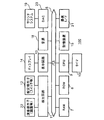
- FIG. 1 is a block diagram illustrating an example of a hardware configuration of an accompaniment data generation device 100 according to an embodiment of the present invention.
- a RAM 7, ROM 8, CPU 9, detection circuit 11, display circuit 13, storage device 15, sound source 18 and communication interface (I / F) 21 are connected to the bus 6 of the accompaniment data generation device 100.
- the RAM 7 has a buffer area such as a reproduction buffer and a working area for the CPU 9, and stores flags, registers, various parameters, and the like. For example, automatic accompaniment data described later is loaded into a predetermined area in the RAM 7.
- the ROM 8 can store various data files (for example, automatic accompaniment data AA to be described later), various parameters and a control program, a program for realizing the present embodiment, and the like. In this case, it is not necessary to store programs or the like in the storage device 15 in an overlapping manner.
- the CPU 9 performs calculation or device control according to a control program stored in the ROM 8 or the storage device 15 or a program for realizing the present embodiment.
- a timer 10 is connected to the CPU 9, and a basic clock signal, interrupt processing timing, and the like are supplied to the CPU 9.
- the user can perform various inputs, settings, and selections using the setting operator 12 connected to the detection circuit 11.
- the setting operator 12 may be any switch, pad, fader, slider, rotary encoder, joystick, jog shuttle, character input keyboard, mouse, or the like that can output a signal in accordance with the user input.
- the setting operator 12 may be a soft switch or the like displayed on the display device 14 that is operated using another operator such as a cursor switch.
- the user operates the setting operator 12 to record the automatic accompaniment data AA recorded in the storage device 15 or the ROM 8 or acquired (downloaded) from an external device via the communication I / F 21. Performs selection, automatic accompaniment start and stop instructions, and other setting operations.
- the display circuit 13 is connected to the display 14 and can display various information on the display 14.
- the display 14 can display various information for setting the accompaniment data generating apparatus 100.
- the storage device 15 is a combination of a storage medium such as a hard disk, an FD (flexible disk or floppy disk (registered trademark)), a CD (compact disk), a DVD (digital multipurpose disk), or a semiconductor memory such as a flash memory, and a driving device thereof. It is composed of at least one.
- the storage medium may be detachable or built in.
- the storage device 15 and / or the ROM 8 preferably include a plurality of automatic accompaniment data AA and separation pattern data DP including separation waveform data DW associated with the automatic accompaniment data AA, in order to realize each embodiment of the present invention. And other control programs can be stored.
- the sound source 18 is, for example, a waveform memory sound source, and is a hardware or software sound source capable of generating a musical tone signal from at least waveform data (phrase waveform data), and automatic accompaniment data recorded in the storage device 15, the ROM 8, the RAM 7, or the like.
- a musical tone signal is generated in accordance with performance signals, MIDI signals, phrase waveform data, etc. supplied from automatic performance data or performance operators (keyboards) 22 or external devices connected to the communication interface 21, and various musical effects. Is supplied to the sound system 19 via the DAC 20.
- the DAC 20 converts the supplied digital musical tone signal into an analog format, and the sound system 19 includes an amplifier and a speaker, and generates a DA converted musical tone signal.
- the communication interface 21 is a general-purpose short-distance wired I / F such as USB or IEEE 1394, a general-purpose network I / F such as Ethernet (registered trademark), a general-purpose I / F such as MIDI I / F, a wireless LAN, or Bluetooth. It is composed of at least one of a communication interface such as a general-purpose short-range wireless I / F such as (registered trademark) and a music dedicated wireless communication interface, and can communicate with an external device, a server, and the like.
- a general-purpose short-range wireless I / F such as (registered trademark) and a music dedicated wireless communication interface
- a performance operator (keyboard or the like) 22 is connected to the detection circuit 11 and supplies performance information (performance data) according to the performance operation of the user.
- the performance operator 22 is an operator for inputting a user's performance, and has a pitch corresponding to the operator operated by the user, and a key-on and key-off signal indicating an operation start timing and an end timing for the user's operator, respectively. Enter as.
- various parameters such as velocity values can be input in accordance with a user's performance operation.
- the performance information input by the performance operator (keyboard or the like) 22 includes chord information or information for generating chord information, which will be described later.
- an external device connected to the setting operator 12 or the communication interface 21 can be used for inputting chord information.
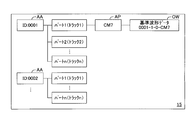
- FIG. 2 is a conceptual diagram showing an example of the configuration of automatic accompaniment data AA according to the embodiment of the present invention.
- the automatic accompaniment data AA includes one or a plurality of accompaniment parts (tracks), and each accompaniment part includes at least one accompaniment pattern data AP.
- Each accompaniment pattern data AP corresponds to one reference pitch (chord root) and chord type, and includes reference waveform data OW based on the reference pitch and chord type.
- automatic accompaniment data AA includes accompaniment style name, time signature information, tempo information (recording (playback) tempo of reference waveform data OW) of the automatic accompaniment data, and each accompaniment part.
- the setting information of the entire automatic accompaniment data including information and the like is included.
- each section includes the section name (intro, main, ending, etc.) and the number of bars (for example, one bar, four bars, eight bars, etc.).
- the automatic accompaniment data AA includes, for example, an automatic accompaniment of at least one accompaniment part (track) when the user plays a melody line using the performance operator 22 of FIG. Data to do.
- the automatic accompaniment data AA corresponds to music genres such as jazz, rock and classic, and a plurality of types are prepared for each genre, and are identified by an identification number (ID number), an accompaniment style name, or the like.
- ID number an identification number
- a plurality of automatic accompaniment data AA is stored in, for example, the storage device 15 or the ROM 8 of FIG. 1, and each automatic accompaniment data AA is assigned an ID number (“0001”, "0002" etc.).
- Each automatic accompaniment data AA is usually prepared for each accompaniment style such as a plurality of rhythm types, music genres, and tempos.
- Each automatic accompaniment data AA is provided with a plurality of sections according to the music scene such as intro, main, fill-in, and ending.
- Each section is composed of a plurality of tracks such as a chord track, a bass track, and a drum (rhythm) track.
- the automatic accompaniment data AA is composed of any one section, and the section includes a plurality of accompaniment parts (accompaniment part 1 (track 1) including at least chord accompaniment. ) To accompaniment part n (track n)).
- the accompaniment pattern data AP corresponds to a predetermined chord type at a predetermined reference pitch (chord root) and includes at least one reference waveform data OW including a constituent sound of the chord type.
- the accompaniment pattern data AP includes, as attribute information, reference chord information (reference pitch (chord route) information and reference chord type information), recording of the accompaniment pattern data AP. It holds the tempo (can be omitted if it is defined collectively in the automatic accompaniment data AA), length (time or number of bars, etc.), identifier (ID), name, number of reference waveform data OW included, and the like.
- the separated waveform data DW described later is included, the fact and the attributes (information such as constituent sounds included in the data) and the number of the separated waveform data are also stored.
- the reference waveform data OW is phrase waveform data in which musical tones corresponding to the performance of an accompaniment phrase based on the chord type and chord root (root tone) supported by the associated accompaniment pattern data AP are recorded. ⁇ The length of multiple bars.
- the reference waveform data OW based on CM7 is digitally sampled and stored by a performance (including accompaniments other than chord accompaniment) that mainly uses pitches C, E, G, and B that are CM7 chord constituent sounds. Waveform data.
- the reference waveform data OW may include pitches (non-harmonic sounds) other than the constituent sounds of a reference chord (a chord specified by a combination of chord type and chord root). In the present embodiment, as shown in FIG.
- accompaniment pattern data AP can be prepared for all chord roots (12 sounds).
- different code types may be associated with each code route. For example, “M7” may be associated with the code route “C”, and “m7” may be associated with the code route “D”.
- accompaniment pattern data AP corresponding to some chord routes (2 to 11) may be prepared instead of all chord routes.
- Each base waveform data OW is provided with an identifier that can identify the reference waveform data OW.
- each reference is in the format of “ID of automatic accompaniment data AA (style number) ⁇ accompaniment part (track) number ⁇ number indicating chord root (chord route information) ⁇ chord type name (chord type information)”.
- ID of automatic accompaniment data AA style number
- AA style number
- AA envelope number
- AA envelope number
- number ⁇ accompaniment part (track) number ⁇ number indicating chord root (chord route information)
- chord type name chord type information
- the reference waveform data OW may be stored in the automatic accompaniment data AA or stored separately from the automatic accompaniment data AA, and only the link information to the reference waveform data OW is stored in the automatic accompaniment data AA. May be stored.
- reference waveform data OW including four sounds is prepared as the reference waveform data OW, but instead of or in addition to this, only three sounds are included, You may make it prepare the thing containing 5 sounds or 6 sounds.
- chord route information and chord type information may be detected by analyzing accompaniment pattern data in addition to storing them in advance as attribute information.
- FIG. 4 is a conceptual diagram for explaining the separated waveform data according to the embodiment of the present invention.
- the predetermined constituent sound and its harmonic component are separated from the reference waveform data OW, and the separated waveform data DW corresponding to the predetermined constituent sound is generated.
- the separated waveform data DW is separated from the reference waveform data OW by separation processing.
- the separation process is, for example, as described in the section of [Embodiment of the invention] in Japanese Patent Application Laid-Open No. 2004-21027 (see particularly paragraphs [0014] to [0016] and [0025] to [0027]).
- Japanese Patent Application Laid-Open No. 2004-21027 See particularly paragraphs [0014] to [0016] and [0025] to [0027]).
- the contents described in Japanese Patent Application Laid-Open No. 2004-21027 are incorporated in the present specification.
- a musical sound waveform signal based on the reference waveform data OW is subjected to spectrum analysis for each predetermined time frame, and a line spectral component corresponding to the fundamental frequency and the harmonic frequency included in the musical sound waveform is extracted.
- a trajectory is tracked and extracted based on the peak data included in the extracted line spectrum component, and a pitch trajectory (trajectory), an amplitude trajectory (trajectory), and a phase trajectory (trajectory) for each frequency component are generated. That is, a time-series continuation of the same frequency component is detected and extracted as a trajectory. Further, a sine wave signal having a frequency corresponding to the frequency component is generated from the generated pitch trajectory and amplitude trajectory of each frequency component, and the sine wave signal of each frequency component thus generated is added and synthesized.
- a waveform (Deterministic Wave) is generated, and a residual waveform is obtained by subtracting the deterministic waveform from the original musical sound waveform, and each trajectory and residual waveform for each frequency component is obtained.
- Use analytical data Subsequently, analysis data (trajectory data) of a plurality of frequency components (ie, fundamental tone and each harmonic) having a harmonic relationship with a specific target pitch from the analysis data for each frequency component obtained by the musical tone analysis process. ) Is generated, the separated waveform data DW corresponding to a predetermined constituent sound is generated.
- the separation of the separated waveform data DW from the reference waveform data OW is not limited to the above method, and any method can be used as long as a specific chord constituent sound and its harmonic component can be separated from the reference waveform data OW. May be.
- the reference waveform data OW is generated in accordance with a five-stage separation pattern, and separated waveform data DW corresponding to a predetermined constituent sound is generated and stored for later use.
- the separation pattern at the 0th stage includes only the original reference waveform data OW that does not execute the separation process, and the data at this stage is referred to as separation pattern data DP0.
- the separated waveform data DWb including is generated.
- the generated separation waveform data DWa and separation waveform data DWb are stored as first-stage separation pattern data DP1.
- the chord root and the component sound of 5 degrees (this In the example, separation waveform data DWc including 0 degree, complete 5 degrees) and its harmonic component, and separated waveform data DWd including only the third component sound (3 degrees in this example) and its harmonic component are generated. Is done.
- the generated separated waveform data DWc and separated waveform data DWd, and the separated waveform data DWb corresponding to the seven constituent sounds previously separated are stored as the second-stage separation pattern data DP2.
- the separation waveform data DWa of the first-stage separation pattern data DP1 it is possible to separate the 5th component sound (in this example, the complete 5th) and its overtone component.
- the separated waveform data DWe includes the chord root and the third component sound (in this example, 0 degree, long third) and the separated waveform data DWe including its harmonic component and the fifth component sound (in this example, And the separated waveform data DWf including only the harmonic component thereof is generated.
- the generated separated waveform data DWe and separated waveform data DWf, and the separated waveform data DWb corresponding to the previously separated seven-degree constituent sounds are stored as the third-stage separation pattern data DP3.
- the chord root (0 degree) and its harmonics are separated from the separated waveform data DWc of the separation pattern data DP2 of the second stage by further separating the constituent sounds of 5 degrees (in this example, perfect 5 degrees) and their harmonic components.
- the separated waveform data DWg including the components, and the separated waveform data DWf including only the component sound of 5 degrees (completely 5 degrees in this example) and its overtone component are generated.
- the generated separated waveform data DWg and separated waveform data DWf, the separated waveform data DWb corresponding to the 7th component sound previously separated, and the separated waveform data DWd corresponding to the third component sound are the fourth stage. Is stored as the separation pattern data DP4.
- the fourth stage separation pattern data DP4 can also be generated from the third stage separation pattern data DP3.
- DWd is generated.
- the generated separated waveform data DWg and separated waveform data DWd, as well as the separated waveform data DWb corresponding to the 7th component sound previously separated and the separated waveform data DWf corresponding to the 5th component sound are the fourth stage. Is stored as the separation pattern data DP4.
- the separation pattern data DP0 is difficult to use except for the chord type that is based on the original reference waveform data OW because the chord constituent sounds are not separated.
- a tension sound is further added, it can be used by synthesizing with other phrase waveform data including the tension sound.
- the separation pattern data DP1 is composed of chord root, 3rd and 5th constituent sounds (in this example, 0 degree, 3rd degree, and complete 5 degrees) and separated waveform data DWa including harmonic components thereof, and 7th constituent sounds.
- the separated waveform data DWb including the overtone component thereof, the separated waveform data DWb can be adapted to the code type (6, M7, 7) by synthesizing the separated waveform data DWb as it is or by shifting the pitch to the separated waveform data DWa.
- the separated waveform data DWa can be used alone with reference to the code type (Maj).
- the separation pattern data DP2 is a separation waveform data including a chord root, 5th component sound (in this example, 0 °, complete 5 °) and its harmonic component, and a separation waveform data including 3rd component sound and its harmonic component. Since the separated waveform data DWb including the data DWd and the 7th component sound and its harmonic component are included, the separated waveform data DWd is directly or pitch-shifted and synthesized with the separated waveform data DWc, so that the code type (maj, m, sus4). Further, by further synthesizing the separated waveform data DWb as it is or by shifting the pitch, it is possible to correspond to the code type (6, M7, 7, m6, m7, mM7, 7sus4). The separated waveform data DWc can be used alone as a reference based on the code type (1 + 5).
- the separation pattern data DP3 includes a separation waveform data DWe including a chord root and a third-degree component sound (in this example, 0 degree and third degree) and its harmonic component, and a separation waveform including a fifth-degree component sound and its harmonic component. Since the separated waveform data DWb including the data DWf and the 7th component sound and its harmonic components are included, the separated waveform data DWf is directly or pitch-shifted and synthesized with the separated waveform data DWe, so that the code type (maj, aug, ⁇ 5). Further, it is possible to cope with code types (6, M7, M7 ( ⁇ ⁇ 5), 7 ( ⁇ 5), 7aug, M7auug) by synthesizing the separated waveform data DWb as it is or by shifting the pitch.
- code types (6, M7, M7 ( ⁇ ⁇ 5), 7 ( ⁇ 5), 7aug, M7auug
- each separation waveform data DW is used as it is.
- the code type shown in FIG. 5 can be handled by pitch-shifting and synthesizing with other separated waveform data DW.
- the separated waveform data DW when the separated waveform data DW is simply used in this specification, it indicates any one or the whole of the separated waveform data DWa to DWg. Further, waveform data storing accompaniment phrases such as separated waveform data DW and reference waveform data OW is referred to as phrase waveform data.
- FIG. 5 is a conceptual diagram showing an example of a semitone distance number table by chord type according to the embodiment of the present invention.
- the reference waveform data OW or the separated waveform data DW including the chord root is pitch-shifted according to the chord root of the chord information input by the user's performance operation or the like, and 1 or according to the chord root and the chord type.
- the separated waveform data DW including a plurality of constituent sounds are pitch-shifted and synthesized to generate synthesized waveform data corresponding to the accompaniment phrase based on the chord type and chord root of the input chord information.
- each separated waveform data DW is 3 degrees long ( Semitone distance number 4), complete 5 degrees (semitone distance number 7), long 7 degrees (semitone distance number 11) only, corresponding to other constituent sounds, it is necessary to shift the pitch according to the chord type There is. Therefore, when one or a plurality of separated waveform data DW is pitch-shifted according to the chord root and chord type, the chord type semitone distance number table shown in FIG. 5 is referred to.
- the semitone distance number table by chord type is a table in which the semitone distance numbers from the chord root to the chord root, the third, fifth, and fourth chord constituent sounds are recorded for each chord type.
- the numbers of semitones from the chord root of the chord root, the third and fifth constituent sounds are “0”, “4”, and “7”, respectively.
- the separation waveform data DW of the present embodiment is prepared in correspondence with the long 3 degrees (semitone distance number 4) and the complete 5 degrees (semitone distance number 7), so the pitch shift according to the code type is
- minor seventh (m7) the numbers of semitones from the chord root of the chord root, the third, fifth, and seventh degrees are “0”, “3”, “ 7 ”and“ 10 ”, the pitch (pitch) of the selected waveform data SW corresponding to 3 degrees long (semitone distance number 4) and 7 degrees long (semitone distance number 11) needs to be lowered by one semitone. This can be understood by referring to the semitone distance number table by chord type.
- the semitone distance from the chord root of the constituent sound of 9 degrees, 11 degrees, and 13 degrees is included in the code type semitone distance number table. There is a need.
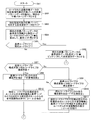
- 6A and 6B are flowcharts showing main processing according to the embodiment of the present invention. This main process is started simultaneously with the power-on of the accompaniment data generation apparatus 100 according to the embodiment of the present invention.
- step SA1 in FIG. 6A main processing is started, and initial setting is performed in step SA2.
- the initial settings here are automatic accompaniment data AA selection, use chord type setting (use only major triads, triad, 7th chord, etc.), chord acquisition method (input by user performance, input by direct specification by user, chord) 1) setting, performance tempo setting, key setting, etc., for example, using the setting operator 12 in FIG.
- step SA3 the reference waveform data OW in the accompaniment pattern data AP of each part included in the automatic accompaniment data AA selected in step SA2 or later-described step SA4 is separated.
- This separation process is performed as described with reference to FIG.
- the degree of separation in this separation process (which one of separation patterns DP0 to DP4 is to be generated) is determined by the default setting or the usage code type set by the user in step SA2. For example, in step SA2, when the user sets to use only the main triad, it is sufficient to generate the separation pattern DP1 of FIG. 4, and when the user sets to use the basic code including the seventh code. It is sufficient to generate the separation pattern DP2 of FIG.
- the separation pattern DP4 of FIG. 4 may be generated.
- the generated separated waveform data DW is stored in the storage device 15, for example, in association with the accompaniment pattern data AP together with the original reference waveform data OW.
- the stored separation waveform data DW may be used. Processing is omitted.
- the separation process may be performed and stored in accordance with the input code information each time code information is input.
- step SA4 it is determined whether or not a setting change operation by the user has been detected.
- the setting change operation here is a setting that needs to initialize the current setting, such as re-selection of automatic accompaniment data AA, and does not include, for example, changing the setting of the performance tempo. If a setting change operation is detected, the process proceeds to step SA5 indicated by a Yes arrow. When the setting change operation is not detected, the process proceeds to Step SA6 indicated by a No arrow.
- step SA5 automatic accompaniment stop processing is performed.
- step SA6 it is determined whether or not an end operation of the main process (power-off of the accompaniment data generation device 100, etc.) has been detected. If an end operation is detected, the process proceeds to step SA24 indicated by a Yes arrow to end the main process. When not detected, it progresses to step SA7 shown by the arrow of No.
- step SA7 it is determined whether or not a performance operation by the user has been detected.
- the detection of the performance operation by the user is performed, for example, by detecting whether or not a performance signal is input by operating the performance operator 22 of FIG. 1 or a performance signal is input via the communication I / F 21. If a performance operation is detected, the process proceeds to step SA8 indicated by a Yes arrow, performs sound generation or mute processing based on the detected performance operation, and then proceeds to step SA9. If the performance operation is not detected, the process proceeds to step SA9 indicated by a No arrow.
- step SA9 it is determined whether or not an automatic accompaniment start instruction has been detected.
- the automatic accompaniment start instruction is performed, for example, when the user operates the setting operator 12 shown in FIG. If an automatic accompaniment start instruction is detected, the process proceeds to step SA10 indicated by a Yes arrow. When the start instruction is not detected, the process proceeds to step SA14 in FIG.
- step SA11 the automatic accompaniment data AA selected in step SA2 or step SA4 is stored in the RAM 7 from, for example, the storage device 15 in FIG. Load into a predetermined area. Thereafter, in step SA12, the immediately preceding code, current code, and synthesized waveform data are cleared, a timer is started in step SA13, and the process proceeds to step SA14 in FIG. 6A.
- step SA14 in FIG. 6B it is determined whether or not a stop instruction for automatic accompaniment has been detected.
- the automatic accompaniment stop instruction is given, for example, by the user operating the setting operator 12 shown in FIG. If an automatic accompaniment stop instruction is detected, the process proceeds to step SA15 indicated by a Yes arrow. When the stop instruction is not detected, the process proceeds to Step SA18 indicated by a No arrow.
- step SA19 it is determined whether or not input of code information is detected (code information is acquired). If the input of code information is detected, the process proceeds to step SA20 indicated by a Yes arrow, and if not detected, the process proceeds to step SA23 indicated by a No arrow.
- step SA19 may be repeated without proceeding to step SA23 until valid chord information is input, and generation of accompaniment data may be waited until valid chord information is input.
- chord information is input by a performance operation using the performance operator 22 shown in FIG.
- Acquisition of chord information from the user's performance is detected from, for example, a key combination of chord keys, which is a partial area of the performance operator 22 such as a keyboard (in this case, no sound corresponding to the key press is performed).
- it may be detected from a key pressing state at a predetermined timing width in the entire key range of the keyboard.
- a known code detection technique can be used.
- the chord information may be input not only using the performance operator 22 but also using the setting operator 12.
- the code information may be input as a combination of information (characters and numbers) indicating the code root (root sound) and information (characters and numbers) indicating the code type.
- chord information stored in advance may be read and acquired at a predetermined tempo, without chord information being input by a user, and chord detection is performed from music data being played back. May be obtained.
- step SA20 the code information set in “current code” is set in “previous code”, and the code information detected (obtained) in step SA19 is set in “current code”.
- step SA21 it is determined whether the code information set in the “current code” and the code information set in the “preceding code” are the same. If they are the same, the process proceeds to step SA23 indicated by a Yes arrow, and if not, the process proceeds to step SA22 indicated by a No arrow. Note that the process also proceeds to step SA22 when detecting the initial code information.
- step SA22 for each accompaniment part (track) included in the automatic accompaniment data AA loaded in step SA11, the chord type of chord information (hereinafter referred to as the current chord type) and chord set in “current chord” Synthetic waveform data that conforms to the root (hereinafter referred to as the current code root) is generated and referred to as “current synthetic waveform data”.
- the synthetic waveform data generation process will be described later with reference to FIGS. 7A and 7B.
- step SA23 for each accompaniment part (track) included in the automatic accompaniment data AA loaded in step SA11, data at a position suitable for the timer is set from the “current synthesized waveform data” set in step SA22. It is read according to the performance tempo, and accompaniment data is generated and output based on the read data. Thereafter, the process returns to step SA4 in FIG. 6A and the subsequent processing is repeated.
- the automatic accompaniment data AA is selected by the user before starting the automatic accompaniment in step SA2 or during automatic accompaniment in step SA4. However, the previously stored chord sequence data or the like is reproduced. For example, the designation information of the automatic accompaniment data AA may be included in the chord sequence data or the like, and it may be read and automatically selected. Further, the automatic accompaniment data AA may be selected in advance as a default.
- the instruction to start and stop the reproduction of the selected automatic accompaniment data AA is performed by detecting the user's operation in step SA9 and step SA14, but the start and end of the performance using the performance operator 22 is detected by the user. Then, playback of the selected automatic accompaniment data AA may be automatically started and stopped.
- step SA14 when an automatic accompaniment stop instruction is detected in step SA14, the automatic accompaniment may be stopped immediately, but automatically until the end of the phrase waveform data PW being reproduced or a break (where the sound is cut off). You may make it stop after continuing an accompaniment.
- step SA22 of FIG. 6B are flowcharts showing the synthetic waveform data generation process executed in step SA22 of FIG. 6B.
- this process is repeated for the number of accompaniment parts.
- step SA3 in FIG. 6A description will be made assuming that the separation pattern data DP4 in FIG. 4 has been generated.
- step SB1 in FIG. 7A the composite waveform data generation process is started.
- step SB2 the accompaniment associated with the accompaniment part that is the current processing target of the automatic accompaniment data AA loaded in step SA11 in FIG.
- the pattern data AP is extracted and set as “current accompaniment pattern data”.
- step SB3 the composite waveform data corresponding to the accompaniment part currently being processed is cleared.
- step SB4 the difference between the reference pitch information (chord route information) of the accompaniment pattern data AP set in the “current accompaniment pattern data” and the chord route of the chord information set in the “current chord” (
- the pitch shift amount is calculated from the number of semitone distances to obtain a “basic shift amount”.
- the “basic shift amount” may be negative.
- the chord root of the accompaniment pattern data AP is “C”. For example, when the input chord information is “Dm7”, the chord root of the chord information is “D”, so "Becomes" 2 (number of semitone distances) ".
- step SB17 where the synthesized waveform data generation process is terminated, and the process proceeds to step SA23 in FIG. If they are not the same, a separate pitch shift is performed for each component sound, so the process proceeds to step SB7 indicated by an arrow No.
- step SB7 it is determined whether or not the number of constituent sounds of the reference chord type is greater than the number of constituent sounds of the current chord type (the number of constituent sounds of the reference chord type> the number of constituent sounds of the current chord type). If the number of constituent sounds of the reference chord type is greater than the number of constituent sounds of the current chord type, the process proceeds to step SB8 indicated by a Yes arrow to extract constituent sounds that exist only in the reference chord type but not in the current chord type. Proceed to Step SB12 as “unnecessary component sound”. When the number of constituent sounds of the reference chord type is equal to or less than the number of constituent sounds of the current chord type, the process proceeds to step SB9 indicated by a No arrow. For example, when the current chord type is Dm, the reference chord type in the present embodiment is CM7, and therefore, the seven constituent sounds are constituent sounds that exist only in the reference chord type and are set as “unnecessary constituent sounds”. Is done.
- step SB9 it is determined whether or not the number of constituent sounds of the reference chord type is less than the number of constituent sounds of the current chord type (the number of constituent sounds of the reference chord type ⁇ the number of constituent sounds of the current chord type). If the number of constituent sounds of the reference chord type is less than the number of constituent sounds of the current chord type, the process proceeds to step SB10 indicated by the Yes arrow, and if the same, the process proceeds to step SB12 indicated by the No arrow.
- step SB10 a constituent sound that exists only in the current chord type and does not exist in the reference chord type is extracted and set as “insufficient constituent sound”.
- the reference chord type in this embodiment is CM7, and therefore, the nine-degree constituent sound is a constituent sound that exists only in the current chord type, "Is set.
- step SB11 the difference ( ⁇ 2 to +2) between the number of semitone distances from the chord root of each constituent sound other than the short constituent sound of the current chord type and the number of semitone distances from the chord root of the corresponding constituent sound of the reference chord type Are extracted with reference to the semitone distance number table shown in FIG. 5 and the process proceeds to Step SB13 in FIG. 7B.
- the case where the constituent sounds of the current chord type and the reference chord type correspond is the case where the frequency with respect to the chord root is the same. Treat as sound.
- the sixth chord (six chord) is treated as the fourth component. This correspondence is preferably set in advance, but may be settable by the user.
- the reference chord type in this embodiment is CM7, so the difference is calculated for each constituent sound other than the nine-degree constituent sound that is the “insufficient constituent sound”.
- the numbers of semitone distances of constituent sounds other than the “insufficient constituent sound” of the current chord type Dm7 (9) are the routes “0”, “3”, “3”, and “5”, respectively, according to the semitone distance number table shown in FIG. It can be seen that the degree is “7” and the fourth voice is “10”.
- the reference chord type CM 7 has a route of “0”, 3 degrees “4”, 5 degrees “7”, and 4th voice “11”, respectively, based on the semitone distance number table shown in FIG. Recognize. Therefore, when the difference is obtained for each constituent sound, the route becomes “0”, 3 ° “ ⁇ 1”, 5 ° “0”, 4th voice “ ⁇ 1”.
- step SB12 the difference ( ⁇ 2 to +2) between the number of semitones from the chord root of each constituent sound of the current chord type and the number of semitones from the chord root of the corresponding constituent sound of the reference chord type is shown in FIG. Extraction is made with reference to the chord type semitone distance number table shown, and the process proceeds to step SB13. Since the difference is extracted only for each constituent sound of the reference chord type corresponding to each constituent sound of the current chord type, “unnecessary constituent sounds” are ignored. For example, when the current chord type is Dm, the reference chord type in the present embodiment is CM7, so the difference is calculated for each constituent sound other than the seven-degree constituent sound that is an “unnecessary constituent sound”.
- the numbers of semitone distances of the current chord type Dm are routes “0”, 3 ° “3”, and 5 ° “7”, respectively.
- the reference code type CM7 has the routes “0”, “3” “4”, and “5” “7”, respectively. Therefore, when the difference is obtained for each constituent sound, the route becomes “0”, “3” “ ⁇ 1”, and “5” “0”.
- step SB13 in FIG. 7B the shift amount of each constituent sound of the reference chord type is calculated based on the difference extracted in step SB11 or step SB12.
- the shift amount of each constituent sound is obtained by adding the basic shift amount to the difference extracted in step SB11 or step SB12.
- step SB14 when the separation waveform data DW includes phrase waveform data including a plurality of chord constituent sounds (including unnecessary constituent sounds) in the separation pattern data DP associated with the current accompaniment pattern data AP.
- the phrase waveform data including both the chord constituent sound whose difference is “0” and the chord constituent sound whose difference is not “0” (including unnecessary constituent sounds) excluding the missing constituent sound is separated waveform data.
- the difference is the difference between the number of semitones from the chord root of each constituent sound of the current chord type and the number of semitones from the chord root of the corresponding constituent sound of the reference chord type.
- the separated waveform data DW includes chord constituent sounds (excluding insufficient constituent sounds) defined by the chord type of the current chord and includes chord constituent sounds not defined by the chord type. Is included in the separation pattern data DP. If the separation waveform data DW including a plurality of chord constituent sounds does not exist in the separation pattern data DP, the separation pattern data DP including the corresponding separation waveform data DW does not exist in the current accompaniment pattern data AP. It is judged. If the separation pattern data DP including the corresponding separation waveform data DW does not exist in the current accompaniment pattern data AP, the process proceeds to Step SB16 indicated by a No arrow, and if present, the process proceeds to Step SB15 indicated by a Yes arrow.
- step SB16 Even if the separated waveform data DW is not included, if the shift amounts of the constituent sounds included in the same separated waveform data DW are the same, there is no problem in the pitch shift processing in step SB16, which will be described later. The process proceeds to step SB16 indicated by the arrow.
- each constituent sound chord root of the current chord type 3 degrees, 5 degrees, Nine degrees out of 7 and 9 are ignored because they are insufficiently composed sounds. Since the separation pattern data DP4 is separated into separation waveform data DWg, DWd, DWf, and DWb corresponding to the code root, 3 degrees, 5 degrees, and 7 degrees, the process proceeds to step SB16 indicated by an arrow No.
- step SA3 of FIG. 6 when the separation code data DP3 of FIG. 4 is prepared in step SA3 of FIG. 6, if the current chord type is Dm7 (9), each constituent sound chord root of the current chord type, 3 degrees, 5 degrees, Nine degrees out of 7 and 9 are ignored because they are insufficiently composed sounds.
- the separation waveform data DWf and DWb corresponding to 5 degrees and 7 degrees are separated, but the code route of the separation waveform data DWe and the shift amount of 3 degrees out of 3 degrees are different. That is, since the separated waveform data DWe includes a chord component sound whose difference is not “0”, the process proceeds to step SB15 indicated by a Yes arrow.
- the separation pattern data DP2 of FIG. 4 is prepared in step SA3 of FIG. 6, if the current chord type is Dm7 (9), each constituent sound chord root of the current chord type, 3 degrees, 5 degrees, Nine degrees out of 7 and 9 are ignored because they are insufficiently composed sounds.
- the separation waveform data DWd and DWb corresponding to 3 degrees and 7 degrees are separated, and the code route and the 5 degree shift amount of the separation waveform data DWc are the same, that is, the separation waveform. Since the data DWc does not include a code configuration whose difference is not “0”, the process proceeds to Step SB16 indicated by a No arrow.
- each component sound whose current chord type difference is not “0” is selected from the separated waveform data DW (or reference waveform data OW) in the separated pattern data DP associated with the current accompaniment pattern data AP.
- the corresponding constituent sounds (other than the insufficient constituent sounds) and the unnecessary constituent sounds those that have not yet been separated from the separated waveform data DW are separated to generate separated waveform data DW corresponding to the constituent sounds, and new separation is performed.
- Generate pattern data In other words, when the separated waveform data DW (or the reference waveform data OW) includes a chord constituting sound that is not defined by the code type of the current chord, the code type of the current chord from the separated waveform data DW (or the reference waveform data OW).
- phrase waveform data including chord constituent sounds (other than insufficient constituent sounds) defined by the above and phrase waveform data including chord constituent sounds and unnecessary constituent sounds not defined by the chord type and new separated waveform data is obtained.
- the separation pattern data DP3 having the reference code CM7 is prepared and Dm7 is input
- the separation waveform data DWe of the separation pattern data DP3 is separated
- the separation waveform data DWg and the separation waveform data are separated.
- DWd is generated, and new separation pattern data DP4 is generated. Thereafter, the process proceeds to Step SB16.
- step SB16 the entire separated waveform data DW other than unnecessary constituent sounds in the separation pattern data DP detected in step SB15 or generated in step SB16 is pitch-shifted by the corresponding constituent sound shift amount.
- the separated waveform data DW is synthesized into synthesized waveform data. Thereafter, the process proceeds to step SB17, where the combined waveform data generation process is terminated, and the process proceeds to step SA23 in FIG.
- waveform data OW including the chord root or the separated waveform data DW whose difference is “0” is pitch-shifted by the “basic shift amount” and separated including one chord component sound whose difference is not “0”.
- Waveform data DW is accompaniment data based on the desired chord root and chord type by performing pitch shift by the number of semitone distances obtained by adding (subtracting) a value corresponding to the chord type to “basic shift amount” and synthesizing. Can be obtained.
- the component sound set as “insufficient component sound” in the current chord type is ignored because the separated waveform data DW cannot be prepared, but the data corresponding to the component sound determined as the component component insufficient. May be prepared as automatic performance data such as MIDI data.
- the phrase waveform data may be prepared in advance and synthesized after the pitch shift.
- a code type that is a substitute for the current code type and that can be handled by the prepared separation pattern data DP is set as the current code type. Good.
- step SB15 instead of newly generating separated waveform data DW including the necessary constituent sounds, an accompaniment phrase corresponding to the separated waveform data DW including the necessary constituent sounds is prepared as automatic performance data such as MIDI data. You may make it do. Further, a code type that is a substitute for the current code type and that can be handled by the prepared separation pattern data DP may be set as the current code type.
- step SB4 when preparing reference waveform data OW for all chord roots (12 sounds), the basic shift amount calculation process in step SB4 is omitted, and the basic shift amount is added in step SB13. Do not.
- the reference waveform data OW corresponding to the chord root having the smallest pitch difference from the chord information (chord root) set in the “current chord” is read, and the pitch difference is “basic”.
- the shift amount may be set.
- the reference waveform data WO corresponding to the chord root having the smallest pitch difference from the chord information (chord root) set in the “current chord” is selected by the processing of step SA3 or step SB2.
- the separation pattern data DP1 to DP4 may be processed.
- the separated waveform data DW from CM7 may be used by shifting the pitch for the major code
- the separated waveform data DW from Dm7 may be used by shifting the pitch for the minor code.
- the reference waveform data OW including a plurality of chord-constituting sounds is prepared in association with the accompaniment pattern data AP, based on a predetermined chord root and chord type chord.
- the separated waveform data DW including the reference waveform data OW or the plurality of component sounds is separated to generate the separated waveform data DW including the component sounds having a difference value other than “0”, and after appropriately shifting them.
- the phrase waveform data including a constituent sound whose difference value is other than “0” is separated from the reference waveform data OW or the separated waveform data DW including a plurality of sounds, and then synthesized after the pitch shift. Therefore, even if a code of a code type different from the code type based on the reference waveform data OW is input, it is possible to cope with it. In addition, it is possible to follow changes in the chord type accompanying chord changes.
- the reference waveform data OW is prepared for all chord root sounds, it is only necessary to perform a pitch shift on only a part of the constituent sounds, so that deterioration in sound quality due to the pitch shift can be minimized.
- the separation waveform data DW and the reference appropriate for the input code can be used without performing separation processing.
- the waveform data OW can be read and synthesized.
- accompaniment patterns are prepared as phrase waveform data, automatic accompaniment with high sound quality becomes possible. It is also possible to automatically perform accompaniment using a special instrument or a special scale that is difficult to pronounce with a MIDI sound source.
- step SB13 the difference extracted by the process in step SB11 or step SB12 and the “basic shift amount” calculated in step SB4 are added to calculate the shift amount of each constituent sound, and step SB16.
- the entire separated waveform data is pitch-shifted by the shift amount of the corresponding constituent sound.
- the combined waveform data may be finally pitch-shifted by the “basic shift amount” as follows. That is, in step SB13, without adding the “basic shift amount”, only the difference extracted by the processing in step SB11 or step SB12 is set as the shift amount of each constituent sound, and in step SB16, all the separated waveform data is set. The pitch is shifted by the shift amount set in step SB13, the pitch-shifted all separated waveform data is synthesized, and the synthesized waveform data is pitch-shifted by the “basic shift amount”.
- the separation patterns DP1 to DP4 including the separation waveform data DW are generated from the reference waveform data OW.
- at least one of the separation pattern data DP1 to DP4 including the separation waveform data DW is stored in advance. You may make it leave. Further, at least one of the separation pattern data DP0 to DP4 may be acquired from an external device as necessary.
- the recording tempo of the reference waveform data OW is stored as attribute information of the automatic accompaniment data AA, but may be stored here for each reference waveform data OW.
- the reference waveform data OW is prepared for only one recording tempo, but the reference waveform data OW may be prepared for a plurality of types of tempos.
- the embodiment of the present invention is not limited to the form of the electronic musical instrument, and may be implemented by a commercially available computer or the like in which a computer program or the like corresponding to the embodiment is installed.
- the computer program or the like corresponding to each embodiment may be provided to the user while being stored in a storage medium that can be read by a computer such as a CD-ROM.
- a computer such as a CD-ROM.
- a communication network such as a LAN, the Internet, or a telephone line
- a computer program, various data, and the like may be provided to the user via the communication network.
Landscapes
- Engineering & Computer Science (AREA)
- Physics & Mathematics (AREA)
- Acoustics & Sound (AREA)
- Multimedia (AREA)
- General Engineering & Computer Science (AREA)
- Electrophonic Musical Instruments (AREA)
- Auxiliary Devices For Music (AREA)
Abstract
Un dispositif de génération de données d'accompagnement est pourvu d'une unité de mémorisation (15) pour mémoriser des données de forme d'onde d'expression comprenant une pluralité de notes constituant un accord, et d'une unité centrale (9). L'unité centrale (9) exécute un traitement pour séparer les données de forme d'onde d'expression comprenant la pluralité de notes constituant un accord en une pluralité d'éléments de données de forme d'onde d'expression comprenant respectivement différentes notes constituant un accord, un traitement d'acquisition pour acquérir des informations de code qui spécifient un type d'accord et une base d'accord, et un traitement de génération d'expression sonore d'accord pour décaler la tonie de certains éléments de données de forme d'onde de la pluralité séparée d'éléments de données de forme d'onde d'expression en fonction des types de code de ceux-ci et synthétiser la pluralité séparée d'éléments de données de forme d'onde d'expression comprenant les données de forme d'onde d'expression à tonie décalée pour générer, en tant que données d'accompagnement, des données de forme d'onde concernant une expression sonore d'accord.
Priority Applications (3)
| Application Number | Priority Date | Filing Date | Title |
|---|---|---|---|
| EP12764236.1A EP2690619B1 (fr) | 2011-03-25 | 2012-03-14 | Dispositif de génération de données d'accompagnement |
| CN201280015148.1A CN103443848B (zh) | 2011-03-25 | 2012-03-14 | 伴奏数据产生设备 |
| US13/982,479 US8946534B2 (en) | 2011-03-25 | 2012-03-14 | Accompaniment data generating apparatus |
Applications Claiming Priority (2)
| Application Number | Priority Date | Filing Date | Title |
|---|---|---|---|
| JP2011-067938 | 2011-03-25 | ||
| JP2011067938A JP5598398B2 (ja) | 2011-03-25 | 2011-03-25 | 伴奏データ生成装置及びプログラム |
Publications (1)
| Publication Number | Publication Date |
|---|---|
| WO2012132901A1 true WO2012132901A1 (fr) | 2012-10-04 |
Family
ID=46930639
Family Applications (1)
| Application Number | Title | Priority Date | Filing Date |
|---|---|---|---|
| PCT/JP2012/056551 Ceased WO2012132901A1 (fr) | 2011-03-25 | 2012-03-14 | Dispositif de génération de données d'accompagnement |
Country Status (5)
| Country | Link |
|---|---|
| US (1) | US8946534B2 (fr) |
| EP (1) | EP2690619B1 (fr) |
| JP (1) | JP5598398B2 (fr) |
| CN (1) | CN103443848B (fr) |
| WO (1) | WO2012132901A1 (fr) |
Families Citing this family (12)
| Publication number | Priority date | Publication date | Assignee | Title |
|---|---|---|---|---|
| JP5598398B2 (ja) * | 2011-03-25 | 2014-10-01 | ヤマハ株式会社 | 伴奏データ生成装置及びプログラム |
| EP3206202B1 (fr) | 2011-03-25 | 2018-12-12 | Yamaha Corporation | Appareil et procédé de génération de données d'accompagnement |
| JP5891656B2 (ja) * | 2011-08-31 | 2016-03-23 | ヤマハ株式会社 | 伴奏データ生成装置及びプログラム |
| WO2013149188A1 (fr) | 2012-03-29 | 2013-10-03 | Smule, Inc. | Conversion automatique de contenu vocal en chanson, rap ou autre expression audible à mesure ou rythme cible |
| US9459768B2 (en) | 2012-12-12 | 2016-10-04 | Smule, Inc. | Audiovisual capture and sharing framework with coordinated user-selectable audio and video effects filters |
| JP6040809B2 (ja) * | 2013-03-14 | 2016-12-07 | カシオ計算機株式会社 | コード選択装置、自動伴奏装置、自動伴奏方法および自動伴奏プログラム |
| US9384716B2 (en) * | 2014-02-07 | 2016-07-05 | Casio Computer Co., Ltd. | Automatic key adjusting apparatus and method, and a recording medium |
| JP6645085B2 (ja) | 2015-09-18 | 2020-02-12 | ヤマハ株式会社 | 自動アレンジ装置及びプログラム |
| JP6565528B2 (ja) | 2015-09-18 | 2019-08-28 | ヤマハ株式会社 | 自動アレンジ装置及びプログラム |
| JP6583320B2 (ja) * | 2017-03-17 | 2019-10-02 | ヤマハ株式会社 | 自動伴奏装置、自動伴奏プログラムおよび伴奏データ生成方法 |
| JP6733720B2 (ja) * | 2018-10-23 | 2020-08-05 | ヤマハ株式会社 | 演奏装置、演奏プログラム、及び演奏パターンデータ生成方法 |
| JP7475993B2 (ja) * | 2020-06-30 | 2024-04-30 | ローランド株式会社 | 自動編曲プログラム及び自動編曲装置 |
Citations (6)
| Publication number | Priority date | Publication date | Assignee | Title |
|---|---|---|---|---|
| JPS6059392A (ja) * | 1983-09-12 | 1985-04-05 | ヤマハ株式会社 | 自動伴奏装置 |
| JP2900753B2 (ja) | 1993-06-08 | 1999-06-02 | ヤマハ株式会社 | 自動伴奏装置 |
| JP2004021027A (ja) | 2002-06-18 | 2004-01-22 | Yamaha Corp | 演奏音制御方法及び装置 |
| JP2006126697A (ja) * | 2004-11-01 | 2006-05-18 | Roland Corp | 自動伴奏装置 |
| JP4274272B2 (ja) | 2007-08-11 | 2009-06-03 | ヤマハ株式会社 | アルペジオ演奏装置 |
| JP2009156914A (ja) * | 2007-12-25 | 2009-07-16 | Yamaha Corp | 自動伴奏装置及びプログラム |
Family Cites Families (23)
| Publication number | Priority date | Publication date | Assignee | Title |
|---|---|---|---|---|
| US4508002A (en) * | 1979-01-15 | 1985-04-02 | Norlin Industries | Method and apparatus for improved automatic harmonization |
| US4876937A (en) | 1983-09-12 | 1989-10-31 | Yamaha Corporation | Apparatus for producing rhythmically aligned tones from stored wave data |
| US4941387A (en) * | 1988-01-19 | 1990-07-17 | Gulbransen, Incorporated | Method and apparatus for intelligent chord accompaniment |
| US4922797A (en) * | 1988-12-12 | 1990-05-08 | Chapman Emmett H | Layered voice musical self-accompaniment system |
| JP2562370B2 (ja) * | 1989-12-21 | 1996-12-11 | 株式会社河合楽器製作所 | 自動伴奏装置 |
| US5179241A (en) * | 1990-04-09 | 1993-01-12 | Casio Computer Co., Ltd. | Apparatus for determining tonality for chord progression |
| JP2590293B2 (ja) * | 1990-05-26 | 1997-03-12 | 株式会社河合楽器製作所 | 伴奏内容検出装置 |
| US5138926A (en) * | 1990-09-17 | 1992-08-18 | Roland Corporation | Level control system for automatic accompaniment playback |
| JP2586740B2 (ja) * | 1990-12-28 | 1997-03-05 | ヤマハ株式会社 | 電子楽器 |
| JP2705334B2 (ja) * | 1991-03-01 | 1998-01-28 | ヤマハ株式会社 | 自動伴奏装置 |
| JP2956867B2 (ja) * | 1992-08-31 | 1999-10-04 | ヤマハ株式会社 | 自動伴奏装置 |
| JP2658767B2 (ja) * | 1992-10-13 | 1997-09-30 | ヤマハ株式会社 | 自動伴奏装置 |
| US5518408A (en) * | 1993-04-06 | 1996-05-21 | Yamaha Corporation | Karaoke apparatus sounding instrumental accompaniment and back chorus |
| US5563361A (en) | 1993-05-31 | 1996-10-08 | Yamaha Corporation | Automatic accompaniment apparatus |
| US5477003A (en) * | 1993-06-17 | 1995-12-19 | Matsushita Electric Industrial Co., Ltd. | Karaoke sound processor for automatically adjusting the pitch of the accompaniment signal |
| US5693903A (en) * | 1996-04-04 | 1997-12-02 | Coda Music Technology, Inc. | Apparatus and method for analyzing vocal audio data to provide accompaniment to a vocalist |
| JP2004000122A (ja) * | 2002-03-22 | 2004-01-08 | Kao Corp | アルカリプロテアーゼ |
| US7705231B2 (en) * | 2007-09-07 | 2010-04-27 | Microsoft Corporation | Automatic accompaniment for vocal melodies |
| JP2009156014A (ja) * | 2007-12-27 | 2009-07-16 | Fuji House Kk | ビスの突き合わせによる木材のめり込み防止構造 |
| US8779268B2 (en) * | 2009-06-01 | 2014-07-15 | Music Mastermind, Inc. | System and method for producing a more harmonious musical accompaniment |
| CA2996784A1 (fr) * | 2009-06-01 | 2010-12-09 | Music Mastermind, Inc. | Systeme et procede de reception, d'analyse et d'emission de contenu audio pour creer des compositions musicales |
| EP3206202B1 (fr) * | 2011-03-25 | 2018-12-12 | Yamaha Corporation | Appareil et procédé de génération de données d'accompagnement |
| JP5598398B2 (ja) * | 2011-03-25 | 2014-10-01 | ヤマハ株式会社 | 伴奏データ生成装置及びプログラム |
-
2011
- 2011-03-25 JP JP2011067938A patent/JP5598398B2/ja not_active Expired - Fee Related
-
2012
- 2012-03-14 US US13/982,479 patent/US8946534B2/en active Active
- 2012-03-14 WO PCT/JP2012/056551 patent/WO2012132901A1/fr not_active Ceased
- 2012-03-14 EP EP12764236.1A patent/EP2690619B1/fr not_active Not-in-force
- 2012-03-14 CN CN201280015148.1A patent/CN103443848B/zh not_active Expired - Fee Related
Patent Citations (6)
| Publication number | Priority date | Publication date | Assignee | Title |
|---|---|---|---|---|
| JPS6059392A (ja) * | 1983-09-12 | 1985-04-05 | ヤマハ株式会社 | 自動伴奏装置 |
| JP2900753B2 (ja) | 1993-06-08 | 1999-06-02 | ヤマハ株式会社 | 自動伴奏装置 |
| JP2004021027A (ja) | 2002-06-18 | 2004-01-22 | Yamaha Corp | 演奏音制御方法及び装置 |
| JP2006126697A (ja) * | 2004-11-01 | 2006-05-18 | Roland Corp | 自動伴奏装置 |
| JP4274272B2 (ja) | 2007-08-11 | 2009-06-03 | ヤマハ株式会社 | アルペジオ演奏装置 |
| JP2009156914A (ja) * | 2007-12-25 | 2009-07-16 | Yamaha Corp | 自動伴奏装置及びプログラム |
Non-Patent Citations (1)
| Title |
|---|
| See also references of EP2690619A4 |
Also Published As
| Publication number | Publication date |
|---|---|
| JP2012203219A (ja) | 2012-10-22 |
| US8946534B2 (en) | 2015-02-03 |
| CN103443848B (zh) | 2015-10-21 |
| CN103443848A (zh) | 2013-12-11 |
| EP2690619B1 (fr) | 2018-11-21 |
| JP5598398B2 (ja) | 2014-10-01 |
| US20130305907A1 (en) | 2013-11-21 |
| EP2690619A4 (fr) | 2015-04-22 |
| EP2690619A1 (fr) | 2014-01-29 |
Similar Documents
| Publication | Publication Date | Title |
|---|---|---|
| JP5598398B2 (ja) | 伴奏データ生成装置及びプログラム | |
| US9536508B2 (en) | Accompaniment data generating apparatus | |
| JP5891656B2 (ja) | 伴奏データ生成装置及びプログラム | |
| JP5821229B2 (ja) | 伴奏データ生成装置及びプログラム | |
| JP5598397B2 (ja) | 伴奏データ生成装置及びプログラム | |
| JP2011123239A (ja) | 演奏教習装置及びブログラム | |
| JP5626062B2 (ja) | 伴奏データ生成装置及びプログラム | |
| JP4186802B2 (ja) | 自動伴奏生成装置及びプログラム | |
| JP3960242B2 (ja) | 自動伴奏装置及び自動伴奏プログラム | |
| JP4572839B2 (ja) | 演奏補助装置及びプログラム | |
| JP5104418B2 (ja) | 自動演奏装置、プログラム | |
| JP4172509B2 (ja) | 奏法自動判定装置及び方法 | |
| JP5509982B2 (ja) | 楽音生成装置 | |
| JP4900233B2 (ja) | 自動演奏装置 | |
| JPH10133658A (ja) | 伴奏パターンデータ作成装置 | |
| JP2009216772A (ja) | 自動演奏装置及びプログラム | |
| JP2008233811A (ja) | 電子音楽装置 | |
| JP2002278553A (ja) | 演奏情報解析装置 | |
| JP2004212580A (ja) | 自動演奏装置及びプログラム |
Legal Events
| Date | Code | Title | Description |
|---|---|---|---|
| 121 | Ep: the epo has been informed by wipo that ep was designated in this application |
Ref document number: 12764236 Country of ref document: EP Kind code of ref document: A1 |
|
| WWE | Wipo information: entry into national phase |
Ref document number: 13982479 Country of ref document: US |
|
| NENP | Non-entry into the national phase |
Ref country code: DE |