WO2012133079A1 - Résine silsesquioxane de type panier, copolymère de silsesquioxane de type panier et leur procédé de production - Google Patents
Résine silsesquioxane de type panier, copolymère de silsesquioxane de type panier et leur procédé de production Download PDFInfo
- Publication number
- WO2012133079A1 WO2012133079A1 PCT/JP2012/057268 JP2012057268W WO2012133079A1 WO 2012133079 A1 WO2012133079 A1 WO 2012133079A1 JP 2012057268 W JP2012057268 W JP 2012057268W WO 2012133079 A1 WO2012133079 A1 WO 2012133079A1
- Authority
- WO
- WIPO (PCT)
- Prior art keywords
- group
- formula
- cage
- silsesquioxane resin
- represented
- Prior art date
- Legal status (The legal status is an assumption and is not a legal conclusion. Google has not performed a legal analysis and makes no representation as to the accuracy of the status listed.)
- Ceased
Links
- 0 C*1ON(OC)O[N+]1OC Chemical compound C*1ON(OC)O[N+]1OC 0.000 description 1
Images




Classifications
-
- C—CHEMISTRY; METALLURGY
- C08—ORGANIC MACROMOLECULAR COMPOUNDS; THEIR PREPARATION OR CHEMICAL WORKING-UP; COMPOSITIONS BASED THEREON
- C08G—MACROMOLECULAR COMPOUNDS OBTAINED OTHERWISE THAN BY REACTIONS ONLY INVOLVING UNSATURATED CARBON-TO-CARBON BONDS
- C08G77/00—Macromolecular compounds obtained by reactions forming a linkage containing silicon with or without sulfur, nitrogen, oxygen or carbon in the main chain of the macromolecule
- C08G77/04—Polysiloxanes
- C08G77/06—Preparatory processes
-
- C—CHEMISTRY; METALLURGY
- C08—ORGANIC MACROMOLECULAR COMPOUNDS; THEIR PREPARATION OR CHEMICAL WORKING-UP; COMPOSITIONS BASED THEREON
- C08G—MACROMOLECULAR COMPOUNDS OBTAINED OTHERWISE THAN BY REACTIONS ONLY INVOLVING UNSATURATED CARBON-TO-CARBON BONDS
- C08G77/00—Macromolecular compounds obtained by reactions forming a linkage containing silicon with or without sulfur, nitrogen, oxygen or carbon in the main chain of the macromolecule
- C08G77/04—Polysiloxanes
-
- C—CHEMISTRY; METALLURGY
- C07—ORGANIC CHEMISTRY
- C07F—ACYCLIC, CARBOCYCLIC OR HETEROCYCLIC COMPOUNDS CONTAINING ELEMENTS OTHER THAN CARBON, HYDROGEN, HALOGEN, OXYGEN, NITROGEN, SULFUR, SELENIUM OR TELLURIUM
- C07F7/00—Compounds containing elements of Groups 4 or 14 of the Periodic Table
- C07F7/02—Silicon compounds
- C07F7/21—Cyclic compounds having at least one ring containing silicon, but no carbon in the ring
-
- C—CHEMISTRY; METALLURGY
- C08—ORGANIC MACROMOLECULAR COMPOUNDS; THEIR PREPARATION OR CHEMICAL WORKING-UP; COMPOSITIONS BASED THEREON
- C08F—MACROMOLECULAR COMPOUNDS OBTAINED BY REACTIONS ONLY INVOLVING CARBON-TO-CARBON UNSATURATED BONDS
- C08F299/00—Macromolecular compounds obtained by interreacting polymers involving only carbon-to-carbon unsaturated bond reactions, in the absence of non-macromolecular monomers
- C08F299/02—Macromolecular compounds obtained by interreacting polymers involving only carbon-to-carbon unsaturated bond reactions, in the absence of non-macromolecular monomers from unsaturated polycondensates
- C08F299/08—Macromolecular compounds obtained by interreacting polymers involving only carbon-to-carbon unsaturated bond reactions, in the absence of non-macromolecular monomers from unsaturated polycondensates from polysiloxanes
-
- C—CHEMISTRY; METALLURGY
- C08—ORGANIC MACROMOLECULAR COMPOUNDS; THEIR PREPARATION OR CHEMICAL WORKING-UP; COMPOSITIONS BASED THEREON
- C08F—MACROMOLECULAR COMPOUNDS OBTAINED BY REACTIONS ONLY INVOLVING CARBON-TO-CARBON UNSATURATED BONDS
- C08F30/00—Homopolymers or copolymers of compounds having one or more unsaturated aliphatic radicals, each having only one carbon-to-carbon double bond, and containing phosphorus, selenium, tellurium or a metal
- C08F30/04—Homopolymers or copolymers of compounds having one or more unsaturated aliphatic radicals, each having only one carbon-to-carbon double bond, and containing phosphorus, selenium, tellurium or a metal containing a metal
- C08F30/08—Homopolymers or copolymers of compounds having one or more unsaturated aliphatic radicals, each having only one carbon-to-carbon double bond, and containing phosphorus, selenium, tellurium or a metal containing a metal containing silicon
-
- C—CHEMISTRY; METALLURGY
- C08—ORGANIC MACROMOLECULAR COMPOUNDS; THEIR PREPARATION OR CHEMICAL WORKING-UP; COMPOSITIONS BASED THEREON
- C08G—MACROMOLECULAR COMPOUNDS OBTAINED OTHERWISE THAN BY REACTIONS ONLY INVOLVING UNSATURATED CARBON-TO-CARBON BONDS
- C08G59/00—Polycondensates containing more than one epoxy group per molecule; Macromolecules obtained by polymerising compounds containing more than one epoxy group per molecule using curing agents or catalysts which react with the epoxy groups
- C08G59/02—Polycondensates containing more than one epoxy group per molecule
-
- C—CHEMISTRY; METALLURGY
- C08—ORGANIC MACROMOLECULAR COMPOUNDS; THEIR PREPARATION OR CHEMICAL WORKING-UP; COMPOSITIONS BASED THEREON
- C08G—MACROMOLECULAR COMPOUNDS OBTAINED OTHERWISE THAN BY REACTIONS ONLY INVOLVING UNSATURATED CARBON-TO-CARBON BONDS
- C08G77/00—Macromolecular compounds obtained by reactions forming a linkage containing silicon with or without sulfur, nitrogen, oxygen or carbon in the main chain of the macromolecule
- C08G77/04—Polysiloxanes
- C08G77/14—Polysiloxanes containing silicon bound to oxygen-containing groups
-
- C—CHEMISTRY; METALLURGY
- C08—ORGANIC MACROMOLECULAR COMPOUNDS; THEIR PREPARATION OR CHEMICAL WORKING-UP; COMPOSITIONS BASED THEREON
- C08G—MACROMOLECULAR COMPOUNDS OBTAINED OTHERWISE THAN BY REACTIONS ONLY INVOLVING UNSATURATED CARBON-TO-CARBON BONDS
- C08G77/00—Macromolecular compounds obtained by reactions forming a linkage containing silicon with or without sulfur, nitrogen, oxygen or carbon in the main chain of the macromolecule
- C08G77/04—Polysiloxanes
- C08G77/20—Polysiloxanes containing silicon bound to unsaturated aliphatic groups
Definitions
- the present invention relates to a cage silsesquioxane resin, a cage silsesquioxane copolymer, and a method for producing them.
- silsesquioxane resin for example, as described in 1995, “Chem. Rev.”, Vol. 95, page 1409 (non-patent document 1), a ladder structure (ladder type), complete Silsesquioxanes having a condensed structure (cage type), an incomplete condensed type structure (random type), and an amorphous structure having no fixed structure have been reported. Further, in “Organometrics” published in 1991, the 10th volume, page 2526 (Non-patent Document 2), by hydrolytic condensation of cyclopentyltrichlorosilane or cyclohexyltrichlorosilane in acetone, It is described that silsesquioxane is obtained.
- the silsesquioxane having a completely condensed structure means a structure having a plurality of cyclic structures and forming a closed space
- the silsesquioxane having the incompletely condensed structure random type
- the cage-type silsesquioxane resin has a rigid skeleton, so it is particularly expected as a material excellent in heat resistance, weather resistance, optical properties, dimensional stability, etc. Has been.
- Patent Document 1 As a method for producing a cage-type silsesquioxane resin, for example, in JP-A-2004-143449 (Patent Document 1), it has any one of (meth) acryloyl group, glycidyl group and vinyl group A method is described in which a silicon compound is hydrolyzed in an organic polar solvent and then the reaction product is recondensed.
- a copolymer using a cage-type silsesquioxane resin or a derivative thereof has a rigid skeleton, and thus is expected as a material excellent in heat resistance, weather resistance, optical characteristics, dimensional stability, and the like.
- a method for producing such a copolymer for example, “Chem. Mater.” Published in 2003, Volume 15, pages 264 to 268 (Non-patent Document 3), Silsesquioxy having an incompletely condensed structure is disclosed.
- a method for producing a copolymer is disclosed in which suns (not in a perfect octahedral structure but having a structure in which at least one portion is cleaved and the space is not closed) are connected by a siloxane bond.
- This manufacturing method is a method in which an amine or the like is introduced into an incomplete cage silsesquioxane via an organometallic compound and then crosslinked with an aromatic imide compound or phenyl ether.
- a silanol group possessed by an incomplete cage silsesquioxane reacts with aminosilane or the like.
- a process for the production of such a copolymer is disclosed.
- Non-Patent Documents 3 and 4 the method for producing a silsesquioxane copolymer described in Non-Patent Documents 3 and 4 has a problem that the structure of the obtained copolymer is unclear and lacks stability.
- a monomer is graft-polymerized to the main chain composed of a cage-type silsesquioxane, which may be gelled as a crosslinking point.
- the resulting molded article has poor moldability and transparency, and further has a problem that heat resistance and weather resistance are not yet sufficient.
- Patent Document 2 discloses that a silane compound having three hydrolyzable groups is first hydrolyzed in an organic solvent in the presence of a monovalent alkali metal hydroxide. In this way, an incomplete cage silsesquioxane having a reactive group (—Si—ONa) is synthesized, and then the incomplete cage silsesquioxane is reacted with dichlorosilane. A method for obtaining a copolymer of sesquioxane and a residue of dichlorosilane is disclosed.
- JP 2010-195986 A discloses a copolymer by adding a dichlorosilane to an incomplete cage silsesquioxane having an silanol group and an organic diol compound to cause a condensation reaction. Is disclosed.
- Patent Document 4 JP 2009-227863 A discloses a method in which a dialkoxysilane is added to a cage siloxane compound containing a silanol group using a basic catalyst, and then the silanol group is condensed. A method for obtaining a copolymer is disclosed.
- the structure of the polymer using this as a building block can be controlled, and a polymer having completely different physical properties can be obtained.
- the cage silsesquioxane described in Patent Document 1 has one functional group per molecule, the reaction method is limited, and the selectivity of the physical properties of the resulting polymer is narrow. The present inventors have found that this is still insufficient.
- a carbon-carbon double bond group such as a (meth) acryloyl group and an epoxy group. Even if an attempt is made to introduce a functional group of the above into a cage silsesquioxane resin, the product becomes insoluble and it is difficult to obtain a cage silsesquioxane resin in a high yield. They found out.
- the present invention has been made in view of the above-mentioned problems of the prior art, and has a carbon-carbon double bond group and an epoxy group in one molecule, and has a reaction and structure in producing a polymer.
- An object of the present invention is to provide a cage silsesquioxane resin that can be easily controlled and a method for producing the cage silsesquioxane resin in a high yield.
- the present invention also relates to a cage silsesquioxane copolymer having a cage silsesquioxane skeleton containing a carbon-carbon double bond group and an aromatic ring, and the structure of the cage silsesquioxane copolymer.
- An object of the present invention is to provide a method for producing a cage-type silsesquioxane copolymer that can be easily controlled.
- the present inventors have mixed a silicon compound having a specific structure in a specific combination in a method for producing a cage-type silsesquioxane resin, so that water and organic polarity are mixed.
- a mixed solvent consisting of a solvent and an organic nonpolar solvent and a basic catalyst and not heating at a high temperature, it has a group having a carbon-carbon double bond and an epoxy group in one molecule. It has been found that a cage-type silsesquioxane resin can be produced in high yield.
- the cage-type silsesquioxane resin thus obtained and an aromatic diol compound are subjected to a polymerization reaction in the presence of a polymerization catalyst under specific temperature conditions, whereby carbon- It has been found that a cage silsesquioxane copolymer having a cage silsesquioxane skeleton containing a carbon double bond group and an aromatic ring can be easily and reproducibly obtained. Furthermore, according to the polymerization reaction, it was found that the weight average molecular weight of the cage silsesquioxane copolymer can be easily and arbitrarily adjusted only by adjusting the reaction time, and the present invention has been completed. It was.
- X represents a hydrolyzable group.
- R 3 represents any one selected from the group consisting of an alkyl group, a cycloalkyl group, a cycloalkenyl group, a phenyl group, a hydrogen atom, an alkoxy group, and an alkylsiloxy group; Decomposable group is shown.
- the method for producing a cage silsesquioxane resin of the present invention preferably further comprises a step of subjecting the solution after the hydrolysis reaction to a recondensation treatment at 50 to 90 ° C. after the hydrolysis reaction step.
- the cage silsesquioxane resin of the present invention has the following general formula (9): [R 1 SiO 3/2 ] n [R 2 SiO 3/2 ] m [R 3 SiO 3/2 ] k (9)
- R 1 represents any one of the groups represented by the general formulas (2) to (4)
- R 2 represents the group represented by the general formula (6)
- R 3 represents a group represented by the general formula (7)
- R 3 represents any one selected from the group consisting of an alkyl group, a cycloalkyl group, a cycloalkenyl group, a phenyl group, a hydrogen atom, an alkoxy group, and an alkylsiloxy group.
- N, m and k represent integers satisfying the conditions represented by the above formulas (ii) to (iv), and when n, m and k are each 2 or more, R 1 R 2 and R 3 are respectively It may be the same or different. ] It is represented by
- the method for producing the cage silsesquioxane copolymer of the present invention comprises the cage silsesquioxane resin (A) represented by the general formula (9) and the aromatic diol compound (B). Polymerization reaction at a temperature of 100 to 140 ° C. in the presence of at least one polymerization catalyst (C) selected from the group consisting of: a tertiary amine compound, a quaternary ammonium compound, a tertiary phosphine compound, and a quaternary phosphonium compound. At least a cage-type silsesquioxane copolymer is obtained.
- C polymerization catalyst
- the number of hydroxyl groups of the aromatic diol compound (B) and the epoxy of the cage silsesquioxane resin (A) in the polymerization reaction are as follows.
- the ratio to the number of groups (number of hydroxyl groups: number of epoxy groups) is preferably 0.5: 1 to 1.3: 1, and the weight average of the cage silsesquioxane copolymer
- the molecular weight is preferably 5000 to 400,000.
- cage silsesquioxane copolymer of the present invention has the following general formula (10):
- each R 1 independently represents any one of the groups represented by General Formulas (2) to (4), and each R 2 independently represents General Formula (6).
- each R 3 independently comprises an alkyl group, a cycloalkyl group, a cycloalkenyl group, a phenyl group, a hydrogen atom, an alkoxy group, and an alkylsiloxy group. Any one selected from the group, and each R 6 independently represents the following general formula (11):
- R 7 represents each independently a divalent aromatic hydrocarbon group
- n, m, k and p represent the above formulas (ii) to (iv) and the following formula ( v): 1 ⁇ p ⁇ m (v)
- R 8 is an integer satisfying the condition represented by the following general formula (13):
- R 1 , R 2 , R 3 , R 6 , n, m, k, and p are R 1 , R 2 , R 3 , R 6 , n, m, K and p have the same meanings, and the difference between n, m and p, and when k and p are each 2 or more, R 1 , R 2 , R 3 and R 6 are the same or different. Also good.
- q represents an integer of 3 to 400. ⁇ It is represented by
- a specific silicon compound having a carbon-carbon double bond group such as a (meth) acryloyl group, a specific silicon compound having an epoxy group, and an alkyl
- a silicon compound having a group or the like is mixed at a mixing ratio capable of forming a cage silsesquioxane skeleton, hydrolyzed and condensed in a mixed solvent, whereby a carbon-carbon double bond group and an epoxy group are contained in one molecule.
- a cage-type silsesquioxane resin into which is introduced can be obtained.
- the oxane resin can be obtained in a high yield.
- such a cage silsesquioxane resin of the present invention polymerizes different functional groups in stages to form a dense three-dimensional network structure without reducing the crosslinking density. Since it can be formed, the obtained molded body (cured product) forms an alternately penetrating polymer and can have rigidity and toughness superior to homopolymerization.
- a method for producing such a cured product for example, first, by using a diol compound having a target structure, the epoxy group of the cage silsesquioxane resin obtained by the present invention and the hydroxyl group of the diol compound are obtained. It is reacted selectively to form a copolymer having the target structure introduced.
- the carbon-carbon double bond groups in the cage-type silsesquioxane resin are subjected to radical copolymerization reaction, and the copolymer and / or the copolymer is crosslinked, thereby more easily and reliably.
- the present inventors speculate that a dense three-dimensional network structure can be formed.
- the method for producing a cage silsesquioxane copolymer of the present invention which is a method for producing such a copolymer
- the carbon-carbon double bond group and the epoxy group which are curable functional groups are combined.
- the cage-type silsesquioxane resin of the present invention a copolymer having the carbon-carbon double bond group introduced therein can be obtained, and the epoxy group and the aromatic diol are selected.
- the cage-type silsesquioxane skeleton having a cage-type silsesquioxane skeleton containing an aromatic ring is linearly connected to the aromatic ring and the cage-type silsesquioxane skeleton.
- a polymer can be easily obtained. Furthermore, according to this reaction, side reactions are unlikely to occur, and since there are no byproducts such as salts, post-treatment steps such as purification are easy.
- the weight average molecular weight of the cage silsesquioxane copolymer can be easily and arbitrarily adjusted only by adjusting the reaction time. Can do.
- the structure of the cage silsesquioxane copolymer can be controlled by adjusting the number of epoxy groups in the cage silsesquioxane resin, for example, a linear copolymer. It is possible to control such that
- the cage silsesquioxane copolymer of the present invention thus obtained has a cage silsesquioxane skeleton containing a carbon-carbon double bond group which is a curable functional group and an aromatic ring. Therefore, by carrying out a radical copolymerization reaction of the carbon-carbon double bond group to crosslink the copolymer and / or between the copolymers, a dense and rigid three-dimensional network structure can be obtained more easily and reliably. Can be formed. Accordingly, the present inventor believes that a molded product (cured product) obtained using the cage silsesquioxane copolymer of the present invention can have excellent heat resistance, weather resistance, optical properties, and moldability. Et al.
- a cage-type silsesquioxane having a carbon-carbon double bond group and an epoxy group in one molecule and capable of easily controlling the reaction and structure in producing a polymer It is possible to provide a method for producing the resin and the cage silsesquioxane resin in a high yield.
- a cage silsesquioxane copolymer having a cage silsesquioxane skeleton containing a carbon-carbon double bond group and an aromatic ring and the cage silsesquioxane copolymer. It is possible to provide a method for producing a cage-type silsesquioxane copolymer that can easily control the structure.
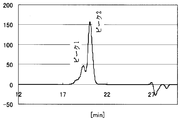
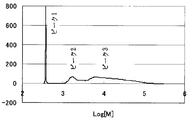
- FIG. 2 is a chromatogram showing the GPC results of the silsesquioxane resin composition obtained in Example 1.
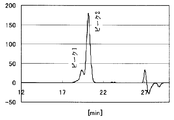
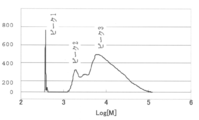
- FIG. 2 is a chromatogram showing the results of GPC of the silsesquioxane resin composition obtained in Example 2.
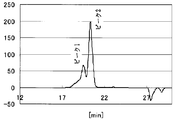
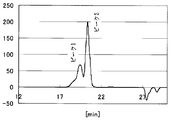
- 6 is a chromatogram showing the results of GPC of the silsesquioxane resin composition obtained in Example 3. It is a chromatogram which shows the result of GPC of the silsesquioxane resin composition obtained in Example 4.
- 6 is a chromatogram showing the results of GPC of the silsesquioxane resin composition obtained in Example 5.
- 6 is a chromatogram showing the results of GPC of the composition obtained in Comparative Example 2.
- 6 is a chromatogram showing the GPC result of the reaction product obtained in Example 6.
- 6 is a chromatogram showing the results of GPC of the purified reaction product obtained in Example 6.
- 2 is a graph showing a 1 H-NMR spectrum of a purified reaction product obtained in Example 6. It is an enlarged view of FIG. 9A.
- 6 is a chromatogram showing the GPC results of the reaction product obtained in Example 7.
- 6 is a chromatogram showing the GPC results of the reaction product obtained in Comparative Example 3.
- the method for producing a cage silsesquioxane resin according to the present invention includes a silicon compound (a), a silicon compound (b), and a silicon compound (c), a mixed solvent comprising water, an organic polar solvent, and an organic nonpolar solvent. And a hydrolysis reaction step of condensing and condensing in the presence of a basic catalyst to obtain a cage-type silsesquioxane resin, and a step of heating above 90 ° C. is not included after the hydrolysis reaction step Is.
- a cage-type silsesquioxane resin having a carbon-carbon double bond group can be obtained by using such a silicon compound (a) having a carbon-carbon double bond group.
- a cured product having excellent heat resistance, weather resistance, optical properties, and moldability can be obtained by radical polymerization.
- R 4 each independently represents an alkylene group or a phenylene group.
- the alkylene group may be linear or branched, and when a cured product is produced using a cage-type silsesquioxane resin, the bond distance is short and thermally stable, and From the viewpoint of obtaining a cured product having a sufficiently small linear expansion coefficient, the number of carbon atoms is preferably 1 to 3.
- the phenylene group include a 1,2-phenylene group having a lower alkyl group in addition to an unsubstituted phenylene group.
- R 4 is preferably an alkylene group having 1 to 3 carbon atoms from the viewpoint of easy availability of raw materials. When a cured product is produced, the distance between crosslinks does not increase, and the linear expansion coefficient From the viewpoint of obtaining a cured product having a sufficiently small size, a propylene group is more preferable.
- each R 5 independently represents a hydrogen atom or an alkyl group.
- the alkyl group may be linear or branched, and preferably has 1 to 3 carbon atoms from the viewpoint of better radical polymerization reactivity.
- R 5 a methyl group is more preferable from the viewpoint that the reactivity of radical polymerization is further improved.
- R 1 is preferably a methacryloxypropyl group from the viewpoint of easy availability of raw materials and high radical polymerization reactivity when producing a cured product.
- X represents a hydrolyzable group.
- the hydrolyzable group include an alkoxy group, an acetoxy group, a halogen atom, and a hydroxy group.
- an alkoxy group is preferable from the viewpoint of excellent stability and simplicity in the hydrolysis reaction.
- the alkoxy group include a methoxy group, an ethoxy group, an n-propoxy group, an i-propoxy group, an n-butoxy group, an i-butoxy group, and a t-butoxy group.
- a methoxy group is preferable from the viewpoint of high reactivity.
- Examples of such a silicon compound (a) include methacryloxymethyltriethoxysilane, methacryloxymethyltrimethoxysilane, 3-methacryloxypropyltrimethoxysilane, 3-methacryloxypropyltriethoxysilane, and 3-acryloxypropyl.
- Examples include trimethoxysilane, allyltrimethoxysilane, allyltriethoxysilane, p-styryltrimethoxysilane, p-styryltriethoxysilane, vinyltrimethoxysilane, and vinyltriethoxysilane.
- 3-methacryloxypropyltrimethoxysilane is preferable from the viewpoint of easy availability of raw materials.
- the silicon compound (a) according to the present invention one kind may be used alone, or two or more kinds may be used in combination.
- the method for producing a cage silsesquioxane resin of the present invention by using the silicon compound (a) having such a carbon-carbon double bond group such as a (meth) acryloyl group or a vinyl group, A cage-type silsesquioxane resin having a carbon-carbon double bond group can be obtained.
- the silicon compound (b) according to the present invention has the following general formula (5): R 2 SiX 3 (5) It is represented by In the formula (5), R 2 represents the following general formula (6):
- j represents an integer of 1 to 3.
- the group represented by is shown.
- a cage-type silsesquioxane resin having an epoxy group can be obtained by using such a silicon compound (b) having an epoxy group (OCC-C-).
- R 2 a glycidoxypropyl group is preferable from the viewpoint of easy availability of raw materials.
- X is a hydrolyzable group.
- the hydrolyzable group include the same groups as those described above for the silicon compound (a). Among them, a methoxy group is preferable from the viewpoint of high reactivity.
- silicon compound (b) for example, 3-glycidoxypropyltrimethoxysilane, 3-glycidoxypropyltriethoxysilane, and 2- (3,4-epoxycyclohexylethyl) trimethoxysilane are preferable.
- the silicon compound (b) according to the present invention one kind may be used alone, or two or more kinds may be used in combination.
- the silicon compound (c) according to the present invention has the following general formula (8): R 3 SiX 3 (8) It is represented by In the formula (8), R 3 represents any one selected from the group consisting of an alkyl group, a cycloalkyl group, a cycloalkenyl group, a phenyl group, a hydrogen atom, an alkoxy group, and an alkylsiloxy group.
- the alkyl group may be linear or branched, and has 2 to 10 carbon atoms from the viewpoint of more efficiently forming a cage silsesquioxane skeleton. Is preferred.
- Examples of the cycloalkyl group include a cyclobutyl group, a cyclopentyl group, a cyclohexyl group, a cycloheptyl group, a cyclooctyl group, and a cyclohexylethyl group. Among these, a cyclohexyl group is preferable from the viewpoint of easy availability.
- Examples of the cycloalkenyl group include a cyclopentenyl group and a cyclohexenyl group. Among these, a cyclopentenyl group is preferable from the viewpoint of easy availability.
- Examples of the alkoxy group include a methoxy group, an ethoxy group, and an isopropyl group.
- a methoxy group is preferable from the viewpoint of making the same group as the preferable hydrolyzable group.
- the alkylsiloxy group include a trimethylsiloxy group, a triethylsiloxy group, a triphenylsiloxy group, a dimethylsiloxy group, and a t-butyldimethylsiloxy group.
- R 3 an alkyl group having 2 to 10 carbon atoms or a phenyl group is more preferable from the viewpoint that it is easily available and a cage-type silsesquioxane skeleton tends to be formed more efficiently. .
- X is a hydrolyzable group.
- the hydrolyzable group include the same groups as those described above for the silicon compound (a). Among them, a methoxy group is preferable from the viewpoint of high reactivity.
- Examples of such a silicon compound (c) include phenyltrimethoxysilane, phenyltriethoxysilane, methyltrimethoxysilane, methyltrimethoxysilane, ethyltrimethoxysilane, n-propyltrimethoxysilane, n-propyltriethoxy.
- Examples thereof include silane, n-butyltrimethoxysilane, n-butyltriethoxysilane, t-butyltrimethoxysilane, t-butyltriethoxysilane, n-octyltrimethoxysilane, and n-octyltriethoxysilane.
- the silicon compound (c) according to the present invention one kind may be used alone, or two or more kinds may be used in combination.
- the mixing molar ratio (a: b: c) of the silicon compound (a), the silicon compound (b), and the silicon compound (c) is as follows.
- n, m and k have one or more carbon-carbon double bond groups and one or more epoxy groups, and are almost completely A cage-type silsesquioxane resin having a cage-structure skeleton condensed to the above can be obtained, so that a dense three-dimensional network structure can be easily and more reliably formed using this cage-type silsesquioxane resin. Can do.
- cage silsesquioxane resin when used in combination with the aromatic diol compound (B) in the following method for producing a cage silsesquioxane copolymer of the present invention, it is efficient and easy.
- a cage silsesquioxane copolymer having a cage silsesquioxane skeleton containing a carbon-carbon double bond group and an aromatic ring can be obtained.
- the ratio between the number of carbon-carbon double bond groups and the number of epoxy groups in the cage silsesquioxane resin tends to be in a preferred range (13: 1 to 1:13 (more preferably 12: 2 to 2:12, more preferably 12: 2 to 10: 3)).
- the ratio of n to m (n: m) is preferably 13: 1 to 1:13, more preferably 12: 2 to 2:12, and 12: 2 to 8: 5. Is more preferable, and 12: 2 to 10: 3 is particularly preferable.
- n is less than the lower limit
- excellent moldability is obtained when a cured product is produced using a cage silsesquioxane resin, but the strength tends to decrease, whereas the upper limit is exceeded.
- excellent moldability is obtained, but moldability tends to decrease.
- the ratio of k to the sum of n and m (n + m: k) is preferably 1: 0 to 1: 3.
- the presence of water is necessary.
- the amount of water may be at least a mass sufficient to hydrolyze the hydrolyzable groups in the silicon compounds (a) to (c), and from the mass of the silicon compounds (a) to (c).
- the mass is preferably equivalent to 1.0 to 1.5 times the theoretical amount (mol) of the calculated number of hydrolyzable groups.
- Examples of the organic polar solvent according to the present invention include alcohols such as methanol, ethanol and 2-propanol; acetone; tetrahydrofuran (THF) and the like. May be used.
- alcohols such as methanol, ethanol and 2-propanol
- acetone such as acetone
- THF tetrahydrofuran
- the organic nonpolar solvent according to the present invention may be any solvent that has little or no solubility in water, but is preferably a hydrocarbon solvent.
- the hydrocarbon solvent include nonpolar solvents having a low boiling point such as toluene, benzene, and xylene. One of these may be used alone, or two or more may be used in combination. Among these, it is more preferable to use toluene from the viewpoint that the operation becomes easy due to the low boiling point.
- the mixing ratio of the organic polar solvent and the organic nonpolar solvent is 1: 0.1 to 1:10 is preferable, and 1: 1 to 1: 3 is more preferable.
- the content of the organic polar solvent is less than the lower limit, the reaction system is not uniform, and the hydrolysis reaction does not proceed sufficiently and unreacted hydrolyzable groups tend to remain.
- the efficiency of the cage silsesquioxane skeleton formation decreases, and the resulting product tends to have a high molecular weight.
- the amount of the mixed solvent composed of the water, the organic polar solvent, and the organic nonpolar solvent is such that the molar concentration (mol / liter: M) of the silicon compounds (a) to (c) is 0.01 to 10M. It is preferable to be in the range.
- Examples of the basic catalyst according to the present invention include alkali metal hydroxides such as potassium hydroxide, sodium hydroxide and cesium hydroxide; tetramethylammonium hydroxide, tetraethylammonium hydroxide, tetrabutylammonium hydroxide, benzyltrimethylammonium hydroxy And ammonium hydroxide salts such as benzyltriethylammonium hydroxide.
- alkali metal hydroxides such as potassium hydroxide, sodium hydroxide and cesium hydroxide
- tetramethylammonium hydroxide tetraethylammonium hydroxide
- tetrabutylammonium hydroxide benzyltrimethylammonium hydroxy And ammonium hydroxide salts
- benzyltriethylammonium hydroxide one of these may be used alone, or two or more may be used in combination.
- tetramethylammonium hydroxide is preferably
- the amount of the basic catalyst used is preferably 0.1 to 10% by mass with respect to the total mass of the silicon compounds (a) to (c).
- the said basic catalyst is normally used as aqueous solution, you may use the water contained in the aqueous solution of this basic catalyst as the said water which concerns on this invention.
- the silicon compound (a), the silicon compound (b), and the silicon compound (c) are mixed with the water and the organic polarity.
- the desired cage silsesquioxane resin is obtained by hydrolysis and condensation in the presence of a mixed solvent comprising a solvent and an organic nonpolar solvent and a basic catalyst.
- the reaction temperature is preferably 0 to 50 ° C., more preferably 20 to 40 ° C.
- the reaction rate becomes slow, so that the hydrolyzable group remains in an unreacted state, and the reaction time tends to be long.
- the reaction temperature exceeds the above upper limit, the reaction rate is too high, so that a complicated condensation reaction proceeds, and as a result, high molecular weight of the hydrolysis product tends to be promoted.
- the reaction time is preferably 2 hours or more. When the reaction time is less than the lower limit, the hydrolysis reaction does not proceed sufficiently and the hydrolyzable group tends to remain in an unreacted state.
- condensation of the hydrolyzate occurs with the hydrolysis. Therefore, most of the hydrolyzable groups in the silicon compounds (a) to (c), preferably almost all, are substituted with OH groups by the hydrolysis, and most of the OH groups, preferably 95%, are substituted by the condensation. Since the above is condensed, a cage-type silsesquioxane resin can be obtained in the product obtained in the hydrolysis reaction step.
- the content of such a cage silsesquioxane resin is preferably 50% by mass or more based on the entire product obtained in the hydrolysis reaction step.
- the content of the cage silsesquioxane resin is preferably such that the ratio of the peak area measured by gel permeation chromatography (GPC) is 50 area% or more.
- the product becomes a colorless viscous liquid having a number average molecular weight in the range of 500 to 8000, depending on the reaction conditions.
- the number average molecular weight is preferably 500 to 7000, more preferably 500 to 3000, although it varies depending on the reaction conditions.
- the molecular weight distribution of the product is preferably 1.00 to 2.00.
- the molecular weight distribution of the compound is usually preferably in the range of 1.00 to 1.01, but if the molecular weight distribution is within the above range, the product is used as a resin containing a cage silsesquioxane resin as it is. There is a tendency that it can be used for a polymerization reaction or the like.
- the ratio of the peak area, the molecular weight distribution, and the number average molecular weight are determined by gel permeation chromatography (GPC) (device name: HLC-8320GPC (manufactured by Tosoh Corporation), solvent: tetrahydrofuran, column: TSKgel. It is measured using SuperH-RC (manufactured by Tosoh Corporation), temperature: 40 ° C., speed: 0.6 ml / min), and is obtained by conversion using standard polystyrene (trade name: TSK standard POLYSTYRENE, manufactured by Tosoh Corporation).
- GPC gel permeation chromatography
- the method for producing a cage silsesquioxane resin of the present invention it is preferable to further include a recovery step of recovering the cage silsesquioxane resin obtained in the hydrolysis reaction step.
- the recovery method include a method of first adjusting a reaction solution to be neutral or acidic using a weakly acidic solution, and then separating the mixed solvent containing water.
- the weakly acidic solution include sulfuric acid diluted solution, hydrochloric acid diluted solution, citric acid solution, acetic acid, ammonium chloride aqueous solution, malic acid solution, phosphoric acid solution, oxalic acid solution and the like.
- a method of separating the mixed solvent a method of washing the reaction solution with a saline solution or the like to sufficiently remove moisture and other impurities, and then drying with a desiccant such as anhydrous magnesium sulfate is used.
- a desiccant such as anhydrous magnesium sulfate
- the product containing the cage silsesquioxane resin is treated in the presence of an organic nonpolar solvent and a basic catalyst. It is preferable to further include a step of heating at a temperature to recondense the siloxane bond. By further including the step of performing such a recondensation treatment, a cage-type silsesquioxane resin can be obtained in a higher yield.
- organic nonpolar solvent examples include the same organic nonpolar solvents described in the hydrolysis reaction step. When the recovery step is not performed before the recondensation treatment step, You may use what was used in the hydrolysis process as it is. As such an organic nonpolar solvent, it is preferable to use toluene.
- the organic nonpolar solvent may be used in an amount that can dissolve the product, and is preferably 0.1 to 20 times the mass of the total mass of the product.
- Examples of the basic catalyst include those similar to the basic catalyst described in the hydrolysis reaction step. When the recovery step is not performed before the step of performing the recondensation treatment, the hydrolysis is performed. You may use what was used in the process as it is.
- a catalyst soluble in a nonpolar solvent such as tetraalkylammonium is preferably used. The amount of such a basic catalyst is preferably 0.01 to 10% by mass of the product.
- the reaction temperature must be 50 to 90 ° C.
- the method for producing a cage silsesquioxane resin of the present invention is characterized in that it does not include a step of heating above 90 ° C. after the hydrolysis step.
- the reaction temperature is lower than the lower limit, sufficient driving force for recondensing reaction cannot be obtained and the reaction does not proceed.
- the reaction temperature exceeds the upper limit, an OH group substituted by hydrolysis and an epoxy group undergo a polymerization reaction, making it difficult to obtain a cage silsesquioxane resin.
- the reaction temperature is particularly preferably 60 to 80 ° C.
- the reaction temperature is lower than the lower limit, sufficient driving force for causing the recondensation reaction cannot be obtained and the reaction does not proceed.
- the reaction temperature exceeds the upper limit, the OH group And the epoxy group may undergo a polymerization reaction, so that it is necessary to add a polymerization inhibitor or the like.
- the recondensation reaction conditions are preferably a reaction time of 1 to 10 hours.
- the product subjected to the recondensation treatment is preferably used after being washed and dried by the recovery step and further concentrated, but these treatments may not be performed.
- water may be present, but it is not necessary to add it positively, and it is preferable to keep the amount of water supplied from the basic catalyst solution.
- the amount necessary for hydrolyzing the remaining hydrolyzable group (the hydrolyzable group calculated from the mass of the silicon compounds (a) to (c)) It is preferable to add water in an amount equal to or more than 1.0 to 1.5 times the theoretical amount (mol) of the number of
- a cage silsesquioxane resin can be obtained more selectively by further providing the recovery step after the step of performing the recondensation treatment. it can.
- the content of such a cage silsesquioxane resin is preferably 50% by mass or more, more preferably 60% by mass or more, based on the entire product after the recondensation treatment.
- the content of the cage silsesquioxane resin is preferably such that the ratio of the peak area measured by gel permeation chromatography (GPC) is 50 area% or more, More preferably 60% by area or more. If content is more than the said minimum, it exists in the tendency which can use the said product as polymerization resin etc. as it is as resin containing cage-type silsesquioxane resin.
- the recondensation product containing such a cage silsesquioxane resin preferably has a molecular weight distribution (weight average molecular weight (Mw) / number average molecular weight (Mn)) of 1.50 or less, More preferably, it is in the range of 1.03 to 1.10.
- the molecular weight distribution of the compound is usually preferably in the range of 1.00 to 1.01, but if the molecular weight distribution is not more than the above upper limit, the recondensation product is a resin containing a cage silsesquioxane resin. There is a tendency that the composition can be used in a polymerization reaction or the like as it is.
- the number average molecular weight of the recondensation product is preferably 600 to 2500, more preferably 1000 to 2000.
- the ratio of the peak area, the molecular weight distribution, and the number average molecular weight are measured by using the gel permeation chromatography (GPC), and are obtained by conversion using the standard polystyrene.
- a cage-type silsesquioxane resin of the present invention has a carbon-carbon double bond group and an epoxy group, and the reaction and structure can be easily controlled when producing a polymer.
- a cage-type silsesquioxane resin can be obtained.
- the cage silsesquioxane resin of the present invention has the following general formula (9): [R 1 SiO 3/2 ] n [R 2 SiO 3/2 ] m [R 3 SiO 3/2 ] k (9) It is characterized by being represented by.
- the cage silsesquioxane resin of the present invention can be obtained by the method for producing the cage silsesquioxane resin of the present invention.
- R 1 has the same meaning as R 1 in the above formula (1)
- R 2 has the same meaning as R 2 in the formula (5)
- R 3 is the formula ( 8) is synonymous with R 3 in the formula
- n, m and k are integers satisfying the conditions represented by the above formulas (ii) to (iv), and when n, m and k are each 2 or more, R 1 R 2 and R 3 may be the same or different.
- n, m, and k are represented by the following formula (vi) from the viewpoint of obtaining a cured product having a high crosslinking density and excellent mechanical strength.
- (N + m) / k ⁇ 1 (vi) It is more preferable that the condition represented by Furthermore, the ratio of n to m (n: m) is preferably 13: 1 to 1:13, more preferably 12: 2 to 2:12, and 12: 2 to 10: 3. More preferably.
- n When the number of n is less than the lower limit, the strength tends to decrease when a cured product is produced using a cage silsesquioxane resin, while when the number exceeds n, the cage silsesquioxane resin tends to decrease in strength. When a cured product is produced using an oxan resin, moldability tends to decrease.
- R 1, R 2 and R 3 are the same meanings as R 1, R 2 and R 3 in the formula (9).
- h is 12, and the following general formula (16):
- R 1, R 2 and R 3 are the same meanings as R 1, R 2 and R 3 in the formula (9).
- h is 14, and the following general formula (17):
- R 1, R 2 and R 3 are the same meanings as R 1, R 2 and R 3 in the formula (9). ] The compound represented by these is mentioned.
- the cage-type silsesquioxane resin of the present invention has a carbon-carbon double bond group and an epoxy group in one molecule, stepwise polymerization is possible without reducing the crosslinking density. Since it has both characteristics of resin, it is effective in improving the heat resistance, thermal stability, chemical resistance, mechanical properties, and moldability of the cured resin.
- the method for producing the cage silsesquioxane copolymer of the present invention comprises the cage silsesquioxane resin (A) of the present invention and an aromatic diol compound (B) in the presence of a polymerization catalyst (C).
- the cage silsesquioxane copolymer is obtained by polymerization reaction at a temperature of 100 to 140 ° C.
- the cage silsesquioxane resin (A) according to the method for producing the cage silsesquioxane copolymer of the present invention is a cage silsesquioxane resin represented by the above general formula (9).
- a cage-type silsesquioxane resin having such a carbon-carbon double bond group and an epoxy group (OCC-C—) excellent heat resistance, weather resistance, optical properties, and
- a cage-type silsesquioxane copolymer capable of obtaining a cured product having moldability by radical polymerization can be obtained, and the epoxy group is selectively polymerized with the hydroxyl group of the diol compound (B).
- a cage silsesquioxane copolymer having an aromatic ring and a cage silsesquioxane skeleton can be obtained efficiently.
- the structure of the cage silsesquioxane copolymer can be controlled by the value of m in the general formula (9).
- m is more preferably 1 to 3.
- the ratio of the number of carbon-carbon double bond groups to the number of epoxy groups (total carbon-carbon double bond groups: total number of epoxy groups) in the cage silsesquioxane resin is 13: 1 to 1:13. It is preferable that When the content of the carbon-carbon double bond group is less than the lower limit, the rigidity of the obtained cured product tends to be lowered. On the other hand, when the content exceeds the upper limit, molding of the obtained cured product is performed. Tend to decrease. Also, from the viewpoint of more efficiently synthesizing a linear cage silsesquioxane copolymer, the ratio (total carbon-carbon double bond group: total epoxy group number) is 13: 1 to 10: 3. It is more preferable that
- the ratio between the number of carbon-carbon double bond groups and the total number of epoxy groups in the cage silsesquioxane resin is 1 H-NMR (device name: JNM-ECA400 (JEOL Ltd.) (Manufactured by company), solvent: chloroform-d, temperature: 22.7 ° C., 400 MHz), and the integration ratio of the peak of the carbon-carbon double bond group and the epoxy group.
- the cage silsesquioxane resin may be used alone or in combination of two or more.
- the aromatic diol compound (B) according to the method for producing the cage silsesquioxane copolymer of the present invention is selected from the group consisting of p-phenylene, m-phenylene, sulfonyldiphenylene, and carbonyldiphenylene.
- a compound having a structure in which two phenolic hydroxyl groups are bonded to any one kind of divalent aromatic hydrocarbon group is preferable.
- aromatic diol compound (B) examples include hydroquinone, resorcin, bisphenol S (4,4′-dihydroxydiphenyl sulfone), bisphenol K (4,4′-dihydroxydiphenyl ketone), bisphenol A, Bisphenol F, methylhydroquinone, chlorohydroquinone, 4,4'-dihydroxydiphenyl oxide, 2,6-dihydroxynaphthalene, dichlorobisphenol A, tetrachlorobisphenol A, tetrabromobisphenol A, bisphenol ACP, bisphenol L, bisphenol V, etc. It is done. Among these, bisphenol A is preferable from the viewpoint of easy availability. Moreover, as an aromatic diol compound (B) based on this invention, you may use individually by 1 type, or may be used in combination of 2 or more type.
- the polymerization catalyst (C) according to the method for producing the cage silsesquioxane copolymer of the present invention is selected from the group consisting of tertiary amine compounds, quaternary ammonium compounds, tertiary phosphine compounds and quaternary phosphonium compounds. It is necessary to be at least one polymerization catalyst. By using such a polymerization catalyst (C), a copolymer of the cage silsesquioxane resin (A) which is an epoxy compound and the aromatic diol compound (B) which is a diol compound is obtained.
- tertiary amine compound examples include triethylamine, tri-n-propylamine, triisopropylamine, tri-n-butylamine, tri-sec-butylamine, tri-n-hexylamine, dimethylbenzylamine, diethylbenzylamine, And tribenzylamine.
- Examples of the quaternary ammonium compound include tetramethylammonium hydroxide, tetraethylammonium hydroxide, tetra-n-propylammonium hydroxide, tetraisopropylammonium hydroxide, tetra-n-butylammonium hydroxide, and trimethylbenzylammonium hydroxide.
- Quaternary ammonium hydroxide compounds such as triethylbenzylammonium hydroxide; tetramethylammonium chloride, tetraethylammonium chloride, tetra-n-propylammonium chloride, tetraisopropylammonium chloride, tetra-n-butylammonium chloride, trimethylbenzylammonium chloride, chloride Quaternary ammonium chloride compounds such as triethylbenzylammonium; tetramethylammonium bromide, tetraethylammonium bromide, Quaternary ammonium compounds such as lan-propylammonium bromide, tetraethylammonium bromide, tetra-n-butylammonium bromide, trimethylbenzylammonium bromide, triethylbenzylammonium bromide; tetramethylammonium
- Examples of the third phosphine compound include triethylphosphine, tri-n-butylphosphine, triphenylphosphine, trinonylphenylphosphine, and the like. .
- quaternary phosphonium compound examples include quaternary phosphonium compounds such as tetramethylphosphonium hydroxide; tetramethylphosphonium chloride, tetra n-butyl phosphonium chloride, tetraphenyl phosphonium chloride, tetra n-butyl phosphonium bromide, odor Halogenated quaternary phosphonium compounds such as methyltriphenylphosphonium bromide, ethyltriphenylphosphonium bromide, n-butyltriphenylphosphonium bromide (butyltriphenylphosphonium bromide); quaternary phosphonium compounds such as ethyltriphenylphosphonium acetate, etc. Is mentioned.
- a quaternary phosphonium compound such as n-butyltriphenylphosphonium bromide is preferable from the viewpoint that polymerization proceeds gently and a high molecular weight copolymer is obtained.
- a polymerization catalyst (C) based on this invention you may use individually by 1 type or may be used in combination of 2 or more type.
- the number of hydroxyl groups of the aromatic diol compound (B) (amount of charged aromatic diol compound (g) / hydroxyl group equivalent (g / eq))
- the ratio of the number of epoxy groups in the cage silsesquioxane resin (A) (the charged amount of cage silsesquioxane resin (g) / epoxy equivalent (g / eq)) (number of hydroxyl groups: epoxy)
- the number of groups is preferably from 0.5: 1 to 1.3: 1. When the ratio of the number of hydroxyl groups is less than the lower limit, many unreacted epoxy groups tend to remain.
- the ratio (number of hydroxyl groups: number of epoxy groups) is more preferably 1.2: 1 to 1: 1.2 from the viewpoint of reducing unreacted residues.
- the said epoxy equivalent can be calculated
- the hydroxyl equivalent also referred to as hydroxyl value
- the amount of the polymerization catalyst (C) used is preferably 0.001 to 10 mol%, preferably 0.005 to 5 mol%, with respect to 1 mol of the aromatic diol compound (B). More preferred.
- the amount of the polymerization catalyst (C) used is less than the lower limit, the polymerization reaction rate tends to be slow and uneconomical.
- the amount exceeds the upper limit the polymerization reaction rate is fast and the reaction can be controlled. It tends to be difficult.
- the cage silsesquioxane resin (A), the aromatic diol compound (B) and the polymerization catalyst (C) are mixed and heated. Then, the epoxy group in the cage silsesquioxane resin (A) and the hydroxyl group in the aromatic diol compound (B) are polymerized to give the cage silsesquioxane resin (A) and the above-mentioned A copolymer comprising the aromatic diol compound (B) is obtained.
- a polymerization solvent may be further added.
- the polymerization solvent is preferably a solvent that can maintain the reaction system uniformly throughout, for example, toluene, chlorobenzene, methyl ethyl ketone, methyl isobutyl ketone, cyclohexanone, diisopropyl ketone, acetophenone, N, N-dimethylformamide, N , N-dimethylacetamide, N-methylpyrrolidone, 1,3-dimethyl-2-imidazolidinone, dimethyl sulfoxide, sulfolane, pyridine, and other aprotic organic solvents.
- a combination of the above may also be used.
- the content thereof is preferably 50% by mass or less, and more preferably 20% by mass or less, based on the entire mixture to be polymerized.
- the content exceeds the above upper limit, the proportion of the solvent increases and the polymerization reaction becomes slow, which tends to be economically disadvantageous.
- the addition timing of the polymerization catalyst (C) is not particularly limited, and may be added before the reaction mixture is heated, may be added after the reaction mixture reaches a predetermined temperature,
- the method for adding the polymerization catalyst (C) is not particularly limited, and the polymerization catalyst (C) may be added alone, or a solution dissolved in the polymerization solvent may be added.
- the polymerization reaction is preferably performed in an inert gas atmosphere.
- the inert gas include nitrogen gas, helium, and argon.
- the heating temperature needs to be in the range of 100 to 140 ° C.
- the temperature is lower than the lower limit, the cage silsesquioxane resin (A) and the aromatic diol compound (B) are not polymerized, and it is difficult to obtain a cage silsesquioxane copolymer.
- the upper limit is exceeded, side reactions such as a carbon-carbon double bond group crosslinking reaction and a siloxane bond decomposition reaction are likely to occur.
- the weight average molecular weight of the cage silsesquioxane copolymer can be easily and arbitrarily adjusted only by adjusting the reaction time of the polymerization reaction. It can be adjusted and designed according to the purpose. Such a reaction time is preferably 0.5 to 20 hours, more preferably 0.5 to 15 hours, and further preferably 0.5 to 10 hours. When the reaction time is less than the lower limit, although depending on the amount of the catalyst added, it tends to be difficult to obtain a cage silsesquioxane copolymer having a target molecular weight.
- the polymerization reaction may be performed under normal pressure or under pressure, but in the present invention, the reaction is preferably performed under normal pressure from the viewpoint that the polymerization equipment is inexpensive and economical.
- the cage silsesquioxane copolymer according to the present invention is obtained.
- the content of such a cage silsesquioxane copolymer is preferably 60% by mass or more in the reaction product.
- the cage silsesquioxane copolymer preferably has a weight average molecular weight of 5,000 to 500,000, and more preferably 7,000 to 400,000. When the weight average molecular weight is less than the lower limit, a large number of unreacted cage silsesquioxane resins (A) and aromatic diol compounds (B) tend to remain. There is a tendency that the handling property of the cured product is lowered and molding becomes difficult.
- the said weight average molecular weight is measured using the said gel permeation chromatography (GPC), and is calculated
- the cage silsesquioxane copolymer of the present invention has the following general formula (10):
- the cage silsesquioxane copolymer of the present invention can be obtained by the method for producing the cage silsesquioxane copolymer of the present invention.
- R 1, R 2, R 3 are each independently the same meaning as R 1, R 2, R 3 in the formula (1).
- R ⁇ 6 > is respectively independently the following general formula (11):
- R 6 is a group linking the cage silsesquioxane skeleton derived from the cage silsesquioxane resin (A) and the aromatic diol compound (B). As such R 6 , a group represented by the general formula (11) is more preferable from the viewpoint of easy availability of raw materials.
- R ⁇ 7 > shows a bivalent aromatic hydrocarbon group each independently.
- the divalent aromatic hydrocarbon group is any one group selected from the group consisting of p-phenylene, m-phenylene, sulfonyldiphenylene, and carbonyldiphenylene. Examples of such a divalent aromatic hydrocarbon group include a residue obtained by removing two hydroxyl groups from the compound mentioned as the aromatic diol compound (B).
- n, m, k and p are the above formulas (ii) to (iv) and the following formula (v): 1 ⁇ p ⁇ m (v) Is an integer that satisfies the condition represented by R 8 represents the following general formula (13):
- R 1 , R 2 , R 3 , R 6 , n, m, k, and p are R 1 , R 2 , R 3 , R 6 , n, m, K and p have the same meanings, and the difference between n, m and p, and when k and p are each 2 or more, R 1 , R 2 , R 3 and R 6 are the same or different. Also good.
- q represents an integer of 3 to 400.
- the value of q is particularly preferably 5 to 300 from the viewpoint that the handleability of the obtained cured product is more excellent.
- the cage-type silsesquioxane copolymer of the present invention has at least one or more carbon-carbon double bond groups in one molecule and can also have an epoxy group. It is effective in improving the properties, chemical resistance, mechanical properties, and moldability.
- Example 1 First, in a reaction vessel equipped with a stirrer, a dropping funnel and a thermometer, 180 ml of 2-propanol (IPA) as a solvent, 360 ml of toluene, and 34.1 g of a 5% tetramethylammonium hydroxide aqueous solution (TMAH aqueous solution) as a basic catalyst. I put it in.
- IPA 2-propanol
- TMAH aqueous solution a 5% tetramethylammonium hydroxide aqueous solution
- MTMS 3-methacryloxypropyltrimethoxysilane
- GTMS 3-glycidoxypropyltrimethoxysilane
- Toray Dow Corning Silicone Co., Ltd. 35.48 g (0.15 mol) was mixed and placed in the dropping funnel, and dropped into the reaction vessel at room temperature (about 25 ° C.) over 2 hours with stirring. did. After completion of dropping, the mixture was further stirred for 2 hours without heating.
- reaction solution 11.4 g of 5% aqueous citric acid solution was added to the stirred solution (reaction solution) and stirred for 10 minutes, and then washed with saturated saline and pure water until neutral. Subsequently, 20 g of anhydrous magnesium sulfate was added for dehydration, and the anhydrous magnesium sulfate was filtered off and concentrated by a rotary evaporator to obtain 100.44 g of a silsesquioxane resin composition. In this reaction, the recovery rate was 96%, and the resulting silsesquioxane resin composition was a colorless viscous liquid soluble in various organic solvents.
- the chromatogram which shows the result of GPC of the obtained silsesquioxane resin composition is shown in FIG.
- peak 1 indicates a random ladder-type silsesquioxane resin
- peak 2 indicates a cage-type silsesquioxane resin.
- Mn number average molecular weight
- Mw / Mn molecular weight distribution
- Example 2 First, in a reaction vessel equipped with a stirrer, a dropping funnel and a thermometer, 180 ml of 2-propanol (IPA) and 360 ml of toluene as a solvent and 34.1 g of a 5% tetramethylammonium hydroxide aqueous solution (TMAH aqueous solution) as a basic catalyst were added. I put it in.
- IPA 2-propanol
- TMAH aqueous solution a 5% tetramethylammonium hydroxide aqueous solution
- MTMS 3-methacryloxypropyltrimethoxysilane
- GTMS 3-glycidoxypropyltrimethoxysilane
- Toray Dow Corning Silicone Co., Ltd. 35.48 g (0.15 mol) was mixed and placed in a dropping funnel, and dropped into the reaction vessel at room temperature (about 25 ° C.) over 2 hours with stirring. did. After completion of dropping, the mixture was further stirred for 2 hours without heating.
- the chromatogram which shows the result of GPC of the obtained silsesquioxane resin composition is shown in FIG.
- peak 1 represents a random / ladder type silsesquioxane resin
- peak 2 represents a cage type silsesquioxane resin.
- Mn number average molecular weight
- Mw / Mn molecular weight distribution
- Mw / Mn number average molecular weight distribution
- Example 3 30 ml of 2-propanol (IPA), 60 ml of toluene, 5.72 g of 5% tetramethylammonium hydroxide aqueous solution (TMAH aqueous solution), and 12.418 g (0.05) of 3-methacryloxypropyltrimethoxysilane (MTMS) Mol), 3-glycidoxypropyltrimethoxysilane (GTMS) was changed to 11.817 g (0.05 mol), and a 5% aqueous citric acid solution was changed to 1.907 g. 15.51 g of a silsesquioxane resin composition was obtained. In this reaction, the recovery rate was 90%, and the resulting silsesquioxane resin composition was a colorless viscous liquid soluble in various organic solvents.
- IPA 2-propanol
- TMAH aqueous solution 5% tetramethylammonium hydroxide aqueous solution
- MTMS 3-methacryloxypropyl
- the chromatogram which shows the result of GPC of the obtained silsesquioxane resin composition is shown in FIG.
- peak 1 represents a random / ladder type silsesquioxane resin
- peak 2 represents a cage type silsesquioxane resin.
- Mn number average molecular weight
- Mw / Mn molecular weight distribution
- Mw / Mn number average molecular weight distribution
- Example 4 30 ml of 2-propanol (IPA), 60 ml of toluene, 5.702 g of 5% tetramethylammonium hydroxide aqueous solution (TMAH aqueous solution), and 6.209 g (0.025 g) of 3-methacryloxypropyltrimethoxysilane (MTMS) Mol), 3-glycidoxypropyltrimethoxysilane (GTMS) was 17.726 g (0.075 mol), and 5901 aqueous solution of citric acid was changed to 1.901 g. 15.16 g of a silsesquioxane resin composition was obtained. In this reaction, the recovery rate was 90%, and the resulting silsesquioxane resin composition was a colorless viscous liquid soluble in various organic solvents.
- IPA 2-propanol
- TMAH aqueous solution 5.702 g of 5% tetramethylammonium hydroxide aqueous solution
- the chromatogram which shows the result of GPC of the obtained silsesquioxane resin composition is shown in FIG.
- peak 1 represents a random / ladder type silsesquioxane resin
- peak 2 represents a cage type silsesquioxane resin.
- Mn number average molecular weight
- Mw / Mn molecular weight distribution
- Mw / Mn number average molecular weight distribution
- Example 5 30 ml of 2-propanol (IPA), 60 ml of toluene, 5.702 g of 5% tetramethylammonium hydroxide aqueous solution (TMAH aqueous solution), and 24.836 g (0.1MS) of 3-methacryloxypropyltrimethoxysilane (MTMS) Mol), 3-glycidoxypropyltrimethoxysilane (GTMS) (11.817 g (0.05 mol)), phenyltrimethoxysilane (PTMS) (LS2750, manufactured by Shin-Etsu Chemical Co., Ltd.) 9.916 g (0.05) Mol) was further placed in a dropping funnel, and 30.128 g of a silsesquioxane resin composition was obtained in the same manner as in Example 2 except that the 5% aqueous citric acid solution was changed to 1.907 g. In this reaction, the recovery rate was 92%, and the resulting silsesquioxane resin composition
- the chromatogram which shows the result of GPC of the obtained silsesquioxane resin composition is shown in FIG.
- peak 1 represents a random / ladder type silsesquioxane resin
- peak 2 represents a cage type silsesquioxane resin.
- Mn number average molecular weight
- Mw / Mn molecular weight distribution
- Example 2 100.20 g of a composition was obtained in the same manner as in Example 2 except that 2-propanol (IPA) was not used.
- the chromatogram which shows the result of GPC of the obtained composition is shown in FIG.
- peak 1 is a random ladder-type silsesquioxane resin
- peak 2 is a cage-type silsesquioxane resin
- peak 3 is 3-methacryloxypropyltrimethoxysilane
- peak 4 is 3-glycidoxy Propyltrimethoxysilane is shown.
- Table 2 shows the area ratio of each peak of bisphenol A, the cage silsesquioxane resin, and the product (cage silsesquioxane copolymer) in each reaction time. As shown in Table 2, as the reaction time elapses, the area ratio of bisphenol A and the cage silsesquioxane resin decreases and the area ratio of the product increases. It was confirmed that an oxane copolymer was obtained.
- reaction time 3.5 hours
- solvent was removed by distillation under reduced pressure to obtain a viscous liquid.
- the obtained viscous liquid was dissolved in 30 ml of tetrahydrofuran (THF), dropped into 150 ml of hexane and reprecipitated to purify the reaction product.
- the purified reaction product was 4.34 g, and the yield was 56%.
- FIG. 8 A chromatogram showing the GPC results of the reaction product after purification is shown in FIG.
- peak 1 shows bisphenol A
- peak 2 shows a cage silsesquioxane resin
- peak 3 shows a cage silsesquioxane copolymer.
- FIG. 8 it was confirmed that a cage-type silsesquioxane copolymer was obtained.
- the weight average molecular weight of the obtained cage-type silsesquioxane copolymer was 22,600. At this time, unreacted bisphenol A was 2.8% in area ratio.
- FIG. 9A to 9B show 1 H-NMR spectra of the reaction product after purification. As shown in FIG. 9A to FIG. 9B, peaks derived from acrylic groups (5.5 ppm, 6.0 ppm) and peaks derived from aromatic rings (6.7 ppm, 7.0 ppm) were detected. It was confirmed that the obtained copolymer was a copolymer of a cage-type silsesquioxane resin and bisphenol A.
- FIG. 11 shows a chromatogram showing the GPC result of the obtained reaction product.
- peak 1 represents bisphenol A
- peak 2 represents a cage silsesquioxane resin.
- FIG. 11 it was confirmed that a cage-type silsesquioxane copolymer could not be obtained.
- one molecule has a carbon-carbon double bond group and an epoxy group, and the reaction and structure can be easily controlled when producing a polymer. It becomes possible to provide a cage silsesquioxane resin and a method for producing the cage silsesquioxane resin in high yield.
- the cage silsesquioxane resin of the present invention has a carbon-carbon double bond group and an epoxy group in one molecule, stepwise polymerization is possible without reducing the crosslink density.
- the epoxy resin are effective in improving the heat resistance, thermal stability, chemical resistance, mechanical properties, and moldability of the cured resin.
- a cage silsesquioxane copolymer having a cage silsesquioxane skeleton containing a carbon-carbon double bond group and an aromatic ring and the cage silsesquioxane copolymer It is possible to provide a method for producing a cage-type silsesquioxane copolymer in which the structure of the coalescence can be easily controlled.
Landscapes
- Chemical & Material Sciences (AREA)
- Organic Chemistry (AREA)
- Health & Medical Sciences (AREA)
- Chemical Kinetics & Catalysis (AREA)
- Medicinal Chemistry (AREA)
- Polymers & Plastics (AREA)
- Silicon Polymers (AREA)
Abstract
Cette invention concerne un procédé de production d'une résine silsesquioxane de type panier comprenant une étape de réaction d'hydrolyse consistant à hydrolyser un composé de silicium (a), un composé de silicium (b) et un composé de silicium (c) en présence d'un mélange de solvants composé d'eau, d'un solvant polaire organique et d'un solvant non polaire organique ainsi que d'un catalyseur basique, et à les condenser ensemble pour obtenir une résine silsesquioxane de type panier selon l'invention, le rapport de mélange molaire de (a), (b) et (c) étant représenté par la formule (i) suivante, (i) a:b:c=n:m:k (Dans la formule, n, m et k sont des entiers qui satisfont les conditions suivantes; n≥1, m≥1, n+m+k ayant l'une quelconque des valeurs suivantes : 8, 10, 12 ou 14), et ne comprenant pas d'étape de chauffage au-dessus de 90°C après l'étape de réaction d'hydrolyse.
Priority Applications (2)
| Application Number | Priority Date | Filing Date | Title |
|---|---|---|---|
| KR1020137028590A KR101831600B1 (ko) | 2011-03-31 | 2012-03-22 | 바구니형 실세스퀴옥산 수지 및 바구니형 실세스퀴옥산 공중합체, 그리고 그들의 제조방법 |
| CN201280016096.XA CN103459468B (zh) | 2011-03-31 | 2012-03-22 | 笼状硅倍半氧烷树脂和笼状硅倍半氧烷共聚物及其制造方法 |
Applications Claiming Priority (4)
| Application Number | Priority Date | Filing Date | Title |
|---|---|---|---|
| JP2011079494A JP5662864B2 (ja) | 2011-03-31 | 2011-03-31 | かご型シルセスキオキサン共重合体及びその製造方法 |
| JP2011079492A JP5698584B2 (ja) | 2011-03-31 | 2011-03-31 | かご型シルセスキオキサン樹脂及びその製造方法 |
| JP2011-079492 | 2011-03-31 | ||
| JP2011-079494 | 2011-03-31 |
Publications (1)
| Publication Number | Publication Date |
|---|---|
| WO2012133079A1 true WO2012133079A1 (fr) | 2012-10-04 |
Family
ID=46930807
Family Applications (1)
| Application Number | Title | Priority Date | Filing Date |
|---|---|---|---|
| PCT/JP2012/057268 Ceased WO2012133079A1 (fr) | 2011-03-31 | 2012-03-22 | Résine silsesquioxane de type panier, copolymère de silsesquioxane de type panier et leur procédé de production |
Country Status (4)
| Country | Link |
|---|---|
| KR (1) | KR101831600B1 (fr) |
| CN (1) | CN103459468B (fr) |
| TW (1) | TWI520987B (fr) |
| WO (1) | WO2012133079A1 (fr) |
Cited By (2)
| Publication number | Priority date | Publication date | Assignee | Title |
|---|---|---|---|---|
| KR20140064658A (ko) * | 2012-11-19 | 2014-05-28 | 신닛테츠 수미킨 가가쿠 가부시키가이샤 | 케이지형 실세스퀴옥산 화합물, 그것을 사용한 경화성 수지 조성물 및 수지 경화물 |
| CN114250076A (zh) * | 2020-09-21 | 2022-03-29 | 易安爱富科技有限公司 | 氮化硅膜蚀刻组合物以及利用该组合物的蚀刻方法 |
Families Citing this family (2)
| Publication number | Priority date | Publication date | Assignee | Title |
|---|---|---|---|---|
| KR102170818B1 (ko) * | 2013-12-26 | 2020-10-28 | 주식회사 동진쎄미켐 | 열 용융-압출 성형이 가능한 실세스퀴옥산, 이를 이용한 고투명 및 고내열 플라스틱 투명기판 및 이의 제조방법 |
| CN106008981B (zh) * | 2016-06-08 | 2019-04-02 | 中国船舶重工集团公司第七二五研究所 | 一种混杂倍半硅氧烷树脂的制备方法 |
Citations (5)
| Publication number | Priority date | Publication date | Assignee | Title |
|---|---|---|---|---|
| JP2004143449A (ja) * | 2002-09-30 | 2004-05-20 | Nippon Steel Chem Co Ltd | 官能基を有するかご型シルセスキオキサン樹脂とその製造方法 |
| JP2006276501A (ja) * | 2005-03-29 | 2006-10-12 | Seiko Epson Corp | 配向膜、配向膜の形成方法、電子デバイス用基板、液晶パネルおよび電子機器 |
| WO2006125707A2 (fr) * | 2005-05-27 | 2006-11-30 | Degussa | Composition contenant des silsesquioxanes oligomeriques polyedres fonctionnalises et procedes de realisation associes |
| JP2009167325A (ja) * | 2008-01-17 | 2009-07-30 | Nippon Steel Chem Co Ltd | シラノール基含有硬化性籠型シルセスキオキサン化合物およびこれを用いた共重合体並びにそれらの製造方法 |
| WO2009119253A1 (fr) * | 2008-03-28 | 2009-10-01 | 新日鐵化学株式会社 | Composé silsesquioxane de type cage, durcissable, contenant un groupe silanol, copolymère de silicone durcissable, contenant une structure en cage, leurs procédés de production, et composition de résine durcissable |
-
2012
- 2012-03-22 KR KR1020137028590A patent/KR101831600B1/ko not_active Expired - Fee Related
- 2012-03-22 CN CN201280016096.XA patent/CN103459468B/zh active Active
- 2012-03-22 WO PCT/JP2012/057268 patent/WO2012133079A1/fr not_active Ceased
- 2012-03-29 TW TW101111070A patent/TWI520987B/zh not_active IP Right Cessation
Patent Citations (5)
| Publication number | Priority date | Publication date | Assignee | Title |
|---|---|---|---|---|
| JP2004143449A (ja) * | 2002-09-30 | 2004-05-20 | Nippon Steel Chem Co Ltd | 官能基を有するかご型シルセスキオキサン樹脂とその製造方法 |
| JP2006276501A (ja) * | 2005-03-29 | 2006-10-12 | Seiko Epson Corp | 配向膜、配向膜の形成方法、電子デバイス用基板、液晶パネルおよび電子機器 |
| WO2006125707A2 (fr) * | 2005-05-27 | 2006-11-30 | Degussa | Composition contenant des silsesquioxanes oligomeriques polyedres fonctionnalises et procedes de realisation associes |
| JP2009167325A (ja) * | 2008-01-17 | 2009-07-30 | Nippon Steel Chem Co Ltd | シラノール基含有硬化性籠型シルセスキオキサン化合物およびこれを用いた共重合体並びにそれらの製造方法 |
| WO2009119253A1 (fr) * | 2008-03-28 | 2009-10-01 | 新日鐵化学株式会社 | Composé silsesquioxane de type cage, durcissable, contenant un groupe silanol, copolymère de silicone durcissable, contenant une structure en cage, leurs procédés de production, et composition de résine durcissable |
Non-Patent Citations (1)
| Title |
|---|
| MUI SIANG SOH ET AL.: "Effect of chain modifications on the physicomechanical properties of silsesquioxane- based dental nanocomposites", JOURNAL OF BIOMEDICAL MATERIALS RESEARCH, PART B: APPLIED BIOMATERIALS, vol. 85B, no. 1, 2008, pages 78 - 86 * |
Cited By (4)
| Publication number | Priority date | Publication date | Assignee | Title |
|---|---|---|---|---|
| KR20140064658A (ko) * | 2012-11-19 | 2014-05-28 | 신닛테츠 수미킨 가가쿠 가부시키가이샤 | 케이지형 실세스퀴옥산 화합물, 그것을 사용한 경화성 수지 조성물 및 수지 경화물 |
| JP2014101435A (ja) * | 2012-11-19 | 2014-06-05 | Nippon Steel & Sumikin Chemical Co Ltd | かご型シルセスキオキサン化合物、それを用いた硬化性樹脂組成物及び樹脂硬化物 |
| KR102095315B1 (ko) | 2012-11-19 | 2020-03-31 | 닛테츠 케미컬 앤드 머티리얼 가부시키가이샤 | 케이지형 실세스퀴옥산 화합물, 그것을 사용한 경화성 수지 조성물 및 수지 경화물 |
| CN114250076A (zh) * | 2020-09-21 | 2022-03-29 | 易安爱富科技有限公司 | 氮化硅膜蚀刻组合物以及利用该组合物的蚀刻方法 |
Also Published As
| Publication number | Publication date |
|---|---|
| KR20140024353A (ko) | 2014-02-28 |
| TW201302863A (zh) | 2013-01-16 |
| CN103459468A (zh) | 2013-12-18 |
| TWI520987B (zh) | 2016-02-11 |
| CN103459468B (zh) | 2015-06-24 |
| KR101831600B1 (ko) | 2018-02-23 |
Similar Documents
| Publication | Publication Date | Title |
|---|---|---|
| US6787625B2 (en) | Polyorganosilsesquioxane and process for preparing the same | |
| US6284858B1 (en) | Silicone compounds and process for producing the same | |
| KR101332434B1 (ko) | 비스하이드록시아릴실록산 및 그의 제조 방법 | |
| JP3272002B2 (ja) | ポリオルガノシルセスキオキサンの製造方法 | |
| CN104356390A (zh) | 含苯并环丁烯基团的有机硅氧烷及其制备和应用 | |
| CN108299645B (zh) | 可直接热固化的有机硅氧烷的制备和应用 | |
| JP2014047207A (ja) | 新規有機珪素化合物及びその製造方法 | |
| KR101831600B1 (ko) | 바구니형 실세스퀴옥산 수지 및 바구니형 실세스퀴옥산 공중합체, 그리고 그들의 제조방법 | |
| JP2004346144A (ja) | エポキシ基を有するケイ素化合物及び熱硬化性樹脂組成物 | |
| JPH1129640A (ja) | 光カチオン硬化性組成物の製造方法及び光カチオン硬化性ハードコート剤組成物 | |
| JP5698584B2 (ja) | かご型シルセスキオキサン樹脂及びその製造方法 | |
| JP3848260B2 (ja) | ヒドロキシアルキルポリシロキサンの製法 | |
| JP5346593B2 (ja) | 官能基を有するかご開裂型シロキサン樹脂とその製造方法 | |
| JP2018512487A (ja) | 高屈折率シロキサンモノマー、それらの重合及び用途 | |
| JP5119843B2 (ja) | カゴ型シルセスキオキサン誘導体の製造方法 | |
| JP5662864B2 (ja) | かご型シルセスキオキサン共重合体及びその製造方法 | |
| JPH0881461A (ja) | 新規エポキシ化合物及びその製造方法 | |
| JP2008266301A (ja) | 新規シリコーン化合物及びその原料並びに新規シリコーン化合物の製造方法 | |
| JP4846267B2 (ja) | 水酸基を有するシリコーン共重合体及びその製造方法 | |
| US8524933B2 (en) | Beta-ketoester group-containing organopolysiloxane compound | |
| KR101621576B1 (ko) | 옥세타닐기를 갖는 규소 화합물의 제조 방법 | |
| KR101858262B1 (ko) | 내용제성이 향상된 실리콘 수지의 제조방법 및 그에 의해 제조된 실리콘 수지를 포함하는 내열도료 | |
| WO2016070434A1 (fr) | Organosiloxane contenant un groupe benzocyclobutène et préparation et utilisation associées | |
| KR20170072070A (ko) | 폴리에스테르 및 이의 제조방법 |
Legal Events
| Date | Code | Title | Description |
|---|---|---|---|
| 121 | Ep: the epo has been informed by wipo that ep was designated in this application |
Ref document number: 12763604 Country of ref document: EP Kind code of ref document: A1 |
|
| NENP | Non-entry into the national phase |
Ref country code: DE |
|
| ENP | Entry into the national phase |
Ref document number: 20137028590 Country of ref document: KR Kind code of ref document: A |
|
| 122 | Ep: pct application non-entry in european phase |
Ref document number: 12763604 Country of ref document: EP Kind code of ref document: A1 |