WO2012137977A1 - 被膜形成用組成物 - Google Patents
被膜形成用組成物 Download PDFInfo
- Publication number
- WO2012137977A1 WO2012137977A1 PCT/JP2012/059835 JP2012059835W WO2012137977A1 WO 2012137977 A1 WO2012137977 A1 WO 2012137977A1 JP 2012059835 W JP2012059835 W JP 2012059835W WO 2012137977 A1 WO2012137977 A1 WO 2012137977A1
- Authority
- WO
- WIPO (PCT)
- Prior art keywords
- film
- group
- composition
- forming composition
- mass
- Prior art date
- Legal status (The legal status is an assumption and is not a legal conclusion. Google has not performed a legal analysis and makes no representation as to the accuracy of the status listed.)
- Ceased
Links
Classifications
-
- C—CHEMISTRY; METALLURGY
- C09—DYES; PAINTS; POLISHES; NATURAL RESINS; ADHESIVES; COMPOSITIONS NOT OTHERWISE PROVIDED FOR; APPLICATIONS OF MATERIALS NOT OTHERWISE PROVIDED FOR
- C09D—COATING COMPOSITIONS, e.g. PAINTS, VARNISHES OR LACQUERS; FILLING PASTES; CHEMICAL PAINT OR INK REMOVERS; INKS; CORRECTING FLUIDS; WOODSTAINS; PASTES OR SOLIDS FOR COLOURING OR PRINTING; USE OF MATERIALS THEREFOR
- C09D5/00—Coating compositions, e.g. paints, varnishes or lacquers, characterised by their physical nature or the effects produced; Filling pastes
-
- C—CHEMISTRY; METALLURGY
- C09—DYES; PAINTS; POLISHES; NATURAL RESINS; ADHESIVES; COMPOSITIONS NOT OTHERWISE PROVIDED FOR; APPLICATIONS OF MATERIALS NOT OTHERWISE PROVIDED FOR
- C09K—MATERIALS FOR MISCELLANEOUS APPLICATIONS, NOT PROVIDED FOR ELSEWHERE
- C09K3/00—Materials not provided for elsewhere
- C09K3/18—Materials not provided for elsewhere for application to surfaces to minimize adherence of ice, mist or water thereto; Thawing or antifreeze materials for application to surfaces
-
- C—CHEMISTRY; METALLURGY
- C09—DYES; PAINTS; POLISHES; NATURAL RESINS; ADHESIVES; COMPOSITIONS NOT OTHERWISE PROVIDED FOR; APPLICATIONS OF MATERIALS NOT OTHERWISE PROVIDED FOR
- C09D—COATING COMPOSITIONS, e.g. PAINTS, VARNISHES OR LACQUERS; FILLING PASTES; CHEMICAL PAINT OR INK REMOVERS; INKS; CORRECTING FLUIDS; WOODSTAINS; PASTES OR SOLIDS FOR COLOURING OR PRINTING; USE OF MATERIALS THEREFOR
- C09D183/00—Coating compositions based on macromolecular compounds obtained by reactions forming in the main chain of the macromolecule a linkage containing silicon, with or without sulfur, nitrogen, oxygen, or carbon only; Coating compositions based on derivatives of such polymers
- C09D183/04—Polysiloxanes
-
- B—PERFORMING OPERATIONS; TRANSPORTING
- B32—LAYERED PRODUCTS
- B32B—LAYERED PRODUCTS, i.e. PRODUCTS BUILT-UP OF STRATA OF FLAT OR NON-FLAT, e.g. CELLULAR OR HONEYCOMB, FORM
- B32B27/00—Layered products comprising a layer of synthetic resin
-
- C—CHEMISTRY; METALLURGY
- C08—ORGANIC MACROMOLECULAR COMPOUNDS; THEIR PREPARATION OR CHEMICAL WORKING-UP; COMPOSITIONS BASED THEREON
- C08K—Use of inorganic or non-macromolecular organic substances as compounding ingredients
- C08K5/00—Use of organic ingredients
- C08K5/54—Silicon-containing compounds
- C08K5/541—Silicon-containing compounds containing oxygen
- C08K5/5415—Silicon-containing compounds containing oxygen containing at least one Si—O bond
- C08K5/5419—Silicon-containing compounds containing oxygen containing at least one Si—O bond containing at least one Si—C bond
-
- C—CHEMISTRY; METALLURGY
- C08—ORGANIC MACROMOLECULAR COMPOUNDS; THEIR PREPARATION OR CHEMICAL WORKING-UP; COMPOSITIONS BASED THEREON
- C08L—COMPOSITIONS OF MACROMOLECULAR COMPOUNDS
- C08L83/00—Compositions of macromolecular compounds obtained by reactions forming in the main chain of the macromolecule a linkage containing silicon with or without sulfur, nitrogen, oxygen or carbon only; Compositions of derivatives of such polymers
-
- C—CHEMISTRY; METALLURGY
- C08—ORGANIC MACROMOLECULAR COMPOUNDS; THEIR PREPARATION OR CHEMICAL WORKING-UP; COMPOSITIONS BASED THEREON
- C08L—COMPOSITIONS OF MACROMOLECULAR COMPOUNDS
- C08L83/00—Compositions of macromolecular compounds obtained by reactions forming in the main chain of the macromolecule a linkage containing silicon with or without sulfur, nitrogen, oxygen or carbon only; Compositions of derivatives of such polymers
- C08L83/04—Polysiloxanes
-
- C—CHEMISTRY; METALLURGY
- C09—DYES; PAINTS; POLISHES; NATURAL RESINS; ADHESIVES; COMPOSITIONS NOT OTHERWISE PROVIDED FOR; APPLICATIONS OF MATERIALS NOT OTHERWISE PROVIDED FOR
- C09D—COATING COMPOSITIONS, e.g. PAINTS, VARNISHES OR LACQUERS; FILLING PASTES; CHEMICAL PAINT OR INK REMOVERS; INKS; CORRECTING FLUIDS; WOODSTAINS; PASTES OR SOLIDS FOR COLOURING OR PRINTING; USE OF MATERIALS THEREFOR
- C09D5/00—Coating compositions, e.g. paints, varnishes or lacquers, characterised by their physical nature or the effects produced; Filling pastes
- C09D5/16—Antifouling paints; Underwater paints
- C09D5/1656—Antifouling paints; Underwater paints characterised by the film-forming substance
- C09D5/1662—Synthetic film-forming substance
- C09D5/1675—Polyorganosiloxane-containing compositions
-
- F—MECHANICAL ENGINEERING; LIGHTING; HEATING; WEAPONS; BLASTING
- F28—HEAT EXCHANGE IN GENERAL
- F28F—DETAILS OF HEAT-EXCHANGE AND HEAT-TRANSFER APPARATUS, OF GENERAL APPLICATION
- F28F13/00—Arrangements for modifying heat-transfer, e.g. increasing, decreasing
- F28F13/18—Arrangements for modifying heat-transfer, e.g. increasing, decreasing by applying coatings, e.g. radiation-absorbing, radiation-reflecting; by surface treatment, e.g. polishing
-
- F—MECHANICAL ENGINEERING; LIGHTING; HEATING; WEAPONS; BLASTING
- F28—HEAT EXCHANGE IN GENERAL
- F28F—DETAILS OF HEAT-EXCHANGE AND HEAT-TRANSFER APPARATUS, OF GENERAL APPLICATION
- F28F19/00—Preventing the formation of deposits or corrosion, e.g. by using filters or scrapers
- F28F19/02—Preventing the formation of deposits or corrosion, e.g. by using filters or scrapers by using coatings, e.g. vitreous or enamel coatings
-
- F—MECHANICAL ENGINEERING; LIGHTING; HEATING; WEAPONS; BLASTING
- F28—HEAT EXCHANGE IN GENERAL
- F28F—DETAILS OF HEAT-EXCHANGE AND HEAT-TRANSFER APPARATUS, OF GENERAL APPLICATION
- F28F3/00—Plate-like or laminated elements; Assemblies of plate-like or laminated elements
-
- C—CHEMISTRY; METALLURGY
- C08—ORGANIC MACROMOLECULAR COMPOUNDS; THEIR PREPARATION OR CHEMICAL WORKING-UP; COMPOSITIONS BASED THEREON
- C08G—MACROMOLECULAR COMPOUNDS OBTAINED OTHERWISE THAN BY REACTIONS ONLY INVOLVING UNSATURATED CARBON-TO-CARBON BONDS
- C08G77/00—Macromolecular compounds obtained by reactions forming a linkage containing silicon with or without sulfur, nitrogen, oxygen or carbon in the main chain of the macromolecule
- C08G77/04—Polysiloxanes
- C08G77/12—Polysiloxanes containing silicon bound to hydrogen
-
- F—MECHANICAL ENGINEERING; LIGHTING; HEATING; WEAPONS; BLASTING
- F28—HEAT EXCHANGE IN GENERAL
- F28F—DETAILS OF HEAT-EXCHANGE AND HEAT-TRANSFER APPARATUS, OF GENERAL APPLICATION
- F28F2245/00—Coatings; Surface treatments
- F28F2245/04—Coatings; Surface treatments hydrophobic
-
- Y—GENERAL TAGGING OF NEW TECHNOLOGICAL DEVELOPMENTS; GENERAL TAGGING OF CROSS-SECTIONAL TECHNOLOGIES SPANNING OVER SEVERAL SECTIONS OF THE IPC; TECHNICAL SUBJECTS COVERED BY FORMER USPC CROSS-REFERENCE ART COLLECTIONS [XRACs] AND DIGESTS
- Y10—TECHNICAL SUBJECTS COVERED BY FORMER USPC
- Y10T—TECHNICAL SUBJECTS COVERED BY FORMER US CLASSIFICATION
- Y10T428/00—Stock material or miscellaneous articles
- Y10T428/31504—Composite [nonstructural laminate]
- Y10T428/31652—Of asbestos
- Y10T428/31663—As siloxane, silicone or silane
Definitions
- the present invention relates to a film-forming composition and a film-forming method, and a substrate having a film formed on the surface and use thereof.
- Japanese Patent Application Laid-Open No. 2000-119642 discloses a composition for forming a water-repellent film containing an organopolysiloxane having a silicon atom-bonded hydrogen atom
- Japanese Patent Application Laid-Open No. 2010-60162 discloses the composition.
- a heat pump air conditioner having a heat exchanger with cooling fins having a water repellent coating made of is described.
- the surface having the water-repellent coating is not sufficiently hydrophobic.
- a cooling fin provided with the water-repellent coating on the surface water droplets attached to the surface will be formed unless the cooling fin is arranged at an angle close to perpendicular. Hard to slide down.
- frost is generated on the surface of the cooling fin, depending on the operating conditions, frost is generated on the surface of the cooling fin, the ventilation resistance in the heat exchanger increases, the ventilation volume decreases, and the air on the heat exchange surface of the heat exchanger decreases. The heat transfer performance on the side is reduced, and the capacity of the heat exchanger is reduced.
- the purpose of the present invention is to (A) an organoalkoxysilane, (B) silicon-bonded hydrogen atom-containing organopolysiloxane, and (C) It is achieved by a film forming composition containing a condensation reaction catalyst.
- the (C) condensation reaction catalyst is preferably a zinc, tin, manganese, cobalt or iron-based catalyst.
- the blending amount of the (A) organoalkoxysilane in the film-forming composition of the present invention is preferably in the range of 1 to 90% by mass based on the total solid mass of the composition.
- the blending amount of the (B) silicon atom-bonded hydrogen atom-containing organopolysiloxane in the film-forming composition of the present invention is preferably in the range of 1 to 90% by mass based on the total solid mass of the composition.
- the blending amount of the (C) condensation reaction catalyst in the film-forming composition of the present invention is preferably in the range of 0.001 to 8% by mass based on the total solid mass of the composition.
- the film-forming composition of the present invention preferably further comprises (D) a silicone resin.
- the (D) silicone resin the following average unit formula (2): [R 6 SiO 3/2 ] a [R 7 R 8 p SiO (3-p) / 2 ] b (2) ⁇
- R 6 and R 7 are each independently a monovalent hydrocarbon group
- R 8 is each independently an alkoxy group or a hydroxyl group, provided that at least 70 mol% of R 8 is An alkoxy group
- p is a number in the range of 1 ⁇ p ⁇ 3
- a is 0 or a positive number
- b is a positive number
- 0.5 ⁇ b / (a + b) ⁇ 1.0 What is represented by a certain ⁇ is preferable.
- the film forming composition of the present invention may further contain (E) a hydrosilylation reaction catalyst.
- the present invention also relates to a film forming method in which the film forming composition is heated after being applied to a substrate surface.
- the substrate surface is preferably made of an inorganic material.
- the substrate surface may already have a silicon-containing coating.
- the heating can be performed within a temperature range of 100 to 300 ° C.
- the present invention also relates to a substrate having a film formed on the surface by the above-described film forming method.
- the substrate can be suitably used in a gas containing water vapor.
- the base body can be suitably used for a heat radiating body, and the base body or the heat radiating body can be suitably used for a heat exchanger.
- the film forming composition and the film forming method of the present invention can form a water-repellent film having high hydrophobicity and sufficient water sliding performance.
- the film obtained by the present invention has high hydrophobicity, and even with a very small amount of water droplets such as 2 ⁇ l, excellent water sliding performance that allows water droplets adhering to the film to slide down by simply tilting the film.
- the inclination angle may be 15 degrees or less with respect to the horizontal plane.
- the substrate of the present invention has a highly hydrophobic and water-repellent surface having sufficient water sliding performance, and is therefore suitable as a heat radiator used in the air, and in particular, heat exchange with the outside air. It is suitable for the heat exchanger which performs.
- the film-forming composition of the present invention comprises: (A) an organoalkoxysilane, (B) silicon-bonded hydrogen atom-containing organopolysiloxane, and (C) At least a condensation reaction catalyst is included.
- the (A) organoalkoxysilane is a component for forming a cured film having excellent water-sliding characteristics when used in combination with the (B) organobonded silicon atom-containing organopolysiloxane.
- the (A) organoalkoxysilane is not limited as long as it has at least one silicon atom-bonded organic group and at least one alkoxy group. R a x Si (OR b ) 4-x The thing represented by these is preferable.
- the (A) organoalkoxysilane one kind of organoalkoxysilane may be used alone, or two or more kinds of organoalkoxysilane may be used in combination as required.
- each R a independently represents a monovalent hydrocarbon group.
- the monovalent hydrocarbon group is preferably a substituted or unsubstituted, linear or branched monovalent hydrocarbon group having 1 to 30 carbon atoms, such as a methyl group, an ethyl group, a propyl group, or a butyl group.
- a cycloalkyl group having 3 to 30 carbon atoms such as a cyclopentyl group or a cyclohexyl group, preferably 3 to 20 carbon atoms, more preferably 3 to 6 carbon atoms; a carbon atom such as a vinyl group, an allyl group, or a butenyl group;
- groups in which hydrogen atoms bonded to carbon atoms of these groups are at least partially substitute
- the monovalent hydrocarbon group is preferably a linear alkyl group having 1 to 6 carbon atoms, an alkenyl group or an aryl group, more preferably a methyl group, an ethyl group, a vinyl group or a phenyl group.
- each R b independently represents 1 to 30 carbon atoms such as a methyl group, an ethyl group, a propyl group, a butyl group, a pentyl group, a hexyl group, a heptyl group, an octyl group, preferably a carbon atom. It represents a linear or branched alkyl group having 1 to 20, more preferably 1 to 6 carbon atoms.
- R b is preferably a methyl group, an ethyl group, or a propyl group.
- x is an integer of 0 to 3, preferably 1 or 2, and more preferably 1.
- Examples of (A) organoalkoxysilane include methyltrimethoxysilane, methyltriethoxysilane, ethyltrimethoxysilane, ethyltriethoxysilane, tert-butyltrimethoxysilane, tert-butyltriethoxysilane, and n-hexyltri.
- the blending amount of the (A) organoalkoxysilane in the film-forming composition of the present invention is not particularly limited as long as a water-repellent film can be formed, but the total solid mass of the film-forming composition is 1 to 90% by mass is preferable, 10 to 85% by mass is more preferable, and 30 to 80% by mass is even more preferable.
- the (B) silicon atom-bonded hydrogen atom-containing organopolysiloxane is a component for forming a cured film having excellent water sliding characteristics when used in combination with the (A) organoalkoxysilane.
- the silicon-bonded hydrogen atom-containing organopolysiloxane is not limited as long as it has at least one, preferably at least two silicon-bonded hydrogen atoms, and any of linear, branched, cyclic, and network
- R 1 , R 2 and R 3 are each independently a monovalent hydrocarbon group or a hydrogen atom
- R 4 and R 5 are each independently a monovalent hydrocarbon group
- m is 0 or a positive number
- n is a positive number
- the value of (m + n) is 5 to 500
- silicon atom-bonded hydrogen atom-containing organopolysiloxane one kind of silicon atom-bonded hydrogen atom-containing organopolysiloxane may be used alone, or two or more kinds of silicon atom-bonded hydrogen as required. Atom-containing organopolysiloxane may be used in combination.
- the definition and illustration of the monovalent hydrocarbon group in the average unit formula (1) are as described above.
- the monovalent hydrocarbon group is preferably a linear alkyl group having 1 to 6 carbon atoms, an alkenyl group or an aryl group, more preferably a methyl group, an ethyl group, a vinyl group or a phenyl group.
- 0 ⁇ m / (m + n) ⁇ 0.2 is preferable, and 0 ⁇ m / (m + n) ⁇ 0.1 is even more preferable.
- 5 ⁇ m + n ⁇ 400 is preferable, 8 ⁇ m + n ⁇ 300 is more preferable, and 10 ⁇ m + n ⁇ 200 from the viewpoint of easy preparation of the film thickness. Even more preferably.
- the blending amount of the (B) silicon atom-bonded hydrogen atom-containing organopolysiloxane in the film-forming composition of the present invention is not particularly limited as long as a water-repellent film can be formed. 1 to 90% by mass, preferably 2 to 70% by mass, and more preferably 5 to 50% by mass, based on the total solid mass of the above. However, when it is not preferable that silicone oil is present on the surface of the water repellent coating, the blending amount of the (B) silicon atom-bonded hydrogen atom-containing organopolysiloxane is based on the total solid mass of the coating composition. 1 to 15% by mass is preferable, and 1 to 10% by mass is more preferable.
- the (C) condensation reaction catalyst is a catalyst for forming a cured film by condensation reaction of the (A) organoalkoxysilane and the (B) silicon atom-bonded hydrogen atom-containing organopolysiloxane.
- the condensation reaction includes (A) a condensation reaction between a silanol group produced by hydrolysis of an alkoxy group in an organoalkoxysilane and (B) a silicon atom-bonded hydrogen atom in a silicon atom-bonded hydrogen atom-containing organopolysiloxane. It is.
- the (C) condensation reaction catalyst one kind of condensation reaction catalyst may be used alone, or two or more kinds of condensation reaction catalysts may be used in combination as required.
- the type of the (C) condensation reaction catalyst is not limited as long as a cured film can be formed.
- the (C) condensation reaction catalyst for example, zinc, tin, manganese, cobalt, or iron-based catalyst can be used.
- zinc, tin, manganese, cobalt or iron-based catalyst an organic acid metal salt is preferable, and as the organic acid, a fatty acid is preferable.
- the (C) curing catalyst include, for example, zinc diacetate, zinc dioctylate, zinc octylate, zinc dineodecanoate, diundecenic zinc, zinc dimethacrylate; dimethyltin dynedecanoate, dibutyltin diacetate, Dibutyltin dioctylate, dibutyltin dilaurate, dioctyl dilaurate, dibutyltin dioleate, dimethoxydibutyltin, tin dioctylate, tin dilaurate, tin diacetate, tin tetraacetate, dibutyltin oxide, dibutyltin benzyl maleate, bis (Triethoxysiloxy) dibutyltin, diphenyltin diacetate, tin octylate, dimethyltin neodecanoate; manganese diacetate,
- the blending amount of the (C) condensation reaction catalyst in the film-forming composition of the present invention is not limited, but is 0.01 to 8% by mass based on the total solid mass of the film-forming composition. Preferably, 0.1 to 5% by mass is more preferable, and 1 to 3% by mass is even more preferable.
- the film-forming composition of the present invention preferably further comprises (D) a silicone resin.
- the film forming composition of the present invention containing the (D) silicone resin can form a dense film with a more uniform thickness. Therefore, the composition for forming a film of the present invention containing the (D) partial hydrolysis-condensation product of the silicone resin can form a more excellent film in terms of rust prevention and the like.
- the (D) silicone resin a trifunctional siloxane unit represented by a unit formula (R c SiO 3/2 ) (hereinafter referred to as T unit) and, if necessary, a unit formula (R c 2 SiO 2/2 ) DT type or MDT type silicone comprising a bifunctional siloxane unit (hereinafter referred to as D unit) and a monofunctional siloxane unit (hereinafter referred to as M unit) represented by a unit formula (R c 3 SiO 1/2 )
- the resin include an MQ resin composed of a tetrafunctional siloxane unit (hereinafter referred to as Q unit) represented by a unit formula (SiO 4/2 ) and an M unit.
- each R c independently represents a monovalent hydrocarbon group.
- the monovalent hydrocarbon groups are exemplified the same groups as R a.
- a small amount of R c may be an alkoxy group or a hydroxyl group represented by OR b .
- the silicone resin may be solid or liquid at room temperature, and may have a melting point if it is solid.
- R 6 and R 7 are each independently a monovalent hydrocarbon group, and R 8 is independently an alkoxy group or a hydroxyl group, provided that 70 mol% or more of R 8 Is an alkoxy group, p is a number in the range of 1 ⁇ p ⁇ 3, a is 0 or a positive number, b is a positive number, and 0.5 ⁇ b / (a + b) ⁇ 1.0 What is represented by a certain ⁇ is preferable.
- the silicone resin represented by (D) average unit formula (2) is preferably a partially hydrolyzed condensate of organoalkoxysilane, and may be a partially hydrolyzed condensate of organoalkoxysilane having at least one alkoxy group. It is not limited.
- the partially hydrolyzed condensate of organoalkoxysilane one kind of partially hydrolyzed condensate of organoalkoxysilane may be used alone, or, if necessary, the partial hydrolysis of two or more kinds of organoalkoxysilanes. A condensate may be used in combination.
- the definition and examples of the monovalent hydrocarbon group in the average unit formula (2) are as described above.
- the monovalent hydrocarbon group is preferably a linear alkyl group having 1 to 6 carbon atoms, an alkenyl group or an aryl group, more preferably a methyl group, an ethyl group, a vinyl group or a phenyl group.
- the (D) silicone resin preferably has at least one alkenyl group in one molecule.
- the alkenyl group is preferably a vinyl group.
- the alkoxy group in the average unit formula (2) is a linear alkoxy group having 1 to 30 carbon atoms, preferably 1 to 20 carbon atoms, more preferably 1 to 6 carbon atoms, Specific examples include a methoxy group, an ethoxy group, and a propoxy group. A methoxy group or an ethoxy group is more preferable, and a methoxy group is still more preferable.
- 3 ⁇ a + b ⁇ 100 is preferable, 4 ⁇ a + b ⁇ 50 is more preferable, and 5 ⁇ a + b ⁇ 20 is even more preferable.
- the blending amount of the (D) silicone resin in the film forming composition of the present invention is not limited, but it is preferably 5 to 80% by mass based on the total solid mass of the film forming composition. ⁇ 50 mass% is more preferable, and 15 to 43 mass% is even more preferable.
- the film forming composition of the present invention may further contain (E) a hydrosilylation reaction catalyst.
- a hydrosilylation reaction catalyst when the film-forming composition of the present invention contains the (D) silicone resin, particularly when the (D) silicone resin contains an alkenyl group, it is preferable that the composition further comprises (E) a hydrosilylation reaction catalyst.
- the (E) hydrosilylation reaction catalyst one type of hydrosilylation reaction catalyst may be used alone, or two or more types of hydrosilylation reaction catalysts may be used in combination as necessary.
- hydrosilylation catalysts such as platinum, ruthenium, rhodium, palladium, osmium, iridium and the like can be used.
- a platinum-based catalyst is particularly useful. Examples of platinum-based catalysts include chloroplatinic acid, platinum alone, alumina, silica, carbon black, etc. supported on solid platinum, platinum-vinylsiloxane complex, platinum-phosphine complex, platinum-phosphine. Phyto complexes, platinum alcoholate catalysts, etc. can be used.
- the platinum-based catalyst can be used as platinum in an amount of about 0.00001% by mass to 0.1% by mass based on the total solid mass of the film-forming composition.
- the film-forming composition of the present invention comprises, for example, the components (A) to (C) and, if necessary, the components (D) and / or (E), and other optional components mixed with a solvent. Can be prepared.
- the optional component is not particularly limited as long as it is an additive that does not interfere with the effect of the resulting water-repellent coating.
- pigments, dyes, preservatives, antifungal agents, anti-aging agents, anticorrosive agents , Antirust agents, antistatic agents, flame retardants, antifouling agents and the like are examples of additives, dyes, preservatives, antifungal agents, anti-aging agents, anticorrosive agents , Antirust agents, antistatic agents, flame retardants, antifouling agents and the like.
- Solvents include aromatic hydrocarbon compounds such as benzene, toluene and xylene; ether compounds such as diethyl ether, diisopropyl ether and tetrahydrofuran; alcohol compounds such as methanol, ethanol, propanol, butanol and hexanol; acetone, methyl ethyl ketone and methyl isobutyl ketone.
- Ketone compounds such as ethyl acetate and butyl acetate; halogenated hydrocarbon compounds such as chloroform, trichloroethylene and carbon tetrachloride; saturated hydrocarbon compounds such as n-hexane, n-octane, isooctane and octadecane; trimethylmethoxy Silane compounds such as silane, dimethyldimethoxysilane, methyltrimethoxysilane, tetraethoxysilane; volatile silicone compounds such as hexamethyldisiloxane It can gel, but not limited thereto. Moreover, although a solvent can be used independently, you may use 2 or more types together.
- the blending amount of the solvent in the film forming composition of the present invention is not limited, but is preferably 50 to 98% by mass, more preferably 70 to 95% by mass based on the total mass of the film forming composition. 80 to 90% by mass is even more preferable.
- the solid content in the film-forming composition of the present invention is preferably 2 to 50% by mass, more preferably 5 to 30% by mass based on the total mass of the film-forming composition, and 10 to 20% by mass. Is even more preferred.
- the film-forming composition of the present invention can be cured by heating to form a water-repellent film. Therefore, in the film forming method of the present invention, the water-repellent film having high hydrophobicity and sufficient water sliding performance is formed by heating the film-forming composition after application to the substrate surface.
- the substrate may be made of any material, and may be metal, metal oxide, glass, ceramic, plastic, rubber, or the like, but at least the surface of the substrate (preferably the entire substrate) is made of metal or metal oxide in terms of heat resistance. It is preferable to consist of inorganic materials, such as a thing, glass, and a ceramic. Examples of the metal include iron, aluminum, copper, gold, silver, brass, tin, nickel, and stainless steel. Various plating may be applied to the metal surface.
- the substrate surface may already have a silicon-containing coating.
- a silicon-containing film a silicone cured film is preferable.
- the silicone cured film may be obtained by a known curing mechanism such as a condensation reaction curing type, a hydrosilylation reaction curing type, an organic peroxide curing type, or an ultraviolet curing type.
- Condensation reaction curable silicone cured films are, for example, (1) diorganopolysiloxanes that are liquid at room temperature and whose molecular chain ends are blocked with silanol groups or silicon atom-bonded hydrolyzable groups, or silicon-bonded hydrolysis A partially hydrolyzed condensate of an organosilane having a functional group, (2) (1) an organosilane or organosiloxane crosslinking agent having a sufficient amount of silicon atom-bonded hydrolyzable groups to crosslink the component; and (3) It can be obtained by curing a curable silicone composition containing a necessary amount of a condensation reaction promoting catalyst.
- the silicon atom-bonded hydrolyzable group in the component (1) is a ketoximo group such as a dimethylketoximo group or a methylethylketoximo group [sometimes called a ketoximino group, and has a general formula: —O—N ⁇ CR 9 R A group represented by 10 (wherein R 9 and R 10 are the same or different alkyl groups, preferably an alkyl group having 1 to 6 carbon atoms); an alkoxy group such as a methoxy group or an ethoxy group; An acyloxy group such as an N group; an alkylamino group such as an N-butylamino group and an N, N-diethylamino group; an acylamide group such as an N-methylacetamide group; an N, N-dialkylaminoxy such as an N, N-diethylaminoxy group Group; an alkenyloxy group such as a propenoxy group is exemplified.
- dimethylpolysiloxane, methylalkylpolysiloxane, dimethylsiloxane / methylphenylsiloxane copolymer, methyl (both ends of the molecular chain blocked with silanol groups, silicon-bonded methoxy groups or ethoxy groups, methyl ( 3,3,3-trifluoropropyl) polysiloxane or alkoxysilane partially hydrolyzed condensate, etc. are exemplified, but dimethylpolysiloxane or alkoxysilane partially hydrolyzed in terms of properties and economy of the cured product. Condensates are preferred.
- the terminal group of dimethylpolysiloxane blocked with a silicon atom-bonded methoxy group or ethoxy group includes methyldimethoxysiloxy group, methyldiethoxysiloxy group, trimethoxysiloxy group, triethoxysiloxy group, methyldimethoxysilylethyl (dimethyl).
- two or more kinds of partial hydrolysis condensates of diorganopolysiloxane or organosilane may be used in combination.
- examples thereof include a mixture of dimethylpolysiloxanes in which both ends of a molecular chain are blocked with silanol groups.
- the mixing ratio of the component (1-1) and the component (1-2) is preferably in the range of 1/99 to 10/90 in terms of mass ratio.
- the viscosity of the component (1) is less than 1000 to less than 5000 mPa ⁇ s, and the coating property is improved.
- the component (2) is a crosslinking agent of the component (1) and has at least two, preferably three or four silicon atom-bonded hydrolyzable groups.
- R 11 y SiX 4-y (wherein R 11 is a monovalent hydrocarbon group having 1 to 10 carbon atoms, X is a silicon atom-bonded hydrolyzable group, and y is A typical example is an organosilane oligomer (which is 0 or 1) or a partial hydrolysis condensate of the organosilane.
- the definitions and examples of the monovalent hydrocarbon group and the silicon atom-bonded hydrolyzable group are as described above.
- Examples of the component (2) include tetramethoxysilane, tetraethoxysilane, n-propyl orthosilicate, methyltrimethoxysilane, methyltriethoxysilane, dimethyldimethoxysilane, dimethyldiethoxysilane, vinyltrimethoxysilane, vinyltris (2 -Methoxyethoxy) silane, 3-aminopropyltriethoxysilane, 3-glycidoxypropylmethyldimethoxysilane, bis- [3- (triethoxysilyl) -propyl] tetrasulfide, bis- [3- (triethoxysilyl) -Propyl] disulfide, triethoxysilylpropyl-methacrylate-monosulfide, tetrakis (methylethylketoximo) silane, methyltris (methylethylketoximo) silane, vinyltris
- the blending amount of the component (2) is an amount sufficient to cure the component (1).
- the curable silicone composition is a one-component type, it can be stored for a long period of time under moisture shielding. Is an amount that can be cured at room temperature, and is usually in the range of 2 to 30% by mass.
- the blending amount of component (2) is, for example, 5 to 100 parts by mass per 100 parts by mass of component (1), and is preferably in the range of 8 to 40 parts by mass from the viewpoint of curability.
- a conventionally known condensation reaction promoting catalyst can be used as the component (3).
- Specific examples include organotin compounds such as dibutyltin diacetate, dibutyltin dioctate, dibutyltin dilaurate, dibutyltin dimaleate, dioctyltin dilaurate, dioctyltin dimaleate, tin octylate; tetra (i-propyl) titanate, Organic titanate compounds such as tetra (n-butyl) titanate, dibutoxybis (acetylacetonate) titanium, isopropyltriisostearoyl titanate, isopropyltris (dioctylpyrophosphate) titanate, bis (dioctylpyrophosphate) oxyacetate titanate; tetrabutylzirconate , Tetrakis (acetylacetonato) zirconium, tetrais
- the amount of component (3) is an amount sufficient to promote the condensation reaction of component (1) and component (2), for example, 0.1 to 15% by mass, and 1 to 8% by mass. It is preferable. On the basis of the component (A), for example, it is 0.1 to 20 parts by mass with respect to 100 parts by mass of the component (1), and a range of 1 to 12 parts by mass is preferable in terms of curability.
- the hydrosilylation reaction-cured silicone cured film is, for example, a diorganopolysiloxane having at least two alkenyl groups bonded to a silicon atom in one molecule (for example, dimethylpolysiloxane blocked with dimethylvinylsiloxy at both ends), one molecule
- the organic peroxide curable silicone cured film is obtained, for example, by heat curing a curable silicone composition containing a diorganopolysiloxane having at least two alkenyl groups in one molecule, an organic peroxide, and the like. be able to.
- the ultraviolet curable silicone cured film is, for example, (a) a hydrosilylation reaction curable organopolysiloxane and a photopolymerization initiator, (b) an acrylic functional polysiloxane and a photopolymerization initiator, or (c) an epoxy functionality. It can be obtained by curing a curable silicone composition containing an organopolysiloxane and a cation-generating catalyst.
- the photopolymerization initiator can be appropriately selected from compounds conventionally known as compounds that generate radicals upon irradiation with ultraviolet rays, such as organic peroxides, carbonyl compounds, organic sulfur compounds, and azo compounds.
- the cation generating catalyst can be appropriately selected from known onium salts, specifically, triarylsulfonium salts, triaryliodonium salts, bis (dodecylphenyl) hexafluoroantimonate, and the like.
- the UV-curable curable silicone composition preferably has a wavelength region of 200 to 400 nm, particularly UV rays in the range of 200 to 300 nm when a cation generating catalyst is used, and hydrosilylation reaction curing.
- a cured film can be formed by irradiating ultraviolet rays in the range of preferably 300 to 400 nm at a temperature of about 0 to 80 ° C.
- the coating film-forming composition of the present invention can be applied to the substrate surface by any means.
- the application means dip coating, impregnation method, roll coating, flow coating, brush coating method, spray method and the like can be used.
- the thickness of the coating film formed on the substrate surface is not particularly limited, but in terms of thermal conductivity, a thickness of 0.1 to 5.0 ⁇ m is preferable, and a thickness of 1.0 to 2 ⁇ m is more preferable. .
- the heating can be performed, for example, within a temperature range of 100 to 300 ° C, preferably a temperature range of 120 to 250 ° C, and more preferably a temperature range of 130 to 200 ° C.
- the heating time is not limited, for example, the heating can be performed in a time range of 1 minute to 1 hour.
- the film-forming composition and the film-forming method of the present invention can be suitably used for various substrates that require excellent water repellency.
- the film-forming composition and the film-forming method are used in a gas containing water vapor, and have condensation and / or frost formation. It can utilize for the surface treatment of the arbitrary base
- the substrate of the present invention has a water-repellent surface having high hydrophobicity and sufficient water sliding performance, it can be suitably used for a heat exchanger for exchanging heat with the outside air.
- a heat exchanger for exchanging heat with the outside air.
- the substrate of the present invention it is preferable to use the substrate of the present invention as a cooling fin of a heat exchanger including a plurality of cooling fins installed in parallel at regular intervals and a heat exchange tube connecting the cooling fins.
- the said heat exchanger has a blower which sends the air for heat exchange to a cooling fin.
- the present invention can be suitably used for a refrigeration apparatus such as a refrigerator or a refrigeration apparatus used in an atmosphere containing moisture, or an air conditioning apparatus such as an air conditioner.
- [Falling angle (sliding angle)] It measured by the sliding method using the contact angle meter (DM-700 by Kyowa Interface Science). Specifically, 2 ⁇ l of water is deposited, the droplet surface is tilted, the water droplet is observed with a camera, and the tilt angle at the moment when both the front end point and the rear end point of the water droplet start to move is determined as the falling angle (sliding angle). ).
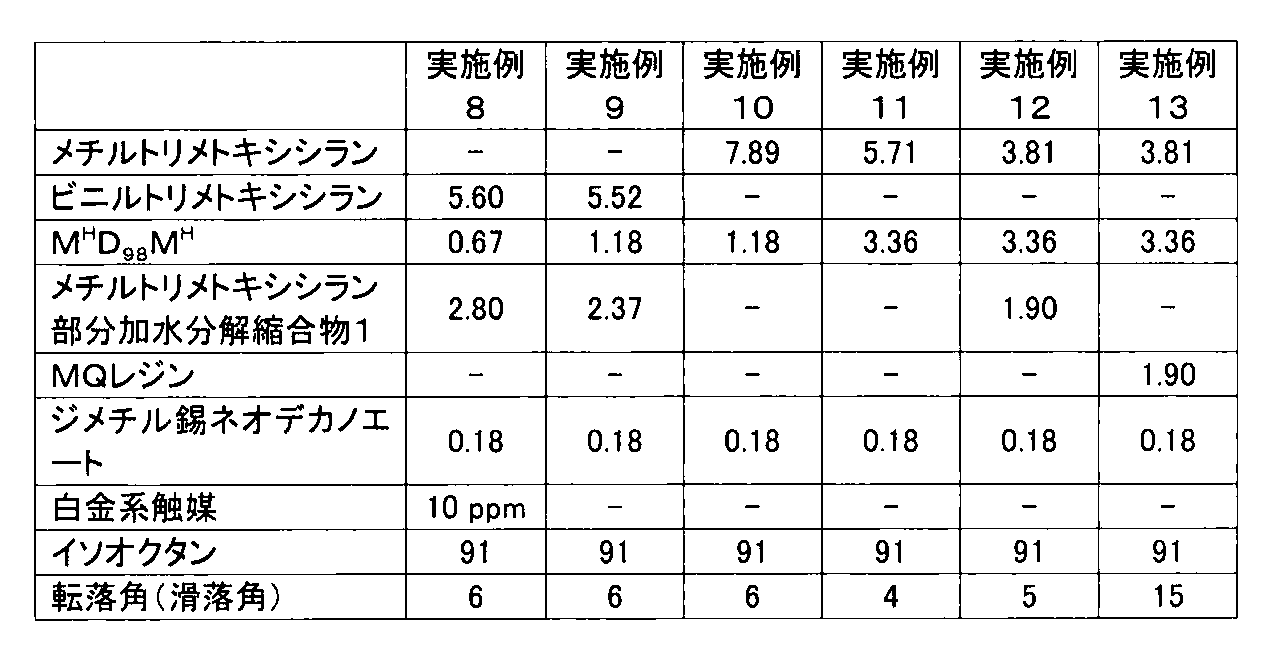
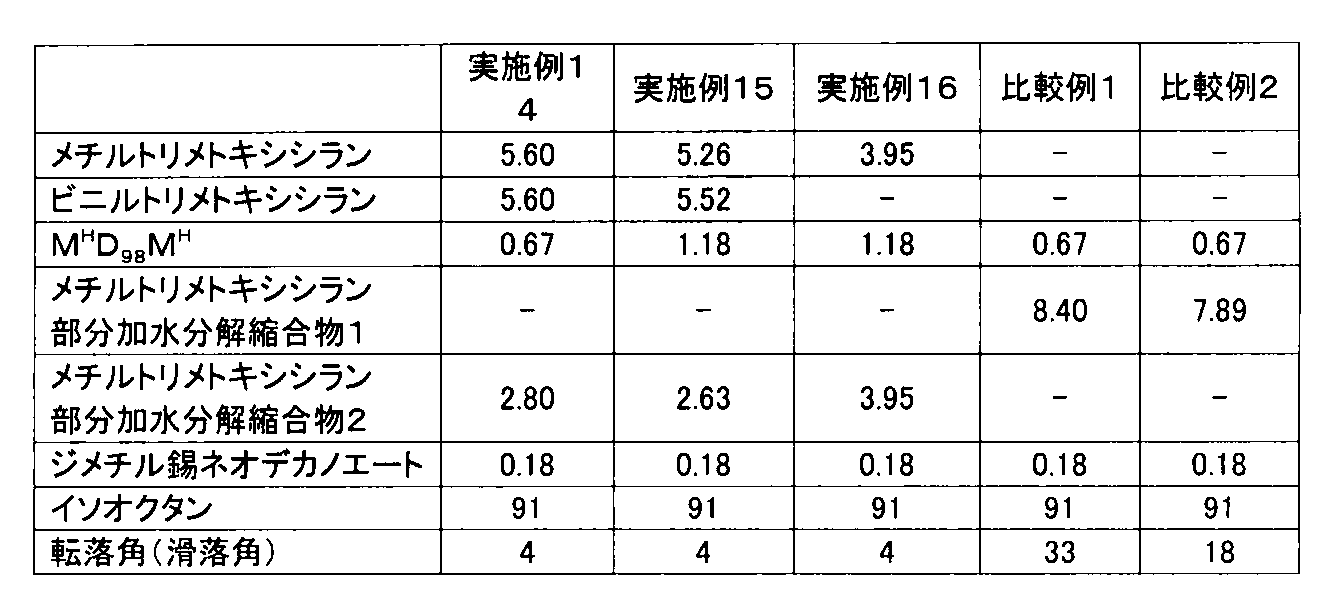
- Examples 1 to 16 and Comparative Examples 1 and 2 The components shown in Tables 1 to 3 were uniformly mixed in the parts by mass shown in Tables 1 to 3 to prepare film-forming compositions of Examples 1 to 14 and Comparative Examples 1 and 2.
- the platinum-based catalyst was blended so that the amount of platinum metal was 10 ppm of the solid content of the film-forming composition.
- the test was performed by immersing and pulling up an aluminum test panel (JIS A1050P) washed with running water and distilled water and heat-dried in the composition.
- the panel surface was coated with a film-forming composition.
- the coated test panel was allowed to stand at room temperature for several minutes to volatilize isooctane and then heated at 200 ° C. for 20 minutes to form a hydrophobic cured film on the test panel surface.
- MH D represents (H (CH 3 ) 2 SiO 1/2 ) unit: represents ((CH 3 ) 2 SiO 2/2 ) unit, and the subscript represents the average chain number of D unit.
- the methyl silicate in the table is a product name MKC silicate MS56 (number of silicon atoms in one molecule is about 10 on average) manufactured by Mitsubishi Chemical Corporation.
- the MQ resins in the table are represented by the following average unit formula: [(CH 3 ) 3 SiO 1/2 ] 0.44 [SiO 4/2 ] 0.56
- the weight average molecular weight in terms of standard polystyrene as measured by gel permeation chromatography is about 4,600, and contains about 3% by weight of hydroxyl groups.
- the film-forming composition of the present invention can form a water-repellent cured film having good water sliding performance, while the absence of organoalkoxysilane. Below, it turns out that the water repellency of the cured film obtained falls, and water slidability worsens.
Landscapes
- Chemical & Material Sciences (AREA)
- Engineering & Computer Science (AREA)
- Organic Chemistry (AREA)
- Chemical Kinetics & Catalysis (AREA)
- Materials Engineering (AREA)
- Medicinal Chemistry (AREA)
- Wood Science & Technology (AREA)
- Health & Medical Sciences (AREA)
- Life Sciences & Earth Sciences (AREA)
- Polymers & Plastics (AREA)
- Physics & Mathematics (AREA)
- Thermal Sciences (AREA)
- Mechanical Engineering (AREA)
- General Engineering & Computer Science (AREA)
- Combustion & Propulsion (AREA)
- Paints Or Removers (AREA)
- Laminated Bodies (AREA)
- Silicon Polymers (AREA)
Abstract
Description
(A)オルガノアルコキシシラン、
(B)ケイ素原子結合水素原子含有オルガノポリシロキサン、及び、
(C)縮合反応触媒
を含む被膜形成用組成物によって達成される。
[R1R2R3SiO1/2]2[R4HSiO2/2]m[R5 2SiO2/2]n (1)
〔式中、R1、R2及びR3は、それぞれ独立して、一価炭化水素基又は水素原子であり、R4及びR5は、それぞれ独立して、一価炭化水素基であり、mは0又は正数であり、nは正数であり、(m+n)の値は5~500であり、{m/(m+n)}の値は0~0.3であり、但し、m>0のとき、末端シリル基のケイ素原子に
結合する水素原子は0~2個であり、m=0のとき、末端シリル基のケイ素原子に結合する水素原子は1又は2個である〕で表されるものが好ましい。
[R6SiO3/2]a[R7R8 pSiO(3−p)/2]b (2)
{式中、R6及びR7は、それぞれ独立して、一価炭化水素基でありR8は、それぞれ独立して、アルコキシ基又は水酸基であり、但し、R8のうち70モル%以上はアルコキシ基であり、pは、1≦p<3の範囲の数であり、aは0又は正数であり、bは正数であり、0.5≦b/(a+b)≦1.0である}で表されるものが好ましい。
(A)オルガノアルコキシシラン、
(B)ケイ素原子結合水素原子含有オルガノポリシロキサン、及び、
(C)縮合反応触媒
を少なくとも含む。
Ra xSi(ORb)4−x
で表されるものが好ましい。前記(A)オルガノアルコキシシランとして、1種類のオルガノアルコキシシランを単独で使用してもよく、また、必要に応じて2種類以上のオルガノアルコキシシランを併用してもよい。
[R1R2R3SiO1/2]2[R4HSiO2/2]m[R5 2SiO2/2]n (1)
〔式中、R1、R2及びR3は、それぞれ独立して、一価炭化水素基又は水素原子であり、R4及びR5は、それぞれ独立して、一価炭化水素基であり、mは0又は正数であり、nは正数であり、(m+n)の値は5~500であり、{m/(m+n)}の値は0~0.3であり、但し、m>0のとき、末端シリル基のケイ素原子に結合する水素原子は0~2個であり、m=0のとき、末端シリル基のケイ素原子に結合する水素原子は1又は2個である〕で表される直鎖状のものが好ましい。前記(B)ケイ素原子結合水素原子含有オルガノポリシロキサンとして、1種類のケイ素原子結合水素原子含有オルガノポリシロキサンを単独で使用してもよく、また、必要に応じて2種類以上のケイ素原子結合水素原子含有オルガノポリシロキサンを併用してもよい。
[R6SiO3/2]a[R7R8 pSiO(3−p)/2]b (2)
{式中、R6及びR7は、それぞれ独立して、一価炭化水素基であり、R8は、それぞれ独立して、アルコキシ基又は水酸基であり、但し、R8のうち70モル%以上はアルコキシ基でありpは、1≦p<3の範囲の数であり、aは0又は正数であり、bは正数であり、0.5≦b/(a+b)≦1.0である}で表されるものが好ましい。
(2)(1)成分を架橋するのに十分な量のケイ素原子結合加水分解性基を有するオルガノシラン系又はオルガノシロキサン系架橋剤、及び、
(3)必要量の縮合反応促進触媒
を含む硬化性シリコーン組成物を硬化することによって得ることができる。
接触角計(協和界面科学製DM−700)を用い滑落法で測定した。具体的には、2μlの水を着滴し、着滴面を傾けながら、水滴をカメラで観察し、水滴の前端点及び後端点の両方が移動し始める瞬間の傾斜角度を転落角(滑落角)とした。
撹拌装置、冷却管、及び、温度計を設けた500mlの四口フラスコに、メチルトリメトキシシラン 259.6g、メタノール28.6g及びトリフルオロメタンスルホン酸0.13gを投入し、均一に混合した後、水29.6gを滴下し、メタノール還流温度で1時間反応させ、常圧下120℃の温度でメタノールを除去しながら3時間反応させた。室温まで冷却後、アンモニアガスを吹き込んで中和し、更に、80℃の温度及び50mmHgの減圧下でストリッピングを行った後、ろ過を実施してメチルトリメトキシシラン部分加水分解縮合物1を得た。13C NMR、及び、29Si NMRの測定結果から得られたメチルトリメトキシシラン部分加水分解縮合物1は下記平均組成式を有することが確認された。
[CH3SiO3/2]3.8[CH3R3 1.3SiO1.7/2]6.5
(式中、R3はメトキシ基である)
撹拌装置、冷却管、及び、温度計を設けた500mlの四口フラスコに、メチルトリメトキシシラン 265.1g、メタノール23.3g及びトリフルオロメタンスルホン酸0.13gを投入し、均一に混合した後、水24.9gを滴下し、メタノール還流温度で1時間反応させ、常圧下120℃の温度でメタノールを除去しながら3時間反応させた。室温まで冷却後、アンモニアガスを吹き込んで中和し、更に、80℃の温度及び50mmHgの減圧下でストリッピングを行った後、ろ過を実施してメチルトリメトキシシラン部分加水分解縮合物2を得た。13C NMR、及び、29Si NMRの測定結果から得られたメチルトリメトキシシラン部分加水分解縮合物2は下記平均組成式を有することが確認された。
[CH3SiO3/2]0.3[CH3R3 1.3SiO1.7/2]3.0
(式中、R3はメトキシ基である)
表1~3に示す成分を表1~3に記載の質量部数で均一に混合して実施例1~14及び比較例1~2の被膜形成用組成物を調製した。なお、白金系触媒は白金金属量が被膜形成用組成物の固形分の10ppmとなるように配合した。次に、アルカリ脱脂剤に浸漬して脱脂処理を行った後、流水及び蒸留水で洗浄し、加熱乾燥したアルミニウムテストパネル(JIS A1050P)を前記組成物中に浸漬し、引上げることによって前記テストパネル表面を被膜形成用組成物で被覆した。前記被覆テストパネルを室温で数分間放置してイソオクタンを揮発させた後、200℃で20分加熱して、前記テストパネル表面上に疎水性硬化被膜を形成した。
MH:(H(CH3)2SiO1/2)単位を表す
D:((CH3)2SiO2/2)単位を表し、添字はD単位の平均の連鎖数を表す
[(CH3)3SiO1/2]0.44[SiO4/2]0.56
で表わされるシリコーンレジンであり、ゲルパーミエーションクロマトグラフィーによる標準ポリスチレン換算の重量平均分子量は約4,600であり、水酸基を約 3重量%含有する。

Claims (18)
- (A)オルガノアルコキシシラン、(B)ケイ素原子結合水素原子含有オルガノポリシロキサン、及び、(C)縮合反応触媒を含む被膜形成用組成物。
- 前記(B)ケイ素原子結合水素原子含有オルガノポリシロキサンが、下記平均単位式(1):
[R1R2R3SiO1/2]2[R4HSiO2/2]m[R5 2SiO2/2]n (1)
〔式中、R1、R2及びR3は、それぞれ独立して、一価炭化水素基又は水素原子であり、R4及びR5は、それぞれ独立して、一価炭化水素基であり、mは0又は正数であり、nは正数であり、(m+n)の値は5~500であり、{m/(m+n)}の値は0~0.3であり、但し、m>0のとき、末端シリル基のケイ素原子に結合する水素原子は0~2個であり、m=0のとき、末端シリル基のケイ素原子に結合する水素原子は1又は2個である〕で表される請求項1記載の被膜形成用組成物。 - 前記平均単位式(1)においてm=0である、請求項1又は2記載の被膜形成用組成物。
- 前記(C)縮合反応触媒が、亜鉛、錫、マンガン、コバルト又は鉄系触媒である、請求項1乃至3のいずれかに記載の被膜形成用組成物。
- 前記(A)オルガノアルコキシシランの配合量が、組成物の全固形分質量を基準にして、1~90質量%である、請求項1乃至4のいずれかに記載の被膜形成用組成物。
- 前記(B)ケイ素原子結合水素原子含有オルガノポリシロキサンの配合量が、組成物の全固形分質量を基準にして、1~90質量%である、請求項1乃至5のいずれかに記載の被膜形成用組成物。
- 前記(C)縮合反応触媒の配合量が、組成物の全固形分質量を基準にして、0.001~8質量%である、請求項1乃至6のいずれかに記載の被膜形成用組成物。
- (D)シリコーンレジンを更に含む、請求項1乃至7のいずれかに記載の被膜形成用組成物。
- 前記(D)シリコーンレジンが、下記平均単位式(2):
[R6SiO3/2]a[R7R8 pSiO(3−p)/2]b (2)
{式中、R6及びR7は、それぞれ独立して、一価炭化水素基であり、R8は、アルコキシ基又は水酸基であり、但し、R8のうち70モル%以上はアルコキシ基であり、pは1≦p<3の範囲の数であり、aは0又は正数であり、bは正数であり、0.5≦b/(a+b)≦1.0である}で表される、請求項8記載の被膜形成用組成物。 - (E)ヒドロシリル化反応触媒を更に含む、請求項1乃至9のいずれかに記載の被膜形成用組成物。
- 請求項1乃至10のいずれかに記載の被膜形成用組成物を基体表面に適用後に加熱する被膜形成方法。
- 前記基体表面が無機材料からなる、請求項11記載の被膜形成方法。
- 前記基体表面がケイ素含有被膜を有する、請求項11又は12記載の被膜形成方法。
- 前記加熱を100~300℃の温度範囲内で行う、請求項11乃至13のいずれかに記載の被膜形成方法。
- 請求項11乃至14のいずれかに記載の被膜形成方法により被膜が表面に形成された基体。
- 水蒸気を含む気体中で使用される、請求項15記載の基体。
- 請求項15又は16記載の基体を備える放熱体。
- 請求項15若しくは16記載の基体又は請求項17記載の放熱体を備える熱交換器。
Priority Applications (5)
| Application Number | Priority Date | Filing Date | Title |
|---|---|---|---|
| US14/003,478 US8925626B2 (en) | 2011-04-08 | 2012-04-04 | Composition for forming film |
| CN2012800153720A CN103443223A (zh) | 2011-04-08 | 2012-04-04 | 被膜形成用组合物 |
| JP2013508964A JPWO2012137977A1 (ja) | 2011-04-08 | 2012-04-04 | 被膜形成用組成物 |
| KR20137025579A KR20140010115A (ko) | 2011-04-08 | 2012-04-04 | 피막 형성용 조성물 |
| EP12767955.3A EP2695922A4 (en) | 2011-04-08 | 2012-04-04 | COMPOSITION FOR FORMING A COATING FILM |
Applications Claiming Priority (2)
| Application Number | Priority Date | Filing Date | Title |
|---|---|---|---|
| JP2011-086275 | 2011-04-08 | ||
| JP2011086275 | 2011-04-08 |
Publications (1)
| Publication Number | Publication Date |
|---|---|
| WO2012137977A1 true WO2012137977A1 (ja) | 2012-10-11 |
Family
ID=46969362
Family Applications (1)
| Application Number | Title | Priority Date | Filing Date |
|---|---|---|---|
| PCT/JP2012/059835 Ceased WO2012137977A1 (ja) | 2011-04-08 | 2012-04-04 | 被膜形成用組成物 |
Country Status (7)
| Country | Link |
|---|---|
| US (1) | US8925626B2 (ja) |
| EP (1) | EP2695922A4 (ja) |
| JP (1) | JPWO2012137977A1 (ja) |
| KR (1) | KR20140010115A (ja) |
| CN (1) | CN103443223A (ja) |
| TW (1) | TW201247802A (ja) |
| WO (1) | WO2012137977A1 (ja) |
Cited By (3)
| Publication number | Priority date | Publication date | Assignee | Title |
|---|---|---|---|---|
| CN103204639A (zh) * | 2013-04-19 | 2013-07-17 | 奇瑞汽车股份有限公司 | 防尘汽车玻璃的制备方法 |
| JP2017538016A (ja) * | 2014-12-19 | 2017-12-21 | ダウ コーニング コーポレーションDow Corning Corporation | 縮合架橋粒子の調製方法 |
| JP2020111657A (ja) * | 2019-01-10 | 2020-07-27 | 信越化学工業株式会社 | ポリシロキサンの製造方法 |
Families Citing this family (14)
| Publication number | Priority date | Publication date | Assignee | Title |
|---|---|---|---|---|
| JP6346456B2 (ja) * | 2013-02-22 | 2018-06-20 | 国立研究開発法人産業技術総合研究所 | 撥水/撥油皮膜及びその製造方法 |
| KR101405366B1 (ko) * | 2014-01-27 | 2014-06-11 | 대한로드라인 페인트 주식회사 | 침투성 발수제 및 이를 이용한 그루빙 시공방법 |
| KR102441644B1 (ko) | 2014-10-31 | 2022-09-07 | 스미또모 가가꾸 가부시키가이샤 | 투명 피막 |
| KR102500899B1 (ko) | 2014-10-31 | 2023-02-16 | 스미또모 가가꾸 가부시키가이샤 | 발수 발유 코팅 조성물 |
| KR102553617B1 (ko) * | 2014-10-31 | 2023-07-07 | 스미또모 가가꾸 가부시키가이샤 | 투명 피막 |
| CN107109128B (zh) | 2014-11-12 | 2021-05-25 | 住友化学株式会社 | 疏水疏油涂敷组合物及透明被膜 |
| JP6232605B2 (ja) * | 2016-05-10 | 2017-11-22 | メック株式会社 | 被膜形成用組成物、表面処理金属部材の製造方法、および金属‐樹脂複合体の製造方法 |
| JP6975375B2 (ja) * | 2016-10-05 | 2021-12-01 | 株式会社スリーボンド | コーティング剤組成物 |
| US11326059B2 (en) | 2017-09-07 | 2022-05-10 | Dow Global Technologies Llc | Thermally conductive ice-phobic coatings |
| JP6932198B2 (ja) * | 2017-10-12 | 2021-09-08 | 日本パーカライジング株式会社 | 表面処理剤、並びに、表面処理被膜を有する金属材料及びその製造方法 |
| JPWO2019189664A1 (ja) * | 2018-03-28 | 2021-03-18 | 株式会社カネカ | 加熱硬化型の硬化物の製造方法、および加熱硬化型の硬化性組成物 |
| CN112512453B (zh) * | 2018-08-03 | 2025-03-07 | 日本帕卡濑精株式会社 | 具有表面处理覆膜的外科用电极 |
| US11542398B2 (en) * | 2019-01-23 | 2023-01-03 | Dow Global Technologies Llc | Azeotropic and pseudoazeotropic blends |
| WO2022192480A1 (en) * | 2021-03-10 | 2022-09-15 | Spotless Materials Inc. | Repellent coatings for high temperature surfaces |
Citations (5)
| Publication number | Priority date | Publication date | Assignee | Title |
|---|---|---|---|---|
| JPH06329914A (ja) * | 1993-05-18 | 1994-11-29 | Toray Dow Corning Silicone Co Ltd | 室温硬化性オルガノポリシロキサン組成物およびその製造方法 |
| JPH1143777A (ja) * | 1997-07-22 | 1999-02-16 | Kobe Steel Ltd | 撥水性及び着霜防止性が優れたアルミニウム又はアルミニウム合金材及びその製造方法 |
| JP2000119642A (ja) | 1998-10-12 | 2000-04-25 | Dow Corning Asia Ltd | 撥水性被膜形成用組成物 |
| JP2001295078A (ja) * | 2000-04-12 | 2001-10-26 | Toto Ltd | 水廻り機器、機器用部品およびその製造方法 |
| JP2010060162A (ja) | 2008-09-01 | 2010-03-18 | Daikin Ind Ltd | 冷凍装置におけるデフロスト方法及び冷凍装置 |
Family Cites Families (15)
| Publication number | Priority date | Publication date | Assignee | Title |
|---|---|---|---|---|
| GB1115051A (en) * | 1964-05-27 | 1968-05-22 | Owens Illinois Inc | Siloxane resins |
| JPS63120773A (ja) | 1986-11-10 | 1988-05-25 | Toray Silicone Co Ltd | シリコ−ン水性エマルジヨン防水材組成物 |
| JP3110749B2 (ja) * | 1990-11-28 | 2000-11-20 | 東レ・ダウコーニング・シリコーン株式会社 | 室温硬化性オルガノポリシロキサン組成物 |
| JPH06329997A (ja) * | 1993-05-18 | 1994-11-29 | Toray Dow Corning Silicone Co Ltd | シリコーンゴムによる基材の接着方法 |
| US5895794A (en) * | 1993-08-30 | 1999-04-20 | Dow Corning Corporation | Shelf stable cross-linked emulsions with optimum consistency and handling without the use of thickeners |
| EP0643106B1 (en) | 1993-09-10 | 1999-12-22 | Shin-Etsu Chemical Co., Ltd. | Organopolysiloxane compositions, their preparation and use, rubber articles coated with them |
| JP3846640B2 (ja) * | 1994-01-20 | 2006-11-15 | 東レ・ダウコーニング株式会社 | 硬化性オルガノポリシロキサン組成物 |
| JP3461404B2 (ja) * | 1995-03-29 | 2003-10-27 | 東レ・ダウコーニング・シリコーン株式会社 | 硬化性オルガノポリシロキサン組成物 |
| JPH0912892A (ja) * | 1995-07-04 | 1997-01-14 | Toray Dow Corning Silicone Co Ltd | 現場成形ガスケット用シリコーンゴム組成物 |
| TW334469B (en) * | 1995-08-04 | 1998-06-21 | Doconitele Silicon Kk | Curable organosiloxane compositions and semiconductor devices |
| JPH10292151A (ja) | 1997-04-17 | 1998-11-04 | Ito Kogaku Kogyo Kk | 撥水処理光学要素 |
| US6297305B1 (en) * | 1998-09-02 | 2001-10-02 | Dow Corning Toray Silicone Company, Ltd. | Curable silicone composition |
| JP4875251B2 (ja) * | 2001-04-26 | 2012-02-15 | 東レ・ダウコーニング株式会社 | シリコーンゲル組成物 |
| BR0210737A (pt) * | 2001-07-26 | 2004-07-20 | Dow Corning Toray Silicone | Composição de organopolissiloxano curável a temperatura ambiente |
| JP5972511B2 (ja) * | 2008-03-31 | 2016-08-17 | 東レ・ダウコーニング株式会社 | 硬化性オルガノポリシロキサン組成物およびその硬化物 |
-
2012
- 2012-04-04 WO PCT/JP2012/059835 patent/WO2012137977A1/ja not_active Ceased
- 2012-04-04 CN CN2012800153720A patent/CN103443223A/zh active Pending
- 2012-04-04 KR KR20137025579A patent/KR20140010115A/ko not_active Withdrawn
- 2012-04-04 JP JP2013508964A patent/JPWO2012137977A1/ja active Pending
- 2012-04-04 EP EP12767955.3A patent/EP2695922A4/en not_active Withdrawn
- 2012-04-04 US US14/003,478 patent/US8925626B2/en not_active Expired - Fee Related
- 2012-04-06 TW TW101112377A patent/TW201247802A/zh unknown
Patent Citations (5)
| Publication number | Priority date | Publication date | Assignee | Title |
|---|---|---|---|---|
| JPH06329914A (ja) * | 1993-05-18 | 1994-11-29 | Toray Dow Corning Silicone Co Ltd | 室温硬化性オルガノポリシロキサン組成物およびその製造方法 |
| JPH1143777A (ja) * | 1997-07-22 | 1999-02-16 | Kobe Steel Ltd | 撥水性及び着霜防止性が優れたアルミニウム又はアルミニウム合金材及びその製造方法 |
| JP2000119642A (ja) | 1998-10-12 | 2000-04-25 | Dow Corning Asia Ltd | 撥水性被膜形成用組成物 |
| JP2001295078A (ja) * | 2000-04-12 | 2001-10-26 | Toto Ltd | 水廻り機器、機器用部品およびその製造方法 |
| JP2010060162A (ja) | 2008-09-01 | 2010-03-18 | Daikin Ind Ltd | 冷凍装置におけるデフロスト方法及び冷凍装置 |
Non-Patent Citations (1)
| Title |
|---|
| See also references of EP2695922A4 |
Cited By (3)
| Publication number | Priority date | Publication date | Assignee | Title |
|---|---|---|---|---|
| CN103204639A (zh) * | 2013-04-19 | 2013-07-17 | 奇瑞汽车股份有限公司 | 防尘汽车玻璃的制备方法 |
| JP2017538016A (ja) * | 2014-12-19 | 2017-12-21 | ダウ コーニング コーポレーションDow Corning Corporation | 縮合架橋粒子の調製方法 |
| JP2020111657A (ja) * | 2019-01-10 | 2020-07-27 | 信越化学工業株式会社 | ポリシロキサンの製造方法 |
Also Published As
| Publication number | Publication date |
|---|---|
| JPWO2012137977A1 (ja) | 2014-07-28 |
| TW201247802A (en) | 2012-12-01 |
| CN103443223A (zh) | 2013-12-11 |
| KR20140010115A (ko) | 2014-01-23 |
| US20130340992A1 (en) | 2013-12-26 |
| US8925626B2 (en) | 2015-01-06 |
| EP2695922A1 (en) | 2014-02-12 |
| EP2695922A4 (en) | 2014-08-20 |
Similar Documents
| Publication | Publication Date | Title |
|---|---|---|
| WO2012137977A1 (ja) | 被膜形成用組成物 | |
| JP4908681B2 (ja) | 撥水コーティング用シリコーン樹脂組成物 | |
| JP4745058B2 (ja) | 熱伝導性シリコーン組成物 | |
| JP4937494B2 (ja) | 熱伝導性シリコーン組成物 | |
| US4929703A (en) | Solventless silicone coating composition | |
| JP2002356651A (ja) | 撥水コーティング用シリコーン組成物 | |
| JP6890898B2 (ja) | 熱伝導性ポリオルガノシロキサン組成物用表面処理剤 | |
| WO2012137976A1 (ja) | 被膜形成用組成物 | |
| JP2017505849A (ja) | 確定された反応性の反応性官能基を有するアルコキシ基含有シリコーン | |
| TWI780221B (zh) | 導熱疏冰塗層 | |
| JP2003041122A (ja) | 皮膜形成性シリコーン樹脂組成物 | |
| TWI794401B (zh) | 可室溫固化有機聚矽氧烷組成物及電氣/電子設備 | |
| JP5080224B2 (ja) | 耐溶剤性シリコーンゴム組成物 | |
| WO2012137974A1 (ja) | 被膜形成用組成物 | |
| JP7234807B2 (ja) | 撥水撥油膜組成物及びその利用 | |
| JP2019163386A (ja) | フェニル変性オルガノポリシロキサンプレポリマー組成物 | |
| JP2008280367A (ja) | 低透湿性ポリオルガノシロキサン組成物 | |
| JP6932198B2 (ja) | 表面処理剤、並びに、表面処理被膜を有する金属材料及びその製造方法 | |
| JP7176527B2 (ja) | オルガノポリシロキサン組成物、並びに有機ケイ素化合物及びその製造方法 | |
| US11981828B2 (en) | Water repellent and oil repellent film composition and use thereof | |
| JP2004256586A (ja) | コーティング用組成物 | |
| JPH1121510A (ja) | 撥水性被膜形成用シリコーンレジン及びその組成物 | |
| JP2000119642A (ja) | 撥水性被膜形成用組成物 | |
| JP7397558B2 (ja) | 撥水撥油膜組成物及びその利用 | |
| TW201920216A (zh) | 有機鈦化合物、濕氣硬化型組成物及成形體 |
Legal Events
| Date | Code | Title | Description |
|---|---|---|---|
| 121 | Ep: the epo has been informed by wipo that ep was designated in this application |
Ref document number: 12767955 Country of ref document: EP Kind code of ref document: A1 |
|
| ENP | Entry into the national phase |
Ref document number: 2013508964 Country of ref document: JP Kind code of ref document: A |
|
| WWE | Wipo information: entry into national phase |
Ref document number: 14003478 Country of ref document: US |
|
| WWE | Wipo information: entry into national phase |
Ref document number: 2012767955 Country of ref document: EP |
|
| ENP | Entry into the national phase |
Ref document number: 20137025579 Country of ref document: KR Kind code of ref document: A |
|
| NENP | Non-entry into the national phase |
Ref country code: DE |