WO2012144352A1 - Film pour protéger une surface - Google Patents
Film pour protéger une surface Download PDFInfo
- Publication number
- WO2012144352A1 WO2012144352A1 PCT/JP2012/059532 JP2012059532W WO2012144352A1 WO 2012144352 A1 WO2012144352 A1 WO 2012144352A1 JP 2012059532 W JP2012059532 W JP 2012059532W WO 2012144352 A1 WO2012144352 A1 WO 2012144352A1
- Authority
- WO
- WIPO (PCT)
- Prior art keywords
- pressure
- sensitive adhesive
- protective film
- adhesive layer
- surface protective
- Prior art date
- Legal status (The legal status is an assumption and is not a legal conclusion. Google has not performed a legal analysis and makes no representation as to the accuracy of the status listed.)
- Ceased
Links
Images

Classifications
-
- C—CHEMISTRY; METALLURGY
- C09—DYES; PAINTS; POLISHES; NATURAL RESINS; ADHESIVES; COMPOSITIONS NOT OTHERWISE PROVIDED FOR; APPLICATIONS OF MATERIALS NOT OTHERWISE PROVIDED FOR
- C09J—ADHESIVES; NON-MECHANICAL ASPECTS OF ADHESIVE PROCESSES IN GENERAL; ADHESIVE PROCESSES NOT PROVIDED FOR ELSEWHERE; USE OF MATERIALS AS ADHESIVES
- C09J7/00—Adhesives in the form of films or foils
- C09J7/30—Adhesives in the form of films or foils characterised by the adhesive composition
- C09J7/38—Pressure-sensitive adhesives [PSA]
-
- C—CHEMISTRY; METALLURGY
- C09—DYES; PAINTS; POLISHES; NATURAL RESINS; ADHESIVES; COMPOSITIONS NOT OTHERWISE PROVIDED FOR; APPLICATIONS OF MATERIALS NOT OTHERWISE PROVIDED FOR
- C09J—ADHESIVES; NON-MECHANICAL ASPECTS OF ADHESIVE PROCESSES IN GENERAL; ADHESIVE PROCESSES NOT PROVIDED FOR ELSEWHERE; USE OF MATERIALS AS ADHESIVES
- C09J183/00—Adhesives based on macromolecular compounds obtained by reactions forming in the main chain of the macromolecule a linkage containing silicon, with or without sulfur, nitrogen, oxygen, or carbon only; Adhesives based on derivatives of such polymers
-
- C—CHEMISTRY; METALLURGY
- C09—DYES; PAINTS; POLISHES; NATURAL RESINS; ADHESIVES; COMPOSITIONS NOT OTHERWISE PROVIDED FOR; APPLICATIONS OF MATERIALS NOT OTHERWISE PROVIDED FOR
- C09J—ADHESIVES; NON-MECHANICAL ASPECTS OF ADHESIVE PROCESSES IN GENERAL; ADHESIVE PROCESSES NOT PROVIDED FOR ELSEWHERE; USE OF MATERIALS AS ADHESIVES
- C09J183/00—Adhesives based on macromolecular compounds obtained by reactions forming in the main chain of the macromolecule a linkage containing silicon, with or without sulfur, nitrogen, oxygen, or carbon only; Adhesives based on derivatives of such polymers
- C09J183/04—Polysiloxanes
- C09J183/06—Polysiloxanes containing silicon bound to oxygen-containing groups
-
- C—CHEMISTRY; METALLURGY
- C09—DYES; PAINTS; POLISHES; NATURAL RESINS; ADHESIVES; COMPOSITIONS NOT OTHERWISE PROVIDED FOR; APPLICATIONS OF MATERIALS NOT OTHERWISE PROVIDED FOR
- C09J—ADHESIVES; NON-MECHANICAL ASPECTS OF ADHESIVE PROCESSES IN GENERAL; ADHESIVE PROCESSES NOT PROVIDED FOR ELSEWHERE; USE OF MATERIALS AS ADHESIVES
- C09J201/00—Adhesives based on unspecified macromolecular compounds
-
- C—CHEMISTRY; METALLURGY
- C09—DYES; PAINTS; POLISHES; NATURAL RESINS; ADHESIVES; COMPOSITIONS NOT OTHERWISE PROVIDED FOR; APPLICATIONS OF MATERIALS NOT OTHERWISE PROVIDED FOR
- C09J—ADHESIVES; NON-MECHANICAL ASPECTS OF ADHESIVE PROCESSES IN GENERAL; ADHESIVE PROCESSES NOT PROVIDED FOR ELSEWHERE; USE OF MATERIALS AS ADHESIVES
- C09J7/00—Adhesives in the form of films or foils
- C09J7/20—Adhesives in the form of films or foils characterised by their carriers
- C09J7/22—Plastics; Metallised plastics
-
- C—CHEMISTRY; METALLURGY
- C09—DYES; PAINTS; POLISHES; NATURAL RESINS; ADHESIVES; COMPOSITIONS NOT OTHERWISE PROVIDED FOR; APPLICATIONS OF MATERIALS NOT OTHERWISE PROVIDED FOR
- C09J—ADHESIVES; NON-MECHANICAL ASPECTS OF ADHESIVE PROCESSES IN GENERAL; ADHESIVE PROCESSES NOT PROVIDED FOR ELSEWHERE; USE OF MATERIALS AS ADHESIVES
- C09J7/00—Adhesives in the form of films or foils
- C09J7/30—Adhesives in the form of films or foils characterised by the adhesive composition
-
- C—CHEMISTRY; METALLURGY
- C09—DYES; PAINTS; POLISHES; NATURAL RESINS; ADHESIVES; COMPOSITIONS NOT OTHERWISE PROVIDED FOR; APPLICATIONS OF MATERIALS NOT OTHERWISE PROVIDED FOR
- C09J—ADHESIVES; NON-MECHANICAL ASPECTS OF ADHESIVE PROCESSES IN GENERAL; ADHESIVE PROCESSES NOT PROVIDED FOR ELSEWHERE; USE OF MATERIALS AS ADHESIVES
- C09J7/00—Adhesives in the form of films or foils
- C09J7/30—Adhesives in the form of films or foils characterised by the adhesive composition
- C09J7/38—Pressure-sensitive adhesives [PSA]
- C09J7/381—Pressure-sensitive adhesives [PSA] based on macromolecular compounds obtained by reactions involving only carbon-to-carbon unsaturated bonds
- C09J7/385—Acrylic polymers
-
- C—CHEMISTRY; METALLURGY
- C09—DYES; PAINTS; POLISHES; NATURAL RESINS; ADHESIVES; COMPOSITIONS NOT OTHERWISE PROVIDED FOR; APPLICATIONS OF MATERIALS NOT OTHERWISE PROVIDED FOR
- C09J—ADHESIVES; NON-MECHANICAL ASPECTS OF ADHESIVE PROCESSES IN GENERAL; ADHESIVE PROCESSES NOT PROVIDED FOR ELSEWHERE; USE OF MATERIALS AS ADHESIVES
- C09J7/00—Adhesives in the form of films or foils
- C09J7/40—Adhesives in the form of films or foils characterised by release liners
- C09J7/403—Adhesives in the form of films or foils characterised by release liners characterised by the structure of the release feature
-
- C—CHEMISTRY; METALLURGY
- C09—DYES; PAINTS; POLISHES; NATURAL RESINS; ADHESIVES; COMPOSITIONS NOT OTHERWISE PROVIDED FOR; APPLICATIONS OF MATERIALS NOT OTHERWISE PROVIDED FOR
- C09J—ADHESIVES; NON-MECHANICAL ASPECTS OF ADHESIVE PROCESSES IN GENERAL; ADHESIVE PROCESSES NOT PROVIDED FOR ELSEWHERE; USE OF MATERIALS AS ADHESIVES
- C09J2203/00—Applications of adhesives in processes or use of adhesives in the form of films or foils
- C09J2203/318—Applications of adhesives in processes or use of adhesives in the form of films or foils for the production of liquid crystal displays
-
- C—CHEMISTRY; METALLURGY
- C09—DYES; PAINTS; POLISHES; NATURAL RESINS; ADHESIVES; COMPOSITIONS NOT OTHERWISE PROVIDED FOR; APPLICATIONS OF MATERIALS NOT OTHERWISE PROVIDED FOR
- C09J—ADHESIVES; NON-MECHANICAL ASPECTS OF ADHESIVE PROCESSES IN GENERAL; ADHESIVE PROCESSES NOT PROVIDED FOR ELSEWHERE; USE OF MATERIALS AS ADHESIVES
- C09J2301/00—Additional features of adhesives in the form of films or foils
- C09J2301/30—Additional features of adhesives in the form of films or foils characterized by the chemical, physicochemical or physical properties of the adhesive or the carrier
- C09J2301/312—Additional features of adhesives in the form of films or foils characterized by the chemical, physicochemical or physical properties of the adhesive or the carrier parameters being the characterizing feature
-
- C—CHEMISTRY; METALLURGY
- C09—DYES; PAINTS; POLISHES; NATURAL RESINS; ADHESIVES; COMPOSITIONS NOT OTHERWISE PROVIDED FOR; APPLICATIONS OF MATERIALS NOT OTHERWISE PROVIDED FOR
- C09J—ADHESIVES; NON-MECHANICAL ASPECTS OF ADHESIVE PROCESSES IN GENERAL; ADHESIVE PROCESSES NOT PROVIDED FOR ELSEWHERE; USE OF MATERIALS AS ADHESIVES
- C09J2483/00—Presence of polysiloxane
-
- G—PHYSICS
- G02—OPTICS
- G02F—OPTICAL DEVICES OR ARRANGEMENTS FOR THE CONTROL OF LIGHT BY MODIFICATION OF THE OPTICAL PROPERTIES OF THE MEDIA OF THE ELEMENTS INVOLVED THEREIN; NON-LINEAR OPTICS; FREQUENCY-CHANGING OF LIGHT; OPTICAL LOGIC ELEMENTS; OPTICAL ANALOGUE/DIGITAL CONVERTERS
- G02F1/00—Devices or arrangements for the control of the intensity, colour, phase, polarisation or direction of light arriving from an independent light source, e.g. switching, gating or modulating; Non-linear optics
- G02F1/01—Devices or arrangements for the control of the intensity, colour, phase, polarisation or direction of light arriving from an independent light source, e.g. switching, gating or modulating; Non-linear optics for the control of the intensity, phase, polarisation or colour
- G02F1/13—Devices or arrangements for the control of the intensity, colour, phase, polarisation or direction of light arriving from an independent light source, e.g. switching, gating or modulating; Non-linear optics for the control of the intensity, phase, polarisation or colour based on liquid crystals, e.g. single liquid crystal display cells
- G02F1/133—Constructional arrangements; Operation of liquid crystal cells; Circuit arrangements
- G02F1/1333—Constructional arrangements; Manufacturing methods
- G02F1/133308—Support structures for LCD panels, e.g. frames or bezels
- G02F1/133311—Environmental protection, e.g. against dust or humidity
-
- Y—GENERAL TAGGING OF NEW TECHNOLOGICAL DEVELOPMENTS; GENERAL TAGGING OF CROSS-SECTIONAL TECHNOLOGIES SPANNING OVER SEVERAL SECTIONS OF THE IPC; TECHNICAL SUBJECTS COVERED BY FORMER USPC CROSS-REFERENCE ART COLLECTIONS [XRACs] AND DIGESTS
- Y10—TECHNICAL SUBJECTS COVERED BY FORMER USPC
- Y10T—TECHNICAL SUBJECTS COVERED BY FORMER US CLASSIFICATION
- Y10T428/00—Stock material or miscellaneous articles
- Y10T428/28—Web or sheet containing structurally defined element or component and having an adhesive outermost layer
- Y10T428/2852—Adhesive compositions
-
- Y—GENERAL TAGGING OF NEW TECHNOLOGICAL DEVELOPMENTS; GENERAL TAGGING OF CROSS-SECTIONAL TECHNOLOGIES SPANNING OVER SEVERAL SECTIONS OF THE IPC; TECHNICAL SUBJECTS COVERED BY FORMER USPC CROSS-REFERENCE ART COLLECTIONS [XRACs] AND DIGESTS
- Y10—TECHNICAL SUBJECTS COVERED BY FORMER USPC
- Y10T—TECHNICAL SUBJECTS COVERED BY FORMER US CLASSIFICATION
- Y10T428/00—Stock material or miscellaneous articles
- Y10T428/28—Web or sheet containing structurally defined element or component and having an adhesive outermost layer
- Y10T428/2852—Adhesive compositions
- Y10T428/2878—Adhesive compositions including addition polymer from unsaturated monomer
- Y10T428/2891—Adhesive compositions including addition polymer from unsaturated monomer including addition polymer from alpha-beta unsaturated carboxylic acid [e.g., acrylic acid, methacrylic acid, etc.] Or derivative thereof
-
- Y—GENERAL TAGGING OF NEW TECHNOLOGICAL DEVELOPMENTS; GENERAL TAGGING OF CROSS-SECTIONAL TECHNOLOGIES SPANNING OVER SEVERAL SECTIONS OF THE IPC; TECHNICAL SUBJECTS COVERED BY FORMER USPC CROSS-REFERENCE ART COLLECTIONS [XRACs] AND DIGESTS
- Y10—TECHNICAL SUBJECTS COVERED BY FORMER USPC
- Y10T—TECHNICAL SUBJECTS COVERED BY FORMER US CLASSIFICATION
- Y10T428/00—Stock material or miscellaneous articles
- Y10T428/31504—Composite [nonstructural laminate]
- Y10T428/31652—Of asbestos
- Y10T428/31663—As siloxane, silicone or silane
-
- Y—GENERAL TAGGING OF NEW TECHNOLOGICAL DEVELOPMENTS; GENERAL TAGGING OF CROSS-SECTIONAL TECHNOLOGIES SPANNING OVER SEVERAL SECTIONS OF THE IPC; TECHNICAL SUBJECTS COVERED BY FORMER USPC CROSS-REFERENCE ART COLLECTIONS [XRACs] AND DIGESTS
- Y10—TECHNICAL SUBJECTS COVERED BY FORMER USPC
- Y10T—TECHNICAL SUBJECTS COVERED BY FORMER US CLASSIFICATION
- Y10T428/00—Stock material or miscellaneous articles
- Y10T428/31504—Composite [nonstructural laminate]
- Y10T428/31786—Of polyester [e.g., alkyd, etc.]
- Y10T428/31797—Next to addition polymer from unsaturated monomers
Definitions
- the present invention relates to a surface protective film.
- the surface protective film of the present invention has a base material layer and a pressure-sensitive adhesive layer, and is used for applications such as affixing to the surface of a display member or an image recognition member to protect the surface.
- a surface protective film may be attached to the surface of the display member or the image recognition member in order to prevent scratches or dirt on the surface.
- Such a surface protective film is often attached manually.
- air bubbles are often involved between the adherend and the surface protective film.
- a plasticizer is added to the adhesive layer of the surface protection film as a technique to prevent air bubbles from being caught between the adherend and the surface protection film when the adherend and the surface protection film are bonded manually.
- Patent Document 1 a technique for improving wettability has been reported.
- the present invention has been made in order to solve the above-described conventional problems.
- the object of the present invention is to exhibit sufficiently high antistatic properties without using an antistatic agent, and without using a plasticizer.
- An object of the present invention is to provide a novel surface protective film that can exhibit sufficiently high wettability and is excellent in reworkability (light release property).
- the surface protective film of the present invention is A surface protective film having a base material layer and an adhesive layer,
- the peeling voltage of the pressure-sensitive adhesive layer is 0.7 kV or less,
- the first wetting speed with respect to the acrylic plate on the surface of the pressure-sensitive adhesive layer in contact with the adherend is 5.0 cm 2 / sec or more.
- the adhesive force A to the acrylic plate at a tensile speed of 0.3 m / min on the surface of the pressure-sensitive adhesive layer in contact with the adherend is 0.02 to 0.20 N / 25 mm.
- the adhesive force B to the acrylic plate at a tensile speed of 10 m / min on the surface of the pressure-sensitive adhesive layer in contact with the adherend is 0.02 to 0.30 N / 25 mm.
- the adhesive force B against the acrylic plate at a tensile speed of 10 m / min on the surface of the pressure-sensitive adhesive layer in contact with the adherend and the tensile speed of 0 on the surface of the pressure-sensitive adhesive layer in contact with the adherend are 0.
- the difference B ⁇ A from the adhesive strength A to the acrylic plate at 3 m / min is 0.1 N / 25 mm or less.
- the pressure-sensitive adhesive layer has a gel fraction of 80% or more.
- the surface protective film of the present invention is used on the surface of a display member or an image recognition member.
- the present invention also provides a display member.
- the display member of the present invention is covered with the surface protective film of the present invention.
- the present invention also provides an image recognition member.
- the image recognition member of the present invention is covered with the surface protective film of the present invention.
- a sufficiently high antistatic property can be expressed without using an antistatic agent, a sufficiently high wettability can be expressed without using a plasticizer, and reworkability (light release property) can be achieved. It is also possible to provide a novel surface protective film that is excellent in performance.
- FIG. 1 is a schematic cross-sectional view of a surface protective film according to a preferred embodiment of the present invention.
- the surface protective film 10 includes a base material layer 1 and an adhesive layer 2.
- the surface protective film of the present invention may further have any appropriate other layer as required (not shown).
- the base material layer includes a fatty acid amide, polyethyleneimine, and a long-chain alkyl series.
- a release treatment can be performed by adding an additive or the like, or a coating layer made of any appropriate release agent such as silicone, long-chain alkyl, or fluorine can be provided.
- the surface protective film of the present invention may be bonded with a release liner having releasability.
- the thickness of the surface protective film of the present invention can be set to any appropriate thickness depending on the application. From the viewpoint of fully expressing the effects of the present invention, the thickness is preferably 10 to 300 ⁇ m, more preferably 15 to 250 ⁇ m, still more preferably 20 to 200 ⁇ m, and particularly preferably 25 to 150 ⁇ m.
- the surface protective film of the present invention has an adhesive layer peeling voltage of 0.7 kV or less, preferably 0.5 kV or less, more preferably 0.3 kV or less.
- the release voltage of the pressure-sensitive adhesive layer is within the above range, the surface protective film of the present invention can exhibit sufficiently high antistatic properties without using an antistatic agent, and it is sufficient without using a plasticizer. High wettability can be expressed, and reworkability (light release) is also excellent. The measurement of the stripping voltage will be described later.
- the first wetting rate with respect to the acrylic plate on the surface of the pressure-sensitive adhesive layer in contact with the adherend is 5.0 cm 2 / sec or more, preferably 10 cm 2 / sec or more, more preferably. Is 15 cm 2 / sec or more, more preferably 20 cm 2 / sec or more, and particularly preferably 30 cm 2 / sec or more.
- the upper limit value of the first wetting rate is not particularly limited, in practice, preferably not more than 1000 cm 2 / sec, more preferably not more than 100 cm 2 / sec.
- the surface protective film of the present invention has sufficiently high antistatic properties without using an antistatic agent. And can exhibit sufficiently high wettability without using a plasticizer. The measurement of the first wetting rate will be described later.
- the third wetting rate with respect to the acrylic plate on the surface of the pressure-sensitive adhesive layer in contact with the adherend is preferably 5.0 cm 2 / sec or more, more preferably 10 cm 2 / sec or more. Yes, more preferably 15 cm 2 / sec or more, particularly preferably 20 cm 2 / sec or more, and most preferably 30 cm 2 / sec or more.
- the upper limit value of the third wetting rate is not particularly limited, but practically, it is preferably 1000 cm 2 / sec or less, more preferably 100 cm 2 / sec or less.
- the surface protective film of the present invention has sufficiently high antistatic properties without using an antistatic agent. And can exhibit sufficiently high wettability without using a plasticizer. The measurement of the third wetting rate will be described later.
- the adhesive force A against the acrylic plate at a tensile speed of 0.3 m / min on the surface of the pressure-sensitive adhesive layer in contact with the adherend is preferably 0.02 to 0.20 N / 25 mm. More preferably, it is 0.02 to 0.10 N / 25 mm, and further preferably 0.02 to 0.05 N / 25 mm. If the adhesive force A to the acrylic plate at a tensile speed of 0.3 m / min on the surface of the pressure-sensitive adhesive layer in contact with the adherend is within the above range, the surface protective film of the present invention does not use an antistatic agent. However, it can exhibit sufficiently high antistatic properties and is excellent in reworkability (light peelability). The measurement of the adhesive strength A will be described later.
- the adhesive force B with respect to the acrylic plate at a tensile speed of 10 m / min on the surface of the pressure-sensitive adhesive layer in contact with the adherend is preferably 0.02 to 0.30 N / 25 mm. It is preferably 0.02 to 0.20 N / 25 mm, and more preferably 0.02 to 0.15 N / 25 mm. If the adhesive force B to the acrylic plate at a tensile speed of 10 m / min on the surface of the pressure-sensitive adhesive layer in contact with the adherend is within the above range, the surface protective film of the present invention can be used without using an antistatic agent. Sufficiently high antistatic properties can be expressed, and reworkability (light release) is excellent. The measurement of the adhesive strength B will be described later.
- the surface protective film of the present invention has an adhesive force B with respect to an acrylic plate at a tensile speed of 10 m / min and an adhesive force A with respect to an acrylic plate at a tensile speed of 0.3 m / min on the surface of the pressure-sensitive adhesive layer in contact with the adherend.
- BA “Adhesive strength against an acrylic plate at a tensile speed of 10 m / min” ⁇ “Adhesive strength against an acrylic plate at a tensile speed of 0.3 m / min”
- BA “Adhesive strength against an acrylic plate at a tensile speed of 10 m / min”
- Adhesive strength against an acrylic plate at a tensile speed of 0.3 m / min” is preferably 0.1 N / 25 mm or less More preferably, it is 0.09 N / 25 mm or less, More preferably, it is 0.08 N / 25 mm or less. If the difference in the adhesive strength is within the above
- the gel fraction of the pressure-sensitive adhesive layer is 80% or more, preferably 82% or more, more preferably 84% or more, still more preferably 86% or more, particularly preferably. Is 88% or more. If the gel fraction of the pressure-sensitive adhesive layer is within the above range, the surface protective film of the present invention can exhibit sufficiently high antistatic properties without using an antistatic agent, and without using a plasticizer. Sufficiently high wettability can be exhibited, and reworkability (light peelability) is also excellent. The measurement of the gel fraction will be described later.
- the thickness of the base material layer is preferably 5 to 300 ⁇ m, more preferably 10 to 250 ⁇ m, still more preferably 15 to 200 ⁇ m, and particularly preferably 20 to 150 ⁇ m.
- the substrate layer may be a single layer or a laminate of two or more layers.
- the base material layer may be stretched.
- the material of the base material layer any appropriate material can be adopted depending on the application.
- a plastic, paper, a metal film, a nonwoven fabric, etc. are mentioned.
- it is a plastic.
- the base material layer may be composed of one kind of material, or may be composed of two or more kinds of materials. For example, you may be comprised from 2 or more types of plastics.
- plastic examples include polyester resins, polyamide resins, and polyolefin resins.
- polyester resin examples include polyethylene terephthalate, polybutylene terephthalate, and polyethylene naphthalate.
- polyolefin resin examples include olefin monomer homopolymers, olefin monomer copolymers, and the like. Specific examples of polyolefin resins include homopolypropylene; block-type, random-type, and graft-type propylene copolymers having an ethylene component as a copolymer component; reactor TPO; low density, high density, linear Low density, ultra-low density, etc.
- ethylene polymers ethylene / propylene copolymer, ethylene / vinyl acetate copolymer, ethylene / methyl acrylate copolymer, ethylene / ethyl acrylate copolymer, ethylene / acrylic acid And ethylene copolymers such as butyl copolymer, ethylene / methacrylic acid copolymer, and ethylene / methyl methacrylate copolymer.
- the base material layer may contain any appropriate additive as required.
- the additive that can be contained in the base material layer include an antioxidant, an ultraviolet absorber, a light stabilizer, an antistatic agent, a filler, and a pigment.
- the kind, number, and amount of additives that can be contained in the base material layer can be appropriately set according to the purpose.
- the material of the base material layer is plastic, it is preferable to contain some of the above additives for the purpose of preventing deterioration.
- particularly preferred additives include antioxidants, ultraviolet absorbers, light stabilizers, and fillers.
- any appropriate antioxidant can be adopted as the antioxidant.
- antioxidants include phenol-based antioxidants, phosphorus-based processing heat stabilizers, lactone-based processing heat stabilizers, sulfur-based heat-resistant stabilizers, phenol-phosphorus-based antioxidants, and the like.
- the content of the antioxidant is preferably 1 part by weight or less with respect to 100 parts by weight of the base resin of the base layer (when the base layer is a blend, the blend is the base resin), More preferred is 0.5 parts by weight or less, and still more preferred is 0.01 to 0.2 parts by weight.
- any appropriate UV absorber can be adopted as the UV absorber.
- UV absorbers include benzotriazole UV absorbers, triazine UV absorbers, and benzophenone UV absorbers.
- the content of the ultraviolet absorber is preferably 2 parts by weight or less with respect to 100 parts by weight of the base resin forming the base layer (when the base layer is a blend, the blend is the base resin). More preferably 1 part by weight or less, still more preferably 0.01 to 0.5 part by weight.
- any appropriate light stabilizer can be adopted as the light stabilizer.
- Examples of such light stabilizers include hindered amine light stabilizers and benzoate light stabilizers.
- the content ratio of the light stabilizer is preferably 2 parts by weight or less with respect to 100 parts by weight of the base resin forming the base layer (in the case where the base layer is a blend, the blend is the base resin). More preferably 1 part by weight or less, still more preferably 0.01 to 0.5 part by weight.
- any suitable filler can be adopted as the filler.
- suitable fillers include inorganic fillers.
- Specific examples of the inorganic filler include carbon black, titanium oxide, and zinc oxide.
- the content of the filler is preferably 20 parts by weight or less with respect to 100 parts by weight of the base resin forming the base layer (when the base layer is a blend, the blend is the base resin). More preferably, it is 10 parts by weight or less, and still more preferably 0.01 to 10 parts by weight.
- inorganic, low molecular weight and high molecular weight antistatic agents such as surfactants, inorganic salts, polyhydric alcohols, metal compounds, carbon and the like are also preferred.
- a high molecular weight antistatic agent and carbon are preferable from the viewpoint of contamination and adhesiveness maintenance.
- the thickness of the pressure-sensitive adhesive layer is preferably 1 to 100 ⁇ m, more preferably 3 to 50 ⁇ m, and further preferably 5 to 30 ⁇ m.
- the adhesive layer is composed of an adhesive. Only one type of adhesive may be used, or two or more types may be used.
- the adhesive is preferably composed mainly of polymer P.
- the content ratio of the polymer P in the pressure-sensitive adhesive is preferably 50% by weight or more, more preferably 80% by weight or more, still more preferably 90% by weight or more, and particularly preferably 95% by weight or more.
- the polymer P may be a crosslinked polymer.
- the adhesive which comprises an adhesive layer is an adhesive layer.
- adhesives include silicone adhesives, urethane adhesives, acrylic adhesives, rubber adhesives, and the like.
- the pressure-sensitive adhesive is preferably a silicone-based pressure-sensitive adhesive or a urethane-based pressure-sensitive adhesive.
- silicone-based adhesive Any appropriate silicone-based adhesive can be adopted as the silicone-based adhesive.
- a silicone-based pressure-sensitive adhesive one obtained by blending or agglomerating a silicone resin can be preferably used.
- silicone adhesive examples include addition reaction curable silicone adhesive and peroxide curable silicone adhesive.
- silicone pressure-sensitive adhesives peroxides (benzoyl peroxide and the like) are not used, and decomposition products are not generated. Therefore, an addition reaction curable silicone pressure-sensitive adhesive is preferable.
- the curing reaction of the addition reaction curable silicone pressure-sensitive adhesive for example, when obtaining a polyalkyl silicone pressure-sensitive adhesive, generally, a method of curing the polyalkylhydrogensiloxane composition with a platinum catalyst can be mentioned.
- any appropriate urethane-based adhesive can be adopted as the urethane-based adhesive.
- a urethane type adhesive Preferably, what consists of urethane resin obtained by making a polyol and a polyisocyanate compound react is mentioned.
- the polyol include polyether polyol, polyester polyol, polycarbonate polyol, and polycaprolactone polyol.
- the polyisocyanate compound include diphenylmethane diisocyanate, tolylene diisocyanate, hexamethylene diisocyanate, and the like.
- any suitable additive can be contained in the pressure-sensitive adhesive constituting the pressure-sensitive adhesive layer.
- suitable additives include softeners, tackifiers, surface lubricants, leveling agents, antioxidants, corrosion inhibitors, light stabilizers, ultraviolet absorbers, heat stabilizers, polymerization inhibitors, silane cups.
- examples include ring agents, lubricants, inorganic or organic fillers, metal powders, pigments, and solvents.
- the pressure-sensitive adhesive constituting the pressure-sensitive adhesive layer preferably does not contain an antistatic agent. If an adhesive layer to which an antistatic agent is added is used, the antistatic property is improved, but the adherend may be contaminated by the antistatic agent.
- the pressure-sensitive adhesive constituting the pressure-sensitive adhesive layer preferably does not contain a plasticizer. This is because, when a pressure-sensitive adhesive layer to which a plasticizer is added is used, wettability is improved, but the adherend may be contaminated by the plasticizer.
- the pressure-sensitive adhesive constituting the pressure-sensitive adhesive layer can be produced by any appropriate method.
- a polymerization method generally used as a polymer synthesis method such as solution polymerization, emulsion polymerization, bulk polymerization, suspension polymerization, polymerization by ultraviolet rays (UV), etc. is used. It can be produced by adopting an appropriate crosslinking method and using any appropriate additive as required.
- the surface protective film of the present invention can be used for any appropriate application.
- the surface protective film of the present invention is used on the surface of a display member or an image recognition member.
- the display member covered with the surface protective film of the present invention can be bonded and peeled many times manually.
- the image recognition member covered with the surface protective film of the present invention can be bonded and peeled many times manually.
- the surface protective film of the present invention can be produced by any appropriate method.
- a manufacturing method for example, (1) A method of applying a solution of a pressure-sensitive adhesive solvent or a hot melt to a substrate, (2) A method for transferring the pressure-sensitive adhesive layer applied and formed in the form of a separator in accordance therewith, (3) A method of forming and applying an adhesive layer forming material onto a substrate, (4) A method of extruding a base material and an adhesive layer in two layers or multiple layers, (5) A method of laminating a pressure-sensitive adhesive layer on a substrate or a method of laminating two layers of pressure-sensitive adhesive layers together with a laminate layer, (6) A method of laminating a pressure-sensitive adhesive layer and a base material forming material such as a film or a laminate layer in two or multiple layers, It can be performed according to any appropriate production method.
- Examples of the coating method include a method using a bar coater, gravure coater, spin coater, roll coater, knife coater, applicator and the like.
- the method for producing the surface protective film of the present invention is particularly preferably a method of applying a solution of an adhesive solvent or a hot melt to a substrate.
- the protective film is cut to a size of 70 mm in width and 130 mm in length, the separator is peeled off, and the surface of the acrylic plate (Mitsubishi Rayon Co., Acrylite L) with a thickness of 1 mm, a width of 70 mm, and a length of 100 mm is previously removed.
- the one end was pressed with a hand roller so that it protruded 30 mm.
- the sample was set at a predetermined position.
- One end that protruded 30 mm was fixed to an automatic winder and peeled so that the peeling angle was 150 ° and the peeling speed was 10 m / min.
- the peeled protective film was placed on a sample fixing stand, and the potential of the acrylic plate was measured with a potential measuring device (KSD-0103, manufactured by Kasuga Denki Co., Ltd.) fixed at a predetermined position. The measurement was performed in an environment of 23 ° C. ⁇ 25% RH.
- KSD-0103 manufactured by Kasuga Denki Co., Ltd.
- Test piece 2.5 cm ⁇ 8.0 cm
- Substrate Acrylic board (Made by Mitsubishi Rayon, trade name: Acrylite L) Number of measurements: 3 (adopts average value of 3 independent measurements)
- Measurement environment Class 10000 clean room (temperature 23 ° C, humidity 50% RH) (1)
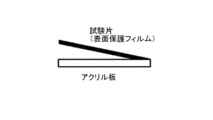
- the angle is set to 20 to 30 degrees with a part of the pressure-sensitive adhesive layer surface of the test piece (surface protective film) in contact with the acrylic plate.
- the adhesive strength A was measured using a universal tensile tester (manufactured by Minebea Co., Ltd., product name: TCM-1kNB) at a peeling angle of 180 ° and a pulling speed of 0.3 m / min.
- an adhesive strength B was measured at a peeling angle of 180 ° and a pulling speed of 10 m / min using a universal tensile testing machine (manufactured by Minebea Co., Ltd., product name: TCM-1kNB).
- Reworkability was evaluated according to the following criteria. ⁇ : The third wetting rate is 5.0 cm 2 / sec or more, and there is no deformation of the film and the pressure-sensitive adhesive layer surface. X: The third wetting speed is less than 5.0 cm 2 / sec, the wettability evaluation is x, and there is deformation of the film and pressure-sensitive adhesive layer surface.
- Example 1 “X-40-3295” (solid content 30%, manufactured by Shin-Etsu Chemical Co., Ltd.) 100 parts by weight as a silicone-based adhesive, and “CAT-PL-50T” (manufactured by Shin-Etsu Chemical Co., Ltd.) 0.3 parts by weight as a platinum catalyst Then, 150 parts by weight of toluene as a solvent was blended and stirred with a disper to prepare a silicone-based pressure-sensitive adhesive composition. The obtained silicone-based pressure-sensitive adhesive composition was applied to a base material “Lumirror S10” (thickness 38 ⁇ m, manufactured by Toray Industries, Inc.) made of a polyester resin so that the thickness after drying with a fountain roll was 21 ⁇ m.
- Example 2 "X-40-3229” (solid content 60%, manufactured by Shin-Etsu Chemical Co., Ltd.) 100 parts by weight as a silicone-based adhesive, and "CAT-PL-50T” (manufactured by Shin-Etsu Chemical Co., Ltd.) 0.5 parts by weight as a platinum catalyst Then, 300 parts by weight of toluene as a solvent was blended and stirred with a disper to prepare a silicone-based pressure-sensitive adhesive composition. The obtained silicone-based pressure-sensitive adhesive composition was applied to a base material “Lumirror S10” (thickness 38 ⁇ m, manufactured by Toray Industries, Inc.) made of a polyester resin so that the thickness after drying with a fountain roll was 21 ⁇ m.
- the obtained silicone-based pressure-sensitive adhesive composition was applied to a base material “Lumirror S10” (thickness 38 ⁇ m, manufactured by Toray Industries, Inc.) made of a polyester resin so that the thickness after drying with a fountain roll was 21 ⁇ m. It was cured and dried under the condition of a drying time of 1 minute.
- the surface of the pressure-sensitive adhesive layer was bonded with the silicone-treated surface of a base material made of a polyester resin having a thickness of 25 ⁇ m and treated on one surface with a silicone fluoride to produce a surface protective film (C1).
- Table 1 The results are shown in Table 1.
- the resulting acrylic polymer A solution (40% by weight) was diluted to 20% by weight with ethyl acetate, and isocyanurate of hexamethylene diisocyanate (manufactured by Nippon Polyurethane Industry Co., Ltd., trade name: Coronate HX) to 100 g of this solution.
- 0.8 g and 0.4 g of dibutyltin dilaurate (1 wt% ethyl acetate solution) as a crosslinking catalyst were added to prepare an acrylic pressure-sensitive adhesive solution.
- the obtained acrylic pressure-sensitive adhesive solution was applied to a base material “Lumirror S10” (thickness 38 ⁇ m, manufactured by Toray Industries, Inc.) made of a polyester resin so that the thickness after drying with a fountain roll was 21 ⁇ m, and the drying temperature was 110 ° C. Cure and dry for 3 minutes.
- the surface of the pressure-sensitive adhesive layer was pasted with the silicone-treated surface of a base material made of a polyester resin having a thickness of 25 ⁇ m and treated on one surface with a silicone fluoride to produce a surface protective film (C2).
- Table 1 The results are shown in Table 1.
- the surface protective film of the present invention is suitably used for applications such as affixing to the surface of a display member or an image recognition member to protect the surface.
Landscapes
- Chemical & Material Sciences (AREA)
- Organic Chemistry (AREA)
- Chemical Kinetics & Catalysis (AREA)
- Adhesive Tapes (AREA)
- Adhesives Or Adhesive Processes (AREA)
Abstract
Priority Applications (4)
| Application Number | Priority Date | Filing Date | Title |
|---|---|---|---|
| US14/110,559 US20140030518A1 (en) | 2011-04-22 | 2012-04-06 | Surface-protecting film |
| CN201280019804.5A CN103492510A (zh) | 2011-04-22 | 2012-04-06 | 表面保护膜 |
| EP12773523.1A EP2700685A4 (fr) | 2011-04-22 | 2012-04-06 | Film pour protéger une surface |
| KR20137027366A KR20140048864A (ko) | 2011-04-22 | 2012-04-06 | 표면 보호 필름 |
Applications Claiming Priority (2)
| Application Number | Priority Date | Filing Date | Title |
|---|---|---|---|
| JP2011095697A JP2012224805A (ja) | 2011-04-22 | 2011-04-22 | 表面保護フィルム |
| JP2011-095697 | 2011-04-22 |
Publications (1)
| Publication Number | Publication Date |
|---|---|
| WO2012144352A1 true WO2012144352A1 (fr) | 2012-10-26 |
Family
ID=47041464
Family Applications (1)
| Application Number | Title | Priority Date | Filing Date |
|---|---|---|---|
| PCT/JP2012/059532 Ceased WO2012144352A1 (fr) | 2011-04-22 | 2012-04-06 | Film pour protéger une surface |
Country Status (7)
| Country | Link |
|---|---|
| US (1) | US20140030518A1 (fr) |
| EP (1) | EP2700685A4 (fr) |
| JP (1) | JP2012224805A (fr) |
| KR (1) | KR20140048864A (fr) |
| CN (1) | CN103492510A (fr) |
| TW (1) | TW201247836A (fr) |
| WO (1) | WO2012144352A1 (fr) |
Cited By (2)
| Publication number | Priority date | Publication date | Assignee | Title |
|---|---|---|---|---|
| WO2015151352A1 (fr) * | 2014-03-31 | 2015-10-08 | リンテック株式会社 | Composition adhésive et feuille adhésive |
| JP2016160322A (ja) * | 2015-02-27 | 2016-09-05 | フジコピアン株式会社 | 両面粘着フィルム及びそれを用いた情報表示画面用の保護部材 |
Families Citing this family (7)
| Publication number | Priority date | Publication date | Assignee | Title |
|---|---|---|---|---|
| JP6126436B2 (ja) * | 2013-03-29 | 2017-05-10 | リンテック株式会社 | 基材レスシリコーン両面テープ |
| JP2016199619A (ja) * | 2015-04-07 | 2016-12-01 | 旭化学工業株式会社 | 両面テープ |
| US10282583B2 (en) * | 2015-12-22 | 2019-05-07 | Gemalto Sa | Fingerprint imaging systems comprising self-wetting adhesive, films and methods |
| WO2017199463A1 (fr) * | 2016-05-16 | 2017-11-23 | 株式会社寺岡製作所 | Composition adhésive sensible à la pression et ruban adhésif sensible à la pression |
| JP2019116609A (ja) | 2017-12-26 | 2019-07-18 | 日東電工株式会社 | 光学部材用表面保護シート |
| KR20190078510A (ko) | 2017-12-26 | 2019-07-04 | 닛토덴코 가부시키가이샤 | 광학 부재용 표면 보호 시트 |
| TWI699424B (zh) * | 2019-01-30 | 2020-07-21 | 南亞塑膠工業股份有限公司 | 一種oca光學膠的離型薄膜及其製造方法 |
Citations (3)
| Publication number | Priority date | Publication date | Assignee | Title |
|---|---|---|---|---|
| JP2007231145A (ja) * | 2006-03-01 | 2007-09-13 | Achilles Corp | 熱遮蔽性シート |
| JP2009179788A (ja) * | 2008-02-01 | 2009-08-13 | Dainippon Printing Co Ltd | サインフィルム |
| JP2010209324A (ja) | 2009-02-13 | 2010-09-24 | Dic Corp | 保護粘着フィルム |
Family Cites Families (5)
| Publication number | Priority date | Publication date | Assignee | Title |
|---|---|---|---|---|
| JP2006182795A (ja) * | 2004-12-24 | 2006-07-13 | Mitsubishi Chemicals Corp | ポリウレタン粘着剤組成物、及び粘着シート又は表面保護フィルム |
| JP4505649B2 (ja) * | 2006-03-23 | 2010-07-21 | フジコピアン株式会社 | 固定シート |
| WO2009038183A1 (fr) * | 2007-09-20 | 2009-03-26 | Toyo Boseki Kabushiki Kaisha | Feuille adhésive, électrode supérieure pour panneau tactile et dispositif d'affichage d'image |
| JP2009126929A (ja) * | 2007-11-22 | 2009-06-11 | Cheil Industries Inc | 粘着剤組成物及び光学部材、表面保護シート |
| JP4842358B2 (ja) * | 2008-12-04 | 2011-12-21 | 日東電工株式会社 | 両面粘着テープ |
-
2011
- 2011-04-22 JP JP2011095697A patent/JP2012224805A/ja active Pending
-
2012
- 2012-04-06 KR KR20137027366A patent/KR20140048864A/ko not_active Withdrawn
- 2012-04-06 WO PCT/JP2012/059532 patent/WO2012144352A1/fr not_active Ceased
- 2012-04-06 EP EP12773523.1A patent/EP2700685A4/fr not_active Withdrawn
- 2012-04-06 CN CN201280019804.5A patent/CN103492510A/zh active Pending
- 2012-04-06 US US14/110,559 patent/US20140030518A1/en not_active Abandoned
- 2012-04-20 TW TW101114292A patent/TW201247836A/zh unknown
Patent Citations (3)
| Publication number | Priority date | Publication date | Assignee | Title |
|---|---|---|---|---|
| JP2007231145A (ja) * | 2006-03-01 | 2007-09-13 | Achilles Corp | 熱遮蔽性シート |
| JP2009179788A (ja) * | 2008-02-01 | 2009-08-13 | Dainippon Printing Co Ltd | サインフィルム |
| JP2010209324A (ja) | 2009-02-13 | 2010-09-24 | Dic Corp | 保護粘着フィルム |
Non-Patent Citations (2)
| Title |
|---|
| "Silicone Pressure Sensitive Adhesives", July 2010 (2010-07-01), XP008171673, Retrieved from the Internet <URL:http://www.silicone.jp/e/catalog/pdf/PSAE.pdf> [retrieved on 20120702] * |
| See also references of EP2700685A4 |
Cited By (4)
| Publication number | Priority date | Publication date | Assignee | Title |
|---|---|---|---|---|
| WO2015151352A1 (fr) * | 2014-03-31 | 2015-10-08 | リンテック株式会社 | Composition adhésive et feuille adhésive |
| JPWO2015151352A1 (ja) * | 2014-03-31 | 2017-04-13 | リンテック株式会社 | 粘着剤組成物および粘着シート |
| US10174234B2 (en) | 2014-03-31 | 2019-01-08 | Lintec Corporation | Adhesive composition and adhesive sheet |
| JP2016160322A (ja) * | 2015-02-27 | 2016-09-05 | フジコピアン株式会社 | 両面粘着フィルム及びそれを用いた情報表示画面用の保護部材 |
Also Published As
| Publication number | Publication date |
|---|---|
| EP2700685A1 (fr) | 2014-02-26 |
| TW201247836A (en) | 2012-12-01 |
| US20140030518A1 (en) | 2014-01-30 |
| CN103492510A (zh) | 2014-01-01 |
| KR20140048864A (ko) | 2014-04-24 |
| EP2700685A4 (fr) | 2014-10-22 |
| JP2012224805A (ja) | 2012-11-15 |
Similar Documents
| Publication | Publication Date | Title |
|---|---|---|
| TWI761604B (zh) | 補強膜 | |
| JP2012224805A (ja) | 表面保護フィルム | |
| WO2012144351A1 (fr) | Film pour protéger une surface | |
| KR101987643B1 (ko) | 박리성이 우수한 이형 필름 | |
| JP2006028416A (ja) | 粘着テープ類 | |
| JP5855465B2 (ja) | 表面保護フィルム、及びそれが貼着された光学部品、工業製品 | |
| KR102546280B1 (ko) | 아크릴계 점착제 및 이를 포함하는 보호 필름 | |
| TWI763405B (zh) | 保護膜、可折疊式裝置、及可捲式裝置 | |
| WO2013077234A1 (fr) | Film protecteur de surface | |
| US7270877B2 (en) | Protective tape used for optical member | |
| JP2014196442A (ja) | 粘着剤組成物およびそれを用いた粘着シート | |
| WO2012144349A1 (fr) | Film pour protéger une surface | |
| JP2013107998A (ja) | 表面保護フィルム | |
| JP2013107997A (ja) | 表面保護フィルム | |
| WO2012144350A1 (fr) | Film pour protéger une surface | |
| TWI706858B (zh) | 表面保護膜及貼合有該表面保護膜的光學部件 | |
| JP2013035977A (ja) | 表面保護フィルム | |
| JP6076517B2 (ja) | 帯電防止表面保護フィルム用剥離フィルム | |
| TWI424037B (zh) | 光學構件用之溶劑型抗靜電丙烯酸黏著劑及光學構件用保護薄膜 | |
| JP6655681B2 (ja) | 帯電防止表面保護フィルム用剥離フィルム | |
| JP2022033915A (ja) | 帯電防止表面保護フィルム | |
| JP2021006404A (ja) | 帯電防止表面保護フィルム |
Legal Events
| Date | Code | Title | Description |
|---|---|---|---|
| 121 | Ep: the epo has been informed by wipo that ep was designated in this application |
Ref document number: 12773523 Country of ref document: EP Kind code of ref document: A1 |
|
| WWE | Wipo information: entry into national phase |
Ref document number: 14110559 Country of ref document: US |
|
| ENP | Entry into the national phase |
Ref document number: 20137027366 Country of ref document: KR Kind code of ref document: A |
|
| WWE | Wipo information: entry into national phase |
Ref document number: 2012773523 Country of ref document: EP |
|
| NENP | Non-entry into the national phase |
Ref country code: DE |