WO2012147708A1 - 硬化性組成物および光学用接着剤 - Google Patents
硬化性組成物および光学用接着剤 Download PDFInfo
- Publication number
- WO2012147708A1 WO2012147708A1 PCT/JP2012/060899 JP2012060899W WO2012147708A1 WO 2012147708 A1 WO2012147708 A1 WO 2012147708A1 JP 2012060899 W JP2012060899 W JP 2012060899W WO 2012147708 A1 WO2012147708 A1 WO 2012147708A1
- Authority
- WO
- WIPO (PCT)
- Prior art keywords
- curable composition
- polythiol
- group
- component
- sulfur
- Prior art date
- Legal status (The legal status is an assumption and is not a legal conclusion. Google has not performed a legal analysis and makes no representation as to the accuracy of the status listed.)
- Ceased
Links
- 0 CC1SCC(*)SC1 Chemical compound CC1SCC(*)SC1 0.000 description 1
Classifications
-
- C—CHEMISTRY; METALLURGY
- C08—ORGANIC MACROMOLECULAR COMPOUNDS; THEIR PREPARATION OR CHEMICAL WORKING-UP; COMPOSITIONS BASED THEREON
- C08G—MACROMOLECULAR COMPOUNDS OBTAINED OTHERWISE THAN BY REACTIONS ONLY INVOLVING UNSATURATED CARBON-TO-CARBON BONDS
- C08G75/00—Macromolecular compounds obtained by reactions forming a linkage containing sulfur with or without nitrogen, oxygen, or carbon in the main chain of the macromolecule
- C08G75/02—Polythioethers
- C08G75/06—Polythioethers from cyclic thioethers
- C08G75/08—Polythioethers from cyclic thioethers from thiiranes
-
- C—CHEMISTRY; METALLURGY
- C08—ORGANIC MACROMOLECULAR COMPOUNDS; THEIR PREPARATION OR CHEMICAL WORKING-UP; COMPOSITIONS BASED THEREON
- C08G—MACROMOLECULAR COMPOUNDS OBTAINED OTHERWISE THAN BY REACTIONS ONLY INVOLVING UNSATURATED CARBON-TO-CARBON BONDS
- C08G75/00—Macromolecular compounds obtained by reactions forming a linkage containing sulfur with or without nitrogen, oxygen, or carbon in the main chain of the macromolecule
-
- C—CHEMISTRY; METALLURGY
- C09—DYES; PAINTS; POLISHES; NATURAL RESINS; ADHESIVES; COMPOSITIONS NOT OTHERWISE PROVIDED FOR; APPLICATIONS OF MATERIALS NOT OTHERWISE PROVIDED FOR
- C09J—ADHESIVES; NON-MECHANICAL ASPECTS OF ADHESIVE PROCESSES IN GENERAL; ADHESIVE PROCESSES NOT PROVIDED FOR ELSEWHERE; USE OF MATERIALS AS ADHESIVES
- C09J181/00—Adhesives based on macromolecular compounds obtained by reactions forming in the main chain of the macromolecule a linkage containing sulfur, with or without nitrogen, oxygen, or carbon only; Adhesives based on polysulfones; Adhesives based on derivatives of such polymers
- C09J181/02—Polythioethers; Polythioether-ethers
Definitions
- the present invention relates to a curable composition suitable as an optical adhesive used for producing a composite optical element.
- a photocurable composition mainly composed of an acrylate compound or the like is widely used as an adhesive for producing an optical element.
- Adhesives, photocurability, mechanical strength, durability, and optical properties are basic performances for adhesives, but in recent years, the refractive index has become an important performance as optical elements become more sophisticated. . In particular, increasing the refractive index of the adhesive is highly desired because the degree of freedom in optical design is expanded.
- Application examples in which an adhesive having a high refractive index is used for example, as an example of a composite optical element, an achromatic lens (achromat lens) formed by bonding two lenses, and a composite of glass and resin Examples include a prism having a complicated shape such as a hybrid aspherical lens and a dichroic prism.
- Adhesives used for these applications are required not only to have a high refractive index, but also to have performance such as adhesion, photocurability, colorless transparency, heat resistance, and viscosity suitable for work.
- the refractive index of a cured product of bis (2,3-epithiopropyl) sulfide is 1.70. Since the episulfide compound has a low viscosity and can be easily injected into a mold, it is suitable for producing a molded article such as a spectacle lens. However, assuming use as an adhesive, if the viscosity is too low, the adhesive may sag or flow, and the adherend may be displaced during pasting, which causes problems in workability. Moreover, since the episulfide compound generally has a large shrinkage due to curing, when used as an adhesive, it causes a decrease in adhesion.
- a polyfunctional (meth) acrylate compound having a high refractive index 9,9-bis (4- (2-acryloxyethoxy) phenyl) fluorene (hereinafter referred to as A-BPEF) (refractive index of cured product 1 .62), 4,4′-bis (methacryloylthio) diphenyl sulfide (hereinafter referred to as MPSMA) (refractive index of cured product 1.69) and the like.
- A-BPEF 9,9-bis (4- (2-acryloxyethoxy) phenyl) fluorene
- MPSMA 4,4′-bis (methacryloylthio) diphenyl sulfide
- a polyfunctional (meth) acrylate compound has a large shrinkage due to curing, and causes a decrease in adhesion when used as an adhesive.
- an ene / thiol composition combining an ethylenically unsaturated compound such as a (meth) acrylate compound and a thiol compound has a high refractive index cured product because the thiol compound contains a sulfur atom having a high atomic refraction.
- a thiol compound contains a sulfur atom having a high atomic refraction.
- Patent Document 5 describes an ene-thiol composition composed of a bifunctional thiol compound containing a 1,4-dithiane ring and triallyl isocyanurate or triallyl cyanurate.
- the refractive index of the cured product is not particularly described.
- the bifunctional thiol compound is used, the cured product is easily softened at a high temperature (see Comparative Example).
- Patent Document 6 describes an ene-thiol composition composed of A-BPEF, an ethylenically unsaturated compound, and a thiol compound. According to the examples, the refractive index of the cured product is at most in the range of 1.58 to 1.61.
- Patent Document 7 describes an ene / thiol composition composed of MPSMA, a vinyl monomer, and polythiol. According to the example, the refractive index of the cured product is 1.649 at the maximum. However, MPSMA is easily yellow-colored and has a limit in the amount of dissolution in the composition because it is solid.
- Patent Document 8 describes a resin composition composed of a resin component having a fluorene ring and a sulfur-containing compound having a diphenyl sulfide skeleton such as MPSMA, and a resin having a refractive index of 1.724. Illustrated.
- the resin composition in the present invention is substantially a thermoplastic resin obtained by kneading a polyester having a fluorene ring and a sulfur-containing compound and is not a curable composition, and of course, photocurability cannot be imparted.
- Japanese Patent Laid-Open No. 9-71580 Japanese Patent Laid-Open No. 9-110979 Japanese Patent Laid-Open No. 9-255781 JP 2001-163874 A JP 2000-154251 A JP 2010-254732 A Japanese Patent Laid-Open No. 03-021638 JP 2005-187661 A
- an object of the present invention is to provide a curable composition having a high refractive index and also having performances required as an optical adhesive such as photocurability, low shrinkage, colorless transparency, and viscosity suitable for work. Is to provide.
- component A a polythiol oligomer obtained by reacting polythiol and sulfur
- component B a polyene compound obtained by reacting polythiol and sulfur
- component C an episulfide compound obtained by reacting polythiol and sulfur
- component D a photobase generator
- a curable composition having a high refractive index and also having performance as an optical adhesive such as photocurability, low shrinkage, colorless transparency and viscosity suitable for work. be able to.
- the first curable composition of the present invention comprises a polythiol oligomer (A component) obtained by reacting polythiol and sulfur and a polyene compound (B component). First, the manufacturing method of a polythiol oligomer (A component) is demonstrated.
- the polythiol used as the raw material of the polythiol oligomer is a compound having two or more thiol groups in one molecule, and may be any of linear, branched, and cyclic.
- compounds represented by the following general formulas (1) to (3) are preferable.
- p1 and p2 each independently represents an integer of 0 to 1
- X 1 to X 8 each independently represents a hydrogen atom or a methylthiol group.
- q represents an integer of 0 to 3
- R 1 represents a simple bond or an alkylene group having 1 to 3 carbon atoms.
- r represents an integer of 0 to 3
- R 2 represents an alkylene group having 1 to 3 carbon atoms.
- Examples of the compound represented by the general formula (1) include 1,5-dimercapto-3-thiapentane, 2-mercaptomethyl-1,5-dimercapto-3-thiapentane, 2,4-bis (mercaptomethyl) -1 , 5-dimercapto-3-thiapentane, 4-mercaptomethyl-1,8-dimercapto-3,6-dithiaoctane, 4,8-bis (mercaptomethyl) -1,11-dimercapto-3,6,9-trithia Undecane, 4,7-bis (mercaptomethyl) -1,11-dimercapto-3,6,9-trithiaundecane, 5,7-bis (mercaptomethyl) -1,11-dimercapto-3,6,9- Examples of the compound represented by the general formula (2) include 2,5-dimercapto-1,4-dithiane and 2,5-dithiane.
- Examples of the polythiol compound other than the compounds represented by the general formulas (1) to (3) include ethylene glycol bis (3-mercaptopropionate), trimethylolpropane tris (3-mercaptopropionate), pentaerythritol tetrakis (3 -Mercaptopropionate), benzenedithiol, tolylenedithiol and the like.
- sulfur forms many allotropes, and generally well-known cyclic S8 sulfur is preferable.
- Sulfur may be in any form, for example, crystalline, colloidal, powder, or sulfur.
- reaction of polythiol is mainly represented by the following reaction formulas (6) and (7): (In the formula, R represents an organic group, and n represents an integer of 1 or more.) Proceed according to.
- the amount of sulfur used is preferably in the range of 0.2 to 0.95 moles of sulfur atoms, more preferably in the range of 0.2 to 0.5 moles per mole of thiol group.
- the reaction between polythiol and sulfur proceeds by heating in the presence or absence of a basic catalyst, but a method using a basic catalyst is preferred.
- the basic catalyst include amines, ammonium salts, phosphines, and phosphonium salts.
- the amount of the basic catalyst used is preferably in the range of 0.005 to 5 mol, more preferably in the range of 0.05 to 0.5 mol, with respect to 100 mol of the thiol group contained in the raw polythiol.
- Each raw material can be added by adding a catalyst to the polythiol and sulfur mixed solution, adding sulfur to the polythiol and catalyst mixed solution, or adding the polythiol and sulfur mixed solution to the polythiol and sulfur mixed solution. May be. In order to allow the reaction to proceed gently, the catalyst and sulfur may be added in several portions.
- the reaction between polythiol and sulfur may be performed in the presence of a polyene compound (component B). Since the reaction between polythiol and sulfur is accompanied by the generation of hydrogen sulfide, the reaction is preferably performed under exhaust or reduced pressure. You may use a solvent as needed. When using a solvent, a post-process for distilling off the solvent is required.
- the reaction temperature is not particularly limited, but it is preferably in the range of 0 to 100 ° C. The temperature may be gradually raised while checking the progress of the reaction.
- the reaction time depends on various conditions such as the type of raw material, the ratio of polythiol and sulfur, and the reaction temperature, and thus cannot be defined unconditionally, but the reaction is continued until no unreacted sulfur remains.
- the 1st curable composition of this invention is comprised including the polythiol oligomer (A component) and polyene compound (B component) which were mentioned above.
- the polyene compound (component B) is a compound having two or more ethylenically unsaturated bond groups in one molecule, and examples of the ethylenically unsaturated bond group include acryloyl group, methacryloyl group, vinyl group, and allyl group. Can be mentioned.
- a compound having an aromatic ring or a heterocyclic ring in the molecule is preferable. Examples of such a compound include triallyl isocyanurate, triallyl cyanurate, diallyl phthalate.
- X represents a sulfur atom or a sulfonyl group
- Z represents a (meth) acryloyl group, a vinyl group, or an allyl group.
- m and n represent an integer in which the sum of m and n satisfies 0 to 4, R 3 represents an alkylene group having 1 to 5 carbon atoms, R 4 represents a hydrogen atom or a methyl group, R 5 represents a hydrogen atom or a methyl group.
- Examples of the compound represented by the general formula (4) include 4,4′-bis (methacryloylthio) diphenyl sulfide, 4,4′-bis (methacryloylthio) diphenyl sulfone, and the like. Examples of the compound represented include 9,9-bis (4- (2-acryloxyethoxy) phenyl) fluorene.
- the content of the polythiol oligomer in the first curable composition is preferably in the range of 10 to 80 parts by weight, more preferably in the range of 20 to 70 parts by weight with respect to 100 parts by weight of the curable composition.
- the content of the polythiol oligomer is less than 10 parts by weight, the effect of increasing the viscosity or reducing the shrinkage is reduced, and when it exceeds 80 parts by weight, the toughness of the cured product is lowered, which is not preferable.
- a polymerization inhibitor an antioxidant, a light stabilizer (HALS), an ultraviolet absorber, a silane coupling agent, a release agent, a pigment, a dye, and the like may be added to the curable composition of the present invention. Is possible.
- the curable composition of the present invention is cured by irradiation with an actinic ray such as ultraviolet light or visible light in the presence of a radical photopolymerization initiator.
- an actinic ray such as ultraviolet light or visible light
- the radical photopolymerization initiator is not particularly limited as long as it generates an active free radical by photolysis.
- Such compounds include 2,2-methoxy-1,2-diphenylethane-1-one, 1-hydroxy-cyclohexyl phenyl ketone, 2-hydroxy-2-methyl-1-phenylpropane-1- ON, 2-methyl-1- [4- (methylthio) phenyl] -2-morpholinopropan-1-one, 2-benzyl-2-dimethylamino-1- (4-morpholinophenyl) -1-butanone, Examples thereof include bis (2,4,6-trimethylbenzoyl) -phenylphosphine oxide, 2,4,6-trimethylbenzoyl-diphenyl-phosphine oxide, and the like.
- the radical photopolymerization initiators may be used alone or in combination of two or more.
- the content is not particularly limited, but is preferably in the range of 0.1 to 10 parts by weight, more preferably in the range of 0.5 to 5 parts by weight with respect to 100 parts by weight of the curable composition.
- the curable composition is used as an adhesive with respect to the viscosity of the curable composition
- the adhesive may sag or flow, or the adherend may be displaced during bonding, which is not preferable.
- the viscosity is too high, it is not preferable because it becomes difficult to discharge or apply the adhesive, or the air bubbles are bitten at the time of bonding.
- the viscosity suitable for workability in the first curable composition cannot be defined unconditionally because it depends on the use form of the adhesive such as the coating method and the laminating method, but is preferably 500 to 20,000 mPa ⁇ s. The range is more preferably 1,000 to 10,000 mPa ⁇ s.
- the second curable composition of the present invention comprises a polythiol oligomer (A component) obtained by reacting polythiol and sulfur, an episulfide compound (C component), and a photobase generator (D component). .
- the method for producing the polythiol oligomer (component A) in the second curable composition is generally as described for the first curable composition.
- the manufacturing method of the polythiol oligomer (A component) in the second curable composition will be described focusing on the difference from the manufacturing method of the polythiol oligomer (A component) in the first curable composition.
- the reaction between polythiol and sulfur proceeds by heating in the presence or absence of a basic catalyst, but a method using a basic catalyst is preferred.
- a hindered amine is preferable as the base catalyst.
- the hindered amine refers to an amine having a substituent on both sides of the amino group. Hindered amines are weak in activity as polymerization catalysts for episulfide compounds due to steric hindrance of substituents.
- the curable composition combining the polythiol oligomer and the episulfide compound is sufficiently stable (the polymerization of the episulfide compound is sufficiently slow), and can be stored for a long period of time.
- a compound having a 2,2,6,6-tetramethylpiperidine skeleton is preferable.
- the amount of the basic catalyst used is preferably in the range of 0.005 to 5 mol, more preferably in
- the reaction between polythiol and sulfur may be performed in the presence of an episulfide compound (component C).
- component C an episulfide compound
- the episulfide compound may be polymerized to cause gelation. Therefore, when a basic catalyst is used, hindered amine is preferable for the reason described above.
- the 2nd curable composition of this invention is comprised including the polythiol oligomer (A component) mentioned above, an episulfide compound (C component), and a photobase generator (D component).
- An episulfide compound (component C) is a compound having one or more episulfide groups in one molecule.
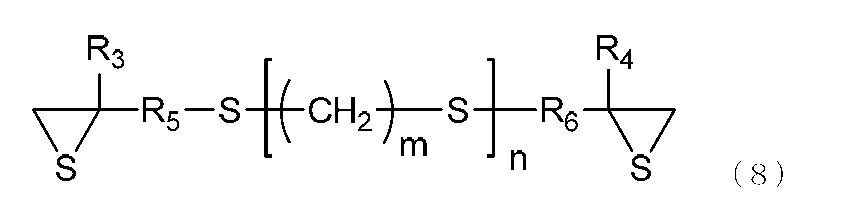
- the following general formula (8) wherein m is an integer from 0 to 6, n is an integer from 0 to 4, R 3 and R 4 are each independently a hydrogen atom or an alkyl group having 1 to 10 carbon atoms, and R 5 , R 4 6 is each independently an alkylene group having 1 to 10 carbon atoms.
- the compound represented by these is preferable.
- Examples of the episulfide compound represented by the general formula (8) include bis (2,3-epithiopropyl) sulfide.
- the episulfide compound represented by the general formula (8) has a large shrinkage due to curing, the shrinkage accompanying the curing can be suppressed by copolymerizing with the polythiol oligomer.
- the episulfide compound represented by the general formula (8) generally has a low viscosity, but is adjusted to a viscosity excellent in workability by mixing with the polythiol oligomer.
- the viscosity of the curable composition assuming that it is used as an adhesive, if the viscosity is too low, the adhesive may sag or flow, or the substrate may be displaced during pasting. It is not preferable. On the other hand, if the viscosity is too high, it is not preferable because it becomes difficult to discharge or apply the adhesive, or bubbles are bitten during the bonding.
- the viscosity suitable for workability in the second curable composition cannot be unconditionally defined because it depends on the use form of the adhesive such as the coating method and the laminating method, but is preferably in the range of 100 to 50,000 mPa ⁇ s. More preferably, it is in the range of 500 to 10,000 mPa ⁇ s.
- the content of the polythiol oligomer in the second curable composition is preferably in the range of 10 to 70 parts by weight, more preferably in the range of 20 to 50 parts by weight with respect to 100 parts by weight of the curable composition. If the content of the polythiol oligomer is less than 10 parts by weight, the effect of increasing the viscosity or reducing the shrinkage is reduced, and if it exceeds 70 parts by weight, the toughness of the cured product is lowered, which is not preferable.
- the photobase generator (component D) is a compound that generates a base by photolysis with actinic rays.
- amidine such as DBN (diazabicyclononene) and DBU (diazabicycloundecene)
- photobase generators that generate these bases are preferred.
- the addition amount of the photobase generator is preferably in the range of 0.01 to 10 parts by weight, more preferably in the range of 0.1 to 5 parts by weight with respect to 100 parts by weight of the curable composition.
- a photosensitizer may be included. By adding the photosensitizer, the photodecomposition of the photobase generator is accelerated, and the curing time of the photocurable composition can be shortened.
- Specific examples of the photosensitizer include benzophenones, thioxanthones, anthraquinones, camphorquinones, benzyls, Michler ketones, and anthracenes. These may be used alone or in combination of two or more.
- the addition amount of the photosensitizer is preferably from 0.01 to 10 parts by weight, more preferably from 0.1 to 5 parts by weight, based on 100 parts by weight of the curable composition.
- a polymerization inhibitor a polymerization inhibitor, an antioxidant, an ultraviolet absorber, a silane coupling agent, a release agent, a pigment, a dye, and the like can be added to the curable composition. . Moreover, you may perform filtration, defoaming, etc. as needed.
- the cure shrinkage rate in an Example was computed from the refractive index before and behind hardening according to the following formula.
- X (1 ⁇ d1 / d2) ⁇ 100 [%]
- the refractive indexes of the curable composition and the cured product (cured film) were measured using an Abbe refractometer NAR-3T (manufactured by Atago Co., Ltd.).
- the transmittance of the cured product was measured using a spectrophotometer U-3500 (manufactured by Hitachi High-Tech) at a thickness of 0.25 mm and a wavelength of 400 nm.
- Example 1 In a 300 ml flask, 65 g of 4-mercaptomethyl-1,8-dimercapto-3,6-dithiaoctane and 0.05 g of dicyclohexylmethylamine were taken and stirred well. 4.7 g of sulfur powder was slowly added dropwise in several portions at room temperature. When sulfur powder was added, the solution turned yellow and gas was generated. After the generation of gas became slow, the temperature was raised to 60 ° C. while flowing nitrogen gas through the liquid surface, and stirring was continued for 3 hours. As the reaction progressed, gas generation almost disappeared and the solution became colorless and transparent. The polythiol oligomer was produced by the above procedure. After cooling the polythiol oligomer to room temperature, 35 g of triallyl isocyanurate was added and stirred until uniform. The 1st curable composition was produced in the above procedure.
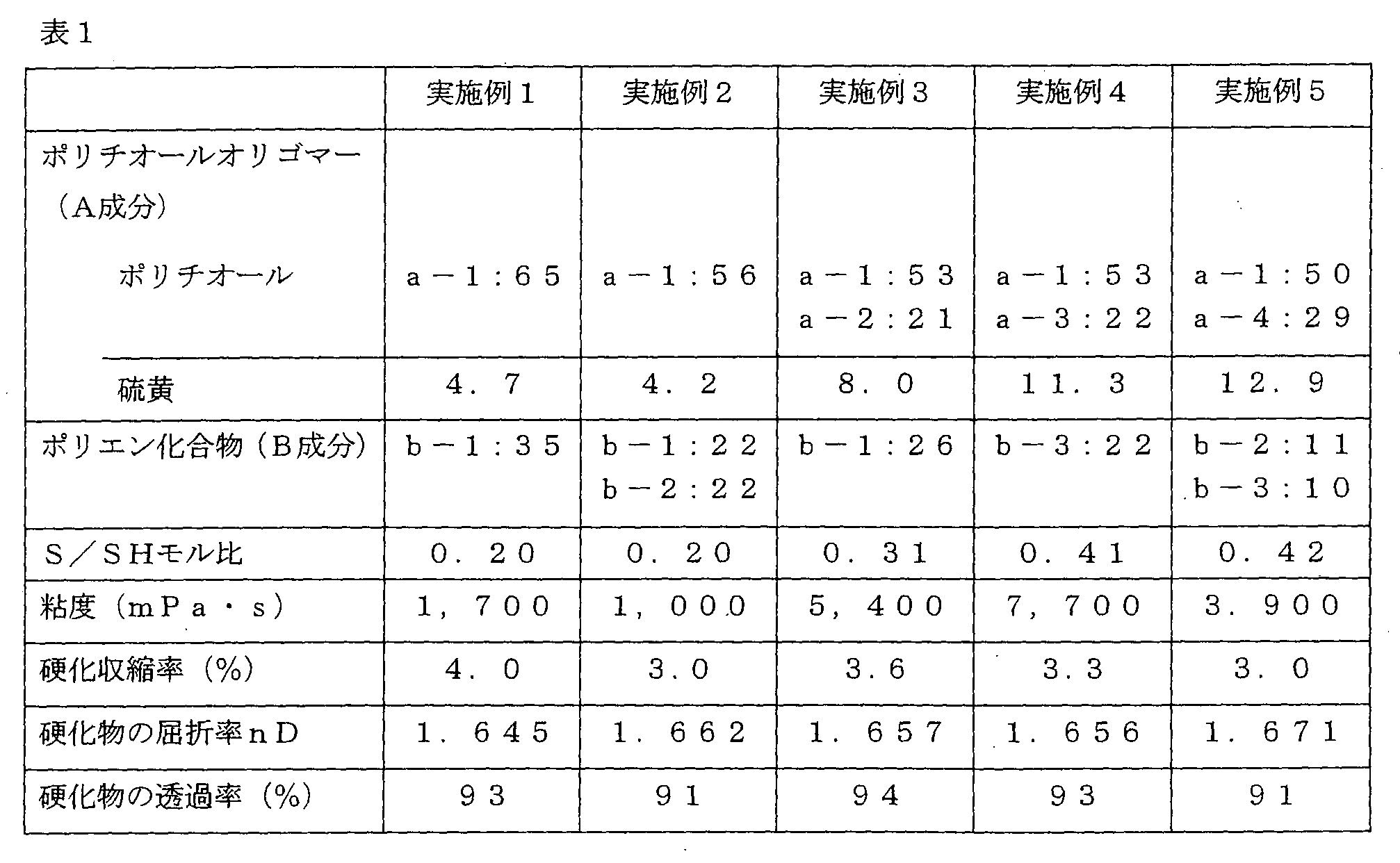
- Examples 2-5 A first curable composition and a cured product were prepared in the same manner as in Example 1 except that the types and amounts of polythiol, sulfur, and polyene compound were changed to the contents shown in Table 1. The physical properties of the first curable composition and the cured product were as shown in Table 1.
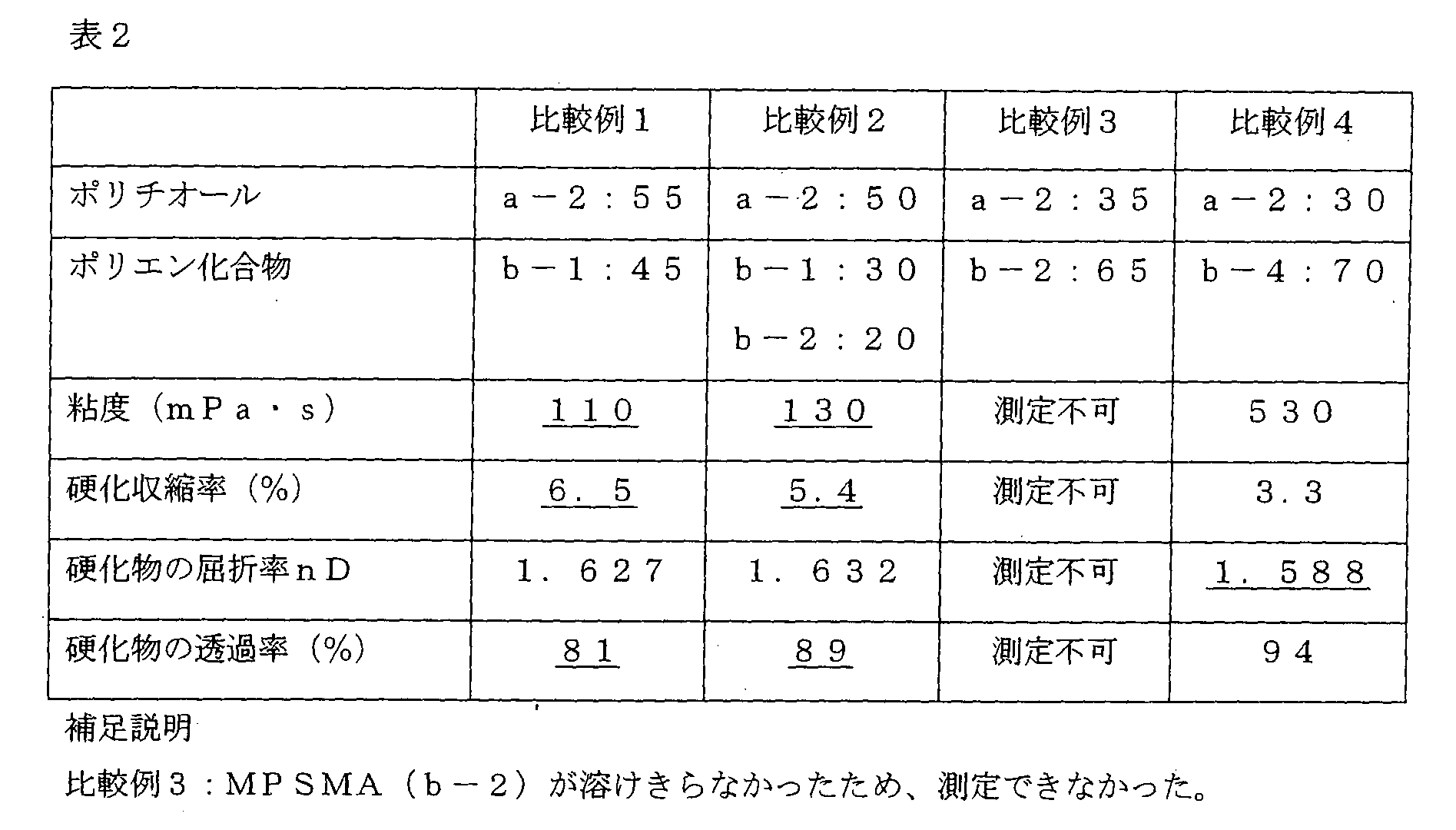
- Comparative Example 1 In a 300 ml flask, 55 g of 2,5-dimercaptomethyl-1,4-dithiane and 45 g of triallyl isocyanurate were taken and stirred until uniform. The curable composition was produced in the above procedure. A cured film was produced in the same manner as in Example 1. The physical properties of the curable composition and the cured product were as shown in Table 2. In addition, the value which performance is inferior compared with an Example was underlined.
- Comparative Examples 2-4 A curable composition and a cured product were prepared in the same manner as in Comparative Example 1 except that the types and amounts of the thiol compound and ethylenically unsaturated compound were changed to those shown in Table 2. The physical properties of the curable composition and the cured product were as shown in Table 2. In addition, the value which performance is inferior compared with an Example was underlined.
- Example 6 In a 300 ml flask, 40 g of 2,5-dimercaptomethyl-1,4-dithiane and 0.05 g of tributylamine were taken and stirred well. 6.0 g of sulfur powder was slowly added dropwise in several portions at room temperature. When sulfur powder was added, the solution turned yellow and gas was generated. After the generation of gas became slow, the temperature was raised to 60 ° C. while flowing nitrogen gas through the liquid surface, and stirring was continued for 3 hours. As the reaction progressed, gas generation almost disappeared and the solution became colorless and transparent. The polythiol oligomer was produced by the above procedure.
- the curable composition was sandwiched between two release-treated glass plates, irradiated with light from a metal halide lamp (120 W / cm) for 3 minutes from a distance of 30 cm, and then the cured film was peeled from the glass plate.
- a cured film having a thickness of 0.25 mm was produced by the above procedure.
- the physical properties of the second curable composition and the cured film were as shown in Table 3.
- Example 7 In a 300 ml flask, 40 g of 2,5-dimercaptomethyl-1,4-dithiane, 60 g of bis (2,3-epithiopropyl) sulfide, 1,2,2,6,6-pentamethyl-4-piperidyl methacrylate .1 g was taken and stirred well. 6.0 g of sulfur powder was slowly added dropwise in several portions at room temperature. When sulfur powder was added, the solution turned yellow and gas was generated. After the generation of gas became slow, the temperature was raised to 60 ° C. while flowing nitrogen gas through the liquid surface, and stirring was continued for 3 hours. As the reaction progressed, gas generation almost disappeared and the solution became colorless and transparent.
- a cured product was prepared in the same manner as in Example 6.
- the physical properties of the second curable composition and the cured film were as shown in Table 3.
- Examples 8-14 The 2nd curable composition and hardened
- Comparative Example 5 100 g of bis (2,3-epithiopropyl) sulfide, 0.2 g of photobase generator (component D) represented by the structural formula (9), and 4-benzoyl-4′-methyldiphenyl sulfide as a sensitizer 1 g was added and stirred until uniform.
- the curable composition was produced in the above procedure.
- a cured product was produced in the same manner as in Example 6.
- the physical properties of the curable composition and the cured product were as shown in Table 5. In addition, physical properties that are inferior to those of the examples are underlined.
Landscapes
- Chemical & Material Sciences (AREA)
- Chemical Kinetics & Catalysis (AREA)
- Organic Chemistry (AREA)
- Health & Medical Sciences (AREA)
- Medicinal Chemistry (AREA)
- Polymers & Plastics (AREA)
- Polymers With Sulfur, Phosphorus Or Metals In The Main Chain (AREA)
Abstract
高い屈折率を有し、且つ、光硬化性、低収縮性、無色透明性、作業に適した粘度といった光学用接着剤として求められる性能も兼ね備えた硬化性組成物等を提供する。 本発明によれば、ポリチオールと硫黄を反応させて得られるポリチオールオリゴマー(A成分)およびポリエン化合物(B成分)を含有する硬化性組成物、または、ポリチオールと硫黄を反応させて得られるポリチオールオリゴマー(A成分)、エピスルフィド化合物(C成分)および光塩基発生剤(D成分)を含有する硬化性組成物を提供することができる。
Description
本発明は、複合光学素子を作製する際に使用される光学用接着剤として好適な硬化性組成物に関するものである。
アクリレート化合物等を主成分とする光硬化性組成物は、光学素子を作製する際の接着剤として幅広く使用されている。接着剤にとって、密着性、光硬化性、機械的強度、耐久性、および光学特性は基本性能であるが、近年では光学素子の高機能化に伴って、屈折率が重要な性能になっている。特に接着剤の高屈折率化は光学設計の自由度が広がるので要望が高い。高い屈折率を有する接着剤が使用される用途例、例えば複合光学素子の例としては、2枚のレンズの張り合わせで構成される色消しレンズ(アクロマートレンズ)、ガラスと樹脂の複合で構成されるハイブリッド型非球面レンズ、ダイクロイックプリズムなどの複雑形状をしたプリズム等が挙げられる。これらの用途に使用される接着剤には、高い屈折率だけでなく、密着性、光硬化性、無色透明性、耐熱性、作業に適した粘度といった性能も当然要求される。
高い屈折率を有する化合物として、分子構造中に硫黄原子を高濃度で含有するエピスルフィド化合物が多数見出されている(特許文献1~4)。例えば、ビス(2,3-エピチオプロピル)スルフィドの硬化物の屈折率は1.70である。該エピスルフィド化合物は粘度が低く、容易にモールド注入できるため、眼鏡レンズなどの成形体の作製には好適である。しかしながら、接着剤としての使用を想定した場合、粘度が低すぎると接着剤が垂れたり流れたり、張り合わせの際に被着体がずれたりして作業性に課題がある。また、一般的にエピスルフィド化合物は硬化に伴う収縮が大きいため、接着剤として使用した場合には密着性が低下する原因となる。
また、高い屈折率を有する多官能(メタ)アクリレート化合物として、9,9-ビス(4-(2-アクリロキシエトキシ)フェニル)フルオレン(以下、A-BPEFと呼ぶ)(硬化物の屈折率1.62)や4,4’-ビス(メタクリロイルチオ)ジフェニルスルフィド(以下、MPSMAと呼ぶ)(硬化物の屈折率1.69)等が知られている。しかしながら、これらの化合物は常温で固体であるため、単独での使用は難しい。
また、一般的に多官能(メタ)アクリレート化合物は硬化に伴う収縮が大きく、接着剤として使用した場合に密着性低下の原因となる。
また、一般的に多官能(メタ)アクリレート化合物は硬化に伴う収縮が大きく、接着剤として使用した場合に密着性低下の原因となる。
一方、(メタ)アクリレート化合物等のエチレン性不飽和化合物とチオール化合物を組み合わせたエン・チオール組成物は、チオール化合物が原子屈折の高い硫黄原子を含有することから、屈折率が高い硬化物が得られることが知られている。しかしながら、チオール基とエチレン性不飽和結合基との付加重合は連鎖重合に比べて架橋点が少なく、また生成するスルフィド結合は軟質な硬化物を与える傾向にあるため、得られる硬化物は高温で軟化しやすい課題がある。十分な耐熱性を得るためには、多官能のエチレン性不飽和化合物およびチオール化合物を選択する必要がある。
特許文献5には、1,4-ジチアン環含有の2官能チオール化合物と、イソシアヌル酸トリアリルまたはシアヌル酸トリアリルから構成されるエン・チオール組成物が記載されている。しかしながら、硬化物の屈折率については特に記載されていない。また、2官能のチオール化合物を使用しているため、硬化物は高温で軟化しやすい(比較例参照)。
特許文献6には、A-BPEF、エチレン性不飽和化合物、およびチオール化合物から構成されるエン・チオール組成物が記載されている。実施例によると、硬化物の屈折率は高々1.58~1.61の範囲である。
特許文献7には、MPSMA、ビニル系モノマー、およびポリチオールから構成されるエン・チオール組成物が記載されている。実施例によると、硬化物の屈折率は最高で1.649である。しかしながら、MPSMAは黄着色しやすく、また固体であるため組成物への溶解量に限界があった。
また、特許文献8には、フルオレン環を有する樹脂成分と、MPSMA等のジフェニルスルフィド骨格を有する硫黄含有化合物とで構成される樹脂組成物が記載されており、屈折率1.724を有する樹脂が例示されている。しかしながら、該発明における樹脂組成物とは、実質的にはフルオレン環を有するポリエステルと硫黄含有化合物を混練した熱可塑性樹脂であって硬化性組成物ではなく、当然ながら光硬化性は付与できない。
特許文献6には、A-BPEF、エチレン性不飽和化合物、およびチオール化合物から構成されるエン・チオール組成物が記載されている。実施例によると、硬化物の屈折率は高々1.58~1.61の範囲である。
特許文献7には、MPSMA、ビニル系モノマー、およびポリチオールから構成されるエン・チオール組成物が記載されている。実施例によると、硬化物の屈折率は最高で1.649である。しかしながら、MPSMAは黄着色しやすく、また固体であるため組成物への溶解量に限界があった。
また、特許文献8には、フルオレン環を有する樹脂成分と、MPSMA等のジフェニルスルフィド骨格を有する硫黄含有化合物とで構成される樹脂組成物が記載されており、屈折率1.724を有する樹脂が例示されている。しかしながら、該発明における樹脂組成物とは、実質的にはフルオレン環を有するポリエステルと硫黄含有化合物を混練した熱可塑性樹脂であって硬化性組成物ではなく、当然ながら光硬化性は付与できない。
従って、本発明の目的は、高い屈折率を有し、且つ、光硬化性、低収縮性、無色透明性、作業に適した粘度といった光学用接着剤として求められる性能も兼ね備えた硬化性組成物を提供することにある。
本発明者らは、上記課題を解決するために鋭意検討した結果、ポリチオールと硫黄を反応させて得られるポリチオールオリゴマー(A成分)と、ポリエン化合物(B成分)を含有した硬化性組成物が、更なる高屈折率化を可能にし、且つ光学用接着剤としての必要性能も兼ね備えることを見出し、本発明に至った。
また、本発明者らは、ポリチオールと硫黄を反応させて得られるポリチオールオリゴマー(A成分)、エピスルフィド化合物(C成分)および光塩基発生剤(D成分)を含有した硬化性組成物が、接着剤として作業性に適した粘度を有し、且つ硬化に伴う収縮が小さいことから、光学用接着剤として好適であることを見出した。さらに、ポリチオールと硫黄を反応させる際に塩基性触媒を使用することが好ましいが、この触媒としてヒンダードアミンを使用すると、保存安定性に優れた(エピスルフィドの反応が十分に遅い)硬化性組成物が得られることを見出した。以上の知見に基づき、本発明に至った。
また、本発明者らは、ポリチオールと硫黄を反応させて得られるポリチオールオリゴマー(A成分)、エピスルフィド化合物(C成分)および光塩基発生剤(D成分)を含有した硬化性組成物が、接着剤として作業性に適した粘度を有し、且つ硬化に伴う収縮が小さいことから、光学用接着剤として好適であることを見出した。さらに、ポリチオールと硫黄を反応させる際に塩基性触媒を使用することが好ましいが、この触媒としてヒンダードアミンを使用すると、保存安定性に優れた(エピスルフィドの反応が十分に遅い)硬化性組成物が得られることを見出した。以上の知見に基づき、本発明に至った。
本発明によれば、高い屈折率を有し、且つ、光硬化性、低収縮性、無色透明性、作業に適した粘度といった光学用接着剤としての性能も兼ね備えた硬化性組成物を提供することができる。
本発明の第1の硬化性組成物は、ポリチオールと硫黄を反応させて得られるポリチオールオリゴマー(A成分)と、ポリエン化合物(B成分)を含有して構成される。
まず、ポリチオールオリゴマー(A成分)の製造方法について説明する。
まず、ポリチオールオリゴマー(A成分)の製造方法について説明する。
ポリチオールオリゴマーの原料となるポリチオールとは、1分子中に2個以上のチオール基を有する化合物であり、直鎖状、分岐鎖状、環状のいずれであってもよい。特に、硬化性組成物の高屈折率化と作業性に適した粘度を追求した場合、下記一般式(1)から(3)で表わされる化合物が好ましい。

(式中、p1およびp2はそれぞれ独立に0~1の整数を表し、X1~X8はそれぞれ独立に水素原子またはメチルチオール基を表す。)

(式中、qは0~3の整数を表し、R1は単なる結合または炭素数1~3のアルキレン基を表す。)

(式中、rは0~3の整数を表し、R2は炭素数1~3のアルキレン基を表す。)
一般式(1)で表わされる化合物の例としては、1,5-ジメルカプト-3-チアペンタン、2-メルカプトメチル-1,5-ジメルカプト-3-チアペンタン、2,4-ビス(メルカプトメチル)-1,5-ジメルカプト-3-チアペンタン、4-メルカプトメチル-1,8-ジメルカプト-3,6-ジチアオクタン、4,8-ビス(メルカプトメチル)-1,11-ジメルカプト-3,6,9-トリチアウンデカン、4,7-ビス(メルカプトメチル)-1,11-ジメルカプト-3,6,9-トリチアウンデカン、5,7-ビス(メルカプトメチル)-1,11-ジメルカプト-3,6,9-トリチアウンデカン等が挙げられ、一般式(2)で表わされる化合物の例としては、2,5-ジメルカプト-1,4-ジチアン、2,5-ジメルカプトメチル-1,4-ジチアン、2,5-ジメルカプトエチル-1,4-ジチアン等が挙げられ、一般式(3)で表わされる化合物の例としては、キシリレンジチオール等が挙げられる。一般式(1)から(3)で表わされる化合物以外のポリチオール化合物としては、エチレングリコールビス(3-メルカプトプロピオネート)、トリメチロールプロパントリス(3-メルカプトプロピオネート)、ペンタエリスリトールテトラキス(3-メルカプトプロピオネート)、ベンゼンジチオール、トリレンジチオール等が挙げられる。
ポリチオールオリゴマーの原料となる硫黄について、硫黄は多くの同素体を形成するが、通常よく知られている環状のS8硫黄が好ましい。硫黄はいかなる形態でもよく、例えば、結晶状、コロイド状、粉末、あるいは硫黄華でもよい。
Jounal of Organic Chemistry,32巻,3833~3836ページ(1967年)によると、ポリチオールと硫黄の反応は、例えば生成物が2量体の場合、主に下記の反応式(6)および(7)


(式中、Rは有機基を表し、nは1以上の整数を表す。)
に従って進行する。硫黄の使用量は、チオール基1モルに対して、硫黄原子0.2~0.95モルの範囲が好ましく、0.2~0.5モルの範囲がより好ましい。0.2モル未満ではポリチオールの転化率が低すぎて実用的でないし、0.95モルを超えると光学材料の原料として好ましくない分子量が過大なポリチオールオリゴマーが生成するとともに、未反応の硫黄が残存しやすく好ましくない。
に従って進行する。硫黄の使用量は、チオール基1モルに対して、硫黄原子0.2~0.95モルの範囲が好ましく、0.2~0.5モルの範囲がより好ましい。0.2モル未満ではポリチオールの転化率が低すぎて実用的でないし、0.95モルを超えると光学材料の原料として好ましくない分子量が過大なポリチオールオリゴマーが生成するとともに、未反応の硫黄が残存しやすく好ましくない。
ポリチオールと硫黄の反応は、塩基性触媒の存在下あるいは非存在下で加熱することで進行するが、塩基性触媒を使用する方法が好ましい。塩基性触媒の種類としては、アミン、アンモニウム塩、ホスフィン、ホスホニウム塩等が挙げられる。塩基性触媒の使用量は、原料のポリチオールに含まれるチオール基100モルに対して、0.005~5モルの範囲が好ましく、0.05~0.5モルの範囲がより好ましい。
各原料の添加手順は、ポリチオールと硫黄の混合溶液に触媒を添加しても、ポリチオールと触媒の混合溶液に硫黄を添加しても、ポリチオールと硫黄の混合溶液にポリチオールと触媒の混合溶液を添加してもよい。反応を穏やかに進行させるために、触媒や硫黄を複数回に分割して添加してもよい。
ポリチオールと硫黄の反応は、ポリエン化合物(B成分)の存在下で行ってもよい。ポリチオールと硫黄の反応は硫化水素の発生を伴うので、排気下や減圧下で反応を行うことが好ましい。必要に応じて溶媒を使用してもよい。溶媒を使用する場合には溶媒を留去する後工程が必要となる。反応温度は特に限定されないが、0~100℃の範囲が好ましく、反応の進行具合を見ながら徐々に温度を上げていってもよい。反応時間は、原料の種類、ポリチオールと硫黄の割合、反応温度などの様々な条件に依るので一概には規定できないが、未反応の硫黄が残存しなくなるまで反応させる。
次に、本発明の第1の硬化性組成物について説明する。
本発明の第1の硬化性組成物は、前述したポリチオールオリゴマー(A成分)とポリエン化合物(B成分)を含有して構成される。
本発明の第1の硬化性組成物は、前述したポリチオールオリゴマー(A成分)とポリエン化合物(B成分)を含有して構成される。
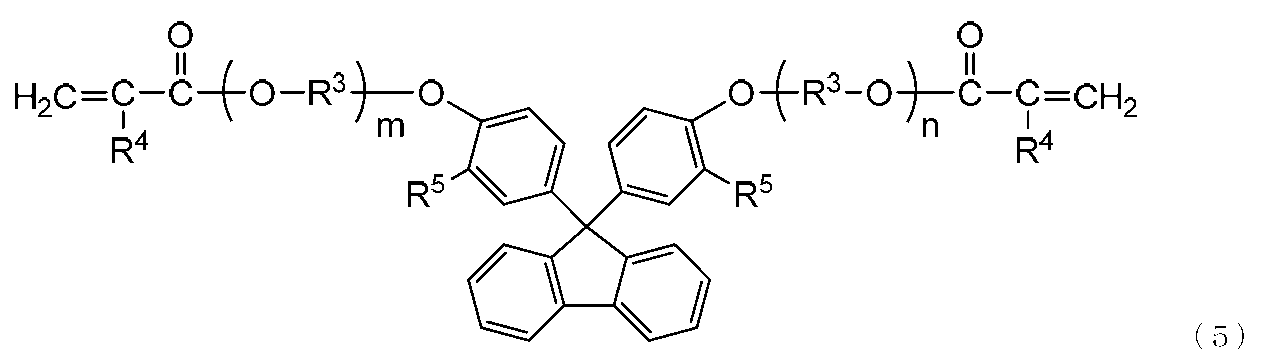
ポリエン化合物(B成分)とは、1分子中に2個以上のエチレン性不飽和結合基を有する化合物であり、エチレン性不飽和結合基としてはアクリロイル基、メタクリロイル基、ビニル基、アリル基等が挙げられる。特に、硬化性組成物の高屈折率化を追求した場合、分子内に芳香環や複素環を有する化合物が好ましく、このような化合物の例としては、イソシアヌル酸トリアリル、シアヌル酸トリアリル、フタル酸ジアリル、イソフタル酸ジアリル、テレフタル酸ジアリル、トリメリット酸トリアリル、ピロメリット酸テトラアリル、一般式(4)で表わされる化合物、一般式(5)で表わされる化合物等が挙げられる。
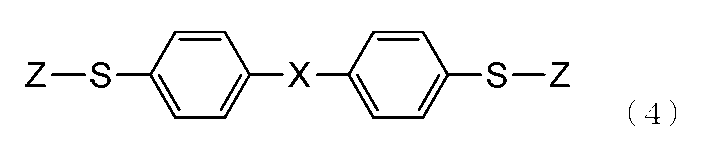
(式中、Xは硫黄原子またはスルホニル基を表し、Zは(メタ)アクリロイル基、ビニル基、またはアリル基を表わす。)

(式中、mおよびnは、mとnの合計が0~4を満たす整数を表し、R3は炭素数1~5のアルキレン基を表し、R4は水素原子またはメチル基を表し、R5は水素原子またはメチル基を表す。)
一般式(4)で表わされる化合物の例としては、4,4’-ビス(メタクリロイルチオ)ジフェニルスルフィド、4,4’-ビス(メタクリロイルチオ)ジフェニルスルホン等が挙げられ、一般式(5)で表わされる化合物としては、9,9-ビス(4-(2-アクリロキシエトキシ)フェニル)フルオレン等が挙げられる。
一般式(4)で表わされる化合物の例としては、4,4’-ビス(メタクリロイルチオ)ジフェニルスルフィド、4,4’-ビス(メタクリロイルチオ)ジフェニルスルホン等が挙げられ、一般式(5)で表わされる化合物としては、9,9-ビス(4-(2-アクリロキシエトキシ)フェニル)フルオレン等が挙げられる。
第1の硬化性組成物におけるポリチオールオリゴマーの含有量について、硬化性組成物100重量部に対して、10~80重量部の範囲が好ましく、20~70重量部の範囲がさらに好ましい。ポリチオールオリゴマーの含有量が10重量部未満では高粘度化や低収縮化の効果が小さくなり、80重量部を超えると硬化物の靭性が低下して、好ましくない。
本発明の硬化性組成物には必要に応じて、重合禁止剤、酸化防止剤、光安定剤(HALS)、紫外線吸収剤、シランカップリング剤、離型剤、顔料、染料等を添加することが可能である。
本発明の硬化性組成物は、ラジカル系光重合開始剤の存在下で、紫外光や可視光などの活性光線を照射することで硬化する。ラジカル系光重合開始剤とは、光分解によって活性な遊離ラジカルを生成させるものであれば特に限定されない。このような化合物の具体例としては、2,2-メトキシ-1,2-ジフェニルエタン-1-オン、1-ヒドロキシ-シクロヘキシルフェニルケトン、2-ヒドロキシ-2-メチル-1-フェニルプロパン-1-オン、2-メチル-1-[4-(メチルチオ)フェニル]-2-モルフォリノプロパン-1-オン、2-ベンジル-2-ジメチルアミノ-1-(4-モルフォリノフェニル)-1-ブタノン、ビス(2,4,6-トリメチルベンゾイル)-フェニルフォスフィンオキサイド、2,4,6-トリメチルベンゾイル-ジフェニル-フォスフィンオキサイド等が挙げられる。ラジカル系光重合開始剤は単独でも2種類以上を混合して使用しても構わない。その含有量は特に限定されないが、硬化性組成物100重量部に対して、0.1~10重量部の範囲が好ましく、0.5~5重量部の範囲がより好ましい。
硬化性組成物の粘度に関して、接着剤としての使用を想定した場合、粘度が低すぎると、接着剤が垂れたり流れたり、張り合わせの際に被着体がずれたりして好ましくない。また、粘度が高すぎると、接着剤の吐出や塗布が困難になったり、張り合わせの際に気泡を噛んだりして好ましくない。第1の硬化性組成物における、作業性に適した粘度とは、塗布方法や張り合わせ方法といった接着剤の使用形態にも依るので一概には規定できないが、好ましくは500~20,000mPa・sの範囲であり、より好ましくは1,000~10,000mPa・sの範囲である。
本発明の第2の硬化性組成物は、ポリチオールと硫黄を反応させて得られるポリチオールオリゴマー(A成分)、エピスルフィド化合物(C成分)および光塩基発生剤(D成分)を含有して構成される。
まず、第2の硬化性組成物におけるポリチオールオリゴマー(A成分)の製造方法については、概ね、上述の第1の硬化性組成物について説明した通りである。以下、第1の硬化性組成物におけるポリチオールオリゴマー(A成分)の製造方法との相違点を中心に、第2の硬化性組成物におけるポリチオールオリゴマー(A成分)の製造方法について説明する。
第2の硬化性組成物においても、ポリチオールと硫黄の反応は、塩基性触媒の存在下あるいは非存在下で加熱することで進行するが、塩基性触媒を使用する方法が好ましい。特に塩基触媒としてはヒンダードアミンが好ましい。ヒンダードアミンとはアミノ基の両隣に置換基を有するアミンを言う。ヒンダードアミンは置換基の立体障害に起因して、エピスルフィド化合物の重合触媒としては活性が弱い。その結果、ポリチオールオリゴマーとエピスルフィド化合物を合わせた硬化性組成物は十分に安定(エピスルフィド化合物の重合が十分に遅い)であり、長期の保存が可能となる。ヒンダードアミンとしては、2,2,6,6-テトラメチルピペリジン骨格を有する化合物が好ましく、具体的には、2,2,6,6-テトラメチルピペリジン、1,2,2,6,6-ペンタメチルピペリジン、4-ヒドロキシ-2,2,6,6-テトラメチルピペリジン、4-ヒドロキシ-1,2,2,6,6-ペンタメチルピペリジン、アクリル酸2,2,6,6-テトラメチル-4-ピペリジル、メタクリル酸2,2,6,6-テトラメチル-4-ピペリジル、アクリル酸1,2,2,6,6-ペンタメチル-4-ピペリジル、メタクリル酸1,2,2,6,6-ペンタメチル-4-ピペリジル、セバシン酸ビス(2,2,6,6-テトラメチル-4-ピペリジル)、セバシン酸ビス(1,2,2,6,6-ペンタメチル-4-ピペリジル)等が挙げられる。塩基性触媒の使用量は、原料のポリチオールに含まれるチオール基100モルに対して、0.005~5モルの範囲が好ましく、0.05~0.5モルの範囲がより好ましい。
ポリチオールと硫黄の反応は、エピスルフィド化合物(C成分)の存在下で行ってもよい。ただし、適切な塩基性触媒を選択しないと、エピスルフィド化合物の重合が進行してゲル化を引き起こす場合がある。従って、塩基性触媒を使用する場合には前述した理由によりヒンダードアミンが好ましい。
次に、本発明の第2の硬化性組成物について説明する。
本発明の第2の硬化性組成物は、前述したポリチオールオリゴマー(A成分)、エピスルフィド化合物(C成分)、および光塩基発生剤(D成分)を含有して構成される。
エピスルフィド化合物(C成分)とは、1分子中に1個以上のエピスルフィド基を有する化合物である。特に、硬化性組成物の高屈折率化を追求した場合、下記の一般式(8)
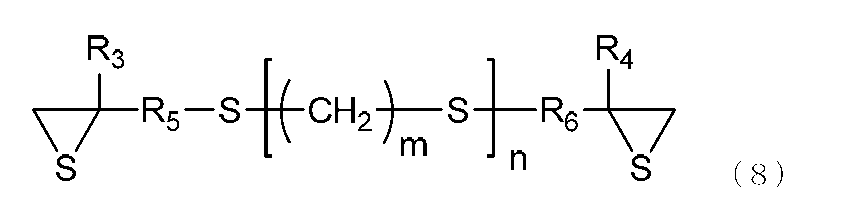
(式中、mは0から6の整数、nは0から4の整数であり、R3およびR4はそれぞれ独立に、水素原子または炭素数1~10のアルキル基であり、R5,R6はそれぞれ独立に炭素数1~10のアルキレン基である。)
で表わされる化合物が好ましい。一般式(8)で表わされるエピスルフィド化合物の例としては、ビス(2,3-エピチオプロピル)スルフィド等が挙げられる。
本発明の第2の硬化性組成物は、前述したポリチオールオリゴマー(A成分)、エピスルフィド化合物(C成分)、および光塩基発生剤(D成分)を含有して構成される。
エピスルフィド化合物(C成分)とは、1分子中に1個以上のエピスルフィド基を有する化合物である。特に、硬化性組成物の高屈折率化を追求した場合、下記の一般式(8)
で表わされる化合物が好ましい。一般式(8)で表わされるエピスルフィド化合物の例としては、ビス(2,3-エピチオプロピル)スルフィド等が挙げられる。
一般式(8)で表わされるエピスルフィド化合物は硬化に伴う収縮が大きいが、ポリチオールオリゴマーと共重合することによって硬化に伴う収縮を抑えることができる。また、一般式(8)で表わされるエピスルフィド化合物は概して粘度が低いが、ポリチオールオリゴマーと混合することで、作業性に優れた粘度に調整される。
第2の硬化性組成物においても、硬化性組成物の粘度に関して、接着剤としての使用を想定した場合、粘度が低すぎると、接着剤が垂れたり流れたり、張り合わせの際に基板がずれたりして好ましくない。また、粘度が高すぎると、接着剤の吐出や塗布が困難になったり、張り合わせの際に気泡が噛んだりして好ましくない。第2の硬化性組成物における作業性に適した粘度とは、塗布方法や張り合わせ方法といった接着剤の使用形態にも依るので一概には規定できないが、好ましくは100~50,000mPa・sの範囲であり、より好ましくは500~10,000mPa・sの範囲である。
第2の硬化性組成物におけるポリチオールオリゴマーの含有量について、硬化性組成物100重量部に対して、10~70重量部の範囲が好ましく、20~50重量部の範囲がさらに好ましい。ポリチオールオリゴマーの含有量が10重量部未満では高粘度化や低収縮化の効果が小さくなり、70重量部を超えると硬化物の靭性が低下して、好ましくない。
光塩基発生剤(D成分)とは、活性光線によって光分解して塩基を発生する化合物である。特に、エピスルフィド化合物の重合はDBN(ジアザビシクロノネン)やDBU(ジアザビシクロウンデセン)等のアミジンによって促進されるので、これらの塩基を発生させる光塩基発生剤が好ましい。具体的には、特表2001-513765に記載されているテトラアリールボラート塩を形成しているアミジニウムケトン(下記式(9)の左辺)や特表2005-511536に記載されているアリールアルキル基によって置換された1,3-ジアミン(下記式(10)の左辺)等が挙げられる。これらは単独でも2種類以上を混合して使用しても構わない。光塩基発生剤の添加量は、硬化性組成物100重量部に対して、0.01~10重量部の範囲が好ましく、0.1~5重量部の範囲がより好ましい。


また、光塩基発生剤に加えて光増感剤を含んでもよい。光増感剤を添加することにより、光塩基発生剤の光分解が速まり、光硬化性組成物の硬化時間を短縮することができる。光増感剤の具体例としては、ベンゾフェノン類、チオキサントン類、アンスラキノン類、カンファーキノン類、ベンジル類、ミヒラーケトン類、アントラセン類が挙げられる。これらは単独でも2種類以上を混合して使用しても構わない。光増感剤の添加量は、硬化性組成物100重量部に対して、0.01~10重量部の範囲が好ましく、0.1~5重量部の範囲がより好ましい。
前記の硬化性組成物には必要に応じて、重合禁止剤、重合抑制剤、酸化防止剤、紫外線吸収剤、シランカップリング剤、離型剤、顔料、染料等を添加することが可能である。また、必要に応じて、ろ過や脱泡などを行っても構わない。
以下、実施例により本発明を具体的に説明するが、本発明はこれらに限定されるものではない。なお、実施例中における硬化収縮率は、下記の計算式に従い、硬化前後における屈折率から計算した。
X=(1-d1/d2)×100[%]
R=(n2-1)/(n2+2)×M/d
硬化前後でR/Mは一定なので、上の2式より、
X=[1-{(n12-1)/(n12+2)}/{(n22-1)/(n22+2)}]×100[%]
(式中、Xは硬化収縮率、dは比重、d1は硬化前の比重、d2は硬化後の比重、Rは分子屈折、nは屈折率、n1は硬化前の屈折率、n2は硬化後の屈折率、Mは分子量を表す。)
また、硬化性組成物の粘度は、コーン/プレート型粘度計DV-II+(ブルックフィールド社製)を用いて、温度25℃にて測定した。硬化性組成物および硬化物(硬化膜)の屈折率は、アッベ屈折計NAR-3T(アタゴ社製)を用いて測定した。硬化物の透過率は、分光光度計U-3500(日立ハイテク社製)を用いて、硬化物の厚み0.25mm、波長400nmにて測定した。
X=(1-d1/d2)×100[%]
R=(n2-1)/(n2+2)×M/d
硬化前後でR/Mは一定なので、上の2式より、
X=[1-{(n12-1)/(n12+2)}/{(n22-1)/(n22+2)}]×100[%]
(式中、Xは硬化収縮率、dは比重、d1は硬化前の比重、d2は硬化後の比重、Rは分子屈折、nは屈折率、n1は硬化前の屈折率、n2は硬化後の屈折率、Mは分子量を表す。)
また、硬化性組成物の粘度は、コーン/プレート型粘度計DV-II+(ブルックフィールド社製)を用いて、温度25℃にて測定した。硬化性組成物および硬化物(硬化膜)の屈折率は、アッベ屈折計NAR-3T(アタゴ社製)を用いて測定した。硬化物の透過率は、分光光度計U-3500(日立ハイテク社製)を用いて、硬化物の厚み0.25mm、波長400nmにて測定した。
まず、第1の硬化性組成物の実施例について、以下に説明する。
実施例1
300mlフラスコに、4-メルカプトメチル-1,8-ジメルカプト-3,6-ジチアオクタン65g、ジシクロヘキシルメチルアミン0.05gをとり、よく撹拌した。硫黄粉末4.7gを室温下にてゆっくりと数回に分けて滴下した。硫黄粉末を添加すると溶液が黄色に変色して、ガスが発生した。ガスの発生が緩やかになった後、液面に窒素ガスを流しながら温度を60℃に上げて3時間撹拌を続けた。反応の進行に伴って、ガスの発生はほとんどなくなり、溶液は無色透明となった。以上の手順でポリチオールオリゴマーを作製した。
ポリチオールオリゴマーを室温まで冷却した後、イソシアヌル酸トリアリル35gを加えて、均一になるまで撹拌した。以上の手順で第1の硬化性組成物を作製した。
実施例1
300mlフラスコに、4-メルカプトメチル-1,8-ジメルカプト-3,6-ジチアオクタン65g、ジシクロヘキシルメチルアミン0.05gをとり、よく撹拌した。硫黄粉末4.7gを室温下にてゆっくりと数回に分けて滴下した。硫黄粉末を添加すると溶液が黄色に変色して、ガスが発生した。ガスの発生が緩やかになった後、液面に窒素ガスを流しながら温度を60℃に上げて3時間撹拌を続けた。反応の進行に伴って、ガスの発生はほとんどなくなり、溶液は無色透明となった。以上の手順でポリチオールオリゴマーを作製した。
ポリチオールオリゴマーを室温まで冷却した後、イソシアヌル酸トリアリル35gを加えて、均一になるまで撹拌した。以上の手順で第1の硬化性組成物を作製した。
第1の硬化性組成物100重量部に対して、1-ヒドロキシ-シクロヘキシルフェニルケトン3重量部を加えて、均一になるまで撹拌して、減圧脱泡した。これを離型処理された2枚のガラス板で挟み、メタルハライドランプ(120W/cm)からの光を30cmの距離から3分間照射した後、硬化した膜をガラス板から剥がした。以上の手順で厚み0.25mmの硬化膜を作製した。硬化性組成物および硬化膜(硬化物)の物性は表1に示す通りであった。
実施例2~5
ポリチオール、硫黄、およびポリエン化合物の種類と仕込み量を表1に示す内容に変える以外は実施例1と同様にして第1の硬化性組成物および硬化物の作製を行った。第1の硬化性組成物および硬化物の物性は表1に示す通りであった。
ポリチオール、硫黄、およびポリエン化合物の種類と仕込み量を表1に示す内容に変える以外は実施例1と同様にして第1の硬化性組成物および硬化物の作製を行った。第1の硬化性組成物および硬化物の物性は表1に示す通りであった。
比較例1
300mlフラスコに、2,5-ジメルカプトメチル-1,4-ジチアン55g、およびイソシアヌル酸トリアリル45gをとり、均一になるまで撹拌した。以上の手順で硬化性組成物を作製した。
硬化膜の作製を実施例1と同様にして行った。硬化性組成物および硬化物の物性は表2に示す通りであった。なお、実施例と比較して性能が劣る値には下線を引いた。
300mlフラスコに、2,5-ジメルカプトメチル-1,4-ジチアン55g、およびイソシアヌル酸トリアリル45gをとり、均一になるまで撹拌した。以上の手順で硬化性組成物を作製した。
硬化膜の作製を実施例1と同様にして行った。硬化性組成物および硬化物の物性は表2に示す通りであった。なお、実施例と比較して性能が劣る値には下線を引いた。
比較例2~4
チオール化合物、エチレン性不飽和化合物の種類と仕込み量を表2に示す内容に変える以外は比較例1と同様にして硬化性組成物および硬化物の作製を行った。硬化性組成物および硬化物の物性は表2に示す通りであった。なお、実施例と比較して性能が劣る値には下線を引いた。
チオール化合物、エチレン性不飽和化合物の種類と仕込み量を表2に示す内容に変える以外は比較例1と同様にして硬化性組成物および硬化物の作製を行った。硬化性組成物および硬化物の物性は表2に示す通りであった。なお、実施例と比較して性能が劣る値には下線を引いた。
[規則26に基づく補充 22.06.2012]
[規則26に基づく補充 22.06.2012]
表中略語の説明
(a-1)4-メルカプトメチル-1,8-ジメルカプト-3,6-ジチアオクタン
(a-2)2,5-ジメルカプトメチル-1,4-ジチアン
(a-3)m-キシリレンジチオール
(a-4)1,5-ジメルカプト-3-チアペンタン
(b-1)イソシアヌル酸トリアリル
(b-2)4,4’-ビス(メタクリロイルチオ)ジフェニルスルフィド
(b-3)トリメリット酸トリアリル
(b‐4)2,2-ビス(4-(アクリロキシジエトキシ)フェニル)プロパン
(a-1)4-メルカプトメチル-1,8-ジメルカプト-3,6-ジチアオクタン
(a-2)2,5-ジメルカプトメチル-1,4-ジチアン
(a-3)m-キシリレンジチオール
(a-4)1,5-ジメルカプト-3-チアペンタン
(b-1)イソシアヌル酸トリアリル
(b-2)4,4’-ビス(メタクリロイルチオ)ジフェニルスルフィド
(b-3)トリメリット酸トリアリル
(b‐4)2,2-ビス(4-(アクリロキシジエトキシ)フェニル)プロパン
次に、第2の硬化性組成物の実施例について、以下に説明する。
実施例6
300mlフラスコに、2,5-ジメルカプトメチル-1,4-ジチアン40g、トリブチルアミン0.05gをとり、よく撹拌した。硫黄粉末6.0gを室温下にてゆっくりと数回に分けて滴下した。硫黄粉末を添加すると溶液が黄色に変色して、ガスが発生した。ガスの発生が緩やかになった後、液面に窒素ガスを流しながら温度を60℃に上げて3時間撹拌を続けた。反応の進行に伴って、ガスの発生はほとんどなくなり、溶液は無色透明となった。以上の手順でポリチオールオリゴマーを作製した。
実施例6
300mlフラスコに、2,5-ジメルカプトメチル-1,4-ジチアン40g、トリブチルアミン0.05gをとり、よく撹拌した。硫黄粉末6.0gを室温下にてゆっくりと数回に分けて滴下した。硫黄粉末を添加すると溶液が黄色に変色して、ガスが発生した。ガスの発生が緩やかになった後、液面に窒素ガスを流しながら温度を60℃に上げて3時間撹拌を続けた。反応の進行に伴って、ガスの発生はほとんどなくなり、溶液は無色透明となった。以上の手順でポリチオールオリゴマーを作製した。
このポリチオールオリゴマー(A成分)に、ビス(2,3-エピチオプロピル)スルフィド60g(C成分)、下記構造式(11)
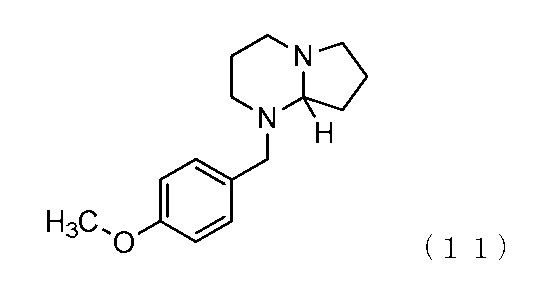
で表わされる光塩基発生剤0.2g(D成分)、および増感剤として4-ベンゾイル-4’-メチルジフェニルスルフィド1gを加えて、均一になるまで撹拌した。以上の手順で第2の硬化性組成物を作製した。硬化性組成物の粘度は900mPa・s(20℃)であった。また、5℃にて1週間保存したところ、硬化性組成物はゲル化していた。
硬化性組成物を離型処理された2枚のガラス板で挟み、メタルハライドランプ(120W/cm)からの光を30cmの距離から3分間照射した後、硬化した膜をガラス板から剥がした。以上の手順で厚み0.25mmの硬化膜を作製した。
第2の硬化性組成物および硬化膜の物性は表3に示す通りであった。
第2の硬化性組成物および硬化膜の物性は表3に示す通りであった。
実施例7
300mlフラスコに、2,5-ジメルカプトメチル-1,4-ジチアン40g、ビス(2,3-エピチオプロピル)スルフィド60g、メタクリル酸1,2,2,6,6-ペンタメチル-4-ピペリジル0.1gをとり、よく撹拌した。硫黄粉末6.0gを室温下にてゆっくりと数回に分けて滴下した。硫黄粉末を添加すると溶液が黄色に変色して、ガスが発生した。ガスの発生が緩やかになった後、液面に窒素ガスを流しながら温度を60℃に上げて3時間撹拌を続けた。反応の進行に伴って、ガスの発生はほとんどなくなり、溶液は無色透明となった。室温まで冷却した後、前記の構造式(11)で表わされる光塩基発生剤0.2g(D成分)、および増感剤として4-ベンゾイル-4’-メチルジフェニルスルフィド1gを加えて、均一になるまで撹拌した。以上の手順で硬化性組成物を作製した。硬化性組成物の粘度は1,000mPa・s(20℃)であった。また、5℃にて1週間保存した後の粘度は1,100mPa・s(20℃)であった。
300mlフラスコに、2,5-ジメルカプトメチル-1,4-ジチアン40g、ビス(2,3-エピチオプロピル)スルフィド60g、メタクリル酸1,2,2,6,6-ペンタメチル-4-ピペリジル0.1gをとり、よく撹拌した。硫黄粉末6.0gを室温下にてゆっくりと数回に分けて滴下した。硫黄粉末を添加すると溶液が黄色に変色して、ガスが発生した。ガスの発生が緩やかになった後、液面に窒素ガスを流しながら温度を60℃に上げて3時間撹拌を続けた。反応の進行に伴って、ガスの発生はほとんどなくなり、溶液は無色透明となった。室温まで冷却した後、前記の構造式(11)で表わされる光塩基発生剤0.2g(D成分)、および増感剤として4-ベンゾイル-4’-メチルジフェニルスルフィド1gを加えて、均一になるまで撹拌した。以上の手順で硬化性組成物を作製した。硬化性組成物の粘度は1,000mPa・s(20℃)であった。また、5℃にて1週間保存した後の粘度は1,100mPa・s(20℃)であった。
実施例6と同様にして硬化物の作製を行った。第2の硬化性組成物および硬化膜の物性は表3に示す通りであった。
実施例8~14
ポリチオール、硫黄、およびエピスルフィド化合物の種類と仕込み量を表3および表4に示す内容に変える以外は実施例7と同様にして第2の硬化性組成物および硬化物を作製した。第2の硬化性組成物および硬化物の物性は表3および4に示す通りであった。
ポリチオール、硫黄、およびエピスルフィド化合物の種類と仕込み量を表3および表4に示す内容に変える以外は実施例7と同様にして第2の硬化性組成物および硬化物を作製した。第2の硬化性組成物および硬化物の物性は表3および4に示す通りであった。
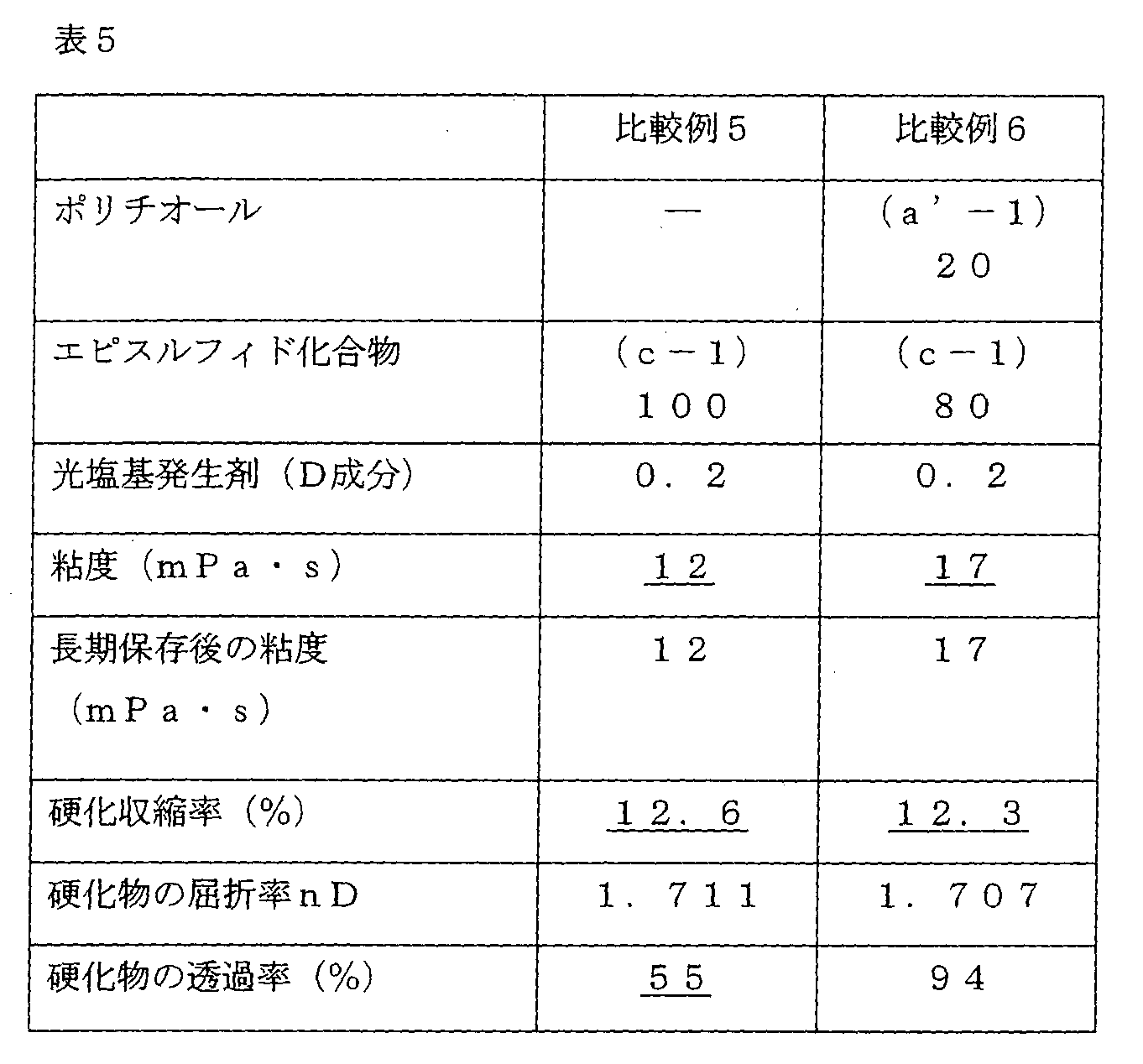
比較例5
ビス(2,3-エピチオプロピル)スルフィド100g、前記の構造式(9)で表わされる光塩基発生剤0.2g(D成分)、および増感剤として4-ベンゾイル-4’-メチルジフェニルスルフィド1gを加えて、均一になるまで撹拌した。以上の手順で硬化性組成物を作製した。
実施例6と同様にして硬化物を作製した。硬化性組成物および硬化物の物性は表5に示す通りであった。なお、実施例と比較して劣る物性には下線を引いた。
ビス(2,3-エピチオプロピル)スルフィド100g、前記の構造式(9)で表わされる光塩基発生剤0.2g(D成分)、および増感剤として4-ベンゾイル-4’-メチルジフェニルスルフィド1gを加えて、均一になるまで撹拌した。以上の手順で硬化性組成物を作製した。
実施例6と同様にして硬化物を作製した。硬化性組成物および硬化物の物性は表5に示す通りであった。なお、実施例と比較して劣る物性には下線を引いた。
比較例6
2,5-ジメルカプトメチル-1,4-ジチアン20g、ビス(2,3-エピチオプロピル)スルフィド80g、前記の構造式(9)で表わされる光塩基発生剤0.2g(D成分)、および増感剤として4-ベンゾイル-4’-メチルジフェニルスルフィド1gを加えて、均一になるまで撹拌した。以上の手順で硬化性組成物を作製した。
実施例6と同様にして硬化物を作製した。硬化性組成物および硬化物の物性は表5に示す通りであった。なお、実施例と比較して劣る物性には下線を引いた。
2,5-ジメルカプトメチル-1,4-ジチアン20g、ビス(2,3-エピチオプロピル)スルフィド80g、前記の構造式(9)で表わされる光塩基発生剤0.2g(D成分)、および増感剤として4-ベンゾイル-4’-メチルジフェニルスルフィド1gを加えて、均一になるまで撹拌した。以上の手順で硬化性組成物を作製した。
実施例6と同様にして硬化物を作製した。硬化性組成物および硬化物の物性は表5に示す通りであった。なお、実施例と比較して劣る物性には下線を引いた。
[規則26に基づく補充 22.06.2012]

[規則26に基づく補充 22.06.2012]
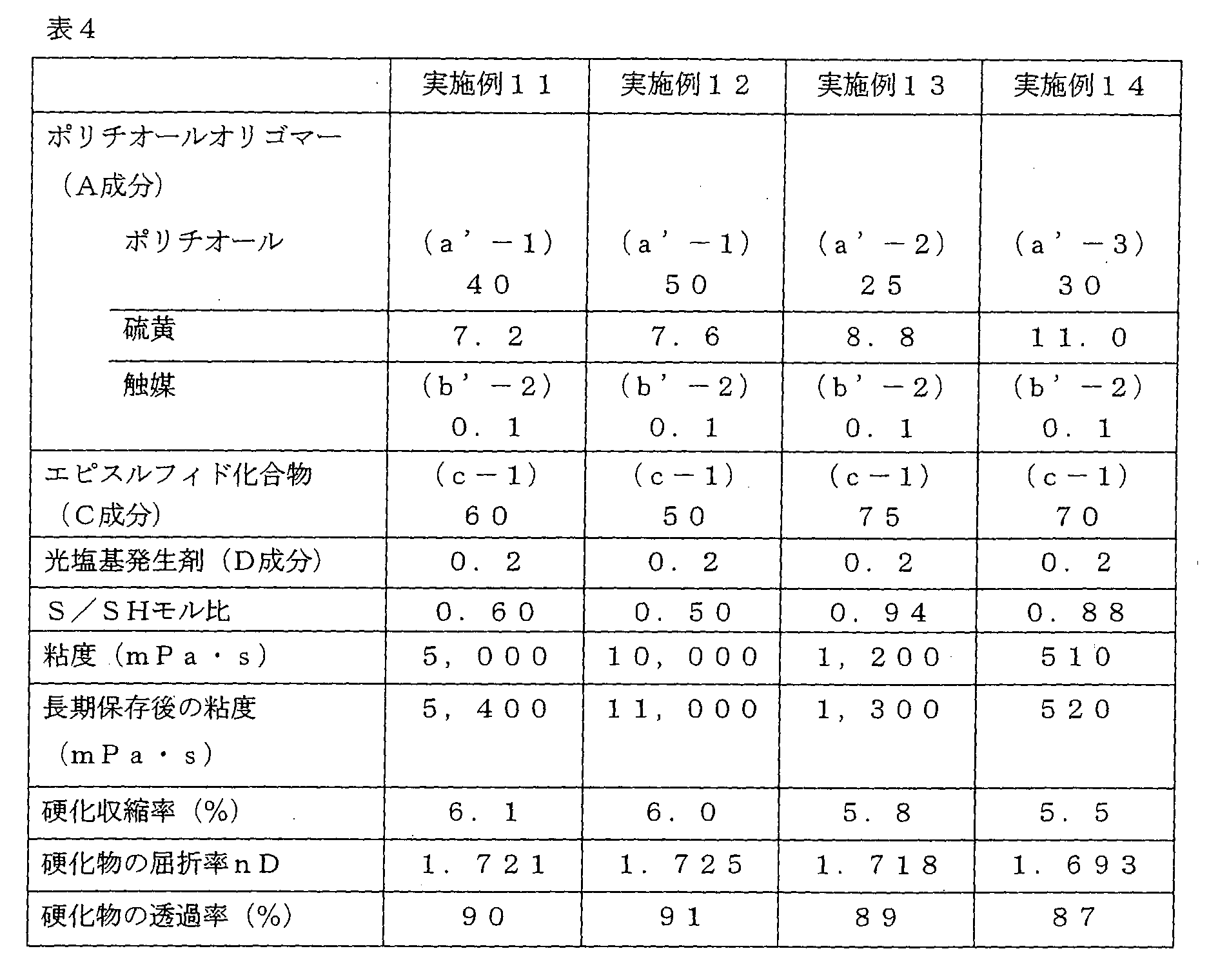
[規則26に基づく補充 22.06.2012]
表中略語の説明
(a’-1)2,5-ジメルカプトメチル-1,4-ジチアン
(a’-2)m-キシリレンジチオール
(a’-3)1,5-ジメルカプト-3-チアペンタン
(b’-1)トリブチルアミン
(b’-2)メタクリル酸1,2,2,6,6-ペンタメチル-4-ピペリジル
(c-1)ビス(2,3-エピチオプロピル)スルフィド
(a’-1)2,5-ジメルカプトメチル-1,4-ジチアン
(a’-2)m-キシリレンジチオール
(a’-3)1,5-ジメルカプト-3-チアペンタン
(b’-1)トリブチルアミン
(b’-2)メタクリル酸1,2,2,6,6-ペンタメチル-4-ピペリジル
(c-1)ビス(2,3-エピチオプロピル)スルフィド
Claims (9)
- ポリチオールと硫黄を反応させて得られるポリチオールオリゴマー(A成分)およびポリエン化合物(B成分)、または、
ポリチオールと硫黄を反応させて得られるポリチオールオリゴマー(A成分)、エピスルフィド化合物(C成分)および光塩基発生剤(D成分)を含有する硬化性組成物。 - ポリチオールが、下記一般式(1)、下記一般式(2)および下記一般式(3)から成る群から選択される一種以上である請求項1に記載の硬化性組成物。



- ポリチオールと硫黄を反応させる際のポリチオールと硫黄の比率が、チオール基1モルに対して、硫黄原子が0.2~0.95モルの範囲である、請求項1または2に記載の硬化性組成物。
- ポリエン化合物(B成分)が、イソシアヌル酸トリアリル、シアヌル酸トリアリル、フタル酸ジアリル、イソフタル酸ジアリル、テレフタル酸ジアリル、トリメリット酸トリアリル、ピロメリット酸テトラアリル、一般式(4)で表わされる化合物、一般式(5)で表わされる化合物、から成る群から選択される一種以上である、請求項1から3のいずれかに記載の硬化性組成物。

- ポリチオールと硫黄を反応させる際に反応触媒としてヒンダードアミンを使用することを特徴とする請求項1から4のいずれかに記載の硬化性組成物。
- ヒンダードアミンが2,2,6,6-テトラメチルピペリジン骨格を有する化合物である請求項5に記載の硬化性組成物。
- エピスルフィド化合物(C成分)が、下記一般式(8)で表わされる化合物である請求項1から6のいずれかに記載の硬化性組成物。
- 一般式(8)で表わされる化合物がビス(2,3-エピチオプロピル)スルフィドである請求項7に記載の硬化性組成物。
- 請求項1から8のいずれかに記載の硬化性組成物を含有する光学用接着剤。
Priority Applications (1)
| Application Number | Priority Date | Filing Date | Title |
|---|---|---|---|
| CN201280020326.XA CN103562273B9 (zh) | 2011-04-28 | 2012-04-24 | 固化性组合物及光学用粘接剂 |
Applications Claiming Priority (4)
| Application Number | Priority Date | Filing Date | Title |
|---|---|---|---|
| JP2011101440A JP5834474B2 (ja) | 2011-04-28 | 2011-04-28 | 硬化性組成物および光学接着剤 |
| JP2011-101440 | 2011-04-28 | ||
| JP2011103643A JP5742443B2 (ja) | 2011-05-06 | 2011-05-06 | 硬化性組成物および光学接着剤 |
| JP2011-103643 | 2011-05-06 |
Publications (1)
| Publication Number | Publication Date |
|---|---|
| WO2012147708A1 true WO2012147708A1 (ja) | 2012-11-01 |
Family
ID=47072227
Family Applications (1)
| Application Number | Title | Priority Date | Filing Date |
|---|---|---|---|
| PCT/JP2012/060899 Ceased WO2012147708A1 (ja) | 2011-04-28 | 2012-04-24 | 硬化性組成物および光学用接着剤 |
Country Status (2)
| Country | Link |
|---|---|
| TW (1) | TWI521035B (ja) |
| WO (1) | WO2012147708A1 (ja) |
Cited By (7)
| Publication number | Priority date | Publication date | Assignee | Title |
|---|---|---|---|---|
| WO2013122068A1 (ja) * | 2012-02-14 | 2013-08-22 | 三菱瓦斯化学株式会社 | 光学材料用重合性組成物、その製造方法、及び光学材料の製造方法 |
| JP2014047334A (ja) * | 2012-09-04 | 2014-03-17 | Mitsubishi Gas Chemical Co Inc | 光学材料用重合性組成物の製造方法 |
| JP2014047333A (ja) * | 2012-09-04 | 2014-03-17 | Mitsubishi Gas Chemical Co Inc | 光学材料の製造方法 |
| US9458293B2 (en) | 2012-02-02 | 2016-10-04 | Mitsubishi Gas Chemical Company, Inc. | Method for producing composition for optical material |
| WO2020080391A1 (ja) * | 2018-10-17 | 2020-04-23 | ナミックス株式会社 | 樹脂組成物 |
| US11214650B2 (en) | 2016-04-11 | 2022-01-04 | Mitsubishi Gas Chemical Company, Inc. | Composition for high refractive index low dispersion resins for composite diffractive optical elements, and composite diffractive optical element using the same |
| KR20240066765A (ko) * | 2022-11-08 | 2024-05-16 | 한국과학기술연구원 | 황 공중합체 및 이의 제조방법 |
Families Citing this family (1)
| Publication number | Priority date | Publication date | Assignee | Title |
|---|---|---|---|---|
| TWI593755B (zh) * | 2012-10-18 | 2017-08-01 | Mitsubishi Gas Chemical Co | Polymerizable composition and hardened | cured material |
Citations (11)
| Publication number | Priority date | Publication date | Assignee | Title |
|---|---|---|---|---|
| JPH0321638A (ja) * | 1989-06-20 | 1991-01-30 | Showa Denko Kk | 硬化性組成物 |
| JPH10120676A (ja) * | 1996-04-26 | 1998-05-12 | Hoya Corp | ポリチオールオリゴマーの製造方法および光学材料用重合体 |
| JP2001342252A (ja) * | 2000-03-27 | 2001-12-11 | Mitsui Chemicals Inc | 新規なポリチオールを含有する重合性組成物、及びそれを重合させてなる樹脂、並びにレンズ |
| WO2005014696A1 (ja) * | 2003-08-06 | 2005-02-17 | Mitsubishi Gas Chemical Company, Inc. | 光硬化性組成物及びコーティング剤組成物 |
| JP2005139401A (ja) * | 2003-11-10 | 2005-06-02 | Sekisui Chem Co Ltd | 偏光板用光硬化型接着剤および液晶表示パネル |
| JP2005264156A (ja) * | 2004-02-16 | 2005-09-29 | Mitsubishi Gas Chem Co Inc | 光塩基発生剤 |
| JP2007091921A (ja) * | 2005-09-29 | 2007-04-12 | Hoya Corp | 高屈折率樹脂の製造方法 |
| WO2008026727A1 (en) * | 2006-08-31 | 2008-03-06 | Hoya Corporation | Method for producing polythiourethane resin |
| JP2009074037A (ja) * | 2007-08-24 | 2009-04-09 | Mitsubishi Gas Chem Co Inc | 光学材料用樹脂組成物 |
| JP2010254732A (ja) * | 2009-04-21 | 2010-11-11 | Osaka Gas Chem Kk | 硬化性組成物及びその硬化物 |
| JP2011038050A (ja) * | 2009-08-18 | 2011-02-24 | Mitsubishi Gas Chemical Co Inc | 光硬化性組成物、硬化方法及び硬化物 |
-
2012
- 2012-04-24 WO PCT/JP2012/060899 patent/WO2012147708A1/ja not_active Ceased
- 2012-04-25 TW TW101114704A patent/TWI521035B/zh active
Patent Citations (11)
| Publication number | Priority date | Publication date | Assignee | Title |
|---|---|---|---|---|
| JPH0321638A (ja) * | 1989-06-20 | 1991-01-30 | Showa Denko Kk | 硬化性組成物 |
| JPH10120676A (ja) * | 1996-04-26 | 1998-05-12 | Hoya Corp | ポリチオールオリゴマーの製造方法および光学材料用重合体 |
| JP2001342252A (ja) * | 2000-03-27 | 2001-12-11 | Mitsui Chemicals Inc | 新規なポリチオールを含有する重合性組成物、及びそれを重合させてなる樹脂、並びにレンズ |
| WO2005014696A1 (ja) * | 2003-08-06 | 2005-02-17 | Mitsubishi Gas Chemical Company, Inc. | 光硬化性組成物及びコーティング剤組成物 |
| JP2005139401A (ja) * | 2003-11-10 | 2005-06-02 | Sekisui Chem Co Ltd | 偏光板用光硬化型接着剤および液晶表示パネル |
| JP2005264156A (ja) * | 2004-02-16 | 2005-09-29 | Mitsubishi Gas Chem Co Inc | 光塩基発生剤 |
| JP2007091921A (ja) * | 2005-09-29 | 2007-04-12 | Hoya Corp | 高屈折率樹脂の製造方法 |
| WO2008026727A1 (en) * | 2006-08-31 | 2008-03-06 | Hoya Corporation | Method for producing polythiourethane resin |
| JP2009074037A (ja) * | 2007-08-24 | 2009-04-09 | Mitsubishi Gas Chem Co Inc | 光学材料用樹脂組成物 |
| JP2010254732A (ja) * | 2009-04-21 | 2010-11-11 | Osaka Gas Chem Kk | 硬化性組成物及びその硬化物 |
| JP2011038050A (ja) * | 2009-08-18 | 2011-02-24 | Mitsubishi Gas Chemical Co Inc | 光硬化性組成物、硬化方法及び硬化物 |
Cited By (13)
| Publication number | Priority date | Publication date | Assignee | Title |
|---|---|---|---|---|
| US9458293B2 (en) | 2012-02-02 | 2016-10-04 | Mitsubishi Gas Chemical Company, Inc. | Method for producing composition for optical material |
| WO2013122068A1 (ja) * | 2012-02-14 | 2013-08-22 | 三菱瓦斯化学株式会社 | 光学材料用重合性組成物、その製造方法、及び光学材料の製造方法 |
| US9529117B2 (en) | 2012-02-14 | 2016-12-27 | Mitsubishi Gas Chemical Company, Inc. | Polymerizable composition for optical material, method for producing same, and method for producing optical material |
| JP2014047334A (ja) * | 2012-09-04 | 2014-03-17 | Mitsubishi Gas Chemical Co Inc | 光学材料用重合性組成物の製造方法 |
| JP2014047333A (ja) * | 2012-09-04 | 2014-03-17 | Mitsubishi Gas Chemical Co Inc | 光学材料の製造方法 |
| US11214650B2 (en) | 2016-04-11 | 2022-01-04 | Mitsubishi Gas Chemical Company, Inc. | Composition for high refractive index low dispersion resins for composite diffractive optical elements, and composite diffractive optical element using the same |
| KR20210077678A (ko) * | 2018-10-17 | 2021-06-25 | 나믹스 가부시끼가이샤 | 수지 조성물 |
| JPWO2020080391A1 (ja) * | 2018-10-17 | 2021-10-14 | ナミックス株式会社 | 樹脂組成物 |
| WO2020080391A1 (ja) * | 2018-10-17 | 2020-04-23 | ナミックス株式会社 | 樹脂組成物 |
| JP7473206B2 (ja) | 2018-10-17 | 2024-04-23 | ナミックス株式会社 | 樹脂組成物 |
| KR102738585B1 (ko) | 2018-10-17 | 2024-12-04 | 나믹스 가부시끼가이샤 | 수지 조성물 |
| KR20240066765A (ko) * | 2022-11-08 | 2024-05-16 | 한국과학기술연구원 | 황 공중합체 및 이의 제조방법 |
| KR102841125B1 (ko) | 2022-11-08 | 2025-08-01 | 한국과학기술연구원 | 황 공중합체 및 이의 제조방법 |
Also Published As
| Publication number | Publication date |
|---|---|
| TWI521035B (zh) | 2016-02-11 |
| TW201311847A (zh) | 2013-03-16 |
| CN103562273A (zh) | 2014-02-05 |
| CN103562273B (zh) | 2016-03-02 |
Similar Documents
| Publication | Publication Date | Title |
|---|---|---|
| JP5834474B2 (ja) | 硬化性組成物および光学接着剤 | |
| WO2012147708A1 (ja) | 硬化性組成物および光学用接着剤 | |
| CN103562271B (zh) | 固化性组合物及光学用粘接剂 | |
| JP5810611B2 (ja) | 硬化性組成物および光学接着剤 | |
| JP7545023B2 (ja) | 重合性組成物並びにそれから得られる光学材料及び色調変化材料 | |
| JP5991315B2 (ja) | 硬化性組成物および光学用接着剤 | |
| JP6565160B2 (ja) | 硬化性組成物および光学接着剤 | |
| JP5754233B2 (ja) | 硬化性組成物および光学接着剤 | |
| JP6230419B2 (ja) | 硬化性組成物および光学用接着剤 | |
| JP5742443B2 (ja) | 硬化性組成物および光学接着剤 | |
| JP2019142849A (ja) | 多官能プロパルギル化合物及びそれを含む光学用組成物 | |
| JP5810610B2 (ja) | 硬化性組成物および光学接着剤 | |
| CN103562270B (zh) | 固化性组合物及光学用粘接剂 | |
| CN103562273B9 (zh) | 固化性组合物及光学用粘接剂 | |
| JP2004510000A (ja) | (アルコキシフェニル)ホスフィンで触媒されるエピスルフィド系重合性組成物、それから得られる物品およびその製造方法 | |
| JP5849432B2 (ja) | 硬化性組成物および光学接着剤 | |
| JP2012021080A (ja) | 硬化性組成物及び光学材料 | |
| JP5834475B2 (ja) | 硬化性組成物および光学接着剤 | |
| JP4977309B2 (ja) | 光学部品用光重合性組成物およびその用途 | |
| WO2022158324A1 (ja) | 光硬化性組成物及びその硬化物並びに該硬化物を含む光学材料 |
Legal Events
| Date | Code | Title | Description |
|---|---|---|---|
| 121 | Ep: the epo has been informed by wipo that ep was designated in this application |
Ref document number: 12775928 Country of ref document: EP Kind code of ref document: A1 |
|
| NENP | Non-entry into the national phase |
Ref country code: DE |
|
| 122 | Ep: pct application non-entry in european phase |
Ref document number: 12775928 Country of ref document: EP Kind code of ref document: A1 |