WO2012147952A1 - Catalyseur de cathode pour batterie secondaire à air, et batterie secondaire à air - Google Patents
Catalyseur de cathode pour batterie secondaire à air, et batterie secondaire à air Download PDFInfo
- Publication number
- WO2012147952A1 WO2012147952A1 PCT/JP2012/061459 JP2012061459W WO2012147952A1 WO 2012147952 A1 WO2012147952 A1 WO 2012147952A1 JP 2012061459 W JP2012061459 W JP 2012061459W WO 2012147952 A1 WO2012147952 A1 WO 2012147952A1
- Authority
- WO
- WIPO (PCT)
- Prior art keywords
- group
- ring
- secondary battery
- positive electrode
- metal complex
- Prior art date
- Legal status (The legal status is an assumption and is not a legal conclusion. Google has not performed a legal analysis and makes no representation as to the accuracy of the status listed.)
- Ceased
Links
- 0 Cc1nc(c2c3nc(C)[n](*)c3ccc2cc2)c2[n]1* Chemical compound Cc1nc(c2c3nc(C)[n](*)c3ccc2cc2)c2[n]1* 0.000 description 17
- QGVHYMWWLYRZPJ-OSODFHRSSA-N C/C=C(\C(N)=C)/C(/C=C)=N/C Chemical compound C/C=C(\C(N)=C)/C(/C=C)=N/C QGVHYMWWLYRZPJ-OSODFHRSSA-N 0.000 description 1
- XWCZGNWSLUZPLS-HMMKTVFPSA-N C/C=N/c(ccnc1)c1/N=C/C Chemical compound C/C=N/c(ccnc1)c1/N=C/C XWCZGNWSLUZPLS-HMMKTVFPSA-N 0.000 description 1
- CUUTWLCTYWCZKA-HMMKTVFPSA-N C/C=N/c1cccc(/N=C/C)c1O Chemical compound C/C=N/c1cccc(/N=C/C)c1O CUUTWLCTYWCZKA-HMMKTVFPSA-N 0.000 description 1
- XCKZISZFRFUOBZ-JMQWPVDRSA-N C/N=C/c1nc(/C=N/C)ccc1 Chemical compound C/N=C/c1nc(/C=N/C)ccc1 XCKZISZFRFUOBZ-JMQWPVDRSA-N 0.000 description 1
- BFKUTDGAGSJUGH-UHFFFAOYSA-N CC(C)(C)c(cc1-c2ccc[n]2C(OC(C)(C)C)=O)cc(-c2ccc[n]2C(OC(C)(C)C)=O)c1OC Chemical compound CC(C)(C)c(cc1-c2ccc[n]2C(OC(C)(C)C)=O)cc(-c2ccc[n]2C(OC(C)(C)C)=O)c1OC BFKUTDGAGSJUGH-UHFFFAOYSA-N 0.000 description 1
- ZABMIETUNJAEKC-VYIQYICTSA-N CC(C)(C)c(cc1-c2nc(CC(N/C(/C)=C3/C=C)=C)ccc2)cc(c2cc(C(C)(C)C)c4)c1[nH]c2c4-c1cccc3n1 Chemical compound CC(C)(C)c(cc1-c2nc(CC(N/C(/C)=C3/C=C)=C)ccc2)cc(c2cc(C(C)(C)C)c4)c1[nH]c2c4-c1cccc3n1 ZABMIETUNJAEKC-VYIQYICTSA-N 0.000 description 1
- UDZXVHYIQLWLIX-UHFFFAOYSA-N CC(C)(C)c(cc1Br)cc(Br)c1OC Chemical compound CC(C)(C)c(cc1Br)cc(Br)c1OC UDZXVHYIQLWLIX-UHFFFAOYSA-N 0.000 description 1
- YGYHALZMXXKCLZ-UHFFFAOYSA-N CC(CNC12)(C1(C)NC=C2c1nc2c3ncccc3ccc2cc1)c(cc1)nc2c1ccc1ccc(-c3c[nH]c4c3NC=CC4)nc21 Chemical compound CC(CNC12)(C1(C)NC=C2c1nc2c3ncccc3ccc2cc1)c(cc1)nc2c1ccc1ccc(-c3c[nH]c4c3NC=CC4)nc21 YGYHALZMXXKCLZ-UHFFFAOYSA-N 0.000 description 1
- ZKCFBUHYJGHLJQ-IYOYZZHUSA-N CC(c1c(C=C)c2cc(C(C)(C)C)cc(-c3cc(BOC(C)(C)C(C)(C)O)cc(/C(/C=C)=C(/C)\NC(C4C)=C)n3)c2[nH]1)c1nc4cc(B2OC(C)(C)C(C)(C)O2)c1 Chemical compound CC(c1c(C=C)c2cc(C(C)(C)C)cc(-c3cc(BOC(C)(C)C(C)(C)O)cc(/C(/C=C)=C(/C)\NC(C4C)=C)n3)c2[nH]1)c1nc4cc(B2OC(C)(C)C(C)(C)O2)c1 ZKCFBUHYJGHLJQ-IYOYZZHUSA-N 0.000 description 1
- XPUBBTKDSNJNSA-AXPMFYHGSA-N CC/C=C(/C(/C=C)=C(/C)\NC(C)=C)\NC Chemical compound CC/C=C(/C(/C=C)=C(/C)\NC(C)=C)\NC XPUBBTKDSNJNSA-AXPMFYHGSA-N 0.000 description 1
- OYFBDTOEIZRBKA-UHFFFAOYSA-N CC1(C)OB(c2c3[nH]cc(C)c3c(B3OC(C)(C)C(C)(C)O3)c3c2c(C)c[nH]3)OC1(C)C Chemical compound CC1(C)OB(c2c3[nH]cc(C)c3c(B3OC(C)(C)C(C)(C)O3)c3c2c(C)c[nH]3)OC1(C)C OYFBDTOEIZRBKA-UHFFFAOYSA-N 0.000 description 1
- UCFSYHMCKWNKAH-UHFFFAOYSA-N CC1(C)OBOC1(C)C Chemical compound CC1(C)OBOC1(C)C UCFSYHMCKWNKAH-UHFFFAOYSA-N 0.000 description 1
- AEPSLPUHOAMEEX-UHFFFAOYSA-N CC1=NC2c3nc(C)ccc3CC2CC1 Chemical compound CC1=NC2c3nc(C)ccc3CC2CC1 AEPSLPUHOAMEEX-UHFFFAOYSA-N 0.000 description 1
- NPUBDPDASOEIOA-UHFFFAOYSA-N CCB1OC(C)(C)C(C)(C)O1 Chemical compound CCB1OC(C)(C)C(C)(C)O1 NPUBDPDASOEIOA-UHFFFAOYSA-N 0.000 description 1
- ZDQMAWSZYSLOMV-RAXLEYEMSA-N Cc([nH]1)ccc1/N=C1\N=C(C)C=C1 Chemical compound Cc([nH]1)ccc1/N=C1\N=C(C)C=C1 ZDQMAWSZYSLOMV-RAXLEYEMSA-N 0.000 description 1
- DQIWLXOUJWWYQQ-UHFFFAOYSA-N Cc(cc1)nc2c1[o]c1c2nc(C)cc1 Chemical compound Cc(cc1)nc2c1[o]c1c2nc(C)cc1 DQIWLXOUJWWYQQ-UHFFFAOYSA-N 0.000 description 1
- IYRGXJIJGHOCFS-UHFFFAOYSA-N Cc(cc1)nc2c1ccc1ccc(C)nc21 Chemical compound Cc(cc1)nc2c1ccc1ccc(C)nc21 IYRGXJIJGHOCFS-UHFFFAOYSA-N 0.000 description 1
- KUCQGRFBBSNBFJ-UHFFFAOYSA-N Cc1c(C(c2c(C)c3cccc-4c3[nH]2)c2ccccc2)[nH]c2c1cccc2-c1ccc2c3nc(c5ccc(-c6c7[nH]c(C(c8c(C)c(cccc9-%10)c9[nH]8)c8ccccc8)c(C)c7ccc6)nc5c5nc-%10ccc55)c5nc3c3ccc-4nc3c2n1 Chemical compound Cc1c(C(c2c(C)c3cccc-4c3[nH]2)c2ccccc2)[nH]c2c1cccc2-c1ccc2c3nc(c5ccc(-c6c7[nH]c(C(c8c(C)c(cccc9-%10)c9[nH]8)c8ccccc8)c(C)c7ccc6)nc5c5nc-%10ccc55)c5nc3c3ccc-4nc3c2n1 KUCQGRFBBSNBFJ-UHFFFAOYSA-N 0.000 description 1
- OWMABZCGYISGKS-XFFZJAGNSA-N Cc1c(C)[nH]c(/C=C2\N=C(C)C=C2)c1 Chemical compound Cc1c(C)[nH]c(/C=C2\N=C(C)C=C2)c1 OWMABZCGYISGKS-XFFZJAGNSA-N 0.000 description 1
- BHXFFSVIWGGQHE-UHFFFAOYSA-N Cc1c[nH]c2c1cccc2-c(ccc1c2nc(c3ccc(-c4c5[nH]cc(C)c5ccc4)nc3c3c4ccc(-c5c6[nH]cc(C)c6ccc5)n3)c4nc2c2cc3)nc1c2nc3-c1cccc2c1[nH]cc2C Chemical compound Cc1c[nH]c2c1cccc2-c(ccc1c2nc(c3ccc(-c4c5[nH]cc(C)c5ccc4)nc3c3c4ccc(-c5c6[nH]cc(C)c6ccc5)n3)c4nc2c2cc3)nc1c2nc3-c1cccc2c1[nH]cc2C BHXFFSVIWGGQHE-UHFFFAOYSA-N 0.000 description 1
- JBLUYCNPVKDYRS-UHFFFAOYSA-N Cc1ccc(Cc2ccc(C)[nH]2)[nH]1 Chemical compound Cc1ccc(Cc2ccc(C)[nH]2)[nH]1 JBLUYCNPVKDYRS-UHFFFAOYSA-N 0.000 description 1
- PIWQHPWDDGHIKG-UHFFFAOYSA-N Cc1nc(c2c(cc3)[o]c(C)n2)c3[o]1 Chemical compound Cc1nc(c2c(cc3)[o]c(C)n2)c3[o]1 PIWQHPWDDGHIKG-UHFFFAOYSA-N 0.000 description 1
- KGMDRBDBIJQAQL-UHFFFAOYSA-N Cc1nc(c2c(cc3)[s]c(C)n2)c3[s]1 Chemical compound Cc1nc(c2c(cc3)[s]c(C)n2)c3[s]1 KGMDRBDBIJQAQL-UHFFFAOYSA-N 0.000 description 1
- UNSVZTCQKHTEBU-UHFFFAOYSA-N Cc1nc2c(c3c(cc4)[o]c(C)n3)c4ccc2[o]1 Chemical compound Cc1nc2c(c3c(cc4)[o]c(C)n3)c4ccc2[o]1 UNSVZTCQKHTEBU-UHFFFAOYSA-N 0.000 description 1
- PTBZHJAKKLTCAQ-UHFFFAOYSA-N Cc1nc2c(c3c(cc4)[s]c(C)n3)c4ccc2[s]1 Chemical compound Cc1nc2c(c3c(cc4)[s]c(C)n3)c4ccc2[s]1 PTBZHJAKKLTCAQ-UHFFFAOYSA-N 0.000 description 1
- DNKGIDURJINUOA-UHFFFAOYSA-N Clc(ccc1ccc2cc3)nc1c2nc3Cl Chemical compound Clc(ccc1ccc2cc3)nc1c2nc3Cl DNKGIDURJINUOA-UHFFFAOYSA-N 0.000 description 1
- OOPPJTCDNMXHSK-UHFFFAOYSA-N O=C(c(cc1)c(-c2nc(Cl)ccc22)nc1Cl)C2=O Chemical compound O=C(c(cc1)c(-c2nc(Cl)ccc22)nc1Cl)C2=O OOPPJTCDNMXHSK-UHFFFAOYSA-N 0.000 description 1
Images


Classifications
-
- H—ELECTRICITY
- H01—ELECTRIC ELEMENTS
- H01M—PROCESSES OR MEANS, e.g. BATTERIES, FOR THE DIRECT CONVERSION OF CHEMICAL ENERGY INTO ELECTRICAL ENERGY
- H01M4/00—Electrodes
- H01M4/86—Inert electrodes with catalytic activity, e.g. for fuel cells
- H01M4/90—Selection of catalytic material
- H01M4/9008—Organic or organo-metallic compounds
-
- C—CHEMISTRY; METALLURGY
- C07—ORGANIC CHEMISTRY
- C07D—HETEROCYCLIC COMPOUNDS
- C07D241/00—Heterocyclic compounds containing 1,4-diazine or hydrogenated 1,4-diazine rings
- C07D241/02—Heterocyclic compounds containing 1,4-diazine or hydrogenated 1,4-diazine rings not condensed with other rings
- C07D241/10—Heterocyclic compounds containing 1,4-diazine or hydrogenated 1,4-diazine rings not condensed with other rings having three double bonds between ring members or between ring members and non-ring members
- C07D241/12—Heterocyclic compounds containing 1,4-diazine or hydrogenated 1,4-diazine rings not condensed with other rings having three double bonds between ring members or between ring members and non-ring members with only hydrogen atoms, hydrocarbon or substituted hydrocarbon radicals, directly attached to ring carbon atoms
-
- C—CHEMISTRY; METALLURGY
- C07—ORGANIC CHEMISTRY
- C07D—HETEROCYCLIC COMPOUNDS
- C07D257/00—Heterocyclic compounds containing rings having four nitrogen atoms as the only ring hetero atoms
- C07D257/10—Heterocyclic compounds containing rings having four nitrogen atoms as the only ring hetero atoms condensed with carbocyclic rings or ring systems
-
- C—CHEMISTRY; METALLURGY
- C07—ORGANIC CHEMISTRY
- C07D—HETEROCYCLIC COMPOUNDS
- C07D259/00—Heterocyclic compounds containing rings having more than four nitrogen atoms as the only ring hetero atoms
-
- C—CHEMISTRY; METALLURGY
- C07—ORGANIC CHEMISTRY
- C07D—HETEROCYCLIC COMPOUNDS
- C07D471/00—Heterocyclic compounds containing nitrogen atoms as the only ring hetero atoms in the condensed system, at least one ring being a six-membered ring with one nitrogen atom, not provided for by groups C07D451/00 - C07D463/00
- C07D471/02—Heterocyclic compounds containing nitrogen atoms as the only ring hetero atoms in the condensed system, at least one ring being a six-membered ring with one nitrogen atom, not provided for by groups C07D451/00 - C07D463/00 in which the condensed system contains two hetero rings
- C07D471/04—Ortho-condensed systems
-
- C—CHEMISTRY; METALLURGY
- C07—ORGANIC CHEMISTRY
- C07D—HETEROCYCLIC COMPOUNDS
- C07D471/00—Heterocyclic compounds containing nitrogen atoms as the only ring hetero atoms in the condensed system, at least one ring being a six-membered ring with one nitrogen atom, not provided for by groups C07D451/00 - C07D463/00
- C07D471/12—Heterocyclic compounds containing nitrogen atoms as the only ring hetero atoms in the condensed system, at least one ring being a six-membered ring with one nitrogen atom, not provided for by groups C07D451/00 - C07D463/00 in which the condensed system contains three hetero rings
- C07D471/18—Bridged systems
-
- C—CHEMISTRY; METALLURGY
- C07—ORGANIC CHEMISTRY
- C07D—HETEROCYCLIC COMPOUNDS
- C07D471/00—Heterocyclic compounds containing nitrogen atoms as the only ring hetero atoms in the condensed system, at least one ring being a six-membered ring with one nitrogen atom, not provided for by groups C07D451/00 - C07D463/00
- C07D471/22—Heterocyclic compounds containing nitrogen atoms as the only ring hetero atoms in the condensed system, at least one ring being a six-membered ring with one nitrogen atom, not provided for by groups C07D451/00 - C07D463/00 in which the condensed systems contains four or more hetero rings
-
- C—CHEMISTRY; METALLURGY
- C07—ORGANIC CHEMISTRY
- C07D—HETEROCYCLIC COMPOUNDS
- C07D487/00—Heterocyclic compounds containing nitrogen atoms as the only ring hetero atoms in the condensed system, not provided for by groups C07D451/00 - C07D477/00
- C07D487/12—Heterocyclic compounds containing nitrogen atoms as the only ring hetero atoms in the condensed system, not provided for by groups C07D451/00 - C07D477/00 in which the condensed system contains three hetero rings
- C07D487/16—Peri-condensed systems
-
- C—CHEMISTRY; METALLURGY
- C07—ORGANIC CHEMISTRY
- C07D—HETEROCYCLIC COMPOUNDS
- C07D487/00—Heterocyclic compounds containing nitrogen atoms as the only ring hetero atoms in the condensed system, not provided for by groups C07D451/00 - C07D477/00
- C07D487/22—Heterocyclic compounds containing nitrogen atoms as the only ring hetero atoms in the condensed system, not provided for by groups C07D451/00 - C07D477/00 in which the condensed system contains four or more hetero rings
-
- C—CHEMISTRY; METALLURGY
- C07—ORGANIC CHEMISTRY
- C07D—HETEROCYCLIC COMPOUNDS
- C07D498/00—Heterocyclic compounds containing in the condensed system at least one hetero ring having nitrogen and oxygen atoms as the only ring hetero atoms
- C07D498/22—Heterocyclic compounds containing in the condensed system at least one hetero ring having nitrogen and oxygen atoms as the only ring hetero atoms in which the condensed system contains four or more hetero rings
-
- C—CHEMISTRY; METALLURGY
- C07—ORGANIC CHEMISTRY
- C07D—HETEROCYCLIC COMPOUNDS
- C07D519/00—Heterocyclic compounds containing more than one system of two or more relevant hetero rings condensed among themselves or condensed with a common carbocyclic ring system not provided for in groups C07D453/00 or C07D455/00
-
- H—ELECTRICITY
- H01—ELECTRIC ELEMENTS
- H01M—PROCESSES OR MEANS, e.g. BATTERIES, FOR THE DIRECT CONVERSION OF CHEMICAL ENERGY INTO ELECTRICAL ENERGY
- H01M12/00—Hybrid cells; Manufacture thereof
- H01M12/08—Hybrid cells; Manufacture thereof composed of a half-cell of a fuel-cell type and a half-cell of the secondary-cell type
-
- Y—GENERAL TAGGING OF NEW TECHNOLOGICAL DEVELOPMENTS; GENERAL TAGGING OF CROSS-SECTIONAL TECHNOLOGIES SPANNING OVER SEVERAL SECTIONS OF THE IPC; TECHNICAL SUBJECTS COVERED BY FORMER USPC CROSS-REFERENCE ART COLLECTIONS [XRACs] AND DIGESTS
- Y02—TECHNOLOGIES OR APPLICATIONS FOR MITIGATION OR ADAPTATION AGAINST CLIMATE CHANGE
- Y02E—REDUCTION OF GREENHOUSE GAS [GHG] EMISSIONS, RELATED TO ENERGY GENERATION, TRANSMISSION OR DISTRIBUTION
- Y02E60/00—Enabling technologies; Technologies with a potential or indirect contribution to GHG emissions mitigation
- Y02E60/10—Energy storage using batteries
Definitions
- the present invention relates to a positive electrode catalyst for an air secondary battery and an air secondary battery using the catalyst.
- the present application claims priority based on Japanese Patent Application Nos. 2011-100165 and 2011-1000016 filed in Japan on April 27, 2011, the contents of which are incorporated herein by reference.
- an air battery using oxygen in the air as an active material can be increased in energy density, it is expected to be applied to various uses such as for electric vehicles.
- An air battery is a battery that uses a positive electrode catalyst having oxygen reducing ability and a negative electrode active material containing zinc, iron, aluminum, magnesium, lithium, hydrogen, or the like as an active material.
- a negative electrode active material containing zinc, iron, aluminum, magnesium, lithium, hydrogen, or the like
- the discharge reaction of the air battery under alkaline conditions is represented by the following formula.
- Negative electrode Zn + 2OH ⁇ ⁇ ZnO + H 2 O + 2e ⁇ Total reaction: 2Zn + O 2 ⁇ 2ZnO
- Non-Patent Document 1 As a conventional air battery, a battery using manganese dioxide as a positive electrode catalyst has been disclosed (see Non-Patent Document 1).
- batteries secondary batteries, rechargeable batteries, storage batteries that can store electricity by charging and can be used repeatedly.
- Development of batteries used as active materials is also underway.
- a battery that uses oxygen in the air as an active material and can be repeatedly charged and discharged is referred to as an “air secondary battery” in order to distinguish it from the above-described air battery.
- the positive electrode catalyst of the air secondary battery is required to have an oxidation activity of water at the time of charging in addition to the oxygen reduction activity required for the positive electrode catalyst of the air battery (primary battery) that performs only discharge.
- the positive electrode catalyst of a conventional air battery from this point of view, for example, the above-mentioned manganese dioxide has catalytic activity for oxygen reduction reaction, but has low activity for water oxidation reaction (oxygen generation). Therefore, it was difficult to use as a positive electrode catalyst for an air secondary battery.
- This invention is made
- one embodiment of the present invention provides a positive electrode catalyst for an air secondary battery using a polynuclear metal complex.
- the polynuclear metal complex has two or more central metals and a ligand coordinated to the central metal.
- the ligand has a space surrounded by four or more atoms that can coordinate with the central metal, and the four or more atoms are selected from the group consisting of a nitrogen atom, an oxygen atom, and a sulfur atom.
- It is an organic compound that is one or more kinds of atoms and has two or more structures in the molecule that can accommodate the central metal in the space, and the two or more structures may be the same or different. Those are preferred.
- the number of central metals of the polynuclear metal complex is preferably 2-6.
- the central metal of the polynuclear metal complex is preferably a transition metal atom belonging to the fourth to sixth periods of the periodic table or an ion thereof, and vanadium, chromium, manganese, iron, cobalt More preferably, it is at least one selected from the group consisting of nickel, copper and ions thereof, and more preferably at least one selected from the group consisting of vanadium, chromium, manganese, iron, cobalt, nickel and copper. .
- the polynuclear metal complex is preferably a polynuclear metal complex represented by the following general formula (A-1).
- A a polynuclear metal complex represented by the following general formula (A-1).
- Z 1 is a trivalent organic group, and two or more Z 1 may be the same as or different from each other.
- E is an oxygen atom or a sulfur atom, and two or more E may be the same as or different from each other.
- Q 1 is a divalent organic group having at least two nitrogen atoms.
- T 1 is an organic group having a nitrogen atom, and two or more T 1 may be the same or different from each other, and two or more T 1 may be bonded to each other.
- l is an integer of 1 or more, and when l is 2 or more, the two or more general formulas to which l is attached may be the same as or different from each other.
- M is a transition metal atom or transition metal ion, m is an integer of 2 or more, and 2 or more of M may be the same or different from each other.
- X 1 is a counter ion or a neutral molecule, n is an integer of 0 or more, and when n is 2 or more, 2 or more of X 1 may be the same or different from each other.
- T 1 is preferably an organic group having a nitrogen-containing aromatic heterocycle.
- the polynuclear metal complex represented by the general formula (A-1) is preferably a polynuclear metal complex represented by the following general formula (A-2).
- R 1 is a hydrogen atom or a substituent, and two or more R 1 s may be the same as or different from each other, and adjacent R 1 may be bonded to each other to form a ring together with the carbon atom to which each is bonded.
- Q 2 is a divalent organic group having at least two nitrogen atoms.
- T 2 is an organic group having a nitrogen atom. Two or more T 2 may be the same or different from each other, and two or more T 2 may be bonded to each other.
- l is an integer of 1 or more, and when l is 2 or more, the two or more general formulas to which l is attached may be the same as or different from each other.
- M is a transition metal atom or transition metal ion, m is an integer of 2 or more, and 2 or more of M may be the same or different from each other.
- X 1 is a counter ion or a neutral molecule, n is an integer of 0 or more, and when n is 2 or more, 2 or more of X 1 may be the same or different from each other.
- the T 2 is preferably an organic group having a nitrogen-containing aromatic heterocycle.
- the polynuclear metal complex represented by the general formula (A-2) is preferably a polynuclear metal complex represented by the following general formula (A-3).
- R 2 is a hydrogen atom or a substituent, and two or more R 2 s may be the same or different from each other, and adjacent R 2 may be bonded to each other to form a ring together with the carbon atom to which each is bonded.
- Q 3 and Q 4 are each independently represented by the following general formulas (A-3-1), (A-3-2), (A-3-3), (A-3-4), (A-3- 5) or a divalent group represented by (A-3-6).
- l is an integer of 1 or more, and when l is 2 or more, the two or more general formulas to which l is attached may be the same as or different from each other.
- M is a transition metal atom or transition metal ion, m is an integer of 2 or more, and 2 or more of M may be the same or different from each other.
- X 1 is a counter ion or a neutral molecule, n is an integer of 0 or more, and when n is 2 or more, 2 or more of X 1 may be the same or different from each other.
- R 3 , R 4 , R 5 , R 6 , R 7 and R 8 are each independently a hydrogen atom or a substituent, and two or more R 3 , R 4 , R 5 , R 6 , R 7 and R 8 Each may be the same or different from each other, and two or more of R 3 , R 4 , R 5 , R 6 , R 7 and R 8 are bonded to each other to form a ring together with the carbon atoms to which they are bonded. May be.
- a a is a divalent group represented by the following formula (A-3-a), (A-3-b) or the following general formula (A-3-c), and two or more A a are: They may be the same or different from each other.
- R 9 is a hydrogen atom or a hydrocarbyl group.
- M is one or more selected from the group consisting of vanadium, chromium, manganese, iron, cobalt, nickel, and copper.
- m is preferably 2.
- the polynuclear metal complex has two or more central metals and a ligand coordinated to the central metal.
- the ligand is preferably an aromatic compound that satisfies the following requirements (a) and (b).
- At least one of the nitrogen atoms constituting the structure is a nitrogen atom contained in the nitrogen-containing hetero 6-membered ring.
- the structure has a number n of nitrogen atoms constituting the structure and an average distance r ( ⁇ ) from the center of the space to the center of each nitrogen atom constituting the structure. What satisfies the requirements shown by the following formula (A) is preferable. 0 ⁇ r / n ⁇ 0.7 (A)
- the number n of nitrogen atoms and the average distance r satisfy the requirements represented by the following formula (B). 0.2 ⁇ r / n ⁇ 0.6 (B)
- the structure preferably has a number n of nitrogen atoms constituting the structure of 4 or more and 6 or less.
- the requirements which the mass W C of the total carbon atoms constituting the ligand, and the mass W N of the total nitrogen atoms constituting the ligand is represented by the following formula (C) Those satisfying these conditions are preferred. 0 ⁇ W N / W C ⁇ 1.1 (C)
- a structure having a space surrounded by four or more nitrogen atoms capable of coordinating with the central metal and capable of accommodating the central metal in the space has the following general formula (B Those which are aromatic compounds represented by -1) are preferred. (Where m is an integer of 1 or more. Q 1a , Q 1b and Q 1c are each independently a nitrogen-containing aromatic heterocyclic ring which may have a substituent, and each contains 4 or more nitrogen atoms capable of coordination. When Q 1b is 2 or more, they may be the same or different. However, at least one of Q 1a , Q 1b and Q 1c is a nitrogen-containing aromatic hetero 6-membered ring.
- Z 1a and Z 1b are each independently a direct bond or a linking group, and when Z 1b is 2 or more, they may be the same or different.
- Q 1a and Q 1b , and Q 1b and Q 1c may each form a polycyclic aromatic heterocycle together.
- m is an integer of 2 or more and Z 1b is a direct bond, two adjacent Q 1b's may together form a polycyclic aromatic heterocycle.
- Q 1a and Q 1c may be directly bonded to each other or may be bonded to each other via a linking group, and may form a polycyclic aromatic heterocycle together.
- n 2 or 4 in the formula (B-1).
- Q 1a , Q 1b and Q 1c are each independently a pyridine ring, pyrazine ring, pyrimidine ring, pyridazine ring, 1,3,5-triazine ring, 1,2,4-triazine.
- two nitrogen-containing aromatic heterocycles Q 1a and Q 1b or two nitrogen-containing aromatic heterocycles Q 1b and Q 1c and the two nitrogen-containing aromatic heterocycles And an organic group consisting of a direct bond or a linking group that binds to each other has the following formulas (B-4-a) to (B-4-c), (B-5-a) to (B-5-d)
- a divalent organic group represented by any one of (B-6-a) to (B-6-d) is preferable.
- Y is —N (H) — or ⁇ N—.
- R 4b , R 4c , R 5b , R 5c , R 5d , R 6b , R 6c , R 6d , R ⁇ and R ⁇ are each independently a hydrogen atom or a substituent, and adjacent substituents are mutually They may combine to form a ring with the carbon atoms to which they are attached.
- Two or more of X, Y, R 4b , R 4c , R 5b , R 5c , R 6b and R 6c may be the same or different.
- two nitrogen-containing aromatic heterocycles Q 1a and Q 1b or two nitrogen-containing aromatic heterocycles Q 1b and Q 1c and the two nitrogen-containing aromatic heterocycles And an organic group consisting of a direct bond or a linking group that binds to each other has the following general formulas (B-7-a) to (B-7-e), (B-8-a) to (B-8-e) ), (B-9-a) to (B-9-e) or (B-10-a) to (B-10-e) are preferred. .
- R 7a, R 7b, R 7c , R 7d, R 7e, R 8a, R 8b, R 8c, R 8d, R 8e, R 9a, R 9b, R 9c, R 9d, R 9e, R 10a, R 10b , R 10c , R 10d and R 10e are each independently a hydrogen atom or a substituent, and adjacent substituents may be bonded to each other to form a ring together with the carbon atom to which they are bonded.
- R 7a, R 7b, R 7c , R 7d, R 7e, R 8a, R 8b, R 8c, R 8d, R 8e, R 9a, R 9b, R 9c, R 9d, R 9e, R 10a , R 10b , R 10c , R 10d and R 10e may be the same or different.
- the ligand is preferably an aromatic compound represented by the following formula (XI).
- R ⁇ represents a hydrogen atom or a substituent.
- R ⁇ represents a hydrogen atom or a substituent.
- R ⁇ represents a hydrogen atom or a substituent.
- R ⁇ represents a hydrogen atom or a substituent.
- R ⁇ represents a hydrogen atom or a substituent.
- R ⁇ represents a hydrogen atom or a substituent.
- R ⁇ represents a hydrogen atom or a substituent.
- R ⁇ represents a hydrogen atom or a substituent.
- R ⁇ represents a hydrogen atom or a substituent.
- adjacent substituents may be bonded to each other to form a ring together with the carbon atoms to which they are bonded.
- a 1 , A 2 and A 3 are each independently represented by the following general formulas (B-7-a) to (B-7-e), (B-8-a) to (B-8-e), (B A divalent organic group represented by any of -9-a) to (B-9-e) or (B-10-a) to (B-10-e).
- R 7a, R 7b, R 7c , R 7d, R 7e, R 8a, R 8b, R 8c, R 8d, R 8e, R 9a, R 9b, R 9c, R 9d, R 9e, R 10a, R 10b , R 10c , R 10d and R 10e are each independently a hydrogen atom or a substituent, and adjacent substituents may be bonded to each other to form a ring together with the carbon atom to which they are bonded.
- R 7a, R 7b, R 7c , R 7d, R 7e, R 8a, R 8b, R 8c, R 8d, R 8e, R 9a, R 9b, R 9c, R 9d, R 9e, R 10a , R 10b , R 10c , R 10d and R 10e may be the same or different.
- the central metal is preferably a transition metal atom belonging to the fourth to sixth periods of the periodic table or an ion thereof.
- the number of the central metals is 2 to 4.
- composition containing the polynuclear metal complex and carbon it is preferable to use a composition containing the polynuclear metal complex and carbon.
- composition comprising a polymer having a residue of the polynuclear metal complex and carbon is preferable.
- the polynuclear metal complex, the composition containing the polynuclear metal complex and carbon, or the composition containing a polymer having a residue of the polynuclear metal complex and carbon is 300 ° C. or higher and 1200 ° C. It is preferable to use a modified product obtained by heating at a temperature of °C or less as a forming material.
- One embodiment of the present invention includes the above-described positive electrode catalyst for an air secondary battery in the positive electrode catalyst layer, and one or more selected from the group consisting of zinc, iron, aluminum, magnesium, lithium, hydrogen, and ions thereof An air secondary battery using as a negative electrode active material is provided.
- the present invention it is possible to provide a positive electrode catalyst for an air secondary battery that is excellent in both oxygen reduction activity and water oxidation activity, and an air secondary battery using the catalyst.
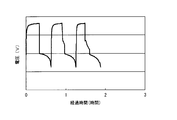
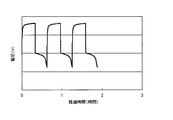
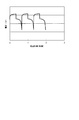
- FIG. 10 is a graph showing the results of a charge / discharge cycle test of an air secondary battery in Example 7. It is a graph which shows the result of the charging / discharging cycle test of the air secondary battery in Example 8. It is a graph which shows the result of the charging / discharging cycle test of the air secondary battery in Example 16. It is a graph which shows the result of the charging / discharging cycle test of the air secondary battery in Example 17. It is a graph which shows the result of the charging / discharging cycle test of the air secondary battery in Example 18. It is a graph which shows the result of the charging / discharging cycle test of the air secondary battery in Example 19.
- having a substituent means that “one or more hydrogen atoms are substituted with a group other than a hydrogen atom (substituent)” in the target group, unless otherwise specified.
- the number and position of the substituents are not limited, and all hydrogen atoms may be substituted with substituents.
- the positive electrode catalyst for an air secondary battery of the present embodiment uses a polynuclear metal complex.
- the polynuclear metal complex is a metal complex having two or more metal atoms or metal ions, and may have only a metal atom or may have only a metal ion. And may have metal ions.
- the metal atom or metal ion forms the polynuclear metal complex together with a ligand having one or more of a nitrogen atom, an oxygen atom, and a sulfur atom as an atom capable of coordination bonding.
- the polynuclear metal complex is excellent in both oxygen reduction activity and water oxidation activity, and is useful for application to an air secondary battery.
- the positive electrode catalyst for an air secondary battery is a polynuclear metal complex in which the polynuclear metal complex includes two or more central metals and a ligand that coordinates to the central metal.
- the ligand has a space surrounded by four or more atoms that can coordinate to the central metal, and the four or more atoms are selected from the group consisting of a nitrogen atom, an oxygen atom, and a sulfur atom.
- the molecule has two or more structures in the molecule that can accommodate the central metal in the space (the two or more structures may be the same or different).
- the number of atoms that can coordinate to the central metal surrounding the space is preferably 4 to 8, and more preferably 4 to 6.
- the structure is preferably 2-6 in the molecule, more preferably 2-5, and even more preferably 2-4.
- the molecular structure adjacent to such a space and forming the outer edge of the space is “having a space surrounded by four or more atoms capable of coordinating with the central metal, and the four or more atoms are “A structure that is one or more atoms selected from the group consisting of a nitrogen atom, an oxygen atom, and a sulfur atom and that can accommodate the central metal in the space”.
- the ligand used in the polynuclear metal complex of this embodiment has two or more of the structures in the molecule.
- the polynuclear metal complex is a polynuclear metal complex in which two or more metal atoms or metal ions are formed by the above ligand and a bond (usually a coordinate bond).
- the metal atom or metal ion may have a crosslinked structure.
- the partial structures are exemplified below (Ai) to (A-vi).
- M represents a metal atom or a metal ion, and two Ms may be the same or different.
- the number of central metals is preferably 2-6. In the polynuclear metal complex, the number of central metals is more preferably 2 to 5, and further preferably 2 to 4.
- the central metal of the polynuclear metal complex is preferably a transition metal atom belonging to the 4th to 6th periods of the periodic table or an ion thereof, vanadium, chromium, manganese, iron, cobalt, nickel, copper, and their It is more preferably at least one selected from the group consisting of ions, and even more preferably at least one selected from the group consisting of vanadium, chromium, manganese, iron, cobalt, nickel and copper.
- Examples of the polynuclear metal complex crosslinked with a nitrogen atom include a polynuclear metal complex represented by the following general formula (Aa). The charge of the polynuclear metal complex is omitted.
- polynuclear metal complex crosslinked with an oxygen atom examples include polynuclear metal complexes represented by the following general formulas (Ab) to (Ah). The charge of the polynuclear metal complex is omitted.
- polynuclear metal complexes crosslinked with sulfur atoms examples include polynuclear metal complexes represented by the following general formulas (AI) to (Al). The charge of the polynuclear metal complex is omitted.
- the ligand of the polynuclear metal complex of the present embodiment has a space surrounded by two nitrogen atoms and two oxygen atoms that can be coordinated to the central metal, and the central metal can be accommodated in the space.
- Examples of the polynuclear metal complex having the ligand include polynuclear metal complexes represented by the following general formulas (Am) and (An). The charge of the polynuclear metal complex is omitted.
- the ligand of the polynuclear metal complex of the present embodiment has a space surrounded by four nitrogen atoms that can coordinate with the central metal, and has a structure that can accommodate the central metal in the space. Two or more of them may be present (two or more of the structures may be the same or different).
- Examples of the polynuclear metal complex having the ligand include polynuclear metal complexes represented by the following general formulas (Ao) to (As). The charge of the polynuclear metal complex is omitted.
- the polynuclear metal complex is preferably one represented by the following general formula (A-1).
- A-1 a polynuclear metal complex that can be represented by the following general formula (A-1) may be referred to as a “first polynuclear metal complex”.
- Z 1 is a trivalent organic group, and two or more Z 1 may be the same as or different from each other.
- E is an oxygen atom or a sulfur atom, and two or more E may be the same as or different from each other.
- Q 1 is a divalent organic group having at least two nitrogen atoms.
- T 1 is an organic group having a nitrogen atom, and two or more T 1 may be the same or different from each other, and two or more T 1 may be bonded to each other.
- l is an integer of 1 or more, and when l is 2 or more, the two or more general formulas to which l is attached may be the same as or different from each other.
- M is a transition metal atom or transition metal ion
- m is an integer of 2 or more, and 2 or more of M may be the same or different from each other.
- X 1 is a counter ion or a neutral molecule
- n is an integer of 0 or more, and when n is 2 or more, 2 or more of X 1 may be the same or different from each other.
- Z 1 is a trivalent organic group, and two or more (two in the general formula to which 1 is attached) Z 1 may be the same or different.
- the trivalent organic group include an aromatic group which may have a substituent.
- the aromatic group in Z 1 is a trivalent group generated by removing three hydrogen atoms from an aromatic compound (preferably from a carbon atom constituting the ring of the aromatic compound).
- the aromatic compound preferably has a total number of carbon atoms such as benzene, naphthalene, anthracene, tetracene, biphenyl, binaphthyl, phenanthrene, dibenzofuran, thiophene, benzothiophene, dibenzothiophene, pyridine, pyrazine, pyrrole, etc. 60, more preferably 3 to 40 aromatic compounds may be mentioned, which may be monocyclic or polycyclic.
- the substituent that the aromatic group may have (hereinafter referred to as “substituent G”) is a group other than a hydrogen atom, and when the substituent G is 2 or more, these 2 or more substituents
- the groups G may be the same as or different from each other, and adjacent substituents G may be bonded to each other to form a ring together with the atoms to which they are bonded.
- Preferred examples of the substituent G include a hydroxyl group, an amino group, a nitro group, a cyano group, a carboxyl group, a formyl group, a hydroxysulfonyl group, a halogen atom, and an optionally substituted hydrocarbyl group (having a substituent.
- Monovalent hydrocarbon group which may have a substituent hydrocarbyloxy group which may have a substituent (hydrocarbonoxy group which may have a substituent), hydrocarbyl which may have a substituent Mercapto group (hydrocarbon mercapto group optionally having substituent), hydrocarbylcarbonyl group optionally having substituent (hydrocarbon carbonyl group optionally having substituent), having substituent Hydrocarbyloxycarbonyl group (hydrocarbonoxycarbonyl group which may have a substituent) which may be substituted, hydrocarbylo group which may have a substituent
- An amino group substituted with two hydrocarbyl groups which may have a substituent that is, an optionally substituted hydrocarbonsulfonyl group) (that is, an optionally substituted hydrocarbon sulfonyl group)
- a hydrocarbon disubstituted amino group hereinafter sometimes referred to as a “substituted amino group”
- the substituent G is substituted with two hydrocarbyl groups which may have a substituent, hydrocarbyloxy groups which may have a substituent, and two hydrocarbyl groups which may have a substituent. More preferred are an amino group, a hydrocarbyl mercapto group optionally having a substituent, a hydrocarbylcarbonyl group optionally having a substituent, and a hydrocarbyloxycarbonyl group optionally having a substituent.
- a hydrocarbyl group which may have, a hydrocarbyloxy group which may have a substituent, and an amino group which is substituted with two hydrocarbyl groups which may have a substituent are more preferable.
- a hydrocarbyl group which may be substituted and a hydrocarbyloxy group which may have a substituent are particularly preferred.
- the hydrogen atom when a nitrogen atom to which a hydrogen atom is bonded is present, the hydrogen atom is preferably substituted with a hydrocarbyl group.
- these two or more substituents may be the same or different from each other, and adjacent substituents are bonded to each other, and atoms to which each is bonded.
- a ring may be formed together.
- hydrocarbyl group in the substituent G examples include methyl group, ethyl group, n-propyl group, isopropyl group, n-butyl group, isobutyl group, tert-butyl group, pentyl group, hexyl group, heptyl group, octyl group, A linear or branched alkyl group having 1 to 50 carbon atoms, more preferably 1 to 20 carbon atoms, such as a nonyl group, a decyl group, an undecyl group, a dodecyl group, a pentadecyl group, an octadecyl group or a docosyl group; Cyclopropyl group, cyclobutyl group, cyclobutyl group, cyclopentyl group, cyclohexyl group, cyclononyl group, cyclododecyl group, norbornyl group, adamanty
- Cyclic or polycyclic cyclic alkyl group ethenyl group, propenyl group, 3-butenyl group, 2-butene group A linear, branched or cyclic group having 2 to 50 carbon atoms, more preferably 2 to 20 carbon atoms, such as an nyl group, a 2-pentenyl group, a 2-hexenyl group, a 2-nonenyl group, or a 2-dodecenyl group.
- alkenyl group in the case of cyclic, monocyclic or polycyclic
- phenyl group 1-naphthyl group, 2-naphthyl group, 2-methylphenyl group, 3-methylphenyl group, 4-methylphenyl group, 4-ethylphenyl group, 4-propylphenyl group, 4-isopropylphenyl group, 4-butylphenyl group, 4-tert-butylphenyl group, 4-hexylphenyl group, 4-cyclohexylphenyl group, 4-adamantylphenyl group, A monocyclic or polycyclic aryl group having preferably 6 to 50 carbon atoms, more preferably 6 to 20 carbon atoms, such as a 4-phenylphenyl group; Nylethyl group, 2-phenylethyl group, 1-phenyl-1-propyl group, 1-phenyl-2-propyl group, 2-phenyl-2-propyl group, 3-phenyl-1
- the hydrocarbyl group in the substituent G preferably has 1 to 20 carbon atoms, more preferably 2 to 12 carbon atoms, and still more preferably 3 to 10 carbon atoms.
- the hydrocarbyloxy group, hydrocarbyl mercapto group, hydrocarbylcarbonyl group, hydrocarbyloxycarbonyl group, and hydrocarbylsulfonyl group are the oxy group, mercapto group, carbonyl group, oxycarbonyl group, and sulfonyl group, respectively. It is a monovalent group formed by one bond.
- the substituted amino group and the substituted aminocarbonyl group each have two hydrogen atoms in an amino group (—NH 2 ) or an aminocarbonyl group (—C ( ⁇ O) —NH 2 ), and the hydrocarbyl group.
- the hydrocarbyl group is the same as the hydrocarbyl group as the substituent G.
- Examples of the substituent that the hydrocarbyloxy group, hydrocarbyl mercapto group, hydrocarbylcarbonyl group, hydrocarbyloxycarbonyl group, hydrocarbylsulfonyl group, substituted amino group and substituted aminocarbonyl group in the substituent G may have include a halogen atom and a hydroxyl group , Amino group, nitro group, cyano group, hydrocarbyl group which may have a substituent, hydrocarbyloxy group which may have a substituent, hydrocarbyl mercapto group which may have a substituent, substituent And a hydrocarbylcarbonyl group which may have a substituent, a hydrocarbyloxycarbonyl group which may have a substituent, and a hydrocarbylsulfonyl group which may have a substituent.
- halogen atom examples include a fluorine atom, a chlorine atom, a bromine atom, and an iodine atom.
- the optionally substituted hydrocarbyl group, optionally substituted hydrocarbyloxy group, optionally substituted hydrocarbyl mercapto group, optionally substituted hydrocarbylcarbonyl The hydrocarbyloxycarbonyl group which may have a group and a substituent, and the hydrocarbylsulfonyl group which may have a substituent are the same as those exemplified as the substituent G.
- Substituent G is, among the above, methyl, ethyl, n-propyl, isopropyl, n-butyl, isobutyl, tert-butyl, phenyl, methylphenyl, 1-naphthyl, 2- A naphthyl group and a pyridyl group are particularly preferable.
- substituents G When adjacent substituents G are bonded to each other to form a ring together with the atoms to which they are bonded, preferred examples of such a ring include a benzene ring, a cyclohexane ring, a pyridine ring, and a naphthalene ring. . Such a ring may have the substituent G described above as a substituent.
- E represents an oxygen atom or a sulfur atom, and two or more (two in the general formula to which 1 is attached) E may be the same as or different from each other.
- the E is preferably an oxygen atom.
- Q 1 is a divalent organic group having at least two nitrogen atoms, and is represented by the following general formula (A-4-1), (A-4-2) or (A- The group represented by 4-3) is preferred.
- R 10 and R 11 are each independently a hydrogen atom or a substituent, and two or more R 10 and R 11 may be the same as or different from each other.
- R 12 is a hydrogen atom or a hydrocarbyl group having 1 to 12 carbon atoms.
- Z 2 and Z 3 are each independently a divalent organic group.
- Y 1 and Y 2 are each independently a group represented by the formula “—N ⁇ ” or “—NH—”.
- P 1 is an atomic group that forms a heterocyclic ring together with two carbon atoms adjacent to Y 1 and Y 1 .
- P 2 is an atomic group that forms a heterocyclic ring together with two carbon atoms adjacent to Y 2 and Y 2 .
- D 1 is a single bond, a double bond or a divalent linking group.
- R 10 and R 11 are each independently a hydrogen atom or a substituent, and two or more R 10 and R 11 are It may be the same or different. Examples of the substituent for R 10 and R 11 are the same as those for the substituent G.
- R 12 is a hydrogen atom or a hydrocarbyl group having 1 to 12 carbon atoms.
- the hydrocarbyl group in R 12 is the same as the hydrocarbyl group in the substituent G except that it has 1 to 12 carbon atoms.
- Z 2 and Z 3 are each independently a divalent organic group.
- Preferred examples of Z 2 and Z 3 include an alkylene group which may be substituted with a substituent or a divalent aromatic group.
- the alkylene group in Z 2 and Z 3 is a divalent group generated by removing two hydrogen atoms from a saturated hydrocarbon, and may be linear, branched or cyclic. Specifically, methylene group, ethylene group, 1,1-propylene group, 1,2-propylene group, 1,3-propylene group, 2,4-butylene group, 2,4-dimethyl-2,4-butylene A linear or branched group having a total carbon number of preferably 1 to 20, more preferably 1 to 10, and further preferably 2 to 10, such as a group, 1,2-cyclopentylene group, 1,2-cyclohexylene group, etc. Examples thereof include a chain alkylene group and a cyclic alkylene group having preferably 3 to 20 carbon atoms.
- the alkylene group in Z 2 and Z 3 may have the same thing as the substituent G as a substituent.
- the divalent aromatic group in Z 2 and Z 3 is a divalent group generated by removing two hydrogen atoms from an aromatic compound (preferably from a carbon atom constituting the ring of the aromatic compound). , Either monocyclic or polycyclic.
- aromatic compound benzene, naphthalene, anthracene, tetracene, biphenyl, binaphthyl, phenanthrene, dibenzofuran, thiophene, benzothiophene, dibenzothiophene, pyridine, pyrazine, etc., preferably 3 to 60, more preferably Can be 3 to 40.
- the aromatic group in Z 2 and Z 3 may have the same thing as the substituent G as a substituent.
- Q 1 represented by the general formula (A-4-1) groups represented by the following formulas (A-4-1-1) to (A-4-1-11) are preferable.
- the groups represented by (A-4-1-1) to (A-4-1-6) are more preferable.
- Q 1 represented by the following formulas (A-4-1-1) to (A-4-1-11) may have the same substituent as the substituent G described above.
- Q 1 represented by the general formula (A-4-2) groups represented by the following general formulas (A-4-2-1) to (A-4-2-11) are preferable. Groups represented by the general formulas (A-4-2-1) to (A-4-2-6) are more preferable. Q 1 represented by the following general formulas (A-4-2-1) to (A-4-2-11) may have the same substituent as the substituent G.
- R 42 is a hydrogen atom or a hydrocarbyl group having 1 to 12 carbon atoms, and when R 42 is 2 or more, these 2 or more R 42 s may be the same as or different from each other.
- R 42 is a hydrogen atom or a hydrocarbyl group having 1 to 12 carbon atoms, and the hydrocarbyl group is the same as the hydrocarbyl group in R 12 . Moreover, when R42 is two or more, these two or more R42s may be the same as or different from each other.
- Y 1 and Y 2 are each independently a group represented by the formula “—N ⁇ ” or “—NH—”.
- a group represented by the formula “—N ⁇ ” the position of the double bond, that is, which side of the two carbon atoms adjacent to each of Y 1 and Y 2 is located , Not limited.
- P 1 represents an atomic group that forms a heterocyclic ring together with two carbon atoms adjacent to Y 1 and Y 1 .
- P 2 is an atomic group that forms a heterocyclic ring together with two carbon atoms adjacent to Y 2 and Y 2 .
- the heterocyclic ring formed by P 1 and the like and the heterocyclic ring formed by P 2 and the like may be either monocyclic or polycyclic, but are preferably aromatic heterocyclic rings, and nitrogen-containing aromatics More preferably, it is a heterocyclic ring.
- heterocyclic ring examples include pyrrole, pyridine, pyrazine, pyrimidine, pyridazine, thiazole, imidazole, oxazole, triazole, and indole, and pyrrole, pyridine, thiazole, imidazole, and oxazole are more preferable.
- the heterocyclic ring formed by P 1 and the like and the heterocyclic ring formed by P 2 and the like may have the same as the substituent G as a substituent.
- adjacent substituents may be bonded to each other to form a ring together with the atoms to which they are bonded.
- P 1 , P 2 and D 1 form a ring
- preferred examples of such a ring include a benzene ring, a cyclohexane ring, a pyridine ring and a naphthalene ring.
- such a ring may further have the substituent G described above as a substituent.
- D 1 is a single bond, a double bond or a divalent linking group.
- the linking group in D 1 is preferably an alkylene group, examples thereof being the same as the alkylene group in Z 2 and Z 3 may be the same as those in the substituent G.
- the heterocyclic ring formed by P 1 and the like, and the heterocyclic ring formed by P 2 and the like may be bonded to each other through a bond or linking group other than D 1 to form a polycyclic heterocyclic ring. .
- Q 1 represented by the general formula (A-4-3) groups represented by the following general formulas (A-4-3-1) to (A-4-3-3-13) are preferable. Groups represented by general formulas (A-4-3-1) to (A-4-3-6) are more preferable. Q 1 represented by the following general formulas (A-4-3-1) to (A-4-3-3-13) may have the same substituent as the substituent G described above.
- R 43 is a hydrogen atom or a hydrocarbyl group having 1 to 12 carbon atoms, and two or more R 43 may be the same as or different from each other.
- R 43 is the same as R 42 described above.
- T 1 is an organic group having a nitrogen atom, and two or more (two in the general formula to which 1 is attached) T 1 may be the same or different from each other. Two or more T 1 may be bonded to each other.
- T 1 examples include groups represented by the following general formula (A-5-a), (A-5-b), or (A-5-c).
- R 13 and R 14 are each independently a hydrogen atom or a substituent, and two or more R 13 and R 14 may be the same as or different from each other.
- R 15 is a hydrogen atom or a hydrocarbyl group having 1 to 12 carbon atoms.
- Y 3 is a group represented by the formula “—N ⁇ ” or “—NH—”.
- P 3 is an atomic group that forms a nitrogen-containing aromatic heterocycle together with two carbon atoms adjacent to Y 3 and Y 3 .
- R 13 and R 14 are each independently a hydrogen atom or a substituent, and the substituent is the same as the substituent G. The thing can be illustrated. Two or more of R 13 and R 14 may be the same as or different from each other.
- R 15 represents a hydrogen atom or a hydrocarbyl group having 1 to 12 carbon atoms, and is the same as R 42 described above.
- the nitrogen-containing aromatic heterocycle formed by P 3 or the like may be either monocyclic or polycyclic, and specific examples thereof include pyridine, pyrrole, pyrazine, pyrimidine, pyridazine, thiazole, imidazole, Examples include oxazole, triazole, indole, benzimidazole, quinoline, isoquinoline, cinnoline, phthalazine, quinazoline, quinoxaline, benzodiazine, pyridine, pyrrole, pyrazine, pyrimidine, pyridazine, thiazole, imidazole, oxazole, triazole, indole, benzimidazole, pyrrole Are more preferable, and pyridine, pyrrole, thiazole, imidazole, and oxazole are more preferable.
- the nitrogen-containing aromatic heterocyclic ring may have the same thing as the substituent G as
- Preferred examples of the divalent organic group formed by bonding two T 1 to each other include those represented by the following formulas (A-5-1) to (A-5-35).
- the organic groups represented by the following formulas (A-5-1) to (A-5-35) may have the same substituents as the substituent G.
- R 51 is a hydrogen atom or a hydrocarbyl group having 1 to 12 carbon atoms, and two or more R 51 s may be the same as or different from each other.
- R 51 is a hydrogen atom or a hydrocarbyl group having 1 to 12 carbon atoms, and two or more R 51 s may be the same as or different from each other.
- R 51 is a hydrogen atom or a hydrocarbyl group having 1 to 12 carbon atoms, and is the same as R 42 described above.
- l is an integer of 1 or more and represents the number of ligands constituting the polynuclear metal complex, preferably 1 to 4, more preferably 1 or 2, particularly preferably. 1.
- the 2 or more general formulas represented by l may be the same as or different from each other.
- M is a transition metal atom or a transition metal ion, and is coordinated or ionically bonded to at least E in the polynuclear metal complex. M is also coordinated to two or more nitrogen atoms of Q 1 in formula (A-1), and is coordinated to four or more atoms together with E. . Further, M is coordinated to the nitrogen atom of T 1 in the general formula (A-1), and is coordinated to four or more atoms together with E.
- the general formula (A-1) ligand in (Z 1, E, ligands containing Q 1 and T 1) is a space surrounded by coordinating four possible more atoms in M (2 A space surrounded by two E and two or more nitrogen atoms of Q 1 and a space surrounded by two E and two nitrogen atoms of T 1 ), and the central metal is placed in the space A structure that can be accommodated (a structure that forms a space surrounded by two E and two or more nitrogen atoms that Q 1 has, and a space that is surrounded by two E and two nitrogen atoms that T 1 has 2 or more in the molecule.
- the transition metal atom is preferably a transition metal atom belonging to the fourth to sixth periods of the periodic table. Specifically, scandium, titanium, vanadium, chromium, manganese, iron, cobalt, nickel, copper, yttrium, zirconium, niobium, molybdenum, ruthenium, rhodium, palladium, silver, lanthanum, cerium, praseodymium, neodymium, samarium, europium , Gadolinium, terbium, dysprosium, holmium, erbium, thulium, ytterbium, lutetium, hafnium, tantalum, tungsten, rhenium, osmium, iridium, platinum, and gold.
- scandium, titanium, vanadium, chromium, manganese, iron, cobalt, nickel, copper, yttrium, zirconium, niobium, molybdenum, silver, lanthanum, cerium, praseodymium, neodymium, samarium, europium, gadolinium are preferable.
- One or more selected from the group consisting of zirconium, niobium, molybdenum, tantalum, and tungsten is more preferable, and consists of vanadium, chromium, manganese, iron, cobalt, nickel, and copper. More preferably one or more kinds that are more selected, manganese, iron, cobalt, nickel, one or more members selected from the group consisting of copper is particularly preferred.
- the transition metal ion is preferably an ion of a transition metal atom belonging to the fourth to sixth periods of the periodic table.
- m is an integer of 2 or more, and represents the total number of transition metal atoms and transition metal ions constituting the polynuclear metal complex, preferably 2 to 6, more preferably 2 to 4. More preferably, it is 2 or 3, particularly preferably 2.
- the two or more Ms may be the same or different from each other, may be only a transition metal atom, may be only a transition metal ion, or a transition metal atom and a transition metal ion may coexist.
- Crosslinking coordination may be performed between Ms.
- At least one M is a cobalt atom or a cobalt ion. All M may be cobalt atoms or cobalt ions.
- X 1 is a counter ion or a neutral molecule, and the counter ion electrically neutralizes the polynuclear metal complex, and the neutral molecule is , Itself an electrically neutral molecule.
- neutral molecules include ammonia, pyridine, pyrrole, pyridazine, pyrimidine, pyrazine, 1,2,4-triazine, pyrazole, imidazole, 1,2,3-triazole, oxazole.
- preferred neutral molecules are ammonia, pyridine, pyrrole, pyridazine, pyrimidine, pyrazine, 1,2,4-triazine, pyrazole, imidazole, 1,2,3-triazole, oxazole, isoxazole, 1,3 , 4-oxadiazole, indole, indazole, quinoline, isoquinoline, phenanthridine, cinnoline, phthalazine, quinazoline, quinoxaline, 1,8-naphthyridine, acridine, 2,2'-bipyridine, 4,4'-bipyridine, 1 , 10-phenanthroline, ethylenediamine, propylenediamine, phenylenediamine, cyclohexanediamine, pyridine N-oxide, 2,2'-bipyridine N, N'-dioxide, oxamide, dimethylglyoxime, o-
- the counter ion may be either an anionic counter ion or a cationic counter ion.
- counter ions having anionic property include hydroxide ions; peroxides; superoxides; cyanide ions; thiocyanate ions; halide ions such as fluoride ions, chloride ions, bromide ions, iodide ions; sulfate ions; Nitrate ion; carbonate ion, perchlorate ion; tetrafluoroborate ion; tetraarylborate ion such as tetraphenylborate ion; hexafluorophosphate ion; methanesulfonate ion; trifluoromethanesulfonate ion; p-toluenesulfonate ion Benzene sulfonate ion; phosphate ion; phosphite
- Examples include lomethanesulfonate ion, p-toluenesulfonate ion, benzenesulfonate ion, phosphate ion, acetate ion, trifluoroacetate ion, hydroxide ion, sulfate ion, nitrate ion, carbonate ion, tetraphenylborate ion. More preferred are trifluoromethanesulfonate ion, p-toluenesulfonate ion, acetate ion, and trifluoroacetic acid.
- Examples of the counter ion having a cationic property include alkali metal ions; alkaline earth metal ions; tetraalkylammonium ions such as tetra (n-butyl) ammonium ion and tetraethylammonium ion; tetraarylphosphonium ions such as tetraphenylphosphonium ion. It can be illustrated.
- examples thereof include phenylphosphonium ion, more preferably tetra (n-butyl) ammonium ion, tetraethylammonium ion, and tetraphenylphosphonium ion, and still more preferably tetra (n-butyl) ammonium ion and tetraethylammonium ion.
- n is an integer of 0 or more, and represents the number of X 1 constituting the polynuclear metal complex.
- n is 2 or more, two or more X 1 s may be the same as or different from each other. Further, two or more X 1 may be a counter ion alone, a neutral molecule alone, or a counter ion and a neutral molecule may coexist.
- the polynuclear metal complex represented by the general formula (A-1) is preferably a polynuclear metal complex represented by the following general formula (A-2).
- R 1 is a hydrogen atom or a substituent, and two or more R 1 s may be the same as or different from each other, and adjacent R 1 may be bonded to each other to form a ring together with the carbon atom to which each is bonded.
- Q 2 is a divalent organic group having at least two nitrogen atoms.
- T 2 is an organic group having a nitrogen atom, and is the same group as T 1 .
- Two or more T 2 may be the same or different from each other, and two or more T 2 may be bonded to each other.
- l is an integer of 1 or more, and when l is 2 or more, the two or more general formulas to which l is attached may be the same as or different from each other.
- M is a transition metal atom or transition metal ion
- m is an integer of 2 or more, and 2 or more of M may be the same or different from each other.
- X 1 is a counter ion or a neutral molecule
- n is an integer of 0 or more, and when n is 2 or more, 2 or more of X 1 may be the same or different from each other.
- M, X 1, l, m and n are, M in the general formula (A-1), is the same as X 1, l, m and n.
- M in the general formula (A-1) is the same as X 1, l, m and n.
- the 2 or more general formulas (general formulas representing ligands including R 1 , Q 2, and T 2) to which l is attached may be the same as or different from each other.
- Q 2 is a divalent organic group having at least two nitrogen atoms, and is the same as Q 1 in the general formula (A-1).
- T 2 is an organic group having a nitrogen atom, and is the same as T 1 in the general formula (A-1). Accordingly, two or more T 2 may be the same or different from each other, and two or more T 2 may be bonded to each other.
- R 1 is a hydrogen atom or a substituent, two or more of R 1 may be the same or different, R 1 adjacent, taken together, each You may form a ring with the carbon atom to which it couple
- R 1 is the same as the substituent G except that R 1 may be a hydrogen atom. That is, the substituent in R 1 is the same as the substituent G.
- R 1 represents a hydrogen atom, a methyl group, an ethyl group, an n-propyl group, an isopropyl group, an n-butyl group, an isobutyl group, a tert-butyl group, a phenyl group, a methylphenyl group, a 1-naphthyl group, or a 2-naphthyl group. Or it is especially preferable that it is a pyridyl group.
- M is a coordinate bond between two or more nitrogen atoms of Q 2 in the general formula (A-2) and two oxygen atoms, and a total of four or more.
- Coordination bond is formed between the atoms of M is coordinated with the nitrogen atom of T 2 in the general formula (A-2) and two oxygen atoms, and is coordinated with four or more atoms in total. ing.
- the ligand in the general formula (A-2) is surrounded by a space surrounded by four or more atoms capable of coordinating with M (two oxygen atoms and two or more nitrogen atoms of Q 2).
- a space surrounded by two oxygen atoms and two nitrogen atoms included in T 2 and a structure that can accommodate the central metal in the space (two oxygen atoms and Q 2 have Two or more nitrogen atoms in the molecule having a structure surrounded by two or more nitrogen atoms and a structure surrounded by two oxygen atoms and two nitrogen atoms possessed by T 2 is doing.
- the polynuclear metal complex represented by the general formula (A-2) is preferably a polynuclear metal complex represented by the following general formula (A-3).
- R 2 is a hydrogen atom or a substituent, and two or more R 2 s may be the same or different from each other, and adjacent R 2 may be bonded to each other to form a ring together with the carbon atom to which each is bonded.
- Q 3 and Q 4 are each independently represented by the following general formulas (A-3-1), (A-3-2), (A-3-3), (A-3-4), (A-3- 5) or a divalent group represented by (A-3-6).
- l is an integer of 1 or more, and when l is 2 or more, the two or more general formulas to which l is attached may be the same as or different from each other.
- M is a transition metal atom or transition metal ion
- m is an integer of 2 or more, and 2 or more of M may be the same or different from each other.
- X 1 is a counter ion or a neutral molecule
- n is an integer of 0 or more, and when n is 2 or more, 2 or more of X 1 may be the same or different from each other.
- R 3 , R 4 , R 5 , R 6 , R 7 and R 8 are each independently a hydrogen atom or a substituent, and two or more R 3 , R 4 , R 5 , R 6 , R 7 and R 8 Each may be the same or different from each other, and two or more of R 3 , R 4 , R 5 , R 6 , R 7 and R 8 are bonded to each other to form a ring together with the carbon atoms to which they are bonded. May be.
- a a is a divalent group represented by the following formula (A-3-a) or (A-3-b) or the following general formula (A-3-c), and two or more A a are: They may be the same or different from each other. )
- R 9 is a hydrogen atom or a hydrocarbyl group.
- M, X 1, l, m and n are, M in the general formula (A-1), is the same as X 1, l, m and n.
- M in the general formula (A-1) is the same as X 1, l, m and n.
- l is 2 or more
- the two or more general formulas represented by l may be the same as or different from each other.
- R 2 is a hydrogen atom or a substituent, and is the same as R 1 in the general formula (A-2). Accordingly, two or more R 2 s may be the same as or different from each other, and adjacent R 2 may be bonded to each other to form a ring together with the carbon atom to which each is bonded.
- Q 3 and Q 4 are each independently the general formulas (A-3-1), (A-3-2), (A-3-3), (A- 3-4), a divalent group represented by (A-3-5) or (A-3-6).
- R 3 , R 4 , R 5 , R 6 , R 7 and R 8 are each independently a hydrogen atom or a substituent, The same as R 1 in the general formula (A-2). Accordingly, two or more R 3 , R 4 , R 5 , R 6 , R 7 and R 8 may be the same or different from each other, and two or more R 3 , R 4 , R 5 , R 6 , R 7 and R 8 may be bonded to each other to form a ring together with the carbon atom to which each is bonded.
- a a is a divalent group represented by the formula (A-3-a) or (A-3-b) or the general formula (A-3-c). And two or more A a may be the same or different from each other.
- R 9 is a hydrogen atom or a hydrocarbyl group.
- the hydrocarbyl group in R 9 is the same as the hydrocarbyl group in the substituent G.
- the ligand represented by the general formula including R 2 , Q 3 and Q 4 is represented by the formula (A-6-7) to
- the ligand represented by (A-6-14) is preferable, and the ligands represented by formulas (A-6-7) to (A-6-9) are more preferable.
- M is a coordinate bond between two nitrogen atoms of Q 3 in the general formula (A-3) and two oxygen atoms. There is a coordination bond between. M is coordinated with two nitrogen atoms and two oxygen atoms of Q 4 in formula (A-3), and is coordinated with four atoms in total. ing.
- the ligand in the general formula (A-3) is a space surrounded by four atoms capable of coordinating to M (a space surrounded by two oxygen atoms and two nitrogen atoms of Q 3 , And a structure surrounded by two oxygen atoms and two nitrogen atoms of Q 4 ), and a structure capable of accommodating the central metal in the space (two nitrogen atoms of two oxygen atoms and Q 3
- preferred examples of the ligand constituting the polynuclear metal complex include ligands represented by the following formulas (A-6-1) to (A-6-34).
- the ligands represented by the formulas (A-6-1) to (A-6-22) are more preferable, and the ligands represented by (A-6-1) to (A-6-14) are preferred.
- a ligand is particularly preferred.
- the charge is omitted.
- Me is a methyl group
- t Bu is a tert-butyl group.
- Me is a methyl group
- t Bu is a tert-butyl group.
- Me is a methyl group
- t Bu is a tert-butyl group.
- examples of preferable polynuclear metal complexes include polynuclear metal complexes represented by the following general formulas (A-7-1) to (A-7-34).
- A-7-1) to (A-7-34) electric charges, counter ions and neutral molecules (X 1 ) are omitted.
- M 1 and M 2 are each independently a transition metal atom or a transition metal ion, and t Bu is a tert-butyl group.
- M 1 and M 2 are each independently a transition metal atom or a transition metal ion, and t Bu is a tert-butyl group.
- M 1 , M 2 , M 3 and M 4 are each independently a transition metal atom or transition metal ion, Me is a methyl group, and t Bu is a tert-butyl group.
- M 1 and M 2 are each independently a transition metal atom or a transition metal ion, Me is a methyl group, and t Bu is a tert-butyl group.
- M 1 , M 2 , M 3 and M 4 are each independently a transition metal atom or a transition metal ion, and Me is a methyl group.
- M 1 , M 2 , M 3 and M 4 are each independently a transition metal atom or a transition metal ion, Same as M in A-1).
- the ligand in the polynuclear metal complex described above includes, for example, a phenol compound having an aldehyde group and a compound having an amino group, as described in “Journal of Organic Chemistry, 69, 5419” (2004). It can manufacture by the method of having the process made to react in solvents, such as alcohol. Further, for example, as described in “Australian Journal of Chemistry, 23, 2225 (1970)”, a metal salt may be added during the reaction to directly produce the target polynuclear metal complex.
- an addition of an organometallic reagent to a heterocyclic ring and an oxidation reaction were performed, followed by a halogenation reaction and then a transition metal catalyst. It can manufacture by the method which has the process of performing a cross coupling reaction. It can also be produced by a method having a step of performing a cross-coupling reaction stepwise using a heterocyclic halide.
- the ligand used in the polynuclear metal complex may be an aromatic compound that satisfies the following requirements (a) and (b).
- a polynuclear metal complex having a ligand that satisfies the above requirements (a) and (b) may be referred to as a “second polynuclear metal complex”.
- the nitrogen atom that can be coordinated to the central metal in the requirement (a) has one lone pair of electrons and can form a coordinate bond with the central metal (metal atom or metal ion). Is an atom.
- the nitrogen atom before coordination to the metal atom or metal ion may donate a lone pair of electrons to the proton to form an N—H bond.
- the ligand used in the polynuclear metal complex of this embodiment has two or more of the structures in the molecule.
- Each structure (that is, a space included in each structure) can preferably accommodate 1 to 3, more preferably 1 or 2, and particularly preferably 1 central metal.
- Such a structure is obtained by forming a polynuclear metal complex having a compound containing the above structure as a ligand and then performing structural analysis such as X-ray crystal structure analysis on a crystal obtained by a generally known method such as recrystallization. It can be confirmed by doing.
- all the nitrogen-containing aromatic hetero 6-membered rings contained in the ligand molecule may contain only one or two nitrogen atoms as hetero atoms. preferable.
- the “structure” in which the space accommodating the central metal is formed has any one of line symmetry, point symmetry, and rotational symmetry.
- the symmetry is the symmetry when focusing only on the above-mentioned “molecular structure forming the outer edge of the space in which the central metal is accommodated”, and regarding the substituents such as aromatic rings constituting the molecular structure. Is not considered.
- a molecular structure in which a hydrogen atom (proton) bonded to the nitrogen atom is eliminated from a nitrogen atom forming the structure is considered.
- the “structure” When the “structure” has rotational symmetry, it is 2 times symmetric (C 2 symmetry) or more, preferably 2 to 12 times symmetric, more preferably 2 to 6 times symmetric.
- aromatic compounds (ligands) having such a symmetrical structure in the molecule include compounds represented by the following general formulas (Ba) to (Bx).
- the ligand contained in the polynuclear metal complex of this embodiment has two or more such structures in the molecule.
- the ratio of the mass W N of all nitrogen atoms to the mass W C of all carbon atoms constituting the aromatic compound (W N / W C ) Is preferably greater than 0 and 1.1 or less (0 ⁇ W N / W C ⁇ 1.1).
- the value of W N / W C is more preferably 0.05 or more, and still more preferably 0.1 or more. Further, it is more preferably 1.0 or less, and still more preferably 0.9 or less.
- the upper limit value and the lower limit value can be arbitrarily combined.
- the number n of nitrogen atoms constituting each of the above structures, and the center of the space formed by the structure in each of the above structures is preferably such that the value of r / n is greater than 0 and 0.7 or less (0 ⁇ r / n ⁇ 0.7).
- the value of r / n is more preferably 0.1 or more, and still more preferably 0.2 or more. Further, it is more preferably 0.65 or less, and still more preferably 0.6 or less.
- the upper limit value and the lower limit value can be arbitrarily combined.
- the center of the space surrounded by four or more coordinating nitrogen atoms is defined as follows. That is, when the structure has line symmetry, the center is on the axis of symmetry and the average distance from each nitrogen atom is the shortest. When the structure has point symmetry, the center is a symmetry point. When the structure has rotational symmetry, the center is on the rotational symmetry axis, and the average distance from the center of each nitrogen atom is the shortest.
- n is preferably 4 to 10, more preferably 4 to 8, and particularly preferably 4 to 6.
- the lower limit value of r is preferably 1.5 ⁇ , more preferably 1.71, even more preferably 1.9 ⁇ , and the upper limit is preferably 3.5 ⁇ , more preferably 3. It is 3 ?, more preferably 3.1 ?.
- the aromatic compound that can be used as the ligand of the polynuclear metal complex of the present embodiment can further improve the catalytic activity, it preferably has a polycyclic aromatic heterocycle.
- a structure that has a space surrounded by four or more nitrogen atoms that can coordinate to the central metal and that can accommodate the central metal in the space is represented by the following general formula (B-1). It is preferably represented.
- the number of nitrogen atoms that can be coordinated to the central metal surrounding the space is preferably 4 to 8, and more preferably 4 to 6.
- Q 1a , Q 1b and Q 1c are each independently a nitrogen-containing aromatic heterocyclic ring which may have a substituent, and each contains 4 or more nitrogen atoms capable of coordination. When Q 1b is 2 or more, they may be the same or different. However, at least one of Q 1a , Q 1b and Q 1c is a nitrogen-containing aromatic hetero 6-membered ring.
- Z 1a and Z 1b are each independently a direct bond or a linking group, and when Z 1b is 2 or more, they may be the same or different.
- Q 1a and Q 1b , and Q 1b and Q 1c may each form a polycyclic aromatic heterocycle together.
- Q 1a and Q 1c may be directly bonded to each other or may be bonded to each other via a linking group, and may form a polycyclic aromatic heterocycle together.
- m in the general formula (B-1) is more preferably an integer of 1 to 5, still more preferably an integer of 2 to 4, and particularly preferably 2 or 4.
- Q 1a , Q 1b and Q 1c in the general formula (B-1) are each independently a nitrogen-containing aromatic heterocyclic ring which may have a substituent, and the following formulas (B-1-1) to The pyridine ring, pyrazine ring, pyrimidine ring, pyridazine ring, 1,3,5-triazine ring, 1,2,4-triazine ring, 1,2,4,5- Tetrazine ring, 1H-pyrrole ring, 2H-pyrrole ring, 3H-pyrrole ring, imidazole ring, pyrazole ring, 1,2,3-triazole ring, 1,2,4-triazole ring, oxazole ring, isoxazole ring, thiazole Ring, isothiazole ring, 1,3,4-oxadiazole ring, 1,2,5-oxadiazole ring, 1,3,4-thiadiazole ring, 1,2,5-thiadiazole ring
- Z 1a and Z 1b are each independently a direct bond or a linking group.
- Examples of the direct bond include a single bond and a double bond.
- Examples of the linking group include a divalent or trivalent linking group.
- Z 1a and Z 1b are a single bond, a double bond, and a linking group represented by —C (R ⁇ ) 2 —, ⁇ C (R ⁇ ) —, ⁇ N (R ⁇ ) — or ⁇ N—
- R ⁇ , R ⁇ and R ⁇ are each independently a hydrogen atom or a substituent, and adjacent substituents may be bonded to each other to form a ring together with the carbon atom to which they are bonded. Good.
- substituents examples include a halogeno group, a hydroxy group, a carboxyl group, a mercapto group, a sulfonic acid group, a nitro group, an amino group, a cyano group, a phosphonic acid group, a silyl group substituted with an alkyl group having 1 to 4 carbon atoms, A linear or branched alkyl group having 1 to 50 carbon atoms, a cyclic alkyl group having 3 to 50 carbon atoms, an alkenyl group, an alkynyl group, an alkoxy group, an aryl group having 6 to 60 carbon atoms, or 7 to 7 carbon atoms 50 aralkyl groups, monovalent heterocyclic groups and the like, preferably halogeno groups, mercapto groups, hydroxy groups, carboxyl groups, linear or branched alkyl groups having 1 to 20 carbon atoms, carbon numbers A cyclic alkyl group having 3 to 20 carbon atoms, an alkoxy
- halogeno group examples include a fluoro group, a chloro group, a bromo group, and an iodo group.
- Examples of the silyl group substituted with an alkyl group having 1 to 4 carbon atoms include a trimethylsilyl group, a triethylsilyl group, a tert-butyldimethylsilyl group, and a triisopropylsilyl group.
- linear or branched alkyl group examples include methyl, ethyl, propyl, isopropyl, butyl, isobutyl, tert-butyl, sec-butyl, pentyl, hexyl, and heptyl.
- cyclic alkyl group examples include cyclopropyl group, cyclobutyl group, cyclopentyl group, cyclohexyl group, cyclononyl group, cyclododecyl group, norbornyl group, adamantyl group and the like.
- alkenyl group examples include those in which the single bond (C—C) between any one carbon atom in the linear or branched alkyl group is substituted with a double bond.
- the position of the bond is not limited.
- Preferred examples of the alkenyl group include ethenyl group, propenyl group, 3-butenyl group, 2-butenyl group, 2-pentenyl group, 2-hexenyl group, 2-nonenyl group, 2-dodecenyl group and the like.
- alkynyl group examples include those in which a single bond (C—C) between any one carbon atom in the linear or branched alkyl group is substituted with a triple bond. The position is not limited.
- alkynyl group examples include ethynyl group, 1-propynyl group, 2-propynyl group, 1-butynyl group, 2-butynyl group, 1-pentynyl group, 2-pentynyl group, 1-hexynyl group, 2-hexynyl group, 1 An octynyl group is preferred, and an ethynyl group is more preferred.
- alkoxy group examples include a monovalent group in which the linear or branched alkyl group or the cyclic alkyl group is bonded to an oxygen atom.
- Preferred examples of the alkoxy group include methyl group, ethyl group, propyl group, isopropyl group, butyl group, isobutyl group, tert-butyl group, sec-butyl group, pentyl group, hexyl group, heptyl group, octyl group, Examples thereof include a monovalent group in which a nonyl group, a decyl group, a dodecyl group, a pentadecyl group, an octadecyl group, a cyclopropyl group, a cyclobutyl group, a cyclopentyl group, and a cyclohexyl group are bonded to an oxygen atom.
- aryl group examples include phenyl group, 1-naphthyl group, 2-naphthyl group, 1-anthracenyl group, 2-anthracenyl group, 9-anthracenyl group, 1-tetracenyl group, 2-tetracenyl group, 5-tetracenyl group, 1 -Pyrenyl group, 2-pyrenyl group, 4-pyrenyl group, 2-perenyl group, 3-perylenyl group, 2-fluorenyl group, 3-fluorenyl group, 4-fluorenyl group, 1-biphenylenyl group, 2-biphenylenyl group, 2 -Phenanthrenyl group, 9-phenanthrenyl group, 6-chrysenyl group, 1-coronenyl group and the like.
- the hydrogen atom in the aryl group includes a halogeno group, a hydroxy group, a carboxyl group, a mercapto group, a sulfonic acid group, a nitro group, an amino group, a cyano group, a phosphonic acid group, the alkyl group, the alkenyl group, the alkynyl group, and the above. It may be substituted with an alkoxy group, the aryl group, the aralkyl group, or the like.
- Examples of the monovalent heterocyclic group include pyridyl group, pyrazyl group, pyrimidyl group, pyridazyl group, pyrrolyl group, furyl group, thienyl group, imidazolyl group, pyrazolyl group, thiazolyl group, oxazolyl group and the like.
- the monovalent heterocyclic group means a remaining atomic group obtained by removing one hydrogen atom from a heterocyclic compound.
- a monovalent aromatic heterocyclic group is preferable.
- aralkyl group examples include benzyl group, 1-phenylethyl group, 2-phenylethyl group, 1-phenyl-1-propyl group, 1-phenyl-2-propyl group, 2-phenylpropyl group, 3-phenyl-1 -Propyl group and the like.
- R ⁇ , R ⁇ and R ⁇ may be bonded to each other or together with other bonds in the carbon atom or nitrogen atom to which the substituent is bonded to form a ring.
- ring cyclohexene ring, benzene ring, pyridine ring, pyrazine ring, pyrimidine ring, pyridazine ring, 1H-pyrrole ring, 2H-pyrrole ring, 3H-pyrrole ring, imidazole ring, pyrazole ring, 1,2, 3-triazole ring, 1,2,4-triazole ring, oxazole ring, isoxazole ring, thiazole ring, isothiazole ring, 1,3,4-oxadiazole ring, 1,2,5-oxadiazole ring, Examples include 1,3,4-thiadiazole ring, 1,2,5-thiadiazole ring, furan ring, thi
- Q 2a , Q 2b , Q 2c and Q 2d are each independently a nitrogen-containing aromatic heterocyclic ring which may have a substituent, and each contains 4 or more nitrogen atoms capable of coordination. However, at least one of Q 2a , Q 2b , Q 2c and Q 2d is a nitrogen-containing aromatic hetero 6-membered ring.
- Z 2a , Z 2b and Z 2c are each independently a direct bond or a linking group.
- Q 2a and Q 2b , Q 2b and Q 2c , and Q 2c and Q 2d may each together form a polycyclic aromatic heterocycle.
- Q 2a and Q 2d may be bonded to each other via a direct bond or a linking group, and may form a polycyclic aromatic heterocycle together.
- Q 3a , Q 3b , Q 3c , Q 3d , Q 3e, and Q 3f are each independently a nitrogen-containing aromatic heterocyclic ring that may have a substituent, Each contains a nitrogen atom. However, at least one of Q 3a , Q 3b , Q 3c , Q 3d , Q 3e and Q 3f is a nitrogen-containing aromatic hetero 6-membered ring.
- Z 3a , Z 3b , Z 3c , Z 3d and Z 3e are each independently a direct bond or a linking group.
- Q 3a and Q 3b , Q 3b and Q 3c , Q 3c and Q 3d , Q 3d and Q 3e , and Q 3e and Q 3f together form a polycyclic aromatic heterocycle. May be.
- Q 3a and Q 3f may be bonded to each other via a direct bond or a linking group, and may form a polycyclic aromatic heterocycle together.
- Q 2a in the general formula (B-2) corresponds to Q 1a in the general formula (B-1), and Q 2b and Q 2c in the general formula (B-2) are Q in the general formula (B-1).
- Q 2d in the general formula (B-2) corresponds to Q 1c in the general formula (B-1).
- Z 2a in the general formula (B-2) corresponds to Z 1a in the general formula (B-1), and Z 2b and Z 2c in the general formula (B-2) are represented by the general formula (B-1).
- Z 1b corresponds to Z 1b .
- Q 3a in the general formula (B-3) corresponds to Q 1a in the general formula (B-1)
- Q 3b to Q 3e in the general formula (B-3) are represented by the general formula (B-1 corresponding to Q 1b of)
- Q 3f of formula (B-3) corresponds to the Q 1c of the general formula (B-1).
- Z 3a in the general formula (B-3) corresponds to Z 1a in the general formula (B-1)
- Z 3b to Z 3e in the general formula (B-3) are represented by the general formula (B-1).
- Q 2a , Q 2b , Q 2c and Q 2d in the general formula (B-2) and Q 3a , Q 3b , Q 3c , Q 3d , Q 3e and Q 3f in the general formula (B-3) are independent of each other.
- a nitrogen-containing aromatic ring optionally having a substituent, and preferred examples thereof are the same as those of Q 1a , Q 1b and Q 1c in the above general formula (B-1).
- An organic group consisting of Q 3e and Q 3f which are heterocyclic rings and a direct bond or linking group which bonds the two nitrogen-containing aromatic heterocyclic rings to each other is represented by the following formulas (B-4-a) to (B— 4-c), (B-5-a) to (B-5-d) or (B-6-a) to (B-6-d)
- Two or more of X, R 4b , R 4c , R 5b , R 5c , R 6b and R 6c may be the same or different.
- Y is —N (H) — or ⁇ N—. Two or more Y may be the same or different.
- the dotted line of the straight line in the formula indicates that the dotted portion is coupled to Z 1a or the like in the general formulas (B-1), (B-2), and (B-3) described above. )
- R 4b , R 4c , R 5b , R 5c , R 5d , R 6b , R 6c , R 6d , R ⁇ and R ⁇ in the above formula are each independently a hydrogen atom or a substituent.
- a substituent is synonymous with the above-mentioned substituent.
- adjacent substituents may be bonded to each other to form a ring together with the carbon atoms to which they are bonded.
- R 7a to R 10e are each independently a hydrogen atom or a substituent, and adjacent substituents may be bonded to each other to form a ring together with the carbon atom to which each is bonded. Two or more of R 7a to R 10e may be the same or different.
- a substituent is synonymous with the above-mentioned substituent.
- the dotted line of the straight line in the formula indicates that the dotted portion is coupled to Z 1a or the like in the general formulas (B-1), (B-2), and (B-3) described above. )
- Examples of the ligand of the polynuclear metal complex of the present embodiment include compounds represented by the structural formulas represented by the following general formulas (BI-1) to (BI-41).
- the hydrogen atom in the formula may be substituted with the above-described substituent.
- Examples of the ligand of the polynuclear metal complex of this embodiment include aromatic compounds having unit structures represented by the following general formulas (BI-42) to (BI-62).
- the ligand has two or more of the following unit structures, and the two or more unit structures may be the same or different.
- the hydrogen atom in the formula may be substituted with the above-described substituent.
- the aromatic compounds having the above unit structure and usable as the ligand of the polynuclear metal complex of the present embodiment are represented by the following general formulas (BI-63) to (BI-97). Are exemplified.
- the hydrogen atom in the formula may be substituted with the above-described substituent, or two adjacent hydrogen bonds may be removed to form a direct bond or a linking group.
- examples of the ligand of the polynuclear metal complex of the present embodiment include polymer compounds having repeating units represented by the following general formulas (BI-98) to (BI-111). .
- the hydrogen atom in the formula may be substituted with the above-described substituent, or two adjacent hydrogen bonds may be removed to form a direct bond or a linking group.
- the number average molecular weight in terms of polystyrene of the polymer compound is preferably 1 ⁇ 10 3 to 1 ⁇ . 10 8 , more preferably 2 ⁇ 10 3 to 1 ⁇ 10 6 .
- the polystyrene equivalent weight average molecular weight of the polymer compound is preferably 2 ⁇ 10 3 to 1 ⁇ 10 8 , more preferably 3 ⁇ 10 3 to 2 ⁇ 10 6 .
- the polynuclear metal complex used for the positive electrode catalyst for an air secondary battery of the present embodiment has an aromatic compound represented by the following formula (XI) as a ligand.
- R ⁇ represents a hydrogen atom or a substituent. When two or more R ⁇ are substituents, they may be the same or different, and adjacent substituents may be bonded to each other to form a ring together with the carbon atoms to which they are bonded. Two or more R ⁇ s may be the same or different.
- a 1 , A 2 and A 3 are each independently represented by the general formulas (B-7-a) to (B-7-e), (B-8-a) to (B-8-e), (B A divalent organic group represented by any of -9-a) to (B-9-e) or (B-10-a) to (B-10-e).
- Examples of the aromatic compound represented by the formula (XI) include compounds represented by the following general formulas (BI-112) to (BI-116).
- the hydrogen atom in the formula may be substituted with the above-described substituent.
- any metal atom or ion of alkali metal, alkaline earth metal, or transition metal can be used. Is the transition metal or its ion of the 4th period to the 6th period of the periodic table.
- the valence of the metal ion is preferably 1 to 4, more preferably 2 to 4, particularly preferably 2 or 3.
- the polynuclear metal complex of this embodiment may include an anion that makes the polynuclear metal complex electrically neutral as a whole.
- Counter ions include fluoride ion, chloride ion, bromide ion, iodide ion, sulfide ion, oxide ion, hydroxide ion, hydride ion, sulfite ion, phosphate ion, cyanide ion, acetate ion , Carbonate ions, sulfate ions, nitrate ions, bicarbonate ions, inorganic ions, trifluoroacetate ions, thiocyanide ions, trifluoromethanesulfonate ions, acetylacetonate, tetrafluoroborate ions, hexafluorophosphate ions, tetra Examples thereof include organic acid ions such as phenyl bo
- Examples of the polynuclear metal complex of the present embodiment include polynuclear metal complexes represented by the following general formulas (B-II-1) to (B-II-76), and the following general formula (B-II-77) to Examples thereof include a polymer compound having a repeating unit represented by the formula (B-II-89).
- the hydrogen atom in the formula may be substituted with the above-described substituent.
- the molecular weight of the polynuclear metal complex of this embodiment is based on the molecular weight of the above-mentioned aromatic compound.
- M in the formula represents a metal atom.
- the metal atom represented by M is the same as the metal atom described above. When two or more M are present, they may be the same or different. Further, the charge of the polynuclear metal complex in the formula is omitted.
- the function of the polynuclear metal complex obtained can be controlled by adjusting the amount of metal atoms or metal ions reacted with the aromatic compound.
- a method for producing the polynuclear metal complex will be described later.
- the said aromatic compound may be manufactured by what kind of method, for example, it can manufacture by the condensation reaction in the acetic acid of the diamine compound and hexaketocyclohexane shown to following Reaction formula (100).
- a halogeno group such as a bromo group is introduced in advance as shown in the following reaction formula (101), You may make it.
- reaction formula (101) Yamamoto coupling and Ullmann coupling can be used.
- the aromatic compound that can be used as the ligand of the polynuclear metal complex of the present embodiment can also be produced using the Suzuki-Miyaura coupling reaction as shown in the following reaction formula (102).
- the aromatic compound that can be used as the ligand of the polynuclear metal complex of the present embodiment can also be produced using a reaction of a diketone compound and an ammonium salt as shown in the following reaction formula (103).
- a diketone compound and 1,2-diamino-1,2-dicyanoethylene can be reacted and then cyclized.
- the aromatic compound that can be used as the ligand of the polynuclear metal complex of the present embodiment is a condensation reaction product of a diamine compound having a halogeno group such as a bromo group and hexaketocyclohexane as shown in the following reaction formula (105) It can also be produced by introducing a boronic acid compound of a nitrogen-containing aromatic compound such as pyrrole into a product by a coupling reaction or the like.
- reaction formula (106) the compound obtained by the above reaction formula (105) may be reacted with an aldehyde to cause ring closure.
- the aromatic compound having the above structure can be oxidized using an appropriate oxidizing agent as shown in the following reaction formula (107).
- an appropriate oxidizing agent 2,3-dichloro-5,6-dicyano-p-benzoquinone (DDQ), oxygen, or the like can be used.
- the reaction stage can be adjusted by adjusting the amount of the oxidizing agent added and the reaction time.
- the aromatic compound that can be used as the ligand of the polynuclear metal complex of the present embodiment may have a reactive group such as an ethynyl group.
- Introduction of a reactive group is preferable because the catalytic activity of the polynuclear metal complex can be further improved.
- a reactive group can be introduced by reacting with an aldehyde having an ethynyl group.
- TMS trimethylsilyl
- TES triethylsilyl
- TBDMS tert-butyldimethylsilyl
- TIPS triisopropylsilyl
- tert-butyl The ethynyl group may be protected with a protecting group such as a diphenylsilyl (TBDPS) group and introduced into the nitrogen-containing aromatic compound, and then may be subjected to acidic conditions, or may be deprotected by reacting with a fluoride ion. .
- An aromatic compound that can be used as a ligand of the polynuclear metal complex of the present embodiment can also be produced as shown in the following reaction formula (109).
- reaction formula (110) it has one structure that forms a space surrounded by four or more nitrogen atoms capable of coordinating with a metal, and at least one of the nitrogen atoms is included.
- the compounds represented by the general formulas (B-11) to (B-20), (B-22), and (B-23) can be used as a raw material of an aromatic compound that becomes a ligand of the polynuclear metal complex of the present embodiment.
- the aromatic compound may be one of a hydrogen atom or a substituent in the structural formulas represented by the general formulas (B-11) to (B-20), (B-22), and (B-23) or It can also be produced by removing two or more and connecting them.
- coupling methods commonly used coupling reactions can be used, such as Suzuki / Miyaura coupling or Mikuroki / Heck reaction using palladium as a catalyst, Yamamoto coupling or Kumada / Tama using nickel as a catalyst. Examples are tail coupling and Ullmann reaction using copper as a catalyst.
- R 11 to R 20 , R 22 and R 23 are each independently a hydrogen atom or a substituent, and adjacent substituents may be bonded to each other to form a ring together with the carbon atom to which they are bonded.
- Q 11 is a nitrogen-containing aromatic heterocycle.
- T 12 is a bromo group, a chloro group or an iodo group.
- E 13 , E 20 and E 22 are each independently a hydrogen atom or a protecting group.
- X 16 and X 17 are each independently a hydrogen atom, a halogeno group, or a direct bond in which X 16 or X 17 are bonded to each other. Two or more of R 11 to R 20 , R 22 , R 23 , Q 11 , T 12 , E 13 , E 20 , E 22 , X 16 and X 17 may be the same or different.
- R 11 to R 20 , R 22 and R 23 are the same as those described and exemplified for the above substituents.
- Q 11 is a nitrogen-containing aromatic heterocycle, which is a pyridine ring, pyrazine ring, pyrimidine ring, pyridazine ring, 1,3,5-triazine ring, 1,2,4-triazine ring, 1,2,4,5 -Tetrazine ring, 1H-pyrrole ring, 2H-pyrrole ring, 3H-pyrrole ring, imidazole ring, pyrazole ring, 1,2,3-triazole ring, 1,2,4-triazole ring, oxazole ring, isoxazole ring, Thiazole ring, isothiazole ring, 1,3,4-oxadiazole ring, 1,2,5-oxadiazole ring, 1,3,4-thiadiazole ring, 1,2,5-thiadiazole ring and these rings Preferred are polycyclic aromatic heterocycles having a pyridine ring, pyrazine ring, pyrimidine ring
- T 12 is preferably a bromo group or a chloro group, and more preferably a bromo group.
- E 13 , E 20 and E 22 are each independently a hydrogen atom or a protecting group.
- the protecting group include methoxycarbonyl group, ethoxycarbonyl group, 2,2,2-trichloroethoxycarbonyl group, alkoxycarbonyl group such as tert-butoxycarbonyl (Boc) group, alkenyloxycarbonyl group such as vinyloxycarbonyl group, Aralkyloxycarbonyl group such as benzyloxycarbonyl group, 9-fluorenylmethoxycarbonyl group, aralkyl group which may be substituted such as benzyl group and 4-methoxybenzyl group, formyl group, acetyl group, trifluoroacetyl group, Examples thereof include acyl groups such as benzoyl group, arylsulfonyl groups such as p-toluenesulfonyl group and benzenesulfonyl group, alkylsulfonyl
- the compound represented by the general formula (B-11) can be produced, for example, by reacting an o-diaminobenzene derivative and hexaketocyclohexane in acetic acid as shown in the following reaction formula (111). it can.
- the compound represented by the general formula (B-12) can be produced, for example, by reacting an ortho-diaminobenzene derivative and hexaketocyclohexane in acetic acid as shown in the following reaction formula (112). it can.
- the compound represented by the general formula (B-13) includes, for example, as shown in the following reaction formula (113), a compound represented by the general formula (B-12) and 6 molecules of pyrrole boric acid. It can manufacture by connecting each. Examples of the linking method include a general cross coupling reaction, and Suzuki coupling is particularly preferable.
- the compound represented by the general formula (B-14) is produced, for example, by cyclically linking three molecules of 2,9-dihalogeno-1,10-phenanthroline as shown in the following reaction formula (114). can do.
- Examples of the connecting method include Yamamoto coupling using nickel as a catalyst, Kumada / Tamao coupling, and Ullmann reaction using copper as a catalyst.
- the compound represented by the general formula (B-15) is a cyclic form of three molecules of 2,9-dihalogeno-1,10-phenanthroline-5,6-dione as shown in the following reaction formula (115). It can manufacture by connecting to. Examples of the connecting method include Yamamoto coupling using nickel as a catalyst, Kumada / Tamao coupling, and Ullmann reaction using copper as a catalyst.
- the compound represented by the general formula (B-16) is obtained by linking 2,9-dihalogeno-1,10-phenanthroline and two molecules of a quinoline borate as shown in the following reaction formula (116), for example. Can be manufactured. Examples of the linking method include a general cross coupling reaction, and Suzuki coupling is particularly preferable.
- the compound represented by the general formula (B-17) links, for example, 2,9-dihalogeno-1,10-phenanthroline and two molecules of indole borate as shown in the following reaction formula (117). Can be manufactured.
- Examples of the linking method include a general cross coupling reaction, and Suzuki coupling is particularly preferable.
- the compound represented by the general formula (B-18) is obtained by reacting a derivative of the compound represented by the general formula (B-17) with an aldehyde or a ketone as shown in the following reaction formula (118), for example. Can be manufactured.
- the compound represented by the general formula (B-19) for example, as shown in the following reaction formula (119), is a derivative of the compound represented by the general formula (B-17) and an aldehyde in the presence of an oxidizing agent. It can manufacture by making it react.
- a method of oxidizing a derivative of the compound represented by the general formula (B-18) with an oxidizing agent can be used.
- the compound represented by the general formula (B-20) is obtained by cyclically forming two molecules each of 2,9-dihalogeno-1,10-phenanthroline and pyrrole boronic acid. It can manufacture by connecting to.
- the coupling method includes a cross coupling reaction, and Suzuki coupling is preferable.
- the compound represented by the general formula (B-22) can be produced, for example, by linking two molecules of a carbazole derivative and a pyrrole derivative in a cyclic manner.
- the coupling method includes a cross coupling reaction, and Suzuki coupling is preferable.
- the compound represented by the general formula (B-11) is used as a raw material, for example, as shown in the following reaction formula (122), the compound represented by the general formula (B-11) and the hexaketocyclohexane Can be reacted in acetic acid to produce an aromatic compound that can be used as a ligand of the polynuclear metal complex of the present embodiment.
- the compound represented by the general formula (B-12) When the compound represented by the general formula (B-12) is used as a raw material, for example, as shown in the following reaction formula (123), the compound represented by the general formula (B-12) contains six compounds.
- an aromatic compound that can be used as a ligand of the polynuclear metal complex of the present embodiment can be produced.
- a cross coupling reaction may be mentioned.
- Q is a nitrogen-containing aromatic heterocyclic ring
- Y a is a group suitable for cross-coupling such as a boryl group or a stannyl group.
- the nitrogen atom of the compound represented by the general formula (B-13) can be produced by deprotecting the bonded protecting group.
- a deprotection method a general deprotection operation, heating, microwave irradiation, or the like can be used.
- the compound represented by the general formula (B-17) is used as a raw material, for example, as shown in the following reaction formula (125), the compound represented by the general formula (B-17-a) is synthesized. Then, after making it into an oxo form with trifluoroacetic acid, an aromatic compound that can be used as a ligand of the polynuclear metal complex of the present embodiment can be produced by reacting two molecules with ammonium acetate. .
- the aromatic compound that can be used as the ligand of the polynuclear metal complex of the present embodiment may be further reacted to form a closed ring structure as shown in the following reaction formula (126).
- the aromatic compound that can be used as the ligand of the polynuclear metal complex of the present embodiment is, for example, a compound represented by the general formula (B-18-a) as shown in the following reaction formula (127). It can also be manufactured via.
- the aromatic compound that can be used as the ligand of the polynuclear metal complex of the present embodiment is 2,3-dichloro-5,6-dicyano-p-benzoquinone (DDQ) as shown in the following reaction formula (128). It is good also as an oxidant using oxidizing agents, such as).
- the aromatic compound that can be used as the ligand of the polynuclear metal complex of the present embodiment is, for example, a compound represented by the general formula (B-18-b) as shown in the following reaction formula (129) Can be produced by heat condensation.
- the aromatic compound that can be used as the ligand of the polynuclear metal complex of the present embodiment can be produced as a polymer compound in which two or more nitrogen-containing aromatic heterocycles are linked.
- An example thereof is shown in the following reaction formula (130).
- Q 4 in the above reaction formula is a nitrogen-containing aromatic heterocycle having two coordinating nitrogen atoms.
- the specific structural formula is shown below.
- the hydrogen atom in these structural formulas may be substituted with the above-described substituent.
- reaction formula (131) A more specific reaction formula of the reaction formula (130) exemplified as the method for producing an aromatic compound of the present embodiment is shown in the following reaction formula (131).
- the compounds used as raw materials for the above reaction can be synthesized according to the following reaction formulas (132) and (133), respectively.
- the obtained aromatic compound is reacted with an aldehyde to form a polymer compound in which the structure for forming the space for containing the central metal is a closed ring type. it can.
- the aromatic compound may be synthesized using a polymer compound produced according to the following reaction formulas (135) and (136).
- the aromatic compound that can be used as the ligand of the polynuclear metal complex of the present embodiment can also be produced by synthesizing a compound having one of the above structures and then linking them.
- the compound having the above structure is produced, for example, by linking two or more nitrogen-containing aromatic heterocycles to a compound having two nitrogen-containing aromatic heterocycles as shown in the following reaction formula (137).
- reaction formula (137) As a connection method, a general cross-coupling reaction can be mentioned.
- reaction formula (138) the compound obtained in the above reaction formula (137) may be further reacted to be cyclized.
- a compound having the above structure can also be produced by cyclizing two or more compounds having two nitrogen-containing aromatic heterocycles.
- the aromatic compound of this embodiment can also be produced by linking compounds having a structure that forms a space that accommodates the central metal.
- Examples of the linking method include a method of linking a compound having a halogeno group by Yamamoto coupling as shown in the following reaction formula (141).
- linking method as shown in the following reaction formula (142), for example, a method of linking a boric acid ester and a compound having a halogeno group by Suzuki coupling can be mentioned.
- the aromatic compound that can be used as the ligand of the polynuclear metal complex of the present embodiment includes the following formulas (B-24) to (B) in addition to the ligand that satisfies the above requirements (a) and (b): It may contain an organic group in which one or two or more hydrogen atoms have been removed from the compound having the molecular structure represented by B-29). A hydrogen atom in the compounds represented by the following structural formulas (B-24) to (B-29) may be substituted with the above-described substituent.
- the compound represented by the above formula (B-24) can be produced by linking two molecules of dihalogeno-carbazole and pyrrole boronic acid in a cyclic manner as shown in the following reaction formula (143).
- the coupling method can use a cross coupling reaction, and Suzuki coupling is particularly preferable.
- R 24 is a hydrogen atom or a substituent, and adjacent substituents may be bonded to each other to form a ring together with the carbon atoms to which they are bonded.
- Two or more E 24 s are the same. But it may be different.
- the polynuclear metal complex for example, organically synthesizes a ligand compound (hereinafter referred to as a “ligand compound”) as shown below, which is then transition metal atom or transition metal ion. It can manufacture by the method which has the process of mixing with the reaction agent (henceforth a "metal imparting agent”) which provides.
- a ligand compound organically synthesizes a ligand compound (hereinafter referred to as a “ligand compound”) as shown below, which is then transition metal atom or transition metal ion. It can manufacture by the method which has the process of mixing with the reaction agent (henceforth a "metal imparting agent”) which provides.
- the metal imparting agent a salt having the metal atom as a cation is used.
- chloride salt, bromide salt, iodide salt, acetate salt, nitrate salt, sulfate salt and carbonate salt are preferable.
- the metal-imparting agent is, for example, a transition metal atom M in the general formulas (A-1) to (A-3) and a counter ion X 1 .
- M and X 1 are as described above, but M which is manganese, iron, cobalt, nickel or copper and X 1 which is acetate ion, chloride ion or nitrate ion. And cobalt acetate is particularly preferred.
- the metal imparting agent may be an anhydride or a hydrate.
- the step of mixing the ligand compound and the metal imparting agent is performed in the presence of a suitable solvent.
- a solvent used in the reaction, water; organic acids such as acetic acid and propionic acid; amines such as aqueous ammonia and triethylamine; methanol, ethanol, n-propanol, isopropyl alcohol, 2-methoxyethanol, Alcohols such as 1-butanol and 1,1-dimethylethanol; ethylene glycol, diethyl ether, 1,2-dimethoxyethane, methyl ethyl ether, 1,4-dioxane, tetrahydrofuran (hereinafter referred to as “THF”), Aromatic hydrocarbons such as benzene, toluene, xylene, mesitylene, durene, decalin; halogen solvents such as dichloromethane, chloroform, carbon tetrachloride, chlorobenzene, 1,2-
- the mixing temperature of the ligand compound and the metal-imparting agent is preferably ⁇ 10 ° C. or higher and 250 ° C. or lower, more preferably 0 ° C. or higher and 200 ° C. or lower, and particularly preferably 0 ° C. or higher and 150 ° C. or lower.
- the mixing time of the ligand compound and the metal-imparting agent is preferably 1 minute or more and 1 week or less, more preferably 5 minutes or more and 24 hours or less, and particularly preferably 1 hour or more and 12 hours or less.
- the mixing temperature and mixing time are preferably adjusted in consideration of the types of the ligand compound and the metal-imparting agent.
- the produced polynuclear metal complex can be removed from the solvent by selecting and applying a suitable method from known recrystallization methods, reprecipitation methods, and chromatography methods. At this time, two or more of the methods are used. May be combined. Depending on the type of the solvent, the produced polynuclear metal complex may be precipitated. In this case, the precipitated polynuclear metal complex may be separated by filtration, and then washed, dried, or the like.
- the positive electrode catalyst for an air secondary battery of this embodiment is formed using the polynuclear metal complex.
- the said polynuclear metal complex may be used individually by 1 type, and may use 2 or more types together.
- the polynuclear metal complex may be used alone or in combination with other components as a composition.
- carbon can be exemplified.
- One of these other components may be used alone, or two or more thereof may be used in combination.
- Examples of the carbon include “NORIT” (manufactured by NORIT), “Ketjen Black” (manufactured by Lion), “Vulcan” (manufactured by Cabot), “Black Pearls” (manufactured by Cabot), “acetylene black” (electric) (Manufactured by Kagaku Kogyo Co., Ltd.) (all trade names) carbon black; fullerenes such as C60, C70; carbon nanotubes, multiwall carbon nanotubes, double wall carbon nanotubes, single wall carbon nanotubes, carbon fibers such as carbon nanohorns, graphene, Graphene oxide can be exemplified, and carbon black is preferable.
- the carbon may be used in combination with a conductive polymer such as polypyrrole or polyaniline.
- the composition containing the polynuclear metal complex and carbon can be prepared by mixing these components.
- the content of the polynuclear metal complex is preferably 1 part by mass or more, more preferably 5 parts by mass or more, when the amount of the composition is 100 parts by mass. Part or more is particularly preferable.
- the upper limit of the said content is 70 mass parts or less, It is more preferable that it is 60 mass parts or less, It is especially preferable that it is 50 mass parts or less.
- the upper limit value and the lower limit value can be arbitrarily combined.
- polynuclear metal complex polymer a polymer having a residue of a polynuclear metal complex (a structural unit derived from a precursor polynuclear metal complex) (hereinafter referred to as “polynuclear metal complex polymer”). May also be used.
- the polynuclear metal complex polymer means a polymer having a structure in which one or more hydrogen atoms are removed in the polynuclear metal complex described above, and all hydrogen atoms may be removed. Examples of the polynuclear metal complex include the polynuclear metal complexes described above.
- the polymer that is the main skeleton of the polynuclear metal complex polymer is not limited, but examples thereof include conductive polymers, dendrimers, natural polymers, solid polymer electrolytes, polyethylene, polyethylene glycol, and polypropylene. Molecular electrolytes are preferred.
- the conductive polymer is a general term for polymer substances exhibiting metallic or semi-metallic conductivity. Examples of the conductive polymer include polyacetylene as described in “Conductive Polymer” (Shinichi Yoshimura, Kyoritsu Publishing) and “Latest Application Technology of Conductive Polymer” (supervised by Masao Kobayashi, CMC Publishing).
- polyparaphenylene and derivatives thereof polyparaphenylene vinylene and derivatives thereof, polyaniline and derivatives thereof, polythiophene and derivatives thereof, polypyrrole and derivatives thereof, polyfluorene and derivatives thereof, polyfluorene and derivatives thereof, polycarbazole and derivatives thereof
- examples thereof include derivatives, polyindoles and derivatives thereof, and copolymers of two or more of these polymers.
- the solid polymer electrolyte include polymer compounds obtained by sulfonating perfluorosulfonic acid, polyether ether ketone, polyimide, polyphenylene, polyarylene, or polyarylene ether sulfone.
- the composition containing the polynuclear metal complex polymer and carbon can be prepared by mixing these components.
- the content of the polynuclear metal complex polymer is preferably 1 part by mass or more, more preferably 5 parts by mass or more, when the amount of the composition is 100 parts by mass. It is particularly preferable that the amount is at least part by mass.
- the upper limit of the said content is 70 mass parts or less, It is more preferable that it is 60 mass parts or less, It is especially preferable that it is 50 mass parts or less.
- the upper limit value and the lower limit value can be arbitrarily combined.
- Preferred positive electrode catalysts for air secondary batteries of the present embodiment include (1) those composed of the polynuclear metal complex, (2) those composed of a composition containing the polynuclear metal complex and carbon, and (3) the polynuclear metal.
- the composition include a polynuclear metal complex or a polynuclear metal complex and other components such as a composition comprising a complex polymer and carbon.
- a preferable positive electrode catalyst for an air secondary battery of the present embodiment (4) a heat treatment product of the polynuclear metal complex, and (5) a heat treatment product of a composition containing the polynuclear metal complex and carbon.
- a heat-treated product of a polynuclear metal complex or a composition comprising a polynuclear metal complex and other components, such as a heat-treated product of a composition containing the polynuclear metal complex polymer and carbon.
- a heat-treated product of a composition containing the polynuclear metal complex polymer and carbon examples thereof include those made of heat-treated products (the heat-treated products (1) to (3) above).
- the heat treatment is performed, for example, by heating an object.
- the heat treatment it is preferable to dry the object to be treated for 6 hours or more under the conditions of a temperature of 15 to 200 ° C. and a pressure of 1333.22 Pa or less.
- Such pretreatment can be performed using, for example, a vacuum dryer.
- the heat treatment includes a reducing gas atmosphere such as hydrogen and carbon monoxide; an oxidizing gas atmosphere such as oxygen, carbon dioxide, and water vapor; an inert gas atmosphere such as nitrogen, helium, neon, argon, krypton, and xenon; ammonia, acetonitrile, and the like It is preferable to carry out in a gas atmosphere such as a nitrogen-containing compound or a vapor thereof; and a mixed gas atmosphere composed of two or more of these gases. Among them, for example, under a reducing gas atmosphere, under a mixed gas atmosphere of hydrogen or hydrogen and the inert gas, under an oxidizing gas atmosphere, under a mixed gas atmosphere of oxygen or oxygen and the inert gas. In an inert gas atmosphere, nitrogen, neon, argon, or a mixed atmosphere composed of two or more of these gases is preferable.
- a reducing gas atmosphere such as hydrogen and carbon monoxide
- an oxidizing gas atmosphere such as oxygen, carbon dioxide, and water vapor
- the pressure at the time of the heat treatment is not limited, but normal pressure or a pressure in the vicinity thereof such as 50.7 to 152.0 kPa (0.5 to 1.5 atm) is preferable.
- the temperature during the heat treatment is preferably 250 ° C. or higher, more preferably 300 ° C. or higher, still more preferably 400 ° C. or higher, and particularly preferably 500 ° C. or higher. Moreover, this temperature becomes like this. Preferably it is 1500 degrees C or less, More preferably, it is 1200 degrees C or less, Most preferably, it is 1000 degrees C or less.
- the upper limit value and the lower limit value can be arbitrarily combined.
- the time for the heat treatment can be set according to the type, temperature, etc. of the gas. For example, in an environment in which the gas is filled and sealed, or in an environment in which the gas is vented, the temperature may be lowered immediately after the temperature is gradually raised from room temperature to reach the target temperature. However, after reaching the target temperature, it is preferable to gradually heat by maintaining the temperature or the vicinity thereof for a predetermined time. By carrying out like this, durability of the catalyst obtained can be improved more.
- the time for maintaining the temperature is preferably 1 hour to 100 hours, more preferably 1 to 40 hours, still more preferably 2 to 10 hours, and particularly preferably 2 to 3 hours.
- Examples of the apparatus for performing the heat treatment include an oven, a furnace (such as a tubular furnace), and an IH hot plate.
- the heat treatment may be performed by adding an organic compound having a boiling point or melting point of 250 ° C. or higher, or an organic compound having a thermal polymerization start temperature of 250 ° C. or lower.
- Examples of the organic compound having a boiling point or melting point of 250 ° C. or higher include perylene-3,4,9,10-tetracarboxylic dianhydride, 3,4,9,10-perylenetetracarboxylic acid diimide, 5,8-naphthalenetetracarboxylic dianhydride, 1,4,5,8-naphthalenetetracarboxylic acid diimide, 1,4,5,8-naphthalenetetracarboxylic acid, pyromellitic acid, dianhydropyromellitic acid, etc.
- carboxylic acid derivatives of aromatic compounds Examples of such compounds are shown below in (A-8-1) to (A-8-14).
- the organic compound having a thermal polymerization start temperature of 250 ° C. or lower is an organic compound having an aromatic ring and a double bond or triple bond, and examples thereof include acenaphthylene and derivatives thereof, vinyl naphthalene and derivatives thereof, and acenaphthylene and vinyl naphthalene. Is preferred.
- the positive electrode catalyst for an air secondary battery described above is excellent in both oxygen reduction activity and water oxidation activity.
- the air secondary battery of the present embodiment includes the positive electrode catalyst for the air secondary battery of the present embodiment in the positive electrode catalyst layer, and is selected from the group consisting of zinc, iron, aluminum, magnesium, lithium, hydrogen, and ions thereof.
- One or more selected from the group consisting of zinc, iron, aluminum, magnesium, lithium and hydrogen are preferably used as the negative electrode active material.
- the positive electrode catalyst may be used alone or in combination of two or more.
- FIG. 1 is a schematic cross-sectional view illustrating an embodiment of an air secondary battery according to this embodiment.
- the air secondary battery 1 shown here includes a positive electrode catalyst layer 11 including the positive electrode catalyst, a positive electrode current collector 12, a negative electrode active material layer 13, a negative electrode current collector 14, an electrolyte 15, and a container (not shown). ).
- the positive electrode current collector 12 is disposed in contact with the positive electrode catalyst layer 11 to constitute a positive electrode.
- the negative electrode current collector 14 is disposed in contact with the negative electrode active material layer 13, and these constitute a negative electrode.
- a positive electrode terminal (lead wire) 120 is connected to the positive electrode current collector 12, and a negative electrode terminal (lead wire) 140 is connected to the negative electrode current collector 14.
- the positive electrode catalyst layer 11 and the negative electrode active material layer 13 are disposed to face each other, and the electrolyte 15 is disposed so as to be in contact with them.
- the air secondary battery according to the present embodiment is not limited to the one shown here, and a part of the configuration may be changed as necessary.
- the positive electrode catalyst layer 11 preferably includes a conductive material and a binder in addition to the positive electrode catalyst.
- the conductive material may be any material that can improve the conductivity of the positive electrode catalyst layer 11, but carbon is preferable. Here, the carbon is the same as the carbon described and exemplified as the other components.
- the conductive material may be used in combination with a conductive polymer such as polypyrrole or polyaniline.
- the binder is for adhering the positive electrode catalyst, the conductive material and the like to the positive electrode current collector 12, and examples thereof include those that do not dissolve in the electrolytic solution used as the electrolyte 15, such as polytetrafluoroethylene (PTFE). , Tetrafluoroethylene / perfluoroalkyl vinyl ether copolymer, tetrafluoroethylene / hexafluoropropylene copolymer, tetrafluoroethylene / ethylene copolymer, polyvinylidene fluoride, polychlorotrifluoroethylene, chlorotrifluoroethylene / ethylene A fluororesin such as a copolymer is preferred.
- PTFE polytetrafluoroethylene
- the contents of the positive electrode catalyst, the conductive material and the binder in the positive electrode catalyst layer 11 are not limited. Since the catalytic activity of the positive electrode catalyst can be further improved, the blending amount of the conductive material is preferably 0.5 to 30 parts by mass with respect to 1 part by mass of the positive electrode catalyst, and 1 to 20 parts by mass. More preferably, the amount is 1 to 15 parts by mass, and the amount of the binder is preferably 0.1 to 10 parts by mass with respect to 1 part by mass of the positive electrode catalyst. It is more preferably 5 to 5 parts by mass, and particularly preferably 0.5 to 3 parts by mass.
- each of the constituent components such as the positive electrode catalyst, the conductive material, and the binder may be used alone or in combination of two or more.
- the material of the positive electrode current collector 12 may be conductive.
- Preferred examples of the positive electrode current collector 12 include a metal mesh, a metal sintered body, carbon paper, and carbon cloth.
- Examples of the metal in the metal mesh and the metal sintered body include simple metals such as nickel, chromium, iron, and titanium; examples include alloys containing two or more of these metals, nickel, stainless steel (iron-nickel-chromium alloy) Is preferred.
- the negative electrode active material in the negative electrode active material layer 13 is preferably zinc, iron, aluminum, magnesium, lithium, lithium ion, or hydrogen, more preferably zinc, iron, or hydrogen, and particularly preferably zinc.
- Negative electrodes using zinc, iron, aluminum, magnesium, and lithium as active materials include negative electrodes used in conventional zinc-air batteries, iron-air batteries, aluminum-air batteries, magnesium-air batteries, and lithium-air batteries. Can be illustrated. Moreover, as a negative electrode which uses hydrogen as an active material, the negative electrode which consists of a hydrogen storage alloy etc. which can occlude / release hydrogen can be illustrated.
- the constituent components such as the negative electrode active material may be used singly or in combination of two or more.
- the negative electrode current collector 14 may be the same as the positive electrode current collector 12.
- the electrolyte 15 is preferably used as an electrolytic solution by being dissolved in an aqueous solvent or a non-aqueous solvent.
- the electrolyte for the aqueous solvent is preferably sodium hydroxide, potassium hydroxide, or ammonium chloride.
- the concentration of the electrolyte in the electrolytic solution is preferably 1 to 99% by mass, more preferably 5 to 60% by mass, and particularly preferably 5 to 40% by mass.
- the container accommodates the positive electrode catalyst layer 11, the positive electrode current collector 12, the negative electrode active material layer 13, the negative electrode current collector 14, and the electrolyte 15.
- the material of the container include resins such as polystyrene, polyethylene, polypropylene, polyvinyl chloride, and ABS resin, and metals that do not react with the contents such as the positive electrode catalyst layer 11.
- an oxygen diffusion film may be separately provided.
- the oxygen diffusion film is preferably provided outside the positive electrode current collector 12 (on the opposite side of the positive electrode catalyst layer 11). By doing so, oxygen (air) is preferentially supplied to the positive electrode catalyst layer 11 through the oxygen diffusion film.
- the oxygen diffusion film may be a film that can suitably transmit oxygen (air), and examples thereof include a resin nonwoven fabric or a porous film. Examples of the resin include polyolefins such as polyethylene and polypropylene; polytetrafluoroethylene, A fluororesin such as polyvinylidene fluoride can be exemplified.
- a separator may be provided between them in order to prevent a short circuit due to contact between the positive electrode and the negative electrode.
- the separator may be made of an insulating material that can move the electrolyte 15, and examples thereof include a resin nonwoven fabric or a porous film.
- the resin include polyolefins such as polyethylene and polypropylene; polytetrafluoroethylene, polyfluoride, and the like. Examples thereof include fluororesins such as vinylidene chloride.
- the air secondary battery of the present embodiment is useful as a small power source for mobile devices such as an automobile power source, a household power source, a mobile phone or a portable personal computer.
- Boc is a tert-butoxycarbonyl group.
- the starting ligand compound was synthesized according to the method described in “Tetrahedron, Vol. 55, p. 8377 (1999)”. Next, after the reaction vessel was filled with a nitrogen gas atmosphere, a 200 mL solution of 2-methoxyethanol (MeOEtOH) containing 1.388 g of the ligand compound and 1.245 g of cobalt acetate tetrahydrate was added to a 500 mL eggplant flask. And stirred for 2 hours while heating to 80 ° C., a brown solid was formed. The brown solid was collected by filtration, washed with 20 mL of 2-methoxyethanol, and dried to obtain a polynuclear metal complex (E) (yield 1.532 g, yield 74%).
- MeOEtOH 2-methoxyethanol
- the positive electrode catalyst (1) was produced by supporting the polynuclear metal complex (D) on carbon. Specifically, 2 mg of the polynuclear metal complex (D) and 8 mg of carbon (trade name: Ketjen Black EC600JD, manufactured by Lion Corporation) are mixed in methanol, irradiated with ultrasonic waves for 15 minutes, and then the evaporator. The solvent was removed by evaporation and dried overnight under reduced pressure of 200 Pa to obtain a positive electrode catalyst (1).
- Example 2 (Production of positive electrode catalyst (2)) A polynuclear metal complex (E) and carbon (trade name: Ketjen Black EC600JD, manufactured by Lion Corporation) were mixed at a mass ratio of 1: 4, stirred in ethanol at room temperature for 15 minutes, and then at 200 Pa at room temperature. Dried for 12 hours under reduced pressure. The obtained composition is heated at 800 ° C. for 2 hours under a nitrogen stream of 200 mL / min using a tubular furnace having quartz as a furnace core tube to obtain a positive electrode catalyst (2) (heat-treated product). It was.
- E polynuclear metal complex
- carbon trade name: Ketjen Black EC600JD, manufactured by Lion Corporation
- Examples 3 to 7 (Production of positive electrode catalysts (3) to (7)) The same operation as in Example 1 was performed, and the positive electrode was obtained using the polynuclear metal complex (E), polynuclear metal complex (I), polynuclear metal complex (L), polynuclear metal complex (N), and polynuclear metal complex (O), respectively.
- Catalyst (3), positive electrode catalyst (4), positive electrode catalyst (5), positive electrode catalyst (6), and positive electrode catalyst (7) were obtained.
- the positive electrode catalysts (positive electrode catalysts (1) to (7) and (R1)) obtained above were evaluated for oxygen reduction activity using a rotating disk electrode. Specifically, it is as follows. As the electrode, a disk electrode having a disk portion made of glassy carbon (diameter 6.0 mm) was used. After adding 1 mL of a 0.5% by mass Nafion (registered trademark) solution (a solution obtained by diluting a 5% by mass Nafion (registered trademark) solution 10 times with ethanol) to a sample bottle containing 1 mg of the positive electrode catalyst, ultrasonic waves was dispersed for 15 minutes.
- a 0.5% by mass Nafion (registered trademark) solution a solution obtained by diluting a 5% by mass Nafion (registered trademark) solution 10 times with ethanol
- the electrode for measurement was obtained by drying in a dryer heated to 80 ° C. for 3 hours.
- the current value of the oxygen reduction reaction was measured under the following measurement apparatus and measurement conditions.
- the current value is measured in a state in which nitrogen gas is saturated (in a nitrogen gas atmosphere) and in a state in which oxygen gas is saturated (in an oxygen gas atmosphere), and the current value obtained by measurement in an oxygen gas atmosphere.
- the value obtained by subtracting the current value obtained by measurement under a nitrogen gas atmosphere was used as the current value of the oxygen reduction reaction.
- the current density was determined by dividing the current value by the surface area of the measurement electrode. The results are shown in Table 1.
- the current density is a value at ⁇ 0.8 V with respect to the silver / silver chloride electrode.
- the cathode catalysts (1) to (7) of the present invention were significantly superior in both oxygen reduction activity and water oxidation activity than the cathode catalyst (R1).
- Example 8 Manufacture of positive electrode for air secondary battery (1)
- the polynuclear metal complex (D) (1 part by mass) as a positive electrode catalyst
- acetylene black 10 parts by mass
- PTFE powder manufactured by Daikin 1 part by mass
- ethanol 5 drops with a pipette
- the obtained positive electrode catalyst layer (1) was sandwiched between a water-repellent PTFE sheet and a stainless mesh from both sides, and pressure-bonded with a press machine to obtain a positive electrode (1) for an air secondary battery.
- the hydrogen storage alloy used as the negative electrode was taken out by the following method.
- AA rechargeable nickel metal hydride battery (ENEROOP (registered trademark), Sanyo Electric Co., Ltd., HR-3UTGA) is connected to a charge / discharge tester (Toyo System Co., Ltd., product name TOSCAT-3000U), and the battery voltage is 1 The battery was discharged until 0V was reached.
- the nickel metal hydride battery was disassembled and the hydrogen storage alloy was taken out.
- the hydrogen storage alloy was sandwiched between porous metal bodies (Celmet # 8, manufactured by Toyama Sumitomo Electric Co., Ltd.) and pressed with a press to obtain a negative electrode (1).
- the air secondary battery (1) had sufficient charge / discharge performance.
- Example 9 Manufacture of positive electrode (2) for air secondary battery
- the positive electrode catalyst (2) (10 parts by mass) as the positive electrode catalyst and the conductive material
- PTFE powder manufactured by Daikin
- ethanol 5 drops by pipette
- the film was thinned to obtain a positive electrode catalyst layer (2).
- the obtained positive electrode catalyst layer (2) was sandwiched between a water-repellent PTFE sheet and a stainless mesh from both sides, and pressure-bonded with a press machine to obtain a positive electrode (2) for an air secondary battery.
- Example 8 an air secondary battery was produced and evaluated in the same manner as in Example 8 except that the positive electrode catalyst layer (1) was changed to the positive electrode catalyst layer (2).
- the air secondary battery (1) had sufficient charge / discharge performance.
- compound 1 as a raw material was synthesized by the following method.
- 1,4-Dibromo-2,3-diaminobenzene was synthesized according to the method described in the literature (Journal of Organic Chemistry, 2006, 71, 3350).
- 10 mL of acetic acid solution containing 0.600 g (2.256 mmol) of 1,4-dibromo-2,3-diaminobenzene was heated to 50 ° C. in the flask, and the gas in the flask was allowed to flow for 1 hour. And replaced with argon gas.
- Ligand compound 5 was synthesized according to the following reaction formula (303). And according to the following reaction formula (304), the polynuclear metal complex MC2 was synthesized using the ligand compound 5 and the metal-imparting agent.
- the ligand compound 5 was synthesized by the following method.
- 308.0 mg (0.40 mmol) of compound 3 and 683.3 mg (2.38 mmol) of 4-((triisopropyl) ethynyl) benzaldehyde were added to a mixed solution of 12 mL of dichloromethane and 4 mL of THF.
- 2 mL of trifluoroacetic acid was added, and the gas in the flask was replaced with argon gas.
- the obtained reaction solution was put into a microwave test tube and reacted at 85 ° C. and an output of 50 W for 6 hours using a microwave apparatus.
- the ligand compound 5 was obtained by refine
- Ligand compound 7 was synthesized according to the following reaction formulas (305), (306), and (307).
- the starting material 2,6-dibromo-4-chloropyridine was synthesized according to the following reaction formula (305) according to the method described in the literature (European Journal of Organic Chemistry, 2009, 1781-1795).
- the polynuclear metal complex MC3 was synthesized using the ligand compound 7 and the metal imparting agent.
- the obtained reaction solution was cooled to 0 ° C., 1 M aqueous hydrochloric acid solution was added for hydrolysis, and then ethyl acetate was added.
- the obtained organic layer was washed sequentially with 1M sodium hydroxide solution and 1M sodium hydrogen carbonate solution, and then dehydrated with magnesium sulfate.
- the solvent was distilled off with an evaporator and then recrystallized with warm hexane to obtain 3,6-di-tert-butyl-1,8-bis (4,4,5,5-tetramethyl-1,3, 2-Dioxaborolan-2-yl) -9H-carbazole was obtained.
- the yield was 2.7 g, and the yield was 50%. Identification data of the obtained compound is shown below.
- the crude product was purified with a silica gel column (developing solvent: hexane / dichloromethane) and recrystallized with warm hexane to obtain Compound 6.
- the yield was 40 mg and the yield was 5%. Identification data for the obtained compound 6 are shown below.
- Ligand compound 9 was synthesized via compound 8 according to the following reaction formula (309). And according to the following Reaction formula (310), the polynuclear metal complex MC4 was synthesize
- the obtained organic layer was filtered, and the solvent was distilled off from the obtained filtrate to obtain a crude product.
- the yield was 3.5 g, and the yield was 90%.
- Identification data for the obtained compound 8 are shown below.
- a ligand compound 9 was synthesized by the following operation.
- 100 mg (0.13 mmol) of compound 3 and 383 mg (0.56 mmol) of compound 8 are dispersed in a mixed solution of 4 mL of dichloromethane and 2 mL of THF, and 0.5 mL of trifluoroacetic acid is added.
- the gas in the flask was replaced with argon gas.
- the obtained reaction solution was put in a microwave test tube and reacted at 85 ° C. and an output of 50 W for 18 hours using a microwave apparatus. After concentrating the obtained reaction liquid, methanol was added to obtain a crude product as a precipitate.
- the ligand compound 9 was obtained by refine
- the yield was 250 mg, and the yield was 71%.
- Identification data for the obtained ligand compound 9 are shown below.
- Ligand compound 11 was synthesized via compound 10 according to the following reaction formula (311). And according to the following reaction formula (312), the polynuclear metal complex MC5 was synthesized using the ligand compound 11 and the metal-imparting agent.
- the obtained residue was extracted with dichloromethane, and the obtained organic layer was washed with water and brine, and then dehydrated with magnesium sulfate.
- the obtained organic layer was filtered, and the solvent was distilled off from the obtained filtrate to obtain a crude product.
- the yield was 817 mg, and the yield was 55%. Identification data for the obtained compound 10 are shown below.
- the ligand compound 11 was synthesized by the following operation.
- 120 mg (0.15 mmol) of compound 3 and 230 mg (0.85 mmol) of compound 10 are dispersed in a mixed solution of 4 mL of dichloromethane and 2 mL of THF, and 0.5 mL of trifluoroacetic acid is added.
- the gas in the flask was replaced with argon gas.
- the obtained reaction solution was put into a microwave test tube and reacted at 70 ° C. for 2 days using a microwave apparatus. After concentrating the obtained reaction liquid, methanol was added to the obtained concentrated liquid to obtain a crude product as a precipitate.
- the ligand compound 11 was obtained by refine
- the yield was 150 mg and the yield was 65%.
- Identification data for the obtained ligand compound 11 are shown below. MS (Maldi-Tof, TCNQ) measured value (m / z): 153.003 (M + ), theoretical value: 1530.56 (M + )
- Example 10 (Production of cathode catalyst 10) The polynuclear metal complex MC1 and carbon (trade name: Ketjen Black EC600JD, manufactured by Lion Corporation) were mixed at a mass ratio of 1: 4, stirred in methanol at room temperature for 15 minutes, and then stirred at room temperature under a reduced pressure of 200 Pa. It was made to dry for a time and the positive electrode catalyst 10 was obtained.
- the polynuclear metal complex MC1 and carbon (trade name: Ketjen Black EC600JD, manufactured by Lion Corporation) were mixed at a mass ratio of 1: 4, stirred in methanol at room temperature for 15 minutes, and then stirred at room temperature under a reduced pressure of 200 Pa. It was made to dry for a time and the positive electrode catalyst 10 was obtained.
- Example 11 (Production of cathode catalysts 11 to 15)
- the polynuclear metal complex MC1 was converted into the polynuclear metal complex MC2 (Example 11), the polynuclear metal complex MC3 (Example 12), the polynuclear metal complex MC4 (Example 13), and the polynuclear metal complex MC5 (Example), respectively. 14), except that the polynuclear metal complex MC6 (Example 15) was changed, in the same manner as in Example 10, a positive electrode catalyst 11, a positive electrode catalyst 12, a positive electrode catalyst 13, a positive electrode catalyst 14, and a positive electrode catalyst 15 were prepared. An electrode was prepared and evaluated for oxygen reduction activity. The obtained results are shown in Table 2.
- the oxygen reduction activity of the positive electrode catalysts (positive electrode catalysts 10 to 15 and positive electrode catalyst R2) obtained above was evaluated using a rotating disk electrode. Specifically, it is as follows.
- As the electrode a disk electrode having a disk portion made of glassy carbon (diameter 6.0 mm) was used. After adding 1 mL of a 0.5% by mass Nafion (registered trademark) solution (a solution obtained by diluting a 5% by mass Nafion (registered trademark) solution 10 times with ethanol) to a sample bottle containing 1 mg of the positive electrode catalyst, ultrasonic waves was dispersed for 15 minutes.
- a 0.5% by mass Nafion (registered trademark) solution a solution obtained by diluting a 5% by mass Nafion (registered trademark) solution 10 times with ethanol
- the electrode for measurement was obtained by drying in a dryer heated to 80 ° C. for 3 hours.
- the current value of the oxygen reduction reaction was measured under the following measurement apparatus and measurement conditions.
- the current value is measured in a state in which nitrogen gas is saturated (in a nitrogen gas atmosphere) and in a state in which oxygen gas is saturated (in an oxygen gas atmosphere), and the current value obtained by measurement in an oxygen gas atmosphere.
- the value obtained by subtracting the current value obtained by measurement under a nitrogen gas atmosphere was used as the current value of the oxygen reduction reaction.
- the current density was determined by dividing the current value by the surface area of the measurement electrode. The results are shown in Table 2.
- the current density is a value at ⁇ 0.8 V with respect to the silver / silver chloride electrode.
- the positive electrode catalyst layer J1 was sandwiched between a water-repellent PTFE sheet and a stainless mesh from both sides, and pressed with a press machine to obtain a positive electrode for an air secondary battery.
- the hydrogen storage alloy used as the negative electrode was taken out by the following method.
- AA rechargeable nickel metal hydride battery (ENEROOP (registered trademark), Sanyo Electric Co., Ltd., HR-3UTGA) is connected to a charge / discharge tester (Toyo System Co., Ltd., product name TOSCAT-3000U), and the battery voltage is 1 The battery was discharged until 0V was reached. The nickel metal hydride battery was disassembled and the hydrogen storage alloy was taken out.
- the hydrogen storage alloy is sandwiched between porous metal bodies (Celmet # 8, manufactured by Toyama Sumitomo Electric Co., Ltd.) and pressed with a press machine as a negative electrode, and a charge / discharge tester (manufactured by Toyo System Co., Ltd., product name: TOSCAT-3000U) ), And a charge / discharge cycle test was conducted using an 8.0 M aqueous potassium hydroxide solution as an electrolytic solution. In the charge / discharge cycle test, the following steps 1 to 4 were repeated 10 times. Step 1: Charge for 20 minutes at a constant current of 3 mA Step 2: Rest for 5 minutes Step 3: Discharge at a constant current of 3 mA When the voltage reaches 0.5V, go to Step 4. Step 4: Pause for 5 minutes
- FIG. 4 is a graph showing the results of a charge / discharge cycle test of an air secondary battery using the positive electrode for an air secondary battery of Example 16. As shown in the figure, in the air secondary battery using the polynuclear metal complex MC1 of the present invention, charging and discharging can be repeated satisfactorily, and further, no deterioration in physical properties was observed after repeated charging and discharging. .
- FIG. 5 and 6 are graphs showing the results of the charge / discharge cycle test of the air secondary batteries of Examples 17 and 18.
- FIG. As shown in the figure, in the air secondary battery using the polynuclear metal complex MC4 and the polynuclear metal complex MC5 of the present invention, charging and discharging can be favorably repeated, and further, physical properties are reduced even after repeated charging and discharging. Was not seen.
- Example 16 In the same manner as in Example 16, the evaluation was performed by setting the charge / discharge cycle to 3 times.
- FIG. 7 is a graph showing the results of a charge / discharge cycle test of the air secondary battery of Example 19. As shown in the figure, in the air secondary battery using both the polynuclear metal complex (D) and the polynuclear metal complex MC1 of the present invention, charging and discharging can be repeated satisfactorily, and further after charging and discharging are repeated. However, no physical property deterioration was observed.
- the present invention can be used in the energy field as an air secondary battery.
Landscapes
- Chemical & Material Sciences (AREA)
- Organic Chemistry (AREA)
- Engineering & Computer Science (AREA)
- Chemical Kinetics & Catalysis (AREA)
- Electrochemistry (AREA)
- General Chemical & Material Sciences (AREA)
- Materials Engineering (AREA)
- Manufacturing & Machinery (AREA)
- Inert Electrodes (AREA)
- Hybrid Cells (AREA)
- Catalysts (AREA)
Abstract
La présente invention concerne un catalyseur de cathode pour une batterie secondaire à air qui possède une excellente activité de réduction de l'oxygène et une excellente activité d'oxydation de l'eau. La présente invention concerne également une batterie secondaire à air qui utilise ledit catalyseur. La présente invention concerne un catalyseur de cathode pour une batterie secondaire à air, ledit catalyseur incorporant un complexe métallique polynucléaire.
Priority Applications (1)
| Application Number | Priority Date | Filing Date | Title |
|---|---|---|---|
| US14/113,758 US20140066290A1 (en) | 2011-04-27 | 2012-04-27 | Cathode catalyst for air secondary battery and air secondary battery |
Applications Claiming Priority (4)
| Application Number | Priority Date | Filing Date | Title |
|---|---|---|---|
| JP2011-100165 | 2011-04-27 | ||
| JP2011100166 | 2011-04-27 | ||
| JP2011100165 | 2011-04-27 | ||
| JP2011-100166 | 2011-04-27 |
Publications (1)
| Publication Number | Publication Date |
|---|---|
| WO2012147952A1 true WO2012147952A1 (fr) | 2012-11-01 |
Family
ID=47072463
Family Applications (1)
| Application Number | Title | Priority Date | Filing Date |
|---|---|---|---|
| PCT/JP2012/061459 Ceased WO2012147952A1 (fr) | 2011-04-27 | 2012-04-27 | Catalyseur de cathode pour batterie secondaire à air, et batterie secondaire à air |
Country Status (3)
| Country | Link |
|---|---|
| US (1) | US20140066290A1 (fr) |
| JP (1) | JP5943194B2 (fr) |
| WO (1) | WO2012147952A1 (fr) |
Cited By (6)
| Publication number | Priority date | Publication date | Assignee | Title |
|---|---|---|---|---|
| CN103910763A (zh) * | 2014-01-06 | 2014-07-09 | 苏州大学 | 一种水溶性铁配合物、其制备方法及应用 |
| KR20140124807A (ko) * | 2012-02-17 | 2014-10-27 | 바이엘 인텔렉쳐 프로퍼티 게엠베하 | 알칼리 토금속이 착화된 금속 비스아미드 |
| KR20140127249A (ko) * | 2012-02-17 | 2014-11-03 | 바이엘 인텔렉쳐 프로퍼티 게엠베하 | 알칼리 토금속-착물화된 금속 아미드 |
| US9130233B2 (en) | 2010-09-17 | 2015-09-08 | Sumitomo Chemical Company, Limited | Metal complex, modified compound thereof and useful compound thereof |
| US20160285109A1 (en) * | 2013-11-18 | 2016-09-29 | Sumitomo Chemical Company, Limited | Cathode catalyst for air secondary batteries, cathode catalyst layer for air secondary batteries and air secondary battery |
| CN108140920A (zh) * | 2015-10-27 | 2018-06-08 | 住友化学株式会社 | 镁空气电池用电极和镁空气电池、以及芳香族化合物和金属络合物 |
Families Citing this family (13)
| Publication number | Priority date | Publication date | Assignee | Title |
|---|---|---|---|---|
| JP6142399B2 (ja) * | 2013-02-27 | 2017-06-07 | 住友化学株式会社 | 空気二次電池 |
| JP6296879B2 (ja) * | 2014-04-23 | 2018-03-20 | 住友化学株式会社 | 電極およびそれを用いた空気二次電池 |
| CA2948001C (fr) | 2014-05-12 | 2023-03-14 | Johna Leddy | Electrochimie des lanthanides |
| JP6120101B2 (ja) * | 2014-12-25 | 2017-04-26 | トヨタ自動車株式会社 | 非水電解質二次電池およびその製造方法 |
| CN104600329B (zh) * | 2015-01-21 | 2018-12-14 | 华东理工大学 | 碳材料共价负载仿生多核铜氧还原电催化剂的制备 |
| US10497968B2 (en) * | 2016-01-04 | 2019-12-03 | Global Graphene Group, Inc. | Solid state electrolyte for lithium secondary battery |
| US10168758B2 (en) | 2016-09-29 | 2019-01-01 | Intel Corporation | Techniques to enable communication between a processor and voltage regulator |
| WO2018165312A1 (fr) * | 2017-03-07 | 2018-09-13 | University Of Massachusetts | Batterie à circulation et composants correspondants |
| US10629970B2 (en) * | 2017-06-12 | 2020-04-21 | Panasonic Intellectual Property Management Co., Ltd. | Lithium air battery including negative electrode, positive electrode, nonaqueous lithium ion conductor, and copper ion |
| JP2022525751A (ja) * | 2019-03-14 | 2022-05-19 | エボニック オペレーションズ ゲーエムベーハー | 成形された有機電荷蓄積装置の製造方法 |
| US20240247019A1 (en) | 2021-05-24 | 2024-07-25 | Sumitomo Chemical Company, Limited | Method for producing bipyridine derivative, method for producing macrocyclic compound, method for producing metal complex containing macrocyclic compound as ligand, metal complex, electrode for air battery, and air battery |
| CN114335476B (zh) * | 2021-12-31 | 2023-08-11 | 蜂巢能源科技股份有限公司 | 一种负极材料的制备方法及其应用 |
| CN114759294A (zh) * | 2022-04-27 | 2022-07-15 | 东北大学 | 一种高效调控镁阳极溶解行为的电解液及其制备方法 |
Citations (5)
| Publication number | Priority date | Publication date | Assignee | Title |
|---|---|---|---|---|
| JPS57208073A (en) * | 1981-06-17 | 1982-12-21 | Toshiba Corp | Porous catalyst layer of air electrode |
| JPS57208074A (en) * | 1981-06-17 | 1982-12-21 | Toshiba Corp | Porous catalytic layer of air electrode |
| JP2005066592A (ja) * | 2003-08-05 | 2005-03-17 | Toyota Motor Corp | 触媒材料およびその製造方法 |
| WO2006083029A1 (fr) * | 2005-02-03 | 2006-08-10 | Toyota Jidosha Kabushiki Kaisha | Materiau catalytique et procede pour sa preparation |
| JP2008147123A (ja) * | 2006-12-13 | 2008-06-26 | Nec Corp | 燃料電池用触媒およびその製造方法、並びにそれを用いた燃料電池用電極 |
Family Cites Families (15)
| Publication number | Priority date | Publication date | Assignee | Title |
|---|---|---|---|---|
| JP2003178816A (ja) * | 2001-12-11 | 2003-06-27 | Hitachi Maxell Ltd | 空気二次電池 |
| JP4575212B2 (ja) * | 2005-03-31 | 2010-11-04 | 株式会社東芝 | 非水電解質空気電池 |
| JP2007237092A (ja) * | 2006-03-09 | 2007-09-20 | Toyota Motor Corp | 触媒材料の製造方法 |
| US20090318681A1 (en) * | 2006-12-11 | 2009-12-24 | Sumitomo Chemical Company Limited | Metal complex, and use thereof |
| EP2523243A1 (fr) * | 2007-03-09 | 2012-11-14 | Sumitomo Chemical Company, Limited | Ensemble membrane-électrode et pile à combustible l'utilisant |
| KR20090127419A (ko) * | 2007-03-09 | 2009-12-11 | 내셔날 인스티튜트 오브 어드밴스드 인더스트리얼 사이언스 앤드 테크놀로지 | 연료 전지용 전극 촉매 |
| JP2008258150A (ja) * | 2007-03-09 | 2008-10-23 | Sumitomo Chemical Co Ltd | 燃料電池用電極触媒 |
| JP5422159B2 (ja) * | 2007-12-28 | 2014-02-19 | 住友化学株式会社 | 環状化合物、その金属錯体及び変性金属錯体 |
| KR101305506B1 (ko) * | 2008-07-14 | 2013-09-05 | 삼성전자주식회사 | 화상형성장치 및 그 제어방법 |
| JP5369527B2 (ja) * | 2008-07-29 | 2013-12-18 | 株式会社ジェイテクト | 舵角検出装置 |
| WO2010138643A1 (fr) * | 2009-05-29 | 2010-12-02 | Eveready Battery Company, Inc. | Collecteur de courant pour électrode catalytique |
| KR20120102649A (ko) * | 2009-10-30 | 2012-09-18 | 막스-플랑크-게젤샤프트 츄어 푀르더룽 데어 비쎈샤프텐 에.파우. | 질소 함유 방향족 화합물 및 금속 착체 |
| JP5721329B2 (ja) * | 2010-01-18 | 2015-05-20 | 住友化学株式会社 | 空気電池、空気電池スタック |
| JP5626872B2 (ja) * | 2010-09-16 | 2014-11-19 | 学校法人同志社 | 水素/空気二次電池 |
| JP5831053B2 (ja) * | 2010-09-17 | 2015-12-09 | 住友化学株式会社 | 金属錯体、その変性物及びそれに有用な化合物 |
-
2012
- 2012-04-27 US US14/113,758 patent/US20140066290A1/en not_active Abandoned
- 2012-04-27 JP JP2012103998A patent/JP5943194B2/ja active Active
- 2012-04-27 WO PCT/JP2012/061459 patent/WO2012147952A1/fr not_active Ceased
Patent Citations (5)
| Publication number | Priority date | Publication date | Assignee | Title |
|---|---|---|---|---|
| JPS57208073A (en) * | 1981-06-17 | 1982-12-21 | Toshiba Corp | Porous catalyst layer of air electrode |
| JPS57208074A (en) * | 1981-06-17 | 1982-12-21 | Toshiba Corp | Porous catalytic layer of air electrode |
| JP2005066592A (ja) * | 2003-08-05 | 2005-03-17 | Toyota Motor Corp | 触媒材料およびその製造方法 |
| WO2006083029A1 (fr) * | 2005-02-03 | 2006-08-10 | Toyota Jidosha Kabushiki Kaisha | Materiau catalytique et procede pour sa preparation |
| JP2008147123A (ja) * | 2006-12-13 | 2008-06-26 | Nec Corp | 燃料電池用触媒およびその製造方法、並びにそれを用いた燃料電池用電極 |
Non-Patent Citations (1)
| Title |
|---|
| ENIYA LISTIANI DEWI: "Vanadium Takaku Sakutai o Seikyoku ni Mochiita Kuki Denchi no Hoden Tokusei", POLYMER PREPRINTS, vol. 50, no. 12, 28 August 2001 (2001-08-28), JAPAN, pages 2994 * |
Cited By (8)
| Publication number | Priority date | Publication date | Assignee | Title |
|---|---|---|---|---|
| US9130233B2 (en) | 2010-09-17 | 2015-09-08 | Sumitomo Chemical Company, Limited | Metal complex, modified compound thereof and useful compound thereof |
| KR20140124807A (ko) * | 2012-02-17 | 2014-10-27 | 바이엘 인텔렉쳐 프로퍼티 게엠베하 | 알칼리 토금속이 착화된 금속 비스아미드 |
| KR20140127249A (ko) * | 2012-02-17 | 2014-11-03 | 바이엘 인텔렉쳐 프로퍼티 게엠베하 | 알칼리 토금속-착물화된 금속 아미드 |
| KR102014305B1 (ko) | 2012-02-17 | 2019-08-26 | 바이엘 인텔렉쳐 프로퍼티 게엠베하 | 알칼리 토금속-착물화된 금속 아미드 |
| KR102069089B1 (ko) | 2012-02-17 | 2020-01-22 | 바이엘 인텔렉쳐 프로퍼티 게엠베하 | 알칼리 토금속이 착화된 금속 비스아미드 |
| US20160285109A1 (en) * | 2013-11-18 | 2016-09-29 | Sumitomo Chemical Company, Limited | Cathode catalyst for air secondary batteries, cathode catalyst layer for air secondary batteries and air secondary battery |
| CN103910763A (zh) * | 2014-01-06 | 2014-07-09 | 苏州大学 | 一种水溶性铁配合物、其制备方法及应用 |
| CN108140920A (zh) * | 2015-10-27 | 2018-06-08 | 住友化学株式会社 | 镁空气电池用电极和镁空气电池、以及芳香族化合物和金属络合物 |
Also Published As
| Publication number | Publication date |
|---|---|
| JP5943194B2 (ja) | 2016-06-29 |
| US20140066290A1 (en) | 2014-03-06 |
| JP2012238591A (ja) | 2012-12-06 |
Similar Documents
| Publication | Publication Date | Title |
|---|---|---|
| JP5943194B2 (ja) | 空気二次電池用正極触媒及び空気二次電池 | |
| Saha et al. | Strategies to improve electrical conductivity in metal–organic frameworks: a comparative study | |
| JP6125742B2 (ja) | 含窒素芳香族化合物及び金属錯体 | |
| JP5422159B2 (ja) | 環状化合物、その金属錯体及び変性金属錯体 | |
| WO2017073467A1 (fr) | Électrode de batterie magnésium-air, batterie magnésium-air, composé aromatique et complexe métallique | |
| KR20090127419A (ko) | 연료 전지용 전극 촉매 | |
| JP2008258152A (ja) | 膜−電極接合体およびこれを用いた燃料電池 | |
| CN102325772A (zh) | 环状化合物 | |
| Gu et al. | A single potassium-ion conducting metal–organic framework | |
| WO2012169548A1 (fr) | Catalyseur d'électrode positive pour batterie secondaire à air et batterie secondaire à air | |
| KR20090130018A (ko) | 변성 금속 착체 및 그의 용도 | |
| Kobayashi et al. | Proton Conductive Mononuclear Hydrogen-Bonded Cobalt (II) Spin Crossover Complex | |
| CN108140920A (zh) | 镁空气电池用电极和镁空气电池、以及芳香族化合物和金属络合物 | |
| Kumar et al. | An interfacially stacked covalent porous polymer on graphene favors electronic mobility: ensuring accelerated oxygen reduction reaction kinetics by an in situ study | |
| JP2013016474A (ja) | 空気二次電池用正極触媒及び空気二次電池 | |
| JP5831053B2 (ja) | 金属錯体、その変性物及びそれに有用な化合物 | |
| JP6830320B2 (ja) | マグネシウム空気電池用電極およびマグネシウム空気電池 | |
| JP2010167390A (ja) | 酸素還元触媒、それを用いた燃料電池および空気電池、酸素還元触媒の製造方法 | |
| JP5994197B2 (ja) | 空気二次電池用正極触媒及びそれを用いた空気二次電池 | |
| JP6666186B2 (ja) | 酸素還元用電極、空気電池および金属錯体 | |
| JP6795321B2 (ja) | マグネシウム空気電池用電極およびマグネシウム空気電池 |
Legal Events
| Date | Code | Title | Description |
|---|---|---|---|
| 121 | Ep: the epo has been informed by wipo that ep was designated in this application |
Ref document number: 12776715 Country of ref document: EP Kind code of ref document: A1 |
|
| WWE | Wipo information: entry into national phase |
Ref document number: 14113758 Country of ref document: US |
|
| NENP | Non-entry into the national phase |
Ref country code: DE |
|
| 122 | Ep: pct application non-entry in european phase |
Ref document number: 12776715 Country of ref document: EP Kind code of ref document: A1 |