WO2012153848A1 - Composition durcissable par rayons énergétiques actifs, stratifié, et procédé de production dudit stratifié - Google Patents
Composition durcissable par rayons énergétiques actifs, stratifié, et procédé de production dudit stratifié Download PDFInfo
- Publication number
- WO2012153848A1 WO2012153848A1 PCT/JP2012/062181 JP2012062181W WO2012153848A1 WO 2012153848 A1 WO2012153848 A1 WO 2012153848A1 JP 2012062181 W JP2012062181 W JP 2012062181W WO 2012153848 A1 WO2012153848 A1 WO 2012153848A1
- Authority
- WO
- WIPO (PCT)
- Prior art keywords
- group
- active energy
- energy ray
- carbon atoms
- cured film
- Prior art date
- Legal status (The legal status is an assumption and is not a legal conclusion. Google has not performed a legal analysis and makes no representation as to the accuracy of the status listed.)
- Ceased
Links
Images






Classifications
-
- C—CHEMISTRY; METALLURGY
- C08—ORGANIC MACROMOLECULAR COMPOUNDS; THEIR PREPARATION OR CHEMICAL WORKING-UP; COMPOSITIONS BASED THEREON
- C08L—COMPOSITIONS OF MACROMOLECULAR COMPOUNDS
- C08L83/00—Compositions of macromolecular compounds obtained by reactions forming in the main chain of the macromolecule a linkage containing silicon with or without sulfur, nitrogen, oxygen or carbon only; Compositions of derivatives of such polymers
- C08L83/04—Polysiloxanes
- C08L83/06—Polysiloxanes containing silicon bound to oxygen-containing groups
-
- C—CHEMISTRY; METALLURGY
- C08—ORGANIC MACROMOLECULAR COMPOUNDS; THEIR PREPARATION OR CHEMICAL WORKING-UP; COMPOSITIONS BASED THEREON
- C08J—WORKING-UP; GENERAL PROCESSES OF COMPOUNDING; AFTER-TREATMENT NOT COVERED BY SUBCLASSES C08B, C08C, C08F, C08G or C08H
- C08J7/00—Chemical treatment or coating of shaped articles made of macromolecular substances
- C08J7/04—Coating
- C08J7/043—Improving the adhesiveness of the coatings per se, e.g. forming primers
-
- B—PERFORMING OPERATIONS; TRANSPORTING
- B05—SPRAYING OR ATOMISING IN GENERAL; APPLYING FLUENT MATERIALS TO SURFACES, IN GENERAL
- B05D—PROCESSES FOR APPLYING FLUENT MATERIALS TO SURFACES, IN GENERAL
- B05D3/00—Pretreatment of surfaces to which liquids or other fluent materials are to be applied; After-treatment of applied coatings, e.g. intermediate treating of an applied coating preparatory to subsequent applications of liquids or other fluent materials
- B05D3/02—Pretreatment of surfaces to which liquids or other fluent materials are to be applied; After-treatment of applied coatings, e.g. intermediate treating of an applied coating preparatory to subsequent applications of liquids or other fluent materials by baking
- B05D3/0209—Multistage baking
-
- B—PERFORMING OPERATIONS; TRANSPORTING
- B05—SPRAYING OR ATOMISING IN GENERAL; APPLYING FLUENT MATERIALS TO SURFACES, IN GENERAL
- B05D—PROCESSES FOR APPLYING FLUENT MATERIALS TO SURFACES, IN GENERAL
- B05D3/00—Pretreatment of surfaces to which liquids or other fluent materials are to be applied; After-treatment of applied coatings, e.g. intermediate treating of an applied coating preparatory to subsequent applications of liquids or other fluent materials
- B05D3/14—Pretreatment of surfaces to which liquids or other fluent materials are to be applied; After-treatment of applied coatings, e.g. intermediate treating of an applied coating preparatory to subsequent applications of liquids or other fluent materials by electrical means
-
- B—PERFORMING OPERATIONS; TRANSPORTING
- B05—SPRAYING OR ATOMISING IN GENERAL; APPLYING FLUENT MATERIALS TO SURFACES, IN GENERAL
- B05D—PROCESSES FOR APPLYING FLUENT MATERIALS TO SURFACES, IN GENERAL
- B05D7/00—Processes, other than flocking, specially adapted for applying liquids or other fluent materials to particular surfaces or for applying particular liquids or other fluent materials
- B05D7/24—Processes, other than flocking, specially adapted for applying liquids or other fluent materials to particular surfaces or for applying particular liquids or other fluent materials for applying particular liquids or other fluent materials
-
- B—PERFORMING OPERATIONS; TRANSPORTING
- B32—LAYERED PRODUCTS
- B32B—LAYERED PRODUCTS, i.e. PRODUCTS BUILT-UP OF STRATA OF FLAT OR NON-FLAT, e.g. CELLULAR OR HONEYCOMB, FORM
- B32B9/00—Layered products comprising a layer of a particular substance not covered by groups B32B11/00 - B32B29/00
-
- C—CHEMISTRY; METALLURGY
- C08—ORGANIC MACROMOLECULAR COMPOUNDS; THEIR PREPARATION OR CHEMICAL WORKING-UP; COMPOSITIONS BASED THEREON
- C08G—MACROMOLECULAR COMPOUNDS OBTAINED OTHERWISE THAN BY REACTIONS ONLY INVOLVING UNSATURATED CARBON-TO-CARBON BONDS
- C08G77/00—Macromolecular compounds obtained by reactions forming a linkage containing silicon with or without sulfur, nitrogen, oxygen or carbon in the main chain of the macromolecule
- C08G77/04—Polysiloxanes
- C08G77/045—Polysiloxanes containing less than 25 silicon atoms
-
- C—CHEMISTRY; METALLURGY
- C08—ORGANIC MACROMOLECULAR COMPOUNDS; THEIR PREPARATION OR CHEMICAL WORKING-UP; COMPOSITIONS BASED THEREON
- C08J—WORKING-UP; GENERAL PROCESSES OF COMPOUNDING; AFTER-TREATMENT NOT COVERED BY SUBCLASSES C08B, C08C, C08F, C08G or C08H
- C08J7/00—Chemical treatment or coating of shaped articles made of macromolecular substances
- C08J7/04—Coating
-
- C—CHEMISTRY; METALLURGY
- C08—ORGANIC MACROMOLECULAR COMPOUNDS; THEIR PREPARATION OR CHEMICAL WORKING-UP; COMPOSITIONS BASED THEREON
- C08J—WORKING-UP; GENERAL PROCESSES OF COMPOUNDING; AFTER-TREATMENT NOT COVERED BY SUBCLASSES C08B, C08C, C08F, C08G or C08H
- C08J7/00—Chemical treatment or coating of shaped articles made of macromolecular substances
- C08J7/04—Coating
- C08J7/0427—Coating with only one layer of a composition containing a polymer binder
-
- C—CHEMISTRY; METALLURGY
- C08—ORGANIC MACROMOLECULAR COMPOUNDS; THEIR PREPARATION OR CHEMICAL WORKING-UP; COMPOSITIONS BASED THEREON
- C08J—WORKING-UP; GENERAL PROCESSES OF COMPOUNDING; AFTER-TREATMENT NOT COVERED BY SUBCLASSES C08B, C08C, C08F, C08G or C08H
- C08J7/00—Chemical treatment or coating of shaped articles made of macromolecular substances
- C08J7/04—Coating
- C08J7/046—Forming abrasion-resistant coatings; Forming surface-hardening coatings
-
- C—CHEMISTRY; METALLURGY
- C08—ORGANIC MACROMOLECULAR COMPOUNDS; THEIR PREPARATION OR CHEMICAL WORKING-UP; COMPOSITIONS BASED THEREON
- C08J—WORKING-UP; GENERAL PROCESSES OF COMPOUNDING; AFTER-TREATMENT NOT COVERED BY SUBCLASSES C08B, C08C, C08F, C08G or C08H
- C08J7/00—Chemical treatment or coating of shaped articles made of macromolecular substances
- C08J7/08—Heat treatment
-
- C—CHEMISTRY; METALLURGY
- C08—ORGANIC MACROMOLECULAR COMPOUNDS; THEIR PREPARATION OR CHEMICAL WORKING-UP; COMPOSITIONS BASED THEREON
- C08J—WORKING-UP; GENERAL PROCESSES OF COMPOUNDING; AFTER-TREATMENT NOT COVERED BY SUBCLASSES C08B, C08C, C08F, C08G or C08H
- C08J7/00—Chemical treatment or coating of shaped articles made of macromolecular substances
- C08J7/12—Chemical modification
- C08J7/123—Treatment by wave energy or particle radiation
-
- C—CHEMISTRY; METALLURGY
- C08—ORGANIC MACROMOLECULAR COMPOUNDS; THEIR PREPARATION OR CHEMICAL WORKING-UP; COMPOSITIONS BASED THEREON
- C08K—Use of inorganic or non-macromolecular organic substances as compounding ingredients
- C08K5/00—Use of organic ingredients
- C08K5/54—Silicon-containing compounds
- C08K5/541—Silicon-containing compounds containing oxygen
- C08K5/5435—Silicon-containing compounds containing oxygen containing oxygen in a ring
-
- C—CHEMISTRY; METALLURGY
- C08—ORGANIC MACROMOLECULAR COMPOUNDS; THEIR PREPARATION OR CHEMICAL WORKING-UP; COMPOSITIONS BASED THEREON
- C08L—COMPOSITIONS OF MACROMOLECULAR COMPOUNDS
- C08L101/00—Compositions of unspecified macromolecular compounds
-
- C—CHEMISTRY; METALLURGY
- C08—ORGANIC MACROMOLECULAR COMPOUNDS; THEIR PREPARATION OR CHEMICAL WORKING-UP; COMPOSITIONS BASED THEREON
- C08L—COMPOSITIONS OF MACROMOLECULAR COMPOUNDS
- C08L67/00—Compositions of polyesters obtained by reactions forming a carboxylic ester link in the main chain; Compositions of derivatives of such polymers
- C08L67/06—Unsaturated polyesters
-
- C—CHEMISTRY; METALLURGY
- C09—DYES; PAINTS; POLISHES; NATURAL RESINS; ADHESIVES; COMPOSITIONS NOT OTHERWISE PROVIDED FOR; APPLICATIONS OF MATERIALS NOT OTHERWISE PROVIDED FOR
- C09D—COATING COMPOSITIONS, e.g. PAINTS, VARNISHES OR LACQUERS; FILLING PASTES; CHEMICAL PAINT OR INK REMOVERS; INKS; CORRECTING FLUIDS; WOODSTAINS; PASTES OR SOLIDS FOR COLOURING OR PRINTING; USE OF MATERIALS THEREFOR
- C09D133/00—Coating compositions based on homopolymers or copolymers of compounds having one or more unsaturated aliphatic radicals, each having only one carbon-to-carbon double bond, and at least one being terminated by only one carboxyl radical, or of salts, anhydrides, esters, amides, imides, or nitriles thereof; Coating compositions based on derivatives of such polymers
- C09D133/04—Homopolymers or copolymers of esters
- C09D133/06—Homopolymers or copolymers of esters of esters containing only carbon, hydrogen and oxygen, the oxygen atom being present only as part of the carboxyl radical
- C09D133/10—Homopolymers or copolymers of methacrylic acid esters
-
- C—CHEMISTRY; METALLURGY
- C09—DYES; PAINTS; POLISHES; NATURAL RESINS; ADHESIVES; COMPOSITIONS NOT OTHERWISE PROVIDED FOR; APPLICATIONS OF MATERIALS NOT OTHERWISE PROVIDED FOR
- C09D—COATING COMPOSITIONS, e.g. PAINTS, VARNISHES OR LACQUERS; FILLING PASTES; CHEMICAL PAINT OR INK REMOVERS; INKS; CORRECTING FLUIDS; WOODSTAINS; PASTES OR SOLIDS FOR COLOURING OR PRINTING; USE OF MATERIALS THEREFOR
- C09D167/00—Coating compositions based on polyesters obtained by reactions forming a carboxylic ester link in the main chain; Coating compositions based on derivatives of such polymers
- C09D167/06—Unsaturated polyesters having carbon-to-carbon unsaturation
-
- C—CHEMISTRY; METALLURGY
- C09—DYES; PAINTS; POLISHES; NATURAL RESINS; ADHESIVES; COMPOSITIONS NOT OTHERWISE PROVIDED FOR; APPLICATIONS OF MATERIALS NOT OTHERWISE PROVIDED FOR
- C09D—COATING COMPOSITIONS, e.g. PAINTS, VARNISHES OR LACQUERS; FILLING PASTES; CHEMICAL PAINT OR INK REMOVERS; INKS; CORRECTING FLUIDS; WOODSTAINS; PASTES OR SOLIDS FOR COLOURING OR PRINTING; USE OF MATERIALS THEREFOR
- C09D183/00—Coating compositions based on macromolecular compounds obtained by reactions forming in the main chain of the macromolecule a linkage containing silicon, with or without sulfur, nitrogen, oxygen, or carbon only; Coating compositions based on derivatives of such polymers
- C09D183/04—Polysiloxanes
- C09D183/06—Polysiloxanes containing silicon bound to oxygen-containing groups
-
- B—PERFORMING OPERATIONS; TRANSPORTING
- B05—SPRAYING OR ATOMISING IN GENERAL; APPLYING FLUENT MATERIALS TO SURFACES, IN GENERAL
- B05D—PROCESSES FOR APPLYING FLUENT MATERIALS TO SURFACES, IN GENERAL
- B05D3/00—Pretreatment of surfaces to which liquids or other fluent materials are to be applied; After-treatment of applied coatings, e.g. intermediate treating of an applied coating preparatory to subsequent applications of liquids or other fluent materials
- B05D3/02—Pretreatment of surfaces to which liquids or other fluent materials are to be applied; After-treatment of applied coatings, e.g. intermediate treating of an applied coating preparatory to subsequent applications of liquids or other fluent materials by baking
- B05D3/0218—Pretreatment, e.g. heating the substrate
-
- B—PERFORMING OPERATIONS; TRANSPORTING
- B05—SPRAYING OR ATOMISING IN GENERAL; APPLYING FLUENT MATERIALS TO SURFACES, IN GENERAL
- B05D—PROCESSES FOR APPLYING FLUENT MATERIALS TO SURFACES, IN GENERAL
- B05D3/00—Pretreatment of surfaces to which liquids or other fluent materials are to be applied; After-treatment of applied coatings, e.g. intermediate treating of an applied coating preparatory to subsequent applications of liquids or other fluent materials
- B05D3/14—Pretreatment of surfaces to which liquids or other fluent materials are to be applied; After-treatment of applied coatings, e.g. intermediate treating of an applied coating preparatory to subsequent applications of liquids or other fluent materials by electrical means
- B05D3/141—Plasma treatment
- B05D3/145—After-treatment
- B05D3/147—Curing
-
- C—CHEMISTRY; METALLURGY
- C08—ORGANIC MACROMOLECULAR COMPOUNDS; THEIR PREPARATION OR CHEMICAL WORKING-UP; COMPOSITIONS BASED THEREON
- C08G—MACROMOLECULAR COMPOUNDS OBTAINED OTHERWISE THAN BY REACTIONS ONLY INVOLVING UNSATURATED CARBON-TO-CARBON BONDS
- C08G77/00—Macromolecular compounds obtained by reactions forming a linkage containing silicon with or without sulfur, nitrogen, oxygen or carbon in the main chain of the macromolecule
- C08G77/80—Siloxanes having aromatic substituents, e.g. phenyl side groups
-
- C—CHEMISTRY; METALLURGY
- C08—ORGANIC MACROMOLECULAR COMPOUNDS; THEIR PREPARATION OR CHEMICAL WORKING-UP; COMPOSITIONS BASED THEREON
- C08J—WORKING-UP; GENERAL PROCESSES OF COMPOUNDING; AFTER-TREATMENT NOT COVERED BY SUBCLASSES C08B, C08C, C08F, C08G or C08H
- C08J2300/00—Characterised by the use of unspecified polymers
- C08J2300/22—Thermoplastic resins
-
- C—CHEMISTRY; METALLURGY
- C08—ORGANIC MACROMOLECULAR COMPOUNDS; THEIR PREPARATION OR CHEMICAL WORKING-UP; COMPOSITIONS BASED THEREON
- C08J—WORKING-UP; GENERAL PROCESSES OF COMPOUNDING; AFTER-TREATMENT NOT COVERED BY SUBCLASSES C08B, C08C, C08F, C08G or C08H
- C08J2333/00—Characterised by the use of homopolymers or copolymers of compounds having one or more unsaturated aliphatic radicals, each having only one carbon-to-carbon double bond, and only one being terminated by only one carboxyl radical, or of salts, anhydrides, esters, amides, imides, or nitriles thereof; Derivatives of such polymers
- C08J2333/02—Homopolymers or copolymers of acids; Metal or ammonium salts thereof
-
- C—CHEMISTRY; METALLURGY
- C08—ORGANIC MACROMOLECULAR COMPOUNDS; THEIR PREPARATION OR CHEMICAL WORKING-UP; COMPOSITIONS BASED THEREON
- C08J—WORKING-UP; GENERAL PROCESSES OF COMPOUNDING; AFTER-TREATMENT NOT COVERED BY SUBCLASSES C08B, C08C, C08F, C08G or C08H
- C08J2483/00—Characterised by the use of macromolecular compounds obtained by reactions forming in the main chain of the macromolecule a linkage containing silicon with or without sulfur, nitrogen, oxygen, or carbon only; Derivatives of such polymers
- C08J2483/04—Polysiloxanes
-
- C—CHEMISTRY; METALLURGY
- C08—ORGANIC MACROMOLECULAR COMPOUNDS; THEIR PREPARATION OR CHEMICAL WORKING-UP; COMPOSITIONS BASED THEREON
- C08J—WORKING-UP; GENERAL PROCESSES OF COMPOUNDING; AFTER-TREATMENT NOT COVERED BY SUBCLASSES C08B, C08C, C08F, C08G or C08H
- C08J2483/00—Characterised by the use of macromolecular compounds obtained by reactions forming in the main chain of the macromolecule a linkage containing silicon with or without sulfur, nitrogen, oxygen, or carbon only; Derivatives of such polymers
- C08J2483/04—Polysiloxanes
- C08J2483/06—Polysiloxanes containing silicon bound to oxygen-containing groups
-
- Y—GENERAL TAGGING OF NEW TECHNOLOGICAL DEVELOPMENTS; GENERAL TAGGING OF CROSS-SECTIONAL TECHNOLOGIES SPANNING OVER SEVERAL SECTIONS OF THE IPC; TECHNICAL SUBJECTS COVERED BY FORMER USPC CROSS-REFERENCE ART COLLECTIONS [XRACs] AND DIGESTS
- Y10—TECHNICAL SUBJECTS COVERED BY FORMER USPC
- Y10T—TECHNICAL SUBJECTS COVERED BY FORMER US CLASSIFICATION
- Y10T428/00—Stock material or miscellaneous articles
- Y10T428/24—Structurally defined web or sheet [e.g., overall dimension, etc.]
- Y10T428/24942—Structurally defined web or sheet [e.g., overall dimension, etc.] including components having same physical characteristic in differing degree
Definitions
- the present invention relates to an active energy ray-curable composition, a laminate obtained by curing the curable composition, and a method for producing the laminate.
- An object of the present invention is to provide an active energy ray-curable composition having a good appearance and capable of forming a cured film excellent in scratch resistance, crack resistance and weather resistance adhesion in a short time, and the cured film thereof It is in providing the laminated body laminated
- the first gist of the present invention is an active energy ray-curable composition containing the following components (A) to (D).
- component (A) represents an organic group having 1 to 10 carbon atoms.
- R 2 represents an alkyl group having 1 to 5 carbon atoms or an acyl group having 1 to 4 carbon atoms.
- A represents an integer of 1 to 3)
- B Epoxy group-containing alkoxysilane represented by formula (2) (hereinafter referred to as “component (B)”) R 3 R 4 b Si (OR 5 ) 3-b (2)
- R 3 represents an organic group containing an epoxy group.
- R 4 represents an organic group having 1 to 10 carbon atoms.
- R 5 represents an alkyl group having 1 to 5 carbon atoms or an acyl group having 1 to 4 carbon atoms.
- component (C) Organic polymer having a mass average molecular weight of 30,000 or more (hereinafter referred to as “component (C)”)
- component (D) Active energy ray-sensitive acid generator
- the second gist of the present invention is a cured film obtained by applying the active energy ray-curable composition on a base material, and the cured film has a siloxane polymer as compared with the innermost layer. It is a cured film having a relatively large surface layer and an innermost layer containing a relatively large amount of the organic polymer (C) that forms a surface in contact with the substrate surface of the cured film as compared with the surface layer. Furthermore, the third gist of the present invention is that after the curable composition is applied to the substrate surface to form a coating film, the coating is performed at a temperature equal to or higher than the temperature at which the component (D) generates an acid by heat. This is a method for producing a laminate in which a solvent in a film is volatilized and then a cured film is formed by irradiating active energy rays.
- a cured film having a good appearance and excellent in scratch resistance, crack resistance and weather resistance adhesion can be formed in a short time, so that it has high weather resistance (crack resistance and weather adhesion) and resistance.
- the present invention can be applied to outdoor applications such as automotive glazing materials, road signs, road sound insulation walls and the like, and terrace roofing materials that require scratch resistance.
- the component (A) is a hydrolyzed / condensed product of a silane monomer containing an organoalkoxysilane represented by the formula (1), and is a siloxane oligomer having a mass average molecular weight of 2,000 or less.
- R 1 a Si (OR 2 ) 4-a (1) R 1 represents an organic group having 1 to 10 carbon atoms.
- R 2 represents an alkyl group having 1 to 5 carbon atoms or an acyl group having 1 to 4 carbon atoms.
- A represents an integer of 1 to 3)
- the organoalkoxysilane (1) used in the present invention is a compound represented by the formula (1).
- R 1 represents an organic group having 1 to 10 carbon atoms.
- An organic group having 1 to 6 carbon atoms is more preferable. If the carbon number of R 1 is within the above range, the organicity of the cured film tends to be relatively low, and the hardness of the film tends to be high.
- the organic group include an alkyl group, an alkenyl group, an alkynyl group, an acyl group, an aryl group, and a glycidyl group.
- These groups may be substituted with at least one substituent selected from the group consisting of halogen, typified by chlorine, bromine and iodine, a hydroxyl group, a mercapto group, an isocyanate group and an amino group.
- the number of substituents is preferably 1 to 3, more preferably 1.
- R 2 represents an alkyl group having 1 to 5 carbon atoms or an acyl group having 1 to 4 carbon atoms.
- An alkyl group having 1 to 2 carbon atoms is more preferred from the viewpoint of rapid hydrolysis / condensation reaction. If the carbon number of R 2 is in the above range, it is easy to hydrolyze, so that an oligomer is easily synthesized and the degree of curing of the coating tends to be high.
- organoalkoxysilane (1) examples include methyltriethoxysilane, methyltrimethoxysilane, phenyltriethoxysilane, phenyltrimethoxysilane, vinyltriethoxysilane, vinyltrimethoxysilane, and 3- (meth) acryloyloxypropyl.
- Triethoxysilane 3- (meth) acryloyloxypropyltrimethoxysilane, p-styryltriethoxysilane, p-styryltrimethoxysilane, 3-aminopropyltrimethoxysilane, 3-aminopropyltriethoxysilane, 3-chloropropyl Trimethoxysilane, 3-chloropropyltriethoxysilane, 3-mercaptopropyltrimethoxysilane, 3-mercaptopropyltriethoxysilane, 3-isocyanatopropyltrimethoxysilane Down, 3-isocyanate propyl triethoxysilane, dimethyl diethoxy silane, dimethyl dimethoxy silane, trimethyl silane, triethyl silane, and trimethyl silane and triethyl silane.
- methyltrimethoxysilane, phenyltrimethoxysilane, ethyltrimethoxysilane, and dimethyldimethoxysilane are preferable in that good scratch resistance can be imparted to the cured film of the present invention.
- the siloxane-based oligomer of the component (A) of the present invention includes an organoalkoxysilane other than the organoalkoxysilane (1), or an oligomer or an alkyl silicate thereof. 1 ′) may be included.
- alkyl silicate examples include methyl silicate, ethyl silicate, isopropyl silicate, n-propyl silicate, isobutyl silicate, n-butyl silicate and oligomers thereof.
- alkyl silicate oligomer examples include a compound represented by the formula (3).
- methyl silicates in which all of R 6 to R 9 are methyl groups and ethyl silicate in which all of R 6 to R 9 are ethyl groups are preferable in that the hydrolysis / condensation reaction is fast.
- R 6 , R 7 , R 8 and R 9 may be the same or different and each represents an alkyl group having 1 to 5 carbon atoms or an acyl group having 1 to 4 carbon atoms. (It is an integer of 10.)
- hydrolysis / condensation refers to condensation after hydrolysis
- hydrolysis / condensation product refers to a product obtained by hydrolysis / condensation
- Component (A) used in the present invention is a hydrolyzed / condensed product of organoalkoxysilane (1), and Mw is 2,000 or less, preferably 300 to 1,500, more preferably 300 to 1,000. belongs to. If Mw of (A) component is 2,000 or less, the initial haze of a cured film can be made low and adhesiveness with a base material will become favorable. In addition, in this invention, Mw of (A) component says the value in polystyrene conversion obtained by measuring with a gel permeation chromatograph (GPC).
- GPC gel permeation chromatograph
- the organoalkoxysilane and the silane monomer (1 ′) are dissolved in alcohol, and water (single amount) is used.
- water (1 to 100 mol) and acid such as hydrochloric acid and acetic acid are added to make the mixture acidic (pH 2 to 5) and stirred.
- the alcohol generated during the hydrolysis can be distilled out of the system.
- Examples of the condensation method subsequent to the hydrolysis of the organoalkoxysilane (1) and the silane monomer (1 ′) include a method of leaving the hydrolyzed mixed solution as it is. During the condensation, the progress of the condensation can be accelerated by controlling the pH of the hydrolyzed mixture to be near neutral (for example, pH 6 to 7). Water generated during the condensation can be distilled out of the system. Further, as a method of condensing following hydrolysis, organoalkoxysilane (1) and silane monomer (1 ′) are dissolved in alcohol, and water (1 to 100 water per 1 mol of monomer) is further dissolved. And a mixed solution to which (mol) is added with stirring (for example, 30 to 100 ° C.).
- the component (B) used in the present invention is a compound represented by the formula (2).
- R 3 represents an organic group having an epoxy group
- R 4 represents an organic group having 1 to 10 carbon atoms
- R 5 represents an alkyl group having 1 to 5 carbon atoms or an acyl group having 1 to 4 carbon atoms
- b represents an integer of 0 to 2.
- Examples of the “organic group having an epoxy group” for R 3 include an epoxy group having 1 to 10 carbon atoms, an alkyl group, and an alkenyl group. These groups are any of linear, branched, and cyclic groups. It may be.
- the epoxy group may be located on a ring of a cyclic group such as 3,4-epoxycyclohexyl, or may have a glycidyl group as a substituent such as a 3-glycidoxypropyl group.
- a cyclic group such as 3,4-epoxycyclohexyl
- a glycidyl group as a substituent such as a 3-glycidoxypropyl group.
- Examples of the “organic group having 1 to 10 carbon atoms” of R 4 include an alkyl group or an alkoxy group having 1 to 10 carbon atoms.
- component (B) examples include 2- (3,4-epoxycyclohexyl) ethyltriethoxysilane, 2- (3,4-epoxycyclohexyl) ethyltrimethoxysilane, 3-glycidoxypropylmethyldimethoxysilane, Examples include 3-glycidoxypropylmethyldiethoxysilane, 3-glycidoxypropyltriethoxysilane, and 3-glycidoxypropyltrimethoxysilane. These can be used alone or in combination of two or more.
- Component (B) includes 3-glycidoxypropyltrimethoxysilane and 3-glycidoxy from the viewpoint of improving the scratch resistance of the surface forming the surface of the laminate formed from the cured film of the present invention.
- Propyltriethoxysilane is preferred.
- an epoxy group-containing organosilane other than the formula (2) can be contained as the component (B) as necessary.
- one component of the alkoxy group is used as the component (B). What adjusted the polarity by hydrolyzing a part or all can be used.
- the adhesiveness between the obtained cured film and the substrate can be improved by using a component in which a part of the alkoxy group is hydrolyzed to adjust the polarity.
- the component (C) used in the present invention is an organic polymer having a mass average molecular weight of 30,000 or more.
- the Mw of (C) is preferably 30,000 to 2,000,000, more preferably 100,000 to 1,000,000.
- Mw is 30,000 or more, the adhesion to the substrate tends to be improved. Further, when Mw is 2,000,000 or less, the transparency of the cured film tends to be good.
- Mw of (C) component means the value in polystyrene conversion obtained by measuring with a gel permeation chromatograph (GPC).
- the organic polymer used in the present invention is not particularly limited, but from the viewpoint of transparency, a resin having good transparency is preferable.
- a resin having good transparency is preferable.
- a poly (meth) acrylate resin, a polystyrene resin, a saturated polyester resin examples include unsaturated polyester resins and polycarbonate resins. These can be used alone or in combination of two or more.
- a poly (meth) acrylate resin is preferable from the viewpoint of solubility in a solvent, transparency, ease of molecular design for controlling the melting temperature, and the like.
- the monomer used to obtain the poly (meth) acrylate resin include methyl (meth) acrylate, ethyl (meth) acrylate, i-propyl (meth) acrylate, and (meth) acrylic.
- N-butyl acid i-butyl (meth) acrylate, t-butyl (meth) acrylate, cyclohexyl (meth) acrylate and 2-ethylhexyl (meth) acrylate, 2-hydroxyethyl (meth) acrylate, ( 2-hydroxypropyl (meth) acrylate, 3-hydroxypropyl (meth) acrylate, 4-hydroxybutyl (meth) acrylate, 6-hydroxyhexyl (meth) acrylate, n-lauryl (meth) acrylate, (meta And n-stearyl acrylate and cyclohexyl (meth) acrylate. These can be used alone or in combination of two or more.
- a monomer copolymerizable with the above monomer can be used in combination as necessary.
- monomers copolymerizable with the above monomers include, for example, carboxyl group-containing vinyl monomers such as methacrylic acid, acrylic acid, crotonic acid, fumaric acid, maleic acid, itaconic acid, sorbic acid, maleic anhydride, Acid anhydrides such as itaconic anhydride, maleimide derivatives such as N-phenylmaleimide, N-cyclohexylmaleimide, N-butylmaleimide, acrolein, diacetone acrylamide, formylstyrene, vinyl methyl ketone, vinyl ethyl ketone, vinyl isobutyl ketone, Vinyl monomers having a carbonyl group based on an aldehyde group or a keto group, such as diacetone acrylate,
- crosslinking agents such as ethylene glycol diacrylate, ethylene glycol dimethacrylate, allyl acrylate, allyl methacrylate, divinylbenzene, trimethylolpropane triacrylate, can be used as necessary.
- the cured film does not have a reactive functional group in the side chain in terms of easy phase separation or is reactive to the extent that phase separation is not hindered.
- a polymer having a low functional group content is preferred.
- polymethyl methacrylate is preferable in terms of transparency, glass transition temperature, hardness of the cured film, and adhesion to a substrate.
- the “reactive functional group” means a functional group having reactivity with silanol or alkoxysilane.
- silanol refers to a compound produced by hydrolysis of at least one selected from the alkyl silicates of component (A) and component (B).
- the “silanol” further includes a compound produced by hydrolysis of the alkyl silicate represented by the formula (3).
- Alkoxysilane means a compound in which at least one selected from the component (A) and the component (B) remains without being hydrolyzed.
- the “alkoxysilane” further includes a compound in which the alkyl silicate represented by the formula (3) remains without being hydrolyzed.
- the “functional group having reactivity with silanol or alkoxysilane” include a silanol group, an alkoxysilyl group, a hydroxyl group, an amino group, and an epoxy group.
- Examples of the organic polymer having a reactive functional group include monomer units of alkoxysilyl group-containing monomers such as 3-methacryloxypropyltrimethoxysilane and 3-acryloxypropyltrimethoxysilane.
- (Meth) acrylic resins (meth) acrylic resins containing monomer units of epoxy group-containing monomers such as glycidyl (meth) acrylate, and hydroxyl group-containing single quantities such as 2-hydroxyethyl (meth) acrylate (Meth) acrylic resin containing a monomer unit of the body.
- a polyester polyol, an epoxy resin, and polyvinyl alcohol are mentioned, for example.
- the separation between the inorganic layer and the organic layer may be incomplete, or may be compatible and uniform.
- the organic polymer having the organic layer having an adhesive property on the plastic substrate side is not oriented.
- (meth) acrylic acid and “(meth) acrylate” mean “acrylic acid” or “methacrylic acid” and “acrylate” or “methacrylate”, respectively.
- polyalkyl (meth) acrylate is preferable in terms of solubility in a solvent, transparency, ease of molecular design for controlling a melting temperature, and the like.
- the monomer used to obtain the polyalkyl (meth) acrylate include methyl (meth) acrylate, ethyl (meth) acrylate, i-propyl (meth) acrylate, n-butyl (meth) acrylate, i -Butyl (meth) acrylate, t-butyl (meth) acrylate, cyclohexyl (meth) acrylate and 2-ethylhexyl (meth) acrylate. These can be used alone or in combination of two or more.
- the component (D) used in the present invention is a compound that generates an acid upon irradiation with active energy rays such as visible light, ultraviolet rays, heat rays, and electron beams to cause a polycondensation reaction in the components (A) and (B). It is.
- active energy rays such as visible light, ultraviolet rays, heat rays, and electron beams to cause a polycondensation reaction in the components (A) and (B). It is.
- active energy rays such as visible light, ultraviolet rays, heat rays, and electron beams to cause a polycondensation reaction in the components (A) and (B). It is.
- active energy rays such as visible light, ultraviolet rays, heat rays, and electron beams to cause a polycondensation reaction in the components (A) and (B).
- active energy rays such as visible light, ultraviolet rays, heat rays, and electron beams to cause a polycondensation reaction in
- component (D) examples include diazonium salts, iodonium salts, sulfonium salts, phosphonium salts, selenium salts, oxonium salts, and ammonium salts.
- Specific examples of the component (D) include Irgacure 250 (trade name, manufactured by Ciba Specialty Chemicals Co., Ltd.), Adeka optomer SP-150, and Adeka optomer SP-170 (trade name, manufactured by ADEKA Corporation).
- Cyracure UVI-6970, Cyracure UVI-6974, Cyracure UVI-6990 and Cyracure UVI-6950 (trade name, manufactured by Union Carbide Corp., USA), DAICATII (trade name, manufactured by Daicel Chemical Industries, Ltd.), UVAC1591 (Daicel U CI-2734, CI-2855, CI-2823 and CI-2758 (trade name, manufactured by Nippon Soda Co., Ltd.). These can be used alone or in combination of two or more.
- those that generate acid by heat include, for example, Sun-Aid SI-60L, Sun-Aid SI-80L, Sun-Aid SI-100L, and Sun-Aid SI-150L (manufactured by Sanshin Chemical Industry Co., Ltd.) , Product name). These can be used alone or in combination of two or more.
- a light-sensitive acid generator having sensitivity only to light can be used as the component (D) according to the purpose, and a heat-sensitive acid generator having reactivity only to heat can be used in combination. .
- DSC differential scanning calorimetry
- the curable composition of this invention contains (A) component, (B) component, (C) component, and (D) component.
- the blending amount of the component (A) and the component (B) in the composition is preferably 3 to 200 parts by weight of the solid content of the component (B) with respect to 100 parts by weight of the solid content of the component (A). 100 parts by mass is more preferable.
- the solid content of the component (B) is 3 parts by mass or more, and the weather resistance of the cured film tends to be good. Moreover, when the solid content of the component (B) is 200 parts by mass or less, the hardness of the cured film and the adhesion of the cured film to the substrate tend to be suppressed.
- the solid content of component (A) or component (B) is the theory of the structure after condensation based on component (A) or component (B) when the condensation of component (A) or component (B) is complete. Say quantity.
- the blending amount of the component (C) is preferably 3 to 50 parts by mass, more preferably 5 to 30 parts by mass with respect to 100 parts by mass of the total solid content of the components (A) and (B).
- the compounding quantity of a component is 3 mass parts or more, and it exists in the tendency for the adhesiveness to the base material of a cured film to become favorable. Further, when the blending amount of the component (C) is 50 parts by mass or less, the scratch resistance of the cured film tends to be good.
- Component (D) is preferably blended in an amount of 0.01 to 10 parts by weight, based on a total of 100 parts by weight of the solids of siloxane oligomer (A) and epoxy group-containing alkoxysilane (B), preferably 0.1 to 8 parts by mass is more preferable.
- the compounding quantity of a component is 0.01 mass part or more, and exists in the tendency for the sclerosis
- the curable composition may contain a solvent for the purpose of adjusting the solid content concentration of the curable composition, improving the dispersion stability, improving the coating property, and improving the adhesion to the substrate. it can.
- a solvent for the purpose of adjusting the solid content concentration of the curable composition, improving the dispersion stability, improving the coating property, and improving the adhesion to the substrate.
- Various additives can be blended.
- solvent contained in the curable composition examples include alcohols, ketones, ethers, esters, cellosolves, and aromatic compounds.
- the solvent include methanol, ethanol, 1-propanol, 2-propanol, 1-butanol, 2-butanol, isobutyl alcohol, t-butyl alcohol, benzyl alcohol, 2-methoxyethanol, 2-ethoxyethanol, 2- (Methoxymethoxy) ethanol, 2-butoxyethanol, furfuryl alcohol, tetrahydrofurfuryl alcohol, diethylene glycol, diethylene glycol monomethyl ether, diethylene glycol monoethyl ether, diethylene glycol monobutyl ether, 1-methoxy-2-propanol, 1-ethoxy-2-propanol , Dipropylene glycol, dipropylene glycol monomethyl ether, dipropylene glycol monoethyl ether, tripro Lenglycol monomethyl ether, diacetone alcohol, acetone, methyl ethyl ketone, 2-pentanone, 3-pentanone, 2-hexanone, methyl isobutyl ket
- the content of the solvent in the curable composition is preferably 10 to 1,000 parts by mass with respect to 100 parts by mass in total of the components (A) to (D).
- the content of the solvent is 10 parts by mass or more, the storage stability of the curable composition becomes good, the viscosity of the curable composition does not become too high, and a good coating film tends to be obtained.
- the content of the solvent is 1,000 parts by mass or less, the solid content of the curable composition becomes too low to cause a problem that the coating film becomes thin, and the scratch resistance of the cured coating is improved. There is a tendency to be able to.
- a laminate in which a cured coating is laminated on the surface of the substrate can be obtained by applying the curable composition to the surface of the substrate described later to form a coating film and then curing the coating film.
- a base material used by this invention a plastics, a metal, paper, a wooden material, and an inorganic material are mentioned, for example.
- plastic base materials such as polymethyl methacrylate, polycarbonate, polystyrene, and a copolymer of methyl methacrylate and styrene are preferable.
- a substrate having a primer layer formed on the surface can be used as necessary.
- a primer layer what hardened
- the coating film of this invention is obtained by apply
- the method for applying the composition to a substrate include a dipping method, a spray method, a bar coating method, a roll coating method, a gravure printing method, a flexographic printing method, a screen printing method, a spin coating method, a flow coating method, and a static coating method.
- the electropainting method is mentioned.
- the cured film of the present invention is obtained by curing the above-described coating film applied to the surface of a substrate or the like.
- the cured coating has a good appearance and excellent scratch resistance. Further, the cured film is excellent in crack resistance and weather resistance adhesion.
- the cured film of the present invention has a layer structure having at least a two-layer structure of a surface layer and an innermost layer, and the surface layer is formed on the surface of the surface having the cured film of the laminate, and the siloxane polymer is relative to the innermost layer. Is contained in a large amount. Further, the innermost layer is formed on the surface of the cured coating that is in contact with the base material, and contains (C) an organic polymer in a relatively larger amount than the surface layer.
- the “innermost layer” means an inner layer that is in contact with the substrate.
- at least one intermediate layer in which the siloxane polymer and the (C) organic polymer are mixed may be provided between the surface layer and the innermost layer.
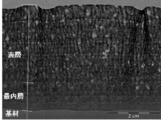
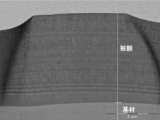
- the presence or absence of the layer structure (surface layer and innermost layer) of the cured film and the thickness of each layer can be confirmed by, for example, a transmission image of a cross section of the cured film by a transmission electron microscope (TEM).
- TEM transmission electron microscope
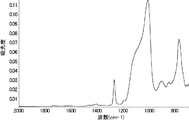
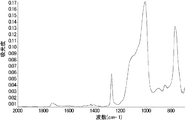
- the state of the layer structure of the cured film is estimated by measuring the infrared absorption spectrum of the surface layer and the innermost layer of the cured film obtained by peeling off from the substrate by the total reflection method (ATR method) of infrared spectroscopy. can do.
- a method of obtaining the cured film peeled off from the base material for example, a method of obtaining a cured film peeled off from the base material by a long-term weather resistance test or a close contact with a cured film such as a Teflon (registered trademark) plate The method of peeling a cured film after producing a laminated body using a base material with low property is mentioned.
- the contrast density can be observed according to the transmission and scattering of the electron beam.
- the degree of scattering increases as the density and thickness of the sample increases, and the heavier atoms contained, and the metal oxide contains higher density and heavier metal atoms. It appears black compared to.
- the (A) component and the (B) component which are siloxane polymer components are observed darkly, and the (C) organic polymer component is observed lightly.
- the surface layer containing a relatively large amount of the siloxane polymer as compared with the innermost layer is observed to have a high contrast, and (C) a relatively large amount of the organic polymer component compared to the surface layer.
- the innermost layer is observed with a low contrast.
- a portion having a high contrast and a portion having a low contrast are mixed, or an intermediate contrast is observed.
- the total reflection method (single reflection ATR method) of infrared spectroscopy, although it depends on the wave number, it is possible to measure infrared absorption in a depth region within a sub- ⁇ m to 1 ⁇ m range from the surface layer.
- the main component of the outermost layer is a siloxane polymer
- absorption derived from a siloxane bond near 1020 cm ⁇ 1 is greatly detected
- (C) Absorption of the organic polymer is not detected, or even if detected, it is very small.
- absorption derived from a siloxane bond is strongly detected, and absorption derived from a carbonyl group is hardly observed.
- the thickness of the cured film of the present invention is usually about 0.5 to 50 ⁇ m.
- the thickness of the surface layer is preferably 0.5 to 30 ⁇ m, more preferably 1 to 15 ⁇ m.
- the thickness of the surface layer is 0.5 ⁇ m or more, the cured film tends to have good hardness and scratch resistance.
- the thickness of the surface layer is 30 ⁇ m or less, and the cured film tends to have good crack resistance.
- the thickness of the innermost layer is preferably 0.05 to 10 ⁇ m.
- the thickness of the innermost layer is 0.05 ⁇ m or more, the adhesiveness of the cured film to the substrate tends to be good, and when it is 10 ⁇ m or less, the hardness of the cured film tends to be good.
- the laminate of the present invention is obtained by applying the curable composition to the surface of a substrate, and irradiating the obtained coating film with active energy rays to cure the coating film.
- active energy rays include visible light, vacuum ultraviolet rays, ultraviolet rays, and electron beams.
- Specific examples of active energy rays include low-pressure mercury lamp, medium-pressure mercury lamp, high-pressure mercury lamp, ultra-high-pressure mercury lamp, incandescent lamp, xenon lamp, halogen lamp, carbon arc lamp, metal halide lamp, fluorescent lamp, tungsten lamp, gallium lamp, and excimer laser. And light using sunlight as a light source.
- an active energy ray can be used individually or in combination of 2 or more types.
- the irradiation energy amount of the active energy ray for example, in the case of irradiating ultraviolet rays, the integrated light amount is preferably 100 to 5,000 mJ / cm 2 .
- active energy rays can be irradiated while heating as necessary. Curing can be accelerated by irradiation with active energy rays at a high temperature.
- the heating method parallel to the active energy ray irradiation include an irradiation method using an infrared heater and a circulating heating method using hot air. The following method is mentioned as a specific example for obtaining the cured film of this invention.
- an active energy ray-sensitive acid generator is heated after applying this composition containing a solvent and using the component (D) that generates acid by heat on the surface of the substrate to form a coating film. In this way, the coating film is heated at a temperature equal to or higher than the temperature at which the acid is generated.
- an active energy ray is irradiated to a coating film, and the laminated body which has a cured film is obtained.
- the curable composition of the present invention When the curable composition of the present invention is cured, condensation due to dehydration condensation or dealcoholization reaction of component (A) and component (B) occurs, so silanol or alkoxysilane in the curable composition is used for the reaction. Need to associate with neighboring molecules.
- the component (D) that generates an acid by heat is used, and the coating film has a fluid setting stage, and the component (D) is at a temperature that is higher than the temperature at which the component generates an acid by heat.
- silanol or alkoxysilane associates efficiently, so that the degree of curing can be increased.
- the scratch resistance and crack resistance can be improved.
- Examples of the setting method include a method using a hot air dryer.
- the setting conditions setting under one temperature condition or two (step) or more setting conditions with different temperatures can be used as necessary.
- the setting temperature is preferably a temperature equal to or higher than the temperature at which component (D) generates an acid by heat.
- the component (D) may be at or above the temperature at which acid is generated by heat.
- Specific examples of the setting include a setting at 60 to 120 ° C. for 1 to 30 minutes. There is a tendency that the solvent can be sufficiently volatilized by heating for 1 minute or longer. Moreover, it exists in the tendency which can maintain productivity highly by the heating for 30 minutes or less.
- post-curing by heating for a short time can be performed as necessary after curing of the coating film of the curable composition by irradiation with active energy rays.
- the crack resistance and scratch resistance of the resulting cured film can be improved.
- the adhesiveness of a cured film and a base material can be improved by post-cure by heating.
- the present invention will be described with reference to examples.
- “%” represents “% by mass” unless otherwise specified.
- the solid content of the condensate obtained means the theoretical amount of the structure after condensation based on the raw material when the condensation of the raw material is completed.
- oligomer Mw, acid generation temperature of the acid generator, and initial appearance of the cured film in the laminate having the cured film laminated on the substrate surface total light transmittance, initial haze, pencil hardness, initial adhesion, scratch resistance
- the following methods evaluated the property, the hot water test, the weather resistance test, and the layer structure of the cured coating.
- Total light transmittance and initial haze NDH-2000 Haze Meter (trade name) manufactured by Nippon Denshoku Industries Co., Ltd. was used.
- the total light transmittance and initial haze were measured at three points on the surface of the cured coating of the laminate, and the average value of each was determined.
- the initial haze is preferably 1.0% or less because if it exceeds 1.0%, the whitishness can be recognized visually.
- Pencil hardness The pencil hardness of the surface of the cured coating of the laminate was evaluated according to JIS-K5600 (pencil scratch test).
- Hot water test The test piece of the laminate was immersed in hot water and heated at 90 ° C for 2 hours. Subsequently, the test piece was taken out and visually observed for cracks, and the hot water crack resistance was evaluated according to the following criteria. ⁇ Hot water crack resistance> ⁇ : There is no crack. X: Cracks occurred. Moreover, after immersing the test piece of a laminated body in hot water and heating at 90 degreeC for 2 hours, the adhesive test similar to an initial stage adhesive test was done, and hot water adhesiveness was evaluated.
- Exposure cycle / irradiation temperature 63 ° C, humidity 70%, UV irradiation; 4 hours (irradiation energy 140 mW / cm 2 ) ⁇ Condensation: Temperature 70 ° C., Humidity 90% 4 hours ⁇ Dark: Temperature 30 ° C., Humidity 98% 4 hours, 30 seconds before and after dark ⁇ Weather and crack resistance> “None”: There is no crack. “Yes”: Cracks occur.
- oligomer (A-1) 75.0 g of water was added to the above solution, followed by hydrolysis and condensation by heating at 80 ° C. for 5 hours with stirring to obtain an oligomer (A-1) solution having a solid content of 20%.
- the Mw of the oligomer (A-1) was about 650.
- 20.2 g of water was added to the above solution, and the mixture was heated and stirred at 80 ° C. for 2 hours for hydrolysis and condensation to obtain an oligomer (A-2) solution having a solid content of 23%. Mw of the oligomer (A-2) was about 500.
- oligomer (A-4) 10.5 g of water was added to the above solution, followed by hydrolysis and condensation by heating at 80 ° C. for 3 hours with stirring. Next, isopropyl alcohol was added to the resulting reaction solution to make 69.0 g in total, and an oligomer (A-4) solution having a solid content of 20% was obtained.
- the Mw of the oligomer (A-4) was about 5,900.
- the inside of the flask was purged with nitrogen, heated to 80 ° C. and reacted for about 1 hour, and further heated to 93 ° C. and held for 1 hour in order to further increase the polymerization rate. Thereafter, the reaction solution was cooled to 40 ° C. to obtain an aqueous polymer suspension.
- This aqueous polymer suspension was filtered through a nylon filter cloth having an opening of 45 ⁇ m, and the filtrate was washed with deionized water, dehydrated, and dried at 40 ° C. for 16 hours to obtain a polymer. Mw was 3,100. This polymer was dissolved with ⁇ -butyrolactone to obtain a polymer solution-3 having a solid content of 10%.
- Preparation Example 1 Preparation of polymer solution-1 (C) 1.0 g of polymethyl methacrylate (Mitsubishi Rayon Co., Ltd., Dianar BR-85, Mw 280,000) as an organic polymer was added to 9.0 g of ⁇ -butyrolactone. Polymer solution-1 dissolved in 1 was obtained.
- Preparation Example 2 Preparation of polymer solution-2 (C) 1.0 g of polymethyl methacrylate (manufactured by Mitsubishi Rayon Co., Ltd., Dianal BR-83, Mw 40,000) as an organic polymer was 9.0 g of ⁇ -butyrolactone. Polymer solution-2 dissolved in 1 was obtained.
- GTS ⁇ -glycidoxypropyltrimethoxysilane (manufactured by Shin-Etsu Chemical Co., Ltd., trade name: KBM-403)
- BR-85 Polymethyl methacrylate (Mitsubishi Rayon Co., Ltd., Dianal BR-85, Mw about 280,000)
- BR-83 polymethyl methacrylate (Mitsubishi Rayon Co., Ltd., Dianar BR-83, Mw about 40,000)
- Sun-Aid SI-80L Sulfonium salt acid generator solution (manufactured by Sanshin Chemical Industry Co., Ltd., trade name: Sun-Aid SI-80L, 50% ⁇ -butyrolactone solution)
- Sun-Aid SI-100L Sulfonium salt acid generator solution (manufactured by Sanshin Chemical Industry Co., Ltd., trade name: Sun-Aid SI-100L, 50% ⁇ -butyrolactone solution
- the coating liquid A is a base material 10 cm long, 5 cm wide and 3 mm thick acrylic plate (Mitsubishi Rayon Co., Ltd., trade name: Acrylite L, total light transmittance 92.6%, haze 0.08% ) Was applied in an appropriate amount onto the surface, and applied by a bar coating method (using bar coater No. 26) so that the thickness of the cured film was 3 to 10 ⁇ m, and a coating film was formed on the surface of the substrate. Subsequently, the base material on which the coating film was formed was set at 90 ° C. for 10 minutes with a hot air dryer.
- the set base material was measured with a high-pressure mercury lamp (manufactured by Oak Seisakusho Co., Ltd., ultraviolet irradiation device, trade name: Handy UV-1200, QRU-2161 type), and the ultraviolet ray (UV) irradiation integrated light quantity 1,000 mJ /
- the coating film was cured by irradiating UV at cm 2 to obtain a laminate in which a cured film was laminated on the substrate surface.
- the evaluation results of the laminate are shown in Table 1.
- the UV irradiation amount was measured with an ultraviolet light meter (manufactured by Oak Seisakusho, trade name: UV-351 type, peak sensitivity wavelength 360 nm).
- Example 2 As setting conditions, 60 ° C. ⁇ 1/10 stage setting was performed, and then 90 ° C. ⁇ 10/10 second stage setting was performed. Other than that was carried out similarly to Example 1, and obtained the laminated body by which the cured film was laminated
- Example 3 After curing of the coating film by irradiation with ultraviolet rays, post-cure was performed at 90 ° C. for 10 minutes. Other than that was carried out similarly to Example 1, and obtained the laminated body by which the cured film was laminated
- Example 4 After curing of the coating film by ultraviolet irradiation, post-curing was performed at 90 ° C. for 10 minutes. Other than that was carried out similarly to Example 2, and obtained the laminated body by which the cured film was laminated
- Example 5 The setting was 100 ° C. ⁇ 10 minutes, and the post cure was 100 ° C. ⁇ 10 minutes. Other than that was carried out similarly to Example 3, and obtained the laminated body by which the cured film was laminated
- Table 1 shows the types of coating solutions. Other than that was carried out similarly to Example 5, and obtained the laminated body by which the cured film was laminated
- Table 1 shows the types of coating solutions. Other than that was carried out similarly to Example 1, and obtained the laminated body by which the cured film was laminated
- Table 1 shows the types of coating solutions, the setting is 60 ° C. ⁇ 10 minutes, and the UV irradiation integrated light quantity is 3,000 mJ / cm 2 . Other than that was carried out similarly to Example 1, and obtained the laminated body by which the cured film was laminated
- Table 1 shows the types of coating solutions. Other than that was carried out similarly to Example 5, and obtained the laminated body by which the cured film was laminated
- Comparative Example 1 containing no component (B) was inferior in scratch resistance.
- Comparative Example 2 which does not contain (C) component it was inferior to hot water adhesiveness and weather resistance adhesiveness.
- comparative example 3 which does not contain (B) component and (C) component it was inferior to weather-resistant adhesiveness.
- Comparative Example 4 in which the Mw of the component (A) is high and the setting temperature is lower than the acid generation temperature of the component (D) the initial appearance, initial haze, pencil hardness, initial adhesion, scratch resistance and heat The water adhesion was poor.
- Comparative Example 5 in which the Mw of the component (A) was high, the initial adhesion, scratch resistance and hot water adhesion were inferior. Moreover, in Comparative Example 6 in which the Mw of the component (C) was low, the scratch resistance was inferior, and in Comparative Example 7, adhesion was not expressed, and it was impossible to achieve both performances.
- Example 5 Example 7 and Example 8 showing good physical properties from transmission micrographs, the cured film forming the surface of the laminate had a surface layer and an organic layer containing a relatively large amount of siloxane polymer. It was confirmed that the innermost layer containing a relatively large amount of the polymer was present. Furthermore, in the film of Example 7, an intermediate layer in which a dark portion and a thin portion were mixed was confirmed.
- Example 5 the surface layer strongly detected absorption from the siloxane bond (near 1020 cm ⁇ 1 ), and (C) absorption of the carbonyl group from the organic polymer ( (Near 1730 cm ⁇ 1 ) was hardly observed, indicating that the surface layer contains a relatively large amount of siloxane-based polymer.
- Example 5 Example 7, and Example 8, (C) The innermost layer containing a relatively large amount of the organic polymer was present, so that the weather resistance adhesion was also good.
- the cured film was homogeneous without having a surface layer and an innermost layer.
Landscapes
- Chemical & Material Sciences (AREA)
- Organic Chemistry (AREA)
- Chemical Kinetics & Catalysis (AREA)
- Health & Medical Sciences (AREA)
- Medicinal Chemistry (AREA)
- Polymers & Plastics (AREA)
- Wood Science & Technology (AREA)
- Engineering & Computer Science (AREA)
- Life Sciences & Earth Sciences (AREA)
- Materials Engineering (AREA)
- Physics & Mathematics (AREA)
- Thermal Sciences (AREA)
- General Chemical & Material Sciences (AREA)
- Laminated Bodies (AREA)
- Paints Or Removers (AREA)
- Silicon Polymers (AREA)
- Coating Of Shaped Articles Made Of Macromolecular Substances (AREA)
- Compositions Of Macromolecular Compounds (AREA)
Abstract
Priority Applications (5)
| Application Number | Priority Date | Filing Date | Title |
|---|---|---|---|
| CN201280022805.5A CN103517951A (zh) | 2011-05-11 | 2012-05-11 | 活性能量射线固化性组合物、层积体和层积体的制造方法 |
| EP12782067.8A EP2711397A4 (fr) | 2011-05-11 | 2012-05-11 | Composition durcissable par rayons énergétiques actifs, stratifié, et procédé de production dudit stratifié |
| JP2012527129A JP6032417B2 (ja) | 2011-05-11 | 2012-05-11 | 活性エネルギー線硬化性組成物、積層体及び積層体の製造方法 |
| KR1020137032761A KR101885404B1 (ko) | 2011-05-11 | 2012-05-11 | 활성 에너지선 경화성 조성물, 적층체, 및 적층체의 제조 방법 |
| US14/116,938 US20140087155A1 (en) | 2011-05-11 | 2012-05-11 | Active energy ray-curable composition, laminate, and method for producing laminate |
Applications Claiming Priority (2)
| Application Number | Priority Date | Filing Date | Title |
|---|---|---|---|
| JP2011-106139 | 2011-05-11 | ||
| JP2011106139 | 2011-05-11 |
Publications (1)
| Publication Number | Publication Date |
|---|---|
| WO2012153848A1 true WO2012153848A1 (fr) | 2012-11-15 |
Family
ID=47139322
Family Applications (1)
| Application Number | Title | Priority Date | Filing Date |
|---|---|---|---|
| PCT/JP2012/062181 Ceased WO2012153848A1 (fr) | 2011-05-11 | 2012-05-11 | Composition durcissable par rayons énergétiques actifs, stratifié, et procédé de production dudit stratifié |
Country Status (7)
| Country | Link |
|---|---|
| US (1) | US20140087155A1 (fr) |
| EP (1) | EP2711397A4 (fr) |
| JP (1) | JP6032417B2 (fr) |
| KR (1) | KR101885404B1 (fr) |
| CN (1) | CN103517951A (fr) |
| TW (1) | TW201245337A (fr) |
| WO (1) | WO2012153848A1 (fr) |
Cited By (1)
| Publication number | Priority date | Publication date | Assignee | Title |
|---|---|---|---|---|
| WO2013151169A1 (fr) * | 2012-04-06 | 2013-10-10 | 三菱レイヨン株式会社 | Stratifié comportant une couche de revêtement dur et son procédé de fabrication |
Families Citing this family (4)
| Publication number | Priority date | Publication date | Assignee | Title |
|---|---|---|---|---|
| US10604653B2 (en) * | 2015-10-19 | 2020-03-31 | Dow Toray Co., Ltd. | Active energy ray curable hot melt silicone composition, cured product thereof, and method of producing film |
| CN110049826B (zh) | 2016-12-15 | 2023-11-24 | 科思创德国股份有限公司 | 透明涂覆的聚碳酸酯部件、其制造和用途 |
| CN112888750B (zh) * | 2018-09-24 | 2023-09-08 | 地板工业有限公司 | 用于喷墨数字印刷的陶瓷油墨 |
| KR102570940B1 (ko) * | 2019-02-14 | 2023-08-28 | 디아이씨 가부시끼가이샤 | 경화성 수지 조성물, 경화물, 산 변성 말레이미드 수지 및 경화제 |
Citations (5)
| Publication number | Priority date | Publication date | Assignee | Title |
|---|---|---|---|---|
| WO2005085373A1 (fr) | 2004-03-09 | 2005-09-15 | Mitsubishi Rayon Co., Ltd. | Composition de revêtement vulcanisable par rayon d’énergie active et procédé de fabrication d’un film de revêtement de protection |
| JP2006348061A (ja) * | 2005-06-13 | 2006-12-28 | Nippon Kayaku Co Ltd | 感光性樹脂組成物及びその硬化皮膜を有するフィルム |
| WO2008126902A1 (fr) * | 2007-04-11 | 2008-10-23 | Mitsubishi Rayon Co., Ltd. | Composition, procédé pour former un film de revêtement protecteur, un stratifié et son procédé de production |
| JP2008285502A (ja) * | 2007-04-19 | 2008-11-27 | Mitsubishi Rayon Co Ltd | 活性エネルギー線硬化性組成物および成形体 |
| JP2010270202A (ja) | 2009-05-20 | 2010-12-02 | Mitsubishi Rayon Co Ltd | 活性エネルギー線硬化性被覆材組成物及び積層体 |
Family Cites Families (3)
| Publication number | Priority date | Publication date | Assignee | Title |
|---|---|---|---|---|
| DE3621477A1 (de) * | 1985-06-26 | 1987-01-08 | Canon Kk | Durch strahlen mit wirksamer energie haertbare harzmischung |
| DE4443749A1 (de) * | 1994-12-08 | 1996-06-13 | Wacker Chemie Gmbh | (Meth)acryloxygruppen aufweisende Organosiliciumverbindungen, deren Herstellung und Verwendung |
| TW482817B (en) * | 1998-06-18 | 2002-04-11 | Jsr Corp | Photosetting compositions and photoset articles |
-
2012
- 2012-05-11 TW TW101116922A patent/TW201245337A/zh unknown
- 2012-05-11 JP JP2012527129A patent/JP6032417B2/ja active Active
- 2012-05-11 WO PCT/JP2012/062181 patent/WO2012153848A1/fr not_active Ceased
- 2012-05-11 CN CN201280022805.5A patent/CN103517951A/zh active Pending
- 2012-05-11 KR KR1020137032761A patent/KR101885404B1/ko active Active
- 2012-05-11 US US14/116,938 patent/US20140087155A1/en not_active Abandoned
- 2012-05-11 EP EP12782067.8A patent/EP2711397A4/fr not_active Withdrawn
Patent Citations (5)
| Publication number | Priority date | Publication date | Assignee | Title |
|---|---|---|---|---|
| WO2005085373A1 (fr) | 2004-03-09 | 2005-09-15 | Mitsubishi Rayon Co., Ltd. | Composition de revêtement vulcanisable par rayon d’énergie active et procédé de fabrication d’un film de revêtement de protection |
| JP2006348061A (ja) * | 2005-06-13 | 2006-12-28 | Nippon Kayaku Co Ltd | 感光性樹脂組成物及びその硬化皮膜を有するフィルム |
| WO2008126902A1 (fr) * | 2007-04-11 | 2008-10-23 | Mitsubishi Rayon Co., Ltd. | Composition, procédé pour former un film de revêtement protecteur, un stratifié et son procédé de production |
| JP2008285502A (ja) * | 2007-04-19 | 2008-11-27 | Mitsubishi Rayon Co Ltd | 活性エネルギー線硬化性組成物および成形体 |
| JP2010270202A (ja) | 2009-05-20 | 2010-12-02 | Mitsubishi Rayon Co Ltd | 活性エネルギー線硬化性被覆材組成物及び積層体 |
Non-Patent Citations (1)
| Title |
|---|
| See also references of EP2711397A4 |
Cited By (2)
| Publication number | Priority date | Publication date | Assignee | Title |
|---|---|---|---|---|
| WO2013151169A1 (fr) * | 2012-04-06 | 2013-10-10 | 三菱レイヨン株式会社 | Stratifié comportant une couche de revêtement dur et son procédé de fabrication |
| JPWO2013151169A1 (ja) * | 2012-04-06 | 2015-12-17 | 三菱レイヨン株式会社 | ハードコート層を有する積層体及びその製造方法 |
Also Published As
| Publication number | Publication date |
|---|---|
| EP2711397A1 (fr) | 2014-03-26 |
| CN103517951A (zh) | 2014-01-15 |
| KR20140043748A (ko) | 2014-04-10 |
| KR101885404B1 (ko) | 2018-08-03 |
| EP2711397A4 (fr) | 2015-02-18 |
| JPWO2012153848A1 (ja) | 2014-07-31 |
| TW201245337A (en) | 2012-11-16 |
| JP6032417B2 (ja) | 2016-11-30 |
| US20140087155A1 (en) | 2014-03-27 |
Similar Documents
| Publication | Publication Date | Title |
|---|---|---|
| EP2360194B1 (fr) | Composition de résine de siloxane et film protecteur pour écran tactile l'utilisant | |
| JP5354207B2 (ja) | 硬化性樹脂組成物、保護膜および保護膜の形成方法 | |
| JP6256858B2 (ja) | ハードコート層を有する積層体及びその製造方法 | |
| JP5671936B2 (ja) | ネガ型感光性樹脂組成物およびそれを用いた硬化膜 | |
| JP6032417B2 (ja) | 活性エネルギー線硬化性組成物、積層体及び積層体の製造方法 | |
| JP2015232122A (ja) | 熱硬化性組成物 | |
| JP2011116975A (ja) | シロキサンオリゴマーの製造方法、成形体の製造方法及び成形体 | |
| CN110419000A (zh) | 感光性硅氧烷树脂组合物、固化膜及触摸面板用构件 | |
| JP2010253767A (ja) | ハードコート成形品及びその製造方法、ならびに活性エネルギー線硬化性コーティング組成物 | |
| JP2014015559A (ja) | 活性エネルギー線硬化性組成物、硬化膜の形成方法及び積層体 | |
| JPWO2011099505A1 (ja) | 屋外設置用デバイスおよび屋外設置用デバイス用反射防止層 | |
| JP4942356B2 (ja) | 活性エネルギー線硬化性組成物及び硬化物 | |
| JP6042223B2 (ja) | ネガ型感放射線性樹脂組成物 | |
| JP2014091756A (ja) | 活性エネルギー線硬化性組成物及び硬化被膜の製造方法 | |
| JP5207280B2 (ja) | 活性エネルギー線硬化性組成物、硬化被膜の形成方法及び積層体 | |
| JPWO2012161185A1 (ja) | シロキサンオリゴマーの製造方法 | |
| JP2010042624A (ja) | 積層体 | |
| JP2014046240A (ja) | 積層体の製造方法 | |
| JP2011246702A (ja) | オルガノシロキサンオリゴマー組成物の製造方法、オルガノシロキサンオリゴマー組成物、ポリオルガノシロキサン硬化被膜の製造方法、及びポリオルガノシロキサン硬化被膜 | |
| JP2014148574A (ja) | ハードコート層形成用活性エネルギー線硬化性組成物、硬化被膜の形成方法及び積層体 | |
| JP2013124366A (ja) | 積層体および硬化方法 | |
| CN116419848A (zh) | 硬涂膜及其制造方法、以及图像显示装置 | |
| JP2005279416A (ja) | 保護被膜形成方法 | |
| JP2014015560A (ja) | 耐擦傷性に優れたシロキサン系硬化被膜 | |
| JP2013154324A (ja) | シロキサン系硬化膜の製造方法 |
Legal Events
| Date | Code | Title | Description |
|---|---|---|---|
| ENP | Entry into the national phase |
Ref document number: 2012527129 Country of ref document: JP Kind code of ref document: A |
|
| 121 | Ep: the epo has been informed by wipo that ep was designated in this application |
Ref document number: 12782067 Country of ref document: EP Kind code of ref document: A1 |
|
| NENP | Non-entry into the national phase |
Ref country code: DE |
|
| WWE | Wipo information: entry into national phase |
Ref document number: 14116938 Country of ref document: US |
|
| WWE | Wipo information: entry into national phase |
Ref document number: 2012782067 Country of ref document: EP |
|
| ENP | Entry into the national phase |
Ref document number: 20137032761 Country of ref document: KR Kind code of ref document: A |