WO2012161274A1 - Procédé de fabrication d'un corps granulé, procédé de fabrication de verre fondu, et procédé de fabrication d'un article en verre - Google Patents
Procédé de fabrication d'un corps granulé, procédé de fabrication de verre fondu, et procédé de fabrication d'un article en verre Download PDFInfo
- Publication number
- WO2012161274A1 WO2012161274A1 PCT/JP2012/063365 JP2012063365W WO2012161274A1 WO 2012161274 A1 WO2012161274 A1 WO 2012161274A1 JP 2012063365 W JP2012063365 W JP 2012063365W WO 2012161274 A1 WO2012161274 A1 WO 2012161274A1
- Authority
- WO
- WIPO (PCT)
- Prior art keywords
- glass
- liquid
- exhaust gas
- component
- producing
- Prior art date
- Legal status (The legal status is an assumption and is not a legal conclusion. Google has not performed a legal analysis and makes no representation as to the accuracy of the status listed.)
- Ceased
Links
Images
Classifications
-
- C—CHEMISTRY; METALLURGY
- C03—GLASS; MINERAL OR SLAG WOOL
- C03B—MANUFACTURE, SHAPING, OR SUPPLEMENTARY PROCESSES
- C03B5/00—Melting in furnaces; Furnaces so far as specially adapted for glass manufacture
- C03B5/16—Special features of the melting process; Auxiliary means specially adapted for glass-melting furnaces
-
- B—PERFORMING OPERATIONS; TRANSPORTING
- B01—PHYSICAL OR CHEMICAL PROCESSES OR APPARATUS IN GENERAL
- B01D—SEPARATION
- B01D53/00—Separation of gases or vapours; Recovering vapours of volatile solvents from gases; Chemical or biological purification of waste gases, e.g. engine exhaust gases, smoke, fumes, flue gases, aerosols
- B01D53/14—Separation of gases or vapours; Recovering vapours of volatile solvents from gases; Chemical or biological purification of waste gases, e.g. engine exhaust gases, smoke, fumes, flue gases, aerosols by absorption
- B01D53/1418—Recovery of products
-
- B—PERFORMING OPERATIONS; TRANSPORTING
- B01—PHYSICAL OR CHEMICAL PROCESSES OR APPARATUS IN GENERAL
- B01D—SEPARATION
- B01D53/00—Separation of gases or vapours; Recovering vapours of volatile solvents from gases; Chemical or biological purification of waste gases, e.g. engine exhaust gases, smoke, fumes, flue gases, aerosols
- B01D53/34—Chemical or biological purification of waste gases
- B01D53/46—Removing components of defined structure
-
- B—PERFORMING OPERATIONS; TRANSPORTING
- B01—PHYSICAL OR CHEMICAL PROCESSES OR APPARATUS IN GENERAL
- B01J—CHEMICAL OR PHYSICAL PROCESSES, e.g. CATALYSIS OR COLLOID CHEMISTRY; THEIR RELEVANT APPARATUS
- B01J2/00—Processes or devices for granulating materials, e.g. fertilisers in general; Rendering particulate materials free flowing in general, e.g. making them hydrophobic
- B01J2/28—Processes or devices for granulating materials, e.g. fertilisers in general; Rendering particulate materials free flowing in general, e.g. making them hydrophobic using special binding agents
-
- C—CHEMISTRY; METALLURGY
- C03—GLASS; MINERAL OR SLAG WOOL
- C03B—MANUFACTURE, SHAPING, OR SUPPLEMENTARY PROCESSES
- C03B1/00—Preparing the batches
- C03B1/02—Compacting the glass batches, e.g. pelletising
-
- C—CHEMISTRY; METALLURGY
- C03—GLASS; MINERAL OR SLAG WOOL
- C03B—MANUFACTURE, SHAPING, OR SUPPLEMENTARY PROCESSES
- C03B18/00—Shaping glass in contact with the surface of a liquid
- C03B18/02—Forming sheets
-
- C—CHEMISTRY; METALLURGY
- C03—GLASS; MINERAL OR SLAG WOOL
- C03B—MANUFACTURE, SHAPING, OR SUPPLEMENTARY PROCESSES
- C03B19/00—Other methods of shaping glass
- C03B19/10—Forming beads
- C03B19/1005—Forming solid beads
- C03B19/102—Forming solid beads by blowing a gas onto a stream of molten glass or onto particulate materials, e.g. pulverising
-
- C—CHEMISTRY; METALLURGY
- C03—GLASS; MINERAL OR SLAG WOOL
- C03B—MANUFACTURE, SHAPING, OR SUPPLEMENTARY PROCESSES
- C03B19/00—Other methods of shaping glass
- C03B19/10—Forming beads
- C03B19/1005—Forming solid beads
- C03B19/1055—Forming solid beads by extruding, e.g. dripping molten glass in a gaseous atmosphere
-
- C—CHEMISTRY; METALLURGY
- C03—GLASS; MINERAL OR SLAG WOOL
- C03B—MANUFACTURE, SHAPING, OR SUPPLEMENTARY PROCESSES
- C03B5/00—Melting in furnaces; Furnaces so far as specially adapted for glass manufacture
- C03B5/16—Special features of the melting process; Auxiliary means specially adapted for glass-melting furnaces
- C03B5/235—Heating the glass
- C03B5/237—Regenerators or recuperators specially adapted for glass-melting furnaces
-
- C—CHEMISTRY; METALLURGY
- C03—GLASS; MINERAL OR SLAG WOOL
- C03C—CHEMICAL COMPOSITION OF GLASSES, GLAZES OR VITREOUS ENAMELS; SURFACE TREATMENT OF GLASS; SURFACE TREATMENT OF FIBRES OR FILAMENTS MADE FROM GLASS, MINERALS OR SLAGS; JOINING GLASS TO GLASS OR OTHER MATERIALS
- C03C1/00—Ingredients generally applicable to manufacture of glasses, glazes, or vitreous enamels
- C03C1/002—Use of waste materials, e.g. slags
-
- C—CHEMISTRY; METALLURGY
- C03—GLASS; MINERAL OR SLAG WOOL
- C03C—CHEMICAL COMPOSITION OF GLASSES, GLAZES OR VITREOUS ENAMELS; SURFACE TREATMENT OF GLASS; SURFACE TREATMENT OF FIBRES OR FILAMENTS MADE FROM GLASS, MINERALS OR SLAGS; JOINING GLASS TO GLASS OR OTHER MATERIALS
- C03C3/00—Glass compositions
- C03C3/04—Glass compositions containing silica
- C03C3/076—Glass compositions containing silica with 40% to 90% silica, by weight
- C03C3/089—Glass compositions containing silica with 40% to 90% silica, by weight containing boron
-
- Y—GENERAL TAGGING OF NEW TECHNOLOGICAL DEVELOPMENTS; GENERAL TAGGING OF CROSS-SECTIONAL TECHNOLOGIES SPANNING OVER SEVERAL SECTIONS OF THE IPC; TECHNICAL SUBJECTS COVERED BY FORMER USPC CROSS-REFERENCE ART COLLECTIONS [XRACs] AND DIGESTS
- Y02—TECHNOLOGIES OR APPLICATIONS FOR MITIGATION OR ADAPTATION AGAINST CLIMATE CHANGE
- Y02P—CLIMATE CHANGE MITIGATION TECHNOLOGIES IN THE PRODUCTION OR PROCESSING OF GOODS
- Y02P40/00—Technologies relating to the processing of minerals
- Y02P40/50—Glass production, e.g. reusing waste heat during processing or shaping
Definitions
- the present invention relates to a method for producing a granulated body, a method for producing a molten glass using a granulated body obtained by the method for producing the granulated body, and a method for producing a glass article using the method for producing the molten glass.
- Patent Document 1 discloses a method for removing boron and sulfur components from exhaust gas by dissolving the boron component and sulfur component in the exhaust gas in water by bringing cooling water and contact water into contact with the exhaust gas. Are listed.
- the effluent containing the boron component and sulfur component generated by this method can be reused as cooling water or contact water after neutralization.
- NaOH is used as a neutralizing agent for drainage, and no precipitate is generated due to neutralization. Therefore, the neutralized drainage is used as it is as a part of cooling water or contact water. Can be reused.
- the boron component etc. which are contained in exhaust gas are useful as a glass raw material, collect
- Patent Document 2 a fuel that does not substantially contain sulfur is used as a fuel for heating and melting a glass raw material, and an exhaust gas from a glass melting furnace is brought into contact with water to obtain a collected liquid.
- a method for recovering arsenic components, boron components, and chlorine components useful as glass raw materials by neutralizing the solution to obtain a neutralized collection solution, followed by solid-liquid separation of the neutralized collection solution and drying by heating. are listed.
- Non-alkali glass that does not substantially contain an alkali metal oxide is used for various display glass substrates and the like.
- sodium salt that is an alkali metal salt is included in the neutralized drainage.
- the neutralized effluent contains boron and sulfur components that can be reused as glass raw materials, but also contains alkali metal salts, so the effluent should be used for the production of alkali-free glass. I can't.
- an insoluble calcium salt such as calcium borate is generated using, for example, a calcium compound such as slaked lime or quick lime as a neutralizing agent for the collected liquid. Accordingly, in order to reuse the calcium borate as a part of the glass raw material, a solid-liquid separation step and a heat drying step are required, which increases the manufacturing cost.
- the present invention is a method for producing a granulated body, in which components in exhaust gas discharged from a glass melting furnace can be reused as a raw material for non-alkali glass, and a heating and drying step for the reuse is not required.
- Another object of the present invention is to provide a method for producing a molten glass using the granulated body obtained by the method for producing the granulated body, and a method for producing a glass article using the method for producing the molten glass.
- the present inventors paid attention to the fact that many alkali-free borosilicate glasses useful as display substrate glass contain MgO as a glass component, and examined the use of a magnesium solution as a neutralizing agent for drainage.
- magnesium hydroxide is used as a neutralizing agent for general acidic effluents because it is cheap and easy to handle, but its solubility in water is low and it is usually in a slurry state, so it can be recycled by recycling the liquid. When doing so, there is a concern of clogging of piping.
- the present inventor adds a magnesium hydroxide slurry to an effluent containing a boron component to form an aqueous solution despite the inclusion of magnesium, and the use of the boron component is facilitated. It found out that it was useful and came to this invention.
- the present invention includes the following [1] to [15].
- a granulation step comprising granulating a glass raw material powder for producing an alkali-free borosilicate glass in the presence of the granulating liquid to produce a granulated body.
- the alkali-free borosilicate glass contains at least SiO 2 , B 2 O 3 , and MgO, and the content of SiO 2 is 60 to 75 mol% in terms of oxide-based mol%, and B 2 O 3
- the glass raw material powder and the granulation liquid are used so that the granulated body is a non-alkali borosilicate glass having the glass composition described in [3], wherein the glass obtained by melting and vitrifying the granulated body.
- the magnesium hydroxide is added such that the pH of the liquid containing the boron component and the magnesium component is in the range of 6.5 to 7.7.
- [7] The method for producing a granulated product according to any one of [1] to [6], wherein in the magnesium hydroxide addition step, the liquid containing the boron component and the magnesium component is further stirred.
- [8] The method for producing a granulated body according to any one of [1] to [7], wherein the exhaust gas is treated with a dust collector before the exhaust gas is brought into contact with the contact liquid.
- [10] A method for producing molten glass, wherein the granulated product obtained by the production method of any one of [1] to [9] is melted to obtain molten glass.
- [11] The method for producing molten glass according to [10], wherein an exhaust gas generated by melting the granulated body is used as the exhaust gas.
- [12] The method for producing a molten glass according to [10] or [11], wherein the granule is charged on a molten glass liquid surface in a melting furnace and melted.
- the boron component in the exhaust gas discharged from the glass melting furnace can be recovered in a state dissolved in a liquid not containing alkali metal ions.
- the liquid is an aqueous solution containing the boron component and the magnesium component, and the boron component and the magnesium component in the aqueous solution become a boron source and a magnesium source of the molten glass. If the liquid is used as a granulating liquid or a part thereof for producing a granulated body, the boron component in the exhaust gas discharged from the glass melting furnace is reused as a raw material for the alkali-free borosilicate glass. Can do.
- the glass article produced in the present invention is a non-alkali borosilicate glass (hereinafter sometimes simply referred to as borosilicate glass or glass).
- the glass composition of the glass article is preferably a borosilicate glass containing 1 mol% or more of MgO in terms of mol% on the basis of oxide and having a total content of alkali metal oxides of less than 1 mol%.
- Components of the glass represents SiO 2, B 2 O 3, Al 2 O 3, MgO, CaO, SrO, an oxide of BaO, etc., the content is expressed in mole percent on an oxide basis.
- the alkaline earth metal refers to three elements of calcium (Ca), strontium (Sr), and barium (Ba).
- the composition of the solid glass (glass in the glass article) in which the molten glass is solidified in the present invention has a SiO 2 content of 60 to 75 mol%, a B 2 O 3 content of 2 to 25 mol%, and an MgO content. Is preferably 1 to 30 mol%, and preferably contains substantially no alkali metal oxide.
- the total content of specific alkali metal oxides is preferably less than 1 mol%, more preferably less than 0.1 mol%.
- known components can be contained in the alkali-free borosilicate glass.
- SiO 2 SiO 2 is a glass network former and is an essential component. SiO 2 is highly effective in increasing the acid resistance of the glass and reducing the density of the glass.
- the content is generally 75 mol% or less, preferably 70 mol% or less, considering that the viscosity of the molten glass becomes too high and it becomes difficult to produce molten glass by a normal melting method. It is. On the other hand, if the amount of SiO 2 is too small, it may cause deterioration of acid resistance, increase of linear expansion coefficient, etc., and therefore in the case of display substrate glass, its content is preferably 60 mol% or more.
- B 2 O 3 is a glass network former, and is also a component that improves the dissolution reactivity in melt vitrification.
- the content of B 2 O 3 is usually 2 mol% or more, preferably 5 mol% or more.
- B 2 O 3 may lower the acid resistance of the glass.
- the content of B 2 O 3 is 25 mol% or less, preferably 20 mol% or less, more preferably 8 mol. % Or less.
- MgO is a component that lowers the viscosity of molten glass, lowers the density of glass, does not increase the linear expansion coefficient, and improves melting reactivity. It is an essential component when manufacturing a substrate.
- the content of MgO is 1 mol% or more, preferably 2 mol% or more, more preferably 4 mol% or more.
- the content is 30 mol% or less, preferably 20 mol% or less, more preferably 15 mol% or less, and even more preferably 10 mol from the viewpoint of increasing acid resistance. It is as follows.
- Al 2 O 3 is a component that may be used for the purpose of increasing the strain point of the glass and suppressing the phase separation of the glass.
- the content is preferably 1 mol% or more, more preferably 5 mol% or more, and further preferably 10 mol% or more.
- the content of Al 2 O 3 is preferably 20 mol% or less, more preferably 15 mol% or less, from the viewpoint of avoiding high viscosity of molten glass, devitrification characteristics of glass, and deterioration of acid resistance. .
- CaO is a component that lowers the viscosity of molten glass, and is a component that may be used for the purpose of adjusting glass properties such as density, linear expansion coefficient, and strain point.
- the content when CaO is contained is preferably 1 mol% or more, more preferably 2 mol% or more, and further preferably 4 mol% or more.
- the content is preferably 20 mol% or less, more preferably 15 mol% or less, still more preferably 10 mol% or less, from the viewpoint of avoiding deterioration of the devitrification characteristics of the glass, an increase in linear expansion coefficient, and the like. is there.
- [SrO] SrO is a component that lowers the viscosity of the molten glass, and is a component that may be included to improve the devitrification properties and acid resistance of the glass.
- the content is preferably 1 mol% or more, more preferably 2 mol% or more.
- the content is preferably 10 mol% or less, more preferably 7 mol% or less, and still more preferably 6 mol% or less.
- BaO is a component that lowers the viscosity of the molten glass, and is a component that can be added for the purpose of, for example, phase separation of glass, improvement of devitrification characteristics, and improvement of acid resistance.
- the glass is a glass substrate for liquid crystal in order to increase the density or the like, it is preferable to make the content inevitable.
- the content in the case of positively containing BaO is preferably 10 mol% or less, more preferably 5 mol% or less, and still more preferably 2 mol% or less.
- the total content of SrO, CaO and BaO is small, the viscosity of the molten glass increases and the dissolution reactivity deteriorates.
- the total content of these is preferably 5 mol% or more, more preferably 8 mol% or more.
- the total content of SrO, CaO, and BaO is preferably 20 mol% or less, more preferably 18 mol% or less, and still more preferably 15 from the viewpoint of avoiding an increase in glass density and linear expansion coefficient. It is less than mol%.
- the preferred glass composition in this case is The SiO 2 content is 60 to 75 mol%, The content of Al 2 O 3 is 0 to 15 mol%, The content of B 2 O 3 is 2 to 25 mol%, MgO content is 1 to 20 mol%, The total content of SrO, CaO, and BaO is 5 to 20 mol%.
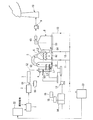
- FIG. 1 is a schematic configuration diagram showing an embodiment of an apparatus suitably used in the method for producing molten glass of the present invention.
- the apparatus of this embodiment includes a granulating apparatus 1, a melting furnace 2, a bag filter 3, a cooling tower 4, a scrubber (exhaust gas cleaning apparatus) 6, a centrifugal dust collector 8, a chimney 10, a treatment liquid tank 14, and a magnesium hydroxide addition apparatus. 16, a circulation pump 17, and a granulation liquid preparation tank 21.
- a method for producing molten glass using the apparatus of FIG. 1 will be described.
- the granulated body obtained by granulating glass raw material powder in presence of a granulation liquid is used.
- the process (granulation process) which manufactures a granulated body is mentioned later.
- the granulated material is charged into the melting furnace 2 and melted to obtain molten glass (granulated material melting step).
- the granule melting step may be performed by a normal melting method using a glass melting furnace such as a Siemens type or may be performed by an air melting method. Any of them can be carried out by a known method. In this embodiment, a normal melting method is used.
- Air melting method In the air melting method, at least a part of a granulated body is melted in a gas phase atmosphere to form molten glass particles, and the molten glass particles are accumulated to form molten glass. Specifically, the granulated body is first introduced into a high-temperature gas phase atmosphere of an air heating device. A well-known thing can be used for an air heating apparatus. Since the granulated product produced by the present invention is excellent in strength, even when collision occurs between particles or particles and the inner wall of the conveyance path during conveyance or introduction, generation of fine powder can be suppressed. In addition, melting at least a part of the granulated body means melting a part or all of the one granulated body for each granulated body.
- the state in which a part of the granulated body is melted includes, for example, a state in which the surface of the (one) granulated body is melted and the central portion is not sufficiently melted.
- the molten glass particles (one piece) are not melted entirely, and there is a portion that is not sufficiently melted at the center.
- the particles are accumulated and heated in the process of forming a glass melt, so that a homogeneous glass melt can be obtained when subjected to the molding process. .
- molten glass particles particles generated in a gas phase atmosphere including particles that are not sufficiently melted in the gas phase atmosphere.
- the granulated material is melted in a gas phase atmosphere to form molten glass particles, and then the generated molten glass particles are accumulated in an air heating device to obtain a glass melt. Used for the molding process.
- a method for accumulating the molten glass particles for example, there is a method in which the molten glass particles falling by their own weight in the gas phase atmosphere are received and accumulated in a heat resistant container provided in the lower part of the gas phase atmosphere.
- the exhaust gas generated in the melting process of the glass raw material in the present invention is the exhaust gas G1 generated from the melting furnace 2 in FIG.
- the exhaust gas G1 includes gas components derived from the constituent components of the glass raw material charged into the melting furnace 2.
- a glass raw material that generates the exhaust gas G1 that is, a glass raw material that is melted in the melting furnace 2
- a granulated body may be used as in this embodiment, or a normal glass raw material powder is used. May be.
- the glass raw material to be melted is preferably a non-alkali borosilicate glass raw material, but may contain an alkali component as long as it contains a boron component.
- an exhaust gas G1 is passed through a bag filter described later, alkali components such as sodium can be adsorbed, so that the exhaust gas G1 discharged from the melting furnace may contain an alkali component.
- the exhaust gas G1 must not contain a component that is not a raw material for the alkali-free borosilicate glass and that cannot be removed in a step prior to the magnesium hydroxide addition step described later.
- a granulated body containing the component is generated, and such a granulated body cannot be used as a raw material for the alkali-free borosilicate glass.
- a glass material containing phosphoric acid, lead or the like is not preferable as a glass material to be melted in the melting furnace 2. If the granulated material obtained by the method for producing a granulated material of the present invention is used as a glass raw material and the exhaust gas obtained in the melting process is used, there are few extra components to be removed, and in one melting furnace This is preferable because the efficiency with which glass raw materials can be recovered and reused is very high. Moreover, you may utilize the granulated material obtained from the boron component collect
- boron in the exhaust gas generated in the manufacturing process of molten glass can be efficiently recovered and reused as a raw material for the alkali-free borosilicate glass.
- the “boron component” in this specification is a general term for components containing a boron atom (B) (the same applies to other components).
- the boron component in the exhaust gas G1 is mainly boric acid or boron oxide.
- a component derived from a fining agent for example, a component containing a sulfur atom (S) (referred to herein as a sulfur component), a component containing a chlorine atom (Cl) (referred to as a chlorine component in this specification).
- a component containing a fluorine atom (F) (referred to herein as a fluorine component) or the like may be contained.
- the exhaust gas G1 contains a sulfur component derived from the fuel.
- the sulfur component in the exhaust gas G1 is mainly an oxide (SO x ).
- the chlorine component in the exhaust gas G1 is mainly HCl.
- the fluorine component in the exhaust gas G1 is mainly HF.
- the method of the present invention is also suitable when the exhaust gas G1 contains a sulfur component and / or a chlorine component in addition to the boron component, and these components are recovered as a magnesium salt and reused for glass production. be able to.
- an alkali component is present in the exhaust gas G1, it is removed.
- powdery calcium hydroxide (slaked lime) is supplied into the exhaust gas G1 in the path from the melting furnace 2 to the bag filter 3 to remove the fluorine component in the exhaust gas G1. It is preferable to do.
- Reference numeral 18 in the figure denotes a calcium hydroxide supply means. Powdered calcium hydroxide is removed by the bag filter 3 after adsorbing the fluorine component in the exhaust gas G1.
- the temperature of the exhaust gas G2 immediately before being supplied to the cooling tower 4 is not particularly limited. For example, 130 to 180 ° C. is preferable.
- the first contact liquid L1 is brought into contact with the exhaust gas G2.
- the first contact liquid L1 is sprayed on the exhaust gas G2.
- the temperature is lowered to become exhaust gas G3 after cooling.
- a part of the components in the exhaust gas G2 may be dissolved in the first contact liquid L1.
- the first contact liquid L1 that has come into contact with the exhaust gas G2 is stored as a first treatment liquid S1 at the bottom of the cooling tower 4.
- the type of the first contact liquid L1 is not particularly limited as long as it can cool the exhaust gas G2 by contacting the exhaust gas G2. What dissolves the components in the exhaust gas G2 is preferable, and water (industrial water, distilled water, etc.) or an aqueous solution (a solute is acceptable as a component in the granulating liquid) is preferable.
- the first contact liquid L1 at the start of operation is water, and the liquid obtained in the magnesium hydroxide addition step described later is reused as the first contact liquid L1.
- the temperature of the exhaust gas G3 after cooling is preferably 80 ° C. or lower, and more preferably 70 ° C. or lower. When G3 is at a high temperature, equipment with a high heat resistance material is required.
- the lower limit of the temperature of the exhaust gas G3 after cooling is preferably in a temperature range in which components in the gas do not precipitate. For example, 40 degreeC or more is preferable and 60 degreeC or more is more preferable.
- the cooled exhaust gas G3 passes through the pipe 5 and is supplied to the scrubber 6.
- a known scrubber exhaust gas cleaning device
- a venturi scrubber is used.
- the second contact liquid L2 is sprayed on the exhaust gas G3 after cooling.
- the boron component in the exhaust gas G3 after cooling is dissolved in the second contact liquid L2.
- components other than the boron component in the exhaust gas G3 after cooling may be dissolved in the second contact liquid L2.
- the exhaust gas G1 contains a sulfur component and / or a chlorine component
- the sulfur component and / or chlorine component in the exhaust gas G3 after cooling is dissolved in the second contact liquid L2.
- the type of the second contact liquid L2 is not particularly limited, and a liquid that can be removed from the gas by dissolving at least a boron component in the exhaust gas G3 by contacting with the exhaust gas G3 is used. Water (industrial water, distilled water, etc.) or an aqueous solution (a solute is acceptable as a component in the granulation liquid) is preferable.
- the second contact liquid L2 at the start of operation is water, and the liquid obtained in the magnesium hydroxide addition step described later is reused as the second contact liquid L2.
- the second contact liquid L2 immediately after the second contact liquid L2 is sprayed on the exhaust gas G3 after cooling, these mixed fluids pass through the high differential pressure region 7 that causes pressure loss. As a result, the mixed fluid becomes a turbulent state, and the exhaust gas G3 after cooling and the second contact liquid L2 are sufficiently mixed, and the components in the exhaust gas G3 after cooling dissolve in the second contact liquid L2. Is more promoted.
- the second contact liquid L2 after contacting the exhaust gas G3 after cooling is stored at the bottom of the scrubber 6 as the second treatment liquid S2.
- a clean gas G4 is obtained in which the boron components and the like in the exhaust gas G3 after cooling are dissolved and removed in the treatment liquid.
- the clean gas G4 is removed from the mist-like water by the centrifugal dust collector 8 to become the exhaust clean gas G5, and is emitted from the chimney 10 to the atmosphere.
- a fan 9 is provided between the centrifugal dust collector 8 and the chimney 10, so that the gas flow rate in the apparatus from the inlet of the cooling tower 4 to the outlet of the chimney 10 can be adjusted. Yes.
- the mist-like water separated by the centrifugal dust collector 8 is stored as a third treatment liquid S3 at the bottom of the centrifugal dust collector 8.
- the first processing liquid S ⁇ b> 1 is extracted from the bottom of the cooling tower 4 through the pipe 11 and collected in the processing liquid tank 14.
- the second processing liquid S ⁇ b> 2 is extracted from the bottom of the venturi scrubber 6 through the pipe 12 and collected in the processing liquid tank 14.
- the third processing liquid S3 is extracted from the bottom of the centrifugal dust collector 8 through the pipe 13 and collected in the processing liquid tank 14.
- the treatment liquid tank 14 includes a pH measurement device 15 and a magnesium hydroxide addition device 16.
- the first to third processing liquids S1 to S3 are mixed in the processing liquid tank 14 to form a processing liquid mixture. At least the boron component in the exhaust gas G1 is dissolved in the treatment liquid mixture.
- magnesium hydroxide is added to the processing liquid mixture. Thereby, the liquid containing a boron component and a magnesium component is obtained.
- magnesium hydroxide it is considered that the boron component in the treatment liquid mixture reacts with magnesium hydroxide to produce magnesium borate.
- the liquid obtained by adding magnesium hydroxide contains the produced magnesium borate and optionally unreacted boron component or magnesium hydroxide.
- this liquid is called a liquid containing a boron component and a magnesium component.
- the liquid containing the boron component and the magnesium component is preferably an aqueous solution in which these components are dissolved.
- components in the liquid such as magnesium borate are not sufficiently dissolved due to changes in the concentration, liquid temperature, pH of the liquid, etc., and the addition of magnesium hydroxide to the treatment liquid mixture may cause some cloudiness. However, even a liquid in a state where the cloudiness is generated can be transferred to the next step and used as a granulating liquid.
- the liquid obtained by adding magnesium hydroxide may contain a trace amount of chlorine, fluorine, calcium, and the like.
- the molten glass from which the exhaust gas G1 has been collected is not alkali-free borosilicate glass, as described above, what is not a raw material for alkali-free borosilicate glass is removed in the step before adding magnesium hydroxide.
- various known methods can be adopted. However, when the ratio of the components to be removed is increased, the scale of the apparatus is relatively increased and the labor is increased, which is not preferable.
- magnesium hydroxide water slurry a slurry in which magnesium hydroxide is dispersed in water (hereinafter sometimes referred to as magnesium hydroxide water slurry) is prepared in the magnesium hydroxide addition device 16. This is preferably added to the treatment liquid mixture.
- the magnesium hydroxide concentration in the magnesium hydroxide water slurry may be constant, or may be appropriately changed according to the water level in the treatment liquid tank 14.
- a stirring means such as a bubbler is provided in the treatment liquid tank 14, and the It is preferable to stir the liquid.
- the amount of magnesium hydroxide added to the treatment liquid mixture is preferably an amount sufficient to convert a boron component such as boric acid in the treatment liquid mixture into a magnesium salt.
- a sulfur component and / or a chlorine component etc. are contained in the processing liquid mixture, it is preferable that the amount is sufficient to convert these components and a boron component into a magnesium salt.
- the supply amount of magnesium hydroxide is too large, unreacted magnesium hydroxide precipitates in the liquid. If a large amount of such precipitation occurs, it is difficult to reuse the liquid as the first contact liquid L1 or the second contact liquid L2.
- the pH of the liquid is measured by the pH measuring device 15 of the treatment liquid tank 14, and the supply amount of the magnesium hydroxide water slurry is controlled so that the pH is maintained within the range of 6.5 to 7.7. It is preferable to do.
- the pH of the liquid is 6.5 or more, the boron component and the like in the treatment liquid mixture can be favorably converted into a magnesium salt, and the unreacted boron component and the like remaining in the liquid can be reduced.
- the pH of the liquid is preferably maintained at 7.7 or lower, more preferably 7.5 or lower, and 7. 0 or less is particularly preferable.
- the liquid thus obtained is extracted from the treatment liquid tank 14, transported as necessary, and transferred to the granulation liquid preparation tank 21 for preparing the granulation liquid.
- the extraction of the liquid from the processing liquid tank 14 may be performed continuously or intermittently.
- the flow rate of the liquid to be withdrawn may be constant or may be changed as appropriate.
- a part of the liquid is reused as the first contact liquid L1 and the second contact liquid L2. That is, a part of the liquid in the processing liquid tank 14 is sprayed on the first contact liquid L1 sprayed in the cooling tower 4 and the scrubber 6 after the temperature is adjusted as necessary via the circulation pump 17. Used as the second contact liquid L2.
- the composition of an aqueous solution containing a boron component and a magnesium component is measured, and the composition is adjusted so as to obtain a desired granulation liquid composition to obtain a granulation liquid. Moreover, it is preferable to adjust the concentration of the boron component and the magnesium component by adding water.
- the granulating liquid may contain known additives used in the granulating step. Examples of such additives include organic binders. Examples of the organic binder include polyvinyl alcohol. It is most preferable not to use an organic binder in terms of preventing the coloring of the glass.
- the granulation liquid prepared in the granulation liquid preparation tank 21 is appropriately supplied to the granulation liquid storage tank 22 of the granulation apparatus 1 and used for the production of the granulated body.
- a glass raw material powder for producing alkali-free borosilicate glass is granulated in the presence of a granulating liquid to produce a granulated body (granulating step). If necessary, after granulation, heat to dry.
- the glass raw material powder is a powder of a compound that can be an oxide as a glass component, and includes the following silicon source, boron source, and the like. Known raw material powders can be appropriately selected and used.
- the granulation liquid contains the boron component and the magnesium component, which become part of the boron source and part of the magnesium source.
- the composition of the granulation liquid and the glass raw material powder is designed so as to obtain a desired granulated composition.
- the composition of the granulate is designed so that the desired glass composition of the non-alkali borosilicate glass is obtained.
- the composition of the granulated material is almost the same as the glass composition to be obtained in terms of oxide, excluding boron oxide.
- Boron oxide is the sum of the boron source in the raw material powder and the boron component in the granulation liquid, in terms of oxide, usually more than the boron oxide content in the glass composition to be obtained by an amount that takes into account the volatile content. It mix
- the granulated material can contain a clarifying agent, a colorant, a melting aid, an opacifier, and the like as auxiliary materials, as necessary.
- auxiliary materials known components can be appropriately used.
- the clarifier component is volatilized in the granule melting step, and thus it is recovered from the drainage liquid and may be contained in the granulation liquid of the present invention.
- the granulating liquid can also be used as a fining agent raw material.
- the raw material powder as a silicon source is a powder of a compound that can be a SiO 2 component during the glass production process. Silica sand is preferably used as the silicon source.
- the raw material powder as a boron source is a powder of a compound that can be a B 2 O 3 component during the glass production process. Specific examples include boric acid such as orthoboric acid (H 3 BO 3 ), metaboric acid (HBO 2 ), tetraboric acid (H 2 B 4 O 7 ), boron oxide (B 2 O 3 ), and colemanite. It is done. These may be used alone or in combination of two or more. Orthoboric acid is preferred because it is inexpensive and easily available. Colemanite is also a calcium source described later.
- the raw material powder as the magnesium source is a powder of a compound that can be an MgO component during the glass production process. Specific examples include magnesium oxide (MgO), magnesium hydroxide (Mg (OH) 2 ), magnesium carbonate (MgCO 3 ), and the like.
- MgO magnesium oxide
- Mg (OH) 2 magnesium hydroxide
- MgCO 3 magnesium carbonate
- the raw material powder as the aluminum source is a powder of a compound that can be an Al 2 O 3 component during the glass production process. Aluminum oxide, aluminum hydroxide and the like are preferably used. These may be used alone or in combination of two or more.
- the raw material powder as the alkaline earth metal source is a powder of a compound that can be SrO, CaO, or BaO during the glass production process.
- carbonates such as calcium carbonate (CaCO 3 ), barium carbonate (BaCO 3 ), strontium carbonate (SrCO 3 ), dolomite (ideal chemical composition: CaMg (CO 3 ) 2 ); calcium oxide (CaO), Oxides such as barium oxide (BaO) and strontium oxide (SrO); calcium hydroxide (Ca (OH) 2 ), barium hydroxide (Ba (OH) 2 ), strontium hydroxide (Sr (OH) 2 ) and the like Hydroxides. These may be used alone or in combination of two or more. Dolomite is also the aforementioned magnesium source.
- the granulate can contain sulfate, chloride, or fluoride, for example, as a fining agent. These may use 1 type and may use 2 or more types.
- sulfate, chloride, or fluoride a compound containing an oxide cation constituting glass can be used.
- Mg or alkaline earth metal sulfate, chloride, or fluoride can be used.
- Mg sulfate, chloride, or fluoride is the source of magnesium.
- the alkaline earth metal sulfate, chloride, or fluoride is the source of the alkaline earth metal.
- the liquid obtained in the magnesium hydroxide addition step contains MgSO 4 and / or MgCl 2 .
- the sulfur component and the chlorine component derived from the sulfate and / or chloride can be recovered and reused.
- MgSO 4 and / or MgCl 2 in the granulation liquid becomes a magnesium source and sulfate and / or chloride as a fining agent.
- a granulation process can be performed using a well-known granulation method suitably.
- a dry granulation method such as rolling granulation or a wet granulation method such as spray drying is preferably used.
- the rolling granulation method is preferable in terms of easy production of a granulated material having a relatively large particle size, which is preferably used in the ordinary melting method, and the particle size is preferably used in the air melting method.
- the spray dry granulation method is preferable in that it is easy to produce a relatively small granulated body.
- the granulator 1 can use a well-known thing suitably.
- Rolling granulation method for example, glass raw material powder is put in a container of a rolling granulator, and the raw material powder is mixed and tumbled and stirred by vibrating and / or rotating the container, and the raw material powder is mixed with A method of granulating by spraying a predetermined amount of the granulating liquid is preferred.
- the container of the rolling granulator a dish-shaped, cylindrical, conical rotating container, a vibrating container, or the like can be used, and is not particularly limited.
- the rolling granulation apparatus is not particularly limited, and includes, for example, a container that rotates about a direction inclined with respect to the vertical direction as a rotation axis, and a rotary blade that rotates in the opposite direction to the container around the rotation axis in the container. What is provided can be used. Specific examples of such a rolling granulator include an Eirich intensive mixer (trade name: manufactured by Eirich). If the amount of the granulating liquid used is too large, it takes a long time to dry, but if it is too small, the strength of the granulated material is insufficient, so that it is preferable to set so that these disadvantages do not occur.
- the particle size of the granulated body can be controlled by the intensity of stirring and the stirring time.
- the spray dry granulation method can be performed by a known method. For example, using a stirrer such as a ball mill, a granulation liquid is supplied to the raw material powder to prepare a slurry, and the slurry is sprayed into a high temperature atmosphere of about 200 to 500 ° C. using a spraying means such as a spray dryer. Then, a granulated body is obtained by drying and solidifying.
- the spray drying method is preferable for obtaining a relatively small granulated material having an average particle diameter (D50) of, for example, about 0 to 700 ⁇ m. The obtained granulated body may be sieved as necessary.
- D50 average particle diameter
- the average particle diameter (D50) of the granulated body is not particularly limited, and is preferably set to a suitable size according to a method for producing molten glass using the granulated body. In order to improve the uniformity of the glass composition in the molten glass or glass article, it is preferable that the variation in the particle size of the granulated body is small.
- the average particle size and particle size distribution of the granulated body can be adjusted by the composition of the raw material powder or the production conditions in the granulation step.
- the average particle diameter (D50) of the granulated body is 1.0 mm or more in that generation of bubbles in the molten glass is easily suppressed.
- D50 representing the average particle diameter of particles is a median diameter of 50% cumulative volume in a particle size distribution curve measured using a laser diffraction scattering method when the particles are less than 1 mm. There is a median diameter of 50% cumulative mass measured using a sieve or the like when the particles are 1 mm or more.
- the average particle diameter (D50) of the granulated body is preferably 50 to 1000 ⁇ m, more preferably 50 to 800 ⁇ m, and further preferably 70 to 700 ⁇ m.
- the average particle diameter of the granulated body is 50 ⁇ m or more, the granulated body and molten glass particles are hardly scattered in the flue during melting in the air.
- the surface area per unit mass becomes relatively small, volatilization of boric acid from the surface of the molten glass particles can be reduced, which is preferable.
- the average particle diameter of the granulated body is 1000 ⁇ m or less, it is preferable that when the granulated body is melted in an air heating apparatus, vitrification proceeds sufficiently to the inside of the granulated body to form molten glass particles.
- the alkaline earth metal borate hydrate when the alkaline earth metal borate hydrate is generated during the manufacturing process of the granulated body, the strength of the granulated body is improved. In particular, the effect is high when borate hydrate of Sr and / or borate hydrate of Ca is produced. It is preferable to use a carbonate (including dolomite) as the alkaline earth metal source in that the alkaline earth metal borate hydrate is easily generated. On the other hand, when an alkaline earth metal hydroxide is present in the raw material powder, the alkaline earth metal borate hydrate is unlikely to be formed.
- the raw material powder contains a magnesium source selected from the group consisting of magnesium oxide (MgO), magnesium hydroxide (Mg (OH) 2 ), and magnesium carbonate (MgCO 3 ), Earth metal borate hydrate is difficult to form.
- MgO magnesium oxide
- Mg (OH) 2 magnesium hydroxide
- MgCO 3 magnesium carbonate
- Earth metal borate hydrate is difficult to form.
- the strength of the granulated body is improved, generation of fine powder due to breakage of the granulated body during use is suppressed, and the uniformity of the glass composition is also improved.
- the strength of the resulting granulated body is likely to be improved.
- the magnesium ion is considered to function as a binder. Since the granulation liquid in the present invention contains a magnesium component, the strength of the granulated body can be improved by preparing the slurry using the granulation liquid.
- the glass article manufacturing method of the present invention is a manufacturing method in which the molten glass obtained by the molten glass manufacturing method of the present invention is molded and slowly cooled.
- the glass article refers to an article in which glass that is solid at room temperature and has substantially no fluidity is used for a part or all of the glass article, and includes, for example, a glass surface processed.
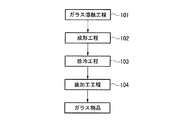
- FIG. 2 is a flowchart showing an example of the method for producing a glass article of the present invention.
- symbol 101 is a glass melting process, and is corresponded to the granulated body melting process in the manufacturing method of the molten glass of this invention.
- the molten glass obtained in the glass melting step 101 is formed into a target shape in the forming step 102 and then slowly cooled in the slow cooling step 103. Thereafter, a glass article is obtained by performing post-processing by a known method such as cutting or polishing in the post-processing step 104 as necessary.
- the molding step 102 can be performed by a known method such as a float method, a down draw method, or a fusion method.
- the float process is a method of forming molten glass into a plate shape on molten tin.
- the granulated body in the present invention is particularly suitable for the float process since MgO is contained in its glass composition.
- the slow cooling step 103 can also be performed by a known method.
- the unit of gas amount “Nm 3 (normal rice)” means a gas volume of 1 m 3 when the target gas is converted to a standard state (0 ° C., 760 mmHg).
- the measuring method of each component used the following method.
- An ion chromatographic method described in JIS K0103 was used as a method for measuring the sulfur oxide (SO x ) concentration in the gas.
- An ion chromatographic method described in JIS K0107 was used as a method for measuring the hydrogen chloride (HCl) concentration in the gas.
- the boron (B) concentration in the gas was measured using ICP emission spectroscopy by passing the gas through water.
- the fluorine (F) concentration in the gas the lanthanum-alizarin complexone spectrophotometric method described in JIS K0105 was used as a method for measuring the fluorine (F) concentration in the gas.
- the concentrations of sulfur (S), chlorine (Cl), boron (B), and fluorine (F) in the liquid were measured by ICP emission spectroscopy.
- Example 1 Using the apparatus having the configuration shown in FIG. 1, a molten glass having the following glass composition was produced under the following production conditions. However, the glass raw material charged into the melting furnace was not a granulated body produced by a granulator, but a raw material powder separately prepared so as to obtain a target glass composition. Table 1 shows the concentration (exhaust gas composition) of each component in the exhaust gas G2 immediately before being supplied to the cooling tower 4. In this example, the calcium hydroxide supply means 18 is not provided before the bag filter 3.
- Amount of exhaust gas G1 generated from the melting furnace 2 about 500 Nm 3 / h
- the temperature of the exhaust gas G2 immediately before being supplied to the cooling tower 4 170 ° C.
- Amount of the first contact liquid L1 sprayed into the cooling tower 4 1.3 m 3 / h
- Temperature of exhaust gas G3 after cooling 65 ° C.
- Temperature of the second contact liquid L2 immediately before being sprayed into the venturi scrubber 6 65 ° C.
- the amount of the second contact liquid L2 sprayed into the venturi scrubber 6 4.4 m 3 / h
- the temperature of the clean gas G4 at the outlet of the venturi scrubber 6 65 ° C.
- Example 2 In this example, the exhaust gas in which the content of each component in the exhaust gas G2 is larger than that in Example 1 was used. Table 1 shows the concentration of each component in the exhaust gas G2 immediately before being supplied to the cooling tower 4 in this example. Otherwise, the measurement and evaluation for each item in Table 1 were performed in the same manner as in Example 1. The results are shown in Table 1.
- Example 5 The measurement and evaluation for each item in Table 1 were performed in the same manner as in Example 1 except that the pH fluctuation range of the liquid in the treatment liquid tank 14 was changed as shown in Table 1. The results are shown in Table 1. In Example 5, since a large amount of precipitation and white turbidity occurred in the processing tank 14, the liquid obtained by solid-liquid separation of the liquid was reused as the contact liquid.
- Example 6 This example is an example in which a fluorine component derived from a fining agent is present in the exhaust gas G1.
- the calcium hydroxide supply means 18 is not provided in front of the bag filter 3.
- Table 1 shows the concentration (exhaust gas composition) of each component in the exhaust gas G2 immediately before being supplied to the cooling tower 4. Otherwise, the measurement and evaluation for each item in Table 1 were performed in the same manner as in Example 1. The results are shown in Table 1.
- Example 1 When the liquid is used, it is necessary to prevent the liquid from standing still by using a bubbler or a stirrer.
- Example 1 Production of granulated material and production of glass> A granulated body was produced using the mixture of the liquid and water collected in Example 1 as a granulating liquid, and a glass having the same glass composition as the molten glass in Example 1 was produced using the granulated body.
- the raw material powder for the production of alkali-free borosilicate glass was mixed at the ratio (unit: mass%) shown in Table 2, and 16.7 parts by mass of the liquid recovered in Example 1 with respect to 100 parts by mass of the mixed powder and water 2. 7 parts by mass was added, and a granulated body having an average particle diameter (D50) of mass cumulative percentage of about 2 mm was obtained using an Eirich intensive mixer (product name, manufactured by Nihon Eirich).
- Glass was manufactured using the obtained granulated body. That is, a granulated material having an amount of 250 g after vitrification was placed in a platinum crucible having a diameter of about 80 mm and heated in an electric furnace at 1550 ° C. for 60 minutes to melt the glass raw material. Thereafter, the glass was gradually cooled.
- the glass obtained in Production Example 1 and Comparative Production Example 1 was evaluated by the following method. That is, the glass in the upper center of the crucible was cut into a cylindrical glass having a diameter of 40 mm and a height of 25 mm with a core drill. A glass plate having a thickness of 1 mm including the central axis of the cylindrical glass was cut out. Both surfaces of the cut-out surface were optically polished (mirror polished), and used as evaluation samples. The obtained evaluation samples, the index become ⁇ SiO 2 value of the uniformity of the residual bubble number and glass composition were measured by the following methods. In addition, it was confirmed by X-ray fluorescence that glass having a desired composition was obtained in all cases.
- the SiO 2 concentration (unit: mass%) was measured in the same manner for a portion corresponding to a distance of 22 to 25 mm from the upper surface of the crucible glass.
- the measured value was X2.
- the value obtained by subtracting X2 from X1 (X1-X2) was taken as the ⁇ SiO 2 value.
- Example 1 As a result of the measurement, the number of remaining bubbles in Production Example 1 was 103, and the ⁇ SiO 2 value was 1.5. In Comparative Production Example 1, the number of remaining bubbles was 124, and the ⁇ SiO 2 value was 3.3.
- Production Example 1 using the granulated material granulated using the liquid recovered in Example 1 is superior in the uniformity of the glass composition as compared with the Comparative Production Example using the raw material powder without granulation.
- the granulate obtained by the present invention can be used for the production of alkali-free borosilicate glass, and the granule can be produced by recovering boron components from the exhaust gas discharged during the production process of the alkali-free borosilicate glass.
- the boron component can be easily reused.
Landscapes
- Chemical & Material Sciences (AREA)
- Engineering & Computer Science (AREA)
- Organic Chemistry (AREA)
- Materials Engineering (AREA)
- Chemical Kinetics & Catalysis (AREA)
- General Chemical & Material Sciences (AREA)
- Manufacturing & Machinery (AREA)
- Geochemistry & Mineralogy (AREA)
- Life Sciences & Earth Sciences (AREA)
- Analytical Chemistry (AREA)
- Oil, Petroleum & Natural Gas (AREA)
- Biomedical Technology (AREA)
- Environmental & Geological Engineering (AREA)
- Health & Medical Sciences (AREA)
- Glass Compositions (AREA)
- Glass Melting And Manufacturing (AREA)
- Treating Waste Gases (AREA)
- Gas Separation By Absorption (AREA)
- Glanulating (AREA)
- Processing Of Solid Wastes (AREA)
Abstract
Priority Applications (5)
| Application Number | Priority Date | Filing Date | Title |
|---|---|---|---|
| EP12788903.8A EP2716609B1 (fr) | 2011-05-25 | 2012-05-24 | Procédé de fabrication d'un corps granulé, procédé de fabrication de verre fondu, et procédé de fabrication d'un article en verre |
| JP2013516442A JP5954319B2 (ja) | 2011-05-25 | 2012-05-24 | 造粒体の製造方法、溶融ガラスの製造方法およびガラス物品の製造方法 |
| KR1020137027724A KR101960984B1 (ko) | 2011-05-25 | 2012-05-24 | 조립체의 제조 방법, 용융 유리의 제조 방법 및 유리 물품의 제조 방법 |
| CN201280025160.0A CN103547538B (zh) | 2011-05-25 | 2012-05-24 | 造粒体的制造方法、熔融玻璃的制造方法及玻璃物品的制造方法 |
| US14/088,851 US9302926B2 (en) | 2011-05-25 | 2013-11-25 | Process for producing granules, method for producing molten glass and method for producing glass product |
Applications Claiming Priority (2)
| Application Number | Priority Date | Filing Date | Title |
|---|---|---|---|
| JP2011-117148 | 2011-05-25 | ||
| JP2011117148 | 2011-05-25 |
Related Child Applications (1)
| Application Number | Title | Priority Date | Filing Date |
|---|---|---|---|
| US14/088,851 Continuation US9302926B2 (en) | 2011-05-25 | 2013-11-25 | Process for producing granules, method for producing molten glass and method for producing glass product |
Publications (1)
| Publication Number | Publication Date |
|---|---|
| WO2012161274A1 true WO2012161274A1 (fr) | 2012-11-29 |
Family
ID=47217346
Family Applications (1)
| Application Number | Title | Priority Date | Filing Date |
|---|---|---|---|
| PCT/JP2012/063365 Ceased WO2012161274A1 (fr) | 2011-05-25 | 2012-05-24 | Procédé de fabrication d'un corps granulé, procédé de fabrication de verre fondu, et procédé de fabrication d'un article en verre |
Country Status (7)
| Country | Link |
|---|---|
| US (1) | US9302926B2 (fr) |
| EP (1) | EP2716609B1 (fr) |
| JP (1) | JP5954319B2 (fr) |
| KR (1) | KR101960984B1 (fr) |
| CN (1) | CN103547538B (fr) |
| TW (1) | TWI526410B (fr) |
| WO (1) | WO2012161274A1 (fr) |
Cited By (6)
| Publication number | Priority date | Publication date | Assignee | Title |
|---|---|---|---|---|
| WO2013133003A1 (fr) * | 2012-03-05 | 2013-09-12 | 日本電気硝子株式会社 | Procédé de traitement de gaz de décharge et dispositif de traitement de gaz de décharge |
| WO2014077114A1 (fr) * | 2012-11-15 | 2014-05-22 | 旭硝子株式会社 | Procédé de fabrication de verre sans alcali |
| JP2015157734A (ja) * | 2014-02-25 | 2015-09-03 | 旭硝子株式会社 | フッ化カルシウムの製造方法および排ガス中のフッ化水素除去方法 |
| US20160332905A1 (en) * | 2014-02-06 | 2016-11-17 | Asahi Glass Company, Limited | Method for producing granules and method for producing glass product |
| WO2017047552A1 (fr) * | 2015-09-17 | 2017-03-23 | 旭硝子株式会社 | Procédé de production de corps granulés de matière première de verre, procédé de production de verre fondu et procédé de production d'un article en verre |
| WO2017179364A1 (fr) * | 2016-04-15 | 2017-10-19 | 日本電気硝子株式会社 | Procédé de fabrication d'un produit en verre |
Families Citing this family (9)
| Publication number | Priority date | Publication date | Assignee | Title |
|---|---|---|---|---|
| JP6142869B2 (ja) * | 2012-02-28 | 2017-06-07 | 旭硝子株式会社 | 造粒体およびその製造方法 |
| RU2579078C1 (ru) * | 2014-12-26 | 2016-03-27 | Федеральное государственное бюджетное образовательное учреждение высшего профессионального образования "Белгородский государственный технологический университет им. В.Г. Шухова" | Шихта для изготовления стеклогранулята для пеностекла на основе колеманита |
| GB201502542D0 (en) * | 2015-02-14 | 2015-04-01 | Etimine S A | A process which is for the removal of gaseous boron species from furnace flue gases and which is such that an agricultural fertiliser is produced |
| CN105674756A (zh) * | 2016-01-14 | 2016-06-15 | 彩虹显示器件股份有限公司 | 一种tft玻璃基板窑炉废气处理的方法和装置 |
| WO2018051793A1 (fr) | 2016-09-13 | 2018-03-22 | 旭硝子株式会社 | Substrat en verre pour dispositif haute fréquence et carte de circuit imprimé pour dispositif haute fréquence |
| JP7333159B2 (ja) * | 2016-12-26 | 2023-08-24 | 日本電気硝子株式会社 | 無アルカリガラス基板の製造方法 |
| EP3766831A1 (fr) * | 2019-07-18 | 2021-01-20 | Linde GmbH | Procédé de fonctionnement d'un four chauffé et agencement comprenant un tel four |
| WO2023084203A1 (fr) | 2021-11-10 | 2023-05-19 | Pilkington Group Limited | Poudre de borosilicate |
| CN115477474A (zh) * | 2022-09-02 | 2022-12-16 | 中国科学院上海光学精密机械研究所 | 用于放射性核废料固化处理的铁磷酸盐玻璃珠及其制备方法 |
Citations (5)
| Publication number | Priority date | Publication date | Assignee | Title |
|---|---|---|---|---|
| JPS62171731A (ja) * | 1986-01-24 | 1987-07-28 | Ishikawajima Harima Heavy Ind Co Ltd | ガラス融解炉排ガス処理装置 |
| JP2003305331A (ja) * | 2002-04-12 | 2003-10-28 | Cottrell Kogyo Kk | 排ガス中の特定成分回収方法及び回収装置 |
| JP2004238236A (ja) * | 2003-02-05 | 2004-08-26 | Nippon Electric Glass Co Ltd | ガラス溶融方法およびガラス溶融設備 |
| WO2009072612A1 (fr) * | 2007-12-05 | 2009-06-11 | Asahi Glass Co., Ltd. | Procédé de production d'un produit en verre contenant du bore et procédé de purification d'un gaz résiduaire généré pendant la production du produit en verre contenant du bore |
| JP2009137780A (ja) * | 2007-12-04 | 2009-06-25 | Daido Steel Co Ltd | ガラス溶解装置 |
Family Cites Families (5)
| Publication number | Priority date | Publication date | Assignee | Title |
|---|---|---|---|---|
| JPH07277768A (ja) * | 1994-04-08 | 1995-10-24 | Nippon Electric Glass Co Ltd | 中空ガラス球の製造方法 |
| SE9704185D0 (sv) | 1997-11-14 | 1997-11-14 | Astra Pharma Prod | Inhalation device |
| TW201026597A (en) * | 2008-09-30 | 2010-07-16 | Calera Corp | CO2-sequestering formed building materials |
| CN102482140A (zh) | 2009-08-28 | 2012-05-30 | 旭硝子株式会社 | 造粒体的制造方法以及玻璃制品的制造方法 |
| CN103108839B (zh) | 2010-09-24 | 2015-12-16 | 旭硝子株式会社 | 玻璃原料造粒体的制造方法及玻璃制品的制造方法 |
-
2012
- 2012-05-24 EP EP12788903.8A patent/EP2716609B1/fr active Active
- 2012-05-24 WO PCT/JP2012/063365 patent/WO2012161274A1/fr not_active Ceased
- 2012-05-24 JP JP2013516442A patent/JP5954319B2/ja active Active
- 2012-05-24 CN CN201280025160.0A patent/CN103547538B/zh active Active
- 2012-05-24 KR KR1020137027724A patent/KR101960984B1/ko active Active
- 2012-05-25 TW TW101118748A patent/TWI526410B/zh active
-
2013
- 2013-11-25 US US14/088,851 patent/US9302926B2/en active Active
Patent Citations (5)
| Publication number | Priority date | Publication date | Assignee | Title |
|---|---|---|---|---|
| JPS62171731A (ja) * | 1986-01-24 | 1987-07-28 | Ishikawajima Harima Heavy Ind Co Ltd | ガラス融解炉排ガス処理装置 |
| JP2003305331A (ja) * | 2002-04-12 | 2003-10-28 | Cottrell Kogyo Kk | 排ガス中の特定成分回収方法及び回収装置 |
| JP2004238236A (ja) * | 2003-02-05 | 2004-08-26 | Nippon Electric Glass Co Ltd | ガラス溶融方法およびガラス溶融設備 |
| JP2009137780A (ja) * | 2007-12-04 | 2009-06-25 | Daido Steel Co Ltd | ガラス溶解装置 |
| WO2009072612A1 (fr) * | 2007-12-05 | 2009-06-11 | Asahi Glass Co., Ltd. | Procédé de production d'un produit en verre contenant du bore et procédé de purification d'un gaz résiduaire généré pendant la production du produit en verre contenant du bore |
Non-Patent Citations (1)
| Title |
|---|
| See also references of EP2716609A4 * |
Cited By (11)
| Publication number | Priority date | Publication date | Assignee | Title |
|---|---|---|---|---|
| WO2013133003A1 (fr) * | 2012-03-05 | 2013-09-12 | 日本電気硝子株式会社 | Procédé de traitement de gaz de décharge et dispositif de traitement de gaz de décharge |
| US9364784B2 (en) | 2012-03-05 | 2016-06-14 | Nippon Electric Glass Co., Ltd. | Emission gas treatment method and emission gas treatment apparatus |
| US9403119B1 (en) | 2012-03-05 | 2016-08-02 | Nippon Electric Glass Co., Ltd. | Emission gas treatment method and emission gas treatment apparatus |
| WO2014077114A1 (fr) * | 2012-11-15 | 2014-05-22 | 旭硝子株式会社 | Procédé de fabrication de verre sans alcali |
| JPWO2014077114A1 (ja) * | 2012-11-15 | 2017-01-05 | 旭硝子株式会社 | 無アルカリガラスの製造方法 |
| US20160332905A1 (en) * | 2014-02-06 | 2016-11-17 | Asahi Glass Company, Limited | Method for producing granules and method for producing glass product |
| US10173917B2 (en) * | 2014-02-06 | 2019-01-08 | AGC Inc. | Method for producing granules and method for producing glass product |
| JP2015157734A (ja) * | 2014-02-25 | 2015-09-03 | 旭硝子株式会社 | フッ化カルシウムの製造方法および排ガス中のフッ化水素除去方法 |
| WO2017047552A1 (fr) * | 2015-09-17 | 2017-03-23 | 旭硝子株式会社 | Procédé de production de corps granulés de matière première de verre, procédé de production de verre fondu et procédé de production d'un article en verre |
| JPWO2017047552A1 (ja) * | 2015-09-17 | 2018-07-05 | 旭硝子株式会社 | ガラス原料造粒体の製造方法、溶融ガラスの製造方法、およびガラス物品の製造方法 |
| WO2017179364A1 (fr) * | 2016-04-15 | 2017-10-19 | 日本電気硝子株式会社 | Procédé de fabrication d'un produit en verre |
Also Published As
| Publication number | Publication date |
|---|---|
| CN103547538A (zh) | 2014-01-29 |
| EP2716609B1 (fr) | 2016-02-03 |
| JP5954319B2 (ja) | 2016-07-20 |
| EP2716609A4 (fr) | 2014-12-17 |
| KR20140025402A (ko) | 2014-03-04 |
| US9302926B2 (en) | 2016-04-05 |
| TW201307230A (zh) | 2013-02-16 |
| EP2716609A1 (fr) | 2014-04-09 |
| US20140075995A1 (en) | 2014-03-20 |
| KR101960984B1 (ko) | 2019-03-21 |
| CN103547538B (zh) | 2015-11-25 |
| TWI526410B (zh) | 2016-03-21 |
| JPWO2012161274A1 (ja) | 2014-07-31 |
Similar Documents
| Publication | Publication Date | Title |
|---|---|---|
| JP5954319B2 (ja) | 造粒体の製造方法、溶融ガラスの製造方法およびガラス物品の製造方法 | |
| JP6075383B2 (ja) | 無アルカリガラスの製造方法 | |
| JP5920342B2 (ja) | 造粒体およびその製造方法、溶融ガラスの製造方法、ならびにガラス物品の製造方法 | |
| TWI482744B (zh) | A method for producing a glass raw material granule and a method for producing the same | |
| EP3103775B1 (fr) | Procédé de production d'un corps granulé et procédé de production d'un article en verre | |
| CN107074603B (zh) | 玻璃原料造粒体的制造方法、熔融玻璃的制造方法和玻璃物品的制造方法 | |
| KR102228111B1 (ko) | 조립체, 그 제조 방법 및 유리 물품의 제조 방법 | |
| JPWO2012161275A1 (ja) | 造粒体の製造方法、溶融ガラスの製造方法、ならびにガラス物品の製造方法 | |
| CN102015555B (zh) | 卤氧化物玻璃澄清化 | |
| TWI466840B (zh) | 製造玻璃組成份之方法 | |
| JP3662966B2 (ja) | 非晶質珪酸ナトリウム・金属硫酸塩複合粉末及びその製造方法 | |
| JP6777085B2 (ja) | ガラス原料造粒体の製造方法、溶融ガラスの製造方法、およびガラス物品の製造方法 |
Legal Events
| Date | Code | Title | Description |
|---|---|---|---|
| 121 | Ep: the epo has been informed by wipo that ep was designated in this application |
Ref document number: 12788903 Country of ref document: EP Kind code of ref document: A1 |
|
| ENP | Entry into the national phase |
Ref document number: 2013516442 Country of ref document: JP Kind code of ref document: A |
|
| ENP | Entry into the national phase |
Ref document number: 20137027724 Country of ref document: KR Kind code of ref document: A |
|
| WWE | Wipo information: entry into national phase |
Ref document number: 2012788903 Country of ref document: EP |
|
| NENP | Non-entry into the national phase |
Ref country code: DE |