WO2013133003A1 - Procédé de traitement de gaz de décharge et dispositif de traitement de gaz de décharge - Google Patents
Procédé de traitement de gaz de décharge et dispositif de traitement de gaz de décharge Download PDFInfo
- Publication number
- WO2013133003A1 WO2013133003A1 PCT/JP2013/053969 JP2013053969W WO2013133003A1 WO 2013133003 A1 WO2013133003 A1 WO 2013133003A1 JP 2013053969 W JP2013053969 W JP 2013053969W WO 2013133003 A1 WO2013133003 A1 WO 2013133003A1
- Authority
- WO
- WIPO (PCT)
- Prior art keywords
- solution
- boron
- exhaust gas
- separation
- solid
- Prior art date
- Legal status (The legal status is an assumption and is not a legal conclusion. Google has not performed a legal analysis and makes no representation as to the accuracy of the status listed.)
- Ceased
Links
Images

Classifications
-
- B—PERFORMING OPERATIONS; TRANSPORTING
- B01—PHYSICAL OR CHEMICAL PROCESSES OR APPARATUS IN GENERAL
- B01D—SEPARATION
- B01D53/00—Separation of gases or vapours; Recovering vapours of volatile solvents from gases; Chemical or biological purification of waste gases, e.g. engine exhaust gases, smoke, fumes, flue gases, aerosols
- B01D53/14—Separation of gases or vapours; Recovering vapours of volatile solvents from gases; Chemical or biological purification of waste gases, e.g. engine exhaust gases, smoke, fumes, flue gases, aerosols by absorption
- B01D53/1418—Recovery of products
-
- C—CHEMISTRY; METALLURGY
- C03—GLASS; MINERAL OR SLAG WOOL
- C03B—MANUFACTURE, SHAPING, OR SUPPLEMENTARY PROCESSES
- C03B5/00—Melting in furnaces; Furnaces so far as specially adapted for glass manufacture
- C03B5/16—Special features of the melting process; Auxiliary means specially adapted for glass-melting furnaces
- C03B5/235—Heating the glass
- C03B5/237—Regenerators or recuperators specially adapted for glass-melting furnaces
-
- B—PERFORMING OPERATIONS; TRANSPORTING
- B01—PHYSICAL OR CHEMICAL PROCESSES OR APPARATUS IN GENERAL
- B01D—SEPARATION
- B01D36/00—Filter circuits or combinations of filters with other separating devices
-
- B—PERFORMING OPERATIONS; TRANSPORTING
- B01—PHYSICAL OR CHEMICAL PROCESSES OR APPARATUS IN GENERAL
- B01D—SEPARATION
- B01D47/00—Separating dispersed particles from gases, air or vapours by liquid as separating agent
- B01D47/06—Spray cleaning
-
- B—PERFORMING OPERATIONS; TRANSPORTING
- B01—PHYSICAL OR CHEMICAL PROCESSES OR APPARATUS IN GENERAL
- B01D—SEPARATION
- B01D53/00—Separation of gases or vapours; Recovering vapours of volatile solvents from gases; Chemical or biological purification of waste gases, e.g. engine exhaust gases, smoke, fumes, flue gases, aerosols
- B01D53/14—Separation of gases or vapours; Recovering vapours of volatile solvents from gases; Chemical or biological purification of waste gases, e.g. engine exhaust gases, smoke, fumes, flue gases, aerosols by absorption
- B01D53/1425—Regeneration of liquid absorbents
-
- B—PERFORMING OPERATIONS; TRANSPORTING
- B01—PHYSICAL OR CHEMICAL PROCESSES OR APPARATUS IN GENERAL
- B01D—SEPARATION
- B01D53/00—Separation of gases or vapours; Recovering vapours of volatile solvents from gases; Chemical or biological purification of waste gases, e.g. engine exhaust gases, smoke, fumes, flue gases, aerosols
- B01D53/34—Chemical or biological purification of waste gases
- B01D53/46—Removing components of defined structure
-
- B—PERFORMING OPERATIONS; TRANSPORTING
- B03—SEPARATION OF SOLID MATERIALS USING LIQUIDS OR USING PNEUMATIC TABLES OR JIGS; MAGNETIC OR ELECTROSTATIC SEPARATION OF SOLID MATERIALS FROM SOLID MATERIALS OR FLUIDS; SEPARATION BY HIGH-VOLTAGE ELECTRIC FIELDS
- B03C—MAGNETIC OR ELECTROSTATIC SEPARATION OF SOLID MATERIALS FROM SOLID MATERIALS OR FLUIDS; SEPARATION BY HIGH-VOLTAGE ELECTRIC FIELDS
- B03C3/00—Separating dispersed particles from gases or vapour, e.g. air, by electrostatic effect
- B03C3/017—Combinations of electrostatic separation with other processes, not otherwise provided for
-
- B—PERFORMING OPERATIONS; TRANSPORTING
- B03—SEPARATION OF SOLID MATERIALS USING LIQUIDS OR USING PNEUMATIC TABLES OR JIGS; MAGNETIC OR ELECTROSTATIC SEPARATION OF SOLID MATERIALS FROM SOLID MATERIALS OR FLUIDS; SEPARATION BY HIGH-VOLTAGE ELECTRIC FIELDS
- B03C—MAGNETIC OR ELECTROSTATIC SEPARATION OF SOLID MATERIALS FROM SOLID MATERIALS OR FLUIDS; SEPARATION BY HIGH-VOLTAGE ELECTRIC FIELDS
- B03C3/00—Separating dispersed particles from gases or vapour, e.g. air, by electrostatic effect
- B03C3/02—Plant or installations having external electricity supply
- B03C3/16—Plant or installations having external electricity supply wet type
-
- C—CHEMISTRY; METALLURGY
- C02—TREATMENT OF WATER, WASTE WATER, SEWAGE, OR SLUDGE
- C02F—TREATMENT OF WATER, WASTE WATER, SEWAGE, OR SLUDGE
- C02F1/00—Treatment of water, waste water, or sewage
- C02F1/42—Treatment of water, waste water, or sewage by ion-exchange
-
- C—CHEMISTRY; METALLURGY
- C03—GLASS; MINERAL OR SLAG WOOL
- C03B—MANUFACTURE, SHAPING, OR SUPPLEMENTARY PROCESSES
- C03B5/00—Melting in furnaces; Furnaces so far as specially adapted for glass manufacture
- C03B5/16—Special features of the melting process; Auxiliary means specially adapted for glass-melting furnaces
-
- C—CHEMISTRY; METALLURGY
- C03—GLASS; MINERAL OR SLAG WOOL
- C03C—CHEMICAL COMPOSITION OF GLASSES, GLAZES OR VITREOUS ENAMELS; SURFACE TREATMENT OF GLASS; SURFACE TREATMENT OF FIBRES OR FILAMENTS MADE FROM GLASS, MINERALS OR SLAGS; JOINING GLASS TO GLASS OR OTHER MATERIALS
- C03C1/00—Ingredients generally applicable to manufacture of glasses, glazes, or vitreous enamels
- C03C1/002—Use of waste materials, e.g. slags
-
- F—MECHANICAL ENGINEERING; LIGHTING; HEATING; WEAPONS; BLASTING
- F23—COMBUSTION APPARATUS; COMBUSTION PROCESSES
- F23J—REMOVAL OR TREATMENT OF COMBUSTION PRODUCTS OR COMBUSTION RESIDUES; FLUES
- F23J15/00—Arrangements of devices for treating smoke or fumes
- F23J15/02—Arrangements of devices for treating smoke or fumes of purifiers, e.g. for removing noxious material
-
- F—MECHANICAL ENGINEERING; LIGHTING; HEATING; WEAPONS; BLASTING
- F23—COMBUSTION APPARATUS; COMBUSTION PROCESSES
- F23J—REMOVAL OR TREATMENT OF COMBUSTION PRODUCTS OR COMBUSTION RESIDUES; FLUES
- F23J15/00—Arrangements of devices for treating smoke or fumes
- F23J15/02—Arrangements of devices for treating smoke or fumes of purifiers, e.g. for removing noxious material
- F23J15/04—Arrangements of devices for treating smoke or fumes of purifiers, e.g. for removing noxious material using washing fluids
-
- B—PERFORMING OPERATIONS; TRANSPORTING
- B01—PHYSICAL OR CHEMICAL PROCESSES OR APPARATUS IN GENERAL
- B01D—SEPARATION
- B01D2252/00—Absorbents, i.e. solvents and liquid materials for gas absorption
- B01D2252/10—Inorganic absorbents
- B01D2252/103—Water
-
- B—PERFORMING OPERATIONS; TRANSPORTING
- B01—PHYSICAL OR CHEMICAL PROCESSES OR APPARATUS IN GENERAL
- B01D—SEPARATION
- B01D2258/00—Sources of waste gases
- B01D2258/02—Other waste gases
- B01D2258/0241—Other waste gases from glass manufacture plants
-
- C—CHEMISTRY; METALLURGY
- C02—TREATMENT OF WATER, WASTE WATER, SEWAGE, OR SLUDGE
- C02F—TREATMENT OF WATER, WASTE WATER, SEWAGE, OR SLUDGE
- C02F2103/00—Nature of the water, waste water, sewage or sludge to be treated
- C02F2103/18—Nature of the water, waste water, sewage or sludge to be treated from the purification of gaseous effluents
-
- F—MECHANICAL ENGINEERING; LIGHTING; HEATING; WEAPONS; BLASTING
- F23—COMBUSTION APPARATUS; COMBUSTION PROCESSES
- F23J—REMOVAL OR TREATMENT OF COMBUSTION PRODUCTS OR COMBUSTION RESIDUES; FLUES
- F23J2217/00—Intercepting solids
- F23J2217/10—Intercepting solids by filters
- F23J2217/102—Intercepting solids by filters electrostatic
-
- F—MECHANICAL ENGINEERING; LIGHTING; HEATING; WEAPONS; BLASTING
- F23—COMBUSTION APPARATUS; COMBUSTION PROCESSES
- F23J—REMOVAL OR TREATMENT OF COMBUSTION PRODUCTS OR COMBUSTION RESIDUES; FLUES
- F23J2219/00—Treatment devices
- F23J2219/40—Sorption with wet devices, e.g. scrubbers
Definitions
- the present invention relates to a technique for recovering a recycled material from an exhaust gas of a glass melting furnace that melts the glass material.
- molten glass is manufactured by heating powdery or granular glass raw material with a burner flame or the like. This molten glass becomes various glass products through a predetermined forming process such as press and blow.
- the exhaust gas generated from the glass melting furnace a part of the components contained in the glass raw material is contained in a gas or fine solid state. For this reason, many components that can be recycled as a glass raw material are contained in the exhaust gas. Therefore, if the recycled material can be recovered from the exhaust gas, it can contribute to saving of the glass material. At the same time, the environment can be considered.
- Patent Document 1 by using a fuel that does not substantially contain sulfur as the fuel for the burner flame, or by using a glass material that has low sulfur as the glass raw material, It is described that the sulfur oxides that cause it are reduced from the exhaust gas, and recycled materials that can be used as glass materials are recovered.
- This invention makes it a technical subject to collect
- a first invention created in order to solve the above problems is an exhaust gas treatment method for recovering a recycled raw material containing boron from an exhaust gas of a glass melting furnace for melting a boron-containing glass raw material, wherein boron is removed from the exhaust gas.
- Impurities are removed from the extraction liquid obtained in the collection process of obtaining the collected liquid by wet-collecting the contained components, the first separation process for solid-liquid separation of the collected liquid, and the first separation process.
- the solution forming step for obtaining the boron solution, the extraction solid obtained in the first separation step are mixed with the boron solution, the mixing step for obtaining the extraction solid-containing solution, and the extraction solid-containing solution are subjected to solid-liquid separation. It is characterized by including a second separation step and a recovery step of recovering the recycled material from the extracted solid obtained in the second separation step.
- "boron” here shall contain boron compounds, such as boric acid (hereinafter the same).
- boron substantially free of impurities such as sulfates and halides can be efficiently recovered from the exhaust gas of the glass melting furnace for the following reasons.
- the collected liquid obtained in the collection step is solid-liquid separated into an extraction liquid and an extraction solid in the first separation step.
- the extraction liquid becomes a boron solution by removing impurities in the solution forming step. Boron is already dissolved in the boron solution, and the boron concentration is high. For this reason, in the mixing step, when the extracted solid and the boron solution are mixed to obtain an extracted solid-containing solution, boron in the extracted solid is hardly dissolved in the extracted solid-containing solution and remains as an undissolved substance.
- impurities other than boron (such as sulfates and halides) in the extracted solid are soluble and easily dissolved in the extracted solid-containing solution because the impurity concentration in the boron solution is low.
- impurities are removed from the extraction liquid using an ion exchange resin in the solution forming step.
- boron in the extraction liquid can be efficiently recovered. That is, since boron is a weak acid, it is difficult to adsorb ions and passes through the ion exchange resin. On the other hand, impurity components (such as sulfates and halides) other than boron are easily adsorbed by a strong acid and are trapped by an ion exchange resin. Therefore, if the ion exchange resin is used, it is possible to efficiently remove impurities in the extraction liquid while reducing the amount of boron decrease in the extraction liquid as much as possible. As the ion exchange resin, it is preferable to use a weakly basic anion exchange resin from the viewpoint of preventing boron adsorption.
- the extraction liquid obtained in the second separation step is supplied to the solution formation step, and in the solution formation step, the extraction liquid obtained in the first separation step and the second separation step By removing impurities from the extracted liquid obtained, the boron solution is obtained, and the recycled material is recovered by drying the extracted solid obtained in the second separation step in the recovery step. It may be.
- a second solution forming step for obtaining a boron solution by removing impurities from the extraction liquid obtained in the second separation step, and the extracted solid obtained in the second separation step in the second step A second mixing step of mixing the boron solution obtained in the solution forming step to obtain an extracted solid-containing solution, and drying the extracted solid-containing solution obtained in the second mixing step in the recovery step. By doing so, the recycled material may be recovered.
- a second invention created in order to solve the above-mentioned problems is an exhaust gas treatment method for recovering a recycled raw material containing boron from an exhaust gas of a glass melting furnace for melting a boron-containing glass raw material, wherein boron is removed from the exhaust gas.
- a collecting step for dry-capturing the contained components to obtain collected powder a mixing step for mixing the collected powder into a solution to obtain a collected powder-containing solution, and a separation for solid-liquid separation of the collected powder-containing solution Removing the impurities from the extraction liquid obtained in the separation step to obtain a boron solution, and supplying the boron solution as the solution in the mixing step; and the extraction obtained in the separation step And a recovery step of recovering the recycled raw material from the solid.
- the collected powder obtained in the collecting step is mixed with the solution in the mixing step to become a collected powder-containing solution.
- This collected powder-containing solution is solid-liquid separated into an extraction liquid and an extraction solid in a separation step.
- the extraction liquid is returned as a solution in the above mixing step after impurities are removed in the solution forming step to form a boron solution.
- the mixing step the collected powder and the boron solution are mixed.
- the boron concentration of the boron solution is already high, the boron in the collected powder is difficult to dissolve, and it is not dissolved in the solution. Remains.
- impurities other than boron in the collected powder are easily dissolved because the concentration in the boron solution is low. Therefore, in the separation process, if the collected powder-containing solution in such a dissolved state is solid-liquid separated and the extracted solid, which is undissolved, is taken out, the recycled raw material containing boron with very few impurities is recovered in the recovery process. can do.
- impurities may be removed from the extraction liquid using an ion exchange resin in the solution forming step, or solid-liquid separation may be performed by filtration in the separation step.
- a third invention devised to solve the above-described problem is an exhaust gas treatment apparatus for recovering a recycled raw material containing boron from an exhaust gas of a glass melting furnace for melting a boron-containing glass raw material, wherein the boron in the exhaust gas is removed. Impurities are removed from the extraction liquid obtained by the collecting means for collecting the contained components by wet collection to obtain the collected liquid, the first separating means for solid-liquid separation of the collected liquid, and the first separating means.
- it is characterized by comprising a second separation means for solid-liquid separation of the extracted solid-containing solution, and a recovery means for recovering the recycled material from the extracted solid obtained by the second separation means.
- a fourth invention devised to solve the above problems is an exhaust gas treatment apparatus for recovering a recycled raw material containing boron from an exhaust gas of a glass melting furnace for melting a boron-containing glass raw material, wherein boron is removed from the exhaust gas.
- a trapping means for dry-capturing the components to be contained to collect the collected powder a mixing tank for mixing the collected powder with the solution to obtain a collected powder-containing solution, and an undissolved material in the collected powder-containing solution.
- separation means for solid-liquid separation of the collected powder-containing solution a boron solution is formed by removing impurities from the extraction liquid obtained by the separation means, and the boron solution is added to the solution in the mixing tank.
- a recovery means for recovering the recycled material from the extracted solid obtained by the separation means.
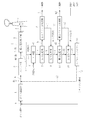
- FIG. 1 is a view showing a glass melting facility in which an exhaust gas treatment apparatus according to the first embodiment of the present invention is incorporated.
- a boron-containing glass raw material hereinafter simply referred to as a glass raw material
- a target glass composition is heated in a glass melting furnace 1 with a burner flame, and borosilicate glass and A molten glass is produced.
- the fuel for the burner flame for example, LPG or LNG with a low sulfur content is preferably used.
- the glass raw material a with little sulfur content is used.
- the exhaust gas b generated from the glass melting furnace 1 contains fine solids and vaporized substances derived from the glass raw material a and the burner flame fuel. For this reason, in addition to boron, which is a useful component, the exhaust gas b contains sulfates and halides derived from the glass raw material a and fuel impurities.
- the exhaust gas b is first introduced into the collecting means 2.
- the exhaust gas b is cooled to, for example, 60 to 70 ° C., and boron contained in the exhaust gas b in a vaporized state is crystallized.
- the collecting means 2 is a wet collecting means composed of a spray tower 3 and a wet electrostatic precipitator 4.
- the collection means 2 will not be specifically limited if a boron component can be wet-collected from waste gas, For example, a scrubber etc. may be sufficient.
- the component (micro solid or vaporized substance) containing boron contained in the exhaust gas b is collected as a collection liquid c by contacting with water sprayed in the spray tower 3. Further, the component e containing boron that has passed through the spray tower 3 is also collected as a collected liquid c by contacting with the water of the wet electrostatic precipitator 4.
- the exhaust gas d that has been purified by passing through the wet electrostatic precipitator 4 is discharged from the chimney 5 into the atmosphere.
- the wet electrostatic precipitator 4 plays an auxiliary role of the spray tower 3, it may be omitted.
- the collected liquid c collected by the spray tower 3 and the wet electrostatic precipitator 4 is introduced into the neutralization tank 6.
- an alkali component such as slaked lime f is added to the collected liquid c to neutralize the acidic collected liquid c. This prevents corrosion of the piping and the like in the subsequent process from being caused by acid, and lowers the solubility of boron in the collected liquid c to increase its recovery efficiency.
- the neutralization tank 6 may be omitted.
- the collection liquid c is neutralized so that the hydrogen ion concentration (pH) becomes weakly alkaline, for example, 7.5 to 12.0, more preferably 8.0 to 10.0.
- the collected liquid g neutralized in the neutralization tank 6 is introduced into a first filter 7 as solid-liquid separation means.
- the collected liquid g is separated into solid and liquid, and is divided into an extraction liquid (filtrate) h and an extraction solid (filter cake (cake)) k.
- the extracted solid k contains about 10 to 20% of a liquid component, and the liquid component contains a large amount of impurities.
- Examples of the first filter 7 include a filter press, centrifugal separation, and vacuum filtration.
- the extraction liquid h obtained by the first filter 7 is introduced into an ion exchange resin 8 as a solution forming means.
- This extraction liquid h contains sulfate, halide, calcium and boron.
- impurities for example, sulfates, halides, etc.
- boron mainly boric acid
- impurities i other than boron in the extraction liquid h are easily adsorbed by ions due to the strong acid, and are captured by the ion exchange resin 8 and cannot pass through the ion exchange resin 8.
- a boron solution j from which the impurities i have been removed is formed.
- the solution forming means for example, a reverse osmosis membrane or the like may be used, but it is preferable to use an ion exchange resin because the boron recovery rate is reduced. Further, since calcium can be used as a glass raw material, there is no problem even if it is mixed in boron.
- the boron solution j it is preferable that boron is saturated or close to saturation.
- the boron solution j is preferably a high concentration solution of boron.
- the boron concentration of the boron solution j is, for example, preferably 0.1 to 0.8% at 20 ° C., and more preferably 0.3 to 0.6%.
- the extracted solid k obtained by the first filter 7 is introduced into the mixing tank 9.
- a boron solution j formed of the ion exchange resin 8 is also introduced into the mixing tank 9, and the extracted solid k and the boron solution j are mixed in the mixing tank 9 to form an extracted solid-containing solution l. ing.
- the boron concentration in the boron solution j is already high, the boron in the extracted solid k is difficult to dissolve and remains as an undissolved substance in the extracted solid-containing solution l.
- the impurity concentration in the boron solution j is low, the impurities in the extracted solid k are easily dissolved in the extracted solid-containing solution l.
- the extracted solid-containing solution 1 obtained in the mixing tank 9 showing such a dissolved state is introduced into the second filter 10.
- the extracted solid-containing solution 1 is separated into solid and liquid, and divided into an extracted liquid m and an extracted solid n.
- the extracted solid n contains about 10 to 20% of a liquid component, but this liquid component contains almost no impurities.
- Examples of the second filter 10 include a filter press, centrifugal separation, and vacuum filtration.
- the extraction liquid m obtained by the second filter 10 is introduced into the ion exchange resin 8. That is, in this embodiment, the impurity i is removed from the extraction liquid h obtained by the first filter 7 and the extraction liquid m obtained by the second filter 10 by the ion exchange resin 8, and the mixture is transferred to the mixing tank 9. A boron solution j to be supplied is formed.
- the extracted solid n obtained by the second filter 10 is introduced into a vacuum dryer 11 as a recovery means.
- the moisture contained in the extracted solid n is dried and removed to form a powdered recycled raw material o, which is supplied to the glass melting furnace 1 together with the glass raw material a.
- the extracted solid n to be dried under reduced pressure is an undissolved material containing boron in the extracted solid-containing solution 1 as described above. Therefore, if moisture is removed by drying, boron with less impurities is recovered. It becomes possible. Boron is typically recovered as boric acid. Moreover, calcium may be recovered simultaneously with boron.
- the recovery means is not limited to the vacuum dryer 11, and in this embodiment, the recovery means is not particularly limited as long as it is a means capable of drying and removing moisture from the solid.
- a rotary dryer or a band dryer may be used.
- the glass raw material a is put into the glass melting furnace 1 to produce molten glass. From the exhaust gas b generated at this time, a component containing boron is collected as a collection liquid c by the spray tower 3 and the wet electrostatic precipitator 4, and the purified exhaust gas d is released from the chimney 5 into the atmosphere.
- the collected liquid c is neutralized in the neutralization tank 6 and then solid-liquid separated by the first filter 7.
- the extraction liquid h that has been subjected to solid-liquid separation is introduced into the ion exchange resin 8 to remove the impurities i to form a boron solution j, which is then introduced into the mixing tank 9.
- the impurity i removed by the ion exchange resin 8 is released out of the system.
- the extracted solid k separated into solid and liquid is introduced into the mixing tank 9 together with the boron solution j.
- the extracted solid k and the boron solution j are mixed to form an extracted solid-containing solution l.
- boron in the extracted solid k remains as an undissolved substance, and impurities other than boron in the extracted solid k are dissolved.
- the extracted solid-containing solution l showing such a dissolved state is solid-liquid separated by the second filter 10.
- the extraction liquid m subjected to solid-liquid separation is introduced into the ion exchange resin 8 and becomes a raw material of the boron solution j.
- the extracted solid n that has been subjected to solid-liquid separation is dried and removed by the reduced-pressure dryer 11, and becomes a recycled material o containing boron with less impurities.
- the impurities in the recycled material are, for example, about 2000 ppm for sulfate and about 50000 ppm for halide, but according to the configuration of the first embodiment.
- impurities in the recycled material can be greatly reduced to about 100 ppm for sulfate and about 100 ppm for halide.
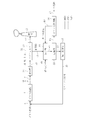
- FIG. 2 is a view showing a glass melting facility in which an exhaust gas treatment apparatus according to the second embodiment of the present invention is incorporated.
- the second embodiment is different from the first embodiment in the drying method in the recovery step for obtaining a recycled raw material.
- symbol is attached
- the recycled material is formed from a solid, whereas in the second embodiment, the recycled material is formed from a liquid.
- the procedure until it reaches the 2nd filter 10 in a figure is the same as that of 1st Embodiment, the process after it is demonstrated.
- the extracted solid-containing solution 1 obtained in the first mixing tank (corresponding to the mixing tank of the first embodiment) 9 is solid-liquid separated by the second filter 10, and the extracted liquid a2 is subjected to the second ion exchange. It is designed to be introduced into the resin 21.
- the impurity b ⁇ b> 2 is removed from the extraction liquid a ⁇ b> 2 to form a boron solution c ⁇ b> 2 and introduced into the second mixing tank 22.
- the extracted solid d2 obtained by the second filter 10 is introduced into the second mixing tank 22 together with the boron solution c2.
- the extracted solid d2 and the boron solution c2 are mixed to form an extracted solid-containing solution e2. Since the extracted solid-containing solution e2 is a mixture of the extracted solid d2 that is an undissolved material containing high-purity boron and the boron solution c2, the solution contains almost no impurities other than boron.
- the extracted solid-containing solution e2 is introduced into the spray dryer 23.
- the extracted solid-containing solution e2 is sprayed into hot air, and the moisture in the extracted solid-containing solution e2 is dried and removed by the heat of the hot air.
- the extraction solid-containing solution e2 to be dried is a liquid that contains almost no components other than boron as described above. Therefore, if moisture is removed by drying, a recycled raw material containing boron with less impurities It becomes possible to collect f2.
- the gas g2 generated by the spray dryer 23 is supplied to the spray tower 3.
- the hot air supplied into the spray dryer 23 for example, hot air generated in the glass melting furnace 1 is used.
- a drum dryer, a CD dryer, or the like can be used instead of the spray dryer 23, a drum dryer, a CD dryer, or the like.
- the impurities in the recycled material can be suppressed to 100 ppm for sulfate and about 100 ppm for halide.
- FIG. 3 is a view showing a glass melting facility in which an exhaust gas treatment apparatus according to the third embodiment of the present invention is incorporated.
- the third embodiment is different from the first embodiment and the second embodiment in that a component containing boron is collected from exhaust gas.
- a component containing boron is collected from exhaust gas.
- symbol is attached
- the collection means 31 is composed of a cooling tower 32 and a bag filter 33.
- the exhaust gas b is cooled in contact with the wind (air) of the cooling tower 32, and the cooled exhaust gas a3 is introduced into the bag filter 33.
- the bag filter 33 solid components (fine solids and gaseous substances that have been cooled and crystallized) in the cooled exhaust gas a3 are collected as collected powder b3.
- the purified exhaust gas c3 that has passed through the bag filter 33 is discharged from the chimney 5 into the atmosphere.
- a dry electrostatic precipitator may be used.
- the collected powder b3 is introduced into the mixing tank 34.
- the collected powder b3 and the solution are mixed to form a collected powder-containing solution e3.
- an alkali component made of slaked lime d3 or the like is added to the mixing tank 34, and a neutralization treatment of the collected powder-containing solution e3 is performed.
- the water or boron solution supplied from the outside is utilized only at the time of the start of operation (first time). Further, the neutralization treatment may be omitted.
- the collected powder-containing solution e3 obtained in the mixing tank 34 is introduced into a filter 35.
- the collected powder-containing solution e3 is subjected to solid-liquid separation.
- the extraction liquid f3 obtained by the filter 35 is introduced into the ion exchange resin 36.
- the impurity g3 is removed from the extraction liquid f3, and the boron solution h3 is formed.
- the boron solution h3 is returned as a solution in the mixing tank 34.
- the collected powder-containing solution e3 remains as an undissolved boron in the collected powder b3 for the reason described in the first embodiment. Then, the impurities in the collected powder b3 are dissolved.
- the extracted solid i3 obtained by the filter 35 is introduced into the vacuum dryer 37. Since the extraction solid i3 to be dried is an undissolved material containing high-purity boron, if the moisture contained in the extraction solid i3 is dried and removed by the reduced pressure dryer 37, boron with less impurities is recycled into the raw material j3. It becomes possible to collect as.
- the impurities in the recycled material can be suppressed to 100 ppm for sulfate and about 100 ppm for halide.
Landscapes
- Chemical & Material Sciences (AREA)
- Engineering & Computer Science (AREA)
- Chemical Kinetics & Catalysis (AREA)
- General Chemical & Material Sciences (AREA)
- Organic Chemistry (AREA)
- Analytical Chemistry (AREA)
- Oil, Petroleum & Natural Gas (AREA)
- Materials Engineering (AREA)
- Mechanical Engineering (AREA)
- General Engineering & Computer Science (AREA)
- Life Sciences & Earth Sciences (AREA)
- Environmental & Geological Engineering (AREA)
- Geochemistry & Mineralogy (AREA)
- Health & Medical Sciences (AREA)
- Water Supply & Treatment (AREA)
- Hydrology & Water Resources (AREA)
- Biomedical Technology (AREA)
- Treating Waste Gases (AREA)
- Removal Of Specific Substances (AREA)
- Processing Of Solid Wastes (AREA)
- Manufacture And Refinement Of Metals (AREA)
- Treatment Of Water By Ion Exchange (AREA)
- Separation Of Particles Using Liquids (AREA)
- Filtration Of Liquid (AREA)
Priority Applications (5)
| Application Number | Priority Date | Filing Date | Title |
|---|---|---|---|
| US14/382,421 US9364784B2 (en) | 2012-03-05 | 2013-02-19 | Emission gas treatment method and emission gas treatment apparatus |
| KR1020187035021A KR101954629B1 (ko) | 2012-03-05 | 2013-02-19 | 배기 가스 처리 방법 및 배기 가스 처리 장치 |
| CN201380008480.XA CN104105673B (zh) | 2012-03-05 | 2013-02-19 | 废气处理方法以及废气处理装置 |
| KR1020147022613A KR101969732B1 (ko) | 2012-03-05 | 2013-02-19 | 배기 가스 처리 방법 및 배기 가스 처리 장치 |
| US15/150,980 US9403119B1 (en) | 2012-03-05 | 2016-05-10 | Emission gas treatment method and emission gas treatment apparatus |
Applications Claiming Priority (2)
| Application Number | Priority Date | Filing Date | Title |
|---|---|---|---|
| JP2012-048008 | 2012-03-05 | ||
| JP2012048008A JP5857802B2 (ja) | 2012-03-05 | 2012-03-05 | 排ガス処理方法および排ガス処理装置 |
Related Child Applications (2)
| Application Number | Title | Priority Date | Filing Date |
|---|---|---|---|
| US14/382,421 A-371-Of-International US9364784B2 (en) | 2012-03-05 | 2013-02-19 | Emission gas treatment method and emission gas treatment apparatus |
| US15/150,980 Division US9403119B1 (en) | 2012-03-05 | 2016-05-10 | Emission gas treatment method and emission gas treatment apparatus |
Publications (1)
| Publication Number | Publication Date |
|---|---|
| WO2013133003A1 true WO2013133003A1 (fr) | 2013-09-12 |
Family
ID=49116487
Family Applications (1)
| Application Number | Title | Priority Date | Filing Date |
|---|---|---|---|
| PCT/JP2013/053969 Ceased WO2013133003A1 (fr) | 2012-03-05 | 2013-02-19 | Procédé de traitement de gaz de décharge et dispositif de traitement de gaz de décharge |
Country Status (6)
| Country | Link |
|---|---|
| US (2) | US9364784B2 (fr) |
| JP (1) | JP5857802B2 (fr) |
| KR (2) | KR101954629B1 (fr) |
| CN (1) | CN104105673B (fr) |
| TW (1) | TWI561290B (fr) |
| WO (1) | WO2013133003A1 (fr) |
Cited By (1)
| Publication number | Priority date | Publication date | Assignee | Title |
|---|---|---|---|---|
| JP2016117628A (ja) * | 2014-12-24 | 2016-06-30 | 日本電気硝子株式会社 | ガラス繊維の製造方法 |
Families Citing this family (3)
| Publication number | Priority date | Publication date | Assignee | Title |
|---|---|---|---|---|
| JP7042692B2 (ja) * | 2018-05-30 | 2022-03-28 | 日本電気硝子株式会社 | 処理液の処理方法および排ガスの処理方法 |
| CN111408262B (zh) * | 2020-04-29 | 2025-08-19 | 江苏琥珀环境技术有限公司 | 一种用于玻璃熔窑炉尾气除尘净化的装置及方法 |
| JP7684631B2 (ja) * | 2021-04-15 | 2025-05-28 | 日本電気硝子株式会社 | ガラス物品の製造方法、及びガラス物品の製造装置 |
Citations (4)
| Publication number | Priority date | Publication date | Assignee | Title |
|---|---|---|---|---|
| JPS62171731A (ja) * | 1986-01-24 | 1987-07-28 | Ishikawajima Harima Heavy Ind Co Ltd | ガラス融解炉排ガス処理装置 |
| JP2003305331A (ja) * | 2002-04-12 | 2003-10-28 | Cottrell Kogyo Kk | 排ガス中の特定成分回収方法及び回収装置 |
| JP2004238236A (ja) * | 2003-02-05 | 2004-08-26 | Nippon Electric Glass Co Ltd | ガラス溶融方法およびガラス溶融設備 |
| WO2012161274A1 (fr) * | 2011-05-25 | 2012-11-29 | 旭硝子株式会社 | Procédé de fabrication d'un corps granulé, procédé de fabrication de verre fondu, et procédé de fabrication d'un article en verre |
Family Cites Families (7)
| Publication number | Priority date | Publication date | Assignee | Title |
|---|---|---|---|---|
| JPH029728A (ja) * | 1988-06-27 | 1990-01-12 | Sumitomo Metal Ind Ltd | 石英ガラス微粒子の回収方法および装置 |
| JPH03131515A (ja) * | 1989-10-13 | 1991-06-05 | Nippon Electric Glass Co Ltd | 排ガスから硼酸を回収する方法 |
| JP2001317726A (ja) | 2000-05-08 | 2001-11-16 | Nkk Corp | 焼却炉排ガスの処理方法および装置 |
| DE102005001595A1 (de) | 2005-01-12 | 2006-07-20 | Grochowski, Horst, Dr. | Verfahren zum Reinigen von Abgasen eines Glasschmelzprozesses, insbesondere für Gläser für LCD-Bildschirme |
| CN2826332Y (zh) * | 2005-05-13 | 2006-10-11 | 吴金泉 | 玻璃熔炉烟气脱硫脱氟装置 |
| KR101487048B1 (ko) * | 2007-12-05 | 2015-01-28 | 아사히 가라스 가부시키가이샤 | 붕소 함유 유리 제품의 제조 방법 및 붕소 함유 유리 제품의 제조시 발생 배기 가스의 정화 방법 |
| CN102247752B (zh) | 2011-07-19 | 2013-03-06 | 陕西彩虹电子玻璃有限公司 | 一种池炉烟气处理系统及其烟气处理方法 |
-
2012
- 2012-03-05 JP JP2012048008A patent/JP5857802B2/ja active Active
-
2013
- 2013-02-19 KR KR1020187035021A patent/KR101954629B1/ko not_active Expired - Fee Related
- 2013-02-19 WO PCT/JP2013/053969 patent/WO2013133003A1/fr not_active Ceased
- 2013-02-19 KR KR1020147022613A patent/KR101969732B1/ko not_active Expired - Fee Related
- 2013-02-19 CN CN201380008480.XA patent/CN104105673B/zh not_active Expired - Fee Related
- 2013-02-19 US US14/382,421 patent/US9364784B2/en active Active
- 2013-03-04 TW TW102107540A patent/TWI561290B/zh active
-
2016
- 2016-05-10 US US15/150,980 patent/US9403119B1/en active Active
Patent Citations (4)
| Publication number | Priority date | Publication date | Assignee | Title |
|---|---|---|---|---|
| JPS62171731A (ja) * | 1986-01-24 | 1987-07-28 | Ishikawajima Harima Heavy Ind Co Ltd | ガラス融解炉排ガス処理装置 |
| JP2003305331A (ja) * | 2002-04-12 | 2003-10-28 | Cottrell Kogyo Kk | 排ガス中の特定成分回収方法及び回収装置 |
| JP2004238236A (ja) * | 2003-02-05 | 2004-08-26 | Nippon Electric Glass Co Ltd | ガラス溶融方法およびガラス溶融設備 |
| WO2012161274A1 (fr) * | 2011-05-25 | 2012-11-29 | 旭硝子株式会社 | Procédé de fabrication d'un corps granulé, procédé de fabrication de verre fondu, et procédé de fabrication d'un article en verre |
Cited By (1)
| Publication number | Priority date | Publication date | Assignee | Title |
|---|---|---|---|---|
| JP2016117628A (ja) * | 2014-12-24 | 2016-06-30 | 日本電気硝子株式会社 | ガラス繊維の製造方法 |
Also Published As
| Publication number | Publication date |
|---|---|
| US9403119B1 (en) | 2016-08-02 |
| KR101969732B1 (ko) | 2019-04-17 |
| US9364784B2 (en) | 2016-06-14 |
| TWI561290B (en) | 2016-12-11 |
| US20150101484A1 (en) | 2015-04-16 |
| TW201341036A (zh) | 2013-10-16 |
| KR101954629B1 (ko) | 2019-03-06 |
| JP2013180284A (ja) | 2013-09-12 |
| JP5857802B2 (ja) | 2016-02-10 |
| KR20180132972A (ko) | 2018-12-12 |
| KR20140139485A (ko) | 2014-12-05 |
| CN104105673A (zh) | 2014-10-15 |
| CN104105673B (zh) | 2016-05-18 |
Similar Documents
| Publication | Publication Date | Title |
|---|---|---|
| CN110127918B (zh) | 一种酸性烟气洗涤废水零排放处理方法及其装置 | |
| CN113105138B (zh) | 垃圾焚烧飞灰水洗脱氯和水洗液蒸发分质结晶的处理方法及系统 | |
| JP5800436B2 (ja) | ホウ酸の回収方法および回収装置 | |
| CN110304646B (zh) | 一种从铝灰中高效分离氟、氯、氮成分联产氧化铝精矿的方法 | |
| CN110124507B (zh) | 一种多污染物烟气清洁处理的方法及其装置 | |
| JPH11100243A (ja) | セメント原料化処理方法 | |
| JP5857802B2 (ja) | 排ガス処理方法および排ガス処理装置 | |
| JP4210456B2 (ja) | セメント原料化処理方法 | |
| CN101745309A (zh) | 粉煤灰或炼铁高炉渣用于烟气脱硫及综合利用的方法 | |
| CN101200336B (zh) | 一种零排放处理邻苯二胺硫化碱还原废水工艺 | |
| WO2011162033A1 (fr) | Méthode d'élimination de calcium | |
| CN106947864B (zh) | 一种从废弃scr催化剂中回收重金属的系统及其处理方法 | |
| CN107140703A (zh) | 高有机物杂盐脱除有机物回收无机盐的方法 | |
| JP2012245467A (ja) | 排ガス処理装置、及び排ガス処理方法 | |
| JP2004238236A (ja) | ガラス溶融方法およびガラス溶融設備 | |
| JP2016017798A (ja) | 飛灰の処理装置および処理方法 | |
| JP2008174393A (ja) | 塩の製造方法 | |
| CN108025337A (zh) | 用于处理飞灰的设备以及通过所述设备处理飞灰的方法 | |
| JP7042692B2 (ja) | 処理液の処理方法および排ガスの処理方法 | |
| KR102871290B1 (ko) | 생활폐기물 소각장에서 발생하는 비산재를 활용한 온실가스 포집 및 침강탄산칼슘 제조 방법 | |
| JP2008178791A (ja) | 廃蛍光管の処理方法と廃蛍光管処理装置 | |
| CN110124491A (zh) | 一种多污染物烟气协同处理及废水零排放的方法及其装置 | |
| RU2528993C2 (ru) | Устройство и способ для обработки отходящего газа | |
| CN106495190A (zh) | 一种含锂废盐煅烧回收方法 | |
| JP3633840B2 (ja) | 溶融飛灰の処理方法 |
Legal Events
| Date | Code | Title | Description |
|---|---|---|---|
| 121 | Ep: the epo has been informed by wipo that ep was designated in this application |
Ref document number: 13757331 Country of ref document: EP Kind code of ref document: A1 |
|
| ENP | Entry into the national phase |
Ref document number: 20147022613 Country of ref document: KR Kind code of ref document: A |
|
| WWE | Wipo information: entry into national phase |
Ref document number: 14382421 Country of ref document: US |
|
| NENP | Non-entry into the national phase |
Ref country code: DE |
|
| 122 | Ep: pct application non-entry in european phase |
Ref document number: 13757331 Country of ref document: EP Kind code of ref document: A1 |