WO2012161459A2 - Alliage d'aluminium et son procédé de fabrication - Google Patents
Alliage d'aluminium et son procédé de fabrication Download PDFInfo
- Publication number
- WO2012161459A2 WO2012161459A2 PCT/KR2012/003843 KR2012003843W WO2012161459A2 WO 2012161459 A2 WO2012161459 A2 WO 2012161459A2 KR 2012003843 W KR2012003843 W KR 2012003843W WO 2012161459 A2 WO2012161459 A2 WO 2012161459A2
- Authority
- WO
- WIPO (PCT)
- Prior art keywords
- magnesium
- silicon
- alloy
- aluminum
- based additive
- Prior art date
- Legal status (The legal status is an assumption and is not a legal conclusion. Google has not performed a legal analysis and makes no representation as to the accuracy of the status listed.)
- Ceased
Links
Images

Classifications
-
- C—CHEMISTRY; METALLURGY
- C22—METALLURGY; FERROUS OR NON-FERROUS ALLOYS; TREATMENT OF ALLOYS OR NON-FERROUS METALS
- C22C—ALLOYS
- C22C21/00—Alloys based on aluminium
- C22C21/06—Alloys based on aluminium with magnesium as the next major constituent
- C22C21/08—Alloys based on aluminium with magnesium as the next major constituent with silicon
-
- C—CHEMISTRY; METALLURGY
- C22—METALLURGY; FERROUS OR NON-FERROUS ALLOYS; TREATMENT OF ALLOYS OR NON-FERROUS METALS
- C22C—ALLOYS
- C22C1/00—Making non-ferrous alloys
- C22C1/02—Making non-ferrous alloys by melting
- C22C1/026—Alloys based on aluminium
-
- C—CHEMISTRY; METALLURGY
- C22—METALLURGY; FERROUS OR NON-FERROUS ALLOYS; TREATMENT OF ALLOYS OR NON-FERROUS METALS
- C22C—ALLOYS
- C22C1/00—Making non-ferrous alloys
- C22C1/02—Making non-ferrous alloys by melting
- C22C1/03—Making non-ferrous alloys by melting using master alloys
-
- C—CHEMISTRY; METALLURGY
- C22—METALLURGY; FERROUS OR NON-FERROUS ALLOYS; TREATMENT OF ALLOYS OR NON-FERROUS METALS
- C22C—ALLOYS
- C22C1/00—Making non-ferrous alloys
- C22C1/06—Making non-ferrous alloys with the use of special agents for refining or deoxidising
-
- C—CHEMISTRY; METALLURGY
- C22—METALLURGY; FERROUS OR NON-FERROUS ALLOYS; TREATMENT OF ALLOYS OR NON-FERROUS METALS
- C22C—ALLOYS
- C22C21/00—Alloys based on aluminium
-
- C—CHEMISTRY; METALLURGY
- C22—METALLURGY; FERROUS OR NON-FERROUS ALLOYS; TREATMENT OF ALLOYS OR NON-FERROUS METALS
- C22C—ALLOYS
- C22C23/00—Alloys based on magnesium
-
- B—PERFORMING OPERATIONS; TRANSPORTING
- B22—CASTING; POWDER METALLURGY
- B22D—CASTING OF METALS; CASTING OF OTHER SUBSTANCES BY THE SAME PROCESSES OR DEVICES
- B22D21/00—Casting non-ferrous metals or metallic compounds so far as their metallurgical properties are of importance for the casting procedure; Selection of compositions therefor
- B22D21/02—Casting exceedingly oxidisable non-ferrous metals, e.g. in inert atmosphere
- B22D21/04—Casting aluminium or magnesium
Definitions
- the present invention relates to an aluminum alloy and a method for manufacturing the same, and more particularly, to an aluminum alloy including magnesium and silicon as an alloying element and a method for manufacturing the same.
- the aluminum-magnesium-silicon alloy in which magnesium (Mg) and silicon (Si) are added to aluminum (Al), corresponds to 6000 series in the classification table set by the American Aluminum Association, and maintains appropriate strength. In addition, it is used as a whole body material excellent in corrosion resistance and moldability.
- the 6063 alloy which is a representative aluminum-magnesium-silicon alloy, is widely used as a building material because of its excellent extrudability and surface treatment properties.
- the 6061 alloy with added magnesium and silicon has a higher mechanical strength than that of the 6063 alloy. It is used in cranes and bumpers for automobiles that require light weight and high strength.
- the aluminum-magnesium-silicon alloy precipitates and distributes Mg 2 Si, which is an intermetallic compound, on an Al base through heat treatment, and the strength increases due to the Mg 2 Si precipitated phase.
- FIG. 7 shows a state diagram of aluminum-Mg 2 Si.
- the solid solubility of Mg 2 Si in aluminum reaches 1.85% at 595 ° C., but rapidly decreases with temperature drop to almost zero at room temperature. Therefore, when the temperature is lowered while Mg 2 Si is dissolved, a large amount of Mg 2 Si is precipitated at the matrix due to the difference in the solubility according to temperature, and the mechanical properties of the aluminum alloy are improved by the Mg 2 Si.
- an alloy prepared by adding magnesium and silicon to aluminum is solution-treated at 515 to 550 ° C., followed by water cooling, and then aged at 170 to 180 ° C. to precipitate Mg 2 Si.
- a series of heat treatment processes must be performed to precipitate Mg 2 Si.
- an object of the present invention is to provide an aluminum alloy and a method of manufacturing the same, which improves mechanical properties by distributing an intermetallic compound (hereinafter, a magnesium-silicon compound) made of magnesium and silicon in an aluminum base without performing heat treatment.
- an intermetallic compound hereinafter, a magnesium-silicon compound
- a method of manufacturing an aluminum alloy is provided.
- the aluminum may be pure aluminum or an aluminum alloy.
- the magnesium mother alloy may be prepared by using pure magnesium or a magnesium alloy as a base material, and adding the silicon-based additive to the base material.
- the magnesium master alloy may be added in the range of 0.0001 to 30wt%.
- the magnesium-silicon compound may be produced by reacting magnesium and silicon separated from the silicon-based additive.
- the manufacturing method of the magnesium mother alloy the step of dissolving pure magnesium or magnesium alloy to form a magnesium molten metal; And adding a silicon-based additive to the magnesium molten metal.
- the silicon-based additive may be added uniformly dispersed on the surface of the magnesium molten metal.
- the silicon-based additives may be reacted with each other and added to a range in which the silicon-based additive does not remain in the magnesium mother alloy.
- the silicon-based additive may be added in the range of 0.001 to 30wt%.
- the step of adding the silicon-based additives may be stirred to the upper layer of the magnesium molten metal.
- the stirring may be performed at an upper layer portion of 20% or less of the total depth of the magnesium molten metal from the surface of the magnesium molten metal.
- Such silicon-based additives may include silicon oxide (SiO 2 ).
- the magnesium-silicon compound may include Mg 2 Si.
- the aluminum base And a magnesium-silicon compound present in the matrix, wherein the magnesium-silicon compound is produced by reacting silicon and magnesium decomposed from a silicon-based additive added to the magnesium molten metal.
- the aluminum base may be a magnesium solution.
- the silicon-based additive may include silicon oxide (SiO 2 ).
- the magnesium-silicon compound may include Mg 2 Si.
- the magnesium-silicon compound contained in the magnesium master alloy added in the manufacturing step of the aluminum alloy is distributed at the base of the aluminum alloy even if the heat treatment is not performed. Therefore, even if the heat treatment process is not performed separately in a subsequent process in the casting process is completed, it is possible to significantly improve the mechanical properties by distributing the magnesium-silicon compound to the base, it is possible to enable a significant improvement in economics and productivity.
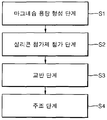
- FIG. 1 is a flow chart showing an embodiment of a method for producing a magnesium mother alloy added to the molten aluminum in the manufacture of an aluminum alloy according to the present invention.
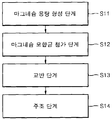
- Figure 4 is a flow chart showing an embodiment of a method of manufacturing an aluminum alloy according to the present invention.
- 5a and 5b are the results of observing the microstructures of the experimental and comparative examples according to an embodiment of the present invention, respectively, under an optical microscope.
- 6A to 6D show the results of analyzing the components and shapes of the magnesium-silicon compound of the experimental example.
- Figure 7 shows a magnesium-silicon state diagram
- the aluminum alloy according to the present invention is prepared by adding a silicon-based additive to pure magnesium or a magnesium alloy to prepare a mother alloy, and then adding the mother alloy to pure aluminum or an aluminum alloy.
- the mother alloy refers to an alloy prepared for addition into the molten metal provided in a subsequent step, and separately referred to as an alloy for a result prepared by adding the mother alloy.
- magnesium mother alloy in the present specification and claims refers to both using pure magnesium or magnesium alloy as a base material.
- a method of preparing a magnesium mother alloy includes a molten magnesium forming step (S1), a silicon-based additive addition step (S2), a stirring step (S3), and a casting step (S4).
- the magnesium molten metal forming step (S1) pure magnesium or a magnesium alloy is put into a crucible and heated to form magnesium molten metal.
- the heating temperature may be in the range of 400 to 800 °C as an example.
- the molten metal is formed at 600 ° C. or higher, but in the case of magnesium alloy, molten metal may be formed at 600 ° C. or lower, for example, 400 ° C. or higher, due to the lowering of the melting point that may appear due to alloying.
- Magnesium alloys used in the molten magnesium formation step (S1) are AZ91D, AM20, AM30, AM50, AM60, AZ31, AS41, AS31, AS21X, AE42, AE44, AX51, AX52, AJ50X, AJ52X, AJ62X, MRI153, MRI230, AM - May be any one selected from HP2, magnesium-Al, magnesium-Al-Re, magnesium-Al-Sn, magnesium-Zn-Sn, magnesium-Si, magnesium-Zn-Y and equivalents thereof. It is not intended to limit the invention. Typically any magnesium alloy that can be used in the industry can be used.
- a protective gas may be additionally provided as the molten metal in order to prevent ignition of the molten magnesium.
- the protective gas uses conventional SF6, SO2, CO2, HFC-134a, Novec TM 612, inert gas and its equivalents, or a mixture thereof, and can suppress ignition of the molten magnesium.
- the silicon-based additive is added to the magnesium molten metal.
- the silicon-based additive may be uniformly dispersed on the surface of the magnesium molten metal so as not to be mixed into the magnesium molten metal.
- the silicon-based additive thus added is sufficiently exhausted so that the silicon-based additive is substantially not remaining in the magnesium mother alloy prepared by casting magnesium molten metal in a subsequent step, and the silicon produced as a result of the exhaustion is substantially in the magnesium mother alloy.
- the reaction may be performed so as not to remain.
- the silicon decomposed from the added silicon-based additive may react with magnesium in the molten magnesium to form a magnesium-silicon compound (that is, a compound in which magnesium and silicon are chemically bonded to each other).
- a magnesium-silicon compound that is, a compound in which magnesium and silicon are chemically bonded to each other.
- Such magnesium-silicon compounds may comprise Mg 2 Si.
- Such a silicon-based additive may be a compound in which silicon is chemically bonded to another element as a member element, for example, silicon oxide (SiO 2 ).
- silicon oxide When silicon oxide is added as a silicon-based additive, it is decomposed into silicon and oxygen, and oxygen is discharged from the magnesium molten metal to the atmosphere in a gaseous state or suspended above the molten metal as dross or sludge.
- the decomposed silicon may react with magnesium to form the above-described magnesium-silicon compound.
- the silicone-based additive to be added is advantageous as the surface area is wider to improve reactivity, and therefore, it is advantageous to be added in powder form.
- the present invention is not limited thereto, and in order to prevent powder scattering, the powder may be added in a pellet form or in a bulk form.
- the size of the silicon-based additives added may be 0.1-500 ⁇ m, more strictly 0.1-200 ⁇ m.
- the size of the silicon-based additive is less than 0.1 ⁇ m is too fine to be scattered by the sublimated magnesium or hot air is difficult to enter the crucible.
- the aggregates form aggregates, they do not easily mix with the molten metal in the liquid phase. Such agglomerates become undesirable in view of the reduced surface area for the reaction.
- the size of the silicon-based additive exceeds 500 ⁇ m the surface area for the reaction is reduced, furthermore, the silicon-based additive may not react with the magnesium molten metal.
- the size of the silicone additive may be adjusted to 200 ⁇ m or less.
- all of the silicon-based additives may be added to a range not remaining as a silicon-based additive in the magnesium mother alloy.
- the silicon-based additive may be added in an amount of 0.001 to 30 wt%, more strictly 0.01 to 15 wt%. have.
- the silicon-based additive When the silicon-based additive is less than 0.001 wt%, the improvement of the mechanical properties of the magnesium alloy by adding the silicon-based additive is insignificant or hardly generated. In addition, when the silicon-based additive exceeds 30wt%, the original magnesium may not appear.
- the addition of the silicone-based additives may be carried out in a plurality of steps with a certain time difference after the necessary amount is added at a time or divided into appropriate amounts.
- the silicon additive to be added is a powder having fine particles, it is possible to promote the reaction of the silicon additive by lowering the possibility of agglomeration of the powder by adding a plurality of steps at a time difference.
- a stirring step (S3) of the molten magnesium may be performed. Stirring may begin simultaneously with the addition of the silicone-based additive or after the added silicone-based additive is heated to a constant temperature in the melt.
- the stirring can be further promoted by performing the reaction in the region of the upper layer of the magnesium molten metal, for example, 20% or less of the total depth of the magnesium molten metal from the surface of the magnesium molten metal.
- the time for stirring may vary depending on the temperature of the molten metal and the state of the injected powder, and until the added silicon-based additive is completely consumed in the molten metal and further, the silicon decomposed from the silicone-based additive reacts substantially. It can be stirred sufficiently.
- the magnesium mother alloy is produced through the casting step (S4) to put the magnesium molten metal in a mold to solidify.
- the temperature of the mold in the casting step (S4) may have a temperature range of room temperature (for example, 25 °C) to 400 °C.
- the mother alloy can be separated from the mold after cooling the mold to room temperature, but even when the mother alloy is solidified before the room temperature, the mother alloy can be separated from the mold.
- the mold may use any one selected from a mold, a ceramic mold, a graphite mold, and an equivalent thereof.
- casting methods include sand casting, die casting, gravity casting, continuous casting, low pressure casting, squeeze casting, lost wax casting, thixo casting, and the like.
- Gravity casting may refer to a method of injecting a molten alloy into the mold using gravity
- low pressure casting may refer to a method of injecting molten metal into the mold by applying pressure to the molten surface of the molten alloy using gas.
- Thixocasting is a casting technique in a semi-melt state that combines the advantages of conventional casting and forging.
- the present invention does not limit the type of mold and the manner of casting.
- Magnesium-silicon compounds produced in the process of manufacturing the master alloy may exist at the base of the magnesium master alloy thus prepared.
- the magnesium-silicon compound may be formed by reacting silicon decomposed from the silicon-based additive added to the magnesium molten metal as described above with magnesium.
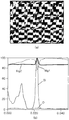
- FIG. 2A shows the results of observing the particulates distributed at the matrix of the magnesium mother alloy prepared by the above-described method with a scanning electron microscope
- FIGS. 2B and 2C show the results of analyzing the components along a straight line shown in FIG. 2A.
- the particulate form is a magnesium-silicon compound composed of magnesium and silicon from the fact that the detected concentration of magnesium (Mg1 in FIG. 2B) is different from the known magnesium (Mg2 in FIG. 2B) detection concentration.
- FIG. 3A shows the microstructure of the magnesium mother alloy observed using back scattering electrons
- FIGS. 3B to 3D show the mapping of the magnesium, silicon and oxygen, respectively, as a result of mapping to EPMA. The results shown.
- the phase is a compound consisting of magnesium and silicon. That is, it can be seen that the magnesium-silicon compound produced by the reaction of the silicon separated from the silicon-based additive of the magnesium mother alloy prepared by the above-described method with magnesium is distributed.
- the magnesium-silicon compound may be Mg 2 Si, an intermetallic compound shown in the magnesium-silicon state diagram shown in FIG. 7.
- the magnesium master alloy thus prepared may be added back to the molten aluminum during casting of the aluminum alloy.
- the magnesium mother alloy includes a magnesium-silicon compound formed by reaction of the silicon supplied from the silicon-based additive added in the casting process with magnesium.
- Such magnesium-silicon compounds can have a significantly higher melting point compared to aluminum.
- Mg 2 Si has a melting point of 1120 ° C., which is significantly higher than that of aluminum (658 ° C.).
- the magnesium mother alloy containing the magnesium-silicon compound having such a high melting point when added to the molten aluminum, the magnesium-silicon compound may be maintained without melting in the aluminum molten metal. Therefore, the magnesium-silicon compound may be distributed on the base of the aluminum alloy manufactured by casting the molten aluminum. In this case, even if the aluminum alloy is not heat treated separately, the effect of distributing the magnesium-silicon compound in the aluminum base can be obtained.
- Method for producing an aluminum alloy comprises the steps of providing a magnesium mother alloy and aluminum containing a magnesium-silicon compound, forming a molten magnesium alloy and aluminum melt and casting the molten metal It includes a step.
- the aluminum in order to form the molten magnesium alloy and the molten aluminum melted, first, the aluminum may be melted to form an aluminum molten metal, and the molten magnesium alloy may be formed by adding and dissolving a magnesium mother alloy containing a magnesium-silicon compound.
- the aluminum and the magnesium master alloy may be formed by mounting them together in a melting apparatus such as a crucible and then melting them by heating.
- FIG. 4 is a flowchart of a method of manufacturing an aluminum alloy using a method of forming an aluminum molten metal first and then adding and dissolving the magnesium mother alloy prepared by the method described above.
- the aluminum alloy manufacturing method includes a molten aluminum forming step (S11), magnesium master alloy addition step (S12), stirring step (S13) and casting step (S14).
- the aluminum is placed in a crucible and heated in a range of 600 to 900 ° C. to form aluminum molten metal.
- Aluminum in the molten aluminum forming step (S11) means pure aluminum or aluminum alloy.
- the aluminum alloy is, for example, 1000 series, 2000 series, 3000 series, 4000 series, 5000 series, 6000 series, 7000 series and 8000 series plastic processing aluminum or 100 series, 200 series, 300 series, 400 series, 500 series It may be any one selected from 700 series cast aluminum.
- the magnesium master alloy addition step (S12) the magnesium master alloy prepared by the method described above is added to the aluminum molten metal.
- the magnesium mother alloy used in the magnesium mother alloy addition step (S12) may be added in the range of 0.0001 to 30wt%. If the added magnesium master alloy is less than 0.0001wt%, the effect of adding the magnesium master alloy may be small. In addition, when the magnesium mother alloy exceeds 30wt%, the original aluminum alloy may not appear. In this case, the magnesium master alloy may be added in the form of a bulk, but the present invention is not limited thereto, and may have other forms such as powder form and granule form.
- the magnesium-silicon compound included in the magnesium master alloy is also provided in the molten aluminum.
- a small amount of protective gas may be additionally provided to prevent oxidation of the magnesium mother alloy.
- the protective gas may use conventional SF6, SO2, CO2, HFC-134a, Novec TM 612, inert gas and equivalents thereof, or a mixed gas thereof, thereby inhibiting oxidation of the magnesium master alloy.
- the stirring step (S13) may be performed to sufficiently mix the magnesium mother alloy in the molten aluminum.
- the aluminum molten metal is poured into the mold and then the casting step (S14) of solidification is performed.
- the temperature of the mold in the casting step (S14) may have a temperature range of room temperature to 400 °C.
- the aluminum alloy may be separated from the mold after cooling the mold to room temperature, but even when the aluminum alloy is solidified even before the room temperature, the aluminum alloy may be separated from the mold.
- the aluminum alloy prepared according to the casting method according to the present invention already distributes the magnesium-silicon compound, for example, Mg 2 Si, even if the aluminum base is not heat-treated separately. That is, the magnesium-silicon compound contained in the magnesium mother alloy added to the aluminum molten metal is maintained in the molten metal and then formed as a separate phase in the aluminum base during the casting of the aluminum alloy.
- the magnesium-silicon compound contained in the magnesium mother alloy added to the aluminum molten metal is maintained in the molten metal and then formed as a separate phase in the aluminum base during the casting of the aluminum alloy.
- the aluminum base may have a plurality of regions that form a boundary and are separated from each other.
- the magnesium-silicon compound may exist within the boundary or region.
- the plurality of regions separated from each other may be a plurality of grains typically divided into grain boundaries, and as another example, the plurality of regions may be a plurality of phase regions defined by two or more different phase boundaries.
- the magnesium-silicon compound may be distributed in the grain boundary or the phase boundary.
- the magnesium-silicon compound acts as an obstacle of grain boundary or the boundary boundary, thereby inhibiting the movement of the grain boundary or the boundary boundary, thereby reducing the average size of the grain or the boundary boundary.
- the magnesium-silicon compound may provide a place where nucleation takes place in the course of the aluminum alloy ascending from the liquid phase to the solid phase. That is, the magnesium-silicon compound transitions from the liquid phase to the solid phase during the solidification of the aluminum alloy is made in terms of nucleation and growth, wherein the magnesium-silicon compound itself functions as a heterogeneous nucleation site. Therefore, the nucleation for the transition of the magnesium-silicon compound and the liquid phase into the solid phase preferentially occurs. The nucleated solid phase grows around the magnesium-silicon compound.
- the magnesium-silicon compound When the magnesium-silicon compound is distributed in a large number, the solid phases grown at the interface of each magnesium-silicon compound meet each other to form a boundary, and the boundary thus formed may form a grain boundary or a phase boundary. Therefore, when the magnesium-silicon compound functions as a nucleation site, the magnesium-silicon compound is present inside the grains or the phase region, and the grains or the phase region are finer than in the case where the magnesium-silicon compound is not present. Will be displayed.
- the magnesium-silicon compound may have a finer and smaller grain or phase region size on average than the aluminum alloy does not exist.
- the miniaturization of grains or phase regions due to such magnesium-silicon compounds may bring about an effect of improving mechanical properties such as strength, toughness, and elongation of the aluminum alloy.
- the magnesium-silicon compound when the magnesium-silicon compound is dispersed and distributed in the form of fine particles in the aluminum alloy, the magnesium-silicon compound is an intermetallic compound, which is a higher strength material than the known aluminum, and the strength of the aluminum alloy is due to the dispersion distribution of the high strength material. Can be increased.
- Experimental Example is an aluminum alloy prepared by adding a magnesium mother alloy containing a magnesium-silicon compound according to the production method of the present invention, while a comparative example is an aluminum alloy prepared by adding only magnesium. Both experimental and comparative examples were produced by casting in a billet-shaped mold. At this time, the experimental example was prepared by adding 5wt% magnesium master alloy to pure aluminum, wherein the magnesium master alloy was prepared by adding 0.5wt% of silicon oxide as pure silicon additive. Comparative Example was prepared by adding 5wt% pure magnesium to pure aluminum.
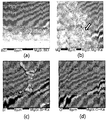
- 5A and 5B show microstructure results of observing experimental and comparative examples with an optical microscope, respectively. 5A and 5B, it can be seen from the experimental example that the magnesium-silicon compound particles (arrows) are distributed in the matrix.
- FIG. 6A shows the microstructure of the aluminum alloy observed using back scattering electrons
- FIGS. 6B to 6D show the mapping of EPMA to the distribution of aluminum, magnesium, silicon and oxygen, respectively. Is the result.
- FIG. 6B A portion A of FIG. 6B is a region in which a detection signal of aluminum is very low and substantially no aluminum component is present. 6C and 6D, it can be seen that the detection signals of magnesium and silicon are very high in the same region as region A of FIG. 6B, while oxygen is not detected at all, as shown in FIG. 6E.
- magnesium-silicon compound is distributed in the matrix of the cast aluminum alloy according to the present invention even if heat treatment is not performed separately in the cast state.
- Table 1 shows the average hardness values of the experimental and comparative examples.
- the average hardness value was obtained by using a Rockwell hardness tester and a Brennel hardness tester to measure two to six places on the surface of the cast billet and to measure the hardness. Referring to Table 1, it can be seen that the hardness values measured using the Rockwell hardness tester and the Brennel hardness tester were all higher than those of the comparative example.
Landscapes
- Chemical & Material Sciences (AREA)
- Engineering & Computer Science (AREA)
- Mechanical Engineering (AREA)
- Materials Engineering (AREA)
- Metallurgy (AREA)
- Organic Chemistry (AREA)
- Silicon Compounds (AREA)
- Manufacture And Refinement Of Metals (AREA)
- Continuous Casting (AREA)
- Moulds For Moulding Plastics Or The Like (AREA)
- Refinement Of Pig-Iron, Manufacture Of Cast Iron, And Steel Manufacture Other Than In Revolving Furnaces (AREA)
- Molds, Cores, And Manufacturing Methods Thereof (AREA)
Abstract
La présente invention concerne un alliage d'aluminium et son procédé de fabrication, dans lequel les propriétés mécaniques de l'alliage sont améliorées par dispersion d'un composé magnésium-silicium dans une base d'aluminium, sans mise en œuvre d'un traitement thermique. Un aspect de la présente invention fournit un procédé de fabrication d'un alliage d'aluminium comprenant les étapes consistant à : former une masse fondue par fusion d'aluminium et d'un alliage mère de magnésium comprenant un composé magnésium-silicium ; et couler la masse fondue.
Priority Applications (1)
| Application Number | Priority Date | Filing Date | Title |
|---|---|---|---|
| US14/119,084 US9657376B2 (en) | 2011-05-20 | 2012-05-16 | Aluminum alloy and production method thereof |
Applications Claiming Priority (2)
| Application Number | Priority Date | Filing Date | Title |
|---|---|---|---|
| KR1020110048189A KR101340292B1 (ko) | 2011-05-20 | 2011-05-20 | 알루미늄 합금 및 그 제조방법 |
| KR10-2011-0048189 | 2011-05-20 |
Publications (2)
| Publication Number | Publication Date |
|---|---|
| WO2012161459A2 true WO2012161459A2 (fr) | 2012-11-29 |
| WO2012161459A3 WO2012161459A3 (fr) | 2013-01-24 |
Family
ID=47217860
Family Applications (1)
| Application Number | Title | Priority Date | Filing Date |
|---|---|---|---|
| PCT/KR2012/003843 Ceased WO2012161459A2 (fr) | 2011-05-20 | 2012-05-16 | Alliage d'aluminium et son procédé de fabrication |
Country Status (3)
| Country | Link |
|---|---|
| US (1) | US9657376B2 (fr) |
| KR (1) | KR101340292B1 (fr) |
| WO (1) | WO2012161459A2 (fr) |
Cited By (1)
| Publication number | Priority date | Publication date | Assignee | Title |
|---|---|---|---|---|
| US20140202284A1 (en) * | 2011-05-20 | 2014-07-24 | Korea Institute Of Industrial Technology | Magnesium-based alloy produced using a silicon compound and method for producing same |
Families Citing this family (2)
| Publication number | Priority date | Publication date | Assignee | Title |
|---|---|---|---|---|
| KR102449704B1 (ko) * | 2018-02-26 | 2022-09-30 | 한국생산기술연구원 | 마그네슘 모합금 및 알루미늄 합금의 제조방법 |
| JP7383582B2 (ja) * | 2020-07-29 | 2023-11-20 | Dowaメタルテック株式会社 | アルミニウム-セラミックス接合基板およびその製造方法 |
Family Cites Families (5)
| Publication number | Priority date | Publication date | Assignee | Title |
|---|---|---|---|---|
| US5178686A (en) * | 1988-12-20 | 1993-01-12 | Metallgesellschaft Aktiengesellschaft | Lightweight cast material |
| MX9201015A (es) * | 1991-03-07 | 1992-09-01 | Kb Alloys Inc | Endurecedor para aleaciones patron y metodo para su preparacion. |
| JPH11323456A (ja) | 1998-05-08 | 1999-11-26 | Kobe Steel Ltd | アルミニウム合金鋳塊の製造方法 |
| TW200530406A (en) | 2003-12-26 | 2005-09-16 | Nippon Light Metal Co | Method for producing Al-Mg-Si based aluminum alloy plate excellent in bake-hardenability |
| KR101133775B1 (ko) | 2009-09-21 | 2012-08-24 | 한국생산기술연구원 | 마그네슘 모합금, 이의 제조 방법, 이를 이용한 금속 합금, 및 이의 제조 방법 |
-
2011
- 2011-05-20 KR KR1020110048189A patent/KR101340292B1/ko active Active
-
2012
- 2012-05-16 US US14/119,084 patent/US9657376B2/en active Active
- 2012-05-16 WO PCT/KR2012/003843 patent/WO2012161459A2/fr not_active Ceased
Cited By (2)
| Publication number | Priority date | Publication date | Assignee | Title |
|---|---|---|---|---|
| US20140202284A1 (en) * | 2011-05-20 | 2014-07-24 | Korea Institute Of Industrial Technology | Magnesium-based alloy produced using a silicon compound and method for producing same |
| US9447482B2 (en) * | 2011-05-20 | 2016-09-20 | Korea Institute Of Industrial Technology | Magnesium-based alloy produced using a silicon compound and method for producing same |
Also Published As
| Publication number | Publication date |
|---|---|
| KR101340292B1 (ko) | 2013-12-11 |
| WO2012161459A3 (fr) | 2013-01-24 |
| KR20120129716A (ko) | 2012-11-28 |
| US9657376B2 (en) | 2017-05-23 |
| US20140086790A1 (en) | 2014-03-27 |
Similar Documents
| Publication | Publication Date | Title |
|---|---|---|
| WO2012161460A2 (fr) | Alliage d'aluminium et son procédé de fabrication | |
| JP5405115B2 (ja) | 結晶粒微細化母合金の製造方法 | |
| WO2011122785A2 (fr) | Alliage à base de magnésium pour haute température, et procédé de fabrication correspondant | |
| WO2011122784A2 (fr) | Alliage de magnésium pour température ambiante, et procédé de fabrication correspondant | |
| WO2011062447A2 (fr) | Alliage d'aluminium et son procédé de fabrication | |
| Kumar et al. | Grain refinement response of LM25 alloy towards Al–Ti–C and Al–Ti–B grain refiners | |
| WO2011062448A2 (fr) | Alliage d'aluminium et son procédé de fabrication | |
| CN114150171A (zh) | 铝合金及其制备方法 | |
| EP2885437A1 (fr) | Alliage mère d'al-nb-b pour l'affinage du grain | |
| WO2012161463A2 (fr) | Procédé de fabrication d'un alliage et alliage fabriqué au moyen dudit procédé | |
| JP2013204087A (ja) | 高強度高熱伝導性アルミニウム合金部材とその製造方法 | |
| WO2012161484A2 (fr) | Alliage à base de magnésium obtenu à l'aide d'un composé de silicium et son procédé de production | |
| Gan et al. | Synchronous improvement in thermal conductivity and mechanical properties of Al–7Si–0.6 Fe–0.5 Zn cast alloy by B/La/Sr composite modification | |
| WO2012161461A2 (fr) | Alliage d'aluminium et son procédé de fabrication | |
| WO2012053813A2 (fr) | Alliage d'aluminium ayant une résistance à l'oxydation, une résistance à la corrosion, ou une résistance à l'usure améliorée, matériau moulé sous pression et matériau extrudé obtenu à partir dudit alliage d'aluminium | |
| KR101340292B1 (ko) | 알루미늄 합금 및 그 제조방법 | |
| WO2012134243A2 (fr) | Alliage maître à base de mg-al-ca pour des alliages de mg, et procédé de production de celui-ci | |
| WO2018117713A1 (fr) | Alliage de magnésium de résistance élevée présentant une excellente ininflammabilité, et son procédé de production | |
| CN103981416A (zh) | 一种Mg-Zn-RE-Zr系镁合金及其制备方法 | |
| WO2016117768A1 (fr) | Procédé de fabrication de billette d'alliage de magnésium pour traitement plastique et procédé de fabrication d'alliage de magnésium corroyé à haute résistance comprenant celui-ci | |
| WO2013157903A1 (fr) | Alliage d'aluminium et procédé de fabrication de ce dernier | |
| WO2012161397A1 (fr) | Métal d'apport pour le soudage d'aluminium et son procédé de fabrication | |
| CN101437970A (zh) | 压铸用Zn合金及其制造方法、压铸合金用Al母合金 | |
| CN111961899B (zh) | 使用Al-Zr中间合金除去镁合金中杂质铁的方法 | |
| CN104903480A (zh) | 锌合金及其制备方法 |
Legal Events
| Date | Code | Title | Description |
|---|---|---|---|
| 121 | Ep: the epo has been informed by wipo that ep was designated in this application |
Ref document number: 12790068 Country of ref document: EP Kind code of ref document: A2 |
|
| NENP | Non-entry into the national phase |
Ref country code: DE |
|
| WWE | Wipo information: entry into national phase |
Ref document number: 14119084 Country of ref document: US |
|
| 122 | Ep: pct application non-entry in european phase |
Ref document number: 12790068 Country of ref document: EP Kind code of ref document: A2 |