WO2012165131A1 - Nouveau microorganisme marin et procédé de production de polyhydroxyalcanoate - Google Patents
Nouveau microorganisme marin et procédé de production de polyhydroxyalcanoate Download PDFInfo
- Publication number
- WO2012165131A1 WO2012165131A1 PCT/JP2012/062308 JP2012062308W WO2012165131A1 WO 2012165131 A1 WO2012165131 A1 WO 2012165131A1 JP 2012062308 W JP2012062308 W JP 2012062308W WO 2012165131 A1 WO2012165131 A1 WO 2012165131A1
- Authority
- WO
- WIPO (PCT)
- Prior art keywords
- vibrio
- pha
- structural unit
- following formula
- unit represented
- Prior art date
- Legal status (The legal status is an assumption and is not a legal conclusion. Google has not performed a legal analysis and makes no representation as to the accuracy of the status listed.)
- Ceased
Links
Images


Classifications
-
- C—CHEMISTRY; METALLURGY
- C12—BIOCHEMISTRY; BEER; SPIRITS; WINE; VINEGAR; MICROBIOLOGY; ENZYMOLOGY; MUTATION OR GENETIC ENGINEERING
- C12N—MICROORGANISMS OR ENZYMES; COMPOSITIONS THEREOF; PROPAGATING, PRESERVING, OR MAINTAINING MICROORGANISMS; MUTATION OR GENETIC ENGINEERING; CULTURE MEDIA
- C12N1/00—Microorganisms; Compositions thereof; Processes of propagating, maintaining or preserving microorganisms or compositions thereof; Processes of preparing or isolating a composition containing a microorganism; Culture media therefor
- C12N1/20—Bacteria; Culture media therefor
-
- C—CHEMISTRY; METALLURGY
- C12—BIOCHEMISTRY; BEER; SPIRITS; WINE; VINEGAR; MICROBIOLOGY; ENZYMOLOGY; MUTATION OR GENETIC ENGINEERING
- C12N—MICROORGANISMS OR ENZYMES; COMPOSITIONS THEREOF; PROPAGATING, PRESERVING, OR MAINTAINING MICROORGANISMS; MUTATION OR GENETIC ENGINEERING; CULTURE MEDIA
- C12N1/00—Microorganisms; Compositions thereof; Processes of propagating, maintaining or preserving microorganisms or compositions thereof; Processes of preparing or isolating a composition containing a microorganism; Culture media therefor
- C12N1/20—Bacteria; Culture media therefor
- C12N1/205—Bacterial isolates
-
- C—CHEMISTRY; METALLURGY
- C12—BIOCHEMISTRY; BEER; SPIRITS; WINE; VINEGAR; MICROBIOLOGY; ENZYMOLOGY; MUTATION OR GENETIC ENGINEERING
- C12P—FERMENTATION OR ENZYME-USING PROCESSES TO SYNTHESISE A DESIRED CHEMICAL COMPOUND OR COMPOSITION OR TO SEPARATE OPTICAL ISOMERS FROM A RACEMIC MIXTURE
- C12P7/00—Preparation of oxygen-containing organic compounds
- C12P7/62—Carboxylic acid esters
- C12P7/625—Polyesters of hydroxy carboxylic acids
-
- C—CHEMISTRY; METALLURGY
- C12—BIOCHEMISTRY; BEER; SPIRITS; WINE; VINEGAR; MICROBIOLOGY; ENZYMOLOGY; MUTATION OR GENETIC ENGINEERING
- C12R—INDEXING SCHEME ASSOCIATED WITH SUBCLASSES C12C - C12Q, RELATING TO MICROORGANISMS
- C12R2001/00—Microorganisms ; Processes using microorganisms
- C12R2001/01—Bacteria or Actinomycetales ; using bacteria or Actinomycetales
- C12R2001/63—Vibrio
Definitions
- the present invention relates to a novel marine bacterium Vibrio genus having bioplastic production ability.
- the present invention also relates to a method for producing bioplastic (polyhydroxyalkanoate) using the marine bacteria.
- the present invention further relates to a novel bioplastic.
- P (3HB) Poly [(R) -3-hydroxybutyrate]
- PHAs poly (hydroxyalkanoates)
- P (3HB) Poly [(R) -3-hydroxybutyrate]
- PHAs poly (hydroxyalkanoates)
- P (3HB) the most widely known among PHA, is one of the most studied bio-based biodegradable plastics, and its properties have also been extensively studied.
- ⁇ P (3HB) was initially recognized as a hard and brittle material and is not compatible with polyethylene or polystyrene. Identifying hydroxyalkanoate (HA) units other than (R) -3-hydroxybutyrate (3HB) units as constituents of microbial storage polyesters has a strong impact on the research and development of this type of microbial polyester This is because the mechanical and thermal properties can be changed by incorporating different HA units into P (3HB) (Non-patent Documents 4 and 5). Its mechanical properties have recently been improved by using a new stretching technique, which has resulted in a tensile strength of 1.32 GPa, an elongation at break of 31%, and a Young's modulus of 8.1 GPa when pulled.
- Non-patent document 6 These mechanical properties of PHA are comparable to those of industrial grade polyethylene, polystyrene and poly (glycolic acid) used for surgical suturing. Therefore, PHA is a fairly attractive material with respect to environmental impact, carbon dioxide emissions and mechanical strength.
- Typical PHA synthesis genes such as genes from Ralstonia eutropha are present in operons including ⁇ -ketothiolase (phaA), acetoacetyl-coenzyme (CoA) reductase (phaB) and synthase (phaC).
- the thiolase and reductase synthesize 3-hydroxybutyl CoA (3HBCoA), which is a monomer substrate, and the synthase polymerizes the monomer into PHA.
- Other proteins involved in PHA synthesis are intracellular PHA depolymerase, fasine protein and regulatory protein, which are often encoded in the vicinity of phaA, phaB and phaC.
- the phaJ and fabG genes encoding (R) -specific 2-enoyl-CoA hydratase and 3-ketoacyl-acyl carrier protein (ACP) reductase are also 3-enoyl-CoA, respectively.
- 3-ketoacyl-CoA is known to function to convert (R) -3-hydroxy-CoA (Non-patent Documents 7 and 8).
- the substrate specificity of the synthase PhaC differs among various PHA synthases that affect the monomer composition of the final product PHA copolymer (Non-patent Document 9).
- Non-patent Document 10 Bacillus megaterium as a microbial storage polyester
- many types of bacteria such as Bacillus spp., Pseudomonas spp., Cupriavidus spp., Aeromonas spp., Etc.
- PHA Bacillus megaterium
- many types of bacteria such as Bacillus spp., Pseudomonas spp., Cupriavidus spp., Aeromonas spp., Etc.
- Studies have been conducted on the use of these bacteria (Non-Patent Documents 11 to 14).
- a few species of marine bacteria have also been studied for the production of PHA under marine conditions, but the resulting PHA has not been characterized in detail (Non-Patent Documents 15-17).
- the benefits of biosynthesizing PHA under marine conditions include avoiding contamination by bacteria that lack seawater resistance, and the ability to use filtered seawater as a culture medium, thus enabling industrial PHA production on a large scale It is included.
- a further possible advantage is that some marine bacteria, such as recombinant Alcanivorax borkumensis, can produce PHA extracellularly, thereby simplifying the industrial process of producing PHA (Non-patent Document 18).
- marine bacteria have recently attracted attention as candidates for producing practical substances from marine ecosystems including the oceanic carbon dioxide cycle (Non-Patent Documents 19 to 21).
- Vibrio species such as V. cholerae, V. parahaemolyticus and V. vulnificus This is because it contains various human pathogens.
- Virio species such as V. cholerae, V. parahaemolyticus and V. vulnificus
- V. fischeri several Vibrio species such as V. fischeri have not shown pathogenicity.
- PHA production ability V. harveyi has been shown to form PHA granules at high cell density during the development of luminescence (Non-patent Document 22).
- the object of the present invention is to provide a novel marine bacterium having a bioplastic producing ability, which is different from V. harveyi.
- the present invention also aims to provide a method for producing bioplastic using the marine bacteria.
- the present invention further aims to provide a novel bioplastic.
- the present invention has the following features.
- a Vibrio genus bacterium having the following properties (a) and (b): (a) Closely related to Vibrio sp. Ex25 in phylogenetic classification based on 16S rDNA sequence (b) Poly (3-hydroxybutyrate) homologues under aerobic conditions when the bacteria are cultured in an inorganic salt medium containing 15-20 g / L NaCl using soybean oil as the single carbon source. Producing a polymer, while producing a poly (hydroxyalkanoate) copolymer comprising 3-hydroxybutyrate units, 3-hydroxypropionate units, and 5-hydroxyvalerate units under aerobic-anaerobic conditions be able to
- the bacterium may produce a poly (3-hydroxybutyrate) homopolymer under aerobic conditions or aerobic-anaerobic conditions. Vibrio genus bacteria according to (1) above.
- Vibrio spsp KN01-5 (deposit number NITE BP-1101) or a Vibrio genus bacterium according to (1) or (2) above, which is a mutant strain having the properties (a) and (b) above.
- a method for producing polyhydroxyalkanoate comprising culturing the Vibrio genus bacterium according to any one of (1) to (3) above.
- the culture is carried out using one or more substances selected from the group consisting of sugars, sugar acids, fatty acids and fats and oils as a carbon source, according to any one of (4) to (6) above the method of.
- fatty acid is a saturated fatty acid, an unsaturated fatty acid, or a mixture thereof.
- a polyhydroxyalkanoate copolymer comprising a structural unit represented by the following formula (a), a structural unit represented by the following formula (b), and a structural unit represented by the following formula (c). (In the formula, R is an alkyl group, and n is 4 or 6.)
- a polyhydroxyalkano having at least a structural unit represented by the following formula (a) and a structural unit represented by the following formula (c), wherein the composition ratio of the structural unit (a) is 70 to 95% Ate copolymer.
- R is an alkyl group, and n is 4 or 6.
- the present invention relates to a novel Vibrio genus bacterium that produces polyhydroxyalkanoate isolated from seawater, and bioplastics can be produced by using this bacterium.
- seawater can be used as a medium at that time, and by limiting the dissolved oxygen concentration, the mechanical properties and / or the thermal properties are improved, such as polyhydroxyalkanoate copolymers composed of a plurality of different monomer units, etc.
- Bioplastics can be produced.
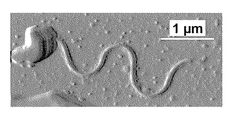
- An AFM amplitude image of Vibrio sp. KN01 5 strain supported on mica at 25 ° C in air is shown.
- the phylogenetic tree obtained by the neighbor binding analysis of 16S rDNA sequence is shown.
- This figure shows the location of Vibrio sp. KN01 5 isolated strain among other Vibrio spp.
- the bootstrap value is over 50%.
- the scale bar represents 0.01 nucleotide substitutions per site.
- 1 shows the 1 H-NMR spectrum of P (3HB) produced from an isolated strain using soybean oil as the single carbon source under anaerobic conditions.
- the numbers described in the structural formula indicate the peak positions of hydrogen atoms.
- the present invention relates to a novel Vibrio genus bacterium that produces a poly (hydroxyalkanoate) polymer (sometimes referred to as “PHA”) isolated from seawater (ie, derived from the ocean).
- PHA poly (hydroxyalkanoate) polymer isolated from seawater (ie, derived from the ocean).
- the Vibrio bacterium of the present invention is characterized by having the following properties (a) and (b).
- the term “related” is preferably 90% to 94% or more, more preferably 95% to 98% or more, and further preferably 99% to 99.5%, when comparing 16S rDNA sequences between bacteria. Used when the sequence identity is as described above. Sequence identity is expressed as a percentage (%) of the number of identical nucleotides relative to the total number of nucleotides, including gaps, when the two sequences are aligned for maximum agreement. Identity can be determined, for example, by utilizing the BLAST algorithm (Altschul et al., 1990).
- the bacterium of the present invention can further have the following property (c).
- the present inventors are a novel Gram-negative Vibrio genus bacterium that is different from V. harveyi from seawater collected at Akajima Hizushi Beach in Okinawa Prefecture, Vibrio having the above properties (a), (b) and (c) Sp KN01N5 strain was found this time.
- Vibrio sp KN01 5 was deposited on May 12, 2011 at the Patent Evaluation Microorganism Deposit Center (NITE), National Institute of Technology and Evaluation (2-5-8, Kazusa Kamaashi, Kisarazu, Chiba, Japan) Deposit number NITE P-1101. This strain was transferred to an international deposit under the Budapest Treaty on May 10, 2012, and the deposit number NITE ⁇ BP-1101 (international deposit date, May 12, 2011) was assigned.
- Vibrio sp KN01 5 strain morphologically has a polar flagella and a curved rod-like (rod-like) shape (Fig. 1), Vibrio spp. Selection TCBS agar medium (see Examples below) Incubate at about 35 ° C to form large yellow colonies. This strain was also found to be most closely related to Vibrio sp. Ex25 as a result of 16S rDNA sequence analysis (Fig. 2).
- the Vibrio sp KN01 5 strain of the present invention is a kind of marine bacteria and can grow even under conditions of a high NaCl concentration of 10 g / L or more, for example, about 19.5 g / L.
- a normal marine bacterial culture medium Vibrio genus bacterial culture medium (TCBS Agar (for example, Fluka code No. 86348), Vibrio agar medium, etc.) and the like can be used.
- the Vibrio bacterium of the present invention is characterized by having at least the above properties (a) and (b), preferably at least the above properties (a), (b) and (c). Therefore, as long as it has such a property, the mutant strain having the properties (a) and (b) described above, which is obtained by subjecting the isolated strain Vibrio sp KN01 5 to mutation treatment, is also a Vibrio genus bacterium of the present invention. include.
- Mutations include irradiation of high energy rays such as ultraviolet rays (UV), methyl ethyl sulfonic acid (EMS), methyl methane sulfonic acid (MMS), N-methyl-N'-nitro-N-nitrosoguanidine (MNNG), etc. It can be performed by treating the strain on the medium for a certain period of time by a usual method such as contact with a chemical mutagenic agent.
- UV ultraviolet rays
- EMS methyl ethyl sulfonic acid
- MMS methyl methane sulfonic acid
- NNG N-methyl-N'-nitro-N-nitrosoguanidine
- the Vibrio genus bacterium of the present invention is an inorganic salt medium that is reduced or depleted with a nitrogen source and supplemented with a carbon source.
- PHA having a number average molecular weight ranging from about 50 to 150 ⁇ 10 3 , particularly poly ( 3-hydroxybutyrate) homopolymer can be produced.
- substances such as saccharides, fatty acids, oils and fats can be used as the carbon source.
- the bacterium of the present invention When the bacterium of the present invention is cultured under conditions controlled so as to gradually reduce the dissolved oxygen concentration (see below), that is, an aerobic-anaerobic condition, the bacterium becomes poly (3- (3) when saccharides are used as a carbon source. Hydroxybutyrate) homopolymers, but polyhydroxyalkanoate copolymers can be produced when fatty acids or fats are used as the carbon source.
- this copolymer may be, for example, 3-hydroxypropionate (3HP) units, 5-hydroxyvalerate (5HV) units, 3-hydroxyvalerate (3HV) units, 3 -Hydroxyhexanoate (3HH) units, 7-hydroxyheptanoate (7H0) units, and multiple (ie, two or more) HA units selected from the group consisting of other hydroxyalkanoate (HA) units Can be included.
- 3-HP 3-hydroxypropionate
- 5HV 5-hydroxyvalerate
- 3-HV 3-hydroxyvalerate
- 3HH 3 -Hydroxyhexanoate
- 7H0 7-hydroxyheptanoate
- multiple (ie, two or more) HA units selected from the group consisting of other hydroxyalkanoate (HA) units Can be included.
- soybean oil including linoleic acid, oleic acid, ⁇ -linoleic acid, palmitic acid, stearic acid
- a PHA copolymer with 3HB: 3HP: 5HV of 83: 14: 3 (mol%) is produced.
- the term “aerobic-anaerobic condition” means that the Vibrio bacterium of the present invention proliferates under both aerobic conditions with oxygen (air) and anaerobic conditions with oxygen (air) deficiency Although it can be carried out, it refers to a condition in which the culture is started under certain conditions of oxygen (air), and the dissolved oxygen concentration is gradually reduced as oxygen is consumed, for example, by sealing the culture system.
- the present invention also provides a method for producing bioplastic, comprising culturing the above-mentioned Vibrio genus bacteria to produce bioplastic, and collecting the plastic.
- the culture is a medium containing NaCl of about 3 g / L or more, preferably 10 g / L or more, more preferably 15 to 20 g / L or more, such as a medium containing seawater or artificial seawater or an inorganic salt medium. It is preferable to use a medium containing a carbon source but with a nitrogen source reduced or depleted more than usual.
- the medium may be, for example, an agar-based solid medium or a liquid medium, preferably a liquid medium.
- the seawater When seawater is contained in the medium, the seawater is filtered using a membrane filter to remove organic matter including microorganisms such as plankton, bacteria, mold, and yeast.
- a membrane filter to remove organic matter including microorganisms such as plankton, bacteria, mold, and yeast.
- compositions of the medium are 2.80 g / L KH 2 PO 4 , 3.32 g / L Na 2 HPO 4 , 0.54 g / L (NH 2 ) 2 CO, 0.25 g / L MgSO 4 ⁇ 7H 2 O, 19.45 g / L NaCl, 1.0 mL / L Trace element (0.22 g / L CoCl 2 ⁇ 6H 2 O, 9.70 g / L FeCl 3 , 7.80 g / L CaCl 2 , 0.12 g / L NiCl 2 ⁇ 6H 2 O, 0.11 g / L CrCl 3 ⁇ 6H 2 O, 0.16 g / L CuSO 4 ⁇ 5H 2 O).
- the pH of the medium is usually 6 to 8, preferably 7.0 to 7.4.
- Examples of the carbon source added to the medium include, but are not limited to, sugars, saturated or unsaturated fatty acids, oils and fats, sugar derivatives, fatty acid derivatives, and the like. These substances can be used alone or in any combination as a carbon source.
- saccharides include monosaccharides, disaccharides, oligosaccharides, polysaccharides, and the like, such as glucose, fructose, sucrose, lactose, maltose, and starch.
- fatty acids are saturated or unsaturated fatty acids such as butyric acid, caproic acid, caprylic acid, capric acid, lauric acid, myristic acid having 1 to 30 or more carbon atoms in the fatty chain portion, preferably 7 to 20 carbon atoms.
- fats and oils are animal fats and oils, vegetable fats and oils, examples of animal fats and oils are fish oil, beef tallow, pork fat and herring oil.
- vegetable fats and oils are soybean oil, rapeseed oil, sesame oil, corn oil, palm oil. , Jatropha oil, olive oil, cottonseed oil, coconut oil, castor oil, linseed oil, tung oil, and mixtures thereof.
- sugar derivatives are sugar acids such as gluconic acid.
- fatty acid derivatives are alkyl groups (methyl, ethyl, etc.), hydroxy groups, halogen groups (F, Cl, Br or I), phenyl groups, naphthyl groups, heterocyclic groups (eg furyl groups, thiophenyl groups, pyrrolyl groups). , Etc.) and the like, which contain an aryl group as a substituent. These functional groups may be further substituted with an arbitrary group.
- the concentration of the carbon source is 1 g / L to 40 g / L, preferably 15 g / L to 25 g / L, but is not limited to this range.
- the culture temperature is preferably in the range of about 20 ° C to about 40 ° C, more preferably about 25 ° C to 35 ° C.
- the culture time is not particularly limited, but is, for example, about 5 hours to 48 hours or more.
- Cultivation is performed under aerobic conditions or aerobic-anaerobic conditions. Under aerobic conditions, it may be in the air, and if necessary, ventilation is possible. In the aerobic-anaerobic condition, the condition can be set so that the dissolved oxygen concentration is reduced from about 20% in the initial stage of culture to about 5% in the final stage of culture, but this is only an example. If conditions for gradually reducing the density are set, the condition is not limited to the above range.
- the poly (3-hydroxybutyrate) homopolymer as a main component is used when the saccharides, sugar acids, fatty acids, fats and oils described above are used as the carbon source. 100%).
- PHA having a number average molecular weight in the range of about 110 to 120 ⁇ 10 3 can be produced.
- PHA having a smaller number average molecular weight for example, 50 to 60 ⁇ 10 3
- the yield of PHA is determined by the relationship between the weight of the growing cells and the PHA content in the cells, but suitable carbon sources that can further increase the PHA yield include sugar acids, fatty acids, vegetable oils, and the like.
- a poly (3-hydroxybutyrate) homopolymer as a main component (almost 100) is used when the saccharides, sugar acids and the like are used as a carbon source. %).
- the number average molecular weight of the PHA obtained is in the range of about 85-100 ⁇ 10 3 and is somewhat smaller than that obtained under aerobic conditions (see Table 1).
- the carbon source is a saccharide
- the PHA yield tends to increase compared to the aerobic condition.
- PHA copolymers mainly random copolymers
- the PHA copolymer includes, for example, a 3-hydroxypropionate (3HP) unit, a 5-hydroxyvalerate (5HV) unit, a 3-hydroxyvalerate (3HV) unit, Multiple (ie, two or more) HA units selected from the group consisting of 3-hydroxyhexanoate (3HH) units, 7-hydroxyheptanoate (7H0) units, and other hydroxyalkanoate (HA) units including.
- the ratio and position of each structural unit are not limited.
- One of the characteristics of the polymer obtained using the bacterium of the present invention is that it can produce a PHA copolymer containing 3HP units.
- the PHA polymer produced in the microbial cells as described above recovers the polymer after mechanically or chemically destroying the microbial cells.
- a chemical method includes a method using an enzyme such as lysozyme
- a physical method includes an ultrasonic treatment method, a method using a homogenizer, and a method using a French press. is there.
- the polymer can be recovered by, for example, dissolving it in an organic solvent that dissolves PHA such as chloroform and then adding a solvent insoluble in PHA such as hexane or methanol to cause polymer precipitation.
- Bioplastic The bioplastic produced by the above method, that is, the PHA polymer, can change the polymer unit composition depending on the type of carbon source added to the culture.
- the PHA copolymer can be produced under aerobic-anaerobic conditions.
- Such polymers are expected to be mechanically and / or thermally superior to P (3HB) homopolymers.
- the carbon source is soybean oil
- a polyHPA copolymer containing at least 3HB units, 3HP units, and 5HV units can be obtained, but the carbon source is changed to other fatty acids and fats and oils.
- 3HB units More characteristic 3HB units, 3HP units (this constituent unit may be present or absent), and a group consisting of 5HV units, 3HH units, 3HV units and 7HO units
- Biopolymers such as PHA copolymers composed of multiple (ie, two or more) other HA units selected from can be produced.
- the present invention provides the following PHA copolymers.
- a PHA copolymer comprising a structural unit represented by the following formula (a), a structural unit represented by the following formula (b), and a structural unit represented by the following formula (c).
- R is an alkyl group, and n is 4 or 6.
- composition ratio of the structural unit (a) is 70 to 95%, preferably 75 to 90%.
- a PHA copolymer In the formula, R is an alkyl group, and n is 4 or 6.
- the structural unit (a) is an R configuration in absolute configuration, and the alkyl group in the unit is saturated or unsaturated alkyl, and the number of carbons is not limited to the following, but for example, the number of carbons is 1 to 10, preferably Is 1-4, more preferably 1-3 (ie methyl, ethyl or propyl group).
- the arrangement or position of each structural unit is arbitrary and generally forms a random copolymer, but may be a block copolymer.
- the above PHA copolymer is not limited to the following, but the number average molecular weight is, for example, 40,000 to 200,000. Further, when mol% of the structural unit (a), the structural unit (b), and the structural unit (c) is x, y, z, respectively, or the structural unit (a), the structural unit (b), the structural unit ( When the mol% of c1) and structural unit (c2) is x, y, z1, and z2, respectively, the ratio of x: y: z or x: y: (z1 + z2) is as follows: Although not limited, for example, (70 to 90): (5 to 20): (1 to 10) or (70 to 95): (0 to 15): (1 to 15).
- the composition of MM is 2.80 g / L KH 2 PO 4 , 3.32 g / L Na 2 HPO 4 , 0.54 g / L (NH 2 ) 2 CO, 0.25 g / L MgSO 4 7H 2 O, 19.45 g / L NaCl And 1.0 mL / L trace elements (0.22 g / L CoCl 2 ⁇ 6H 2 O, 9.70 g / L FeCl 3 , 7.80 g / L CaCl 2 , 0.12 g / L NiCl 2 ⁇ 6H 2 O, 0.11 g / L CrCl 3 ⁇ Contains 6H 2 O and 0.16 g / L CuSO 4 .5H 2 O.) Accumulation of PHA was detected by Nile red staining under UV light and proved by 1 H nuclear magnetic resonance spectra ( 1 H-NMR) (Spiekermann et al., 1999).
- the accumulated PHA was extracted from the dried cells with chloroform at 70 ° C. for 72 hours, and purified by precipitation with hexane.
- the obtained PHA was dissolved in chloroform and purified by precipitation with methanol.
- the PHA content was determined based on the weight of purified PHA and the dry cell weight.
- PHA ⁇ Characteristics of PHA> Purified PHA was characterized for molecular weight and chemical structure. The molecular weight of PHA was measured by gel permeation chromatography (Shimadzu Corporation, Kyoto). PHA was analyzed by 1 H-NMR (JNM-Excalibur270; JEOL) to determine its exact chemical structure and composition.
- Genomic DNA was extracted from PHA-producing bacteria isolated from seawater as described above.
- the 16S rDNA gene was amplified based on the E. coli sequence using a universal primer set (Rainey and Stackebrandt, 1993).
- the DNA sequence of the plasmid was determined using a DNA sequencing service (RIKEN Brain Science Institute Research Resources Center Support Unit for Bio-Material Analysis, Saitama, Japan). All sequences were compared to sequences deposited in the GenBank DNA database using the BLAST algorithm (Altschul et al., 1990).
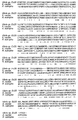
- the full-length sequence of 16S rDNA from KN01 strain 5 is shown as SEQ ID NO: 1 (1431 bp).
- a phylogenetic tree was constructed using the neighbor-joining method of Saitou and Nei (Saitou and Nei, 1987). Three topologies were tested by boost trap analysis with 1000 resampling. Photobacterium damselae subsp. was used as an out group.
- TCBS agar contains 5 g / L yeast extract, 5 g / L casein pancreatin digest, 5 g / L animal tissue peptin digest, 10 g / L sodium citrate, 10 g / L sodium thiosulfate, 3 g / L sodium cholate, 5g / L oxgall, 20g / L sucrose, 10g / L sodium chloride, 1g / L ferric citrate, 0.04g / L thymol blue, 0.04g / L bromo Contains thymol blue and 14 g / L agar (Kobayashi et al., 1963; Nakanishi, 1963).
- the strain also grew very well under marine conditions containing 19.45 g / L NaCl, but never seen in the case of Vibrio alginolyticus (Molitoris et al., 1985).
- AFM was observed to characterize the morphology of the strain, it had a curved rod-like (rod-like) shape with polar flagella (FIG. 1).
- the isolated PHA producing strain was identified as a member of Vibrio spp. And a phylogenetic tree was constructed using Vibrio spp. And other related strains ( Figure 2). This phylogenetic tree confirms that the 16S rDNA sequence of the isolated strain is highly similar to Vibrio sp.
- the isolated strain showed good cell growth (about 2.4 g / L) when soybean oil was used as the single carbon source, while cell growth with other carbon sources was relatively low, about 1.4-1.7. It was in the range of g / L. PHA accumulation is observed with all four carbon sources, and 1 H-NMR spectra show that all of these products are like medium chain length hydroxyalkanoates (HA), even with PHA from soybean oil. It consisted only of 3HB with no major second monomer unit (Figure 3). P (3HB) homopolymer production using vegetable oils such as soybean oil has been identified among PHA producing bacteria, including Pseudomonas spp. And Cupriavidus spp. (Cupriavidus necator is officially known as Ralstonia eutropha). It is a rare characteristic.
- the molecular weight and polydispersity index (PDI) of P (3HB) extracted from Vibrio sp. KN01 5 under various conditions were measured by GPC and listed in Table 1.
- the difference in molecular weight when using different carbon sources, ie sugars and fatty acids, is that the ⁇ -oxidation pathway has high enough activity and efficiency to convert fatty acids to acetyl-CoA under aerobic conditions. As a result, it was shown that there was almost no hydroxyacyl CoA (HACoA) polymerized to PHA.
- HACoA hydroxyacyl CoA
- the strains cultured under aerobic-anaerobic conditions showed approximately the same cell growth rate regardless of whether glucose, fructose or gluconate was used as the single carbon source, Cell growth with soybean oil was relatively low, and its dry cell weight (DCW) was about 0.4 g / L (Table 1).
- DCW dry cell weight
- PHA accumulation is observed under aerobic-anaerobic conditions using each of the four carbon sources, and the average PHA content of isolated strains cultured in soybean oil is significantly higher than that of natural bacteria It was over 40% by weight.
- the PHA content of all samples under aerobic-anaerobic conditions is 8 ⁇ 2 under such conditions by limiting the amount of dissolved oxygen, especially when soybean oil is used as the single carbon source. It increased from wt% (aerobic conditions) to 40 ⁇ 6 wt% (aerobic-anaerobic conditions) (Table 1). These weight% shows the ratio per total dry cell weight.
- PHA synthesized from soybean oil under aerobic-anaerobic conditions is based on 1 H-NMR spectra and is assigned 3-hydroxypropionate (3HP) and 5-hydroxyvalerate (5HV) in addition to 3HB (Fig. 4). Attribution is reduced by the lower amount of dissolved oxygen in the ⁇ -oxidation pathway under aerobic-anaerobic conditions according to the procedure described in the literature (Doi et al., 1987; Fukui et al., 2009).
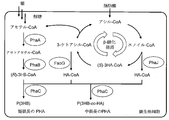
- the temporarily accumulated 3-ketoacyl-CoA and / or enoyl-CoA can then be converted to HACoA by 3-ketoacylacyl carrier protein (ACP) reductase (FabG) and / or enoyl-CoA hydratase (PhaJ). It shows that there was ( Figure 5).
- ACP 3-ketoacylacyl carrier protein
- FGS 3-ketoacylacyl carrier protein
- PhaJ enoyl-CoA hydratase
- KN01 5 in the 16S rDNA sequence has been shown to contain genes encoding FabG and PhaJ in addition to PhaA, PhaB and PhaC . Even under anaerobic conditions, the glycolytic pathway producing 3HB-CoA became active, resulting in PHA consisting of 3HB and HA units. The resulting HA monomer units (3HP and 5HV) had an odd number of carbon atoms.
- the main fatty acids in soybean oil are about 50% linoleic acid (C 17 H 31 COOH), 23% oleic acid (C 17 H 33 COOH), 7-10% ⁇ -linoleic acid (C 17 H 29 COOH) 10% palmitic acid (C 15 H 31 COOH) and 4% stearic acid (C 17 H 35 COOH).
- These fatty acids are metabolized inefficiently under aerobic-anaerobic conditions and can be converted to 3HPCoA and 5HVCoA via the ⁇ -oxidation pathway that liberates the two-carbon unit acetyl-CoA in each of the cycles (Fig. Five). This finding indicates that biosynthesis of long main chain PHA can be controlled by changing the activity of the ⁇ -oxidation pathway, which is also tunable by changing the dissolved oxygen concentration.
- PHA synthases which are important enzymes of PHA biosynthesis, fall into four classes with respect to primary structure (Rehm, 2003).
- V. cholera, V. parahaemolyticus and V. harveyi have been reported to be included in class I PHA synthases (Rehm, 2003; Sun et al., 1995).
- Vibrio sp. Ex25 which shows 99.9% similarity to Vibrio sp. KN01 5 strain with respect to the 16S rDNA sequence, has been shown to contain class I according to the revealed chromosomal sequence.
- Class I PhaC is composed of a single subunit with a molecular weight between 61 kDa and 68 kDa.
- PhaCs from R. eutropha and A. caviae are typical class I PhaCs, known to exhibit strict and broad substrate specificities, respectively (Fukui and Doi, 1997; Fukui et al ., 1999; Rehm, 2003).
- PhaC from A. caviae is one of the class I exceptional PhaCs because of its low similarity (about 45% sequence identity) to other class I PHA synthases (Steinbuchel et al , 1993; Liebergesell and Steinbuchel, 1993).
- the facultative anaerobe Vibrio sp. KN01 5 strain, produces PHA under aerobic and aerobic-anaerobic conditions when artificial seawater is used as the culture medium.
- the PHA content of all samples under aerobic-anaerobic conditions was increased by limiting the amount of dissolved oxygen, especially when using soybean oil as the single carbon source.
- PHA accumulated using soybean oil as a single carbon source under aerobic-anaerobic conditions contains 14% 3HP and 3% 5HV units in addition to 3HB units and has a number average molecular weight of 42 ⁇ 10 3 Had.
- a novel PHA such as a PHA copolymer containing multiple (ie, two or more) HAs selected from the group consisting of (HA) units in any ratio can be synthesized by adjusting anaerobic conditions .
- a novel PHA copolymer containing a plurality of (ie, two or more) HAs selected from the group consisting of (HA) units in any ratio can be produced.
- Table 2 below shows the biosynthesis results of the PHA copolymer by Vibrio sp. KN015 strain when oleic acid is used as the fatty acid and Jatropha oil is used as the fat and oil.
- a marine bacterium accumulates polyhydroxyalkanoate consisting of mainly 3-hydroxydodecanoate and 3-hydroxydecanoate. World J Microb Biot, 26: 1149-1153.
- the present invention provides a novel marine bacterium belonging to the genus Vibrio that can produce polyhydroxyalkanoates, and is therefore useful for producing characteristic bioplastics.
Landscapes
- Chemical & Material Sciences (AREA)
- Engineering & Computer Science (AREA)
- Life Sciences & Earth Sciences (AREA)
- Organic Chemistry (AREA)
- Health & Medical Sciences (AREA)
- Zoology (AREA)
- Wood Science & Technology (AREA)
- Genetics & Genomics (AREA)
- Bioinformatics & Cheminformatics (AREA)
- Biotechnology (AREA)
- General Health & Medical Sciences (AREA)
- Biochemistry (AREA)
- General Engineering & Computer Science (AREA)
- Microbiology (AREA)
- Medicinal Chemistry (AREA)
- Tropical Medicine & Parasitology (AREA)
- Virology (AREA)
- Biomedical Technology (AREA)
- Chemical Kinetics & Catalysis (AREA)
- General Chemical & Material Sciences (AREA)
- Micro-Organisms Or Cultivation Processes Thereof (AREA)
- Preparation Of Compounds By Using Micro-Organisms (AREA)
Abstract
La présente invention concerne : une bactérie appartenant au genre Vibrio, (a) qui est étroitement apparenté à Vibrio sp. Ex25 dans la classification systématique sur la base de séquences d'ADNr 16S et (b) qui peut produire un homopolymère poly(3-hydroxybutyrate) dans des conditions aérobies et peut produire un copolymère polyhydroxyalcanoate comprenant une unité 3-hydroxybutyrate, une unité 3-hydroxypropionate et une unité 5-hydroxyvalérate dans des conditions aérobies-anaérobies lorsque la bactérie est mise en culture dans un milieu de culture de sel inorganique contenant 15-20 g/L de NaCl à l'aide d'une huile de soja en tant que source unique de carbone; et un procédé de production d'un polyhydroxyalcanoate à l'aide de la bactérie.
Applications Claiming Priority (2)
| Application Number | Priority Date | Filing Date | Title |
|---|---|---|---|
| JP2011-119748 | 2011-05-27 | ||
| JP2011119748 | 2011-05-27 |
Publications (1)
| Publication Number | Publication Date |
|---|---|
| WO2012165131A1 true WO2012165131A1 (fr) | 2012-12-06 |
Family
ID=47258994
Family Applications (1)
| Application Number | Title | Priority Date | Filing Date |
|---|---|---|---|
| PCT/JP2012/062308 Ceased WO2012165131A1 (fr) | 2011-05-27 | 2012-05-14 | Nouveau microorganisme marin et procédé de production de polyhydroxyalcanoate |
Country Status (1)
| Country | Link |
|---|---|
| WO (1) | WO2012165131A1 (fr) |
Cited By (7)
| Publication number | Priority date | Publication date | Assignee | Title |
|---|---|---|---|---|
| JPWO2013035372A1 (ja) * | 2011-09-05 | 2015-03-23 | 独立行政法人理化学研究所 | 長主鎖構造を有するポリヒドロキシアルカン酸の製造方法 |
| CN111849808A (zh) * | 2020-07-06 | 2020-10-30 | 北京大学深圳研究院 | 海洋源产pha菌富集培养及接种、pcr扩增基因方法 |
| CN113088475A (zh) * | 2021-05-25 | 2021-07-09 | 北京化工大学 | 一种盐弧菌及其应用 |
| CN113265356A (zh) * | 2021-05-25 | 2021-08-17 | 北京化工大学 | 一种利用挥发性脂肪酸的盐弧菌及其应用 |
| JPWO2021193847A1 (fr) * | 2020-03-27 | 2021-09-30 | ||
| CN113832084A (zh) * | 2021-09-29 | 2021-12-24 | 北京化工大学 | 一种生产聚羟基脂肪酸酯的溶藻弧菌及其应用 |
| JPWO2022080282A1 (fr) * | 2020-10-12 | 2022-04-21 |
Citations (1)
| Publication number | Priority date | Publication date | Assignee | Title |
|---|---|---|---|---|
| JPH03224492A (ja) * | 1990-01-29 | 1991-10-03 | Showa Denko Kk | 共重合体およびその製造法 |
-
2012
- 2012-05-14 WO PCT/JP2012/062308 patent/WO2012165131A1/fr not_active Ceased
Patent Citations (1)
| Publication number | Priority date | Publication date | Assignee | Title |
|---|---|---|---|---|
| JPH03224492A (ja) * | 1990-01-29 | 1991-10-03 | Showa Denko Kk | 共重合体およびその製造法 |
Non-Patent Citations (2)
| Title |
|---|
| KEIJI NUMATA ET AL.: "Kaiyo Biseibutsu Vibrio sp. ni yoru Bio Plastic Seisan Oyobi sono Kanren Idenshi ni Kansuru Kenkyu", DAI 14 KAI JAPANESE SOCIETY FOR MARINE BIOTECHNOLOGY TAIKAI MARINE BIO SHIZUOKA 2011 KOEN YOSHISHU, 28 May 2011 (2011-05-28), pages 63 * |
| MIWA YAMADA ET AL.: "Cho Shusa Monomer Unit o Yusuru Polyhydroxyalkanoate no Biseibutsu Gosei", DAI 60 KAI THE SOCIETY OF POLYMER SCIENCE, 23 September 2011 (2011-09-23), pages 5245 - 5246 * |
Cited By (14)
| Publication number | Priority date | Publication date | Assignee | Title |
|---|---|---|---|---|
| JPWO2013035372A1 (ja) * | 2011-09-05 | 2015-03-23 | 独立行政法人理化学研究所 | 長主鎖構造を有するポリヒドロキシアルカン酸の製造方法 |
| JPWO2021193847A1 (fr) * | 2020-03-27 | 2021-09-30 | ||
| WO2021193847A1 (fr) * | 2020-03-27 | 2021-09-30 | 住友林業株式会社 | Procédé de production d'acide polyhydroxyalcanoïque mettant en oeuvre de l'eau de mer |
| CN115279913A (zh) * | 2020-03-27 | 2022-11-01 | 住友林业株式会社 | 使用海水的pha的制造方法 |
| CN111849808A (zh) * | 2020-07-06 | 2020-10-30 | 北京大学深圳研究院 | 海洋源产pha菌富集培养及接种、pcr扩增基因方法 |
| JPWO2022080282A1 (fr) * | 2020-10-12 | 2022-04-21 | ||
| US12600993B2 (en) | 2020-10-12 | 2026-04-14 | Kaneka Corporation | Method for producing poly(3-hydroxyalkanoate) |
| JP7804584B2 (ja) | 2020-10-12 | 2026-01-22 | 株式会社カネカ | ポリ(3-ヒドロキシアルカノエート)の製造方法 |
| CN113088475B (zh) * | 2021-05-25 | 2022-05-17 | 北京化工大学 | 一种盐弧菌及其应用 |
| CN113265356B (zh) * | 2021-05-25 | 2022-04-08 | 北京化工大学 | 一种利用挥发性脂肪酸的盐弧菌及其应用 |
| CN113265356A (zh) * | 2021-05-25 | 2021-08-17 | 北京化工大学 | 一种利用挥发性脂肪酸的盐弧菌及其应用 |
| CN113088475A (zh) * | 2021-05-25 | 2021-07-09 | 北京化工大学 | 一种盐弧菌及其应用 |
| CN113832084A (zh) * | 2021-09-29 | 2021-12-24 | 北京化工大学 | 一种生产聚羟基脂肪酸酯的溶藻弧菌及其应用 |
| CN113832084B (zh) * | 2021-09-29 | 2024-01-05 | 北京化工大学 | 一种生产聚羟基脂肪酸酯的溶藻弧菌及其应用 |
Similar Documents
| Publication | Publication Date | Title |
|---|---|---|
| Numata et al. | Biosynthesis of polyhydroxyalkanaotes by a novel facultatively anaerobic Vibrio sp. under marine conditions | |
| Moorkoth et al. | Production and characterization of poly (3-hydroxy butyrate-co-3 hydroxyvalerate)(PHBV) by a novel halotolerant mangrove isolate | |
| Abd El-malek et al. | Polyhydroxyalkanoates (PHA) from Halomonas pacifica ASL10 and Halomonas salifodiane ASL11 isolated from Mariout salt lakes | |
| Chien et al. | Production of poly-β-hydroxybutyrate (PHB) by Vibrio spp. isolated from marine environment | |
| WO2012165131A1 (fr) | Nouveau microorganisme marin et procédé de production de polyhydroxyalcanoate | |
| Van‐Thuoc et al. | Polyester production by halophilic and halotolerant bacterial strains obtained from mangrove soil samples located in N orthern V ietnam | |
| Sindhu et al. | Microbial poly-3-hydroxybutyrate and related copolymers | |
| Sangkharak et al. | Screening and identification of polyhydroxyalkanoates producing bacteria and biochemical characterization of their possible application | |
| Thomas et al. | Complete genome sequence of the halophilic PHA-producing bacterium Halomonas sp. SF2003: insights into its biotechnological potential | |
| Tao et al. | Production of polyhydroxyalkanoates by a moderately halophilic bacterium of Salinivibrio sp. TGB10 | |
| Ilham et al. | Characterization of polyhydroxyalkanoate synthases from Halomonas sp. O-1 and Halomonas elongata DSM2581: Site-directed mutagenesis and recombinant expression | |
| Ng et al. | Identification of a new polyhydroxyalkanoate (PHA) producer Aquitalea sp. USM4 (JCM 19919) and characterization of its PHA synthase | |
| JP7669112B2 (ja) | 4-ヒドロキシブチレート単位を含むポリエステル | |
| Thuoc et al. | Bioconversion of crude fish oil into poly-3-hydroxybutyrate by Ralstonia sp. M91 | |
| Porras et al. | Bioconversion of glycerol to poly (HB-co-HV) copolymer in an inexpensive medium by a Bacillus megaterium strain isolated from marine sediments | |
| KR102606951B1 (ko) | 폴리에스테르의 제조방법 | |
| Esposito et al. | Enhanced production of biobased, biodegradable, Poly (3-hydroxybutyrate) using an unexplored marine bacterium Pseudohalocynthiibacter aestuariivivens, isolated from highly polluted coastal environment | |
| Kung et al. | Isolation of polyhydroxyalkanoates‐producing bacteria using a combination of phenotypic and genotypic approach | |
| Ino et al. | Mechanical properties of cold-drawn films of ultrahigh-molecular-weight poly (3-hydroxybutyrate-co-3-hydroxyvalerate) produced by Haloferax mediterranei | |
| Bhubalan et al. | Cloning and expression of the PHA synthase gene from a locally isolated Chromobacterium sp. USM2 | |
| Chia et al. | Biosynthesis and characterization of novel polyhydroxyalkanoate polymers with high elastic property by Cupriavidus necator PHB− 4 transformant | |
| Lau et al. | Biosynthesis and mobilization of a novel polyhydroxyalkanoate containing 3-hydroxy-4-methylvalerate monomer produced by Burkholderia sp. USM (JCM15050) | |
| Tay et al. | Polyhydroxyalkanoate (PHA) accumulating bacteria from the gut of higher termite Macrotermes carbonarius (Blattodea: Termitidae) | |
| Amirul et al. | Synthesis of biodegradable polyesters by Gram negative bacterium isolated from Malaysian environment | |
| JP2008245633A (ja) | 組換えコリネ型細菌および生分解性ポリエステルの製造方法 |
Legal Events
| Date | Code | Title | Description |
|---|---|---|---|
| 121 | Ep: the epo has been informed by wipo that ep was designated in this application |
Ref document number: 12793100 Country of ref document: EP Kind code of ref document: A1 |
|
| NENP | Non-entry into the national phase |
Ref country code: DE |
|
| 122 | Ep: pct application non-entry in european phase |
Ref document number: 12793100 Country of ref document: EP Kind code of ref document: A1 |
|
| NENP | Non-entry into the national phase |
Ref country code: JP |