WO2012165482A1 - 成形材料及び成形体 - Google Patents
成形材料及び成形体 Download PDFInfo
- Publication number
- WO2012165482A1 WO2012165482A1 PCT/JP2012/063936 JP2012063936W WO2012165482A1 WO 2012165482 A1 WO2012165482 A1 WO 2012165482A1 JP 2012063936 W JP2012063936 W JP 2012063936W WO 2012165482 A1 WO2012165482 A1 WO 2012165482A1
- Authority
- WO
- WIPO (PCT)
- Prior art keywords
- monomer
- molding material
- polymer
- molding
- mass
- Prior art date
- Legal status (The legal status is an assumption and is not a legal conclusion. Google has not performed a legal analysis and makes no representation as to the accuracy of the status listed.)
- Ceased
Links
- 0 CC(C)(CC(CC1(C)C)OC(C(C)=C)=O)*1OO Chemical compound CC(C)(CC(CC1(C)C)OC(C(C)=C)=O)*1OO 0.000 description 1
Classifications
-
- C—CHEMISTRY; METALLURGY
- C08—ORGANIC MACROMOLECULAR COMPOUNDS; THEIR PREPARATION OR CHEMICAL WORKING-UP; COMPOSITIONS BASED THEREON
- C08F—MACROMOLECULAR COMPOUNDS OBTAINED BY REACTIONS ONLY INVOLVING CARBON-TO-CARBON UNSATURATED BONDS
- C08F220/00—Copolymers of compounds having one or more unsaturated aliphatic radicals, each having only one carbon-to-carbon double bond, and only one being terminated by only one carboxyl radical or a salt, anhydride ester, amide, imide or nitrile thereof
- C08F220/02—Monocarboxylic acids having less than ten carbon atoms; Derivatives thereof
- C08F220/10—Esters
- C08F220/12—Esters of monohydric alcohols or phenols
- C08F220/14—Methyl esters, e.g. methyl (meth)acrylate
-
- C—CHEMISTRY; METALLURGY
- C08—ORGANIC MACROMOLECULAR COMPOUNDS; THEIR PREPARATION OR CHEMICAL WORKING-UP; COMPOSITIONS BASED THEREON
- C08F—MACROMOLECULAR COMPOUNDS OBTAINED BY REACTIONS ONLY INVOLVING CARBON-TO-CARBON UNSATURATED BONDS
- C08F2/00—Processes of polymerisation
- C08F2/44—Polymerisation in the presence of compounding ingredients, e.g. plasticisers, dyestuffs, fillers
-
- B—PERFORMING OPERATIONS; TRANSPORTING
- B29—WORKING OF PLASTICS; WORKING OF SUBSTANCES IN A PLASTIC STATE IN GENERAL
- B29C—SHAPING OR JOINING OF PLASTICS; SHAPING OF MATERIAL IN A PLASTIC STATE, NOT OTHERWISE PROVIDED FOR; AFTER-TREATMENT OF THE SHAPED PRODUCTS, e.g. REPAIRING
- B29C45/00—Injection moulding, i.e. forcing the required volume of moulding material through a nozzle into a closed mould; Apparatus therefor
-
- C—CHEMISTRY; METALLURGY
- C08—ORGANIC MACROMOLECULAR COMPOUNDS; THEIR PREPARATION OR CHEMICAL WORKING-UP; COMPOSITIONS BASED THEREON
- C08F—MACROMOLECULAR COMPOUNDS OBTAINED BY REACTIONS ONLY INVOLVING CARBON-TO-CARBON UNSATURATED BONDS
- C08F26/00—Homopolymers and copolymers of compounds having one or more unsaturated aliphatic radicals, each having only one carbon-to-carbon double bond, and at least one being terminated by a single or double bond to nitrogen or by a heterocyclic ring containing nitrogen
- C08F26/06—Homopolymers and copolymers of compounds having one or more unsaturated aliphatic radicals, each having only one carbon-to-carbon double bond, and at least one being terminated by a single or double bond to nitrogen or by a heterocyclic ring containing nitrogen by a heterocyclic ring containing nitrogen
-
- C—CHEMISTRY; METALLURGY
- C08—ORGANIC MACROMOLECULAR COMPOUNDS; THEIR PREPARATION OR CHEMICAL WORKING-UP; COMPOSITIONS BASED THEREON
- C08J—WORKING-UP; GENERAL PROCESSES OF COMPOUNDING; AFTER-TREATMENT NOT COVERED BY SUBCLASSES C08B, C08C, C08F, C08G or C08H
- C08J5/00—Manufacture of articles or shaped materials containing macromolecular substances
- C08J5/18—Manufacture of films or sheets
-
- C—CHEMISTRY; METALLURGY
- C08—ORGANIC MACROMOLECULAR COMPOUNDS; THEIR PREPARATION OR CHEMICAL WORKING-UP; COMPOSITIONS BASED THEREON
- C08J—WORKING-UP; GENERAL PROCESSES OF COMPOUNDING; AFTER-TREATMENT NOT COVERED BY SUBCLASSES C08B, C08C, C08F, C08G or C08H
- C08J2333/00—Characterised by the use of homopolymers or copolymers of compounds having one or more unsaturated aliphatic radicals, each having only one carbon-to-carbon double bond, and only one being terminated by only one carboxyl radical, or of salts, anhydrides, esters, amides, imides, or nitriles thereof; Derivatives of such polymers
- C08J2333/04—Characterised by the use of homopolymers or copolymers of compounds having one or more unsaturated aliphatic radicals, each having only one carbon-to-carbon double bond, and only one being terminated by only one carboxyl radical, or of salts, anhydrides, esters, amides, imides, or nitriles thereof; Derivatives of such polymers esters
- C08J2333/06—Characterised by the use of homopolymers or copolymers of compounds having one or more unsaturated aliphatic radicals, each having only one carbon-to-carbon double bond, and only one being terminated by only one carboxyl radical, or of salts, anhydrides, esters, amides, imides, or nitriles thereof; Derivatives of such polymers esters of esters containing only carbon, hydrogen, and oxygen, the oxygen atom being present only as part of the carboxyl radical
- C08J2333/10—Homopolymers or copolymers of methacrylic acid esters
- C08J2333/12—Homopolymers or copolymers of methyl methacrylate
-
- C—CHEMISTRY; METALLURGY
- C08—ORGANIC MACROMOLECULAR COMPOUNDS; THEIR PREPARATION OR CHEMICAL WORKING-UP; COMPOSITIONS BASED THEREON
- C08J—WORKING-UP; GENERAL PROCESSES OF COMPOUNDING; AFTER-TREATMENT NOT COVERED BY SUBCLASSES C08B, C08C, C08F, C08G or C08H
- C08J2333/00—Characterised by the use of homopolymers or copolymers of compounds having one or more unsaturated aliphatic radicals, each having only one carbon-to-carbon double bond, and only one being terminated by only one carboxyl radical, or of salts, anhydrides, esters, amides, imides, or nitriles thereof; Derivatives of such polymers
- C08J2333/04—Characterised by the use of homopolymers or copolymers of compounds having one or more unsaturated aliphatic radicals, each having only one carbon-to-carbon double bond, and only one being terminated by only one carboxyl radical, or of salts, anhydrides, esters, amides, imides, or nitriles thereof; Derivatives of such polymers esters
- C08J2333/14—Characterised by the use of homopolymers or copolymers of compounds having one or more unsaturated aliphatic radicals, each having only one carbon-to-carbon double bond, and only one being terminated by only one carboxyl radical, or of salts, anhydrides, esters, amides, imides, or nitriles thereof; Derivatives of such polymers esters of esters containing halogen, nitrogen, sulfur, or oxygen atoms in addition to the carboxy oxygen
-
- C—CHEMISTRY; METALLURGY
- C08—ORGANIC MACROMOLECULAR COMPOUNDS; THEIR PREPARATION OR CHEMICAL WORKING-UP; COMPOSITIONS BASED THEREON
- C08J—WORKING-UP; GENERAL PROCESSES OF COMPOUNDING; AFTER-TREATMENT NOT COVERED BY SUBCLASSES C08B, C08C, C08F, C08G or C08H
- C08J2333/00—Characterised by the use of homopolymers or copolymers of compounds having one or more unsaturated aliphatic radicals, each having only one carbon-to-carbon double bond, and only one being terminated by only one carboxyl radical, or of salts, anhydrides, esters, amides, imides, or nitriles thereof; Derivatives of such polymers
- C08J2333/24—Homopolymers or copolymers of amides or imides
Definitions
- the present invention relates to a molding material obtained by polymerizing a monomer component containing a monomer having a piperidine skeleton, and a molding obtained from the molding material.
- Patent Document 1 discloses that various hindered amine light stabilizers having a piperidine skeleton (hereinafter referred to as “HALS”) have various OR groups on the nitrogen atom. It has been proposed to add (hereinafter referred to as “NOR-HALS”) substituted with (wherein O represents an oxygen atom and R represents an alkyl group) into the paint component.
- HALS hindered amine light stabilizers having a piperidine skeleton
- NOR-HALS has an effect of improving the weather resistance of the polymer material, but is gradually lost from the polymer material due to migration or volatilization, and has a problem that the effect decreases with time.
- Patent Document 2 a polymerizable NOR-HALS having a vinyl group in the molecule (hereinafter referred to as “polymerizable NOR-HALS”) is copolymerized and added to the paint component. It has been proposed.
- Patent Document 2 it is proposed to add a polymerizable NOR-HALS copolymer to a coating component, but it is suggested that a polymerizable NOR-HALS copolymer is used as a molding material and its molded body. It has not been.
- an object of the present invention is to provide a molded article that is excellent in weather resistance, the effect of which does not decrease with time, and coloring is suppressed.
- NOR-HALS NOR-HALS
- R 1 represents a hydrogen atom or a methyl group
- X represents an oxygen atom or an imino group
- R 2 represents a hydrogen atom, a linear alkyl group having 1 to 8 carbon atoms
- 8 represents a branched alkyl group, an alicyclic hydrocarbon group having 6 to 8 carbon atoms which may have a substituent, or an aryl group which may have a substituent.
- [5] A method of molding the molding material (B) according to any one of [1] to [4] above at a temperature of 280 ° C. or lower.
- yellowness means the value which performed the yellowness measurement on the following conditions about the molded object produced with the following method.
- ⁇ Method for producing molded body> The polymer is supplied to a small injection molding machine CS-183-MMX (manufactured by Custom Scientific Instruments), heated and melted and held for 3 minutes. Thereafter, using a 10 mm ⁇ 20 mm ⁇ 2 mm mold, injection molding was performed at a mold temperature of 60 ° C. to produce a molded body.
- the molding material according to the present invention it is possible to obtain a molded body in which coloring is suppressed even if it is overheated in the melt molding process.
- the polymer contained in the molding material of the present invention is a polymer obtained by polymerizing the monomer (a1).
- the monomer (a1) will be described.
- the monomer (a1) used in the present invention belongs to polymerizable NOR-HALS and is represented by the following formula (1).
- R 1 represents a hydrogen atom or a methyl group
- X represents an oxygen atom or an imino group
- R 2 represents a hydrogen atom, a linear or branched alkyl group having 1 to 8 carbon atoms, It represents an alicyclic hydrocarbon group having 6 to 8 carbon atoms which may have a substituent, or an aryl group which may have a substituent.
- the polymer or copolymer of the monomer (a1) is expected to have excellent weather resistance.
- X is preferably an oxygen atom because the monomer (a1) can be easily synthesized.
- R 2 is preferably a hydrogen atom or a linear or branched alkyl group having 1 to 8 carbon atoms because the appearance and weather resistance of the resulting molded article are good.
- R 2 is more preferably a hydrogen atom or a linear or branched alkyl group having 1 to 6 carbon atoms.
- R 2 is more preferably a hydrogen atom, a linear or branched alkyl group having 1 to 4 carbon atoms, and most preferably a hydrogen atom.
- Examples of the monomer (a1) include, from the viewpoint of ease of synthesis, 1-methyloxy-2,2,6,6-tetramethyl-4- (meth) acryloyloxypiperidine, 1-methyloxy- 2,2,6,6-tetramethyl-4- (meth) acrylamide piperidine, 1-ethyloxy-2,2,6,6-tetramethyl-4- (meth) acryloyloxypiperidine, 1-ethyloxy-2,2 , 6,6-tetramethyl-4- (meth) acrylamide piperidine, 1-propyloxy-2,2,6,6-tetramethyl-4- (meth) acryloyloxypiperidine, 1-propyloxy-2,2, 6,6-tetramethyl-4- (meth) acrylamide piperidine and the like.
- the monomer (a1) one type may be used alone, or two or more types may be used in combination.
- (meth) acryl represents acryl or methacryl
- (meth) acryloyl represents acryloyl or methacryloyl
- the monomer (a1) can be synthesized by a known method.
- 1-methyloxy-2,2,6,6-tetramethyl-4-methacryloyloxypiperidine (hereinafter referred to as “monomer (a1-1)”) is described in JP-T-2009-541428. According to this method, 1-methyloxy-2,2,6,6-tetramethyl-4-hydroxypiperidine can be synthesized and then reacted with methacryloyl chloride.
- 2,2,6,6-tetramethyl-4-hydroxypiperidine-N-oxide is reacted with acetone and a 30% aqueous hydrogen peroxide solution in the presence of copper (I) chloride.
- the resulting 1-methyloxy-2,2,6,6-tetramethyl-4-hydroxypiperidine can be synthesized by reacting with methacryloyl chloride.
- 1-ethyloxy-2,2,6,6-tetramethyl-4-methacryloyloxypiperidine (hereinafter referred to as “monomer (a1-2)”) is described in JP-T-2009-541428. According to the method, 1-ethyloxy-2,2,6,6-tetramethyl-4-hydroxypiperidine can be synthesized and then reacted with methacryloyl chloride.
- 2,2,6,6-tetramethyl-4-hydroxypiperidine-N-oxide was obtained by reacting with methyl ethyl ketone and a 30% aqueous hydrogen peroxide solution in the presence of copper (I) chloride. It can be synthesized by reacting 1-ethyloxy-2,2,6,6-tetramethyl-4-hydroxypiperidine with methacryloyl chloride.
- the polymer contained in the molding material of the present invention is obtained by polymerizing the monomer (a1) and the monomer (a2).
- the monomer (a2) will be described.
- the monomer (a2) used in the present invention contains methyl methacrylate as a main component.
- main component it is called “main component” that it is 50 mass% or more with respect to the whole.
- the monomer (a2) contains 50% by mass or more of methyl methacrylate, preferably 75% by mass or more, and more preferably 90% by mass or more. However, the monomer (a2) is 100% by mass.
- the appearance, mechanical strength and weather resistance of the resulting molded article will be good.
- the monomer (a2) can contain a monomer other than methyl methacrylate.
- the content of monomers other than methyl methacrylate in the monomer (a2) is 50% by mass or less, preferably less than 50% by mass, more preferably 25% by mass or less, and 10% by mass. More preferably, it is as follows.
- the content of monomers other than methyl methacrylate in the monomer (a2) is 50% by mass or less, the appearance, mechanical strength and weather resistance of the resulting molded article are improved.
- monomers other than methyl methacrylate contained in the monomer (a2) for example, methyl acrylate, ethyl (meth) acrylate, cyclohexyl (meth) acrylate, isobornyl (meth) acrylate, phenyl (meth) acrylate, benzyl ( (Meth) acrylates such as meth) acrylate; aromatic vinyl monomers such as styrene and ⁇ -methylstyrene; silicon-containing monomers such as vinyltrimethoxysilane; maleic anhydride, maleic acid, maleic acid monoalkyl esters, etc.
- Maleic acid monomers such as fumaric acid and fumaric acid monoalkyl esters; maleimide monomers such as maleimide and N-methylmaleimide; vinyl cyanide monomers such as (meth) acrylonitrile Body; ethylene glycol di (meth) acrylate, di Crosslinking monomers such Nirubenzen like.
- aromatic vinyl monomers such as styrene and vinyl cyanide monomers are preferred because the appearance, mechanical strength and weather resistance of the resulting molded article are improved.
- the polymer (A) in the present invention can be produced by the following method.
- a monomer mixture containing monomer (a1) 0.01 to 35 mol% and monomer (a2) 65 to 99.99 mol% is polymerized.
- the mixture includes the monomer (a1) and the monomer (a2) as monomer components.
- the monomer (a1) and the monomer (a2) may be mixed in advance before the start of polymerization, or may be added individually, for example, by dropping separately during the polymerization.
- the monomer mixture preferably contains 0.03 to 15 mol% of monomer (a1) and 85 to 99.97 mol% of monomer (a2), and 0.03 to More preferably, it contains 10 mol% and monomer (a2) 90 to 99.97 mol%.
- the monomer (a1) is 0.03 to 5 mol% and the monomer (a2) is 95 to 99.97 mol%. More preferably.
- the content of the monomer (a1) in the monomer mixture is 0.01 mol% or more, the effect of improving the weather resistance is sufficiently expressed, and if it is 35 mol% or less, the molded article to be obtained is obtained. Appearance and mechanical strength are improved.
- the monomer mixture is preferably polymerized at a temperature of 280 ° C. or lower.
- the maximum processing temperature in the polymerization step is referred to as “polymerization temperature”.
- the polymerization temperature is preferably in the range of 40 to 210 ° C., more preferably in the range of 70 to 100 ° C.
- the polymerization temperature is 280 ° C. or lower, the group bonded to the nitroxide of the monomer (a1) is suppressed from dissociating during polymerization, and the resulting polymer is difficult to be colored. Moreover, if superposition
- the polymer (A) As a method for obtaining the polymer (A), known methods such as a bulk polymerization method, a suspension polymerization method, and an emulsion polymerization method are possible, but the suspension polymerization method is preferable because of easy handling.
- a polymer (A) is manufactured by a suspension polymerization method is demonstrated as an example.
- a polymerization initiator and, if necessary, a chain transfer agent are dissolved in a monomer mixture composed of the monomer (a1) and the monomer (a2).
- the obtained homogeneous mixed solution is suspended in an aqueous medium containing a dispersion stabilizer, and then held at a predetermined polymerization temperature for a certain period of time to complete the polymerization, and the obtained suspension polymer is filtered.
- the polymer can be obtained by washing with water and drying.
- the monomer (a1), the monomer (a2), or a mixture of the monomer (a1) and the monomer (a2) may be appropriately added during the polymerization.
- batch or dropping may be used.
- polymerization initiator used in the suspension polymerization examples include azo initiators such as 2,2′-azobisisobutyronitrile and 2,2′-azobis-2,4-dimethylvaleronitrile, Benzoyl peroxide, di-t-butyl peroxide, t-hexyl peroxypivalate, t-hexyl peroxyisopropyl carbonate, t-butyl peroxy 2-ethylhexanoate, 1,1-di-t-butyl peroxy And peroxide initiators such as oxy-2-methylcyclohexane.
- azo initiators such as 2,2′-azobisisobutyronitrile and 2,2′-azobis-2,4-dimethylvaleronitrile
- Benzoyl peroxide di-t-butyl peroxide
- t-hexyl peroxypivalate t-hexyl peroxyisopropyl carbonate
- radical polymerization initiators benzoyl peroxide, 2,2′-azobisisobutyronitrile, 2,2′-azobis-2,4-dimethylvaleronitrile, t-hexylperperoxide are excellent because of easy handling. Oxypivalate is preferred.
- the amount of these polymerization initiators used is preferably in the range of 0.001 to 3 parts by mass with respect to 100 parts by mass of the monomer mixture.
- Examples of the chain transfer agent used in suspension polymerization include t-butyl mercaptan, n-butyl mercaptan, n-octyl mercaptan, and n-dodecyl mercaptan.
- the amount of these chain transfer agents used is preferably in the range of 0 to 3 parts by mass with respect to 100 parts by mass of the monomer mixture.
- dispersant used in the suspension polymerization examples include polyvinyl alcohol, alkali metal salt of (meth) acrylic acid homopolymer or copolymer, sodium methyl methacrylate and sodium 2-sulfoethyl methacrylate.
- examples thereof include a salt copolymer, carboxyl cellulose, gelatin, starch, barium sulfate, calcium sulfate, calcium carbonate, magnesium carbonate, and calcium phosphate.
- the amount of these dispersants used is preferably in the range of 0.01 to 5 parts by mass with respect to 100 parts by mass of water.
- a dispersing aid such as sodium chloride, potassium chloride, sodium sulfate, potassium sulfate, manganese sulfate can be used in combination with these dispersants.
- the amount of water used in the suspension polymerization is not particularly limited, but is preferably in the range of 100 to 1000 parts by mass, more preferably in the range of 150 to 400 parts by mass with respect to 100 parts by mass of the monomer mixture.
- the polymerization temperature for suspension polymerization is not particularly limited, but is preferably in the range of 50 to 150 ° C, and more preferably in the range of 50 to 130 ° C.
- an ultraviolet absorber and a light stabilizer an antioxidant, an antistatic agent, an antibacterial agent, a flame retardant, an impact modifier, a light diffusing agent, a chain transfer agent, a filler, A reinforcing agent or the like may be blended.
- ultraviolet absorbers and light stabilizers examples include the following.
- 2-hydroxy-benzophenones such as 4-hydroxy-2-hydroxy-benzophenone
- Sterically hindered amines For example, bis (2,2,6,6-tetramethyl-4-piperidyl) sebacate (LS770 manufactured by ADEKA Corporation), bis (1,2,2,6,6-pentamethyl-4-piperidyl) sebacate (TV-292 manufactured by Ciba Japan Co., Ltd.), bis (1-octyloxy-2,2,6,6-pentamethyl-4-piperidyl) sebacate (TV-123 manufactured by Ciba Japan Co., Ltd.), 2, 4-Bis [N-butyl-N- (1-cyclohexyloxy-2,2,6,6-tetramethylpiperidin-4-yl) amino] -6- (2-hydroxyethylamine) -1,3,5- Triazine (Ciba Japan Co., Ltd., TV-152), bis (1,2,2,6,6-pentamethylpiperidyl) n-butyl-3,5-di-tert-butyl-4-hydroxybenzylmer Nate, 1-hydroxy
- Hydroxyphenyl-s-triazines such as 2,6-bis- (2,4-dimethylphenyl) -4- (2-hydroxy-4-octyloxyphenyl) -s-triazine.
- antioxidants include the following.
- Alkylated monophenols For example, 2,6-di-tert-butyl-4-methylphenol, 2-tert-butyl-4,6-dimethylphenol, 2,6-di-tert-butyl-4-ethylphenol, 2,6-diphenol -Tert-butyl-4-n-butylphenol, 2,6-di-tert-butyl-4-isobutylphenol, 2,6-dicyclopentyl-4-methylphenol, 2- ( ⁇ -methylcyclohexyl) -4,6 Dimethylphenol, 2,6-dioctadecyl-4-methylphenol, 2,4,6-tricyclohexylphenol, 2,6-di-tert-butyl-4-methoxymethylphenol.
- Alkylated hydroquinones For example, 2,6-di-tert-butyl-4-methoxyphenol, 2,5-di-tert-butylhydroquinone, 2,5-di-tert-amylhydroquinone, 2,6-di-phenyl-4-octadecyl Oxyphenol.
- the amount of additive varies depending on the application, but is generally 5% or less.
- the blending amount of the additive is 3% or less, the resulting molded article has a small decrease in glass transition temperature, which is preferable in terms of heat resistance.
- the polymer (A) preferably has a number average molecular weight of 1,000 to 1,000,000, more preferably 2,000 to 500,000.
- the number average molecular weight of the polymer (A) is 1000 or more, volatilization of the polymer is suppressed.
- the polymer (A) may be used as it is, or a material other than the polymer (A) may be contained.
- polyolefins such as polyethylene and polypropylene
- poly (meth) acrylic esters such as polyethyl (meth) acrylate and polybutyl (meth) acrylate
- monomers such as polyethyl (meth) acrylate and polybutyl (meth) acrylate
- organic polymer such as polyester or polyamide
- organic low molecule such as borate ester or phosphate ester
- fiber microplate
- granular glass, metal oxides such as aluminum hydroxide, aluminum oxide, titanium oxide, calcium hydroxide, or boric acid, and inorganic compounds including hydroxides can be given.
- the ultraviolet absorber As described in the explanation of the polymer (A), the ultraviolet absorber, the light stabilizer, the antioxidant, the antistatic agent, the antibacterial agent, the flame retardant, the impact resistance modifier, the light diffusing agent, the chain transfer. Agents, fillers, reinforcing agents and the like. These organic compounds and inorganic compounds may be used alone or in combination as a mixture.
- poly (meth) acrylic ester, fibrous form, plate shape, or granular glass is preferable, and also polymethyl methacrylate is preferable.
- the content of the polymer (A) in the molding material (B) is preferably 50% by mass or more. This is because the appearance, mechanical strength, and weather resistance of the obtained molded body are improved.
- the molding material (B) of the present invention contains a polymer (A) containing 0.01 to 35 mol% of the monomer (a1).
- the content of the monomer (a1) in the molding material (B) is preferably 0.01 to 50% by mass, more preferably 0.1 to 30% by mass, and further preferably 0.1 to 20% by mass.
- the content of the monomer (a1) in the molding material (B) is 0.01% by mass or more, the effect of improving the weather resistance is sufficiently exhibited. The appearance and mechanical strength of the are improved.
- the molding material (B) of the present invention is preferably molded at a temperature of 280 ° C. or lower.
- the maximum processing temperature in the molding process is referred to as “molding temperature”.
- the molding temperature varies depending on the melting temperature of the molding material (B), but is preferably in the range of 200 to 260 ° C, and more preferably in the range of 200 to 240 ° C.
- the molding temperature is 280 ° C. or lower, the group bonded to the nitroxide of the monomer (a1) is suppressed from being dissociated during molding, and the resulting molded body is difficult to be colored.
- the molding temperature is 200 ° C. or higher, the viscosity of the molding material used is sufficiently lowered, and the molding process is easy.
- the molding material (B) can be molded into various molded bodies by a known method such as an extrusion molding method, an injection molding method, or a compression molding method. Moreover, it can also be made into a pellet shape by an extrusion molding method, and the pellet can be further molded.
- the molding method is selected depending on the purpose, but the injection molding method is preferable from the viewpoint of productivity.
- the molding material (B) of this invention is excellent in transparency. When a molded body having a thickness of 2 mm is obtained by molding, the total light transmittance is preferably 85 to 100%, and more preferably 90 to 100%. The haze value is preferably 5% or less.
- the molded product of the present invention has high weather resistance, it is useful as an article used outdoors such as building materials.
- the monomer (a1) was dissolved in deuterated chloroform, and the compound was identified from the integrated intensity and peak position of the peak.
- the measurement temperature is 25 ° C., and the number of integration is 16 times.
- Total light transmittance and haze value The total light transmittance and haze value of the molded product were measured according to JIS-K7105 using a haze meter HM-65W type manufactured by Murakami Color Research Laboratory.
- Synthesis Example 1 Synthesis of Monomer (a1-1) 1,7.8 g (100 mmol) of 2,2,6,6-tetramethyl-4-hydroxypiperidine-N-oxide was dissolved in 100 ml of acetone, and 30% excess was obtained. 34 g (300 mmol) of an aqueous hydrogen oxide solution was slowly added over 10 minutes. While cooling to 5 ° C., 0.49 g (5.0 mol%) of copper (I) chloride was added and the temperature of the reaction mixture was maintained between 5 ° C. and 55 ° C. After 15 minutes, 0.5 g of 35% hydrochloric acid was added and the reaction mixture was stirred at room temperature for 2 hours.
- the obtained 1-methyloxy-2,2,6,6-tetramethyl-4-hydroxypiperidine was dissolved in 50 ml of dichloromethane and 50 ml of triethylamine, and 10.4 g (100 mmol) of methacryloyl chloride was slowly added at 0 ° C. The reaction was allowed to proceed for 1 hour while gradually warming to room temperature. After 1 hour, the reaction mixture was concentrated on a rotary evaporator, 300 ml of water was added to the residue, and the mixture was extracted with 300 ml of ethyl acetate.
- Synthesis Example 2 Synthesis of Monomer (a1-2) 8.6 g (50 mmol) of 2,2,6,6-tetramethyl-4-hydroxypiperidine-N-oxide was dissolved in 50 ml of methyl ethyl ketone, and 30% excess was obtained. 17 g (150 mmol) of an aqueous hydrogen oxide solution was slowly added over 10 minutes. While cooling to 5 ° C., 0.25 g (5.0 mol%) of copper (I) chloride was added and the temperature of the reaction mixture was maintained between 5 ° C. and 55 ° C. After 15 minutes, 0.2 g of 35% hydrochloric acid was added and the reaction mixture was stirred at room temperature for 2 hours.
- the mixture was concentrated with a rotary evaporator, 200 mL of water was added to the residue, and the mixture was extracted with a total of 200 mL of dichloromethane.
- the organic layer was concentrated with a rotary evaporator, dissolved in 20 mL of dichloromethane and 10 mL of triethylamine, and 10.5 g (100 mmol) of methacryloyl chloride was added at 0 ° C. and reacted for 1 hour.
- the mixture was concentrated with a rotary evaporator, 200 mL of water was added to the residue, and the mixture was extracted with a total of 200 mL of ethyl acetate.
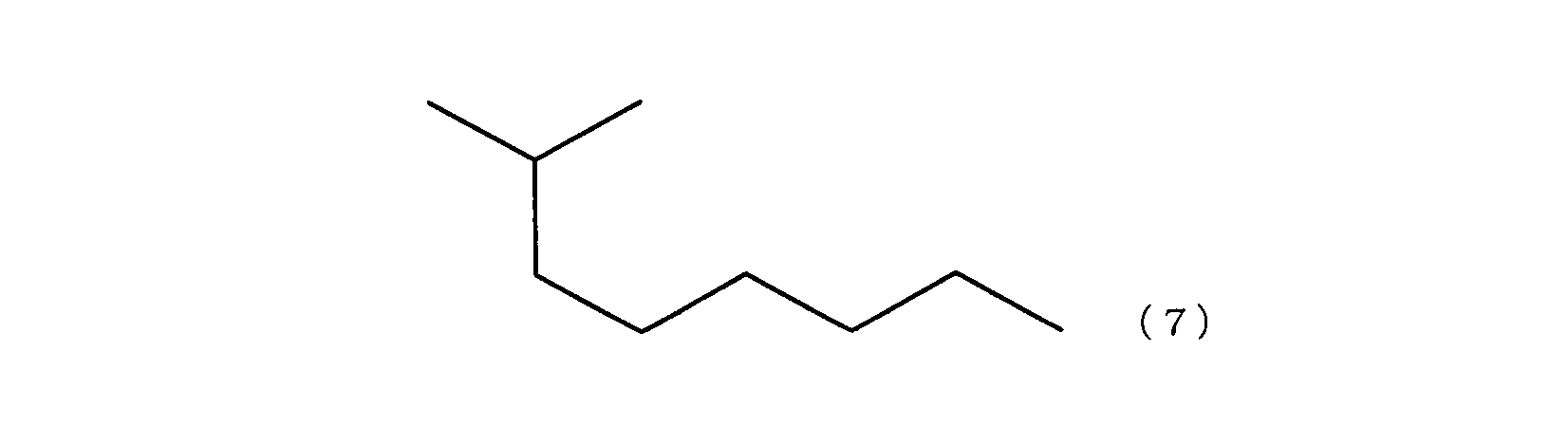
- Oc is a structure represented by the following formulas (5) to (7).
- the following formulas (5) to (7) are represented as “Oc”.
- Examples 1 to 16 The polymer obtained in the synthesis example or a mixture thereof is used as shown in Table 1, and is supplied to a small injection molding machine CS-183-MMX (manufactured by Custom Scientific Instruments). Hold at temperature (described in Table 2) for 3 minutes. Thereafter, using a 10 mm ⁇ 20 mm ⁇ 2 mm mold, injection molding was performed at a mold temperature of 60 ° C. to produce molded bodies (1) to (16).
- Table 2 shows the yellowness, appearance, and polymer used of the produced molded body.
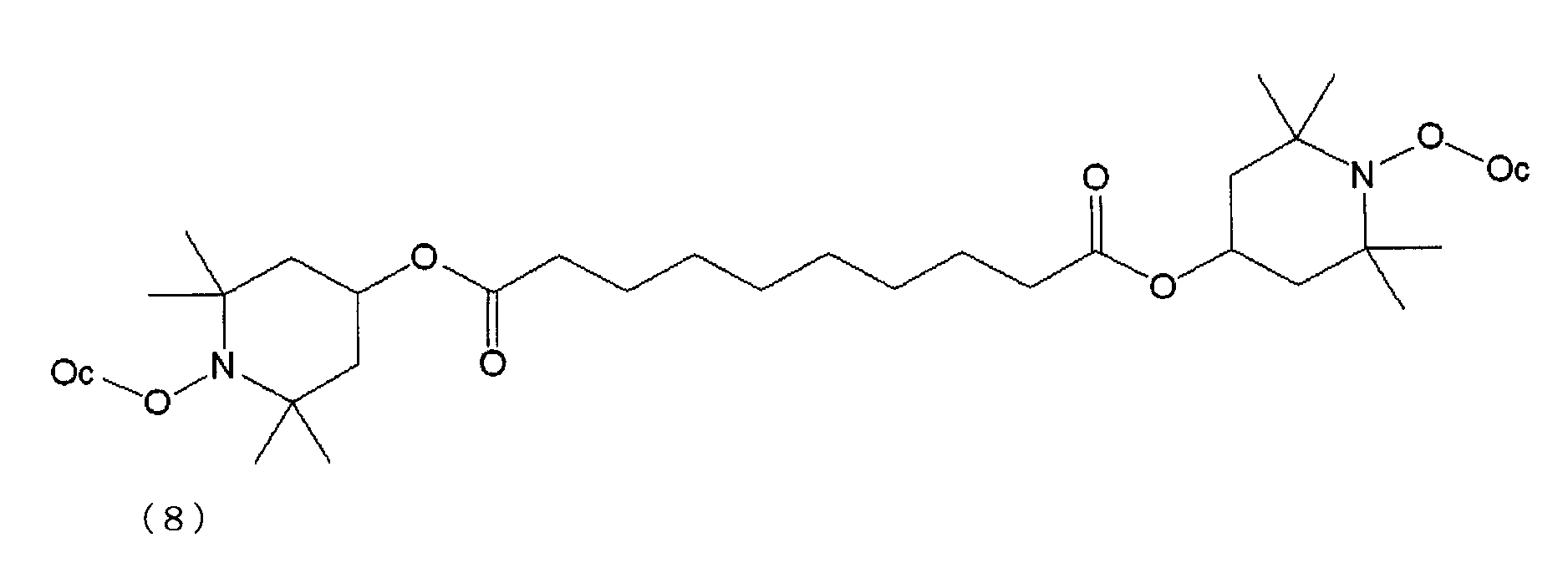
- TV123 bis (1-octyloxy-2,2,6,6-pentamethyl-4-piperidyl) sebacate (TV-123, manufactured by Ciba Japan Co., Ltd.) * Since TV123 has two HALS sites in the molecule, the number of moles of HALS sites is twice the number of moles added.
- the structure of the TV 123 is shown in Formula (8).
- ** 9 parts by mass of polymer 6 not containing HALS is added to 1 part by mass of polymer 3 or 4, and diluted so that the HALS amount is 1/10 of that of polymer 3 or 4, respectively.
- the molded products 1 to 16 using the molding material of the present invention had a yellowness of 10 or less and a good appearance.
- Molded bodies (17) to (19) using a molding material containing monomer (b1-1) and TV123 having a structure different from that of monomer (a1) in the present invention have a high yellowness and an appearance. Was poor (Comparative Examples 1 to 3).
- the molded body using the molding material of the present invention contains NOR-HALS and has excellent weather resistance.
- the molded material containing NOR-HALS in which coloring due to decomposition of NOR-HALS is suppressed can be produced by the molding material of the present invention. Since the molded article produced by the present invention contains NOR-HALS, it has excellent weather resistance and is useful as an article used outdoors such as building materials.
Landscapes
- Chemical & Material Sciences (AREA)
- Health & Medical Sciences (AREA)
- Chemical Kinetics & Catalysis (AREA)
- Medicinal Chemistry (AREA)
- Polymers & Plastics (AREA)
- Organic Chemistry (AREA)
- Engineering & Computer Science (AREA)
- Manufacturing & Machinery (AREA)
- Materials Engineering (AREA)
- Mechanical Engineering (AREA)
- Addition Polymer Or Copolymer, Post-Treatments, Or Chemical Modifications (AREA)
- Manufacture Of Macromolecular Shaped Articles (AREA)
- Compositions Of Macromolecular Compounds (AREA)
- Injection Moulding Of Plastics Or The Like (AREA)
Abstract
Description

重合体を小型射出成形機 CS-183-MMX(カスタム・サイエンティフィック・インスツルメンツ社製)に供給し、加熱溶融させて3分間保持する。その後、10mm×20mm×2mmの金型を用いて、金型温度60℃にて射出成形し、成形体を作製した。
得られた成形体の透過スペクトルを、分光光度計 MCPD-3000(大塚電子(株)製)により測定し、黄色度を測定した。
本発明で用いる単量体(a1)は、重合性NOR-HALSに属し、下記式(1)で表される。

本発明で用いる単量体(a2)は、メチルメタクリレートを主成分とする。尚、本発明では、全体に対して50質量%以上であることを「主成分」という。
本発明の成形材料(B)は、重合体(A)をそのまま用いても良く、重合体(A)以外の材料を含有することもできる。
単量体(a1)の構造の確認には、1H-NMR JNM-EX270(日本電子(株)製、(商品名))を用いた。
得られた成形体の透過スペクトルを、分光光度計 MCPD-3000(大塚電子(株)製)により測定し、黄色度を測定した。
得られた成形体を肉眼で観察し、着色の有無を判定した。黄色度が10以下であれば着色が無いと判定した。
成形体の全光線透過率とヘイズ値を村上色彩技術研究所製ヘイズメーターHM-65W型を用いて、JIS-K7105に従い測定した。
2,2,6,6-テトラメチル-4-ヒドロキシピペリジン-N-オキシド17.8g(100mmol)をアセトン100mlに溶解し、30%過酸化水素水溶液34g(300mmol)を10分以上かけてゆっくり添加した。5℃まで冷却しながら、塩化銅(I)0.49g(5.0mol%)を添加し、反応混合物の温度を5℃から55℃の間に保持した。15分後、35%塩酸を0.5g添加し、反応混合物を室温において2時間撹拌した。2時間後、4mol/Lの重亜硫酸ナトリウム水溶液50ml、飽和炭酸水素カリウム水溶液100mlを加え、300mlの酢酸エチルで抽出した。有機層を回転エバポレーターで濃縮し、1-メチルオキシ-2,2,6,6-テトラメチル-4-ヒドロキシピペリジンを得た。
単量体(a1-1)の構造を、式(2)に示す。

2,2,6,6-テトラメチル-4-ヒドロキシピペリジン-N-オキシド8.6g(50mmol)をメチルエチルケトン50mlに溶解し、30%過酸化水素水溶液17g(150mmol)を10分以上かけてゆっくり添加した。5℃まで冷却しながら、塩化銅(I)0.25g(5.0mol%)を添加し、反応混合物の温度を5℃から55℃の間に保持した。15分後、35%塩酸を0.2g添加し、反応混合物を室温において2時間撹拌した。2時間後、4mol/Lの重亜硫酸ナトリウム水溶液25ml、飽和炭酸水素カリウム水溶液50mlを加え、150mlの酢酸エチルで抽出した。有機層を回転エバポレーターで濃縮し、1-エチルオキシ-2,2,6,6-テトラメチル-4-ヒドロキシピペリジン混合物を得た。得られた混合物は不純物として、1-メチルオキシ-2,2,6,6-テトラメチル-4-ヒドロキシピペリジンを含んでいる。
単量体(a1-2)の構造を、式(3)に示す。

テトラヒドロフラン(THF)200mL中、トリエチルアミン30.3g(300mmol)、及び4-ヒドロキシ-2,2,6,6-テトラメチルピペリジン-N-オキシド(TEMPOL)34.4g(200mmol)の溶液に、無水酢酸25.5g(250mmol)を0℃で添加した。
単量体(b1-1)の構造を、式(4)に示す。



メチルメタクリレート(MMA) 2.90mol(290g)、メチルアクリレート 90mmol(7.7g)、オクチルメルカプタン 0.88g、AIBN 0.66g、単量体(a1-1) 10mmol(2.6g)、水 600g、硫酸ナトリウム 4.0g、分散剤 4.4gを、撹拌機を有したセパラブルフラスコに投入し、30分間窒素バブリングにより脱気した。30分後、撹拌しつつ70℃にまで昇温し、約3時間保持した。発熱ピークを確認した後、90℃に昇温して30分保持した。その後、室温まで冷却して重合体を取り出して水洗し、粒子状の重合体(1)を得た。
単量体(a1-1)の量を表1に「HALS量」として記載した量とした以外は、合成例4と同様の操作を行うことで、重合体(2)~(4)を得た。なお、表1において、HALS量は、成形材料(B)を得る際に使用した全単量体中の含有率(mol%及びwt%)で表した。
単量体(a1-1)の代わりに単量体(a1-2)を用い、表1に「HALS量」として記載した量を添加した以外は、合成例4と同様の操作を行うことで、重合体(5)を得た。
単量体(a1-1)を用いなかった以外は、合成例4と同様の操作を行うことで、重合体(6)を得た。
単量体(a1-1)の代わりに単量体(TV123)を用い、表1に「HALS量」として記載した量を添加した以外は、合成例4と同様の操作を行うことで、重合体(7)を得た。
単量体(a1-1)の代わりに単量体(b1-1)を用い、表1に「HALS量」として記載した量を添加した以外は、合成例4と同様の操作を行うことで、重合体(8)を得た。
合成例で得られた重合体、又はそれらの混合物を表1に示すように使用し、小型射出成形機 CS-183-MMX(カスタム・サイエンティフィック・インスツルメンツ社製)に供給し、所定のシリンダー温度(表2に記載)で3分間保持した。その後、10mm×20mm×2mmの金型を用いて、金型温度60℃にて射出形し、成形体(1)~(16)を作製した。
用いる重合体を表2に示す通りに変更したこと以外は、実施例(1)と同様にして、成形体(17)~(19)を得た。作製した成形体の黄色度、外観、使用した重合体を表2に示す。

TV123:ビス(1-オクチルオキシ-2,2,6,6-ペンタメチル-4-ピペリジル)セバケート(チバ・ジャパン(株)製 TV-123)
*TV123は、HALS部位を分子内に2つ持つため、HALS部位のモル数は添加モル数の2倍である。TV123の構造を式(8)に示す。

Claims (7)
- 下記一般式(1)で表される単量体(a1)0.01~35モル%及びメチルメタクリレートを主成分とする単量体(a2)65~99.99モル%を重合して得られる重合体(A)を含有する成形材料;

- 成形して厚み2mmの成形体を得た場合に全光線透過率が85~100%であり、ヘイズ値が5%以下である請求項1に記載の成形材料。
- 成形材料(B)100質量%中の前記単量体(a1)由来の構成単位が0.01~50質量%である請求項1に記載の成形材料。
- 前記重合体(A)の含有量が50質量%以上である請求項1に記載の成形材料。
- 請求項1に記載の成形材料を、280℃以下の温度で成形する方法。
- 請求項5に記載の方法で得られた成形体。
- 厚み2mmでの全光線透過率が85~100%であり、ヘイズ値が5%以下である請求項6記載の成形体。
Priority Applications (5)
| Application Number | Priority Date | Filing Date | Title |
|---|---|---|---|
| JP2012526774A JP6177524B2 (ja) | 2011-05-30 | 2012-05-30 | 成形材料及び成形体 |
| KR1020137034524A KR101921776B1 (ko) | 2011-05-30 | 2012-05-30 | 성형 재료 및 성형체 |
| EP12792656.6A EP2716665B1 (en) | 2011-05-30 | 2012-05-30 | Molding material and molding |
| US14/123,158 US9534065B2 (en) | 2011-05-30 | 2012-05-30 | Molding material and molding |
| CN201280026753.9A CN103562242B (zh) | 2011-05-30 | 2012-05-30 | 成型材料和成型体 |
Applications Claiming Priority (2)
| Application Number | Priority Date | Filing Date | Title |
|---|---|---|---|
| JP2011120449 | 2011-05-30 | ||
| JP2011-120449 | 2011-05-30 |
Publications (1)
| Publication Number | Publication Date |
|---|---|
| WO2012165482A1 true WO2012165482A1 (ja) | 2012-12-06 |
Family
ID=47259334
Family Applications (1)
| Application Number | Title | Priority Date | Filing Date |
|---|---|---|---|
| PCT/JP2012/063936 Ceased WO2012165482A1 (ja) | 2011-05-30 | 2012-05-30 | 成形材料及び成形体 |
Country Status (7)
| Country | Link |
|---|---|
| US (1) | US9534065B2 (ja) |
| EP (1) | EP2716665B1 (ja) |
| JP (1) | JP6177524B2 (ja) |
| KR (1) | KR101921776B1 (ja) |
| CN (1) | CN103562242B (ja) |
| TW (1) | TWI565720B (ja) |
| WO (1) | WO2012165482A1 (ja) |
Families Citing this family (7)
| Publication number | Priority date | Publication date | Assignee | Title |
|---|---|---|---|---|
| US9663603B2 (en) * | 2011-05-31 | 2017-05-30 | Mitsubishi Rayon Co., Ltd. | Curable composition and polymer |
| KR102547223B1 (ko) | 2016-10-04 | 2023-06-26 | 에스케이이노베이션 주식회사 | 바이오 슬러지 탈수 처리 방법 |
| US10062069B1 (en) * | 2017-06-29 | 2018-08-28 | The Bartley J. Madden Foundation | Systems and methods regarding point-of-recognition optimization of onsite user purchases at a physical location |
| EP3947271A1 (en) | 2019-04-02 | 2022-02-09 | Ecolab Usa Inc. | Pure chlorine dioxide generation system with reduced acid usage |
| TW202348787A (zh) | 2022-04-01 | 2023-12-16 | 美商藝康美國公司 | 用於乙烯系單體流之高苛刻度加工的防汙劑組成物 |
| TW202404930A (zh) | 2022-04-01 | 2024-02-01 | 美商藝康美國公司 | 在共軛二烯單體之萃取蒸餾期間減少非所要之乳化聚合 |
| TW202348786A (zh) | 2022-04-01 | 2023-12-16 | 美商藝康美國公司 | 用於蒸氣空間應用之防汙劑組成物 |
Citations (12)
| Publication number | Priority date | Publication date | Assignee | Title |
|---|---|---|---|---|
| JPH01113368A (ja) | 1987-09-21 | 1989-05-02 | Ciba Geigy Ag | N−置換立体障害性アミン安定剤 |
| JPH02281009A (ja) | 1989-03-21 | 1990-11-16 | Ciba Geigy Ag | 1―ヒドロカルビルオキシ―2,2,6,6―テトラメチルピペリジン部分を有するエチレン性不飽和化合物、ポリマー、コポリマーおよび安定化組成物 |
| JPH10219140A (ja) * | 1997-02-07 | 1998-08-18 | Nippon Nsc Ltd | 耐候性塗料用樹脂エマルション |
| JP2000103924A (ja) * | 1998-09-28 | 2000-04-11 | Asahi Glass Co Ltd | 樹脂用添加剤、樹脂組成物、および成形体 |
| JP2001210314A (ja) * | 2000-01-31 | 2001-08-03 | Denso Corp | 非水電解液二次電池 |
| JP2001210365A (ja) * | 2000-01-31 | 2001-08-03 | Denso Corp | 難燃性電解液及び非水電解液二次電池 |
| JP2006526670A (ja) * | 2003-04-08 | 2006-11-24 | チバ スペシャルティ ケミカルズ ホールディング インコーポレーテッド | 顔料分散体における光安定化ポリマー分散剤 |
| JP2008127527A (ja) * | 2006-11-24 | 2008-06-05 | Mitsubishi Rayon Co Ltd | 水性塗料用架橋性耐候性向上材 |
| JP2008231307A (ja) * | 2007-03-22 | 2008-10-02 | Mitsubishi Rayon Co Ltd | アクリル系樹脂フィルム及びそれを積層した積層成型品 |
| JP2009541428A (ja) | 2006-07-05 | 2009-11-26 | チバ ホールディング インコーポレーテッド | 立体障害性ニトロキシルエーテルの製造方法 |
| JP2010215902A (ja) * | 2009-02-19 | 2010-09-30 | Mitsubishi Rayon Co Ltd | (メタ)アクリル酸エステル |
| WO2011068110A1 (ja) * | 2009-12-01 | 2011-06-09 | 三菱レイヨン株式会社 | ピペリジン骨格を有する単量体を用いた重合体の製造方法、及び成型体 |
Family Cites Families (3)
| Publication number | Priority date | Publication date | Assignee | Title |
|---|---|---|---|---|
| US6251986B1 (en) | 1997-02-07 | 2001-06-26 | National Starch And Chemical Investment Holding Corporation | Paint resin emulsion having weatherability |
| JP3661600B2 (ja) * | 2000-07-27 | 2005-06-15 | 住友化学株式会社 | メタクリル酸メチル系樹脂組成物およびその成形体 |
| WO2007105741A1 (ja) * | 2006-03-10 | 2007-09-20 | Teijin Chemicals Ltd. | 積層体 |
-
2012
- 2012-05-30 EP EP12792656.6A patent/EP2716665B1/en active Active
- 2012-05-30 CN CN201280026753.9A patent/CN103562242B/zh active Active
- 2012-05-30 US US14/123,158 patent/US9534065B2/en active Active
- 2012-05-30 JP JP2012526774A patent/JP6177524B2/ja active Active
- 2012-05-30 KR KR1020137034524A patent/KR101921776B1/ko active Active
- 2012-05-30 TW TW101119333A patent/TWI565720B/zh active
- 2012-05-30 WO PCT/JP2012/063936 patent/WO2012165482A1/ja not_active Ceased
Patent Citations (12)
| Publication number | Priority date | Publication date | Assignee | Title |
|---|---|---|---|---|
| JPH01113368A (ja) | 1987-09-21 | 1989-05-02 | Ciba Geigy Ag | N−置換立体障害性アミン安定剤 |
| JPH02281009A (ja) | 1989-03-21 | 1990-11-16 | Ciba Geigy Ag | 1―ヒドロカルビルオキシ―2,2,6,6―テトラメチルピペリジン部分を有するエチレン性不飽和化合物、ポリマー、コポリマーおよび安定化組成物 |
| JPH10219140A (ja) * | 1997-02-07 | 1998-08-18 | Nippon Nsc Ltd | 耐候性塗料用樹脂エマルション |
| JP2000103924A (ja) * | 1998-09-28 | 2000-04-11 | Asahi Glass Co Ltd | 樹脂用添加剤、樹脂組成物、および成形体 |
| JP2001210314A (ja) * | 2000-01-31 | 2001-08-03 | Denso Corp | 非水電解液二次電池 |
| JP2001210365A (ja) * | 2000-01-31 | 2001-08-03 | Denso Corp | 難燃性電解液及び非水電解液二次電池 |
| JP2006526670A (ja) * | 2003-04-08 | 2006-11-24 | チバ スペシャルティ ケミカルズ ホールディング インコーポレーテッド | 顔料分散体における光安定化ポリマー分散剤 |
| JP2009541428A (ja) | 2006-07-05 | 2009-11-26 | チバ ホールディング インコーポレーテッド | 立体障害性ニトロキシルエーテルの製造方法 |
| JP2008127527A (ja) * | 2006-11-24 | 2008-06-05 | Mitsubishi Rayon Co Ltd | 水性塗料用架橋性耐候性向上材 |
| JP2008231307A (ja) * | 2007-03-22 | 2008-10-02 | Mitsubishi Rayon Co Ltd | アクリル系樹脂フィルム及びそれを積層した積層成型品 |
| JP2010215902A (ja) * | 2009-02-19 | 2010-09-30 | Mitsubishi Rayon Co Ltd | (メタ)アクリル酸エステル |
| WO2011068110A1 (ja) * | 2009-12-01 | 2011-06-09 | 三菱レイヨン株式会社 | ピペリジン骨格を有する単量体を用いた重合体の製造方法、及び成型体 |
Also Published As
| Publication number | Publication date |
|---|---|
| EP2716665A1 (en) | 2014-04-09 |
| TWI565720B (zh) | 2017-01-11 |
| EP2716665A4 (en) | 2014-12-03 |
| TW201247722A (en) | 2012-12-01 |
| US9534065B2 (en) | 2017-01-03 |
| CN103562242B (zh) | 2018-07-27 |
| CN103562242A (zh) | 2014-02-05 |
| EP2716665B1 (en) | 2018-07-18 |
| KR20140041594A (ko) | 2014-04-04 |
| US20140100345A1 (en) | 2014-04-10 |
| JPWO2012165482A1 (ja) | 2015-02-23 |
| KR101921776B1 (ko) | 2018-11-23 |
| JP6177524B2 (ja) | 2017-08-09 |
Similar Documents
| Publication | Publication Date | Title |
|---|---|---|
| JP6177524B2 (ja) | 成形材料及び成形体 | |
| JP5747507B2 (ja) | ピペリジン骨格を有する単量体を用いた重合体の製造方法、及び成型体 | |
| US8901218B2 (en) | Branched (meth)acrylate copolymer with high refractive index and method for preparing the same | |
| JP6230589B2 (ja) | シート状成形体 | |
| JP6031405B2 (ja) | ベンゾトリアゾール化合物 | |
| KR20080060140A (ko) | 내변색성 및 투과율이 우수한 메타크릴계 수지 조성물 및그 제조 방법 | |
| JP2018158997A (ja) | 熱可塑性樹脂組成物及びそれを用いた成形材料または光学フィルム | |
| JP7236055B2 (ja) | ジアリルアミン系/ジアリルエーテル系共重合体、その製造方法及び用途 | |
| US20250092172A1 (en) | Methacrylic resin, method for producing same, resin composition and resin film | |
| JP7592619B2 (ja) | Asa系樹脂組成物、それを含む成形品及びその成形品の製造方法 | |
| KR20240105483A (ko) | 열가소성 수지 조성물, 성형 재료 및 성형체 | |
| JP5565678B2 (ja) | アクリル型共重合体 | |
| KR20140130746A (ko) | 수지 코팅제 | |
| KR20130063455A (ko) | 내열성이 우수한 아크릴계 공중합체 및 이의 제조방법 | |
| KR20150134202A (ko) | 내충격성 향상 라텍스 및 그로부터 제조되는 라텍스 필름 | |
| JP2024053644A (ja) | 新規な(メタ)アクリル酸エステルモノマー、樹脂及びそれを含むフィルム | |
| US20130274431A1 (en) | Methacrylic Resin and Method for Preparing the Same | |
| JP2011231173A (ja) | アクリル系熱可塑性樹脂の製造方法及びアクリル系フィルムの製造方法 | |
| JP2014201531A (ja) | 重合性アルコキシシラン化合物 |
Legal Events
| Date | Code | Title | Description |
|---|---|---|---|
| ENP | Entry into the national phase |
Ref document number: 2012526774 Country of ref document: JP Kind code of ref document: A |
|
| 121 | Ep: the epo has been informed by wipo that ep was designated in this application |
Ref document number: 12792656 Country of ref document: EP Kind code of ref document: A1 |
|
| WWE | Wipo information: entry into national phase |
Ref document number: 14123158 Country of ref document: US |
|
| NENP | Non-entry into the national phase |
Ref country code: DE |
|
| ENP | Entry into the national phase |
Ref document number: 20137034524 Country of ref document: KR Kind code of ref document: A |