WO2012169170A1 - Brique réfractaire thermiquement isolante - Google Patents
Brique réfractaire thermiquement isolante Download PDFInfo
- Publication number
- WO2012169170A1 WO2012169170A1 PCT/JP2012/003656 JP2012003656W WO2012169170A1 WO 2012169170 A1 WO2012169170 A1 WO 2012169170A1 JP 2012003656 W JP2012003656 W JP 2012003656W WO 2012169170 A1 WO2012169170 A1 WO 2012169170A1
- Authority
- WO
- WIPO (PCT)
- Prior art keywords
- heat
- insulating brick
- slurry
- refractory
- resistant
- Prior art date
- Legal status (The legal status is an assumption and is not a legal conclusion. Google has not performed a legal analysis and makes no representation as to the accuracy of the status listed.)
- Ceased
Links
Images


Classifications
-
- C—CHEMISTRY; METALLURGY
- C04—CEMENTS; CONCRETE; ARTIFICIAL STONE; CERAMICS; REFRACTORIES
- C04B—LIME, MAGNESIA; SLAG; CEMENTS; COMPOSITIONS THEREOF, e.g. MORTARS, CONCRETE OR LIKE BUILDING MATERIALS; ARTIFICIAL STONE; CERAMICS; REFRACTORIES; TREATMENT OF NATURAL STONE
- C04B35/00—Shaped ceramic products characterised by their composition; Ceramics compositions; Processing powders of inorganic compounds preparatory to the manufacturing of ceramic products
- C04B35/01—Shaped ceramic products characterised by their composition; Ceramics compositions; Processing powders of inorganic compounds preparatory to the manufacturing of ceramic products based on oxide ceramics
- C04B35/10—Shaped ceramic products characterised by their composition; Ceramics compositions; Processing powders of inorganic compounds preparatory to the manufacturing of ceramic products based on oxide ceramics based on aluminium oxide
- C04B35/101—Refractories from grain sized mixtures
-
- C—CHEMISTRY; METALLURGY
- C04—CEMENTS; CONCRETE; ARTIFICIAL STONE; CERAMICS; REFRACTORIES
- C04B—LIME, MAGNESIA; SLAG; CEMENTS; COMPOSITIONS THEREOF, e.g. MORTARS, CONCRETE OR LIKE BUILDING MATERIALS; ARTIFICIAL STONE; CERAMICS; REFRACTORIES; TREATMENT OF NATURAL STONE
- C04B35/00—Shaped ceramic products characterised by their composition; Ceramics compositions; Processing powders of inorganic compounds preparatory to the manufacturing of ceramic products
- C04B35/01—Shaped ceramic products characterised by their composition; Ceramics compositions; Processing powders of inorganic compounds preparatory to the manufacturing of ceramic products based on oxide ceramics
- C04B35/10—Shaped ceramic products characterised by their composition; Ceramics compositions; Processing powders of inorganic compounds preparatory to the manufacturing of ceramic products based on oxide ceramics based on aluminium oxide
-
- C—CHEMISTRY; METALLURGY
- C04—CEMENTS; CONCRETE; ARTIFICIAL STONE; CERAMICS; REFRACTORIES
- C04B—LIME, MAGNESIA; SLAG; CEMENTS; COMPOSITIONS THEREOF, e.g. MORTARS, CONCRETE OR LIKE BUILDING MATERIALS; ARTIFICIAL STONE; CERAMICS; REFRACTORIES; TREATMENT OF NATURAL STONE
- C04B35/00—Shaped ceramic products characterised by their composition; Ceramics compositions; Processing powders of inorganic compounds preparatory to the manufacturing of ceramic products
- C04B35/622—Forming processes; Processing powders of inorganic compounds preparatory to the manufacturing of ceramic products
- C04B35/626—Preparing or treating the powders individually or as batches ; preparing or treating macroscopic reinforcing agents for ceramic products, e.g. fibres; mechanical aspects section B
- C04B35/63—Preparing or treating the powders individually or as batches ; preparing or treating macroscopic reinforcing agents for ceramic products, e.g. fibres; mechanical aspects section B using additives specially adapted for forming the products, e.g.. binder binders
- C04B35/6303—Inorganic additives
-
- C—CHEMISTRY; METALLURGY
- C04—CEMENTS; CONCRETE; ARTIFICIAL STONE; CERAMICS; REFRACTORIES
- C04B—LIME, MAGNESIA; SLAG; CEMENTS; COMPOSITIONS THEREOF, e.g. MORTARS, CONCRETE OR LIKE BUILDING MATERIALS; ARTIFICIAL STONE; CERAMICS; REFRACTORIES; TREATMENT OF NATURAL STONE
- C04B38/00—Porous mortars, concrete, artificial stone or ceramic ware; Preparation thereof
-
- C—CHEMISTRY; METALLURGY
- C04—CEMENTS; CONCRETE; ARTIFICIAL STONE; CERAMICS; REFRACTORIES
- C04B—LIME, MAGNESIA; SLAG; CEMENTS; COMPOSITIONS THEREOF, e.g. MORTARS, CONCRETE OR LIKE BUILDING MATERIALS; ARTIFICIAL STONE; CERAMICS; REFRACTORIES; TREATMENT OF NATURAL STONE
- C04B38/00—Porous mortars, concrete, artificial stone or ceramic ware; Preparation thereof
- C04B38/10—Porous mortars, concrete, artificial stone or ceramic ware; Preparation thereof by using foaming agents or by using mechanical means, e.g. adding preformed foam
-
- F—MECHANICAL ENGINEERING; LIGHTING; HEATING; WEAPONS; BLASTING
- F27—FURNACES; KILNS; OVENS; RETORTS
- F27D—DETAILS OR ACCESSORIES OF FURNACES, KILNS, OVENS OR RETORTS, IN SO FAR AS THEY ARE OF KINDS OCCURRING IN MORE THAN ONE KIND OF FURNACE
- F27D1/00—Casings; Linings; Walls; Roofs
- F27D1/0003—Linings or walls
- F27D1/0006—Linings or walls formed from bricks or layers with a particular composition or specific characteristics
-
- F—MECHANICAL ENGINEERING; LIGHTING; HEATING; WEAPONS; BLASTING
- F27—FURNACES; KILNS; OVENS; RETORTS
- F27D—DETAILS OR ACCESSORIES OF FURNACES, KILNS, OVENS OR RETORTS, IN SO FAR AS THEY ARE OF KINDS OCCURRING IN MORE THAN ONE KIND OF FURNACE
- F27D1/00—Casings; Linings; Walls; Roofs
- F27D1/0003—Linings or walls
- F27D1/003—Linings or walls comprising porous bricks
-
- C—CHEMISTRY; METALLURGY
- C04—CEMENTS; CONCRETE; ARTIFICIAL STONE; CERAMICS; REFRACTORIES
- C04B—LIME, MAGNESIA; SLAG; CEMENTS; COMPOSITIONS THEREOF, e.g. MORTARS, CONCRETE OR LIKE BUILDING MATERIALS; ARTIFICIAL STONE; CERAMICS; REFRACTORIES; TREATMENT OF NATURAL STONE
- C04B2111/00—Mortars, concrete or artificial stone or mixtures to prepare them, characterised by specific function, property or use
- C04B2111/76—Use at unusual temperatures, e.g. sub-zero
- C04B2111/763—High temperatures
-
- C—CHEMISTRY; METALLURGY
- C04—CEMENTS; CONCRETE; ARTIFICIAL STONE; CERAMICS; REFRACTORIES
- C04B—LIME, MAGNESIA; SLAG; CEMENTS; COMPOSITIONS THEREOF, e.g. MORTARS, CONCRETE OR LIKE BUILDING MATERIALS; ARTIFICIAL STONE; CERAMICS; REFRACTORIES; TREATMENT OF NATURAL STONE
- C04B2235/00—Aspects relating to ceramic starting mixtures or sintered ceramic products
- C04B2235/02—Composition of constituents of the starting material or of secondary phases of the final product
- C04B2235/30—Constituents and secondary phases not being of a fibrous nature
- C04B2235/32—Metal oxides, mixed metal oxides, or oxide-forming salts thereof, e.g. carbonates, nitrates, (oxy)hydroxides, chlorides
- C04B2235/3201—Alkali metal oxides or oxide-forming salts thereof
-
- C—CHEMISTRY; METALLURGY
- C04—CEMENTS; CONCRETE; ARTIFICIAL STONE; CERAMICS; REFRACTORIES
- C04B—LIME, MAGNESIA; SLAG; CEMENTS; COMPOSITIONS THEREOF, e.g. MORTARS, CONCRETE OR LIKE BUILDING MATERIALS; ARTIFICIAL STONE; CERAMICS; REFRACTORIES; TREATMENT OF NATURAL STONE
- C04B2235/00—Aspects relating to ceramic starting mixtures or sintered ceramic products
- C04B2235/02—Composition of constituents of the starting material or of secondary phases of the final product
- C04B2235/30—Constituents and secondary phases not being of a fibrous nature
- C04B2235/34—Non-metal oxides, non-metal mixed oxides, or salts thereof that form the non-metal oxides upon heating, e.g. carbonates, nitrates, (oxy)hydroxides, chlorides
- C04B2235/3427—Silicates other than clay, e.g. water glass
-
- C—CHEMISTRY; METALLURGY
- C04—CEMENTS; CONCRETE; ARTIFICIAL STONE; CERAMICS; REFRACTORIES
- C04B—LIME, MAGNESIA; SLAG; CEMENTS; COMPOSITIONS THEREOF, e.g. MORTARS, CONCRETE OR LIKE BUILDING MATERIALS; ARTIFICIAL STONE; CERAMICS; REFRACTORIES; TREATMENT OF NATURAL STONE
- C04B2235/00—Aspects relating to ceramic starting mixtures or sintered ceramic products
- C04B2235/02—Composition of constituents of the starting material or of secondary phases of the final product
- C04B2235/30—Constituents and secondary phases not being of a fibrous nature
- C04B2235/34—Non-metal oxides, non-metal mixed oxides, or salts thereof that form the non-metal oxides upon heating, e.g. carbonates, nitrates, (oxy)hydroxides, chlorides
- C04B2235/3427—Silicates other than clay, e.g. water glass
- C04B2235/3463—Alumino-silicates other than clay, e.g. mullite
-
- C—CHEMISTRY; METALLURGY
- C04—CEMENTS; CONCRETE; ARTIFICIAL STONE; CERAMICS; REFRACTORIES
- C04B—LIME, MAGNESIA; SLAG; CEMENTS; COMPOSITIONS THEREOF, e.g. MORTARS, CONCRETE OR LIKE BUILDING MATERIALS; ARTIFICIAL STONE; CERAMICS; REFRACTORIES; TREATMENT OF NATURAL STONE
- C04B2235/00—Aspects relating to ceramic starting mixtures or sintered ceramic products
- C04B2235/02—Composition of constituents of the starting material or of secondary phases of the final product
- C04B2235/50—Constituents or additives of the starting mixture chosen for their shape or used because of their shape or their physical appearance
- C04B2235/54—Particle size related information
- C04B2235/5418—Particle size related information expressed by the size of the particles or aggregates thereof
- C04B2235/5427—Particle size related information expressed by the size of the particles or aggregates thereof millimeter or submillimeter sized, i.e. larger than 0,1 mm
-
- C—CHEMISTRY; METALLURGY
- C04—CEMENTS; CONCRETE; ARTIFICIAL STONE; CERAMICS; REFRACTORIES
- C04B—LIME, MAGNESIA; SLAG; CEMENTS; COMPOSITIONS THEREOF, e.g. MORTARS, CONCRETE OR LIKE BUILDING MATERIALS; ARTIFICIAL STONE; CERAMICS; REFRACTORIES; TREATMENT OF NATURAL STONE
- C04B2235/00—Aspects relating to ceramic starting mixtures or sintered ceramic products
- C04B2235/02—Composition of constituents of the starting material or of secondary phases of the final product
- C04B2235/50—Constituents or additives of the starting mixture chosen for their shape or used because of their shape or their physical appearance
- C04B2235/54—Particle size related information
- C04B2235/5418—Particle size related information expressed by the size of the particles or aggregates thereof
- C04B2235/5436—Particle size related information expressed by the size of the particles or aggregates thereof micrometer sized, i.e. from 1 to 100 micron
-
- C—CHEMISTRY; METALLURGY
- C04—CEMENTS; CONCRETE; ARTIFICIAL STONE; CERAMICS; REFRACTORIES
- C04B—LIME, MAGNESIA; SLAG; CEMENTS; COMPOSITIONS THEREOF, e.g. MORTARS, CONCRETE OR LIKE BUILDING MATERIALS; ARTIFICIAL STONE; CERAMICS; REFRACTORIES; TREATMENT OF NATURAL STONE
- C04B2235/00—Aspects relating to ceramic starting mixtures or sintered ceramic products
- C04B2235/02—Composition of constituents of the starting material or of secondary phases of the final product
- C04B2235/50—Constituents or additives of the starting mixture chosen for their shape or used because of their shape or their physical appearance
- C04B2235/54—Particle size related information
- C04B2235/5463—Particle size distributions
- C04B2235/5472—Bimodal, multi-modal or multi-fraction
-
- C—CHEMISTRY; METALLURGY
- C04—CEMENTS; CONCRETE; ARTIFICIAL STONE; CERAMICS; REFRACTORIES
- C04B—LIME, MAGNESIA; SLAG; CEMENTS; COMPOSITIONS THEREOF, e.g. MORTARS, CONCRETE OR LIKE BUILDING MATERIALS; ARTIFICIAL STONE; CERAMICS; REFRACTORIES; TREATMENT OF NATURAL STONE
- C04B2235/00—Aspects relating to ceramic starting mixtures or sintered ceramic products
- C04B2235/60—Aspects relating to the preparation, properties or mechanical treatment of green bodies or pre-forms
- C04B2235/606—Drying
-
- C—CHEMISTRY; METALLURGY
- C04—CEMENTS; CONCRETE; ARTIFICIAL STONE; CERAMICS; REFRACTORIES
- C04B—LIME, MAGNESIA; SLAG; CEMENTS; COMPOSITIONS THEREOF, e.g. MORTARS, CONCRETE OR LIKE BUILDING MATERIALS; ARTIFICIAL STONE; CERAMICS; REFRACTORIES; TREATMENT OF NATURAL STONE
- C04B2235/00—Aspects relating to ceramic starting mixtures or sintered ceramic products
- C04B2235/70—Aspects relating to sintered or melt-casted ceramic products
- C04B2235/96—Properties of ceramic products, e.g. mechanical properties such as strength, toughness, wear resistance
-
- C—CHEMISTRY; METALLURGY
- C04—CEMENTS; CONCRETE; ARTIFICIAL STONE; CERAMICS; REFRACTORIES
- C04B—LIME, MAGNESIA; SLAG; CEMENTS; COMPOSITIONS THEREOF, e.g. MORTARS, CONCRETE OR LIKE BUILDING MATERIALS; ARTIFICIAL STONE; CERAMICS; REFRACTORIES; TREATMENT OF NATURAL STONE
- C04B2235/00—Aspects relating to ceramic starting mixtures or sintered ceramic products
- C04B2235/70—Aspects relating to sintered or melt-casted ceramic products
- C04B2235/96—Properties of ceramic products, e.g. mechanical properties such as strength, toughness, wear resistance
- C04B2235/9607—Thermal properties, e.g. thermal expansion coefficient
Definitions
- the present invention relates to a fire-resistant and heat-insulating brick, and more specifically, to a porous fire-resistant and heat-insulating brick formed by molding and drying a bubble-containing slurry obtained by foaming a slurry containing a fire-resistant powder and water.
- Refractory heat-insulating brick (ceramic porous body) is a porous lightweight refractory material that has both fire resistance and heat insulation by containing many pores inside the refractory material.
- the refractory insulating brick may be used alone on the heating surface (for example, the furnace inner surface) or may be used as a backing in combination with other refractory materials.
- porous fireproof and heat insulating bricks are also produced mainly using raw materials with high porosity such as diatomaceous earth, pearlite, vermiculite and the like as main raw materials.
- diatomaceous earth has many fine pores
- refractory insulating bricks mainly made of diatomaceous earth are widely used as excellent refractory insulating bricks with low thermal conductivity.
- the heat resistant temperature of diatomaceous earth is about 1000 ° C., it cannot be used in a high temperature range exceeding 1000 ° C. Therefore, in order to cope with the use in a high temperature range exceeding 1000 ° C., a production method for producing a porous refractory heat-insulating brick using a raw material excellent in heat resistance as a main raw material has been put into practical use.
- Patent Document 1 discloses a porous molded body in which pores are contained in a slurry containing ceramic powder and water, and a method for producing the same.
- the porous molded body described in Patent Document 1 causes foaming by stirring a slurry containing ceramic powder and water, and controls the stirring to control the content of bubbles (pores) and the pore diameter in the slurry. Then, the slurry is dried and solidified.
- This porous molded body has a pore diameter of 1 mm or less and a porosity of 60% or more in the porous molded body, the pores are substantially uniformly distributed in the porous molded body, and depending on the use. It is characterized in that a shape is given to the porous molded body.
- the porous molded body described in Patent Document 1 is a low-density and high-quality porous molded body including pores whose pore diameter and distribution are controlled, a lightweight structural material, a heat insulating material, a soundproofing material, a vibration-proof material It can be suitably used for various applications such as materials, filters, sensors, catalyst carriers, and biomaterials.
- the invention described in Patent Document 1 has been made mainly for use in applications such as filters that allow fluid to pass through pores. Therefore, Patent Document 1 describes as follows.
- the technical meaning that the pore diameter in the porous molded body is 1 mm or less and the porosity is 60% or more is porous such as fluid permeability, liquid absorbability, liquid storability, gas adsorbability, etc.
- Controlling the pore diameter means that the characteristics of the porous member (fluid permeability coefficient, capillary force, specific surface area, etc.) resulting from the pore diameter can be arbitrarily controlled.
- the method of obtaining pores by burning off the combustible material in the slurry described above is an internal crack caused by the combustion gas generated when the combustible material burns inside the brick and the temperature rise due to heat generation. Such defects may occur. Since this phenomenon is more likely to occur as the amount of combustible material added to the slurry is larger, it is difficult to produce a refractory and heat-insulating brick having high porosity and excellent heat insulation properties by this method. Moreover, since the particle diameter of the combustible material which is a pore material becomes the pore diameter as it is, a fine combustible material is required to produce fine pores. However, there is no cheap and appropriate material for fine combustibles.
- porous molded body described in Patent Document 1 is mainly intended for use in applications such as filters, fine pores having a pore diameter of 1 mm or less are stably formed in the porous molded body. keeping. Therefore, by further developing the invention described in Patent Document 1, there is a possibility that a porous molded body having pores suitable for a refractory heat insulating brick and a method for producing the same can be established.
- the present invention has been made in view of the above situation, and in a porous refractory heat insulating brick formed and dried from a bubble-containing slurry obtained by foaming a slurry containing a refractory powder and water, the composition and porosity are
- An object of the present invention is to provide a fire-resistant and heat-insulating brick that is the same, but has better heat insulation.
- the fire-resistant and heat-insulating brick according to the present invention is a porous fire-resistant and heat-insulating brick obtained by molding and drying a bubble-containing slurry obtained by foaming a slurry containing a fire-resistant powder having a heat-resistant temperature of 1000 ° C. or more and water.
- the porosity of the refractory heat insulating brick is 60% or more, and 80% or more of the total pore volume in the refractory heat insulating brick is composed of pores having a pore diameter of 200 ⁇ m or less.
- Refractory insulating bricks with the same composition and porosity have the same bulk specific gravity. And even if the bulk specific gravity of each fireproof heat insulation brick is the same, if the pore diameter and the distribution of the pores contained in each fireproof heat insulation brick are different, the heat insulation property of each fireproof heat insulation brick is We have the knowledge that it will be different. Here, the inventor has come to make the present invention based on the idea that, for the same porosity, the smaller the pore diameter, the smaller the thermal conductivity of the refractory insulating brick.
- the fire-resistant and heat-insulating brick of the present invention contains many fine pores having a pore diameter of 200 ⁇ m or less, so that the heat-resistant and heat-insulating bricks having the same composition and porosity are more excellent in heat insulation.
- a refractory heat insulating brick having fire resistance that can be used up to a high temperature range can be obtained.
- the desired desired strength can be obtained by drying the bubble-containing slurry, and if there is no problem in use, firing after drying the bubble-containing slurry can be omitted.
- the refractory powder is selected from the group consisting of alumina, mullite, andalusite, kyanite, cordierite, spinel, magnesia and zirconia. It consists of raw materials containing at least one kind.
- Alumina, mullite, andalusite, kyanite, cordierite, spinel, magnesia and zirconia are refractory materials used in high temperature ranges exceeding 1000 ° C. Therefore, by using the refractory powder made of these raw materials as in the configuration of the present invention, a refractory heat-insulating brick having fire resistance that can be used up to a high temperature range can be obtained.
- the fireproof heat insulating brick of the present invention described in the above (2) preferably, only the high-purity alumina powder having a purity of 99% or more is used as the fireproof powder, and the bulk specific gravity of the fireproof heat insulating brick is 1. 2 or less.
- the fire-resistant and heat-insulating brick of the present invention using only high-purity alumina powder having a purity of 99% or more as the fire-resistant powder has a bulk specific gravity halved compared to the fire-resistant and heat-insulating brick produced by press-molding conventional alumina hollow particles. It is possible to increase the porosity until it becomes low, and light weight and low thermal conductivity characteristics can be obtained.
- Alumina is used in many fields because it has various excellent features such as mechanical strength, heat resistance, electrical insulation, chemical stability, and chemical resistance, and is relatively inexpensive. Ceramics. As in the configuration of the present invention, a fireproof and heat insulating brick having an alumina content of 99% or more has excellent characteristics of the above-mentioned alumina in addition to fire resistance and heat insulation, and is expected to be applied to various usage environments. it can.
- the slurry contains at least one of alumina cement, hydraulic alumina, and calcined gypsum.
- the strength due to the hydration reaction is manifested.
- the strength of the molded body required in the manufacturing process of the fireproof and heat insulating brick can be obtained.
- the composition and the porosity are the same, but the heat insulating property is further improved.
- An excellent fireproof insulating brick can be provided.
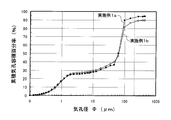
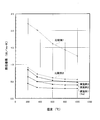
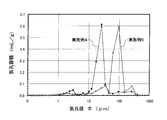
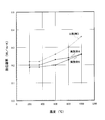
- Example 1 It is a pore measurement result of Example 1 (1a and 1b), Comprising: The pore diameter distribution curve is shown. It is a pore measurement result of Example 1 (1a and 1b), Comprising: The accumulation pore volume distribution curve is shown. The temperature change of the thermal conductivity of Examples 1, 2, 3 and Comparative Examples 1 and 2 is shown. It is a pore measurement result of Example 4 and 5, Comprising: The pore diameter distribution curve is shown. It is a pore measurement result of Example 4 and 5, Comprising: The accumulation pore volume distribution curve is shown. The temperature change of the thermal conductivity of Examples 4 and 5 and Comparative Example 3 is shown.
- the fireproof insulating brick of the present invention is a foam-containing slurry obtained by foaming a slurry containing a refractory powder having a heat resistant temperature of 1000 ° C. or higher and water, and an auxiliary agent is added to the slurry as necessary. Is done.
- a foam-containing slurry obtained by foaming a slurry containing a refractory powder having a heat resistant temperature of 1000 ° C. or higher and water, and an auxiliary agent is added to the slurry as necessary. Is done.
- auxiliary agent is added to the slurry as necessary.
- Examples of the refractory powder having a heat-resistant temperature of 1000 ° C. or more which is the main raw material of the refractory heat-insulating brick, include oxidation of alumina, mullite, andalusite, kyanite, cordierite, spinel, magnesia, zirconia, titania, silica, calcia, etc.
- Physical inorganic materials and mixtures thereof can be used as raw materials.
- andalusite and kayanite are natural materials of high alumina, and the other raw materials are industrial products (ceramics).
- alumina, mullite, andalusite, and kyanite are particularly preferably used.
- the main raw material is not limited to these, and any raw material equivalent to or similar to these can be used in the same manner.
- the particle size, particle size distribution, blending ratio, type of additive added to the slurry, amount added, etc. can be arbitrarily designed. Further, if necessary, a substance that reacts with water and hardens such as alumina cement, hydraulic alumina, or calcined gypsum can be added to the slurry.
- a large amount of air bubbles are introduced into the slurry, and the air-containing slurry is molded and dried while maintaining the air bubbles, thereby producing a porous fireproof and heat insulating brick.
- an auxiliary agent for imparting foamability and bubble stability is added to the slurry.
- auxiliary agent having a foaming component examples include sodium alkyl sulfate, polyoxyethylene alkyl ether sodium sulfate, polyoxyethylene octyl phenyl ether, sodium lauryl sulfate, lauroyl sarcosine sodium, lauroyl methylalanine, which are surfactants used in detergents. Sodium or the like can be used. In addition, materials having an effect of reducing the surface tension such as polyvinyl alcohol can be used.
- the slurry to which an auxiliary agent having a bubble stabilizing component is added can suppress the disappearance of fine bubbles and maintain the amount of bubbles in the slurry.
- an auxiliary agent for example, a thickener such as cellulose-based carboxymethyl cellulose, hydroxyethyl cellulose, and methyl cellulose can be used.
- an auxiliary agent having a water retention component can be added to the slurry in order to improve the bubble stability.
- the water retention component holds water in the slurry and suppresses the weakening of the bubble wall, and thus has an effect of improving the bubble stability.
- an auxiliary agent for example, sugars such as granulated sugar, sucrose, fructose and glucose can be used.
- the slurry can have both foamability and bubble stability.
- water glass can be added to adjust the viscosity of the bubble-containing slurry, or calcined gypsum can be added to accelerate the hardening of the bubble-containing slurry.
- a stirrer may be used to introduce bubbles into the slurry.
- a slurry having fine bubbles can be obtained by finely cutting the bubbles mixed in the slurry.
- the optimum method varies depending on the stirrer to be used, and therefore the optimum stirring method may be determined by experiments or the like.
- the slurry is agitated with a whipper, it is performed as follows. First, an auxiliary agent and mixed water are added while stirring at a low speed so that the main raw material does not overflow from the container, thereby forming a slurry having an appropriate viscosity. Next, outside air is taken into the slurry while gradually increasing the stirring speed, and stirring is performed so as to shear.
- Example 1 The composition of the test body of Example 1 is as shown in Table 1.
- the refractory powder that is the main raw material of the test body of Example 1 is composed of four types of high-purity alumina powder (Al 2 O 3 ) having a purity of 99% or more, which is a ceramic powder.
- Al 2 O 3 high-purity alumina powder
- AES polyoxyethylene alkyl ether sodium sulfate
- MC methylcellulose
- granulated sugar as a water retention component
- water glass a viscosity adjusting component Yes.
- Example 1 The manufacturing procedure of the test body of the fireproof heat insulation brick in Example 1 is as follows. [Procedure 1] MC and granulated sugar are sufficiently stirred and dissolved using hot water at 75 ° C. PVA and AES are added to and mixed with water and cooled. [Procedure 2] Add the mixture in [Procedure 1] to the main ingredients weighed in advance. After adding water glass Using a whipper (capacity 60L, motor capacity 2.2kW) Stir the slurry. Stir for 1 minute 30 seconds at 1st speed (98 rpm). Then, it was stirred for 1 minute and 30 seconds at 2nd speed (187 rpm).
- Example 2 The test body of Example 2 is an example of a test body having the same composition as that of the test body of Example 1 and having a smaller porosity (larger bulk specific gravity) than that of Example 1.
- the manufacturing procedure of the test body of Example 2 is the same as that of Example 1 except that the stirring time of [Procedure 3] is shorter than that of Example 1.
- Comparative Example 1 The test body of Comparative Example 1 uses the same main raw material as the test body of Example 1.
- the test piece of the fire-resistant and heat-insulating brick was molded only with water without adding the auxiliary agent of Example 1, and the porosity of the test piece of the fire-resistant and heat-insulating brick of Comparative Example 1 was 54.7. %.
- Comparative Example 2 The test body of Comparative Example 2 uses the same main raw material as the test body of Example 1. In Comparative Example 2, instead of adding the auxiliary of Example 1, pores are contained in the test piece of the fireproof heat insulating brick by adding expanded polystyrene beads (EPS) having a particle diameter of 1 to 2 mm. .
- EPS expanded polystyrene beads
- FIG. 1 shows a pore diameter distribution curve in which the horizontal axis is the pore diameter ⁇ ( ⁇ m) and the vertical axis is the pore volume (mL / g).
- the pore diameter distribution curve shown in FIG. 1 has a measured value of pores exceeding about 400 to 500 ⁇ m. Not included.
- the test samples of Examples 1a and 1b have a peak pore diameter of about 100 ⁇ m, and there is a small peak in the vicinity of the pore diameter of 1 ⁇ m.
- the test specimens of Examples 1a and 1b contain about 5 to 10% of the total pore volume of pores having a pore diameter of about 400 to 500 ⁇ m.
- a porous refractory heat-insulating brick having a volume of 80% or more of the total pore volume composed of fine pores having a pore diameter of 100 ⁇ m or less could be prototyped.
- the specimen does not contain pores having a large pore diameter, and it is desirable that the pores having a pore diameter of 500 ⁇ m or less be 10% or less of the total pore volume.
- FIG. 3 shows the temperature change of the thermal conductivity of the specimens of Examples 1 (1a), 2, 3, and Comparative Examples 1 and 2.
- the specimen of Comparative Example 1 having a large bulk specific gravity has a large thermal conductivity, and the thermal conductivity tends to gradually decrease as the temperature rises.
- the test body of Comparative Example 2 is obtained by adding pores having a pore diameter of 1 to 2 mm to the test body of Comparative Example 1, and the thermal conductivity is smaller than that of the test body of Comparative Example 1.
- the test samples of Example 1 (1a), 2, and 3 have a low thermal conductivity in this order.
- the test body of Example 1 (1a) having the smallest bulk specific gravity and the highest porosity is most excellent in heat insulation.
- Each of the examples and comparative examples has a characteristic characteristic of alumina that the thermal conductivity gradually decreases as the temperature rises.
- Example 4 The composition of the test body of Example 4 is as shown in Table 3.
- the refractory powder which is the main raw material of the test body of Example 4, is two kinds of high-purity alumina powder (Al 2 O 3 ) having a purity of 99% or more, which is a ceramic powder, and Andalusite, which is a high-alumina natural mineral. (Al 2 SiO 5 ) and kyanite (Al 2 SiO 5 ) and a small amount of alumina cement. When these refractory powders are fired, mullite (3Al 2 O 3 ⁇ 2SiO 2 ) is produced.
- Example 5 The test body of Example 5 is an example having the same composition as the test body of Example 4 and a larger pore diameter than the test body of Example 4. The manufacturing procedure of the test body of Example 5 is the same as that of Example 1.
- Comparative Example 3 The test body of Comparative Example 3 uses the same main raw material as the test bodies of Examples 4 and 5.
- the specimen of Comparative Example 3 instead of adding the auxiliary used in the specimens of Examples 4 and 5, as in the specimen of Comparative Example 2, expanded polystyrene beads having a particle diameter of 1 to 2 mm ( By adding EPS, pores are contained inside the fireproof and heat insulating brick.
- Table 4 shows the quality and characteristics of the fireproof and heat insulating bricks of Examples 4 and 5 and Comparative Example 3 manufactured in this way. As shown in Table 4, although Examples 4 and 5 were produced with the same composition and the same production procedure, there were differences in the bulk specific gravity, porosity and average pore diameter of both test specimens. Moreover, the bulk specific gravity and the porosity of Comparative Example 3 are approximately the same as those of Example 5.
- ⁇ Pore diameter distribution> The pore measurement results of the specimens of Examples 4 and 5 are shown in FIGS. As shown in the pore size distribution curve of FIG. 4, the peak pore diameter of the test body of Example 4 is about 20 ⁇ m, and the peak pore diameter of the test body of Example 5 is about 100 ⁇ m. It can be seen that even if the fireproof bricks are manufactured by the same manufacturing procedure, a certain degree of difference occurs in the pore size distribution due to the difference in the foaming device.
- pores having a pore diameter of about 400 to 500 ⁇ m are 5 to 5% of the total pore volume. About 10% is included.
- 80% or more of the total pore volume has a pore diameter of 200 ⁇ m or less. It was possible to make a prototype of a porous fireproof insulating brick.
- Example 1 a porous refractory heat-insulating brick consisting of fine pores with a volume of 80% or more of the total pore volume having a pore diameter of 100 ⁇ m or less is made as a prototype. I was able to.
- FIG. 6 shows the temperature change of the thermal conductivity of the specimens of Examples 4 and 5 and Comparative Example 3.
- the mullite refractory bricks of Examples 4 and 5 containing many fine pores having a pore diameter of 200 ⁇ m or less have a low thermal conductivity regardless of the temperature, and The increase in thermal conductivity with increasing temperature is slight. That is, the mullite refractory insulating bricks of Examples 4 and 5 and the mullite refractory insulating brick of Comparative Example 3 containing pores having a pore diameter of 1 to 2 mm differed in thermal conductivity between the two as the temperature increased. Becomes larger. Therefore, the mullite refractory insulating bricks of Examples 4 and 5 have ideal thermal conductivity as a refractory insulating brick for high temperatures, and are excellent in heat insulation at high temperatures that are actual use temperature ranges. Yes.
- the heat-insulating brick by including many fine pores having a pore diameter of 200 ⁇ m or less, compared to the refractory bricks having the same composition and porosity, the heat-insulating brick is more excellent in heat insulation. It can be a fireproof insulating brick.
Landscapes
- Engineering & Computer Science (AREA)
- Chemical & Material Sciences (AREA)
- Ceramic Engineering (AREA)
- Organic Chemistry (AREA)
- Materials Engineering (AREA)
- Structural Engineering (AREA)
- Manufacturing & Machinery (AREA)
- Mechanical Engineering (AREA)
- General Engineering & Computer Science (AREA)
- Inorganic Chemistry (AREA)
- Compositions Of Oxide Ceramics (AREA)
- Porous Artificial Stone Or Porous Ceramic Products (AREA)
- Furnace Housings, Linings, Walls, And Ceilings (AREA)
Abstract
Priority Applications (3)
| Application Number | Priority Date | Filing Date | Title |
|---|---|---|---|
| US14/124,897 US9115029B2 (en) | 2011-06-10 | 2012-06-04 | Thermal insulating firebrick |
| EP12797455.8A EP2719675A4 (fr) | 2011-06-10 | 2012-06-04 | Brique réfractaire thermiquement isolante |
| KR1020147000505A KR101503657B1 (ko) | 2011-06-10 | 2012-06-04 | 내화 단열 벽돌 |
Applications Claiming Priority (2)
| Application Number | Priority Date | Filing Date | Title |
|---|---|---|---|
| JP2011130170A JP5902894B2 (ja) | 2011-06-10 | 2011-06-10 | 耐火断熱レンガ |
| JP2011-130170 | 2011-06-10 |
Publications (1)
| Publication Number | Publication Date |
|---|---|
| WO2012169170A1 true WO2012169170A1 (fr) | 2012-12-13 |
Family
ID=47295755
Family Applications (1)
| Application Number | Title | Priority Date | Filing Date |
|---|---|---|---|
| PCT/JP2012/003656 Ceased WO2012169170A1 (fr) | 2011-06-10 | 2012-06-04 | Brique réfractaire thermiquement isolante |
Country Status (5)
| Country | Link |
|---|---|
| US (1) | US9115029B2 (fr) |
| EP (1) | EP2719675A4 (fr) |
| JP (1) | JP5902894B2 (fr) |
| KR (1) | KR101503657B1 (fr) |
| WO (1) | WO2012169170A1 (fr) |
Cited By (1)
| Publication number | Priority date | Publication date | Assignee | Title |
|---|---|---|---|---|
| JP2016037399A (ja) * | 2014-08-05 | 2016-03-22 | クアーズテック株式会社 | 中空粒子および中空粒子を含む断熱材 |
Families Citing this family (17)
| Publication number | Priority date | Publication date | Assignee | Title |
|---|---|---|---|---|
| JP2013139368A (ja) * | 2012-01-06 | 2013-07-18 | Isolite Insulating Products Co Ltd | 軽量アルミナ質耐火断熱れんがの製造方法 |
| JP6011966B2 (ja) * | 2012-09-24 | 2016-10-25 | 国立研究開発法人産業技術総合研究所 | 高耐火性及び高断熱性を有するレンガの製造方法 |
| FR3011238B1 (fr) * | 2013-09-30 | 2017-10-13 | Saint-Gobain Centre De Rech Et D'Etudes Europeen | Produit refractaire a matrice de sialon |
| JP6207423B2 (ja) * | 2014-02-24 | 2017-10-04 | イソライト工業株式会社 | 軽量耐アルカリ耐火断熱れんが及びその製造方法 |
| JP6319769B2 (ja) * | 2014-06-24 | 2018-05-09 | クアーズテック株式会社 | 断熱材 |
| JP6319909B2 (ja) * | 2014-11-07 | 2018-05-09 | クアーズテック株式会社 | 断熱材 |
| JP6456857B2 (ja) * | 2016-01-29 | 2019-01-23 | クアーズテック株式会社 | 不定形耐火物用粒子 |
| JP6708909B2 (ja) * | 2017-05-16 | 2020-06-10 | 丸越工業株式会社 | 伝熱促進体、伝熱促進体の配設方法、伝熱促進体の製造方法、ラジアントチューブ式加熱装置及びラジアントチューブ式熱交換器 |
| FR3071248B1 (fr) * | 2017-09-19 | 2020-09-25 | Saint Gobain Ct Recherches | Mousse ceramique |
| DE102018106260B4 (de) * | 2018-03-16 | 2019-12-24 | Siemens Aktiengesellschaft | Verfahren zur Herstellung eines keramischen Absorbers, keramischer Absorber und Verwendung desselben |
| CN109160819A (zh) * | 2018-08-07 | 2019-01-08 | 北京中冶设备研究设计总院有限公司 | 一种近中性高温密封粘结剂的制备方法 |
| CN111233496A (zh) * | 2018-11-29 | 2020-06-05 | 河南鑫诚耐火材料股份有限公司 | 一种莫来石隔热耐火砖及其制备方法 |
| CN112094128A (zh) * | 2020-09-25 | 2020-12-18 | 南阳开元高温新材料有限公司 | 一种高强度莫来石轻质隔热砖 |
| CN112125685B (zh) * | 2020-09-25 | 2023-01-06 | 南阳开元高温新材料有限公司 | 一种低导热莫来石轻质隔热砖 |
| CN115784756A (zh) * | 2022-11-24 | 2023-03-14 | 中国地质大学(北京) | 一种高含量废电瓷基免烧成耐火砖的制备方法 |
| US12559429B2 (en) * | 2022-12-30 | 2026-02-24 | Saint-Gobain Ceramics & Plastics, Inc. | Porous refractory objects and methods of forming |
| CN116553921B (zh) * | 2023-02-27 | 2024-06-25 | 河南三元光电科技有限公司 | 一种耐高温隔热复合材料及其制备方法 |
Citations (5)
| Publication number | Priority date | Publication date | Assignee | Title |
|---|---|---|---|---|
| JPH09157066A (ja) * | 1995-12-04 | 1997-06-17 | Mitsubishi Materials Corp | 多孔質セラミック焼結体の製造方法 |
| JP2003112256A (ja) * | 2001-10-02 | 2003-04-15 | Zeon North Kk | アルミニウム溶湯取鍋 |
| JP2007290893A (ja) | 2006-04-24 | 2007-11-08 | National Institute Of Advanced Industrial & Technology | 多孔質成形体とその製造方法 |
| JP2010168272A (ja) * | 2008-12-26 | 2010-08-05 | Taiko Rozai Kk | 断熱性不定形耐火物及びその施工方法 |
| JP2010235414A (ja) * | 2009-03-31 | 2010-10-21 | Sumitomo Osaka Cement Co Ltd | セラミックス多孔体の製造方法及びセラミックス多孔体 |
Family Cites Families (8)
| Publication number | Priority date | Publication date | Assignee | Title |
|---|---|---|---|---|
| US2588646A (en) * | 1948-03-17 | 1952-03-11 | Babcock & Wilcox Co | Insulating firebrick and process of manufacture |
| BE631865A (fr) * | 1962-05-04 | |||
| US3641229A (en) * | 1970-07-01 | 1972-02-08 | Research Corp | Method of making a permeable ceramic mold used as a substitute for plaster of paris molds |
| FR2431468A1 (fr) * | 1978-07-19 | 1980-02-15 | Lafarge Sa | Materiau microporeux utilisable notamment dans l'industrie ceramique |
| DE4102430A1 (de) | 1991-01-28 | 1992-07-30 | Agrob Ag | Verfahren zur herstellung feinporiger festkoerper mit hohem porenvolumen |
| JP4394329B2 (ja) * | 2001-03-01 | 2010-01-06 | 日本碍子株式会社 | セラミックス構造体の製造方法 |
| FR2873685B1 (fr) * | 2004-07-28 | 2007-06-22 | Saint Gobain Ct Recherches | Procede d'obtention de ceramiques poreuses |
| JP4480758B2 (ja) * | 2007-12-27 | 2010-06-16 | 日本碍子株式会社 | 耐火モルタル硬化成形物 |
-
2011
- 2011-06-10 JP JP2011130170A patent/JP5902894B2/ja active Active
-
2012
- 2012-06-04 US US14/124,897 patent/US9115029B2/en active Active
- 2012-06-04 WO PCT/JP2012/003656 patent/WO2012169170A1/fr not_active Ceased
- 2012-06-04 EP EP12797455.8A patent/EP2719675A4/fr not_active Withdrawn
- 2012-06-04 KR KR1020147000505A patent/KR101503657B1/ko active Active
Patent Citations (5)
| Publication number | Priority date | Publication date | Assignee | Title |
|---|---|---|---|---|
| JPH09157066A (ja) * | 1995-12-04 | 1997-06-17 | Mitsubishi Materials Corp | 多孔質セラミック焼結体の製造方法 |
| JP2003112256A (ja) * | 2001-10-02 | 2003-04-15 | Zeon North Kk | アルミニウム溶湯取鍋 |
| JP2007290893A (ja) | 2006-04-24 | 2007-11-08 | National Institute Of Advanced Industrial & Technology | 多孔質成形体とその製造方法 |
| JP2010168272A (ja) * | 2008-12-26 | 2010-08-05 | Taiko Rozai Kk | 断熱性不定形耐火物及びその施工方法 |
| JP2010235414A (ja) * | 2009-03-31 | 2010-10-21 | Sumitomo Osaka Cement Co Ltd | セラミックス多孔体の製造方法及びセラミックス多孔体 |
Non-Patent Citations (4)
| Title |
|---|
| See also references of EP2719675A4 |
| THE CERAMIC SOCIETY OF JAPAN, CERAMIC KOGAKU GUIDE BOOK, 10 April 1989 (1989-04-10), pages 1734 - 1742, XP008172520 * |
| THE TECHNICAL ASSOCIATION OF REFRACTORIES, ATARASHII YORO TO SONO TAIKABUTSU, 1 February 1973 (1973-02-01), JAPAN, pages 89 - 90, XP008172521 * |
| THE TECHNICAL ASSOCIATION OF REFRACTORIES, TAIKABUTSU TECHO, 31 October 1982 (1982-10-31), JAPAN, pages 57 - 59, XP008172519 * |
Cited By (1)
| Publication number | Priority date | Publication date | Assignee | Title |
|---|---|---|---|---|
| JP2016037399A (ja) * | 2014-08-05 | 2016-03-22 | クアーズテック株式会社 | 中空粒子および中空粒子を含む断熱材 |
Also Published As
| Publication number | Publication date |
|---|---|
| JP5902894B2 (ja) | 2016-04-13 |
| JP2012254910A (ja) | 2012-12-27 |
| KR101503657B1 (ko) | 2015-03-18 |
| EP2719675A1 (fr) | 2014-04-16 |
| US20140128242A1 (en) | 2014-05-08 |
| US9115029B2 (en) | 2015-08-25 |
| KR20140019471A (ko) | 2014-02-14 |
| EP2719675A4 (fr) | 2015-04-22 |
Similar Documents
| Publication | Publication Date | Title |
|---|---|---|
| JP5902894B2 (ja) | 耐火断熱レンガ | |
| Liu et al. | Effects of pore structure on thermal conductivity and strength of alumina porous ceramics using carbon black as pore-forming agent | |
| US8445395B2 (en) | Method of obtaining porous ceramics | |
| Zhao et al. | Transient liquid phase diffusion process for porous mullite ceramics with excellent mechanical properties | |
| Du et al. | Highly porous silica foams prepared via direct foaming with mixed surfactants and their sound absorption characteristics | |
| CN103011884B (zh) | 一种刚玉莫来石轻质隔热材料的制备方法 | |
| EP2088134B1 (fr) | Matériel céramique ultraléger | |
| CN110963762A (zh) | 建筑外围护结构的泡沫混凝土及其混凝土砌块的制备方法 | |
| Shao et al. | Novel method for fabrication of silicon nitride/silicon oxynitride composite ceramic foams using fly ash cenosphere as a pore‐forming agent | |
| CA2960461C (fr) | Procede de fabrication d'une mousse ceramique | |
| Chen et al. | Novel porous ceramic with high strength and thermal performance using MA hollow spheres | |
| JP2012031006A (ja) | 耐火断熱煉瓦及びその製造方法 | |
| Bartonickova et al. | Tailoring microstructure and properties of porous mullite-based ceramics via sol-gel impregnation | |
| WO2022105981A1 (fr) | Matériau de construction à base de liant minéral présentant un comportement amélioré de résistance au feu | |
| JP4714640B2 (ja) | 断熱傾斜材の製造方法 | |
| JP5709726B2 (ja) | 耐火断熱材及びその製造方法 | |
| Debbakh et al. | Development and characterization of cellular ceramic bricks using Algerian kaolin. | |
| JPH10101441A (ja) | 流し込み耐火物用組成物及びそれを使用した炉壁の形成方法 | |
| Nasir et al. | Effect of different types of pore-forming agent on the macro pore size of ceramic | |
| JP2007284292A (ja) | 多孔質軽量建材の製造方法 | |
| Dyatlova et al. | High-melting heat-insulating materials obtained by foaming and gassing methods | |
| Pee et al. | DEVELOPMENT OF LIGHTWEIGHT POTTERY USING ORGANIC ANDINORGANIC ADDITIVES | |
| CZ2013331A3 (cs) | Způsob výroby a stabilizace kaolinové pěny | |
| CN117800746A (zh) | 一种适用于低碳钢的中间包挡渣墙浇注料及其制备方法 | |
| Nasir et al. | Preparation of macroporous ceramic materials by using aluminium powder as foaming agent |
Legal Events
| Date | Code | Title | Description |
|---|---|---|---|
| 121 | Ep: the epo has been informed by wipo that ep was designated in this application |
Ref document number: 12797455 Country of ref document: EP Kind code of ref document: A1 |
|
| DPE1 | Request for preliminary examination filed after expiration of 19th month from priority date (pct application filed from 20040101) | ||
| WWE | Wipo information: entry into national phase |
Ref document number: 14124897 Country of ref document: US |
|
| NENP | Non-entry into the national phase |
Ref country code: DE |
|
| REEP | Request for entry into the european phase |
Ref document number: 2012797455 Country of ref document: EP |
|
| WWE | Wipo information: entry into national phase |
Ref document number: 2012797455 Country of ref document: EP |
|
| ENP | Entry into the national phase |
Ref document number: 20147000505 Country of ref document: KR Kind code of ref document: A |