WO2012172248A1 - Epaississants non ioniques associatifs contenant des alkyls cyclohexylols, formulations les contenant et leurs utilisations - Google Patents
Epaississants non ioniques associatifs contenant des alkyls cyclohexylols, formulations les contenant et leurs utilisations Download PDFInfo
- Publication number
- WO2012172248A1 WO2012172248A1 PCT/FR2012/051314 FR2012051314W WO2012172248A1 WO 2012172248 A1 WO2012172248 A1 WO 2012172248A1 FR 2012051314 W FR2012051314 W FR 2012051314W WO 2012172248 A1 WO2012172248 A1 WO 2012172248A1
- Authority
- WO
- WIPO (PCT)
- Prior art keywords
- weight
- carbon atoms
- formulation
- monomer
- formula
- Prior art date
- Legal status (The legal status is an assumption and is not a legal conclusion. Google has not performed a legal analysis and makes no representation as to the accuracy of the status listed.)
- Ceased
Links
Classifications
-
- C—CHEMISTRY; METALLURGY
- C08—ORGANIC MACROMOLECULAR COMPOUNDS; THEIR PREPARATION OR CHEMICAL WORKING-UP; COMPOSITIONS BASED THEREON
- C08G—MACROMOLECULAR COMPOUNDS OBTAINED OTHERWISE THAN BY REACTIONS ONLY INVOLVING UNSATURATED CARBON-TO-CARBON BONDS
- C08G18/00—Polymeric products of isocyanates or isothiocyanates
- C08G18/06—Polymeric products of isocyanates or isothiocyanates with compounds having active hydrogen
- C08G18/28—Polymeric products of isocyanates or isothiocyanates with compounds having active hydrogen characterised by the compounds used containing active hydrogen
-
- C—CHEMISTRY; METALLURGY
- C08—ORGANIC MACROMOLECULAR COMPOUNDS; THEIR PREPARATION OR CHEMICAL WORKING-UP; COMPOSITIONS BASED THEREON
- C08G—MACROMOLECULAR COMPOUNDS OBTAINED OTHERWISE THAN BY REACTIONS ONLY INVOLVING UNSATURATED CARBON-TO-CARBON BONDS
- C08G18/00—Polymeric products of isocyanates or isothiocyanates
- C08G18/06—Polymeric products of isocyanates or isothiocyanates with compounds having active hydrogen
-
- C—CHEMISTRY; METALLURGY
- C08—ORGANIC MACROMOLECULAR COMPOUNDS; THEIR PREPARATION OR CHEMICAL WORKING-UP; COMPOSITIONS BASED THEREON
- C08G—MACROMOLECULAR COMPOUNDS OBTAINED OTHERWISE THAN BY REACTIONS ONLY INVOLVING UNSATURATED CARBON-TO-CARBON BONDS
- C08G18/00—Polymeric products of isocyanates or isothiocyanates
- C08G18/06—Polymeric products of isocyanates or isothiocyanates with compounds having active hydrogen
- C08G18/28—Polymeric products of isocyanates or isothiocyanates with compounds having active hydrogen characterised by the compounds used containing active hydrogen
- C08G18/2805—Compounds having only one group containing active hydrogen
- C08G18/2815—Monohydroxy compounds
- C08G18/282—Alkanols, cycloalkanols or arylalkanols including terpenealcohols
-
- C—CHEMISTRY; METALLURGY
- C08—ORGANIC MACROMOLECULAR COMPOUNDS; THEIR PREPARATION OR CHEMICAL WORKING-UP; COMPOSITIONS BASED THEREON
- C08G—MACROMOLECULAR COMPOUNDS OBTAINED OTHERWISE THAN BY REACTIONS ONLY INVOLVING UNSATURATED CARBON-TO-CARBON BONDS
- C08G18/00—Polymeric products of isocyanates or isothiocyanates
- C08G18/06—Polymeric products of isocyanates or isothiocyanates with compounds having active hydrogen
- C08G18/28—Polymeric products of isocyanates or isothiocyanates with compounds having active hydrogen characterised by the compounds used containing active hydrogen
- C08G18/2805—Compounds having only one group containing active hydrogen
-
- C—CHEMISTRY; METALLURGY
- C08—ORGANIC MACROMOLECULAR COMPOUNDS; THEIR PREPARATION OR CHEMICAL WORKING-UP; COMPOSITIONS BASED THEREON
- C08G—MACROMOLECULAR COMPOUNDS OBTAINED OTHERWISE THAN BY REACTIONS ONLY INVOLVING UNSATURATED CARBON-TO-CARBON BONDS
- C08G18/00—Polymeric products of isocyanates or isothiocyanates
- C08G18/06—Polymeric products of isocyanates or isothiocyanates with compounds having active hydrogen
- C08G18/28—Polymeric products of isocyanates or isothiocyanates with compounds having active hydrogen characterised by the compounds used containing active hydrogen
- C08G18/2805—Compounds having only one group containing active hydrogen
- C08G18/2815—Monohydroxy compounds
-
- C—CHEMISTRY; METALLURGY
- C08—ORGANIC MACROMOLECULAR COMPOUNDS; THEIR PREPARATION OR CHEMICAL WORKING-UP; COMPOSITIONS BASED THEREON
- C08G—MACROMOLECULAR COMPOUNDS OBTAINED OTHERWISE THAN BY REACTIONS ONLY INVOLVING UNSATURATED CARBON-TO-CARBON BONDS
- C08G18/00—Polymeric products of isocyanates or isothiocyanates
- C08G18/06—Polymeric products of isocyanates or isothiocyanates with compounds having active hydrogen
- C08G18/28—Polymeric products of isocyanates or isothiocyanates with compounds having active hydrogen characterised by the compounds used containing active hydrogen
- C08G18/2805—Compounds having only one group containing active hydrogen
- C08G18/2815—Monohydroxy compounds
- C08G18/282—Alkanols, cycloalkanols or arylalkanols including terpenealcohols
- C08G18/2825—Alkanols, cycloalkanols or arylalkanols including terpenealcohols having at least 6 carbon atoms
-
- C—CHEMISTRY; METALLURGY
- C08—ORGANIC MACROMOLECULAR COMPOUNDS; THEIR PREPARATION OR CHEMICAL WORKING-UP; COMPOSITIONS BASED THEREON
- C08G—MACROMOLECULAR COMPOUNDS OBTAINED OTHERWISE THAN BY REACTIONS ONLY INVOLVING UNSATURATED CARBON-TO-CARBON BONDS
- C08G18/00—Polymeric products of isocyanates or isothiocyanates
- C08G18/06—Polymeric products of isocyanates or isothiocyanates with compounds having active hydrogen
- C08G18/28—Polymeric products of isocyanates or isothiocyanates with compounds having active hydrogen characterised by the compounds used containing active hydrogen
- C08G18/30—Low-molecular-weight compounds
-
- C—CHEMISTRY; METALLURGY
- C08—ORGANIC MACROMOLECULAR COMPOUNDS; THEIR PREPARATION OR CHEMICAL WORKING-UP; COMPOSITIONS BASED THEREON
- C08G—MACROMOLECULAR COMPOUNDS OBTAINED OTHERWISE THAN BY REACTIONS ONLY INVOLVING UNSATURATED CARBON-TO-CARBON BONDS
- C08G18/00—Polymeric products of isocyanates or isothiocyanates
- C08G18/06—Polymeric products of isocyanates or isothiocyanates with compounds having active hydrogen
- C08G18/28—Polymeric products of isocyanates or isothiocyanates with compounds having active hydrogen characterised by the compounds used containing active hydrogen
- C08G18/40—High-molecular-weight compounds
- C08G18/48—Polyethers
-
- C—CHEMISTRY; METALLURGY
- C08—ORGANIC MACROMOLECULAR COMPOUNDS; THEIR PREPARATION OR CHEMICAL WORKING-UP; COMPOSITIONS BASED THEREON
- C08G—MACROMOLECULAR COMPOUNDS OBTAINED OTHERWISE THAN BY REACTIONS ONLY INVOLVING UNSATURATED CARBON-TO-CARBON BONDS
- C08G18/00—Polymeric products of isocyanates or isothiocyanates
- C08G18/06—Polymeric products of isocyanates or isothiocyanates with compounds having active hydrogen
- C08G18/28—Polymeric products of isocyanates or isothiocyanates with compounds having active hydrogen characterised by the compounds used containing active hydrogen
- C08G18/40—High-molecular-weight compounds
- C08G18/48—Polyethers
- C08G18/4833—Polyethers containing oxyethylene units
-
- C—CHEMISTRY; METALLURGY
- C08—ORGANIC MACROMOLECULAR COMPOUNDS; THEIR PREPARATION OR CHEMICAL WORKING-UP; COMPOSITIONS BASED THEREON
- C08G—MACROMOLECULAR COMPOUNDS OBTAINED OTHERWISE THAN BY REACTIONS ONLY INVOLVING UNSATURATED CARBON-TO-CARBON BONDS
- C08G18/00—Polymeric products of isocyanates or isothiocyanates
- C08G18/06—Polymeric products of isocyanates or isothiocyanates with compounds having active hydrogen
- C08G18/28—Polymeric products of isocyanates or isothiocyanates with compounds having active hydrogen characterised by the compounds used containing active hydrogen
- C08G18/40—High-molecular-weight compounds
- C08G18/48—Polyethers
- C08G18/4833—Polyethers containing oxyethylene units
- C08G18/4837—Polyethers containing oxyethylene units and other oxyalkylene units
-
- C—CHEMISTRY; METALLURGY
- C08—ORGANIC MACROMOLECULAR COMPOUNDS; THEIR PREPARATION OR CHEMICAL WORKING-UP; COMPOSITIONS BASED THEREON
- C08G—MACROMOLECULAR COMPOUNDS OBTAINED OTHERWISE THAN BY REACTIONS ONLY INVOLVING UNSATURATED CARBON-TO-CARBON BONDS
- C08G18/00—Polymeric products of isocyanates or isothiocyanates
- C08G18/06—Polymeric products of isocyanates or isothiocyanates with compounds having active hydrogen
- C08G18/28—Polymeric products of isocyanates or isothiocyanates with compounds having active hydrogen characterised by the compounds used containing active hydrogen
- C08G18/65—Low-molecular-weight compounds having active hydrogen with high-molecular-weight compounds having active hydrogen
- C08G18/66—Compounds of groups C08G18/42, C08G18/48, or C08G18/52
-
- C—CHEMISTRY; METALLURGY
- C08—ORGANIC MACROMOLECULAR COMPOUNDS; THEIR PREPARATION OR CHEMICAL WORKING-UP; COMPOSITIONS BASED THEREON
- C08G—MACROMOLECULAR COMPOUNDS OBTAINED OTHERWISE THAN BY REACTIONS ONLY INVOLVING UNSATURATED CARBON-TO-CARBON BONDS
- C08G18/00—Polymeric products of isocyanates or isothiocyanates
- C08G18/06—Polymeric products of isocyanates or isothiocyanates with compounds having active hydrogen
- C08G18/28—Polymeric products of isocyanates or isothiocyanates with compounds having active hydrogen characterised by the compounds used containing active hydrogen
- C08G18/65—Low-molecular-weight compounds having active hydrogen with high-molecular-weight compounds having active hydrogen
- C08G18/66—Compounds of groups C08G18/42, C08G18/48, or C08G18/52
- C08G18/6666—Compounds of group C08G18/48 or C08G18/52
-
- C—CHEMISTRY; METALLURGY
- C09—DYES; PAINTS; POLISHES; NATURAL RESINS; ADHESIVES; COMPOSITIONS NOT OTHERWISE PROVIDED FOR; APPLICATIONS OF MATERIALS NOT OTHERWISE PROVIDED FOR
- C09D—COATING COMPOSITIONS, e.g. PAINTS, VARNISHES OR LACQUERS; FILLING PASTES; CHEMICAL PAINT OR INK REMOVERS; INKS; CORRECTING FLUIDS; WOODSTAINS; PASTES OR SOLIDS FOR COLOURING OR PRINTING; USE OF MATERIALS THEREFOR
- C09D7/00—Features of coating compositions, not provided for in group C09D5/00; Processes for incorporating ingredients in coating compositions
- C09D7/40—Additives
-
- C—CHEMISTRY; METALLURGY
- C09—DYES; PAINTS; POLISHES; NATURAL RESINS; ADHESIVES; COMPOSITIONS NOT OTHERWISE PROVIDED FOR; APPLICATIONS OF MATERIALS NOT OTHERWISE PROVIDED FOR
- C09D—COATING COMPOSITIONS, e.g. PAINTS, VARNISHES OR LACQUERS; FILLING PASTES; CHEMICAL PAINT OR INK REMOVERS; INKS; CORRECTING FLUIDS; WOODSTAINS; PASTES OR SOLIDS FOR COLOURING OR PRINTING; USE OF MATERIALS THEREFOR
- C09D7/00—Features of coating compositions, not provided for in group C09D5/00; Processes for incorporating ingredients in coating compositions
- C09D7/40—Additives
- C09D7/43—Thickening agents
-
- C—CHEMISTRY; METALLURGY
- C09—DYES; PAINTS; POLISHES; NATURAL RESINS; ADHESIVES; COMPOSITIONS NOT OTHERWISE PROVIDED FOR; APPLICATIONS OF MATERIALS NOT OTHERWISE PROVIDED FOR
- C09D—COATING COMPOSITIONS, e.g. PAINTS, VARNISHES OR LACQUERS; FILLING PASTES; CHEMICAL PAINT OR INK REMOVERS; INKS; CORRECTING FLUIDS; WOODSTAINS; PASTES OR SOLIDS FOR COLOURING OR PRINTING; USE OF MATERIALS THEREFOR
- C09D7/00—Features of coating compositions, not provided for in group C09D5/00; Processes for incorporating ingredients in coating compositions
- C09D7/40—Additives
- C09D7/65—Additives macromolecular
Definitions
- the present invention relates to novel associative thickeners belonging to the category of HEUR (Hydrophobically Modified Ethylene Oxide Ethylene Oxide (URET)). Used in aqueous formulations, they make it possible to increase the viscosity at low, medium and high shear rates. Such a result results in particular from the implementation of original groups based on alkyl cyclohexylols, to manufacture the associative monomer of these thickeners.
- HEUR Hydrophilic acid
- aqueous paint formulations containing mineral fillers consist of an aqueous phase, one or more emulsion polymers in the liquid phase, called binders, fillers and / or pigments, a dispersing agent and adjuvants as well. various surfactants, coalescing agents, biocides, defoamers and finally, at least one thickening agent.
- the latter makes it possible to control the rheology of the aqueous formulations into which it is introduced, and in particular aqueous paints, both at the stage of their manufacture, during their transport, their storage or during their implementation.
- the diversity of practical constraints at each of these stages refers to a multiplicity of different rheological behaviors.
- ansociative thickener which are water-soluble polymers having insoluble hydrophobic groups.
- Such macromolecules have a character associating: once introduced into the water, the Hydrophobic groups are likely to assemble as micellar aggregates. These aggregates are interconnected by the hydrophilic parts of the polymers: there is then formation of a three-dimensional network which causes the increase of the viscosity of the medium.
- associative thickeners there is the class of associative thickeners of the HEUR type (hydrophilically modified Ethylene oxide ethylene oxide or modified Ethylene oxide URethane according to the appropriate acronym). They denote copolymers resulting from the synthesis between a compound of the polyalkylene glycol type, a polyisocyanate, and a so-called "associative" monomer or condensate of the alkyl, aryl or arylalkyl type constituted by a hydrophobic end group. These structures are well known for developing high viscosities for a medium to low shear rate (J.
- the paint formulator sometimes expresses the need for a more complex rheology, a real compromise between application properties and behavior of the potted product.
- the viscosity ICI TM of the paint formulation this has the consequence of improving the application properties of the product, by limiting projections (especially if the product is applied to the roll), drips (if it is an application on walls or ceilings), and by an increase in the amount transferred from the application tool to the support.
- EP 1 566 393 describes a HEUR type thickener, one of the essential characteristics of which is the presence of n-butyl-1-octanol, while its hydrophobic groups are based on fatty alcohols containing from 8 to 18 carbon atoms.
- DE 10 206 023001 discloses a HEUR-type associative nonionic thickener comprising a branched linear alcohol.
- EP 1 241 198 discloses polyurethane thickeners comprising a monoalcohol having from 6 to 22 carbon atoms.
- EP 1 013 264 describes a polyurethane thickener for cosmetic formulations, having an associative monomer functionalized with a hydrophobic group that can be linear or branched, but preferably linear and having from 12 to 24 carbon atoms.
- the document WO 94/06840 proposes an associative thickener of the HEUR type, characterized by a certain density of hydrophobic pendant groups by urethane bond, said groups being linear alkyl chains having from 8 to 22 carbon atoms.
- EP 1 584 331 proposes a hydrophobic end group having from 6 to 34 carbon atoms for the associative monomer.
- EP 0 639 595 proposes linear hydrophobic groups having from 4 to 36 carbon atoms.
- WO 02/102868 also refers to linear structures for the associative monomer.
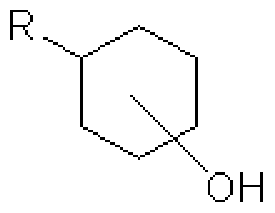
- R denotes an alkyl group having from 10 to 15 carbon atoms.
- Such compounds have been identified as surfactants and are obtained by hydrogenation of an alkyl phenol.
- the resulting compounds are referred to as "alkyl cyclohexylols". It is important to add that the final structure is not that of an alkyl phenol, and that the resulting product will not be categorized as such.
- R denotes an alkyl group having from 6 to 10 carbon atoms, preferentially 9 carbon atoms
- a first object of the present invention consists of water-soluble polyurethanes resulting from the condensation of: a) at least one monomer of formula (I)
- R denotes an alkyl group having from 6 to 10 carbon atoms, preferentially 9 carbon atoms
- Polyurethane means a urethane polymer, that is to say a compound produced by the reaction of an isocyanate and an alcohol.
- alkyl denotes a linear or branched hydrocarbon radical of 6 to 10 carbon atoms, such as, hexyl, heptyl, octyl, nonyl, decyl.
- polyalkylene glycol is meant a polymer of an alkylene glycol derived from an olefinic oxide.
- the polyalkylene glycol according to the present invention is for example polyethylene glycol, polypropylene glycol, polybutylene glycol or a polyalkylene glycol containing a proportion of ethylene-oxy group and / or a proportion of propylene-oxy group and / or a proportion of group butyleneoxy.
- the polyalkylene glycol according to the present invention may for example comprise a major proportion of ethyleneoxy group in combination with a secondary proportion of propyleneoxy group.
- alkylene glycol polymer examples include: polyalkylene glycols having an average molecular weight of 1,000, 4,000, 6,000, 10,000 and 20,000 g / mol (in the case of polyethylene glycol called PEG-1,000, PEG-4 000, PEG-6000, PEG 10,000, PEG 20,000); polyethylene polypropylene glycols having a a percentage of ethylene oxide of between 20 and 80% by weight and a percentage of propylene oxide of between 20 and 80% by weight.
- the monomer of formula (I) has a formula (II):
- R denotes an alkyl group as defined above, that is to say having from 6 to 10 carbon atoms.
- the monomer a) has a formula (I) or (II) wherein R denotes a group having 9 carbon atoms.
- the polyurethanes result from the condensation of two monofunctional alcohols, a polyalkylene glycol and a polyisocyanate.
- one of two monofunctional alcohols has a formula (I) or (II) in which R denotes an alkyl group having from 6 to 10 carbon atoms, preferably 9 carbon atoms, and the other monofunctional alcohol is of aliphatic alcohol type, linear or branched, having between 6 and 20 carbon atoms, preferably between 10 and 15 carbon atoms.
- the polyurethanes result from the condensation of: a) from 1 to 29% by weight of a monomer of formula (I):
- R denotes an alkyl group having from 6 to 10 carbon atoms, preferably 9 carbon atoms
- the polyurethanes result from the condensation, in particular of a polyalkylene glycol which is polyethylene glycol.
- a polyalkylene glycol which is polyethylene glycol.
- It may be for example a polyethylene glycol whose molecular mass varies between 2,000 g / mol and 20,000 g / mol, for example between 8,000 g / mol and 15,000 g / mol.
- polyethylene glycol with a molecular weight of 10,000 g / mol and 12,000 g / mol.
- the polyurethanes result from the condensation, in particular of a polyisocyanate which is selected from the group consisting of toluene diisocyanate, toluene diisocyanate dimers, toluene trimers.
- diisocyanate 1,4-butane diisocyanate, 1,6-hexane diisocyanate, isophorone diisocyanate, 1,3-cyclohexane diisocyanate, 1,4-cyclohexane diisocyanate, 4,4'diisocyanatodicyclohexylmethane, 1,4-diisocyanate methyl-2,4-diisocyanatocyclohexane, a mixture of 1-methyl-2,4-diisocyanatocyclohexane and 1-methyl-2,6-diisocyanatocyclohexane, hexamethylene diisocyanate biuret, hexamethylene diisocyanate biuret dimers, trimers of hexamethylene diisocyanate biuret and a mixture of at least two of these compounds.
- a second subject of the present invention relates to a process for preparing a polyurethane according to the invention, said process consisting in a condensation of the various constituents of the polyurethane.
- a third subject of the present invention consists of an aqueous composition comprising a polyurethane according to the present invention.
- said aqueous composition comprises, in addition, water and at least one nonionic surfactant.
- the polyurethane is formulated in water in the presence of at least one nonionic surfactant.
- nonionic surfactant or “nonionic surfactant” is meant a nonionic molecule consisting of at least one hydrophilic part and at least one hydrophobic part.
- said composition comprises several surfactants, for example two, three or four.
- said aqueous composition further comprises at least one additive selected from the group consisting of a biocide, a solvent, an antifoaming agent, a pH regulator, a coalescing agent, and mixtures thereof. .
- Biocide means a chemical substance intended to destroy, repel or render harmless harmful organisms, to prevent their action or to combat them in any other way, by chemical or biological action.
- antifoaming agent is meant a substance or formulation intended to destroy air bubbles in a homogeneous or heterogeneous liquid medium (or on its surface) or to prevent their formation.
- pH regulator or “pH regulating agent” is meant a chemical compound which makes it possible to adjust the pH to the expected value.
- the pH regulating agent may increase the pH; this is the case of bases, such as NaOH.
- the pH regulating agent can decrease the pH; this is the case of acids.
- coalescing agent an agent used in paints which makes it possible to lower the minimum temperature of formation of the film (TMFF or MFFT for Minimum Film Formation Temperature) of paint at a temperature adapted to the conditions of desired application ( s) (eg a TMFF of 5 ° C for outdoor application).
- TMFF minimum temperature of formation of the film
- MFFT Minimum Film Formation Temperature
- a coalescent agent according to the invention mention may be made of propylene glycol, butyl glycol, 2,2,4-trimethyl-1,3-pentanediol monoisobutyrate or 2,2,4-trimethyl- 1,3-pentanediol diisobutyrate.
- the aqueous composition of the present invention consists of:
- At least one other additive selected from the group consisting of a biocide, a solvent, an antifoaming agent, a pH regulator, a coalescing agent and mixtures thereof,
- the aqueous composition of the present invention is a polyurethane as described above, a surfactant, water, a biocide and an antifoam agent.
- the aqueous composition consists of a mixture of 5 to 45% by weight of at least one polyurethane as described above, of 5 to 30% by weight of at least one surfactant, from 25 to 75% by weight of water, from 0.01 to 5% by weight of at least one biocide and from 0.01 to 5% by weight of at least one anti-foaming agent.
- a fourth object of the present invention relates to a method for preparing an aqueous composition according to the invention, said method comprising mixing different constituents of the aqueous composition.
- a fifth object of the present invention is the use of a polyurethane according to the invention or an aqueous composition according to the invention for thickening an aqueous formulation, said formulation being selected from the group consisting of a paint, a lacquer , a varnish, a paper coating color, a cosmetic formulation and a detergent formulation.
- a sixth object of the present invention relates to an aqueous formulation comprising a polyurethane according to the invention or an aqueous composition according to the invention, said formulation being selected from the group consisting of a paint, a lacquer, a varnish, a sauce paper coating, a cosmetic formulation and a detergent formulation.
- the aqueous formulation is a paint and comprises at least one dispersing agent, at least one inorganic filler, at least one binder, at least one biocide, at least one anti-foaming agent and optionally a coalescing agent.
- a final subject of the present invention relates to a process for preparing an aqueous formulation according to the invention, said process consisting in mixing different constituents of the aqueous formulation.
- This example describes a polyurethane according to the invention, implementing a compound of formula (II) wherein R denotes the linear alkyl group having 9 carbon atoms. There is therefore here a hydrophobic monomer of formula (II) having 15 carbon atoms.
- this example also illustrates 4 polyurethanes according to the prior art, using linear fatty alcohols having 12, 14, 16 and 18 carbon atoms.
- this example describes a polyurethane outside the invention, using a compound of formula (II) wherein R denotes the linear alkyl group having 12 carbon atoms. There is therefore here a hydrophobic monomer of formula (II) having 18 carbon atoms.
- All polyurethanes are products which are the result of the condensation of, expressed in% by weight of each of the constituents, 90% of polyethylene glycol of molecular weight by weight equal to 10 000 g / mol, 5% of a completed monomer by a hydrophobic group whose nature will be specified later, and 5% of isophorone diisocyanate.
- aqueous composition is thus obtained.
- This test illustrates a field outside the invention and corresponds to a formulation in water at 30% by dry weight of a polyurethane of molecular weight equal to about 11000 g / mol, wherein the hydrophobic monomer has the formula (II), where R denotes the linear alkyl group having 12 carbon atoms.
- This test illustrates the prior art and corresponds to a formulation in water at 30% by dry weight of a polyurethane of molecular weight equal to about 11000 g / mol, wherein the hydrophobic monomer is a linear alcohol having 12 atoms. of carbon, sold under the name Nacol TM 12-96 by SASOL TM.
- This test illustrates the prior art and corresponds to a formulation in water at 30% by dry weight of a polyurethane of molecular weight equal to about 11000 g / mol, wherein the hydrophobic monomer is a linear alcohol having 14 atoms. of carbon, sold under the name Nacol TM 14-98 by SASOL TM.
- This test illustrates the prior art and corresponds to a formulation in water at 30% by dry weight of a polyurethane of molecular weight equal to about 11000 g / mol, wherein the hydrophobic monomer is a linear alcohol having 18 atoms. of carbon, sold under the name Nacol TM 18-98 by SASOL TM.
- This example illustrates the use of the polyurethanes of Example 1 as thickening agents of a matte paint.
- composition of said paint is shown in Table 1, the masses of each constituent being indicated in grams.
- the paint is formulated according to methods well known to those skilled in the art.
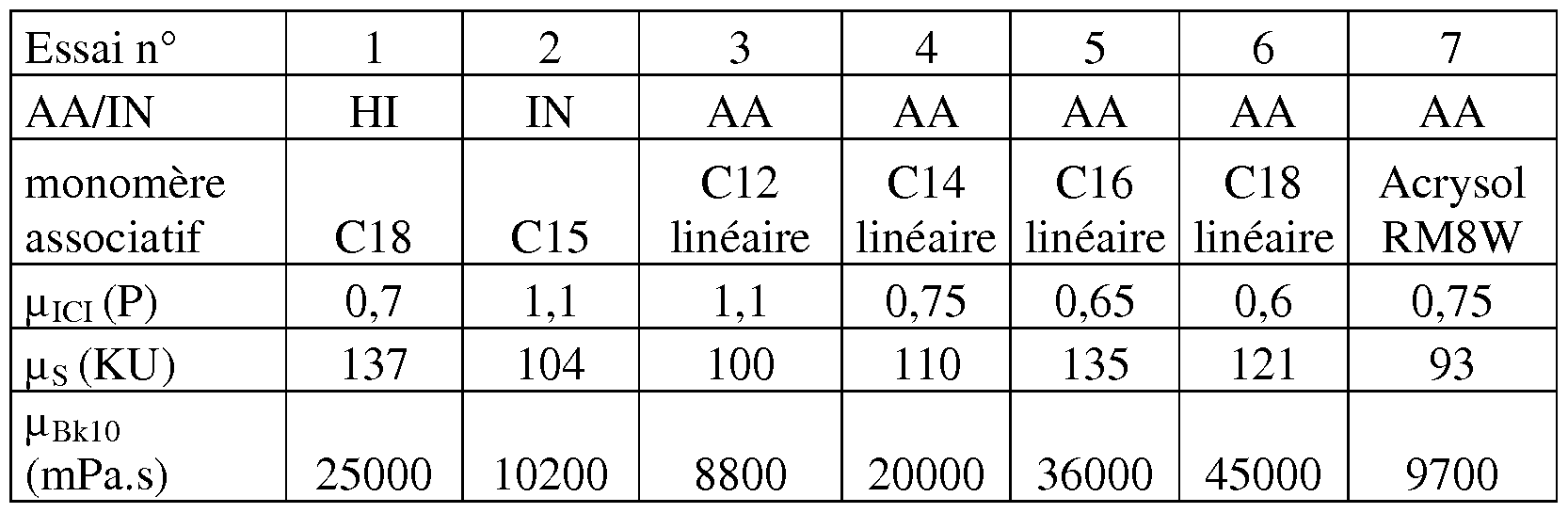
- the polymer according to the invention develops a very unique rheology: it makes it possible to equal the ICI TM viscosity obtained with the C12 polymer, while exceeding its Brookfield TM and Stormer TM viscosity level.
- test No. 1 demonstrates the importance of limiting the carbon number of the hydrophobic monomer according to the invention; with 18 carbon atoms, the polymer of test No. 1 is not efficient enough at high shear rate (viscosity ICI TM).
- This example illustrates the use of the polyurethanes of Example 1 as thickeners of another matte paint.
- composition of said paint is indicated in Table 3, the masses of each constituent being indicated in grams.
- the paint is formulated according to methods well known to those skilled in the art. In each test, use is made of 0.36% by dry weight of the polymer according to the invention, relative to the total weight of the paint formulation.
Landscapes
- Chemical & Material Sciences (AREA)
- Organic Chemistry (AREA)
- Health & Medical Sciences (AREA)
- Chemical Kinetics & Catalysis (AREA)
- Medicinal Chemistry (AREA)
- Polymers & Plastics (AREA)
- Materials Engineering (AREA)
- Engineering & Computer Science (AREA)
- Life Sciences & Earth Sciences (AREA)
- Wood Science & Technology (AREA)
- Polyurethanes Or Polyureas (AREA)
- Paints Or Removers (AREA)
- Cosmetics (AREA)
- Compositions Of Macromolecular Compounds (AREA)
- Paper (AREA)
- Macromonomer-Based Addition Polymer (AREA)
Abstract
Description


Claims


Priority Applications (11)
| Application Number | Priority Date | Filing Date | Title |
|---|---|---|---|
| CN201280029298.8A CN103619897B (zh) | 2011-06-14 | 2012-06-12 | 含有烷基环己醇的非离子缔合型增稠剂,含有该增稠剂的制剂以及它们的用途 |
| JP2014515258A JP6457264B2 (ja) | 2011-06-14 | 2012-06-12 | アルキルを含有する非イオン系会合性増粘剤、これを含有する製剤、ならびにこの使用 |
| SG2013086079A SG195078A1 (en) | 2011-06-14 | 2012-06-12 | Nonionic associative thickeners containing cyclohexylol alkyls, formulations containing same and uses thereof |
| RU2014100900/04A RU2603966C2 (ru) | 2011-06-14 | 2012-06-12 | Неионные ассоциативные загустители, содержащие алкилциклогексилолы, композиции, содержащие такие загустители, и их применение |
| EP12731135.5A EP2721083B1 (fr) | 2011-06-14 | 2012-06-12 | Epaississants non ioniques associatifs contenant des alkyls cyclohexylols, formulations les contenant et leurs utilisations |
| BR112013029891A BR112013029891A2 (pt) | 2011-06-14 | 2012-06-12 | espessantes associativos não iônicos contendo alquilas de cicloexilol, formulações contendo-os e seu uso |
| MX2013014728A MX341168B (es) | 2011-06-14 | 2012-06-12 | Espesantes asociativos no ionicos que contienen alquilo, fomulaciones que los contienen y sus usos. |
| AU2012270207A AU2012270207B2 (en) | 2011-06-14 | 2012-06-12 | Nonionic associative thickeners containing cyclohexylol alkyls, formulations containing same and uses thereof |
| CA2837826A CA2837826A1 (fr) | 2011-06-14 | 2012-06-12 | Epaississants non ioniques associatifs contenant des alkyls cyclohexylols, formulations les contenant et leurs utilisations |
| KR1020147000828A KR101972185B1 (ko) | 2011-06-14 | 2012-06-12 | 시클로헥실올 알킬을 함유하는 비이온성 회합성 증점제, 이를 함유하는 제제 및 이들의 용도 |
| ZA2014/00140A ZA201400140B (en) | 2011-06-14 | 2014-01-08 | Non-ionic associative thickeners containing alkyl,formulations containing them and their uses |
Applications Claiming Priority (2)
| Application Number | Priority Date | Filing Date | Title |
|---|---|---|---|
| FR1155150A FR2976579B1 (fr) | 2011-06-14 | 2011-06-14 | Epaississants non ioniques associatifs contenant des alkyls cyclohexylols, formulations les contenant et leurs utilisations |
| FR1155150 | 2011-06-14 |
Publications (1)
| Publication Number | Publication Date |
|---|---|
| WO2012172248A1 true WO2012172248A1 (fr) | 2012-12-20 |
Family
ID=46420448
Family Applications (1)
| Application Number | Title | Priority Date | Filing Date |
|---|---|---|---|
| PCT/FR2012/051314 Ceased WO2012172248A1 (fr) | 2011-06-14 | 2012-06-12 | Epaississants non ioniques associatifs contenant des alkyls cyclohexylols, formulations les contenant et leurs utilisations |
Country Status (14)
| Country | Link |
|---|---|
| US (1) | US9896533B2 (fr) |
| EP (1) | EP2721083B1 (fr) |
| JP (1) | JP6457264B2 (fr) |
| KR (1) | KR101972185B1 (fr) |
| CN (1) | CN103619897B (fr) |
| AU (1) | AU2012270207B2 (fr) |
| BR (1) | BR112013029891A2 (fr) |
| CA (1) | CA2837826A1 (fr) |
| FR (1) | FR2976579B1 (fr) |
| MX (1) | MX341168B (fr) |
| RU (1) | RU2603966C2 (fr) |
| SG (1) | SG195078A1 (fr) |
| WO (1) | WO2012172248A1 (fr) |
| ZA (1) | ZA201400140B (fr) |
Cited By (1)
| Publication number | Priority date | Publication date | Assignee | Title |
|---|---|---|---|---|
| RU2696779C2 (ru) * | 2013-02-21 | 2019-08-06 | Л'Ореаль | Эмульсия типа "масло в воде", включающая по меньшей мере одну конкретную смесь неионогенных поверхностно-активных веществ, воск, включающий по меньшей мере один сложный эфир, и растворимый в воде полисахарид |
Families Citing this family (8)
| Publication number | Priority date | Publication date | Assignee | Title |
|---|---|---|---|---|
| FR2976580B1 (fr) * | 2011-06-14 | 2013-05-31 | Coatex Sas | Epaississants non ioniques associatifs contenant des alkyls cyclohexylols, formulations les contenant et leurs utilisations. |
| CN106349113B (zh) * | 2015-07-16 | 2017-12-26 | 中国石油化工股份有限公司 | 一种疏水单体及基于该单体的钻井堵漏用水凝胶 |
| FR3039833B1 (fr) | 2015-08-05 | 2017-09-01 | Coatex Sas | Agent epaississant pour systemes aqueux, formulations le contenant et utilisations |
| FR3041964B1 (fr) * | 2015-10-05 | 2017-10-20 | Coatex Sas | Agent epaississant pour systemes aqueux, formulations le contenant et utilisations. |
| JP6983164B2 (ja) | 2016-08-31 | 2021-12-17 | 株式会社Adeka | 水系ゲル化剤組成物及びそれを用いた化粧料 |
| KR101989402B1 (ko) | 2018-01-11 | 2019-06-14 | 서울대학교산학협력단 | 자율신경계 활동 유도 장치 및 그 방법 |
| KR102563508B1 (ko) * | 2018-02-28 | 2023-08-07 | (주)아모레퍼시픽 | 고함량의 오일을 안정화시킨 수중유형 화장료 조성물 |
| AU2022370211A1 (en) * | 2021-10-18 | 2024-05-23 | Rohm And Haas Company | Ici building rheology modifier |
Citations (13)
| Publication number | Priority date | Publication date | Assignee | Title |
|---|---|---|---|---|
| WO1994006840A1 (fr) | 1992-09-15 | 1994-03-31 | Berol Nobel Ab | Polyurethane, son utilisation et peinture a l'eau dans laquelle le polyurethane sert d'epaississant |
| EP0639595A1 (fr) | 1993-08-16 | 1995-02-22 | Bayer Ag | Polyuréthanes utilisés comme agents d'épaississant et leur utilisation pour épaississement des systèmes aqueux |
| WO1999011594A1 (fr) * | 1997-09-03 | 1999-03-11 | Rayburn Randy L | Alcoxylates d'alkylcyclohexanol et procede de fabrication associe |
| EP1013264A1 (fr) | 1998-12-17 | 2000-06-28 | Shiseido Company Limited | Composition cosmétique |
| EP1241198A1 (fr) | 2001-03-12 | 2002-09-18 | Bayer Ag | Polyuréthanes et leur utilisation comme épaississants de systèmes aqueux |
| WO2002102868A1 (fr) | 2001-06-19 | 2002-12-27 | Coatex S.A.S. | Epaississants non ioniques pour compositions pigmentaires, notamment pour peintures, et leurs applications |
| WO2003022947A1 (fr) * | 2001-09-06 | 2003-03-20 | E.I. Du Pont De Nemours And Company | Composition aqueuse de revetement |
| EP1566393A2 (fr) | 2004-02-19 | 2005-08-24 | Cognis Deutschland GmbH & Co. KG | Epaississant à base de polyuréthane |
| FR2894980A1 (fr) * | 2005-12-20 | 2007-06-22 | Coatex Sas | Compositions aqueuses epaissantes et limpides, leur utilisation dans des formulations aqueuses acides, formulations obtenues. |
| EP1806386A2 (fr) * | 2006-01-05 | 2007-07-11 | Rohm and Haas Company | Combinaisons épaississantes associatives |
| DE102006023001A1 (de) | 2006-05-17 | 2007-11-22 | Cognis Ip Management Gmbh | Verdickungsmittel auf Polyurethanbasis |
| DE102006056509A1 (de) * | 2006-11-30 | 2008-06-05 | Evonik Goldschmidt Gmbh | Polyurethan-Verdickungsmittel zur Verdickung wässriger Systeme |
| EP2327732A1 (fr) * | 2009-11-27 | 2011-06-01 | Cognis IP Management GmbH | Épaississant à base de polyuréthane |
Family Cites Families (16)
| Publication number | Priority date | Publication date | Assignee | Title |
|---|---|---|---|---|
| US4155892A (en) * | 1975-10-03 | 1979-05-22 | Rohm And Haas Company | Polyurethane thickeners for aqueous compositions |
| US5281654A (en) * | 1993-01-14 | 1994-01-25 | Rohm And Haas Company | Polyurethane mixture |
| US5376709A (en) | 1993-03-12 | 1994-12-27 | Rohm And Haas Company | Method for improving thickeners for aqueous systems |
| JPH07112948A (ja) * | 1993-10-15 | 1995-05-02 | New Japan Chem Co Ltd | 4−アルキルシクロヘキサノール異性体混合物の製造方法 |
| US5425806B1 (en) * | 1994-05-12 | 1997-07-01 | Rheox Inc | Pourable water dispersible thickening composition for aqueous systems and a method of thickening said aqueous systems |
| DE19503281A1 (de) * | 1995-02-02 | 1996-08-08 | Bayer Ag | Als Verdickungsmittel für wäßrige Systeme geeignete Polyurethane |
| TW460508B (en) | 1997-05-02 | 2001-10-21 | Rohm & Haas | Aqueous composition comprising a mixed surfactant/associative thickener, its use in a formulated composition, and method for enhancing thickening efficiency of aqueous composition |
| JP2000072699A (ja) * | 1998-09-01 | 2000-03-07 | Mitsui Chemicals Inc | 高純度アルキルシクロヘキサノールの製造方法 |
| JP4463992B2 (ja) * | 1998-12-18 | 2010-05-19 | ダウ グローバル テクノロジーズ インコーポレイティド | 防湿性の改良されたポリマーの製造に有用な水性ポリウレタン分散液 |
| FR2811993B1 (fr) * | 2000-07-21 | 2006-08-04 | Oreal | Nouveaux polymeres associatifs cationiques et leur utilisation comme epaississants |
| JPWO2007013469A1 (ja) * | 2005-07-26 | 2009-02-05 | 三菱瓦斯化学株式会社 | (アルキルフェニル)アルキルシクロヘキサン及び(アルキルフェニル)アルキルシクロヘキサン、アルキルビフェニルの製造方法 |
| DE102007059858A1 (de) * | 2007-12-12 | 2009-06-18 | Bayer Materialscience Ag | Energiewandler hergestellt aus filmbildenden wässrigen Polymer-Dispersionen, insbesondere Polyurethan-Dispersionen |
| EP2292675A1 (fr) * | 2009-09-08 | 2011-03-09 | BYK-Chemie GmbH | Polyurées comme agents régulateur de rhéologie |
| FR2949783B1 (fr) * | 2009-09-10 | 2012-08-17 | Coatex Sas | Polyurethanes associatifs a base de cardanol, epaississants associatifs correspondants et leurs utilisations. |
| PT2710123T (pt) * | 2011-05-19 | 2017-10-13 | Inst De Medicina Molecular | Linha celular de linfócitos compreendendo células t gama-delta, método de composição e produção resultante dos mesmos |
| FR2976580B1 (fr) * | 2011-06-14 | 2013-05-31 | Coatex Sas | Epaississants non ioniques associatifs contenant des alkyls cyclohexylols, formulations les contenant et leurs utilisations. |
-
2011
- 2011-06-14 FR FR1155150A patent/FR2976579B1/fr active Active
-
2012
- 2012-06-12 CA CA2837826A patent/CA2837826A1/fr not_active Abandoned
- 2012-06-12 MX MX2013014728A patent/MX341168B/es active IP Right Grant
- 2012-06-12 SG SG2013086079A patent/SG195078A1/en unknown
- 2012-06-12 AU AU2012270207A patent/AU2012270207B2/en not_active Ceased
- 2012-06-12 CN CN201280029298.8A patent/CN103619897B/zh not_active Expired - Fee Related
- 2012-06-12 WO PCT/FR2012/051314 patent/WO2012172248A1/fr not_active Ceased
- 2012-06-12 KR KR1020147000828A patent/KR101972185B1/ko not_active Expired - Fee Related
- 2012-06-12 EP EP12731135.5A patent/EP2721083B1/fr not_active Not-in-force
- 2012-06-12 JP JP2014515258A patent/JP6457264B2/ja not_active Expired - Fee Related
- 2012-06-12 BR BR112013029891A patent/BR112013029891A2/pt not_active Application Discontinuation
- 2012-06-12 RU RU2014100900/04A patent/RU2603966C2/ru not_active IP Right Cessation
- 2012-06-13 US US13/495,115 patent/US9896533B2/en not_active Expired - Fee Related
-
2014
- 2014-01-08 ZA ZA2014/00140A patent/ZA201400140B/en unknown
Patent Citations (16)
| Publication number | Priority date | Publication date | Assignee | Title |
|---|---|---|---|---|
| WO1994006840A1 (fr) | 1992-09-15 | 1994-03-31 | Berol Nobel Ab | Polyurethane, son utilisation et peinture a l'eau dans laquelle le polyurethane sert d'epaississant |
| EP0639595A1 (fr) | 1993-08-16 | 1995-02-22 | Bayer Ag | Polyuréthanes utilisés comme agents d'épaississant et leur utilisation pour épaississement des systèmes aqueux |
| WO1999011594A1 (fr) * | 1997-09-03 | 1999-03-11 | Rayburn Randy L | Alcoxylates d'alkylcyclohexanol et procede de fabrication associe |
| US6111146A (en) | 1997-09-03 | 2000-08-29 | Rayborn; Randy L. | Alkyl cyclohexanol alkoxylates and method for making same |
| EP1584331A1 (fr) | 1998-12-17 | 2005-10-12 | Shiseido Co., Ltd. | Composition cosmétique comprenant un polyéther polyuréthanne modifié hydrophobiquement et un alcool monohydrique |
| EP1013264A1 (fr) | 1998-12-17 | 2000-06-28 | Shiseido Company Limited | Composition cosmétique |
| EP1241198A1 (fr) | 2001-03-12 | 2002-09-18 | Bayer Ag | Polyuréthanes et leur utilisation comme épaississants de systèmes aqueux |
| WO2002102868A1 (fr) | 2001-06-19 | 2002-12-27 | Coatex S.A.S. | Epaississants non ioniques pour compositions pigmentaires, notamment pour peintures, et leurs applications |
| WO2003022947A1 (fr) * | 2001-09-06 | 2003-03-20 | E.I. Du Pont De Nemours And Company | Composition aqueuse de revetement |
| EP1566393A2 (fr) | 2004-02-19 | 2005-08-24 | Cognis Deutschland GmbH & Co. KG | Epaississant à base de polyuréthane |
| US20050187342A1 (en) * | 2004-02-19 | 2005-08-25 | Ludwig Schieferstein | Polyurethane-based thickeners |
| FR2894980A1 (fr) * | 2005-12-20 | 2007-06-22 | Coatex Sas | Compositions aqueuses epaissantes et limpides, leur utilisation dans des formulations aqueuses acides, formulations obtenues. |
| EP1806386A2 (fr) * | 2006-01-05 | 2007-07-11 | Rohm and Haas Company | Combinaisons épaississantes associatives |
| DE102006023001A1 (de) | 2006-05-17 | 2007-11-22 | Cognis Ip Management Gmbh | Verdickungsmittel auf Polyurethanbasis |
| DE102006056509A1 (de) * | 2006-11-30 | 2008-06-05 | Evonik Goldschmidt Gmbh | Polyurethan-Verdickungsmittel zur Verdickung wässriger Systeme |
| EP2327732A1 (fr) * | 2009-11-27 | 2011-06-01 | Cognis IP Management GmbH | Épaississant à base de polyuréthane |
Non-Patent Citations (6)
| Title |
|---|
| "Rheological modifiers for water-based paints : the most flexible tools for your formulations", EUROCOAT 97, UATCM, vol. 1, pages 423 - 442 |
| "Rheology modifiers for water-borne paints", SURFACE COATINGS AUSTRALIA, 1985, pages 6 - 10 |
| J. OF APPLIED POLYMER SCIENCE, vol. 58, 1995, pages 209 - 230 |
| POLYMERIC MAT. SCI. AND ENGINEERING, vol. 59, 1988, pages 1033 |
| POLYMERIC MAT. SCI. AND ENGINEERING, vol. 61, 1989, pages 533 |
| POLYMERIC PAINT COLOUR JOURNAL, vol. 176, no. 4169, June 1986 (1986-06-01), pages 459 |
Cited By (1)
| Publication number | Priority date | Publication date | Assignee | Title |
|---|---|---|---|---|
| RU2696779C2 (ru) * | 2013-02-21 | 2019-08-06 | Л'Ореаль | Эмульсия типа "масло в воде", включающая по меньшей мере одну конкретную смесь неионогенных поверхностно-активных веществ, воск, включающий по меньшей мере один сложный эфир, и растворимый в воде полисахарид |
Also Published As
| Publication number | Publication date |
|---|---|
| KR101972185B1 (ko) | 2019-04-24 |
| MX341168B (es) | 2016-08-10 |
| FR2976579B1 (fr) | 2013-07-05 |
| ZA201400140B (en) | 2015-05-27 |
| CN103619897A (zh) | 2014-03-05 |
| FR2976579A1 (fr) | 2012-12-21 |
| JP6457264B2 (ja) | 2019-01-23 |
| US9896533B2 (en) | 2018-02-20 |
| EP2721083A1 (fr) | 2014-04-23 |
| CA2837826A1 (fr) | 2012-12-20 |
| KR20140039287A (ko) | 2014-04-01 |
| AU2012270207A1 (en) | 2014-01-09 |
| MX2013014728A (es) | 2014-02-27 |
| RU2014100900A (ru) | 2015-07-20 |
| BR112013029891A2 (pt) | 2016-12-20 |
| US20130158160A1 (en) | 2013-06-20 |
| CN103619897B (zh) | 2015-09-16 |
| EP2721083B1 (fr) | 2015-07-29 |
| SG195078A1 (en) | 2013-12-30 |
| JP2014523933A (ja) | 2014-09-18 |
| AU2012270207B2 (en) | 2016-03-24 |
| RU2603966C2 (ru) | 2016-12-10 |
Similar Documents
| Publication | Publication Date | Title |
|---|---|---|
| EP2721083B1 (fr) | Epaississants non ioniques associatifs contenant des alkyls cyclohexylols, formulations les contenant et leurs utilisations | |
| CA2834310C (fr) | Epaississants non ioniques associatifs contenant des alkyls cyclohexylols, formulations les contenant et leurs utilisations | |
| CA2771183A1 (fr) | Polyurethanes associatifs a base de cardanol, epaississants associatifs correspondants et leurs utilisations | |
| EP3331932B1 (fr) | Agent épaississant pour systèmes aqueux, formulations le contenant et utilisations | |
| WO2016066910A1 (fr) | Agent epaississant pour systemes aqueux, formulations le contenant et utilisations | |
| EP2780386B1 (fr) | Épaississants non ioniques associatifs contenant des alkyls cyclohexylols alkoxyles, leurs utilisations et formulations les contenant | |
| EP3359584B1 (fr) | Agent epaississant pour systemes aqueux, formulations le contenant et utilisations | |
| EP2780417B1 (fr) | Epaississants ioniques associatifs contenant des alkyls cyclohexylols alkoxyles, leurs utilisations et formulations les contenant | |
| WO2016097647A1 (fr) | Agent epaississant pour systemes aqueux, formulations le contenant et utilisations |
Legal Events
| Date | Code | Title | Description |
|---|---|---|---|
| 121 | Ep: the epo has been informed by wipo that ep was designated in this application |
Ref document number: 12731135 Country of ref document: EP Kind code of ref document: A1 |
|
| ENP | Entry into the national phase |
Ref document number: 2014515258 Country of ref document: JP Kind code of ref document: A |
|
| ENP | Entry into the national phase |
Ref document number: 2837826 Country of ref document: CA |
|
| WWE | Wipo information: entry into national phase |
Ref document number: MX/A/2013/014728 Country of ref document: MX |
|
| NENP | Non-entry into the national phase |
Ref country code: DE |
|
| REG | Reference to national code |
Ref country code: BR Ref legal event code: B01A Ref document number: 112013029891 Country of ref document: BR |
|
| ENP | Entry into the national phase |
Ref document number: 2012270207 Country of ref document: AU Date of ref document: 20120612 Kind code of ref document: A |
|
| ENP | Entry into the national phase |
Ref document number: 20147000828 Country of ref document: KR Kind code of ref document: A |
|
| ENP | Entry into the national phase |
Ref document number: 2014100900 Country of ref document: RU Kind code of ref document: A |
|
| ENP | Entry into the national phase |
Ref document number: 112013029891 Country of ref document: BR Kind code of ref document: A2 Effective date: 20131121 |