WO2012172983A1 - 研磨用組成物 - Google Patents
研磨用組成物 Download PDFInfo
- Publication number
- WO2012172983A1 WO2012172983A1 PCT/JP2012/064046 JP2012064046W WO2012172983A1 WO 2012172983 A1 WO2012172983 A1 WO 2012172983A1 JP 2012064046 W JP2012064046 W JP 2012064046W WO 2012172983 A1 WO2012172983 A1 WO 2012172983A1
- Authority
- WO
- WIPO (PCT)
- Prior art keywords
- polishing
- polishing composition
- water
- soluble polymer
- containing portion
- Prior art date
- Legal status (The legal status is an assumption and is not a legal conclusion. Google has not performed a legal analysis and makes no representation as to the accuracy of the status listed.)
- Ceased
Links
Classifications
-
- H—ELECTRICITY
- H10—SEMICONDUCTOR DEVICES; ELECTRIC SOLID-STATE DEVICES NOT OTHERWISE PROVIDED FOR
- H10P—GENERIC PROCESSES OR APPARATUS FOR THE MANUFACTURE OR TREATMENT OF DEVICES COVERED BY CLASS H10
- H10P52/00—Grinding, lapping or polishing of wafers, substrates or parts of devices
- H10P52/40—Chemomechanical polishing [CMP]
- H10P52/402—Chemomechanical polishing [CMP] of semiconductor materials
-
- C—CHEMISTRY; METALLURGY
- C09—DYES; PAINTS; POLISHES; NATURAL RESINS; ADHESIVES; COMPOSITIONS NOT OTHERWISE PROVIDED FOR; APPLICATIONS OF MATERIALS NOT OTHERWISE PROVIDED FOR
- C09G—POLISHING COMPOSITIONS; SKI WAXES
- C09G1/00—Polishing compositions
- C09G1/02—Polishing compositions containing abrasives or grinding agents
-
- C—CHEMISTRY; METALLURGY
- C09—DYES; PAINTS; POLISHES; NATURAL RESINS; ADHESIVES; COMPOSITIONS NOT OTHERWISE PROVIDED FOR; APPLICATIONS OF MATERIALS NOT OTHERWISE PROVIDED FOR
- C09K—MATERIALS FOR MISCELLANEOUS APPLICATIONS, NOT PROVIDED FOR ELSEWHERE
- C09K3/00—Materials not provided for elsewhere
- C09K3/14—Anti-slip materials; Abrasives
- C09K3/1436—Composite particles, e.g. coated particles
-
- C—CHEMISTRY; METALLURGY
- C09—DYES; PAINTS; POLISHES; NATURAL RESINS; ADHESIVES; COMPOSITIONS NOT OTHERWISE PROVIDED FOR; APPLICATIONS OF MATERIALS NOT OTHERWISE PROVIDED FOR
- C09K—MATERIALS FOR MISCELLANEOUS APPLICATIONS, NOT PROVIDED FOR ELSEWHERE
- C09K3/00—Materials not provided for elsewhere
- C09K3/14—Anti-slip materials; Abrasives
- C09K3/1454—Abrasive powders, suspensions and pastes for polishing
- C09K3/1463—Aqueous liquid suspensions
-
- H—ELECTRICITY
- H10—SEMICONDUCTOR DEVICES; ELECTRIC SOLID-STATE DEVICES NOT OTHERWISE PROVIDED FOR
- H10P—GENERIC PROCESSES OR APPARATUS FOR THE MANUFACTURE OR TREATMENT OF DEVICES COVERED BY CLASS H10
- H10P52/00—Grinding, lapping or polishing of wafers, substrates or parts of devices
- H10P52/40—Chemomechanical polishing [CMP]
- H10P52/403—Chemomechanical polishing [CMP] of conductive or resistive materials
-
- H—ELECTRICITY
- H10—SEMICONDUCTOR DEVICES; ELECTRIC SOLID-STATE DEVICES NOT OTHERWISE PROVIDED FOR
- H10P—GENERIC PROCESSES OR APPARATUS FOR THE MANUFACTURE OR TREATMENT OF DEVICES COVERED BY CLASS H10
- H10P95/00—Generic processes or apparatus for manufacture or treatments not covered by the other groups of this subclass
- H10P95/06—Planarisation of inorganic insulating materials
- H10P95/062—Planarisation of inorganic insulating materials involving a dielectric removal step
Definitions
- the present invention relates to a polishing composition suitable for polishing an object to be polished having a hydrophobic silicon-containing portion and a hydrophilic silicon-containing portion.
- the present invention also relates to a polishing method and a substrate manufacturing method using the polishing composition.
- plugs (contact plugs) and pads (contact pads) of semiconductor devices are formed from polysilicon (polycrystalline silicon) through chemical mechanical polishing.
- polysilicon polycrystalline silicon
- a defect called edge over erosion hereinafter referred to as EOE
- the occurrence of the fang and EOE is considered to be caused by the fact that the polysilicon portion is hydrophobic while the silicon oxide portion or the silicon nitride portion is hydrophilic.
- the fang means that local erosion occurs at the boundary between the polysilicon portion and the silicon oxide portion or the silicon nitride portion, and is particularly seen on both sides of the relatively wide polysilicon portion. is there.
- EOE means that local erosion occurs on both sides of a region where polysilicon portions having relatively narrow widths are lined up without much interval.
- the level of the upper surface of the polysilicon portion is lowered due to unnecessary polishing and removal of the polysilicon portion, resulting in dish-shaped dents, that is, dishing. It is difficult to prevent the occurrence of defects such as fang, EOE, dishing and the like when forming plugs and pads made of polysilicon, even if the polishing compositions of Patent Documents 1 to 5 are used.
- an object of the present invention is to provide a polishing composition that can be suitably used in applications for polishing a polishing object having a hydrophobic silicon-containing portion and a hydrophilic silicon-containing portion, and for polishing the same.
- An object of the present invention is to provide a polishing method and a substrate manufacturing method using the composition.
- a first embodiment of the present invention provides a polishing composition containing a water-soluble polymer having a hydrophilic group and abrasive grains.
- the water contact angle of the hydrophobic silicon-containing portion after polishing a polishing object having a hydrophobic silicon-containing portion and a hydrophilic silicon-containing portion using this polishing composition is determined from this polishing composition. It is smaller than the water contact angle of the hydrophobic silicon-containing part after polishing the same object to be polished using another composition having a composition excluding the water-soluble polymer, preferably 57 degrees or less.
- the number of hydrophilic groups of the water-soluble polymer is preferably 3 or more per molecule.
- the water-soluble polymer is preferably a polysaccharide or an alcohol compound, particularly preferably a polyether.
- the polishing composition containing the abrasive grain which has a silanol group, and a water-soluble polymer is provided.
- this polishing composition is allowed to stand for one day in an environment of a temperature of 25 ° C., 5000 or more water-soluble polymer molecules are adsorbed per 1 ⁇ m 2 of the surface area of the abrasive grains.
- the water-soluble polymer is preferably a nonionic compound having a polyoxyalkylene chain.
- the nonionic compound having a polyoxyalkylene chain is polyethylene glycol, polypropylene glycol, polyoxyethylene alkylene diglycerether, polyoxyethylene alkyl ether, or polyoxyethylene sorbitan fatty acid ester. It is preferable that
- the abrasive grains are preferably silica with an organic acid immobilized thereon.
- Each of the polishing compositions according to the first and second aspects is used for polishing a polishing object having a hydrophobic silicon-containing portion and a hydrophilic silicon-containing portion.
- the hydrophobic silicon-containing portion is made of, for example, polysilicon.
- a method of polishing a polishing object having a hydrophobic silicon-containing part and a hydrophilic silicon-containing part using the polishing compositions of the first and second aspects will provide a.
- a polishing object having a hydrophobic silicon-containing part and a hydrophilic silicon-containing part is polished using the polishing compositions of the first and second aspects.
- a polishing composition that can be suitably used for polishing an object to be polished having a hydrophobic silicon-containing portion and a hydrophilic silicon-containing portion, and the polishing composition are used.
- a polishing method and a substrate manufacturing method are provided.
- the polishing composition of the first embodiment is prepared by mixing abrasive grains and a water-soluble polymer with water. Accordingly, the polishing composition contains abrasive grains and a water-soluble polymer.
- This polishing composition is used for polishing a polishing object having a hydrophobic silicon-containing portion and a hydrophilic silicon-containing portion, and more specifically, used for polishing a polishing object to produce a substrate.
- the hydrophobic silicon-containing portion is made of, for example, polysilicon.
- the hydrophilic silicon-containing portion is made of, for example, silicon oxide or silicon nitride.
- the polishing composition of the first embodiment is not intended for use in applications for polishing a metal as described above, the polishing composition such as an oxidizing agent or a metal anticorrosive agent that is usually contained in a metal polishing composition is used. Contains no ingredients.
- the water-soluble polymer contained in the polishing composition of the first embodiment has a hydrophilic group such as a hydroxy group, a carboxy group, an amino group, and an ether group.
- a hydrophilic group such as a hydroxy group, a carboxy group, an amino group, and an ether group.
- polysaccharides, alcohol compounds, polyethers, polycarboxylic acids and salts thereof can be used.
- a nonionic compound having a polyoxyalkylene chain can also be used.
- the number of hydrophilic groups contained in the water-soluble polymer is preferably 3 or more per molecule, more preferably 5 or more, and still more preferably 10 or more. As the number of hydrophilic groups in the water-soluble polymer increases, the hydrophilic effect on the object to be polished, particularly the hydrophobic silicon-containing portion, increases, and as a result, generation of fangs and EOE, and in some cases, more dishing. Can be suppressed.
- the water-soluble polymer is a hydrophobic silicon-containing part after polishing a polishing object having a hydrophobic silicon-containing part and a hydrophilic silicon-containing part using the polishing composition of the first embodiment.
- a hydrophobic silicon-containing part after polishing the same object using another composition having a composition obtained by removing the water-soluble polymer from the polishing composition are selected from among the types of compounds that are smaller, preferably 57 degrees or less, more preferably 50 degrees or less, and even more preferably 45 degrees or less.
- the water contact angle of the hydrophobic silicon-containing portion after polishing using the polishing composition of the first embodiment becomes smaller, the occurrence of fangs and EOE, and in some cases, the occurrence of dishing can be further suppressed.
- water-soluble polymer examples include polysaccharides such as alginic acid, pectic acid, carboxymethylcellulose, starch, agar, curdlan and pullulan, alcohol compounds such as polyethylene glycol, polyglycerin, pentanol, polypropylene glycol and Polyvinyl alcohol (polyethylene glycol, polyglycerin and polypropylene glycol are alcohol compounds and polyethers), polyoxyethylene (hereinafter referred to as POE) alkylene diglyceryl ether which is a nonionic compound having a polyoxyalkylene chain POE alkyl ether and monooleic acid POE (6) sorbitan, polycarboxylic acid or its salt, polyaspartic acid, polyglutamic acid, polylysine, Malic acid, polymethacrylic acid, polymethacrylic acid ammonium salt, polymethacrylic acid sodium salt, polymaleic acid, polyitaconic acid, polyfumaric acid, poly (p-saccharides such
- the content of the water-soluble polymer in the polishing composition of the first embodiment is preferably 10 mass ppm or more, more preferably 50 mass ppm or more, and further preferably 100 mass ppm or more. As the water-soluble polymer content increases, the water contact angle of the hydrophobic silicon-containing portion after polishing with the polishing composition decreases, resulting in the occurrence of fangs and EOE, and in some cases dishing further Can be further suppressed.
- the content of the water-soluble polymer in the polishing composition of the first embodiment is also preferably 100000 ppm by mass or less, more preferably 50000 ppm by mass or less, and still more preferably 10000 ppm by mass or less. As the content of the water-soluble polymer decreases, the aggregation of abrasive grains in the polishing composition is less likely to occur. As a result, there is an advantage that the storage stability of the polishing composition is improved.
- the molecular weight of the water-soluble polymer is preferably 100 or more, more preferably 300 or more. As the molecular weight of the water-soluble polymer increases, the water-soluble polymer can be effectively adsorbed on the surface of the hydrophobic silicon-containing portion, and as a result, the hydrophobic property after polishing using the polishing composition can be reduced. There is an advantage that the water contact angle of the silicon-containing part becomes smaller.
- the molecular weight of the water-soluble polymer is preferably 500,000 or less, more preferably 300,000 or less. As the molecular weight of the water-soluble polymer decreases, the aggregation of abrasive grains in the polishing composition is less likely to occur, and as a result, the storage stability of the polishing composition is advantageously improved.
- the abrasive grains contained in the polishing composition of the first embodiment may be any of inorganic particles, organic particles, and organic-inorganic composite particles.
- the inorganic particles include particles made of metal oxides such as silica, alumina, ceria, titania, and silicon nitride particles, silicon carbide particles, and boron nitride particles.
- the organic particles include polymethyl methacrylate (PMMA) particles. Among these, silica particles are preferable, and colloidal silica is particularly preferable.
- Abrasive grains may be surface-modified. Since ordinary colloidal silica has a zeta potential value close to zero under acidic conditions, silica particles are not electrically repelled with each other under acidic conditions and are likely to agglomerate. On the other hand, abrasive grains whose surfaces are modified so that the zeta potential has a relatively large negative value even under acidic conditions are strongly repelled from each other and dispersed well even under acidic conditions, resulting in storage of the polishing composition. Stability will be improved. Such surface-modified abrasive grains can be obtained, for example, by mixing a metal such as aluminum, titanium or zirconium or an oxide thereof with the abrasive grains and doping the surface of the abrasive grains.
- a metal such as aluminum, titanium or zirconium or an oxide thereof
- the surface-modified abrasive grains in the polishing composition may be silica with an organic acid immobilized thereon.
- colloidal silica having an organic acid immobilized thereon can be preferably used.
- the organic acid is immobilized on the colloidal silica by chemically bonding a functional group of the organic acid to the surface of the colloidal silica. If the colloidal silica and the organic acid are simply allowed to coexist, the organic acid is not fixed to the colloidal silica.
- sulfonic acid which is a kind of organic acid, is immobilized on colloidal silica, for example, the method described in “Sulfonic acid-functionalized silica through quantitative oxidation of thiol groups”, Chem.
- a silane coupling agent having a thiol group such as 3-mercaptopropyltrimethoxysilane is coupled to colloidal silica and then oxidized with hydrogen peroxide to fix the sulfonic acid on the surface.
- the colloidal silica thus obtained can be obtained.
- the carboxylic acid is immobilized on colloidal silica, for example, “Novel Silane Coupling Agents Containing a Photolabile 2-Nitrobenzyl Ester for Introduction of a Carboxy Group on the Surface of Silica Gel”, Chemistry Letters, 228, 229 (2000).
- colloidal silica having a carboxylic acid immobilized on the surface can be obtained by irradiating light after coupling a silane coupling agent containing a photoreactive 2-nitrobenzyl ester to colloidal silica. .
- the content of abrasive grains in the polishing composition of the first embodiment is preferably 0.1% by mass or more, more preferably 0.5% by mass or more, and further preferably 1% by mass or more. As the abrasive content increases, the removal rate of the hydrophobic silicon-containing portion and the hydrophilic silicon-containing portion by the polishing composition is advantageously improved.
- the content of abrasive grains in the polishing composition of the first embodiment is also preferably 20% by mass or less, more preferably 15% by mass or less, and further preferably 10% by mass or less. As the content of the abrasive grains decreases, the material cost of the polishing composition can be reduced, and in addition, aggregation of the abrasive grains hardly occurs. Moreover, it is easy to obtain a polished surface with few scratches by polishing an object to be polished using the polishing composition.
- the average primary particle diameter of the abrasive grains is preferably 5 nm or more, more preferably 7 nm or more, and further preferably 10 nm or more. As the average primary particle diameter of the abrasive grains increases, there is an advantage that the removal rate of the hydrophobic silicon-containing portion and the hydrophilic silicon-containing portion by the polishing composition is improved. In addition, the value of the average primary particle diameter of an abrasive grain can be calculated based on the specific surface area of the abrasive grain measured by BET method, for example.
- the average primary particle diameter of the abrasive grains is also preferably 100 nm or less, more preferably 90 nm or less, and still more preferably 80 nm or less. As the average primary particle diameter of the abrasive grains decreases, it is easy to obtain a polished surface with few scratches by polishing the object to be polished using the polishing composition.
- the average secondary particle diameter of the abrasive grains is preferably 150 nm or less, more preferably 120 nm or less, and still more preferably 100 nm or less.
- the value of the average secondary particle diameter of the abrasive grains can be measured by, for example, a laser light scattering method.
- the average degree of association of the abrasive grains obtained by dividing the value of the average secondary particle diameter of the abrasive grains by the value of the average primary particle diameter is preferably 1.2 or more, more preferably 1.5 or more. .
- the removal rate of the hydrophobic silicon-containing part and the hydrophilic silicon-containing part by the polishing composition is advantageously improved.
- the average degree of association of the abrasive grains is also preferably 4 or less, more preferably 3 or less, and still more preferably 2 or less. As the average degree of association of the abrasive grains decreases, it is easy to obtain a polished surface with few scratches by polishing the object to be polished using the polishing composition.
- the polishing composition of the second embodiment is prepared by mixing abrasive grains and a water-soluble polymer with water, as in the polishing composition of the first embodiment. Therefore, the polishing composition of the second embodiment also contains abrasive grains and a water-soluble polymer.
- the polishing composition according to the second embodiment is used for polishing a polishing object having a hydrophobic silicon-containing portion and a hydrophilic silicon-containing portion, and more specifically, the polishing object is polished to produce a substrate.
- the hydrophobic silicon-containing portion is made of, for example, polysilicon.
- the hydrophilic silicon-containing portion is made of, for example, silicon oxide or silicon nitride.
- the polishing composition of the second embodiment is not intended for use in applications for polishing a metal as described above, it is usually included in the metal polishing composition as in the polishing composition of the first embodiment. It does not contain ingredients such as oxidants and metal anticorrosives.
- the abrasive contained in the polishing composition of the second embodiment has a silanol group.
- a typical example of abrasive grains having a silanol group is silica particles, preferably colloidal silica. It is also possible to use those obtained by imparting silanol groups to abrasive grains other than silica particles by surface modification.
- the water-soluble polymer contained in the polishing composition of the second embodiment is 5000 per 1 ⁇ m 2 of the surface area of the abrasive grains when the polishing composition is allowed to stand for one day in an environment of a temperature of 25 ° C. It is selected from the types of water-soluble polymers that can adsorb the above molecules.
- a nonionic compound having a polyoxyalkylene chain can be suitably used because an oxygen atom in the polyoxyalkylene chain hydrogen bonds with a silanol group of the abrasive grains.
- nonionic compound having a polyoxyalkylene chain examples include polyethylene glycol, polypropylene glycol, POE alkylene diglyceryl ether, POE alkyl ether, POE sorbitan fatty acid ester, POE alkyl phenyl ether, POE glycol fatty acid ester, POE hexitan fatty acid ester. , POE polypropylene alkyl ethers, and polyoxypropylene / polyoxyethylene block / random copolymers.
- the content of the water-soluble polymer in the polishing composition of the second embodiment is preferably 10 mass ppm or more, more preferably 50 mass ppm or more, and further preferably 100 mass ppm or more. As the content of the water-soluble polymer increases, the water-soluble polymer can be effectively adsorbed on the surface of the abrasive grains, and as a result, the occurrence of fang, EOE and dishing can be further suppressed.
- the content of the water-soluble polymer in the polishing composition of the second embodiment is also preferably 100000 ppm by mass or less, more preferably 50000 ppm by mass or less, and still more preferably 10000 ppm by mass or less. As the content of the water-soluble polymer decreases, the aggregation of abrasive grains in the polishing composition is less likely to occur. As a result, there is an advantage that the storage stability of the polishing composition is improved.
- the pH of the polishing composition of the first and second embodiments is preferably 12 or less, more preferably 11 or less, and still more preferably 10 or less. As the pH of the polishing composition decreases, etching of the hydrophobic silicon-containing portion by the polishing composition is less likely to occur, and as a result, the occurrence of dishing can be further suppressed.
- the pH adjuster used as necessary to adjust the pH of the polishing composition of the first and second embodiments to a desired value may be either acid or alkali, and inorganic and organic Any of the compounds may be used.
- the water-soluble polymer contained in the polishing composition of the first embodiment has a hydrophilic group, the water-soluble polymer is adsorbed on the surface of the hydrophobic silicon-containing portion.
- Surface wettability can be improved. This can suppress generation of fang and EOE when a polishing object having a hydrophobic silicon-containing portion and a hydrophilic silicon-containing portion is polished using the polishing composition of the first embodiment. In some cases, it is considered that the occurrence of dishing can be further suppressed. Therefore, the polishing composition according to the first embodiment can be suitably used in applications for polishing such an object to be polished.
- the polishing composition according to the second embodiment contains a water-soluble polymer that can be adsorbed to the surface of abrasive grains having a silanol group by a predetermined amount or more under specific conditions.
- a change in the properties of the abrasive grains occurs when a predetermined amount or more of the water-soluble polymer is adsorbed on the surface of the abrasive grains.
- the polishing composition of the first and second embodiments has an acidic pH (for example, pH 6 or less) and colloidal silica in which an organic acid is immobilized is used as abrasive grains contained in the polishing composition Can further suppress the occurrence of fang, EOE and dishing.
- the zeta potential of colloidal silica immobilized with an organic acid shows a negative value in the acidic pH region
- the zeta potential of hydrophobic silicon-containing parts such as polysilicon of the object to be polished is also acidic. This is because a negative value is exhibited in the pH region.
- the abrasive grains in the polishing composition are electrically repelled with respect to the hydrophobic silicon-containing portion of the object to be polished, and as a result, excessive polishing of the hydrophobic silicon-containing portion by the abrasive grains is performed. Fang, EOE and dishing due to
- the polishing composition of the first and second embodiments has an acidic pH (for example, pH 6 or less) and colloidal silica in which an organic acid is immobilized is used as abrasive grains contained in the polishing composition Improves the polishing rate of the hydrophilic silicon-containing portion of the object to be polished by the polishing composition.
- the reason is that the zeta potential of colloidal silica immobilized with organic acid shows a negative value in the acidic pH region, whereas the zeta potential of hydrophilic silicon-containing parts such as silicon oxide and silicon nitride of the object to be polished. This is because it shows a positive value in an acidic pH region.
- the abrasive grains in the polishing composition do not electrically repel the hydrophilic silicon-containing portion of the object to be polished, and as a result, the hydrophilic silicon-containing portion machined by the abrasive grains. Polishing is promoted.
- the polishing composition which has the dispersion stability excellent over the long term is obtained. It is done. The reason is that colloidal silica in which an organic acid is immobilized tends to have a larger absolute value of zeta potential in the polishing composition than ordinary colloidal silica in which no organic acid is immobilized. . As the absolute value of the zeta potential in the polishing composition increases, electrostatic repulsion between the silica particles increases, so that colloidal silica aggregation due to attractive force due to van der Waals force hardly occurs.
- the zeta potential of colloidal silica immobilized with an organic acid generally shows a negative value of ⁇ 15 mV or less, whereas the zeta potential of ordinary colloidal silica shows a value close to zero.
- the first and second embodiments may be modified as follows.
- the polishing composition of the first embodiment may contain two or more water-soluble polymers.
- some water-soluble polymers do not necessarily have a hydrophilic group, and do not necessarily have an action of reducing the water contact angle of the hydrophobic silicon-containing portion.
- the polishing composition of the second embodiment may contain two or more water-soluble polymers.
- some water-soluble polymers do not necessarily have a property of adsorbing to the surface of the abrasive grains.
- the polishing compositions of the first and second embodiments may further contain a known additive such as a preservative as necessary.
- the polishing composition of the first and second embodiments may be a one-component type or a multi-component type such as a two-component type.
- the polishing composition of the first and second embodiments may be prepared by diluting a stock solution of the polishing composition with water.
- Examples 1 to 12 and Comparative Examples 1 to 3 The polishing composition of Comparative Example 1 was prepared by diluting colloidal silica sol with water and adding an organic acid as a pH adjuster to adjust the pH value to 3.
- the polishing compositions of Examples 1 to 12 and Comparative Examples 2 and 3 were prepared by diluting a colloidal silica sol with water, adding a water-soluble polymer thereto, and then adding an organic acid to adjust the pH value to 3.
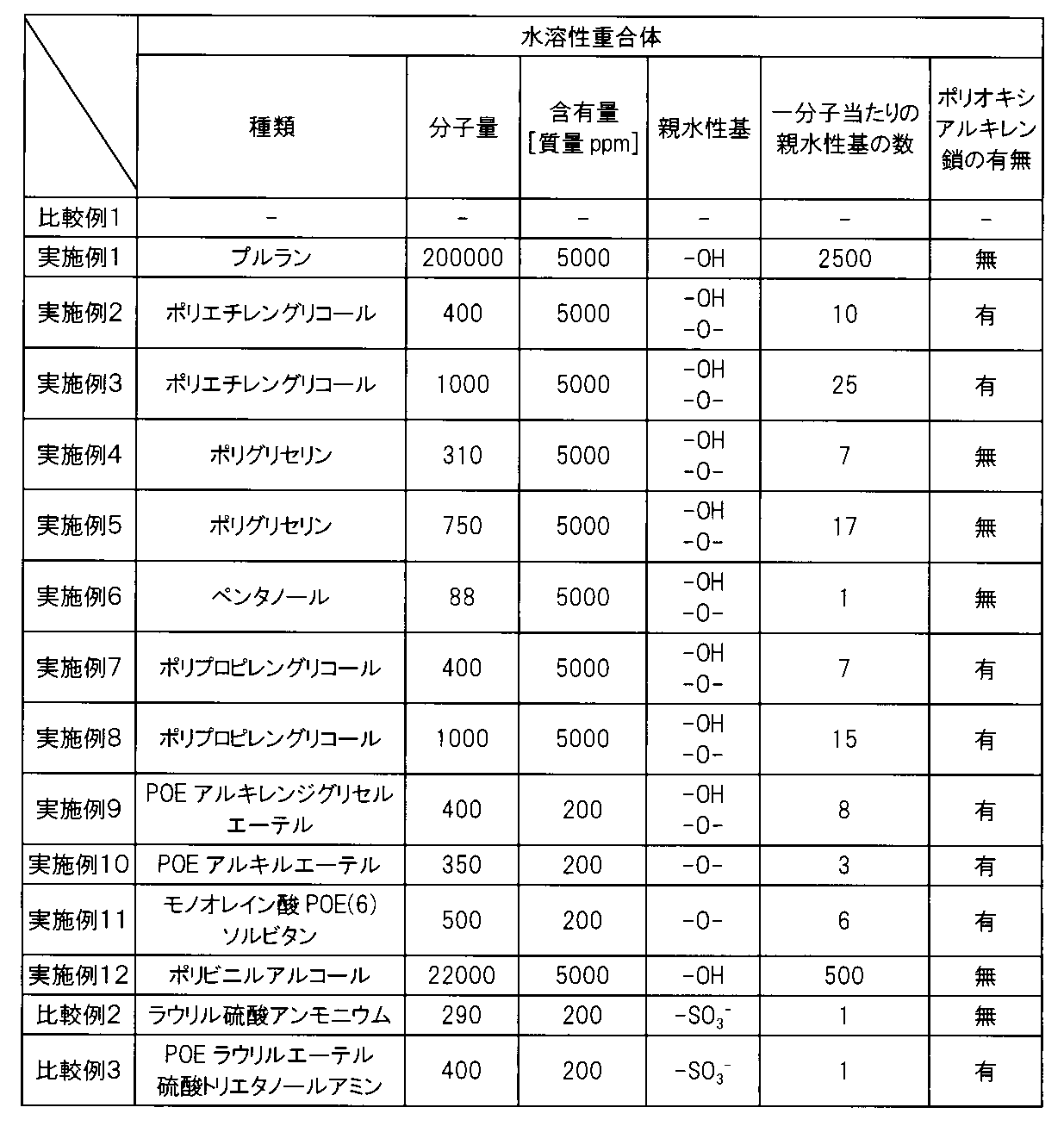
- a product was prepared. Details of the water-soluble polymer in each polishing composition are as shown in Table 1.
- the polishing compositions of Examples 1 to 12 and Comparative Examples 1 to 3 are all colloidal silica having an immobilized sulfonic acid (average primary particle size 35 nm, average secondary). The particle size is 70 nm and the average degree of association 2) is 5% by mass.
- the amount of progress of the fang and the amount of progress of dishing were measured using an atomic force microscope in a region where polysilicon portions having a width of 100 ⁇ m were formed at intervals of 100 ⁇ m. The results are shown in the “Fang progress” column and the “Dishing progress” column in the “100 ⁇ m / 100 ⁇ m region” column of Table 2.
- the amount of progress of EOE and the amount of dishing were measured using an atomic force microscope in a region where 0.25 ⁇ m wide polysilicon portions were formed at intervals of 0.25 ⁇ m. .
- the results are shown in the “EOE progress amount” column and the “Dishing progress amount” column in the “0.25 ⁇ m / 0.25 ⁇ m region” column of Table 2.
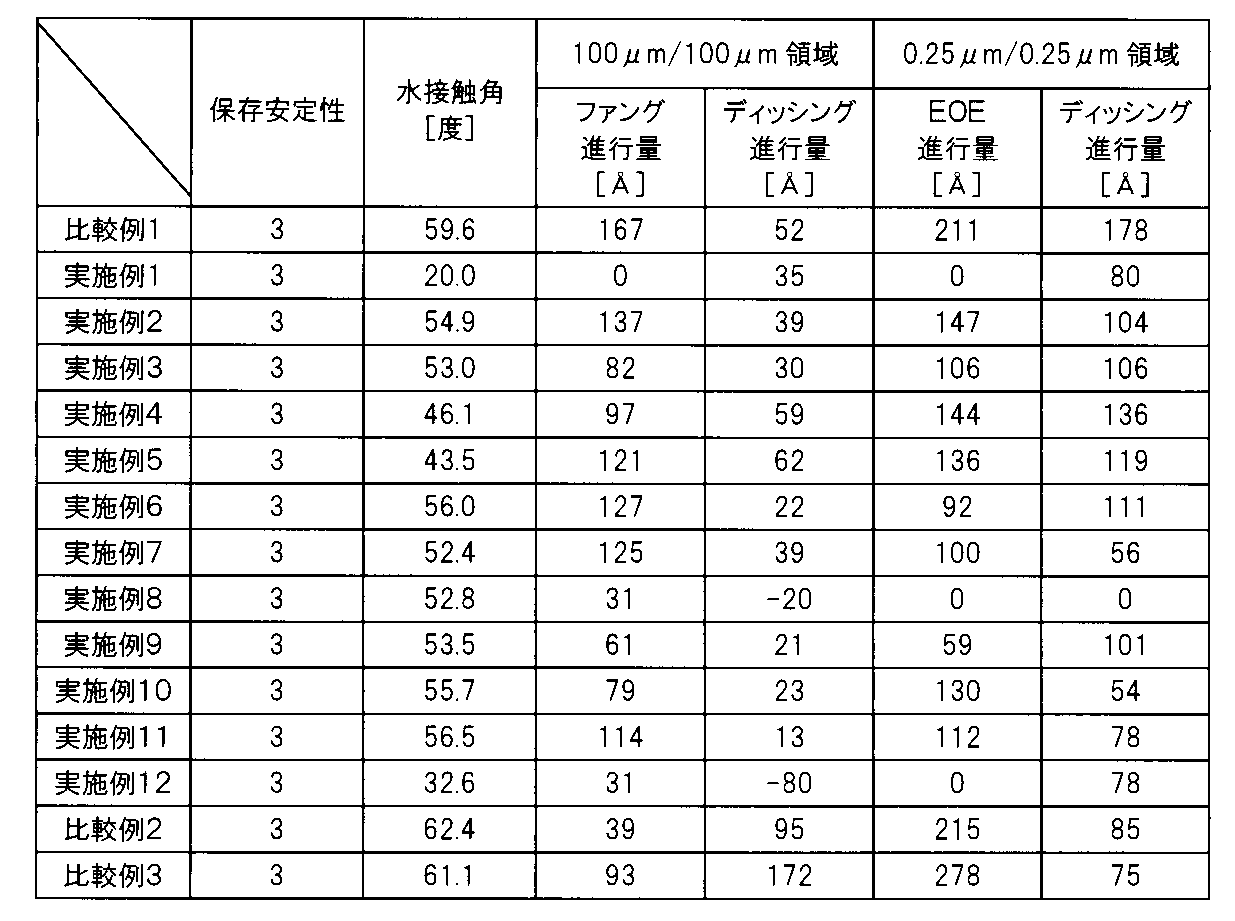
- the polished poly was less than when the polishing composition of Comparative Example 1 containing no water-soluble polymer was used.
- the water contact angle of the silicon portion was small, and in this case, both the fang progress amount and the EOE progress amount were reduced as compared with the case where the polishing composition of Comparative Example 1 was used.
- the polishing composition of Comparative Example 1 was used for the dishing progress in addition to the fang progress and the EOE progress. A decrease was observed in comparison with.
- the polishing composition of Comparative Example 4 was prepared by diluting colloidal silica sol with water and adding an organic acid as a pH adjuster to adjust the pH value to 3.
- the polishing compositions of Examples 13 to 18 and Comparative Examples 4 to 8 were prepared by diluting colloidal silica sol with water, adding a water-soluble polymer thereto, and then adding an organic acid to adjust the pH value to 3.
- a product was prepared. The details of the water-soluble polymer in each polishing composition are as shown in Table 4.
- polishing compositions of Examples 13 to 18 and Comparative Examples 4 to 8 were colloidal silica having an immobilized sulfonic acid (average primary particle size 35 nm, average secondary). The particle size is 70 nm and the average degree of association 2) is 5% by mass.
- each polishing composition was allowed to stand for 1 day in an environment of a temperature of 25 ° C., and then centrifuged at a rotational speed of 20000 rpm for 2 hours to collect a supernatant.
- the total amount of organic carbon in the collected supernatant was measured using an organic carbon measuring device of a combustion catalytic oxidation method.
- a composition having a composition obtained by removing colloidal silica from each polishing composition was prepared and allowed to stand in an environment at a temperature of 25 ° C. for one day.
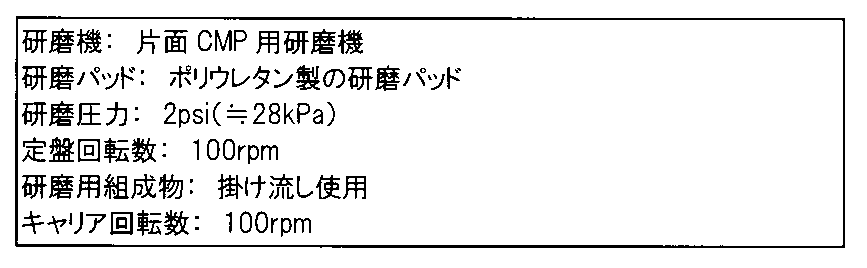
- poly-Si / HDP patterned wafers having a diameter of 200 mm having portions made of polysilicon and portions made of high-density plasma CVD silicon oxide Polishing was performed under the conditions shown in Table 6. The polishing of the patterned wafer was finished after further continuing for 15 seconds after the upper surface of the polysilicon portion was exposed.
- the amount of progress of the fang and the amount of progress of dishing were measured using an atomic force microscope in a region where polysilicon portions having a width of 100 ⁇ m were formed at intervals of 100 ⁇ m. The results are shown in the “Fang progress” column and the “Dishing progress” column in the “100 ⁇ m / 100 ⁇ m region” column of Table 5.
- the amount of progress of EOE and the amount of dishing were measured using an atomic force microscope in a region where 0.25 ⁇ m wide polysilicon portions were formed at intervals of 0.25 ⁇ m. .
- the results are shown in the “EOE progress amount” column and the “Dishing progress amount” column in the “0.25 ⁇ m / 0.25 ⁇ m region” column of Table 5.
Landscapes
- Chemical & Material Sciences (AREA)
- Organic Chemistry (AREA)
- Engineering & Computer Science (AREA)
- Materials Engineering (AREA)
- Composite Materials (AREA)
- Finish Polishing, Edge Sharpening, And Grinding By Specific Grinding Devices (AREA)
- Mechanical Treatment Of Semiconductor (AREA)
Abstract
本発明の研磨用組成物は、親水性基を有する水溶性重合体、及び砥粒を含有する。この研磨用組成物を用いて研磨した後の疎水性のケイ素含有部分の水接触角は、この研磨用組成物から水溶性重合体を除いた組成を有する別の組成物を用いて研磨した後の疎水性のケイ素含有部分の水接触角と比較して小さく、好ましくは57度以下である。このような水溶性重合体の例としては、多糖類又はアルコール化合物が挙げられる。あるいは、本発明の研磨用組成物は、シラノール基を有する砥粒、及び水溶性重合体を含有する。この研磨用組成物を25℃の温度の環境下で一日間静置したときには、砥粒の表面積1μm2あたりに5000個以上の前記水溶性重合体の分子が吸着する。このような水溶性重合体の例としては、ポリエチレングリコールなどのポリオキシアルキレン鎖を有するノニオン性化合物が挙げられる。
Description
本発明は、疎水性のケイ素含有部分と親水性のケイ素含有部分とを有する研磨対象物の研磨に適した研磨用組成物に関する。本発明はまた、その研磨用組成物を用いた研磨方法及び基板の製造方法に関する。
従来、半導体装置の銅等の金属配線を形成するための化学的機械的研磨において、ファング(あるいはシーム)と呼ばれる欠陥が研磨後に生じることが問題となっており、このような欠陥の発生を防ぐ目的で、特許文献1~5に開示されているような研磨用組成物の開発が行われている。
一方、半導体装置のプラグ(コンタクトプラグ)やパッド(コンタクトパッド)を、化学的機械的研磨を通じてポリシリコン(多結晶ケイ素)から形成することが行われている。このようなプラグやパッドの形成に際しては一般に、ポリシリコンからなる部分に加えて、その周辺に設けられている酸化シリコン又は窒化シリコンからなる部分も同時に研磨をすることが必要である。この場合、金属配線の形成時と同様のファングに加え、エッジオーバーエロージョン(以下、EOEという)と呼ばれる欠陥も研磨後に生じることがある。このファング及びEOEの発生は、ポリシリコン部分が疎水性であるのに対して酸化シリコン部分又は窒化シリコン部分が親水性であることが原因と考えられる。なお、ここでいうファングとは、ポリシリコン部分と酸化シリコン部分又は窒化シリコン部分との境界で局所的なエロージョンが起こることをいい、特に比較的幅広のポリシリコン部分の両脇で見られるものである。一方、EOEとは、比較的幅狭のポリシリコン部分があまり間隔を空けずに並んだ領域の両脇で局所的なエロージョンが起こることをいう。また同時に、ファングやEOEに加えて、ポリシリコン部分が必要以上に研磨除去されることによりポリシリコン部分の上面のレベルが低下して皿状の凹み、すなわちディッシングが生じるという問題もある。このようなポリシリコンからなるプラグやパッドの形成に際してのファングやEOE、ディッシングなどの欠陥の発生は、特許文献1~5の研磨用組成物を使用しても防止することは難しい。
そこで本発明の目的は、疎水性のケイ素含有部分と親水性のケイ素含有部分とを有する研磨対象物を研磨する用途で好適に用いることができる研磨用組成物を提供すること、またその研磨用組成物を用いた研磨方法及び基板の製造方法を提供することにある。
上記の目的を達成するために、本発明の第1の態様では、親水性基を有する水溶性重合体、及び砥粒を含有する研磨用組成物を提供する。この研磨用組成物を用いて疎水性のケイ素含有部分と親水性のケイ素含有部分とを有する研磨対象物を研磨した後の疎水性のケイ素含有部分の水接触角は、この研磨用組成物から水溶性重合体を除いた組成を有する別の組成物を用いて同じ研磨対象物を研磨した後の疎水性のケイ素含有部分の水接触角と比較して小さく、好ましくは57度以下である。
上記第1の態様の研磨用組成物において、水溶性重合体が有する親水性基の数は一分子当たり3個以上であることが好ましい。
上記第1の態様の研磨用組成物において、水溶性重合体は、多糖類又はアルコール化合物であること、特にポリエーテルであることが好ましい。
本発明の第2の態様では、シラノール基を有する砥粒、及び水溶性重合体を含有する研磨用組成物を提供する。この研磨用組成物を25℃の温度の環境下で一日間静置したときには、砥粒の表面積1μm2あたりに5000個以上の水溶性重合体の分子が吸着する。
上記第2の態様の研磨用組成物において、水溶性重合体はポリオキシアルキレン鎖を有するノニオン性化合物であることが好ましい。
上記第2の態様の研磨用組成物において、ポリオキシアルキレン鎖を有するノニオン性化合物は、ポリエチレングリコール、ポリプロピレングリコール、ポリオキシエチレンアルキレンジグリセルエーテル、ポリオキシエチレンアルキルエーテル、又はポリオキシエチレンソルビタン脂肪酸エステルであることが好ましい。
上記第1及び第2の態様の各研磨用組成物において、砥粒は、有機酸を固定化したシリカであることが好ましい。
上記第1及び第2の態様の各研磨用組成物は、疎水性のケイ素含有部分と親水性のケイ素含有部分とを有する研磨対象物を研磨する用途で使用される。疎水性のケイ素含有部分は例えばポリシリコンからなる。
本発明の第3の態様では、上記第1及び第2の態様の各研磨用組成物を用いて、疎水性のケイ素含有部分と親水性のケイ素含有部分とを有する研磨対象物を研磨する方法を提供する。
本発明の第4の態様では、上記第1及び第2の態様の各研磨用組成物を用いて、疎水性のケイ素含有部分と親水性のケイ素含有部分とを有する研磨対象物を研磨することにより、基板を製造する方法を提供する。
本発明によれば、疎水性のケイ素含有部分と親水性のケイ素含有部分とを有する研磨対象物を研磨する用途で好適に用いることができる研磨用組成物と、その研磨用組成物を用いた研磨方法及び基板の製造方法とが提供される。
第1実施形態
第1実施形態の研磨用組成物は、砥粒及び水溶性重合体を水に混合することにより調製される。従って、研磨用組成物は、砥粒及び水溶性重合体を含有する。
第1実施形態の研磨用組成物は、砥粒及び水溶性重合体を水に混合することにより調製される。従って、研磨用組成物は、砥粒及び水溶性重合体を含有する。
この研磨用組成物は、疎水性のケイ素含有部分と親水性のケイ素含有部分とを有する研磨対象物を研磨する用途、さらに言えばその研磨対象物を研磨して基板を製造する用途で使用される。疎水性のケイ素含有部分は、例えばポリシリコンからなるものである。親水性のケイ素含有部分は、例えば酸化シリコン又は窒化シリコンからなるものである。第1実施形態の研磨用組成物を用いてそのような研磨対象物を研磨した場合には、疎水性のケイ素含有部分の表面に研磨用組成物中の水溶性重合体が吸着することにより当該表面の濡れ性が向上する結果、ファング及びEOEの発生を抑えることができ、場合によってはさらにディッシングの発生も抑えることができる。
第1実施形態の研磨用組成物は、このように金属を研磨する用途での使用を意図していないため、金属研磨用の組成物に通常含まれている酸化剤や金属防食剤のような成分を含有してはいない。
第1実施形態の研磨用組成物中に含まれる水溶性重合体は、ヒドロキシ基、カルボキシ基、アミノ基及びエーテル基等の親水性基を有するものである。具体的には例えば、多糖類、アルコール化合物、ポリエーテル、ポリカルボン酸及びその塩等が使用可能である。あるいは、ポリオキシアルキレン鎖を有するノニオン性化合物も使用が可能である。
水溶性重合体が有する親水性基の数は、一分子当たり3個以上であることが好ましく、より好ましくは5個以上、さらに好ましくは10個以上である。水溶性重合体が有する親水性基の数が多いほど、研磨対象物、特に疎水性のケイ素含有部分に対する親水効果が高まり、その結果としてファング及びEOEの発生、場合によってはさらにディッシングの発生をより抑えることができる。
また、水溶性重合体は、第1実施形態の研磨用組成物を用いて疎水性のケイ素含有部分と親水性のケイ素含有部分とを有する研磨対象物を研磨した後の疎水性のケイ素含有部分の水接触角が、この研磨用組成物から水溶性重合体を除いた組成を有する別の組成物を用いて同じ研磨対象物を研磨した後の疎水性のケイ素含有部分の水接触角と比較して小さくなるような種類の化合物、好ましくは57度以下、より好ましくは50度以下、さらに好ましくは45度以下となるような種類の化合物の中から選択して使用される。第1実施形態の研磨用組成物を用いて研磨後の疎水性のケイ素含有部分の水接触角が小さくなるほど、ファング及びEOEの発生、場合によってはさらにディッシングの発生をより抑えることができる。
このような水溶性重合体の具体例としては、多糖類であるアルギン酸、ペクチン酸、カルボキシメチルセルロース、デンプン、寒天、カードラン及びプルラン、アルコール化合物であるポリエチレングリコール、ポリグリセリン、ペンタノール、ポリプロピレングリコール及びポリビニルアルコール(このうちポリエチレングリコール、ポリグリセリン及びポリプロピレングリコールはアルコール化合物であってかつポリエーテルである)、ポリオキシアルキレン鎖を有するノニオン性化合物であるポリオキシエチレン(以下、POEという)アルキレンジグリセルエーテル、POEアルキルエーテル及びモノオレイン酸POE(6)ソルビタン、ポリカルボン酸又はその塩であるポリアスパラギン酸、ポリグルタミン酸、ポリリシン、ポリリンゴ酸、ポリメタクリル酸、ポリメタクリル酸アンモニウム塩、ポリメタクリル酸ナトリウム塩、ポリマレイン酸、ポリイタコン酸、ポリフマル酸、ポリ(p-スチレンカルボン酸)、ポリアクリル酸、ポリアクリルアミド、アミノポリアクリルアミド、ポリアクリル酸メチル、ポリアクリル酸エチル、ポリアクリル酸アンモニウム塩、ポリアクリル酸ナトリウム塩、ポリアミド酸、ポリアミド酸アンモニウム塩、ポリアミド酸ナトリウム塩、ポリグリオキシル酸、ポリカルボン酸アミド、ポリカルボン酸エステル及びポリカルボン酸塩が挙げられる。
第1実施形態の研磨用組成物中の水溶性重合体の含有量は10質量ppm以上であることが好ましく、より好ましくは50質量ppm以上、さらに好ましくは100質量ppm以上である。水溶性重合体の含有量が多くなるにつれて、研磨用組成物を用いて研磨後の疎水性のケイ素含有部分の水接触角が小さくなり、その結果としてファング及びEOEの発生、場合によってはさらにディッシングの発生をより抑えることができる。
第1実施形態の研磨用組成物中の水溶性重合体の含有量はまた、100000質量ppm以下であることが好ましく、より好ましくは50000質量ppm以下、さらに好ましくは10000質量ppm以下である。水溶性重合体の含有量が少なくなるにつれて、研磨用組成物中の砥粒の凝集が起こりにくくなり、その結果として研磨用組成物の保存安定性が向上する有利がある。
水溶性重合体の分子量は100以上であることが好ましく、より好ましくは300以上である。水溶性重合体の分子量が大きくなるにつれて、疎水性のケイ素含有部分の表面に水溶性重合体が効果的に吸着することができ、その結果として研磨用組成物を用いて研磨後の疎水性のケイ素含有部分の水接触角がより小さくなる有利がある。
水溶性重合体の分子量は500000以下であることが好ましく、より好ましくは300000以下である。水溶性重合体の分子量が小さくなるにつれて、研磨用組成物中の砥粒の凝集が起こりにくくなり、その結果として研磨用組成物の保存安定性が向上する有利がある。
第1実施形態の研磨用組成物中に含まれる砥粒は、無機粒子、有機粒子、及び有機無機複合粒子のいずれであってもよい。無機粒子の具体例としては、例えば、シリカ、アルミナ、セリア、チタニアなどの金属酸化物からなる粒子、並びに窒化ケイ素粒子、炭化ケイ素粒子及び窒化ホウ素粒子が挙げられる。有機粒子の具体例としては、例えばポリメタクリル酸メチル(PMMA)粒子が挙げられる。その中でもシリカ粒子が好ましく、特に好ましいのはコロイダルシリカである。
砥粒は表面修飾されていてもよい。通常のコロイダルシリカは、酸性条件下でゼータ電位の値がゼロに近いために、酸性条件下ではシリカ粒子同士が互いに電気的に反発せず凝集を起こしやすい。これに対し、酸性条件でもゼータ電位が比較的大きな負の値を有するように表面修飾された砥粒は、酸性条件下においても互いに強く反発して良好に分散する結果、研磨用組成物の保存安定性を向上させることになる。このような表面修飾砥粒は、例えば、アルミニウム、チタン又はジルコニウムなどの金属あるいはそれらの酸化物を砥粒と混合して砥粒の表面にドープさせることにより得ることができる。
あるいは、研磨用組成物中の表面修飾砥粒は、有機酸を固定化したシリカであってもよい。中でも有機酸を固定化したコロイダルシリカを好ましく使用することができる。コロイダルシリカへの有機酸の固定化は、コロイダルシリカの表面に有機酸の官能基を化学的に結合させることにより行われる。コロイダルシリカと有機酸を単に共存させただけではコロイダルシリカへの有機酸の固定化は果たされない。有機酸の一種であるスルホン酸をコロイダルシリカに固定化するのであれば、例えば、“Sulfonic acid-functionalized silica through quantitative oxidation of thiol groups”, Chem. Commun. 246-247 (2003)に記載の方法で行うことができる。具体的には、3-メルカプトプロピルトリメトキシシラン等のチオール基を有するシランカップリング剤をコロイダルシリカにカップリングさせた後に過酸化水素でチオール基を酸化することにより、スルホン酸が表面に固定化されたコロイダルシリカを得ることができる。あるいは、カルボン酸をコロイダルシリカに固定化するのであれば、例えば、“Novel Silane Coupling Agents Containing a Photolabile 2-Nitrobenzyl Ester for Introduction of a Carboxy Group on the Surface of Silica Gel”, Chemistry Letters, 3, 228-229 (2000)に記載の方法で行うことができる。具体的には、光反応性2-ニトロベンジルエステルを含むシランカップリング剤をコロイダルシリカにカップリングさせた後に光照射することにより、カルボン酸が表面に固定化されたコロイダルシリカを得ることができる。
第1実施形態の研磨用組成物中の砥粒の含有量は0.1質量%以上であることが好ましく、より好ましくは0.5質量%以上、さらに好ましくは1質量%以上である。砥粒の含有量が多くなるにつれて、研磨用組成物による疎水性のケイ素含有部分及び親水性のケイ素含有部分の除去速度が向上する有利がある。
第1実施形態の研磨用組成物中の砥粒の含有量はまた、20質量%以下であることが好ましく、より好ましくは15質量%以下、さらに好ましくは10質量%以下である。砥粒の含有量が少なくなるにつれて、研磨用組成物の材料コストを抑えることができるのに加え、砥粒の凝集が起こりにくい。また、研磨用組成物を用いて研磨対象物を研磨することによりスクラッチの少ない研磨面を得られやすい。
砥粒の平均一次粒子径は5nm以上であることが好ましく、より好ましくは7nm以上、さらに好ましくは10nm以上である。砥粒の平均一次粒子径が大きくなるにつれて、研磨用組成物による疎水性のケイ素含有部分及び親水性のケイ素含有部分の除去速度が向上する有利がある。なお、砥粒の平均一次粒子径の値は、例えば、BET法で測定される砥粒の比表面積に基づいて計算することができる。
砥粒の平均一次粒子径はまた、100nm以下であることが好ましく、より好ましくは90nm以下、さらに好ましくは80nm以下である。砥粒の平均一次粒子径が小さくなるにつれて、研磨用組成物を用いて研磨対象物を研磨することによりスクラッチの少ない研磨面を得られやすい。
砥粒の平均二次粒子径は150nm以下であることが好ましく、より好ましくは120nm以下、さらに好ましくは100nm以下である。砥粒の平均二次粒子径の値は、例えば、レーザー光散乱法により測定することができる。
砥粒の平均二次粒子径の値を平均一次粒子径の値で除することにより得られる砥粒の平均会合度は1.2以上であることが好ましく、より好ましくは1.5以上である。砥粒の平均会合度が大きくなるにつれて、研磨用組成物による疎水性のケイ素含有部分及び親水性のケイ素含有部分の除去速度が向上する有利がある。
砥粒の平均会合度はまた、4以下であることが好ましく、より好ましくは3以下、さらに好ましくは2以下である。砥粒の平均会合度が小さくなるにつれて、研磨用組成物を用いて研磨対象物を研磨することによりスクラッチの少ない研磨面を得られやすい。
第2実施形態
第2実施形態の研磨用組成物は、第1実施形態の研磨用組成物と同様、砥粒及び水溶性重合体を水に混合することにより調製される。従って、第2実施形態の研磨用組成物もまた、砥粒及び水溶性重合体を含有する。
第2実施形態の研磨用組成物は、第1実施形態の研磨用組成物と同様、砥粒及び水溶性重合体を水に混合することにより調製される。従って、第2実施形態の研磨用組成物もまた、砥粒及び水溶性重合体を含有する。
第2実施形態の研磨用組成物は、疎水性のケイ素含有部分と親水性のケイ素含有部分とを有する研磨対象物を研磨する用途、さらに言えばその研磨対象物を研磨して基板を製造する用途で例えば使用される。疎水性のケイ素含有部分は、例えばポリシリコンからなるものである。親水性のケイ素含有部分は、例えば酸化シリコン又は窒化シリコンからなるものである。第2実施形態の研磨用組成物を用いてそのような研磨対象物を研磨した場合には、所定の量以上の水溶性重合体が砥粒の表面に吸着することにより砥粒の性質に変化が生じる結果、ファング、EOE及びディッシングの発生を抑えることができる。
第2実施形態の研磨用組成物は、このように金属を研磨する用途での使用を意図していないため、第1実施形態の研磨用組成物と同様、金属研磨用の組成物に通常含まれている酸化剤や金属防食剤のような成分を含有してはいない。
第2実施形態の研磨用組成物中に含まれる砥粒は、シラノール基を有するものである。シラノール基を有する砥粒の典型例はシリカ粒子であり、好ましくはコロイダルシリカである。表面改質によりシリカ粒子以外の砥粒にシラノール基を付与したものも使用可能である。
第2実施形態の研磨用組成物中の砥粒についてのその他の詳細は、先に説明した第1実施形態の研磨用組成物中の砥粒と同じであるので、重複を避けるために説明を省略する。
第2実施形態の研磨用組成物中に含まれる水溶性重合体は、研磨用組成物を25℃の温度の環境下で一日間静置したときに、砥粒の表面積1μm2あたりに5000個以上の分子が吸着するような種類の水溶性重合体の中から選択して使用される。ポリオキシアルキレン鎖を有するノニオン性化合物は、ポリオキシアルキレン鎖中の酸素原子が砥粒のシラノール基と水素結合するため、好適に使用することができる。ポリオキシアルキレン鎖を有するノニオン性化合物の具体例としては、ポリエチレングリコール、ポリプロピレングリコール、POEアルキレンジグリセルエーテル、POEアルキルエーテル、POEソルビタン脂肪酸エステル、POEアルキルフェニルエーテル、POEグリコール脂肪酸エステル、POEヘキシタン脂肪酸エステル、POEポリプロピレンアルキルエーテル、及びポリオキシプロピレン/ポリオキシエチレンのブロック/ランダムコポリマーが挙げられる。
第2実施形態の研磨用組成物中の水溶性重合体の含有量は10質量ppm以上であることが好ましく、より好ましくは50質量ppm以上、さらに好ましくは100質量ppm以上である。水溶性重合体の含有量が多くなるにつれて、砥粒の表面に水溶性重合体が効果的に吸着することができ、その結果としてファング、EOE及びディッシングの発生をより抑えることができる。
第2実施形態の研磨用組成物中の水溶性重合体の含有量はまた、100000質量ppm以下であることが好ましく、より好ましくは50000質量ppm以下、さらに好ましくは10000質量ppm以下である。水溶性重合体の含有量が少なくなるにつれて、研磨用組成物中の砥粒の凝集が起こりにくくなり、その結果として研磨用組成物の保存安定性が向上する有利がある。
第1及び第2実施形態の研磨用組成物のpHは12以下であることが好ましく、より好ましくは11以下、さらに好ましくは10以下である。研磨用組成物のpHが小さくなるにつれて、研磨用組成物による疎水性のケイ素含有部分のエッチングが起こりにくくなり、その結果としてディッシングの発生をより抑えることができる。
第1及び第2実施形態の研磨用組成物のpHを所望の値に調整するために必要に応じて使用されるpH調整剤は酸及びアルカリのいずれであってもよく、また無機及び有機の化合物のいずれであってもよい。
第1及び第2実施形態によれば以下の作用及び効果が得られる。
・ 第1実施形態の研磨用組成物に含まれている水溶性重合体は親水性基を有しているため、疎水性のケイ素含有部分の表面にこの水溶性重合体が吸着することにより当該表面の濡れ性を向上することができる。このことが、第1実施形態の研磨用組成物を用いて疎水性のケイ素含有部分と親水性のケイ素含有部分とを有する研磨対象物を研磨した場合にファング及びEOEの発生を抑えることができ、場合によってはさらにディッシングの発生も抑えることができる理由と考えられる。そのため、第1実施形態の研磨用組成物は、そのような研磨対象物を研磨する用途で好適に使用することができる。
・ 第2実施形態の研磨用組成物は、シラノール基を有する砥粒の表面に特定の条件下で所定の量以上吸着することができる水溶性重合体を含有している。所定の量以上の水溶性重合体が砥粒の表面に吸着することにより、砥粒の性質には変化が生じる。このことが、第2実施形態の研磨用組成物を用いて疎水性のケイ素含有部分と親水性のケイ素含有部分とを有する研磨対象物を研磨した場合にファング、EOE及びディッシングの発生を抑えることができる理由と考えられる。そのため、第2実施形態の研磨用組成物は、そのような研磨対象物を研磨する用途で好適に使用することができる。
・ 第1及び第2実施形態の研磨用組成物のpHが酸性(例えばpH6以下)であってかつ研磨用組成物中に含まれる砥粒として有機酸を固定化したコロイダルシリカを使用した場合には、ファング、EOE及びディッシングの発生をさらに抑えることができる。その理由は、有機酸を固定化したコロイダルシリカのゼータ電位が酸性のpH領域で負の値を示すのに対し、研磨対象物のポリシリコンなどの疎水性のケイ素含有部分のゼータ電位もまた酸性のpH領域で負の値を示すためである。つまり、酸性のpH領域では研磨用組成物中の砥粒が研磨対象物の疎水性のケイ素含有部分に対して電気的に反発し、その結果、砥粒による疎水性のケイ素含有部分の過剰研磨が原因のファング、EOE及びディッシングは生じにくい。
・ 第1及び第2実施形態の研磨用組成物のpHが酸性(例えばpH6以下)であってかつ研磨用組成物中に含まれる砥粒として有機酸を固定化したコロイダルシリカを使用した場合には、研磨用組成物による研磨対象物の親水性のケイ素含有部分の研磨速度が向上する。その理由は、有機酸を固定化したコロイダルシリカのゼータ電位が酸性のpH領域で負の値を示すのに対し、研磨対象物の酸化シリコンや窒化シリコンなどの親水性のケイ素含有部分のゼータ電位が酸性のpH領域で正の値を示すためである。つまり、酸性のpH領域では研磨用組成物中の砥粒が研磨対象物の親水性のケイ素含有部分に対して電気的に反発せず、その結果、砥粒による親水性のケイ素含有部分の機械的研磨が促進される。
・ 第1及び第2実施形態の研磨用組成物中に含まれる砥粒として有機酸を固定化したコロイダルシリカを使用した場合には、長期にわたり優れた分散安定性を有する研磨用組成物が得られる。その理由は、有機酸を固定化したコロイダルシリカは、有機酸が固定化されていない通常のコロイダルシリカに比べて、研磨用組成物中でのゼータ電位の絶対値が大きい傾向があるためである。研磨用組成物中でのゼータ電位の絶対値が大きくなるにつれて、シリカ粒子同士の間の静電的斥力が強まるために、ファンデルワールス力による引力が原因のコロイダルシリカの凝集は起こりにくくなる。例えば酸性のpH領域において、有機酸を固定化したコロイダルシリカのゼータ電位は一般に-15mV以下の負の値を示すのに対し、通常のコロイダルシリカのゼータ電位はゼロに近い値を示す。
前記第1及び第2実施形態は次のように変更されてもよい。
・ 第1実施形態の研磨用組成物は、水溶性重合体を二種類以上含有してもよい。この場合、一部の水溶性重合体については必ずしも親水性基を有している必要はなく、また疎水性のケイ素含有部分の水接触角を小さくする作用を必ずしも有している必要もない。
・ 第2実施形態の研磨用組成物は、水溶性重合体を二種類以上含有してもよい。この場合、一部の水溶性重合体については必ずしも砥粒の表面に吸着する性質を有している必要はない。
・ 第1及び第2実施形態の研磨用組成物は、防腐剤のような公知の添加剤を必要に応じてさらに含有してもよい。
・ 第1及び第2実施形態の研磨用組成物は一液型であってもよいし、二液型を始めとする多液型であってもよい。
・ 第1及び第2実施形態の研磨用組成物は、研磨用組成物の原液を水で希釈することにより調製されてもよい。
次に、本発明の実施例及び比較例を説明する。
実施例1~12及び比較例1~3
コロイダルシリカゾルを水で希釈し、pH調整剤として有機酸を添加してpHの値を3に調整することにより比較例1の研磨用組成物を調製した。コロイダルシリカゾルを水で希釈し、そこに水溶性重合体を加えた後、有機酸を添加してpHの値を3に調整することにより実施例1~12及び比較例2,3の研磨用組成物を調製した。各研磨用組成物中の水溶性重合体の詳細は表1に示すとおりである。
コロイダルシリカゾルを水で希釈し、pH調整剤として有機酸を添加してpHの値を3に調整することにより比較例1の研磨用組成物を調製した。コロイダルシリカゾルを水で希釈し、そこに水溶性重合体を加えた後、有機酸を添加してpHの値を3に調整することにより実施例1~12及び比較例2,3の研磨用組成物を調製した。各研磨用組成物中の水溶性重合体の詳細は表1に示すとおりである。
なお、表1中には示していないが、実施例1~12及び比較例1~3の研磨用組成物はいずれも、スルホン酸を固定化したコロイダルシリカ(平均一次粒子径35nm、平均二次粒子径70nm、平均会合度2)を5質量%含有している。
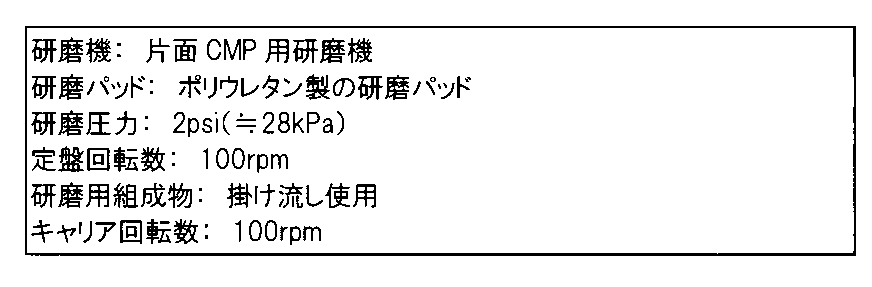
実施例1~12及び比較例1~3の各研磨用組成物を用いて、ポリシリコンからなる部分と高密度プラズマCVD酸化シリコンからなる部分とを有する直径200mmのpoly-Si/HDPパターンウェーハを、表3に示す条件で研磨した。このパターンウェーハの研磨は、ポリシリコン部分の上面が露出した後、15秒だけさらに継続の後に終了させた。
研磨後の各パターンウェーハを純水でリンスし、乾燥空気を吹き付けて乾燥した後、市販の接触角評価装置を用いてθ/2法で、ポリシリコン部分の水接触角を測定した。その結果を表2の“水接触角”欄に示す。
研磨後の各パターンウェーハについて、100μm幅のポリシリコン部分が100μm間隔で形成されている領域で、原子間力顕微鏡を用いて、ファングの進行量及びディッシングの進行量を測定した。その結果を表2の“100μm/100μm領域”欄の“ファング進行量”欄及び“ディッシング進行量”欄に示す。
同じく研磨後の各パターンウェーハについて、0.25μm幅のポリシリコン部分が0.25μm間隔で形成されている領域で、原子間力顕微鏡を用いて、EOEの進行量及びディッシングの進行量を測定した。その結果を表2の“0.25μm/0.25μm領域”欄の“EOE進行量”欄及び“ディッシング進行量”欄に示す。
実施例13~18及び比較例4~8
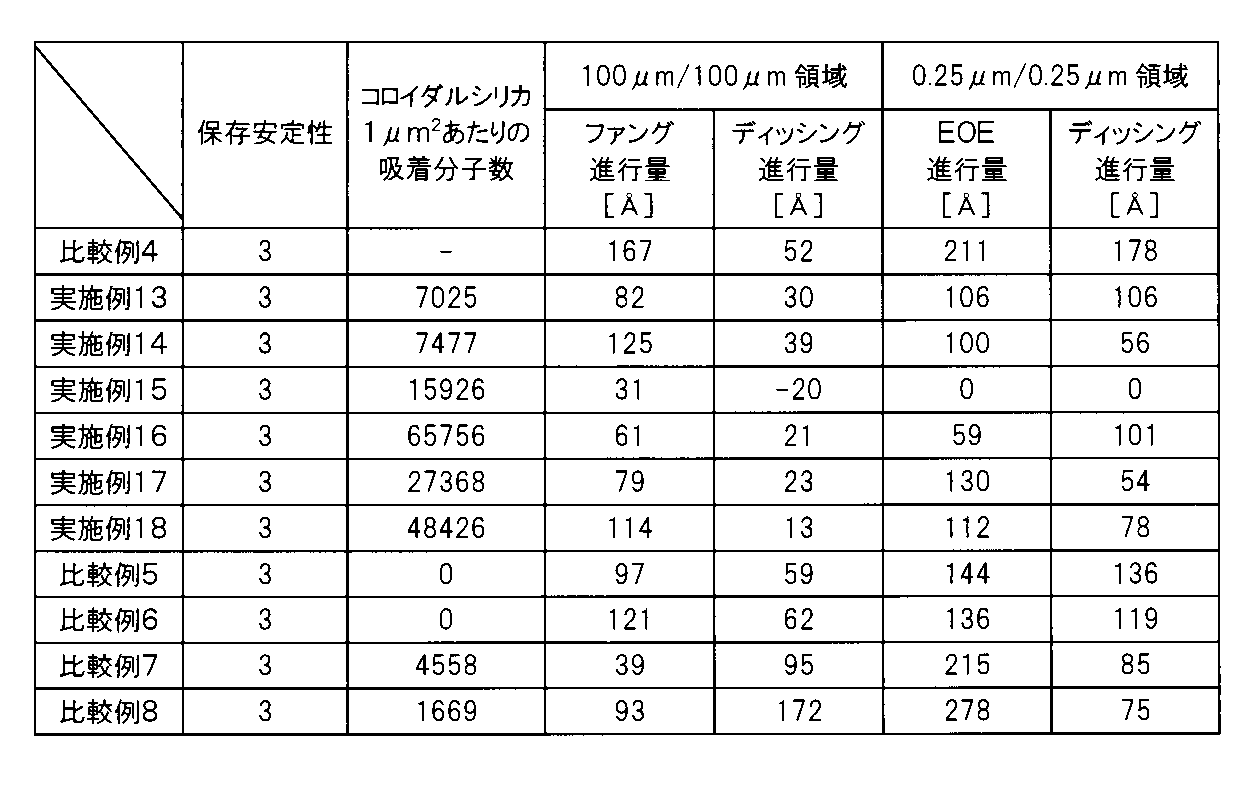
コロイダルシリカゾルを水で希釈し、pH調整剤として有機酸を添加してpHの値を3に調整することにより比較例4の研磨用組成物を調製した。コロイダルシリカゾルを水で希釈し、そこに水溶性重合体を加えた後、有機酸を添加してpHの値を3に調整することにより実施例13~18及び比較例4~8の研磨用組成物を調製した。各研磨用組成物中の水溶性重合体の詳細は表4に示すとおりである。
コロイダルシリカゾルを水で希釈し、pH調整剤として有機酸を添加してpHの値を3に調整することにより比較例4の研磨用組成物を調製した。コロイダルシリカゾルを水で希釈し、そこに水溶性重合体を加えた後、有機酸を添加してpHの値を3に調整することにより実施例13~18及び比較例4~8の研磨用組成物を調製した。各研磨用組成物中の水溶性重合体の詳細は表4に示すとおりである。
なお、表4中には示していないが、実施例13~18及び比較例4~8の研磨用組成物はいずれも、スルホン酸を固定化したコロイダルシリカ(平均一次粒子径35nm、平均二次粒子径70nm、平均会合度2)を5質量%含有している。

実施例13~18及び比較例4~8の各研磨用組成物について、コロイダルシリカの単位表面積あたりに吸着する水溶性重合体の分子数を次のようにして測定した。すなわち、各研磨用組成物を25℃の温度の環境下で一日間静置した後、20000rpmの回転速度で2時間遠心分離して上澄み液を回収した。回収した上澄み液中の全有機炭素量を、燃焼触媒酸化方式の有機炭素測定装置を用いて計測した。またそれとは別に、各研磨用組成物からコロイダルシリカを除いた組成を有する組成物を用意し、25℃の温度の環境下で一日間静置した後、同じく燃焼触媒酸化方式の有機炭素測定装置を用いてこの組成物中の全有機炭素量を計測した。そして、対応する研磨用組成物の上澄み液中の全有機炭素量をこれから減ずることにより、研磨用組成物中のコロイダルシリカに対する水溶性重合体の全吸着量を算出した。コロイダルシリカの単位表面積あたりに吸着する水溶性重合体の分子数は、こうして算出した吸着量からコロイダルシリカの表面積及び水溶性重合体の分子量に基づいて算出することができた。その結果を表5の“コロイダルシリカ1μm2あたりの吸着分子数”欄に示す。
実施例13~18及び比較例4~8の各研磨用組成物を用いて、ポリシリコンからなる部分と高密度プラズマCVD酸化シリコンからなる部分とを有する直径200mmのpoly-Si/HDPパターンウェーハを、表6に示す条件で研磨した。このパターンウェーハの研磨は、ポリシリコン部分の上面が露出した後、15秒だけさらに継続の後に終了させた。
研磨後の各パターンウェーハについて、100μm幅のポリシリコン部分が100μm間隔で形成されている領域で、原子間力顕微鏡を用いて、ファングの進行量及びディッシングの進行量を測定した。その結果を表5の“100μm/100μm領域”欄の“ファング進行量”欄及び“ディッシング進行量”欄に示す。
同じく研磨後の各パターンウェーハについて、0.25μm幅のポリシリコン部分が0.25μm間隔で形成されている領域で、原子間力顕微鏡を用いて、EOEの進行量及びディッシングの進行量を測定した。その結果を表5の“0.25μm/0.25μm領域”欄の“EOE進行量”欄及び“ディッシング進行量”欄に示す。
Claims (14)
- 疎水性のケイ素含有部分と親水性のケイ素含有部分とを有する研磨対象物を研磨する用途で使用される研磨用組成物であって、
親水性基を有する水溶性重合体、及び砥粒を含有し、
前記研磨用組成物を用いて前記研磨対象物を研磨した後の疎水性のケイ素含有部分の水接触角が、前記研磨用組成物から水溶性重合体を除いた組成を有する別の組成物を用いて前記研磨対象物を研磨した後の疎水性のケイ素含有部分の水接触角と比較して小さい
ことを特徴とする研磨用組成物。 - 前記研磨用組成物を用いて前記研磨対象物を研磨した後の疎水性のケイ素含有部分の水接触角は57度以下である、請求項1に記載の研磨用組成物。
- 前記水溶性重合体が有する親水性基の数は一分子当たり3個以上である、請求項1又は2に記載の研磨用組成物。
- 前記水溶性重合体は、多糖類又はアルコール化合物である、請求項1~3のいずれか一項に記載の研磨用組成物。
- 前記アルコール化合物はポリエーテルである、請求項4に記載の研磨用組成物。
- 前記疎水性のケイ素含有部分はポリシリコンからなる、請求項1~5のいずれか一項に記載の研磨用組成物。
- シラノール基を有する砥粒、及び水溶性重合体を含有する研磨用組成物であって、
前記研磨用組成物を25℃の温度の環境下で一日間静置したときに、前記砥粒の表面積1μm2あたりに5000個以上の前記水溶性重合体の分子が吸着することを特徴とする研磨用組成物。 - 前記水溶性重合体はポリオキシアルキレン鎖を有するノニオン性化合物である、請求項7に記載の研磨用組成物。
- 前記ポリオキシアルキレン鎖を有するノニオン性化合物は、ポリエチレングリコール、ポリプロピレングリコール、ポリオキシエチレンアルキレンジグリセルエーテル、ポリオキシエチレンアルキルエーテル、又はポリオキシエチレンソルビタン脂肪酸エステルである、請求項8に記載の研磨用組成物。
- 疎水性のケイ素含有部分と親水性のケイ素含有部分とを有する研磨対象物を研磨する用途で使用される、請求項7~9のいずれか一項に記載の研磨用組成物。
- 前記疎水性のケイ素含有部分はポリシリコンからなる、請求項10に記載の研磨用組成物。
- 前記砥粒は有機酸を固定化したシリカである、請求項1~11のいずれか一項に記載の研磨用組成物。
- 請求項1~12のいずれか一項に記載の研磨用組成物を用いて、疎水性のケイ素含有部分と親水性のケイ素含有部分とを有する研磨対象物を研磨することを特徴とする研磨方法。
- 請求項1~12のいずれか一項に記載の研磨用組成物を用いて、疎水性のケイ素含有部分と親水性のケイ素含有部分とを有する研磨対象物を研磨する工程を有することを特徴とする基板の製造方法。
Priority Applications (4)
| Application Number | Priority Date | Filing Date | Title |
|---|---|---|---|
| KR1020147000159A KR102000304B1 (ko) | 2011-06-14 | 2012-05-31 | 연마용 조성물 |
| CN201280029023.4A CN103620747B (zh) | 2011-06-14 | 2012-05-31 | 研磨用组合物 |
| EP12800395.1A EP2722872A4 (en) | 2011-06-14 | 2012-05-31 | POLISHING COMPOSITION |
| US14/123,889 US9640407B2 (en) | 2011-06-14 | 2012-05-31 | Polishing composition |
Applications Claiming Priority (8)
| Application Number | Priority Date | Filing Date | Title |
|---|---|---|---|
| JP2011132413 | 2011-06-14 | ||
| JP2011-132413 | 2011-06-14 | ||
| JP2011132412 | 2011-06-14 | ||
| JP2011-132412 | 2011-06-14 | ||
| JP2011-284285 | 2011-12-26 | ||
| JP2011284285A JP6407503B2 (ja) | 2011-06-14 | 2011-12-26 | 研磨用組成物 |
| JP2011284286A JP6411708B2 (ja) | 2011-06-14 | 2011-12-26 | 研磨用組成物 |
| JP2011-284286 | 2011-12-26 |
Publications (1)
| Publication Number | Publication Date |
|---|---|
| WO2012172983A1 true WO2012172983A1 (ja) | 2012-12-20 |
Family
ID=48802348
Family Applications (1)
| Application Number | Title | Priority Date | Filing Date |
|---|---|---|---|
| PCT/JP2012/064046 Ceased WO2012172983A1 (ja) | 2011-06-14 | 2012-05-31 | 研磨用組成物 |
Country Status (7)
| Country | Link |
|---|---|
| US (1) | US9640407B2 (ja) |
| EP (1) | EP2722872A4 (ja) |
| KR (1) | KR102000304B1 (ja) |
| CN (1) | CN103620747B (ja) |
| SG (1) | SG10201604609WA (ja) |
| TW (1) | TWI534220B (ja) |
| WO (1) | WO2012172983A1 (ja) |
Cited By (5)
| Publication number | Priority date | Publication date | Assignee | Title |
|---|---|---|---|---|
| CN103772393A (zh) * | 2012-10-18 | 2014-05-07 | 博瑞生物医药技术(苏州)有限公司 | 替卡格雷的晶型及其制备方法 |
| WO2014103494A1 (ja) * | 2012-12-28 | 2014-07-03 | 株式会社フジミインコーポレーテッド | 研磨用組成物 |
| CN105073941A (zh) * | 2013-02-21 | 2015-11-18 | 福吉米株式会社 | 研磨用组合物及研磨物制造方法 |
| EP2952550A4 (en) * | 2013-02-01 | 2016-09-28 | Fujimi Inc | SURFACE LENS POLISHING COMPOSITION |
| US10106704B2 (en) * | 2014-03-20 | 2018-10-23 | Fujimi Incorporated | Polishing composition, polishing method, and method for producing substrate |
Families Citing this family (18)
| Publication number | Priority date | Publication date | Assignee | Title |
|---|---|---|---|---|
| WO2013157442A1 (ja) * | 2012-04-18 | 2013-10-24 | 株式会社フジミインコーポレーテッド | 研磨用組成物 |
| KR20160010495A (ko) * | 2013-05-15 | 2016-01-27 | 바스프 에스이 | 폴리에틸렌 이민을 포함하는 화학-기계적 연마 조성물 |
| JP5857310B2 (ja) * | 2013-09-30 | 2016-02-10 | 株式会社フジミインコーポレーテッド | 研磨用組成物およびその製造方法 |
| JP6801964B2 (ja) * | 2016-01-19 | 2020-12-16 | 株式会社フジミインコーポレーテッド | 研磨用組成物及びシリコン基板の研磨方法 |
| KR102508181B1 (ko) * | 2016-12-28 | 2023-03-09 | 니타 듀퐁 가부시키가이샤 | 연마용 조성물 및 연마 방법 |
| US11643573B2 (en) | 2017-03-14 | 2023-05-09 | Fujimi Incorporated | Polishing composition, production method therefor, and polishing method and production method for substrate, using polishing composition |
| JP7104053B2 (ja) * | 2017-09-07 | 2022-07-20 | 株式会社フジミインコーポレーテッド | 研磨用組成物およびシリコン基板研磨方法 |
| US10822524B2 (en) | 2017-12-14 | 2020-11-03 | Rohm And Haas Electronic Materials Cmp Holdings, I | Aqueous compositions of low dishing silica particles for polysilicon polishing |
| JP7128005B2 (ja) * | 2018-03-26 | 2022-08-30 | 株式会社フジミインコーポレーテッド | 研磨用組成物 |
| US10815392B2 (en) * | 2018-05-03 | 2020-10-27 | Rohm and Haas Electronic CMP Holdings, Inc. | Chemical mechanical polishing method for tungsten |
| WO2021111817A1 (ja) * | 2019-12-02 | 2021-06-10 | 住友電気工業株式会社 | 炭化珪素基板および炭化珪素基板の製造方法 |
| US11525071B2 (en) * | 2020-03-30 | 2022-12-13 | Fujimi Incorporated | Polishing composition based on mixture of colloidal silica particles |
| TWI896724B (zh) * | 2020-09-29 | 2025-09-11 | 日商福吉米股份有限公司 | 研磨用組成物及其製造方法、研磨方法以及基板的製造方法 |
| KR102699714B1 (ko) * | 2021-03-04 | 2024-08-29 | 주식회사 케이씨텍 | 실리콘 웨이퍼 연마용 조성물 |
| KR20220131152A (ko) * | 2021-03-19 | 2022-09-27 | 가부시키가이샤 후지미인코퍼레이티드 | 연마용 조성물, 연마 방법, 및 반도체 기판의 제조 방법 |
| JP7702284B2 (ja) * | 2021-06-29 | 2025-07-03 | 株式会社フジミインコーポレーテッド | 表面修飾コロイダルシリカおよびこれを含む研磨用組成物 |
| KR102728251B1 (ko) * | 2021-12-31 | 2024-11-11 | 주식회사 케이씨텍 | 컨택 공정용 금속막 슬러리 조성물 |
| KR102754530B1 (ko) * | 2022-05-18 | 2025-01-21 | 주식회사 케이씨텍 | 연마 슬러리 조성물 |
Citations (4)
| Publication number | Priority date | Publication date | Assignee | Title |
|---|---|---|---|---|
| JP2001326199A (ja) * | 2000-05-17 | 2001-11-22 | Hitachi Ltd | 半導体集積回路装置の製造方法 |
| JP2006100550A (ja) * | 2004-09-29 | 2006-04-13 | Fuji Photo Film Co Ltd | 金属用研磨液材料及び研磨方法 |
| JP2007220759A (ja) * | 2006-02-14 | 2007-08-30 | Fujifilm Corp | 金属用研磨液及びそれを用いた化学的機械的研磨方法 |
| JP2010153781A (ja) * | 2008-11-20 | 2010-07-08 | Hitachi Chem Co Ltd | 基板の研磨方法 |
Family Cites Families (34)
| Publication number | Priority date | Publication date | Assignee | Title |
|---|---|---|---|---|
| SG108221A1 (en) | 1999-03-15 | 2005-01-28 | Tokyo Magnetic Printing | Free abrasive slurry compositions and a grinding method using the same |
| US6419174B1 (en) * | 2000-08-18 | 2002-07-16 | J. M. Huber Corporation | Abrasive compositions and methods for making same |
| JP2002329688A (ja) * | 2001-02-28 | 2002-11-15 | Kyoeisha Chem Co Ltd | 保湿剤を含有する研磨用懸濁液 |
| US6857434B2 (en) * | 2002-01-24 | 2005-02-22 | International Business Machines Corporation | CMP slurry additive for foreign matter detection |
| JP2006086462A (ja) | 2004-09-17 | 2006-03-30 | Fujimi Inc | 研磨用組成物およびそれを用いた配線構造体の製造法 |
| WO2006115393A1 (en) * | 2005-04-28 | 2006-11-02 | Techno Semichem Co., Ltd. | Auto-stopping abrasive composition for polishing high step height oxide layer |
| CN100578741C (zh) | 2005-09-02 | 2010-01-06 | 福吉米株式会社 | 抛光组合物 |
| JP2007103515A (ja) | 2005-09-30 | 2007-04-19 | Fujimi Inc | 研磨方法 |
| KR100750191B1 (ko) * | 2005-12-22 | 2007-08-17 | 삼성전자주식회사 | 슬러리 조성물, 이를 이용한 화학 기계적 연마 방법 및상기 방법을 이용한 비 휘발성 메모리 소자의 제조 방법 |
| JP2007214205A (ja) * | 2006-02-07 | 2007-08-23 | Fujimi Inc | 研磨用組成物 |
| JP2007258510A (ja) * | 2006-03-24 | 2007-10-04 | Toshiba Corp | 半導体装置の製造方法 |
| JP4901301B2 (ja) * | 2006-05-23 | 2012-03-21 | 株式会社東芝 | 研磨方法及び半導体装置の製造方法 |
| CN101484276B (zh) | 2006-07-05 | 2011-07-20 | 日立化成工业株式会社 | Cmp用研磨液及研磨方法 |
| KR100852242B1 (ko) * | 2006-08-16 | 2008-08-13 | 삼성전자주식회사 | 화학 기계적 연마용 슬러리 조성물, 이를 이용한 연마 방법및 반도체 메모리 소자의 제조 방법 |
| JP2008117807A (ja) | 2006-10-31 | 2008-05-22 | Fujimi Inc | 研磨用組成物及び研磨方法 |
| CN102352187B (zh) | 2007-07-05 | 2015-03-18 | 日立化成株式会社 | 金属膜用研磨液及研磨方法 |
| JP2009187984A (ja) | 2008-02-01 | 2009-08-20 | Fujimi Inc | 研磨用組成物及びそれを用いた研磨方法 |
| CN103131330B (zh) | 2008-02-01 | 2015-09-23 | 福吉米株式会社 | 研磨用组合物以及使用其的研磨方法 |
| JP5220428B2 (ja) * | 2008-02-01 | 2013-06-26 | 株式会社フジミインコーポレーテッド | 研磨用組成物を用いた研磨方法 |
| JP5333744B2 (ja) | 2008-02-18 | 2013-11-06 | Jsr株式会社 | 化学機械研磨用水系分散体、化学機械研磨方法および化学機械研磨用水系分散体の製造方法 |
| US20110081780A1 (en) * | 2008-02-18 | 2011-04-07 | Jsr Corporation | Aqueous dispersion for chemical mechanical polishing and chemical mechanical polishing method |
| JP5444625B2 (ja) | 2008-03-05 | 2014-03-19 | 日立化成株式会社 | Cmp研磨液、基板の研磨方法及び電子部品 |
| US9202709B2 (en) * | 2008-03-19 | 2015-12-01 | Fujifilm Corporation | Polishing liquid for metal and polishing method using the same |
| JP4521058B2 (ja) | 2008-03-24 | 2010-08-11 | 株式会社Adeka | 表面改質コロイダルシリカおよびこれを含有するcmp用研磨組成物 |
| EP2346069A4 (en) * | 2008-11-07 | 2012-06-13 | Asahi Glass Co Ltd | ABRASIVE, POLISHING METHOD AND METHOD FOR PRODUCING AN INTEGRATED SEMICONDUCTOR SWITCHING |
| WO2010077773A1 (en) * | 2008-12-30 | 2010-07-08 | 3M Innovative Properties Company | Lubricant composition and method of forming |
| JP5843613B2 (ja) | 2009-01-20 | 2016-01-13 | キャボット コーポレイションCabot Corporation | シラン変性金属酸化物を含む組成物 |
| JP2010269985A (ja) | 2009-05-22 | 2010-12-02 | Fuso Chemical Co Ltd | スルホン酸修飾水性アニオンシリカゾル及びその製造方法 |
| JP5587620B2 (ja) * | 2010-01-25 | 2014-09-10 | 株式会社フジミインコーポレーテッド | 研磨用組成物及びそれを用いた研磨方法 |
| JP5760317B2 (ja) * | 2010-02-05 | 2015-08-05 | 日立化成株式会社 | Cmp研磨液及びこのcmp研磨液を用いた研磨方法 |
| JP5774283B2 (ja) * | 2010-04-08 | 2015-09-09 | 株式会社フジミインコーポレーテッド | 研磨用組成物及び研磨方法 |
| JP5544244B2 (ja) * | 2010-08-09 | 2014-07-09 | 株式会社フジミインコーポレーテッド | 研磨用組成物および研磨方法 |
| JP5695367B2 (ja) * | 2010-08-23 | 2015-04-01 | 株式会社フジミインコーポレーテッド | 研磨用組成物及びそれを用いた研磨方法 |
| JP6040029B2 (ja) * | 2010-09-24 | 2016-12-07 | 株式会社フジミインコーポレーテッド | 研磨用組成物及び研磨方法 |
-
2012
- 2012-05-31 KR KR1020147000159A patent/KR102000304B1/ko active Active
- 2012-05-31 EP EP12800395.1A patent/EP2722872A4/en not_active Withdrawn
- 2012-05-31 SG SG10201604609WA patent/SG10201604609WA/en unknown
- 2012-05-31 WO PCT/JP2012/064046 patent/WO2012172983A1/ja not_active Ceased
- 2012-05-31 US US14/123,889 patent/US9640407B2/en active Active
- 2012-05-31 CN CN201280029023.4A patent/CN103620747B/zh active Active
- 2012-06-11 TW TW101120915A patent/TWI534220B/zh active
Patent Citations (4)
| Publication number | Priority date | Publication date | Assignee | Title |
|---|---|---|---|---|
| JP2001326199A (ja) * | 2000-05-17 | 2001-11-22 | Hitachi Ltd | 半導体集積回路装置の製造方法 |
| JP2006100550A (ja) * | 2004-09-29 | 2006-04-13 | Fuji Photo Film Co Ltd | 金属用研磨液材料及び研磨方法 |
| JP2007220759A (ja) * | 2006-02-14 | 2007-08-30 | Fujifilm Corp | 金属用研磨液及びそれを用いた化学的機械的研磨方法 |
| JP2010153781A (ja) * | 2008-11-20 | 2010-07-08 | Hitachi Chem Co Ltd | 基板の研磨方法 |
Non-Patent Citations (1)
| Title |
|---|
| See also references of EP2722872A4 * |
Cited By (6)
| Publication number | Priority date | Publication date | Assignee | Title |
|---|---|---|---|---|
| CN103772393A (zh) * | 2012-10-18 | 2014-05-07 | 博瑞生物医药技术(苏州)有限公司 | 替卡格雷的晶型及其制备方法 |
| WO2014103494A1 (ja) * | 2012-12-28 | 2014-07-03 | 株式会社フジミインコーポレーテッド | 研磨用組成物 |
| JP2014130944A (ja) * | 2012-12-28 | 2014-07-10 | Fujimi Inc | 研磨用組成物 |
| EP2952550A4 (en) * | 2013-02-01 | 2016-09-28 | Fujimi Inc | SURFACE LENS POLISHING COMPOSITION |
| CN105073941A (zh) * | 2013-02-21 | 2015-11-18 | 福吉米株式会社 | 研磨用组合物及研磨物制造方法 |
| US10106704B2 (en) * | 2014-03-20 | 2018-10-23 | Fujimi Incorporated | Polishing composition, polishing method, and method for producing substrate |
Also Published As
| Publication number | Publication date |
|---|---|
| US20140094033A1 (en) | 2014-04-03 |
| KR20140039260A (ko) | 2014-04-01 |
| CN103620747B (zh) | 2017-07-28 |
| SG10201604609WA (en) | 2016-07-28 |
| TWI534220B (zh) | 2016-05-21 |
| EP2722872A1 (en) | 2014-04-23 |
| US9640407B2 (en) | 2017-05-02 |
| TW201313850A (zh) | 2013-04-01 |
| KR102000304B1 (ko) | 2019-07-15 |
| EP2722872A4 (en) | 2015-04-29 |
| CN103620747A (zh) | 2014-03-05 |
Similar Documents
| Publication | Publication Date | Title |
|---|---|---|
| KR102000304B1 (ko) | 연마용 조성물 | |
| JP5569575B2 (ja) | 研磨剤及びこの研磨剤を用いた基板の研磨方法 | |
| JP6407503B2 (ja) | 研磨用組成物 | |
| JP6377707B2 (ja) | 研磨用組成物 | |
| WO2016006553A1 (ja) | Cmp用研磨液及び研磨方法 | |
| CN104285284A (zh) | 研磨用组合物以及使用其的研磨方法和基板的制造方法 | |
| TW201137095A (en) | Polishing composition and polishing method using the same | |
| TWI842954B (zh) | 化學機械研磨用組成物以及化學機械研磨方法 | |
| JP2022167826A (ja) | ケミカルメカニカルポリッシング組成物および方法 | |
| JP2006352042A (ja) | 半導体研磨用組成物 | |
| JP6411708B2 (ja) | 研磨用組成物 | |
| TW202340405A (zh) | 半導體製程用組合物以及基板的拋光方法 | |
| TWI604025B (zh) | 研磨用組成物 | |
| JP2021155699A (ja) | 研磨用組成物、その製造方法、研磨方法および半導体基板の製造方法 | |
| TWI854585B (zh) | 半導體製程用組合物和半導體元件的製造方法 | |
| JP7329035B2 (ja) | 半導体工程用研磨組成物及び研磨組成物を適用した基板の研磨方法 | |
| CN110023449A (zh) | 研磨用组合物和研磨方法 |
Legal Events
| Date | Code | Title | Description |
|---|---|---|---|
| 121 | Ep: the epo has been informed by wipo that ep was designated in this application |
Ref document number: 12800395 Country of ref document: EP Kind code of ref document: A1 |
|
| WWE | Wipo information: entry into national phase |
Ref document number: 14123889 Country of ref document: US |
|
| NENP | Non-entry into the national phase |
Ref country code: DE |
|
| ENP | Entry into the national phase |
Ref document number: 20147000159 Country of ref document: KR Kind code of ref document: A |