WO2012173015A1 - Ensemble de sondes et son utilisation - Google Patents
Ensemble de sondes et son utilisation Download PDFInfo
- Publication number
- WO2012173015A1 WO2012173015A1 PCT/JP2012/064471 JP2012064471W WO2012173015A1 WO 2012173015 A1 WO2012173015 A1 WO 2012173015A1 JP 2012064471 W JP2012064471 W JP 2012064471W WO 2012173015 A1 WO2012173015 A1 WO 2012173015A1
- Authority
- WO
- WIPO (PCT)
- Prior art keywords
- hybridization
- probe
- probe set
- sequence
- base
- Prior art date
- Legal status (The legal status is an assumption and is not a legal conclusion. Google has not performed a legal analysis and makes no representation as to the accuracy of the status listed.)
- Ceased
Links
Images


Classifications
-
- C—CHEMISTRY; METALLURGY
- C12—BIOCHEMISTRY; BEER; SPIRITS; WINE; VINEGAR; MICROBIOLOGY; ENZYMOLOGY; MUTATION OR GENETIC ENGINEERING
- C12Q—MEASURING OR TESTING PROCESSES INVOLVING ENZYMES, NUCLEIC ACIDS OR MICROORGANISMS; COMPOSITIONS OR TEST PAPERS THEREFOR; PROCESSES OF PREPARING SUCH COMPOSITIONS; CONDITION-RESPONSIVE CONTROL IN MICROBIOLOGICAL OR ENZYMOLOGICAL PROCESSES
- C12Q1/00—Measuring or testing processes involving enzymes, nucleic acids or microorganisms; Compositions therefor; Processes of preparing such compositions
- C12Q1/68—Measuring or testing processes involving enzymes, nucleic acids or microorganisms; Compositions therefor; Processes of preparing such compositions involving nucleic acids
- C12Q1/6876—Nucleic acid products used in the analysis of nucleic acids, e.g. primers or probes
- C12Q1/6888—Nucleic acid products used in the analysis of nucleic acids, e.g. primers or probes for detection or identification of organisms
- C12Q1/689—Nucleic acid products used in the analysis of nucleic acids, e.g. primers or probes for detection or identification of organisms for bacteria
-
- C—CHEMISTRY; METALLURGY
- C12—BIOCHEMISTRY; BEER; SPIRITS; WINE; VINEGAR; MICROBIOLOGY; ENZYMOLOGY; MUTATION OR GENETIC ENGINEERING
- C12Q—MEASURING OR TESTING PROCESSES INVOLVING ENZYMES, NUCLEIC ACIDS OR MICROORGANISMS; COMPOSITIONS OR TEST PAPERS THEREFOR; PROCESSES OF PREPARING SUCH COMPOSITIONS; CONDITION-RESPONSIVE CONTROL IN MICROBIOLOGICAL OR ENZYMOLOGICAL PROCESSES
- C12Q2600/00—Oligonucleotides characterized by their use
- C12Q2600/156—Polymorphic or mutational markers
Definitions
- This specification relates to the probe set and its use.
- probe hybridization techniques are frequently used for searching for homologous genes, determining base sequences, detecting gene mutations and polymorphisms, and the like.
- the probe hybridization technique is a technique for detecting a specific base sequence (hereinafter also referred to as a target sequence) in a polynucleotide such as DNA of biological origin by hybridization using an oligonucleotide probe to form a base pair.
- a target sequence a specific base sequence
- an array on which a plurality of probes are immobilized is often used.
- probes having a base sequence complementary to the target sequence are immobilized on the array.
- hybridization between a probe and a DNA sample of biological origin varies depending on the type of sample, the length of the immobilized probe, the base sequence and the form (single strand or double strand). In general, it takes about several to 48 hours (Non-Patent Document 1).
- the melting temperature (Tm) is within a certain temperature range, does not form a stable secondary structure, and is selected from 100 artificially selected molecules that are highly specifically hybridized with complementary sequences.
- a method of using a universal array in which a base sequence is determined and a universal probe having this base sequence is immobilized has also been reported (Non-patent Document 1, Patent Document 1).
- a hybridization sample having an identification sequence associated with a specific base sequence in a probe on an array is prepared in advance as a linking molecule using a ligase reaction or the like from a DNA sample. When such a sample is applied to a universal array, it will hybridize with a probe in which the identification sequence in the sample is pre-associated.
- the hybridization time can be about 1 hour. It is also described that it is even more preferable to use a probe with a melting temperature as close as possible (Patent Document 1).
- Non-patent Document 2 describes that a probe that does not form a secondary structure at the probe end has higher hybridization promoting ability than a probe that does not.
- DNA chip application technology Chapter 5: DNA microarrays and their applications, pages 43-54, August 2000, CM Publishing Co., Ltd. Analytical Biochemistry, 364, 1, 2007, 78-85 Proceedings of the 13th international conference on DNA computing, pp.119-129, 2008, Springer-Verlag Berlin, Heidelberg
- the present specification provides a probe set with better analytical performance and its use.
- the inventors of the present invention have made various studies on the hybridization speed of the probe, and have found that there is a difference in hybridization speed exceeding expectations in actual hybridization. Furthermore, the present inventors have found that by selecting a probe based on the hybridization rate, it is possible to realize an analysis with a hybridization time that cannot be assumed in the past. It was also found that an analysis with excellent quantitative response can be realized by using a probe with a uniform hybridization rate.
- the present specification provides the following means.
- a probe set comprising one or more probes each having one or more base sequences selected from the group consisting of the base sequences described in the following table or their complementary sequences.
- the method according to (1) comprising one or two or more probes each having one or more base sequences selected from the group consisting of the base sequences described in the following table or a complementary sequence thereof.
- Probe set. consisting of one or two or more probes each having one or two or more types of base sequences selected from the group consisting of the base sequences described in the following table or their complementary sequences, (1) or ( The probe set according to 2).
- the probe set according to (3) comprising 10 or more types of probes having 10 or more types of base sequences selected from the group consisting of the base sequences described in the table according to (1) or a complementary sequence thereof .
- the probe set according to (4) comprising at least probes having the base sequences or complementary sequences described in the following table.
- a screening method comprising: (9) A probe screening method, A hybridization step in which a probe having a melting temperature of 57 ° C. or more and 61 ° C.
- a screening method comprising: (10) A probe set, The set which consists of a probe which satisfies the following (a) and (b).
- the melting temperature is 57 ° C. or more and 61 ° C. or less, and the base sequence is a 23-base long orthonormal sequence.
- the hybridization rate at 15 seconds after the start of hybridization is 50% or more relative to the hybridization rate at 3600 seconds after the start of hybridization.
- This specification relates to a probe set that can shorten hybridization and its use.
- the probe set disclosed in the present specification it is possible to achieve target hybridization at a level sufficient to achieve rapid hybridization exceeding expectations, to ensure detection accuracy even in a very short time, and to achieve a level of reliability. Yes.
- Such rapid detection enables further expansion of application of probe hybridization.
- Probe set This probe set is selected from a group of base sequences selected from the specific base sequences (SEQ ID NOs: 1 to 100) shown in Table 5 or their complementary sequences (SEQ ID NOs: 101 to 200) so as to satisfy certain conditions.
- a probe set having a base sequence is selected from a group of base sequences selected from the specific base sequences (SEQ ID NOs: 1 to 100) shown in Table 5 or their complementary sequences (SEQ ID NOs: 101 to 200) so as to satisfy certain conditions.
- the base sequences described in Table 5 are also called orthonormal sequences.
- a DNA sequence having a predetermined base length obtained from a random number has a continuous match length, melting temperature prediction by Nearest-Neighbor method, Hamming distance, secondary structure prediction. It is designed by performing the calculation of
- An orthonormal sequence is a base sequence of nucleic acid having a uniform melting temperature, that is, a sequence designed so that the melting temperature is within a certain range, and the nucleic acid itself is intramolecular. It means a base sequence that does not form a structure and does not inhibit hybridization with a complementary sequence, and does not form a stable hybrid other than a complementary base sequence.
- a sequence included in one orthonormal sequence group hardly reacts between sequences other than the desired combination and within a self-sequence, or does not generate a reaction.
- the orthogonal sequence is amplified by PCR, the amount of nucleic acid corresponding to the initial amount of the nucleic acid having the orthogonal sequence is quantitatively amplified without being affected by the problems such as the above-mentioned cross-hybridization. It has the property to be.
- Orthonormal sequences such as the above are designed based on the information described in H. Yoshida and A.Suyama, “Solution to 3-SAT by breadth first search”, DIMACS Vl.54, 9-20 (2000). It was.
- the three-digit number in the left column of each column in Table 5 corresponds to the sequence number. That is, the base sequences specified by D01-001 to 100 in Table 5 correspond to SEQ ID NOs: 1 to 100. In addition, base sequences complementary to the base sequences represented by SEQ ID NOs: 1 to 100 are represented by SEQ ID NOs: 101 to 200.
- the melting temperature of the base sequence of Table 5 is in the range of 57 ° C. or more and 61 ° C. or less. Among them, the melting temperature is preferably 58 ° C. or more and 60 ° C. or less, more preferably about 59 ° C.
- the melting temperature can be measured using a Nearest-neighbor method with a probe concentration of 0.1 ⁇ M and conditions of 50 mM Na +1 and 1.5 mM Mg 2+ .
- the melting temperature of the orthonormal array that can be used in the present invention is not limited to the above temperature, and is within a certain range, preferably a target melting temperature of ⁇ 2 ° C., more preferably ⁇ 1 ° C. Can be set within a certain range.
- the base sequences in Table 5 are all 23 bases long, but the base lengths of orthonormal sequences that can be used in the present invention are not limited to 23 bases. Orthonormal sequences with fewer or more base lengths are designed as needed.
- This probe set can be composed of one or more probes each having one or more base sequences selected from the group consisting of the base sequences shown in Table 6 below or their complementary sequences. .
- the base sequence possessed by the probe included in the probe set is either a base sequence specifically represented in the following table or the like or a complementary sequence thereof.
- the other probe when one probe has one base sequence specifically represented in a table or the like, the other probe has another specifically represented base sequence, and its complementary sequence It is preferable not to have.
- the probe having the base sequence shown in Table 6 is selected based on the hybridization rate. That is, these probes are probes that can achieve a hybridization rate of 50% or more within 15 seconds after the start of hybridization with respect to the hybridization rate (fluorescence intensity) in hybridization of 3600 seconds (1 hour). .
- such a probe has a hybridization rate of 85% or more (indicated by A in Table 6) within 900 seconds after the start of hybridization, preferably 90% or more (shown as AA in Table 6). More preferably 95% or more (AAA is added and shown in Table 6).
- a probe having a hybridization rate within a certain range at 3600 seconds versus 3).
- the difference in the hybridization rate is within 20%, more preferably within 15%, still more preferably within 10%, and even more preferably within 5%. It is preferable.
- a probe set composed of such probes it is possible to perform hybridization that is rapid and excellent in quantitativeness.
- This probe set preferably comprises probes having one or more base sequences selected from the group consisting of the base sequences described in the following table. These probes are probes in which the hybridization rate at 3600 seconds is 65% or more within 15 seconds after the start of hybridization. According to such a probe, hybridization with higher accuracy can be detected more rapidly. Also in these probes, as described above, the time of 3600 seconds after a certain time from the start of hybridization (for example, 15 seconds, 30 seconds, 60 seconds, 120 seconds, 240 seconds, and 900 seconds). It is preferable to select a probe whose hybridization rate is within a certain range.
- the probe set is more preferably composed of probes having one or more base sequences selected from the group consisting of the base sequences shown in Table 7 below.
- These probes are probes in which the hybridization rate at 3600 seconds is 70% or more within 15 seconds after the start of hybridization. According to such a probe, hybridization with higher accuracy can be detected more rapidly. Also in these probes, as described above, the time of 3600 seconds after a certain time from the start of hybridization (for example, 15 seconds, 30 seconds, 60 seconds, 120 seconds, 240 seconds, and 900 seconds). It is preferable to select a probe whose hybridization rate is within a certain range.
- the probe set is more preferably composed of probes having one or more base sequences selected from the group consisting of the base sequences shown in Table 8 below.
- These probes are probes whose hybridization rate at 3600 seconds is 75% or more within 15 seconds after the start of hybridization. According to such a probe, hybridization with higher accuracy can be detected more rapidly. Also in these probes, as described above, the time of 3600 seconds after a certain time from the start of hybridization (for example, 15 seconds, 30 seconds, 60 seconds, 120 seconds, 240 seconds, and 900 seconds). It is preferable to select a probe whose hybridization rate is within a certain range.
- the probes constituting this probe set preferably have a hybridization rate of 80% or more at 3600 seconds within 15 seconds after the start of hybridization, more preferably 85% or more.
- This probe set is composed of probes having one or two or more kinds of base sequences selected from the base sequence group shown in Table 6.
- the probe set is further composed of many kinds of probes.
- the present probe set may include other probes that realize a hybridization rate equal to or higher than that of the probes constituting the present probe set.
- This probe set preferably comprises one or more probes having one or more base sequences selected from the group consisting of the base sequences shown in Table 9 below or their complementary sequences. Preferably, all of these are preferably included. All of these probes have a hybridization rate of 85% or more at 3600 seconds within 30 seconds after the start of hybridization, and further, 88 at 3600 seconds within 30 seconds after the start of hybridization. % Hybrid formation rate.
- the composition of the hybridization solution is 1 to 10 ⁇ SSC (sodium citrate buffer; 1 ⁇ SSC composition: 0.15 M NaCl, 15 mM Buffers of sodium acid, pH 7.0) (preferably 1 to 2 ⁇ SSC) and 0.1 to 1.0% SDS (sodium dodecyl sulfate) (preferably about 0.1 to 0.3%)
- the hybridization temperature is preferably about 20 ° C. to 70 ° C. using If necessary, 10-50% formamide such as DM can be added. Further, EDTA or the like can be added at 1 mM to 10 mM (preferably 2 mM).
- the following composition can be used. 20 x SSC 2.0 ml 10% SDS 0.8 ml 100% Formamide 12.0 ml 100 mM EDTA 0.8 ml 24.4 ml water 40.0 ml
- this probe set can also take the following forms. That is, it is possible to take the form of a set including the probe that satisfies the following (a) and (b).
- the melting temperature is 57 ° C. or more and 61 ° C. or less, and the base sequence is a 23-base long orthonormal sequence.
- the hybridization rate at 15 seconds after the start of hybridization is 50% or more relative to the hybridization rate at 3600 seconds after the start of hybridization.
- the various forms of the probe which comprises this probe set are applicable.
- the probe constituting this probe set only needs to have the above base sequence and can be hybridized with a polynucleotide such as DNA in a detection target having a complementary base sequence. Therefore, the base structure is not particularly limited as long as it can retain the base sequence. Therefore, the probe may be various artificially synthesized nucleic acids such as DNA, peptide nucleic acid, morpholino nucleic acid, methyl phosphonate nucleic acid and S-oligonucleic acid. Furthermore, the probe may be single-stranded or double-stranded, but is preferably single-stranded when immobilized on a carrier.
- the probe can be provided with an identification mark if necessary.
- an identification label various conventionally known identification labels can be provided, and those skilled in the art can select an appropriate identification label and give it to the probes of the present probe set.
- the probe can be provided with a structure for immobilization on a carrier described later by chemical or physical adsorption.
- the probe can be immobilized on the surface of the solid phase carrier by various known methods.
- Such a structure is well known to those skilled in the art of probe hybridization, and a person skilled in the art can appropriately select the structure depending on the type of the holder and the like, and immobilize the probe on the holder.
- the probe may be provided with an appropriate linker sequence for the structural part for immobilization.
- the linker sequence is preferably the same sequence with the same base length between the probes.
- Such a probe set can directly or indirectly detect a specific base sequence in a detection target.
- a probe set is previously given to a detection target, and a specific base sequence included in the probe is used as a discrimination base sequence to be used for identification of the detection target. It is done.
- detection targets in such cases include products distributed in the market, parts (including intermediate products), fishery products, agricultural products, banknotes, and the like.
- the detection target can be identified by the detection probe set having a base sequence complementary to the base sequence for identification of probes constituting the probe set assigned to the detection target. In this case, it is preferable that the probe set provided to the detection target is an array described later.
- the probe set for detection is preferably a solution sample.
- Non-Patent Document 2 a base sequence previously associated with a specific base sequence of a probe constituting this probe set by using a hybridization reaction, a ligase reaction, or the like for a target sequence of an organism (a base sequence identical or complementary to the specific base sequence)
- a ligase product having the above and providing a label of this ligase product to this probe set
- the target sequence in the detection target can be detected or identified.
- an array described later is preferably used as the probe set.
- the probe set can be dissolved in a solution and used for a hybridization reaction in the solution, or can be used for a hybridization reaction as a solid-liquid reaction in a state of being immobilized on an appropriate carrier.
- a probe screening method is also provided from the above. That is, in the screening method, for example, a probe having a base sequence which is a normal orthogonal sequence having a melting temperature of 57 ° C. or more and 61 ° C. or less and a base length of 23 bases is complementary to the base sequence. And a step of selecting a probe having a hybridization rate of a predetermined value or more within a predetermined time in the hybridization step.
- this screening method is, for example, a probe having a base sequence selected based on a probe having a base sequence that is a normal orthogonal sequence having a melting temperature of 57 ° C. or more and 61 ° C.
- a hybridization step of performing hybridization with an oligonucleotide having a base sequence complementary to the base sequence, and a step of selecting a probe having a hybridization rate within a predetermined numerical range within a predetermined time in the hybridization step And can be provided. According to this method, a probe having high analytical ability can be efficiently selected as a universal probe.
- Various forms applied to the probes constituting this probe set can be applied to the hybridization rate that is a probe selection in the screening step.
- the probe set is held on a carrier.
- the probe set is immobilized and held on a carrier by physical adsorption or chemical bonding.
- the carrier is not particularly limited as long as it can withstand normal hybridization conditions. Specific examples include those that are insoluble in a solvent used for immobilization of nucleic acid, hybridization, and the like and are solid or gel at room temperature or in the vicinity of a temperature range (for example, 0 to 100 ° C.).
- such a carrier material examples include plastics, inorganic polymers, metals, natural polymers, and ceramics.
- the plastic is not particularly limited as long as it can immobilize biomolecules by ultraviolet irradiation, and specific examples include thermoplastic resins, thermosetting resins, and copolymers. .
- thermoplastic resin examples include ionomers (styrene-based, olefin-based), polynorbornene, polyacetal, polyarylate, polyether ether ketone, polyethylene oxide, polyoxymethylene, polyethylene terephthalate, polycarbonate, polystyrene, polysulfone, Polyparamethylstyrene, polyallylamine, polyphenylene ether, polyphenylene sulfide, polybutadiene, polybutylene terephthalate, polypropylene, polymethylpentene, polyethersulfone, polyphenylene sulfide, polyoxybenzoyl, polyoxyethylene, cellulose acetate, polydimethylsiloxane, polyisobutylene , Cellulose triacetate, poly-p-phenylene terephthalamide, poly Soprene, polyacrylonitrile, polymethylpentene, chlorine plastic (polyvinyl chloride, polychlorinated ethylene
- Thermosetting resins include epoxy, polyxylene, polyguanamine, polydiallyl phthalate, polyvinyl ester, polyphenol, unsaturated polyester, polyfuran, polyimide, polyurethane, polymaleic acid, melamine, urea, alkyd, benzoguanamine, polycyanate, polycyanate.
- An isocyanate etc. are mentioned.
- the copolymer includes isobutylene maleic anhydride copolymer, acrylonitrile acrylate styrene copolymer, acrylonitrile EPDM styrene copolymer, acrylonitrile styrene copolymer, acrylonitrile butadiene styrene copolymer, butadiene styrene methyl methacrylate copolymer.
- Ethylene vinyl chloride copolymer ethylene vinyl acetate copolymer, ethylene-ethyl acrylate copolymer, acrylonitrile-butadiene styrene copolymer, polyether ether ketone copolymer, fluorinated ethylene polypropylene copolymer, tetrafluoroethylene
- Ethylene vinyl chloride copolymer ethylene vinyl acetate copolymer, ethylene-ethyl acrylate copolymer, acrylonitrile-butadiene styrene copolymer, polyether ether ketone copolymer, fluorinated ethylene polypropylene copolymer, tetrafluoroethylene
- perfluoroalkyl vinyl ether copolymers and tetrafluoroethylene ethylene copolymers.
- polycarbonate particularly preferred are polycarbonate, polymethyl methacrylate, acrylonitrile butadiene styrene copolymer, polyethylene, polyethylene terephthalate, polyphenol, polystyrene, polyacrylonitrile, polyvinyl chloride, aramid and the like.
- the inorganic polymer include glass, crystal, carbon, silica gel, and graphite.
- Specific examples of the metal include gold, platinum, silver, copper, iron, aluminum, a magnet, and a paramagnet.
- natural polymers include polyamino acids, cellulose, chitin, chitosan, alginic acid, and derivatives thereof.
- Specific examples of the ceramic include apatite, alumina, silica, silicon carbide, silicon nitride, and boron carbide.
- the probe may be directly held on the carrier, but may further be provided with an immobilized phase for immobilization on the carrier.
- an immobilization phase as long as it is supported on the carrier, it may be supported simply using physical adhesiveness, or may be chemically supported via a covalent bond or the like.
- the said fixed phase may be carry
- the immobilized phase include small organic molecules in addition to the materials described above as materials for the carrier and the like.
- Specific examples of the organic low molecule include a carbodiimide group-containing compound, an isocyanate group-containing compound, a nitrogen iperit group-containing compound, an aldehyde group-containing compound, and an amino group-containing compound.
- the immobilization phase is preferably supported as a film on the carrier.
- known methods such as spraying, dipping, brushing, stamping, vapor deposition, coating using a film coater, and the like can be used.
- an amino-substituted organoalkoxysilane such as 3-aminopropyltriethoxysilane is dissolved in a suitable solvent into a solution obtained.
- the carrier is taken out, washed with water, and further heated and dried at about 100 to 120 ° C. for about 4 to 5 hours.
- the substrate is immersed in a suitable solvent, carbodiimide resin is added, and the mixture is stirred for about 12 hours at a temperature of about 30 to 170 ° C.
- amino group of 3-aminopropyltriethoxysilane can be reacted with a functional group other than the nucleic acid binding group of the nitrogen iperit group using an appropriate solvent to introduce the nitrogen iperit group onto the surface of the glass carrier.
- plastic carriers mentioned above already have the functional group as described above on the surface of the carrier. In this case, without introducing the functional group onto the surface of the carrier or the like, this can be used as it is. It can also be used for the production of carriers and the like. Further, even such a plastic carrier can be used for the production of the carrier by further introducing a functional group.
- the method of using the probe set comprises a hybridization step of performing hybridization using the probe set, and a step of detecting a hybridization product obtained in the hybridization step, and a method of detecting a detection target It can be. Since this probe set can rapidly realize specific hybridization, the detection target can be identified or detected quickly.
- detection means that the present probe set (identification probe set) is provided in advance for a detection target, and the detection target is a specific base sequence (discrimination base sequence) in the probe (identification probe). ). Then, hybridization with a detection probe set (also this probe set) having a base sequence complementary to the base sequence for identification of the probes of these detection probe sets is performed on such a detection target. In addition to identifying the object to be detected, this includes detecting or identifying authenticity, alteration, deterioration, and the like. This method can also be used as a method for management, monitoring, authentication, identification, tracking, and the like of detection targets. Hereinafter, this embodiment will be described first.
- This method of use can comprise a hybridization step and a detection step.
- the hybridization step includes an identification probe set assigned to a detection target, and a detection probe set including one or more detection probes having a base sequence complementary to the identification base sequence included in the probe. It can be a step of performing hybridization.
- the detection target includes an identification probe associated in advance
- the identification probe on the detection target and the detection probe can form a hybridization product.
- the detection probe set may supply only probes corresponding to the identification base sequence previously assigned to the detection target, or may supply probes that are universally applicable to many detection targets.
- the detection probe is preferably labeled.
- a conventionally known one can be appropriately selected and used. It may be various dyes such as a fluorescent substance that emits a fluorescent signal when excited by itself, or may be a substance that emits various signals in combination with the second component by an enzyme reaction or an antigen-antibody reaction.
- a fluorescent labeling substance such as Cy3, Alexa555, Cy5, Alexa647 can be used.
- biotin and streptavidin HPR may be combined for detection by color development such as by treatment with a substrate.
- the conditions for the hybridization process are not particularly limited.
- a normal hybridization medium can be used. Moreover, it can set to moderate temperature.
- the hybridization time can be 15 minutes or less. Moreover, it can also preferably be 10 minutes or less, and can also be 5 minutes or less.
- the array may be separated from the detection target.
- the hybridization step can be performed in a state separated from the detection target. If possible, a hybridization step may be performed on the detection target. For example, the case where a cavity for hybridization is provided on the present array can be mentioned.
- the identification probe is immobilized on the carrier, the hybridized product is retained on the carrier even if the excess probe is washed.
- the detection step can be a step of detecting a hybridized product in the hybridization step.
- the detection target By detecting the hybridization product, the detection target can be detected and identified.
- the method for detecting the hybridized product in the detection step is not particularly limited.
- the label When the linking molecule has a label, the label may be detected. Alternatively, the double strand may be detected by an electrical detection method or the like.
- the detection target is identified and identified. That is, since the identity of the detection target is determined, it can be determined that the detection target has not been tampered with, has not been replaced, or has not been damaged. Further, when the hybridized product is not detected, it is determined that the detection target is absent or the detection target is not identical. That is, it is determined whether the detection target has been lost, altered, or damaged.
- the time required for the detection process is not particularly limited, but can be 1 second or more and 1 hour or less.
- hybridization and detection can be performed at 40 ° C. or less (eg, about 37 ° C.) compared to a general detection temperature (50 ° C. to 70 ° C.).
- the detection process can be speeded up. More preferably, they are 1 second or more and 5 minutes or less, More preferably, they are 1 second or more and 1 minute or less.
- detection refers to a base sequence (target sequence) that may exist in a nucleic acid of an organism, by using a hybridization reaction and a ligase reaction, and a base associated with the probe of this probe set.
- This includes performing hybridization with this probe set using a ligase product having a sequence (a base sequence identical or complementary to a specific base sequence) as a mediator, and detecting a detection target.
- This type of method can be carried out with reference to Non-Patent Document 2 and Patent Document 1, as well as Japanese Unexamined Patent Application Publication Nos. 2009-232778 and 2009-24.
- a probe constituting this probe set can be used as a capture probe in a method for detecting a polymorphism or mutation in one or more target nucleic acids in a sample. . Further, in the method for detecting a mutation in a target nucleic acid described in JP-A-2009-232778, a probe constituting this probe set can be used as a capture probe. Furthermore, in the method for detecting a mutation in a target nucleic acid described in JP-A-2009-24, the probes constituting this probe set can be used as a capture probe.
- nucleic acid includes all DNA and RNA including cDNA, genomic DNA, mRNA, total RNA, hnRNA, and synthetic RNA.
- the target nucleic acid is a nucleic acid having a target sequence
- the target sequence is a human such as onset, disease diagnosis, treatment prognosis, drug or treatment selection for a specific disease such as constitution, genetic disease, cancer, etc.
- a nucleotide sequence that serves as a genetic index in a living organism such as a non-human animal.
- polymorphisms such as SNP and congenital or acquired mutations can be mentioned.
- base sequences derived from microorganisms such as pathogenic bacteria and viruses are also included in the target sequence.
- the synthetic oligo DNA sequences used were all 100 species (first probe set) D1-D1-100 (Table 10) described in Supplementary Table 1 of the literature (Analytical Biochemistry 364 (2007) 78-85), D1- From 001 to D1-100, three sets of 52 types (second probe set) shown in Table 11 and 48 types (third probe set) shown in Table 12 were prepared, and these sets were immobilized respectively. did. After the spot, baking was performed at 80 ° C. for 1 hour.
- the probe was immobilized according to the procedure described below. That is, after washing with 2 ⁇ SSC / 0.2% SDS for 15 minutes, washing with 2 ⁇ SSC / 0.2% SDS at 95 ° C. for 5 minutes, and further washing with shaking 10 times or more using sterile water 3 times Then, the solution was centrifuged at 1000 rpm for 3 minutes to drain the liquid.
- a base sequence complementary to each probe sequence of the probe set on the three types of DNA microarrays is selected from Table 13, and has such a complementary base sequence and is modified with a fluorescent dye.
- a set of sample DNA was prepared. Hybridization reactivity was evaluated using the corresponding three types of sample DNA sets for the three types of DNA microarrays.
- the reaction operation and the detection procedure were as follows.
- a labeled DNA sample solution for hybridization was prepared as follows. (Preparation of labeled sample DNA solution for hybridization) Sample DNA solution 9.0 ⁇ l Hybridization solution 9.0 ⁇ l 18.0 ⁇ l total
- composition of the sample DNA solution was as follows. 100 types of Alexa555-rD1-001-100 (1 mM each) 2 ⁇ l x 100 each TE 800 ⁇ l 1000 ⁇ l
- composition of the hybridization solution was as follows. 20 x SSC 2.0 ml 10% SDS 0.8 ml 100% Formamide 12.0 ml 100 mM EDTA 0.8 ml Milli-Q water 24.4 ml 40.0 ml
- Hybridization between the DNA microarray and the sample DNA set was performed as follows. First, the prepared labeled DNA sample solution was heated at 90 ° C. for 1 minute using a heat block (TAITEC DTU-N), and further heated at 80 ° C. for 1 minute. Next, 9 ⁇ l each of the above sample solution is applied to the spot area of the DNA microarray, sealed in a container to prevent drying, and at 23 ° C. for 15 seconds, 30 seconds, 1 minute, 2 minutes, 4 minutes, 15 minutes, 1 hour, respectively. Hybridization was carried out by allowing the reaction to stand for a period of time.
- TAITEC DTU-N a heat block
- the glass substrate after hybridization was immersed in a glass staining vat containing a cleaning solution having the following composition, and shaken up and down for 5 minutes. Thereafter, the glass substrate was transferred to a glass staining vat containing sterilized water and shaken up and down for 1 minute. Furthermore, the water remaining on the glass substrate surface was removed by centrifugal drying at 2000 rpm for 1 minute.
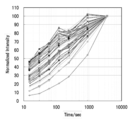
- Fluorescence detection with a scanner was performed as follows. That is, the measurement conditions were appropriately adjusted using Molecular® Devices® GenePix4000B, and fluorescence images were acquired. Furthermore, using GenePix®Pro, the fluorescence signal of the obtained image was digitized. Furthermore, in the hybridization with three types of DNA microarrays, the relative values (hybrid formation rate) for each reaction time and each probe when the fluorescence intensity obtained from each probe after hybridization for 1 hour is defined as 100. Plotted. The results for the three arrays are shown in FIGS. FIGS. 1 to 3 show the results of the DNA microarray of the first probe set consisting of 100 probes. FIGS. 4 and 5 show the results of the DNA microarray of the second probe set consisting of 52 probes. FIG. 6 and FIG. 7 show the results in the DNA microarray of the third probe set consisting of 48 probes.
- the second probe set and Among the third probe sets significant differences between the probe sets were confirmed with respect to the reactivity immediately after the reaction (15 seconds) and the reactivity after 15 minutes (900 seconds).
- the probes constituting the second probe set are all probes that achieve 50% or more of the hybridization rate during 1 hour hybridization within 15 seconds. Furthermore, a hybridization rate of 55% or more, more preferably 60% or more, more preferably 65% or more, more preferably 70% or more, even more preferably 75% or more, and even more preferably 80% or more within 15 seconds. By selecting this probe, more rapid hybridization becomes possible.
- the probe selected from the second probe set can promote hybridization and rapidly form a hybridization product. That is, by using a probe selected from such a probe set, it is possible to obtain an array with high probe responsiveness (instantaneous) during hybridization and high reaction completion in a short time.
Landscapes
- Chemical & Material Sciences (AREA)
- Life Sciences & Earth Sciences (AREA)
- Analytical Chemistry (AREA)
- Proteomics, Peptides & Aminoacids (AREA)
- Organic Chemistry (AREA)
- Zoology (AREA)
- Wood Science & Technology (AREA)
- Health & Medical Sciences (AREA)
- Engineering & Computer Science (AREA)
- Microbiology (AREA)
- Immunology (AREA)
- Molecular Biology (AREA)
- Biotechnology (AREA)
- Biophysics (AREA)
- Physics & Mathematics (AREA)
- Biochemistry (AREA)
- Bioinformatics & Cheminformatics (AREA)
- General Engineering & Computer Science (AREA)
- General Health & Medical Sciences (AREA)
- Genetics & Genomics (AREA)
- Measuring Or Testing Involving Enzymes Or Micro-Organisms (AREA)
- Apparatus Associated With Microorganisms And Enzymes (AREA)
Abstract
L'invention concerne un ensemble de sondes ayant une performance supérieure d'analyse. L'invention concerne un ensemble de sondes comprenant un ou plusieurs types de sondes, chacun ayant un ou plusieurs types de séquences de base choisies dans le groupe consistant en les séquences de base listées dans le tableau et des séquences complémentaires de celles-ci.
Applications Claiming Priority (2)
| Application Number | Priority Date | Filing Date | Title |
|---|---|---|---|
| JP2011133285 | 2011-06-15 | ||
| JP2011-133285 | 2011-06-15 |
Publications (1)
| Publication Number | Publication Date |
|---|---|
| WO2012173015A1 true WO2012173015A1 (fr) | 2012-12-20 |
Family
ID=47357005
Family Applications (1)
| Application Number | Title | Priority Date | Filing Date |
|---|---|---|---|
| PCT/JP2012/064471 Ceased WO2012173015A1 (fr) | 2011-06-15 | 2012-06-05 | Ensemble de sondes et son utilisation |
Country Status (2)
| Country | Link |
|---|---|
| JP (1) | JPWO2012173015A1 (fr) |
| WO (1) | WO2012173015A1 (fr) |
-
2012
- 2012-06-05 WO PCT/JP2012/064471 patent/WO2012173015A1/fr not_active Ceased
- 2012-06-05 JP JP2013520509A patent/JPWO2012173015A1/ja active Pending
Non-Patent Citations (2)
| Title |
|---|
| NISHIDA NAO ET AL.: "DigiTag assay for multiplex single nucleotide polymorphism typing with high success rate.", ANALYTICAL BIOCHEMISTRY, vol. 346, no. 2, 2005, pages 281 - 288 * |
| NISHIDA NAO ET AL.: "Further development of multiplex single nucleotide polymorphism typing method, the DigiTag2 assay.", ANALYTICAL BIOCHEMISTRY, vol. 364, no. 1, 2007, pages 78 - 85 * |
Also Published As
| Publication number | Publication date |
|---|---|
| JPWO2012173015A1 (ja) | 2015-02-23 |
Similar Documents
| Publication | Publication Date | Title |
|---|---|---|
| US12516446B2 (en) | Array and method for detecting spatial information of nucleic acids | |
| JP2005502346A (ja) | 核酸配列の非特異的ハイブリダイゼーションをブロックするための方法 | |
| JP2012509078A (ja) | 二本鎖核酸特異色素を用いる固体表面でのリアルタイムマルチプレックスpcr検出 | |
| KR20010085860A (ko) | 핵산 증폭과 서열분석 방법 | |
| JP6182300B2 (ja) | 標的核酸の検出方法 | |
| JP5663491B2 (ja) | 標的核酸の検出方法 | |
| JP2017018115A (ja) | 核酸の検出方法 | |
| JP5403573B2 (ja) | 肺炎原因菌検出用プライマーセット | |
| US20060078889A1 (en) | Array-based methods for producing ribonucleic acids | |
| US20030152931A1 (en) | Nucleic acid detection device and method utilizing the same | |
| CN100480384C (zh) | 核酸探针固定化基体和用其检测靶核酸存在的方法 | |
| US7754475B2 (en) | Nucleic acid probes and microarrays for analysis of polynucleotides | |
| JP5613160B2 (ja) | ゲノムdna中の標的配列の検出又は解析方法 | |
| JP5165936B2 (ja) | 標的核酸中の変異の検出方法及びアレイ | |
| WO2012173015A1 (fr) | Ensemble de sondes et son utilisation | |
| JP5936541B2 (ja) | 識別対象を識別するための識別情報の保持体及びその利用 | |
| Sethi et al. | New protocol for oligonucleotide microarray fabrication using SU-8-coated glass microslides | |
| Sinibaldi et al. | Gene expression analysis on medium-density oligonucleotide arrays | |
| KR101566402B1 (ko) | 마이크로어레이 칩을 이용한 흰반점바이러스 진단용 멀티플렉스 키트 | |
| JP2001017166A (ja) | Dnaチップ、dnaチップの検定キットおよびdnaチップの検定法 | |
| JP3917640B2 (ja) | 核酸プローブ固定化基体を用いた標的核酸の存在を検出する方法 | |
| WO2019229792A1 (fr) | Procédé de détection d'un fragment d'acide nucléique cible | |
| JP2005211017A (ja) | 新規マイクロアレイ | |
| JP2006246774A (ja) | Dna鎖伸長方法、dna鎖増幅方法およびdna鎖伸長用マイクロアレイ | |
| JP2006055065A (ja) | 非対称pcrを用いた核酸の検出方法、ポリヌクレオチドプローブ、それを固定するプローブ固定化担体およびキット |
Legal Events
| Date | Code | Title | Description |
|---|---|---|---|
| 121 | Ep: the epo has been informed by wipo that ep was designated in this application |
Ref document number: 12800785 Country of ref document: EP Kind code of ref document: A1 |
|
| ENP | Entry into the national phase |
Ref document number: 2013520509 Country of ref document: JP Kind code of ref document: A |
|
| NENP | Non-entry into the national phase |
Ref country code: DE |
|
| 122 | Ep: pct application non-entry in european phase |
Ref document number: 12800785 Country of ref document: EP Kind code of ref document: A1 |