WO2012173222A1 - Médicament marqué par du gallium - Google Patents
Médicament marqué par du gallium Download PDFInfo
- Publication number
- WO2012173222A1 WO2012173222A1 PCT/JP2012/065332 JP2012065332W WO2012173222A1 WO 2012173222 A1 WO2012173222 A1 WO 2012173222A1 JP 2012065332 W JP2012065332 W JP 2012065332W WO 2012173222 A1 WO2012173222 A1 WO 2012173222A1
- Authority
- WO
- WIPO (PCT)
- Prior art keywords
- gallium
- tameol
- sal
- ligand
- complex
- Prior art date
- Legal status (The legal status is an assumption and is not a legal conclusion. Google has not performed a legal analysis and makes no representation as to the accuracy of the status listed.)
- Ceased
Links
Images


Classifications
-
- A—HUMAN NECESSITIES
- A61—MEDICAL OR VETERINARY SCIENCE; HYGIENE
- A61K—PREPARATIONS FOR MEDICAL, DENTAL OR TOILETRY PURPOSES
- A61K51/00—Preparations containing radioactive substances for use in therapy or testing in vivo
- A61K51/02—Preparations containing radioactive substances for use in therapy or testing in vivo characterised by the carrier, i.e. characterised by the agent or material covalently linked or complexing the radioactive nucleus
- A61K51/04—Organic compounds
- A61K51/0474—Organic compounds complexes or complex-forming compounds, i.e. wherein a radioactive metal (e.g. 111In3+) is complexed or chelated by, e.g. a N2S2, N3S, NS3, N4 chelating group
- A61K51/0478—Organic compounds complexes or complex-forming compounds, i.e. wherein a radioactive metal (e.g. 111In3+) is complexed or chelated by, e.g. a N2S2, N3S, NS3, N4 chelating group complexes from non-cyclic ligands, e.g. EDTA, MAG3
-
- A—HUMAN NECESSITIES
- A61—MEDICAL OR VETERINARY SCIENCE; HYGIENE
- A61K—PREPARATIONS FOR MEDICAL, DENTAL OR TOILETRY PURPOSES
- A61K51/00—Preparations containing radioactive substances for use in therapy or testing in vivo
- A61K51/02—Preparations containing radioactive substances for use in therapy or testing in vivo characterised by the carrier, i.e. characterised by the agent or material covalently linked or complexing the radioactive nucleus
- A61K51/04—Organic compounds
- A61K51/08—Peptides, e.g. proteins, carriers being peptides, polyamino acids, proteins
- A61K51/082—Peptides, e.g. proteins, carriers being peptides, polyamino acids, proteins the peptide being a RGD-containing peptide
-
- A—HUMAN NECESSITIES
- A61—MEDICAL OR VETERINARY SCIENCE; HYGIENE
- A61K—PREPARATIONS FOR MEDICAL, DENTAL OR TOILETRY PURPOSES
- A61K51/00—Preparations containing radioactive substances for use in therapy or testing in vivo
- A61K51/02—Preparations containing radioactive substances for use in therapy or testing in vivo characterised by the carrier, i.e. characterised by the agent or material covalently linked or complexing the radioactive nucleus
- A61K51/04—Organic compounds
- A61K51/08—Peptides, e.g. proteins, carriers being peptides, polyamino acids, proteins
- A61K51/088—Peptides, e.g. proteins, carriers being peptides, polyamino acids, proteins conjugates with carriers being peptides, polyamino acids or proteins
-
- C—CHEMISTRY; METALLURGY
- C07—ORGANIC CHEMISTRY
- C07B—GENERAL METHODS OF ORGANIC CHEMISTRY; APPARATUS THEREFOR
- C07B59/00—Introduction of isotopes of elements into organic compounds ; Labelled organic compounds per se
-
- C—CHEMISTRY; METALLURGY
- C07—ORGANIC CHEMISTRY
- C07C—ACYCLIC OR CARBOCYCLIC COMPOUNDS
- C07C251/00—Compounds containing nitrogen atoms doubly-bound to a carbon skeleton
- C07C251/02—Compounds containing nitrogen atoms doubly-bound to a carbon skeleton containing imino groups
- C07C251/24—Compounds containing nitrogen atoms doubly-bound to a carbon skeleton containing imino groups having carbon atoms of imino groups bound to carbon atoms of six-membered aromatic rings
-
- C—CHEMISTRY; METALLURGY
- C07—ORGANIC CHEMISTRY
- C07F—ACYCLIC, CARBOCYCLIC OR HETEROCYCLIC COMPOUNDS CONTAINING ELEMENTS OTHER THAN CARBON, HYDROGEN, HALOGEN, OXYGEN, NITROGEN, SULFUR, SELENIUM OR TELLURIUM
- C07F5/00—Compounds containing elements of Groups 3 or 13 of the Periodic Table
Definitions
- the present invention relates to tri-salicylaldiminomethyl ethanol [tri-salicyldiminomethyl-ethanol, H 3 (sal) 3 TAMEol] and gallium 67 (gallium-67, Ga-67) or gallium combined with a compound that binds to a target molecule.
- 68 gallium-68, Ga-68
- a complex having a complex structure formed therein and a radiogallium-labeled drug with increased accumulation and stability at a target site, a method for producing the same, and the radiogallium-labeled drug
- a method for producing the same and the radiogallium-labeled drug
- the radiogallium-labeled drug To a ligand for the preparation of
- a radiolabeled drug is a drug containing a compound labeled with a radioisotope nuclide, and is widely used for diagnosis and treatment of diseases, for example, diagnosis and treatment of tumors.
- radiolabeled drugs By accumulating radiolabeled drugs in specific tissues and cells, highly sensitive diagnosis and effective treatment can be performed, and side effects on normal tissues and cells can be reduced. For example, even when tumor cells have spread and scattered in organs or tissues, effective diagnosis and treatment can be performed without affecting normal tissues and cells.
- diagnosis and treatment using radiolabeled drugs selection of useful nuclides and drug design for accumulating the drugs in specific tissues and cells have been performed.
- Gallium (Ga) is an element having an atomic number of 31 and belongs to the same group 13 element as indium.
- two radionuclides Ga-67 (hereinafter sometimes abbreviated as 67 Ga) and Ga-68 (hereinafter also abbreviated as 68 Ga), are used for nuclear medicine diagnosis. It has suitable properties.
- 67 Ga is a ⁇ -ray emitting nuclide produced by cyclotron with a half-life of 78 hours
- 67 Ga citrate ( 67 Ga-citrate) is a single photon radiation computed tomography for the diagnosis of malignant tumors and inflammation ( single photo emission computed tomography (hereinafter abbreviated as SPECT).
- 68 Ga is a positron emitting nuclide with a half-life of 68 minutes, and is used for positron emission tomography (hereinafter abbreviated as PET) diagnosis.
- PET positron emission tomography
- bioactive molecules such as proteins and peptides generally do not have a stable binding site for gallium
- the coordination site to gallium and the bioactive molecule are used to label the bioactive molecule that is the target molecule with gallium.
- DOTA-D-Phe1-Tyr3-octreotide (DOTA-D-Phe1-Tyr3-octreotide, DOTA-TOC, Non-patent Documents 1 and 2) targeting the somatostatin receptor expressed in endocrine tumors and Her2 reception of breast cancer Research has been conducted on DOTA affibodies (DOTA-affibody, Non-Patent Document 3) targeting the body.
- a compound (referred to as a divalent compound) having two molecules of binding sites with a target molecule (sometimes referred to as a target molecule recognition element) in the molecule is referred to as a compound (referred to as a monovalent compound) having a binding site.
- a compound (referred to as a monovalent compound) having a binding site Is known to have a higher binding force to the target molecule, and this is widely used in the design of pharmaceuticals as a multivalent effect (Non-Patent Documents 5 to 7). Based on these findings, it is expected that the monovalent ligand having one target molecule recognition element will form a 1: 2 or 1: 3 complex with a metal atom, thereby improving the accumulation of the label on the target molecule. it can.
- the present inventors have used technetium- 99m (hereinafter sometimes abbreviated as 99m Tc) as a metal radionuclide and an Arg-Gly-Asp-bonded penicillamine (hereinafter referred to as a ligand having a target molecule recognition element).
- 99m Tc a metal radionuclide
- Arg-Gly-Asp-bonded penicillamine hereinafter referred to as a ligand having a target molecule recognition element
- RGD-bound penicillamine may be referred to
- the complex formed with 99m Tc and RGD-bound penicillamine has high accumulation on the target molecule and is stable in vivo.
- Patent Documents 1 and 2 has been shown to be useful as a radiolabeled drug
- the radionuclide of gallium is useful for molecular imaging, which is expected to make a great contribution to advanced imaging diagnosis and elucidation of pathology, but is stable in vivo and efficiently accumulates at the target site Labeling agents have not been developed yet.
- An object of the present invention is to provide a radioactive gallium-labeled drug that efficiently accumulates at a target site and has high stability in a living body.
- cyclo-Arg-Gly-Asp-D a cyclic pentapeptide that specifically binds to ⁇ v ⁇ 3 integrin, which is known to be expressed at high density in new blood vessels such as malignant tumors.
- -Phe-Lys [SEQ ID NO: 1 in the Sequence Listing, hereinafter abbreviated as c (RGDfK)] Ga- (sal) 3 TAMEol complex Ga- () having a structure bonded to the benzene ring via hexanoic acid RGD-hx) 3 TAMEol was prepared, and its stability in apo-transferrin and affinity for ⁇ v ⁇ 3 integrin were examined.
- specific accumulation of Ga- (RGD-hx) 3 TAMEol at the target site was examined in vivo using a tumor-bearing model mouse.
- H 3 (sal) 3 TAMEol which is a compound having a Schiff base in the ligand skeleton
- H 3 (RGD-hx) 3 TAMEol which is a compound having a target molecule recognition element
- gallium It was found that the complex with is stable in apotransferrin.
- the complex of H 3 (RGD-hx) 3 TAMEol and gallium shows a high affinity for ⁇ v ⁇ 3 integrin and accumulated in the transplanted tumor. A clear image was given, but it was revealed that it did not accumulate in other tissues except excreted tissues.
- the present inventors have found that a complex formed from H 3 (sal) 3 TAMEol having a target molecule binding element and radioactive gallium has high in vivo stability, and has a target site. It has been found that a radioactive gallium-labeled drug that accumulates efficiently can be provided, and the present invention has been completed.
- the present invention relates to the following. (1) having a complex structure formed from trisalicylicaldiminomethyl ethanol (tri-salicyldiminomethyl-ethanol, H 3 (sal) 3 TAMEol) and gallium 67 or gallium 68 bound to a compound that binds to the target molecule A radioactive gallium-labeled drug containing a complex and having increased accumulation and stability at a target site. (2) The radioactive gallium label wherein H 3 (sal) 3 TAMEol bound to a compound that binds to a target molecule is H 3 (sal) 3 TAMEol bound to the cyclic pentapeptide shown in SEQ ID NO: 1 in the Sequence Listing. Drugs.
- a ligand for preparing a radioactive gallium-labeled drug having increased accumulation at a target site comprising H 3 (sal) 3 TAMEol bound to a compound that binds to a target molecule.
- a radioactive gallium-labeled drug having increased accumulation at a target site comprising a compound having a chemical structure formed by reacting a compound that binds to a target molecule and salicylaldehyde and TAMEol in vitro. Preparation ligand.
- the ligand for preparing the radioactive gallium-labeled drug, wherein the compound that binds to the target molecule is a cyclic pentapeptide represented by SEQ ID NO: 1 in the Sequence Listing.
- a kit comprising a drug containing a ligand for preparing any of the above-mentioned radiogallium-labeled drugs and a drug containing gallium 67 or gallium 68 as separate packaging units.
- a kit comprising sal-hx-RGDfK, TAMEol, and gallium 67 or gallium 68 as separate packaging units.
- a method for producing a radioactive gallium-labeled drug comprising using H 3 (sal) 3 TAMEol bound to a compound that binds to a target molecule as a ligand and complexing with gallium 67 or gallium 68 in vitro.
- the radioactive gallium label wherein H 3 (sal) 3 TAMEol bound to a compound that binds to a target molecule is H 3 (sal) 3 TAMEol bound to the cyclic pentapeptide shown in SEQ ID NO: 1 in the Sequence Listing.
- a method for producing a drug comprising reacting sal-hx-RGDfK, TAMEol, and gallium 67 or gallium 68 in a citric acid solution .
- the present invention includes a complex having a complex structure formed of H 3 (sal) 3 TAMol bound to a compound that binds to a target molecule and gallium 67 or gallium 68, A radioactive gallium-labeled drug with increased accumulation and stability can be provided. Since the complex contained in the radioactive gallium-labeled drug according to the present invention is a multivalent complex having three target molecule recognition elements (monovalent target molecule recognition elements) having one binding site to a target molecule, it is conventionally used. Compared with the monovalent complex that has been used, it exhibits high accumulation at the target site.
- the radioactive gallium-labeled drug according to the present invention quickly collapses into a ligand having a smaller number of coordination sites, and the gallium complex alone exhibits a multivalent effect. Even if a large excess of ligand is used in the production, the accumulation at the target site is high, making it easy to diagnose and observe the course of treatment by molecular imaging technology.
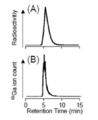
- 67 Ga- (sal) is a diagram showing a 3 TAMEol and non-radioactive gallium labeled (sal) 3 each reverse-phase high performance liquid chromatography TAMEol (RP-HPLC) the holding time is matched.
- Panel (A) shows the radioactivity in RP-HPLC analysis of 67 Ga- (sal) 3 TAMEol.
- Panel (B) shows the result of analyzing the gallium ion intensity ( 69 Ga ion count) in RP-HPLC of non-radioactive gallium labeled (sal) 3 TAMEol as a control by an inductively coupled plasma mass spectrometer (ICP-MS).
- ICP-MS inductively coupled plasma mass spectrometer
- the horizontal axis represents retention time (minutes) [retention time (min)].
- Example 4 67 Ga- (RGD-hx) is a diagram showing a 3 TAMEol and non-radioactive gallium labeled (RGD-hx) 3 that each RP-HPLC retention time TAMEol match.
- Panel (A) shows a control of non-radioactive gallium labeled (RGD-hx) 3 TAMol analyzed by RP-HPLC and measured for ultraviolet absorption (UV absorption).
- Ga- (RGD-) was obtained at a retention time of 28.5 minutes.
- Panel (B) shows that in RP-HPLC analysis of 67 Ga- (RGD-hx) 3 TAMEol, its radioactivity was observed at 28.5 minutes.
- Panel (C) measured the analyzed UV absorption by RP-HPLC after 67 Ga-labeled, primarily, the sal-hx-RGDfK 26 minutes, included in the 67 Ga- gallium citrate (67 Ga-citrate) This shows that benzyl alcohol was observed at 15 minutes.
- the horizontal axis represents retention time (minutes) [retention time (min)].
- Example 4 H 3 (sal) 3 TAMEol are stable in ethanol solution, shows that disintegrate rapidly salicylaldehyde and TAMEol in phosphate buffer.
- Panel (A) shows the result of UV absorption measured by RP-HPLC after 1 hour incubation of H 3 (sal) 3 TAMEol in ethanol.
- Panel (B) shows the result of UV absorption measured by RP-HPLC analysis of H 3 (sal) 3 TAMEol after 1 hour incubation in phosphate buffer.
- a retention time of 13.5 minutes is H 3 (sal) 3 TAMEol, and a retention time of 5 minutes is a salicylaldehyde peak.
- the horizontal axis represents retention time (minutes) [retention time (min)].
- Example 5 It is a figure which shows that 67 Ga- (sal) 3 TAMEol exists stably in an apotransferrin solution.
- the horizontal axis indicates the period (time) [Time (h)], and the vertical axis indicates the percentage of complete data (% of intact).
- 67 Ga- (RGD-hx) 3 TAMEol is a diagram showing that stably present in apotransferrin solution.
- the horizontal axis indicates the period (time) [Time (h)], and the vertical axis indicates the percentage of complete data (% of intact).
- 67 Ga- and (RGD-hx) 3 accumulation property to a target site -TAMEol, the degree of accumulation to a side effect other tissues, is a graph showing the result of investigation in vivo using tumor-bearing model mice .
- the present invention relates to a complex having a complex structure formed from trisalicylicaldiminomethyl ethanol (tri-salicyldiminomethyl-ethanol, H 3 (sal) 3 TAMEol) bound to a target molecule recognition element and gallium 67 or gallium 68. And a method for producing the same, and a ligand for preparing the radioactive gallium-labeled drug.
- trisalicylicaldiminomethyl ethanol tri-salicyldiminomethyl-ethanol, H 3 (sal) 3 TAMEol
- radioactive gallium-labeled drug is a type of radiolabeled drug and includes a compound labeled with a radionuclide of gallium and means a drug used for labeling a target site, such as a specific tissue or cell. .
- a drug is used for diagnosis of a disease and follow-up of a therapeutic effect, for example, for diagnosis by a molecular imaging technique using SPECT, PET, etc. and follow-up of a therapeutic effect.
- Preferred examples of the gallium radionuclide include 67 Ga and 68 Ga.
- complex means a substance in which a ligand is coordinated around an atom or ion of a metal and a metal-like element, and is also called a coordination compound.
- Coordination means that a ligand forms a coordinate bond with a central metal and is arranged around the central metal.
- the complex is formed by a coordinate bond between a ligand and a metal. Formation of a complex of a ligand and a metal may be referred to as complex formation.
- a coordinate bond refers to a bond in which two valence electrons participating in one bond are provided from only one atom.
- Multi-coordination means that a plurality of ligands form a coordination bond with a central metal and are arranged around the central metal.
- n-coordination means that n-molecule ligands form a coordination bond with the central metal and are arranged around the central metal.
- n is generally 2 to 9.
- the coordination number is the number of ligands that gather around the central metal to form a coordination bond.
- ligand means a compound containing another atom (coordinating atom) coordinated to a central metal in a complex.
- a compound containing two or more possible coordination atoms is a multidentate ligand, one is a monodentate ligand, and two is a bidentate.
- the case of three ligands is referred to as a tridentate ligand.
- target molecule recognition element means a compound that binds to a target molecule, preferably a compound that specifically binds.
- To specifically bind to a target molecule means to bind to a target molecule but not to a molecule other than the target molecule or to bind weakly.
- target molecule recognition elements include proteins, peptides, antibodies, and antibody fragments.
- the metal that forms the complex is a metal that forms a two or more coordination bond with the ligand, such as gallium.
- a metal radionuclide is preferably used as the metal. Specific examples of the metal radionuclide include 67 Ga and 68 Ga. The metal radionuclide is not limited to these specific examples, and any metal radionuclide is used as long as it has radiation, radiation dose, and half-life suitable for purposes such as diagnosis using radiolabeled drugs and internal radiation therapy such as cancer diseases. be able to. From the viewpoint of reducing the influence on normal tissues and cells in diagnosis and treatment, short half-life metal radionuclides are preferably used.
- a ligand that forms a complex is a compound that can form a multi-coordination complex with a metal through a coordination bond, and a compound that rapidly collapses when a complex is not formed is used.
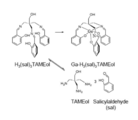
- a compound having a Schiff base in the ligand skeleton can be preferably exemplified. Since the Schiff base is in equilibrium with amines and aldehydes in an aqueous solution, it is decomposed when the ligand having the Schiff base does not form a complex, but it is stabilized by complex formation, and only the complexed label is formed. Can be considered to exhibit a multivalent effect (FIG. 1).
- the complex according to the present invention quickly collapses into a ligand having a smaller number of coordination sites even when a large excess of ligand is used in the production of the complex. Since only the complex exhibits a multivalent effect, the accumulation at the target site is higher than that of the conventionally produced complex.
- Preferred examples of the compound having a Schiff base in the ligand skeleton include tri-salicylaldiminomethyl ethanol (tri-salicyldiminomethyl-ethanol, H 3 (sal) 3 TAMEol).
- the ligand is not particularly limited, and any ligand can be used as long as it is a compound that forms a multi-coordination complex with a metal.
- examples of target molecule recognition elements include proteins, peptides, antibodies, and antibody fragments.
- Specific examples include proteins that are highly expressed in tissue construction associated with inflammation, tumor cell infiltration, and the like, ligands that bind to proteins that are specifically expressed in tumor cells, antibodies, and Fab fragments of antibodies.
- a cyclic pentapeptide having affinity for an integrin that is highly expressed in neovascular blood vessels of cancer such as cyclo-Arg-Gly-Asp-D-Phe-Lys [SEQ ID NO: 1, c in the sequence listing] (Abbreviated as (RGDfK)).
- receptors for bisphosphonic acid, oligoaspartic acid, oligoglutamic acid and macrophages that have an affinity for hydroxyapatite, which is abundant in osteogenic cancer (bone metastasis), and affinity for the scanning factor on the surface of macrophages Examples thereof include fMet-Leu-Phe (fMLP), a folic acid that binds to a folate receptor whose expression is observed in cancer cells, and derivatives thereof.
- the target molecule recognition element is not limited to the exemplified compounds, and any compound that binds to the target molecule can be used.
- the distance between the target molecule recognition elements is important for the complex formed by the ligand and the metal to exhibit a multivalent effect effectively.
- the distance between the target molecule recognition elements varies depending on the size of the target molecule recognition element. For example, in the study of the multivalent effect of RGD binding agents targeting ⁇ v ⁇ 3 integrin, a distance of 25-30 bonds is required between RGD peptides.
- the distance between the target molecule recognition elements is not limited to the exemplified distance, and an appropriate distance is selected depending on the target molecule recognition element to be used.
- a spacer is effective for maintaining such a distance.
- examples of compounds that can be preferably used as the spacer include linear saturated carboxylic acids such as hexanoic acid, peptides composed of several amino acids, ethylene glycol chains composed of a plurality of ethylene glycols, and the like. More preferred is hexanoic acid.
- the method for binding the target molecule recognition element and the ligand is not particularly limited, and for example, the target molecular recognition element and the ligand can be bonded by an amide bond with a carboxylic acid and an amino group or N-alkylation with an alkyl halide.
- the complex can be produced by in vitro complexation with a metal using H 3 (sal) 3 TAMEol bound to a target molecule recognition element as a ligand.
- the target molecule recognition element, the ligand, and the metal can be mixed to bond the target molecule recognition element and the ligand and simultaneously form a complex.
- — (aminomethyl) -ethanol, TAMEol] reacting — (aminomethyl) -ethanol, TAMEol] with 67 Ga or 68 Ga in a citric acid solution, a 67 Ga or 68 Ga complex can be formed.
- the complexing reaction can also be carried out in acetate buffer or citrate solution using 67 GaCl 3 as radioactive gallium.
- the preferred reaction conditions are: when 67 Ga-citrate is used, the ligand concentration is about 0.1 mM to 10 mM, the citric acid concentration is about 1 to 10 mM, the pH is 4 to 6, the temperature is 80 to 100 ° C., and the reaction time is 15 ⁇ 60 minutes.
- reaction conditions are as follows: a ligand concentration of about 0.1 mM to 10 mM in 0.1 M acetate buffer or 0.1 mM to 10 mM citrate solution, pH 3 to 6, and temperature
- the reaction time is from 5 to 30 minutes from room temperature to 100 ° C.
- the radiolabeled drug according to the present invention includes a complex having a complex structure formed from H 3 (sal) 3 TAMEol and 67 Ga or 68 Ga bound to c (RGDfK) (SEQ ID NO: 1 in the Sequence Listing). Examples thereof include radiolabeled drugs.
- the radiolabeled drug according to the present invention is preferably formed from H 3 (sal) 3 TAMEol and 67 Ga or 68 Ga to which c (RGDfK) (SEQ ID NO: 1 in the sequence listing) is bound via hexanoic acid.
- a radiolabeled drug containing a complex having a complex structure [the following formula (I)] is preferably exemplified.
- Ga may be 67 Ga or 68 Ga.
- the radiolabeled drug according to the present invention includes a complex formed by reacting sal-hx-RGDfK, TAMEol, and 67 Ga or 68 Ga in a citric acid solution. Can be illustrated.
- the radiolabeled drug according to the present invention is effective for a complex formed from a ligand that is bound to a target molecule recognition element and forms a multi-coordination complex with a metal and a radionuclide of the metal.
- the complex has the same number of target molecule recognition elements as the ligand in the complex.
- the complex is referred to as a polyvalent complex
- a radiolabeled drug containing the polyvalent complex as an active ingredient is referred to as a polyvalent radiolabeled drug.
- a complex that includes a ligand that binds to a target molecule recognition element and forms a tricoordination complex with a metal has three target molecule binding sites in the complex. This is called a complex.
- a complex that is a ligand bonded to a target molecule recognition element and includes a ligand that forms a bicoordination complex with a metal has two target molecule binding sites in the complex. This is called a complex.
- a complex that is a ligand bound to a target molecule recognition element and includes a ligand that forms a one-coordinate complex with a metal has one target molecule binding site in the complex, and a monovalent complex Called.
- a compound having two binding sites for a target molecule exhibits higher affinity and accumulation with the target molecule than a compound having a single binding site for a target molecule (a monovalent compound).
- a compound having a single binding site for a target molecule a monovalent compound.
- Non-patent Document 3 Taking as an example the antibody as a compound that binds to a target molecule, the binding of bivalent IgG antibodies, at least 50 to 100 times than monovalent Fab fragments, IgM multivalent antibodies with 10 4 times the antigen IgG Have avidity.
- the multivalent complex exhibits higher affinity and accumulation with the target molecule than the monovalent complex. Therefore, a radiolabeled drug containing a multivalent complex exhibits high accumulation at the target site.
- the radiolabeled drug according to the present invention can be used for diagnostic imaging and internal radiotherapy using the radiolabeled drug.
- the radiolabeled drug according to the present invention is preferably used for diagnosis and treatment of cancer diseases, but applicable diseases are not particularly limited, and any disease can be used as long as image diagnosis and internal radiation therapy are applied.
- the target According to the characteristics of the target to be diagnosed or treated, the target can be diagnosed or treated by selecting a target molecule recognition element that binds to a complex that is an active ingredient of the radiolabeled drug. Can be widely used in the field of diagnosis and therapy.
- intravenous administration or intraarterial administration can be preferably mentioned.
- the administration route is not limited to these routes, and any route can be used as long as its action can be effectively expressed after administration of the present radiolabeled drug.
- the radioactivity intensity of the radiolabeled drug according to the present invention is arbitrary as long as the objective can be achieved by administering the labeled drug and the subject is exposed to the lowest possible clinical dose. is there.
- the radioactive intensity can be determined with reference to the radioactive intensity used in a general diagnostic method or therapeutic method using a radiolabeled drug.
- the radiolabeled drug according to the present invention may contain one or more kinds of pharmaceutically acceptable carriers (pharmaceutical carriers) as necessary, in addition to the complex as an active ingredient.
- pharmaceutically acceptable carriers include acids, bases, buffers, stabilizers, isotonic agents, and preservatives for adjusting pH.
- kits comprising a drug containing H 3 (sal) 3 TAMEol bound to a target molecule recognition element and a drug containing 67 Ga or 68 Ga as separate packaging units
- Preferred examples of the kit according to the present invention include a kit comprising a drug containing sal-hx-RGDfK, a drug containing TAMEol, and a drug containing 67 Ga or 68 Ga as separate packaging units.
- the agent containing 67 Ga or 68 Ga is preferably a 67 Ga solution or 68 Ga solution, more preferably citric acid 67 Ga or 67 GaCl 3 , and still more preferably citric acid 67 Ga.
- the medicine contained in the kit can contain one or more kinds of pharmaceutically acceptable carriers (pharmaceutical carriers) as described above, if necessary.
- the complex which is an active ingredient of the radiolabeled drug according to the present invention is a multivalent complex, and exhibits higher affinity and accumulation with the target molecule than the monovalent complex. Therefore, the radiolabeled drug containing the multivalent complex according to the present invention shows higher accumulation at the target site compared to the radiolabeled drug containing the monovalent complex conventionally used, and therefore the radiolabeled drug was used. High sensitivity can be provided in diagnostic imaging.
- the radiolabeled drug containing the multivalent complex according to the present invention exhibits sufficient stability in vivo.
- the use of the radiolabeled drug containing the multivalent complex according to the present invention can increase the accumulation of the radiocomplex at the target site.
- high sensitivity can be obtained in image diagnosis using the radiolabeled drug.
- the complex which is an active ingredient of the radiolabeled drug according to the present invention is c (RGDfK) (SEQ ID NO: 1 in the Sequence Listing), which is a cyclic pentapeptide having an affinity for integrin which is highly expressed in neovascular blood vessels of cancer. )
- RGDfK a target molecule recognition element
- the accumulation in a cancer neovascularization that is a target site is increased as compared with a monovalent complex.
- this complex showed sufficient stability in vivo. Therefore, a radiolabeled drug containing such a complex can provide high sensitivity in cancer diagnosis.
- the radiolabeled drug according to the present invention is also more useful than conventional radiogallium labeled drugs. Since conventional radiogallium-labeled drugs use a large excess of ligands in their production, ligands that do not form a complex compete with radiolabeled drugs for target sites when used as they are, and thus radiolabeled drugs As a result, imaging of target molecules in molecular imaging was hindered. On the other hand, the radiolabeled drug according to the present invention quickly disintegrates a ligand that does not form a complex into a ligand having a smaller number of coordination sites, and only the complex exhibits a multivalent effect. Even if a large excess of ligand is used in the production, the accumulation at the target site is high, making it easy to diagnose and observe the course of treatment by molecular imaging technology.
- c (RGDfK) which is a cyclic pentapeptide that specifically binds to ⁇ v ⁇ 3 integrin, which is known to be expressed at high density in new blood vessels such as malignant tumors, as a target molecule recognition element (of the sequence listing).
- Ga- (RGD-hx) 3 TAMEol was prepared by binding SEQ ID NO: 1) to the benzene ring of Ga- (sal) 3 TAMEol via hexanoic acid, and its stability in apotransferrin and ⁇ v ⁇ 3 The affinity for integrin was examined. Furthermore, specific accumulation of Ga- (RGD-hx) 3 TAMEol at the target site was examined in vivo using a tumor-bearing model mouse.
- LC-ICP-MS analysis was performed by connecting the HPLC eluate to ICP-MS HP4500 (Agilent, Tokyo) online.
- ICP-MS HP4500 Agilent, Tokyo
- silica gel plates Merck silica gel 60F 254 , Nippon Merck, Tokyo
- RP-TLC reverse phase thin layer chromatography
- -18F 254S Nippon Merck, Tokyo
- methanol system 4
- Pentaerythritol triazide (Penta-erithoritol-tri-azide ) Synthesis pentaerythritol Toriburomin (Penta-erithoritol-tri-bromin ) 2g (6.17mmol) and dimethylformamide sodium azide 4.7g (72mmol) (dimethylformamide, DMF ) It melt
- sal-hx-RGDfK was synthesized. Initially, acetal was tried as a protecting group for the aldehyde group, but the formation of an ester with carboxylic acid was confirmed by the acid catalyst at the time of introduction, and purification was difficult. Therefore, a Schiff base was prepared by condensation of an amine and an aldehyde and used as a protecting group. After condensation with c (RGDfK) to which a spacer is bound (SEQ ID NO: 1 in the sequence listing), deprotection of the peptide and hydrolysis of the Schiff base are performed at the same time, and sal-hx-RGDfK is purified by RT-HPLC. Synthesized in 7 steps.
- H 3 (RGD-hx) 3 TAMEol was attempted by performing condensation with TAMEol using sal-hx-RGDfK, but synthesis of the target product was difficult. This is thought to be because the formed ligand cannot exist stably because the peptide is hardly soluble in an organic solvent and undergoes a binding reaction in an aqueous solution.
- Ga- (sal) 3 TAMEol is hardly soluble in most organic solvents including chloroform and ethyl acetate, and is slightly soluble only in heated DMSO.
- 67 Ga- (sal) 3 TAMEol is obtained by a radiochemical yield of 95 at a final concentration of 5 ⁇ 10 ⁇ 4 M by the ligand exchange reaction between 67 Ga-citrate and H 3 (sal) 3 TAMEol as described above. % Or more.
- 67 Ga- and (sal) 3 Confirmation of formation of TAMEol was carried out by comparing 67 Ga- (sal) 3 retention time Ga- (sal) of TAMEol 3 TAMEol retention time with the RT-HPLC. Since the non-radioactive gallium complex of H 3 (sal) 3 TAMEol is sparingly soluble and does not have an amount of solubility that can be detected by the UV detector attached to the RT-HPLC apparatus, the retention time of the non-radioactive gallium complex is ICP -Determined by MS.
- 67 Ga- (RGD-hx) 3 TAMEol was synthesized by adding 67 Ga-citrate to the mixed solution of sal-hx-RGDfK and TAMEol as described above and heating.
- the gallium-coordinated complex exists stably as a trivalent complex, but the gallium-coordinated complex is considered to exist as a monovalent ligand.
- H 3 (sal) 3 TAMEol [Evaluation of stability of H 3 (sal) 3 TAMEol in aqueous solution]
- H 3 (sal) 3 TAMEol was incubated as a 1 mM / ethanol solution at 37 ° C. for 1 hour.
- a 1 mM / ethanol solution of H 3 (sal) 3 TAMEol was diluted 3-fold with 10 mM phosphate buffer (pH 7.4) and incubated at 37 ° C. for 1 hour. Both solutions were analyzed by RP-HPCL (System 3) and the amount of salicylaldehyde generated by degradation was compared.
- H 3 (sal) 3 TAMEol was stable in an ethanol solution, but a salicylaldehyde peak was mainly observed in a phosphate buffer solution with a retention time of 5 minutes (FIG. 4). From this, it became clear that H 3 (sal) 3 TAMEol rapidly disintegrates into salicylaldehyde and TAMEol by diluting with a phosphate buffer.
- the evaluation was performed as follows. First, excess sal-hx-RGDfK was removed by RP-HPLC (system 2), and purified 67 Ga- (sal) 3 TAMEol was dissolved in 0.1 M carbonate buffer (pH 7.4). A solution of 1.04 mg of apotransferrin dissolved in 150 ⁇ L of 0.1 M carbonate buffer (pH 7.4) was added to 100 ⁇ L of this solution, and incubated at 37 ° C. for 1, 3, 6 hours. The ratio of unreacted was determined by RP-HPLC (system 3).
- Each of the salicylaldehydes of this ligand has a target molecule recognition element c (RGDfK), and a complex complexed with Ga, 67 Ga- (RGD-hx) 3 TAMEol, is prepared, and stability is similarly examined. It was.
- TAMEol has high stability even when a peptide is introduced as a target molecule recognition element, and only Ga- (RGD-hx) 3 TAMEol generated by complex formation exists stably as trivalent, and complex. Those not formed are considered to be compounds suitable for the intended purpose of becoming monovalent by hydrolysis.
- the evaluation was performed as follows. Immuno-lockwell module (Maxisorp, Nalge-Nunc International KK, Tokyo) plates and coating buffer (25 mM Tris-HCl, pH 7.) of human purified ⁇ v ⁇ 3 integrin (Chemicon International, Temecula, CA, USA). 100 ⁇ L of 4,150 mM NaCl, 1 mM CaCl 2 , 0.5 mM MgCl 2 , 1 mM MnCl 2 ) solution (600 ng / mL) was added and coated overnight at 4 ° C. The wells were washed twice with 200 ⁇ L of binding buffer (0.1% BSA / coating buffer).
- the binding to ⁇ v ⁇ 3 integrin was assessed in a competitive binding assay with 125 I-RGDyV, and c (RGDyV), 185/187 Re-TMEC- [N-hx-c (RGDfK)] 2 , and
- the IC 50 values for Ga- (RGD-hx) 3 TAMEol were 114 ⁇ 13 nM, 44.7 ⁇ 13 nM, and 5.26 ⁇ 0.35 nM, respectively.
- Ga- (RGD-hx) 3 TAMEol showed the lowest IC 50 value.
- the trivalent compound Ga- (RGD-hx) 3 TAMEol has the ability to bind to ⁇ v ⁇ 3 integrin c (RGDyV) (SEQ ID NO: 2) or divalent compound.
- RGDyV ⁇ v ⁇ 3 integrin c
- H 3 (sal) 3 TAMEol and H 3 (sal) 3 TAMEol having a target molecule recognition element are useful for designing a new radioactive gallium-labeled drug that improves the accumulation at the target site.
- 67 Ga- (RGD-hx) 3 -TAMEol (6.4 MBq, 0.4 mM, 100 ⁇ L) was administered to tumor-bearing mice transplanted with human glioma cells and U87MG, and SPECT for small animals 1 hour after administration.
- / Image was taken with a CT apparatus. Imaging was performed under the conditions of 60 s / projection and ROR 45 mm using an FX-3200 small animal SPECT / CT apparatus (manufactured by Gamma Medical) equipped with a 5-hole multi-pinhole collimator. During imaging, mice were anesthetized with 1.3% isoflurane.
- the complex having a complex structure formed from H 3 (sal) 3 TAMEol having a target molecule recognition element and radioactive gallium accumulates specifically at the target site, and the target site is clearly imaged by diagnostic imaging. It has been revealed in vivo that it can be transformed and does not show the side effects of accumulating in other tissues other than excreted tissue.
- the present invention includes a complex formed of H 3 (sal) 3 TAMEol combined with a target molecule recognition element and gallium 67 or gallium 68, and has an accumulation property and stability at a target site. Increased radiogallium labeling agents can be provided.
- the radioactive gallium-labeled drug according to the present invention rapidly disintegrates a ligand that does not form a complex into a ligand having a smaller number of coordination sites, and only the gallium complex exhibits a multivalent effect.
- High accumulation at the site and high stability, useful for diagnosis of diseases and follow-up of therapeutic effects, for example, diagnosis by molecular imaging technology using SPECT, PET, etc. and follow-up of therapeutic effects is there.
Landscapes
- Chemical & Material Sciences (AREA)
- Health & Medical Sciences (AREA)
- Life Sciences & Earth Sciences (AREA)
- Organic Chemistry (AREA)
- Proteomics, Peptides & Aminoacids (AREA)
- Epidemiology (AREA)
- Optics & Photonics (AREA)
- Pharmacology & Pharmacy (AREA)
- Medicinal Chemistry (AREA)
- Animal Behavior & Ethology (AREA)
- General Health & Medical Sciences (AREA)
- Public Health (AREA)
- Veterinary Medicine (AREA)
- Physics & Mathematics (AREA)
- Medicines Containing Antibodies Or Antigens For Use As Internal Diagnostic Agents (AREA)
- Organic Low-Molecular-Weight Compounds And Preparation Thereof (AREA)
- Peptides Or Proteins (AREA)
Abstract
L'invention concerne un médicament marqué par du gallium radioactif, qui comprend du gallium 67 ou du gallium 68 et un complexe ayant une structure complexe formé à partir de trisalicylaldiminométhyl-éthanol lié à un composé qui se lie aux molécules cibles, et qui présente une absorption accrue au niveau du site cible et une stabilité accrue ; le médicament marqué par du gallium radioactif pour un diagnostic ou une utilisation thérapeutique ; un ligand pour la préparation du médicament marqué par du gallium radioactif ; une trousse contenant, en tant qu'unités emballées individuellement, le médicament contenant le ligand et le médicament contenant le gallium 67 ou le gallium 68 ; et un procédé de fabrication du médicament marqué par du gallium radioactif.
Priority Applications (1)
| Application Number | Priority Date | Filing Date | Title |
|---|---|---|---|
| JP2013520596A JP5971867B2 (ja) | 2011-06-17 | 2012-06-15 | ガリウム標識薬剤 |
Applications Claiming Priority (2)
| Application Number | Priority Date | Filing Date | Title |
|---|---|---|---|
| JP2011135535 | 2011-06-17 | ||
| JP2011-135535 | 2011-06-17 |
Publications (1)
| Publication Number | Publication Date |
|---|---|
| WO2012173222A1 true WO2012173222A1 (fr) | 2012-12-20 |
Family
ID=47357200
Family Applications (1)
| Application Number | Title | Priority Date | Filing Date |
|---|---|---|---|
| PCT/JP2012/065332 Ceased WO2012173222A1 (fr) | 2011-06-17 | 2012-06-15 | Médicament marqué par du gallium |
Country Status (2)
| Country | Link |
|---|---|
| JP (1) | JP5971867B2 (fr) |
| WO (1) | WO2012173222A1 (fr) |
Citations (3)
| Publication number | Priority date | Publication date | Assignee | Title |
|---|---|---|---|---|
| JPH04500072A (ja) * | 1988-07-19 | 1992-01-09 | マリンクロッド・インコーポレイテッド | 新規Tc―99m錯体 |
| JP2009132691A (ja) * | 2007-10-29 | 2009-06-18 | Chiba Univ | 放射性標識薬剤 |
| WO2010125647A1 (fr) * | 2009-04-28 | 2010-11-04 | 国立大学法人 千葉大学 | Substance marquée radioactivement |
-
2012
- 2012-06-15 JP JP2013520596A patent/JP5971867B2/ja not_active Expired - Fee Related
- 2012-06-15 WO PCT/JP2012/065332 patent/WO2012173222A1/fr not_active Ceased
Patent Citations (3)
| Publication number | Priority date | Publication date | Assignee | Title |
|---|---|---|---|---|
| JPH04500072A (ja) * | 1988-07-19 | 1992-01-09 | マリンクロッド・インコーポレイテッド | 新規Tc―99m錯体 |
| JP2009132691A (ja) * | 2007-10-29 | 2009-06-18 | Chiba Univ | 放射性標識薬剤 |
| WO2010125647A1 (fr) * | 2009-04-28 | 2010-11-04 | 国立大学法人 千葉大学 | Substance marquée radioactivement |
Non-Patent Citations (3)
| Title |
|---|
| GOTTSCHALDT,M. ET AL.: "InIII and GaIII Complexes of Sugar-Substituted Tripodal Trisalicylidene Imines: The First 68Ga-Labeled Sugar Derivative", EUROPEAN JOURNAL OF INORGANIC CHEMISTRY, no. 28, 2009, pages 4298 - 4307 * |
| TAKEMI ROKUGAWA ET AL.: "Basic studies on multivalent 68Ga-labeled probes: A preliminary study with RGD peptides", ABSTRACTS OF ANNUAL MEETING OF PHARMACEUTICAL SOCIETY OF JAPAN, vol. 131, no. 4, 5 March 2011 (2011-03-05), pages 97 * |
| TOMOYA UEHARA ET AL.: "Takai Hyoteki Shikosei o Yusuru Taka Hoshasei Gallium Sakutai: RGD Peptide o Mochiita Kento", JAPANESE JOURNAL OF NUCLEAR MEDICINE, vol. 48, no. 3, 30 September 2011 (2011-09-30), pages 305 * |
Also Published As
| Publication number | Publication date |
|---|---|
| JP5971867B2 (ja) | 2016-08-17 |
| JPWO2012173222A1 (ja) | 2015-02-23 |
Similar Documents
| Publication | Publication Date | Title |
|---|---|---|
| JP7376481B2 (ja) | 鉛またはトリウム放射性核種に連結されたpsma標的化化合物を含む錯体 | |
| JP7059372B2 (ja) | デュアルモードの放射性トレーサーおよび療法剤 | |
| JP2021059557A (ja) | 前立腺特異的膜抗原(psma)の標識インヒビター、前立腺癌の治療のための画像化剤および薬剤としてのその使用 | |
| US10646598B2 (en) | Cage-like bifunctional chelators, copper-64 radiopharmaceuticals and PET imaging using the same | |
| EP3856261A1 (fr) | Inhibiteurs marqués de l'antigène membranaire spécifique de la prostate (psma), leur utilisation en tant qu'agents d'imagerie et agents pharmaceutiques pour le traitement de cancers exprimant le psma | |
| TR201808820T4 (tr) | Nükleer görüntüleme ve radyoterapi için şelatörlerin etkili sentezi: bileşimler ve uygulamalar. | |
| US12605447B2 (en) | Stable formulations for radionuclide complexes | |
| JPWO2019065774A1 (ja) | 放射性薬剤 | |
| KR20180118658A (ko) | 방사성 표지 약제 | |
| CN114502528B (zh) | 成像和治疗组合物 | |
| Lee et al. | Synthesis and biological evaluation of RGD peptides with the 99m Tc/188 Re chelated iminodiacetate core: Highly enhanced uptake and excretion kinetics of theranostics against tumor angiogenesis | |
| CN116217505B (zh) | 用于诊断或治疗表达前列腺特异性膜抗原癌症的新型标记靶向剂 | |
| CN109438517B (zh) | 一种与羰基金属核心配位的双功能连接剂的配合物及其制备方法 | |
| KR20250065913A (ko) | Rgd 이량체 화합물 및 이의 제조 방법과 응용 | |
| AU2022328455A1 (en) | Radiopharmaceuticals, methods for the production thereof, and uses in treatment, diagnosis and imaging diseases | |
| JP5481673B2 (ja) | 放射性標識薬剤 | |
| JP5971867B2 (ja) | ガリウム標識薬剤 | |
| KR20250016195A (ko) | 전립선-특이적 막 항원(psma) 리간드 | |
| KR102389014B1 (ko) | 신규 암 치료 및 진단용 방사성 화합물이 결합된 인간 EphA2 특이적 모노바디 제조법 및 그의 용도 | |
| JP5604680B2 (ja) | 放射性標識薬剤 | |
| KR102936498B1 (ko) | 보론산-함유 시클로 rgd 유도체 및 이의 용도 | |
| KR20080059159A (ko) | 바이오틴 다이아미노유도체 및 이들의 거대고리킬레이트제와의 접합체 | |
| US20250303005A1 (en) | Prostate specific membrane antigen (psma) ligands with improved renal clearance | |
| CN113557037A (zh) | 用于核医学和放射引导医学的诊断/治疗用途的放射性药物 | |
| JP2015083546A (ja) | 癌の原発巣・骨転移の検査・治療用放射性標識薬剤 |
Legal Events
| Date | Code | Title | Description |
|---|---|---|---|
| 121 | Ep: the epo has been informed by wipo that ep was designated in this application |
Ref document number: 12800342 Country of ref document: EP Kind code of ref document: A1 |
|
| ENP | Entry into the national phase |
Ref document number: 2013520596 Country of ref document: JP Kind code of ref document: A |
|
| NENP | Non-entry into the national phase |
Ref country code: DE |
|
| 122 | Ep: pct application non-entry in european phase |
Ref document number: 12800342 Country of ref document: EP Kind code of ref document: A1 |