WO2012173349A2 - Procédé et appareil pour transmettre des données en mode d'économie d'énergie dans un système de communication sans fil - Google Patents
Procédé et appareil pour transmettre des données en mode d'économie d'énergie dans un système de communication sans fil Download PDFInfo
- Publication number
- WO2012173349A2 WO2012173349A2 PCT/KR2012/004392 KR2012004392W WO2012173349A2 WO 2012173349 A2 WO2012173349 A2 WO 2012173349A2 KR 2012004392 W KR2012004392 W KR 2012004392W WO 2012173349 A2 WO2012173349 A2 WO 2012173349A2
- Authority
- WO
- WIPO (PCT)
- Prior art keywords
- base station
- data
- traffic
- ranging
- mode
- Prior art date
- Legal status (The legal status is an assumption and is not a legal conclusion. Google has not performed a legal analysis and makes no representation as to the accuracy of the status listed.)
- Ceased
Links
Images




Classifications
-
- H—ELECTRICITY
- H04—ELECTRIC COMMUNICATION TECHNIQUE
- H04W—WIRELESS COMMUNICATION NETWORKS
- H04W60/00—Affiliation to network, e.g. registration; Terminating affiliation with the network, e.g. de-registration
- H04W60/06—De-registration or detaching
-
- Y—GENERAL TAGGING OF NEW TECHNOLOGICAL DEVELOPMENTS; GENERAL TAGGING OF CROSS-SECTIONAL TECHNOLOGIES SPANNING OVER SEVERAL SECTIONS OF THE IPC; TECHNICAL SUBJECTS COVERED BY FORMER USPC CROSS-REFERENCE ART COLLECTIONS [XRACs] AND DIGESTS
- Y02—TECHNOLOGIES OR APPLICATIONS FOR MITIGATION OR ADAPTATION AGAINST CLIMATE CHANGE
- Y02D—CLIMATE CHANGE MITIGATION TECHNOLOGIES IN INFORMATION AND COMMUNICATION TECHNOLOGIES [ICT], I.E. INFORMATION AND COMMUNICATION TECHNOLOGIES AIMING AT THE REDUCTION OF THEIR OWN ENERGY USE
- Y02D30/00—Reducing energy consumption in communication networks
- Y02D30/70—Reducing energy consumption in communication networks in wireless communication networks
Definitions
- the present invention relates to wireless communication, and more particularly, to a data transmission method and apparatus in a power saving mode in a wireless communication system.
- the Institute of Electrical and Electronics Engineers (IEEE) 802.16e standard is the sixth standard for international mobile telecommunications (IMT-2000) in the ITU-radiocommunication sector (ITU-R) under the International Telecommunication Union (ITU) in 2007. It was adopted under the name OFDMA TDD '. ITU-R is preparing the IMT-advanced system as the next generation 4G mobile communication standard after IMT-2000.
- the IEEE 802.16 working group (WG) decided to pursue the IEEE 802.16m project with the goal of drafting an amendment standard of the existing IEEE 802.16e as a standard for the IMT-advanced system at the end of 2006.
- the IEEE 802.16m standard implies two aspects: past continuity of modification of the IEEE 802.16e standard and future continuity of the specification for next generation IMT-advanced systems. Therefore, the IEEE 802.16m standard is required to satisfy all the advanced requirements for the IMT-advanced system while maintaining compatibility with the mobile WiMAX system based on the IEEE 802.16e standard.
- the IEEE 802.16p specification which is based on the IEEE 802.16e standard and the IEEE 802.16m standard and optimized for machine-to-machine communication (M2M), is being developed.
- M2M communication may be defined as an information exchange performed between a subscriber station and a server or between subscriber stations in a core network without any interaction with a person. .
- a device that performs M2M communication may be referred to as an M2M device.
- the IEEE 802.16p specification is the minimum change in orthogonal frequency division multiple access (OFDMA) physical layer (PHY) within the enhancement of medium access control (MAC) and licensed bands of the IEEE 802.16 specification. Is under discussion. As the IEEE 802.16p specification is discussed, wide area wireless coverage is required within the licensed band, and the scope of application of automated M2M communications for the purpose of observation and control is wide. Can lose.
- OFDMA orthogonal frequency division multiple access
- PHY physical layer
- MAC medium access control
- M2M applications have significantly different requirements for network access, typically human-initiated or human-controlled network access. Require. M2M applications include vehicular telematics for vehicles, healthcare monitoring of bio-sensors, remote maintenance and control, smart metering, and consumer devices Automated services, etc. M2M application requirements include very lower power consumption, large numbers of devices, short bursts, etc. transmission, device tampering detection and reporting, improved device authentication, and the like.
- the operation of the M2M device may be optimized.
- a power saving mode for entering each M2M device may be determined according to mobility, communication type, and scheduling type of the M2M device. Even in the power saving mode, there may be data to be transmitted by the base station or the M2M device. Whenever there is data to be sent, it may be inefficient to exit the power saving mode and perform network reentry.
- An object of the present invention is to provide a data transmission method and apparatus in a power saving mode in a wireless communication system.
- the present invention provides a method of transmitting uplink data while maintaining a DCR mode when an M2M device in a delegation with context retention (DCR) mode transmits uplink data.
- DCR delegation with context retention
- a data transmission method by a machine-to-machine (M2M) device in a deregistration with context retention (DCR) mode in a wireless communication system generates uplink (UL) data having a size smaller than 140 bytes, and transmits a ranging request message (AAI-RNG-REQ) including the UL data to a base station.
- UL uplink
- AI-RNG-REQ ranging request message
- the ranging request message may further include a context retention identifier (CRID) which is an M2M device identifier currently assigned to the M2M device in the DCR mode.
- CRID context retention identifier
- the ranging response message may further include a traffic indication field indicating whether there is downlink (DL) data to be transmitted from the base station to the M2M device in the DCR mode.
- DL downlink
- the data transmission method may further include terminating the DCR mode by performing network reentry to the base station and receiving the DL data from the base station.
- the value of the traffic indication field is 1, and the traffic indication field may indicate that there is DL data to be transmitted by the base station to the M2M device.
- the ranging response message may further include a DL traffic start time field indicating a least significant bit (LSB) 8 bits of a frame number at which the base station starts to transmit the DL data. Can be.
- LSB least significant bit
- the data transmission method may further include receiving the DL data from the base station without terminating the DCR mode.
- the last DL data of the DL data transmitted by the base station may include a multicast traffic end extended header (MTEEH) or a traffic end extended header (TEEH).
- MBEH multicast traffic end extended header
- TEEH traffic end extended header
- the DCR mode may be determined based on an M2M power saving class negotiated with the base station at the time of network entry.
- the data transmission method may further include receiving a CRID of the M2M device from the base station upon entering the network.
- a machine-to-machine (M2M) device is provided that is in a derivative with context retention (DCR) mode in a wireless communication system.
- the M2M device includes a radio frequency (RF) unit for transmitting or receiving a radio signal, and a processor connected to the RF unit, wherein the processor is uplink (UL) data having a size smaller than 140 bytes.
- RF radio frequency
- UL uplink
- AAI-RNG-REQ ranging request message
- AI-RNG-RSP ranging response message
- the ranging request message includes a ranging purpose indication field indicating a location update for transmitting the UL data in the DCR mode
- the ranging response message includes: a ranging purpose indication field
- the message is a location update response indicating a success of a location update for transmission of the UL data in response to the ranging purpose indication field. se) contains fields.
- UL data can be efficiently transmitted to the base station without performing network re-entry.
- 1 illustrates a wireless communication system
- M2M machine-to-machine
- FIG 3 illustrates an advanced M2M service system structure of IEEE 802.16 supporting M2M communication.
- FIG. 4 shows an example of a frame structure of IEEE 802.16m.
- FIG 6 shows an embodiment of the proposed multicast traffic reception method.
- FIG 10 shows another embodiment of the proposed multicast traffic reception method.
- 11 shows another embodiment of the proposed multicast traffic reception method.
- 16 is a block diagram of a wireless communication system in which an embodiment of the present invention is implemented.
- CDMA code division multiple access
- FDMA frequency division multiple access
- TDMA time division multiple access
- OFDMA orthogonal frequency division multiple access
- SC-FDMA single carrier frequency division multiple access
- CDMA may be implemented by a radio technology such as universal terrestrial radio access (UTRA) or CDMA2000.
- TDMA may be implemented with wireless technologies such as global system for mobile communications (GSM) / general packet radio service (GPRS) / enhanced data rates for GSM evolution (EDGE).
- GSM global system for mobile communications
- GPRS general packet radio service
- EDGE enhanced data rates for GSM evolution
- OFDMA may be implemented in a wireless technology such as IEEE 802.11 (Wi-Fi), IEEE 802.16 (WiMAX), IEEE 802-20, evolved UTRA (E-UTRA).
- IEEE 802.16m is an evolution of IEEE 802.16e and provides backward compatibility with systems based on IEEE 802.16e.
- UTRA is part of a universal mobile telecommunications system (UMTS).
- 3rd generation partnership project (3GPP) long term evolution (LTE) is part of evolved UMTS (E-UMTS) using evolved-UMTS terrestrial radio access (E-UTRA), which employs OFDMA in downlink and SC in uplink -FDMA is adopted.
- LTE-A evolution of 3GPP LTE.
- 1 illustrates a wireless communication system
- the wireless communication system 10 includes at least one base station (BS) 11.
- Each base station 11 provides a communication service for a particular geographic area (generally called a cell) 15a, 15b, 15c.
- the cell can in turn be divided into a number of regions (called sectors).
- a user equipment (UE) 12 may be fixed or mobile, and may include a mobile station (MS), a mobile terminal (MS), a user terminal (UT), a subscriber station (SS), a wireless device, and a PDA (PDA). It may be called other terms such as personal digital assistant, wireless modem, handheld device, etc.
- Base station 11 generally refers to a fixed station that communicates with terminal 12, It may be called other terms such as an evolved-NodeB (eNB), a base transceiver system (BTS), an access point, and the like.
- eNB evolved-NodeB
- BTS base transceiver system
- access point and the like.
- the UE belongs to one cell, and the cell to which the UE belongs is called a serving cell.
- a base station that provides a communication service for a serving cell is called a serving BS. Since the wireless communication system is a cellular system, there are other cells adjacent to the serving cell. Another cell adjacent to the serving cell is called a neighbor cell.
- a base station that provides communication service for a neighbor cell is called a neighbor BS.
- the serving cell and the neighbor cell are relatively determined based on the terminal.
- downlink means communication from the base station 11 to the terminal 12
- uplink means communication from the terminal 12 to the base station 11.
- the transmitter may be part of the base station 11 and the receiver may be part of the terminal 12.
- the transmitter may be part of the terminal 12 and the receiver may be part of the base station 11.
- M2M machine-to-machine
- the basic M2M service system architecture 20 may include a mobile network operator (MNO) 21, an M2M service consumer 24, at least one IEEE 802.16 M2M device (hereinafter, 802.16 M2M device, 28), at least One non-IEEE 802.16 M2M device 29 is included.
- the MNO 21 includes an access service network (ASN) and a connectivity service network (CSN).
- the 802.16 M2M device 28 is an IEEE 802.16 terminal with M2M functionality.
- the M2M server 23 is an entity that communicates with one or more 802.16 M2M devices 28.
- the M2M server 23 has an interface to which the M2M service consumer 24 can connect.
- the M2M service consumer 24 is a user of the M2M service.
- the M2M server 23 may be inside or outside a connectivity service network (CSN) and may provide specific M2M services to one or more 802.16 M2M devices 28.
- the ASN may include an IEEE 802.16 base station 22.
- the M2M application is operated based on the 802.16 M2M device 28 and the M2M server 23.
- the basic M2M service system architecture 20 supports two kinds of M2M communication: M2M communication between one or more 802.16 M2M devices and an M2M server or point-to-multipoint communication between 802.16 M2M devices and an IEEE 802.16 base station. do.
- the basic M2M service system architecture of FIG. 2 allows an 802.16 M2M device to act as an aggregation point for a non-IEEE 802.16 M2M device.
- Non-IEEE 802.16 M2M devices use a wireless interface different from IEEE 802.16, such as IEEE 802.11, IEEE 802.15 or PLC. At this time, the change of the air interface of the non-IEEE 802.16 M2M device to IEEE 802.16 is not allowed.
- FIG 3 illustrates an advanced M2M service system structure of IEEE 802.16 supporting M2M communication.
- an 802.16 M2M device may operate as an aggregation point for a non-IEEE 802.16 M2M device and may also operate as an aggregation point for an 802.16 M2M device.
- the wireless interface may be changed to IEEE 802.16 in order to perform the aggregation function for the 802.16 M2M device and the non-802.16 M2M device.
- an enhanced M2M service system architecture may support peer-to-peer (P2P) connectivity between 802.16 M2M devices, where the P2P connection may be over IEEE 802.16 or over another wireless interface such as IEEE 802.11, IEEE 802.15 or PLC. Can be connected.
- P2P peer-to-peer
- FIG. 4 shows an example of a frame structure of IEEE 802.16m.
- a superframe includes a superframe header (SFH) and four frames (frames, F0, F1, F2, and F3).
- Each frame in the superframe may have the same length.
- the size of each superframe is 20ms and the size of each frame is illustrated as 5ms, but is not limited thereto.
- the length of the superframe, the number of frames included in the superframe, the number of subframes included in the frame, and the like may be variously changed.
- the number of subframes included in the frame may be variously changed according to channel bandwidth and length of a cyclic prefix (CP).
- CP cyclic prefix
- One frame includes a plurality of subframes (subframe, SF0, SF1, SF2, SF3, SF4, SF5, SF6, SF7). Each subframe may be used for uplink or downlink transmission.
- One subframe includes a plurality of orthogonal frequency division multiplexing (OFDM) symbols or an orthogonal frequency division multiple access (OFDMA) in a time domain, and includes a plurality of subcarriers in the frequency domain. do.
- the OFDM symbol is used to represent one symbol period, and may be called another name such as an OFDMA symbol or an SC-FDMA symbol according to a multiple access scheme.
- the subframe may be composed of 5, 6, 7 or 9 OFDMA symbols, but this is only an example and the number of OFDMA symbols included in the subframe is not limited.
- the number of OFDMA symbols included in the subframe may be variously changed according to the channel bandwidth and the length of the CP.
- a type of a subframe may be defined according to the number of OFDMA symbols included in the subframe.
- the type-1 subframe may be defined to include 6 OFDMA symbols
- the type-2 subframe includes 7 OFDMA symbols
- the type-3 subframe includes 5 OFDMA symbols
- the type-4 subframe includes 9 OFDMA symbols.
- One frame may include subframes of the same type. Alternatively, one frame may include different types of subframes.
- the number of OFDMA symbols included in each subframe in one frame may be the same or different.
- the number of OFDMA symbols of at least one subframe in one frame may be different from the number of OFDMA symbols of the remaining subframes in the frame.
- a TDD scheme or a frequency division duplex (FDD) scheme may be applied to the frame.
- each subframe is used for uplink transmission or downlink transmission at different times at the same frequency. That is, subframes in a frame of the TDD scheme are classified into an uplink subframe and a downlink subframe in the time domain.
- each subframe is used for uplink transmission or downlink transmission at different frequencies at the same time. That is, subframes in the frame of the FDD scheme are divided into an uplink subframe and a downlink subframe in the frequency domain. Uplink transmission and downlink transmission occupy different frequency bands and may be simultaneously performed.
- the SFH may carry essential system parameters and system configuration information.
- the SFH may be located in the first subframe in the superframe.
- SFH may occupy the last five OFDMA symbols of the first subframe.
- the superframe header may be classified into primary SFH (P-SFH) and secondary SFH (S-SFH; secondary-SFH).
- P-SFH primary SFH
- S-SFH secondary SFH
- the P-SFH may be transmitted every superframe.
- Information transmitted to the S-SFH can be divided into three subpackets (S-SFH SP1, S-SFH SP2, S-SFH SP3). Each subpacket may be transmitted periodically with a different period. The importance of information transmitted through S-SFH SP1, S-SFH SP2, and S-SFH SP3 may be different from each other.
- S-SFH SP1 may be transmitted in the shortest period, and S-SFH SP3 may be transmitted in the longest period.
- S-SFH SP1 includes information on network re-entry, and the transmission period of S-SFH SP1 may be 40 ms.
- S-SFH SP2 includes information about initial network entry and network discovery, and the transmission period of S-SFH SP2 may be 80 ms.
- S-SFH SP3 includes the remaining important system information, and the transmission period of S-SFH SP3 may be either 160 ms or 320 ms.
- One OFDMA symbol includes a plurality of subcarriers, and the number of subcarriers is determined according to the FFT size.
- the types of subcarriers can be divided into data subcarriers for data transmission, pilot subcarriers for various measurements, guard bands and null carriers for DC carriers.
- Parameters that characterize an OFDMA symbol are BW, N used , n, G, and the like.
- BW is the nominal channel bandwidth.
- N used is the number of subcarriers used (including DC subcarriers).
- n is a sampling factor. This parameter is combined with BW and N used to determine subcarrier spacing and useful symbol time.
- G is the ratio of CP time to useful time.
- Table 1 below shows OFDMA parameters.
- the OFDMA parameters of Table 1 may be equally used for the frame structure of 802.16e of FIG. 4.
- T s ( ⁇ s) 102.857 144 115.2 102.857 102.857 FDD Number of ODFMA symbols per 5ms frame 48 34 43 48 48 Idle time ( ⁇ s) 62.857 104 46.40 62.857 62.857 TDD Number of ODFMA symbols per 5ms frame 47 33 42 47 47 TTG + RTG ( ⁇ s) 165.714 248 161.6 165.714 165.714 G 1/16 Symbol time, T s ( ⁇ s) 97.143 136 108.8 97.143 97.143 97.143
- the operation of the M2M device may be optimized.
- characteristics related to power saving of the M2M device may be defined according to the characteristics of the M2M device.
- a power saving mode for entering each M2M device may be determined according to mobility, communication type, and scheduling type of the M2M device.
- the power saving mode that the M2M device may enter may be either an idle mode or a degistration with context retention (DCR) mode.
- the DCR mode indicates a mode in which the terminal is deregistered from the network, but the context of the terminal is kept in the network before the context maintenance timer expires.
- a context retention identifier assigned to each terminal may be used to identify the terminal in the DCR mode.
- Table 2 shows an example of a power saving class and a power saving mode of the M2M device determined according to the mobility, communication type, and scheduling delay of the M2M device.
- M2M power saving class properties Mobility (mobility) Communication type Scheduling delay Power saving mode
- M2M PSC1 No Device originated only Tolerant DCR Mode
- M2M PSC2 No Network originated only tolerant Idle mode
- M2M PSC3 No Both originated Unbearable Idle mode
- M2M PSC4 Yes network originated only intolerant Idle mode
- M2M PSC5 Yes network originated only tolerant Idle mode
- Mobility indicates whether the M2M device is fixed or mobile.
- the communication type indicates the direction of data transmitted in the M2M communication. That is, when the communication type is 'device originated only', only traffic transmitted by the M2M device to the base station exists, and when the communication type is 'network originated only', only traffic transmitted by the base station to the M2M device exists.
- the scheduling delay indicates whether the transmitted traffic is sensitive to delay.
- the M2M power saving class defined as shown in Table 2 may be predetermined between the M2M device and the base station or another network entity, or may be determined by negotiating with the M2M device and the base station at the network entry stage.
- the power saving mode of the M2M device may be determined based on the determined M2M power saving class.
- Table 3 shows the functions required and unnecessary functions for each M2M device and the power saving mode of each M2M device based on the M2M power saving class defined by Table 2.
- M2M power saving class Explanation M2M PSC 1 Only when there is no mobility and the M2M device has data to transmit Since data is transmitted, no paging and location update procedures are required.
- Paging not supported Timer-based location update: not supported Paging group-based location update: not supported Paging Group ID, Paging Controller ID: Unassigned Deregistration ID (idle mode identifier): not used No paging cycles, paging offsets, paging listening intervals Power Saving Mode: DCR Mode M2M PSC 2 Because of its mobility, no paging group-based location update is required. Since only the base station transmits data to the M2M device, a DL notification mechanism to the M2M device is required. Therefore, paging must be supported.
- Paging Supported Timer-based location update: supported Paging group-based location update: not supported Paging Group ID: Unassigned, paging by M2M group ID (MGID) Paging Controller ID: Assigned Deregistration ID: Used (M2M DID (device ID)) Paging Cycle, Paging Offset Allocation Power Saving Mode: Idle Mode M2M PSC 3 Because of its mobility, no paging group-based location update is required. Since the base station can transmit data to the M2M device, a DL notification mechanism to the M2M device is required. Therefore, paging must be supported.
- M2M group ID M2M group ID
- Paging Controller ID Assigned Deregistration ID: Used (M2M DID (device ID)) Paging Cycle
- Paging Offset Allocation Power Saving Mode Idle Mode M2M PSC 3 Because of its mobility, no paging group-based location update is required. Since the base station can transmit data to the M2M device, a DL notification mechanism to the M2M
- Paging Supported Timer-based location update: supported Paging group-based location update: not supported Paging Group ID: Unassigned, paging by M2M group ID (MGID) Paging Controller ID: Assigned Deregistration ID: Used (M2M DID) Paging Cycle, Paging Offset Allocation Power Saving Mode: Idle Mode M2M PSC 4 Because of its mobility, a location update procedure is required. Since the base station can transmit data to the M2M device, a DL notification mechanism to the M2M device is required. Therefore, paging must be supported.
- M2M group ID M2M group ID
- M2M DID Used (M2M DID) Paging Cycle
- Paging Offset Allocation Power Saving Mode Idle Mode M2M PSC 4 Because of its mobility, a location update procedure is required. Since the base station can transmit data to the M2M device, a DL notification mechanism to the M2M device is required. Therefore, paging must be supported.
- Paging Supported Timer-based location update: supported Paging Group-Based Location Updates: Supported Paging Group ID, Paging Controller ID: Assigned Deregistration ID: Used (M2M DID) Paging Cycle, Paging Offset Allocation Power Saving Mode: Idle Mode ... ... M2M PSC N Only when there is no mobility and the M2M device has data to transmit Since data is sent, no paging and location update procedures are required.
- Paging not supported Timer-based location update: not supported Paging group-based location update: not supported Paging Group ID, Paging Controller ID: Unassigned Deregistration ID (idle mode identifier): not used Paging Cycle, Paging Offset, No Paging Receive Interval Power Saving Mode: DCR Mode
- the DCR to the power saving mode of the M2M device Mode can be used.
- step S100 the network entity transmits a CRID (hereinafter referred to as M2M CRID) of the M2M device to the base station.
- M2M CRID a CRID
- step S101 the M2M device performs network entry to the base station.
- the M2M power saving class may be negotiated when the M2M device performs network entry, and the base station assigns the M2M CRID to the M2M device.
- DCR mode initialization is performed between the M2M device and the base station.
- DCR mode initialization may be performed in a connected mode or in an idle mode.
- the M2M device may initialize the DCR mode by transmitting a deregistration request message (AAI-DREG-REQ).
- the M2M device may request the base station to maintain specific service and operation information for the DCR mode through an AAI-DREG-REQ message.
- the base station accepts the request of the M2M device, the base station may transmit a deregistration response message (AAI-DREG-RSP) to the M2M device.
- the M2M device that receives the AAI-DREG-RSP message starts a context maintenance timer.
- the M2M device may initialize the DCR mode by performing a location update through a ranging request message (AAI-RNG-REQ).
- the base station accepts the request of the M2M device, the base station may transmit a ranging response message (AAI-RNG-RSP) to the M2M device.
- the M2M device that receives the AAI-RNG-RSP message starts a context maintenance timer. While the context hold timer is valid, the network maintains the information of the M2M device.
- step S103 the M2M device in the DCR mode generates UL data to transmit.
- step S104 network reentry is performed between the M2M device and the base station.
- optimized network reentry may be performed through the M2M CRID.
- the M2M device may initiate network reentry by transmitting an AAI-RNG-REQ message including the M2M CRID to the base station.
- step S105 the base station retrieves information of the M2M device maintained by the network using the M2M CRID.
- the DCR mode may be terminated when the M2M device re-enters the network or the context hold timer expires.
- the M2M device In the DCR mode, the M2M device does not receive the paging message and thus cannot receive the multicast traffic transmitted by the base station or the network entity. This is because the paging message includes information indicating the presence or absence of multicast traffic.
- the multicast traffic is data transmitted from the base station to the plurality of M2M devices at the same time and may include firmware upgrade related data.
- a method for M2M device to receive multicast traffic may be required.
- a multicast traffic indication extended header (MTIEH) may be newly defined.
- Table 4 shows an example of MTIEH newly defined by the present invention.
- the MTIEH includes a Response Indication field and includes a Multicast Transmission Indication field when the value of the Response Indication field is 1.
- the Multicast Transmission Indication field indicates whether there is multicast traffic to be transmitted by the base station.
- MTIEH of Table 4 indicates the presence of multicast traffic in a multicast manner, but can similarly indicate the presence of DL traffic in a unicast manner.
- TIEH traffic indication extended header
- the TIEH includes a Response Indication field
- the TIEH includes a Traffic Indication field when the value of the Response Indication field is 1.
- the Traffic Indication field indicates whether there is DL traffic to be transmitted by the base station.
- FIG 6 shows an embodiment of the proposed multicast traffic reception method.
- the M2M device may receive multicast traffic from the base station through MTIEH.
- M2M devices such as smart metering devices that only transmit the collected information to the network, periodically monitor the DL to receive multicast traffic, and do not check for the presence of multicast traffic, and the DCR mode ends.
- the UL data is transmitted, it is possible to confirm the presence of multicast traffic.
- the network entity transmits an M2M CRID to the base station.
- the M2M device performs network entry to the base station.
- the M2M power saving class may be negotiated when the M2M device performs network entry, and the base station assigns the M2M CRID to the M2M device.
- DCR mode initialization is performed between the M2M device and the base station.
- the M2M device in the DCR mode generates UL data to transmit. Accordingly, the M2M device performs network reentry to the base station.
- step S204 the M2M device transmits the MAC message with the MTIEH defined in Table 4 to the base station.
- a value of the Response Indication field in the MTIEH may be zero. That is, the Response Indication field may indicate a request.
- the base station transmits the MAC message with MTIEH to the M2M device.
- a value of the Response Indication field in the MTIEH may be 1. That is, the Response Indication field may indicate a response. Accordingly, the base station can indicate to the M2M device whether multicast traffic is present through the Multicast transmission Indication field in the MTIEH.
- step S206 the M2M device transmits the generated UL data to the base station and, if there is multicast traffic, receives the multicast traffic from the base station.
- the network entity transmits an M2M CRID to the base station.
- the M2M device performs network entry to the base station.
- the M2M power saving class may be negotiated when the M2M device performs network entry, and the base station assigns the M2M CRID to the M2M device.
- DCR mode initialization is performed between the M2M device and the base station.
- the M2M device in the DCR mode generates UL data to transmit. Accordingly, the M2M device performs network reentry to the base station.
- step S214 the base station transmits a MAC message with MTIEH to the M2M device.
- MTIEH may be defined as shown in Table 6.
- Table 6 is a variation of Table 4.
- the base station may indicate to the M2M device whether multicast traffic is present through the Multicast Traffic Indication field in the MTIEH.
- TIEH may be defined as shown in Table 7 to indicate whether DL traffic exists in a unicast manner.
- Table 7 is a variation of Table 5.
- the base station may indicate to the M2M device whether DL traffic exists through the Traffic Indication field in the TIEH.
- step S215 the M2M device transmits generated UL data to the base station, and receives multicast traffic from the base station if the multicast traffic exists.
- step S220 the network entity transmits an M2M CRID to the base station.
- the M2M device performs network entry to the base station.
- the M2M power saving class may be negotiated when the M2M device performs network entry, and the base station assigns the M2M CRID to the M2M device.
- step S222 DCR mode initialization is performed between the M2M device and the base station.
- step S223 the M2M device in the DCR mode generates UL data to be transmitted. Accordingly, the M2M device performs network reentry to the base station.
- step S224 the M2M device transmits a ranging request message (AAI-RNG-REQ) to the base station.
- step S225 the base station transmits a ranging response message (AAI-RNG-RSP) to the M2M device in response to the AAI-RNG-REQ message.
- the AAI-RNG-RSP message includes a multicast traffic indication. That is, the AAI-RNG-RSP message can inform the M2M device whether the multicast traffic is present.
- Table 8 shows an example of an AAI-RNG-RSP message including a multicast traffic indication.
- the base station may indicate to the M2M device whether multicast traffic is present through the Multicast Traffic Indication field in the AAI-RNG-RSP message.
- the AAI-RNG-RSP message may include a traffic indication in order to indicate whether DL traffic exists in a unicast manner.
- Table 9 shows an example of an AAI-RNG-RSP message including a traffic indication.
- the base station needs to inform the M2M device that it is the last multicast traffic.
- the present invention attaches a multicast traffic end extended header (MTEEH) to the last multicast traffic transmitted by the base station, and informs the M2M device that the base station is the last multicast traffic.
- MTEEH multicast traffic end extended header
- the M2M device can immediately enter the DCR mode to reduce power consumption.
- the network entity transmits an M2M CRID to the base station.
- the M2M device performs network entry to the base station.
- the M2M power saving class may be negotiated when the M2M device performs network entry, and the base station assigns the M2M CRID to the M2M device.
- DCR mode initialization is performed between the M2M device and the base station.
- the M2M device in the DCR mode generates UL data to transmit. Accordingly, the M2M device performs network reentry to the base station.
- the base station transmits the MAC message with MTIEH to the M2M device.
- the MTIEH may be defined as shown in Table 6.
- the base station may indicate to the M2M device whether multicast traffic is present through the Multicast Traffic Indication field in the MTIEH.
- the M2M device transmits the generated UL data to the base station, and receives the multicast traffic from the base station if there is multicast traffic.
- step S306 the base station transmits the MAC message including the MTEEH to the M2M device.
- MTEEH may be defined as shown in Table 10.
- a traffic end extended header similar to Table 10 may be defined as shown in Table 11 to indicate whether the last DL traffic is unicast.
- the M2M device receiving the MAC message including the MTEEH may initialize the DCR mode again.
- the M2M device transmits an AAI-DREG-REQ message to the base station, and in step S308, the base station transmits an AAI-DREG-RSP message to the M2M device in response to the AAI-DREG-REQ message.
- FIG 10 shows another embodiment of the proposed multicast traffic reception method.
- the network entity transmits an M2M CRID to the base station.
- the M2M device performs network entry to the base station.
- the M2M power saving class may be negotiated when the M2M device performs network entry, and the base station assigns the M2M CRID to the M2M device.
- DCR mode initialization is performed between the M2M device and the base station.
- the M2M device in the DCR mode generates UL data to be transmitted. Accordingly, the M2M device performs network reentry to the base station.
- the base station transmits the MAC message with MTIEH to the M2M device.
- the MTIEH may be defined as shown in Table 6.
- the base station may indicate to the M2M device whether multicast traffic is present through the Multicast Traffic Indication field in the MTIEH.
- the M2M device transmits the generated UL data to the base station and, if there is multicast traffic, receives the multicast traffic from the base station.
- the base station transmits a MAC message including MTEEH to the M2M device.
- the MAC message may further include a DCR mode reinitialization request.
- the DCR mode reinitialization request may be included in the MTEEH. That is, the base station may request the M2M device to enter the DCR mode in an unsolicited manner while indicating that the base station is the last multicast traffic.
- Table 12 shows an example of an MTEEH including an action code requesting DCR mode reinitialization.
- a TEEH including an action code for unconditionally requesting DCR mode reinitialization may be defined as shown in Table 13.
- the M2M device receiving the MTEEH including the DCR mode reinitialization request transmits an AAI-DREG-REQ message to the base station and enters the DCR mode in response.
- the AAI-DREG-REQ message may include a confirmation of the DCR mode reinitialization request of the base station.
- Table 14 shows an example of an AAI-DREG-REQ message including confirmation of a DCR mode reinitialization request of a base station.
- AAI-DREG-REQ ⁇ De-registration-Request_Code 3 Indicates the purpose of the AAI-DREG-REQ message 0x00: UE deregistration request from base station and network 0x01: UE deregistration request from S-ABS and initialization mode of idle mode of UE 0x02: Response to AAI-DREG-RSP message with action code 0x05 sent from base station 0x03: Rejection for an AAI-DREG-RSP message with an action code 0x05 sent from the base station. This code is applicable only if the terminal has UL data to transmit.
- 0x04 UE deregistration request from S-ABS to enter DCR mode
- 0x04 request for AMS
- AMS 0x05 a) response to AAI-DREG-RSP message with action code 0x00, 0x01, 0x02 or 0x03, b) response to MTEEH or TEEH including Request_DCR_Mode_Initiation field ... ⁇ - -
- the AAI-DREG-REQ message includes a De-registration-Request_code field.
- the De-registration-Request_code field may indicate a response to MTEEH or TEEH including the Request_DCR_Mode_Intiation field.
- 11 shows another embodiment of the proposed multicast traffic reception method.
- the network entity transmits an M2M CRID to the base station.
- the M2M device performs network entry to the base station.
- the M2M power saving class may be negotiated when the M2M device performs network entry, and the base station assigns the M2M CRID to the M2M device.
- DCR mode initialization is performed between the M2M device and the base station.
- the M2M device in the DCR mode generates UL data to be transmitted. Accordingly, the M2M device performs network reentry to the base station.
- the base station transmits the MAC message with MTIEH to the M2M device.
- the MTIEH may be defined as shown in Table 6.
- the base station may indicate to the M2M device whether multicast traffic is present through the Multicast Traffic Indication field in the MTIEH.
- the M2M device transmits the generated UL data to the base station, and receives the multicast traffic from the base station if there is multicast traffic.
- step S326 the base station transmits a MAC message including MTEEH to the M2M device.
- step S327 the base station transmits an AAI-DREG-RSP message to the M2M device.
- the AAI-DREG-RSP message may further include a DCR mode reinitialization request. That is, the base station may request the M2M device to enter the DCR mode unconditionally through the AAI-DREG-RSP message.
- Table 15 shows an example of an AAI-DREG-RSP message including an action code requesting DCR mode reinitialization.
- the terminal terminates the current connected state with the base station.
- 0x05 UE starts idle mode initialization: a) Instructs UE to start idle mode, b) Allows UE to send idle mode request from UE when REQ-Duration expires.
- 0x10 Request for unconditional DCR mode initialization to M2M device.
- 0x11-0x15 reserved ... ⁇ - -
- the AAI-DREG-RSP message includes an Action code field. If the value of the action code field is 0x10, the AAI-DREG-RSP message may indicate unconditional DCR mode reinitialization to the M2M device.
- the M2M device that receives the AAI-DREG-RSP message having the Action code field having a value of 0x10 transmits an AAI-DREG-REQ message to the base station in response to this and enters the DCR mode. do.
- the AAI-DREG-REQ message may include acknowledgment of the DCR mode reinitialization request of the base station.
- Table 16 shows an example of an AAI-DREG-REQ message including confirmation of a DCR mode reinitialization request of a base station.
- AAI-DREG-REQ ⁇ De-registration-Request_Code 3 Indicates the purpose of the AAI-DREG-REQ message 0x00: UE deregistration request from base station and network 0x01: UE deregistration request from S-ABS and initialization mode of idle mode of UE 0x02: Response to AAI-DREG-RSP message with action code 0x05 sent from base station 0x03: Rejection for an AAI-DREG-RSP message with an action code 0x05 sent from the base station. This code is applicable only if the terminal has UL data to transmit.
- 0x04 UE deregistration request from S-ABS to enter DCR mode
- 0x04 request for AMS
- AMS 0x05 a) response to AAI-DREG-RSP message with action code 0x00, 0x01, 0x02, 0x03 or 0x10, b) response to MTEEH or TEEH including Request_DCR_Mode_Initiation field ... ⁇ - -
- step S400 the M2M device performs network entry to the base station.
- the M2M power saving class may be negotiated when the M2M device performs network entry.
- step S401 idle mode initialization is performed between the M2M device and the base station.
- the base station may transmit a paging period and a paging offset to the M2M device.
- the base station In the state of entering the idle mode, the base station periodically transmits a paging message in step S402. After receiving the paging message in step S403, the M2M device transmits a location update to the base station.
- step S404 the M2M device in idle mode generates UL data to transmit.
- step S405 network reentry is performed between the M2M device and the base station.
- the present invention has described a method of transmitting UL data generated after network reentry to a base station.
- the M2M device in the DCR mode when the M2M device in the DCR mode transmits UL data, a method of transmitting UL data while maintaining the DCR mode without ending the DCR mode will be described. That is, according to the present invention described below, the M2M device in the DCR mode may transmit UL data to the base station without performing network reentry to the base station.
- step S500 the network entity transmits an M2M CRID to the base station.
- the M2M device performs network entry to the base station.
- the M2M power saving class may be negotiated when the M2M device performs network entry, and the base station assigns the M2M CRID to the M2M device.
- step S502 DCR mode initialization is performed between the M2M device and the base station.
- step S503 the M2M device in the DCR mode generates UL data to transmit.
- the M2M device transmits an AAI-RNG-REQ message including the generated UL data to the base station.
- the UL data may be a short message service (SMS) message that does not exceed 140 bytes.
- SMS short message service
- Table 17 shows an example of an AAI-RNG-REQ message according to the proposed data transmission method.
- the Ranging Purpose indication field indicating the purpose of the AAI-RNG-REQ message includes a value indicating that the M2M device can transmit UL data in the DCR mode.
- an M2M CRID may be included in the AAI-RNG-REQ message to distinguish the M2M device in the DCR mode.
- step S505 the base station transmits an AAI-RNG-RSP message to the M2M device in response to the received AAI-RNG-REQ message.
- network reentry may be performed to terminate the DCR mode and transmit the UL data.
- step S510 the network entity transmits an M2M CRID to the base station.
- the M2M device performs network entry to the base station.
- the M2M power saving class may be negotiated when the M2M device performs network entry, and the base station assigns the M2M CRID to the M2M device.
- step S512 DCR mode initialization is performed between the M2M device and the base station.
- step S513 the M2M device in the DCR mode generates UL data to be transmitted.
- step S514 the M2M device transmits the AAI-RNG-REQ message including the generated UL data to the base station.
- the UL data may be an SMS message that does not exceed 140 bytes.
- AAI-RNG-REQ message may be defined as shown in Table 17.
- step S515 the base station transmits the AAI-RNG-RSP message to the M2M device in response to the received AAI-RNG-REQ message.
- the AAI-RNG-RSP message may indicate whether there is DL traffic to be transmitted by the base station.
- Table 18 shows an example of an AAI-RNG-RSP message according to the proposed data transmission method.
- DL traffic DL traffic for the firmware upgrade is an example of DL traffic to be sent to the M2M device in DCR mode.
- the base station has DL traffic to be sent to the M2M device ⁇ ... ⁇ - -
- the Location update response field in the AAI-RNG-RSP message may indicate a location update for short message transmission in DCR mode.
- the AAI-RNG-RSP message may include a Traffic Indication field indicating whether there is DL traffic to be transmitted to the M2M CRID and the M2M device.
- the Traffic Indication field may indicate whether there is DL traffic to be transmitted by the base station.
- step S5166 the M2M device terminates the DCR mode and performs network reentry with the base station. If there is DL traffic to be transmitted by the base station in step S517, the M2M device receives the DL traffic from the base station.
- the AAI-RNG-RSP message may indicate whether there is DL traffic to be transmitted by the base station, but may also indicate whether there is DL traffic to be transmitted by the base station through the aforementioned MTIEH or TIEH.
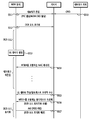
- the network entity transmits an M2M CRID to the base station.
- the M2M device performs network entry to the base station.
- the M2M power saving class may be negotiated when the M2M device performs network entry, and the base station assigns the M2M CRID to the M2M device.
- DCR mode initialization is performed between the M2M device and the base station.
- the M2M device in the DCR mode generates UL data to transmit.
- step S524 the M2M device transmits an AAI-RNG-REQ message including the generated UL data to the base station.
- the UL data may be an SMS message that does not exceed 140 bytes.
- AAI-RNG-REQ message may be defined as shown in Table 17.
- step S525 the base station transmits the AAI-RNG-RSP message to the M2M device in response to the received AAI-RNG-REQ message.
- the AAI-RNG-RSP message may indicate whether there is DL traffic to be transmitted by the base station.
- Table 19 shows an example of an AAI-RNG-RSP message according to the proposed data transmission method. Table 19 is a variation of Table 18.
- DL traffic DL traffic for the firmware upgrade is an example of DL traffic to be sent to the M2M device in DCR mode.
- the AAI-RNG-RSP message includes a DL Traffic Start Time field.
- the M2M device may know when DL traffic is received.
- the M2M device receives the DL traffic from the base station while maintaining the DCR mode.
- the M2M device receives the last DL traffic.
- the M2M device may receive DL traffic while maintaining the DCR mode, and monitor the DL only from the time indicated by the DL Traffic Start Time field in the AAI-RNG-RSP message to the last DL traffic to reduce power consumption.
- the last DL traffic may include the aforementioned MTEEH or TEEH. Accordingly, the M2M device may know that the received DL traffic is the last DL traffic, thereby reducing the power consumption of the M2M device.
- 16 is a block diagram of a wireless communication system in which an embodiment of the present invention is implemented.
- the base station 800 includes a processor 810, a memory 820, and an RF unit 830.
- Processor 810 implements the proposed functions, processes, and / or methods. Layers of the air interface protocol may be implemented by the processor 810.
- the memory 820 is connected to the processor 810 and stores various information for driving the processor 810.
- the RF unit 830 is connected to the processor 810 to transmit and / or receive a radio signal.
- the M2M device 900 includes a processor 910, a memory 920, and an RF unit 930.
- Processor 910 implements the proposed functions, processes, and / or methods. Layers of the air interface protocol may be implemented by the processor 910.
- the memory 920 is connected to the processor 910 and stores various information for driving the processor 910.
- the RF unit 930 is connected to the processor 910 to transmit and / or receive a radio signal.
- Processors 810 and 910 may include application-specific integrated circuits (ASICs), other chipsets, logic circuits, and / or data processing devices.
- the memory 820, 920 may include read-only memory (ROM), random access memory (RAM), flash memory, memory card, storage medium, and / or other storage device.
- the RF unit 830 and 930 may include a baseband circuit for processing a radio signal.
- the above-described technique may be implemented as a module (process, function, etc.) for performing the above-described function.
- the module may be stored in the memory 820, 920 and executed by the processor 810, 910.
- the memories 820 and 920 may be inside or outside the processors 810 and 910, and may be connected to the processors 810 and 910 by various well-known means.
Landscapes
- Engineering & Computer Science (AREA)
- Computer Networks & Wireless Communication (AREA)
- Signal Processing (AREA)
- Mobile Radio Communication Systems (AREA)
Abstract
La présente invention se rapporte à un procédé et à un appareil adaptés pour transmettre des données dans un système de communication sans fil. Selon la présente invention, un appareil de machine à machine (M2M) configuré dans un mode d'annulation d'inscription avec rétention de contexte (DCR) génère des données sur la liaison montante (UL) dont la taille est inférieure à 140 octets ; il transmet un message de demande de mesure de distance (AAI-RNG-REQ) contenant les données UL à une station de base ; et il reçoit, de la station de base, un message de réponse de mesure de distance (AAI-RNG-RSP) en réponse au message de demande de mesure de distance. Le message de demande de mesure de distance contient un champ d'indication de raison de mesure de distance pour indiquer une mise à jour de position afin de transmettre les données UL dans le mode DCR. Le message de réponse de mesure de distance comprend quant à lui un champ de réponse de mise à jour de position pour indiquer la réussite d'une mise à jour de position lors de la transmission des données UL, en réponse au champ d'indication de raison de mesure de distance.
Applications Claiming Priority (4)
| Application Number | Priority Date | Filing Date | Title |
|---|---|---|---|
| US201161497962P | 2011-06-17 | 2011-06-17 | |
| US61/497,962 | 2011-06-17 | ||
| US201161499162P | 2011-06-20 | 2011-06-20 | |
| US61/499,162 | 2011-06-20 |
Publications (2)
| Publication Number | Publication Date |
|---|---|
| WO2012173349A2 true WO2012173349A2 (fr) | 2012-12-20 |
| WO2012173349A3 WO2012173349A3 (fr) | 2013-03-28 |
Family
ID=47357569
Family Applications (1)
| Application Number | Title | Priority Date | Filing Date |
|---|---|---|---|
| PCT/KR2012/004392 Ceased WO2012173349A2 (fr) | 2011-06-17 | 2012-06-04 | Procédé et appareil pour transmettre des données en mode d'économie d'énergie dans un système de communication sans fil |
Country Status (1)
| Country | Link |
|---|---|
| WO (1) | WO2012173349A2 (fr) |
Cited By (1)
| Publication number | Priority date | Publication date | Assignee | Title |
|---|---|---|---|---|
| WO2016056839A1 (fr) * | 2014-10-07 | 2016-04-14 | 엘지전자 주식회사 | Procédé de fonctionnement d'un terminal m2m dans un système de communication sans fil |
Family Cites Families (2)
| Publication number | Priority date | Publication date | Assignee | Title |
|---|---|---|---|---|
| US8599768B2 (en) * | 2009-08-24 | 2013-12-03 | Intel Corporation | Distributing group size indications to mobile stations |
| US8638751B2 (en) * | 2009-10-23 | 2014-01-28 | Intel Corporation | Coverage loss recovery in a wireless communication network |
-
2012
- 2012-06-04 WO PCT/KR2012/004392 patent/WO2012173349A2/fr not_active Ceased
Cited By (2)
| Publication number | Priority date | Publication date | Assignee | Title |
|---|---|---|---|---|
| WO2016056839A1 (fr) * | 2014-10-07 | 2016-04-14 | 엘지전자 주식회사 | Procédé de fonctionnement d'un terminal m2m dans un système de communication sans fil |
| US10306438B2 (en) | 2014-10-07 | 2019-05-28 | Lg Electronics Inc. | Operating method of M2M terminal in wireless communication system |
Also Published As
| Publication number | Publication date |
|---|---|
| WO2012173349A3 (fr) | 2013-03-28 |
Similar Documents
| Publication | Publication Date | Title |
|---|---|---|
| EP2512158B1 (fr) | Transmission de message d'appel dans un système de communication sans fil | |
| KR101646521B1 (ko) | 광대역 무선통신 시스템에서 다중 페이징을 위한 장치 및 방법 | |
| JP6084979B2 (ja) | 通信端末、方法およびプログラム | |
| US9319231B2 (en) | Method and apparatus for transmitting a MAC control message in wireless access system | |
| EP3975449B1 (fr) | Procédé de gestion de collision d'id pour un système de communication d2d, et dispositif associé | |
| EP3100375B1 (fr) | Procédé de notification pour système communication d2d et dispositif associé | |
| WO2016188432A1 (fr) | Procédé de programmation de communication de type machine, station de base, et équipement d'utilisateur | |
| KR101381470B1 (ko) | M2m 통신을 위한 아이들 모드에서 동작 방법 및 이를 이용한 장치 | |
| JP2012124897A (ja) | 無線アクセスシステムにおいて位置更新を行うための方法及び装置 | |
| US8489078B2 (en) | Apparatus and method for providing an emergency service in a broadband wireless communication system | |
| EP2693661A2 (fr) | Procédé et dispositif permettant d'accéder à un réseau pour une coopération entre clients dans un système de communication sans fil | |
| US9319826B2 (en) | Method for providing an M2M service, and method and apparatus for M2M communication | |
| WO2012121498A2 (fr) | Procédé et dispositif pour réaliser une télémétrie dans un système de communication sans fil | |
| WO2012115406A2 (fr) | Procédé et appareil pour mettre à jour une position dans un système de communication sans fil | |
| US20230413229A1 (en) | Method and Apparatus for Relay Communication | |
| US9565652B2 (en) | Method and apparatus for monitoring a paging message in M2M communications | |
| US8811989B2 (en) | Method and apparatus for transmitting paging message for M2M device in wireless communication system | |
| US20130121300A1 (en) | Method for reentering network of no-mobility mobile station in idle state and method for supporting same | |
| WO2012087009A2 (fr) | Procédé de signalisation montante et appareil de signalisation montante dans un système de communication sans fil | |
| WO2013015639A2 (fr) | Procédé permettant une mise à jour de position dans une communication m2m et appareil qui utilise ce dernier | |
| WO2013009107A2 (fr) | Procédé et appareil permettant un fonctionnement en mode veille de la communication m2m | |
| WO2012173349A2 (fr) | Procédé et appareil pour transmettre des données en mode d'économie d'énergie dans un système de communication sans fil | |
| KR20120138619A (ko) | 무선 통신 시스템에서 데이터 전송 방법 및 장치 | |
| WO2012002689A2 (fr) | Appareil et procédé d'émission et de réception d'informations de système dans un système de communication sans fil | |
| WO2013055067A2 (fr) | Procédé et dispositif pour entrer dans un réseau suite à une mise hors tension anormale dans un système de communication sans fil |
Legal Events
| Date | Code | Title | Description |
|---|---|---|---|
| 121 | Ep: the epo has been informed by wipo that ep was designated in this application |
Ref document number: 12799959 Country of ref document: EP Kind code of ref document: A2 |
|
| NENP | Non-entry into the national phase |
Ref country code: DE |
|
| 122 | Ep: pct application non-entry in european phase |
Ref document number: 12799959 Country of ref document: EP Kind code of ref document: A2 |