WO2013014871A1 - Lave-vaisselle - Google Patents
Lave-vaisselle Download PDFInfo
- Publication number
- WO2013014871A1 WO2013014871A1 PCT/JP2012/004499 JP2012004499W WO2013014871A1 WO 2013014871 A1 WO2013014871 A1 WO 2013014871A1 JP 2012004499 W JP2012004499 W JP 2012004499W WO 2013014871 A1 WO2013014871 A1 WO 2013014871A1
- Authority
- WO
- WIPO (PCT)
- Prior art keywords
- temperature
- outside air
- water
- cleaning
- dishwasher
- Prior art date
- Legal status (The legal status is an assumption and is not a legal conclusion. Google has not performed a legal analysis and makes no representation as to the accuracy of the status listed.)
- Ceased
Links
Images

Classifications
-
- A—HUMAN NECESSITIES
- A47—FURNITURE; DOMESTIC ARTICLES OR APPLIANCES; COFFEE MILLS; SPICE MILLS; SUCTION CLEANERS IN GENERAL
- A47L—DOMESTIC WASHING OR CLEANING; SUCTION CLEANERS IN GENERAL
- A47L15/00—Washing or rinsing machines for crockery or tableware
- A47L15/0018—Controlling processes, i.e. processes to control the operation of the machine characterised by the purpose or target of the control
- A47L15/0021—Regulation of operational steps within the washing processes, e.g. optimisation or improvement of operational steps depending from the detergent nature or from the condition of the crockery
- A47L15/0034—Drying phases, including dripping-off phases
-
- A—HUMAN NECESSITIES
- A47—FURNITURE; DOMESTIC ARTICLES OR APPLIANCES; COFFEE MILLS; SPICE MILLS; SUCTION CLEANERS IN GENERAL
- A47L—DOMESTIC WASHING OR CLEANING; SUCTION CLEANERS IN GENERAL
- A47L15/00—Washing or rinsing machines for crockery or tableware
- A47L15/0018—Controlling processes, i.e. processes to control the operation of the machine characterised by the purpose or target of the control
- A47L15/0047—Energy or water consumption, e.g. by saving energy or water
-
- A—HUMAN NECESSITIES
- A47—FURNITURE; DOMESTIC ARTICLES OR APPLIANCES; COFFEE MILLS; SPICE MILLS; SUCTION CLEANERS IN GENERAL
- A47L—DOMESTIC WASHING OR CLEANING; SUCTION CLEANERS IN GENERAL
- A47L15/00—Washing or rinsing machines for crockery or tableware
- A47L15/42—Details
- A47L15/4246—Details of the tub
-
- A—HUMAN NECESSITIES
- A47—FURNITURE; DOMESTIC ARTICLES OR APPLIANCES; COFFEE MILLS; SPICE MILLS; SUCTION CLEANERS IN GENERAL
- A47L—DOMESTIC WASHING OR CLEANING; SUCTION CLEANERS IN GENERAL
- A47L2401/00—Automatic detection in controlling methods of washing or rinsing machines for crockery or tableware, e.g. information provided by sensors entered into controlling devices
- A47L2401/12—Water temperature
-
- A—HUMAN NECESSITIES
- A47—FURNITURE; DOMESTIC ARTICLES OR APPLIANCES; COFFEE MILLS; SPICE MILLS; SUCTION CLEANERS IN GENERAL
- A47L—DOMESTIC WASHING OR CLEANING; SUCTION CLEANERS IN GENERAL
- A47L2401/00—Automatic detection in controlling methods of washing or rinsing machines for crockery or tableware, e.g. information provided by sensors entered into controlling devices
- A47L2401/18—Air temperature
-
- A—HUMAN NECESSITIES
- A47—FURNITURE; DOMESTIC ARTICLES OR APPLIANCES; COFFEE MILLS; SPICE MILLS; SUCTION CLEANERS IN GENERAL
- A47L—DOMESTIC WASHING OR CLEANING; SUCTION CLEANERS IN GENERAL
- A47L2401/00—Automatic detection in controlling methods of washing or rinsing machines for crockery or tableware, e.g. information provided by sensors entered into controlling devices
- A47L2401/20—Time, e.g. elapsed operating time
-
- A—HUMAN NECESSITIES
- A47—FURNITURE; DOMESTIC ARTICLES OR APPLIANCES; COFFEE MILLS; SPICE MILLS; SUCTION CLEANERS IN GENERAL
- A47L—DOMESTIC WASHING OR CLEANING; SUCTION CLEANERS IN GENERAL
- A47L2501/00—Output in controlling method of washing or rinsing machines for crockery or tableware, i.e. quantities or components controlled, or actions performed by the controlling device executing the controlling method
- A47L2501/11—Air heaters
Definitions
- the present invention relates to a dishwasher that performs washing by spraying washing water onto an object to be washed such as tableware.
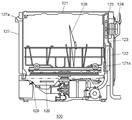
- FIG. 4 is a diagram showing an internal configuration of the conventional dishwasher 100 as viewed from the side.
- the dishwasher 100 includes a washing tank 121, a communication part 121 a provided at the lower rear part of the washing tank 121, an intake duct 122 communicating with the communication part 121 a, and a fan case 123 connected to the intake duct 122.
- a motor 124 is attached to the fan case 123, and a blower fan 125 directly connected to the motor 124 is provided inside the fan case 123.
- the fan case 123 has an opening to the outside air so that the outside air can be taken into the cleaning tank 121.
- a heater 126 is provided as a heat source at the lower part of the cleaning tank 121, and an opening 127a to the outside air is provided at the upper part of the lid 127 that covers the front surface of the product.
- the dishwasher 100 energizes the heater 126 to increase the temperature of the air in the washing tank 121, and energizes the motor 124 to operate the blower fan 125.
- the outside air is sent into the cleaning tank 121 through the intake duct 122 and the communication part 121a.
- control unit performs a preset operation.
- the time for the drying process is preset as a product or is set by the user operating a timer.
- the temperature of the air in the washing tank 121 is easily influenced by the outside air temperature.
- the temperature of the air in the cleaning tank 121 is also lowered, so that the tableware 128 may not be sufficiently dried in a preset drying time.
- the outside air temperature is high, the tableware 128 becomes overdried, and there is a possibility that time and energy are wasted.
- the level of the outside air temperature is determined from the temperature change ⁇ T in the cleaning tank 121 during the drying process without directly detecting the outside air temperature. For this reason, for example, when the air volume decreases due to a change in the state of the blower fan 125, the motor 124, or the blower path, the temperature change ⁇ T in the cleaning tank 121 becomes small, so the outside air temperature is determined to be in a high temperature state. The Thus, in the prior art, there is a risk that the outside air temperature may be erroneously determined.
- the temperature detecting element 129 is provided by providing an opening in the cleaning tank 121.
- an opening is formed in the bottom wall of the cleaning tank 121 and the temperature detection element 129 is provided. It will be.
- the opening since the opening is exposed to the cleaning water in the cleaning process or the like, water leakage may occur. Therefore, it is necessary to perform a strict sealing process on the opening so that water leakage does not occur over a long period of time.
- the present invention accurately detects the outside air temperature, has no risk of water leakage, optimizes the control to warm the air in the washing tank according to the temperature of the outside air taken into the washing tank, and saves energy in the drying process.
- the present invention provides a dishwasher that can be realized.
- the dishwasher of the present invention includes a washing tub that accommodates an object to be washed, a heating unit that is provided in the washing tub, heats washing water, and heats the outside air introduced in the drying process, and a washing tub
- a temperature detection unit that is provided in contact with the outside of the bottom and detects the temperature of the cleaning water and the outside air temperature, and a control unit that controls the operation of the heating unit based on the detection result of the temperature detection unit. Further, the temperature detection unit detects the outside air temperature at the start of operation, and the control unit determines that the outside air temperature detected by the temperature detection unit is higher than the first predetermined temperature, to the heating unit in the drying process.
- the amount of heat input is controlled to be less than usual.
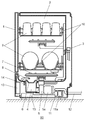
- FIG. 1 is a cross-sectional view showing the internal configuration of the dishwasher according to the embodiment of the present invention as seen from the side.
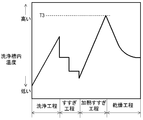
- FIG. 2A is a diagram showing a temperature change in the washing tank in each operation process in the dishwasher according to the embodiment of the present invention.
- FIG. 2B is a diagram illustrating an operation state of each part in each operation process in the dishwasher according to the embodiment of the present invention.
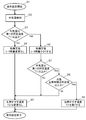
- FIG. 3 is a flowchart for explaining the condition setting of the dishwasher in the embodiment of the present invention.
- FIG. 4 is a diagram showing an internal configuration as viewed from the side of a conventional dishwasher.
- the dishwasher 50 in the embodiment of the present invention will be described.
- FIG. 1 is a cross-sectional view seen from the side, showing the internal configuration of the dishwasher 50 in the embodiment of the present invention.
- FIG. 2A is a view showing a temperature change in the washing tub 2 in each operation process in the dishwasher 50.
- FIG. 2B is a diagram illustrating an operation state of each part in each operation process in the dishwasher 50.
- the dishwasher 50 is provided with a door 1 on the front and a washing tub 2 inside.
- the dishwasher 50 includes a water supply valve 3 that supplies water or hot water into the washing tub 2.
- a water reservoir 4 is provided at the bottom of the cleaning tank 2.
- the dishwasher 50 includes a washing pump 5 that communicates with the water storage unit 4 and is driven by a washing motor 5a.
- a cleaning nozzle 7 is provided at the inner bottom of the cleaning tank 2. Washing water is pumped to the washing nozzle 7 by the washing pump 5 and sprayed into the entire washing tank 2.
- the water storage unit 4 is provided with a leftover filter 6 for collecting leftovers.
- the cleaning water supplied into the cleaning tank 2 passes through the leftover filter 6 and the water storage unit 4, is sucked into the cleaning pump 5, and is supplied from the cleaning pump 5 to the cleaning nozzle 7.
- the washing water sprayed from the washing nozzle 7 circulates along a path that returns to the water storage unit 4 again after washing the dishes 9 that are the objects to be washed.
- the leftovers washed away from the dishes 9 flow into the leftover filter 6 together with the washing water, and the leftovers having a size that cannot pass through the leftover filter 6 are collected in the leftover filter 6.
- a heater 8 that is a heating unit for cleaning water or the like is provided. During cleaning, the heater 8 heats the cleaning water to about 50 ° C.
- the tableware 9 can be arranged in an orderly manner, and a tableware basket 10 configured so that the washing water is effectively sprayed onto the tableware 9 is installed, so that efficient washing is performed.
- the drainage pump 11 driven by the drainage motor 11a discharges the washing water to the outside through the drainage hose 12.
- a thermistor 14 serving as a temperature detection unit used for detecting both the outside air temperature and the temperature of the cleaning water is disposed outside the bottom of the cleaning tank 2.
- the dishwasher 50 includes a control unit 15 that controls the operation of the dishwasher 50 based on the detection result of the thermistor 14.
- the thermistor 14 is disposed in contact with the outside of the cleaning tank 2 and can indirectly detect the outside air temperature or the temperature of the cleaning water depending on the timing.
- the temperature of the wall surface of the cleaning tank 2 is the same as the outside air temperature, so the thermistor 14 can indirectly detect the outside air temperature accurately.
- the temperature of the wall surface of the cleaning tank 2 becomes substantially the same as that of the cleaning water. Can be detected. With such a configuration, it is not necessary to provide an opening in the cleaning tank 2 and attach the thermistor 14, so that it is not necessary to perform an extra sealing process, and a configuration with no risk of water leakage can be realized.
- the amount of heat input to the heater 8 in the drying process or the like is adjusted by adjusting the on and off times in the on / off control of the heater 8 (see FIG. 2B).
- cleaning water a liquid used for cleaning and rinsing objects to be cleaned such as tableware 9 accommodated in the cleaning tank 2 is referred to as cleaning water.
- the dishwasher 50 performs a washing process for removing dirt adhering to the dishes 9 and rinsing the detergent components adhering to the dishes 9 with clean washing water, and a rinsing process. Perform 1 to 3 times (2 times in the example of FIGS. 2A and 2B).
- the water supply valve 3 is turned off, the cleaning pump 5 and the heater 8 are turned on, and the cleaning water is injected.
- the blower fan 13 and the drainage pump 11 are kept off.
- the temperature inside the cleaning tank 2 rises.
- the cleaning pump 5 and the heater 8 are turned off, the drain pump 11 is turned on, and the cleaning water is discharged.
- the dishes 9 are rinsed with clean washing water heated to 60 to 80 ° C., and then the heating and rinsing process is performed.
- the heating and rinsing process after the water supply valve 3 is turned on and the cleaning water is supplied, the cleaning pump 5 and the heater 8 are turned on and the cleaning water is injected. The drain pump 11 and the blower fan 13 are kept off. Thereby, the temperature inside the washing tank 2 rises to the heating rinse temperature T3.
- the cleaning pump 5 and the heater 8 are turned off, the drain pump 11 is turned on, and the cleaning water is discharged.
- a drying process for drying the washed dishes 9 is performed.
- outside air is taken into the cleaning tank 2 by turning on the blower fan 13 provided at the lower part of the cleaning tank 2.
- the outside air is heated by the heater 8 that is intermittently turned on by the on-off control.
- the heated air flows between the dishes 9 by the blower fan 13 to dry the water droplets attached to the dishes 9.
- the water supply valve 3, the cleaning pump 5, and the drainage pump 11 are in an off state.
- the temperature inside the cleaning tank 2 is lowered from the heating rinse temperature T3.
- the thermistor 14 indirectly detects the ambient temperature before the water supply process of supplying the cleaning water into the cleaning tank 2. Then, the washing
- control unit 15 controls the amount of heat input to the heater 8 based on the temperature detected by the thermistor 14. For example, when the outside air temperature is high, the tableware 9 can be sufficiently dried even if the amount of heat for heating the outside air in the washing tank 2 is reduced. By performing such control, the amount of heat input to the heater 8 in the drying process can be reduced.
- the standard outside air temperature is set to the first predetermined temperature T1 (for example, 25 ° C.), and the amount of heat necessary for drying the dishes with air of 25 ° C. is set in advance as the standard heat amount.
- T1 for example, 25 ° C.
- the amount of heat necessary for drying the dishes with air of 25 ° C. is set in advance as the standard heat amount.
- the amount of heat for heating the outside air by the heater 8 can be optimized according to the outside air temperature, and the dishwasher 50 that can save energy in the drying process can be provided.
- the thermistor 14 is used to detect both the temperature of the wash water and the outside air temperature. For this reason, the thermistor 14 is disposed in contact with the outside of the bottom of the cleaning tank 2. As described above, in the state where the wall surface of the cleaning tank 2 has been warmed by the previous drying process during continuous operation, the thermistor 14 cannot accurately detect the temperature of the outside air at the start of operation, resulting in false detection.
- a temperature higher than the actual outside temperature is detected by the thermistor 14. If control is performed based on this result, the amount of heat in the drying process will be less than the standard amount of heat, sufficient drying performance may not be obtained, and the tableware 9 may not be completely dried. That is, the greater the amount of tableware 9 and the lower the outside air temperature, the greater the influence on the drying performance due to false detection.
- the second predetermined temperature T2 is set as a threshold value higher than the first predetermined temperature T1 when the thermistor 14 detects the temperature.
- the control unit 15 uses the thermistor 14 to measure the water temperature rise time.
- the water temperature rise time is the time taken for the temperature of the wash water supplied in the heating rinsing process to rise by a predetermined temperature.
- the control unit 15 When it is determined that the water temperature rise time is longer than the predetermined time, the control unit 15 has a low temperature of the supplied wash water, that is, the outside air temperature is lower than the temperature detected by the thermistor 14. Is determined. In other words, the control unit 15 determines that the high outside air temperature is detected by the thermistor 14 because of an increase in the temperature inside the cleaning tank 2 due to continuous operation.
- control part 15 performs the operation control which sets the heating rinse temperature T3 in a heating rinse process higher than an initial setting instead of reducing an amount of heat in a drying process and performing an energy saving operation.
- the second predetermined temperature T2 is set to a temperature higher than the first predetermined temperature T1.
- the second predetermined temperature T2 is preferably set to a temperature that is usually difficult to reach, for example, about 35 ° C.
- FIG. 3 is a flowchart for explaining the condition setting of the dishwasher 50 in the embodiment of the present invention.
- the control unit 15 starts the condition setting as the dishwasher 50 starts operating (S1).
- the thermistor 14 detects the outside air temperature (S2), and the control unit 15 determines whether or not the detected outside air temperature is equal to or higher than the first predetermined temperature T1 (S3).
- the control unit 15 When the detected outside air temperature is lower than the first predetermined temperature T1 (S3, NO), the control unit 15 does not change the amount of heat input to the heater 8 in the drying process with the initial setting (S4). In this case, the control unit 15 ends the condition setting without changing the heating rinse temperature T3 to the initial setting (S5).
- step S2 if the outside air temperature measured in step S2 is equal to or higher than the first predetermined temperature T1 (S3, YES), the control unit 15 reduces the amount of heat input to the heater 8 in the drying process from the initial setting.
- the setting is changed (S6).
- control unit 15 determines whether or not the outside air temperature detected in step S2 is equal to or higher than the second predetermined temperature T2 (S7).
- the control unit 15 ends the condition setting without changing the heating rinse temperature T3 to the initial setting (S5).
- step S2 when the outside air temperature detected in step S2 is equal to or higher than the second predetermined temperature T2 (S7, YES), the controller 15 increases the water temperature rise time of the wash water detected by the thermistor 14 in the heating rinse process. Is longer than the predetermined time (S8).
- the control unit 15 ends the condition setting without changing the heating rinse temperature T3 to the initial setting (S5).
- the control unit 15 changes the setting so that the heating rinse temperature T3 is higher than usual (S9), and ends the condition setting.
- the dishwasher 50 there is no need to provide an opening in the washing tub 2 and attach the thermistor 14, so there is no risk of water leakage from the opening. Furthermore, by providing the thermistor 14 so as to be in contact with the bottom outside of the cleaning tank 2, it is possible to detect an accurate outside air temperature. Thereby, optimal operation control according to external temperature can be performed, and the energy saving of a drying process can be aimed at.
- control unit 15 has been described using an example in which the on / off time of the heater 8 is controlled in order to reduce the amount of heat in the drying process.
- the present invention is not limited to this.
- the controller 15 can also save energy in the drying process by reducing the voltage applied to the heater 8 or shortening the time of the drying process.
- the outside air temperature is accurately detected, there is no risk of water leakage, and the control for heating the air in the washing tank according to the state of the temperature of the outside air taken into the washing tank is optimal. Energy saving in the drying process. Therefore, this invention is useful as a dishwasher etc. which inject
Landscapes
- Washing And Drying Of Tableware (AREA)
Abstract
L'invention porte sur un lave-vaisselle, lequel lave-vaisselle comprend un réservoir de lavage (2) pour recevoir des articles à laver, et une unité de chauffage (8) pour chauffer de l'eau de lavage et chauffer de l'air externe aspiré pendant une étape de séchage, l'unité de chauffage étant disposée à l'intérieur du réservoir de lavage (2). Le lave-vaisselle comprend également : un détecteur de température (14) pour détecter la température de l'eau de lavage et la température de l'air externe, le détecteur de température étant disposé de façon à toucher le côté externe de la partie inférieure du réservoir de lavage (2) ; et un dispositif de commande (15) pour commander le fonctionnement sur la base des résultats de détection du détecteur de température (14). Le détecteur de température (14) détecte la température de l'air externe au démarrage du fonctionnement, et, lorsque le dispositif de commande (15) a déterminé que la température de l'air externe détectée par le détecteur de température (14) est supérieure à une première température prédéterminée, le dispositif de commande effectue une commande pour réduire la quantité de chaleur fournie à l'unité de chauffage (8) pendant l'étape de séchage, de sorte qu'elle soit inférieure à ce qui est habituel.
Applications Claiming Priority (2)
| Application Number | Priority Date | Filing Date | Title |
|---|---|---|---|
| JP2011-163982 | 2011-07-27 | ||
| JP2011163982A JP2013027450A (ja) | 2011-07-27 | 2011-07-27 | 食器洗い乾燥機 |
Publications (1)
| Publication Number | Publication Date |
|---|---|
| WO2013014871A1 true WO2013014871A1 (fr) | 2013-01-31 |
Family
ID=47600749
Family Applications (1)
| Application Number | Title | Priority Date | Filing Date |
|---|---|---|---|
| PCT/JP2012/004499 Ceased WO2013014871A1 (fr) | 2011-07-27 | 2012-07-12 | Lave-vaisselle |
Country Status (3)
| Country | Link |
|---|---|
| JP (1) | JP2013027450A (fr) |
| TW (1) | TW201306783A (fr) |
| WO (1) | WO2013014871A1 (fr) |
Cited By (5)
| Publication number | Priority date | Publication date | Assignee | Title |
|---|---|---|---|---|
| US9820888B2 (en) | 2006-09-26 | 2017-11-21 | Smith & Nephew, Inc. | Wound dressing |
| US10124098B2 (en) | 2013-03-13 | 2018-11-13 | Smith & Nephew, Inc. | Negative pressure wound closure device and systems and methods of use in treating wounds with negative pressure |
| US10159771B2 (en) | 2013-03-14 | 2018-12-25 | Smith & Nephew Plc | Compressible wound fillers and systems and methods of use in treating wounds with negative pressure |
| CN111820785A (zh) * | 2020-07-20 | 2020-10-27 | 上海明略人工智能(集团)有限公司 | 漂洗设备、无效喷淋量检测方法、装置及介质 |
| US10939796B2 (en) | 2018-05-01 | 2021-03-09 | Haier Us Appliance Solutions, Inc. | Dishwasher appliance with adjustable dry cycle |
Families Citing this family (2)
| Publication number | Priority date | Publication date | Assignee | Title |
|---|---|---|---|---|
| JP6162007B2 (ja) | 2013-02-15 | 2017-07-12 | 株式会社マキタ | 切削工具及びグリップ部 |
| CN106031622B (zh) * | 2015-03-20 | 2020-03-03 | 青岛海尔洗碗机有限公司 | 一种洗碗机节水水槽及洗碗机 |
Citations (3)
| Publication number | Priority date | Publication date | Assignee | Title |
|---|---|---|---|---|
| JPH10328113A (ja) * | 1997-05-30 | 1998-12-15 | Matsushita Electric Ind Co Ltd | 食器洗い乾燥機 |
| JP2000185009A (ja) * | 1998-12-21 | 2000-07-04 | Sanyo Electric Co Ltd | 食器洗い機 |
| JP2011072770A (ja) * | 2009-09-07 | 2011-04-14 | Panasonic Corp | 食器洗い機 |
-
2011
- 2011-07-27 JP JP2011163982A patent/JP2013027450A/ja active Pending
-
2012
- 2012-07-12 WO PCT/JP2012/004499 patent/WO2013014871A1/fr not_active Ceased
- 2012-07-16 TW TW101125535A patent/TW201306783A/zh unknown
Patent Citations (3)
| Publication number | Priority date | Publication date | Assignee | Title |
|---|---|---|---|---|
| JPH10328113A (ja) * | 1997-05-30 | 1998-12-15 | Matsushita Electric Ind Co Ltd | 食器洗い乾燥機 |
| JP2000185009A (ja) * | 1998-12-21 | 2000-07-04 | Sanyo Electric Co Ltd | 食器洗い機 |
| JP2011072770A (ja) * | 2009-09-07 | 2011-04-14 | Panasonic Corp | 食器洗い機 |
Cited By (5)
| Publication number | Priority date | Publication date | Assignee | Title |
|---|---|---|---|---|
| US9820888B2 (en) | 2006-09-26 | 2017-11-21 | Smith & Nephew, Inc. | Wound dressing |
| US10124098B2 (en) | 2013-03-13 | 2018-11-13 | Smith & Nephew, Inc. | Negative pressure wound closure device and systems and methods of use in treating wounds with negative pressure |
| US10159771B2 (en) | 2013-03-14 | 2018-12-25 | Smith & Nephew Plc | Compressible wound fillers and systems and methods of use in treating wounds with negative pressure |
| US10939796B2 (en) | 2018-05-01 | 2021-03-09 | Haier Us Appliance Solutions, Inc. | Dishwasher appliance with adjustable dry cycle |
| CN111820785A (zh) * | 2020-07-20 | 2020-10-27 | 上海明略人工智能(集团)有限公司 | 漂洗设备、无效喷淋量检测方法、装置及介质 |
Also Published As
| Publication number | Publication date |
|---|---|
| TW201306783A (zh) | 2013-02-16 |
| JP2013027450A (ja) | 2013-02-07 |
Similar Documents
| Publication | Publication Date | Title |
|---|---|---|
| JP5170327B2 (ja) | 食器洗い機 | |
| KR101366262B1 (ko) | 식기 세척기의 제어방법 | |
| WO2013014871A1 (fr) | Lave-vaisselle | |
| KR20100023167A (ko) | 식기세척기의 제어방법 | |
| US7998280B2 (en) | Method of controlling dishwasher and dishwasher | |
| KR20100023172A (ko) | 식기세척기의 제어방법 | |
| KR101306732B1 (ko) | 식기 세척기의 제어방법 | |
| TWI471112B (zh) | Tableware cleaning machine | |
| KR101669378B1 (ko) | 세척기 | |
| KR101141388B1 (ko) | 식기 세척기 및 그의 제어 방법 | |
| KR20110046180A (ko) | 식기 세척기 및 식기 세척기의 제어방법 | |
| KR101405930B1 (ko) | 식기 세척기의 제어방법 | |
| KR102443320B1 (ko) | 식기 세척기 및 식기 세척기의 제어방법 | |
| JP2013240405A (ja) | 食器洗い機 | |
| JP5445566B2 (ja) | 食器洗い機 | |
| KR102547553B1 (ko) | 식기 세척기 및 그 제어방법 | |
| JP4496145B2 (ja) | 食器洗い機 | |
| KR20110130957A (ko) | 식기세척기 및 그 제어방법 | |
| JP2005095505A (ja) | 食器洗い機 | |
| JP2001112698A (ja) | 食器洗い乾燥機 |
Legal Events
| Date | Code | Title | Description |
|---|---|---|---|
| 121 | Ep: the epo has been informed by wipo that ep was designated in this application |
Ref document number: 12818147 Country of ref document: EP Kind code of ref document: A1 |
|
| NENP | Non-entry into the national phase |
Ref country code: DE |
|
| 122 | Ep: pct application non-entry in european phase |
Ref document number: 12818147 Country of ref document: EP Kind code of ref document: A1 |