WO2013014894A1 - Alliage à base de titane - Google Patents
Alliage à base de titane Download PDFInfo
- Publication number
- WO2013014894A1 WO2013014894A1 PCT/JP2012/004621 JP2012004621W WO2013014894A1 WO 2013014894 A1 WO2013014894 A1 WO 2013014894A1 JP 2012004621 W JP2012004621 W JP 2012004621W WO 2013014894 A1 WO2013014894 A1 WO 2013014894A1
- Authority
- WO
- WIPO (PCT)
- Prior art keywords
- content
- titanium alloy
- alloy
- platinum group
- rare earth
- Prior art date
- Legal status (The legal status is an assumption and is not a legal conclusion. Google has not performed a legal analysis and makes no representation as to the accuracy of the status listed.)
- Ceased
Links
Images


Classifications
-
- C—CHEMISTRY; METALLURGY
- C22—METALLURGY; FERROUS OR NON-FERROUS ALLOYS; TREATMENT OF ALLOYS OR NON-FERROUS METALS
- C22C—ALLOYS
- C22C14/00—Alloys based on titanium
-
- C—CHEMISTRY; METALLURGY
- C22—METALLURGY; FERROUS OR NON-FERROUS ALLOYS; TREATMENT OF ALLOYS OR NON-FERROUS METALS
- C22F—CHANGING THE PHYSICAL STRUCTURE OF NON-FERROUS METALS AND NON-FERROUS ALLOYS
- C22F1/00—Changing the physical structure of non-ferrous metals or alloys by heat treatment or by hot or cold working
- C22F1/02—Changing the physical structure of non-ferrous metals or alloys by heat treatment or by hot or cold working in inert or controlled atmosphere or vacuum
-
- C—CHEMISTRY; METALLURGY
- C22—METALLURGY; FERROUS OR NON-FERROUS ALLOYS; TREATMENT OF ALLOYS OR NON-FERROUS METALS
- C22F—CHANGING THE PHYSICAL STRUCTURE OF NON-FERROUS METALS AND NON-FERROUS ALLOYS
- C22F1/00—Changing the physical structure of non-ferrous metals or alloys by heat treatment or by hot or cold working
- C22F1/16—Changing the physical structure of non-ferrous metals or alloys by heat treatment or by hot or cold working of other metals or alloys based thereon
- C22F1/18—High-melting or refractory metals or alloys based thereon
- C22F1/183—High-melting or refractory metals or alloys based thereon of titanium or alloys based thereon
Definitions
- the present invention relates to a titanium alloy, in particular, a titanium alloy excellent in corrosion resistance (such as crevice corrosion resistance and acid resistance), workability and economy, and excellent in corrosion resistance and workability and starting from damage such as flaws.
- the present invention relates to a titanium alloy that hardly undergoes corrosion.
- Titanium is actively used in the aircraft field and other fields because it is light and strong. In addition, since it has excellent corrosion resistance, it has been widely used for chemical industrial equipment materials, thermal / nuclear power generation equipment materials, seawater desalination equipment materials, and the like.
- crevice corrosion becomes a problem because the anode electrode used for electrolysis is used in high-temperature and high-concentration salt water containing 20 to 30% chlorine and 100 ° C or higher. Used on the site.
- Ni and Pb refining industry it is used as a material for reaction vessels and pipes that are exposed to high-temperature and high-concentration sulfuric acid solution containing slurry and exceeding 100 ° C.
- heat transfer tubes used for heat transfer tubes exposed to high-temperature and high-concentration salt water in the salt production field, heat transfer tubes used for heat exchange of incinerator exhaust gas containing chlorine, NO x , and SO x .
- a Ti-0.15Pd alloy (ASTM Gr. 7) with improved corrosion resistance was developed for the aforementioned applications.
- This titanium alloy utilizes the phenomenon that the contained Pd can reduce the hydrogen overvoltage and maintain the natural potential in the passive state region. That is, Pd eluted from this alloy due to corrosion is precipitated again and deposited on the surface of the alloy, whereby the hydrogen overvoltage of this alloy is lowered, the natural potential is maintained in the passive state, and excellent corrosion resistance is exhibited.
- ASTM Gr. Has excellent corrosion resistance. 7 is a platinum group element and is very expensive (2220 yen / g, Nihon Keizai Shimbun February 9, 2011). Since Pd is contained, its field of use was limited.
- the Pd content is 0.03 to 0.1% by mass
- ASTM Gr. A titanium alloy (ASTM Gr. 17) having excellent crevice corrosion resistance while being reduced as compared with 7 is proposed and put into practical use.
- Patent Document 2 contains a total of 0.01 to 0.12% by mass of one or more platinum group elements as a titanium alloy that can be manufactured at low cost while suppressing a decrease in corrosion resistance, and contains Al, Cr, Zr, Nb. , A titanium alloy containing 5% by mass or less of one or more of Si, Sn and Mn in total is disclosed.
- Pd has characteristics such as sufficient corrosion resistance in the range of 0.01 to 0.12% by mass.
- properties such as corrosion resistance have become insufficient.
- Patent Documents 3 and 4 disclose titanium alloys in which platinum group elements, rare earth elements, and transition elements are added in combination as inventions in a field different from the target field of the present invention. Each of these inventions is an ultra-high vacuum vessel or a titanium alloy for an ultra-high vacuum vessel.
- the reason for adding platinum group elements and rare earth elements is to obtain an effect of suppressing the phenomenon in which gas components dissolved in the material diffuse into the vacuum side and are released in an ultrahigh vacuum.
- the platinum group element traps hydrogen and the rare earth element traps oxygen in the titanium alloy.
- transition elements of Co, Fe, Cr, Ni, Mn, and Cu are essential elements in addition to platinum group elements and rare earth elements.
- the transition element has a role of fixing atomic hydrogen adsorbed on the surface of the vacuum vessel by the platinum group element.
- whether these titanium alloys have corrosion resistance is unknown without any disclosure or suggestion.
- Non-Patent Document 1 discloses that from the viewpoint of obtaining crevice corrosion resistance of a Ti—Pd alloy, the Pd content must be 0.05% by mass or more, and Co, Ni, or V is used as the third element. It is described that the crevice corrosion resistance is improved by the addition.
- the present invention has been made in view of the above-mentioned problems, has an equivalent or better corrosion resistance and good workability, and has a lower content of platinum group elements such as Pd and is economical. It aims at providing the titanium alloy which is. In addition, when the Pd content is about the same as the conventional one, it has the same or better corrosion resistance and good workability as the conventional one, and when damage such as surface flaws occurs, corrosion starts from this damage. It aims at providing the titanium alloy which is hard to carry out.
- the present inventors understand the mechanism for improving the corrosion resistance of a Ti—Pd alloy, and newly contain an element that promotes the realization of a preferable surface state for improving the corrosion resistance.
- the improvement of the corrosion resistance and the corrosion resistance equal to or higher than the conventional one with a lower Pd content than the conventional one were studied.
- the present invention is a conventional technique that enhances the corrosion resistance of the titanium alloy by adding an element having an effect of enhancing the corrosion resistance, as in the techniques described in Patent Document 2 and Non-Patent Document 1. Is different.
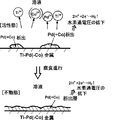
- FIG. 1 is a schematic diagram for explaining a mechanism for improving the corrosion resistance of a Ti—Pd (—Co) alloy.
- Ti—Pd alloy and Ti—Pd—Co alloy are in an active state in the initial state, and when immersed in an acid solution such as boiling hydrochloric acid, Ti and Pd on the surface, or Ti, Pd and Co dissolve, and dissolved Pd, Alternatively, Pd and Co are precipitated on the surface and concentrated to lower the hydrogen overvoltage of the entire alloy. For this reason, this alloy is maintained at a potential in a passive state region and exhibits excellent corrosion resistance.
- the present inventors have prepared an alloy base material that is generated at an early stage after immersion in the solution so that Pd can be rapidly and uniformly deposited on the surface and concentrated after the Ti—Pd alloy is immersed in the acid solution. We searched for elements that promote dissolution.
- the alloy base material dissolves early in the active state after being immersed in the acid solution, the Pd ion concentration in the solution near the outermost surface is increased, and the alloy surface is promptly and appropriately It is considered that a sufficient amount of Pd precipitation concentration (high Pd content compared to the case where no new element is added) can be realized. If this Pd precipitation concentration occurs, even if the Pd content is low, the hydrogen overvoltage of the Ti—Pd alloy decreases rapidly, leading to a more noble and stable potential (potential in the passive state region). it can.
- the present inventors have searched for an element that promotes dissolution of the alloy base material that occurs early after immersion in the solution, that is, an element that promotes Pd precipitation concentration on the surface of the Ti—Pd alloy. I proceeded with the experiment. As a result, it was found that rare earth elements correspond to such elements.
- the present invention has been completed based on this finding, and the gist of the following (1) to (5) titanium alloys.
- the titanium alloy of the present invention has excellent corrosion resistance and workability. Therefore, according to the titanium alloy of the present invention, it is possible to further improve the performance and reliability of facilities and equipment used in corrosive environments (especially high temperature and high concentration chloride environments).
- corrosive environments especially high temperature and high concentration chloride environments.
- the platinum group element content is relatively low, such a titanium alloy can be obtained at a more economical raw material cost. Further, when the content of the platinum group element is relatively high, the corrosion hardly starts from damage such as soot generated on the surface.
- FIG. 1 is a schematic diagram for explaining a mechanism for improving the corrosion resistance of a Ti—Pd (—Co) alloy.
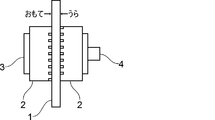
- 2A and 2B are schematic views of a test piece for a crevice corrosion test.
- FIG. 2A is a plan view and
- FIG. 2B is a side view.
- FIG. 3 is a schematic view showing a state of a test piece when subjected to a crevice corrosion test (ASTM G78).
- FIG. 4 is a schematic view of a test piece for a heat-resistant (boiling) hydrochloric acid test.
- FIG. 4 (a) is a plan view and FIG. 4 (b) is a side view.
- FIG. 4 (a) is a plan view and
- FIG. 4 (b) is a side view.
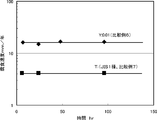
- FIG. 5 is a graph showing the change over time in the corrosion rate when immersed in boiling 3% hydrochloric acid of Comparative Example 6 and Comparative Example 7.
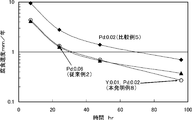
- FIG. 6 is a graph showing the change over time in the corrosion rate when immersed in boiling 3% hydrochloric acid of Invention Example 8, Comparative Example 5 and Conventional Example 2.
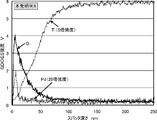
- FIG. 7 is a view showing the concentration distribution of Pd, Ti, and O from the surface of the titanium alloy according to Invention Example 4 in the depth direction.
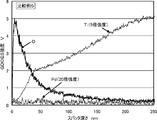
- FIG. 8 is a view showing the concentration distribution of Pd, Ti and O from the surface of the titanium alloy of Comparative Example 5 in the depth direction.
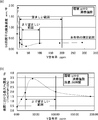
- FIG. 9 shows the results of a heat resistance (boiling) hydrochloric acid test, FIG. 9 (a) shows the relationship between the 96 hour average corrosion rate and the Y content, and FIG. 9 (b) shows the surface Pd concentration after the test. It is a figure about the relationship between Y and Y content.
- the titanium alloy of the present invention contains, in mass%, platinum group element: 0.01 to 0.15% and rare earth element: 0.001 to 0.10%, with the balance being from Ti and impurities.
- This is a titanium alloy.
- platinum group element refers to Ru, Rh, Pd, Os, Ir, and Pt.
- the platinum group element has an effect of lowering the hydrogen overvoltage of the titanium alloy and maintaining the natural potential in the passive state region, and is an essential component for the titanium alloy having corrosion resistance.
- the titanium alloy of the present invention contains one or more of these platinum group elements.
- the total content of 1 or 2 or more of these platinum group elements (hereinafter simply referred to as “platinum group element content”) is 0.01 to 0.15%.
- the platinum group element content is preferably 0.01 to 0.05% in consideration of the balance between economy and corrosion resistance. This is because the titanium alloy of the present invention has a corrosion resistance equivalent to that of a conventional titanium alloy having a platinum group element content higher than 0.05% even in this range of platinum group element content.
- the platinum group element is most preferable since Pd of Ru, Rh, Pd, Os, Ir and Pt is relatively inexpensive and has a high effect of improving corrosion resistance per content. Since Rh and Pt are very expensive, they are disadvantageous from the viewpoint of economy. Ru and Ir are slightly cheaper than Pd and can be used as an alternative to Pd. However, since Pd is less produced than Pd, Pd that can be stably obtained is preferable.
- Rare earth element 1-2-1 Reasons for Inclusion of Rare Earth Elements
- the inventors of the present invention studied to contain a trace amount of an element that is easily dissolved in a high-temperature, high-concentration chloride aqueous solution environment in a Ti-0.02% Pd alloy. Then, a titanium alloy containing such an element is immersed in an aqueous chloride solution, dissolved in an active state region, and promotes precipitation concentration of platinum group elements on the surface, thereby bringing the entire alloy into a passive state region. The effect of shifting to a potential was investigated. As a result of investigating various elements, it was a rare earth element that showed this effect.
- the platinum group element content is preferably 0.01 to 0.05%.
- the platinum group element content in the platinum group element-containing titanium alloy is higher than 0.05%, it is the same as in the case of the content ratio of 0.01% to 0.05%.
- a platinum group element-containing titanium alloy containing a rare earth element has a higher efficiency of precipitating the platinum group element on the surface than a platinum group element-only titanium alloy, and the amount of corrosion of the entire titanium alloy is small. Platinum group elements can be precipitated efficiently and have excellent corrosion resistance.
- platinum group element-containing titanium alloys containing rare earth elements have platinum group elements deposited on the surface removed by wear or the like when used in plants that use high-temperature, high-concentration chloride aqueous solutions, for example. In the case, or even in a severe use environment more than conventional cases such as when damage such as wrinkles occurs on the surface as described above, the precipitation concentration of the platinum group element can proceed promptly and can be repaired. Corrosion resistance can be maintained.
- the rare earth elements include Sc, Y, light rare earth elements (La-Eu) and heavy rare earth elements (Gd-Lu). According to the results of the study by the present inventors, any rare earth element was effective. Moreover, it is not necessary to contain it as a single element, and a rare earth element mixture such as a mixed rare earth element (Misch metal, hereinafter also referred to as “Mm”) or a didymium alloy (an alloy composed of Nd and Pr) before separation and purification is used. The effect was recognized even when used. For this reason, it is preferable from the viewpoint of economical efficiency to use La, Ce, Nd, Pr, Sm, Mm, didymium alloy, Y, etc., which have good availability and are relatively inexpensive even for rare earth elements. As long as the composition of Mm and the didymium alloy is a material that can be obtained in the market, the compositional rare earth composition ratio is not limited.
- Rare earth element content The range of the rare earth element content in the titanium alloy of the present invention is 0.001 to 0.10%.
- the lower limit of the rare earth element content is set to 0.001% because Ti, Pd and rare earth elements are simultaneously dissolved in an aqueous chloride solution in the active state region of the Ti—Pd alloy, and Pd is precipitated on the alloy surface. This is to sufficiently obtain the effect of promoting the above.
- the upper limit of the rare earth element content is set to 0.10% is that if an excessive amount of rare earth elements is contained in the Ti—Pd alloy, a new compound may be formed in the Ti alloy. Since this new compound is preferentially dissolved in an aqueous chloride solution, pit-like corrosion occurs in the Ti—Pd alloy. Therefore, the Ti—Pd alloy produced by this compound is inferior in corrosion resistance compared to the case where no rare earth element is contained.
- the rare earth element content in the Ti—Pd alloy is preferably below the solid solubility limit of ⁇ -Ti shown in the phase diagram or the like.
- the solid solubility limit of ⁇ -Ti of Y Ti—0.02% Pd alloy is 0.02 mass% (0.01 at%). Therefore, when Y is contained, the content is preferably less than 0.02% by mass.
- the Y content is less than 0.02%, and if it is 0.01% or less, higher effects are exhibited. Is done.
- the solid solubility limit of La Ti-0.02% Pd alloy in ⁇ -Ti is very large as 2.84 mass% (1 at%) (TBMassalski, “Binary Alloy Phase Diagrams Volume 3”, ( USA), Second Edition, ASM International, 1990, p. 2432.
- the content is made 0.10% by mass or less from the viewpoint of securing economic efficiency.
- La is sufficient if the content is less than 0.02% from the viewpoint of promoting the concentration of platinum group elements on the surface of the titanium alloy, and more preferably 0.01% or less. High effect is demonstrated.
- the titanium alloy of the present invention may contain 0.05 to 1% of Co instead of a part of Ti.
- Co is an element that improves the crevice corrosion resistance of the titanium alloy.
- the present inventors have found that a platinum group element-containing titanium alloy containing a rare earth element can have higher corrosion resistance due to a synergistic effect with the rare earth element by containing Co instead of a part of Ti. did.
- the Co content must be 0.05% or more.
- Ni, Mo, V, Cr and W may be contained instead of a part of Ti.
- Ni, Mo, V, Cr and W may be contained instead of a part of Ti.
- Impurity elements in the titanium alloy include Al, Cr, Zr, Nb, Si mixed when raw materials, melting electrodes and the environment, such as Fe, O, C, H and N, and scraps are used as raw materials. , Sn, Mn, Cu and the like. There is no problem even if these impurity elements are mixed as long as they do not impair the effects of the present invention.
- the range not inhibiting the effect of the present invention is Fe: 0.3% or less, O: 0.35% or less, C: 0.18% or less, H: 0.015% or less, N: 0.03% or less, Al: 0.3% or less, Cr: 0.2% or less, Zr: 0.2% or less, Nb: 0.2% or less, Si: 0.02% or less, Sn: 0.0. 2% or less, Mn: 0.01% or less, Cu: 0.1% or less, and 0.6% or less in total.
- Test conditions 1-1 Sample 1-1-1. Conventional Titanium Alloys For the titanium alloys of Conventional Examples 1 to 3, a commercially available Ti—Pd alloy was obtained in the market as a plate material having a thickness of 4 mm. Table 1 shows the analysis values of the types and composition of the obtained materials. Conventional Example 1 is ASTM Gr. 7, Conventional Example 2 is ASTM Gr. 17, Conventional Example 3 is ASTM Gr. It was set to 19. Conventional examples 4 and 5 are Ti—Pd alloys having a Pd content close to the lower limit of the range disclosed in Patent Document 1. Conventional examples 1 to 5 are examples of Ti—Pd alloys that do not contain rare earth elements. Conventional examples 1 and 2 serve as benchmarks for the examples of the present invention described later.
- the titanium alloys of the present invention and the comparative examples are commercially available pure Ti sponge (JIS type 1) commercially available, palladium (Pd) powder (purity 99.9%) manufactured by Kishida Chemical Co., Ltd., and Kishida Chemical Co., Ltd. Ruthenium (Ru) powder (purity 99.9%), Yttrium (Y) shaving (purity 99.9%), bulk rare earth elements and bulk electrolytic cobalt (Co) (purity 99.8) manufactured by Kishida Chemical Co., Ltd. %).
- JIS type 1 commercially available, palladium (Pd) powder (purity 99.9%) manufactured by Kishida Chemical Co., Ltd., and Kishida Chemical Co., Ltd.
- Ruthenium (Ru) powder purity 99.9%
- Yttrium (Y) shaving purity 99.9%
- bulk rare earth elements and bulk electrolytic cobalt (Co) purity 99.8 manufactured by Kishida Chemical Co., Ltd. %).
- the rare earth elements were Mm, La, Nd, Ce, Dy, Pr, Sm, and a didymium alloy, and those other than Mm and didymium alloy having a purity of 99% were used.
- the composition of Mm is La: 28.6%, Ce: 48.8%, Pr: 6.4%, Nd: 16.2%, and the composition of the didymium alloy is Nd: 70.1%, Pr: 29. It was 9%.
- All of the titanium alloys of Invention Examples 1 to 18 have compositions within the range specified in the present invention.
- Invention Examples 6, 7, 17 and 18 contain rare earth elements, Pd and Co, and Invention Example 19 Only Y and Ru were contained, and other than that, only rare earth elements and Pd were contained.
- Table 1, “-” indicates that the element was below the detection limit.
- Comparative Examples 1 to 8 All of the titanium alloys of Comparative Examples 1 to 8 had compositions that deviated from the range specified in the present invention.
- Comparative Examples 1 and 2 both contained Y and Pd. In Comparative Example 1, the Y content was higher than the range specified in the present invention, and Comparative Example 2 was low.
- Comparative Example 3 contained Y and Pd, and the Pd content was lower than the range defined in the present invention.
- Comparative Example 4 contained La, Pd, and Co, and the Co content was higher than the range defined in the present invention.
- Comparative Examples 5 to 8 did not contain at least one of rare earth elements and platinum group elements. Of these, Comparative Example 7 was JIS type 1 Ti.
- Sample preparation method Using an arc melting furnace in an argon atmosphere, melt 80 g of ingot made of the above-mentioned raw materials, and then remelt all 5 ingots together to form a 15 mm thick rectangular ingot. Produced. The completed square ingot was redissolved for homogenization to obtain a square ingot having a thickness of 15 mm again. That is, the dissolution was performed three times in total.
- the square ingot subjected to the homogenizing heat treatment was rolled under the following conditions to obtain a plate material having a thickness of 4 mm.
- ⁇ -phase region hot rolling heating 1000 ° C., thickness 15 mm ⁇ 9 mm ⁇ + ⁇ phase region hot rolling: heating 875 ° C., thickness 9 mm ⁇ 4 mm
- the plate material obtained by rolling was annealed at 750 ° C. for 30 minutes in a vacuum to remove strain.
- FIG. 2 is a schematic view of a test piece for a crevice corrosion resistance test, where FIG. 2A is a plan view and FIG. 2B is a side view.
- a test piece having a thickness of 3 mm, a width of 30 mm, and a length of 30 mm shown in the figure was cut out from the plate material, and a hole having a diameter of 7 mm was provided in the center.
- the surface of this test piece was polished with emery paper having a particle size of # 600.
- FIG. 3 is a schematic diagram showing the state of the test piece when subjected to the crevice corrosion test.
- the test piece polished with emery paper was subjected to a crevice corrosion test based on the multi-clevis test specified by ASTM G78 in the state shown in FIG. That is, the test piece 1 was sandwiched between the multi-clevises 2 from both sides and tightened with a torque of 10 kgf ⁇ cm using a bolt 3 and a nut 4 made of pure Ti.
- the multi-clevis 2 was made of polytrifluoroethylene, and was arranged so that the surface having the groove was in contact with the test piece 1.
- FIG. 4 is a schematic view of a test piece for heat-resistant (boiling) hydrochloric acid test, where FIG. 4A is a plan view and FIG. 4B is a side view.
- the surface of this test piece was polished with emery paper having a particle size of # 600.
- the amount of corrosion (corrosion rate) per unit time was calculated from the mass reduced by corrosion.
- the heat resistance (boiling) hydrochloric acid test is a corrosion test simulating the crevice environment in the crevice corrosion, and was performed under the following conditions.
- the boiling test vessel was equipped with a serpentine cooler, and the hot vapor was cooled back to liquid so that the solution concentration did not change.
- Solution concentration and temperature 3% hydrochloric acid (boiling state)
- Solution pH pH ⁇ 0 (room temperature)
- Immersion time 96 hours
- the Pd concentration was examined under the following conditions. Analysis method: Marcus type high-frequency glow discharge luminescent surface analysis (hereinafter referred to as “GDOES”) Analyzer: GD-Profiler 2 manufactured by Horiba, Ltd. Analysis position: Area of 4 mm in diameter on the surface of the test piece in contact with boiling hydrochloric acid Depth: Area from the outermost surface to 250 nm
- test results The evaluation items were the number of occurrences of crevice corrosion, average corrosion rate, economic efficiency, and comprehensive evaluation thereof. Table 2 shows these results.
- Crevice Corrosion Resistance Table 2 shows the number of locations where corrosion occurred in 40 gaps formed by multi-clevis as an evaluation of crevice corrosion resistance. According to the test conducted under the above conditions, no corrosion occurred in the 40 gaps in all of the invention examples (invention examples 1 to 19) and the conventional examples 1 to 3. Of these, Examples 4 to 18 of the present invention had an Pd content of less than 0.05%, and Example 19 of the present invention had an Ru content of 0.04%, which was an economical composition.
- FIGS. 5 and 6 are graphs showing changes over time in the corrosion rate when immersed in boiling 3% hydrochloric acid of Comparative Example 6 and Comparative Example 7, and Invention Example 8, Comparative Example 5 and Conventional Example 2, respectively. From the results shown in the figure and Table 2, it was found that the following (1) to (8) are shown.
- Example 1 of the present invention Comparing the results of Example 1 of the present invention with a high Pd content of 0.15% or 0.14% and Conventional Example 1 as a benchmark, the one containing Y is initially 7 hours and 96 hours It was found that the average corrosion rate was small and the heat resistance (boiling) hydrochloric acid property was good.
- the content of Pd is 0.03% or less, and the content of various rare earth elements is in the range of 0.03% to 0.10%. From these results, when the rare earth element is contained, the average corrosion rate is smaller in both the initial 7 hours and 96 hours than the conventional example 2, and the heat resistance (boiling) hydrochloric acid property is good, regardless of the type of the rare earth element. I understood. By containing a rare earth element, it means that the melting of the alloy base material was promoted, and the efficiency of Pd precipitation concentration was increased. Moreover, when Y was contained, it turned out that heat resistance (boiling) hydrochloric acid property is better than other rare earth elements.
- Examples 4 to 19 of the present invention were excellent in economic efficiency, crevice corrosion resistance, and heat resistance (boiling) hydrochloric acid.
- Examples 1 to 3 of the present invention were confirmed to be extremely excellent in corrosion resistance as a result of heat resistance (boiling) hydrochloric acid test under the above conditions with glazing on the surface, with no corrosion starting from glazing. did. Further, it was confirmed that all of the titanium alloys of the present invention had workability comparable to that of pure Ti of Comparative Example 7.
- FIG 7 and 8 are diagrams showing concentration distributions of Pd, Ti, and O in the depth direction from the surfaces of the titanium alloys of Invention Example 8 and Comparative Example 5, respectively.
- concentration of each element is indicated by the intensity measured by GDOES.
- Example 4 of the present invention Comparing the concentration distribution in the depth direction of Ti, in Example 4 of the present invention, the composition of the base material of the titanium alloy (Ti) from the depth of 120 nm from the surface immediately below the O and Pd enriched layer on the surface. ⁇ 100%). This is considered that Pd is concentrated in the vicinity of the surface, so that the entire titanium alloy becomes a noble potential, and the passive state of the surface can be stably maintained.
- the titanium alloy of Comparative Example 5 has a composition of the base material of the titanium alloy (Ti ⁇ 100%) from a depth of 250 nm from the surface. This is presumably because corrosion has progressed from the surface to the inside in the depth direction.
- Example 2 crevice corrosion resistance and heat resistance (boiling) hydrochloric acid properties were investigated in more detail for a rare earth content range of 0.02% or less.
- Test conditions 1-1 Sample The composition of the titanium alloys of the present invention and the comparative example used in Example 2 is shown in Table 3. Of these, Invention Example 8, Comparative Example 2 and Comparative Example 5 are alloys used in Example 1.
- Titanium alloys of Invention Examples 8 and 20 to 27 all have compositions within the range specified in the present invention.
- Invention Example 25 contains only Mm and Pd
- Invention Example 26 contains Y, Pd, and Co.
- Inventive Example 27 contained Y, Pd and Ru, and otherwise contained only Y and Pd.
- Comparative Examples 2 and 5 each had a composition within the range specified in the present invention, Comparative Example 2 contained only Y and Pd, and Comparative Example 5 contained only Pd and no Y. In Table 3, “-” indicates that the element was below the detection limit.
- Comparative Examples 5 and 2 and Invention Examples 20 to 22, 8, 23 and 24 are materials for investigating the influence of the rare earth element (Y) content.
- Invention Example 26 is a material for investigating the effects when a transition element is contained, and
- Invention Example 27 is a material for investigating the effects of platinum group species.
- the titanium alloy used in Example 2 was the same as that of Example 1 in raw materials and production method.
- Example 2 a crevice corrosion resistance test and a heat resistance (boiling) hydrochloric acid test were performed under the same conditions as in Example 1.
- Example 1 Investigation of Pd Concentration Change near the Titanium Alloy Surface
- Example 2 pure Ti, ASTM Gr. 17 (Ti-0.06Pd), ASTM Gr. 7 (Ti-0.14Pd) and pure Pd were analyzed by GDOES, so that a strength-concentration calibration curve was created so that the approximate Pd concentration on the titanium alloy surface could be calculated. Since Ti and O are detected in addition to Pd on the surface of the titanium alloy, in Example 2, the Pd concentration corrected so that the total content of Ti, O and Pd was 100% was used.
- Comparative Example 5 and Invention Examples 20-22, 8, 23, and 24 were analyzed by GDOES under the same conditions as those for preparing the calibration curve, and the Pd concentration on the titanium alloy surface was calculated from the newly obtained calibration curve.
- Test results were the number of occurrences of crevice corrosion, average corrosion rate, economic efficiency, and overall evaluation thereof. Table 4 shows these results.
- the alloys of the present invention and comparative examples used in Example 2 were all economical (good).
- Example 2 Heat resistance (boiling) hydrochloric acid test
- the average corrosion rate was 5 mm / year or less for the initial 7 hours and the low corrosion rate was 0.3 mm / year or less for the 96-hour average.
- the influence of the rare earth element content on the average corrosion rate for 96 hours was investigated.
- the resistance to heat (boiling) hydrochloric acid is closely related to resistance to crevice corrosion.
- FIG. 9 is a diagram showing the results of a heat resistance (boiling) hydrochloric acid test.
- FIG. 9A shows the relationship between the 96 hour average corrosion rate and the Y content
- FIG. 9B shows the surface Pd concentration after the test. It is a figure about the relationship between Y and Y content. In the same figure, the Pd content is constant at 0.02%, and the results arranged in the case where the Y content is different are shown.
- the heat resistance (boiling) hydrochloric acid evaluated by the average corrosion rate for 96 hours is 0.30 mm / year or less when the range of Y content (0.001 to 0.10%) specified in the present invention is satisfied. And good values (FIG. 9A).
- the Y content is preferably 10 ppm to 200 ppm, more preferably 20 ppm to 100 ppm, at which the average corrosion rate becomes smaller.
- the concentration range where the Y content was 20 ppm to 100 ppm the surface Pd concentration after the test was high (FIG. 9B).
- Invention Example 24 is a 290 ppm material in which the Y content exceeds the solid solubility limit (about 200 ppm) with respect to Ti.
- the heat resistance (boiling) hydrochloric acid average was 0.30 mm / year for 96 hours, which was the upper limit of the range of the present invention example shown in Example 1.
- 23 of the addition amount below the solid solubility limit it was 0.28 mm / year on the average for 96 hours.
- the Y content is desirably 200 ppm or less, which is the solid solubility limit or less.
- the titanium alloy is more excellent in the range of less than 0.02% in the rare earth element content range (0.001 to 0.10%) defined in the present invention. It was found that high corrosion resistance was obtained.
- the titanium alloy of the present invention has excellent corrosion resistance and workability. Therefore, according to the titanium alloy of the present invention, it is possible to further improve the performance and reliability of facilities and equipment used in a corrosive environment (particularly high temperature and high concentration chloride environment).
- a corrosive environment particularly high temperature and high concentration chloride environment.
- the platinum group element content is relatively low, such a titanium alloy can be obtained at a more economical raw material cost. Further, when the content of the platinum group element is relatively high, the corrosion hardly starts from damage such as soot generated on the surface.
Landscapes
- Chemical & Material Sciences (AREA)
- Engineering & Computer Science (AREA)
- Materials Engineering (AREA)
- Mechanical Engineering (AREA)
- Metallurgy (AREA)
- Organic Chemistry (AREA)
- Physics & Mathematics (AREA)
- Thermal Sciences (AREA)
- Crystallography & Structural Chemistry (AREA)
- Physical Vapour Deposition (AREA)
- Preventing Corrosion Or Incrustation Of Metals (AREA)
- Testing Resistance To Weather, Investigating Materials By Mechanical Methods (AREA)
Abstract
Priority Applications (8)
| Application Number | Priority Date | Filing Date | Title |
|---|---|---|---|
| CN201280037157.0A CN103717766B (zh) | 2011-07-26 | 2012-07-20 | 钛合金 |
| JP2013515620A JP5348355B2 (ja) | 2011-07-26 | 2012-07-20 | チタン合金 |
| EP12816824.2A EP2738271B1 (fr) | 2011-07-26 | 2012-07-20 | Alliage à base de titane |
| KR1020147004111A KR101707284B1 (ko) | 2011-07-26 | 2012-07-20 | 티탄 합금 |
| KR1020167021170A KR20160096726A (ko) | 2011-07-26 | 2012-07-20 | 티탄 합금 |
| UAA201401908A UA109341C2 (xx) | 2011-07-26 | 2012-07-20 | Титановий сплав |
| RU2014106997/02A RU2557034C1 (ru) | 2011-07-26 | 2012-07-20 | Титановый сплав |
| US14/234,475 US10227677B2 (en) | 2011-07-26 | 2012-07-20 | Titanium alloy |
Applications Claiming Priority (4)
| Application Number | Priority Date | Filing Date | Title |
|---|---|---|---|
| JP2011-162814 | 2011-07-26 | ||
| JP2011162814 | 2011-07-26 | ||
| JP2011-258961 | 2011-11-28 | ||
| JP2011258961 | 2011-11-28 |
Publications (1)
| Publication Number | Publication Date |
|---|---|
| WO2013014894A1 true WO2013014894A1 (fr) | 2013-01-31 |
Family
ID=47600765
Family Applications (1)
| Application Number | Title | Priority Date | Filing Date |
|---|---|---|---|
| PCT/JP2012/004621 Ceased WO2013014894A1 (fr) | 2011-07-26 | 2012-07-20 | Alliage à base de titane |
Country Status (7)
| Country | Link |
|---|---|
| US (1) | US10227677B2 (fr) |
| EP (1) | EP2738271B1 (fr) |
| JP (1) | JP5348355B2 (fr) |
| KR (2) | KR20160096726A (fr) |
| CN (1) | CN103717766B (fr) |
| RU (1) | RU2557034C1 (fr) |
| WO (1) | WO2013014894A1 (fr) |
Cited By (5)
| Publication number | Priority date | Publication date | Assignee | Title |
|---|---|---|---|---|
| WO2014115845A1 (fr) * | 2013-01-25 | 2014-07-31 | 新日鐵住金株式会社 | Alliage de titane possédant une excellente résistance à la corrosion dans un environnement contenant des ions bromure |
| WO2017018523A1 (fr) * | 2015-07-29 | 2017-02-02 | 新日鐵住金株式会社 | Matériau de titane pour laminage à chaud |
| WO2017018511A1 (fr) * | 2015-07-29 | 2017-02-02 | 新日鐵住金株式会社 | Matériau en titane pour utilisation lors d'un laminage à chaud |
| RU2724272C2 (ru) * | 2015-07-29 | 2020-06-22 | Ниппон Стил Корпорейшн | Титановый композиционный материал и титановый материал для горячей обработки давлением |
| CN117778808A (zh) * | 2023-12-26 | 2024-03-29 | 深圳市优米特新材料科技有限公司 | 一种高塑性耐疲劳双态细晶钛合金及其制备方法和应用 |
Families Citing this family (12)
| Publication number | Priority date | Publication date | Assignee | Title |
|---|---|---|---|---|
| WO2015156358A1 (fr) * | 2014-04-10 | 2015-10-15 | 新日鐵住金株式会社 | Tuyau soudé en alliage de titane α+β présentant d'excellentes résistance et rigidité dans la direction de la longueur du tuyau et procédé de production de ce dernier |
| TW201600611A (zh) * | 2014-04-10 | 2016-01-01 | Nippon Steel & Sumitomo Metal Corp | 具有高強度、高楊氏模數之α+β型鈦合金冷軋退火板及其製造方法 |
| EP3128046A4 (fr) * | 2014-06-25 | 2017-11-15 | Nippon Steel & Sumitomo Metal Corporation | Anode de type panier |
| CN104278172A (zh) * | 2014-09-17 | 2015-01-14 | 湖南稀土金属材料研究院 | 钛合金及其制备方法 |
| CN104451337B (zh) * | 2014-12-23 | 2016-06-22 | 丁义存 | 一种钛合金及其制备方法和应用 |
| JP6658756B2 (ja) * | 2015-07-29 | 2020-03-04 | 日本製鉄株式会社 | チタン複合材および熱間圧延用チタン材 |
| CN108300899A (zh) * | 2018-02-02 | 2018-07-20 | 宝鸡巨成钛业股份有限公司 | 耐腐蚀钛合金及钛合金板材的制备方法 |
| CN108467970B (zh) * | 2018-03-23 | 2020-12-25 | 中国石油天然气集团公司管材研究所 | 一种用于高腐蚀性油气开发的含铁钛合金管及其制备方法 |
| CN108798255A (zh) * | 2018-06-19 | 2018-11-13 | 苏州爱盟机械有限公司 | 智能锁用锁座 |
| CN114555842B (zh) * | 2019-10-30 | 2022-10-18 | 日本制铁株式会社 | 钛合金 |
| CN110983102B (zh) * | 2019-12-02 | 2021-02-02 | 中国石油天然气集团有限公司 | 一种钛合金油管及其制造方法 |
| CN116445763B (zh) * | 2023-06-20 | 2023-08-22 | 北京理工大学 | 一种室温塑性钛铝铌系合金及其制备方法 |
Citations (6)
| Publication number | Priority date | Publication date | Assignee | Title |
|---|---|---|---|---|
| JPS61277162A (ja) * | 1985-03-29 | 1986-12-08 | ザ スタンダ−ド オイル カンパニ− | アルカリ性環境中で使用するエネルギ−貯蔵装置および無定形金属合金電極 |
| JPS63114931A (ja) * | 1986-10-31 | 1988-05-19 | Sumitomo Metal Ind Ltd | 油井環境用チタン合金の耐食性改善方法 |
| JPH0457735A (ja) | 1990-06-22 | 1992-02-25 | Mitsui Toatsu Chem Inc | 移送保管容器 |
| JPH0665661A (ja) | 1992-08-24 | 1994-03-08 | Nkk Corp | ガス放出量の少い超高真空用チタン合金 |
| JPH0664600A (ja) | 1992-08-24 | 1994-03-08 | Nissan Motor Co Ltd | 超高真空容器 |
| WO2007077645A1 (fr) | 2005-12-28 | 2007-07-12 | Sumitomo Metal Industries, Ltd. | Alliage de titane pour materiau resistant a la corrosion |
Family Cites Families (16)
| Publication number | Priority date | Publication date | Assignee | Title |
|---|---|---|---|---|
| US3063825A (en) * | 1961-01-24 | 1962-11-13 | Hooker Chemical Corp | Controlling plant growth with octachloropropane |
| US4129438A (en) * | 1976-03-23 | 1978-12-12 | Rmi Company | Method of adding trace elements to base metals |
| US4923770A (en) | 1985-03-29 | 1990-05-08 | The Standard Oil Company | Amorphous metal alloy compositions for reversible hydrogen storage and electrodes made therefrom |
| JPH0689423B2 (ja) | 1985-11-05 | 1994-11-09 | 住友金属工業株式会社 | 耐食性の優れたチタン合金 |
| JPS62107040A (ja) | 1985-11-05 | 1987-05-18 | Sumitomo Metal Ind Ltd | 耐すき間腐食性の優れたチタン合金 |
| JP2593158B2 (ja) * | 1987-07-16 | 1997-03-26 | 日鉱金属株式会社 | 耐食性及び加工性に優れたチタン基合金材の製造方法 |
| JPH0397820A (ja) * | 1989-09-11 | 1991-04-23 | Nippon Mining Co Ltd | アノード用チタン合金 |
| JP3007367B2 (ja) * | 1990-02-07 | 2000-02-07 | 石福金属興業株式会社 | 生体植込材料 |
| JPH0436445A (ja) | 1990-05-31 | 1992-02-06 | Sumitomo Metal Ind Ltd | 耐食性チタン合金継目無管の製造方法 |
| US5091148A (en) * | 1991-01-02 | 1992-02-25 | Jeneric/Pentron, Inc. | Titanium alloy dental restorations |
| JPH06307545A (ja) | 1992-01-28 | 1994-11-01 | Kyoraku Co Ltd | ステアリングブーツ |
| JP3163550B2 (ja) * | 1993-04-20 | 2001-05-08 | 株式会社アイ・エイチ・アイ・エアロスペース | 超高真空容器のシール構造 |
| US5478524A (en) | 1992-08-24 | 1995-12-26 | Nissan Motor Co., Ltd. | Super high vacuum vessel |
| RU2039113C1 (ru) * | 1992-12-30 | 1995-07-09 | Всероссийский научно-исследовательский институт авиационных материалов | Сплав на основе титана |
| JP5201256B1 (ja) * | 2011-11-18 | 2013-06-05 | 新日鐵住金株式会社 | 固体高分子型燃料電池セパレータ用チタン材並びにその製造方法およびそれを用いた固体高分子型燃料電池 |
| EP2889386B1 (fr) * | 2013-01-25 | 2018-04-11 | Nippon Steel & Sumitomo Metal Corporation | Alliage de titane possédant une excellente résistance à la corrosion dans un environnement contenant des ions bromure |
-
2012
- 2012-07-20 JP JP2013515620A patent/JP5348355B2/ja active Active
- 2012-07-20 CN CN201280037157.0A patent/CN103717766B/zh active Active
- 2012-07-20 KR KR1020167021170A patent/KR20160096726A/ko not_active Withdrawn
- 2012-07-20 RU RU2014106997/02A patent/RU2557034C1/ru active
- 2012-07-20 KR KR1020147004111A patent/KR101707284B1/ko active Active
- 2012-07-20 US US14/234,475 patent/US10227677B2/en active Active
- 2012-07-20 WO PCT/JP2012/004621 patent/WO2013014894A1/fr not_active Ceased
- 2012-07-20 EP EP12816824.2A patent/EP2738271B1/fr active Active
Patent Citations (6)
| Publication number | Priority date | Publication date | Assignee | Title |
|---|---|---|---|---|
| JPS61277162A (ja) * | 1985-03-29 | 1986-12-08 | ザ スタンダ−ド オイル カンパニ− | アルカリ性環境中で使用するエネルギ−貯蔵装置および無定形金属合金電極 |
| JPS63114931A (ja) * | 1986-10-31 | 1988-05-19 | Sumitomo Metal Ind Ltd | 油井環境用チタン合金の耐食性改善方法 |
| JPH0457735A (ja) | 1990-06-22 | 1992-02-25 | Mitsui Toatsu Chem Inc | 移送保管容器 |
| JPH0665661A (ja) | 1992-08-24 | 1994-03-08 | Nkk Corp | ガス放出量の少い超高真空用チタン合金 |
| JPH0664600A (ja) | 1992-08-24 | 1994-03-08 | Nissan Motor Co Ltd | 超高真空容器 |
| WO2007077645A1 (fr) | 2005-12-28 | 2007-07-12 | Sumitomo Metal Industries, Ltd. | Alliage de titane pour materiau resistant a la corrosion |
Non-Patent Citations (2)
| Title |
|---|
| "The Society of Materials Science, Committee on Corrosion and Protection", LOW ALLOY TITANIUM HAVING GOOD CREVICE CORROSION RESISTANCE |
| T.B.MASSALSKI: "Binary Alloy Phase Diagram", vol. 3, 1990, ASM INTERNATIONAL, pages: 2432 |
Cited By (10)
| Publication number | Priority date | Publication date | Assignee | Title |
|---|---|---|---|---|
| WO2014115845A1 (fr) * | 2013-01-25 | 2014-07-31 | 新日鐵住金株式会社 | Alliage de titane possédant une excellente résistance à la corrosion dans un environnement contenant des ions bromure |
| WO2017018523A1 (fr) * | 2015-07-29 | 2017-02-02 | 新日鐵住金株式会社 | Matériau de titane pour laminage à chaud |
| WO2017018511A1 (fr) * | 2015-07-29 | 2017-02-02 | 新日鐵住金株式会社 | Matériau en titane pour utilisation lors d'un laminage à chaud |
| JPWO2017018511A1 (ja) * | 2015-07-29 | 2018-01-25 | 新日鐵住金株式会社 | 熱間圧延用チタン材 |
| JP2019115934A (ja) * | 2015-07-29 | 2019-07-18 | 日本製鉄株式会社 | 熱間圧延用チタン材 |
| JP2019115933A (ja) * | 2015-07-29 | 2019-07-18 | 日本製鉄株式会社 | 熱間圧延用チタン材 |
| RU2724272C2 (ru) * | 2015-07-29 | 2020-06-22 | Ниппон Стил Корпорейшн | Титановый композиционный материал и титановый материал для горячей обработки давлением |
| US11066727B2 (en) | 2015-07-29 | 2021-07-20 | Nippon Steel Corporation | Titanium composite material and titanium material for hot working |
| US11814703B2 (en) | 2015-07-29 | 2023-11-14 | Nippon Steel Corporation | Titanium material for hot working |
| CN117778808A (zh) * | 2023-12-26 | 2024-03-29 | 深圳市优米特新材料科技有限公司 | 一种高塑性耐疲劳双态细晶钛合金及其制备方法和应用 |
Also Published As
| Publication number | Publication date |
|---|---|
| RU2557034C1 (ru) | 2015-07-20 |
| JP5348355B2 (ja) | 2013-11-20 |
| EP2738271A4 (fr) | 2015-04-01 |
| KR20140037958A (ko) | 2014-03-27 |
| US20140161660A1 (en) | 2014-06-12 |
| KR20160096726A (ko) | 2016-08-16 |
| CN103717766B (zh) | 2016-11-23 |
| KR101707284B1 (ko) | 2017-02-15 |
| EP2738271B1 (fr) | 2017-06-21 |
| US10227677B2 (en) | 2019-03-12 |
| JPWO2013014894A1 (ja) | 2015-02-23 |
| CN103717766A (zh) | 2014-04-09 |
| EP2738271A1 (fr) | 2014-06-04 |
Similar Documents
| Publication | Publication Date | Title |
|---|---|---|
| JP5348355B2 (ja) | チタン合金 | |
| JP5660253B2 (ja) | 臭素イオンを含む環境での耐食性に優れたチタン合金 | |
| JP5390934B2 (ja) | チタン合金材および構造部材ならびに放射性廃棄物用容器 | |
| EP3266892B1 (fr) | Alliage à base de tantale résistant à la corrosion aqueuse | |
| TWI688661B (zh) | 雙相Ni-Cr-Mo合金之製造方法 | |
| EP1541701A1 (fr) | Alliages de titane ayant une excellente resistance a l'absorption d'hydrogene | |
| Zhang et al. | Hot corrosion characteristics of Ni–20Cr–18W superalloy in molten salt | |
| CN107429330A (zh) | 钛合金、分隔件、及固体高分子型燃料电池 | |
| JP5505214B2 (ja) | 圧延方向の0.2%耐力が大きい高耐食チタン合金とその製造方法 | |
| JP2013047369A (ja) | チタン合金 | |
| JP2013001973A (ja) | 耐水素吸収性ならびに造管性に優れるチタン合金溶接管および溶接管用フープ製品とそれらの製造方法 | |
| JP3878376B2 (ja) | 耐食Ti合金 | |
| WO2019198147A1 (fr) | Alliage de titane et procédé de production pour celui-ci | |
| Qin et al. | Thermal stability, corrosion resistance, and surface analysis of Cu–Hf–Ti–Ni–Nb bulk metallic glasses | |
| WO2015088382A1 (fr) | Alliage de titane résistant à la corrosion | |
| Arockiasamy et al. | Effect of cathodic charging on Al-32Si-2Cu alloy in acidic solution | |
| JPS63118034A (ja) | 耐水素吸収性に優れた耐隙間腐食用チタン合金 |
Legal Events
| Date | Code | Title | Description |
|---|---|---|---|
| 121 | Ep: the epo has been informed by wipo that ep was designated in this application |
Ref document number: 12816824 Country of ref document: EP Kind code of ref document: A1 |
|
| ENP | Entry into the national phase |
Ref document number: 2013515620 Country of ref document: JP Kind code of ref document: A |
|
| WWE | Wipo information: entry into national phase |
Ref document number: 14234475 Country of ref document: US |
|
| NENP | Non-entry into the national phase |
Ref country code: DE |
|
| REEP | Request for entry into the european phase |
Ref document number: 2012816824 Country of ref document: EP |
|
| WWE | Wipo information: entry into national phase |
Ref document number: 2012816824 Country of ref document: EP |
|
| ENP | Entry into the national phase |
Ref document number: 20147004111 Country of ref document: KR Kind code of ref document: A |
|
| ENP | Entry into the national phase |
Ref document number: 2014106997 Country of ref document: RU Kind code of ref document: A |