WO2013018424A1 - ゴム組成物及び空気入りタイヤ - Google Patents
ゴム組成物及び空気入りタイヤ Download PDFInfo
- Publication number
- WO2013018424A1 WO2013018424A1 PCT/JP2012/063292 JP2012063292W WO2013018424A1 WO 2013018424 A1 WO2013018424 A1 WO 2013018424A1 JP 2012063292 W JP2012063292 W JP 2012063292W WO 2013018424 A1 WO2013018424 A1 WO 2013018424A1
- Authority
- WO
- WIPO (PCT)
- Prior art keywords
- group
- atom
- modifier
- copolymer
- compound
- Prior art date
- Legal status (The legal status is an assumption and is not a legal conclusion. Google has not performed a legal analysis and makes no representation as to the accuracy of the status listed.)
- Ceased
Links
Classifications
-
- C—CHEMISTRY; METALLURGY
- C08—ORGANIC MACROMOLECULAR COMPOUNDS; THEIR PREPARATION OR CHEMICAL WORKING-UP; COMPOSITIONS BASED THEREON
- C08L—COMPOSITIONS OF MACROMOLECULAR COMPOUNDS
- C08L15/00—Compositions of rubber derivatives
-
- B—PERFORMING OPERATIONS; TRANSPORTING
- B60—VEHICLES IN GENERAL
- B60C—VEHICLE TYRES; TYRE INFLATION; TYRE CHANGING; CONNECTING VALVES TO INFLATABLE ELASTIC BODIES IN GENERAL; DEVICES OR ARRANGEMENTS RELATED TO TYRES
- B60C1/00—Tyres characterised by the chemical composition or the physical arrangement or mixture of the composition
-
- B—PERFORMING OPERATIONS; TRANSPORTING
- B60—VEHICLES IN GENERAL
- B60C—VEHICLE TYRES; TYRE INFLATION; TYRE CHANGING; CONNECTING VALVES TO INFLATABLE ELASTIC BODIES IN GENERAL; DEVICES OR ARRANGEMENTS RELATED TO TYRES
- B60C1/00—Tyres characterised by the chemical composition or the physical arrangement or mixture of the composition
- B60C1/0016—Compositions of the tread
-
- C—CHEMISTRY; METALLURGY
- C08—ORGANIC MACROMOLECULAR COMPOUNDS; THEIR PREPARATION OR CHEMICAL WORKING-UP; COMPOSITIONS BASED THEREON
- C08C—TREATMENT OR CHEMICAL MODIFICATION OF RUBBERS
- C08C19/00—Chemical modification of rubber
- C08C19/22—Incorporating nitrogen atoms into the molecule
-
- C—CHEMISTRY; METALLURGY
- C08—ORGANIC MACROMOLECULAR COMPOUNDS; THEIR PREPARATION OR CHEMICAL WORKING-UP; COMPOSITIONS BASED THEREON
- C08C—TREATMENT OR CHEMICAL MODIFICATION OF RUBBERS
- C08C19/00—Chemical modification of rubber
- C08C19/25—Incorporating silicon atoms into the molecule
-
- C—CHEMISTRY; METALLURGY
- C08—ORGANIC MACROMOLECULAR COMPOUNDS; THEIR PREPARATION OR CHEMICAL WORKING-UP; COMPOSITIONS BASED THEREON
- C08C—TREATMENT OR CHEMICAL MODIFICATION OF RUBBERS
- C08C19/00—Chemical modification of rubber
- C08C19/30—Addition of a reagent which reacts with a hetero atom or a group containing hetero atoms of the macromolecule
- C08C19/42—Addition of a reagent which reacts with a hetero atom or a group containing hetero atoms of the macromolecule reacting with metals or metal-containing groups
- C08C19/44—Addition of a reagent which reacts with a hetero atom or a group containing hetero atoms of the macromolecule reacting with metals or metal-containing groups of polymers containing metal atoms exclusively at one or both ends of the skeleton
-
- C—CHEMISTRY; METALLURGY
- C08—ORGANIC MACROMOLECULAR COMPOUNDS; THEIR PREPARATION OR CHEMICAL WORKING-UP; COMPOSITIONS BASED THEREON
- C08K—Use of inorganic or non-macromolecular organic substances as compounding ingredients
- C08K3/00—Use of inorganic substances as compounding ingredients
- C08K3/34—Silicon-containing compounds
- C08K3/36—Silica
-
- C—CHEMISTRY; METALLURGY
- C08—ORGANIC MACROMOLECULAR COMPOUNDS; THEIR PREPARATION OR CHEMICAL WORKING-UP; COMPOSITIONS BASED THEREON
- C08L—COMPOSITIONS OF MACROMOLECULAR COMPOUNDS
- C08L9/00—Compositions of homopolymers or copolymers of conjugated diene hydrocarbons
- C08L9/06—Copolymers with styrene
-
- Y—GENERAL TAGGING OF NEW TECHNOLOGICAL DEVELOPMENTS; GENERAL TAGGING OF CROSS-SECTIONAL TECHNOLOGIES SPANNING OVER SEVERAL SECTIONS OF THE IPC; TECHNICAL SUBJECTS COVERED BY FORMER USPC CROSS-REFERENCE ART COLLECTIONS [XRACs] AND DIGESTS
- Y02—TECHNOLOGIES OR APPLICATIONS FOR MITIGATION OR ADAPTATION AGAINST CLIMATE CHANGE
- Y02T—CLIMATE CHANGE MITIGATION TECHNOLOGIES RELATED TO TRANSPORTATION
- Y02T10/00—Road transport of goods or passengers
- Y02T10/80—Technologies aiming to reduce greenhouse gasses emissions common to all road transportation technologies
- Y02T10/86—Optimisation of rolling resistance, e.g. weight reduction
Definitions
- the present invention relates to a rubber composition and a pneumatic tire produced using the rubber composition.
- a rubber composition for an automobile tire a rubber composition containing a conjugated diene polymer such as polybutadiene or butadiene-styrene copolymer and a filler such as carbon black or silica is used.
- Patent Document 1 proposes a method using a diene rubber (modified rubber) modified with an organosilicon compound containing an amino group and an alkoxy group.
- modified rubber modified rubber
- the fuel efficiency is improved, while the Mooney viscosity is increased and the processability tends to be deteriorated.
- the performance required for rubber compositions for automobile tires includes wet grip performance and wear resistance, but these performances are generally in contradiction to low fuel consumption. It was difficult to obtain a high dimension and good balance.
- An object of the present invention is to solve the above-mentioned problems and to provide a rubber composition that can improve fuel economy, wet grip performance, wear resistance, and workability in a well-balanced manner, and a pneumatic tire using the rubber composition.
- the present invention provides a nitrogen atom and an active terminal of a copolymer obtained by polymerizing a monomer component containing a conjugated diene compound and a silicon-containing vinyl compound using a polymerization initiator represented by the following formula (I). And / or a conjugated diene polymer obtained by reacting a compound containing a silicon atom and silica, and the content of the conjugated diene polymer in 100% by mass of the rubber component is 90% by mass or less,
- the present invention relates to a rubber composition having a silica content of 10 to 150 parts by mass with respect to 100 parts by mass of a rubber component.
- R 11 represents a hydrocarbylene group having 1 to 100 carbon atoms
- R 12 and R 13 are hydrocarbyl groups which may have a substituent, Alternatively, it represents a trihydrocarbylsilyl group, or R 12 and R 13 are bonded to each other and have at least one atom selected from the atomic group consisting of a silicon atom, a nitrogen atom and an oxygen atom as a hetero atom.
- An optionally substituted hydrocarbylene group, and M represents an alkali metal atom
- R 11 in the above formula (I) is preferably a group represented by the following formula (Ia).
- R 14 represents a hydrocarbylene group composed of a structural unit derived from a conjugated diene compound and / or a structural unit derived from an aromatic vinyl compound, and n represents an integer of 1 to 10)
- R 14 in the above formula (Ia) is preferably a hydrocarbylene group composed of 1 to 10 structural units derived from isoprene.
- the silicon-containing vinyl compound is preferably a compound represented by the following formula (II).
- m is 0 or 1
- R 21 represents a hydrocarbylene group
- X 1 , X 2 and X 3 have a substituted amino group, a hydrocarbyloxy group, or a substituent. Represents a good hydrocarbyl group
- the conjugated diene polymer preferably has a structural unit derived from an aromatic vinyl compound.
- the silica preferably has a nitrogen adsorption specific surface area of 40 to 400 m 2 / g.
- the present invention also relates to a pneumatic tire produced using the rubber composition.
- a pneumatic tire since it is a rubber composition containing a specific amount of a specific conjugated diene polymer and silica, fuel economy, wet grip performance, wear resistance and processability are improved in a well-balanced manner.
- a pneumatic tire can be provided.
- the hydrocarbyl group represents a monovalent group obtained by removing one hydrogen atom from a hydrocarbon.
- the hydrocarbylene group represents a divalent group obtained by removing two hydrogen atoms from a hydrocarbon.
- the hydrocarbyloxy group represents a monovalent group having a structure in which a hydrogen atom of a hydroxy group is replaced with a hydrocarbyl group.
- a substituted amino group is a group having a structure in which at least one hydrogen atom of an amino group is replaced by a monovalent atom other than a hydrogen atom or a monovalent group, or two hydrogen atoms of an amino group are divalent groups
- the hydrocarbyl group having a substituent hereinafter sometimes referred to as a substituted hydrocarbyl group
- a hydrocarbylene group having a heteroatom is a carbon atom and / or hydrogen other than the carbon atom from which the hydrogen atom of the hydrocarbylene group is removed.
- a divalent group having a structure in which an atom is replaced with a group having a hetero atom is represented.
- the conjugated diene polymer according to the present invention is a copolymer obtained by polymerizing a monomer component containing a conjugated diene compound and a silicon-containing vinyl compound using a polymerization initiator represented by the following formula (I). It is obtained by reacting a compound containing a nitrogen atom and / or a silicon atom with the active terminal.
- R 11 represents a hydrocarbylene group having 1 to 100 carbon atoms
- R 12 and R 13 are hydrocarbyl groups which may have a substituent, Alternatively, it represents a trihydrocarbylsilyl group, or R 12 and R 13 are bonded to each other and have at least one atom selected from the atomic group consisting of a silicon atom, a nitrogen atom and an oxygen atom as a hetero atom.
- An optionally substituted hydrocarbylene group, and M represents an alkali metal atom
- “modify” means that a compound other than these is bonded to a diene compound or a copolymer having a diene compound and an aromatic vinyl compound.
- the polymer initiation terminal is modified by the polymerization initiator represented by the above formula (I)
- the main chain is modified by copolymerizing the silicon-containing vinyl compound, the nitrogen atom and / or Alternatively, it has a structure in which the terminating end is modified with a silicon-containing vinyl compound.
- I in the formula (I) is 0 or 1, preferably 1.
- R 11 in the formula (I) is a hydrocarbylene group having 1 to 100 carbon atoms, preferably a hydrocarbylene group having 6 to 100 carbon atoms, more preferably 7 to 80 carbon atoms. It is a hydrocarbylene group.
- the number of carbon atoms in R 11 exceeds 100, the molecular weight of the polymerization initiator increases, and the economy and operability during polymerization may be reduced.
- the polymerization initiator represented by formula (I) the number of carbon atoms of R 11 may be used in combination plural kinds of different compounds.
- R 11 in the formula (I) is preferably a group represented by the following formula (Ia).
- R 14 represents a hydrocarbylene group composed of a structural unit derived from a conjugated diene compound and / or a structural unit derived from an aromatic vinyl compound, and n represents an integer of 1 to 10)
- R 14 represents a hydrocarbylene group composed of a structural unit derived from a conjugated diene compound and / or a structural unit derived from an aromatic vinyl compound, preferably a hydrocarbylene group composed of a structural unit derived from isoprene. More preferably, it is a hydrocarbylene group consisting of 1 to 10 structural units derived from isoprene.
- the number of structural units derived from a conjugated diene compound and / or an aromatic vinyl compound in R 14 is preferably 1 to 10 units, and more preferably 1 to 5 units.
- n is an integer of 1 to 10, preferably an integer of 2 to 4.
- R 11 includes a group in which 1 to 10 structural units derived from isoprene and a methylene group are bonded, a group in which 1 to 10 structural units derived from isoprene and an ethylene group are bonded, and a structural unit 1 to 1 derived from isoprene. Examples thereof include a group in which 10 units and a trimethylene group are bonded, and a group in which 1 to 10 structural units derived from isoprene and a trimethylene group are bonded is preferable.
- R 12 and R 13 in formula (I) represent a hydrocarbyl group or trihydrocarbylsilyl group which may have a substituent, or R 12 and R 13 are bonded to each other to form a silicon atom, nitrogen atom, represent a hydrocarbylene group optionally having an atom selected from the group consisting of oxygen atom as a hetero atom.
- the hydrocarbyl group which may have a substituent is a hydrocarbyl group or a substituted hydrocarbyl group.
- substituent in the substituted hydrocarbyl group include a substituted amino group and a hydrocarbyloxy group.
- Hydrocarbyl groups include methyl, ethyl, n-propyl, isopropyl, n-butyl, isobutyl, sec-butyl, tert-butyl, n-pentyl, n-hexyl and n-octyl.
- a chain alkyl group such as n-dodecyl group
- a cyclic alkyl group such as cyclopentyl group and cyclohexyl group
- an aryl group such as phenyl group and benzyl group, preferably a chain alkyl group, more preferably Is a chain alkyl group having 1 to 4 carbon atoms.
- the substituted hydrocarbyl group in which the substituent is a substituted amino group include an N, N-dimethylaminomethyl group, a 2-N, N-dimethylaminoethyl group, and a 3-N, N-dimethylaminopropyl group.
- Examples of the substituted hydrocarbyl group in which the substituent is a hydrocarbyloxy group include a methoxymethyl group, a methoxyethyl group, and an ethoxymethyl group.
- a hydrocarbyl group is preferable, a chain alkyl group having 1 to 4 carbon atoms is more preferable, and a methyl group or an ethyl group is further preferable.
- trihydrocarbylsilyl group examples include a trimethylsilyl group and a tert-butyl-dimethylsilyl group, and a trimethylsilyl group is preferable.
- the hydrocarbylene group which may have at least one atom selected from the atomic group consisting of a silicon atom, a nitrogen atom and an oxygen atom as a heteroatom is a hydrocarbylene group, or a heteroatom is a silicon atom, nitrogen It is a heteroatom-containing hydrocarbylene group which is at least one atom selected from an atomic group consisting of an atom and an oxygen atom.
- hydrocarbylene group examples include a tetramethylene group, a pentamethylene group, a hexamethylene group, a pentane-2-ene-1,5-diyl group, and a 2,2,4-trimethylhexane-1,6-diyl group.
- Alkylene groups Alkenediyl groups such as pentane-2-ene-1,5-diyl groups can be mentioned, with alkylene groups being preferred, and alkylene groups having 4 to 7 carbon atoms being more preferred.
- heteroatom-containing hydrocarbylene group in which the heteroatom is a silicon atom examples include a group represented by —Si (CH 3 ) 2 —CH 2 —CH 2 —Si (CH 3 ) 2 —.
- heteroatom-containing hydrocarbylene group in which the heteroatom is a nitrogen atom examples include a group represented by —CH ⁇ N—CH ⁇ CH— and a group represented by —CH ⁇ N—CH 2 —CH 2 —. be able to.
- heteroatom-containing hydrocarbylene group in which the heteroatom is an oxygen atom examples include a group represented by —CH 2 —CH 2 —O—CH 2 —CH 2 —.
- a hydrocarbylene group is preferable, an alkylene group having 4 to 7 carbon atoms is more preferable, and a tetramethylene group, a pentamethylene group, and a hexamethylene group are further preferable.
- R 12 and R 13 are preferably hydrocarbyl groups, or R 12 and R 13 are preferably bonded to form a hydrocarbylene group, which is a chain alkyl group having 1 to 4 carbon atoms, or a bond An alkylene group having 4 to 7 carbon atoms is more preferable, and a methyl group or an ethyl group is further preferable.
- M represents an alkali metal atom.
- alkali metal atom examples include Li, Na, K, and Cs, and Li is preferable.
- examples of the compound in which i is 1 include compounds obtained by polymerizing 1 to 5 structural units derived from isoprene on an aminoalkyl lithium compound.
- the aminoalkyl lithium compounds include 3- (N, N-dimethylamino) -1-propyllithium, 3- (N, N-diethylamino) -1-propyllithium, 3- (N, N-di-n- Butylamino) -1-propyllithium, 4- (N, N-dimethylamino) -1-butyllithium, 4- (N, N-diethylamino) -1-butyllithium, 4- (N, N-di-n N, N-dialkylaminoalkyllithium such as -propylamino) -1-butyllithium, 3- (N, N-di-n-butylamino) -1-butyllithium; 3- (1-pyrrolidino)
- Heteroatom-containing cyclic aminoalkyllithium compounds can be mentioned, N, N-dialkylaminoalkyllithium is preferred, 3- (N, N-dimethylamino) -1-propyllithium or 3- (N, N-diethylamino) More preferred is 1-propyllithium.
- compounds in which i is 0 include lithium hexamethylene imide, lithium pyrrolidide, lithium piperidide, lithium heptamethylene imide, lithium dodecamethylene imide, and lithium dimethylamide.
- a compound in which i is 0 may be preliminarily prepared from a secondary amine and a hydrocarbyl lithium compound and used for the polymerization reaction, or generated in a polymerization system. Also good.
- examples of the secondary amine include dimethylamine, diethylamine, dibutylamine, dioctylamine, dicyclohexylamine, diisobutylamine and the like, azacycloheptane (ie, hexamethyleneimine), 2- (2-ethylhexyl) pyrrolidine, 3 -(2-propyl) pyrrolidine, 3,5-bis (2-ethylhexyl) piperidine, 4-phenylpiperidine, 7-decyl-1-azacyclotridecane, 3,3-dimethyl-1-azacyclotetradecane, 4- Dodecyl-1-azacyclooctane, 4- (2-phenylbutyl) -1-azacyclooctane, 3-ethyl-5-cyclohexyl-1-azacycloheptane, 4-hexyl-1-azacycloheptane, 9-isoamyl -1-Azacycloh
- the polymerization initiator represented by the formula (I) is preferably a compound in which i is 1, more preferably a compound obtained by polymerizing 1 to 5 structural units derived from isoprene on N, N-aminoalkyllithium. More preferred is a compound obtained by polymerizing 1 to 5 structural units derived from isoprene to-(N, N-dimethylamino) -1-propyllithium or 3- (N, N-diethylamino) -1-propyllithium.
- the amount of the polymerization initiator represented by the formula (I) is preferably 0.01 to 15 mmol, more preferably 0.1 to 10 mmol, per 100 g of monomer components used in the polymerization.
- n-butyl lithium may be used in combination.
- conjugated diene compound examples include 1,3-butadiene, isoprene, 1,3-pentadiene, 2,3-dimethyl-1,3-butadiene, 1,3-hexadiene, and myrcene. These may be one kind, Two or more kinds may be used. From the viewpoint of availability, 1,3-butadiene and isoprene are preferable.
- the silicon-containing vinyl compound is preferably a compound represented by the following formula (II).
- m is 0 or 1
- R 21 represents a hydrocarbylene group
- X 1 , X 2 and X 3 have a substituted amino group, a hydrocarbyloxy group, or a substituent. Represents a good hydrocarbyl group
- M in the formula (II) is 0 or 1, preferably 0.
- Examples of the hydrocarbylene group in the formula (II) include an alkylene group, an alkenediyl group, an arylene group, and a group in which an arylene group and an alkylene group are bonded.
- Examples of the alkylene group include a methylene group, an ethylene group, and a trimethylene group.
- Examples of the alkenediyl group include a vinylene group and an ethylene-1,1-diyl group.
- Examples of the arylene group include a phenylene group, a naphthylene group, and a biphenylene group.
- Examples of the group in which an arylene group and an alkylene group are bonded include a group in which a phenylene group and a methylene group are bonded, and a group in which a phenylene group and an ethylene group are bonded.
- R 21 is preferably an arylene group, more preferably a phenylene group.
- X 1 , X 2 and X 3 represent a substituted amino group, a hydrocarbyloxy group, or a hydrocarbyl group which may have a substituent.
- at least one of X 1 , X 2 and X 3 is a substituted amino group, more preferably two of X 1 , X 2 and X 3 are substituted amino groups.
- the substituted amino group in formula (II) is preferably a group represented by the following formula (IIa).
- R 22 and R 23 represent a hydrocarbyl group or a trihydrocarbylsilyl group which may have a substituent, or R 22 and R 23 are bonded to form a nitrogen atom.
- R 22 and R 23 are bonded to form a nitrogen atom.
- / or a hydrocarbylene group which may have an oxygen atom as a hetero atom
- the hydrocarbyl group which may have a substituent in formula (IIa) is a hydrocarbyl group or a substituted hydrocarbyl group.
- the substituted hydrocarbyl group include a substituted hydrocarbyl group in which the substituent is a hydrocarbyloxy group.
- Hydrocarbyl groups include methyl, ethyl, n-propyl, isopropyl, n-butyl, isobutyl, sec-butyl, tert-butyl, n-pentyl, n-hexyl and n-octyl.
- a chain alkyl group such as a group; a cyclic alkyl group such as a cyclopentyl group and a cyclohexyl group; and an aryl group such as a phenyl group, a benzyl group, and a naphthyl group.
- a chain alkyl group is preferred, and a methyl group or an ethyl group is preferred. More preferred.
- Examples of the substituted hydrocarbyl group in which the substituent is a hydrocarbyloxy group include alkoxyalkyl groups such as a methoxymethyl group, ethoxymethyl group, and methoxyethyl group; aryloxyalkyl groups such as a phenoxymethyl group.
- trihydrocarbylsilyl group in the formula (IIa) examples include trialkylsilyl groups such as a trimethylsilyl group, a triethylsilyl group, and a tert-butyldimethylsilyl group.
- the hydrocarbylene group which may have a nitrogen atom and / or an oxygen atom in formula (IIa) as a heteroatom is a heteroatom-containing hydrocarbyl group in which the hydrocarbylene group or heteroatom is a nitrogen atom and / or an oxygen atom. It is a len group.
- the heteroatom-containing hydrocarbylene group in which the heteroatom is a nitrogen atom and / or an oxygen atom includes a heteroatom-containing hydrocarbylene group in which the heteroatom is a nitrogen atom, and a heteroatom-containing hydrocarbylene in which the heteroatom is an oxygen atom You can raise a group.
- hydrocarbylene group examples include trimethylene group, tetramethylene group, pentamethylene group, hexamethylene group, heptamethylene group, octamethylene group, decamethylene group, dodecamethylene group, 2,2,4-trimethylhexane-1,6.
- An alkylene group such as a diyl group; and an alkenediyl group such as a pentane-2-ene-1,5-diyl group.
- heteroatom-containing hydrocarbylene group in which the heteroatom is a nitrogen atom include a group represented by —CH ⁇ N—CH ⁇ CH— and a group represented by —CH ⁇ N—CH 2 —CH 2 —. be able to.
- heteroatom-containing hydrocarbylene group in which the heteroatom is an oxygen atom examples include a group represented by —CH 2 —CH 2 —O—CH 2 —CH 2 —.
- R 22 and R 23 that is either an alkyl group, or R 22 and R 23 are bonded to an alkylene group, more preferably an alkyl group, a methyl group or an ethyl group Is more preferable.
- R 22 and R 23 are hydrocarbyl groups
- R 22 and R 23 are hydrocarbyl groups
- R 22 and R 23 are hydrocarbyl groups
- Dialkylamino groups such as di-n-butylamino group, diisobutylamino group, di-sec-butylamino group and di-tert-butylamino group
- diarylamino groups such as diphenylamino group.
- Group is preferred, and dimethylamino group, diethylamino group, and di-n-butylamino group are more preferred.
- Examples of the substituted hydrocarbyl group in which R 22 and R 23 have a hydrocarbyloxy group as a substituent include di (alkoxyalkyl) amino groups such as di (methoxymethyl) amino group and di (ethoxymethyl) amino group.
- R 22 and R 23 being a trihydrocarbylsilyl group include trialkylsilyl groups such as bis (trimethylsilyl) amino group, bis (tert-butyldimethylsilyl) amino group, and N-trimethylsilyl-N-methylamino group An amino group can be mentioned.
- substituted amino groups represented by the formula (IIa) include 1-trimethyleneimino group, 1-pyrrolidino group, 1- Examples include 1-alkyleneimino groups such as piperidino group, 1-hexamethyleneimino group, 1-heptamethyleneimino group, 1-octamethyleneimino group, 1-decamethyleneimino group, 1-dodecamethyleneimino group.
- Examples of the hetero atom-containing hydrocarbylene group in which the hetero atom is a nitrogen atom include a 1-imidazolyl group and a 4,5-dihydro-1-imidazolyl group.
- the hetero atom-containing hydrocarbylene group in which the hetero atom is an oxygen atom include a morpholino group.
- the substituted amino group represented by the formula (IIa) is preferably a dialkylamino group or a 1-alkyleneimino group, more preferably a dialkylamino group, and further preferably a dimethylamino group, a diethylamino group, or a di-n-butylamino group. .
- hydrocarbyloxy group in the formula (II) examples include alkoxy groups such as methoxy group, ethoxy group, n-propoxy group, isopropoxy group, n-butoxy group, sec-butoxy group, tert-butoxy group; phenoxy group, benzyloxy And aryloxy groups such as a group.
- the hydrocarbyl group which may have a substituent in formula (II) is a hydrocarbyl group or a substituted hydrocarbyl group.
- the substituted hydrocarbyl group include a substituted hydrocarbyl group in which the substituent is a hydrocarbyloxy group.
- the hydrocarbyl group include an alkyl group such as a methyl group, an ethyl group, an n-propyl group, an isopropyl group, an n-butyl group, a sec-butyl group, and a tert-butyl group; a phenyl group, a 4-methyl-1-phenyl group, An aryl group such as a benzyl group can be mentioned.
- the substituted hydrocarbyl group in which the substituent is a hydrocarbyloxy group include alkoxyalkyl groups such as a methoxymethyl group, an ethoxymethyl group, and an ethoxyethyl group.
- one of X 1 , X 2 and X 3 is a substituted amino group, and m is 0.
- one of X 1 , X 2 and X 3 is a substituted amino group, and m is 1, (Dimethylamino) dimethyl-4-vinylphenylsilane, (dimethylamino) dimethyl-3-vinylphenylsilane, (diethylamino) dimethyl-4-vinylphenylsilane, (diethylamino) dimethyl-3-vinylphenylsilane, (di-n -Propylamino) dimethyl-4-vinylphenylsilane, (di-n-propylamino) dimethyl-3-vinylphenylsilane, (di-n-butylamino) dimethyl-4-vinylphenylsilane, (di-n-butyl) Amino) dimethyl-3-vinylphenylsilane, (dimethylamino) diethyl-4-vinylsilane, (dimethylamino) dieth
- X 1 , X 2 and X 3 are substituted amino groups, and m is 0.
- X 1 , X 2 and X 3 are substituted amino groups, and m is 1, Bis (dimethylamino) methyl-4-vinylphenylsilane, bis (dimethylamino) methyl-3-vinylphenylsilane, bis (diethylamino) methyl-4-vinylphenylsilane, bis (diethylamino) methyl-3-vinylphenylsilane, Bis (di-n-propylamino) methyl-4-vinylphenylsilane, bis (di-n-propylamino) methyl-3-vinylphenylsilane, bis (di-n-butylamino) methyl-4-vinylphenylsilane Bis (di-n-butylamino) methyl-3-vinylphenylsilane, bis (dimethylamino) ethyl-4
- silicon-containing vinyl compounds represented by the formula (II) three of X 1 , X 2 and X 3 are substituted amino groups, and m is 0.
- examples thereof include tris (dialkylamino) vinylsilane such as tris (dimethylamino) vinylsilane, tris (diethylamino) vinylsilane, tris (di-n-propylamino) vinylsilane, tris (di-n-butylamino) vinylsilane.
- X 1 , X 2 and X 3 are substituted amino groups and m is 1, Tris (dimethylamino) -4-vinylphenylsilane, Tris (dimethylamino) -3-vinylphenylsilane, Tris (diethylamino) -4-vinylphenylsilane, Tris (diethylamino) -3-vinylphenylsilane, Tris (di- n-propylamino) -4-vinylphenylsilane, tris (di-n-propylamino) -3-vinylphenylsilane, tris (di-n-butylamino) -4-vinylphenylsilane, tris (di-n- And tris (dialkylamino) vinylphenylsilane such as butylamino) -3-vinylpheny
- Trialkoxyvinylsilanes such as trimethoxyvinylsilane, triethoxyvinylsilane, tripropoxyvinylsilane; dialkoxyalkylvinylsilanes such as methyldimethoxyvinylsilane and methyldiethoxyvinylsilane; di (tert-pentoxy) phenylvinylsilane, di (tert-butoxy) phenylvinylsilane, etc.
- Dialkoxyaryl vinyl silanes monoalkoxy dialkyl vinyl silanes such as dimethylmethoxy vinyl silane; monoalkoxy diaryl vinyl silanes such as tert-butoxy diphenyl vinyl silane; tert-pentoxy diphenyl vinyl silane; tert-butoxymethyl phenyl vinyl silane; Monoalkoxyalkylary Vinylsilane; tris (beta-methoxyethoxy) substitution such as vinyl silane alkoxy vinyl silane compounds can be mentioned.
- examples of the silicon-containing vinyl compound include bis (trialkylsilyl) aminostyrene such as 4-N, N-bis (trimethylsilyl) aminostyrene and 3-N, N-bis (trimethylsilyl) aminostyrene; 4-bis (trimethylsilyl) Bis (trialkylsilyl) aminoalkylstyrene such as aminomethylstyrene, 3-bis (trimethylsilyl) aminomethylstyrene, 4-bis (trimethylsilyl) aminoethylstyrene, 3-bis (trimethylsilyl) aminoethylstyrene .
- the silicon-containing vinyl compound is preferably a compound represented by formula (II), more preferably a compound in which m in formula (II) is 0, and among X 1 , X 2 and X 3 in formula (II) More preferred are compounds in which two are dialkylamino groups.
- Particularly preferred compounds as the silicon-containing vinyl compound are bis (dimethylamino) methylvinylsilane, bis (diethylamino) methylvinylsilane, and bis (di-n-butylamino) methylvinylsilane.
- the amount of the silicon-containing vinyl compound used is 100% by mass based on the total amount of monomer components used in the polymerization, and the fuel efficiency, wet grip performance, wear resistance and processing are reduced.
- the content is preferably 0.01% by mass or more, more preferably 0.02% by mass or more, and further preferably 0.05% by mass or more.
- the content is preferably 20% by mass or less, more preferably 2% by mass or less, and further preferably 1% by mass or less.
- a polymerizable monomer may be used as the monomer component in addition to the conjugated diene compound and the silicon-containing vinyl compound.
- the monomer include aromatic vinyl compounds, vinyl nitriles and unsaturated carboxylic acid esters.
- the aromatic vinyl compound include styrene, ⁇ -methylstyrene, vinyl toluene, vinyl naphthalene, divinyl benzene, trivinyl benzene, and divinyl naphthalene.
- Examples of the vinyl nitrile include acrylonitrile, and examples of the unsaturated carboxylic acid ester include methyl acrylate, ethyl acrylate, methyl methacrylate, and ethyl methacrylate. In these, an aromatic vinyl compound is preferable and styrene is more preferable.
- the amount of the aromatic vinyl compound used is preferably 10% by mass, with the total amount of the conjugated diene compound and the aromatic vinyl compound being 100% by mass. It is at least mass% (the amount of conjugated diene compound used is 90% by mass or less), more preferably at least 15% by mass (the amount of conjugated diene compound used is 85% by mass or less). From the viewpoint of low fuel consumption, the amount of aromatic vinyl compound used is preferably 50% by mass or less (the amount of conjugated diene compound used is 50% by mass or more), more preferably 45% by mass or less (conjugated diene). The amount of the compound used is 55% by mass or more).
- the polymerization is preferably performed in a hydrocarbon solvent.
- the hydrocarbon solvent is a solvent that does not deactivate the polymerization initiator of formula (I), and examples thereof include aliphatic hydrocarbons, aromatic hydrocarbons, and alicyclic hydrocarbons.
- examples of the aliphatic hydrocarbon include propane, n-butane, iso-butane, n-pentane, iso-pentane, n-hexane, n-heptane, and n-octane.
- the aromatic hydrocarbon include benzene, toluene, xylene, and ethylbenzene.
- the alicyclic hydrocarbon examples include cyclopentane and cyclohexane.
- the hydrocarbon solvent may be a mixture of various components such as industrial hexane. Preferably, it is a hydrocarbon having 2 to 12 carbon atoms.
- Polymerization reaction is an agent that adjusts the amount of vinyl bonds of conjugated diene units, an agent that adjusts the distribution of monomer units based on monomers other than conjugated diene units and conjugated dienes in the conjugated diene polymer chain , And collectively referred to as “regulators”).
- agents include ether compounds, tertiary amine compounds, and phosphine compounds.
- ether compounds include cyclic ethers such as tetrahydrofuran, tetrahydropyran, and 1,4-dioxane; aliphatic monoethers such as diethyl ether and dibutyl ether; ethylene glycol dimethyl ether, ethylene glycol diethyl ether, ethylene glycol dibutyl ether, and diethylene glycol diethyl ether. And aliphatic diethers such as diethylene glycol dibutyl ether; aromatic ethers such as diphenyl ether and anisole.
- cyclic ethers such as tetrahydrofuran, tetrahydropyran, and 1,4-dioxane
- aliphatic monoethers such as diethyl ether and dibutyl ether
- ethylene glycol dimethyl ether ethylene glycol diethyl ether
- ethylene glycol dibutyl ether ethylene glycol dibutyl ether
- Examples of the tertiary amine compound include triethylamine, tripropylamine, tributylamine, N, N, N ′, N′-tetramethylethylenediamine, N, N-diethylaniline, pyridine, quinoline and the like.
- Examples of the phosphine compound include trimethylphosphine, triethylphosphine, triphenylphosphine, and the like. One or more of these are used.
- a polymerization initiator may be supplied to the polymerization reactor before supplying the monomer component to the polymerization reactor.
- the polymerization initiator may be supplied to the polymerization reactor after being supplied to the reactor, or a part of the monomer components used for the polymerization may be supplied to the polymerization reactor and then supplied to the polymerization reactor. Good.
- a polymerization initiator may be supplied to a polymerization reactor at a time, and may be supplied continuously.
- the monomer component may be supplied to the polymerization reactor at a time, may be supplied continuously, or may be supplied intermittently. Moreover, each monomer may be supplied separately to the polymerization reactor or may be supplied simultaneously.
- the polymerization temperature in the production of the conjugated diene polymer is usually 25 to 100 ° C., preferably 35 to 90 ° C. More preferably, it is 50 to 80 ° C.
- the polymerization time is usually 10 minutes to 5 hours.
- the conjugated diene polymer is prepared by polymerizing a monomer component containing a conjugated diene compound and a silicon-containing vinyl compound using a polymerization initiator represented by the formula (I) (active terminal (copolymer)). It can be obtained by reacting a compound containing a nitrogen atom and / or a silicon atom with the active terminal of the polymer (which is considered to have an alkali metal derived from the polymerization initiator) (terminal modification reaction). Specifically, a compound containing a nitrogen atom and / or a silicon atom is added to the polymerization solution and mixed.
- a polymerization initiator represented by the formula (I) (active terminal (copolymer)
- the amount of the compound containing nitrogen atoms and / or silicon atoms added to the polymerization solution is usually 0.1 to 3 mol per 1 mol of the alkali metal derived from the polymerization initiator represented by the formula (I) used.
- the amount is preferably 0.5 to 2 mol, and more preferably 0.7 to 1.5 mol.
- the reaction temperature of the terminal modification reaction is usually 25 to 100 ° C., preferably 35 to 90 ° C., more preferably 50 to 80 ° C.
- the reaction time for the terminal reaction is usually 60 seconds to 5 hours, preferably 5 minutes to 1 hour, more preferably 15 minutes to 1 hour.
- the compounds containing a nitrogen atom and / or a silicon atom preferred are compounds containing a nitrogen atom and a carbonyl group.
- R 31 is a hydrocarbyl group which may have a substituent, a hydrocarbylene group which may be bonded to R 32 and have a nitrogen atom and / or an oxygen atom as a hetero atom, or represents divalent group bonded to R 34
- R 32 are have an optionally substituted hydrocarbyl group, or a nitrogen atom and / or oxygen atom bonded to R 31 as a hetero atom
- R 34 may be a hydrocarbyl group which may have a substituent, a hydrogen atom, or a divalent group bonded to R 31.
- R 33 represents a divalent group.
- K represents 0 or 1)
- the hydrocarbyl group which may have a substituent of R 31 , R 32 and R 34 is a hydrocarbyl group or a substituted hydrocarbyl group.
- the substituted hydrocarbyl group include a substituted hydrocarbyl group in which the substituent is a hydrocarbyloxy group, and a substituted hydrocarbyl group in which the substituent is a substituted amino group.
- hydrocarbyl groups include alkyl groups such as methyl, ethyl, n-propyl, isopropyl and n-butyl groups; alkenyl groups such as vinyl, allyl and isopropenyl groups; and aryl groups such as phenyl groups. be able to.
- Examples of the substituted hydrocarbyl group in which the substituent is a hydrocarbyloxy group include alkoxyalkyl groups such as a methoxymethyl group, an ethoxymethyl group, and an ethoxyethyl group.
- the substituted hydrocarbyl group in which the substituent is a substituted amino group includes 2- (N, N-dimethylamino) ethyl group, 2- (N, N-diethylamino) ethyl group, 3- (N, N-dimethylamino) propyl Groups, (N, N-dialkylamino) alkyl groups such as 3- (N, N-diethylamino) propyl group; 4- (N, N-dimethylamino) phenyl group, 3- (N, N-dimethylamino) phenyl Groups, (N, N-dialkylamino) aryl groups such as 4- (N, N-diethylamino) phenyl group,
- the hydrocarbylene group optionally having a nitrogen atom and / or an oxygen atom to which R 31 and R 32 are bonded as a hetero atom is a hydrocarbylene group, or a hetero atom is a nitrogen atom and And / or a heteroatom-containing hydrocarbylene group which is an oxygen atom.
- the heteroatom-containing hydrocarbylene group in which the heteroatom is a nitrogen atom and / or an oxygen atom includes a heteroatom-containing hydrocarbylene group in which the heteroatom is a nitrogen atom, and a heteroatom-containing hydrocarbylene in which the heteroatom is an oxygen atom You can raise a group.
- the hydrocarbylene group includes trimethylene group, tetramethylene group, pentamethylene group, hexamethylene group, pentane-2-ene-1,5-diyl group, 2,2,4-trimethylhexane-1,6-diyl
- An alkylene group such as a group
- an arylene group such as a 1,4-phenylene group.
- heteroatom-containing hydrocarbylene group in which the heteroatom is a nitrogen atom include a group represented by —CH ⁇ N—CH ⁇ CH— and a group represented by —CH ⁇ N—CH 2 —CH 2 —. be able to.
- heteroatom-containing hydrocarbylene group in which the heteroatom is an oxygen atom examples include groups represented by — (CH 2 ) s —O— (CH 2 ) t — (s and t are integers of 1 or more). Can do.
- the divalent group in which R 31 and R 34 are bonded and the divalent group of R 33 include a hydrocarbylene group, a heteroatom-containing hydrocarbylene group in which the hetero atom is a nitrogen atom, hetero A heteroatom-containing hydrocarbylene group in which the atom is an oxygen atom, a group in which a hydrocarbylene group and an oxygen atom are bonded, a group represented by a hydrocarbylene group and —NR 35 — (R 35 is a hydrocarbyl group or a hydrogen atom And a group bonded to each other.
- the hydrocarbylene group includes trimethylene group, tetramethylene group, pentamethylene group, hexamethylene group, pentane-2-ene-1,5-diyl group, 2,2,4-trimethylhexane-1,6-diyl
- An alkylene group such as a group
- an arylene group such as a 1,4-phenylene group.
- heteroatom-containing hydrocarbylene group in which the heteroatom is a nitrogen atom include a group represented by —CH ⁇ N—CH ⁇ CH— and a group represented by —CH ⁇ N—CH 2 —CH 2 —. be able to.
- heteroatom-containing hydrocarbylene group in which the heteroatom is an oxygen atom examples include groups represented by — (CH 2 ) s —O— (CH 2 ) t — (s and t are integers of 1 or more). Can do.
- R 35 represents a hydrocarbyl group or a hydrogen atom
- a group represented by — (CH 2 ) p —NR 35 — R 35 represents a hydrocarbyl group (preferably a hydrocarbyl group having 1 to 6 carbon atoms) or a hydrogen atom
- p represents an integer of 1 or more.
- Preferred examples of the compound represented by the formula (III) include a compound represented by the following formula (IIIa) in which k is 0 and R 34 is a hydrocarbyl group or a hydrogen atom which may have a substituent. it can.
- R 31 represents a hydrocarbyl group which may have a substituent, or a hydrocarbylene which may be bonded to R 32 and have a nitrogen atom and / or an oxygen atom as a hetero atom.
- R 32 represents a hydrocarbyl group which may have a substituent or a hydrocarbylene group which may combine with R 31 and have a nitrogen atom and / or an oxygen atom as a hetero atom.
- R 34 represents an optionally substituted hydrocarbyl group or a hydrogen atom
- a hydrocarbyl group which may have a substituent of R 31 , R 32 and R 34 , a nitrogen atom and / or an oxygen atom to which R 31 and R 32 are bonded have a hetero atom.
- the description and examples of the preferred hydrocarbylene group are the same as those described in the description of formula (III).
- R 31 is preferably a hydrocarbyl group having 1 to 10 carbon atoms, or a hydrocarbylene group having 3 to 10 carbon atoms bonded to R 32 or a hetero atom is a nitrogen atom. It is a heteroatom-containing hydrocarbylene group having 3 to 10 carbon atoms. More preferably, it is an alkyl group having 1 to 10 carbon atoms or an aryl group having 6 to 10 carbon atoms, or an alkylene group having 3 to 10 carbon atoms bonded to R 32 , —CH ⁇ N—CH ⁇ A group represented by CH— or a group represented by —CH ⁇ N—CH 2 —CH 2 —. More preferably, it is an alkyl group having 1 to 6 carbon atoms. Particularly preferred is a methyl group or an ethyl group.
- R 32 is preferably a hydrocarbyl group having 1 to 10 carbon atoms, or a hydrocarbylene group having 3 to 10 carbon atoms bonded to R 31 or a hetero atom is a nitrogen atom. It is a heteroatom-containing hydrocarbylene group having 3 to 10 carbon atoms. More preferably, it is an alkyl group having 1 to 10 carbon atoms or an aryl group having 6 to 10 carbon atoms, or an alkylene group having 3 to 10 carbon atoms bonded to R 31 , —CH ⁇ N—CH ⁇ A group represented by CH— or a group represented by —CH ⁇ N—CH 2 —CH 2 —. More preferably, it is an alkyl group having 1 to 6 carbon atoms. Particularly preferred is a methyl group or an ethyl group.
- R 34 is preferably a hydrocarbyl group or a hydrogen atom, more preferably a hydrocarbyl group or a hydrogen atom having 1 to 10 carbon atoms, still more preferably an alkyl group having 1 to 6 carbon atoms or A hydrogen atom, particularly preferably a hydrogen atom, a methyl group, or an ethyl group.
- R 34 is a hydrocarbyl group
- those in which R 34 is a hydrocarbyl group include N, N-dimethylacetamide, N, N-diethylacetamide, N-methyl-N-ethylacetamide and the like.
- Mention may be made of N, N-dihydrocarbyl methacrylamide such as methacrylamide and N-methyl-N-ethyl methacrylamide.
- those in which R 34 is a hydrogen atom include N, N-dimethylformamide, N, N-dimethylformamide, N-methyl-N-ethylformamide and the like N, N Mention may be made of dihydrocarbylformamide.
- Preferable compounds represented by the formula (III) include compounds represented by the following formula (IIIb) in which k is 0 and R 34 is bonded to R 31 to form a divalent group.
- R 32 represents an optionally substituted hydrocarbyl group
- R 36 is a hydrocarbylene group or a group obtained by bonding a hydrocarbylene group to a group represented by —NR 35 —.
- R 35 represents a hydrocarbyl group or a hydrogen atom
- R 36 trimethylene group, tetramethylene group, pentamethylene group, hexamethylene group, pentane-2-ene-1,5-diyl group, 2,2,4- Examples thereof include alkylene groups such as trimethylhexane-1,6-diyl group; and arylene groups such as 1,4-phenylene group.
- the group of R 36 to which a hydrocarbylene group and a group represented by —NR 35 — (R 35 represents a hydrocarbyl group or a hydrogen atom) is bonded is represented by — (CH 2 ) p —NR 35 —.
- Group (R 35 represents a hydrocarbyl group or a hydrogen atom, and p represents an integer of 1 or more).
- R 32 is preferably a hydrocarbyl group having 1 to 10 carbon atoms, more preferably an alkyl group having 1 to 10 carbon atoms or an aryl group having 6 to 10 carbon atoms, and further preferably Is an alkyl group having 1 to 6 carbon atoms or a phenyl group, particularly preferably a methyl group, an ethyl group or a phenyl group.
- R 36 is preferably a hydrocarbylene group having 1 to 10 carbon atoms, or a group represented by —NR 35 — and a hydrocarbylene group having 1 to 10 carbon atoms
- R 35 is A group bonded to a hydrocarbyl group (preferably a hydrocarbyl group having 1 to 10 carbon atoms) or a hydrogen atom, more preferably an alkylene group having 3 to 6 carbon atoms or — (CH 2 ) p —NR 35 - group represented by (R 35 is a hydrocarbyl group (preferably an hydrocarbyl group) of 1 to 10 carbon atoms, p is an integer of 1 or more (preferably an integer) of 2 to 5), and More preferred is a trimethylene group, a tetramethylene group, a pentamethylene group, or a group represented by — (CH 2 ) 2 —N (CH 3 ) —.
- R 36 is a hydrocarbylene group
- R 36 is a hydrocarbylene group
- R 36 is a hydrocarbylene group
- N-methyl-2-pyrrolidone N-vinyl-2-pyrrolidone, N-phenyl-2-pyrrolidone, N-tert-butyl-2-pyrrolidone, N-methyl-5-methyl-2- N-hydrocarbyl-2-pyrrolidone such as pyrrolidone
- N-hydrocarbyl-2-piperidone such as N-methyl-2-piperidone, N-vinyl-2-piperidone, N-phenyl-2-piperidone
- N-methyl- ⁇ - N-hydrocarbyl- ⁇ -caprolactam such as caprolactam, N-phenyl- ⁇ -caprolactam
- R 36 is a group in which a hydrocarbylene group and a group represented by —NR 35 — (R 35 represents a hydrocarbyl group or a hydrogen atom) are combined.
- Examples include 1,3-dihydrocarbyl-2-imidazolidinone such as non-one, among which 1,3-dimethyl-2-imidazolidinone is preferable.
- Preferable compounds represented by the formula (III) include compounds represented by the following formula (IIIc) in which k is 1 and R 33 is a hydrocarbylene group.
- R 31 represents a hydrocarbyl group which may have a substituent, or a hydrocarbyl which may be bonded to R 32 and have a nitrogen atom and / or an oxygen atom as a hetero atom.
- R 32 represents a hydrocarbyl group which may have a substituent, or R 32 may be bonded to R 31 and may have a nitrogen atom and / or an oxygen atom as a hetero atom
- R 33 represents a hydrocarbylene group
- R 34 represents a hydrocarbyl group or a hydrogen atom which may have a substituent.
- a hydrocarbyl group which may have a substituent of R 31 , R 32 and R 34 , a nitrogen atom and / or an oxygen atom to which R 31 and R 32 are bonded have a hetero atom.
- the description and illustration of the preferred hydrocarbylene group, the hydrocarbylene group of R 33 are the same as those described in the description of formula (III).
- R 33 is preferably a hydrocarbylene group having 1 to 10 carbon atoms, more preferably an alkylene group having 1 to 10 carbon atoms or an arylene group having 6 to 10 carbon atoms, An alkylene group having 1 to 6 carbon atoms or a phenylene group is more preferable, and an ethylene group, trimethylene group, or 1,4-phenylene group is particularly preferable.
- R 34 is preferably a hydrocarbyl group having 1 to 10 carbon atoms, or a substituted hydrocarbyl group having 1 to 10 carbon atoms in which the substituent is a dialkylamino group, more preferably 1 carbon atom.
- R 31 is preferably a hydrocarbyl group having 1 to 10 carbon atoms, a hydrocarbylene group having 3 to 10 carbon atoms bonded to R 32 , or a hetero atom having a nitrogen atom or oxygen atom
- a heteroatom-containing hydrocarbylene group having 3 to 10 carbon atoms more preferably an alkyl group having 1 to 10 carbon atoms or an aryl group having 6 to 10 carbon atoms, or a bond to R 32
- CH N—CH ⁇ CH—
- R 32 is preferably a hydrocarbyl group having 1 to 10 carbon atoms, or a hydrocarbylene group having 3 to 10 carbon atoms bonded to R 31 , or a hetero atom having a nitrogen atom or oxygen atom
- a C3-C10 heteroatom-containing hydrocarbylene group more preferably an alkyl group having 1 to 10 carbon atoms or an aryl group having 6 to 10 carbon atoms, or a bond to R 31
- CH N—CH ⁇ CH— A group represented by —CH ⁇ N—CH 2
- 4-N, N-dihydrocarbylaminoacetophenone such as 4- (N, N-dimethylamino) acetophenone, 4-N-methyl-N-ethylaminoacetophenone, 4-N, N-diethylaminoacetophenone; 4 ′-(imidazole Examples include 4-cyclic aminoacetophenone compounds such as -1-yl) acetophenone and 4-pyrazolylacetophenone, among which 4-cyclic aminoacetophenone compounds are preferable, and 4 ′-(imidazol-1-yl) acetophenone is more preferable. .
- k is 1, and R 33 is a group in which a hydrocarbylene group and an oxygen atom are bonded, or a group represented by a hydrocarbylene group and —NR 35 — ( R 35 represents a compound represented by the following formula (IIId) which is a group bonded to a hydrocarbyl group or a hydrogen atom.
- R 31 represents a hydrocarbyl group which may have a substituent, or a hydrocarbyl which may be bonded to R 32 and have a nitrogen atom and / or an oxygen atom as a hetero atom.
- R 32 represents a hydrocarbyl group which may have a substituent, or R 32 may be bonded to R 31 and may have a nitrogen atom and / or an oxygen atom as a hetero atom
- R 37 represents a hydrocarbylene group
- A represents an oxygen atom or —NR 35 —
- R 35 represents a hydrocarbyl group or a hydrogen atom
- R 34 represents a hydrocarbyl group which may have a substituent or (Represents a hydrogen atom)
- a hydrocarbyl group which may have a substituent of R 31 , R 32 and R 34 , a nitrogen atom and / or an oxygen atom to which R 31 and R 32 are bonded have a hetero atom.
- the description and examples of the preferred hydrocarbylene group are the same as those described in the description of formula (III).
- the hydrocarbyl group of R 35 is the same as that described for the hydrocarbyl group of R 31 , R 32 , and R 34 .
- A is preferably an oxygen atom or a group represented by —NR 35 — (R 35 is a hydrocarbyl group (preferably a hydrocarbyl group having 1 to 5 carbon atoms) or a hydrogen atom). More preferred is an oxygen atom or a group represented by —NH—, and still more preferred is a group represented by —NH—.
- the hydrocarbylene group represented by R 37 includes trimethylene group, tetramethylene group, pentamethylene group, hexamethylene group, pentane-2-ene-1,5-diyl group, 2,2,4- Examples thereof include alkylene groups such as trimethylhexane-1,6-diyl group; and arylene groups such as 1,4-phenylene group.
- R 34 is preferably a hydrocarbyl group having 1 to 10 carbon atoms, more preferably an alkenyl group having 2 to 5 carbon atoms, and further preferably a vinyl group.
- R 37 is preferably a hydrocarbylene group having 1 to 10 carbon atoms, more preferably an alkylene group having 1 to 6 carbon atoms, still more preferably an ethylene group or a trimethylene group. Particularly preferred is a trimethylene group.
- R 31 is preferably a hydrocarbyl group having 1 to 10 carbon atoms, a hydrocarbylene group having 3 to 10 carbon atoms bonded to R 32 , or a hetero atom having a nitrogen atom or oxygen atom
- R 32 is preferably a hydrocarbyl group having 1 to 10 carbon atoms, a hydrocarbylene group having 3 to 10 carbon atoms bonded to R 31 , or a hetero atom having a nitrogen atom or oxygen
- a C3-C10 heteroatom-containing hydrocarbylene group more preferably an alkyl group having 1 to 10 carbon atoms or an aryl group having 6 to 10 carbon atoms, or a bond to R 31
- N N-dihydrocarbylaminoethylacrylamide, such as N, N-dimethylaminoethylacrylamide, N, N-diethylaminoethylacrylamide; N, N-, such as N, N-dimethylaminopropylacrylamide, N, N-diethylaminopropylacrylamide Dihydrocarbylaminopropylacrylamide; N, N-dihydrocarbylaminobutylacrylamide such as N, N-dimethylaminobutylacrylamide, N, N-diethylaminobutylacrylamide; N, N-dimethylaminoethylmethacrylamide, N, N-diethylaminoethyl N, N-dihydrocarbylaminoe
- a preferred compound represented by the formula (III) is a compound represented by the formula (IIId), among which N, N-dihydrocarbylaminopropylacrylamide is particularly preferred, and N, N-dimethylaminopropylacrylamide is most preferred. .
- a compound containing an alkoxysilyl group can also be mentioned as a preferable compound containing a nitrogen atom and / or a silicon atom.
- R 41 represents a hydrocarbyl group
- R 42 and R 43 represent a hydrocarbyl group or a hydrocarbyloxy group
- R 44 represents a hydrocarbyl group or trihydrocarbylsilyl group which may have a substituent.
- R 45 represents a silicon atom, a nitrogen atom and hydrocarbylene group optionally having at least one atom as a hetero atom selected from the group of atoms consisting of oxygen atoms
- R 45 is substituted represent a hydrocarbyl group or a trihydrocarbylsilyl group which may have a group, or combined with R 44, at least one atom selected from the group of atoms of silicon atoms, nitrogen atoms and oxygen atoms as a hetero atom
- j represents an integer of 1 to 5
- the hydrocarbyl group which may have a substituent is a hydrocarbyl group or a substituted hydrocarbyl group.
- hydrocarbyl groups include alkyl groups such as methyl, ethyl, n-propyl, isopropyl and n-butyl groups; alkenyl groups such as vinyl, allyl and isopropenyl groups; and aryl groups such as phenyl groups. It is preferably an alkyl group, more preferably a methyl group or an ethyl group.
- the substituted hydrocarbyl group include oxacycloalkyl groups such as an oxiranyl group and a tetrahydrofuranyl group, and a tetrahydrofuranyl group is preferable.
- the oxacycloalkyl group represents a group in which CH 2 on the alicyclic ring of the cycloalkyl group is replaced with an oxygen atom.
- Hydrocarbyloxy groups include alkoxy groups such as methoxy, ethoxy, n-propoxy, isopropoxy, n-butoxy, sec-butoxy, and tert-butoxy; aryloxy such as phenoxy and benzyloxy Group, and preferably an alkoxy group, more preferably a methoxy group or an ethoxy group.
- trihydrocarbylsilyl group examples include a trimethylsilyl group and a tert-butyl-dimethylsilyl group, and a trimethylsilyl group is preferable.
- the hydrocarbylene group which may have at least one atom selected from the atomic group consisting of a silicon atom, a nitrogen atom and an oxygen atom as a heteroatom is a hydrocarbylene group, or the heteroatom is a silicon atom or a nitrogen atom And a heteroatom-containing hydrocarbylene group that is at least one atom selected from the group consisting of oxygen atoms.
- hydrocarbylene group examples include a tetramethylene group, a pentamethylene group, a hexamethylene group, a pentane-2-ene-1,5-diyl group, and a 2,2,4-trimethylhexane-1,6-diyl group.
- An alkylene group can be mentioned. Among them, an alkylene group having 4 to 7 carbon atoms is preferable, and a pentamethylene group or a hexamethylene group is particularly preferable.
- heteroatom-containing hydrocarbylene group in which the heteroatom is a silicon atom include a group represented by —Si (CH 3 ) 2 —CH 2 —CH 2 —Si (CH 3 ) 2 —.
- the heteroatom-containing hydrocarbylene group in which the heteroatom is a nitrogen atom includes a group represented by —CH ⁇ N—CH ⁇ CH— or a group represented by —CH ⁇ N—CH 2 —CH 2 —.
- I can give you. Examples thereof include a heteroatom-containing hydrocarbylene group in which the heteroatom is an oxygen atom, and a group represented by —CH 2 —CH 2 —O—CH 2 —CH 2 —.
- R 41 is preferably an alkyl group having 1 to 4 carbon atoms, more preferably a methyl group or an ethyl group.
- R 42 and R 43 are preferably a hydrocarbyloxy group, more preferably an alkoxy group having 1 to 4 carbon atoms, and still more preferably a methoxy group or an ethoxy group.
- R 44 and R 45 are preferably a hydrocarbyl group, more preferably an alkyl group having 1 to 4 carbon atoms, and still more preferably a methyl group or an ethyl group.
- J is preferably an integer of 2 to 4.
- Examples of the compound represented by the formula (IV) include 3-dimethylaminopropyltriethoxysilane, 3-dimethylaminopropyltrimethoxysilane, 3-diethylaminopropyltriethoxysilane, 3-diethylaminopropyltrimethoxysilane, and 3-dimethyl.
- [(Dialkylamino) alkyl] alkoxysilane compounds such as aminopropylmethyldiethoxysilane, 2-dimethylaminoethyltriethoxysilane, 2-dimethylaminoethyltrimethoxysilane; hexamethyleneiminomethyltrimethoxysilane, 3-hexamethyleneimino Cyclic amino such as propyltriethoxysilane, N- (3-triethoxysilylpropyl) -4,5-dihydroimidazole, N- (3-trimethoxysilylpropyl) -4,5-imidazole [Di (tetrahydrofuranyl) amino] alkylalkoxysilane compounds such as 3- [di (tetrahydrofuranyl) amino] propyltrimethoxysilane and 3- [di (tetrahydrofuranyl) amino] propyltriethoxysilane; N N, N-bis (t
- Tetraalkoxysilanes such as tetramethoxysilane, tetraethoxysilane, tetra-n-propoxysilane; trialkoxyhydrocarbylsilanes such as methyltrimethoxysilane, methyltriethoxysilane, ethyltrimethoxysilane, phenyltrimethoxysilane; trimethoxychlorosilane, Trialkoxyhalosilanes such as triethoxychlorosilane and tri-n-propoxychlorosilane; dialkoxydihydrocarbylsilanes such as dimethoxydimethylsilane, diethoxydimethylsilane and dimethoxydiethylsilane; dimethoxydichlorosilane, diethoxydichloro
- the compound containing an alkoxysilyl group may contain a nitrogen atom and a carbonyl group.
- tris [3- (trimethoxysilyl) propyl] isocyanurate tris [3- (triethoxysilyl) propyl] isocyanurate
- tris [3 Examples include tris [(alkoxysilyl) alkyl] isocyanurate compounds such as-(tripropoxysilyl) propyl] isocyanurate and tris [3- (tributoxysilyl) propyl] isocyanurate, among which tris [3- (tri Methoxysilyl) propyl] isocyanurate is preferred.
- examples of the compound containing a nitrogen atom and / or a silicon atom include N, N-dialkyl-substituted carboxylic acid amide dialkyl acetal compounds.
- Examples of N, N-dialkyl-substituted carboxylic acid amide dialkyl acetal compounds include N, N-dimethylformamide dimethyl acetal, N, N-diethylformamide dimethyl acetal and the like; N, N-dialkylformamide dialkyl acetal; N, N-dialkylacetamido dialkyl acetals such as acetal and N, N-diethylacetamidodimethylacetal; N, N-dialkylpropionamide dialkyl such as N, N-dimethylpropionamide dimethylacetal and N, N-diethylpropionamide dimethylacetal Acetal and the like.
- N, N-dialkylformamide dialkylacetal is preferable, and N, N-dimethylformamide dimethyl
- a coupling agent may be added to the hydrocarbon solution of the conjugated diene polymer from the start of polymerization of the monomer to the recovery of the polymer described later.
- An example of the coupling agent is a compound represented by the following formula (V).
- R 51 a ML 4-a (V) (In the formula (V), R 51 represents an alkyl group, an alkenyl group, a cycloalkenyl group or an aryl group, M represents a silicon atom or a tin atom, L represents a halogen atom or a hydrocarbyloxy group, and a represents 0 to Represents an integer of 2)
- silicon tetrachloride methyltrichlorosilane, dimethyldichlorosilane, trimethylchlorosilane, tin tetrachloride, methyltrichlorotin, dimethyldichlorotin, trimethylchlorotin, tetramethoxysilane
- examples thereof include methyltrimethoxysilane, dimethoxydimethylsilane, methyltriethoxysilane, ethyltrimethoxysilane, dimethoxydiethylsilane, diethoxydimethylsilane, tetraethoxysilane, ethyltriethoxysilane, and diethoxydiethylsilane.
- the addition amount of the coupling agent is preferably 0.03 mol or more, more preferably 0.05 mol or more, per 1 mol of alkali metal derived from the alkali metal catalyst in order to improve the processability of the conjugated diene polymer. Moreover, in order to improve low-fuel-consumption property, Preferably it is 0.4 mol or less, More preferably, it is 0.3 mol or less.
- an unreacted active terminal may be treated with an alcohol such as methanol or isopropyl alcohol before recovering the polymer described later.
- a known method can be used as a method for recovering the conjugated diene polymer from the conjugated diene polymer hydrocarbon solution.
- a known method can be used. For example, (A) a method of adding a coagulant to the conjugated diene polymer hydrocarbon solution. (B) A method of adding steam to the hydrocarbon solution of the conjugated diene polymer (steam stripping treatment) can be mentioned.
- the recovered conjugated diene polymer may be dried by a known dryer such as a band dryer or an extrusion dryer.
- the content of the structural unit derived from the polymerization initiator represented by the formula (I) is heavy from the viewpoint of improving fuel economy, wet grip performance, wear resistance and workability in a balanced manner.
- the content of the structural unit derived from the silicon-containing vinyl compound is preferably per polymer unit mass from the viewpoint of improving fuel economy, wet grip performance, wear resistance, and workability in a balanced manner. 0.01 mmol / g polymer or more, more preferably 0.02 mmol / g polymer or more, preferably 0.4 mmol / g polymer or less, more preferably 0.2 mmol / g polymer or less.
- the conjugated diene polymer preferably has a structural unit derived from the compound represented by the formula (II).
- the structural unit derived from the compound represented by the formula (II) in the conjugated diene polymer means a structural unit represented by the following formula (IIb). (In the formula (IIb), m, R 21 , X 1 , X 2 and X 3 are the same as those in the formula (II).)
- the conjugated diene polymer according to the present invention in the structural unit derived from the compound represented by formula (II) in the conjugated diene polymer, at least one of X 1 , X 2 and X 3 is substituted with a hydroxyl group. It is preferable that two or more are substituted with a hydroxyl group, and it is more preferable that two are substituted with a hydroxyl group. Thereby, the improvement effect of fuel-consumption property, wet grip performance, abrasion resistance, and workability can be heightened.
- the method for substituting X 1 , X 2 and X 3 with a hydroxyl group is not particularly limited, and an example is a method by steam stripping treatment.
- the conjugated diene polymer preferably has a structural unit (aromatic vinyl unit) derived from an aromatic vinyl compound.
- the content of the aromatic vinyl unit in the conjugated diene polymer is such that the structural unit derived from the conjugated diene compound (conjugated diene unit) and the aromatic vinyl unit.
- the total amount is preferably 10% by mass or more (content of the conjugated diene unit content compound is 90% by mass or less), more preferably 15% by mass or more (content of the conjugated diene unit is 85% by mass or less).
- the content of the aromatic vinyl unit is preferably 50% by mass or less (the content of the conjugated diene unit is 50% by mass or more), more preferably 45% by mass or less (conjugated diene).
- the unit content is 55% by mass or more).
- the vinyl bond content (vinyl content) of the conjugated diene polymer is low fuel consumption, with the conjugated diene unit content being 100 mol%. From this viewpoint, it is preferably 80 mol% or less, more preferably 70 mol% or less. Moreover, from a viewpoint of wet grip performance, Preferably it is 10 mol% or more, More preferably, it is 15 mol% or more, More preferably, it is 20 mol% or more, Especially preferably, it is 40 mol% or more.
- the conjugated diene polymer preferably does not have a structural unit of an aromatic vinyl compound.
- the vinyl bond content (vinyl content) of the conjugated diene polymer ) is 100 mol%, preferably 20 mol% or less, more preferably 15 mol% or less.
- the vinyl bond amount of the said conjugated diene type polymer can be measured by the method as described in the Example mentioned later.
- the molecular weight distribution of the conjugated diene polymer is preferably 1 to 5 and more preferably 1 to 2 in order to improve fuel efficiency.
- the molecular weight distribution is obtained by measuring the number average molecular weight (Mn) and the weight average molecular weight (Mw) by gel permeation chromatography (GPC) method and dividing Mw by Mn.
- the conjugated diene polymer can be used in the rubber composition of the present invention as a rubber component.
- the content of the conjugated diene polymer in 100% by mass of the rubber component is 90% by mass or less, preferably 80% by mass or less, more preferably 75% by mass or less. When it exceeds 90% by mass, the wear resistance is lowered and the cost tends to be high. Further, the content of the conjugated diene polymer is preferably 5% by mass or more, more preferably 10% by mass or more, still more preferably 25% by mass or more, and particularly preferably 40% by mass or more. If the amount is less than 5% by mass, the effect of improving fuel economy tends to be difficult to obtain.
- Examples of the other rubber component include conventional styrene-butadiene copolymer rubber (SBR), polybutadiene rubber (BR), butadiene-isoprene copolymer rubber, and butyl rubber.
- SBR styrene-butadiene copolymer rubber
- BR polybutadiene rubber
- NR butadiene-isoprene copolymer rubber
- NR natural rubber
- Two or more of these rubber components may be used in combination. Among them, those containing 50% by mass or more of a structural unit derived from a conjugated diene compound can be suitably used from the viewpoint that fuel economy, wet grip performance, wear resistance and workability can be improved in a balanced manner.
- NR, BR, SBR and IR are preferable.
- the NR is not particularly limited, and for example, those commonly used in the tire industry such as SIR20, RSS # 3, TSR20, deproteinized natural rubber (DPNR), and high-purity natural rubber (HPNR) can be used. Similarly, IR that is common in the tire industry can be used.
- the BR is not particularly limited.
- BR1220 manufactured by Nippon Zeon Co., Ltd., BR130B manufactured by Ube Industries, Ltd., BR150B having high cis content such as BR150B, VCR412 manufactured by Ube Industries, Ltd., VCR617, etc.
- Commonly used in the tire industry such as BR containing syndiotactic polybutadiene crystals can be used.
- the content of BR in 100% by mass of the rubber component is preferably 5% by mass or more, more preferably 10% by mass or more, and further preferably 15% by mass or more. . If it is less than 5% by mass, the wear resistance tends to decrease.
- the BR content is preferably 60% by mass or less, more preferably 50% by mass or less. If it exceeds 60% by mass, the wet grip performance tends to decrease.
- the SBR is not particularly limited, and for example, those commonly used in the tire industry such as Nipol NS116R manufactured by Nippon Zeon Co., Ltd. can be used.
- the content of SBR in 100% by mass of the rubber component is preferably 40% by mass or more, more preferably 50% by mass or more. If it is less than 40% by mass, the wet grip performance tends to decrease.
- the content of the SBR is preferably 90% by mass or less, more preferably 80% by mass or less. If it exceeds 90% by mass, the fuel efficiency tends to deteriorate.
- the rubber composition of the present invention contains silica.
- the silica is not particularly limited, and examples thereof include dry process silica (anhydrous silica), wet process silica (hydrous silica), and wet process silica is preferable because of its large number of silanol groups.
- Silica may be used alone or in combination of two or more.
- the content of silica is 10 parts by mass or more, preferably 30 parts by mass or more, more preferably 45 parts by mass or more with respect to 100 parts by mass of the rubber component. When the amount is less than 10 parts by mass, the effect of blending silica cannot be sufficiently obtained, and the wear resistance tends to be lowered.
- the content of silica is 150 parts by mass or less, preferably 100 parts by mass or less. If it exceeds 150 parts by mass, the workability tends to deteriorate.
- the nitrogen adsorption specific surface area (N 2 SA) of silica is preferably 40 m 2 / g or more, more preferably 50 m 2 / g or more, and further preferably 60 m 2 / g or more. If it is less than 40 m 2 / g, the reinforcing effect is small, and the wear resistance and fracture strength tend to be lowered.
- the nitrogen adsorption specific surface area (N 2 SA) of silica is preferably 400 m 2 / g or less, more preferably 360 m 2 / g or less, and further preferably 300 m 2 / g or less.
- the nitrogen adsorption specific surface area of silica is a value measured by the BET method according to ASTM D3037-81.
- a silane coupling agent may be used in combination with the silica.
- silane coupling agents include bis (3-triethoxysilylpropyl) tetrasulfide, bis (3-triethoxysilylpropyl) trisulfide, bis (3-triethoxysilylpropyl) disulfide, and bis (2-triethoxy).
- Silylethyl) tetrasulfide bis (3-trimethoxysilylpropyl) tetrasulfide, bis (2-trimethoxysilylethyl) tetrasulfide, 3-mercaptopropyltrimethoxysilane, 3-mercaptopropyltriethoxysilane, 2-mercaptoethyl Trimethoxysilane, 2-mercaptoethyltriethoxysilane, 3-trimethoxysilylpropyl-N, N-dimethylthiocarbamoyl tetrasulfide, 3-triethoxysilylpropyl-N, N-dimethylthiocarb Moyl tetrasulfide, 2-triethoxysilylethyl-N, N-dimethylthiocarbamoyl tetrasulfide, 3-trimethoxysilylpropylbenzothiazole tetrasulfide
- silane coupling agents may be used alone or in combination of two or more.
- the content of the silane coupling agent is preferably 1 part by mass or more, more preferably 2 parts by mass or more with respect to 100 parts by mass of silica. If it is less than 1 part by mass, the viscosity of the unvulcanized rubber composition is high, and the processability tends to deteriorate. Further, the content of the silane coupling agent is preferably 20 parts by mass or less, more preferably 15 parts by mass or less. When it exceeds 20 parts by mass, there is a tendency that an effect commensurate with the increase in cost cannot be obtained.
- additives can be used, such as sulfur vulcanizing agents; thiazole vulcanization accelerators, thiuram vulcanization accelerators, sulfenamide vulcanization accelerators, guanidine vulcanization accelerators.
- Vulcanization accelerators such as stearic acid and zinc oxide; organic peroxides; fillers such as carbon black, calcium carbonate, talc, alumina, clay, aluminum hydroxide and mica; Examples include processing aids such as lubricants; anti-aging agents.
- the carbon black examples include furnace black (furness carbon black) such as SAF, ISAF, HAF, MAF, FEF, SRF, GPF, APF, FF, CF, SCF and ECF; acetylene black (acetylene carbon black); FT and Examples thereof include thermal black (thermal carbon black) such as MT; channel black (channel carbon black) such as EPC, MPC and CC; graphite and the like. These can be used alone or in combination of two or more.
- the content of carbon black is preferably 1 part by mass or more, more preferably 3 parts by mass or more with respect to 100 parts by mass of the rubber component. If the amount is less than 1 part by mass, sufficient reinforcement may not be obtained.
- the content of carbon black is preferably 60 parts by mass or less, more preferably 30 parts by mass or less, and still more preferably 10 parts by mass or less. If it exceeds 60 parts by mass, the fuel efficiency tends to deteriorate.
- Nitrogen adsorption specific surface area (N 2 SA) of carbon black is usually 5 ⁇ 200m 2 / g, the lower limit is preferably 50 m 2 / g, the upper limit is 150 meters 2 / g.
- Carbon black has a dibutyl phthalate (DBP) absorption of usually 5 to 300 ml / 100 g, preferably a lower limit of 80 ml / 100 g and an upper limit of 180 ml / 100 g. If the N 2 SA or DBP absorption amount of the carbon black is less than the lower limit of the above range, the reinforcing effect tends to be small and the wear resistance tends to decrease.
- DBP dibutyl phthalate
- the extending oil examples include aromatic mineral oil (viscosity specific gravity constant (VGC value) 0.900 to 1.049), naphthenic mineral oil (VGC value 0.850 to 0.899), paraffinic mineral oil (VG value 0.790 to 0.849), and the like.
- the polycyclic aromatic content of the extender oil is preferably less than 3% by mass, more preferably less than 1% by mass.
- the polycyclic aromatic content is measured according to the British Petroleum Institute 346/92 method.
- the aromatic compound content (CA) of the extending oil is preferably 20% by mass or more.
- These extending oils may be used in combination of two or more.
- vulcanization accelerator examples include thiazole vulcanization accelerators such as 2-mercaptobenzothiazole, dibenzothiazyl disulfide, and N-cyclohexyl-2-benzothiazylsulfenamide; tetramethylthiuram monosulfide, tetramethylthiuram Thiuram vulcanization accelerators such as disulfides; N-cyclohexyl-2-benzothiazole sulfenamide, Nt-butyl-2-benzothiazole sulfenamide, N-oxyethylene-2-benzothiazole sulfenamide, N -Sulfenamide vulcanization accelerators such as oxyethylene-2-benzothiazole sulfenamide and N, N'-diisopropyl-2-benzothiazole sulfenamide; diphenylguanidine, diortolylguanidine, orthotolylbiguanidine What guanidine-based
- a known method for example, using a known mixer such as a roll or a banbury for each component.
- a kneading method can be used.
- the kneading temperature is usually 50 to 200 ° C., preferably 80 to 190 ° C.
- the kneading time is usually 30 seconds. -30 minutes, and preferably 1-30 minutes.
- the kneading temperature is usually 100 ° C. or lower, preferably room temperature to 80 ° C.
- a composition containing a vulcanizing agent and a vulcanization accelerator is usually used after vulcanization treatment such as press vulcanization.
- the vulcanization temperature is usually 120 to 200 ° C, preferably 140 to 180 ° C.
- the rubber composition of the present invention has an excellent balance of low fuel consumption, wet grip performance, wear resistance, and processability, and can provide a remarkable improvement effect of these performances.
- the rubber composition of the present invention can be suitably used for each member of a tire, and can be particularly suitably used for a tread.
- the pneumatic tire of the present invention is produced by a usual method using the rubber composition. That is, a rubber composition containing various additives as necessary is extruded according to the shape of a tire tread, etc. at an unvulcanized stage, and molded by a normal method on a tire molding machine, Bonding together with other tire members forms an unvulcanized tire.
- This unvulcanized tire can be heated and pressurized in a vulcanizer to produce the pneumatic tire of the present invention.
- the pneumatic tire of the present invention can be suitably used as a tire for passenger cars.
- THF anhydrous tetrahydrofuran hydride manufactured by Kanto Chemical Co., Ltd .: diethylamine manufactured by Kanto Chemical Co., Ltd .: methyl vinyl dichlorosilane manufactured by Kanto Chemical Co., Ltd .: anhydrous hexane manufactured by Shin-Etsu Chemical Co., Ltd .: styrene manufactured by Kanto Chemical Co., Ltd. : Kanto Chemical Co., Ltd. Butadiene: Tokyo Chemical Industry Co., Ltd. 1,3-Butadiene TMEDA: Kanto Chemical Co., Ltd.
- tetramethylethylenediamine n-butyllithium solution 1.6M n- from Kanto Chemical Co., Ltd.
- Butyllithium hexane solution initiator (1) Compound in which two units of structural units derived from isoprene are bonded to AI-200CE2 (3- (N, N-dimethylamino) -1-propyllithium manufactured by FMC (represented by the following formula) Compound)) (0.9M) Piperidine: Diamylamine manufactured by Tokyo Chemical Industry Co., Ltd .: 2,6-di-tert-butyl-p-cresol manufactured by Tokyo Chemical Industry Co., Ltd. Nocrack 200 manufactured by Ouchi Shinsei Chemical Co., Ltd.
- Bis (dimethylamino) methylvinylsilane N, N-dimethylaminopropyl acrylamide manufactured by Shin-Etsu Chemical Co., Ltd .: 3-diethylaminopropyltriethoxysilane manufactured by Tokyo Chemical Industry Co., Ltd .: 1,3-dimethyl- manufactured by Amax Co., Ltd.
- 2-Imidazolidinone N-phenyl-2-pyrrolidone manufactured by Tokyo Chemical Industry Co., Ltd .: N-methyl- ⁇ -caprolactam manufactured by Tokyo Chemical Industry Co., Ltd .: Tris [3- (trimethoxy manufactured by Tokyo Chemical Industry Co., Ltd.
- ⁇ Preparation of modifier (3) (main chain modifier)> 1000 mL of THF and 13 g of sodium hydride were added to a 2 L three-necked flask sufficiently purged with nitrogen, and 36.5 g of diethylamine was slowly added dropwise with stirring on an ice-water bath. After stirring for 30 minutes, 36 g of methylvinyldichlorosilane was added dropwise over 30 minutes and stirred for 2 hours. The resulting solution was concentrated, filtered, and purified by distillation under reduced pressure to synthesize bis (diethylamino) methylvinylsilane.
- ⁇ Preparation of initiator (4) (bifunctional initiator)> 550 ml of cyclohexane, 27 ml of TMEDA and 200 ml of sec-butyllithium solution were added to a 1 L eggplant flask which had been thoroughly dried and purged with nitrogen, and 17 ml of 1,3-diisopropenylbenzene was slowly added over 30 minutes while stirring at 45 ° C. Furthermore, after stirring for 1 hour, it was made to cool to normal temperature and created.
- the weight average molecular weight Mw and number average molecular weight Mn of the copolymer were determined by gel permeation chromatography (GPC) (GPC-8000 series, manufactured by Tosoh Corporation, detector: differential refractometer, column: TSKGEL manufactured by Tosoh Corporation) It was determined as a standard polystyrene equivalent value based on the measured value by SUPERMULTIPORE HZ-M). From the measurement results, the molecular weight distribution Mw / Mn was calculated.
- GPC gel permeation chromatography
- Copolymer (1) was obtained.
- the silicon-containing vinyl compound (modifier (1)) added was 0.32 g per 100 g of the monomer component.
- the charged polymerization initiator (initiator (2)) was 0.85 mmol per 100 g of the monomer component.
- the amount of the nitrogen atom and / or silicon atom-containing compound (modifier (2)) added was 1.18 mol per 1 mol of the alkali metal derived from the added polymerization initiator.
- a copolymer (2) was obtained by the same formulation as the synthesis of the copolymer (1) except that 34 mL of the initiator (2) was changed to 34 mL of the initiator (3).
- the silicon-containing vinyl compound (modifier (1)) added was 0.32 g per 100 g of the monomer component.
- the charged polymerization initiator (initiator (3)) was 0.85 mmol per 100 g of the monomer component.
- the amount of the nitrogen atom and / or silicon atom-containing compound (modifier (2)) added was 1.18 mol per 1 mol of the alkali metal derived from the added polymerization initiator.
- a copolymer (3) was obtained by the same formulation as the synthesis of the copolymer (1) except that the amount of styrene was changed to 900 g and the amount of butadiene was changed to 1100 g.
- the silicon-containing vinyl compound (modifier (1)) added was 0.32 g per 100 g of the monomer component.
- the charged polymerization initiator (initiator (2)) was 0.85 mmol per 100 g of the monomer component.
- the amount of the nitrogen atom and / or silicon atom-containing compound (modifier (2)) added was 1.18 mol per 1 mol of the alkali metal derived from the added polymerization initiator.
- a copolymer (4) was obtained by the same formulation as the synthesis of the copolymer (1) except that 34 mL of the initiator (2) was changed to 19 ml of the initiator (1).
- the silicon-containing vinyl compound (modifier (1)) added was 0.32 g per 100 g of the monomer component. Further, the polymerization initiator (initiator (1)) charged was 0.85 mmol per 100 g of the monomer component.
- the amount of the nitrogen atom and / or silicon atom-containing compound (modifier (2)) added was 1.18 mol per 1 mol of the alkali metal derived from the added polymerization initiator.
- a copolymer (7) was obtained by the same formulation as the synthesis of the copolymer (4) except that 40 mL of the modifier (1) was changed to 40 mL of the modifier (3).
- the silicon-containing vinyl compound (modifier (3)) added was 0.43 g per 100 g of the monomer component.
- the charged polymerization initiator (initiator (1)) was 0.85 mmol per 100 g of the monomer component.
- the amount of the nitrogen atom and / or silicon atom-containing compound (modifier (2)) added was 1.18 mol per 1 mol of the alkali metal derived from the added polymerization initiator.
- a copolymer (8) was obtained by the same formulation as the synthesis of the copolymer (7) except that 19 mL of the initiator (1) was changed to 10.6 mL of n-butyllithium solution.
- the silicon-containing vinyl compound (modifier (3)) added was 0.43 g per 100 g of the monomer component.
- the amount of the nitrogen atom and / or silicon atom-containing compound (modifier (2)) added was 1.18 mol per 1 mol of the alkali metal derived from the added polymerization initiator.
- a copolymer (9) was obtained by the same formulation as the synthesis of the copolymer (6) except that 23 mL of the initiator (1) was changed to 13 mL of n-butyllithium solution.
- the silicon-containing vinyl compound (modifier (1)) added was 0.43 g per 100 g of the monomer component.
- the amount of the nitrogen atom and / or silicon atom-containing compound (modifier (2)) added was 0.95 mol per 1 mol of the alkali metal derived from the added polymerization initiator.
- a copolymer (10) was obtained by the same formulation as the synthesis of the copolymer (1) except that 40 mL of the modifier (1) was changed to 0 mL.
- the charged polymerization initiator (initiator (2)) was 0.85 mmol per 100 g of the monomer component.
- the amount of the nitrogen atom and / or silicon atom-containing compound (modifier (2)) added was 1.18 mol per 1 mol of the alkali metal derived from the added polymerization initiator.
- a copolymer (11) was obtained by the same formulation as the synthesis of the copolymer (1) except that 20 mL of the modifier (2) was changed to 0 mL.
- the silicon-containing vinyl compound (modifier (1)) added was 0.32 g per 100 g of the monomer component.
- the charged polymerization initiator (initiator (2)) was 0.85 mmol per 100 g of the monomer component.
- a copolymer (14) was obtained by the same formulation as the synthesis of the copolymer (7) except that 40 mL of the modifier (3) was changed to 0 mL and 20 mL of the modifier (2) was changed to 0 mL.
- the charged polymerization initiator (initiator (1)) was 8.5 mmol per 100 g of the monomer component.
- the copolymer (15) was prepared in the same formulation as the copolymer (7) except that 19 mL of the initiator (1) was changed to 6.8 mL of n-butyllithium solution and 20 mL of the modifier (2) was changed to 0 mL. Got. In addition, the silicon-containing vinyl compound (modifier (3)) added was 0.43 g per 100 g of the monomer component.
- the copolymer (16) was prepared in the same formulation as the copolymer (7) except that 19 mL of the initiator (1) was changed to 6.8 mL of n-butyllithium solution and 40 mL of the modifier (3) was changed to 0 mL. Got. The amount of the nitrogen atom and / or silicon atom-containing compound (modifier (2)) added was 1.18 mol per 1 mol of the alkali metal derived from the added polymerization initiator.
- a copolymer (18) was obtained by the same formulation as the synthesis of the copolymer (1) except that 20 mL of the modifier (2) was changed to 20 mL of the modifier (4).
- the silicon-containing vinyl compound (modifier (1)) added was 0.32 g per 100 g of the monomer component.
- the charged polymerization initiator (initiator (2)) was 0.85 mmol per 100 g of the monomer component.
- the amount of the nitrogen atom and / or silicon atom-containing compound (modifier (4)) added was 1.18 mol per 1 mol of the alkali metal derived from the added polymerization initiator.
- a copolymer (19) was obtained by the same formulation as the synthesis of the copolymer (2) except that 20 mL of the modifier (2) was changed to 20 mL of the modifier (4).
- the silicon-containing vinyl compound (modifier (1)) added was 0.32 g per 100 g of the monomer component.
- the charged polymerization initiator (initiator (3)) was 0.85 mmol per 100 g of the monomer component.
- the amount of the nitrogen atom and / or silicon atom-containing compound (modifier (4)) added was 1.18 mol per 1 mol of the alkali metal derived from the added polymerization initiator.
- a copolymer (20) was obtained by the same formulation as the synthesis of the copolymer (3) except that 20 mL of the modifier (2) was changed to 20 mL of the modifier (4).
- the silicon-containing vinyl compound (modifier (1)) added was 0.32 g per 100 g of the monomer component.
- the charged polymerization initiator (initiator (2)) was 0.85 mmol per 100 g of the monomer component.
- the amount of the nitrogen atom and / or silicon atom-containing compound (modifier (4)) added was 1.18 mol per 1 mol of the alkali metal derived from the added polymerization initiator.
- a copolymer (21) was obtained by the same formulation as the synthesis of the copolymer (4) except that 20 mL of the modifier (2) was changed to 20 mL of the modifier (4).
- the silicon-containing vinyl compound (modifier (1)) added was 0.32 g per 100 g of the monomer component.
- the charged polymerization initiator (initiator (1)) was 0.85 mmol per 100 g of the monomer component.
- the amount of the nitrogen atom and / or silicon atom-containing compound (modifier (4)) added was 1.18 mol per 1 mol of the alkali metal derived from the added polymerization initiator.
- a copolymer (22) was obtained by the same formulation as the synthesis of the copolymer (5) except that 20 mL of the modifier (2) was changed to 20 mL of the modifier (4).
- the silicon-containing vinyl compound (modifier (1)) added was 1.19 g per 100 g of the monomer component.
- the charged polymerization initiator (initiator (1)) was 0.85 mmol per 100 g of the monomer component.
- the amount of the nitrogen atom and / or silicon atom-containing compound (modifier (4)) added was 1.18 mol per 1 mol of the alkali metal derived from the added polymerization initiator.
- a copolymer (23) was obtained by the same formulation as the synthesis of the copolymer (6) except that 20 mL of the modifier (2) was changed to 20 mL of the modifier (4).
- the silicon-containing vinyl compound (modifier (1)) added was 0.32 g per 100 g of the monomer component.
- the charged polymerization initiator (initiator (1)) was 1.05 mmol per 100 g of the monomer component.
- the amount of the nitrogen atom and / or silicon atom-containing compound (modifier (4)) added was 0.95 mol per 1 mol of the alkali metal derived from the added polymerization initiator.
- a copolymer (24) was obtained by the same formulation as the synthesis of the copolymer (7) except that 20 mL of the modifier (2) was changed to 20 mL of the modifier (4).
- the silicon-containing vinyl compound (modifier (3)) added was 0.32 g per 100 g of the monomer component.
- the charged polymerization initiator (initiator (1)) was 0.85 mmol per 100 g of the monomer component.
- the amount of the nitrogen atom and / or silicon atom-containing compound (modifier (4)) added was 1.18 mol per 1 mol of the alkali metal derived from the added polymerization initiator.
- the copolymer (26) was prepared in the same formulation as the synthesis of the copolymer (24) except that 19 mL of the initiator (1) was changed to 10.6 mL of n-butyllithium solution and 40 mL of the modifier (3) was changed to 0 mL. Got.
- the amount of the nitrogen atom and / or silicon atom-containing compound (modifier (4)) added was 1.18 mol per 1 mol of the alkali metal derived from the added polymerization initiator.
- a copolymer (27) was obtained by the same formulation as the synthesis of the copolymer (1) except that 20 mL of the modifier (2) was changed to 20 mL of the modifier (5).
- the silicon-containing vinyl compound (modifier (1)) added was 0.32 g per 100 g of the monomer component.
- the charged polymerization initiator (initiator (2)) was 0.85 mmol per 100 g of the monomer component.
- the amount of the nitrogen atom and / or silicon atom-containing compound (modifier (5)) added was 1.18 mol per 1 mol of the alkali metal derived from the added polymerization initiator.
- a copolymer (28) was obtained by the same formulation as the synthesis of the copolymer (2) except that 20 mL of the modifier (2) was changed to 20 mL of the modifier (5).
- the silicon-containing vinyl compound (modifier (1)) added was 0.32 g per 100 g of the monomer component.
- the charged polymerization initiator (initiator (3)) was 0.85 mmol per 100 g of the monomer component.
- the amount of the nitrogen atom and / or silicon atom-containing compound (modifier (5)) added was 1.18 mol per 1 mol of the alkali metal derived from the added polymerization initiator.
- a copolymer (29) was obtained by the same formulation as the synthesis of the copolymer (3) except that 20 mL of the modifier (2) was changed to 20 mL of the modifier (5).
- the silicon-containing vinyl compound (modifier (1)) added was 0.32 g per 100 g of the monomer component.
- the charged polymerization initiator (initiator (2)) was 0.85 mmol per 100 g of the monomer component.
- the amount of the nitrogen atom and / or silicon atom-containing compound (modifier (5)) added was 1.18 mol per 1 mol of the alkali metal derived from the added polymerization initiator.
- a copolymer (30) was obtained by the same formulation as the synthesis of the copolymer (4) except that 20 mL of the modifier (2) was changed to 20 mL of the modifier (5).
- the silicon-containing vinyl compound (modifier (1)) added was 0.32 g per 100 g of the monomer component.
- the charged polymerization initiator (initiator (1)) was 0.85 mmol per 100 g of the monomer component.
- the amount of the nitrogen atom and / or silicon atom-containing compound (modifier (5)) added was 1.18 mol per 1 mol of the alkali metal derived from the added polymerization initiator.
- a copolymer (31) was obtained by the same formulation as the synthesis of the copolymer (5) except that 20 mL of the modifier (2) was changed to 20 mL of the modifier (5).
- the silicon-containing vinyl compound (modifier (1)) added was 1.19 g per 100 g of the monomer component.
- the charged polymerization initiator (initiator (1)) was 0.85 mmol per 100 g of the monomer component.
- the amount of the nitrogen atom and / or silicon atom-containing compound (modifier (5)) added was 1.18 mol per 1 mol of the alkali metal derived from the added polymerization initiator.
- a copolymer (32) was obtained by the same formulation as the synthesis of the copolymer (6) except that 20 mL of the modifier (2) was changed to 20 mL of the modifier (5).
- the silicon-containing vinyl compound (modifier (1)) added was 0.32 g per 100 g of the monomer component.
- the charged polymerization initiator (initiator (1)) was 1.05 mmol per 100 g of the monomer component.
- the amount of the nitrogen atom and / or silicon atom-containing compound (modifier (5)) added was 0.95 mol per 1 mol of the alkali metal derived from the added polymerization initiator.
- a copolymer (33) was obtained by the same formulation as the synthesis of the copolymer (7) except that 20 mL of the modifier (2) was changed to 20 mL of the modifier (5).
- the silicon-containing vinyl compound (modifier (3)) added was 0.32 g per 100 g of the monomer component.
- the charged polymerization initiator (initiator (1)) was 0.85 mmol per 100 g of the monomer component.
- the amount of the nitrogen atom and / or silicon atom-containing compound (modifier (5)) added was 1.18 mol per 1 mol of the alkali metal derived from the added polymerization initiator.
- ⁇ Synthesis of copolymer (34) When collecting the aggregate from the polymer solution, a copolymer (33) was used except that the polymer solution was evaporated at room temperature for 24 hours and then dried under reduced pressure instead of the steam stripping treatment.
- the copolymer (34) was obtained by the same formulation as in the synthesis of).
- the silicon-containing vinyl compound (modifier (3)) added was 0.32 g per 100 g of the monomer component.
- the charged polymerization initiator (initiator (1)) was 0.85 mmol per 100 g of the monomer component.
- the amount of the nitrogen atom and / or silicon atom-containing compound (modifier (5)) added was 1.18 mol per 1 mol of the alkali metal derived from the added polymerization initiator.
- a copolymer (35) was obtained by the same formulation as the synthesis of the copolymer (7) except that 20 mL of the modifier (2) was changed to 20 mL of the modifier (6).
- the silicon-containing vinyl compound (modifier (3)) added was 0.32 g per 100 g of the monomer component.
- the charged polymerization initiator (initiator (1)) was 0.85 mmol per 100 g of the monomer component.
- the amount of the compound containing nitrogen atom and / or silicon atom (modifier (6)) added was 1.18 mol per 1 mol of the alkali metal derived from the added polymerization initiator.
- a copolymer (36) was obtained by the same formulation as the synthesis of the copolymer (7) except that 20 mL of the modifier (2) was changed to 20 mL of the modifier (7).
- the silicon-containing vinyl compound (modifier (3)) added was 0.32 g per 100 g of the monomer component.
- the charged polymerization initiator (initiator (1)) was 0.85 mmol per 100 g of the monomer component.
- the amount of the nitrogen atom and / or silicon atom-containing compound (modifier (7)) added was 1.18 mol per 1 mol of the alkali metal derived from the added polymerization initiator.
- a copolymer (37) is obtained by the same formulation as the synthesis of the copolymer (33) except that 19 mL of the initiator (1) is changed to 10.6 mL of the butyllithium solution and 40 mL of the modifier (3) is changed to 0 mL. It was. The amount of the compound containing nitrogen atom and / or silicon atom (modifier (5)) added was 1.18 mol per 1 mol of alkali metal derived from the added polymerization initiator.
- a copolymer (38) was obtained by the same formulation as the synthesis of the copolymer (1) except that 20 mL of the modifier (2) was changed to 20 mL of the modifier (8).
- the silicon-containing vinyl compound (modifier (1)) added was 0.32 g per 100 g of the monomer component.
- the charged polymerization initiator (initiator (2)) was 0.85 mmol per 100 g of the monomer component.
- the amount of the nitrogen atom and / or silicon atom-containing compound (modifier (8)) added was 1.18 mol per 1 mol of the alkali metal derived from the added polymerization initiator.
- a copolymer (39) was obtained by the same formulation as the synthesis of the copolymer (2) except that 20 mL of the modifier (2) was changed to 20 mL of the modifier (8).
- the silicon-containing vinyl compound (modifier (1)) added was 0.32 g per 100 g of the monomer component.
- the charged polymerization initiator (initiator (3)) was 0.85 mmol per 100 g of the monomer component.
- the amount of the nitrogen atom and / or silicon atom-containing compound (modifier (8)) added was 1.18 mol per 1 mol of the alkali metal derived from the added polymerization initiator.
- a copolymer (40) was obtained by the same formulation as the synthesis of the copolymer (3) except that 20 mL of the modifier (2) was changed to 20 mL of the modifier (8).
- the silicon-containing vinyl compound (modifier (1)) added was 0.32 g per 100 g of the monomer component.
- the charged polymerization initiator (initiator (2)) was 0.85 mmol per 100 g of the monomer component.
- the amount of the nitrogen atom and / or silicon atom-containing compound (modifier (8)) added was 1.18 mol per 1 mol of the alkali metal derived from the added polymerization initiator.
- a copolymer (41) was obtained by the same formulation as the synthesis of the copolymer (4) except that 20 mL of the modifier (2) was changed to 20 mL of the modifier (8).
- the silicon-containing vinyl compound (modifier (1)) added was 0.32 g per 100 g of the monomer component.
- the charged polymerization initiator (initiator (1)) was 0.85 mmol per 100 g of the monomer component.
- the amount of the nitrogen atom and / or silicon atom-containing compound (modifier (8)) added was 1.18 mol per 1 mol of the alkali metal derived from the added polymerization initiator.
- a copolymer (42) was obtained by the same formulation as the synthesis of the copolymer (5) except that 20 mL of the modifier (2) was changed to 20 mL of the modifier (8).
- the silicon-containing vinyl compound (modifier (1)) added was 1.19 g per 100 g of the monomer component.
- the charged polymerization initiator (initiator (1)) was 0.85 mmol per 100 g of the monomer component.
- the amount of the nitrogen atom and / or silicon atom-containing compound (modifier (8)) added was 1.18 mol per 1 mol of the alkali metal derived from the added polymerization initiator.
- a copolymer (43) was obtained by the same formulation as the synthesis of the copolymer (6) except that 20 mL of the modifier (2) was changed to 20 mL of the modifier (8).
- the silicon-containing vinyl compound (modifier (1)) added was 0.32 g per 100 g of the monomer component.
- the charged polymerization initiator (initiator (1)) was 1.05 mmol per 100 g of the monomer component.
- the amount of the nitrogen atom and / or silicon atom-containing compound (modifier (8)) added was 0.95 mol per 1 mol of the alkali metal derived from the added polymerization initiator.
- a copolymer (44) was obtained by the same formulation as the synthesis of the copolymer (7) except that 20 mL of the modifier (2) was changed to 20 mL of the modifier (8).
- the silicon-containing vinyl compound (modifier (3)) added was 0.32 g per 100 g of the monomer component.
- the charged polymerization initiator (initiator (1)) was 0.85 mmol per 100 g of the monomer component.
- the amount of the nitrogen atom and / or silicon atom-containing compound (modifier (8)) added was 1.18 mol per 1 mol of the alkali metal derived from the added polymerization initiator.
- a copolymer (46) is obtained by the same formulation as the synthesis of the copolymer (44) except that 19 mL of the initiator (1) is changed to 10.6 mL of the butyllithium solution and 40 mL of the modifier (3) is changed to 0 mL. It was. In addition, the compound (modifying agent (8)) containing the nitrogen atom and / or silicon atom added was 1.18 mol per 1 mol of the alkali metal derived from the polymerization initiator added.
- a copolymer (47) was obtained by the same formulation as the synthesis of the copolymer (1) except that 20 mL of the modifier (2) was changed to 20 mL of the modifier (9).
- the silicon-containing vinyl compound (modifier (1)) added was 0.32 g per 100 g of the monomer component.
- the charged polymerization initiator (initiator (2)) was 0.85 mmol per 100 g of the monomer component.
- the amount of the nitrogen atom and / or silicon atom-containing compound (modifier (9)) added was 1.18 mol per 1 mol of the alkali metal derived from the added polymerization initiator.
- a copolymer (48) was obtained by the same formulation as the synthesis of the copolymer (2) except that 20 mL of the modifier (2) was changed to 20 mL of the modifier (9).
- the silicon-containing vinyl compound (modifier (1)) added was 0.32 g per 100 g of the monomer component.
- the charged polymerization initiator (initiator (3)) was 0.85 mmol per 100 g of the monomer component.
- the amount of the nitrogen atom and / or silicon atom-containing compound (modifier (9)) added was 1.18 mol per 1 mol of the alkali metal derived from the added polymerization initiator.
- a copolymer (49) was obtained by the same formulation as the synthesis of the copolymer (3) except that 20 mL of the modifier (2) was changed to 20 mL of the modifier (9).
- the silicon-containing vinyl compound (modifier (1)) added was 0.32 g per 100 g of the monomer component.
- the charged polymerization initiator (initiator (2)) was 0.85 mmol per 100 g of the monomer component.
- the amount of the nitrogen atom and / or silicon atom-containing compound (modifier (9)) added was 1.18 mol per 1 mol of the alkali metal derived from the added polymerization initiator.
- a copolymer (50) was obtained by the same formulation as the synthesis of the copolymer (4) except that 20 mL of the modifier (2) was changed to 20 mL of the modifier (9).
- the silicon-containing vinyl compound (modifier (1)) added was 0.32 g per 100 g of the monomer component.
- the charged polymerization initiator (initiator (1)) was 0.85 mmol per 100 g of the monomer component.
- the amount of the nitrogen atom and / or silicon atom-containing compound (modifier (9)) added was 1.18 mol per 1 mol of the alkali metal derived from the added polymerization initiator.
- a copolymer (51) was obtained by the same formulation as the synthesis of the copolymer (5) except that 20 mL of the modifier (2) was changed to 20 mL of the modifier (9).
- the silicon-containing vinyl compound (modifier (1)) added was 1.19 g per 100 g of the monomer component.
- the charged polymerization initiator (initiator (1)) was 0.85 mmol per 100 g of the monomer component.
- the amount of the nitrogen atom and / or silicon atom-containing compound (modifier (9)) added was 1.18 mol per 1 mol of the alkali metal derived from the added polymerization initiator.
- a copolymer (52) was obtained by the same formulation as the synthesis of the copolymer (6) except that 20 mL of the modifier (2) was changed to 20 mL of the modifier (9).
- the silicon-containing vinyl compound (modifier (1)) added was 0.32 g per 100 g of the monomer component.
- the charged polymerization initiator (initiator (1)) was 1.05 mmol per 100 g of the monomer component.
- the amount of the nitrogen atom and / or silicon atom-containing compound (modifier (9)) added was 0.95 mol per 1 mol of the alkali metal derived from the added polymerization initiator.
- a copolymer (53) was obtained by the same formulation as the synthesis of the copolymer (7) except that 20 mL of the modifier (2) was changed to 20 mL of the modifier (9).
- the silicon-containing vinyl compound (modifier (3)) added was 0.32 g per 100 g of the monomer component.
- the charged polymerization initiator (initiator (1)) was 0.85 mmol per 100 g of the monomer component.
- the amount of the nitrogen atom and / or silicon atom-containing compound (modifier (9)) added was 1.18 mol per 1 mol of the alkali metal derived from the added polymerization initiator.
- the copolymer (55) was obtained by the same formulation as the synthesis of the copolymer (53) except that 19 mL of the initiator (1) was changed to 10.6 mL of the butyllithium solution and 40 mL of the modifier (3) was changed to 0 mL. It was. The amount of the compound containing nitrogen atom and / or silicon atom (modifier (9)) added was 1.18 mol per 1 mol of alkali metal derived from the added polymerization initiator.
- the monomer components of the copolymers (1) to (55) are summarized in Tables 1 to 5.
- Copolymers (1) to (55) Synthetic butadiene rubber by the above method: Ubepol BR150B manufactured by Ube Industries, Ltd.
- Stearic acid Beads manufactured by NOF Corporation
- Zinc stearate zinc oxide Zinc flower No. 1 manufactured by Mitsui Kinzoku Mining Co., Ltd.
- Wax Sunnock N manufactured by Ouchi Shinsei Chemical Co., Ltd.
- Sulfur Powder sulfur vulcanization accelerator manufactured by Tsurumi Chemical Industry Co., Ltd. 1: Soxinol CZ manufactured by Sumitomo Chemical Co., Ltd.
- Vulcanization accelerator 2 Soxinol D manufactured by Sumitomo Chemical Co., Ltd.
- the obtained unvulcanized rubber composition is molded into a tread shape and bonded together with other tire members on a tire molding machine to form an unvulcanized tire, which is vulcanized at 170 ° C. for 12 minutes, and tested.
- Tires (size: 195 / 65R15) were manufactured.
- Example 4 Using a rolling resistance tester, the rolling resistance when a test tire was run at a rim (15 ⁇ 6JJ), internal pressure (230 kPa), load (3.43 kN), speed (80 km / h) was measured and compared.
- Example 4 is expressed as an index when 100 is assumed. Larger values indicate lower rolling resistance and better fuel efficiency.
- ⁇ LAT wear test> The volume loss amount of each vulcanized rubber composition was measured under the conditions of a load of 50 N, a speed of 20 km / h, and a slip angle of 5 ° using a LAT tester (Laboratory Absence and Skid Tester).
- the numerical values (wear resistance index) in Tables 6 to 12 are relative values when the volume loss amount of Comparative Example 4 is 100. The larger the value, the better the wear resistance.
- the Examples have specific amine structures at the starting ends, have a structural unit derived from a silicon-containing compound in the main chain portion, and have nitrogen atoms and / or silicon atoms at the terminating ends. Since it contains a specific amount of diene copolymer having structural units derived from the compound and silica, respectively, it has lower fuel consumption, wet grip performance, wear resistance and processability compared to the rubber composition of the comparative example. Improved in a well-balanced manner.
- the above conjugated diene polymer having a structure in which three sites of the start terminal, main chain, and stop terminal are modified with a specific compound, and a copolymer in which only the start terminal, only the main chain, and only the stop terminal are modified.
- the conjugated diene polymer instead of the conjugated diene polymer, it has a structural unit derived from a silicon-containing compound in the main chain portion and a structural unit derived from a compound containing a nitrogen atom and / or a silicon atom at the terminal end.
- the comparative example 8 containing the copolymer (17) having no amine structure at the starting terminal is lower in performance than the examples, and wear resistance and workability are higher than those of the comparative example 4 as a reference. It was inferior.
- Comparative Examples 9, 11, 14, 16, and 18 contain the above conjugated diene polymer, but because of its large content, wear resistance is greatly reduced, and other performances are equal to or less than those of the Comparative Examples. Met.
Landscapes
- Chemical & Material Sciences (AREA)
- Health & Medical Sciences (AREA)
- Chemical Kinetics & Catalysis (AREA)
- Medicinal Chemistry (AREA)
- Polymers & Plastics (AREA)
- Organic Chemistry (AREA)
- General Chemical & Material Sciences (AREA)
- Engineering & Computer Science (AREA)
- Mechanical Engineering (AREA)
- Compositions Of Macromolecular Compounds (AREA)
- Addition Polymer Or Copolymer, Post-Treatments, Or Chemical Modifications (AREA)
- Tires In General (AREA)
Abstract
Description


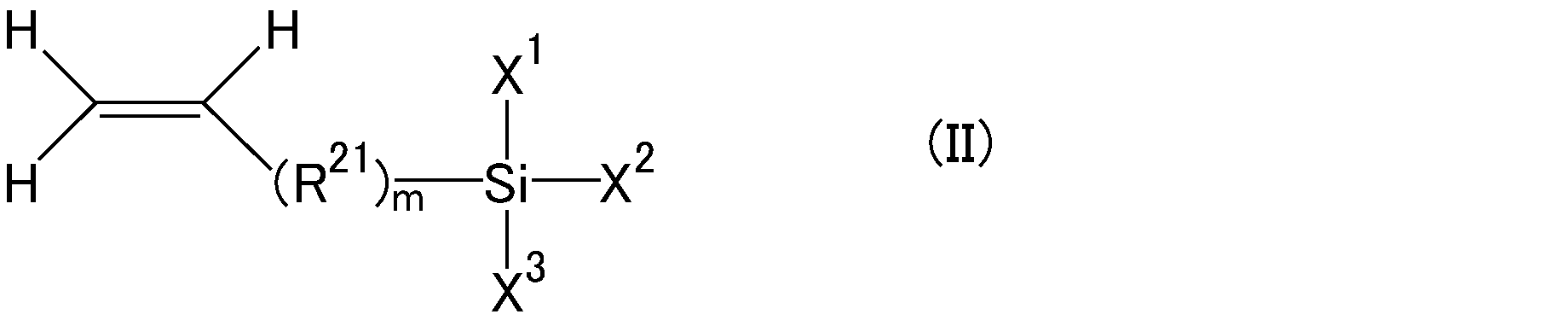

なお、式(I)で表される重合開始剤としては、R11の炭素原子数が異なる化合物を複数種併用してもよい。



(ジメチルアミノ)ジメチルビニルシラン、(エチルメチルアミノ)ジメチルビニルシラン、(ジ-n-プロピルアミノ)ジメチルビニルシラン、(ジイソプロピルアミノ)ジメチルビニルシラン、(ジメチルアミノ)ジエチルビニルシラン、(エチルメチルアミノ)ジエチルビニルシラン、(ジ-n-プロピルアミノ)ジエチルビニルシラン、(ジイソプロピルアミノ)ジエチルビニルシランなどの(ジアルキルアミノ)ジアルキルビニルシラン;[ビス(トリメチルシリル)アミノ]ジメチルビニルシラン、[ビス(t-ブチルジメチルシリル)アミノ]ジメチルビニルシラン、[ビス(トリメチルシリル)アミノ]ジエチルビニルシラン、[ビス(t-ブチルジメチルシリル)アミノ]ジエチルビニルシランなどの[ビス(トリアルキルシリル)アミノ]ジアルキルビニルシラン;(ジメチルアミノ)ジ(メトキシメチル)ビニルシラン、(ジメチルアミノ)ジ(メトキシエチル)ビニルシラン、(ジメチルアミノ)ジ(エトキシメチル)ビニルシラン、(ジメチルアミノ)ジ(エトキシエチル)ビニルシラン、(ジエチルアミノ)ジ(メトキシメチル)ビニルシラン、(ジエチルアミノ)ジ(メトキシエチル)ビニルシラン、(ジエチルアミノ)ジ(エトキシメチル)ビニルシラン、(ジエチルアミノ)ジ(エトキシエチル)ビニルシランなどの(ジアルキルアミノ)ジ(アルコキシアルキル)ビニルシラン;ピロリジノジメチルビニルシラン、ピペリジノジメチルビニルシラン、ヘキサメチレンイミノジメチルビニルシラン、4,5-ジヒドロイミダゾリルジメチルビニルシラン、モルホリノジメチルビニルシランなどの環状アミノジアルキルビニルシラン化合物をあげることができる。
(ジメチルアミノ)ジメチル-4-ビニルフェニルシラン、(ジメチルアミノ)ジメチル-3-ビニルフェニルシラン、(ジエチルアミノ)ジメチル-4-ビニルフェニルシラン、(ジエチルアミノ)ジメチル-3-ビニルフェニルシラン、(ジ-n-プロピルアミノ)ジメチル-4-ビニルフェニルシラン、(ジ-n-プロピルアミノ)ジメチル-3-ビニルフェニルシラン、(ジ-n-ブチルアミノ)ジメチル-4-ビニルフェニルシラン、(ジ-n-ブチルアミノ)ジメチル-3-ビニルフェニルシラン、(ジメチルアミノ)ジエチル-4-ビニルフェニルシラン、(ジメチルアミノ)ジエチル-3-ビニルフェニルシラン、(ジエチルアミノ)ジエチル-4-ビニルフェニルシラン、(ジエチルアミノ)ジエチル-3-ビニルフェニルシラン、(ジ-n-プロピルアミノ)ジエチル-4-ビニルフェニルシラン、(ジ-n-プロピルアミノ)ジエチル-3-ビニルフェニルシラン、(ジ-n-ブチルアミノ)ジエチル-4-ビニルフェニルシラン、(ジ-n-ブチルアミノ)ジエチル-3-ビニルフェニルシランなどの(ジアルキルアミノ)ジアルキルビニルフェニルシランをあげることができる。
ビス(ジメチルアミノ)メチルビニルシラン、ビス(ジエチルアミノ)メチルビニルシラン、ビス(ジ-n-プロピルアミノ)メチルビニルシラン、ビス(ジ-n-ブチルアミノ)メチルビニルシラン、ビス(ジメチルアミノ)エチルビニルシラン、ビス(ジエチルアミノ)エチルビニルシラン、ビス(ジ-n-プロピルアミノ)エチルビニルシラン、ビス(ジ-n-ブチルアミノ)エチルビニルシランなどのビス(ジアルキルアミノ)アルキルビニルシラン;ビス[ビス(トリメチルシリル)アミノ]メチルビニルシラン、ビス[ビス(tert-ブチルジメチルシリル)アミノ]メチルビニルシラン、ビス[ビス(トリメチルシリル)アミノ]エチルビニルシラン、ビス[ビス(tert-ブチルジメチルシリル)アミノ]エチルビニルシランなどのビス[ビス(トリアルキルシリル)アミノ]アルキルビニルシラン;ビス(ジメチルアミノ)メトキシメチルビニルシラン、ビス(ジメチルアミノ)メトキシエチルビニルシラン、ビス(ジメチルアミノ)エトキシメチルビニルシラン、ビス(ジメチルアミノ)エトキシエチルビニルシラン、ビス(ジエチルアミノ)メトキシメチルビニルシラン、ビス(ジエチルアミノ)メトキシエチルビニルシラン、ビス(ジエチルアミノ)エトキシメチルビニルシラン、ビス(ジメチルアミノ)エトキシエチルビニルシランなどのビス(ジアルキルアミノ)アルコキシアルキルシラン;ビス(ピロリジノ)メチルビニルシラン、ビス(ピペリジノ)メチルビニルシラン、ビス(ヘキサメチレンイミノ)メチルビニルシラン、ビス(4,5-ジヒドロイミダゾリル)メチルビニルシラン、ビス(モルホリノ)メチルビニルシランなどのビス(環状アミノ)アルキルビニルシラン化合物をあげることができる。
ビス(ジメチルアミノ)メチル-4-ビニルフェニルシラン、ビス(ジメチルアミノ)メチル-3-ビニルフェニルシラン、ビス(ジエチルアミノ)メチル-4-ビニルフェニルシラン、ビス(ジエチルアミノ)メチル-3-ビニルフェニルシラン、ビス(ジ-n-プロピルアミノ)メチル-4-ビニルフェニルシラン、ビス(ジ-n-プロピルアミノ)メチル-3-ビニルフェニルシラン、ビス(ジ-n-ブチルアミノ)メチル-4-ビニルフェニルシラン、ビス(ジ-n-ブチルアミノ)メチル-3-ビニルフェニルシラン、ビス(ジメチルアミノ)エチル-4-ビニルフェニルシラン、ビス(ジメチルアミノ)エチル-3-ビニルフェニルシラン、ビス(ジエチルアミノ)エチル-4-ビニルフェニルシラン、ビス(ジエチルアミノ)エチル-3-ビニルフェニルシラン、ビス(ジ-n-プロピルアミノ)エチル-4-ビニルフェニルシラン、ビス(ジ-n-プロピルアミノ)エチル-3-ビニルフェニルシラン、ビス(ジ-n-ブチルアミノ)エチル-4-ビニルフェニルシラン、ビス(ジ-n-ブチルアミノ)エチル-3-ビニルフェニルシランなどのビス(ジアルキルアミノ)アルキルビニルフェニルシランをあげることができる。
トリス(ジメチルアミノ)ビニルシラン、トリス(ジエチルアミノ)ビニルシラン、トリス(ジ-n-プロピルアミノ)ビニルシラン、トリス(ジ-n-ブチルアミノ)ビニルシランなどのトリス(ジアルキルアミノ)ビニルシランをあげることができる。
トリス(ジメチルアミノ)-4-ビニルフェニルシラン、トリス(ジメチルアミノ)-3-ビニルフェニルシラン、トリス(ジエチルアミノ)-4-ビニルフェニルシラン、トリス(ジエチルアミノ)-3-ビニルフェニルシラン、トリス(ジ-n-プロピルアミノ)-4-ビニルフェニルシラン、トリス(ジ-n-プロピルアミノ)-3-ビニルフェニルシラン、トリス(ジ-n-ブチルアミノ)-4-ビニルフェニルシラン、トリス(ジ-n-ブチルアミノ)-3-ビニルフェニルシランなどのトリス(ジアルキルアミノ)ビニルフェニルシランをあげることができる。
トリメトキシビニルシラン、トリエトキシビニルシラン、トリプロポキシビニルシランなどのトリアルコキシビニルシラン;メチルジメトキシビニルシラン、メチルジエトキシビニルシランなどのジアルコキシアルキルビニルシラン;ジ(tert-ペントキシ)フェニルビニルシラン、ジ(tert-ブトキシ)フェニルビニルシランなどのジアルコキシアリールビニルシラン;ジメチルメトキシビニルシランなどのモノアルコキシジアルキルビニルシラン;tert-ブトキシジフェニルビニルシラン、tert-ペントキシジフェニルビニルシランなどのモノアルコキシジアリールビニルシラン;tert-ブトキシメチルフェニルビニルシラン、tert-ブトキシエチルフェニルビニルシランなどのモノアルコキシアルキルアリールビニルシラン;トリス(β-メトキシエトキシ)ビニルシランなどの置換アルコキシビニルシラン化合物をあげることができる。




4-(N,N-ジメチルアミノ)アセトフェノン、4-N-メチル-N-エチルアミノアセトフェノン、4-N,N-ジエチルアミノアセトフェノンなどの4-N,N-ジヒドロカルビルアミノアセトフェノン;4’-(イミダゾール-1-イル)アセトフェノン、4-ピラゾリルアセトフェノンなどの4-環状アミノアセトフェノン化合物などをあげることができ、中でも4-環状アミノアセトフェノン化合物が好ましく、4’-(イミダゾール-1-イル)アセトフェノンがより好ましい。
1,7-ビス(メチルエチルアミノ)-4-ヘプタノン、1,3-ビス(ジフェニルアミノ)-2-プロパノンなどのビス(ジヒドロカルビルアミノアルキル)ケトン;4-N,N-ジメチルアミノベンゾフェノン、4-N,N-ジ-t-ブチルアミノベンゾフェノン、4-N,N-ジフェニルアミノベンゾフェノンなどの4-(ジヒドロカルビルアミノ)ベンゾフェノン;4,4’-ビス(ジメチルアミノ)ベンゾフェノン、4,4’-ビス(ジエチルアミノ)ベンゾフェノン、4,4’-ビス(ジフェニルアミノ)ベンゾフェノンなどの4,4’-ビス(ジヒドロカルビルアミノ)ベンゾフェノンをあげることができ、中でも4,4’-ビス(ジヒドロカルビルアミノ)ベンゾフェノンが好ましく、4,4’-ビス(ジエチルアミノ)ベンゾフェノンがより好ましい。

2-N,N-ジメチルアミノエチルアクリレート、2-N,N-ジエチルアミノエチルアクリレートなどの2-N,N-ジヒドロカルビルアミノエチルアクリレート;3-N,N-ジメチルアミノプロピルアクリレートなどの3-N,N-ジヒドロカルビルアミノプロピルアクリレート;2-N,N-ジメチルアミノエチルメタクリレート、2-N,N-ジエチルアミノエチルメタクリレートなどの2-N,N-ジヒドロカルビルアミノエチルメタクリレート;3-N,N-ジメチルアミノプロピルメタクリレートなどの3-N,N-ジヒドロカルビルアミノプロピルメタクリレートをあげることができ、3-N,N-ジヒドロカルビルアミノプロピルアクリレートが好ましく、3-N,N-ジメチルアミノプロピルアクリレートがより好ましい。
N,N-ジメチルアミノエチルアクリルアミド、N,N-ジエチルアミノエチルアクリルアミドなどのN、N-ジヒドロカルビルアミノエチルアクリルアミド;N,N-ジメチルアミノプロピルアクリルアミド、N,N-ジエチルアミノプロピルアクリルアミドなどのN,N-ジヒドロカルビルアミノプロピルアクリルアミド;N,N-ジメチルアミノブチルアクリルアミド、N,N-ジエチルアミノブチルアクリルアミドなどのN,N-ジヒドロカルビルアミノブチルアクリルアミド;N,N-ジメチルアミノエチルメタクリルアミド、N,N-ジエチルアミノエチルメタクリルアミドなどのN、N-ジヒドロカルビルアミノエチルメタクリルアミド;N,N-ジメチルアミノプロピルメタクリルアミド、N,N-ジエチルアミノプロピルメタクリルアミドなどのN,N-ジヒドロカルビルアミノプロピルメタクリルアミド;N,N-ジメチルアミノブチルメタクリルアミド、N,N-ジエチルアミノブチルメタクリルアミドなどのN,N-ジヒドロカルビルアミノブチルメタクリルアミドをあげることができ、N,N-ジヒドロカルビルアミノプロピルアクリルアミドが好ましく、N,N-ジメチルアミノプロピルアクリルアミドがより好ましい。

テトラメトキシシラン、テトラエトキシシラン、テトラ-n-プロポキシシランなどのテトラアルコキシシラン;メチルトリメトキシシラン、メチルトリエトキシシラン、エチルトリメトキシシラン、フェニルトリメトキシシランなどのトリアルコキシヒドロカルビルシラン;トリメトキシクロロシラン、トリエトキシクロロシラン、トリ-n-プロポキシクロロシランなどのトリアルコキシハロシラン;ジメトキシジメチルシラン、ジエトキシジメチルシラン、ジメトキシジエチルシランなどのジアルコキシジヒドロカルビルシラン;ジメトキシジクロロシラン、ジエトキシジクロロシラン、ジ-n-プロポキシジクロロシランなどのジアルコキシジハロシラン;メトキシトリメチルシランなどのモノアルコキシトリヒドロカルビルシラン;メトキシトリクロロシラン、エトキシトリクロロシランなどのモノアルコキシトリハロシラン;2-グリシドキシエチルトリメトキシシラン、2-グリシドキシエチルトリエトキシシラン、(2-グリシドキシエチル)メチルジメトキシシラン、3-グリシドキシプロピルトリメトキシシラン、3-グリシドキシプロピルトリエトキシシラン、(3-グリシドキシプロピル)メチルジメトキシシランなどの(グリシドキシアルキル)アルコキシシラン化合物;2-(3,4-エポキシシクロヘキシル)エチルトリメトキシシラン、2-(3,4-エポキシシクロヘキシル)エチルトリエトキシシラン、2-(3,4-エポキシシクロヘキシル)エチル(メチル)ジメトキシシランなどの(3,4-エポキシシクロヘキシル)アルキルアルコキシシラン化合物;3-トリメトキシシリルプロピルコハク酸無水物、3-トリエトキシシリルプロピルコハク酸無水物などのアルコキシシリルアルキルコハク酸無水物;3-メタクリロイロキシプロピルトリメトキシシラン、3-メタクリロイロキシプロピルトリエトキシシランなどの(メタクリロイロキシアルキル)アルコキシシラン化合物をあげることができる。
R51 aML4-a (V)
(式(V)中、R51はアルキル基、アルケニル基、シクロアルケニル基又はアリール基を表し、Mはケイ素原子又はスズ原子を表し、Lはハロゲン原子又はヒドロカルビルオキシ基を表し、aは0~2の整数を表す)

なお、シリカの窒素吸着比表面積は、ASTM D3037-81に準じてBET法で測定される値である。
THF:関東化学(株)製無水テトラヒドロフラン
水素化ナトリウム:関東化学(株)製
ジエチルアミン:関東化学(株)製
メチルビニルジクロロシラン:信越化学工業(株)製
無水ヘキサン:関東化学(株)製
スチレン:関東化学(株)製
ブタジエン:東京化成工業(株)製1,3-ブタジエン
TMEDA:関東化学(株)製テトラメチルエチレンジアミン
n-ブチルリチウム溶液:関東化学(株)製の1.6M n-ブチルリチウムヘキサン溶液
開始剤(1):FMC社製AI-200CE2(3-(N,N-ジメチルアミノ)-1-プロピルリチウムにイソプレン由来の構造単位が2単位結合した化合物(下記式で表される化合物))(0.9M)

ジアミルアミン:東京化成工業(株)製
2,6-ジ-tert-ブチル-p-クレゾール:大内新興化学工業(株)製のノクラック200
ビス(ジメチルアミノ)メチルビニルシラン:信越化学工業(株)製
N,N-ジメチルアミノプロピルアクリルアミド:東京化成工業(株)製
3-ジエチルアミノプロピルトリエトキシシラン:アヅマックス(株)製
1,3-ジメチル-2-イミダゾリジノン:東京化成工業(株)製
N-フェニル-2-ピロリドン:東京化成工業(株)製
N-メチル-ε-カプロラクタム:東京化成工業(株)製
トリス[3-(トリメトキシシリル)プロピル]イソシアヌレート:信越化学工業(株)製
N,N-ジメチルホルムアミドジメチルアセタール:東京化成工業(株)製
1,3-ジイソプロペニルベンゼン:東京化成工業(株)製
sec-ブチルリチウム溶液:関東化学(株)製(1.0mol/L)
シクロヘキサン:関東化学(株)製
窒素雰囲気下、100mlメスフラスコにビス(ジメチルアミノ)メチルビニルシランを15.8g入れ、さらに無水ヘキサンを加え全量を100mlにして作成した。
窒素雰囲気下、100mlメスフラスコにN,N-ジメチルアミノプロピルアクリルアミドを15.6g入れ、さらに無水ヘキサンを加え全量を100mlにして作成した。
充分に窒素置換した2L三つ口フラスコにTHF1000mL、水素化ナトリウム13gを加え、氷水バス上で撹拌しながらジエチルアミン36.5gをゆっくり滴下した。30分撹拌後、メチルビニルジクロロシラン36gを30分かけて滴下し、2時間撹拌させた。得られた溶液を濃縮し、ろ過後、減圧蒸留精製を行い、ビス(ジエチルアミノ)メチルビニルシランを合成した。得られたビス(ジエチルアミノ)メチルビニルシラン21.4gを窒素雰囲気下で100mlメスフラスコに入れ、さらに無水ヘキサンを加え全量を100mlにした。
充分に窒素置換した200mLナスフラスコに、無水ヘキサン127.6ml、ピペリジン8.5gを加えた。0℃に冷却後、n-ブチルリチウム溶液62.5mLを1時間かけてゆっくり添加し、作製した。
充分に窒素置換した200mLナスフラスコに、無水ヘキサン117ml、ジアミルアミン15.7gを加えた。0℃に冷却後、n-ブチルリチウム溶液62.5mLを1時間かけてゆっくり添加し、作製した。
窒素雰囲気下、100mlメスフラスコに3-ジエチルアミノプロピルトリエトキシシランを27.7g入れ、さらに無水ヘキサンを加え全量を100mlにして作製した。
充分に乾燥及び窒素置換された1Lナスフラスコにシクロヘキサン550mlとTMEDA27mlとsec-ブチルリチウム溶液200mlを加え、45℃で撹拌しながら30分かけて1,3-ジイソプロペニルベンゼン17mlをゆっくり加えた。さらに1時間撹拌後、常温まで冷却させて作成した。
窒素雰囲気下、100mlメスフラスコに1,3-ジメチル-2-イミダゾリジノンを11.4g入れ、さらに無水ヘキサンを加え全量を100mlにして作製した。
窒素雰囲気下、100mlメスフラスコにN-フェニル-2-ピロリドンを16.1g入れ、さらに無水ヘキサンを加え全量を100mlにして作製した。
窒素雰囲気下、100mlメスフラスコにN-メチル-ε-カプロラクタムを12.7g入れ、さらに無水ヘキサンを加え全量を100mlにして作製した。
窒素雰囲気下、100mlメスフラスコにトリス[3-(トリメトキシシリル)プロピル]イソシアヌレートを30.7g入れ、さらに無水ヘキサンを加え全量を200mlにして作製した。
窒素雰囲気下、100mlメスフラスコにN,N-ジメチルホルムアミドジメチルアセタールを11.9g入れ、さらに無水ヘキサンを加え全量を200mlにして作製した。
下記により得られた共重合体(共役ジエン系重合体)の分析は以下の方法で行った。
共重合体の重量平均分子量Mw及び数平均分子量Mnは、ゲルパーミエーションクロマトグラフ(GPC)(東ソー(株)製GPC-8000シリーズ、検出器:示差屈折計、カラム:東ソー(株)製のTSKGEL SUPERMULTIPORE HZ-M)による測定値を基に標準ポリスチレン換算値として求めた。測定結果から、分子量分布Mw/Mnを算出した。
共重合体の構造同定(スチレン含有量、ビニル含有量)は、日本電子(株)製JNM-ECAシリーズの装置を用いて行った。測定は、重合体0.1gを15mlのトルエンに溶解させ、30mlのメタノール中にゆっくり注ぎ込んで再沈殿させたものを、減圧乾燥後に測定した。
充分に窒素置換した30L耐圧容器にn-ヘキサンを18L、スチレンを600g、ブタジエンを1400g、変性剤(1)を40mL、TMEDAを10mmol加え、40℃に昇温した。次に、開始剤(2)を34mL加えた後、50℃に昇温させ3時間撹拌した。次に、変性剤(2)を20mL追加し30分間撹拌を行った。反応溶液にメタノール15mL及び2,6-tert-ブチル-p-クレゾール0.1gを添加後、スチームストリッピング処理によって重合体溶液から凝集体を回収し、得られた凝集体を24時間減圧乾燥させ、共重合体(1)を得た。なお、投入したケイ素含有ビニル化合物(変性剤(1))は、単量体成分100gあたり0.32gであった。投入した重合開始剤(開始剤(2))は、単量体成分100gあたり0.85mmolであった。投入した窒素原子及び/又はケイ素原子を含有する化合物(変性剤(2))は、投入した重合開始剤に由来するアルカリ金属1molあたり、1.18molであった。
開始剤(2)34mLを開始剤(3)34mLに変えた以外は、共重合体(1)の合成と同じ処方により、共重合体(2)を得た。なお、投入したケイ素含有ビニル化合物(変性剤(1))は、単量体成分100gあたり0.32gであった。投入した重合開始剤(開始剤(3))は、単量体成分100gあたり0.85mmolであった。投入した窒素原子及び/又はケイ素原子を含有する化合物(変性剤(2))は、投入した重合開始剤に由来するアルカリ金属1molあたり、1.18molであった。
スチレンの量を900gに、ブタジエンの量を1100gに変えた以外は、共重合体(1)の合成と同じ処方により、共重合体(3)を得た。なお、投入したケイ素含有ビニル化合物(変性剤(1))は、単量体成分100gあたり0.32gであった。投入した重合開始剤(開始剤(2))は、単量体成分100gあたり0.85mmolであった。投入した窒素原子及び/又はケイ素原子を含有する化合物(変性剤(2))は、投入した重合開始剤に由来するアルカリ金属1molあたり、1.18molであった。
開始剤(2)34mLを開始剤(1)19mlに変えた以外は、共重合体(1)の合成と同じ処方により、共重合体(4)を得た。なお、投入したケイ素含有ビニル化合物(変性剤(1))は、単量体成分100gあたり0.32gであった。また、投入した重合開始剤(開始剤(1))は、単量体成分100gあたり0.85mmolであった。投入した窒素原子及び/又はケイ素原子を含有する化合物(変性剤(2))は、投入した重合開始剤に由来するアルカリ金属1molあたり、1.18molであった。
充分に窒素置換した30L耐圧容器にn-ヘキサンを18L、スチレンを600g、ブタジエンを1400g、変性剤(1)を75mL、TMEDAを10mmol加え、40℃に昇温した。次に、開始剤(1)を19mL加えた後、50℃に昇温させ30分撹拌し、さらに変性剤(1)を75mL追加し2.5時間撹拌した。次に、変性剤(2)を20mL追加し30分間撹拌を行った。反応溶液にメタノール1mL及び2,6-tert-ブチル-p-クレゾール0.1gを添加後、スチームストリッピング処理によって重合体溶液から凝集体を回収し、得られた凝集体を24時間減圧乾燥させ、共重合体(5)を得た。なお、投入したケイ素含有ビニル化合物(変性剤(1))は、単量体成分100gあたり1.19gであった。投入した重合開始剤(開始剤(1))は、単量体成分100gあたり0.85mmolであった。投入した窒素原子及び/又はケイ素原子を含有する化合物(変性剤(2))は、投入した重合開始剤に由来するアルカリ金属1molあたり、1.18molであった。
スチレンの量を0gに、ブタジエンの量を2000gに、TMEDA10mmoLをTHF5mmoLに、開始剤(1)19mLを開始剤(1)23mLに変えた以外は、共重合体(4)の合成と同じ処方により、共重合体(6)を得た。なお、投入したケイ素含有ビニル化合物(変性剤(1))は、単量体成分100gあたり0.32gであった。投入した重合開始剤(開始剤(1))は、単量体成分100gあたり1.05mmolであった。投入した窒素原子及び/又はケイ素原子を含有する化合物(変性剤(2))は、投入した重合開始剤に由来するアルカリ金属1molあたり、0.95molであった。
変性剤(1)40mLを変性剤(3)40mLに変えた以外は、共重合体(4)の合成と同じ処方により、共重合体(7)を得た。なお、投入したケイ素含有ビニル化合物(変性剤(3))は、単量体成分100gあたり0.43gであった。投入した重合開始剤(開始剤(1))は、単量体成分100gあたり0.85mmolであった。投入した窒素原子及び/又はケイ素原子を含有する化合物(変性剤(2))は、投入した重合開始剤に由来するアルカリ金属1molあたり、1.18molであった。
開始剤(1)19mLをn-ブチルリチウム溶液10.6mLに変えた以外は、共重合体(7)の合成と同じ処方により、共重合体(8)を得た。なお、投入したケイ素含有ビニル化合物(変性剤(3))は、単量体成分100gあたり0.43gであった。投入した窒素原子及び/又はケイ素原子を含有する化合物(変性剤(2))は、投入した重合開始剤に由来するアルカリ金属1molあたり、1.18molであった。
開始剤(1)23mLをn-ブチルリチウム溶液13mLに変えた以外は、共重合体(6)の合成と同じ処方により、共重合体(9)を得た。なお、投入したケイ素含有ビニル化合物(変性剤(1))は、単量体成分100gあたり0.43gであった。投入した窒素原子及び/又はケイ素原子を含有する化合物(変性剤(2))は、投入した重合開始剤に由来するアルカリ金属1molあたり、0.95molであった。
変性剤(1)40mLを0mLに変えた以外は、共重合体(1)の合成と同じ処方により、共重合体(10)を得た。投入した重合開始剤(開始剤(2))は、単量体成分100gあたり0.85mmolであった。投入した窒素原子及び/又はケイ素原子を含有する化合物(変性剤(2))は、投入した重合開始剤に由来するアルカリ金属1molあたり、1.18molであった。
変性剤(2)20mLを0mLに変えた以外は、共重合体(1)の合成と同じ処方により、共重合体(11)を得た。なお、投入したケイ素含有ビニル化合物(変性剤(1))は、単量体成分100gあたり0.32gであった。投入した重合開始剤(開始剤(2))は、単量体成分100gあたり0.85mmolであった。
充分に窒素置換した30L耐圧容器にn-ヘキサンを18L、スチレンを600g、ブタジエンを1400g、TMEDAを10mmol加え、40℃に昇温した。次に、n-ブチルリチウム溶液を11mL加えた後、50℃に昇温させ3時間撹拌した。次に、反応溶液にメタノール1mL及び2,6-tert-ブチル-p-クレゾール0.1gを添加後、スチームストリッピング処理によって重合体溶液から凝集体を回収し、得られた凝集体を24時間減圧乾燥させ、共重合体(12)を得た。
重合体溶液から凝集体を回収する際、スチームストリッピング処理の代わりに、重合体溶液を常温で24時間蒸発させ、その後減圧乾燥をさせることで凝集体を回収した以外は、共重合体(7)の合成と同じ処方により、共重合体(13)を得た。なお、投入したケイ素含有ビニル化合物(変性剤(3))は、単量体成分100gあたり0.43gであった。投入した重合開始剤(開始剤(1))は、単量体成分100gあたり0.85mmolであった。投入した窒素原子及び/又はケイ素原子を含有する化合物(変性剤(2))は、投入した重合開始剤に由来するアルカリ金属1molあたり、1.18molであった。
変性剤(3)40mLを0mLに、変性剤(2)20mLを0mLに変えた以外は、共重合体(7)の合成と同じ処方により、共重合体(14)を得た。なお、投入した重合開始剤(開始剤(1))は、単量体成分100gあたり8.5mmolであった。
開始剤(1)19mLをn-ブチルリチウム溶液6.8mLに、変性剤(2)20mLを0mLに変えた以外は、共重合体(7)の合成と同じ処方により、共重合体(15)を得た。なお、投入したケイ素含有ビニル化合物(変性剤(3))は、単量体成分100gあたり0.43gであった。
開始剤(1)19mLをn-ブチルリチウム溶液6.8mLに、変性剤(3)40mLを0mLに変えた以外は、共重合体(7)の合成と同じ処方により、共重合体(16)を得た。なお、投入した窒素原子及び/又はケイ素原子を含有する化合物(変性剤(2))は、投入した重合開始剤に由来するアルカリ金属1molあたり、1.18molであった。
開始剤(2)34mLを開始剤(4)(二官能開始剤)68mLに、変性剤(2)20mLを変性剤(2)40mlに変えた以外は、共重合体(1)の合成と同じ処方により、共重合体(17)を得た。なお、投入したケイ素含有ビニル化合物(変性剤(1))は、単量体成分100gあたり0.32gであった。投入した窒素原子及び/又はケイ素原子を含有する化合物(変性剤(2))は、投入した重合開始剤に由来するアルカリ金属1molあたり、2.28mol(片方の末端当り1.14mol)であった。
変性剤(2)20mLを変性剤(4)20mLに変えた以外は、共重合体(1)の合成と同じ処方により、共重合体(18)を得た。なお、投入したケイ素含有ビニル化合物(変性剤(1))は、単量体成分100gあたり0.32gであった。投入した重合開始剤(開始剤(2))は、単量体成分100gあたり0.85mmolであった。投入した窒素原子及び/又はケイ素原子を含有する化合物(変性剤(4))は、投入した重合開始剤に由来するアルカリ金属1molあたり、1.18molであった。
変性剤(2)20mLを変性剤(4)20mLに変えた以外は、共重合体(2)の合成と同じ処方により、共重合体(19)を得た。なお、投入したケイ素含有ビニル化合物(変性剤(1))は、単量体成分100gあたり0.32gであった。投入した重合開始剤(開始剤(3))は、単量体成分100gあたり0.85mmolであった。投入した窒素原子及び/又はケイ素原子を含有する化合物(変性剤(4))は、投入した重合開始剤に由来するアルカリ金属1molあたり、1.18molであった。
変性剤(2)20mLを変性剤(4)20mLに変えた以外は、共重合体(3)の合成と同じ処方により、共重合体(20)を得た。なお、投入したケイ素含有ビニル化合物(変性剤(1))は、単量体成分100gあたり0.32gであった。投入した重合開始剤(開始剤(2))は、単量体成分100gあたり0.85mmolであった。投入した窒素原子及び/又はケイ素原子を含有する化合物(変性剤(4))は、投入した重合開始剤に由来するアルカリ金属1molあたり、1.18molであった。
変性剤(2)20mLを変性剤(4)20mLに変えた以外は、共重合体(4)の合成と同じ処方により、共重合体(21)を得た。なお、投入したケイ素含有ビニル化合物(変性剤(1))は、単量体成分100gあたり0.32gであった。投入した重合開始剤(開始剤(1))は、単量体成分100gあたり0.85mmolであった。投入した窒素原子及び/又はケイ素原子を含有する化合物(変性剤(4))は、投入した重合開始剤に由来するアルカリ金属1molあたり、1.18molであった。
変性剤(2)20mLを変性剤(4)20mLに変えた以外は、共重合体(5)の合成と同じ処方により、共重合体(22)を得た。なお、投入したケイ素含有ビニル化合物(変性剤(1))は、単量体成分100gあたり1.19gであった。投入した重合開始剤(開始剤(1))は、単量体成分100gあたり0.85mmolであった。投入した窒素原子及び/又はケイ素原子を含有する化合物(変性剤(4))は、投入した重合開始剤に由来するアルカリ金属1molあたり、1.18molであった。
変性剤(2)20mLを変性剤(4)20mLに変えた以外は、共重合体(6)の合成と同じ処方により、共重合体(23)を得た。なお、投入したケイ素含有ビニル化合物(変性剤(1))は、単量体成分100gあたり0.32gであった。投入した重合開始剤(開始剤(1))は、単量体成分100gあたり1.05mmolであった。投入した窒素原子及び/又はケイ素原子を含有する化合物(変性剤(4))は、投入した重合開始剤に由来するアルカリ金属1molあたり、0.95molであった。
変性剤(2)20mLを変性剤(4)20mLに変えた以外は、共重合体(7)の合成と同じ処方により、共重合体(24)を得た。なお、投入したケイ素含有ビニル化合物(変性剤(3))は、単量体成分100gあたり0.32gであった。投入した重合開始剤(開始剤(1))は、単量体成分100gあたり0.85mmolであった。投入した窒素原子及び/又はケイ素原子を含有する化合物(変性剤(4))は、投入した重合開始剤に由来するアルカリ金属1molあたり、1.18molであった。
重合体溶液から凝集体を回収する際、スチームストリッピング処理の代わりに、重合体溶液を常温で24時間蒸発させ、その後減圧乾燥をさせることで凝集体を回収した以外は、共重合体(24)の合成と同じ処方により、共重合体(25)を得た。なお、投入したケイ素含有ビニル化合物(変性剤(3))は、単量体成分100gあたり0.32gであった。投入した重合開始剤(開始剤(1))は、単量体成分100gあたり0.85mmolであった。投入した窒素原子及び/又はケイ素原子を含有する化合物(変性剤(4))は、投入した重合開始剤に由来するアルカリ金属1molあたり、1.18molであった。
開始剤(1)19mLをn-ブチルリチウム溶液10.6mLに、変性剤(3)40mLを0mLに変えた以外は、共重合体(24)の合成と同じ処方により、共重合体(26)を得た。なお、投入した窒素原子及び/又はケイ素原子を含有する化合物(変性剤(4))は、投入した重合開始剤に由来するアルカリ金属1molあたり、1.18molであった。
変性剤(2)20mLを変性剤(5)20mLに変えた以外は、共重合体(1)の合成と同じ処方により、共重合体(27)を得た。なお、投入したケイ素含有ビニル化合物(変性剤(1))は、単量体成分100gあたり0.32gであった。投入した重合開始剤(開始剤(2))は、単量体成分100gあたり0.85mmolであった。投入した窒素原子及び/又はケイ素原子を含有する化合物(変性剤(5))は、投入した重合開始剤に由来するアルカリ金属1molあたり、1.18molであった。
変性剤(2)20mLを変性剤(5)20mLに変えた以外は、共重合体(2)の合成と同じ処方により、共重合体(28)を得た。なお、投入したケイ素含有ビニル化合物(変性剤(1))は、単量体成分100gあたり0.32gであった。投入した重合開始剤(開始剤(3))は、単量体成分100gあたり0.85mmolであった。投入した窒素原子及び/又はケイ素原子を含有する化合物(変性剤(5))は、投入した重合開始剤に由来するアルカリ金属1molあたり、1.18molであった。
変性剤(2)20mLを変性剤(5)20mLに変えた以外は、共重合体(3)の合成と同じ処方により、共重合体(29)を得た。なお、投入したケイ素含有ビニル化合物(変性剤(1))は、単量体成分100gあたり0.32gであった。投入した重合開始剤(開始剤(2))は、単量体成分100gあたり0.85mmolであった。投入した窒素原子及び/又はケイ素原子を含有する化合物(変性剤(5))は、投入した重合開始剤に由来するアルカリ金属1molあたり、1.18molであった。
変性剤(2)20mLを変性剤(5)20mLに変えた以外は、共重合体(4)の合成と同じ処方により、共重合体(30)を得た。なお、投入したケイ素含有ビニル化合物(変性剤(1))は、単量体成分100gあたり0.32gであった。投入した重合開始剤(開始剤(1))は、単量体成分100gあたり0.85mmolであった。投入した窒素原子及び/又はケイ素原子を含有する化合物(変性剤(5))は、投入した重合開始剤に由来するアルカリ金属1molあたり、1.18molであった。
変性剤(2)20mLを変性剤(5)20mLに変えた以外は、共重合体(5)の合成と同じ処方により、共重合体(31)を得た。なお、投入したケイ素含有ビニル化合物(変性剤(1))は、単量体成分100gあたり1.19gであった。投入した重合開始剤(開始剤(1))は、単量体成分100gあたり0.85mmolであった。投入した窒素原子及び/又はケイ素原子を含有する化合物(変性剤(5))は、投入した重合開始剤に由来するアルカリ金属1molあたり、1.18molであった。
変性剤(2)20mLを変性剤(5)20mLに変えた以外は、共重合体(6)の合成と同じ処方により、共重合体(32)を得た。なお、投入したケイ素含有ビニル化合物(変性剤(1))は、単量体成分100gあたり0.32gであった。投入した重合開始剤(開始剤(1))は、単量体成分100gあたり1.05mmolであった。投入した窒素原子及び/又はケイ素原子を含有する化合物(変性剤(5))は、投入した重合開始剤に由来するアルカリ金属1molあたり、0.95molであった。
変性剤(2)20mLを変性剤(5)20mLに変えた以外は、共重合体(7)の合成と同じ処方により、共重合体(33)を得た。なお、投入したケイ素含有ビニル化合物(変性剤(3))は、単量体成分100gあたり0.32gであった。投入した重合開始剤(開始剤(1))は、単量体成分100gあたり0.85mmolであった。投入した窒素原子及び/又はケイ素原子を含有する化合物(変性剤(5))は、投入した重合開始剤に由来するアルカリ金属1molあたり、1.18molであった。
重合体溶液から凝集体を回収する際、スチームストリッピング処理の代わりに、重合体溶液を常温で24時間蒸発させ、その後減圧乾燥をさせることで凝集体を回収した以外は、共重合体(33)の合成と同じ処方により、共重合体(34)を得た。なお、投入したケイ素含有ビニル化合物(変性剤(3))は、単量体成分100gあたり0.32gであった。投入した重合開始剤(開始剤(1))は、単量体成分100gあたり0.85mmolであった。投入した窒素原子及び/又はケイ素原子を含有する化合物(変性剤(5))は、投入した重合開始剤に由来するアルカリ金属1molあたり、1.18molであった。
変性剤(2)20mLを変性剤(6)20mLに変えた以外は、共重合体(7)の合成と同じ処方により、共重合体(35)を得た。なお、投入したケイ素含有ビニル化合物(変性剤(3))は、単量体成分100gあたり0.32gであった。投入した重合開始剤(開始剤(1))は、単量体成分100gあたり0.85mmolであった。投入した窒素原子及び/又はケイ素原子を含有する化合物(変性剤(6))は、投入した重合開始剤に由来するアルカリ金属1molあたり、1.18molであった。
変性剤(2)20mLを変性剤(7)20mLに変えた以外は、共重合体(7)の合成と同じ処方により、共重合体(36)を得た。なお、投入したケイ素含有ビニル化合物(変性剤(3))は、単量体成分100gあたり0.32gであった。投入した重合開始剤(開始剤(1))は、単量体成分100gあたり0.85mmolであった。投入した窒素原子及び/又はケイ素原子を含有する化合物(変性剤(7))は、投入した重合開始剤に由来するアルカリ金属1molあたり、1.18molであった。
開始剤(1)19mLをブチルリチウム溶液10.6mLに、変性剤(3)40mLを0mLに変えた以外は、共重合体(33)の合成と同じ処方により、共重合体(37)を得た。なお、投入した窒素原子及び/又はケイ素原子を含有する化合物(変性剤(5))は、投入した重合開始剤に由来するアルカリ金属1molあたり、1.18molであった。
変性剤(2)20mLを変性剤(8)20mLに変えた以外は、共重合体(1)の合成と同じ処方により、共重合体(38)を得た。なお、投入したケイ素含有ビニル化合物(変性剤(1))は、単量体成分100gあたり0.32gであった。投入した重合開始剤(開始剤(2))は、単量体成分100gあたり0.85mmolであった。投入した窒素原子及び/又はケイ素原子を含有する化合物(変性剤(8))は、投入した重合開始剤に由来するアルカリ金属1molあたり、1.18molであった。
変性剤(2)20mLを変性剤(8)20mLに変えた以外は、共重合体(2)の合成と同じ処方により、共重合体(39)を得た。なお、投入したケイ素含有ビニル化合物(変性剤(1))は、単量体成分100gあたり0.32gであった。投入した重合開始剤(開始剤(3))は、単量体成分100gあたり0.85mmolであった。投入した窒素原子及び/又はケイ素原子を含有する化合物(変性剤(8))は、投入した重合開始剤に由来するアルカリ金属1molあたり、1.18molであった。
変性剤(2)20mLを変性剤(8)20mLに変えた以外は、共重合体(3)の合成と同じ処方により、共重合体(40)を得た。なお、投入したケイ素含有ビニル化合物(変性剤(1))は、単量体成分100gあたり0.32gであった。投入した重合開始剤(開始剤(2))は、単量体成分100gあたり0.85mmolであった。投入した窒素原子及び/又はケイ素原子を含有する化合物(変性剤(8))は、投入した重合開始剤に由来するアルカリ金属1molあたり、1.18molであった。
変性剤(2)20mLを変性剤(8)20mLに変えた以外は、共重合体(4)の合成と同じ処方により、共重合体(41)を得た。なお、投入したケイ素含有ビニル化合物(変性剤(1))は、単量体成分100gあたり0.32gであった。投入した重合開始剤(開始剤(1))は、単量体成分100gあたり0.85mmolであった。投入した窒素原子及び/又はケイ素原子を含有する化合物(変性剤(8))は、投入した重合開始剤に由来するアルカリ金属1molあたり、1.18molであった。
変性剤(2)20mLを変性剤(8)20mLに変えた以外は、共重合体(5)の合成と同じ処方により、共重合体(42)を得た。なお、投入したケイ素含有ビニル化合物(変性剤(1))は、単量体成分100gあたり1.19gであった。投入した重合開始剤(開始剤(1))は、単量体成分100gあたり0.85mmolであった。投入した窒素原子及び/又はケイ素原子を含有する化合物(変性剤(8))は、投入した重合開始剤に由来するアルカリ金属1molあたり、1.18molであった。
変性剤(2)20mLを変性剤(8)20mLに変えた以外は、共重合体(6)の合成と同じ処方により、共重合体(43)を得た。なお、投入したケイ素含有ビニル化合物(変性剤(1))は、単量体成分100gあたり0.32gであった。投入した重合開始剤(開始剤(1))は、単量体成分100gあたり1.05mmolであった。投入した窒素原子及び/又はケイ素原子を含有する化合物(変性剤(8))は、投入した重合開始剤に由来するアルカリ金属1molあたり、0.95molであった。
変性剤(2)20mLを変性剤(8)20mLに変えた以外は、共重合体(7)の合成と同じ処方により、共重合体(44)を得た。なお、投入したケイ素含有ビニル化合物(変性剤(3))は、単量体成分100gあたり0.32gであった。投入した重合開始剤(開始剤(1))は、単量体成分100gあたり0.85mmolであった。投入した窒素原子及び/又はケイ素原子を含有する化合物(変性剤(8))は、投入した重合開始剤に由来するアルカリ金属1molあたり、1.18molであった。
重合体溶液から凝集体を回収する際、スチームストリッピング処理の代わりに、重合体溶液を常温で24時間蒸発させ、その後減圧乾燥をさせることで凝集体を回収した以外は、共重合体(44)の合成と同じ処方により、共重合体(45)を得た。なお、投入したケイ素含有ビニル化合物(変性剤(3))は、単量体成分100gあたり0.32gであった。投入した重合開始剤(開始剤(1))は、単量体成分100gあたり0.85mmolであった。投入した窒素原子及び/又はケイ素原子を含有する化合物(変性剤(8))は、投入した重合開始剤に由来するアルカリ金属1molあたり、1.18molであった。
開始剤(1)19mLをブチルリチウム溶液10.6mLに、変性剤(3)40mLを0mLに変えた以外は、共重合体(44)の合成と同じ処方により、共重合体(46)を得た。なお、投入した窒素原子及び/又はケイ素原子を含有する化合物(変性剤(8))は、投入した重合開始剤に由来するアルカリ金属1molあたり、1.18molであった。
変性剤(2)20mLを変性剤(9)20mLに変えた以外は、共重合体(1)の合成と同じ処方により、共重合体(47)を得た。なお、投入したケイ素含有ビニル化合物(変性剤(1))は、単量体成分100gあたり0.32gであった。投入した重合開始剤(開始剤(2))は、単量体成分100gあたり0.85mmolであった。投入した窒素原子及び/又はケイ素原子を含有する化合物(変性剤(9))は、投入した重合開始剤に由来するアルカリ金属1molあたり、1.18molであった。
変性剤(2)20mLを変性剤(9)20mLに変えた以外は、共重合体(2)の合成と同じ処方により、共重合体(48)を得た。なお、投入したケイ素含有ビニル化合物(変性剤(1))は、単量体成分100gあたり0.32gであった。投入した重合開始剤(開始剤(3))は、単量体成分100gあたり0.85mmolであった。投入した窒素原子及び/又はケイ素原子を含有する化合物(変性剤(9))は、投入した重合開始剤に由来するアルカリ金属1molあたり、1.18molであった。
変性剤(2)20mLを変性剤(9)20mLに変えた以外は、共重合体(3)の合成と同じ処方により、共重合体(49)を得た。なお、投入したケイ素含有ビニル化合物(変性剤(1))は、単量体成分100gあたり0.32gであった。投入した重合開始剤(開始剤(2))は、単量体成分100gあたり0.85mmolであった。投入した窒素原子及び/又はケイ素原子を含有する化合物(変性剤(9))は、投入した重合開始剤に由来するアルカリ金属1molあたり、1.18molであった。
変性剤(2)20mLを変性剤(9)20mLに変えた以外は、共重合体(4)の合成と同じ処方により、共重合体(50)を得た。なお、投入したケイ素含有ビニル化合物(変性剤(1))は、単量体成分100gあたり0.32gであった。投入した重合開始剤(開始剤(1))は、単量体成分100gあたり0.85mmolであった。投入した窒素原子及び/又はケイ素原子を含有する化合物(変性剤(9))は、投入した重合開始剤に由来するアルカリ金属1molあたり、1.18molであった。
変性剤(2)20mLを変性剤(9)20mLに変えた以外は、共重合体(5)の合成と同じ処方により、共重合体(51)を得た。なお、投入したケイ素含有ビニル化合物(変性剤(1))は、単量体成分100gあたり1.19gであった。投入した重合開始剤(開始剤(1))は、単量体成分100gあたり0.85mmolであった。投入した窒素原子及び/又はケイ素原子を含有する化合物(変性剤(9))は、投入した重合開始剤に由来するアルカリ金属1molあたり、1.18molであった。
変性剤(2)20mLを変性剤(9)20mLに変えた以外は、共重合体(6)の合成と同じ処方により、共重合体(52)を得た。なお、投入したケイ素含有ビニル化合物(変性剤(1))は、単量体成分100gあたり0.32gであった。投入した重合開始剤(開始剤(1))は、単量体成分100gあたり1.05mmolであった。投入した窒素原子及び/又はケイ素原子を含有する化合物(変性剤(9))は、投入した重合開始剤に由来するアルカリ金属1molあたり、0.95molであった。
変性剤(2)20mLを変性剤(9)20mLに変えた以外は、共重合体(7)の合成と同じ処方により、共重合体(53)を得た。なお、投入したケイ素含有ビニル化合物(変性剤(3))は、単量体成分100gあたり0.32gであった。投入した重合開始剤(開始剤(1))は、単量体成分100gあたり0.85mmolであった。投入した窒素原子及び/又はケイ素原子を含有する化合物(変性剤(9))は、投入した重合開始剤に由来するアルカリ金属1molあたり、1.18molであった。
重合体溶液から凝集体を回収する際、スチームストリッピング処理の代わりに、重合体溶液を常温で24時間蒸発させ、その後減圧乾燥をさせることで凝集体を回収した以外は、共重合体(53)の合成と同じ処方により、共重合体(54)を得た。なお、投入したケイ素含有ビニル化合物(変性剤(3))は、単量体成分100gあたり0.32gであった。投入した重合開始剤(開始剤(1))は、単量体成分100gあたり0.85mmolであった。投入した窒素原子及び/又はケイ素原子を含有する化合物(変性剤(9))は、投入した重合開始剤に由来するアルカリ金属1molあたり、1.18molであった。
開始剤(1)19mLをブチルリチウム溶液10.6mLに、変性剤(3)40mLを0mLに変えた以外は、共重合体(53)の合成と同じ処方により、共重合体(55)を得た。なお、投入した窒素原子及び/又はケイ素原子を含有する化合物(変性剤(9))は、投入した重合開始剤に由来するアルカリ金属1molあたり、1.18molであった。


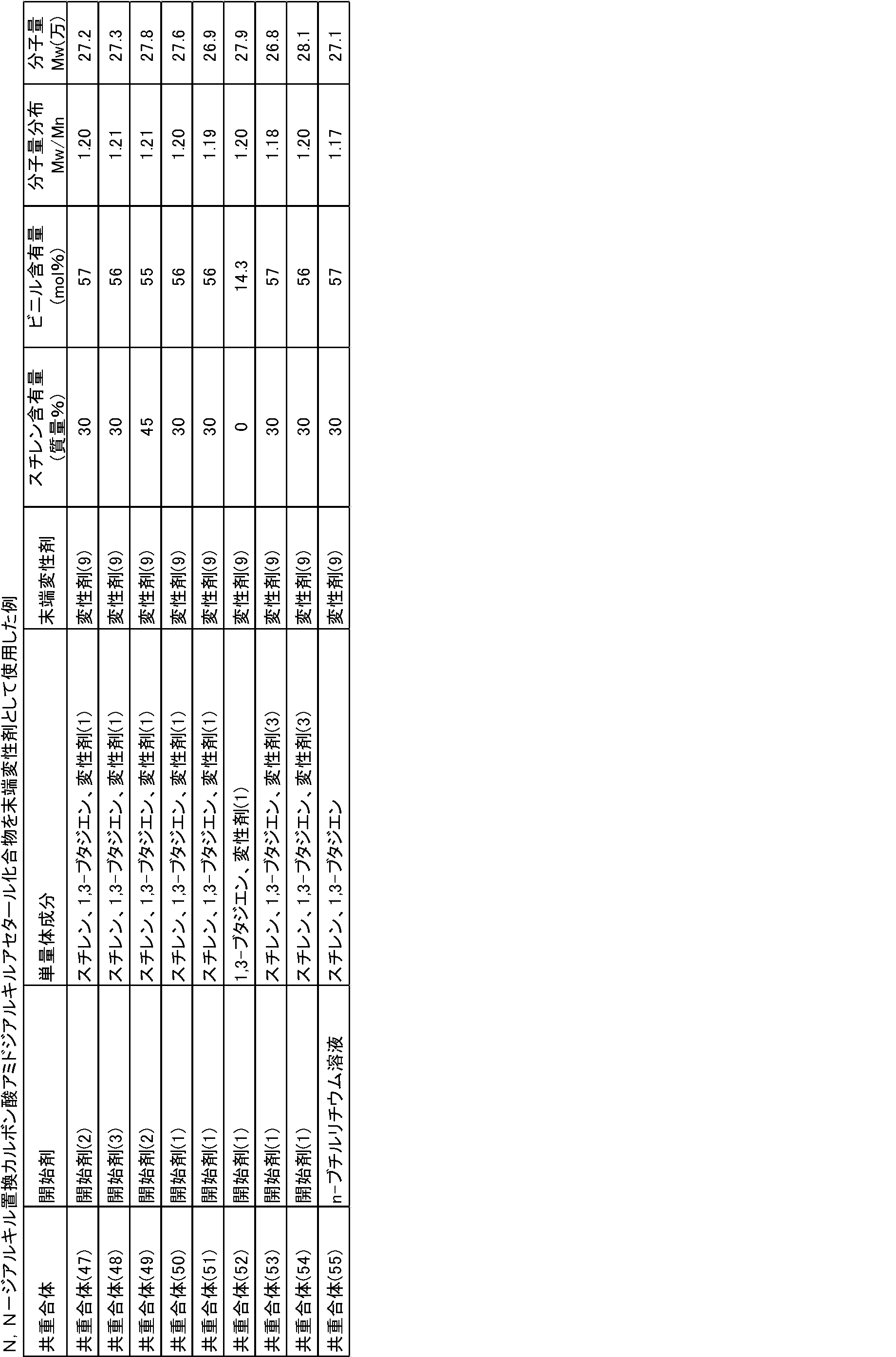
共重合体(1)~(55):上記方法で合成
ブタジエンゴム:宇部興産(株)製のウベポールBR150B
シリカ:エボニックデグッサ社製のウルトラシルVN3-G(N2SA:175m2/g)
シランカップリング剤:エボニックデグッサ社製のSi69(ビス(3-トリエトキシシリルプロピル)テトラスルフィド)
カーボンブラック:三菱化学(株)製のダイアブラックN339(N2SA:96m2/g、DBP吸収量:124ml/100g)
オイル:JX日鉱日石エネルギー(株)製のX-140
老化防止剤:住友化学(株)製のアンチゲン3C
ステアリン酸:日油(株)製のビーズステアリン酸つばき
酸化亜鉛:三井金属鉱業(株)製の亜鉛華1号
ワックス:大内新興化学工業(株)製のサンノックN
硫黄:鶴見化学工業(株)製の粉末硫黄
加硫促進剤1:住友化学(株)製のソクシノールCZ
加硫促進剤2:住友化学(株)製のソクシノールD
表6~12に示す配合内容に従い、(株)神戸製鋼所製の1.7Lバンバリーミキサーを用いて、硫黄及び加硫促進剤以外の材料を150℃の条件下で5分間混練りし、混練り物を得た。次に、得られた混練り物に硫黄及び加硫促進剤を添加し、オープンロールを用いて、80℃の条件下で5分間練り込み、未加硫ゴム組成物を得た。得られた未加硫ゴム組成物を170℃で20分間、0.5mm厚の金型でプレス加硫し、加硫ゴム組成物を得た。
また、得られた未加硫ゴム組成物をトレッドの形状に成形し、タイヤ成型機上で他のタイヤ部材とともに貼り合わせて未加硫タイヤを形成し、170℃で12分間加硫し、試験用タイヤ(サイズ:195/65R15)を製造した。
<tanδ>
(株)上島製作所製スペクトロメーターを用いて、動的歪振幅1%、周波数10Hz、温度50℃で加硫ゴム組成物のtanδを測定した。tanδの逆数の値について比較例4を100として指数表示した。数値が大きいほど転がり抵抗が小さく、低燃費性に優れることを示している。
転がり抵抗試験機を用い、試験用タイヤを、リム(15×6JJ)、内圧(230kPa)、荷重(3.43kN)、速度(80km/h)で走行させたときの転がり抵抗を測定し、比較例4を100とした時の指数で表示した。数値が大きいほど転がり抵抗が小さく、低燃費性に優れることを示している。
各試験用タイヤを車両(国産FF2000cc)の全輪に装着して、湿潤アスファルト路面にて初速度100km/hからの制動距離を求めた。結果は指数で表し、数値が大きいほどウェットスキッド性能(ウェットグリップ性能)が良好である。指数は次の式で求めた。
(ウェットグリップ性能指数)=(比較例4の制動距離)/(各配合の制動距離)×100
LAT試験機(Laboratory Absation and Skid Tester)を用い、荷重50N、速度20km/h、スリップアングル5°の条件にて、各加硫ゴム組成物の容積損失量を測定した。表6~12の数値(耐摩耗性指数)は、比較例4の容積損失量を100としたときの相対値である。当該数値が大きいほど耐摩耗性に優れている。
JIS K 6300-1:2001「未加硫ゴム-物理特性-第1部:ムーニー粘度計による粘度及びスコーチタイムの求め方」に準じて、ムーニー粘度試験機を用いて、1分間の予熱によって熱せられた130℃の温度条件にて、小ローターを回転させ、4分間経過した時点での上記未加硫ゴム組成物のムーニー粘度(ML1+4/130℃)を測定した。結果は指数で表し、数値が大きいほどムーニー粘度が低く、加工性が良好である。指数は次の式で求めた。
(ムーニー粘度指数)=(比較例4のムーニー粘度)/(各配合のムーニー粘度)×100


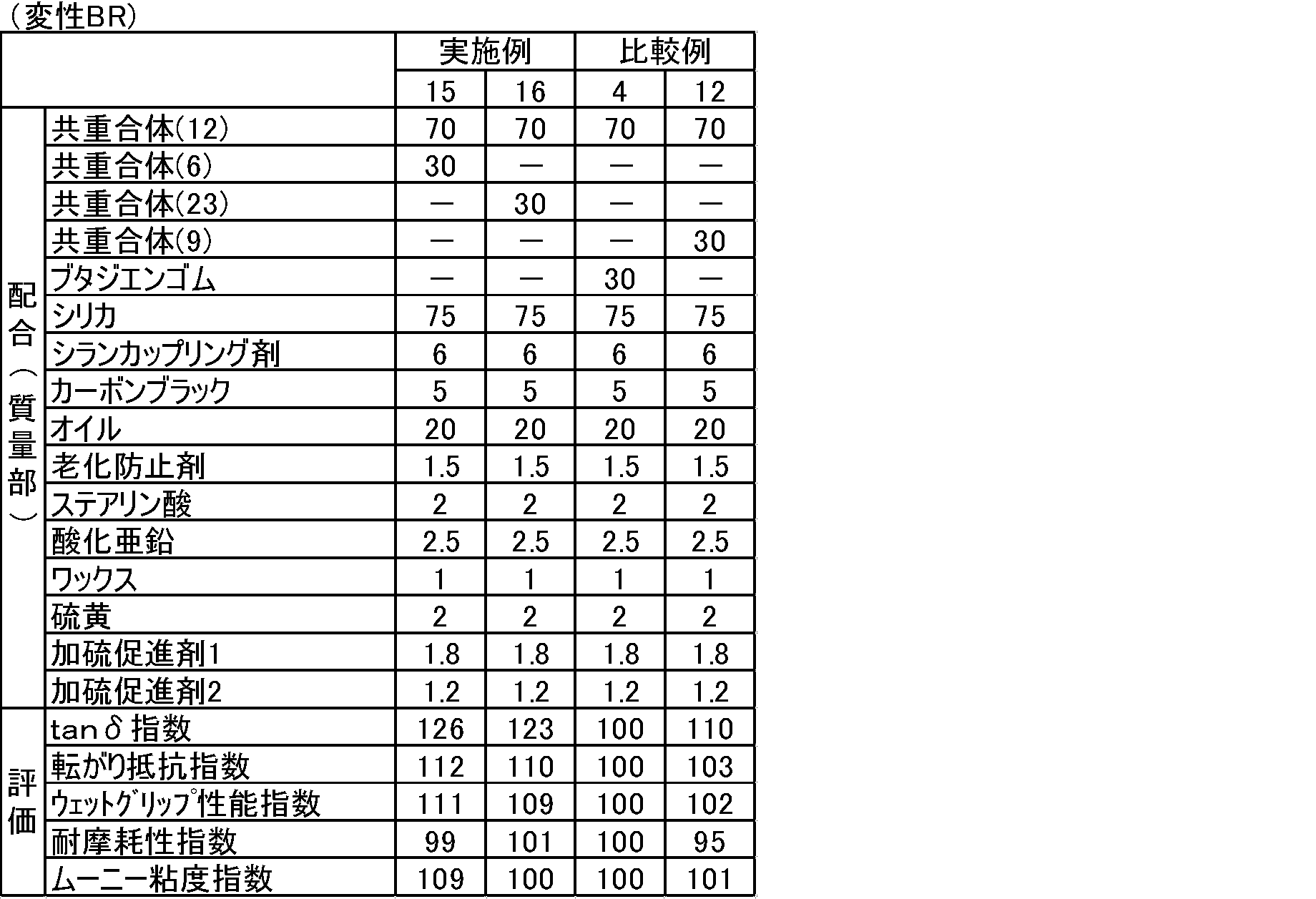

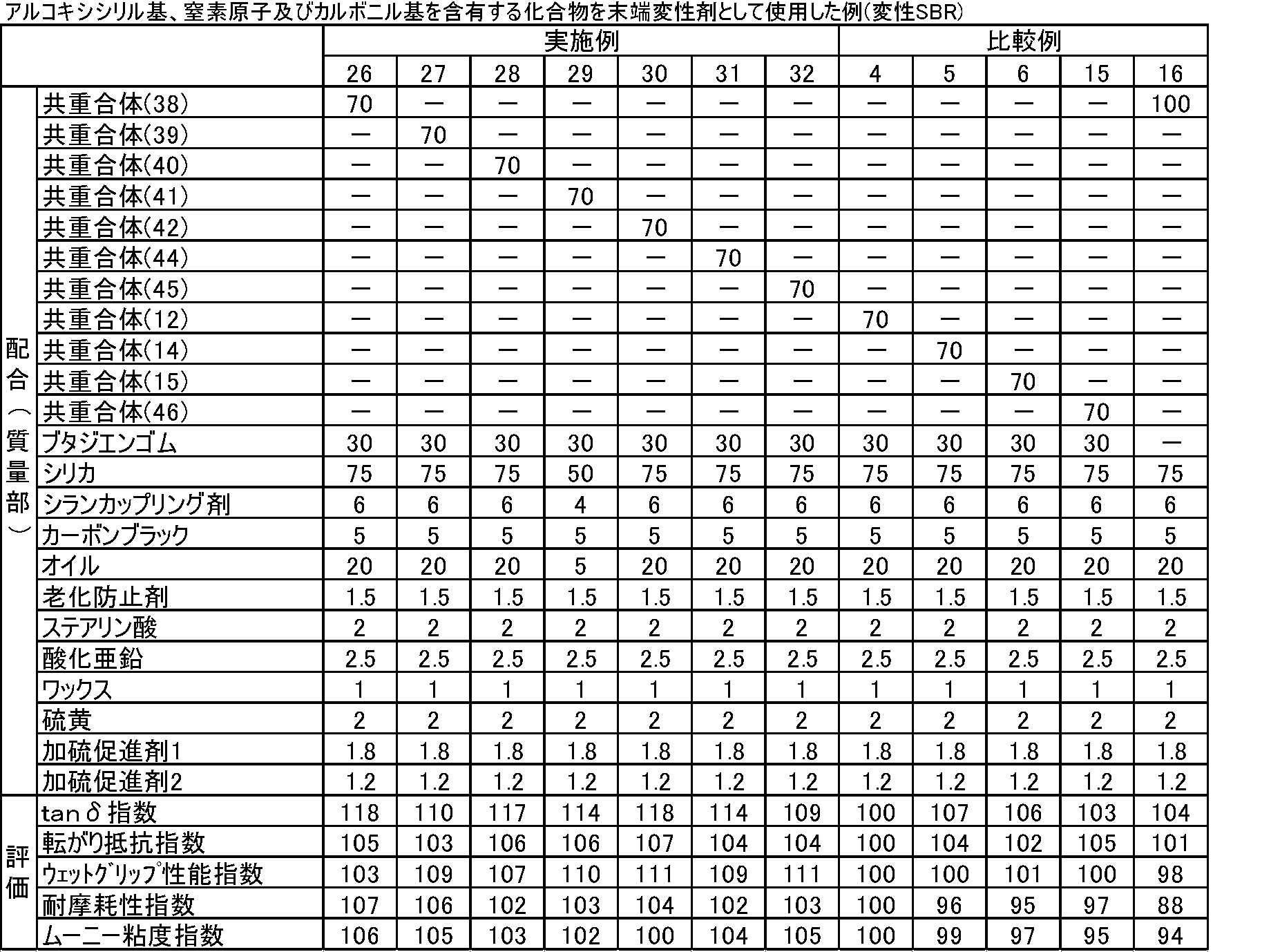

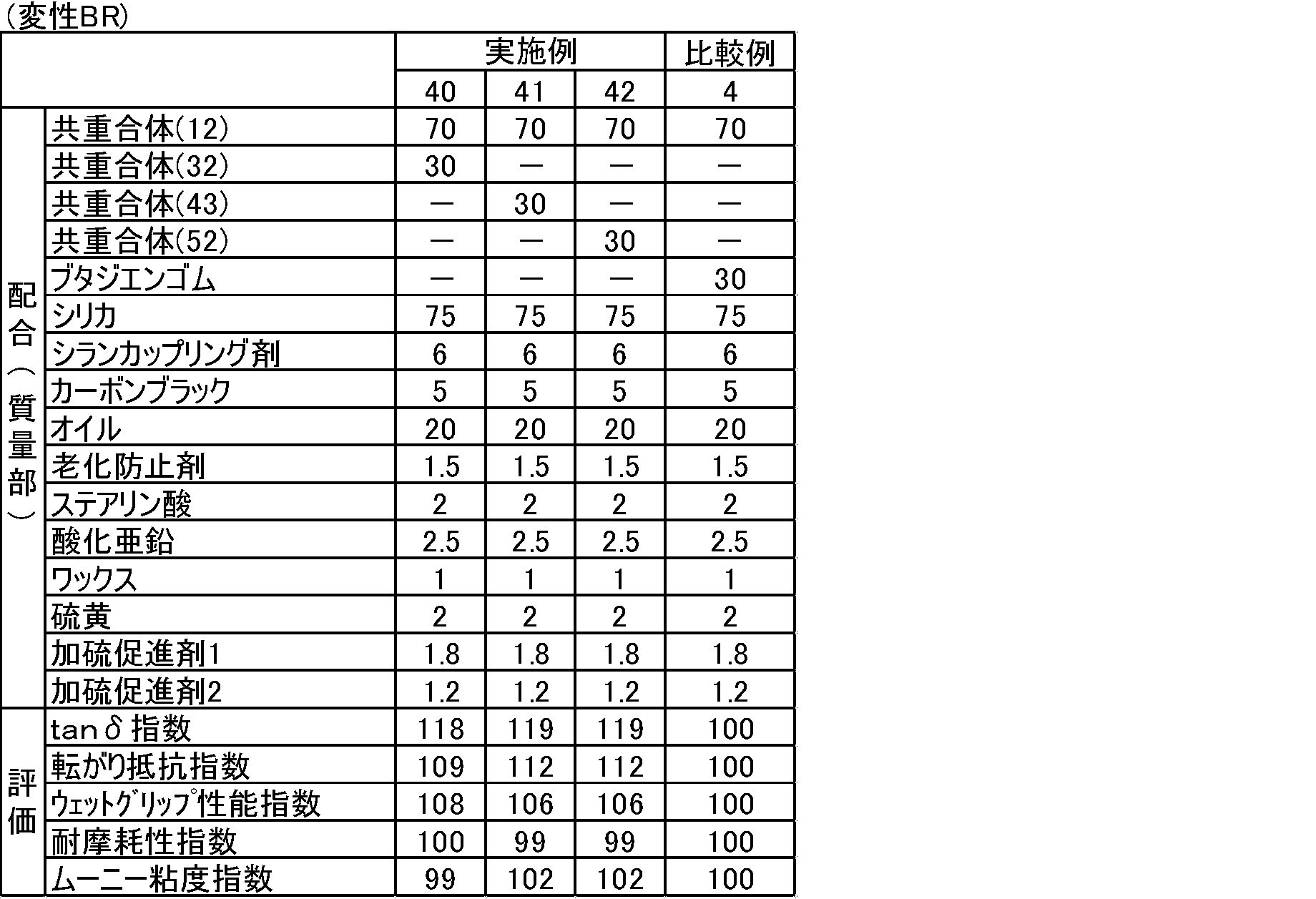
Claims (7)
- 下記式(I)で表される重合開始剤を用いて共役ジエン化合物及びケイ素含有ビニル化合物を含む単量体成分を重合させて得られる共重合体の活性末端に、窒素原子及び/又はケイ素原子を含有する化合物を反応させて得られる共役ジエン系重合体と、シリカとを含み、
ゴム成分100質量%中の前記共役ジエン系重合体の含有量が90質量%以下であり、
ゴム成分100質量部に対する前記シリカの含有量が10~150質量部であるゴム組成物。

- 前記式(I)のR11が下記式(Ia)で表される基である請求項1記載のゴム組成物。

- 前記式(Ia)のR14がイソプレン由来の構造単位1~10単位からなるヒドロカルビレン基である請求項2記載のゴム組成物。
- 前記ケイ素含有ビニル化合物が、下記式(II)で表される化合物である請求項1~3のいずれかに記載のゴム組成物。
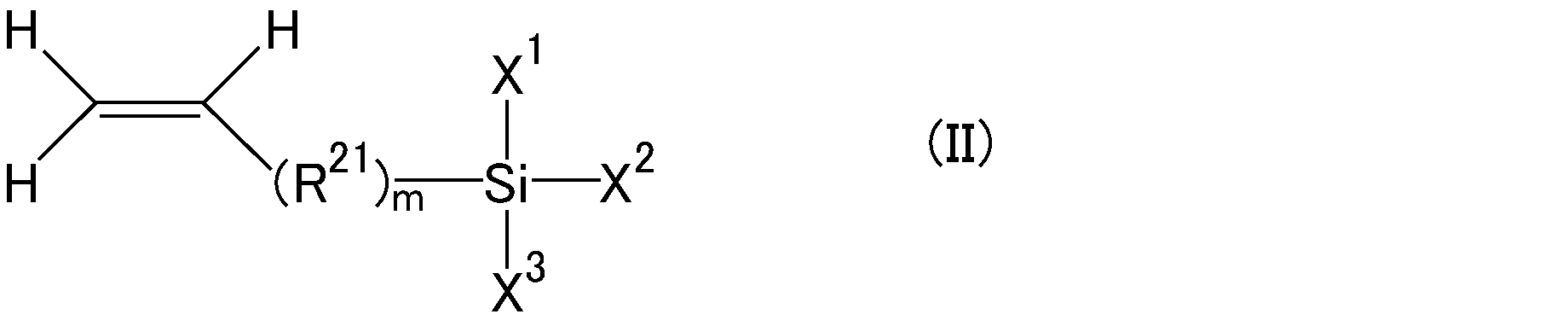
- 前記共役ジエン系重合体が芳香族ビニル化合物由来の構造単位を有する請求項1~4のいずれかに記載のゴム組成物。
- 前記シリカの窒素吸着比表面積が40~400m2/gである請求項1~5のいずれかに記載のゴム組成物。
- 請求項1~6のいずれかに記載のゴム組成物を用いて作製した空気入りタイヤ。
Priority Applications (7)
| Application Number | Priority Date | Filing Date | Title |
|---|---|---|---|
| KR1020137032453A KR101909767B1 (ko) | 2011-08-03 | 2012-05-24 | 고무 조성물 및 공기 타이어 |
| CN201280038227.4A CN103732672B (zh) | 2011-08-03 | 2012-05-24 | 橡胶组合物及充气轮胎 |
| EP12820434.4A EP2738210B1 (en) | 2011-08-03 | 2012-05-24 | Rubber composition and pneumatic tire |
| BR112014002423A BR112014002423A2 (pt) | 2011-08-03 | 2012-05-24 | composição de borracha e pneumático |
| RU2014100860/05A RU2603370C2 (ru) | 2011-08-03 | 2012-05-24 | Резиновая смесь и пневматическая шина |
| JP2013526776A JP5723009B2 (ja) | 2011-08-03 | 2012-05-24 | ゴム組成物及び空気入りタイヤ |
| US14/126,746 US9284433B2 (en) | 2011-08-03 | 2012-05-24 | Rubber composition and pneumatic tire |
Applications Claiming Priority (2)
| Application Number | Priority Date | Filing Date | Title |
|---|---|---|---|
| JP2011170556 | 2011-08-03 | ||
| JP2011-170556 | 2011-08-03 |
Publications (1)
| Publication Number | Publication Date |
|---|---|
| WO2013018424A1 true WO2013018424A1 (ja) | 2013-02-07 |
Family
ID=47628964
Family Applications (1)
| Application Number | Title | Priority Date | Filing Date |
|---|---|---|---|
| PCT/JP2012/063292 Ceased WO2013018424A1 (ja) | 2011-08-03 | 2012-05-24 | ゴム組成物及び空気入りタイヤ |
Country Status (8)
| Country | Link |
|---|---|
| US (1) | US9284433B2 (ja) |
| EP (1) | EP2738210B1 (ja) |
| JP (1) | JP5723009B2 (ja) |
| KR (1) | KR101909767B1 (ja) |
| CN (1) | CN103732672B (ja) |
| BR (1) | BR112014002423A2 (ja) |
| RU (1) | RU2603370C2 (ja) |
| WO (1) | WO2013018424A1 (ja) |
Cited By (9)
| Publication number | Priority date | Publication date | Assignee | Title |
|---|---|---|---|---|
| JP2013108040A (ja) * | 2011-11-24 | 2013-06-06 | Sumitomo Rubber Ind Ltd | ゴム組成物及び空気入りタイヤ |
| JP2014198840A (ja) * | 2013-03-12 | 2014-10-23 | 住友化学株式会社 | 共役ジエン系重合体、及び該重合体を含有する重合体組成物 |
| JP2014198839A (ja) * | 2013-03-12 | 2014-10-23 | 住友化学株式会社 | 共役ジエン系重合体、及び該重合体を含有する重合体組成物 |
| JP2014201637A (ja) * | 2013-04-03 | 2014-10-27 | 住友ゴム工業株式会社 | タイヤ用ゴム組成物及び空気入りタイヤ |
| JP2015193774A (ja) * | 2013-04-09 | 2015-11-05 | 住友化学株式会社 | 共役ジエン系重合体、及び該重合体を含有する重合体組成物 |
| CN105473624A (zh) * | 2013-11-15 | 2016-04-06 | Lg化学株式会社 | 改性共轭二烯聚合物及其制备方法,和含有该改性共轭二烯聚合物的橡胶组合物 |
| CN105658676A (zh) * | 2013-10-17 | 2016-06-08 | Lg化学株式会社 | 改性的基于共轭二烯的聚合物,其制备方法以及包含所述聚合物的橡胶组合物 |
| WO2019073829A1 (ja) | 2017-10-13 | 2019-04-18 | 日本ゼオン株式会社 | 変性共役ジエン系ゴム |
| WO2019073828A1 (ja) | 2017-10-13 | 2019-04-18 | 日本ゼオン株式会社 | 共役ジエン系ゴム |
Families Citing this family (28)
| Publication number | Priority date | Publication date | Assignee | Title |
|---|---|---|---|---|
| KR101909767B1 (ko) | 2011-08-03 | 2018-10-18 | 스미토모 고무 고교 가부시키가이샤 | 고무 조성물 및 공기 타이어 |
| US9221964B2 (en) | 2011-11-24 | 2015-12-29 | Sumitomo Rubber Industries, Ltd. | Rubber composition and pneumatic tire |
| BR112014011266A2 (pt) | 2011-11-24 | 2017-04-25 | Sumitomo Rubber Ind | composição de borracha, e pneumático |
| JPWO2013077021A1 (ja) | 2011-11-24 | 2015-04-27 | 住友ゴム工業株式会社 | ゴム組成物及び空気入りタイヤ |
| RU2604239C2 (ru) * | 2011-11-24 | 2016-12-10 | Сумитомо Раббер Индастриз, Лтд. | Резиновая смесь и пневматическая шина |
| JP6050253B2 (ja) | 2011-12-26 | 2016-12-21 | 住友ゴム工業株式会社 | ゴム組成物及び空気入りタイヤ |
| EP2787032B1 (en) | 2011-12-26 | 2016-09-14 | Sumitomo Rubber Industries, Ltd. | Rubber composition and pneumatic tire |
| KR101534101B1 (ko) * | 2013-10-17 | 2015-07-07 | 주식회사 엘지화학 | 변성 공액 디엔계 중합체, 이의 제조방법, 및 이를 포함하는 고무 조성물 |
| CN107636023B (zh) * | 2015-06-12 | 2019-11-26 | 旭化成株式会社 | 改性共轭二烯系聚合物及其制造方法、橡胶组合物以及轮胎 |
| RU2603366C1 (ru) * | 2015-08-11 | 2016-11-27 | Федеральное государственное бюджетное образовательное учреждение высшего профессионального образования "Волгоградский государственный технический университет" (ВолгГТУ) | Резиновая смесь на основе бутадиен-метилстирольного каучука |
| RU2603365C1 (ru) * | 2015-08-11 | 2016-11-27 | Федеральное государственное бюджетное образовательное учреждение высшего профессионального образования "Волгоградский государственный технический университет" (ВолгГТУ) | Резиновая смесь на основе бутадиен-метилстирольного каучука |
| CN109906235B (zh) * | 2016-11-02 | 2021-11-12 | 公共型股份公司希布尔控股 | 生产改性的含二烯的橡胶的方法、橡胶和基于其的组合物 |
| WO2019016885A1 (en) * | 2017-07-19 | 2019-01-24 | Compagnie Generale Des Etablissements Michelin | RUBBER COMPOSITION BASED ON SILICONE OIL |
| KR102501594B1 (ko) * | 2018-03-21 | 2023-02-20 | 주식회사 엘지화학 | 변성 중합 개시제 및 이의 제조방법 |
| JP2021523261A (ja) | 2018-05-04 | 2021-09-02 | ブリヂストン アメリカズ タイヤ オペレーションズ、 エルエルシー | タイヤトレッドゴム組成物 |
| EP3781625A4 (en) | 2018-05-04 | 2022-01-05 | Bridgestone Americas Tire Operations, LLC | RUBBER COMPOSITION FOR TIRE TREAD |
| JP2021523959A (ja) | 2018-05-04 | 2021-09-09 | ブリヂストン アメリカズ タイヤ オペレーションズ、 エルエルシー | タイヤトレッドゴム組成物 |
| EP3788101A4 (en) | 2018-05-04 | 2022-01-12 | Bridgestone Americas Tire Operations, LLC | RUBBER COMPOSITION FOR TIRE TREAD |
| WO2019245287A1 (ko) * | 2018-06-20 | 2019-12-26 | 주식회사 엘지화학 | 변성 중합 개시제 및 이의 제조방법 |
| KR102281112B1 (ko) * | 2018-06-20 | 2021-07-26 | 주식회사 엘지화학 | 변성 중합 개시제 및 이의 제조방법 |
| EP3976709A1 (en) | 2019-05-29 | 2022-04-06 | Bridgestone Americas Tire Operations, LLC | Tire tread rubber composition and related methods |
| US12325797B2 (en) | 2019-05-29 | 2025-06-10 | Bridgestone Americas Tire Operations, Llc | Tire tread rubber composition and related methods |
| WO2020243311A1 (en) | 2019-05-29 | 2020-12-03 | Bridgestone Americas Tire Operations, Llc | Tire tread rubber composition and related methods |
| WO2021049914A1 (ko) | 2019-09-11 | 2021-03-18 | 주식회사 엘지화학 | 변성 공액디엔계 중합체 및 이를 포함하는 고무 조성물 |
| KR102604539B1 (ko) | 2019-09-11 | 2023-11-22 | 주식회사 엘지화학 | 변성 공액디엔계 중합체, 이의 제조방법 및 이를 포함하는 고무 조성물 |
| TWI845759B (zh) | 2019-09-11 | 2024-06-21 | 南韓商Lg化學股份有限公司 | 改質之共軛二烯系聚合物、其製備方法及包含彼之橡膠組成物 |
| SG11202108200TA (en) | 2019-09-11 | 2021-08-30 | Lg Chemical Ltd | Modified conjugated diene-based polymer and rubber composition including the same |
| CN113574077B (zh) | 2019-09-11 | 2024-01-09 | 株式会社Lg化学 | 改性共轭二烯类聚合物、它的制备方法和包含它的橡胶组合物 |
Citations (7)
| Publication number | Priority date | Publication date | Assignee | Title |
|---|---|---|---|---|
| JP2004277696A (ja) * | 2003-02-27 | 2004-10-07 | Sumitomo Chem Co Ltd | 変性ジエン系重合体ゴム及びその製造方法 |
| JP2004331940A (ja) * | 2003-04-15 | 2004-11-25 | Sumitomo Chem Co Ltd | 変性ジエン系重合体ゴム及びその製造方法 |
| JP2006257260A (ja) * | 2005-03-17 | 2006-09-28 | Sumitomo Chemical Co Ltd | 変性ジエン系重合体ゴム及びその製造方法 |
| JP2010077413A (ja) * | 2008-08-27 | 2010-04-08 | Sumitomo Chemical Co Ltd | 共役ジエン系重合体、共役ジエン系重合体組成物及び共役ジエン系重合体の製造方法 |
| JP2010077414A (ja) * | 2008-08-27 | 2010-04-08 | Sumitomo Chemical Co Ltd | 共役ジエン系重合体、共役ジエン系重合体組成物及び共役ジエン系重合体の製造方法 |
| JP2010077412A (ja) * | 2008-08-27 | 2010-04-08 | Sumitomo Chemical Co Ltd | 共役ジエン系重合体、共役ジエン系重合体組成物及び共役ジエン系重合体の製造方法 |
| JP2010254852A (ja) * | 2009-04-27 | 2010-11-11 | Bridgestone Corp | ゴム組成物及びそれを用いたタイヤ |
Family Cites Families (74)
| Publication number | Priority date | Publication date | Assignee | Title |
|---|---|---|---|---|
| JPS4817674B1 (ja) | 1970-03-23 | 1973-05-31 | ||
| JPS56131640A (en) | 1980-03-18 | 1981-10-15 | Bridgestone Corp | Tire tread rubber composition |
| JPS6248739A (ja) | 1985-08-27 | 1987-03-03 | Bridgestone Corp | 高速走行に適した高グリツプトレツドゴム組成物 |
| JPS6399249A (ja) | 1987-09-25 | 1988-04-30 | Asahi Chem Ind Co Ltd | 共役ジエン系ゴム組成物 |
| JPS6399252A (ja) | 1987-09-25 | 1988-04-30 | Asahi Chem Ind Co Ltd | 改良されたゴム組成物 |
| US5189109A (en) | 1988-02-25 | 1993-02-23 | Sumitomo Chemical Company, Limited | Modified diene polymer rubbers |
| JP2594809B2 (ja) | 1988-04-02 | 1997-03-26 | 日本ゼオン株式会社 | タイヤトレッド用ゴム組成物 |
| JP3290469B2 (ja) | 1992-08-17 | 2002-06-10 | ジェイエスアール株式会社 | ゴム組成物 |
| JPH0817674B2 (ja) | 1993-02-24 | 1996-02-28 | 有限会社ごうや | 椎茸加工食品及び椎茸加工食品の製造方法 |
| US5679744A (en) | 1994-11-11 | 1997-10-21 | The Yokohama Rubber Co., Ltd. | Rubber composition |
| JP3385123B2 (ja) | 1995-01-19 | 2003-03-10 | 横浜ゴム株式会社 | ゴム組成物 |
| US5902856A (en) | 1994-11-24 | 1999-05-11 | Nippon Zeon Co., Ltd. | Rubber composition of two diene rubbers |
| EP0717075B1 (en) | 1994-12-16 | 1999-07-14 | The Yokohama Rubber Co., Ltd. | Rubber composition, process for producing thereof and use thereof |
| JP3392249B2 (ja) | 1994-12-28 | 2003-03-31 | 横浜ゴム株式会社 | ゴム組成物及びその製法 |
| CA2154633A1 (en) | 1995-01-25 | 1996-07-26 | Paul Harry Sandstrom | Silica reinforced rubber composition and use in tires |
| US5574109A (en) | 1995-02-01 | 1996-11-12 | Bridgestone Corporation | Aminoalkyllithium compounds containing cyclic amines and polymers therefrom |
| US5932866A (en) | 1995-05-19 | 1999-08-03 | Dai Nippon Printing Co., Ltd. | Optical card with a built-in IC module technical field |
| EP0767206B1 (fr) | 1995-10-04 | 2002-07-10 | Compagnie Generale Des Etablissements Michelin-Michelin & Cie | Composition de caoutchouc à base d'un polymère diénique comprenant un dérivé organosilane, utilisable pour la fabrication de bandes de roulement de pneumatiques |
| DE19721917A1 (de) | 1997-05-26 | 1998-12-03 | Continental Ag | Kautschukmischung für Laufstreifen für Fahrzeugluftreifen |
| JP4921625B2 (ja) | 1999-06-04 | 2012-04-25 | 住友ゴム工業株式会社 | 変性ジエン系ゴム組成物 |
| JP2000239444A (ja) | 1999-02-19 | 2000-09-05 | Bridgestone Corp | ゴム組成物及びそれを用いた重荷重用空気入りタイヤ |
| JP2001151940A (ja) | 1999-09-14 | 2001-06-05 | Yokohama Rubber Co Ltd:The | ゴム組成物 |
| JP2002332381A (ja) | 2001-05-10 | 2002-11-22 | Sumitomo Chem Co Ltd | ゴム組成物およびそれを用いるタイヤ |
| US7084228B2 (en) | 2002-07-29 | 2006-08-01 | Michelin Recherche Et Technique S.A. | Rubber composition for a tire tread |
| JP4955191B2 (ja) | 2002-08-21 | 2012-06-20 | 住友ゴム工業株式会社 | タイヤトレッド用ゴム組成物 |
| US7339005B2 (en) | 2003-01-31 | 2008-03-04 | Sumitomo Chemical Company, Limited | Process for producing modified diene polymer rubber |
| CN1330678C (zh) | 2003-02-27 | 2007-08-08 | 住友化学工业株式会社 | 制备改性二烯聚合物橡胶的方法 |
| US7137423B2 (en) | 2003-06-06 | 2006-11-21 | The Goodyear Tire & Rubber Company | Tire with component comprised of amine functionalized styrene/diene copolymer elastomer, silanol functionalized carbon black and coupling agent |
| US7625981B2 (en) | 2004-06-04 | 2009-12-01 | Sumitomo Chemical Company, Limited | Process for producing modified polymer rubber |
| JP4622512B2 (ja) | 2004-12-28 | 2011-02-02 | 横浜ゴム株式会社 | ゴム組成物 |
| US20060173118A1 (en) | 2005-01-28 | 2006-08-03 | Sumitomo Rubber Industries, Ltd. | Rubber composition and tire having tread comprising thereof |
| JP4566888B2 (ja) | 2005-01-28 | 2010-10-20 | 住友ゴム工業株式会社 | ゴム組成物およびそれを用いたトレッドを有するタイヤ |
| US8030406B2 (en) | 2005-03-04 | 2011-10-04 | Bridgestone Corporation | Rubber composition and pneumatic tire using the same |
| JP5350577B2 (ja) | 2005-09-15 | 2013-11-27 | 株式会社ブリヂストン | ゴム組成物およびそれを用いたタイヤ |
| RU2392284C2 (ru) * | 2005-10-05 | 2010-06-20 | Джей Эс Эр КОРПОРЕЙШН | Способ получения модифицированного сопряженного диенового полимера, модифицированный сопряженный диеновый полимер, полученный этим способом, резиновая композиция, содержащая указанный полимер |
| US20070112121A1 (en) * | 2005-11-14 | 2007-05-17 | Sumitomo Rubber Industries, Ltd. | Rubber composition and pneumatic tire using the same for tread |
| JP5154071B2 (ja) | 2005-12-28 | 2013-02-27 | 住友ゴム工業株式会社 | ゴム組成物およびそれを用いたタイヤ |
| EP1803770B1 (en) | 2005-12-28 | 2014-07-16 | Sumitomo Rubber Industries, Ltd. | Rubber composition and tire using the same |
| EP1882716A1 (en) | 2006-07-26 | 2008-01-30 | Sumitomo Rubber Industries, Ltd. | Rubber composition and tire having tread and/or sidewall using same |
| JP4823846B2 (ja) | 2006-10-20 | 2011-11-24 | 住友ゴム工業株式会社 | ゴム組成物およびそれを用いたトレッド、サイドウォールを有するタイヤ |
| JP2009001721A (ja) | 2007-06-22 | 2009-01-08 | Bridgestone Corp | ゴム組成物及びそれを用いた空気入りタイヤ |
| JP2009035643A (ja) | 2007-08-02 | 2009-02-19 | Sumitomo Rubber Ind Ltd | ビードエイペックス用ゴム組成物およびそれを用いたビードエイペックスを有する空気入りタイヤ |
| JP2009091482A (ja) | 2007-10-10 | 2009-04-30 | Sumitomo Rubber Ind Ltd | スタッドレスタイヤに用いるトレッド用ゴム組成物およびそれを用いたトレッドを有するスタッドレスタイヤ |
| EP2223959A1 (en) | 2007-12-07 | 2010-09-01 | Bridgestone Corporation | Tire |
| EP2236554B1 (en) | 2007-12-28 | 2013-08-07 | Bridgestone Corporation | Tire |
| SG155870A1 (en) * | 2008-03-31 | 2009-10-29 | Sumitomo Chemical Co | Conjugated diene polymer, process for producing same, and conjugated diene polymer composition and vulcanizate |
| SG159474A1 (en) | 2008-08-27 | 2010-03-30 | Sumitomo Chemical Co | Conjugated diene polymer, conjugated diene polymer composition, and method for producing conjugated diene polymer |
| SG159479A1 (en) | 2008-08-27 | 2010-03-30 | Sumitomo Chemical Co | Conjugated diene polymer, conjugated diene polymer composition, and method for producing conjugated diene polymer |
| CN105175582B (zh) | 2008-10-14 | 2017-10-17 | 旭化成株式会社 | 改性共轭二烯系聚合物、其制造方法、改性共轭二烯系聚合物组合物及轮胎 |
| JP4810567B2 (ja) | 2008-12-10 | 2011-11-09 | 住友ゴム工業株式会社 | スタッドレスタイヤ用トレッドゴム組成物及びスタッドレスタイヤ |
| CN102365306B (zh) | 2009-04-07 | 2014-04-02 | 住友橡胶工业株式会社 | 含极性基的共聚物、橡胶组合物以及无防滑钉轮胎 |
| JP5324384B2 (ja) | 2009-10-05 | 2013-10-23 | 住友ゴム工業株式会社 | 重合体、タイヤ用ゴム組成物及び空気入りタイヤ |
| JP5256262B2 (ja) | 2009-12-07 | 2013-08-07 | 住友ゴム工業株式会社 | タイヤ用ゴム組成物及び空気入りタイヤ |
| JP2011140613A (ja) | 2009-12-09 | 2011-07-21 | Sumitomo Rubber Ind Ltd | タイヤ用ゴム組成物及び空気入りタイヤ |
| JP5149316B2 (ja) | 2009-12-09 | 2013-02-20 | 住友ゴム工業株式会社 | タイヤ用ゴム組成物及び空気入りタイヤ |
| JP5097766B2 (ja) | 2009-12-25 | 2012-12-12 | 住友ゴム工業株式会社 | トレッド用ゴム組成物及び空気入りタイヤ |
| CN102115554B (zh) | 2010-01-04 | 2014-09-10 | 住友橡胶工业株式会社 | 轮胎用橡胶组合物以及无钉防滑轮胎 |
| JP4875757B2 (ja) | 2010-01-13 | 2012-02-15 | 住友ゴム工業株式会社 | タイヤ用ゴム組成物及び空気入りタイヤ |
| JP2011144324A (ja) | 2010-01-18 | 2011-07-28 | Sumitomo Rubber Ind Ltd | タイヤ用ゴム組成物及び空気入りタイヤ |
| JP5691623B2 (ja) | 2010-02-26 | 2015-04-01 | 住友化学株式会社 | 共役ジエン系重合体ゴム、及び、共役ジエン系重合体ゴム組成物 |
| EP2366557B1 (en) | 2010-03-16 | 2012-05-23 | Sumitomo Rubber Industries, Ltd. | Tire rubber composition and pneumatic tire |
| CN102190822B (zh) | 2010-03-17 | 2014-10-29 | 住友橡胶工业株式会社 | 轮胎橡胶组合物和重载轮胎 |
| JP5659721B2 (ja) | 2010-03-31 | 2015-01-28 | 住友化学株式会社 | 共役ジエン系重合体組成物の製造方法 |
| JP5715628B2 (ja) | 2010-07-23 | 2015-05-07 | 住友ゴム工業株式会社 | ゴム組成物及び空気入りタイヤ |
| SG182931A1 (en) | 2011-01-24 | 2012-08-30 | Sumitomo Chemical Co | Process for producing conjugated diene-based polymer, conjugated diene-based polymer, and conjugated diene-based polymer composition |
| KR101909767B1 (ko) | 2011-08-03 | 2018-10-18 | 스미토모 고무 고교 가부시키가이샤 | 고무 조성물 및 공기 타이어 |
| US9006326B2 (en) * | 2011-11-24 | 2015-04-14 | Sumitomo Rubber Industries, Ltd. | Rubber composition and pneumatic tire |
| BR112014011266A2 (pt) * | 2011-11-24 | 2017-04-25 | Sumitomo Rubber Ind | composição de borracha, e pneumático |
| US9221964B2 (en) * | 2011-11-24 | 2015-12-29 | Sumitomo Rubber Industries, Ltd. | Rubber composition and pneumatic tire |
| RU2604239C2 (ru) * | 2011-11-24 | 2016-12-10 | Сумитомо Раббер Индастриз, Лтд. | Резиновая смесь и пневматическая шина |
| JPWO2013077021A1 (ja) * | 2011-11-24 | 2015-04-27 | 住友ゴム工業株式会社 | ゴム組成物及び空気入りタイヤ |
| CN103917590B (zh) * | 2011-11-24 | 2016-06-01 | 住友橡胶工业株式会社 | 橡胶组合物以及无钉防滑轮胎 |
| EP2787032B1 (en) * | 2011-12-26 | 2016-09-14 | Sumitomo Rubber Industries, Ltd. | Rubber composition and pneumatic tire |
| JP6050253B2 (ja) * | 2011-12-26 | 2016-12-21 | 住友ゴム工業株式会社 | ゴム組成物及び空気入りタイヤ |
-
2012
- 2012-05-24 KR KR1020137032453A patent/KR101909767B1/ko not_active Expired - Fee Related
- 2012-05-24 BR BR112014002423A patent/BR112014002423A2/pt not_active Application Discontinuation
- 2012-05-24 EP EP12820434.4A patent/EP2738210B1/en not_active Not-in-force
- 2012-05-24 RU RU2014100860/05A patent/RU2603370C2/ru not_active IP Right Cessation
- 2012-05-24 JP JP2013526776A patent/JP5723009B2/ja not_active Expired - Fee Related
- 2012-05-24 US US14/126,746 patent/US9284433B2/en not_active Expired - Fee Related
- 2012-05-24 WO PCT/JP2012/063292 patent/WO2013018424A1/ja not_active Ceased
- 2012-05-24 CN CN201280038227.4A patent/CN103732672B/zh not_active Expired - Fee Related
Patent Citations (7)
| Publication number | Priority date | Publication date | Assignee | Title |
|---|---|---|---|---|
| JP2004277696A (ja) * | 2003-02-27 | 2004-10-07 | Sumitomo Chem Co Ltd | 変性ジエン系重合体ゴム及びその製造方法 |
| JP2004331940A (ja) * | 2003-04-15 | 2004-11-25 | Sumitomo Chem Co Ltd | 変性ジエン系重合体ゴム及びその製造方法 |
| JP2006257260A (ja) * | 2005-03-17 | 2006-09-28 | Sumitomo Chemical Co Ltd | 変性ジエン系重合体ゴム及びその製造方法 |
| JP2010077413A (ja) * | 2008-08-27 | 2010-04-08 | Sumitomo Chemical Co Ltd | 共役ジエン系重合体、共役ジエン系重合体組成物及び共役ジエン系重合体の製造方法 |
| JP2010077414A (ja) * | 2008-08-27 | 2010-04-08 | Sumitomo Chemical Co Ltd | 共役ジエン系重合体、共役ジエン系重合体組成物及び共役ジエン系重合体の製造方法 |
| JP2010077412A (ja) * | 2008-08-27 | 2010-04-08 | Sumitomo Chemical Co Ltd | 共役ジエン系重合体、共役ジエン系重合体組成物及び共役ジエン系重合体の製造方法 |
| JP2010254852A (ja) * | 2009-04-27 | 2010-11-11 | Bridgestone Corp | ゴム組成物及びそれを用いたタイヤ |
Non-Patent Citations (1)
| Title |
|---|
| See also references of EP2738210A4 * |
Cited By (15)
| Publication number | Priority date | Publication date | Assignee | Title |
|---|---|---|---|---|
| JP2013108040A (ja) * | 2011-11-24 | 2013-06-06 | Sumitomo Rubber Ind Ltd | ゴム組成物及び空気入りタイヤ |
| JP2014198840A (ja) * | 2013-03-12 | 2014-10-23 | 住友化学株式会社 | 共役ジエン系重合体、及び該重合体を含有する重合体組成物 |
| JP2014198839A (ja) * | 2013-03-12 | 2014-10-23 | 住友化学株式会社 | 共役ジエン系重合体、及び該重合体を含有する重合体組成物 |
| JP2014201637A (ja) * | 2013-04-03 | 2014-10-27 | 住友ゴム工業株式会社 | タイヤ用ゴム組成物及び空気入りタイヤ |
| JP2015193774A (ja) * | 2013-04-09 | 2015-11-05 | 住友化学株式会社 | 共役ジエン系重合体、及び該重合体を含有する重合体組成物 |
| CN105658676A (zh) * | 2013-10-17 | 2016-06-08 | Lg化学株式会社 | 改性的基于共轭二烯的聚合物,其制备方法以及包含所述聚合物的橡胶组合物 |
| US9695256B2 (en) | 2013-10-17 | 2017-07-04 | Lg Chem, Ltd. | Modified conjugated diene-based polymer, preparation method therefor, and rubber composition comprising same |
| CN105473624A (zh) * | 2013-11-15 | 2016-04-06 | Lg化学株式会社 | 改性共轭二烯聚合物及其制备方法,和含有该改性共轭二烯聚合物的橡胶组合物 |
| US9944741B2 (en) | 2013-11-15 | 2018-04-17 | Lg Chem, Ltd. | Modified conjugated diene polymer, method for preparing same, and rubber composition containing same |
| WO2019073829A1 (ja) | 2017-10-13 | 2019-04-18 | 日本ゼオン株式会社 | 変性共役ジエン系ゴム |
| WO2019073828A1 (ja) | 2017-10-13 | 2019-04-18 | 日本ゼオン株式会社 | 共役ジエン系ゴム |
| KR20200087125A (ko) | 2017-10-13 | 2020-07-20 | 니폰 제온 가부시키가이샤 | 변성 공액 디엔계 고무 |
| KR20200087124A (ko) | 2017-10-13 | 2020-07-20 | 니폰 제온 가부시키가이샤 | 공액 디엔계 고무 |
| US11530287B2 (en) | 2017-10-13 | 2022-12-20 | Zeon Corporation | Conjugated-diene-based rubber |
| US11566094B2 (en) | 2017-10-13 | 2023-01-31 | Zeon Corporation | Modified conjugated diene rubber |
Also Published As
| Publication number | Publication date |
|---|---|
| EP2738210B1 (en) | 2016-08-10 |
| CN103732672B (zh) | 2016-01-20 |
| CN103732672A (zh) | 2014-04-16 |
| RU2014100860A (ru) | 2015-09-10 |
| KR20140047612A (ko) | 2014-04-22 |
| EP2738210A1 (en) | 2014-06-04 |
| JP5723009B2 (ja) | 2015-05-27 |
| US20140114014A1 (en) | 2014-04-24 |
| US9284433B2 (en) | 2016-03-15 |
| BR112014002423A2 (pt) | 2017-02-21 |
| JPWO2013018424A1 (ja) | 2015-03-05 |
| RU2603370C2 (ru) | 2016-11-27 |
| KR101909767B1 (ko) | 2018-10-18 |
| EP2738210A4 (en) | 2015-04-08 |
Similar Documents
| Publication | Publication Date | Title |
|---|---|---|
| JP5723009B2 (ja) | ゴム組成物及び空気入りタイヤ | |
| JP6050253B2 (ja) | ゴム組成物及び空気入りタイヤ | |
| JP6050254B2 (ja) | ゴム組成物及び空気入りタイヤ | |
| JP5918261B2 (ja) | ゴム組成物及び空気入りタイヤ | |
| JP5918263B2 (ja) | ゴム組成物及び空気入りタイヤ | |
| JP5918262B2 (ja) | ゴム組成物及びスタッドレスタイヤ | |
| JP5918259B2 (ja) | ゴム組成物及び空気入りタイヤ | |
| JP5918260B2 (ja) | ゴム組成物及び空気入りタイヤ | |
| JPWO2013077021A1 (ja) | ゴム組成物及び空気入りタイヤ | |
| JP5902447B2 (ja) | ゴム組成物及び空気入りタイヤ | |
| WO2013077017A1 (ja) | ゴム組成物及び空気入りタイヤ | |
| JP2013133387A (ja) | ゴム組成物及び空気入りタイヤ | |
| JP5917895B2 (ja) | ゴム組成物及び空気入りタイヤ | |
| JP5902445B2 (ja) | ゴム組成物及び空気入りタイヤ | |
| JP5967907B2 (ja) | ゴム組成物及び空気入りタイヤ | |
| JP2013108039A (ja) | ゴム組成物及び空気入りタイヤ | |
| JP5917894B2 (ja) | ゴム組成物及び空気入りタイヤ |
Legal Events
| Date | Code | Title | Description |
|---|---|---|---|
| 121 | Ep: the epo has been informed by wipo that ep was designated in this application |
Ref document number: 12820434 Country of ref document: EP Kind code of ref document: A1 |
|
| ENP | Entry into the national phase |
Ref document number: 2013526776 Country of ref document: JP Kind code of ref document: A |
|
| ENP | Entry into the national phase |
Ref document number: 20137032453 Country of ref document: KR Kind code of ref document: A |
|
| WWE | Wipo information: entry into national phase |
Ref document number: 14126746 Country of ref document: US |
|
| NENP | Non-entry into the national phase |
Ref country code: DE |
|
| REEP | Request for entry into the european phase |
Ref document number: 2012820434 Country of ref document: EP |
|
| WWE | Wipo information: entry into national phase |
Ref document number: 2012820434 Country of ref document: EP |
|
| ENP | Entry into the national phase |
Ref document number: 2014100860 Country of ref document: RU Kind code of ref document: A |
|
| REG | Reference to national code |
Ref country code: BR Ref legal event code: B01A Ref document number: 112014002423 Country of ref document: BR |
|
| ENP | Entry into the national phase |
Ref document number: 112014002423 Country of ref document: BR Kind code of ref document: A2 Effective date: 20140130 |