WO2013047745A1 - 口腔用組成物 - Google Patents
口腔用組成物 Download PDFInfo
- Publication number
- WO2013047745A1 WO2013047745A1 PCT/JP2012/075075 JP2012075075W WO2013047745A1 WO 2013047745 A1 WO2013047745 A1 WO 2013047745A1 JP 2012075075 W JP2012075075 W JP 2012075075W WO 2013047745 A1 WO2013047745 A1 WO 2013047745A1
- Authority
- WO
- WIPO (PCT)
- Prior art keywords
- oral
- lipase
- protease
- chicken egg
- composition
- Prior art date
- Legal status (The legal status is an assumption and is not a legal conclusion. Google has not performed a legal analysis and makes no representation as to the accuracy of the status listed.)
- Ceased
Links
Classifications
-
- A—HUMAN NECESSITIES
- A61—MEDICAL OR VETERINARY SCIENCE; HYGIENE
- A61K—PREPARATIONS FOR MEDICAL, DENTAL OR TOILETRY PURPOSES
- A61K8/00—Cosmetics or similar toiletry preparations
- A61K8/18—Cosmetics or similar toiletry preparations characterised by the composition
- A61K8/30—Cosmetics or similar toiletry preparations characterised by the composition containing organic compounds
- A61K8/33—Cosmetics or similar toiletry preparations characterised by the composition containing organic compounds containing oxygen
- A61K8/36—Carboxylic acids; Salts or anhydrides thereof
- A61K8/365—Hydroxycarboxylic acids; Ketocarboxylic acids
-
- A—HUMAN NECESSITIES
- A61—MEDICAL OR VETERINARY SCIENCE; HYGIENE
- A61K—PREPARATIONS FOR MEDICAL, DENTAL OR TOILETRY PURPOSES
- A61K38/00—Medicinal preparations containing peptides
- A61K38/16—Peptides having more than 20 amino acids; Gastrins; Somatostatins; Melanotropins; Derivatives thereof
- A61K38/17—Peptides having more than 20 amino acids; Gastrins; Somatostatins; Melanotropins; Derivatives thereof from animals; from humans
- A61K38/39—Connective tissue peptides, e.g. collagen, elastin, laminin, fibronectin, vitronectin, cold insoluble globulin [CIG]
-
- A—HUMAN NECESSITIES
- A61—MEDICAL OR VETERINARY SCIENCE; HYGIENE
- A61K—PREPARATIONS FOR MEDICAL, DENTAL OR TOILETRY PURPOSES
- A61K38/00—Medicinal preparations containing peptides
- A61K38/16—Peptides having more than 20 amino acids; Gastrins; Somatostatins; Melanotropins; Derivatives thereof
- A61K38/43—Enzymes; Proenzymes; Derivatives thereof
- A61K38/46—Hydrolases (3)
- A61K38/465—Hydrolases (3) acting on ester bonds (3.1), e.g. lipases, ribonucleases
-
- A—HUMAN NECESSITIES
- A61—MEDICAL OR VETERINARY SCIENCE; HYGIENE
- A61K—PREPARATIONS FOR MEDICAL, DENTAL OR TOILETRY PURPOSES
- A61K38/00—Medicinal preparations containing peptides
- A61K38/16—Peptides having more than 20 amino acids; Gastrins; Somatostatins; Melanotropins; Derivatives thereof
- A61K38/43—Enzymes; Proenzymes; Derivatives thereof
- A61K38/46—Hydrolases (3)
- A61K38/48—Hydrolases (3) acting on peptide bonds (3.4)
-
- A—HUMAN NECESSITIES
- A61—MEDICAL OR VETERINARY SCIENCE; HYGIENE
- A61K—PREPARATIONS FOR MEDICAL, DENTAL OR TOILETRY PURPOSES
- A61K39/00—Medicinal preparations containing antigens or antibodies
- A61K39/395—Antibodies; Immunoglobulins; Immune serum, e.g. antilymphocytic serum
- A61K39/39591—Stabilisation, fragmentation
-
- A—HUMAN NECESSITIES
- A61—MEDICAL OR VETERINARY SCIENCE; HYGIENE
- A61K—PREPARATIONS FOR MEDICAL, DENTAL OR TOILETRY PURPOSES
- A61K8/00—Cosmetics or similar toiletry preparations
- A61K8/18—Cosmetics or similar toiletry preparations characterised by the composition
- A61K8/30—Cosmetics or similar toiletry preparations characterised by the composition containing organic compounds
- A61K8/64—Proteins; Peptides; Derivatives or degradation products thereof
-
- A—HUMAN NECESSITIES
- A61—MEDICAL OR VETERINARY SCIENCE; HYGIENE
- A61K—PREPARATIONS FOR MEDICAL, DENTAL OR TOILETRY PURPOSES
- A61K8/00—Cosmetics or similar toiletry preparations
- A61K8/18—Cosmetics or similar toiletry preparations characterised by the composition
- A61K8/30—Cosmetics or similar toiletry preparations characterised by the composition containing organic compounds
- A61K8/64—Proteins; Peptides; Derivatives or degradation products thereof
- A61K8/65—Collagen; Gelatin; Keratin; Derivatives or degradation products thereof
-
- A—HUMAN NECESSITIES
- A61—MEDICAL OR VETERINARY SCIENCE; HYGIENE
- A61K—PREPARATIONS FOR MEDICAL, DENTAL OR TOILETRY PURPOSES
- A61K8/00—Cosmetics or similar toiletry preparations
- A61K8/18—Cosmetics or similar toiletry preparations characterised by the composition
- A61K8/30—Cosmetics or similar toiletry preparations characterised by the composition containing organic compounds
- A61K8/64—Proteins; Peptides; Derivatives or degradation products thereof
- A61K8/66—Enzymes
-
- A—HUMAN NECESSITIES
- A61—MEDICAL OR VETERINARY SCIENCE; HYGIENE
- A61K—PREPARATIONS FOR MEDICAL, DENTAL OR TOILETRY PURPOSES
- A61K8/00—Cosmetics or similar toiletry preparations
- A61K8/18—Cosmetics or similar toiletry preparations characterised by the composition
- A61K8/96—Cosmetics or similar toiletry preparations characterised by the composition containing materials, or derivatives thereof of undetermined constitution
- A61K8/98—Cosmetics or similar toiletry preparations characterised by the composition containing materials, or derivatives thereof of undetermined constitution of animal origin
- A61K8/981—Cosmetics or similar toiletry preparations characterised by the composition containing materials, or derivatives thereof of undetermined constitution of animal origin of mammals or bird
- A61K8/982—Reproductive organs; Embryos, Eggs
-
- A—HUMAN NECESSITIES
- A61—MEDICAL OR VETERINARY SCIENCE; HYGIENE
- A61Q—SPECIFIC USE OF COSMETICS OR SIMILAR TOILETRY PREPARATIONS
- A61Q11/00—Preparations for care of the teeth, of the oral cavity or of dentures; Dentifrices, e.g. toothpastes; Mouth rinses
-
- A—HUMAN NECESSITIES
- A61—MEDICAL OR VETERINARY SCIENCE; HYGIENE
- A61K—PREPARATIONS FOR MEDICAL, DENTAL OR TOILETRY PURPOSES
- A61K39/00—Medicinal preparations containing antigens or antibodies
- A61K2039/54—Medicinal preparations containing antigens or antibodies characterised by the route of administration
- A61K2039/541—Mucosal route
- A61K2039/542—Mucosal route oral/gastrointestinal
-
- C—CHEMISTRY; METALLURGY
- C07—ORGANIC CHEMISTRY
- C07K—PEPTIDES
- C07K2317/00—Immunoglobulins specific features
- C07K2317/10—Immunoglobulins specific features characterized by their source of isolation or production
- C07K2317/11—Immunoglobulins specific features characterized by their source of isolation or production isolated from eggs
-
- C—CHEMISTRY; METALLURGY
- C07—ORGANIC CHEMISTRY
- C07K—PEPTIDES
- C07K2317/00—Immunoglobulins specific features
- C07K2317/20—Immunoglobulins specific features characterized by taxonomic origin
- C07K2317/23—Immunoglobulins specific features characterized by taxonomic origin from birds
Definitions
- the present invention relates to an oral composition.
- a membrane-bound glucosyltransferase which is an enzyme produced by S. mutans, synthesizes an adhesive and insoluble glucan using sucrose as a substrate, and through this glucan, Streptococcus mutans is synthesized. are firmly attached to the tooth surface.
- plaque adhesion is a factor of periodontal disease, which is inflammation such as sarcoma, periodontitis or alveolar pus leakage that develops in the periodontal tissue.
- oral compositions containing chicken egg antibodies and enzymes have been developed (see, for example, Patent Document 1 and Patent Document 2). .
- An object of the present invention is to provide an oral composition that can stably contain a chicken egg antibody and an enzyme and can prevent or ameliorate oral diseases such as caries and periodontal disease.
- An oral composition comprising at least one selected from the group consisting of a lipase, a protease, and a chicken egg antibody, citric acid, and a metal salt of citrate.
- composition for oral cavity according to (1) above wherein the total amount of the lipase, the protease, and the chicken egg antibody is 0.001 to 10 wt%.
- composition for oral cavity according to any one of (1) to (5) above, which further contains a polyglycerin fatty acid ester or an amino acid amphoteric surfactant as a surfactant.
- composition for oral cavity according to any one of (1) to (6), further including collagens.
- composition for oral cavity according to any one of (1) to (7) above, wherein the salt concentration in the composition for oral cavity is 0.1 to 20%.
- composition for oral cavity that can stably contain chicken egg antibodies and enzymes and can prevent or ameliorate oral diseases such as caries and periodontal disease.
- the oral composition in the present specification includes toothpastes, toothpastes, liquid dentifrices, dentifrices such as liquid dentifrices, troches, tablets, creams, ointments, patches, mouthwashes Agent, chewing gum and the like.
- composition for oral cavity of the present invention is used for the purpose of inhibiting the formation of plaque and preventing oral disease, and is at least one selected from the group consisting of lipase, protease and chicken egg antibody. And citric acid and a metal salt of citrate.
- oral compositions containing chicken egg antibodies have been developed.
- the conventional oral composition cannot stably mix chicken egg antibodies and enzymes, and it has been difficult to sufficiently prevent or improve caries and periodontal disease.
- the present inventors have intensively studied in view of such problems, and as a result, in the composition for oral cavity, chicken egg antibodies and enzymes as described later were blended, and citric acid and metal citrate were blended. . By doing so, the present inventors have found that a chicken egg antibody and an enzyme described later can be stably blended. As a result, the present inventors have found that an excellent effect of preventing or improving oral diseases can be exhibited.
- a chicken egg antibody is an antibody obtained from a chicken egg immunized with an enzyme (antigen) produced by a causative bacterium of oral disease, and has a function of inactivating the enzyme produced by the causative fungus of oral disease.
- a chicken egg antibody cannot be stably blended in an oral composition conventionally, and the above-mentioned function decreases with time, and a sufficient oral disease prevention effect is exhibited. I could not.
- a chicken egg antibody can be stably mix
- chicken egg antibodies include those obtained from chicken eggs immunized with antigens produced by oral bacteria such as Streptococcus mutans and Porphyromonas gingivalis.
- caries is generally caused by Streptococcus mutans, which are oral bacteria.
- Streptococcus mutans produces membrane-bound glucosyltransferase in the oral cavity.
- the produced membrane-bound glucosyltransferase synthesizes an insoluble glucan having adhesive properties using sucrose as a substrate.
- Streptococcus mutans firmly adheres to the tooth surface to form plaque.
- This dental plaque causes caries.
- periodontal diseases such as gingivitis and periodontitis occur when this plaque is retained in the oral cavity for a long time.
- the oral composition can effectively prevent plaque from adhering to the tooth surface and has an excellent caries prevention effect, periodontal disease Demonstrate the preventive effect.
- the formation of biofilm (plaque layer) due to the adhesion of plaque to the tooth surface is suppressed, and caries and periodontal diseases are prevented. Occurrence can be reliably prevented.
- the enzyme on which the chicken egg antibody acts is preferably a membrane-bound glucosyltransferase that is an adhesion factor to Streptococcus mutans teeth.
- the enzyme on which the chicken egg antibody acts is preferably a membrane-bound glucosyltransferase that is an adhesion factor to Streptococcus mutans teeth.
- Chicken egg antibodies that act on membrane-bound glucosyltransferase can be obtained as immunoglobulins prepared from eggs produced by chickens that have been immunized with membrane-bound glucosyltransferase.
- the antibody not only acts on the adhesion factor of Streptococcus mutans to teeth, but also suppresses the production of membrane-bound glucosyltransferase. As a result, glucan synthesis can be inhibited, and plaque formation can be more effectively suppressed.
- the chicken egg antibody can be stably added to the oral composition, and the action of Streptococcus mutans can be more effectively suppressed. can do. As a result, it is possible to efficiently prevent the occurrence of oral diseases such as caries and periodontal disease.
- Porphyromonas gingivalis is a fungus that dislikes oxygen and exists in dental plaque. This Porphyromonas gingivalis produces a proteolytic enzyme called gingipain for growth. This enzyme destroys gingival tissue, promotes gingival inflammation, and periodontal disease progresses.
- the composition for oral cavity contains a chicken egg antibody against an enzyme produced by Porphyromonas gingivalis (gingipain)
- the enzyme produced by Porphyromonas gingivalis can be inactivated. Thereby, progression of gingival inflammation can be suppressed, and oral disease can be prevented or improved more reliably.
- Lipase is a generic name given to enzymes that catalyze the hydrolysis of fats and oils, and is one of the three major digestive enzymes along with amylase and protease. This lipase is a hydrolase that breaks down cell walls, lipids, and sugars. A lipase is an enzyme having a function of hindering the activity of oral bacteria by, for example, decomposing cell walls of oral bacteria or decomposing sugars used by oral bacteria.
- lipase can be stably blended into the oral composition by using citric acid and a metal salt of citrate and lipase in combination.
- lipase examples include those derived from organs such as pigs, those derived from microorganisms, and specifically, those derived from the genus Pseudomonas and Bacillus.
- Protease is an enzyme that hydrolyzes peptide bonds of peptides (generally less than 100 residues, relatively low molecular weight) and proteins (generally 100 residues or more, relatively high molecular weight) in which amino acids are linked in chains by peptide bonds. It is a general term.
- Protease has a function of decomposing and removing such proteins.
- plaque can be effectively removed.
- proteases examples include subtilisin (manufactured by Nova), alcalase (manufactured by Nova), esperase (manufactured by Nova), sabinase (manufactured by Nova), and nagase (manufactured by Nagase Biochemical Co., Ltd.) produced by bacteria belonging to the genus Bacillus. ), API-21 (manufactured by Showa Denko), prozyme (manufactured by Amano Pharmaceutical Co., Ltd.) produced by Aspergillus genus filamentous fungi, serratopeptidase produced by Serratia genus bacteria, and the like. Examples thereof include fruit-derived papain and promelain. In addition, for example, a culture solution of a protease-producing strain isolated from soil or the like can be used.
- the total amount of chicken egg antibody, lipase and protease as described above is preferably 0.001 to 10 wt%, more preferably 0.05 to 5 wt%. Thereby, the action of oral bacteria can be more reliably suppressed.
- the total blended amount is less than the lower limit, it becomes difficult to retain a sufficient amount of antibody in the oral cavity, and it becomes difficult to sufficiently suppress the action of oral bacteria. There is.
- the total blending amount exceeds the upper limit value, an effect sufficient to meet the content may not be obtained sufficiently.
- the oral composition of the present invention contains citric acid and a metal citrate salt.
- Citric acid and citrate metal salt are components that contribute to the stable blending of the above-described egg egg antibody, lipase and protease into the oral composition.
- citric acid and a metal salt of citrate By including such citric acid and a metal salt of citrate, the functions of chicken egg antibody, lipase and protease can be exhibited stably.
- oral diseases such as caries and periodontal disease can be prevented or improved. This is considered to be due to the following reason.
- Chicken egg antibody contains many amino acids and forms a three-dimensional structure by electrostatic force due to the charge of amino acids. However, its structure is fragile and is greatly affected by moisture, temperature, pH and salt concentration. Therefore, it is considered that by adding citric acid and a metal citrate salt to the oral composition, it is possible to adjust the optimum pH and salt concentration for chicken egg antibody and the like, and to form a more stable three-dimensional structure.
- examples of the metal citrate include sodium citrate, potassium citrate, calcium citrate, magnesium citrate, and copper citrate.
- the amount of citric acid is preferably 0.005 to 10 wt%, more preferably 0.01 to 5 wt%.
- the blending amount of the metal citrate is preferably 0.05 to 10 wt%, more preferably 0.1 to 5 wt%, and most preferably 0.2 to 1 wt%.
- the blending amount of citric acid is A [wt%] and the blending amount of the citric acid metal salt is B [wt%], it is preferable to satisfy the relationship of 0.005 ⁇ A / B ⁇ 1, It is more preferable to satisfy the relationship of ⁇ A / B ⁇ 0.5.
- a chicken egg antibody, a lipase and a protease can be more effectively and stably blended in the oral composition.
- the stabilization of chicken egg antibodies can be significantly improved.
- the blending amount of citric acid is A [wt%] and the total blending amount of lipase, protease and chicken egg antibody is C [wt%], the relationship of 0.0005 ⁇ A / C ⁇ 10000 is satisfied. It is more preferable that the relationship of 0.002 ⁇ A / C ⁇ 2000 is satisfied.
- a chicken egg antibody, a lipase and a protease can be stably and efficiently blended in the oral composition. In particular, the stabilization of chicken egg antibodies can be significantly improved.
- the blending amount of the metal citrate is B [wt%] and the total blending amount of lipase, protease and chicken egg antibody is C [wt%], the relationship of 0.005 ⁇ B / C ⁇ 10000 is satisfied. It is preferable that the relationship of 0.01 ⁇ B / C ⁇ 2000 is satisfied.
- a chicken egg antibody, a lipase and a protease can be stably and efficiently blended in the oral composition. In particular, the stabilization of chicken egg antibodies can be significantly improved.
- composition for oral cavity of the present invention may contain the following components in addition to the above components.
- composition for oral cavity of the present invention may contain collagens.
- Collagens are components that contribute to the stable blending of the above-described egg egg antibody, lipase, and protease into the oral composition.
- citric acid and citrate metal salt in combination with collagens, stable incorporation of egg antibody, lipase and protease into the oral composition can be further promoted, and the functions of egg egg antibody, lipase and protease can be improved. Furthermore, it can be exhibited stably. As a result, oral diseases such as caries and periodontal diseases can be prevented or improved more effectively.
- collagens examples include fibrous collagens such as type I-III collagen and type V collagen, non-fibrous collagen such as type IV collagen and types VI-VIII, or these collagens are hydrolyzed with acid or enzyme. Examples include hydrolyzed collagen (collagen peptide), water-soluble collagen (atelocollagen), gelatin and the like.
- the egg egg antibody, lipase and protease when hydrolyzed collagen is used, the egg egg antibody, lipase and protease can be more effectively and stably blended in the oral composition, and the function of the egg egg antibody, lipase and protease can be more effectively performed. Can be demonstrated. As a result, oral diseases can be prevented or improved more reliably.
- Hydrolyzed collagen is a high-purity protein that is easily absorbed into the body by hydrolyzing collagen contained in large quantities in fish, cow, pork skin, etc. with acid, base, etc.
- the collagen may be a fish-derived (skin, scale, etc.) collagen, a cow-derived or pig-derived mammal (skin-like) collagen, or another (chicken-like) collagen.
- the type of fish is not particularly limited, and examples include salmon, trout, cod, mackerel, horse mackerel, Thailand, tilapia, perch, herring, carp, and crucian carp.
- the obtained hydrolyzed collagen may be used as a solution, but if necessary, the solution may be concentrated and used as a concentrated solution, or the solution liquid may be volatilized and used as a solid.
- Gelatin is a component having a molecular weight of tens of thousands to hundreds of thousands obtained by degrading and purifying collagen.
- the blending amount of collagens is preferably 0.01 to 10 wt%, more preferably 0.1 to 5 wt%.
- the relationship of 0.001 ⁇ D / C ⁇ 10000 is satisfied.
- various components may be blended in the oral composition of the present invention depending on the dosage form.
- an abrasive, a wetting agent, a binder, a foaming agent (surfactant), a sweetener, an antiseptic, a fragrance component, and other medicinal components Etc. can be blended.
- silica-based abrasives such as silica gel, precipitated silica, igneous silica, hydrous silicic acid, anhydrous silicic acid, aluminosilicate, zirconosilicate, dicalcium phosphate dihydrate, anhydrous dibasic calcium phosphate Calcium hydrogen phosphate, calcium pyrophosphate, tribasic magnesium phosphate, tribasic calcium phosphate, aluminum hydroxide, alumina, light calcium carbonate, heavy calcium carbonate, magnesium carbonate, zirconium silicate, synthetic resin abrasive Of these, one or two or more of these can be used in combination.
- the blending amount of the abrasive is not particularly limited, but is preferably 3 to 60 wt%, and more preferably 10 to 45 wt%.
- wetting agent examples include polyhydric alcohols such as glycerin, concentrated glycerin, diglycerin, sorbitol, maltitol, dipropylene glycol, propylene glycol, 1,3-butylene glycol, and xylitol. More than one species can be used in combination.
- the blending amount of the wetting agent is not particularly limited, but is preferably 1 to 60 wt%, and more preferably 5 to 50 wt%.
- binder examples include carrageenan ( ⁇ , ⁇ , ⁇ ), alginic acid, sodium alginate, propylene glycol ester alginate, calcium-containing sodium alginate, potassium alginate, calcium alginate and derivatives thereof, xanthan gum, guar gum, Examples thereof include gelatin, agar, sodium carboxymethyl cellulose, hydroxyethyl cellulose, sodium polyacrylate, and the like, and one or more of these can be used in combination.
- carrageenan ⁇ , ⁇ , ⁇
- alginic acid sodium alginate
- propylene glycol ester alginate calcium-containing sodium alginate
- potassium alginate calcium alginate and derivatives thereof
- xanthan gum examples thereof include gelatin, agar, sodium carboxymethyl cellulose, hydroxyethyl cellulose, sodium polyacrylate, and the like, and one or more of these can be used in combination.
- the compounding amount of the binder is not particularly limited, but is preferably 0.1 to 5.0 wt%, and more preferably 0.5 to 3.0 wt%.
- foaming agents examples include N-acyl amino acid salts such as sodium lauryl sulfate, sodium lauroamphoacetate, sodium alkylsulfosuccinate, sodium palm oil fatty acid monoglycerin sulfonate, sodium ⁇ -olefin sulfonate, N-acyl glutamate
- Amino acid amphoteric active agents such as 2-alkyl-N-carboxymethyl-N-hydroxyethylimidazolinium betaine, sodium undecylhydroxyethylimidazolinium betaine, maltitol fatty acid ester, sucrose fatty acid ester, polyglycerin fatty acid ester , Fatty acid diethanolamide, polyoxyethylene sorbitan monostearate, polyoxyethylene hydrogenated castor oil, polyoxyethylene fatty acid ester, and the like. It can be used in combination of two or more kinds.
- chicken egg antibody, lipase and protease can be blended more stably in the oral composition, and egg egg antibody, lipase and protease The function of can be exhibited more stably. As a result, the occurrence of oral disease can be more effectively prevented or suppressed.
- polyglycerol fatty acid ester it is preferable to use an ester of polyglycerol and a fatty acid having 12 to 16 carbon atoms.
- the blending amount of the foaming agent (surfactant) is not particularly limited, but is preferably 0.1 to 10.0 wt%, and more preferably 0.5 to 5.0 wt%.
- the relationship of 0.01 ⁇ E / C ⁇ 10000 is satisfied. It is more preferable that the relationship 0.1 ⁇ E / C ⁇ 100 is satisfied.
- a chicken egg antibody, a lipase, and a protease can be stably blended more efficiently in the oral composition.
- sweetening agent examples include saccharin sodium, aspartame, trehalose, stevioside, stevia extract, paramethoxycinnamic aldehyde, neohesperidyl dihydrochalcone, perilartin, and the like, and one or more of these may be used in combination. it can.
- the blending amount of the sweetening agent is not particularly limited, but is preferably 0.005 to 5.0 wt%, and more preferably 0.01 to 3.0 wt%.
- preservatives include parabens such as methyl paraben, ethyl paraben, propyl paraben, and butyl paraben, sodium benzoate, phenoxyethanol, alkyldiaminoethyl glycine hydrochloride, and the like, and one or more of these are used in combination. be able to.
- parabens such as methyl paraben, ethyl paraben, propyl paraben, and butyl paraben, sodium benzoate, phenoxyethanol, alkyldiaminoethyl glycine hydrochloride, and the like, and one or more of these are used in combination. be able to.
- the blending amount of the preservative varies depending on the type and the like, but is preferably 0.005 to 5.0 wt%, and more preferably 0.01 to 3.0 wt%.
- fragrance component examples include l-menthol, anethole, menthone, cineol, limonene, carvone, methyl salicylate, ethyl butyrate, eugenol, thymol, cinnamic aldehyde, trans-2-hexenal, etc. Two or more kinds can be used in combination. These components may be blended in the oral composition alone, but essential oils containing them may be blended in the oral composition. In addition to the above fragrance components, fragrance components such as aliphatic alcohols and esters thereof, terpene hydrocarbons, phenol ethers, aldehydes, ketones, and lactones, and essential oils may be blended within a range that does not interfere with the effects of the present invention.
- the blending amount of the fragrance component is not particularly limited, but is preferably 0.02 to 2 wt%, more preferably 0.05 to 1.5 wt%.
- Medicinal ingredients include monofluorophosphate, sodium fluoride, potassium fluoride, sodium monofluorophosphate, polyethylene glycol, polyvinylpyrrolidone, zeolite, hinokitiol, chlorhexidine salts, cetylpyridinium chloride, benzalkonium chloride, benzethonium chloride, Decalinium, triclosan, isopropylmethylphenol, bisabolol, ascorbic acid and / or its derivatives, tocopherol acetate, ⁇ -aminocaproic acid, tranexamic acid, aluminum hydroxyl allantoin, aluminum lactate, dihydrocholesterol, glycyrrhetinic acid, glycyrrhizinate, copper chlorophyllin salt, Examples include guaiazulene sulfonate, dextranase, pyridoxine hydrochloride, and zeolite. Is, it is possible to incorporate one or
- the oral composition includes, for example, a pigment such as Blue No. 1, a pigment such as titanium oxide, an antioxidant such as dibutylhydroxytoluene, a tea extract, a tea dry distillation solution, and sodium glutamate. It may contain a corrigent.
- the salt concentration of the oral composition as described above is preferably 0.1 to 20%, and more preferably 0.5 to 15%.
- a chicken egg antibody, a lipase, and a protease can be more stably stably blended in the composition for oral cavity.
- the salt concentration refers to the total concentration of salts contained in the oral composition.
- the composition for oral cavity of this invention which combined the said component can be manufactured according to a conventional method,
- the manufacturing method is not specifically limited.
- the chicken egg antibody is preferably added to the oral composition in a state of being dissolved in water together with collagens.
- a chicken egg antibody can be mix
- the function of the chicken egg antibody can be more stably exhibited, and the occurrence of oral disease can be more effectively prevented or suppressed.
- the obtained composition such as a toothpaste can be used by being filled into an aluminum tube, a laminate tube, a glass vapor deposition tube, a plastic tube, a plastic bottle, an aerosol container or the like.
- composition for oral cavity of this invention is not limited to this.
- the composition for oral cavity of this invention can mix
- Example 1 A toothpaste, which is an oral composition, was produced using the following components 1 to 11 (unit: wt%).
- the chicken egg antibody used was an immunoglobulin prepared from eggs produced by chickens immunized with Streptococcus mutans membrane-bound glucosyltransferase.
- a toothpaste was produced according to a conventional method except that the chicken egg antibody was dissolved in water together with hydrolyzed collagen.
- Examples 2 to 10 A toothpaste was produced in the same manner as in Example 1 except that the compounding amounts of chicken egg antibody, citric acid, and metal citrate were changed as shown in Table 1.
- Example 11 As a chicken egg antibody, an antibody prepared as an immunoglobulin prepared from an egg produced by a chicken immunized with Porphyromonas gingivalis gindipine, hydrolyzed collagen was changed to gelatin, and polyglyceryl monolaurate as a surfactant A toothpaste was prepared in the same manner as in Example 1 except that 2-alkyl-N-carboxymethyl-N-hydroxyethylimidazolinium betaine was blended in the blending amount shown in Table 1.
- Example 12 A toothpaste was produced using the following components 1 to 13 (unit: wt%).
- the chicken egg antibody used was an immunoglobulin prepared from eggs produced by chickens immunized with Streptococcus mutans membrane-bound glucosyltransferase.
- a toothpaste was produced according to a conventional method except that the chicken egg antibody was dissolved in water together with hydrolyzed collagen.
- Example 13 A toothpaste was produced using the following components 1 to 11 (unit: wt%).
- a toothpaste was produced according to a conventional method except that lipase was dissolved in water together with hydrolyzed collagen and added.
- Lipase (derived from Pseudomonas): 1.0 2. Citric acid: 0.08 3. Sodium citrate: 1.0 4). Hydrolyzed collagen: 0.5 5. Polyglyceryl monolaurate: 0.2 6). Xylitol: 1.0 7). Concentrated glycerin: 20.0 8). Sorbitol: 40.0 9. Sodium carboxymethyl cellulose: 2.7 10. Fragrance: 1.0 11. Distilled water: remaining
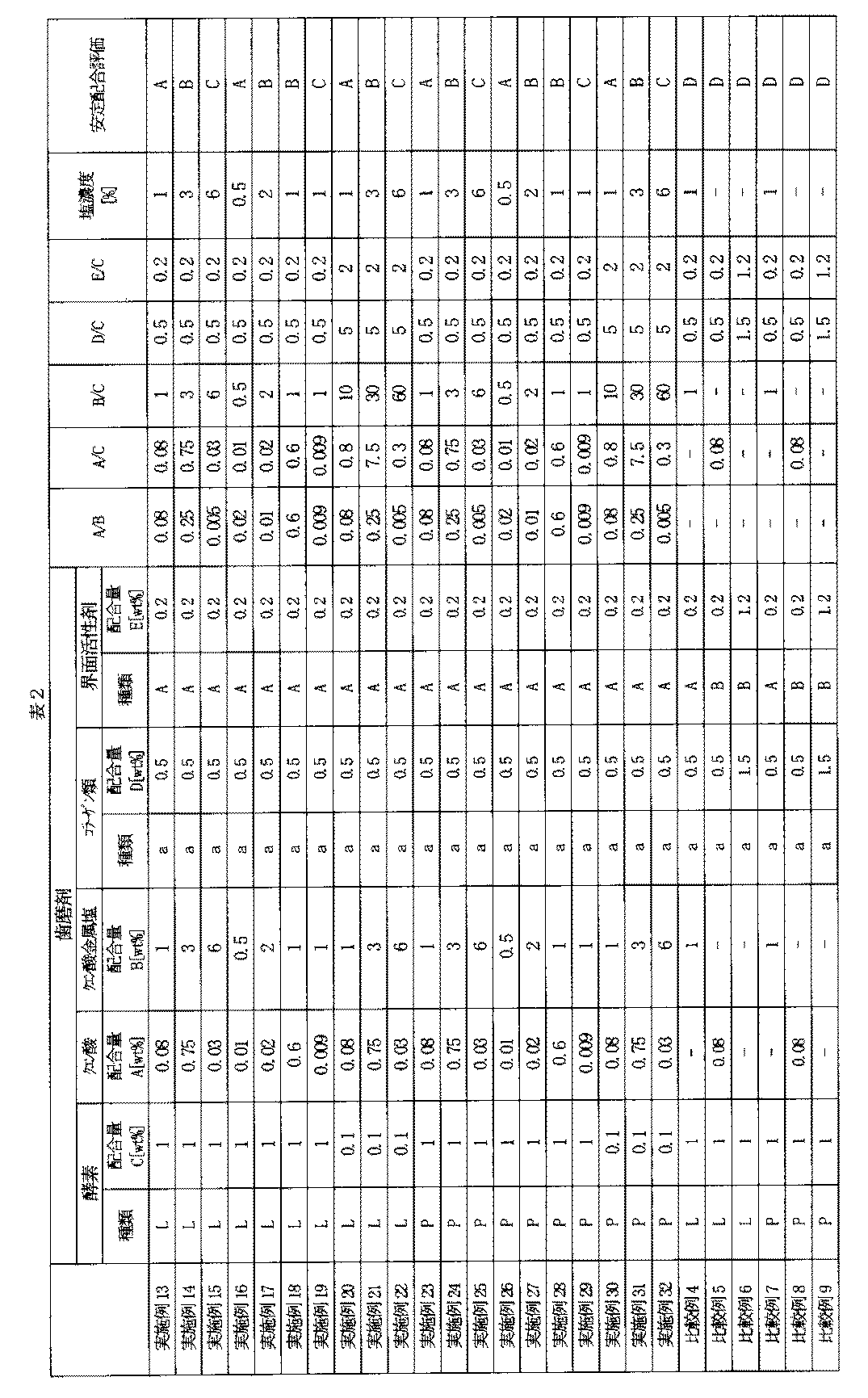
- Example 14 to 22 A toothpaste was produced in the same manner as in Example 13 except that the amounts of lipase, citric acid, and metal citrate were changed as shown in Table 2.
- Example 23 A toothpaste was produced using the following components 1 to 11 (unit: wt%).
- a toothpaste was produced in accordance with a conventional method except that protease was added together with hydrolyzed collagen in water.
- Examples 24-32 A toothpaste was produced in the same manner as in Example 23 except that the blending amounts of protease, citric acid, and metal citrate were changed as shown in Table 2.
- Example 2 A toothpaste was produced in the same manner as in Example 1 except that sodium citrate was not blended in the toothpaste and the surfactant shown in Table 1 was used.
- Example 3 A toothpaste was prepared in the same manner as in Example 1 except that both the citric acid and sodium citrate were not added to the toothpaste and the surfactant shown in Table 1 was used.
- Example 5 A toothpaste was produced in the same manner as in Example 13 except that sodium citrate was not added to the toothpaste and the surfactant shown in Table 2 was used.
- Example 6 A toothpaste was produced in the same manner as in Example 13 except that both the citric acid and sodium citrate were not added to the toothpaste and the surfactant shown in Table 2 was used.
- Example 8 A toothpaste was produced in the same manner as in Example 23 except that sodium citrate was not added to the toothpaste and the surfactant shown in Table 2 was used.
- Example 9 A toothpaste was prepared in the same manner as in Example 23 except that both the citric acid and sodium citrate were not added to the toothpaste and the surfactant shown in Table 2 was used.
- Tables 1 and 2 show the types and blending amounts of the egg egg antibodies or enzymes, the blending amounts of citric acid, sodium citrate and sodium chloride, the types and blending amounts of collagens and surfactants in each Example and Comparative Example. Show. Further, in the table, chicken egg antibody obtained as an immunoglobulin prepared from eggs produced by chicken immunized with membrane-bound glucosyltransferase of Streptococcus mutans, X, immunized with Porphyromonas gingivalis gingipain, Chicken egg antibody obtained as an immunoglobulin prepared from eggs produced by chickens is Y, lipase is L, protease is P, hydrolyzed collagen is a, gelatin is b, polyglyceryl monolaurate is A, sodium lauroamphoacetate is B, 2-alkyl-N-carboxymethyl-N-hydroxyethylimidazolinium betaine was designated C.
- the sample solution was added at 100 ⁇ L / well to the ELISA plate on which the immobilized antigen was adsorbed.
- the ELISA plate was allowed to stand at 25 ° C. for 1 hour to carry out an antigen-antibody reaction. After completion of the reaction, the ELISA plate was washed 5 times with PBS-T. Further, 100 ⁇ L of a peroxidase-conjugated anti-chicken IgG antibody as a secondary antibody was added to the ELISA plate, followed by antigen-antibody reaction at 25 ° C. for 30 minutes. Thereafter, the ELISA plate was washed 6 times with PBS-T.
- the lipase titer (unit / g) was determined by the following formula.
- the ratio of the lipase titer obtained using the toothpaste stored at 40 ° C. for 6 months to the lipase titer obtained using the toothpaste immediately after production is defined as the following four stages. Evaluation was made according to criteria.
- A Lipase residual rate of 80% or more
- B Lipase residual rate of 70% or more and less than 80%
- C Lipase residual rate of 50% or more and less than 70%
- D Lipase residual rate of less than 50%
- Mixture H was shaken and left for 1 minute. After the contents were oxidized, 0.2 mL of sodium bisulfite solution (1 ⁇ 10) was added to the mixture H to obtain a mixture I. Mixture I was shaken to reduce excess potassium permanganate. Subsequently, 8 mL of 0.4% chromotropic acid solution was added to the mixed solution I to obtain a mixed solution J. Mixture J was stirred well and warmed in a boiling water bath for exactly 15 minutes. As a result, the mixed solution J was colored. The mixture J was left for 40 minutes at room temperature. Thereafter, the absorbance of the mixed solution J at a wavelength of 580 nm was measured using water as a control.
- protease titer [unit / g] was determined by the following formula.
- the ratio of the protease titer obtained using the toothpaste stored at 40 ° C. for 6 months to the lipase titer obtained using the toothpaste immediately after production was defined as the protease residual rate in the following four stages. Evaluation was made according to criteria.
- Protease titer [unit / g] (ab) ⁇ 188
- a Absorbance of sample solution
- b Absorbance of sample solution for blank test.
- the present invention provides an oral composition characterized by containing at least one selected from the group consisting of lipase, protease and chicken egg antibody, citric acid, and a metal salt of citrate.
- ADVANTAGE OF THE INVENTION According to this invention, a composition for oral cavity which can mix
Landscapes
- Health & Medical Sciences (AREA)
- Life Sciences & Earth Sciences (AREA)
- Veterinary Medicine (AREA)
- Animal Behavior & Ethology (AREA)
- General Health & Medical Sciences (AREA)
- Public Health (AREA)
- Epidemiology (AREA)
- Birds (AREA)
- Engineering & Computer Science (AREA)
- Medicinal Chemistry (AREA)
- Chemical & Material Sciences (AREA)
- Pharmacology & Pharmacy (AREA)
- Immunology (AREA)
- Bioinformatics & Cheminformatics (AREA)
- Gastroenterology & Hepatology (AREA)
- Proteomics, Peptides & Aminoacids (AREA)
- Zoology (AREA)
- Oral & Maxillofacial Surgery (AREA)
- Emergency Medicine (AREA)
- Reproductive Health (AREA)
- Microbiology (AREA)
- Mycology (AREA)
- Developmental Biology & Embryology (AREA)
- Biomedical Technology (AREA)
- Cosmetics (AREA)
Abstract
鶏卵抗体を安定して配合することができ、齲蝕や歯周病等の口腔内疾患を予防または改善することが可能な口腔用組成物が提供される。その口腔用組成物は、リパーゼ、プロテアーゼおよび鶏卵抗体からなる群から選択される少なくとも1種と、クエン酸と、クエン酸金属塩と、を含有することを特徴とする。リパーゼ、プロテアーゼおよび鶏卵抗体の総配合量は、0.001~10wt%であることが好ましい。クエン酸の配合量をA[wt%]、クエン酸金属塩の配合量をB[wt%]としたとき、0.005≦A/B≦1の関係を満足することが好ましい。また、本発明の口腔用組成物は、界面活性剤として、ポリグリセリン脂肪酸エステルまたはアミノ酸系両性活性剤を含むことが好ましい。また、本発明の口腔用組成物は、コラーゲン類を含むことが好ましい。
Description
本発明は、口腔用組成物に関するものである。
齲蝕の原因として歯垢(プラーク)の付着がある。従来から口腔衛生においてはその除去や付着予防、すなわち歯垢付着予防が重要であることが指摘されている。歯垢は、ストレプトコッカス・ミュータンス(S.mutans)が産生する酵素である膜結合型グルコシルトランスフェラーゼがスクロースを基質として、粘着性で且つ不溶性のグルカンを合成し、このグルカンを介してストレプトコッカス・ミュータンスが歯面に強固に付着して形成されるものである。
また、このような歯垢の付着は、歯周組織に発症する肉炎、歯周炎または歯槽膿漏等の炎症である歯周病の要因ともなっている。
このような齲蝕や歯周病等の口腔内疾患を予防または改善するために、鶏卵抗体や酵素等を配合した口腔用組成物が開発されている(例えば、特許文献1および特許文献2参照)。
しかしながら、従来の口腔用組成物では、鶏卵抗体や酵素を安定して配合することができず、持続的に歯垢の付着を十分に防止するのが困難であった。そのため、従来の口腔組成物は、十分に齲蝕や歯周病を予防または改善するものではなかった。
本発明の目的は、鶏卵抗体や酵素を安定して配合することができ、齲蝕や歯周病等の口腔内疾患を予防または改善することが可能な口腔用組成物を提供することにある。
このような目的は、下記(1)~(8)の本発明により達成される。
(1) リパーゼ、プロテアーゼおよび鶏卵抗体からなる群から選択される少なくとも1種と、クエン酸と、クエン酸金属塩と、を含有することを特徴とする口腔用組成物。
(1) リパーゼ、プロテアーゼおよび鶏卵抗体からなる群から選択される少なくとも1種と、クエン酸と、クエン酸金属塩と、を含有することを特徴とする口腔用組成物。
(2) 前記リパーゼ、前記プロテアーゼおよび前記鶏卵抗体の総配合量は、0.001~10wt%である上記(1)に記載の口腔用組成物。
(3) 前記クエン酸の配合量をA[wt%]、前記クエン酸金属塩の配合量をB[wt%]としたとき、0.005≦A/B≦1の関係を満足する上記(1)または(2)に記載の口腔用組成物。
(4) 前記クエン酸の配合量をA[wt%]、前記リパーゼ、前記プロテアーゼおよび前記鶏卵抗体の総配合量をC[wt%]としたとき、0.0005≦A/C≦10000の関係を満足する上記(1)ないし(3)のいずれか1項に記載の口腔用組成物。
(5) 前記クエン酸金属塩の配合量をB[wt%]、前記リパーゼ、前記プロテアーゼおよび前記鶏卵抗体の総配合量をC[wt%]としたとき、0.005≦B/C≦10000の関係を満足する上記(1)ないし(4)のいずれか1項に記載の口腔用組成物。
(6) 界面活性剤として、ポリグリセリン脂肪酸エステルまたはアミノ酸系両性活性剤をさらに含む上記(1)ないし(5)のいずれか1項に記載の口腔用組成物。
(7) コラーゲン類をさらに含む上記(1)ないし(6)のいずれか1項に記載の口腔用組成物。
(8) 前記口腔用組成物中の塩濃度が、0.1~20%である上記(1)ないし(7)のいずれか1項に記載の口腔用組成物。
本発明によれば、鶏卵抗体や酵素を安定して配合することができ、齲蝕や歯周病等の口腔内疾患を予防または改善することが可能な口腔用組成物を提供することができる。
以下、本発明の口腔用組成物の好適な実施形態について詳細に説明する。
なお、本明細書中における口腔用組成物は、練歯磨剤、粉歯磨剤、液状歯磨剤、液体歯磨剤などの歯磨剤類、トローチ剤、錠剤、クリーム剤、軟膏剤、貼付剤、洗口剤、及びチューインガム等を含むものである。
なお、本明細書中における口腔用組成物は、練歯磨剤、粉歯磨剤、液状歯磨剤、液体歯磨剤などの歯磨剤類、トローチ剤、錠剤、クリーム剤、軟膏剤、貼付剤、洗口剤、及びチューインガム等を含むものである。
本発明の口腔用組成物は、歯垢の形成を抑制し、口腔内疾患の予防効果を目的として使用されるものであり、リパーゼ、プロテアーゼおよび鶏卵抗体からなる群から選択される少なくとも1種と、クエン酸と、クエン酸金属塩とを含むことに特徴を有している。
ところで、齲蝕や歯周病等の口腔内疾患を予防または改善するために、鶏卵抗体を配合した口腔用組成物が開発されている。しかし、従来の口腔用組成物では、鶏卵抗体や酵素を安定して配合することができず、十分に齲蝕や歯周病を予防または改善することが困難であった。
そこで、本発明者らは、このような問題に鑑み、鋭意検討した結果、口腔用組成物中に、後述するような鶏卵抗体や酵素を配合するとともに、クエン酸およびクエン酸金属塩を配合した。そうすることにより、本発明者らは、後述する鶏卵抗体、酵素を安定配合することができることを見出した。その結果、本発明者らは、口腔内疾患の優れた予防・改善効果を発揮することができることを見出した。
以下、各成分について詳細に説明する。
[鶏卵抗体]
鶏卵抗体は、口腔内疾患の原因菌が産生する酵素(抗原)を免疫した鶏卵から得られる抗体であり、口腔内疾患の原因菌が産生する酵素を不活性にする機能を有している。
[鶏卵抗体]
鶏卵抗体は、口腔内疾患の原因菌が産生する酵素(抗原)を免疫した鶏卵から得られる抗体であり、口腔内疾患の原因菌が産生する酵素を不活性にする機能を有している。
上述したように、このような鶏卵抗体は、従来、口腔用組成物中に安定して配合することができず、経時的に上記機能が低下し、十分な口腔内疾患予防効果を発揮させることができなかった。本発明では、後述するような成分とともに鶏卵抗体を口腔用組成物に配合することにより、鶏卵抗体を安定配合することができ、鶏卵抗体の機能を安定して発揮させることができる。その結果、口腔内疾患の予防または改善効果を発揮させることができる。
鶏卵抗体としては、ストレプトコッカス・ミュータンス、ポルフィロモナス・ジンジバリス等の口腔内細菌が産生する抗原を免疫した鶏卵から得られたものが挙げられる。
特に、ストレプトコッカス・ミュータンスが産生する酵素を免疫した鶏卵から得られる鶏卵抗体を用いた場合、以下のような効果を得ることができる。
口腔内疾患の中でも齲蝕は、一般に、口腔内細菌であるストレプトコッカス・ミュータンスによって生じる。
ストレプトコッカス・ミュータンスは、口腔内において膜結合型グルコシルトランスフェラーゼを産生する。産生された膜結合型グルコシルトランスフェラーゼは、スクロースを基質として、粘着性を有する不溶性のグルカンを合成する。
この合成されたグルカンを介して、ストレプトコッカス・ミュータンスが歯牙表面に強固に付着して、歯垢を形成する。この歯垢により齲蝕が発生する。また、この歯垢が口腔内に長期にわたって保持されることにより、歯肉炎、歯周炎等の歯周病が発生する。
口腔用組成物が、ストレプトコッカス・ミュータンスが産生する酵素に対する鶏卵抗体を含むことにより、歯牙表面に歯垢が付着するのを効果的に防止することができ、優れた齲蝕予防効果、歯周病予防効果を発揮する。すなわち、鶏卵抗体によってストレプトコッカス・ミュータンスが産生した酵素を不活性化することにより、歯牙表面への歯垢の付着によるバイオフィルム(歯垢の層)の形成を抑制し、齲蝕および歯周病の発生を確実に防止することができる。
ストレプトコッカス・ミュータンスが産生する酵素のうち、鶏卵抗体が作用する酵素としては、ストレプトコッカス・ミュータンスの歯牙への接着因子である膜結合型グルコシルトランスフェラーゼであるのが好ましい。これにより、ストレプトコッカス・ミュータンスが歯牙表面に付着するのを阻害することができ、より効果的に歯垢の付着を防止することができる。その結果、齲蝕および歯周病の発生をより効果的に防止することができる。
膜結合型グルコシルトランスフェラーゼに対して作用する鶏卵抗体は、膜結合型グルコシルトランスフェラーゼを免疫した、鶏が産生する卵より調製された免疫グロブリンとして得ることができる。
このようにして得られた免疫グロブリンとして、抗体は、ストレプトコッカス・ミュータンスの歯牙への付着因子に対して作用するだけでなく、膜結合型グルコシルトランスフェラーゼの産生も抑制する。その結果、グルカンの合成を阻害し、歯垢の形成をさらに効果的に抑制することができる。
また、このような鶏卵抗体と後述するような成分とを併用することにより、鶏卵抗体を安定して口腔用組成物に配合することができるとともに、ストレプトコッカス・ミュータンスの働きをより効果的に抑制することができる。その結果、齲蝕および歯周病等の口腔内疾患の発生を効率よく予防することができる。
また、ポルフィロモナス・ジンジバリスが産生する酵素を免疫した鶏卵から得られる鶏卵抗体を用いた場合、以下のような効果を得ることができる。
ポルフィロモナス・ジンジバリスは、酸素を嫌い、歯垢の中に存在する菌である。そして、このポルフィロモナス・ジンジバリスは、増殖のために、ジンジパインというタンパク分解酵素を産生する。この酵素が歯肉組織を破壊し、歯肉の炎症を進行させ、歯周病が進行する。
口腔用組成物が、ポルフィロモナス・ジンジバリスが産生する酵素(ジンジパイン)に対する鶏卵抗体を含むことにより、ポルフィロモナス・ジンジバリスが産生した酵素を不活性化することができる。それにより、歯肉の炎症が進行するのを抑制することができ、口腔内疾患をより確実に予防または改善することができる。
[リパーゼ]
リパーゼは、油脂の加水分解を触媒する酵素に与えられた総称で、アミラーゼ、プロテアーゼとともに三大消化酵素のひとつである。このリパーゼは、細胞壁、脂質、糖を分解する加水分解酵素である。リパーゼは、口腔内細菌の細胞壁を分解したり、口腔内細菌に利用される糖分を分解する等により、口腔内細菌の活動を妨げる機能を有する酵素である。
リパーゼは、油脂の加水分解を触媒する酵素に与えられた総称で、アミラーゼ、プロテアーゼとともに三大消化酵素のひとつである。このリパーゼは、細胞壁、脂質、糖を分解する加水分解酵素である。リパーゼは、口腔内細菌の細胞壁を分解したり、口腔内細菌に利用される糖分を分解する等により、口腔内細菌の活動を妨げる機能を有する酵素である。
従来の口腔用組成物では、リパーゼを安定配合するのは困難であった。しかしながら、本発明のように、クエン酸およびクエン酸金属塩とリパーゼとを併用することにより、リパーゼを口腔用組成物に安定配合することができる。
リパーゼとしては、豚等の臓器由来のもの、微生物由来のもの等が挙げられ、具体的には、シュードモナス属、バシルス属由来のものが挙げられる。
[プロテアーゼ]
プロテアーゼは、アミノ酸がペプチド結合によって鎖状に連結したペプチド(一般に100残基未満、比較的分子量が小さい)やタンパク質(一般に100残基以上、比較的分子量が大きい)のペプチド結合を加水分解する酵素の総称である。
プロテアーゼは、アミノ酸がペプチド結合によって鎖状に連結したペプチド(一般に100残基未満、比較的分子量が小さい)やタンパク質(一般に100残基以上、比較的分子量が大きい)のペプチド結合を加水分解する酵素の総称である。
歯垢中には、多くのタンパク質が含有されている。プロテアーゼは、このようなタンパク質を分解除去する機能を有している。口腔用組成物がプロテアーゼを含むことにより、歯垢を効果的に除去することができる。
従来の口腔用組成物では、プロテアーゼを安定配合するのは困難であった。しかしながら、本発明のように、クエン酸およびクエン酸金属塩とプロテアーゼとを併用することにより、プロテアーゼを口腔用組成物に安定配合することができる。
プロテアーゼとしては、例えば、バチラス(Bacillus)属細菌の生産するスブチリシン(ノヴァ社製)、アルカラーゼ(ノヴァ社製)、エスペラーゼ(ノヴァ社製)、サビナーゼ(ノヴァ社製)、ナガーゼ(長瀬生化学工業社製)、API-21(昭和電工社製)、アスペルギルス(Aspergillus)属糸状菌の生産するプロザイム(天野製薬社製)、セラチア(Serratia)属細菌の生産するセラチオペプチダーゼ等が挙げられる。また、例えば、果実由来のパパイン、プロメライン等が挙げられる。また、例えば、土壌等より分離したプロテアーゼ生産菌株の培養液も使用し得る。
上述したような鶏卵抗体、リパーゼおよびプロテアーゼの総配合量は、0.001~10wt%であるのが好ましく、0.05~5wt%であるのがより好ましい。これにより、口腔内細菌の働きをより確実に抑制することができる。これに対して、前記総配合量が前記下限値未満であると、十分な量の抗体を口腔内に滞留させることが困難となり、口腔内細菌の働きを十分に抑制するのが困難となる場合がある。一方、前記総配合量が前記上限値を超えると、含有量に見合うだけの効果が十分に得られない場合がある。
[クエン酸およびクエン酸金属塩]
本発明の口腔用組成物は、クエン酸およびクエン酸金属塩を含んでいる。
本発明の口腔用組成物は、クエン酸およびクエン酸金属塩を含んでいる。
クエン酸およびクエン酸金属塩は、口腔用組成物中への上記鶏卵抗体、リパーゼおよびプロテアーゼの安定配合に寄与する成分である。このようなクエン酸およびクエン酸金属塩を含むことにより、鶏卵抗体、リパーゼおよびプロテアーゼの機能を安定して発揮させることができる。その結果、齲蝕や歯周病等の口腔内疾患を予防または改善することができる。これは、以下の理由によるものと考えられる。
鶏卵抗体は、多くのアミノ酸を含んでおり、アミノ酸の電荷による静電力で立体構造を形成している。しかしながら、その構造は脆弱であり、水分、温度、pHおよび塩濃度に大きく影響を受ける。そこで、クエン酸およびクエン酸金属塩を口腔用組成物に加えることで、鶏卵抗体等に対して最適なpHおよび塩濃度を調整でき、さらに安定な立体構造を形成させると考えられる。
なお、クエン酸金属塩としては、例えば、クエン酸ナトリウム、クエン酸カリウム、クエン酸カルシウム、クエン酸マグネシウム、クエン酸銅等が挙げられる。
クエン酸の配合量は、0.005~10wt%であるのが好ましく、0.01~5wt%であるのがより好ましい。これにより、口腔用組成物中に鶏卵抗体、リパーゼおよびプロテアーゼをより効果的に安定配合することができる。
また、クエン酸金属塩の配合量は、0.05~10wt%であるのが好ましく、0.1~5wt%であるのがより好ましく、0.2~1wtがもっとも好ましい。これにより、口腔用組成物中に鶏卵抗体、リパーゼおよびプロテアーゼをより効果的に安定配合することができる。
クエン酸の配合量をA[wt%]、クエン酸金属塩の配合量をB[wt%]としたとき、0.005≦A/B≦1の関係を満足するのが好ましく、0.01≦A/B≦0.5の関係を満足するのがより好ましい。このような関係を満足することにより、口腔用組成物中に鶏卵抗体、リパーゼおよびプロテアーゼをより効果的に安定配合することができる。特に、鶏卵抗体の安定化向上を顕著なものとすることができる。
また、クエン酸の配合量をA[wt%]、リパーゼ、プロテアーゼおよび鶏卵抗体の総配合量をC[wt%]としたとき、0.0005≦A/C≦10000の関係を満足するのが好ましく、0.002≦A/C≦2000の関係を満足するのがより好ましい。このような関係を満足することにより、口腔用組成物中に鶏卵抗体、リパーゼおよびプロテアーゼをより効率よく安定配合することができる。特に、鶏卵抗体の安定化向上を顕著なものとすることができる。
また、クエン酸金属塩の配合量をB[wt%]、リパーゼ、プロテアーゼおよび鶏卵抗体の総配合量をC[wt%]としたとき、0.005≦B/C≦10000の関係を満足するのが好ましく、0.01≦B/C≦2000の関係を満足するのがより好ましい。このような関係を満足することにより、口腔用組成物中に鶏卵抗体、リパーゼおよびプロテアーゼをより効率よく安定配合することができる。特に、鶏卵抗体の安定化向上を顕著なものとすることができる。
[その他の成分]
本発明の口腔用組成物は、上記成分の他、以下に示すような成分を含んでいてもよい。
本発明の口腔用組成物は、上記成分の他、以下に示すような成分を含んでいてもよい。
(コラーゲン類)
本発明の口腔用組成物は、コラーゲン類を含んでいてもよい。
本発明の口腔用組成物は、コラーゲン類を含んでいてもよい。
コラーゲン類は、口腔用組成物中への上記鶏卵抗体、リパーゼおよびプロテアーゼの安定配合に寄与する成分である。クエン酸およびクエン酸金属塩とコラーゲン類とを併用することにより、鶏卵抗体、リパーゼおよびプロテアーゼの口腔用組成物中への安定配合をさらに促進することができ、鶏卵抗体、リパーゼおよびプロテアーゼの機能をさらに安定して発揮させることができる。その結果、齲蝕や歯周病等の口腔内疾患をより効果的に予防または改善することができる。
コラーゲン類としては、例えば、I~III型コラーゲン、V型コラーゲン等の線維性コラーゲン、IV型コラーゲン、VI~VIII型等の非線維性コラーゲン、または、これらのコラーゲンを酸や酵素で加水分解した加水分解コラーゲン(コラーゲンペプチド)、水溶性コラーゲン(アテロコラーゲン)、ゼラチン等が挙げられる。
上述した中でも、加水分解コラーゲン、を用いた場合、口腔用組成物中に、鶏卵抗体、リパーゼおよびプロテアーゼをより効果的に安定配合することができ、鶏卵抗体、リパーゼおよびプロテアーゼの機能をより効果的に発揮させることができる。その結果、口腔内疾患をより確実に予防または改善することができる。
なお、加水分解コラーゲンは、魚、牛、豚の皮等に大量に含まれるコラーゲンを酸、塩基等で加水分解して低分子化し、体内に吸収しやすくした高純度のタンパク質である。コラーゲンは、魚由来(皮、鱗等)のコラーゲンでもよいし、牛、豚等の哺乳動物由来(皮等)のコラーゲンでもよいし、その他(鶏等)の由来のコラーゲンでもよい。魚の種類は特に限定されるものではなく、サケ、マス、タラ、サバ、アジ、タイ、ティラピア、スズキ、ニシン、コイ、フナ等があげられる。なお、得られた加水分解コラーゲンは、溶液として用いてもよいが、必要によりその溶液を濃縮して濃縮液として用いてもよいし、溶液の液体を全て揮発させて固体として用いてもよい。
また、ゼラチンは、コラーゲンを分解、精製して得られる、分子量数万~数十万の成分である。
コラーゲン類の配合量は、0.01~10wt%であるのが好ましく、0.1~5wt%であるのがより好ましい。これにより、口腔用組成物中に、鶏卵抗体、リパーゼおよびプロテアーゼをさらに効果的に安定配合することができ、鶏卵抗体、リパーゼおよびプロテアーゼの機能をさらに効果的に発揮させることができる。その結果、口腔内疾患をより確実に予防または改善することができる。
また、鶏卵抗体、リパーゼおよびプロテアーゼの総配合量をC[wt%]、コラーゲン類の配合量をD[wt%]としたとき、0.001≦D/C≦10000の関係を満足するのが好ましく、0.02≦D/C≦100の関係を満足するのがより好ましい。これにより、口腔用組成物中に鶏卵抗体、リパーゼおよびプロテアーゼをさらに効率よく安定配合することができる。
また、本発明の口腔用組成物には、上記成分の他、その剤型に応じて、種々の成分を配合してもよい。例えば、本発明の口腔用組成物を練歯磨剤に適用した場合、研磨剤、湿潤剤、粘結剤、発泡剤(界面活性剤)、甘味剤、防腐剤、香料成分、上記以外の薬用成分等を配合することができる。
研磨剤としては、シリカゲル、沈降性シリカ、火成性シリカ、含水ケイ酸、無水ケイ酸、アルミノシリケート、ジルコノシリケート等のシリカ系研磨剤、第二リン酸カルシウム二水和物、第二リン酸カルシウム無水和物等の歯磨用リン酸水素カルシウム、ピロリン酸カルシウム、第三リン酸マグネシウム、第三リン酸カルシウム、水酸化アルミニウム、アルミナ、軽質炭酸カルシウム、重質炭酸カルシウム、炭酸マグネシウム、ケイ酸ジルコニウム、合成樹脂系研磨剤等が挙げられ、これらのうち1種または2種以上を併用して用いることができる。
研磨剤の配合量は、特に限定されないが、3~60wt%であるのが好ましく、10~45wt%であるのがより好ましい。
湿潤剤としては、グリセリン、濃グリセリン、ジグリセリン、ソルビット、マルチトール、ジプロピレングリコール、プロピレングリコール、1,3-ブチレングリコール、キシリトール等の多価アルコール等が挙げられ、これらのうち1種または2種以上を併用して用いることができる。
湿潤剤の配合量は、特に限定されないが、1~60wt%であるのが好ましく、5~50wt%であるのがより好ましい。
粘結剤としては、カラギーナン(ι、λ、κ)、アルギン酸、アルギン酸ナトリウム、アルギン酸プロピレングリコールエステル、カルシウム含有アルギン酸ナトリウム、アルギン酸カリウム、アルギン酸カルシウム、アルギン酸アンモニウム等のアルギン酸塩及びその誘導体、キサンタンガム、グァーガム、ゼラチン、寒天、カルボキシメチルセルロースナトリウム、ヒドロキシエチルセルロース、ポリアクリル酸ナトリウム等が挙げられ、これらのうち1種または2種以上を併用して用いることができる。
粘結剤の配合量は、特に限定されないが、0.1~5.0wt%が好ましく、0.5~3.0wt%であるのがより好ましい。
発泡剤(界面活性剤)としては、ラウリル硫酸ナトリウム、ラウロアンホ酢酸ナトリウム、アルキルスルホコハク酸ナトリウム、ヤシ油脂肪酸モノグリセリンスルホン酸ナトリウム、α-オレフィンスルホン酸ナトリウム、N-アシルグルタメート等のN-アシルアミノ酸塩、2-アルキル-N-カルボキシメチル-N-ヒドロキシエチルイミダゾリニウムベタイン、ウンデシルヒドロキシエチルイミダゾリニウムベタインナトリウム等のアミノ酸系両性活性剤、マルチトール脂肪酸エステル、ショ糖脂肪酸エステル、ポリグリセリン脂肪酸エステル、脂肪酸ジエタノールアミド、ポリオキシエチレンソルビタンモノステアレート、ポリオキシエチレン硬化ヒマシ油、ポリオキシエチレン脂肪酸エステル等が挙げられ、これらのうち1種または2種以上を併用して用いることができる。
上述した中でも、ポリグリセリン脂肪酸エステルおよび/またはアミノ酸系両性活性剤を用いた場合、鶏卵抗体、リパーゼおよびプロテアーゼを口腔用組成物内により安定して配合することができるとともに、鶏卵抗体、リパーゼおよびプロテアーゼの機能をより安定して発揮させることができる。その結果、口腔内疾患の発生をより効果的に防止または抑制することができる。
また、ポリグリセリン脂肪酸エステルとしては、ポリグリセリンと、炭素数が12~16の脂肪酸とのエステルを用いるのが好ましい。これにより、鶏卵抗体、リパーゼおよびプロテアーゼを口腔用組成物内にさらに安定して配合することができるとともに、鶏卵抗体、リパーゼおよびプロテアーゼの機能をさらに安定して発揮させることができる。その結果、口腔内疾患の発生をさらに効果的に防止または抑制することができる。
発泡剤(界面活性剤)の配合量は、特に限定されないが、0.1~10.0wt%であるのが好ましく、0.5~5.0wt%であるのがより好ましい。
また、鶏卵抗体、リパーゼおよびプロテアーゼの総配合量をC[wt%]、発泡剤の配合量をE[wt%]としたとき、0.01≦E/C≦10000の関係を満足するのが好ましく、0.1≦E/C≦100の関係を満足するのがより好ましい。これにより、口腔用組成物中に鶏卵抗体、リパーゼおよびプロテアーゼをより効率よく安定配合することができる。
甘味剤としては、サッカリンナトリウム、アスパルテーム、トレハロース、ステビオサイド、ステビアエキス、パラメトキシシンナミックアルデヒド、ネオヘスペリジルジヒドロカルコン、ペリラルチン等が挙げられ、これらのうち1種または2種以上を併用して用いることができる。
甘味剤の配合量は、特に限定されないが、0.005~5.0wt%であるのが好ましく、0.01~3.0wt%であるのがより好ましい。
防腐剤としては、メチルパラベン、エチルパラベン、プロピルパラベン、ブチルパラベン等のパラベン類、安息香酸ナトリウム、フェノキシエタノール、塩酸アルキルジアミノエチルグリシン等が挙げられ、これらのうち1種または2種以上を併用して用いることができる。
防腐剤の配合量は、その種類等によって異なるが、0.005~5.0wt%であるのが好ましく、0.01~3.0wt%であるのがより好ましい。
香料成分としては、l-メントール、アネトール、メントン、シネオール、リモネン、カルボン、メチルサリシレート、エチルブチレート、オイゲノール、チモール、シンナミックアルデヒド、トランス-2-ヘキセナール等が挙げられ、これらのうち1種または2種以上を併用して用いることができる。これらの成分は単品で口腔用組成物に配合してもよいが、これらを含有する精油等を口腔用組成物に配合してもよい。また、上記香料成分に加え、脂肪族アルコールやそのエステル、テルペン系炭化水素、フェノールエーテル、アルデヒド、ケトン、ラクトン等の香料成分、精油を本発明の効果を妨げない範囲で配合してもよい。
香料成分の配合量は、特に限定されないが、0.02~2wt%であるのが好ましく、0.05~1.5wt%であるのがより好ましい。
薬用成分としては、モノフルオロホスフェイト、フッ化ナトリウム、フッ化カリウム、モノフルオロリン酸ナトリウム、ポリエチレングリコール、ポリビニルピロリドン、ゼオライト、ヒノキチオール、クロルヘキシジン塩類、塩化セチルピリジニウム、塩化ベンザルコニウム、塩化ベンゼトニウム、塩化デカリニウム、トリクロサン、イソプロピルメチルフェノール、ビサボロール、アスコルビン酸および/またはその誘導体、酢酸トコフェロール、ε-アミノカプロン酸、トラネキサム酸、アルミニウムヒドロキシルアラントイン、乳酸アルミニウム、ジヒドロコレステロール、グリチルレチン酸、グリチルリチン酸塩類、銅クロロフィリン塩、グァイアズレンスルホン酸塩、デキストラナーゼ、塩酸ピリドキシン、ゼオライト等が挙げられ、これらのうち1種または2種以上を配合することができる。
また、口腔用組成物は、上述した成分の他にも、例えば、青色1号等の色素、酸化チタン等の顔料、ジブチルヒドロキシトルエン等の酸化防止剤、チャエキス、チャ乾留液、グルタミン酸ナトリウム等の矯味剤等を含んでいてもよい。
上述したような口腔用組成物の塩濃度は、0.1~20%であるのが好ましく、0.5~15%であるのがより好ましい。これにより、口腔用組成物中に鶏卵抗体、リパーゼおよびプロテアーゼをさらに効果的に安定配合することができる。
ここで、塩濃度とは、口腔用組成物中に含まれる塩の総濃度をいう。
ここで、塩濃度とは、口腔用組成物中に含まれる塩の総濃度をいう。
なお、上記成分を組み合わせた本発明の口腔用組成物は、常法に準じて製造できるものであり、その製法は特に限定されるものではない。特に、鶏卵抗体は、コラーゲン類とともに水に溶解させた状態で、口腔用組成物に添加するのが好ましい。これにより、鶏卵抗体を口腔用組成物内により安定して配合することができる。その結果、鶏卵抗体の機能をより安定して発揮させることができ、口腔内疾患の発生をより効果的に防止または抑制することができる。
また、得られた練歯磨剤等の組成物は、アルミニウムチューブ、ラミネートチューブ、ガラス蒸着チューブ、プラスチックチューブ、プラスチックボトル、エアゾール容器等に充填して使用することができる。
以上、本発明の口腔用組成物について説明したが、本発明はこれに限定されない。例えば、本発明の口腔用組成物には、前述した成分の他に、任意の機能を有する成分を配合することができる。
次に、本発明の具体的実施例について説明する。
(実施例1)
下記1~11の成分(単位:wt%)を用いて、口腔用組成物である練歯磨剤を製造した。
(実施例1)
下記1~11の成分(単位:wt%)を用いて、口腔用組成物である練歯磨剤を製造した。
なお、鶏卵抗体としては、ストレプトコッカス・ミュータンスの膜結合型グルコシルトランスフェラーゼを免疫した、鶏が産生する卵より調製された免疫グロブリンを用いた。また、鶏卵抗体を、加水分解コラーゲンとともに、水に溶解させて添加した以外は、常法に従って練歯磨剤を製造した。
1.鶏卵抗体 : 1.0
2.クエン酸 : 0.08
3.クエン酸ナトリウム : 1.0
4.加水分解コラーゲン : 0.5
5.モノラウリン酸ポリグリセリル : 0.2
6.キシリトール : 1.0
7.濃グリセリン :20.0
8.ソルビトール :40.0
9.カルボキシメチルセルロースナトリウム : 2.7
10.香料 : 1.0
11.蒸留水 : 残部
2.クエン酸 : 0.08
3.クエン酸ナトリウム : 1.0
4.加水分解コラーゲン : 0.5
5.モノラウリン酸ポリグリセリル : 0.2
6.キシリトール : 1.0
7.濃グリセリン :20.0
8.ソルビトール :40.0
9.カルボキシメチルセルロースナトリウム : 2.7
10.香料 : 1.0
11.蒸留水 : 残部
(実施例2~10)
鶏卵抗体、クエン酸、クエン酸金属塩の配合量を表1に示すように変更した以外は、前記実施例1と同様にして練歯磨剤を製造した。
鶏卵抗体、クエン酸、クエン酸金属塩の配合量を表1に示すように変更した以外は、前記実施例1と同様にして練歯磨剤を製造した。
(実施例11)
鶏卵抗体としては、ポルフィロモナス・ジンジバリスのジンジパインを免役した鶏が産生する卵より調製された免疫グロブリンとして得られたものを用い、加水分解コラーゲンをゼラチンに変更し、界面活性剤としてモノラウリン酸ポリグリセリルの代わりに2-アルキル-N-カルボキシメチル-N-ヒドロキシエチルイミダゾリニウムベタインを表1に示す配合量で配合した以外は、前記実施例1と同様にして練歯磨剤を製造した。
鶏卵抗体としては、ポルフィロモナス・ジンジバリスのジンジパインを免役した鶏が産生する卵より調製された免疫グロブリンとして得られたものを用い、加水分解コラーゲンをゼラチンに変更し、界面活性剤としてモノラウリン酸ポリグリセリルの代わりに2-アルキル-N-カルボキシメチル-N-ヒドロキシエチルイミダゾリニウムベタインを表1に示す配合量で配合した以外は、前記実施例1と同様にして練歯磨剤を製造した。
(実施例12)
下記1~13の成分(単位:wt%)を用いて、練歯磨剤を製造した。
下記1~13の成分(単位:wt%)を用いて、練歯磨剤を製造した。
なお、鶏卵抗体としては、ストレプトコッカス・ミュータンスの膜結合型グルコシルトランスフェラーゼを免疫した、鶏が産生する卵より調製された免疫グロブリンを用いた。また、鶏卵抗体を、加水分解コラーゲンとともに、水に溶解させて添加した以外は、常法に従って練歯磨剤を製造した。
1.鶏卵抗体 : 1.0
2.クエン酸 : 0.08
3.クエン酸ナトリウム : 1.0
4.加水分解コラーゲン : 1.0
5.モノラウリン酸ポリグリセリル : 2.0
6.リン酸水素カルシウム :25.0
7.無水ケイ酸 : 7.0
8.キシリトール : 1.0
9.濃グリセリン :25.0
10.カルボキシメチルセルロースナトリウム: 1.0
11.ポリエチレングリコール400 : 2.0
12.香料 : 1.0
13.蒸留水 : 残部
2.クエン酸 : 0.08
3.クエン酸ナトリウム : 1.0
4.加水分解コラーゲン : 1.0
5.モノラウリン酸ポリグリセリル : 2.0
6.リン酸水素カルシウム :25.0
7.無水ケイ酸 : 7.0
8.キシリトール : 1.0
9.濃グリセリン :25.0
10.カルボキシメチルセルロースナトリウム: 1.0
11.ポリエチレングリコール400 : 2.0
12.香料 : 1.0
13.蒸留水 : 残部
(実施例13)
下記1~11の成分(単位:wt%)を用いて、練歯磨剤を製造した。
下記1~11の成分(単位:wt%)を用いて、練歯磨剤を製造した。
なお、リパーゼを、加水分解コラーゲンとともに、水に溶解させて添加した以外は、常法に従って練歯磨剤を製造した。
1.リパーゼ(シュードモナス属由来) : 1.0
2.クエン酸 : 0.08
3.クエン酸ナトリウム : 1.0
4.加水分解コラーゲン : 0.5
5.モノラウリン酸ポリグリセリル : 0.2
6.キシリトール : 1.0
7.濃グリセリン :20.0
8.ソルビトール :40.0
9.カルボキシメチルセルロースナトリウム : 2.7
10.香料 : 1.0
11.蒸留水 : 残部
2.クエン酸 : 0.08
3.クエン酸ナトリウム : 1.0
4.加水分解コラーゲン : 0.5
5.モノラウリン酸ポリグリセリル : 0.2
6.キシリトール : 1.0
7.濃グリセリン :20.0
8.ソルビトール :40.0
9.カルボキシメチルセルロースナトリウム : 2.7
10.香料 : 1.0
11.蒸留水 : 残部
(実施例14~22)
リパーゼ、クエン酸、クエン酸金属塩の配合量を表2に示すように変更した以外は、前記実施例13と同様にして練歯磨剤を製造した。
リパーゼ、クエン酸、クエン酸金属塩の配合量を表2に示すように変更した以外は、前記実施例13と同様にして練歯磨剤を製造した。
(実施例23)
下記1~11の成分(単位:wt%)を用いて、練歯磨剤を製造した。
下記1~11の成分(単位:wt%)を用いて、練歯磨剤を製造した。
なお、プロテアーゼを、加水分解コラーゲンとともに、水に溶解させて添加した以外は、常法に従って練歯磨剤を製造した。
1.プロテアーゼ(パパイン) : 1.0
2.クエン酸 : 0.08
3.クエン酸ナトリウム : 1.0
4.加水分解コラーゲン : 0.5
5.モノラウリン酸ポリグリセリル : 0.2
6.キシリトール : 1.0
7.濃グリセリン :20.0
8.ソルビトール :40.0
9.カルボキシメチルセルロースナトリウム : 2.7
10.香料 : 1.0
11.蒸留水 : 残部
2.クエン酸 : 0.08
3.クエン酸ナトリウム : 1.0
4.加水分解コラーゲン : 0.5
5.モノラウリン酸ポリグリセリル : 0.2
6.キシリトール : 1.0
7.濃グリセリン :20.0
8.ソルビトール :40.0
9.カルボキシメチルセルロースナトリウム : 2.7
10.香料 : 1.0
11.蒸留水 : 残部
(実施例24~32)
プロテアーゼ、クエン酸、クエン酸金属塩の配合量を表2に示すように変更した以外は、前記実施例23と同様にして練歯磨剤を製造した。
プロテアーゼ、クエン酸、クエン酸金属塩の配合量を表2に示すように変更した以外は、前記実施例23と同様にして練歯磨剤を製造した。
(比較例1)
クエン酸を練歯磨剤に配合しなかった以外は、前記実施例1と同様にして練歯磨剤を製造した。
クエン酸を練歯磨剤に配合しなかった以外は、前記実施例1と同様にして練歯磨剤を製造した。
(比較例2)
クエン酸ナトリウムを練歯磨剤に配合せず、表1に示される界面活性剤を用いた以外は、前記実施例1と同様にして練歯磨剤を製造した。
クエン酸ナトリウムを練歯磨剤に配合せず、表1に示される界面活性剤を用いた以外は、前記実施例1と同様にして練歯磨剤を製造した。
(比較例3)
クエン酸およびクエン酸ナトリウムの双方を練歯磨剤に配合せず、表1に示される界面活性剤を用いた以外は、前記実施例1と同様にして練歯磨剤を製造した。
クエン酸およびクエン酸ナトリウムの双方を練歯磨剤に配合せず、表1に示される界面活性剤を用いた以外は、前記実施例1と同様にして練歯磨剤を製造した。
(比較例4)
クエン酸を練歯磨剤に配合しなかった以外は、前記実施例13と同様にして練歯磨剤を製造した。
クエン酸を練歯磨剤に配合しなかった以外は、前記実施例13と同様にして練歯磨剤を製造した。
(比較例5)
クエン酸ナトリウムを練歯磨剤に配合せず、表2に示される界面活性剤を用いた以外は、前記実施例13と同様にして練歯磨剤を製造した。
クエン酸ナトリウムを練歯磨剤に配合せず、表2に示される界面活性剤を用いた以外は、前記実施例13と同様にして練歯磨剤を製造した。
(比較例6)
クエン酸およびクエン酸ナトリウムの双方を練歯磨剤に配合せず、表2に示される界面活性剤を用いた以外は、前記実施例13と同様にして練歯磨剤を製造した。
クエン酸およびクエン酸ナトリウムの双方を練歯磨剤に配合せず、表2に示される界面活性剤を用いた以外は、前記実施例13と同様にして練歯磨剤を製造した。
(比較例7)
クエン酸を練歯磨剤に配合しなかった以外は、前記実施例23と同様にして練歯磨剤を製造した。
クエン酸を練歯磨剤に配合しなかった以外は、前記実施例23と同様にして練歯磨剤を製造した。
(比較例8)
クエン酸ナトリウムを練歯磨剤に配合せず、表2に示される界面活性剤を用いた以外は、前記実施例23と同様にして練歯磨剤を製造した。
クエン酸ナトリウムを練歯磨剤に配合せず、表2に示される界面活性剤を用いた以外は、前記実施例23と同様にして練歯磨剤を製造した。
(比較例9)
クエン酸およびクエン酸ナトリウムの双方を練歯磨剤に配合せず、表2に示される界面活性剤を用いた以外は、前記実施例23と同様にして練歯磨剤を製造した。
クエン酸およびクエン酸ナトリウムの双方を練歯磨剤に配合せず、表2に示される界面活性剤を用いた以外は、前記実施例23と同様にして練歯磨剤を製造した。
各実施例および各比較例の鶏卵抗体または酵素の種類および配合量、クエン酸、クエン酸ナトリウムおよび塩化ナトリウムの配合量、コラーゲン類および界面活性剤の種類および配合量等を表1および表2に示す。また、表中、ストレプトコッカス・ミュータンスの膜結合型グルコシルトランスフェラーゼを免疫した、鶏が産生する卵より調製された免疫グロブリンとして得られた鶏卵抗体をX、ポルフィロモナス・ジンジバリスのジンジパインを免疫した、鶏が産生する卵より調製された免疫グロブリンとして得られた鶏卵抗体をY、リパーゼをL、プロテアーゼをP、加水分解コラーゲンをa、ゼラチンをb、モノラウリン酸ポリグリセリルをA、ラウロアンホ酢酸ナトリウムをB、2-アルキル-N-カルボキシメチル-N-ヒドロキシエチルイミダゾリニウムベタインをCと示した。

<評価>
[鶏卵抗体の安定配合評価]
実施例1~12および比較例1~3のそれぞれで得られた練歯磨剤に関し、製造直後の練歯磨剤および40℃で6ヶ月間保存した練歯磨剤のそれぞれ1gをリン酸緩衝生理食塩水(PBS)9mLに浮遊させて溶液を得た。この溶液を37℃のウォーターバスで15分間インキュベートした。この溶液に、クロロホルム10mLを加えて混合液を得た。この混合液を37℃のウォーターバスで15分間インキュベートした後、混合液を20分間遠心分離し、水相部分を得た。この水相部分を試料溶液とした。試料溶液を、固相化抗原を吸着させたELISAプレートに100μL/wellで加えた。ELISAプレートを25℃、1時間静置し、抗原抗体反応を行なわせた。反応終了後、ELISAプレートをPBS-Tで5回洗浄した。更に、ELISAプレートに2次抗体としてのペルオキシダーゼ結合抗ニワトリIgG抗体を100μL加え、25℃で30分間抗原抗体反応させた。その後、PBS-Tで6回ELISAプレートを洗浄した。次に、0.2Mリン酸2ナトリウム-0.1Mクエン酸緩衝液(pH5.0)50mLに、基質であるフェニレンジアミン20mgおよび過酸化水素10μLを溶解した溶液を100μL加え、混合液を得た。その後、25℃で20分間、混合液を反応させた。反応停止は、混合液に3N硫酸溶液を100μL加えることで行った。反応終了後、得られた反応液の吸光度(OD490)を測定することによって、抗体価を得た。製造直後の練歯磨剤を用いて得られた抗体価に対する、40℃で6ヶ月間保存した練歯磨剤を用いて得られた抗体価の割合を鶏卵抗体残存率として、以下の4段階の基準に従い評価した。
[鶏卵抗体の安定配合評価]
実施例1~12および比較例1~3のそれぞれで得られた練歯磨剤に関し、製造直後の練歯磨剤および40℃で6ヶ月間保存した練歯磨剤のそれぞれ1gをリン酸緩衝生理食塩水(PBS)9mLに浮遊させて溶液を得た。この溶液を37℃のウォーターバスで15分間インキュベートした。この溶液に、クロロホルム10mLを加えて混合液を得た。この混合液を37℃のウォーターバスで15分間インキュベートした後、混合液を20分間遠心分離し、水相部分を得た。この水相部分を試料溶液とした。試料溶液を、固相化抗原を吸着させたELISAプレートに100μL/wellで加えた。ELISAプレートを25℃、1時間静置し、抗原抗体反応を行なわせた。反応終了後、ELISAプレートをPBS-Tで5回洗浄した。更に、ELISAプレートに2次抗体としてのペルオキシダーゼ結合抗ニワトリIgG抗体を100μL加え、25℃で30分間抗原抗体反応させた。その後、PBS-Tで6回ELISAプレートを洗浄した。次に、0.2Mリン酸2ナトリウム-0.1Mクエン酸緩衝液(pH5.0)50mLに、基質であるフェニレンジアミン20mgおよび過酸化水素10μLを溶解した溶液を100μL加え、混合液を得た。その後、25℃で20分間、混合液を反応させた。反応停止は、混合液に3N硫酸溶液を100μL加えることで行った。反応終了後、得られた反応液の吸光度(OD490)を測定することによって、抗体価を得た。製造直後の練歯磨剤を用いて得られた抗体価に対する、40℃で6ヶ月間保存した練歯磨剤を用いて得られた抗体価の割合を鶏卵抗体残存率として、以下の4段階の基準に従い評価した。
A:鶏卵抗体残存率80%以上
B:鶏卵抗体残存率70%以上80%未満
C:鶏卵抗体残存率50%以上70%未満
D:鶏卵抗体残存率50%未満
B:鶏卵抗体残存率70%以上80%未満
C:鶏卵抗体残存率50%以上70%未満
D:鶏卵抗体残存率50%未満
[リパーゼの安定配合評価]
実施例13~22および比較例4~6のそれぞれで得られた練歯磨剤に関し、製造直後の練歯磨剤および40℃で6ヶ月間保存した練歯磨剤のそれぞれ5.0gを0.1Mリン酸緩衝液(pH7.0)10mLで懸濁して懸濁液を得た。次に、懸濁液を5分間遠心分離し、遠心上清を得た。この遠心上清1mLに0.1Mリン酸緩衝液(pH7.0)を2mL加えて混合液Aを得た。混合液Aを37℃の恒温槽中で5分間加温した。さらに、あらかじめ37℃で5分間加温したオリブ油乳化液3mLを混合液Aに加えて混合液Bを得た。混合液Bを37℃で30分間かき混ぜた。その後、アセトンおよびエタノールの等容量混液20mLを混合液Bに加え、試験溶液とした。
実施例13~22および比較例4~6のそれぞれで得られた練歯磨剤に関し、製造直後の練歯磨剤および40℃で6ヶ月間保存した練歯磨剤のそれぞれ5.0gを0.1Mリン酸緩衝液(pH7.0)10mLで懸濁して懸濁液を得た。次に、懸濁液を5分間遠心分離し、遠心上清を得た。この遠心上清1mLに0.1Mリン酸緩衝液(pH7.0)を2mL加えて混合液Aを得た。混合液Aを37℃の恒温槽中で5分間加温した。さらに、あらかじめ37℃で5分間加温したオリブ油乳化液3mLを混合液Aに加えて混合液Bを得た。混合液Bを37℃で30分間かき混ぜた。その後、アセトンおよびエタノールの等容量混液20mLを混合液Bに加え、試験溶液とした。
これとは別に、実施例13~22および比較例4~6のそれぞれで得られた練歯磨剤に関し、製造直後の練歯磨剤および40℃で6ヶ月間保存した練歯磨剤のそれぞれ5.0gを0.1Mリン酸緩衝液(pH7.0)10mLで懸濁して懸濁液を得た。次に、懸濁液を5分間遠心分離し、遠心上清を得た。この遠心上清1mLに0.1Mリン酸緩衝液(pH7.0)を2mL加えて混合液Cを得た。さらにアセトンおよびエタノールの等容量混液20mLを混合液Cに加え充分混和した。その後、オリブ油乳化液3mLを混合液Cに加えて混合液Dを得た。混合液Dを37℃で30分かき混ぜ、対照溶液とした。
試験溶液および対照溶液にフェノールフタレイン溶液3滴を加え、0.1N水酸化ナトリウム液で滴定した。次式によりリパーゼ力価(単位/g)を求めた。製造直後の練歯磨剤を用いて得られたリパーゼ力価に対する、40℃で6ヶ月間保存した練歯磨剤を用いて得られたリパーゼ力価の割合をリパーゼ残存率として、以下の4段階の基準に従い評価した。
リパーゼ力価[単位/g]=[400×(a-b)]/3
ただし、a:試験溶液の滴定量(mL)、b:対照溶液の滴定量(mL)。
ただし、a:試験溶液の滴定量(mL)、b:対照溶液の滴定量(mL)。
A:リパーゼ残存率80%以上
B:リパーゼ残存率70%以上80%未満
C:リパーゼ残存率50%以上70%未満
D:リパーゼ残存率50%未満
B:リパーゼ残存率70%以上80%未満
C:リパーゼ残存率50%以上70%未満
D:リパーゼ残存率50%未満
[プロテアーゼの安定配合評価]
実施例23~32および比較例7~9のそれぞれで得られた練歯磨剤に関し、製造直後の練歯磨剤および40℃で6ヶ月間保存した練歯磨剤のそれぞれ0.25gに水20mLを正確に加えてかき混ぜ、懸濁して懸濁液を得た。その後、懸濁液を5分間遠心分離して遠心上清を得た。この遠心上清1mLに0.1mol/Lリン酸緩衝液4mLを加えて混合液Eをえた。混合液Eを30℃の恒温水槽中で5分間加温した。さらに、あらかじめ30℃で5分間加温した0.1mol/Lp-トシルアルギニンメチルエステル塩酸塩溶液4mLを混合液Eに加えて、混合液Fを得た。混合液Fを30℃で30分間加温した後、速やかに混合液Fをろ過(ポアサイズ0.45μmのメンブランフィルター)した。得られたろ液0.6mLにトリクロロ酢酸溶液(15→100)0.4mLを加えて、酵素反応を停止させた。これにより混合液Gを得た。ついで、過マンガン酸カリウム溶液(2→100)0.2mLを混合液Gに加えて、混合液Hを得た。混合液Hを振り混ぜ、1分間放置した。内容物を酸化した後、亜硫酸水素ナトリウム溶液(1→10)0.2mLを混合液Hに加えて、混合液Iを得た。混合液Iを振り混ぜ、過剰の過マンガン酸カリウムを還元した。ついで、0.4%クロモトロープ酸溶液8mLを混合液Iに加え、混合液Jを得た。混合液Jをよくかき混ぜ、沸騰水浴中で正確に15分間加温した。これにより、混合液Jを発色させた。室温で40分間混合液Jを放置した。その後、水を対照として、波長580nmにおける混合液Jの吸光度を測定した。同様の方法で空試験を行い、次式によりプロテアーゼ力価[単位/g]を求めた。製造直後の練歯磨剤を用いてら得られたリパーゼ力価に対する、40℃で6ヶ月間保存した練歯磨剤を用いて得られたプロテアーゼ力価の割合をプロテアーゼ残存率として、以下の4段階の基準に従い評価した。
実施例23~32および比較例7~9のそれぞれで得られた練歯磨剤に関し、製造直後の練歯磨剤および40℃で6ヶ月間保存した練歯磨剤のそれぞれ0.25gに水20mLを正確に加えてかき混ぜ、懸濁して懸濁液を得た。その後、懸濁液を5分間遠心分離して遠心上清を得た。この遠心上清1mLに0.1mol/Lリン酸緩衝液4mLを加えて混合液Eをえた。混合液Eを30℃の恒温水槽中で5分間加温した。さらに、あらかじめ30℃で5分間加温した0.1mol/Lp-トシルアルギニンメチルエステル塩酸塩溶液4mLを混合液Eに加えて、混合液Fを得た。混合液Fを30℃で30分間加温した後、速やかに混合液Fをろ過(ポアサイズ0.45μmのメンブランフィルター)した。得られたろ液0.6mLにトリクロロ酢酸溶液(15→100)0.4mLを加えて、酵素反応を停止させた。これにより混合液Gを得た。ついで、過マンガン酸カリウム溶液(2→100)0.2mLを混合液Gに加えて、混合液Hを得た。混合液Hを振り混ぜ、1分間放置した。内容物を酸化した後、亜硫酸水素ナトリウム溶液(1→10)0.2mLを混合液Hに加えて、混合液Iを得た。混合液Iを振り混ぜ、過剰の過マンガン酸カリウムを還元した。ついで、0.4%クロモトロープ酸溶液8mLを混合液Iに加え、混合液Jを得た。混合液Jをよくかき混ぜ、沸騰水浴中で正確に15分間加温した。これにより、混合液Jを発色させた。室温で40分間混合液Jを放置した。その後、水を対照として、波長580nmにおける混合液Jの吸光度を測定した。同様の方法で空試験を行い、次式によりプロテアーゼ力価[単位/g]を求めた。製造直後の練歯磨剤を用いてら得られたリパーゼ力価に対する、40℃で6ヶ月間保存した練歯磨剤を用いて得られたプロテアーゼ力価の割合をプロテアーゼ残存率として、以下の4段階の基準に従い評価した。
プロテアーゼ力価[単位/g]=(a-b)×188
ただし、a:試料溶液の吸光度、b:空試験用の試料溶液の吸光度。
ただし、a:試料溶液の吸光度、b:空試験用の試料溶液の吸光度。
A:プロテアーゼ残存率80%以上
B:プロテアーゼ残存率70%以上80%未満
C:プロテアーゼ残存率50%以上70%未満
D:プロテアーゼ残存率50%未満
以上の評価結果を、表1、表2に合わせて示す。
B:プロテアーゼ残存率70%以上80%未満
C:プロテアーゼ残存率50%以上70%未満
D:プロテアーゼ残存率50%未満
以上の評価結果を、表1、表2に合わせて示す。
表1、2から明らかなように、各実施例で得られた練歯磨剤は、いずれもリパーゼ、プロテアーゼおよび鶏卵抗体を安定配合できるものであった。
これに対し、各比較例で得られた歯磨剤は、満足な結果が得られなかった。
これに対し、各比較例で得られた歯磨剤は、満足な結果が得られなかった。
本発明は、リパーゼ、プロテアーゼおよび鶏卵抗体からなる群から選択される少なくとも1種と、クエン酸と、クエン酸金属塩と、を含有することを特徴とする口腔用組成物を提供する。本発明によれば、鶏卵抗体や酵素を安定して配合することができ、齲蝕や歯周病等の口腔内疾患を予防または改善することが可能な口腔用組成物を提供することができる。したがって、本発明は、産業上の利用可能性を有する。
Claims (8)
- リパーゼ、プロテアーゼおよび鶏卵抗体からなる群から選択される少なくとも1種と、クエン酸と、クエン酸金属塩と、を含有することを特徴とする口腔用組成物。
- 前記リパーゼ、前記プロテアーゼおよび前記鶏卵抗体の総配合量は、0.001~10wt%である請求項1に記載の口腔用組成物。
- 前記クエン酸の配合量をA[wt%]、前記クエン酸金属塩の配合量をB[wt%]としたとき、0.005≦A/B≦1の関係を満足する請求項1または2に記載の口腔用組成物。
- 前記クエン酸の配合量をA[wt%]、前記リパーゼ、前記プロテアーゼおよび前記鶏卵抗体の総配合量をC[wt%]としたとき、0.0005≦A/C≦10000の関係を満足する請求項1ないし3のいずれか1項に記載の口腔用組成物。
- 前記クエン酸金属塩の配合量をB[wt%]、前記リパーゼ、前記プロテアーゼおよび前記鶏卵抗体の総配合量をC[wt%]としたとき、0.005≦B/C≦10000の関係を満足する請求項1ないし4のいずれか1項に記載の口腔用組成物。
- 界面活性剤として、ポリグリセリン脂肪酸エステルまたはアミノ酸系両性活性剤をさらに含む請求項1ないし5のいずれか1項に記載の口腔用組成物。
- コラーゲン類をさらに含む請求項1ないし6のいずれか1項に記載の口腔用組成物。
- 前記口腔用組成物中の塩濃度が、0.1~20%である請求項1ないし7のいずれか1項に記載の口腔用組成物。
Priority Applications (4)
| Application Number | Priority Date | Filing Date | Title |
|---|---|---|---|
| EP12835599.7A EP2732809B1 (en) | 2011-09-30 | 2012-09-28 | Stomatological composition comprising citric acid and a metal salt of citric acid |
| CN201280040676.2A CN103889398B (zh) | 2011-09-30 | 2012-09-28 | 口腔组合物 |
| US14/345,877 US9724282B2 (en) | 2011-09-30 | 2012-09-28 | Stomatological composition |
| ES12835599.7T ES2566903T3 (es) | 2011-09-30 | 2012-09-28 | Composición estomatológica que comprende ácido cítrico y una sal de metal del ácido cítrico |
Applications Claiming Priority (2)
| Application Number | Priority Date | Filing Date | Title |
|---|---|---|---|
| JP2011-217960 | 2011-09-30 | ||
| JP2011217960A JP5868103B2 (ja) | 2011-09-30 | 2011-09-30 | 口腔用組成物 |
Publications (1)
| Publication Number | Publication Date |
|---|---|
| WO2013047745A1 true WO2013047745A1 (ja) | 2013-04-04 |
Family
ID=47995770
Family Applications (1)
| Application Number | Title | Priority Date | Filing Date |
|---|---|---|---|
| PCT/JP2012/075075 Ceased WO2013047745A1 (ja) | 2011-09-30 | 2012-09-28 | 口腔用組成物 |
Country Status (8)
| Country | Link |
|---|---|
| US (1) | US9724282B2 (ja) |
| EP (1) | EP2732809B1 (ja) |
| JP (1) | JP5868103B2 (ja) |
| CN (1) | CN103889398B (ja) |
| CO (1) | CO7020853A2 (ja) |
| ES (1) | ES2566903T3 (ja) |
| TW (1) | TWI552765B (ja) |
| WO (1) | WO2013047745A1 (ja) |
Cited By (1)
| Publication number | Priority date | Publication date | Assignee | Title |
|---|---|---|---|---|
| JP2023045499A (ja) * | 2021-09-22 | 2023-04-03 | サンスター株式会社 | 口腔用組成物 |
Families Citing this family (6)
| Publication number | Priority date | Publication date | Assignee | Title |
|---|---|---|---|---|
| CN104739719A (zh) * | 2015-03-06 | 2015-07-01 | 吉林省现代中药工程研究中心有限公司 | 一种能迅速止痛、消炎、抑菌、防龋齿、清新口气的牙膏 |
| JP6820149B2 (ja) * | 2016-02-17 | 2021-01-27 | 日本ゼトック株式会社 | 口腔用組成物 |
| CN109010822A (zh) * | 2018-09-10 | 2018-12-18 | 广州汇高生物科技有限公司 | 一种医用口香糖及其制备方法 |
| CN109401632A (zh) * | 2018-11-20 | 2019-03-01 | 吴江市格瑞福金属制品有限公司 | 一种用于铸件的环保型抛光液及其制备方法 |
| CN109453369A (zh) * | 2019-01-09 | 2019-03-12 | 包金旺 | 一种用于治疗宠物口臭的药物及其制备方法 |
| CN115413736B (zh) * | 2019-01-31 | 2023-07-07 | 重庆博力生物科技有限公司 | 一种可食用组合物 |
Citations (5)
| Publication number | Priority date | Publication date | Assignee | Title |
|---|---|---|---|---|
| JPH01503142A (ja) * | 1986-07-07 | 1989-10-26 | デン・マト・コーポレーション | 練り歯磨 |
| JPH01313438A (ja) * | 1988-06-13 | 1989-12-18 | Taiyo Kagaku Co Ltd | 抗歯周病組成物 |
| JP2001181163A (ja) * | 1999-12-24 | 2001-07-03 | Lion Corp | ステイン除去用口腔用組成物 |
| JP2009532374A (ja) * | 2006-03-31 | 2009-09-10 | マクニール−ピーピーシー・インコーポレイテッド | 多成分系漂白組成物および容器 |
| JP2011084500A (ja) * | 2009-10-14 | 2011-04-28 | Nippon Zettoc Co Ltd | 口腔用組成物 |
Family Cites Families (5)
| Publication number | Priority date | Publication date | Assignee | Title |
|---|---|---|---|---|
| US4986981A (en) * | 1986-07-07 | 1991-01-22 | Den Mat Corporation | Toothpaste having low abrasion |
| US5281524A (en) | 1988-01-22 | 1994-01-25 | Kanebo, Ltd. | Cell-associated glucosyltransferase from Streptococcus mutans serotype, c, e or f |
| JP2641228B2 (ja) | 1988-01-22 | 1997-08-13 | 鐘紡株式会社 | 抗体およびそれを有効成分とするう蝕予防剤、並びにこれらの製造方法 |
| US20090274660A1 (en) * | 1999-08-17 | 2009-11-05 | Immunopath Profile, Inc. | Pluripotent therapeutic compositions and uses thereof |
| CN1274235C (zh) | 2004-09-17 | 2006-09-13 | 珠海百奥生物技术有限公司 | 抗龋齿口香糖及其制备方法 |
-
2011
- 2011-09-30 JP JP2011217960A patent/JP5868103B2/ja active Active
-
2012
- 2012-09-28 EP EP12835599.7A patent/EP2732809B1/en active Active
- 2012-09-28 CN CN201280040676.2A patent/CN103889398B/zh active Active
- 2012-09-28 US US14/345,877 patent/US9724282B2/en active Active
- 2012-09-28 WO PCT/JP2012/075075 patent/WO2013047745A1/ja not_active Ceased
- 2012-09-28 ES ES12835599.7T patent/ES2566903T3/es active Active
- 2012-09-28 TW TW101136234A patent/TWI552765B/zh active
-
2014
- 2014-02-25 CO CO14039939A patent/CO7020853A2/es unknown
Patent Citations (5)
| Publication number | Priority date | Publication date | Assignee | Title |
|---|---|---|---|---|
| JPH01503142A (ja) * | 1986-07-07 | 1989-10-26 | デン・マト・コーポレーション | 練り歯磨 |
| JPH01313438A (ja) * | 1988-06-13 | 1989-12-18 | Taiyo Kagaku Co Ltd | 抗歯周病組成物 |
| JP2001181163A (ja) * | 1999-12-24 | 2001-07-03 | Lion Corp | ステイン除去用口腔用組成物 |
| JP2009532374A (ja) * | 2006-03-31 | 2009-09-10 | マクニール−ピーピーシー・インコーポレイテッド | 多成分系漂白組成物および容器 |
| JP2011084500A (ja) * | 2009-10-14 | 2011-04-28 | Nippon Zettoc Co Ltd | 口腔用組成物 |
Non-Patent Citations (1)
| Title |
|---|
| See also references of EP2732809A4 * |
Cited By (2)
| Publication number | Priority date | Publication date | Assignee | Title |
|---|---|---|---|---|
| JP2023045499A (ja) * | 2021-09-22 | 2023-04-03 | サンスター株式会社 | 口腔用組成物 |
| JP7827430B2 (ja) | 2021-09-22 | 2026-03-10 | サンスター株式会社 | 口腔用組成物 |
Also Published As
| Publication number | Publication date |
|---|---|
| CO7020853A2 (es) | 2014-08-11 |
| JP5868103B2 (ja) | 2016-02-24 |
| CN103889398A (zh) | 2014-06-25 |
| TW201321021A (zh) | 2013-06-01 |
| US20140234230A1 (en) | 2014-08-21 |
| EP2732809A4 (en) | 2014-08-27 |
| ES2566903T3 (es) | 2016-04-18 |
| EP2732809A1 (en) | 2014-05-21 |
| EP2732809B1 (en) | 2016-01-06 |
| JP2013075875A (ja) | 2013-04-25 |
| CN103889398B (zh) | 2017-04-05 |
| US9724282B2 (en) | 2017-08-08 |
| TWI552765B (zh) | 2016-10-11 |
Similar Documents
| Publication | Publication Date | Title |
|---|---|---|
| US7939306B2 (en) | Antibacterial dentifrice exhibiting antiplaque and breath freshening properties | |
| JP5868103B2 (ja) | 口腔用組成物 | |
| AU2003228954B2 (en) | Antibacterial dentifrice exhibiting enhanced antiplaque and breath freshening properties | |
| US20080152601A1 (en) | Dual Component Dental Composition Containing Enzyme | |
| CN110494123A (zh) | 口腔生物膜去除剂和口腔用组合物 | |
| JP5575443B2 (ja) | 口腔用組成物 | |
| JP5732192B2 (ja) | 口腔用組成物 | |
| JPH0710728A (ja) | 口腔用組成物 | |
| HK1193763A (en) | Oral composition | |
| HK1193763B (en) | Oral composition | |
| JP2007091737A (ja) | 口腔用組成物 |
Legal Events
| Date | Code | Title | Description |
|---|---|---|---|
| 121 | Ep: the epo has been informed by wipo that ep was designated in this application |
Ref document number: 12835599 Country of ref document: EP Kind code of ref document: A1 |
|
| WWE | Wipo information: entry into national phase |
Ref document number: 2012835599 Country of ref document: EP |
|
| WWE | Wipo information: entry into national phase |
Ref document number: 14039939 Country of ref document: CO |
|
| WWE | Wipo information: entry into national phase |
Ref document number: 14345877 Country of ref document: US |
|
| NENP | Non-entry into the national phase |
Ref country code: DE |