WO2013054764A1 - 新規なベンゾトリアゾール誘導体及び該誘導体が使用されている有機エレクトロルミネッセンス素子 - Google Patents
新規なベンゾトリアゾール誘導体及び該誘導体が使用されている有機エレクトロルミネッセンス素子 Download PDFInfo
- Publication number
- WO2013054764A1 WO2013054764A1 PCT/JP2012/075994 JP2012075994W WO2013054764A1 WO 2013054764 A1 WO2013054764 A1 WO 2013054764A1 JP 2012075994 W JP2012075994 W JP 2012075994W WO 2013054764 A1 WO2013054764 A1 WO 2013054764A1
- Authority
- WO
- WIPO (PCT)
- Prior art keywords
- formula
- compound
- group
- benzotriazole
- organic
- Prior art date
- Legal status (The legal status is an assumption and is not a legal conclusion. Google has not performed a legal analysis and makes no representation as to the accuracy of the status listed.)
- Ceased
Links
- 0 I*(*1)*c2c1cccc2 Chemical compound I*(*1)*c2c1cccc2 0.000 description 6
- KUZNURGIXXKBEJ-UHFFFAOYSA-N Cc(cc1)ccc1-c1cccnc1 Chemical compound Cc(cc1)ccc1-c1cccnc1 KUZNURGIXXKBEJ-UHFFFAOYSA-N 0.000 description 2
- UHOVQNZJYSORNB-UHFFFAOYSA-N c1ccccc1 Chemical compound c1ccccc1 UHOVQNZJYSORNB-UHFFFAOYSA-N 0.000 description 2
- LQYYDWJDEVKDGB-XPWSMXQVSA-N Cc(cc1)ccc1N(c1ccc(C)cc1)c1ccc(/C=C/c2ccc(/C=C/c(cc3)ccc3N(c3ccc(C)cc3)c3ccc(C)cc3)cc2)cc1 Chemical compound Cc(cc1)ccc1N(c1ccc(C)cc1)c1ccc(/C=C/c2ccc(/C=C/c(cc3)ccc3N(c3ccc(C)cc3)c3ccc(C)cc3)cc2)cc1 LQYYDWJDEVKDGB-XPWSMXQVSA-N 0.000 description 1
- LLCYXFYLGPOKQO-UHFFFAOYSA-N Cc1cccc(-c2ncccc2)n1 Chemical compound Cc1cccc(-c2ncccc2)n1 LLCYXFYLGPOKQO-UHFFFAOYSA-N 0.000 description 1
- VYNGZLLFAINJAC-VSAWXHCFSA-N N=C(C=C(C=C1)c2c(cccc3)c3c(-c3cccc4c3cccc4)c3c2cccc3)/C1=N\Nc(cc1)ccc1-c1ccncc1 Chemical compound N=C(C=C(C=C1)c2c(cccc3)c3c(-c3cccc4c3cccc4)c3c2cccc3)/C1=N\Nc(cc1)ccc1-c1ccncc1 VYNGZLLFAINJAC-VSAWXHCFSA-N 0.000 description 1
- AKILTGVKHHTWMO-VSAWXHCFSA-N N=C(C=C(C=C1)c2c(cccc3)c3c(-c3cccc4c3cccc4)c3c2cccc3)/C1=N\Nc1cccc(-c2cccnc2)c1 Chemical compound N=C(C=C(C=C1)c2c(cccc3)c3c(-c3cccc4c3cccc4)c3c2cccc3)/C1=N\Nc1cccc(-c2cccnc2)c1 AKILTGVKHHTWMO-VSAWXHCFSA-N 0.000 description 1
- UQQHVEFBCFCVBG-UHFFFAOYSA-O N=C(C=C(C=C1c(cc2)ccc2-c(cc2)ccc2-c2ccccc2)c(cc2)ccc2-c(cc2)ccc2-c2ccccc2)C1=N[NH2+]c(cc1)ccc1-c1ccncc1 Chemical compound N=C(C=C(C=C1c(cc2)ccc2-c(cc2)ccc2-c2ccccc2)c(cc2)ccc2-c(cc2)ccc2-c2ccccc2)C1=N[NH2+]c(cc1)ccc1-c1ccncc1 UQQHVEFBCFCVBG-UHFFFAOYSA-O 0.000 description 1
- ZHVLYNDLQYVKEL-CUMIGHMQSA-N N=C(C=CC(c1c(cccc2)c2c(C(CC2)Cc3c2cccc3)c2ccccc12)=C1)/C1=N\c1ccncc1 Chemical compound N=C(C=CC(c1c(cccc2)c2c(C(CC2)Cc3c2cccc3)c2ccccc12)=C1)/C1=N\c1ccncc1 ZHVLYNDLQYVKEL-CUMIGHMQSA-N 0.000 description 1
- WLMMJPKNKSIDGT-UHFFFAOYSA-P [NH2+]=C(C=CC(c1c(cccc2)c2c(-c2ccccc2)c2c1cccc2)=C1)C1=N[NH2+]c1ccncc1 Chemical compound [NH2+]=C(C=CC(c1c(cccc2)c2c(-c2ccccc2)c2c1cccc2)=C1)C1=N[NH2+]c1ccncc1 WLMMJPKNKSIDGT-UHFFFAOYSA-P 0.000 description 1
- VYFMFJDWGWLICC-CFXBHCEASA-O [NH2+]=C1C(c(cc2)ccc2-c2cc3ccccc3cc2)=CC(c(cc2)ccc2-c2cc3ccccc3cc2)=C/C1=N/Nc(cc1)ccc1-c1cccnc1 Chemical compound [NH2+]=C1C(c(cc2)ccc2-c2cc3ccccc3cc2)=CC(c(cc2)ccc2-c2cc3ccccc3cc2)=C/C1=N/Nc(cc1)ccc1-c1cccnc1 VYFMFJDWGWLICC-CFXBHCEASA-O 0.000 description 1
- CVRYAVQGMWLYSJ-RLKIQYBXSA-O [NH2+]=C1C(c2cc3ccccc3c3c2cccc3)=CC(c2cc(cccc3)c3c3c2cccc3)=C/C1=N/Nc(cc1)ccc1-c1cnccc1 Chemical compound [NH2+]=C1C(c2cc3ccccc3c3c2cccc3)=CC(c2cc(cccc3)c3c3c2cccc3)=C/C1=N/Nc(cc1)ccc1-c1cnccc1 CVRYAVQGMWLYSJ-RLKIQYBXSA-O 0.000 description 1
- MWZMYEDSIFKBFC-UHFFFAOYSA-N c1cc2ccc(cc(cc3)-c4cc5n[n](-c(cc6)ccc6-c6cnccc6)nc5c(-c5ccc6c7ccccc7ccc6c5)c4)c3c2cc1 Chemical compound c1cc2ccc(cc(cc3)-c4cc5n[n](-c(cc6)ccc6-c6cnccc6)nc5c(-c5ccc6c7ccccc7ccc6c5)c4)c3c2cc1 MWZMYEDSIFKBFC-UHFFFAOYSA-N 0.000 description 1
Images







Classifications
-
- H—ELECTRICITY
- H10—SEMICONDUCTOR DEVICES; ELECTRIC SOLID-STATE DEVICES NOT OTHERWISE PROVIDED FOR
- H10K—ORGANIC ELECTRIC SOLID-STATE DEVICES
- H10K85/00—Organic materials used in the body or electrodes of devices covered by this subclass
- H10K85/60—Organic compounds having low molecular weight
- H10K85/615—Polycyclic condensed aromatic hydrocarbons, e.g. anthracene
- H10K85/626—Polycyclic condensed aromatic hydrocarbons, e.g. anthracene containing more than one polycyclic condensed aromatic rings, e.g. bis-anthracene
-
- C—CHEMISTRY; METALLURGY
- C07—ORGANIC CHEMISTRY
- C07D—HETEROCYCLIC COMPOUNDS
- C07D249/00—Heterocyclic compounds containing five-membered rings having three nitrogen atoms as the only ring hetero atoms
- C07D249/16—Heterocyclic compounds containing five-membered rings having three nitrogen atoms as the only ring hetero atoms condensed with carbocyclic rings or ring systems
- C07D249/18—Benzotriazoles
-
- C—CHEMISTRY; METALLURGY
- C07—ORGANIC CHEMISTRY
- C07D—HETEROCYCLIC COMPOUNDS
- C07D401/00—Heterocyclic compounds containing two or more hetero rings, having nitrogen atoms as the only ring hetero atoms, at least one ring being a six-membered ring with only one nitrogen atom
- C07D401/02—Heterocyclic compounds containing two or more hetero rings, having nitrogen atoms as the only ring hetero atoms, at least one ring being a six-membered ring with only one nitrogen atom containing two hetero rings
- C07D401/04—Heterocyclic compounds containing two or more hetero rings, having nitrogen atoms as the only ring hetero atoms, at least one ring being a six-membered ring with only one nitrogen atom containing two hetero rings directly linked by a ring-member-to-ring-member bond
-
- C—CHEMISTRY; METALLURGY
- C07—ORGANIC CHEMISTRY
- C07D—HETEROCYCLIC COMPOUNDS
- C07D401/00—Heterocyclic compounds containing two or more hetero rings, having nitrogen atoms as the only ring hetero atoms, at least one ring being a six-membered ring with only one nitrogen atom
- C07D401/02—Heterocyclic compounds containing two or more hetero rings, having nitrogen atoms as the only ring hetero atoms, at least one ring being a six-membered ring with only one nitrogen atom containing two hetero rings
- C07D401/10—Heterocyclic compounds containing two or more hetero rings, having nitrogen atoms as the only ring hetero atoms, at least one ring being a six-membered ring with only one nitrogen atom containing two hetero rings linked by a carbon chain containing aromatic rings
-
- C—CHEMISTRY; METALLURGY
- C07—ORGANIC CHEMISTRY
- C07D—HETEROCYCLIC COMPOUNDS
- C07D401/00—Heterocyclic compounds containing two or more hetero rings, having nitrogen atoms as the only ring hetero atoms, at least one ring being a six-membered ring with only one nitrogen atom
- C07D401/14—Heterocyclic compounds containing two or more hetero rings, having nitrogen atoms as the only ring hetero atoms, at least one ring being a six-membered ring with only one nitrogen atom containing three or more hetero rings
-
- C—CHEMISTRY; METALLURGY
- C09—DYES; PAINTS; POLISHES; NATURAL RESINS; ADHESIVES; COMPOSITIONS NOT OTHERWISE PROVIDED FOR; APPLICATIONS OF MATERIALS NOT OTHERWISE PROVIDED FOR
- C09K—MATERIALS FOR MISCELLANEOUS APPLICATIONS, NOT PROVIDED FOR ELSEWHERE
- C09K11/00—Luminescent materials, e.g. electroluminescent or chemiluminescent
- C09K11/06—Luminescent materials, e.g. electroluminescent or chemiluminescent containing organic luminescent materials
-
- H—ELECTRICITY
- H10—SEMICONDUCTOR DEVICES; ELECTRIC SOLID-STATE DEVICES NOT OTHERWISE PROVIDED FOR
- H10K—ORGANIC ELECTRIC SOLID-STATE DEVICES
- H10K50/00—Organic light-emitting devices
-
- H—ELECTRICITY
- H10—SEMICONDUCTOR DEVICES; ELECTRIC SOLID-STATE DEVICES NOT OTHERWISE PROVIDED FOR
- H10K—ORGANIC ELECTRIC SOLID-STATE DEVICES
- H10K50/00—Organic light-emitting devices
- H10K50/10—OLEDs or polymer light-emitting diodes [PLED]
- H10K50/11—OLEDs or polymer light-emitting diodes [PLED] characterised by the electroluminescent [EL] layers
-
- H—ELECTRICITY
- H10—SEMICONDUCTOR DEVICES; ELECTRIC SOLID-STATE DEVICES NOT OTHERWISE PROVIDED FOR
- H10K—ORGANIC ELECTRIC SOLID-STATE DEVICES
- H10K85/00—Organic materials used in the body or electrodes of devices covered by this subclass
- H10K85/60—Organic compounds having low molecular weight
- H10K85/615—Polycyclic condensed aromatic hydrocarbons, e.g. anthracene
-
- H—ELECTRICITY
- H10—SEMICONDUCTOR DEVICES; ELECTRIC SOLID-STATE DEVICES NOT OTHERWISE PROVIDED FOR
- H10K—ORGANIC ELECTRIC SOLID-STATE DEVICES
- H10K85/00—Organic materials used in the body or electrodes of devices covered by this subclass
- H10K85/60—Organic compounds having low molecular weight
- H10K85/649—Aromatic compounds comprising a hetero atom
- H10K85/654—Aromatic compounds comprising a hetero atom comprising only nitrogen as heteroatom
-
- H—ELECTRICITY
- H10—SEMICONDUCTOR DEVICES; ELECTRIC SOLID-STATE DEVICES NOT OTHERWISE PROVIDED FOR
- H10K—ORGANIC ELECTRIC SOLID-STATE DEVICES
- H10K85/00—Organic materials used in the body or electrodes of devices covered by this subclass
- H10K85/60—Organic compounds having low molecular weight
- H10K85/649—Aromatic compounds comprising a hetero atom
- H10K85/657—Polycyclic condensed heteroaromatic hydrocarbons
- H10K85/6572—Polycyclic condensed heteroaromatic hydrocarbons comprising only nitrogen in the heteroaromatic polycondensed ring system, e.g. phenanthroline or carbazole
-
- C—CHEMISTRY; METALLURGY
- C09—DYES; PAINTS; POLISHES; NATURAL RESINS; ADHESIVES; COMPOSITIONS NOT OTHERWISE PROVIDED FOR; APPLICATIONS OF MATERIALS NOT OTHERWISE PROVIDED FOR
- C09K—MATERIALS FOR MISCELLANEOUS APPLICATIONS, NOT PROVIDED FOR ELSEWHERE
- C09K2211/00—Chemical nature of organic luminescent or tenebrescent compounds
- C09K2211/10—Non-macromolecular compounds
- C09K2211/1018—Heterocyclic compounds
- C09K2211/1025—Heterocyclic compounds characterised by ligands
- C09K2211/1059—Heterocyclic compounds characterised by ligands containing three nitrogen atoms as heteroatoms
Definitions
- the present invention relates to a novel benzotriazole derivative, and more particularly to a novel benzotriazole derivative in which a pyridine ring structure is introduced, and an organic electroluminescence device including an organic layer containing the derivative between electrodes. .
- organic electroluminescence elements (hereinafter sometimes referred to as organic EL elements) are self-luminous elements, they are brighter and more visible than liquid crystal elements, and can be clearly displayed. I came.
- organic EL element is formed by laminating a phosphor capable of transporting electrons and an organic substance capable of transporting holes, and injects both charges into the phosphor layer. In this way, high luminance of 1000 cd / m 2 or more can be obtained at a voltage of 10 V or less.
- the light injected from both electrodes is recombined in the light emitting layer to obtain light emission.
- the hole moving speed is faster than the electron moving speed, some of the holes pass through the light emitting layer. There is a problem of efficiency reduction due to passing through. Therefore, an electron transport material having a high electron moving speed is demanded.
- Tris (8-hydroxyquinoline) aluminum (hereinafter abbreviated as Alq 3 ), which is a typical luminescent material, is generally used as an electron transport material, but has a low electron mobility and a work function of 5 The hole blocking performance is not sufficient because of .6 eV.
- a method for preventing a part of holes from passing through the light emitting layer and improving the probability of charge recombination in the light emitting layer is to insert a hole blocking layer.
- Patent Document 1 discloses 3- (4-biphenylyl) -4-phenyl-5- (4-t-butylphenyl) -1 2,4-triazole (hereinafter abbreviated as TAZ).
- hole blocking materials include bathocuproine (hereinafter abbreviated as BCP), mixed ligand complexes of aluminum such as aluminum (III) bis (2-methyl-8-quinolinato) -4-phenylphenolate (hereinafter referred to as “BCP”). And abbreviated as BAlq)] and the like.
- BCP bathocuproine
- BCP mixed ligand complexes of aluminum such as aluminum (III) bis (2-methyl-8-quinolinato) -4-phenylphenolate
- BAlq abbreviated as BAlq
- TAZ has a large work function of 6.6 eV and high hole blocking ability
- an electron transporting hole blocking layer laminated on the cathode side of a fluorescent light emitting layer or phosphorescent light emitting layer produced by vacuum deposition or coating It contributes to the high efficiency of the organic EL element.
- TAZ has a low electron transport property
- BCP has a large work function of 6.7 eV and high hole blocking ability, but its glass transition point (Tg) is as low as 83 ° C., so the hole blocking layer has a low stability of the thin film and functions stably.
- Tg glass transition point
- Patent Document 2 discloses a general electron transporting compound, but such an electron transporting compound also has insufficient film stability or insufficient function of blocking holes. It is.
- an organic compound having excellent electron injection / transport performance and hole blocking ability and high stability in a thin film state is required.
- the object of the present invention is as a material for an organic electroluminescence device with high efficiency and high durability, excellent electron injection / transport performance, hole blocking ability, and excellent stability in a thin film state. It is providing the novel organic compound which has these.
- Another object of the present invention is to provide an organic electroluminescence device having an organic layer formed using the above organic compound and having high efficiency and high durability.
- the present inventors have the ability to coordinate the nitrogen atom of the pyridine ring, which is electron affinity, to the metal, and the benzotriazole ring structure has a high electron transport ability.
- the pyridine ring and the benzotriazole ring structure are excellent in heat resistance, etc., and a compound having a benzotriazole ring structure and a pyridine ring structure is designed and chemically synthesized.
- a benzotriazole derivative represented by the following general formula (1) is provided.
- Ar 1 represents an aromatic hydrocarbon group or an aromatic heterocyclic group
- Ar 2 represents a hydrogen atom, a deuterium atom, an aromatic hydrocarbon group or an aromatic bicyclic group
- A is a monovalent group represented by the following formula (2).
- m 0 or an integer of 1 to 2
- X represents a carbon atom or a nitrogen atom
- R 1 to R 8 are each a hydrogen atom, a deuterium atom, a fluorine atom, A chlorine atom, a cyano group, an alkyl group having 1 to 6 carbon atoms, an aromatic hydrocarbon group or an aromatic heterocyclic group
- X is a nitrogen atom
- the nitrogen atoms any one of the R 1 ⁇ R 4 groups and not bound R 1 ⁇ R 4 represented by the shall not exist
- m is 2
- a plurality of R 1 to R 4 and X may be the same or different from each other.
- At least one layer of the organic layer includes the benzotriazole derivative, and an organic electroluminescence device is provided.
- the organic EL device of the present invention has, for example, an electron transport layer, a hole blocking layer, a light emitting layer, or an electron injection layer as the organic layer containing the benzotriazole derivative.
- the benzotriazole derivative of the present invention represented by the general formula (1) described above is a novel compound and has a benzotriazole ring and a pyridine ring.
- the benzotriazole derivative having such a structure has the following characteristics.
- the benzotriazole derivative of the present invention is stable in a thin film state, it can be used as an organic layer provided between electrodes of an organic electroluminescence element and can impart the following characteristics to the organic EL element. it can.
- F High luminous efficiency and power efficiency.
- G The light emission start voltage is low.
- H The practical drive voltage is low.
- I The device life is long (high durability is shown).
- an organic EL device in which an electron injection layer and / or an electron transport layer is formed using the benzotriazole derivative of the present invention has a high electron injection / transfer rate and an electron transport efficiency from the electron transport layer to the light emitting layer. Therefore, high luminous efficiency is exhibited, driving voltage is lowered, and high durability is exhibited.
- the organic EL device having a hole blocking layer formed using the benzotriazole derivative of the present invention is excellent in hole blocking ability and electron transporting property, so that it has high luminous efficiency and is driven. The voltage is lowered, the current resistance is improved, and the maximum light emission luminance is improved.
- the benzotriazole derivative of the present invention since it has excellent electron transport properties and a wide band gap, it can be used as a host material for a light emitting layer, and is called, for example, a dopant.
- a dopant By supporting a phosphor or phosphorescent light emitter and using it as a light emitting layer, the driving voltage of the organic EL element can be lowered and the light emission efficiency can be improved.
- the benzotriazole derivative of the present invention is useful as a constituent material of an electron injection layer, an electron transport layer, a hole blocking layer, or a light emitting layer of an organic EL device, and improves the light emission efficiency and power efficiency of the organic EL device.
- the practical driving voltage can be lowered, a low light emission starting voltage can be realized, and the durability can be enhanced.
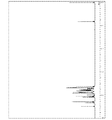
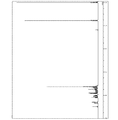
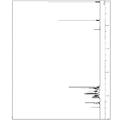
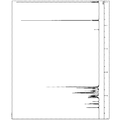
- 1 H-NMR chart of the compound of Example 12 (Compound 66). 1 H-NMR chart of the compound of Example 13 (Compound 62). 1 H-NMR chart of the compound of Example 14 (Compound 54). 1 H-NMR chart of the compound of Example 15 (Compound 110). 1 H-NMR chart of the compound of Example 16 (Compound 112). 1 H-NMR chart of the compound of Example 17 (Compound 18). 1 H-NMR chart of the compound of Example 18 (Compound 82). 1 H-NMR chart of the compound of Example 19 (Compound 111). 1 H-NMR chart of the compound of Example 20 (Compound 113). The figure which showed an example of the layer structure of an organic EL element.
- the novel benzotriazole derivative of the present invention is represented by the following general formula (1), and has a structure in which a group A having a pyridine ring is bonded to a benzotriazole ring.
- Ar 1 represents an aromatic hydrocarbon group or an aromatic heterocyclic group
- Ar 2 represents a deuterium atom, an aromatic hydrocarbon group, or an aromatic heterocyclic group.
- the aromatic hydrocarbon group and aromatic heterocyclic group in Ar 1 and Ar 2 may have a monocyclic structure or may have a condensed polycyclic structure.
- aromatic groups include phenyl, biphenylyl, terphenylyl, tetrakisphenyl, styryl, naphthyl, anthryl, acenaphthenyl, phenanthryl, fluorenyl, indenyl, pyrenyl, triazyl, Pyrimidyl group, furanyl group, pyrrolyl group, thienyl group, quinolyl group, isoquinolyl group, benzofuranyl group, benzothienyl group, indolyl group, carbazolyl group, benzoxazolyl group, benzothiazolyl group, quinoxalyl group, benzoimidazolyl group, pyrazolyl group, dibenzo A furanyl group, a dibenzothienyl group,
- the aromatic heterocyclic group is preferably a sulfur-containing aromatic heterocyclic group such as a thienyl group, a benzothienyl group, a benzothiazolyl group, a dibenzothienyl group, a nitrogen-containing aromatic heterocyclic group, particularly a pyridyl group.
- a sulfur-containing aromatic heterocyclic group such as a thienyl group, a benzothienyl group, a benzothiazolyl group, a dibenzothienyl group, a nitrogen-containing aromatic heterocyclic group, particularly a pyridyl group.
- Such a group is not preferable from the viewpoint of bipolar properties.
- said aromatic group may have a substituent.
- substituents include deuterium atom; fluorine atom; chlorine atom; cyano group; hydroxyl group; nitro group; linear or branched alkyl group having 1 to 6 carbon atoms; cyclic alkyl group (for example, cyclopentyl group).
- Cyclohexyl group linear or branched alkoxy group having 1 to 6 carbon atoms; dialkylamino group substituted with linear or branched alkyl group having 1 to 6 carbon atoms; phenyl group, naphthyl Aryl groups such as a group, anthryl group, fluorenyl group and styryl group; aromatic heterocyclic groups such as a pyridyl group, a pyridoindolyl group, a quinolyl group and a benzothiazolyl group; These substituents may further have a substituent such as a trifluoromethyl group. Examples of the alkyl group in the substituent and the alkyl group in the alkoxy group are the same as those exemplified as the alkyl groups represented by R 1 to R 8 in the general formula (2) described below. It can be illustrated.
- the monovalent group A has a pyridine ring and is represented by the following formula (2).
- m represents 0 or an integer of 1 to 2.
- X in the ring represents a carbon atom or a nitrogen atom.
- R 1 to R 8 each represents a hydrogen atom, a deuterium atom, a fluorine atom, a chlorine atom, a cyano group, an alkyl group having 1 to 6 carbon atoms, an aromatic hydrocarbon group, or an aromatic heterocyclic group.
- the alkyl group is not particularly limited as long as it has 1 to 6 carbon atoms, and may have, for example, a linear or branched structure, such as a methyl group, an ethyl group, or n-propyl.
- Such an alkyl group may also have a substituent, such as a deuterium atom; a fluorine atom; a chlorine atom; a cyano group; a phenyl group, a naphthyl group, an anthryl group, a fluorenyl group, a styryl group, and the like.
- An aryl group such as a pyridyl group, a pyridoindolyl group, a quinolyl group, and a benzothiazolyl group;
- a representative example of a substituted alkyl group is a trifluoromethyl group.
- the aromatic hydrocarbon group and the aromatic heterocyclic group may be the same as those exemplified for the groups Ar 1 and Ar 2 , and these aromatic groups may have a substituent and such substitution.
- the types of groups are the same as those exemplified for the groups Ar 1 and Ar 2 .
- the benzotriazole derivative of the present invention represented by the general formula (1) described above can be synthesized, for example, by the following method.
- a 2-aminoarylazobenzene derivative containing a pyridyl group having groups R 5 to R 8 in the general formula (2) is synthesized from a 1,2-diaminobenzene derivative and a nitroarylpyridine derivative by a known method.
- This 2-aminoarylazobenzene derivative is subjected to an oxidative cyclization reaction with iodobenzene diacetate to synthesize a 2-arylbenzotriazole derivative having the above pyridyl group as a substituent (for example, Aust. J. Chem.
- the resulting compound is purified by column chromatography, adsorption purification using silica gel, activated carbon, activated clay, etc., recrystallization using a solvent, crystallization method, and the like.
- the compound is identified by NMR analysis.
- X in the group represented by the formula (2) is preferably a carbon atom.
- Such a benzotriazole derivative is represented by the following general formula (1-1): expressed. Where Ar 1 , Ar 2 , R 1 to R 8 and m have the same meanings as described in the general formula (1).
- m is preferably 1.
- Such a benzotriazole derivative is represented by the following general formula (1a). Where Ar 1 , Ar 2 , R 1 to R 8 and m have the same meanings as described in the general formula (1).
- benzotriazole derivative represented by the above general formula (1a) may have, for example, the following general formulas (1a-1) to (1), depending on the bonding position of the benzene ring interposed between the benzotriazole ring and the pyridine ring. It is classified into the compound represented by (1a-4).
- the above-described benzotriazole derivative of the present invention has a high glass transition point (Tg), can form a thin film excellent in heat resistance, and can maintain an amorphous state stably and maintain a thin film state stably. it can. Furthermore, the electron injection characteristics are good, the electron moving speed is fast, and a high hole blocking element capability is exhibited. For example, when a deposited film having a thickness of 100 nm is formed using the compound of the present invention and the work function thereof is measured, an extremely high value is shown. Therefore, the benzotriazole derivative of the present invention is extremely useful as a material for forming an organic layer of an organic EL device.
- Tg glass transition point
- the organic EL element provided with the organic layer formed using the compound of the present invention described above has, for example, the layer structure shown in FIG. That is, a transparent anode 2, a hole transport layer 3, a light emitting layer 4, a hole blocking layer 5, an electron transport layer 6, an electron injection on a glass substrate 1 (a transparent substrate such as a transparent resin substrate may be used).
- a layer 7 and a cathode 8 are provided.
- the organic EL device to which the compound of the present invention is applied is not limited to the above layer structure, and an electron blocking layer can be provided between the light emitting layer 4 and the hole transport layer 3, Further, a simple layer structure in which the electron injection layer 7 and the hole blocking layer 5 are omitted can be obtained.
- some layers can be omitted.
- a simple layer structure in which the anode 2, the hole transport layer 3, the light emitting layer 4, the electron transport layer 6, and the cathode 8 are provided on the substrate 1 can be used.
- the benzotriazole derivative of the present invention is a material for forming an organic layer (for example, the electron injection layer 7, the electron transport layer 6, the hole blocking layer 5 or the light emitting layer 4) provided between the anode 2 and the cathode 8. Is preferably used.
- the transparent anode 2 may be formed of a known electrode material, and is formed by vapor-depositing an electrode material having a large work function such as ITO or gold on the substrate 1.
- a hole injection layer (not shown) (which can be provided between the transparent electrode 2 and the hole transport layer 3) can be formed using a conventionally known material, for example, the following materials.
- Application-type polymer materials such as poly (3,4-ethylenedioxythiophene) (PEDOT), poly (styrene sulfonate) (PSS), etc .;
- An acceptor heterocyclic compound such as hexacyanoazatriphenylene; Formation of a layer (thin film) using the above materials can be performed by a known method such as a spin coating method or an ink jet method in addition to a vapor deposition method.
- the hole transport layer 3 can also be formed using a conventionally known hole transport material.
- Typical examples of such hole materials are as follows.
- Benzidine derivatives such as N, N'-diphenyl-N, N'-di (m-tolyl) Benzidine (hereinafter abbreviated as TPD); N, N'-diphenyl-N, N'-di ( ⁇ -naphthyl) Benzidine (hereinafter abbreviated as NPD); N, N, N ′, N′-tetrabiphenylylbenzidine; Amine derivatives such as 1,1-bis [4- (di-4-tolylamino) phenyl] Cyclohexane (hereinafter abbreviated as TAPC); Various triphenylamine trimers and tetramers;
- TPD N, N'-diphenyl-N, N'-di (m-tolyl) Benzidine
- NPD N, N'-diphenyl
- the hole transport layer 3 (the same applies to the hole injection layer), it is possible to use a material which is usually used for the layer and further P-doped with trisbromophenylamine hexachloroantimony.
- the hole transport layer 3 (or hole injection layer) can be formed using a polymer compound having a basic skeleton of TPD.
- an electron blocking layer (not shown) (which can be provided between the light emitting layer 4 and the hole transport layer 3), a known compound having an electron blocking action, such as a carbazole derivative or a triphenylsilyl group And a compound having a triarylamine structure can be used.
- a known compound having an electron blocking action such as a carbazole derivative or a triphenylsilyl group
- a compound having a triarylamine structure can be used as follows.
- TCTA Triphenylamine
- mCP 1,3-bis (carbazol-9-yl) benzene
- Ad-Cz 2,2-bis (4-carbazol-9-ylphenyl) Adamantane
- the electron blocking layer is formed by using one kind or two or more kinds of known hole transport materials as described above. A plurality of layers are formed by using one or more kinds of these hole transport materials. A multilayer film formed and laminated with such layers can be used as an electron blocking layer.
- the light-emitting layer 4 of the organic EL element can be formed using the above-described benzotriazole derivative of the present invention as a light-emitting material.
- benzotriazole derivative of the present invention in addition to metal complexes of quinolinol derivatives such as Alq 3 , zinc, beryllium, aluminum, etc.
- These light emitting materials such as various metal complexes, anthracene derivatives, bisstyrylbenzene derivatives, pyrene derivatives, oxazole derivatives, polyparaphenylene vinylene derivatives can also be used.
- the light emitting layer 4 can also be comprised with a host material and a dopant material.
- a thiazole derivative, a benzimidazole derivative, a polydialkylfluorene derivative, or the like can be used as the host material in addition to the above light emitting material.
- the dopant material quinacridone, coumarin, rubrene, perylene and derivatives thereof, benzopyran derivatives, rhodamine derivatives, aminostyryl derivatives, and the like can be used.
- Such a light-emitting layer 4 can also have a single-layer configuration using one or more of the light-emitting materials, or a multilayer structure in which a plurality of layers are stacked.
- the light emitting layer 4 can also be formed using a phosphorescent light emitting material as the light emitting material.
- a phosphorescent material a phosphorescent material of a metal complex such as iridium or platinum can be used.
- green phosphorescent emitters such as Ir (ppy) 3
- blue phosphorescent emitters such as FIrpic and FIr6
- red phosphorescent emitters such as Btp 2 Ir (acac)
- the material is used by doping a hole transporting host material or an electron transporting host material.
- the compound of the present invention may be used. it can.
- CBP 4,4′-di (N-carbazolyl) biphenyl
- TCTA 4,4′-di (N-carbazolyl) biphenyl
- mCP mCP
- the compound of the present invention may be used. it can.
- UGH2 p-bis (triphenylsilyl) benzene
- TPBI 1-phenyl-1H-benzimidazole
- the host material with a phosphorescent light emitting material by co-evaporation in the range of 1 to 30 weight percent with respect to the entire light emitting layer in order to avoid concentration quenching.
- the hole blocking layer 5 of the organic EL device can be formed using a compound having a known hole blocking action in addition to the benzotriazole derivative of the present invention.
- known compounds having such a hole blocking action include phenanthroline derivatives such as bathocuproin (hereinafter abbreviated as BCP), aluminum (III) bis (2-methyl-8-quinolinato) -4-phenylpheno
- BCP bathocuproin
- BAlq metal complexes of quinolinol derivatives
- triazole derivatives, triazine derivatives, oxadiazole derivatives, and the like can be given.
- These materials can also be used for forming the electron transport layer 6 described below, and the hole blocking layer 5 and the electron transport layer 6 can be used in combination.
- Such a hole blocking layer 5 can also have a single layer or multilayer structure, and each layer is formed using one or more of the compounds having the hole blocking action described above.
- the electron transport layer 6 is a known electron transport compound such as a metal complex of a quinolinol derivative including Alq 3 and BAlq, as well as zinc, beryllium, aluminum, and the like. It is formed using various metal complexes, triazole derivatives, triazine derivatives, oxadiazole derivatives, thiadiazole derivatives, carbodiimide derivatives, quinoxaline derivatives, phenanthroline derivatives, silole derivatives, and the like.
- the electron transport layer 6 can also have a single layer or multilayer structure, and each layer is formed using one or more of the electron transport compounds described above.
- the electron injection layer 7 is also known per se, for example, alkali metal salts such as lithium fluoride and cesium fluoride, alkaline earth metal salts such as magnesium fluoride, oxidation It can be formed using a metal oxide such as aluminum.
- an electrode material having a low work function such as aluminum, or an alloy having a lower work function such as a magnesium silver alloy, a magnesium indium alloy, or an aluminum magnesium alloy is used as the electrode material.
- An organic EL device in which at least one of the organic layers (for example, the electron injection layer 7, the electron transport layer 6, the hole blocking layer 5 or the light emitting layer 4) is formed using the benzotriazole derivative of the present invention has a luminous efficiency and It has high power efficiency, low practical driving voltage, low light emission starting voltage, and extremely excellent durability.
- the structure of the obtained light green powder was identified using NMR. The results of 1 H-NMR measurement are shown in FIG.
- the structure of the obtained light green powder was identified using NMR. The results of 1 H-NMR measurement are shown in FIG.
- Example 21 About each compound of this invention obtained by said Example, melting
- the compound of the present invention has a glass transition point of 100 ° C. or higher. This indicates that the thin film formed by the compound of the present invention is stably maintained (the thin film state is stable).
- Example 22 Using each compound of the present invention obtained in the above examples, a deposited film with a film thickness of 100 nm was prepared on an ITO substrate, and the work function was measured with an atmospheric photoelectron spectrometer (AC-3 type, manufactured by Riken Keiki Co., Ltd.). Was measured. The results were as follows.
- the compound of the present invention has a value larger than the work function 5.4 eV of general hole transport materials such as NPD and TPD, and has a large hole blocking ability.
- Example 23 On a glass substrate 1 on which an ITO electrode is previously formed as a transparent anode 2, a hole injection layer 3, a hole transport layer 4, a light emitting layer 5, a hole blocking layer 6, an electron transport layer 7, an electron injection layer 8. Then, the cathode (aluminum electrode) 9 was deposited in this order to produce an organic EL element having a layer structure shown in FIG.
- the glass substrate 1 on which ITO having a thickness of 150 nm was formed was washed with an organic solvent, and then the surface was washed by oxygen plasma treatment. Then, this glass substrate with an ITO electrode was mounted in a vacuum vapor deposition machine and the pressure was reduced to 0.001 Pa or less. Subsequently, a compound 114 having the following structural formula was formed as the hole injection layer 3 so as to cover the transparent anode 2 so as to have a film thickness of 20 nm at a deposition rate of 6 nm / min.
- a compound 115 having the following structural formula was formed as the hole transport layer 4 so as to have a film thickness of 40 nm at a deposition rate of 6 nm / min.
- a film thickness of 30 nm is formed on the hole transport layer 4.
- combined in Example 7 was formed so that it might become a film thickness of 30 nm with a vapor deposition rate of 6 nm / min as hole blocking layer and electron transport layers 6 and 7.
- the hole blocking layer / electron transport layers 6 and 7 thus formed, lithium fluoride was formed as the electron injection layer 8 so as to have a film thickness of 0.5 nm at a deposition rate of 0.6 nm / min. .
- aluminum was deposited to a thickness of 150 nm to form the cathode 9.
- the characteristic measurement was performed at normal temperature in air
- Example 24 An organic EL device was produced under the same conditions as in Example 23, except that the compound 46 of the present invention synthesized in Example 8 was used as the material of the hole blocking layer / electron transport layers 6 and 7 in Example 23. did. About this organic EL element, the characteristic measurement was performed at normal temperature in air
- Example 25 An organic EL device was produced under the same conditions as in Example 23, except that the compound 4 of the present invention synthesized in Example 1 was used as the material for the hole blocking layer / electron transport layers 6 and 7 in Example 23. did. About the produced organic EL element, the characteristic measurement was performed at normal temperature in air
- Example 26 An organic EL device was produced under the same conditions as in Example 23, except that the compound 5 of the present invention synthesized in Example 2 was used as the material of the hole blocking layer / electron transport layers 6 and 7 in Example 23. did. About the produced organic EL element, the characteristic measurement was performed at normal temperature in air
- Example 27 An organic EL device was produced under the same conditions as in Example 23, except that the compound 8 of the present invention synthesized in Example 3 was used as the material of the hole blocking layer / electron transport layers 6 and 7 in Example 23. did. About the produced organic EL element, the characteristic measurement was performed at normal temperature in air
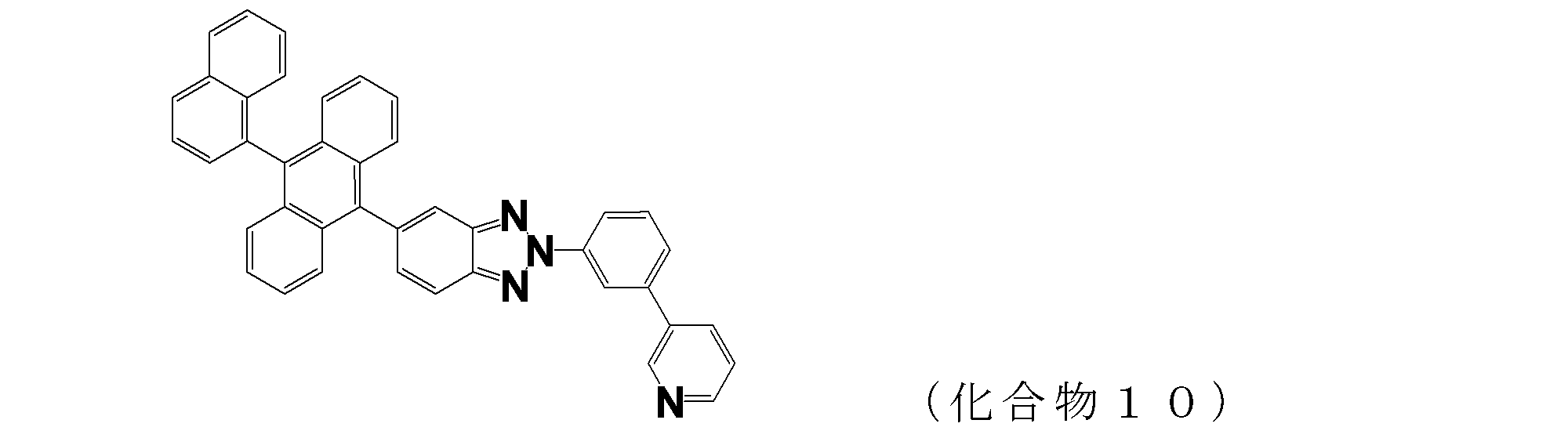
- Example 28 An organic EL device was produced under the same conditions as in Example 23, except that the compound 10 of the present invention synthesized in Example 4 was used as the material for the hole blocking layer / electron transport layers 6 and 7 in Example 23. did. About the produced organic EL element, the characteristic measurement was performed at normal temperature in air
- Example 29 An organic EL device was produced under the same conditions as in Example 23, except that the compound 14 of the present invention synthesized in Example 5 was used as the material for the hole blocking layer / electron transport layers 6 and 7 in Example 23. did. About the produced organic EL element, the characteristic measurement was performed at normal temperature in air
- Example 30 An organic EL device was produced under the same conditions as in Example 23, except that the compound 15 of the present invention synthesized in Example 6 was used as the material of the hole blocking layer / electron transport layers 6 and 7 in Example 23. did. About the produced organic EL element, the characteristic measurement was performed at normal temperature in air
- Example 31 An organic EL device was produced under the same conditions as in Example 23, except that the compound 18 of the present invention synthesized in Example 17 was used as the material of the hole blocking layer / electron transport layers 6 and 7 in Example 23. did. About the produced organic EL element, the characteristic measurement was performed at normal temperature in air
- Example 32 An organic EL device was produced under the same conditions as in Example 23, except that the compound 66 of the present invention synthesized in Example 12 was used as the material of the hole blocking layer / electron transport layers 6 and 7 in Example 23. did. About the produced organic EL element, the characteristic measurement was performed at normal temperature in air
- Example 33 An organic EL device was produced under the same conditions as in Example 23, except that the compound 112 of the present invention synthesized in Example 16 was used as the material of the hole blocking layer / electron transport layers 6 and 7 in Example 23. did. About the produced organic EL element, the characteristic measurement was performed at normal temperature in air
- Example 23 was replaced with Example 23 except that Compound 118 having the following structural formula disclosed in WO2003 / 060956 was used as the material of the hole blocking layer / electron transport layer 6 and 7 in Example 23.
- An organic EL device was produced under the same conditions as those described above.
- Table 1 summarizes the measurement results of the light emission characteristics when a DC voltage was applied to the produced organic EL element.
- the driving voltage at a current density of 10 mA / cm 2 was 5.95 V of the organic EL device (Comparative Example 1) using the compound 118 of the structural formula, and Example 23 of the present invention.
- the voltage was lowered to 4.11 to 4.92V.
- both luminance and luminous efficiency were improved when a current density of 10 mA / cm 2 was passed.
- the power efficiency was greatly improved from 5.21 to 7.87 lm / W in Examples 23 to 33 as compared to 4.19 lm / W in Comparative Example 1.
- the organic EL device of the present invention is superior in luminous efficiency and power efficiency as compared with a device using the compound 118 of the structural formula used as a general electron transporting material, and is further practically driven. It has been found that a significant drop in voltage can be achieved.
- the speed of electron transfer of such a benzotriazole derivative is used as a general electron transport material because of a significant decrease in driving voltage in an organic EL device using the benzotriazole derivative of the present invention having a benzotriazole ring structure and a pyridine ring structure. It is expected to be faster in each stage than the compound 118 of the above structural formula.
- the benzotriazole derivative of the present invention is excellent as a compound for an organic EL device because it has good electron injection characteristics, excellent hole blocking ability, and a stable thin film state.
- an organic EL device using the compound, high luminous efficiency and power efficiency can be obtained, practical driving voltage can be lowered, and durability can be improved. For example, it has become possible to develop home appliances and lighting.
Landscapes
- Chemical & Material Sciences (AREA)
- Organic Chemistry (AREA)
- Engineering & Computer Science (AREA)
- Materials Engineering (AREA)
- Physics & Mathematics (AREA)
- Spectroscopy & Molecular Physics (AREA)
- Optics & Photonics (AREA)
- Electroluminescent Light Sources (AREA)
- Plural Heterocyclic Compounds (AREA)
Abstract
Description
また発光効率の更なる向上を目的として三重項励起子の利用が試みられ、燐光発光性化合物の利用も検討されている。
また、特許文献2には、一般的な電子輸送性化合物が開示されているが、このような電子輸送性化合物においても、膜安定性が不足しているか或いは正孔を阻止する機能が不十分である。

Ar1は、芳香族炭化水素基または芳香族複素環基を表し、
Ar2は、水素原子、重水素原子、芳香族炭化水素基または芳香族複
素環基を表し、
Aは、下記式(2)で示される1価基である、

mは、0または1ないし2の整数を表し、
Xは、炭素原子または窒素原子を表し、
R1~R8は、それぞれ、水素原子、重水素原子、フッ素原子、
塩素原子、シアノ基、炭素原子数1ないし6のアルキル基、芳
香族炭化水素基または芳香族複素環基を表し、
Xが窒素原子である場合、該窒素原子には、R1~R4で示さ
れる基は結合しておらず且つR1~R4の内の何れか一つは存在
しないものとし、
mが2である場合、複数個存在するR1~R4およびXは、相
互に同一でも異なっていても良いものとする。
前記有機層の少なくとも一つの層は、前記ベンゾトリアゾール誘導体を含んでいることを特徴とする有機エレクトロルミネッセンス素子が提供される。
(A)電子の注入特性が良いこと。
(B)電子の移動速度が速いこと。
(C)正孔阻止能力に優れていること。
(D)薄膜状態が安定であること。
(E)耐熱性に優れていること。
(F)発光効率および電力効率が高いこと。
(G)発光開始電圧が低いこと。
(H)実用駆動電圧が低いこと。
(I)素子寿命が長いこと(高い耐久性を示す)。

これらの芳香族基の例としては、フェニル基、ビフェニリル基、ターフェニリル基、テトラキスフェニル基、スチリル基、ナフチル基、アントリル基、アセナフテニル基、フェナントリル基、フルオレニル基、インデニル基、ピレニル基、トリアジル基、ピリミジル基、フラニル基、ピロリル基、チエニル基、キノリル基、イソキノリル基、ベンゾフラニル基、ベンゾチエニル基、インドリル基、カルバゾリル基、ベンゾオキサゾリル基、ベンゾチアゾリル基、キノキサリル基、ベンゾイミダゾリル基、ピラゾリル基、ジベンゾフラニル基、ジベンゾチエニル基、ナフチリジニル基、フェナントロリニル基、アクリジニル基等を挙げることができる。
これらの中で、芳香族複素環基としては、チエニル基、ベンゾチエニル基、ベンゾチアゾリル基、ジベンゾチエニル基等の含硫黄芳香族複素環基が好ましく、含窒素芳香族複素環基、特にピリジル基のような基は、バイポーラー性の観点から好ましくない。
このような置換基としては、重水素原子;フッ素原子;塩素原子;シアノ基;水酸基;ニトロ基;炭素原子数1ないし6の直鎖状もしくは分岐状のアルキル基;環状アルキル基(例えばシクロペンチル基、シクロヘキシル基);炭素原子数1ないし6の直鎖状もしくは分岐状のアルコキシ基;炭素原子数1ないし6の直鎖状もしくは分岐状のアルキル基で置換されたジアルキルアミノ基;フェニル基、ナフチル基、アントリル基、フルオレニル基、スチリル基等のアリール基;ピリジル基、ピリドインドリル基、キノリル基、ベンゾチアゾリル基等の芳香族複素環基;などを挙げることができる。これらの置換基は、トリフルオロメチル基のように、さらに置換基を有するものであってもよい。
尚、上記置換基におけるアルキル基やアルコキシ基中のアルキル基部分の例としては、以下に述べる一般式(2)中のR1~R8が示すアルキル基の例として挙げたものと同じものを例示することができる。

また、環中のXは、炭素原子または窒素原子を表す。
さらに、R1~R8は、それぞれ、水素原子、重水素原子、フッ素原子、塩素原子、シアノ基、炭素原子数1ないし6のアルキル基、芳香族炭化水素基または芳香族複素環基を表す。
上記のアルキル基は、炭素数が1~6の範囲内である限り特に制限されず、例えば直鎖状、分岐状の何れの構造を有していてよく、メチル基、エチル基、n-プロピル基、i-プロピル基、n-ブチル基、2-メチルプロピル基、t-ブチル基、n-ペンチル基、3-メチルブチル基、t-ペンチル基、n-ヘキシル基、i-ヘキシル基およびt-ヘキシル基を例示することができる。かかるアルキル基も置換基を有していてよく、このような置換基としては、重水素原子;フッ素原子;塩素原子;シアノ基;フェニル基、ナフチル基、アントリル基、フルオレニル基、スチリル基等のアリール基;ピリジル基、ピリドインドリル基、キノリル基、ベンゾチアゾリル基等の芳香族複素環基;などを挙げることができる。置換アルキル基の代表的な例は、トリフルオロメチル基である。
さらに、上記芳香族炭化水素基及び芳香族複素環基は、基Ar1やAr2に関して例示したもの同じであってよく、これらの芳香族基が置換基を有していてよいこと及びかかる置換基の種類も、基Ar1やAr2に関して例示したもの同じである。
また、mが2である場合、複数個存在するR1、R2、R3或いはR4は、それぞれ、互いに異なっていてもよい。また、複数個存在するXも互いに異なっていてよく、例えば、ベンゼン環(X=C)とピリジン環(X=N)とが混在する形で末端のピリジン環に結合するものであってよい。
まず、1,2-ジアミノベンゼン誘導体とニトロアリールピリジン誘導体より、既知の方法によって、一般式(2)における基R5~R8を有するピリジル基を含む2-アミノアリールアゾベンゼン誘導体を合成する。
この2-アミノアリールアゾベンゼン誘導体を、ヨードベンゼンジアセテートによる酸化的環化反応を行うことによって、上記のピリジル基を置換基として有する2-アリールベンゾトリアゾール誘導体を合成する(例えば、Aust.J.Chem.,45,371(1992)参照)。
このようにして得られた2-アリールベンゾトリアゾール誘導体と種々のアリールボロン酸誘導体とを、Suzukiカップリングなどのクロスカップリング反応することによって、一般式(1)で表される本発明のベンゾトリアゾール誘導体を合成することができる。

Ar1、Ar2、R1~R8及びmは、前記一般式(1)に記載した
とおりの意味である。

Ar1、Ar2、R1~R8及びmは、前記一般式(1)に記載した
とおりの意味である。

Ar1、Ar2、R1~R8及びmは、前記一般式(1)に記載した
とおりの意味である。
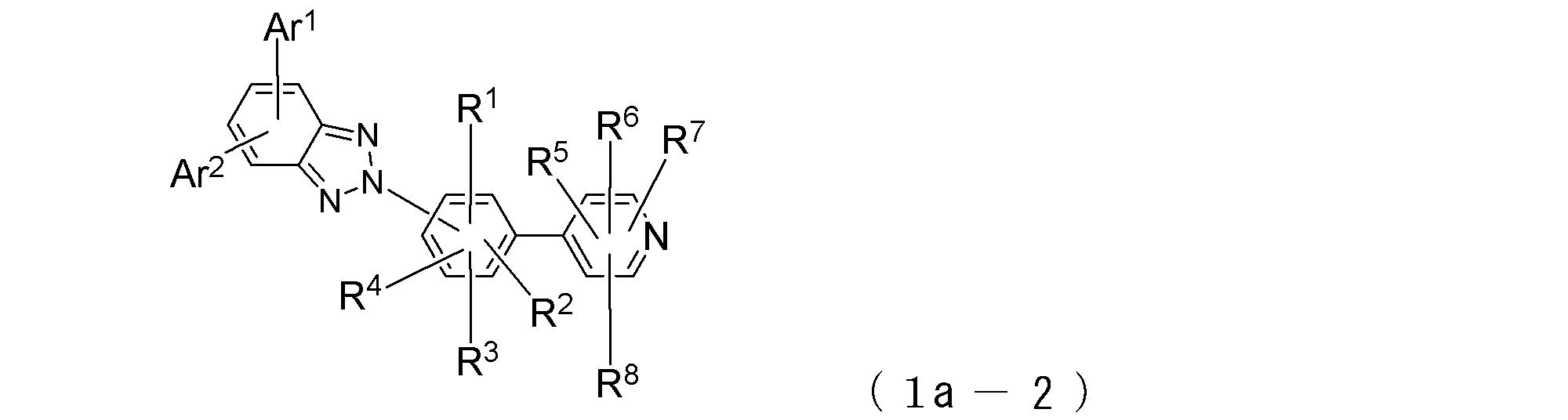
Ar1、Ar2、R1~R8及びmは、前記一般式(1)に記載した
とおりの意味である。

Ar1、Ar2、R1~R8及びmは、前記一般式(1)に記載した
とおりの意味である。

Ar1、Ar2、R1~R8及びmは、前記一般式(1)に記載した
とおりの意味である。
尚、以下の具体例に示す化合物には、基Aを示す一般式(2)のmの値及びXの種類を示し、さらに、特に好適な化合物の場合には、対応する式(1a-1)~(1a-4)の番号を付した。また、以下の化合物において、番号1、2は欠番である。

式(1a-2),式(1a-3)

式(1a-1),式(1a-3)

式(1a-2),式(1a-4)

式(1a-1),式(1a-4)

式(1a-2),式(1a-3)

式(1a-1),式(1a-3)

式(1a-2),式(1a-4)
式(1a-2),式(1a-4)

式(1a-1)
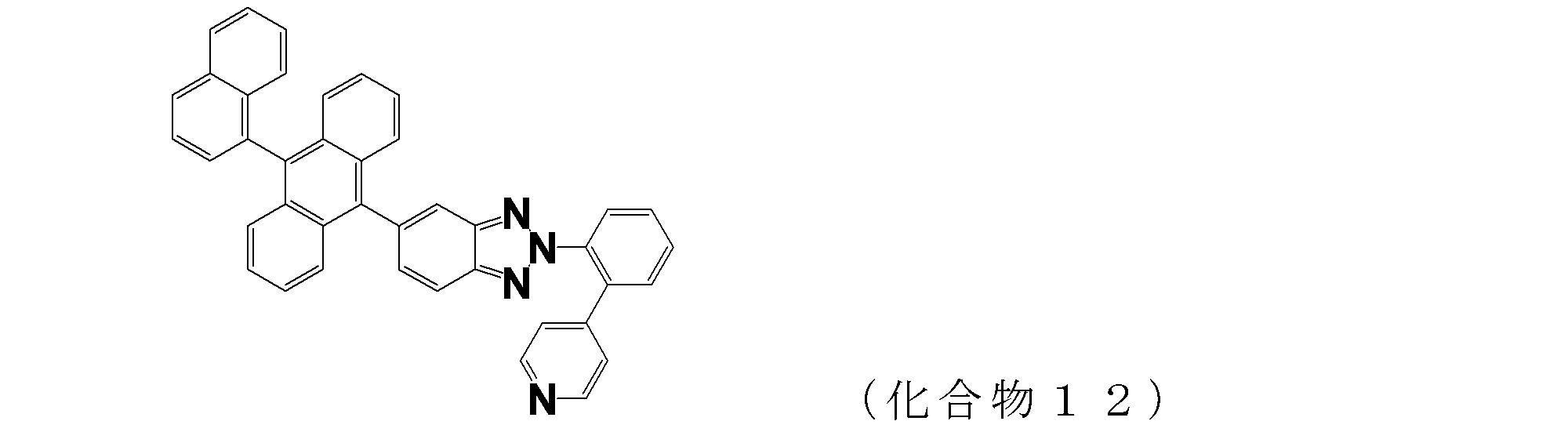
式(1a-2)

式(1a-2),式(1a-3)

式(1a-1),式(1a-3)

式(1a-1),式(1a-4)
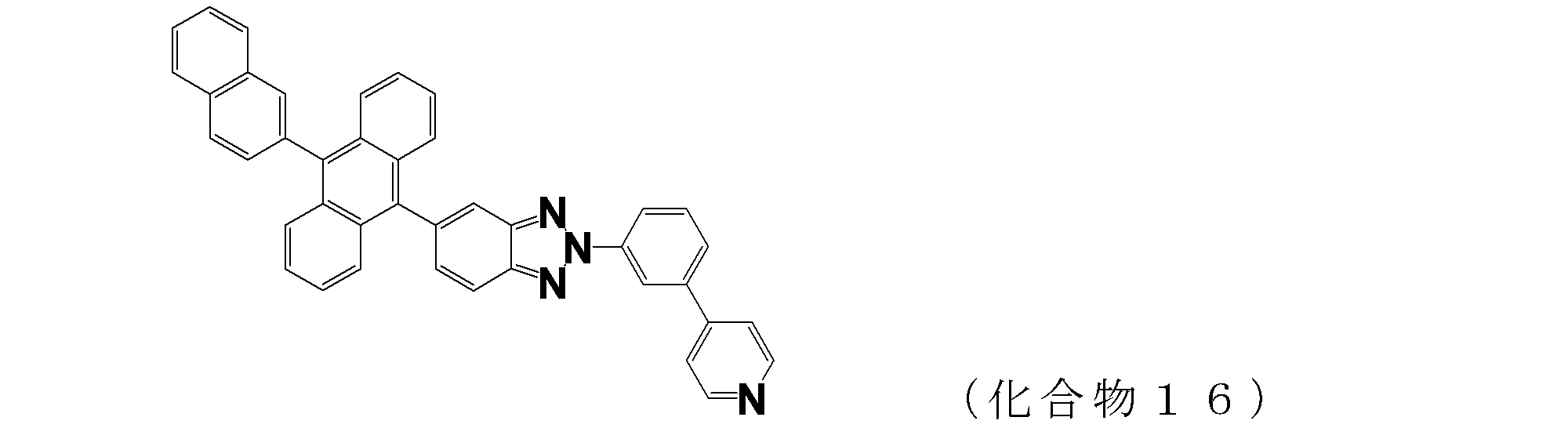
式(1a-2),式(1a-4)

式(1a-2),式(1a-3)

式(1a-1),式(1a-3)
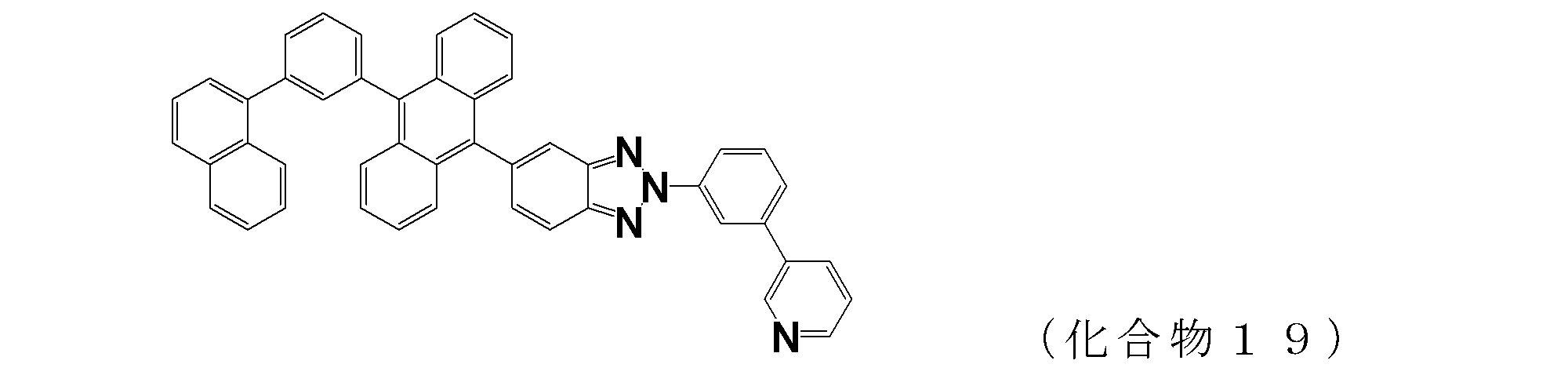
式(1a-1),式(1a-4)

式(1a-2),式(1a-4)

式(1a-2),式(1a-3)
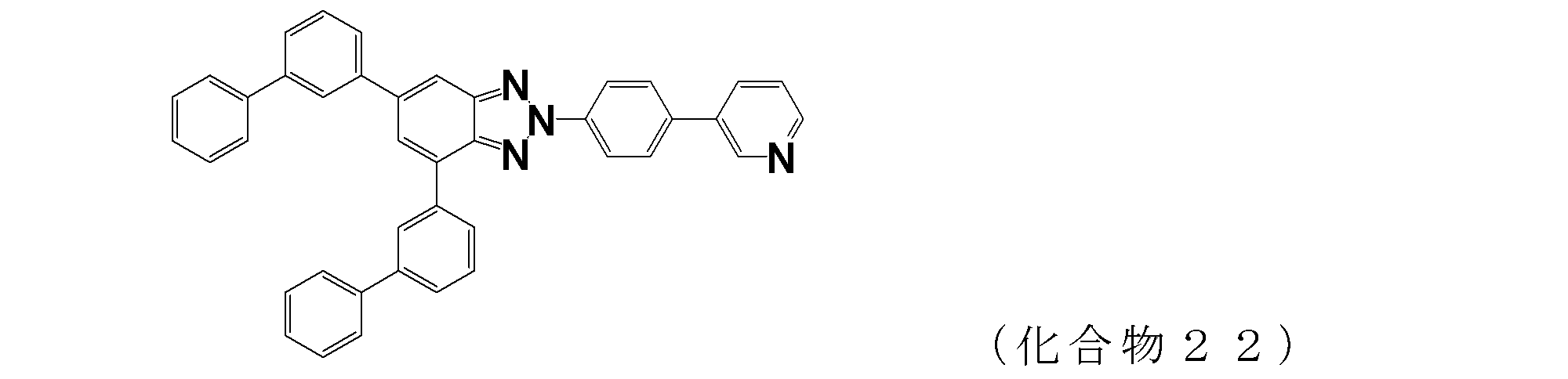
式(1a-1),式(1a-3)

式(1a-2),式(1a-4)
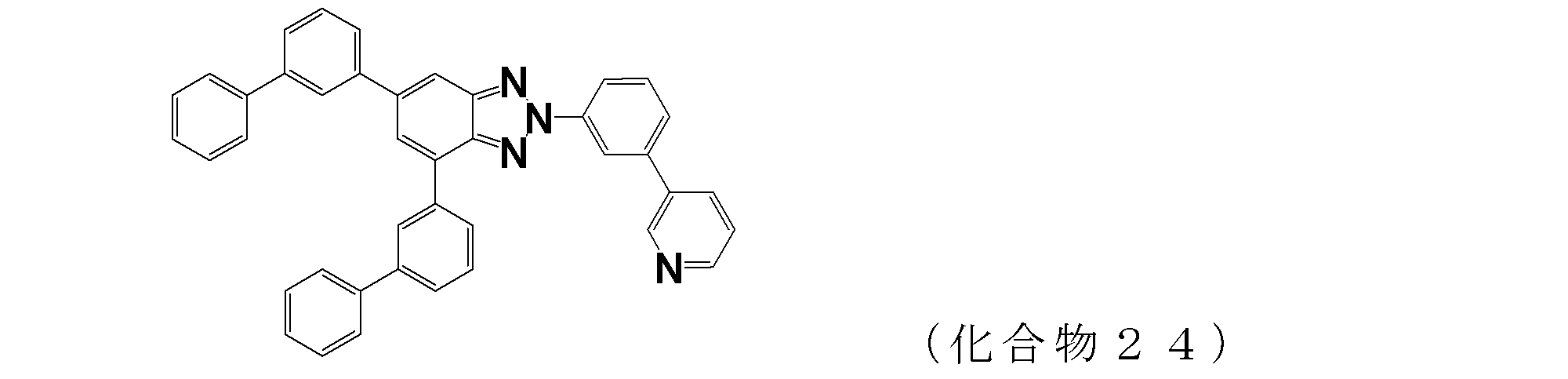
式(1a-1),式(1a-4)
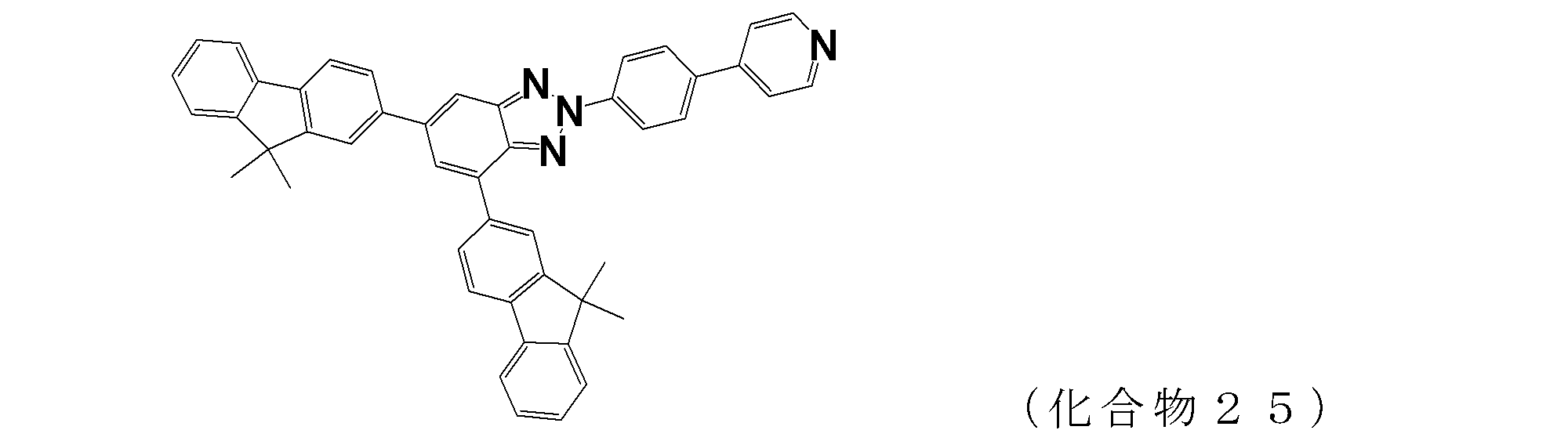
式(1a-2),式(1a-3)

式(1a-1),式(1a-3)
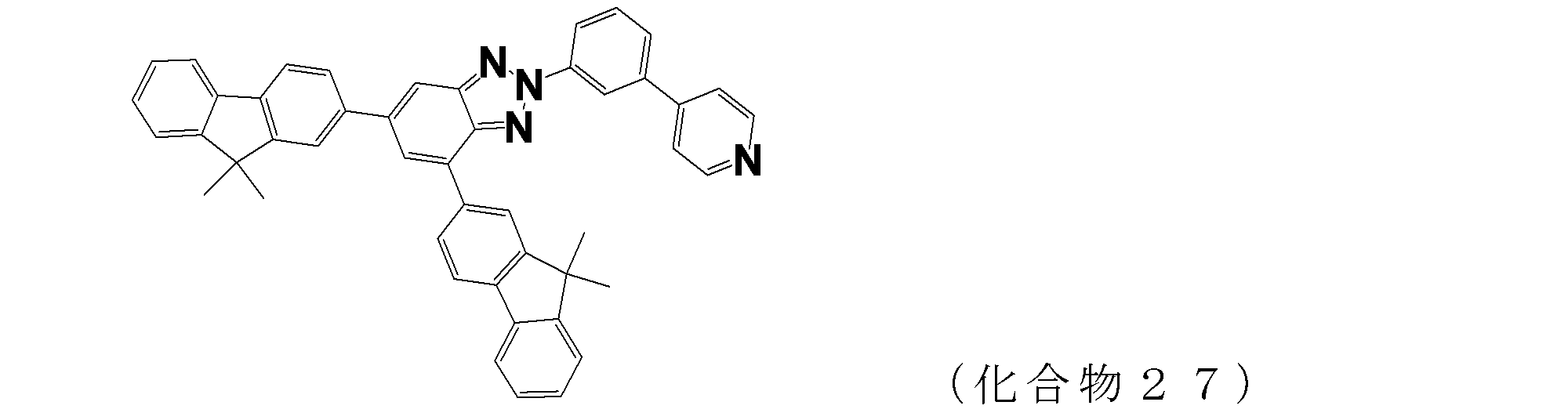
式(1a-2),式(1a-4)

式(1a-1),式(1a-4)
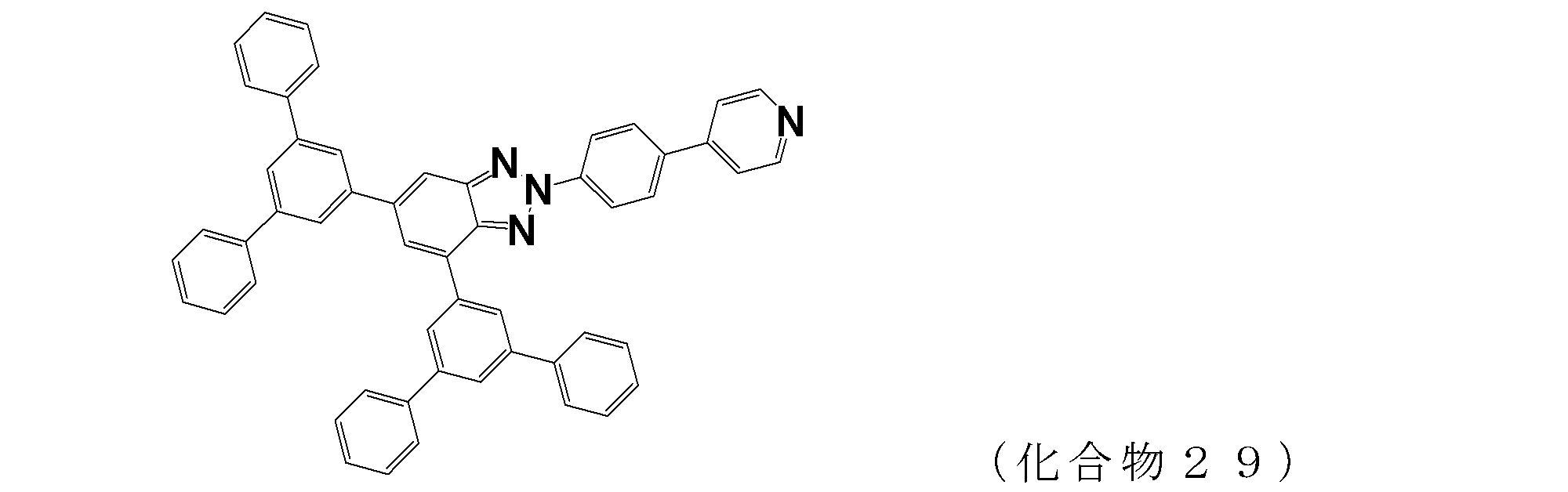
式(1a-2),式(1a-3)

式(1a-1),式(1a-3)
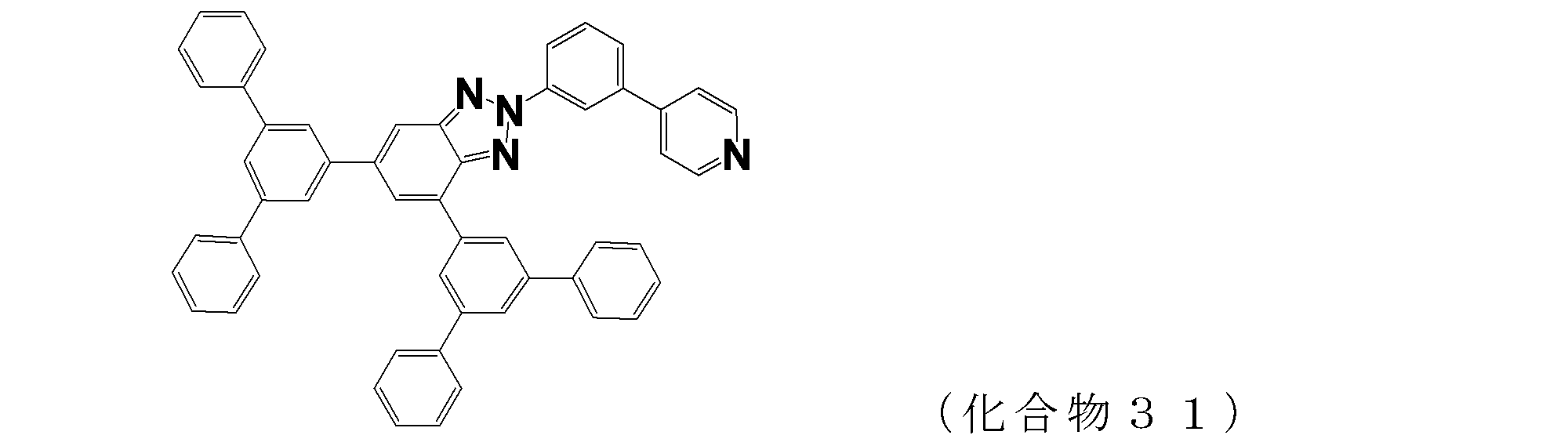
式(1a-2),式(1a-4)

式(1a-1),式(1a-4)
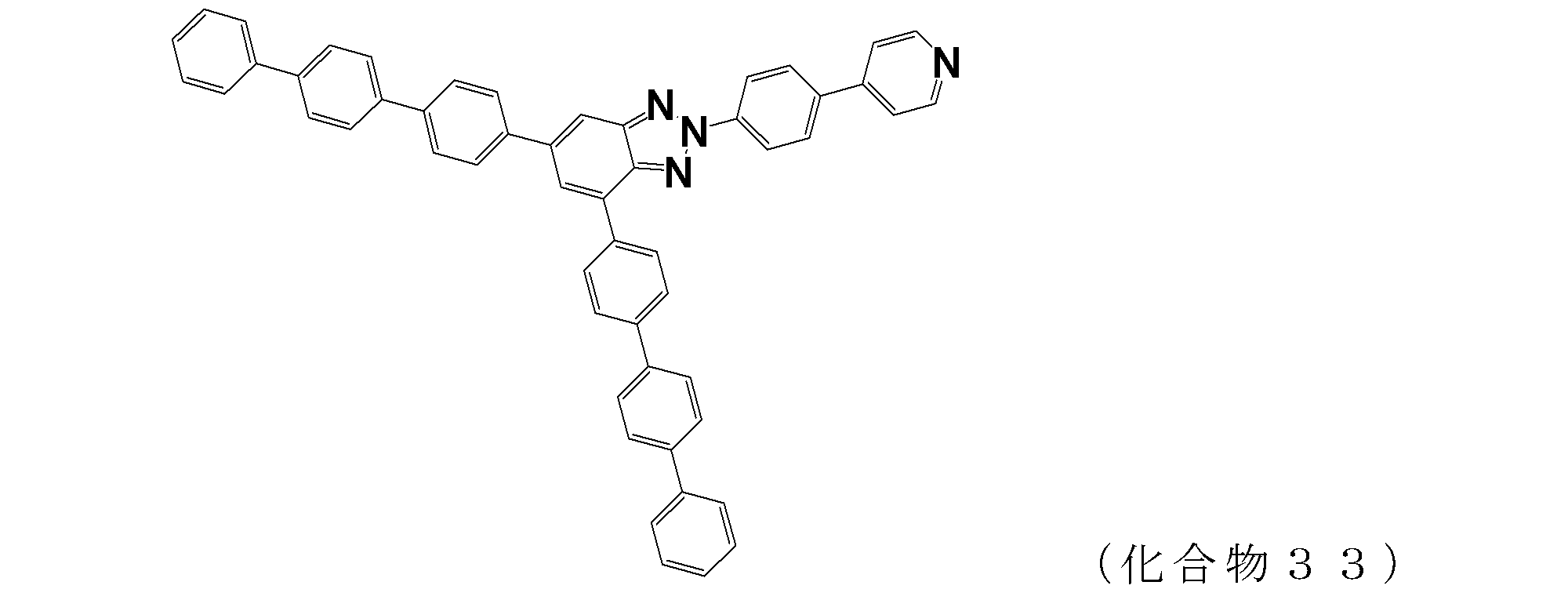
式(1a-2),式(1a-3)

式(1a-1),式(1a-3)

式(1a-2),式(1a-4)

式(1a-1),式(1a-4)

式(1a-2),式(1a-3)
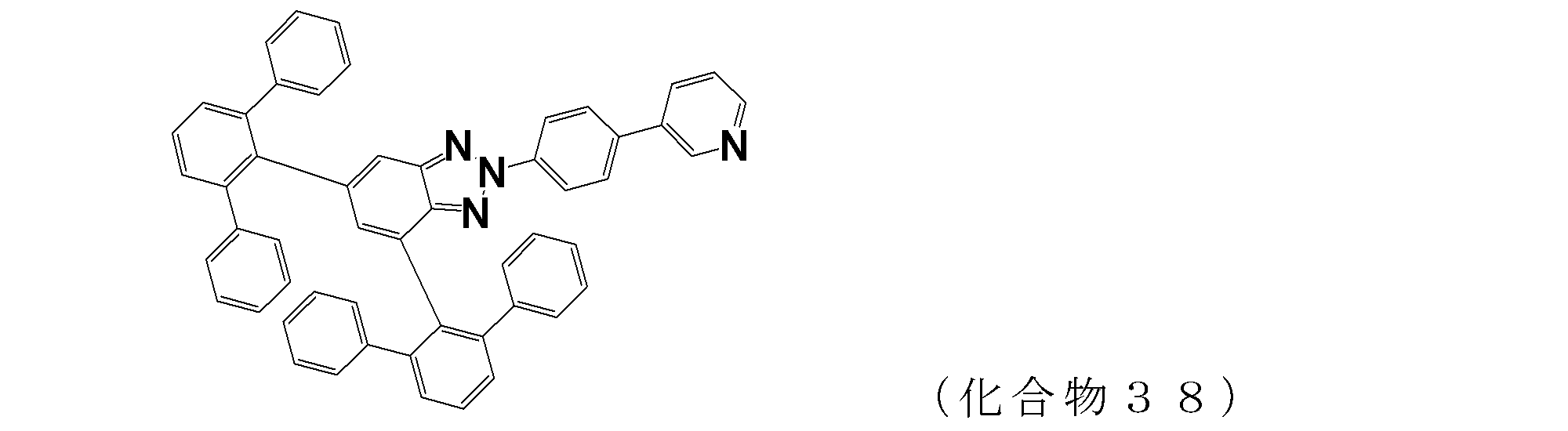
式(1a-1),式(1a-3)

式(1a-2),式(1a-4)

式(1a-1),式(1a-4)

式(1a-2),式(1a-3)
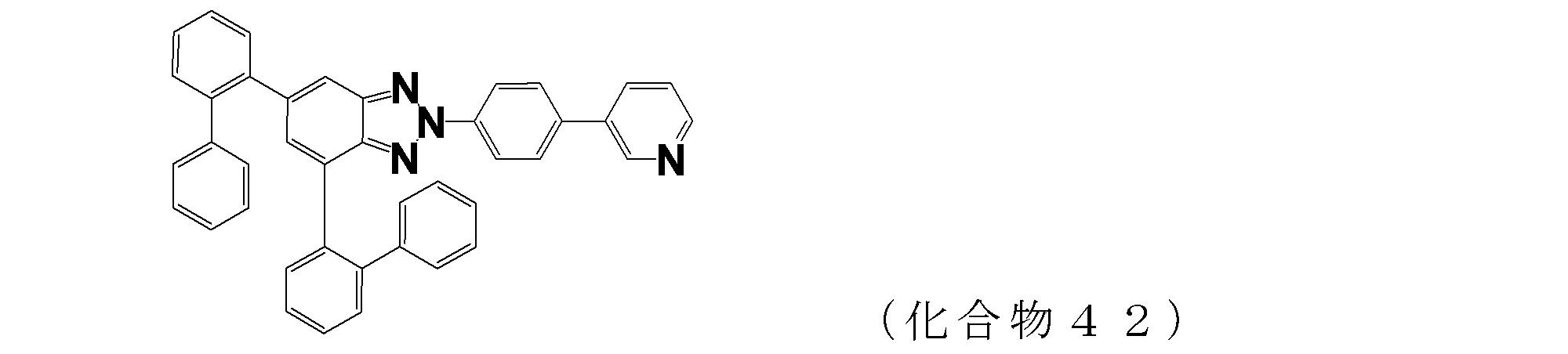
式(1a-1),式(1a-3)

式(1a-2),式(1a-4)

式(1a-1),式(1a-4)
式(1a-2),式(1a-3)
式(1a-1),式(1a-3)

式(1a-2),式(1a-4)

式(1a-1),式(1a-4)

式(1a-2),式(1a-3)

式(1a-1),式(1a-3)

式(1a-2),式(1a-4)

式(1a-1),式(1a-4)

式(1a-2),式(1a-3)
式(1a-1),式(1a-3)
式(1a-2),式(1a-4)

式(1a-1),式(1a-4)
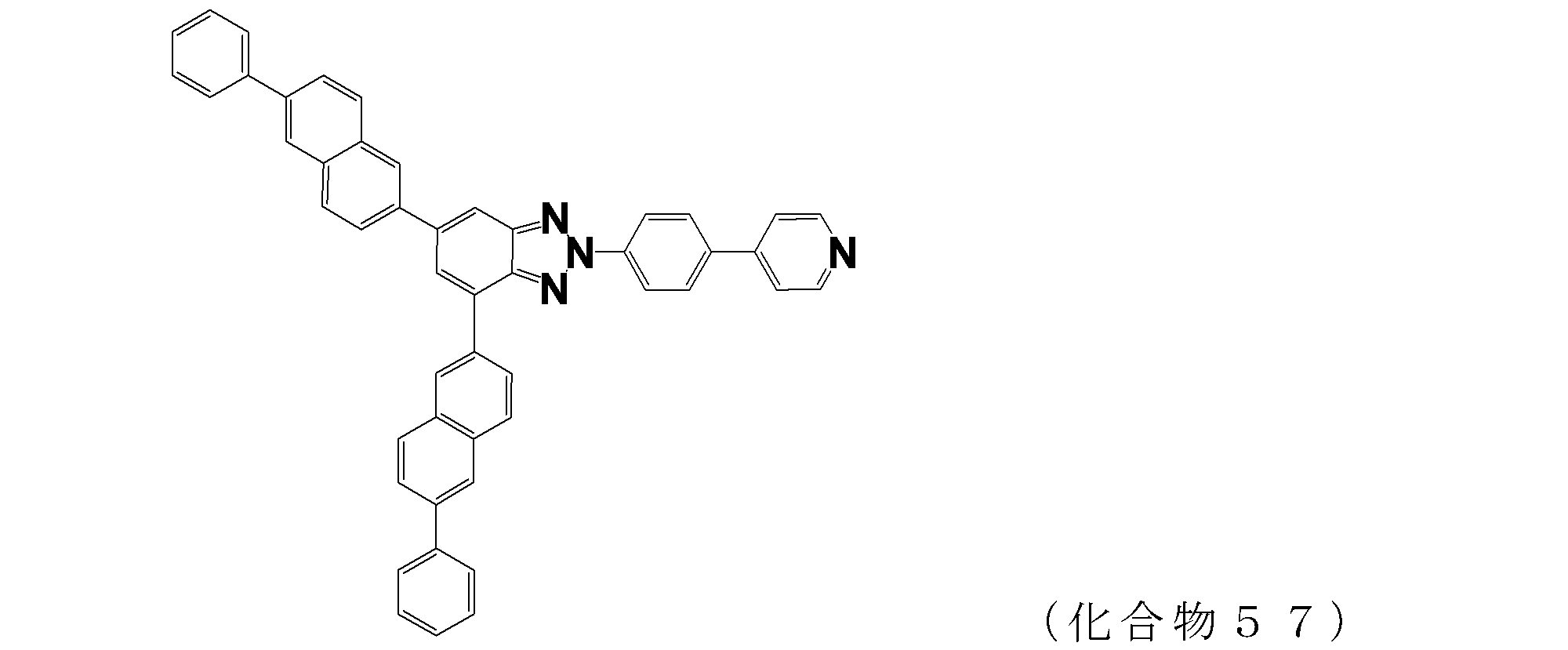
式(1a-2),式(1a-3)

式(1a-1),式(1a-3)
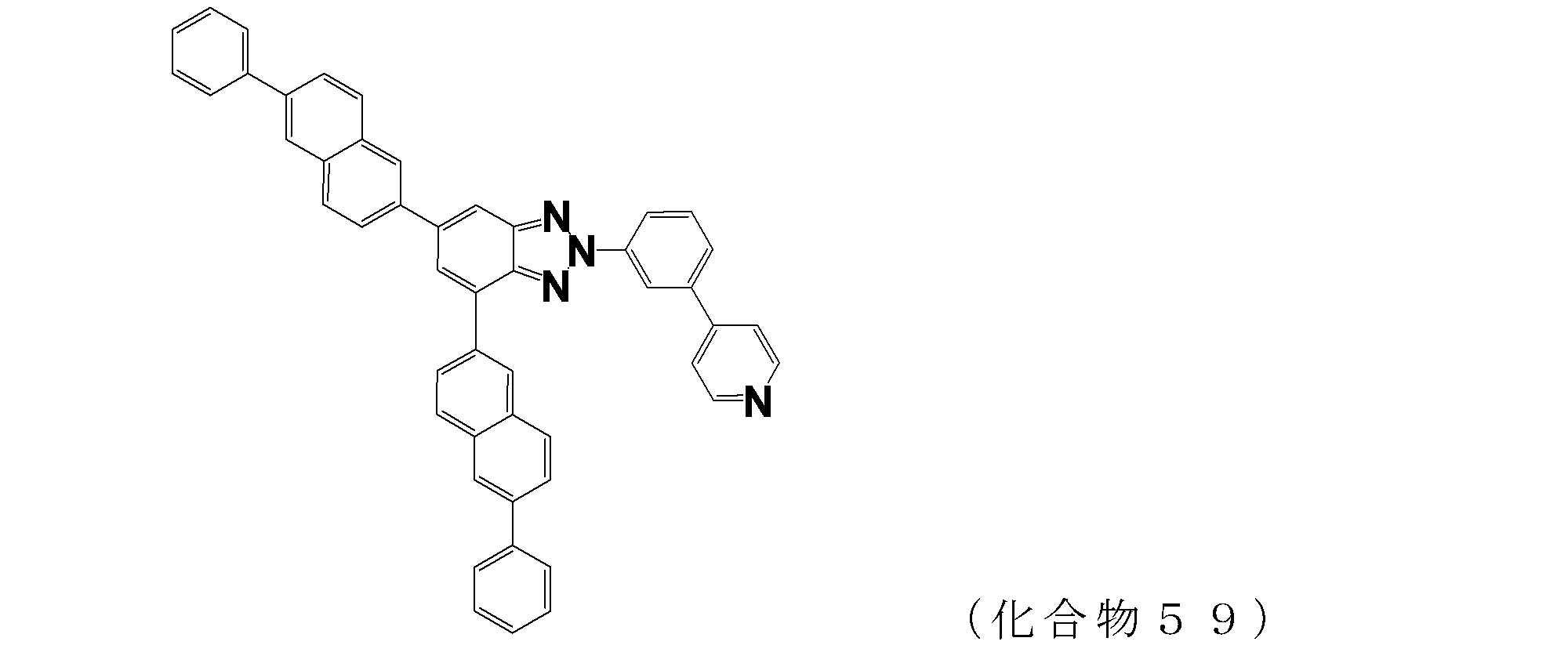
式(1a-2),式(1a-4)
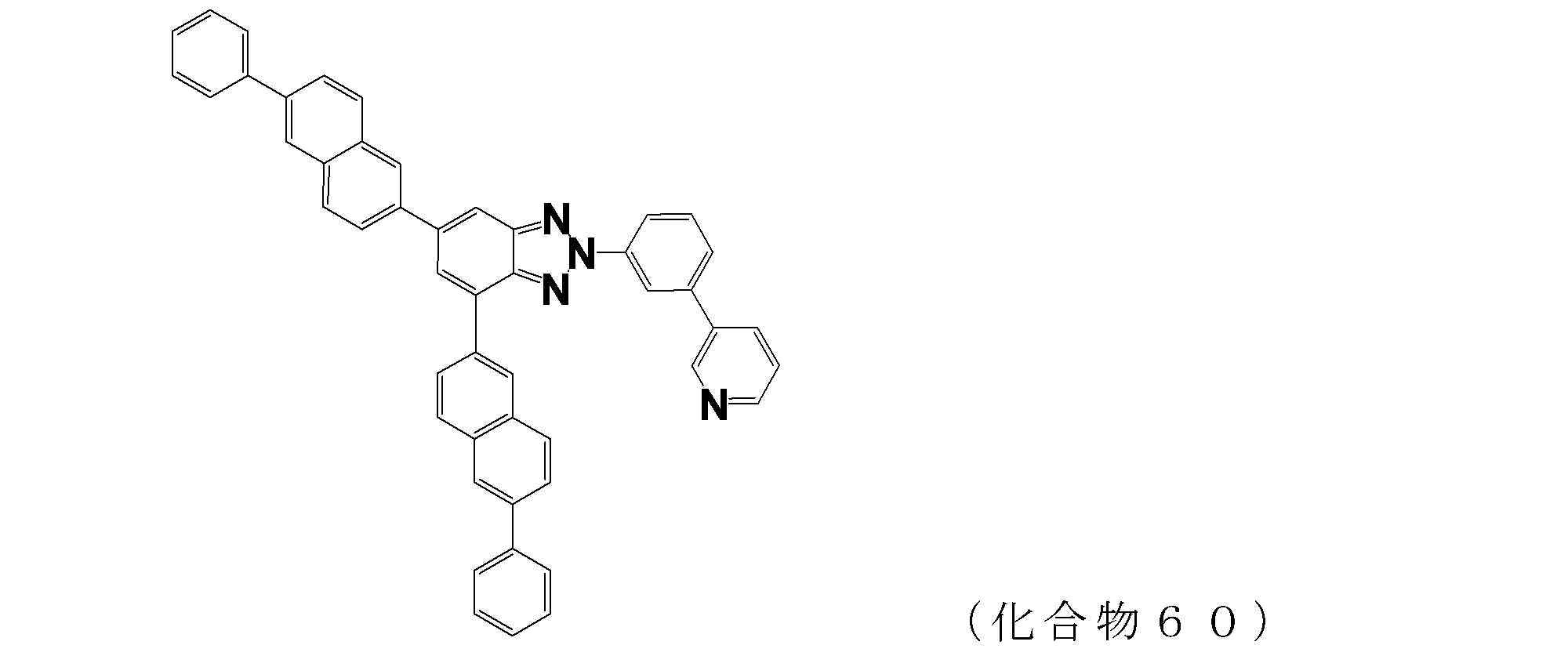
式(1a-1),式(1a-4)
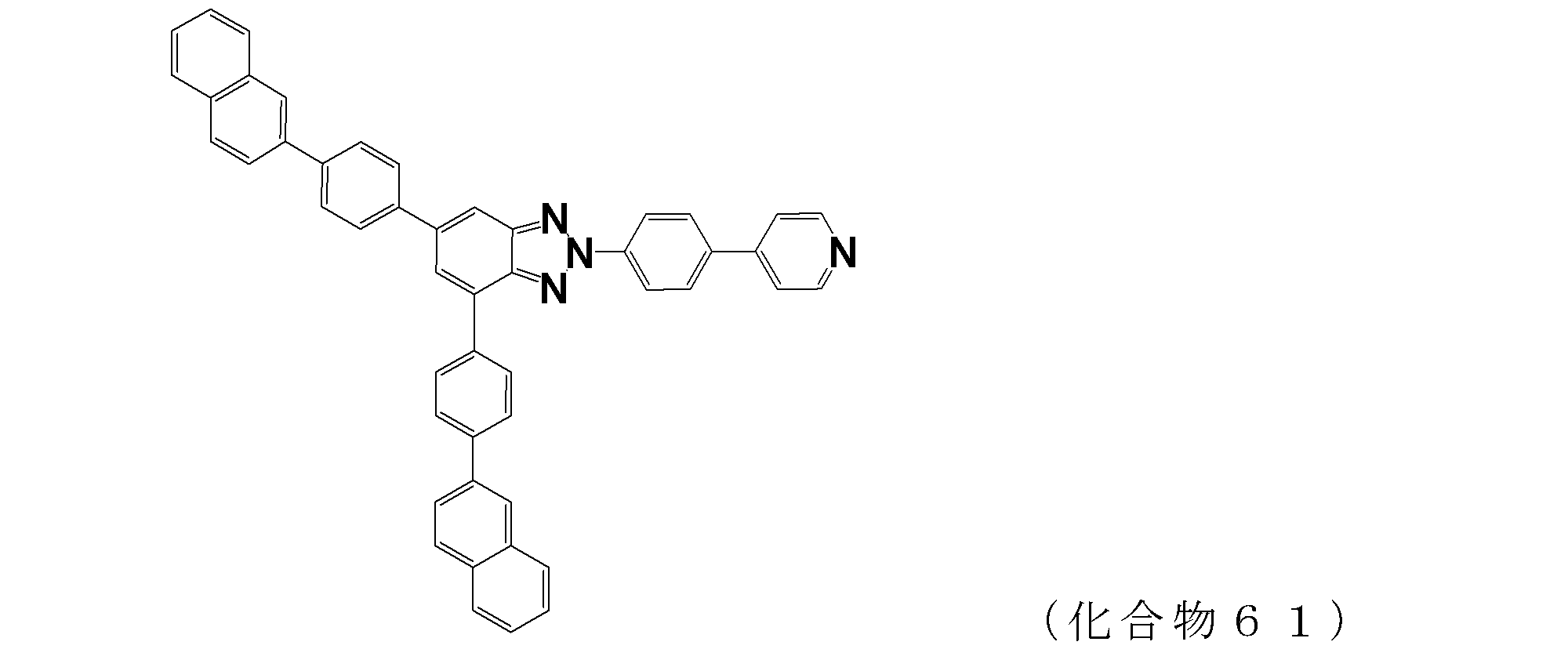
式(1a-2),式(1a-3)

式(1a-1),式(1a-3)

式(1a-2),式(1a-4)

式(1a-1),式(1a-3)

式(1a-2),式(1a-3)

式(1a-1),式(1a-3)

式(1a-2),式(1a-4)

式(1a-1),式(1a-4)
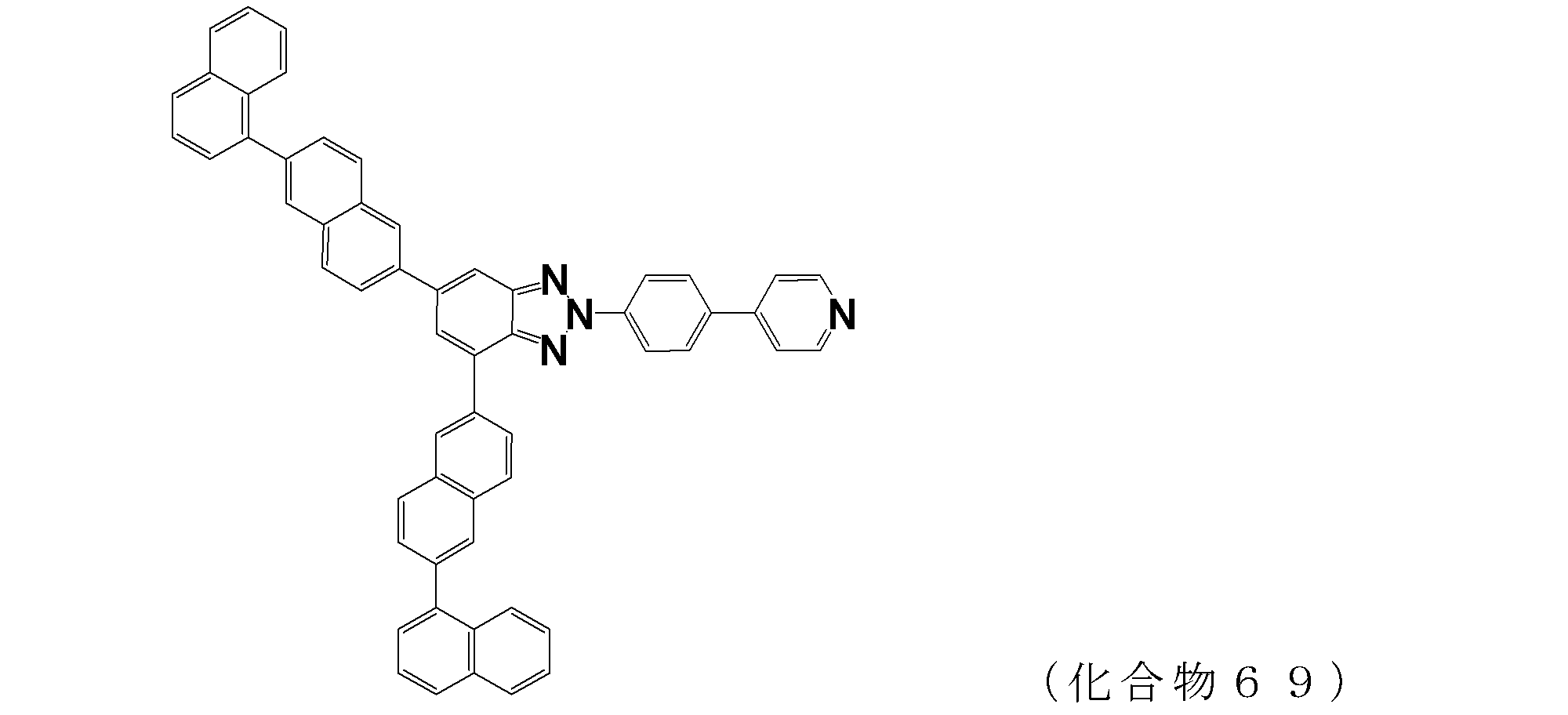
式(1a-2),式(1a-3)

式(1a-1),式(1a-3)
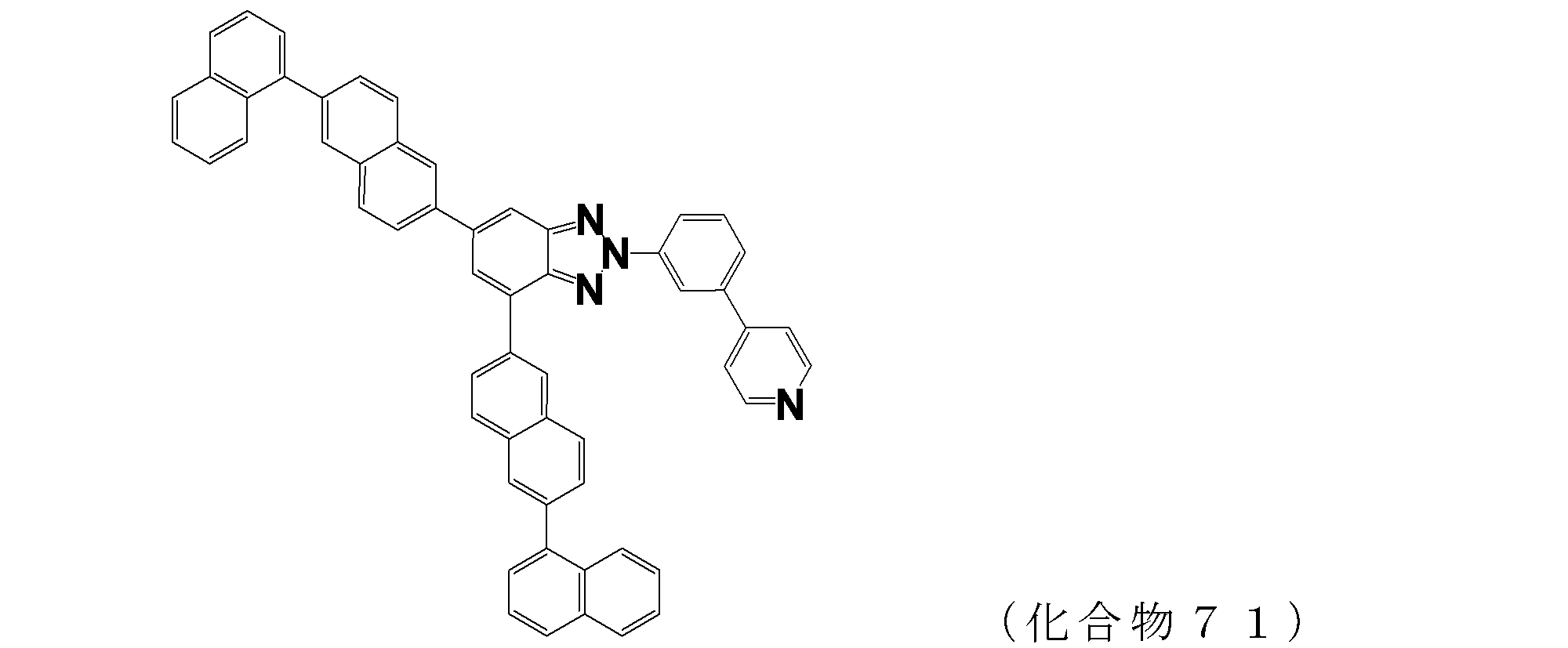
式(1a-2),式(1a-4)

式(1a-1),式(1a-4)
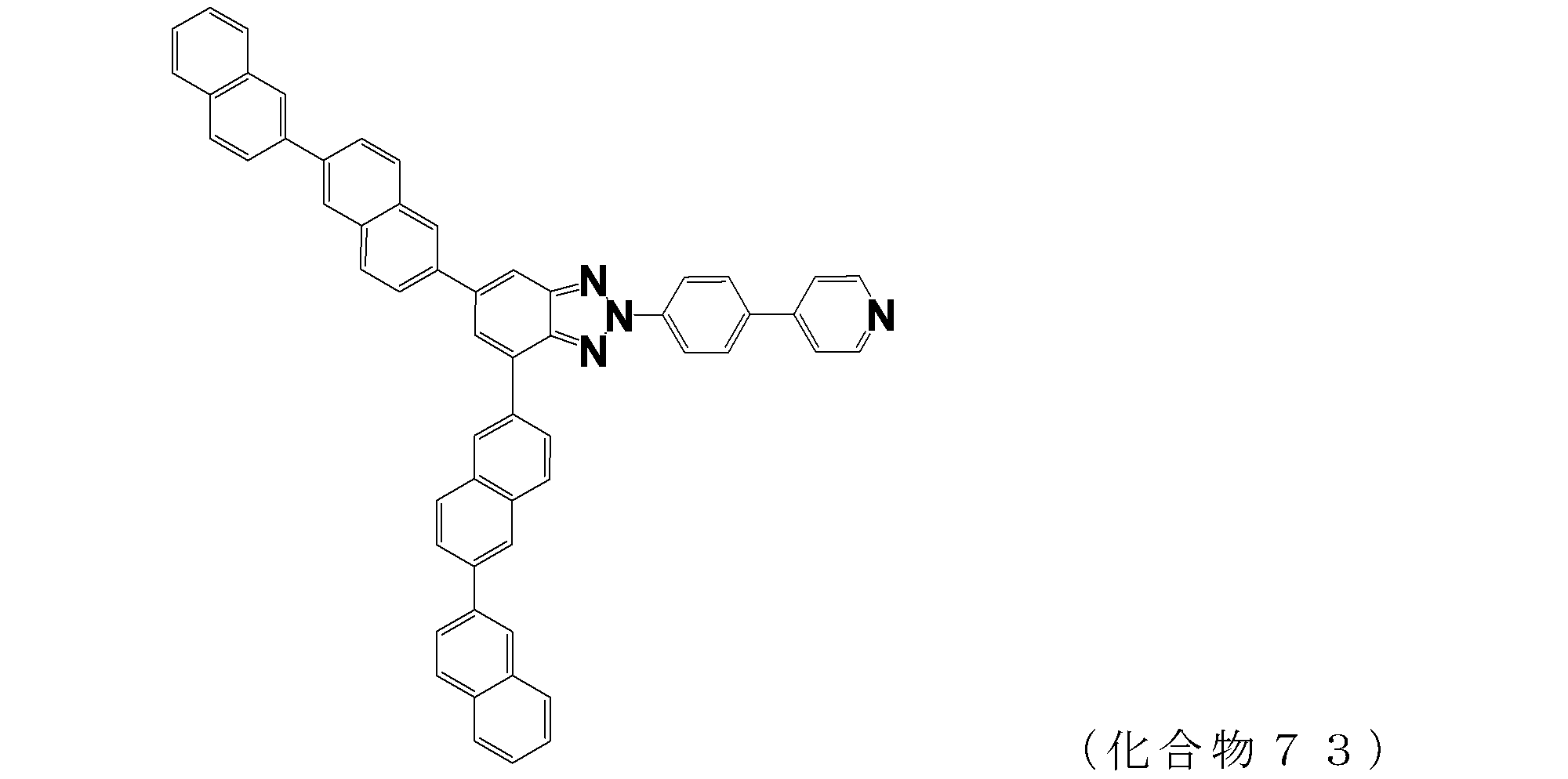
式(1a-2),式(1a-3)
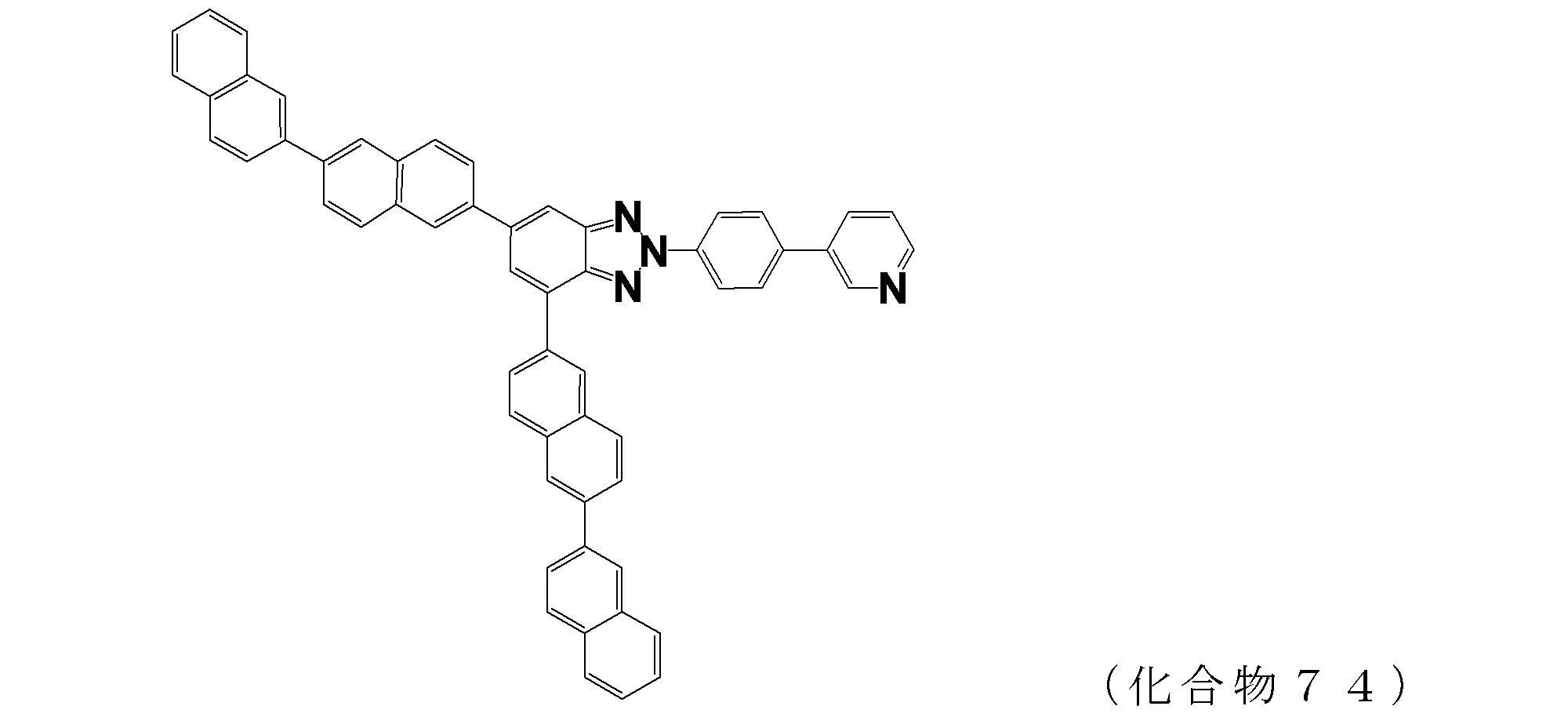
式(1a-1),式(1a-3)

式(1a-2),式(1a-4)

式(1a-1),式(1a-4)

式(1a-2),式(1a-3)
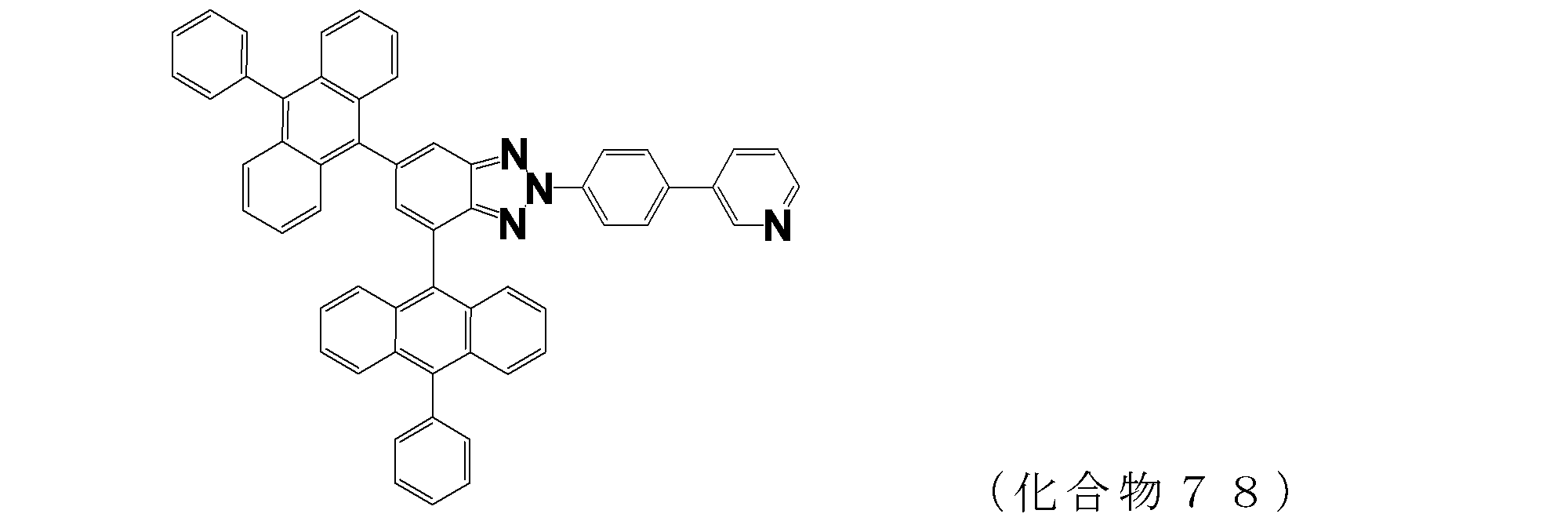
式(1a-1),式(1a-3)

式(1a-2),式(1a-4)

式(1a-1),式(1a-4)

式(1a-2),式(1a-3)
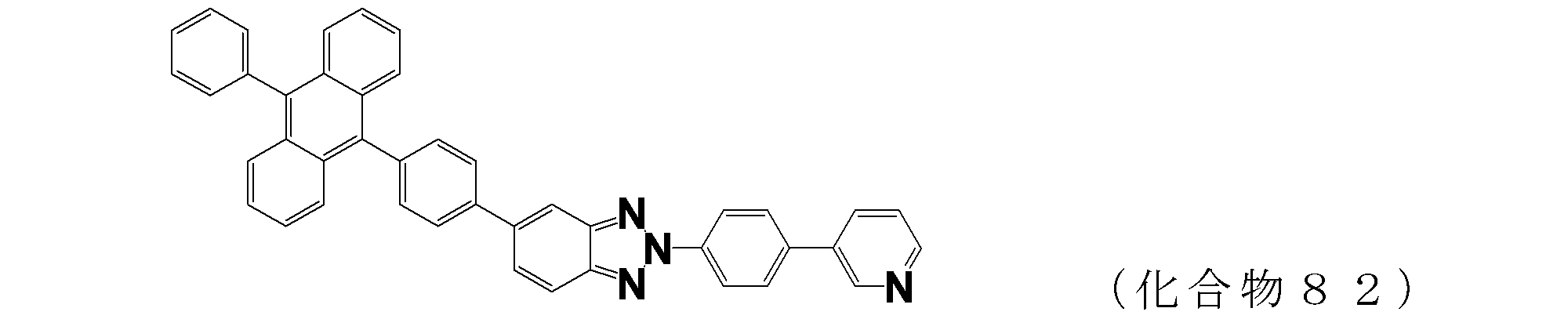
式(1a-1),式(1a-3)

式(1a-2),式(1a-4)

式(1a-1),式(1a-4)

式(1a-1),式(1a-3)

式(1a-2),式(1a-4)

式(1a-1),式(1a-4)

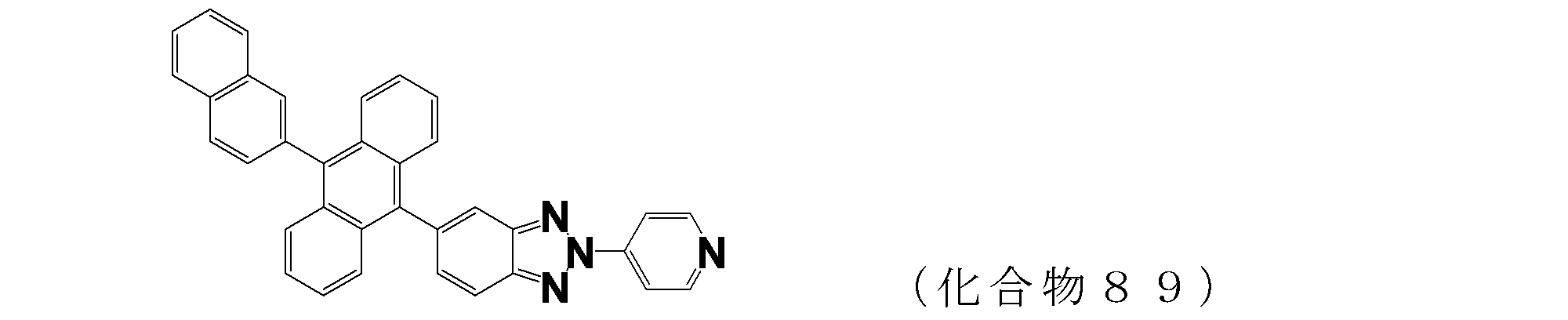


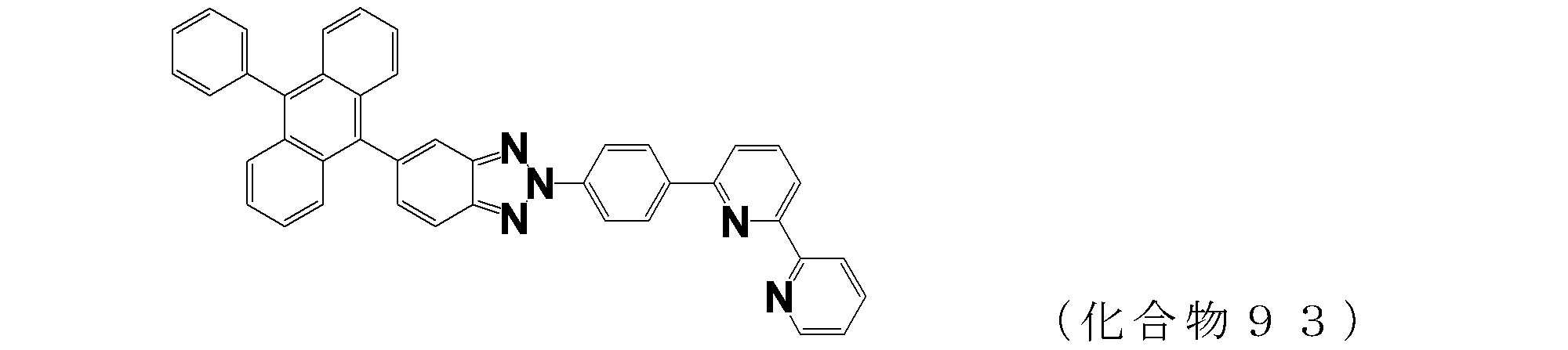


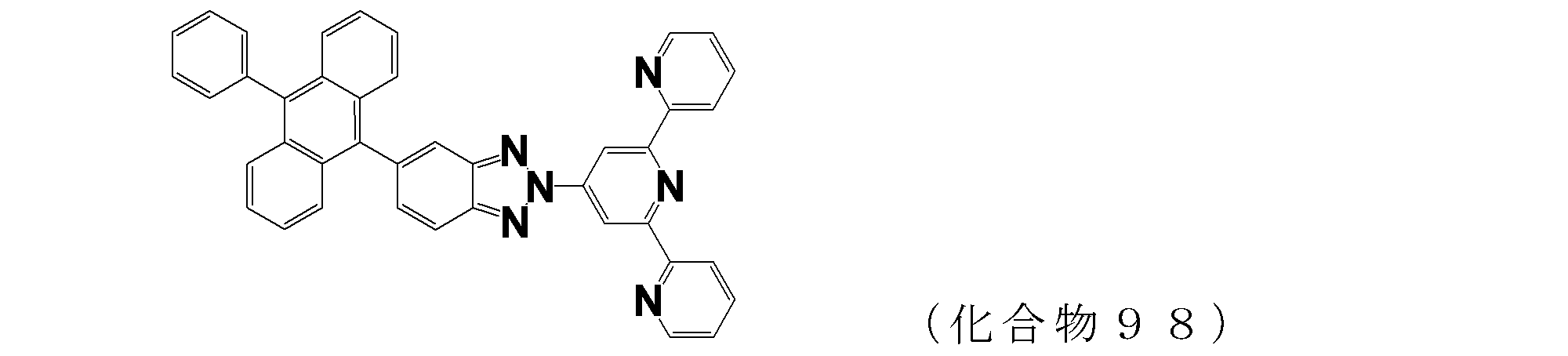


式(1a-1),式(1a-4)
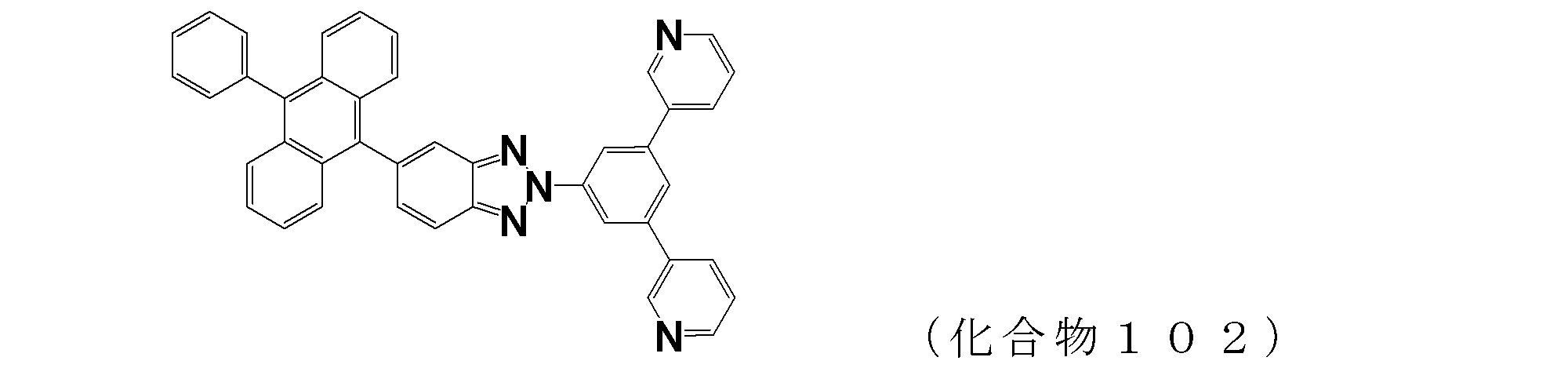
式(1a-1),式(1a-4)
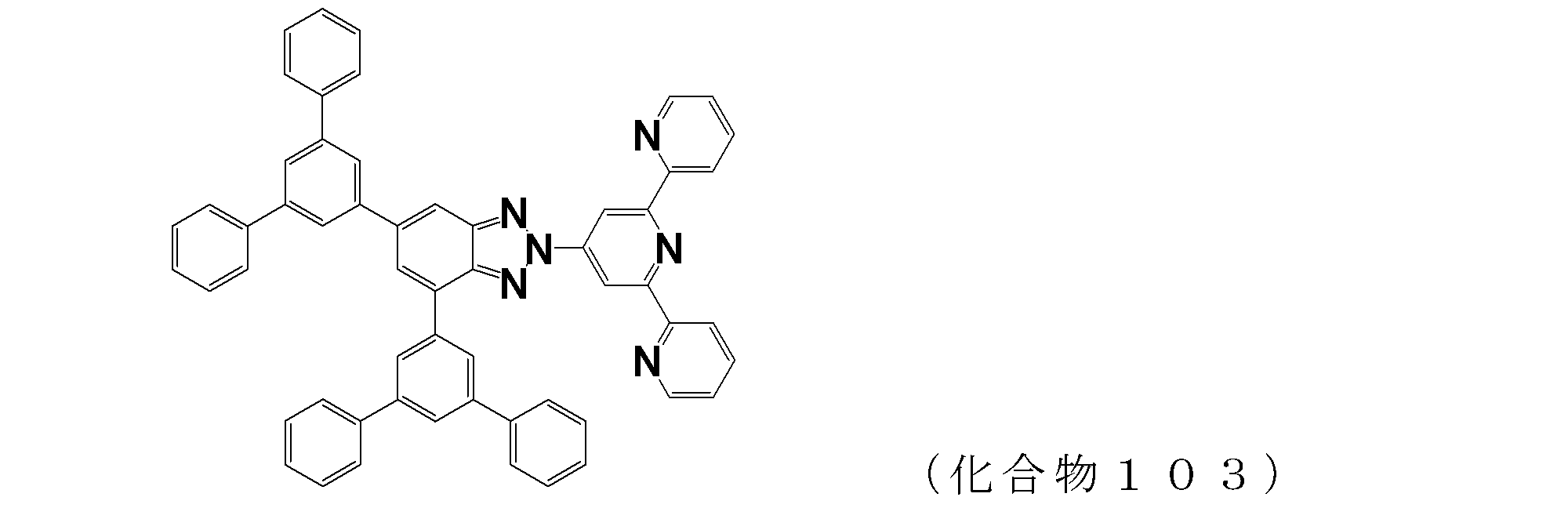

式(1a-1),式(1a-4)
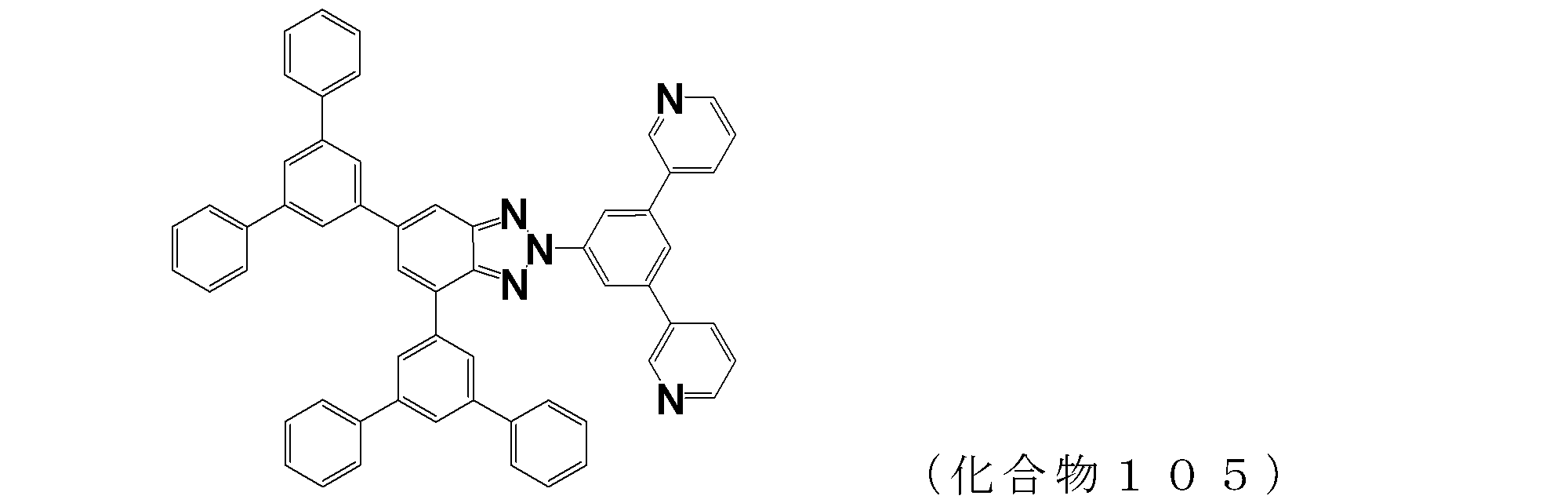
式(1a-1),式(1a-4)
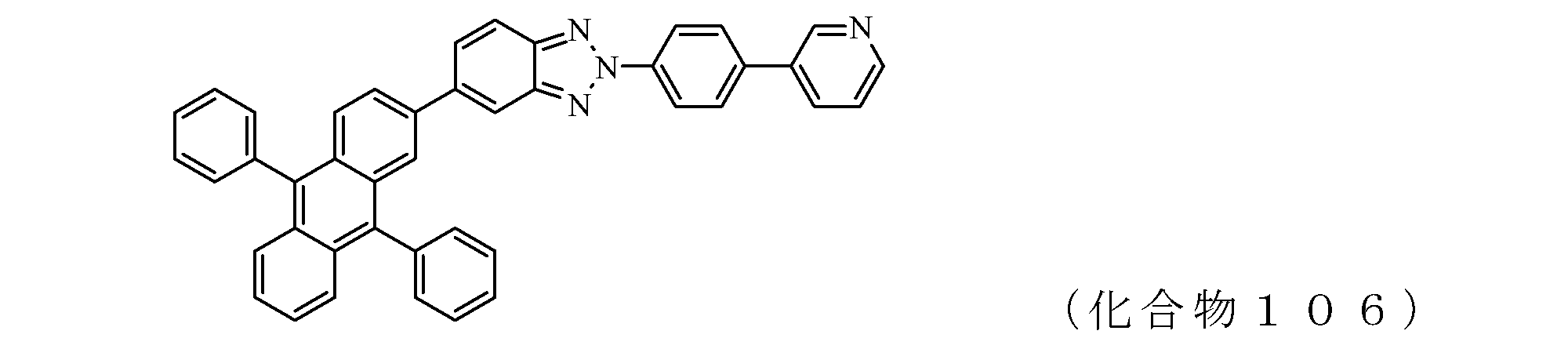
式(1a-1),式(1a-3)
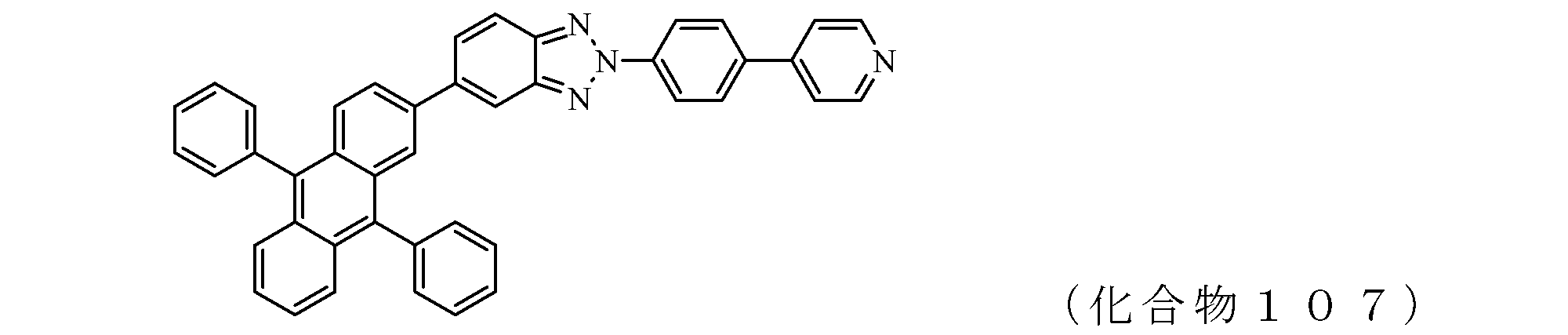
式(1a-2),式(1a-3)

式(1a-1),式(1a-3)

式(1a-2),式(1a-3)

式(1a-1),式(1a-3)
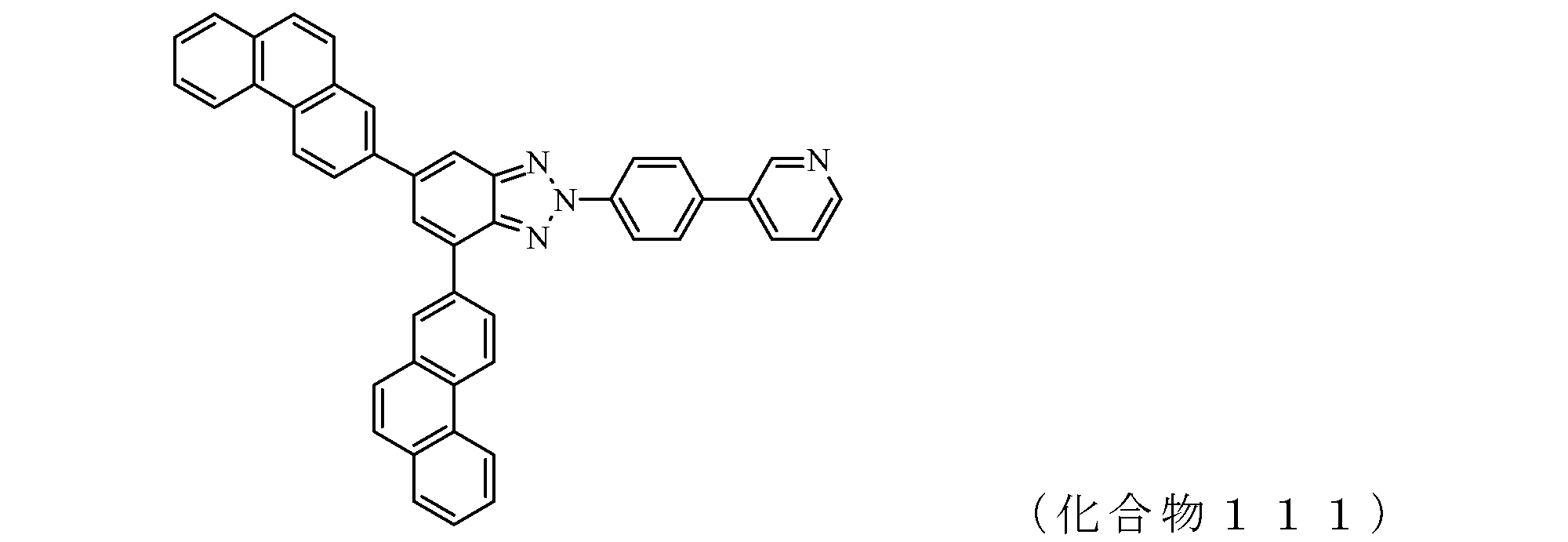
式(1a-1),式(1a-3)
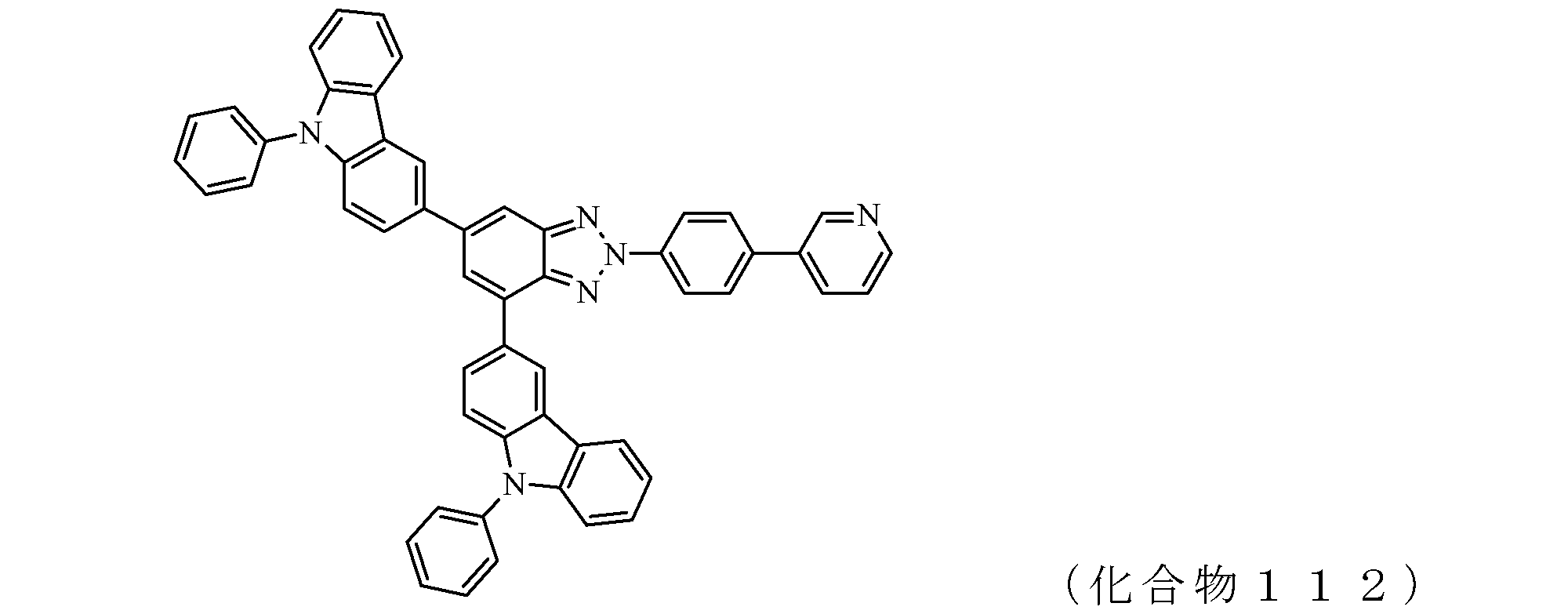
式(1a-1),式(1a-3)
式(1a-1),式(1a-3)
従って、本発明のベンゾトリアゾール誘導体は、有機EL素子が有する有機層の形成材料として極めて有用である。
上述した本発明の化合物を用いて形成される有機層を備えた有機EL素子は、例えば図21に示す層構造を有している。
即ち、ガラス基板1(透明樹脂基板など、透明基板であればよい)の上に、透明な陽極2、正孔輸送層3、発光層4、正孔阻止層5、電子輸送層6、電子注入層7及び陰極8が設けられている。
勿論、本発明の化合物が適用される有機EL素子は、上記の層構造に限定されるものではなく、発光層4と正孔輸送層3との間に電子阻止層を設けることができるし、また、電子注入層7や正孔阻止層5などを省略したシンプルな層構造とすることができる。例えば、上記の多層構造において、いくつかの層を省略することもできる。例えば基板1上に、陽極2、正孔輸送層3、発光層4、電子輸送層6及び陰極8を設けたシンプルな層構造とすることもできる。
銅フタロシアニンに代表されるポルフィリン化合物;
スターバースト型のトリフェニルアミン誘導体;
単結合或いはヘテロ原子を含まない2価基により、複数のトリフェニルアミン骨格が連結された構造を有するアリールアミン(例えばトリフェニルアミンの3量体や4量体);
塗布型の高分子材料、例えばポリ(3,4-エチレンジオキシチオフェン)(PEDOT)、ポリ(スチレンスルフォネート)(PSS)など;
ヘキサシアノアザトリフェニレンのようなアクセプター性の複素環化合物;
上記の材料を用いての層(薄膜)形成は、蒸着法の他、スピンコート法やインクジェット法などの公知の方法によって行うことができる。以下に述べる各種の層も同様に、蒸着やスピンコート、インクジェットなどにより成膜することができる。
このような正孔材料として代表的なものは、次のとおりである。
ベンジジン誘導体、例えば、
N,N’-ジフェニル-N,N’-ジ(m-トリル)
ベンジジン (以下、TPDと略す);
N,N’-ジフェニル-N,N’-ジ(α-ナフチル)
ベンジジン (以下、NPDと略す);
N,N,N’,N’-テトラビフェニリルベンジジン;
アミン系誘導体、例えば、
1,1-ビス[4-(ジ-4-トリルアミノ)フェニル]
シクロヘキサン (以下、TAPCと略す);
種々のトリフェニルアミン3量体および4量体;
正孔注入層用としても使用される上記の塗布型高分子材料;
このような正孔輸送材料の化合物は、それぞれ単独で成膜しても良いが、2種以上を混合して成膜することもできるし、また、上記化合物の1種または複数種を用いて複数の層を形成し、このような層が積層された多層膜を正孔輸送層とすることもできる。
<カルバゾール誘導体>
4,4’,4’’-トリ(N-カルバゾリル)
トリフェニルアミン (以後、TCTAと略称する);
9,9-ビス[4-(カルバゾール-9-イル)フェニル]
フルオレン;
1,3-ビス(カルバゾール-9-イル)ベンゼン
(以後、mCPと略称する);
2,2-ビス(4-カルバゾール-9-イルフェニル)
アダマンタン (以後、Ad-Czと略称する);
<トリアリールアミン構造を有する化合物>
9-[4-(カルバゾール-9-イル)フェニル]-9-[4-
(トリフェニルシリル)フェニル]-9H-フルオレン;
この場合のホスト材料として、上記の発光材料に加え、チアゾール誘導体、ベンズイミダゾール誘導体、ポリジアルキルフルオレン誘導体などを使用するができる。
ドーパント材料としては、キナクリドン、クマリン、ルブレン、ペリレンおよびそれらの誘導体、ベンゾピラン誘導体、ローダミン誘導体、アミノスチリル誘導体などを用いることができる。
燐光発光材料としては、イリジウムや白金などの金属錯体の燐光発光体を使用することができる。例えば、Ir(ppy)3などの緑色の燐光発光体、FIrpic、FIr6などの青色の燐光発光体、Btp2Ir(acac)などの赤色の燐光発光体などを用いることができ、これらの燐光発光材料は、正孔輸送性のホスト材料や電子輸送性のホスト材料にドープして使用される。
また、電子輸送性のホスト材料としては、p-ビス(トリフェニルシリル)ベンゼン(以後、UGH2と略称する)や2,2’,2’’-(1,3,5-フェニレン)-トリス(1-フェニル-1H-ベンズイミダゾール)(以後、TPBIと略称する)などを用いることができる。
このような正孔阻止作用を有する公知化合物の例としては、バソクプロイン(以後、BCPと略称する)などのフェナントロリン誘導体や、アルミニウム(III)ビス(2-メチル-8-キノリナート)-4-フェニルフェノレート(以後、BAlqと略称する)などのキノリノール誘導体の金属錯体の他、トリアゾール誘導体、トリアジン誘導体、オキサジアゾール誘導体などを挙げることができる。
これらの材料は、以下に述べる電子輸送層6の形成にも使用することができ、さらには、この正孔阻止層5と電子輸送層6とを兼用させることもできる。
この電子輸送層6も、単層或いは多層の積層構造とすることができ、各層は、上述した電子輸送性化合物の1種或いは2種以上を用いて成膜される。
5-(10-フェニル-アントラセン-9-イル)-2-{4-(ピリジン-3-イル)フェニル}-2H-ベンゾトリアゾールの合成;
(化合物4の合成)

3-ピリジンボロン酸 31.9g
2M炭酸カリウム水溶液 309ml
トルエン 200ml
エタノール 40ml
テトラキストリフェニルホスフィンパラジウム(0) 11.0g
を窒素置換した反応容器に加え、攪拌しながら14時間加熱還流した。反応液を濃縮し、析出する結晶をろ過によって採取した。イソプロパノールで分散洗浄することによって、3-(4-ニトロフェニル)ピリジンの灰色の粉末状結晶43.5g(収率88.8%)を得た。
4-ブロモ-1,2-ジアミノベンゼン 3.6g
苛性ソーダ 1.4g
トルエン 50ml
を窒素置換した反応容器に加え、攪拌しながら7時間加熱還流した。
トルエン100mlを加えて抽出し、減圧下濃縮した後、カラムクロマトグラフによって精製して、5-ブロモ-2-{4-(ピリジン-3-イル)フェニルアゾ}フェニルアミンの赤色の粉末状結晶1.83g(収率38.1%)を得た。
ヨードベンゼンジアセテート 2.0g
トルエン 30ml
を窒素置換した反応容器に加えて加熱し、74℃で1時間攪拌した。有機層を分液操作のよって採取し、減圧下濃縮した後、カラムクロマトグラフによって精製して、5-ブロモ-2-{4-(ピリジン-3-イル)フェニル}-2H-ベンゾトリアゾールの白色の粉末状結晶0.8g(収率58.6%)を得た。
-2H-ベンゾトリアゾール 5.0g
9-フェニルアントラセン-10-イルボロン酸 4.7g
2M炭酸カリウム水溶液 21ml
トルエン50ml
エタノール10ml
テトラキストリフェニルホスフィンパラジウム(0) 0.8g
を窒素置換した反応容器に加え、攪拌しながら8.5時間加熱還流した。
有機層を分液操作によって採取し、減圧下濃縮した後、カラムクロマトグラフによって精製して、5-(10-フェニル-アントラセン-9-イル)-2-{4-(ピリジン-3-イル)フェニル}-2H-ベンゾトリアゾール(化合物4)の黄色粉体 10.4g(収率82.7%)を得た。
δ(ppm)=8.97(1H)
8.66(1H)
8.57(2H)
8.16(1H)
8.10(1H)
7.98(1H)
7.83(2H)
7.76-7.73(4H)
7.57(6H)
7.43(1H)
7.35(4H)
5-(10-フェニル-アントラセン-9-イル)-2-{3-(ピリジン-4-イル)フェニル}-2H-ベンゾトリアゾール(化合物5)の合成:
(化合物5の合成)

上記の5-ブロモ-2-{3-(ピリジン-4-イル)フェニル}
-2H-ベンゾトリアゾール 2.9g
9-フェニルアントラセン-10-イルボロン酸 2.6g
2M炭酸カリウム水溶液 12ml
トルエン 30ml
エタノール 5.6ml
テトラキストリフェニルホスフィンパラジウム(0) 0.4g
を窒素置換した反応容器に加え、攪拌しながら7.5時間加熱還流した。
有機層を分液操作によって採取し、減圧下濃縮した後、カラムクロマトグラフによって精製して、5-(10-フェニル-アントラセン-9-イル)-2-{3-(ピリジン-4-イル)フェニル}-2H-ベンゾトリアゾール(化合物5)の黄色粉体1.7g(収率38.7%)を得た。
δ(ppm)=9.02(1H)
8.69(2H)
8.5(1H)
8.16(1H)
8.1(1H)
8.06(1H)
7.76-7.71(6H)
7.63(2H)
7.57(2H)
7.51(2H)
7.45(1H)
7.36(4H)
5-{10-(ナフタレン-1-イル)アントラセン-9-イル}-2-{4-(ピリジン-3-イル)フェニル}-2H-ベンゾトリアゾールの合成;
(化合物8の合成)

フェニル}-2H-ベンゾトリアゾール 4.0g
10-(ナフタレン-1-イル)アントラセン-9-イルボロン酸
4.8g
2M炭酸カリウム水溶液 17ml
トルエン 28ml
エタノール 7ml
を窒素置換した反応容器に加え、撹拌しながら60分間窒素ガスを通気した。
次いで、
テトラキストリフェニルホスフィンパラジウム(0) 0.7g
を加え、攪拌しながら10.5時間加熱還流した。有機層を分液操作によって採取し、減圧下濃縮した後、カラムクロマトグラフによって精製して、5-{10-(ナフタレン-1-イル)アントラセン-9-イル}-2-{4-(ピリジン-3-イル)フェニル}-2H-ベンゾトリアゾール(化合物8)の黄色粉体3.5g(収率53.5%)を得た。
δ(ppm)=8.98(1H)
8.67(1H)
8.59(2H)
8.19(2H)
8.09(1H)
8.04(1H)
8.00(1H)
7.84(1H)
7.80(1H)
7.73(1H)
7.61(1H)
7.47(4H)
7.35(2H)
7.25(7H)
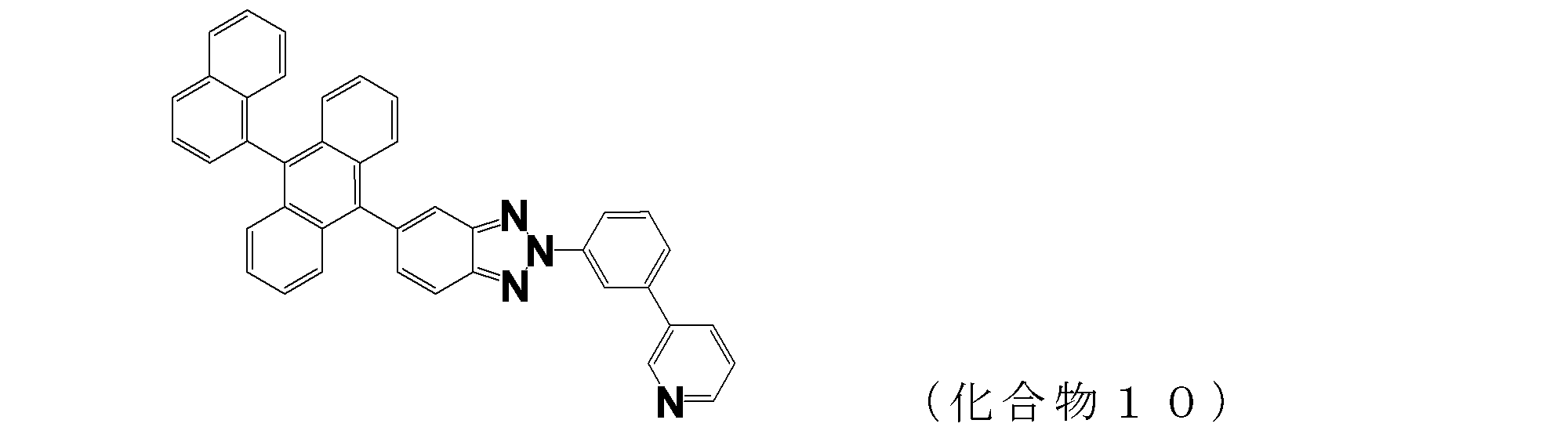
5-{10-(ナフタレン-1-イル)アントラセン-9-イル}-2-{3-(ピリジン-3-イル)フェニル}-2H-ベンゾトリアゾールの合成;
(化合物10の合成)
上記の5-ブロモ-2-{3-(ピリジン-3-イル)フェニル}
-2H-ベンゾトリアゾール 2.9g
10-(ナフタレン-1-イル)アントラセン-9-イルボロン酸
3.5g
2M炭酸カリウム水溶液 12ml
トルエン20ml
エタノール5ml
テトラキストリフェニルホスフィンパラジウム(0) 0.5g
を窒素置換した反応容器に加え、攪拌しながら8.5時間加熱還流した。
有機層を分液操作によって採取し、減圧下濃縮した後、カラムクロマトグラフによって精製して、5-{10-(ナフタレン-1-イル)アントラセン-9-イル}-2-{3-(ピリジン-3-イル)フェニル}-2H-ベンゾトリアゾール(化合物10)の黄色粉体2.1g(収率44.0%)を得た。
δ(ppm)=9.02(1H)
8.70(2H)
8.51(1H)
8.19(1H)
8.06(3H)
7.80(2H)
7.73(2H)
7.60(2H)
7.49(4H)
7.34(2H)
7.23(6H)
5-{10-(ナフタレン-2-イル)アントラセン-9-イル}-2-{4-(ピリジン-3-イル)フェニル}-2H-ベンゾトリアゾールの合成;
(化合物14の合成)

フェニル}-2H-ベンゾトリアゾール 4.0g
10-(ナフタレン-2-イル)アントラセン-9-イルボロン酸
4.76g
2M炭酸カリウム水溶液 17ml
トルエン 28ml
エタノール 7ml
テトラキストリフェニルホスフィンパラジウム(0) 0.4g
を窒素置換した反応容器に加え、攪拌しながら8.5時間加熱還流した。有機層を分液操作によって採取し、減圧下濃縮した後、カラムクロマトグラフによって精製して、5-{10-(ナフタレン-2-イル)アントラセン-9-イル}-2-{4-(ピリジン-3-イル)フェニル}-2H-ベンゾトリアゾール(化合物14)の黄色粉体1.5g(収率22.9%)を得た。
δ(ppm)=8.97(1H)
8.67(1H)
8.58(2H)
8.18(1H)
8.11(2H)
8.05-7.98(2H)
7.94(1H)
7.84(2H)
7.77(4H)
7.61(4H)
7.44(1H)
7.37-7.32(4H)
7.26(1H)
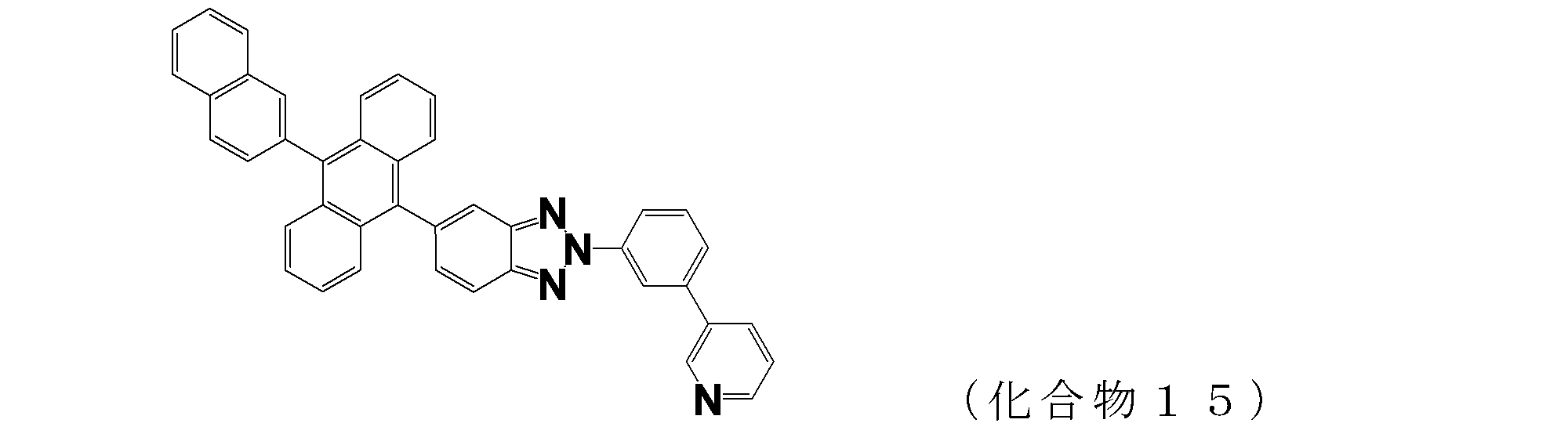
5-{10-(ナフタレン-2-イル)アントラセン-9-イル}-2-{3-(ピリジン-3-イル)フェニル}-2H-ベンゾトリアゾールの合成;
(化合物15の合成)
フェニル}-2H-ベンゾトリアゾール 5.0g
10-(ナフタレン-2-イル)アントラセン-9-イルボロン酸
5.95g
2M炭酸カリウム水溶液 21ml
トルエン 35ml
エタノール 9ml
テトラキストリフェニルホスフィンパラジウム(0) 0.5g
を窒素置換した反応容器に加え、攪拌しながら8.5時間加熱還流した。
有機層を分液操作によって採取し、減圧下濃縮した後、カラムクロマトグラフによって精製して、5-{10-(ナフタレン-2-イル)アントラセン-9-イル}-2-{3-(ピリジン-3-イル)フェニル}-2H-ベンゾトリアゾール(化合物15)の黄色粉体6.3g(収率76.5%)を得た。
δ(ppm)=9.02(1H)
8.71(1H)
8.68(1H)
8.51(1H)
8.18(1H)
8.07(5H)
7.94(1H)
7.79-7.73(6H)
7.64-7.57(4H)
7.45(1H)
7.35(4H)
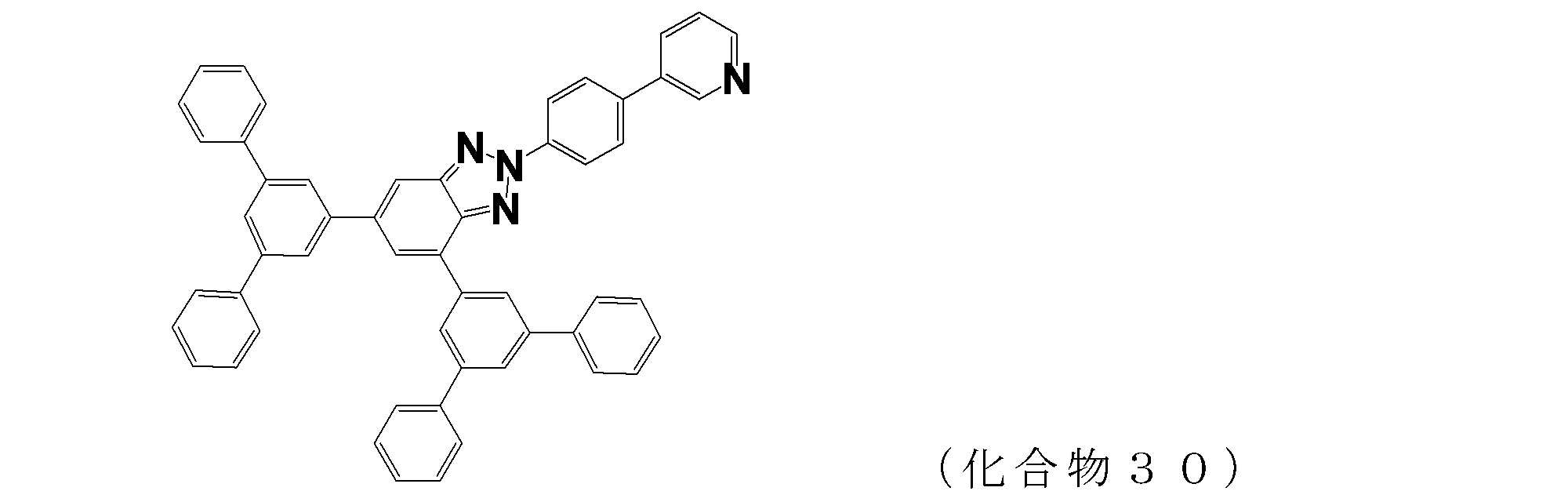
2-{4-(ピリジン-3-イル)フェニル}-4,6-ビス([1,1’;3’、1’’]ターフェニル-5’-イル)-2H-ベンゾトリアゾールの合成;
(化合物30の合成)
10.0g
o-フェニレンジアミン 6.0g
水酸化ナトリウム 4.0g
トルエン 100ml
を窒素置換した反応容器に加え、攪拌しながら9.5時間加熱還流した。
有機層を分液操作によって採取し、減圧下濃縮した後、カラムクロマトグラフによって精製して、2-{4-(ピリジン-3-イル)フェニルアゾ}フェニルアミンの褐色粉末状晶3.42g(収率25.0%)を得た。
室温で3時間攪拌した後、水洗し、減圧下濃縮した後、カラムクロマトグラフによって精製して、2,4-ジブロモ-6-{4-(ピリジン-3-イル)フェニルアゾ}フェニルアミンの赤色粉末状晶4.1g(収率75.9%)を得た。
フェニルアゾ}フェニルアミン 4.0g
ヨードベンゼンジアセテート 4.5g
トルエン 40ml
を窒素置換した反応容器に加えて加熱し、74℃で1時間攪拌した。有機層を分液操作によって採取し、減圧下濃縮した後、カラムクロマトグラフによって精製して、4,6-ジブロモ-2-{4-(ピリジン-3-イル)フェニル}-2H-ベンゾトリアゾールの白色粉末状晶1.6g(62.5%)を得た。
フェニル}-2H-ベンゾトリアゾール 1.2g
(3,5-ジフェニル)フェニルボロン酸 1.7g
2M炭酸カリウム水溶液 4.3ml
トルエン 10ml
エタノール 2ml
テトラキストリフェニルホスフィンパラジウム(0) 0.3g
を窒素置換した反応容器に加え、攪拌しながら4.5時間加熱還流した。
有機層を分液操作によって採取し、減圧下濃縮した後、カラムクロマトグラフによって精製して、2-{4-(ピリジン-3-イル)フェニル}-4,6-ビス([1,1’;3’、1’’]ターフェニル-5’-イル)-2H-ベンゾトリアゾール(化合物30)の黄色粉体1.0g(収率50.0%)を得た。
δ(ppm)=8.94(1H)
8.65(1H)
8.56(2H)
8.34(2H)
8.23(1H)
8.05(1H)
7.95-7.94(3H)
7.92(1H)
7.87(1H)
7.80-7.74(10H)
7.53-7.40(13H)
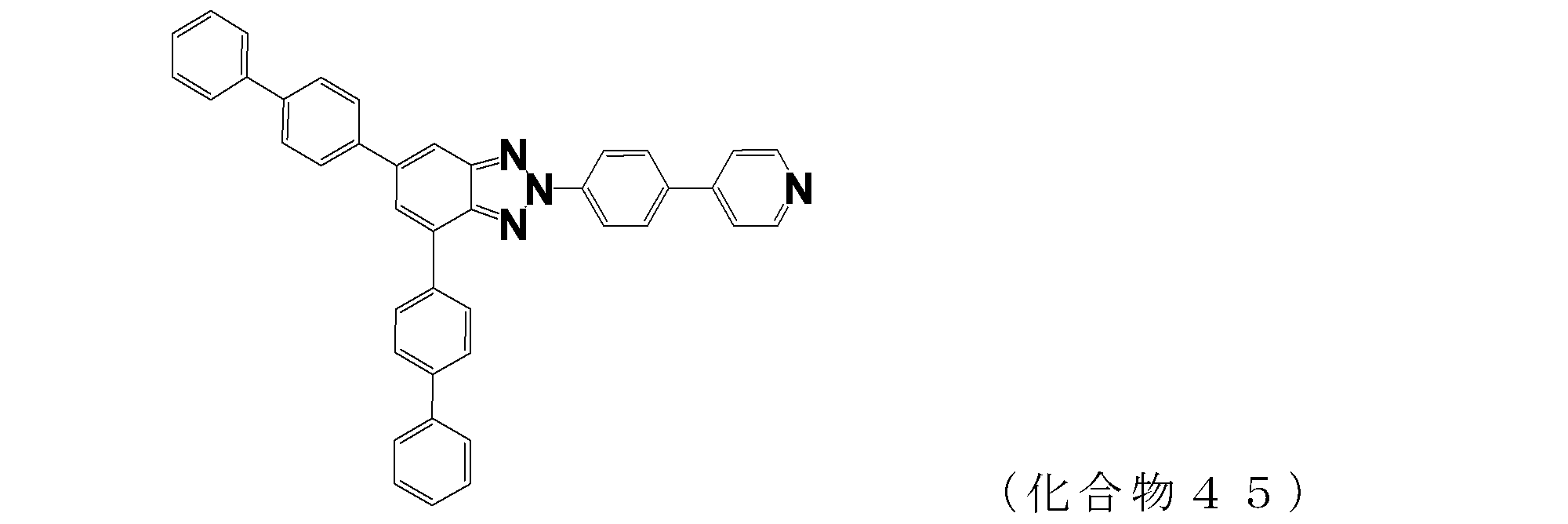
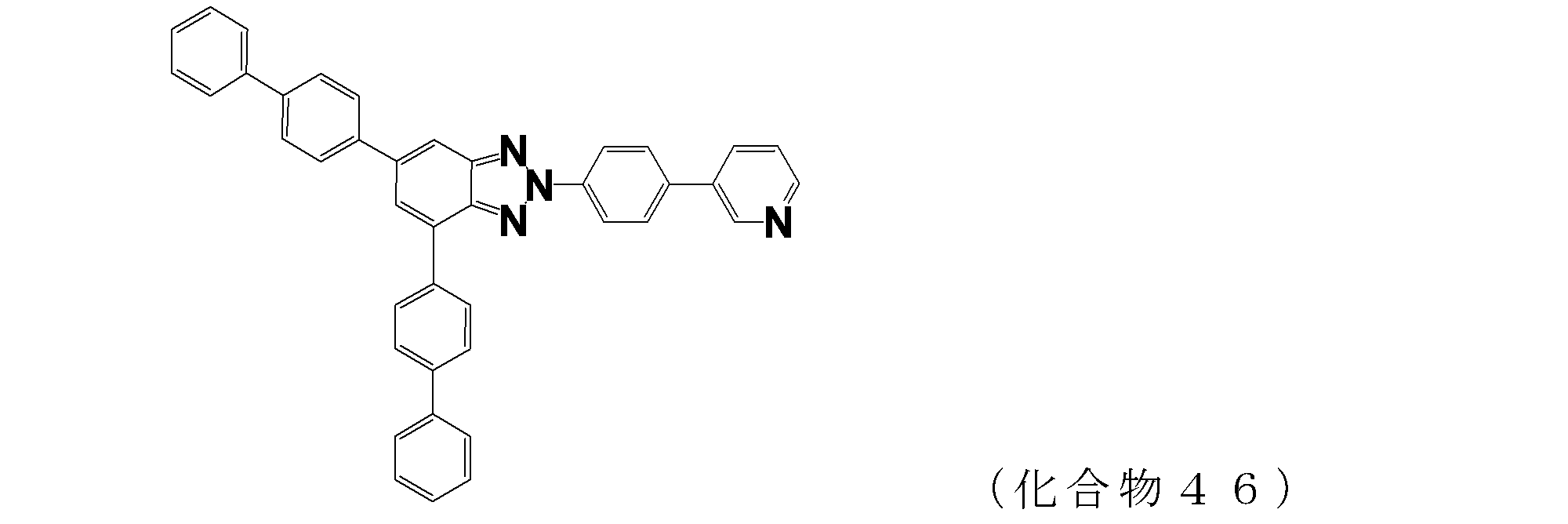
4,6-ビス(ビフェニル-4-イル)-2-{4-(ピリジン-3-イル)フェニル}-2H-ベンゾトリアゾール(化合物46)の合成>
(化合物46の合成)

イル)フェニル}-2H-ベンゾトリアゾール 1.0g
4-ビフェニルボロン酸 1.0g
2M炭酸カリウム水溶液 3.5ml
トルエン 10ml
エタノール 2ml
テトラキストリフェニルホスフィンパラジウム(0) 0.3g
を窒素置換した反応容器に加え、攪拌しながら4.5時間加熱還流した。
有機層を分液操作によって採取し、減圧下濃縮した後、カラムクロマトグラフによって精製して、4,6-ビス(ビフェニル-4-イル)-2-{4-(ピリジン-3-イル)フェニル}-2H-ベンゾトリアゾール(化合物46)の黄色粉体0.6g(収率41.6%)を得た。
δ(ppm)=8.94(1H)
8.65(1H)
8.56(2H)
8.28(2H)
8.14(1H)
7.98(1H)
7.96(1H)
7.86-7.68(8H)
7.51-7.40(7H)
5-(9,10-ジフェニルアントラセン-2-イル)-2-{4-(ピリジン-3-イル)フェニル}-2H-ベンゾトリアゾール(化合物106)の合成;
(化合物106の合成)

フェニル}-2H-ベンゾトリアゾール 2.9g
9,10-ジフェニルアントラセン-2-イルボロン酸 3.7g
2M炭酸カリウム水溶液 12ml
トルエン 30ml
エタノール 5.6ml
テトラキストリフェニルホスフィンパラジウム(0) 0.4g
を窒素置換した反応容器に加え、攪拌しながら7.5時間加熱還流した。
有機層を分液操作によって採取し、減圧下濃縮した後、カラムクロマトグラフによって精製して、5-(9,10-ジフェニルアントラセン-2-イル)-2-{4-(ピリジン-3-イル)フェニル}-2H-ベンゾトリアゾール(化合物106)の淡緑色粉末2.2g(収率43.84%)を得た。
δ(ppm)=8.93(1H)
8.64(1H)
8.46(2H)
8.07(1H)
8.02(1H)
7.94(2H)
7.84(1H)
7.76(2H)
7.73-7.34(17H)
5-{9,10-ジ(ナフタレン-2-イル)アントラセン-2-イル}-2-{4-(ピリジン-3-イル)フェニル}-2H-ベンゾトリアゾールの合成;
(化合物108の合成)

フェニル}-2H-ベンゾトリアゾール 2.9g
9,10-ジ(ナフタレン-2-イル)アントラセン-2-イルボロ
ン酸 4.7g
2M炭酸カリウム水溶液 12ml
トルエン 30ml
エタノール 5.6ml
テトラキストリフェニルホスフィンパラジウム(0) 0.4g
を窒素置換した反応容器に加え、攪拌しながら7.5時間加熱還流した。
有機層を分液操作によって採取し、減圧下濃縮した後、カラムクロマトグラフによって精製して、5-{9,10-ジ(ナフタレン-2-イル)アントラセン-2-イル}-2-{4-(ピリジン-3-イル)フェニル}-2H-ベンゾトリアゾール((化合物108)の淡緑色粉末2.4g(収率41.33%)を得た。
δ(ppm)=8.91(1H)
8.63(1H)
8.42(2H)
8.13(2H)
8.06(5H)
8.03(1H)
7.96-7.60(17H)
7.40(1H)
7.34(2H)
4,6-ビス(9,9-ジメチル-9H-フルオレン-2-イル)-2-{4-(ピリジン-3-イル)フェニル}-2H-ベンゾトリアゾールの合成;
(化合物26の合成)

イル)フェニル}-2H-ベンゾトリアゾール 1.5g
9,9-ジメチル-9H-フルオレン-2-イルボロン酸 2.8g
2M炭酸カリウム水溶液 5.3ml
トルエン 30ml
エタノール 6ml
テトラキストリフェニルホスフィンパラジウム(0) 0.1g
を窒素置換した反応容器に加え、攪拌しながら4.5時間加熱還流した。
有機層を分液操作によって採取し、減圧下濃縮した後、カラムクロマトグラフによって精製して、4,6-ビス(9,9-ジメチル-9H-フルオレン-2-イル)-2-{4-(ピリジン-3-イル)フェニル}-2H-ベンゾトリアゾール(化合物26)の黄色粉末1.2g(収率51.2%)を得た。
δ(ppm)=9.12(1H)
8.74(1H)
8.70(1H)
8.53(1H)
8.29(1H)
8.18(2H)
8.05(2H)
7.95(1H)
7.91(1H)
7.83-7.79(4H)
7.71(2H)
7.52(2H)
7.47-7.39(5H)
1.55(6H)
1.51(6H)
4,6-ビス{4-(ナフタレン-1-イル)フェニル}-2-{4-(ピリジン-3-イル)フェニル}-2H-ベンゾトリアゾールの合成;
(化合物66の合成)

イル)フェニル}-2H-ベンゾトリアゾール 1.5g
4-(ナフタレン-1-イル)フェニルボロン酸 2.2g
2M炭酸カリウム水溶液 5.3ml
トルエン 30ml
エタノール 6ml
テトラキストリフェニルホスフィンパラジウム(0) 0.1g
を窒素置換した反応容器に加え、攪拌しながら4.5時間加熱還流した。
有機層を分液操作によって採取し、減圧下濃縮した後、カラムクロマトグラフによって精製して、4,6-ビス{4-(ナフタレン-1-イル)フェニル}-2-{4-(ピリジン-3-イル)フェニル}-2H-ベンゾトリアゾール(化合物66)の黄色粉末2.0g(収率84.2%)を得た。
δ(ppm)=8.62(1H)
8.61(1H)
8.36(2H)
8.22(1H)
8.11(1H)
8.08(1H)
8.02(1H)
7.96-7.83(8H)
7.81(2H)
7.75(2H)
7.68(2H)
7.59-7.49(10H)
4,6-ビス{4-(ナフタレン-2-イル)フェニル}-2-{4-(ピリジン-3-イル)フェニル}-2H-ベンゾトリアゾールの合成;
(化合物62の合成)
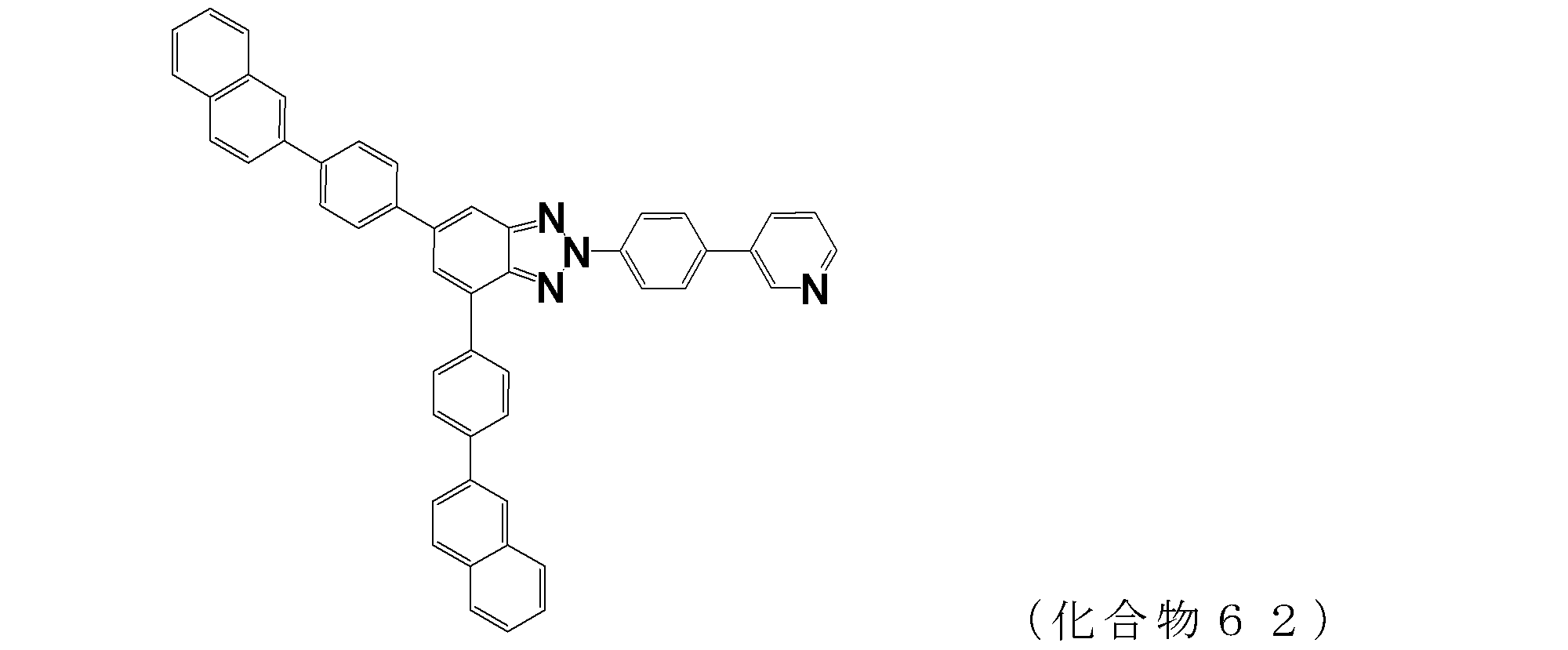
イル)フェニル}-2H-ベンゾトリアゾール 1.5g
4-(ナフタレン-2-イル)フェニルボロン酸 2.2g
2M炭酸カリウム水溶液 5.3ml
トルエン 30ml
エタノール 6ml
テトラキストリフェニルホスフィンパラジウム(0) 0.1g
を窒素置換した反応容器に加え、攪拌しながら4.5時間加熱還流した。
有機層を分液操作によって採取し、減圧下濃縮した後、カラムクロマトグラフによって精製して、4,6-ビス{4-(ナフタレン-2-イル)フェニル}-2-{4-(ピリジン-3-イル)フェニル}-2H-ベンゾトリアゾール(化合物62)の黄色粉末1.2g(収率44.2%)を得た。
δ(ppm)=8.95(1H)
8.66(1H)
8.57(2H)
8.33(2H)
8.17(2H)
8.13(1H)
7.98-7.88(14H)
7.80(2H)
7.75(2H)
7.54(4H)
7.43(1H)
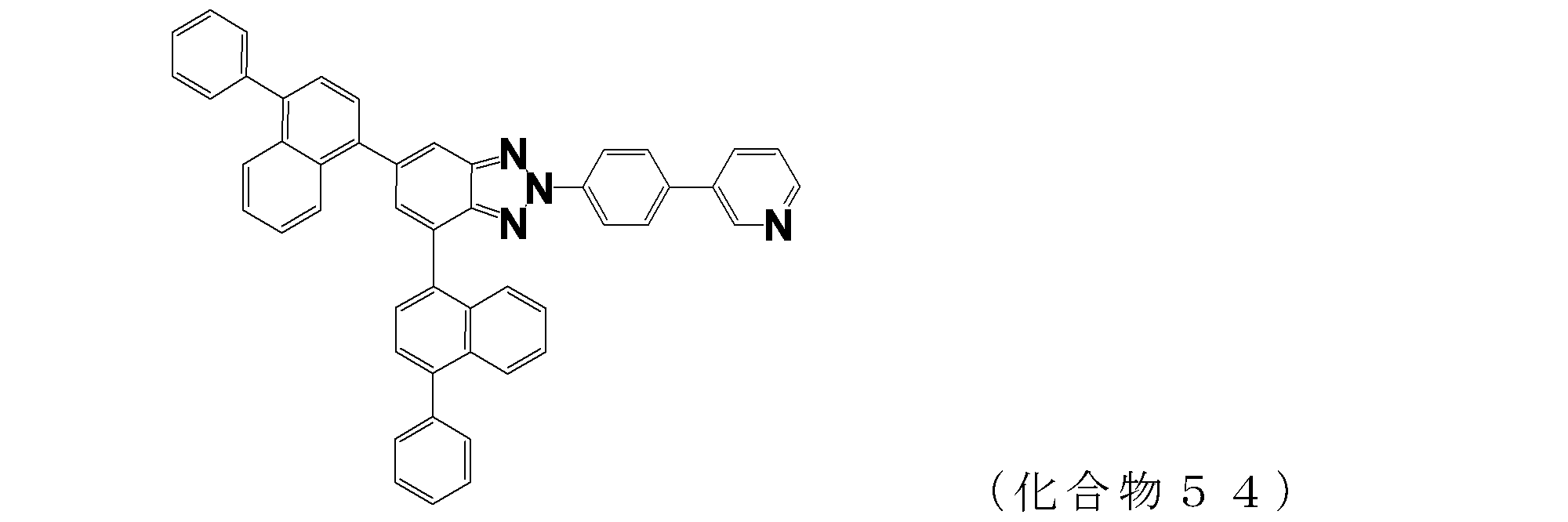
4,6-ビス(4-フェニル-ナフタレン-1-イル)-2-{4-(ピリジン-3-イル)フェニル}-2H-ベンゾトリアゾールの合成;
(化合物54の合成)

イル)フェニル}-2H-ベンゾトリアゾール 1.5g
4-フェニル-ナフタレン-1-イルボロン酸 2.2g
2M炭酸カリウム水溶液 5.3ml
トルエン 30ml
エタノール 6ml
テトラキストリフェニルホスフィンパラジウム(0) 0.1g
を窒素置換した反応容器に加え、攪拌しながら4.5時間加熱還流した。
有機層を分液操作によって採取し、減圧下濃縮した後、カラムクロマトグラフによって精製して、4,6-ビス(4-フェニル-ナフタレン-1-イル)-2-{4-(ピリジン-3-イル)フェニル}-2H-ベンゾトリアゾール(化合物54)の黄色粉末1.5g(収率62.0%)を得た。
δ(ppm)=8.90(1H)
8.64(1H)
8.47(2H)
8.20(1H)
8.17(1H)
8.09(1H)
8.02(3H)
7.91(1H)
7.81(1H)
7.81(1H)
7.73(2H)
7.69(1H)
7.61-41(16H)
4,6-ビス(フェナンスレン-9-イル)-2-{4-(ピリジン-3-
イル)フェニル}-2H-ベンゾトリアゾールの合成;
(化合物110の合成)

イル)フェニル}-2H-ベンゾトリアゾール 2.0g
フェナンスレン-9-イルボロン酸 3.5g
2M炭酸カリウム水溶液 6.0ml
トルエン 20ml
エタノール 4ml
テトラキストリフェニルホスフィンパラジウム(0) 0.1g
を窒素置換した反応容器に加え、攪拌しながら4.5時間加熱還流した。
有機層を分液操作によって採取し、減圧下濃縮した後、カラムクロマトグラフによって精製して、4,6-ビス(フェナンスレン-9-イル)-2-{4-(ピリジン-3-イル)フェニル}-2H-ベンゾトリアゾール(化合物110)の黄色粉末2.1g(収率72.3%)を得た。
δ(ppm)=8.88(1H)
8.81(1H)
8.76(2H)
8.62(1H)
8.43(2H)
8.23(1H)
8.14(1H)
8.06(1H)
7.96-7.92(4H)
7.84(1H)
7.71-7.76(9H)
7.73(2H)
7.54(1H)
7.26(1H)
4,6-ビス(9-フェニル-9H-カルバゾール-3-イル)-2-{4-(ピリジン-3-イル)フェニル}-2H-ベンゾトリアゾールの合成;
(化合物112の合成)

イル)フェニル}-2H-ベンゾトリアゾール 2.5g
9-フェニル-9H-カルバゾール-3-イルボロン酸 4.5g
2M炭酸カリウム水溶液 25.0ml
トルエン 20ml
エタノール 5ml
テトラキストリフェニルホスフィンパラジウム(0) 0.1g
を窒素置換した反応容器に加え、攪拌しながら4.5時間加熱還流した。
有機層を分液操作によって採取し、減圧下濃縮した後、カラムクロマトグラフによって精製して、4,6-ビス(9-フェニル-9H-カルバゾール-3-イル)-2-{4-(ピリジン-3-イル)フェニル}-2H-ベンゾトリアゾール(化合物112)の黄色粉末3.7g(収率83.4%)を得た。
δ(ppm)=8.96(2H)
8.66(1H)
8.60-8.56(3H)
8.30(2H)
8.26(1H)
8.16(2H)
7.97(1H)
7.87(1H)
7.80(2H)
7.64(8H)
7.57(1H)
7.52(2H)
7.45(6H)
7.35(2H)
5-[10-{3-(ナフタレン-1-イル)フェニル}アントラセン-9-イル]-2-{4-(ピリジン-3-イル)フェニル}-2H-ベンゾトリアゾールの合成;
(化合物18の合成)

フェニル}-2H-ベンゾトリアゾール 3.5g
10-{3-(ナフタレン-1-イル)フェニル}アントラセン-9
-イルボロン酸 3.7g
2M炭酸カリウム水溶液 12ml
トルエン 26ml
エタノール 7ml
テトラキストリフェニルホスフィンパラジウム(0) 0.5g
を窒素置換した反応容器に加え、攪拌しながら8.5時間加熱還流した。
有機層を分液操作によって採取し、減圧下濃縮した後、カラムクロマトグラフによって精製して、5-[10-{3-(ナフタレン-1-イル)フェニル}アントラセン-9-イル]-2-{4-(ピリジン-3-イル)フェニル}-2H-ベンゾトリアゾール(化合物18)の黄色粉末2.8g(収率53.4%)を得た。
δ(ppm)=8.97(1H)
8.67(1H)
8.57(2H)
8.17-8.08(3H)
7.98-7.68(12H)
7.60-7.49(5H)
7.40(4H)
7.26(2H)
5-{4-(10-フェニルアントラセン-9-イル)フェニル}-2-{4-(ピリジン-3-イル)フェニル}-2H-ベンゾトリアゾールの合成;
(化合物82の合成)
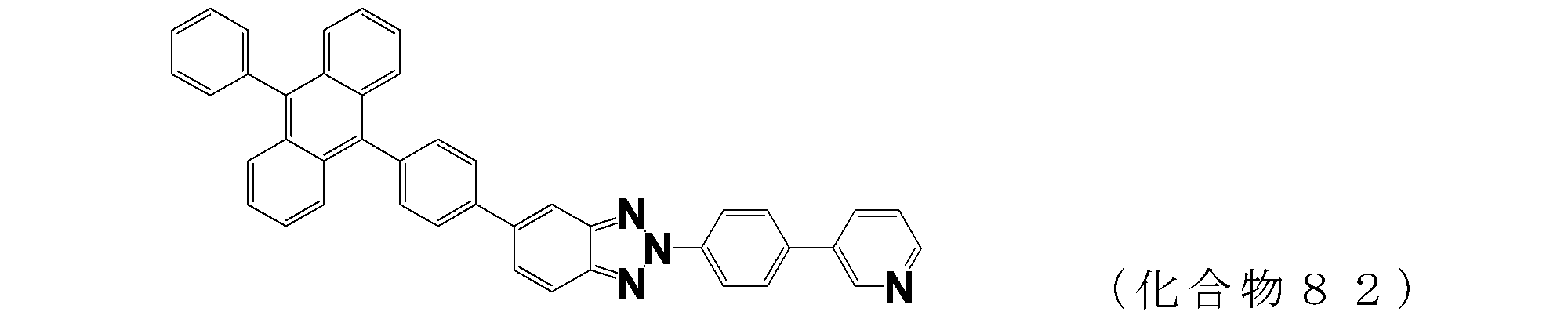
フェニル}-2H-ベンゾトリアゾール 1.6g
4-(10-フェニルアントラセン-9-イル)フェニルボロン酸
1.6g
2M炭酸カリウム水溶液 6ml
トルエン 16ml
エタノール 4ml
テトラキストリフェニルホスフィンパラジウム(0) 0.2g
を窒素置換した反応容器に加え、攪拌しながら8.5時間加熱還流した。
有機層を分液操作によって採取し、減圧下濃縮した後、カラムクロマトグラフによって精製して、5-{4-(10-フェニルアントラセン-9-イル)フェニル}-2-{4-(ピリジン-3-イル)フェニル}-2H-ベンゾトリアゾール(化合物82)の黄色粉末1.0g(収率40.0%)を得た。
δ(ppm)=9.01(1H)
8.69(2H)
8.48(1H)
8.30(1H)
8.11(1H)
8.05(1H)
7.95(2H)
7.91(1H)
7.81(2H)
7.73-7.44(8H)
7.51(3H)
7.45(1H)
7.37(4H)
4,6-ビス(フェナンスレン-2-イル)-2-{4-(ピリジン-3-イル)フェニル}-2H-ベンゾトリアゾールの合成;
(化合物111の合成)
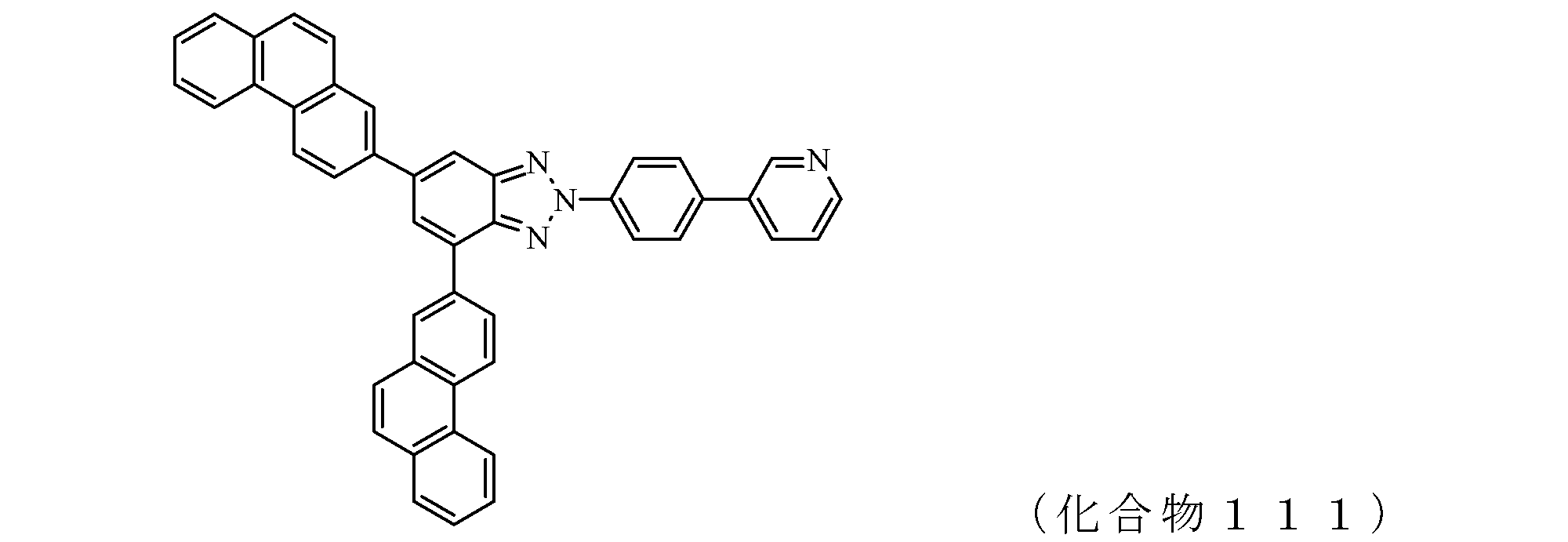
イル)フェニル}-2H-ベンゾトリアゾール 2.8g
フェナンスレン-9-イルボロン酸 4.9g
2M炭酸カリウム水溶液 10ml
トルエン 24ml
エタノール 6ml
テトラキストリフェニルホスフィンパラジウム(0) 0.4g
を窒素置換した反応容器に加え、攪拌しながら4.5時間加熱還流した。
有機層を分液操作によって採取し、減圧下濃縮した後、カラムクロマトグラフによって精製して、4,6-ビス(フェナンスレン-2-イル)-2-{4-(ピリジン-3-イル)フェニル}-2H-ベンゾトリアゾール(化合物111)の黄色粉末1.0g(収率24.5%)を得た。
δ(ppm)=8.96(1H)
8.91(1H)
8.87(1H)
8.79(3H)
8.67(1H)
8.62(2H)
8.54(1H)
8.31(2H)
8.25(1H)
8.13(1H)
7.95(4H)
7.89(1H)
7.84(3H)
7.73(2H)
7.66(2H)
7.45(2H)
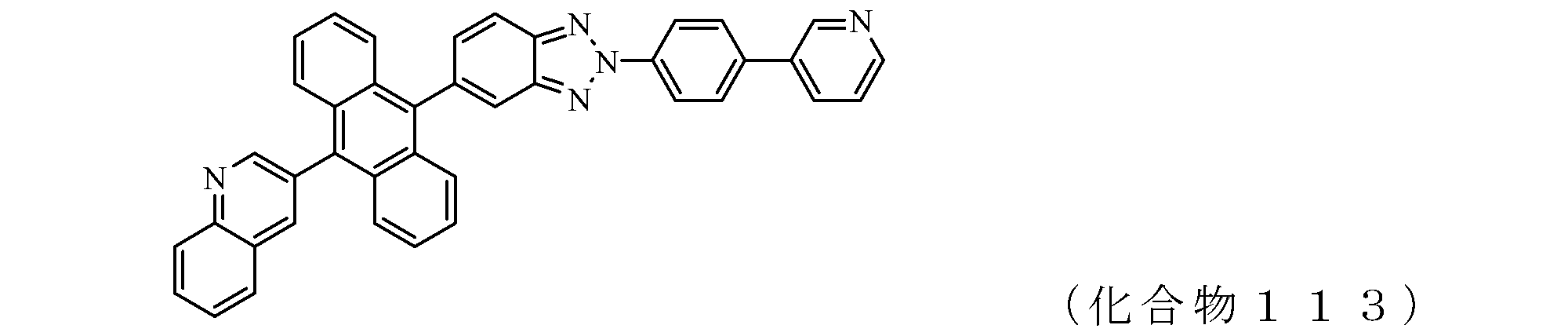
5-{10-(キノリン-3-イル)アントラセン-9-イル}-2-{4-(ピリジン-3-イル)フェニル}-2H-ベンゾトリアゾールの合成;
(化合物113の合成)

フェニル}-2H-ベンゾトリアゾール 7.0g
ビスピナコラートジボロン 6.58g
{1,1’-ビス(ジフェニルホスフィノ)フェロセン}パラジウム
ジクロリド 0.33g
酢酸カリウム 5.87g
ジオキサン 70ml
を窒素置換した反応容器に加えて加熱し、85℃で5時間撹拌した。室温まで冷却し、水に加えた後、トルエンを用いた抽出操作を行った。
有機層を減圧下濃縮した後、カラムクロマトグラフによって精製して、2-{4-(ピリジン-3-イル)フェニル}-5-(4,4,5,5-テトラメチル-[1,3,2]ジオキサボロラン-2-イル)-2H-ベンゾトリアゾールの黄色粉末6.4g(収率80.6%)を得た。
(4,4,5,5-テトラメチル-[1,3,2]ジオキサボロラン
-2-イル)-2H-ベンゾトリアゾール 1.4g
3-(10-ブロモアントラセン-9-イル)キノリン 1.2g
2M炭酸カリウム水溶液 5ml
トルエン 12ml
エタノール 3ml
テトラキストリフェニルホスフィンパラジウム(0) 0.4g
を窒素置換した反応容器に加え、攪拌しながら70℃で15.5時間加熱還流した。有機溶媒を留去し、クロロホルム、水を加えた後、分液操作によって有機層を採取した。
減圧下濃縮した後、トルエンに溶解し、NHシリカゲルを用いた吸着精製、続いて、カラムクロマトグラフによって精製して、5-{10-(キノリン-3-イル)アントラセン-9-イル}-2-{4-(ピリジン-3-イル)フェニル}-2H-ベンゾトリアゾール(化合物113)の黄色粉末0.6g(収率61.0%)を得た。
δ(ppm)=9.07(1H)
8.98(1H)
8.68(1H)
8.59(1H)
8.57(1H)
8.36(1H)
8.33(1H)
8.19(1H)
8.12(1H)
8.00(1H)
7.97(1H)
7.95(1H)
7.85(2H)
7.81(2H)
7.71(3H)
7.57(1H)
7.47(1H)
7.40(4H)
上記の実施例で得られた本発明の各化合物について、高感度示差走査熱量計(ブルカー・エイエックスエス製、DSC3100S)によって融点とガラス転移点を求めた。
その結果を以下に示す。
例示化合物 融点 ガラス転移点
化合物4 292℃ 118℃
化合物5 233℃ 106℃
化合物8 325℃ 151℃
化合物10 281℃ 144℃
化合物14 312℃ 148℃
化合物15 測定されず。 137℃
化合物30 246℃ 129℃
化合物46 243℃ 109℃
化合物106 287℃ 139℃
化合物108 303℃ 150℃
化合物26 322℃ 132℃
化合物66 157℃ 133℃
化合物62 263℃ 109℃
化合物54 180℃ 147℃
化合物110 203℃ 144℃
化合物112 188℃ 160℃
化合物18 256℃ 145℃
化合物82 359℃ 148℃
化合物111 197℃ 138℃
化合物113 319℃ 148℃
上記実施例で得られた本発明の各化合物を用いて、ITO基板の上に膜厚100nmの蒸着膜を作製して、大気中光電子分光装置(理研計器製、AC-3型)で仕事関数を測定した。その結果は以下のとおりであった。
例示化合物 仕事関数
化合物30 6.35eV
化合物46 6.21eV
化合物4 5.95eV
化合物6 5.98eV
化合物8 6.03eV
化合物10 6.05eV
化合物14 5.96eV
化合物15 6.03eV
化合物18 6.03eV
化合物26 6.05eV
化合物54 6.25eV
化合物62 6.12eV
化合物66 6.10eV
化合物82 5.95eV
化合物110 6.13eV
化合物112 5.78eV
ガラス基板1上に透明陽極2としてITO電極をあらかじめ形成したものの上に、正孔注入層3、正孔輸送層4、発光層5、正孔阻止層6、電子輸送層7、電子注入層8、陰極(アルミニウム電極)9の順に蒸着して、図21に示す層構造の有機EL素子を作製した。
続いて、透明陽極2を覆うように、正孔注入層3として下記構造式の化合物114を蒸着速度6nm/minで膜厚20nmとなるように形成した。
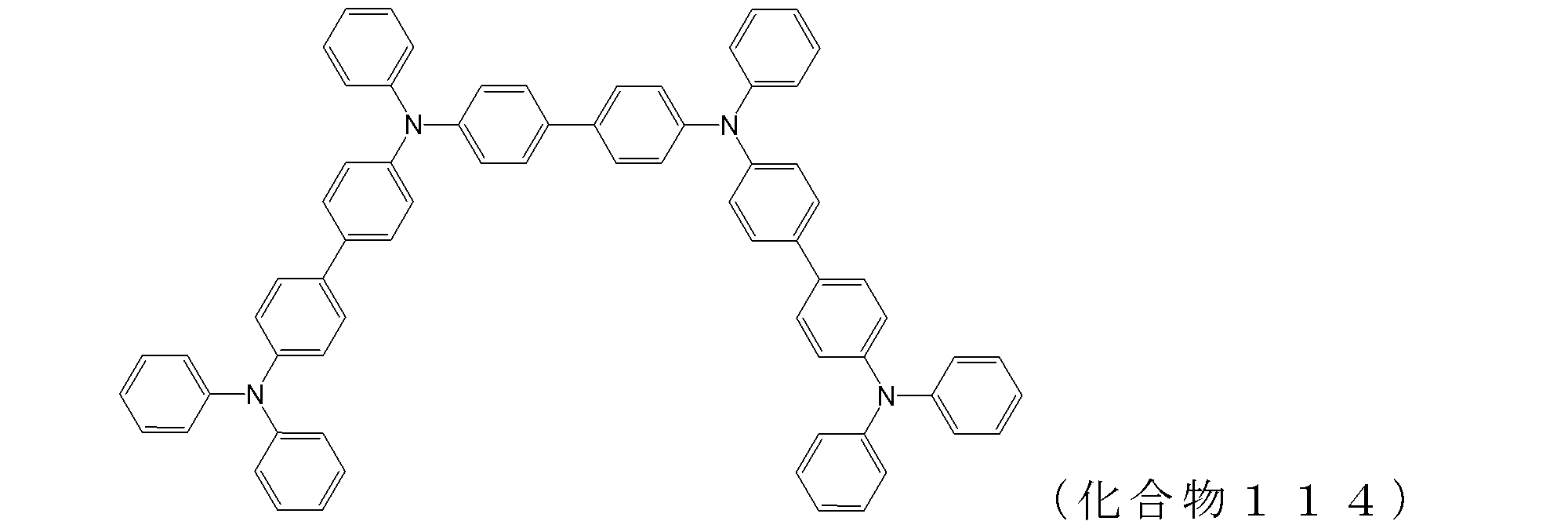
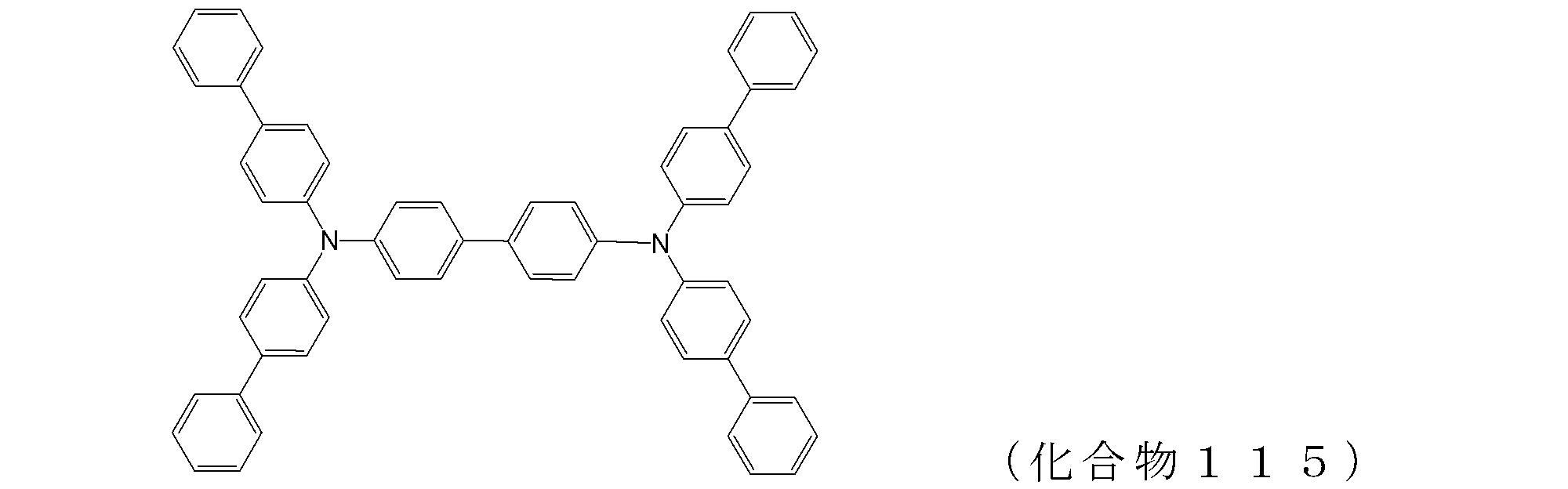
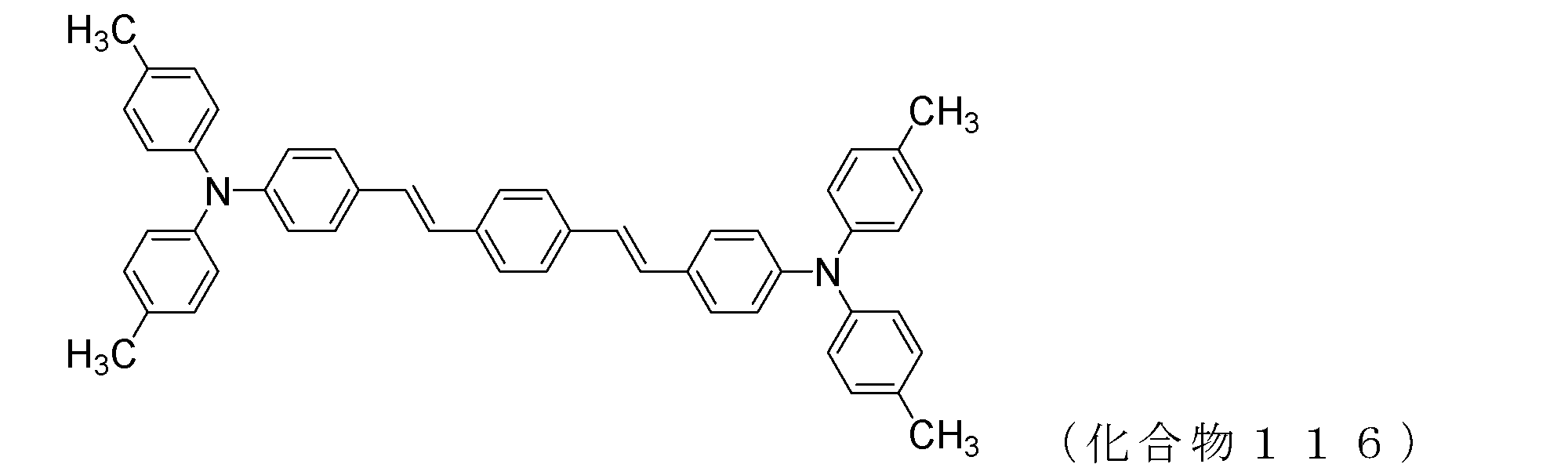

このようにして形成された正孔阻止層兼電子輸送層6および7の上に、電子注入層8としてフッ化リチウムを蒸着速度0.6nm/minで膜厚0.5nmとなるように形成した。
最後に、アルミニウムを膜厚150nmとなるように蒸着して陰極9を形成した。作製した有機EL素子について、大気中、常温で特性測定を行なった。
実施例23における正孔阻止層兼電子輸送層6および7の材料として、実施例8で合成された本発明の化合物46を用いた以外は、実施例23と同様の条件で有機EL素子を作製した。この有機EL素子について、大気中、常温で特性測定を行なった。この有機EL素子に直流電圧を印加したときの発光特性の測定結果を表1にまとめて示した。
実施例23における正孔阻止層兼電子輸送層6および7の材料として、実施例1で合成された本発明の化合物4を用いた以外は、実施例23と同様の条件で有機EL素子を作製した。作製した有機EL素子について、大気中、常温で特性測定を行なった。作製した有機EL素子に直流電圧を印加したときの発光特性の測定結果を表1にまとめて示した。
実施例23における正孔阻止層兼電子輸送層6および7の材料として、実施例2で合成された本発明の化合物5を用いた以外は、実施例23と同様の条件で有機EL素子を作製した。作製した有機EL素子について、大気中、常温で特性測定を行なった。作製した有機EL素子に直流電圧を印加したときの発光特性の測定結果を表1にまとめて示した。
実施例23における正孔阻止層兼電子輸送層6および7の材料として、実施例3で合成された本発明の化合物8を用いた以外は、実施例23と同様の条件で有機EL素子を作製した。作製した有機EL素子について、大気中、常温で特性測定を行なった。作製した有機EL素子に直流電圧を印加したときの発光特性の測定結果を表1にまとめて示した。
実施例23における正孔阻止層兼電子輸送層6および7の材料として、実施例4で合成された本発明の化合物10を用いた以外は、実施例23と同様の条件で有機EL素子を作製した。作製した有機EL素子について、大気中、常温で特性測定を行なった。作製した有機EL素子に直流電圧を印加したときの発光特性の測定結果を表1にまとめて示した。
実施例23における正孔阻止層兼電子輸送層6および7の材料として、実施例5で合成された本発明の化合物14を用いた以外は、実施例23と同様の条件で有機EL素子を作製した。作製した有機EL素子について、大気中、常温で特性測定を行なった。作製した有機EL素子に直流電圧を印加したときの発光特性の測定結果を表1にまとめて示した。
実施例23における正孔阻止層兼電子輸送層6および7の材料として、実施例6で合成された本発明の化合物15を用いた以外は、実施例23と同様の条件で有機EL素子を作製した。作製した有機EL素子について、大気中、常温で特性測定を行なった。作製した有機EL素子に直流電圧を印加したときの発光特性の測定結果を表1にまとめて示した。
実施例23における正孔阻止層兼電子輸送層6および7の材料として、実施例17で合成された本発明の化合物18を用いた以外は、実施例23と同様の条件で有機EL素子を作製した。作製した有機EL素子について、大気中、常温で特性測定を行なった。作製した有機EL素子に直流電圧を印加したときの発光特性の測定結果を表1にまとめて示した。
実施例23における正孔阻止層兼電子輸送層6および7の材料として、実施例12で合成された本発明の化合物66を用いた以外は、実施例23と同様の条件で有機EL素子を作製した。作製した有機EL素子について、大気中、常温で特性測定を行なった。作製した有機EL素子に直流電圧を印加したときの発光特性の測定結果を表1にまとめて示した。
実施例23における正孔阻止層兼電子輸送層6および7の材料として、実施例16で合成された本発明の化合物112を用いた以外は、実施例23と同様の条件で有機EL素子を作製した。作製した有機EL素子について、大気中、常温で特性測定を行なった。作製した有機EL素子に直流電圧を印加したときの発光特性の測定結果を表1にまとめて示した。
比較のために、実施例23における正孔阻止層兼電子輸送層6および7の材料として、WO2003/060956に開示されている下記構造式の化合物118を用いた以外は、に代え、実施例23と同様の条件で有機EL素子を作製した。


2 透明陽極
3 正孔輸送層
4 発光層
5 正孔阻止層
6 電子輸送層
7 電子注入層
8 陰極
Claims (12)
- 下記一般式(1)で表されるベンゾトリアゾール誘導体;

Ar1は、芳香族炭化水素基または芳香族複素環基を表し、
Ar2は、水素原子、重水素原子、芳香族炭化水素基また
は芳香族複素環基を表し、
Aは、下記式(2)で示される1価基である、

mは、0または1ないし2の整数を表し、
Xは、炭素原子または窒素原子を表し、
R1~R8は、それぞれ、水素原子、重水素原子、フッ素原子、
塩素原子、シアノ基、炭素原子数1ないし6のアルキル基、芳
香族炭化水素基または芳香族複素環基を表し、
Xが窒素原子である場合、該窒素原子には、R1~R4で示さ
れる基は結合しておらず且つR1~R4の内の何れか一つは存在
しないものとし、
mが2である場合、複数個存在するR1~R4およびXは、相
互に同一でも異なっていても良いものとする。 - 下記一般式(1-1):

Ar1、Ar2、R1~R8及びmは、前記一般式(1)に記
載したとおりの意味である、
で表される請求項1記載のベンゾトリアゾール誘導体。 - 下記一般式(1a):

Ar1、Ar2、R1~R8及びmは、前記一般式(1)に記
載したとおりの意味である、
で表される請求項2記載のベンゾトリアゾール誘導体。 - 下記一般式(1a-1);

Ar1、Ar2、R1~R8及びmは、前記一般式(1)に記
載したとおりの意味である、
で表される請求項3記載のベンゾトリアゾール誘導体。 - 下記一般式(1a-2);

Ar1、Ar2、R1~R8及びmは、前記一般式(1)に記
載したとおりの意味である、
で表される請求項3記載のベンゾトリアゾール誘導体。 - 下記一般式(1a-3);

Ar1、Ar2、R1~R8及びmは、前記一般式(1)に記
載したとおりの意味である、
で表される請求項3記載のベンゾトリアゾール誘導体。 - 下記一般式(1a-4);
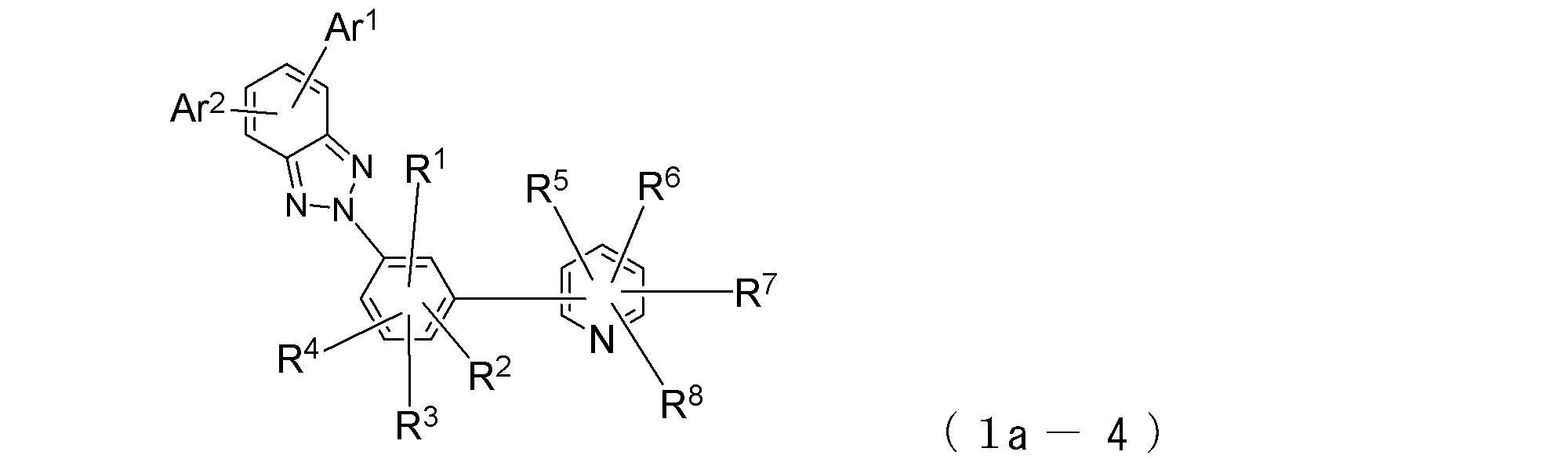
Ar1、Ar2、R1~R8及びmは、前記一般式(1)に記
載したとおりの意味である、
で表される請求項3記載のベンゾトリアゾール誘導体。 - 一対の電極とその間に挟まれた少なくとも一層の有機層を有する有機エレクトロルミネッセンス素子において、
前記有機層の少なくとも一つの層は、請求項1に記載のベンゾトリアゾール誘導体を含んでいることを特徴とする有機エレクトロルミネッセンス素子。 - 前記ベンゾトリアゾール誘導体を含む有機層が電子輸送層である請求項8記載の有機エレクトロルミネッセンス素子。
- 前記ベンゾトリアゾール誘導体を含む有機層が正孔阻止層である請求項8記載の有機エレクトロルミネッセンス素子。
- 前記ベンゾトリアゾール誘導体を含む有機層が発光層であり、上記一般式(1)で表される化合物が発光層である請求項8記載の有機エレクトロルミネッセンス素子。
- 前記ベンゾトリアゾール誘導体を含む有機層が電子注入層である請求項8記載の有機エレクトロルミネッセンス素子。
Priority Applications (6)
| Application Number | Priority Date | Filing Date | Title |
|---|---|---|---|
| US14/345,513 US9123897B2 (en) | 2011-10-14 | 2012-10-05 | Benzotriazole derivatives and organic electroluminescent devices using the derivatives |
| JP2013538530A JP6184867B2 (ja) | 2011-10-14 | 2012-10-05 | 新規なベンゾトリアゾール誘導体及び該誘導体が使用されている有機エレクトロルミネッセンス素子 |
| CN201710844921.XA CN107573326B (zh) | 2011-10-14 | 2012-10-05 | 新型苯并三唑衍生物和使用该衍生物的有机电致发光器件 |
| CN201280050354.6A CN103857671A (zh) | 2011-10-14 | 2012-10-05 | 新型苯并三唑衍生物和使用该衍生物的有机电致发光器件 |
| KR1020147009166A KR102083691B1 (ko) | 2011-10-14 | 2012-10-05 | 신규 벤조트리아졸 유도체 및 그 유도체가 사용되는 유기 전계 발광 소자 |
| EP12840372.2A EP2767534B1 (en) | 2011-10-14 | 2012-10-05 | New benzotriazole derivative and organic electroluminescent element in which said derivative is used |
Applications Claiming Priority (2)
| Application Number | Priority Date | Filing Date | Title |
|---|---|---|---|
| JP2011-226501 | 2011-10-14 | ||
| JP2011226501 | 2011-10-14 |
Publications (1)
| Publication Number | Publication Date |
|---|---|
| WO2013054764A1 true WO2013054764A1 (ja) | 2013-04-18 |
Family
ID=48081819
Family Applications (1)
| Application Number | Title | Priority Date | Filing Date |
|---|---|---|---|
| PCT/JP2012/075994 Ceased WO2013054764A1 (ja) | 2011-10-14 | 2012-10-05 | 新規なベンゾトリアゾール誘導体及び該誘導体が使用されている有機エレクトロルミネッセンス素子 |
Country Status (7)
| Country | Link |
|---|---|
| US (1) | US9123897B2 (ja) |
| EP (1) | EP2767534B1 (ja) |
| JP (1) | JP6184867B2 (ja) |
| KR (1) | KR102083691B1 (ja) |
| CN (2) | CN103857671A (ja) |
| TW (1) | TWI555736B (ja) |
| WO (1) | WO2013054764A1 (ja) |
Cited By (16)
| Publication number | Priority date | Publication date | Assignee | Title |
|---|---|---|---|---|
| WO2015016135A1 (ja) * | 2013-07-29 | 2015-02-05 | 保土谷化学工業株式会社 | ベンゾトリアゾール誘導体および有機エレクトロルミネッセンス素子 |
| WO2015150324A1 (en) | 2014-04-04 | 2015-10-08 | Basf Se | Fluorescent organic light emitting elements having high efficiency |
| WO2015156325A1 (ja) * | 2014-04-10 | 2015-10-15 | 保土谷化学工業株式会社 | キノリノトリアゾール誘導体および有機エレクトロルミネッセンス素子 |
| WO2016017594A1 (ja) * | 2014-07-29 | 2016-02-04 | 保土谷化学工業株式会社 | 有機エレクトロルミネッセンス素子 |
| WO2016027687A1 (ja) * | 2014-08-20 | 2016-02-25 | 保土谷化学工業株式会社 | 有機エレクトロルミネッセンス素子 |
| WO2016104289A1 (ja) * | 2014-12-24 | 2016-06-30 | 保土谷化学工業株式会社 | 有機エレクトロルミネッセンス素子 |
| WO2016175211A1 (ja) * | 2015-04-27 | 2016-11-03 | 保土谷化学工業株式会社 | 有機エレクトロルミネッセンス素子 |
| JP2017143272A (ja) * | 2015-01-06 | 2017-08-17 | 保土谷化学工業株式会社 | 有機エレクトロルミネッセンス素子 |
| JP2017204492A (ja) * | 2016-05-09 | 2017-11-16 | 保土谷化学工業株式会社 | 有機エレクトロルミネッセンス素子 |
| WO2018008718A1 (ja) | 2016-07-07 | 2018-01-11 | 保土谷化学工業株式会社 | ベンゾアゾール環構造を有する化合物および有機エレクトロルミネッセンス素子 |
| WO2019026728A1 (ja) | 2017-08-04 | 2019-02-07 | 保土谷化学工業株式会社 | ベンゾアゾール環構造を有する化合物を含有する有機エレクトロルミネッセンス素子 |
| WO2019049965A1 (ja) | 2017-09-11 | 2019-03-14 | 保土谷化学工業株式会社 | ピリミジン環構造を有する化合物および有機エレクトロルミネッセンス素子 |
| WO2019181997A1 (ja) | 2018-03-23 | 2019-09-26 | 保土谷化学工業株式会社 | ベンゾイミダゾール環構造を有する化合物および有機エレクトロルミネッセンス素子 |
| JPWO2020246484A1 (ja) * | 2019-06-06 | 2020-12-10 | ||
| US11046658B2 (en) | 2018-07-02 | 2021-06-29 | Incyte Corporation | Aminopyrazine derivatives as PI3K-γ inhibitors |
| US11926616B2 (en) | 2018-03-08 | 2024-03-12 | Incyte Corporation | Aminopyrazine diol compounds as PI3K-γ inhibitors |
Families Citing this family (7)
| Publication number | Priority date | Publication date | Assignee | Title |
|---|---|---|---|---|
| JP7406500B2 (ja) | 2018-10-17 | 2023-12-27 | 保土谷化学工業株式会社 | ピリミジン環構造を有する化合物および有機エレクトロルミネッセンス素子 |
| JP7369714B2 (ja) | 2018-11-29 | 2023-10-26 | 保土谷化学工業株式会社 | アザベンゾオキサゾール環構造を有する化合物および有機エレクトロルミネッセンス素子 |
| CN111285853B (zh) * | 2018-12-10 | 2023-07-28 | 江苏裕事达新材料科技有限责任公司 | 一种多环化合物 |
| KR102732187B1 (ko) | 2019-02-13 | 2024-11-19 | 호도가야 가가쿠 고교 가부시키가이샤 | 벤조아졸 고리 구조를 갖는 화합물 및 유기 일렉트로 루미네선스 소자 |
| CN113728070B (zh) * | 2019-04-26 | 2024-03-08 | 三吉油脂株式会社 | 耐热性优异和长波长吸收优异的紫外线吸收剂 |
| CN111100082B (zh) * | 2019-11-18 | 2023-01-17 | 温州大学 | 一种2-芳基苯并三氮唑类化合物的制备方法 |
| KR20220051976A (ko) * | 2020-10-20 | 2022-04-27 | 롬엔드하스전자재료코리아유한회사 | 유기 전계 발광 화합물 및 이를 포함하는 유기 전계 발광 소자 |
Citations (5)
| Publication number | Priority date | Publication date | Assignee | Title |
|---|---|---|---|---|
| JP2734341B2 (ja) | 1993-03-26 | 1998-03-30 | 住友電気工業株式会社 | 有機エレクトロルミネッセンス素子 |
| WO2003060956A2 (en) | 2002-01-18 | 2003-07-24 | Lg Chem, Ltd. | New material for transporting electrons and organic electroluminescent display using the same |
| WO2005054212A2 (en) * | 2003-12-05 | 2005-06-16 | Ciba Specialty Chemicals Holding Inc. | Electroluminescent device |
| WO2010107074A1 (ja) * | 2009-03-18 | 2010-09-23 | 保土谷化学工業株式会社 | ベンゾトリアゾール環構造を有する化合物および有機エレクトロルミネッセンス素子 |
| GB2480813A (en) * | 2010-06-01 | 2011-12-07 | Summit Corp Plc | Compounds for the treatment of clostridium difficile-associated disease |
Family Cites Families (6)
| Publication number | Priority date | Publication date | Assignee | Title |
|---|---|---|---|---|
| WO1994022974A1 (fr) | 1993-03-26 | 1994-10-13 | Sumitomo Electric Industries, Ltd. | Elements organiques electroluminescents |
| US7750112B2 (en) * | 2003-05-05 | 2010-07-06 | Ciba Specialty Chemicals Corp. | Polymers comprising benzotriazole for use in optical devices |
| JP2008218986A (ja) * | 2007-02-06 | 2008-09-18 | Sumitomo Chemical Co Ltd | 組成物及び該組成物を用いてなる発光素子 |
| KR101975611B1 (ko) | 2011-02-22 | 2019-05-07 | 호도가야 가가쿠 고교 가부시키가이샤 | 인돌로카르바졸 고리 구조를 갖는 화합물 및 유기 일렉트로루미네선스 소자 |
| KR101947201B1 (ko) | 2011-02-28 | 2019-02-12 | 호도가야 가가쿠 고교 가부시키가이샤 | 유기 일렉트로루미네선스 소자 |
| CN105419379B (zh) * | 2011-09-26 | 2018-11-20 | 日东电工株式会社 | 用于提高的日光采集效率的高荧光且光稳定性生色团 |
-
2012
- 2012-10-05 JP JP2013538530A patent/JP6184867B2/ja active Active
- 2012-10-05 CN CN201280050354.6A patent/CN103857671A/zh active Pending
- 2012-10-05 CN CN201710844921.XA patent/CN107573326B/zh active Active
- 2012-10-05 EP EP12840372.2A patent/EP2767534B1/en active Active
- 2012-10-05 US US14/345,513 patent/US9123897B2/en active Active
- 2012-10-05 KR KR1020147009166A patent/KR102083691B1/ko active Active
- 2012-10-05 WO PCT/JP2012/075994 patent/WO2013054764A1/ja not_active Ceased
- 2012-10-12 TW TW101137799A patent/TWI555736B/zh active
Patent Citations (5)
| Publication number | Priority date | Publication date | Assignee | Title |
|---|---|---|---|---|
| JP2734341B2 (ja) | 1993-03-26 | 1998-03-30 | 住友電気工業株式会社 | 有機エレクトロルミネッセンス素子 |
| WO2003060956A2 (en) | 2002-01-18 | 2003-07-24 | Lg Chem, Ltd. | New material for transporting electrons and organic electroluminescent display using the same |
| WO2005054212A2 (en) * | 2003-12-05 | 2005-06-16 | Ciba Specialty Chemicals Holding Inc. | Electroluminescent device |
| WO2010107074A1 (ja) * | 2009-03-18 | 2010-09-23 | 保土谷化学工業株式会社 | ベンゾトリアゾール環構造を有する化合物および有機エレクトロルミネッセンス素子 |
| GB2480813A (en) * | 2010-06-01 | 2011-12-07 | Summit Corp Plc | Compounds for the treatment of clostridium difficile-associated disease |
Non-Patent Citations (2)
| Title |
|---|
| AUST. J. CHEM., vol. 45, 1992, pages 371 |
| See also references of EP2767534A4 |
Cited By (53)
| Publication number | Priority date | Publication date | Assignee | Title |
|---|---|---|---|---|
| KR20160039236A (ko) * | 2013-07-29 | 2016-04-08 | 호도가야 가가쿠 고교 가부시키가이샤 | 벤조트리아졸 유도체 및 유기 전계발광 소자 |
| JPWO2015016135A1 (ja) * | 2013-07-29 | 2017-03-02 | 保土谷化学工業株式会社 | ベンゾトリアゾール誘導体および有機エレクトロルミネッセンス素子 |
| WO2015016135A1 (ja) * | 2013-07-29 | 2015-02-05 | 保土谷化学工業株式会社 | ベンゾトリアゾール誘導体および有機エレクトロルミネッセンス素子 |
| CN112079814B (zh) * | 2013-07-29 | 2023-11-07 | 保土谷化学工业株式会社 | 苯并三唑衍生物和有机电致发光器件 |
| EP3029034B1 (en) * | 2013-07-29 | 2021-04-14 | Hodogaya Chemical Co., Ltd. | Benzotriazole derivatives and organic electroluminescent element |
| KR102214289B1 (ko) * | 2013-07-29 | 2021-02-08 | 호도가야 가가쿠 고교 가부시키가이샤 | 벤조트리아졸 유도체 및 유기 전계발광 소자 |
| CN112079814A (zh) * | 2013-07-29 | 2020-12-15 | 保土谷化学工业株式会社 | 苯并三唑衍生物和有机电致发光器件 |
| CN105579443A (zh) * | 2013-07-29 | 2016-05-11 | 保土谷化学工业株式会社 | 苯并三唑衍生物和有机电致发光器件 |
| US9842999B2 (en) | 2013-07-29 | 2017-12-12 | Hodogaya Chemical Co., Ltd. | Benzotriazole derivative and an organic electroluminescent device |
| US10135004B2 (en) | 2014-04-04 | 2018-11-20 | Udc Ireland Limited | Fluorescent organic light emitting elements having high efficiency |
| WO2015150324A1 (en) | 2014-04-04 | 2015-10-08 | Basf Se | Fluorescent organic light emitting elements having high efficiency |
| US9853224B2 (en) | 2014-04-04 | 2017-12-26 | Udc Ireland Limited | Fluorescent organic light emitting elements having high efficiency |
| JPWO2015156325A1 (ja) * | 2014-04-10 | 2017-04-13 | 保土谷化学工業株式会社 | キノリノトリアゾール誘導体および有機エレクトロルミネッセンス素子 |
| WO2015156325A1 (ja) * | 2014-04-10 | 2015-10-15 | 保土谷化学工業株式会社 | キノリノトリアゾール誘導体および有機エレクトロルミネッセンス素子 |
| JPWO2016017594A1 (ja) * | 2014-07-29 | 2017-05-25 | 保土谷化学工業株式会社 | 有機エレクトロルミネッセンス素子 |
| EP3176845A4 (en) * | 2014-07-29 | 2018-03-14 | Hodogaya Chemical Co., Ltd. | Organic electroluminescent element |
| US20180212153A1 (en) * | 2014-07-29 | 2018-07-26 | Hodogaya Chemical Co., Ltd. | Organic electroluminescence device |
| WO2016017594A1 (ja) * | 2014-07-29 | 2016-02-04 | 保土谷化学工業株式会社 | 有機エレクトロルミネッセンス素子 |
| KR20170040306A (ko) | 2014-07-29 | 2017-04-12 | 호도가야 가가쿠 고교 가부시키가이샤 | 유기 전계발광 소자 |
| US11217754B2 (en) | 2014-07-29 | 2022-01-04 | Hodogaya Chemical Co., Ltd. | Organic electroluminescence device |
| WO2016027687A1 (ja) * | 2014-08-20 | 2016-02-25 | 保土谷化学工業株式会社 | 有機エレクトロルミネッセンス素子 |
| JP5875743B1 (ja) * | 2014-08-20 | 2016-03-02 | 保土谷化学工業株式会社 | 有機エレクトロルミネッセンス素子 |
| US10424742B2 (en) | 2014-08-20 | 2019-09-24 | Hodogaya Chemical Co., Ltd. | Organic electroluminescent device |
| JPWO2016104289A1 (ja) * | 2014-12-24 | 2017-11-09 | 保土谷化学工業株式会社 | 有機エレクトロルミネッセンス素子 |
| WO2016104289A1 (ja) * | 2014-12-24 | 2016-06-30 | 保土谷化学工業株式会社 | 有機エレクトロルミネッセンス素子 |
| KR20170100599A (ko) | 2014-12-24 | 2017-09-04 | 호도가야 가가쿠 고교 가부시키가이샤 | 유기 일렉트로 루미네센스 소자 |
| CN107112425A (zh) * | 2014-12-24 | 2017-08-29 | 保土谷化学工业株式会社 | 有机电致发光器件 |
| US10497876B2 (en) | 2014-12-24 | 2019-12-03 | Hodogaya Chemical Co., Ltd. | Organic electroluminescent device |
| US10593884B2 (en) | 2015-01-06 | 2020-03-17 | Hodogaya Chemical Co., Ltd. | Organic electroluminescent device |
| JP2017143272A (ja) * | 2015-01-06 | 2017-08-17 | 保土谷化学工業株式会社 | 有機エレクトロルミネッセンス素子 |
| KR20170102950A (ko) | 2015-01-06 | 2017-09-12 | 호도가야 가가쿠 고교 가부시키가이샤 | 유기 일렉트로루미네선스 소자 |
| KR20240052887A (ko) | 2015-04-27 | 2024-04-23 | 호도가야 가가쿠 고교 가부시키가이샤 | 유기 일렉트로루미네선스 소자 |
| JPWO2016175211A1 (ja) * | 2015-04-27 | 2018-02-15 | 保土谷化学工業株式会社 | 有機エレクトロルミネッセンス素子 |
| WO2016175211A1 (ja) * | 2015-04-27 | 2016-11-03 | 保土谷化学工業株式会社 | 有機エレクトロルミネッセンス素子 |
| JP2017204492A (ja) * | 2016-05-09 | 2017-11-16 | 保土谷化学工業株式会社 | 有機エレクトロルミネッセンス素子 |
| KR20190026796A (ko) | 2016-07-07 | 2019-03-13 | 호도가야 가가쿠 고교 가부시키가이샤 | 벤조아졸 고리 구조를 가지는 화합물 및 유기 일렉트로루미네센스 소자 |
| WO2018008718A1 (ja) | 2016-07-07 | 2018-01-11 | 保土谷化学工業株式会社 | ベンゾアゾール環構造を有する化合物および有機エレクトロルミネッセンス素子 |
| US11437583B2 (en) | 2017-08-04 | 2022-09-06 | Hodogaya Chemical Co., Ltd. | Organic electroluminescence device that includes compound having benzoazole structure |
| WO2019026728A1 (ja) | 2017-08-04 | 2019-02-07 | 保土谷化学工業株式会社 | ベンゾアゾール環構造を有する化合物を含有する有機エレクトロルミネッセンス素子 |
| KR20200035985A (ko) | 2017-08-04 | 2020-04-06 | 호도가야 가가쿠 고교 가부시키가이샤 | 벤조아졸 고리 구조를 갖는 화합물을 함유하는 유기 일렉트로 루미네선스 소자 |
| US12221430B2 (en) | 2017-09-11 | 2025-02-11 | Hodogaya Chemical Co., Ltd. | Compound having pyrimidine ring structure and organic electroluminescence device |
| KR20200051651A (ko) | 2017-09-11 | 2020-05-13 | 호도가야 가가쿠 고교 가부시키가이샤 | 피리미딘 고리 구조를 갖는 화합물 및 유기 일렉트로 루미네선스 소자 |
| WO2019049965A1 (ja) | 2017-09-11 | 2019-03-14 | 保土谷化学工業株式会社 | ピリミジン環構造を有する化合物および有機エレクトロルミネッセンス素子 |
| US12365668B2 (en) | 2018-03-08 | 2025-07-22 | Incyte Corporation | Aminopyrazine diol compounds as PI3K-y inhibitors |
| US11926616B2 (en) | 2018-03-08 | 2024-03-12 | Incyte Corporation | Aminopyrazine diol compounds as PI3K-γ inhibitors |
| KR20200134232A (ko) | 2018-03-23 | 2020-12-01 | 호도가야 가가쿠 고교 가부시키가이샤 | 벤조이미다졸 고리 구조를 갖는 화합물 및 유기 일렉트로 루미네선스 소자 |
| WO2019181997A1 (ja) | 2018-03-23 | 2019-09-26 | 保土谷化学工業株式会社 | ベンゾイミダゾール環構造を有する化合物および有機エレクトロルミネッセンス素子 |
| US12037332B2 (en) | 2018-03-23 | 2024-07-16 | Hodogaya Chemical Co., Ltd. | Compound including benzimidazole ring structure and organic electroluminescent element |
| US11046658B2 (en) | 2018-07-02 | 2021-06-29 | Incyte Corporation | Aminopyrazine derivatives as PI3K-γ inhibitors |
| US12421197B2 (en) | 2018-07-02 | 2025-09-23 | Incyte Corporation | Aminopyrazine derivatives as PI3K-γ inhibitors |
| JP7573524B2 (ja) | 2019-06-06 | 2024-10-25 | 保土谷化学工業株式会社 | ベンゾトリアゾール環構造を有する化合物および有機エレクトロルミネッセンス素子 |
| WO2020246484A1 (ja) * | 2019-06-06 | 2020-12-10 | 保土谷化学工業株式会社 | ベンゾトリアゾール環構造を有する化合物および有機エレクトロルミネッセンス素子 |
| JPWO2020246484A1 (ja) * | 2019-06-06 | 2020-12-10 |
Also Published As
| Publication number | Publication date |
|---|---|
| JPWO2013054764A1 (ja) | 2015-03-30 |
| CN107573326A (zh) | 2018-01-12 |
| KR20140076569A (ko) | 2014-06-20 |
| US20140374721A1 (en) | 2014-12-25 |
| TW201321360A (zh) | 2013-06-01 |
| EP2767534A1 (en) | 2014-08-20 |
| CN103857671A (zh) | 2014-06-11 |
| EP2767534A4 (en) | 2015-07-29 |
| KR102083691B1 (ko) | 2020-03-02 |
| EP2767534B1 (en) | 2020-06-03 |
| CN107573326B (zh) | 2024-03-15 |
| TWI555736B (zh) | 2016-11-01 |
| JP6184867B2 (ja) | 2017-08-23 |
| US9123897B2 (en) | 2015-09-01 |
Similar Documents
| Publication | Publication Date | Title |
|---|---|---|
| JP6184867B2 (ja) | 新規なベンゾトリアゾール誘導体及び該誘導体が使用されている有機エレクトロルミネッセンス素子 | |
| TWI676623B (zh) | 嘧啶衍生物及有機電致發光元件 | |
| US10797242B2 (en) | Compound having substituted triphenylene ring structure, and organic electroluminescent device | |
| WO2011105373A1 (ja) | 置換されたピリジル化合物および有機エレクトロルミネッセンス素子 | |
| TWI743146B (zh) | 具有苯并唑環結構之化合物及有機電致發光元件 | |
| JP6058531B2 (ja) | 有機エレクトロルミネッセンス素子 | |
| JP6294866B2 (ja) | 新規なナフトトリアゾール誘導体および有機エレクトロルミネッセンス素子 | |
| JP6389461B2 (ja) | ベンゾトリアゾール誘導体および有機エレクトロルミネッセンス素子 | |
| WO2014024447A1 (ja) | トリフェニレン環構造を有する化合物および有機エレクトロルミネッセンス素子 | |
| KR20140097931A (ko) | 신규 헤테로고리 화합물 및 이를 포함한 유기 발광 소자 | |
| JP6479770B2 (ja) | キノリノトリアゾール誘導体および有機エレクトロルミネッセンス素子 |
Legal Events
| Date | Code | Title | Description |
|---|---|---|---|
| 121 | Ep: the epo has been informed by wipo that ep was designated in this application |
Ref document number: 12840372 Country of ref document: EP Kind code of ref document: A1 |
|
| ENP | Entry into the national phase |
Ref document number: 2013538530 Country of ref document: JP Kind code of ref document: A |
|
| WWE | Wipo information: entry into national phase |
Ref document number: 2012840372 Country of ref document: EP |
|
| WWE | Wipo information: entry into national phase |
Ref document number: 14345513 Country of ref document: US |
|
| ENP | Entry into the national phase |
Ref document number: 20147009166 Country of ref document: KR Kind code of ref document: A |
|
| NENP | Non-entry into the national phase |
Ref country code: DE |