WO2013054918A1 - 高分子圧電材料、およびその製造方法 - Google Patents
高分子圧電材料、およびその製造方法 Download PDFInfo
- Publication number
- WO2013054918A1 WO2013054918A1 PCT/JP2012/076520 JP2012076520W WO2013054918A1 WO 2013054918 A1 WO2013054918 A1 WO 2013054918A1 JP 2012076520 W JP2012076520 W JP 2012076520W WO 2013054918 A1 WO2013054918 A1 WO 2013054918A1
- Authority
- WO
- WIPO (PCT)
- Prior art keywords
- piezoelectric material
- stabilizer
- group
- polymeric piezoelectric
- weight
- Prior art date
- Legal status (The legal status is an assumption and is not a legal conclusion. Google has not performed a legal analysis and makes no representation as to the accuracy of the status listed.)
- Ceased
Links
Classifications
-
- B—PERFORMING OPERATIONS; TRANSPORTING
- B29—WORKING OF PLASTICS; WORKING OF SUBSTANCES IN A PLASTIC STATE IN GENERAL
- B29C—SHAPING OR JOINING OF PLASTICS; SHAPING OF MATERIAL IN A PLASTIC STATE, NOT OTHERWISE PROVIDED FOR; AFTER-TREATMENT OF THE SHAPED PRODUCTS, e.g. REPAIRING
- B29C55/00—Shaping by stretching, e.g. drawing through a die; Apparatus therefor
- B29C55/02—Shaping by stretching, e.g. drawing through a die; Apparatus therefor of plates or sheets
- B29C55/04—Shaping by stretching, e.g. drawing through a die; Apparatus therefor of plates or sheets uniaxial, e.g. oblique
-
- B—PERFORMING OPERATIONS; TRANSPORTING
- B29—WORKING OF PLASTICS; WORKING OF SUBSTANCES IN A PLASTIC STATE IN GENERAL
- B29C—SHAPING OR JOINING OF PLASTICS; SHAPING OF MATERIAL IN A PLASTIC STATE, NOT OTHERWISE PROVIDED FOR; AFTER-TREATMENT OF THE SHAPED PRODUCTS, e.g. REPAIRING
- B29C71/00—After-treatment of articles without altering their shape; Apparatus therefor
- B29C71/02—Thermal after-treatment
-
- B—PERFORMING OPERATIONS; TRANSPORTING
- B29—WORKING OF PLASTICS; WORKING OF SUBSTANCES IN A PLASTIC STATE IN GENERAL
- B29D—PRODUCING PARTICULAR ARTICLES FROM PLASTICS OR FROM SUBSTANCES IN A PLASTIC STATE
- B29D7/00—Producing flat articles, e.g. films or sheets
- B29D7/01—Films or sheets
-
- C—CHEMISTRY; METALLURGY
- C08—ORGANIC MACROMOLECULAR COMPOUNDS; THEIR PREPARATION OR CHEMICAL WORKING-UP; COMPOSITIONS BASED THEREON
- C08G—MACROMOLECULAR COMPOUNDS OBTAINED OTHERWISE THAN BY REACTIONS ONLY INVOLVING UNSATURATED CARBON-TO-CARBON BONDS
- C08G63/00—Macromolecular compounds obtained by reactions forming a carboxylic ester link in the main chain of the macromolecule
- C08G63/02—Polyesters derived from hydroxycarboxylic acids or from polycarboxylic acids and polyhydroxy compounds
-
- C—CHEMISTRY; METALLURGY
- C08—ORGANIC MACROMOLECULAR COMPOUNDS; THEIR PREPARATION OR CHEMICAL WORKING-UP; COMPOSITIONS BASED THEREON
- C08G—MACROMOLECULAR COMPOUNDS OBTAINED OTHERWISE THAN BY REACTIONS ONLY INVOLVING UNSATURATED CARBON-TO-CARBON BONDS
- C08G63/00—Macromolecular compounds obtained by reactions forming a carboxylic ester link in the main chain of the macromolecule
- C08G63/02—Polyesters derived from hydroxycarboxylic acids or from polycarboxylic acids and polyhydroxy compounds
- C08G63/06—Polyesters derived from hydroxycarboxylic acids or from polycarboxylic acids and polyhydroxy compounds derived from hydroxycarboxylic acids
-
- C—CHEMISTRY; METALLURGY
- C08—ORGANIC MACROMOLECULAR COMPOUNDS; THEIR PREPARATION OR CHEMICAL WORKING-UP; COMPOSITIONS BASED THEREON
- C08G—MACROMOLECULAR COMPOUNDS OBTAINED OTHERWISE THAN BY REACTIONS ONLY INVOLVING UNSATURATED CARBON-TO-CARBON BONDS
- C08G63/00—Macromolecular compounds obtained by reactions forming a carboxylic ester link in the main chain of the macromolecule
- C08G63/02—Polyesters derived from hydroxycarboxylic acids or from polycarboxylic acids and polyhydroxy compounds
- C08G63/06—Polyesters derived from hydroxycarboxylic acids or from polycarboxylic acids and polyhydroxy compounds derived from hydroxycarboxylic acids
- C08G63/08—Lactones or lactides
-
- C—CHEMISTRY; METALLURGY
- C08—ORGANIC MACROMOLECULAR COMPOUNDS; THEIR PREPARATION OR CHEMICAL WORKING-UP; COMPOSITIONS BASED THEREON
- C08J—WORKING-UP; GENERAL PROCESSES OF COMPOUNDING; AFTER-TREATMENT NOT COVERED BY SUBCLASSES C08B, C08C, C08F, C08G or C08H
- C08J5/00—Manufacture of articles or shaped materials containing macromolecular substances
- C08J5/18—Manufacture of films or sheets
-
- C—CHEMISTRY; METALLURGY
- C08—ORGANIC MACROMOLECULAR COMPOUNDS; THEIR PREPARATION OR CHEMICAL WORKING-UP; COMPOSITIONS BASED THEREON
- C08J—WORKING-UP; GENERAL PROCESSES OF COMPOUNDING; AFTER-TREATMENT NOT COVERED BY SUBCLASSES C08B, C08C, C08F, C08G or C08H
- C08J7/00—Chemical treatment or coating of shaped articles made of macromolecular substances
- C08J7/08—Heat treatment
-
- C—CHEMISTRY; METALLURGY
- C08—ORGANIC MACROMOLECULAR COMPOUNDS; THEIR PREPARATION OR CHEMICAL WORKING-UP; COMPOSITIONS BASED THEREON
- C08K—Use of inorganic or non-macromolecular organic substances as compounding ingredients
- C08K5/00—Use of organic ingredients
- C08K5/16—Nitrogen-containing compounds
- C08K5/29—Compounds containing one or more carbon-to-nitrogen double bonds
-
- C—CHEMISTRY; METALLURGY
- C08—ORGANIC MACROMOLECULAR COMPOUNDS; THEIR PREPARATION OR CHEMICAL WORKING-UP; COMPOSITIONS BASED THEREON
- C08L—COMPOSITIONS OF MACROMOLECULAR COMPOUNDS
- C08L67/00—Compositions of polyesters obtained by reactions forming a carboxylic ester link in the main chain; Compositions of derivatives of such polymers
- C08L67/04—Polyesters derived from hydroxycarboxylic acids, e.g. lactones
-
- H—ELECTRICITY
- H10—SEMICONDUCTOR DEVICES; ELECTRIC SOLID-STATE DEVICES NOT OTHERWISE PROVIDED FOR
- H10N—ELECTRIC SOLID-STATE DEVICES NOT OTHERWISE PROVIDED FOR
- H10N30/00—Piezoelectric or electrostrictive devices
-
- H—ELECTRICITY
- H10—SEMICONDUCTOR DEVICES; ELECTRIC SOLID-STATE DEVICES NOT OTHERWISE PROVIDED FOR
- H10N—ELECTRIC SOLID-STATE DEVICES NOT OTHERWISE PROVIDED FOR
- H10N30/00—Piezoelectric or electrostrictive devices
- H10N30/01—Manufacture or treatment
-
- H—ELECTRICITY
- H10—SEMICONDUCTOR DEVICES; ELECTRIC SOLID-STATE DEVICES NOT OTHERWISE PROVIDED FOR
- H10N—ELECTRIC SOLID-STATE DEVICES NOT OTHERWISE PROVIDED FOR
- H10N30/00—Piezoelectric or electrostrictive devices
- H10N30/01—Manufacture or treatment
- H10N30/08—Shaping or machining of piezoelectric or electrostrictive bodies
-
- H—ELECTRICITY
- H10—SEMICONDUCTOR DEVICES; ELECTRIC SOLID-STATE DEVICES NOT OTHERWISE PROVIDED FOR
- H10N—ELECTRIC SOLID-STATE DEVICES NOT OTHERWISE PROVIDED FOR
- H10N30/00—Piezoelectric or electrostrictive devices
- H10N30/01—Manufacture or treatment
- H10N30/09—Forming piezoelectric or electrostrictive materials
-
- H—ELECTRICITY
- H10—SEMICONDUCTOR DEVICES; ELECTRIC SOLID-STATE DEVICES NOT OTHERWISE PROVIDED FOR
- H10N—ELECTRIC SOLID-STATE DEVICES NOT OTHERWISE PROVIDED FOR
- H10N30/00—Piezoelectric or electrostrictive devices
- H10N30/01—Manufacture or treatment
- H10N30/09—Forming piezoelectric or electrostrictive materials
- H10N30/098—Forming organic materials
-
- H—ELECTRICITY
- H10—SEMICONDUCTOR DEVICES; ELECTRIC SOLID-STATE DEVICES NOT OTHERWISE PROVIDED FOR
- H10N—ELECTRIC SOLID-STATE DEVICES NOT OTHERWISE PROVIDED FOR
- H10N30/00—Piezoelectric or electrostrictive devices
- H10N30/80—Constructional details
- H10N30/85—Piezoelectric or electrostrictive active materials
- H10N30/857—Macromolecular compositions
-
- H—ELECTRICITY
- H10—SEMICONDUCTOR DEVICES; ELECTRIC SOLID-STATE DEVICES NOT OTHERWISE PROVIDED FOR
- H10N—ELECTRIC SOLID-STATE DEVICES NOT OTHERWISE PROVIDED FOR
- H10N30/00—Piezoelectric or electrostrictive devices
- H10N30/80—Constructional details
- H10N30/87—Electrodes or interconnections, e.g. leads or terminals
- H10N30/877—Conductive materials
- H10N30/878—Conductive materials the principal material being non-metallic, e.g. oxide or carbon based
-
- B—PERFORMING OPERATIONS; TRANSPORTING
- B29—WORKING OF PLASTICS; WORKING OF SUBSTANCES IN A PLASTIC STATE IN GENERAL
- B29C—SHAPING OR JOINING OF PLASTICS; SHAPING OF MATERIAL IN A PLASTIC STATE, NOT OTHERWISE PROVIDED FOR; AFTER-TREATMENT OF THE SHAPED PRODUCTS, e.g. REPAIRING
- B29C71/00—After-treatment of articles without altering their shape; Apparatus therefor
- B29C71/02—Thermal after-treatment
- B29C2071/022—Annealing
-
- B—PERFORMING OPERATIONS; TRANSPORTING
- B29—WORKING OF PLASTICS; WORKING OF SUBSTANCES IN A PLASTIC STATE IN GENERAL
- B29K—INDEXING SCHEME ASSOCIATED WITH SUBCLASSES B29B, B29C OR B29D, RELATING TO MOULDING MATERIALS OR TO MATERIALS FOR MOULDS, REINFORCEMENTS, FILLERS OR PREFORMED PARTS, e.g. INSERTS
- B29K2067/00—Use of polyesters or derivatives thereof, as moulding material
- B29K2067/04—Polyesters derived from hydroxycarboxylic acids
- B29K2067/046—PLA, i.e. polylactic acid or polylactide
-
- B—PERFORMING OPERATIONS; TRANSPORTING
- B29—WORKING OF PLASTICS; WORKING OF SUBSTANCES IN A PLASTIC STATE IN GENERAL
- B29K—INDEXING SCHEME ASSOCIATED WITH SUBCLASSES B29B, B29C OR B29D, RELATING TO MOULDING MATERIALS OR TO MATERIALS FOR MOULDS, REINFORCEMENTS, FILLERS OR PREFORMED PARTS, e.g. INSERTS
- B29K2995/00—Properties of moulding materials, reinforcements, fillers, preformed parts or moulds
- B29K2995/0037—Other properties
- B29K2995/004—Semi-crystalline
-
- C—CHEMISTRY; METALLURGY
- C08—ORGANIC MACROMOLECULAR COMPOUNDS; THEIR PREPARATION OR CHEMICAL WORKING-UP; COMPOSITIONS BASED THEREON
- C08J—WORKING-UP; GENERAL PROCESSES OF COMPOUNDING; AFTER-TREATMENT NOT COVERED BY SUBCLASSES C08B, C08C, C08F, C08G or C08H
- C08J2367/00—Characterised by the use of polyesters obtained by reactions forming a carboxylic ester link in the main chain; Derivatives of such polymers
- C08J2367/04—Polyesters derived from hydroxy carboxylic acids, e.g. lactones
Definitions
- the present invention relates to a polymer piezoelectric material and a method for producing the same.
- PZT PbZrO 3 -PbTiO 3 solid solution
- PZT contains lead, so it has a low environmental burden and is highly flexible.
- Molecular piezoelectric materials are being used.
- polymer piezoelectric materials are mainly classified into the following two types. That is, Pauling type polymer represented by nylon 11, polyvinyl fluoride, polyvinyl chloride, polyurea, etc., polyvinylidene fluoride ( ⁇ type) (PVDF), and vinylidene fluoride-trifluoroethylene copolymer (P (VDF-TrFE)) (75/25) and other ferroelectric polymers.
- PVDF polyvinylidene fluoride
- PVDF-TrFE vinylidene fluoride-trifluoroethylene copolymer
- polymeric piezoelectric materials are not as good as PZT in piezoelectricity, and are required to improve piezoelectricity. For this reason, attempts have been made to improve the piezoelectricity of the polymeric piezoelectric material from various viewpoints.
- the ferroelectric polymers PVDF and P have excellent piezoelectricity among the polymers, and the piezoelectric constant d 31 is 20 pC / N or more.
- the film material formed from PVDF and P (VDF-TrFE) by orienting polymer chains in the stretching direction by stretching operation, and then applying different charges on the front and back of the film by corona discharge, An electric field is generated in the direction perpendicular to the film surface, and permanent dipoles containing fluorine in the side chains of the polymer chain are oriented parallel to the electric field direction to impart piezoelectricity.
- PVDF is the most piezoelectric material among the above polymer piezoelectric materials, but the dielectric constant is relatively high among the polymer piezoelectric materials and is 13. Therefore, the piezoelectric d constant is divided by the dielectric constant. The value of the piezoelectric g constant (open voltage per unit stress) becomes small. Moreover, although PVDF has good conversion efficiency from electricity to sound, improvement in the conversion efficiency from sound to electricity has been expected.
- polylactic acid has a small volume fraction of side chains with respect to the main chain and a large ratio of permanent dipoles per volume, and can be said to be an ideal polymer among the polymers having helical chirality.
- a polymer piezoelectric material that exhibits a piezoelectric constant of about 10 pC / N at room temperature by stretching a molded product of polylactic acid has been disclosed (see, for example, JP-A-5-152638).
- an object of the present invention is to provide a highly reliable polymeric piezoelectric material with improved heat and moisture resistance and a method for producing the same.
- a polymeric piezoelectric material comprising 0.01 to 10 parts by weight of the agent (B).
- the stabilizer (B) includes a stabilizer (B3) having one functional group in one molecule selected from the group consisting of a carbodiimide group, an epoxy group, and an isocyanate group.
- the polymeric piezoelectric material as described. [3] Internal haze to visible light is 50% or less, and the piezoelectric constant d 14 measured by a displacement method at 25 ° C. is 1 Pm/V or more, polymeric piezoelectric according to [1] or [2] material.
- Stabilizer (B1) having a weight average molecular weight of 200 to 900, wherein the stabilizer (B) has at least one functional group selected from the group consisting of a carbodiimide group, an epoxy group, and an isocyanate group.
- a stabilizer (B2) having a weight average molecular weight of 1,000 to 60,000 having two or more functional groups in one molecule selected from the group consisting of a carbodiimide group, an epoxy group, and an isocyanate group,
- [5] The polymeric piezoelectric material according to any one of [1] to [4], wherein the internal haze is 13% or less.
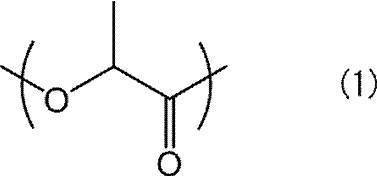
- a compound having a main chain containing a repeating unit represented by the following formula (1) is preferable from the viewpoint of increasing optical purity and improving piezoelectricity.
- Examples of the compound having a repeating unit represented by the formula (1) as a main chain include polylactic acid polymers. Among them, polylactic acid is preferable, and L-lactic acid homopolymer (PLLA) or D-lactic acid homopolymer (PDLA) is most preferable.
- the polylactic acid-based polymer in the present embodiment refers to “polylactic acid (polymer compound consisting only of repeating units derived from a monomer selected from L-lactic acid and D-lactic acid)”, “L-lactic acid or D-lactic acid”. A copolymer of lactic acid and a compound copolymerizable with the L-lactic acid or D-lactic acid ”, or a mixture of both.
- the lower limit 40 of the preferred range of the product of normalized molecular orientation MORc and crystallinity of the polymer piezoelectric material is that the product of birefringence ⁇ n and crystallinity of the polymer piezoelectric material is converted to 0.1. Can do.
- the raw material of the polymeric piezoelectric material of the present embodiment includes the aliphatic polyester (A) such as the polylactic acid polymer described above, the stabilizer (B) such as a carbodiimide compound, and other components as necessary. Are mixed to obtain a mixture. The mixture may be melt kneaded.
- a pre-crystallized pre-crystallized sheet may be sent to a stretching step (second step) described later and set in a stretching apparatus to be stretched (off-line heat treatment), or 2) by heat treatment
- a non-crystallized amorphous sheet is set in a stretching apparatus, heated in a stretching apparatus to be pre-crystallized, and then continuously sent to a stretching process (second process) for stretching.
- Good heat treatment by in-line).
- the heating time for pre-crystallization or the heating time for crystallization when extruding into a sheet form satisfies the desired degree of crystallinity and is the standard for the polymeric piezoelectric material after stretching (after the second step)
- the product of the polymer molecular orientation MORc and the crystallinity of the polymer piezoelectric material after stretching is preferably adjusted to 40 to 700, more preferably 125 to 650, and further preferably 250 to 350.
- the heating time becomes longer the degree of crystallinity after stretching increases, and the normalized molecular orientation MORc after stretching also increases.
- the heating time is shortened, the crystallinity after stretching also decreases, and the normalized molecular orientation MORc after stretching tends to decrease.
- the stretching method in the stretching step which is the second step, is not particularly limited, and various stretching methods such as uniaxial stretching, biaxial stretching, and solid phase stretching described later can be used.
- various stretching methods such as uniaxial stretching, biaxial stretching, and solid phase stretching described later can be used.
- the glass transition temperature Tg [° C.] of the polymer piezoelectric material and the melting point Tm [° C.] of the polymer piezoelectric material are measured with respect to the polymer piezoelectric material using a differential scanning calorimeter (DSC). From the melting endothermic curve when the temperature is raised at 10 ° C./min, the glass transition temperature (Tg) obtained as the inflection point of the curve and the temperature (Tm) confirmed as the peak value of the endothermic reaction.
- DSC differential scanning calorimeter
- the compressive stress is preferably 50 MPa to 5000 MPa, and more preferably 100 MPa to 3000 MPa.
- the solid-phase stretching of the pre-crystallized sheet is performed by applying pressure by sandwiching a polymer piezoelectric material between, for example, a roll or a burette.
- preheating When stretching the pre-crystallized sheet, preheating may be performed immediately before stretching in order to facilitate stretching of the sheet. This preheating is generally performed in order to soften the sheet before stretching and facilitate stretching, so that the sheet before stretching is crystallized and does not harden the sheet. It is normal. However, as described above, in the present embodiment, since pre-crystallization may be performed before stretching, the pre-heating may be performed together with pre-crystallization. Specifically, preheating and precrystallization can be performed by performing preheating at a temperature higher or longer than the normal temperature in accordance with the heating temperature and heat treatment time in the precrystallization step described above.
- the temperature of the annealing treatment is preferably approximately 80 ° C. to 160 ° C., more preferably 100 ° C. to 155 ° C.
- the temperature application time of the annealing treatment is preferably 1 second to 60 minutes, more preferably 1 second to 300 seconds, and further preferably heating in the range of 1 second to 60 seconds.
- the degree of orientation may decrease due to the growth of spherulites from the molecular chains of the amorphous portion at a temperature higher than the glass transition temperature of the polymeric piezoelectric material. And transparency may be reduced.
- the polymer piezoelectric material annealed as described above is rapidly cooled after the annealing treatment.
- “rapidly cool” means that the annealed polymer piezoelectric material is immersed in ice water or the like immediately after the annealing process and cooled to at least the glass transition point Tg or less. It means that no other treatment is included in the dipping time.
- the rapid cooling method includes a method of immersing the annealed polymer piezoelectric material in a coolant such as ethanol, methanol, or liquid nitrogen containing water, ice water, ethanol, or dry ice, or by spraying a liquid spray with a low vapor pressure to evaporate.
- a coolant such as ethanol, methanol, or liquid nitrogen containing water, ice water, ethanol, or dry ice
- the method of cooling by latent heat is mentioned.
- To continuously cool the polymer piezoelectric material it is possible to rapidly cool the polymer piezoelectric material by bringing it into contact with a metal roll controlled to a temperature not higher than the glass transition temperature Tg of the polymer piezoelectric material. It is. Further, the number of times of cooling may be only once, or may be two or more. Furthermore, annealing and cooling can be alternately repeated.
- the method for producing a polymeric piezoelectric material according to the present invention includes a step of stretching a sheet containing the aliphatic polyester (A) and the stabilizer (B) mainly in a uniaxial direction, and a step of annealing. You may include in order.
- the stretching process and the annealing process can be the same processes as described above. Moreover, in this manufacturing method, it is not necessary to implement the above-mentioned preliminary crystallization process.
- the polymeric piezoelectric material is cut at 40 mm in the stretching direction (MD direction) and 40 mm in the direction orthogonal to the stretching direction (TD direction) to produce a rectangular test piece.
- the obtained test piece is set on a test stand of a sputtering thin film forming apparatus JSP-8000 manufactured by ULVAC, and the coater chamber is evacuated (for example, 10 ⁇ 3 Pa or less) by a rotary pump.
- sputtering is performed on one surface of the test piece for 500 seconds on an Ag (silver) target under the conditions of an applied voltage of 280 V and a sputtering current of 0.4 A).
- the other surface of the test piece is sputtered for 500 seconds under the same conditions to coat Ag on both sides of the test piece to form an Ag conductive layer.
- a 40 mm ⁇ 40 mm test piece having an Ag conductive layer formed on both sides is set to 32 mm in the direction of 45 ° with respect to the stretching direction (MD direction) of the polymer piezoelectric material, and 5 mm in the direction perpendicular to the direction of 45 °. Cut and cut out a rectangular film of 32 mm ⁇ 5 mm. This was used as a piezoelectric constant measurement sample.
- a 32 mm ⁇ 30 mm test piece having an Au conductive layer formed on both sides was cut to 10 mm in the stretching direction (MD direction) of the polymeric piezoelectric material and 9 mm in the direction perpendicular to the stretching direction (TD direction) to form a rectangular shape. Cut out the film.
- This is a sample for measurement of resonance-antiresonance method.
- an impedance resonance curve appearing in a band of 50 kHz to 100 kHz is measured using an impedance analyzer HP4194A manufactured by Yokogawa Hewlett-Packard Company. From the impedance resonance curve and the relative dielectric constant ⁇ r obtained, Jpn. J. et al. Appl.
- the obtained piezoelectric constant is defined as the piezoelectric constant of the polymer piezoelectric material.
- the crystallinity of the polymer piezoelectric material is determined by the DSC method, and the crystallinity of the polymer piezoelectric material of the present embodiment is 20% to 80%, preferably 25% to 70%, more preferably Is preferably 30% to 50%. If the crystallinity is in the above range, the piezoelectricity and transparency of the polymeric piezoelectric material are well balanced, and when the polymeric piezoelectric material is stretched, whitening and breakage are unlikely to occur and it is easy to manufacture.
- the transparency of the polymeric piezoelectric material can be evaluated, for example, by visual observation or haze measurement.
- the haze of the polymeric piezoelectric material is preferably 50% or less, more preferably 20% or less, and even more preferably 15% or less.
- the internal haze is 25 ° C. using a haze measuring device (TC Density Co., Ltd., TC-HIII DPK) in accordance with JIS-K7105 for a polymeric piezoelectric material having a thickness of 0.05 mm. The details of the measurement method will be described later in Examples.
- the polymer piezoelectric material of the present embodiment preferably has a normalized molecular orientation MORc of 2.0 to 15.0, preferably 3.0 to 10.0, and 4.0 to 8.0. More preferably. If the normalized molecular orientation MORc is in the range of 2.0 to 15.0, there are many polylactic acid molecular chains arranged in the stretching direction. As a result, the rate of formation of oriented crystals increases, and high piezoelectricity is expressed. It becomes possible.
- the product of the crystallinity of the polymeric piezoelectric material and the normalized molecular orientation MORc is preferably 40 to 700, more preferably 75 to 680, more preferably 90 to 660, more preferably 125 to 650, and more preferably 180 to 350. If the product of the crystallinity of the polymer piezoelectric material and the normalized molecular orientation MORc is in the range of 40 to 700, the balance between piezoelectricity and transparency of the polymer piezoelectric material is good, and dimensional stability And can be suitably used as a piezoelectric element described later.
- Polymeric piezoelectric material of the present invention above described large piezoelectric constant d 14 is as transparency, because it is excellent piezoelectric material dimensional stability, speakers, headphones, a touch panel, remote controller, microphone, water microphone, Ultrasonic transducer, ultrasonic applied measuring instrument, piezoelectric vibrator, mechanical filter, piezoelectric transformer, delay device, sensor, acceleration sensor, impact sensor, vibration sensor, pressure sensor, tactile sensor, electric field sensor, sound pressure sensor, display It can be used in various fields such as fans, pumps, variable focus mirrors, sound insulation materials, sound insulation materials, keyboards, acoustic equipment, information processing equipment, measurement equipment, medical equipment, and the like.
- the polymeric piezoelectric material of the present invention is preferably used as a piezoelectric element having at least two surfaces and having electrodes on the surfaces.
- the electrodes only need to be provided on at least two surfaces of the polymeric piezoelectric material.
- limit especially as said electrode For example, ITO, ZnO, IZO (trademark), a conductive polymer, etc. are used.
- the polymeric piezoelectric material of the present invention and electrodes can be repeatedly stacked and used as a laminated piezoelectric element.
- the unit having two repetitions is a laminated piezoelectric element in which electrodes, polymer piezoelectric material, electrodes, polymer piezoelectric material, and electrodes are stacked in this order.
- one layer of the polymer piezoelectric material may be the polymer piezoelectric material of the present invention, and the other layers may not be the polymer piezoelectric material of the present invention.
- the laminated piezoelectric element includes a plurality of polymer piezoelectric materials of the present invention, if the optical activity of the aliphatic polyester (A) included in the polymer piezoelectric material of the present invention in a certain layer is L, the other The aliphatic polyester (A) contained in the polymer piezoelectric material of this layer may be L-form or D-form.
- the arrangement of the polymeric piezoelectric material can be appropriately adjusted according to the use of the piezoelectric element.
- the first layer of the piezoelectric polymer material containing the L-type aliphatic polyester (A) as the main component contains the second high-density polyester containing the L-type aliphatic polyester (A) as the main component via the electrode.
- the uniaxial stretching direction (main stretching direction) of the first polymeric piezoelectric material intersects the uniaxial stretching direction (main stretching direction) of the second polymeric piezoelectric material, preferably orthogonal This is preferable because the direction of displacement of the first polymer piezoelectric material and the second polymer piezoelectric material can be made uniform, and the piezoelectricity of the entire laminated piezoelectric element is enhanced.
- the first layer of the piezoelectric polymer material containing the L-type aliphatic polyester (A) as the main component contains the second high-density polyester containing the D-type aliphatic polyester (A) as the main component via the electrode.
- the uniaxial stretching direction (main stretching direction) of the first polymeric piezoelectric material is substantially parallel to the uniaxial stretching direction (main stretching direction) of the second polymeric piezoelectric material. It is preferable that the first and second polymer piezoelectric materials can be arranged in the same direction, and the piezoelectricity of the entire laminated piezoelectric element is enhanced.
- the transparency of the electrode specifically means that the internal haze is 20% or less (total light transmittance is 80% or more).
- the piezoelectric element using the polymer piezoelectric material of the present invention can be applied to the above-described various piezoelectric devices such as speakers and touch panels.
- a piezoelectric element provided with a transparent electrode is suitable for application to a speaker, a touch panel, an actuator, and the like.
- Example 1 Carbidelide (Nisshinbo Chemical Co., Ltd.) as stabilizer (B) [carbodiimide compound] for 100 parts by weight of polylactic acid resin (registered trademark LACEEA, H-400 (weight average molecular weight Mw: 200,000)) manufactured by Mitsui Chemicals, Inc. Company, LA-1) 0.1 parts by weight was added and dry blended to produce a raw material, which was put into an extruder hopper and extruded from a T die while being heated to 220 ° C. to 230 ° C.
- polylactic acid resin registered trademark LACEEA, H-400 (weight average molecular weight Mw: 200,000
- a pre-crystallized sheet having a thickness of 150 ⁇ m was formed in contact with a cast roll of 0.5 minutes (pre-crystallization step), and the crystallinity of the pre-crystallized sheet was measured to be 5.63%. It was.
- the obtained pre-crystallized sheet was stretched by roll-to-roll while being heated to 70 ° C. at a stretching speed of 1650 mm / min, and uniaxially stretched in the MD direction up to 3.3 times (stretching step).
- the thickness of the obtained film was 53 ⁇ m.
- the uniaxially stretched film was subjected to annealing treatment by roll-to-roll on a roll heated to 130 ° C. for 60 seconds to produce a polymeric piezoelectric material (annealing treatment step).
- Examples 2 to 5 Comparative Example 1
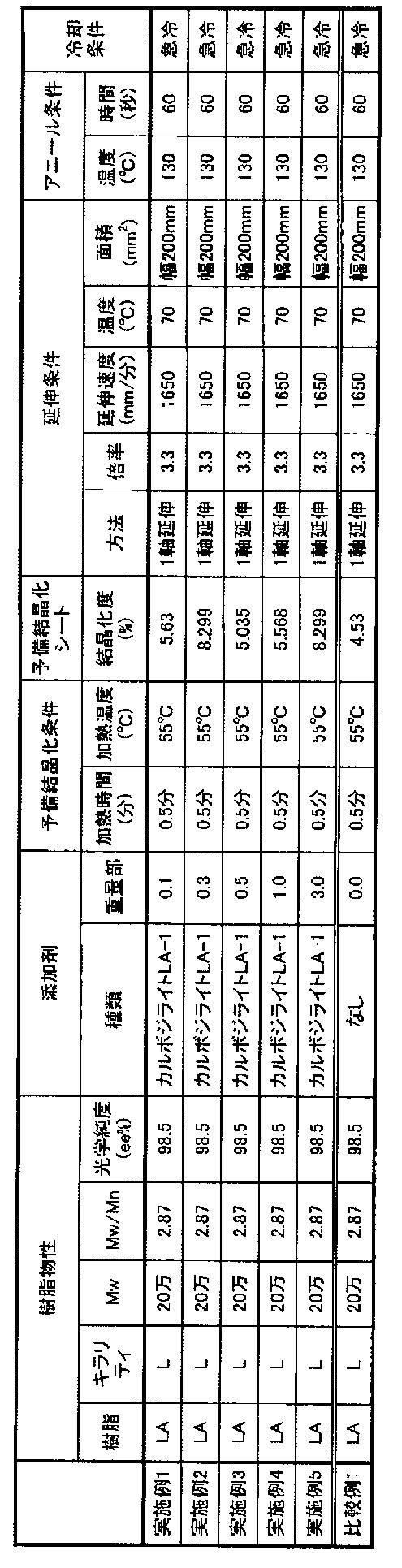
- Example 2 to 5 were carried out in the same manner except that the addition amount of carbodilite LA-1, precrystallization conditions and stretching conditions were changed to the conditions shown in Table 1.
- Polymer piezoelectric materials of Example 5 and Comparative Example 1 were produced.
- the sample solution was cooled to room temperature, neutralized by adding 20 mL of 1.0 mol / L hydrochloric acid solution, and the Erlenmeyer flask was sealed and mixed well.
- 1.0 mL of the sample solution was placed in a 25 mL volumetric flask, and HPLC sample solution 1 was prepared with 25 mL of mobile phase.
- 5 ⁇ L of the HPLC sample solution 1 was injected into the HPLC apparatus, the D / L body peak area of polylactic acid was determined under the following HPLC conditions, and the amount of L body and the amount of D body were calculated.
- -HPLC measurement conditions - ⁇ Column Optical resolution column, SUMICHIRAL OA5000, manufactured by Sumika Chemical Analysis Co., Ltd.
- Measurement conditions 0.1 ml of the sample solution was introduced into the column at a solvent (chloroform), a temperature of 40 ° C. and a flow rate of 1 ml / min, and the sample concentration in the sample solution separated by the column was measured with a differential refractometer.
- a universal calibration curve was prepared using a polystyrene standard sample, and the weight average molecular weight (Mw) of each resin was calculated.
- Mw weight average molecular weight Table 1 shows the measurement results of the resins used in Examples and Comparative Examples.
- “LA” represents LACEA H-400.
- the amount of carbodilite LA1 added is 100 parts by weight of LACEA H-400.
- Glass transition temperature Tg, melting point Tm, and crystallinity Each of the polymeric piezoelectric materials of Examples and Comparative Examples was accurately weighed in an amount of 10 mg, and measured using a differential scanning calorimeter (DSC-1 manufactured by Perkin Elmer Co., Ltd.) under a temperature rising rate of 10 ° C./min. A melting endotherm curve was obtained. From the obtained melting endotherm curve, melting point Tm, glass transition temperature Tg, specific heat capacity Cp and crystallinity were obtained.
- the stretched film was cut 50 mm in the stretching direction (MD direction) and 50 mm in the direction orthogonal to the stretching direction (TD direction) to cut out a 50 mm ⁇ 50 mm rectangular film.
- This film was suspended in an oven set at 85 ° C. and annealed for 30 minutes. Thereafter, the dimension of the film rectangular side length in the MD direction before and after annealing was measured with calipers, the dimensional change rate (%) was calculated according to the following formula, and the dimensional stability was evaluated by the absolute value. A smaller dimensional change rate indicates higher dimensional stability.
- Dimensional change rate (%) 100 ⁇ ((side length in MD direction before annealing) ⁇ (side length in MD direction after annealing)) / (side length in MD direction before annealing)
- haze or “internal haze” refers to internal haze of the polymeric piezoelectric material of the present invention, and the measurement method is measured by a general method. Specifically, the internal haze value of each polymeric piezoelectric material of Examples and Comparative Examples was measured by measuring light transmittance in the thickness direction using the following apparatus under the following measurement conditions.
- the internal haze (hereinafter also referred to as internal haze (H1)) of the polymeric piezoelectric material of the present invention is preliminarily provided between two glass plates with silicon oil (Shin-Etsu Silicone (trademark) manufactured by Shin-Etsu Chemical Co., Ltd.), model number: KF96.
- the haze (H2) and haze (H3) were measured using the following apparatus under the following measurement conditions, and the light transmittance in the thickness direction was measured. By measuring, the internal haze (H1) of the polymeric piezoelectric material was calculated.
- Measuring device Tokyo Denshoku Co., Ltd., HAZE METER TC-HIIIDPK Sample size: width 30 mm x length 30 mm, thickness 0.05 mm
- Measurement conditions Conforms to JIS-K7105 Measurement temperature: Room temperature (25 ° C)
- piezoelectric constant d 14 (by displacement method)
- a 40 mm ⁇ 40 mm test piece having an Ag conductive layer formed on both sides is set to 32 mm in the direction of 45 ° with respect to the stretching direction (MD direction) of the polymer piezoelectric material, and 5 mm in the direction perpendicular to the direction of 45 °.
- a rectangular film of 32 mm ⁇ 5 mm was cut out. This was used as a piezoelectric constant measurement sample.
- a sine wave AC voltage of 10 Hz, 300 Vpp was applied to the obtained sample, the difference distance between the maximum value and the minimum value of the displacement of the film was measured with a laser spectral interference displacement meter SI-1000 manufactured by Keyence Corporation. .
- the measured amount of displacement (mp-p) divided by the reference length of the film 30 mm is used as the amount of strain, and the amount of strain applied to the film is the electric field strength ((applied voltage (V)) / (film thickness)).
- V applied voltage
- a value obtained by multiplying the value divided by 2 by 2 was defined as a piezoelectric constant d 14 (pm / V).
- Example 6 A polylactic acid solution is prepared by dissolving 10 g of polylactic acid (H400) and 200 g of chloroform (Wako Pure Chemical Industries, Ltd., Wako First Grade) at room temperature. Next, 3 parts by weight of stabilizer B2-2 (compound described in Table 3) with respect to 100 parts by weight of polylactic acid and 10 g of chloroform are dissolved at room temperature to prepare a stabilizer solution. The polylactic acid solution thus obtained and the stabilizer solution were mixed at room temperature and stirred for 30 minutes. This solution was allowed to stand at 50 ° C. and 0.2 atm for 12 hours and dried to obtain a mixed solid. The mixed solid was hot pressed at 205 ° C. for 1 minute and then pressed with a press set at 20 ° C.
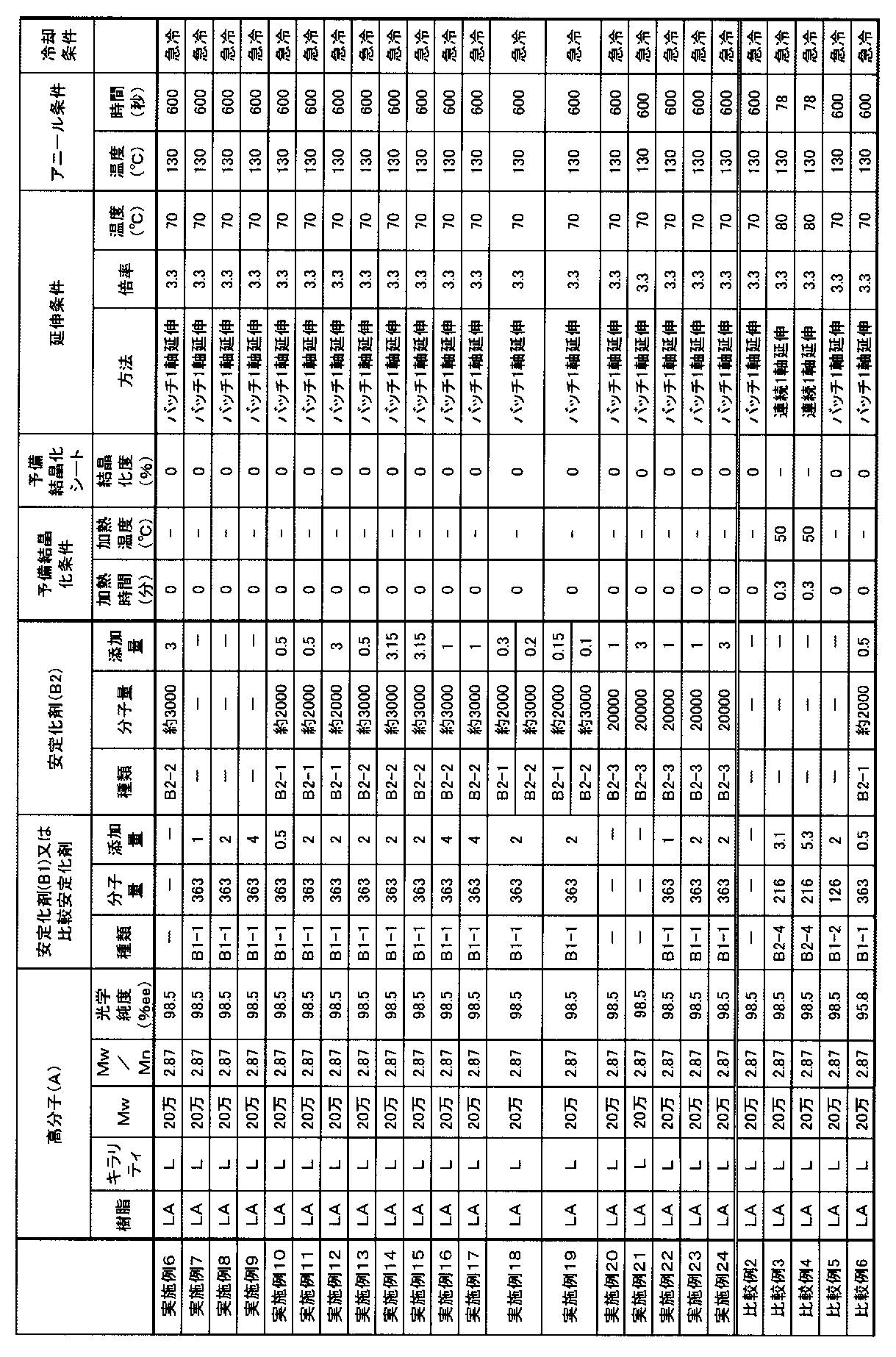
- Example 7 to 24, Comparative Examples 2 to 6 A polymeric piezoelectric material was obtained in the same manner as in Example 6 except that the type of polylactic acid and the type and amount of stabilizer were changed as shown in Table 3 below. In addition, the area of the main surface of the polymeric piezoelectric material described as an Example or a comparative example of this application was all 10 mm ⁇ 2 > or more.
- the addition amount of the stabilizer in Table 3 below represents the addition amount (parts by weight) relative to 100 parts by weight of the polymer (A).
- the molecular weight of the stabilizer (B1-1) is a weight average molecular weight
- the molecular weights of the stabilizers (B2-1 to B2-3) and the comparative stabilizers (B1-2, B2-4) are weight average. Represents molecular weight.
- Stabilizer B1-1 manufactured by Tokyo Chemical Industry, B2756 (trade name), bis-2,6-diisopropylphenylcarbodiimide, stabilizer B2-1: manufactured by Nisshinbo Chemical Co., Ltd., Carbodilite LA-1 (trade name) poly ( 4,4′-dicyclohexylmethanecarbodiimide): weight average molecular weight: about 2000
- Stabilizer B2-2 Rhein Chemie, Stabaxol P (trade name), poly (1,3,5-triisopropylphenylene-2,4-carbodiimide): weight average molecular weight: about 3000
- Stabilizer B2-3 Rhein Chemie, Stabaxol P400 (trade name), poly (1,3,5-triisopropylphenylene-2,4-carbodiimide): weight average molecular weight: 20000
- Comparative stabilizer B2-4 manufactured by Mikuni Pharmaceutical Co.
- Example 6 For Examples 6 to 24 and Comparative Examples 2 to 6, the melting point (Tm), crystallinity, MORc and initial internal haze, piezoelectric constant (pm / V), and weight average molecular weight of the resin are shown in Example 1. And evaluated in the same manner. The results are shown in Table 4 below.
- the reliability (moisture and heat resistance) test was evaluated in the same manner as the reliability test I described above except that the test piece was stored in an atmosphere of 85 ° C. and 85% RH (reliability test II). After storage for 200 hours and 500 hours, the internal haze and the weight average molecular weight were measured in the same manner as in the initial stage.
- the molecular weight change is the weight average molecular weight Mw of the test piece immediately after production, and shows a standard value obtained by dividing the molecular weight Mw of the test piece after being placed in the constant temperature and humidity chamber for 200 hours and 500 hours. Even if the standard value is larger than 1 or smaller than 1, the decrease rate is low, which confirms that the hydrolyzability is suppressed and the reliability is good.
- Table 4 the case where the molecular weight is “not measurable” indicates that the molecular weight could not be measured because the molecular weight was too low and liquefied. According to the following evaluation, those having a molecular weight change after storage for 200 hours in a moist heat environment of 0.3 or less, specifically those having a value between 0.7 and 1.3 have sufficient reliability in practical use. to decide.
- the polymeric piezoelectric materials of Examples 6 to 24 had an internal haze of 50% or less and a good piezoelectric constant. Further, it can be seen that the change in internal haze is small even after storage for 200 hours under high temperature and high humidity, and the heat and moisture resistance is excellent. Furthermore, the polymeric piezoelectric materials of Example 14 to Example 17, Example 23, and Example 24 have very severe conditions with little change in internal haze and molecular weight even after being stored under high temperature and high humidity for 500 hours. It turns out that it is excellent in the heat-and-moisture resistance below.
- Examples 25 to 26 A polymeric piezoelectric material was obtained based on the conditions described in Table 5 below.
- the addition amount of the stabilizer in Table 5 below represents the addition amount (parts by weight) relative to 100 parts by weight of the polymer (A).
- Example 25 the melting point (Tm), crystallinity, MORc, internal haze, piezoelectric constant (pm / V), and weight average molecular weight of the resin were evaluated in the same manner as in Example 1. The results are shown in Table 6 below.
- the reliability (moisture and heat resistance) test was evaluated in the same manner as the reliability test I described above except that the test piece was stored in an atmosphere of 60 ° C. and 95% RH. After storage for 500 hours, the internal haze, piezoelectric constant, and weight average molecular weight were measured in the same manner as in the initial stage.
- Table 6 shows the standard value obtained by dividing the molecular weight Mw of the test piece immediately after production by the molecular weight Mw of the test piece after being placed under the above conditions for 500 hours.
- the standard value is larger than 1 or smaller than 1, the decrease rate is low, which means that the hydrolyzability is suppressed and the reliability is improved.
- the dimensional change rate II was evaluated in the same manner as in Example 1 except that the heat treatment was changed to 100 ° C. for 30 minutes.
Landscapes
- Chemical & Material Sciences (AREA)
- Engineering & Computer Science (AREA)
- Manufacturing & Machinery (AREA)
- Polymers & Plastics (AREA)
- Health & Medical Sciences (AREA)
- Chemical Kinetics & Catalysis (AREA)
- Medicinal Chemistry (AREA)
- Organic Chemistry (AREA)
- Physics & Mathematics (AREA)
- Mechanical Engineering (AREA)
- Spectroscopy & Molecular Physics (AREA)
- Thermal Sciences (AREA)
- Materials Engineering (AREA)
- Compositions Of Macromolecular Compounds (AREA)
- Biological Depolymerization Polymers (AREA)
- Manufacture Of Macromolecular Shaped Articles (AREA)
Abstract
Description
[1]重量平均分子量が5万~100万で光学活性を有する脂肪族系ポリエステル(A)と、カルボジイミド基、エポキシ基、及びイソシアネート基からなる群から選ばれる1種類以上の官能基を有する重量平均分子量が200~60000の安定化剤(B)とを含み、DSC法で得られる結晶化度が20%~80%であり、前記脂肪族系ポリエステル(A)100重量部に対して前記安定化剤(B)が0.01重量部~10重量部含まれる、高分子圧電材料。
[2]前記安定化剤(B)が、カルボジイミド基、エポキシ基、及びイソシアネート基からなる群から選ばれる官能基を1分子内に1つ有する安定化剤(B3)を含む、[1]に記載の高分子圧電材料。
[3]可視光線に対する内部ヘイズが50%以下であり、且つ、25℃において変位法で測定した圧電定数d14が1pm/V以上である、[1]または[2]に記載の高分子圧電材料。
[4]前記安定化剤(B)が、カルボジイミド基、エポキシ基、及びイソシアネート基からなる群から選ばれる1種類以上の官能基を有する、重量平均分子量が200~900の安定化剤(B1)と、カルボジイミド基、エポキシ基、及びイソシアネート基からなる群から選ばれる1種類以上の官能基を1分子内に2以上有する重量平均分子量が1000~60000の安定化剤(B2)と、を含む、[1]または[3]に記載の高分子圧電材料。
[5]内部ヘイズが13%以下である、[1]~[4]のいずれか1つに記載の高分子圧電材料。
[6]前記脂肪族系ポリエステル(A)100重量部に対して前記安定化剤(B)が0.01~2.8重量部含まれる、[1]~[5]のいずれか1つに記載の高分子圧電材料。
[7]マイクロ波透過型分子配向計で測定される基準厚さを50μmとしたときの規格化分子配向MORcと前記結晶化度との積が40~700である、[1]~[6]のいずれか1つに記載の高分子圧電材料。
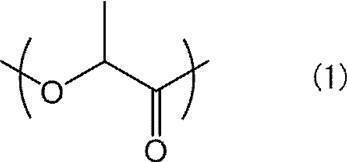
[8]前記脂肪族系ポリエステル(A)が、下記式(1)で表される繰り返し単位を含む主鎖を有するポリ乳酸系高分子である、[1]~[7]のいずれか1つに記載の高分子圧電材料。

[10]前記脂肪族系ポリエステル(A)の含有量が80質量%以上である、[1]~[9]のいずれか1つに記載の高分子圧電材料。
[11]主面の面積が5mm2以上である、[1]~[10]のいずれか1つに記載の高分子圧電材料。
[12][1]~[11]のいずれか1つに記載の高分子圧電材料を製造する方法であって、前記脂肪族系ポリエステル(A)と前記安定化剤(B)を含む予備結晶化シートを得る第一の工程と、前記予備結晶化シートを主として1軸方向に延伸する第二の工程と、を含む、高分子圧電材料の製造方法。
[13]前記第二の工程の後に、アニール処理をする、[12]に記載の高分子圧電材料の製造方法。
[14][1]~[11]のいずれか1つに記載の高分子圧電材料を製造する方法であって、前記脂肪族系ポリエステル(A)と前記安定化剤(B)を含むシートを主として1軸方向に延伸する工程と、アニール処理をする工程と、をこの順で含む高分子圧電材料の製造方法。
なお、前記高分子圧電材料は、可視光線に対する内部ヘイズが50%以下であり、25℃において変位法で測定した圧電定数d14が1pm/V以上であることが好ましい態様である。本発明の高分子圧電材料の内部ヘイズは、13%以下が好ましい。
光学活性を有する脂肪族系ポリエステルとは、分子構造が螺旋構造である分子光学活性を有する脂肪族系ポリエステルなど、分子構造に起因する光学活性を有する脂肪族系ポリエステルをいう。光学活性を有する脂肪族系ポリエステル(以下、「光学活性高分子」ともいう)としては、例えば、ポリ乳酸系高分子、ポリ(β―ヒドロキシ酪酸)等を挙げることができる。また光学活性を有する脂肪族系ポリエステルとしては、圧電性を増加させやすいヘリカルキラル高分子であることが好ましい。
本実施形態に係る光学活性高分子(A)は、重量平均分子量(Mw)が、5万~100万である。光学活性高分子(A)の重量平均分子量の下限が、5万未満であると光学活性高分子を成型体としたときの機械的強度が不十分となる。光学活性高分子の重量平均分子量の下限は、10万以上であることが好ましく、20万以上であることがさらに好ましい。一方、光学活性高分子の重量平均分子量の上限が100万を超えると、光学活性高分子を成型体としたときのフィルムなどの押出成型などの成形をすることが難しくなる。重量平均分子量の上限は、80万以下であることが好ましく、30万以下であることがさらに好ましい。
-GPC測定装置-
Waters社製GPC-100
-カラム-
昭和電工社製、Shodex LF-804
-サンプルの調製-
光学活性高分子(A)を40℃で溶媒(例えば、クロロホルム)へ溶解させ、濃度1mg/mlのサンプル溶液を準備する。
-測定条件-
サンプル溶液0.1mlを溶媒〔クロロホルム〕、温度40℃、1ml/分の流速でカラムに導入する。
本実施形態に使用される安定化剤(B)は、カルボジイミド基、エポキシ基、及びイソシアネート基からなる群より選ばれる1種類以上の官能基を有する重量平均分子量が200~60000の化合物である、この安定化剤(B)は、前記脂肪族系ポリエステルの加水分解性を抑制し、得られる圧電材料の耐湿熱性を改良するために用いられる。
脂肪族系ポリエステルの加水分解性を抑制するために、ポリエステルなどのポリマー中の未反応モノマーや不純物、鎖状・環状のオリゴマー等の低分子量化合物を低減する方法(例えば、特開平9-12688号公報)や、芳香族カルボジイミドを添加する方法(例えば、特表2001-525473号公報)、オキサゾリン化合物を添加する方法(例えば、特開2007-77193号公報)など多数の方法が知られている。しかし、後述するような構造を有する光学活性を有する脂肪族系ポリエステルを含む高分子圧電材料の信頼性を、その圧電特性や透明性を大きく損なうことなく、前記圧電材料に含まれる脂肪族系ポリエステルの加水分解性を抑制することで向上させる方法は知られていなかった。
脂肪族ポリエステル(A)の加水分解は以下のスキームにて進行するものと推定される。よって、加水分解を抑制するためには、水分との接触をラミネートなどにより抑制するか、或いは、系中で加水分解した部分に架橋構造を形成するか、フリーのカルボキシ基を封鎖する方法が考えられる。本発明においては、水酸基及びカルボキシ基の両方の官能基と相互作用を形成しやすい官能基を有する安定化剤、より好ましくは、複数の水酸基やカルボキシ基と相互作用を形成しやすい官能基を有する安定化剤を用いることで、上記加水分解を抑制しうると考えられる。
これは、水酸基とカルボキシ基の双方と相互作用する官能基を有する安定化剤であって、特定の範囲内の分子量を持つ化合物を用いることで、脂肪族ポリエステル(A)が結晶化する際に、結晶になりやすい部分(具体的には、分子鎖が切れていない領域)から結晶になりにくい部分(一部分子鎖が切れていて水酸基やカルボキシ基が生じている領域)に移動しやすい。このため、安定化剤は、結晶になりやすい部分の結晶化を阻害することなく、結晶性が高い部分よりも耐湿熱性が低い結晶性が低い部分に多く、且つ、均一に存在することになり、効率的に耐湿熱性を向上させることができると考えられる。
他方、脂肪族ポリエステル(A)の安定化剤として知られているオキサゾリン基を有する化合物を用いた場合、オキサゾリン基は、カルボキシ基と反応するが、水酸基とは反応し難い。このため、脂肪族ポリエステル(A)が結晶化する際に、結晶になりやすい部分にもオキサゾリンが存在して結晶化し難くなり、また、用いる化合物の構造によっては結晶成長の核となって局所的に大きな結晶が形成される可能性がある。そのため、高分子圧電材料の透明性が低下する懸念がある。また、より結晶性が低い部分にオキサゾリンが移動し難いために、耐湿熱性改良効果を充分に得難いと考えられる。


本発明において安定化剤(B)として用いられる、カルボジイミド基を有するカルボジイミド化合物は、分子中に1個以上のカルボジイミド基を有する。カルボジイミド化合物(ポリカルボジイミド化合物を含む)としては、一般的に良く知られた方法で合成されたものを使用することができる。例えば、触媒として有機リン系化合物又は有機金属化合物を用い、各種イソシアネートを約70℃以上の温度で、無溶媒又は不活性溶媒中で、脱炭酸縮合反応に付することより合成することができるものを挙げることができる。
上記カルボジイミド化合物に含まれるモノカルボジイミド化合物としては、ジシクロヘキシルカルボジイミド、ジメチルカルボジイミド、ジイソブチルカルボジイミド、ジオクチルカルボジイミド、t-ブチルイソプロピルカルボジイミド、ジフェニルカルボジイミド、ジ-t-ブチルカルボジイミド、ジ-β-ナフチルカルボジイミド等を例示することができ、これらの中では、特に工業的に入手が容易であるという面から、ジシクロヘキシルカルボジイミド、またはビス-2,6-ジイソプロピルフェニルカルボジイミドが好適である。
カルボジイミド化合物としては、市販品を用いてもよく、例えば、東京化成製、B2756(商品名)、日清紡ケミカル社製、カルボジライトLA-1、ラインケミー社製、Stabaxol P、Stabaxol P400、Stabaxol I(いずれも商品名)等が挙げられる。
本発明において安定化剤(B)として用いられる、イソシアネート基を有する化合物(イソシアネート化合物)としては、ヘキシルイソシアネート、シクロヘキシルイソシアネート、ベンジルイソシアネート、フェネチルイソシアネート、イソシアナト酢酸ブチル、ドデシルイソシアネート、オクタデシルイソシアネート、イソシアン酸3-(トリエトキシシリル)プロピル、2 , 4 - トリレンジイソシアネート、2 , 6- トリレンジイソシアネート、m - フェニレンジイソシアネート、p - フェニレンジイソシアネート、4 , 4 '- ジフェニルメタンジイソシアネート、2 , 4 '- ジフェニルメタンジイソシアネート、2 , 2 '- ジフェニルメタンジイソシアネート、3 , 3 '- ジメチル-4 , 4 '- ビフェニレンジイソシアネート、3 , 3 '- ジメトキシ- 4 , 4 '- ビフェニレンジイソシアネート、3 , 3 '- ジクロロ- 4 , 4 '- ビフェニレンジイソシアネート、1, 5 - ナフタレンジイソシアネート、1 , 5 - テトラヒドロナフタレンジイソシアネート、テトラメチレンジイソシアネート、1 , 6 - ヘキサメチレンジイソシアネート、ドデカメチレンジイソシアネート、トリメチルヘキサメチレンジイソシアネート、1 , 3 - シクロヘキシレンジイソシアネート、1 , 4 - シクロヘキシレンジイソシアネート、キシリレンジイソシアネート、テトラメチルキシリレンジイソシアネート、水素添加キシリレンジイソシアネート、リジンジイソシアネート、イソホロンジイソシアネート、4 , 4 '- ジシクロヘキシルメタンジイソシアネート、又は、3 , 3 '- ジメチル- 4 , 4 '- ジシクロヘキシルメタンジイソシアネート、ジフェニルメタンジイソシアネート系ポリイソシアネート、1 , 6 - ヘキサメチレンジイソシアネート系ポリイソシアネート、キシリレンジイソシアネート系ポリイソシアネート、イソホロンジイソシアネート系ポリイソシアネート等が挙げられる。
本発明において安定化剤(B)として用いられる、エポキシ基を有する化合物(エポキシ化合物)としては、N-グリシジルフタルイミド、オルソフェニルフェニルグリシジルエーテル、フェニルグリシジルエーテル、p-t-ブチルフェニルグリシジルエーテル、ヒドロキノンジグリシジルエーテル、レゾルシンジグリシジルエーテル、1,6-ヘキサンジオールジグリシジルエーテル、ジエチレングリコールジグリシジルエーテル、ポリエチレングリコールジグリシジルエーテル、トリメチロールプロパントリグリシジルエーテル、ビスフェノールA-ジグリシジルエーテル、水添ビスフェノールA-ジグリシジルエーテル、フェノールノボラック型エポキシ樹脂、クレゾールノボラック型エポキシ樹脂、エポキシ化ポリブタジエン等が挙げられる。
ここで、安定化剤(B1)としては、具体的には、ジシクロヘキシルカルボジイミド、ビス-2,6-ジイソプロピルフェニルカルボジイミド、ヘキシルイソシアネート、オクタデシルイソシアネート、イソシアン酸3-(トリエトキシシリル)プロピル、N-グリシジルフタルイミド、オルソフェニルフェニルグリシジルエーテル、フェニルグリシジルエーテル、p-t-ブチルフェニルグリシジルエーテル等が挙げられる。
また、安定化剤(B2)としては、具体的には、ポリ(4,4’-ジシクロヘキシルメタンカルボジイミド)、ポリ(テトラメチルキシリレンカルボジイミド)、ポリ(N,N-ジメチルフェニルカルボジイミド)、ポリ(N,N’-ジ-2,6-ジイソプロピルフェニルカルボジイミド)、ジフェニルメタンジイソシアネート系ポリイソシアネート、1 , 6 - ヘキサメチレンジイソシアネート系ポリイソシアネート、キシリレンジイソシアネート系ポリイソシアネート、イソホロンジイソシアネート系ポリイソシアネート、フェノールノボラック型エポキシ樹脂、クレゾールノボラック型エポキシ樹脂、エポキシ化ポリブタジエン等が挙げられる。
カルボジイミド基、エポキシ基、及びイソシアネート基からなる群から選ばれる官能基を1分子内に1つ有する化合物の重量平均分子量としては、200~2000が好ましく、200~1500がより好ましく、300~900がさらに好ましい。
カルボジイミド基、エポキシ基、及びイソシアネート基からなる群から選ばれる官能基を1分子内に1つ有する化合物の具体例としては、ジシクロヘキシルカルボジイミド、ビス-2,6-ジイソプロピルフェニルカルボジイミド、ヘキシルイソシアネート、オクタデシルイソシアネート、イソシアン酸3-(トリエトキシシリル)プロピル、N-グリシジルフタルイミド、オルソフェニルフェニルグリシジルエーテル、フェニルグリシジルエーテル、p-t-ブチルフェニルグリシジルエーテルが挙げられる。これらの中でも、ジシクロヘキシルカルボジイミド、ビス-2,6-ジイソプロピルフェニルカルボジイミドが好ましく、ビス-2,6-ジイソプロピルフェニルカルボジイミドがさらに好ましい。
また安定化剤(B3)と、カルボジイミド基、エポキシ基、及びイソシアネート基からなる群から選ばれる官能基を1分子内に2つ以上有する安定化剤(B4)(例えば前述の安定化剤(B2)が含まれる)を併用してもよい。安定化剤(B3)100重量部に対して、カルボジイミド基、エポキシ基、及びイソシアネート基からなる群から選ばれる官能基を1分子内に2つ以上有する安定化剤(B4)が5重量部~200重量部の範囲であることが、透明性、耐湿熱性及び寸法安定性バランスという観点から好ましく、10重量部~100重量部の範囲であることが、より好ましい。
上記安定化剤(B)の数平均分子量(Mn)と重量平均分子量(Mw)は、いずれも、光学活性高分子(A)の項にて記載したゲル浸透クロマトグラフ(GPC)を用いた測定方法により同様に測定される。なおGPC以外にもGC-MS,FAB-MS,ESI-MS,TOF-MSなどの測定方法でも測定することができる。
なお、上記添加量は、安定化剤(B)を2種以上併用する場合、それらの総量を示す。
一方、内部ヘイズを低くし、かつ圧電定数を高めるか又は維持するという観点からは、安定化剤(B)の添加量は、光学活性を有する脂肪族系ポリエステル(A)100重量部に対して0.01重量部~1.2重量部が好ましく、0.01重量部~0.7重量部がさらに好ましく、0.01重量部~0.6重量部がさらにより好ましい。
本実施形態の高分子圧電材料は、本実施形態の効果を損なわない限度において、ポリフッ化ビニリデン、ポリエチレン樹脂やポリスチレン樹脂に代表される公知の樹脂や、シリカ、ヒドロキシアパタイト、モンモリロナイト等の無機フィラー、フタロシアニン等の公知の結晶核剤等他の成分を含有していてもよい。
例えば、高分子圧電材料を、気泡等のボイドの発生を抑えた透明なフィルムとするために、高分子圧電材料中に、ヒドロキシアパタイト等の無機フィラーをナノ分散してもよい。但し、無機のフィラーをナノ分散させるためには、凝集塊の解砕に大きなエネルギーが必要であり、また、フィラーがナノ分散しない場合、フィルムの透明度が低下する場合がある。本実施形態に係る高分子圧電材料が無機フィラーを含有するとき、高分子圧電材料全質量に対する無機フィラーの含有量は、1質量%未満とすることが好ましい。なお、高分子圧電材料が脂肪族系ポリエステル以外の成分を含む場合、脂肪族系ポリエステル以外の成分の含有量は、高分子圧電材料全質量中に対して、20質量%以下であることが好ましく、10質量%以下であることがより好ましい。
結晶促進剤は、結晶化促進の効果が認められるものであれば、特に限定されないが、脂肪族系ポリエステルの結晶格子の面間隔に近い面間隔を持つ結晶構造を有する物質を選択することが望ましい。面間隔が近い物質ほど核剤としての効果が高いからである。例えば、脂肪族系ポリエステルとしてポリ乳酸系高分子を用いた場合、有機系物質であるフェニルスルホン酸亜鉛、ポリリン酸メラミン、メラミンシアヌレート、フェニルホスホン酸亜鉛、フェニルホスホン酸カルシウム、フェニルホスホン酸マグネシウム、無機系物質のタルク、クレー等が挙げられる。それらのうちでも、最も面間隔がポリ乳酸の面間隔に類似し、良好な結晶形成促進効果が得られるフェニルホスホン酸亜鉛が好ましい。なお、使用する結晶促進剤は、市販されているものを用いることができる。具体的には例えば、フェニルホスホン酸亜鉛;エコプロモート(日産化学工業(株)製)等が挙げられる。
後述するように、本実施形態の高分子圧電材料は、高度に分子が配向している。この配向を表す指標として、「分子配向度MOR」がある。分子配向度MOR(Molecular Orientation Ratio)は、分子の配向の度合いを示す値であり、以下のようなマイクロ波測定法により測定される。すなわち、試料(フィルム)を、周知のマイクロ波分子配向度測定装置(マイクロ波透過型分子配向計ともいう)のマイクロ波共振導波管中に、マイクロ波の進行方向に前記試料面(フィルム面)が垂直になるように配置する。そして、振動方向が一方向に偏ったマイクロ波を試料に連続的に照射した状態で、試料をマイクロ波の進行方向と垂直な面内で0~360°回転させて、試料を透過したマイクロ波強度を測定することにより分子配向度MORを求める。
MORc=(tc/t)×(MOR-1)+1
(tc:補正したい基準厚さ、t:試料厚さ)
規格化分子配向MORcは、公知の分子配向計、例えば王子計測機器株式会社製マイクロ波方式分子配向計MOA-2012AやMOA-6000等により、4GHzもしくは12GHz近傍の共振周波数で測定することができる。
例えば、脂肪族系ポリエステル(A)がポリ乳酸系高分子で複屈折率Δnを測定波長550nmで測定した場合、規格化分子配向MORcの好ましい範囲の下限である2.0は、複屈折率Δn 0.005に変換できる。また高分子圧電材料の規格化分子配向MORcと結晶化度の積の好ましい範囲の下限である40は、高分子圧電材料の複屈折率Δnと結晶化度の積が0.1に変換することができる。
本実施形態の高分子圧電材料の原料は、既述のポリ乳酸系高分子などの脂肪族系ポリエステル(A)とカルボジイミド化合物などの安定化剤(B)、並びに、必要に応じて他の成分を混合して、混合物とすることにより得られる。混合物は溶融混練をしてもよい。具体的には、混合する脂肪族系ポリエステル(A)と安定化剤(B)と必要に応じて用いられる他の成分とを、溶融混練機〔東洋精機社製、ラボプラストミル〕を用い、ミキサー回転数30rpm~70rpm、180℃~250℃の条件で、5分~20分間溶融混練することで、脂肪族系ポリエステル(A)と安定化剤(B)とのブレンド体、複数種の脂肪族系ポリエステルのブレンド体や脂肪族系ポリエステルと無機フィラーなどの他の成分とのブレンド体を得ることができる。
予備結晶化シートは、脂肪族系ポリエステル(A)と安定化剤(B)とを含む非晶状態のシートを加熱処理して結晶化させることで得ることができる。また、押出成形法などで脂肪族系ポリエステル(A)と安定化剤(B)とを含む原料を、脂肪族系ポリエステルのガラス転移温度よりも高い温度に加熱しシート状に押出成形した後、キャスターで押し出されたシートを急冷することで、所定の結晶化度を有する予備結晶化シートを得ることもできる。
Tg-40℃≦T≦Tg+40℃
(Tgは、前記脂肪族系ポリエステルのガラス転移温度を表す)
第二の工程である、延伸工程における延伸方法は特に制限されず、1軸延伸、2軸延伸、後述する固相延伸などの種々の延伸方法を用いることができる。高分子圧電材料を延伸することにより、主面の面積が大きな高分子圧電材料を得ることができる。
圧電定数を向上させる観点から、延伸処理を施した後(前記第二の工程の後)の高分子圧電材料を、一定の熱処理(以下「アニール処理」とも称する)することが好ましい。なおアニール処理により主に結晶化する場合は、前述の予備結晶化工程で行う予備結晶化を省略できる場合がある。
本実施形態に係る高分子圧電材料は、圧電定数が大きく、耐湿熱安定性に優れる。
本実施形態において、高分子圧電材料の圧電定数(変位法)は、例えば次のようにして変位法により測定される値をいう。
本実施形態において、高分子圧電材料の圧電定数(共振法)は、例えば次のようにして共振法により測定される値をいう。
高分子圧電材料を、延伸方向(MD方向)に32mm、延伸方向に直交する方向(TD方向)に30mmにカットして、矩形の試験片を作製する。
サンユー電子社製クイックコータSC-701の試験台に、得られた試験片をセットし、ロータリーポンプによりコータチャンバー内を真空状態(例えば、10-3Pa以下)にする。その後、Au(金)ターゲット、スパッタリング電流4mAの条件で、試験片の一方の面に3分間スパッタリング処理をする。次いで、試験片の他方の面を、同様の条件で3分間スパッタリング処理をして、試験片の両面にAuを被覆し、Auの導電層を形成する。
得られた共振-反共振法測定用サンプルについて、横河ヒューレットパッカード社製インピーダンスアナライザHP4194Aを用いて、50kHz~100kHzの帯域に現れるインピーダンスの共振曲線を測定する。得られるインピーダンスの共振曲線及び比誘電率εrから、Jpn.J.Appl.Phys.Vol.37(1998)pp.3374-3376,part1,No.6A,June 1998に示されている方法に準じて圧電定数d14を算出する。
得られた圧電定数を、高分子圧電材料の圧電定数とする。
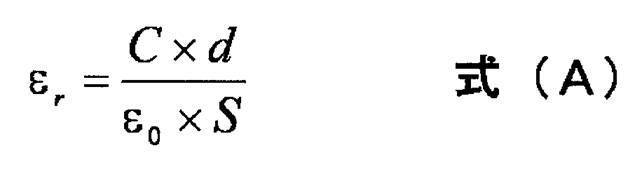
εr:共振-反共振法測定用サンプルの比誘電率
C:共振-反共振法測定用サンプルの静電容量〔F〕
d:共振-反共振法測定用サンプルの厚さ〔m〕
ε0:真空の誘電率
S:共振-反共振法測定用サンプルの面積〔m2〕
高分子圧電材料の結晶化度は、DSC法によって求められるものであり、本実施形態の高分子圧電材料の結晶化度は20%~80%であり、好ましくは25%~70%、さらに好ましくは30%~50%が好ましい。前記範囲に結晶化度があれば、高分子圧電材料の圧電性、透明性のバランスがよく、また高分子圧電材料を延伸するときに、白化や破断がおきにくく製造しやすい。
高分子圧電材料の透明性は、例えば、目視観察やヘイズ測定により評価することができる。高分子圧電材料のヘイズは、可視光線に対する内部ヘイズが50%以下であることが好ましく、20%以下であることがより好ましく、15%以下であることがさらに好ましい。
ここで内部ヘイズは、厚さ0.05mmの高分子圧電材料に対して、JIS-K7105に準拠して、ヘイズ測定機〔(有)東京電色製、TC-HIII DPK〕を用いて25℃で測定したときの値であり、測定方法の詳細は実施例において後述する。高分子圧電材料のヘイズは、低ければ低いほどよいが、圧電定数などとのバランスの観点からは、0.01%~13%であることが好ましく、0.1%~5%であることがさらに好ましい。なお、本願でいう「ヘイズ」または「内部ヘイズ」とは、本発明の高分子圧電材料の内部へイズをいう。内部へイズとは、実施例において後述するように前記高分子圧電材料の外表面の形状によるヘイズを除外したヘイズである。
本実施形態の高分子圧電材料は、規格化分子配向MORcが2.0~15.0であることが好ましく、3.0~10.0であることが好ましく、4.0~8.0であることがより好ましい。規格化分子配向MORcが2.0~15.0の範囲にあれば、延伸方向に配列するポリ乳酸分子鎖が多く、その結果、配向結晶の生成する率が高くなり、高い圧電性を発現することが可能となる。
高分子圧電材料の結晶化度と規格化分子配向MORcとの積は好ましくは40~700、さらに好ましくは75~680、さらに好ましくは90~660、さらに好ましくは125~650、さらに好ましくは180~350である。高分子圧電材料の結晶化度と、規格化分子配向MORcとの積が40~700の範囲にあれば、高分子圧電材料の圧電性と透明性とのバランスが良好であり、かつ寸法安定性も高く、後述する圧電素子として好適に用いることができる。
また積層圧電素子に複数の本発明の高分子圧電材料が含まれる場合は、ある層の本発明の高分子圧電材料に含まれる脂肪族系ポリエステル(A)の光学活性がL体ならば、他の層の高分子圧電材料に含まれる脂肪族系ポリエステル(A)はL体であってもD体であってもよい。高分子圧電材料の配置は圧電素子の用途に応じて適宜調整することができる。
三井化学(株)製ポリ乳酸系樹脂(登録商標LACEA、H-400(重量平均分子量Mw:20万)100重量部に対して、安定化剤(B)〔カルボジイミド化合物〕としてカルボジライド(日清紡ケミカル株式会社、LA-1)を0.1重量部添加しドライブレンドし原料を作製した。作製した原料を押出成形機ホッパーに入れて、220℃~230℃に加熱しながらTダイから押し出し、55℃のキャストロールに0.5分間接触させて、厚さ150μmの予備結晶化シートを製膜した(予備結晶化工程)。前記予備結晶化シートの結晶化度を測定したところ5.63%であった。
得られた予備結晶化シートを70℃に加熱しながらロールツーロールで、延伸速度1650mm/分で延伸を開始し、3.3倍までMD方向に一軸延伸した(延伸工程)。得られたフィルムの厚さは53μmであった。
その後、前記一軸延伸フィルムを、ロールツーロールで、130℃に加熱したロール上に60秒間接触させアニール処理し、高分子圧電材料を作製した(アニール処理工程)。
次いで、実施例1の高分子圧電材料の作製において、カルボジライトLA-1の添加量、予備結晶化条件や延伸条件を、表1に示す条件に変更したほかは同様にして、実施例2~実施例5、比較例1の高分子圧電材料を作製した。
50mLの三角フラスコに1.0gのサンプル(高分子圧電材料)を秤り込み、IPA(イソプロピルアルコール)2.5mLと、5.0mol/L水酸化ナトリウム溶液5mLとを加えた。次に、サンプル溶液が入った前記三角フラスコを、温度40℃の水浴に入れ、ポリ乳酸が完全に加水分解するまで、約5時間攪拌した。
-HPLC測定条件-
・カラム
光学分割カラム、(株)住化分析センター製 SUMICHIRAL OA5000・測定装置
日本分光社製 液体クロマトグラフィ
・カラム温度
25℃
・移動相
1.0mM-硫酸銅(II)緩衝液/IPA=98/2(V/V)
硫酸銅(II)/IPA/水=156.4mg/20mL/980mL
・移動相流量
1.0ml/分
・検出器
紫外線検出器(UV254nm)
ゲル浸透クロマトグラフ(GPC)を用い、下記GPC測定方法により、実施例および比較例の各高分子圧電材料に含まれる樹脂(光学活性高分子)の分子量分布(Mw/Mn)を測定した。
-GPC測定方法-
・測定装置
Waters社製GPC-100
・カラム
昭和電工社製、Shodex LF-804
・サンプルの調製
実施例および比較例の各高分子圧電材料を、それぞれ40℃で溶媒〔クロロホルム〕へ溶解させ、濃度1mg/mlのサンプル溶液を準備した。
・測定条件
サンプル溶液0.1mlを溶媒(クロロホルム)、温度40℃、1ml/分の流速でカラムに導入し、カラムで分離されたサンプル溶液中のサンプル濃度を示差屈折計で測定した。樹脂の分子量は、ポリスチレン標準試料にてユニバーサル検量線を作成し、各樹脂の重量平均分子量(Mw)を算出した。実施例、比較例で用いた樹脂について測定した結果を表1に示した。なお、表1において、「LA」はLACEA H-400を表す。またカルボジライトLA1の添加量は、LACEA H-400を100重量部としたときの重量部である。
以上のようにして得られた実施例1~実施例5、比較例1の高分子圧電材料について、各高分子圧電材料のガラス転移温度Tg、融点Tm、結晶化度、比熱容量Cp、厚さ、内部ヘイズ、圧電定数、規格化分子配向MORc、寸法安定性、耐湿熱性に係る信頼性を測定した。結果を表2に示す。なお、具体的には、次のようにして測定した。
実施例および比較例の各高分子圧電材料を、それぞれ10mg正確に秤量し、示差走査型熱量計(パーキンエルマー社製DSC-1)を用い、昇温速度10℃/分の条件で測定し、融解吸熱曲線を得た。得られた融解吸熱曲線から融点Tm、ガラス転移温度Tg、比熱容量Cpおよび結晶化度を得た。
実施例および比較例の各高分子圧電材料を上記示差走査型熱量計で測定したときに、1g当たり1℃上昇させるのに要した熱量を測定した。測定条件はTg、Tmと同様の条件で測定した。
延伸したフィルムを、延伸方向(MD方向)に50mm、延伸方向と直交する方向(TD方向)に50mmカットして、50mm×50mmの矩形フィルムを切り出した。このフィルムを85℃にセットした、オーブン中に吊り下げて、30分間アニール処理した。その後、アニール前後のMD方向のフィルム矩形辺長の寸法をノギスで測定し、下式に従い、寸法変化率(%)を算出し、その絶対値により、寸法安定性を評価した。寸法変化率が小さいほど寸法安定性が高いことを示す。
寸法変化率(%)=100×((アニール前のMD方向の辺長)-(アニール後のMD方向の辺長))/(アニール前のMD方向の辺長)
本願でいう「ヘイズ」または「内部ヘイズ」とは本発明の高分子圧電材料の内部へイズのことをいい、測定方法は一般的な方法で測定される。具体的には、実施例および比較例の各高分子圧電材料の内部ヘイズ値は、下記測定条件下で下記装置を用いて、厚さ方向の光透過性を測定することにより、測定した。本発明の高分子圧電材料の内部ヘイズ(以下、内部ヘイズ(H1)ともいう)は、予めガラス板2枚の間に、シリコンオイル(信越化学工業株式会社製信越シリコーン(商標)、型番:KF96-100CS)のみを挟んでヘイズ(H2)を測定し、次にシリコンオイルで表面を均一に塗らしたフィルムを、ガラス板2枚で挟んでヘイズ(H3)を測定し、下記式のようにこれらの差をとることで本発明の高分子圧電材料の内部ヘイズ(H1)を得た。
内部ヘイズ(H1)=ヘイズ(H3)-ヘイズ(H2)
測定装置:東京電色社製、HAZE METER TC-HIIIDPK
試料サイズ:幅30mm×長さ30mm、厚さ0.05mm
測定条件:JIS-K7105に準拠
測定温度:室温(25℃)
両面にAgの導電層が形成された40mm×40mmの試験片を、高分子圧電材料の延伸方向(MD方向)に対して45°なす方向に32mm、45°なす方向に直交する方向に5mmにカットして、32mm×5mmの矩形のフィルムを切り出した。これを、圧電定数測定用サンプルとした。得られたサンプルに、10Hz、300Vppの正弦波の交流電圧を印加したときの、フィルムの変位の最大値と最小値の差分距離を、キーエンス社製レーザ分光干渉型変位計SI-1000により計測した。
規格化分子配向MORcは、王子計測機器株式会社製マイクロ波方式分子配向計MOA6000により測定した。基準厚さtcは、50μmに設定した。
製造直後の高分子圧電材料を長手方向に50mm×幅方向に50mmの矩形にカットし試験片を作成した。試験片を、60℃ RH90%に保った恒温恒湿器内に吊り下げた。前記恒温恒湿器内で所定の時間保持した後、試験片を取り出し、前述の「GPC測定方法」と同様にして分子量Mwを測定した。表2には、製造直後の試験片の分子量Mwで、96時間、192時間、500時間、前記恒温恒湿器内に置いた後の試験片の分子量Mwを除した規格値を示す。前記規格値が1より大きいほど加水分解性が抑制され信頼性が向上していることを表す。

ポリ乳酸(H400)10gとクロロホルム(和光純薬工業株式会社製、和光一級)200gを室温で溶解させポリ乳酸溶液を作製する。
次に、安定化剤B2-2(表3に記載の化合物)を前記ポリ乳酸100重量部に対し3重量部とクロロホルム10gとを室温で溶解させ安定化剤溶液を作製する。
このようにして得られた前記ポリ乳酸溶液と前記安定化剤溶液とを室温で混合し、30分攪拌した。この溶液を50℃、0.2気圧で12時間放置し、乾燥させ混合固体を得た。混合固体を205℃で熱プレスを1分間行った後に20℃に設定したプレス機でプレスして急冷フィルムを得た。前記急冷フィルムの対向する2辺をクリップで固定し、固定した2辺と直交する方向に、70℃に加熱しながら3.3倍まで延伸し延伸フィルムを得た。得られたフィルムを、130℃で600秒アニールした後、急冷し、実施例6の高分子圧電材料を得た。
用いるポリ乳酸の種類並びに安定化剤の種類及び量を下記表3に示すように変更した以外は、実施例6と同様にして高分子圧電材料を得た。なお本願の実施例または比較例として記載している高分子圧電材料の主面の面積はすべて10mm2以上であった。
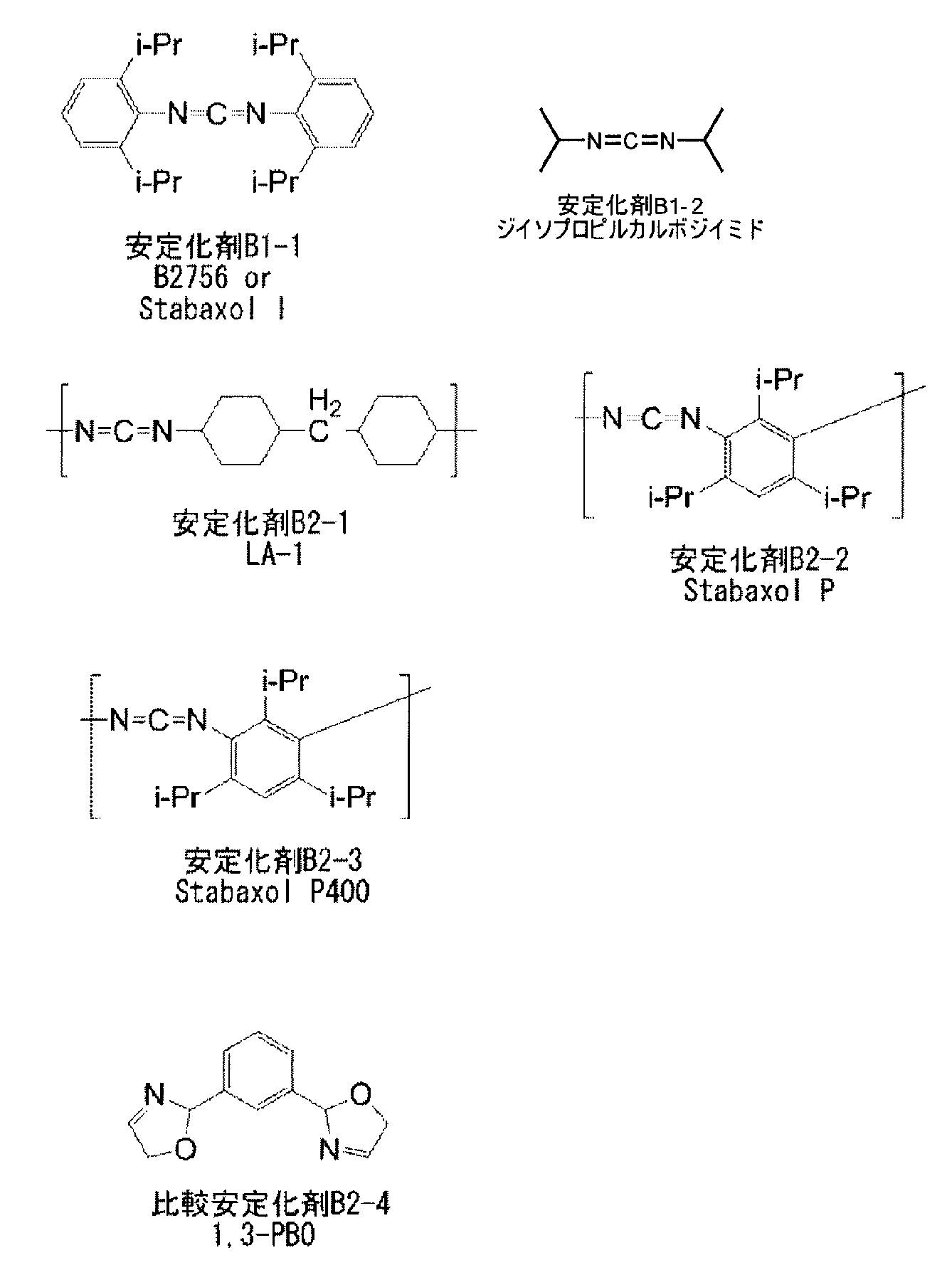
下記表3における安定化剤の添加量は、高分子(A)100重量部に対する添加量(重量部)を表す。また、安定化剤(B1-1)の分子量は重量平均分子量であり、安定化剤(B2-1~B2-3)及び比較安定化剤(B1-2、B2-4)の分子量は重量平均分子量を表す。
・安定化剤B1-1:東京化成製、B2756(商品名)、ビス-2,6-ジイソプロピルフェニルカルボジイミド
・安定化剤B2-1:日清紡ケミカル社製、カルボジライトLA-1(商品名)ポリ(4,4’-ジシクロヘキシルメタンカルボジイミド):重量平均分子量:約2000
・安定化剤B2-2:ラインケミー、Stabaxol P(商品名)、ポリ(1,3,5-トリイソプロピルフェニレン-2,4-カルボジイミド):重量平均分子量:約3000
・安定化剤B2-3:ラインケミー、Stabaxol P400(商品名)、ポリ(1,3,5-トリイソプロピルフェニレン-2,4-カルボジイミド):重量平均分子量:20000
・比較安定化剤B2-4:三國製薬工業社製、MS571(商品名)、1,3-PBO 2,2’-(1,3-フェニレン)-ビス(2-オキソザリン)
・比較安定化剤B1-2:ジイソプロピルカルボジイミド 分子量:126
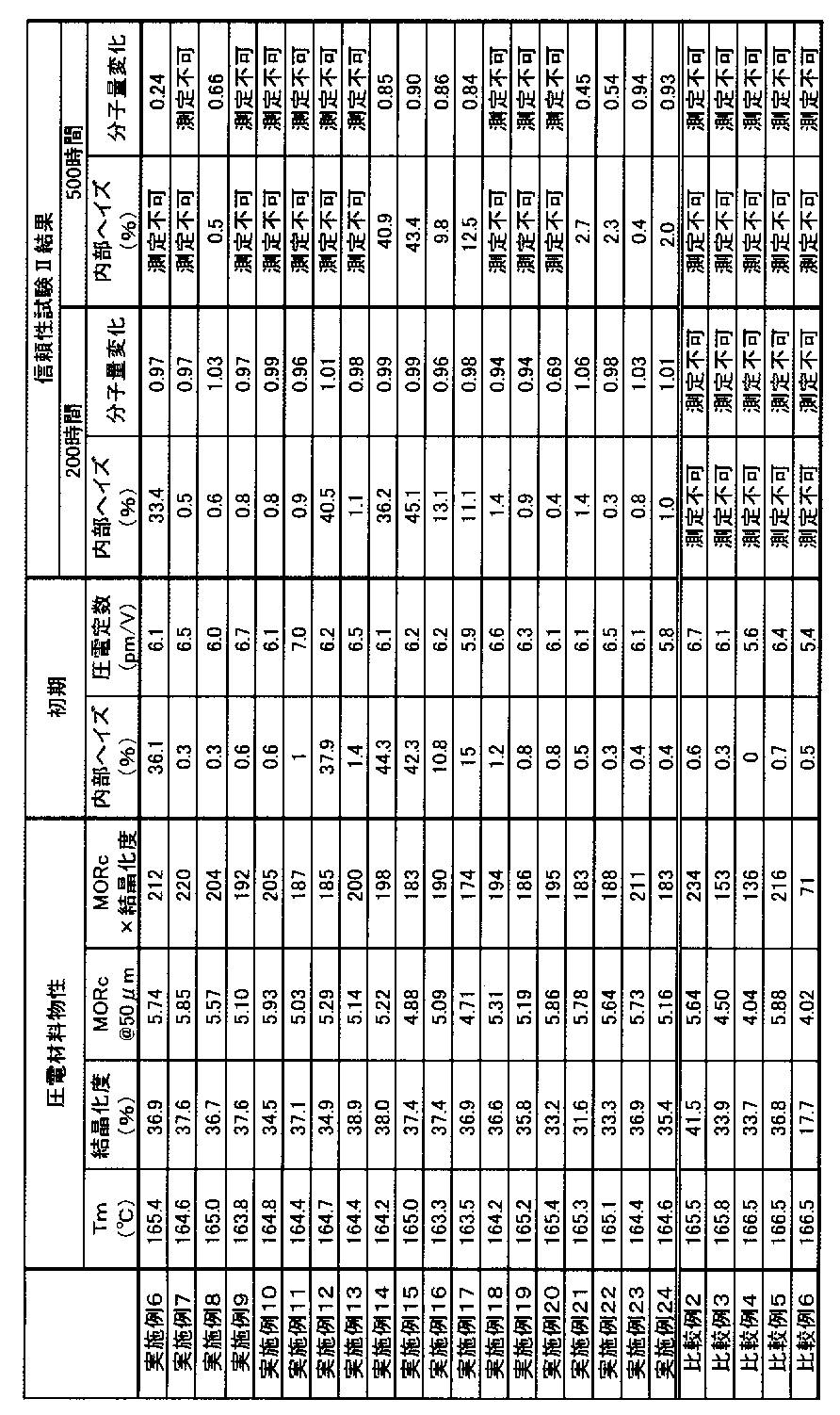
また、信頼性(耐湿熱性)試験は前述の信頼性試験Iにおいて、85℃、85%RHの雰囲気下に試験片を保存した以外は同様にして評価を行った(信頼性試験II)。200時間、500時間保存した後、初期と同様にして、内部ヘイズ、及び重量平均分子量を測定した。
このとき、分子量変化は、製造直後の試験片の重量平均分子量Mwで、200時間、500時間、前記恒温恒湿器内に置いた後の試験片の分子量Mwを除した規格値を示す。前記規格値が1より大きいこと、或いは、1よりも小さい場合であっても低下率が低いことにより、加水分解性が抑制され信頼性が良好であることが裏付けられる。
なお、下記表4中で、分子量が「測定不可」となっているものは、分子量が低くなりすぎて液状化したため、分子量を測定できなかったことを表す。下記評価により、湿熱環境下で200時間保存後の分子量変化が0.3以下のもの、具体的には0.7~1.3の間にあるものを実用上充分な信頼性を有するものと判断する。
下記表5に記載の諸条件に基づいて、高分子圧電材料を得た。下記表5における安定化剤の添加量は、高分子(A)100重量部に対する添加量(重量部)を表す。
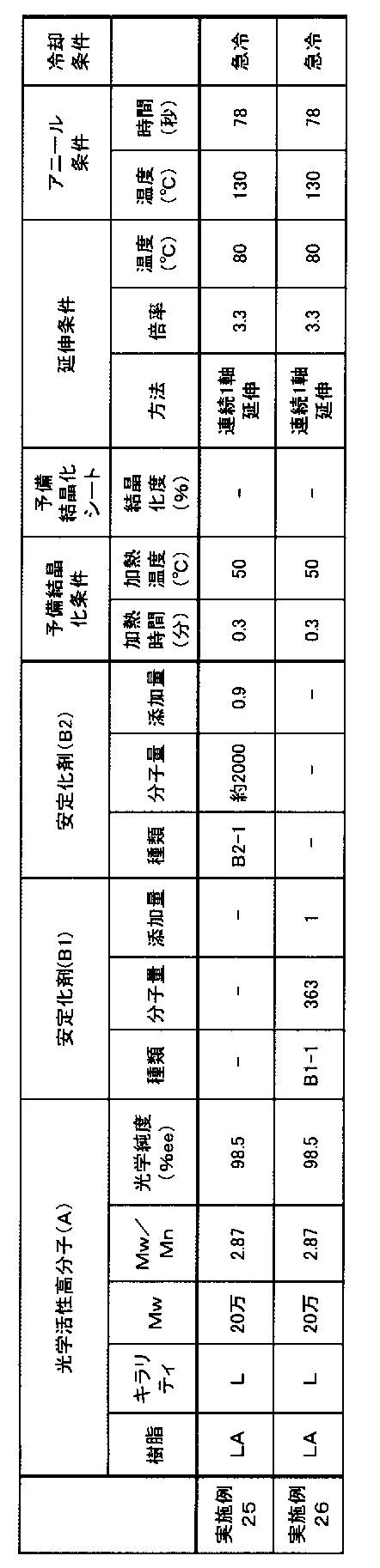
また、信頼性(耐湿熱性)試験は前述の信頼性試験Iにおいて、60℃、95%RHの雰囲気下に試験片を保存した以外は同様にして評価を行った。500時間保存した後、初期と同様にして、内部ヘイズ、圧電定数及び重量平均分子量を測定した。表6には、製造直後の試験片の分子量Mwで、500時間前記条件下に置いた後の試験片の分子量Mwを除した規格値を示す。前記規格値が1より大きいほど、或いは、1よりも小さい場合であっても低下率が低いことにより、加水分解性が抑制され信頼性が向上していることを表す。
寸法変化率IIは、100℃で30分の熱処理に変更した以外は実施例1と同様にして評価した。

Claims (14)
- 重量平均分子量が5万~100万で光学活性を有する脂肪族系ポリエステル(A)と、カルボジイミド基、エポキシ基、及びイソシアネート基からなる群から選ばれる1種類以上の官能基を有する重量平均分子量が200~60000の安定化剤(B)とを含み、
DSC法で得られる結晶化度が20%~80%であり、
前記脂肪族系ポリエステル(A)100重量部に対して前記安定化剤(B)が0.01重量部~10重量部含まれる、高分子圧電材料。 - 前記安定化剤(B)が、カルボジイミド基、エポキシ基、及びイソシアネート基からなる群から選ばれる官能基を1分子内に1つ有する安定化剤(B3)を含む、請求項1に記載の高分子圧電材料。
- 可視光線に対する内部ヘイズが50%以下であり、且つ、25℃において変位法で測定した圧電定数d14が1pm/V以上である、請求項1に記載の高分子圧電材料。
- 前記安定化剤(B)が、カルボジイミド基、エポキシ基、及びイソシアネート基からなる群から選ばれる1種類以上の官能基を有する、重量平均分子量が200~900の安定化剤(B1)と、カルボジイミド基、エポキシ基、及びイソシアネート基からなる群から選ばれる1種類以上の官能基を1分子内に2以上有する重量平均分子量が1000~60000の安定化剤(B2)と、を含む、請求項1に記載の高分子圧電材料。
- 内部ヘイズが13%以下である、請求項1に記載の高分子圧電材料。
- 前記脂肪族系ポリエステル(A)100重量部に対して前記安定化剤(B)が0.01~2.8重量部含まれる、請求項1に記載の高分子圧電材料。
- マイクロ波透過型分子配向計で測定される基準厚さを50μmとしたときの規格化分子配向MORcと前記結晶化度との積が40~700である、請求項1に記載の高分子圧電材料。
- 前記脂肪族系ポリエステル(A)が、下記式(1)で表される繰り返し単位を含む主鎖を有するポリ乳酸系高分子である、請求項1に記載の高分子圧電材料。
- 前記脂肪族系ポリエステル(A)は、光学純度が95.00%ee以上である、請求項1に記載の高分子圧電材料。
- 前記脂肪族系ポリエステル(A)の含有量が80質量%以上である、請求項1に記載の高分子圧電材料。
- 主面の面積が5mm2以上である、請求項1に記載の高分子圧電材料。
- 請求項1~請求項11のいずれか1項に記載の高分子圧電材料を製造する方法であって、
前記脂肪族系ポリエステル(A)と前記安定化剤(B)を含む予備結晶化シートを得る第一の工程と、
前記予備結晶化シートを主として1軸方向に延伸する第二の工程と、
を含む、高分子圧電材料の製造方法。 - 前記第二の工程の後に、アニール処理をする、請求項12に記載の高分子圧電材料の製造方法。
- 請求項1~請求項11のいずれか1項に記載の高分子圧電材料を製造する方法であって、
前記脂肪族系ポリエステル(A)と前記安定化剤(B)を含むシートを主として1軸方向に延伸する工程と、
アニール処理をする工程と、
をこの順で含む高分子圧電材料の製造方法。
Priority Applications (6)
| Application Number | Priority Date | Filing Date | Title |
|---|---|---|---|
| EP12840727.7A EP2672539B1 (en) | 2011-10-13 | 2012-10-12 | Polymeric piezoelectric material and process for producing the same |
| CN201280007258.3A CN103380505B (zh) | 2011-10-13 | 2012-10-12 | 高分子压电材料及其制造方法 |
| KR1020137020240A KR101467721B1 (ko) | 2011-10-13 | 2012-10-12 | 고분자 압전 재료 및 그의 제조방법 |
| JP2013508312A JP5259026B1 (ja) | 2011-10-13 | 2012-10-12 | 高分子圧電材料、およびその製造方法 |
| US13/990,677 US9136461B2 (en) | 2011-10-13 | 2012-10-12 | Polymeric piezoelectric material and process for producing the same |
| US14/819,663 US9559289B2 (en) | 2011-10-13 | 2015-08-06 | Polymeric piezoelectric material and process for producing the same |
Applications Claiming Priority (4)
| Application Number | Priority Date | Filing Date | Title |
|---|---|---|---|
| JP2011-225899 | 2011-10-13 | ||
| JP2011225899 | 2011-10-13 | ||
| JP2012039368 | 2012-02-24 | ||
| JP2012-039368 | 2012-02-24 |
Related Child Applications (2)
| Application Number | Title | Priority Date | Filing Date |
|---|---|---|---|
| US13/990,677 A-371-Of-International US9136461B2 (en) | 2011-10-13 | 2012-10-12 | Polymeric piezoelectric material and process for producing the same |
| US14/819,663 Continuation US9559289B2 (en) | 2011-10-13 | 2015-08-06 | Polymeric piezoelectric material and process for producing the same |
Publications (1)
| Publication Number | Publication Date |
|---|---|
| WO2013054918A1 true WO2013054918A1 (ja) | 2013-04-18 |
Family
ID=48081963
Family Applications (1)
| Application Number | Title | Priority Date | Filing Date |
|---|---|---|---|
| PCT/JP2012/076520 Ceased WO2013054918A1 (ja) | 2011-10-13 | 2012-10-12 | 高分子圧電材料、およびその製造方法 |
Country Status (6)
| Country | Link |
|---|---|
| US (2) | US9136461B2 (ja) |
| EP (1) | EP2672539B1 (ja) |
| JP (2) | JP5259026B1 (ja) |
| KR (1) | KR101467721B1 (ja) |
| CN (2) | CN105131541B (ja) |
| WO (1) | WO2013054918A1 (ja) |
Cited By (20)
| Publication number | Priority date | Publication date | Assignee | Title |
|---|---|---|---|---|
| GB2509177A (en) * | 2012-12-24 | 2014-06-25 | Innovia Films Ltd | Packaging and labelling films |
| WO2014185530A1 (ja) * | 2013-05-16 | 2014-11-20 | 三井化学株式会社 | 押圧検出装置及びタッチパネル |
| WO2015001956A1 (ja) | 2013-07-04 | 2015-01-08 | 三井化学株式会社 | フィルム及び高分子圧電材料 |
| WO2015008841A1 (ja) | 2013-07-19 | 2015-01-22 | 三井化学株式会社 | 結晶化高分子フィルム及びその製造方法 |
| JP2015015283A (ja) * | 2013-07-03 | 2015-01-22 | 三井化学株式会社 | 積層圧電素子 |
| WO2015030174A1 (ja) | 2013-09-02 | 2015-03-05 | 三井化学株式会社 | 積層体 |
| WO2015053089A1 (ja) | 2013-10-07 | 2015-04-16 | 三井化学株式会社 | 押圧検出装置及び押圧検出タッチパネル |
| JP2015201609A (ja) * | 2014-04-04 | 2015-11-12 | 三井化学株式会社 | 高分子圧電材料 |
| WO2016098597A1 (ja) * | 2014-12-17 | 2016-06-23 | 三井化学株式会社 | 積層体 |
| CN105723534A (zh) * | 2013-11-26 | 2016-06-29 | 三井化学株式会社 | 高分子压电材料及其制造方法 |
| WO2016140110A1 (ja) * | 2015-03-02 | 2016-09-09 | 三井化学株式会社 | フィルム巻層体及びその製造方法 |
| CN105968392A (zh) * | 2016-05-25 | 2016-09-28 | 江苏科技大学 | 一种高含量聚偏氟乙烯压电β相的制备方法 |
| CN107251252A (zh) * | 2015-02-13 | 2017-10-13 | 三井化学株式会社 | 高分子压电膜及其制造方法 |
| US20170317268A1 (en) * | 2014-11-14 | 2017-11-02 | Mitsui Chemicals, Inc. | Polymeric piezoelectric film |
| WO2017213108A1 (ja) | 2016-06-06 | 2017-12-14 | 三井化学株式会社 | 圧電基材、圧電織物、圧電編物、圧電デバイス、力センサー、及びアクチュエータ |
| WO2018194180A1 (ja) | 2017-04-20 | 2018-10-25 | 三井化学株式会社 | 圧電基材、力センサー及びアクチュエータ |
| WO2019031414A1 (ja) | 2017-08-09 | 2019-02-14 | 三井化学株式会社 | センサモジュール及びこれを備えた圧力分布センサ |
| WO2020059573A1 (ja) | 2018-09-19 | 2020-03-26 | 三井化学株式会社 | 人体検出装置、ベッド装置及び人体検出システム |
| WO2022065454A1 (ja) | 2020-09-25 | 2022-03-31 | 三井化学株式会社 | 圧電デバイス、力センサー、及び生体情報取得デバイス |
| JP2025010872A (ja) * | 2023-07-10 | 2025-01-23 | 株式会社村田製作所 | 圧電フィルムデバイス |
Families Citing this family (13)
| Publication number | Priority date | Publication date | Assignee | Title |
|---|---|---|---|---|
| EP2952940B1 (en) * | 2013-02-01 | 2019-05-22 | Murata Manufacturing Co., Ltd. | Display panel with pressing sensor, and electronic device with pressing input function |
| KR101789896B1 (ko) * | 2013-02-01 | 2017-10-25 | 미쯔이가가꾸가부시끼가이샤 | 표시 장치 및 적층 광학 필름 |
| CA2902145A1 (en) * | 2013-03-25 | 2014-10-02 | Teijin Limited | Resin composition |
| CN105189106B (zh) * | 2013-04-10 | 2017-10-27 | 三井化学株式会社 | 叠层体 |
| JP2015109431A (ja) * | 2013-10-23 | 2015-06-11 | 株式会社Kri | 圧電ポリマー膜、アクチュエータ、感圧センサ及びそれを用いたデバイス |
| JP6210855B2 (ja) * | 2013-11-19 | 2017-10-11 | オリンパス株式会社 | 操作装置 |
| CN106575699A (zh) * | 2014-08-22 | 2017-04-19 | 三井化学株式会社 | 高分子压电膜 |
| JP6368658B2 (ja) * | 2014-08-29 | 2018-08-01 | 三井化学株式会社 | 高分子圧電材料および高分子圧電材料の製造方法 |
| TWI715738B (zh) * | 2016-03-09 | 2021-01-11 | 日商三井化學股份有限公司 | 積層體 |
| US10629800B2 (en) * | 2016-08-05 | 2020-04-21 | Wisconsin Alumni Research Foundation | Flexible compact nanogenerators based on mechanoradical-forming porous polymer films |
| EP3431538A1 (de) * | 2017-07-17 | 2019-01-23 | LANXESS Deutschland GmbH | Zusammensetzungen enthaltend polymeres carbodiimid, epoxid und polyester-basierte polymere, deren herstellung und verwendung |
| JP7033623B2 (ja) * | 2020-03-30 | 2022-03-10 | 株式会社村田製作所 | 糸およびそれを含んで成る構造物 |
| CN114848910A (zh) * | 2022-04-12 | 2022-08-05 | 中怡(深圳)医疗科技集团有限公司 | 一种压电高分子材料的制备方法 |
Citations (18)
| Publication number | Priority date | Publication date | Assignee | Title |
|---|---|---|---|---|
| US2668182A (en) | 1950-07-13 | 1954-02-02 | William T Miller | Polyunsaturated fluoroolefins |
| US2941956A (en) | 1956-08-15 | 1960-06-21 | Socony Mobil Oil Co Inc | Regeneration of contact material |
| JPS4733279B1 (ja) | 1968-12-20 | 1972-08-24 | ||
| US4057357A (en) | 1975-11-24 | 1977-11-08 | Mueller Co. | Chipless shell cutter for large diameter plastic pipe |
| JPS5996123A (ja) | 1982-11-25 | 1984-06-02 | Showa Highpolymer Co Ltd | 高分子量ポリラクタイドの製造方法 |
| JPH05152638A (ja) | 1991-07-31 | 1993-06-18 | Takiron Co Ltd | 高分子圧電材 |
| JPH0733861A (ja) | 1993-07-22 | 1995-02-03 | Mitsui Toatsu Chem Inc | ポリヒドロキシカルボン酸の製造方法 |
| JPH0912688A (ja) | 1995-06-27 | 1997-01-14 | Toyobo Co Ltd | ポリ乳酸系樹脂組成物 |
| JPH09110968A (ja) * | 1995-10-19 | 1997-04-28 | Shimadzu Corp | 高分子エレクトレット材料及びその製造法 |
| JP2000144545A (ja) * | 1998-08-31 | 2000-05-26 | Gunze Ltd | 圧電材およびその製造法 |
| JP2001525473A (ja) | 1997-12-09 | 2001-12-11 | バイエル・アクチエンゲゼルシヤフト | 生物分解性物質の安定化された成形組成物 |
| JP2002293943A (ja) * | 2001-03-29 | 2002-10-09 | Mitsui Chemicals Inc | ポリ乳酸系樹脂の配向方法及び光学素子 |
| JP2005203590A (ja) * | 2004-01-16 | 2005-07-28 | Fuji Photo Film Co Ltd | 圧電変換複合材料 |
| JP2005213376A (ja) | 2004-01-29 | 2005-08-11 | Mitsui Chemicals Inc | ポリ乳酸系樹脂と無機化合物からなる高分子圧電材料 |
| JP2007077193A (ja) | 2005-09-12 | 2007-03-29 | Kohjin Co Ltd | ポリ乳酸加水分解抑制剤およびそれを含有するポリ乳酸樹脂組成物 |
| JP4084953B2 (ja) | 2002-04-18 | 2008-04-30 | 日清紡績株式会社 | 生分解性プラスチック組成物とその成形品及び生分解速度制御方法 |
| JP2010132899A (ja) * | 2008-11-07 | 2010-06-17 | Koichiro Beitake | 配向したポリ乳酸樹脂材料の製造方法 |
| WO2010104196A1 (ja) * | 2009-03-13 | 2010-09-16 | 三井化学株式会社 | 高分子圧電材料、及びその製造方法、並びに、圧電素子 |
Family Cites Families (9)
| Publication number | Priority date | Publication date | Assignee | Title |
|---|---|---|---|---|
| JP3776578B2 (ja) | 1997-07-09 | 2006-05-17 | 日清紡績株式会社 | 生分解性プラスチック組成物及び生分解性プラスチックの生分解速度調節方法 |
| JP3440915B2 (ja) * | 2000-03-14 | 2003-08-25 | 東レ株式会社 | ポリ乳酸樹脂および成形品 |
| JP4585749B2 (ja) * | 2003-08-07 | 2010-11-24 | 日清紡ホールディングス株式会社 | 黄変を抑えたカルボジイミド組成物、耐加水分解安定剤及び熱可塑性樹脂組成物 |
| JP2006262770A (ja) * | 2005-03-24 | 2006-10-05 | Ueda Holdings:Kk | 乳酸、ポリ乳酸及び生分解性プラスチック |
| JP5259926B2 (ja) | 2006-03-02 | 2013-08-07 | 花王株式会社 | ポリ乳酸樹脂組成物の製造法 |
| CN102089384B (zh) * | 2008-07-10 | 2016-02-24 | 日本电气株式会社 | 聚乳酸树脂组合物和聚乳酸树脂成形体 |
| US7635707B1 (en) * | 2008-11-10 | 2009-12-22 | Intermune, Inc. | Pirfenidone treatment for patients with atypical liver function |
| JP6082511B2 (ja) | 2010-05-14 | 2017-02-15 | 帝人株式会社 | 積層フィルム |
| CN102484199B (zh) | 2010-08-25 | 2014-09-10 | 三井化学株式会社 | 高分子压电材料和其制造方法 |
-
2012
- 2012-10-12 US US13/990,677 patent/US9136461B2/en active Active
- 2012-10-12 CN CN201510505352.7A patent/CN105131541B/zh active Active
- 2012-10-12 EP EP12840727.7A patent/EP2672539B1/en active Active
- 2012-10-12 CN CN201280007258.3A patent/CN103380505B/zh active Active
- 2012-10-12 WO PCT/JP2012/076520 patent/WO2013054918A1/ja not_active Ceased
- 2012-10-12 KR KR1020137020240A patent/KR101467721B1/ko active Active
- 2012-10-12 JP JP2013508312A patent/JP5259026B1/ja active Active
-
2013
- 2013-04-19 JP JP2013088785A patent/JP2013199649A/ja active Pending
-
2015
- 2015-08-06 US US14/819,663 patent/US9559289B2/en active Active
Patent Citations (18)
| Publication number | Priority date | Publication date | Assignee | Title |
|---|---|---|---|---|
| US2668182A (en) | 1950-07-13 | 1954-02-02 | William T Miller | Polyunsaturated fluoroolefins |
| US2941956A (en) | 1956-08-15 | 1960-06-21 | Socony Mobil Oil Co Inc | Regeneration of contact material |
| JPS4733279B1 (ja) | 1968-12-20 | 1972-08-24 | ||
| US4057357A (en) | 1975-11-24 | 1977-11-08 | Mueller Co. | Chipless shell cutter for large diameter plastic pipe |
| JPS5996123A (ja) | 1982-11-25 | 1984-06-02 | Showa Highpolymer Co Ltd | 高分子量ポリラクタイドの製造方法 |
| JPH05152638A (ja) | 1991-07-31 | 1993-06-18 | Takiron Co Ltd | 高分子圧電材 |
| JPH0733861A (ja) | 1993-07-22 | 1995-02-03 | Mitsui Toatsu Chem Inc | ポリヒドロキシカルボン酸の製造方法 |
| JPH0912688A (ja) | 1995-06-27 | 1997-01-14 | Toyobo Co Ltd | ポリ乳酸系樹脂組成物 |
| JPH09110968A (ja) * | 1995-10-19 | 1997-04-28 | Shimadzu Corp | 高分子エレクトレット材料及びその製造法 |
| JP2001525473A (ja) | 1997-12-09 | 2001-12-11 | バイエル・アクチエンゲゼルシヤフト | 生物分解性物質の安定化された成形組成物 |
| JP2000144545A (ja) * | 1998-08-31 | 2000-05-26 | Gunze Ltd | 圧電材およびその製造法 |
| JP2002293943A (ja) * | 2001-03-29 | 2002-10-09 | Mitsui Chemicals Inc | ポリ乳酸系樹脂の配向方法及び光学素子 |
| JP4084953B2 (ja) | 2002-04-18 | 2008-04-30 | 日清紡績株式会社 | 生分解性プラスチック組成物とその成形品及び生分解速度制御方法 |
| JP2005203590A (ja) * | 2004-01-16 | 2005-07-28 | Fuji Photo Film Co Ltd | 圧電変換複合材料 |
| JP2005213376A (ja) | 2004-01-29 | 2005-08-11 | Mitsui Chemicals Inc | ポリ乳酸系樹脂と無機化合物からなる高分子圧電材料 |
| JP2007077193A (ja) | 2005-09-12 | 2007-03-29 | Kohjin Co Ltd | ポリ乳酸加水分解抑制剤およびそれを含有するポリ乳酸樹脂組成物 |
| JP2010132899A (ja) * | 2008-11-07 | 2010-06-17 | Koichiro Beitake | 配向したポリ乳酸樹脂材料の製造方法 |
| WO2010104196A1 (ja) * | 2009-03-13 | 2010-09-16 | 三井化学株式会社 | 高分子圧電材料、及びその製造方法、並びに、圧電素子 |
Non-Patent Citations (4)
| Title |
|---|
| CHEMICAL REVIEW, vol. 81, no. 4, 1981, pages 619 - 621 |
| J. ORG. CHEM., vol. 28, 1963, pages 2069 - 2075 |
| JPN. J. APPL. PHYS., vol. 37, June 1998 (1998-06-01), pages 3374 - 3376 |
| See also references of EP2672539A1 |
Cited By (41)
| Publication number | Priority date | Publication date | Assignee | Title |
|---|---|---|---|---|
| GB2509177A (en) * | 2012-12-24 | 2014-06-25 | Innovia Films Ltd | Packaging and labelling films |
| CN105229436A (zh) * | 2013-05-16 | 2016-01-06 | 三井化学株式会社 | 按压检测装置及触控面板 |
| WO2014185530A1 (ja) * | 2013-05-16 | 2014-11-20 | 三井化学株式会社 | 押圧検出装置及びタッチパネル |
| CN105229436B (zh) * | 2013-05-16 | 2019-06-28 | 三井化学株式会社 | 按压检测装置及触控面板 |
| US10031606B2 (en) | 2013-05-16 | 2018-07-24 | Mitsui Chemicals, Inc. | Pressure detecting device and touch panel |
| EP2998716A4 (en) * | 2013-05-16 | 2017-01-18 | Mitsui Chemicals, Inc. | Pressing-detection device and touch panel |
| JP5985744B2 (ja) * | 2013-05-16 | 2016-09-06 | 三井化学株式会社 | 押圧検出装置及びタッチパネル |
| JP2015015283A (ja) * | 2013-07-03 | 2015-01-22 | 三井化学株式会社 | 積層圧電素子 |
| JPWO2015001956A1 (ja) * | 2013-07-04 | 2017-02-23 | 三井化学株式会社 | フィルム及び高分子圧電材料 |
| WO2015001956A1 (ja) | 2013-07-04 | 2015-01-08 | 三井化学株式会社 | フィルム及び高分子圧電材料 |
| CN105283491A (zh) * | 2013-07-19 | 2016-01-27 | 三井化学株式会社 | 结晶化高分子膜及其制造方法 |
| EP3023451A4 (en) * | 2013-07-19 | 2017-11-01 | Mitsui Chemicals, Inc. | Crystalline polymer film and method for manufacturing same |
| CN105283491B (zh) * | 2013-07-19 | 2018-10-16 | 三井化学株式会社 | 结晶化高分子膜及其制造方法 |
| US20160130388A1 (en) * | 2013-07-19 | 2016-05-12 | Mitsui Chemicals, Inc. | Crystallized polymer film and method for producing the same |
| WO2015008841A1 (ja) | 2013-07-19 | 2015-01-22 | 三井化学株式会社 | 結晶化高分子フィルム及びその製造方法 |
| JP5933845B2 (ja) * | 2013-09-02 | 2016-06-15 | 三井化学株式会社 | 積層体 |
| KR101885970B1 (ko) * | 2013-09-02 | 2018-08-06 | 미쯔이가가꾸가부시끼가이샤 | 적층체 |
| WO2015030174A1 (ja) | 2013-09-02 | 2015-03-05 | 三井化学株式会社 | 積層体 |
| CN105451994B (zh) * | 2013-09-02 | 2018-05-11 | 三井化学株式会社 | 层合体 |
| CN105451994A (zh) * | 2013-09-02 | 2016-03-30 | 三井化学株式会社 | 层合体 |
| KR20160033203A (ko) * | 2013-09-02 | 2016-03-25 | 미쯔이가가꾸가부시끼가이샤 | 적층체 |
| WO2015053089A1 (ja) | 2013-10-07 | 2015-04-16 | 三井化学株式会社 | 押圧検出装置及び押圧検出タッチパネル |
| CN105723534A (zh) * | 2013-11-26 | 2016-06-29 | 三井化学株式会社 | 高分子压电材料及其制造方法 |
| EP3057147A4 (en) * | 2013-11-26 | 2017-06-14 | Mitsui Chemicals, Inc. | Macromolecular piezoelectric material and manufacturing method therefor |
| JP2015201609A (ja) * | 2014-04-04 | 2015-11-12 | 三井化学株式会社 | 高分子圧電材料 |
| US20170317268A1 (en) * | 2014-11-14 | 2017-11-02 | Mitsui Chemicals, Inc. | Polymeric piezoelectric film |
| WO2016098597A1 (ja) * | 2014-12-17 | 2016-06-23 | 三井化学株式会社 | 積層体 |
| CN107000370A (zh) * | 2014-12-17 | 2017-08-01 | 三井化学株式会社 | 层合体 |
| JPWO2016098597A1 (ja) * | 2014-12-17 | 2017-06-08 | 三井化学株式会社 | 積層体 |
| CN107251252A (zh) * | 2015-02-13 | 2017-10-13 | 三井化学株式会社 | 高分子压电膜及其制造方法 |
| CN107251252B (zh) * | 2015-02-13 | 2019-11-29 | 三井化学株式会社 | 高分子压电膜及其制造方法 |
| WO2016140110A1 (ja) * | 2015-03-02 | 2016-09-09 | 三井化学株式会社 | フィルム巻層体及びその製造方法 |
| JPWO2016140110A1 (ja) * | 2015-03-02 | 2017-11-02 | 三井化学株式会社 | フィルム巻層体及びその製造方法 |
| CN105968392B (zh) * | 2016-05-25 | 2019-01-18 | 江苏科技大学 | 一种高含量聚偏氟乙烯压电β相的制备方法 |
| CN105968392A (zh) * | 2016-05-25 | 2016-09-28 | 江苏科技大学 | 一种高含量聚偏氟乙烯压电β相的制备方法 |
| WO2017213108A1 (ja) | 2016-06-06 | 2017-12-14 | 三井化学株式会社 | 圧電基材、圧電織物、圧電編物、圧電デバイス、力センサー、及びアクチュエータ |
| WO2018194180A1 (ja) | 2017-04-20 | 2018-10-25 | 三井化学株式会社 | 圧電基材、力センサー及びアクチュエータ |
| WO2019031414A1 (ja) | 2017-08-09 | 2019-02-14 | 三井化学株式会社 | センサモジュール及びこれを備えた圧力分布センサ |
| WO2020059573A1 (ja) | 2018-09-19 | 2020-03-26 | 三井化学株式会社 | 人体検出装置、ベッド装置及び人体検出システム |
| WO2022065454A1 (ja) | 2020-09-25 | 2022-03-31 | 三井化学株式会社 | 圧電デバイス、力センサー、及び生体情報取得デバイス |
| JP2025010872A (ja) * | 2023-07-10 | 2025-01-23 | 株式会社村田製作所 | 圧電フィルムデバイス |
Also Published As
| Publication number | Publication date |
|---|---|
| EP2672539B1 (en) | 2016-09-28 |
| US9559289B2 (en) | 2017-01-31 |
| JPWO2013054918A1 (ja) | 2015-04-02 |
| US20150337113A1 (en) | 2015-11-26 |
| EP2672539A4 (en) | 2015-01-14 |
| CN103380505A (zh) | 2013-10-30 |
| JP2013199649A (ja) | 2013-10-03 |
| CN105131541B (zh) | 2017-05-24 |
| US20140084204A1 (en) | 2014-03-27 |
| CN105131541A (zh) | 2015-12-09 |
| JP5259026B1 (ja) | 2013-08-07 |
| EP2672539A1 (en) | 2013-12-11 |
| KR20130120505A (ko) | 2013-11-04 |
| CN103380505B (zh) | 2015-08-26 |
| KR101467721B1 (ko) | 2014-12-01 |
| US9136461B2 (en) | 2015-09-15 |
Similar Documents
| Publication | Publication Date | Title |
|---|---|---|
| JP5259026B1 (ja) | 高分子圧電材料、およびその製造方法 | |
| JP5313414B1 (ja) | 高分子圧電材料、およびその製造方法 | |
| JP4934235B2 (ja) | 高分子圧電材料、およびその製造方法 | |
| JP6271121B2 (ja) | 高分子圧電材料及びその製造方法並びに高分子圧電材料用組成物 | |
| TWI687450B (zh) | 高分子壓電膜及其製造方法 | |
| US20160284977A1 (en) | Polymeric piezoelectric material and method of producing the same | |
| WO2014185530A1 (ja) | 押圧検出装置及びタッチパネル | |
| JP2014093487A (ja) | 高分子圧電材料、およびその製造方法 | |
| JPWO2015001956A1 (ja) | フィルム及び高分子圧電材料 | |
| JP2016138239A (ja) | 高分子圧電材料及びその製造方法 | |
| JP6300948B2 (ja) | 高分子圧電フィルム | |
| KR101972242B1 (ko) | 고분자 압전 필름 | |
| JP2017126615A (ja) | 高分子圧電材料 | |
| JP2017191951A (ja) | 高分子圧電材料及びその製造方法並びに高分子圧電材料用組成物 | |
| JP2019019277A (ja) | 高分子圧電材料、及びその製造方法 | |
| JP2016172797A (ja) | 高分子圧電材料、およびその製造方法 |
Legal Events
| Date | Code | Title | Description |
|---|---|---|---|
| ENP | Entry into the national phase |
Ref document number: 2013508312 Country of ref document: JP Kind code of ref document: A |
|
| 121 | Ep: the epo has been informed by wipo that ep was designated in this application |
Ref document number: 12840727 Country of ref document: EP Kind code of ref document: A1 |
|
| WWE | Wipo information: entry into national phase |
Ref document number: 13990677 Country of ref document: US |
|
| ENP | Entry into the national phase |
Ref document number: 20137020240 Country of ref document: KR Kind code of ref document: A |
|
| REEP | Request for entry into the european phase |
Ref document number: 2012840727 Country of ref document: EP |
|
| WWE | Wipo information: entry into national phase |
Ref document number: 2012840727 Country of ref document: EP |
|
| NENP | Non-entry into the national phase |
Ref country code: DE |