WO2013111456A1 - インク、被印字基材、印字装置、印字方法、被印字基材の製造方法 - Google Patents
インク、被印字基材、印字装置、印字方法、被印字基材の製造方法 Download PDFInfo
- Publication number
- WO2013111456A1 WO2013111456A1 PCT/JP2012/081444 JP2012081444W WO2013111456A1 WO 2013111456 A1 WO2013111456 A1 WO 2013111456A1 JP 2012081444 W JP2012081444 W JP 2012081444W WO 2013111456 A1 WO2013111456 A1 WO 2013111456A1
- Authority
- WO
- WIPO (PCT)
- Prior art keywords
- ink
- glass composition
- printed
- substrate
- printing
- Prior art date
- Legal status (The legal status is an assumption and is not a legal conclusion. Google has not performed a legal analysis and makes no representation as to the accuracy of the status listed.)
- Ceased
Links
Images


Classifications
-
- B—PERFORMING OPERATIONS; TRANSPORTING
- B41—PRINTING; LINING MACHINES; TYPEWRITERS; STAMPS
- B41J—TYPEWRITERS; SELECTIVE PRINTING MECHANISMS, i.e. MECHANISMS PRINTING OTHERWISE THAN FROM A FORME; CORRECTION OF TYPOGRAPHICAL ERRORS
- B41J11/00—Devices or arrangements of selective printing mechanisms, e.g. ink-jet printers or thermal printers, for supporting or handling copy material in sheet or web form
- B41J11/0015—Devices or arrangements of selective printing mechanisms, e.g. ink-jet printers or thermal printers, for supporting or handling copy material in sheet or web form for treating before, during or after printing or for uniform coating or laminating the copy material before or after printing
- B41J11/002—Curing or drying the ink on the copy materials, e.g. by heating or irradiating
- B41J11/0021—Curing or drying the ink on the copy materials, e.g. by heating or irradiating using irradiation
-
- B—PERFORMING OPERATIONS; TRANSPORTING
- B41—PRINTING; LINING MACHINES; TYPEWRITERS; STAMPS
- B41J—TYPEWRITERS; SELECTIVE PRINTING MECHANISMS, i.e. MECHANISMS PRINTING OTHERWISE THAN FROM A FORME; CORRECTION OF TYPOGRAPHICAL ERRORS
- B41J11/00—Devices or arrangements of selective printing mechanisms, e.g. ink-jet printers or thermal printers, for supporting or handling copy material in sheet or web form
- B41J11/0015—Devices or arrangements of selective printing mechanisms, e.g. ink-jet printers or thermal printers, for supporting or handling copy material in sheet or web form for treating before, during or after printing or for uniform coating or laminating the copy material before or after printing
-
- B—PERFORMING OPERATIONS; TRANSPORTING
- B41—PRINTING; LINING MACHINES; TYPEWRITERS; STAMPS
- B41J—TYPEWRITERS; SELECTIVE PRINTING MECHANISMS, i.e. MECHANISMS PRINTING OTHERWISE THAN FROM A FORME; CORRECTION OF TYPOGRAPHICAL ERRORS
- B41J11/00—Devices or arrangements of selective printing mechanisms, e.g. ink-jet printers or thermal printers, for supporting or handling copy material in sheet or web form
- B41J11/0015—Devices or arrangements of selective printing mechanisms, e.g. ink-jet printers or thermal printers, for supporting or handling copy material in sheet or web form for treating before, during or after printing or for uniform coating or laminating the copy material before or after printing
- B41J11/002—Curing or drying the ink on the copy materials, e.g. by heating or irradiating
-
- B—PERFORMING OPERATIONS; TRANSPORTING
- B41—PRINTING; LINING MACHINES; TYPEWRITERS; STAMPS
- B41J—TYPEWRITERS; SELECTIVE PRINTING MECHANISMS, i.e. MECHANISMS PRINTING OTHERWISE THAN FROM A FORME; CORRECTION OF TYPOGRAPHICAL ERRORS
- B41J2/00—Typewriters or selective printing mechanisms characterised by the printing or marking process for which they are designed
- B41J2/005—Typewriters or selective printing mechanisms characterised by the printing or marking process for which they are designed characterised by bringing liquid or particles selectively into contact with a printing material
- B41J2/01—Ink jet
- B41J2/21—Ink jet for multi-colour printing
- B41J2/2107—Ink jet for multi-colour printing characterised by the ink properties
-
- C—CHEMISTRY; METALLURGY
- C09—DYES; PAINTS; POLISHES; NATURAL RESINS; ADHESIVES; COMPOSITIONS NOT OTHERWISE PROVIDED FOR; APPLICATIONS OF MATERIALS NOT OTHERWISE PROVIDED FOR
- C09D—COATING COMPOSITIONS, e.g. PAINTS, VARNISHES OR LACQUERS; FILLING PASTES; CHEMICAL PAINT OR INK REMOVERS; INKS; CORRECTING FLUIDS; WOODSTAINS; PASTES OR SOLIDS FOR COLOURING OR PRINTING; USE OF MATERIALS THEREFOR
- C09D11/00—Inks
- C09D11/30—Inkjet printing inks
- C09D11/32—Inkjet printing inks characterised by colouring agents
- C09D11/322—Pigment inks
-
- C—CHEMISTRY; METALLURGY
- C09—DYES; PAINTS; POLISHES; NATURAL RESINS; ADHESIVES; COMPOSITIONS NOT OTHERWISE PROVIDED FOR; APPLICATIONS OF MATERIALS NOT OTHERWISE PROVIDED FOR
- C09D—COATING COMPOSITIONS, e.g. PAINTS, VARNISHES OR LACQUERS; FILLING PASTES; CHEMICAL PAINT OR INK REMOVERS; INKS; CORRECTING FLUIDS; WOODSTAINS; PASTES OR SOLIDS FOR COLOURING OR PRINTING; USE OF MATERIALS THEREFOR
- C09D11/00—Inks
- C09D11/30—Inkjet printing inks
- C09D11/36—Inkjet printing inks based on non-aqueous solvents
-
- C—CHEMISTRY; METALLURGY
- C09—DYES; PAINTS; POLISHES; NATURAL RESINS; ADHESIVES; COMPOSITIONS NOT OTHERWISE PROVIDED FOR; APPLICATIONS OF MATERIALS NOT OTHERWISE PROVIDED FOR
- C09D—COATING COMPOSITIONS, e.g. PAINTS, VARNISHES OR LACQUERS; FILLING PASTES; CHEMICAL PAINT OR INK REMOVERS; INKS; CORRECTING FLUIDS; WOODSTAINS; PASTES OR SOLIDS FOR COLOURING OR PRINTING; USE OF MATERIALS THEREFOR
- C09D11/00—Inks
- C09D11/30—Inkjet printing inks
- C09D11/38—Inkjet printing inks characterised by non-macromolecular additives other than solvents, pigments or dyes
-
- C—CHEMISTRY; METALLURGY
- C09—DYES; PAINTS; POLISHES; NATURAL RESINS; ADHESIVES; COMPOSITIONS NOT OTHERWISE PROVIDED FOR; APPLICATIONS OF MATERIALS NOT OTHERWISE PROVIDED FOR
- C09D—COATING COMPOSITIONS, e.g. PAINTS, VARNISHES OR LACQUERS; FILLING PASTES; CHEMICAL PAINT OR INK REMOVERS; INKS; CORRECTING FLUIDS; WOODSTAINS; PASTES OR SOLIDS FOR COLOURING OR PRINTING; USE OF MATERIALS THEREFOR
- C09D11/00—Inks
- C09D11/52—Electrically conductive inks
-
- B—PERFORMING OPERATIONS; TRANSPORTING
- B41—PRINTING; LINING MACHINES; TYPEWRITERS; STAMPS
- B41J—TYPEWRITERS; SELECTIVE PRINTING MECHANISMS, i.e. MECHANISMS PRINTING OTHERWISE THAN FROM A FORME; CORRECTION OF TYPOGRAPHICAL ERRORS
- B41J2/00—Typewriters or selective printing mechanisms characterised by the printing or marking process for which they are designed
- B41J2/005—Typewriters or selective printing mechanisms characterised by the printing or marking process for which they are designed characterised by bringing liquid or particles selectively into contact with a printing material
- B41J2/01—Ink jet
- B41J2/21—Ink jet for multi-colour printing
- B41J2/2107—Ink jet for multi-colour printing characterised by the ink properties
- B41J2/2114—Ejecting specialized liquids, e.g. transparent or processing liquids
- B41J2/2117—Ejecting white liquids
-
- B—PERFORMING OPERATIONS; TRANSPORTING
- B41—PRINTING; LINING MACHINES; TYPEWRITERS; STAMPS
- B41M—PRINTING, DUPLICATING, MARKING, OR COPYING PROCESSES; COLOUR PRINTING
- B41M1/00—Inking and printing with a printer's forme
- B41M1/26—Printing on other surfaces than ordinary paper
- B41M1/34—Printing on other surfaces than ordinary paper on glass or ceramic surfaces
-
- B—PERFORMING OPERATIONS; TRANSPORTING
- B41—PRINTING; LINING MACHINES; TYPEWRITERS; STAMPS
- B41M—PRINTING, DUPLICATING, MARKING, OR COPYING PROCESSES; COLOUR PRINTING
- B41M5/00—Duplicating or marking methods; Sheet materials for use therein
- B41M5/0041—Digital printing on surfaces other than ordinary paper
- B41M5/0047—Digital printing on surfaces other than ordinary paper by ink-jet printing
-
- B—PERFORMING OPERATIONS; TRANSPORTING
- B41—PRINTING; LINING MACHINES; TYPEWRITERS; STAMPS
- B41M—PRINTING, DUPLICATING, MARKING, OR COPYING PROCESSES; COLOUR PRINTING
- B41M5/00—Duplicating or marking methods; Sheet materials for use therein
- B41M5/0041—Digital printing on surfaces other than ordinary paper
- B41M5/007—Digital printing on surfaces other than ordinary paper on glass, ceramic, tiles, concrete, stones, etc.
-
- B—PERFORMING OPERATIONS; TRANSPORTING
- B41—PRINTING; LINING MACHINES; TYPEWRITERS; STAMPS
- B41M—PRINTING, DUPLICATING, MARKING, OR COPYING PROCESSES; COLOUR PRINTING
- B41M7/00—After-treatment of prints, e.g. heating, irradiating, setting of the ink, protection of the printed stock
- B41M7/009—After-treatment of prints, e.g. heating, irradiating, setting of the ink, protection of the printed stock using thermal means, e.g. infrared radiation, heat
-
- C—CHEMISTRY; METALLURGY
- C08—ORGANIC MACROMOLECULAR COMPOUNDS; THEIR PREPARATION OR CHEMICAL WORKING-UP; COMPOSITIONS BASED THEREON
- C08K—Use of inorganic or non-macromolecular organic substances as compounding ingredients
- C08K3/00—Use of inorganic substances as compounding ingredients
- C08K3/40—Glass
-
- C—CHEMISTRY; METALLURGY
- C08—ORGANIC MACROMOLECULAR COMPOUNDS; THEIR PREPARATION OR CHEMICAL WORKING-UP; COMPOSITIONS BASED THEREON
- C08K—Use of inorganic or non-macromolecular organic substances as compounding ingredients
- C08K5/00—Use of organic ingredients
- C08K5/55—Boron-containing compounds
Definitions
- the present invention relates to ink, a substrate to be printed, a printing apparatus, a printing method, and a method for manufacturing a substrate to be printed.
- Ceramic printed substrates such as tiles and tiles are often baked after printing the production number, precise pattern, etc. using the inkjet method or the like. Moreover, the temperature of the lamp surface rises to about 300 ° C. when used in a headlamp of an automobile, a projector or a halogen lamp for an optical fiber light source.
- the colorant of the print dot is thermally deteriorated as the lamp usage time elapses. Due to color fading, the print shape cannot be finally identified.
- Patent Document 1 discloses that a metal salt that is soluble in a solvent is used as a pigment, and the metal salt is converted into a colored metal oxide by heating, so that it can be used for marking or decoration at a temperature of 300 ° C. or higher. Has been.
- Patent Document 2 by using a lead-free glass powder having a softening point equal to or lower than the softening point of a coating object such as window glass, a dispersant, and a viscosity agent that imparts viscosity to a mixture of the glass powder and the dispersant, It is disclosed that ink can be prevented from peeling off.
- Patent Document 1 since the polymer is deteriorated by heat and the pigment that has become a metal oxide is exposed to the atmosphere, the pigment fades while being used at a high temperature.
- An object of the present invention is to prevent fading due to thermal history after ink is printed.
- the present invention is characterized in that, in an ink containing a glass composition, the glass composition contains Ag, V, and a vitrification component.
- FIG. 3 is a schematic diagram of the structure of ink on a substrate to be printed.
- FIG. 2 is a schematic diagram of a head portion of a charge control type inkjet printer.
- the ink is roughly composed of a color composition, a resin, a solvent, an additive and the like in addition to the glass composition which is an essential component. These are stirred by an overhead stirrer or the like to disperse each other, thereby forming ink.
- FIG. 1 shows how the ink structure changes as ink is applied to a substrate to be printed and heated.
- A shows the case where the ink contains a glass composition (first glass composition) 1 and a resin 3 and no color former.
- the ink includes the first glass composition 1, the resin 3 and the like dispersed in a solvent.
- the solvent is volatilized and the ink or substrate 8 to be printed is heated to a temperature at which the first glass composition 1 is softened.
- the 1st glass composition 1 of this invention contains Ag and V which are a component which lowers a softening point, and the vitrification component which vitrifies these. Since the 1st glass composition 1 is blackish, the printing formed after a heating can be identified.
- the substrate 8 to be printed is baked at a temperature equal to or higher than the softening point, and the first glass composition 1 is crystallized. Since the crystallized glass is stable, the glass is not denatured even if the temperature is repeatedly raised to a high temperature after crystallization. Therefore, the printing is difficult to fade.
- heating is performed in two stages: heating for softening the glass and heating (firing) for crystallization.
- (B) shows a case where the color former 2 is further included.
- the color former 2 is included, it is possible to print with a clearer color than in the case of the first glass composition 1 alone.
- the color former 2 is coated with the first glass composition 1 that has been heated and melted, and the ink is fixed to the substrate 8 without being exposed to the atmosphere. Thereafter, the substrate 8 to be printed is baked at a temperature equal to or higher than the softening point, and the first glass composition 1 is crystallized. That is, since the color former used for printing is coated with glass, the color former does not fade even in a use environment exposed to a high temperature for a long time. In addition, since the softening point of the glass composition is low, the color former does not fade even when heated during fixing to the substrate to be printed.
- the glass composition produced by the method exemplified below is used for the glass composition of the present invention.
- an oxide containing Te, P, Ba, W, etc. as a vitrification component as a starting material is mixed at a predetermined mass ratio, then melted at 800 ° C. or higher, cooled and pulverized.
- the oxide may be stable, but by substituting a part of O in the oxide with N, the bond of the glass composition is weakened, and the softening point can be further lowered.
- Te or P is preferable because it contributes to a decrease in the softening point.
- the softening point of the first glass composition is 300 ° C. or less, it is preferable because the color developing agent in contact with the glass is hardly deteriorated.
- a colored glass composition (second glass composition) may be used as the color former.
- the second glass composition has a higher softening point than the first glass composition.
- chromium oxide is divalent, tetravalent black, and trivalent green. If the color former itself is glass, even if there is a portion that is not covered with the first glass composition, the colored portion is also difficult to fade.
- Ag 2 O is easily reduced to Ag by heating.
- V captures Ag ions in the first glass composition it is difficult to be reduced even when heated, and Ag can be present in the glass as ions and Ag is unlikely to precipitate.
- the first glass composition is considered to have a greatly reduced softening point due to Ag ions incorporated therein.
- Ag 2 O is sometimes used as a white pigment, but in this case, when heated, it is reduced to Ag and thus fading.
- Ag 2 O in the present invention is not used as a pigment but as a glass composition.
- the softening point of the glass composition of the present invention generally corresponds to the content of Ag 2 O.
- TeO 2 and P 2 O 5 serving as vitrification components TeO 2 is particularly preferable because it contributes to lowering the softening point.
- V 2 O 5 suppresses the precipitation of metal Ag from Ag 2 O in the glass and contributes to the improvement of the thermal stability of the glass. Further, since the precipitation of metal Ag from Ag 2 O is suppressed by the addition of V 2 O 5 , it is possible to increase the blending amount of Ag 2 O and promote the lowering of the softening point.
- the chemical stability for example, moisture resistance
- the glass composition preferably has a total content of Ag 2 O, V 2 O 5 and TeO 2 of 75% by mass or more when the components are represented by oxides.
- lead that is a prohibited substance in the RoHS Directive European Union (EU) Directive on Restriction of Use of Specific Hazardous Substances in Electronic / Electrical Equipment, Effective July 1, 2006) exceeds the specified value. Do not contain.
- RoHS Directive European Union (EU) Directive on Restriction of Use of Specific Hazardous Substances in Electronic / Electrical Equipment, Effective July 1, 2006
- a softening point can be 300 degrees C or less.
- the mass content of Ag 2 O is 2.6 times or less the mass content of V 2 O 5 .
- the ratio V 2 O 5 content of Ag 2 O content "(Ag 2 O content) / (V 2 O 5 content)" is 2.6 or less. According to this, deposition of the metal Ag from Ag 2 O is suppressed, it is possible to increase the amount of Ag 2 O.
- the glass composition contains at least 25% by mass of at least one of P 2 O 5 , BaO, K 2 O, WO 3 , MoO 3 , Fe 2 O 3 , MnO 2 , Sb 2 O 3 , and ZnO. Even if it is contained as a component of the glass composition, the softening point can be lowered.
- the color former of the present invention is used in addition to the second glass composition. Similar to the second glass composition, when the first glass composition is softened, the first glass composition is dispersed in the first glass composition and develops a color, and the melting point is higher than the softening point of the first glass composition. If it does not specifically limit.
- inorganic pigments such as silica blue, cobalt zinc silica blue, manganese violet, and cobalt violet
- diketopyrrolopyrrole pigments such as silica blue, cobalt zinc silica blue, manganese violet, and cobalt violet
- diketopyrrolopyrrole pigments such as silica blue, cobalt zinc silica blue, manga
- the resin of the present invention dissolves in a solvent, prints an ink on a substrate to be printed, and after the solvent evaporates, plays a role like a binder for temporarily fixing a glass composition or a color former on the substrate.
- the material is not particularly limited as long as it is a material that plays a role in improving the dispersibility of the glass composition and the color former.
- nitrocellulose, polyurethane, polycarboxylic acid ester for example, polyacrylate
- unsaturated polyamide for example, polycarboxylic acid, polycarboxylic acid salt, polysiloxane, hydroxyl group-containing polycarboxylic acid ester, and modified products thereof
- Water-soluble resins such as (meth) acrylic acid-styrene copolymer, (meth) acrylic acid- (meth) acrylic acid ester copolymer, styrene-maleic acid copolymer, polyvinyl alcohol, polyvinyl butyral, polyvinylpyrrolidone, etc.
- Water-soluble polymer compounds, polyesters, modified polyacrylates, and the like are used, and these can be used in combination of two or more.
- the resin type pigment dispersant preferably has a weight average molecular weight of about 1000 to 30000.
- the additive of the present invention includes a surfactant for improving the dispersibility of the glass composition and the color former, a conductive agent for controlling the charged state of the ink in the case of a charge control type inkjet printer, Examples thereof include a leveling agent for controlling the shape after the ink has landed on the printing substrate.
- a surfactant for improving the dispersibility of the glass composition and the color former, a conductive agent for controlling the charged state of the ink in the case of a charge control type inkjet printer, Examples thereof include a leveling agent for controlling the shape after the ink has landed on the printing substrate.
- an anionic, nonionic, cationic or amphoteric surfactant can be used as the surfactant.
- anionic activators include fatty acid salts and alkyl sulfate salts.
- the nonionic activator include nonionic activators such as polyoxyethylene alkyl ether, polyoxyethylene alkyl aryl ether, and glycerin fatty acid este
- Examples of the cationic activator include alkylamine salts and quaternary ammonium salts.
- the conductive agent a compound having a structure capable of imparting high conductivity to the dye, specifically, a compound having a metal salt structure is selected, or a conductive agent is added separately.
- the leveling agent a polydimethylsiloxane-modified compound or a perfluoro compound can be used.
- ink for inkjet printers of charge control type needs to have a specific resistance of 1000-1500 ⁇ ⁇ cm in order to change the charge amount of the droplet itself. Therefore, it is necessary to ensure necessary conductivity, and a conductive agent is added as an additive.
- a metal salt structure is mentioned.
- the resin dissolves in a solvent and does not corrode, dissolve, or swell members such as a pump and a hose member inside the ink jet printer. Considering these, nitrate is desirable.
- perchlorate and tetraphenylborate can be used. Hydrochloric acid salts are not preferred because they may cause corrosion of SUS, iron, and the like.
- the metal species is preferably an alkali metal having high solubility of the metal salt, particularly lithium or sodium.
- Ammonium ions and tetramethylammonium ions can also be used because they tend to be highly soluble.
- the solvent of the present invention is not particularly limited as long as it dissolves the resin and reduces the ink to a printable viscosity.
- an aqueous system can be used.
- the softening point in the present invention was measured by differential thermal analysis (DTA).
- FIG. 2 shows a DTA measurement diagram.
- the DTA measurement was performed by setting the mass of the reference sample ( ⁇ -alumina) and the measurement sample to 650 mg, respectively, at a heating rate of 5 ° C./min in the atmosphere, and the peak temperature of the second endothermic peak was determined as the softening point Ts.
- the starting temperature of the first exothermic peak is the crystallization temperature Tc.
- each temperature shall be the temperature calculated
- the heating temperature for softening the glass composition is usually set to about 30 to 50 ° C. higher than the softening point Ts of the glass composition. In the heating at this time, it is necessary that the glass composition does not crystallize, so that the temperature difference between the softening point and the crystallization temperature is desirably about 50 ° C. or more.
- the substrate to be printed of the present invention is intended for those exposed to a high temperature environment, and includes ceramic, glass, metal and the like. These printed substrates are made of a material that does not change or deform even when a high temperature thermal history is applied in the manufacturing process and use environment.
- glass compositions having various compositions were prepared, and the softening point of the glass composition was investigated.
- Each starting material powder was mixed at a mass ratio shown in the table and placed in a platinum crucible.
- the raw material powder was mixed using a metal spoon in the crucible so as not to absorb moisture excessively.
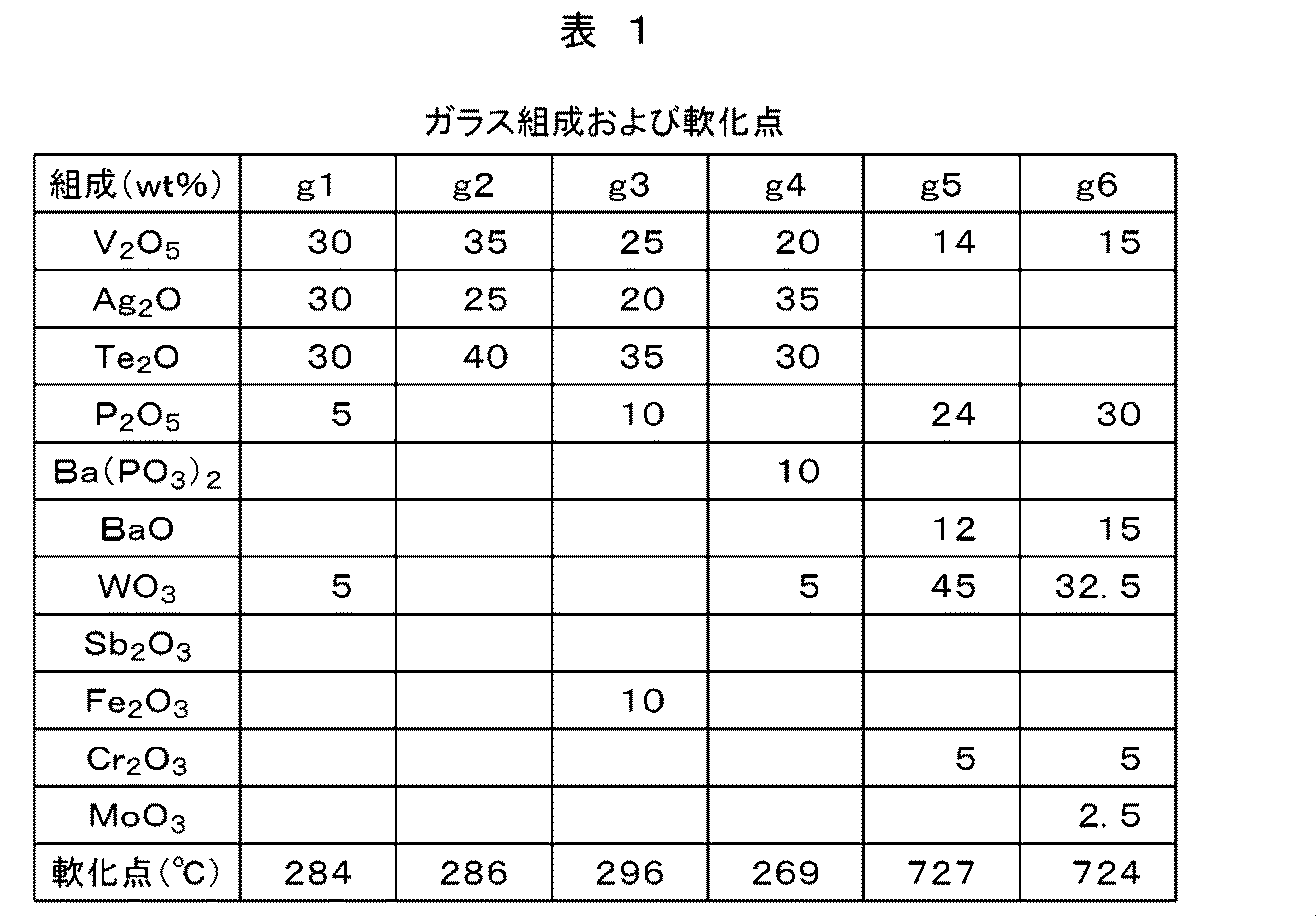
- the crucible containing the raw material powder was placed in a glass melting furnace and heated and melted. The temperature was raised at a rate of 10 ° C./min, and the molten glass was held for 1 hour at the set temperature (g1-g4 was 800 ° C., g5-g6 was 1400 ° C.) with stirring. Thereafter, the crucible was taken out from the glass melting furnace, and the glass was cast into a graphite mold heated to 150 ° C. in advance. Next, the cast glass was moved to a strain relief furnace that had been heated to a strain relief temperature in advance, strain was removed by holding for 1 hour, and then cooled to room temperature at a rate of 1 ° C./min. The glass cooled to room temperature was pulverized to produce a glass composition powder having the composition shown in the table.
- a glass paste was prepared by mixing the powder of the glass composition prepared as described above (average particle size of 1.0 ⁇ m or less), a resin, and a solvent.
- a paste was prepared using 1.5 wt% of nitrocellulose as a resin and 7.5 parts by weight of glass composition powder and 1 part by weight of butyl carbitol acetate as a solvent.
- Methyl ethyl ketone (MEK) (manufactured by Wako Pure Chemical Industries, Ltd.) was used as a solvent, and 0.5 wt% of polyether-modified polydimethylsiloxane (TSF-4442: manufactured by Momentive) was dissolved as an additive.
- TSF-4442 polyether-modified polydimethylsiloxane
- lithium tetraphenylborate manufactured by Wako Pure Chemical Industries, Ltd.
- 9 wt% of g1 paste was dissolved as a glass composition to prepare an ink for an ink jet printer.
- the ink jet printer (printing apparatus) targeted by this embodiment can be used for various conventionally known printers. Typical examples include a charge control method, an ink-on-demand method, and a method in which ink is discharged by a thermal head.
- the charge control type ink jet printer is preferable in that printing can be performed on a printing medium having a phase shape.
- Fig. 3 shows the process from ink discharge to landing of a charge control type ink jet printer.
- the ink droplet 5 ejected from the nozzle 4 is charged by the charging electrode 6, and then the direction is controlled by the deflection electrode 7, and the deflected ink droplet 5 lands on the substrate 8 to be printed.
- Ink that is not printed is collected from the gutter 9 and returned to the ink tank (not shown).
- a nozzle 4, a charging electrode 6, a deflection electrode 7, and a gutter 9 are built in a printer head (printing mechanism).
- the ink was printed using a charge control type ink jet printer (PX-D: manufactured by Hitachi Industrial Equipment). After printing on an alumina substrate (50 mm ⁇ 50 mm ⁇ 0.25 mm: manufactured by Kyocera) as a substrate to be printed, the glass composition g1 was softened and fixed on the substrate by heating in an electric furnace at 400 ° C./30 minutes. Next, the glass composition g1 was crystallized by firing at 500 ° C. for 3 hours. Thereafter, the printed portion was observed for fading. Moreover, the tape peeling test was performed and the adhesiveness of the printed matter was evaluated. The results are shown in Table 2. When the ink of this example was used, the color did not fade and the substrate adhesion was good.
- FIG. 4 shows a state in which a laser heating mechanism 11 is attached to the tip of the print head 10 of the printing apparatus, and the printing dots 12 formed on the substrate 8 to be printed are heated by the carbon dioxide laser beam 13. According to the laser heating, it is possible to suppress unnecessary irradiation other than the printed portion, so that the heating efficiency is good. If the heating mechanism 11 is arranged in the vicinity of the print head 10 so that heating can be performed immediately after printing, the dots can be irradiated with high accuracy. After heating, the printed part was observed for fading. Moreover, the tape peeling test was performed and the adhesiveness of the printed matter was evaluated. The results are shown in Table 2. When the ink of this example was used, the color did not fade and the substrate adhesion was good.
- Ink jet inks were prepared by blending 5 wt% of glass paste of g2 as glass composition 1 and g5 of color former 2 in the same manner as in Example 1. This ink was printed and evaluated in the same manner as in Example 1. The results are shown in Table 2. When the ink of this example was used, the color did not fade and the substrate adhesion was good.
- Ink was prepared in the same manner as in Example 3. At that time, a glass paste of g1 as the glass composition 1 and g6 as the color former 2 was used. In this embodiment, the printing dots are heated with a lamp.
- FIG. 5 shows a state in which the lamp heating mechanism 14 is attached to the tip of the print head 10 of the printing apparatus, and the printing dots 12 formed on the substrate 8 to be printed are heated by the lamp. After printing, heating was performed at 500 ° C. for 1 second to fix the printing dots 12 to the substrate 8 to be printed.
- This ink was evaluated in the same manner as in Example 1. The results are shown in Table 2. When the ink of this example was used, the color did not fade and the substrate adhesion was good.
- Other heating methods include microwave heating and resistance heating.
- Ink was prepared in the same manner as in Example 1. At that time, 5 wt% of g2 glass paste was added as glass composition 1, and 5 wt% of Cu—Mn—Fe-based Black # 3550 (manufactured by Dainichi Seika) was added as a color former. This ink was printed and evaluated in the same manner as in Example 1. The results are shown in Table 2. When the ink of this example was used, the color did not fade and the substrate adhesion was good.
- Ink was prepared in the same manner as in Example 5. At that time, a glass paste of g1 was used as the glass composition 1. This ink was printed and evaluated in the same manner as in Example 1. The results are shown in Table 2. When the ink of this example was used, the color did not fade and the substrate adhesion was good.
- Example 1 An ink was prepared by adding 10 wt% of Solvent Black 29 (manufactured by BASF) into the MEK solution to which the same additive as in Example 1 was added, and printing was performed under the same conditions as in Example 1. This sample was evaluated under the same conditions as in Example 1. The results are shown in Table 2. The color faded and the black part peeled off in the adhesion test.
- Example 2 An ink was prepared in the same manner as in Example 4. At this time, the glass composition 1 was not added, and the amount of the color former 2 was 10 wt%. This sample was heat-treated by the same method as in Example 4 and evaluated in the same manner. The results are shown in Table 2. Although fading did not occur, the black part was peeled off during the adhesion test.
- Example 3 Ink for an ink jet printer was prepared in the same manner as in Example 5. At this time, the glass composition 1 was not added, and the amount of the color former was 10 wt%. This sample was heat-treated by the same method as in Example 4 and evaluated in the same manner. The results are shown in Table 2. The color faded and the black part peeled off during the adhesion test.
Landscapes
- Chemical & Material Sciences (AREA)
- Life Sciences & Earth Sciences (AREA)
- Engineering & Computer Science (AREA)
- Materials Engineering (AREA)
- Wood Science & Technology (AREA)
- Organic Chemistry (AREA)
- Health & Medical Sciences (AREA)
- General Health & Medical Sciences (AREA)
- Toxicology (AREA)
- Inks, Pencil-Leads, Or Crayons (AREA)
- Ink Jet (AREA)
- Ink Jet Recording Methods And Recording Media Thereof (AREA)
Abstract
インクが被印字基材に印字された後に、高温環境にさらされた場合でもインクの退色を防止する。ガラス組成物を含むインクにおいて、前記ガラス組成物1はAgとVとガラス化成分とを含む。
Description
本発明は、インク、被印字基材、印字装置、印字方法、被印字基材の製造方法に関する。
タイルや琺瑯のようなセラミックの被印字基材は、製造番号や精密な模様等をインクジェット法等を用いて印字した後、焼成されることが多い。また、自動車のヘッドランプ、プロジェクターや光ファイバー光源用のハロゲンランプは使用時に300℃程度までランプ表面の温度が上昇する。
上記のように被印字基材が高温環境にさらされる場合、例えば遷移金属錯体、有機系分散剤から構成されるインクで印字すると、ランプ使用時間の経過に伴い、印字ドットの発色剤が熱劣化によって退色し、最終的には印字形状の識別ができなくなる。
特許文献1には、溶剤に可溶な金属塩を顔料に用いて、加熱によって金属塩が有色の金属酸化物に転化することで、300℃以上の温度でのマーキングや装飾に使用できることが開示されている。
特許文献2には、ウィンドウガラス等の塗布対象の軟化点以下の軟化点を有する無鉛ガラス粉体、分散剤、ガラス粉体と分散剤との混合物に粘性を付与する粘性剤を用いることで、インクの剥がれ落ちを防止できることが開示されている。
しかし、特許文献1のものは、熱によってポリマーが劣化し、金属酸化物となった顔料が大気にさらされた状態になるため、高温下で使用するうちに顔料が退色してしまう。
特許文献2のものは、ガラス粉体を着色剤に混合することで、加熱後には着色剤がある程度ガラスに被覆された状態となる。しかし、ここではガラス粉体の軟化点が400~450℃であるため、ガラス粉体が軟化する際に着色剤が退色してしまう。
本発明は、インクが印字された後の熱履歴による退色を防止することを目的とする。
上記目的を達成するために、本発明は、ガラス組成物を含むインクにおいて、前記ガラス組成物はAgとVとガラス化成分とを含むことを特徴とする。
本発明によれば、インクが印字された後の熱履歴による退色を防止することができる。
インクは大雑把には、必須成分であるガラス組成物の他、発色剤、樹脂、溶媒、添加剤等から構成される。これらをオーバーヘッドスターラ等により撹拌しお互いを分散させ、インクが形成される。
図1は、インクが被印字基材に塗布され加熱されることで、インクの構造が変化していく様子を示す。(a)はインクにガラス組成物(第1のガラス組成物)1、樹脂3を含み、発色剤を含まない場合を示す。インクは第1のガラス組成物1、樹脂3等が溶媒中に分散して存在している。インクが被印字基材8に印字、塗布された後、溶媒が揮発し、第1のガラス組成物1が軟化する温度にインク又は被印字基材8が加熱される。本発明の第1のガラス組成物1は、軟化点を下げる成分であるAgとVと、これらをガラス化させるガラス化成分とを含む。第1のガラス組成物1は黒色がかっているため、加熱後に形成される印字を識別することができる。その後、軟化点以上の温度で被印字基材8が焼成され、第1のガラス組成物1が結晶化する。結晶化したガラスは安定であるため、結晶化後は繰り返し高温に昇温してもガラスは変性しない。従って、印字は退色しにくい。本発明では、インクを被印字基材8に定着させるために、ガラスを軟化させる加熱と、結晶化させる加熱(焼成)の2段階で加熱する。
(b)は更に発色剤2を含む場合を示す。発色剤2を含むと第1のガラス組成物1のみの場合よりも鮮明な色で印字することができる。加熱されて溶けた第1のガラス組成物1によって発色剤2が被覆され、発色剤2が大気にさらされることなくインクが被印字基材8に固定される。その後、軟化点以上の温度で被印字基材8が焼成され、第1のガラス組成物1が結晶化する。即ち、印字に供する発色剤がガラスで被覆されるので、長時間高温にさらされる使用環境でも発色剤が退色しない。しかも、ガラス組成物の軟化点が低いので、被印字基材への定着時に加熱しても発色剤が退色しない。
本発明のガラス組成物は、以下に例示する方法で作製したガラス粉末を用いる。初めにAgおよびVを含む酸化物の他、ガラス化成分としてTe、P、Ba、W等を含む酸化物を出発原料として所定の質量比で混合後、800℃以上で融解、冷却し粉砕する。ガラス組成物は酸化物が安定していて良いが、酸化物中の一部のOをNに置換することでガラス組成物の結合が弱まり、更に軟化点を下げることができる。ガラス組成物をガラス化するための成分としては、Te又はPが軟化点の低下に寄与するために好ましい。
これらガラス組成物のうち特に第1のガラス組成物の軟化点が300℃以下であれば、ガラスと接する発色剤の熱劣化が生じにくいので好ましい。発色剤としては後述する発色剤のほか、有色のガラス組成物(第2のガラス組成物)を用いても良い。第2のガラス組成物を用いる場合、第2のガラス組成物は第1のガラス組成物よりも軟化点が高いものとする。具体的には第1のガラス組成物からAg酸化物を除き、Cr、Mo等を含む酸化物を出発原料粉末として配合すると軟化点が500℃以上のガラス組成を得ることができる。例えば酸化クロムは二価、四価で黒色、三価で緑色を示す。発色剤自体がガラスであれば、第1のガラス組成物に被覆されない部分が存在しても、その有色部分も退色しにくくなる。
通常、Ag2Oは加熱によって容易にAgに還元される。しかし、第1のガラス組成物はVがAgイオンを捕捉するので、加熱されても還元され難く、Agはイオンとしてガラス中に存在することができ、Agが析出し難い。第1のガラス組成物は、その内部に取り込まれたAgイオンによって軟化点が大きく下がると考えられる。Ag2Oは白色顔料として用いられることがあるが、この場合は加熱されるとAgに還元されるので退色してしまう。本発明におけるAg2Oは、顔料として用いるのではなくガラス組成物として用いるものである。
本発明のガラス組成物の軟化点は、特にAg2Oの含有率におおむね対応する。ガラス化成分となるTeO2とP2O5のうち、特にTeO2が軟化点の低温化に寄与するため好ましい。V2O5は、ガラス中のAg2Oからの金属Agの析出を抑制し、ガラスの熱的安定性の向上に寄与する。また、V2O5の添加によってAg2Oからの金属Agの析出が抑制されることから、Ag2Oの配合量を増大させることが可能となり軟化点の低温化が助長されると共に、ガラスの化学的安定性(例えば、耐湿性)が向上する。これらを考慮して、ガラス組成物は成分を酸化物で表したときに、Ag2OとV2O5とTeO2との合計含有率が75質量%以上であることが好ましい。なお、本発明ではRoHS指令(電子・電気機器における特定有害物質の使用制限についての欧州連合(EU)による指令、2006年7月1日施行)における禁止物質である鉛を、指定値を超えて含有しないものとする。
より具体的なガラス組成としては、10質量%以上60質量%以下のAg2Oと、5質量%以上65質量%以下のV2O5と、15質量%以上50質量%以下のTeO2とを含有すると、軟化点を300℃以下にすることができる。
更にAg2Oの質量含有率がV2O5の質量含有率の2.6倍以下である。言い換えると、Ag2O含有率のV2O5含有率に対する比「(Ag2O含有率)/(V2O5含有率)」が2.6以下である。これによれば、Ag2Oからの金属Agの析出が抑制され、Ag2Oの配合量を増大させることができる。
更にガラス組成物は、P2O5、BaO、K2O、WO3、MoO3、Fe2O3、MnO2、Sb2O3、及びZnOの内の1種以上を25質量%以下でガラス組成物の成分として含有させても、軟化点を低温化させることができる。
本発明の発色剤は、上記第2のガラス組成物の他、以下に例示する発色剤が用いられる。第2ガラス組成物と同様に、第1のガラス組成物が軟化する際に第1のガラス組成物中に分散し発色するものであり、第1のガラス組成物の軟化点より高い融点であれば特に限定されない。具体的にはカーボンブラックや、酸化チタン、亜鉛華、硫化亜鉛、鉛白、炭酸カルシウム、沈降性硫酸バリウム、ホワイトカーボン、アルミナホワイト、カオリンクレー、タルク、ベントナイト、カドミウムレッド、べんがら、モリブデンレッド、モリブデートオレンジ、クロムバーミリオン、黄鉛、カドミウムイエロー、黄色酸化鉄、チタンイエロー、酸化クロム、ビリジアン、チタンコバルトグリーン、コバルトグリーン、コバルトクロムグリーン、ビクトリアグリーン、群青、紺青、コバルトブルー、セルリアンブルー、コバルトシリカブルー、コバルト亜鉛シリカブルー、マンガンバイオレット、又はコバルトバイオレット等の無機系顔料の他、ジケトピロロピロール系顔料、アゾ系顔料、フタロシアニン系顔料、アントラキノン系顔料、キナクリドン系顔料、ジオキサジン系顔料、ペリノン系顔料、ペリレン系顔料、チオインジゴ系顔料、イソインドリン系顔料、イソインドリノン系顔料、キノフタロン系顔料、スレン系顔料、又は金属錯体系の有機系顔料が挙げられる。本発明に用いられる顔料としては特に耐熱性に優れたものが好ましい。また、黒色系顔料としては特にFeを含む黒色顔料が耐熱性の点から特に好ましい。
本発明の樹脂は、溶媒に溶解し、インクを被印字基材上に印字し、溶媒が蒸発した後、ガラス組成物や発色剤を基材上に仮固定するためのバインダのような役割や、ガラス組成物や発色剤の分散性を向上させる役割を果たす材料であれば特に制限はない。具体的には、ニトロセルロース、ポリウレタン、ポリカルボン酸エステル(例えば、ポリアクリレートなど)、不飽和ポリアミド、ポリカルボン酸、ポリカルボン酸塩類、ポリシロキサン、水酸基含有ポリカルボン酸エステルや、これらの変性物、(メタ)アクリル酸-スチレン共重合体、(メタ)アクリル酸-(メタ)アクリル酸エステル共重合体、スチレン-マレイン酸共重合体、ポリビニルアルコール、ポリビニルブチラール、ポリビニルピロリドンなどの水溶性樹脂や水溶性高分子化合物、ポリエステル系、変性ポリアクリレート系等が用いられ、これらは又は2種以上を混合して用いることができる。樹脂型顔料分散剤の重量平均分子量は1000~30000程度のものが好ましい。
本発明の添加剤は、ガラス組成物や発色剤の分散性を向上させるための界面活性剤の他、帯電制御方式のインクジェットプリンタの場合、インクの帯電状態を制御するための導電剤や、被印字基材に対しインクが着弾した後の形状を制御するためのレベリング剤等が挙げられる。界面活性剤としては、アニオン性、非イオン性、カチオン性、両イオン性活性剤を用いることができる。アニオン性活性剤としては、脂肪酸塩、アルキル硫酸エステル塩等を例示できる。非イオン性活性剤としては、ポリオキシエチレンアルキルエーテル、ポリオキシエチレンアルキルアリールエーテル、グリセリン脂肪酸エステル等の非イオン性活性剤が例示できる。カチオン性活性剤としては、アルキルアミン塩、第4級アンモニウム塩等を例示できる。導電剤としては、高い導電性を染料に付与できる構造の化合物、具体的には金属塩構造の化合物を選択するか、或いは別途導電剤を添加する。レベリング剤としてはポリジメチルシロキサン変性化合物やパーフロロ系化合物を用いることができる。
通常、帯電制御方式のインクジェットプリンタ用インクは、液滴自体の帯電量を変化させるために比抵抗を1000~1500Ω・cmにする必要がある。そのため、必要な導電性を確保する必要があり、添加剤として導電剤を添加する。具体的には、金属の塩構造のものが挙げられる。ただし、溶媒に溶解し、且つインクジェットプリンタ内部のポンプ、ホース部材等の部材を腐食、溶解、膨潤させないものが望まれる。これらを考慮すると硝酸塩が望ましい。その他、過塩素酸塩、テトラフェニルホウ酸塩も使用可能である。塩酸の塩はSUS、鉄等の腐食を引き起こす可能性があるので好ましくない。また金属種も金属塩の溶解性が高いアルカリ金属、特にリチウム、ナトリウムが望ましい。またアンモニウムイオン、テトラメチルアンモニウムイオンも溶解性が高い傾向があるので使用可能である。以上をまとめると、硝酸リチウム、硝酸ナトリウム、硝酸アンモニウム、硝酸テトラメチルアンモニウム、過塩素酸リチウム、過塩素酸ナトリウム、過塩素酸アンモニウム、過塩素酸テトラメチルアンモニウム、テトラフェニルホウ酸リチウム、テトラフェニルホウ酸ナトリウム、テトラフェニルホウ酸アンモニウム、テトラフェニルホウ酸テトラメチルアンモニウム等が使用可能である。
本発明の溶剤は、樹脂を溶解し、インクを印字可能な粘度まで低減させるものであれば特に制限はなく、例えば、芳香系、エステル系、ケトン系、炭化水素系、アルコール系、グリコール系等の有機溶剤の他、水系を用いることができる。
本発明における軟化点は示差熱分析(DTA)により測定した。図2にDTA測定図を示す。DTA測定は、参照試料(α-アルミナ)および測定試料の質量をそれぞれ650mgとし、大気中5℃/minの昇温速度で行い、第2吸熱ピークのピーク温度を軟化点Tsとして求めた。第1発熱ピークの開始温度は結晶化温度Tcである。なお、それぞれの温度は、接線法によって求められる温度とする。
ガラス組成物を軟化させる際の加熱温度は、通常、ガラス組成物の軟化点Tsよりも30~50℃程度高く設定される。このときの加熱において、ガラス組成物が結晶化しないことが必要なので、軟化点と結晶化温度との温度差が50℃程度以上あることが望ましい。
本発明の被印字基材は、高温環境にさらされるものを対象とし、セラミック、ガラス、金属等が挙げられる。これら被印字基材は製造プロセスおよび使用環境において高温の熱履歴がかかっても変質、変形しない材質が用いられる。
本発明に係るインク、被印字基材、印字方法、印字装置、被印字基材の製造方法の実施例について詳細に説明する。以下の実施例では、インクの塗布方法としてインクジェットプリンタで印字する例を説明する。
はじめに、本実施例では種々の組成を有するガラス組成物を作製し、該ガラス組成物の軟化点を調査した。
(ガラス組成物の作製)
表1に示す組成のガラス組成物(g1~g6)を作製した。表中の組成は、各成分の酸化物換算における質量比率で表示してある。出発原料としては、(株)高純度化学研究所製の酸化物粉末(純度99.9%)を用いた。一部の試料においては、Ba源およびP源としてBa(PO3)2(ラサ興行(株)製)を用いた。
表1に示す組成のガラス組成物(g1~g6)を作製した。表中の組成は、各成分の酸化物換算における質量比率で表示してある。出発原料としては、(株)高純度化学研究所製の酸化物粉末(純度99.9%)を用いた。一部の試料においては、Ba源およびP源としてBa(PO3)2(ラサ興行(株)製)を用いた。
表に示した質量比で各出発原料粉末を混合し、白金るつぼに入れた。原料粉末が余分に吸湿しないように、るつぼ内で金属製スプーンを用いて混合した。
原料粉末が入ったるつぼをガラス溶融炉内に設置し、加熱・融解した。10℃/minの昇温速度で昇温し、設定温度(g1-g4は800℃、g5-g6は1400℃)で、融解しているガラスを撹拌しながら1時間保持した。その後、るつぼをガラス溶融炉から取り出し、あらかじめ150℃に加熱しておいた黒鉛鋳型にガラスを鋳込んだ。次に、鋳込まれたガラスを、あらかじめ歪取り温度に加熱しておいた歪取り炉に移動し、1時間保持により歪を除去した後、1℃/minの速度で室温まで冷却した。室温まで冷却したガラスを粉砕し、表に示した組成のガラス組成物の粉末を作製した。
(ガラスペーストの作製)
上述のようにして作製したガラス組成物の粉末(平均粒径1.0μm以下)と樹脂と溶剤とを混合してガラスペーストを作製した。ガラス組成粉末7.5wt%に対し、樹脂はニトロセルロースを1.5wt%用い、溶剤としてはブチルカルビトールアセテート1重量部を用い、ペーストを作製した。
上述のようにして作製したガラス組成物の粉末(平均粒径1.0μm以下)と樹脂と溶剤とを混合してガラスペーストを作製した。ガラス組成粉末7.5wt%に対し、樹脂はニトロセルロースを1.5wt%用い、溶剤としてはブチルカルビトールアセテート1重量部を用い、ペーストを作製した。
(インクジェットプリンタ用インクの作製)
溶剤としてメチルエチルケトン(MEK)(和光純薬製)を用い、添加剤としてポリエーテル変性ポリジメチルシロキサン(TSF-4452:モーメンティブ製)0.5wt%を溶解した。次に、同じ溶液に、導電剤としてテトラフェニルホウ酸リチウム(和光純薬製)を0.5wt%となるよう溶解した。最後にガラス組成物としてg1ペースト9wt%を溶解してインクジェットプリンタ用インクを作製した。
溶剤としてメチルエチルケトン(MEK)(和光純薬製)を用い、添加剤としてポリエーテル変性ポリジメチルシロキサン(TSF-4452:モーメンティブ製)0.5wt%を溶解した。次に、同じ溶液に、導電剤としてテトラフェニルホウ酸リチウム(和光純薬製)を0.5wt%となるよう溶解した。最後にガラス組成物としてg1ペースト9wt%を溶解してインクジェットプリンタ用インクを作製した。
(印字および耐熱、接着性試験)
本実施例が対象としているインクジェットプリンタ(印字装置)としては、従来から公知の各種プリンタに使用できる。例えば帯電制御方式、インクオンディマンド方式あるいはサーマルヘッドによりインクを吐出させる方式等が代表的なものとして挙げられる。特に、帯電制御方式のインクジェットプリンタは局面形状の被印字体にも印字可能である点において好ましい。
本実施例が対象としているインクジェットプリンタ(印字装置)としては、従来から公知の各種プリンタに使用できる。例えば帯電制御方式、インクオンディマンド方式あるいはサーマルヘッドによりインクを吐出させる方式等が代表的なものとして挙げられる。特に、帯電制御方式のインクジェットプリンタは局面形状の被印字体にも印字可能である点において好ましい。
図3に帯電制御式のインクジェットプリンタのインク吐出、着弾までのプロセスを示す。ノズル4から吐出したインク滴5は帯電電極6で電荷を付与され、その後、偏向電極7で方向を制御され、偏向したインク滴5が被印字基材8に着弾する。印字されないインクはガター9から回収され、インクタンク(図示省略)に戻される。図3において、ノズル4、帯電電極6、偏向電極7、ガター9がプリンタのヘッド(印字機構)に内蔵される。
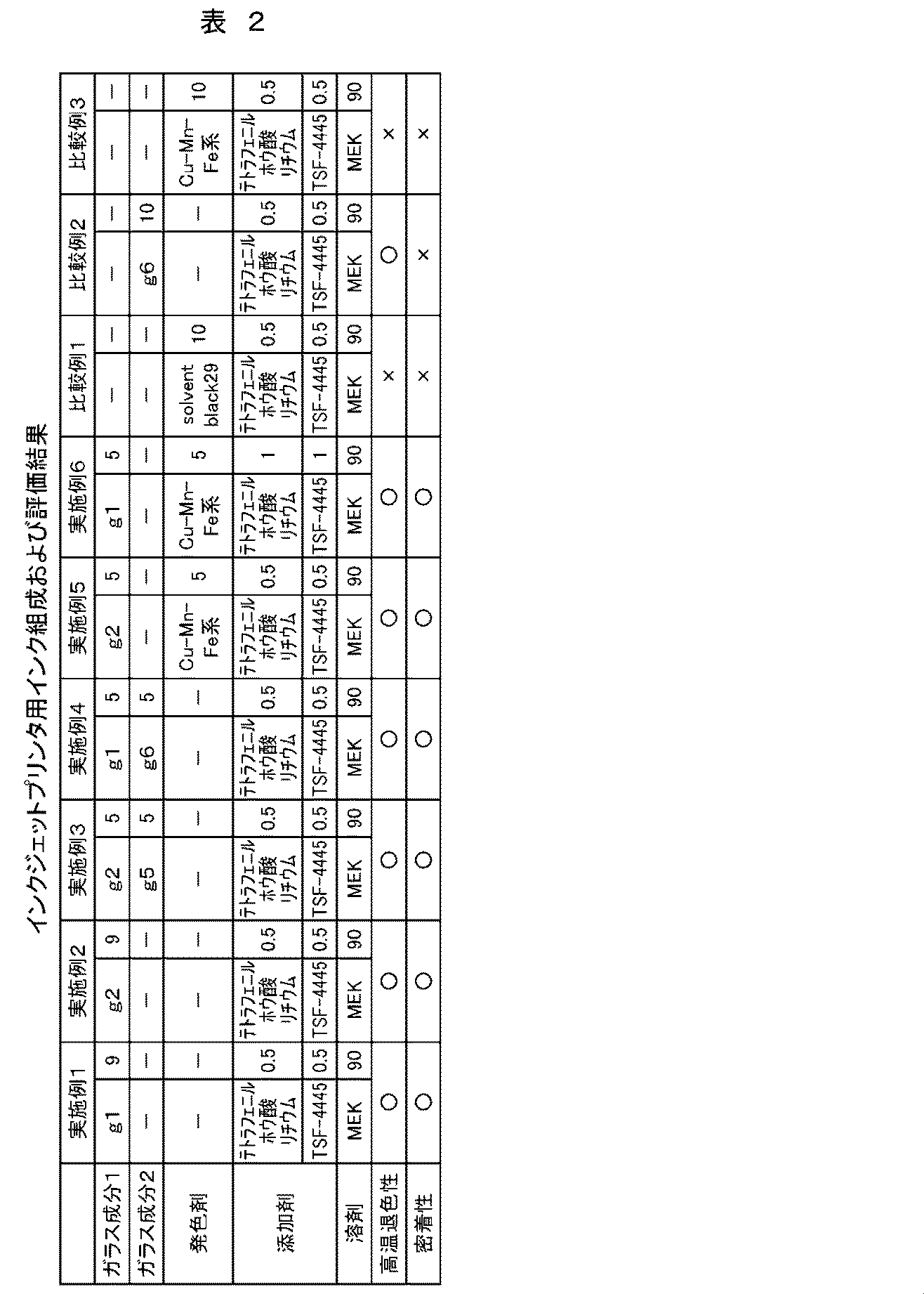
このインクを帯電制御方式のインクジェットプリンタ装置(PX-D:日立産機製)を用い印字を行った。被印字基材としてアルミナ基板(50mm×50mm×0.25mm:京セラ製)上に印字した後、電気炉で400度/30分加熱し、ガラス組成物g1を軟化させて基板に定着させた。次に500℃/3時間焼成してガラス組成物g1を結晶化させた。その後、印字部分について退色の有無を観察した。また、テープ剥離試験を行い、印字物の密着性を評価した。結果を表2に示す。本実施例のインクを用いた場合、退色せず、基板密着性も良好な結果となった。
実施例1のガラス組成物1をg2に変更したインクを作製した。本実施例では、印字ドットをレーザで加熱する。図4に印字装置の印字ヘッド10の先端部にレーザ加熱機構11を取り付け、被印字基材8上に形成された印字ドット12を炭酸ガスレーザ光13で加熱する様子を示す。レーザ加熱によれば、印字部分以外をむだに照射することが抑えられるので、加熱効率がよい。また印字ヘッド10近傍に加熱機構11を配置し、印字直後に加熱できるようにすると、ドットに精度良く照射することができる。加熱後、印字部分について退色の有無を観察した。また、テープ剥離試験を行い、印字物の密着性を評価した。結果を表2に示す。本実施例のインクを用いた場合、退色せず、基板密着性も良好な結果となった。
実施例1と同様の方法でガラス組成物1としてg2、発色剤2としてg5のガラスペーストをそれぞれ5wt%ずつ配合したインクジェット用インクを作製した。このインクを実施例1と同様の方法で印字および評価した。結果を表2に示す。本実施例のインクを用いた場合、退色せず、基板密着性も良好な結果となった。
実施例3と同様の方法でインクを作製した。その際、ガラス組成物1としてg1、発色剤2としてg6のガラスペーストを用いた。本実施例では、印字ドットをランプで加熱する。図5に印字装置の印字ヘッド10の先端部にランプ加熱機構14を取り付け、被印字基材8上に形成された印字ドット12をランプで加熱する様子を示す。印字後に500℃で1秒間加熱し、印字ドット12を被印字基材8に定着させた。このインクを実施例1と同様の方法で評価した。結果を表2に示す。本実施例のインクを用いた場合、退色せず、基板密着性も良好な結果となった。
その他の加熱方法としてはマイクロ波加熱、抵抗加熱等が挙げられる。
その他の加熱方法としてはマイクロ波加熱、抵抗加熱等が挙げられる。
実施例1と同様の方法でインクを作製した。その際、ガラス組成物1としてg2のガラスペーストを5wt%、発色剤としてCu-Mn-Fe系のBlack#3550(大日精化製)を5wt%添加した。このインクを実施例1と同様の方法で印字および評価した。結果を表2に示す。本実施例のインクを用いた場合、退色せず、基板密着性も良好な結果となった。
実施例5と同様の方法でインクを作製した。その際、ガラス組成物1としてg1のガラスペーストを用いた。このインクを実施例1と同様の方法で印字および評価した。結果を表2に示す。本実施例のインクを用いた場合、退色せず、基板密着性も良好な結果となった。
〔比較例1〕
実施例1と同様の添加剤が加えられたMEK溶液中にソルベントブラック29(BASF製)を10wt%添加しインクを作製し、実施例1と同じ条件で印字した。このサンプルを実施例1と同じ条件で評価した。結果を表2に示す。色が退色し、密着試験で黒色部が剥がれた。
実施例1と同様の添加剤が加えられたMEK溶液中にソルベントブラック29(BASF製)を10wt%添加しインクを作製し、実施例1と同じ条件で印字した。このサンプルを実施例1と同じ条件で評価した。結果を表2に示す。色が退色し、密着試験で黒色部が剥がれた。
〔比較例2〕
実施例4と同様にインクを作成した。この際、ガラス組成物1を添加せず、発色剤2の量を10wt%とした。このサンプルを実施例4と同じ方法で熱処理し、同様に評価した。結果を表2に示す。退色は発生しなかったが、黒色部が密着試験の際剥がれた。
実施例4と同様にインクを作成した。この際、ガラス組成物1を添加せず、発色剤2の量を10wt%とした。このサンプルを実施例4と同じ方法で熱処理し、同様に評価した。結果を表2に示す。退色は発生しなかったが、黒色部が密着試験の際剥がれた。
〔比較例3〕
実施例5と同様にインクジェットプリンタ用インクを作成した。この際、ガラス組成物1を添加せず、発色剤の量を10wt%とした。このサンプルを実施例4と同じ方法で熱処理し、同様に評価した。結果を表2に示す。色が退色し、黒色部が密着試験の際剥がれた。
実施例5と同様にインクジェットプリンタ用インクを作成した。この際、ガラス組成物1を添加せず、発色剤の量を10wt%とした。このサンプルを実施例4と同じ方法で熱処理し、同様に評価した。結果を表2に示す。色が退色し、黒色部が密着試験の際剥がれた。
1 ガラス組成物(第1のガラス組成物)
2 発色剤(第2のガラス組成物)
3 樹脂
4 ノズル
5 インク滴
6 帯電電極
7 偏向電極
8 被印字基材
9 ガター
10 印字ヘッド(印字機構)
11 レーザ加熱機構(加熱機構)
12 印字ドット
13 炭酸ガスレーザ光
14 ランプ加熱機構(加熱機構)
2 発色剤(第2のガラス組成物)
3 樹脂
4 ノズル
5 インク滴
6 帯電電極
7 偏向電極
8 被印字基材
9 ガター
10 印字ヘッド(印字機構)
11 レーザ加熱機構(加熱機構)
12 印字ドット
13 炭酸ガスレーザ光
14 ランプ加熱機構(加熱機構)
Claims (12)
- ガラス組成物を含むインクにおいて、前記ガラス組成物はAgとVとガラス化成分とを含むことを特徴とするインク。
- 請求項1において、前記ガラス化成分はTe又はPの少なくとも何れかであることを特徴とするインク。
- 請求項1において、前記ガラス組成物はAg2OとV2O5とTeO2とを含むことを特徴とするインク。
- 請求項3において、前記ガラス組成物のAg2OとV2O5とTeO2との合計含有率が75質量%以上であることを特徴とするインク。
- 請求項1において、発色剤を含むことを特徴とするインク。
- 請求項1において、前記ガラス組成物よりも軟化点が高い第2のガラス組成物を含むことを特徴とするインク。
- 請求項5において、前記発色剤はFeを含むことを特徴とするインク。
- 請求項1のインクが塗布された被印字基材。
- 請求項8において、前記ガラス組成物の軟化点以上の温度で加熱されることを特徴とする被印字基材。
- 請求項1のインクを塗布する印字機構と、前記ガラス組成物の軟化点以上の温度で加熱する加熱機構とを備えることを特徴とする印字装置。
- 請求項1のインクを被印字基材に塗布する工程と、前記ガラス組成物の軟化点以上の温度で加熱する工程とを備えることを特徴とする印字方法。
- 請求項1のインクを被印字基材に塗布する工程と、前記ガラス組成物の軟化点以上の温度で加熱する工程とを備えることを特徴とする被印字基材の製造方法。
Priority Applications (4)
| Application Number | Priority Date | Filing Date | Title |
|---|---|---|---|
| CN201280068105.XA CN104080862B (zh) | 2012-01-26 | 2012-12-05 | 墨水、被印刷基材、印刷装置、印刷方法、被印刷基材的制造方法 |
| EP12866577.5A EP2808366B1 (en) | 2012-01-26 | 2012-12-05 | Ink, base to be printed, printing device, printing method, and method for producing base to be printed |
| ES12866577.5T ES2601952T3 (es) | 2012-01-26 | 2012-12-05 | Tinta, base para ser impresa, dispositivo de impresión, método de impresión y método para producir una base para ser impresa |
| US14/374,369 US9334415B2 (en) | 2012-01-26 | 2012-12-05 | Ink, base to be printed, printing device, printing method, and method for producing base to be printed |
Applications Claiming Priority (2)
| Application Number | Priority Date | Filing Date | Title |
|---|---|---|---|
| JP2012013658A JP5816565B2 (ja) | 2012-01-26 | 2012-01-26 | インク、被印字基材、印字装置、印字方法、被印字基材の製造方法 |
| JP2012-013658 | 2012-01-26 |
Publications (1)
| Publication Number | Publication Date |
|---|---|
| WO2013111456A1 true WO2013111456A1 (ja) | 2013-08-01 |
Family
ID=48873197
Family Applications (1)
| Application Number | Title | Priority Date | Filing Date |
|---|---|---|---|
| PCT/JP2012/081444 Ceased WO2013111456A1 (ja) | 2012-01-26 | 2012-12-05 | インク、被印字基材、印字装置、印字方法、被印字基材の製造方法 |
Country Status (6)
| Country | Link |
|---|---|
| US (1) | US9334415B2 (ja) |
| EP (1) | EP2808366B1 (ja) |
| JP (1) | JP5816565B2 (ja) |
| CN (1) | CN104080862B (ja) |
| ES (1) | ES2601952T3 (ja) |
| WO (1) | WO2013111456A1 (ja) |
Cited By (3)
| Publication number | Priority date | Publication date | Assignee | Title |
|---|---|---|---|---|
| DE102014219480A1 (de) * | 2014-09-25 | 2015-09-03 | Heidelberger Druckmaschinen Ag | Verfahren zum Bedrucken von gekrümmten Glassubstraten mit einem Fluid |
| JP2019156935A (ja) * | 2018-03-09 | 2019-09-19 | 御国色素株式会社 | インク及び被印字体の製造方法 |
| JP2020041116A (ja) * | 2018-09-12 | 2020-03-19 | 御国色素株式会社 | 印刷用インク及びその製造方法並びにプリンタ |
Families Citing this family (1)
| Publication number | Priority date | Publication date | Assignee | Title |
|---|---|---|---|---|
| JP6897704B2 (ja) * | 2019-03-29 | 2021-07-07 | Tdk株式会社 | 黒色マーク組成物およびこれを用いた電子部品 |
Citations (5)
| Publication number | Priority date | Publication date | Assignee | Title |
|---|---|---|---|---|
| JPH02293344A (ja) * | 1989-04-19 | 1990-12-04 | Natl Starch & Chem Corp | 電子的用途に使用するのに好適な低軟化点金属酸化物ガラス |
| JPH05202326A (ja) | 1991-05-24 | 1993-08-10 | Imaje Sa | 物品、特にセラミック物品のマーキングまたは装飾用インク |
| JP2010116541A (ja) | 2008-10-16 | 2010-05-27 | Nissei Kogyo Kk | 無機材料用インク |
| JP2010520934A (ja) * | 2007-03-09 | 2010-06-17 | ドウジン セミケム カンパニー リミテッド | 黒色導電性ペースト組成物、これを含む妨害電磁波遮蔽フィルター、及び表示装置 |
| JP2011512426A (ja) * | 2008-01-30 | 2011-04-21 | ビーエーエスエフ ソシエタス・ヨーロピア | 有機金属修飾剤を有する導電性インク |
Family Cites Families (8)
| Publication number | Priority date | Publication date | Assignee | Title |
|---|---|---|---|---|
| US6939002B2 (en) * | 2002-10-11 | 2005-09-06 | Eastman Kodak Company | Method and apparatus for producing a selectable gloss finish on ink jet prints |
| GB0327340D0 (en) * | 2003-11-25 | 2003-12-31 | Johnson Matthey Bv | Ink-jet composition |
| US7736546B2 (en) * | 2008-01-30 | 2010-06-15 | Basf Se | Glass frits |
| KR101061048B1 (ko) * | 2010-02-17 | 2011-09-01 | (주)덕산테코피아 | 솔더 잉크 및 이를 이용한 전자소자 패키지 |
| TWI448444B (zh) * | 2010-08-11 | 2014-08-11 | Hitachi Ltd | A glass composition for an electrode, a paste for an electrode for use, and an electronic component to which the electrode is used |
| JP5726698B2 (ja) | 2011-07-04 | 2015-06-03 | 株式会社日立製作所 | ガラス組成物、それを含むガラスフリット、それを含むガラスペースト、およびそれを利用した電気電子部品 |
| JP5732381B2 (ja) | 2011-12-26 | 2015-06-10 | 株式会社日立製作所 | 積層体及びこれを用いた有機el素子、窓、太陽電池モジュール |
| JP5712123B2 (ja) | 2011-12-26 | 2015-05-07 | 株式会社日立製作所 | 複合材料 |
-
2012
- 2012-01-26 JP JP2012013658A patent/JP5816565B2/ja active Active
- 2012-12-05 US US14/374,369 patent/US9334415B2/en active Active
- 2012-12-05 WO PCT/JP2012/081444 patent/WO2013111456A1/ja not_active Ceased
- 2012-12-05 ES ES12866577.5T patent/ES2601952T3/es active Active
- 2012-12-05 EP EP12866577.5A patent/EP2808366B1/en active Active
- 2012-12-05 CN CN201280068105.XA patent/CN104080862B/zh active Active
Patent Citations (5)
| Publication number | Priority date | Publication date | Assignee | Title |
|---|---|---|---|---|
| JPH02293344A (ja) * | 1989-04-19 | 1990-12-04 | Natl Starch & Chem Corp | 電子的用途に使用するのに好適な低軟化点金属酸化物ガラス |
| JPH05202326A (ja) | 1991-05-24 | 1993-08-10 | Imaje Sa | 物品、特にセラミック物品のマーキングまたは装飾用インク |
| JP2010520934A (ja) * | 2007-03-09 | 2010-06-17 | ドウジン セミケム カンパニー リミテッド | 黒色導電性ペースト組成物、これを含む妨害電磁波遮蔽フィルター、及び表示装置 |
| JP2011512426A (ja) * | 2008-01-30 | 2011-04-21 | ビーエーエスエフ ソシエタス・ヨーロピア | 有機金属修飾剤を有する導電性インク |
| JP2010116541A (ja) | 2008-10-16 | 2010-05-27 | Nissei Kogyo Kk | 無機材料用インク |
Non-Patent Citations (1)
| Title |
|---|
| See also references of EP2808366A4 |
Cited By (3)
| Publication number | Priority date | Publication date | Assignee | Title |
|---|---|---|---|---|
| DE102014219480A1 (de) * | 2014-09-25 | 2015-09-03 | Heidelberger Druckmaschinen Ag | Verfahren zum Bedrucken von gekrümmten Glassubstraten mit einem Fluid |
| JP2019156935A (ja) * | 2018-03-09 | 2019-09-19 | 御国色素株式会社 | インク及び被印字体の製造方法 |
| JP2020041116A (ja) * | 2018-09-12 | 2020-03-19 | 御国色素株式会社 | 印刷用インク及びその製造方法並びにプリンタ |
Also Published As
| Publication number | Publication date |
|---|---|
| JP2013151620A (ja) | 2013-08-08 |
| EP2808366B1 (en) | 2016-11-02 |
| EP2808366A4 (en) | 2015-07-15 |
| US9334415B2 (en) | 2016-05-10 |
| EP2808366A1 (en) | 2014-12-03 |
| CN104080862A (zh) | 2014-10-01 |
| US20140375736A1 (en) | 2014-12-25 |
| ES2601952T3 (es) | 2017-02-16 |
| JP5816565B2 (ja) | 2015-11-18 |
| CN104080862B (zh) | 2016-09-21 |
Similar Documents
| Publication | Publication Date | Title |
|---|---|---|
| ES2345985T3 (es) | Tinta para superficies ceramicas. | |
| US8765855B2 (en) | Reaction-based laser marking compositions, systems and methods | |
| JP5816565B2 (ja) | インク、被印字基材、印字装置、印字方法、被印字基材の製造方法 | |
| JPH05202326A (ja) | 物品、特にセラミック物品のマーキングまたは装飾用インク | |
| JP4075864B2 (ja) | 加飾セラミックス体、その製造方法及び釉薬調合物 | |
| JP7122057B2 (ja) | 粒子混合物、キット、インク、方法及び物品 | |
| ES2424775B1 (es) | Composicion de tinta para decoración de substratos no porosos | |
| WO2020043930A1 (es) | Tintas de inyección cerámicas digitales para vidrio y procedimiento para obtener las mismas | |
| JPWO2007020779A1 (ja) | 無機質基材へのインクジェットプリント方法 | |
| WO2005073140A1 (en) | Improved glass compositions | |
| CN119053664A (zh) | 用于制造搪瓷涂层的可喷墨印刷墨料 | |
| JP7349574B2 (ja) | インクジェットプリンタ用インク | |
| JP6613139B2 (ja) | インクジェット用インクセット、それを用いたインクジェットプリント物の製造方法およびインクジェットプリント物 | |
| JP2014005400A (ja) | インクジェット用インク及び印刷方法 | |
| JP2003094893A (ja) | 皮膜形成転写シート及び皮膜樹脂液 | |
| CN104341780A (zh) | 一种热转印专用蜡及其制作方法 | |
| JPH0678178B2 (ja) | サ−モクロミック皮膜形成方法 | |
| JP2008284882A (ja) | 皮膜形成転写シート及び皮膜樹脂液 |
Legal Events
| Date | Code | Title | Description |
|---|---|---|---|
| 121 | Ep: the epo has been informed by wipo that ep was designated in this application |
Ref document number: 12866577 Country of ref document: EP Kind code of ref document: A1 |
|
| REEP | Request for entry into the european phase |
Ref document number: 2012866577 Country of ref document: EP |
|
| WWE | Wipo information: entry into national phase |
Ref document number: 2012866577 Country of ref document: EP |
|
| WWE | Wipo information: entry into national phase |
Ref document number: 14374369 Country of ref document: US |
|
| NENP | Non-entry into the national phase |
Ref country code: DE |