WO2013129191A1 - Système de prétraitement d'échantillons - Google Patents
Système de prétraitement d'échantillons Download PDFInfo
- Publication number
- WO2013129191A1 WO2013129191A1 PCT/JP2013/054037 JP2013054037W WO2013129191A1 WO 2013129191 A1 WO2013129191 A1 WO 2013129191A1 JP 2013054037 W JP2013054037 W JP 2013054037W WO 2013129191 A1 WO2013129191 A1 WO 2013129191A1
- Authority
- WO
- WIPO (PCT)
- Prior art keywords
- sample
- amount
- child
- unit
- dispensing
- Prior art date
- Legal status (The legal status is an assumption and is not a legal conclusion. Google has not performed a legal analysis and makes no representation as to the accuracy of the status listed.)
- Ceased
Links
Images






Classifications
-
- G—PHYSICS
- G01—MEASURING; TESTING
- G01N—INVESTIGATING OR ANALYSING MATERIALS BY DETERMINING THEIR CHEMICAL OR PHYSICAL PROPERTIES
- G01N1/00—Sampling; Preparing specimens for investigation
- G01N1/28—Preparing specimens for investigation including physical details of (bio-)chemical methods covered elsewhere, e.g. G01N33/50, C12Q
-
- G—PHYSICS
- G01—MEASURING; TESTING
- G01N—INVESTIGATING OR ANALYSING MATERIALS BY DETERMINING THEIR CHEMICAL OR PHYSICAL PROPERTIES
- G01N35/00—Automatic analysis not limited to methods or materials provided for in any single one of groups G01N1/00 - G01N33/00; Handling materials therefor
- G01N35/00584—Control arrangements for automatic analysers
- G01N35/0092—Scheduling
-
- G—PHYSICS
- G01—MEASURING; TESTING
- G01N—INVESTIGATING OR ANALYSING MATERIALS BY DETERMINING THEIR CHEMICAL OR PHYSICAL PROPERTIES
- G01N35/00—Automatic analysis not limited to methods or materials provided for in any single one of groups G01N1/00 - G01N33/00; Handling materials therefor
- G01N35/10—Devices for transferring samples or any liquids to, in, or from, the analysis apparatus, e.g. suction devices, injection devices
- G01N35/1009—Characterised by arrangements for controlling the aspiration or dispense of liquids
- G01N35/1016—Control of the volume dispensed or introduced
-
- G—PHYSICS
- G01—MEASURING; TESTING
- G01F—MEASURING VOLUME, VOLUME FLOW, MASS FLOW OR LIQUID LEVEL; METERING BY VOLUME
- G01F22/00—Methods or apparatus for measuring volume of fluids or fluent solid material, not otherwise provided for
-
- G—PHYSICS
- G01—MEASURING; TESTING
- G01N—INVESTIGATING OR ANALYSING MATERIALS BY DETERMINING THEIR CHEMICAL OR PHYSICAL PROPERTIES
- G01N35/00—Automatic analysis not limited to methods or materials provided for in any single one of groups G01N1/00 - G01N33/00; Handling materials therefor
- G01N35/00584—Control arrangements for automatic analysers
- G01N35/0092—Scheduling
- G01N2035/0094—Scheduling optimisation; experiment design
-
- G—PHYSICS
- G01—MEASURING; TESTING
- G01N—INVESTIGATING OR ANALYSING MATERIALS BY DETERMINING THEIR CHEMICAL OR PHYSICAL PROPERTIES
- G01N35/00—Automatic analysis not limited to methods or materials provided for in any single one of groups G01N1/00 - G01N33/00; Handling materials therefor
- G01N35/10—Devices for transferring samples or any liquids to, in, or from, the analysis apparatus, e.g. suction devices, injection devices
- G01N2035/1027—General features of the devices
- G01N2035/1032—Dilution or aliquotting
-
- Y—GENERAL TAGGING OF NEW TECHNOLOGICAL DEVELOPMENTS; GENERAL TAGGING OF CROSS-SECTIONAL TECHNOLOGIES SPANNING OVER SEVERAL SECTIONS OF THE IPC; TECHNICAL SUBJECTS COVERED BY FORMER USPC CROSS-REFERENCE ART COLLECTIONS [XRACs] AND DIGESTS
- Y10—TECHNICAL SUBJECTS COVERED BY FORMER USPC
- Y10T—TECHNICAL SUBJECTS COVERED BY FORMER US CLASSIFICATION
- Y10T436/00—Chemistry: analytical and immunological testing
- Y10T436/25—Chemistry: analytical and immunological testing including sample preparation
- Y10T436/2575—Volumetric liquid transfer
Definitions
- the present invention relates to a sample pretreatment system for preprocessing a sample for clinical examination.
- a sample pretreatment system that pre-processes samples such as blood and urine, such as dispensing parent samples and creating child samples prior to analysis processing such as biochemical analysis and immunological analysis.
- samples such as blood and urine, such as dispensing parent samples and creating child samples prior to analysis processing such as biochemical analysis and immunological analysis.
- the sample collection amount has increased with the recent increase in the number of analysis items, and a plurality of parent samples have been collected.
- a function for creating a child sample from a plurality of parent samples has been required.
- a plurality of parent samples are mounted and transported in a sample transport rack and dispensed from a plurality of parent samples to a plurality of child samples (see Patent Document 1).
- the apparatus of the above-mentioned Patent Document 1 is to carry a plurality of parent samples on a single sample transport rack and transport them all together, and management of the parent sample also depends on the information of the sample transport rack.
- an object of the present invention is to provide a sample pretreatment system that can appropriately create a plurality of child samples from a plurality of parent samples conveyed separately.
- the present invention sets a minimum guaranteed amount (the amount of specimen expected to be accommodated in a test tube at least) for each type of test tube, and is requested to have the minimum guaranteed amount. Based on the dispensed amount of each child sample, the maximum number of child samples is created within a range that does not exceed the minimum guaranteed amount.
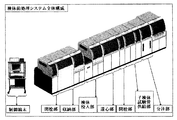
- the present invention provides a system and method that can efficiently create a plurality of child samples from a plurality of parent samples in a sample pretreatment system that pre-processes a sample for clinical testing having the configuration shown in FIG. 7 before analysis. I will provide a.
- this sample pretreatment system as shown in FIG. 8, one test tube is carried on one holder.
- specimen refers to a liquid in a portion of a liquid used in a test tube that is used for analysis in an analyzer (for example, a portion of serum or plasma obtained by centrifuging blood). .
- the “minimum guaranteed amount” is the amount of specimen that is presumed that the minimum number of specimens is definitely in the test tube, and is the value set for each type of test tube. .
- a method of discriminating the type of test tube it may be a method of discriminating by reading a barcode or a wireless tag attached to the test tube, or a method of discriminating by processing an image obtained by imaging the test tube.
- the determination may be made by recognizing the color of the cap of the test tube.
- This embodiment can efficiently create a plurality of child specimens from a plurality of parent specimens in a specimen pretreatment system that pretreats specimens for clinical tests before analysis.
- the amount of liquid actually collected in the blood collection tube may vary depending on its volume, the blood pressure of the subject, etc., so it is difficult to know the amount of liquid actually contained in the blood collection tube.
- an expensive and special liquid amount measuring device is required. The processing speed of this liquid amount measuring apparatus is slow, and if this is incorporated into a sample pretreatment system, the system becomes expensive and the processing speed is significantly reduced, which is not practical.
- the minimum guaranteed amount of the sample amount in the test tube is set for each type of the test tube, and the dispensing sample unit takes the minimum guaranteed amount for each test tube type and adds the child sample from the parent sample. create.
- the maximum number of child specimens are created from the transported test tubes within a range not exceeding the minimum guaranteed amount.
- test tubes containing specimens (parent specimens) collected from a certain subject are put into the specimen pretreatment system, and dispensing requests are made to create four 300 ⁇ L child specimens from these parent specimens.
- the dispensing unit creates three child samples for the test tube that has been transported first, and then the test tube is transported. Wait for it to come and create a fourth child sample.
- the content of the dispensing request is determined by the type and number of test items, and the parent sample that has arrived at the dispensing unit is usually collected in an amount sufficient to produce the requested child samples.
- the sample arrives as in this embodiment regardless of the number of arrivals and the arrival time of the parent sample.
- all of the requested child samples can be created when the last parent sample arrives.
- a plurality of child samples can be efficiently created from a plurality of parent samples, and there is no need to transport a plurality of parent samples as a whole. It is also possible to suppress a decrease in efficiency of other pretreatment steps.
- the fourth child sample is Less than 300 ⁇ L (only 200 mL can be secured), resulting in a failure.
- the container and the dispensing operation used to create the fourth child sample are wasted.
- the generation of such waste can be suppressed.
- the minimum guaranteed amount of the test tube may be updated as appropriate in the process of repeating the dispensing process for the same type of test tube, with the value input and set by the operator as the initial value. it can. Specifically, after creating a child sample, first draw up the parent sample remaining in the test tube and create a stored sample to be preliminarily stored for rapid reexamination. The measured amount of the sample collected in the test tube is obtained by adding the dispensed amounts of the sample and the stored sample. In addition to accumulating actual measured values for each test tube in this way, the validity of the minimum guaranteed value is statistically enhanced by updating the minimum guaranteed amount for each test tube based on statistical data. And the child sample creation efficiency is improved. As the parameter increases, the reliability of the value increases.
- a configuration can be added to notify the operator to that effect.
- the total collected amount of the parent sample is insufficient in the first place relative to the total required amount of the child sample, and in this case, it is necessary to wait for the arrival of the next parent sample to create the remaining child samples.
- the parent sample is not transported. In such a case, if the set time has passed without the next parent sample arriving and the remaining child samples not being created, the operator is notified of the lack of the parent sample, and the parent sample is added. Measures such as collection can be encouraged.
- the test tube of the parent sample is unconditionally.
- the minimum amount of the stored sample is determined in advance, and the amount of the parent sample remaining in the test tube after the preparation of the child sample is estimated from the difference between the minimum guaranteed amount and the dispensed amount to the child sample.
- the amount is less than the minimum amount, a stored sample is not prepared, and a stored sample is generated only when the minimum amount is expected. Thereby, it is possible to suppress waste such as a container used for preparation of a stored specimen and a dispensing operation.
- a stored sample may be created when a parent sample exceeding the minimum amount of the stored sample remains. That is, a stored sample can be prepared from the test tube into which the last child sample has been dispensed. In this case, it is possible to avoid the creation of a plurality of stored samples having the same parent sample as the contents, and it is possible to minimize the number of stored samples.
- test tubes collected from the same parent sample may be different.
- the following example can also be applied to the case where a plurality of child specimens are created from these different types of test tubes.
- FIG. 1 is a block diagram of a sample pretreatment system according to a first embodiment of the present invention, together with a control concept.
- the sample pretreatment system includes a control terminal 10 and a dispensing unit 20.
- the control terminal 10 includes a setting unit 11 and a minimum guaranteed amount storage unit 12.
- the minimum guaranteed amount storage unit 12 stores a minimum guaranteed amount set for each type of blood collection tube, which is an aspect of a test tube. As described above, the minimum guaranteed amount is the amount of specimen that is expected to be accommodated at least per target blood collection tube. The minimum guaranteed amount is input by the operator through the setting means 11 of the control terminal 10 and stored in the minimum guaranteed amount storage unit 12.
- the dispensing unit 20 includes a dispensing device 21 and its control device 22.
- the dispensing device 21 is one of the pretreatment devices, and the sample processing system includes at least the dispensing device 21 as the pretreatment device. However, other pretreatment devices such as a centrifuge for centrifuging the sample and an opening device for opening the sample may be further provided.
- the control device 22 includes an accumulating unit 23, a reading unit 24, and a child sample creating unit 25.
- the accumulating unit 23 is a processing unit that accumulates the dispensing amount of each child sample based on the dispensing request information 50 for the supplied blood collection tubes.
- Dispensing request information 50 is input by the operator through the setting means 11 and sent from the control terminal 10 to each preprocessing unit including the dispensing unit 20 (the dispensing request information 50 is sent from the host computer to the control terminal 10 or May be passed to each pre-processing unit).
- the reading unit 24 reads the minimum guaranteed amount of the blood collection tube from the minimum guaranteed amount storage unit 12 based on the type of the blood collection tube supplied to the dispensing device 21.
- the type of blood collection tube is determined by reading a barcode (not shown) attached to the blood collection tube with a barcode reading device (not shown) provided in the dispensing unit 20.
- the child sample creation unit 25 sequentially compares the minimum guaranteed amount read by the reading unit 24 with the cumulative value of the dispensed amount of the child sample calculated by the accumulation unit 23, and determines the maximum number of child samples within a range not exceeding the minimum guaranteed amount. Dispensing to the dispensing device 21.
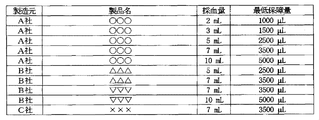
- FIG. 2 is a diagram illustrating an example of a database of minimum guaranteed amounts stored in the minimum guaranteed amount storage unit.
- the blood collection tube can be classified according to the manufacturer, product name, and blood collection amount.
- “Manufacturer” here refers to the manufacturer of the blood collection tube
- “Product name” refers to the name of the blood collection tube assigned by the manufacturer
- “Blood collection volume” refers to the value of the blood collection volume determined by the manufacturer for the blood collection tube.
- the type of blood collection tube is differentiated such that the blood collection tube “A” of Company A has a blood collection volume of 2 mL, the blood collection tube “C” of Company C has a blood collection volume of 7 mL, and the like.
- the blood collection amounts are 2 mL, 3 mL, 5 mL, and 7 mL, respectively.
- a low value is set with respect to the blood collection amount determined by the manufacturer.
- a value that is half of the blood collection amount is set as the minimum guaranteed amount from the ratio of the amount of the blood cell component of the centrifuged blood containing the separating agent and the serum amount is illustrated.
- identification information regarding the blood collection tube is attached to each blood collection tube as a barcode, and is identified by each pre-processing device.
- a parent sample is collected from the subject using several (for example, two) blood collection tubes 1 in accordance with the total amount dispensed of the first to fourth child samples.
- Information on the sample is attached to the sample pretreatment system.
- the input blood collection tube is subjected to another process such as a centrifugal separation process, and is then transported to the dispensing unit 20 by a transport device (not shown).
- the dispensing unit 20 first, based on the information of the barcode attached to the first blood collection tube 1 that has arrived first (the imaging means is provided to acquire an external image of the blood collection tube 1 and the image recognition result of the external shape is obtained. In some cases, the minimum guaranteed amount set for the type of the blood collection tube 1 is read by the reading unit 24. Here, the minimum guaranteed amount set for the blood collection tube 1 is X. In addition, the dispensing request information corresponding to the parent sample of the blood collection tube 1 is read from the control terminal 10.
- the child sample preparation unit 25 calculates a value that is equal to or less than the minimum guaranteed amount X and is closest to the minimum guaranteed amount X among these cumulative values. Select and instruct the dispensing device 21 to create the accumulated child sample, create a child sample within a range that does not exceed the minimum guaranteed amount X, and if there is a child sample that cannot be created, collect the same parent sample Wait for another blood collection tube.
- X is compared with X in order from the smallest cumulative value, and when X is exceeded for the first time at (a + b + c), a + b) is selected.
- the child sample creation unit 25 instructs the dispensing device 21 to perform two dispensing operations of the dispensing amounts a and b, and creates the first and second child samples.
- the created child specimen is transmitted to the control terminal 10 with information to that effect added to the dispensing request information.
- the dispensing unit 20 executes the same processing as that performed on the first blood collection tube 1. That is, the minimum guaranteed amount X and the dispensing request information 50 are read from the control terminal 10, the cumulative value of the dispensing amount is calculated for the uncreated third and fourth child samples, and the child can be created by comparing them with X.
- the dispensing apparatus 21 is instructed to create a sample. For example, if the dispensing amounts c and d of the remaining third and fourth child samples are added to the minimum guaranteed amount X (X ⁇ (c + d)), the child sample preparation unit 25 sends the dispensing device 21 to the dispensing device 21. Then, two dispensing operations of dispensing amounts c and d are instructed to create third and fourth child samples. In addition, information indicating that the creation of the third and fourth child samples is completed is attached to the dispensing request information and transmitted to the control terminal 10.
- the minimum guaranteed amount of the sample amount in the blood collection tube is set for each type of blood collection tube, and the requested amount is within a range not exceeding the minimum guaranteed amount from the blood collection tubes that arrive sequentially in the dispensing unit.
- Samples will be created sequentially. If all of the requested child samples cannot be created, another parent sample is expected to be transported later, and the remaining child samples are created after waiting for the parent sample to be transported later. This makes it possible to efficiently create a plurality of child samples from a plurality of parent samples regardless of the number of arrivals and arrival times of the parent samples, and eliminates the need to transport a plurality of parent samples together. It is also possible to suppress a decrease in efficiency of other pretreatment steps such as centrifugation.
- FIG. 3 is a block diagram of the sample pretreatment system according to the second embodiment of the present invention, together with a control concept.
- This embodiment is an example in which the sample amount storage unit 13, the minimum guaranteed amount update unit 14, the stored sample creation unit 26, and the sample amount calculation unit 27 shown in FIG. 3 are added to the configuration of the first embodiment.
- the sample amount storage unit 13 and the minimum guaranteed amount update unit 14 are incorporated in the control terminal 10
- the stored sample preparation unit 26 and the sample amount calculation unit 27 are incorporated in the control device 22 of the dispensing unit 20.
- the illustration and description of the configuration and operation similar to those of the first embodiment are omitted as appropriate.
- the stored sample preparation unit 26 instructs the dispensing device 21 after the child sample is generated by the instruction of the child sample preparation unit 25, and sucks out the parent sample remaining in the blood collection tube 1 and dispenses it to another container.
- This is a command unit for creating a stored sample.
- the sample amount calculation unit 27 adds up the dispensed volume created in the creation of the child specimen and the dispensed volume created in the creation of the stored specimen for the blood collection tube 1 used for creating the stored specimen, It is a processing unit that calculates the amount of the sample that was originally collected (the estimated amount of the parent sample in the blood collection tube before dispensing).
- the sample amount storage unit 13 is a storage unit that stores and accumulates the sample amount calculated by the sample amount calculation unit 27 for each type of blood collection tube.
- the minimum guaranteed amount update unit 14 statistically processes the sample amount stored in the sample amount storage unit 13 for each blood collection tube type, and calculates the corresponding minimum guaranteed amount value stored in the minimum guaranteed amount storage unit 12.
- a processing unit to be updated Other configurations are the same as those of the first embodiment.
- the dispensing unit 20 performs the processing of the reading unit 24, the accumulation unit 23, and the child sample preparation unit 25 to process the fifth child sample from the third blood collection tube 1 as in the first embodiment.
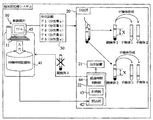
- the parent sample (unsucked ⁇ ) remains in the blood collection tube 1 after the child sample is created.
- the dispensing device 21 sucks up and dispenses unabsorbed ⁇ of the parent sample (all the unabsorbed ⁇ is aspirated and discharged to another container), and the stored sample is removed. create.
- the sample amount calculation unit 27 calculates the total dispense amount of the child sample created from the third blood collection tube 1 (in this example, the dispense amount A of only the fifth child sample) and the dispense amount of the stored sample (in this example, the dispense amount).
- the blood sample type information corresponding to the amount of the parent sample (sample amount) that was originally collected in the blood collection tube 1 (third blood collection tube 1) when it arrived at the dispensing unit 20 is added.
- the information is transmitted to the control terminal 10, and the control terminal 10 stores information on the sample amount and the type of blood collection tube in the sample amount storage unit 13.
- information on the sample amount is accumulated for each type of blood collection tube in accordance with the operation of the sample pretreatment system.
- the minimum guaranteed amount update unit 14 repeatedly executes the following processing 101-105 at predetermined time intervals or at any time during operation of the sample pretreatment system.
- Step 101 First, the sample amount data accumulated for a certain type of blood collection tube is read from the sample amount storage unit 13, and the number N of data of these sample amounts is updated.
- 1 is added to the number N of sample amount data for the blood collection tube 1 previously recognized by the minimum guaranteed amount update unit 14.
- the number of data N is updated to the value after addition.
- Step 102 the number of data N is compared with a threshold value (30 in this example, but can be changed). Specifically, it is determined whether or not the number of data N is 30 or more. If the number of data N is less than 30, it is determined that the data is insufficient, and the procedure returns to step 101. The number of data N reaches 30. It will wait until. On the other hand, if the number of data N is 30 or more in this procedure, the procedure proceeds to step 103.
- a threshold value in this example, but can be changed.
- Step 103-105 A process of calculating an average value MEAN of the 30 or more sample amount data is performed (step 103), and a standard deviation SD is further calculated (step 104).
- a value of ⁇ MEAN ⁇ (3 ⁇ SD) ⁇ is calculated as a new minimum guaranteed value (step 105).
- the minimum guaranteed amount update unit 14 sends the value of the minimum guaranteed amount calculated in this way to the minimum guaranteed amount storage unit 12, and updates the value of the minimum guaranteed amount currently set for the corresponding blood collection tube type to a new value.
- the minimum guaranteed amount updating unit 14 updates the data of the minimum guaranteed amount for each blood collection tube type in the minimum guaranteed amount storage unit 12 by repeatedly executing the above procedure.
- FIG. 1 when the parent sample of the blood collection tube 1 is dispensed into a plurality of child samples, depending on the relationship between the actual amount of the parent sample collected in the blood collection tube 1 and the dispensing amount of the child sample, FIG. As shown, the parent sample remains in the blood collection tube 1 after the child sample is created. It is desirable that this unsucked ⁇ is as small as possible. Therefore, in the present embodiment, the stored sample creation process is executed as described above, and the dispensed amount that has already been executed for the same blood collection tube 1 (when multiple child samples are created from the same blood collection tube 1). Is added to the total value), and the amount of the sample collected in the blood collection tube 1 is calculated and accumulated in the sample amount storage unit 13.
- the data is statistically processed to update the set value of the minimum guaranteed amount.
- the accuracy and reliability of the set value of the minimum guaranteed amount can be improved, and the minimum amount of guarantee for the sample amount actually collected in the blood collection tube 1 is more than necessary.
- the amount to be small it is possible to suppress the generation of excessive unsucked ⁇ .
- the generation efficiency of the child sample is further improved, and the waste of the parent sample is also reduced.
- a stored sample is created only for the third blood collection tube 1 for the three blood collection tubes 1 is illustrated, but a stored sample may be created for each blood collection tube. it can.
- a larger number N of data can be secured, and the reliability of the minimum guaranteed amount can be increased more quickly.
- the determination process 100 is performed by changing the minimum guaranteed amount update setting of the control terminal 10 from “present” to “not present”. The process of the minimum guaranteed amount update unit 14 is not performed, and the update of the minimum guaranteed amount can be stopped.
- FIG. 5 is a block diagram of the specimen pretreatment system according to the third embodiment of the present invention, together with a control concept.
- This embodiment is an example in which notification means for notifying an operator of a shortage of a parent sample is added to the configuration of the first or second embodiment.
- a standby time storage unit 41 As shown in FIG. 5, a standby time storage unit 41, a reading unit 42, a timer unit 43, and an elapsed time determination unit 44 are provided.
- the standby time storage unit 41 is incorporated in the control terminal 10, and the reading unit 42, the timing unit 43, and the elapsed time determination unit 44 are incorporated in the control device 22 of the dispensing unit 20.
- the illustration and description of the same configuration and operation as those of the above-described embodiments are omitted as appropriate.
- the standby time storage unit 41 is a storage unit that stores a standby time that is a determination time for notifying the operator of an abnormality.
- the waiting time is a time for which it is estimated that the blood collection tube 1 will not come if the blood collection tube 1 does not arrive even if it waits for the set time for the parent sample that has been instructed to dispense.
- the input is set by the setting means 11 by the operator in consideration of the processing speed of the sample pretreatment system. A different value can be set for each type of blood collection tube, but a common value can be used regardless of the type of blood collection tube.
- the reading unit 42 is a functional unit that reads standby time data from the standby time storage unit 41 for a parent sample that has been requested to be dispensed, and the time measuring unit 43 is an elapsed time since a child sample is created for a certain parent sample. It is a functional part that measures
- the elapsed time determination unit 44 is a determination unit that determines whether the elapsed time measured by the time measuring unit 43 for a certain parent sample does not exceed the standby time, and selects a part of the requested child samples. After creating from the parent sample, if the above elapsed time exceeds the waiting time without completing the creation of all the child samples requested for the parent sample (the remaining child samples that have not been created), an alarm signal is created and controlled Transmit to the terminal 10.
- the control terminal 10 creates a display signal based on this alarm signal, and displays an alarm display such as “No parent sample has arrived” or “Parent sample is insufficient” with respect to the parent sample. Is displayed on the display unit 45, and the operator is informed accordingly.
- FIG. 9 is an example of alarm display.
- the notification method is not limited to such character display, and other notification methods using voice warnings, warnings, warning lights, and the like can be applied, and these can be combined as appropriate. Other configurations are the same as those in the first or second embodiment.
- the reading unit 24, the totaling unit 23, and the child specimen creation unit 25 For the blood collection tube 1 that has arrived at the dispensing unit 20, for example, when five child specimen creation requests 50 are made as shown in FIG. 5, the reading unit 24, the totaling unit 23, and the child specimen creation unit 25. It is assumed that two child specimens are created from the first blood collection tube 1 by the above process, and then two further child specimens are created from the blood collection tube 1 that has arrived next before the standby time elapses.
- the time measuring unit 43 starts measuring time, and the elapsed time determining unit 44 compares the time measured by the time measuring unit 43 with the standby time read by the reading unit 42. Then, when the measurement time exceeds the standby time, an alarm signal is transmitted to the control terminal 10.
- Example 2 This informs the operator that there is a shortage of the parent sample.
- the operator in addition to the same effects as in Example 1 or Example 2, the operator should consider necessary measures such as additional sampling of the parent sample in a timely manner by notifying the fact that the parent sample is insufficient. The effect of being able to be obtained.
- FIG. 6 is a block diagram of a sample pretreatment system according to the fourth embodiment of the present invention, together with a control concept.
- This embodiment is an example in which the minimum stored sample amount storage unit 51, the stored sample creation unit 26, the remaining amount calculation unit 52, and the stored sample creation availability determination unit 53 shown in FIG. 6 are added to the configuration of the second embodiment.
- the minimum stored sample amount storage unit 51 is incorporated in the control terminal 10
- the saved sample preparation unit 26, the remaining amount calculation unit 52, and the stored sample preparation availability determination unit 53 are incorporated in the control device 22 of the dispensing unit 20.
- the illustration and description of the configuration and operation similar to those of the second embodiment are omitted as appropriate.
- the minimum stored sample amount storage unit 51 is a storage unit that stores the minimum stored sample amount for each blood collection tube type.
- the minimum stored sample amount is the minimum amount of the stored sample that it is necessary to secure at least this value when creating a stored sample, and is a value determined for each type of blood collection tube.
- the remaining amount calculation unit 52 calculates the dispensing amount dispensed to the child sample for the blood collection tube 1 from the minimum guaranteed amount updated by the minimum guaranteed amount update unit 14 for the blood collection tube 1 conveyed to the dispensing device 21. It is a processing unit that subtracts and calculates the remaining amount (the amount of unsucked ⁇ ) of the parent sample in the blood collection tube 1.
- the stored sample creation possibility determination unit 53 compares the remaining amount of the parent sample calculated by the remaining amount calculation unit 52 with the minimum stored sample amount read from the minimum stored sample amount storage unit 51, and the parent sample remaining amount is equal to or greater than the minimum stored amount. Only when it is, a signal instructing creation of a stored sample is output to the stored sample creating unit 26. When the remaining amount of the parent sample is less than the minimum storage amount, the stored sample creation availability determination unit 53 does not output a signal that instructs the stored sample creation unit 26 to create a stored sample.
- the remaining amount of the parent sample in the blood collection tube 1 is calculated by the remaining amount calculation unit 52 based on the dispensed amount and the minimum guaranteed amount read from the minimum guaranteed amount storage unit 12. Is calculated. Since the minimum guaranteed amount used here has increased reliability through the update of the value by the minimum guaranteed amount update unit 14, the remaining amount of the parent sample can be calculated with high accuracy.
- the remaining amount of the parent sample calculated by the remaining amount calculation unit 52 is compared with the minimum stored sample amount read from the minimum stored sample amount storage unit 51 in the stored sample creation possibility determination unit 53, and a stored sample is created. It is determined whether or not.
- the remaining amount calculation unit 52 calculates the remaining amount of the parent sample for the third blood collection tube 1, and the stored sample creation availability determination unit 53 determines whether the saved sample can be created. (Although these processes can also be executed for the first two blood collection tubes 1, it is assumed that as a result of dispensing two child samples, the remaining amount has not reached the minimum stored sample amount). In this example, as shown in FIG. 6, assuming that the remaining amount of the parent sample (unsucked ⁇ ) after the child sample of the third blood collection tube 1 is less than the minimum stored sample amount Y, the stored sample is prepared.
- the availability determination unit 53 completes the dispensing operation for the third blood collection tube 1 without outputting the stored sample preparation instruction signal to the stored sample preparation unit 26. That is, creation of a stored specimen from the unsucked ⁇ of the third blood collection tube 1 is avoided. Thereafter, if the fourth blood collection tube 1 does not arrive at the dispensing unit 20, a stored sample for the parent sample is not created. If the remaining amount of the parent sample in the third blood collection tube 1 is equal to or greater than the minimum stored sample amount Y, the stored sample creation availability determination unit 53 outputs a stored sample creation instruction signal to the stored sample creation unit 26 for storage. A sample is created and the dispensing operation for the third blood collection tube 1 is completed.
- the same processing as described above is executed.
- the dispensed amount associated with the child sample preparation is zero, so the remaining amount of the parent sample is equal to the minimum guaranteed amount.
- the stored sample preparation availability determination unit 53 outputs a stored sample preparation instruction signal to the stored sample preparation unit 26. All the parent specimens of the blood collection tubes are dispensed and used as stored specimens.
Landscapes
- Physics & Mathematics (AREA)
- Health & Medical Sciences (AREA)
- Life Sciences & Earth Sciences (AREA)
- Chemical & Material Sciences (AREA)
- Analytical Chemistry (AREA)
- Biochemistry (AREA)
- General Health & Medical Sciences (AREA)
- General Physics & Mathematics (AREA)
- Immunology (AREA)
- Pathology (AREA)
- Automatic Analysis And Handling Materials Therefor (AREA)
Abstract
Priority Applications (4)
| Application Number | Priority Date | Filing Date | Title |
|---|---|---|---|
| CN201380007895.5A CN104094124A (zh) | 2012-02-27 | 2013-02-19 | 检体预处理系统 |
| US14/379,787 US9804065B2 (en) | 2012-02-27 | 2013-02-19 | System for pretreating sample |
| EP13755247.7A EP2821795B1 (fr) | 2012-02-27 | 2013-02-19 | Système de prétraitement d'échantillons |
| JP2014502148A JP6200413B2 (ja) | 2012-02-27 | 2013-02-19 | 検体前処理システム |
Applications Claiming Priority (2)
| Application Number | Priority Date | Filing Date | Title |
|---|---|---|---|
| JP2012-040740 | 2012-02-27 | ||
| JP2012040740 | 2012-02-27 |
Publications (1)
| Publication Number | Publication Date |
|---|---|
| WO2013129191A1 true WO2013129191A1 (fr) | 2013-09-06 |
Family
ID=49082391
Family Applications (1)
| Application Number | Title | Priority Date | Filing Date |
|---|---|---|---|
| PCT/JP2013/054037 Ceased WO2013129191A1 (fr) | 2012-02-27 | 2013-02-19 | Système de prétraitement d'échantillons |
Country Status (5)
| Country | Link |
|---|---|
| US (1) | US9804065B2 (fr) |
| EP (1) | EP2821795B1 (fr) |
| JP (1) | JP6200413B2 (fr) |
| CN (1) | CN104094124A (fr) |
| WO (1) | WO2013129191A1 (fr) |
Cited By (3)
| Publication number | Priority date | Publication date | Assignee | Title |
|---|---|---|---|---|
| JP2015075331A (ja) * | 2013-10-04 | 2015-04-20 | 株式会社日立ハイテクノロジーズ | 検体前処理装置 |
| JP2016114491A (ja) * | 2014-12-16 | 2016-06-23 | 株式会社東芝 | 自動分析装置 |
| JP2021534419A (ja) * | 2018-08-20 | 2021-12-09 | エフ.ホフマン−ラ ロシュ アーゲーF. Hoffmann−La Roche Aktiengesellschaft | 実験器具の動作方法 |
Families Citing this family (5)
| Publication number | Priority date | Publication date | Assignee | Title |
|---|---|---|---|---|
| EP3182133B1 (fr) * | 2015-12-16 | 2020-01-15 | F. Hoffmann-La Roche AG | Système analytique automatisé et procédé pour son fonctionnement |
| WO2018111721A1 (fr) * | 2016-12-12 | 2018-06-21 | Beckman Coulter, Inc. | Manipulation intelligente de matériaux |
| EP3410323B1 (fr) | 2017-05-29 | 2020-11-25 | F. Hoffmann-La Roche AG | Procédé de fonctionnement d'un système de laboratoire |
| EP3751284B1 (fr) * | 2019-06-14 | 2023-02-22 | F. Hoffmann-La Roche AG | Procédé et système de laboratoire permettant de fournir des échantillons de contrôle pour valider un test de diagnostic |
| EP4160214B1 (fr) | 2021-09-29 | 2025-10-29 | F. Hoffmann-La Roche AG | Tests d'addition et de répétition d'aliquotes avec ou sans dilutions |
Citations (6)
| Publication number | Priority date | Publication date | Assignee | Title |
|---|---|---|---|---|
| JPS63122959A (ja) * | 1986-11-12 | 1988-05-26 | Toshiba Corp | サンプリングノズルの停止方法 |
| JPH043355U (fr) * | 1990-04-25 | 1992-01-13 | ||
| JPH11118809A (ja) * | 1997-10-20 | 1999-04-30 | Aloka Co Ltd | 分注装置 |
| JP2003083991A (ja) * | 2001-09-11 | 2003-03-19 | Aloka Co Ltd | 検体前処理装置 |
| JP2007040932A (ja) | 2005-08-05 | 2007-02-15 | Hitachi High-Technologies Corp | 検体分注処理装置 |
| JP2008292393A (ja) * | 2007-05-28 | 2008-12-04 | Sysmex Corp | 採取管選択方法及び分析装置管理システム |
Family Cites Families (11)
| Publication number | Priority date | Publication date | Assignee | Title |
|---|---|---|---|---|
| DE3680317D1 (de) * | 1986-01-31 | 1991-08-22 | Nittec Koganei Kk | Automatischer analysenapparat. |
| JPS63188768A (ja) * | 1987-02-02 | 1988-08-04 | Toshiba Corp | 自動化学分析装置のラベル |
| JP2605816Y2 (ja) * | 1992-02-26 | 2000-08-21 | シスメックス株式会社 | 残液量検知機能を備えた自動分析装置 |
| US5428993A (en) * | 1992-02-26 | 1995-07-04 | Toa Medical Electronics Co., Ltd. | Automatic analyzer having function of detecting remaining liquid quantity |
| US5314825A (en) * | 1992-07-16 | 1994-05-24 | Schiapparelli Biosystems, Inc. | Chemical analyzer |
| JPH08271527A (ja) * | 1995-03-30 | 1996-10-18 | S R L:Kk | 検体搬送用ラック |
| AUPP058197A0 (en) * | 1997-11-27 | 1997-12-18 | A.I. Scientific Pty Ltd | Pathology sample tube distributor |
| JP2003315348A (ja) * | 2002-04-22 | 2003-11-06 | Hitachi High-Technologies Corp | 検体処理システム及びそれを用いた検体検査自動化システム |
| JP4448769B2 (ja) * | 2004-12-15 | 2010-04-14 | 株式会社日立ハイテクノロジーズ | 自動分析装置 |
| US7641855B2 (en) * | 2006-08-25 | 2010-01-05 | Siemens Healthcare Diagnostics Inc. | System for automatically storing and reprocessing patient samples in an automatic clinical analyzer |
| EP2752247A3 (fr) * | 2010-07-23 | 2016-08-31 | Beckman Coulter, Inc. | Système ou procédé comprenant des unités analytiques |
-
2013
- 2013-02-19 CN CN201380007895.5A patent/CN104094124A/zh active Pending
- 2013-02-19 EP EP13755247.7A patent/EP2821795B1/fr active Active
- 2013-02-19 WO PCT/JP2013/054037 patent/WO2013129191A1/fr not_active Ceased
- 2013-02-19 US US14/379,787 patent/US9804065B2/en active Active
- 2013-02-19 JP JP2014502148A patent/JP6200413B2/ja active Active
Patent Citations (6)
| Publication number | Priority date | Publication date | Assignee | Title |
|---|---|---|---|---|
| JPS63122959A (ja) * | 1986-11-12 | 1988-05-26 | Toshiba Corp | サンプリングノズルの停止方法 |
| JPH043355U (fr) * | 1990-04-25 | 1992-01-13 | ||
| JPH11118809A (ja) * | 1997-10-20 | 1999-04-30 | Aloka Co Ltd | 分注装置 |
| JP2003083991A (ja) * | 2001-09-11 | 2003-03-19 | Aloka Co Ltd | 検体前処理装置 |
| JP2007040932A (ja) | 2005-08-05 | 2007-02-15 | Hitachi High-Technologies Corp | 検体分注処理装置 |
| JP2008292393A (ja) * | 2007-05-28 | 2008-12-04 | Sysmex Corp | 採取管選択方法及び分析装置管理システム |
Cited By (4)
| Publication number | Priority date | Publication date | Assignee | Title |
|---|---|---|---|---|
| JP2015075331A (ja) * | 2013-10-04 | 2015-04-20 | 株式会社日立ハイテクノロジーズ | 検体前処理装置 |
| JP2016114491A (ja) * | 2014-12-16 | 2016-06-23 | 株式会社東芝 | 自動分析装置 |
| JP2021534419A (ja) * | 2018-08-20 | 2021-12-09 | エフ.ホフマン−ラ ロシュ アーゲーF. Hoffmann−La Roche Aktiengesellschaft | 実験器具の動作方法 |
| JP7200357B2 (ja) | 2018-08-20 | 2023-01-06 | エフ.ホフマン-ラ ロシュ アーゲー | 実験器具の動作方法 |
Also Published As
| Publication number | Publication date |
|---|---|
| EP2821795B1 (fr) | 2021-04-07 |
| US9804065B2 (en) | 2017-10-31 |
| EP2821795A4 (fr) | 2015-11-04 |
| US20150031143A1 (en) | 2015-01-29 |
| JP6200413B2 (ja) | 2017-09-20 |
| EP2821795A1 (fr) | 2015-01-07 |
| CN104094124A (zh) | 2014-10-08 |
| JPWO2013129191A1 (ja) | 2015-07-30 |
Similar Documents
| Publication | Publication Date | Title |
|---|---|---|
| JP6200413B2 (ja) | 検体前処理システム | |
| JP6018406B2 (ja) | 自動試料ワークセルの操作方法 | |
| EP2296819B1 (fr) | Procédé de chargement de centrifugeuse à l'intérieur d'un système de laboratoire automatisé | |
| JP6010409B2 (ja) | 幾何学的な管のデータを備えた試料管の操作 | |
| US11860176B2 (en) | Method of operating an analytical laboratory | |
| JP7558692B2 (ja) | 分析実験室の操作方法 | |
| CN111579804B (zh) | 操作分析实验室的方法 | |
| JP7392097B2 (ja) | 分析方法 | |
| JP6220781B2 (ja) | 遠心分離装置、遠心分離装置を備えた前処理システムおよび当該システムの制御方法 | |
| JP7555171B2 (ja) | 自動分析システム | |
| EP2804002B1 (fr) | Système automatisé de laboratoire ayant un module de routage d'échantillons commun | |
| WO2013035418A1 (fr) | Dispositif d'analyse automatique | |
| EP3182133B1 (fr) | Système analytique automatisé et procédé pour son fonctionnement | |
| JP2008039554A (ja) | 自動分析装置 | |
| EP3751284B1 (fr) | Procédé et système de laboratoire permettant de fournir des échantillons de contrôle pour valider un test de diagnostic | |
| JP5075790B2 (ja) | 検体検査前処理システム、および検体検査前処理方法 | |
| CN112151131B (zh) | 一种样本调度方法、样本优先程度的设置方法和系统 | |
| US20230324365A1 (en) | Setting clotting time for blood samples | |
| EP4459289A1 (fr) | Procédé et instrument pour l'aliquotage d'un échantillon biologique | |
| JP2010151708A (ja) | 自動分析装置 | |
| JP2008039552A (ja) | 検体搬送システム | |
| CN119064612A (zh) | 一种样本分析系统和方法 |
Legal Events
| Date | Code | Title | Description |
|---|---|---|---|
| 121 | Ep: the epo has been informed by wipo that ep was designated in this application |
Ref document number: 13755247 Country of ref document: EP Kind code of ref document: A1 |
|
| ENP | Entry into the national phase |
Ref document number: 2014502148 Country of ref document: JP Kind code of ref document: A |
|
| WWE | Wipo information: entry into national phase |
Ref document number: 2013755247 Country of ref document: EP Ref document number: 14379787 Country of ref document: US |
|
| NENP | Non-entry into the national phase |
Ref country code: DE |