WO2013141255A1 - Préimprégné comprenant des particules de polyphénylène éther - Google Patents
Préimprégné comprenant des particules de polyphénylène éther Download PDFInfo
- Publication number
- WO2013141255A1 WO2013141255A1 PCT/JP2013/057882 JP2013057882W WO2013141255A1 WO 2013141255 A1 WO2013141255 A1 WO 2013141255A1 JP 2013057882 W JP2013057882 W JP 2013057882W WO 2013141255 A1 WO2013141255 A1 WO 2013141255A1
- Authority
- WO
- WIPO (PCT)
- Prior art keywords
- ppe
- particles
- less
- mass
- prepreg
- Prior art date
- Legal status (The legal status is an assumption and is not a legal conclusion. Google has not performed a legal analysis and makes no representation as to the accuracy of the status listed.)
- Ceased
Links
Images
Classifications
-
- H—ELECTRICITY
- H05—ELECTRIC TECHNIQUES NOT OTHERWISE PROVIDED FOR
- H05K—PRINTED CIRCUITS; CASINGS OR CONSTRUCTIONAL DETAILS OF ELECTRIC APPARATUS; MANUFACTURE OF ASSEMBLAGES OF ELECTRICAL COMPONENTS
- H05K1/00—Printed circuits
- H05K1/02—Details
- H05K1/03—Use of materials for the substrate
- H05K1/0313—Organic insulating material
- H05K1/0353—Organic insulating material consisting of two or more materials, e.g. two or more polymers, polymer + filler, + reinforcement
- H05K1/0366—Organic insulating material consisting of two or more materials, e.g. two or more polymers, polymer + filler, + reinforcement reinforced, e.g. by fibres, fabrics
-
- C—CHEMISTRY; METALLURGY
- C08—ORGANIC MACROMOLECULAR COMPOUNDS; THEIR PREPARATION OR CHEMICAL WORKING-UP; COMPOSITIONS BASED THEREON
- C08J—WORKING-UP; GENERAL PROCESSES OF COMPOUNDING; AFTER-TREATMENT NOT COVERED BY SUBCLASSES C08B, C08C, C08F, C08G or C08H
- C08J5/00—Manufacture of articles or shaped materials containing macromolecular substances
- C08J5/24—Impregnating materials with prepolymers which can be polymerised in situ, e.g. manufacture of prepregs
-
- B—PERFORMING OPERATIONS; TRANSPORTING
- B32—LAYERED PRODUCTS
- B32B—LAYERED PRODUCTS, i.e. PRODUCTS BUILT-UP OF STRATA OF FLAT OR NON-FLAT, e.g. CELLULAR OR HONEYCOMB, FORM
- B32B15/00—Layered products comprising a layer of metal
- B32B15/04—Layered products comprising a layer of metal comprising metal as the main or only constituent of a layer, which is next to another layer of the same or of a different material
- B32B15/08—Layered products comprising a layer of metal comprising metal as the main or only constituent of a layer, which is next to another layer of the same or of a different material of synthetic resin
-
- B—PERFORMING OPERATIONS; TRANSPORTING
- B32—LAYERED PRODUCTS
- B32B—LAYERED PRODUCTS, i.e. PRODUCTS BUILT-UP OF STRATA OF FLAT OR NON-FLAT, e.g. CELLULAR OR HONEYCOMB, FORM
- B32B15/00—Layered products comprising a layer of metal
- B32B15/20—Layered products comprising a layer of metal comprising aluminium or copper
-
- B—PERFORMING OPERATIONS; TRANSPORTING
- B32—LAYERED PRODUCTS
- B32B—LAYERED PRODUCTS, i.e. PRODUCTS BUILT-UP OF STRATA OF FLAT OR NON-FLAT, e.g. CELLULAR OR HONEYCOMB, FORM
- B32B27/00—Layered products comprising a layer of synthetic resin
- B32B27/06—Layered products comprising a layer of synthetic resin as the main or only constituent of a layer, which is next to another layer of the same or of a different material
- B32B27/08—Layered products comprising a layer of synthetic resin as the main or only constituent of a layer, which is next to another layer of the same or of a different material of synthetic resin
-
- B—PERFORMING OPERATIONS; TRANSPORTING
- B32—LAYERED PRODUCTS
- B32B—LAYERED PRODUCTS, i.e. PRODUCTS BUILT-UP OF STRATA OF FLAT OR NON-FLAT, e.g. CELLULAR OR HONEYCOMB, FORM
- B32B27/00—Layered products comprising a layer of synthetic resin
- B32B27/18—Layered products comprising a layer of synthetic resin characterised by the use of special additives
- B32B27/20—Layered products comprising a layer of synthetic resin characterised by the use of special additives using fillers, pigments, thixotroping agents
-
- B—PERFORMING OPERATIONS; TRANSPORTING
- B32—LAYERED PRODUCTS
- B32B—LAYERED PRODUCTS, i.e. PRODUCTS BUILT-UP OF STRATA OF FLAT OR NON-FLAT, e.g. CELLULAR OR HONEYCOMB, FORM
- B32B27/00—Layered products comprising a layer of synthetic resin
- B32B27/28—Layered products comprising a layer of synthetic resin comprising synthetic resins not wholly covered by any one of the sub-groups B32B27/30 - B32B27/42
- B32B27/285—Layered products comprising a layer of synthetic resin comprising synthetic resins not wholly covered by any one of the sub-groups B32B27/30 - B32B27/42 comprising polyethers
-
- B—PERFORMING OPERATIONS; TRANSPORTING
- B32—LAYERED PRODUCTS
- B32B—LAYERED PRODUCTS, i.e. PRODUCTS BUILT-UP OF STRATA OF FLAT OR NON-FLAT, e.g. CELLULAR OR HONEYCOMB, FORM
- B32B27/00—Layered products comprising a layer of synthetic resin
- B32B27/32—Layered products comprising a layer of synthetic resin comprising polyolefins
-
- B—PERFORMING OPERATIONS; TRANSPORTING
- B32—LAYERED PRODUCTS
- B32B—LAYERED PRODUCTS, i.e. PRODUCTS BUILT-UP OF STRATA OF FLAT OR NON-FLAT, e.g. CELLULAR OR HONEYCOMB, FORM
- B32B7/00—Layered products characterised by the relation between layers; Layered products characterised by the relative orientation of features between layers, or by the relative values of a measurable parameter between layers, i.e. products comprising layers having different physical, chemical or physicochemical properties; Layered products characterised by the interconnection of layers
- B32B7/04—Interconnection of layers
- B32B7/06—Interconnection of layers permitting easy separation
-
- C—CHEMISTRY; METALLURGY
- C08—ORGANIC MACROMOLECULAR COMPOUNDS; THEIR PREPARATION OR CHEMICAL WORKING-UP; COMPOSITIONS BASED THEREON
- C08J—WORKING-UP; GENERAL PROCESSES OF COMPOUNDING; AFTER-TREATMENT NOT COVERED BY SUBCLASSES C08B, C08C, C08F, C08G or C08H
- C08J5/00—Manufacture of articles or shaped materials containing macromolecular substances
- C08J5/24—Impregnating materials with prepolymers which can be polymerised in situ, e.g. manufacture of prepregs
- C08J5/241—Impregnating materials with prepolymers which can be polymerised in situ, e.g. manufacture of prepregs using inorganic fibres
- C08J5/244—Impregnating materials with prepolymers which can be polymerised in situ, e.g. manufacture of prepregs using inorganic fibres using glass fibres
-
- C—CHEMISTRY; METALLURGY
- C08—ORGANIC MACROMOLECULAR COMPOUNDS; THEIR PREPARATION OR CHEMICAL WORKING-UP; COMPOSITIONS BASED THEREON
- C08J—WORKING-UP; GENERAL PROCESSES OF COMPOUNDING; AFTER-TREATMENT NOT COVERED BY SUBCLASSES C08B, C08C, C08F, C08G or C08H
- C08J5/00—Manufacture of articles or shaped materials containing macromolecular substances
- C08J5/24—Impregnating materials with prepolymers which can be polymerised in situ, e.g. manufacture of prepregs
- C08J5/249—Impregnating materials with prepolymers which can be polymerised in situ, e.g. manufacture of prepregs characterised by the additives used in the prepolymer mixture
-
- C—CHEMISTRY; METALLURGY
- C08—ORGANIC MACROMOLECULAR COMPOUNDS; THEIR PREPARATION OR CHEMICAL WORKING-UP; COMPOSITIONS BASED THEREON
- C08L—COMPOSITIONS OF MACROMOLECULAR COMPOUNDS
- C08L71/00—Compositions of polyethers obtained by reactions forming an ether link in the main chain; Compositions of derivatives of such polymers
- C08L71/08—Polyethers derived from hydroxy compounds or from their metallic derivatives
- C08L71/10—Polyethers derived from hydroxy compounds or from their metallic derivatives from phenols
- C08L71/12—Polyphenylene oxides
-
- H—ELECTRICITY
- H05—ELECTRIC TECHNIQUES NOT OTHERWISE PROVIDED FOR
- H05K—PRINTED CIRCUITS; CASINGS OR CONSTRUCTIONAL DETAILS OF ELECTRIC APPARATUS; MANUFACTURE OF ASSEMBLAGES OF ELECTRICAL COMPONENTS
- H05K1/00—Printed circuits
- H05K1/02—Details
- H05K1/03—Use of materials for the substrate
- H05K1/0313—Organic insulating material
- H05K1/0353—Organic insulating material consisting of two or more materials, e.g. two or more polymers, polymer + filler, + reinforcement
- H05K1/0373—Organic insulating material consisting of two or more materials, e.g. two or more polymers, polymer + filler, + reinforcement containing additives, e.g. fillers
-
- B—PERFORMING OPERATIONS; TRANSPORTING
- B32—LAYERED PRODUCTS
- B32B—LAYERED PRODUCTS, i.e. PRODUCTS BUILT-UP OF STRATA OF FLAT OR NON-FLAT, e.g. CELLULAR OR HONEYCOMB, FORM
- B32B2264/00—Composition or properties of particles which form a particulate layer or are present as additives
- B32B2264/02—Synthetic macromolecular particles
- B32B2264/0214—Particles made of materials belonging to B32B27/00
- B32B2264/0257—Polyolefin particles, e.g. polyethylene or polypropylene homopolymers or ethylene-propylene copolymers
-
- B—PERFORMING OPERATIONS; TRANSPORTING
- B32—LAYERED PRODUCTS
- B32B—LAYERED PRODUCTS, i.e. PRODUCTS BUILT-UP OF STRATA OF FLAT OR NON-FLAT, e.g. CELLULAR OR HONEYCOMB, FORM
- B32B2307/00—Properties of the layers or laminate
- B32B2307/30—Properties of the layers or laminate having particular thermal properties
- B32B2307/306—Resistant to heat
-
- B—PERFORMING OPERATIONS; TRANSPORTING
- B32—LAYERED PRODUCTS
- B32B—LAYERED PRODUCTS, i.e. PRODUCTS BUILT-UP OF STRATA OF FLAT OR NON-FLAT, e.g. CELLULAR OR HONEYCOMB, FORM
- B32B2307/00—Properties of the layers or laminate
- B32B2307/50—Properties of the layers or laminate having particular mechanical properties
- B32B2307/538—Roughness
-
- B—PERFORMING OPERATIONS; TRANSPORTING
- B32—LAYERED PRODUCTS
- B32B—LAYERED PRODUCTS, i.e. PRODUCTS BUILT-UP OF STRATA OF FLAT OR NON-FLAT, e.g. CELLULAR OR HONEYCOMB, FORM
- B32B2457/00—Electrical equipment
- B32B2457/08—PCBs, i.e. printed circuit boards
-
- C—CHEMISTRY; METALLURGY
- C08—ORGANIC MACROMOLECULAR COMPOUNDS; THEIR PREPARATION OR CHEMICAL WORKING-UP; COMPOSITIONS BASED THEREON
- C08J—WORKING-UP; GENERAL PROCESSES OF COMPOUNDING; AFTER-TREATMENT NOT COVERED BY SUBCLASSES C08B, C08C, C08F, C08G or C08H
- C08J2300/00—Characterised by the use of unspecified polymers
- C08J2300/12—Polymers characterised by physical features, e.g. anisotropy, viscosity or electrical conductivity
-
- C—CHEMISTRY; METALLURGY
- C08—ORGANIC MACROMOLECULAR COMPOUNDS; THEIR PREPARATION OR CHEMICAL WORKING-UP; COMPOSITIONS BASED THEREON
- C08J—WORKING-UP; GENERAL PROCESSES OF COMPOUNDING; AFTER-TREATMENT NOT COVERED BY SUBCLASSES C08B, C08C, C08F, C08G or C08H
- C08J2371/00—Characterised by the use of polyethers obtained by reactions forming an ether link in the main chain; Derivatives of such polymers
- C08J2371/08—Polyethers derived from hydroxy compounds or from their metallic derivatives
- C08J2371/10—Polyethers derived from hydroxy compounds or from their metallic derivatives from phenols
- C08J2371/12—Polyphenylene oxides
-
- C—CHEMISTRY; METALLURGY
- C08—ORGANIC MACROMOLECULAR COMPOUNDS; THEIR PREPARATION OR CHEMICAL WORKING-UP; COMPOSITIONS BASED THEREON
- C08J—WORKING-UP; GENERAL PROCESSES OF COMPOUNDING; AFTER-TREATMENT NOT COVERED BY SUBCLASSES C08B, C08C, C08F, C08G or C08H
- C08J2471/00—Characterised by the use of polyethers obtained by reactions forming an ether link in the main chain; Derivatives of such polymers
- C08J2471/08—Polyethers derived from hydroxy compounds or from their metallic derivatives
- C08J2471/10—Polyethers derived from hydroxy compounds or from their metallic derivatives from phenols
- C08J2471/12—Polyphenylene oxides
-
- H—ELECTRICITY
- H05—ELECTRIC TECHNIQUES NOT OTHERWISE PROVIDED FOR
- H05K—PRINTED CIRCUITS; CASINGS OR CONSTRUCTIONAL DETAILS OF ELECTRIC APPARATUS; MANUFACTURE OF ASSEMBLAGES OF ELECTRICAL COMPONENTS
- H05K2201/00—Indexing scheme relating to printed circuits covered by H05K1/00
- H05K2201/01—Dielectrics
- H05K2201/0137—Materials
-
- H—ELECTRICITY
- H05—ELECTRIC TECHNIQUES NOT OTHERWISE PROVIDED FOR
- H05K—PRINTED CIRCUITS; CASINGS OR CONSTRUCTIONAL DETAILS OF ELECTRIC APPARATUS; MANUFACTURE OF ASSEMBLAGES OF ELECTRICAL COMPONENTS
- H05K2201/00—Indexing scheme relating to printed circuits covered by H05K1/00
- H05K2201/02—Fillers; Particles; Fibers; Reinforcement materials
- H05K2201/0203—Fillers and particles
- H05K2201/0206—Materials
- H05K2201/0212—Resin particles
-
- Y—GENERAL TAGGING OF NEW TECHNOLOGICAL DEVELOPMENTS; GENERAL TAGGING OF CROSS-SECTIONAL TECHNOLOGIES SPANNING OVER SEVERAL SECTIONS OF THE IPC; TECHNICAL SUBJECTS COVERED BY FORMER USPC CROSS-REFERENCE ART COLLECTIONS [XRACs] AND DIGESTS
- Y10—TECHNICAL SUBJECTS COVERED BY FORMER USPC
- Y10T—TECHNICAL SUBJECTS COVERED BY FORMER US CLASSIFICATION
- Y10T428/00—Stock material or miscellaneous articles
- Y10T428/24—Structurally defined web or sheet [e.g., overall dimension, etc.]
- Y10T428/24355—Continuous and nonuniform or irregular surface on layer or component [e.g., roofing, etc.]
Definitions
- the present invention relates to a prepreg containing polyphenylene ether particles.
- PPE polyphenylene ether
- Patent Document 1 discloses a technique in which a curable monomer or polymer is blended with PPE to obtain a curable resin composition.
- Patent Document 2 discloses a method in which PPE is chemically modified, and the PPE is combined with triallyl isocyanurate and / or triallyl cyanurate as curable monomers to form a curable resin composition.
- Patent Documents 3 and 4 disclose PPE resin compositions using low molecular weight PPE.
- Patent Documents 5 and 6 particles of a resin composition containing a crosslinking agent such as PPE and a styrene butadiene copolymer and a crosslinking aid such as triallyl isocyanurate (TAIC) are dispersed in a non-chlorine organic solvent at room temperature.
- TAIC triallyl isocyanurate
- Patent Document 7 describes a resin composition containing a low molecular weight PPE and an epoxy resin.
- Patent Document 8 describes a method of using a varnish in which PPE particles are dispersed in a solvent containing 90% or more of water.
- Patent Document 9 describes a low dielectric resin containing a PPE-modified butadiene polymer, an inorganic filler, and a saturated thermoplastic elastomer.
- Patent Document 10 describes a high-frequency multilayer wiring board using PPE as a low dielectric resin.
- Patent Document 11 describes a laminated material using a thermosetting resin containing a resin having a polyphenylene oxide skeleton and TAIC as a low dielectric resin.
- JP-A-61-287739 JP-A-4-39017 JP 2002-26577 A Japanese Patent Laid-Open No. 2008-260942 Japanese Patent Laid-Open No. 7-292126 JP 2008-50528 JP 2006-63114 A JP 2003-34731 A International Publication No. 2008/136373 JP 2004-140268 A Japanese Patent Laid-Open No. 2003-283098
- Patent Documents 1 to 8 have the excellent dielectric properties of PPE, and are less likely to have resin powder falling off or peeling off at the time of production or handling. From the viewpoint of obtaining a prepreg having a peel strength between layers in a multilayer board or a peel strength between a cured product of a curable resin composition and a metal foil such as a copper foil, there was still room for improvement.
- the techniques described in Patent Documents 9 to 11 are intended to improve the adhesion between the low dielectric resin and the metal foil, but cannot sufficiently cope with the reduction in the roughness and thickness of the metal foil. There was still room for improvement. Furthermore, the techniques described in Patent Documents 9 to 11 are not developed from the viewpoint of improving resin cracks that occur near the base material or near the metal foil due to thermal load, moisture absorption load, mechanical load, etc. There wasn't.
- the problem to be solved by the present invention is a prepreg that has excellent dielectric properties of PPE and has low adhesive powder and resin peeling at the time of prepreg manufacture or handling because of good adhesion.
- Another object of the present invention is to provide a laminate that can suppress the generation of cracks due to stress acting due to thermal load, moisture absorption load, and mechanical load during the manufacturing process and handling.
- the present inventors have made a predetermined amount of PPE particles in the prepreg, and the content ratio, particle size, and PPE content of the PPE particles are within a predetermined range. It is found that the adhesion between the prepreg and the curable resin containing the PPE of the substrate produced from the prepreg by heat and pressure molding and the base material is improved, and the present invention is based on such knowledge. It has come to be completed. Furthermore, the present inventors have made the metal foil peel strength higher than a certain level in a laminated material composed of a low dielectric resin, a base material, and a low-roughness metal foil, and the appropriate linear thermal expansion coefficient of the laminated plate.
- the present invention is as follows.
- the PPE particles (A) are 0.3 ⁇ m or more and 200 ⁇ m or less, and 60% or more of the total number of the PPE particles (A) is 1.0 ⁇ m or more and 100 ⁇ m or less
- 60% or more of the total number of primary particles (A ′) constituting the PPE particles (A) is a particle size of 0.3 ⁇ m or more and 30 ⁇ m or less, and 60% or more of the total number of particles is a particle size of 0.3 ⁇ m or more
- the PPE-containing prepreg according to any one of the above.
- the crosslinkable curable resin (C) is a monomer having two or more vinyl groups in the molecule.
- TAIC triallyl isocyanurate
- a laminate comprising a low dielectric resin and a base material, (1) The dielectric loss tangent at 10 GHz of the laminate is 0.007 or less (cavity resonance method), (2) The laminate, the metal foil peel strength with a metal foil having a surface smoothness Rz 2.0 ⁇ m or less is 0.6 N / mm or more, (3) The coefficient of linear thermal expansion (Tg or less) of the laminate is 20 ppm / K or more and 60 ppm / K or less, (4) The laminate as described above, wherein the peel strength between the low dielectric resin and the base material is 0.8 to 1.8 times the metal foil peel strength. [15] The laminate plate according to [14], wherein Tg of the laminate plate is 180 ° C. or higher.
- a prepreg that has excellent dielectric properties of PPE and has good adhesiveness, and is less likely to cause resin powder dropping or resin peeling during prepreg manufacturing or handling.
- the laminated board which can suppress generation
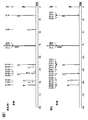
- FIG. 2 is a carbon nuclear magnetic resonance spectroscopy spectrum of the extract (A) obtained by the method of Example 1, and a carbon nuclear magnetic resonance spectroscopy spectrum of a standard substance.
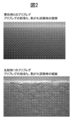
- FIG. 3 is a photographic image after a powder fall-off test of a prepreg in which PPE particles were present (Example 2) and a prepreg in which no PPE particles were present (Comparative Example 1).
- the first embodiment is a prepreg composed of a curable resin composition containing PPE particles and a substrate.
- PPE Polyphenylene ether
- R1, R2, R3 and R4 each independently have a hydrogen atom, a halogen atom, an alkyl group which may have a substituent, an alkoxy group which may have a substituent, or a substituent.
- PPE examples include, for example, poly (2,6-dimethyl-1,4-phenylene ether), poly (2-methyl-6-ethyl-1,4-phenylene ether), poly (2-methyl-6 -Phenyl-1,4-phenylene ether), poly (2,6-dichloro-1,4-phenylene ether), etc., and 2,6-dimethylphenol and other phenols (e.g. 2,3,6-phenylene ether). And a polyphenylene ether copolymer obtained by coupling 2,6-dimethylphenol and biphenols or bisphenols, and the like.
- a preferred example is poly (2,6-dimethyl-1,4-phenylene ether).
- PPE means a polymer composed of a substituted or unsubstituted phenylene ether unit structure, but may contain other copolymerization components.
- the prepreg of the first embodiment contains PPE particles (A) insoluble in the mixed solvent as PPE extracted with a mixed solvent of toluene and methanol having a mass ratio of 95: 5.
- PPE particles (A) in the prepreg can suppress the film formability of the resin layer in the step of drying the solvent after applying the resin varnish in prepreg production. For this reason, it is preferable because a film-like product is formed on the surface layer of the composite of the curable resin composition and the substrate, and the film-like product can be prevented from peeling off during the subsequent prepreg manufacturing process or handling.
- FIG. 2 shows a photographic image of a prepreg in which PPE particles are present (Example 2) and a prepreg in which no PPE particles are present (Comparative Example 1) after a powder fall-off test. Furthermore, since the solvent drying load in the drying process is reduced by suppressing the film formability of the resin layer, deterioration with time due to the remaining solvent and inhibition of curing of the curable resin composition are less likely to occur. This is also preferable.
- the presence of such PPE particles (A) in the prepreg can improve the adhesion between the substrate and the cured resin and the adhesion between the cured resin and the metal foil.
- the interlayer peel strength and the copper foil peel strength of the cured product composite are improved, and further, the moisture absorption resistance, heat resistance, and stability of electrical properties under moisture absorption conditions of the cured product composite tend to be improved, which is preferable. .
- the reason for this is not clear, but it is because the melting rate of the PPE particles (A) can be appropriately delayed from the thermosetting resin component other than the PPE particles (A) under normal heating and pressing molding conditions. Conceivable.
- thermosetting resin component other than the PPE particles (A) is first melted to cover the surface of the base material and strongly adhere to the base material.
- the PPE component melted with delay from the PPE particles (A) is covered, and the thermosetting resin is cured through a process in which the thermosetting resin component and the PPE component are compatible. It is presumed that the adhesiveness of the resin composition to the cured body is improved.
- a preferable form of the PPE particles (A) for improving the adhesion between the substrate and the cured product of the curable resin composition will be described later.
- the PPE particles (A) contain PPE in a proportion of 70% by mass or more, preferably 80% by mass or more, more preferably 85% by mass or more, and further preferably 90% by mass or more. If the PPE component contained in the PPE particles (A) is in the above range, the adhesion between the base material and the cured product of the thermosetting resin composition in the cured product composite described later is improved, and the cured product composite There is a tendency to obtain a cured product composite having moisture resistance, heat resistance, and excellent electrical properties under moisture absorption conditions. In addition, although it is not certain as this cause, it thinks as follows.
- thermosetting resin component content in the PPE particles (A) By increasing the PPE content in the PPE particles (A), the PPE component content in the components other than the PPE particles is decreased, and the thermosetting resin component content other than the PPE components is increased.
- the melting rate of the PPE particles (A) is slower than that of the thermosetting resin composition components other than the PPE particles (A).
- a thermosetting resin component other than the PPE particles (A) having a high melting rate is melted to cover the surface of the substrate. At this time, since the content ratio of the thermosetting resin component other than the PPE component is large, the adhesiveness to the substrate becomes stronger.
- thermosetting resin is cured through a process in which the thermosetting resin component and the PPE component are compatible. It is presumed that the adhesiveness of the adhesive resin composition to the cured body is improved.
- the number average molecular weight of PPE contained in the PPE particles (A) is 8,000 or more and 40,000 or less.
- a preferred range for the number average molecular weight is from 8,500 to 30,000, and a more preferred range is from 9,000 to 25,000. If this number average molecular weight is 8,000 or more, desired dielectric properties, water absorption resistance, solder heat resistance, and adhesiveness (for example, delamination strength between layers in a multilayer board, etc.) desired in high-frequency electronic circuit boards, etc. Or, it tends to give a good peel strength between the cured product of the curable resin composition and the copper foil or the like, which is preferable.
- the melt viscosity of the curable resin composition at the time of molding is small, and good moldability tends to be obtained, which is preferable.
- the ratio of the number of particles having a major axis of 0.3 ⁇ m to 200 ⁇ m to the total number of particles is preferably 60% or more, preferably 70% or more, preferably 80% or more, preferably 90% or more. Preferably, it is 95% or more, preferably 98% or more.
- the upper limit is preferably 100% or less.
- the ratio of the number of particles having a major axis of 1.0 ⁇ m or more and 100 ⁇ m or less to the total number of particles is preferably 60% or more, preferably 70% or more, preferably 80% or more, preferably 90% or more. Preferably, it is 95% or more, preferably 98% or more.
- the upper limit is preferably 100% or less.
- the ratio of the number of particles having a major axis of 3 ⁇ m or more and 20 ⁇ m or less to the total number of particles is preferably 60% or more, preferably 70% or more, preferably 80% or more, preferably 90% or more, Preferably it is 95% or more, preferably 98% or more.
- the upper limit is preferably 100% or less.
- the ratio of the number of particles having a major axis of 0.3 ⁇ m to 30 ⁇ m to the total number of particles is preferably 60% or more, preferably 70% or more, preferably 80% or more, preferably 90% or more. Preferably, it is 95% or more, preferably 98% or more.
- the upper limit is preferably 100% or less.
- the ratio of the number of particles having a major axis of 0.3 ⁇ m or more and 20 ⁇ m or less to the total number of particles is preferably 60% or more, preferably 70% or more, preferably 80% or more, preferably 90% or more. Preferably, it is 95% or more, preferably 98% or more.
- the upper limit is preferably 100% or less.
- the ratio of the number of particles having a major axis of 0.3 ⁇ m to 3 ⁇ m to the total number of particles is preferably 60% or more, preferably 70% or more, preferably 80% or more, preferably 90% or more. Preferably, it is 95% or more, preferably 98% or more.
- the upper limit is preferably 100% or less.
- the melting rate of the PPE particles at the time of heat and pressure molding is reduced to PPE.
- the thermosetting resin composition other than the particles it is assumed that it can be moderately slow, but the adhesion between the substrate in the cured product composite described later and the cured product of the curable resin composition is good. Therefore, it is preferable.
- the PPE component in the PPE particles is completely removed under normal heating and pressing conditions. It is presumed to melt, but it is preferable because the curable resin component can be sufficiently filled in the gaps between the base materials (for example, between filaments in a fibrous base material such as glass cloth) or the unevenness of the wiring. Sufficient expression of melting of the PPE component in the PPE particles is preferable from the viewpoint of suppressing molding defects such as voids and scum.
- the PPE particles (A) extracted from the prepreg with a mixed solvent of toluene and methanol having a mass ratio of 95: 5 are preferably composed of primary particles (A ′).
- This primary particle (A ') The ratio of the number of particles having a major axis of 0.3 ⁇ m or more and 200 ⁇ m or less to the total number of particles, The ratio of the number of particles having a major axis of 1.0 ⁇ m to 100 ⁇ m to the total number of particles, The ratio of the number of particles whose major axis is 3 ⁇ m or more and 20 ⁇ m or less to the total number of particles, The ratio of the number of particles having a major axis of 0.3 ⁇ m to 30 ⁇ m to the total number of particles, The ratio of the number of particles having a major axis of 0.3 ⁇ m or more and 20 ⁇ m or less to the total number of particles, The ratio of the number of particles having a major axis of 0.3 ⁇ m to 3
- 80% or more of the total number of primary PPE particles is 0.3 ⁇ m and 30 ⁇ m or less, and 60% or more of the total number of primary PPE particles is 0.3 ⁇ m or more and 20 ⁇ m or less.
- the speed is estimated to be reasonably slow compared to thermosetting resin compositions other than PPE particles, but the adhesion between the substrate and the cured body of the curable resin composition described later This is preferable because the property is improved.
- the melting rate of the PPE component in the PPE particles (A) is appropriate.
- thermosetting resin components other than PPE particles (A) can be uniformly mixed and cured, It is estimated that it contributes to the improvement of adhesiveness. Furthermore, it is preferable that 60% or more of all PPE primary particles have a size of 0.3 ⁇ m or more and 3 ⁇ m or less because the cured product composite described later is excellent in the stability of electric characteristics under moisture absorption conditions. The reason for this is not clear, but the difference between the melting rate of PPE particles during heat and pressure molding and the melting rate of thermosetting resin compositions other than PPE particles is impregnated into the base material of the curable resin composition. It is most suitable for improving the adhesiveness between the curable resin composition and the substrate, and is considered to be because moisture absorption to the interface region between the curable resin composition and the substrate is suppressed.
- the maximum diameter of the PPE particles (A) or primary particles (A ′) is preferably 40 ⁇ m or less, more preferably 30 ⁇ m or less, still more preferably 20 ⁇ m or less, and most preferably 8 ⁇ m or less.
- the lower limit is preferably 0.5 ⁇ m or more.
- the maximum diameter of 40 ⁇ m or less is presumed to be because the PPE primary particles are completely melted under normal heating and pressing conditions, but the gap between the substrates (for example, between filaments in a fibrous substrate such as glass cloth) ) And the irregularities of the wiring can be sufficiently filled with the curable resin component, which is preferable.
- the lower limit of the maximum diameter is preferably 0.5 ⁇ m or more from the viewpoint of better expressing the effect of excellent adhesion between the substrate and the cured product of the curable resin composition.
- PPE extracted from a prepreg with a mixed solvent of toluene and methanol having a mass ratio of 95: 5 is dissolved in the mixed solvent in addition to the PPE particles (A) insoluble in the mixed solvent. It preferably contains PPE (B).
- the blending ratio of the PPE particles (A) and the dissolved PPE (B) is preferably 99: 1 to 45:55 as PPE particles (A): dissolved PPE (B) (mass ratio), More preferably, it is 99: 1 to 60:40, still more preferably 99: 1 to 75:25, and most preferably 99: 1 to 85:15.
- the mass ratio is the same as 99: 1 or the ratio of the PPE particles (A) is less than this, it is preferable from the viewpoint of reducing resin powder falling or resin peeling that occurs during prepreg production or prepreg handling. . This is presumably because the thermosetting resin component containing dissolved PPE (B) is interposed between the substrate and the PPE particles (A).
- the mass ratio is 45:55 or the ratio of the PPE particles (A) is higher than this, the adhesion between the substrate in the cured product composite described later and the cured product of the thermosetting resin composition is Since it becomes favorable, it is preferable.
- thermosetting resin component containing the dissolved PPE particles (B) other than the PPE particles (A) is first melted to form a base.
- the surface of the material is covered and adhered to the base material.
- the amount of the PPE component in the thermosetting resin component can be reduced, so that the adhesion to the base material is considered to be strong.
- the number average molecular weight of the dissolved PPE (B) is preferably 5,000 to 40,000. A more preferable range of the number average molecular weight of the dissolved PPE (B) is from 5,500 to 30,000, and a more preferable range is from 6,000 to 25,000. If the number average molecular weight of the dissolved PPE (B) is 5,000 or more, it is preferable because the electrical characteristics of the printed wiring board produced using the dispersion liquid are improved.
- the prepreg obtained by impregnating the varnish containing the PPE particle dispersion into the base material has a low melt viscosity of the curable resin composition at the time of molding, and is good It is preferable in that good moldability is obtained.
- the number average molecular weight is preferably 1,000 or more and 7,000 or less, and the average phenolic hydroxyl group per molecule is preferably 0.5 or less.
- a more preferable range of the number average molecular weight of the dissolved PPE (B) is 1,300 to 5,000, and a more preferable range is 1,500 to 4,000. It is preferable that the number average molecular weight of the dissolved PPE (B) is 7,000 or less because the melt viscosity of the curable resin composition at the time of heat and pressure molding is small and good moldability is obtained.
- the number average molecular weight is 1,000 or more, the desired dielectric properties, water absorption resistance, solder heat resistance, and adhesiveness (for example, delamination strength between layers in multilayer boards) are desired for high-frequency electronic circuit boards. Or the peel strength between the cured product of the curable resin composition and the copper foil, etc.) can be kept good, which is preferable.
- the PPE component contained in the prepreg is preferably 10% by mass or more and 70% by mass or less based on 100% by mass of the curable resin composition contained in the prepreg.
- a more preferable range of the proportion of the PPE component in the curable resin composition is 13% by mass to 60% by mass, and a further preferable range is 15% by mass to 50% by mass.
- the ratio of the PPE component contained in the prepreg to the curable resin component is a value obtained by the following method.
- the amount of the curable resin composition in the prepreg is determined by the following method. Add 50 g of chloroform at 23 ° C. ⁇ 2 ° C. to 2.5 g of prepreg. In a thermostatic chamber at 23 ° C.
- the curable resin composition dissolved in chloroform is collected by filtration. Subsequently, 50 g of chloroform at 23 ° C. ⁇ 2 ° C. was added to the extraction residue, and after similarly vigorously shaking every 5 minutes for 1 hour in a constant temperature room at 23 ° C. ⁇ 2 ° C., the cured dissolved in chloroform by filtration The resinous resin composition is recovered. The collected two chloroform solutions are combined, the solvent is removed to obtain a curable resin composition, the weight thereof is measured, and the mass of the curable resin composition contained in 2.5 g of the prepreg is obtained.
- the amount of the PPE component contained in the prepreg was determined by the method described later, and was calculated from the mass of the PPE particles (A) contained in 2.5 g of the prepreg and the PPE content in the PPE particles (A). It is determined as the sum of the mass of the PPE component in (A) and the mass of dissolved PPE (B) contained in 2.5 g of prepreg.
- the mass ratio of the PPE component to the curable resin composition is determined from the mass of the curable resin composition contained in 2.5 g of the prepreg obtained by the above method and the mass of the PPE component.
- the proportion of the PPE component in the resin composition is 10% by mass or more, the PPE content in the printed wiring board obtained by heating and pressing the prepreg is increased, which is preferable because the printed wiring board has excellent electrical characteristics.
- the proportion of the PPE component in the resin composition is 70% or less, it is preferable because the melt viscosity in the heat and pressure molding process of the prepreg containing PPE particles is prevented from becoming too high, and a uniform and good molded product is obtained. .
- the average number of phenolic hydroxyl groups per molecule of PPE in the first embodiment is not particularly limited.
- the average number of phenolic hydroxyl groups per PPE molecule can be set to less than 0.5. More preferably, it is 0.2 or less, and further preferably 0.1 or less. If the average number of phenolic hydroxyl groups is less than 0.5, a cured product having a low dielectric constant and dielectric loss tangent can be formed even when a relatively low molecular weight PPE is used. Moreover, since the inhibition of curing by the phenolic hydroxyl group is suppressed, a cured product having good curing reactivity and excellent mechanical properties and heat resistance is preferable. The smaller the average number of phenolic hydroxyl groups, the better. It may be 0, but usually the lower limit is about 0.001 from the viewpoint of the efficiency obtained by modifying the phenolic hydroxyl group with another functional group.
- the average number of phenolic hydroxyl groups per molecule of PPE can be set to 0.3 or more. Preferably it is 0.7 or more, more preferably 0.9 or more, still more preferably 1.05 or more.
- PPE having an average number of phenolic hydroxyl groups per molecule of 0.3 or more is used in the curable resin composition, the adhesion between the cured product of the resin composition and a substrate (for example, glass cloth, etc.), or the Adhesiveness between the cured product of the resin composition and a metal foil such as a copper foil is improved, and the printed circuit board has water absorption resistance, solder heat resistance, and adhesiveness (for example, peeling strength between layers in a multilayer board, or cured product) And the peel strength between the copper foil and the like are preferable.
- the average number of phenolic hydroxyl groups is a viewpoint that can suppress an increase in water absorption of a composite (for example, a laminate) containing a cured product of the curable resin composition and a substrate, or the dielectric constant of the composite From the viewpoint of suppressing an increase in dielectric loss tangent, it is preferably 2.0 or less, more preferably 1.85 or less, and still more preferably 1.6 or less.
- the average number of phenolic hydroxyl groups per molecule of PPE is, for example, by mixing PPE in which the phenolic hydroxyl group at the molecular end remains with PPE in which the phenolic hydroxyl group at the molecular end is modified with another functional group. It can be adjusted by changing the mixing ratio. Or it can adjust also by changing the substitution degree by the other functional group of the phenolic hydroxyl group of a molecule terminal.
- the mode of the functional group is not particularly limited, and may be a benzyl group, an allyl group, a propargyl group, a glycidyl group, a vinylbenzyl group, a methacryl group, or the like.
- the functional group is preferably a benzyl group.
- an allyl group, propargyl group, glycidyl group, vinylbenzyl group, or methacryl group is preferably used in that a cross-linking reaction can be formed in the heat and pressure molding process, and a cured product having excellent mechanical properties and heat resistance can be obtained. It is also possible.
- the curable resin composition preferably contains a crosslinkable curable component (C) in addition to the PPE described above.
- the crosslinkable curable component (C) is preferably a monomer having two or more unsaturated groups in the molecule.
- the resin dispersion is preferably 5 to 95 parts by weight, more preferably 10 to 80 parts by weight, and still more preferably 10 to 70 parts by weight of the crosslinkable curable component (C) with respect to 100 parts by weight of PPE (A).
- the most preferred content is 20 to 70 parts by mass.
- the amount of the crosslinkable curable component (C) is 5 parts by mass or more, the melt viscosity of the resin composition can be reduced satisfactorily, the moldability by heat and pressure molding becomes good, and the resin The heat resistance of the composition can be improved.
- the amount of the crosslinkable curable component (C) is 95 parts by mass or less, the excellent dielectric constant and dielectric loss tangent of PPE can be expressed.
- Monomers having two or more unsaturated groups in the molecule include triallyl isocyanurate (TAIC), triallyl cyanurate (TAC), trimethallyl cyanurate, trimethylolpropane trimethacrylate, divinylbenzene, divinylnaphthalene, diallyl Examples thereof include phthalate and diallyl cyanurate, and among them, TAIC having good compatibility with PPE is preferable.
- the curable resin composition preferably further includes an initiator (D) of the crosslinkable curable component (C).
- the initiator (D) for example, any initiator having the ability to accelerate the polymerization reaction of vinyl monomers can be used, for example, benzoyl peroxide, cumene hydroperoxide, 2,5-dimethylhexane-2,5 -Dihydroperoxide, 2,5-dimethyl-2,5-di (t-butylperoxy) hexyne-3, di-t-butyl peroxide, t-butylcumyl peroxide, ⁇ , ⁇ '-bis ( (t-butylperoxy-m-isopropyl) benzene, 2,5-dimethyl-2,5-di (t-butylperoxy) hexane, dicumyl peroxide, di-t-butylperoxyisophthalate, t-butyl Peroxybenzoate, 2,2-bis (t-butyl
- a radical generator such as 2,3-dimethyl-2,3-diphenylbutane can also be used as a reaction initiator.
- 2,5-dimethyl-2,5-di (t-butylperoxy) hexyne- is superior in terms of heat resistance and mechanical properties, and can provide a cured product having a lower dielectric constant and dielectric loss tangent.
- 3, ⁇ , ⁇ ′-bis (t-butylperoxy-m-isopropyl) benzene and 2,5-dimethyl-2,5-di (t-butylperoxy) hexane are preferred.
- the amount of the initiator (D) used can be appropriately set, but generally, from the viewpoint of favorably promoting the polymerization reaction with respect to 100 parts by mass of the crosslinkable curable component (C), preferably 1.0 part by mass or more. More preferably, it is 3.0 parts by mass or more, more preferably 5.0 parts by mass or more, and from the viewpoint that the dielectric constant and dielectric loss tangent of the cured product can be kept low, preferably 25 parts by mass or less, more preferably 20 parts by mass or less. More preferably, it is 10 parts by mass or less.
- the curable resin composition may contain another resin different from the PPE (A) (for example, a thermoplastic resin, a curable resin, etc.).
- a thermoplastic resin examples include ethylene, propylene, butadiene, isoprene, styrene, divinylbenzene, methacrylic acid, acrylic acid, methacrylic ester, acrylic ester, vinyl chloride, acrylonitrile, maleic anhydride, vinyl acetate, and tetrafluoride.
- examples include homopolymers of vinyl compounds such as ethylene, copolymers of two or more vinyl compounds, and polyamides, polyimides, polycarbonates, polyesters, polyacetals, polyphenylene sulfides, polyethylene glycols, and the like.
- a styrene homopolymer, a styrene-butadiene copolymer, and a styrene-ethylene-butadiene copolymer can be preferably used from the viewpoint of solubility of the resin composition in a solvent and moldability.
- the curable resin include phenol resins, epoxy resins, and cyanate esters.
- the thermoplastic resin and curable resin may be modified with a functional compound such as an acid anhydride, an epoxy compound, or an amine.
- the amount of such other resin used is preferably 10 parts by mass or more, more preferably 15 parts by mass or more, and still more preferably 20 parts by mass or more with respect to 100 parts by mass of PPE (A). From the standpoint of exhibiting dielectric properties and heat resistance, it is preferably 90 parts by mass or less, more preferably 70 parts by mass or less, and still more preferably 50 parts by mass or less.
- the range of the epoxy resin in the curable resin composition is 0% or more and 10% or less in order to reflect the excellent dielectric properties of PPE in the curable resin composition. In particular, from the viewpoint of improving adhesiveness, it is more preferably 0.1% or more and 10% or less.
- the curable resin composition may further contain an appropriate additive depending on the purpose.
- the additive include a flame retardant, a heat stabilizer, an antioxidant, a UV absorber, a surfactant, a lubricant, a filler, and a polymer additive.
- the resin composition further contains a flame retardant, good moldability, water absorption resistance, solder heat resistance, and adhesiveness (for example, peeling strength between layers in a multilayer board, or between a cured product and copper foil, etc.
- the flame retardant is not particularly limited as long as it has a function of inhibiting the combustion mechanism.
- Inorganic flame retardants such as antimony trioxide, aluminum hydroxide, magnesium hydroxide, zinc borate, hexabromobenzene, decabromodiphenyl
- aromatic bromine compounds such as ethane, 4,4-dibromobiphenyl, and ethylene bistetrabromophthalimide
- phosphorus-based flame retardants such as resorcinol bis-diphenyl phosphate and resorcinol bis-dixylenyl phosphate.
- decabromodiphenylethane and the like are preferable from the viewpoint of keeping the dielectric constant and dielectric loss tangent of the obtained cured product low.
- the amount of flame retardant used varies depending on the flame retardant used, and is not particularly limited, but from the viewpoint of maintaining flame resistance at the UL standard 94V-0 level, functionalized PPE (A) and a crosslinkable curable component It is preferably 5 parts by mass or more, more preferably 10 parts by mass or more, and still more preferably 15 parts by mass or more with respect to 100 parts by mass in total with (C). Moreover, from the viewpoint that the dielectric constant and dielectric loss tangent of the cured product obtained can be kept small, the amount used is preferably 50 parts by mass or less, more preferably 45 parts by mass or less, and still more preferably 40 parts by mass or less.
- Other various additives include heat stabilizers, antioxidants, UV absorbers, surfactants, lubricants, fillers, polymer additives, and the like. The amount of these additives used is appropriately set by those skilled in the art as desired.
- the prepreg of the first embodiment is typically a prepreg for an electronic circuit board.
- the adhesion between the curable resin composition containing PPE and the substrate is good, so there is little resin powder falling off or peeling of the resin during manufacturing or handling, and heat and pressure molding Better adhesion (for example, peel strength between layers in a multilayer board, or peel strength between a cured product of a curable resin composition and a metal foil such as copper foil), moisture absorption resistance, heat resistance, moisture absorption conditions
- PPE has a characteristic that adhesion to a substrate or a metal foil is not good.
- the prepreg of the present embodiment can maintain the excellent electrical properties of PPE and can improve adhesiveness.
- a typical prepreg is a composite of a curable resin composition and a substrate obtained by impregnating the substrate with a resin varnish containing the curable resin composition described above and then volatilizing the solvent with a hot air dryer or the like.
- Various glass cloths such as roving cloth, cloth, chopped mat, and surfacing mat; asbestos cloth, metal fiber cloth, and other synthetic or natural inorganic fiber cloth; wholly aromatic polyamide fiber, wholly aromatic polyester fiber Woven or non-woven fabric obtained from liquid crystal fiber such as polybenzoxazole fiber; natural fiber fabric such as cotton cloth, linen cloth, felt; carbon fiber cloth, craft paper, cotton paper, cloth obtained from paper-glass mixed yarn, etc.
- Natural cellulose-based substrates; polytetrafluoroethylene porous films; and the like can be used alone or in combination of two or more.
- the ratio of the curable resin composition in the prepreg is preferably 30 to 80 parts by mass, more preferably 40 to 70 parts by mass with respect to 100 parts by mass of the total amount of prepreg.
- the proportion is 30 parts by mass or more, excellent insulation reliability is obtained when the prepreg is used, for example, for forming an electronic substrate, and when the proportion is 80 parts by mass or less, the obtained electronic substrate has a flexural modulus, etc. Excellent mechanical properties.
- a method for preparing the prepreg a method such as applying a varnish in which PPE particles are dispersed to a substrate can be used.
- the method for obtaining the varnish in which the PPE particles (A) are dispersed is not particularly limited.
- a method in which PPE particles are dispersed in an organic solvent, or PPE is pulverized in an organic solvent so that PPE particles having a predetermined particle size are dispersed hereinafter also referred to as “crush dispersion method”
- Examples thereof include a method in which PPE is added to a non-halogen solvent and then heated to dissolve the PPE and then the temperature is lowered (hereinafter also referred to as “crystal method”).
- the method of obtaining a varnish in which the PPE particles (A) are dispersed as exemplified herein is preferable because the prepreg can be stably produced because the PPE particles exist stably.
- the particle size of the PPE particles (A) present in the prepreg (A), the PPE content ratio, the PPE molecular weight, and the weight ratio of the PPE particles (A) and the dissolved PPE (B) are, for example, in the ⁇ crush dispersion method '' described below.
- PPE particles to be added to the organic solvent can be adjusted in advance, or can be adjusted by changing the crushing strength in the organic solvent.
- the concentration can be adjusted by changing the concentration of PPE, the molecular weight of PPE, the presence and amount of coexisting substances, the temperature lowering rate, the stirring intensity, and the like.
- the solvent to be used is preferably a mixed solvent of a solvent (a) having a PPE solvent holding amount of 1500% or more and a solvent (b) having a PPE solvent holding amount of 300% or less, and further its mass ratio.
- (a) :( b) is preferably 90:10 to 99.9: 0.1.
- a more preferable range of the mixing mass ratio (a) :( b) of the solvent (a) having a solvent holding amount of 1500% or more and the solvent (b) having a solvent content of 300% or less is 93: 7 to 99.5: 0.5, and more preferable.
- the solvent retention amount of PPE is a value determined by the following method. Add PPE, W0 (g) (5 ⁇ 0.1g) to about 80g of solvent at 23 ° C ⁇ 2 ° C and stir for 2 hours or more in a constant temperature room at 23 ° C ⁇ 2 ° C with a magnetic stirrer. To do. Transfer the resulting dispersion to a 100 cm 3 sedimentation tube, add solvent to a total volume of 100 cm 3 , stir the dispersion lightly and uniformly, and then leave it in a constant temperature room at 23 ° C. ⁇ 2 ° C. for 24 hours. .
- the solvent having a PPE solvent holding amount of 1500% or more is not particularly limited, but an aromatic organic solvent is preferably used because it tends to have a solvent holding amount of 1500% or more regardless of the type and molecular weight of PPE. .
- aromatic organic solvent is preferably used because it tends to have a solvent holding amount of 1500% or more regardless of the type and molecular weight of PPE.
- benzene, toluene, xylene and the like can be used alone, or two or more kinds can be mixed and used.
- the solvent with a PPE solvent retention of 300% or less is not particularly limited, but it is preferably used because polar solvents such as alcohols and ketones tend to have a solvent retention of 300% or less regardless of the type and molecular weight of PPE. It is done.
- polar solvents such as alcohols and ketones
- methanol, ethanol, isopropyl alcohol, methyl ethyl ketone, and the like can be used alone, or two or more kinds can be mixed and used.
- Such dispersion in an organic solvent is preferably carried out at a temperature that is 10 ° C. or less different from the coating temperature. As a result, it is possible to avoid a decrease in uniformity due to an increase in viscosity and variations due to an increase in the amount of PPE deposited during the storage period before coating or during coating.
- the method of pulverizing PPE in an organic solvent and producing a varnish in which PPE is dispersed in the organic solvent is as follows.
- the solvent to be used is not particularly limited, but the mass ratio (a) of the solvent (a) having a PPE solvent holding amount of 1500% or more and the solvent (b) having a PPE solvent holding amount of 300% or less. :
- (b) is used in a mixing ratio of 90:10 to 99.9: 0.1, the fluidity and dispersion stability of the PPE particles are secured, and the coating property to the base material is excellent. Since the prepreg excellent in the adhesiveness of the resin composition containing particle
- Examples of the solvent with a PPE solvent retention of 1500% or more include aromatic organic solvents such as benzene, toluene, xylene, etc., and these may be used alone or in combination of two or more. Good.
- Examples of the solvent having a PPE solvent holding amount of 300% or less include ketones such as methyl ethyl ketone and methyl isobutyl ketone, and alcohols such as methanol, ethanol, and butanol, and these may be used alone. You may mix and use a seed
- the solvent holding amount of PPE is 1500% or more, the PPE particles will swell the solvent by incorporating the solvent into the particles, the viscosity will increase, the dispersion stability will increase, and the amount of coating on the substrate ( (Resin content) also increases.
- the resin component dissolved in the solvent is equivalent to the resin component in the swollen PPE particles, so that the dipping into the substrate is stable and uniform coating is possible. If the swelling property is insufficient, there is also a problem that PPE particles are filtered into the base material / glass cloth / woven fabric structure in the varnish impregnation portion and deposited on the impregnation roll.
- the solvent holding amount of PPE is 1500% or more, the gelation and solidification due to swelling of PPE particles can be suppressed, coating can be performed, and swelling and gelation over time can also be suppressed. , The storage stability is excellent.
- a PPE solution containing 70% by mass or more of PPE in the solid content is used.
- the content of particles having a major axis of 3 ⁇ m or more and 20 ⁇ m or less is preferably 60% or more from the viewpoint of obtaining a viscosity suitable for coating.
- the ratio of major axis / minor axis of the particles is in the range of 1.0 or more and 1.2 or less, because the viscosity suitable for coating is obtained, and since fluidity is easily obtained, PPE particles in the varnish.
- the concentration can be increased.
- the ratio of PPE in the PPE solution to the dissolved component is high because the PPE concentration in the PPE particles can be increased and the PPE particles in the first embodiment can be easily obtained.
- the PPE solution is a block comprising a polystyrene resin, a polymer block A mainly composed of one kind of vinyl aromatic compound, and a polymer block B mainly composed of at least one kind of conjugated diene compound.
- An additive such as a hydrogenated block copolymer obtained by hydrogenating the copolymer may also be included.
- the PPE solution does not contain a component having a melting point of 30 ° C. or higher, a PPE crystal dispersion having stable and reproducible fluidity can be obtained.
- the temperature drop is preferably performed in a tank provided with a stirring blade.
- a PPE particle dispersion is produced by lowering the temperature of PPE dissolved in a non-halogen solvent while stirring. At this time, when the temperature becomes 10 ° C. or more higher than the temperature at which the PPE crystal particles start to precipitate, stirring is preferably performed at a blade tip speed of 3 m / s or less in order to prevent particle aggregation and thickening of the dispersion.
- the temperature drop may be in a stationary state from the viewpoint of easily controlling the obtained PPE particles into a large spherical shape, increasing the fluidity of the dispersion, or increasing the PPE content.
- the ultimate temperature drop should be close to the temperature at which the base material is impregnated with the varnish.
- the coating temperature is ⁇ ° C
- the temperature should be between ⁇ -15 ° C and ⁇ + 10 ° C.
- the mass ratio between the PPE particles (A) and the dissolved PPE (B) is easy to control, and a stable prepreg is obtained, which is preferable.
- a more preferable range of the temperature drop reaching temperature is ⁇ -10 ° C or higher and ⁇ + 5 ° C or lower, a further preferable temperature range ⁇ -5 ° C or higher and ⁇ + 4 ° C or lower, and the most preferable temperature range is ⁇ -3 ° C or higher and ⁇ + 3 ° C or lower. It is.
- the PPE particles (A) can be carried out at a temperature between the temperature drop attainment temperature and the coating temperature at the time of resin dispersion creation.
- the mass ratio between the PPE particles (A) and the dissolved PPE (B) can be controlled.
- the addition rate of the components is 0.6 parts by weight or less per minute based on 100 parts by weight of the total PPE content in the dispersion. It is preferable to add at a speed from the viewpoint of preventing aggregation of the resin.
- the solubility of PPE at a temperature of 25 ° C. is preferably 3% by mass or more and 20% by mass or less. More preferably, the solubility of PPE at a temperature of 80 ° C. is 20% by mass or more, preferably 30% by mass or more. There is no particular limitation as long as the above PPE dissolution characteristics are satisfied, and one kind or a mixture of two or more kinds may be used.
- Preferable solvents include aromatic organic solvents such as benzene, toluene and xylene, ketones such as cyclohexanone, methyl ethyl ketone and methyl isobutyl ketone, and alcohols such as methanol, ethanol and butanol.
- aromatic organic solvents such as benzene, toluene and xylene
- ketones such as cyclohexanone, methyl ethyl ketone and methyl isobutyl ketone
- alcohols such as methanol, ethanol and butanol.
- a laminated plate on which metal foils are laminated can be formed.
- the laminate is preferably one in which the cured product composite and the metal foil are in close contact with each other, and is suitably used as a material for an electronic substrate.
- the metal foil for example, an aluminum foil and a copper foil can be used, and among them, the copper foil is preferable because of its low electric resistance.
- the cured product composite to be combined with the metal foil may be one sheet or a plurality of sheets. Depending on the application, the metal foil is overlapped on one or both surfaces of the composite to be processed into a laminate.
- a method for producing a laminate for example, a method of obtaining a laminate in which a cured product laminate and a metal foil are laminated by curing the curable resin composition after being overlapped with the above-described prepreg and metal foil.
- a particularly preferred application of the laminate is an electronic circuit board.
- the second embodiment is a laminate composed of a low dielectric resin and a base material.
- the laminate satisfies the following requirements.
- Dielectric loss tangent at 10 GHz is 0.007 or less (cavity resonance method)
- Linear thermal expansion coefficient (Tg or less) is 20ppm / K or more and 60ppm / K or less
- the peel strength between the low dielectric resin and the base material is 0.8 times or more and 1.8 times or less than the metal foil peel strength.
- the substrate composed of the low dielectric resin and the base material In an electronic circuit board that forms a circuit with a low-roughness metal foil, cracks occur in the vicinity of the substrate or conductor without concentration of stress during manufacturing (for example, drilling or solder reflow) or handling. It becomes difficult.
- a low-roughness metal foil it is possible to reduce the dielectric loss and the conductor loss in the high-frequency region, to provide an electronic circuit board having excellent transmission characteristics and excellent insulation reliability. it can.
- Patent Documents 9 to 11 have been reported to improve the adhesion between the low dielectric resin and the metal foil and have been reported to be improved, the separation between the low dielectric resin and the substrate, the substrate It was not developed from the viewpoint of improving the occurrence of cracks in the nearby resin and the occurrence of cracks in the resin near the metal foil.
- the dielectric loss tangent at 10 GHz is 0.007 or less.
- a preferable range of the dielectric loss tangent is 0.006 or less, a more preferable range is 0.005 or less, and a further preferable range is 0.004 or less.
- the dielectric loss tangent of the laminate is desired to be smaller in order to keep the dielectric loss small, but the low dielectric resin has a relatively rigid structure with low polarity, the resin itself is fragile, the filler in the resin, etc. There is a tendency that the adhesiveness to the component is lacking, and the tendency is stronger as the low dielectric resin has a smaller dielectric loss tangent.
- the metal foil peel strength with a metal foil having a surface with a surface smoothness Rz of 2.0 ⁇ m or less is 0.6 N / mm or more.
- a preferable range of the metal foil peel strength is 0.8 N / mm or more, and a more preferable range is 1.0 N / mm or more.
- the metal foil peel strength is 0.6 N / mm or more, the adhesion between the low dielectric resin and the metal foil is firmly maintained, so the thermal load, moisture absorption load, and mechanical load in the manufacturing process process may cause It is preferable because peeling and swelling are less likely to occur.
- the peel strength between a base material and low dielectric resin is 0.6 N / mm or more.
- a more preferable range of peel strength between the substrate and the low dielectric resin is 0.8 N / mm or more, a further preferable range is 1.0 N / mm or more, and a most preferable range is 1.2 N / mm or more.
- the peel strength between the base material and the low dielectric resin is 0.6 N / mm or more because delamination hardly occurs during the manufacturing process and handling of the laminate.
- a stronger peel strength between the base material and the low dielectric resin is preferable in that delamination is less likely to occur.
- a metal it is preferable to adjust the strength ratio with the foil peel strength within the following specific range.
- peel strength ratio the ratio between the peel strength between the substrate and the low dielectric resin and the peel strength of the metal foil (stripping strength between the substrate of the laminate and the low dielectric resin / copper foil of the laminate)
- the peel strength (hereinafter simply referred to as “peel strength ratio”) is 0.8 or more and 1.8 or less.
- a more preferable range of the peel strength ratio is 1.05 to 1.8, a more preferable range is 1.3 to 1.8, and a further preferable range is 1.3 to 1.6.
- the peel strength ratio is in the above-mentioned range, it is preferable that cracks of the resin in the vicinity of the substrate or the metal foil hardly occur with respect to the thermal load, moisture absorption load, and mechanical load in the manufacturing process. The reason for this is not clear, but the stress generated by the thermal load, moisture absorption load, and mechanical load in the manufacturing process is distributed throughout the laminate without being concentrated in the vicinity of the base material or metal foil. It is assumed that it can be made.
- the coefficient of linear thermal expansion (Tg or less) is 20 ppm / K or more and 60 ppm / K or less.
- a preferable range of the linear thermal expansion coefficient is 23 ppm / K or more and 55 ppm / K or less, and a more preferable range is 25 ppm or more and 50 ppm / K or less.
- the linear thermal expansion coefficient is 20 ppm / K or more, the stress generated in the vicinity of the substrate or the metal foil due to the thermal load, moisture absorption load, and mechanical load in the manufacturing process is efficiently dispersed, and the stress is concentrated. This is presumed to be mitigated, but is preferable because cracks in the resin hardly occur.
- the linear thermal expansion coefficient is 60 ppm / K or less, it is presumed that the deformation of the low dielectric resin itself is suppressed to a small extent. It is preferable because resin cracks hardly occur in the vicinity.
- the glass transition temperature (Tg) is preferably 180 ° C. or higher.
- a more preferable temperature range of the glass transition temperature is 190 ° C or higher, a more preferable range is 200 ° C or higher, and a most preferable range is 210 ° C or higher. It is assumed that the glass transition temperature of the laminate is 180 ° C or higher, and the mechanical strength of the low dielectric resin can be kept strong even when the laminate is exposed to high temperatures in the manufacturing process, but resin cracks are unlikely to occur. Therefore, it is preferable.
- stacked on the laminated board mentioned above for the purpose of circuit formation etc. can be formed.
- the metal foil laminate is preferably one in which the cured product composite and the metal foil are in close contact with each other, and is suitably used as a material for an electronic substrate.
- the metal foil for example, an aluminum foil and a copper foil can be used, and among them, the copper foil is preferable because of its low electric resistance.
- the laminate to be combined with the metal foil may be a single laminate or a plurality of laminates, and the metal foil is laminated on one or both sides of the laminate to be processed into a metal foil laminate according to the application.
- the metal foil preferably has a smaller surface roughness in that the conductor loss can be reduced.
- a preferable range of the surface roughness is Rz of 2 ⁇ m or less, a more preferable range is 1.5 ⁇ m or less, a further preferable range is 1.0 ⁇ m or less, and a most preferable range is 0.5 ⁇ m or less.
- the surface of the metal foil can be subjected to a surface treatment such as a silane coupling treatment for the purpose of improving the adhesion with the low dielectric resin.
- the thickness of the metal foil is preferably less than 35 ⁇ m.
- the metal foil When the thickness is less than 35 ⁇ m, when the low dielectric resin is deformed due to stress caused by thermal load, moisture absorption load, mechanical load in the manufacturing process, or stress relaxation, the metal foil also follows easily. It is presumed that stress is unlikely to concentrate between the low dielectric resin and the metal foil, but it is preferable because cracks are unlikely to occur.
- the low dielectric resin in the second embodiment is not particularly limited. Cyanate resins, polyphenylene ethers, amorphous polyolefins, epoxy resins (preferably low dielectric epoxy resins modified so as not to generate hydroxyl groups at the time of crosslinking), liquid crystal polymers, etc., which have excellent dielectric properties, are preferably used. Can do. Among these, a polylenylene ether resin is preferable because of its excellent dielectric properties, heat resistance, adhesiveness, moisture absorption resistance, and workability. For example, in the low dielectric resin in the second embodiment, a thermosetting resin composition containing PPE particles constituting the first embodiment can be used.
- the thermosetting resin composition is excellent in dielectric properties and excellent in adhesion to a base material and a metal foil, it is suitable for satisfying the properties of the second embodiment.
- the number average molecular weight is 1,000 or more and 7,000 or less
- the average number of phenolic hydroxyl groups per molecule is 0.1 or more and 0.8 or less
- the molecular chain terminal PPE having a thermosetting functional group can be used.
- a preferred range of the number average molecular weight is 1,500 to 5,000, a more preferred range is 2,000 to 4,000, and a further preferred range is 25000 to 3,500.
- the preferred range of phenolic hydroxyl groups per molecule is 0.1 or more and 0.6 or less, more preferred range is 0.1 or more and 0.5 or less, and further preferred range is 0.1 or more and 0.4 or less.
- the number average molecular weight of PPE and the average number of phenolic hydroxyl groups per molecule are the values described in the first embodiment. If the number average molecular weight is 1,000 or more and a thermosetting functional group is present at the end of the molecular chain, a crosslinking reaction can be sufficiently formed in the pressure heating molding process, and the glass transition temperature can be increased. preferable.
- the number average molecular weight is preferably 7,000 or less, the melt viscosity in the pressure heating molding process is small, and the moldability is excellent, which is preferable.
- the average number of phenolic hydroxyl groups per molecule is preferably 0.1 or more because it can ensure adhesion to the base material and the metal foil, and is preferably 0.8 or less because of excellent electrical properties and moisture absorption resistance. .
- the measured value of the various parameters mentioned above unless there is particular notice, it measures according to the measuring method in the following Example.
- PPE content contained in PPE particles (A) and mass ratio of PPE particles and dissolved PPE (B) 20 g of a mixed solvent of toluene and methanol with a mass ratio of 95: 5 at 23 ° C. ⁇ 3 ° C. is added to 2.5 g of the prepreg. In a constant temperature room of 23 ° C ⁇ 2 ° C, let it pass for 1 hour with vigorous shaking every 5 minutes. Next, it is allowed to stand for 24 hours in the same constant temperature room.
- Tetramethylsilane is used as the standard for chemical shift, and its peak is 0 ppm.
- the peak intensities near 16.8, 114.4, 132.5, 145.4, and 154.7 ppm are summed as the peak of PPE, and the ratio to the peak intensity of tetramethylsilane is X.
- the PPE content in the extract can be measured by calculating the value of (X2 / X1) ⁇ 100.
- the signal derived from the PPE may be used at the same position as the standard material, and is not limited to the above.
- poly (2,6-dimethyl-1,4-phenylene ether) having a number average molecular weight of 15,000 to 25,000 is used as a standard substance, and the ratio of peak intensities obtained from the same measurement sample amount is used.
- poly (2,6-dimethyl-1,4-phenylene ether) having a number average molecular weight of 15,000 to 25,000 S202A grade manufactured by Asahi Kasei Chemicals Corporation was used.
- the carbon nuclear magnetic resonance spectroscopy spectrum of the extract (A) obtained by the method of Example 1 and the carbon magnetic resonance spectroscopy spectrum of the standard substance are shown in FIG. 1 for reference.
- Mass of PPE particles (A) in prepreg The mass of the above-mentioned extract (A) was measured and used as the mass of the PPE particles (A) contained in 2.5 g of the prepreg.
- Mass of dissolved PPE (B) in prepreg All the supernatant liquid when the PPE content ratio in the PPE particles (A) is measured according to the above-described procedure is recovered. The solvent of the supernatant is removed by drying, and the mass of the curable resin composition soluble in the solvent is measured.
- the PPE content ratio in the curable resin composition soluble in the solvent is quantitatively determined by nuclear magnetic resonance spectroscopy as in the measurement of the PPE content ratio in the PPE particles (A).
- the dissolved PPE contained in 2.5 g of the prepreg From the mass of the curable resin composition soluble in the solvent and the PPE content ratio of the curable resin composition soluble in the solvent obtained by the above method, the dissolved PPE contained in 2.5 g of the prepreg.
- the mass of (B) was determined.
- the mass ratio of (A) and (B) was determined from the mass of PPE particles (A) contained in 2.5 g of the prepreg and the mass of dissolved PPE (B) obtained by the method described above.
- the value measured in terms of standard polystyrene was defined as the number average molecular weight of PPE contained in the PPE particles (A).
- Number average molecular weight of dissolved PPE (B) An operation of extracting PPE from the prepreg was performed in the same manner as the measurement of the PPE content in the PPE particles (A) described above, and all the supernatant liquid was recovered. The supernatant liquid was subjected to component separation using silica gel column chromatography to obtain a PEE separation liquid. Next, the molecular weight of PPE contained in the PPE separation liquid was measured and determined by the same method as the number average molecular weight of the PPE component in the PPE particles (A).
- PPE particles the major axis of the PPE particles (A), or the primary particles (A ') Measure the major axis.
- the straightness is drawn so as to pass through the inside of the particle, and the length when the straight line becomes the longest is defined as the major axis of the particle.
- the major axis of the PPE particles (A) the major axis of 400 or more PPE particles is randomly measured.
- the major axis of the primary particles (A ′) the major axis of 400 or more PPE primary particles is randomly measured.
- the number of PPE particles having a specific particle size is obtained, and the ratio to the total number of measured particles is calculated to be the ratio of the particles having the specific particle size to the total number of PPE particles.
- the maximum major axis is the maximum value of the measured major axis.
- the prepreg was bent at 180 ° so that the two short sides of the rectangle overlapped, and then returned to its original state.
- those that had no problems such as resin powder falling or resin layer peeling were evaluated as “pass ( ⁇ )”.
- those with severe resin powder fall were evaluated as “Fail ( ⁇ ) / resin powder fall”, and those with severe resin layer peeling were marked as “Fail ( ⁇ ) / resin peel”.
- the 90 ° test is a test conducted with the above 180 ° set to 90 °. The evaluation method is the same as described above.
- Dielectric constant and dielectric loss tangent of laminate (10GHz, 1GHz) Eight prepregs are stacked, vacuum-pressed under the condition of 5 kg / cm 2 while heating from room temperature at a heating rate of 3 ° C / min. When reaching 130 ° C, the pressure is 30 kg while heating at a heating rate of 3 ° C / min. A vacuum was performed under the conditions of / cm 2 , and when the temperature reached 200 ° C., the laminate was prepared by performing the vacuum press under the conditions of a pressure of 30 kg / cm 2 and a time of 60 minutes while maintaining the temperature at 200 ° C. The laminate was cut into a size of 50 mm ⁇ 1.8 mm and used as a sample for measuring dielectric constant and dielectric loss tangent.
- the dielectric constant and dielectric loss tangent of the laminated plate at 10 GHz were measured by a cavity resonance method using a network analyzer under two conditions, a steady state and a moisture absorption state.
- a network analyzer N5230A, manufactured by Agilent Technologies
- a cavity resonator Cavity Resornator S series manufactured by Kanto Electronics Application Development Co., Ltd. were used.
- the steady state measurement was performed by placing the measurement sample in an oven at 105 ° C. ⁇ 2 ° C. and drying for 2 hours, then placing it in an environment of 23 ° C.
- the test was carried out in an environment with a relative humidity of 65 ⁇ 5%. Also, in the hygroscopic state, the sample for measurement was placed in an oven at 105 ° C. and dried for 2 hours, then immersed in 23 ° C. water for 96 ⁇ 5 hours, and then the water on the sample surface was wiped off. The test was performed in an environment with a relative humidity of 65 ⁇ 5%. On the other hand, the dielectric constant and dielectric loss tangent of the laminate at 1 GHz were measured using an impedance analyzer.
- an impedance analyzer (4291B op.002 with 16453A, 16454A, manufactured by Agilent Technologies) as a measuring device, measure the specimen thickness: approx. 2 mm, voltage: 100 mV, frequency: 1 mmHz to 1.8 GHz, 100 sweeps It was calculated
- the measurement sample was subjected to a water absorption acceleration test, and the water absorption was determined from the increased mass.
- a measurement sample was cut into a 50 mm square to prepare a test piece. After the test piece was dried at 130 ° C. for 30 minutes, the mass was measured to obtain the mass (g) before the acceleration test.
- the mass after the acceleration test was performed under the conditions of temperature: 121 ° C., pressure: 2 atm, and time: 4 hours, and the mass (g) after the acceleration test was measured.
- the water absorption was calculated by the following formula, and the average value of the measured values of the four test pieces was obtained.
- Water absorption (mass%) (mass before acceleration test-mass after acceleration test) / mass before acceleration test x 100
- solder heat resistance after water absorption test of laminate The solder heat resistance test at 288 ° C. and 260 ° C. was performed using the measurement sample after measuring the water absorption rate described in (7) above.
- the laminated board after the water absorption acceleration test was immersed in a solder bath at 288 ° C. or 260 ° C. for 20 seconds and visually observed. A laminated board in which no swelling, peeling or whitening was confirmed even when immersed in a solder bath at 288 ° C. was evaluated as “solder heat resistance 288 ° C.”.
- any one or more of blistering, peeling and whitening occurred by immersion in a solder bath at 288 ° C, but no swelling, peeling or whitening was observed even when immersed in a solder bath at 260 ° C.
- the laminated board was evaluated as “solder heat resistance 260 ° C.”. Further, a laminate in which one or more of swelling, peeling and whitening occurred by immersion in a solder bath at 260 ° C. was evaluated as “failed”.
- Copper foil peel strength of laminate (Peel strength N / mm) Two prepregs are stacked, and copper foil (thickness 35 ⁇ m, GTS-MP foil, manufactured by Furukawa Electric Co., Ltd. (evaluation result in Table 1), or thickness 12 ⁇ m, surface roughness Rz 2.0 ⁇ m, FV-WS foil, Furukawa Electric Co., Ltd. (Evaluation result in Table 2)) was superposed and vacuum-pressed under the condition of pressure 5kg / cm 2 while heating from room temperature at a heating rate of 3 ° C / min, up to 130 ° C When it reaches, press at 30kg / cm 2 under the condition of pressure 30kg / cm 2 while heating at 3 ° C / min.
- a double-sided copper-clad laminate was prepared by performing a vacuum press. This double-sided copper-clad laminate was used as a measurement sample. Conforms to JIS C 6481 standard for copper-clad laminate testing for printed wiring boards. Cut the measurement sample to a size of 15 mm wide ⁇ 150 mm long, and using an autograph (AG-5000D, manufactured by Shimadzu Corporation), pull the copper foil at an angle of 90 ° C to the removal surface at a speed of 50 mm / min. The average value of the load at the time of peeling was measured, and the average value of five measurements was obtained.
- Coefficient of linear thermal expansion of laminate (CTE (ppm / K)) It is a value obtained by TMA method (Thermo-mechanical analysis) at a temperature below Tg.
- the test piece is prepared by removing the surface metal foil by etching and then cutting it into 5 mm squares. A weight of 40 g weight / cm2 is applied to the test piece, the sample is heated at a heating rate of 10 ° C./min, and the change in the thickness of the sample piece is measured. Heat from 25 ° C to 300 ° C. The amount of change in thickness in the temperature range of 50 ° C. to 100 ° C. was divided by the thickness of the test piece, and the value further divided by 50 was taken as the linear thermal expansion coefficient.
- test piece is a stack of two prepregs, and a copper foil (GTS-MP foil, manufactured by Furukawa Electric Co., Ltd.) with a thickness of 12 ⁇ m is superimposed on the top and bottom, final ultimate temperature 200 ° C., final ultimate pressure 30 kg / Vacuum pressing was performed under conditions of cm 2 to obtain a double-sided copper-clad laminate, and then the copper foil was removed by etching.
- GTS-MP foil manufactured by Furukawa Electric Co., Ltd.
- final ultimate temperature 200 ° C. final ultimate pressure 30 kg / Vacuum pressing was performed under conditions of cm 2 to obtain a double-sided copper-clad laminate, and then the copper foil was removed by etching.
- (13) Heat resistance test Eight prepregs were stacked, and copper foil (FV-WS foil, manufactured by Furukawa Electric) having a thickness of 12 ⁇ m and a surface roughness of Rz 2.0 ⁇ m was stacked on both sides thereof.
- vacuum pressing is performed under the condition of a pressure of 5 kg / cm 2 while heating from room temperature at a temperature rising rate of 3 ° C./min.
- a pressure of 30 kg / cm 2 is applied while heating at a temperature rising rate of 3 ° C./min.
- a vacuum-pressing was performed under the conditions, and when the temperature reached 200 ° C., a copper-clad laminate was produced by performing the vacuum pressing under the conditions of a pressure of 30 kg / cm 2 and a time of 60 minutes while maintaining the temperature at 200 ° C.
- the copper foil on only one side was removed by etching and a heat resistance test was performed.
- a test piece was cut into a 50 mm square, then placed in an oven at 105 ° C. and dried for 2 hours, and then a pressure cooker test was performed under conditions of 2 atm and 4 hours. Thereafter, a heat resistance test was performed by repeating the test of dipping for 20 seconds in a solder bath at 288 ° C. 30 times. The dip interval was 20 seconds. Further, the cross section of the sample after the heat test was observed using SEM.
- the number average molecular weight of the obtained low molecular weight PPE was 2,800, and the average number of phenolic hydroxyl groups per molecule was 1.96.
- the temperature of the reaction solution containing the low molecular weight PE was lowered to 50 ° C., an aqueous solution in which 340 g of sodium hydroxide was dissolved in 3050 g of ion-exchanged water and 31 g of tetrabutylammonium iodide were added and stirred for 5 minutes.
- 1070 g of benzyl chloride was added and stirring was continued at a temperature of 50 ° C. for 4 hours to obtain a reaction solution containing low molecular weight / benzylated PPE.
- reaction solution was allowed to stand and the two layers were separated, and then the lower tank was removed. Further, 1000 g of water was added, stirred, allowed to stand, and again separated into two tanks, and then the lower tank was removed. Next, 200 g of methanol was added, and the mixture was stirred and allowed to stand in the same manner to separate into two layers, and then the upper layer was removed. Further, 100 g of methanol was added, and the mixture was stirred and allowed to stand in the same manner to be separated into two layers, and then the lower layer was recovered to obtain a reaction solution containing low molecular weight / benzylated PPE.
- the mixture was stirred at 165 ° C. for 5 hours and then heated to 180 ° C., and unreacted allyl glycidyl ether was removed under reduced pressure to obtain an allylated PPE resin.
- the number average molecular weight of the obtained resin was 2900, and the average number of phenolic hydroxyl groups per molecule was 0.03.
- the mixture was stirred at 165 ° C. for 5 hours and then heated to 180 ° C., and unreacted allyl glycidyl ether was removed under reduced pressure to obtain an allylated PPE resin.
- the number average molecular weight of the obtained resin was 2900, and the average number of phenolic hydroxyl groups per molecule was 0.43.
- Example 1 147 parts by weight of a mixed solvent of toluene and methanol (mass ratio 95: 5) was placed in a stainless beaker, and while stirring, 32.3 parts of PPE1 and 3.6 parts by weight of styrene elastomer were added and stirred for 2 hours. Subsequently, PPE was crushed using a homomixer (HM-300 type, manufactured by ASONE Co., Ltd.) at 25 ° C. and 8,000 rpm for 30 minutes to obtain a dispersion of PPE particles.
- HM-300 type manufactured by ASONE Co., Ltd.
- Example 2 210 parts by weight of a mixed solvent of toluene and methanol (mass ratio 95: 5) was placed in a stainless beaker, and while stirring, PPE1 and polystyrene were added in the amounts shown in Table 1 and stirred for 2 hours. Subsequently, PPE was crushed using a homomixer (HM-300 type, manufactured by ASONE Co., Ltd.) at 25 ° C. and 8,000 rpm for 30 minutes to obtain a dispersion of PPE particles. Next, other curable resin composition components having the formulation shown in Table 1 were added to the obtained PPE dispersion and stirred uniformly to obtain a coating varnish.
- HM-300 type manufactured by ASONE Co., Ltd.
- the resulting varnish was impregnated into an E glass glass cloth (2116 style, manufactured by Asahi Shovel) with a thickness of about 0.1 mm, and after removing excess varnish with a slit, the solvent was removed by drying, and the resin contained An amount of 60% by mass of prepreg B was obtained.
- Example 3 A prepreg C having a resin content of 60% by mass was obtained in the same manner as in Example 2 except that the amount of toluene was changed to 158 parts by weight.
- Examples 4 to 7 Except for the formulation shown in Table 1, prepregs D to G having a resin content of 60% by mass were obtained in the same manner as in Example 2.
- a prepreg H having a resin content of 60% by mass was obtained in the same manner as in Example 2.
- Example 9 A prepreg I having a resin content of 60% by mass was obtained in the same manner as in Example 8, except that the aperture of the JIS test sieve was changed to 20 ⁇ m.
- Example 10 A prepreg J having a resin content of 60% by mass was obtained in the same manner as in Example 8, except that the aperture of the JIS test sieve was changed to 26 ⁇ m.
- Example 11 158 parts by weight of toluene was placed in a separable flask and heated to 80 ° C. 53.3 parts of PPE1 and 1.5 parts by weight of polystyrene were added and stirred at 80 ° C. for 2 hours to dissolve the PPE and polystyrene. Stirring was stopped and the temperature was lowered to 25 ° C. over 5 hours to obtain a dispersion of PPE particles. When the dispersion was observed with an optical microscope, crystalline particles of about 4 to 12 ⁇ m of PPE were dispersed.
- Example 12 A prepreg L having a resin content of 60% by mass was obtained in the same manner as in Example 11 except that the temperature drop of the toluene solution of PPE and polystyrene was reduced to 35 ° C.
- the ratio of primary particles (particle number%) in the prepreg to a particle size of 3 ⁇ m or more and 20 ⁇ m or less was 92%.
- Example 13> A prepreg M having a resin content of 60% by mass was obtained in the same manner as in Example 11 except that the amount of toluene was 210 parts by weight and the temperature drop of the toluene solution of PPE and polystyrene was 20 ° C. The ratio of primary particles (particle number%) in the prepreg to a particle size of 3 ⁇ m or more and 20 ⁇ m or less was 81%.
- Example 14 A prepreg N having a resin content of 60% by mass was obtained in the same manner as in Example 13 except that the temperature drop of the toluene solution of PPE and polystyrene was reduced to 35 ° C.
- the ratio of primary particles (particle number%) in the prepreg to a particle size of 3 ⁇ m or more and 20 ⁇ m or less was 88%.
- Example 15 147 parts by weight of a mixed solvent of toluene and methanol (mass ratio 95: 5) was placed in a stainless beaker, and while stirring, 32.3 parts of PPE1 and 3.6 parts by weight of styrene elastomer were added and stirred for 2 hours. Subsequently, PPE was crushed using a homomixer (HM-300 type, manufactured by ASONE Co., Ltd.) at 25 ° C. and 8,000 rpm for 30 minutes to obtain a dispersion of PPE particles.
- HM-300 type manufactured by ASONE Co., Ltd.
- Example 16> In advance, PPE1 was ground in a mortar and then sieved using a JIS test sieve having an opening of 38 ⁇ m, and the sieved portion was collected to obtain PPE powder. 210 parts by weight of toluene and 2.6 parts by weight of polystyrene (650, manufactured by PS Japan) were placed in a separable urasco and stirred at 25 ° C. to dissolve the polystyrene. Next, 53.3 parts of PPE powder prepared in advance was added and stirred at 25 ° C. for 2 hours to obtain a dispersion of PPE particles.
- a JIS test sieve having an opening of 38 ⁇ m
- ⁇ Comparative Example 1> 158 parts by weight of toluene was placed in a separable flask and heated to 80 ° C. Next, 53.3 parts of PPE1 and 2.6 parts by weight of polystyrene were added and dissolved by stirring for 2 hours. Next, 22.8 parts by weight of triallyl isocyanurate and 1.5 parts by weight of ⁇ , ⁇ '-bis (t-butylperoxy-m-isopropyl) benzene were added and stirred uniformly, and then 19.8 parts of decabromodiphenylethane was added and uniformly added. The mixture was stirred to obtain a coating varnish. After the temperature of the obtained varnish was lowered to 60 ° C.
- prepreg Q having a resin content of 60% by mass.
- the prepregs of the examples were superior to the prepregs of the comparative examples without any resin powdering or peeling off.
- the copper clad laminates and laminates obtained from the prepregs of Examples 1 to 15 all have higher copper foil peel strength, superior water absorption resistance, solder heat resistance, and electrical characteristics than the comparative examples. Met. Furthermore, in the electrical characteristics, the fluctuation between the steady state and the moisture absorption state was small, and the stability was excellent.
- the cured product had excellent adhesion (peel strength between layers in a multilayer board, or peel strength between a cured product of the curable resin composition and a metal foil such as a copper foil).
- the copper-clad laminate and laminate obtained from the prepreg of Comparative Example 1 that uses high molecular weight PPE particles but does not leave PPE particles in the prepreg by producing the prepreg in a dissolved state are the same resin composition Compared to the copper-clad laminates and laminates obtained from the prepregs of Examples 2, 3, and 8 to 15, the copper foil peel strength, water absorption resistance, and solder heat resistance were slightly worse. Moreover, although the electrical characteristics in the steady state were the same, the electrical characteristics in the moisture absorption state were deteriorated.
- the copper-clad laminates and laminates obtained from the prepregs of Comparative Examples 2, 3, and 6 that do not leave PPE particles in the prepreg by using low molecular weight PPE are the copper-clad laminates obtained from the prepregs of Examples 1 to 15. Compared to the laminate and laminate, the copper foil peel strength, water absorption resistance, and solder heat resistance were somewhat poor. Moreover, although the electrical characteristics in the steady state were the same, the electrical characteristics in the moisture absorption state were deteriorated.
- the copper-clad laminate and laminate obtained from the prepreg of Comparative Example 5 having a PPE content of 60% as small as PPE particles (A) were obtained from the prepregs of Examples 2, 3, and 8 to 14 having the same resin composition. Compared to copper-clad laminates and laminates, copper foil peel strength, water absorption resistance, solder heat resistance, and electrical properties were poor.
- Table 2 shows the results of various evaluations performed using a copper foil having a thickness of 12 ⁇ m and a surface roughness of Rz 2.0 ⁇ m (FV-WS foil, manufactured by Furukawa Electric) as the copper foil.
- the laminate using prepreg P has a copper foil peel strength as small as 0.4 N / mm, which does not meet the requirements of the laminate of the second aspect. Has occurred.
- the laminate using the prepreg U had a copper foil peel strength of 0.6 N / mm or more, but the interlayer peel strength was as low as 0.4 N / mm, 0.7 times the copper foil peel strength.
- the requirement that the peel strength ratio in a certain laminated sheet is 0.8 times or more and 1.8 times or less was not satisfied, and as a result of cross-sectional observation, resin cracks were generated in the vicinity of the copper foil.
- the laminate using prepreg O has a large CTE of 75 ppm / K, does not satisfy the requirements for the laminate of the second embodiment, and as a result of cross-sectional observation, resin cracks have occurred in the vicinity of the copper foil .
- the adhesive property between the curable resin composition containing PPE and the substrate is good, there is little resin powder falling off or peeling of the resin at the time of manufacturing or handling, and excellent adhesiveness (for example, multilayer) Peel strength between layers in the plate, or peel strength between a cured product of a curable resin composition and a metal foil such as a copper foil), moisture absorption resistance, heat resistance, cured product having stability of electrical characteristics under moisture absorption conditions
- the present invention can be suitably used for the production of an electronic circuit board containing a prepreg for an electronic circuit board and a cured product of the prepreg.
- prepreg has excellent adhesion between low dielectric resin and low roughness metal foil, so there is no peeling or swelling of copper foil during the manufacturing process or handling, and good transmission characteristics can be achieved by using low roughness metal foil.
- a laminated material for an electronic circuit board in which peeling at the base material part during the manufacturing process or handling and generation of resin cracks in the vicinity of the base material or metal foil are suppressed.
- the laminated plate is a highly reliable laminated plate that is unlikely to crack due to thermal load, moisture absorption load, and mechanical load. It can be suitably used.
Landscapes
- Chemical & Material Sciences (AREA)
- Engineering & Computer Science (AREA)
- Materials Engineering (AREA)
- Organic Chemistry (AREA)
- Health & Medical Sciences (AREA)
- Chemical Kinetics & Catalysis (AREA)
- Medicinal Chemistry (AREA)
- Polymers & Plastics (AREA)
- Manufacturing & Machinery (AREA)
- Microelectronics & Electronic Packaging (AREA)
- Inorganic Chemistry (AREA)
- Reinforced Plastic Materials (AREA)
- Laminated Bodies (AREA)
- Compositions Of Macromolecular Compounds (AREA)
- Polyethers (AREA)
Abstract
Priority Applications (6)
| Application Number | Priority Date | Filing Date | Title |
|---|---|---|---|
| KR1020137032569A KR101505358B1 (ko) | 2012-03-19 | 2013-03-19 | 폴리페닐렌에테르 입자를 포함하는 프리프레그 |
| CN201380001687.4A CN103608387B (zh) | 2012-03-19 | 2013-03-19 | 含有聚苯醚颗粒的预浸料 |
| JP2014506251A JP5580952B2 (ja) | 2012-03-19 | 2013-03-19 | ポリフェニレンエーテル粒子を含むプリプレグ |
| US14/128,555 US9258891B2 (en) | 2012-03-19 | 2013-03-19 | Prepreg comprising polyphenylene ether particles |
| KR1020147022697A KR101529453B1 (ko) | 2012-03-19 | 2013-03-19 | 폴리페닐렌에테르 입자를 포함하는 프리프레그 |
| US14/472,221 US9485861B2 (en) | 2012-03-19 | 2014-08-28 | Prepreg comprising polyphenylene ether particles |
Applications Claiming Priority (4)
| Application Number | Priority Date | Filing Date | Title |
|---|---|---|---|
| JP2012-062455 | 2012-03-19 | ||
| JP2012062455 | 2012-03-19 | ||
| JP2012-062754 | 2012-03-19 | ||
| JP2012062754 | 2012-03-19 |
Related Child Applications (2)
| Application Number | Title | Priority Date | Filing Date |
|---|---|---|---|
| US14/128,555 A-371-Of-International US9258891B2 (en) | 2012-03-19 | 2013-03-19 | Prepreg comprising polyphenylene ether particles |
| US14/472,221 Division US9485861B2 (en) | 2012-03-19 | 2014-08-28 | Prepreg comprising polyphenylene ether particles |
Publications (1)
| Publication Number | Publication Date |
|---|---|
| WO2013141255A1 true WO2013141255A1 (fr) | 2013-09-26 |
Family
ID=49222712
Family Applications (1)
| Application Number | Title | Priority Date | Filing Date |
|---|---|---|---|
| PCT/JP2013/057882 Ceased WO2013141255A1 (fr) | 2012-03-19 | 2013-03-19 | Préimprégné comprenant des particules de polyphénylène éther |
Country Status (7)
| Country | Link |
|---|---|
| US (2) | US9258891B2 (fr) |
| JP (3) | JP5580952B2 (fr) |
| KR (2) | KR101505358B1 (fr) |
| CN (2) | CN104070737B (fr) |
| SG (1) | SG10201406126YA (fr) |
| TW (1) | TWI506066B (fr) |
| WO (1) | WO2013141255A1 (fr) |
Cited By (8)
| Publication number | Priority date | Publication date | Assignee | Title |
|---|---|---|---|---|
| JP2014070087A (ja) * | 2012-09-27 | 2014-04-21 | Asahi Kasei E-Materials Corp | 樹脂分散液、樹脂組成物、樹脂組成物複合体及び積層板 |
| JP2015067700A (ja) * | 2013-09-27 | 2015-04-13 | 旭化成イーマテリアルズ株式会社 | Ppe含有樹脂組成物 |
| WO2015076288A1 (fr) * | 2013-11-20 | 2015-05-28 | 旭化成イーマテリアルズ株式会社 | Produit durci d'une composition de résine contenant un éther de polyphénylène |
| WO2016009611A1 (fr) * | 2014-07-16 | 2016-01-21 | パナソニックIpマネジメント株式会社 | Stratifié revêtu de métal, procédé pour sa production, feuille métallique comprenant une résine, et carte de câblage imprimée |
| JP2017082200A (ja) * | 2015-09-30 | 2017-05-18 | 京セラ株式会社 | 樹脂組成物、プリプレグ、金属張積層板、および配線基板 |
| WO2020027189A1 (fr) * | 2018-07-31 | 2020-02-06 | 株式会社カネカ | Stratifié plaqué de métal, carte de circuit imprimé et procédé de fabrication associé |
| JP2023151327A (ja) * | 2022-03-31 | 2023-10-16 | 住友ベークライト株式会社 | 低誘電樹脂組成物、プリプレグ、積層板、配線板 |
| JP2024137375A (ja) * | 2023-03-24 | 2024-10-07 | 味の素株式会社 | 樹脂組成物 |
Families Citing this family (10)
| Publication number | Priority date | Publication date | Assignee | Title |
|---|---|---|---|---|
| US9243164B1 (en) | 2012-02-21 | 2016-01-26 | Park Electrochemical Corporation | Thermosetting resin composition containing a polyphenylene ether and a brominated fire retardant compound |
| US9051465B1 (en) | 2012-02-21 | 2015-06-09 | Park Electrochemical Corporation | Thermosetting resin composition containing a polyphenylene ether and a brominated fire retardant compound |
| JP5970214B2 (ja) * | 2012-03-19 | 2016-08-17 | 旭化成株式会社 | ポリフェニレンエーテル粒子を含む分散液 |
| JP6092520B2 (ja) * | 2012-03-19 | 2017-03-08 | 旭化成株式会社 | ポリフェニレンエーテル粒子を含むプリプレグ |
| SG10201406126YA (en) * | 2012-03-19 | 2014-11-27 | Asahi Kasei E Materials Corp | Prepreg comprising polyphenylene ether particles |
| EP3221402A4 (fr) | 2014-11-19 | 2018-06-06 | SABIC Global Technologies B.V. | Composition de vernis contenant du poly(phénylène éther) particulaire, composite et stratifié préparés à partir de celle-ci et procédé de formation de composite |
| JP6672954B2 (ja) * | 2016-03-29 | 2020-03-25 | 味の素株式会社 | 樹脂シート |
| JP6815792B2 (ja) * | 2016-08-29 | 2021-01-20 | 旭化成株式会社 | 熱硬化性樹脂組成物およびそれを用いるプリプレグ、金属張積層板またはプリント配線板 |
| JP7217441B2 (ja) * | 2017-12-28 | 2023-02-03 | パナソニックIpマネジメント株式会社 | 樹脂組成物、プリプレグ、樹脂付きフィルム、樹脂付き金属箔、金属張積層板、及び配線板 |
| CN111499866B (zh) * | 2020-06-04 | 2022-02-18 | 哈尔滨工业大学 | 一种高效催化固化苯乙炔封端聚酰亚胺树脂体系的制备方法 |
Citations (5)
| Publication number | Priority date | Publication date | Assignee | Title |
|---|---|---|---|---|
| JPH09104094A (ja) * | 1995-10-12 | 1997-04-22 | Matsushita Electric Works Ltd | 積層板の製造方法 |
| JP2001019839A (ja) * | 1999-07-09 | 2001-01-23 | Asahi Chem Ind Co Ltd | 硬化性樹脂組成物 |
| JP2003188543A (ja) * | 2001-12-20 | 2003-07-04 | Kyocera Corp | 導電性ペーストおよびこれを用いた多層配線基板 |
| JP2006008750A (ja) * | 2004-06-22 | 2006-01-12 | Matsushita Electric Works Ltd | 電気絶縁性樹脂組成物、プリプレグ、積層板及び多層プリント配線板 |
| JP2008050526A (ja) * | 2006-08-28 | 2008-03-06 | Matsushita Electric Works Ltd | 樹脂組成物、それを用いたプリプレグ及び積層板 |
Family Cites Families (15)
| Publication number | Priority date | Publication date | Assignee | Title |
|---|---|---|---|---|
| US5583179A (en) * | 1995-06-07 | 1996-12-10 | General Electric Company | Compositions of poly(phenylene ether) resins and polyester resins |
| US6352782B2 (en) * | 1999-12-01 | 2002-03-05 | General Electric Company | Poly(phenylene ether)-polyvinyl thermosetting resin |
| JP2003034731A (ja) | 2001-07-24 | 2003-02-07 | Asahi Schwebel Co Ltd | プリプレグの製造方法 |
| WO2003027167A1 (fr) * | 2001-09-20 | 2003-04-03 | Asahi Kasei Chemicals Corporation | Ether de polyphenylene fonctionnalise |
| JP2003283098A (ja) * | 2002-03-26 | 2003-10-03 | Matsushita Electric Works Ltd | プリント配線板製造用積層材料、積層板、樹脂付き銅箔、プリント配線板及び多層プリント配線板 |
| JP2004140268A (ja) * | 2002-10-18 | 2004-05-13 | Matsushita Electric Works Ltd | 高周波用多層プリント配線板の製造方法 |
| CN100547033C (zh) * | 2003-01-28 | 2009-10-07 | 松下电工株式会社 | 聚苯醚树脂组合物、半固化片和层压板 |
| US7413791B2 (en) * | 2003-01-28 | 2008-08-19 | Matsushita Electric Works, Ltd. | Poly (phenylene ether) resin composition, prepreg, and laminated sheet |
| WO2007097231A1 (fr) * | 2006-02-21 | 2007-08-30 | Asahi Kasei Chemicals Corporation | Procede de production de poly(phenylene ether) de faible masse moleculaire |
| JP5104507B2 (ja) * | 2007-04-26 | 2012-12-19 | 日立化成工業株式会社 | セミipn型複合体の熱硬化性樹脂を含有する樹脂ワニスの製造方法、並びにこれを用いたプリント配線板用樹脂ワニス、プリプレグ及び金属張積層板 |
| JP5233710B2 (ja) * | 2008-02-12 | 2013-07-10 | 三菱瓦斯化学株式会社 | 樹脂組成物、プリプレグおよび金属箔張り積層板 |
| DE602009000326D1 (de) * | 2008-04-01 | 2010-12-23 | Mitsubishi Gas Chemical Co | Harzzusammensetzung, Prepreg und mit einer Metallfolie kaschiertes Laminat |
| JP2011001473A (ja) | 2009-06-19 | 2011-01-06 | Hitachi Chem Co Ltd | 電子部品用絶縁材料 |
| TWI540170B (zh) * | 2009-12-14 | 2016-07-01 | Ajinomoto Kk | Resin composition |
| SG10201406126YA (en) * | 2012-03-19 | 2014-11-27 | Asahi Kasei E Materials Corp | Prepreg comprising polyphenylene ether particles |
-
2013
- 2013-03-19 SG SG10201406126YA patent/SG10201406126YA/en unknown
- 2013-03-19 KR KR1020137032569A patent/KR101505358B1/ko not_active Expired - Fee Related
- 2013-03-19 TW TW102109726A patent/TWI506066B/zh not_active IP Right Cessation
- 2013-03-19 KR KR1020147022697A patent/KR101529453B1/ko not_active Expired - Fee Related
- 2013-03-19 CN CN201410280149.XA patent/CN104070737B/zh not_active Expired - Fee Related
- 2013-03-19 WO PCT/JP2013/057882 patent/WO2013141255A1/fr not_active Ceased
- 2013-03-19 CN CN201380001687.4A patent/CN103608387B/zh not_active Expired - Fee Related
- 2013-03-19 US US14/128,555 patent/US9258891B2/en not_active Expired - Fee Related
- 2013-03-19 JP JP2014506251A patent/JP5580952B2/ja not_active Expired - Fee Related
-
2014
- 2014-03-11 JP JP2014047812A patent/JP5711834B2/ja not_active Expired - Fee Related
- 2014-08-28 US US14/472,221 patent/US9485861B2/en not_active Expired - Fee Related
-
2015
- 2015-02-04 JP JP2015020465A patent/JP5948552B2/ja not_active Expired - Fee Related
Patent Citations (5)
| Publication number | Priority date | Publication date | Assignee | Title |
|---|---|---|---|---|
| JPH09104094A (ja) * | 1995-10-12 | 1997-04-22 | Matsushita Electric Works Ltd | 積層板の製造方法 |
| JP2001019839A (ja) * | 1999-07-09 | 2001-01-23 | Asahi Chem Ind Co Ltd | 硬化性樹脂組成物 |
| JP2003188543A (ja) * | 2001-12-20 | 2003-07-04 | Kyocera Corp | 導電性ペーストおよびこれを用いた多層配線基板 |
| JP2006008750A (ja) * | 2004-06-22 | 2006-01-12 | Matsushita Electric Works Ltd | 電気絶縁性樹脂組成物、プリプレグ、積層板及び多層プリント配線板 |
| JP2008050526A (ja) * | 2006-08-28 | 2008-03-06 | Matsushita Electric Works Ltd | 樹脂組成物、それを用いたプリプレグ及び積層板 |
Cited By (15)
| Publication number | Priority date | Publication date | Assignee | Title |
|---|---|---|---|---|
| JP2014070087A (ja) * | 2012-09-27 | 2014-04-21 | Asahi Kasei E-Materials Corp | 樹脂分散液、樹脂組成物、樹脂組成物複合体及び積層板 |
| JP2015067700A (ja) * | 2013-09-27 | 2015-04-13 | 旭化成イーマテリアルズ株式会社 | Ppe含有樹脂組成物 |
| US10047224B2 (en) | 2013-11-20 | 2018-08-14 | Asahi Kasei Kabushiki Kaisha | Cured product of polyphenylene ether-containing resin composition |
| WO2015076288A1 (fr) * | 2013-11-20 | 2015-05-28 | 旭化成イーマテリアルズ株式会社 | Produit durci d'une composition de résine contenant un éther de polyphénylène |
| JPWO2015076288A1 (ja) * | 2013-11-20 | 2017-03-16 | 旭化成株式会社 | ポリフェニレンエーテルを含む樹脂組成物の硬化物 |
| WO2016009611A1 (fr) * | 2014-07-16 | 2016-01-21 | パナソニックIpマネジメント株式会社 | Stratifié revêtu de métal, procédé pour sa production, feuille métallique comprenant une résine, et carte de câblage imprimée |
| JP2017082200A (ja) * | 2015-09-30 | 2017-05-18 | 京セラ株式会社 | 樹脂組成物、プリプレグ、金属張積層板、および配線基板 |
| WO2020027189A1 (fr) * | 2018-07-31 | 2020-02-06 | 株式会社カネカ | Stratifié plaqué de métal, carte de circuit imprimé et procédé de fabrication associé |
| CN112913336A (zh) * | 2018-07-31 | 2021-06-04 | 株式会社钟化 | 金属包覆层叠板、印刷布线板、及该金属包覆层叠板的制造方法 |
| JPWO2020027189A1 (ja) * | 2018-07-31 | 2021-08-19 | 株式会社カネカ | 金属張積層板、プリント配線板およびその製造方法 |
| JP7410859B2 (ja) | 2018-07-31 | 2024-01-10 | 株式会社カネカ | 金属張積層板、プリント配線板およびその製造方法 |
| US11889623B2 (en) | 2018-07-31 | 2024-01-30 | Kaneka Corporation | Metal-clad laminate, printed circuit board, and method of manufacturing same |
| CN112913336B (zh) * | 2018-07-31 | 2024-05-03 | 株式会社钟化 | 金属包覆层叠板、印刷布线板、及该金属包覆层叠板的制造方法 |
| JP2023151327A (ja) * | 2022-03-31 | 2023-10-16 | 住友ベークライト株式会社 | 低誘電樹脂組成物、プリプレグ、積層板、配線板 |
| JP2024137375A (ja) * | 2023-03-24 | 2024-10-07 | 味の素株式会社 | 樹脂組成物 |
Also Published As
| Publication number | Publication date |
|---|---|
| US9258891B2 (en) | 2016-02-09 |
| TWI506066B (zh) | 2015-11-01 |
| JPWO2013141255A1 (ja) | 2015-08-03 |
| SG10201406126YA (en) | 2014-11-27 |
| KR101529453B1 (ko) | 2015-06-18 |
| KR101505358B1 (ko) | 2015-03-23 |
| JP5580952B2 (ja) | 2014-08-27 |
| JP5711834B2 (ja) | 2015-05-07 |
| TW201343741A (zh) | 2013-11-01 |
| US20150057413A1 (en) | 2015-02-26 |
| CN104070737A (zh) | 2014-10-01 |
| JP2015127144A (ja) | 2015-07-09 |
| CN104070737B (zh) | 2016-08-17 |
| US9485861B2 (en) | 2016-11-01 |
| JP2014139022A (ja) | 2014-07-31 |
| KR20140109500A (ko) | 2014-09-15 |
| KR20140016973A (ko) | 2014-02-10 |
| US20140127462A1 (en) | 2014-05-08 |
| CN103608387B (zh) | 2016-02-03 |
| JP5948552B2 (ja) | 2016-07-06 |
| CN103608387A (zh) | 2014-02-26 |
Similar Documents
| Publication | Publication Date | Title |
|---|---|---|
| JP5948552B2 (ja) | ポリフェニレンエーテル粒子を含むプリプレグ | |
| JP6092520B2 (ja) | ポリフェニレンエーテル粒子を含むプリプレグ | |
| JP5970214B2 (ja) | ポリフェニレンエーテル粒子を含む分散液 | |
| TWI418594B (zh) | Hardened resin composition | |
| JP6163292B2 (ja) | 硬化性樹脂組成物 | |
| JP2008260942A (ja) | ポリフェニレンエーテル樹脂組成物、プリプレグ、積層板 | |
| JP6254762B2 (ja) | 樹脂分散液、ワニス、樹脂複合体、及び積層体 | |
| JP6080455B2 (ja) | 樹脂分散液、樹脂組成物、樹脂組成物複合体及び積層板 | |
| JP6478507B2 (ja) | ポリフェニレンエーテル含有液状物 | |
| JP6204815B2 (ja) | ポリフェニレンエーテルを含む混合液 | |
| JP6478508B2 (ja) | ポリフェニレンエーテル含有液 | |
| JP6815792B2 (ja) | 熱硬化性樹脂組成物およびそれを用いるプリプレグ、金属張積層板またはプリント配線板 | |
| JP6254761B2 (ja) | 樹脂分散液、ワニス、樹脂複合体、及び積層体 | |
| JP6080604B2 (ja) | ポリフェニレンエーテル樹脂粒子分散液並びに該樹脂粒子と基材との複合体の製法 | |
| JP2015067675A (ja) | Ppeを含む分散液の製造方法 | |
| JP2014198773A (ja) | Ppe粒子分散液 | |
| JP2015174996A (ja) | ポリフェニレンエーテル粉体 |
Legal Events
| Date | Code | Title | Description |
|---|---|---|---|
| ENP | Entry into the national phase |
Ref document number: 2014506251 Country of ref document: JP Kind code of ref document: A |
|
| 121 | Ep: the epo has been informed by wipo that ep was designated in this application |
Ref document number: 13764816 Country of ref document: EP Kind code of ref document: A1 |
|
| ENP | Entry into the national phase |
Ref document number: 20137032569 Country of ref document: KR Kind code of ref document: A |
|
| WWE | Wipo information: entry into national phase |
Ref document number: 14128555 Country of ref document: US |
|
| NENP | Non-entry into the national phase |
Ref country code: DE |
|
| 122 | Ep: pct application non-entry in european phase |
Ref document number: 13764816 Country of ref document: EP Kind code of ref document: A1 |