WO2013141273A1 - Matériau d'électrode ayant une structure plaquée - Google Patents
Matériau d'électrode ayant une structure plaquée Download PDFInfo
- Publication number
- WO2013141273A1 WO2013141273A1 PCT/JP2013/057986 JP2013057986W WO2013141273A1 WO 2013141273 A1 WO2013141273 A1 WO 2013141273A1 JP 2013057986 W JP2013057986 W JP 2013057986W WO 2013141273 A1 WO2013141273 A1 WO 2013141273A1
- Authority
- WO
- WIPO (PCT)
- Prior art keywords
- electrode material
- alloy
- layer
- contact layer
- base layer
- Prior art date
- Legal status (The legal status is an assumption and is not a legal conclusion. Google has not performed a legal analysis and makes no representation as to the accuracy of the status listed.)
- Ceased
Links
Images
Classifications
-
- H—ELECTRICITY
- H01—ELECTRIC ELEMENTS
- H01H—ELECTRIC SWITCHES; RELAYS; SELECTORS; EMERGENCY PROTECTIVE DEVICES
- H01H37/00—Thermally-actuated switches
- H01H37/02—Details
- H01H37/64—Contacts
-
- B—PERFORMING OPERATIONS; TRANSPORTING
- B23—MACHINE TOOLS; METAL-WORKING NOT OTHERWISE PROVIDED FOR
- B23K—SOLDERING OR UNSOLDERING; WELDING; CLADDING OR PLATING BY SOLDERING OR WELDING; CUTTING BY APPLYING HEAT LOCALLY, e.g. FLAME CUTTING; WORKING BY LASER BEAM
- B23K35/00—Rods, electrodes, materials, or media, for use in soldering, welding, or cutting
- B23K35/001—Interlayers, transition pieces for metallurgical bonding of workpieces
- B23K35/007—Interlayers, transition pieces for metallurgical bonding of workpieces at least one of the workpieces being of copper or another noble metal
-
- B—PERFORMING OPERATIONS; TRANSPORTING
- B23—MACHINE TOOLS; METAL-WORKING NOT OTHERWISE PROVIDED FOR
- B23K—SOLDERING OR UNSOLDERING; WELDING; CLADDING OR PLATING BY SOLDERING OR WELDING; CUTTING BY APPLYING HEAT LOCALLY, e.g. FLAME CUTTING; WORKING BY LASER BEAM
- B23K35/00—Rods, electrodes, materials, or media, for use in soldering, welding, or cutting
- B23K35/02—Rods, electrodes, materials, or media, for use in soldering, welding, or cutting characterised by mechanical features, e.g. shape
- B23K35/0255—Rods, electrodes, materials, or media, for use in soldering, welding, or cutting characterised by mechanical features, e.g. shape for use in welding
- B23K35/0261—Rods, electrodes or wires
-
- B—PERFORMING OPERATIONS; TRANSPORTING
- B23—MACHINE TOOLS; METAL-WORKING NOT OTHERWISE PROVIDED FOR
- B23K—SOLDERING OR UNSOLDERING; WELDING; CLADDING OR PLATING BY SOLDERING OR WELDING; CUTTING BY APPLYING HEAT LOCALLY, e.g. FLAME CUTTING; WORKING BY LASER BEAM
- B23K35/00—Rods, electrodes, materials, or media, for use in soldering, welding, or cutting
- B23K35/02—Rods, electrodes, materials, or media, for use in soldering, welding, or cutting characterised by mechanical features, e.g. shape
- B23K35/0255—Rods, electrodes, materials, or media, for use in soldering, welding, or cutting characterised by mechanical features, e.g. shape for use in welding
- B23K35/0261—Rods, electrodes or wires
- B23K35/0272—Rods, electrodes or wires with more than one layer of coating or sheathing material
-
- B—PERFORMING OPERATIONS; TRANSPORTING
- B23—MACHINE TOOLS; METAL-WORKING NOT OTHERWISE PROVIDED FOR
- B23K—SOLDERING OR UNSOLDERING; WELDING; CLADDING OR PLATING BY SOLDERING OR WELDING; CUTTING BY APPLYING HEAT LOCALLY, e.g. FLAME CUTTING; WORKING BY LASER BEAM
- B23K35/00—Rods, electrodes, materials, or media, for use in soldering, welding, or cutting
- B23K35/22—Rods, electrodes, materials, or media, for use in soldering, welding, or cutting characterised by the composition or nature of the material
- B23K35/24—Selection of soldering or welding materials proper
- B23K35/30—Selection of soldering or welding materials proper with the principal constituent melting at less than 1550°C
- B23K35/302—Cu as the principal constituent
-
- B—PERFORMING OPERATIONS; TRANSPORTING
- B23—MACHINE TOOLS; METAL-WORKING NOT OTHERWISE PROVIDED FOR
- B23K—SOLDERING OR UNSOLDERING; WELDING; CLADDING OR PLATING BY SOLDERING OR WELDING; CUTTING BY APPLYING HEAT LOCALLY, e.g. FLAME CUTTING; WORKING BY LASER BEAM
- B23K35/00—Rods, electrodes, materials, or media, for use in soldering, welding, or cutting
- B23K35/22—Rods, electrodes, materials, or media, for use in soldering, welding, or cutting characterised by the composition or nature of the material
- B23K35/36—Selection of non-metallic compositions, e.g. coatings or fluxes; Selection of soldering or welding materials, conjoint with selection of non-metallic compositions, both selections being of interest
-
- B—PERFORMING OPERATIONS; TRANSPORTING
- B23—MACHINE TOOLS; METAL-WORKING NOT OTHERWISE PROVIDED FOR
- B23K—SOLDERING OR UNSOLDERING; WELDING; CLADDING OR PLATING BY SOLDERING OR WELDING; CUTTING BY APPLYING HEAT LOCALLY, e.g. FLAME CUTTING; WORKING BY LASER BEAM
- B23K35/00—Rods, electrodes, materials, or media, for use in soldering, welding, or cutting
- B23K35/22—Rods, electrodes, materials, or media, for use in soldering, welding, or cutting characterised by the composition or nature of the material
- B23K35/36—Selection of non-metallic compositions, e.g. coatings or fluxes; Selection of soldering or welding materials, conjoint with selection of non-metallic compositions, both selections being of interest
- B23K35/3601—Selection of non-metallic compositions, e.g. coatings or fluxes; Selection of soldering or welding materials, conjoint with selection of non-metallic compositions, both selections being of interest with inorganic compounds as principal constituents
- B23K35/3602—Carbonates, basic oxides or hydroxides
-
- C—CHEMISTRY; METALLURGY
- C22—METALLURGY; FERROUS OR NON-FERROUS ALLOYS; TREATMENT OF ALLOYS OR NON-FERROUS METALS
- C22C—ALLOYS
- C22C5/00—Alloys based on noble metals
- C22C5/06—Alloys based on silver
-
- C—CHEMISTRY; METALLURGY
- C22—METALLURGY; FERROUS OR NON-FERROUS ALLOYS; TREATMENT OF ALLOYS OR NON-FERROUS METALS
- C22C—ALLOYS
- C22C9/00—Alloys based on copper
- C22C9/02—Alloys based on copper with tin as the next major constituent
-
- C—CHEMISTRY; METALLURGY
- C22—METALLURGY; FERROUS OR NON-FERROUS ALLOYS; TREATMENT OF ALLOYS OR NON-FERROUS METALS
- C22C—ALLOYS
- C22C9/00—Alloys based on copper
- C22C9/06—Alloys based on copper with nickel or cobalt as the next major constituent
-
- H—ELECTRICITY
- H01—ELECTRIC ELEMENTS
- H01B—CABLES; CONDUCTORS; INSULATORS; SELECTION OF MATERIALS FOR THEIR CONDUCTIVE, INSULATING OR DIELECTRIC PROPERTIES
- H01B1/00—Conductors or conductive bodies characterised by the conductive materials; Selection of materials as conductors
- H01B1/02—Conductors or conductive bodies characterised by the conductive materials; Selection of materials as conductors mainly consisting of metals or alloys
-
- H—ELECTRICITY
- H01—ELECTRIC ELEMENTS
- H01H—ELECTRIC SWITCHES; RELAYS; SELECTORS; EMERGENCY PROTECTIVE DEVICES
- H01H1/00—Contacts
- H01H1/02—Contacts characterised by the material thereof
- H01H1/021—Composite material
- H01H1/023—Composite material having a noble metal as the basic material
- H01H1/0237—Composite material having a noble metal as the basic material and containing oxides
-
- H—ELECTRICITY
- H01—ELECTRIC ELEMENTS
- H01H—ELECTRIC SWITCHES; RELAYS; SELECTORS; EMERGENCY PROTECTIVE DEVICES
- H01H1/00—Contacts
- H01H1/02—Contacts characterised by the material thereof
- H01H1/021—Composite material
- H01H1/025—Composite material having copper as the basic material
-
- H—ELECTRICITY
- H01—ELECTRIC ELEMENTS
- H01H—ELECTRIC SWITCHES; RELAYS; SELECTORS; EMERGENCY PROTECTIVE DEVICES
- H01H85/00—Protective devices in which the current flows through a part of fusible material and this current is interrupted by displacement of the fusible material when this current becomes excessive
- H01H85/02—Details
- H01H85/36—Means for applying mechanical tension to fusible member
-
- H—ELECTRICITY
- H01—ELECTRIC ELEMENTS
- H01H—ELECTRIC SWITCHES; RELAYS; SELECTORS; EMERGENCY PROTECTIVE DEVICES
- H01H2201/00—Contacts
- H01H2201/022—Material
- H01H2201/03—Composite
Definitions
- the present invention relates to an electrode material, and more particularly to a material suitable for a movable electrode of a thermal fuse.
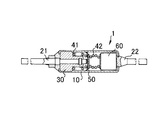
- FIG. 1 shows the structure of a general thermal fuse.
- the thermal fuse 1 lead wires 21 and 22 are connected to a case 10 made of a conductive metal, and an insulating material 30, springs 41 and 42, a movable electrode 50, and a fusible body 60 are housed inside the case 10. Yes.
- the spring 41 is installed between the movable electrode 50 and the insulating material 30, and the spring 42 is installed between the movable electrode 50 and the fusible body 60.
- the movable electrode 50 is in a movable state while being in contact with the inner surface of the case 10.
- the thermal fuse is adapted to energize the lead wire 21 from the lead wire 21 to the movable electrode 50 and the case 10 and further to the lead wire 22 in a normal state (state of FIG. 1).
- the fusible body 60 is deformed and melted at a predetermined operating temperature (generally around 240 ° C.), so that the spring 42 is extended by unloading, and at the same time, the spring 41 is extended, so that the movable electrode 50 moves away from the lead wire 21.
- a predetermined operating temperature generally around 240 ° C.
- the constituent material of the movable electrode of the thermal fuse having the above operating mechanism is required to have resistance to welding to the lead wire in addition to the conductivity as the electrode material. This is because the movable electrode is always energized under the contact state with the lead wire, but if welding occurs, it causes a malfunction of the thermal fuse.
- an Ag—CuO-based oxide dispersion alloy is known as a constituent material of a conventional movable electrode (Patent Document 1: hereinafter, this alloy is referred to as an Ag—CuO alloy).
- the Ag-CuO alloy is an alloy in which Cu is dispersed using Ag as a matrix, and has excellent welding resistance.
- the Ag—CuO alloy is used in combination with the fact that it does not use Cd, which is a harmful substance, unlike the Ag—CdO alloy used before.
- an object of the present invention is to provide an electrode material suitable for a movable electrode of a thermal fuse, which can solve the above-mentioned problem of poor contact.
- the inventors of the present invention examined factors that cause contact failure with a case in a conventional movable electrode made of an Ag—CuO alloy.
- the Ag-CuO alloy is softened in the Ag matrix by being heated for a long time at the operating temperature of the thermal fuse (100 ° C. or more), and its spring property is lowered, so that it can be stably contacted with the case. I thought it would disappear. Therefore, it was decided to secure the strength by using an electrode material clad with a metal layer that can maintain the spring property even when the Ag—CuO alloy is heated. This is because the Ag-CuO alloy is considered to be an excellent material in terms of welding resistance, although there is a problem of the above-mentioned decrease in springiness. By adopting such a clad structure, strength and welding resistance are considered. It is possible to achieve compatibility with sex.
- the base layer made of Cu or Cu alloy is joined to the contact layer made of Ag—CuO-based oxide dispersion strengthened alloy.
- An electrode material having a clad structure is, according to the present invention for solving the above problems, in the electrode material constituting the movable electrode of the thermal fuse, the base layer made of Cu or Cu alloy is joined to the contact layer made of Ag—CuO-based oxide dispersion strengthened alloy.
- the electrode material according to the present invention has a clad structure in which a plurality of metal layers are laminated as described above. These metal layers are a contact layer made of an Ag—CuO alloy and functioning as a contact material for the lead wire of the thermal fuse, and a base layer made of Cu or a Cu alloy and having a function of ensuring the strength of the contact layer.
- the Ag—CuO alloy constituting the contact layer is preferably an internal oxidation treatment of Cu: 1 to 20% by mass of an Ag—Cu alloy.
- the contact layer is a contact material that contacts the lead wire of the thermal fuse, and is required to have welding resistance.
- the welding resistance of the Ag—CuO alloy varies depending on the amount of oxide (CuO) dispersed, and this depends on the Cu content of the Ag—Cu alloy that undergoes internal oxidation. In consideration of this, in order to ensure suitable welding resistance, the Cu content of the internally oxidized Ag—Cu alloy is set to 1 to 20 mass%.
- the base layer is made of Cu or a Cu alloy.
- a layer made of Cu having a low oxygen concentration such as so-called oxygen-free copper (OFC) or tough pitch copper (TPC) is preferable. This is because sufficient conductivity can be secured.
- OFC oxygen-free copper
- TPC tough pitch copper
- a Cu alloy containing 0.1 to 3% by mass of at least one of Sn, In, Cr, and Ni is preferable. This is because the spring property and conductivity can be secured.
- the electrode material having a cladding structure according to the present invention is preferably one in which a contact layer made of Ag is bonded to the back surface of the base layer (the side opposite to the bonding surface with the contact layer).
- the present invention is an electrode material, and it is necessary to reduce the contact resistance when contacting the case of the thermal fuse.
- the electrode having the clad structure as described above tends to have a higher contact resistance than the state of the Ag—CuO alloy alone. Therefore, by providing a contact layer made of Ag, it is possible to reduce the contact resistance with the case when the movable electrode is used.
- This Ag layer is preferably high-purity Ag for reducing the resistance value, and is preferably composed of 99.9% by mass or more of Ag.
- each metal layer of the contact layer, base layer, and contact layer is the ratio of the thickness of the contact layer (Ag—CuO alloy) to the base layer (Cu or Cu alloy).
- the thickness of the contact layer is preferably 10 to 40% with respect to the total thickness. This is to ensure strength.
- the contact layer (Ag) is not required to have a large thickness for the purpose of reducing the contact resistance, and is preferably 0.5 to 5% with respect to the total thickness of the entire material.
- the contact layer is 15 to 25 ⁇ m
- the base layer is 59 to 68 ⁇ m
- the contact layer is 1 to 3 ⁇ m.
- the electrode material according to the present invention preferably includes an intermediate layer made of Ag between the contact layer and the base layer.
- an intermediate layer made of Ag between the contact layer and the base layer.
- Ag constituting the intermediate layer is preferably high-purity Ag, and more preferably 99.9% by mass or more.
- the thickness of the intermediate layer is preferably 0.5 to 5% with respect to the total thickness of the entire material including the intermediate layer. This intermediate layer is not an essential component because it does not affect the conductivity and strength of the electrode material, but is useful in the manufacture of a movable electrode having a complex shape and a high processing rate.
- the electrode material according to the present invention can be made into a clad material by overlappingly rolling and joining plate materials, foil materials, or tape materials constituting each metal layer.
- the electrode material to which the intermediate layer (Ag) is applied can be bonded to the bonding site by this method.
- middle layer can be formed by thin film manufacturing techniques, such as plating, besides clad joining a board
- the clad material joined with each metal layer can then be rolled as necessary to adjust the overall thickness.
- cutting, slitting, and bending can be performed into shapes and dimensions necessary for the movable electrode of the thermal fuse.
- the electrode material according to the present invention is suitable for a movable electrode of a thermal fuse, in which Cu or Cu alloy is clad on an Ag—CuO alloy, and thereby the case of a thermal fuse without lowering the spring property even under heating. Can be stably maintained.
- the use of the Ag—CuO alloy results in good welding resistance originally required for the movable electrode.
- an electrode material having a two-layer structure including a contact layer and a base layer was manufactured.
- An Ag—CuO alloy wire (wire diameter: 4.5 mm) produced by internally oxidizing an Ag—Cu alloy (Cu concentration: 5, 10, 12% by mass) was prepared, and this was rolled to obtain a width of 7 mm ⁇ thickness.
- An Ag—CuO alloy (contact layer) tape was manufactured by rolling to 0.6 mm.
- a wire wire diameter 5.5 mm) of Cu (oxygen-free copper) and Cu alloy (Cu-0.15 mass% Sn alloy, Cu-1 mass% Ni alloy) was rolled and processed to have a width of 7 mm and a thickness of 1.
- Cu and Cu alloy (base layer) tapes were manufactured up to 5 mm. These two metal tapes were stacked and rolled in an inert atmosphere to be clad-joined. This clad material was further rolled and slit processed to obtain a tape for electrode material. At this time, the thickness of the Ag—CuO alloy (contact layer) was 20 ⁇ m, and the thickness of the Cu and Cu alloy (base layer) was 64 ⁇ m (84 ⁇ m in total). The tape material was cut out to produce a test piece and its characteristics were evaluated.
- Characteristic evaluation evaluated spring property by measuring a spring limit value by a spring limit value test about a test piece after manufacture.
- the specific resistance of a 1 m hoop material was measured with a milliohm meter, and “ ⁇ ” was given for conductivity exceeding IACS 85%, and 80 to 85% was given “ ⁇ ”. evaluated.
- the test piece was kept at 240 ° C. for 100 hours and heated, and the spring property and conductivity after the heating were measured in the same manner. The results are shown in Table 1. For comparison, the same measurement is performed for the electrode material (thickness 84 ⁇ m) made only of the Ag—CuO alloy.
- the spring property of the single-layer electrode material made of the conventional Ag—CuO alloy is reduced to less than 80 N / mm 2 by heating.
- the base layer is provided to complement the strength reduction of the Ag—CuO alloy serving as the contact layer, and the spring property of the electrode material is improved by 10% or more.
- the conductivity of the electrode material itself each of the examples and comparative examples was sufficient in terms of IACS standards.
- Second Embodiment an electrode material having a three-layer structure in which an Ag layer serving as a contact layer was joined was manufactured and evaluated.
- an Ag (purity 99.9 or more) wire (wire diameter: 4.0 mm) was prepared, and this was rolled to a width of 7 mm and a thickness of 0.1 mm to produce an Ag tape.
- an Ag—CuO alloy tape and a Cu or Cu alloy tape manufactured in the same manner as in the first embodiment were stacked, rolled in an inert atmosphere, and clad-joined. Then, it rolled and slit processed similarly to 1st Embodiment, and it was set as the tape for electrode materials.
- the thickness of the Ag—CuO alloy (contact layer) was 20 ⁇ m
- the thickness of the Cu and Cu alloy (base layer) was 62 ⁇ m
- the thickness of Ag (contact layer) was 2 ⁇ m (total) 84 ⁇ m).
- the tape material produced above was cut out to produce a test piece, and its characteristics were evaluated. The evaluation was performed before and after heating at 240 ° C., and the spring limit value was measured as in the first embodiment. Moreover, the contact resistance value was measured with the contact resistance meter as electroconductivity evaluation. The results are shown in Table 2. Table 2 also shows the results for each example and comparative example of the first embodiment.
- Third Embodiment an electrode material having a four-layer structure in which an Ag layer serving as an intermediate layer is bonded was manufactured, and the effect of improving the bonding property between the contact layer and the base layer was confirmed.
- the Ag tape material manufactured in the second embodiment the Ag—CuO alloy tape, Ag tape, Cu or Cu alloy tape, and Ag tape of the first and second embodiments are stacked and rolled in an inert atmosphere. Cladded. And it rolled and slit-processed and it was set as the tape for electrode materials.
- the thickness of the Ag—CuO alloy (contact layer) is 20 ⁇ m
- the thickness of Ag (intermediate layer) is 2 ⁇ m
- the thickness of Cu, Cu alloy (base layer) is 60 ⁇ m
- Ag The thickness of the contact layer was 2 ⁇ m (total 84 ⁇ m).
- the tape material produced above was cut out to produce a test piece, and its characteristics were evaluated.
- the evaluation was performed by measuring the spring limit value before and after heating at 240 ° C. About the electrode material after a heating, the joining force of a contact layer and a base layer was evaluated. In this evaluation, a bending test (a test in which the material is folded back by 180 degrees) was performed, and it was observed whether or not a mouth opening occurred between the contact layer and the base layer.
- the evaluation content was “ ⁇ ”when the mouth opening did not occur even when the bending test was performed twice or more, and“ ⁇ ”when the mouth opening did not occur once.
- Table 3 also shows the results for each example (Examples 10 to 18) of the second embodiment.
- the present invention is an electrode material that is resistant to welding and has little decrease in springiness due to heating, and is suitable for a movable electrode of a thermal fuse. According to the present invention, it is possible to suppress malfunction of the thermal fuse, and to ensure the reliability of various electric devices.
Landscapes
- Engineering & Computer Science (AREA)
- Mechanical Engineering (AREA)
- Chemical & Material Sciences (AREA)
- Materials Engineering (AREA)
- Metallurgy (AREA)
- Organic Chemistry (AREA)
- Composite Materials (AREA)
- Inorganic Chemistry (AREA)
- Contacts (AREA)
- Manufacture Of Switches (AREA)
- Fuses (AREA)
Abstract
Un matériau d'électrode qui constitue une électrode mobile (50) dans une découpe (1) thermique et qui a une structure plaquée formée en joignant une couche de base constituée de Cu ou d'un alliage de Cu avec une couche de contact constituée d'alliage renforcé par dispersion d'oxydes à base de Ag-CuO. La présente invention est un matériau d'électrode qui est approprié pour une électrode mobile pour une découpe thermique, et qui peut résoudre le problème de mauvaise mise en contact avec un boîtier, ladite mauvaise mise en contact étant due à une utilisation de longue durée. Afin d'améliorer la résistance de contact entre l'électrode (50) et un boîtier (10), il est préférable que le matériau d'électrode ait une couche de contact constituée de Ag et jointe à la face arrière de la couche de base.
Priority Applications (3)
| Application Number | Priority Date | Filing Date | Title |
|---|---|---|---|
| EP13763716.1A EP2830080A4 (fr) | 2012-03-22 | 2013-03-21 | Matériau d'électrode ayant une structure plaquée |
| CN201380015753.3A CN104205282A (zh) | 2012-03-22 | 2013-03-21 | 具有包层结构的电极材料 |
| US14/381,590 US20150015360A1 (en) | 2012-03-22 | 2013-03-21 | Electrode material having clad structure |
Applications Claiming Priority (2)
| Application Number | Priority Date | Filing Date | Title |
|---|---|---|---|
| JP2012064680A JP2013196984A (ja) | 2012-03-22 | 2012-03-22 | クラッド構造を有する電極材料 |
| JP2012-064680 | 2012-03-22 |
Publications (1)
| Publication Number | Publication Date |
|---|---|
| WO2013141273A1 true WO2013141273A1 (fr) | 2013-09-26 |
Family
ID=49222730
Family Applications (1)
| Application Number | Title | Priority Date | Filing Date |
|---|---|---|---|
| PCT/JP2013/057986 Ceased WO2013141273A1 (fr) | 2012-03-22 | 2013-03-21 | Matériau d'électrode ayant une structure plaquée |
Country Status (5)
| Country | Link |
|---|---|
| US (1) | US20150015360A1 (fr) |
| EP (1) | EP2830080A4 (fr) |
| JP (1) | JP2013196984A (fr) |
| CN (1) | CN104205282A (fr) |
| WO (1) | WO2013141273A1 (fr) |
Families Citing this family (6)
| Publication number | Priority date | Publication date | Assignee | Title |
|---|---|---|---|---|
| WO2017121474A1 (fr) * | 2016-01-14 | 2017-07-20 | Schurter Ag | Fusible thermique activable mécaniquement |
| CN107527775A (zh) * | 2017-04-06 | 2017-12-29 | 张娜娜 | 小家电熔丝 |
| CN107527776A (zh) * | 2017-04-06 | 2017-12-29 | 张娜娜 | 豆浆机熔丝 |
| JP6903615B2 (ja) | 2017-09-14 | 2021-07-14 | ショット日本株式会社 | 感温ペレット型温度ヒューズ |
| WO2019054437A1 (fr) * | 2017-09-14 | 2019-03-21 | ショット日本株式会社 | Fusible thermique du type pastille sensible à la température |
| JP7524156B2 (ja) | 2021-12-20 | 2024-07-29 | ショット日本株式会社 | 温度ヒューズ用接点材およびこれを用いた感温ペレット型温度ヒューズ |
Citations (8)
| Publication number | Priority date | Publication date | Assignee | Title |
|---|---|---|---|---|
| JPS56169320U (fr) * | 1980-05-17 | 1981-12-15 | ||
| JPH01166436A (ja) * | 1987-12-23 | 1989-06-30 | Suginami Sokki Seisakusho:Kk | 複合型全領域保護ヒユーズ |
| JPH025844U (fr) * | 1988-06-24 | 1990-01-16 | ||
| JPH0547252A (ja) * | 1991-08-15 | 1993-02-26 | Furukawa Electric Co Ltd:The | 電気接点材料とその製造方法 |
| JPH06170557A (ja) * | 1992-12-04 | 1994-06-21 | Tanaka Kikinzoku Kogyo Kk | 貴金属複合材料の製造方法 |
| JPH10162704A (ja) * | 1996-11-29 | 1998-06-19 | Nec Kansai Ltd | 温度ヒューズ |
| WO2003009323A1 (fr) * | 2001-07-18 | 2003-01-30 | Nec Schott Components Corporation | Fusible thermique |
| JP2011137198A (ja) | 2009-12-28 | 2011-07-14 | Tokuriki Honten Co Ltd | 電極材料およびその製造方法 |
Family Cites Families (9)
| Publication number | Priority date | Publication date | Assignee | Title |
|---|---|---|---|---|
| US4523711A (en) * | 1980-09-18 | 1985-06-18 | Fuji Electric Co., Ltd. | Method for bonding silver-based contact |
| JP2641549B2 (ja) * | 1988-12-29 | 1997-08-13 | 株式会社徳力本店 | Ag―酸化物系複合接点材料およびその製造方法 |
| JP2895793B2 (ja) * | 1995-02-24 | 1999-05-24 | マブチモーター株式会社 | 摺動接点材料及びクラッド複合材ならびにそれらからなるコンミテータ及びそのコンミテータを使用した直流小型モータ |
| JP2004209490A (ja) * | 2002-12-27 | 2004-07-29 | Neomax Co Ltd | 溶接構造用クラッド材およびそのクラッド材を用いた溶接構造部材 |
| JP4084298B2 (ja) * | 2003-12-24 | 2008-04-30 | 株式会社神戸製鋼所 | 耐アーク性に優れた電気接点用材料 |
| CN101562081B (zh) * | 2008-04-18 | 2012-03-21 | 佛山通宝精密合金股份有限公司 | 一种节银型层状复合触头片件的制备方法 |
| JP3161636U (ja) * | 2010-05-25 | 2010-08-05 | 顔瓊章 | 温度ヒューズの導電片の改良 |
| KR101701688B1 (ko) | 2011-07-06 | 2017-02-01 | 가부시키가이샤 토쿠리키 혼텐 | 온도 퓨즈용 전극 재료 및 그 제조 방법과 그 전극 재료를 이용한 온도 퓨즈 |
| KR101955747B1 (ko) * | 2011-11-22 | 2019-03-07 | 쇼트 니혼 가부시키가이샤 | 온도 퓨즈 및 당해 온도 퓨즈에 이용되는 활주전극 |
-
2012
- 2012-03-22 JP JP2012064680A patent/JP2013196984A/ja active Pending
-
2013
- 2013-03-21 CN CN201380015753.3A patent/CN104205282A/zh active Pending
- 2013-03-21 US US14/381,590 patent/US20150015360A1/en not_active Abandoned
- 2013-03-21 WO PCT/JP2013/057986 patent/WO2013141273A1/fr not_active Ceased
- 2013-03-21 EP EP13763716.1A patent/EP2830080A4/fr not_active Withdrawn
Patent Citations (8)
| Publication number | Priority date | Publication date | Assignee | Title |
|---|---|---|---|---|
| JPS56169320U (fr) * | 1980-05-17 | 1981-12-15 | ||
| JPH01166436A (ja) * | 1987-12-23 | 1989-06-30 | Suginami Sokki Seisakusho:Kk | 複合型全領域保護ヒユーズ |
| JPH025844U (fr) * | 1988-06-24 | 1990-01-16 | ||
| JPH0547252A (ja) * | 1991-08-15 | 1993-02-26 | Furukawa Electric Co Ltd:The | 電気接点材料とその製造方法 |
| JPH06170557A (ja) * | 1992-12-04 | 1994-06-21 | Tanaka Kikinzoku Kogyo Kk | 貴金属複合材料の製造方法 |
| JPH10162704A (ja) * | 1996-11-29 | 1998-06-19 | Nec Kansai Ltd | 温度ヒューズ |
| WO2003009323A1 (fr) * | 2001-07-18 | 2003-01-30 | Nec Schott Components Corporation | Fusible thermique |
| JP2011137198A (ja) | 2009-12-28 | 2011-07-14 | Tokuriki Honten Co Ltd | 電極材料およびその製造方法 |
Non-Patent Citations (1)
| Title |
|---|
| See also references of EP2830080A1 |
Also Published As
| Publication number | Publication date |
|---|---|
| EP2830080A1 (fr) | 2015-01-28 |
| CN104205282A (zh) | 2014-12-10 |
| JP2013196984A (ja) | 2013-09-30 |
| US20150015360A1 (en) | 2015-01-15 |
| EP2830080A4 (fr) | 2016-02-17 |
Similar Documents
| Publication | Publication Date | Title |
|---|---|---|
| WO2013141273A1 (fr) | Matériau d'électrode ayant une structure plaquée | |
| JP6180324B2 (ja) | 温度ヒューズおよび当該温度ヒューズに用いられる摺動電極 | |
| JP4537465B2 (ja) | 抵抗金属板低抵抗チップ抵抗器の製造方法 | |
| KR101701688B1 (ko) | 온도 퓨즈용 전극 재료 및 그 제조 방법과 그 전극 재료를 이용한 온도 퓨즈 | |
| JP5334416B2 (ja) | 電気接触子及び電気部品用ソケット | |
| CN104272419B (zh) | 用于温度保险丝可动电极的电极材料 | |
| JP5239236B2 (ja) | 電子部品およびその製造方法 | |
| JP5730480B2 (ja) | 電極材料およびその製造方法 | |
| JP7153565B2 (ja) | テープ状接点材及びその製造方法 | |
| TW200428419A (en) | Multilayer chip varistor and method of manufacturing the same | |
| JP2008021501A (ja) | 配線用電気部品及び端末接続部並びに配線用電気部品の製造方法 | |
| JP4847898B2 (ja) | 配線用導体およびその製造方法 | |
| CN109155208B (zh) | 电触点用的覆层材料和该覆层材料的制造方法 | |
| JP4734695B2 (ja) | 耐屈曲フラットケーブル | |
| JP5822777B2 (ja) | 2芯平行リード線及びリード線付きサーミスタ | |
| JP6530267B2 (ja) | 温度ヒューズ用電極材料 | |
| JP4796522B2 (ja) | 配線用導体およびその製造方法 | |
| JP2010007111A (ja) | 銅或いは銅合金平角導体及びフレキシブルフラットケーブル | |
| JP2008066493A (ja) | リード線、アルミニウム電解コンデンサ用リード端子およびアルミニウム電解コンデンサ |
Legal Events
| Date | Code | Title | Description |
|---|---|---|---|
| 121 | Ep: the epo has been informed by wipo that ep was designated in this application |
Ref document number: 13763716 Country of ref document: EP Kind code of ref document: A1 |
|
| WWE | Wipo information: entry into national phase |
Ref document number: 2013763716 Country of ref document: EP |
|
| WWE | Wipo information: entry into national phase |
Ref document number: 14381590 Country of ref document: US |
|
| WWE | Wipo information: entry into national phase |
Ref document number: IDP00201406393 Country of ref document: ID |
|
| NENP | Non-entry into the national phase |
Ref country code: DE |