WO2013175992A1 - Batterie entièrement solide - Google Patents
Batterie entièrement solide Download PDFInfo
- Publication number
- WO2013175992A1 WO2013175992A1 PCT/JP2013/063350 JP2013063350W WO2013175992A1 WO 2013175992 A1 WO2013175992 A1 WO 2013175992A1 JP 2013063350 W JP2013063350 W JP 2013063350W WO 2013175992 A1 WO2013175992 A1 WO 2013175992A1
- Authority
- WO
- WIPO (PCT)
- Prior art keywords
- solid
- negative electrode
- electrode layer
- solid electrolyte
- layer
- Prior art date
- Legal status (The legal status is an assumption and is not a legal conclusion. Google has not performed a legal analysis and makes no representation as to the accuracy of the status listed.)
- Ceased
Links
Images

Classifications
-
- H—ELECTRICITY
- H01—ELECTRIC ELEMENTS
- H01M—PROCESSES OR MEANS, e.g. BATTERIES, FOR THE DIRECT CONVERSION OF CHEMICAL ENERGY INTO ELECTRICAL ENERGY
- H01M4/00—Electrodes
- H01M4/02—Electrodes composed of, or comprising, active material
- H01M4/36—Selection of substances as active materials, active masses, active liquids
- H01M4/48—Selection of substances as active materials, active masses, active liquids of inorganic oxides or hydroxides
- H01M4/485—Selection of substances as active materials, active masses, active liquids of inorganic oxides or hydroxides of mixed oxides or hydroxides for inserting or intercalating light metals, e.g. LiTi2O4 or LiTi2OxFy
-
- H—ELECTRICITY
- H01—ELECTRIC ELEMENTS
- H01M—PROCESSES OR MEANS, e.g. BATTERIES, FOR THE DIRECT CONVERSION OF CHEMICAL ENERGY INTO ELECTRICAL ENERGY
- H01M10/00—Secondary cells; Manufacture thereof
- H01M10/05—Accumulators with non-aqueous electrolyte
- H01M10/052—Li-accumulators
-
- H—ELECTRICITY
- H01—ELECTRIC ELEMENTS
- H01M—PROCESSES OR MEANS, e.g. BATTERIES, FOR THE DIRECT CONVERSION OF CHEMICAL ENERGY INTO ELECTRICAL ENERGY
- H01M10/00—Secondary cells; Manufacture thereof
- H01M10/05—Accumulators with non-aqueous electrolyte
- H01M10/056—Accumulators with non-aqueous electrolyte characterised by the materials used as electrolytes, e.g. mixed inorganic/organic electrolytes
- H01M10/0561—Accumulators with non-aqueous electrolyte characterised by the materials used as electrolytes, e.g. mixed inorganic/organic electrolytes the electrolyte being constituted of inorganic materials only
- H01M10/0562—Solid materials
-
- H—ELECTRICITY
- H01—ELECTRIC ELEMENTS
- H01M—PROCESSES OR MEANS, e.g. BATTERIES, FOR THE DIRECT CONVERSION OF CHEMICAL ENERGY INTO ELECTRICAL ENERGY
- H01M4/00—Electrodes
- H01M4/02—Electrodes composed of, or comprising, active material
- H01M4/36—Selection of substances as active materials, active masses, active liquids
- H01M4/58—Selection of substances as active materials, active masses, active liquids of inorganic compounds other than oxides or hydroxides, e.g. sulfides, selenides, tellurides, halogenides or LiCoFy; of polyanionic structures, e.g. phosphates, silicates or borates
- H01M4/5825—Oxygenated metallic salts or polyanionic structures, e.g. borates, phosphates, silicates, olivines
-
- Y—GENERAL TAGGING OF NEW TECHNOLOGICAL DEVELOPMENTS; GENERAL TAGGING OF CROSS-SECTIONAL TECHNOLOGIES SPANNING OVER SEVERAL SECTIONS OF THE IPC; TECHNICAL SUBJECTS COVERED BY FORMER USPC CROSS-REFERENCE ART COLLECTIONS [XRACs] AND DIGESTS
- Y02—TECHNOLOGIES OR APPLICATIONS FOR MITIGATION OR ADAPTATION AGAINST CLIMATE CHANGE
- Y02E—REDUCTION OF GREENHOUSE GAS [GHG] EMISSIONS, RELATED TO ENERGY GENERATION, TRANSMISSION OR DISTRIBUTION
- Y02E60/00—Enabling technologies; Technologies with a potential or indirect contribution to GHG emissions mitigation
- Y02E60/10—Energy storage using batteries
Definitions
- the present invention relates to an all solid state battery.
- the battery having the above configuration has a risk of leakage of the electrolyte.
- the organic solvent etc. which are used for electrolyte solution are combustible substances. For this reason, it is required to further increase the safety of the battery.
- Patent Document 1 Japanese Patent Application Laid-Open No. 2007-5279 proposes an all-solid lithium secondary battery in which all components are made of solid using a nonflammable solid electrolyte.
- an electrode layer containing an electrode active material made of a first phosphate compound and a solid electrolyte layer containing a solid electrolyte made of a second phosphate compound are stacked and heat-treated.
- Patent Document 1 discloses a method for producing a laminate of an all-solid battery as a fired body.
- an object of the present invention is to provide an all-solid battery capable of improving the charge / discharge capacity.
- a solid electrolyte layer containing a lithium-containing phosphate compound and a pentavalent metal-containing oxide are included.
- the bondability at the interface between the solid electrolyte layer and the electrode layer can be improved, and the charge / discharge capacity can be improved. I found out that I can do it.
- the present invention has the following features.
- the all solid state battery according to the present invention includes at least one of the positive electrode layer and the negative electrode layer and a solid electrolyte layer laminated on the electrode layer.
- the solid electrolyte layer contains a lithium-containing phosphate compound
- the electrode layer contains a pentavalent metal-containing oxide
- a part of the pentavalent metal is substituted with phosphorus in the pentavalent metal-containing oxide.
- the pentavalent metal is preferably at least one metal selected from the group consisting of niobium and vanadium.
- the pentavalent metal-containing oxide is M 2-x P x O 5 (wherein M includes at least one element selected from the group consisting of Nb and V, and x is 0 ⁇ x ⁇ 1. It is preferable that the oxide be a numerical value within the range of 33).
- x is preferably a numerical value within a range of 0.11 ⁇ x ⁇ 1.00, and more preferably a numerical value within a range of 0.11 ⁇ x ⁇ 0.20.
- the electrode layer preferably contains a lithium-containing phosphate compound.
- the bondability at the interface between the solid electrolyte layer and the electrode layer can be improved, and the charge / discharge capacity can be improved.
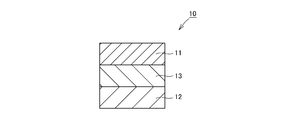
- an all-solid battery stack 10 is composed of a stack in which a positive electrode layer 11, a solid electrolyte layer 13, and a negative electrode layer 12 are stacked in this order.
- the positive electrode layer 11 is disposed on one surface of the solid electrolyte layer 13, and the negative electrode layer 12 is disposed on the other surface opposite to the one surface of the solid electrolyte layer 13.
- the positive electrode layer 11 and the negative electrode layer 12 are provided at positions facing each other with the solid electrolyte layer 13 interposed therebetween.
- Each of the positive electrode layer 11 and the negative electrode layer 12 includes at least an electrode active material, and may further include a solid electrolyte.
- the solid electrolyte layer 13 includes a solid electrolyte.
- Each of the positive electrode layer 11 and the negative electrode layer 12 may contain carbon, a metal, an oxide, etc. as an electronic conductive material.
- the solid electrolyte layer 13 includes a lithium-containing phosphate compound, and at least one of the positive electrode layer 11 and the negative electrode layer 12 is pentavalent as an electrode active material. Including a metal-containing oxide, a part of the pentavalent metal is substituted with phosphorus in the pentavalent metal-containing oxide.
- the pentavalent metal is preferably at least one metal selected from the group consisting of niobium and vanadium.
- niobium or vanadium as the pentavalent metal, a decrease in charge / discharge capacity due to firing can be suppressed.
- the pentavalent metal-containing oxide is M 2-x P x O 5 (wherein M includes at least one element selected from the group consisting of Nb and V, and x is 0 ⁇ x ⁇ 1. It is preferable that the oxide be a numerical value within the range of 33). By using such a pentavalent metal-containing oxide, the bondability between the solid electrolyte layer 13 and the electrode layer can be further improved.
- At least one of the positive electrode layer 11 and the negative electrode layer 12 includes a lithium-containing phosphate compound as a solid electrolyte.
- the lithium-containing phosphate compound as a solid electrolyte included in the solid electrolyte layer 13 or the lithium-containing phosphate compound as a solid electrolyte included in the positive electrode layer 11 or the negative electrode layer 12 is a lithium-containing phosphate compound having a NASICON structure.
- Lithium-containing phosphoric acid compound having a NASICON-type structure the chemical formula Li x M y (PO 4) 3 ( Formula, x 1 ⁇ x ⁇ 2, y is a number in the range of 1 ⁇ y ⁇ 2, M Includes one or more elements selected from the group consisting of Ti, Ge, Al, Ga and Zr), for example, Li 1.5 Al 0.5 Ti 1.5 (PO 4 ) 3 .
- part of P in the above chemical formula may be substituted with B, Si, or the like.
- two or more compounds having different compositions of lithium-containing phosphate compounds having a NASICON type structure such as Li 1.5 Al 0.5 Ge 1.5 (PO 4 ) 3 and Li 1.2 Al 0.2 Ti 1.8 (PO 4 ) 3 are mixed. You may use the mixture.
- the lithium-containing phosphate compound having a NASICON structure used in the above solid electrolyte includes a crystal phase of a lithium-containing phosphate compound having a NASICON structure, or a lithium-containing phosphate having a NASICON structure by heat treatment You may use the glass which precipitates the crystal phase of a phosphoric acid compound.
- a material used for said solid electrolyte it is possible to use the material which has ion conductivity and is so small that electronic conductivity can be disregarded other than the lithium-containing phosphate compound which has a NASICON structure.
- Examples of such a material include lithium oxyacid salts and derivatives thereof.
- Li-PO system compounds such as lithium phosphate (Li 3 PO 4 ), LIPON (LiPO 4 ⁇ x N x ) in which nitrogen is mixed with lithium phosphate, and Li—Si—O such as Li 4 SiO 4
- Li—Si—O such as Li 4 SiO 4
- Examples thereof include compounds having a lobskite structure, compounds having a garnet structure having Li, La, and Zr.
- MOx (M is Ti, Si, Sn, Cr, Fe) as the negative electrode active material included in the negative electrode layer 12.
- x is a numerical value in the range of 0.9 ⁇ x ⁇ 2.0.
- a mixture in which two or more active materials having a composition represented by MOx containing different elements M such as TiO 2 and SiO 2 may be used.
- the negative electrode active material graphite-lithium compounds, lithium alloys such as Li-Al, oxidation of Li 3 V 2 (PO 4 ) 3 , Li 3 Fe 2 (PO 4 ) 3 , Li 4 Ti 5 O 12, etc. Thing, etc. can be used.
- the negative electrode layer 12 may be formed from metallic lithium.
- the positive electrode active material included in the positive electrode layer 11 may be a NASICON type such as Li 3 V 2 (PO 4 ) 3.
- Lithium-containing phosphate compounds having a structure, lithium-containing phosphate compounds having an olivine structure such as LiFePO 4 and LiMnPO 4 , layered compounds such as LiCoO 2 , LiCo 1/3 Ni 1/3 Mn 1/3 O 2 , LiMn A lithium-containing compound having a spinel structure such as 2 O 4 , LiNi 0.5 Mn 1.5 O 4 , or Li 4 Ti 5 O 12 can be used.
- the solid electrolyte layer 13 includes a solid electrolyte made of a lithium-containing phosphate compound having a NASICON structure, and at least one of the positive electrode layer 11 and the negative electrode layer 12 is a NASICON type. It is preferable to include a solid electrolyte composed of a lithium-containing phosphate compound having a structure.
- an unsintered electrode layer that is an unsintered body of at least one of the positive electrode layer 11 and the negative electrode layer 12, and a solid An unsintered solid electrolyte layer that is an unsintered body of the electrolyte layer 13 is fabricated (unsintered layer fabrication step).
- an unsintered solid electrolyte layer that is an unsintered body of the solid electrolyte layer 13 is prepared from the material including the lithium-containing phosphate compound, and the electrode including the pentavalent metal-containing oxide is used as an electrode.
- An unsintered electrode layer which is an unsintered body of the layer is produced.
- the produced unfired electrode layer and the unfired solid electrolyte layer are laminated to form a laminate (laminated body forming step). And the obtained laminated body is baked (baking process). The positive electrode layer 11 and / or the negative electrode layer 12 and the solid electrolyte layer 13 are joined by firing. Finally, the fired laminate is sealed, for example, in a coin cell.
- the sealing method is not particularly limited. For example, you may seal the laminated body after baking with resin. Alternatively, an insulating paste having an insulating property such as Al 2 O 3 may be applied or dipped around the laminate, and the insulating paste may be heat-treated for sealing.
- a current collector layer such as a carbon layer, a metal layer, or an oxide layer may be formed on the positive electrode layer 11 and the negative electrode layer 12.
- Examples of the method for forming the current collector layer include a sputtering method.
- the metal paste may be applied or dipped and heat-treated.
- a laminated body may be formed by laminating a plurality of laminated bodies having the above single cell structure with an unfired body of the current collector interposed therebetween.
- a plurality of laminates having a single battery structure may be laminated electrically in series or in parallel.
- the method for forming the unfired electrode layer and the unfired solid electrolyte layer is not particularly limited, but a doctor blade method, a die coater, a comma coater, etc. for forming a green sheet, or a screen for forming a printing layer. Printing or the like can be used.
- the method for laminating the unfired electrode layer and the unfired solid electrolyte layer is not particularly limited, but hot isostatic pressing (HIP), cold isostatic pressing (CIP), isostatic pressing (WIP), etc.
- HIP hot isostatic pressing
- CIP cold isostatic pressing
- WIP isostatic pressing
- the green electrode layer and the green solid electrolyte layer can be laminated by using.
- the slurry for forming the green sheet or the printing layer includes an organic vehicle in which an organic material is dissolved in a solvent, a positive electrode active material and a solid electrolyte, a negative electrode active material and a solid electrolyte, a first component and a second component, or a collection. It can be produced by wet-mixing the electrical material. Media can be used in wet mixing, and specifically, a ball mill method, a viscomill method, or the like can be used. On the other hand, a wet mixing method that does not use media may be used, and a sand mill method, a high-pressure homogenizer method, a kneader dispersion method, or the like can be used.
- the organic material contained in the slurry for forming the green sheet or the printing layer is not particularly limited, and polyvinyl acetal resin, cellulose resin, acrylic resin, urethane resin, and the like can be used.
- the slurry may contain a plasticizer.
- plasticizer is not particularly limited, phthalic acid esters such as dioctyl phthalate and diisononyl phthalate may be used.
- the atmosphere is not particularly limited, but it is preferably performed under conditions that do not change the valence of the transition metal contained in the electrode active material.
- the firing temperature is preferably 400 ° C. or higher and 1000 ° C. or lower.
- Example shown below is an example and this invention is not limited to the following Example.
- a negative electrode active material used for the all solid state battery of the example was prepared as follows.
- the obtained raw material mixed powder was fired in an air atmosphere at a temperature of 400 ° C. for 3 hours to produce a fired powder.
- the obtained pulverized powder was fired in a nitrogen gas atmosphere at a temperature of 1200 ° C. for 10 hours to produce a negative electrode active material powder used for the all solid state battery of the example.
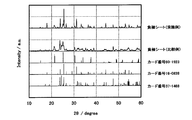
- FIG. 2 shows an X-ray diffraction of a P 0.2 Nb 1.8 O 5 JCPDS (Joint Committee on Powder Diffraction Standards) card (card number: 16-0838), which is an oxide in which part of a pentavalent metal is substituted with phosphorus.
- JCPDS Joint Committee on Powder Diffraction Standards
- the X-ray diffraction pattern of the negative electrode active material almost coincides with the X-ray diffraction pattern of P 0.2 Nb 1.8 O 5 , and the negative electrode active material is orthorhombic Nb 2 O 5 and a part of Nb is P. It was confirmed that this was a substituted pentavalent metal oxide.
- negative electrode sheets and solid electrolyte sheets were produced as follows.
- the above binder solution was mixed with glass powder of Li 1.5 Al 0.5 Ge 1.5 (PO 4 ) 3 (hereinafter referred to as LAGP), which is an example of a NASICON type lithium-containing phosphate compound as a solid electrolyte.
- LAGP Li 1.5 Al 0.5 Ge 1.5 (PO 4 ) 3
- Solid electrolyte slurries used in the examples and comparative examples were prepared.
- the mixing ratio of the above glass powder and polyvinyl alcohol was 70:30 by weight.
- the negative electrode sheets and solid electrolyte sheets (green sheets) of the examples and comparative examples were prepared by forming each of the obtained negative electrode slurries and solid electrolyte slurries of the examples and comparative examples to a thickness of 50 ⁇ m by the doctor blade method. did.
- X-ray diffraction patterns of the negative electrode sheets of the examples and comparative examples as fired bodies at a scanning speed of 4.0 ° / min using an X-ray diffractometer (XRD) at a measurement angle range of 10 ° to 60 °. was measured.
- the measured X-ray diffraction patterns of the negative electrode sheets of the example and the comparative example are shown in FIG.
- FIG 3 is a lithium-containing phosphate compound of the NASICON type LiGe 2 (PO 4) 3 of the JCPDS (Joint Committee on Powder Diffraction Standards ) card (card number: 80-1923) and X-ray diffraction pattern of, P 0.2
- An X-ray diffraction pattern (card number: 16-0838) of Nb 1.8 O 5 JCPDS card and an X-ray diffraction pattern of a monoclinic Nb 2 O 5 JCPDS card (card number: 37-1468) are shown together. .
- the X-ray diffraction pattern of the negative electrode sheet of the example almost coincides with the X-ray diffraction pattern of LiGe 2 (PO 4 ) 3 and P 0.2 Nb 1.8 O 5 , and LAGP as a solid electrolyte and negative electrode active material It was confirmed that the skeleton of P 0.2 Nb 1.8 O 5 was maintained without disappearing in the solid phase reaction.
- the X-ray diffraction pattern of the negative electrode sheet of the comparative example almost coincides with the X-ray diffraction pattern of LiGe 2 (PO 4 ) 3 and monoclinic Nb 2 O 5 , and LAGP as a solid electrolyte and It was confirmed that the skeleton of the monoclinic Nb 2 O 5 as the negative electrode active material could be maintained without disappearing in the solid phase reaction.
- Each of the negative electrode sheet of Example and Comparative Example cut into a circular shape with a diameter of 12 mm is laminated on one side of a solid electrolyte sheet cut into a circular shape with a diameter of 12 mm, and 1 ton at a temperature of 80 ° C.
- the negative electrode-electrolyte laminates of Examples and Comparative Examples as molded bodies were manufactured by applying thermocompression with the pressure of.
- Firing is performed for 2 hours at a temperature of 500 ° C. in an oxygen gas atmosphere in a state where each of the negative electrode-electrolyte laminates of the example as a compact and the comparative example is sandwiched between two alumina ceramic plates.
- the negative electrode layer and the solid electrolyte layer were joined by firing for 2 hours at a temperature of 700 ° C. in a nitrogen gas atmosphere (firing step 2).
- the negative electrode-electrolyte laminated body of the Example and comparative example as a sintered body was produced.
- Each of the negative electrode-electrolyte laminates of the example as a fired body and the comparative example was dried at a temperature of 100 ° C. to remove moisture, and then the polymethyl methacrylate resin (PMMA) was placed on the metal lithium plate as the positive electrode.
- PMMA polymethyl methacrylate resin
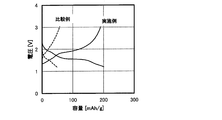
- FIG. 4 shows charge / discharge curves of the obtained all-solid-state batteries of Examples and Comparative Examples.
- the discharge capacity of the all-solid battery of the example is about 191 mAh / g
- the discharge capacity of the all-solid battery of the comparative example is about 58 mAh / g. It was confirmed that the charge voltage was low and the discharge voltage was high compared to the solid battery.
- charge / discharge capacity is obtained by using P 0.2 Nb 1.8 O 5 which is a pentavalent metal oxide in which Nb is partially substituted with P in orthorhombic Nb 2 O 5 as the negative electrode active material. It became clear that improved dramatically. This is considered to be due to an improvement in the firing density and ionic conductivity at the interface between the solid electrolyte layer and the negative electrode layer.
- the charge / discharge curve of the all-solid battery of the comparative example has very few linear and flat portions, whereas the charge / discharge curve of the all-solid battery of the example has a flat portion of the potential. From the increase, it can be seen that according to the present invention, the overvoltage can be reduced during charging and discharging.
- the charge / discharge capacity can be improved, preferably by limiting the numerical value of x within the range of 0.11 ⁇ x ⁇ 1.00. More preferably, the above effect can be further enhanced by limiting the numerical value of x within the range of 0.11 ⁇ x ⁇ 0.20.
- the crystal system changes or a mixed phase composed of two phases having different compositions occurs depending on the value of x, that is, the amount of substitution of phosphorus.
- x the amount of substitution of phosphorus.
- anode active material a part of Nb is subjected only to describe pentavalent metal oxide represented by Nb 2-x P x O 5 substituted by P, a negative electrode
- the active material is not limited to the niobium oxide described above, and the same effect can be obtained even if V 2 ⁇ x P x O 5 in which a part of V using vanadium as a pentavalent metal is substituted with P is obtained. It is done.
- the example in which the present invention is applied to the negative electrode layer as the electrode layer has been described, but the same effect can be obtained even if the present invention is applied to the positive electrode layer.
- the present invention is particularly useful for the production of an all-solid battery.
Landscapes
- Chemical & Material Sciences (AREA)
- General Chemical & Material Sciences (AREA)
- Chemical Kinetics & Catalysis (AREA)
- Electrochemistry (AREA)
- Inorganic Chemistry (AREA)
- Engineering & Computer Science (AREA)
- Manufacturing & Machinery (AREA)
- General Physics & Mathematics (AREA)
- Condensed Matter Physics & Semiconductors (AREA)
- Physics & Mathematics (AREA)
- Crystallography & Structural Chemistry (AREA)
- Secondary Cells (AREA)
- Battery Electrode And Active Subsutance (AREA)
Priority Applications (1)
| Application Number | Priority Date | Filing Date | Title |
|---|---|---|---|
| JP2014516756A JP6003982B2 (ja) | 2012-05-24 | 2013-05-14 | 全固体電池 |
Applications Claiming Priority (2)
| Application Number | Priority Date | Filing Date | Title |
|---|---|---|---|
| JP2012118913 | 2012-05-24 | ||
| JP2012-118913 | 2012-05-24 |
Publications (1)
| Publication Number | Publication Date |
|---|---|
| WO2013175992A1 true WO2013175992A1 (fr) | 2013-11-28 |
Family
ID=49623686
Family Applications (1)
| Application Number | Title | Priority Date | Filing Date |
|---|---|---|---|
| PCT/JP2013/063350 Ceased WO2013175992A1 (fr) | 2012-05-24 | 2013-05-14 | Batterie entièrement solide |
Country Status (2)
| Country | Link |
|---|---|
| JP (1) | JP6003982B2 (fr) |
| WO (1) | WO2013175992A1 (fr) |
Cited By (2)
| Publication number | Priority date | Publication date | Assignee | Title |
|---|---|---|---|---|
| CN110462913A (zh) * | 2017-03-30 | 2019-11-15 | Tdk株式会社 | 固体电解质和全固体锂离子二次电池 |
| JP2022147896A (ja) * | 2021-03-24 | 2022-10-06 | Fdk株式会社 | 固体電池及び固体電池の製造方法 |
Citations (8)
| Publication number | Priority date | Publication date | Assignee | Title |
|---|---|---|---|---|
| JPH11149820A (ja) * | 1997-11-14 | 1999-06-02 | Univ Osaka | リチウムイオン伝導性固体電解質及び電気化学的素子 |
| JP2004335455A (ja) * | 2003-04-18 | 2004-11-25 | Matsushita Electric Ind Co Ltd | 固体電解質およびそれを含んだ全固体電池 |
| JP2010140725A (ja) * | 2008-12-10 | 2010-06-24 | Namics Corp | リチウムイオン二次電池、及び、その製造方法 |
| JP2010245039A (ja) * | 2009-03-18 | 2010-10-28 | Idemitsu Kosan Co Ltd | 全固体リチウム電池 |
| WO2011132627A1 (fr) * | 2010-04-23 | 2011-10-27 | 株式会社 村田製作所 | Pile rechargeable intégralement à base de semi-conducteurs, et procédé de production correspondant |
| WO2012008422A1 (fr) * | 2010-07-12 | 2012-01-19 | 株式会社 村田製作所 | Batterie tout solide |
| WO2012029641A1 (fr) * | 2010-09-01 | 2012-03-08 | 株式会社 村田製作所 | Batterie monolithique et procédé de fabrication de celle-ci |
| WO2012060402A1 (fr) * | 2010-11-04 | 2012-05-10 | 株式会社 村田製作所 | Accumulateur entièrement solide et son procédé de fabrication |
Family Cites Families (2)
| Publication number | Priority date | Publication date | Assignee | Title |
|---|---|---|---|---|
| JPS59134561A (ja) * | 1983-01-24 | 1984-08-02 | Nippon Telegr & Teleph Corp <Ntt> | リチウム電池 |
| FR2956523B1 (fr) * | 2010-02-18 | 2012-04-27 | Centre Nat Rech Scient | Procede de preparation d'une batterie monolithique par frittage sous courant pulse |
-
2013
- 2013-05-14 WO PCT/JP2013/063350 patent/WO2013175992A1/fr not_active Ceased
- 2013-05-14 JP JP2014516756A patent/JP6003982B2/ja active Active
Patent Citations (8)
| Publication number | Priority date | Publication date | Assignee | Title |
|---|---|---|---|---|
| JPH11149820A (ja) * | 1997-11-14 | 1999-06-02 | Univ Osaka | リチウムイオン伝導性固体電解質及び電気化学的素子 |
| JP2004335455A (ja) * | 2003-04-18 | 2004-11-25 | Matsushita Electric Ind Co Ltd | 固体電解質およびそれを含んだ全固体電池 |
| JP2010140725A (ja) * | 2008-12-10 | 2010-06-24 | Namics Corp | リチウムイオン二次電池、及び、その製造方法 |
| JP2010245039A (ja) * | 2009-03-18 | 2010-10-28 | Idemitsu Kosan Co Ltd | 全固体リチウム電池 |
| WO2011132627A1 (fr) * | 2010-04-23 | 2011-10-27 | 株式会社 村田製作所 | Pile rechargeable intégralement à base de semi-conducteurs, et procédé de production correspondant |
| WO2012008422A1 (fr) * | 2010-07-12 | 2012-01-19 | 株式会社 村田製作所 | Batterie tout solide |
| WO2012029641A1 (fr) * | 2010-09-01 | 2012-03-08 | 株式会社 村田製作所 | Batterie monolithique et procédé de fabrication de celle-ci |
| WO2012060402A1 (fr) * | 2010-11-04 | 2012-05-10 | 株式会社 村田製作所 | Accumulateur entièrement solide et son procédé de fabrication |
Cited By (4)
| Publication number | Priority date | Publication date | Assignee | Title |
|---|---|---|---|---|
| CN110462913A (zh) * | 2017-03-30 | 2019-11-15 | Tdk株式会社 | 固体电解质和全固体锂离子二次电池 |
| CN110462913B (zh) * | 2017-03-30 | 2023-09-15 | Tdk株式会社 | 固体电解质和全固体锂离子二次电池 |
| JP2022147896A (ja) * | 2021-03-24 | 2022-10-06 | Fdk株式会社 | 固体電池及び固体電池の製造方法 |
| JP7721294B2 (ja) | 2021-03-24 | 2025-08-12 | Fdk株式会社 | 固体電池及び固体電池の製造方法 |
Also Published As
| Publication number | Publication date |
|---|---|
| JPWO2013175992A1 (ja) | 2016-01-12 |
| JP6003982B2 (ja) | 2016-10-05 |
Similar Documents
| Publication | Publication Date | Title |
|---|---|---|
| US9368828B2 (en) | All-solid battery and manufacturing method therefor | |
| JP5910737B2 (ja) | 全固体電池 | |
| JP5811191B2 (ja) | 全固体電池およびその製造方法 | |
| JP6262129B2 (ja) | 全固体電池およびその製造方法 | |
| WO2013137224A1 (fr) | Cellule entièrement électronique et son procédé de fabrication | |
| US20140120421A1 (en) | All-solid battery and manufacturing method therefor | |
| WO2012008422A1 (fr) | Batterie tout solide | |
| JP5516749B2 (ja) | 全固体電池およびその製造方法 | |
| JP6197495B2 (ja) | 全固体電池 | |
| WO2012060349A1 (fr) | Batterie à l'état solide | |
| JP5804208B2 (ja) | 全固体電池、全固体電池用未焼成積層体、および全固体電池の製造方法 | |
| JP5935892B2 (ja) | 全固体電池 | |
| WO2011111555A1 (fr) | Cellule secondaire entièrement solide, et procédé de production associé | |
| WO2013100002A1 (fr) | Batterie entièrement à l'état solide, et procédé de fabrication de celle-ci | |
| JP5556969B2 (ja) | 全固体電池用積層成形体、全固体電池およびその製造方法 | |
| JP6264807B2 (ja) | 全固体電池およびその製造方法 | |
| WO2012060402A1 (fr) | Accumulateur entièrement solide et son procédé de fabrication | |
| JP6003982B2 (ja) | 全固体電池 | |
| JP6213340B2 (ja) | 固体電解質及び全固体電池 | |
| WO2013133394A1 (fr) | Batterie entièrement solide | |
| JPWO2013035526A1 (ja) | 全固体電池用積層成形体、全固体電池およびその製造方法 |
Legal Events
| Date | Code | Title | Description |
|---|---|---|---|
| 121 | Ep: the epo has been informed by wipo that ep was designated in this application |
Ref document number: 13793568 Country of ref document: EP Kind code of ref document: A1 |
|
| ENP | Entry into the national phase |
Ref document number: 2014516756 Country of ref document: JP Kind code of ref document: A |
|
| NENP | Non-entry into the national phase |
Ref country code: DE |
|
| 122 | Ep: pct application non-entry in european phase |
Ref document number: 13793568 Country of ref document: EP Kind code of ref document: A1 |