WO2013176111A1 - Procédé et appareil de traitement de résidus liquides acides contenant du chlorure de cuivre - Google Patents
Procédé et appareil de traitement de résidus liquides acides contenant du chlorure de cuivre Download PDFInfo
- Publication number
- WO2013176111A1 WO2013176111A1 PCT/JP2013/064040 JP2013064040W WO2013176111A1 WO 2013176111 A1 WO2013176111 A1 WO 2013176111A1 JP 2013064040 W JP2013064040 W JP 2013064040W WO 2013176111 A1 WO2013176111 A1 WO 2013176111A1
- Authority
- WO
- WIPO (PCT)
- Prior art keywords
- waste liquid
- copper
- copper chloride
- acidic waste
- containing acidic
- Prior art date
- Legal status (The legal status is an assumption and is not a legal conclusion. Google has not performed a legal analysis and makes no representation as to the accuracy of the status listed.)
- Ceased
Links
Images

Classifications
-
- C—CHEMISTRY; METALLURGY
- C25—ELECTROLYTIC OR ELECTROPHORETIC PROCESSES; APPARATUS THEREFOR
- C25C—PROCESSES FOR THE ELECTROLYTIC PRODUCTION, RECOVERY OR REFINING OF METALS; APPARATUS THEREFOR
- C25C1/00—Electrolytic production, recovery or refining of metals by electrolysis of solutions
- C25C1/12—Electrolytic production, recovery or refining of metals by electrolysis of solutions of copper
-
- C—CHEMISTRY; METALLURGY
- C25—ELECTROLYTIC OR ELECTROPHORETIC PROCESSES; APPARATUS THEREFOR
- C25C—PROCESSES FOR THE ELECTROLYTIC PRODUCTION, RECOVERY OR REFINING OF METALS; APPARATUS THEREFOR
- C25C7/00—Constructional parts, or assemblies thereof, of cells; Servicing or operating of cells
- C25C7/06—Operating or servicing
-
- C—CHEMISTRY; METALLURGY
- C02—TREATMENT OF WATER, WASTE WATER, SEWAGE, OR SLUDGE
- C02F—TREATMENT OF WATER, WASTE WATER, SEWAGE, OR SLUDGE
- C02F1/00—Treatment of water, waste water, or sewage
- C02F1/46—Treatment of water, waste water, or sewage by electrochemical methods
- C02F1/461—Treatment of water, waste water, or sewage by electrochemical methods by electrolysis
- C02F1/467—Treatment of water, waste water, or sewage by electrochemical methods by electrolysis by electrochemical disinfection; by electrooxydation or by electroreduction
- C02F1/4672—Treatment of water, waste water, or sewage by electrochemical methods by electrolysis by electrochemical disinfection; by electrooxydation or by electroreduction by electrooxydation
- C02F1/4674—Treatment of water, waste water, or sewage by electrochemical methods by electrolysis by electrochemical disinfection; by electrooxydation or by electroreduction by electrooxydation with halogen or compound of halogens, e.g. chlorine, bromine
-
- C—CHEMISTRY; METALLURGY
- C02—TREATMENT OF WATER, WASTE WATER, SEWAGE, OR SLUDGE
- C02F—TREATMENT OF WATER, WASTE WATER, SEWAGE, OR SLUDGE
- C02F1/00—Treatment of water, waste water, or sewage
- C02F1/66—Treatment of water, waste water, or sewage by neutralisation; pH adjustment
-
- C—CHEMISTRY; METALLURGY
- C02—TREATMENT OF WATER, WASTE WATER, SEWAGE, OR SLUDGE
- C02F—TREATMENT OF WATER, WASTE WATER, SEWAGE, OR SLUDGE
- C02F2101/00—Nature of the contaminant
- C02F2101/10—Inorganic compounds
- C02F2101/20—Heavy metals or heavy metal compounds
-
- C—CHEMISTRY; METALLURGY
- C02—TREATMENT OF WATER, WASTE WATER, SEWAGE, OR SLUDGE
- C02F—TREATMENT OF WATER, WASTE WATER, SEWAGE, OR SLUDGE
- C02F2103/00—Nature of the water, waste water, sewage or sludge to be treated
- C02F2103/34—Nature of the water, waste water, sewage or sludge to be treated from industrial activities not provided for in groups C02F2103/12 - C02F2103/32
- C02F2103/346—Nature of the water, waste water, sewage or sludge to be treated from industrial activities not provided for in groups C02F2103/12 - C02F2103/32 from semiconductor processing, e.g. waste water from polishing of wafers
Definitions
- the present invention relates to a treatment / recovery method for copper chloride-containing acidic waste liquid, and more specifically, for example, an etching waste liquid produced when a copper printed board is etched with a cupric chloride etchant, and a plating bath liquid in electrolytic copper foil production. Renewed waste liquid, neutralizing copper chloride-containing acidic waste liquid containing high concentrations of copper ions, such as etching waste liquid generated in the roughening process of the substrate surface in the lamination process when producing multilayer printed circuit boards, and copper from the solution It is related with the processing method and apparatus which removes and collects. Moreover, this invention relates to the processing method and apparatus of the high concentration salt water which generate
- etching waste liquid generated when etching copper printed board with cupric chloride etching liquid we produce etching waste liquid generated when etching copper printed board with cupric chloride etching liquid, renewed waste liquid of plating bath liquid in electrolytic copper foil production, and multilayer printed board Etching waste liquid generated by the roughening treatment of the substrate surface in the laminating process is known.
- the etching waste liquid produced when etching a copper printed circuit board with a cupric chloride etchant has a copper concentration of 5 to 20% by mass (hereinafter simply referred to as “%”).
- the concentration of coexisting chloride ions is usually as high as 5 to 30%.
- Patent Document 1 A method has been proposed in which copper oxide can be efficiently recovered by adding the mixed solution to the alkaline agent solution. According to this method, the solid substance which has a copper oxide as a main component is obtained by dripping the liquid mixture of a copper containing acidic waste liquid and an oxidizing agent in an alkaline agent solution.
- the copper-containing acidic waste liquid is mixed with the oxidizing agent together with the oxidizing agent in small amounts to neutralize the copper-containing acidic waste liquid while obtaining an appropriate dilution effect, and is contained in the copper-containing acidic waste liquid.
- Copper ions can be oxidized to copper oxide.
- Patent Document 1 has an advantage that it can treat a high concentration copper chloride-containing acidic waste liquid without diluting.
- the copper chloride-containing acidic waste liquid to be treated contains a high concentration of chloride ions due to its nature. After processing the copper chloride-containing acidic waste liquid and separating and removing the generated solid components, the high concentration Salt water is generated.
- the copper chloride etching waste liquid contains about 200 to 300 g / L of chloride ions.
- the supernatant of the copper oxide slurry may contain about 100 g / L of chloride ions. This is about 170 g / L in terms of salt concentration.
- the supernatant generated in this treatment is recovered and removed until the remaining metals such as copper are less than a few mg / L.
- the metals can satisfy the discharge standard by simple pH adjustment. it can.
- Japan there is no standard for chloride ion for wastewater from business establishments, but the supernatant liquid contains high-concentration salt water as described above.
- chloride ion concentration is often regulated overseas for discharged water from business establishments, and it is possible that the water cannot be discharged unless appropriate treatment is performed. Therefore, it may be required to appropriately treat high-concentration salt water generated after the treatment of the copper chloride etching waste liquid.
- the present invention has been made in view of the above circumstances, and treats copper chloride-containing acidic waste liquid to efficiently recover copper as copper oxide and treats high-concentration salt water generated after treatment of the copper chloride-containing acidic waste liquid. It aims at providing the processing method and apparatus of the copper chloride containing acidic waste liquid which can be made into the treated water which can be discharged
- the method for treating a copper chloride-containing acidic waste liquid according to the present invention is a method of treating a copper chloride-containing acidic waste liquid with a sodium hydroxide in a liquid amount equal to or more than a neutralization equivalent to the copper chloride-containing acidic waste liquid. Or, pour into a carbonate solution and mix to produce a suspension containing solids based on copper oxide, and separate the solids based on copper oxide from the suspension.
- the high-concentration saline solution generated after separating the solid matter is introduced into an anode chamber of an electrolytic cell equipped with a diaphragm, and electrolyzed.
- copper is recovered as copper oxide, and the high-concentration saline after solid-liquid separation is electrolyzed in an electrolytic cell equipped with a diaphragm, thereby reusable water. While producing
- the diaphragm is made of an ion exchange membrane, and a sodium hydroxide solution generated in the cathode chamber of the electrolytic cell is used for neutralizing the copper chloride-containing acidic waste liquid.
- a sodium hydroxide solution generated in the cathode chamber of the electrolytic cell is used for neutralizing the copper chloride-containing acidic waste liquid.
- the diaphragm is made of a porous membrane, and a sodium hydroxide solution generated in the cathode chamber of the electrolytic cell is used for neutralizing the copper chloride-containing acidic waste liquid.
- a porous membrane for the diaphragm of the electrolytic cell, a reusable sodium hydroxide solution can be produced, and the produced sodium hydroxide can be used for the neutralization treatment of the copper chloride-containing acidic waste liquid.
- the copper chloride-containing acidic waste liquid is poured into a sodium hydroxide or carbonate solution having a volume equal to or greater than the neutralization equivalent to the copper chloride-containing acidic waste liquid. And then mixing to produce a suspension containing solids composed mainly of copper oxide, and separating and recovering solids composed mainly of copper oxide from the suspension. Then, the high-concentration saline solution generated after the solid matter is separated is introduced into a non-diaphragm electrolyzer and electrolyzed.
- copper is recovered as copper oxide and further electrolyzed with high-concentration saline to produce a reusable sodium hypochlorite solution, and a salt.
- concentration can be reduced and the treated water can be discharged as it is.
- a chlorine gas generated near the anode and sodium hydroxide generated near the cathode are reacted to generate a sodium hypochlorite solution.
- Reusable sodium hypochlorite can be produced by electrolysis using a diaphragm membrane electrolytic cell.
- the copper chloride-containing acidic waste liquid treatment apparatus of the present invention is a method in which a copper chloride-containing acidic waste liquid is poured into a sodium hydroxide or carbonate solution having a volume equal to or greater than the neutralization equivalent to the copper chloride-containing acidic waste liquid. And mixing to produce a suspension containing a solid containing copper oxide as a main component, and separating the solid containing copper oxide as a main component and high-concentration saline from the suspension.
- a solid-liquid separation device, and an electrolytic cell having an anode chamber and a cathode chamber separated by a diaphragm, and a high-concentration saline solution generated after separating solids in the solid-liquid separation device.
- copper chloride-containing acidic waste liquid treatment apparatus of the present invention copper can be recovered as copper oxide to produce reusable sodium hydroxide, and the salt concentration can be reduced and the treated water can be discharged as it is.
- the diaphragm is made of an ion exchange membrane, and includes a pipe for supplying a sodium hydroxide solution generated in the cathode chamber of the electrolytic cell to the mixed reaction vessel.
- the diaphragm is made of a porous membrane, and includes a pipe for supplying a sodium hydroxide solution generated in the cathode chamber of the electrolytic cell to the mixed reaction vessel.
- the copper chloride-containing acidic waste liquid treatment apparatus of the present invention is a method in which a copper chloride-containing acidic waste liquid is poured into a sodium hydroxide or carbonate solution having a volume equal to or greater than the neutralization equivalent to the copper chloride-containing acidic waste liquid. And mixing to produce a suspension containing a solid containing copper oxide as a main component, and separating the solid containing copper oxide as a main component and high-concentration saline from the suspension. And a non-membrane membrane electrolytic cell for electrolyzing high-concentration saline generated after separating the solid in the solid-liquid separator.
- copper can be recovered as copper oxide to produce a useful substance in an electrolytic cell, and the salt concentration can be reduced and the treated water can be discharged as it is.
- a chlorine gas generated near the anode and sodium hydroxide generated near the cathode are reacted to generate a sodium hypochlorite solution.
- Recyclable sodium hypochlorite can be produced in a diaphragmless cell.
- a copper chloride-containing acidic waste liquid having a high copper chloride concentration of 5 to 20% which has been difficult to process by the formation of a double salt or the like with conventional processing techniques, is directly diluted without dilution.
- the product which can be processed and has a copper oxide as a main component as a copper component can be collect
- high-concentration salt water remaining after separating the solid product is electrolyzed in an electrolytic tank equipped with a diaphragm to recover sodium hydroxide necessary for reducing salt concentration in waste water and treating copper chloride-containing acidic waste liquid. Is possible.
- high-concentration salt water is treated in a diaphragm electrolyzer, it is possible to reduce the salt concentration in the wastewater and to produce a sodium hypochlorite solution, effectively utilizing the generated salt water. it can.
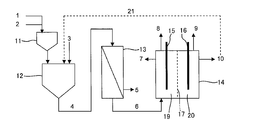
- FIG. 1 is a schematic diagram which shows the one aspect
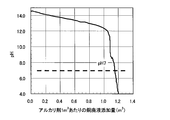
- 2 is a graph showing a neutralization curve of a copper chloride etching waste liquid and a sodium hydroxide aqueous solution in Example 1.
- the recovery method of the present invention In the treatment process by the copper recovery method from the copper chloride-containing acidic waste liquid of the present invention (hereinafter referred to as “the recovery method of the present invention”), an excess amount of sodium relative to the neutralization equivalent of the copper chloride-containing acidic waste liquid to be treated A copper chloride-containing acidic waste liquid is gradually poured into a mixed reaction tank to which a hydroxide or carbonate solution (hereinafter also referred to as an alkaline solution) is supplied, and contains a solid containing copper oxide as a main component. A suspension is produced.
- a hydroxide or carbonate solution hereinafter also referred to as an alkaline solution
- the recovery method of the present invention it is basically important to neutralize the copper chloride-containing acidic waste solution and the alkaline solution on the alkali side from the neutralization point. Therefore, in order to carry out the recovery method of the present invention, neutralization is carried out in an excess of alkaline solution, for example, about 1.2 times the neutralization equivalent, so that the alkaline solution is in excess. It is necessary to add the copper chloride-containing acidic waste liquid (and the oxidizing agent) gradually to the alkaline solution with sufficient stirring. In addition, it is necessary that the alkaline solution is always in excess of the neutralization equivalent during the reaction.
- the copper chloride-containing acidic waste liquid to be treated and the alkaline solution to be used are tested in advance, and the amount of the alkaline solution is examined with respect to the amount of copper chloride-containing acidic waste liquid to be treated. It is preferable.
- the copper chloride-containing acidic waste liquid to be treated by the recovery method of the present invention is an acidic waste liquid containing copper and chlorine in an ionic state, and the copper ion concentration and chloride ion concentration are not particularly limited.
- Specific examples of the copper chloride-containing acidic waste liquid that can be particularly suitably treated by the recovery method of the present invention include etching waste liquid that is generated when a copper printed board is etched with a cupric chloride etchant.
- sodium hydroxide or carbonate can be used as the alkaline agent used for preparing the alkaline solution in the recovery method of the present invention, and the form thereof may be solid or liquid. This is because when a copper chloride-containing acidic waste solution is treated with sodium hydroxide or carbonate, a high-concentration saline solution is formed after the reaction is completed. Therefore, the substance produced by electrolytic treatment of this high-concentration salt solution is hydroxylated. This is because it can be used as a raw material for sodium or sodium hypochlorite.
- the solid alkali for example, granular sodium hydroxide or sodium carbonate
- the solid alkaline agent may be dissolved in water or the like before being supplied to the mixing reaction tank, or supplied as a solid in the mixing reaction tank and dissolved in the mixing reaction tank. You may let them. It is also possible to use a sodium hydroxide solution generated by electrolytic treatment of high-concentration saline.
- the water for dissolving the solid alkaline agent a separation liquid separated from the solid by solid-liquid separation, a washing waste water generated by the washing treatment of the separated solid, and the like can be used.
- an alkaline solution is used as an alkaline agent, there are advantages in terms of handling such as easy adjustment control of the amount of alkaline agent to be used, easy replenishment of chemicals, and no dissolution operation. is there.
- the copper chloride-containing acidic waste liquid contains chloride ions in addition to copper ions. Therefore, when copper chloride-containing acidic waste liquid is added to a sodium hydroxide or carbonate solution, anions (chloride ions) in the copper chloride-containing acidic waste liquid react with sodium ions in the alkaline solution to form sodium chloride. To do.
- the waste liquid contains about 200 to 300 g / L of chloride ions.
- the supernatant of the copper oxide slurry may contain about 100 g / L of chloride ions. This is about 170 g / L in terms of salt concentration. Therefore, when the supernatant is separated from the copper oxide slurry in the copper oxide slurry washing step, about 170 g / L of saline is generated.
- the high-concentration salt generated in the present invention is used to treat and further effectively use the high-concentration salt water.
- Electrolyze water Although various forms are proposed as an electrolytic cell, it will not specifically limit if it is an electrolytic cell of the system which can electrolyze a salt solution, It is preferable to select according to the utilization form of the product after electrolytic treatment.
- high-concentration saline is supplied to the anode chamber and subjected to electrolytic treatment.
- sodium ions in the saline solution pass through the ion exchange membrane and move to the cathode side.
- chloride ions do not pass through the diaphragm but are oxidized at the anode and released as chlorine gas. For this reason, the treated water having a reduced salt concentration is discharged from the anode chamber.
- Pure water is supplied to the cathode chamber, and hydrogen ions are reduced at the cathode to become hydrogen gas, and hydroxide ions are present. Since hydroxide ions do not pass through the diaphragm, the liquidity becomes alkaline in the presence of sodium ions that have moved to the cathode chamber. In the entire cathode chamber, hydrogen gas is generated and the sodium hydroxide solution is discharged. Since the sodium hydroxide solution generated in the cathode chamber can be used for the treatment reaction of the copper chloride-containing acidic waste liquid, it can be expected to reduce the cost of purchasing the alkaline agent.
- high-concentration saline is supplied to the anode chamber and subjected to electrolytic treatment.
- chloride ions in high-concentration saline are oxidized to chlorine gas.
- the high-concentration saline supplied to the anode chamber passes through the porous membrane and moves to the cathode chamber.
- the cathode chamber the water in the saline solution that has flowed in is reduced at the cathode, and hydrogen gas and hydroxide ions are generated. Accordingly, hydrogen gas is generated in the entire cathode chamber, and the sodium hydroxide solution is discharged.
- the sodium hydroxide solution discharged from the cathode chamber of the porous membrane electrolytic cell contains sodium chloride.
- separation operation of salt may be needed.
- Both the ion exchange membrane electrolytic cell and the porous membrane electrolytic cell generate chlorine gas from the anode chamber and hydrogen gas from the cathode chamber when high-concentration saline is electrolyzed. Since it is dangerous to release these as they are, for example, a facility for mixing and burning the generated chlorine gas and hydrogen gas can be provided and recovered as hydrochloric acid. There are many cases where pH adjustment is required in the treatment of factory wastewater, and if the recovered hydrochloric acid is used for pH adjustment, it can contribute to the reduction of the amount of chemicals used in the factory.
- an electrolytic cell having no diaphragm can be used.
- the supplied high-concentration saline is electrolyzed, and chloride ions are oxidized to chlorine gas at the anode.
- water is reduced at the cathode, hydrogen gas and hydroxide ions are generated, and a sodium hydroxide solution is generated.
- the chlorine gas generated near the anode and sodium hydroxide generated near the cathode react as shown in the following reaction formula to generate sodium hypochlorite unlike the diaphragm electrolyzer.
- the produced sodium hypochlorite can be used as a disinfectant, it can be used, for example, for sterilization of microorganisms in the effluent discharged from the factory, and suppression of biofouling in the piping.
- the electrolytic treatment of the high-concentration saline discharged from the copper recovery step it is possible to arbitrarily select an electrolysis method according to the form of product reuse.
- a sodium hydroxide aqueous solution in an amount exceeding the neutralization equivalent of the copper chloride etching waste liquid to be treated is prepared and placed in a mixing reaction vessel.
- the copper chloride etching waste liquid is poured into the mixed reaction tank little by little. This addition may be continuous or intermittent, but is preferably intermittent.
- the copper ions in the copper chloride etching waste solution are first changed to copper hydroxide, but then rapidly oxidized in the presence of an oxidizing agent. Change to copper.
- the pH of the suspension in the mixing reaction tank becomes less than 7, and the copper is Cu. It dissolves again in the form of 2+ and the copper concentration in the treated water increases. Since one of the objects of the present invention is removal / recovery of copper from the copper chloride etching waste liquid, such a phenomenon is not preferable. Therefore, it is important to control the pH not to be more acidic than the neutralization point in the reaction system, either temporarily or partially, when adding or mixing the copper chloride etching waste liquid.
- the pH of the mixed reaction tank is measured, and the pH value of the liquid during the reaction is controlled to be higher than 7, preferably 8 or higher, so that the copper is regenerated in the form of Cu 2+. It is desirable to suppress dissolution.
- the neutralization and recovery treatment device for carrying out the recovery method of the present invention includes alkaline solution supply means, copper chloride-containing acidic waste liquid pouring means, and mixing A mixed reaction tank having a means for reacting an alkaline solution and an acidic waste liquid containing copper chloride to produce an alkaline suspension; a solid containing copper oxide as a main component from the alkaline suspension and high-concentration saline And a solid-liquid separation device for separating the high-concentration saline solution; a pipe for introducing the high-concentration saline to the anode chamber; a diaphragm comprising an ion exchange membrane; and a pipe for introducing a sodium hydroxide aqueous solution generated in the cathode chamber to the mixed reaction tank And an apparatus equipped with a tank.
- FIG. 1 schematically shows one embodiment of the recovery device of the present invention.
- the recovery device of the present invention includes a mixing tank 11 for mixing a copper chloride-containing acidic waste liquid 1 and an oxidant 2, a mixed solution of a copper chloride-containing acidic waste liquid 1 and an oxidant 2, and an alkaline solution 3.
- the copper chloride-containing acidic waste liquid 1 and the oxidizer 2 are supplied to the mixing tank 11 and mixed in the mixing tank 11. And the liquid mixture of the copper chloride containing acidic waste liquid 1 and the oxidizing agent 2 is poured little by little into the mixed reaction tank 12 to which the alkaline solution 3 is supplied.
- the alkaline solution 3 and the copper chloride-containing acidic waste liquid react to produce an alkaline suspension.
- the alkaline suspension 4 is transferred to the solid-liquid separator 13, and after the solid-liquid separation in the solid-liquid separator 13, the copper oxide slurry 5 containing copper oxide as a main component is recovered.
- the high-concentration saline 6 generated in the solid-liquid separator 13 is supplied to the electrolytic cell 14.
- a diaphragm 17 is provided in the electrolytic cell 14, and the inside of the electrolytic cell 14 is divided into an anode chamber 19 and a cathode chamber 20 by the diaphragm 17.
- the diaphragm 17 can use an ion exchange membrane or a porous membrane.
- An anode 15 is disposed in the anode chamber 19, and a cathode 16 is disposed in the cathode chamber 20.
- an ion exchange membrane is used for the diaphragm 17
- high-concentration saline is supplied to the anode chamber 19 and subjected to electrolytic treatment.
- sodium ions in the saline solution pass through the ion exchange membrane and move to the cathode chamber 20.
- chloride ions do not pass through the diaphragm 17 but are oxidized at the anode 15 and released as chlorine gas 8. For this reason, desalted water (low-concentration saline) 7 having a reduced salt concentration is discharged from the anode chamber 19. In the cathode chamber 20, water is reduced, and the hydrogen gas 9 and the sodium hydroxide solution 10 are discharged.
- the sodium hydroxide solution 10 can also be supplied to the mixing reaction tank 12 via the sodium hydroxide solution return pipe 21 as indicated by a dotted line.
- an alkaline solution supply means a copper chloride-containing acidic waste liquid pouring means and a mixing means, and the alkaline solution and the copper chloride-containing acidic waste liquid are reacted to be alkaline.
- a mixed reaction tank for producing a suspension; a solid-liquid separation device for separating a solid mainly composed of copper oxide and a high-concentration saline from the alkaline suspension; and a pipe for supplying the high-concentration saline
- an apparatus equipped with is an apparatus equipped with;
- the electrolytic cell for electrolyzing high-concentration saline is composed of a non-diaphragm electrolytic cell 18 having no diaphragm.
- the copper chloride-containing acidic waste liquid 1 and the oxidizing agent 2 are supplied to the mixing tank 11 and mixed in the mixing tank 11.
- the liquid mixture of the copper chloride containing acidic waste liquid 1 and the oxidizing agent 2 is poured little by little into the mixed reaction tank 12 to which the alkaline solution 3 is supplied.
- the alkaline solution 3 and the copper chloride-containing acidic waste liquid react to produce an alkaline suspension.
- the alkaline suspension 4 is transferred to the solid-liquid separator 13, and after the solid-liquid separation in the solid-liquid separator 13, the copper oxide slurry 5 containing copper oxide as a main component is recovered.
- the high-concentration saline solution 6 generated in the solid-liquid separator 13 is supplied to the non-diaphragm electrolytic cell 18.
- the high-concentration saline 6 is supplied to the diaphragm membrane electrolytic cell 18.
- chloride ions are oxidized and chlorine gas 8 is generated.
- water is reduced at the cathode 16 to generate hydrogen gas 9 and sodium hydroxide solution 10. Since there is no diaphragm in the non-diaphragm electrolytic cell 18, the chlorine gas 8 generated in the vicinity of the anode 15 and the sodium hydroxide generated in the vicinity of the cathode 16 react to generate sodium hypochlorite. Since the inside of the diaphragm electrolyzer 18 is under an alkaline condition, the alkaline sodium hypochlorite solution 21 is discharged from the diaphragm electrolyzer 18.
- a product containing copper oxide as a main component can be obtained by adding a copper chloride-containing acidic waste liquid to an alkaline agent.
- electrolytic equipment in the cleaning process for the generated copper oxide, it is possible to effectively use the high-concentration saline solution generated in the cleaning process for copper oxide as a raw material for sodium hydroxide solution or sodium hypochlorite. It becomes.
- Example 1 In Example 1, a copper chloride etching waste solution was used as the copper chloride-containing acidic waste solution, and a sodium hydroxide aqueous solution was used as the alkaline solution. In order to make the pH value in the mixing reaction tank higher than 7 at the end of the treatment (reaction completion), the amount of copper chloride etching waste solution required for neutralizing the 25 wt% aqueous sodium hydroxide solution to pH 7 is reduced to chloride. The copper chloride etching waste liquid was finally supplied to the mixing reaction tank so that the cumulative amount of copper etching waste liquid added was 0.8 equivalent. In addition, the operation of pouring the copper chloride etching waste liquid required for neutralizing the aqueous sodium hydroxide solution into the mixing reaction tank was performed in 8 steps.
- a neutralization treatment test was conducted in order to determine the minimum amount of 25 wt% aqueous sodium hydroxide solution relative to the amount of copper chloride etching waste solution to be treated.
- the copper chloride etching waste solution was added little by little to the 25 wt% aqueous sodium hydroxide solution and the pH relative to the added amount of the copper chloride etching waste solution was measured, a neutralization curve as shown in FIG. 3 was obtained.
- the horizontal axis indicates the amount of copper chloride etching waste liquid added (m 3 ) per 1 m 3 of an alkaline solution composed of a 25 wt% sodium hydroxide aqueous solution
- the vertical axis indicates pH.
- the amount of copper chloride etching waste liquid for neutralizing 1 m 3 of 25 wt% sodium hydroxide aqueous solution to pH 7 was about 1.15 m 3 as shown by the thick dotted line in FIG. . From this result, it was assumed that the mixing ratio for mixing the copper chloride etching waste solution and the 25 wt% sodium hydroxide aqueous solution used in this example to pH 7 was 1.15: 1 in volume ratio.
- a voltage was applied between the electrodes at a current density of 15 A / dm 2 , and the supernatant was supplied to the anode chamber at a flow rate of 165 mL per hour.
- a total of about 118 mL of a 30 wt% aqueous sodium hydroxide solution was recovered from the cathode chamber.
- about 580 mL of saline having a chloride ion concentration of 118 g / L was recovered from the anode chamber.
- about 20 g of chlorine gas was generated from the anode chamber.
- Example 2 a total of 464 mL of copper chloride etching waste liquid was treated under the same conditions as in Example 1. Further, as in the case of Example 1, the obtained suspension containing the black solid was allowed to stand for about 12 hours, and then the supernatant was separated. When 700 mL of the obtained supernatant was analyzed, the pH was 12 and the chloride ion concentration was about 120 g / L. A non-diaphragm electrolytic cell having an electrode area of 50 cm 2 was used for electrolysis of the supernatant.
- a voltage was applied between the electrodes at a current density of 15 A / dm 2 , and the supernatant was supplied to the electrolytic cell at a flow rate of 165 mL per hour.
- a sodium hypochlorite solution having an effective chlorine concentration of about 38 g / L was produced in the effluent from the electrolytic cell. From this result, it was possible to recover the sodium hypochlorite solution by subjecting the high-concentration saline generated from the copper chloride etching waste solution treatment to electroless membrane electrolysis.
- the present invention it is possible to produce and recover a sodium hydroxide solution required for the treatment of copper chloride-containing acidic waste liquid by electrolyzing high-concentration saline generated in treating the copper chloride-containing acidic waste liquid. At the same time, the chloride ion concentration in the waste water can be reduced. Moreover, a sodium hypochlorite solution can be collect
- the present invention provides, for example, an etching waste liquid generated when etching a copper printed board with a cupric chloride etchant, a renewed waste liquid of a plating bath liquid in the production of an electrolytic copper foil, and a substrate surface in a laminating process when producing a multilayer printed board.
- the present invention is applicable to a treatment method in which a copper chloride-containing acidic waste liquid containing high-concentration copper ions such as an etching waste liquid generated in the roughening treatment is neutralized, and copper is removed from the solution and recovered.
- this invention can be utilized for the processing method of the high concentration salt water generated after removing copper from the said copper chloride containing acidic waste liquid.
Landscapes
- Chemical & Material Sciences (AREA)
- Engineering & Computer Science (AREA)
- Chemical Kinetics & Catalysis (AREA)
- Electrochemistry (AREA)
- Materials Engineering (AREA)
- Metallurgy (AREA)
- Organic Chemistry (AREA)
- Water Treatment By Electricity Or Magnetism (AREA)
- Manufacture And Refinement Of Metals (AREA)
- Electrolytic Production Of Non-Metals, Compounds, Apparatuses Therefor (AREA)
- Removal Of Specific Substances (AREA)
Abstract
Cette invention concerne un procédé et un appareil de traitement pour neutraliser les résidus liquides acides contenant du chlorure de cuivre qui contiennent des ions cuivre à des concentrations élevées, lesdits résidus liquides acides contenant du chlorure de cuivre comprenant le résidu liquide régénéré issu de la solution de bain de placage utilisée pour fabriquer une feuille d'aluminium électrolytique, et le résidu liquide de gravure généré lors de la gravure de cartes de circuits imprimés en cuivre à l'aide d'un agent de gravure de type chlorure cuprique, puis séparer et récupérer le cuivre à partir de la solution obtenue, le procédé de traitement selon la présente invention consistant à : verser et mélanger le résidu liquide acide contenant du chlorure de cuivre dans une solution d'hydroxyde de sodium ou un carbonate ayant un volume au moins suffisant pour neutraliser ledit résidu liquide acide contenant du chlorure de cuivre et générer une suspension contenant des fractions solides principalement composées d'oxyde de cuivre ; puis séparer les fractions solides principalement composées d'oxyde de cuivre de la suspension, et les récupérer. Une saumure de concentration élevée obtenue après que les fractions solides ont été séparées est acheminée jusqu'à la chambre anodique d'un bain électrolytique pourvu d'un diaphragme, et soumise à électrolyse.
Applications Claiming Priority (2)
| Application Number | Priority Date | Filing Date | Title |
|---|---|---|---|
| JP2012-118368 | 2012-05-24 | ||
| JP2012118368A JP2013244430A (ja) | 2012-05-24 | 2012-05-24 | 塩化銅含有酸性廃液の処理方法及び装置 |
Publications (1)
| Publication Number | Publication Date |
|---|---|
| WO2013176111A1 true WO2013176111A1 (fr) | 2013-11-28 |
Family
ID=49623801
Family Applications (1)
| Application Number | Title | Priority Date | Filing Date |
|---|---|---|---|
| PCT/JP2013/064040 Ceased WO2013176111A1 (fr) | 2012-05-24 | 2013-05-21 | Procédé et appareil de traitement de résidus liquides acides contenant du chlorure de cuivre |
Country Status (2)
| Country | Link |
|---|---|
| JP (1) | JP2013244430A (fr) |
| WO (1) | WO2013176111A1 (fr) |
Cited By (7)
| Publication number | Priority date | Publication date | Assignee | Title |
|---|---|---|---|---|
| CN107662988A (zh) * | 2016-07-30 | 2018-02-06 | 湖北永绍科技股份有限公司 | 一种酸性蚀刻废液的处理方法 |
| CN109354078A (zh) * | 2018-02-05 | 2019-02-19 | 蔡智 | 一种高纯度净水剂的生产方法及其设备 |
| CN110697998A (zh) * | 2019-11-12 | 2020-01-17 | 东江环保股份有限公司 | 氧化铜生产废水的处理方法 |
| CN112807949A (zh) * | 2020-08-13 | 2021-05-18 | 佰仕邦水处理环保科技(大连)有限公司 | 一种处理溶液中的低浓度酸和/或酸根的工艺 |
| CN114016034A (zh) * | 2021-11-04 | 2022-02-08 | 兴平市秦兴环保科技有限公司 | 一种刻蚀废液混酸的回收再利用处理方法 |
| CN119219127A (zh) * | 2024-07-23 | 2024-12-31 | 南方科技大学 | 一种酸性废水的组合处理方法 |
| CN119956087A (zh) * | 2025-02-17 | 2025-05-09 | 盛隆资源再生(无锡)有限公司 | 一种含铜、铁蚀刻废液回收处理的方法 |
Families Citing this family (1)
| Publication number | Priority date | Publication date | Assignee | Title |
|---|---|---|---|---|
| CN112125449B (zh) * | 2020-09-21 | 2022-09-06 | 深圳市祺鑫环保科技有限公司 | 棕化废液的处理方法 |
Citations (5)
| Publication number | Priority date | Publication date | Assignee | Title |
|---|---|---|---|---|
| JPH0489315A (ja) * | 1990-07-30 | 1992-03-23 | Toagosei Chem Ind Co Ltd | 塩酸含有塩化銅水溶液から硫酸銅及び塩化アルカリを回収する方法 |
| JPH06340990A (ja) * | 1993-02-12 | 1994-12-13 | De Nora Permelec Spa | 塩素−アルカリ電解用の多孔質隔膜を有する改良されたセルおよびそれを使用する方法 |
| JP2000126773A (ja) * | 1998-10-22 | 2000-05-09 | Hitachi Ltd | 次亜塩素酸塩溶液の製造設備及び水処理設備 |
| JP2010059521A (ja) * | 2008-09-05 | 2010-03-18 | Ebara Engineering Service Co Ltd | 銅含有酸性廃液からの銅の除去回収方法及び装置 |
| JP2010180102A (ja) * | 2009-02-06 | 2010-08-19 | Tosoh Corp | 食塩水の精製方法 |
-
2012
- 2012-05-24 JP JP2012118368A patent/JP2013244430A/ja active Pending
-
2013
- 2013-05-21 WO PCT/JP2013/064040 patent/WO2013176111A1/fr not_active Ceased
Patent Citations (5)
| Publication number | Priority date | Publication date | Assignee | Title |
|---|---|---|---|---|
| JPH0489315A (ja) * | 1990-07-30 | 1992-03-23 | Toagosei Chem Ind Co Ltd | 塩酸含有塩化銅水溶液から硫酸銅及び塩化アルカリを回収する方法 |
| JPH06340990A (ja) * | 1993-02-12 | 1994-12-13 | De Nora Permelec Spa | 塩素−アルカリ電解用の多孔質隔膜を有する改良されたセルおよびそれを使用する方法 |
| JP2000126773A (ja) * | 1998-10-22 | 2000-05-09 | Hitachi Ltd | 次亜塩素酸塩溶液の製造設備及び水処理設備 |
| JP2010059521A (ja) * | 2008-09-05 | 2010-03-18 | Ebara Engineering Service Co Ltd | 銅含有酸性廃液からの銅の除去回収方法及び装置 |
| JP2010180102A (ja) * | 2009-02-06 | 2010-08-19 | Tosoh Corp | 食塩水の精製方法 |
Cited By (8)
| Publication number | Priority date | Publication date | Assignee | Title |
|---|---|---|---|---|
| CN107662988A (zh) * | 2016-07-30 | 2018-02-06 | 湖北永绍科技股份有限公司 | 一种酸性蚀刻废液的处理方法 |
| CN109354078A (zh) * | 2018-02-05 | 2019-02-19 | 蔡智 | 一种高纯度净水剂的生产方法及其设备 |
| CN110697998A (zh) * | 2019-11-12 | 2020-01-17 | 东江环保股份有限公司 | 氧化铜生产废水的处理方法 |
| CN112807949A (zh) * | 2020-08-13 | 2021-05-18 | 佰仕邦水处理环保科技(大连)有限公司 | 一种处理溶液中的低浓度酸和/或酸根的工艺 |
| CN114016034A (zh) * | 2021-11-04 | 2022-02-08 | 兴平市秦兴环保科技有限公司 | 一种刻蚀废液混酸的回收再利用处理方法 |
| CN119219127A (zh) * | 2024-07-23 | 2024-12-31 | 南方科技大学 | 一种酸性废水的组合处理方法 |
| WO2026021045A1 (fr) * | 2024-07-23 | 2026-01-29 | 南方科技大学 | Procédé de traitement combiné d'eaux usées acides |
| CN119956087A (zh) * | 2025-02-17 | 2025-05-09 | 盛隆资源再生(无锡)有限公司 | 一种含铜、铁蚀刻废液回收处理的方法 |
Also Published As
| Publication number | Publication date |
|---|---|
| JP2013244430A (ja) | 2013-12-09 |
Similar Documents
| Publication | Publication Date | Title |
|---|---|---|
| WO2013176111A1 (fr) | Procédé et appareil de traitement de résidus liquides acides contenant du chlorure de cuivre | |
| JP5102157B2 (ja) | 銅含有酸性廃液からの銅の除去回収方法及び装置 | |
| JP6223442B2 (ja) | 金属塩溶液から塩酸を生成又は回収するための方法及び装置 | |
| TWI423935B (zh) | 從含有銅之酸性廢液去除回收銅的方法與裝置,及含銅物的製造方法 | |
| US20170107137A1 (en) | Resource reuse-type industrial waste water treatment method and apparatus utilizing oxidizing agent generated by utilizing waste water | |
| CN111560615B (zh) | 一种酸性蚀刻废液在线回收铜、氯气及蚀刻液再生的方法 | |
| CN104903248B (zh) | 处理工业水的方法 | |
| WO2012098924A1 (fr) | Appareil, procédé et système de traitement des eaux usées | |
| CN105621764B (zh) | 一种环氧氯丙烷生产废水的处理工艺 | |
| WO2008005641A2 (fr) | formulation de solutions électrolytiques pour des générateurs électrochimiques de dioxyde de chlore | |
| CN106414781B (zh) | 含铜酸性废液的处理方法 | |
| JP2018035024A (ja) | 次亜塩素酸ソーダの製造方法及び次亜塩素酸ソーダの製造装置 | |
| CN100389076C (zh) | 一种电解法降解废水中苯胺或/和硝基苯的方法 | |
| Ozturk | Electrochemical advanced oxidation for removal of xanthate from flotation process water | |
| JP2021070861A (ja) | マグネシウムの回収方法およびマグネシウム回収装置 | |
| CN106637215B (zh) | 一种线路板酸性蚀刻废液资源电解氧化剂回用方法 | |
| JP5965213B2 (ja) | 銅含有酸性廃液からの酸化銅の回収方法及び装置 | |
| JP2014012880A (ja) | 無電解銅めっき廃液を処理する方法およびその装置 | |
| JP5808132B2 (ja) | 銅含有酸性廃液の処理・回収法およびそのための装置 | |
| JP5689954B2 (ja) | プロセス水を生成するために未処理の塩水を処理する方法、それによって生成されるプロセス水、および前記方法を行うための装置 | |
| CN108545803B (zh) | 一种光促破络复合药剂与uv联用降解铜络合物并同步除铜的方法 | |
| JP2008162823A (ja) | 銅エッチング廃液から酸化第2銅を製造する方法 | |
| CN113697905A (zh) | 一种同步处理综合废水的方法 | |
| JP2024101218A (ja) | マグネシウムの回収方法およびマグネシウム回収装置 | |
| JP2008149222A (ja) | 温泉水中のフッ素イオン除去方法 |
Legal Events
| Date | Code | Title | Description |
|---|---|---|---|
| 121 | Ep: the epo has been informed by wipo that ep was designated in this application |
Ref document number: 13794012 Country of ref document: EP Kind code of ref document: A1 |
|
| NENP | Non-entry into the national phase |
Ref country code: DE |
|
| 122 | Ep: pct application non-entry in european phase |
Ref document number: 13794012 Country of ref document: EP Kind code of ref document: A1 |