WO2013178721A1 - Vinylacetat-copolymere für hydraulisch abbindende baustoffmassen - Google Patents
Vinylacetat-copolymere für hydraulisch abbindende baustoffmassen Download PDFInfo
- Publication number
- WO2013178721A1 WO2013178721A1 PCT/EP2013/061137 EP2013061137W WO2013178721A1 WO 2013178721 A1 WO2013178721 A1 WO 2013178721A1 EP 2013061137 W EP2013061137 W EP 2013061137W WO 2013178721 A1 WO2013178721 A1 WO 2013178721A1
- Authority
- WO
- WIPO (PCT)
- Prior art keywords
- vinyl acetate
- weight
- acetate copolymers
- ethylenically unsaturated
- vinyl
- Prior art date
- Legal status (The legal status is an assumption and is not a legal conclusion. Google has not performed a legal analysis and makes no representation as to the accuracy of the status listed.)
- Ceased
Links
Classifications
-
- C—CHEMISTRY; METALLURGY
- C04—CEMENTS; CONCRETE; ARTIFICIAL STONE; CERAMICS; REFRACTORIES
- C04B—LIME, MAGNESIA; SLAG; CEMENTS; COMPOSITIONS THEREOF, e.g. MORTARS, CONCRETE OR LIKE BUILDING MATERIALS; ARTIFICIAL STONE; CERAMICS; REFRACTORIES; TREATMENT OF NATURAL STONE
- C04B26/00—Compositions of mortars, concrete or artificial stone, containing only organic binders, e.g. polymer or resin concrete
- C04B26/02—Macromolecular compounds
- C04B26/04—Macromolecular compounds obtained by reactions only involving carbon-to-carbon unsaturated bonds
- C04B26/08—Macromolecular compounds obtained by reactions only involving carbon-to-carbon unsaturated bonds containing halogen
-
- C—CHEMISTRY; METALLURGY
- C04—CEMENTS; CONCRETE; ARTIFICIAL STONE; CERAMICS; REFRACTORIES
- C04B—LIME, MAGNESIA; SLAG; CEMENTS; COMPOSITIONS THEREOF, e.g. MORTARS, CONCRETE OR LIKE BUILDING MATERIALS; ARTIFICIAL STONE; CERAMICS; REFRACTORIES; TREATMENT OF NATURAL STONE
- C04B24/00—Use of organic materials as active ingredients for mortars, concrete or artificial stone, e.g. plasticisers
- C04B24/24—Macromolecular compounds
- C04B24/26—Macromolecular compounds obtained by reactions only involving carbon-to-carbon unsaturated bonds
- C04B24/2623—Polyvinylalcohols; Polyvinylacetates
-
- C—CHEMISTRY; METALLURGY
- C04—CEMENTS; CONCRETE; ARTIFICIAL STONE; CERAMICS; REFRACTORIES
- C04B—LIME, MAGNESIA; SLAG; CEMENTS; COMPOSITIONS THEREOF, e.g. MORTARS, CONCRETE OR LIKE BUILDING MATERIALS; ARTIFICIAL STONE; CERAMICS; REFRACTORIES; TREATMENT OF NATURAL STONE
- C04B24/00—Use of organic materials as active ingredients for mortars, concrete or artificial stone, e.g. plasticisers
- C04B24/24—Macromolecular compounds
- C04B24/26—Macromolecular compounds obtained by reactions only involving carbon-to-carbon unsaturated bonds
- C04B24/2688—Copolymers containing at least three different monomers
-
- C—CHEMISTRY; METALLURGY
- C04—CEMENTS; CONCRETE; ARTIFICIAL STONE; CERAMICS; REFRACTORIES
- C04B—LIME, MAGNESIA; SLAG; CEMENTS; COMPOSITIONS THEREOF, e.g. MORTARS, CONCRETE OR LIKE BUILDING MATERIALS; ARTIFICIAL STONE; CERAMICS; REFRACTORIES; TREATMENT OF NATURAL STONE
- C04B28/00—Compositions of mortars, concrete or artificial stone, containing inorganic binders or the reaction product of an inorganic and an organic binder, e.g. polycarboxylate cements
- C04B28/02—Compositions of mortars, concrete or artificial stone, containing inorganic binders or the reaction product of an inorganic and an organic binder, e.g. polycarboxylate cements containing hydraulic cements other than calcium sulfates
-
- C—CHEMISTRY; METALLURGY
- C08—ORGANIC MACROMOLECULAR COMPOUNDS; THEIR PREPARATION OR CHEMICAL WORKING-UP; COMPOSITIONS BASED THEREON
- C08F—MACROMOLECULAR COMPOUNDS OBTAINED BY REACTIONS ONLY INVOLVING CARBON-TO-CARBON UNSATURATED BONDS
- C08F218/00—Copolymers of compounds having one or more unsaturated aliphatic radicals, each having only one carbon-to-carbon double bond, and at least one being terminated by an acyloxy radical of a saturated carboxylic acid, of carbonic acid or of a haloformic acid
- C08F218/02—Esters of monocarboxylic acids
- C08F218/04—Vinyl esters
- C08F218/08—Vinyl acetate
-
- C—CHEMISTRY; METALLURGY
- C08—ORGANIC MACROMOLECULAR COMPOUNDS; THEIR PREPARATION OR CHEMICAL WORKING-UP; COMPOSITIONS BASED THEREON
- C08J—WORKING-UP; GENERAL PROCESSES OF COMPOUNDING; AFTER-TREATMENT NOT COVERED BY SUBCLASSES C08B, C08C, C08F, C08G or C08H
- C08J3/00—Processes of treating or compounding macromolecular substances
-
- C—CHEMISTRY; METALLURGY
- C08—ORGANIC MACROMOLECULAR COMPOUNDS; THEIR PREPARATION OR CHEMICAL WORKING-UP; COMPOSITIONS BASED THEREON
- C08J—WORKING-UP; GENERAL PROCESSES OF COMPOUNDING; AFTER-TREATMENT NOT COVERED BY SUBCLASSES C08B, C08C, C08F, C08G or C08H
- C08J3/00—Processes of treating or compounding macromolecular substances
- C08J3/02—Making solutions, dispersions, lattices or gels by other methods than by solution, emulsion or suspension polymerisation techniques
- C08J3/03—Making solutions, dispersions, lattices or gels by other methods than by solution, emulsion or suspension polymerisation techniques in aqueous media
- C08J3/05—Making solutions, dispersions, lattices or gels by other methods than by solution, emulsion or suspension polymerisation techniques in aqueous media from solid polymers
-
- C—CHEMISTRY; METALLURGY
- C04—CEMENTS; CONCRETE; ARTIFICIAL STONE; CERAMICS; REFRACTORIES
- C04B—LIME, MAGNESIA; SLAG; CEMENTS; COMPOSITIONS THEREOF, e.g. MORTARS, CONCRETE OR LIKE BUILDING MATERIALS; ARTIFICIAL STONE; CERAMICS; REFRACTORIES; TREATMENT OF NATURAL STONE
- C04B2111/00—Mortars, concrete or artificial stone or mixtures to prepare them, characterised by specific function, property or use
- C04B2111/00474—Uses not provided for elsewhere in C04B2111/00
- C04B2111/00482—Coating or impregnation materials
- C04B2111/00517—Coating or impregnation materials for masonry
-
- C—CHEMISTRY; METALLURGY
- C04—CEMENTS; CONCRETE; ARTIFICIAL STONE; CERAMICS; REFRACTORIES
- C04B—LIME, MAGNESIA; SLAG; CEMENTS; COMPOSITIONS THEREOF, e.g. MORTARS, CONCRETE OR LIKE BUILDING MATERIALS; ARTIFICIAL STONE; CERAMICS; REFRACTORIES; TREATMENT OF NATURAL STONE
- C04B2111/00—Mortars, concrete or artificial stone or mixtures to prepare them, characterised by specific function, property or use
- C04B2111/00474—Uses not provided for elsewhere in C04B2111/00
- C04B2111/00637—Uses not provided for elsewhere in C04B2111/00 as glue or binder for uniting building or structural materials
-
- C—CHEMISTRY; METALLURGY
- C04—CEMENTS; CONCRETE; ARTIFICIAL STONE; CERAMICS; REFRACTORIES
- C04B—LIME, MAGNESIA; SLAG; CEMENTS; COMPOSITIONS THEREOF, e.g. MORTARS, CONCRETE OR LIKE BUILDING MATERIALS; ARTIFICIAL STONE; CERAMICS; REFRACTORIES; TREATMENT OF NATURAL STONE
- C04B2111/00—Mortars, concrete or artificial stone or mixtures to prepare them, characterised by specific function, property or use
- C04B2111/00474—Uses not provided for elsewhere in C04B2111/00
- C04B2111/00663—Uses not provided for elsewhere in C04B2111/00 as filling material for cavities or the like
- C04B2111/00672—Pointing or jointing materials
-
- C—CHEMISTRY; METALLURGY
- C04—CEMENTS; CONCRETE; ARTIFICIAL STONE; CERAMICS; REFRACTORIES
- C04B—LIME, MAGNESIA; SLAG; CEMENTS; COMPOSITIONS THEREOF, e.g. MORTARS, CONCRETE OR LIKE BUILDING MATERIALS; ARTIFICIAL STONE; CERAMICS; REFRACTORIES; TREATMENT OF NATURAL STONE
- C04B2111/00—Mortars, concrete or artificial stone or mixtures to prepare them, characterised by specific function, property or use
- C04B2111/10—Compositions or ingredients thereof characterised by the absence or the very low content of a specific material
- C04B2111/1006—Absence of well-defined organic compounds
-
- C—CHEMISTRY; METALLURGY
- C04—CEMENTS; CONCRETE; ARTIFICIAL STONE; CERAMICS; REFRACTORIES
- C04B—LIME, MAGNESIA; SLAG; CEMENTS; COMPOSITIONS THEREOF, e.g. MORTARS, CONCRETE OR LIKE BUILDING MATERIALS; ARTIFICIAL STONE; CERAMICS; REFRACTORIES; TREATMENT OF NATURAL STONE
- C04B2111/00—Mortars, concrete or artificial stone or mixtures to prepare them, characterised by specific function, property or use
- C04B2111/60—Flooring materials
- C04B2111/62—Self-levelling compositions
-
- C—CHEMISTRY; METALLURGY
- C04—CEMENTS; CONCRETE; ARTIFICIAL STONE; CERAMICS; REFRACTORIES
- C04B—LIME, MAGNESIA; SLAG; CEMENTS; COMPOSITIONS THEREOF, e.g. MORTARS, CONCRETE OR LIKE BUILDING MATERIALS; ARTIFICIAL STONE; CERAMICS; REFRACTORIES; TREATMENT OF NATURAL STONE
- C04B2111/00—Mortars, concrete or artificial stone or mixtures to prepare them, characterised by specific function, property or use
- C04B2111/70—Grouts, e.g. injection mixtures for cables for prestressed concrete
-
- C—CHEMISTRY; METALLURGY
- C04—CEMENTS; CONCRETE; ARTIFICIAL STONE; CERAMICS; REFRACTORIES
- C04B—LIME, MAGNESIA; SLAG; CEMENTS; COMPOSITIONS THEREOF, e.g. MORTARS, CONCRETE OR LIKE BUILDING MATERIALS; ARTIFICIAL STONE; CERAMICS; REFRACTORIES; TREATMENT OF NATURAL STONE
- C04B2111/00—Mortars, concrete or artificial stone or mixtures to prepare them, characterised by specific function, property or use
- C04B2111/72—Repairing or restoring existing buildings or building materials
-
- C—CHEMISTRY; METALLURGY
- C08—ORGANIC MACROMOLECULAR COMPOUNDS; THEIR PREPARATION OR CHEMICAL WORKING-UP; COMPOSITIONS BASED THEREON
- C08F—MACROMOLECULAR COMPOUNDS OBTAINED BY REACTIONS ONLY INVOLVING CARBON-TO-CARBON UNSATURATED BONDS
- C08F210/00—Copolymers of unsaturated aliphatic hydrocarbons having only one carbon-to-carbon double bond
- C08F210/02—Ethene
-
- C—CHEMISTRY; METALLURGY
- C08—ORGANIC MACROMOLECULAR COMPOUNDS; THEIR PREPARATION OR CHEMICAL WORKING-UP; COMPOSITIONS BASED THEREON
- C08F—MACROMOLECULAR COMPOUNDS OBTAINED BY REACTIONS ONLY INVOLVING CARBON-TO-CARBON UNSATURATED BONDS
- C08F214/00—Copolymers of compounds having one or more unsaturated aliphatic radicals, each having only one carbon-to-carbon double bond, and at least one being terminated by a halogen
- C08F214/02—Monomers containing chlorine
- C08F214/04—Monomers containing two carbon atoms
- C08F214/06—Vinyl chloride
-
- C—CHEMISTRY; METALLURGY
- C08—ORGANIC MACROMOLECULAR COMPOUNDS; THEIR PREPARATION OR CHEMICAL WORKING-UP; COMPOSITIONS BASED THEREON
- C08J—WORKING-UP; GENERAL PROCESSES OF COMPOUNDING; AFTER-TREATMENT NOT COVERED BY SUBCLASSES C08B, C08C, C08F, C08G or C08H
- C08J2331/00—Characterised by the use of copolymers of compounds having one or more unsaturated aliphatic radicals, each having only one carbon-to-carbon double bond, and at least one being terminated by an acyloxy radical of a saturated carboxylic acid, or carbonic acid, or of a haloformic acid
- C08J2331/02—Characterised by the use of omopolymers or copolymers of esters of monocarboxylic acids
- C08J2331/04—Homopolymers or copolymers of vinyl acetate
-
- C—CHEMISTRY; METALLURGY
- C08—ORGANIC MACROMOLECULAR COMPOUNDS; THEIR PREPARATION OR CHEMICAL WORKING-UP; COMPOSITIONS BASED THEREON
- C08J—WORKING-UP; GENERAL PROCESSES OF COMPOUNDING; AFTER-TREATMENT NOT COVERED BY SUBCLASSES C08B, C08C, C08F, C08G or C08H
- C08J2429/00—Characterised by the use of homopolymers or copolymers of compounds having one or more unsaturated aliphatic radicals, each having only one carbon-to-carbon double bond, and at least one being terminated by an alcohol, ether, aldehydo, ketonic, acetal, or ketal radical; Hydrolysed polymers of esters of unsaturated alcohols with saturated carboxylic acids; Derivatives of such polymer
- C08J2429/02—Homopolymers or copolymers of unsaturated alcohols
- C08J2429/04—Polyvinyl alcohol; Partially hydrolysed homopolymers or copolymers of esters of unsaturated alcohols with saturated carboxylic acids
Definitions
- the invention relates to vinyl acetate copolymers, processes for their preparation and building materials containing hydraulically setting binders, fillers and vinyl acetate copolymers and their use, for example, as adhesive mortar, such as tile ⁇ adhesive for ceramic tiles.
- adhesive mortar such as tile ⁇ adhesive for ceramic tiles.
- the requirements for hydraulically setting building materials, such as tile adhesive have become increasingly high in recent years.
- EN12004 describes the different grades of cementitious tile adhesives.
- high-quality adhesives are identified by the abbreviation C2.
- C stands for cementitious adhesives and 2 stands for an adhesive tensile strength of at least 1.0 N / mm 2 after various supports (determined to EN1348).
- the difficulty in practice is to provide hydraulically setting building materials which, after application to a substrate, show high adhesive tensile strengths both after water storage and after heat load.
- high adhesion tensile strengths after water storage typically hydrophobic copolymers such as copolymers of vinyl acetate, VeovalO, butyl acrylate or ethylene are used.
- the ⁇ type copolymers having a relatively low glass transition temperature Tg of ⁇ 10 ° C do not show sufficient performance after thermal stress.
- copolymers of, for example, vinyl acetate and VeovalO or copolymers of vinyl acetate and ethylene with a low ethylene content and a glass transition temperature Tg of> 10 ° C although good values for adhesive tensile strengths after heat stress, but are very prone to water storage and thus do not meet the required standard.
- EP1262465 describes a complex vinyl acetate, ethylene and methyl methacrylate copolymer to be prepared in two stages by first polymerizing vinyl acetate with ethylene and then methyl methacrylate.
- Hydraulically setting building materials are bulk goods that are subject to increasing economic pressure. These economic requirements can not meet expensive monomer, such as methyl methacrylate, butyl acrylate or VeovalO, or elaborate Her ⁇ alternate method.
- expensive monomer such as methyl methacrylate, butyl acrylate or VeovalO, or elaborate Her ⁇ alternate method.
- the task of building materials ent ⁇ holding hydraulically setting binders, in particular Mor ⁇ telzusammen stuen provide with which the C2 standard can be met according to EN12004, and overcome the disadvantages of the prior art was.
- this object was ge solves ⁇ with building compositions containing vinyl acetate copolymers based on 40 to 80 wt .-% vinyl acetate, 15 to 35 wt .-% of vinyl chloride, 1 to 25 wt .-% of ethylene and, optionally, further ethylenically unsaturated comonomers , On some occasions, copolymers of vinyl chloride and ethylene as well as vinyl acetate have been described. So recommends the
- WO05118684 the use of copolymers of vinyl chloride and ethylene in the form of redispersible powders for Fassadenbe- layers such as Skim Coats.
- Skim coats are thin coatings with layer thicknesses of a few millimeters and correspondingly low binding force requirements.
- the EP0149098 describes redispersible dispersion powders based on copolymers of ethylene and other monomers, the other monomers are at least 60% of vinyl chloride be ⁇ .
- the adhesive tensile strengths of at least 1.0 N / mm 2 required in the C2 standard are not satisfactorily fulfilled.
- Regarding the tensile bond strength after heat aging were not taken any off ⁇ say.
- the dispersion powder Elotex 10184 contains a terpolymer based on vinyl acetate, ethylene and 10 weight percent Ge ⁇ vinyl chloride. Also, such polymers are the on ⁇ requirements of the C2 norm of EN12004 not fair.
- the invention provides vinyl acetate copolymers obtainable by free-radically initiated polymerization of ethylenically unsaturated monomers in an aqueous medium, characterized in that in the polymerization as ethylenically unsaturated monomers 40 to 80 wt .-% vinyl acetate, 15 to 35 wt .-% vinyl chloride , 1 to 25 wt .-% of ethylene and optionally one or more further ethylenically unsaturated comonomers incorporated ⁇ be set, where the figures in wt .-% based on the total weight of all ⁇ ethylenically unsaturated monomers and weight on 100th - Add up%.
- the vinyl acetate copolymers are preferably based on 50 to 75% by weight of vinyl acetate, 20 to 30% by weight of vinyl chloride and 5 to 20% by weight of ethylene; wherein the amounts in wt .-% based on the overall of the ethylenically ungesquestionedtig ⁇ th total monomers used felif relate.
- Examples of other comonomers are Vinylester of Carbon Text ⁇ ren having 3 to 15 carbon atoms, esters of acrylic acid or methacrylic acid, and ethylene from various olefins such as propylene.
- Preferred vinyl esters of carboxylic acids having 3 to 15 C atoms are vinyl propionate, vinyl butyrate, vinyl 2-ethylhexanoate, vinyl laurate, 1-methylvinyl acetate, vinyl pivalate and vinyl esters of ⁇ -branched monocarboxylic acids having 9 to 11 C atoms, for example VeoVa9R or VeoValOR (trade name of Hexi ⁇ on).
- esters of acrylic acid or methacrylic acid are triacrylate at ⁇ play, esters of unbranched or branched alcohols having 1 to 15 carbon atoms, such as methyl acrylate, methyl methacrylate, ethyl acrylate, ethyl methacrylate, propyl acrylate, Propylmethac-, n-butyl acrylate, n-butyl methacrylate, 2-ethylhexyl acrylate , Norbornyl acrylate. Methyl acrylate, Methylmethacry ⁇ methacrylate, n-butyl acrylate and 2-ethylhexyl acrylate are preferred.
- Preferred further comonomers are vinyl esters of carboxylic acids having 3 to 15 carbon atoms.
- the other comonomers are preferably used at 0 to 10 wt .-%, based on the total weight of the total ⁇ set ethylenically unsaturated monomers.
- the other comonomers preferably comprise less than 5 wt .-%, particularly preferably less than 2.5 wt .-% and still more preferably Weni ⁇ ger than 1 wt .-% esters of acrylic acid or methacrylic acid, each based on the total weight of the total used ethylenically unsaturated monomers.
- the vinyl acetate copolymers do not contain a monomer unit of an ester of acrylic acid or methacrylic acid. Most preferably, no further comonomers are used.
- auxiliary monomers are copolymerized.
- auxiliary monomers are ethylenically unsaturated mono- and dicarboxylic acids, preferably acrylic acid, methacrylic acid, fumaric acid and maleic acid; ethylenically unsaturated carboxylic acid amides and nitriles, preferably acrylamide and acrylonitrile; Mono- and diesters of fumaric acid and maleic acid, such as diethyl and diisopropyl esters, and also maleic anhydride, ethylenically unsaturated sulfonic acids or salts thereof, preferably vinylsulfonic acid, 2-acrylamido-2-methylpropanesulfonic acid.
- mono- and diesters of fumaric acid and maleic acid such as diethyl and diisopropyl esters, and also maleic anhydride, ethylenically unsaturated sulfonic acids or salts thereof, preferably vinylsulfonic acid, 2-acrylamido-2-methylpropanesulfonic acid.
- diallyl are maleate, allyl methacrylate or triallyl cyanurate, or renegotiations wetting comonomers, for example acrylamidoglycolic acid (A-GA), methyl methylacrylamidoglycolate (MAGME), N-methylolacrylamide (NMA), N-methylolmethacrylamide (NMMA), N-methylolallyl carbamate, alkyl ethers such as the isobutoxy ether or esters of N-methylolacrylamide, N-methylolmethacrylamide and N-methylolallylcarbamate.
- A-GA acrylamidoglycolic acid
- MAGME methyl methylacrylamidoglycolate
- NMA N-methylolacrylamide
- NMMA N-methylolmethacrylamide
- alkyl ethers such as the isobutoxy ether or esters of N-methylolacrylamide, N-methylolmethacrylamide and N-methylolallylcarbamate.
- epoxy-functional comonomers such as glycidyl methacrylate and glycidyl acrylate.
- silicon-functional comonomers such as acryloxypropyltri (alkoxy) and methacryloxypropyltri (alkoxy) silanes, vinyltrialkoxysilanes and vinylmethyldialkoxysilanes, where as alkoxy groups, for example, methoxy,
- Ethoxy and Ethoxypropylenglykolether residues may be contained Kings ⁇ nen. Mention may also be made of monomers having hydroxyl or CO groups, for example methacrylic acid and acrylic acid hydroxyalkyl esters such as hydroxyethyl, hydroxypropyl or hydroxybutyl acrylate or methacrylate, and also compounds such as diacetone acrylamide and acetoacetoxyethyl acrylate or methacrylate.
- preferred vinyl acetate copolymers according to the invention do not contain (meth) acrylic acid unit and / or any unit ei ⁇ nes (meth) acrylic acid derivative such as the silicon above functional comonomers or carbonitriles or insbeson particular carboxylic acid amides, sulfonic acids, epoxy-functional Como ⁇ nomere, (meth) acrylates or Acetylacetoxy- ethyl (meth) acrylate.
- Preferred vinyl acetate copolymers according to the invention also contain no units of precrosslinking comonomers and / or postcrosslinking comonomers. Particularly preferred vinyl acetate copolymers according to the invention contain no auxiliary monomer unit.
- the monomers or the choice of the proportions by weight of Mo nomere is effected so that in general, results in a glass ⁇ transition temperature Tg of -10 ° C to + 40 ° C.
- the glass ⁇ transition temperature Tg of the polymers can be determined in known manner by differential scanning calorimetry (DSC) ⁇ the.
- Tg n the glass transition temperature in Kelvin of the homopolymer of the monomer n. Tg values for homopolymers are listed in Polymer Handbook 2nd Edition, J. Wiley & Sons, New York (1975).
- the invention further provides processes for the preparation of the vinyl acetate copolymers by free-radically initiated polymerization of ethylenically unsaturated monomers in an aqueous medium, which comprises, as ethylenically unsaturated monomers, from 40 to 80% by weight of vinyl acetate, from 15 to 35% by weight.
- % Vinyl chloride, 1 to 25 wt .-% of ethylene and optionally one or more further ethylenically unsaturated comonomers are polymerized, wherein the data in wt .-% based on the total weight of the total ethylenically ungeusch ⁇ tigten monomers and based on 100 wt. - Add up%.
- the preparation of the vinyl acetate copolymers is generally carried out by the emulsion polymerization process.
- the polymers generally fall in the form of aqueous dispersions. Preference is given to vinyl acetate copolymers in the form of protective colloid-stabilized aqueous dispersions.
- the polymerization temperature is generally 40 ° C to 150 ° C, preferably 60 ° C to 90 ° C.
- the initiation of the polymerization is carried out with the poly ⁇ customary for emulsion polymerization redox initiator combinations.
- Suitable oxidation initiators are the sodium, potassium and ammonium salts of peroxydisulphuric acid, hydrogen peroxide, t-butyl peroxide, t-butyl hydroperoxide, potassium peroxodiphosphate, t-butyl peroxypivalate, cumene hydroperoxide, isopropylbenzene monohydroperoxide azobisisobutyronitrile. Preference is given to the sodium, potassium and ammonium salts of peroxodisulfuric acid and hydrogen peroxide.
- the initiators mentioned are generally used in an amount of 0.01 to 2.0 wt .-%, based on the total weight of the ethylenically unsaturated ⁇ monomers.
- Suitable reducing agents are, for example, the sulfites and bisulfites of the alkali metals and ammonium, such as Natriumsul ⁇ fit, the derivatives of sulfoxylic acid such as zinc or Alkalifor- maldehydsulfoxylate, for example sodium hydroxymethanesulfinate (Brüggolit) and (iso) ascorbic acid. Nat ⁇ riumhydroxymethansulfinat and (iso) ascorbic acid are preferred.
- the amount of reducing agent is preferably from 0.015 to 3% by weight, based on the total weight of the ethylenically unsaturated monomers.
- oxidizing agents above in particular the salts of the Per ⁇ oxodischwefelklare may also be used solely as thermal initiators of.
- the molecular weight substances can be used during the poly merisation ⁇ controlled. If regulators are used, these are usually used in amounts of from 0.01 to 5.0% by weight, based on the monomers to be polymerized, and used separately or else premixed with action components dosed. Examples of such substances are n-dodecyl mercaptan, tert. Dodecylmercaptan, mercaptopropionic acid, methyl mercaptopropionate, isopropanol and acetaldehyde. Preferably, no regulatory substances are used.
- Suitable protective colloids are partially hydrolyzed or fully hydrolyzed polyvinyl alcohols.
- Partially saponified polyvinyl alcohols having a degree of hydrolysis of 80 to 95 mol% and a Höppler viscosity, in 4 "6 aqueous solution of 1 to 30 mPas are preferred.
- ⁇ is also given to partially hydrolyzed, hydrophobically modified polyvinyl ⁇ nylalkohole with a degree of hydrolysis of 80 to 95 mol%, and ei ⁇ ner Höppler viscosity, in 4 "6 aqueous solution of 1 to 30 mPas.
- Examples are partially hydrolyzed copolymers of vinyl acetate with hydrophobic comonomers, such as isopropenyl acetate, vinyl pivalate, vinyl ethylhexanoate, Vinylester of ge ⁇ saturated alpha-branched monocarboxylic acids having 5 or from 9 to 11 carbon atoms, dialkyl maleates and dialkyl isopropylmaleinat such as di- and diisopropyl fumarate, vinyl chloride, Vinyl alkyl ethers such as vinyl butyl ether, olefins such as ethene and decene.
- hydrophobic comonomers such as isopropenyl acetate, vinyl pivalate, vinyl ethylhexanoate, Vinylester of ge ⁇ saturated alpha-branched monocarboxylic acids having 5 or from 9 to 11 carbon atoms, dialkyl maleates and dialkyl isopropylmaleinat such as di- and diisopropy
- the proportion of the hydrophobic units is preferably 0.1 to 10 wt .-%, based on the total weight of the partially hydrolyzed polyvinyl alcohol. It can also be used mixtures of said Po ⁇ lyvinylalkohole.
- hydro- phobic polyvinyl alcohols which are obtained by polymer-analogous imple ⁇ pollution, for example, acetalization of the vinyl alcohol units with Ci- to C 4 aldehydes, such as butyraldehyde.
- the proportion of hydrophobic units is preferably 0.1 to 10 wt .-%, based on the total weight of the partially hydrolyzed polyvinyl acetate.
- the degree of hydrolysis is, for example, 80 to 95 mol%, preferably 85 to 94 mol%;
- the Höppler viscosity (determined according to DIN 53015, Höppler method, in 4% aqueous solution at 20 ° C) is for example 1 to 30 mPas, preferably 2 to 25 mPas.
- Most preferred are polyvinyl alcohols with a degree of lysis Hydro ⁇ from 85 to 94 mol% and a Höppler viscosity in 4% strength aqueous solution of 3 to 15 mPas (Höppler method at 20 ° C, DIN 53015).
- the protective colloids mentioned are accessible by methods known to the person skilled in the art.
- the polyvinyl alcohols are generally added in an amount of 1 to 20% by weight, based on the total weight of the ethylenically unsaturated monomers, in the polymerization.
- protective colloids preferably no cellulose and / or cellulose derivatives are used. Particular preference is given to using protective colloids in addition to one or more polyvinyl alcohols, no further protective colloids.
- emulsifiers are customary anionic, cationic or nonionic emulsifiers, for example anionic surfactants, such as alkyl sulfates having a chain length of 8 to 18 carbon atoms,
- the polymerization can be carried out in pressure reactors and / or Drucklosre- actuators.
- pressure reactors or pressureless reactors the conventional, correspondingly dimensioned te steel reactors with stirrer, heating / cooling systems and lines for supplying the reactants or removal of products are used.
- the preferred working pressure in the pressure reactor is 3 to 120 bar, more preferably 10 to 80 bar.
- the preferred working pressure in the pressureless reactor is 100 mbar to 5 bar, more preferably 200 mbar to 1 bar.
- the polymerization can be carried out in batch, semibatch or continuous processes.
- the total monomers can be initially charged or metered in.
- the procedure is preferably such that 50 to 100% by weight, in particular more than 70% by weight of the monomers, based on the total weight of the monomers used in total, are initially charged and the remaining monomers are added later.
- Vinyl chloride is placed vorzugswei ⁇ se at least 50 wt .-% of the total amount of vinyl chloride before ⁇ and the optionally remaining rest of the amount of vinyl chloride is metered in.
- the dosages may be carried out separately (spatially and chronologically), or the components to be metered can be all or partly pre-emulsified do ⁇ Siert.
- the protective colloid portion can be completely charged as well as partly metered. Preferably, at least 70 wt .-% of the protective colloids are presented, more preferably the protective colloid portion is completely charged.
- the polymerization in a cascade of stirred tanks is comprising one or more, insbesonde ⁇ re least two pressure reactors and continuously performed one or more unpressurized.
- the individual reactors are connected to each other via pipelines. The mass flow passes through the stirred tank cascade starting in the first reactor and then through each additional reactor.
- the individual reactors are preferably in one Row, ie arranged linearly one behind the other. All substances are preferably fed continuously and the end product is preferably withdrawn continuously from the last reactor, preferably the third reactor, particularly preferably a pressureless reactor.
- Particularly preferred is a combination of two pressure reactors and a pressure-free reactor, in particular in this order.
- % By weight, particularly preferably 100% by weight, of the total amount of vinyl chloride used is metered into the first reactor of the stirred tank cascade.
- the first reactor of the stirred tank cascade is preferably a
- the last reactor of the stirred tank battery is be ⁇ vorzugt an unpressurized.
- vinyl acetate copolymers in the form of water-redispersible polymer powders in particular in the form of protective colloid-stabilized, water-redispersible polymer powders.
- the aqueous dispersions optionally after addition of protective colloids as drying aid, are dried, for example by fluidized-bed drying, freeze-drying or spray-drying. Preferably, the dispersions are spray-dried.
- Spray-drying takes place in conventional Sprühtrocknungsanla ⁇ gene, wherein the atomization nozzle by means of one, two or multifuel or can take place with a rotating disk.
- Exit temperature is generally selected in the range of 45 ° C to 120 ° C, preferably 60 ° C to 90 ° C, depending on the system, Tg of the resin and the desired degree of drying.
- the drying aid is used in a total amount of from 3 to 30% by weight, based on the polymeric constituents of the dispersion. That is, the total amount of protective colloid before the drying process ⁇ should generally be at least 3 to 30 wt .-%, based on the polymer fraction; 5 to 20% by weight, based on the polymer fraction, are preferably used.
- Suitable drying aids are, for example, partially hydrolyzed polyvinyl alcohols; Polyvinyl pyrrolidones; Polysaccharides in water-soluble form, such as starches (amylose and amylopectin), celluloses and their carboxymethyl, methyl, hydroxyethyl, hydroxypropyl derivatives; Proteins such as casein or caseinate, SojaPro ⁇ tein, gelatin; Lignosulfonates; synthetic polymers such as poly (meth) acrylic acid, copolymers of (meth) acrylates having carboxy-functional comonomer units, poly (meth) acrylamide, polyvinylsulfonic acids and their water-soluble copolymers; melamine minformaldehyde sulfonates, naphthalene formaldehyde sulfonates, styrene maleic acid and vinyl ether maleic acid copolymers.
- no further protective colloids are used as polyvinyl alcohol
- the vinyl acetate copolymers in the form of aqueous dispersions or water-redispersible polymer powders preferably contain no further protective colloids in addition to one or more polyvinyl alcohols.
- Preferred vinyl acetate copolymers in the form of aqueous dispersions or water-redispersible polymer powders contain no anionic emulsifiers, in particular no emulsifiers.
- the powder obtained can with an antiblocking agent (anticaking agent), preferably to 30 wt .-%, based on the total weight of poly ⁇ mer ingredients are equipped.
- anti-blocking agent ⁇ are Ca or Mg carbonate, talc, gypsum, silica, kaolins, and silicates with particle sizes preferably in the range of 10 nm to 10 .mu.m.
- the viscosity of the feed to be sprayed is adjusted by the fixed ⁇ oxygen content so that in general a value of ⁇ 500 mPas (Brookfield viscosity at 20 revolutions and 23 ° C), preferably ⁇ 250 mPas, is obtained.
- the solids content of the dispersion to be atomized is generally> 35%, preferably> 45%.
- dispersion powder compositions contained in preferred embodiments are, for example, pigments, Fillers, foam stabilizers, water repellents.
- Another object of the invention are building materials containing one or more hydraulically setting binders, one or more fillers and optionally one or more additives, characterized in that the building materials to ⁇ additionally contain one or more vinyl acetate copolymers of the invention.
- hydraulically setting binders are Kalkhyd ⁇ rat, fly ash, metakaolin, fly ash, diatomaceous earth, amorphous silica, gypsum, and preferably cement, such as Portland cements the group CEM I, II and III, pozzolanic, slag, magnesia, phosphate ⁇ cement and / or aluminate cements.
- White cements may also be used, in particular to adjust the color of the building materials. It is also possible to use mixtures of hydraulically setting binders.
- limestone flour, marble, clay, talc or, preferably, the common quartz sands or carbonates, such as calcium carbonates can be used as fillers.
- Conventional grain ⁇ sizes of the fillers are 0.5 to 5.0 mm, preferably 1.0 to 3, 0 mm.
- Typical formulations of the building material compositions generally contain 10 to 50 wt .-%, in particular 20 to 45 wt .-% ⁇ hydraulically setting binders, 0.5 to 15 wt .-%, particularly 1 to 10 -.% Vinyl acetate copolymers, 45 to 80 wt.
- the building materials are preferably in the form of dry mixtures.
- the building materials are generally directly transferred before their application by the addition of water in aqueous building materials.
- additives can be added to the building materials.
- Conventional additives are thickening agents, for example, polysaccharides such as cellulose ethers, and modified cellulose ethers, starch, guar gum, xanthan gum, polycarboxylic acids such as polyacrylic acid and its Generalester, and polyvinyl alcohols, which are optionally substituted Siert acetali- or may be hydrophobically modified, casein and asso ⁇ ziativ acting thickener.
- Conventional additives are also tying ⁇ accelerator, for example, alkali or alkaline earth metal salts of inorganic or organic acids.
- ⁇ accelerator for example, alkali or alkaline earth metal salts of inorganic or organic acids.
- the building compositions according to the invention can in particular run reasonably as building adhesives, plasters, fillers, floor fillers, supply, Grout, tile grout or Betonmodifi ⁇ cation can be used.
- the use as full ⁇ thermal insulation adhesives or tile adhesive, in particular for ceramic j ⁇ specific tile is preferred.
- Vinyl chloride is due to the production based on rock salt ⁇ a traditionally low-cost monomer. It was also surprising that vinyl chloride in the amounts according to the invention could be copolymerized with vinyl acetate and ethylene to give polymers having a high binding power. Because vinyl chloride has in itself be ⁇ can purportedly unfavorable copolymerization with vinyl acetate and ethylene to as, for example, vinyl acetate with ethylene so that such polymers to produce copolymers have not been taken into consideration with high bonding strength.
- Example 1 (Example 1):
- a continuous emulsion polymerization is carried out in a stirred tank cascade consisting of 2 pressure reactors of 16 liter volume and 1 pressure-less reactor with 30 liters volume.
- the 3 reactors are connected by pipelines.
- the mass flow runs the cascade starting in the first pressure ⁇ reactor, then through the second pressure reactor and finally through the third reactor. All materials are supplied continuously and continu ously ⁇ taken from the final product from the third reactor.
- the third reactor (300 mbar) operated in a vacuum and removed excess ethylene and vinyl chloride in the Un ⁇ tertik the dispersion and fed to the waste recycling.
- the pressure reactors are before polymerization with a Dispersion of a copolymer of 92% vinyl acetate and 8% ethylene filled; this dispersion is monomeric with 8 wt .-%, based on the total, of a partially hydrolyzed polyvinyl alcohol having a Hyd ⁇ rolysegrad of 88 mol% and a Höppler viscosity of 4 mPas (determined according to DIN 53015 at 20 ° C in 4% aqueous Solution) stabilized.
- the preparation takes place according to the prior art familiar to the person skilled in the art in an emulsion polymerization in batch mode.
- the continuous polymerization is carried out at 70 ° C and 63 bar, the pressure is controlled here by the ethylene metering and pressure holding valves between the second and third reactor (pressureless reactor).
- the initiators potassium persulfate and Na-hydroxymethanesulfinate are added continuously with the rates mentioned below.
- the monomers vinyl acetate, ethylene and vinyl chloride are added at the rates mentioned below and an aqueous solution of the partially hydrolyzed polyvinyl alcohol described above.
- the initiator potassium persulfate, and sodium hydroxymethanesulfinate be added with the ge ⁇ called rate continuously.
- the initiators t-butyl hydroperoxide and sodium hydroxymethanesulfinate with the stated rates are continuously added to the pressureless reactor
- the stirred tank cascade is operated continuously for 24 hours.
- the final product is filtered off over 250 ym and filled into storage containers.
- Example 2 (Example 2):
- Example 3 (Example 3)
- Aqueous solution (1791 g of a 20% strength aqueous solution of the polyvinyl alcohol described in Example 1, 1900 g of water, 1 g of formic acid, 100 mg of iron ammonium sulfate)
- the reactor was evacuated. Subsequently, 138 kg of vinyl acetate and 17 kg of vinyl chloride were added to the original. Subsequently, the reactor was heated to 55 ° C and subjected to an ethylene pressure of 53 bar (corresponding to a quantity of 42 kg of ethylene).
- the polymerization was started by starting the metering of a 3% strength aqueous potassium persulfate solution and a 1.5% aqueous Na-hydroxymethanesulfinate solution (Brüggolit) at a rate of 4.3 kg / h. 30 minutes after the start of the polymerization, a monomer mixture consisting of 69 kg of vinyl acetate and 11 kg of vinyl chloride was metered in over a period of 2.5 hours. An aqueous dosage, consisting of 33 kg of the aforementioned 20% polyvinyl alcohol solution and 17 kg of water, was also metered 30 minutes after the start of the reaction at a rate of 20 kg / h over a period of 2.5 h. After the end of the monomer and aqueous doses, the initiator doses ran for an additional 90 minutes to polymerize out the batch. The total polymerization time was 5 hours.
- the dispersion was then transferred to separate überschüs ⁇ Sigem ethylene and vinyl chloride in the unpressurized reactor in which a pressure of 0.7 bar was applied, and there by addition of 1.6 kg of a 10% aqueous t-butyl hydroperoxide and peroxide
- the pH was adjusted to 5 by addition of sodium hydroxide solution (10% strength aqueous solution) to 5.
- the batch is filled out of the pressureless reactor via a 250 ⁇ m sieve ,
- Example 7 Analogously to Comparative Example 6 with the following changes of the Mo ⁇ nomerZusammen experience.
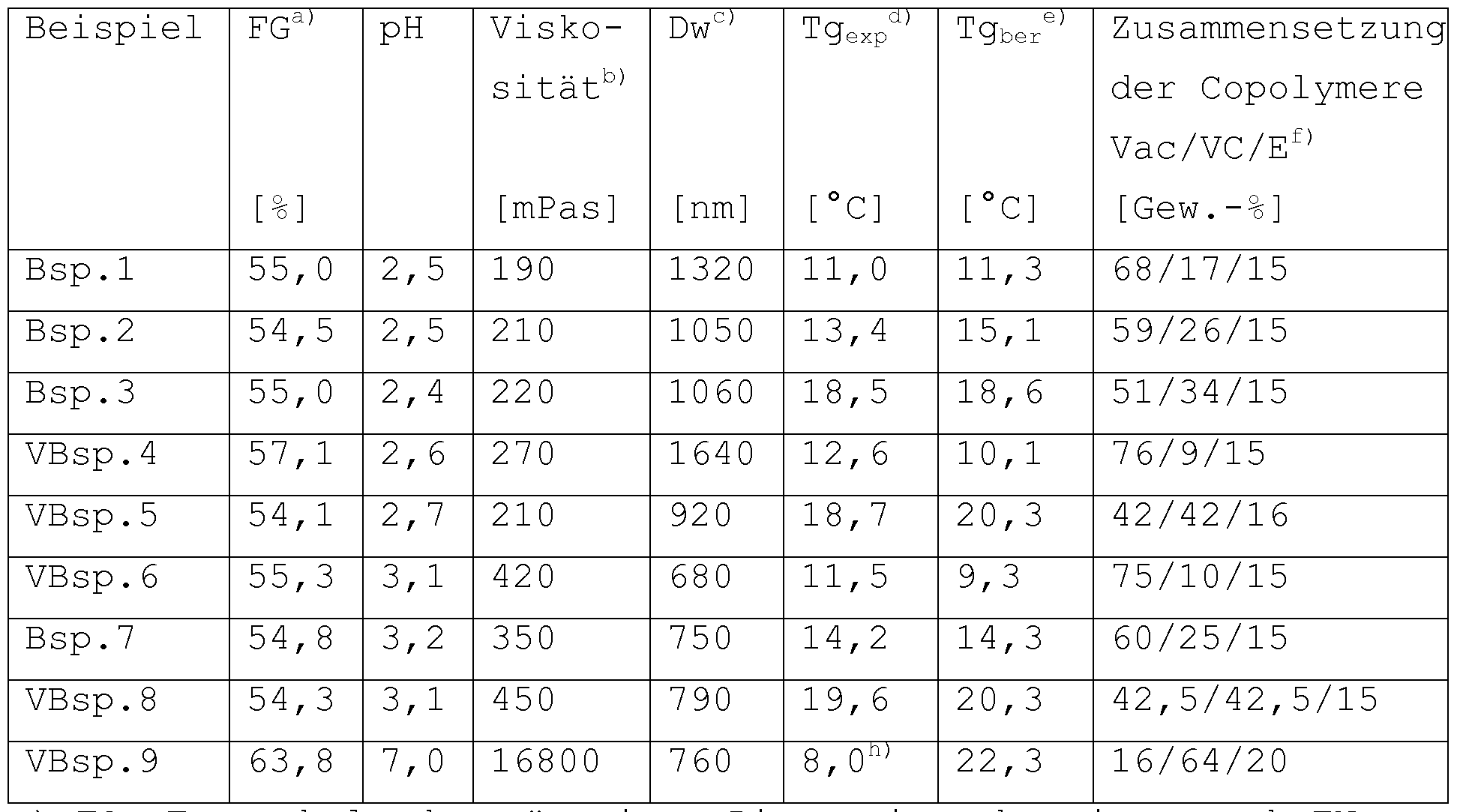
- Example 10 Analogously to Example I of EP0149098, a dispersion having the composition 16% vinyl acetate, 64% vinyl chloride and 20% ethylene was prepared. Dispersion properties are shown in Table 1. Comparative Example 10 (VBsp. 10):
- Vinyl acetate-ethylene copolymer dispersion (92% by weight vinyl acetate, 8% by weight ethylene) stabilized with 8% by weight polyvinyl alcohol 04/88.
- Vac is vinyl acetate, VC is vinyl chloride and E is ethylene;
- Dispersion contains plasticizer.
- plasticizer Preparation of vinyl acetate copolymers in the form of water-redispersible powders
Landscapes
- Chemical & Material Sciences (AREA)
- Ceramic Engineering (AREA)
- Engineering & Computer Science (AREA)
- Organic Chemistry (AREA)
- Chemical Kinetics & Catalysis (AREA)
- Materials Engineering (AREA)
- Structural Engineering (AREA)
- Medicinal Chemistry (AREA)
- Polymers & Plastics (AREA)
- Health & Medical Sciences (AREA)
- Inorganic Chemistry (AREA)
- Dispersion Chemistry (AREA)
- Addition Polymer Or Copolymer, Post-Treatments, Or Chemical Modifications (AREA)
Description

Claims
Priority Applications (6)
| Application Number | Priority Date | Filing Date | Title |
|---|---|---|---|
| EP13725702.8A EP2855543B1 (de) | 2012-05-31 | 2013-05-29 | Vinylacetat-copolymere für hydraulisch abbindende baustoffmassen |
| CN201380029063.3A CN104364278B (zh) | 2012-05-31 | 2013-05-29 | 用于水硬固化结构材料物质的乙酸乙烯酯共聚物 |
| BR112014029973-0A BR112014029973B1 (pt) | 2012-05-31 | 2013-05-29 | Copolímeros de acetato de vinila, processo para preparar o referido copolímero; composição de material de construção e uso da referida composição |
| US14/404,671 US20150119519A1 (en) | 2012-05-31 | 2013-05-29 | Vinyl acetate copolymers for hydraulically setting construction materials |
| US15/251,361 US20160368823A1 (en) | 2012-05-31 | 2016-08-30 | Vinyl acetate copolymers for hydraulically setting construction materials |
| US17/722,738 US20220234954A1 (en) | 2012-05-31 | 2022-04-18 | Vinyl acetate copolymers for hydraulically setting construction materials |
Applications Claiming Priority (2)
| Application Number | Priority Date | Filing Date | Title |
|---|---|---|---|
| DE201210209210 DE102012209210A1 (de) | 2012-05-31 | 2012-05-31 | Vinylacetat-Copolymere für hydraulisch abbindende Baustoffmassen |
| DE102012209210.2 | 2012-05-31 |
Related Child Applications (2)
| Application Number | Title | Priority Date | Filing Date |
|---|---|---|---|
| US14/404,671 A-371-Of-International US20150119519A1 (en) | 2012-05-31 | 2013-05-29 | Vinyl acetate copolymers for hydraulically setting construction materials |
| US15/251,361 Continuation US20160368823A1 (en) | 2012-05-31 | 2016-08-30 | Vinyl acetate copolymers for hydraulically setting construction materials |
Publications (1)
| Publication Number | Publication Date |
|---|---|
| WO2013178721A1 true WO2013178721A1 (de) | 2013-12-05 |
Family
ID=48536907
Family Applications (1)
| Application Number | Title | Priority Date | Filing Date |
|---|---|---|---|
| PCT/EP2013/061137 Ceased WO2013178721A1 (de) | 2012-05-31 | 2013-05-29 | Vinylacetat-copolymere für hydraulisch abbindende baustoffmassen |
Country Status (6)
| Country | Link |
|---|---|
| US (3) | US20150119519A1 (de) |
| EP (1) | EP2855543B1 (de) |
| CN (1) | CN104364278B (de) |
| BR (1) | BR112014029973B1 (de) |
| DE (1) | DE102012209210A1 (de) |
| WO (1) | WO2013178721A1 (de) |
Cited By (2)
| Publication number | Priority date | Publication date | Assignee | Title |
|---|---|---|---|---|
| DE102015203227A1 (de) | 2015-02-23 | 2016-08-25 | Wacker Chemie Ag | Polymermischungen in Form von wässrigen Dispersionen oder in Wasser redispergierbaren Pulvern |
| WO2023016627A1 (de) | 2021-08-10 | 2023-02-16 | Wacker Chemie Ag | Baustofftrockenmischungen enthaltend vinylester-festharze |
Families Citing this family (4)
| Publication number | Priority date | Publication date | Assignee | Title |
|---|---|---|---|---|
| CN105969256A (zh) * | 2016-04-28 | 2016-09-28 | 李鲁源 | 胶体溶液材料及其制备方法、水硬胶粘剂及其制备方法 |
| CN105856402B (zh) * | 2016-04-28 | 2019-07-05 | 李鲁源 | 一种混凝土养护方法 |
| ES2797300T3 (es) * | 2017-03-03 | 2020-12-01 | Wacker Chemie Ag | Uso de copolímeros de acetato de vinilo como aditivo reductor de la medida de contracción en sistemas de endurecimiento en frío |
| WO2020119932A1 (de) * | 2018-12-14 | 2020-06-18 | Wacker Chemie Ag | Polymere in form von in wasser redispergierbaren pulvern oder wässrigen dispersionen |
Citations (9)
| Publication number | Priority date | Publication date | Assignee | Title |
|---|---|---|---|---|
| EP0149098A2 (de) | 1983-12-07 | 1985-07-24 | Wacker-Chemie GmbH | Verfahren zur Herstellung eines redispergierbaren Dispersionspulvers und seine Anwendung |
| EP0255363A2 (de) * | 1986-07-30 | 1988-02-03 | Unilever Plc | Terpolymer-Emulsionen |
| EP0334591A1 (de) * | 1988-03-22 | 1989-09-27 | Unilever Plc | Modifizierte Terpolymeremulsionen |
| EP1134255A2 (de) * | 2000-03-06 | 2001-09-19 | Wacker-Chemie GmbH | Polymerzusammensetzung zur Flexibilisierung von Baustoffmassen |
| EP1262465A2 (de) | 2001-05-31 | 2002-12-04 | Wacker Polymer Systems GmbH & Co. KG | Verwendung von Mischpolymerisaten von Vinylester-, (Meth)acrylsäureester- und gegebenenfalls Ethylen-Comonomeren in Baustoffen |
| WO2005118684A1 (de) | 2004-06-01 | 2005-12-15 | Wacker Polymer Systems Gmbh & Co. Kg | Verwendung von vinylchlorid-ethylen-mischpolymerisaten zur hydrophobierung von baustoffmassen |
| WO2006099960A1 (de) | 2005-03-21 | 2006-09-28 | Elotex Ag | Dispersionszusammensetzung für hochflexible, wasserfeste, hydraulisch abbindende fliesenkleber |
| EP2158265A1 (de) | 2007-05-15 | 2010-03-03 | Dow Global Technologies Inc. | Copolymermischung |
| DE102009003196A1 (de) * | 2009-05-18 | 2010-11-25 | Wacker Chemie Ag | Faserhaltige pastöse Baustoffmassen |
Family Cites Families (8)
| Publication number | Priority date | Publication date | Assignee | Title |
|---|---|---|---|---|
| DE2214410C3 (de) * | 1972-03-24 | 1978-10-12 | Hoechst Ag, 6000 Frankfurt | Verfahren zur Herstellung eines redispergierbaren Vinylacetat/Äthylen-Polymerdispersionspulvers |
| DE2349910B2 (de) * | 1973-10-04 | 1978-05-18 | Hoechst Ag, 6000 Frankfurt | Zusatzmittel für Mörtel und Beton |
| DE2614261C3 (de) * | 1976-04-02 | 1984-08-23 | Hoechst Ag, 6230 Frankfurt | Verfahren zur Herstellung dispergierbarer Dispersionspulver |
| DE10035588A1 (de) * | 2000-07-21 | 2002-02-07 | Wacker Polymer Systems Gmbh | Verfahren zur Herstellung von zweiphasigen Polymerisaten in Form deren wässrigen Polymerdispersionen und in Wasser redispergierbaren Polymerpulver |
| DE10313937A1 (de) * | 2003-03-27 | 2004-10-14 | Wacker Polymer Systems Gmbh & Co. Kg | Dispergiermittel |
| DE102004057996A1 (de) * | 2004-12-01 | 2006-06-08 | Wacker Polymer Systems Gmbh & Co. Kg | Hydrophobierendes Additiv |
| DE102005054905A1 (de) * | 2005-11-17 | 2007-05-24 | Wacker Polymer Systems Gmbh & Co. Kg | Schutzkolloidstabilisiertes Dispersionspulver |
| JP2012515128A (ja) * | 2008-09-19 | 2012-07-05 | ギャンピュール、アショーク、アミト | 断熱及び熱反射製品用水硬性セメント集成体 |
-
2012
- 2012-05-31 DE DE201210209210 patent/DE102012209210A1/de not_active Withdrawn
-
2013
- 2013-05-29 WO PCT/EP2013/061137 patent/WO2013178721A1/de not_active Ceased
- 2013-05-29 CN CN201380029063.3A patent/CN104364278B/zh active Active
- 2013-05-29 EP EP13725702.8A patent/EP2855543B1/de active Active
- 2013-05-29 BR BR112014029973-0A patent/BR112014029973B1/pt active IP Right Grant
- 2013-05-29 US US14/404,671 patent/US20150119519A1/en not_active Abandoned
-
2016
- 2016-08-30 US US15/251,361 patent/US20160368823A1/en not_active Abandoned
-
2022
- 2022-04-18 US US17/722,738 patent/US20220234954A1/en not_active Abandoned
Patent Citations (9)
| Publication number | Priority date | Publication date | Assignee | Title |
|---|---|---|---|---|
| EP0149098A2 (de) | 1983-12-07 | 1985-07-24 | Wacker-Chemie GmbH | Verfahren zur Herstellung eines redispergierbaren Dispersionspulvers und seine Anwendung |
| EP0255363A2 (de) * | 1986-07-30 | 1988-02-03 | Unilever Plc | Terpolymer-Emulsionen |
| EP0334591A1 (de) * | 1988-03-22 | 1989-09-27 | Unilever Plc | Modifizierte Terpolymeremulsionen |
| EP1134255A2 (de) * | 2000-03-06 | 2001-09-19 | Wacker-Chemie GmbH | Polymerzusammensetzung zur Flexibilisierung von Baustoffmassen |
| EP1262465A2 (de) | 2001-05-31 | 2002-12-04 | Wacker Polymer Systems GmbH & Co. KG | Verwendung von Mischpolymerisaten von Vinylester-, (Meth)acrylsäureester- und gegebenenfalls Ethylen-Comonomeren in Baustoffen |
| WO2005118684A1 (de) | 2004-06-01 | 2005-12-15 | Wacker Polymer Systems Gmbh & Co. Kg | Verwendung von vinylchlorid-ethylen-mischpolymerisaten zur hydrophobierung von baustoffmassen |
| WO2006099960A1 (de) | 2005-03-21 | 2006-09-28 | Elotex Ag | Dispersionszusammensetzung für hochflexible, wasserfeste, hydraulisch abbindende fliesenkleber |
| EP2158265A1 (de) | 2007-05-15 | 2010-03-03 | Dow Global Technologies Inc. | Copolymermischung |
| DE102009003196A1 (de) * | 2009-05-18 | 2010-11-25 | Wacker Chemie Ag | Faserhaltige pastöse Baustoffmassen |
Non-Patent Citations (2)
| Title |
|---|
| "Polymer Handbook", 1975, J. WILEY & SONS |
| NACH FOX T. G., BULL. AM. PHYSICS SOC., vol. 1, 3, 1956, pages 123 |
Cited By (4)
| Publication number | Priority date | Publication date | Assignee | Title |
|---|---|---|---|---|
| DE102015203227A1 (de) | 2015-02-23 | 2016-08-25 | Wacker Chemie Ag | Polymermischungen in Form von wässrigen Dispersionen oder in Wasser redispergierbaren Pulvern |
| WO2016135039A1 (de) * | 2015-02-23 | 2016-09-01 | Wacker Chemie Ag | Polymermischungen in form von wässrigen dispersionen oder in wasser redispergierbaren pulvern |
| US10538657B2 (en) | 2015-02-23 | 2020-01-21 | Wacker Chemie Ag | Polymer blends in the form of aqueous dispersions or powders that can be redispersed in water |
| WO2023016627A1 (de) | 2021-08-10 | 2023-02-16 | Wacker Chemie Ag | Baustofftrockenmischungen enthaltend vinylester-festharze |
Also Published As
| Publication number | Publication date |
|---|---|
| EP2855543A1 (de) | 2015-04-08 |
| US20150119519A1 (en) | 2015-04-30 |
| BR112014029973B1 (pt) | 2020-12-15 |
| CN104364278B (zh) | 2017-04-12 |
| US20220234954A1 (en) | 2022-07-28 |
| BR112014029973A2 (pt) | 2017-06-27 |
| EP2855543B1 (de) | 2019-08-21 |
| DE102012209210A1 (de) | 2013-12-05 |
| CN104364278A (zh) | 2015-02-18 |
| US20160368823A1 (en) | 2016-12-22 |
Similar Documents
| Publication | Publication Date | Title |
|---|---|---|
| EP1615861B1 (de) | Redispersionspulver-zusammensetzung mit abbindebesschleunigender wirkung | |
| DE10126560C1 (de) | Verwendung von Mischpolymerisaten von Vinylester-, (Meth)acrylsäureester- und gegebenenfalls Ethylen-Comonomeren in Baustoffen | |
| EP1110978B1 (de) | Verfahren zur Herstellung von Vinylester-(Meth)acrylsäureester-Mischpolymerisaten | |
| EP2178928B1 (de) | Kontinuierliches polymerisationsverfahren | |
| US6664322B2 (en) | Process for preparing protective-colloid-stabilized polymers by continuous emulsion polymerization | |
| EP1215219B1 (de) | Polyvinylacetal-gepfropfte Polymerisate | |
| EP1420033B1 (de) | Schutzkolloidstabilisierte Polymerisate in Form deren wässrigen Dispersionen und in Wasser redispergierbaren Pulver | |
| EP1498446A1 (de) | Redispersionspulver mit puzzolanischen Komponenten | |
| EP1174447B1 (de) | Verfahren zur Herstellung von zweiphasigen Polymerisaten in Form deren wässrigen Polymerdispersionen und in Wasser redispergierbaren Polymerpulver | |
| DE10162513A1 (de) | Verfahren zur Herstellung von Schutzkolloid-stabilisierten Polymerisaten mittels kontinuierlicher Emulsionspolymerisation | |
| WO2013178721A1 (de) | Vinylacetat-copolymere für hydraulisch abbindende baustoffmassen | |
| EP1940751B1 (de) | Fettsäureanhydride enthaltende dispersionspulver | |
| EP1670830B1 (de) | Modifizierte polyvinylalkohole enthaltende polymerzusammensetzungen | |
| DE102005054905A1 (de) | Schutzkolloidstabilisiertes Dispersionspulver | |
| DE102005051588A1 (de) | Silan-modifizierte Dispersionspulver | |
| EP4157804A1 (de) | Verfahren zur herstellung von in wasser redispergierbaren polymerpulvern für baustofftrockenformulierungen | |
| EP1682462B1 (de) | Redispergierbare dispersionspulver für wärmedämm-verbundsysteme | |
| WO2019020157A1 (de) | Dispersionspulver-zusammensetzung enthaltend vinylalkohol-copolymerisat | |
| EP4441010A1 (de) | Verfahren zur herstellung von in wasser redispergierbaren polymerpulvern | |
| EP4584303B1 (de) | In wasser redispergierbare polymerpulver für baustofftrockenformulierungen | |
| EP2920213A1 (de) | Verfahren zur herstellung von polyvinylalkohol-stabilisierten polymerisaten mittels emulsionspolymerisation |
Legal Events
| Date | Code | Title | Description |
|---|---|---|---|
| 121 | Ep: the epo has been informed by wipo that ep was designated in this application |
Ref document number: 13725702 Country of ref document: EP Kind code of ref document: A1 |
|
| WWE | Wipo information: entry into national phase |
Ref document number: 2013725702 Country of ref document: EP |
|
| NENP | Non-entry into the national phase |
Ref country code: DE |
|
| WWE | Wipo information: entry into national phase |
Ref document number: 14404671 Country of ref document: US |
|
| REG | Reference to national code |
Ref country code: BR Ref legal event code: B01A Ref document number: 112014029973 Country of ref document: BR |
|
| ENP | Entry into the national phase |
Ref document number: 112014029973 Country of ref document: BR Kind code of ref document: A2 Effective date: 20141201 |