WO2013187311A1 - 親水性の変性アクリル樹脂膜 - Google Patents
親水性の変性アクリル樹脂膜 Download PDFInfo
- Publication number
- WO2013187311A1 WO2013187311A1 PCT/JP2013/065722 JP2013065722W WO2013187311A1 WO 2013187311 A1 WO2013187311 A1 WO 2013187311A1 JP 2013065722 W JP2013065722 W JP 2013065722W WO 2013187311 A1 WO2013187311 A1 WO 2013187311A1
- Authority
- WO
- WIPO (PCT)
- Prior art keywords
- group
- acrylic resin
- ion
- meth
- resin film
- Prior art date
- Legal status (The legal status is an assumption and is not a legal conclusion. Google has not performed a legal analysis and makes no representation as to the accuracy of the status listed.)
- Ceased
Links
Images

Classifications
-
- C—CHEMISTRY; METALLURGY
- C08—ORGANIC MACROMOLECULAR COMPOUNDS; THEIR PREPARATION OR CHEMICAL WORKING-UP; COMPOSITIONS BASED THEREON
- C08J—WORKING-UP; GENERAL PROCESSES OF COMPOUNDING; AFTER-TREATMENT NOT COVERED BY SUBCLASSES C08B, C08C, C08F, C08G or C08H
- C08J7/00—Chemical treatment or coating of shaped articles made of macromolecular substances
- C08J7/12—Chemical modification
- C08J7/16—Chemical modification with polymerisable compounds
-
- C—CHEMISTRY; METALLURGY
- C08—ORGANIC MACROMOLECULAR COMPOUNDS; THEIR PREPARATION OR CHEMICAL WORKING-UP; COMPOSITIONS BASED THEREON
- C08F—MACROMOLECULAR COMPOUNDS OBTAINED BY REACTIONS ONLY INVOLVING CARBON-TO-CARBON UNSATURATED BONDS
- C08F222/00—Copolymers of compounds having one or more unsaturated aliphatic radicals, each having only one carbon-to-carbon double bond, and at least one being terminated by a carboxyl radical and containing at least one other carboxyl radical in the molecule; Salts, anhydrides, esters, amides, imides, or nitriles thereof
- C08F222/10—Esters
- C08F222/1006—Esters of polyhydric alcohols or polyhydric phenols
-
- C—CHEMISTRY; METALLURGY
- C08—ORGANIC MACROMOLECULAR COMPOUNDS; THEIR PREPARATION OR CHEMICAL WORKING-UP; COMPOSITIONS BASED THEREON
- C08F—MACROMOLECULAR COMPOUNDS OBTAINED BY REACTIONS ONLY INVOLVING CARBON-TO-CARBON UNSATURATED BONDS
- C08F222/00—Copolymers of compounds having one or more unsaturated aliphatic radicals, each having only one carbon-to-carbon double bond, and at least one being terminated by a carboxyl radical and containing at least one other carboxyl radical in the molecule; Salts, anhydrides, esters, amides, imides, or nitriles thereof
- C08F222/10—Esters
- C08F222/1006—Esters of polyhydric alcohols or polyhydric phenols
- C08F222/106—Esters of polycondensation macromers
- C08F222/1065—Esters of polycondensation macromers of alcohol terminated (poly)urethanes, e.g. urethane(meth)acrylates
-
- C—CHEMISTRY; METALLURGY
- C08—ORGANIC MACROMOLECULAR COMPOUNDS; THEIR PREPARATION OR CHEMICAL WORKING-UP; COMPOSITIONS BASED THEREON
- C08J—WORKING-UP; GENERAL PROCESSES OF COMPOUNDING; AFTER-TREATMENT NOT COVERED BY SUBCLASSES C08B, C08C, C08F, C08G or C08H
- C08J5/00—Manufacture of articles or shaped materials containing macromolecular substances
- C08J5/18—Manufacture of films or sheets
-
- C—CHEMISTRY; METALLURGY
- C08—ORGANIC MACROMOLECULAR COMPOUNDS; THEIR PREPARATION OR CHEMICAL WORKING-UP; COMPOSITIONS BASED THEREON
- C08J—WORKING-UP; GENERAL PROCESSES OF COMPOUNDING; AFTER-TREATMENT NOT COVERED BY SUBCLASSES C08B, C08C, C08F, C08G or C08H
- C08J7/00—Chemical treatment or coating of shaped articles made of macromolecular substances
- C08J7/12—Chemical modification
- C08J7/16—Chemical modification with polymerisable compounds
- C08J7/18—Chemical modification with polymerisable compounds using wave energy or particle radiation
-
- C—CHEMISTRY; METALLURGY
- C08—ORGANIC MACROMOLECULAR COMPOUNDS; THEIR PREPARATION OR CHEMICAL WORKING-UP; COMPOSITIONS BASED THEREON
- C08L—COMPOSITIONS OF MACROMOLECULAR COMPOUNDS
- C08L33/00—Compositions of homopolymers or copolymers of compounds having one or more unsaturated aliphatic radicals, each having only one carbon-to-carbon double bond, and only one being terminated by only one carboxyl radical, or of salts, anhydrides, esters, amides, imides or nitriles thereof; Compositions of derivatives of such polymers
- C08L33/04—Homopolymers or copolymers of esters
- C08L33/14—Homopolymers or copolymers of esters of esters containing halogen, nitrogen, sulfur, or oxygen atoms in addition to the carboxy oxygen
-
- C—CHEMISTRY; METALLURGY
- C08—ORGANIC MACROMOLECULAR COMPOUNDS; THEIR PREPARATION OR CHEMICAL WORKING-UP; COMPOSITIONS BASED THEREON
- C08F—MACROMOLECULAR COMPOUNDS OBTAINED BY REACTIONS ONLY INVOLVING CARBON-TO-CARBON UNSATURATED BONDS
- C08F220/00—Copolymers of compounds having one or more unsaturated aliphatic radicals, each having only one carbon-to-carbon double bond, and only one being terminated by only one carboxyl radical or a salt, anhydride ester, amide, imide or nitrile thereof
- C08F220/02—Monocarboxylic acids having less than ten carbon atoms; Derivatives thereof
- C08F220/10—Esters
- C08F220/38—Esters containing sulfur
- C08F220/382—Esters containing sulfur and containing oxygen, e.g. 2-sulfoethyl (meth)acrylate
-
- C—CHEMISTRY; METALLURGY
- C08—ORGANIC MACROMOLECULAR COMPOUNDS; THEIR PREPARATION OR CHEMICAL WORKING-UP; COMPOSITIONS BASED THEREON
- C08F—MACROMOLECULAR COMPOUNDS OBTAINED BY REACTIONS ONLY INVOLVING CARBON-TO-CARBON UNSATURATED BONDS
- C08F222/00—Copolymers of compounds having one or more unsaturated aliphatic radicals, each having only one carbon-to-carbon double bond, and at least one being terminated by a carboxyl radical and containing at least one other carboxyl radical in the molecule; Salts, anhydrides, esters, amides, imides, or nitriles thereof
- C08F222/10—Esters
- C08F222/1006—Esters of polyhydric alcohols or polyhydric phenols
- C08F222/102—Esters of polyhydric alcohols or polyhydric phenols of dialcohols, e.g. ethylene glycol di(meth)acrylate or 1,4-butanediol dimethacrylate
-
- C—CHEMISTRY; METALLURGY
- C08—ORGANIC MACROMOLECULAR COMPOUNDS; THEIR PREPARATION OR CHEMICAL WORKING-UP; COMPOSITIONS BASED THEREON
- C08J—WORKING-UP; GENERAL PROCESSES OF COMPOUNDING; AFTER-TREATMENT NOT COVERED BY SUBCLASSES C08B, C08C, C08F, C08G or C08H
- C08J2333/00—Characterised by the use of homopolymers or copolymers of compounds having one or more unsaturated aliphatic radicals, each having only one carbon-to-carbon double bond, and only one being terminated by only one carboxyl radical, or of salts, anhydrides, esters, amides, imides, or nitriles thereof; Derivatives of such polymers
- C08J2333/04—Characterised by the use of homopolymers or copolymers of compounds having one or more unsaturated aliphatic radicals, each having only one carbon-to-carbon double bond, and only one being terminated by only one carboxyl radical, or of salts, anhydrides, esters, amides, imides, or nitriles thereof; Derivatives of such polymers esters
- C08J2333/06—Characterised by the use of homopolymers or copolymers of compounds having one or more unsaturated aliphatic radicals, each having only one carbon-to-carbon double bond, and only one being terminated by only one carboxyl radical, or of salts, anhydrides, esters, amides, imides, or nitriles thereof; Derivatives of such polymers esters of esters containing only carbon, hydrogen, and oxygen, the oxygen atom being present only as part of the carboxyl radical
- C08J2333/08—Homopolymers or copolymers of acrylic acid esters
-
- C—CHEMISTRY; METALLURGY
- C08—ORGANIC MACROMOLECULAR COMPOUNDS; THEIR PREPARATION OR CHEMICAL WORKING-UP; COMPOSITIONS BASED THEREON
- C08J—WORKING-UP; GENERAL PROCESSES OF COMPOUNDING; AFTER-TREATMENT NOT COVERED BY SUBCLASSES C08B, C08C, C08F, C08G or C08H
- C08J2335/00—Characterised by the use of homopolymers or copolymers of compounds having one or more unsaturated aliphatic radicals, each having only one carbon-to-carbon double bond, and at least one being terminated by a carboxyl radical, and containing at least one other carboxyl radical in the molecule, or of salts, anhydrides, esters, amides, imides or nitriles thereof; Derivatives of such polymers
- C08J2335/02—Characterised by the use of homopolymers or copolymers of esters
-
- C—CHEMISTRY; METALLURGY
- C08—ORGANIC MACROMOLECULAR COMPOUNDS; THEIR PREPARATION OR CHEMICAL WORKING-UP; COMPOSITIONS BASED THEREON
- C08L—COMPOSITIONS OF MACROMOLECULAR COMPOUNDS
- C08L2201/00—Properties
Definitions
- the present invention relates to a hydrophilic modified acrylic resin film having excellent antifogging and antifouling properties and excellent transparency, and a laminate in which the modified acrylic resin film is laminated.
- Non-Patent Document 1 As a method for solving the problem of fogging, there has been proposed a method for improving hydrophilicity and water absorption by using an antifogging paint containing a reactive surfactant and an acrylic oligomer (for example, see Non-Patent Document 1). Further, as a means for solving the problem of dirt, a method has been proposed in which dirt such as an outside air hydrophobic substance adhering to an outer wall or the like is lifted and removed by watering or rainfall by improving the hydrophilicity of the material surface. (For example, refer nonpatent literature 2 and 3.).
- the crosslinkable polymerizable monomer composition is applied to the surface of the base material to form an incompletely polymerized crosslinked polymer by controlling the amount of UV irradiation, and then the hydrophilic monomer is applied and irradiated again with UV rays.
- a hydrophilic material that blocks or graft-polymerizes the polymer on the surface of a crosslinked polymer (Patent Document 1 and Patent Document 2).
- the above-described method of blocking or graft polymerizing a hydrophilic monomer on the surface of a base material has a problem that durability is low and it cannot endure long-term use because a hydrophilic group exists only on the surface.
- Patent Document 3 Previously proposed (Patent Document 3 and Patent Document 4).
- the present inventors have improved the durability while improving the hydrophilicity of the prior applications (Patent Document 3 and Patent Document 4), thereby achieving high-performance antifogging properties, antifouling properties, and dew condensation that can withstand long-term use. It is an object of the present invention to provide a hydrophilic film having preventive properties and the like, and a laminate in which the hydrophilic film is laminated.
- the inventors of the present invention are acrylic resin-based films having an anionic hydrophilic group, and the concentration of anionic hydrophilic groups on the surface is determined from the surface of the acrylic resin-based film.
- the surface of the acrylic resin film having a concentration higher than the concentration of the anionic hydrophilic group at a depth of 1 ⁇ 2 of the thickness is one or more anionic hydrophilic groups and one or more polymerizable carbon-carbon double molecules in one molecule. It has been found that the treatment with the compound (A) having any of a group containing a bond, an amino group, a mercapto group, or a hydroxyl group can further increase the hydrophilicity and improve the durability.
- the present invention is an acrylic resin film having an anionic hydrophilic group, and the anionic hydrophilic group concentration on the surface is an anionic hydrophilic film at a depth of 1/2 the film thickness from the surface of the acrylic resin film.
- the surface of the acrylic resin film having a concentration higher than the concentration of the group is composed of one or more anionic hydrophilic groups in one molecule, a group containing a polymerizable carbon-carbon double bond, an amino group, a mercapto group, and a hydroxyl group.
- the hydrophilic film of the present invention has improved hydrophilicity and durability, and has high performance antifogging properties, antifouling properties, anti-condensation properties, etc. that can withstand long-term use.
- FIG. 1 is a diagram for explaining sample preparation in Examples.
- the modified acrylic resin film of the present invention is a modified acrylic resin film obtained from an acrylic resin film having an anionic hydrophilic group, and the concentration of the anionic hydrophilic group on the surface is determined from the surface of the acrylic resin film.
- the surface of the acrylic resin film having a concentration higher than the concentration of an anionic hydrophilic group at a depth of 1/2 is a group containing at least one anionic hydrophilic group and a polymerizable carbon-carbon double bond in one molecule, amino It is obtained by treating with a compound (A) having at least one group selected from the group consisting of a group, a mercapto group and a hydroxyl group.
- the acrylic resin film used in the present invention may be an acrylic resin film in which the concentration of the anionic hydrophilic group on the surface is higher than the concentration of the anionic hydrophilic group at a depth of 1/2 of the film thickness from the surface. . In the present specification, this is sometimes referred to as “a membrane in which an anionic hydrophilic group is inclined (graded membrane)”.
- the membrane in which these anionic hydrophilic groups are inclined examples include highly hydrophilic membranes (Patent Document 3 and Patent Document 4) in which an anionic hydrophilic group is inclined on the surface by utilizing evaporation of a solvent. It is preferably used as a treatment film.
- the anionic hydrophilic group represents a hydrophilic functional group selected from a sulfonic acid group, a carboxyl group, and a phosphoric acid group, and among these, a sulfonic acid group that has high surface hydrophilicity is particularly preferable.
- Acrylic resin-based film used in the present invention, wherein the concentration of anionic hydrophilic groups on the surface is higher than the concentration of anionic hydrophilic groups at a depth of 1/2 of the film thickness from the surface
- the anionic hydrophilic groups of are analyzed by TOF-SIMS. It is usually expressed as follows that the concentration of the anionic hydrophilic group on the surface is higher than the concentration of the anionic hydrophilic group at a depth of 1 ⁇ 2 of the film thickness from the surface.
- the anion concentration ratio concentration ratio of the anion concentration Sa on the membrane surface to the anion concentration Da at a point at a depth half the film thickness from the surface
- Sa / Da exceeds 1.0
- the concentration of the anionic hydrophilic group on the surface is higher than the concentration of the anionic hydrophilic group at a depth of 1 ⁇ 2 of the film thickness from the surface.
- Said Sa / Da is sometimes referred to as the inclination of the anionic hydrophilic group.
- a compound having one or more anionic hydrophilic groups in one molecule and one or more selected from the group consisting of a group containing a polymerizable carbon-carbon double bond, an amino group, a mercapto group, and a hydroxyl group is preferably an acrylic resin-based hydrophilic gradient membrane having an anionic hydrophilic group gradient (Sa / Da) of 1.1 or more.
- the hydrophilicity of the surface of the acrylic resin-based gradient film treated with the compound (A) is preferably higher. When expressed in terms of water contact angle, it is preferably 30 ° or less, more preferably 20 ° or less, and more preferably 10 ° or less. More preferably.
- the acrylic resin film used in the present invention has a higher concentration of anionic hydrophilic groups on the surface than the concentration of anionic hydrophilic groups at a depth of 1 ⁇ 2 of the film thickness from the surface. It can be obtained by the method described.
- a polyvalent monomer (II) having two or more (meth) acryloyl groups, at least one anionic hydrophilic group, a group containing a polymerizable carbon-carbon double bond, an amino group, a mercapto group, and a hydroxyl group
- the acrylic film used in the present invention has a high concentration of anionic hydrophilic groups on the surface and in the vicinity of the surface. Therefore, when treated with the hydrophilic compound (A), the hydrophilic compound (A) Assuming that the surface is processed without defects and many anionic hydrophilic groups are grafted, and that the anionic hydrophilic groups are grafted to the inside of the membrane by penetrating into the membrane near the surface. Is done. Therefore, compared with the film
- the hydrophilicity is drastically increased, and even if the surface is somewhat deteriorated or decomposed, the anionic hydrophilic group in the vicinity of the surface backs up the surface, thereby reducing the hydrophilicity. It can be suppressed (improvement of durability). It is also considered that the balance between the hydrophilicity and the physical properties such as transparency is good. Moreover, it is excellent also in the adhesiveness of the part obtained from the compound (A) and the acrylic film.
- the compound used in the treatment of the present invention comprises a group selected from the group consisting of a group containing one or more anionic hydrophilic groups and a polymerizable carbon-carbon double bond in one molecule, an amino group, a mercapto group, and a hydroxyl group. It is a compound (A) which has 1 or more.
- the polymerizable carbon-carbon double bond bonded to the compound (A) is, for example, from (meth) acryloyloxy group, (meth) acryloylthio group, (meth) acrylamide group, allyl group, vinyl group, or isopropenyl group. Represents a selected radical polymerizable functional group.
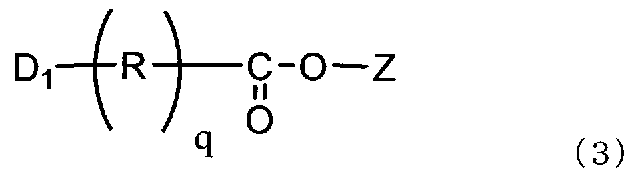
- D 1 is a (meth) acryloyloxy group (only when q is 1), (meth) acryloylthio group (only when q is 1), (meth) acrylamide group (q is 1) Only), vinyl group, allyl group, isopropenyl group, styryl group, mercapto group, amino group, methylamino group, or ethylamino group
- Z is a hydrogen ion, ammonium ion, amine ion, alkali metal ion Or an alkaline earth metal ion of 1/2 atom
- R is a divalent aliphatic hydrocarbon group having 1 to 600 carbon atoms, and includes an aromatic ring, an aliphatic cyclic group, an ether group, and an ester group.
- q represents 0 or 1)
- R 5 and R 6 represent a hydrogen atom or a methyl group
- R 7 represents a hydrogen atom or an alkyl group having 1 to 6 carbon atoms
- Z represents a hydrogen ion, an ammonium ion, an amine ion
- an alkali represents a metal ion or a 1/2 atom alkaline earth metal ion
- n1 represents an integer of 1 to 10.
- D 1 is a (meth) acryloyloxy group (only when q is 1), (meth) acryloylthio group (only when q is 1), (meth) acrylamide group (q is 1) Only), vinyl group, allyl group, isopropenyl group, styryl group, mercapto group, amino group, methylamino group, or ethylamino group
- Z is a hydrogen ion, ammonium ion, amine ion, alkali metal ion Or an alkaline earth metal ion of 1/2 atom
- R is a divalent aliphatic hydrocarbon group having 1 to 600 carbon atoms, and includes an aromatic ring, an aliphatic cyclic group, an ether group, and an ester group.
- q represents 0 or 1)
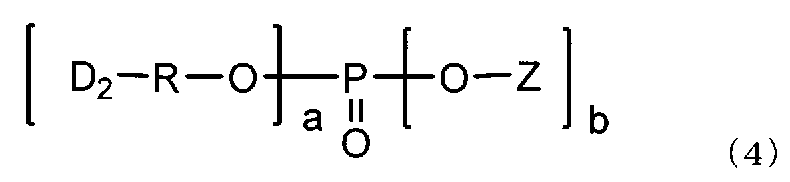
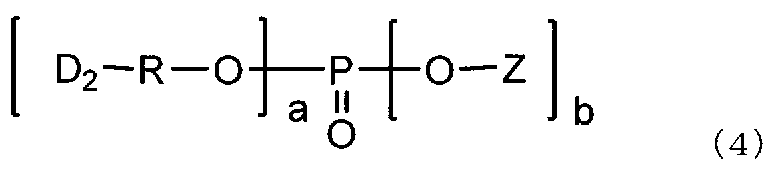
- D 2 is a (meth) acryloyloxy group, (meth) acryloylthio group, (meth) acrylamide group, vinyl group, allyl group, isopropenyl group, styryl group, mercapto group, amino group
- M represents a methylamino group or an ethylamino group
- Z represents a hydrogen ion, an ammonium ion, an amine ion, an alkali metal ion, or an alkaline earth metal ion having a 1 ⁇ 2 atom
- R represents 2 having 1 to 600 carbon atoms.
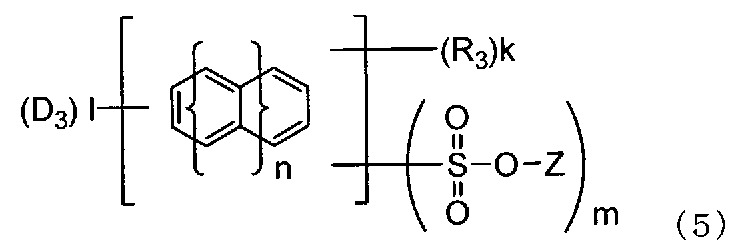
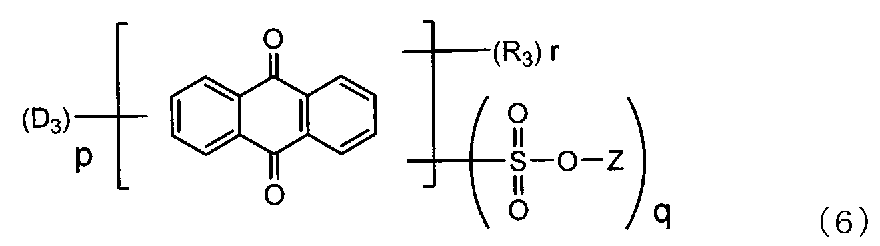
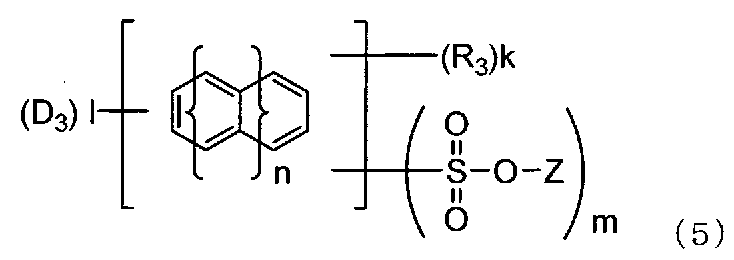
- D 3 , R 3 and SO 3 Z are groups bonded to carbon on the ring contained in the above formula, and each D 3 independently represents a vinyl group, an allyl group, Represents an isopropenyl group, a styryl group, a mercapto group, an amino group, a methylamino group, an ethylamino group, or a hydroxyl group, and Z represents a hydrogen ion, an ammonium ion, an amine ion, an alkali metal ion, or a 1/2 atom alkaline earth
- Each of R 3 independently represents H, methyl group, ethyl group, methoxy group, ethoxy group, fluorine atom, chlorine atom, bromine atom, or iodine atom, and k is 0-10.
- D 3 , R 3 and SO 3 Z are groups bonded to carbon on the ring contained in the above formula, and each D 3 independently represents a vinyl group, an allyl group, Represents an isopropenyl group, a styryl group, a mercapto group, an amino group, a methylamino group, an ethylamino group, or a hydroxyl group, and Z represents a hydrogen ion, an ammonium ion, an amine ion, an alkali metal ion, or a 1/2 atom alkaline earth
- R 3 represents a metal ion
- each R 3 independently represents H, a methyl group, an ethyl group, a methoxy group, an ethoxy group, a fluorine atom, a chlorine atom, a bromine atom, or an iodine atom, and r is 0-6.
- D 3 may be the same or different from each other, in the case of 2 or more, R 3 And may be the same or different from each other.
- q is 2 or more, Z may be the same or different from each other.
- the compound represented by these is mentioned.
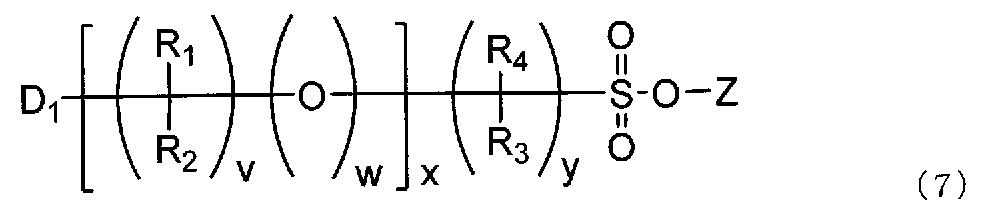
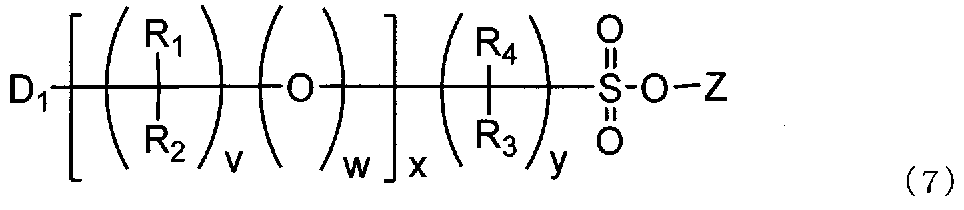
- D 1 is a (meth) acryloyloxy group (when either x or y is 1 or more), (meth) acryloylthio group (when either x or y is 1 or more) , (Meth) acrylamide group (when either x or y is 1 or more), vinyl group, allyl group, isopropenyl group, styryl group, mercapto group, amino group, methylamino group, or ethylamino group, Z represents a hydrogen ion, an ammonium ion, an amine ion, an alkali metal ion, or a 1 ⁇ 2 atom alkaline earth metal ion, and R 1 to R 4 each independently represent a hydrogen atom or a carbon number of 1 to 6 Or an alkoxy group having 1 to 6 carbon atoms.
- v and y independently represent an integer of 0 to 10, and w represents 0 or 1 (provided that when either v or y is 0, w is also 0).
- x represents an integer of 0 to 10.
- R 1 and R 2 may be the same or different, and when y is 2 or more, R 3 and R 4 may be the same or different.
- R 1 and R 2 may be the same or different from each other.
- the compound represented by these is mentioned.
- Typical compounds represented by the general formula (7) include, for example, sodium 2- (meth) acryloyloxyethyl sulfonate, 3- (meth) acryloyloxypropyl sulfonic acid, 3- (meth) acryloyloxypropyl sulfone.
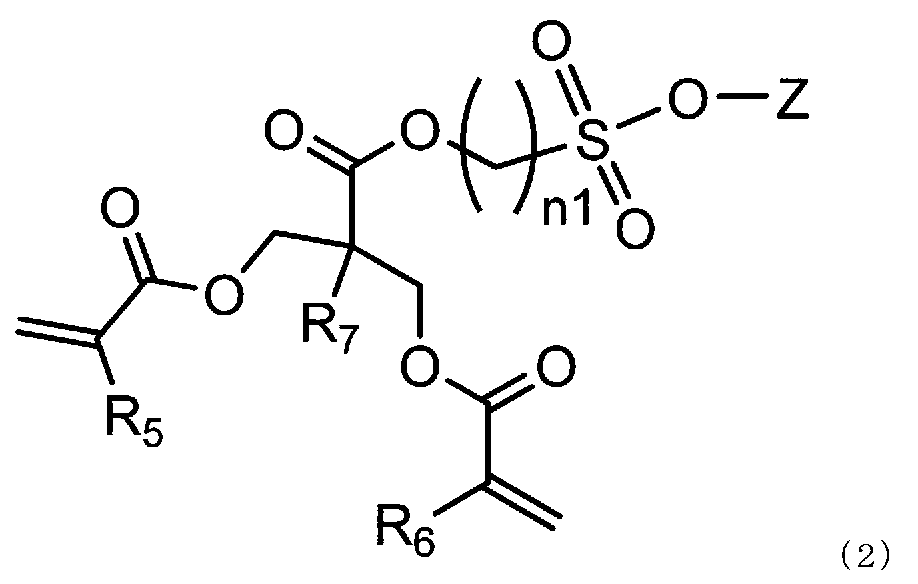
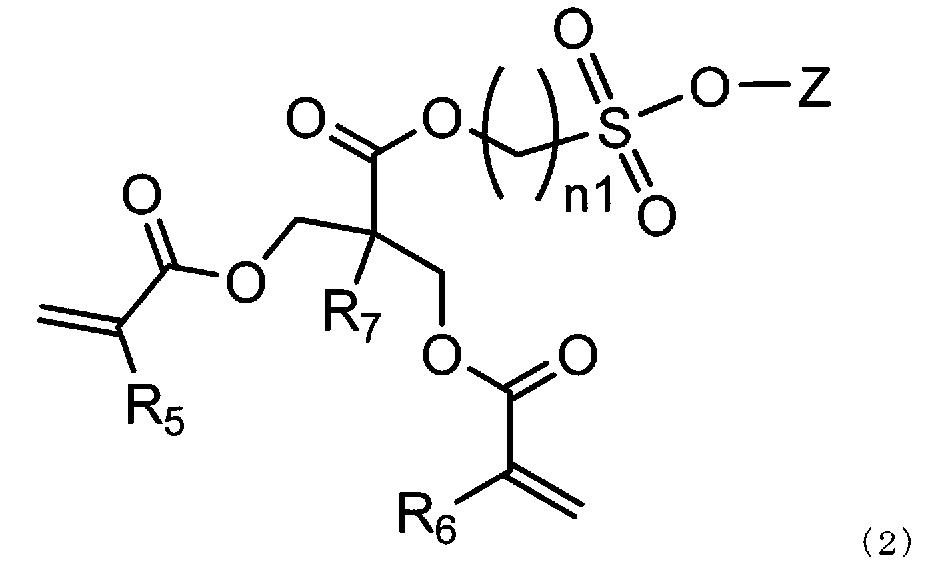
- Examples of the compound represented by the general formula (2) include 2,2-bis ((meth) acryloyloxymethyl) acetic acid-3-sulfopropyl ester, 2,2-bis ((meth) acryloyloxymethyl) acetic acid- 3-sulfopropyl ester potassium salt, 2,2-bis ((meth) acryloyloxymethyl) acetic acid-3-sulfoethyl ester potassium salt, 2,2-bis ((meth) acryloyloxymethyl) acetic acid-3-sulfobutyl Ester potassium salt, 2,2-bis ((meth) acryloyloxymethyl) acetic acid-3-sulfohexyl ester potassium salt, 2,2-bis ((meth) acryloyloxymethyl) acetic acid-3-sulfodecyl ester potassium salt, 2,2-bis ((meth) acryloyloxymethyl) propionic acid-2-sulfomethyl ester Potassium salt, 2,2-bis (
- D 1 is a (meth) acryloyloxy group (when either x or y is 1 or more), (meth) acryloylthio group (when either x or y is 1 or more) , (Meth) acrylamide group (when either x or y is 1 or more), vinyl group, allyl group, isopropenyl group, styryl group, mercapto group, amino group, methylamino group, or ethylamino group, Z represents a hydrogen ion, an ammonium ion, an amine ion, an alkali metal ion, or a 1 ⁇ 2 atom alkaline earth metal ion, and R 1 and R 2 each independently represent a hydrogen atom or a carbon number of 1 to 6 Or an alkoxy group having 1 to 6 carbon atoms, v and y independently represent an integer of 0 to 10, and w represents 0 or 1 (provided that either v or y is
- R 1 and R 2 may be the same or different from each other, and when y is 2 or more, R 3 and R 4 may be the same or different from each other.
- R 1 and R 2 may be the same or different from each other. The compound represented by these is mentioned.
- D 1 is a (meth) acryloyloxy group, (meth) acryloylthio group, (meth) acrylamide group, vinyl group, allyl group, isopropenyl group, styryl group, mercapto group, amino group
- M represents a methylamino group or an ethylamino group
- Z represents a hydrogen ion, an ammonium ion, an amine ion, an alkali metal ion, or a 1 ⁇ 2 atom alkaline earth metal ion
- R 1 to R 4 are each independently And represents a hydrogen atom, an alkyl group having 1 to 6 carbon atoms, or an alkoxy group having 1 to 6 carbon atoms
- a and b represent 1 or 2
- c is 1 to 20
- D represents an integer of 1 to 10.
- R 1 and R 2 may be the same or different from each other, and when d is 2 or more, R 1 , R 2 If Judges are 2 good .a be the same as or different from each other, D 1 with each other, R 1 each other, when R 2 each other may be the same or different from each other .b is 2, Z each other to each other It may be the same or different.) The compound represented by these is mentioned.
- Representative compounds represented by the general formula (9) include, for example, sodium (meth) acryloyloxymethyl phosphate, sodium (meth) acryloyloxyethyl phosphate, sodium (meth) acryloyloxyethyl phosphate, bis ⁇ ( (Meth) acryloyloxyethyl ⁇ potassium phosphate, potassium 5- (meth) acryloyloxy-3-oxapentyl phosphate, sodium 8- (meth) acryloyloxy-3,6-dioxaoctylphosphate, 11- (meth) Examples include acryloyloxy-3,6,9-trioxaundecyl phosphate, sodium styryloxyethyl phosphate, and the like.
- Examples of the compound represented by the general formula (5) include 3-aminobenzenesulfonic acid, 4-aminobenzenesulfonic acid sodium salt, 5-aminotoluene-2-sulfonic acid, 4-amino-3-methoxybenzenesulfone.
- Acid sodium salt 3-amino-4-methoxybenzenesulfonic acid potassium salt, 7-amino-1,3-naphthalenedisulfonic acid monopotassium salt, 8-amino-1,3-naphthalenedisulfonic acid monosodium salt, 7-amino -1,3,6-naphthalene trisulfonic acid disodium salt, 8-amino-1,3,6-naphthalene trisulfonic acid trisodium salt, 4-hydroxybenzenesulfonic acid sodium salt, 4-hydroxy-3-methoxybenzene Sulfonic acid potassium salt, 1,2-dihydroxy-3,5-benzenedisulfone Disodium salt, 2-hydroxy-6,8-naphthalenesulfonic acid dipotassium salt, such as 8-hydroxy-1,3,6-tri-sulfonic acid trisodium salt.
- 4-aminobenzenesulfonic acid sodium salt 5-aminotoluene-2-sulfonic acid sodium salt, 7-amino-1,3-naphthalenedisulfonic acid monopotassium salt, 8-amino-1,3,6 -Naphthalene trisulfonic acid trisodium salt and 4-hydroxybenzenesulfonic acid sodium salt are preferred.
- Examples of the compound represented by the general formula (6) include sodium 1-aminoanthraquinone-2-sulfonate, sodium 1-aminoanthraquinone-4-sulfonate, sodium 1-aminoanthraquinone-8-sulfonate, -Sodium amino-4-bromoanthraquinone-2-sulfonate, sodium 1-amino-2,4-dihydroxyanthraquinone-3-sulfonate, and the like.
- sodium 1-amino-4-bromoanthraquinone-2-sulfonate and sodium 1-amino-2,4-dihydroxyanthraquinone-3-sulfonate are preferable.
- the acrylic resin film used in the present invention has a higher concentration of anionic hydrophilic groups on the surface than the concentration of anionic hydrophilic groups at a depth of 1 ⁇ 2 of the film thickness from the surface. It can be obtained by the method described.
- a polyvalent monomer (II) having two or more (meth) acryloyl groups, at least one anionic hydrophilic group, a group containing a polymerizable carbon-carbon double bond, an amino group, a mercapto group, and a hydroxyl group
- the acrylic film used in the present invention can be obtained by, for example, applying a mixture containing the compound (A ′) and the polyfunctional monomer (II) only once. This may be referred to as a “single layer film”.
- the acrylic film is preferably a single layer film.
- the substrate is separated from the laminate of the substrate and the acrylic resin film obtained through the above steps, and the obtained acrylic resin film is attached as a hydrophilic film or laminated to another substrate. You may do it.
- examples of the (meth) acryloyl group include (meth) acryloyloxy group, (meth) acryloylthio group, and (meth) acrylamide.
- a (meth) acryloyloxy group and a (meth) acryloylthio group are particularly preferable.
- polyvalent monomer (II) for example, a compound having one or more hydroxyl groups and two or more (meth) acryloyl groups in one molecule, one in one molecule Compounds having the above ether bond or thioether bond and two or more (meth) acryloyl groups, in addition to the (meth) acrylate group, having one or more ester bonds and two or more (meth) acryloyl groups in one molecule Compound, compound having one or more aliphatic or aromatic ring structures and two or more (meth) acryloyl groups in one molecule, one or more heterocyclic structures and two or more (meta) in one molecule And compounds having an acryloyl group.
- Patent Document 3 International Publication No. 2007/064003, Applicant: Mitsui Chemicals, Inventor: Mitsuki Okazaki et al.
- the preferable aspect of the said compound described in this patent document 3 is the same also in this invention.
- the compound (A ′) having at least one anionic hydrophilic group and at least one selected from the group consisting of a group containing a polymerizable carbon-carbon double bond, an amino group, a mercapto group, and a hydroxyl group examples having the same range as that of the compound (A) described later can be mentioned as examples, and those having the same range as those in the general formulas (1) to (6) in (A) can be preferably mentioned.
- Additives such as (HALS), a catalyst, an ultraviolet absorption saki, a radical scavenger, an internal mold release agent, an antioxidant, a polymerization inhibitor, a dye, a binder, and a leveling agent may be contained.
- the ratio of the solvent to the total of 100 parts by weight of these additives, the polyvalent monomer (II), the compound (A ′) and the solvent is not particularly limited, but is usually from 1 part by weight to 99 parts by weight.
- the amount is preferably 5 parts by weight or more and 95 parts by weight or less, more preferably 10 parts by weight or more and 90 parts by weight or less.
- a solvent whose solubility parameter does not satisfy the above range may be further included within the range not impairing the object of the present invention other than the above.
- the ratio of (applied mixture-removed solvent) immediately before polymerization after the step of removing at least a part of the solvent from the applied mixture is preferably 10 wt% or less, more preferably It is 9 wt% or less, still more preferably 5 wt% or less, and particularly preferably 1 wt% or less.
- the concentration of the anionic hydrophilic group is considered to increase from a point at a depth of 1 ⁇ 2 of the film thickness from the surface toward the film surface. It is done.
- (meth) acrylate having an anionic hydrophilic group is less soluble in a highly polar solvent such as alcohol and water than an amphiphilic compound.
- a hydrophilic compound is preferred.
- the above-mentioned so-called gradient (Sa / Da) is preferable in that it is easily obtained.
- Examples of the compound preferably used as the compound having an anionic hydrophilic group (A ′) include, for example, the general formula (10)
- J represents a hydrogen atom or a methyl group.
- R represents a divalent aliphatic hydrocarbon group having 1 to 600 carbon atoms, and includes an aromatic ring, an aliphatic cyclic group, an ether group, and One or more groups selected from ester groups may be contained, and Z represents a hydrogen ion, an ammonium ion, an amine ion, an alkali metal ion, or a 1/2 atom alkaline earth metal ion.
- Z represents a hydrogen ion, an ammonium ion, an amine ion, an alkali metal ion, or a 1/2 atom alkaline earth metal ion.
- J represents a hydrogen atom or a methyl group.
- R represents a divalent aliphatic hydrocarbon group having 1 to 600 carbon atoms, and includes an aromatic ring, an aliphatic cyclic group, an ether group, and One or more groups selected from ester groups may be contained,
- Z represents a hydrogen ion, an ammonium ion, an amine ion, an alkali metal ion, or a 1/2 atom alkaline earth metal ion, and nn is 0. Or represents 1.
- J represents a hydrogen atom or a methyl group.
- R represents a divalent aliphatic hydrocarbon group having 1 to 600 carbon atoms, and includes an aromatic ring, an aliphatic cyclic group, an ether group, and One or more groups selected from ester groups may be contained, and Z represents a hydrogen ion, an ammonium ion, an amine ion, an alkali metal ion, or a 1/2 atom alkaline earth metal ion, a and b.
- Each represents 1 or 2
- a + b 3
- Js and Rs may be the same or different from each other, and when b is 2, Zs are the same or different from each other May be.
- the compound represented by the general formula (10) is relatively preferable.
- more preferable compounds include, for example, the general formula (13).
- J represents a hydrogen atom or a methyl group.
- R 3 and R 4 independently represent a hydrogen atom, a methyl group, or an ethyl group.
- Z represents a hydrogen ion, an ammonium ion, or an amine.
- mm represents an integer of 1 to 20.
- R 3 and R 4 are the same or different from each other.
- a compound in which mm is, for example, 1 to 10, particularly 1 to 3 is one of the preferred embodiments.
- J represents a hydrogen atom or a methyl group.
- R 3 and R 4 independently represent a hydrogen atom, a methyl group, or an ethyl group.
- Z represents a hydrogen ion, an ammonium ion, or an amine.
- mm represents an integer of 1 to 20, and ll represents 2 to 10.
- R 3 to R 4 may be the same or different from each other.
- the polymerization can be performed by, for example, irradiation radiation.
- Examples of the base material used as necessary in the present invention include base materials made of non-base materials such as glass, silica, metal, metal oxide, polymethyl methacrylate, polycarbonate, polyethylene terephthalate, polyethylene, polypropylene, polystyrene.
- a base material made of a base material such as polyurethane resin, epoxy resin, vinyl chloride resin, silicone resin, paper, pulp, etc., and a paint applied on the surface of the base material made of these inorganic material or base material Examples include a substrate having a cured product layer.
- these substrate surfaces are activated, as necessary, by corona treatment, ozone treatment, low temperature plasma treatment using oxygen gas or nitrogen gas, glow discharge treatment, chemicals, etc.
- a physical or chemical treatment such as an oxidation treatment or a flame treatment can be performed.
- primer treatment, undercoat treatment, and anchor coat treatment may be performed.
- Examples of the coating agent used in the primer treatment, undercoat treatment, and anchor coat treatment include, for example, polyester resins, polyamide resins, polyurethane resins, epoxy resins, phenol resins, (meth) acrylic resins, and polyvinyl acetate resins.
- a coating agent containing a resin, a polyolefin resin such as polyethylene and polypropylene, or a copolymer or modified resin thereof, a resin such as a cellulose resin as a main component of the vehicle can be used.
- the coating agent may be either a solvent type coating agent or an aqueous type coating agent.
- modified polyolefin coating agents ethyl vinyl alcohol coating agents, polyethyleneimine coating agents, polybutadiene coating agents, polyurethane coating agents; Polyester polyurethane emulsion coating agent, polyvinyl chloride emulsion coating agent, urethane acrylic emulsion coating agent, silicon acrylic emulsion coating agent, vinyl acetate acrylic emulsion coating agent, acrylic emulsion coating agent; Styrene-butadiene copolymer latex coating agent, acrylonitrile-butadiene copolymer latex coating agent, methyl methacrylate-butadiene copolymer latex coating agent, chloroprene latex coating agent, polybutadiene rubber rubber latex coating agent, poly An acrylic ester latex coating agent, a polyvinylidene chloride latex coating agent, a polybutadiene latex coating agent, or a coating agent comprising a carboxylic acid-modified latex or dispersion of a resin
- These coating agents can be applied by, for example, a gravure coating method, a reverse roll coating method, a knife coating method, a kiss coating method, etc. state is usually 0.05g / m 2 ⁇ 5g / m 2.
- polyurethane-based coating agents are more preferable.
- the polyurethane-based coating agent has a urethane bond in the main chain or side chain of the resin contained in the coating agent.
- a polyurethane-type coating agent is a coating agent containing the polyurethane obtained by making polyol and isocyanate compounds, such as polyester polyol, polyether polyol, or acrylic polyol, react, for example.
- polyurethane coating agents obtained by mixing polyester polyols such as condensation polyester polyols and lactone polyester polyols with isocyanate compounds such as tolylene diisocyanate, hexamethylene diisocyanate, and xylene diisocyanate are closely attached. It is preferable because of its excellent properties.
- the method of mixing the polyol compound and the isocyanate compound is not particularly limited.
- the mixing ratio is not particularly limited, but if the isocyanate compound is too small, it may cause curing failure, so that the OH group of the polyol compound and the NCO group of the isocyanate compound are in the range of 2/1 to 1/40 in terms of equivalents. Is preferred.
- the base material in the present invention may include the above-mentioned surface-treated base material surface.
- the concentration of the anionic hydrophilic group on one surface of the acrylic film is usually higher than the concentration of the anionic hydrophilic group at a depth of 1 ⁇ 2 of the film thickness from the surface.
- the concentration of the anionic hydrophilic group is usually higher on the surface opposite to the substrate than the concentration of the anionic hydrophilic group at a depth of 1/2 of the film thickness from the surface.
- the acrylic resin film usually has an anionic hydrophilic group concentration on the surface opposite to the side in contact with the base material, and the anion at a depth of 1/2 of the film thickness from the surface of the acrylic resin film. Higher than the concentration of the hydrophilic group.
- the Sa / Da of the present invention is preferably 1.2 or more, and more preferably 1.3 or more. There is no upper limit, and it is usually 20 or less.
- Sa / Da of the acrylic film is a value before the treatment with the compound (A). As will be described later, when the treatment with the compound (A) is performed in a state where the polymerization is not completed, Sa / Da is a value in a state where the polymerization is not completed.
- a solution containing the compound (A), a solvent and, if necessary, a surfactant (leveling agent) is usually applied to the surface of the inclined film, and after drying the solvent, irradiation or heating is performed. Then, the grafting reaction is performed, and finally, the compound (A) not involved in the grafting reaction is removed by washing or the like.
- the acrylic film gradient film
- the solution may be applied.
- the acrylic film is manufactured, the polymerization is completed. Alternatively, the solution may be applied next. In order not to complete the polymerization, it can be achieved, for example, by appropriately reducing the radiation dose as compared with the case of complete curing.
- the acrylic resin-based film to be treated at the time of grafting may be broken, or the surface of the film and The hydrophilic (meth) acrylate (A ′) having an anionic hydrophilic group inclined in the vicinity of the membrane surface may be eluted, which tends to be undesirable.
- the grafting rate is reduced by decreasing the polymer radical concentration on the surface and in the vicinity of the surface. It tends to decrease (decrease in graft amount), which is not preferable.
- the degree of polymerization of the (meth) acrylic group of the acrylic resin-based gradient film to be grafted is preferably about 3 to 60 mol%, more preferably 20 to 60 mol%, and further preferably 35 to 55 mol%.
- the solvent used in the present invention is preferably a highly polar solvent from the standpoint of solubility.
- DMSO dimethyl sulfoxide
- sulfolane water, and mixed solvents thereof Etc.
- DMSO dimethyl sulfoxide
- sulfolane water, and mixed solvents thereof Etc.
- DMSO dimethyl sulfoxide
- sulfolane water, and mixed solvents thereof Etc.
- DMSO dimethyl sulfoxide
- the concentration of the compound (A) dissolved in the solvent varies depending on the selected solvent, but is approximately 0.001 wt% to saturated solubility.
- 0.01 to 50 wt% is preferable, 0.01 to 20 wt% is more preferable, and 0.1 to 10 wt% is more preferable.
- a surfactant (leveling agent) used as necessary is added mainly for the purpose of preventing repellency of the coating liquid.
- carboxylic acid salts such as alkyl carboxylic acid and its alkali metal or alkaline earth metal salt, polyoxyethylene alkyl ether carboxylic acid and its alkali metal or alkaline earth metal salt, alkylbenzene sulfonic acid and its alkali metal or alkaline earth Metal salts, alkylnaphthalenesulfonic acid and its alkali metal or alkaline earth metal salts, alkali metal or alkaline earth metal salts of alkylnaphthalenesulfonic acid, formalin polycondensates, alkali metal or alkaline earth metal salts of melaminesulfonic acid, formalin heavy Condensate, dialkylsulfosuccinic acid ester and alkali metal or alkaline earth metal salt thereof, ⁇ -olefinsulfonic acid and alkali metal or alkaline
- the amount of the surfactant added as necessary is about 0.0001 to 20 wt%, preferably 0.001 to 10 wt%, more preferably about 0.1 wt% with respect to the total amount of the compound (A) and the solvent.
- the range is 01 to 5 wt%.
- the treatment liquid of the present invention containing the compound (A) includes, for example, a UV polymerization initiator, a radical (thermal) polymerization initiator, a UV absorption, in addition to the compound (A), a solvent, and a surfactant (leveling agent).
- a UV polymerization initiator for example, a UV polymerization initiator, a radical (thermal) polymerization initiator, a UV absorption, in addition to the compound (A), a solvent, and a surfactant (leveling agent).
- Various organic compounds such as agents, HASLS, fillers, and inorganic compounds may be included as long as the object of the present invention is not impaired.
- Examples of the method for applying the treatment liquid of the present invention containing the compound (A) include a dip coating method, a flow-through coating method, a spray coating method, a bar coating method, a gravure coating method, a reverse roll coating method, and a knife coating method.
- Various methods such as a kiss coating method and a spin coating method can be mentioned, and they are appropriately selected according to the shape and the like.
- the solvent drying after application can be performed by various methods such as natural drying, air gun, electric fan, dryer, or oven, but the oven tends to be preferably used. Drying conditions when using an oven are approximately in the range of 30 to 120 ° C., for example, 1 minute to 10 hours. However, solvent drying is not essential. For example, solvent drying and grafting reaction may be performed simultaneously, or grafting reaction may be performed without solvent drying.
- an electron beam or UV (ultraviolet light) in the range of 200 to 400 nm is preferably used, and grafting is performed with an irradiation energy amount of about 100 to 5000 mJ / cm 2 . Is done.
- the grafting reaction is carried out with heat, it is carried out by heating in the range of about 30 to 250 ° C. for 0.1 to 24 hours.
- the cleaning of the treated film (acrylic resin-modified film) performed after the grafting reaction is performed for the purpose of removing the compound (A) that has not participated in the grafting reaction from the treated film (acrylic resin-modified film).
- a polar solvent is preferably used.
- the hydrophilicity of the acrylic resin gradient film can be further improved and the antifogging property can be improved.
- water contact angle it can be reduced in the range of approximately 1 to 30 ° (improvement of hydrophilization), and the water contact angle on the surface of the modified acrylic resin film treated with the compound (A) is usually 10 ° or less, When it is preferable, it is 5 ° or less, and when it is more preferable, it is 4 ° or less.
- the hydrophilic treatment of the present invention in which an acrylic resin-based hydrophilic membrane having an anionic hydrophilic group is inclined is grafted with the compound (A), the formation of a water membrane is facilitated and the state can be maintained for a relatively long time. It is useful for anti-fogging materials and anti-fogging coatings (also called anti-fogging coatings) that require high anti-fogging properties. Further, the modified acrylic resin film of the present invention is considered to have high antistatic performance. Furthermore, it is thought that it tends to be excellent in scratch resistance.
- the highly hydrophilic modified acrylic resin film obtained by the present invention can be laminated on various substrates such as PET, PC, PMMA, and glass.
- the hydrophilic film on which the film is laminated is used as an antifogging film, etc. Glass, dressing rooms, mirrors in bathrooms, display screens such as displays, TVs, signboards, advertisements, information boards such as information boards, signs on railways, roads, etc., exterior and interior walls of buildings, window glass, etc. be able to.
- the modified acrylic resin film obtained by the present invention is excellent in hydrophilicity, it is also useful as an antifogging material, an antifouling material, a dew condensation preventing material, a water droplet preventing material, an antistatic material and the like.
- body, wheels, exterior materials, and transportation equipment materials such as automobiles, ships, and aircraft such as interior materials; outer wall materials, inner wall materials, floor materials, furniture materials, bathroom materials, vanity materials, ventilation fans, etc.
- Kitchen materials, toilet materials, building materials and housing materials such as pipe inner and outer surfaces; construction materials such as sound insulation boards installed on highways, etc .; clothing materials such as clothes, cloth and textiles; windows, mirrors, Optical materials such as optical films, optical discs, eyeglasses, contact lenses, goggles, reflective films, and reflectors; lighting materials such as lamps and lights; industrial materials such as cooling fins; electrical appliance materials, wiring materials, touch panel flat panels, etc. Display materials and electrical / electronic materials such as photoresists; inkjet recording plates, printing / printing primers, etc. Print substrate; can be used in applications such as dental materials and denture like; commodity materials, such as cosmetic containers.
- the surface of the acrylic resin film having a higher concentration of the hydrophilic group is composed of one or more anionic hydrophilic groups in one molecule and a group containing a polymerizable carbon-carbon double bond, an amino group, a mercapto group, and a hydroxyl group.
- the modified acrylic resin film according to [1], wherein the treatment is a graft treatment.
- the modified acrylic resin film according to [1] or [2], wherein the compound (A) is at least one selected from compounds represented by the general formulas (1) to (6); General formula (1)
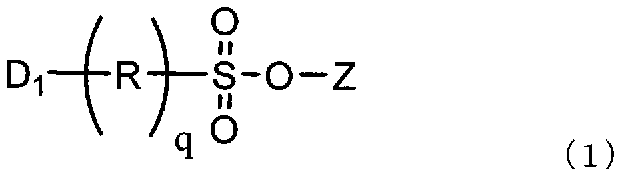
- D1 is a (meth) acryloyloxy group (only when q is 1), a (meth) acryloylthio group (only when q is 1), a (meth) acrylamide group (when q is 1) Only), a vinyl group, an allyl group, an isopropenyl group, a styryl group, a mercapto group, an amino group, a methylamino group, or an ethylamino group, and Z represents a hydrogen ion, an ammonium ion, an amine ion, an alkali metal ion, Or a 1/2 atom alkaline earth metal ion, wherein R is a divalent aliphatic hydrocarbon group having 1 to 600 carbon atoms, and is selected from an aromatic ring, an aliphatic cyclic group, an ether group, and an ester group. And q represents 0 or 1), General formula (2)
- R 5 and R 6 represent a hydrogen atom or a methyl group
- R 7 represents a hydrogen atom or an alkyl group having 1 to 6 carbon atoms
- Z represents a hydrogen ion, an ammonium ion, an amine ion
- an alkali represents a metal ion or a 1/2 atom alkaline earth metal ion
- n1 represents an integer of 1 to 10.
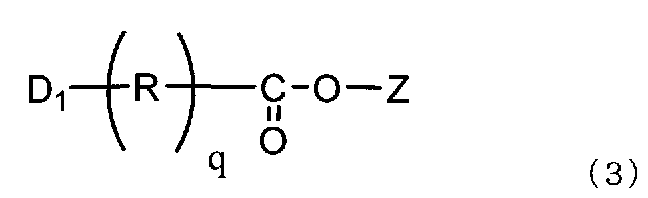
- D1 is a (meth) acryloyloxy group (only when q is 1), (meth) acryloylthio group (only when q is 1), (meth) acrylamide group (when q is 1) Only), a vinyl group, an allyl group, an isopropenyl group, a styryl group, a mercapto group, an amino group, a methylamino group, or an ethylamino group, and Z represents a hydrogen ion, an ammonium ion, an amine ion, an alkali metal ion, Or a 1/2 atom alkaline earth metal ion, wherein R is a divalent aliphatic hydrocarbon group having 1 to 600 carbon atoms, and is selected from an aromatic ring, an aliphatic cyclic group, an ether group, and an ester group. And q represents 0 or 1), General formula (4)
- D 2 is a (meth) acryloyloxy group, (meth) acryloylthio group, (meth) acrylamide group, vinyl group, allyl group, isopropenyl group, styryl group, mercapto group, amino group
- M represents a methylamino group or an ethylamino group
- Z represents a hydrogen ion, an ammonium ion, an amine ion, an alkali metal ion, or an alkaline earth metal ion having a 1 ⁇ 2 atom
- R represents 2 having 1 to 600 carbon atoms.
- a + b 3 when a is 2, D 2 and R may be the same or different from each other, and when b is 2, Z are the same or different from each other.
- D 3 , R 3 and SO 3 Z are groups bonded to carbon on the ring contained in the above formula, and each D 3 independently represents a vinyl group, an allyl group, Represents an isopropenyl group, a styryl group, a mercapto group, an amino group, a methylamino group, an ethylamino group, or a hydroxyl group, and Z represents a hydrogen ion, an ammonium ion, an amine ion, an alkali metal ion, or a 1/2 atom alkaline earth
- Each of R 3 independently represents H, methyl group, ethyl group, methoxy group, ethoxy group, fluorine atom, chlorine atom, bromine atom, or iodine atom, and k is 0-10.
- D 3 are the same as each other But different May have, when k is 2 or more, R 3 together may be the same or different, when m is 2 or more, Z to each other may be the same or different.
- D 3 , R 3 and SO 3 Z are groups bonded to carbon on the ring contained in the above formula, and each D 3 independently represents a vinyl group, an allyl group, Represents an isopropenyl group, a styryl group, a mercapto group, an amino group, a methylamino group, an ethylamino group, or a hydroxyl group, and Z represents a hydrogen ion, an ammonium ion, an amine ion, an alkali metal ion, or a 1/2 atom alkaline earth
- R 3 represents a metal ion
- each R 3 independently represents H, a methyl group, an ethyl group, a methoxy group, an ethoxy group, a fluorine atom, a chlorine atom, a bromine atom, or an iodine atom, and r is 0-6.
- D 3 may be the same or different from each other, in the case of 2 or more, R 3 And may be the same or different from each other.
- q is 2 or more, Z may be the same or different from each other.
- the compound represented by the general formula (1) is represented by the general formula (7).
- D1 is a (meth) acryloyloxy group (when either x or y is 1 or more), a (meth) acryloylthio group (when either x or y is 1 or more), A (meth) acrylamide group (when either x or y is 1 or more), a vinyl group, an allyl group, an isopropenyl group, a styryl group, a mercapto group, an amino group, a methylamino group, or an ethylamino group; Represents a hydrogen ion, an ammonium ion, an amine ion, an alkali metal ion, or a 1 ⁇ 2 atom alkaline earth metal ion, wherein R 1 to R 4 each independently represents a hydrogen atom, a carbon number of 1 to 6 Represents an alkyl group or an alkoxy group having 1 to 6 carbon atoms, v and y independently represent an integer of
- R 1 each other, R 2 to each other may be the same or different from each other, if y is 2 or more, R 3 and R 4 may be the same or different from each other.
- R 1 and R 2 may be the same or different from each other.
- An acrylic resin film having an anionic hydrophilic group wherein the concentration of the anionic hydrophilic group on the surface is higher than the concentration of the anionic hydrophilic group at a depth of 1 ⁇ 2 of the film thickness from the surface of the acrylic resin film
- the surface of the acrylic resin film is a group selected from the group consisting of one or more anionic hydrophilic groups in one molecule and a group containing a polymerizable carbon-carbon double bond, an amino group, a mercapto group, and a hydroxyl group.
- the anionic hydrophilic group concentration on the surface opposite to the side in contact with the base material is such that the anionic hydrophilic group is at a depth of 1 ⁇ 2 from the surface of the acrylic resin film.
- the physical properties of the coating were evaluated as follows.
- TOF-SIMS (Analyzer and measurement conditions) TOF-SIMS; TOF-SIMS5 manufactured by ION-TOF Primary ion; Bi 32 + (acceleration voltage 25 kV) Measurement area: 400 ⁇ m 2 Measurement uses neutralization gun for charge correction (sample preparation, etc.) As shown in FIG. 1, a sample provided with a coating layer 20 on the surface of a base material 10 is cut in a precise oblique direction toward a cutting direction 30, and then cut into a size of about 10 ⁇ 10 mm 2 to measure the surface.
- Sa / Da anion concentration on the surface 40 of the coat layer / anion concentration at a point where the thickness of the coat layer 20 is 1/2 ⁇ Measurement of water contact angle>
- a water contact angle measuring device CA-V type manufactured by Kyowa Interface Science Co., Ltd.
- the obtained filtrate was put in an evaporating dish, dried by heating at 150 ° C. for 2 hours, cooled to room temperature, and the weight of the residue was measured.
- Solubility (wt%) residue amount (g) / ⁇ 10.0 (g) + residue amount (g) ⁇ ⁇ 100 As a result, the solubility was ⁇ 1 wt%.
- the coating solution 1 was applied to a polycarbonate sheet (hereinafter abbreviated as a PC plate) as a base material at room temperature (26 ° C.-20% RH) with a bar coater # 6 and allowed to stand (dry) for 1 minute, and then a UV conveyor.
- Example 1 First, a treatment liquid for grafting the film surface obtained in Production Example 1 was prepared according to Table 3.
- the obtained grafting solution was applied to the coating film surface of Production Example 1 with a bar coater # 20, dried for 2 to 3 minutes with a hot air dryer at 40 to 50 ° C., and then UV conveyor (Fusion UV Systems Japan Co., Ltd.) Company, electrodeless discharge lamp H bulb, output 100%, conveyor speed 6m / min) passed once (cumulative light quantity 900mJ / cm 2 ) to perform the grafting treatment on the coating film surface and harden the film completely . Finally, the surface of the obtained coating film was washed with running water while gently rubbing with a polyurethane sponge, dried with a warm air dryer, and then cooled to room temperature to complete the coating. The results are shown in Table 6.
- V-4263 Trifunctional urethane acrylate oligomer having an average molecular weight of about 2000 (“Unidic V-4263” manufactured by Dainippon Ink & Chemicals, Inc.)
- HDDA 1,6-hexanediol diacrylate (“New Frontier HDDA” manufactured by Daiichi Kogyo Seiyaku Co., Ltd.)
- MR200 2-methacryloyloxyethyl acid phosphate (“MR200” manufactured by Daihachi Chemical Industry Co., Ltd.)
- the coating liquid was applied to a PC plate having a thickness of 2 mm with a bar coater, and irradiated with 200 mJ / cm 2 (integrated light amount) of ultraviolet rays using the ultraviolet irradiation device of Example 1 to obtain a coating film on the PC plate.
- the acrylic group polymerization degree of this coating film was 60 mol%. (Grafting) Next, the PC plate on which this coating film was laminated was put into the grafting solution prepared above for 1 minute, pulled up, and then irradiated again with the above-mentioned ultraviolet rays at 1500 mJ / cm 2 (integrated light amount). Was completely cured.
- the obtained coating film was washed with running water, dried with a warm air dryer, and cooled to room temperature to complete the coating film.
- the results are listed in Table 6.
- the laminated body having a grafted film formed on PC was immersed in hot water at 90 ° C. to evaluate hot water resistance.
- the results are shown in Table 8 together with the results of the laminates of Example 1 and Comparative Example 1.
- Table 8 shows the results obtained by immersing the membranes obtained in Example 1, Comparative Example 1 and Reference Example 1 in hot water of 90 ° for 1, 4, 9, or 14 days, and measuring the water contact angle and haze. Shown in
- Examples 2 to 17 Tests were conducted in the same manner as in Example 1, except that the compound having an anionic hydrophilic group (graft compound) constituting the grafting solution in Table 3 was changed. The results are listed in Table 9.
- Base material 20 Coat layer 30: Cutting direction 40: Coat layer surface 50: Inside of coat layer
Landscapes
- Chemical & Material Sciences (AREA)
- Health & Medical Sciences (AREA)
- Chemical Kinetics & Catalysis (AREA)
- Medicinal Chemistry (AREA)
- Polymers & Plastics (AREA)
- Organic Chemistry (AREA)
- Engineering & Computer Science (AREA)
- Manufacturing & Machinery (AREA)
- General Chemical & Material Sciences (AREA)
- Materials Engineering (AREA)
- Toxicology (AREA)
- Laminated Bodies (AREA)
- Coating Of Shaped Articles Made Of Macromolecular Substances (AREA)
- Treatments Of Macromolecular Shaped Articles (AREA)
- Addition Polymer Or Copolymer, Post-Treatments, Or Chemical Modifications (AREA)
- Paints Or Removers (AREA)
Description
本発明で用いられるアクリル樹脂系膜とは、表面におけるアニオン性親水基の濃度が、表面から膜厚1/2の深さにおけるアニオン性親水基の濃度よりも高いアクリル樹脂系膜であれば良い。本明細書ではこれを「アニオン性の親水基が傾斜した膜(傾斜膜)」ということがある。これらのアニオン性親水基が傾斜した膜としては、溶剤の蒸発を利用して表面にアニオン性親水基を傾斜させた高親水性の膜(特許文献3および特許文献4)が挙げられ、本発明の処理膜として好ましく用いられる。ここでアニオン性親水基とは、スルホン酸基、カルボキシル基またはリン酸基から選ばれる親水性の官能基を表し、これらの中では、表面の親水性が高くなるスルホン酸基が特に好ましい。
本発明の処理に用いられる化合物は、1分子内にアニオン性親水基を1個以上と重合性炭素炭素二重結合を含む基、アミノ基、メルカプト基、及び水酸基からなる群より選ばれる基を1個以上とを有する化合物(A)である。化合物(A)に結合される重合性炭素炭素二重結合とは、例えば(メタ)アクリロイルオキシ基、(メタ)アクリロイルチオ基、(メタ)アクリルアミド基、アリル基、ビニル基、またはイソプロペニル基から選ばれるラジカル重合性の官能基を表す。
一般式(1)

または一般式(2)
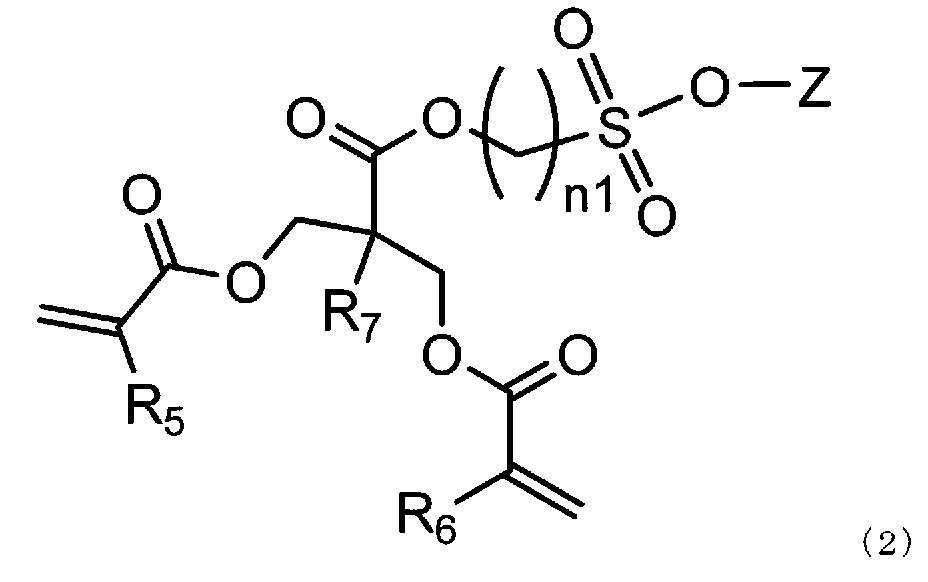
または、一般式(3)
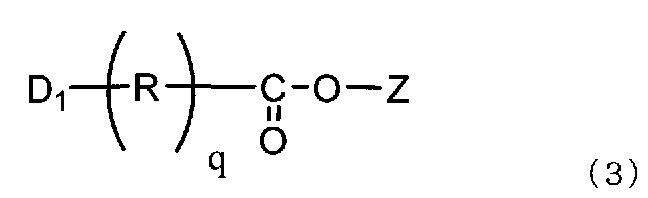
または、一般式(4)
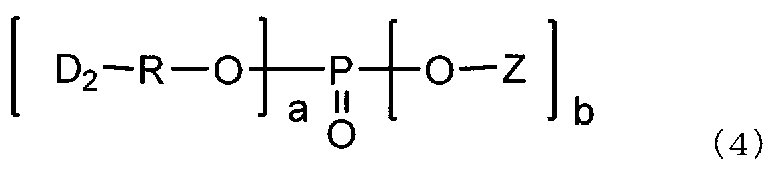
または、一般式(5)

または、一般式(6)
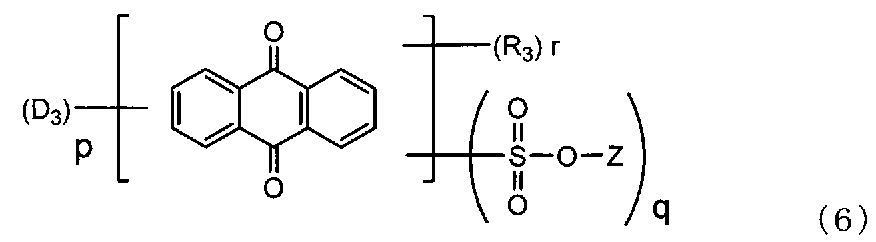
で表わされる化合物が挙げられる。

vおよびyは、独立して0~10の整数を表し、wは0または1を表す(但し、vまたはyの何れかが0の場合、wも0である。)。xは0~10の整数を表す。vが2以上である場合、R1同士、R2同士は互いに同一でも異なっていても良く、yが2以上である場合、R3同士、R4同士は互いに同一でも異なっていても良い。xが2以上である場合、R1同士、R2同士は互いに同一でも異なっていても良い。)
で表される化合物が挙げられる。
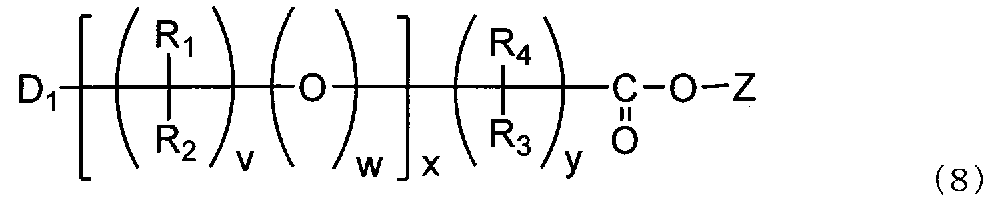
で表される化合物が挙げられる。
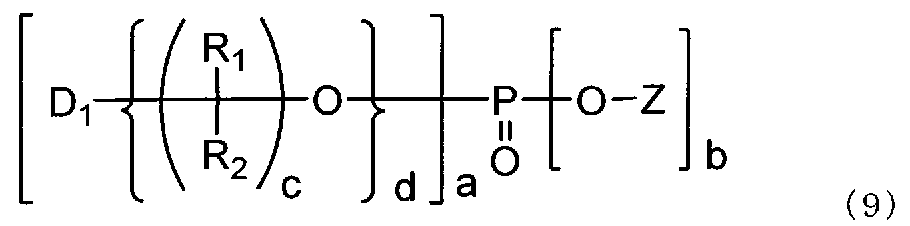
で表される化合物が挙げられる。
表面におけるアニオン性親水基の濃度が、表面から膜厚1/2の深さにおけるアニオン性親水基の濃度よりも高いアクリル樹脂系膜に、アニオン性親水基を有する化合物(A)を含む溶液を塗布し、放射線照射または加熱することにより、表面に化合物(A)をグラフト反応させることにより、その表面および表面付近内部アニオン性親水基濃度を向上させることにより、親水性をさらに高め防曇性を向上させることができる。化合物(A)の傾斜膜へのグラフト反応について、代表例を以下に掲載する。

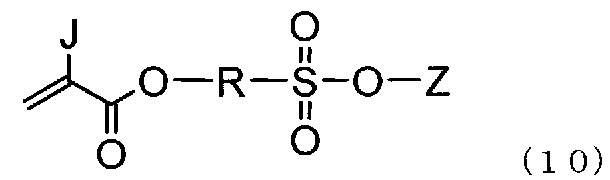
で表される化合物、または一般式(11)
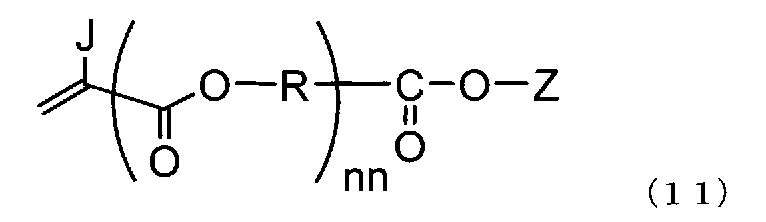
で表される化合物、または一般式(12)
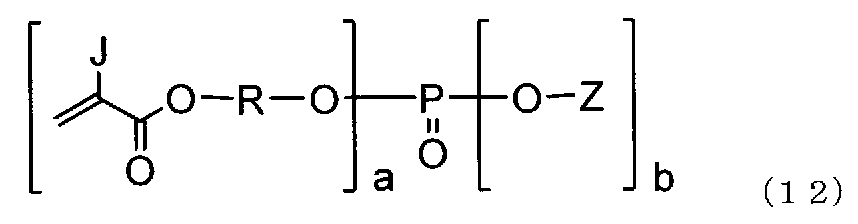
で表される化合物などが挙げられる。
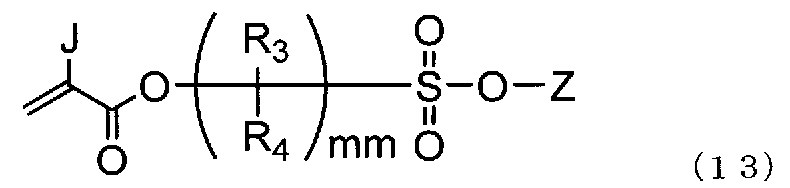
で表される化合物、または一般式(14)
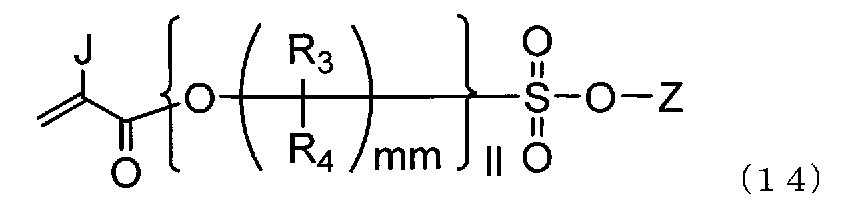
で表される化合物が挙げられる。
ポリエステル系ポリウレタンエマルジョンコート剤、ポリ塩化ビニルエマルジョンコート剤、ウレタンアクリルエマルジョンコート剤、シリコンアクリルエマルジョンコート剤、酢酸ビニルアクリルエマルジョンコート剤、アクリルエマルジョンコート剤;
スチレン-ブタジエン共重合体ラテックスコート剤、アクリルニトリル-ブタジエン共重合体ラテックスコート剤、メチルメタアクリレート-ブタジエン共重合体ラテックスコート剤、クロロプレンラテックスコート剤、ポリブタジェンラテックスのゴム系ラテックスコート剤、ポリアクリル酸エステルラテックスコート剤、ポリ塩化ビニリデンラテックスコート剤、ポリブタジエンラテックスコート剤、あるいはこれらラテックスコート剤に含まれる樹脂のカルボン酸変性物ラテックスもしくはディスパージョンからなるコート剤が好ましい。
ポリオキシエチレンアルキルおよびアリールエーテル、ポリオキシプロピレンアルキルおよびアリールエーテル、多価アルコールエステルのポリオキシエチレンアルキルおよびアリールエーテル、ポリエチレングリコール脂肪酸エステル、脂肪族アルカノールアミド、ポリオキシエチレン脂肪族アミドなどの非イオン界面活性剤、DIC社製メガファック、三菱マテリアル電子化成社製エフトップ、旭硝子社製サーフロン、ネオス社製フタージェント、ダイキン工業社製ユニダイン、住友スリーエム社製フローラード、ディポン社製ゾニールなどのフッ素系界面活性剤、共栄社化学製アクアレン8020、アクアレンHS-01、アクアレンSB-630、ポリフローKL-100、ポリフローKL-800、ポリフローWS-30などのシリコン系界面活性剤などが挙げられる。これらの中ではシリコン系界面活性剤が比較的に好ましい。
[1]
アニオン性親水基を有するアクリル樹脂系膜から得られる変性アクリル樹脂膜であって、表面におけるアニオン性親水基の濃度が、該アクリル樹脂系膜の表面から膜厚1/2の深さにおけるアニオン性親水基の濃度よりも高いアクリル樹脂系膜の当該表面を、1分子内にアニオン性親水基を1個以上と重合性炭素炭素二重結合を含む基、アミノ基、メルカプト基、及び水酸基からなる群より選ばれる基を1個以上とを有する化合物(A)で処理して得られる変性アクリル樹脂膜。
[2]
前記処理がグラフト処理である[1]記載の変性アクリル樹脂膜。
[3]
化合物(A)が、一般式(1)~(6)で表される化合物から選ばれる1種以上である[1]または[2]に記載の変性アクリル樹脂膜;
一般式(1)
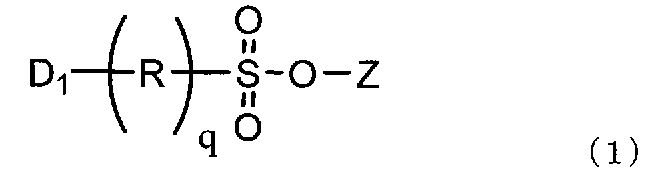
一般式(2)
一般式(3)
一般式(4)
一般式(5)
一般式(6)
[4]
一般式(1)で表される化合物が、一般式(7)
で表される化合物である[3]記載の変性アクリル樹脂膜。
[5]
基材と、[1]~[4]のいずれかに記載の変性アクリル樹脂膜との積層体。
[6]
アニオン性親水基を有するアクリル樹脂系膜であって、表面におけるアニオン性親水基の濃度が、該アクリル樹脂系膜の表面から膜厚1/2の深さにおけるアニオン性親水基の濃度よりも高いアクリル樹脂系膜の、当該表面を、1分子内にアニオン性親水基を1個以上と重合性炭素炭素二重結合を含む基、アミノ基、メルカプト基、及び水酸基からなる群より選ばれる基を1個以上とを有する化合物(A)で処理することを特徴とする、変性アクリル樹脂膜の製造方法。
[7]
基材上に前記アクリル樹脂系膜を形成する工程を含む[6]記載の変性アクリル樹脂膜の製造方法。
[8]
前記アクリル樹脂系膜は、基材と接している側と反対側の表面におけるアニオン性親水基の濃度が、該アクリル樹脂系膜の表面から膜厚1/2の深さにおけるアニオン性親水基の濃度よりも高いものである[7]記載の変性アクリル樹脂膜の製造方法。
以下、実施例等により本発明をさらに詳細に説明するが、本発明がこれら実施例のみに限定されるものではない。
アクリル樹脂系コーティング液を基材に塗布して溶剤乾燥し、UV照射前後の808cm-1の>C=CH2ピーク強度(ベースライン法)を測定し、以下の計算式により重合度を算出した。
<アニオン及びカチオン濃度比の測定>
図1に示す試料調製の通りサンプルを斜めに切断し、飛行時間型2次イオン質量分析装置(TOF-SIMS)を用いて、上記外表面のアニオン濃度(Sa)と上記中間地点とのアニオン濃度(Da)とを測定し、その値から外気に接する膜の外表面と膜の内表面と外表面との中間地点のアニオン濃度比(Sa/Da)を求めた。
(分析装置と測定条件)
TOF-SIMS; ION・TOF社製 TOF-SIMS5
1次イオン; Bi32 + (加速電圧25kV)
測定面積; 400μm2
測定には帯電補正用中和銃を使用
(試料調製等)
図1に示す通りに、基材10の表面にコート層20が設けられたサンプルを切削方向30に向かって、精密斜め切削を行った後、10×10mm2程度の大きさに切り出し、測定面にメッシュを当て、サンプルホルダーに固定し、外気と接するコート層表面40および膜の内部であるコート層内部50(膜厚1/2の地点、基材10に接するコート層の内表面)で飛行時間型2次イオン質量分析装置(TOF-SIMS)を用いてアニオン濃度を測定した。
(評価)
評価は以下の計算式で行った。尚、各測定点のイオン濃度は、相対強度(トータル検出イオンに対する)を用いた。
<水接触角の測定>
協和界面科学社製の水接触角測定装置CA-V型を用いて、1サンプルについて3箇所測定し、これら値の平均値を水接触角の値とした。
日本電色工業社製のヘーズメーターNDH2000を用いて、1サンプルについて4箇所測定し、これら値の平均値をヘーズの値とした。
碁盤目剥離試験により評価した。
ゼブラ(株)製の油性マーカー「マッキー極細」(黒,品番MO-120-MC-BK)でマークし、その上に水滴を垂らして30秒間放置し、テッシュペーパーでふき取る。マークがふき取れた場合を〇、ふき取れずに残った場合を×とした。
呼気により曇らなかった場合を〇、曇った場合を×とした。
防曇性評価装置(協和界面科学,防曇性評価装置「AFA-1」)を用い測定を行った。尚、評価は測定中に防曇指数が全て2以下を維持した場合を○、防曇指数が1回でも2を超えた場合を×とした。
AFA-1の測定条件
水蒸気温度: 35℃
測定室温度: 16℃
測定方法: 1回/3秒の間隔で防曇指数を測定,0~15秒まではスタート時の状態を保持→15秒~1分15秒は35℃蒸気を連続吹きつけ→1分15秒~2分15秒は蒸気を停止して強制乾燥
〔製造例1〕アニオン性親水基を有するコーティング表面(親水性膜)の製造
(コーティング溶液1の調製)
表1の配合比に従い、固形分65wt%の均一なコーティング液1を調製した。

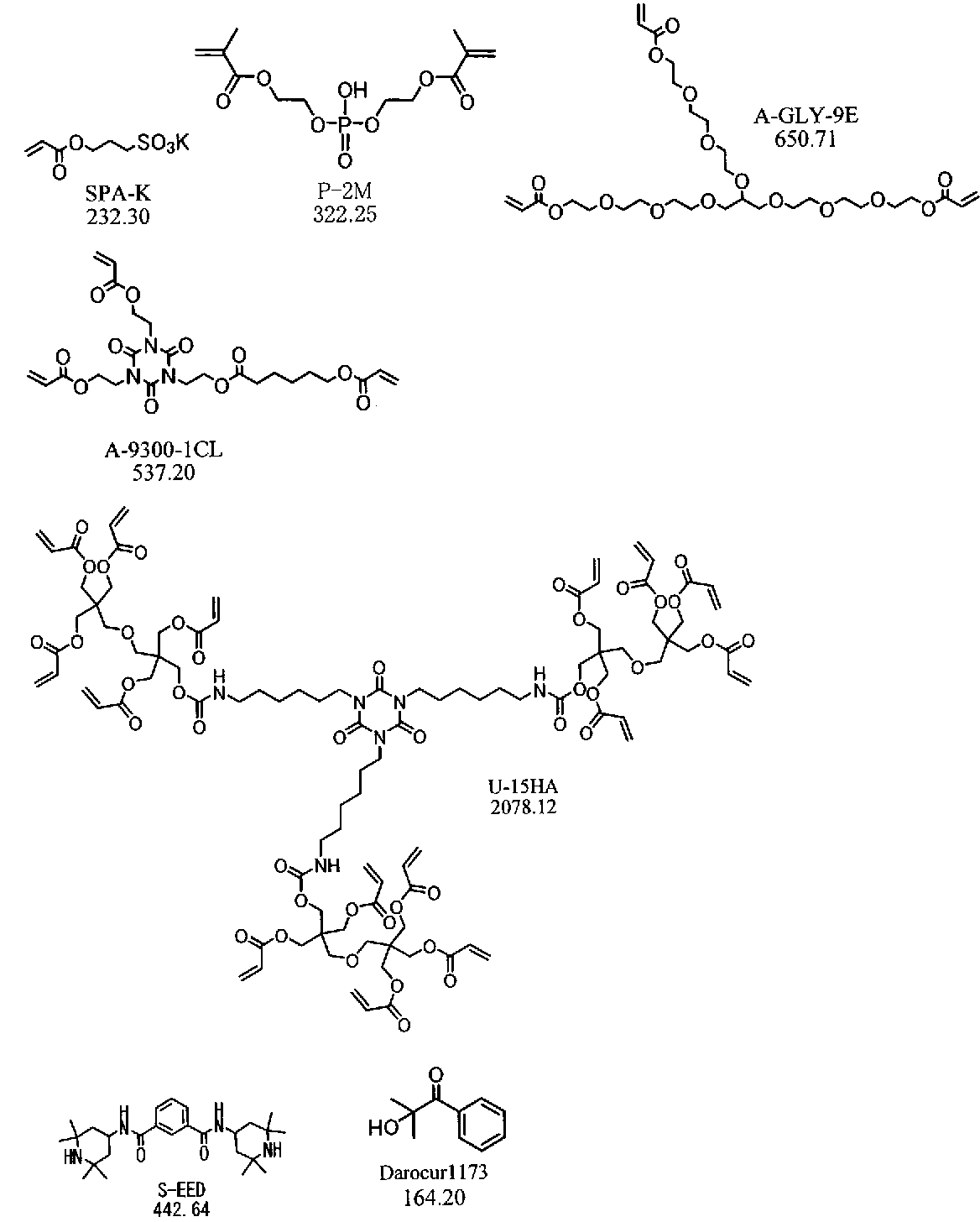
シクロヘキサン8.3gとトルエン1.7gの混合溶液10.0gに、本発明の傾斜膜を形成する親水性化合物SPA-K:3-スルホプロピルアクリレートカリウム塩1.0gを添加して25℃で1時間攪拌し、0.45μmのメンブランフィルターで濾過した。
結果、溶解度は<1wt%であった。
(表面におけるアニオン性親水基の濃度が、表面から膜厚1/2の深さ(以下「深部」ということがある)におけるアニオン性親水基の濃度よりも高い(いわゆる傾斜膜)の形成)
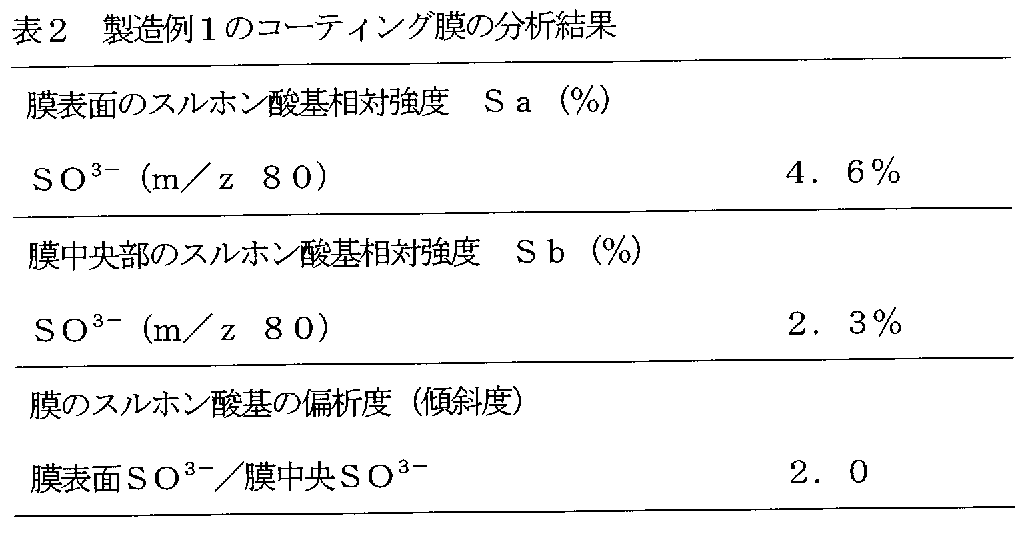
コーティング溶液1を基材となるポリカーボネート製シート(以下PC板と略す。)に、室温(26℃-20%RH)でバーコーター#6で塗布して1分間静置(乾燥)し、UVコンベアー(フュージョンUVシステムズ・ジャパン株式会社,無電極放電ランプ Hバルブ,出力50%,コンベアー速度30m/分)を1回通過させて(積算光量90mJ/cm2)、PC板上に膜厚約5μmの傾斜膜を形成させた。このコーティング膜のアクリル基重合度は50mol%で、その他に物性測定およびTOF-SIMSによる分析を行った。結果を表2に示す。
先ず、製造例1で得られた膜表面をグラフト処理するための処理液を表3に従い調製した。

グラフト処理液の塗布を行わずに、実施例1と同様に試験を行った。結果を表6に示す。
参考: 特開2001-98007号公報, 川村理化学研究所
(使用化合物の説明)
「M-114」:ノニルフェノキシポリエチレングリコール(n=8)アクリレート(東亜合成化学株式会社製の「M-114」、HLB値:11.25)
「V-4263」:平均分子量約2000の3官能ウレタンアクリレートオリゴマー(大日本インキ化学工業株式会社製の「ユニディックV-4263」)
「HDDA」:1,6-ヘキサンジオールジアクリレート(第一工業製薬株式会社製の「ニューフロンティアHDDA」)
「MR200」:2-メタクリロイルオキシエチルアシッドホスフェート
(大八化学工業社製の「MR200」)
「PMNE10」:ポリエチレングリコールモノ-4-ノニルフェニルエーテル(n′=10)(東京化成工業株式会社製の「ポリエチレングリコールモノ-4-ノニルフェニルエーテル(n′=10)」)
「Irg.184」:1-ヒドロキシシクロヘキシルフェニルケトン(チバガイギー社製の「イルガキュアー184」)
(コーティング液の調製)
架橋重合性化合物として「V-4263」20部および「HDDA」20部、重合性化合物として「M114」60部、ならびに光重合開始剤として「Irg.184」5部を混合してコーティング液を調製した。
(グラフト処理液の調製)
「PMNE10」5部、親水性化合物として「MR200」5部、および水90部からなる溶液を調製し、親水性層形成材料とした。
(グラフト処理用コーティング膜の作製)
上記コーティング液を、 厚さ2mmのPC板にバーコーターで塗布し、実施例1の紫外線照射装置で200mJ/cm2(積算光量)紫外線を照射し、PC板上に塗膜を得た。
(グラフト処理)
次に、この塗膜が積層されたPC板を上記で調製されたグラフト処理液中に1分間投入し、引き上げた後、再度上記の紫外線を1500mJ/cm2(積算光量)照射し、塗膜を完全に硬化させた。
参考: 特開2011-229734号公報, 積水ホームテクノ
(コーティング液の調整)
下表4に従い、コーティング液を調製した。
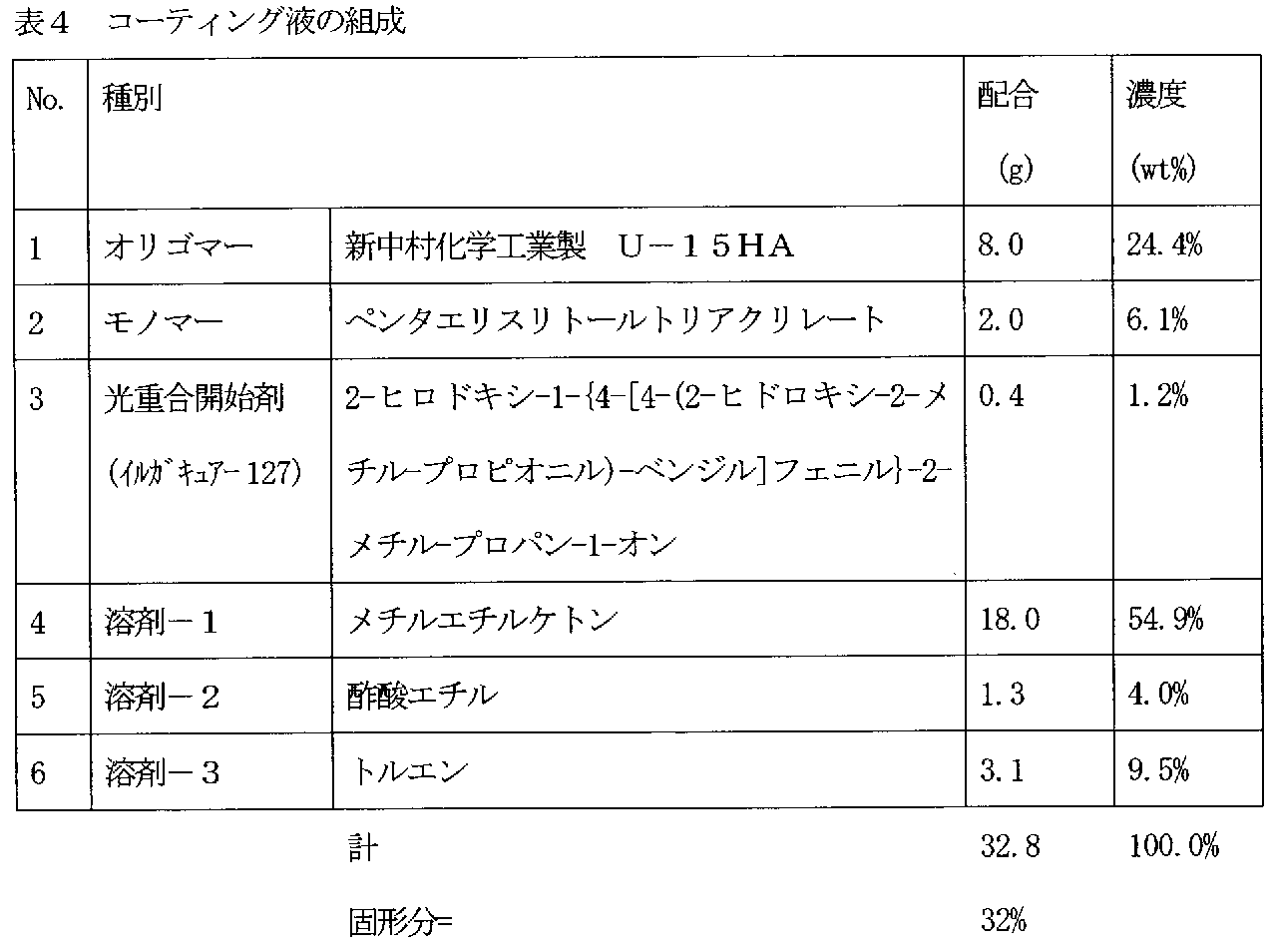
上記の下塗り用コーティング液をスプレーガンで、設定乾燥膜厚が12μm(as dry)になるように基材PC板上に塗布し、室温で3分間放置後、80℃温風乾燥機に3分間設置して乾燥し、実施例1と同様にUV照射(ランプ出力50%,コンベアー速度30m/分,積算光量90mJ/cm2)、PC上コーティング膜を得た。
この膜アクリル基重合度は50mol%であった。
(グラフト処理液の調製)
下記表5に従いグラフト処理液を調製した。
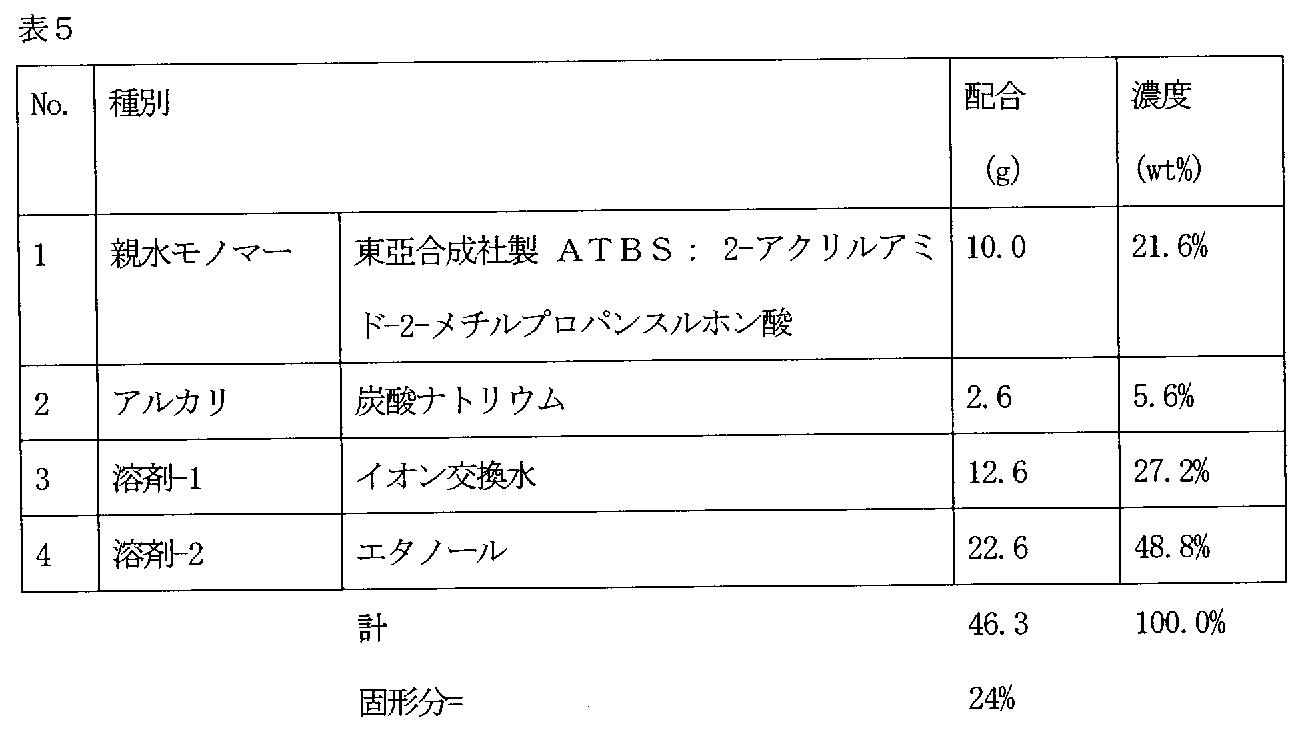
PC上に作製されたコーティング膜表面に、表5のグラフト処理液で実施例1と同様に処理し、被膜を完成させた。結果を表6に掲載する。

表1のコーティング溶液1の代わりに表7のコーティング溶液2を用いて実施例1と同様に試験を行った(グラフト処理前の膜のアクリル基重合度は50mol%であった。)。

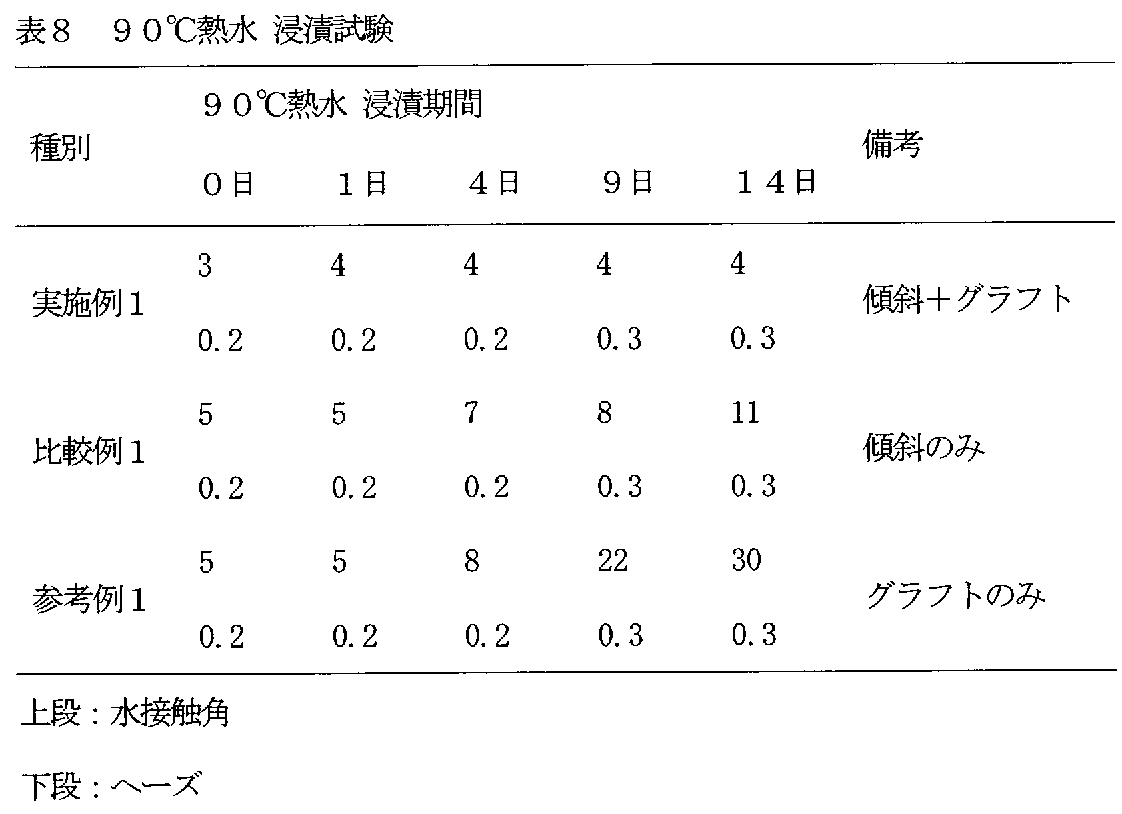
表3のグラフト処理液を構成するアニオン性親水基を有する化合物(グラフト化合物)を変更して、実施例1と同様に試験した。結果を表9に掲載する。

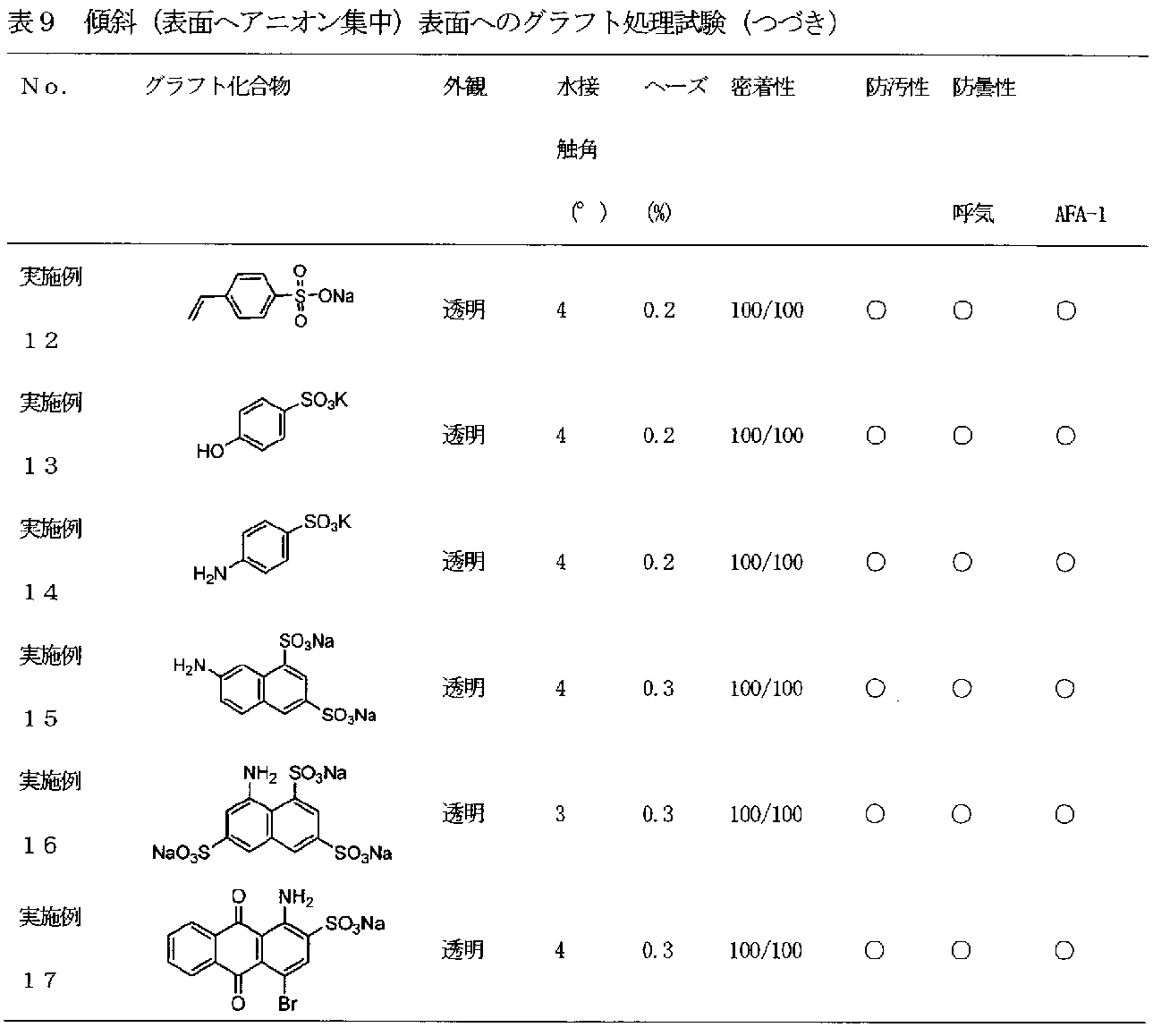
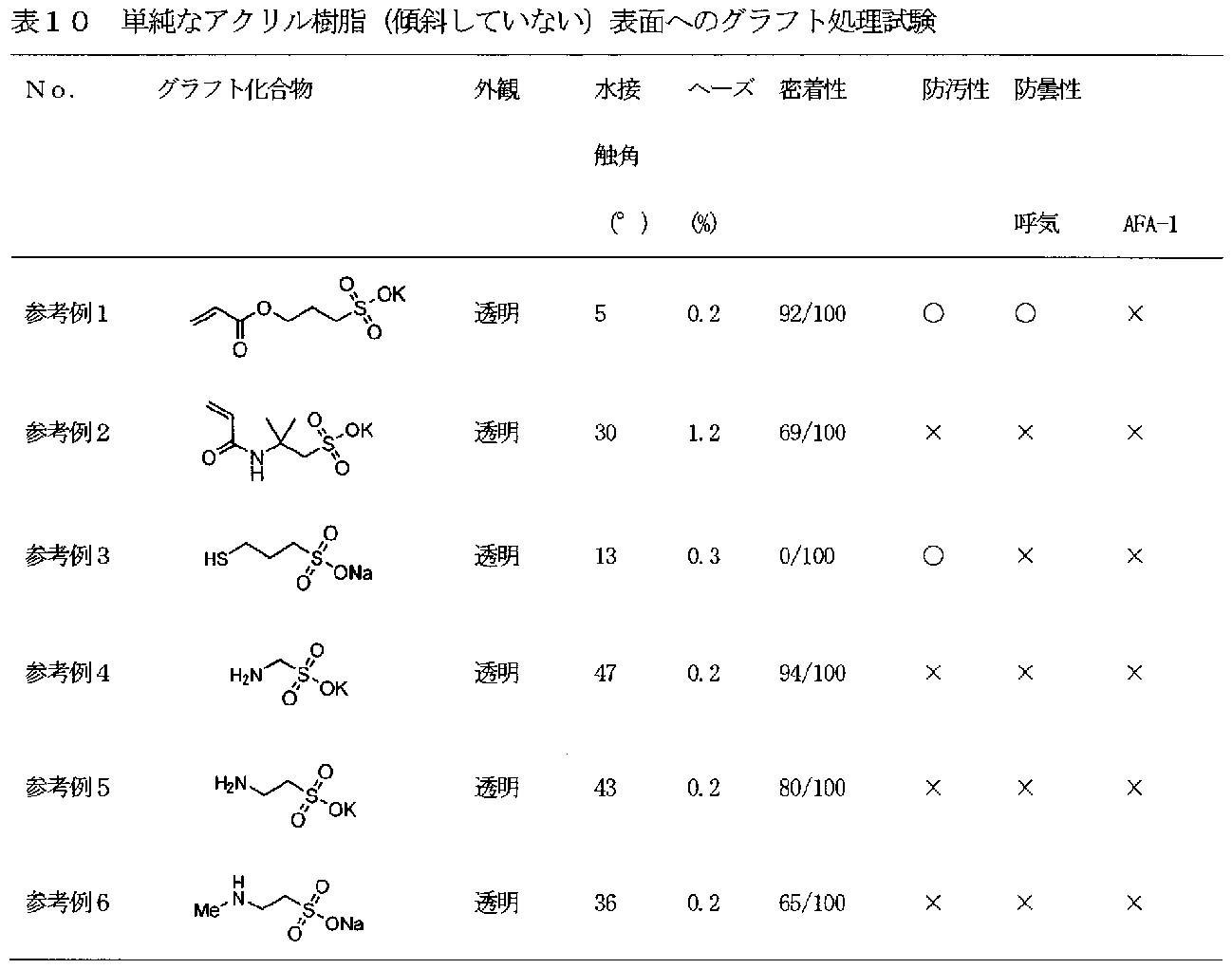
表3のグラフト処理液を構成するアニオン性親水基を有する化合物(グラフト化合物)を変更して、参考例1と同様に試験した。結果を表10に掲載する。
20: コート層
30: 切削方向
40: コート層表面
50: コート層内部
Claims (8)
- アニオン性親水基を有するアクリル樹脂系膜から得られる変性アクリル樹脂膜であって、表面におけるアニオン性親水基の濃度が、該アクリル樹脂系膜の表面から膜厚1/2の深さにおけるアニオン性親水基の濃度よりも高いアクリル樹脂系膜の当該表面を、1分子内にアニオン性親水基を1個以上と重合性炭素炭素二重結合を含む基、アミノ基、メルカプト基、及び水酸基からなる群より選ばれる基を1個以上とを有する化合物(A)で処理して得られる変性アクリル樹脂膜。
- 前記処理がグラフト処理である請求項1記載の変性アクリル樹脂膜。
- 化合物(A)が、一般式(1)~(6)で表される化合物から選ばれる1種以上である請求項1または2に記載の変性アクリル樹脂膜;
一般式(1)
一般式(2)
一般式(3)
一般式(4)
一般式(5)
一般式(6)

- 一般式(1)で表される化合物が、一般式(7)
で表される化合物である請求項3記載の変性アクリル樹脂膜。 - 基材と、請求項1~4のいずれかに記載の変性アクリル樹脂膜との積層体。
- アニオン性親水基を有するアクリル樹脂系膜であって、表面におけるアニオン性親水基の濃度が、該アクリル樹脂系膜の表面から膜厚1/2の深さにおけるアニオン性親水基の濃度よりも高いアクリル樹脂系膜の、当該表面を、1分子内にアニオン性親水基を1個以上と重合性炭素炭素二重結合を含む基、アミノ基、メルカプト基、及び水酸基からなる群より選ばれる基を1個以上とを有する化合物(A)で処理することを特徴とする、変性アクリル樹脂膜の製造方法。
- 基材上に前記アクリル樹脂系膜を形成する工程を含む請求項6記載の変性アクリル樹脂膜の製造方法。
- 前記アクリル樹脂系膜は、基材と接している側と反対側の表面におけるアニオン性親水基の濃度が、該アクリル樹脂系膜の表面から膜厚1/2の深さにおけるアニオン性親水基の濃度よりも高いものである請求項7記載の変性アクリル樹脂膜の製造方法。
Priority Applications (7)
| Application Number | Priority Date | Filing Date | Title |
|---|---|---|---|
| EP13803809.6A EP2860215A4 (en) | 2012-06-12 | 2013-06-06 | MODIFIED HYDROPHILIC ACRYLIC RESIN FOIL |
| CN201380030594.4A CN104364302B (zh) | 2012-06-12 | 2013-06-06 | 亲水性的改性丙烯酸树脂膜 |
| US14/407,404 US20150126682A1 (en) | 2012-06-12 | 2013-06-06 | Hydrophilic modified acrylic resin film |
| BR112014031019A BR112014031019A2 (pt) | 2012-06-12 | 2013-06-06 | filme de resina acrílica modificada hidrofílica |
| KR1020147036748A KR101634485B1 (ko) | 2012-06-12 | 2013-06-06 | 친수성의 변성 아크릴 수지막 |
| JP2014521294A JP5881828B2 (ja) | 2012-06-12 | 2013-06-06 | 親水性の変性アクリル樹脂膜 |
| IN10572DEN2014 IN2014DN10572A (ja) | 2012-06-12 | 2014-12-11 |
Applications Claiming Priority (2)
| Application Number | Priority Date | Filing Date | Title |
|---|---|---|---|
| JP2012133074 | 2012-06-12 | ||
| JP2012-133074 | 2012-06-12 |
Publications (1)
| Publication Number | Publication Date |
|---|---|
| WO2013187311A1 true WO2013187311A1 (ja) | 2013-12-19 |
Family
ID=49758136
Family Applications (1)
| Application Number | Title | Priority Date | Filing Date |
|---|---|---|---|
| PCT/JP2013/065722 Ceased WO2013187311A1 (ja) | 2012-06-12 | 2013-06-06 | 親水性の変性アクリル樹脂膜 |
Country Status (9)
| Country | Link |
|---|---|
| US (1) | US20150126682A1 (ja) |
| EP (1) | EP2860215A4 (ja) |
| JP (1) | JP5881828B2 (ja) |
| KR (1) | KR101634485B1 (ja) |
| CN (1) | CN104364302B (ja) |
| BR (1) | BR112014031019A2 (ja) |
| IN (1) | IN2014DN10572A (ja) |
| TW (1) | TWI598381B (ja) |
| WO (1) | WO2013187311A1 (ja) |
Cited By (6)
| Publication number | Priority date | Publication date | Assignee | Title |
|---|---|---|---|---|
| CN104761991A (zh) * | 2014-01-07 | 2015-07-08 | 中国科学院兰州化学物理研究所 | 一种环保型多元协同海洋防污涂料 |
| WO2015178248A1 (ja) * | 2014-05-19 | 2015-11-26 | 三井化学株式会社 | 親水性単層膜 |
| WO2016136811A1 (ja) * | 2015-02-25 | 2016-09-01 | 三井化学株式会社 | 変性アクリル樹脂硬化物、及びその積層体、並びに、これらの製造方法 |
| WO2018038270A1 (ja) * | 2016-08-26 | 2018-03-01 | 三井化学株式会社 | 防曇性積層体 |
| EP3270192A4 (en) * | 2015-03-09 | 2018-10-31 | Mitsui Chemicals, Inc. | Hydrophilic single-layer film having optical functionality, and laminate thereof |
| KR20190038867A (ko) | 2016-08-26 | 2019-04-09 | 미쯔이가가꾸가부시끼가이샤 | 반사 방지성 적층체 |
Families Citing this family (6)
| Publication number | Priority date | Publication date | Assignee | Title |
|---|---|---|---|---|
| TWI547374B (zh) | 2015-04-24 | 2016-09-01 | 長興材料工業股份有限公司 | 體外膜片用之親水膜 |
| CN108211826A (zh) * | 2018-02-13 | 2018-06-29 | 温州莲华环保科技有限公司 | 一种正渗透膜及其制备方法 |
| CN114829537B (zh) * | 2019-12-24 | 2024-05-28 | 东京应化工业株式会社 | 表面处理液及亲水化处理方法 |
| US12378436B2 (en) * | 2020-03-13 | 2025-08-05 | Lixil Corporation | Sanitary facility and method for manufacturing sanitary facility |
| CN118454487B (zh) * | 2024-05-20 | 2024-11-08 | 上海乐纯生物技术股份有限公司 | 一种亲水改性聚偏氟乙烯过滤膜的制备方法 |
| CN121064549B (zh) * | 2025-11-05 | 2026-02-27 | 厦门理工学院 | 一种亲水改性hdpe组合物及其应用 |
Citations (13)
| Publication number | Priority date | Publication date | Assignee | Title |
|---|---|---|---|---|
| JPH04175349A (ja) * | 1989-11-17 | 1992-06-23 | Mitsubishi Rayon Co Ltd | 成形物およびその製造方法 |
| JPH05186620A (ja) * | 1992-01-13 | 1993-07-27 | Mitsubishi Rayon Co Ltd | 被覆成形物およびその製造方法 |
| JPH1053658A (ja) * | 1996-05-21 | 1998-02-24 | Dainippon Ink & Chem Inc | 表面親水性成形物の製造方法 |
| JPH10101827A (ja) * | 1996-09-27 | 1998-04-21 | Sekisui Chem Co Ltd | 基材の表面処理方法 |
| JP2000319406A (ja) * | 1999-05-13 | 2000-11-21 | Kawamura Inst Of Chem Res | 親水性成形物およびその製造方法 |
| JP2001098007A (ja) | 1999-09-29 | 2001-04-10 | Kawamura Inst Of Chem Res | 親水性成形物およびその製造法 |
| WO2007064003A1 (ja) | 2005-12-02 | 2007-06-07 | Mitsui Chemicals, Inc. | 単層膜およびこれからなる親水性材料 |
| JP2008185530A (ja) * | 2007-01-31 | 2008-08-14 | Ai Bio Chips:Kk | 分離回収用ゲル組成物及びこれを用いた分離回収方法 |
| JP2009073923A (ja) * | 2007-09-20 | 2009-04-09 | Mitsui Chemicals Inc | 親水性化合物およびこれからなる親水性材料 |
| WO2009099210A1 (ja) * | 2008-02-08 | 2009-08-13 | Mitsubishi Rayon Co., Ltd. | ハイドロゲルおよびその製造方法 |
| JP2011219512A (ja) * | 2010-04-02 | 2011-11-04 | Menicon Co Ltd | 重合性組成物、ポリマー材料、眼用レンズ及びコンタクトレンズ |
| JP2011229734A (ja) | 2010-04-28 | 2011-11-17 | Sekisui Home Techno Kk | 浴槽及び浴槽の製造方法 |
| WO2012014829A1 (ja) | 2010-07-29 | 2012-02-02 | 三井化学株式会社 | 単層膜およびこれからなる親水性材料 |
Family Cites Families (4)
| Publication number | Priority date | Publication date | Assignee | Title |
|---|---|---|---|---|
| GB2325467B (en) * | 1997-05-21 | 2000-11-01 | Dainippon Ink & Chemicals | Process for producing material with hydrophilic surface |
| JP5307378B2 (ja) * | 2007-10-26 | 2013-10-02 | スリーエム イノベイティブ プロパティズ カンパニー | (メタ)アクリル系フィルムおよびこれを用いたマーキングフィルム |
| US9512034B2 (en) * | 2008-03-21 | 2016-12-06 | Mitsui Chemicals, Inc. | Hydrophilic film |
| US8758894B2 (en) * | 2010-04-09 | 2014-06-24 | Nanofilm, Ltd. | Fog and abrasion resistant hardcoat for plastics having hydrophilic surfactant rich surface portion with surfactant concentration gradient |
-
2013
- 2013-06-06 KR KR1020147036748A patent/KR101634485B1/ko not_active Expired - Fee Related
- 2013-06-06 EP EP13803809.6A patent/EP2860215A4/en not_active Withdrawn
- 2013-06-06 JP JP2014521294A patent/JP5881828B2/ja not_active Expired - Fee Related
- 2013-06-06 BR BR112014031019A patent/BR112014031019A2/pt not_active Application Discontinuation
- 2013-06-06 CN CN201380030594.4A patent/CN104364302B/zh not_active Expired - Fee Related
- 2013-06-06 WO PCT/JP2013/065722 patent/WO2013187311A1/ja not_active Ceased
- 2013-06-06 US US14/407,404 patent/US20150126682A1/en not_active Abandoned
- 2013-06-11 TW TW102120671A patent/TWI598381B/zh not_active IP Right Cessation
-
2014
- 2014-12-11 IN IN10572DEN2014 patent/IN2014DN10572A/en unknown
Patent Citations (13)
| Publication number | Priority date | Publication date | Assignee | Title |
|---|---|---|---|---|
| JPH04175349A (ja) * | 1989-11-17 | 1992-06-23 | Mitsubishi Rayon Co Ltd | 成形物およびその製造方法 |
| JPH05186620A (ja) * | 1992-01-13 | 1993-07-27 | Mitsubishi Rayon Co Ltd | 被覆成形物およびその製造方法 |
| JPH1053658A (ja) * | 1996-05-21 | 1998-02-24 | Dainippon Ink & Chem Inc | 表面親水性成形物の製造方法 |
| JPH10101827A (ja) * | 1996-09-27 | 1998-04-21 | Sekisui Chem Co Ltd | 基材の表面処理方法 |
| JP2000319406A (ja) * | 1999-05-13 | 2000-11-21 | Kawamura Inst Of Chem Res | 親水性成形物およびその製造方法 |
| JP2001098007A (ja) | 1999-09-29 | 2001-04-10 | Kawamura Inst Of Chem Res | 親水性成形物およびその製造法 |
| WO2007064003A1 (ja) | 2005-12-02 | 2007-06-07 | Mitsui Chemicals, Inc. | 単層膜およびこれからなる親水性材料 |
| JP2008185530A (ja) * | 2007-01-31 | 2008-08-14 | Ai Bio Chips:Kk | 分離回収用ゲル組成物及びこれを用いた分離回収方法 |
| JP2009073923A (ja) * | 2007-09-20 | 2009-04-09 | Mitsui Chemicals Inc | 親水性化合物およびこれからなる親水性材料 |
| WO2009099210A1 (ja) * | 2008-02-08 | 2009-08-13 | Mitsubishi Rayon Co., Ltd. | ハイドロゲルおよびその製造方法 |
| JP2011219512A (ja) * | 2010-04-02 | 2011-11-04 | Menicon Co Ltd | 重合性組成物、ポリマー材料、眼用レンズ及びコンタクトレンズ |
| JP2011229734A (ja) | 2010-04-28 | 2011-11-17 | Sekisui Home Techno Kk | 浴槽及び浴槽の製造方法 |
| WO2012014829A1 (ja) | 2010-07-29 | 2012-02-02 | 三井化学株式会社 | 単層膜およびこれからなる親水性材料 |
Non-Patent Citations (4)
| Title |
|---|
| "TREND", February 1999, TOAGOSEI CO., LTD., pages: 39 - 44 |
| KOUBUNSHI, vol. 44, no. 5, pages 307 |
| MIRAI ZAIRYOU, vol. 2, no. 1, pages 36 - 41 |
| See also references of EP2860215A4 * |
Cited By (17)
| Publication number | Priority date | Publication date | Assignee | Title |
|---|---|---|---|---|
| CN104761991A (zh) * | 2014-01-07 | 2015-07-08 | 中国科学院兰州化学物理研究所 | 一种环保型多元协同海洋防污涂料 |
| WO2015178248A1 (ja) * | 2014-05-19 | 2015-11-26 | 三井化学株式会社 | 親水性単層膜 |
| JP5959764B2 (ja) * | 2014-05-19 | 2016-08-02 | 三井化学株式会社 | 親水性単層膜 |
| US9976049B2 (en) | 2014-05-19 | 2018-05-22 | Mitsui Chemicals, Inc. | Hydrophilic monolayer films |
| JP6026071B1 (ja) * | 2015-02-25 | 2016-11-16 | 三井化学株式会社 | 変性アクリル樹脂硬化物、及びその積層体、並びに、これらの製造方法 |
| CN107250226A (zh) * | 2015-02-25 | 2017-10-13 | 三井化学株式会社 | 改性丙烯酸树脂固化物及其层叠体以及它们的制造方法 |
| KR20170117123A (ko) * | 2015-02-25 | 2017-10-20 | 미쯔이가가꾸가부시끼가이샤 | 변성 아크릴 수지 경화물, 및 그 적층체, 그리고 이것들의 제조 방법 |
| WO2016136811A1 (ja) * | 2015-02-25 | 2016-09-01 | 三井化学株式会社 | 変性アクリル樹脂硬化物、及びその積層体、並びに、これらの製造方法 |
| EP3263635A4 (en) * | 2015-02-25 | 2018-11-07 | Mitsui Chemicals, Inc. | Modified acrylic resin cured product, and laminate thereof, and production methods therefor |
| KR101945141B1 (ko) * | 2015-02-25 | 2019-02-01 | 미쯔이가가꾸가부시끼가이샤 | 변성 아크릴 수지 경화물, 및 그 적층체, 그리고 이것들의 제조 방법 |
| US10428194B2 (en) | 2015-02-25 | 2019-10-01 | Mitsui Chemicals, Inc. | Modified acrylic resin cured product, and laminate thereof, and production methods therefor |
| EP3270192A4 (en) * | 2015-03-09 | 2018-10-31 | Mitsui Chemicals, Inc. | Hydrophilic single-layer film having optical functionality, and laminate thereof |
| WO2018038270A1 (ja) * | 2016-08-26 | 2018-03-01 | 三井化学株式会社 | 防曇性積層体 |
| KR20190038868A (ko) | 2016-08-26 | 2019-04-09 | 미쯔이가가꾸가부시끼가이샤 | 방담성 적층체 |
| KR20190038867A (ko) | 2016-08-26 | 2019-04-09 | 미쯔이가가꾸가부시끼가이샤 | 반사 방지성 적층체 |
| JPWO2018038270A1 (ja) * | 2016-08-26 | 2019-06-24 | 三井化学株式会社 | 防曇性積層体 |
| US11338562B2 (en) | 2016-08-26 | 2022-05-24 | Mitsui Chemicals, Inc. | Antifogging laminate |
Also Published As
| Publication number | Publication date |
|---|---|
| TW201404810A (zh) | 2014-02-01 |
| IN2014DN10572A (ja) | 2015-08-28 |
| CN104364302A (zh) | 2015-02-18 |
| JPWO2013187311A1 (ja) | 2016-02-04 |
| TWI598381B (zh) | 2017-09-11 |
| BR112014031019A2 (pt) | 2017-06-27 |
| JP5881828B2 (ja) | 2016-03-09 |
| EP2860215A1 (en) | 2015-04-15 |
| CN104364302B (zh) | 2017-05-24 |
| KR20150021083A (ko) | 2015-02-27 |
| US20150126682A1 (en) | 2015-05-07 |
| KR101634485B1 (ko) | 2016-06-28 |
| EP2860215A4 (en) | 2015-08-12 |
Similar Documents
| Publication | Publication Date | Title |
|---|---|---|
| JP5881828B2 (ja) | 親水性の変性アクリル樹脂膜 | |
| KR101432455B1 (ko) | 단층막 및 이것으로 이루어지는 친수성 재료 | |
| JP6434519B2 (ja) | スルホン酸系共重合体とアミノ樹脂からなる親水性材料 | |
| JP6690943B2 (ja) | 親水性硬化物用組成物 | |
| CN103703036A (zh) | 单层膜及包括该单层膜的亲水性材料 | |
| JP5788014B2 (ja) | 組成物及びそれからなる膜 | |
| WO2016143778A1 (ja) | 親水性光学機能性単層膜およびその積層体 | |
| JP5959764B2 (ja) | 親水性単層膜 | |
| JP6026071B1 (ja) | 変性アクリル樹脂硬化物、及びその積層体、並びに、これらの製造方法 | |
| JP2013119555A (ja) | 親水性膜 |
Legal Events
| Date | Code | Title | Description |
|---|---|---|---|
| 121 | Ep: the epo has been informed by wipo that ep was designated in this application |
Ref document number: 13803809 Country of ref document: EP Kind code of ref document: A1 |
|
| ENP | Entry into the national phase |
Ref document number: 2014521294 Country of ref document: JP Kind code of ref document: A |
|
| WWE | Wipo information: entry into national phase |
Ref document number: 14407404 Country of ref document: US |
|
| NENP | Non-entry into the national phase |
Ref country code: DE |
|
| WWE | Wipo information: entry into national phase |
Ref document number: 2013803809 Country of ref document: EP |
|
| ENP | Entry into the national phase |
Ref document number: 20147036748 Country of ref document: KR Kind code of ref document: A |
|
| REG | Reference to national code |
Ref country code: BR Ref legal event code: B01A Ref document number: 112014031019 Country of ref document: BR |
|
| ENP | Entry into the national phase |
Ref document number: 112014031019 Country of ref document: BR Kind code of ref document: A2 Effective date: 20141211 |