WO2013190836A1 - スピーカおよびそれを備える機器 - Google Patents
スピーカおよびそれを備える機器 Download PDFInfo
- Publication number
- WO2013190836A1 WO2013190836A1 PCT/JP2013/003818 JP2013003818W WO2013190836A1 WO 2013190836 A1 WO2013190836 A1 WO 2013190836A1 JP 2013003818 W JP2013003818 W JP 2013003818W WO 2013190836 A1 WO2013190836 A1 WO 2013190836A1
- Authority
- WO
- WIPO (PCT)
- Prior art keywords
- speaker
- voice coil
- yoke
- plate
- magnet
- Prior art date
- Legal status (The legal status is an assumption and is not a legal conclusion. Google has not performed a legal analysis and makes no representation as to the accuracy of the status listed.)
- Ceased
Links
Images










Classifications
-
- H—ELECTRICITY
- H04—ELECTRIC COMMUNICATION TECHNIQUE
- H04R—LOUDSPEAKERS, MICROPHONES, GRAMOPHONE PICK-UPS OR LIKE ACOUSTIC ELECTROMECHANICAL TRANSDUCERS; ELECTRIC HEARING AIDS; PUBLIC ADDRESS SYSTEMS
- H04R9/00—Transducers of moving-coil, moving-strip, or moving-wire type
- H04R9/02—Details
- H04R9/025—Magnetic circuit
-
- H—ELECTRICITY
- H04—ELECTRIC COMMUNICATION TECHNIQUE
- H04R—LOUDSPEAKERS, MICROPHONES, GRAMOPHONE PICK-UPS OR LIKE ACOUSTIC ELECTROMECHANICAL TRANSDUCERS; ELECTRIC HEARING AIDS; PUBLIC ADDRESS SYSTEMS
- H04R9/00—Transducers of moving-coil, moving-strip, or moving-wire type
- H04R9/02—Details
- H04R9/025—Magnetic circuit
- H04R9/027—Air gaps using a magnetic fluid
-
- H—ELECTRICITY
- H04—ELECTRIC COMMUNICATION TECHNIQUE
- H04R—LOUDSPEAKERS, MICROPHONES, GRAMOPHONE PICK-UPS OR LIKE ACOUSTIC ELECTROMECHANICAL TRANSDUCERS; ELECTRIC HEARING AIDS; PUBLIC ADDRESS SYSTEMS
- H04R1/00—Details of transducers, loudspeakers or microphones
- H04R1/20—Arrangements for obtaining desired frequency or directional characteristics
- H04R1/22—Arrangements for obtaining desired frequency or directional characteristics for obtaining desired frequency characteristic only
- H04R1/227—Arrangements for obtaining desired frequency or directional characteristics for obtaining desired frequency characteristic only using transducers reproducing the same frequency band
-
- H—ELECTRICITY
- H04—ELECTRIC COMMUNICATION TECHNIQUE
- H04R—LOUDSPEAKERS, MICROPHONES, GRAMOPHONE PICK-UPS OR LIKE ACOUSTIC ELECTROMECHANICAL TRANSDUCERS; ELECTRIC HEARING AIDS; PUBLIC ADDRESS SYSTEMS
- H04R2209/00—Details of transducers of the moving-coil, moving-strip, or moving-wire type covered by H04R9/00 but not provided for in any of its subgroups
- H04R2209/022—Aspects regarding the stray flux internal or external to the magnetic circuit, e.g. shielding, shape of magnetic circuit, flux compensation coils
-
- H—ELECTRICITY
- H04—ELECTRIC COMMUNICATION TECHNIQUE
- H04R—LOUDSPEAKERS, MICROPHONES, GRAMOPHONE PICK-UPS OR LIKE ACOUSTIC ELECTROMECHANICAL TRANSDUCERS; ELECTRIC HEARING AIDS; PUBLIC ADDRESS SYSTEMS
- H04R9/00—Transducers of moving-coil, moving-strip, or moving-wire type
- H04R9/02—Details
- H04R9/04—Construction, mounting, or centering of coil
- H04R9/046—Construction
Definitions
- the present invention relates to the structure of a speaker.
- Patent Document 1 proposes a conventional speaker that uses a magnetic fluid and a divided suspension and does not reduce the reproduction bandwidth even if it is an elongated speaker.
- FIG. 22 (a) is a diagram showing a cross-sectional view of a speaker 600 using a magnetic fluid and a divided suspension in the conventional speaker in Patent Document 1
- FIG. 22 (b) is a sectional line A-- in FIG. 22 (a). It is the figure which looked at the speaker 600 in the arrow C direction, when a speaker is cut
- FIG. The speaker 600 includes a yoke 601, a magnet 602, a plate 603, a diaphragm 604, suspensions 605 a and 605 b, a voice coil 606, a sound hole 608, a rib 609, and a magnetic fluid 610.
- the magnet 602 is adhered to the inner bottom surface of a box-shaped yoke 601 whose front outer shape is a track shape and whose upper surface is open.
- the plate 603 has a track-like outer shape on the front surface and is bonded to the upper surface of the magnet 602.
- a magnetic gap 607 is formed between the yoke 601 and the plate 603.
- the yoke 601, the magnet 602, and the plate 603 constitute a magnetic circuit that forms the magnetic gap 607.
- the yoke 601, the magnet 602, and the plate 603 are formed with a sound hole 608 that penetrates the yoke 601, the magnet 602, and the plate 603 along the central axis O.
- a plurality of ribs 609 parallel to the short side of the diaphragm 604 are formed on the diaphragm 604.
- Suspensions 605a and 605b are provided on the short side of the diaphragm 604 as supports that support the diaphragm 604 so as to vibrate. That is, no suspension is provided around the entire periphery of the diaphragm 604, and a plurality of independent suspensions (divided suspensions) are provided at a part thereof.
- the suspensions 605a and 605b are made of the same material as the diaphragm 604 and are integrally formed with the diaphragm 604.
- the voice coil 606 has a front outer shape and a front inner shape of a track shape, and is disposed in the magnetic gap 607.
- the magnetic gap 607 is filled with a magnetic fluid 610 in addition to the voice coil 606.
- the magnetic fluid 610 is filled only on the inner peripheral side of the voice coil 606 in the magnetic gap 607.
- the suspensions 605a and 605b that support the vibration plate 604 so as to vibrate are provided at different positions on the outer periphery of the vibration plate 604.
- the stiffness and the minimum resonance frequency of the speaker can be reduced by adjusting the width and thickness of the suspensions 605a and 605b.
- by encapsulating the magnetic fluid 610 interference and rolling between sound waves generated on each surface of the diaphragm 604 can be suppressed.
- the speaker 600 using the magnetic fluid 610 and the divided suspensions 605a and 605b it is possible to improve the reduction of the reproduction bandwidth, which is a problem with an elongated speaker.
- the reproduction bandwidth can be reduced by using the divided suspensions 605a and 605b and the magnetic fluid 610.
- the conventional speaker 600 does not have a configuration that takes into account the uniform distribution of the magnetic fluid 610 in the magnetic gap 607. Therefore, in a speaker using an elongated shape such as the conventional speaker 600 described above, the magnetic fluid 610 is concentrated in some cases, and an air gap is formed in the magnetic gap 607 between the voice coil 606 and the plate 603.
- the speaker according to the present disclosure includes a magnet, a magnetic circuit including a plate fixed to one magnetic pole surface of the magnet, and a box-shaped yoke having an inner bottom surface fixed to the other magnetic pole surface of the magnet, A voice coil disposed in a magnetic gap formed by the plate and the yoke so as to vibrate in a vertical direction; a diaphragm having a peripheral edge joined to an upper end of the voice coil; and a gap between the voice coil and the plate And a magnetic fluid filled in at least one of the gaps between the voice coil and the yoke, and having at least one means for evenly distributing the magnetic fluid.
- the speaker according to the present disclosure includes a magnet, a plate fixed to one magnetic pole surface of the magnet, and a magnetic circuit including a box-shaped yoke having an inner bottom surface fixed to the other magnetic pole surface of the magnet; A voice coil disposed in a magnetic gap formed by the plate and the yoke so as to vibrate in a vertical direction, a diaphragm having a peripheral edge joined to an upper end of the voice coil, and the voice coil and the plate.
- the shapes of the outer edges of the inner magnetic poles are two substantially straight portions facing each other in a top view and two curved portions facing each other.
- a gap between the inner edge of the outer magnetic pole and the outer edge of the inner magnetic pole is formed by the substantially linear portions and the curved portions of each other.
- the interval is characterized by being smaller between the curved portions than between the substantially straight portions.
- the magnetic fluid can be uniformly distributed in the magnetic gap, it is possible to suppress the generation of air gaps in the magnetic gap, thereby reducing the low frequency characteristics due to sound leakage. Deterioration and rolling can be prevented.
- FIG. 1 is a cross-sectional view of a speaker according to the present disclosure.
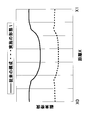
- FIG. 2 is a diagram illustrating a difference in magnetic flux density distribution between a conventional speaker and a speaker according to the present disclosure.
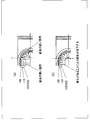
- FIG. 3 is a partially enlarged view of a conventional speaker and a speaker according to the present disclosure.
- FIG. 4 is a cross-sectional view of a speaker according to a modified example of the present disclosure.
- FIG. 5 is a front external view of a thin television equipped with a speaker according to the present disclosure.
- FIG. 6 is a cross-sectional view of another speaker according to the present disclosure.
- FIG. 7 is a cross-sectional view of still another speaker according to the present disclosure.
- FIG. 8 is a cross-sectional view of still another speaker according to the present disclosure.
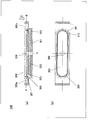
- FIG. 9 is a top view of still another speaker according to the present disclosure.
- 10 is a cross-sectional view of the speaker of FIG.
- FIG. 11 is a diagram illustrating the arrangement of the drawer portions.
- FIG. 12 is a view showing a holding state of the magnetic fluid.
- FIG. 13 is a diagram showing the distribution of magnetic flux.
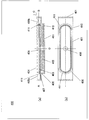
- FIG. 14 is a cross-sectional view of still another speaker according to the present disclosure.
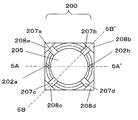
- FIG. 15 is a top view of the speaker of FIG.
- FIG. 16 is a top view of still another speaker according to the present disclosure.
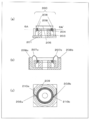
- 17 is a cross-sectional view of the speaker of FIG.
- FIG. 18 is a diagram illustrating a speaker array according to the present disclosure.
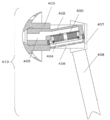
- FIG. 19 is a partial cross-sectional view of the inner ear headphones according to the present disclosure.
- FIG. 20 is a diagram illustrating a portable information terminal according to the present disclosure.
- FIG. 21 is a diagram illustrating a video / audio information terminal according to the present disclosure.
- FIG. 22 is a structural sectional view of a conventional speaker.
- FIG. 23 is a cross-sectional view of the structure of the speaker disclosed in Patent Document 1.
- FIG. 24 is a structural cross-sectional view of the speaker disclosed in Patent Document 2. As shown in FIG.
- the present disclosure relates to a magnetic circuit including a magnet, a plate fixed to one magnetic pole surface of the magnet, a box-shaped yoke having an inner bottom surface fixed to the other magnetic pole surface of the magnet, and the plate.
- a voice coil disposed in a magnetic gap formed by the yoke so as to vibrate in a vertical direction; a diaphragm having a peripheral edge joined to an upper end of the voice coil; a gap between the voice coil and the plate;
- a first loudspeaker including a magnetic fluid filled in at least one of a gap between the voice coil and the yoke, and having at least one means for evenly distributing the magnetic fluid;
- the present disclosure also includes a magnetic circuit including a magnet, a plate fixed to one magnetic pole surface of the magnet, and a box-shaped yoke having an inner bottom surface fixed to the other magnetic pole surface of the magnet, A voice coil disposed in a magnetic gap formed by the plate and the yoke so as to vibrate in a vertical direction;
- the magnetic fluid can be uniformly distributed in the magnetic gap, it is possible to suppress the generation of air gaps in the magnetic gap, thereby degrading the low frequency characteristics due to sound leakage and Rolling can be prevented.
- a sound hole provided so as to penetrate the plate and the magnet may be provided.
- the sound hole may be formed by combining openings of the same shape formed in each of the plate and the magnet.
- the point closest to the outer periphery of the plate from the center of gravity of the sound hole is defined as a first point, and the shortest distance between the first point and the outer periphery of the sound hole Is the first distance, the point farthest from the center of gravity of the sound hole to the outer periphery of the plate is the second point, and the shortest distance between the second point and the outer periphery of the sound hole is the second distance.
- the first distance may be smaller than the second distance.
- the following configuration can be cited as a method for making the magnetic flux distribution uniform by adjusting the distance.
- a plurality of sounds provided so that openings of the same shape formed in each of the plate, the magnet, and the yoke are combined to penetrate the plate, the magnet, and the yoke.
- You may have a hole.
- the sound hole may be provided at least at a location where the magnetic flux density is high.
- the outer peripheral shape of the horizontal cross section of the magnet is a track shape
- the sound hole is a track shape when viewed in the through-axis direction, and the magnetic flux density of the magnetic flux penetrating the outer periphery of the linear portion of the magnet is reduced. May be provided.
- the means may include the voice coil whose shape is adjusted so that the magnetic fluid is evenly distributed in the gap.
- sound holes are provided so that the openings of the same shape formed in each of the plate, the magnet, and the yoke are combined to penetrate the plate, the magnet, and the yoke, A point closest to the outer periphery of the plate from the center of gravity of the sound hole when viewed in the through-axis direction of the sound hole is defined as a third point, and a shortest distance between the third point and the voice coil is defined as a third point.
- the means may include an auxiliary magnet provided outside the voice coil.
- the horizontal cross-sectional shape of the voice coil may be a track shape, and the auxiliary magnet may be provided on the outer periphery in the short side direction of the voice coil so as to have the same radius of curvature as the outer periphery of the plate.
- AV equipment including a television, a mobile phone, a smartphone, a tablet terminal, an earphone, and a hearing aid provided with the speaker can also be configured.
- the magnetic circuit may have a track shape or a substantially rectangular shape in a top view.
- the yoke may have at least two slit portions in the curved portion that allow the lead wire of the voice coil to pass outside the magnetic circuit. This prevents contact with other members of the voice coil lead wire and further distributes the magnetic fluid evenly by making the magnetic gap width of the notch portion narrower than other portions, which is highly efficient and highly linear.
- a small speaker can be provided.
- the following are mentioned as a specific aspect of a slit part.
- the slit portion may be a notch extending to the upper end of the yoke.
- the slit portion may be a through hole provided in the side wall of the yoke so as to have a predetermined clearance above and below the vibration range of the lead wire.
- An inner-ear headphone, a portable information terminal, and a tablet-type video / audio information terminal including the speaker can be configured.
- the conventional speaker 600 does not have a configuration in which the magnetic fluid 610 is uniformly distributed in the magnetic gap 607, so that the magnetic fluid 610 is concentrated in part.
- the inventor of the present application has found that the cause of the concentration of the magnetic fluid in part is that the shape of the speaker is an elongated shape.
- the magnetic flux density in the magnetic gap curve portion is non-uniform.
- the voice coil 606 and the plate 603 that form the magnetic gap 607 have a track shape (a shape formed by two parallel line segments and two curves that connect the opposite ends of the line segments).
- the magnetic flux in the curved portion of the magnetic air gap 607 is greatly diffused compared to the straight portion, the magnetic flux density in the curved portion of the magnetic air gap 607 is lower than that in the straight portion. For this reason, in some cases, the magnetic fluid is concentrated on a part, and an air gap is formed in the magnetic gap 607 between the voice coil 606 and the plate 603, which causes rolling and deterioration of low frequency characteristics. .
- the present disclosure solves these problems.
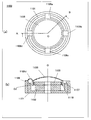
- FIG. 1A is a diagram showing a vertical sectional view of the speaker 100
- FIG. 1B shows the speaker in the direction of arrow C when the speaker is cut along the cutting line AB in FIG. It is a figure.
- the speaker 100 includes a yoke 101, a magnet 102, a plate 103, a diaphragm 104, suspensions 105a and 105b, a voice coil 106, a sound hole 108, and a magnetic fluid 110.
- a magnetic air gap 107 is formed by the yoke 101, the magnet 102, and the plate 103.
- the voice coil 106 and the magnetic fluid 110 are disposed in the magnetic gap 107. Each configuration will be described below.
- the yoke 101 has a box shape with an open upper surface, and an opening end has a track-shaped opening at the center of the bottom surface to form a part of the sound hole 108.
- Two straight line parts are composed of two parallel line segments in the track shape, and two curved parts that are curved in an arc shape so that the two curved lines connecting the opposite ends of the line segments are convex outward are formed. is doing. That is, the opening of the yoke 101 has a long side having a linear shape and a short side having a curved shape.
- the yoke 101 is made of a magnetic material.
- the outer shape of the horizontal section of the magnet 102 is a track shape.
- the magnet 102 has an opening at the center and forms a part of the sound hole 108.
- the shape of the opening of the magnet 102 is the same as the shape of the opening provided in the yoke 101.
- the magnet 102 is bonded to the inner bottom surface of the yoke 101 so that the position of the opening and the position of the opening of the yoke 101 are aligned.
- the magnet 102 is magnetized in the same direction as the vibration direction of the diaphragm 104.
- the plate 103 has a track-like outer peripheral shape in a horizontal section. Similar to the yoke 101 and the magnet 102, the plate 103 has an opening at the center and forms a part of the sound hole 108. The shape of the opening of the plate 103 is also similar to the shape of the opening provided in the yoke 101. Further, the plate 103 is fixed to the upper surface forming one magnetic pole surface of the magnet 102 by bonding or the like so that the position of the opening and the position of the opening of the magnet 102 are aligned. The lower surface forming the other magnetic pole surface of the magnet 102 is fixed to the inner bottom surface of the yoke 101 by bonding or the like as described above.
- a magnetic fluid 110 is in contact with the outer periphery of the plate 103.
- the plate 103 is made of a magnetic material.
- a point (first point) closest to the outer periphery of the plate 108 from the center of gravity of the sound hole 108 in the plate 103 when viewed in the through-axis direction of the sound hole 108 is P, and between the point P and the outer periphery of the sound hole 108.
- the shortest distance is LP (first distance)
- a point (second point) farthest from the center of gravity of the sound hole 108 to the outer periphery of the plate 103 in the plate 103 is Q
- the point Q and the outer periphery of the sound hole 108 When the shortest distance is LQ (second distance), there is a relationship of LP ⁇ LQ.
- the sound hole 108 may be constituted only by the opening of the plate 103 and the opening of the magnet 102.
- the yoke 101 includes at least the opening of the plate 103 and the opening of the magnet 102. There is no opening that can be fitted to.
- the diaphragm 104 has a track shape in the outer peripheral shape of the horizontal section. That is, the vibration plate 104 has a long side having a linear shape and a short side having a curved shape.
- the diaphragm 104 is made of the same material as the suspensions 105a and 105b, and the curved portions thereof are integrally formed and bonded to the suspensions 105a and 105b. Note that the diaphragm 104 may not be formed integrally with the suspension 105a and the suspension 105b, or may not be made of the same material.
- the upper end of the voice coil 106 is bonded to the outer peripheral portion of the bottom surface of the peripheral portion of the diaphragm 104 by bonding or the like. Further, as shown in FIG. 1A, a plurality of ribs 109 parallel to the short side of the diaphragm 104 may be formed. The presence of the rib 109 can suppress resonance within the audible band.
- the suspension 105 a and the suspension 105 b are bonded to the diaphragm 104 and the yoke 101.
- the sides where the suspension 105a and the suspension 105b are bonded to the diaphragm 104 have a curved shape.
- the sides where the suspension 105a and the suspension 105b are bonded to the yoke 101 are linear.
- the suspension 105a and the suspension 105b are collectively referred to as a divided suspension because a plurality of portions (curved portions) are bonded without covering the entire periphery of the diaphragm. Further, the vertical cross-sectional shapes of the suspension 105a and the suspension 105b are non-linear.
- the diaphragm 104 is held so as to be able to vibrate.
- the vertical cross-sectional shape of the suspension 105a and the suspension 105b may be a downward convex shape or an upward convex shape in the vibration direction as shown in FIG.
- the shapes of the suspension 105a and the suspension 105b are not limited to these.
- the side bonded to the yoke 101 may be curved. In this case, of course, the sides of the yoke 101 bonded to the suspension 105a and the suspension 105b are curved.
- the voice coil 106 has a horizontal cross-sectional shape of a track and a three-dimensional shape of a cylinder.
- the upper end of the voice coil 106 in the vertical direction is bonded to the outer periphery of the bottom surface of the diaphragm 104.
- the lower end of the voice coil 106 in the vertical direction is disposed in the magnetic gap 107.
- the magnetic fluid 110 is in contact with the lower end and the inner periphery of the voice coil 106 in the vertical direction. As a result, the voice coil 106 is disposed in the magnetic gap 107 so as to vibrate in the vertical direction.
- the sound holes 108 are configured by openings of the same shape provided in the yoke 101, the magnet 102, and the plate 103, respectively.
- the shape of the sound hole 108 is a track shape when viewed in the through-axis direction as shown in FIG.
- the magnetic fluid 110 is filled in the space around the outer periphery of the plate 103 and the inner periphery of the voice coil 106 without any gaps. In general, the magnetic fluid 110 only needs to fill at least one of the gap between the voice coil 106 and the plate 103 and the gap between the voice coil 106 and the yoke 101.
- the voice coil 106 vibrates according to Fleming's left-hand rule. Since the voice coil 106 is bonded to the diaphragm 104, sound waves are generated from the diaphragm 104. At this time, since the suspensions 105a and 105b are partially bonded to the diaphragm without surrounding the entire diaphragm 104, the stiffness of the suspensions 105a and 105b is equal to the stiffness of the suspension surrounding the entire diaphragm. Compared to low enough. Thereby, the minimum resonance frequency can be reduced and the reduction of the reproduction bandwidth can be suppressed.
- the sound holes 108 are designed so that the magnetic fluid 110 is uniformly distributed on the outer surface of the plate 103, the magnetic fluid 110 can be uniformly distributed in the magnetic gap formed inside the voice coil 106. .
- FIG. 2 shows the result of comparing the magnetic flux density distribution on the side surface of the plate in the conventional configuration and the present disclosure.
- 2 corresponds to the position within the distance X along the outer periphery of the plate between the position X0 of the point P and the position X1 of the point Q, as indicated by an arrow in FIG. Indicates the height of the magnetic flux density.
- the result of the magnetic flux density distribution in the conventional configuration is indicated by a solid line
- the result of the magnetic flux density distribution of the present disclosure is indicated by a dotted line. From FIG. 2, the magnetic flux density distribution is nonuniform in the conventional configuration due to the influence of the sound holes and the magnetic air gap curve portion, whereas in the present disclosure, the magnetic flux density distribution in the magnetic air gap is constant. Since the sound holes are designed, the distribution of the magnetic flux density is uniform compared to the conventional configuration. Therefore, in the present disclosure, the magnetic fluid 110 can be uniformly distributed on the side surface of the plate 103.
- FIG. 3A shows an enlarged part of a conventional speaker 600
- FIG. 3B shows an enlarged part of the speaker 100 according to the present disclosure.
- the magnetic flux density in the straight line portion in the track shape is high, and the magnetic flux density in the curved portion is low.
- the magnetic hole density is reduced due to the formation of the sound hole 108. Therefore, the distribution of magnetic flux density becomes uniform.
- the distribution of the magnetic flux density can be made uniform.
- a track-shaped magnet is provided like the speaker 100, for example, a sound hole is provided at a position where the magnetic flux density of the magnetic flux penetrating the outer periphery of the linear portion of the magnet is reduced.
- the magnetic fluid 110 does not concentrate on a part like the conventional speaker 600.
- the sound holes 108 are designed so that the magnetic fluid 110 is uniformly distributed on the outer surface of the plate 103, the magnetic fluid 110 can be injected evenly when the magnetic fluid is injected into the magnetic circuit in the assembly stage. it can. Therefore, the magnetic fluid 110 can be prevented from adhering to the inner surface of the yoke 101.
- the sound wave radiated from the sound hole 108 since the sound hole 108 is provided so as to extend in the long side direction, the sound wave radiated from the center and the end of the diaphragm 104 interferes with the path difference. Can be prevented. Thereby, even if the speaker 100 has an elongated shape, it is possible to radiate sound waves without impairing the characteristics of high frequencies that are easily affected by interference due to path differences.
- the difference between the speaker device 700 and the speaker device 100 is a sound hole 708.
- the sound hole 708 is formed by arranging three circular holes. By forming the holes with such a shape, it is easy to design and the magnetic fluid 110 can be evenly distributed in the magnetic gap formed inside the voice coil 106.
- the number of holes is not limited to three. As described with reference to FIG. 3, in the case of a track-shaped speaker, the portion where the magnetic flux density is significantly uneven is near the boundary between the straight portion and the curved portion.
- a sound hole may be provided at a position where the magnetic flux density at the location is reduced.
- the present disclosure can be applied to shapes other than the track shape (for example, a shape other than a circle such as a rectangle). Even in that case, the sound hole may be designed so as to reduce the magnetic flux density at a location where the magnetic flux density is high at a location where the non-uniformity of the magnetic flux density is noticeable.
- FIG. 5 is a diagram illustrating a configuration of a thin television equipped with the speaker of the present disclosure.
- FIG. 5 is a front external view of a flat-screen television.
- 201 is a set housing
- 202 is a display unit such as PDP, liquid crystal, or organic EL
- 203 is a speaker.
- the speaker 203 is provided inside the set housing on both sides of the display unit 202. Any of the speakers 100, 300, 400, 500, and 700 according to the present disclosure can be used as the speaker 203.
- the operation of the flat-screen TV configured as described above will be described.
- sound is reproduced from the speaker 203 when the acoustic signal processed by the signal processing unit is input to the left and right speakers 203.
- the speaker 203 has an elongated shape in accordance with the narrow frame design of the television, but since the sound hole is designed so that the magnetic flux density on the outer surface of the plate is constant, the magnetic gap is formed by the magnetic coil and the plate. Accordingly, a flat-screen television excellent in low-pitched sound reproduction can be realized in a state where the low-frequency characteristics due to the air holes are reduced and rolling is suppressed.
- the speakers are arranged at both ends of the display unit, but the number and installation positions of the speakers are not limited.
- FIG. 6 shows a cross-sectional view of the speaker 300 according to the present disclosure. Note that the vertical direction, horizontal direction, and vibration direction are defined in the same manner as described above.
- 6A is a diagram showing a vertical sectional view of the speaker 300
- FIG. 6B is a diagram illustrating the speaker 300 in the direction of arrow C when the speaker 300 is cut along the cutting line AB in FIG. 6A.
- the speaker 300 includes a yoke 301, a magnet 302, a plate 303, a diaphragm 304, suspensions 305 a and 305 b, a voice coil 306, a sound hole 308, and a magnetic fluid 310.
- a magnetic air gap 307 is formed by the yoke 301, the magnet 302, and the plate 303.
- the voice coil 306 and the magnetic fluid 310 are disposed in the magnetic gap 307.
- the difference from the speaker 100 is that a bonded magnet is used for the magnet 302 and a sound hole 308.
- the operation of the speaker 300 will be described with respect to a configuration different from that of the speaker 100.
- the voice coil 306 vibrates and the sound wave is generated from the diaphragm 304 is the same as that of the speaker 100.
- a significant difference from the speaker 100 is that a bonded magnet is used for the magnet 302 (means for evenly distributing the magnetic fluid).
- the bond magnet is a flexible magnet obtained by crushing a magnet and kneading it into rubber or plastic, and is a magnet having a high degree of design freedom in shape and magnetization direction. Therefore, by using a bonded magnet, the magnetic flux density can be designed so that the magnetic fluid 310 is evenly distributed in the magnetic gap formed inside the voice coil 306.
- the magnetic fluid 310 when the magnetic fluid 310 is injected into the magnetic circuit in the assembly stage, the magnetic fluid 310 can be injected without unevenness, so that the magnetic fluid 310 can be prevented from adhering to the inner surface of the yoke 301. Furthermore, the bonded magnet is easy to process. Therefore, regarding the sound wave emitted from the sound hole 308, the sound hole 308 can be freely designed so as not to cause interference between the sound wave emitted from the center and the end of the diaphragm at the time of molding, and the interference due to the path difference is suppressed. Can do. Therefore, it is easy to form a sound hole by a plurality of circular holes as in the speaker 700 of FIG. By forming a sound hole with a plurality of circular holes, it is possible to radiate sound waves without impairing the characteristics of high frequencies that are easily affected by interference due to a path difference even if the speaker has an elongated shape.
- FIG. 7 shows a cross-sectional view of the speaker 400 according to the present disclosure. Note that the vertical direction, horizontal direction, and vibration direction are defined in the same manner as described above.
- FIG. 7A is a diagram showing a vertical cross-sectional view of the speaker 400
- FIG. 7B is a diagram illustrating the speaker 400 in the direction of arrow C when the speaker 400 is cut along the cutting line AB in FIG. FIG.
- the speaker 400 includes a yoke 401, a magnet 402, a plate 403, a diaphragm 404, suspensions 405a and 405b, a voice coil 406, a sound hole 408, a magnetic fluid 410, and an auxiliary magnet 411.
- the difference from the speaker 100 is that an auxiliary magnet 411 is provided.
- the operation of the speaker 400 will be described with respect to a configuration different from that of the speaker 100.
- auxiliary magnets 411 (means for evenly distributing the magnetic fluid) are bonded to both ends of the yoke 401 in the short side direction. Since the auxiliary magnet 411 is adjusted in size and shape so that the magnetic fluid 410 is evenly held on the outer surface of the plate 403, the magnetic fluid 410 is evenly distributed in the magnetic gap formed inside the voice coil 406. Can be distributed. As a result, it is possible to suppress the generation of an air gap between the plate 403 and the voice coil 406 due to the bias of the magnetic fluid 410, and it is possible to prevent deterioration of the low frequency characteristics and rolling due to sound leakage.
- the magnetic fluid 410 when the magnetic fluid 410 is injected into the magnetic circuit at the assembly stage, the magnetic fluid 410 can be injected without any bias, and therefore the magnetic fluid 110 can be prevented from adhering to the inner surface of the yoke 401. Furthermore, in the present disclosure, the auxiliary magnet 411 can increase the magnetic flux density of the magnetic gap curved portion that is insufficient with respect to the curved portion of the magnetic gap 407. As a result, the magnetic flux density distribution can be made uniform without lowering efficiency.
- FIG. 8 shows a cross-sectional view of the speaker 500 according to the present disclosure.
- the vertical direction, horizontal direction, and vibration direction are defined in the same manner as described above.
- FIG. 8A is a diagram showing a vertical cross-sectional view of the speaker 500
- FIG. 8B shows the speaker 500 in the direction of arrow C when the speaker 500 is cut along the cutting line AB in FIG.
- the speaker 500 includes a yoke 501, a magnet 502, a plate 503, a diaphragm 504, suspensions 505a and 505b, a voice coil 506, a sound hole 508, and a magnetic fluid 510.
- the difference from the speaker 100 is the shape of the voice coil 506.
- the operation of the speaker 500 will be described with respect to a configuration different from the speaker 100.
- the point that the voice coil 506 vibrates and a sound wave is generated from the diaphragm 504 is the same as that of the speaker 100.
- a significant difference from the speaker 100 is that a voice coil 506 (means for uniformly distributing the magnetic fluid) is used which is modified in accordance with the distribution of the magnetic fluid 510.
- the magnetic flux density in the region E of the track linear portion is higher than that in the region D of the curved portion of the track, so that the region E compared to the width w1 of the magnetic gap 507 in the region D.
- the width w2 of the magnetic gap 507 is wide.
- this condition is that the point closest to the outer periphery of the plate from the center of gravity of the sound hole when viewed in the through-hole direction of the sound hole is defined as the third point (corresponding to the point R in FIG. 8).
- the third distance corresponding to the width w2 in FIG. 8
- the fourth point corresponding to the point S in FIG. 8 is the point farthest from the center of gravity of the sound hole to the outer periphery of the plate.
- the voice coil 506 has a shape that matches the distribution of the magnetic fluid 510 even when the magnetic fluid 510 is unevenly distributed on the outer surface of the plate 503. It is possible to suppress the generation of air gaps in the magnetic air gap 507 formed on the inner side of the, and to prevent deterioration of low frequency characteristics and rolling due to sound leakage.
- the long side direction of the voice coil 506 is deformed, but any deformation may be used as long as the deformation conforms to the distribution of the magnetic fluid.
- FIG. 23 is a structural cross-sectional view of the speaker 1100 disclosed in Patent Document 1.
- 23A is a top view of the speaker 1100.
- FIG. FIG. 23B is a structural cross-sectional view of the speaker 1100 when the speaker 1100 is cut along the line AOB shown in FIG.
- a speaker 1100 of Patent Document 1 includes a yoke 1101, a magnet 1102, a plate 1103, a diaphragm 1106, edge pieces 1108a to 1108d, a spacer 1109, a voice coil 1107, and a magnetic fluid. 1110.
- the magnetic fluid 1110 is filled on the inner peripheral side of the voice coil 1107 in the magnetic gap G2.
- the support that supports the diaphragm 1106 so as to vibrate is composed of a plurality of edge pieces 1108a to 1108d. Therefore, even if the speaker 1100 is downsized, the stiffness of the support is reduced. It is possible to operate with a large amplitude. Further, since the magnetic fluid 1110 is filled on the inner peripheral side of the voice coil 1107 in the magnetic gap G2, sound waves radiated from the back surface of the diaphragm 1106 leak to the front surface of the diaphragm 1106 via the magnetic gap G2. The sound pressure emitted from the front surface of the diaphragm 1106 can be prevented and the sound pressure can be improved.
- FIG. 24 is a cross-sectional view of the speaker device 1 disclosed in Patent Document 2.
- the speaker device 1 includes a yoke 21, a magnet 22, a plate 23, a vibrating body 3, a voice coil 33, a lead wire 4, a frame 5, and a terminal portion 6.
- the vibrating body 3 is omitted.
- a pair of lead wires 4 are drawn from the voice coil 33.
- the yoke 21 has a notch 71 formed in the side portion 21C of the yoke.
- the lead wire 4 is drawn out from the lower end portion of the voice coil 33 in the vicinity of the notch portion 71, and its end portion is electrically connected to the terminal portion 6 formed in the frame 5 through the notch portion 71. Thereby, even if the voice coil 33 is displaced along the vertical direction, it is possible to reduce the contact of the lead wire 4 with other members such as the yoke 21 and the edge 32. As described above, according to the disclosure of Patent Document 2, it is possible to provide a thin speaker or a small speaker that can vibrate without the lead wire coming into contact with other members.
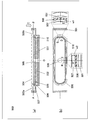
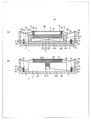
- FIG. 10A is a structural cross-sectional view taken along the line 1A-1A ′ of FIG.
- FIG. 10B is a cross-sectional view of the speaker 100 taken along the line 2A-2A ′ in FIG.
- a speaker 100 includes a yoke 101, a magnet 103, a plate 104, a diaphragm 105, a voice coil 106, suspensions 107a and 107b, frame portions 108a and 108b, a magnetic fluid 109, and the like. Is provided.
- the yoke 101 has a box shape with an open upper surface, and includes notches 102a and 102b.
- the outer shape of the speaker 100 as viewed from above is a long shape as shown in FIG.
- the overall shape of the diaphragm 105 is long, and a rib is provided inside a portion fixed to the voice coil 106.
- a rib is not an essential structure.
- the outer shape of the magnetic circuit portion of the speaker 100 as viewed from above is a substantially oval shape composed of a semicircular portion and a straight portion as shown in FIG.
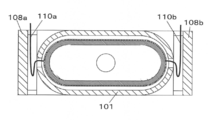
- the voice coil 106 is disposed so as to be able to vibrate up and down in the gap between the inner periphery of the side portions 101a and 101b of the yoke 101 and the outer periphery of the plate 104, and the shape viewed from the top is a substantially oval shape. Furthermore, the voice coil 106 includes lead portions 110a and 110b as shown in FIG.
- the lower surface of the magnet 103 is fixed to the inner bottom surface of the yoke 101 as shown in FIG.
- the plate 104 is fixed to the upper surface of the magnet 103.
- the upper surface of the magnet 103 forms one magnetic pole of the magnet 103, and the lower surface of the magnet 103 forms the other magnetic pole of the magnet 103.
- a cylindrical magnetic gap having a substantially oval cross section is formed between the side portions 101a and 101b of the yoke 101 and the plate 104.
- the voice coil 106 is disposed in the magnetic gap so as to vibrate in the direction of the central axis O, which is the vertical direction.
- the magnetic fluid 109 is filled between the plate 104 and the voice coil 106 and distributed in a substantially oval annular shape when viewed from above.
- the magnetic fluid 109 only needs to be filled in at least one of the gap between the voice coil 106 and the plate 104 and the gap between the voice coil 106 and the yoke 101.
- a through hole 111 along the central axis O is provided by holes formed in the yoke 101, the magnet 103, and the plate 104, respectively.
- the diaphragm 105 is joined to the upper surface of the voice coil 106 at the periphery.
- the suspension 107a connects the left end side of the diaphragm 105 and the frame 108a, and the suspension 107b is installed so as to connect the right end side of the diaphragm 105 and the frame 108b.
- the cross-sectional shapes of the suspensions 107a and 107b are curved shapes that protrude downward as shown in FIG.
- the shape of the inner edge of the outer magnetic pole of the magnetic circuit with respect to the voice coil 106 and the shape of the outer edge of the inner magnetic pole of the magnetic circuit with respect to the voice coil 106 are opposite to each other when viewed from above.
- the two substantially straight portions and two curved portions facing each other and having a convex shape outward.
- the yoke 101 has at least two slit portions in the curved portion that allow the lead wire of the voice coil 106 to pass outside the magnetic circuit.
- the voice coil 106 vibrates according to Fleming's left-hand rule. Since the diaphragm 105 is joined to the voice coil 106, the diaphragm 105 vibrates with the vibration of the voice coil 106, causes a pressure change in the air on the upper surface and the lower surface, and generates sound waves. Audio can be heard by using either the upper surface or the lower surface of the speaker as the radiation surface.
- the magnetic fluid 109 is filled between the plate 104 and the voice coil 106 and is held by a magnetic field generated by the yoke 101, the magnet 103, and the plate 104, thereby generating each other generated on the upper surface and the lower surface of the speaker 100.
- the sound wave of the opposite phase is cut off, and the reproduction sound pressure is not lowered due to the wraparound of the sound wave.
- the lead part 110a of the voice coil 106 passes through the notch part 102a of the yoke 101, and the lead part 110b passes through the notch part 102b to prevent contact with the frames 108a and 108b and the yoke 101, respectively. It is bent into a shape and finally electrically connected to an external terminal (not shown).
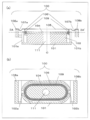
- FIG. 12A to 12C are diagrams in which elements other than the yoke 101, the plate 104, and the magnetic fluid 109 are omitted from the speaker 100.
- FIG. 12 (a) to 12 (c) shows the speaker 100.
- FIG. 12A and 12B the distance between the inner periphery of the yoke 101 and the outer periphery of the plate 104 is d1, and the inner periphery of the yoke 101 and the plate 104 in the vicinity of the notches 102a and 102b in FIG. The distance from the outer periphery is d2.
- the magnetic fluid 109 is uniformly distributed around the plate 104 in the shape of the yoke 101 and the plate 104 in FIG. .
- the distance between the magnetic poles of the yoke 101 and the plate 104 is near the notches 102a and 102b. Since the magnetic flux density decreases as the distance increases, the amount of the magnetic fluid 109 held near the notches 102a and 102b shown in FIG. 12B is smaller than the other portions.
- the magnetic fluid 109 is not filled between the voice coil 106 and the plate 104, causing air leakage, which may reduce the sound pressure of the speaker 100. Even when air leakage does not occur, the distribution of the magnetic fluid 109 is non-uniform, so that the action of holding the voice coil 106 in a predetermined position is weakened by the surface tension of the magnetic fluid, which may cause rolling or the like. . Furthermore, since the electromagnetic force acting on the voice coil 106 itself is also reduced at the notches 102a and 102b, there is a risk of rolling or the like, and the efficiency of the speaker 100 is also reduced.
- the outer periphery of the plate 104 is closer to the inner periphery of the yoke 101 than in the case of FIGS. 12A and 12B. That is, the distance d2 between the inner periphery of the yoke 101 and the outer periphery of the plate 104 in the vicinity of the notches 102a and 102b is smaller than the distance d1 as shown in FIG. As a result, the magnetic flux density does not decrease even in the vicinity of the notches 102a and 102b, and the magnetic fluid 109 is held uniformly over the entire circumference. Accordingly, it is possible to prevent a decrease in sound pressure, rolling, and efficiency of the speaker 100 due to air leakage, which occurs in the configuration of FIG.
- the distance between the inner periphery of the yoke and the outer periphery of the plate in the vicinity of the notches 102a and 102b is smaller than that of the other portions, thereby preventing contact with other members of the lead wire and magnetic properties. It is possible to provide a small and thin speaker in which the fluid is evenly held and the reliability and the bass reproduction capability are improved.
- the gap between the inner edge of the outer magnetic pole and the outer edge of the inner magnetic pole is smaller between the curved portions than between the substantially straight portions. This has the effect of making the magnetic fluid distribution uniform. That is, this is not effective only for a speaker having a notch. It can also be used for speakers that do not have cutouts. That is, not only the above-described problem described in the present embodiment is solved, but the configuration described in the first embodiment can also be achieved by adopting a speaker in which a notch portion is not provided.
- the suspensions 107a and 107b are divided in the long axis direction. That is, the suspension does not cover the entire periphery of the diaphragm. Therefore, the length of the speaker 100 in the short axis direction can be reduced to the length of the yoke 101 in the short axis direction, and a speaker capable of reproducing a narrow width and a wide band can be configured.
- the lead portions 110a and 110b of the voice coil 106 are disposed between the yoke 101 and the frame portions 108a and 108b and in the space below the suspensions 108a and 108b. Need not be provided separately. Therefore, a space-saving speaker can be configured while allowing the voice coil 106 to vibrate.
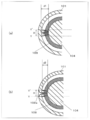
- FIG. 13 shows the distribution (b) of magnetic flux that generates a magnetic circuit in the vicinity of the notch 102a in comparison with the case (a) in which the yoke 101 does not include the notches 102a and 102b.
- the polarity of the magnetic circuit is the N pole on the plate 104 side and the S pole on the yoke 101 side.
- the width of the notch 102a is defined as a height H between the ranges Y-Y '. In the range YY ′ in FIGS.
- the density per unit area of the magnetic flux passing through the voice coil is the average length of the magnetic flux lines starting at the plate 104 side and ending at the yoke 101 side. Inversely proportional to the square of. That is, by setting d2 so that the average length of the magnetic flux lines between the ranges YY ′ is equal to the average length of the magnetic flux lines when the yoke does not have the notches, the magnetic flux density near the notches 102a is set. Can be made equal to the magnetic flux density when the yoke does not have a notch.
- the average length of the magnetic flux lines may be regarded as a distance d1 between the inner wall of the yoke 101 and the outer periphery of the plate 104 as shown in FIG.
- the average length of the magnetic flux lines is a value d2 ′ longer than the distance d2 between the inner wall of the yoke 101 and the outer periphery of the plate 104 as shown in FIG. It changes depending on the width H of the notch 102a.
- the distribution of magnetic flux lines may be approximated by a quadratic curve such as an elliptical arc, and YY ′ may be divided into a plurality of minute regions, and the average length of the magnetic force lines passing through each minute region may be obtained.
- the overall shape of the diaphragm 105 is a long shape.
- the shape of the diaphragm 105 is a substantially oval shape that is substantially the same shape as the magnetic circuit portion, and a long corner portion is cut out. It may be a shape.
- the drawer portions 110a and 110b can be extended to the corner portion, and the range in which the diaphragm 105 can vibrate up and down without contacting the drawer portions 110a and 110b can be expanded.
- the rib of the diaphragm 105 is provided inside the portion fixed to the voice coil 106, it may be provided in a long corner portion.
- the shape of the diaphragm 105 is a flat surface provided with a rib, it may be a dome shape having a convex central portion. According to these diaphragm shapes, by increasing the rigidity of the diaphragm 105, it is possible to prevent a decrease in sound pressure due to divided vibrations, and to provide a speaker having excellent high frequency output frequency characteristics.
- the outer shape of the magnetic circuit portion when viewed from the top surface is an approximately oval shape composed of a semicircular portion and a straight portion, but the shape of the magnetic circuit portion is an approximately long shape with an arcuate corner portion. There may be. According to this configuration, the volume of the magnet 103 can be further expanded within the shape of the speaker 100, and a highly efficient speaker can be provided.
- the lead-out portions 110a and 110b of the voice coil 106 are not limited to the lead-out arrangement on the long side as shown in FIG. 11.
- the lead-out portions 110a and 110b extend to the space below the frame portions 108a and 108b. You may pull it out to the side.
- various lead line arrangements can be realized without changing the shape of the magnetic circuit.
- the direction of the voice coil 106 can be stably held by the holding force of the magnetic fluid 109, even if the lead portions 110a and 110b are arranged asymmetrically with respect to the voice coil 106, it is caused by the bias of the lead wire tension. The possibility of rolling and efficiency reduction can be reduced. Therefore, according to the present disclosure, it is possible to increase the number of options for the direction of the terminal portion without changing the shape of the member, and to provide a speaker that is low in cost and excellent in customization.
- the positions of the notches 102 a and 102 b are not limited to the long axis of the speaker 100, and may be formed at arbitrary positions on the semicircular portion of the yoke 101.
- the notches 102 a and 102 b are formed between one end of the semicircular portion of the yoke 101 and the intermediate point, so that the arrangement of the lead portions 110 a and 110 b of the voice coil 106 is made closer to the long side of the speaker 100. This can reduce the possibility that the lead wires 110a and 110b come into contact with the suspensions 107a and 107b, the frame portions 108a and 108b, and the yoke 101.
- the shape of the notches 102a and 102b is a slit shape extending from the upper surface of the yoke 101 to the inner bottom, but is not limited to this shape.
- the lower ends of the notches 102 a and 102 b may extend to the outer bottom of the yoke 101.
- the notches 102a and 102b can be easily formed by making a cut with the cutting means from the side surface direction of the yoke 101, so that the processing cost can be reduced.
- a filler may be filled in the upper portions of the notches 102a and 102b. According to this structure, it can prevent that drawer
- the distance between the outer periphery of the plate 104 and the outer periphery of the yoke 101 near the notches 102a and 102b is reduced by changing only the shape of the plate 104.
- the circumference may be close to the plate 104, or the shapes of both the yoke 101 and the plate 104 may be changed.
- a through hole provided in the side wall of the yoke 101 may be provided so as to have a predetermined clearance above and below the vibration range of the lead wire.
- FIG. 15 is a top view of the speaker 700.
- 14A is a cross-sectional view of the speaker 700 taken along the line 4A-4A ′ in FIG. 15, and FIG. 14B is a cross-sectional view of the speaker 700 taken along the line 3A-3A ′ in FIG.
- the speaker 700 includes a yoke 701, a magnet 703, a plate 704, a diaphragm 705, a voice coil 706, suspensions 707 a and 707 b, suspension attaching portions 708 a and 708 b, and a magnetic fluid 709.
- the voice coil 706 includes the same drawing portion as described above.
- the outer shape of the speaker 700 in a top view is a substantially rectangular shape as shown in FIG.
- the outer shapes of the magnet 703, the plate 704, and the voice coil 706 are substantially rectangular shapes such as rectangles with rounded corners
- the outer shapes of the yoke 701 and the diaphragm 705 are substantially rectangular shapes such as rectangles with rounded corners. .
- the positional relationship and contact relationship between the yoke 701, the magnet 703, the plate 704, the diaphragm 705, the voice coil 706, and the magnetic fluid 709 are such that the yoke 701, the magnet 703, the plate 704, the diaphragm 705, and the voice coil 706 are substantially rectangular. 9 and 13 except that the yoke 701 does not have a notch. Similarly, a notch may be formed.
- the operation of the speaker 700 configured as described above is the same as the operation of the speaker 100.
- FIG. 17A is a cross-sectional view of the speaker 200 taken along the line 5A-5A ′ in FIG. 16
- FIG. 17B is a cross-sectional view of the speaker 200 taken along the line 5B-5B ′ in FIG. 16
- FIG. FIG. 18 is a cross-sectional view of the speaker 200 taken along line 6A-6A ′ in FIG.
- the speaker 200 includes a yoke 201, a magnet 203, a plate 204, a diaphragm 205, a voice coil 206, suspensions 207a to 207d, suspension attaching portions 208a to 208d, and a magnetic fluid 209.
- the voice coil 206 includes drawers 210a and 210b as shown in FIG.
- the yoke 201 includes notches 202a and 202b.
- the outer shape of the speaker 200 in a top view is a substantially square shape as shown in FIG.
- the outer shape of the magnet 203, the plate 204, and the voice coil 206 is a substantially circular shape, and the outer shape of the yoke 201 and the diaphragm 205 is a substantially elliptical shape with the major axis in the vertical direction in the figure.
- the positional relationship and contact relationship between the yoke 201, the magnet 203, the plate 204, the diaphragm 205, the voice coil 206, the magnetic fluid 209, and the notches 202a and 202b are the same as the yoke 201, the magnet 203, the plate 204, the diaphragm 205, and the voice coil. Except that the shape of 206 is substantially circular, it is the same as that described with reference to FIGS.
- the notches 202a and 202b are provided on the side wall of the yoke 201 in the minor axis direction as linear notches that are symmetrical with respect to the center of the speaker 200 and inclined with respect to the minor axis.
- the suspensions 207a to 207d differ from those described with reference to FIGS. 9 to 13 and are arranged in four strips as shown in FIG. 16, connected to the diaphragm 205 on the center side, and fixed to the suspension sticking portions 208a to 208d. Has been.
- the operation of the speaker 200 with the above configuration is the same as the operation of the speaker 100.
- the outer periphery of the plate 204 has a substantially perfect circle shape, while the inner periphery of the side wall portion of the yoke 201 has a substantially elliptical shape.
- the distance between the inner periphery of the yoke 201 and the outer periphery of the plate 204 in the vicinity of the notches 202a and 202b is smaller than the distance between the inner periphery of the yoke 201 and the outer periphery of the plate 204 in the major axis direction of the yoke 201. Therefore, similarly to the speaker 100, it is possible to provide a small and thin speaker that achieves both prevention of contact of the lead wire to other members and equal retention of the magnetic fluid, and improved reliability and bass reproduction capability. .
- the notches 202a and 202b are provided in a straight line inclined on the side wall of the yoke 201, so that a space for bending the lead wires 210a and 210b inside the speaker 200 can be easily provided. And the risk of breakage of the lead wires 210a and 210b due to the pulling force can be avoided.
- the outer periphery of the plate 204 has a substantially perfect circle shape
- the inner periphery of the side wall portion of the yoke 201 has a substantially elliptical shape.
- the shapes of the plate 204 and the yoke 201 are not limited thereto.
- the outer shape of the magnet 203, the plate 204, and the voice coil 206 may be a substantially elliptical shape having a major axis in the left-right direction in FIG. 16A
- the outer shape of the yoke 201 and the diaphragm 205 may be a substantially perfect circle shape.
- the notches 202a and 202b are linear notches that are point-symmetric with respect to the minor axis, but the notches 202a and 202b are mutually in the minor axis direction of the yoke 201.
- it may be a linear notch that is line symmetric.
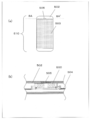
- FIG. 18A is a top view of the speaker array 311, and FIG. 18B is a cross-sectional view of the speaker array 311 taken along the line 7A-7A ′ in FIG.
- the speaker array 311 includes four speakers 300 arranged in a straight line.
- the speaker 300 has a shape and configuration in accordance with the speaker 200, and includes a yoke 301, a magnet 303, a plate 304, a diaphragm 305, a voice coil 306, suspensions 307a to 307d, and suspension attaching portions 308a to 308d. And a magnetic fluid 309. As shown in FIG.
- the voice coil 306 includes lead portions 310a and 310b.
- the yoke 301 includes notches 302a and 302b.
- 308b is integral with the suspension attachment portion 308a ′ of the adjacent speaker 300
- 308d is integral with the suspension attachment portion 308c ′ of the adjacent speaker 300.
- the operation of the speaker 300 having the above configuration is the same as the operation of the speaker 200. Therefore, similarly to the speaker 200, it is possible to achieve both prevention of contact of the lead wire with other members and equal retention of the magnetic fluid.
- the speaker array 311 of the present disclosure it is possible to provide a narrow and thin speaker array with improved reliability and bass reproduction capability.
- the notch 302b and the notch 302a ′ of the adjacent speaker 300 are connected to the outside on the same side with respect to the 7A-7A ′ cross section of the drawer 310b and the drawer 310a ′. It is formed so that. Thereby, the contact of the drawer part of adjacent speakers 300 can be prevented, and generation
- the speaker 300 has a substantially square shape corresponding to the speaker 200.
- the shape of the speaker 300 is not limited to this, and is similar to the speaker 100 described with reference to FIGS.
- the speaker 300 may be arranged in the long side direction. According to this configuration, a narrower speaker array 311 can be realized.
- the yoke 301 has been described with the figure formed by the cylindrical side wall and the bottom surface portion, the yoke 301 is formed as a plurality of cylindrical recesses, and the rectangular outer periphery of the speaker array 311 is used as the outer wall of the yoke 301. It may be integrated. In this case, it is desirable that the notch is provided as a groove of a pedestal formed integrally. According to this configuration, it is not necessary to form the yoke 301 separately, and the manufacturing cost can be reduced.
- the four speakers 300 constituting the speaker array 311 have been described as including independent lead portions 310a and 310b, the lead portions of the voice coils 306 of the adjacent speakers 300 are shared, and the speakers 300 are connected to each other. You may connect in series. In this case, it is desirable that the shape of the notch is a straight line passing through the cross section along line 7A-7A ′. According to this configuration, the terminal end of the speaker array 311 can be terminated at only two positions on both ends of the speaker array 311, and the risk of contact between the drawer portion and other members can be further reduced.
- FIG. 19 is a partial cross-sectional view of the inner ear headphones 410.
- a speaker 400 among the components of the inner ear headphones 410, a speaker 400, a case 402, a cross section of an ear chip 403, a housing 407, and a cord 408 are shown.
- the case 402 has a front volume 404, a port 405, and a back sound hole 406.
- the speaker 400 has a shape and a configuration similar to that of the speaker 100, and the surface of the diaphragm facing the magnetic circuit is a sound wave emitting surface, and the listener's 400 is connected via the front volume 404, the port 405, and the ear chip 403. Output sound in the ear canal.
- the speaker 400 adopts the configuration of the present disclosure to achieve both prevention of contact of the lead wire with other members and equal retention of the magnetic fluid.
- the efficiency decreases due to the uneven distribution of the magnetic fluid or the air due to the magnetic fluid missing. Leakage can be prevented and volume reduction can be prevented.
- the speaker 400 is attached to be tilted with respect to the back surface of the earpiece so that the port portion can be inserted into the entrance of the ear canal and the sound of the opposite phase radiated from the back sound hole 406 can be simultaneously heard. Can be prevented, and a decrease in volume can be prevented. Therefore, according to the inner ear headphones 410 according to the present disclosure, the plate having the configuration according to the present disclosure makes it possible to reproduce a wide band from a low frequency range to a high frequency range with a small size, and to improve wearing feeling. It is possible to provide inner ear headphones that achieve both high sound quality.
- FIG. 20A is an external view of the portable information terminal 510.
- FIG. 20B is a cross-sectional view of the portable information terminal 510 taken along the line 10A-10A ′.
- a speaker 500, a housing 502, a display 503, a substrate 504, and a sound hole 505 are shown.
- the speaker 500 is housed in the housing 502 in a state of being attached to a perforated portion provided on the substrate 504.
- the speaker 500 has a shape and a configuration similar to that of the speaker 100, and outputs a call voice to the user's ear through the sound hole 505 with the surface of the diaphragm facing the magnetic circuit as a sound wave emitting surface.
- the above-described speaker 500 adopts the configuration of the present disclosure, thereby preventing the movement or shaking of the portable information terminal 510 from causing a decrease in efficiency due to the uneven distribution of magnetic fluid or the loss of magnetic fluid. A decrease in volume can be prevented.
- FIG. 21A is an external view of the video / audio information terminal 610.
- FIG. 21B is a cross-sectional view of the video / audio information terminal 610 taken along the line 9A-9A ′ or 9B-9B ′.
- a speaker module 600 among the components of the audio video information terminal 610, a speaker module 600, a housing 602, a display 603, a housing reinforcing frame 604, and a sound hole 605 are shown.
- the speaker module 600 is housed in the housing 602 while being attached to the housing reinforcing frame 604.
- the speaker module 600 has a shape and a configuration similar to that of the speaker array 311, and outputs a call voice to the user's ear through the sound hole 605 with the surface of the diaphragm facing the magnetic circuit as a sound wave radiation surface. . Similar to the inner ear headphones 410, the above-described speaker module 600 prevents the deterioration of efficiency due to the uneven distribution of the magnetic fluid or the loss of the magnetic fluid due to the movement or shaking of the video / audio information terminal 610 by adopting the configuration of the present disclosure. , Can prevent the volume from dropping.
- the speaker array 311 in which the speakers 200 are arranged is described.
- the arrangement and shape of the arranged speakers are not limited to this, and the configuration and shape of the speakers 100 may be arranged.
- 19 and 20 illustrate an example in which the speaker 100 is mounted, the configuration and shape of the speaker are not limited to this, and the configuration and shape of the speaker 200 may be used.
- FIG. 21 illustrates an example in which the speaker array 311 according to FIG. 18 is mounted.
- the configuration and shape of the speaker are not limited to this, and the configuration and shape of the speakers 100 and 200 may be used. good.
- the speaker and the speaker array according to the present disclosure are mounted on the inner ear headphones, the portable information terminal, and the tablet type video / audio information terminal.
- the devices to be mounted are not limited thereto. Instead, for example, a hearing aid, a headset, a display device, or the like may be provided with the speaker according to the present disclosure.
- the distribution of the magnetic fluid in the magnetic gap can be made uniform, so that it is mounted on a television, a tablet terminal, and a smartphone that are becoming narrower in frame. Even with an elongated shape, a speaker excellent in low-pitched sound reproduction is realized.
- a slender shape that can be accommodated in the ear canal can be realized, so that a speaker can be installed in the vicinity of the eardrum. As a result, an equivalent sound pressure level can be realized with a voltage with a low input voltage.
- the speaker according to the present disclosure can provide a small and thin speaker with improved reliability and bass reproduction capability, such as an inner ear headphone, a portable information terminal, a video / audio information terminal, a hearing aid, a headset, It can be used for display devices and other AV devices.
- FIG. 22 100, 203, 300, 400, 500, 600, 700 Speaker 101, 301, 401, 501, 601 Yoke 102, 302, 402, 502, 602 Magnet 103, 303, 403, 503 , 603 Plate 104, 304, 404, 504, 604 Diaphragm 105a, 105b, 305a, 305b, 405a, 405b, 505a, 505b, 605a, 605b Suspension 106, 306, 406, 506, 606 Voice coil 107, 307, 507 , 607 Magnetic gap 108, 308, 408, 508, 608, 708 Sound hole 109, 609 Rib 110, 310, 410, 510, 610 Magnetic fluid 201 Housing 202 Display unit 411 Auxiliary magnet P, Q, R, S point LP, LQ distance w1, w2 width 9 to 21, 23, 24 100, 200, 300, 400, 500, 700, 1100, 1200 Speaker 101, 201, 301, 70
Landscapes
- Physics & Mathematics (AREA)
- Engineering & Computer Science (AREA)
- Acoustics & Sound (AREA)
- Signal Processing (AREA)
- Audible-Bandwidth Dynamoelectric Transducers Other Than Pickups (AREA)
- Diaphragms For Electromechanical Transducers (AREA)
Abstract
Description
また、本開示は、マグネットと、前記マグネットの一方の磁極面に固着されたプレートと、前記マグネットの他方の磁極面に内側底面が固着された函状のヨークとを備えた磁気回路と、前記プレートと前記ヨークとが形成する磁気空隙に上下方向に振動可能に配置されたボイスコイルと、周縁部が前記ボイスコイルの上端と接合された振動板と、前記ボイスコイルと前記プレートとの間隙と、前記ボイスコイルと前記ヨークとの間隙との少なくとも一方に充填された磁性流体とを備え、前記ボイスコイルに対する前記磁気回路の外側磁極の内縁の形状と、前記ボイスコイルに対する前記磁気回路の内側磁極の外縁の形状とはそれぞれ、上面視において互いに対向する2つの略直線部と、互いに対向する2つの湾曲部であって外側に凸形状をなす湾曲部とから成り、前記外側磁極の内縁と前記内側磁極の外縁との間隙は互いの前記略直線部同士および互いの前記湾曲部同士で形成されており、前記間隙の間隔は、互いの前記湾曲部同士の間において互いの前記略直線部同士の間よりも小さい第2のスピーカを含んでいる。
また例えば、前記音孔は、前記プレートと前記マグネットとのそれぞれに形成された同一形状の各開口部が合わされて形成されていても良い。
また例えば、前記音孔の貫通軸方向に見て、前記音孔の重心から前記プレート外周に最も近い点を第1の点とし、前記第1の点と前記音孔外周との間の最短距離を第1の距離、前記音孔の重心から前記プレート外周に最も遠い点を第2の点とし、前記第2の点と前記音孔外周との間の最短距離を第2の距離とするとき、第1の距離<第2の距離であっても良い。これにより、距離の調整による磁束分布の均一化を行って磁性流体の均一な分布を実現することができる。
例えば、前記手段として、前記プレートと前記マグネットと前記ヨークとのそれぞれに形成された同一形状の各開口部が合わされて前記プレートと前記マグネットと前記ヨークとを貫通するように設けられた複数の音孔を有していても良い。
また例えば、前記音孔は少なくとも磁束密度の高い箇所に設けられていても良い。
また例えば、前記マグネットの水平断面の外周形状はトラック形状であり、前記音孔は貫通軸方向に見てトラック形状であり、前記マグネットの直線部分の前記外周を貫く磁束の磁束密度を低下させる位置に設けられていても良い。
また例えば、前記手段として、前記間隙内に前記磁性流体が均等に分布するように形状が調整された前記ボイスコイルを有していても良い。
また例えば、前記プレートと前記マグネットと前記ヨークとのそれぞれに形成された同一形状の各開口部が組み合わされて前記プレートと前記マグネットと前記ヨークとを貫通するように音孔が設けられており、前記音孔の貫通軸方向に見て、前記音孔の重心から前記プレート外周に最も近い点を第3の点とし、前記第3の点と前記ボイスコイルとの間の最短距離を第3の距離、前記音孔の重心から前記プレート外周に最も遠い点を第4の点とし、前記第4の点と前記ボイスコイルとの間の最短距離を第4の距離とするとき、第3の距離>第4の距離であっても良い。
また例えば、前記手段として、前記ボイスコイルよりも外側に設けられた補助マグネットを有していても良い。
また例えば、前記ボイスコイルの水平断面形状はトラック形状であり、前記補助マグネットは、前記ボイスコイルの短辺方向の外周に前記プレート外周と同様の曲率半径を有するように設けられていても良い。
前記スピーカを備えたテレビ、携帯電話、スマートフォン、タブレット端末、イヤホン、補聴器を含むAV機器を構成することもできる。
例えば、前記磁気回路の形状は、上面視において、トラック形と略矩形とのいずれかの形状であっても良い。
また例えば、前記ヨークは、前記ボイスコイルの引き出し線を前記磁気回路の外に通過させる少なくとも2つのスリット部を前記湾曲部に有していても良い。これにより、ボイスコイル引き出し線の他部材への接触を防止し、さらに切り欠き部の磁気ギャップ幅を、他の部分より狭くすることにより磁性流体を均等に分布させ、高能率で線形性の高い小型スピーカを提供することができる。
スリット部の具体的な態様として、以下のものが挙げられる。
例えば、前記スリット部は、ヨークの上端に延伸する切り欠きであっても良い。
また例えば、前記スリット部は、前記引き出し線の振動範囲の上下に所定のクリアランスを有するように前記ヨークの側壁に設けられた貫通孔であっても良い。
前記スピーカを備えるインナーイヤーヘッドホン、携帯型情報端末、タブレット型映像音声情報端末を構成することができる。
従来のスピーカ600では、磁性流体610を磁気空隙607内に均一に分布させることに関して考慮された構成となっていないため、磁性流体610が一部に集中してしまうという課題が発生する。本願発明者は、磁性流体が一部に集中してしまうことの要因が、スピーカの形状が細長い形状であることによることを知見した。細長い形状のスピーカでは、磁気空隙曲線部における磁束密度が不均一となる。例えば従来のスピーカ600では、磁気空隙607を形成するボイスコイル606やプレート603がトラック形状(2つの並行する線分と、当該線分間の相対する端部同士をつなぐ2つの曲線とからなる形状)に構成されるが、磁気空隙607曲線部の磁束が直線部に比べ大きく拡散してしまうため、磁気空隙607曲線部における磁束密度は直線部に比べ低下してしまう。このため、場合によっては、磁性流体が一部に集中することになり、ボイスコイル606とプレート603間の磁気空隙607内に空気の隙間が形成されローリングや低域特性の劣化を生じさせてしまう。本開示はこれら知見した課題を解決する。
本開示に係るスピーカ100の断面図を図1に示す。以下の説明では、図1(a)右側に示した矢印の通り、紙面上部を垂直方向上、紙面下部を垂直方向下として垂直方向を定義する。また水平方向は垂直方向に直交する方向である。また図1の説明において、「振動方向」とは垂直方向と同様の方向を示す。図1(a)は、スピーカ100の垂直断面図を表す図であり、図1(b)は図1(a)の切断線A-Bでスピーカを切断したときに矢印C方向にスピーカを見た図である。スピーカ100は、ヨーク101と、マグネット102と、プレート103と、振動板104と、サスペンション105aおよび105bと、ボイスコイル106と、音孔108と、磁性流体110とを備える。ヨーク101と、マグネット102と、プレート103とによって、磁気空隙107が形成される。ボイスコイル106と、磁性流体110とは、この磁気空隙107内に配置される。以下各構成について説明する。
以上の理由により本開示におけるスピーカ100では、従来のスピーカ600のように磁性流体110が一部に集中することはない。これにより、プレート103の外周およびボイスコイル106の内周の空間に隙間が生じることがないので、音孔108および振動板104の下部の空間は磁性流体によって封止された状態に保たれる。すなわち音孔108および振動板104の下部の空間から、分割サスペンションの下部空間に発生した音が漏れることが抑制される。すなわち音漏れによる低域特性の劣化やローリングを防止することができる。
次に、磁性流体を磁気空隙内に均一に分布させることのできるスピーカについてさらに説明を進めていく。また、以下の説明は、小型かつ低音再生可能なスピーカの生産効率向上および能率向上にも関する。なお、以下の説明における各部材の符号は、図1~図8、図22のものとは独立したものとする。
図10(a)において、スピーカ100は、ヨーク101と、マグネット103と、プレート104と、振動板105と、ボイスコイル106と、サスペンション107aおよび107bと、フレーム部108aおよび108bと、磁性流体109とを備える。ヨーク101は、上面が開放された函状であり、切り欠き部102a、102bを備える。スピーカ100を上面から見た外形状は、図9に示すように長尺状である。振動板105の全体形状は長尺状であり、ボイスコイル106と固着される部分の内側にリブが設けられている。なお、リブは必須の構成ではない。また、スピーカ100の磁気回路部を上面から見た外形状は、図10(b)に示すように半円部と直線部からなる略長円形状である。ボイスコイル106は、ヨーク101の側部101a、101bにおける内周とプレート104の外周との間隙に上下に振動可能に配置され、上面から見た形状は略長円形状である。さらに、ボイスコイル106は、図11に示すように引き出し部110a、110bを備える。
なお、スピーカ100において、振動板105の全体形状は長尺状であるとしたが、振動板105の形状は磁気回路部と略同一形状の略長円形とし、長尺形状のコーナー部を切り抜いた形であっても良い。上述の振動板形状によれば、引き出し部110a、110bをコーナー部に延長させ、振動板105が引き出し部110a、110bと接触することなく上下に振動できる範囲を拡大することができる。
100、203、300、400、500、600、700 スピーカ
101、301、401、501、601 ヨーク
102、302、402、502、602 マグネット
103、303、403、503、603 プレート
104、304、404、504、604 振動板
105a、105b、305a、305b、405a、405b、505a、505b、605a、605b サスペンション
106、306、406、506、606 ボイスコイル
107、307、507、607 磁気空隙
108、308、408、508、608、708 音孔
109、609 リブ
110、310、410、510、610 磁性流体
201 筐体
202 ディスプレー部
411 補助マグネット
P、Q、R、S 点
LP、LQ 距離
w1、w2 幅
図9~図21、図23、図24について
100、200、300、400、500、700、1100、1200 スピーカ
101、201、301、701、1101、21、1201 ヨーク
102a、102b、202a、202b、302a、302b、1202a、1202b 切り欠き部
103、203、303、703、1102 マグネット
104、204、304、704、1103、23、1204 プレート
105、205、305、705、1106 振動板
106、206、306、706、1107、33、1206 ボイスコイル
107a、107b、207a~207d、307a~307d、707a、707b サスペンション
108a、108b フレーム部
208a~208d、308a~308d、308a'、308c'、708a、708b サスペンション貼付部
109、209、309、709、1110、1209 磁性流体
110a、110b、210a、210b、310a、310b 引き出し部
311 スピーカアレイ
410 インナーイヤーヘッドホン
402 ケース
404 前面容積
405 ポート
406 背面音孔
407 ハウジング
408 コード
510 携帯型情報端末
502、602 筐体
503、603 ディスプレイ
504 基板
505、605a~605d 音孔
610 映像音声情報端末
600a~600d スピーカモジュール
604 筐体補強フレーム
1108a~1108d エッジ片
1109 スペーサ
G2 磁気空隙
1 スピーカ装置
21C 側部
22 磁石
3 振動体
4 引出線
5 フレーム
6 端子部
71 切欠部
Claims (20)
- マグネットと、前記マグネットの一方の磁極面に固着されたプレートと、前記マグネットの他方の磁極面に内側底面が固着された函状のヨークとを備えた磁気回路と、
前記プレートと前記ヨークとが形成する磁気空隙に上下方向に振動可能に配置されたボイスコイルと、
周縁部が前記ボイスコイルの上端と接合された振動板と、
前記ボイスコイルと前記プレートとの間隙と、前記ボイスコイルと前記ヨークとの間隙との少なくとも一方に充填された磁性流体とを備え、
前記磁性流体を均等に分布させる手段を少なくとも一つ有することを特徴とするスピーカ。 - 前記手段として、前記プレートと前記マグネットとを貫通するように設けられた音孔を有することを特徴とする請求項1に記載のスピーカ。
- 前記音孔は、前記プレートと前記マグネットとのそれぞれに形成された同一形状の各開口部が合わされて形成される、請求項2に記載のスピーカ。
- 前記音孔の貫通軸方向に見て、前記音孔の重心から前記プレート外周に最も近い点を第1の点とし、前記第1の点と前記音孔外周との間の最短距離を第1の距離、前記音孔の重心から前記プレート外周に最も遠い点を第2の点とし、前記第2の点と前記音孔外周との間の最短距離を第2の距離とするとき、第1の距離<第2の距離であることを特徴する請求項2または3に記載のスピーカ。
- 前記手段として、前記プレートと前記マグネットと前記ヨークとのそれぞれに形成された同一形状の各開口部が合わされて前記プレートと前記マグネットと前記ヨークとを貫通するように設けられた複数の音孔を有することを特徴とする、請求項2または3に記載のスピーカ。
- 前記音孔は少なくとも磁束密度の高い箇所に設けられることを特徴とする請求項2から5のいずれか1項に記載のスピーカ。
- 前記マグネットの水平断面の外周形状はトラック形状であり、
前記音孔は貫通軸方向に見てトラック形状であり、前記マグネットの直線部分の前記外周を貫く磁束の磁束密度を低下させる位置に設けられていることを特徴とする請求項2から6のいずれか1項に記載のスピーカ。 - 前記手段として、前記間隙内に前記磁性流体が均等に分布するように形状が調整された前記ボイスコイルを有することを特徴とする、請求項1に記載のスピーカ。
- 前記プレートと前記マグネットと前記ヨークとのそれぞれに形成された同一形状の各開口部が組み合わされて前記プレートと前記マグネットと前記ヨークとを貫通するように音孔が設けられており、
前記音孔の貫通軸方向に見て、前記音孔の重心から前記プレート外周に最も近い点を第3の点とし、前記第3の点と前記ボイスコイルとの間の最短距離を第3の距離、前記音孔の重心から前記プレート外周に最も遠い点を第4の点とし、前記第4の点と前記ボイスコイルとの間の最短距離を第4の距離とするとき、第3の距離>第4の距離であることを特徴する請求項8に記載のスピーカ。 - 前記手段として、前記ボイスコイルよりも外側に設けられた補助マグネットを有することを特徴とする請求項1に記載のスピーカ。
- 前記ボイスコイルの水平断面形状はトラック形状であり、
前記補助マグネットは、前記ボイスコイルの短辺方向の外周に前記プレート外周と同様の曲率半径を有するように設けられていることを特徴とする請求項10に記載のスピーカ。 - 請求項1から11のいずれか1項に記載のスピーカを備えたテレビ、携帯電話、スマートフォン、タブレット端末、イヤホン、補聴器を含むAV機器。
- マグネットと、前記マグネットの一方の磁極面に固着されたプレートと、前記マグネットの他方の磁極面に内側底面が固着された函状のヨークとを備えた磁気回路と、
前記プレートと前記ヨークとが形成する磁気空隙に上下方向に振動可能に配置されたボイスコイルと、
周縁部が前記ボイスコイルの上端と接合された振動板と、
前記ボイスコイルと前記プレートとの間隙と、前記ボイスコイルと前記ヨークとの間隙との少なくとも一方に充填された磁性流体とを備え、
前記ボイスコイルに対する前記磁気回路の外側磁極の内縁の形状と、前記ボイスコイルに対する前記磁気回路の内側磁極の外縁の形状とはそれぞれ、上面視において互いに対向する2つの略直線部と、互いに対向する2つの湾曲部であって外側に凸形状をなす湾曲部とから成り、
前記外側磁極の内縁と前記内側磁極の外縁との間隙は互いの前記略直線部同士および互いの前記湾曲部同士で形成されており、前記間隙の間隔は、互いの前記湾曲部同士の間において互いの前記略直線部同士の間よりも小さいことを特徴とするスピーカ。 - 前記磁気回路の形状は、上面視において、トラック形と略矩形とのいずれかの形状であることを特徴とする請求項13に記載のスピーカ。
- 前記ヨークは、前記ボイスコイルの引き出し線を前記磁気回路の外に通過させる少なくとも2つのスリット部を前記湾曲部に有することを特徴とする請求項13に記載のスピーカ。
- 前記スリット部は、ヨークの上端に延伸する切り欠きであることを特徴とする、請求項1514に記載のスピーカ。
- 前記スリット部は、前記引き出し線の振動範囲の上下に所定のクリアランスを有するように前記ヨークの側壁に設けられた貫通孔であることを特徴とする、請求項15に記載のスピーカ。
- 請求項13から17のいずれか1項に記載のスピーカを備える、インナーイヤーヘッドホン。
- 請求項13から17のいずれか1項に記載のスピーカを備える、携帯型情報端末。
- 請求項13から17のいずれか1項に記載のスピーカを備える、タブレット型映像音声情報端末。
Priority Applications (3)
| Application Number | Priority Date | Filing Date | Title |
|---|---|---|---|
| JP2014520952A JP6206730B2 (ja) | 2012-06-20 | 2013-06-19 | スピーカおよびそれを備える機器 |
| CN201380002708.4A CN103765921B (zh) | 2012-06-20 | 2013-06-19 | 扬声器以及具备该扬声器的设备 |
| US14/239,637 US9131304B2 (en) | 2012-06-20 | 2013-06-19 | Loudspeaker and equipment including the same |
Applications Claiming Priority (4)
| Application Number | Priority Date | Filing Date | Title |
|---|---|---|---|
| JP2012138963 | 2012-06-20 | ||
| JP2012-138962 | 2012-06-20 | ||
| JP2012138962 | 2012-06-20 | ||
| JP2012-138963 | 2012-06-20 |
Publications (1)
| Publication Number | Publication Date |
|---|---|
| WO2013190836A1 true WO2013190836A1 (ja) | 2013-12-27 |
Family
ID=49768449
Family Applications (1)
| Application Number | Title | Priority Date | Filing Date |
|---|---|---|---|
| PCT/JP2013/003818 Ceased WO2013190836A1 (ja) | 2012-06-20 | 2013-06-19 | スピーカおよびそれを備える機器 |
Country Status (4)
| Country | Link |
|---|---|
| US (1) | US9131304B2 (ja) |
| JP (1) | JP6206730B2 (ja) |
| CN (1) | CN103765921B (ja) |
| WO (1) | WO2013190836A1 (ja) |
Cited By (4)
| Publication number | Priority date | Publication date | Assignee | Title |
|---|---|---|---|---|
| JPWO2016092782A1 (ja) * | 2014-12-12 | 2017-09-28 | パナソニックIpマネジメント株式会社 | ラウドスピーカと、ラウドスピーカを用いた電子機器、および移動体装置 |
| CN113329287A (zh) * | 2021-04-19 | 2021-08-31 | 杨万里 | 一种自硬型防脱落项圈式蓝牙耳机 |
| CN113382346A (zh) * | 2021-08-16 | 2021-09-10 | 深圳市微语信息技术开发有限公司 | 一种高分辨率拾音器 |
| CN113395631A (zh) * | 2021-08-18 | 2021-09-14 | 深圳市微语信息技术开发有限公司 | 一种基于磁流变原理的高分辨率拾音器及录音方法 |
Families Citing this family (14)
| Publication number | Priority date | Publication date | Assignee | Title |
|---|---|---|---|---|
| DE102014219630A1 (de) * | 2014-09-26 | 2016-03-31 | Sennheiser Electronic Gmbh & Co. Kg | Elektrodynamischer Schallwandler |
| EP3271976B1 (en) * | 2015-03-17 | 2020-01-29 | Safran Electrical & Power | Starter-generator brush |
| CN106162425B (zh) * | 2016-07-21 | 2019-08-02 | 瑞声科技(新加坡)有限公司 | 扬声器箱 |
| CN108366324A (zh) * | 2018-01-27 | 2018-08-03 | 瑞声科技(新加坡)有限公司 | 发声器组件及电子设备 |
| CN208806972U (zh) * | 2018-08-03 | 2019-04-30 | 瑞声科技(南京)有限公司 | 扬声器 |
| CN109348339B (zh) * | 2018-11-02 | 2024-03-08 | 歌尔股份有限公司 | 发声装置和耳机 |
| CN109889965B (zh) * | 2018-12-29 | 2021-02-26 | 瑞声科技(新加坡)有限公司 | 发声器件 |
| CN110177322B (zh) * | 2019-05-15 | 2021-01-15 | 瑞声光电科技(常州)有限公司 | 屏幕发声激励器及电子设备 |
| WO2021000156A1 (zh) * | 2019-06-30 | 2021-01-07 | 瑞声声学科技(深圳)有限公司 | 发声器件 |
| CN111866672B (zh) * | 2020-08-03 | 2021-03-30 | 苏州索迩电子技术有限公司 | 屏幕发声装置、方法、存储介质及终端设备 |
| CN111954129A (zh) * | 2020-08-14 | 2020-11-17 | 美特科技(苏州)有限公司 | 一种扬声器模块 |
| CN111770420B (zh) * | 2020-08-28 | 2020-12-04 | 歌尔光学科技有限公司 | 可穿戴发声机构、颈带耳机以及头戴显示设备 |
| CN112911474A (zh) * | 2021-03-30 | 2021-06-04 | 华勤技术股份有限公司 | 一种扬声器 |
| CN113891220B (zh) * | 2021-06-25 | 2022-12-20 | 荣耀终端有限公司 | 振动系统、扬声器及终端 |
Citations (4)
| Publication number | Priority date | Publication date | Assignee | Title |
|---|---|---|---|---|
| US4414437A (en) * | 1979-12-06 | 1983-11-08 | Licentia Patent-Verwaltungs-Gmbh | Moving coil dynamic transducer |
| JPS59161996A (ja) * | 1983-03-07 | 1984-09-12 | Hitachi Ltd | 磁性流体シ−ルスピ−カ |
| JP2007221787A (ja) * | 2006-02-14 | 2007-08-30 | Ferrotec Corp | オーディオスピーカ及び振動システムをオーディオスピーカの駆動ユニットに組み込む方法 |
| JP2011223559A (ja) * | 2010-03-24 | 2011-11-04 | Panasonic Corp | スピーカ、および、それを備える電子機器 |
Family Cites Families (23)
| Publication number | Priority date | Publication date | Assignee | Title |
|---|---|---|---|---|
| JPH0585194A (ja) | 1991-09-25 | 1993-04-06 | Toyota Motor Corp | 自動車のドアのドアウエザストリツプ取付け構造 |
| JP3161042B2 (ja) | 1992-06-18 | 2001-04-25 | 松下電器産業株式会社 | トッププレートの製造法 |
| JP3116315B2 (ja) | 1992-07-08 | 2000-12-11 | 追浜工業株式会社 | デイ−ゼルエンジンの回転計 |
| JPH10126884A (ja) | 1996-10-17 | 1998-05-15 | Pioneer Electron Corp | スピーカ |
| JP2000032587A (ja) | 1998-07-07 | 2000-01-28 | Victor Co Of Japan Ltd | 電気音響変換器 |
| JP2000134696A (ja) | 1998-10-28 | 2000-05-12 | Matsushita Electric Ind Co Ltd | 電磁型電気音響変換器 |
| JP2002191093A (ja) | 2000-12-21 | 2002-07-05 | Kenwood Corp | スピーカの磁気回路構造およびスピーカ |
| JP2002374595A (ja) | 2001-06-15 | 2002-12-26 | Minebea Co Ltd | 偏心スピーカ |
| US6868167B2 (en) * | 2002-04-11 | 2005-03-15 | Ferrotec Corporation | Audio speaker and method for assembling an audio speaker |
| JP2005223720A (ja) | 2004-02-06 | 2005-08-18 | Hosiden Corp | フラットコイルスピーカ |
| JP4403941B2 (ja) | 2004-10-04 | 2010-01-27 | パナソニック株式会社 | スピーカ |
| JP4699878B2 (ja) | 2005-11-18 | 2011-06-15 | パイオニア株式会社 | スピーカ |
| US20090060254A1 (en) * | 2006-01-24 | 2009-03-05 | Matsushita Electric Industrial Co., Ltd. | Speaker and electronic apparatus and device using the same |
| JP4801568B2 (ja) | 2006-11-29 | 2011-10-26 | パイオニア株式会社 | スピーカ用磁気回路及びスピーカ |
| JP2009010806A (ja) * | 2007-06-29 | 2009-01-15 | Citizen Electronics Co Ltd | 電気音響変換器 |
| CN101766035B (zh) | 2007-07-31 | 2014-04-30 | 日本先锋公司 | 扬声器装置 |
| JP2009049762A (ja) | 2007-08-21 | 2009-03-05 | Pioneer Electronic Corp | スピーカ用磁気回路、およびスピーカ装置 |
| JP2009088902A (ja) | 2007-09-28 | 2009-04-23 | Mitsubishi Electric Engineering Co Ltd | スピーカ |
| CN101584225B (zh) * | 2007-11-20 | 2013-11-06 | 松下电器产业株式会社 | 扬声器、视频设备、以及便携式信息处理装置 |
| JP2009253795A (ja) | 2008-04-09 | 2009-10-29 | Panasonic Corp | スピーカの組立方法とそれを用いた電子機器 |
| JP5267310B2 (ja) | 2009-04-28 | 2013-08-21 | 株式会社Jvcケンウッド | スピーカ磁気回路用プレート |
| CN201657295U (zh) * | 2010-03-29 | 2010-11-24 | 瑞声光电科技(常州)有限公司 | 微型发声器 |
| JP5751090B2 (ja) | 2011-08-22 | 2015-07-22 | ソニー株式会社 | スピーカー装置 |
-
2013
- 2013-06-19 US US14/239,637 patent/US9131304B2/en active Active
- 2013-06-19 CN CN201380002708.4A patent/CN103765921B/zh active Active
- 2013-06-19 WO PCT/JP2013/003818 patent/WO2013190836A1/ja not_active Ceased
- 2013-06-19 JP JP2014520952A patent/JP6206730B2/ja active Active
Patent Citations (4)
| Publication number | Priority date | Publication date | Assignee | Title |
|---|---|---|---|---|
| US4414437A (en) * | 1979-12-06 | 1983-11-08 | Licentia Patent-Verwaltungs-Gmbh | Moving coil dynamic transducer |
| JPS59161996A (ja) * | 1983-03-07 | 1984-09-12 | Hitachi Ltd | 磁性流体シ−ルスピ−カ |
| JP2007221787A (ja) * | 2006-02-14 | 2007-08-30 | Ferrotec Corp | オーディオスピーカ及び振動システムをオーディオスピーカの駆動ユニットに組み込む方法 |
| JP2011223559A (ja) * | 2010-03-24 | 2011-11-04 | Panasonic Corp | スピーカ、および、それを備える電子機器 |
Cited By (5)
| Publication number | Priority date | Publication date | Assignee | Title |
|---|---|---|---|---|
| JPWO2016092782A1 (ja) * | 2014-12-12 | 2017-09-28 | パナソニックIpマネジメント株式会社 | ラウドスピーカと、ラウドスピーカを用いた電子機器、および移動体装置 |
| CN113329287A (zh) * | 2021-04-19 | 2021-08-31 | 杨万里 | 一种自硬型防脱落项圈式蓝牙耳机 |
| CN113382346A (zh) * | 2021-08-16 | 2021-09-10 | 深圳市微语信息技术开发有限公司 | 一种高分辨率拾音器 |
| CN113382346B (zh) * | 2021-08-16 | 2021-10-19 | 深圳市微语信息技术开发有限公司 | 一种高分辨率拾音器 |
| CN113395631A (zh) * | 2021-08-18 | 2021-09-14 | 深圳市微语信息技术开发有限公司 | 一种基于磁流变原理的高分辨率拾音器及录音方法 |
Also Published As
| Publication number | Publication date |
|---|---|
| US20140205135A1 (en) | 2014-07-24 |
| US9131304B2 (en) | 2015-09-08 |
| CN103765921B (zh) | 2018-02-13 |
| JPWO2013190836A1 (ja) | 2016-02-08 |
| CN103765921A (zh) | 2014-04-30 |
| JP6206730B2 (ja) | 2017-10-04 |
Similar Documents
| Publication | Publication Date | Title |
|---|---|---|
| JP6206730B2 (ja) | スピーカおよびそれを備える機器 | |
| JP5879563B2 (ja) | スピーカ、補聴器、イヤホン及び携帯型端末装置 | |
| KR101817103B1 (ko) | 패널 진동형 음향 발생 표시 장치 | |
| JP6021023B2 (ja) | スピーカ、スピーカを備えたインナーイヤーヘッドホンおよび補聴器 | |
| CN104067634B (zh) | 扬声器装置、影像音响设备、便携式信息处理装置、移动体、以及耳机 | |
| US9774935B2 (en) | Speaker device | |
| JP3935393B2 (ja) | スピーカおよび携帯端末装置 | |
| JP5608667B2 (ja) | スピーカ、補聴器、インナーイヤーヘッドホン、携帯型情報処理装置、およびav機器 | |
| JP2020048194A (ja) | ディスプレイ装置 | |
| KR102650501B1 (ko) | 음향발생장치, 이를 포함하는 표시장치 및 차량용 장치 | |
| KR20180124442A (ko) | 표시장치 | |
| WO2010058556A1 (ja) | スピーカと、スピーカを備えた電子機器 | |
| KR102321465B1 (ko) | 스피커유닛 및 이를 가지는 음성출력장치 | |
| KR20180131248A (ko) | 표시 장치 | |
| US20130202149A1 (en) | Speaker apparatus with n-divided magnet structure | |
| JP2008211733A (ja) | スピーカ | |
| JPWO2021033226A5 (ja) | ||
| KR20230070955A (ko) | 초슬림형 스피커 | |
| WO2017199929A1 (ja) | 平板スピーカ及びその周波数特性を改善させる方法 | |
| KR102272386B1 (ko) | 박형 음향 트랜스듀서 및 이를 구비한 영상표시장치 | |
| WO2025252106A1 (zh) | 显示设备 | |
| KR20110117920A (ko) | 오디오 출력장치용 진동 유닛 |
Legal Events
| Date | Code | Title | Description |
|---|---|---|---|
| 121 | Ep: the epo has been informed by wipo that ep was designated in this application |
Ref document number: 13807631 Country of ref document: EP Kind code of ref document: A1 |
|
| WWE | Wipo information: entry into national phase |
Ref document number: 14239637 Country of ref document: US |
|
| ENP | Entry into the national phase |
Ref document number: 2014520952 Country of ref document: JP Kind code of ref document: A |
|
| NENP | Non-entry into the national phase |
Ref country code: DE |
|
| 122 | Ep: pct application non-entry in european phase |
Ref document number: 13807631 Country of ref document: EP Kind code of ref document: A1 |