WO2014002674A1 - Procédé de fabrication de lignine à partir de biomasse à l'aide d'un liquide ionique de dissolution de lignine, et procédé de fabrication de lignine, d'hémicellulose et de cellulose - Google Patents
Procédé de fabrication de lignine à partir de biomasse à l'aide d'un liquide ionique de dissolution de lignine, et procédé de fabrication de lignine, d'hémicellulose et de cellulose Download PDFInfo
- Publication number
- WO2014002674A1 WO2014002674A1 PCT/JP2013/064885 JP2013064885W WO2014002674A1 WO 2014002674 A1 WO2014002674 A1 WO 2014002674A1 JP 2013064885 W JP2013064885 W JP 2013064885W WO 2014002674 A1 WO2014002674 A1 WO 2014002674A1
- Authority
- WO
- WIPO (PCT)
- Prior art keywords
- lignin
- group
- ionic liquid
- cellulose
- hemicellulose
- Prior art date
- Legal status (The legal status is an assumption and is not a legal conclusion. Google has not performed a legal analysis and makes no representation as to the accuracy of the status listed.)
- Ceased
Links
Images




Classifications
-
- C—CHEMISTRY; METALLURGY
- C08—ORGANIC MACROMOLECULAR COMPOUNDS; THEIR PREPARATION OR CHEMICAL WORKING-UP; COMPOSITIONS BASED THEREON
- C08L—COMPOSITIONS OF MACROMOLECULAR COMPOUNDS
- C08L5/00—Compositions of polysaccharides or of their derivatives not provided for in groups C08L1/00 or C08L3/00
- C08L5/14—Hemicellulose; Derivatives thereof
-
- C—CHEMISTRY; METALLURGY
- C07—ORGANIC CHEMISTRY
- C07D—HETEROCYCLIC COMPOUNDS
- C07D295/00—Heterocyclic compounds containing polymethylene-imine rings with at least five ring members, 3-azabicyclo [3.2.2] nonane, piperazine, morpholine or thiomorpholine rings, having only hydrogen atoms directly attached to the ring carbon atoms
- C07D295/04—Heterocyclic compounds containing polymethylene-imine rings with at least five ring members, 3-azabicyclo [3.2.2] nonane, piperazine, morpholine or thiomorpholine rings, having only hydrogen atoms directly attached to the ring carbon atoms with substituted hydrocarbon radicals attached to ring nitrogen atoms
- C07D295/08—Heterocyclic compounds containing polymethylene-imine rings with at least five ring members, 3-azabicyclo [3.2.2] nonane, piperazine, morpholine or thiomorpholine rings, having only hydrogen atoms directly attached to the ring carbon atoms with substituted hydrocarbon radicals attached to ring nitrogen atoms substituted by singly bound oxygen or sulfur atoms
- C07D295/084—Heterocyclic compounds containing polymethylene-imine rings with at least five ring members, 3-azabicyclo [3.2.2] nonane, piperazine, morpholine or thiomorpholine rings, having only hydrogen atoms directly attached to the ring carbon atoms with substituted hydrocarbon radicals attached to ring nitrogen atoms substituted by singly bound oxygen or sulfur atoms with the ring nitrogen atoms and the oxygen or sulfur atoms attached to the same carbon chain, which is not interrupted by carbocyclic rings
- C07D295/088—Heterocyclic compounds containing polymethylene-imine rings with at least five ring members, 3-azabicyclo [3.2.2] nonane, piperazine, morpholine or thiomorpholine rings, having only hydrogen atoms directly attached to the ring carbon atoms with substituted hydrocarbon radicals attached to ring nitrogen atoms substituted by singly bound oxygen or sulfur atoms with the ring nitrogen atoms and the oxygen or sulfur atoms attached to the same carbon chain, which is not interrupted by carbocyclic rings to an acyclic saturated chain
-
- C—CHEMISTRY; METALLURGY
- C07—ORGANIC CHEMISTRY
- C07G—COMPOUNDS OF UNKNOWN CONSTITUTION
- C07G1/00—Low-molecular-weight derivatives of lignin
-
- C—CHEMISTRY; METALLURGY
- C08—ORGANIC MACROMOLECULAR COMPOUNDS; THEIR PREPARATION OR CHEMICAL WORKING-UP; COMPOSITIONS BASED THEREON
- C08B—POLYSACCHARIDES; DERIVATIVES THEREOF
- C08B37/00—Preparation of polysaccharides not provided for in groups C08B1/00 - C08B35/00; Derivatives thereof
- C08B37/0003—General processes for their isolation or fractionation, e.g. purification or extraction from biomass
-
- C—CHEMISTRY; METALLURGY
- C08—ORGANIC MACROMOLECULAR COMPOUNDS; THEIR PREPARATION OR CHEMICAL WORKING-UP; COMPOSITIONS BASED THEREON
- C08B—POLYSACCHARIDES; DERIVATIVES THEREOF
- C08B37/00—Preparation of polysaccharides not provided for in groups C08B1/00 - C08B35/00; Derivatives thereof
- C08B37/0006—Homoglycans, i.e. polysaccharides having a main chain consisting of one single sugar, e.g. colominic acid
- C08B37/0057—Homoglycans, i.e. polysaccharides having a main chain consisting of one single sugar, e.g. colominic acid beta-D-Xylans, i.e. xylosaccharide, e.g. arabinoxylan, arabinofuronan, pentosans; (beta-1,3)(beta-1,4)-D-Xylans, e.g. rhodymenans; Hemicellulose; Derivatives thereof
-
- C—CHEMISTRY; METALLURGY
- C08—ORGANIC MACROMOLECULAR COMPOUNDS; THEIR PREPARATION OR CHEMICAL WORKING-UP; COMPOSITIONS BASED THEREON
- C08H—DERIVATIVES OF NATURAL MACROMOLECULAR COMPOUNDS
- C08H6/00—Macromolecular compounds derived from lignin, e.g. tannins, humic acids
-
- C—CHEMISTRY; METALLURGY
- C08—ORGANIC MACROMOLECULAR COMPOUNDS; THEIR PREPARATION OR CHEMICAL WORKING-UP; COMPOSITIONS BASED THEREON
- C08H—DERIVATIVES OF NATURAL MACROMOLECULAR COMPOUNDS
- C08H8/00—Macromolecular compounds derived from lignocellulosic materials
-
- C—CHEMISTRY; METALLURGY
- C08—ORGANIC MACROMOLECULAR COMPOUNDS; THEIR PREPARATION OR CHEMICAL WORKING-UP; COMPOSITIONS BASED THEREON
- C08L—COMPOSITIONS OF MACROMOLECULAR COMPOUNDS
- C08L97/00—Compositions of lignin-containing materials
- C08L97/005—Lignin
-
- C—CHEMISTRY; METALLURGY
- C08—ORGANIC MACROMOLECULAR COMPOUNDS; THEIR PREPARATION OR CHEMICAL WORKING-UP; COMPOSITIONS BASED THEREON
- C08L—COMPOSITIONS OF MACROMOLECULAR COMPOUNDS
- C08L97/00—Compositions of lignin-containing materials
- C08L97/02—Lignocellulosic material, e.g. wood, straw or bagasse
-
- D—TEXTILES; PAPER
- D21—PAPER-MAKING; PRODUCTION OF CELLULOSE
- D21C—PRODUCTION OF CELLULOSE BY REMOVING NON-CELLULOSE SUBSTANCES FROM CELLULOSE-CONTAINING MATERIALS; REGENERATION OF PULPING LIQUORS; APPARATUS THEREFOR
- D21C3/00—Pulping cellulose-containing materials
- D21C3/20—Pulping cellulose-containing materials with organic solvents or in solvent environment
-
- Y—GENERAL TAGGING OF NEW TECHNOLOGICAL DEVELOPMENTS; GENERAL TAGGING OF CROSS-SECTIONAL TECHNOLOGIES SPANNING OVER SEVERAL SECTIONS OF THE IPC; TECHNICAL SUBJECTS COVERED BY FORMER USPC CROSS-REFERENCE ART COLLECTIONS [XRACs] AND DIGESTS
- Y02—TECHNOLOGIES OR APPLICATIONS FOR MITIGATION OR ADAPTATION AGAINST CLIMATE CHANGE
- Y02P—CLIMATE CHANGE MITIGATION TECHNOLOGIES IN THE PRODUCTION OR PROCESSING OF GOODS
- Y02P20/00—Technologies relating to chemical industry
- Y02P20/50—Improvements relating to the production of bulk chemicals
- Y02P20/54—Improvements relating to the production of bulk chemicals using solvents, e.g. supercritical solvents or ionic liquids
Definitions
- the present invention relates to a method for producing lignin from biomass using a lignin-soluble ionic liquid, and a method for producing lignin, hemicellulose, and cellulose.
- Lignin is a macromolecule with a three-dimensional network structure formed by complex cross-linking of phenylpropanoids with aromatic rings.
- wood that contains a lot of lignin, cellulose and lignin form a complex complex. Therefore, it was difficult to extract pure lignin.
- Conventionally known methods for solubilizing lignin from wood include heating with a phenol solution in sulfuric acid or hydrolysis with subcritical water at 300 ° C. under a high pressure of 22 MPa.
- Non-patent Document 1 describes a method of dissolving bamboo powder with an imidazolium salt ionic liquid.
- Non-Patent Document 1 only a small amount is dissolved, and the extraction solvent is a mixed solvent of acetone and water, so there is a concern about the burden on the environment.
- the present invention has been made in view of the above circumstances, and provides an ionic liquid having high lignin solubility and a lignin production method for producing lignin from biomass safely and at low cost with a simple apparatus. Is.
- R 1, R 3 may be different also identical, represent an alkyl group, an alkenyl group having 2 to 6 carbon atoms having 1 to 6 carbon atoms
- R 2 is one or more It may be substituted and represents a hydrogen atom, an amino group, a hydroxy group, a phenyl group, an alkyl group having 1 to 6 carbon atoms, an alkenyl group having 2 to 6 carbon atoms, or an alkoxy group
- Y represents CH 2 , O
- S N represents the number of ring members
- n 1, 2
- X represents an anion derived from an amino acid
- the alkyl group, alkenyl group, and alkoxy group are substituted with halogen, amino group, phenyl
- a lignin-soluble ionic liquid represented by a group, a cycloalkyl group, an alkoxy group, or a hydroxy group.
- the inventors of the present invention conducted intensive studies on the development of an ionic liquid that dissolves lignin.
- the imidazolium salt ionic liquid that has been used conventionally has poor solubility of lignin, whereas the chemical formula (1) It was found that lignin can be easily extracted from biomass by using the expressed ionic liquid. Then, it was found that lignin can be produced safely without requiring high-temperature and high-pressure conditions, and the present invention has been completed.
- the solubility of lignin was higher when pyrrolidinium salt or piperidinium salt was used than when imidazolium salt or ammonium salt was used as the cation. Moreover, it turned out that it becomes an ionic liquid with high lignin solubility by using an amino acid for an anion.
- FIG. 1 shows the results of measuring XRD of precipitated lignin and standard lignin obtained in the lignin dissolution experiment of the present invention.
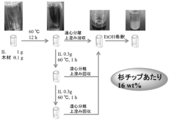
- FIG. 2 is an experimental example for explaining the method for producing lignin of the present invention.
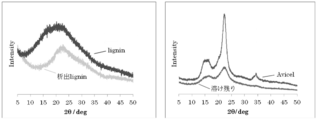
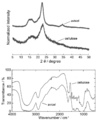
- FIG. 3 shows the result of XRD measurement of precipitated lignin obtained by the lignin production method of the present invention, undissolved cellulose and a sample.
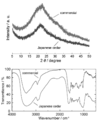
- FIG. 4 shows the results of IR measurement of precipitated lignin and standard lignin obtained by the lignin production method of the present invention.
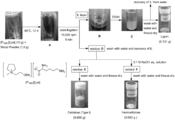
- FIG. 5 is an experimental example for explaining the production method of lignin and the method for separating cellulose and hemicellulose of the present invention.
- FIG. 1 shows the results of measuring XRD of precipitated lignin and standard lignin obtained in the lignin dissolution experiment of the present invention.
- FIG. 2 is an experimental example for explaining the method for producing lignin of the present invention.
- FIG. 3 shows the
- FIG. 6 shows the results of measuring XRD and IR of lignin obtained from cedar chips and standard lignin by the lignin production method of the present invention.
- FIG. 7 shows the results of measurement of XRD and IR of cellulose obtained from cedar chips by the lignin production method of the present invention and standard cellulose.
- FIG. 8 shows the results of measuring XRD and IR of hemicellulose obtained from cedar chips and cellulose obtained from cedar chips by the lignin production method of the present invention.
- FIG. 9 shows the result of MALDI-QIT-TOF MS measurement of lignin obtained from cedar chips by the lignin production method of the present invention.
- FIG. 10 shows the results of measuring MALDI-QIT-TOF MS of lignin obtained from cedar, hinoki and lawan chips by the lignin production method of the present invention.
- Lignin-soluble ionic liquid >> The ionic liquid having lignin solubility is represented by the following chemical formula (1).
- R 1 and R 3 may be the same or different and each represents an alkyl group having 1 to 6 carbon atoms or an alkenyl group having 2 to 6 carbon atoms
- R 2 is one or more substituted And represents a hydrogen atom, an amino group, a hydroxy group, a phenyl group, an alkyl group having 1 to 6 carbon atoms, an alkenyl group having 2 to 6 carbon atoms, or an alkoxy group
- Y represents CH 2 , O, or S.
- N represents the number of ring members
- n 1, 2
- X represents an anion derived from amino acid.
- the alkyl group, alkenyl group, and alkoxy group may have one or more of halogen, amino group, phenyl group, cycloalkyl group, alkoxy group, and hydroxy group as a substituent.
- alkyl group having 1 to 6 carbon atoms examples include a methyl group, an ethyl group, a propyl group, a butyl group, a pentyl group, and a hexyl group.
- one or more hydroxy groups may be substituted.
- alkenyl group having 2 to 6 carbon atoms examples include a vinyl group, an allyl group, a 3-butenyl group, a 4-pentenyl group, and a 5-hexenyl group.
- one or more of an alkoxy group or a hydroxy group may be substituted.
- Examples of the halogen include a fluoro group, a chloro group, and a bromo group.
- Examples of the cycloalkyl group include a cyclopentyl group and a cyclohexyl group.
- Examples of the alkoxy group include a methoxy group and an ethoxy group.
- R 1 and R 3 are preferably a combination of an alkyl group having 1 to 6 carbon atoms and an alkoxyalkyl group, particularly a combination of a methyl group and a 2-methoxyethyl group, and R 2 is preferably a hydrogen atom.
- X is a compound having an amino group and a carboxyl group on the same carbon, and examples thereof include L-amino acids and D-amino acids, of which L-amino acids are preferred, and lysine and arginine are particularly preferred.
- a pyrrolidine derivative and a compound having halogen at the terminal are mixed to synthesize a pyrrolidinium salt having halogen as an anion.
- a pyrrolidine derivative and a compound having a halogen at the terminal are placed in a reaction vessel and mixed at 40 to 160 ° C. Mixing may be performed at normal pressure, or may be performed under pressure using a pressure vessel.
- the reaction vessel is not particularly limited, but glass, Teflon (registered trademark), or the like can be used.
- the mixing method is not particularly limited, but a stirrer or a shaker may be used.
- the reaction temperature in the chlorination step is 40 to 160 ° C, preferably 60 to 100 ° C. This is because if the temperature of the chlorination step is too low, the reaction does not proceed, and if the temperature is too high, the raw material is vaporized and the ionic liquid is colored. Specifically, this temperature is, for example, 40, 50, 60, 70, 80, 90, 100, 110, 120, 130, 140, 150, or 160 ° C., and between any two of the numerical values exemplified here. It may be within the range.
- the reaction time of the chlorination step is not particularly limited, but is, for example, 6 to 48 hours, preferably 12 to 24 hours. Specifically, this time is, for example, 6, 7, 8, 9, 10, 11, 12, 15, 18, 21, 24, 27, 30, 36, 42, or 48 hours. It may be within the range between any two.
- a washing step in which a washing solvent is added for washing may be performed.
- the washing step is a step performed to remove unreacted substrate.
- the washing solvent is not particularly limited, and examples thereof include hexane, ethyl acetate, acetonitrile, and mixed solvents thereof, and any solvent that dissolves a substrate and does not dissolve a pyrrolidinium salt having a halogen as an anion may be used.
- salt exchange process In the salt exchange step, the anionic halogen is exchanged for the target amino acid.
- the cost is low because it is possible, and the (silver oxide / methanol method) has advantages that are suitable for mass synthesis.
- the products obtained by the (ion exchange resin method) and the (silver oxide / methanol method) are exactly the same, and a synthesis method can be selected according to the situation taking into account the respective advantages.
- the pyrrolidinium salt in which the anion is an amino acid is eliminated by passing the pyrrolidinium salt having halogen as an anion obtained in the chlorination step> by exchanging the anion with a hydroxide ion and subsequently reacting with an amino acid.
- An ionic liquid can be synthesized. Specifically, for example, an aqueous pyrrolidinium salt solution is passed through an ion exchange resin and mixed with an aqueous amino acid solution. Thereafter, water is distilled off.
- the ion exchange resin is not particularly limited, but may be an anion exchange resin as long as it can exchange an anion from a halogen to a hydroxide ion.
- the reaction vessel is not particularly limited, glass, Teflon, plastic, or the like can be used.
- the mixing method is not particularly limited, but a stirrer or a shaker may be used.
- the method of salt exchange using an ion exchange resin is not particularly limited, but a method of filling a cylindrical or funnel-shaped container with an ion exchange resin and letting it fall naturally or applying pressure thereto, beaker or flask A method of mixing and mixing may be used as long as the anion is exchanged from halogen to hydroxide ion.
- salt exchange can be performed by filling a glass column with an ion exchange resin and passing a pyrrolidinium salt through natural dropping therethrough.
- the reaction temperature of the ion exchange resin method is ⁇ 10 to 30 ° C., preferably 0 to 10 ° C. This is because the reaction does not proceed when the temperature of the ion exchange resin method is too low, and the raw material is broken when the temperature is too high. Specifically, this temperature is, for example, ⁇ 10, ⁇ 5, 0, 5, 10, 20 or 30 ° C., and may be within a range between any two of the numerical values exemplified here.
- the reaction time of the ion exchange resin method is not particularly limited, but is, for example, 6 to 48 hours, preferably 12 to 24 hours. Specifically, this time is, for example, 6, 7, 8, 9, 10, 11, 12, 15, 18, 21, 24, 27, 30, 36, 42, or 48 hours. It may be within the range between any two.
- a washing and separating step may be performed after water is distilled off.
- the washing / separating step is a step performed for removing unreacted substrate.
- the washing solvent is not particularly limited, and examples thereof include acetonitrile, methanol, acetone, and a mixed solvent thereof. Any solvent that dissolves the pyrrolidinium salt ionic liquid and does not dissolve the substrate may be used.
- the separation method is not particularly limited, and for example, a method such as filtration or centrifugation can be used. Examples of the filtration method include natural filtration, vacuum filtration, and pressure filtration.
- a pyrrolidinium salt ionic liquid can be obtained by removing the unreacted substrate in the washing and separating step and distilling off the washing solvent.
- the pyrrolidinium salt having halogen as an anion obtained in the chlorination step is reacted in methanol to exchange the anion for methoxide, and then reacted with an amino acid to be eliminated as methanol, and the anion is an amino acid pyrrolidinium salt
- An ionic liquid can be synthesized. Specifically, for example, pyrrolidinium salt, silver oxide, and methanol are mixed to separate a solid content, an amino acid is mixed into the separated reaction solution, the solid content is separated, and the solvent is distilled off.
- the reaction vessel is not particularly limited, but glass or Teflon can be used.
- the mixing method is not particularly limited, but a stirrer or a shaker may be used.
- the method for separating the solid content is not particularly limited, and for example, a method such as filtration or centrifugation can be used.
- a method such as filtration or centrifugation can be used.
- the filtration method include natural filtration, vacuum filtration, and pressure filtration.
- the reaction temperature in the silver oxide / methanol method is 0 to 50 ° C., preferably 15 to 35 ° C. Specifically, this temperature is, for example, 0, 5, 10, 15, 20, 25, 30, 35, 40, 45, or 50 ° C., and is within a range between any two of the numerical values exemplified here. There may be.
- the reaction time in the silver oxide / methanol method is not particularly limited, but is, for example, 12 to 72 hours, and preferably 24 to 48 hours. This time is specifically, for example, 12, 18, 24, 30, 36, 42, 48, 54, 60, 66, or 72 hours, and is within a range between any two of the numerical values exemplified here. There may be.
- the method for producing lignin comprises (1) mixing ionic liquid and biomass, (2) separating the ionic liquid phase and the residue from the mixed liquid obtained in the step (1), (3 ) A step of adding a lignin precipitation solvent to the ionic liquid phase obtained in the step (2) to precipitate and separate lignin is provided.
- Step (1) Lignin dissolution process>
- the ionic liquid and biomass are mixed and lignin is dissolved in the ionic liquid.
- an ionic liquid and biomass are put into a reaction vessel and mixed at 0 to 120 ° C. Mixing may be performed at normal pressure, or may be performed under reduced pressure or pressurized conditions using a pressure vessel.
- the reaction vessel is not particularly limited, but glass, Teflon, plastic, or the like can be used.
- the mixing method is not particularly limited, but a stirrer or a shaker may be used.
- lignin in the biomass is dissolved in the ionic liquid, and cellulose and hemicellulose are not dissolved but remain as a residue.
- the reaction temperature in the lignin dissolution step is 0 to 120 ° C., preferably 20 to 100 ° C. This is because the reaction does not proceed when the temperature of the lignin dissolving step is too low, and the ionic liquid is decomposed when the temperature is too high.
- the temperature of the lignin dissolution step is, for example, 0, 10, 20, 30, 40, 50, 60, 70, 80, 90, 100, 110, or 120 ° C, and any of the numerical values exemplified here It may be within a range between the two.
- the ionic liquid used in the present invention also dissolves cellulose, but the dissolution requires a temperature of 80 ° C. or higher.
- lignin can be dissolved at 60 ° C to 80 ° C. For this reason, selective extraction of a lignin is attained by adding biomass to the ionic liquid of this invention, and stirring at 80 degrees C or less.
- the reaction time of the lignin dissolution step is not particularly limited, but is, for example, 0.5 to 24 hours, preferably 6 to 12 hours. This time is specifically 0.5, 1, 2, 3, 4, 5, 6, 7, 8, 9, 10, 11, 12, 15, 18, 21, or 24 hours, for example, It may be within a range between any two of the numerical values exemplified in.
- biomass is not particularly limited as long as it is a plant-based biomass, and examples thereof include woody or herbaceous plant materials.
- this wood-based raw material include thinned wood, wood processing scrap house waste, etc.
- herbaceous raw materials include, for example, bagasse, rice husk, rice, wheat and other potatoes, kenaf, Elianthus, agricultural waste, etc. is there.
- Step (2) Solid-liquid separation step>
- the ionic liquid phase and the residue are separated from the mixed liquid obtained in the step (1) using various solid-liquid separation methods.
- the residue has a solid or gel-like shape.
- the solid-liquid separation method is not particularly limited, and for example, a method such as filtration or centrifugation can be used.
- the filtration method include natural filtration, vacuum filtration, and pressure filtration. Specifically, for example, separation can be performed by removing the ionic liquid separated by centrifugation with a pipette or the like.
- a re-extraction step of separating the ionic liquid from the residue by adding the ionic liquid and performing solid-liquid separation may be performed a plurality of times.
- the re-extraction step is a step performed to remove the ionic liquid in which lignin is completely dissolved from the residue.
- the ionic liquid used for the re-extraction is not particularly limited, but preferably the same ionic liquid as that used in the lignin dissolution step is used.
- As the re-extraction method for example, a method in which an ionic liquid is added again, mixed with the residue, and separated by centrifugation can be used.
- the reaction temperature in the re-extraction step is ⁇ 3-1.
- the reaction time is not particularly limited, but is, for example, 0.5 to 3 hours, preferably 1 to 2 hours. Specifically, this time is, for example, 0.5, 1, 1.5, 2, 2.5, or 3 hours, and may be within a range between any two of the numerical values exemplified here. .
- the re-extraction step is performed in order to improve the extraction efficiency of lignin. Since there is no particularly large yield fluctuation, the re-extraction step can be omitted in a timely manner.
- Step (3) Lignin Precipitation Step>
- a lignin precipitation solvent is added to the ionic liquid phase obtained in step (2) to precipitate and separate lignin.
- the lignin precipitation solvent is not particularly limited, and alcohols such as methanol, ethanol, and propanol, water, and acetone can be used as long as they dissolve ionic liquid and do not dissolve lignin.
- the method for separating lignin and ionic liquid is not particularly limited, and for example, methods such as filtration and centrifugation can be used.
- the filtration method include natural filtration, vacuum filtration, and pressure filtration.
- separation can be performed by removing the ionic liquid separated by centrifugation with a pipette or the like.
- step (4) a basic aqueous solution is added to the residue obtained in step (2) to prepare a mixed solution, and hemicellulose is dissolved in the basic aqueous solution.
- the basic aqueous solution is not particularly limited, but aqueous solutions of various concentrations of sodium hydroxide (NaOH), potassium hydroxide (KOH), calcium hydroxide (CaOH), etc. can be used, dissolving hemicellulose, Any solution that does not dissolve may be used. In particular, a 0.1 M aqueous sodium hydroxide solution is preferred.
- Step (4) is ⁇ 3-1. It can be performed by the same method as in step (1) lignin dissolution step>.
- Step (5) cellulose / hemicellulose separation step
- the liquid mixture obtained in step (4) is separated into a liquid phase and a residue using various solid-liquid separation methods.
- Solid-liquid separation method is ⁇ 3-2. It can be performed by the same method as in step (2) solid-liquid separation step>.
- step (6) hemicellulose is recovered from the liquid phase obtained in step (5), and cellulose is recovered from the residue obtained in step (5).
- hemicellulose in the method for recovering hemicellulose, can be recovered by drying the liquid phase obtained in step (5), washing with water, and drying again.
- the method for recovering cellulose can purify hemicellulose by washing the residue obtained in step (5) with water and drying it.
- the drying method in (Step (6) cellulose / hemicellulose recovery step) is not particularly limited, and for example, methods such as natural drying, vacuum drying, and heat drying can be used.
- the water washing method in (Step (6) cellulose / hemicellulose recovery step) is not particularly limited.
- a method of stirring with a stirrer or a shaker and removing the aqueous phase with a pipette or the like can be used.
- Synthesis of lignin-soluble ionic liquid >> ⁇ 1-1. Chlorination process> ⁇ 1-2. Salt exchange process> (Ion exchange resin method) (Silver oxide / methanol method) ⁇ 1-3. Synthesis of various L-amino acid ionic liquids> ⁇ 2. Lignin dissolution experiment >> ⁇ 2-1. Change in solubility due to differences in cations> ⁇ 2-2. Change in solubility due to difference in anion> ⁇ 3. Biomass dissolution experiment >> ⁇ 3-1. Cedar chip melting experiment> ⁇ 3-2. Comparison with standard products> ⁇ 3-3.
- Chlorination process A chlorination reaction represented by the following chemical formula (2) was performed. The two-necked eggplant flask was replaced with argon, 14.4 ml of 1-methylpyrrolidine was weighed, 13.6 ml of 2-bromoethyl methyl ether was added dropwise, and the mixture was stirred at 80 ° C. for 24 hours with a magnetic stirrer (500 rpm).
- Table 1 shows the results of synthesizing ionic liquids using 20 types of L-amino acids by the same synthesis method as the above (ion exchange resin method). From Table 1, it can be seen that ionic liquids can be synthesized in good yield with all amino acids.
- the cationic N-methyl-N- (2-methoxyethyl) pyrrolidinium is represented as [P 1ME ], and the anionic amino acid is represented in three letters.
- Lignin dissolution experiment >> 0.05 g of standard lignin (lignin, alkali: 471003-100G manufactured by ALDRICH) is weighed into a vial tube per 1 g of ionic liquid ([P 1ME ] [Lys]) and made into a 5 wt% mixed solution at room temperature for 5 hours. It stirred with the magnetic stirrer (500 rpm), and it was visually confirming whether it melt
- the mixture was stirred at 60 ° C. and 100 ° C. for 1 hour. When it was confirmed that it did not dissolve even at 100 ° C., it was diluted with ethanol to precipitate lignin, and centrifuged at 3500 rpm for 5 minutes to separate the ionic liquid and lignin.
- FIG. 1 shows the results of XRD measurement of the precipitated lignin, and comparing the pattern with a standard lignin (lignin, alkali: 471003-100G manufactured by ALDRICH). As is clear from the results of FIG. 1, it was found that the structure of lignin did not change before and after dissolution.
- N, N-diethyl-N-methyl-N- (2-methoxyethyl) ammonium alanine [N 221ME ] [Ala]
- N, N-diethyl-N— Methyl-N- (2- (methylthio) ethyl) ammonium alanine [N 221MTE ] [Ala]
- N, N-diethyl-2 -Methoxy-N- (2-methoxyethyl) ethaneammonium alanine [N 22 (ME) 2 ] [Ala]
- Table 2 shows the results of examining the solubility of lignin in the same manner as in the lignin dissolution experiment >>. From the results in Table 2, it was found that [P 1ME ] [Ala] dissolves lignin most.
- Table 3 shows the results of examining the solubility of lignin by the same operation as lignin dissolution experiment >>.
- N-methyl-N- (2-methoxyethyl) piperidinium lysine ([Py 1ME ] [Lys]) uses N-methyl piperidine as a substrate and is ⁇ 1-1.
- Table 4 shows the results of a lignin dissolution experiment using 20 ionic liquids synthesized in ⁇ 1-3.20 types of L-amino acid ionic liquids> described above. From the results in Table 4, it was found that lignin was most dissolved in lysine and arginine, and then dissolved well in phenylalanine and tyrosine. From these results, lysine and arginine have an amino group at the terminal, and this amino group forms a hydrogen bond between lignin and cellulose, and it seems that the effect of peeling lignin from cellulose is high.
- Biomass dissolution experiment >> As shown in FIG. 2, the above ⁇ 1. Biomass dissolution experiments were performed using N-methyl-N- (2-methoxyethyl) pyrrolidinium lysine ([P 1ME ] [Lys]) synthesized in Synthesis of Lignin-Soluble Ionic Liquid >>. Cedar chips were used as biomass, and sawdust was used to cut cedar boards with a saw.
- cedar chip dissolution experiment 16 wt% lignin per cedar chip was successfully recovered. Since cedar contains about 20% lignin, it was found that almost all can be recovered.
- FIG. 4 shows the results of IR measurement of the precipitated lignin obtained in the cedar chip dissolution experiment. From the results of FIG. 4, it can be seen that precipitated lignin and standard lignin (lignin, alkali: 471003-100G from ALDRICH) have similar IR patterns.
- FIG. 9 shows the results of MALDI-QIT-TOF MS measurement of lignin obtained in lignin / cellulose / hemicellulose separation experiment>.
- the molecular weight of the obtained lignin is 21 kilodaltons, and that it is possible to separate the lignin structure with almost no destruction by using the method of the present invention. .
- N-methyl-N- (2-methoxyethyl) piperidinium lysine [Py 1ME ] [Lys]
- Py 1ME N-methyl-N- (2-methoxyethyl) piperidinium lysine
- N, N-diethyl-N-methyl-N -(2- Methoxyethyl ) ammonium lysine [N 221ME ] [Lys]
Landscapes
- Chemical & Material Sciences (AREA)
- Organic Chemistry (AREA)
- Health & Medical Sciences (AREA)
- Life Sciences & Earth Sciences (AREA)
- Chemical Kinetics & Catalysis (AREA)
- Polymers & Plastics (AREA)
- Medicinal Chemistry (AREA)
- Engineering & Computer Science (AREA)
- Materials Engineering (AREA)
- Biochemistry (AREA)
- General Health & Medical Sciences (AREA)
- Molecular Biology (AREA)
- Sustainable Development (AREA)
- Wood Science & Technology (AREA)
- Polysaccharides And Polysaccharide Derivatives (AREA)
Priority Applications (1)
| Application Number | Priority Date | Filing Date | Title |
|---|---|---|---|
| JP2014522492A JP6108559B2 (ja) | 2012-06-26 | 2013-05-29 | リグニン溶解性イオン液体を使用したバイオマスからのリグニンの製造方法、及びリグニン、ヘミセルロース、及びセルロースの製造方法 |
Applications Claiming Priority (2)
| Application Number | Priority Date | Filing Date | Title |
|---|---|---|---|
| JP2012143093 | 2012-06-26 | ||
| JP2012-143093 | 2012-06-26 |
Publications (1)
| Publication Number | Publication Date |
|---|---|
| WO2014002674A1 true WO2014002674A1 (fr) | 2014-01-03 |
Family
ID=49782841
Family Applications (1)
| Application Number | Title | Priority Date | Filing Date |
|---|---|---|---|
| PCT/JP2013/064885 Ceased WO2014002674A1 (fr) | 2012-06-26 | 2013-05-29 | Procédé de fabrication de lignine à partir de biomasse à l'aide d'un liquide ionique de dissolution de lignine, et procédé de fabrication de lignine, d'hémicellulose et de cellulose |
Country Status (2)
| Country | Link |
|---|---|
| JP (1) | JP6108559B2 (fr) |
| WO (1) | WO2014002674A1 (fr) |
Cited By (9)
| Publication number | Priority date | Publication date | Assignee | Title |
|---|---|---|---|---|
| CN106674120A (zh) * | 2016-11-30 | 2017-05-17 | 辽宁大学 | 一种新型醚基功能化离子液体的制备及在去除道路交通标识中的应用 |
| WO2017191845A1 (fr) * | 2016-05-04 | 2017-11-09 | アイセップ株式会社 | Procédé de traitement de tissu végétal destiné à accélérer la décomposition d'un tissu végétal, agent principal correspondant, composition de matière première extraite à l'aide d'un procédé de traitement de tissu végétal, et procédé de réduction d'une masse de tissu végétal |
| CN108047137A (zh) * | 2018-01-02 | 2018-05-18 | 辽宁大学 | 一种含有醚基功能基团氨基酸咪唑盐离子液体及其制备方法 |
| JP2019505420A (ja) * | 2015-12-07 | 2019-02-28 | ボワトゥゼ ティモテ | リグノセルロース系材料の部分的脱リグニン化及び充填方法、並びに当該方法により得られる複合材料構造体 |
| JP2020015688A (ja) * | 2018-07-25 | 2020-01-30 | 国立大学法人千葉大学 | 硫黄を含むホスホニウム型カチオン及び硫黄を含むホスホニウム型イオン液体 |
| US11656756B2 (en) | 2018-02-09 | 2023-05-23 | Sas Woodoo | Touch detection device with touch interface made of composite material |
| US11820041B2 (en) | 2017-06-07 | 2023-11-21 | Sas Woodoo | Process for supercritical or subcritical partial delignification and filling of a lignocellulosic material |
| CN119431609A (zh) * | 2024-12-10 | 2025-02-14 | 福州大学 | 一种以氨基酸离子液体为催化剂合成纤维素酯的方法 |
| US12617121B2 (en) | 2018-09-20 | 2026-05-05 | Sas Woodoo | Part made from lignocellulosic material and method for producing such a part |
Citations (5)
| Publication number | Priority date | Publication date | Assignee | Title |
|---|---|---|---|---|
| JP2009189277A (ja) * | 2008-02-13 | 2009-08-27 | Toyota Motor Corp | 木質系バイオマスの処理方法、及び有機酸又はアルコールの製造方法 |
| JP2010084104A (ja) * | 2008-10-02 | 2010-04-15 | Kri Inc | イオン液体によるリグノセルロース系バイオマスのセルロースとリグニンの分離化方法 |
| JP2010521155A (ja) * | 2007-03-14 | 2010-06-24 | ザ・ユニバーシティ・オブ・トレド | バイオマス前処理 |
| JP2012012568A (ja) * | 2010-05-31 | 2012-01-19 | Idemitsu Kosan Co Ltd | バイオマスの処理方法 |
| JP2012144441A (ja) * | 2011-01-06 | 2012-08-02 | Idemitsu Kosan Co Ltd | イオン液体、イオン液体の精製方法、およびセルロース系バイオマスの処理方法 |
-
2013
- 2013-05-29 JP JP2014522492A patent/JP6108559B2/ja not_active Expired - Fee Related
- 2013-05-29 WO PCT/JP2013/064885 patent/WO2014002674A1/fr not_active Ceased
Patent Citations (5)
| Publication number | Priority date | Publication date | Assignee | Title |
|---|---|---|---|---|
| JP2010521155A (ja) * | 2007-03-14 | 2010-06-24 | ザ・ユニバーシティ・オブ・トレド | バイオマス前処理 |
| JP2009189277A (ja) * | 2008-02-13 | 2009-08-27 | Toyota Motor Corp | 木質系バイオマスの処理方法、及び有機酸又はアルコールの製造方法 |
| JP2010084104A (ja) * | 2008-10-02 | 2010-04-15 | Kri Inc | イオン液体によるリグノセルロース系バイオマスのセルロースとリグニンの分離化方法 |
| JP2012012568A (ja) * | 2010-05-31 | 2012-01-19 | Idemitsu Kosan Co Ltd | バイオマスの処理方法 |
| JP2012144441A (ja) * | 2011-01-06 | 2012-08-02 | Idemitsu Kosan Co Ltd | イオン液体、イオン液体の精製方法、およびセルロース系バイオマスの処理方法 |
Non-Patent Citations (5)
| Title |
|---|
| KAZUTAKA OHIRA ET AL.: "Amino Acid Ionic Liquid as an Efficient Cosolvent of Dimethyl Sulfoxide to Realize Cellulose Dissolution at Room Temperature", CHEM. LETT., vol. 41, 2012, pages 987 - 989 * |
| KAZUTAKA OHIRA ET AL.: "Design of Cellulose Dissolving Ionic Liquids Inspired by Nature", CHEMSUSCHEM, vol. 5, 2012, pages 388 - 391 * |
| KOHEI YOSHIDA ET AL.: "Mokushitsu Biomass kara Kankyo Chowagata Lignin Chushutsu no Tameno Ion Ekitai Yobai no Kaihatsu", CSJ: THE CHEMICAL SOCIETY OF JAPAN KOEN YOKOSHU, vol. 93, no. 2, 2013, pages 231 * |
| NAWSHAD MUHAMMAD ET AL.: "Dissolution and Delignification of Bamboo Biomass Using Amino Acid-Based Ionic Liquid", APPL. BIOCHEM. BIOTECHNOL., vol. 165, 2011, pages 998 - 1009 * |
| YUKO HAMADA ET AL.: "Lignin Yokaisei o Yusuru Ion Ekitai no Kaihatsu", CSJ: THE CHEMICAL SOCIETY OF JAPAN KOEN YOKOSHU, vol. 93, no. 2, 2013, pages 231 * |
Cited By (14)
| Publication number | Priority date | Publication date | Assignee | Title |
|---|---|---|---|---|
| JP2019505420A (ja) * | 2015-12-07 | 2019-02-28 | ボワトゥゼ ティモテ | リグノセルロース系材料の部分的脱リグニン化及び充填方法、並びに当該方法により得られる複合材料構造体 |
| JP2022069445A (ja) * | 2015-12-07 | 2022-05-11 | ソシエテ パ アクシオンス シンプリフィエ ウードゥー | リグノセルロース系材料の部分的脱リグニン化及び充填方法、並びに当該方法により得られる複合材料構造体 |
| JP7275335B2 (ja) | 2015-12-07 | 2023-05-17 | ソシエテ パ アクシオンス シンプリフィエ ウードゥー | リグノセルロース系材料の構造体を処理するための処理方法及び複合材料構造体の製造方法 |
| WO2017191845A1 (fr) * | 2016-05-04 | 2017-11-09 | アイセップ株式会社 | Procédé de traitement de tissu végétal destiné à accélérer la décomposition d'un tissu végétal, agent principal correspondant, composition de matière première extraite à l'aide d'un procédé de traitement de tissu végétal, et procédé de réduction d'une masse de tissu végétal |
| JPWO2017191845A1 (ja) * | 2016-05-04 | 2018-07-26 | アイセップ株式会社 | 植物組織の分解を促進する植物組織処理方法、その主剤、その植物組織処理方法で抽出した原料組成物、および植物組織の嵩低減方法 |
| CN106674120A (zh) * | 2016-11-30 | 2017-05-17 | 辽宁大学 | 一种新型醚基功能化离子液体的制备及在去除道路交通标识中的应用 |
| CN106674120B (zh) * | 2016-11-30 | 2019-11-29 | 辽宁大学 | 一种醚基功能化离子液体的制备及在去除道路交通标识中的应用 |
| US11820041B2 (en) | 2017-06-07 | 2023-11-21 | Sas Woodoo | Process for supercritical or subcritical partial delignification and filling of a lignocellulosic material |
| CN108047137A (zh) * | 2018-01-02 | 2018-05-18 | 辽宁大学 | 一种含有醚基功能基团氨基酸咪唑盐离子液体及其制备方法 |
| US11656756B2 (en) | 2018-02-09 | 2023-05-23 | Sas Woodoo | Touch detection device with touch interface made of composite material |
| US11662899B2 (en) | 2018-02-09 | 2023-05-30 | Sas Woodoo | Touch detection device with touch interface made of composite material |
| JP2020015688A (ja) * | 2018-07-25 | 2020-01-30 | 国立大学法人千葉大学 | 硫黄を含むホスホニウム型カチオン及び硫黄を含むホスホニウム型イオン液体 |
| US12617121B2 (en) | 2018-09-20 | 2026-05-05 | Sas Woodoo | Part made from lignocellulosic material and method for producing such a part |
| CN119431609A (zh) * | 2024-12-10 | 2025-02-14 | 福州大学 | 一种以氨基酸离子液体为催化剂合成纤维素酯的方法 |
Also Published As
| Publication number | Publication date |
|---|---|
| JPWO2014002674A1 (ja) | 2016-05-30 |
| JP6108559B2 (ja) | 2017-04-05 |
Similar Documents
| Publication | Publication Date | Title |
|---|---|---|
| JP6108559B2 (ja) | リグニン溶解性イオン液体を使用したバイオマスからのリグニンの製造方法、及びリグニン、ヘミセルロース、及びセルロースの製造方法 | |
| JP6344724B2 (ja) | リグニン分解物の製造方法 | |
| KR20210088650A (ko) | 공융 용매 및 리그닌 추출에서의 이의 응용 | |
| CN105908550B (zh) | 一种从桉木中分离提取木质素的方法 | |
| CN1836068A (zh) | 用于处理含木质素物质的溶剂 | |
| WO2013153203A1 (fr) | Prétraitement de biomasse lignocellulosique et récupération de substituants au moyen de mélanges naturels de solvants eutectiques profonds (des)/composés présentant des températures de transition basses | |
| EP2121189A2 (fr) | Récupération d'huile dans un processus de production d'éthanol à partir de maïs moulu à sec | |
| CN102864672A (zh) | 提取木质素的方法 | |
| WO2011149341A1 (fr) | Procédé de traitement d'une biomasse lignocellulosique | |
| CN101649160A (zh) | 以松脂为原料生产精制浅色松香的方法 | |
| CN103031762B (zh) | 一种在可降解型离子液体溶剂中制备富含纤维素材料的方法 | |
| CN102659594A (zh) | 一种利用秸秆类生物质制备乙酰丙酸乙酯的方法 | |
| CA3017800A1 (fr) | Polymeres ioniques et leur utilisation dans le traitement d'une biomasse | |
| JP2010184902A (ja) | イオン液体の精製方法および回収方法 | |
| US10287527B2 (en) | Eco-friendly process for the isolation of biopolymers from agricultural residues | |
| EP3030599B1 (fr) | Méthode de récupération de lignin | |
| EP3030600B1 (fr) | Nouvelles composition contenant de la lignine | |
| JP6274478B2 (ja) | リグニン分解物の製造方法 | |
| Cong et al. | Characterization and components separation of corn stover by alkali and hydrogen peroxide treatments | |
| JP2005239979A (ja) | 燐酸とリグノセルロース加水分解生成物とを分離する方法及びグルコースの製造方法 | |
| JP2010059082A (ja) | シュウ酸の製造方法 | |
| KR100513899B1 (ko) | 고분자 중합물 내 잔류 촉매 제거방법 | |
| JP5458430B2 (ja) | リグノフェノール誘導体の精製法 | |
| CN117604799A (zh) | 一种木质纤维组分分离的方法 | |
| CN104744238A (zh) | 在苯氧乙酸类农药废水中回收羟基乙酸的方法 |
Legal Events
| Date | Code | Title | Description |
|---|---|---|---|
| 121 | Ep: the epo has been informed by wipo that ep was designated in this application |
Ref document number: 13810281 Country of ref document: EP Kind code of ref document: A1 |
|
| ENP | Entry into the national phase |
Ref document number: 2014522492 Country of ref document: JP Kind code of ref document: A |
|
| NENP | Non-entry into the national phase |
Ref country code: DE |
|
| 122 | Ep: pct application non-entry in european phase |
Ref document number: 13810281 Country of ref document: EP Kind code of ref document: A1 |