WO2014002994A1 - Procédé de production d'un composé polymère et composé polymère - Google Patents
Procédé de production d'un composé polymère et composé polymère Download PDFInfo
- Publication number
- WO2014002994A1 WO2014002994A1 PCT/JP2013/067368 JP2013067368W WO2014002994A1 WO 2014002994 A1 WO2014002994 A1 WO 2014002994A1 JP 2013067368 W JP2013067368 W JP 2013067368W WO 2014002994 A1 WO2014002994 A1 WO 2014002994A1
- Authority
- WO
- WIPO (PCT)
- Prior art keywords
- polymer compound
- exchange resin
- acid
- concentration
- molecular weight
- Prior art date
- Legal status (The legal status is an assumption and is not a legal conclusion. Google has not performed a legal analysis and makes no representation as to the accuracy of the status listed.)
- Ceased
Links
Images


Classifications
-
- C—CHEMISTRY; METALLURGY
- C08—ORGANIC MACROMOLECULAR COMPOUNDS; THEIR PREPARATION OR CHEMICAL WORKING-UP; COMPOSITIONS BASED THEREON
- C08G—MACROMOLECULAR COMPOUNDS OBTAINED OTHERWISE THAN BY REACTIONS ONLY INVOLVING UNSATURATED CARBON-TO-CARBON BONDS
- C08G63/00—Macromolecular compounds obtained by reactions forming a carboxylic ester link in the main chain of the macromolecule
- C08G63/88—Post-polymerisation treatment
- C08G63/90—Purification; Drying
-
- B—PERFORMING OPERATIONS; TRANSPORTING
- B01—PHYSICAL OR CHEMICAL PROCESSES OR APPARATUS IN GENERAL
- B01J—CHEMICAL OR PHYSICAL PROCESSES, e.g. CATALYSIS OR COLLOID CHEMISTRY; THEIR RELEVANT APPARATUS
- B01J41/00—Anion exchange; Use of material as anion exchangers; Treatment of material for improving the anion exchange properties
- B01J41/08—Use of material as anion exchangers; Treatment of material for improving the anion exchange properties
- B01J41/12—Macromolecular compounds
-
- B—PERFORMING OPERATIONS; TRANSPORTING
- B01—PHYSICAL OR CHEMICAL PROCESSES OR APPARATUS IN GENERAL
- B01J—CHEMICAL OR PHYSICAL PROCESSES, e.g. CATALYSIS OR COLLOID CHEMISTRY; THEIR RELEVANT APPARATUS
- B01J39/00—Cation exchange; Use of material as cation exchangers; Treatment of material for improving the cation exchange properties
- B01J39/08—Use of material as cation exchangers; Treatment of material for improving the cation exchange properties
- B01J39/16—Organic material
- B01J39/18—Macromolecular compounds
-
- C—CHEMISTRY; METALLURGY
- C08—ORGANIC MACROMOLECULAR COMPOUNDS; THEIR PREPARATION OR CHEMICAL WORKING-UP; COMPOSITIONS BASED THEREON
- C08G—MACROMOLECULAR COMPOUNDS OBTAINED OTHERWISE THAN BY REACTIONS ONLY INVOLVING UNSATURATED CARBON-TO-CARBON BONDS
- C08G63/00—Macromolecular compounds obtained by reactions forming a carboxylic ester link in the main chain of the macromolecule
- C08G63/68—Polyesters containing atoms other than carbon, hydrogen and oxygen
- C08G63/685—Polyesters containing atoms other than carbon, hydrogen and oxygen containing nitrogen
- C08G63/6854—Polyesters containing atoms other than carbon, hydrogen and oxygen containing nitrogen derived from polycarboxylic acids and polyhydroxy compounds
- C08G63/6856—Dicarboxylic acids and dihydroxy compounds
-
- C—CHEMISTRY; METALLURGY
- C08—ORGANIC MACROMOLECULAR COMPOUNDS; THEIR PREPARATION OR CHEMICAL WORKING-UP; COMPOSITIONS BASED THEREON
- C08G—MACROMOLECULAR COMPOUNDS OBTAINED OTHERWISE THAN BY REACTIONS ONLY INVOLVING UNSATURATED CARBON-TO-CARBON BONDS
- C08G63/00—Macromolecular compounds obtained by reactions forming a carboxylic ester link in the main chain of the macromolecule
- C08G63/78—Preparation processes
- C08G63/82—Preparation processes characterised by the catalyst used
-
- C—CHEMISTRY; METALLURGY
- C08—ORGANIC MACROMOLECULAR COMPOUNDS; THEIR PREPARATION OR CHEMICAL WORKING-UP; COMPOSITIONS BASED THEREON
- C08G—MACROMOLECULAR COMPOUNDS OBTAINED OTHERWISE THAN BY REACTIONS ONLY INVOLVING UNSATURATED CARBON-TO-CARBON BONDS
- C08G63/00—Macromolecular compounds obtained by reactions forming a carboxylic ester link in the main chain of the macromolecule
- C08G63/91—Polymers modified by chemical after-treatment
- C08G63/914—Polymers modified by chemical after-treatment derived from polycarboxylic acids and polyhydroxy compounds
- C08G63/916—Dicarboxylic acids and dihydroxy compounds
-
- C—CHEMISTRY; METALLURGY
- C08—ORGANIC MACROMOLECULAR COMPOUNDS; THEIR PREPARATION OR CHEMICAL WORKING-UP; COMPOSITIONS BASED THEREON
- C08G—MACROMOLECULAR COMPOUNDS OBTAINED OTHERWISE THAN BY REACTIONS ONLY INVOLVING UNSATURATED CARBON-TO-CARBON BONDS
- C08G2140/00—Compositions for moulding powders
Definitions
- the present invention relates to a method for producing a polymer compound, and a polymer compound.
- This application claims priority based on Japanese Patent Application No. 2012-142968 filed in Japan on June 26, 2012 and Japanese Patent Application No. 2012-264382 filed on Japan on December 3, 2012 And the contents thereof are incorporated herein.
- a resist film is formed on a substrate, and the resist film is exposed and developed to form a resist pattern.
- resist patterns have been rapidly miniaturized due to advances in lithography technology.
- As a technique for miniaturization there is a reduction in wavelength of irradiation light. Specifically, the irradiation light has been shortened from g-line (wavelength: 438 nm) or i-line (wavelength: 365 nm) to DUV (Deep Ultra Violet) having a wavelength of 300 nm or less.
- KrF excimer laser (wavelength: 248 nm) lithography technology and ArF excimer laser (wavelength: 193 nm) lithography technology are introduced.
- studies have been made on shorter-wavelength EUV (wavelength: 13.5 nm) lithography technology.
- intensive research has been conducted on electron beam lithography technology and immersion lithography technology in which exposure is performed in a liquid such as water.
- various thin films such as an antireflection film, a gap fill film, and a top coat film are used.
- those containing a polymer compound are generally used.
- metal contamination occurs in the manufacture of high-density integrated circuits, computer chips, computer hard drives, and the like, it often leads to an increase in defects and a loss in yield, which is a major factor causing performance degradation.
- a metal impurity such as sodium or iron (for example, a metal ion, a metal powder, or a transition complex) is present in a polymer compound used in a lithography process, there is a risk of causing metal contamination during plasma peeling. .
- metal impurities reduces the performance and stability of semiconductor devices. It has been confirmed that these main factors are light metals such as sodium and heavy metals such as iron contained in the polymer compound used in the lithography process. Furthermore, it has also been found that metal impurity concentrations of less than 100 ppb in the polymer compound adversely affect the performance and stability of such electronic devices.
- the metal impurity concentration in a polymer compound is controlled by selecting raw materials that meet strict impurity concentration standards, or by performing thorough process management so that metal impurities do not enter the polymer compound at the production stage. ing. However, with the strict standardization of the metal impurity concentration, it is necessary to produce a polymer compound by a method in which drastic mixing of metal impurities is controlled.
- a method for reducing metal impurities in a polymer compound a method is proposed in which a polymer compound solution is passed through a filter that does not contain a strongly acidic ion exchange group and contains a charge control agent that generates a zeta potential (patent). Reference 1). Also, the step of bringing the polymer compound solution into contact with the cation exchange resin (T1), the step of bringing the polymer compound solution into contact with the mixed resin of the cation exchange resin and the anion exchange resin (T2), and the polymer compound solution into the positive zeta potential. There has been proposed a method in which the step (T3) of passing through a filter containing a substance having a liquid is combined (PTL 2).
- an acid catalyst or a base catalyst remains as an impurity in addition to metal impurities in the resulting polymer compound.
- the acid catalyst or base catalyst impurity affects the performance and stability of the semiconductor device as well as the metal impurity.
- the polymerization reaction is stopped using a basic compound as a reaction terminator.
- the polymerization reaction is stopped using an acidic compound as a reaction terminator.
- reaction terminators also become impurities and remain in the polymer compound, affecting the performance and stability of the semiconductor device.
- the polymer compound when obtaining a polymer compound in the presence of an acid catalyst, the polymer compound contains impurities derived from an acid catalyst and impurities derived from a reaction terminator (basic compound).
- the polymer compound when a polymer compound is obtained in the presence of a base catalyst, the polymer compound contains impurities derived from the base catalyst and impurities derived from the reaction terminator (acidic compound). Therefore, it is also required to reduce the concentration of these impurities in the polymer compound.
- the impurities derived from the acid catalyst and the reaction terminator are collectively referred to as “acid impurities”, and the impurities derived from the base catalyst and the reaction terminator (basic compound) are collectively referred to as basic impurities.
- Patent Document 2 relates to a method for producing a (meth) acrylic copolymer, and there is no description that the concentration of acid and base impurities can be reduced.
- the present invention has been made in view of the above circumstances, a production method capable of producing a polymer compound having a low metal impurity concentration and a sufficiently reduced acid and base impurity concentration with high productivity, and a low metal impurity concentration.
- Another object of the present invention is to provide a polymer compound in which the concentration of acid and base impurities is sufficiently reduced.
- a solution containing a polymer compound obtained in the presence of an acid catalyst or a base catalyst, or a solution containing a polymer compound obtained by purifying the polymer compound by a reprecipitation method is used as an anion exchange resin and a cation exchange resin. It has been found that a polymer compound in which not only the metal impurity concentration but also the acid and base impurity concentrations are sufficiently reduced can be produced with good productivity by contacting with the mixed resin.
- the present inventors have found that the metal impurity concentration and the acid and base impurity concentrations can be further reduced if the solution containing the polymer compound is brought into contact with the mixed resin and then passed through a specific filter, thereby completing the present invention. .
- a method for producing a polymer compound comprising the following steps (a) and (b).
- a mass ratio of the anion exchange resin to the cation exchange resin is 60/40 to 99/1.
- ⁇ 3> The method for producing a polymer compound according to ⁇ 1> or ⁇ 2>, wherein the polymer compound is obtained by adding a crosslinking agent to a side chain.
- ⁇ 4> The method for producing a polymer compound according to any one of ⁇ 1> to ⁇ 3>, wherein the polymer compound is a polyester polymer compound.
- ⁇ 5> The method for producing a polymer compound according to any one of ⁇ 1> to ⁇ 4>, wherein the acid catalyst is a sulfonic acid.
- ⁇ 6> The method for producing a polymer compound according to any one of ⁇ 1> to ⁇ 4>, wherein the base catalyst is a tertiary amine.
- the total concentration of acid and base impurities is 50 ppm or less, and each metal impurity concentration of sodium, potassium, calcium, and iron is 80 ppb or less, and when the film thickness is reduced to 400 nm or less, the wavelength is 193 nm.
- n value refractive index
- k value attenuation coefficient
- ⁇ 12> The polymer compound according to any one of ⁇ 9> to ⁇ 11>, wherein a crosslinking agent is added to the side chain.
- ⁇ 13> The polymer compound according to any one of ⁇ 9> to ⁇ 12>, which is a polyester polymer compound.
- a polymer compound having a low metal impurity concentration and a sufficiently reduced acid and base impurity concentration can be produced with high productivity.
- the polymer compound of the present invention has a low metal impurity concentration and a sufficiently reduced acid and base impurity concentration.
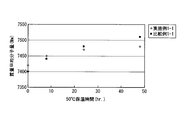
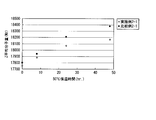
- 6 is a graph showing the storage stability test results of Example 1-1 and Comparative example 1-1. 6 is a graph showing the storage stability test results of Example 1-1 and Comparative example 1-1. 6 is a graph showing the storage stability test results of Example 2-1 and Comparative Example 2-1. 6 is a graph showing the storage stability test results of Example 2-1 and Comparative Example 2-1.
- (meth) acryl is a general term for acrylic and methacrylic.
- mass average molecular weight (Mw) and the Z average molecular weight (Mz) of the polymer compound in the present invention are values obtained in terms of polystyrene by gel permeation chromatography (GPC).
- the method for producing a polymer compound of the present invention includes the following steps (a) and (b).
- the production method preferably further includes the following steps (c) and (d).
- Step (b) A step of bringing the solution containing the polymer compound obtained in the step (a) into contact with a mixed resin obtained by mixing an anion exchange resin and a cation exchange resin.
- Step (d) A step of mixing the solution containing the polymer compound obtained in step (c) with a poor solvent for the polymer compound to precipitate the polymer compound to obtain a powdery polymer compound.
- Step (a) is a step of obtaining a polymer compound in the presence of an acid catalyst or a base catalyst.
- the step (a) is specifically the following step (a-1) or step (a-2).
- Step (a-1) A step of polymerizing a monomer in the presence of an acid catalyst, and using a basic compound to stop the polymerization reaction to obtain a polymer compound.
- Step (a-2) A step of polymerizing a monomer in the presence of a base catalyst and stopping the polymerization reaction using an acidic compound to obtain a polymer compound.
- carboxylic acid such as oxalic acid, maleic anhydride, maleic acid, or its anhydride
- Sulphonic acid such as p-toluenesulfonic acid, methanesulfonic acid, naphthalenesulfonic acid, or its anhydride
- Sulfuric acid hydrochloric acid, nitric acid and the like.
- sulfonic acid or its anhydride is preferable, and sulfonic acid is more preferable. Since sulfonic acid or its anhydride is strongly acidic, has high reactivity, and has a low water content that inhibits condensation polymerization, it is suitable as an acid catalyst.
- These acid catalysts may be used alone or in combination of two or more.
- the base catalyst is not particularly limited, and examples thereof include amines such as diethylamine, triethylamine, and pyridine; and hydroxides such as sodium hydroxide, sodium carbonate, potassium hydroxide, and potassium carbonate.
- amines are preferable in terms of low metal content, and among them, tertiary amines (for example, triethylamine) are more preferable.
- Tertiary amines are suitable as basic catalysts because they are strongly basic, have high reactivity, and do not contain active hydrogen that tends to cause side reactions.
- an acidic compound used as a reaction terminator the same acid catalyst as described above can be used.
- sulfonic acid or its anhydride is preferable in terms of low water content, and sulfonic acid is more preferable.
- a basic compound used as a reaction terminator the same thing as the basic catalyst mentioned above can be used.
- amines are preferable in that the metal content is low.
- tertiary amines for example, triethylamine
- the polymer compound obtained in the presence of the acid catalyst is not particularly limited, and examples thereof include polyester polymer compounds, polyether polymer compounds, and acrylic polymer compounds.
- the polymer compound obtained in the presence of a base catalyst is not particularly limited, and examples thereof include acrylic polymer compounds and siloxane polymer compounds.
- limit especially as a preferable high molecular compound A polyester type high molecular compound is preferable at the point which is excellent in an etching rate etc. and is optimal for application to a semiconductor lithography technique.
- a method for obtaining the polymer compound is not particularly limited, and a known polymerization method such as a solution polymerization method, an emulsion polymerization method, a suspension polymerization method, or a bulk polymerization method can be employed.
- a solution polymerization method is preferably used.
- the step (a) will be described in detail, taking as an example the case of obtaining a polyester polymer compound.
- Polyester polymer compounds are prepared by, for example, dissolving a dicarboxylic acid and a diol as monomers in a polymerization solvent, heating to an appropriate temperature for the polymerization reaction in the presence of an acid catalyst, and then performing a condensation polymerization reaction, and then cooling to an appropriate temperature. Then, a basic compound can be added as a reaction terminator to stop the polycondensation reaction. From the viewpoint of shortening the reaction time until the target molecular weight is reached and precise control of the molecular weight, the polycondensation reaction is preferably carried out at 100 to 150 ° C, more preferably 120 to 145 ° C.
- the polymerization solvent used for the polymerization of the polyester polymer compound is not particularly limited, but a solvent that can dissolve any of the monomer, the acid catalyst, and the resulting polymer (polyester polymer compound) is preferable.
- examples of such an organic solvent include anisole, 1,4-dioxane, acetone, tetrahydrofuran (THF), methyl ethyl ketone (MEK), methyl isobutyl ketone (MIBK), toluene, xylene and the like.
- condensation polymerization reaction it is preferable to control the dehydration and dealcoholization reaction using a monomer in which the functional group (carboxyl group) of dicarboxylic acid is protected with an alkyl group.
- a monomer in which the functional group (carboxyl group) of dicarboxylic acid is protected with an alkyl group As a result, gelation and the like can be suppressed, so that it is possible to obtain a polyester polymer compound suitable for use in a polymer compound for lithography, particularly a polymer compound for an antireflection film.
- the polymer compound obtained in the step (a) preferably has a crosslinking agent added to the side chain.
- a crosslinking agent added to the side chain.
- a compound having a site that absorbs actinic rays used in the lithography process can be used.
- glycoluril, methylated glycoluril, butylated glycoluril, tetramethoxyglycoluril, methylated melamine resin , N-methoxymethyl-melamine, urethane urea, amino group or vinyl ether are preferable in that a polymer compound having excellent antireflection film performance can be obtained.
- the etching rate can be improved.
- the crosslinking agent may be added to the (reaction) solution containing the polymer compound to allow further reaction, thereby crosslinking the functional group contained in the polymer compound.
- a polymer compound in which an agent is added and a crosslinking agent is added to the side chain is obtained.
- the crosslinking agent addition reaction is preferably performed at 50 ° C. or less, more preferably 15 to 30 ° C., and still more preferably. 18-22 ° C.
- the polyester polymer compound has been described as an example, but the present invention is not limited to this.
- a monomer is polymerized using a polymerization initiator in the presence of a polymerization solvent, and a polymer compound such as a (meth) acrylic polymer compound, a polyether polymer compound, or a polyamide polymer compound.
- a polymer compound such as a (meth) acrylic polymer compound, a polyether polymer compound, or a polyamide polymer compound.
- an acid catalyst and a crosslinking agent are added to a solution containing these polymer compounds to carry out a crosslinking agent addition reaction, whereby a polymer compound having a crosslinking agent added to the side chain can be obtained.
- step (a) often contains metal impurities, acid and base impurities in the raw material or manufacturing process, and it is also clear that these impurities adversely affect the performance and stability of electronic devices. It has become. Therefore, it is necessary to remove impurities to a low concentration by the following step (b). Further, if step (c) and step (d) are further performed after step (b), impurities can be removed to a lower concentration.
- Step (b) is a step of bringing the solution containing the polymer compound obtained in step (a) into contact with a mixed resin obtained by mixing an anion exchange resin and a cation exchange resin.
- the solution containing the polymer compound may be brought into contact with the mixed resin as it is, or a solution obtained by re-dissolving the polymer compound precipitated by mixing the solution containing the polymer compound and the poor solvent. You may make it contact with mixed resin. In particular, it is preferable to contact a mixed resin with a solution in which a polymer compound precipitated by a poor solvent is redissolved.
- the polymerization reaction solution can be used as it is as a solution containing the polymer compound.
- the polymerization reaction solution may be diluted to an appropriate solution viscosity with a diluting solvent as necessary.
- Diluting solvents include anisole, 1,4-dioxane, acetone, THF, MEK, MIBK, ⁇ -butyrolactone, propylene glycol monomethyl ether acetate (PGMEA), propylene glycol monomethyl ether (PGME), ethyl lactate, toluene, xylene, 2 -Methyl hydroxyisobutyrate (HBM) and the like. These may use 1 type and may use 2 or more types together.
- the solubility parameter (hereinafter also referred to as “SP value”) of the solvent (a mixture of the polymerization solvent and the dilution solvent) in the polymerization reaction solution after dilution, and the SP value of the poor solvent used for reprecipitation purification The difference is preferably smaller in that good dispersibility of the polymer compound can be obtained and the monomer can be efficiently removed.
- the SP value of the solvent can be determined, for example, by the method described in “Polymer Handbook”, 4th edition, pages VII-675 to VII-711. Specific examples are described in Table 1 (pages VII-683) and Tables 7 to 8 (pages VII-688 to VII-711).
- the SP value in a mixed solvent of a plurality of solvents can be determined by a known method.
- the SP value of the mixed solvent can be obtained as the sum of products of the SP value of each solvent and the volume fraction, assuming that additivity is established.
- the poor solvent used for reprecipitation purification of the polymer compound is a solvent that has a small ability to dissolve the target polymer compound and can precipitate the polymer compound, and varies depending on the polymer compound.
- a known solvent can be appropriately selected and used according to the composition of the target polymer compound. For example, when the polymer compound is used for lithography, unreacted monomers and the like can be efficiently removed.
- the poor solvent methanol, 2-propanol, diisopropyl ether, methyl tertiary butyl ether (MTBE), hexane, heptane Water is preferred.
- a poor solvent may be used individually by 1 type, and may use 2 or more types together.
- the reprecipitation-purified polymer compound is obtained in the form of a wet powder.
- a solution obtained by re-dissolving the polymer compound in a solvent is brought into contact with the mixed resin.
- the solvent used for redissolving the polymer compound is not particularly limited as long as it can dissolve the polymer compound, and examples thereof include the above-described dilution solvents.
- the mixed resin used in the step (b) is a mixture of an anion exchange resin and a cation exchange resin.
- the anion exchange resin mainly serves to adsorb and remove the acid catalyst used in step (a) and the acidic compound that is a reaction terminator.
- the monomer remaining in the polymer compound can be removed by an anion exchange resin.
- the anion exchange resin include strongly basic anion exchange resins (type I and type II) and weakly basic anion exchange resins.
- the total exchange capacity of the strongly basic anion exchange resin is preferably 0.8 mg equivalent or more, more preferably 1.0 mg equivalent or more with respect to 1 mL of the swelling resin.
- the water content of the strongly basic anion exchange resin is preferably 75% or less, more preferably 70% or less.
- the apparent density of the strongly basic anion exchange resin is preferably 650 to 750 g / L.
- the total exchange capacity of the weakly basic anion exchange resin is preferably 1.2 mg equivalent or more, more preferably 1.5 mg equivalent or more with respect to 1 mL of the swelling resin. Moreover, it is preferable that it is 4.6 mg equivalent or more with respect to 1 g of dry resins.
- the water content of the weakly basic anion exchange resin is preferably 70% or less, more preferably 60% or less.
- the apparent density of the weakly basic anion exchange resin is preferably 300 to 700 g / L.
- a commercial item can be used as an anion exchange resin.
- strong base anion exchange resins include “Amberlite IRA400”, “Allite DS-2” and “Allite DS-5” manufactured by Organo Corporation; “Dawex” manufactured by Wako Pure Chemical Industries, Ltd. Examples thereof include “SBR-PC (OH)”, “Dowex MSA-2”, “Diaion PA series”, “Diaion HPA25”, “Diaion SA series” manufactured by Mitsubishi Chemical Corporation.
- Commercially available weakly basic anion exchange resins include, for example, “Amberlyst B20-HG ⁇ Dry”, “Amberlite IRA96”, “Allite DS-6” manufactured by Organo Corporation; Wako Pure Chemical Industries, Ltd. “Diaion WA10”, “Diaion WA20 series”, “Diaion WA30” manufactured by Mitsubishi Chemical Corporation.
- the cation exchange resin adsorbs metal impurities contained in the polymer compound, particularly light metals such as sodium, potassium and calcium, and the basic catalyst used in the step (a) and the basic compound as a reaction terminator. It plays the role of removing mainly.
- the cation exchange resin include strong acid cation exchange resins and weak acid cation exchange resins.
- the total exchange capacity of the strongly acidic cation exchange resin is preferably 1.2 mg equivalent or more, more preferably 1.5 mg equivalent or more with respect to 1 mL of the swelling resin. Moreover, it is preferable that it is 4.7 mg equivalent or more with respect to 1 g of dry resin.
- the water content of the strongly acidic cation exchange resin is preferably 70% or less, more preferably 60% or less.
- the apparent density of the strongly acidic cation exchange resin is preferably 550 to 900 g / L.
- a commercial item can be used as a cation exchange resin.
- strong acid cation exchange resins include “Amberlyst 15JS-HG ⁇ Dry”, “Amberlite IR120B”, “Allite DS-1”, “Allite DS-4” manufactured by Organo Corporation; Wako Jun “Dawex HCR-S” and “Dawex HCR-W2 (H)” manufactured by Yakuhin Co., Ltd .; “Diaion SK series”, “Diaion UBK series” and “Diaion PK series” manufactured by Mitsubishi Chemical Corporation Etc.
- Examples of commercially available weak acid cation exchange resins include “Amberlite IRC76” manufactured by Organo Corporation, “Diaion WK Series”, “Diaion WK40L” manufactured by Mitsubishi Chemical Corporation, and the like.
- the mass ratio of the anion exchange resin to the cation exchange resin is preferably within the above range.
- a mixed resin may be used when the polymer compound has a structure capable of causing a chemical reaction with an acid, for example, by adding a crosslinking agent to the side chain of the polymer compound. The cross-linking reaction is likely to proceed due to contact with.
- the chemical structure or molecular weight of the polymer compound changes after step (a) and after step (b), or after reprecipitation purification in step (b) and after contact with the mixed resin
- the polymer compound solution may become cloudy.
- the ratio of the anion exchange resin is too small, when the acid catalyst is used in the step (a), the acid catalyst may not be sufficiently removed in the step (b).
- the crosslinking reaction proceeds in the subsequent steps, and the chemical structure and molecular weight of the polymer compound may change.
- step (b) as described above, the acid and base impurities in the polymer compound are removed.
- step (b) metal impurities, particularly light metals, are generally removed. Furthermore, if the following step (c) is performed, light metals and heavy metals that could not be removed in step (b) can be removed, and the metal impurity concentration can be further reduced.
- Step (c)> the solution containing the polymer compound obtained in the step (b) is passed through a filter that does not contain a strongly acidic ion exchange group and contains a charge adjusting agent that generates a zeta potential. It is the process of obtaining the solution containing.
- metal impurities (light metals and heavy metals) contained in the polymer compound are efficiently removed without causing changes in the chemical structure of the polymer compound due to the reaction with the strongly acidic ion-exchange group. can do. Therefore, by performing the step (c), light metals and heavy metals that could not be removed in the step (b) can be removed by the filter.
- the strongly acidic ion exchange group examples include a sulfonic acid group.
- the polymer compound has a structure capable of causing a chemical reaction with an acid by adding a crosslinking agent to the side chain of the polymer compound, the polymer compound is added to a filter containing a strongly acidic ion exchange group.
- the crosslinking reaction proceeds, and the chemical structure and molecular weight of the polymer compound change. Therefore, the progress of the crosslinking reaction as described above can be suppressed by filtering the solution containing the polymer compound using a filter that does not contain a strongly acidic ion exchange group.
- Examples of the charge control agent that generates a zeta potential include polyamide-amine epichlorohydrin cation resins as described in JP-B-63-17486 and N-type as described in JP-B 36-20045. Resin reacted with N, N'-diethanolpiperazine, melamine, formalin and glycerin phthalate, melamine-formaldehyde cation resin as described in US Pat. No. 4,0071,13, described in US Pat. No. 2,802,820 Reactions of dicyandiamide, monoethanolamine and formaldehyde as described above, aminotriazine resins as described in US Pat. No. 2,839,506, etc. are generally used. Among these, polyamide-amine epichlorohydrin cationic resin is particularly preferably used because it gives a stable cationic charge to the filter.
- zeta potential is a value representing the surface potential of particles dispersed in a liquid phase.
- a common method for measuring zeta potential is a combination of electrophoresis and light scattering.
- the zeta potential is calculated by moving (electrophoresis) the particles by applying an electric field to the particles, irradiating the moving particles with a laser, and calculating the migration speed from the change in the frequency of the irradiated light and scattered light.
- the zeta potential in the present embodiment is a value obtained by preparing a dilute aqueous solution in which a charge adjusting agent is dispersed and obtaining by an electrophoretic light scattering measurement method (laser Doppler method).
- the zeta potential can be measured by a commercially available zeta potential measuring instrument, for example, “ELS800” manufactured by Otsuka Electronics Co., Ltd .; “DT-1200” manufactured by Dispersion Technology, etc.
- the shape of the filter used in step (c) is not particularly limited, but is preferably a sheet.
- the average pore size and the number of filter sheets can be appropriately selected in the production process.
- the average pore size is preferably about 0.5 to 10 ⁇ m.
- the filter used in step (c) may include a self-supporting fiber matrix.
- the self-supporting fiber matrix can contain a particulate filter aid immobilized therein and, if necessary, a binder resin. Furthermore, it is preferable that the particulate filter aid and the binder resin are uniformly distributed in the cross section of the self-supporting fiber matrix.
- the self-supporting fibrous matrix examples include a matrix made of polyacrylonitrile fiber, nylon fiber, rayon fiber, polyvinyl chloride fiber, cellulose fiber (for example, wood pulp and cotton), and cellulose acetate fiber.
- a matrix made of cellulose fibers is preferable.
- the cellulose fibers are preferably unbeaten cellulose pulp having a Canadian standard freeness of about +400 to about +800 mL, and a Canadian standard of about +100 to about ⁇ 600 mL, as disclosed in US Pat. No. 4,606,824. Derived from a cellulose pulp mixture containing highly beaten cellulose pulp with shape freeness.
- particulate filter aid examples include diatomaceous earth, magnesium oxide, pearlite, talc, colloidal silica, polymeric particulates, polystyrene, polyacrylate, polyvinyl acetate, polyethylene, activated carbon, clay, and the like.
- binder resins examples include melamine formaldehyde colloids disclosed in US Pat. Nos. 4,0071, and 4,007114, polyamide-polyamine epichlorohydrin resins disclosed in US Pat. No. 4,859,340, US Pat. And polyalkylene oxides disclosed in Japanese Patent No. 4596660.
- CUNO TM Zeta Plus TM filter cartridge EC GN grade manufactured by Sumitomo 3M Limited is suitable.
- the pH of the solution when the solution containing the polymer compound is passed through the filter is preferably 3.5 to 11.0, and the temperature of the solution is preferably 0 to 40 ° C., more preferably 10 to 30 ° C.
- the pH and temperature of the solution are within the above ranges, the progress of the crosslinking reaction and the decomposition of the ester bond can be suppressed, and the optimum viscosity for filtration can be maintained.
- the solution containing the polymer compound obtained in the step (c) may be used as it is for forming a resist film, an antireflection film or the like. However, in the point that a higher-purity polymer compound is obtained, the solution of the step (c) It is preferable to perform the following step (d) later.
- Step (d) is a step of obtaining a powdery polymer compound by mixing the solution containing the polymer compound obtained in step (c) and a poor solvent for the polymer compound to precipitate the polymer compound. is there.
- the solution containing the polymer compound that has passed through the filter in step (c) may be mixed with a poor solvent as it is, or the solution containing the polymer compound is diluted to an appropriate solution viscosity with a diluent solvent. Then, it may be mixed with a poor solvent.
- the poor solvent and dilution solvent used in step (d) the same solvent as the poor solvent and dilution solvent used in step (b) can be used.
- the reprecipitation-purified polymer compound is obtained in the form of a wet powder.
- a powdery polymer compound is obtained. Any drying method may be used as long as the polymer compound in the form of a wet powder can be dried so as to have a desired liquid content, and a known drying method can be used. From the viewpoint of drying in a shorter time, a reduced pressure drying method in which the pressure is reduced under a dry atmosphere, a heat drying method in which the pressure is reduced in a dry atmosphere, or a reduced pressure heat drying method in which the pressure is reduced and heated in a dry atmosphere is preferable.
- the liquid content in the powdery polymer compound obtained by drying is preferably 5% by mass or less, more preferably 3% by mass or less, and particularly preferably 1% by mass or less from the viewpoint of lithography performance.
- ⁇ Effect> According to the method for producing a polymer compound of the present invention described above, after obtaining a polymer compound in the presence of an acid catalyst or a base catalyst (step (a)), a solution containing the polymer compound or reprecipitation purification Since the solution containing the polymer compound is brought into contact with a mixed resin of an anion exchange resin and a cation exchange resin (step (b)), metal impurities (mainly light metals) contained in the polymer compound, acid and base Impurities can be removed.
- step (a) a solution containing the polymer compound or reprecipitation purification purification Since the solution containing the polymer compound is brought into contact with a mixed resin of an anion exchange resin and a cation exchange resin (step (b)), metal impurities (mainly light metals) contained in the polymer compound, acid and base Impurities can be removed.
- step (b) if a solution containing the polymer compound in contact with the mixed resin is passed through a specific filter (step (c)), metal impurities contained in the polymer compound (step (b)) Can remove light metals and heavy metals that could not be removed in step 1). Further, if the polymer compound is reprecipitated and purified in step (b) or step (d), unreacted monomers and the like can be removed.
- a polymer compound having a low metal impurity concentration and a sufficiently reduced acid and base impurity concentration can be produced.
- the concentration of metal impurities present in the polymer compound is 80 ppb or less, preferably 50 ppb or less for each metal, and the concentration of acid and base impurities present in the polymer compound is 50 ppm or less in total.
- a high-purity polymer compound is obtained.
- the filter used in step (c) can remove light metals as well as heavy metals. Therefore, it is possible to reduce the metal impurity concentration without performing the step (b) or performing the step (c) before the step (b). However, if the step (b) is not performed, or if the step (c) is performed before the step (b), the light metal is also removed by the filter, which increases the load on the filter. In addition, since the solution containing the acid catalyst or base catalyst used in step (a) or the polymer compound in which the reaction terminator remains is passed through the filter, the ion exchange capacity of the filter is reduced, and as a result The amount of metal adsorption decreases.
- the solution containing the polymer compound before the solution containing the polymer compound is passed through the filter, it is brought into contact with a relatively inexpensive mixed resin of an anion exchange resin and a cation exchange resin. Most of the acid and base impurities are removed.
- the solution containing the light metal and the polymer compound from which most of the acid and base impurities are removed is passed through the filter, so that the burden on the filter is reduced and the number of sheets used can be reduced. Therefore, according to the method for producing a polymer compound of the present invention, a polymer compound having a low metal impurity concentration and a sufficiently reduced acid and base impurity concentration can be produced with high productivity.
- the total concentration of acid and base impurities present in the polymer compound of the present invention is 50 ppm or less.
- the total concentration of acid and base impurities is 50 ppm or less, an effect such as excellent storage stability due to suppression of an increase in molecular weight or the like can be obtained.
- the lower the acid and base impurity concentrations the better.
- acid impurities and base impurities may cause crosslinking during film formation. May act as a catalyst. Therefore, a small amount of acid impurities or base impurities may be contained in the polymer compound depending on the application.
- the total acid and base impurity concentration may be 2 ppm or more.
- the concentration of each metal impurity present in the polymer compound (specifically, the concentration of each metal impurity of sodium, potassium, calcium, and iron) is 80 ppb or less, preferably 50 ppb or less.
- concentration of each metal impurity is 80 ppb or less, and preferably 50 ppb or less, sufficient performance can be exhibited as a polymer compound for lithography used in the lithography process.
- the refractive index (n value) at a wavelength of 193 nm when the film thickness is reduced to 400 nm or less is 1.5 to 2.1
- the attenuation coefficient (k value) is 0.1 to 0.7.
- a polymer compound having a refractive index and an attenuation coefficient within the above ranges is suitable for an antireflection film used for forming an antireflection film (BARC) formed under the resist film.
- the refractive index and the attenuation coefficient can be measured as follows. First, a polymer compound solution is prepared by dissolving a polymer compound in a solvent.
- the polymer compound solution is applied onto a silicon wafer so that the film thickness after drying is 400 nm or less, dried by baking to remove the solvent, and a thin film is formed.
- the refractive index and attenuation coefficient of the obtained thin film at a wavelength of 193 nm are measured.
- the film thickness at the time of thinning is 400 nm or less, even if a refractive index and an attenuation coefficient are measured by any film thickness, the difference in a measured value is small. Therefore, the film thickness is not particularly limited as long as it is 400 nm or less, but is preferably 20 to 100 nm.
- the polymer compound preferably has a crosslinking agent added to the side chain. If a cross-linking agent is added to the side chain, sublimation of the cross-linking agent that may cause foreign substances can be prevented.
- the polymer compound is preferably a polyester polymer compound because it is excellent in etching rate and the like and is optimal for application to semiconductor lithography technology.
- the polymer compound is suitable as a polymer compound for lithography used in the lithography process.
- the polymer compound for lithography include a resist polymer compound used for forming a resist film, an antireflection film (TARC) formed on the upper layer of the resist film, or an antireflection film (BARC) formed on the lower layer of the resist film.
- TARC antireflection film
- BARC antireflection film
- the mass average molecular weight (Mw) of the polymer compound for lithography is preferably from 1,000 to 200,000, more preferably from 2,000 to 40,000.
- the Z average molecular weight (Mz) is preferably from 1,000 to 400,000, more preferably from 2,000 to 100,000.
- the polymer compound is usually used for forming a resist film or an antireflection film in a solution state.
- the solution containing the high molecular compound obtained at the process (c) can be used for various uses as it is as a high molecular compound solution.
- a polymer compound solution obtained by dissolving the powdery polymer compound obtained in the step (d) in a solvent may be used for various applications.
- dissolves a high molecular compound For example, the dilution solvent etc. which were illustrated in description of a process (b) are mentioned.
- the metal impurity concentration is low, and the acid and base impurity concentrations are sufficiently reduced.
- the concentration of the metal impurities present in the polymer compound solution is 80 ppb or less, preferably 50 ppb or less for each metal with respect to the solid content of the polymer compound, and is present in the polymer compound solution.
- the concentration of the acid and base impurities is 50 ppm or less with respect to the solid content of the polymer compound.
- Measurement sample dry powder 50 mg / eluent 5 mL, Eluent: 1.7 mM phosphoric acid / THF, Separation column: “Shodex GPC K-805L” manufactured by Showa Denko KK -Measurement temperature: 40 ° C -Detector: A differential refractive index detector.
- the refractive index and attenuation coefficient of the polymer compound at a wavelength of 193 nm were determined as follows. First, 0.40 g of the dry powder of the polymer compound was dissolved in 9.60 g of methyl 2-hydroxyisobutyrate (HBM) to prepare a polymer compound solution. The obtained polymer compound solution was applied onto a silicon wafer so that the film thickness after drying was 40 nm, dried by baking to remove the solvent, and a thin film was formed.
- HBM methyl 2-hydroxyisobutyrate
- the refractive index and attenuation coefficient of the obtained thin film at a wavelength of 193 nm were measured using a spectroscopic ellipsometer (manufactured by JA Woollam, “VUV-VASE VU-302”).
- the concentration of each metal impurity in the polymer compound was determined as follows. First, a sample was prepared by diluting 1.5 g of a dry powder of a polymer compound 100-fold with distilled purified N-methyl-2-pyrrolidone. About the obtained sample, sodium (Na), potassium (K), calcium (Ca), using an inductively coupled plasma mass spectrometer (ICP-MS (Inductively Coupled Plasma Mass Spectrometer): “7500cs” manufactured by Agilent Technologies) Metal analysis of iron (Fe) was performed to determine the concentration of each metal impurity.
- ICP-MS Inductively Coupled Plasma Mass Spectrometer
- the concentration of acid impurities (solid content conversion, unit: ppm) derived from the acid catalyst (pTSA) in the polymer compound was determined as follows. First, 1.0 g of the dry powder of the polymer compound was dissolved in a mixed solution of 21 mL of acetonitrile and 9 mL of water to prepare a sample. The obtained sample was subjected to acid impurity (residual pTSA) concentration by high performance liquid chromatography (HPLC: Shimadzu Rika Co., Ltd., “LC-20A”, separation column: GL Sciences Inc., “Intersil ODS-2”). Asked.
- the concentration of base impurities (in terms of solid content, unit: ppm) derived from the reaction terminator (basic compound: triethylamine) in the polymer compound was determined as follows. First, 1.0 g of the dry powder of the polymer compound was dissolved in a mixed solution of 21 mL of acetonitrile and 9 mL of water to prepare a sample. The obtained sample was subjected to basic impurities (residual triethylamine) by gas chromatography (GC: Agilent Technologies, Inc., “Agilent 7890A GC System”, separation column: Agilent Technologies, Inc., “Agilent HP-INNOWAX”). ) The concentration was determined.
- GC Agilent Technologies, Inc., “Agilent 7890A GC System”
- separation column Agilent Technologies, Inc., “Agilent HP-INNOWAX”.
- ⁇ Storage stability test method> The storage stability test was conducted as follows. First, a sample was prepared by adding 8.0 g of HBM to 2.0 g of a dry powder of a polymer compound and diluting it 5 times. The obtained sample was kept at 50 ° C., and samples were taken after 8 hours, 24 hours, and 48 hours, respectively, and each molecular weight was obtained in the same manner as the measurement of the mass average molecular weight (Mw) and Z average molecular weight (Mz). It was.
- Mw mass average molecular weight
- Mz Z average molecular weight
- “Synthesis Example 1” 1,3,5-tris (2-hydroxyethyl) isocyanurate (67.12 g, 0.258 mol), dimethyl 2,3-naphthalenedicarboxylate (63.01 g, 0.258 mol), p-toluenesulfonic acid-water A three-necked flask was charged with a hydrate (pTSA) (2.606 g, 13.7 mmol) and anisole (79.60 g), and polymerized at 130 ° C. for 8 hours while performing dehydration and demethanol reaction using a Dean-Stark trap. did.
- pTSA hydrate
- anisole 79.60 g
- polyester polymer compound 1 (mass average molecular weight (Mw): 6300, Z average molecular weight (Mz): 12500, yield: about 50%) was obtained.
- the obtained polymerization solution was added to a mixture (poor solvent) of hexane (580.0 g) and IPA (1740.0 g) and reprecipitated (reprecipitation purification in step (b)), and the following formulas (2) and (3 )
- a polyester polymer compound 2 having a side chain added with a crosslinking agent mass average molecular weight (Mw): 7100, Z average molecular weight (Mz): 14000, yield: about 40%
- Example 1-1 Anion exchange resin (manufactured by Organo Corporation, “Amberlyst B20-HG ⁇ Dry”, total exchange capacity 4.6 mg equivalent / g or more, water content 10% or less, apparent density 400 g / L) (33.25 g), Cation exchange resin (manufactured by Organo Corporation, “Amberlyst 15JS-HG ⁇ Dry”, total exchange capacity 4.7 mg equivalent / g or more, moisture content 2% or less, apparent density 590 g / L) (1.75 g) The mixed resin mixed was washed with THF and dried.
- One filter sheet (Sumitomo 3M Co., Ltd., “CUNO TM Zeta Plus TM filter cartridge EC GN grade ⁇ 90 mm disc”) previously cleaned with ultrapure water (5000 mL) and THF (1000 mL) is brought into contact with the mixed resin.
- step (c) the solution containing the polymer compound was passed through to further remove metal impurities.
- the solution containing the polymer compound after passing through the filter was added to a mixture (poor solvent) of hexane (580.0 g) and IPA (1740.0 g) to reprecipitate.
- the precipitate was taken out and dried under reduced pressure at 40 ° C. for 60 hours to obtain a powdered polyester polymer compound (step (d)).
- step (d) mass average molecular weight (Mw) and Z average molecular weight (Mz), refractive index and attenuation coefficient, each metal impurity concentration, residual pTSA concentration, and residual triethylamine concentration were measured.
- Table 1 mass average molecular weight
- Mz Z average molecular weight
- Example 1-2 A powdery polyester polymer compound was obtained in the same manner as in Example 1-1 except that the step (c) was not performed. About the obtained polyester polymer compound, mass average molecular weight (Mw) and Z average molecular weight (Mz), refractive index and attenuation coefficient, each metal impurity concentration, residual pTSA concentration, and residual triethylamine concentration were measured. The results are shown in Table 1. Furthermore, based on the storage stability test method, the mass average molecular weight (Mw) and the Z average molecular weight (Mz) were measured. The results are shown in Table 3.
- Example 2-1 Steps (b) to (d) were carried out in the same manner as in Example 1-1 except that the polyester polymer compound 2 obtained in Synthesis Example 2 was used to obtain a powdery polyester polymer compound. It was. About the obtained polyester polymer compound, mass average molecular weight (Mw) and Z average molecular weight (Mz), refractive index and attenuation coefficient, each metal impurity concentration, residual pTSA concentration, and residual triethylamine concentration were measured. The results are shown in Table 2. Furthermore, based on the storage stability test method, the mass average molecular weight (Mw) and the Z average molecular weight (Mz) were measured. The results are shown in Table 4 and FIGS.
- Example 2-2 A powdery polyester polymer compound was obtained in the same manner as in Example 1-1 except that the polyester polymer compound 2 obtained in Synthesis Example 2 was used and the step (c) was not performed. About the obtained polyester polymer compound, mass average molecular weight (Mw) and Z average molecular weight (Mz), refractive index and attenuation coefficient, each metal impurity concentration, residual pTSA concentration, and residual triethylamine concentration were measured. The results are shown in Table 2. Furthermore, based on the storage stability test method, the mass average molecular weight (Mw) and the Z average molecular weight (Mz) were measured. The results are shown in Table 4.
- Example 1-1 A powdery polyester polymer compound was obtained in the same manner as in Example 1-1 except that the cation exchange resin was not used in step (b) and step (c) was not performed. About the obtained polyester polymer compound, mass average molecular weight (Mw) and Z average molecular weight (Mz), refractive index and attenuation coefficient, each metal impurity concentration, residual pTSA concentration, and residual triethylamine concentration were measured. The results are shown in Table 1. Furthermore, based on the storage stability test method, the mass average molecular weight (Mw) and the Z average molecular weight (Mz) were measured. The results are shown in Table 3 and FIGS.
- Comparative Example 1-2 A powdery polyester polymer compound was obtained in the same manner as in Example 1-1 except that the cation exchange resin was not used in step (b). About the obtained polyester polymer compound, mass average molecular weight (Mw) and Z average molecular weight (Mz), refractive index and attenuation coefficient, each metal impurity concentration, residual pTSA concentration, and residual triethylamine concentration were measured. The results are shown in Table 1. Furthermore, based on the storage stability test method, the mass average molecular weight (Mw) and the Z average molecular weight (Mz) were measured. The results are shown in Table 3.
- Example 2-1 The same procedure as in Example 1-1 was performed except that the polyester polymer compound 2 obtained in Synthesis Example 2 was used, no cation exchange resin was used in Step (b), and Step (c) was not performed. Thus, a powdery polyester polymer compound was obtained. About the obtained polyester polymer compound, mass average molecular weight (Mw) and Z average molecular weight (Mz), refractive index and attenuation coefficient, each metal impurity concentration, residual pTSA concentration, and residual triethylamine concentration were measured. The results are shown in Table 2. Furthermore, based on the storage stability test method, the mass average molecular weight (Mw) and the Z average molecular weight (Mz) were measured. The results are shown in Table 4 and FIGS.
- Comparative Example 2-2 A powdery polyester polymer compound as in Example 1-1, except that the polyester polymer compound 2 obtained in Synthesis Example 2 was used and no cation exchange resin was used in step (b). Got. About the obtained polyester polymer compound, mass average molecular weight (Mw) and Z average molecular weight (Mz), refractive index and attenuation coefficient, each metal impurity concentration, residual pTSA concentration, and residual triethylamine concentration were measured. The results are shown in Table 2. Furthermore, based on the storage stability test method, the mass average molecular weight (Mw) and the Z average molecular weight (Mz) were measured. The results are shown in Table 4.
- step (b) In the table, the case where no cation exchange resin is used in step (b) is described as “(b ′)”.
- Examples 1-1 and 2-1 each had a metal impurity concentration of 50 ppb or less, and the total of the residual pTSA concentration and the residual triethylamine concentration was 50 ppm or less. A molecular compound could be obtained.
- the metal impurity concentration was slightly higher than those in Examples 1-1 and 2-1.
- Comparative Examples 1-1 and 2-1 which did not use a cation exchange resin in step (b) and did not perform step (c), had a metal impurity concentration higher than those in Examples 1-2 and 2-2.
- the concentration of sodium, which is a light metal was high.
- the residual triethylamine concentration was also high.
- Comparative Examples 1-2 and 2-2 in which no cation exchange resin was used in step (b), the concentration of sodium, which is a light metal, was higher than those in Examples 1-1 and 2-1.
- the residual triethylamine concentration was also high.
- Comparative Examples 1-2 and 2-2 since the step (c) was performed, the concentration of iron, which is a heavy metal, could be reduced.
- step (b) acid impurities were removed by the anion exchange resin, and base impurities and metal impurities (mainly light metals) were removed by the cation exchange resin.
- step (c) metal impurities (light metal and heavy metal that could not be removed in the step (b)) were removed by a specific filter.
- step (c) is performed before the step (b)
- the ion exchange ability of the filter used in the step (c) decreases due to the acid impurities, and it is difficult to sufficiently remove the metal impurities. It was done.
- step (a) The obtained polymerization solution was added to a mixture (poor solvent) of hexane (290.0 g) and IPA (870.0 g) and reprecipitated (reprecipitation purification in step (b)), and the following formulas (4) and (5) )
- a polyester polymer compound 3 having a side chain added with a crosslinking agent mass average molecular weight (Mw): 7500, Z average molecular weight (Mz): 14200, yield: about 40%
- Example 3-1 A powdery polyester polymer compound was obtained in the same manner as in Example 1-1 except that the polyester polymer compound 3 obtained in Synthesis Example 3 was used and the step (c) was not performed. About the obtained polyester type polymer compound, mass average molecular weight (Mw) and Z average molecular weight (Mz), each metal impurity concentration, residual pTSA concentration, and residual triethylamine concentration were measured. The results are shown in Table 5.
- “Comparative Example 3-1” Cation exchange resin (manufactured by Organo Corporation, “Amberlyst 15JS-HG ⁇ Dry”, total exchange capacity 4.7 mg equivalent / g or more, moisture content 2% or less, apparent density 590 g / L) (1.75 g), A solution obtained by dissolving the polyester polymer compound 3 (63.00 g) obtained in Synthesis Example 3 in THF (147.0 g) was added and stirred for 5 hours.
- an anion exchange resin manufactured by Organo Corporation, “Amberlyst B20-HG ⁇ Dry”, total exchange capacity 4.6 mg equivalent / g or more, water content 10% or less, apparent density 400 g / L) (33.25 g) was added and stirred for 5 hours.
- the same step as step (d) of Example 1-1 was performed to obtain a powdery polyester polymer compound.
- Mw mass average molecular weight
- Mz Z average molecular weight
- each metal impurity concentration residual pTSA concentration
- residual triethylamine concentration were measured. The results are shown in Table 5.
- Example 3-1 has a metal impurity concentration of 50 ppb or less, and the total of the residual pTSA concentration and the residual triethylamine concentration is 50 ppm or less, so that a high-purity polyester polymer compound can be obtained. did it.
- the molecular weight of the polymer compound obtained in Comparative Example 3-1 greatly changed between after reprecipitation purification in step (b) and after contact with the ion exchange resin. If the molecular weight changes, it becomes difficult to obtain desired performance, so that it is not suitable as a polymer compound for lithography used in, for example, a lithography process.
- the method for producing a polymer compound of the present invention can efficiently reduce the metal impurity concentration and the acid and base impurity concentrations simultaneously.
- the polymer compound obtained by the present invention is at a level that can exhibit sufficient performance as a polymer compound for lithography used in the lithography process. Furthermore, control of the refractive index and the attenuation coefficient that affect the lithography performance can be realized at the same time.
Landscapes
- Chemical & Material Sciences (AREA)
- Chemical Kinetics & Catalysis (AREA)
- Organic Chemistry (AREA)
- Health & Medical Sciences (AREA)
- Medicinal Chemistry (AREA)
- Polymers & Plastics (AREA)
- General Chemical & Material Sciences (AREA)
- Materials For Photolithography (AREA)
- Polyesters Or Polycarbonates (AREA)
- Addition Polymer Or Copolymer, Post-Treatments, Or Chemical Modifications (AREA)
- Processes Of Treating Macromolecular Substances (AREA)
- Polyamides (AREA)
Priority Applications (5)
| Application Number | Priority Date | Filing Date | Title |
|---|---|---|---|
| KR1020177020742A KR101925740B1 (ko) | 2012-06-26 | 2013-06-25 | 고분자 화합물의 제조 방법 및 고분자 화합물 |
| CN201380034210.6A CN104487484B (zh) | 2012-06-26 | 2013-06-25 | 高分子化合物的制造方法及高分子化合物 |
| US14/409,827 US10307752B2 (en) | 2012-06-26 | 2013-06-25 | Method for producing polymer, and polymer |
| JP2013530467A JP6379487B2 (ja) | 2012-06-26 | 2013-06-25 | 高分子化合物の製造方法 |
| KR1020147030503A KR20150002720A (ko) | 2012-06-26 | 2013-06-25 | 고분자 화합물의 제조 방법 및 고분자 화합물 |
Applications Claiming Priority (4)
| Application Number | Priority Date | Filing Date | Title |
|---|---|---|---|
| JP2012-142968 | 2012-06-26 | ||
| JP2012142968 | 2012-06-26 | ||
| JP2012264381 | 2012-12-03 | ||
| JP2012-264381 | 2012-12-03 |
Publications (1)
| Publication Number | Publication Date |
|---|---|
| WO2014002994A1 true WO2014002994A1 (fr) | 2014-01-03 |
Family
ID=49783140
Family Applications (1)
| Application Number | Title | Priority Date | Filing Date |
|---|---|---|---|
| PCT/JP2013/067368 Ceased WO2014002994A1 (fr) | 2012-06-26 | 2013-06-25 | Procédé de production d'un composé polymère et composé polymère |
Country Status (6)
| Country | Link |
|---|---|
| US (1) | US10307752B2 (fr) |
| JP (1) | JP6379487B2 (fr) |
| KR (2) | KR20150002720A (fr) |
| CN (1) | CN104487484B (fr) |
| TW (1) | TWI625342B (fr) |
| WO (1) | WO2014002994A1 (fr) |
Cited By (3)
| Publication number | Priority date | Publication date | Assignee | Title |
|---|---|---|---|---|
| JP2015129937A (ja) * | 2013-12-27 | 2015-07-16 | ローム・アンド・ハース・エレクトロニック・マテリアルズ・コリア・リミテッド | ナノリソグラフィのための有機底部反射防止コーティング組成物 |
| JP2015214521A (ja) * | 2014-05-13 | 2015-12-03 | 三菱レイヨン株式会社 | 化合物の精製方法、高分子化合物の製造方法、及びフォトリソグラフィー材料 |
| US9873797B2 (en) | 2011-10-24 | 2018-01-23 | Aditya Birla Nuvo Limited | Process for the production of carbon black |
Families Citing this family (2)
| Publication number | Priority date | Publication date | Assignee | Title |
|---|---|---|---|---|
| CN121522958A (zh) * | 2024-09-29 | 2026-02-13 | 国科天骥(山东)新材料有限责任公司 | 一种用于电子束光刻工艺的层状结构及其光刻工艺 |
| CN119179230A (zh) * | 2024-09-29 | 2024-12-24 | 国科天骥(山东)新材料有限责任公司 | 一种含自交联树脂的电子束光刻胶组合物及其制备方法和应用 |
Citations (9)
| Publication number | Priority date | Publication date | Assignee | Title |
|---|---|---|---|---|
| JPS60181124A (ja) * | 1984-02-29 | 1985-09-14 | Mitsui Toatsu Chem Inc | 芳香族ポリエステルの精製法 |
| JP2000516133A (ja) * | 1996-07-30 | 2000-12-05 | キュノ インコーポレーテッド | フィルターシート及び該フィルターシート使用のホトレジスト組成物精製法 |
| JP2001350266A (ja) * | 2000-06-09 | 2001-12-21 | Sumitomo Chem Co Ltd | レジスト組成物の製造方法 |
| JP2004212975A (ja) * | 2002-12-19 | 2004-07-29 | Tokyo Ohka Kogyo Co Ltd | ホトレジスト組成物の製造方法、ろ過装置、塗布装置及びホトレジスト組成物 |
| JP2005346051A (ja) * | 2004-05-18 | 2005-12-15 | Rohm & Haas Electronic Materials Llc | オーバーコートされるフォトレジストと共に使用するコーティング組成物 |
| JP2006328223A (ja) * | 2005-05-26 | 2006-12-07 | Fuji Xerox Co Ltd | 高分子有機電子材料の製造方法、高分子有機電子材料及び有機電界発光素子 |
| WO2007148627A1 (fr) * | 2006-06-19 | 2007-12-27 | Nissan Chemical Industries, Ltd. | Composition contenant une résine de condensation hydroxylée pour former un film sous un résist |
| JP2010189563A (ja) * | 2009-02-19 | 2010-09-02 | Mitsubishi Rayon Co Ltd | フォトリソグラフィ用高分子化合物の金属イオン不純物除去方法 |
| JP2012207058A (ja) * | 2011-03-29 | 2012-10-25 | Mitsubishi Rayon Co Ltd | 半導体リソグラフィー用高分子化合物の製造方法 |
Family Cites Families (24)
| Publication number | Priority date | Publication date | Assignee | Title |
|---|---|---|---|---|
| US2802820A (en) | 1953-02-18 | 1957-08-13 | Atlas Powder Co | Condensation products of secondary hexityl amines, formaldehyde and phenols |
| US2839506A (en) | 1953-11-16 | 1958-06-17 | American Cyanamid Co | Antistatic treatment for hydrophobic synthetic fiber-containing materials |
| CA1044537A (fr) | 1973-05-09 | 1978-12-19 | Amf Incorporated | Milleux de filtration |
| JPS5944300B2 (ja) | 1976-02-12 | 1984-10-29 | 三菱瓦斯化学株式会社 | 芳香族ジカルボン酸とアルキレンオキシドの付加物の製造法 |
| US4859340A (en) | 1976-03-15 | 1989-08-22 | Cuno, Incorporated | Filter sheet |
| GB2043734B (en) | 1979-03-01 | 1983-08-17 | Amf Inc | Filter and method of making same |
| US4596660A (en) | 1982-07-23 | 1986-06-24 | Amf Inc. | Fibrous media containing millimicron-sized particulates |
| US4606824A (en) | 1984-10-26 | 1986-08-19 | Chaokang Chu | Modified cellulose separation matrix |
| JPS61188417A (ja) * | 1985-02-16 | 1986-08-22 | Konishiroku Photo Ind Co Ltd | 静電荷像現像用トナ− |
| US5238776A (en) * | 1986-12-23 | 1993-08-24 | Shipley Company Inc. | Photoresist composition containing block copolymer resin and positive-working o-quinone diazide or negative-working azide sensitizer compound |
| JPH01228560A (ja) * | 1988-03-08 | 1989-09-12 | Hitachi Chem Co Ltd | 不純金属成分の低減された溶液の製造法 |
| TW363999B (en) | 1991-06-04 | 1999-07-11 | Vantico Ag | Photosensitive compositions |
| US5500127A (en) * | 1994-03-14 | 1996-03-19 | Rohm And Haas Company | Purification process |
| KR100677782B1 (ko) * | 2000-01-17 | 2007-02-05 | 제이에스알 가부시끼가이샤 | 절연막 형성용 재료의 제조 방법 |
| TW591341B (en) | 2001-09-26 | 2004-06-11 | Shipley Co Llc | Coating compositions for use with an overcoated photoresist |
| JP2003321545A (ja) | 2002-04-26 | 2003-11-14 | Toagosei Co Ltd | 光カチオン硬化性樹脂の製造方法 |
| JP2004184842A (ja) * | 2002-12-05 | 2004-07-02 | Sharp Corp | 静電荷像現像用トナーの製造方法及びトナー |
| DE10317646A1 (de) | 2003-04-17 | 2004-11-04 | Cognis Deutschland Gmbh & Co. Kg | Strahlungshärtbare Massen |
| JP5030474B2 (ja) * | 2006-05-18 | 2012-09-19 | 丸善石油化学株式会社 | 半導体リソグラフィー用樹脂組成物 |
| JP2008106084A (ja) * | 2006-10-23 | 2008-05-08 | Maruzen Petrochem Co Ltd | 半導体リソグラフィー用共重合体、組成物並びに該共重合体の製造方法 |
| KR20100058591A (ko) | 2007-08-27 | 2010-06-03 | 닛산 가가쿠 고교 가부시키 가이샤 | 리소그래피용 레지스트 하층막 형성 조성물 및 반도체 장치의 제조방법 |
| KR101274369B1 (ko) * | 2008-06-20 | 2013-06-13 | 아사히 가세이 케미칼즈 가부시키가이샤 | α-히드록시산의 제조 방법 |
| JP5384421B2 (ja) | 2010-04-16 | 2014-01-08 | 丸善石油化学株式会社 | 半導体リソグラフィー用共重合体の製造方法 |
| JP5858273B2 (ja) | 2011-04-06 | 2016-02-10 | 三菱レイヨン株式会社 | 半導体リソグラフィー用高分子化合物の製造方法 |
-
2013
- 2013-06-25 WO PCT/JP2013/067368 patent/WO2014002994A1/fr not_active Ceased
- 2013-06-25 TW TW102122591A patent/TWI625342B/zh active
- 2013-06-25 JP JP2013530467A patent/JP6379487B2/ja active Active
- 2013-06-25 KR KR1020147030503A patent/KR20150002720A/ko not_active Ceased
- 2013-06-25 KR KR1020177020742A patent/KR101925740B1/ko active Active
- 2013-06-25 CN CN201380034210.6A patent/CN104487484B/zh active Active
- 2013-06-25 US US14/409,827 patent/US10307752B2/en active Active
Patent Citations (9)
| Publication number | Priority date | Publication date | Assignee | Title |
|---|---|---|---|---|
| JPS60181124A (ja) * | 1984-02-29 | 1985-09-14 | Mitsui Toatsu Chem Inc | 芳香族ポリエステルの精製法 |
| JP2000516133A (ja) * | 1996-07-30 | 2000-12-05 | キュノ インコーポレーテッド | フィルターシート及び該フィルターシート使用のホトレジスト組成物精製法 |
| JP2001350266A (ja) * | 2000-06-09 | 2001-12-21 | Sumitomo Chem Co Ltd | レジスト組成物の製造方法 |
| JP2004212975A (ja) * | 2002-12-19 | 2004-07-29 | Tokyo Ohka Kogyo Co Ltd | ホトレジスト組成物の製造方法、ろ過装置、塗布装置及びホトレジスト組成物 |
| JP2005346051A (ja) * | 2004-05-18 | 2005-12-15 | Rohm & Haas Electronic Materials Llc | オーバーコートされるフォトレジストと共に使用するコーティング組成物 |
| JP2006328223A (ja) * | 2005-05-26 | 2006-12-07 | Fuji Xerox Co Ltd | 高分子有機電子材料の製造方法、高分子有機電子材料及び有機電界発光素子 |
| WO2007148627A1 (fr) * | 2006-06-19 | 2007-12-27 | Nissan Chemical Industries, Ltd. | Composition contenant une résine de condensation hydroxylée pour former un film sous un résist |
| JP2010189563A (ja) * | 2009-02-19 | 2010-09-02 | Mitsubishi Rayon Co Ltd | フォトリソグラフィ用高分子化合物の金属イオン不純物除去方法 |
| JP2012207058A (ja) * | 2011-03-29 | 2012-10-25 | Mitsubishi Rayon Co Ltd | 半導体リソグラフィー用高分子化合物の製造方法 |
Cited By (4)
| Publication number | Priority date | Publication date | Assignee | Title |
|---|---|---|---|---|
| US9873797B2 (en) | 2011-10-24 | 2018-01-23 | Aditya Birla Nuvo Limited | Process for the production of carbon black |
| JP2015129937A (ja) * | 2013-12-27 | 2015-07-16 | ローム・アンド・ハース・エレクトロニック・マテリアルズ・コリア・リミテッド | ナノリソグラフィのための有機底部反射防止コーティング組成物 |
| US11493845B2 (en) | 2013-12-27 | 2022-11-08 | Rohm And Haas Electronic Materials Korea Ltd. | Organic bottom antireflective coating composition for nanolithography |
| JP2015214521A (ja) * | 2014-05-13 | 2015-12-03 | 三菱レイヨン株式会社 | 化合物の精製方法、高分子化合物の製造方法、及びフォトリソグラフィー材料 |
Also Published As
| Publication number | Publication date |
|---|---|
| KR101925740B1 (ko) | 2018-12-05 |
| TWI625342B (zh) | 2018-06-01 |
| JPWO2014002994A1 (ja) | 2016-06-02 |
| KR20170089956A (ko) | 2017-08-04 |
| TW201402630A (zh) | 2014-01-16 |
| US20150190800A1 (en) | 2015-07-09 |
| CN104487484A (zh) | 2015-04-01 |
| KR20150002720A (ko) | 2015-01-07 |
| CN104487484B (zh) | 2020-07-31 |
| US10307752B2 (en) | 2019-06-04 |
| JP6379487B2 (ja) | 2018-08-29 |
Similar Documents
| Publication | Publication Date | Title |
|---|---|---|
| JP5225139B2 (ja) | フォトリソグラフィ用高分子化合物の金属イオン不純物除去方法 | |
| JP6379487B2 (ja) | 高分子化合物の製造方法 | |
| JP3920537B2 (ja) | 有機反射防止重合体およびその製造方法 | |
| US20150221500A1 (en) | Method for cleaning and drying semiconductor substrate | |
| EP2781550A1 (fr) | Composition auto-organisatrice pour la formation de motif et procédé de formation de motif | |
| WO2013191130A1 (fr) | Composite constitué d'un polymère et d'acide tungstique et/ou d'acide molybdique | |
| JP2008231170A (ja) | 感光性多分岐ポリイミド系ハイブリッド前駆体 | |
| TW202010790A (zh) | 抗蝕劑墊層組合物和使用所述組合物形成圖案的方法 | |
| JP2005187801A (ja) | 有機反射防止膜用架橋剤重合体、これを含む有機反射防止膜組成物及びこれを利用したフォトレジストのパターン形成方法 | |
| TW201808812A (zh) | 經膦酸酯基改質之金屬氧化物粒子 | |
| JP5418268B2 (ja) | 感放射線性樹脂組成物 | |
| JP7192779B2 (ja) | 共重合体およびポジ型レジスト組成物 | |
| WO2017115622A1 (fr) | Procédé de formation de motif de réserve et procédé de détermination de conditions de développement | |
| JP5854253B2 (ja) | 半導体リソグラフィー用高分子化合物の製造方法 | |
| JP6680292B2 (ja) | 重合体およびポジ型レジスト組成物、並びに、レジストパターン形成方法 | |
| JP5923227B1 (ja) | 着色硬化性樹脂組成物 | |
| JP2009235185A (ja) | 重合体の精製方法および重合体溶液 | |
| CN119931382B (zh) | 颜料组合物、图案化组合物、图案化基底、彩色滤光片、半导体器件 | |
| TW202222765A (zh) | 金屬錯合物、組成物、抗蝕材料、圖案形成方法及電子裝置之製造方法 | |
| JP6750317B2 (ja) | 共重合体およびポジ型レジスト組成物 | |
| JP2010168434A (ja) | メタクリル系ラクトン共重合体の重合方法及び共重合体 | |
| JP5167609B2 (ja) | オキセタニル基を有するシリコーン共重合体 | |
| TW201937292A (zh) | 正型光阻組成物、光阻膜形成方法及堆疊體之製造方法 | |
| CA3285945A1 (fr) | Procédé de production de polymère | |
| JP2010139845A (ja) | レジストパターンの形成方法 |
Legal Events
| Date | Code | Title | Description |
|---|---|---|---|
| ENP | Entry into the national phase |
Ref document number: 2013530467 Country of ref document: JP Kind code of ref document: A |
|
| 121 | Ep: the epo has been informed by wipo that ep was designated in this application |
Ref document number: 13808615 Country of ref document: EP Kind code of ref document: A1 |
|
| ENP | Entry into the national phase |
Ref document number: 20147030503 Country of ref document: KR Kind code of ref document: A |
|
| WWE | Wipo information: entry into national phase |
Ref document number: 14409827 Country of ref document: US |
|
| NENP | Non-entry into the national phase |
Ref country code: DE |
|
| 122 | Ep: pct application non-entry in european phase |
Ref document number: 13808615 Country of ref document: EP Kind code of ref document: A1 |