WO2014007398A1 - Lipide cationique - Google Patents
Lipide cationique Download PDFInfo
- Publication number
- WO2014007398A1 WO2014007398A1 PCT/JP2013/068682 JP2013068682W WO2014007398A1 WO 2014007398 A1 WO2014007398 A1 WO 2014007398A1 JP 2013068682 W JP2013068682 W JP 2013068682W WO 2014007398 A1 WO2014007398 A1 WO 2014007398A1
- Authority
- WO
- WIPO (PCT)
- Prior art keywords
- compound
- nucleic acid
- carbon atoms
- cationic lipid
- octadeca
- Prior art date
- Legal status (The legal status is an assumption and is not a legal conclusion. Google has not performed a legal analysis and makes no representation as to the accuracy of the status listed.)
- Ceased
Links
- 0 CN(*)*C(*)I*OC(N(*)*)=O Chemical compound CN(*)*C(*)I*OC(N(*)*)=O 0.000 description 3
Images






Classifications
-
- A—HUMAN NECESSITIES
- A61—MEDICAL OR VETERINARY SCIENCE; HYGIENE
- A61K—PREPARATIONS FOR MEDICAL, DENTAL OR TOILETRY PURPOSES
- A61K9/00—Medicinal preparations characterised by special physical form
-
- A—HUMAN NECESSITIES
- A61—MEDICAL OR VETERINARY SCIENCE; HYGIENE
- A61K—PREPARATIONS FOR MEDICAL, DENTAL OR TOILETRY PURPOSES
- A61K31/00—Medicinal preparations containing organic active ingredients
- A61K31/70—Carbohydrates; Sugars; Derivatives thereof
- A61K31/7088—Compounds having three or more nucleosides or nucleotides
- A61K31/713—Double-stranded nucleic acids or oligonucleotides
-
- A—HUMAN NECESSITIES
- A61—MEDICAL OR VETERINARY SCIENCE; HYGIENE
- A61K—PREPARATIONS FOR MEDICAL, DENTAL OR TOILETRY PURPOSES
- A61K47/00—Medicinal preparations characterised by the non-active ingredients used, e.g. carriers or inert additives; Targeting or modifying agents chemically bound to the active ingredient
- A61K47/06—Organic compounds, e.g. natural or synthetic hydrocarbons, polyolefins, mineral oil, petrolatum or ozokerite
- A61K47/16—Organic compounds, e.g. natural or synthetic hydrocarbons, polyolefins, mineral oil, petrolatum or ozokerite containing nitrogen, e.g. nitro-, nitroso-, azo-compounds, nitriles, cyanates
-
- A—HUMAN NECESSITIES
- A61—MEDICAL OR VETERINARY SCIENCE; HYGIENE
- A61K—PREPARATIONS FOR MEDICAL, DENTAL OR TOILETRY PURPOSES
- A61K47/00—Medicinal preparations characterised by the non-active ingredients used, e.g. carriers or inert additives; Targeting or modifying agents chemically bound to the active ingredient
- A61K47/44—Oils, fats or waxes according to two or more groups of A61K47/02-A61K47/42; Natural or modified natural oils, fats or waxes, e.g. castor oil, polyethoxylated castor oil, montan wax, lignite, shellac, rosin, beeswax or lanolin
-
- A—HUMAN NECESSITIES
- A61—MEDICAL OR VETERINARY SCIENCE; HYGIENE
- A61K—PREPARATIONS FOR MEDICAL, DENTAL OR TOILETRY PURPOSES
- A61K47/00—Medicinal preparations characterised by the non-active ingredients used, e.g. carriers or inert additives; Targeting or modifying agents chemically bound to the active ingredient
- A61K47/50—Medicinal preparations characterised by the non-active ingredients used, e.g. carriers or inert additives; Targeting or modifying agents chemically bound to the active ingredient the non-active ingredient being chemically bound to the active ingredient, e.g. polymer-drug conjugates
- A61K47/51—Medicinal preparations characterised by the non-active ingredients used, e.g. carriers or inert additives; Targeting or modifying agents chemically bound to the active ingredient the non-active ingredient being chemically bound to the active ingredient, e.g. polymer-drug conjugates the non-active ingredient being a modifying agent
- A61K47/54—Medicinal preparations characterised by the non-active ingredients used, e.g. carriers or inert additives; Targeting or modifying agents chemically bound to the active ingredient the non-active ingredient being chemically bound to the active ingredient, e.g. polymer-drug conjugates the non-active ingredient being a modifying agent the modifying agent being an organic compound
-
- A—HUMAN NECESSITIES
- A61—MEDICAL OR VETERINARY SCIENCE; HYGIENE
- A61K—PREPARATIONS FOR MEDICAL, DENTAL OR TOILETRY PURPOSES
- A61K47/00—Medicinal preparations characterised by the non-active ingredients used, e.g. carriers or inert additives; Targeting or modifying agents chemically bound to the active ingredient
- A61K47/50—Medicinal preparations characterised by the non-active ingredients used, e.g. carriers or inert additives; Targeting or modifying agents chemically bound to the active ingredient the non-active ingredient being chemically bound to the active ingredient, e.g. polymer-drug conjugates
- A61K47/51—Medicinal preparations characterised by the non-active ingredients used, e.g. carriers or inert additives; Targeting or modifying agents chemically bound to the active ingredient the non-active ingredient being chemically bound to the active ingredient, e.g. polymer-drug conjugates the non-active ingredient being a modifying agent
- A61K47/54—Medicinal preparations characterised by the non-active ingredients used, e.g. carriers or inert additives; Targeting or modifying agents chemically bound to the active ingredient the non-active ingredient being chemically bound to the active ingredient, e.g. polymer-drug conjugates the non-active ingredient being a modifying agent the modifying agent being an organic compound
- A61K47/543—Lipids, e.g. triglycerides; Polyamines, e.g. spermine or spermidine
-
- A—HUMAN NECESSITIES
- A61—MEDICAL OR VETERINARY SCIENCE; HYGIENE
- A61K—PREPARATIONS FOR MEDICAL, DENTAL OR TOILETRY PURPOSES
- A61K9/00—Medicinal preparations characterised by special physical form
- A61K9/0012—Galenical forms characterised by the site of application
- A61K9/0019—Injectable compositions; Intramuscular, intravenous, arterial, subcutaneous administration; Compositions to be administered through the skin in an invasive manner
-
- A—HUMAN NECESSITIES
- A61—MEDICAL OR VETERINARY SCIENCE; HYGIENE
- A61K—PREPARATIONS FOR MEDICAL, DENTAL OR TOILETRY PURPOSES
- A61K9/00—Medicinal preparations characterised by special physical form
- A61K9/48—Preparations in capsules, e.g. of gelatin, of chocolate
- A61K9/50—Microcapsules having a gas, liquid or semi-solid filling; Solid microparticles or pellets surrounded by a distinct coating layer, e.g. coated microspheres, coated drug crystals
- A61K9/51—Nanocapsules; Nanoparticles
-
- A—HUMAN NECESSITIES
- A61—MEDICAL OR VETERINARY SCIENCE; HYGIENE
- A61K—PREPARATIONS FOR MEDICAL, DENTAL OR TOILETRY PURPOSES
- A61K9/00—Medicinal preparations characterised by special physical form
- A61K9/48—Preparations in capsules, e.g. of gelatin, of chocolate
- A61K9/50—Microcapsules having a gas, liquid or semi-solid filling; Solid microparticles or pellets surrounded by a distinct coating layer, e.g. coated microspheres, coated drug crystals
- A61K9/51—Nanocapsules; Nanoparticles
- A61K9/5107—Excipients; Inactive ingredients
- A61K9/5123—Organic compounds, e.g. fats, sugars
-
- A—HUMAN NECESSITIES
- A61—MEDICAL OR VETERINARY SCIENCE; HYGIENE
- A61P—SPECIFIC THERAPEUTIC ACTIVITY OF CHEMICAL COMPOUNDS OR MEDICINAL PREPARATIONS
- A61P1/00—Drugs for disorders of the alimentary tract or the digestive system
- A61P1/16—Drugs for disorders of the alimentary tract or the digestive system for liver or gallbladder disorders, e.g. hepatoprotective agents, cholagogues, litholytics
-
- A—HUMAN NECESSITIES
- A61—MEDICAL OR VETERINARY SCIENCE; HYGIENE
- A61P—SPECIFIC THERAPEUTIC ACTIVITY OF CHEMICAL COMPOUNDS OR MEDICINAL PREPARATIONS
- A61P11/00—Drugs for disorders of the respiratory system
-
- A—HUMAN NECESSITIES
- A61—MEDICAL OR VETERINARY SCIENCE; HYGIENE
- A61P—SPECIFIC THERAPEUTIC ACTIVITY OF CHEMICAL COMPOUNDS OR MEDICINAL PREPARATIONS
- A61P13/00—Drugs for disorders of the urinary system
- A61P13/12—Drugs for disorders of the urinary system of the kidneys
-
- A—HUMAN NECESSITIES
- A61—MEDICAL OR VETERINARY SCIENCE; HYGIENE
- A61P—SPECIFIC THERAPEUTIC ACTIVITY OF CHEMICAL COMPOUNDS OR MEDICINAL PREPARATIONS
- A61P29/00—Non-central analgesic, antipyretic or antiinflammatory agents, e.g. antirheumatic agents; Non-steroidal antiinflammatory drugs [NSAID]
-
- A—HUMAN NECESSITIES
- A61—MEDICAL OR VETERINARY SCIENCE; HYGIENE
- A61P—SPECIFIC THERAPEUTIC ACTIVITY OF CHEMICAL COMPOUNDS OR MEDICINAL PREPARATIONS
- A61P35/00—Antineoplastic agents
-
- C—CHEMISTRY; METALLURGY
- C07—ORGANIC CHEMISTRY
- C07C—ACYCLIC OR CARBOCYCLIC COMPOUNDS
- C07C211/00—Compounds containing amino groups bound to a carbon skeleton
- C07C211/01—Compounds containing amino groups bound to a carbon skeleton having amino groups bound to acyclic carbon atoms
- C07C211/20—Compounds containing amino groups bound to a carbon skeleton having amino groups bound to acyclic carbon atoms of an acyclic unsaturated carbon skeleton
- C07C211/21—Monoamines
-
- C—CHEMISTRY; METALLURGY
- C07—ORGANIC CHEMISTRY
- C07C—ACYCLIC OR CARBOCYCLIC COMPOUNDS
- C07C215/00—Compounds containing amino and hydroxy groups bound to the same carbon skeleton
- C07C215/02—Compounds containing amino and hydroxy groups bound to the same carbon skeleton having hydroxy groups and amino groups bound to acyclic carbon atoms of the same carbon skeleton
- C07C215/04—Compounds containing amino and hydroxy groups bound to the same carbon skeleton having hydroxy groups and amino groups bound to acyclic carbon atoms of the same carbon skeleton the carbon skeleton being saturated
- C07C215/06—Compounds containing amino and hydroxy groups bound to the same carbon skeleton having hydroxy groups and amino groups bound to acyclic carbon atoms of the same carbon skeleton the carbon skeleton being saturated and acyclic
- C07C215/08—Compounds containing amino and hydroxy groups bound to the same carbon skeleton having hydroxy groups and amino groups bound to acyclic carbon atoms of the same carbon skeleton the carbon skeleton being saturated and acyclic with only one hydroxy group and one amino group bound to the carbon skeleton
-
- C—CHEMISTRY; METALLURGY
- C07—ORGANIC CHEMISTRY
- C07C—ACYCLIC OR CARBOCYCLIC COMPOUNDS
- C07C215/00—Compounds containing amino and hydroxy groups bound to the same carbon skeleton
- C07C215/02—Compounds containing amino and hydroxy groups bound to the same carbon skeleton having hydroxy groups and amino groups bound to acyclic carbon atoms of the same carbon skeleton
- C07C215/04—Compounds containing amino and hydroxy groups bound to the same carbon skeleton having hydroxy groups and amino groups bound to acyclic carbon atoms of the same carbon skeleton the carbon skeleton being saturated
- C07C215/06—Compounds containing amino and hydroxy groups bound to the same carbon skeleton having hydroxy groups and amino groups bound to acyclic carbon atoms of the same carbon skeleton the carbon skeleton being saturated and acyclic
- C07C215/10—Compounds containing amino and hydroxy groups bound to the same carbon skeleton having hydroxy groups and amino groups bound to acyclic carbon atoms of the same carbon skeleton the carbon skeleton being saturated and acyclic with one amino group and at least two hydroxy groups bound to the carbon skeleton
-
- C—CHEMISTRY; METALLURGY
- C07—ORGANIC CHEMISTRY
- C07C—ACYCLIC OR CARBOCYCLIC COMPOUNDS
- C07C217/00—Compounds containing amino and etherified hydroxy groups bound to the same carbon skeleton
- C07C217/02—Compounds containing amino and etherified hydroxy groups bound to the same carbon skeleton having etherified hydroxy groups and amino groups bound to acyclic carbon atoms of the same carbon skeleton
- C07C217/04—Compounds containing amino and etherified hydroxy groups bound to the same carbon skeleton having etherified hydroxy groups and amino groups bound to acyclic carbon atoms of the same carbon skeleton the carbon skeleton being acyclic and saturated
- C07C217/06—Compounds containing amino and etherified hydroxy groups bound to the same carbon skeleton having etherified hydroxy groups and amino groups bound to acyclic carbon atoms of the same carbon skeleton the carbon skeleton being acyclic and saturated having only one etherified hydroxy group and one amino group bound to the carbon skeleton, which is not further substituted
- C07C217/08—Compounds containing amino and etherified hydroxy groups bound to the same carbon skeleton having etherified hydroxy groups and amino groups bound to acyclic carbon atoms of the same carbon skeleton the carbon skeleton being acyclic and saturated having only one etherified hydroxy group and one amino group bound to the carbon skeleton, which is not further substituted the oxygen atom of the etherified hydroxy group being further bound to an acyclic carbon atom
-
- C—CHEMISTRY; METALLURGY
- C07—ORGANIC CHEMISTRY
- C07C—ACYCLIC OR CARBOCYCLIC COMPOUNDS
- C07C229/00—Compounds containing amino and carboxyl groups bound to the same carbon skeleton
- C07C229/02—Compounds containing amino and carboxyl groups bound to the same carbon skeleton having amino and carboxyl groups bound to acyclic carbon atoms of the same carbon skeleton
- C07C229/04—Compounds containing amino and carboxyl groups bound to the same carbon skeleton having amino and carboxyl groups bound to acyclic carbon atoms of the same carbon skeleton the carbon skeleton being acyclic and saturated
- C07C229/06—Compounds containing amino and carboxyl groups bound to the same carbon skeleton having amino and carboxyl groups bound to acyclic carbon atoms of the same carbon skeleton the carbon skeleton being acyclic and saturated having only one amino and one carboxyl group bound to the carbon skeleton
- C07C229/10—Compounds containing amino and carboxyl groups bound to the same carbon skeleton having amino and carboxyl groups bound to acyclic carbon atoms of the same carbon skeleton the carbon skeleton being acyclic and saturated having only one amino and one carboxyl group bound to the carbon skeleton the nitrogen atom of the amino group being further bound to acyclic carbon atoms or to carbon atoms of rings other than six-membered aromatic rings
- C07C229/12—Compounds containing amino and carboxyl groups bound to the same carbon skeleton having amino and carboxyl groups bound to acyclic carbon atoms of the same carbon skeleton the carbon skeleton being acyclic and saturated having only one amino and one carboxyl group bound to the carbon skeleton the nitrogen atom of the amino group being further bound to acyclic carbon atoms or to carbon atoms of rings other than six-membered aromatic rings to carbon atoms of acyclic carbon skeletons
-
- C—CHEMISTRY; METALLURGY
- C07—ORGANIC CHEMISTRY
- C07C—ACYCLIC OR CARBOCYCLIC COMPOUNDS
- C07C237/00—Carboxylic acid amides, the carbon skeleton of the acid part being further substituted by amino groups
- C07C237/02—Carboxylic acid amides, the carbon skeleton of the acid part being further substituted by amino groups having the carbon atoms of the carboxamide groups bound to acyclic carbon atoms of the carbon skeleton
- C07C237/04—Carboxylic acid amides, the carbon skeleton of the acid part being further substituted by amino groups having the carbon atoms of the carboxamide groups bound to acyclic carbon atoms of the carbon skeleton the carbon skeleton being acyclic and saturated
- C07C237/06—Carboxylic acid amides, the carbon skeleton of the acid part being further substituted by amino groups having the carbon atoms of the carboxamide groups bound to acyclic carbon atoms of the carbon skeleton the carbon skeleton being acyclic and saturated having the nitrogen atoms of the carboxamide groups bound to hydrogen atoms or to acyclic carbon atoms
-
- C—CHEMISTRY; METALLURGY
- C07—ORGANIC CHEMISTRY
- C07C—ACYCLIC OR CARBOCYCLIC COMPOUNDS
- C07C271/00—Derivatives of carbamic acids, i.e. compounds containing any of the groups, the nitrogen atom not being part of nitro or nitroso groups
- C07C271/06—Esters of carbamic acids
- C07C271/08—Esters of carbamic acids having oxygen atoms of carbamate groups bound to acyclic carbon atoms
- C07C271/10—Esters of carbamic acids having oxygen atoms of carbamate groups bound to acyclic carbon atoms with the nitrogen atoms of the carbamate groups bound to hydrogen atoms or to acyclic carbon atoms
- C07C271/12—Esters of carbamic acids having oxygen atoms of carbamate groups bound to acyclic carbon atoms with the nitrogen atoms of the carbamate groups bound to hydrogen atoms or to acyclic carbon atoms to hydrogen atoms or to carbon atoms of unsubstituted hydrocarbon radicals
-
- C—CHEMISTRY; METALLURGY
- C07—ORGANIC CHEMISTRY
- C07C—ACYCLIC OR CARBOCYCLIC COMPOUNDS
- C07C271/00—Derivatives of carbamic acids, i.e. compounds containing any of the groups, the nitrogen atom not being part of nitro or nitroso groups
- C07C271/06—Esters of carbamic acids
- C07C271/08—Esters of carbamic acids having oxygen atoms of carbamate groups bound to acyclic carbon atoms
- C07C271/10—Esters of carbamic acids having oxygen atoms of carbamate groups bound to acyclic carbon atoms with the nitrogen atoms of the carbamate groups bound to hydrogen atoms or to acyclic carbon atoms
- C07C271/16—Esters of carbamic acids having oxygen atoms of carbamate groups bound to acyclic carbon atoms with the nitrogen atoms of the carbamate groups bound to hydrogen atoms or to acyclic carbon atoms to carbon atoms of hydrocarbon radicals substituted by singly-bound oxygen atoms
-
- C—CHEMISTRY; METALLURGY
- C07—ORGANIC CHEMISTRY
- C07D—HETEROCYCLIC COMPOUNDS
- C07D207/00—Heterocyclic compounds containing five-membered rings not condensed with other rings, with one nitrogen atom as the only ring hetero atom
- C07D207/02—Heterocyclic compounds containing five-membered rings not condensed with other rings, with one nitrogen atom as the only ring hetero atom with only hydrogen or carbon atoms directly attached to the ring nitrogen atom
- C07D207/04—Heterocyclic compounds containing five-membered rings not condensed with other rings, with one nitrogen atom as the only ring hetero atom with only hydrogen or carbon atoms directly attached to the ring nitrogen atom having no double bonds between ring members or between ring members and non-ring members
- C07D207/06—Heterocyclic compounds containing five-membered rings not condensed with other rings, with one nitrogen atom as the only ring hetero atom with only hydrogen or carbon atoms directly attached to the ring nitrogen atom having no double bonds between ring members or between ring members and non-ring members with radicals, containing only hydrogen and carbon atoms, attached to ring carbon atoms
-
- C—CHEMISTRY; METALLURGY
- C07—ORGANIC CHEMISTRY
- C07D—HETEROCYCLIC COMPOUNDS
- C07D207/00—Heterocyclic compounds containing five-membered rings not condensed with other rings, with one nitrogen atom as the only ring hetero atom
- C07D207/02—Heterocyclic compounds containing five-membered rings not condensed with other rings, with one nitrogen atom as the only ring hetero atom with only hydrogen or carbon atoms directly attached to the ring nitrogen atom
- C07D207/04—Heterocyclic compounds containing five-membered rings not condensed with other rings, with one nitrogen atom as the only ring hetero atom with only hydrogen or carbon atoms directly attached to the ring nitrogen atom having no double bonds between ring members or between ring members and non-ring members
- C07D207/08—Heterocyclic compounds containing five-membered rings not condensed with other rings, with one nitrogen atom as the only ring hetero atom with only hydrogen or carbon atoms directly attached to the ring nitrogen atom having no double bonds between ring members or between ring members and non-ring members with hydrocarbon radicals, substituted by hetero atoms, attached to ring carbon atoms
-
- C—CHEMISTRY; METALLURGY
- C07—ORGANIC CHEMISTRY
- C07D—HETEROCYCLIC COMPOUNDS
- C07D207/00—Heterocyclic compounds containing five-membered rings not condensed with other rings, with one nitrogen atom as the only ring hetero atom
- C07D207/02—Heterocyclic compounds containing five-membered rings not condensed with other rings, with one nitrogen atom as the only ring hetero atom with only hydrogen or carbon atoms directly attached to the ring nitrogen atom
- C07D207/04—Heterocyclic compounds containing five-membered rings not condensed with other rings, with one nitrogen atom as the only ring hetero atom with only hydrogen or carbon atoms directly attached to the ring nitrogen atom having no double bonds between ring members or between ring members and non-ring members
- C07D207/08—Heterocyclic compounds containing five-membered rings not condensed with other rings, with one nitrogen atom as the only ring hetero atom with only hydrogen or carbon atoms directly attached to the ring nitrogen atom having no double bonds between ring members or between ring members and non-ring members with hydrocarbon radicals, substituted by hetero atoms, attached to ring carbon atoms
- C07D207/09—Radicals substituted by nitrogen atoms, not forming part of a nitro radical
-
- C—CHEMISTRY; METALLURGY
- C07—ORGANIC CHEMISTRY
- C07D—HETEROCYCLIC COMPOUNDS
- C07D211/00—Heterocyclic compounds containing hydrogenated pyridine rings, not condensed with other rings
- C07D211/04—Heterocyclic compounds containing hydrogenated pyridine rings, not condensed with other rings with only hydrogen or carbon atoms directly attached to the ring nitrogen atom
- C07D211/06—Heterocyclic compounds containing hydrogenated pyridine rings, not condensed with other rings with only hydrogen or carbon atoms directly attached to the ring nitrogen atom having no double bonds between ring members or between ring members and non-ring members
-
- C—CHEMISTRY; METALLURGY
- C07—ORGANIC CHEMISTRY
- C07D—HETEROCYCLIC COMPOUNDS
- C07D211/00—Heterocyclic compounds containing hydrogenated pyridine rings, not condensed with other rings
- C07D211/04—Heterocyclic compounds containing hydrogenated pyridine rings, not condensed with other rings with only hydrogen or carbon atoms directly attached to the ring nitrogen atom
- C07D211/06—Heterocyclic compounds containing hydrogenated pyridine rings, not condensed with other rings with only hydrogen or carbon atoms directly attached to the ring nitrogen atom having no double bonds between ring members or between ring members and non-ring members
- C07D211/08—Heterocyclic compounds containing hydrogenated pyridine rings, not condensed with other rings with only hydrogen or carbon atoms directly attached to the ring nitrogen atom having no double bonds between ring members or between ring members and non-ring members with hydrocarbon or substituted hydrocarbon radicals directly attached to ring carbon atoms
- C07D211/18—Heterocyclic compounds containing hydrogenated pyridine rings, not condensed with other rings with only hydrogen or carbon atoms directly attached to the ring nitrogen atom having no double bonds between ring members or between ring members and non-ring members with hydrocarbon or substituted hydrocarbon radicals directly attached to ring carbon atoms with substituted hydrocarbon radicals attached to ring carbon atoms
- C07D211/20—Heterocyclic compounds containing hydrogenated pyridine rings, not condensed with other rings with only hydrogen or carbon atoms directly attached to the ring nitrogen atom having no double bonds between ring members or between ring members and non-ring members with hydrocarbon or substituted hydrocarbon radicals directly attached to ring carbon atoms with substituted hydrocarbon radicals attached to ring carbon atoms with hydrocarbon radicals, substituted by singly bound oxygen or sulphur atoms
- C07D211/22—Heterocyclic compounds containing hydrogenated pyridine rings, not condensed with other rings with only hydrogen or carbon atoms directly attached to the ring nitrogen atom having no double bonds between ring members or between ring members and non-ring members with hydrocarbon or substituted hydrocarbon radicals directly attached to ring carbon atoms with substituted hydrocarbon radicals attached to ring carbon atoms with hydrocarbon radicals, substituted by singly bound oxygen or sulphur atoms by oxygen atoms
-
- C—CHEMISTRY; METALLURGY
- C07—ORGANIC CHEMISTRY
- C07D—HETEROCYCLIC COMPOUNDS
- C07D211/00—Heterocyclic compounds containing hydrogenated pyridine rings, not condensed with other rings
- C07D211/04—Heterocyclic compounds containing hydrogenated pyridine rings, not condensed with other rings with only hydrogen or carbon atoms directly attached to the ring nitrogen atom
- C07D211/06—Heterocyclic compounds containing hydrogenated pyridine rings, not condensed with other rings with only hydrogen or carbon atoms directly attached to the ring nitrogen atom having no double bonds between ring members or between ring members and non-ring members
- C07D211/08—Heterocyclic compounds containing hydrogenated pyridine rings, not condensed with other rings with only hydrogen or carbon atoms directly attached to the ring nitrogen atom having no double bonds between ring members or between ring members and non-ring members with hydrocarbon or substituted hydrocarbon radicals directly attached to ring carbon atoms
- C07D211/18—Heterocyclic compounds containing hydrogenated pyridine rings, not condensed with other rings with only hydrogen or carbon atoms directly attached to the ring nitrogen atom having no double bonds between ring members or between ring members and non-ring members with hydrocarbon or substituted hydrocarbon radicals directly attached to ring carbon atoms with substituted hydrocarbon radicals attached to ring carbon atoms
- C07D211/34—Heterocyclic compounds containing hydrogenated pyridine rings, not condensed with other rings with only hydrogen or carbon atoms directly attached to the ring nitrogen atom having no double bonds between ring members or between ring members and non-ring members with hydrocarbon or substituted hydrocarbon radicals directly attached to ring carbon atoms with substituted hydrocarbon radicals attached to ring carbon atoms with hydrocarbon radicals, substituted by carbon atoms having three bonds to hetero atoms with at the most one bond to halogen, e.g. ester or nitrile radicals
-
- C—CHEMISTRY; METALLURGY
- C07—ORGANIC CHEMISTRY
- C07D—HETEROCYCLIC COMPOUNDS
- C07D223/00—Heterocyclic compounds containing seven-membered rings having one nitrogen atom as the only ring hetero atom
- C07D223/02—Heterocyclic compounds containing seven-membered rings having one nitrogen atom as the only ring hetero atom not condensed with other rings
- C07D223/04—Heterocyclic compounds containing seven-membered rings having one nitrogen atom as the only ring hetero atom not condensed with other rings with only hydrogen atoms, halogen atoms, hydrocarbon or substituted hydrocarbon radicals, directly attached to ring carbon atoms
-
- C—CHEMISTRY; METALLURGY
- C07—ORGANIC CHEMISTRY
- C07D—HETEROCYCLIC COMPOUNDS
- C07D225/00—Heterocyclic compounds containing rings of more than seven members having one nitrogen atom as the only ring hetero atom
- C07D225/02—Heterocyclic compounds containing rings of more than seven members having one nitrogen atom as the only ring hetero atom not condensed with other rings
-
- C—CHEMISTRY; METALLURGY
- C07—ORGANIC CHEMISTRY
- C07D—HETEROCYCLIC COMPOUNDS
- C07D295/00—Heterocyclic compounds containing polymethylene-imine rings with at least five ring members, 3-azabicyclo [3.2.2] nonane, piperazine, morpholine or thiomorpholine rings, having only hydrogen atoms directly attached to the ring carbon atoms
- C07D295/04—Heterocyclic compounds containing polymethylene-imine rings with at least five ring members, 3-azabicyclo [3.2.2] nonane, piperazine, morpholine or thiomorpholine rings, having only hydrogen atoms directly attached to the ring carbon atoms with substituted hydrocarbon radicals attached to ring nitrogen atoms
- C07D295/14—Heterocyclic compounds containing polymethylene-imine rings with at least five ring members, 3-azabicyclo [3.2.2] nonane, piperazine, morpholine or thiomorpholine rings, having only hydrogen atoms directly attached to the ring carbon atoms with substituted hydrocarbon radicals attached to ring nitrogen atoms substituted by carbon atoms having three bonds to hetero atoms with at the most one bond to halogen, e.g. ester or nitrile radicals
- C07D295/145—Heterocyclic compounds containing polymethylene-imine rings with at least five ring members, 3-azabicyclo [3.2.2] nonane, piperazine, morpholine or thiomorpholine rings, having only hydrogen atoms directly attached to the ring carbon atoms with substituted hydrocarbon radicals attached to ring nitrogen atoms substituted by carbon atoms having three bonds to hetero atoms with at the most one bond to halogen, e.g. ester or nitrile radicals with the ring nitrogen atoms and the carbon atoms with three bonds to hetero atoms attached to the same carbon chain, which is not interrupted by carbocyclic rings
-
- C—CHEMISTRY; METALLURGY
- C12—BIOCHEMISTRY; BEER; SPIRITS; WINE; VINEGAR; MICROBIOLOGY; ENZYMOLOGY; MUTATION OR GENETIC ENGINEERING
- C12N—MICROORGANISMS OR ENZYMES; COMPOSITIONS THEREOF; PROPAGATING, PRESERVING, OR MAINTAINING MICROORGANISMS; MUTATION OR GENETIC ENGINEERING; CULTURE MEDIA
- C12N15/00—Mutation or genetic engineering; DNA or RNA concerning genetic engineering, vectors, e.g. plasmids, or their isolation, preparation or purification; Use of hosts therefor
- C12N15/09—Recombinant DNA-technology
- C12N15/11—DNA or RNA fragments; Modified forms thereof; Non-coding nucleic acids having a biological activity
-
- C—CHEMISTRY; METALLURGY
- C12—BIOCHEMISTRY; BEER; SPIRITS; WINE; VINEGAR; MICROBIOLOGY; ENZYMOLOGY; MUTATION OR GENETIC ENGINEERING
- C12N—MICROORGANISMS OR ENZYMES; COMPOSITIONS THEREOF; PROPAGATING, PRESERVING, OR MAINTAINING MICROORGANISMS; MUTATION OR GENETIC ENGINEERING; CULTURE MEDIA
- C12N15/00—Mutation or genetic engineering; DNA or RNA concerning genetic engineering, vectors, e.g. plasmids, or their isolation, preparation or purification; Use of hosts therefor
- C12N15/09—Recombinant DNA-technology
- C12N15/11—DNA or RNA fragments; Modified forms thereof; Non-coding nucleic acids having a biological activity
- C12N15/113—Non-coding nucleic acids modulating the expression of genes, e.g. antisense oligonucleotides; Antisense DNA or RNA; Triplex- forming oligonucleotides; Catalytic nucleic acids, e.g. ribozymes; Nucleic acids used in co-suppression or gene silencing
-
- C—CHEMISTRY; METALLURGY
- C12—BIOCHEMISTRY; BEER; SPIRITS; WINE; VINEGAR; MICROBIOLOGY; ENZYMOLOGY; MUTATION OR GENETIC ENGINEERING
- C12N—MICROORGANISMS OR ENZYMES; COMPOSITIONS THEREOF; PROPAGATING, PRESERVING, OR MAINTAINING MICROORGANISMS; MUTATION OR GENETIC ENGINEERING; CULTURE MEDIA
- C12N15/00—Mutation or genetic engineering; DNA or RNA concerning genetic engineering, vectors, e.g. plasmids, or their isolation, preparation or purification; Use of hosts therefor
- C12N15/09—Recombinant DNA-technology
- C12N15/11—DNA or RNA fragments; Modified forms thereof; Non-coding nucleic acids having a biological activity
- C12N15/113—Non-coding nucleic acids modulating the expression of genes, e.g. antisense oligonucleotides; Antisense DNA or RNA; Triplex- forming oligonucleotides; Catalytic nucleic acids, e.g. ribozymes; Nucleic acids used in co-suppression or gene silencing
- C12N15/1137—Non-coding nucleic acids modulating the expression of genes, e.g. antisense oligonucleotides; Antisense DNA or RNA; Triplex- forming oligonucleotides; Catalytic nucleic acids, e.g. ribozymes; Nucleic acids used in co-suppression or gene silencing against enzymes
-
- C—CHEMISTRY; METALLURGY
- C12—BIOCHEMISTRY; BEER; SPIRITS; WINE; VINEGAR; MICROBIOLOGY; ENZYMOLOGY; MUTATION OR GENETIC ENGINEERING
- C12N—MICROORGANISMS OR ENZYMES; COMPOSITIONS THEREOF; PROPAGATING, PRESERVING, OR MAINTAINING MICROORGANISMS; MUTATION OR GENETIC ENGINEERING; CULTURE MEDIA
- C12N15/00—Mutation or genetic engineering; DNA or RNA concerning genetic engineering, vectors, e.g. plasmids, or their isolation, preparation or purification; Use of hosts therefor
- C12N15/09—Recombinant DNA-technology
- C12N15/87—Introduction of foreign genetic material using processes not otherwise provided for, e.g. co-transformation
- C12N15/88—Introduction of foreign genetic material using processes not otherwise provided for, e.g. co-transformation using microencapsulation, e.g. using amphiphile liposome vesicle
-
- A—HUMAN NECESSITIES
- A61—MEDICAL OR VETERINARY SCIENCE; HYGIENE
- A61K—PREPARATIONS FOR MEDICAL, DENTAL OR TOILETRY PURPOSES
- A61K31/00—Medicinal preparations containing organic active ingredients
- A61K31/70—Carbohydrates; Sugars; Derivatives thereof
- A61K31/7088—Compounds having three or more nucleosides or nucleotides
-
- C—CHEMISTRY; METALLURGY
- C12—BIOCHEMISTRY; BEER; SPIRITS; WINE; VINEGAR; MICROBIOLOGY; ENZYMOLOGY; MUTATION OR GENETIC ENGINEERING
- C12N—MICROORGANISMS OR ENZYMES; COMPOSITIONS THEREOF; PROPAGATING, PRESERVING, OR MAINTAINING MICROORGANISMS; MUTATION OR GENETIC ENGINEERING; CULTURE MEDIA
- C12N15/00—Mutation or genetic engineering; DNA or RNA concerning genetic engineering, vectors, e.g. plasmids, or their isolation, preparation or purification; Use of hosts therefor
- C12N15/09—Recombinant DNA-technology
- C12N15/11—DNA or RNA fragments; Modified forms thereof; Non-coding nucleic acids having a biological activity
- C12N15/111—General methods applicable to biologically active non-coding nucleic acids
-
- C—CHEMISTRY; METALLURGY
- C12—BIOCHEMISTRY; BEER; SPIRITS; WINE; VINEGAR; MICROBIOLOGY; ENZYMOLOGY; MUTATION OR GENETIC ENGINEERING
- C12N—MICROORGANISMS OR ENZYMES; COMPOSITIONS THEREOF; PROPAGATING, PRESERVING, OR MAINTAINING MICROORGANISMS; MUTATION OR GENETIC ENGINEERING; CULTURE MEDIA
- C12N2310/00—Structure or type of the nucleic acid
- C12N2310/10—Type of nucleic acid
- C12N2310/14—Type of nucleic acid interfering nucleic acids [NA]
-
- C—CHEMISTRY; METALLURGY
- C12—BIOCHEMISTRY; BEER; SPIRITS; WINE; VINEGAR; MICROBIOLOGY; ENZYMOLOGY; MUTATION OR GENETIC ENGINEERING
- C12N—MICROORGANISMS OR ENZYMES; COMPOSITIONS THEREOF; PROPAGATING, PRESERVING, OR MAINTAINING MICROORGANISMS; MUTATION OR GENETIC ENGINEERING; CULTURE MEDIA
- C12N2320/00—Applications; Uses
- C12N2320/30—Special therapeutic applications
- C12N2320/32—Special delivery means, e.g. tissue-specific
Definitions
- the present invention relates to a cationic lipid that facilitates introduction of a nucleic acid into a cell, for example, a composition containing the cationic lipid, and the like.
- Cationic lipids are amphiphilic molecules having a lipophilic region containing one or more hydrocarbon groups and a hydrophilic region containing at least one positively charged polar head group.
- Cationic lipids and macromolecules such as nucleic acids form a positively charged complex that makes it easy for macromolecules such as nucleic acids to pass through the plasma membrane of the cell and enter the cytoplasm.
- Lipids are useful. This process, which can be performed in vitro and in vivo, is known as transfection.
- Patent Documents 1 and 2 include cationic lipids and the lipids that are advantageous for delivering nucleic acids into cells in vivo and for use in nucleic acid-lipid particle compositions suitable for disease treatment Lipid particles are disclosed. In Patent Document 1, for example,
- An object of the present invention is to provide a cationic lipid that facilitates introduction of a nucleic acid into, for example, a cell, a composition containing the cationic lipid, and the like.
- the present invention relates to the following (1) to (22).
- (1) Formula (A)
- R 1 is linear or branched alkyl, alkenyl or alkynyl having 8 to 24 carbon atoms
- R 2 is linear or branched alkyl, alkenyl or alkynyl having 8 to 24 carbon atoms, alkoxyethyl, alkoxypropyl, alkenyloxyethyl, alkenyloxypropyl, alkynyloxyethyl or alkynyloxypropyl
- R 3 and R 4 are the same or different and are alkyl having 1 to 3 carbon atoms, or are combined to form alkylene having 2 to 8 carbon atoms, or R 3 is combined with R 5
- R 5 is a hydrogen atom, alkyl having 1 to 6 carbon atoms, alkenyl having 3 to 6 carbon atoms, amino, monoalkylamino, hydroxy, alkoxy, carbamoyl, monoalkylcarbamoyl, dialkylcarb
- R 6 is linear or branched alkyl, alkenyl or alkynyl having 8 to 24 carbon atoms
- R 7 is linear or branched alkyl, alkenyl or alkynyl having 8 to 24 carbon atoms, alkoxyethyl, alkoxypropyl, alkenyloxyethyl, alkenyloxypropyl, alkynyloxyethyl or alkynyloxypropyl), or a formula (C)
- R 8 is linear or branched alkyl, alkenyl or alkynyl having 8 to 24 carbon atoms
- R 9 is linear or branched alkyl, alkenyl or alkynyl having 8 to 24 carbon atoms, alkoxyethyl, alkoxypropyl, alkenyloxyethyl, alkenyloxypropyl, alkynyloxyethyl or alkynyloxypropyl
- X 3 is alkylene having 1 to 3 carbon atoms
- R 10 is a hydrogen atom or an alkyl having 1 to 3 carbon atoms).
- R 1 , R 2 , R 6 , R 7 , R 8 and R 9 are tetradecyl, hexadecyl, (Z) -tetradec-9-enyl, (Z) -hexadeca-9-enyl, (Z), respectively.
- R 1 , R 2 , R 6 , R 7 , R 8 and R 9 are (Z) -octadeca-9-enyl, (9Z, 12Z) -octadeca-9,12-dienyl or (11Z, The cationic lipid according to (1) above, which is 14Z) -icosa-11,14-dienyl.
- X 1 is alkylene having 1 to 3 carbon atoms
- X 2 is a single bond or methylene.
- X 3 is methylene or ethylene.
- the cationic lipid and the nucleic acid form a complex, or a combination of the cationic lipid with a neutral lipid and / or polymer and the nucleic acid form a complex
- the cationic lipid and the nucleic acid form a complex, or a combination of the cationic lipid with a neutral lipid and / or a polymer and the nucleic acid form a complex.
- RNAi RNA interference
- composition according to (12), wherein the target gene is a gene expressed in the liver, lung, kidney or spleen is a method for introducing the nucleic acid into a cell using the composition according to any one of (9) to (13).
- the method according to (14) above, wherein the cells are cells in the liver, lung, kidney or spleen of a mammal.
- the method according to the above (14) or (15), wherein the method of introducing into a cell is a method of introducing into the cell by intravenous administration of the composition.
- composition containing the cationic lipid and nucleic acid of the present invention can be easily introduced into cells, for example, by administering the composition to mammals or the like.
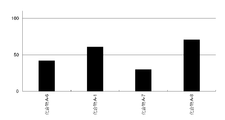
- Example 49 The preparation obtained in Example 49 (preparation using each of compounds A-1, 3 to 5) and the preparation obtained in Comparative Example 1 (DLin-KC2-DMA and each of compounds XI-1 to 3 were used. Shows the expression rate of target gene mRNA after introduction of the above-mentioned preparation into human liver cancer-derived cell line HepG2.
- the vertical axis shows the mRNA expression rate of the target gene when the negative control is 1, and the horizontal axis shows the nucleic acid concentration (nM) and the compound number of the cationic lipid used.
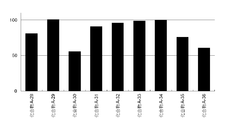
- Example 49 About each of the preparation obtained in Example 49 (preparation using each of compounds A-1 to 5) and the preparation obtained in Comparative Example 1 (preparation using DLin-KC2-MDA), the siRNA was 0.3 mg in each mouse. The value of serum cholesterol at 48 hours after administration of the equivalent of / kg is shown. The vertical axis represents the relative value of serum cholesterol when the physiological saline administration group is 100.
- Formulation obtained in Example 49 (formulation using each of compounds A-1 to 5) and formulation obtained in Comparative Example 1 (formulation using each of DLin-KC2-MDA and compounds XI-1 to 3) ) Shows serum cholesterol levels 48 hours after administration of siRNA 3 mg / kg equivalent to each mouse.
- the vertical axis represents the relative value of serum cholesterol when the physiological saline administration group is 100.
- each mouse was administered an equivalent amount of siRNA 0.3 mg / kg for 48 hours.
- the concentration of Factor VII protein in plasma afterwards is shown.
- the vertical axis shows the relative value of the Factor VII protein concentration in plasma when the physiological saline administration group is 100.
- each mouse was given an equivalent amount of 0.3 mg / kg siRNA for 48 hours.
- the concentration of Factor VII protein in plasma afterwards is shown.
- the vertical axis shows the relative value of the Factor VII protein concentration in plasma when the physiological saline administration group is 100.
- the equivalent of siRNA 0.3 mg / kg was administered to the mice 48 hours after administration of the Factor VII protein in plasma. Indicates the concentration.
- the vertical axis shows the relative value of the Factor VII protein concentration in plasma when the physiological saline administration group is 100.
- the concentration of Factor VII protein in plasma is shown 48 hours after administration of an equivalent amount of siRNA 0.3 mg / kg to each mouse.
- the vertical axis shows the relative value of the Factor VII protein concentration in plasma when the physiological saline administration group is 100.
- the concentration of Factor VII protein in plasma is shown 48 hours after administration of an equivalent amount of siRNA 0.3 mg / kg to each mouse.
- the vertical axis shows the relative value of the Factor VII protein concentration in plasma when the physiological saline administration group is 100.
- the concentration of Factor VII protein in plasma is shown 48 hours after administration of an equivalent amount of siRNA 0.3 mg / kg to each mouse.
- the vertical axis shows the relative value of the Factor VII protein concentration in plasma when the physiological saline administration group is 100.
- Each of the preparations obtained in Example 52 or 53 (preparation using each of compounds A-1, A-6, A-7, A-10, A-12, B-8 and C-1) Shows the concentration of Factor VII protein in plasma 48 hours after administration of siRNA 0.3 or 0.1 mg / kg equivalent.
- the vertical axis shows the relative value of the Factor VII protein concentration in plasma when the physiological saline administration group is 100. ⁇ indicates the 0.3 mg / kg administration group, and ⁇ indicates the 0.1 mg / kg administration group.
- siRNA 0.3 or 0.03 mg / kg equivalent amount was administered to the mice 48 hours after administration of Factor VII in plasma. Indicates the protein concentration.
- the vertical axis shows the relative value of the Factor VII protein concentration in plasma when the physiological saline administration group is 100.
- ⁇ indicates the 0.3 mg / kg administration group, and ⁇ indicates the 0.03 mg / kg administration group.
- the concentration of Factor VII protein in plasma was determined 48 hours after administration of siRNA ⁇ ⁇ ⁇ 0.3 or 0.03 mg / kg equivalent to each mouse. Show.
- the vertical axis shows the relative value of the Factor VII protein concentration in plasma when the physiological saline administration group is 100. ⁇ indicates the 0.3 mg / kg administration group, and ⁇ indicates the 0.03 mg / kg administration group.
- the vertical axis shows the relative value of the Factor VII protein concentration in plasma when the physiological saline administration group is 100.
- ⁇ indicates the 0.3 mg / kg administration group, and ⁇ indicates the 0.03 mg / kg administration group.
- plasma was 48 hours after administration of siRNA 0.3 or 0.1 mg / kg equivalent to each mouse.
- the vertical axis shows the relative value of the Factor VII protein concentration in plasma when the physiological saline administration group is 100.
- ⁇ indicates the 0.3 mg / kg administration group, and ⁇ indicates the 0.1 mg / kg administration group.
- the cationic lipid of the present invention is Formula (A)
- R 1 is linear or branched alkyl, alkenyl or alkynyl having 8 to 24 carbon atoms
- R 2 is linear or branched alkyl, alkenyl or alkynyl having 8 to 24 carbon atoms, alkoxyethyl, alkoxypropyl, alkenyloxyethyl, alkenyloxypropyl, alkynyloxyethyl or alkynyloxypropyl
- R 3 and R 4 are the same or different and are alkyl having 1 to 3 carbon atoms, or are combined to form alkylene having 2 to 8 carbon atoms, or R 3 is combined with R 5
- R 5 is a hydrogen atom, alkyl having 1 to 6 carbon atoms, alkenyl having 3 to 6 carbon atoms, amino, monoalkylamino, hydroxy, alkoxy, carbamoyl, monoalkylcarbamoyl, dialkylcarb
- R 6 is linear or branched alkyl, alkenyl or alkynyl having 8 to 24 carbon atoms
- R 7 is linear or branched alkyl, alkenyl or alkynyl having 8 to 24 carbon atoms, alkoxyethyl, alkoxypropyl, alkenyloxyethyl, alkenyloxypropyl, alkynyloxyethyl or alkynyloxypropyl), or a formula (C)
- R 8 is linear or branched alkyl, alkenyl or alkynyl having 8 to 24 carbon atoms
- R 9 is linear or branched alkyl, alkenyl or alkynyl having 8 to 24 carbon atoms, alkoxyethyl, alkoxypropyl, alkenyloxyethyl, alkenyloxypropyl, alkynyloxyethyl or alkynyloxypropyl
- X 3 is alkylene having 1 to 3 carbon atoms
- R 10 is a cationic lipid represented by a hydrogen atom or alkyl having 1 to 3 carbon atoms.
- the compound represented by the formula (A) may be referred to as the compound (A). The same applies to the compounds of other formula numbers.
- linear or branched alkyl having 8 to 24 carbon atoms examples include octyl, decyl, dodecyl, tridecyl, tetradecyl, 2,6,10-trimethylundecyl, pentadecyl, 3,7,11-trimethyldodecyl, Hexadecyl, heptadecyl, octadecyl, 6,10,14-trimethylpentadecan-2-yl, nonadecyl, 2,6,10,14-tetramethylpentadecyl, icosyl, 3,7,11,15-tetramethylhexadecyl, henicosyl , Docosyl, tricosyl, tetracosyl and the like.
- the straight-chain or branched alkenyl having 8 to 24 carbon atoms may be any straight-chain or branched alkenyl having 8 to 24 carbon atoms containing one or more double bonds.
- the linear or branched alkynyl having 8 to 24 carbon atoms may be any linear or branched alkynyl having 8 to 24 carbon atoms containing one or more triple bonds.
- the linear or branched alkynyl having 8 to 24 carbon atoms may be any linear or branched alkynyl having 8 to 24 carbon atoms containing one or more triple bonds.
- Examples of the alkyl moiety in alkoxyethyl and alkoxypropyl include groups exemplified in the above-mentioned linear or branched alkyl having 8 to 24 carbon atoms.
- Examples of the alkenyl moiety in alkenyloxyethyl and alkenyloxypropyl include groups exemplified in the above-mentioned linear or branched alkenyl having 8 to 24 carbon atoms.
- Examples of the alkynyl moiety in alkynyloxyethyl and alkynyloxypropyl include the groups exemplified in the above-mentioned linear or branched alkynyl having 8 to 24 carbon atoms.
- R 1 and R 2 are preferably the same or different and are linear or branched alkyl or alkenyl having 8 to 24 carbon atoms, and are the same or different and are linear or straight chain having 8 to 24 carbon atoms. Alternatively, branched alkenyl is more preferable, and straight-chain alkenyl having the same or different carbon number of 8 to 24 is more preferable.
- R 1 and R 2 are more preferably the same, and in that case, they are more preferably straight-chain or branched alkyl, alkenyl or alkynyl having 12 to 24 carbon atoms, More preferably, it is 12 to 24 linear alkenyl.
- R 1 and R 2 when different, R 1 is a 16 to 24 carbon atoms linear or branched alkyl, alkenyl or alkynyl, straight-chain R 2 is 8 to 12 carbon atoms like or Branched alkyl, alkenyl or alkynyl is also a preferred form of the invention.
- R 1 is preferably straight-chain alkenyl having 16 to 24 carbon atoms
- R 2 is more preferably straight-chain alkyl having 8 to 12 carbon atoms
- R 1 is (Z) -octadeca- Most preferably, it is 9-enyl or (9Z, 12Z) -octadec-9,12-dienyl and R 2 is octyl, decyl or dodecyl.
- R 1 and R 2 are different, R 1 is straight-chain or branched alkyl, alkenyl or alkynyl having 12 to 24 carbon atoms, and R 2 is alkoxyethyl, alkoxypropyl, alkenyl Oxyethyl, alkenyloxypropyl, alkynyloxyethyl or alkynyloxypropyl is also a preferred form of the present invention.
- R 1 is a straight-chain alkenyl having 16 to 24 carbon atoms
- R 2 is more preferably alkenyloxy ethyl
- R 1 is (Z) - octadec-9-enyl, ( 9Z, 12Z) -octadeca-9,12-dienyl or (11Z, 14Z) -icosa-11,14-dienyl
- R 2 is (Z) -octadeca-9-enyloxyethyl, (9Z, 12Z) More preferably, it is -octadeca-9,12-dienyloxyethyl or (11Z, 14Z) -icosa-11,14-dienyloxyethyl
- R 1 is (9Z, 12Z) -octadeca-9,12 Most preferred is -dienyl and R 2 is (9Z, 12Z) -octadeca-9,12-dienyloxyethyl.
- R 1 and / or R 2 are the same or different and are linear or branched alkyl or alkenyl having 8 to 24 carbon atoms, they are the same or different, tetradecyl, hexadecyl, (Z) -tetradeca- 9-enyl, (Z) -hexadeca-9-enyl, (Z) -octadeca-6-enyl, (Z) -octadeca-9-enyl, (E) -octadec-9-enyl, (Z) -octadeca- 11-enyl, (9Z, 12Z) -octadeca-9,12-dienyl, (9Z, 12Z, 15Z) -octadeca-9,12,15-trienyl, (Z) -icosa-11-enyl, (11Z, 14Z ) -Icosa-11,14-dienyl or (Z)
- R 6 and R 7 are synonymous with R 1 and R 2 , respectively.
- R 7 is a linear or branched alkyl, alkenyl or alkynyl group having 16 to 24 carbon atoms, R 6 and R 7 are identically (9Z, 12Z) -octadeca-9,12- Dienyl is preferred.
- R 8 and R 9 are synonymous with R 1 and R 2 , respectively.
- R 8 and R 9 are preferably the same, straight-chain or branched alkyl, alkenyl or alkynyl having 16 to 24 carbon atoms, and the same (9Z, 12Z) -octadeca-9,12- More preferred is dienyl.
- Examples of the alkyl having 1 to 3 carbon atoms in R 3 and R 4 include methyl, ethyl, propyl, isopropyl and cyclopropyl, preferably methyl and ethyl, and more preferably methyl.
- alkylene having 2 to 8 carbon atoms formed by R 3 and R 4 together examples include, for example, ethylene, n-propylene, n-butylene, n-pentylene, n-hexylene, n-heptylene, n-octylene and the like. N-pentylene, n-hexylene, n-heptylene, etc. are preferred, n-pentylene, n-hexylene and the like are more preferred, and n-hexylene is more preferred.
- R 3 is methyl or ethyl, forms an alkylene group having 5 to 7 carbon atoms with R 4 , or forms an alkylene group with 3 to 5 carbon atoms together with R 5 it is preferred, however, if R 3 does not form an alkylene of 5 to 7 carbon atoms together with R 4 is preferably R 4 is methyl or ethyl, more preferably methyl.
- R 3 is methyl, or together with R 4 forms n-pentylene or n-hexylene, or R 3 together with R 5 forms ethylene, n-propylene. is more preferable, however, if R 3 do not form together with R 4 n- pentylene or n- hexylene more preferably, R 4 is methyl.
- alkyl having 1 to 6 carbon atoms for R 5 examples include methyl, ethyl, propyl, isopropyl, cyclopropyl, butyl, isobutyl, sec-butyl, tert-butyl, cyclobutyl, cyclopropylmethyl, pentyl, isopentyl, sec- Examples include pentyl, neopentyl, tert-pentyl, cyclopentyl, hexyl, cyclohexyl and the like, preferably methyl, ethyl, propyl, isopropyl, butyl, isobutyl, sec-butyl, tert-butyl, pentyl, isopentyl, sec-pentyl, tert- Examples include pentyl, neopentyl, hexyl, and more preferably methyl, ethyl, propyl, and the like.
- alkenyl having 3 to 6 carbon atoms in R 5 examples include allyl, 1-propenyl, butenyl, pentenyl, hexenyl, and preferably allyl.
- the monoalkylamino in R 5 may be any amino substituted with one, for example, an alkyl having 1 to 6 carbon atoms (as defined above), such as methylamino, ethylamino, propylamino, butylamino, pentyl Amino, hexylamino and the like are preferable, and methylamino, ethylamino and the like are preferable.
- amino and monoalkylamino may each be coordinated by a hydrogen ion to a lone pair of electrons on the nitrogen atom to form ammonio and monoalkylammonio. Each include ammonio and monoalkylammonio.
- ammonio and monoalkylammonio in which a hydrogen ion is coordinated to a lone electron pair on the nitrogen atom of amino and monoalkylamino may form a salt with a pharmaceutically acceptable anion.
- the alkoxy in R 5 may be, for example, hydroxy substituted with alkyl having 1 to 6 carbons (as defined above), and examples thereof include methoxy, ethoxy, propyloxy, butyloxy, pentyloxy, hexyloxy and the like. Preferred examples include methoxy and ethoxy.
- Examples of monoalkylcarbamoyl and dialkylcarbamoyl in R 5 include carbamoyl substituted with one and the same or different two, for example, alkyl having 1 to 6 carbon atoms (as defined above), and more specifically Is methylcarbamoyl, ethylcarbamoyl, propylcarbamoyl, butylcarbamoyl, pentylcarbamoyl, hexylcarbamoyl, dimethylcarbamoyl, diethylcarbamoyl, ethylmethylcarbamoyl, methylpropylcarbamoyl, butylmethylcarbamoyl, methylpentylcarbamoyl, hexylmethylcarbamoyl, etc. Includes methylcarbamoyl, ethylcarbamoyl, dimethylcarbamoyl and the like.
- alkylene having 2 to 6 carbon atoms formed by R 5 and R 3 together examples include ethylene, n-propylene, n-butylene, n-pentylene, n-hexylene and the like, and preferably n- Examples include propylene, n-butylene and n-pentylene, more preferably n-propylene and n-butylene, and still more preferably n-propylene.
- R 5 is a hydrogen atom, alkyl having 1 to 6 carbon atoms, monoalkylamino, hydroxy, alkoxy, or 1 or 3 carbon atoms substituted with 1 to 3 amino, monoalkylamino, hydroxy or alkoxy, which are the same or different.
- Examples of the alkyl having 1 to 3 carbon atoms in R 10 include methyl, ethyl, propyl, isopropyl, cyclopropyl and the like, preferably methyl, ethyl, isopropyl and the like, more preferably methyl, ethyl and the like. Can be given.
- R 10 is more preferably a hydrogen atom or methyl, and most preferably a hydrogen atom.
- alkylene having 1 to 6 carbon atoms in X 1 and X 2 examples include methylene, ethylene, n-propylene, n-butylene, n-pentylene, n-hexylene and the like.
- X 1 is preferably alkylene having 1 to 3 carbon atoms, most preferably methylene or ethylene, and X 2 is preferably a single bond, methylene or ethylene, and is a single bond or methylene. More preferably. The sum of the carbon number of X 1 and X 2 is preferably 1 to 3, and most preferably 2.
- R 3 and R 4 are the same or different and are methyl or ethyl
- R 5 is a hydrogen atom, methyl, amino, methylamino, hydroxy, methoxy, or the same or different 1 to 3 Methyl substituted with one amino or hydroxy, or R 3 and R 4 together form an alkylene having 5 to 7 carbon atoms
- R 5 is a hydrogen atom, methyl, amino, methylamino, hydroxy, Methoxy, or methyl identically or differently substituted with 1 to 3 amino or hydroxy
- R 3 and R 5 together form an alkylene of 3 to 5 carbon atoms and R 4 is methyl or
- R 3 and R 4 are methyl
- R 5 is a hydrogen atom or R 3 and R 4 together form n-pentylene or n-hexylene
- R 5 is selected from the group consisting of hydrogen Or a child, or R 3 and R 5 form together n- propylene, more
- alkylene having 1 to 3 carbon atoms in X 3 examples include methylene, ethylene, n-propylene and the like, preferably methylene, ethylene and the like.
- Each oxygen atom in formula (A) may be replaced by a sulfur atom.
- compound Aa is represented by a Lawson reagent (Lawesson's Reagent, 2 1,3,2,4-dithiadiphosphetane-2,4 such as 4-bis (4-methoxyphenyl) -1,3,2,4-dithiadiphosphetane-2,4-disulfide) -It can be obtained by acting a disulfide derivative.
- Lawson reagent Lawesson's Reagent, 2 1,3,2,4-dithiadiphosphetane-2,4 such as 4-bis (4-methoxyphenyl) -1,3,2,4-dithiadiphosphetane-2,4-disulfide
- the cationic lipid of the present invention may form a salt with a pharmaceutically acceptable anion when a hydrogen ion is coordinated to a lone pair of electrons on any nitrogen atom.
- examples of the pharmaceutically acceptable anion include inorganic ions such as chloride ion, bromide ion, nitrate ion, sulfate ion and phosphate ion, acetate ion, oxalate ion, maleate ion, and fumarate ion.
- organic acid ions such as citrate ion, benzoate ion, and methanesulfonate ion.
- the compound (Ia) in which R 2 is linear or branched alkyl, alkenyl or alkynyl having 8 to 24 carbon atoms can be produced by the following method.
- R 11 is a linear or branched alkyl, alkenyl having 8 to 24 carbon atoms or Alkynyl
- Y represents a leaving group such as chlorine atom, bromine atom, iodine atom, trifluoromethanesulfonyloxy, methanesulfonyloxy, benzenesulfonyloxy, p-toluenesulfonyloxy
- Ar is p-nitrophenyl
- o represents a substituted phenyl group or an unsubstituted phenyl group such as -nitrophenyl and p-chlorophenyl
- Step 1 and 2 Compound (IIa) is a mixture of ammonia and compound (IIIa) in the absence of solvent or in a solvent, preferably in the presence of 1 to 10 equivalents of a base, at a temperature between room temperature and 200 ° C. for 5 minutes to 100 hours. It can be produced by reacting. Further, compound (IIb) is obtained by reacting compound (IIa) and compound (IIIb) in the absence of solvent or in a solvent, preferably in the presence of 1 to 10 equivalents of a base, at a temperature between room temperature and 200 ° C. It can be produced by reacting for 5 minutes to 100 hours.
- solvent examples include methanol, ethanol, dichloromethane, chloroform, 1,2-dichloroethane, toluene, ethyl acetate, acetonitrile, diethyl ether, tetrahydrofuran, 1,2-dimethoxyethane, dioxane, N, N-dimethylformamide, N, N -Dimethylacetamide, N-methylpyrrolidone, pyridine, water and the like can be mentioned, and these can be used alone or in combination.
- Examples of the base include potassium carbonate, potassium hydroxide, sodium hydroxide, sodium methoxide, potassium tert-butoxide, triethylamine, diisopropylethylamine, N-methylmorpholine, pyridine, 1,8-diazabicyclo [5.4.0] -7- Undecene (DBU).
- Compound (IIIa) and Compound (IIIb) are commercially available products or known methods (for example, ⁇ 5th edition, Experimental Chemistry Course 13, Synthesis of Organic Compounds I '', 5th edition, p.374, Maruzen (2005)). Or it can obtain by the method according to it.
- Compound (IIb) in the case where R 1 and R 11 are the same can be obtained by using 2 equivalents or more of compound (IIIa) in Step 1.
- Compound (VI) is obtained by reacting Compound (IV) with Compound (V) in the absence of or in a solvent, preferably in the presence of 1 to 10 equivalents of an additive, and / or preferably 1 to 10 if necessary. It can be prepared by reacting in the presence of an equivalent amount of base at a temperature between ⁇ 20 ° C. and 150 ° C. for 5 minutes to 72 hours.
- Examples of the solvent include dichloromethane, chloroform, 1,2-dichloroethane, toluene, ethyl acetate, acetonitrile, diethyl ether, tetrahydrofuran, 1,2-dimethoxyethane, dioxane, N, N-dimethylformamide, N, N-dimethylacetamide, Examples thereof include N-methylpyrrolidone and dimethyl sulfoxide, and these can be used alone or in combination.
- Examples of the additive include 1-hydroxybenzotriazole, 4-dimethylaminopyridine and the like.
- Examples of the base include those exemplified in Steps 1 and 2. Compound (IV) can be obtained as a commercial product.
- Compound (V) is a commercially available product or a known method (for example, “5th edition Experimental Chemistry Course 14 Synthesis of Organic Compounds II”, 5th edition, p.1, Maruzen (2005)) or a method analogous thereto. Can be obtained at
- Compound (Ia) is compound (IIb), compound (VI), and in the absence of solvent or in a solvent, preferably in the presence of 1 to 10 equivalents of an additive, and / or preferably 1 to 10 It can be prepared by reacting in the presence of an equivalent amount of base at a temperature between ⁇ 20 ° C. and 150 ° C. for 5 minutes to 72 hours.
- the solvent and the additive include those exemplified in Step 3.
- Examples of the base include those exemplified in Steps 1 and 2.
- Compound (IIb) can also be produced by the following method.
- Boc represents a tert-butoxycarbonyl group
- Ns represents a 2-nitrobenzenesulfonyl group
- Compound (IIc) comprises N- (tert-butoxycarbonyl) -2-nitrobenzenesulfonamide and compound (IIIa) in the absence of or in a solvent, preferably in the presence of 1 to 10 equivalents of an additive, and It can be produced by reacting for 5 minutes to 100 hours at a temperature between room temperature and 200 ° C., preferably in the presence of 1 to 10 equivalents of a base as necessary.
- the solvent include those exemplified in Steps 1 and 2.
- the additive include n-tetrabutylammonium iodide, sodium iodide and the like.
- Examples of the base include cesium carbonate, potassium carbonate, potassium hydroxide, sodium hydroxide, sodium methoxide, potassium tert-butoxide, triethylamine, diisopropylethylamine, N-methylmorpholine, pyridine, DBU and the like.
- Compound (IId) is obtained by adding compound (IIc) at a temperature of ⁇ 20 ° C. and 150 ° C. with 1 equivalent to a large excess of acid, without solvent or in a solvent, and preferably in the presence of 1 to 10 equivalents of an additive. It can be produced by treating at a temperature between 5 minutes and 72 hours.
- the solvent include those exemplified in Steps 1 and 2.
- the acid include hydrochloric acid, sulfuric acid, phosphoric acid, trifluoroacetic acid and the like.
- the additive include thioanisole, dimethyl sulfide, triisopropylsilane and the like.
- Compound (IIe) comprises compound (IIIb) and compound (IId) in the absence of solvent or in a solvent, preferably in the presence of 1 to 10 equivalents of an additive, and / or preferably 1 to 10 equivalents if necessary.
- a base at a temperature between room temperature and 200 ° C. for 5 minutes to 100 hours.
- the solvent include those exemplified in Steps 1 and 2.
- the additive and the base include those exemplified in Step 5.
- Process 8 Compound (IIb) comprises compound (IIe) and a thiol compound in the absence of solvent or in a solvent, preferably in the presence of 1 to 10 equivalents of a base, at a temperature between room temperature and 200 ° C.
- Examples of the solvent include those exemplified in Steps 1 and 2.
- Examples of the thiol compound include methanethiol, ethanethiol, dodecanethiol, thiophenol, mercaptoacetic acid, and the like.
- Examples of the base include those exemplified in Step 5.
- R 2 is alkoxyethyl, alkoxypropyl, alkenyloxyethyl, alkenyloxypropyl, alkynyloxyethyl or alkynyloxypropyl
- compound (Ib) can be produced by the following method.
- R 1 , R 3 , R 4 , R 5 , X 1 , X 2 , Y and Ar are as defined above, and R 12 is alkoxyethyl, alkoxypropyl, alkenyloxyethyl, alkenyloxypropyl, (Alkynyloxyethyl or alkynyloxypropyl, Ms represents a methanesulfonyl group)
- Step 9 Compound (IIf) is obtained by reacting Compound (IIa) and Compound (IIIc) in the absence of a solvent or in a solvent, preferably in the presence of 1 to 10 equivalents of a base, at a temperature between room temperature and 200 ° C. for 5 minutes. It can be produced by reacting for ⁇ 100 hours.
- the solvent include those exemplified in Steps 1 and 2.
- the base include those exemplified in Steps 1 and 2.
- Step 10 Compound (Ib) is compound (IIf), compound (VI), and in the absence of solvent or in a solvent, preferably in the presence of 1 to 10 equivalents of an additive, and / or preferably 1 to 10 It can be prepared by reacting at a temperature between ⁇ 20 ° C. and 150 ° C. for 5 minutes to 72 hours in the presence of an equivalent amount of base.
- the solvent and the additive include those exemplified in Step 3.
- Examples of the base include those exemplified in Steps 1 and 2.
- Compound (IIIc) can be produced by the following method.
- R 13 is linear or branched alkyl, alkenyl or alkynyl having 8 to 24 carbon atoms, X 4 represents ethylene or n-propylene, and Ms represents a methanesulfonyl group
- Step 11 Compound (VIIb) is obtained by reacting Compound (VIIa) with Compound (VIII) in the absence of solvent or in a solvent, preferably in the presence of 1 to 10 equivalents of a base, at a temperature between room temperature and 200 ° C. It can be produced by reacting for from 100 minutes to 100 minutes.
- the solvent include those exemplified in Step 3.
- the base include those exemplified in Steps 1 and 2.
- Compound (VIIa) is a commercially available product or a known method (for example, “5th edition, Experimental Chemistry Course 14, Synthesis of Organic Compounds II”, 5th edition, p.1, Maruzen (2005)) or a method analogous thereto. Can be obtained at Compound (VIII) can be obtained as a commercial product.
- Compound (IIIc) is obtained by reacting Compound (VIIb) with a mesylating reagent in the absence of a solvent or in a solvent, preferably in the presence of 1 to 10 equivalents of base, at a temperature between ⁇ 20 ° C. and 150 ° C. for 5 minutes. It can be produced by reacting for ⁇ 72 hours.
- the solvent include those exemplified in Step 3.
- the base include those exemplified in Steps 1 and 2.
- the mesylation reagent include mesyl anhydride, mesylate chloride and the like.
- Compound (IIf) can also be produced by the following method.
- Compound (IIg) comprises compound (IIIc) and compound (IId) in the absence of a solvent or in a solvent, preferably in the presence of 1 to 10 equivalents of an additive, and / or preferably 1 to 10 equivalents if necessary. In the presence of a base at a temperature between room temperature and 200 ° C. for 5 minutes to 100 hours.
- the solvent include those exemplified in Steps 1 and 2.
- the additive and the base include those exemplified in Step 5.
- Process 14 Compound (IIf) comprises compound (IIg) and a thiol compound in a solvent-free or solvent, preferably in the presence of 1 to 10 equivalents of a base, at a temperature between room temperature and 200 ° C.
- Examples of the solvent include those exemplified in Steps 1 and 2.
- Examples of the thiol compound include those exemplified in Step 8.
- Examples of the base include those exemplified in Step 5.
- compound (Ba) in which R 7 is linear or branched alkyl, alkenyl or alkynyl having 8 to 24 carbon atoms can be obtained by the method for producing compound (IIb).
- compound (Bc) in which R 7 is alkoxyethyl, alkoxypropyl, alkenyloxyethyl, alkenyloxypropyl, alkynyloxyethyl or alkynyloxypropyl can be obtained by the method for producing compound (IIf). it can.
- Compound (C) can be produced by the following method.
- Compound (C) comprises compound (IIh) and compound (Xa) in the absence of solvent or in a solvent, preferably in the presence of 1 to 10 equivalents of an additive, and / or preferably 1 to 10 equivalents if necessary.
- a base at a temperature between room temperature and 200 ° C. for 5 minutes to 100 hours.
- the solvent and the base include those exemplified in Steps 1 and 2, respectively.
- the additive include those exemplified in Step 5.
- Compound (IIh) can be obtained by the production method of compound (B).
- Compound (Xa) is a commercially available product or a known method (for example, ⁇ 5th edition Experimental Chemistry Course 13 Synthesis of Organic Compounds I '', 5th edition, p.374, Maruzen (2005)) or a method analogous thereto. Obtainable.
- Compound (Ca) in which R 10 is a hydrogen atom after compound (C) can also be produced by the following method.
- R 8 , R 9 , X 3 and Y are as defined above, and Pro is trimethylsilyl, triethylsilyl, tritert-butylsilyl, tert-butyldimethylsilyl, tert-butyldiphenylsilyl, triphenylsilyl, etc.
- Pro is trimethylsilyl, triethylsilyl, tritert-butylsilyl, tert-butyldimethylsilyl, tert-butyldiphenylsilyl, triphenylsilyl, etc.
- Compound (IXa) comprises compound (IIh) and compound (Xb) in the absence of a solvent or in a solvent, preferably in the presence of 1 to 10 equivalents of an additive, and / or preferably 1 to 10 equivalents if necessary.
- a base at a temperature between room temperature and 200 ° C. for 5 minutes to 100 hours.
- the solvent and the base include those exemplified in Steps 1 and 2, respectively.
- the additive include those exemplified in Step 5.
- Compound (IIh) can be obtained by the production method of compound (B).
- Compound (Xb) is a commercially available product or a known method (for example, ⁇ 5th edition, Experimental Chemistry Course 18, Synthesis of Organic Compounds VI '', 5th edition, p.171-172, Maruzen (2005)) or in accordance with it. Can be obtained by the method.
- Step 17 Compound (Ca) can be produced by reacting compound (IXa) and a deprotection reagent in the absence of solvent or in a solvent at a temperature between ⁇ 20 ° C. and 150 ° C. for 5 minutes to 72 hours.
- the solvent include those exemplified in Steps 1 and 2.
- the deprotecting reagent include tetrabutylammonium fluoride, hydrogen fluoride pyridine complex, fluorine compounds such as hydrofluoric acid, and the like, acids such as acetic acid, trifluoroacetic acid, pyridinium paratoluenesulfonate, hydrochloric acid, and the like.
- the compound (Cb) in which R 10 is a hydrogen atom and X 3 is alkylene having 2 carbon atoms can also be produced by the following method. (Wherein R 8 and R 9 are as defined above)
- Process 18 Compound (IXb) is obtained by reacting Compound (IIh) with room temperature and 200 ° C., preferably in the presence of 1 to a large excess of ethyl acrylate, without solvent or in a solvent, and preferably in the presence of 1 to 10 equivalents of a base. By reacting at a temperature between 5 minutes and 100 hours.
- the solvent include those exemplified in Step 1.
- the base include potassium carbonate, potassium hydroxide, sodium hydroxide, sodium methoxide, sodium ethoxide, potassium tert-butoxide, triethylamine, diisopropylethylamine, N-methylmorpholine, pyridine, DBU and the like.
- Compound (Cb) is a compound between -20 ° C. and 150 ° C. in the presence of compound (IXb), preferably 1 to 10 equivalents of a reducing agent, and preferably 1 to 10 equivalents of an additive in a solvent. It can be produced by reacting at a temperature for 5 minutes to 72 hours.
- the solvent include tetrahydrofuran, dioxane, diethyl ether, dichloromethane, toluene and the like, and these can be used alone or in combination.
- the reducing agent include lithium aluminum hydride, aluminum hydride, diisobutylaluminum hydride, sodium triacetoxyborohydride, sodium cyanoborohydride, and borane.
- the additive include aluminum chloride, cerium chloride, iron chloride, acetic acid, hydrochloric acid and the like.
- the intermediates and target compounds in each of the above production methods are isolated and purified by separation and purification methods commonly used in organic synthetic chemistry, such as filtration, extraction, washing, drying, concentration, recrystallization, and various chromatography. be able to.
- the intermediate can be subjected to the next reaction without any particular purification.
- a hydrogen ion may be coordinated to a lone pair on the nitrogen atom in the structure, and in that case, a salt is formed with a pharmaceutically acceptable anion (as defined above).
- the cationic lipid of the present invention includes a compound in which a hydrogen ion is coordinated to a lone electron pair on the nitrogen atom.
- Some of the cationic lipids of the present invention may have stereoisomers such as geometric isomers and optical isomers, tautomers and the like, but the cationic lipids of the present invention include these, Includes all possible isomers and mixtures thereof.
- a part or all of each atom in the cationic lipid of the present invention may be replaced by a corresponding isotope atom, and the compound (A), the compound (B) or the compound (C) Also included are compounds replaced by For example, some or all of the hydrogen atoms in the compound (A), the compound (B), or the compound (C) may be hydrogen atoms (deuterium atoms) having an atomic weight of 2.
- a compound in which a part or all of each atom in the cationic lipid of the present invention is replaced with a corresponding isotope atom can be produced by a method similar to each of the above production methods using a commercially available building block. it can.
- a compound in which part or all of the hydrogen atoms in the compound (A), the compound (B) or the compound (C) are replaced with a deuterium atom is obtained using, for example, an iridium complex as a catalyst and deuterium as a deuterium source.
- cationic lipid of the present invention obtained by the present invention are shown in Tables 1-7.
- the cationic lipid of the present invention is not limited to these.
- the nucleic acid used in the present invention may be any molecule as long as it is a molecule in which nucleotides and / or molecules having functions equivalent to nucleotides are polymerized, for example, ribonucleic acid that is a polymer of ribonucleotides.
- RNA ribonucleic acid
- DNA deoxyribonucleic acid
- chimeric nucleic acids composed of RNA and DNA chimeric nucleic acids composed of RNA and DNA
- nucleic acid of the present invention a derivative containing at least a part of a structure of a molecule obtained by polymerizing nucleotides and / or molecules having functions equivalent to nucleotides is also included in the nucleic acid of the present invention.
- uracil U and thymine T can be replaced with each other.
- nucleotide derivatives examples include nucleotide derivatives.
- the nucleotide derivative may be any molecule as long as it is a modified molecule, for example, in order to improve nuclease resistance or stabilize from other degradation factors compared to RNA or DNA, for example.
- a molecule in which ribonucleotide or deoxyribonucleotide is modified is preferably used.
- nucleotide derivatives include sugar-modified nucleotides, phosphodiester bond-modified nucleotides, base-modified nucleotides, and the like.
- any or all of the nucleotide sugar chemical structure may be modified or substituted with an arbitrary substituent, or substituted with an arbitrary atom. 2'-modified nucleotides are preferably used.
- Examples of the modifying group in the sugar moiety-modified nucleotide include 2′-cyano, 2′-alkyl, 2′-substituted alkyl, 2′-alkenyl, 2′-substituted alkenyl, 2′-halogen and 2′-O-cyano.
- sugar-modified nucleotides for example, a crosslinked structure-type artificial nucleic acid (BNA) having a structure in which a modification group at the 2 ′ position is crosslinked to a carbon atom at the 4 ′ position, more specifically, 2 ′ Locked Nucleic Acid (LNA) in which the oxygen atom at position 4 and the carbon atom at 4 'position are cross-linked via methylene, and Ethylene bridged nucleic acid (ENA) [Nucleic Acid Research , 32, e175 (2004)] and the like, and these are included in 2′-modified nucleotides.
- peptide nucleic acids PNA
- OPNA oxypeptide nucleic acids
- PRNA Peptide ribonucleic acid
- 2'-cyano, 2'-halogen, 2'-O-cyano, 2'-alkyl, 2'-substituted alkyl, 2'-O-alkyl, 2'-O-substituted as a modifying group in sugar modified nucleotide Preferred are alkyl, 2′-O-alkenyl, 2′-O-substituted alkenyl, 2′-Se-alkyl, 2′-Se-substituted alkyl, etc.
- the modifying group in the sugar moiety-modified nucleotide can also define a preferred range from its size, and from the size of fluoro, the one corresponding to the size of -O-butyl is preferable, and the size of -O-methyl To the equivalent of -O-ethyl.
- the alkyl in the modifying group in the sugar moiety-modified nucleotide is synonymous with the alkyl having 1 to 6 carbon atoms in the definition of the cationic lipid of the present invention.
- Examples of the alkenyl in the modifying group in the sugar moiety-modified nucleotide include alkenyl having 3 to 6 carbon atoms, such as allyl, 1-propenyl, butenyl, pentenyl, hexenyl and the like.
- Examples of the halogen in the modifying group in the sugar moiety-modified nucleotide include a fluorine atom, a chlorine atom, a bromine atom, and an iodine atom.
- amino acids in amino acid residues include aliphatic amino acids (specifically, glycine, alanine, valine, leucine, isoleucine, etc.), hydroxy amino acids (specifically, serine, threonine, etc.), acidic amino acids (specifically, Is aspartic acid, glutamic acid, etc.), acidic amino acid amide (specifically, asparagine, glutamine, etc.), basic amino acid (specifically, lysine, hydroxylysine, arginine, ornithine, etc.), sulfur-containing amino acid (specifically, Cysteine, cystine, methionine, etc.), imino acids (specifically, proline, 4-hydroxyproline, etc.) and the like.
- aliphatic amino acids specifically, glycine, alanine, valine, leucine, isoleucine, etc.
- hydroxy amino acids specifically, serine, threonine, etc.
- acidic amino acids specifically, Is aspartic
- Examples of the substituted alkyl in the modified group in the sugar-modified nucleotide and the substituent in the substituted alkenyl include halogen (as defined above), hydroxy, sulfanyl, amino, oxo, -O-alkyl (the alkyl portion of the -O-alkyl is -S-alkyl (the alkyl part of the -S-alkyl is the same as the alkyl), -NH-alkyl (the alkyl part of the -NH-alkyl is the same as the alkyl), dialkylaminooxy ( The two alkyl moieties of the dialkylaminooxy are the same or different and have the same meaning as the alkyl), the dialkylamino (the two alkyl parts of the dialkylamino are the same or different and have the same meaning as the alkyl), the dialkylaminoalkyloxy (the dialkylamino The two alkyl moieties of alkyloxy are the
- the phosphodiester bond-modified nucleotide is any nucleotide that has been modified or substituted with an arbitrary substituent for a part or all of the chemical structure of the phosphodiester bond of the nucleotide, or with any atom.
- a nucleotide in which a phosphodiester bond is replaced with a phosphorothioate bond a nucleotide in which a phosphodiester bond is replaced with a phosphorodithioate bond
- a nucleotide in which a phosphodiester bond is replaced with an alkylphosphonate bond a phosphate
- Examples thereof include nucleotides in which a diester bond is substituted with a phosphoramidate bond.
- any or all of the nucleotide base chemical structure modified or substituted with an arbitrary substituent or substituted with an arbitrary atom may be used.
- oxygen atoms are substituted with sulfur atoms
- hydrogen atoms are substituted with alkyl groups having 1 to 6 carbon atoms
- methyl groups are substituted with hydrogen atoms or alkyl groups with 2 to 6 carbon atoms
- Examples thereof include those in which an amino group is protected with a protecting group such as an alkyl group having 1 to 6 carbon atoms or an alkanoyl group having 1 to 6 carbon atoms.
- nucleotide derivative a nucleotide, sugar moiety, phosphodiester bond or nucleotide derivative modified with at least one of a base, a lipid, phospholipid, phenazine, folate, phenanthridine, anthraquinone, acridine, fluorescein, rhodamine, coumarin, Examples include dyes and other chemical substances added.
- 5′-polyamine-added nucleotide derivatives examples include fluorescent dye (Cy3) -added nucleotide derivatives, red fluorescent dye (Cy5) -added nucleotide derivatives, fluorescein (6-FAM) -added nucleotide derivatives, and biotin-added nucleotide derivatives.
- the nucleotide or nucleotide derivative is different from other nucleotides or nucleotide derivatives in the nucleic acid with an alkylene structure, a peptide structure, a nucleotide structure, an ether structure, an ester structure, and at least one of these.
- a cross-linked structure such as a combined structure may be formed.
- the nucleic acid used in the present invention is preferably a nucleic acid that suppresses the expression of the target gene, and more preferably a nucleic acid that has an action of suppressing the expression of the target gene using RNA interference (RNAi).
- RNAi RNA interference
- the target gene in the present invention is not particularly limited as long as it is a gene that produces and expresses mRNA, for example, a gene related to tumor or inflammation is preferable, for example, vascular endothelial growth factor (hereinafter referred to as VEGF).
- VEGF vascular endothelial growth factor
- VEGFR vascular endothelial growth factor receptor
- fibroblast growth factor fibroblast growth factor receptor
- platelet-derived growth factor platelet-derived growth factor
- platelet-derived growth factor receptor hepatocyte Growth factor
- Kruppel-like factor (KLF) express sequence tag (Ets) transcription factor, nuclear factor, hypoxia-inducible factor, cell cycle-related factor, chromosome replication Related factors, chromosome repair-related factors, microtubule-related factors, growth signal pathway-related factors, growth-related transcription factors, apoptosis-related factors, etc. And the like.
- VEGF gene VEGFR gene
- fibroblast growth factor gene fibroblast growth factor receptor gene
- platelet-derived growth factor gene platelet-derived growth factor gene
- platelet-derived growth factor receptor gene Hepatocyte growth factor gene, hepatocyte growth factor receptor gene, KLF gene, Ets transcription factor gene, nuclear factor gene, hypoxia inducible factor gene, cell cycle related factor gene, chromosome replication related factor gene, chromosome repair related factor gene , Microtubule-related factor genes (for example, CKAP5 gene), growth signal pathway-related factor genes (for example, KRAS gene), growth-related transcription factor genes, apoptosis-related factors (for example, BCL-2 gene), etc. .
- CKAP5 gene CKAP5 gene
- growth signal pathway-related factor genes for example, KRAS gene
- growth-related transcription factor genes for example, apoptosis-related factors (for example, BCL-2 gene), etc.
- a gene expressed in the liver, lung, kidney or spleen is preferable, and a gene expressed in the liver is more preferable.
- the above-mentioned gene related to tumor or inflammation hepatitis B virus Genome, hepatitis C virus genome, apolipoprotein (APO), hydroxymethylglutaryl (HMG) CoA reductase, kexin type 9 serine protease (PCSK9), factor 12, glucagon receptor, glucocorticoid receptor, leukotriene receptor , Thromboxane A2 receptor, histamine H1 receptor, carbonic anhydrase, angiotensin converting enzyme, renin, p53, tyrosine phosphatase (PTP), sodium-dependent glucose transporter, tumor necrosis factor, interleukin, hepcidin, transsilence, anti Thrombin, protein C Matriptase enzyme
- the nucleic acid that suppresses the expression of the target gene includes, for example, a nucleic acid that includes a base sequence complementary to a partial base sequence of mRNA of a gene encoding a protein (target gene) and suppresses the expression of the target gene.
- a nucleic acid such as a double-stranded nucleic acid such as siRNA (short interference RNA) or miRNA (micro RNA), a single-stranded nucleic acid such as shRNA (short hairpin RNA), antisense nucleic acid, or ribozyme may be used.
- double-stranded nucleic acids are preferred.
- a nucleic acid containing a base sequence complementary to a part of the base sequence of the target gene mRNA is called an antisense strand nucleic acid
- a nucleic acid containing a base sequence complementary to the base sequence of the antisense strand nucleic acid is a sense strand.
- a sense strand nucleic acid refers to a nucleic acid capable of forming a double strand forming part by pairing with an antisense strand nucleic acid, such as a nucleic acid itself consisting of a partial base sequence of a target gene.
- a double-stranded nucleic acid refers to a nucleic acid in which two strands are paired and have a duplex forming part.
- the double-stranded forming part refers to a part where nucleotides constituting the double-stranded nucleic acid or a derivative thereof constitute a base pair to form a double strand.
- the base pair constituting the duplex forming part is usually 15 to 27 base pairs, preferably 15 to 25 base pairs, more preferably 15 to 23 base pairs, further preferably 15 to 21 base pairs, and 15 to 19 base pairs. Base pairs are particularly preferred.
- the antisense strand nucleic acid of the duplex forming part for example, a nucleic acid consisting of a partial sequence of the mRNA of the target gene, or 1 to 3 bases, preferably 1 to 2 bases, more preferably 1 base in the nucleic acid, A nucleic acid that is deleted or added and has the activity of suppressing the expression of the target protein is preferably used.
- the single-stranded nucleic acid constituting the double-stranded nucleic acid usually consists of a series of 15 to 30 bases (nucleosides), preferably 15 to 29 bases, more preferably 15 to 27 bases, and further preferably 15 to 25 bases. 17 to 23 bases are particularly preferred, and 19 to 21 bases are most preferred.
- the antisense strand, the sense strand, or both of the nucleic acids constituting the double-stranded nucleic acid have an additional nucleic acid that does not form a duplex on the 3 ′ side or 5 ′ side following the duplex forming part. May be.
- the part that does not form a double chain is also referred to as a protrusion (overhang).
- the double-stranded nucleic acid having a protruding portion for example, one having a protruding portion consisting of 1 to 4 bases, usually 1 to 3 bases at the 3 ′ end or 5 ′ end of at least one strand is used.
- the overhang can have only the antisense strand, only the sense strand, and both the antisense strand and the sense strand, but a double-stranded nucleic acid having an overhang on both the antisense strand and the sense strand is preferably used.
- a sequence that partially or completely matches the base sequence of the target gene mRNA following the duplex formation portion, or a base sequence and a portion of the complementary strand of the target gene mRNA that follows the duplex formation portion Alternatively, an all-matching sequence may be used.
- nucleic acid that suppresses the expression of a target gene for example, a nucleic acid molecule that generates the above-mentioned double-stranded nucleic acid by the action of a ribonuclease such as Dicer (International Publication No. 2005/089287 pamphlet), 3 'end or 5' A double-stranded nucleic acid or the like that does not have a terminal protruding portion can also be used.
- Dicer International Publication No. 2005/089287 pamphlet
- the antisense strand preferably has a sequence of at least the 1st to 17th bases (nucleosides) from the 5 ′ end to the 3 ′ end. It is a sequence of bases complementary to a sequence of 17 consecutive nucleotides of mRNA, and more preferably, the antisense strand has a sequence of bases 1 to 19 from the 5 ′ end to the 3 ′ end, The base sequence is complementary to the 19-base sequence of the target gene mRNA, or the base sequence 1 to 21 is complementary to the 21-base sequence of the target gene mRNA sequence.
- the sequence of the 1st to 25th bases is a base sequence complementary to the sequence of 25 consecutive bases of the mRNA of the target gene.
- nucleic acid used in the present invention is siRNA, preferably 10 to 70%, more preferably 15 to 60%, and still more preferably 20 to 50% of the sugar in the nucleic acid is modified at the 2 ′ position.
- Ribose substituted with ribose substituted with a modifying group at the 2′-position means that the hydroxyl group at the 2′-position of ribose is substituted with the modifying group, and has the same configuration as the hydroxyl group at the 2′-position of ribose. Although it may be present or different, the configuration is preferably the same as the hydroxyl group at the 2 ′ position of ribose.
- Examples of the modifying group in ribose substituted with a modifying group at the 2′-position include those exemplified in the definition of the modifying group in the 2′-modified nucleotide in the sugar moiety-modified nucleotide and the hydrogen atom, 2′-cyano, 2 ′ -Halogen, 2'-O-cyano, 2'-alkyl, 2'-substituted alkyl, 2'-O-alkyl, 2'-O-substituted alkyl, 2'-O-alkenyl, 2'-O-substituted alkenyl , 2'-Se-alkyl, 2'-Se-substituted alkyl, etc.
- 2'-cyano, 2'-fluoro, 2'-chloro, 2'-bromo, 2'-trifluoromethyl, 2'-O -Methyl, 2'-O-ethyl, 2'-O-isopropyl, 2'-O-trifluoromethyl, 2'-O- [2- (methoxy) ethyl], 2'-O- (3-aminopropyl ), 2'-O- [2- (N, N-dimethyl) aminooxy] ethyl, 2'-O- [3- (N, N-dimethylamino) propyl], 2'-O- ⁇ 2- [ 2- (N, N-dimethylamino) ethoxy] ethyl ⁇ , 2'-O- [2- (methyl Amino) -2-oxoethyl], 2'-Se-methyl, hydrogen atom and the like are more preferable, 2'-O-methyl, 2'-O-ethyl
- the nucleic acid used in the present invention includes a derivative in which an oxygen atom or the like contained in a phosphoric acid part or an ester part in the structure of the nucleic acid is substituted with another atom such as a sulfur atom.
- the sugar that binds to the 5 ′ terminal base of the antisense strand and the sense strand has a 5′-position hydroxyl group, a phosphate group or the aforementioned modifying group, or a phosphate group or a nucleolytic enzyme in vivo. It may be modified by a group that is converted to the above-mentioned modifying group.
- the sugar that binds to the 3 ′ terminal base of the antisense strand and the sense strand has a phosphate group or the above-mentioned modifying group, or a phosphate group or a nucleolytic enzyme in vivo in each 3 ′ position. It may be modified by a group that is converted to the above-mentioned modifying group.
- Examples of the single-stranded nucleic acid include 15 to 27 bases (nucleosides) of the target gene, preferably 15 to 25 bases, more preferably 15 to 23 bases, still more preferably 15 to 21 bases, and particularly preferably 15 to 25 bases.
- a nucleic acid comprising a sequence complementary to a sequence comprising 19 bases, or 1 to 3 bases, preferably 1 to 2 bases, more preferably 1 base substituted or deleted or added in the nucleic acid, and having an activity of suppressing the expression of the target protein Any nucleic acid can be used.
- the single-stranded nucleic acid preferably consists of a series of 15 to 30 bases (nucleosides), more preferably 15 to 27 bases, still more preferably 15 to 25 bases, particularly preferably 15 to 23 bases.
- Nucleic acids are preferably used.
- the single-stranded nucleic acid one obtained by linking the antisense strand and the sense strand constituting the double-stranded nucleic acid via a spacer sequence (spacer oligonucleotide) may be used.
- the spacer oligonucleotide is preferably a 6- to 12-base single-stranded nucleic acid molecule, and the sequence at the 5 ′ end is preferably 2 Us.
- An example of the spacer oligonucleotide is a nucleic acid having a UUCAAGAGA sequence. Either the antisense strand or the sense strand connected by the spacer oligonucleotide may be on the 5 ′ side.
- the single-stranded nucleic acid is preferably a single-stranded nucleic acid such as an shRNA having a double-strand formation portion with a stem-loop structure, for example.
- Single-stranded nucleic acids such as shRNA are usually 50 to 70 bases in length.
- a nucleic acid having a length of 70 bases or less, preferably 50 bases or less, more preferably 30 bases or less, designed to produce the above single-stranded nucleic acid or double-stranded nucleic acid by the action of ribonuclease or the like may be used. Good.
- the nucleic acid used in the present invention can be produced using a known RNA or DNA synthesis method and RNA or DNA modification method.
- the composition of the present invention is a composition containing the cationic lipid and nucleic acid of the present invention, for example, a complex of the cationic lipid of the present invention and a nucleic acid, or a neutral lipid and / or a cationic lipid of the present invention.
- a composition containing a complex of a combination of polymers and a nucleic acid, a composition containing the complex and a lipid membrane encapsulating the complex, and the like can be mentioned.
- the lipid membrane may be a lipid single membrane (lipid monomolecular membrane) or a lipid bilayer membrane (lipid bimolecular membrane).
- the lipid membrane may contain the cationic lipid, neutral lipid and / or polymer of the present invention.
- the complex and / or the lipid membrane may contain a cationic lipid other than the cationic lipid of the present invention.
- the composition of the present invention includes, for example, a complex of a cationic lipid other than the cationic lipid of the present invention and a nucleic acid, or a cationic lipid other than the cationic lipid of the present invention and a neutral lipid and / or polymer. And a composition comprising a combination of the above and a nucleic acid, and a lipid membrane encapsulating the complex, and the lipid membrane containing the cationic lipid of the present invention.
- the lipid membrane in this case may also be a lipid monolayer (lipid monomolecular membrane) or a lipid bilayer membrane (lipid bimolecular membrane).
- the lipid membrane may contain a cationic lipid other than the cationic lipid of the present invention, a neutral lipid and / or a polymer.
- composition of the present invention a composition containing the complex of the cationic lipid of the present invention and a nucleic acid, a complex of the cationic lipid of the present invention and a nucleic acid, and a lipid membrane encapsulating the complex
- the composition containing the cationic lipid of the present invention is more preferred, the composition containing the complex of the cationic lipid of the present invention and a nucleic acid, and the complex of the cationic lipid and the nucleic acid of the present invention and the complex More preferably, the composition contains a lipid membrane that encapsulates the body, and the lipid membrane contains the cationic lipid of the present invention.
- the complex of the cationic lipid and nucleic acid of the present invention and the lipid membrane that encapsulates the complex Containing Composition containing a cationic lipid of the present invention a lipid membrane is most preferred.
- the lipid membrane may contain a neutral lipid and / or a polymer.
- the complex and / or the lipid membrane may contain a cationic lipid other than the cationic lipid of the present invention.
- Examples of the form of the complex include a complex of a nucleic acid and a membrane consisting of a single lipid (single molecule) layer (reverse micelle), a complex of a nucleic acid and a liposome, a complex of a nucleic acid and a micelle, and the like. And a complex of a nucleic acid and a lipid monolayer or a complex of a nucleic acid and a liposome.
- Examples of the composition containing a complex and a lipid membrane that encapsulates the complex include liposomes that encapsulate the complex and the complex with a lipid bilayer.
- one or more of the cationic lipids of the present invention may be used, and the cationic lipid of the present invention is mixed with a cationic lipid other than the cationic lipid of the present invention. May be.
- the cationic lipid other than the cationic lipid of the present invention include N- [1- (2,3-dioleyl) disclosed in JP-A-61-161246 (US Pat. No. 5,049,386).
- the unsubstituted alkyl group of the tertiary amine moiety and the quaternary ammonium moiety is more preferably a methyl group.
- the composition of this invention can contain a nucleic acid, it can also contain the compound chemically approximated with the nucleic acid.
- the composition of the present invention can be produced by a known production method or a similar method, and may be produced by any production method.
- a known method for preparing liposomes can be applied to the production of a composition containing liposome, which is one of the compositions.
- Known liposome preparation methods include, for example, Bangham et al.'S liposome preparation method [“J. Mol. Biol.”, 1965, Vol. 13, p.238- 252], ethanol injection method [“Journal of Cell Biology”, 1975, Vol. 66, pp. 621-634], French press method [“FBS Letters (FEBS Lett.) ”, 1979, Vol. 99, p. 210-214], freeze-thaw method [“ Arch. Biochem.
- liposomes for example, an antioxidant such as citric acid, ascorbic acid, cysteine or ethylenediaminetetraacetic acid (EDTA), for example, an isotonic agent such as glycerin, glucose or sodium chloride can be added. is there.
- an antioxidant such as citric acid, ascorbic acid, cysteine or ethylenediaminetetraacetic acid (EDTA)
- an isotonic agent such as glycerin, glucose or sodium chloride
- the cationic lipid of the present invention, or a mixture of the cationic lipid of the present invention and a cationic lipid other than the cationic lipid of the present invention is dissolved in an organic solvent such as ethanol, and the solvent is distilled off. Thereafter, liposomes can also be produced by adding physiological saline or the like, stirring with shaking, and forming liposomes.
- composition of the present invention is prepared by, for example, dissolving the cationic lipid of the present invention or a mixture of the cationic lipid of the present invention and a cationic lipid other than the cationic lipid in chloroform in advance, Aqueous solution and methanol are added and mixed to form a cationic lipid / nucleic acid complex.
- the chloroform layer is then taken out, and polyethylene glycolated phospholipid, neutral lipid, and water are added to the water-in-oil type (W / O) a method of producing an emulsion and treating it by the reverse phase evaporation method (see Japanese Patent Publication No.
- a nucleic acid in an acidic aqueous electrolyte solution for example, the cationic lipid of the present invention
- a mixture of the cationic lipid of the present invention and a cationic lipid other than the cationic lipid of the present invention in ethanol is added, and the ethanol concentration is lowered to 20 v / v% to prepare the nucleic acid-encapsulated liposome.
- the sample is further dialyzed by raising the pH to remove nucleic acids adhering to the surface of the composition (Japanese Patent Publication No. 2002-501511 and Biochimica et al Biophysica Acta, 2001, Vol. 1510, pages 152-166) and the like.
- compositions of the present invention a complex of the cationic lipid of the present invention and a nucleic acid, or a complex of the cationic lipid of the present invention combined with a neutral lipid and / or a polymer and a nucleic acid, and the complex
- a composition containing a liposome containing a lipid bilayer encapsulating a body can be produced, for example, according to the production method described in WO 02/28367 pamphlet and WO 2006/080118 pamphlet. .
- compositions of the present invention for example, a complex of the cationic lipid of the present invention and a nucleic acid, or a complex of a combination of the cationic lipid of the present invention and a neutral lipid and / or polymer, and a nucleic acid
- a composition comprising a lipid membrane encapsulating the complex, a complex of a cationic lipid other than the cationic lipid of the present invention and a nucleic acid, or a neutral lipid and a cationic lipid other than the cationic lipid of the present invention
- a composition comprising a combination of a polymer and a nucleic acid and a lipid membrane encapsulating the complex, and the lipid membrane containing the cationic lipid of the present invention are disclosed in WO 02 / Each complex is produced according to the production method described in pamphlet No.
- each lipid membrane component is dissolved, for example, in an aqueous ethanol solution (Liquid B). It can.
- Liquid A and the liquid B one or plural kinds of the cationic lipid of the present invention or a cationic lipid other than the cationic lipid of the present invention may be used. Lipids and cationic lipids other than the cationic lipid of the present invention may be used in combination.
- the complex of the cationic lipid of the present invention and a nucleic acid or the complex of the cationic lipid of the present invention combined with a neutral lipid and / or a polymer and a nucleic acid, and the complex A composition containing an encapsulated lipid membrane, a complex of a cationic lipid other than the cationic lipid of the present invention and a nucleic acid, or a cationic lipid other than the cationic lipid of the present invention with a neutral lipid and / or polymer.
- a nucleic acid in a complex comprising a complex of the combination and a nucleic acid, and a lipid membrane encapsulating the complex, the composition containing the cationic lipid of the present invention in the lipid membrane, and after production
- the structure of the complex and the membrane may be displaced by electrostatic interaction between the lipid and the cationic lipid in the lipid membrane, or by the fusion of the cationic lipid in the complex and the cationic lipid in the lipid membrane.
- a nucleic acid (as defined above), preferably a double-stranded nucleic acid, a cationic lipid of the present invention and / or a cation of the present invention
- a complex with a liposome containing a cationic lipid other than a functional lipid is produced and dispersed in water or a 0-20% ethanol aqueous solution without dissolving it (solution A).
- Cationic lipids and / or cationic lipids other than the cationic lipid of the present invention are dissolved in an aqueous ethanol solution (liquid B), and an equal volume or a 1: 1 volume ratio of liquid A and liquid B are mixed, or Further, a composition containing the nucleic acid and the cationic lipid can be obtained by adding water as appropriate.
- the composition is preferably a composition containing a complex of a cationic lipid and a nucleic acid and a lipid membrane encapsulating the complex, more preferably from a lipid monolayer containing the nucleic acid and the cationic lipid.
- a composition comprising a complex with a membrane (reverse micelle) and a lipid membrane encapsulating the complex.
- the lipid membrane in these cases may be a lipid monolayer (lipid monomolecular membrane) or a lipid bilayer membrane (lipid bimolecular membrane).
- the liposome in the complex of the nucleic acid of the present disclosure and the liposome is preferably a liposome whose size is adjusted in advance to an average particle size of 10 nm to 400 nm, more preferably 30 nm to 110 nm, still more preferably 40 nm to 80 nm.
- the complex and / or lipid membrane may contain a neutral lipid and / or a polymer.
- the solution A may have an ethanol concentration of 20 to 40% as long as it can form a complex of liposomes and the nucleic acid.
- the solution may be mixed with solution A and solution B in such a ratio that the aqueous ethanol solution has an ethanol concentration of 30 to 60%. Mixing liquid A and liquid B at a ratio that will result in an ethanol concentration that does not dissolve the complex after mixing liquid and liquid B, and adding water further prevents the cationic lipid in liquid B from dissolving
- the density may be set.
- the complex of a nucleic acid and a liposome in the A liquid of the present disclosure is prepared by mixing a liquid A and a B liquid, and further adding water appropriately, and then a membrane composed of a lipid monolayer containing a cationic lipid ( The morphology is changed to a complex of reverse micelle) and nucleic acid.
- the composition containing the nucleic acid and the cationic lipid obtained by the production method of the present disclosure is preferably a composition containing a complex of a cationic lipid and a nucleic acid and a lipid membrane encapsulating the complex.
- composition comprising a membrane (reverse micelle) composed of a lipid monolayer containing a cationic lipid and a nucleic acid, a lipid membrane encapsulating the complex, and a composition containing a cationic lipid in the lipid membrane And its manufacturability (yield and / or uniformity) is excellent.
- a membrane reverse micelle
- the total number of molecules of the cationic lipid of the present invention in the complex is preferably 0.5 to 4 times, more preferably 1.5 to 3.5 times the number of phosphorus atoms of the nucleic acid. Is more preferably 2 to 3 times. Further, the total number of molecules of the cationic lipid of the present invention and of the cationic lipid other than the cationic lipid of the present invention in the complex is preferably 0.5 to 4 times the number of phosphorus atoms of the nucleic acid. The ratio is more preferably 1.5 to 3.5 times, and even more preferably 2 to 3 times.
- the total number of molecules of the cationic lipid of the present invention in the composition containing the complex and the lipid membrane encapsulating the complex is 1 to 10 relative to the number of phosphorus atoms of the nucleic acid. Is preferably 2.5 times, more preferably 2.5 to 9 times, and even more preferably 3.5 to 8 times.
- the total number of molecules of the cationic lipid of the present invention and of the cationic lipid other than the cationic lipid of the present invention in the composition is preferably 1 to 10 times the number of phosphorus atoms of the nucleic acid. 2.5 to 9 times is more preferable, and 3.5 to 8 times is more preferable.
- Neutral lipids may be any of simple lipids, complex lipids or derived lipids, such as, but not limited to, phospholipids, glyceroglycolipids, sphingoglycolipids, sphingoids or sterols.
- the total number of neutral lipid molecules is based on the total number of cationic lipid molecules of the present invention and cationic lipids other than the cationic lipids of the present invention.
- the ratio is preferably 0.1 to 1.8 times, more preferably 0.3 to 1.2 times, and still more preferably 0.4 to 1.0 times.
- compositions of the present invention may contain a neutral lipid in a complex, may be contained in a lipid membrane encapsulating the complex, or at least contained in a lipid membrane encapsulating the complex. More preferably, it is contained in both the complex and the lipid membrane encapsulating the complex.
- phospholipids in neutral lipids include phosphatidylcholine (specifically soybean phosphatidylcholine, egg yolk phosphatidylcholine (EPC), distearoylphosphatidylcholine (DSPC), dipalmitoylphosphatidylcholine (DPPC), palmitoyloleoylphosphatidylcholine (POPC), dimyristoylphosphatidylcholine).
- EPC egg yolk phosphatidylcholine
- DSPC distearoylphosphatidylcholine
- DPPC dipalmitoylphosphatidylcholine
- POPC palmitoyloleoylphosphatidylcholine
- dimyristoylphosphatidylcholine dimyristoylphosphatidylcholine
- DMPC dioleoylphosphatidylcholine
- DOPC dioleoylphosphatidylcholine
- phosphatidylethanolamine specifically distearoyl phosphatidylethanolamine (DSPE), dipalmitoyl phosphatidylethanolamine (DPPE), dioleoylphosphatidylethanolamine (DOPE)), Dimyristoylphosphoethanolamine (DMPE), 16-0-monomethyl PE, 16-0-dimethyl PE, 18-1-trans PE, palmitoyl oleoyl-phosphatidylethanolamine ( POPE), 1 -stearoyl-2-oleoyl-phosphatidylethanolamine (SOPE), etc.), glycerophospholipids (specifically phosphatidylserine, phosphatidic acid, phosphatidylglycerol, phosphatidylinositol, palmitoyloleoylphosphatidylglycerol (PO
- Examples of the glyceroglycolipid in the neutral lipid include sulfoxyribosyl glyceride, diglycosyl diglyceride, digalactosyl diglyceride, galactosyl diglyceride, glycosyl diglyceride and the like.
- glycosphingolipid in the neutral lipid examples include galactosyl cerebroside, lactosyl cerebroside, ganglioside, and the like.
- Examples of the sphingoid in the neutral lipid include sphingan, icosasphingan, sphingosine or derivatives thereof.
- Derivatives include, for example, —NH 2 such as sphingan, icosasphingan, or sphingosine —NHCO (CH 2 ) xCH 3 (wherein x is an integer from 0 to 18, with 6, 12 or 18 being preferred) And the like converted to.
- sterols in neutral lipids include cholesterol, dihydrocholesterol, lanosterol, ⁇ -sitosterol, campesterol, stigmasterol, brassicasterol, ergocasterol, fucosterol or 3 ⁇ - [N- (N ', N'-dimethyl Aminoethyl) carbamoyl] cholesterol (DC-Chol) and the like.
- macromolecules include proteins, albumin, dextran, polyfect, chitosan, dextran sulfate, such as poly-L-lysine, polyethyleneimine, polyaspartic acid, styrene maleic acid copolymer, isopropylacrylamide-acrylpyrrolidone copolymer
- Polymers such as polymers, polyethylene glycol-modified dendrimers, polylactic acid, polylactic acid polyglycolic acid or polyethylene glycolated polylactic acid, or micelles composed of one or more salts thereof.
- polymer salts include, for example, metal salts, ammonium salts, acid addition salts, organic amine addition salts, amino acid addition salts, and the like.
- the metal salt include alkali metal salts such as lithium salt, sodium salt and potassium salt, alkaline earth metal salts such as magnesium salt and calcium salt, aluminum salt and zinc salt.
- the ammonium salt include salts such as ammonium and tetramethylammonium.
- the acid addition salt include inorganic acid salts such as hydrochloride, sulfate, nitrate or phosphate, and organic acid salts such as acetate, maleate, fumarate or citrate.
- organic amine addition salts include addition salts such as morpholine and piperidine.
- amino acid addition salts include addition salts such as glycine, phenylalanine, aspartic acid, glutamic acid or lysine.
- any of the compositions of the present invention preferably contains a lipid derivative or fatty acid derivative of one or more substances selected from, for example, sugars, peptides, nucleic acids, and water-soluble polymers, or surfactants, etc. May be contained in the lipid membrane encapsulating the complex, and it is more preferred that both the complex and the lipid membrane encapsulating the complex are contained.
- the composition of the present invention contains a lipid derivative or fatty acid derivative of one or more substances selected from sugars, peptides, nucleic acids, and water-soluble polymers, they are selected from sugars, peptides, nucleic acids, and water-soluble polymers.
- the total number of lipid derivatives and fatty acid derivative molecules of one or more substances is preferably 0.05 to 0.3 times the total number of cationic lipid molecules of the present invention and cationic lipids other than the cationic lipids of the present invention. 0.07 to 0.25 times is more preferable, and 0.1 to 0.2 times is more preferable.
- the lipid derivative or fatty acid derivative of one or more substances selected from sugars, peptides, nucleic acids and water-soluble polymers, or surfactants are preferably glycolipids or lipid derivatives or fatty acid derivatives of water-soluble polymers. More preferred are water-soluble polymer lipid derivatives or fatty acid derivatives.
- a lipid derivative or fatty acid derivative of one or more substances selected from sugars, peptides, nucleic acids, and water-soluble polymers, or a surfactant is a part of the molecule and other components of the composition such as hydrophobic affinity, electrostatic It is a substance with a two-sided property, which has the property of binding by mechanical interaction, etc., and the other part has the property of binding to the solvent at the time of production of the composition by, for example, hydrophilic affinity, electrostatic interaction, etc. Is preferred.
- lipid derivatives or fatty acid derivatives of sugars, peptides, or nucleic acids include sugars such as sucrose, sorbitol, and lactose, such as casein-derived peptides, egg white-derived peptides, soybean-derived peptides, peptides such as glutathione, or DNA, RNA, plasmids, etc.
- Nucleic acids such as siRNA and ODN and neutral lipids listed in the definition of the composition or the cationic lipid of the present invention or fatty acids such as stearic acid, palmitic acid, myristic acid, lauric acid, etc. And the like.
- examples of the sugar lipid derivative or fatty acid derivative include glyceroglycolipid and glycosphingolipid mentioned in the definition of the composition.
- water-soluble polymer lipid derivative or fatty acid derivative examples include polyethylene glycol, polyglycerin, polyethyleneimine, polyvinyl alcohol, polyacrylic acid, polyacrylamide, oligosaccharide, dextrin, water-soluble cellulose, dextran, chondroitin sulfate, polyglycerin, Chitosan, polyvinylpyrrolidone, polyaspartic acid amide, poly-L-lysine, mannan, pullulan, oligoglycerol, etc.
- lipid inducers such as polyethylene glycol or polyglycerin.
- Body or fatty acid derivatives and their salts can be mentioned, more preferably, a lipid derivative or a fatty acid derivative of a polyethylene glycol and salts thereof.
- Examples of lipid derivatives or fatty acid derivatives of polyethylene glycol include polyethylene glycolated lipids [specifically, polyethylene glycol-phosphatidylethanolamine (more specifically, 1,2-distearoyl-sn-glycero-3-phosphoethanolamine- N- [methoxy (polyethylene glycol) -2000] (PEG-DSPE), 1,2-dimyristoyl-sn-glycero-3-phosphoethanolamine-N- [methoxy (polyethylene glycol) -2000] (PEG-DMPE) Etc.), polyoxyethylene hydrogenated castor oil 60, Cremophor EL, etc.], polyethylene glycol sorbitan fatty acid esters (specifically polyoxyethylene sorbitan monooleate) or polyethylene glycol fatty acid esters, etc. More preferred is polyethylene glycolated lipid.
- lipid derivative or fatty acid derivative of polyglycerin examples include polyglycerinized lipids (specifically polyglycerin-phosphatidylethanolamine) or polyglycerin fatty acid esters, and more preferred are polyglycerinized lipids. It is done.
- surfactant examples include polyoxyethylene sorbitan monooleate (specifically, polysorbate 80), polyoxyethylene polyoxypropylene glycol (specifically, Pluronic F68), sorbitan fatty acid ester (specifically, sorbitan) Monolaurate, sorbitan monooleate, etc.), polyoxyethylene derivatives (specifically polyoxyethylene hydrogenated castor oil 60, polyoxyethylene lauryl alcohol, etc.), glycerin fatty acid ester or polyethylene glycol alkyl ether, etc. are preferred, Examples thereof include polyoxyethylene polyoxypropylene glycol, glycerin fatty acid ester or polyethylene glycol alkyl ether.
- the complex and the lipid membrane in the composition of the present invention can be optionally subjected to surface modification with a water-soluble polymer, for example [Radasic, edited by F. Martin, “Stealth” [See Stealth Liposomes (USA), CRC Press Inc., 1995, p. 93-102].
- water-soluble polymers that can be used for surface modification include polyethylene glycol, polyglycerin, polyethyleneimine, polyvinyl alcohol, polyacrylic acid, polyacrylamide, oligosaccharide, dextrin, water-soluble cellulose, dextran, chondroitin sulfate, and polyglycerin.
- lipid derivative or fatty acid derivative (as defined above) of one or more substances selected from sugars, peptides, nucleic acids, and water-soluble polymers can be used.
- the complex and the lipid membrane in the composition of the present invention contain a lipid derivative or fatty acid derivative of one or more substances selected from sugar, peptide, nucleic acid and water-soluble polymer, or a surfactant.
- the targeting ligand can optionally be directly bound to the surface of the composition of the present invention by covalently binding to the polar head residue of the lipid component of the composition of the present invention (WO 2006). (See pamphlet / 116107).
- the average particle size of the complex in the composition of the present invention or the lipid membrane encapsulating the complex can be freely selected as desired, but the average particle size described below is preferred.
- a method for adjusting the average particle size for example, an extrusion method, a method of mechanically crushing large multilamellar liposomes (MLV) or the like (specifically using a manton gourin, a microfluidizer, etc.) [Müller (RH Muller, S. Benita, B. Bohm, “Emulsion and Nanosuspensions for the Formulation of Poorly Soluble Drugs) ”, Scientific Publishers Stuttgart, 1998, p.267-294].
- the average size of the composite in the composition of the present invention is preferably about 5 nm to 200 nm, more preferably about 20 nm to 150 nm, and further preferably about 30 nm to 100 nm.
- the size of the composition of the present invention (lipid membrane encapsulating the complex) is preferably about 10 nm to 300 nm, more preferably about 30 nm to 200 nm, and more preferably about 50 nm to 150 nm. Is more preferable.
- the average particle diameter of the complex in the composition of the present invention or the lipid membrane encapsulating the complex can be measured, for example, by a dynamic light scattering method.
- the nucleic acid in the composition of the present invention can be introduced into cells by introducing the composition of the present invention into mammalian cells.
- composition of the present invention into mammalian cells in vivo may be performed according to known transfection procedures that can be performed in vivo.
- the composition of the present invention is intravenously administered to mammals including humans, and is delivered to, for example, a tumor or an inflamed organ or site.
- a tumor or an inflamed organ or site can be introduced.
- the organ or site where the tumor or inflammation has occurred is not particularly limited, and examples thereof include stomach, large intestine, liver, lung, spleen, pancreas, kidney, bladder, skin, blood vessel, and eyeball.
- the composition of the present invention is intravenously administered to mammals including humans, and is delivered to, for example, the liver, lung, spleen and / or kidney, and the composition of the present invention is contained in the cells of the delivery organ or site.
- Liver, lung, spleen and / or kidney cells can be normal cells, cells associated with tumors or inflammation or cells associated with other diseases.
- the nucleic acid in the composition of the present invention is a nucleic acid having an action of suppressing the expression of a target gene using RNA interference (RNAi), the nucleic acid or the like that suppresses the expression of the target gene in a mammalian cell in vivo. Can be introduced, and the expression of the target gene can be suppressed.
- RNAi RNA interference
- the administration subject is preferably a human.
- the target gene in the present invention is a gene expressed in, for example, the liver, lung, kidney or spleen, preferably a gene expressed in the liver
- the composition of the present invention is related to the liver, lung, kidney or spleen. It can be used as a therapeutic or prophylactic agent for diseases, preferably as a therapeutic or prophylactic agent for diseases related to the liver. That is, the present invention also provides a method for treating a disease associated with the liver, lung, kidney or spleen, wherein the composition of the present invention described above is administered to a mammal.
- the administration subject is preferably a person, more preferably a person suffering from a disease related to the liver, lung, kidney or spleen.
- composition of the present invention is used as a tool for verifying the effectiveness of suppressing a target gene in an in vivo drug efficacy evaluation model for a therapeutic or prophylactic agent for diseases related to liver, lung, kidney or spleen. It can also be used.
- composition of the present invention for example, stabilizes the nucleic acid in biological components such as blood components (for example, blood, digestive tract, etc.), reduces side effects, or accumulates drugs in tissues or organs containing target gene expression sites. It can also be used as a preparation for the purpose of increasing the amount.
- composition of the present invention is used as a therapeutic or prophylactic agent for pharmaceutical diseases such as diseases related to liver, lung, kidney or spleen
- the most effective route for treatment is used.
- oral administration, intratracheal, rectal, subcutaneous, intramuscular or intravenous administration can be given parenteral or oral administration, preferably intravenous administration or intramuscular administration, more preferably Can be given intravenously.
- the dose varies depending on the disease state, age, route of administration, etc. of the administration subject, but for example, the dose may be administered so that the daily dose converted to nucleic acid is about 0.1 ⁇ g to 1000 mg.
- Examples of the preparation suitable for intravenous administration or intramuscular administration include injections, and the dispersion of the composition prepared by the above-described method can be used as it is in the form of injections, for example.
- the dispersion can be used after removing the solvent, for example, by filtration, centrifugation, etc., or the dispersion can be used after lyophilization, and / or an excipient such as mannitol, lactose, trehalose, maltose or glycine.
- the added dispersion can be lyophilized for use.
- injections for example, water, acids, alkalis, various buffers, physiological saline or amino acid infusions, etc.
- an injection can be prepared by adding an antioxidant such as citric acid, ascorbic acid, cysteine or EDTA or an isotonic agent such as glycerin, glucose or sodium chloride.
- an antioxidant such as citric acid, ascorbic acid, cysteine or EDTA or an isotonic agent such as glycerin, glucose or sodium chloride.
- it can also be cryopreserved by adding a cryopreservation agent such as glycerin.
- the reaction solution was diluted with chloroform, washed with 1 mol / L aqueous sodium hydroxide solution three times, then with saturated brine, dried over anhydrous magnesium sulfate, filtered, and concentrated under reduced pressure.
- the obtained residue was dissolved in a small amount of n-hexane / ethyl acetate (1/4), adsorbed on a pad of amino-modified silica gel, eluted with n-hexane / ethyl acetate (1/4), and concentrated under reduced pressure.
- tert-butyl 5- (di ((9Z, 12Z) -octadeca-9,12-dienyl) amino ) -5-oxopentylcarbamate was obtained.
- tert-Butyl 5- (di ((9Z, 12Z) -octadeca-9,12-dienyl) amino) -5-oxopentylcarbamate was dissolved in dichloromethane (4 mL) and trifluoroacetic acid (0.450 mL, 5.84 mmol). ) And stirred at room temperature for 4 hours.
- Reference Example 2 5- (Dimethylamino) -N, N-di ((9Z, 12Z) -octadeca-9,12-dienyl) pentanamide (Compound XI-2)
- Compound XI-1 (90.0 mg, 0.147 mmol) obtained in Reference Example 1 was dissolved in 1,2-dichloroethane (2 mL) and methanol (2 mL), and formaldehyde (0.219 mL, 2.94 mmol) and sodium triacetoxyboro Hydride (Acros Organics, 311 mg, 1.47 mmol) was added and stirred at room temperature for 5 hours.
- N-benzyl-N, N-bis (2-((9Z, 12Z) -octadeca-9,12-dienyloxy) ethyl) amine (4.01 g, 5.89 mmol)) dissolved in 1,2-dichloroethane (29 mL) 1-chloroethyl chloroformate (manufactured by Tokyo Chemical Industry Co., Ltd., 1.90 mL, 17.4 mmol) was added, and the mixture was stirred at 130 ° C. for 1 hour. Methanol (29 mL) was added to the reaction solution, and the mixture was further stirred at 130 ° C. for 1 hour.
- 2,3-Dihydroxypropanal (0.400 g, 4.44 mmol) was added to the reaction solution, and the mixture was stirred at room temperature for 3 hours.
- Sodium triacetoxyborohydride (0.470 g, 2.22 mmol) was added to the reaction mixture, and the mixture was stirred overnight at room temperature.
- a saturated aqueous sodium hydrogen carbonate solution was added to the reaction mixture, and the mixture was extracted twice with chloroform. The organic layers were combined, washed with saturated brine, dried over anhydrous magnesium sulfate, filtered, and concentrated under reduced pressure.
- Tetra-n-butylammonium fluoride (about 1 mol / L tetrahydrofuran solution, 2.14 mL, 2.14 mmol) was added to the reaction solution, and the mixture was stirred at room temperature for 2 hours and then at 50 ° C. for 1 hour. Saturated aqueous sodium hydrogen carbonate solution was added to the reaction mixture, and the mixture was extracted twice with ethyl acetate. The organic layer was dried over anhydrous magnesium sulfate, filtered and concentrated under reduced pressure.
- reaction solution was concentrated under reduced pressure. Dissolve the resulting residue in tetrahydrofuran (1 mL), add 1-methylpyrrolidine-2-methanol (manufactured by Wako Pure Chemical Industries, 0.0372 g, 0.323 mmol) and triethylamine (0.0563 mL, 0.404 mmol) at room temperature. After stirring overnight, the reaction was stirred at 60 ° C. for 3 hours. A saturated aqueous sodium hydrogen carbonate solution was added to the reaction mixture, and the mixture was extracted twice with n-hexane. The organic layer was dried over anhydrous magnesium sulfate, filtered and concentrated under reduced pressure.
- 1-methylpyrrolidine-2-methanol manufactured by Wako Pure Chemical Industries, 0.0372 g, 0.323 mmol
- triethylamine 0.0563 mL, 0.404 mmol
- Reference Example 23 3- (Dimethylamino) propyl 2,3-bis ((9Z, 12Z) -octadeca-9,12-dienyloxy) propyl (methyl) carbamate (Compound XI-9)
- Process 1 2,3-bis ((9Z, 12Z) -octadeca-9,12-dienyloxy) propan-1-ol (0.303 g, 0.514 mmol) synthesized in the manner described in WO 2009/129395 pamphlet (4 ml) solution was added triethylamine (0.108 ml, 0.772 mmol) and mesylic chloride (0.060 ml, 0.772 mmol) at 0 ° C.
- compositions were prepared as follows.
- the nucleic acid used was a sense strand [5'-rGmUrCrAmUrCrArCrArCmUrGrArAmUrArCrCrArAmU-3 ' Apolipoprotein B (Apolipoprotein-B), and an antisense strand [5'-rArUrUrGrGrUrArUrUrCrArGrUrGrUrGrArGrGrArGrGrArCrC-3 ' (Hereinafter referred to as apo-b) is an anti-APO-B siRNA that suppresses gene expression, and was obtained from Gene Design (hereinafter referred to as apo-b siRNA).
- Each of compounds A-1-5 / 1,2-dimyristoyl-sn-glycero-3-phosphoethanolamine-N- (methoxy (polyethylene glycol) -2000) sodium salt (PEG-DMPE Na, N- (carbonylmethoxy Polyethylene glycol 2000) -1,2-dimyristoyl-sn-glycero-3-phosphoethanolamine sodium salt, manufactured by NOF Corporation / distearoylphosphatidylcholine (DSPC, 1,2-distearoyl-sn-glycero-3- Phosphocholine (manufactured by NOF Corporation) / Cholesterol (manufactured by NOF Corporation) 8.947 / 1.078 / 5.707 / 13.698 mmol / L, each sample is weighed and dissolved in 90 vol% ethanol.
- PEG-DMPE Na distearoylphosphatidylcholine
- DSPC 1,2-distearoyl-sn-glycero-3
- apo-b siRNA / distilled water 24 mg / mL was added to Tris-EDTA buffer (200 mM Tris-HCl, 20 mM EDTA, manufactured by Invitrogen) and 20 mM citrate buffer (pH 5). 0.0) to prepare a 1.5 mg / mL apo-b siRNA aqueous solution (2 mM Tris-EDTA buffer, 20 mM citrate buffer, pH 5.0). After heating the obtained lipid solution to 37 ° C., 500 ⁇ L was transferred to a container for preparation of the preparation, and 500 ⁇ L of the obtained apo-b siRNA aqueous solution was added with stirring.
- the siRNA concentration of the obtained composition is measured, and diluted with DPBS so that the siRNA concentration is 0.3 or 0.03 mg / mL, thereby containing a preparation (each of compounds A-1 to 5 and a nucleic acid).
- a composition was obtained.
- the average particle size of the preparation (composition) was measured with a particle size measuring device (Zetasizer Nano ZS, manufactured by Malvern, the same applies hereinafter). The results are shown in Table 8.
- Comparative Example 1 Similar to Example 49, except that Compound 1 was DLin-KC2-DMA synthesized by a method according to the method described in Patent Document 1 and the compound obtained in Reference Examples 1 to 3 (Compound XI-1 to 3) Thus, a preparation was obtained.
- Table 9 shows the structural formulas of the compounds (DLin-KC2-DMA and compounds XI-1 to XI-3) used in the comparative examples. The average particle size of the preparation (composition) was measured with a particle size measuring device. The results are shown in Table 10.
- Test example 1 Each formulation obtained in Example 49 (compounds each containing compounds A-1, 3 to 5 and nucleic acid) and each formulation obtained in Comparative Example 1 (DLin-KC2-DMA and compound XI-1) Each of (1) to (3) and a composition containing a nucleic acid was introduced into a human liver cancer-derived cell line HepG2 cell (HB-8065) by the following method.
- the universal probe library (Universal Probe Library, Roche Applied Science, 04683633001) as a probe, ABI7900HT Fast (manufactured by ABI), described in the attached instruction manual PCR reaction of the apo-b gene and the constitutively expressed gene glyceraldehyde 3-phosphate dehydrogenase (D-glyceraldehyde-3-phosphate dehydrogenase, hereinafter referred to as gapdh) gene
- gapdh glyceraldehyde 3-phosphate dehydrogenase
- the amount of mRNA amplification was measured, and the semi-quantitative value of apo-b mRNA was calculated using the gapdh mRNA amplification amount as an internal control.
- the apo-b mRNA expression rate was determined from the apo-b mRNA quasi-quantitative value, with the quasi-quantitative value of the apo-b mRNA in the negative control measured similarly.
- the results of the apo-b mRNA expression rate obtained are shown in FIG.
- Example 49 As is clear from FIG. 1, among the preparations obtained in Example 49 (compounds A-1, 3 to 5 and a nucleic acid-containing composition) and each preparation obtained in Comparative Example 1, DLin- KC2-DMA, each of compound XI-1 and compound XI-3, and a composition containing nucleic acid suppressed the expression of mRNA of the apo-b gene after introduction into human hepatoma-derived cell line HepG2 cells. . On the other hand, among the preparations obtained in Comparative Example 1, the composition containing compound XI-2 and nucleic acid expressed mRNA of the apo-b gene after being introduced into the human liver cancer-derived cell line HepG2. Did not suppress.
- Test example 2 Each formulation obtained in Example 49 (each of compounds A-1 to 5 and a composition containing a nucleic acid) and each formulation obtained in Comparative Example 1 (DLin-KC2-DMA and compounds XI-1 to 3) And a composition containing a nucleic acid) were each subjected to an in vivo efficacy evaluation test by the following method. Each formulation was diluted with DPBS according to the test. Mice (Balb / c, obtained from CLEA Japan, Inc.) were acclimated and bred, and then each preparation was intravenously administered to mice at an siRNA concentration of 3 to 0.3 mg / kg.
- the preparation obtained in Example 49 (composition containing anti-APO-B siRNA that suppresses expression of the apo-b gene and each of compounds A-1 to 5)
- the in vivo efficacy evaluation test the measurement result of cholesterol concentration is lower than the measurement result in the composition containing compounds XI-1 to 3 and nucleic acid among the preparations obtained in Comparative Example 1, It shows that the expression of apo-b gene is strongly suppressed by administering the preparation obtained in Example 22. Therefore, the composition of the present invention can introduce a nucleic acid into a cell or the like, and the cationic lipid of the present invention can be a cationic lipid that facilitates delivery of a nucleic acid into a cell in vivo. It became clear.
- a composition was prepared as follows.
- the nucleic acid used was the sense strand [5'-rGrGrAfUfCrAfUfCfUfCrArArGfUfCfUfUrAfCdTdT-3 '
- the ribose is a phosphorothioate bond between deoxyribose that binds to the 20th base and deoxyribose that binds to the 21st base from the 5 'end toward the 3' end)) [5'-rGfUrArArGrAfCfUfUrGrArGrAfUrGrAfUfCfCdTdT-3 ' From the side toward the 3 ′ end side, the bond between deoxyribose that binds to the 20th base and deoxyribose that binds to the 21st base is a phosphorothioate bond)] Liqui
- f7 siRNA / distilled water 24 mg / mL was added to Tris-EDTA buffer (200 mM Tris-HCl, 20 mM EDTA, manufactured by Invitrogen) and 20 mM citrate buffer (pH 4.0).
- f7 siRNA 2 mM Tris-EDTA buffer, 20 mM citrate buffer, pH 4.0.
- the obtained lipid solution was heated to 37 ° C., and then 800 ⁇ L was transferred to a preparation preparation container, and 800 ⁇ L of the obtained f7 siRNA aqueous solution was added with stirring.
- 1600 ⁇ L of the obtained lipid nucleic acid mixed suspension 1600 ⁇ L of 20 mM citrate buffer (containing 300 mM NaCl, pH 6.0) is added with stirring, and 7086 ⁇ L of DPBS (Invitrogen) is added dropwise to roughen the mixture.
- DPBS Invitrogen
- the obtained crude preparation was concentrated using Amicon Ultra (manufactured by Millipore), diluted with DPBS, and filtered in a clean bench using a 0.45 ⁇ m filter (manufactured by Toyo Roshi Kaisha, Ltd.).
- the siRNA concentration of the obtained composition was measured, and diluted with DPBS so that the siRNA concentration was 0.03 mg / mL, to obtain a preparation (composition containing Compound A-6 and nucleic acid).
- the average particle size of the preparation (composition) was measured with a particle size measuring device. The results are shown in Table 11.
- Comparative Example 2 A preparation was obtained in the same manner as in Example 50 except that Compound A-6 was changed to the compounds obtained in Reference Examples 9 to 13 (Compounds XI-4 to 8).
- Table 12 shows the structural formulas of the compounds (Compounds XI-4 to 8) used in Comparative Example 2. The average particle size of the preparation (composition) was measured with a particle size measuring device. The results are shown in Table 13.
- Test example 3 Each formulation obtained in Examples 50 and 51 (compound A-1, A-5 to 21, A-28 to 36, B-1, B-8 and C-1 to 5 respectively, and nucleic acid) Composition) and each of the preparations obtained in Comparative Example 2 (compositions containing compounds XI-4 to 8 and nucleic acids) were subjected to in vivo efficacy evaluation tests by the following methods. Each preparation was diluted with DPBS or physiological saline in accordance with the test. Mice (Balb / c, obtained from Clea Japan) were acclimated and bred, and then each formulation was intravenously administered to mice at siRNA concentrations of 0.3, 0.1 and / or 0.03 mg / kg.
- the preparations obtained in Examples 50 and 51 (anti-Factor VII siRNA that suppresses the expression of Factor VII gene and compounds A-6, A-1, and A-7 to 12) , B-1, B-8, C-1, A-5, A-13-21, A-28-26, and C-2-5)
- the measured measurement results of Factor VII protein concentration in plasma show that expression of Factor VII gene is strongly suppressed by administering each preparation obtained in Examples 50 and 51. Therefore, the composition of the present invention can introduce a nucleic acid into a cell or the like, and the cationic lipid of the present invention can be a cationic lipid that facilitates delivery of a nucleic acid into a cell in vivo. It became clear.
- PEG-DMPE Na manufactured by NOF Corporation
- This suspension was passed through a 0.2 ⁇ m polycarbonate membrane filter at room temperature, and further passed through a 0.05 ⁇ m polycarbonate membrane filter to obtain a dispersion of Compound A-1 / PEG-DMPE Na particles (liposomes).
- the average particle size of the liposomes obtained with a particle size measuring device was measured and confirmed to be within the range of 30 nm to 100 nm.
- a dispersion of / PEG-DMPE Na / f7 siRNA complex was prepared.
- a lipid membrane constituent solution After heating the solution of the obtained lipid membrane component, it is mixed with the obtained compound A-1 / PEG-DMPE Na / f7 siRNA complex dispersion at a ratio of 1: 1, and then several times the amount Of distilled water was mixed to obtain a crude preparation.
- the obtained crude preparation was concentrated using Amicon Ultra (manufactured by Millipore), diluted with physiological saline, and filtered in a clean bench using a 0.2 ⁇ m filter (manufactured by Toyo Roshi Kaisha, Ltd.).
- the siRNA concentration of the obtained composition was measured, and diluted with physiological saline so that the siRNA concentration was 0.03, 0.01, or 0.003 mg / mL, so that the formulation (compound containing compound A-1 and nucleic acid) Product).
- the average particle size of the preparation (composition) was measured with a particle size measuring device. The results are shown in Table 14.
- each of compounds A-5 to 7, A-10, A-12 to 21, A-28 to 36, B-8 and C-1 to 5 was used.
- Formulation (Compounds A-5 to 7, A-10, A-12 to 21, A-28 to 36, B-8 and C-1 to 5 and a composition containing nucleic acid in the same manner as in Example 52) Product).
- the average particle size of the preparation (composition) was measured with a particle size measuring device. The results are shown in Table 14.
- Comparative Example 3 A preparation was obtained in the same manner as in Example 52 except that the compound A-1 was changed to the compound XI-9 obtained in Reference Example 23.
- the structural formula of the compound (Compound XI-9) used in Comparative Example 3 is shown in Table 12.
- the average particle size of the preparation (composition) was measured with a particle size measuring device. The results are shown in Table 13.
- Test example 4 Each preparation obtained in Examples 52 and 53 or a preparation obtained in the same manner as in Example 52 or 53 (compounds A-1, A-5 to 7, A-10, A-12 to 21, A-28 ⁇ 36, B-8 and C-1 ⁇ 5, and a composition containing a nucleic acid) and the preparation obtained in Comparative Example 3 (a composition containing compound XI-9 and a nucleic acid) In vivo drug efficacy evaluation test was carried out by the same method as 3. The calculated results of Factor VII protein concentration in plasma are shown in FIGS.
- compositions were prepared as follows.
- the nucleic acid the same nucleic acid as that used in Example 50 was used.
- Compound A-1, A-7 or A-10 / PEG-DMPE Na (manufactured by NOF Corporation) / DSPC (manufactured by NOF Corporation) / cholesterol (manufactured by NOF Corporation) 7.030 / 0.755 / 2.038 / 4.892 mmol
- Each sample was weighed so as to be / L and dissolved in 100 vol% ethanol to prepare a solution of the constituent components of the lipid membrane.
- f7 siRNA / distilled water 24 mg / mL was added to Tris-EDTA buffer (200 mM Tris-HCl, 20 mM EDTA, manufactured by Invitrogen) and 20 mM citrate buffer (pH 4.0).
- Tris-EDTA buffer 200 mM Tris-HCl, 20 mM EDTA, manufactured by Invitrogen
- 20 mM citrate buffer pH 4.0
- f7 siRNA / distilled water 200 mM Tris-HCl, 20 mM EDTA, manufactured by Invitrogen
- mM citrate buffer pH 4.0
- the formulation (compounds A-1, A-7 and A-10 And a composition containing a nucleic acid).
- the average particle size of the preparation (composition) was measured with a particle size measuring device. The results are shown in Table 15.
- Test Example 5 For each preparation (composition containing each of compound A-1, A-7 or A-10, and nucleic acid) obtained in Example 54, an in vivo drug efficacy evaluation test was performed in the same manner as in Test Example 3. .
- FIG. 14 shows the result of the calculated Factor VII protein concentration in plasma.
- composition containing the cationic lipid and nucleic acid of the present invention can be easily introduced into cells, for example, by administering the composition to mammals or the like.
Landscapes
- Chemical & Material Sciences (AREA)
- Organic Chemistry (AREA)
- Health & Medical Sciences (AREA)
- Life Sciences & Earth Sciences (AREA)
- Engineering & Computer Science (AREA)
- General Health & Medical Sciences (AREA)
- Bioinformatics & Cheminformatics (AREA)
- Medicinal Chemistry (AREA)
- Animal Behavior & Ethology (AREA)
- Pharmacology & Pharmacy (AREA)
- Public Health (AREA)
- Veterinary Medicine (AREA)
- Genetics & Genomics (AREA)
- Biomedical Technology (AREA)
- Epidemiology (AREA)
- Molecular Biology (AREA)
- Wood Science & Technology (AREA)
- Biotechnology (AREA)
- Zoology (AREA)
- General Engineering & Computer Science (AREA)
- Physics & Mathematics (AREA)
- Biochemistry (AREA)
- Biophysics (AREA)
- General Chemical & Material Sciences (AREA)
- Chemical Kinetics & Catalysis (AREA)
- Plant Pathology (AREA)
- Microbiology (AREA)
- Nuclear Medicine, Radiotherapy & Molecular Imaging (AREA)
- Optics & Photonics (AREA)
- Oil, Petroleum & Natural Gas (AREA)
- Nanotechnology (AREA)
- Dermatology (AREA)
- Virology (AREA)
- Rheumatology (AREA)
- Gastroenterology & Hepatology (AREA)
- Pain & Pain Management (AREA)
- Urology & Nephrology (AREA)
- Pulmonology (AREA)
- Pharmaceuticals Containing Other Organic And Inorganic Compounds (AREA)
- Organic Low-Molecular-Weight Compounds And Preparation Thereof (AREA)
Priority Applications (7)
| Application Number | Priority Date | Filing Date | Title |
|---|---|---|---|
| EP13812898.8A EP2871178B1 (fr) | 2012-07-06 | 2013-07-08 | Lipide cationique |
| US14/412,069 US10342758B2 (en) | 2012-07-06 | 2013-07-08 | Cationic lipid |
| AU2013285842A AU2013285842B2 (en) | 2012-07-06 | 2013-07-08 | Cationic lipid |
| CN201380046439.1A CN104603102A (zh) | 2012-07-06 | 2013-07-08 | 阳离子性脂质 |
| CA2878431A CA2878431C (fr) | 2012-07-06 | 2013-07-08 | Lipide cationique |
| KR20157002684A KR20150036316A (ko) | 2012-07-06 | 2013-07-08 | 양이온성 지질 |
| JP2014523819A JP6226476B2 (ja) | 2012-07-06 | 2013-07-08 | カチオン性脂質 |
Applications Claiming Priority (6)
| Application Number | Priority Date | Filing Date | Title |
|---|---|---|---|
| JP2012152423 | 2012-07-06 | ||
| JP2012-152423 | 2012-07-06 | ||
| US201361789466P | 2013-03-15 | 2013-03-15 | |
| US61/789,466 | 2013-03-15 | ||
| JP2013-092327 | 2013-04-25 | ||
| JP2013092327 | 2013-04-25 |
Publications (1)
| Publication Number | Publication Date |
|---|---|
| WO2014007398A1 true WO2014007398A1 (fr) | 2014-01-09 |
Family
ID=49882148
Family Applications (1)
| Application Number | Title | Priority Date | Filing Date |
|---|---|---|---|
| PCT/JP2013/068682 Ceased WO2014007398A1 (fr) | 2012-07-06 | 2013-07-08 | Lipide cationique |
Country Status (9)
| Country | Link |
|---|---|
| US (1) | US10342758B2 (fr) |
| EP (1) | EP2871178B1 (fr) |
| JP (1) | JP6226476B2 (fr) |
| KR (1) | KR20150036316A (fr) |
| CN (2) | CN104603102A (fr) |
| AU (1) | AU2013285842B2 (fr) |
| CA (1) | CA2878431C (fr) |
| TW (3) | TW201408625A (fr) |
| WO (1) | WO2014007398A1 (fr) |
Cited By (37)
| Publication number | Priority date | Publication date | Assignee | Title |
|---|---|---|---|---|
| WO2016002753A1 (fr) * | 2014-06-30 | 2016-01-07 | 協和発酵キリン株式会社 | Lipide cationique |
| WO2016027699A1 (fr) * | 2014-08-18 | 2016-02-25 | 日油株式会社 | Lipide cationique destiné à l'administration d'acides nucléiques |
| WO2016153012A1 (fr) * | 2015-03-24 | 2016-09-29 | 協和発酵キリン株式会社 | Nanoparticules lipidiques contenant des acides nucléiques |
| WO2017111172A1 (fr) | 2015-12-25 | 2017-06-29 | 協和発酵キリン株式会社 | Composés utilisés comme lipides cationiques |
| US9867888B2 (en) | 2015-09-17 | 2018-01-16 | Modernatx, Inc. | Compounds and compositions for intracellular delivery of therapeutic agents |
| WO2018062413A1 (fr) * | 2016-09-28 | 2018-04-05 | 協和発酵キリン株式会社 | Nanoparticules lipidiques comprenant un acide nucléique |
| US10195156B2 (en) | 2015-12-22 | 2019-02-05 | Modernatx, Inc. | Compounds and compositions for intracellular delivery of agents |
| WO2019027055A1 (fr) | 2017-08-04 | 2019-02-07 | 協和発酵キリン株式会社 | Nanoparticules lipidiques contenant un acide nucléique |
| US10323076B2 (en) | 2013-10-03 | 2019-06-18 | Modernatx, Inc. | Polynucleotides encoding low density lipoprotein receptor |
| WO2019131770A1 (fr) | 2017-12-27 | 2019-07-04 | 武田薬品工業株式会社 | Nanoparticule lipidique contenant un acide nucléique et utilisation de celle-ci |
| WO2019235635A1 (fr) | 2018-06-08 | 2019-12-12 | 富士フイルム株式会社 | Composé, sel de celui-ci et particules lipidiques |
| JP2020512272A (ja) * | 2016-11-08 | 2020-04-23 | ラモット アット テル アビブ ユニバーシティ, リミテッド | 核酸送達用カチオン性脂質及びその調製物 |
| WO2020080475A1 (fr) | 2018-10-18 | 2020-04-23 | 武田薬品工業株式会社 | Procédé d'activation/prolifération de lymphocytes t |
| US10857105B2 (en) | 2017-03-15 | 2020-12-08 | MordernaTX, Inc. | Compounds and compositions for intracellular delivery of therapeutic agents |
| US11066355B2 (en) | 2019-09-19 | 2021-07-20 | Modernatx, Inc. | Branched tail lipid compounds and compositions for intracellular delivery of therapeutic agents |
| US11203569B2 (en) | 2017-03-15 | 2021-12-21 | Modernatx, Inc. | Crystal forms of amino lipids |
| US11246933B1 (en) | 2011-12-07 | 2022-02-15 | Alnylam Pharmaceuticals, Inc. | Biodegradable lipids for the delivery of active agents |
| US11583504B2 (en) | 2016-11-08 | 2023-02-21 | Modernatx, Inc. | Stabilized formulations of lipid nanoparticles |
| JP2024505099A (ja) * | 2021-02-02 | 2024-02-02 | ラモット アット テル アビブ ユニバーシティ, リミテッド | 核酸送達に好適な脂質類 |
| US11969506B2 (en) | 2017-03-15 | 2024-04-30 | Modernatx, Inc. | Lipid nanoparticle formulation |
| WO2024121814A1 (fr) | 2022-12-09 | 2024-06-13 | Takeda Pharmaceutical Company Limited | Immunomodulateurs modifiés |
| US12077501B2 (en) | 2017-06-14 | 2024-09-03 | Modernatx, Inc. | Compounds and compositions for intracellular delivery of agents |
| WO2024190817A1 (fr) * | 2023-03-13 | 2024-09-19 | 富士フイルム株式会社 | Composé ou sel de celui-ci, composition lipidique, composition pharmaceutique et support d'administration |
| WO2024200820A1 (fr) | 2023-03-30 | 2024-10-03 | Ose Immunotherapeutics | Procédé de synthèse de nanoparticule lipidique ciblée et ses utilisations |
| WO2024200823A1 (fr) | 2023-03-30 | 2024-10-03 | Ose Immunotherapeutics | Nanoparticule à base de lipide ciblant des cellules immunitaires activées pour l'expression d'une molécule d'amélioration de cellule immunitaire et son utilisation |
| WO2024210160A1 (fr) | 2023-04-07 | 2024-10-10 | Takeda Pharmaceutical Company Limited | Complexe de conjugaison |
| WO2024236361A1 (fr) | 2023-05-15 | 2024-11-21 | Takeda Pharmaceutical Company Limited | Compositions et procédés d'administration d'acides nucléiques à des cellules |
| WO2024236504A1 (fr) | 2023-05-15 | 2024-11-21 | Takeda Pharmaceutical Company Limited | Séquences et procédés d'administration d'adn et d'arn |
| WO2024257088A1 (fr) * | 2023-06-13 | 2024-12-19 | Ramot At Tel-Aviv University Ltd. | Lipides de carbamate biodégradables présentant une stabilité accrue |
| WO2025027116A1 (fr) | 2023-08-01 | 2025-02-06 | Institut Curie | Nanoparticules comprenant des séquences d'acides nucléiques codant pour la gmp-amp cyclique synthase |
| US12263248B2 (en) | 2018-09-19 | 2025-04-01 | Modernatx, Inc. | Compounds and compositions for intracellular delivery of therapeutic agents |
| WO2025133115A1 (fr) | 2023-12-21 | 2025-06-26 | Ose Immunotherapeutics | Nanoparticules à base de lipides comprenant de l'il-35 |
| US12479791B2 (en) | 2018-08-10 | 2025-11-25 | Takeda Pharmaceutical Company Limited | Cationic lipid |
| US12508226B2 (en) | 2019-06-07 | 2025-12-30 | Fujifilm Corporation | Lipid composition |
| US12545931B2 (en) | 2018-08-10 | 2026-02-10 | Takeda Pharmaceutical Company Limited | Method for transfection into cardiomyocytes using cationic lipid |
| WO2026068705A1 (fr) | 2024-09-26 | 2026-04-02 | Ose Immunotherapeutics | Nanoparticules à base de lipides comprenant des domaines fc non glycosylés et leurs utilisations |
| US12595226B2 (en) | 2019-09-19 | 2026-04-07 | Modernatx, Inc. | Carbonate containing lipid compounds and compositions for intracellular delivery of therapeutic agents |
Families Citing this family (9)
| Publication number | Priority date | Publication date | Assignee | Title |
|---|---|---|---|---|
| WO2017218704A1 (fr) | 2016-06-14 | 2017-12-21 | Modernatx, Inc. | Formulations stabilisées de nanoparticules lipidiques |
| WO2017222016A1 (fr) * | 2016-06-24 | 2017-12-28 | エーザイ・アール・アンド・ディー・マネジメント株式会社 | Lipide cationique |
| US12491261B2 (en) | 2016-10-26 | 2025-12-09 | Acuitas Therapeutics, Inc. | Lipid nanoparticle formulations |
| EP3856757A4 (fr) | 2018-09-28 | 2022-06-29 | Nutcracker Therapeutics, Inc. | Peptides cationiques amino-lipidés tertiaires pour l'administration d'acides nucléiques |
| CA3116576A1 (fr) | 2018-10-18 | 2020-04-23 | Acuitas Therapeutics, Inc. | Lipides pour l'administration de nanoparticules lipidiques d'agents actifs |
| ES3054438T3 (en) | 2020-07-16 | 2026-02-03 | Acuitas Therapeutics Inc | Cationic lipids for use in lipid nanoparticles |
| WO2023137227A1 (fr) * | 2022-01-14 | 2023-07-20 | Karma Biotechnologies | Vaccins tolérogènes à nanoparticules lipidiques multivésiculaires pour l'induction d'une tolérance immunitaire systémique in vivo |
| WO2024052923A1 (fr) * | 2022-09-11 | 2024-03-14 | Barcode Nanotech Ltd. | Lipides ionisables et compositions les comprenant |
| CN117263882B (zh) * | 2023-11-21 | 2024-02-23 | 深圳瑞吉生物科技有限公司 | 一种阳离子脂质化合物、包含其的组合物及应用 |
Citations (26)
| Publication number | Priority date | Publication date | Assignee | Title |
|---|---|---|---|---|
| EP0407124A1 (fr) * | 1989-07-07 | 1991-01-09 | Tonen Corporation | Composition d'huile lubrifiante |
| US5049386A (en) | 1985-01-07 | 1991-09-17 | Syntex (U.S.A.) Inc. | N-ω,(ω-1)-dialkyloxy)- and N-(ω,(ω-1)-dialkenyloxy)Alk-1-YL-N,N,N-tetrasubstituted ammonium lipids and uses therefor |
| WO1991016024A1 (fr) | 1990-04-19 | 1991-10-31 | Vical, Inc. | Lipides cationiques servant a l'apport intracellulaire de molecules biologiquement actives |
| JP2572554B2 (ja) | 1984-08-08 | 1997-01-16 | ザ リポソーム カンパニー、インコーポレーテッド | リポソームからの薬剤の放出速度低減方法 |
| WO1997019675A2 (fr) | 1995-11-30 | 1997-06-05 | Vical Incorporated | Lipides cationiques complexes |
| JP2659136B2 (ja) | 1988-09-28 | 1997-09-30 | イッサム リサーチ デベロップメント カンパニー オブ ザ ヒーブルー ユニバーシティー オブ エルサレム | 両親媒性分子を有効に充填かつ制御放出するリポソーム |
| JPH10509418A (ja) * | 1994-09-30 | 1998-09-14 | イネックス ファーマシューティカルズ コーポレイション | 細胞へのポリアニオン性材料の導入のための新規組成物 |
| JP2002501511A (ja) | 1997-05-14 | 2002-01-15 | イネックス ファーマスーティカルズ コーポレイション | 脂質小胞への荷電した治療剤の高率封入 |
| JP2002508765A (ja) | 1997-06-23 | 2002-03-19 | アルザ コーポレイション | リポソーム被包ポリヌクレオチド組成物および方法 |
| WO2002028367A1 (fr) | 2000-10-04 | 2002-04-11 | Kyowa Hakko Kogyo Co., Ltd. | Procede de revetement de particules fines avec un film de lipides |
| WO2004039971A1 (fr) * | 2002-10-30 | 2004-05-13 | Japan Science And Technology Agency | Methode de detection d'une sequence de base specifique d'une molecule d'adn unique |
| WO2005089287A2 (fr) | 2004-03-15 | 2005-09-29 | City Of Hope | Procedes et compositions pour l'inhibition specifique de l'expression genetique par l'arn double brin |
| JP2005532278A (ja) * | 2002-03-26 | 2005-10-27 | カウンシル オブ サイエンティフィク アンド インダストリアル リサーチ | 治療分子の細胞内伝達のためのカチオン性両親媒質、その組成物、工程およびそれらの使用 |
| WO2005121348A1 (fr) | 2004-06-07 | 2005-12-22 | Protiva Biotherapeutics, Inc. | Arn interferant encapsule dans des lipides |
| WO2006080118A1 (fr) | 2005-01-28 | 2006-08-03 | Kyowa Hakko Kogyo Co., Ltd. | Composition inhibant l'expression d'un gene cible |
| WO2006116107A2 (fr) | 2005-04-22 | 2006-11-02 | Alza Corporation | Composition d'immunoliposomes destinee au ciblage d'un recepteur des cellules her2 |
| US20070213257A1 (en) * | 2005-08-12 | 2007-09-13 | Nastech Pharmaceutical Company Inc. | Compositions and methods for complexes of nucleic acids and peptides |
| JP2009501699A (ja) * | 2005-06-15 | 2009-01-22 | マサチューセッツ インスティテュート オブ テクノロジー | アミン含有脂質およびその使用 |
| WO2009086558A1 (fr) | 2008-01-02 | 2009-07-09 | Tekmira Pharmaceuticals Corporation | Compositions et procédés améliorés pour la délivrance d'acides nucléiques |
| JP2009203173A (ja) * | 2008-02-26 | 2009-09-10 | Hokkaido Univ | siRNA−ポリカチオン複合体を含有するイオントフォレーシス用組成物 |
| WO2009129395A1 (fr) | 2008-04-16 | 2009-10-22 | Abbott Laboratories | Lipides cationiques et utilisations de ceux-ci |
| WO2010042877A1 (fr) | 2008-10-09 | 2010-04-15 | Tekmira Pharmaceuticals Corporation | Lipides aminés améliorés et procédés d'administration d'acides nucléiques |
| WO2010054401A1 (fr) | 2008-11-10 | 2010-05-14 | Alnylam Pharmaceuticals, Inc. | Nouveaux lipides et nouvelles compositions pour l’administration d’agents thérapeutiques |
| WO2011136368A1 (fr) | 2010-04-28 | 2011-11-03 | 協和発酵キリン株式会社 | Lipide cationique |
| WO2013089152A1 (fr) * | 2011-12-12 | 2013-06-20 | 協和発酵キリン株式会社 | Nanoparticules lipidiques contenant des associations de lipides cationiques |
| WO2013089151A1 (fr) * | 2011-12-12 | 2013-06-20 | 協和発酵キリン株式会社 | Nanoparticules lipidiques pour système d'administration de médicament contenant des lipides cationiques |
Family Cites Families (31)
| Publication number | Priority date | Publication date | Assignee | Title |
|---|---|---|---|---|
| US2899426A (en) | 1959-08-11 | Synthesis of l | ||
| US2782184A (en) | 1953-07-17 | 1957-02-19 | Minnesota Mining & Mfg | Nu, nu-bis(1, 1-dihydroperfluoroalkyl) acylamides and polymers thereof |
| JPS474599Y1 (fr) | 1967-12-01 | 1972-02-17 | ||
| US3808339A (en) | 1969-07-22 | 1974-04-30 | Scm Corp | Insect repellent compositions and process containing n-(dialkylaminoalkoxy)alkyl terpenylamine |
| US4258061A (en) * | 1970-08-07 | 1981-03-24 | Pfizer Inc. | Interferon induction in animals by amines |
| US4491583A (en) | 1970-08-07 | 1985-01-01 | Pfizer Inc. | Interferon induction in animals by amines |
| US3872171A (en) * | 1971-05-24 | 1975-03-18 | Pfizer | Polyamines as antiviral agents in animals |
| US4034040A (en) * | 1971-05-24 | 1977-07-05 | Pfizer Inc. | Xylene-diamines as antiviral agents |
| JPS4911256A (fr) | 1972-05-29 | 1974-01-31 | ||
| JPS49100011A (fr) | 1973-02-03 | 1974-09-20 | ||
| US4087552A (en) | 1973-02-06 | 1978-05-02 | Pfizer Inc. | Interferon induction in animals by amines |
| US4139560A (en) | 1974-02-22 | 1979-02-13 | Ciba Geigy Corporation | Nonylamines |
| GB1483857A (en) * | 1974-02-22 | 1977-08-24 | Ciba Geigy Ag | Nonylamines and their use as disinfectants |
| US4357476A (en) | 1974-02-22 | 1982-11-02 | Ciba Geigy Corporation, N.Y. | Nonylamines |
| US4021572A (en) | 1975-07-23 | 1977-05-03 | Scott Eugene J Van | Prophylactic and therapeutic treatment of acne vulgaris utilizing lactamides and quaternary ammonium lactates |
| GB1561362A (en) * | 1976-04-20 | 1980-02-20 | Ferrosan Ab | Aminoalcohols and oral compositions thereof |
| DE2646595C3 (de) * | 1976-10-15 | 1979-07-26 | Hoechst Ag, 6000 Frankfurt | Sinterfähige feinteilige Polyvinylchlorid-Fonnmassen |
| JPS61209245A (ja) | 1985-03-14 | 1986-09-17 | Denki Kagaku Kogyo Kk | 熱可塑性樹脂組成物 |
| US6395713B1 (en) | 1997-07-23 | 2002-05-28 | Ribozyme Pharmaceuticals, Inc. | Compositions for the delivery of negatively charged molecules |
| US6333433B1 (en) * | 1998-11-09 | 2001-12-25 | Council Of Scientific Industrial Research | Process for synthesis of novel cationic amphiphiles containing N-hydroxyalkl group for intracellular delivery of biologically active molecules |
| US20020111330A1 (en) | 2000-12-12 | 2002-08-15 | Carlos Pinzon | Compositions containing heteropolymers and methods of using same |
| WO2006069782A2 (fr) | 2004-12-27 | 2006-07-06 | Silence Therapeutics Ag. | Complexes lipidiques revetus et leur utilisation |
| MXPA06012722A (es) | 2004-05-05 | 2007-02-14 | Atugen Ag | Lipidos, complejos de lipido y su uso. |
| EP1736552A1 (fr) | 2005-06-22 | 2006-12-27 | Universität Osnabrück | Nucléolipides et leur utilisation et appareil pour l'analyse d'acides nucléiques |
| WO2010128669A1 (fr) | 2009-05-07 | 2010-11-11 | 公立大学法人大阪府立大学 | Composition d'agent de transfert de gène contenant un dendrimère de polyamidoamine |
| WO2013016058A1 (fr) | 2011-07-22 | 2013-01-31 | Merck Sharp & Dohme Corp. | Nouveaux lipides cationiques contenant du bis-azote pour administration d'oligonucléotide |
| US20140187646A1 (en) | 2012-02-29 | 2014-07-03 | Coyote Pharmaceuticals, Inc. | Geranylgeranylacetone formulations and retinal and systemic delivery thereof |
| US20140171516A1 (en) | 2012-02-29 | 2014-06-19 | Coyote Pharmaceuticals, Inc. | Geranylgeranylacetone formulations |
| WO2013130654A1 (fr) * | 2012-02-29 | 2013-09-06 | Coyote Pharmaceuticals, Inc. | Gga et dérivés de gga, compositions de ceux-ci et procédés pour le traitement de maladies neurodégénératives, comprenant une paralysie, les comprenant |
| US20140194527A1 (en) | 2012-02-29 | 2014-07-10 | Rohto Usa, Inc. | Geranylgeranylacetone formulations and retinal delivery thereof |
| US20140275091A1 (en) | 2013-03-15 | 2014-09-18 | Coyote Pharmaceuticals, Inc. | Ocular formulations comprising geranylgeranylacetone derivatives for intraocular delivery |
-
2013
- 2013-07-05 TW TW102124305A patent/TW201408625A/zh unknown
- 2013-07-05 TW TW106112239A patent/TW201726599A/zh unknown
- 2013-07-05 TW TW106112240A patent/TW201726600A/zh unknown
- 2013-07-08 CN CN201380046439.1A patent/CN104603102A/zh active Pending
- 2013-07-08 CN CN201610312285.1A patent/CN106008272A/zh active Pending
- 2013-07-08 AU AU2013285842A patent/AU2013285842B2/en not_active Ceased
- 2013-07-08 KR KR20157002684A patent/KR20150036316A/ko not_active Withdrawn
- 2013-07-08 CA CA2878431A patent/CA2878431C/fr active Active
- 2013-07-08 EP EP13812898.8A patent/EP2871178B1/fr active Active
- 2013-07-08 US US14/412,069 patent/US10342758B2/en active Active
- 2013-07-08 WO PCT/JP2013/068682 patent/WO2014007398A1/fr not_active Ceased
- 2013-07-08 JP JP2014523819A patent/JP6226476B2/ja not_active Expired - Fee Related
Patent Citations (26)
| Publication number | Priority date | Publication date | Assignee | Title |
|---|---|---|---|---|
| JP2572554B2 (ja) | 1984-08-08 | 1997-01-16 | ザ リポソーム カンパニー、インコーポレーテッド | リポソームからの薬剤の放出速度低減方法 |
| US5049386A (en) | 1985-01-07 | 1991-09-17 | Syntex (U.S.A.) Inc. | N-ω,(ω-1)-dialkyloxy)- and N-(ω,(ω-1)-dialkenyloxy)Alk-1-YL-N,N,N-tetrasubstituted ammonium lipids and uses therefor |
| JP2659136B2 (ja) | 1988-09-28 | 1997-09-30 | イッサム リサーチ デベロップメント カンパニー オブ ザ ヒーブルー ユニバーシティー オブ エルサレム | 両親媒性分子を有効に充填かつ制御放出するリポソーム |
| EP0407124A1 (fr) * | 1989-07-07 | 1991-01-09 | Tonen Corporation | Composition d'huile lubrifiante |
| WO1991016024A1 (fr) | 1990-04-19 | 1991-10-31 | Vical, Inc. | Lipides cationiques servant a l'apport intracellulaire de molecules biologiquement actives |
| JPH10509418A (ja) * | 1994-09-30 | 1998-09-14 | イネックス ファーマシューティカルズ コーポレイション | 細胞へのポリアニオン性材料の導入のための新規組成物 |
| WO1997019675A2 (fr) | 1995-11-30 | 1997-06-05 | Vical Incorporated | Lipides cationiques complexes |
| JP2002501511A (ja) | 1997-05-14 | 2002-01-15 | イネックス ファーマスーティカルズ コーポレイション | 脂質小胞への荷電した治療剤の高率封入 |
| JP2002508765A (ja) | 1997-06-23 | 2002-03-19 | アルザ コーポレイション | リポソーム被包ポリヌクレオチド組成物および方法 |
| WO2002028367A1 (fr) | 2000-10-04 | 2002-04-11 | Kyowa Hakko Kogyo Co., Ltd. | Procede de revetement de particules fines avec un film de lipides |
| JP2005532278A (ja) * | 2002-03-26 | 2005-10-27 | カウンシル オブ サイエンティフィク アンド インダストリアル リサーチ | 治療分子の細胞内伝達のためのカチオン性両親媒質、その組成物、工程およびそれらの使用 |
| WO2004039971A1 (fr) * | 2002-10-30 | 2004-05-13 | Japan Science And Technology Agency | Methode de detection d'une sequence de base specifique d'une molecule d'adn unique |
| WO2005089287A2 (fr) | 2004-03-15 | 2005-09-29 | City Of Hope | Procedes et compositions pour l'inhibition specifique de l'expression genetique par l'arn double brin |
| WO2005121348A1 (fr) | 2004-06-07 | 2005-12-22 | Protiva Biotherapeutics, Inc. | Arn interferant encapsule dans des lipides |
| WO2006080118A1 (fr) | 2005-01-28 | 2006-08-03 | Kyowa Hakko Kogyo Co., Ltd. | Composition inhibant l'expression d'un gene cible |
| WO2006116107A2 (fr) | 2005-04-22 | 2006-11-02 | Alza Corporation | Composition d'immunoliposomes destinee au ciblage d'un recepteur des cellules her2 |
| JP2009501699A (ja) * | 2005-06-15 | 2009-01-22 | マサチューセッツ インスティテュート オブ テクノロジー | アミン含有脂質およびその使用 |
| US20070213257A1 (en) * | 2005-08-12 | 2007-09-13 | Nastech Pharmaceutical Company Inc. | Compositions and methods for complexes of nucleic acids and peptides |
| WO2009086558A1 (fr) | 2008-01-02 | 2009-07-09 | Tekmira Pharmaceuticals Corporation | Compositions et procédés améliorés pour la délivrance d'acides nucléiques |
| JP2009203173A (ja) * | 2008-02-26 | 2009-09-10 | Hokkaido Univ | siRNA−ポリカチオン複合体を含有するイオントフォレーシス用組成物 |
| WO2009129395A1 (fr) | 2008-04-16 | 2009-10-22 | Abbott Laboratories | Lipides cationiques et utilisations de ceux-ci |
| WO2010042877A1 (fr) | 2008-10-09 | 2010-04-15 | Tekmira Pharmaceuticals Corporation | Lipides aminés améliorés et procédés d'administration d'acides nucléiques |
| WO2010054401A1 (fr) | 2008-11-10 | 2010-05-14 | Alnylam Pharmaceuticals, Inc. | Nouveaux lipides et nouvelles compositions pour l’administration d’agents thérapeutiques |
| WO2011136368A1 (fr) | 2010-04-28 | 2011-11-03 | 協和発酵キリン株式会社 | Lipide cationique |
| WO2013089152A1 (fr) * | 2011-12-12 | 2013-06-20 | 協和発酵キリン株式会社 | Nanoparticules lipidiques contenant des associations de lipides cationiques |
| WO2013089151A1 (fr) * | 2011-12-12 | 2013-06-20 | 協和発酵キリン株式会社 | Nanoparticules lipidiques pour système d'administration de médicament contenant des lipides cationiques |
Non-Patent Citations (21)
| Title |
|---|
| "Dai 5-han Jikken Kagaku Kouza 13, Synthesis of Organic Compounds I", 2005, MARUZEN, pages: 374 |
| "Dai 5-han, Jikken Kagaku Kouza 13, Synthesis of Organic Compounds I", 2005, MARUZEN, pages: 374 |
| "Dai 5-han, Jikken Kagaku Kouza 14, Synthesis of Organic Compounds II", 2005, MARUZEN, pages: 1 |
| "Dai 5-han, Jikken Kagaku Kouza 14, Synthesis of Organic Compounds II", 2005, MARUZEN, pages: L |
| "Dai 5-han, Jikken Kagaku Kouza 18, Synthesis of Organic Compounds VI", 2005, MARUZEN, pages: 171 - 172 |
| "Emulsion and Nanosuspensions for the Formulation of Poorly Soluble Drugs", 1998, SCIENTIFIC PUBLISHERS, pages: 267 - 294 |
| "Stealth Liposomes", 1995, CRC PRESS INC., pages: 93 - 102 |
| ACC. CHEM. RES., vol. 32, 1999, pages 624 |
| BANGHAM ET AL., THE JOURNAL OF MOLECULAR BIOLOGY, vol. 13, 1965, pages 238 - 252 |
| BIOCHIMICA ET BIOPHYSICA ACTA, vol. 1510, 2001, pages 152 - 166 |
| FEBS LETT., vol. 99, 1979, pages 210 - 214 |
| J. AM. CHEM. SOC., vol. 122, 2000, pages 6900 |
| J. AM. CHEM. SOC., vol. 123, 2001, pages 4653 |
| JOURNAL OF AMERICAN CHEMICAL SOCIETY, vol. 103, 1981, pages 4194 - 4199 |
| JOURNAL OF AMERICAN CHEMICAL SOCIETY, vol. 124, no. 10, 2002, pages 2092 |
| NUCLEIC ACID RESEARCH, vol. 32, 2004, pages EL75 |
| See also references of EP2871178A4 |
| T.W. GREENE: "Protective Groups in Organic Synthesis", 1999, JOHN WILEY & SONS, INC. |
| THE ARCHIVES OF BIOCHEMISTRY AND BIOPHYSICS, vol. 212, 1981, pages 186 - 194 |
| THE JOURNAL OF CELL BIOLOGY, vol. 66, 1975, pages 621 - 634 |
| THE PROCEEDINGS OF THE NATIONAL ACADEMY OF SCIENCES OF THE UNITED STATES OF AMERICA, vol. 75, 1978, pages 4194 - 4198 |
Cited By (83)
| Publication number | Priority date | Publication date | Assignee | Title |
|---|---|---|---|---|
| US11590229B2 (en) | 2011-12-07 | 2023-02-28 | Alnylam Pharmaceuticals, Inc. | Biodegradable lipids for the delivery of active agents |
| US11679158B2 (en) | 2011-12-07 | 2023-06-20 | Alnylam Pharmaceuticals, Inc. | Biodegradable lipids for the delivery of active agents |
| US11382979B2 (en) | 2011-12-07 | 2022-07-12 | Alnylam Pharmaceuticals, Inc. | Biodegradable lipids for the delivery of active agents |
| US11400158B2 (en) | 2011-12-07 | 2022-08-02 | Alnylam Pharmaceuticals, Inc. | Biodegradable lipids for the delivery of active agents |
| US11246933B1 (en) | 2011-12-07 | 2022-02-15 | Alnylam Pharmaceuticals, Inc. | Biodegradable lipids for the delivery of active agents |
| US11612657B2 (en) | 2011-12-07 | 2023-03-28 | Alnylam Pharmaceuticals, Inc. | Biodegradable lipids for the delivery of active agents |
| US12364762B2 (en) | 2011-12-07 | 2025-07-22 | Alnylam Pharmaceuticals, Inc. | Biodegradable lipids for the delivery of active agents |
| US11633479B2 (en) | 2011-12-07 | 2023-04-25 | Alnylam Pharmaceuticals, Inc. | Biodegradable lipids for the delivery of active agents |
| US12350338B2 (en) | 2011-12-07 | 2025-07-08 | Alnylam Pharmaceuticals, Inc. | Biodegradable lipids for the delivery of active agents |
| US11633480B2 (en) | 2011-12-07 | 2023-04-25 | Alnylam Pharmaceuticals, Inc. | Biodegradable lipids for the delivery of active agents |
| US12343398B2 (en) | 2011-12-07 | 2025-07-01 | Alnylam Pharmaceuticals, Inc. | Biodegradable lipids for the delivery of active agents |
| US12239709B2 (en) | 2011-12-07 | 2025-03-04 | Alnylam Pharmaceuticals, Inc. | Biodegradable lipids for the delivery of active agents |
| US10323076B2 (en) | 2013-10-03 | 2019-06-18 | Modernatx, Inc. | Polynucleotides encoding low density lipoprotein receptor |
| JPWO2016002753A1 (ja) * | 2014-06-30 | 2017-06-01 | 協和発酵キリン株式会社 | カチオン性脂質 |
| KR20170023004A (ko) | 2014-06-30 | 2017-03-02 | 교와 핫꼬 기린 가부시키가이샤 | 양이온성 지질 |
| CN106458884A (zh) * | 2014-06-30 | 2017-02-22 | 协和发酵麒麟株式会社 | 阳离子性脂质 |
| WO2016002753A1 (fr) * | 2014-06-30 | 2016-01-07 | 協和発酵キリン株式会社 | Lipide cationique |
| US10500158B2 (en) | 2014-06-30 | 2019-12-10 | Kyowa Hakko Kirin Co., Ltd. | Cationic lipid |
| WO2016027699A1 (fr) * | 2014-08-18 | 2016-02-25 | 日油株式会社 | Lipide cationique destiné à l'administration d'acides nucléiques |
| JPWO2016027699A1 (ja) * | 2014-08-18 | 2017-07-13 | 日油株式会社 | 核酸送達のためのカチオン性脂質 |
| WO2016153012A1 (fr) * | 2015-03-24 | 2016-09-29 | 協和発酵キリン株式会社 | Nanoparticules lipidiques contenant des acides nucléiques |
| US11298326B2 (en) | 2015-03-24 | 2022-04-12 | Kyowa Kirin Co., Ltd. | Nucleic acid-containing lipid nanoparticles |
| US10442756B2 (en) | 2015-09-17 | 2019-10-15 | Modernatx, Inc. | Compounds and compositions for intracellular delivery of therapeutic agents |
| US10392341B2 (en) | 2015-09-17 | 2019-08-27 | Modernatx, Inc. | Compounds and compositions for intracellular delivery of therapeutic agents |
| US9868693B2 (en) | 2015-09-17 | 2018-01-16 | Modernatx, Inc. | Compounds and compositions for intracellular delivery of therapeutic agents |
| US12151995B2 (en) | 2015-09-17 | 2024-11-26 | Modernatx, Inc. | Compounds and compositions for intracellular delivery of therapeutic agents |
| US9868691B2 (en) | 2015-09-17 | 2018-01-16 | Modernatx, Inc. | Compounds and compositions for intracellular delivery of therapeutic agents |
| US9867888B2 (en) | 2015-09-17 | 2018-01-16 | Modernatx, Inc. | Compounds and compositions for intracellular delivery of therapeutic agents |
| US10266485B2 (en) | 2015-09-17 | 2019-04-23 | Modernatx, Inc. | Compounds and compositions for intracellular delivery of therapeutic agents |
| US11220476B2 (en) | 2015-09-17 | 2022-01-11 | Modernatx, Inc. | Compounds and compositions for intracellular delivery of therapeutic agents |
| US12404232B2 (en) | 2015-09-17 | 2025-09-02 | Modernatx, Inc. | Compounds and compositions for intracellular delivery of therapeutic agents |
| US9868692B2 (en) | 2015-09-17 | 2018-01-16 | Modernatx, Inc. | Compounds and compositions for intracellular delivery of therapeutic agents |
| US10799463B2 (en) | 2015-12-22 | 2020-10-13 | Modernatx, Inc. | Compounds and compositions for intracellular delivery of agents |
| US12396961B2 (en) | 2015-12-22 | 2025-08-26 | Modernatx, Inc. | Compounds and compositions for intracellular delivery of agents |
| US10195156B2 (en) | 2015-12-22 | 2019-02-05 | Modernatx, Inc. | Compounds and compositions for intracellular delivery of agents |
| WO2017111172A1 (fr) | 2015-12-25 | 2017-06-29 | 協和発酵キリン株式会社 | Composés utilisés comme lipides cationiques |
| US10525138B2 (en) | 2015-12-25 | 2020-01-07 | Kyowa Hakko Kirin Co., Ltd. | Compound as cationic lipid |
| WO2018062413A1 (fr) * | 2016-09-28 | 2018-04-05 | 協和発酵キリン株式会社 | Nanoparticules lipidiques comprenant un acide nucléique |
| US12144895B2 (en) | 2016-11-08 | 2024-11-19 | Modernatx, Inc. | Stabilized formulations of lipid nanoparticles |
| US11851389B2 (en) | 2016-11-08 | 2023-12-26 | Ramot At Tel-Aviv University Ltd. | Cationic lipids for nucleic acid delivery and preparation thereof |
| JP2020512272A (ja) * | 2016-11-08 | 2020-04-23 | ラモット アット テル アビブ ユニバーシティ, リミテッド | 核酸送達用カチオン性脂質及びその調製物 |
| US11583504B2 (en) | 2016-11-08 | 2023-02-21 | Modernatx, Inc. | Stabilized formulations of lipid nanoparticles |
| JP7075669B2 (ja) | 2016-11-08 | 2022-05-26 | ラモット アット テル アビブ ユニバーシティ, リミテッド | 核酸送達用カチオン性脂質及びその調製物 |
| US12324859B2 (en) | 2017-03-15 | 2025-06-10 | Modernatx, Inc. | Compounds and compositions for intracellular delivery of therapeutic agents |
| JP2023021468A (ja) * | 2017-03-15 | 2023-02-13 | モデルナティエックス インコーポレイテッド | 治療剤の細胞内送達のための化合物及び組成物 |
| JP7596343B2 (ja) | 2017-03-15 | 2024-12-09 | モデルナティエックス インコーポレイテッド | 治療剤の細胞内送達のための化合物及び組成物 |
| US10857105B2 (en) | 2017-03-15 | 2020-12-08 | MordernaTX, Inc. | Compounds and compositions for intracellular delivery of therapeutic agents |
| EP4186888A1 (fr) * | 2017-03-15 | 2023-05-31 | ModernaTX, Inc. | Composé et compositions pour l'administration intracellulaire d'agents thérapeutiques |
| US11969506B2 (en) | 2017-03-15 | 2024-04-30 | Modernatx, Inc. | Lipid nanoparticle formulation |
| US12552738B2 (en) | 2017-03-15 | 2026-02-17 | Modernatx, Inc. | Crystal forms of amino lipids |
| US11203569B2 (en) | 2017-03-15 | 2021-12-21 | Modernatx, Inc. | Crystal forms of amino lipids |
| US12077501B2 (en) | 2017-06-14 | 2024-09-03 | Modernatx, Inc. | Compounds and compositions for intracellular delivery of agents |
| WO2019027055A1 (fr) | 2017-08-04 | 2019-02-07 | 協和発酵キリン株式会社 | Nanoparticules lipidiques contenant un acide nucléique |
| WO2019131770A1 (fr) | 2017-12-27 | 2019-07-04 | 武田薬品工業株式会社 | Nanoparticule lipidique contenant un acide nucléique et utilisation de celle-ci |
| EP3805198A4 (fr) * | 2018-06-08 | 2021-07-14 | FUJIFILM Corporation | Composé, sel de celui-ci et particules lipidiques |
| US12370143B2 (en) | 2018-06-08 | 2025-07-29 | Fujifilm Corporation | Compound or salt thereof and lipid particles |
| WO2019235635A1 (fr) | 2018-06-08 | 2019-12-12 | 富士フイルム株式会社 | Composé, sel de celui-ci et particules lipidiques |
| KR20210015948A (ko) | 2018-06-08 | 2021-02-10 | 후지필름 가부시키가이샤 | 화합물 또는 그 염 및 지질 입자 |
| KR20230079232A (ko) | 2018-06-08 | 2023-06-05 | 후지필름 가부시키가이샤 | 화합물 또는 그 염 및 지질 입자 |
| US12285525B2 (en) | 2018-06-08 | 2025-04-29 | Fujifilm Corporation | Compound or salt thereof and lipid particles |
| US12479791B2 (en) | 2018-08-10 | 2025-11-25 | Takeda Pharmaceutical Company Limited | Cationic lipid |
| US12545931B2 (en) | 2018-08-10 | 2026-02-10 | Takeda Pharmaceutical Company Limited | Method for transfection into cardiomyocytes using cationic lipid |
| US12263248B2 (en) | 2018-09-19 | 2025-04-01 | Modernatx, Inc. | Compounds and compositions for intracellular delivery of therapeutic agents |
| WO2020080475A1 (fr) | 2018-10-18 | 2020-04-23 | 武田薬品工業株式会社 | Procédé d'activation/prolifération de lymphocytes t |
| US12508226B2 (en) | 2019-06-07 | 2025-12-30 | Fujifilm Corporation | Lipid composition |
| US12312293B2 (en) | 2019-09-19 | 2025-05-27 | Modernatx, Inc. | Branched tail lipid compounds and compositions for intracellular delivery of therapeutic agents |
| US12595226B2 (en) | 2019-09-19 | 2026-04-07 | Modernatx, Inc. | Carbonate containing lipid compounds and compositions for intracellular delivery of therapeutic agents |
| US11066355B2 (en) | 2019-09-19 | 2021-07-20 | Modernatx, Inc. | Branched tail lipid compounds and compositions for intracellular delivery of therapeutic agents |
| US11597698B2 (en) | 2019-09-19 | 2023-03-07 | Modernatx, Inc. | Branched tail lipid compounds and compositions for intracellular delivery of therapeutic agents |
| JP7838836B2 (ja) | 2021-02-02 | 2026-04-01 | ラモット アット テル アビブ ユニバーシティ, リミテッド | 核酸送達に好適な脂質類 |
| JP2024505099A (ja) * | 2021-02-02 | 2024-02-02 | ラモット アット テル アビブ ユニバーシティ, リミテッド | 核酸送達に好適な脂質類 |
| WO2024121814A1 (fr) | 2022-12-09 | 2024-06-13 | Takeda Pharmaceutical Company Limited | Immunomodulateurs modifiés |
| WO2024190817A1 (fr) * | 2023-03-13 | 2024-09-19 | 富士フイルム株式会社 | Composé ou sel de celui-ci, composition lipidique, composition pharmaceutique et support d'administration |
| WO2024200820A1 (fr) | 2023-03-30 | 2024-10-03 | Ose Immunotherapeutics | Procédé de synthèse de nanoparticule lipidique ciblée et ses utilisations |
| WO2024200823A1 (fr) | 2023-03-30 | 2024-10-03 | Ose Immunotherapeutics | Nanoparticule à base de lipide ciblant des cellules immunitaires activées pour l'expression d'une molécule d'amélioration de cellule immunitaire et son utilisation |
| WO2024200826A1 (fr) | 2023-03-30 | 2024-10-03 | Ose Immunotherapeutics | Nanoparticule à base de lipides ciblée au niveau de cellules immunitaires activées pour l'expression d'une molécule inhibitrice de cellules immunitaires et son utilisation |
| WO2024210160A1 (fr) | 2023-04-07 | 2024-10-10 | Takeda Pharmaceutical Company Limited | Complexe de conjugaison |
| WO2024236361A1 (fr) | 2023-05-15 | 2024-11-21 | Takeda Pharmaceutical Company Limited | Compositions et procédés d'administration d'acides nucléiques à des cellules |
| WO2024236504A1 (fr) | 2023-05-15 | 2024-11-21 | Takeda Pharmaceutical Company Limited | Séquences et procédés d'administration d'adn et d'arn |
| WO2024257088A1 (fr) * | 2023-06-13 | 2024-12-19 | Ramot At Tel-Aviv University Ltd. | Lipides de carbamate biodégradables présentant une stabilité accrue |
| WO2025027116A1 (fr) | 2023-08-01 | 2025-02-06 | Institut Curie | Nanoparticules comprenant des séquences d'acides nucléiques codant pour la gmp-amp cyclique synthase |
| WO2025133115A1 (fr) | 2023-12-21 | 2025-06-26 | Ose Immunotherapeutics | Nanoparticules à base de lipides comprenant de l'il-35 |
| WO2026068705A1 (fr) | 2024-09-26 | 2026-04-02 | Ose Immunotherapeutics | Nanoparticules à base de lipides comprenant des domaines fc non glycosylés et leurs utilisations |
Also Published As
| Publication number | Publication date |
|---|---|
| TW201726599A (zh) | 2017-08-01 |
| EP2871178A1 (fr) | 2015-05-13 |
| US10342758B2 (en) | 2019-07-09 |
| TW201408625A (zh) | 2014-03-01 |
| JPWO2014007398A1 (ja) | 2016-06-02 |
| AU2013285842A1 (en) | 2015-02-19 |
| CN106008272A (zh) | 2016-10-12 |
| CN104603102A (zh) | 2015-05-06 |
| AU2013285842B2 (en) | 2018-02-22 |
| TW201726600A (zh) | 2017-08-01 |
| EP2871178B1 (fr) | 2020-12-23 |
| CA2878431C (fr) | 2020-08-25 |
| US20150174261A1 (en) | 2015-06-25 |
| JP6226476B2 (ja) | 2017-11-08 |
| KR20150036316A (ko) | 2015-04-07 |
| EP2871178A4 (fr) | 2016-05-11 |
| CA2878431A1 (fr) | 2014-01-09 |
Similar Documents
| Publication | Publication Date | Title |
|---|---|---|
| JP6226476B2 (ja) | カチオン性脂質 | |
| JP6182457B2 (ja) | カチオン性脂質を含有するドラックデリバリーシステムのための脂質ナノ粒子 | |
| JP6182458B2 (ja) | カチオン性脂質の組み合わせを含有する脂質ナノ粒子 | |
| JP5902617B2 (ja) | カチオン性脂質 | |
| JP5902616B2 (ja) | カチオン性脂質 | |
| JP2018030844A (ja) | カチオン性脂質 | |
| JP6641272B2 (ja) | カチオン性脂質 | |
| WO2015186770A1 (fr) | Composition pharmaceutique à base d'arni réprimant la transcription du gène ckap5 | |
| JP6495408B2 (ja) | カチオン性脂質 | |
| US20140294978A1 (en) | Cationic lipid | |
| JP7043411B2 (ja) | カチオン性脂質としての化合物 |
Legal Events
| Date | Code | Title | Description |
|---|---|---|---|
| 121 | Ep: the epo has been informed by wipo that ep was designated in this application |
Ref document number: 13812898 Country of ref document: EP Kind code of ref document: A1 |
|
| ENP | Entry into the national phase |
Ref document number: 2014523819 Country of ref document: JP Kind code of ref document: A |
|
| WWE | Wipo information: entry into national phase |
Ref document number: 14412069 Country of ref document: US |
|
| ENP | Entry into the national phase |
Ref document number: 2878431 Country of ref document: CA |
|
| NENP | Non-entry into the national phase |
Ref country code: DE |
|
| ENP | Entry into the national phase |
Ref document number: 20157002684 Country of ref document: KR Kind code of ref document: A |
|
| REEP | Request for entry into the european phase |
Ref document number: 2013812898 Country of ref document: EP |
|
| WWE | Wipo information: entry into national phase |
Ref document number: 2013812898 Country of ref document: EP |
|
| ENP | Entry into the national phase |
Ref document number: 2013285842 Country of ref document: AU Date of ref document: 20130708 Kind code of ref document: A |