WO2014010446A1 - Agent durcisseur et composition de résine l'utilisant - Google Patents
Agent durcisseur et composition de résine l'utilisant Download PDFInfo
- Publication number
- WO2014010446A1 WO2014010446A1 PCT/JP2013/067985 JP2013067985W WO2014010446A1 WO 2014010446 A1 WO2014010446 A1 WO 2014010446A1 JP 2013067985 W JP2013067985 W JP 2013067985W WO 2014010446 A1 WO2014010446 A1 WO 2014010446A1
- Authority
- WO
- WIPO (PCT)
- Prior art keywords
- alkylene
- compound
- arylene
- cycloalkylene
- alkyl
- Prior art date
- Legal status (The legal status is an assumption and is not a legal conclusion. Google has not performed a legal analysis and makes no representation as to the accuracy of the status listed.)
- Ceased
Links
Images
Classifications
-
- C—CHEMISTRY; METALLURGY
- C08—ORGANIC MACROMOLECULAR COMPOUNDS; THEIR PREPARATION OR CHEMICAL WORKING-UP; COMPOSITIONS BASED THEREON
- C08G—MACROMOLECULAR COMPOUNDS OBTAINED OTHERWISE THAN BY REACTIONS ONLY INVOLVING UNSATURATED CARBON-TO-CARBON BONDS
- C08G59/00—Polycondensates containing more than one epoxy group per molecule; Macromolecules obtained by polymerising compounds containing more than one epoxy group per molecule using curing agents or catalysts which react with the epoxy groups
- C08G59/18—Macromolecules obtained by polymerising compounds containing more than one epoxy group per molecule using curing agents or catalysts which react with the epoxy groups ; e.g. general methods of curing
- C08G59/40—Macromolecules obtained by polymerising compounds containing more than one epoxy group per molecule using curing agents or catalysts which react with the epoxy groups ; e.g. general methods of curing characterised by the curing agents used
- C08G59/50—Amines
- C08G59/54—Amino amides>
-
- C—CHEMISTRY; METALLURGY
- C08—ORGANIC MACROMOLECULAR COMPOUNDS; THEIR PREPARATION OR CHEMICAL WORKING-UP; COMPOSITIONS BASED THEREON
- C08L—COMPOSITIONS OF MACROMOLECULAR COMPOUNDS
- C08L63/00—Compositions of epoxy resins; Compositions of derivatives of epoxy resins
-
- G—PHYSICS
- G02—OPTICS
- G02F—OPTICAL DEVICES OR ARRANGEMENTS FOR THE CONTROL OF LIGHT BY MODIFICATION OF THE OPTICAL PROPERTIES OF THE MEDIA OF THE ELEMENTS INVOLVED THEREIN; NON-LINEAR OPTICS; FREQUENCY-CHANGING OF LIGHT; OPTICAL LOGIC ELEMENTS; OPTICAL ANALOGUE/DIGITAL CONVERTERS
- G02F1/00—Devices or arrangements for the control of the intensity, colour, phase, polarisation or direction of light arriving from an independent light source, e.g. switching, gating or modulating; Non-linear optics
- G02F1/01—Devices or arrangements for the control of the intensity, colour, phase, polarisation or direction of light arriving from an independent light source, e.g. switching, gating or modulating; Non-linear optics for the control of the intensity, phase, polarisation or colour
- G02F1/13—Devices or arrangements for the control of the intensity, colour, phase, polarisation or direction of light arriving from an independent light source, e.g. switching, gating or modulating; Non-linear optics for the control of the intensity, phase, polarisation or colour based on liquid crystals, e.g. single liquid crystal display cells
- G02F1/133—Constructional arrangements; Operation of liquid crystal cells; Circuit arrangements
- G02F1/1333—Constructional arrangements; Manufacturing methods
- G02F1/1339—Gaskets; Spacers; Sealing of cells
-
- C—CHEMISTRY; METALLURGY
- C08—ORGANIC MACROMOLECULAR COMPOUNDS; THEIR PREPARATION OR CHEMICAL WORKING-UP; COMPOSITIONS BASED THEREON
- C08G—MACROMOLECULAR COMPOUNDS OBTAINED OTHERWISE THAN BY REACTIONS ONLY INVOLVING UNSATURATED CARBON-TO-CARBON BONDS
- C08G2190/00—Compositions for sealing or packing joints
Definitions
- the present invention relates to a curing agent for an epoxy resin and / or a resin having at least one unsaturated bond in a molecule, and particularly, a curing agent that can be suitably used for a liquid crystal display element such as a liquid crystal display, and the same.
- the present invention relates to a resin composition, a liquid crystal sealant composition, a liquid crystal display panel, and a method for producing the same.
- the sealing agent has been made thinner.
- inorganic materials such as ITO electrodes and SiN films, organic materials such as alignment films, etc. can be applied as adhesion targets for sealing agents.
- a sealing agent for adhering such different materials for example, a sealing agent for liquid crystal display elements that contains a curable resin such as epoxy (meth) acrylate, a curing agent such as a thermal epoxy curing agent, and does not contain an inorganic filler. It has been proposed (Patent Document 1).
- the thermal epoxy curing agent used in the sealant for liquid crystal display elements includes dihydrazide compounds such as sebacic acid dihydrazide, isophthalic acid dihydrazide, adipic acid dihydrazide, and other commercially available products such as Amicure VDH, Amicure UDH (all of which are Ajinomoto Fine Techno Co., Ltd.) Manufactured) and the like.
- the sealing agent has further improved adhesive strength in order to suppress peeling when the cell is cut out and when the IC for driving the liquid crystal cell is mounted. It has been demanded.
- An object of the present invention is to find a latent curing agent that can satisfy the demands of thinning of a sealing agent and diversification of adhesiveness and improve adhesive strength, and has at least one epoxy resin and / or one molecule in the molecule. It is to provide a curing agent for a resin having an unsaturated bond, a resin composition using the same, and a liquid crystal sealant composition.
- the present inventors have found that at least one compound having a urea structure in the molecule and having at least one primary amino group is present in the epoxy resin and / or in the molecule.
- a latent curing agent for a resin having one unsaturated bond it is possible to adapt to thinning of the sealing agent for liquid crystal display panels and the like and diversification of adhesiveness, and to improve the adhesive strength.
- the present inventors have found that a resin composition and a liquid crystal sealing agent composition can be obtained.
- the present invention is as [1] to [14].
- [1] A compound having at least one primary amino group in the molecule, obtained by reacting an isocyanate compound with hydrazine or a polyvalent amine compound having two or more primary amino groups in the molecule.
- R 1 is either a single bond or C 1 ⁇ C 12 alkylene, one or more NH (imino group) or O atom (an oxygen atom) discontinuously interrupted by the C 2 ⁇ C 12 alkylene (the H atom (hydrogen atom) bonded to the N atom (nitrogen atom) may be substituted with an amino group or a C 1 -C 12 alkylamino group), C 3 -C 12 cycloalkylene, C 1 -C 12 alkylene-C 3 -C 12 cycloalkylene, C 1 -C 12 alkylene-C 3 -C 12 cycloalkylene-C 1 -C 12 alkylene, C 3 -C 12 cycloalkylene-C 1 -C 12 Alkylene-C 3 -C 12 cycloalkylene, C 6 -C 14 arylene, C 1 -C 4 alkylene-C 6 -C 14 arylene, C 1 -C 4 alkylene, C 1 -C 4 al
- A is the following formula (4) ⁇ Wherein X 3 is Si, or C 3 -C 12 cycloalkyl-C 1 -C 12 alkylene-C 3 -C 12 cycloalkyl, or C 6 -C 14 aryl-C 1 -C 4 Alkylene-C 6 -C 14 aryl (wherein alkylene is linear or branched, optionally substituted with 1 to 6 halogens, C 3 -C 12 cycloalkyl or C 6 -C 14 aryl; Is a tetravalent residue that is unsubstituted or substituted with a halogen or C 1 -C 4 alkyl) ⁇ in the molecule at least one first
- the present invention relates to a curing agent for an epoxy resin containing a compound having a secondary amino group and / or a resin having at least one unsaturated bond in the molecule.
- a compound having at least one primary amino group in the molecule is represented by the following formula (Ia): [Where, R 1 , independently of one another, has the same meaning as [2] above, X 1 is C 1 -C 12 alkylene, C 2 -C 12 alkylene discontinuously interrupted by one or more O atoms (oxygen atoms), C 1 -C 12 alkyleneoxycarbonylalkylene, C 3 -C 12 cycloalkylene, C 1 -C 12 alkylene-C 3 -C 12 cycloalkylene, C 1 -C 12 alkylene-C 3 -C 12 cycloalkylene-C 1 -C 12 alkylene, C 3 -C 12 cycloalkylene -C 1 -C 12 alkylene-C 3 -C 12 cycloalkylene, di-C 3 -C 12 cycloalkanediyl, C 6 -C 14 arylene, C 1 -C 4 alkylene-C 6
- a compound having at least one primary amino group in the molecule is represented by the following formula (IIa): [Where, R 1 has the same meaning as [2] above, X 2 is C 1 -C 12 alkyl, C 2 -C 12 alkyl discontinuously interrupted by one or more O atoms (oxygen atoms), C 1 -C 12 alkyloxycarbonylalkylene, C 3 -C 12 cycloalkyl, C 1 -C 12 alkyl-C 3 -C 12 cycloalkylene, C 3 -C 12 cycloalkyl-C 1 -C 12 alkylene-C 3 -C 12 cycloalkylene, C 6 -C 14 aryl , C 1 -C 4 alkyl-C 6 -C 14 arylene, C 6 -C 14 aryl-C 1 -C 4 alkylene-C 6 -C 14 arylene (wherein alkylene is linear or branched, Optionally substituted with halogen,
- a resin composition comprising the curing agent (A) according to any one of [1] to [7] above and an epoxy resin and / or a resin (B) having at least one unsaturated bond
- a resin composition comprising the curing agent (A) according to any one of [1] to [7] above and an epoxy resin and / or a resin (B) having at least one unsaturated bond
- the total amount of is related to the resin composition as described in any one of [8] to [10] above, which is 0.001 to 10 equivalents.
- a liquid crystal sealant composition comprising the resin composition according to any one of [8] to [11] above.
- the present invention relates to a method for producing a liquid crystal display panel, wherein in the liquid crystal dropping method, photocuring is performed using the liquid crystal sealant composition described in [12] above, followed by thermosetting.
- the adhesive strength can be applied to the thinning of the sealing agent for liquid crystal display panels and the like and the diversification of adhesiveness, and can suppress peeling when the cell is cut out and when the IC for driving the liquid crystal cell is mounted. Can be expressed.
- a numerical range indicated by using “to” indicates a range including the numerical values described before and after “to” as the minimum value and the maximum value, respectively.
- the amount of each component in the composition means the total amount of the plurality of substances present in the composition unless there is a specific notice when there are a plurality of substances corresponding to each component in the composition.
- the description “C a -C b ” means that the carbon number is in the range of a to b.
- the present invention has at least one primary amino group in a molecule obtained by reacting an isocyanate compound with hydrazine or a polyvalent amine compound having two or more primary amino groups in the molecule.
- a curing agent for an epoxy resin and / or a resin having at least one unsaturated bond in the molecule including a compound.
- a curing agent containing a compound having a urea structure in addition to at least one primary amino group in the molecule is used as an epoxy resin and / or a resin having at least one unsaturated bond in the molecule (for example, (meth) acrylic).
- Resin, etc. is used as a latent curing agent for liquid crystal display panels, etc., and adapts to thinning of the sealing agent and diversification of adhesive properties, and also when cutting out cells and mounting ICs for driving liquid crystal cells. Adhesive strength capable of suppressing peeling can be expressed.
- a compound obtained by reacting an isocyanate compound with hydrazine or a polyvalent amine compound having two or more primary amino groups in the molecule has a urea structure and at least one primary amino group in the molecule. Therefore, it is presumed that the hydrogen bond strength with the adherend is improved and the adhesive strength is higher than that of the hydrazide compound or amine compound used as the curing agent.
- the isocyanate compound used in the present invention is a compound having at least one isocyanate group (—N ⁇ C ⁇ O), and is not particularly limited, but is a monoisocyanate compound, a diisocyanate compound, Examples include triisocyanate compounds and tetraisocyanate compounds.
- X 2 is C 1 -C 12 alkyl, C 2 -C 12 alkyl discontinuously interrupted by one or more O atoms (oxygen atoms), C 1 -C 12 alkyl Oxycarbonylalkylene, C 3 -C 12 cycloalkyl, C 1 -C 12 alkyl-C 3 -C 12 cycloalkylene, C 3 -C 12 cycloalkyl-C 1 -C 12 alkylene-C 3 -C 12 cycloalkylene, C 6 -C 14 aryl, C 1 -C 4 alkyl-C 6 -C 14 arylene, C 6 -C 14 aryl-C 1 -C 4 alkylene-C 6 -C 14 arylene (wherein alkylene is linear Or branched and optionally substituted with halogen, C 3 -C 12 cycloal
- C 1 -C 12 alkyl is straight or branched chain and may be substituted with one or more halogens.
- the O atom oxygen atom
- the range of the carbon number of alkyl is C 1 to C 12 , more preferably C 1 to C 8 , still more preferably C 1 to C 6 , and particularly preferably C 1 to C 4 .
- n- examples thereof include, for example, methyl, ethyl, n-propyl, n-butyl, n-pentyl, n-hexyl, n-heptyl, n-octyl, n-nonyl, n-decyl, n-undecyl, n- Examples include straight chain such as dodecyl and branched chain such as isopropyl, isobutyl, sec-butyl, t-butyl, 2-methylbutyl, isooctyl, t-octyl, 2-ethylhexyl, t-nonyl and the like.
- halogen examples include a fluorine atom, a chlorine atom, a bromine atom and an iodine atom.
- the halogen as a substituent is preferably a fluorine atom or a chlorine atom, more preferably a fluorine atom.
- the number of substitution is 1 to 12, preferably 1 to 6, more preferably 1 to 4, and particularly preferably 1 to 3.
- C 1 -C 12 alkylene is straight or branched chain and may be substituted with one or more halogens. May be interrupted discontinuously by NH (imino group) or O atom (oxygen atom) (H atom (hydrogen atom) bonded to N atom (nitrogen atom) is an amino group or C 1 -C 12. And may be substituted with an alkylamino group, preferably a straight chain.
- the range of the carbon number of alkylene is C 1 to C 12 , more preferably C 1 to C 8 , still more preferably C 1 to C 6 , and particularly preferably C 1 to C 4 .
- halogen include a fluorine atom, a chlorine atom, a bromine atom and an iodine atom.
- the halogen as a substituent is preferably a fluorine atom or a chlorine atom, more preferably a fluorine atom.
- the number of substitution is 1 to 12, preferably 1 to 6, more preferably 1 to 4, and particularly preferably 1 to 3.
- the range of the carbon number alkyloxy or alkyleneoxy of "C 1 ⁇ C 12 alkyloxycarbonyl alkylene” or "C 1 ⁇ C 12 alkylene oxycarbonyl alkylene” is a C 1 ⁇ C 12, more The range is preferably C 1 to C 8 , more preferably C 1 to C 6 , and particularly preferably C 1 to C 4 .
- Specific examples thereof include, for example, methoxycarbonylmethylene, ethoxycarbonylmethylene, n-propoxycarbonylmethylene, n-butoxycarbonylmethylene, n-pentyloxycarbonylmethylene, n-hexyloxycarbonylmethylene, n-heptyloxycarbonylmethylene, n -Octyloxycarbonylmethylene, n-nonyloxycarbonylmethylene, n-decyloxycarbonylmethylene, n-undecyloxycarbonylmethylene, n-dodecyloxycarbonylmethylene and the like, isopropoxycarbonylmethylene, isobutoxycarbonylmethylene , Sec-butoxycarbonylmethylene, t-butoxycarbonylmethylene, 2-methylbutoxycarbonylmethylene, isooctyloxycarbonylmethylene Ren, t-octyloxy carbonyl methylene, those
- the carbon number range of “C 3 -C 12 cycloalkyl” is C 3 -C 12 , more preferably C 3 -C 8 , A range of C 3 to C 6 is preferable, and a range of C 4 to C 6 is particularly preferable. Specific examples thereof include cyclopropyl, cyclobutyl, cyclopentyl, cyclohexyl, cycloheptyl, cyclooctyl, cyclononyl, cyclodecyl, cycloundecyl and cyclododecyl.
- C 3 -C 12 cycloalkyl is preferably cyclopentyl or cyclohexyl.
- C 3 -C 12 cycloalkyl may be unsubstituted or substituted with halogen or C 1 -C 4 alkyl, where halogen includes fluorine, chlorine, bromine, iodine .
- the halogen as a substituent is preferably a fluorine atom or a chlorine atom, more preferably a chlorine atom.
- C 1 -C 4 alkyl as a substituent includes methyl, ethyl, n-propyl, isopropyl, n-butyl, isobutyl, sec-butyl and t-butyl.
- C 1 -C 4 alkyl as a substituent is preferably methyl, ethyl or n-propyl, more preferably methyl or ethyl.
- the number of substitution is 1 to 5, preferably 1 to 3, more preferably 1 to 2, and particularly preferably 1.
- the carbon number range of “C 3 -C 12 cycloalkylene” is C 3 -C 12 , more preferably C 3 -C 8 , A range of C 3 to C 6 is preferable, and a range of C 4 to C 6 is particularly preferable. Specific examples thereof include cyclopropylene, cyclobutylene, cyclopentylene, cyclohexylene, cycloheptylene, cyclooctylene, cyclononylene, cyclodecylene, cycloundecylene, and cyclododecylene.
- C 3 -C 12 cycloalkylene is preferably cyclopentylene or cyclohexylene.
- C 3 -C 12 cycloalkylene may be unsubstituted or substituted with halogen or C 1 -C 4 alkyl, where halogen includes fluorine, chlorine, bromine and iodine atoms .
- the halogen as a substituent is preferably a fluorine atom or a chlorine atom, more preferably a chlorine atom.
- C 1 -C 4 alkyl as a substituent includes methyl, ethyl, n-propyl, isopropyl, n-butyl, isobutyl, sec-butyl and t-butyl.
- C 1 -C 4 alkyl as a substituent is preferably methyl, ethyl or n-propyl, more preferably methyl or ethyl.
- the number of substitution is 1 to 4, preferably 1 to 3, more preferably 1 to 2, and particularly preferably 1.
- C 6 -C 14 aryl is a monovalent group having at least one aromatic ring. Specific examples thereof include phenyl, biphenyl, naphthyl, anthranyl, phenanthrene and the like. Preferred is phenyl, biphenyl or naphthyl, and more preferred is phenyl or naphthyl.
- C 6 -C 14 aryl may be unsubstituted or substituted with halogen or C 1 -C 4 alkyl, which includes fluorine, chlorine, bromine and iodine atoms.
- the halogen as a substituent is preferably a fluorine atom or a chlorine atom, more preferably a chlorine atom.
- C 1 -C 4 alkyl as a substituent includes methyl, ethyl, n-propyl, isopropyl, n-butyl, isobutyl, sec-butyl and t-butyl.
- C 1 -C 4 alkyl as a substituent is preferably methyl, ethyl or n-propyl, more preferably methyl or ethyl.
- the number of substitution is 1 to 5, preferably 1 to 3, more preferably 1 to 2, and particularly preferably 1.
- C 6 -C 14 arylene is a divalent group having at least one aromatic ring. Specific examples thereof include phenylene, naphthylene, anthranylene, phenanthranylene and the like. Preferable are phenylene and naphthylene, and more preferable are phenylene and naphthylene.
- the C 6 -C 14 arylene may be unsubstituted or substituted with halogen or C 1 -C 4 alkyl, and examples of the halogen include a fluorine atom, a chlorine atom, a bromine atom, and an iodine atom.
- the halogen as a substituent is preferably a fluorine atom, a chlorine atom or a bromine atom, more preferably a fluorine atom or a chlorine atom.
- C 1 -C 4 alkyl as a substituent includes methyl, ethyl, n-propyl, isopropyl, n-butyl, isobutyl, sec-butyl and t-butyl.
- C 1 -C 4 alkyl as a substituent is preferably methyl, ethyl or n-propyl, more preferably methyl or ethyl.
- the number of substitution is 1 to 4, preferably 1 to 3, more preferably 1 to 2, and particularly preferably 1.
- Examples of the (meth) acryloyloxyalkyl isocyanate as the monoisocyanate compound include compounds represented by the following formula (1b).
- R 6 represents a hydrogen atom or a methyl group
- R 7 represents C 1 -C 6 alkylene.
- the carbon number range of the C 1 -C 6 alkylene of R 7 is preferably C 2 -C 6 , more preferably C 3 -C 6 .
- monoisocyanate compounds include methyl isocyanate, ethyl isocyanate, n-hexyl isocyanate, cyclohexyl isocyanate, 2-ethylhexyl isocyanate, phenyl isocyanate, benzyl isocyanate, propyl isocyanate, isopropyl Isocyanate, butyl isocyanate, heptyl isocyanate, dodecyl isocyanate, octadecyl isocyanate, t-butyl isocyanate, ethyl isocyanatoacetate, butyl isocyanatoacetate, methyl (S)-(-)-2-isocyanatopropionate, isocyanate 1-naphthyl acid, 4-chlorophenyl isocyanate, 4-fluorophenyl isocyanate, phenethyl isocyanate, p-tolyl is
- (meth) acryloyloxyalkyl isocyanate examples include (meth) acryloyloxymethyl isocyanate, (meth) acryloyloxyethyl isocyanate, (meth) acryloyloxypropyl isocyanate, and the like.
- X 1 is, C 1 ⁇ C 12 alkylene, one or more O atoms (oxygen atom) in a non-continuously interrupted C 2 ⁇ C 12 alkylene, C 1 ⁇ C 12 alkylene Oxycarbonylalkylene, C 3 -C 12 cycloalkylene, C 1 -C 12 alkylene-C 3 -C 12 cycloalkylene, C 1 -C 12 alkylene-C 3 -C 12 cycloalkylene-C 1 -C 12 alkylene, C 3 to C 12 cycloalkylene-C 1 to C 12 alkylene-C 3 to C 12 cycloalkylene, diC 3 to C 12 cycloalkanediyl, C 6 to C 14 arylene, C 1 to C 4 alkylene-C 6 to C 14 arylene-C 1 -C 4 alkylene
- diisocyanate compound examples include diphenylmethane diisocyanate (MDI), tolylene diisocyanate (TDI), xylene diisocyanate (XDI), hydrogenated xylene diisocyanate (hydrogenated XDI), and isophorone.
- MDI diphenylmethane diisocyanate
- TDI tolylene diisocyanate
- XDI xylene diisocyanate
- hydrogenated XDI hydrogenated xylene diisocyanate
- isophorone isophorone.
- IPDI Diisocyanate
- TPDI Tolidine diisocyanate
- HDI Hexamethylene diisocyanate
- HMDI Dicyclohexylmethane diisocyanate
- TMHDI 2,4,4-trimethylhexamethylene diisocyanate
- TMHDI 4,4'-diisocyanato-3,3'-dimethylbiphenyl, 4,4'-diisocyanato-3,3'-dimethyldiphenylmethane
- 2,2-bis (4-isocyanato Phenyl) hexafluoropropane 2,4-diisocyanatotoluene
- tolylene-2,6-diisocyanate 1,4-phenylene diisocyanate
- Examples include 1,3-phenylene diisocyanate and 1,5
- Triisocyanate compound examples include compounds having an isocyanurate structure, a biuret structure, or an adduct structure having an isocyanate group at three terminals.
- Examples of the triisocyanate compound having an isocyanurate structure include compounds having an isocyanurate structure represented by the following formula (3a). In the formula, R 2 is the same or different and is linear or branched C 1 -C 12 alkylene.
- Examples of the triisocyanate compound having a biuret structure include compounds represented by the following formula (3b).
- R 3 is the same or different and is linear or branched C 1 -C 12 alkylene.
- Examples of the triisocyanate compound having an adduct structure include a compound represented by the following formula (3c).
- R 4 is the same or different and is linear or branched C 1 -C 12 alkylene, and R 5 is CH.
- triisocyanate compound examples include tri (isocyanatomethyl) isocyanurate, tri (isocyanatoethyl) isocyanurate, tri (isocyanatopropyl) isocyanurate, tri (isocyanatobutyl) isocyanurate, tri (Isocyanatohexyl) isocyanurate, N, N′-2-tris-isocyanatomethylmalonic acid amide, N, N′-2-tris-isocyanatohexylmalonic acid amide and the like.
- tetraisocyanate compound examples include compounds represented by the following formula (4a).
- X 3 is C 3 -C 12 cycloalkyl-C 1 -C 12 alkylene-C 3 -C 12 cycloalkyl, or C 6 -C 14 aryl-C 1 -C 4 alkylene-C 6 -C 14.
- Aryl (alkylene is straight-chain or branched and may be substituted with halogen, C 3 -C 12 cycloalkyl or C 6 -C 14 aryl is unsubstituted, halogen or C 1- A tetravalent group derived from (optionally substituted by C 4 alkyl).
- tetraisocyanate compound examples include tetraisocyanatosilane represented by the following formula (4b).
- tetraisocyanate compound examples include 4,4'-diphenylmethane-2,2 ', 5,5'-tetraisocyanate, tetraisocyanatosilane, and the like.
- the polyvalent amine compound is a compound having at least two primary amino groups, and examples thereof include a polyvalent amine compound represented by the following formula (5a). Wherein L is C 1 -C 12 alkylene, C 2 -C 12 alkylene (N atom (nitrogen) interrupted discontinuously by one or more NH (imino group) or O atom (oxygen atom).
- H atom (hydrogen atom) bonded to atom) may be substituted with an amino group or a C 1 -C 12 alkylamino group), C 3 -C 12 cycloalkylene, C 1 -C 12 alkylene-C 3 -C 12 cycloalkylene, C 1 -C 12 alkylene-C 3 -C 12 cycloalkylene-C 1 -C 12 alkylene, C 3 -C 12 cycloalkylene-C 1 -C 4 alkylene-C 3 -C 12 cycloalkylene , C 6 ⁇ C 14 arylene, C 1 ⁇ C 4 alkylene -C 6 ⁇ C 14 arylene, C 1 ⁇ C 4 alkylene -C 6 ⁇ C 14 arylene -C 1 ⁇ C Alkylene, or C 6 ⁇ C 14 arylene -C 1 ⁇ C 4 alkylene -C 6 ⁇ C 14 arylene (where alkylene is linear or branched chain, may be
- polyvalent amine compound examples include a diamine compound having two primary amino groups, a triamine compound having three primary amino groups, and the like. Although it does not specifically limit as a diamine compound which has two primary amino groups, For example, aliphatic diamine, alicyclic diamine, aromatic diamine etc. are mentioned. Of the compounds represented by the formula (5a), the compound in which L is a single bond is hydrazine.
- the compounds having C 1 to C 12 alkylene are specifically exemplified by, for example, ethylene diamine, propylene diamine, 1,2-diaminopropane, tetramethylene diamine, pentamethylene diamine, hexamethylene diamine, heptamethylene.
- Examples include diamine, octamethylene diamine, dodecamethylene diamine, propane-1,2-diamine, and 1,2-diamino-2-methylpropane.
- compounds having a linear or branched C 2 -C 12 alkylene discontinuously interrupted by one or more O atoms include, for example, 2,2′-oxybis (ethylamine), 1,2-bis (2-aminoethoxy) ethane, 1,11-diamino-3,6,9-trioxaundecane, bis (3-aminopropyl) ether, , 4-butanediol bis (3-aminopropyl) ether, diethylene glycol bis (3-aminopropyl) ether, ethylene glycol bis (3-aminopropyl) ether, and the like.
- H atoms bonded to linear or branched C 2 to C 12 alkylenes (N atoms (nitrogen atoms)) discontinuously interrupted by one or more NH (imino groups) (Hydrogen atom may be substituted with an amino group or a C 1 -C 12 alkylamino group), specifically, for example, diethylenetriamine, triethylenetetramine, tetraethylenepentamine, penta Ethylenehexamine, tris (2-aminoethyl) amine, N, N′-bis (3-aminopropyl) ethylenediamine, bis (hexamethylene) triamine, 3,3′-diamino-N-methyldipropylamine, 3,3 Examples include '-diaminodipropylamine and bis (3-aminopropyl) methylamine.
- alicyclic diamine examples include isophorone diamine, 1,4-diaminocyclohexane, 1,3-diaminocyclohexane, trans-1,2-diaminocyclohexane, 1,3-bis (aminomethyl) cyclohexane, 4,4'-methylenebis (cyclohexylamine) and the like.
- aromatic diamines include p-phenylenediamine, m-phenylenediamine, p-xylylenediamine, m-xylylenediamine, 4,4′-diaminodiphenylmethane, 1,5-diaminonaphthalene, , 8-diaminonaphthalene, 2,6-diaminotoluene and the like.
- triamine compound having three primary amino groups examples include tris (4-aminophenyl) amine, tris (3-aminopropyl) amine, and tris (2-aminoethyl) represented by the following formula: ) Amines and the like.
- the isocyanate compound and the hydrazine or polyvalent amine compound are preferably 0.01 mol to 50 mol, more preferably 0.1 mol to 50 mol of the hydrazine or polyvalent amine compound with respect to 1 mol of the isocyanate compound. More preferably, it is 0.1 to 30 mol, particularly preferably 0.1 to 20 mol, in an organic solvent or neat (no solvent), preferably ⁇ 10 ° C. to 120 ° C., more preferably ⁇ It is preferable to carry out the reaction while controlling at 5 to 100 ° C., more preferably 0 to 50 ° C., particularly preferably 5 to 30 ° C.
- the curing agent comprises an isocyanate compound and a hydrazine or polyvalent amine compound with respect to 1 mol of the isocyanate group contained in the isocyanate compound.
- the total amount is preferably 0.01 mol to 50 mol, more preferably 0.1 mol to 50 mol, still more preferably 0.1 mol to 30 mol, and particularly preferably 0.5 mol to 20 mol. It is also preferable to contain the compound obtained in this way.
- the present invention is a curing agent for an epoxy resin containing a compound represented by the following formula (I) and / or a resin containing at least one unsaturated bond.
- the curing agent of the present invention has the following formula (I) [Wherein R 1 is a single bond, or C 1 -C 12 alkylene, C 2 interrupted discontinuously with one or more NH (imino group) or O oxygen atom (oxygen atom).
- -C 12 alkylene (the H atom (hydrogen atom) bonded to the N atom (nitrogen atom) may be substituted with an amino group or a C 1 -C 12 alkylamino group), C 3 -C 12 cycloalkylene C 1 -C 12 alkylene-C 3 -C 12 cycloalkylene, C 1 -C 12 alkylene-C 3 -C 12 cycloalkylene-C 1 -C 12 alkylene, C 3 -C 12 cycloalkylene-C 1 -C 12 alkylene -C 3 ⁇ C 12 cycloalkylene, C 6 ⁇ C 14 arylene, C 1 ⁇ C 4 alkylene -C 6 ⁇ C 14 arylene, C 1 ⁇ C 4 alkylene - 6 ⁇ C 14 arylene -C 1 ⁇ C 4 alkylene, or C 6 ⁇ C 14 arylene -C 1 ⁇ C 4 alkylene -C 6 ⁇ C 14 arylene
- A is C 1 -C 12 alkyl, C 2 -C 12 alkyl, C 2 -C 12 alkyloxy discontinuously interrupted by one or more O atoms (oxygen atoms) Carbonylalkylene, C 3 -C 12 cycloalkyl, C 1 -C 12 alkyl-C 3 -C 12 cycloalkylene, C 3 -C 12 cycloalkyl-C 1 -C 12 alkylene-C 3 -C 12 cycloalkylene, C 6 -C 14 aryl, C 1 -C 4 alkyl-C 6 -C 14 arylene, C 6 -C 14 aryl-C 1 -C 4 alkylene-C 6 -C 14 arylene (wherein alkylene is linear or Branched, optionally substituted with halogen, C 3 -C 12 cycloalkyl, C 3 -C 12 cycloalkylene, C 6 -C 14 aryl or C 6 -
- A is the following formula (4) ⁇ Wherein X 3 is Si, or C 3 -C 12 cycloalkyl-C 1 -C 12 alkylene-C 3 -C 12 cycloalkyl, or C 6 -C 14 aryl-C 1 -C 4 Alkylene-C 6 -C 14 aryl (wherein alkylene is linear or branched and may be substituted with halogen; C 3 -C 12 cycloalkyl or C 6 -C 14 aryl is unsubstituted Or a tetravalent residue derived from a halogen or substituted with a C 1 -C 4 alkyl ⁇ .
- the compound of the formula (I) is a compound having at least one isocyanate group (—N ⁇ C ⁇ O), such as the monoisocyanate compound, the diisocyanate compound, the triisocyanate compound, and the like. It is preferably obtained by reacting at least one isocyanate compound selected from the group consisting of the above-mentioned tetraisocyanate compounds with hydrazine or a polyvalent amine compound.
- the compound represented by the formula (I) preferably contains the isocyanate compound and the hydrazine or polyvalent amine compound, and the hydrazine or polyvalent amine compound with respect to 1 mole of the isocyanate compound.
- the compound represented by the above formula (I) contains an isocyanate compound and a hydrazine or polyvalent amine compound in the hydrazine or polyvalent amine compound with respect to 1 mol of the isocyanate group contained in the isocyanate compound.
- the total number of primary amino groups to be selected is preferably 0.01 mol to 50 mol, more preferably 0.1 mol to 50 mol, still more preferably 0.1 mol to 30 mol, and particularly preferably 0.5 mol to 20 mol. It is also preferable that it is obtained by reacting so that it becomes a mole.
- the present invention is a curing agent for a resin containing at least one epoxy resin and / or unsaturated bond, including a compound represented by the following formula (Ia) among the compounds represented by the above formula (I). preferable.
- the compound having at least one primary amino group in the molecule is represented by the following formula (Ia):
- R 1 independently of each other, is a single bond or C 1 -C 12 alkylene, C interrupted discontinuously with one or more NH (imino group) or O atoms (oxygen atoms) 2 to C 12 alkylene (the H atom (hydrogen atom) bonded to the N atom (nitrogen atom) may be substituted with an amino group or a C 1 to C 12 alkylamino group), C 3 to C 12 cyclo Alkylene, C 1 -C 12 alkylene-C 3 -C 12 cycloalkylene, C 1 -C 12 alkylene-C 3 -C 12 cycloalkylene-C 1 -C 12 alkylene, C 3 -C 12 cycloalkylene-C 1- C 12 alkylene -C 3 ⁇ C 12 cycloalkylene, C 6 ⁇ C 14 ary
- the compound represented by the formula (Ia) is preferably obtained by reacting the diisocyanate compound with hydrazine or a polyvalent amine compound.
- the diisocyanate compound and the hydrazine or polyvalent amine compound are preferably 0.01 mol to 50 mol, more preferably 0.1 mol to 1 mol of the hydrazine or polyvalent amine compound with respect to 1 mol of the diisocyanate compound.
- a compound obtained by reacting the above diisocyanate compound with, for example, tris (2-aminoethyl) amine, which is a polyvalent amine compound having three primary amino groups in the molecule, is represented by the following formula.
- X 1 has the same meaning as X 1 in formula (Ia).
- Examples of the compound represented by the formula (Ia) include compounds represented by the following formula.
- the present invention is a curing agent for a resin containing at least one epoxy resin and / or unsaturated bond, including a compound represented by the following formula (Ib) among the compounds represented by the above formula (I). preferable.
- the compound having at least one primary amino group in the molecule is represented by the following formula (Ib): (Wherein X 1 has the same meaning as described above), and is preferably a disemicarbazide compound. X 1 in formula (Ib) has the same meaning as A in the case where n is 2 in formula (I).
- the compound represented by the formula (Ib) is preferably obtained by reacting the diisocyanate compound with hydrazine.
- the diisocyanate compound and hydrazine are preferably 0.01 mol to 50 mol, more preferably 0.1 mol to 50 mol, and still more preferably 0.1 mol with respect to 1 mol of the diisocyanate compound.
- an organic solvent or neat (no solvent) preferably ⁇ 10 ° C. to 120 ° C., more preferably ⁇ 5 ° C. to 100 ° C. Is preferably obtained by reaction while controlling at 0 to 50 ° C., particularly preferably 5 to 30 ° C.
- disemicarbazide compound represented by the above formula (Ib) for example, 4,4 ′-(methylenedi-1,4-cyclohexylene) bis (semicarbazide) (B-1), 4,4′-hexamethylenebis (semicarbazide) (B-2), 4,4 ′-(2,2,4-trimethylhexamethylene) bis (semicarbazide) (B-3), 4,4 ′-(1,3-cyclohexylenebismethylene) bis (semicarbazide) (B-4), 4,4 ′-(1,3-phenylenebismethylene) bis (semicarbazide) (B-5), 4,4′-isophoronebis (semicarbazide) (B-6) and the like.
- Examples of the compound represented by the formula (Ib) include compounds represented by the following formula.
- the curing agent of the present invention has the following formula (IIa) [Where, R 1 is a single bond or C 1 -C 12 alkylene, C 2 -C 12 alkylene discontinuously interrupted by one or more NH (imino group) or O atoms (oxygen atoms) (The H atom (hydrogen atom) bonded to the N atom (nitrogen atom) may be substituted with an amino group or a C 1 -C 12 alkylamino group), C 3 -C 12 cycloalkylene, C 1- C 12 alkylene-C 3 -C 12 cycloalkylene, C 1 -C 12 alkylene-C 3 -C 12 cycloalkylene-C 1 -C 12 alkylene, C 3 -C 12 cycloalkylene-C 1 -C 12 alkylene-C 3 to C 12 cycloalkylene, C 6 to C 14 arylene, C 1 to C 4 alkylene-C 6 to C 14 arylene, C 1 to
- X 2 is C 1 -C 12 alkyl, C 2 -C 12 alkyl discontinuously interrupted by one or more O atoms (oxygen atoms), C 1 -C 12 alkyloxycarbonylalkylene, C 3 -C 12 cycloalkyl, C 1 -C 12 alkyl-C 3 -C 12 cycloalkylene, C 3 -C 12 cycloalkyl-C 1 -C 12 alkylene-C 3 -C 12 cycloalkylene, C 6 -C 14 aryl , C 1 -C 4 alkyl-C 6 -C 14 arylene, C 6 -C 14 aryl-C 1 -C 4 alkylene-C 6 -C 14 arylene (wherein alkylene is linear or branched, Optionally substituted with halogen, C 3 -C 12 cycloalkyl, C 3 -C 12 cycloalkylene, C 6 -C 14 aryl or C 6 -C 14
- the compound represented by the formula (IIa) is preferably obtained by reacting the monoisocyanate compound with the hydrazine or polyvalent amine compound.
- the monoisocyanate compound and the hydrazine or polyvalent amine compound are preferably 0.1 mol to 50 mol, more preferably the amino group of the diamino compound with respect to 1 mol of the isocyanate group of the monoisocyanate compound.
- an organic solvent or neat (no solvent) so as to be 0.1 to 30 mol, particularly preferably 0.1 to 20 mol, preferably ⁇ 10 ° C. to 120 ° C., more preferably ⁇ 5 ° C. to 100 ° C.
- the reaction mixture is preferably obtained by controlling the reaction at 0 ° C., more preferably 0 ° C. to 50 ° C., particularly preferably 5 to 30 ° C.
- R 1 when R 1 is a single bond, it is a semicarbazide compound.
- the semicarbazide compound is preferably a compound represented by the following formula (IIb).
- X 2 is as defined above.
- X 2 in formula (IIb) has the same meaning as A in the case where n is 1 in formula (I).
- the compound represented by the above formula (IIb) is preferably obtained by reacting the monoisocyanate compound with hydrazine.
- the monoisocyanate compound and hydrazine are preferably 0.01 mol to 50 mol, more preferably 0.1 mol to 50 mol, and still more preferably 0.1 mol with respect to 1 mol of the monoisocyanate compound.
- an organic solvent or neat (no solvent) preferably ⁇ 10 ° C. to 120 ° C., more preferably ⁇ 5 ° C. to 100 ° C. Is preferably obtained by reaction while controlling at 0 to 50 ° C., particularly preferably 5 to 30 ° C.
- Examples of the compound represented by the above formula (IIa) include 4- (ethyl acrylate) semicarbazide (B-7).
- Examples of the compound represented by the formula (IIb) include a compound represented by the following formula.
- the curing agent of the present invention is obtained by reacting the above isocyanate compound with hydrazine or a polyvalent amine compound having two or more primary amino groups in the molecule, and at least one primary in the molecule. It is also preferable that the curing agent contains a compound obtained by further treating a compound having an amino group with an isocyanate compound.
- the curing agent contains a compound obtained by treating a compound having at least one primary amino group in the molecule with an isocyanate compound, the curing agent and the epoxy resin and / or at least one unsaturated bond
- the liquid stability of a resin composition containing a resin having a viscosity can be improved, and an increase in viscosity over time can be suppressed.
- the isocyanate compound used for the treatment of the compound having at least one primary amino group in the molecule is not particularly limited as long as it is a compound having at least one isocyanate group.
- the isocyanate compound at least one selected from the above-described isocyanate compounds can be preferably used.
- the isocyanate compound may be used alone or in combination of two or more.
- the amount of the isocyanate compound used for treating the compound having at least one primary amino group in the molecule is not particularly limited, and can be appropriately selected according to the purpose.
- the amount of the isocyanate compound used is such that the number of isocyanate groups in the isocyanate compound is 0.01 to 10 moles when the number of amino groups in the compound having at least one primary amino group in the molecule is 1 mole.
- the amount is preferably 0.02 mol to 5 mol, and more preferably 0.05 mol to 2 mol.
- Treatment of a compound having at least one primary amino group in the molecule with an isocyanate compound is preferably ⁇ 10 ° C. to 120 ° C., more preferably ⁇ 5 ° C. to 100 ° C. in an organic solvent or neat (no solvent). It is preferably carried out while controlling at a temperature of 10 ° C., more preferably 10 ° C. to 90 ° C., particularly preferably 20 ° C. to 80 ° C.
- the treatment time can be 0.1 to 100 hours, for example, and preferably 0.5 to 50 hours.
- the time for heating and mixing varies depending on the temperature to be heated and mixed, and the time is shortened when the temperature is high, and the time is lengthened when the temperature is low.Therefore, the optimum processing time is selected according to the purpose of use when used as a curing agent. It is possible to select.
- the curing agent of the present invention is obtained by reacting the above isocyanate compound with hydrazine or a polyvalent amine compound having two or more primary amino groups in the molecule, and at least one primary in the molecule. It is also preferable that the curing agent contains a compound obtained by further treating a compound having an amino group with an isocyanate compound and an epoxy resin.
- the curing agent contains a compound obtained by treating a compound having at least one primary amino group in the molecule with an isocyanate compound and an epoxy resin, whereby the curing agent and the epoxy resin and / or at least one compound is obtained.
- the liquid stability of a resin composition containing a resin having an unsaturated bond is improved, and an increase in viscosity over time can be suppressed.
- the isocyanate compound used for the treatment of the compound having at least one primary amino group in the molecule is not particularly limited as long as it is a compound having at least one isocyanate group.
- the isocyanate compound at least one selected from the above-described isocyanate compounds can be preferably used.
- the isocyanate compound may be used alone or in combination of two or more.
- the epoxy resin used for the treatment of the compound having at least one primary amino group in the molecule is not particularly limited as long as it is a compound having at least one epoxy group, and is appropriately selected from known epoxy resins. Can be used.
- the epoxy resin include bisphenol A type epoxy resin, bisphenol F type epoxy resin, bisphenol AD type epoxy resin, phenol novolac type epoxy resin, cresol novolac type epoxy resin, cyclic aliphatic epoxy resin, glycidyl ester type epoxy resin, glycidyl.
- Examples include amine-based epoxy resins, heterocyclic epoxy resins, and urethane-modified epoxy resins. Among these, it is preferable to use a bisphenol A type epoxy resin, a glycidyl ester type epoxy resin, or the like.
- Epoxy resins may be used singly or in combination of two or more.
- the amount of the isocyanate compound used for treating the compound having at least one primary amino group in the molecule is not particularly limited, and can be appropriately selected according to the purpose.
- the amount of the isocyanate compound used is such that the number of isocyanate groups in the isocyanate compound is 0.01 to 10 moles when the number of amino groups in the compound having at least one primary amino group in the molecule is 1 mole.
- the amount is preferably 0.02 mol to 5 mol, and more preferably 0.05 mol to 2 mol.
- the amount of the epoxy resin used for treating the compound having at least one primary amino group in the molecule is not particularly limited and can be appropriately selected according to the purpose.
- the amount of the epoxy resin used is such that when the number of amino groups of the compound having at least one primary amino group in the molecule is 1 mol, the number of epoxy groups of the epoxy resin is 0.001 mol to 10 mol.
- the amount is preferably 0.005 mol to 1 mol, more preferably 0.01 mol to 0.5 mol.
- the treatment of the compound having at least one primary amino group in the molecule with an isocyanate compound and an epoxy resin is preferably carried out in an organic solvent or neat (no solvent), preferably ⁇ 10 ° C. to 120 ° C., more preferably ⁇ 5. It is preferable to carry out the reaction while controlling at a temperature of 100 ° C. to 100 ° C., more preferably 10 ° C. to 90 ° C., particularly preferably 20 ° C. to 80 ° C.
- the treatment time can be 0.1 to 100 hours, for example, and preferably 0.5 to 50 hours.
- the time for heating and mixing varies depending on the temperature to be heated and mixed, and the time is shortened when the temperature is high, and the time is lengthened when the temperature is low.Therefore, the optimum processing time is selected according to the purpose of use when used as a curing agent. It is possible to select.
- the curing agent of the present invention is obtained by reacting the above isocyanate compound with hydrazine or a polyvalent amine compound having two or more primary amino groups in the molecule, and at least one primary in the molecule. It is also preferable that the curing agent contains a compound obtained by treating a compound having an amino group with an isocyanate compound and a compound having a hydroxy group.
- the curing agent contains a compound obtained by treating a compound having at least one primary amino group in the molecule with an isocyanate compound and a compound having a hydroxy group, the curing agent and the epoxy resin and / or at least The liquid stability of a resin composition containing a resin having one unsaturated bond is improved, and an increase in viscosity over time can be suppressed.
- the isocyanate compound used for the treatment of the compound having at least one primary amino group in the molecule is not particularly limited as long as it is a compound having at least one isocyanate group.
- the isocyanate compound at least one selected from the above-described isocyanate compounds can be preferably used.
- the isocyanate compound may be used alone or in combination of two or more.
- the compound having a hydroxy group used for the treatment of a compound having at least one primary amino group in the molecule is not particularly limited and can be appropriately selected from known compounds.
- Specific examples of the compound having a hydroxy group include alcohol compounds, phenol compounds, and carboxylic acid compounds.
- the compound having a hydroxy group may be a monofunctional compound or a polyfunctional compound.
- examples of the monoalcohol compound include methanol, ethanol, 1-propanol, isopropanol, 1-butanol, 2-butanol, isobutanol, tert-butyl alcohol, 3-methyl-2-butanol, and tert-amyl.
- 2-methoxyethanol diethylene glycol monomethyl ether, decaethylene glycol monomethyl ether, dodecaethylene glycol monomethyl ether, 3-methoxy-1-propanol, 1-butoxy-2-propanol, pentaethylene glycol monomethyl ether, triethylene glycol monomethyl ether
- monoalcohol compounds having an ether bond such as tetraethylene glycol monomethyl ether and 1,4-butanediol monomethyl ether.
- diol compound examples include ethylene glycol, 1,3-propanediol, 1,4-butanediol, 2,3-butanediol, 2,3-dimethyl-2,3-butanediol, 2,2-dimethyl- 1,3-propanediol, 2-methyl-1,3-propanediol, (S, S)-(+)-2,3-butanediol, pinacol, 2,2-dimethyl-1,3-propanediol, 1,7-heptanediol, 1,5-pentanediol, (S)-(+)-1,2-propanediol, (R)-( ⁇ )-1,2-propanediol, 1,5-pentanediol (S)-(+)-1,2-propanediol, (R)-( ⁇ )-1,2-propanediol, 1,5-pentanediol (S)-
- triol compound examples include 1,1,1-tris (hydroxymethyl) ethane, glycerol, 1,2,8-octanetriol and the like.
- tetrafunctional or higher functional polyol compound examples include dipentaerythritol, diglycerol, and span 20.
- monofunctional phenolic compounds include 4-methoxyphenol, 3-chlorophenol, 4-chlorophenol, p-cresol, m-cresol, o-cresol, 3,5-dichlorophenol, guaiacol, 4- Bromophenol, 2,6-dichlorophenol, 4-fluorophenol, 4-iodophenol, 3-methoxyphenol, 3,5-dimethoxyphenol, 4-phenoxyphenol, 3-bromophenol, 2-bromophenol, 2,4 -Dichlorophenol, 3,4-dichlorophenol, 2,6-dimethoxyphenol, 2,6-dimethylphenol, 3,5-dimethylphenol, 2-fluorophenol, 3-fluorophenol, 2-iodophenol, 3-iodo Fenault 4-methoxy-1-naphthol, 2,4,6-trichlorophenol, 4-aminophenol, 6-bromo-2-naphthol, 4-chloro-1-naphthol, 2,3-dichlor
- phenol compounds having two hydroxy groups include 4,4′-dihydroxydiphenyl ether, 5-methoxyresorcinol, 2-methylresorcinol, 5-methylresorcinol monohydrate, 5-methylresorcinol (anhydrous), chlorohydroquinone, 4 -Chlorocatechol, 2,2'-dihydroxydiphenyl ether, 1,3-bis (4-hydroxyphenoxy) benzene, 5-bromoresorcinol, 4-chlororesorcinol, 3-chlorocatechol, 4,6-dichlororesorcinol, 2-iodo Resorcinol, methylhydroquinone, 4-methylcatechol, 3-methoxycatechol, methoxyhydroquinone, 4-bromoresorcinol, 1,4-bis (3-hydroxyphenoxy) benzene, bromohydroquinone, -Bromocatechol, 2,6-dimethylhydroquinone, 2,5-dimethylresorcinol, 2,3-dimethylhydr
- trifunctional phenol compounds examples include 1,2,4-trihydroxybenzene, 1,8,9-trihydroxyanthracene, 5-methylpyrogallol, 4,4 ′, 4 ′′ -trihydroxytriphenylmethane, and the like. Can do.
- examples of the tetrafunctional phenol compound include leucoquinizarin, and examples of the hexafunctional phenol compound include hexahydroxybenzene, 2,3,6,7,10,11-hexahydroxytriphenylene hydrate, and the like. .
- carboxylic acid compounds include methoxyacetic acid, glyoxylic acid, heptanoic acid, decanoic acid, nonanoic acid, lauric acid, myristic acid, 4-methyl-n-octanoic acid, pimelic acid, heptadecanoic acid, 16-hydroxyhexadecanoic acid, 15- Monocarboxylic acids such as hydroxypentadecanoic acid, palmitic acid, pentadecanoic acid, stearic acid, behenic acid, arachidic acid, heneicosanoic acid, 12-hydroxystearic acid, 2-hexyldecanoic acid, azelaic acid, suberic acid, sebacic acid, (+) -Dicarboxylic acids such as camphoric acid and dodecanedioic acid, and trifunctional or higher functional polycarboxylic acids such as 1,3,5-pentanetricarboxylic acid.
- Monocarboxylic acids such as
- the compound having a hydroxy group may be used alone or in combination of two or more. Among these, it is preferable to use at least one selected from the group consisting of alcohol compounds (preferably diol compounds) and phenol compounds.
- the amount of the isocyanate compound used for treating the compound having at least one primary amino group in the molecule is not particularly limited, and can be appropriately selected according to the purpose.
- the amount of the isocyanate compound used is such that the number of isocyanate groups in the isocyanate compound is 0.01 to 10 moles when the number of amino groups in the compound having at least one primary amino group in the molecule is 1 mole.
- the amount is preferably 0.02 mol to 5 mol, and more preferably 0.05 mol to 2 mol.
- the amount of the compound having a hydroxy group for treating the compound having at least one primary amino group in the molecule is not particularly limited, and can be appropriately selected according to the purpose.
- the amount of the compound having a hydroxy group is such that the number of hydroxy groups is 0.001 mol to 10 mol when the number of amino groups in the compound having at least one primary amino group in the molecule is 1 mol.
- the amount is preferably 0.005 mol to 1 mol, more preferably 0.01 mol to 0.5 mol.
- the treatment of the compound having at least one primary amino group in the molecule with the isocyanate compound and the compound having a hydroxy group is preferably carried out in an organic solvent or neat (no solvent), preferably ⁇ 10 ° C. to 120 ° C., more preferably Is preferably carried out while controlling at -5 ° C to 100 ° C, more preferably 10 ° C to 90 ° C, particularly preferably 20 ° C to 80 ° C.
- the treatment time can be 0.1 to 100 hours, for example, and preferably 0.5 to 50 hours.
- the resin composition of the present invention is obtained by reacting the isocyanate compound with hydrazine or a polyvalent amine compound having two or more primary amino groups in the molecule.
- a curing agent (A) containing a compound having a secondary amino group and an epoxy resin and / or a resin (B) having at least one unsaturated bond in the molecule are included.
- the curing agent (A) preferably contains a compound represented by at least one selected from the group consisting of the above formulas (I), (Ia), (Ib), (IIa) and (IIb). It is also preferable to include a compound obtained by treating the compound with an isocyanate compound, an isocyanate compound and an epoxy resin, or an isocyanate compound and a compound having a hydroxy group.
- Epoxy resin As the epoxy resin, known ones can be used, for example, bisphenol A type epoxy resin, bisphenol F type epoxy resin, bisphenol AD type epoxy resin, phenol novolac type epoxy resin, cresol novolac type epoxy resin, cycloaliphatic. Examples thereof include epoxy resins, glycidyl ester resins, glycidyl amine epoxy resins, heterocyclic epoxy resins, and urethane-modified epoxy resins. Among these, it is preferable to use a bisphenol A type epoxy resin, a cresol novolac type epoxy resin, or the like. Epoxy (meth) acrylic acid obtained by modifying a resin having a glycidyl group with (meth) acrylic acid may be used.
- a partially esterified epoxy resin obtained by reacting an epoxy resin described in JP2012-77202A and (meth) acrylic acid is preferably 10 to 90 equivalent%, more preferably 20 to 80 equivalent%, still more preferably 30 to 70 equivalent%, especially 1 equivalent to the epoxy group of the epoxy resin. It is preferable to use a partially esterified epoxy resin obtained by reacting 40 to 60 equivalent% of (meth) acrylic acid.
- An epoxy resin may be used individually by 1 type, and may use multiple types together. Moreover, an unsaturated bond containing epoxy resin may be sufficient.
- the partially esterified epoxy resin for example, first, a bisphenol A type epoxy resin and acrylic acid or methacrylic acid are added in the presence of a basic catalyst according to a conventional method in a range of 0.9 to 1 carboxylic acid groups with respect to 2 equivalents of epoxy groups.
- the reaction product was added with about 4 times the weight ratio of toluene and the same amount of pure water, stirred at 60-80 ° C. for 1 hour, and then allowed to stand for organic reaction.
- the layer is separated into an aqueous layer and the aqueous layer is removed. This operation is repeated 3 to 5 times.
- the organic layer is recovered and the remaining toluene is removed by vacuum distillation to obtain a partially esterified epoxy resin that has been subjected to a reduction treatment of water-soluble ionic substances.
- a partially esterified epoxy resin that has been subjected to a reduction treatment of water-soluble ionic substances.
- the above-described bisphenol A type epoxy resin include, for example, Epicoat 828, 834, 1001, 1004 (manufactured by Mitsubishi Chemical Corporation), Epicron 850, 860, 4055 (manufactured by DIC Corporation).
- a purification treatment such as Epicron 850S (manufactured by DIC)
- the resin composition may contain a resin having at least one unsaturated bond in the molecule.
- the resin having at least one unsaturated bond in the molecule include styrene derivatives, ethylene derivatives, maleimide derivatives, (meth) acrylic acid derivatives, and the like. Among them, it is preferable to use a (meth) acrylic acid derivative having at least one (meth) acryloyl group in the molecule.
- (meth) acrylic acid derivatives include methyl (meth) acrylate, ethyl (meth) acrylate, n-butyl (meth) acrylate, isobutyl (meth) acrylate, and (meth) acrylic acid t.
- (Meth) acrylic acid alkyl esters such as butyl; (meth) acrylic acid aryl esters such as phenyl (meth) acrylate; (meth) acrylic acid aralkyl esters such as (meth) acrylic acid benzyl; (meth) acrylic acid methoxy Alkoxyalkyl (meth) acrylates such as ethyl, ethoxyethyl (meth) acrylate, propoxyethyl (meth) acrylate, butoxyethyl (meth) acrylate; 2-hydroxyethyl (meth) acrylate, (meth) acrylic Acid 3-hydroxypropyl, (meth) acrylic acid-2-hydroxypropyl , (Meth) hydroxyl group-containing (meth) acrylic acid esters such as acrylic acid 4-hydroxybutyl; and the like (meth) acrylates of alicyclic alcohols such as cyclohexyl (meth) acrylate.
- (meth) acrylic acid means both
- the blending amount of the epoxy resin and the resin having at least one unsaturated bond in the molecule is determined by the resin composition It can be appropriately determined depending on the purpose of the cured product obtained by curing the product.
- the resin having at least one unsaturated bond in the molecule is a (meth) acrylic acid derivative having at least one (meth) acryloyl group in the molecule, ) It is preferable to add so that the acryloyl group is 0.1 to 9.0 equivalent, and it is more preferable to add so that the (meth) acryloyl group is 0.3 to 4.0 equivalent.
- the resin composition may contain a silicone resin, a urea resin, an imide resin, glass, or the like, if necessary, in addition to the above resin.
- the resin composition includes various additives as necessary, for example, antioxidants, ultraviolet absorbers, light stabilizers, silane coupling agents, coating surface improvers, thermal polymerization inhibitors, leveling agents, interfaces.
- An activator, a colorant, a storage stabilizer, a plasticizer, a lubricant, a filler, inorganic particles, an anti-aging agent, a wettability improver, an antistatic agent, and the like may be blended.
- the blending amount of the curing agent (A) and the epoxy resin and / or the resin (B) having at least one unsaturated bond in the molecule is that of the curing agent (A) with respect to 1 equivalent of the epoxy resin.
- the total amount of semicarbazide groups or primary amino groups is preferably 0.001 to 10 equivalents, more preferably 0.01 to 8 equivalents, still more preferably 0.05 to 5 equivalents, and particularly preferably 0.1 to 3 equivalents. Is equivalent.
- the resin composition can be sealed in a liquid crystal display panel or the like
- the agent When it is contained in the agent, it can be applied to the thinning required for the sealing agent, diversification of the adhesiveness to various adherends, etc., and the mounting of the IC for driving the cell and driving the liquid crystal cell Adhesive strength that can suppress peeling at times and the like can be expressed.
- the epoxy resin (B) is contained alone, or the epoxy resin and the molecule In the case of containing both of the resin (B) having at least one unsaturated bond, the semicarbazide group or the primary amino group of the curing agent (A) is equivalent to 1 equivalent of the epoxy group of the epoxy resin.
- the total amount is preferably 0.0005 to 10 equivalents, more preferably 0.005 to 8 equivalents, still more preferably 0.025 to 5 equivalents, and particularly preferably 0.05 to 3 equivalents.
- the semicarbazide group of the curing agent (A) or the second group is added to 1 equivalent of the unsaturated bond of the resin (B).
- the total amount of primary amino groups is preferably 0.0005 to 10 equivalents, more preferably 0.005 to 8 equivalents, still more preferably 0.025 to 5 equivalents, and particularly preferably 0.05 to 3 equivalents.
- the blending amount of the curing agent (A) with respect to the resin (B) is within the above range, the thinning required for the sealing agent when the resin composition is contained in the sealing agent such as a liquid crystal display panel, It is possible to adapt to diversification of adhesiveness to various adherends, and to exhibit adhesive strength that can suppress peeling at the time of cell cutting and mounting of an IC for driving a liquid crystal cell.
- the liquid crystal sealant composition is a liquid-crystal sealing compound composition containing the said resin composition.
- the liquid crystal sealant composition comprises a resin composition containing the curing agent (A), an epoxy resin and / or a resin (B) having at least one unsaturated bond in the molecule, and a photopolymerization initiator (C ) And, if necessary, an inorganic filler (D).
- Photopolymerization initiator (C) examples include benzophenone, 2,2-diethoxyacetophenone, benzyl, benzoyl isopropyl ether, benzyl dimethyl ketal, 1-hydroxycyclohexyl phenyl ketone, and thioxanthone. Moreover, you may use the commercially available radical photopolymerization initiator as a photoinitiator.
- photo radical polymerization initiators include, for example, Irgacure 907, Irgacure 819, Irgacure 651, Irgacure 369, benzoin methyl ether, benzoin ethyl ether, benzoin isopropyl ether, and lucillin TPO (all of which are manufactured by BASF Japan Ltd.) ) And the like.
- the inorganic filler is not particularly limited, and examples thereof include spherical silica, spherical alumina, spherical titanium oxide, spherical aluminum oxide, and spherical calcium carbonate. Of these, spherical silica is preferred because of its excellent dispersibility and excellent effect of improving the adhesiveness of a sealing agent suitable for the liquid crystal dropping method and the moisture resistance of a cured product.
- (C) the photopolymerization initiator is 0.5 to 5 parts by mass, preferably 0.5 to 4 parts by mass with respect to 100 parts by mass of the resin composition.
- the amount is more preferably 0.8 to 3 parts by mass
- (D) the inorganic filler is 0 to 40 parts by mass, preferably 2 to 30 parts by mass, and more preferably 3 to 20 parts by mass.
- it is preferable that (C) the photopolymerization initiator is 0.5 to 3% by mass
- (D) the inorganic filler is 0 to 40% by mass.
- the liquid crystal sealant composition is preferably produced by thoroughly kneading using a paint roll or the like, paying particular attention to uniform and complete dispersion of solid materials such as inorganic fillers.
- the liquid crystal sealant composition of the present invention satisfies the demands for thinning and diversification of adhesiveness, and exhibits adhesive strength that can suppress peeling at the time of cell cutting and mounting of an IC for driving a liquid crystal cell. And can be suitably used for manufacturing a liquid crystal display panel. That is, the liquid crystal display panel of the present invention is sealed with an opposing glass substrate, a cured product of a liquid crystal sealing agent composition that bonds the opposing glass substrate, and an opposing glass substrate and a cured product of the liquid crystal sealing agent composition. Liquid crystal.
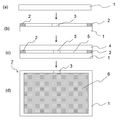
- FIG. 1 shows an embodiment for manufacturing a liquid crystal display panel.
- the glass substrate 1 is used as shown in the cross-sectional view of FIG. 1A, and the liquid crystal sealant composition of the present invention is formed on one glass substrate 1 as shown in the cross-sectional view of FIG. Product 2 was applied.
- the other glass substrate 4 is placed on the liquid crystal sealing agent composition 2 on one glass substrate 1 so as to face each other, and light such as ultraviolet rays is applied under pressure.
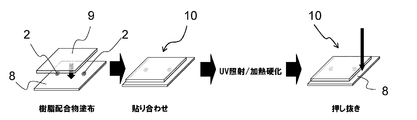
- the liquid crystal sealing composition is dispensed on an ITO glass substrate with an alignment film that has been subjected to a rabin treatment, and then a liquid crystal is dropped onto the substrate, and the upper and lower substrates are bonded together by a liquid crystal dropping method (ODF method), and ultraviolet rays (for example, illuminance) and irradiation time: for 1000 mJ, when the 100mW / cm 2 / 365nm, 50mJ , 50mW / cm 2 / 365nm in 1 second) and then cured by irradiation with, by 1 hour thermoset Thereafter example 120 ° C. hot air oven Also good.
- ODF method liquid crystal dropping method
- ultraviolet rays for example, illuminance
- irradiation time for 1000 mJ, when the 100mW / cm 2 / 365nm, 50mJ , 50mW / cm 2 / 365nm in 1 second
- Dissolving solution B is put in a flask, and dissolving solution A is dropped at a rate of 1.4 g / min while being controlled and stirred at 25 ° C.
- the reaction solution was measured with a Fourier transform infrared spectrophotometer, and it was confirmed that there was no peak near 2250 cm ⁇ 1 derived from an isocyanate group, and the reaction was completed.
- the reaction was performed so that hydrazine was 2 mol (molar ratio 1: 2) with respect to 1 mol of dicyclohexylmethane-4,4′-diisocyanate.
- the solution was filtered through a Kiriyama funnel (manufactured by Kiriyama Co., Ltd.) using a filter paper (Kiriyama Co., Ltd. No. 4), and the liquid was removed.
- the obtained filtered product was dried at 50 ° C. in a vacuum oven. After drying, the mixture was pulverized with a high-pressure pulverizer (trade name: Nanojet Mizer, manufactured by Aisin Nano Technologies) to produce a carbazide compound having an average particle diameter (median diameter) of 2.0 ⁇ m.
- the average particle diameter (median diameter) was measured using a particle size distribution meter (LA-950V2 manufactured by Horiba Seisakusho).
- a solution A in which 16.8 g of hexamethylene diisocyanate was dissolved in 150 g of ethanol and a solution B in which 10 g of hydrazine was dissolved in 150 g of ethanol were prepared.
- the solution A is dropped at a rate of 1.4 g / min while the solution B is controlled and stirred at 25 ° C.
- the reaction solution was measured with a Fourier transform infrared spectrophotometer, and it was confirmed that there was no peak near 2250 cm ⁇ 1 derived from the isocyanate group, and the reaction was completed.
- the reaction was carried out so that hydrazine was 2 mol (molar ratio 1: 2) with respect to 1 mol of hexamethylene diisocyanate. After completion of the reaction, it was filtered through a Kiriyama funnel (manufactured by Kiriyama Co., Ltd.) using a filter paper (Kiriyama Co., Ltd. No. 4), and the liquid was removed. The obtained filtered product was dried at 50 ° C. in a vacuum oven. After drying, the mixture was pulverized with a high-pressure pulverizer (trade name: NanoJet Mizer, manufactured by Aisin Nano Technologies) to produce a carbazide compound having an average particle diameter (median diameter) of 2.1 ⁇ m.
- a high-pressure pulverizer trade name: NanoJet Mizer, manufactured by Aisin Nano Technologies
- the solution A was dropped at a rate of 1.4 g / min while the solution B was being stirred at 25 ° C.
- the reaction solution was measured with a Fourier transform infrared spectrophotometer, and it was confirmed that there was no peak near 2250 cm ⁇ 1 derived from the isocyanate group, and the reaction was completed.
- the reaction was carried out so that 1 mol of hydrazine (1: 1 in molar ratio) per 1 mol of 2-isocyanatoethyl acrylate. After completion of the reaction, skipping ethanol 50 ° C. by an evaporator, the purified product was measured by Fourier transform infrared spectroscopy, and confirmed that the peak around 3300 cm -1 derived from ethanol is not, produce liquid carbazide compound did.
- the solution A was dropped at a rate of 1.4 g / min while the solution B was being stirred at 25 ° C.
- the reaction solution was measured with a Fourier transform infrared spectrophotometer, and it was confirmed that there was no peak near 2250 cm ⁇ 1 derived from the isocyanate group, and the reaction was completed.
- the reaction was carried out so that hydrazine was 2 mol (1: 2 in molar ratio) with respect to 1 mol of trimethylhexamethylene diisocyanate. After completion of the reaction, skipping ethanol 50 ° C. by an evaporator, the purified product was measured by Fourier transform infrared spectroscopy, and confirmed that the peak around 3300 cm -1 derived from ethanol is not, produce liquid carbazide compound did.
- a solution A in which 18.82 g of m-xylylene diisocyanate is dissolved in 100 g of isopropanol and a solution B in which 25.3 g of hydrazine is dissolved in 100 g of isopropanol are prepared.
- the solution A is dropped at a rate of 1.4 g / min while the solution B is being stirred at 30 ° C. in a three-necked flask.
- the reaction solution is measured with a Fourier transform infrared spectrophotometer, and it is confirmed that there is no peak near 2250 cm ⁇ 1 derived from the isocyanate group, and the reaction is completed.
- the reaction was performed so that hydrazine was 5 mol (molar ratio 1: 5) with respect to 1 mol of m-xylylene diisocyanate.
- the solution was filtered with a Kiriyama funnel (manufactured by Kiriyama Co., Ltd.) using a filter paper (Kiriyama Co., Ltd. No. 4), and the liquid was removed.
- the obtained filtered product was dried at 50 ° C. in a vacuum oven. After drying, the mixture was pulverized with a high-pressure pulverizer (trade name: NanoJet Mizer, manufactured by Aisin Nano Technologies) to produce a carbazide compound having an average particle diameter (median diameter) of 2.2 ⁇ m.
- Example 6 (Example 6) (B-4) 4,4 ′-(1,3-cyclohexylenebismethylene) bis (semicarbazide)
- the solution A is dropped at a rate of 1.4 g / min while the solution B is being stirred at 30 ° C. in a three-necked flask.
- the reaction solution is measured with a Fourier transform infrared spectrophotometer, and it is confirmed that there is no peak near 2250 cm ⁇ 1 derived from the isocyanate group, and the reaction is completed. It was made to react so that it might be set to 5 mol (1: 5 by molar ratio) of hydrazine with respect to 1 mol of 1, 3-bis (isocyanatomethyl) cyclohexane.
- the solution was filtered with a Kiriyama funnel (manufactured by Kiriyama Co., Ltd.) using a filter paper (Kiriyama Co., Ltd. No. 4), and the liquid was removed. The obtained filtered product was dried at 50 ° C. in a vacuum oven.
- Example 7 (B-6) 4,4'-Isophorone bis (semicarbazide) A solution A in which 22.22 g of isophorone diisocyanate is dissolved in 100 g of ethanol and a solution B in which 25.3 g of hydrazine are dissolved in 100 g of ethanol are prepared. The solution A is dropped at a rate of 1.4 g / min while the solution B is being stirred at 30 ° C. in a three-necked flask.
- the reaction solution is measured with a Fourier transform infrared spectrophotometer, and it is confirmed that there is no peak near 2250 cm ⁇ 1 derived from the isocyanate group, and the reaction is completed. It was made to react so that it might become hydrazine 5 mol (molar ratio 1: 5) with respect to 1 mol of isophorone diisocyanate.
- skipping ethanol 50 ° C. by an evaporator the purified product was measured by Fourier transform infrared spectroscopy, and confirmed that the peak around 3300 cm -1 derived from ethanol is not, produce liquid carbazide compound did.
- the solution A was added dropwise at a rate of 1.4 g / min to the place where the solution B was being stirred at 30 ° C. in a three-necked flask.
- reaction solution was measured with a Fourier transform infrared spectrophotometer, and it was confirmed that there was no peak near 2250 cm ⁇ 1 derived from the isocyanate group, and the reaction was completed.
- the reaction was performed so that 1 mol of 1,12-diaminododecane was 1 mol (1: 2 in molar ratio) with respect to 1 mol of dicyclohexylmethane-4,4-diisocyanate.
- the reaction solution was poured into 500 g of stirring water to promote crystallization and allowed to stand for 1 hour, and then filtered through a Kiriyama funnel (manufactured by Kiriyama Co.) using a filter paper (Kiriyama Co., Ltd. No.
- the filtered product was dried at 50 ° C. in a vacuum oven. After drying, the mixture was naturally cooled to room temperature, and pulverized with a high-pressure pulverizer (trade name: NanoJet Mizer, manufactured by Aisin Nano Technologies) to produce an amine compound having an average particle diameter (median diameter) of 2.5 ⁇ m.
- a high-pressure pulverizer trade name: NanoJet Mizer, manufactured by Aisin Nano Technologies
- the solution A was added dropwise at a rate of 1.4 g / min to the place where the solution B was being stirred at 30 ° C. in a three-necked flask.
- reaction solution was measured with a Fourier transform infrared spectrophotometer, and it was confirmed that there was no peak near 2250 cm ⁇ 1 derived from the isocyanate group, and the reaction was completed.
- the reaction was carried out so that 1 mol of 1,6-diaminohexane was 2 mol (1: 2 in molar ratio) with respect to 1 mol of dicyclohexylmethane-4,4-diisocyanate. Thereafter, the solvent was distilled off under reduced pressure using a rotary evaporator.
- the mixture was naturally cooled to room temperature and pulverized with a high-pressure pulverizer (trade name: NanoJet Mizer, manufactured by Aisin Nano Technologies) to produce an amine compound having an average particle diameter (median diameter) of 2.2 ⁇ m.
- a high-pressure pulverizer trade name: NanoJet Mizer, manufactured by Aisin Nano Technologies
- the solution A was added dropwise at a rate of 1.4 g / min to the place where the solution B was being stirred at 30 ° C. in a three-necked flask. After completion of the dropping, the reaction solution was measured with a Fourier transform infrared spectrophotometer, and it was confirmed that there was no peak near 2250 cm ⁇ 1 derived from the isocyanate group, and the reaction was completed.
- the reaction was carried out so that 1 mol of hexamethylene diisocyanate was 2 mol of 1,12-diaminododecane (1: 2 in molar ratio). Thereafter, the solvent was distilled off under reduced pressure using a rotary evaporator. After drying, the mixture was naturally cooled to room temperature and pulverized with a high-pressure pulverizer (trade name: NanoJet Mizer, manufactured by Aisin Nano Technologies) to produce a diamine urea compound having an average particle diameter (median diameter) of 2.1 ⁇ m. After completion of the reaction, it was filtered through a Kiriyama funnel (manufactured by Kiriyama Co., Ltd.) using a filter paper (Kiriyama Co., Ltd. No. 4), and the liquid was removed. The obtained filtered product was dried at 50 ° C. in a vacuum oven.
- a high-pressure pulverizer trade name: NanoJet Mizer, manufactured by Aisin Nano Technologies
- the solution A was dropped at a rate of 1.4 g / min while the solution B was being controlled and stirred at 25 ° C. in a three-necked flask.
- the reaction solution was measured with a Fourier transform infrared spectrophotometer, and it was confirmed that there was no peak near 2250 cm ⁇ 1 derived from the isocyanate group, and the reaction was completed.
- the mixture was naturally cooled to room temperature and pulverized with a high-pressure pulverizer (trade name: NanoJet Mizer, manufactured by Aisin Nano Technologies) to produce an amine compound having an average particle diameter (median diameter) of 2.2 ⁇ m.
- a high-pressure pulverizer trade name: NanoJet Mizer, manufactured by Aisin Nano Technologies
- a solution A in which 17.17 g of hexamethylene diisocyanate was dissolved in 150 g of ethanol and a solution B in which 94.9 g of 1,6-diaminohexane (manufactured by TCI) were dissolved in 118 g of ethanol were prepared.
- the solution A was dropped at a rate of 1.4 g / min while the solution B was being controlled and stirred at 25 ° C. in a three-necked flask.
- the reaction solution was measured with a Fourier transform infrared spectrophotometer, and it was confirmed that there was no peak near 2250 cm ⁇ 1 derived from the isocyanate group, and the reaction was completed.
- the reaction was carried out so that 1,6-diaminohexane was 10 moles (1:10 molar ratio) with respect to 1 mole of hexamethylene diisocyanate. Thereafter, the solvent was distilled off under reduced pressure using a rotary evaporator. After drying, the mixture was naturally cooled to room temperature and pulverized with a high-pressure pulverizer (trade name: NanoJet Mizer, manufactured by Aisin Nano Technologies) to produce an amine compound having an average particle diameter (median diameter) of 2.3 ⁇ m.
- a high-pressure pulverizer trade name: NanoJet Mizer, manufactured by Aisin Nano Technologies
- the solution A was dropped at a rate of 1.4 g / min while the solution B was being controlled and stirred at 25 ° C. in a three-necked flask.
- the reaction solution was measured with a Fourier transform infrared spectrophotometer, and it was confirmed that there was no peak near 2250 cm ⁇ 1 derived from the isocyanate group, and the reaction was completed.
- the reaction was carried out so that the molar amount of 1,6-diaminohexane was 5 mol (1: 5 by molar ratio) with respect to 1 mol of hexamethylene diisocyanate. After completion of the reaction, it was filtered through a Kiriyama funnel (manufactured by Kiriyama Co., Ltd.) using a filter paper (Kiriyama Co., Ltd. No. 4), and the liquid was removed. The obtained filtered product was dried at 50 ° C. in a vacuum oven.
- the mixture was naturally cooled to room temperature and pulverized with a high-pressure pulverizer (trade name: NanoJet Mizer, manufactured by Aisin Nano Technologies) to produce an amine compound having an average particle diameter (median diameter) of 2.2 ⁇ m.
- a high-pressure pulverizer trade name: NanoJet Mizer, manufactured by Aisin Nano Technologies
- the reacted hexamethylene diisocyanate and ethylenediamine were 10 mol of ethylenediamine (1:10 in molar ratio) with respect to 1 mol of hexamethylene diisocyanate.
- the obtained precipitate was washed with ethanol (EtOH) and dried under reduced pressure.
- the crystals obtained were pulverized with a high-pressure pulverizer (trade name: NanoJet Mizer, manufactured by Aisin Nano Technologies), and the average particle diameter (median diameter) was obtained. ) A 2.1 ⁇ m amine compound was produced.
- the solution A was dropped at a rate of 1.4 g / min while the solution B was being controlled and stirred at 25 ° C. in a three-necked flask.
- the reaction solution was measured with a Fourier transform infrared spectrophotometer, and it was confirmed that there was no peak near 2250 cm ⁇ 1 derived from the isocyanate group, and the reaction was completed.
- the reaction was performed such that 5 mol of ethylenediamine and 5 mol of 1,6-diaminohexane (1: 5: 5 in molar ratio) were used per 1 mol of hexamethylene diisocyanate.
- a partially esterified epoxy resin was produced according to the production method described in JP-A-5-295087. Specifically, a partially esterified epoxy resin (partially methacrylated epoxy resin) was produced as follows.
- (A) High-purity bisphenol A type epoxy resin: Epiklone-850S (manufactured by DIC) 1000 parts by mass, methacrylic acid: 250 parts by mass, toluene: 900 parts by mass, triethylamine: 2 parts by mass, paramethoxyphenol: 2 parts by mass Were mixed and heated and stirred at 90 ° C. for 8 hours to obtain a partial addition reaction product.
- liquid crystal sealant composition 100 parts by weight of the above partially methacrylic epoxy resin, 15 parts by weight of spherical silica (manufactured by Admafine, SO-C1) as an inorganic filler, 15 parts by weight of F-351 (manufactured by ZEON Corporation) as an organic filler, photoradical 3 parts by mass of Irgacure 907 (manufactured by BASF Japan) as an initiator, 2 parts by mass of KBM-403 (manufactured by Shin-Etsu Chemical Co., Ltd.) as a silane coupling agent, and Examples 1 to 5, 8 to 12 and 14 as curing agents A curing agent is blended in an amount of 1 equivalent to 1 equivalent of the epoxy group of the partially methacrylic epoxy resin, and uniformly dispersed with a three-one motor (trade name: RW28basic, manufactured by IKA) to obtain a liquid crystal sealant resin composition.
- spherical silica manufactured by Admafine, SO-
- Comparative Example 1 commercially available dodecanoic acid hydrazide (DDH, manufactured by Otsuka Chemical Co., Ltd.) was used.
- Comparative Example 2 commercially available 1,3-bis (hydrazinocarbonoethyl) -5-isopropylhydantoin (Amicure VDH, Ajinomoto) A liquid crystal sealant composition was produced in the same manner as described above except that Fine Techno Co.) was used.
- FIG. 2 is a diagram for explaining a method for measuring the adhesive strength using the liquid crystal sealing agent compositions of Examples 1 to 5, 8 to 12, and 14 and Comparative Examples 1 to 2.
- an ITO glass 8 having a thickness of 0.5 mm and a 3.0 cm square (with an ITO electrode film on the glass surface, a glass 9 having a thickness of 0.5 mm and a 2.3 cm square was prepared.
- UV 3000 mJ (trade name: UB-031-A) was applied to the bonded test piece 10. / BM-E1, manufactured by Eye Graphics Co., Ltd.) and then heated at 120 ° C. for 60 minutes to cure the liquid crystal sealant composition 2. From the end of the center line of the ITO glass 8 of the test piece 10 after curing. Auto 5mm point Rough (Shimadzu Corporation; AGS). Press at punching, the adhesive strength was measured results are shown in Table 1.
- An alignment film glass 9 having the same treatment as the corner glass 8 was prepared.
- a liquid crystal sealing agent composition having a diameter of 1.5 mm to 2.0 mm and a thickness of 6.0 ⁇ m to 10.0 ⁇ m as an adhesive surface at 9 mm from both ends on the center line of the glass.
- test piece 10 was irradiated with UV 3000 mJ (trade name: UB-031-A / BM-E1, manufactured by iGraphics), and then heated at 120 ° C. for 60 minutes to cure the liquid crystal sealant composition 2. .
- UV 3000 mJ trade name: UB-031-A / BM-E1, manufactured by iGraphics
- a point of 5 mm from the end of the center line of the ITO glass 8 of the test piece 10 after curing was pushed through an autograph (manufactured by Shimadzu Corporation; AGS), and the adhesive strength was measured.
- illuminance and radiation time for 50mJ, 50mW / cm 2 / 365nm 1 second, in the case of 200mJ was cured by irradiation with 4 seconds) with 50mW / cm 2 / 365nm, thereafter 120 ° C. hot air oven Thermal curing was performed for 1 hour to prepare a test cell for the orientation test.
- illuminance of 0 mJ with a light-shielding mask after bonding, the liquid crystal and the sealant are not irradiated with ultraviolet rays, and then heat-cured in a hot air oven at 120 ° C. for 1 hour to provide a test cell for the orientation test.
- the alignment state of the liquid crystal at the time of sealing was confirmed.
- the confirmation was performed with an optical microscope, and the polarizing plate was observed in a transmission state with a test cell sandwiched in a crossed Nicol state.
- the evaluation criteria for the orientation of the liquid crystal was judged by the presence or absence of alignment disorder during sealing.
- the case where the alignment disorder was 50 ⁇ m or less during sealing was indicated by “ ⁇ ”, and the case where the alignment disorder was further exceeded was indicated by “X”.
- the results are shown in Table 2.
- the liquid crystal sealant composition using the curing agent of the present invention (Examples 1 to 5, 8 to 12 and 14) is obtained when different materials are bonded together such as glass and ITO glass. Even so, the adhesive strength was greater than when the curing agents of Comparative Examples 1 and 2 were used.
- the orientation of the alignment film of the liquid crystal sealant composition of Example 11 (curing agent A-5) was in a good state with an alignment disturbance of 50 ⁇ m or less at both illuminances of 50 mJ and 200 mJ.
- the alignment disorder at the time of sealing exceeded 50 ⁇ m for both illuminances of 50 mJ and 200 mJ.
- the curing agent of the present invention the resin composition using the same, and the liquid crystal sealing agent composition are adapted to thinning and diversification of adhesiveness required for the sealing agent used for bonding liquid crystal display panels and the like.
- the adhesive strength capable of suppressing peeling at the time of cutting out the cell and mounting the IC for driving the liquid crystal cell was exhibited.
- Example 15 A solution A in which 17.17 g of hexamethylene diisocyanate was dissolved in 118 g of ethanol and a solution B in which 61.36 g of ethylenediamine were dissolved in 150 g of ethanol were prepared.
- the solution A was added dropwise at a rate of 1.4 g / min while the solution B was controlled and stirred at 25 ° C. in a three-necked flask. After the completion of the dropwise addition of the solution A, the reaction solution was measured with a Fourier transform infrared spectrophotometer, and it was confirmed that there was no peak near 2250 cm ⁇ 1 derived from the isocyanate group, and the reaction was completed.
- the mixture was naturally cooled to room temperature and pulverized with a high-pressure pulverizer (trade name: NanoJet Mizer, manufactured by Aisin Nano Technologies) to produce an amine compound (A-5) having an average particle diameter (median diameter) of 2.2 ⁇ m. .
- a high-pressure pulverizer trade name: NanoJet Mizer, manufactured by Aisin Nano Technologies
- liquid crystal sealant composition 100 parts by mass of the partially methacrylated epoxy resin obtained above, 15 parts by mass of spherical silica (manufactured by Admafine, SO-C1) as an inorganic filler, and F-351 (manufactured by Nippon Zeon) as an organic filler 15 3 parts by mass of Irgacure 907 (manufactured by BASF Japan) as a photo radical initiator, 2 parts by mass of KBM-403 (manufactured by Shin-Etsu Chemical Co., Ltd.) as a silane coupling agent, and E-1 or E- as a curing agent 2 was blended in an amount of 15 parts by mass with respect to 100 parts by mass of the partially methacrylated epoxy resin, and uniformly dispersed with a three-one motor (manufactured by IKA, trade name: RW28basic) to obtain a liquid crystal sealant resin composition.
- spherical silica manufactured by Admafine, SO-C
- the viscosity was measured as follows.
- a RE-105U type viscometer manufactured by Toki Sangyo Co., Ltd.
- a 3 ° ⁇ R7.7 cone rotor 0.15 ml of the liquid crystal sealant composition to be used is set in the cone rotor, and 25 ° C. at 2.5 rpm.
- the viscosity of the liquid crystal sealant composition was measured. When the measurement range was over, measurement was impossible. Note that the measurement range over reference is 1,200,000 mPa ⁇ s.
- the isocyanate-added amine compound obtained by adding an arbitrary isocyanate to the amine compound has a small change rate of liquid stability and warming liquid stability, and particularly a change rate of warming liquid stability. It is clear that the small is remarkable.
- the liquid crystal sealant composition (resin composition) obtained above was cured under the two conditions shown in Table 4 below (120 ° C. for 1 hour only, and UV 3000 mJ / cm 2 after treatment for 120 hours for 1 hour).
- the obtained cured pieces were measured by FT-IR to evaluate the curability.
- the following formula was used for the calculation method of the epoxy curing rate.
- the methacryl cure rate was calculated by replacing the peak of the epoxy group in the following formula with the peak of the methacryl group.
- Reference peak 1540 to 1480 cm ⁇ 1 (near peak top 1510 cm ⁇ 1 ) Peak of epoxy groups; 925 ⁇ 895cm -1 (near peak top 910 cm -1) Methacryl group peak; 1650-1625 cm ⁇ 1 (near peak top 1635 cm ⁇ 1 )
- the adhesive strength that can sufficiently suppress peeling at the time of cutting out a cell and mounting an IC for driving a liquid crystal cell while satisfying the diversification of adhesiveness by thinning and diversification of different materials.
- the curing agent of the present invention, the resin composition using the same, and the liquid crystal sealant composition are suitable as a sealant or sealant for electronic parts such as liquid crystal display panels. It can be used and is industrially useful.
Landscapes
- Chemical & Material Sciences (AREA)
- Physics & Mathematics (AREA)
- Health & Medical Sciences (AREA)
- Chemical Kinetics & Catalysis (AREA)
- Medicinal Chemistry (AREA)
- Polymers & Plastics (AREA)
- Organic Chemistry (AREA)
- Nonlinear Science (AREA)
- Crystallography & Structural Chemistry (AREA)
- Mathematical Physics (AREA)
- General Physics & Mathematics (AREA)
- Optics & Photonics (AREA)
- Epoxy Resins (AREA)
- Sealing Material Composition (AREA)
- Liquid Crystal (AREA)
- Organic Low-Molecular-Weight Compounds And Preparation Thereof (AREA)
- Compositions Of Macromolecular Compounds (AREA)
- Polyurethanes Or Polyureas (AREA)
Priority Applications (4)
| Application Number | Priority Date | Filing Date | Title |
|---|---|---|---|
| KR1020187023546A KR101931074B1 (ko) | 2012-07-11 | 2013-07-01 | 경화제 및 그것을 사용한 수지 조성물 |
| KR1020157003243A KR101894623B1 (ko) | 2012-07-11 | 2013-07-01 | 경화제 및 그것을 사용한 수지 조성물 |
| JP2014524740A JP6031514B2 (ja) | 2012-07-11 | 2013-07-01 | 硬化剤及びそれを用いた樹脂組成物 |
| CN201380036329.7A CN104428339B (zh) | 2012-07-11 | 2013-07-01 | 固化剂和使用了该固化剂的树脂组合物 |
Applications Claiming Priority (2)
| Application Number | Priority Date | Filing Date | Title |
|---|---|---|---|
| JP2012-155976 | 2012-07-11 | ||
| JP2012155976 | 2012-07-11 |
Publications (1)
| Publication Number | Publication Date |
|---|---|
| WO2014010446A1 true WO2014010446A1 (fr) | 2014-01-16 |
Family
ID=49915910
Family Applications (1)
| Application Number | Title | Priority Date | Filing Date |
|---|---|---|---|
| PCT/JP2013/067985 Ceased WO2014010446A1 (fr) | 2012-07-11 | 2013-07-01 | Agent durcisseur et composition de résine l'utilisant |
Country Status (5)
| Country | Link |
|---|---|
| JP (2) | JP6031514B2 (fr) |
| KR (2) | KR101894623B1 (fr) |
| CN (2) | CN108264631B (fr) |
| TW (1) | TWI573822B (fr) |
| WO (1) | WO2014010446A1 (fr) |
Cited By (6)
| Publication number | Priority date | Publication date | Assignee | Title |
|---|---|---|---|---|
| WO2019107070A1 (fr) * | 2017-11-29 | 2019-06-06 | 協立化学産業株式会社 | Composition de résine durcissable et son procédé de fabrication |
| JP6609396B1 (ja) * | 2018-05-25 | 2019-11-20 | 積水化学工業株式会社 | 液晶表示素子用シール剤、上下導通材料、及び、液晶表示素子 |
| US20210317324A1 (en) * | 2018-09-21 | 2021-10-14 | Asahi Kasei Kabushiki Kaisha | Multilayer coating film and method for producing the same |
| JP7185103B1 (ja) * | 2021-06-03 | 2022-12-06 | 積水化学工業株式会社 | 液晶表示素子用シール剤及び液晶表示素子 |
| CN118389104A (zh) * | 2024-04-30 | 2024-07-26 | 宁夏嘉铂睿环保科技集团有限公司 | 一种耐高温增韧胶黏剂及其制备方法 |
| TWI929200B (zh) | 2021-06-03 | 2026-06-21 | 日商積水化學工業股份有限公司 | 液晶顯示元件用密封劑及液晶顯示元件 |
Families Citing this family (59)
| Publication number | Priority date | Publication date | Assignee | Title |
|---|---|---|---|---|
| CN105295803A (zh) * | 2015-11-14 | 2016-02-03 | 华玉叶 | 一种用于粘接窄边框显示设备的密封剂组合物 |
| CN105294994A (zh) * | 2015-11-14 | 2016-02-03 | 华玉叶 | 一种高粘度固化剂组合物 |
| CN105295001A (zh) * | 2015-11-14 | 2016-02-03 | 华玉叶 | 一种高粘度固化剂组合物 |
| CN105219296A (zh) * | 2015-11-14 | 2016-01-06 | 华玉叶 | 一种高粘度固化剂组合物 |
| CN105219295A (zh) * | 2015-11-14 | 2016-01-06 | 华玉叶 | 一种高粘度固化剂组合物 |
| CN105237743A (zh) * | 2015-11-14 | 2016-01-13 | 华玉叶 | 一种高粘度固化剂组合物 |
| CN105218786A (zh) * | 2015-11-14 | 2016-01-06 | 华玉叶 | 一种高粘度固化剂组合物 |
| CN105219332A (zh) * | 2015-11-14 | 2016-01-06 | 华玉叶 | 一种用于粘接窄边框显示设备的密封剂组合物 |
| CN105349083A (zh) * | 2015-11-14 | 2016-02-24 | 华玉叶 | 一种用于粘接窄边框显示设备的密封剂组合物 |
| CN105238319A (zh) * | 2015-11-14 | 2016-01-13 | 华玉叶 | 一种用于粘接窄边框显示设备的密封剂组合物 |
| CN105219293A (zh) * | 2015-11-14 | 2016-01-06 | 华玉叶 | 一种高粘度固化剂组合物 |
| CN105295807A (zh) * | 2015-11-14 | 2016-02-03 | 华玉叶 | 一种用于粘接窄边框显示设备的密封剂组合物 |
| CN105295003A (zh) * | 2015-11-14 | 2016-02-03 | 华玉叶 | 一种高粘度固化剂组合物 |
| CN105255430A (zh) * | 2015-11-14 | 2016-01-20 | 华玉叶 | 一种用于粘接窄边框显示设备的密封剂组合物 |
| CN105237742A (zh) * | 2015-11-14 | 2016-01-13 | 华玉叶 | 一种高粘度固化剂组合物 |
| CN105295002A (zh) * | 2015-11-14 | 2016-02-03 | 华玉叶 | 一种高粘度固化剂组合物 |
| CN105295804A (zh) * | 2015-11-14 | 2016-02-03 | 华玉叶 | 一种用于粘接窄边框显示设备的密封剂组合物 |
| CN105238317A (zh) * | 2015-11-14 | 2016-01-13 | 华玉叶 | 一种用于粘接窄边框显示设备的密封剂组合物 |
| CN105219330A (zh) * | 2015-11-14 | 2016-01-06 | 华玉叶 | 一种用于粘接窄边框显示设备的密封剂组合物 |
| CN105295799A (zh) * | 2015-11-14 | 2016-02-03 | 华玉叶 | 一种用于粘接窄边框显示设备的密封剂组合物 |
| CN105295805A (zh) * | 2015-11-14 | 2016-02-03 | 华玉叶 | 一种用于粘接窄边框显示设备的密封剂组合物 |
| CN105294997A (zh) * | 2015-11-14 | 2016-02-03 | 华玉叶 | 一种高粘度固化剂组合物 |
| CN105602507A (zh) * | 2015-11-14 | 2016-05-25 | 华玉叶 | 一种用于粘接窄边框显示设备的密封剂组合物 |
| CN105295806A (zh) * | 2015-11-14 | 2016-02-03 | 华玉叶 | 一种用于粘接窄边框显示设备的密封剂组合物 |
| CN105295801A (zh) * | 2015-11-14 | 2016-02-03 | 华玉叶 | 一种用于粘接窄边框显示设备的密封剂组合物 |
| CN105255386A (zh) * | 2015-11-14 | 2016-01-20 | 华玉叶 | 一种高粘度固化剂组合物 |
| CN105602506A (zh) * | 2015-11-14 | 2016-05-25 | 华玉叶 | 一种用于粘接窄边框显示设备的密封剂组合物 |
| CN105295005A (zh) * | 2015-11-14 | 2016-02-03 | 华玉叶 | 一种高粘度固化剂组合物 |
| CN105349082A (zh) * | 2015-11-14 | 2016-02-24 | 华玉叶 | 一种用于粘接窄边框显示设备的密封剂组合物 |
| CN105237744A (zh) * | 2015-11-14 | 2016-01-13 | 华玉叶 | 一种高粘度固化剂组合物 |
| CN105294999A (zh) * | 2015-11-14 | 2016-02-03 | 华玉叶 | 一种高粘度固化剂组合物 |
| CN105273674A (zh) * | 2015-11-14 | 2016-01-27 | 华玉叶 | 一种用于粘接窄边框显示设备的密封剂组合物 |
| CN105219334A (zh) * | 2015-11-14 | 2016-01-06 | 华玉叶 | 一种用于粘接窄边框显示设备的密封剂组合物 |
| CN105238318A (zh) * | 2015-11-14 | 2016-01-13 | 华玉叶 | 一种用于粘接窄边框显示设备的密封剂组合物 |
| CN105295808A (zh) * | 2015-11-14 | 2016-02-03 | 华玉叶 | 一种用于粘接窄边框显示设备的密封剂组合物 |
| CN105219333A (zh) * | 2015-11-14 | 2016-01-06 | 华玉叶 | 一种用于粘接窄边框显示设备的密封剂组合物 |
| CN105295797A (zh) * | 2015-11-14 | 2016-02-03 | 华玉叶 | 一种用于粘接窄边框显示设备的密封剂组合物 |
| CN105295000A (zh) * | 2015-11-14 | 2016-02-03 | 华玉叶 | 一种高粘度固化剂组合物 |
| CN105254851A (zh) * | 2015-11-14 | 2016-01-20 | 华玉叶 | 一种高粘度固化剂组合物 |
| CN105219331A (zh) * | 2015-11-14 | 2016-01-06 | 华玉叶 | 一种用于粘接窄边框显示设备的密封剂组合物 |
| CN105295802A (zh) * | 2015-11-14 | 2016-02-03 | 华玉叶 | 一种用于粘接窄边框显示设备的密封剂组合物 |
| CN105237738A (zh) * | 2015-11-14 | 2016-01-13 | 华玉叶 | 一种高粘度固化剂组合物 |
| CN105294996A (zh) * | 2015-11-14 | 2016-02-03 | 华玉叶 | 一种高粘度固化剂组合物 |
| CN105199647A (zh) * | 2015-11-14 | 2015-12-30 | 华玉叶 | 一种用于粘接窄边框显示设备的密封剂组合物 |
| CN105295770A (zh) * | 2015-11-14 | 2016-02-03 | 华玉叶 | 一种高粘度固化剂组合物 |
| CN105315438A (zh) * | 2015-11-14 | 2016-02-10 | 华玉叶 | 一种高粘度固化剂组合物 |
| CN105254852A (zh) * | 2015-11-14 | 2016-01-20 | 华玉叶 | 一种高粘度固化剂组合物 |
| CN105602505A (zh) * | 2015-11-14 | 2016-05-25 | 华玉叶 | 一种用于粘接窄边框显示设备的密封剂组合物 |
| CN105199080A (zh) * | 2015-11-14 | 2015-12-30 | 华玉叶 | 一种高粘度固化剂组合物 |
| CN105295004A (zh) * | 2015-11-14 | 2016-02-03 | 华玉叶 | 一种高粘度固化剂组合物 |
| CN105218787A (zh) * | 2015-11-14 | 2016-01-06 | 华玉叶 | 一种高粘度固化剂组合物 |
| CN105219335A (zh) * | 2015-11-14 | 2016-01-06 | 华玉叶 | 一种用于粘接窄边框显示设备的密封剂组合物 |
| CN105219294A (zh) * | 2015-11-14 | 2016-01-06 | 华玉叶 | 一种高粘度固化剂组合物 |
| CN105295798A (zh) * | 2015-11-14 | 2016-02-03 | 华玉叶 | 一种用于粘接窄边框显示设备的密封剂组合物 |
| CN105294998A (zh) * | 2015-11-14 | 2016-02-03 | 华玉叶 | 一种高粘度固化剂组合物 |
| JP6650151B2 (ja) * | 2018-04-03 | 2020-02-19 | 協立化学産業株式会社 | 硬化性組成物、液晶パネル、及び液晶パネルの製造方法 |
| JP7270390B2 (ja) * | 2019-01-21 | 2023-05-10 | ナガセケムテックス株式会社 | エポキシ樹脂組成物 |
| CN112266576A (zh) * | 2020-11-04 | 2021-01-26 | 纽宝力精化(广州)有限公司 | 一种纸基板用溴化环氧树脂组合物 |
| KR102706217B1 (ko) * | 2023-01-12 | 2024-09-13 | 한국화학연구원 | 다관능성 아민경화제를 포함하는 일액형 에폭시 접착제 조성물 |
Citations (4)
| Publication number | Priority date | Publication date | Assignee | Title |
|---|---|---|---|---|
| JPH04283214A (ja) * | 1990-10-08 | 1992-10-08 | Huels Ag | ポリエーテルウレタン尿素アミン類の製造方法およびその用途 |
| JPH10298158A (ja) * | 1997-04-24 | 1998-11-10 | Asahi Chem Ind Co Ltd | 新規なセミカルバジド系化合物及びそれを用いた被覆組成物 |
| JP2003506505A (ja) * | 1999-07-28 | 2003-02-18 | バイエル アクチェンゲゼルシャフト | ウレア基含有ポリアミン、その調製方法およびエポキシド樹脂の硬化剤としての使用 |
| WO2012011220A1 (fr) * | 2010-07-20 | 2012-01-26 | 日本化薬株式会社 | Agent de scellement pour cristaux liquides et cellule d'affichage à cristaux liquides le comprenant |
Family Cites Families (5)
| Publication number | Priority date | Publication date | Assignee | Title |
|---|---|---|---|---|
| EP0769492B1 (fr) * | 1994-07-04 | 1999-12-08 | Asahi Kasei Kogyo Kabushiki Kaisha | Derive de semicarbazide et composition de revetement le contenant |
| EP1546227B1 (fr) * | 2002-08-30 | 2009-12-23 | Huntsman Petrochemical Corporation | Agents a base de polyamine de polyether et melanges associes |
| CN101348561A (zh) * | 2008-08-01 | 2009-01-21 | 中国林业科学研究院林产化学工业研究所 | 端氨基聚醚水性环氧固化剂的制备方法 |
| JP5249698B2 (ja) | 2008-09-30 | 2013-07-31 | 積水化学工業株式会社 | 液晶表示素子用シール剤及び液晶表示素子 |
| US8076395B2 (en) * | 2009-09-11 | 2011-12-13 | Air Products And Chemicals, Inc. | Low temperature curable epoxy compositions containing urea curatives |
-
2013
- 2013-07-01 CN CN201810161328.XA patent/CN108264631B/zh active Active
- 2013-07-01 KR KR1020157003243A patent/KR101894623B1/ko active Active
- 2013-07-01 JP JP2014524740A patent/JP6031514B2/ja active Active
- 2013-07-01 CN CN201380036329.7A patent/CN104428339B/zh active Active
- 2013-07-01 KR KR1020187023546A patent/KR101931074B1/ko active Active
- 2013-07-01 WO PCT/JP2013/067985 patent/WO2014010446A1/fr not_active Ceased
- 2013-07-08 TW TW102124385A patent/TWI573822B/zh active
-
2016
- 2016-10-24 JP JP2016207655A patent/JP6114453B2/ja active Active
Patent Citations (4)
| Publication number | Priority date | Publication date | Assignee | Title |
|---|---|---|---|---|
| JPH04283214A (ja) * | 1990-10-08 | 1992-10-08 | Huels Ag | ポリエーテルウレタン尿素アミン類の製造方法およびその用途 |
| JPH10298158A (ja) * | 1997-04-24 | 1998-11-10 | Asahi Chem Ind Co Ltd | 新規なセミカルバジド系化合物及びそれを用いた被覆組成物 |
| JP2003506505A (ja) * | 1999-07-28 | 2003-02-18 | バイエル アクチェンゲゼルシャフト | ウレア基含有ポリアミン、その調製方法およびエポキシド樹脂の硬化剤としての使用 |
| WO2012011220A1 (fr) * | 2010-07-20 | 2012-01-26 | 日本化薬株式会社 | Agent de scellement pour cristaux liquides et cellule d'affichage à cristaux liquides le comprenant |
Cited By (15)
| Publication number | Priority date | Publication date | Assignee | Title |
|---|---|---|---|---|
| JP7297338B2 (ja) | 2017-11-29 | 2023-06-26 | 協立化学産業株式会社 | 硬化性樹脂組成物及びその製造方法 |
| KR20200083556A (ko) * | 2017-11-29 | 2020-07-08 | 교리쯔 가가꾸 산교 가부시키가이샤 | 경화성 수지 조성물 및 그의 제조 방법 |
| JPWO2019107070A1 (ja) * | 2017-11-29 | 2020-12-24 | 協立化学産業株式会社 | 硬化性樹脂組成物及びその製造方法 |
| WO2019107070A1 (fr) * | 2017-11-29 | 2019-06-06 | 協立化学産業株式会社 | Composition de résine durcissable et son procédé de fabrication |
| JP2022105144A (ja) * | 2017-11-29 | 2022-07-12 | 協立化学産業株式会社 | 硬化性樹脂組成物及びその製造方法 |
| KR102594919B1 (ko) * | 2017-11-29 | 2023-10-27 | 교리쯔 가가꾸 산교 가부시키가이샤 | 경화성 수지 조성물 및 그의 제조 방법 |
| JP6609396B1 (ja) * | 2018-05-25 | 2019-11-20 | 積水化学工業株式会社 | 液晶表示素子用シール剤、上下導通材料、及び、液晶表示素子 |
| WO2019225376A1 (fr) * | 2018-05-25 | 2019-11-28 | 積水化学工業株式会社 | Matériau d'étanchéité destiné à un élément d'affichage à cristaux liquides, matériau à conduction verticale, et élément d'affichage à cristaux liquides |
| KR20210012994A (ko) * | 2018-05-25 | 2021-02-03 | 세키스이가가쿠 고교가부시키가이샤 | 액정 표시 소자용 시일제, 상하 도통 재료 및 액정 표시 소자 |
| KR102727731B1 (ko) | 2018-05-25 | 2024-11-07 | 세키스이가가쿠 고교가부시키가이샤 | 액정 표시 소자용 시일제, 상하 도통 재료 및 액정 표시 소자 |
| US20210317324A1 (en) * | 2018-09-21 | 2021-10-14 | Asahi Kasei Kabushiki Kaisha | Multilayer coating film and method for producing the same |
| WO2022255451A1 (fr) * | 2021-06-03 | 2022-12-08 | 積水化学工業株式会社 | Matériau d'étanchéité d'élément d'affichage à cristaux liquides et élément d'affichage à cristaux liquides |
| JP7185103B1 (ja) * | 2021-06-03 | 2022-12-06 | 積水化学工業株式会社 | 液晶表示素子用シール剤及び液晶表示素子 |
| TWI929200B (zh) | 2021-06-03 | 2026-06-21 | 日商積水化學工業股份有限公司 | 液晶顯示元件用密封劑及液晶顯示元件 |
| CN118389104A (zh) * | 2024-04-30 | 2024-07-26 | 宁夏嘉铂睿环保科技集团有限公司 | 一种耐高温增韧胶黏剂及其制备方法 |
Also Published As
| Publication number | Publication date |
|---|---|
| CN104428339B (zh) | 2020-01-07 |
| KR20150036433A (ko) | 2015-04-07 |
| JP2017061694A (ja) | 2017-03-30 |
| JPWO2014010446A1 (ja) | 2016-06-23 |
| TW201418344A (zh) | 2014-05-16 |
| KR101931074B1 (ko) | 2018-12-19 |
| KR20180095728A (ko) | 2018-08-27 |
| KR101894623B1 (ko) | 2018-09-03 |
| JP6114453B2 (ja) | 2017-04-12 |
| TWI573822B (zh) | 2017-03-11 |
| JP6031514B2 (ja) | 2016-11-24 |
| CN108264631B (zh) | 2020-07-14 |
| CN104428339A (zh) | 2015-03-18 |
| CN108264631A (zh) | 2018-07-10 |
Similar Documents
| Publication | Publication Date | Title |
|---|---|---|
| JP6114453B2 (ja) | 硬化剤及びそれを用いた樹脂組成物 | |
| TWI495686B (zh) | A stabilized polyene-polythiol-based hardening resin composition | |
| TWI344975B (fr) | ||
| TW201107416A (en) | Photocurable resin composition and cured product of same | |
| TW201235433A (en) | Resin composition for ultraviolet cure adhesive, adhesive and laminate | |
| TWI698486B (zh) | 光硬化性樹脂組成物、顯示元件密封劑、液晶密封劑及液晶顯示面板及其製造方法 | |
| CN108779313B (zh) | 固化性组合物及光学构件 | |
| TW201641576A (zh) | 樹脂組成物、接著劑及密封劑 | |
| TWI811266B (zh) | 樹脂組成物、塗料組成物、塗裝物 | |
| JP6744167B2 (ja) | 液晶シール剤及びそれを用いた液晶表示セル | |
| JP6069071B2 (ja) | 樹脂組成物 | |
| TW201335253A (zh) | 胺基甲酸酯(甲基)丙烯酸酯組成物 | |
| JP2011221168A (ja) | 液晶シール剤、それを用いた液晶表示パネルの製造方法、及び液晶表示パネル | |
| KR102168846B1 (ko) | 수지 조성물 | |
| TWI635105B (zh) | Photocurable resin composition, cured product thereof, and plastic lens | |
| JP5493422B2 (ja) | 液晶シール剤用硬化性組成物及び液晶表示素子 | |
| JP2022105144A (ja) | 硬化性樹脂組成物及びその製造方法 | |
| JP6048717B2 (ja) | 滴下シール剤組成物 | |
| EP3327049A1 (fr) | Composé silsesquioxane réactif et composition polymérisable contenant un composé vinylique aromatique | |
| CN114621719A (zh) | 液晶滴注法用液晶密封剂 | |
| JP4463571B2 (ja) | 液晶表示素子用シール剤、上下導通材料、及び、液晶表示素子 | |
| JP2019112621A (ja) | ディスプレイ用封止剤 | |
| JP2023068692A (ja) | 液晶滴下工法用液晶シール剤及びそれを用いた液晶表示パネル | |
| JP4875441B2 (ja) | 液晶滴下工法用シール剤組成物およびそれを用いた液晶表示パネルの製造方法 | |
| JP2017203066A (ja) | 新規化合物及びこれを用いた樹脂組成物 |
Legal Events
| Date | Code | Title | Description |
|---|---|---|---|
| 121 | Ep: the epo has been informed by wipo that ep was designated in this application |
Ref document number: 13816599 Country of ref document: EP Kind code of ref document: A1 |
|
| ENP | Entry into the national phase |
Ref document number: 2014524740 Country of ref document: JP Kind code of ref document: A |
|
| NENP | Non-entry into the national phase |
Ref country code: DE |
|
| ENP | Entry into the national phase |
Ref document number: 20157003243 Country of ref document: KR Kind code of ref document: A |
|
| 122 | Ep: pct application non-entry in european phase |
Ref document number: 13816599 Country of ref document: EP Kind code of ref document: A1 |