WO2014023902A1 - Procede de preparation de dialkyloxydianhydrohexitols par etherification de dianhydrohexitols avec un alcool leger, en presence d'un catalyseur acide - Google Patents
Procede de preparation de dialkyloxydianhydrohexitols par etherification de dianhydrohexitols avec un alcool leger, en presence d'un catalyseur acide Download PDFInfo
- Publication number
- WO2014023902A1 WO2014023902A1 PCT/FR2013/051881 FR2013051881W WO2014023902A1 WO 2014023902 A1 WO2014023902 A1 WO 2014023902A1 FR 2013051881 W FR2013051881 W FR 2013051881W WO 2014023902 A1 WO2014023902 A1 WO 2014023902A1
- Authority
- WO
- WIPO (PCT)
- Prior art keywords
- catalyst
- dianhydrohexitol
- isosorbide
- etherification
- mixtures
- Prior art date
- Legal status (The legal status is an assumption and is not a legal conclusion. Google has not performed a legal analysis and makes no representation as to the accuracy of the status listed.)
- Ceased
Links
- 0 CO**(CO[C+]12)*1OC*2=*OC Chemical compound CO**(CO[C+]12)*1OC*2=*OC 0.000 description 1
Classifications
-
- C—CHEMISTRY; METALLURGY
- C07—ORGANIC CHEMISTRY
- C07D—HETEROCYCLIC COMPOUNDS
- C07D493/00—Heterocyclic compounds containing oxygen atoms as the only ring hetero atoms in the condensed system
- C07D493/02—Heterocyclic compounds containing oxygen atoms as the only ring hetero atoms in the condensed system in which the condensed system contains two hetero rings
- C07D493/04—Ortho-condensed systems
Definitions
- the field of the invention is that of the O-alkylation of dianhydrohexitols.
- the present invention relates to the preparation of ether derivatives of 1, 4: 3, 6-dianhydrohexitol such as isosorbide, isoidide or isomannide.
- the invention is directed to a new industrial process for the etherification of these dianhydrohexitols with the aid of light alcohols, of the methanol or ethanol type, by acid catalysis or bifunctional acid-metal catalysis, preferably in the gas phase.
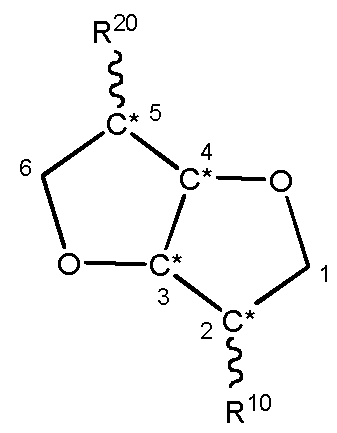
- the 1,4,4,6-dianhydrohexitols known are in particular: isosorbide, isomannide and isoidide of formula:
- Isosorbide derivatives are also known, the isomannide and the isoidide in which the -OH reactive functions are replaced by amine, acid or ether reactive functions.
- DMI is an example of an isosorbide ether derivative.
- DMI is a solvent recommended in pharmaceutical and cosmetic compositions such as self-tanning, oral or anti-acne compositions, care creams, ointments and lotions.
- DMI is also a viscosity control agent. It can be used as a fluxing agent in bitumens.
- the use of DMI in many fields other than the pharmaceutical and cosmetic industry is particularly described in international applications WO 2006/120342 and WO 2006/120343 of the applicant.
- DMI is conventionally prepared by methylation of isosorbide with a methylating agent such as dimethyl sulfate or methyl chloride, in the presence of an alkaline agent such as sodium hydroxide.
- Methyl chloride is a methylating agent of particular interest for economic reasons. It is indeed available on the market in large quantities and at a lower cost than brominated and iodized equivalents.
- the patent application EP 0 092 998 thus describes the methylation of isosorbide with methyl chloride (MeCl), in the presence of sodium or potassium hydroxide.
- the reaction described is carried out in a water / aprotic organic solvent dispersion (DMSO or toluene) with bubbling of the gaseous methylation agent.
- dialkyl carbonate dimethyl or diethyl
- This methylating agent is used both as a reagent and a "green" solvent. It is used in the presence of a basic catalyst. The reaction takes place at high temperatures and pressures and uses a single methyl group of dimethyl carbonate, which penalizes the economics of the process (US 4,770,871;
- WO 2009/120703 describes a process for etherifying dianhydrohexitol sugars in the presence of an O-alkylating agent which is a dialkylcarbonate.
- the present invention aims to satisfy at least one of the objectives set out below.
- One of the essential objectives of the present invention is to provide a new and improved process for preparing a composition based on dialkyloxydianhydrohexitols by etherifying dianhydrohexitols with at least one alkylating agent.
- Another essential object of the invention is to provide a new improved method, simple and economical, of preparing a composition based on dialkyloxydianhydrohexitols by etherification of dianhydrohexitols with at least one alkylating agent.
- Another essential object of the invention is to provide a new and improved process for preparing a composition based on dialkyloxydianhydrohexitols by etherification of dianhydrohexitols with at least one alkylating agent, said process not generating an embarrassing by-product.
- Another essential object of the invention is to provide a new and improved process for preparing a composition based on dialkyloxydianhydrohexitols by etherifying dianhydrohexitols with at least one inexpensive alkylating agent.
- Another essential object of the invention is to provide a new and improved process for preparing a composition based on dialkyloxydianhydrohexitols by etherification of dianhydrohexitols with at least one non-toxic, non-hazardous and ecocompatible alkylating agent.
- Another essential object of the invention is to provide a new and improved process for the preparation of a composition based on dialkyloxydianhydrohexitols by etherification of dianhydrohexitols with at least one alkylating agent, said process being easily industrializable and as such capable of being for example, implemented continuously.
- Another essential object of the invention is to provide a new and improved process for the preparation of a composition based on dialkyloxydianhydrohexitols by etherification of dianhydrohexitols with at least one alkylating agent, said process benefiting from good thermodynamics, and thus from good reaction kinetics.
- Another essential object of the invention is to provide a new and improved process for preparing a composition based on dialkyloxydianhydrohexitols by etherification of dianhydrohexitols with at least one alkylating agent, with good yields and good selectivities of dialkyloxydianhydrohexitols.
- Another essential object of the invention is to provide a new improved process for the preparation of a dimethylisosorbide-based composition by etherification of isosorbide with methanol, said process satisfying at least one of the abovementioned objectives.
- the present invention which firstly relates to a process for the preparation of a composition based on dialkyloxydihydrohexitols by etherification of dianhydrohexitols with at least one alkylating agent, in the presence of a solid catalyst, preferably a catalyst having properties of Lewis or Brnsted acids, the etherifying agent being selected from the group consisting of, and more preferably consisting of:
- alcohols preferably linear or branched aliphatic alcohols, and more preferably C 1 -C 20 alcohols, more preferably methanol, ethanol, isopropanol or tert-butanol, methanol being particularly preferred;
- This new high-performance process is ideally suited to industrial operations. It allows the synthesis of methyl isosorbide ethers by reacting isosorbide with methanol (or ethanol) in the presence of an acidic solid catalyst.
- the process according to the invention is "clean", it bypasses the use of methylating agent such as dimethyl sulfate or methyl chloride which generates stoichiometric amounts of salts. It also avoids the use of dialkylcarbonate, a more expensive methylating agent of which only one of the two methyl groups participates in obtaining mixed ethers of isosorbide.
- methylating agent such as dimethyl sulfate or methyl chloride which generates stoichiometric amounts of salts. It also avoids the use of dialkylcarbonate, a more expensive methylating agent of which only one of the two methyl groups participates in obtaining mixed ethers of isosorbide.
- dialkyloxydianhydrohexitol is meant a derivative of 1,4: 3,6-dianhydrohexitol of formula III:
- R is a radical -OR, the radicals R being identical or different and each corresponding to an alkyl, preferably a linear or branched aliphatic alkyl and, more preferably still, a C 1 -C 20 alkyl, more preferably methyl, l ethyl, isopropyl or tert-butyl; methyl being particularly preferred, which corresponds to DiMethyllososorbide (DMI) as a compound of formula (III).
- DMI DiMethyllososorbide
- O-alkylation is understood to mean grafting an alkyl by ether bonding on a product.
- - means one or more ranges of values whose limits are closed: [x, y].
- Solid catalyst means a solid chemical compound which constitutes a phase distinct from the reaction phase capable of exerting on the evolution of a thermodynamically possible transformation, an accelerating effect and an orientation effect and remaining unchanged in end of reaction and can not modify the thermodynamic equilibrium ("contact catalysis” - JP Le Page-Editions Technip-1978, pages 1, 2).
- supported solid catalyst is meant a solid catalyst consisting of an inert support with a large specific surface on which is dispersed a catalytically active chemical compound ("Contact catalysis” - J.P. Technip-Page-Editions, 1978, page 133).
- conversion especially “conversion of isosorbide” (also denoted “isosorbid conv”), is meant:
- Conv isosorbide (%) 100 * (initial number of moles of isosorbide - final number of moles of isosorbide) / initial number of moles of isosorbide.
- the product i (% mol) (100 * nb moles product i) / (sum nb moles produced i), i denoting the derivatives of isosorbide: DMI or MMI A or MMI B.
- the selectivities are thus calculated by 100% molar normalization on the derivatives of isosorbide.
- the etherification is at least partly carried out in the gas phase.
- the catalyst is selected from the group consisting of and more preferably consisting of:
- X represents a heteroatom selected from the group consisting of the following elements: P, Si, Ge, B and As,
- M represents a peripheral metal element selected from the group consisting of W, Mo and V,
- - j is the number of heteroatoms and represents 1 or 2
- k is the number of hydrogen atoms and is between 0.5 and 10,
- m is the number of peripheral metal atoms W, Mo, V and is between 1 and 18,
- n is the number of oxygen atoms and is between 2 and 62
- y is the number of hydration water molecules and is between 0 and
- alkali metal salts Cs + , K + , Rb + and the ammonium salts (NH 4 + ), the latter being preferred;
- acid catalysts based on zirconium oxide modified with sulphate or tungstate type oxoanions ZrS or ZrW which may contain transition metals such Fe, Mn and mixtures thereof;
- Zeolites preferably selected from the group consisting of and more preferably consisting of: H-Beta; H-ZSM-5; MCM-22; H-USY; and their mixtures;
- montmorillonite acid clays such as Nb or zirconium phosphate, functionalized carbons, in particular carbons functionalized with sulphonic groups;
- heteropoly acid salts of general formula (I) are selected from the group consisting of and most preferably consisting of: H 3 PWi o 2 0 4, 21H 2 0; H 4 SiWi 2 O 40 , 24H 2 O; H 6 P 2 Wi 8 O 62 , 24H 2 O; H 5 BWi 2 O 40 , 30H 2 O; H 5 PWi 0 V 2 O 40 , yH 2 O; H 3 PMo 2 O 40 , 28H 2 O; H 4 SiMoi 2 O 40 , 13H 2 O; H 3 PMo 6 V 6 O 40 , yH 2 O and H 5 PMoOoV 2 O 4 o, yH 2 0; and their mixtures.
- the solid catalyst is a supported catalyst.
- the catalyst is a bifunctional metal-acid catalyst, that is to say that:
- the catalyst comprises a noble metal (preferably selected from the group comprising and more preferably consisting of gold, platinum, palladium, ruthenium optionally modified by the addition of rhenium, osmium and iridium, titanium, zirconium, tantalum, their mixtures or their alloys),
- a noble metal preferably selected from the group comprising and more preferably consisting of gold, platinum, palladium, ruthenium optionally modified by the addition of rhenium, osmium and iridium, titanium, zirconium, tantalum, their mixtures or their alloys
- the solid catalyst is chosen from those having a differential heat of adsorption of ammonia (in kJ / mole) greater than or equal to 100, preferably 120 or even more preferably between 120 and 200.
- Another advantageous way to oppose the loss of catalyst activity is to ensure that the process comprises a step of regenerating the solid catalyst, preferably by treatment under 0 2 at high temperature.
- high temperature of regeneration for example, temperatures (° C) of between, in ascending order of preferably 400 and 600 ° C or more preferably 450 and 500 ° C are aimed.
- Regeneration cycles of the spent catalyst by treatment with oxygen at high temperature can regenerate its activity and give it a resistance to poisoning.
- dianhydrohexitols comprise a 1,4: 3,6-dianhydrohexitol derivative of formula II:
- R 1 , R 2 is a radical -OR 3 , the radicals R 3 being identical or different and each corresponding to H or an alkyl; and the dialkyloxy dianhydrohexitols comprise a 1,4: 3,6-dianhydrohexitol derivative of formula III:
- R is a radical -OR, the radicals R being identical or different and each corresponding to an alkyl, preferably a linear or branched aliphatic alkyl, and, more preferably still, a C1-C20 alkyl, more preferably methyl, ethyl, isopropyl or tert-butyl; methyl being particularly preferred, which corresponds to DiMethyllososorbide (DMI) as a compound of formula (III).
- DMI DiMethyllososorbide
- the etherification agent is selected from the group comprising or, more preferably, consisting of:
- o alcohols preferably linear or branched aliphatic alcohols, more preferably still C1-C20 alcohols, more preferably methanol, ethanol, isopropanol or tert-butanol; methanol being particularly preferred;
- the molar ratio [alkylating agent / dianhydrohexitol] is less than or equal to, in increasing order of preference: 30; 25; 20; 10; 5; 4; 3; 2 or better still between 2 and 20.
- the method is implemented in a continuous or semi-continuous mode.
- the reaction is advantageously carried out in a continuous reactor and in a high temperature gas phase.
- high temperature reaction for example, temperatures (° C) greater than or equal to, in ascending order, preferably 160-300 and more preferably between 180-240 are aimed.
- the implementation in a continuous reactor has the advantage of giving a non-colored reaction product unlike the use in batch reactor in liquid phase, characterized by longer contact times, favorable to the formation of generally colored secondary products, presumably oligomers of dianhydrohexitols (eg isosorbide).
- the (s) dianhydrohexitol (s) is vaporized at a temperature of T1 (in ° C) greater than or equal to 170, preferably 180; T1 being more preferably still between 190 and 300;
- the etherification is carried out with the alkylating agent at a temperature T2 (in ° C) greater than or equal to T1, preferably greater than or equal to 180; T2 being more preferably still between 200 and
- the starting dianhydrohexitol (s) is melted, in solution and / or directly from the synthesis of dianhydrohexitol (s) from hexitol (s).
- the (s) dianhydrohexitol (s) starting directly from a purification step performed during the synthesis of dianhydrohexitol (s) from hexitol (s), including a distillation step.
- the dehydration of hexitol can be catalyzed by the etherification catalyst in a single step incorporating the dehydration of hexitol to dianhydrohexitol and the etherification of dianhydrohexitol.
- the process according to the invention is an industrial process that can be used by hexitol producers such as sorbitol or anhydrohexitol such as isosorbide.
- the reactor used is an autoclave equipped with a magnetic stirrer.
- the liquid reagents are introduced, the alcohol then the isosorbide, finally the solid catalyst.
- the autoclave is inerted under 20 bar of argon. It is brought to the reaction temperature by means of electrical resistances.
- This device represented in the appended FIG. 1, comprises:
- a reaction chamber disposed in the reaction furnace 2 and comprising the catalyst 6
- Isosorbide (ROQUETTE FRERES) is stored in a refrigerator under an inert atmosphere. Methanol and ethanol come from the Aldrich supplier.
- reaction products The analysis of the reaction products is carried out by gas chromatography equipped with a 30m ⁇ 0.32mm DB1 column, after silylation using BSTFA (N, O-bis (trimethylsilyltrifluoroacetamide)).
- BSTFA N, O-bis (trimethylsilyltrifluoroacetamide)
- catalyst 2 g
- isosorbide 36 g
- MeOH / isosorbide molar ratio 5.
- the catalyst is the cesium acid salt of 12-tungstophosphoric acid: K 2 HPW 12 O 40.
- the sky of the autoclave consists of 20 bars of Ar.
- the reaction mixture is heated to two different temperatures: 180 ° C or 200 ° C.
- the reaction time is 6h.
- the reaction medium is cooled by means of an ice bath.
- the liquid reaction products are separated from the reaction medium and analyzed by gas chromatography.
- the conversion of isosorbide and the selectivities are calculated in mol% (100% normalization of conversions and selectivities on isosorbide derivatives).
- Table 1 Conversion and selectivities of the etherification reaction of isosorbide by methanol catalyzed by K 2 HPW 12 O 40 in batch reactor, in liquid phase. Influence of the reaction temperature.
- reaction media obtained at the two temperatures 180 and 200 ° C. are strongly colored.
- the reaction is carried out in the device of FIG.
- Table 3 O-methylation of isosorbide by methanol catalyzed by zeolitic acid solid catalysts in a continuous reactor in the gas phase. Results after 1h reaction.
- the zeolitic acid catalysts After 4 hours of reaction, the zeolitic acid catalysts have a lower activity which is accompanied by a decrease in the selectivity to dimethylisosorbide.
- the Applicant sought to overcome these disadvantages by increasing the residence time in the catalyst bed (Example 5) and / or using bifunctional metal-acid catalysts.
- Table 5 O-methylation of isosorbide by methanol catalyzed by ZrS, ZrW, ZMFS acidic solid catalysts in a continuous gas phase reactor. Results after 1h reaction.
- the acid catalysts based on Zr catalyze the etherification of isosorbide with MeOH to methyl ethers.
- Table 6 O-methylation of isosorbide by methanol catalyzed by acidic solid catalysts ZrS, ZrW, ZMFS in a continuous reactor in the gas phase. Results after 4h reaction.
- the zirconia-based acid catalysts appear to be deactivated during their operation, which is also accompanied by a decrease in selectivity to dimethylisosorbide.
- Table 7 Composition of the reaction medium after a first pass and then a second pass (recirculation of the products) on the catalyst bed.
- Recirculation of the reaction products on the catalyst bed increases the conversion of isosorbide and, in particular, the formation of DMI.
- the conversion is therefore limited only by the residence time in the reactor.
- a first improvement to consider would be to increase the catalyst bed to increase the residence time of the reagents in the catalyst bed and thus to increase the conversion rate.
- Example 6 O-methylation of isosorbide by methanol catalyzed by H-ZSM5, ZrS and ZrW, evolution of catalytic activity over time
- ZrW 25 13 1 0 Whatever the catalyst, the activity decreases with the reaction time. However, ZSM5 has a significantly higher activity than ZrS and ZrW. On the other hand, ZSM5 activity stabilizes around 20% isosorbide conversion after 6h of reaction.
- Example 7 O-methylation of isosorbide by methanol catalyzed by a bifunctional metal-acid catalyst: Pt dispersed on H-ZSM5 in the presence of hydrogen
- the bifunctional catalyst is prepared by incipient wetness impregnation of 1% by weight of Pt on H-ZSM-5.
- Table 9 O-methylation of isosorbide by methanol catalyzed by Pt / H-ZSM-5 in the presence of hydrogen.
- the reaction conditions are the same as those of Example 3.
- the ethanol / isosorbide molar ratio is 20.
- the O-ethylation of isosorbide with ethanol can be carried out in a continuous high-temperature gas phase reactor in the presence of the H-ZSM5 catalyst.
- the results obtained after one hour show the formation of diethylisosorbide (DEI) and monoethyl compounds.
- DEI diethylisosorbide
- monoethyl compounds A decline in activity and selectivity in IED appears over time. However, the deactivation is less pronounced than in the presence of MeOH.
Landscapes
- Chemical & Material Sciences (AREA)
- Organic Chemistry (AREA)
- Heterocyclic Carbon Compounds Containing A Hetero Ring Having Oxygen Or Sulfur (AREA)
- Low-Molecular Organic Synthesis Reactions Using Catalysts (AREA)
- Catalysts (AREA)
- Cosmetics (AREA)
Description




Claims


Priority Applications (9)
| Application Number | Priority Date | Filing Date | Title |
|---|---|---|---|
| IN591DEN2015 IN2015DN00591A (fr) | 2012-08-06 | 2013-08-05 | |
| EP13758931.3A EP2885305B1 (fr) | 2012-08-06 | 2013-08-05 | Procede de preparation de dialkyloxydianhydrohexitols par etherification de dianhydrohexitols avec un alcool leger, en presence d'un catalyseur acide |
| JP2015525926A JP6272326B2 (ja) | 2012-08-06 | 2013-08-05 | 酸性触媒の存在下に低級アルコールを使用してジアンヒドロヘキシトールをエーテル化することによりジアルキルオキシジアンヒドロヘキシトールを調製するための方法 |
| US14/419,661 US9321783B2 (en) | 2012-08-06 | 2013-08-05 | Method for preparing dialkyloxydianhyrohexitol by etherification of dianhydrohexitol using a light alcohol, in the presence of an acidic catalyst |
| MX2015001669A MX363620B (es) | 2012-08-06 | 2013-08-05 | Metodo para preparar dialquiloxidianhidrohexitoles mediante la eterificacion de dianhidrohexitoles utilizando un alcohol inferior, en presencia de un catalizador acido. |
| CA2880284A CA2880284C (fr) | 2012-08-06 | 2013-08-05 | Procede de preparation de dialkyloxydianhydrohexitols par etherification de dianhydrohexitols avec un alcool leger, en presence d'un catalyseur acide |
| KR1020157002882A KR102165491B1 (ko) | 2012-08-06 | 2013-08-05 | 산성 촉매의 존재 하에서, 경알코올을 사용하는 디안하이드로헥시톨의 에테르화에 의해 디알킬옥시디안하이드로헥시톨을 제조하는 방법 |
| ES13758931.3T ES2626485T3 (es) | 2012-08-06 | 2013-08-05 | Método para preparar dialquiloxidianhidrohexitoles mediante la eterificación de dianhidrohexitoles utilizando un alcohol inferior, en presencia de un catalizador ácido |
| CN201380041477.8A CN104822683B (zh) | 2012-08-06 | 2013-08-05 | 用于在酸性催化剂的存在下通过使用轻质醇醚化二脱水己糖醇制备二烷氧基二脱水己糖醇的方法 |
Applications Claiming Priority (2)
| Application Number | Priority Date | Filing Date | Title |
|---|---|---|---|
| FR1257621A FR2994183B1 (fr) | 2012-08-06 | 2012-08-06 | Procede de preparation de dialkyloxydianhydrohexitols par etherification de dianhydrohexitols avec un alcool leger, en presence d'un catalyseur acide |
| FR1257621 | 2012-08-06 |
Publications (1)
| Publication Number | Publication Date |
|---|---|
| WO2014023902A1 true WO2014023902A1 (fr) | 2014-02-13 |
Family
ID=46963951
Family Applications (1)
| Application Number | Title | Priority Date | Filing Date |
|---|---|---|---|
| PCT/FR2013/051881 Ceased WO2014023902A1 (fr) | 2012-08-06 | 2013-08-05 | Procede de preparation de dialkyloxydianhydrohexitols par etherification de dianhydrohexitols avec un alcool leger, en presence d'un catalyseur acide |
Country Status (11)
| Country | Link |
|---|---|
| US (1) | US9321783B2 (fr) |
| EP (1) | EP2885305B1 (fr) |
| JP (1) | JP6272326B2 (fr) |
| KR (1) | KR102165491B1 (fr) |
| CN (1) | CN104822683B (fr) |
| CA (1) | CA2880284C (fr) |
| ES (1) | ES2626485T3 (fr) |
| FR (1) | FR2994183B1 (fr) |
| IN (1) | IN2015DN00591A (fr) |
| MX (1) | MX363620B (fr) |
| WO (1) | WO2014023902A1 (fr) |
Cited By (3)
| Publication number | Priority date | Publication date | Assignee | Title |
|---|---|---|---|---|
| CN104788465A (zh) * | 2015-02-10 | 2015-07-22 | 沈阳化工大学 | 一种由山梨醇制异山梨醇的连续化制备方法 |
| CN105646514A (zh) * | 2014-11-17 | 2016-06-08 | 中国科学院大连化学物理研究所 | 一种合成1,4:3,6-双脱水己糖醇甲醚的方法 |
| WO2018178567A1 (fr) | 2017-03-28 | 2018-10-04 | Roquette Freres | Derives acryliques de 1,4:3,6-dianhydrohexitol |
Families Citing this family (18)
| Publication number | Priority date | Publication date | Assignee | Title |
|---|---|---|---|---|
| CN104250256B (zh) * | 2013-06-28 | 2016-12-28 | 中国科学院大连化学物理研究所 | 一种制备异山梨醇乙醚的方法 |
| US9938217B2 (en) | 2016-07-01 | 2018-04-10 | Res Usa, Llc | Fluidized bed membrane reactor |
| US10189763B2 (en) | 2016-07-01 | 2019-01-29 | Res Usa, Llc | Reduction of greenhouse gas emission |
| US9981896B2 (en) | 2016-07-01 | 2018-05-29 | Res Usa, Llc | Conversion of methane to dimethyl ether |
| CN107722030B (zh) * | 2016-08-10 | 2020-01-10 | 中国科学院大连化学物理研究所 | 一种制备异己糖醇的方法 |
| CN106866610B (zh) * | 2017-04-19 | 2019-06-25 | 齐齐哈尔大学 | 一种Lewis/Bronsted酸促进下醇参与的2-氨基色烯衍生物N-烷基化方法 |
| CN107617436B (zh) * | 2017-10-21 | 2020-02-04 | 辽宁科技学院 | 一种多钛杂多酸及其制备方法 |
| CN109772439B (zh) * | 2017-11-14 | 2022-02-08 | 中国石油化工股份有限公司 | 一种叔丁醇精制催化剂及其制备方法和应用 |
| CN112570011B (zh) * | 2019-09-27 | 2023-07-21 | 中国石油化工股份有限公司 | 一种制备异山梨醇的催化剂及其制备方法和应用 |
| CN111316958B (zh) * | 2020-03-16 | 2024-06-28 | 中科睿格(烟台)技术服务有限责任公司 | 空间载荷昆虫生存监测方法及系统 |
| FR3111895B1 (fr) * | 2020-06-30 | 2023-03-03 | Roquette Freres | Procédé d’obtention de polyépoxydes biosourcés aux propriétés améliorées |
| US11578278B2 (en) | 2020-08-01 | 2023-02-14 | Honeywell International Inc. | Renewable transportation fuel process with thermal oxidation system |
| US11780795B2 (en) | 2020-08-04 | 2023-10-10 | Honeywell International Inc. | Cumene-phenol complex with thermal oxidation system |
| US12017984B2 (en) | 2020-08-04 | 2024-06-25 | Honeywell International Inc. | Propane/butane dehydrogenation complex with thermal oxidation system |
| US11578020B2 (en) | 2020-08-04 | 2023-02-14 | Honeywell International Inc. | Naphtha complex with thermal oxidation system |
| US11492306B2 (en) | 2020-09-30 | 2022-11-08 | Honeywell International Inc. | Alkylation process with thermal oxidation system |
| KR102531524B1 (ko) * | 2020-10-26 | 2023-05-15 | 주식회사 삼양사 | 순도가 개선된 무수당 알코올의 디에테르 제조 방법 |
| CN112275315B (zh) * | 2020-10-30 | 2022-08-16 | 黑龙江新和成生物科技有限公司 | 一种硫改性金属负载型分子筛催化剂、其制备方法以及在制备异山梨醇中的应用 |
Citations (1)
| Publication number | Priority date | Publication date | Assignee | Title |
|---|---|---|---|---|
| WO2009120703A2 (fr) * | 2008-03-24 | 2009-10-01 | Archer Daniels Midland Co. | Procédé de préparation d'éthers d'anhydrosucre |
Family Cites Families (6)
| Publication number | Priority date | Publication date | Assignee | Title |
|---|---|---|---|---|
| US4322359A (en) * | 1981-03-19 | 1982-03-30 | American Cyanamid Company | Process for the preparation of 2,5-dimethyl-1,4: 3,6-dianhydrosorbitol |
| DE3521809A1 (de) * | 1985-06-19 | 1987-01-02 | Ruetgerswerke Ag | Verfahren zur herstellung von 2,5-dialkyl-1,4 |
| US4770871A (en) | 1987-11-06 | 1988-09-13 | Ici Americas Inc. | Process for the preparation of dianhydrosorbitol ethers |
| BRPI0803522A2 (pt) * | 2008-09-17 | 2010-06-15 | Petroleo Brasileiro S.A - Petrobras | composições de combustìvel do ciclo diesel contendo dianidrohexitóis e derivados |
| CN101445508B (zh) * | 2008-11-21 | 2011-08-31 | 南京威尔化工有限公司 | 异山梨醇二甲醚的合成方法 |
| CN104250256B (zh) * | 2013-06-28 | 2016-12-28 | 中国科学院大连化学物理研究所 | 一种制备异山梨醇乙醚的方法 |
-
2012
- 2012-08-06 FR FR1257621A patent/FR2994183B1/fr not_active Expired - Fee Related
-
2013
- 2013-08-05 MX MX2015001669A patent/MX363620B/es unknown
- 2013-08-05 WO PCT/FR2013/051881 patent/WO2014023902A1/fr not_active Ceased
- 2013-08-05 ES ES13758931.3T patent/ES2626485T3/es active Active
- 2013-08-05 EP EP13758931.3A patent/EP2885305B1/fr not_active Not-in-force
- 2013-08-05 JP JP2015525926A patent/JP6272326B2/ja not_active Expired - Fee Related
- 2013-08-05 KR KR1020157002882A patent/KR102165491B1/ko not_active Expired - Fee Related
- 2013-08-05 US US14/419,661 patent/US9321783B2/en active Active
- 2013-08-05 CN CN201380041477.8A patent/CN104822683B/zh not_active Expired - Fee Related
- 2013-08-05 IN IN591DEN2015 patent/IN2015DN00591A/en unknown
- 2013-08-05 CA CA2880284A patent/CA2880284C/fr active Active
Patent Citations (1)
| Publication number | Priority date | Publication date | Assignee | Title |
|---|---|---|---|---|
| WO2009120703A2 (fr) * | 2008-03-24 | 2009-10-01 | Archer Daniels Midland Co. | Procédé de préparation d'éthers d'anhydrosucre |
Cited By (4)
| Publication number | Priority date | Publication date | Assignee | Title |
|---|---|---|---|---|
| CN105646514A (zh) * | 2014-11-17 | 2016-06-08 | 中国科学院大连化学物理研究所 | 一种合成1,4:3,6-双脱水己糖醇甲醚的方法 |
| CN105646514B (zh) * | 2014-11-17 | 2018-02-02 | 中国科学院大连化学物理研究所 | 一种合成1,4:3,6‑双脱水己糖醇甲醚的方法 |
| CN104788465A (zh) * | 2015-02-10 | 2015-07-22 | 沈阳化工大学 | 一种由山梨醇制异山梨醇的连续化制备方法 |
| WO2018178567A1 (fr) | 2017-03-28 | 2018-10-04 | Roquette Freres | Derives acryliques de 1,4:3,6-dianhydrohexitol |
Also Published As
| Publication number | Publication date |
|---|---|
| KR20150039203A (ko) | 2015-04-09 |
| MX363620B (es) | 2019-03-28 |
| CA2880284A1 (fr) | 2014-02-13 |
| JP2015527346A (ja) | 2015-09-17 |
| US9321783B2 (en) | 2016-04-26 |
| ES2626485T3 (es) | 2017-07-25 |
| JP6272326B2 (ja) | 2018-01-31 |
| CN104822683A (zh) | 2015-08-05 |
| EP2885305B1 (fr) | 2017-03-01 |
| FR2994183B1 (fr) | 2015-07-31 |
| IN2015DN00591A (fr) | 2015-06-26 |
| US20150203507A1 (en) | 2015-07-23 |
| EP2885305A1 (fr) | 2015-06-24 |
| CN104822683B (zh) | 2017-05-24 |
| CA2880284C (fr) | 2021-05-25 |
| MX2015001669A (es) | 2015-08-14 |
| KR102165491B1 (ko) | 2020-10-14 |
| FR2994183A1 (fr) | 2014-02-07 |
Similar Documents
| Publication | Publication Date | Title |
|---|---|---|
| EP2885305B1 (fr) | Procede de preparation de dialkyloxydianhydrohexitols par etherification de dianhydrohexitols avec un alcool leger, en presence d'un catalyseur acide | |
| EP2709994B1 (fr) | Procédé de préparation de 5-hydroxyméthylfurfural | |
| EP2748153B1 (fr) | Procede de preparation de furfural | |
| US20120172607A1 (en) | Method For Preparing Hydroxymethylfurfural | |
| JP2016523852A (ja) | 5−ヒドロキシメチルフルフラール(hmf)の調製のための方法 | |
| EP3233817B1 (fr) | Procédé amélioré pour la préparation d'un composé benzène | |
| FR3076554A1 (fr) | Procede de production de 5-hydroxymethylfurfural | |
| US20140378691A1 (en) | Method for selectively oxidizing 5-hydroxymethyl furaldehyde | |
| JP6073364B2 (ja) | 60℃超200℃未満の沸点(標準圧力で)を有する溶媒(略して低沸点溶媒と称する)の存在下における糖溶液からの5−ヒドロキシメチルフルフラール(hmf)の調製 | |
| FR3043081A1 (fr) | Procede de production de 5-hydroxymethylfurfural en presence d'un catalyseur acide de lewis et/ou d'un catalyseur base heterogene et d'un catalyseur organique homogene acide de brønsted en presence d'au moins un solvant polaire aprotique | |
| EP2495239B1 (fr) | Procédé pour la préparation de 4-hydroxyméthylfurfural | |
| EP3154669B1 (fr) | Compositions d'éthers mono-alkyliques de monoanhydro-hexitols, procédés de préparation et leur utilisation | |
| FR2984313A1 (fr) | Procede de preparation d'un melange d'alcools | |
| EP3227254B1 (fr) | Oxydation catalytique du but-3-ène-1,2-diol | |
| FR3071495B1 (fr) | Nouveau procede de fabrication du resorcinol | |
| EP0584663B1 (fr) | Procédé de préparation d'acide tétrahydropyranne-4-carboxylique et ses esters | |
| EP2402328B1 (fr) | Procédé de production d'oxétane fluoré optiquement actif | |
| JP6269384B2 (ja) | テトラヒドロフラン化合物の製造方法 | |
| EP3564207B1 (fr) | Procédé de production d'un composé alcool | |
| WO2013033649A1 (fr) | Procédé de conversion du succinate de diammonium présent dans un bouillon de fermentation en 2-pyrrolidone et en n-méthylpyrrolidone | |
| RU2624673C2 (ru) | Способ получения бензила | |
| Li | Phosphotungstic acid catalysed synthesis of β-enamino compounds under solvent-free conditions | |
| KR20090103834A (ko) | β-히드록시-γ-부티로락톤의 제조 방법 |
Legal Events
| Date | Code | Title | Description |
|---|---|---|---|
| 121 | Ep: the epo has been informed by wipo that ep was designated in this application |
Ref document number: 13758931 Country of ref document: EP Kind code of ref document: A1 |
|
| ENP | Entry into the national phase |
Ref document number: 2880284 Country of ref document: CA |
|
| ENP | Entry into the national phase |
Ref document number: 20157002882 Country of ref document: KR Kind code of ref document: A |
|
| ENP | Entry into the national phase |
Ref document number: 2015525926 Country of ref document: JP Kind code of ref document: A |
|
| WWE | Wipo information: entry into national phase |
Ref document number: 14419661 Country of ref document: US Ref document number: MX/A/2015/001669 Country of ref document: MX |
|
| NENP | Non-entry into the national phase |
Ref country code: DE |
|
| REEP | Request for entry into the european phase |
Ref document number: 2013758931 Country of ref document: EP |
|
| WWE | Wipo information: entry into national phase |
Ref document number: 2013758931 Country of ref document: EP |