WO2014038066A1 - パワー半導体装置 - Google Patents
パワー半導体装置 Download PDFInfo
- Publication number
- WO2014038066A1 WO2014038066A1 PCT/JP2012/072908 JP2012072908W WO2014038066A1 WO 2014038066 A1 WO2014038066 A1 WO 2014038066A1 JP 2012072908 W JP2012072908 W JP 2012072908W WO 2014038066 A1 WO2014038066 A1 WO 2014038066A1
- Authority
- WO
- WIPO (PCT)
- Prior art keywords
- power semiconductor
- capacitor
- semiconductor device
- stress relaxation
- lead frame
- Prior art date
- Legal status (The legal status is an assumption and is not a legal conclusion. Google has not performed a legal analysis and makes no representation as to the accuracy of the status listed.)
- Ceased
Links
Images




Classifications
-
- H—ELECTRICITY
- H05—ELECTRIC TECHNIQUES NOT OTHERWISE PROVIDED FOR
- H05K—PRINTED CIRCUITS; CASINGS OR CONSTRUCTIONAL DETAILS OF ELECTRIC APPARATUS; MANUFACTURE OF ASSEMBLAGES OF ELECTRICAL COMPONENTS
- H05K1/00—Printed circuits
- H05K1/18—Printed circuits structurally associated with non-printed electric components
- H05K1/182—Printed circuits structurally associated with non-printed electric components associated with components mounted in printed circuit boards [PCB], e.g. insert-mounted components [IMC]
- H05K1/185—Printed circuits structurally associated with non-printed electric components associated with components mounted in printed circuit boards [PCB], e.g. insert-mounted components [IMC] associated with components encapsulated in the insulating substrate of the PCBs; associated with components incorporated in internal layers of multilayer circuit boards
- H05K1/186—Printed circuits structurally associated with non-printed electric components associated with components mounted in printed circuit boards [PCB], e.g. insert-mounted components [IMC] associated with components encapsulated in the insulating substrate of the PCBs; associated with components incorporated in internal layers of multilayer circuit boards manufactured by mounting on or connecting to patterned circuits before or during embedding
-
- H—ELECTRICITY
- H05—ELECTRIC TECHNIQUES NOT OTHERWISE PROVIDED FOR
- H05K—PRINTED CIRCUITS; CASINGS OR CONSTRUCTIONAL DETAILS OF ELECTRIC APPARATUS; MANUFACTURE OF ASSEMBLAGES OF ELECTRICAL COMPONENTS
- H05K3/00—Apparatus or processes for manufacturing printed circuits
- H05K3/10—Apparatus or processes for manufacturing printed circuits in which conductive material is applied to the insulating support in such a manner as to form the desired conductive pattern
- H05K3/103—Apparatus or processes for manufacturing printed circuits in which conductive material is applied to the insulating support in such a manner as to form the desired conductive pattern by bonding or embedding conductive wires or strips
-
- H—ELECTRICITY
- H10—SEMICONDUCTOR DEVICES; ELECTRIC SOLID-STATE DEVICES NOT OTHERWISE PROVIDED FOR
- H10W—GENERIC PACKAGES, INTERCONNECTIONS, CONNECTORS OR OTHER CONSTRUCTIONAL DETAILS OF DEVICES COVERED BY CLASS H10
- H10W42/00—Arrangements for protection of devices
- H10W42/121—Arrangements for protection of devices protecting against mechanical damage
-
- H—ELECTRICITY
- H10—SEMICONDUCTOR DEVICES; ELECTRIC SOLID-STATE DEVICES NOT OTHERWISE PROVIDED FOR
- H10W—GENERIC PACKAGES, INTERCONNECTIONS, CONNECTORS OR OTHER CONSTRUCTIONAL DETAILS OF DEVICES COVERED BY CLASS H10
- H10W70/00—Package substrates; Interposers; Redistribution layers [RDL]
- H10W70/20—Conductive package substrates serving as an interconnection, e.g. metal plates
-
- H—ELECTRICITY
- H10—SEMICONDUCTOR DEVICES; ELECTRIC SOLID-STATE DEVICES NOT OTHERWISE PROVIDED FOR
- H10W—GENERIC PACKAGES, INTERCONNECTIONS, CONNECTORS OR OTHER CONSTRUCTIONAL DETAILS OF DEVICES COVERED BY CLASS H10
- H10W70/00—Package substrates; Interposers; Redistribution layers [RDL]
- H10W70/40—Leadframes
- H10W70/421—Shapes or dispositions
- H10W70/442—Shapes or dispositions of multiple leadframes in a single chip
-
- H—ELECTRICITY
- H10—SEMICONDUCTOR DEVICES; ELECTRIC SOLID-STATE DEVICES NOT OTHERWISE PROVIDED FOR
- H10W—GENERIC PACKAGES, INTERCONNECTIONS, CONNECTORS OR OTHER CONSTRUCTIONAL DETAILS OF DEVICES COVERED BY CLASS H10
- H10W70/00—Package substrates; Interposers; Redistribution layers [RDL]
- H10W70/40—Leadframes
- H10W70/464—Additional interconnections in combination with leadframes
- H10W70/465—Bumps or wires
-
- H—ELECTRICITY
- H10—SEMICONDUCTOR DEVICES; ELECTRIC SOLID-STATE DEVICES NOT OTHERWISE PROVIDED FOR
- H10W—GENERIC PACKAGES, INTERCONNECTIONS, CONNECTORS OR OTHER CONSTRUCTIONAL DETAILS OF DEVICES COVERED BY CLASS H10
- H10W70/00—Package substrates; Interposers; Redistribution layers [RDL]
- H10W70/40—Leadframes
- H10W70/464—Additional interconnections in combination with leadframes
- H10W70/468—Circuit boards
-
- H—ELECTRICITY
- H10—SEMICONDUCTOR DEVICES; ELECTRIC SOLID-STATE DEVICES NOT OTHERWISE PROVIDED FOR
- H10W—GENERIC PACKAGES, INTERCONNECTIONS, CONNECTORS OR OTHER CONSTRUCTIONAL DETAILS OF DEVICES COVERED BY CLASS H10
- H10W70/00—Package substrates; Interposers; Redistribution layers [RDL]
- H10W70/40—Leadframes
- H10W70/475—Capacitors in combination with leadframes
-
- H—ELECTRICITY
- H10—SEMICONDUCTOR DEVICES; ELECTRIC SOLID-STATE DEVICES NOT OTHERWISE PROVIDED FOR
- H10W—GENERIC PACKAGES, INTERCONNECTIONS, CONNECTORS OR OTHER CONSTRUCTIONAL DETAILS OF DEVICES COVERED BY CLASS H10
- H10W70/00—Package substrates; Interposers; Redistribution layers [RDL]
- H10W70/40—Leadframes
- H10W70/481—Leadframes for devices being provided for in groups H10D8/00 - H10D48/00
-
- H—ELECTRICITY
- H10—SEMICONDUCTOR DEVICES; ELECTRIC SOLID-STATE DEVICES NOT OTHERWISE PROVIDED FOR
- H10W—GENERIC PACKAGES, INTERCONNECTIONS, CONNECTORS OR OTHER CONSTRUCTIONAL DETAILS OF DEVICES COVERED BY CLASS H10
- H10W74/00—Encapsulations, e.g. protective coatings
- H10W74/10—Encapsulations, e.g. protective coatings characterised by their shape or disposition
- H10W74/111—Encapsulations, e.g. protective coatings characterised by their shape or disposition the semiconductor body being completely enclosed
-
- H—ELECTRICITY
- H10—SEMICONDUCTOR DEVICES; ELECTRIC SOLID-STATE DEVICES NOT OTHERWISE PROVIDED FOR
- H10W—GENERIC PACKAGES, INTERCONNECTIONS, CONNECTORS OR OTHER CONSTRUCTIONAL DETAILS OF DEVICES COVERED BY CLASS H10
- H10W90/00—Package configurations
- H10W90/811—Multiple chips on leadframes
-
- H—ELECTRICITY
- H05—ELECTRIC TECHNIQUES NOT OTHERWISE PROVIDED FOR
- H05K—PRINTED CIRCUITS; CASINGS OR CONSTRUCTIONAL DETAILS OF ELECTRIC APPARATUS; MANUFACTURE OF ASSEMBLAGES OF ELECTRICAL COMPONENTS
- H05K2201/00—Indexing scheme relating to printed circuits covered by H05K1/00
- H05K2201/09—Shape and layout
- H05K2201/09009—Substrate related
- H05K2201/09118—Moulded substrate
-
- H—ELECTRICITY
- H05—ELECTRIC TECHNIQUES NOT OTHERWISE PROVIDED FOR
- H05K—PRINTED CIRCUITS; CASINGS OR CONSTRUCTIONAL DETAILS OF ELECTRIC APPARATUS; MANUFACTURE OF ASSEMBLAGES OF ELECTRICAL COMPONENTS
- H05K2201/00—Indexing scheme relating to printed circuits covered by H05K1/00
- H05K2201/10—Details of components or other objects attached to or integrated in a printed circuit board
- H05K2201/10007—Types of components
- H05K2201/10015—Non-printed capacitor
-
- H—ELECTRICITY
- H05—ELECTRIC TECHNIQUES NOT OTHERWISE PROVIDED FOR
- H05K—PRINTED CIRCUITS; CASINGS OR CONSTRUCTIONAL DETAILS OF ELECTRIC APPARATUS; MANUFACTURE OF ASSEMBLAGES OF ELECTRICAL COMPONENTS
- H05K2201/00—Indexing scheme relating to printed circuits covered by H05K1/00
- H05K2201/10—Details of components or other objects attached to or integrated in a printed circuit board
- H05K2201/10007—Types of components
- H05K2201/10166—Transistor
-
- H—ELECTRICITY
- H05—ELECTRIC TECHNIQUES NOT OTHERWISE PROVIDED FOR
- H05K—PRINTED CIRCUITS; CASINGS OR CONSTRUCTIONAL DETAILS OF ELECTRIC APPARATUS; MANUFACTURE OF ASSEMBLAGES OF ELECTRICAL COMPONENTS
- H05K2201/00—Indexing scheme relating to printed circuits covered by H05K1/00
- H05K2201/10—Details of components or other objects attached to or integrated in a printed circuit board
- H05K2201/10613—Details of electrical connections of non-printed components, e.g. special leads
- H05K2201/10621—Components characterised by their electrical contacts
- H05K2201/10636—Leadless chip, e.g. chip capacitor or resistor
-
- H—ELECTRICITY
- H05—ELECTRIC TECHNIQUES NOT OTHERWISE PROVIDED FOR
- H05K—PRINTED CIRCUITS; CASINGS OR CONSTRUCTIONAL DETAILS OF ELECTRIC APPARATUS; MANUFACTURE OF ASSEMBLAGES OF ELECTRICAL COMPONENTS
- H05K2201/00—Indexing scheme relating to printed circuits covered by H05K1/00
- H05K2201/10—Details of components or other objects attached to or integrated in a printed circuit board
- H05K2201/10613—Details of electrical connections of non-printed components, e.g. special leads
- H05K2201/10954—Other details of electrical connections
- H05K2201/10962—Component not directly connected to the PCB
-
- H—ELECTRICITY
- H05—ELECTRIC TECHNIQUES NOT OTHERWISE PROVIDED FOR
- H05K—PRINTED CIRCUITS; CASINGS OR CONSTRUCTIONAL DETAILS OF ELECTRIC APPARATUS; MANUFACTURE OF ASSEMBLAGES OF ELECTRICAL COMPONENTS
- H05K3/00—Apparatus or processes for manufacturing printed circuits
- H05K3/10—Apparatus or processes for manufacturing printed circuits in which conductive material is applied to the insulating support in such a manner as to form the desired conductive pattern
- H05K3/20—Apparatus or processes for manufacturing printed circuits in which conductive material is applied to the insulating support in such a manner as to form the desired conductive pattern by affixing prefabricated conductor pattern
- H05K3/202—Apparatus or processes for manufacturing printed circuits in which conductive material is applied to the insulating support in such a manner as to form the desired conductive pattern by affixing prefabricated conductor pattern using self-supporting metal foil pattern
-
- H—ELECTRICITY
- H10—SEMICONDUCTOR DEVICES; ELECTRIC SOLID-STATE DEVICES NOT OTHERWISE PROVIDED FOR
- H10W—GENERIC PACKAGES, INTERCONNECTIONS, CONNECTORS OR OTHER CONSTRUCTIONAL DETAILS OF DEVICES COVERED BY CLASS H10
- H10W72/00—Interconnections or connectors in packages
- H10W72/071—Connecting or disconnecting
- H10W72/075—Connecting or disconnecting of bond wires
-
- H—ELECTRICITY
- H10—SEMICONDUCTOR DEVICES; ELECTRIC SOLID-STATE DEVICES NOT OTHERWISE PROVIDED FOR
- H10W—GENERIC PACKAGES, INTERCONNECTIONS, CONNECTORS OR OTHER CONSTRUCTIONAL DETAILS OF DEVICES COVERED BY CLASS H10
- H10W72/00—Interconnections or connectors in packages
- H10W72/071—Connecting or disconnecting
- H10W72/075—Connecting or disconnecting of bond wires
- H10W72/07531—Techniques
- H10W72/07532—Compression bonding, e.g. thermocompression bonding
- H10W72/07533—Ultrasonic bonding, e.g. thermosonic bonding
-
- H—ELECTRICITY
- H10—SEMICONDUCTOR DEVICES; ELECTRIC SOLID-STATE DEVICES NOT OTHERWISE PROVIDED FOR
- H10W—GENERIC PACKAGES, INTERCONNECTIONS, CONNECTORS OR OTHER CONSTRUCTIONAL DETAILS OF DEVICES COVERED BY CLASS H10
- H10W72/00—Interconnections or connectors in packages
- H10W72/50—Bond wires
- H10W72/531—Shapes of wire connectors
- H10W72/5363—Shapes of wire connectors the connected ends being wedge-shaped
-
- H—ELECTRICITY
- H10—SEMICONDUCTOR DEVICES; ELECTRIC SOLID-STATE DEVICES NOT OTHERWISE PROVIDED FOR
- H10W—GENERIC PACKAGES, INTERCONNECTIONS, CONNECTORS OR OTHER CONSTRUCTIONAL DETAILS OF DEVICES COVERED BY CLASS H10
- H10W72/00—Interconnections or connectors in packages
- H10W72/50—Bond wires
- H10W72/541—Dispositions of bond wires
- H10W72/547—Dispositions of multiple bond wires
- H10W72/5475—Dispositions of multiple bond wires multiple bond wires connected to common bond pads at both ends of the wires
-
- H—ELECTRICITY
- H10—SEMICONDUCTOR DEVICES; ELECTRIC SOLID-STATE DEVICES NOT OTHERWISE PROVIDED FOR
- H10W—GENERIC PACKAGES, INTERCONNECTIONS, CONNECTORS OR OTHER CONSTRUCTIONAL DETAILS OF DEVICES COVERED BY CLASS H10
- H10W72/00—Interconnections or connectors in packages
- H10W72/50—Bond wires
- H10W72/551—Materials of bond wires
- H10W72/552—Materials of bond wires comprising metals or metalloids, e.g. silver
- H10W72/5524—Materials of bond wires comprising metals or metalloids, e.g. silver comprising aluminium [Al]
-
- H—ELECTRICITY
- H10—SEMICONDUCTOR DEVICES; ELECTRIC SOLID-STATE DEVICES NOT OTHERWISE PROVIDED FOR
- H10W—GENERIC PACKAGES, INTERCONNECTIONS, CONNECTORS OR OTHER CONSTRUCTIONAL DETAILS OF DEVICES COVERED BY CLASS H10
- H10W72/00—Interconnections or connectors in packages
- H10W72/50—Bond wires
- H10W72/551—Materials of bond wires
- H10W72/552—Materials of bond wires comprising metals or metalloids, e.g. silver
- H10W72/5525—Materials of bond wires comprising metals or metalloids, e.g. silver comprising copper [Cu]
-
- H—ELECTRICITY
- H10—SEMICONDUCTOR DEVICES; ELECTRIC SOLID-STATE DEVICES NOT OTHERWISE PROVIDED FOR
- H10W—GENERIC PACKAGES, INTERCONNECTIONS, CONNECTORS OR OTHER CONSTRUCTIONAL DETAILS OF DEVICES COVERED BY CLASS H10
- H10W72/00—Interconnections or connectors in packages
- H10W72/90—Bond pads, in general
- H10W72/951—Materials of bond pads
-
- H—ELECTRICITY
- H10—SEMICONDUCTOR DEVICES; ELECTRIC SOLID-STATE DEVICES NOT OTHERWISE PROVIDED FOR
- H10W—GENERIC PACKAGES, INTERCONNECTIONS, CONNECTORS OR OTHER CONSTRUCTIONAL DETAILS OF DEVICES COVERED BY CLASS H10
- H10W72/00—Interconnections or connectors in packages
- H10W72/90—Bond pads, in general
- H10W72/951—Materials of bond pads
- H10W72/952—Materials of bond pads comprising metals or metalloids, e.g. PbSn, Ag or Cu
-
- H—ELECTRICITY
- H10—SEMICONDUCTOR DEVICES; ELECTRIC SOLID-STATE DEVICES NOT OTHERWISE PROVIDED FOR
- H10W—GENERIC PACKAGES, INTERCONNECTIONS, CONNECTORS OR OTHER CONSTRUCTIONAL DETAILS OF DEVICES COVERED BY CLASS H10
- H10W74/00—Encapsulations, e.g. protective coatings
-
- H—ELECTRICITY
- H10—SEMICONDUCTOR DEVICES; ELECTRIC SOLID-STATE DEVICES NOT OTHERWISE PROVIDED FOR
- H10W—GENERIC PACKAGES, INTERCONNECTIONS, CONNECTORS OR OTHER CONSTRUCTIONAL DETAILS OF DEVICES COVERED BY CLASS H10
- H10W90/00—Package configurations
- H10W90/701—Package configurations characterised by the relative positions of pads or connectors relative to package parts
- H10W90/751—Package configurations characterised by the relative positions of pads or connectors relative to package parts of bond wires
- H10W90/756—Package configurations characterised by the relative positions of pads or connectors relative to package parts of bond wires between a chip and a stacked lead frame, conducting package substrate or heat sink
-
- Y—GENERAL TAGGING OF NEW TECHNOLOGICAL DEVELOPMENTS; GENERAL TAGGING OF CROSS-SECTIONAL TECHNOLOGIES SPANNING OVER SEVERAL SECTIONS OF THE IPC; TECHNICAL SUBJECTS COVERED BY FORMER USPC CROSS-REFERENCE ART COLLECTIONS [XRACs] AND DIGESTS
- Y02—TECHNOLOGIES OR APPLICATIONS FOR MITIGATION OR ADAPTATION AGAINST CLIMATE CHANGE
- Y02P—CLIMATE CHANGE MITIGATION TECHNOLOGIES IN THE PRODUCTION OR PROCESSING OF GOODS
- Y02P70/00—Climate change mitigation technologies in the production process for final industrial or consumer products
- Y02P70/50—Manufacturing or production processes characterised by the final manufactured product
Definitions
- the present invention relates to a transfer mold type power semiconductor device including a capacitor therein, and more particularly to a power semiconductor device mounted on an in-vehicle device.
- in-vehicle electrical components mounted on automobiles there is an urgent need for further reduction in size and weight.
- a rotating electrical machine for a vehicle such as an alternator
- efforts for improving power generation efficiency and power conversion efficiency are actively performed.
- One approach is to convert the power converter such as a rectifier into an inverter.
- a rotating electrical machine having an inverter as a power conversion unit has higher control of output current than a rotating electrical machine of a rectifier, and can add new functions such as regenerative power generation and engine start.
- diodes are used as power semiconductor elements in rectifiers for in-vehicle devices, but MOS-FETs (Metal Oxide Semiconductor-Field Effect Transistors) and IGBTs (Insulated Gate Bipolar Transistors) are used in inverters for in-vehicle devices.
- MOS-FETs Metal Oxide Semiconductor-Field Effect Transistors
- IGBTs Insulated Gate Bipolar Transistors
- Switching elements such as MOS-FETs and IGBTs are also used in power semiconductor devices for controlling field current of alternators and motor generators.
- the power semiconductor element for controlling the field current is in a path for supplying power to the field winding of the rotor, which is a rotor, and controls the field current.
- in-vehicle power semiconductor devices mounted on these in-vehicle electrical components are soldered with a power semiconductor element on an insulating substrate on which wiring is patterned, and those connected by a wiring member are sealed with silicone gel or the like. It has been manufactured by combining a stopped case type power semiconductor device, a single-function discrete type power semiconductor device in which an element such as a diode or a MOS-FET is transfer-molded, and the like.
- This power semiconductor device is disposed near a radiator such as a heat sink of an in-vehicle device, and the heat generated by the power semiconductor element is released from the radiator.
- Power semiconductor devices for in-vehicle electrical components need to be reduced in size due to the small mounting space.
- a power semiconductor device equipped with a power semiconductor element that is a switching element such as a MOF-FET or IGBT mounted on an in-vehicle electrical component current flows intermittently by switching of the power semiconductor element.
- a capacitor for reducing voltage fluctuation during switching of the power semiconductor element it is necessary to provide a capacitor for reducing voltage fluctuation during switching of the power semiconductor element. This capacitor needs to be installed in the vicinity of the power semiconductor device, which is an obstacle to downsizing of the rotating electrical machine.
- Patent Document 1 discloses a molded semiconductor device in which a chip capacitor is attached between a power supply and a ground of a lead frame, and a low-power integrated circuit (IC chip) and the chip capacitor are sealed with resin.
- This semiconductor device has a structure in which a capacitor is mounted on a tie bar of a lead frame and sealed with resin. As a result, a capacitor can be mounted in the vicinity of the low-power integrated circuit, and noise is reduced.
- Patent Document 1 describes a structure of a semiconductor device in which an integrated circuit (IC chip) and a chip capacitor are resin-sealed to reduce inductance and increase mounting density. Even in a power semiconductor device equipped with a power semiconductor element such as MOF-FET or IGBT, the power semiconductor element and a capacitor for reducing voltage fluctuation at the time of switching of the power semiconductor element are sealed to form a small transfer mold type. We wanted to obtain a power semiconductor device. Since a power semiconductor device needs to operate in a harsh environment as compared with a semiconductor device such as a low-power integrated circuit, the temperature cycle experienced by the power semiconductor device is large.
- a power semiconductor device needs to operate in a harsh environment as compared with a semiconductor device such as a low-power integrated circuit, the temperature cycle experienced by the power semiconductor device is large.
- Patent Document 1 simply mounting a capacitor on a tie bar of a lead frame and encapsulating it with a resin makes it possible to operate a power semiconductor device in a harsh environment or during manufacturing.
- the capacitor will fail.
- the capacitor fails due to a temperature cycle received by the power semiconductor device, a molding pressure at the time of molding, or the like.
- the present invention has been made to solve the above-described problems, and in a transfer mold type power semiconductor device having a capacitor therein, it is possible to prevent the capacitor from being damaged during operation or manufacture. With the goal.
- a power semiconductor device is a power semiconductor device sealed with a mold resin, and a plurality of lead frames molded into a wiring pattern and power semiconductor elements bonded on the lead frame are adjacent to each other.
- the stress relaxation structure portion having a rigidity lower than that of the capacitor is used.
- the stress generated in the capacitor during operation and manufacturing can be relieved and the capacitor can be prevented from being broken.
- FIG. 1 is a schematic view of the inside of a power semiconductor device according to the first embodiment of the present invention
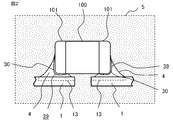
- FIG. 2 is a diagram showing a stress relaxation structure portion according to the first embodiment of the present invention.
- the power semiconductor device 50 according to the first embodiment includes a plurality of lead frames 1 molded into a wiring pattern, a switchable power semiconductor element 2, and a ceramic capacitor that relaxes voltage fluctuation due to switching of the power semiconductor element 2 (
- a chip component such as a chip resistor 100 (also referred to as a capacitor as appropriate), a chip resistor 20 (also referred to as a resistor as appropriate), a plurality of lead frames 1 on which terminals are formed, a lead frame 1 and a power semiconductor element 2
- a wiring member 3 that connects the two, a lead frame 1, a power semiconductor element 2, a mounting component such as a chip component, and a mold resin 5 that seals the wiring member 3.
- FIG. 1 an example of a power semiconductor device 50 in which three power semiconductor elements 2a, 2b and 2c are mounted and which includes five power terminals 11a, 11b, 11c, 11d and 11e and three signal terminals 12a, 12b and 12c.
- symbol of a power semiconductor element uses 2 generally, and uses 2a, 2b, 2c in the case of distinguishing and explaining.
- the reference numerals of the power terminals are generally 11, and 11a, 11b, 11c, 11d, and 11e are used when they are described separately.
- the reference numerals of the signal terminals are generally 12, and 12a, 12b, and 12c are used when they are described separately.
- the power semiconductor device 50 is fixed to an in-vehicle device through an insulating adhesive, an insulating substrate, an insulating sheet, and the like. Further, the power semiconductor device 50 may have an insulating layer on the surface facing the fixed portion of the power semiconductor device 50 and may be pressure-fixed through soldering or heat radiation grease.
- the terminals protruding to the outside of the power semiconductor device 50 are a power terminal 11 through which a large current of several A to a few tens of A flows, and a control signal terminal 12 such as a gate signal line or a sensor signal line of the power semiconductor element 2.
- the power terminal 11 is connected to a power supply device and a power source such as a battery via a relay member, and the control signal terminal 12 is connected to a control board mounted on the in-vehicle device.
- the power semiconductor device 50 is equipped with a power semiconductor element 2 such as a switchable MOS-FET or IGBT, and is switched by a signal transmitted from a gate signal line connected to the control substrate, whereby an output power terminal 11 (for example, 11a, 11b, and 11c) are controlled.
- a power semiconductor element 2 such as a switchable MOS-FET or IGBT
- the lower surface of the power semiconductor element 2 (the surface facing the lead frame 1) and the lead frame 1 are joined by a solder 4 or a conductive bonding agent such as a conductive paste.
- the electrode part formed on the chip of the power semiconductor element 2 and the lead frame 1 are wire bonds for joining aluminum or copper circular or rectangular cross-section wires by ultrasonic vibration, lead frames 1 for wiring, They are connected by a wiring member 3 such as a metal terminal.
- the mounting components such as the lead frame 1 and the ceramic capacitor 100 and the chip resistor 20 are joined with a joining agent such as solder 4.
- the ceramic capacitor 100 is a multilayer ceramic capacitor in which a dielectric portion and an electrode portion are laminated, and includes an external electrode 101 made of an external electrode layer.
- the ceramic capacitor 100 is mounted between the two lead frames 1, and the potential between the two lead frames 1 is different.
- the plurality of lead frames 1 are formed by pressing or etching, and there are steps of about several ⁇ m to several tens of ⁇ m between the lead frames 1.
- the power semiconductor element 2 and the mounting component are bonded to the lead frame 1 with a bonding agent, and the connection with the wiring member 3 is sealed with the mold resin 5.
- the heat semiconductor device 2 mounted therein is efficiently discharged to the power semiconductor device joint portion to which the power semiconductor device 50 in the in-vehicle device is joined.
- a lead frame exposed surface where the lead frame 1 is partially exposed is provided on the surface of the in-vehicle device facing the power semiconductor device joint.
- the lead frame exposed surface of the power semiconductor device 50 is formed, for example, on the surface (back surface) side on which the power semiconductor element 2 and chip components are not mounted in FIG.
- the exposed surface of the lead frame of the power semiconductor device 50 is joined to the power semiconductor device joint portion of the in-vehicle device via an insulating portion having a low thermal resistance. Thereby, the heat generated from the power semiconductor element 2 is efficiently radiated to the power semiconductor junction of the in-vehicle device and radiated from a heat sink or the like installed in the in-vehicle device.
- the power semiconductor device 50 of the present invention includes a plurality of metal lead frames 1 molded into a wiring pattern, a power semiconductor element 2 joined on the lead frame 1, and a plurality of terminals formed.
- a wiring member 3 that connects between the lead frame 1 and between the lead frame 1 and an electrode portion formed on the power semiconductor element 2, and a lower surface electrode portion and a lead formed on the lower surface of the power semiconductor element 2
- a bonding agent for bonding the frame 1, a lead frame 1, a power semiconductor element 2, a wiring member 3, and a mold resin 5 that wraps the bonding agent it is formed inside the power semiconductor device 50.
- a capacitor 100 for reducing voltage fluctuation at the time of switching of the power semiconductor element 2 is provided.
- the power semiconductor device 50 of the present invention includes a stress relaxation structure 39 between the external electrode 101 of the capacitor 100 and the capacitor mounting portion 13 of the lead frame 1 as shown in FIG.
- the temperature of the power semiconductor device 50 greatly fluctuates due to the operation of the on-vehicle equipment, the change in the installed ambient temperature, the energization of the power semiconductor element 2, and the like.
- the temperature change of the power semiconductor device 50 is large, the thermal stress generated in the capacitor 100 due to the difference in coefficient of linear expansion between the capacitor 100 and the surrounding members becomes large. Therefore, the capacitor 100 is simply mounted on the lead frame 1 and molded resin It was difficult to take a structure sealed with 5.
- the configuration of the present invention even when the power semiconductor device 50 is mounted on an in-vehicle device having a large temperature change, the capacitor 100 is mounted between the two lead frames 1 and sealed with the mold resin 5.
- a power semiconductor device 50 having a structure can be used.
- the stress relaxation structure 39 is also caused by vibration when the intermediate manufacturing body in which the capacitor 100 is bonded between the two lead frames 1 is transported on the manufacturing line.
- the production yield can be improved by relaxing the stress on the capacitor 100 and the stress on the capacitor 100 when an external force is applied during transportation, and preventing the failure.
- the external electrode 101 of the capacitor 100 and the capacitor mounting portion 13 of the lead frame 1 are joined by solder 4.
- the power semiconductor device 50 according to the present invention includes a stress relaxation structure portion 39 having rigidity lower than that of the conductive bonding agent between the solder 4 that is the conductive bonding agent of the capacitor mounting portion 13 and the external electrode 101, and a mold resin. 5 is used to wrap the surroundings.
- a stress relaxation structure portion 39 a conductive stress relaxation portion 30 that is a stress relaxation layer in which a conductive filler is blended with a low elastic modulus resin such as an epoxy resin or a silicone resin may be used.
- the stress relaxation structure 39 is made of a conductive member containing a conductive filler.
- FIG. 2 shows an example in which the stress relaxation structure portion 39 is disposed only in the vicinity of the conductive bonding agent (solder 4), the stress relaxation structure portion 39 may be disposed so as to cover the external electrode 101. In the two cases exemplified, the efficiency of the production process is improved by performing the pretreatment for adding the stress relaxation structure 39 to the external electrode 101 of the capacitor 100.
- a step of about several ⁇ m to several tens of ⁇ m occurs between the capacitor mounting portions 13 of the two lead frames 1 on which the capacitor 100 is mounted.
- the step between the two lead frames 1 has a molding pressure that reaches about 100 atm.
- the step changes so as to be small, and the capacitor 100 may crack. Accordingly, even when sealing with the mold resin 5, the stress generated in the capacitor 100 can be relieved by preferentially deforming the stress relaxation structure 39 having a lower rigidity than the conductive adhesive (solder 4). it can.
- the capacitor 100 is prevented from being cracked and to prevent the manufacturing process yield from being lowered.
- the stress relaxation structure portion 39 is subjected to stress on the capacitor 100 due to vibration, It is possible to relieve stress on the capacitor 100 when an external force is applied to the capacitor 100.
- the joint between the capacitor 100 including the stress relaxation structure 39 and the lead frame 1 is finally covered with the mold resin 5.
- the stress relaxation structure 39 relaxes the above-described stress, even if the stress relaxation structure 39 is distorted or a deformation such as a slit is formed in a part of the stress relaxation structure 39, the capacitor 100 and the lead frame 1 Is held by the mold resin 5, the capacitor fixing strength is not lowered, and the loss of function of the power semiconductor device 50 and the occurrence of functional failure can be prevented.
- the stress relaxation structure portion 39 is lower in rigidity than the solder 4 and the capacitor 100, the stress relaxation structure portion 39 is stress-relieved if it is out of specification, such as when there is a particularly large step between the two capacitor mounting portions 13. Since the structural portion 39 is destroyed and becomes an open defect, the defect can be easily found, and the cost of equipment such as an inspection apparatus can be reduced.
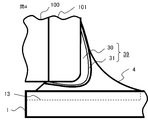
- FIG. 3 is a diagram showing a stress relaxation structure according to Embodiment 1 of the present invention.
- the stress relaxation structure 39 is composed of a mixture of a conductive filler and a resin agent.
- the rigidity of the stress relaxation structure 39 is significantly lower than the rigidity of the conductive bonding agent (solder 4) for bonding the capacitor 100 to the lead frame 1.
- the capacitor 100 and the lead frame 1 may be affected by a temperature cycle during the operation of the power semiconductor device 50, a deformation that reduces the step between the two lead frames 1 during molding, or stress during transportation.
- the stress relaxation structure 39 is positively deformed to prevent the capacitor 100 from being damaged.
- the stress relaxation structure portion 39 may be composed of a conductive stress relaxation portion 30 and a metal plating layer 31 such as Ni or Sn provided on the surface of the conductive stress relaxation portion 30.
- a metal plating layer 31 such as Ni or Sn provided on the surface of the conductive stress relaxation portion 30.
- FIG. 4 is an enlarged view of another stress relaxation structure according to the first embodiment of the present invention. By providing the metal plating layer 31 such as Ni or Sn, soldering can be facilitated as compared with the case where only the conductive stress relaxation portion 30 is provided.
- FIG. 5 is an enlarged view of still another stress relaxation structure portion according to Embodiment 1 of the present invention.
- FIG. 5 is an example in the case where there is a defect portion 40 that is a portion where a part of the solder 4 or a part of the conductive stress relaxation portion 30 is missing.
- the broken line 6 corresponds to the end portion where the solder 4 shown in FIG. 3 was present, and the broken line 35 corresponds to the end portion where the conductive stress relaxation portion 30 shown in FIG. 3 was present.
- the capacitor 100 has a non-connection portion 111 to which the stress relaxation structure portion 39 is not connected on the side of the external electrode 101 facing the lead frame 1.
- the power semiconductor device 50 according to the first embodiment is accompanied by breakage such that a slit or crack is formed in a part of the stress relaxation structure portion 39 provided between the capacitor 100 and the capacitor mounting portion 13 of the lead frame 1. Even when the deformation occurs before the molding process, the mold resin 5 is filled in the defect 40 generated in the stress relaxation structure 39 in the molding process. That is, even when the non-connection portion 111 exists, the non-connection portion 111 is covered with the mold resin 5 in the molding process. Therefore, the power semiconductor device 50 according to the first embodiment can mold the defective portion 40 even if the defective portion 40 in which the solder 4 or the conductive stress relaxation portion 30 is lost in the joint portion between the capacitor 100 and the lead frame 1 occurs. The resin 5 is filled.
- the stress generated in the capacitor 100 is relieved by deformation or partial destruction of the stress relaxation structure 39.
- the lead frame 1 and the mounting components such as the power semiconductor element 2 and the capacitor 100 are covered with the mold resin 5 in that state, that is, the stress relaxation structure 39 is deformed or partially destroyed.
- the mold resin 5 enters the (defect portion 40) is provided. Therefore, power semiconductor device 50 of the first embodiment is deformed or partially destroyed even when stress of capacitor 100 is reduced by deformation or partial destruction of stress relaxation structure 39.
- the strength for holding the capacitor 100 can be maintained by the mold resin 5 that fills the (defect portion 40).
- a plurality of lead frames 1 molded into a wiring pattern, a power semiconductor element 2 bonded on the lead frame 1, and two lead frames 1 adjacent to each other. And a capacitor 100 disposed therebetween, and is sealed with a mold resin 5.
- the capacitor 100 is characterized in that the external electrode 101 of the capacitor 100 is connected to the lead frame 1 via the stress relaxation structure portion 39 having a rigidity lower than that of the capacitor 100, and therefore has a lower rigidity than the capacitor.
- the stress relaxation structure 39 can relieve the stress generated in the capacitor 100 during operation or manufacturing, and can prevent the capacitor 100 from being broken.
- the stress relaxation structure portion 39 of the first embodiment includes the conductive stress relaxation portion 30 having a rigidity lower than that of the solder 4 and the capacitor 100, the stress generated in the capacitor during operation and manufacturing is relaxed, and the capacitor is destroyed. Can be prevented.
- the capacitor 100, the capacitor mounting portion 13 of the lead frame 1, and the stress relaxation structure portion 39 are sealed with the mold resin 5, so that the conductive stress relaxation portion 30 is deformed or partially. By destroying, the thermal stress due to the temperature cycle during molding or in the operating environment can be relaxed, and the capacitor crack can be prevented.
- the capacitor 100 and the capacitor mounting portion 13 are held by the mold resin 5, so that the energization between the lead frame 1 and the capacitor 100 is performed.
- the path or circuit configuration is not destroyed.
- the conductive stress relaxation portion 30 of the stress relaxation structure portion 39 of the first embodiment is made of a mixture of a conductive filler and a resin, the rigidity can be significantly reduced as compared with the solder 4 and the capacitor 100.
- the power semiconductor device 50 includes a structure in which the lead frame 1 and the mounting components such as the power semiconductor element 2 and the capacitor 100 are covered with the mold resin 5, the stress relaxation structure 39 is deformed or partially formed. Even when the stress of the capacitor 100 is reduced by being broken, the strength for holding the capacitor 100 can be maintained by the mold resin 5 that compensates for the deformed or partially broken portion (defect portion 40).
- the capacitor 100 for relaxing the voltage fluctuation at the time of switching of the power semiconductor element 2 is connected to the lead frame 1 with the stress relaxation structure portion 39 interposed therebetween.
- the capacitor 100 can be installed in the vicinity of 2, and the power semiconductor device 50 can be reduced in size.
- the power semiconductor device 50 according to the first embodiment can be used as a power semiconductor device that controls an armature current or a field current of an inverter-integrated rotating machine.
- the armature current is a current that flows through the armature when the stator is an armature.
- the field current is a current that flows through the field winding wound around the rotor when the rotor is an armature.
- the power semiconductor device 50 In a power semiconductor device that controls the armature current and field current of an inverter-integrated rotating machine, heat from the rotating machine is transferred to the power semiconductor device, the temperature of the power semiconductor device rises, and the stress due to the difference in linear expansion coefficient also increases. . Even in such an inverter-integrated rotating machine that operates in a harsh environment, the power semiconductor device 50 according to the first embodiment includes the stress relaxation structure portion 39. Therefore, the stress generated in the capacitor 100 is relaxed. The capacitor 100 can be prevented from being broken.
- FIG. FIG. 6 is an enlarged view of the stress relaxation structure according to the second embodiment.
- the stress relaxation structure portion 39 in the power semiconductor device 50 of the second embodiment includes an electrode connection portion 37 connected to the external electrode 101 of the capacitor 100 and an electrode non-connection portion 38 not connected to the external electrode 101.
- a portion connected to the electrode connection portion 37 of the stress relaxation structure portion 39 is referred to as a first electrode portion 102
- a portion not connected to the electrode connection portion 37 of the stress relaxation structure portion 39 is referred to as a second electrode portion 103.
- the first electrode portion 102 is a portion indicated by an arrow interval 102
- the second electrode portion 103 is a portion indicated by an arrow interval 103.
- the second electrode portion 103 is formed not on the upper side of the external electrode 101 in FIG. 6, that is, on the capacitor mounting portion 13 side, not on the upper limit portion (limit portion) to which the solder 4 is joined.
- the stress relaxation structure portion 39 of the second embodiment includes the electrode non-connecting portion 38, the second electrode portion 103 of the capacitor 100 can be prevented from being fixed to the lead frame 1.
- the stress relaxation structure portion 39 according to the second embodiment prevents the second electrode portion 103 of the capacitor 100 from being fixed to the lead frame 1, so that when the molding pressure during molding is applied, the second electrode Since the vicinity of the portion 103, that is, the electrode non-connecting portion 38 moves slightly, the stress at the time of molding acting on the capacitor 100 is reduced, and the capacitor 100 can be prevented from being broken.
- the second electrode portion 103 is made of a highly heat-resistant polyimide resin or the like that prevents the conductive stress relaxation portion 30 to be the electrode non-connecting portion 38 from being connected to the surface of the external electrode 101 and prevents the solder 4 from getting wet. It can be formed by coating.
- polyimide aluminum may be used. By applying aluminum to the surface of the external electrode 101, it is possible to prevent the conductive stress relaxation portion 30 that becomes the electrode non-connecting portion 38 from being connected and not to be wetted by solder. Such an aluminum layer can be formed on the electrode of the capacitor 100 by firing using aluminum powder.
- the first electrode portion 102 that can be connected to the electrode connecting portion 37 and can be soldered with the solder 4 is disposed on the side surface of the external electrode 101 of the capacitor 100, and the capacitor 100 is opposed to the lead frame 1.
- the configuration example in which the electrode non-connecting portion 38 can be formed on the surface and the second electrode portion 103 that cannot be soldered with the solder 4 is arranged is shown.
- the lead frame 1 may be devised in order to form the second electrode unit 103.
- the lead frame 1 in the power semiconductor device 50 according to the second embodiment has a structure in which an electrode layer that is not soldered is arranged on a part of the capacitor mounting portion 13 of the lead frame 1 facing the capacitor 100.
- a structure in which a part of the capacitor mounting portion 13 is provided with a polyimide resin layer that is not soldered may be used.
- the lead frame 1 side since the lead frame 1 side is devised, it is not necessary to dispose a polyimide resin or an aluminum layer, which is a material different from that of the external electrode 101, in a portion to be the first electrode portion 102 of the capacitor 100.
- FIG. FIG. 7 is a diagram showing a stress relaxation structure according to Embodiment 3 of the present invention.
- the power semiconductor device 50 according to the third embodiment includes a stress relaxation structure 39 made of a metal plate 32 having rigidity lower than that of the capacitor 100 main body. One end of the metal plate 32 is connected to the external electrode 101 of the capacitor 100, and the other end of the metal plate 32 is connected to the capacitor mounting portion 13 of the lead frame 1.
- the stress relaxation structure portion 39 is arranged so that the metal plate 32 is interposed between the capacitor 100 and the lead frame 1, the molding pressure applied to the capacitor 100 during the molding process, mold clamping during molding, power
- the stress generated in the capacitor 100 due to the temperature cycle or the like during the operation of the semiconductor device 50 can be reduced by the deformation of the metal plate 32. As a result, it is possible to prevent a capacitor defect due to the stress generated in the capacitor 100 and improve the yield of the manufacturing process.
- the lower the rigidity of the metal plate 32 the greater the effect of reducing the capacitor stress.
- the effect of reducing the capacitor stress increases as the length corresponding to the distance d between the capacitor 100 and the lead frame 1 increases.
- the material of the metal plate 32 is preferably an Invar material having a linear expansion coefficient close to that of the capacitor 100. Since the power semiconductor device 50 of the third embodiment includes the stress relaxation structure portion 39 made of the metal plate 32, the rigidity of the metal plate 32 is such that the capacitor 100, the stress relaxation structure 39, and the lead frame 1 are sealed with the mold resin 5. It suffices to satisfy the condition that it can withstand the manufacturing process.
- the case-type power semiconductor device has a structure in which a power semiconductor element or chip component is mounted on an insulating substrate on which wiring is patterned, and the power semiconductor element or chip component is connected by a wiring member, such as a silicone gel. Since the silicone gel is easily vibrated, the reliability cannot be satisfied even if only the metal plate 32 is applied.
- the power semiconductor device 50 according to the third embodiment includes the stress relaxation structure portion 39 made of the metal plate 32 and includes the power semiconductor element 2 mounted on the lead frame 1 and Since chip parts such as the capacitor 100 are sealed with the mold resin 5 which is less likely to vibrate than the silicone gel, reliability can be satisfied.
- the members that need to be insulated include the lead frame 1, the wiring member 3, the electrodes of the power semiconductor element 2, and the electrodes of chip components such as the external electrodes 101 of the capacitor 100.
- the sealing by transfer molding applied to the power semiconductor device 50 of the third embodiment is performed by molding at a high pressure reaching 100 atm. It is not included and the insulation distance required in order to maintain the insulation between the said members can be taken small. As a result, the power semiconductor device 50 can be downsized.
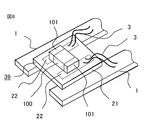
- FIG. FIG. 8 is a diagram showing a capacitor mounting structure according to the fourth embodiment of the present invention.
- the wiring pattern 22 formed on the insulating wiring substrate 21 fixed between the two lead frames 1 and the external electrode 101 of the capacitor 100 are joined to each other.
- the wiring pattern 22 formed in 21 and the lead frame 1 are electrically connected by a wiring member 3 such as another wire bond. That is, the power semiconductor device 50 according to the fourth embodiment includes the stress relaxation structure portion 39 including the wiring substrate 21 having rigidity lower than that of the lead frame 1 and the capacitor 100.
- the wiring substrate 21 is disposed between the capacitor 100 and the lead frame 1, so that the molding pressure during molding and the stress due to mold clamping caused by wiring can be reduced. Since it is alleviated by the substrate 21, it does not occur directly in the capacitor 100, and it is possible to prevent the capacitor 100 from failing.
- the wiring substrate 21 is interposed between the capacitor 100 and the lead frame 1, so that the capacitor 100 can be used even when a temperature cycle occurs during the operation of the power semiconductor device 50. And the linear expansion coefficient difference between the wiring board 21 and the wiring board 21 are reduced. For this reason, in the power semiconductor device 50 according to the fourth embodiment, the thermal stress generated in the capacitor 100 is reduced, and the capacitor 100 can be prevented from failing.
- the material of the wiring board 21 preferably has a small difference in linear expansion coefficient from the material of the lead frame 1, and for example, FR-4 (Flame Retardant-4) in which an epoxy resin is impregnated into a glass fiber cloth is preferable.
- FIG. 8 shows the case where the insulating wiring substrate 21 is used
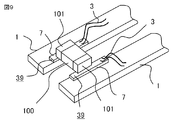
- another capacitor mounting structure using the second lead frame 7 as shown in FIG. 9 may be used.
- FIG. 9 is a diagram showing another capacitor mounting structure according to the fourth embodiment of the present invention.
- the capacitor 100 is bonded onto the second lead frame 7 that is fixed in an insulated state from the lead frame 1.
- the capacitor thermal stress due to the temperature cycle can be relaxed.
- the second lead frame 7 insulated from the wiring substrate 21 and the lead frame 1 is disposed between the capacitor 100 and the lead frame 1, so that molding at the time of molding is performed. It is possible to prevent thermal stress due to pressure and temperature cycles during operation from being transmitted directly to the capacitor 100. Therefore, the power semiconductor device 50 of the fourth embodiment relieves stress generated in the capacitor 100 during operation or manufacture by the stress relieving structure portion 39 having lower rigidity than the capacitor as in the first to third embodiments. The capacitor 100 can be prevented from being broken.
- the power semiconductor element 2 may be formed of silicon.
- a wide band gap semiconductor material having a larger band gap than silicon may be used.
- the wide band gap semiconductor material include silicon carbide, a gallium nitride-based material, and diamond.
- the power semiconductor element 2 formed of such a wide band gap semiconductor material has high voltage resistance and high allowable current density, the power semiconductor element 2 can be miniaturized. By using the element 2, it is possible to reduce the size of the power semiconductor device 50 incorporating these elements.
- SYMBOLS 1 ... Lead frame 2, 2a, 2b, 2c ... Power semiconductor element, 3 ... Wiring member, 4 ... Solder, 5 ... Mold resin, 7 ... 2nd lead frame, 21 ... Wiring board, 30 ... Conductive stress relaxation Part 32, metal plate 37, electrode connection part 38 ... electrode non-connection part 39 ... stress relaxation structure part 50 ... power semiconductor device 100 ... capacitor 101 ... external electrode 111 ... non-connection part.
Landscapes
- Engineering & Computer Science (AREA)
- Manufacturing & Machinery (AREA)
- Microelectronics & Electronic Packaging (AREA)
- Structures Or Materials For Encapsulating Or Coating Semiconductor Devices Or Solid State Devices (AREA)
- Fixed Capacitors And Capacitor Manufacturing Machines (AREA)
- Structures For Mounting Electric Components On Printed Circuit Boards (AREA)
- Power Engineering (AREA)
- Inverter Devices (AREA)
- Lead Frames For Integrated Circuits (AREA)
Abstract
Description
図1は本発明の実施の形態1によるパワー半導体装置の内部の概観模式図であり、図2は本発明の実施の形態1による応力緩和構造部を示す図である。本実施の形態1のパワー半導体装置50は、配線パターン状に成型された複数のリードフレーム1と、スイッチング可能なパワー半導体素子2と、パワー半導体素子2のスイッチングによる電圧変動を緩和させるセラミックコンデンサ(適宜、コンデンサとも称する)100と、チップ抵抗器(適宜、抵抗器とも称する)20などのチップ部品と、端子が形成される複数のリードフレーム1の間や、リードフレーム1とパワー半導体素子2との間を接続する配線部材3と、リードフレーム1、パワー半導体素子2、チップ部品等の実装部品、及び配線部材3を封止するモールド樹脂5とを備える。図1では、3つのパワー半導体素子2a、2b、2cが実装され、5つのパワー端子11a、11b、11c、11d、11eと3つの信号端子12a、12b、12cを備えるパワー半導体装置50の例を示した。なお、パワー半導体素子の符号は、総括的に2を用い、区別して説明する場合に2a、2b、2cを用いる。パワー端子の符号は、総括的に11を用い、区別して説明する場合に11a、11b、11c、11d、11eを用いる。信号端子の符号は、総括的に12を用い、区別して説明する場合に12a、12b、12cを用いる。
図6は、実施の形態2による応力緩和構造部を拡大した図である。実施の形態2のパワー半導体装置50における応力緩和構造部39は、コンデンサ100の外部電極101に接続する電極接続部37と外部電極101に接続しない電極非接続部38とを備える。外部電極101において、応力緩和構造部39の電極接続部37に接続する部分を第1電極部102とし、応力緩和構造部39の電極接続部37に接続しない部分を第2電極部103とする。図6において、第1電極部102は矢印区間102で示した部分であり、第2電極部103は矢印区間103で示した部分である。第2電極部103は、図6における外部電極101の上側、すなわち、はんだ4が接合した上限部(限界部)よりも上側ではなく、コンデンサ実装部13の側に形成される。
図7は、本発明の実施の形態3による応力緩和構造部を示す図である。実施の形態3のパワー半導体装置50は、コンデンサ100本体よりも剛性が低い金属板32からなる応力緩和構造部39を備える。金属板32の一端はコンデンサ100の外部電極101に接続され、金属板32の他の一端はリードフレーム1のコンデンサ実装部13に接続されている。この応力緩和構造部39は、コンデンサ100とリードフレーム1の間に金属板32が介在するように配置された構造なので、モールド工程の際にコンデンサ100に加わる成型圧、モールド時の型締め、パワー半導体装置50の動作時における温度サイクル等によるコンデンサ100に生じる応力を、金属板32が変形することにより緩和することができる。この結果、コンデンサ100に生じる応力に起因したコンデンサ不良を防止することができ、製造プロセスの歩留まりを向上できる。
図8は、本発明の実施の形態4によるコンデンサ実装構造を示す図である。実施の形態4のパワー半導体装置50は、2つのリードフレーム1の間に固定された絶縁性の配線基板21上に形成された配線パターン22とコンデンサ100の外部電極101とが接合され、配線基板21に形成された配線パターン22とリードフレーム1とが別のワイヤーボンドなどの配線部材3により電気的に接続される構造を備える。すなわち、実施の形態4のパワー半導体装置50は、リードフレーム1及びコンデンサ100よりも剛性が低い配線基板21からなる応力緩和構造部39を備える。このように、実施の形態4のパワー半導体装置50は、コンデンサ100とリードフレーム1の間に配線基板21を配置することにより、モールド成型時の成型圧やモールド成型による型締めによる応力が、配線基板21により緩和されるので、直接コンデンサ100に生じることがなく、コンデンサ100が故障するのを防止することがきる。
Claims (11)
- モールド樹脂で封止されたパワー半導体装置であって、
配線パターン状に成型された複数のリードフレームと、
前記リードフレーム上に接合されたパワー半導体素子と、
互いに隣接した2つの前記リードフレームの間に配置されたコンデンサとを備え、
前記コンデンサは、当該コンデンサの外部電極が、当該コンデンサよりも剛性が低い応力緩和構造部を介して前記リードフレームに接続されたことを特徴とするパワー半導体装置。 - 前記コンデンサと前記リードフレームとの接続構造は、
当該コンデンサの外部電極に接続した前記応力緩和構造部と、前記応力緩和構造部と前記リードフレームを接続するはんだとを有し、
前記応力緩和構造部は、前記はんだよりも剛性が低いことを特徴とする請求項1記載のパワー半導体装置。 - 前記応力緩和構造部は、樹脂に導電性フィラーを配合した導電性応力緩和部を有することを特徴とする請求項1または2に記載のパワー半導体装置。
- 前記コンデンサは、当該コンデンサの前記外部電極における前記リードフレームに対向する側において、前記応力緩和構造部が接続されない非接続部を有し、
前記非接続部は前記モールド樹脂により覆われたことを特徴とする請求項1乃至3のいずれか1項に記載のパワー半導体装置。 - 前記応力緩和構造部は、前記コンデンサの前記外部電極に接続する電極接続部と、前記外部電極に接続しない電極非接続部とを有することを特徴とする請求項1乃至4のいずれか1項に記載のパワー半導体装置。
- 前記応力緩和構造部は、金属板であることを特徴とする請求項1または2に記載のパワー半導体装置。
- 前記応力緩和構造部は、前記コンデンサの前記外部電極に接続する配線パターンを有する絶縁性の配線基板であることを特徴とする請求項1または2に記載のパワー半導体装置。
- 前記応力緩和構造部は、前記リードフレーム上に配置されると共に当該リードフレームと絶縁された第2のリードフレームであり、
前記第2のリードフレームは、前記コンデンサの前記外部電極に接続されると共に、配線部材により前記リードフレームに接続されたことを特徴とする請求項1または2に記載のパワー半導体装置。 - 請求項1乃至8のいずれか1項に記載のパワー半導体装置は、車載用の回転電機に設置され、前記回転電機の電機子に電流を供給することを特徴とするパワー半導体装置。
- 前記パワー半導体素子は、ワイドバンドギャップ半導体材料により形成されていることを特徴とする請求項1乃至9のいずれか1項に記載のパワー半導体装置。
- 前記ワイドバンドギャップ半導体材料は、炭化珪素、窒化ガリウム系材料、またはダイヤモンドのうちいずれかであることを特徴とする請求項10記載のパワー半導体装置。
Priority Applications (5)
| Application Number | Priority Date | Filing Date | Title |
|---|---|---|---|
| JP2014534126A JP5989124B2 (ja) | 2012-09-07 | 2012-09-07 | パワー半導体装置 |
| EP12884280.4A EP2894952B1 (en) | 2012-09-07 | 2012-09-07 | Power semiconductor device |
| CN201280075682.1A CN104604344B (zh) | 2012-09-07 | 2012-09-07 | 功率半导体装置 |
| US14/402,538 US9620444B2 (en) | 2012-09-07 | 2012-09-07 | Power semiconductor device |
| PCT/JP2012/072908 WO2014038066A1 (ja) | 2012-09-07 | 2012-09-07 | パワー半導体装置 |
Applications Claiming Priority (1)
| Application Number | Priority Date | Filing Date | Title |
|---|---|---|---|
| PCT/JP2012/072908 WO2014038066A1 (ja) | 2012-09-07 | 2012-09-07 | パワー半導体装置 |
Publications (1)
| Publication Number | Publication Date |
|---|---|
| WO2014038066A1 true WO2014038066A1 (ja) | 2014-03-13 |
Family
ID=50236714
Family Applications (1)
| Application Number | Title | Priority Date | Filing Date |
|---|---|---|---|
| PCT/JP2012/072908 Ceased WO2014038066A1 (ja) | 2012-09-07 | 2012-09-07 | パワー半導体装置 |
Country Status (5)
| Country | Link |
|---|---|
| US (1) | US9620444B2 (ja) |
| EP (1) | EP2894952B1 (ja) |
| JP (1) | JP5989124B2 (ja) |
| CN (1) | CN104604344B (ja) |
| WO (1) | WO2014038066A1 (ja) |
Cited By (15)
| Publication number | Priority date | Publication date | Assignee | Title |
|---|---|---|---|---|
| EP3012861A1 (de) * | 2014-10-21 | 2016-04-27 | Robert Bosch Gmbh | Schaltungsanordnung und leistungsmodul |
| JP2017203709A (ja) * | 2016-05-12 | 2017-11-16 | 株式会社東海理化電機製作所 | モジュール及びその製造方法 |
| JP2018032670A (ja) * | 2016-08-22 | 2018-03-01 | Koa株式会社 | チップ部品、チップ部品の実装構造、チップ抵抗器の製造方法 |
| JP2018049999A (ja) * | 2016-09-23 | 2018-03-29 | Tdk株式会社 | 電子部品及び電子部品装置 |
| JP2019047091A (ja) * | 2017-09-07 | 2019-03-22 | Tdk株式会社 | 電子部品 |
| JP2019047092A (ja) * | 2017-09-07 | 2019-03-22 | Tdk株式会社 | 電子部品 |
| JP2019050278A (ja) * | 2017-09-08 | 2019-03-28 | Tdk株式会社 | 電子部品及び電子部品装置 |
| JP2019067787A (ja) * | 2017-09-28 | 2019-04-25 | Tdk株式会社 | 電子部品 |
| JP2019083253A (ja) * | 2017-10-30 | 2019-05-30 | Tdk株式会社 | 電子部品及び電子部品装置 |
| JP2019083252A (ja) * | 2017-10-30 | 2019-05-30 | Tdk株式会社 | 電子部品 |
| JP2019083254A (ja) * | 2017-10-30 | 2019-05-30 | Tdk株式会社 | 電子部品 |
| JPWO2019132017A1 (ja) * | 2017-12-29 | 2020-12-17 | 株式会社村田製作所 | 積層セラミックコンデンサ、積層セラミックコンデンサの実装構造体および電子部品連 |
| JPWO2021019867A1 (ja) * | 2019-07-30 | 2021-02-04 | ||
| CN112863874A (zh) * | 2016-09-23 | 2021-05-28 | Tdk株式会社 | 电子部件和电子部件装置 |
| WO2022004332A1 (ja) * | 2020-07-01 | 2022-01-06 | 株式会社オートネットワーク技術研究所 | 回路構成体 |
Families Citing this family (10)
| Publication number | Priority date | Publication date | Assignee | Title |
|---|---|---|---|---|
| US9949378B2 (en) * | 2014-04-14 | 2018-04-17 | Presidio Components, Inc. | Electrical devices with solder dam |
| US9647363B2 (en) * | 2014-09-19 | 2017-05-09 | Intel Corporation | Techniques and configurations to control movement and position of surface mounted electrical devices |
| KR102029493B1 (ko) * | 2014-09-29 | 2019-10-07 | 삼성전기주식회사 | 적층 세라믹 커패시터 및 그 실장 기판 |
| US10074590B1 (en) * | 2017-07-02 | 2018-09-11 | Infineon Technologies Ag | Molded package with chip carrier comprising brazed electrically conductive layers |
| DE112019002333T5 (de) * | 2018-05-09 | 2021-01-21 | Mitsubishi Electric Corporation | Leistungshalbleitermodul, Verfahren zum Herstellen desselben und Leistungswandlungsvorrichtung |
| FR3092453A1 (fr) | 2019-01-31 | 2020-08-07 | Valeo Equipements Electriques Moteur | Module électronique de puissance, convertisseur de tension et système électrique |
| CN112448561B (zh) * | 2019-08-30 | 2022-04-15 | 台达电子企业管理(上海)有限公司 | 电源模块及电源模块的制备方法 |
| FR3117267B1 (fr) * | 2020-12-04 | 2023-03-03 | St Microelectronics Alps Sas | Puce électronique |
| US11495549B2 (en) | 2021-02-25 | 2022-11-08 | Texas Instruments Incorporated | Electronic device with crack arrest structure |
| TWI863473B (zh) * | 2023-08-01 | 2024-11-21 | 信容科技股份有限公司 | 具有內置式引線的小型化電容器 |
Citations (8)
| Publication number | Priority date | Publication date | Assignee | Title |
|---|---|---|---|---|
| JPS5972757A (ja) | 1982-10-20 | 1984-04-24 | Fujitsu Ltd | 半導体装置 |
| JPH11238963A (ja) * | 1998-02-21 | 1999-08-31 | Mitsui High Tec Inc | 電子部品の面実装方法及びその実装構造体 |
| JP2002076605A (ja) * | 2000-06-12 | 2002-03-15 | Hitachi Ltd | 半導体モジュール及び半導体装置を接続した回路基板 |
| JP2004031768A (ja) * | 2002-06-27 | 2004-01-29 | Denso Corp | 電子装置の実装方法 |
| JP2006324629A (ja) * | 2005-04-21 | 2006-11-30 | Denso Corp | 電子部品の実装構造およびその実装方法 |
| JP2009032865A (ja) * | 2007-07-26 | 2009-02-12 | Hitachi Ltd | 電子装置及び電子装置の製造方法 |
| JP2011003818A (ja) * | 2009-06-22 | 2011-01-06 | Denso Corp | モールドパッケージ |
| JP2012164796A (ja) * | 2011-02-07 | 2012-08-30 | Mitsubishi Electric Corp | パワー半導体装置 |
Family Cites Families (29)
| Publication number | Priority date | Publication date | Assignee | Title |
|---|---|---|---|---|
| JPH01276655A (ja) * | 1988-04-27 | 1989-11-07 | Japan Radio Co Ltd | トランスファーモールド型集積回路 |
| JPH03220712A (ja) * | 1990-01-25 | 1991-09-27 | Nec Corp | ワイヤボンディング構造体 |
| JPH06232332A (ja) * | 1993-02-08 | 1994-08-19 | Hitachi Ltd | 半導体装置 |
| JPH08203771A (ja) * | 1995-01-27 | 1996-08-09 | Murata Mfg Co Ltd | セラミック電子部品 |
| JPH0936298A (ja) * | 1995-07-25 | 1997-02-07 | Denso Corp | リードフレーム |
| JP2000133909A (ja) | 1998-10-22 | 2000-05-12 | Matsushita Electric Ind Co Ltd | チップコンデンサのプリント配線基板実装構造 |
| JP3376970B2 (ja) * | 1999-09-08 | 2003-02-17 | 株式会社村田製作所 | セラミック電子部品 |
| JP3376971B2 (ja) * | 1999-09-09 | 2003-02-17 | 株式会社村田製作所 | セラミック電子部品 |
| KR100398716B1 (ko) | 2000-06-12 | 2003-09-19 | 가부시키가이샤 히타치세이사쿠쇼 | 반도체 모듈 및 반도체 장치를 접속한 회로 기판 |
| JP2002057064A (ja) | 2000-08-11 | 2002-02-22 | Murata Mfg Co Ltd | 積層セラミック電子部品 |
| JP2002232110A (ja) | 2001-02-02 | 2002-08-16 | Tohoku Pioneer Corp | 積層セラミックコンデンサを実装した回路基板 |
| JP4923367B2 (ja) * | 2001-09-13 | 2012-04-25 | 株式会社デンソー | 電気素子の実装構造 |
| JP2003243595A (ja) | 2002-02-19 | 2003-08-29 | New Japan Radio Co Ltd | 受動部品内蔵型半導体装置 |
| JP4296472B2 (ja) | 2002-10-31 | 2009-07-15 | ソニー株式会社 | 情報処理装置及び電源回路 |
| JP2004179568A (ja) | 2002-11-29 | 2004-06-24 | Kyocera Corp | 積層セラミック部品の製造方法 |
| JP2004296936A (ja) * | 2003-03-27 | 2004-10-21 | Kyocera Corp | セラミック電子部品 |
| JP2006032774A (ja) * | 2004-07-20 | 2006-02-02 | Denso Corp | 電子装置 |
| US6917510B1 (en) * | 2004-10-27 | 2005-07-12 | Kemet Corporation | Extended terminal ceramic SMD |
| JP4046120B2 (ja) | 2005-01-27 | 2008-02-13 | 三菱電機株式会社 | 絶縁シートの製造方法およびパワーモジュールの製造方法 |
| JP4640214B2 (ja) * | 2006-02-28 | 2011-03-02 | 株式会社デンソー | 電子部品の接続構造 |
| CN101454852B (zh) | 2006-06-28 | 2011-03-23 | 株式会社村田制作所 | 陶瓷电子部件及其制造方法 |
| JP4803451B2 (ja) * | 2006-12-26 | 2011-10-26 | Tdk株式会社 | 電子部品及びその実装構造 |
| JP2009059888A (ja) | 2007-08-31 | 2009-03-19 | Murata Mfg Co Ltd | 積層セラミックコンデンサ |
| JP5163069B2 (ja) * | 2007-11-20 | 2013-03-13 | 株式会社デンソー | 半導体装置 |
| JP2009238923A (ja) | 2008-03-26 | 2009-10-15 | Toyota Industries Corp | 電子機器 |
| JP5099243B2 (ja) * | 2010-04-14 | 2012-12-19 | 株式会社デンソー | 半導体モジュール |
| AU2011303259B2 (en) * | 2010-09-15 | 2014-08-14 | Mitsubishi Electric Corporation | Power conversion device, motor containing same, air conditioner containing motor, and ventilation fan containing motor |
| JP5162685B2 (ja) | 2011-02-17 | 2013-03-13 | 三菱電機株式会社 | Dc/dc電圧変換装置 |
| JPWO2012114818A1 (ja) * | 2011-02-23 | 2014-07-07 | 株式会社村田製作所 | セラミック電子部品、及びセラミック電子部品の設計方法 |
-
2012
- 2012-09-07 US US14/402,538 patent/US9620444B2/en not_active Expired - Fee Related
- 2012-09-07 EP EP12884280.4A patent/EP2894952B1/en active Active
- 2012-09-07 WO PCT/JP2012/072908 patent/WO2014038066A1/ja not_active Ceased
- 2012-09-07 JP JP2014534126A patent/JP5989124B2/ja active Active
- 2012-09-07 CN CN201280075682.1A patent/CN104604344B/zh active Active
Patent Citations (8)
| Publication number | Priority date | Publication date | Assignee | Title |
|---|---|---|---|---|
| JPS5972757A (ja) | 1982-10-20 | 1984-04-24 | Fujitsu Ltd | 半導体装置 |
| JPH11238963A (ja) * | 1998-02-21 | 1999-08-31 | Mitsui High Tec Inc | 電子部品の面実装方法及びその実装構造体 |
| JP2002076605A (ja) * | 2000-06-12 | 2002-03-15 | Hitachi Ltd | 半導体モジュール及び半導体装置を接続した回路基板 |
| JP2004031768A (ja) * | 2002-06-27 | 2004-01-29 | Denso Corp | 電子装置の実装方法 |
| JP2006324629A (ja) * | 2005-04-21 | 2006-11-30 | Denso Corp | 電子部品の実装構造およびその実装方法 |
| JP2009032865A (ja) * | 2007-07-26 | 2009-02-12 | Hitachi Ltd | 電子装置及び電子装置の製造方法 |
| JP2011003818A (ja) * | 2009-06-22 | 2011-01-06 | Denso Corp | モールドパッケージ |
| JP2012164796A (ja) * | 2011-02-07 | 2012-08-30 | Mitsubishi Electric Corp | パワー半導体装置 |
Non-Patent Citations (1)
| Title |
|---|
| See also references of EP2894952A1 |
Cited By (25)
| Publication number | Priority date | Publication date | Assignee | Title |
|---|---|---|---|---|
| EP3012861A1 (de) * | 2014-10-21 | 2016-04-27 | Robert Bosch Gmbh | Schaltungsanordnung und leistungsmodul |
| JP2017203709A (ja) * | 2016-05-12 | 2017-11-16 | 株式会社東海理化電機製作所 | モジュール及びその製造方法 |
| JP2018032670A (ja) * | 2016-08-22 | 2018-03-01 | Koa株式会社 | チップ部品、チップ部品の実装構造、チップ抵抗器の製造方法 |
| US12142438B2 (en) | 2016-09-23 | 2024-11-12 | Tdk Corporation | Electronic component and electronic component device |
| JP2018049999A (ja) * | 2016-09-23 | 2018-03-29 | Tdk株式会社 | 電子部品及び電子部品装置 |
| US11264172B2 (en) | 2016-09-23 | 2022-03-01 | Tdk Corporation | Electronic component and electronic component device |
| CN112863874B (zh) * | 2016-09-23 | 2023-02-03 | Tdk株式会社 | 电子部件和电子部件装置 |
| US11594378B2 (en) | 2016-09-23 | 2023-02-28 | Tdk Corporation | Electronic component and electronic component device |
| CN112863874A (zh) * | 2016-09-23 | 2021-05-28 | Tdk株式会社 | 电子部件和电子部件装置 |
| US11763996B2 (en) | 2016-09-23 | 2023-09-19 | Tdk Corporation | Electronic component and electronic component device |
| JP2019047091A (ja) * | 2017-09-07 | 2019-03-22 | Tdk株式会社 | 電子部品 |
| JP2019047092A (ja) * | 2017-09-07 | 2019-03-22 | Tdk株式会社 | 電子部品 |
| JP2019050278A (ja) * | 2017-09-08 | 2019-03-28 | Tdk株式会社 | 電子部品及び電子部品装置 |
| JP2019067787A (ja) * | 2017-09-28 | 2019-04-25 | Tdk株式会社 | 電子部品 |
| JP7003541B2 (ja) | 2017-09-28 | 2022-01-20 | Tdk株式会社 | 電子部品及び電子部品装置 |
| JP2019083254A (ja) * | 2017-10-30 | 2019-05-30 | Tdk株式会社 | 電子部品 |
| JP2019083252A (ja) * | 2017-10-30 | 2019-05-30 | Tdk株式会社 | 電子部品 |
| JP2019083253A (ja) * | 2017-10-30 | 2019-05-30 | Tdk株式会社 | 電子部品及び電子部品装置 |
| JP7040534B2 (ja) | 2017-12-29 | 2022-03-23 | 株式会社村田製作所 | 積層セラミックコンデンサ、積層セラミックコンデンサの実装構造体および電子部品連 |
| JPWO2019132017A1 (ja) * | 2017-12-29 | 2020-12-17 | 株式会社村田製作所 | 積層セラミックコンデンサ、積層セラミックコンデンサの実装構造体および電子部品連 |
| JP7166464B2 (ja) | 2019-07-30 | 2022-11-07 | 三菱電機株式会社 | チップ部品、チップ部品の製造方法、および電子機器の製造方法 |
| JPWO2021019867A1 (ja) * | 2019-07-30 | 2021-02-04 | ||
| JP2022012428A (ja) * | 2020-07-01 | 2022-01-17 | 株式会社オートネットワーク技術研究所 | 回路構成体 |
| WO2022004332A1 (ja) * | 2020-07-01 | 2022-01-06 | 株式会社オートネットワーク技術研究所 | 回路構成体 |
| JP7528573B2 (ja) | 2020-07-01 | 2024-08-06 | 株式会社オートネットワーク技術研究所 | 回路構成体 |
Also Published As
| Publication number | Publication date |
|---|---|
| US20150287670A1 (en) | 2015-10-08 |
| JP5989124B2 (ja) | 2016-09-07 |
| CN104604344B (zh) | 2019-04-16 |
| JPWO2014038066A1 (ja) | 2016-08-08 |
| EP2894952A1 (en) | 2015-07-15 |
| US9620444B2 (en) | 2017-04-11 |
| CN104604344A (zh) | 2015-05-06 |
| EP2894952A4 (en) | 2017-01-25 |
| EP2894952B1 (en) | 2018-06-06 |
Similar Documents
| Publication | Publication Date | Title |
|---|---|---|
| JP5989124B2 (ja) | パワー半導体装置 | |
| US9171773B2 (en) | Semiconductor device | |
| CN109727960B (zh) | 半导体模块、其制造方法以及电力变换装置 | |
| JP6945418B2 (ja) | 半導体装置および半導体装置の製造方法 | |
| US9572291B2 (en) | Semiconductor device and method for manufacturing same | |
| EP4203010B1 (en) | Power module, converter, and electronic device | |
| CN104637832B (zh) | 半导体装置及其制造方法 | |
| CN112074954B (zh) | 功率半导体模块及其制造方法以及电力变换装置 | |
| US12218018B2 (en) | Semiconductor encapsulant strength enhancer | |
| JP2011119489A (ja) | 半導体パッケージおよびその製造方法 | |
| CN110880488B (zh) | 半导体装置及电力转换装置 | |
| CN109997221A (zh) | 半导体装置、控制装置以及半导体装置的制造方法 | |
| JP2016197677A (ja) | パワー半導体装置および車載用回転電機の駆動装置 | |
| CN108735614B (zh) | 半导体装置及半导体装置的制造方法 | |
| CN117438386A (zh) | 半导体装置、半导体装置的制造方法及电力转换装置 | |
| JP6870249B2 (ja) | 半導体装置および半導体装置の製造方法 | |
| CN111276448B (zh) | 半导体装置及电力转换装置 | |
| KR102371636B1 (ko) | 양면 기판 반도체 제조 방법 | |
| JP2013135161A (ja) | 半導体装置およびその製造方法 | |
| JP2013157398A (ja) | 半導体装置およびその製造方法 | |
| JP2004048084A (ja) | 半導体パワーモジュール | |
| JP4861200B2 (ja) | パワーモジュール | |
| WO2013157172A1 (ja) | 半導体パッケージ及びその製造方法、半導体モジュール、並びに半導体装置 | |
| WO2017086248A1 (ja) | 電力用半導体装置および電力用半導体装置の製造方法 | |
| JP2021077661A (ja) | 半導体パワーモジュール |
Legal Events
| Date | Code | Title | Description |
|---|---|---|---|
| 121 | Ep: the epo has been informed by wipo that ep was designated in this application |
Ref document number: 12884280 Country of ref document: EP Kind code of ref document: A1 |
|
| ENP | Entry into the national phase |
Ref document number: 2014534126 Country of ref document: JP Kind code of ref document: A |
|
| WWE | Wipo information: entry into national phase |
Ref document number: 14402538 Country of ref document: US |
|
| WWE | Wipo information: entry into national phase |
Ref document number: 2012884280 Country of ref document: EP |
|
| NENP | Non-entry into the national phase |
Ref country code: DE |