WO2014046062A1 - Composition de résine photosensible - Google Patents
Composition de résine photosensible Download PDFInfo
- Publication number
- WO2014046062A1 WO2014046062A1 PCT/JP2013/074930 JP2013074930W WO2014046062A1 WO 2014046062 A1 WO2014046062 A1 WO 2014046062A1 JP 2013074930 W JP2013074930 W JP 2013074930W WO 2014046062 A1 WO2014046062 A1 WO 2014046062A1
- Authority
- WO
- WIPO (PCT)
- Prior art keywords
- group
- photosensitive resin
- integer
- resin composition
- general formula
- Prior art date
- Legal status (The legal status is an assumption and is not a legal conclusion. Google has not performed a legal analysis and makes no representation as to the accuracy of the status listed.)
- Ceased
Links
- 0 CC*(C)c(cc1)ccc1C(Nc1cc(IC(C(CC2)=CC=C2[O+])=O)c(*)cc1O)=O Chemical compound CC*(C)c(cc1)ccc1C(Nc1cc(IC(C(CC2)=CC=C2[O+])=O)c(*)cc1O)=O 0.000 description 2
Images

Classifications
-
- C—CHEMISTRY; METALLURGY
- C08—ORGANIC MACROMOLECULAR COMPOUNDS; THEIR PREPARATION OR CHEMICAL WORKING-UP; COMPOSITIONS BASED THEREON
- C08G—MACROMOLECULAR COMPOUNDS OBTAINED OTHERWISE THAN BY REACTIONS ONLY INVOLVING UNSATURATED CARBON-TO-CARBON BONDS
- C08G8/00—Condensation polymers of aldehydes or ketones with phenols only
- C08G8/04—Condensation polymers of aldehydes or ketones with phenols only of aldehydes
- C08G8/08—Condensation polymers of aldehydes or ketones with phenols only of aldehydes of formaldehyde, e.g. of formaldehyde formed in situ
- C08G8/20—Condensation polymers of aldehydes or ketones with phenols only of aldehydes of formaldehyde, e.g. of formaldehyde formed in situ with polyhydric phenols
-
- G—PHYSICS
- G03—PHOTOGRAPHY; CINEMATOGRAPHY; ANALOGOUS TECHNIQUES USING WAVES OTHER THAN OPTICAL WAVES; ELECTROGRAPHY; HOLOGRAPHY
- G03F—PHOTOMECHANICAL PRODUCTION OF TEXTURED OR PATTERNED SURFACES, e.g. FOR PRINTING, FOR PROCESSING OF SEMICONDUCTOR DEVICES; MATERIALS THEREFOR; ORIGINALS THEREFOR; APPARATUS SPECIALLY ADAPTED THEREFOR
- G03F7/00—Photomechanical, e.g. photolithographic, production of textured or patterned surfaces, e.g. printing surfaces; Materials therefor, e.g. comprising photoresists; Apparatus specially adapted therefor
- G03F7/004—Photosensitive materials
- G03F7/022—Quinonediazides
- G03F7/023—Macromolecular quinonediazides; Macromolecular additives, e.g. binders
-
- C—CHEMISTRY; METALLURGY
- C08—ORGANIC MACROMOLECULAR COMPOUNDS; THEIR PREPARATION OR CHEMICAL WORKING-UP; COMPOSITIONS BASED THEREON
- C08G—MACROMOLECULAR COMPOUNDS OBTAINED OTHERWISE THAN BY REACTIONS ONLY INVOLVING UNSATURATED CARBON-TO-CARBON BONDS
- C08G69/00—Macromolecular compounds obtained by reactions forming a carboxylic amide link in the main chain of the macromolecule
- C08G69/02—Polyamides derived from amino-carboxylic acids or from polyamines and polycarboxylic acids
- C08G69/26—Polyamides derived from amino-carboxylic acids or from polyamines and polycarboxylic acids derived from polyamines and polycarboxylic acids
-
- C—CHEMISTRY; METALLURGY
- C08—ORGANIC MACROMOLECULAR COMPOUNDS; THEIR PREPARATION OR CHEMICAL WORKING-UP; COMPOSITIONS BASED THEREON
- C08G—MACROMOLECULAR COMPOUNDS OBTAINED OTHERWISE THAN BY REACTIONS ONLY INVOLVING UNSATURATED CARBON-TO-CARBON BONDS
- C08G73/00—Macromolecular compounds obtained by reactions forming a linkage containing nitrogen with or without oxygen or carbon in the main chain of the macromolecule, not provided for in groups C08G12/00 - C08G71/00
- C08G73/06—Polycondensates having nitrogen-containing heterocyclic rings in the main chain of the macromolecule
- C08G73/22—Polybenzoxazoles
-
- C—CHEMISTRY; METALLURGY
- C08—ORGANIC MACROMOLECULAR COMPOUNDS; THEIR PREPARATION OR CHEMICAL WORKING-UP; COMPOSITIONS BASED THEREON
- C08G—MACROMOLECULAR COMPOUNDS OBTAINED OTHERWISE THAN BY REACTIONS ONLY INVOLVING UNSATURATED CARBON-TO-CARBON BONDS
- C08G8/00—Condensation polymers of aldehydes or ketones with phenols only
- C08G8/04—Condensation polymers of aldehydes or ketones with phenols only of aldehydes
- C08G8/08—Condensation polymers of aldehydes or ketones with phenols only of aldehydes of formaldehyde, e.g. of formaldehyde formed in situ
- C08G8/12—Condensation polymers of aldehydes or ketones with phenols only of aldehydes of formaldehyde, e.g. of formaldehyde formed in situ with monohydric phenols having only one hydrocarbon substituent ortho on para to the OH group, e.g. p-tert.-butyl phenol
-
- C—CHEMISTRY; METALLURGY
- C08—ORGANIC MACROMOLECULAR COMPOUNDS; THEIR PREPARATION OR CHEMICAL WORKING-UP; COMPOSITIONS BASED THEREON
- C08G—MACROMOLECULAR COMPOUNDS OBTAINED OTHERWISE THAN BY REACTIONS ONLY INVOLVING UNSATURATED CARBON-TO-CARBON BONDS
- C08G8/00—Condensation polymers of aldehydes or ketones with phenols only
- C08G8/04—Condensation polymers of aldehydes or ketones with phenols only of aldehydes
- C08G8/08—Condensation polymers of aldehydes or ketones with phenols only of aldehydes of formaldehyde, e.g. of formaldehyde formed in situ
- C08G8/20—Condensation polymers of aldehydes or ketones with phenols only of aldehydes of formaldehyde, e.g. of formaldehyde formed in situ with polyhydric phenols
- C08G8/22—Resorcinol
-
- C—CHEMISTRY; METALLURGY
- C08—ORGANIC MACROMOLECULAR COMPOUNDS; THEIR PREPARATION OR CHEMICAL WORKING-UP; COMPOSITIONS BASED THEREON
- C08G—MACROMOLECULAR COMPOUNDS OBTAINED OTHERWISE THAN BY REACTIONS ONLY INVOLVING UNSATURATED CARBON-TO-CARBON BONDS
- C08G8/00—Condensation polymers of aldehydes or ketones with phenols only
- C08G8/04—Condensation polymers of aldehydes or ketones with phenols only of aldehydes
- C08G8/08—Condensation polymers of aldehydes or ketones with phenols only of aldehydes of formaldehyde, e.g. of formaldehyde formed in situ
- C08G8/24—Condensation polymers of aldehydes or ketones with phenols only of aldehydes of formaldehyde, e.g. of formaldehyde formed in situ with mixtures of two or more phenols which are not covered by only one of the groups C08G8/10 - C08G8/20
-
- C—CHEMISTRY; METALLURGY
- C09—DYES; PAINTS; POLISHES; NATURAL RESINS; ADHESIVES; COMPOSITIONS NOT OTHERWISE PROVIDED FOR; APPLICATIONS OF MATERIALS NOT OTHERWISE PROVIDED FOR
- C09D—COATING COMPOSITIONS, e.g. PAINTS, VARNISHES OR LACQUERS; FILLING PASTES; CHEMICAL PAINT OR INK REMOVERS; INKS; CORRECTING FLUIDS; WOODSTAINS; PASTES OR SOLIDS FOR COLOURING OR PRINTING; USE OF MATERIALS THEREFOR
- C09D179/00—Coating compositions based on macromolecular compounds obtained by reactions forming in the main chain of the macromolecule a linkage containing nitrogen, with or without oxygen, or carbon only, not provided for in groups C09D161/00 - C09D177/00
- C09D179/04—Polycondensates having nitrogen-containing heterocyclic rings in the main chain; Polyhydrazides; Polyamide acids or similar polyimide precursors
-
- C—CHEMISTRY; METALLURGY
- C09—DYES; PAINTS; POLISHES; NATURAL RESINS; ADHESIVES; COMPOSITIONS NOT OTHERWISE PROVIDED FOR; APPLICATIONS OF MATERIALS NOT OTHERWISE PROVIDED FOR
- C09D—COATING COMPOSITIONS, e.g. PAINTS, VARNISHES OR LACQUERS; FILLING PASTES; CHEMICAL PAINT OR INK REMOVERS; INKS; CORRECTING FLUIDS; WOODSTAINS; PASTES OR SOLIDS FOR COLOURING OR PRINTING; USE OF MATERIALS THEREFOR
- C09D179/00—Coating compositions based on macromolecular compounds obtained by reactions forming in the main chain of the macromolecule a linkage containing nitrogen, with or without oxygen, or carbon only, not provided for in groups C09D161/00 - C09D177/00
- C09D179/04—Polycondensates having nitrogen-containing heterocyclic rings in the main chain; Polyhydrazides; Polyamide acids or similar polyimide precursors
- C09D179/08—Polyimides; Polyester-imides; Polyamide-imides; Polyamide acids or similar polyimide precursors
-
- G—PHYSICS
- G03—PHOTOGRAPHY; CINEMATOGRAPHY; ANALOGOUS TECHNIQUES USING WAVES OTHER THAN OPTICAL WAVES; ELECTROGRAPHY; HOLOGRAPHY
- G03F—PHOTOMECHANICAL PRODUCTION OF TEXTURED OR PATTERNED SURFACES, e.g. FOR PRINTING, FOR PROCESSING OF SEMICONDUCTOR DEVICES; MATERIALS THEREFOR; ORIGINALS THEREFOR; APPARATUS SPECIALLY ADAPTED THEREFOR
- G03F7/00—Photomechanical, e.g. photolithographic, production of textured or patterned surfaces, e.g. printing surfaces; Materials therefor, e.g. comprising photoresists; Apparatus specially adapted therefor
- G03F7/004—Photosensitive materials
- G03F7/022—Quinonediazides
- G03F7/023—Macromolecular quinonediazides; Macromolecular additives, e.g. binders
- G03F7/0233—Macromolecular quinonediazides; Macromolecular additives, e.g. binders characterised by the polymeric binders or the macromolecular additives other than the macromolecular quinonediazides
-
- G—PHYSICS
- G03—PHOTOGRAPHY; CINEMATOGRAPHY; ANALOGOUS TECHNIQUES USING WAVES OTHER THAN OPTICAL WAVES; ELECTROGRAPHY; HOLOGRAPHY
- G03F—PHOTOMECHANICAL PRODUCTION OF TEXTURED OR PATTERNED SURFACES, e.g. FOR PRINTING, FOR PROCESSING OF SEMICONDUCTOR DEVICES; MATERIALS THEREFOR; ORIGINALS THEREFOR; APPARATUS SPECIALLY ADAPTED THEREFOR
- G03F7/00—Photomechanical, e.g. photolithographic, production of textured or patterned surfaces, e.g. printing surfaces; Materials therefor, e.g. comprising photoresists; Apparatus specially adapted therefor
- G03F7/26—Processing photosensitive materials; Apparatus therefor
- G03F7/40—Treatment after imagewise removal, e.g. baking
Definitions
- the present invention relates to, for example, an insulating material for electronic parts and a photosensitive resin composition used for forming a relief pattern such as a passivation film, a buffer coat film, and an interlayer insulating film in a semiconductor device.
- polyimide resins, polybenzoxazole resins, and the like that have excellent heat resistance, electrical properties, mechanical properties, and the like have been widely used for surface protective films and interlayer insulating films used in semiconductor devices. Since these resins have low solubility in various solvents, they are generally often provided as a composition dissolved in a solvent in the form of a precursor.
- this photosensitive resin composition is that the naphthoquinonediazide compound (that is, the photosensitive diazoquinone compound) and the polybenzoxazole (PBO) precursor in the unexposed area are exposed to light with a low dissolution rate in an alkaline aqueous solution.
- the photosensitive diazoquinone compound is chemically changed to an indenecarboxylic acid compound to increase the dissolution rate of the exposed portion in the alkaline aqueous solution.
- the above-described composition can form a positive relief pattern by exposure and development with an alkaline aqueous solution. Further, it has thermosetting film characteristics by heating.
- a system in which a phenol resin is added to a heat-resistant resin precursor is disclosed as a technique for increasing the residual film and increasing sensitivity during development.
- a photosensitive resin composition (Patent Document 1) containing a polyamic acid silyl ester, a diazonaphthoquinone sulfonic acid ester and a phenol novolac resin, a hydroxy polyamide resin, a photosensitive diazonaphthoquinone compound and a specific phenol resin
- Patent Document 3 containing a hydroxy polyamide resin having a specific structure, a quinonediazide compound, a novolac resin and / or polyhydroxystyrene.
- Patent Document 4 a photosensitive resin composition in which a polyamide resin having a phenolic hydroxyl group contains a phenol resin, a photosensitive diazoquinone compound, a polyfunctional methylol compound, and a solvent.
- Patent Document 5 a photosensitive resin composition (Patent Document 5) using a hydroxypolyamide having at least one ester or thioester structure in the polymer main skeleton is described as a technique for increasing the residual film and increasing the sensitivity.
- an object of the present invention is to provide a photosensitive resin composition having a high development residual film ratio and high sensitivity, and a uniform surface after development.
- the present inventor has found that the above problems can be solved by using a combination of a hydroxypolyamide derivative and a phenol resin having a specific structure. Invented the invention. That is, the present invention is as follows.
- R 9 and R 10 each independently represents a monovalent organic group having 1 to 10 carbon atoms, l is 2 or 3, p is an integer of 1 to 3, o and q Are each independently an integer of 0 to 2, satisfying 2 ⁇ (l + o) ⁇ 4, 1 ⁇ (p + q) ⁇ 4, m3 is a positive integer, and m4 is 0 or a positive integer .
- R 11 and R 12 each independently represents a monovalent organic group having 1 to 10 carbon atoms, r and u are each independently an integer of 1 to 3, and s and v are Each independently an integer from 0 to 2, satisfying 1 ⁇ (r + s) ⁇ 4, 1 ⁇ (u + v) ⁇ 4, m5 is 0 or a positive integer, and m6 is a positive integer, m11 is a positive integer, and P 1 is a monovalent hydrocarbon group having 1 to 20 carbon atoms which may be substituted with a hydroxyl group, a carboxy
- each R 13 independently represents a monovalent organic group having 1 to 10 carbon atoms
- w is an integer of 1 to 3
- x is an integer of 0 to 2
- m7 is a positive integer
- m8 is 0 or a positive integer
- Y is the following formula group (5 ′):
- P 4 and P 5 are each independently a hydrogen atom, a monovalent aliphatic group which may be substituted with fluorine having 1 to 20 carbon atoms, or substituted or unsubstituted 1 having 6 to 20 carbon atoms.
- the phenol resin is represented by the following general formula (4 ′) (Wherein R 11 and R 12 each independently represents a monovalent organic group having 1 to 10 carbon atoms, r, t and u are each independently an integer of 1 to 3; v is each independently an integer of 0 to 2, satisfies 1 ⁇ (r + s) ⁇ 4, 1 ⁇ (u + v) ⁇ 4, m5 is 0 or a positive integer, and m6 is a positive integer is there.)
- the phenol resin is a structure represented by at least one selected from the group consisting of the general formula group (5), and the Y is represented by the following general formula (5 ′′): (P 4 and P 5 are the same as defined in the formula group (5 ).
- R 1 or R 2 in the general formula (1) is represented by the following general formula (6): (Wherein R 18 , R 19 and R 20 each independently represents a divalent organic group having 2 to 60 carbon atoms, and at least one of R 18 , R 19 and R 20 is alicyclic.
- the positive photosensitive resin composition according to any one of the above [1] to [4], which has a structure represented by: [6] R 3 or R 4 in the general formula (1) is represented by the following general formula (7): (In the formula, R 21 represents a monovalent organic group having 1 to 19 carbon atoms.)
- the positive photosensitive resin composition according to any one of the above [1] to [5], which has a structure represented by: [7] (A) forming a photosensitive resin layer composed of the photosensitive resin composition according to any one of [1] to [6] above on a substrate; (B) a step of exposing the photosensitive resin layer; (C) removing the exposed portion with a developer to obtain a relief pattern; and (D) heating the relief pattern.
- a semiconductor device comprising a semiconductor element and a cured film provided on the semiconductor element, wherein the cured film is the cured relief pattern according to the above [8].
- a display device comprising a display element and a cured film provided on the display element, wherein the cured film is the cured relief pattern according to the above [8].
- a cured film containing at least one resin selected from the group consisting of polyimide and polybenzoxazole and a phenol resin The cured film has the following conditions: Plasma type: Microwave Processing gas: O 2 Treatment time: A cured film having an arithmetic average surface roughness of 0.5 to 5.0 nm as measured using an atomic force microscope (AFM) after a dry etching treatment of 60 seconds.
- AFM atomic force microscope
- a photosensitive resin composition having a high development residual film ratio and high sensitivity, which can prevent whitening after development and has a uniform surface.
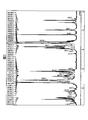
- FIG. 10 is a diagram showing 13 C-NMR results of a hydroxypolyamide resin (P-2) obtained in Synthesis Example 6.
- FIG. 10 is a diagram showing a 1 H-NMR result of a phenol resin (N-1) obtained in Synthesis Example 8.
- the photosensitive resin composition has (a) general formula (1): (Wherein R 1 and R 2 each independently represents a divalent to octavalent organic group having 2 to 60 carbon atoms, and R 3 , R 4 , R 5 and R 6 are each independently hydrogen.
- B a quinonediazide compound (hereinafter also referred to as a quinonediazide compound (b)),
- c a phenol resin (hereinafter referred to as a polymer).
- Phenol resin also referred to as (c)
- the main component means more than 50% by mass.
- the polymer (a) in the present invention is a polymer mainly composed of a structural unit having a repeating number n in the general formula (1) (also referred to as a structural unit represented by the general formula (1) in the present disclosure). Or it can become a polymer which has an imide ring, an oxazole ring, etc. with a suitable catalyst.
- the polymer (a) preferably includes a polyamic acid, a polyamic acid ester of a polyimide precursor, and a polyhydroxyamide of a polybenzoxazole precursor.
- the structural unit represented by the general formula (1) may be one type or two or more types.
- the arrangement of the structural units may be a block or random, and the repeat number n is the total number of repeats of the two or more types of structural units.
- the polymer having the structural unit represented by the general formula (1) as a main component is produced from dicarboxylic acid, tricarboxylic acid, tetracarboxylic acid and derivatives thereof and bis (aminophenol), and has a phenol group at the ortho position of the amide bond.
- the repeating unit represented by the general formula (1) includes, for example, a dicarboxylic acid having a structure of R 1 (OR 3 ) d (COOR 5 ) f (COOH) 2 and R 2 (NH 2 ) 2 (OR 4 ) e. (COOR 6 ) It can be obtained by polycondensation with a diamine having a g structure.
- n is not limited as long as it is a positive integer, but is preferably in the range of 1 to 1000, more preferably in the range of 3 to 50, and in the range of 3 to 30 from the viewpoint of developability. Most preferred.
- the diamine having the R 2 (NH 2 ) 2 (OR 4 ) e (COOR 6 ) g structure will be described.
- R 4 is a hydrogen atom and e is 2, for example, 3,3′-dihydroxybenzidine, 3,3′-diamino-4,4′-dihydroxybiphenyl, 4,4 '-Diamino-3,3'-dihydroxybiphenyl, 3,3'-diamino-4,4'-dihydroxydiphenylsulfone, 4,4'-diamino-3,3'-dihydroxydiphenylsulfone, bis- (3-amino -4-hydroxyphenyl) methane, 2,2-bis- (3-amino-4-hydroxyphenyl) propane, 2,2-bis- (3-amino-4-hydroxyphenyl) hexafluoropropane, 2,2- Bis- (4-amino-3-hydroxyphenyl) hexafluor
- those particularly preferable from the viewpoints of solubility in an alkali developer and heat resistance are compounds in which R 2 is a tetravalent organic group selected from the above formula group.
- the meta position may be an amino group
- the para position may be a hydroxyl group
- the meta position may be a hydroxyl group
- the para position may be an amino group.
- a hydroxyl group is preferable at the para position.
- diamine having the R 2 (NH 2 ) 2 (OR 4 ) e (COOR 6 ) g structure the following structure: (Wherein X 3 is a tetravalent organic group having 2 to 60 carbon atoms.) It is also possible to use two pairs of diamines having an amide bond in the ortho position and a phenolic hydroxyl group (hereinafter referred to as “diamine having a PBO precursor structure in the molecule”).
- X 3 is not limited as long as it is a tetravalent organic group having 2 to 60 carbon atoms, but is exemplified as a preferred organic group represented by R 2 described above from the viewpoint of solubility in an alkali developer and heat resistance. A structure is preferred.
- diamine having a PBO precursor structure in the molecule include the following structures.
- Y 3 in the above structure is not limited as long as it is a divalent organic group having 2 to 60 carbon atoms, but from the viewpoint of solubility in an alkali developer and heat resistance, examples of the organic group represented by R 1 will be described later. Preferably at least one of the listed organic groups.
- the above compound can be obtained, for example, by reacting a dicarboxylic acid dichloride compound with two molecules of nitroaminophenol and reducing the nitro group to an amino group.
- PI precursor structure in the molecule a compound having two polyimide precursor structures in the molecule (hereinafter referred to as “PI precursor structure in the molecule”).
- PI precursor structure in the molecule a compound having two polyimide precursor structures in the molecule.
- Examples of such compounds include the following structures: (Wherein Y 4 represents a tetravalent organic group having 4 to 60 carbon atoms, and R 6 represents a monovalent hydrocarbon group having 1 to 20 carbon atoms.) The compound which has is mentioned.
- R 6 represents hydrogen or a monovalent hydrocarbon group having 1 to 20 carbon atoms.
- a method for producing a bisaminophenol having a PI precursor structure in the molecule for example, a tetracarboxylic dianhydride and a dicarboxylic acid ring-opened with a monoalcohol or a monoamine, a hydroxyl group and a nitro
- a method for producing a bisaminophenol having a PI precursor structure in the molecule for example, a tetracarboxylic dianhydride and a dicarboxylic acid ring-opened with a monoalcohol or a monoamine, a hydroxyl group and a nitro
- An example is a method in which two molecules of aniline having a group are condensed and then the nitro group is reduced.
- a diamine having a raw material R 2 (NH 2 ) 2 (OR 4 ) e (COOR 6 ) g structure a diamine in which both e and g are 0 will be described.
- Such a diamine is advantageous in the case of adjusting the solubility in an alkali developer.
- these diamine compounds include aromatic diamines. Aromatic diamines are advantageous from the viewpoint of heat resistance.
- aromatic diamine examples include m-phenylenediamine, p-phenylenediamine, 2,4-tolylenediamine, 3,3′-diaminodiphenyl ether, 3,4′-diaminodiphenyl ether, 4,4′-diaminodiphenyl ether, 3,3'-diaminodiphenylsulfone, 4,4'-diaminodiphenylsulfone, 3,4'-diaminodiphenylsulfone, 3,3'-diaminodiphenylmethane, 4,4'-diaminodiphenylmethane, 3,4'-diaminodiphenylmethane 4,4'-diaminodiphenyl sulfide, 3,3'-diaminodiphenyl ketone, 4,4'-diaminodiphenyl ketone, 3,4'-diaminodiphenyl
- the hydrogen atom of the aromatic nucleus of the aromatic diamine may be substituted with a chlorine atom, a fluorine atom, a bromine atom, a methyl group, a methoxy group, a cyano group, a phenyl group, or the like.
- Silicon diamine can also be selected as part or all of the diamine.
- silicon diamines include bis (4-aminophenyl) dimethylsilane, bis (4-aminophenyl) tetramethylsiloxane, bis (4-aminophenyl) tetramethyldisiloxane, bis ( ⁇ -aminopropyl) tetramethyldi Examples thereof include siloxane, 1,4-bis ( ⁇ -aminopropyldimethylsilyl) benzene, bis (4-aminobutyl) tetramethyldisiloxane, bis ( ⁇ -aminopropyl) tetraphenyldisiloxane, and the like.
- Such a dicarboxylic acid is advantageous in the case of adjusting the solubility in an alkali developer.
- a 1 is selected from the group consisting of —CH 2 —, —O—, —S—, —SO 2 —, —CO—, —NHCO—, —C (CF 3 ) 2 —, and a single bond.
- Each of k L 1 bonded to a ring carbon is independently composed of a hydrogen atom, a halogen atom, a hydrocarbon group, an amide group, a urea group, an imide group, and a urethane group.
- a group selected from the group and k 4).
- n 10 is an integer from 1 to 12
- L 2 , L 3 and L 4 each independently represent a hydrogen atom or a methyl group
- L 5 represents a hydrogen atom, a methyl group or a hydroxyl group).
- a typical compound as a dicarboxylic acid having a tricyclodecane skeleton includes bis (carboxy) tricyclo [5,2,1,02,6] decane.
- a production example of the compound a synthesis example of International Publication No. 2009/081950 pamphlet can be exemplified.
- tetracarboxylic dianhydride is replaced with monoalcohol or monoamine, etc. Ring-opened dicarboxylic acids can also be used.
- monoalcohol include methanol, ethanol, propanol, isopropanol, butanol, t-butanol, benzyl alcohol, and the like.
- monoamines include butylamine and aniline.
- tetracarboxylic dianhydride include compounds represented by the following chemical formula.
- B is selected from the group consisting of —CH 2 —, —O—, —S—, —SO 2 —, —CO—, —NHCO—, —C (CF 3 ) 2 —, and —COO—. Indicates the divalent group selected.
- tetracarboxylic dianhydride can be reacted with bisaminophenol or diamine, and the resulting carboxylic acid residue can be esterified or amidated with a monoalcohol or monoamine.
- a dicarboxylic acid having an amide bond at the ortho position and a phenolic hydroxyl group can also be used. Examples of such a dicarboxylic acid include compounds represented by the following formula. Wherein X 5 represents a trivalent or tetravalent organic group having at least 2 carbon atoms, R 5 represents a monovalent hydrocarbon group having 1 to 20 carbon atoms, and n 11 Is an integer of 1 or 2.
- Examples of the method for producing the compound represented by the above formula include the structure of bis (aminophenol) or R 2 (NH 2 ) 2 (OH) having the structure of R 2 (NH 2 ) 2 (OH) 2 described above.
- An example is a method in which two molecules of trimellitic acid chloride are reacted with diaminophenol having an acid, and an acid anhydride and an alcohol are further reacted.
- diacid chloride is obtained using dicarboxylic acid and thionyl chloride, and then bisamino Examples thereof include a method in which phenol (diamine) is allowed to act or a method in which dicarboxylic acid and bisaminophenol (diamine) are polycondensed with dicyclohexylcarbodiimide. In the method using dicyclohexylcarbodiimide, hydroxybenztriazole can be allowed to act simultaneously.
- R 1 and / or R 2 in the general formula (1) preferably has a structure having an ester bond.
- the polymer R 1 and / or R 2 of the polymer mainly composed of the structural unit represented by the general formula (1) according to the present embodiment has an ester structure, so that it is compatible with the phenol resin (c) described later. And has a specific effect that the surface condition after development is particularly good. The reason for this is not clear, but the inventor presumes the following reason.
- the polymer having the structural unit represented by the general formula (1) as a main component has an amide bond, and the bond between the amide and the amide is strong due to the polarity of the amide, and it is easy to associate between the polymers. Compatibility is difficult to increase.
- the ester and the phenol resin are close in polarity, and the amide bond ratio is relatively reduced, so that the compatibility between the polymer (a) and the phenol resin (c) is increased.
- ester structure a structure represented by the following general formula (6) and the following structure: (In the formula, Ar 1 and Ar 2 each independently represent an aromatic group) Is mentioned.
- R 1 or R 2 in the general formula (1) has a structure represented by the following general formula (6).
- R 18 , R 19 and R 20 each independently represents a divalent organic group having 2 to 60 carbon atoms, and at least one of R 18 , R 19 and R 20 is alicyclic. Having a structure or an aliphatic structure, and m is 0 or 1.
- the structure represented by the general formula (6) includes, for example, ( ⁇ ) a hydroxyl group-containing compound having the structure of R 18 in the general formula (6), ( ⁇ ) R 19 in the general formula (6), and It can be obtained by reacting at least one carboxylic acid compound selected from the group consisting of polyvalent carboxylic acids having the structure of R 20 and derivatives thereof.
- R 18 is a residue derived from a divalent phenol compound or an alcohol compound.
- the hydroxyl group-containing compound having the structure of R 18 include a phenol compound and an alcohol compound.
- Specific examples of the divalent phenol compound include hydroquinone, resorcinol, 4,4′-dihydroxybiphenyl, 2,2′-dihydroxybiphenyl, 4,4′-dihydroxydiphenylmethane, 4,4′-methylenebis (2-methylphenol).
- a phenol compound containing a functional group can be used as the phenol compound.
- the functional group include an amide group, an imide group, a urea group, a urethane group, and an ether group.
- divalent alcohol compound examples include ethylene glycol, propylene glycol, 1,4-butanediol, 1,5-pentanediol, 1,6-hexanediol, 1,7-heptanediol, and 1,8-octane.
- an alcohol compound containing a functional group can be used in the same manner as the phenol compound.
- the functional group include an amide group, an imide group, a urea group, a urethane group, and an ether group.
- R 1 and / or R 2 has an ester bond
- R 1 or R 2 is the general formula (6).
- it is advantageous also from a viewpoint of i-line permeability.
- R 18 , R 19, and R 20 has an alicyclic structure or an aliphatic structure, particularly from the viewpoint of i-line permeability and high sensitivity.
- aliphatic means chain aliphatic unless otherwise specified.
- R 18 in the general formula (6) is aromatic, and R 19 and R 20 are both alicyclic structures or aliphatic structures (that is, R 19 and R 20 are aromatic structures). Is preferred). In this case, it is advantageous from the viewpoint of further i-line transmittance and higher sensitivity.
- R 18 preferably has 2 to 30 carbon atoms, and R 19 and R 20 each preferably have 2 to 15 carbon atoms.
- R 18 , R 19, and R 20 include at least one group selected from the group consisting of hydrocarbon groups, ether groups, amide groups, imide groups, urea groups, urethane groups, sulfonyl groups, and fluorine-containing groups. Is preferred.
- R 18 in the general formula (6) is more preferably selected from the structure represented by the following general formula (8), and R 19 and R 20 is more preferably selected from structures represented by the following general formula (9).
- R 16 represents a divalent hydrocarbon group having 1 to 18 carbon atoms
- R 17 independently represents a hydrogen atom or a monovalent organic group having 1 to 17 carbon atoms.
- a 1 is selected from the group consisting of —CH 2 —, —O—, —S—, —SO 2 —, —CO—, —NHCO—, —C (CF 3 ) 2 —, and a single bond.
- L 1 represents a hydrogen atom or a monovalent hydrocarbon group having 1 to 6 carbon atoms
- k 4
- a plurality of L 1 may be the same or different
- L 2 to L 4 each independently represents a hydrogen atom or a methyl group
- L 5 represents a hydrogen atom, a methyl group or a hydroxyl group
- n 10 is an integer of 1 to 12.
- the proportion of the ester group-containing structure represented by the general formula (6) in the polymer having the structural unit represented by the general formula (1) as a main component is determined by the solubility in an alkali developer and the resulting resin film machine. From the viewpoint of good physical properties, it is preferably 5 to 80 mol%.
- R 3 and / or R 4 in the polymer having the structural unit represented by the general formula (1) as a main component is represented by the following general formula (7): (In the formula, R 21 represents a monovalent organic group having 1 to 19 carbon atoms.) It preferably has a structure represented by
- R 21 is not particularly limited, but is preferably an aliphatic, alicyclic or aromatic hydrocarbon group having 1 to 10 carbon atoms, and these hydrogen atoms are chlorine atoms, It may be substituted with one or more selected from a fluorine atom, a bromine atom, a methoxy group, a cyano group, and a phenyl group.
- the carbon number of R 21 is 1 to 19, more preferably 1 to 10, more preferably from 1 to 6, as the R 21, more specifically Includes a methyl group, an ethyl group, and a phenyl group.
- the content is preferably 0.1 to 10 mol%.
- the compatibility with the phenol resin (c) is particularly good, and the surface condition after development is particularly good.
- the reason for this is not clear, but the inventor presumes the following reason.
- the polymer having the structural unit represented by the general formula (1) as a main component has an amide bond, and the bond between the amide and the amide is strong due to the polarity of the amide, and it is easy to associate between the polymers. Compatibility is difficult to increase.
- the ester structure is introduced by the structure of the general formula (7), the ester has a polarity close to that of the phenol resin, and the amide bond ratio is relatively reduced, so that the polymer (a) and the phenol resin ( Compatibility with c) becomes high.
- the terminal group of the polymer (a) whose main component is the structural unit represented by the general formula (1) may be sealed with an organic group (hereinafter referred to as “sealing group”).
- an amino group or a compound having a hydroxyl group is used as a sealing group. It is preferable to use it.
- the compound include aniline, ethynylaniline, norborneneamine, butylamine, propargylamine, ethanol, propargyl alcohol, benzyl alcohol, hydroxyethyl methacrylate, and hydroxyethyl acrylate.
- the compound having a blocking group includes an acid anhydride, carboxylic acid, acid chloride, isocyanate. It is preferable to use a compound having a group or the like.
- Examples of the compound include benzoyl chloride, norbornene dicarboxylic anhydride, norbornene carboxylic acid, ethynyl phthalic anhydride, glutaric anhydride, maleic anhydride, phthalic anhydride, cyclohexane dicarboxylic anhydride, methylcyclohexane dicarboxylic anhydride Products, cyclohexenedicarboxylic anhydride, methacryloyloxyethyl methacrylate, phenyl isocyanate, mesyl chloride, and tosyl chloride.
- the polymer (a) whose main component is the structural unit represented by the general formula (1) is an additional structural unit other than the structural unit represented by the general formula (1) as long as the effects of the present invention are not impaired. May be included.
- the additional structural unit include a polyhydroxyimide structure, a polyester structure, and a polyamide structure not containing a hydroxyl group.
- the proportion of the structural unit represented by the general formula (1) is more than 50% by mass, the development residual film ratio is high, the sensitivity is high, the surface after development is uniform, and the cured relief
- it is preferably 75 to 100% by mass, more preferably 90 to 100% by mass. is there.
- the weight average molecular weight in terms of polystyrene by gel permeation chromatography (hereinafter also referred to as “GPC”) of the polymer (a) whose main component is the structural unit represented by the general formula (1) is 3,000 to 70, 000 is preferable, and 6,000 to 50,000 is more preferable.
- the weight average molecular weight is preferably 3,000 or more from the viewpoint of physical properties of the cured relief pattern, and is preferably 70,000 or less from the viewpoint of resolution.
- THF tetrahydrofuran
- NMP N-methyl-2-pyrrolidone
- the molecular weight is determined from a calibration curve prepared using standard monodisperse polystyrene.
- standard monodisperse polystyrene it is recommended to select from standard organic solvent standard sample STANDARD SM-105 manufactured by Showa Denko.
- a naphthoquinonediazide compound (NQD compound) is preferable, and among them, it has a 1,2-naphthoquinonediazide structure.
- Compounds are preferred. Examples of the compound having a 1,2-naphthoquinonediazide structure include 1,2-naphthoquinonediazide-4-sulfonic acid ester of a polyhydroxy compound having a specific structure described in detail below, and 1,2-naphtho of the polyhydroxy compound. Preference is given to at least one NQD compound selected from the group consisting of quinonediazide-5-sulfonic acid esters.
- the NQD compound can be obtained by subjecting a naphthoquinone diazide sulfonic acid compound to sulfonyl chloride with chlorosulfonic acid or thionyl chloride according to a conventional method, and subjecting the resulting naphthoquinone diazide sulfonyl chloride to a polyhydroxy compound.
- the NQD compound can be obtained by reacting in the presence of a basic catalyst for esterification, and washing the resulting product with water and drying.
- Examples of preferable NQD compounds include those represented by the following general formula group.
- Q is a hydrogen atom, or the following formula group: The naphthoquinone diazide sulfonate group represented by any of the above, but not all Q are hydrogen atoms at the same time.
- a naphthoquinone diazide sulfonyl ester compound containing a 4-naphthoquinone diazide sulfonyl group and a 5-naphthoquinone diazide sulfonyl group in the same molecule can be used, and a 4-naphthoquinone diazide sulfonyl ester compound and a 5-naphthoquinone diazide sulfonyl ester compound can be used.
- the blending amount of the quinonediazide compound (b) with respect to the entire alkali-soluble resin is based on 100 parts by mass of the total amount of the polymer (a) having the structural unit represented by the general formula (1) as a main component and the phenol resin (c). 1 to 50 parts by mass is preferable, and 5 to 30 parts by mass is more preferable.
- the amount of the quinonediazide compound (b) is 1 part by mass or more, the patterning property of the resin is good, and when it is 50 parts by mass or less, the tensile elongation rate of the cured film is good, and Less development residue (scum).
- the phenolic resin (c) in this embodiment is represented by at least one selected from the group consisting of the following general formulas (2), (3) and (4), and the general formula group (5).
- R 7 and R 8 each independently represents a monovalent organic group having 1 to 10 carbon atoms
- h and j are each independently an integer of 1 to 3
- i and k are Each independently represents an integer of 0 to 2, satisfying 1 ⁇ (h + i) ⁇ 4, 1 ⁇ (j + k) ⁇ 4
- m1 is 0 or a positive integer
- m2 is a positive integer.
- R 9 and R 10 each independently represents a monovalent organic group having 1 to 10 carbon atoms, l is 2 or 3, p is an integer of 1 to 3, o and q Are each independently an integer of 0 to 2, satisfying 2 ⁇ (l + o) ⁇ 4, 1 ⁇ (p + q) ⁇ 4, m3 is a positive integer, and m4 is 0 or a positive integer .
- R 11 and R 12 each independently represents a monovalent organic group having 1 to 10 carbon atoms, r and u are each independently an integer of 1 to 3, and s and v are Each independently an integer from 0 to 2, satisfying 1 ⁇ (r + s) ⁇ 4, 1 ⁇ (u + v) ⁇ 4, m5 is 0 or a positive integer, and m6 is a positive integer, m11 is a positive integer, and P 1 is a monovalent hydrocarbon group having 1 to 20 carbon atoms which may be substituted with a hydroxyl group, a carboxy
- each R 13 independently represents a monovalent organic group having 1 to 10 carbon atoms
- w is an integer of 1 to 3
- x is an integer of 0 to 2
- m7 is a positive integer
- m8 is 0 or a positive integer
- Y is the following formula group (5 ′):
- P 4 and P 5 are each independently a hydrogen atom, a monovalent aliphatic group which may be substituted with fluorine having 1 to 20 carbon atoms, or substituted or unsubstituted 1 having 6 to 20 carbon atoms. Valent aromatic group.)
- the phenol resin (c) has a dissolution inhibiting effect on the quinonediazide compound (b), while the unexposed portion has a dissolution-inhibiting effect.
- a general phenol resin such as cresol / formaldehyde novolak resin or phenol / formaldehyde novolak resin has poor compatibility with the polymer (a)
- the film obtained by coating the photosensitive resin composition is uniform. Even in such a case, there has been a problem that a phenomenon of whitening of the surface occurs in the film after development.
- the phenol resin having a structure represented by at least one of the general formulas (2), (3), and (4) and the general formula group (5) has compatibility with the polymer (a). high. Therefore, according to the photosensitive resin composition of the present embodiment, whitening does not occur after development, and a film having a uniform surface can be formed.
- the whitening after development is caused by phase separation in the film when the compatibility between the polymer (a) and the phenol resin is poor, and the film after development due to the difference in solubility between the polymer (a) and the phenol resin in an alkaline developer. This is thought to be caused by unevenness on the surface.
- the combination of the polymer (a) and the phenol resin (c) prevents these whitening and surface roughness, and can form a uniform surface film.
- the reason for this is not clear, but the inventor presumes the following reason. In general, the closer the polarity of a substance is, the easier it is to mix, and the polarity of the phenol resin (c) used in the present invention is close to that of the polymer (a), or the phenol resin (c) and the polymer (a) are likely to mix. This is thought to be due to conformation.
- the content of the phenol resin (c) in the present embodiment is preferably in the range of 20 to 200 parts by mass with respect to 100 parts by mass of the polymer (a).
- the content is preferably 20 parts by mass or more from the viewpoint of sensitivity, and preferably 200 parts by mass or less from the viewpoint of heat resistance.
- the content is more preferably from 50 to 150 parts by weight, and still more preferably from 50 to 100 parts by weight, from the viewpoint of heat resistance.
- i and k are each preferably 0 or 1
- R 7 and R 8 are each preferably a methyl group or an ethyl group.
- h and j are preferably 1 or 2, respectively.
- the total number of m1 and m2 is preferably 5 or more, more preferably 10 or more, still more preferably 20 or more, from the viewpoint of heat resistance, and preferably 300 or less, more preferably 250 or less, from the viewpoint of lithographic properties. More preferably, it is 200 or less.
- the ratio of m1 to m2 is preferably 1/99 or more, more preferably 10/90 or more, still more preferably 20/80 or more, from the viewpoint of alkali solubility. Therefore, it is preferably 90/10 or less, more preferably 80/20 or less, and still more preferably 70/30 or less.
- the structure represented by the general formula (2) is more preferably a structure represented by the following formula. (Where m9 and m10 are each independently 0 or a positive integer, m9 and m10 are not simultaneously 0, the sum of m9 and m10 is equal to m1 in general formula (2), and m2 is as defined in the general formula (2).)
- o and q are each preferably 0 or 1
- R 9 and R 10 are each preferably a methyl group or an ethyl group.
- l is preferably 2
- p is preferably 1 or 2.
- R 10 is preferably in the meta position or para position with respect to the phenolic hydroxyl group.
- the total number of m3 and m4 is preferably 5 or more, more preferably 10 or more, and still more preferably 20 or more, from the viewpoint of heat resistance, and preferably 300 or less, more preferably 250 or less, from the viewpoint of lithographic properties.
- the ratio of m3 to m4 is preferably 10/90 or more, more preferably 20/80 or more, from the viewpoint of alkali solubility. More preferably, it is 30/70 or more, and from the viewpoint of heat resistance, it is preferably 99/1 or less, more preferably 90/10 or less, and still more preferably 80/20 or less.
- the m3 / m4 ratio is preferably 10/90 or more, more preferably 20/80 or more, and still more preferably 30/70 or more, from the viewpoint of alkali solubility. From the viewpoint of heat resistance, it is preferably 80/20 or less, more preferably 70/30 or less, and still more preferably 60/40 or less.
- the structure represented by the general formula (3) is more preferably a structure represented by the following formula. (Wherein m3 and m4 are as defined in general formula (3).)
- s and v are preferably 0 or 1
- R 11 and R 12 are each preferably a methyl group or an ethyl group.
- r and u are each preferably 1 or 2.
- the total number of m5 and m6 is preferably 5 or more, more preferably 7 or more, still more preferably 10 or more from the viewpoint of heat resistance, and preferably 300 or less, more preferably 250 or less, from the viewpoint of lithographic properties. More preferably, it is 200 or less.
- the ratio of m5 to m6 is preferably 1/99 or more, more preferably 10/90 or more, and further preferably 20/80 or more from the viewpoint of film stress, and from the viewpoint of heat resistance. , Preferably 90/10 or less, more preferably 80/20 or less, still more preferably 70/30 or less.
- P 1 is preferably a hydroxyphenyl group from the viewpoint of the surface state after development and the adhesive strength between the cured film and the die attach film.
- m11 is preferably 1 to 3 from the viewpoint of alkali solubility of the composition.
- the structure represented by the general formula (4) is more preferably a structure represented by the following general formula (4 ′) particularly from the viewpoint of the sensitivity of the composition and the pattern shape after curing.
- R 11 and R 12 each independently represents a monovalent organic group having 1 to 10 carbon atoms, r, t and u are each independently an integer of 1 to 3; v is each independently an integer of 0 to 2, satisfies 1 ⁇ (r + s) ⁇ 4, 1 ⁇ (u + v) ⁇ 4, m5 is 0 or a positive integer, and m6 is a positive integer is there.
- s and v are preferably 0 or 1
- R 11 and R 12 are each preferably a methyl group or an ethyl group.
- r, t, and u are each preferably 1 or 2.
- the total number of m5 and m6 is preferably 5 or more, more preferably 7 or more, still more preferably 10 or more from the viewpoint of heat resistance, and preferably 300 or less, more preferably 250 or less, from the viewpoint of lithographic properties. More preferably, it is 200 or less.
- the ratio of m5 to m6 is preferably 1/99 or more, more preferably 10/90 or more, and further preferably 20/80 or more from the viewpoint of film stress, and from the viewpoint of heat resistance. , Preferably 90/10 or less, more preferably 80/20 or less, still more preferably 70/30 or less.
- the structure represented by the general formula (4 ′) is more preferably a structure represented by the following formula. (In the formula, m5 and m6 are as defined in the general formula (4 ′).)
- x is preferably 0 or 1
- R 13 is preferably a methyl group or an ethyl group.
- w is preferably 1 or 2.
- the total number of m7 and m8 is preferably 3 or more, more preferably 5 or more, and still more preferably 10 or more, from the viewpoint of heat resistance, and preferably 300 or less, more preferably 250 or less, from the viewpoint of lithographic properties. More preferably, it is 200 or less.
- the ratio of m7 to m8 is preferably 10/90 or more, more preferably 20/80 or more, still more preferably 30/70 or more from the viewpoint of heat resistance, and from the viewpoint of alkali solubility. Therefore, it is preferably 99/1 or less.
- Y is more preferably a structure represented by the following general formula (5 ′′) from the viewpoint of the sensitivity of the composition and the pattern shape after curing.
- P 4 and P 5 are the same as defined in the above formula group (5 ′).
- P 4 and P 5 are each preferably a methyl group or a hydrogen atom from the viewpoint of cost.
- the structure represented by the general formula group (5) is a structure represented by the following formula. (In the formula, m7 is as defined in the general formula group (5).)
- a method for synthesizing the phenol resin (c) a method of polycondensing various phenol compounds alone or a mixture thereof with aldehydes such as formalin by a known method, a phenol compound and a polymerization component, A method of synthesizing by a polymerization reaction and a method of synthesizing by a combination thereof are mentioned.
- polymerization component examples include compounds having two methylol groups in the molecule, compounds having two alkoxymethyl groups in the molecule, and compounds having two haloalkyl groups in the molecule. It is done.
- phenol compound examples include phenol, p-cresol, m-cresol, o-cresol, 2,3-dimethylphenol, 2,4-dimethylphenol, 2,5-dimethylphenol, 2,6-dimethylphenol, 3, 4-dimethylphenol, 3,5-dimethylphenol, methylene bisphenol, methylene bis p-cresol, bisphenol A, resorcin, catechol, 2-methyl resorcin, 4-methyl resorcin, m-methoxyphenol, p-methoxyphenol, p-butoxy Phenol, o-ethylphenol, m-ethylphenol, p-ethylphenol, 2,3-diethylphenol, 2,5-diethylphenol, p-isopropylphenol, etc., which are used alone or in combination It can be used as a.
- aldehydes include trioxane, paraformaldehyde, acetaldehyde, benzaldehyde, hydroxybenzaldehyde, chloroacetaldehyde and the like, and these can be used alone or as a mixture of a plurality of them.
- Examples of the compound having two methylol groups in the molecule include bis (hydroxymethyl) cresol, 2,6-bis (hydroxymethyl) -4-ethylphenol, and 2,6-bis (hydroxymethyl) -4- Propylphenol, 2,6-bis (hydroxymethyl) -4-n-butylphenol, 2,6-bis (hydroxymethyl) -4-tert-butylphenol, 2,6-bis (hydroxymethyl) -4-methoxyphenol, 2,6-bis (hydroxymethyl) -4-ethoxyphenol, 2,6-bis (hydroxymethyl) -4-propoxyphenol, 2,6-bis (hydroxymethyl) -4-n-butoxyphenol, 2,6 -Bis (hydroxymethyl) -4-t-butoxyphenol, bis (hydroxymethyl) biphenyl And the like.
- Examples of the compound having two alkoxymethyl groups in the molecule include bis (methoxymethyl) cresol, 2,6-bis (methoxymethyl) -4-ethylphenol, and 2,6-bis (methoxymethyl) -4.
- -Propylphenol 2,6-bis (methoxymethyl) -4-n-butylphenol, 2,6-bis (methoxymethyl) -4-t-butylphenol, 2,6-bis (methoxymethyl) -4-methoxyphenol 2,6-bis (methoxymethyl) -4-ethoxyphenol, 2,6-bis (methoxymethyl) -4-propoxyphenol, 2,6-bis (methoxymethyl) -4-n-butoxyphenol
- Examples include 6-bis (methoxymethyl) -4-t-butoxyphenol and bis (methoxymethyl) biphenyl.
- the number of carbon atoms of the alkoxymethyl group is preferably 1 to 10, more preferably 1 to 2, and most preferably 1 from the viewpoint of reaction activity.
- Examples of the compound having two haloalkyl groups in the molecule include bischloromethylbiphenyl.
- the weight average molecular weight of the phenol resin (c) is preferably 1,000 to 50,000, more preferably 2,000 to 20,000.
- the weight average molecular weight is preferably 1,000 or more from the viewpoint of elongation, and preferably 50,000 or less from the viewpoint of alkali solubility.
- the weight average molecular weight is a value obtained by standard polystyrene conversion using GPC.
- organic solvents examples include N-methyl-2-pyrrolidone, ⁇ -butyrolactone (hereinafter also referred to as “GBL”), cyclopentanone, cyclohexanone, isophorone, N, N-dimethylacetamide (hereinafter referred to as “DMAc”).
- non-amide solvents are preferred because they have little influence on the photoresist and the like.
- Specific more preferable examples include ⁇ -butyrolactone, ethyl lactate, propylene glycol monomethyl ether, propylene glycol monoethyl ether, propylene glycol monomethyl ether acetate, tetrahydrofurfuryl alcohol, 2-heptanone, 2-octanone, 2-nonanone and the like. Can be mentioned.
- These organic solvents may be used alone or in combination of two or more.
- the amount of the organic solvent added is preferably 100 to 100 parts by mass with respect to 100 parts by mass of the total amount of the polymer (a) having the structural unit represented by the general formula (1) as a main component and the phenol resin (c). 2,000 parts by mass.
- the viscosity of the photosensitive resin composition solution can be controlled by changing the amount of the organic solvent added.
- the addition amount is more preferably 100 to 1,000 parts by mass.
- the photosensitive resin composition according to the present invention can contain a cross-linking agent for the purpose of enhancing the chemical resistance of the film after curing (photosensitive resin layer), if necessary.
- a cross-linking agent for the purpose of enhancing the chemical resistance of the film after curing (photosensitive resin layer), if necessary.
- the crosslinking agent include an aromatic compound having a methylol group and / or an alkoxymethyl group, a compound in which the N-position is substituted with a methylol group and / or an alkoxymethyl group, an epoxy compound, an oxetane compound, and an allyl compound. At least one selected compound can be used.
- At least one compound selected from the group consisting of an aromatic compound having a methylol group and / or an alkoxymethyl group, and a compound in which the N-position is substituted with a methylol group and / or an alkoxymethyl group is present. From the viewpoint of chemical resistance after thermosetting.
- a crosslinking agent can be used individually or in mixture of 2 or more types, and the compounding quantity is the polymer (a) and phenol resin (c) which have as a main component the structural unit represented by General formula (1).
- the total amount is preferably 1 to 100 parts by mass, more preferably 3 to 50 parts by mass with respect to the total amount of 100 parts by mass.
- the blending amount is 1 part by mass or more, crosslinking proceeds well and the patterning property becomes good.
- the blending amount is 100 parts by mass or less, the mechanical properties after curing are kept good.
- a dissolution accelerator can be preferably used.
- the dissolution accelerator include carboxylic acid compounds and phenolic compounds.
- carboxylic acid compounds include 3-phenyl lactic acid, 4-hydroxyphenyl lactic acid, 4-hydroxymandelic acid, 3,4-dihydroxymandelic acid, 4-hydroxy-3-methoxymandelic acid, 2-methoxy-2- ( 1-naphthyl) propionic acid, mandelic acid, atrolactic acid, acetylmandelic acid, ⁇ -methoxyphenylacetic acid, 3-phenyllactic acid, 4-hydroxyphenyllactic acid, 4-hydroxymandelic acid, 3,4-dihydroxymandelic acid, 4 -Hydroxy-3-methoxymandelic acid, 2-methoxy-2- (1-naphthyl) propionic acid, mandelic acid, atrolactic acid, O-acetylmandelic acid, ⁇ -methoxyphenylacetic acid, 4-hydroxymandelic acid, 3, 4-dihydroxymandelic acid, 4-hydroxy-3-methoxymandelic acid , Mandelic acid, atrolactic acid,
- phenol compound a ballast agent used for the photosensitive diazoquinone compound, and a linear phenol compound such as paracumylphenol, bisphenols, resorcinol, or MtrisPC, MtetraPC (trade name, manufactured by Honshu Chemical Industry Co., Ltd.)
- Non-linear phenolic compounds such as TrisP-HAP, TrisP-PHBA, TrisP-PA (trade name) manufactured by Honshu Chemical Industry Co., Ltd., compounds in which 2 to 5 hydrogen atoms of the phenyl group of diphenylmethane are substituted with hydroxyl groups, 2 , Compounds in which 1 to 5 hydrogen atoms of the phenyl group of 2-diphenylpropane are substituted with hydroxyl groups.
- a ballast agent means the phenol compound currently used as a raw material for the above-mentioned photosensitive diazoquinone compound which is a phenol compound in which a part of the phenolic hydrogen atom is converted to naphthoquinonediazide sulfonic acid ester.
- the blending amount of the dissolution accelerator is preferably 0 to 50 parts by mass with respect to 100 parts by mass of the total amount of the polymer (a) having the structural unit represented by the general formula (1) as a main component and the phenol resin (c). 1 to 30 parts by mass is preferable.
- the blending amount is 50 parts by mass or less, the heat resistance of the film after thermosetting is good.
- a compounding quantity is 1 mass part or more, the melt
- the photosensitive resin composition according to the present invention enhances adhesiveness with alcohol, dye, fragrance, surfactant for improving in-plane uniformity of the coating film, and silicon substrate or copper substrate, if necessary. It is also possible to contain additives such as an adhesion aid for the purpose.
- the alcohol preferably has 4 to 14 carbon atoms.
- the blending amount in the case of blending the above alcohol is 0.01 with respect to 100 parts by mass of the total amount of the polymer (a) having the structural unit represented by the general formula (1) as a main component and the phenol resin (c). Is preferably 70 parts by weight, more preferably 0.1-50 parts by weight, still more preferably 1-40 parts by weight, and particularly preferably 5-25 parts by weight.
- the blending amount of the alcohol is 0.01 parts by mass or more, the development residue in the exposed part decreases, and when it is 70 parts by mass or less, the tensile elongation of the film after curing is good.
- the dye examples include methyl violet, crystal violet, and malachite green.
- the blending amount when the dye is blended is 0.1 to 10 with respect to 100 parts by mass of the total amount of the polymer (a) having the structural unit represented by the general formula (1) as a main component and the phenol resin (c). Part by mass is preferred. If the blending amount is 0.1 parts by mass or more, the visualization effect is obtained well, and if it is 10 parts by mass or less, the heat resistance of the film after thermosetting is good.
- Examples of the perfume include terpene compounds, and monoterpene compounds and sesquiterpene compounds are preferable from the viewpoint of solubility in solvents.
- the blending amount is 0.1 to 70 with respect to 100 parts by mass of the total amount of the polymer (a) having the structural unit represented by the general formula (1) as a main component and the phenol resin (c). Part by mass is preferable, and 1 to 50 parts by mass is more preferable. If the blending amount is 0.1 parts by mass, the effect of the fragrance can be obtained satisfactorily, and if it is 70 parts by mass or less, the heat resistance of the film after thermosetting is good.
- the surfactant examples include polyglycols such as polypropylene glycol and polyoxyethylene lauryl ether, and nonionic surfactants composed of derivatives thereof. Further, fluorine-based surfactants such as Fluorard (manufactured by Sumitomo 3M: trade name), Megafuck (manufactured by Dainippon Ink & Chemicals, Inc .: trade name), Lumiflon (trade name, manufactured by Asahi Glass Co., Ltd.), and the like can be mentioned.
- Fluorard manufactured by Sumitomo 3M: trade name
- Megafuck manufactured by Dainippon Ink & Chemicals, Inc .
- Lumiflon trade name, manufactured by Asahi Glass Co., Ltd.
- organic siloxane surfactants such as KP341 (manufactured by Shin-Etsu Chemical Co., Ltd .: trade name), DBE (manufactured by Chisso Corporation: trade name), granol (manufactured by Kyoeisha Chemical Co., Ltd .: trade name), and the like.
- KP341 manufactured by Shin-Etsu Chemical Co., Ltd .: trade name
- DBE manufactured by Chisso Corporation: trade name
- granol manufactured by Kyoeisha Chemical Co., Ltd .: trade name
- the blending amount of the surfactant is preferably 0 to 10 parts by mass with respect to 100 parts by mass of the total amount of the polymer (a) having the structural unit represented by the general formula (1) as a main component and the phenol resin (c). 0.01 to 1 part by mass is more preferable.
- the blending amount is 10 parts by mass or less, the heat resistance of the film after thermosetting is good.
- a compounding quantity is 0.01 mass part or more, the effect which prevents the repelling of said coating film is favorable.
- Adhesion aids that improve the adhesion between the cured resist pattern and the silicon substrate or copper substrate include alkylimidazolines, polyhydroxystyrenes, polyvinyl methyl ethers, t-butyl novolacs, epoxy polymers, organosilicon compounds, and triazoles and tetrazoles. And heterocyclic structure compounds such as oxazole, thiazole and imidazole.
- An organosilicon compound is a compound containing a monofunctional or higher-functional alkoxyl group and a silanol group, and serves as an adhesion aid for enhancing adhesion to a silicon wafer.
- the number of carbon atoms of the organosilicon compound is preferably 4 to 30, more preferably 4 to 18, from the viewpoint of solubility in a solvent.
- the compound examples include 3-mercaptopropyltrimethoxysilane (manufactured by Shin-Etsu Chemical Co., Ltd .: trade name KBM803, manufactured by Chisso Corporation: trade name of Silaace S810), 3-mercaptopropyltriethoxysilane (manufactured by Asmax Co., Ltd .: Trade name SIM6475.0), 3-mercaptopropylmethyldimethoxysilane (manufactured by Shin-Etsu Chemical Co., Ltd .: trade name LS1375, manufactured by Azmax Co., Ltd .: trade name SIM6474.0), mercaptomethyltrimethoxysilane (manufactured by Azmax Corporation: product) Name SIM6473.5C), mercaptomethylmethyldimethoxysilane (manufactured by Azmax Co., Ltd .: trade name SIM6473.0), 3-mercaptopropyldiethoxymethoxysilane, 3-mercaptopropyl
- phenylsilanetriol trimethoxyphenylsilane, trimethoxy (p-tolyl) silane, diphenylsilanediol, dimethoxydiphenylsilane, diethoxydiphenylsilane are among the above-mentioned organosilicon compounds from the viewpoint of storage stability.
- Dimethoxydi-p-tolylsilane, triphenylsilanol, and a silane coupling agent represented by the following structure are preferable.
- the organosilicon compounds may be used alone or in combination of two or more.
- the blending amount is 1 to 40 with respect to 100 parts by mass of the total amount of the polymer (a) having the structural unit represented by the general formula (1) as a main component and the phenol resin (c).
- the mass is preferably 2 to 30 parts by mass, more preferably 4 to 20 parts by mass. If the compounding amount of the compound is 1 part by mass or more, the development residue in the exposed part is reduced satisfactorily and the adhesion to the silicon substrate is good. On the other hand, if it is 40 parts by mass or less, the cured film Tensile elongation is good, and shows good adhesion and lithography performance.
- heterocyclic structure compound examples include 2-mercaptobenzoxazole, 2-mercaptobenzthiazole, 1,3-dimethyl-5-pyrazolone, 3,5-dimethylpyrazole, 5,5-dimethylhydantoin, 3- Methyl-5-pyrazolone, 3-methyl-1-phenyl-5-pyrazolone, 2-methylimidazole, 1,10-phenanthroline, phenothiazine, phenoxazine, phenoxatin, mercaptobenzothiazole, mercaptobenzoxazole, methylthiobenzothiazole, dibenzothia
- Examples include dil disulfide, methylthiobenzimidazole, benzimidazole, phenylmercaptothiazoline, mercaptophenyltetrazole, and mercaptomethyltetrazole.
- benzotriazoles include compounds represented by the following general formula. (Wherein Z 7 is a group selected from the group consisting of a hydrogen atom, a monovalent hydrocarbon group having 1 to 5 carbon atoms, and a carboxyl group, and Z 8 is a hydrogen atom, a hydroxyl group, a carbon atom, These are groups selected from the group consisting of monovalent hydrocarbon groups of 1 to 5 and aminoalkyl groups.)
- heterocyclic structure compounds 5-mercapto-1-phenyltetrazole, 1,2,3-benzotriazole, benzothiazole, benzoxazole, benzimidazole, and 2-mercaptobenzoxazole from the viewpoint of sensitivity on a copper substrate
- a compound selected from the group consisting of: These heterocyclic structure compounds may be used alone or in combination of two or more.
- the compounding amount in the case of compounding the heterocyclic structure compound is 0. 0 with respect to 100 parts by mass of the total amount of the polymer (a) having the structural unit represented by the general formula (1) as a main component and the phenol resin (c). 1 to 30 parts by mass is preferable, and 0.5 to 10 parts by mass is more preferable.
- the compounding amount of the heterocyclic structure compound is 0.1 parts by mass or more, the adhesiveness of the heat-cured film to the copper substrate is good, and when it is 30 parts by mass or less, the stability of the composition is good.
- the present invention is also a method for producing a cured relief pattern, (A) a step of forming a photosensitive resin layer comprising the photosensitive resin composition of the present invention on a substrate; (B) a step of exposing the photosensitive resin layer; (C) removing the exposed portion with a developer to obtain a relief pattern; and (D) heating the relief pattern.
- a method comprising: The present invention also provides a cured relief pattern produced by the above method. This will be specifically described below.
- the photosensitive resin composition of the present invention is spin-coated using a spin coater on a substrate such as a silicon wafer, a ceramic substrate, or an aluminum substrate, Alternatively, it is applied by a coater such as a die coater or a roll coater. This is dried at 50 to 140 ° C. using an oven or a hot plate to remove the solvent, thereby forming a photosensitive resin layer. From the viewpoint of obtaining a coating film having a uniform thickness, the spin coating method using a spin coater is most preferable.
- Step B Step of exposing the photosensitive resin layer
- the substrate obtained above is exposed to actinic radiation using a contact aligner or a stepper through a mask, or a light beam, an electron beam or an ion. Irradiate the line directly.
- development can be performed by selecting from methods such as dipping, paddle, and rotary spraying. By developing, the exposed portion can be eluted and removed from the photosensitive resin layer to obtain a relief pattern.
- Developers include inorganic alkalis such as sodium hydroxide, sodium carbonate, sodium silicate, aqueous ammonia, organic amines such as ethylamine, diethylamine, triethylamine, triethanolamine, tetramethylammonium hydroxide, tetrabutylammonium hydroxide.
- An aqueous solution such as a quaternary ammonium salt such as quaternary ammonium salt and an aqueous solution to which an appropriate amount of a water-soluble organic solvent such as methanol or ethanol or a surfactant is added as required can be used.
- an aqueous tetramethylammonium hydroxide solution is preferable, and the concentration of the tetramethylammonium hydroxide is preferably 0.5 to 10% by mass, and more preferably 1 to 5% by mass.
- a relief pattern is formed.
- the heating device an oven furnace, a hot plate, a vertical furnace, a belt conveyor furnace, a pressure oven, or the like can be used.
- As a heating method heating by hot air, infrared rays, electromagnetic induction, or the like is recommended.
- the temperature is preferably 200 to 450 ° C, more preferably 250 to 400 ° C.
- the heating time is preferably 15 minutes to 8 hours, more preferably 15 minutes to 4 hours.
- the atmosphere is preferably in an inert gas such as nitrogen or argon.
- the present invention also provides a semiconductor device comprising a semiconductor element and a cured film provided on the semiconductor element, wherein the cured film is the cured relief pattern of the present invention.
- the present invention also provides a display device comprising a display element and a cured film provided on the display element, wherein the cured film is the cured relief pattern of the present invention. To do.
- Examples of semiconductor device applications include those having a cured film provided on top of a semiconductor element, wherein the cured film is a cured relief pattern comprising a cured film of the above-described photosensitive resin composition.
- Examples of the cured film include a passivation film on a semiconductor element, a protective film such as a buffer coat film formed by forming a cured film of the above-described photosensitive resin composition on the passivation film, and a circuit formed on the semiconductor element.
- Examples thereof include an insulating film such as an interlayer insulating film formed by forming a cured film of the above-described photosensitive resin composition, an ⁇ -ray blocking film, a planarizing film, a protrusion (resin post), a partition wall, and the like.
- an insulating film such as an interlayer insulating film formed by forming a cured film of the above-described photosensitive resin composition, an ⁇ -ray blocking film, a planarizing film, a protrusion (resin post), a partition wall, and the like.
- Examples of display device applications include a protective film formed by forming a cured film of the above-described photosensitive resin composition on a display element, an insulating film or a planarizing film for TFT elements or color filters, MVA type liquid crystal Examples thereof include protrusions for display devices, partition walls for organic EL element cathodes, and the like.
- the use method is based on forming a cured film of the photosensitive resin composition patterned on the substrate on which the display element or color filter is formed according to the semiconductor device application by the above method.
- the photosensitive resin composition of the present invention is also useful for applications such as interlayer insulation for multilayer circuits, cover coats for flexible copper-clad plates, solder resist films, liquid crystal alignment films for display devices, and light emitting elements. .
- ⁇ Curing film> Another embodiment of the present invention is a cured film containing a phenol resin and at least one resin selected from the group consisting of polyimide and polybenzoxazole,
- the cured film has the following conditions: Plasma type: Microwave Processing gas: O 2
- a cured film is provided. More specifically, the surface roughness is measured by the method described in the Examples section of the present disclosure or a method understood by those skilled in the art to be equivalent thereto.
- the cured film is obtained by applying a photosensitive resin layer composed of a positive photosensitive resin composition to a substrate, and then performing exposure, development, and curing.
- the positive photosensitive resin composition can contain at least one resin selected from the group consisting of a polyimide precursor and a polybenzoxazole precursor, a quinonediazide compound, a phenol resin, and a solvent.
- the surface roughness is determined by the compatibility between components in the positive photosensitive resin composition, in particular, the polyimide precursor and / or the polybenzoxazaol precursor, and the phenol resin. It is presumed that it depends on the compatibility. In order to improve the sensitivity at the time of curing of a positive photosensitive resin composition containing a polyimide precursor and / or a polybenzoxazaol precursor and a phenol resin, it is effective to increase the amount of the phenol resin. However, when the amount of phenol resin is increased, the cured film tends to be whitened.
- This whitening is presumed to be caused by low compatibility between the polyimide precursor and / or the polybenzoxazaol precursor and the phenol resin.
- the compatibility between the polyimide precursor and / or polybenzoxazaol precursor and the phenol resin is such that the backbone structure (hydroxyl group, ester group, etc.) of the polyimide precursor and / or polybenzoxazaol precursor, and phenol It is influenced by the skeletal structure (hydroxyl group concentration, hydroxyl group distance, etc.). Therefore, for example, it may be advantageous to use a relatively large amount of a phenol resin having a specific structure.
- examples of the polyimide precursor and the polybenzoxazaol precursor include those described above as the polymer (a) in the section ⁇ Photosensitive resin composition>.
- examples of the said phenol resin what was mentioned above as a phenol resin (c) by the term of the ⁇ photosensitive resin composition> can be illustrated.
- examples of the said solvent what was mentioned above as an organic solvent by the term of the ⁇ photosensitive resin composition> can be illustrated.
- the surface roughness of the cured film after dry etching treatment under the above conditions is 5.0 nm or less can prevent whitening of the cured film after dry etching treatment and improve the yield of the semiconductor process.
- the lower surface roughness is advantageous, but it may be 0.5 nm or more from the viewpoint of adhesion between the cured film and the mold resin.
- the surface roughness is more preferably 0.5 nm to 4.5 nm, and particularly preferably 0.5 nm to 4.0 nm.
- the positive photosensitive resin composition is based on at least one resin selected from the group consisting of a polyimide precursor and a polybenzoxazole precursor: 100 parts by mass.
- the phenolic resin preferably contains 20 to 200 parts by mass, and the phenolic resin contains 50 to 150 parts by mass.
- the phenol resin content of 20 parts by mass or more is advantageous from the viewpoint of sensitivity during curing, and the content of 200 parts by mass or less prevents heat resistance and further prevents whitening of the cured film. It is advantageous from the viewpoint.
- the weight loss change rate (hereinafter, also simply referred to as “weight loss change rate”) is preferably 0.1 to 3.0%. .
- the weight loss change rate when heat-treated at 240 ° C. for 10 hours in an air atmosphere is a value calculated according to the following formula.
- Rate of change in weight loss (%) ⁇ maximum weight during heat treatment (g) ⁇ minimum weight during heat treatment (g) ⁇ / weight before heat treatment (g) * 100 More specifically, the weight change rate is measured by a method described in the Examples section of the present disclosure or a method understood by those skilled in the art to be equivalent thereto.
- it is composed of a positive photosensitive resin composition containing at least one resin selected from a polyimide precursor and a polybenzoxazole precursor, a quinonediazide compound, a phenol resin, and a solvent.
- a cured film obtained by applying a photosensitive resin layer to a substrate and then performing exposure, development, and curing, and the weight loss change rate is 0 when heat-treated at 240 ° C. for 10 hours in an air atmosphere. Provide a cured film that is 1-3.0%.
- the rate of change in weight reduction is an index of sensitivity when the photosensitive resin layer is cured, and depends on the structure of the polyimide precursor and / or polybenzoxazaol precursor and the phenol resin (particularly, the ester structure).
- the weight loss change rate of the cured film is 3.0% or less when the cured film is formed from the photosensitive resin layer, that is, This means that the sensitivity at the time of curing was good.
- the lower rate of change in weight loss is preferable, but it may be, for example, 0.1% or more.
- the weight loss change rate is more preferably 0.1 to 2.75%, and particularly preferably 0.1 to 2.5%.
- the positive photosensitive resin composition comprises a polyimide precursor and a polybenzoxazole precursor. It is preferable to contain 20 to 200 parts by mass of phenol resin and particularly preferably 50 to 150 parts by mass of phenol resin with respect to 100 parts by mass of at least one resin selected from the group.
- the phenol resin content of 20 parts by mass or more is advantageous from the viewpoint of sensitivity, and the content of 200 parts by mass or less is advantageous from the viewpoint of adhesive strength between the cured film and the die attach film.
- the content of the quinonediazide compound is preferably 1 to 50 parts by mass with respect to a total of 100 parts by mass of at least one resin selected from the group consisting of a polyimide precursor and a polybenzoxazole precursor and a phenol resin, More preferably, it is 5 to 30 parts by mass.
- the content is 1 part by mass or more, the sensitivity is good, and when it is 50 parts by mass or less, the adhesive strength between the cured film and the die attach film is good.
- the thickness of the cured film of the present disclosure is typically preferably 1 to 50 ⁇ m, more preferably 2 to 30 ⁇ m, and even more preferably 3 to 20 ⁇ m.
- the thickness of 1 ⁇ m or more is advantageous from the viewpoint of the function as a protective film and an insulating film, and the thickness of 50 ⁇ m or less is advantageous from the viewpoint of avoiding unnecessary cost increase.
- the GPC apparatus used and the measurement conditions are as follows: Pump: JASCO PU-980 Detector: JASCO RI-930 Column oven: JASCO CO-965 40 ° C Column: Shodex KD-806M Two in series Mobile phase: 0.1 mol / l EtBr / N-methylpyrrolidone Flow rate: 1.0 ml / min.
- a stepper Nekon Corporation NSR2005i8A
- i-line 365 nm
- the film was observed in a dark field at a magnification of 500 times, and the film having a uniform film with no irregularities on the surface was defined as “+2.”
- This whitening after development is caused by phase separation in the film when the compatibility between the polymer (a) and the phenol resin is poor, and the difference in solubility between the polymer (a) and the phenol resin in the alkaline developer is caused by This is a phenomenon that occurs when the film surface is uneven and has irregularities with a period longer than the visible light wavelength range (several hundred nm or more).
- contact marks after development have irregularities with a period of less than or equal to the visible light wavelength range after development (several tens to several hundreds of nm) formed on the surface due to phase separation. This occurs when the film is damaged by breaking the part. When the phase separation period is several tens of nanometers or less, contact marks are not generated even when the film surface after development is touched, and the film is uniform.
- the obtained wafer with a cured film was dry-etched using a high-density plasma apparatus (device name: SWP, manufactured by Shinko Seiki Co., Ltd.).
- the processing conditions are as follows.
- Plasma type Microwave Processing gas: O 2
- Stage temperature 200 ° C
- Treatment time 60 seconds
- surface roughness measurement and whitening evaluation of the surface of the cured film subjected to the dry etching treatment were performed.
- the surface roughness was measured by using an atomic force microscope (AFM) (device name: Nanopics 1000, manufactured by Seiko Instruments Inc.) to measure the arithmetic average roughness Ra (unit: nm) for a measurement range of 5 ⁇ m square.
- the cantilever was NPX1CTP004, the measurement conditions were Damping Mode, and the scan speed was 50 sec / FRAME. Table 4 shows the measurement results.
- this wafer with a cured film was diced using a dicing saw (device name: DAD3350, manufactured by Disco) to obtain a chip with a cured film having a size of 8.0 mm ⁇ 8.0 mm ⁇ 0.3 mm.
- a die bond film (product name: DF-375, manufactured by Hitachi Chemical Co., Ltd.) was attached to the silicon wafer, and the cured film chip obtained above ⁇ size 8.0 mm ⁇ 8.0 mm ⁇ 0.3 mm (area 64 mm 2) ) ⁇ Is arranged at a pitch of 80 ⁇ m, 4 in the vertical direction and 6 in the horizontal direction, for a total of 24. Crimping was performed (in the order of silicon wafer / die bond film / chip with cured film), followed by baking at 180 ° C. for 1 hour.
- thermocompression bonding and baking are repeatedly performed. Assuming such a case, thermocompression bonding under conditions of a pressure bonding temperature of 240 ° C., a load of 1.96 N and a pressure bonding time of 10 seconds and baking at 180 ° C. for 1 hour were repeated 10 times in total.
- the adhesive strength of the sample consisting of silicon wafer / die bond film / chip with cured film was measured.
- the adhesive strength was measured using a desktop strength tester (product name: universal bond tester series 4000, manufactured by DAGE) under the condition that the sample was heated to 260 ° C.
- a desktop strength tester product name: universal bond tester series 4000, manufactured by DAGE
- 24 samples were measured, and the average value was used for the adhesive strength.
- the adhesive strength was evaluated according to the following criteria. The evaluation results are shown in Table 5. Good: The average value of adhesive strength is greater than 1N.
- Bad The average value of adhesive strength is 1N or less. For samples with an average value of adhesive strength of 1N or less, gas is generated from the cured film during repeated thermocompression bonding and baking. It is estimated that the adhesive strength has decreased.
- the sample for this measurement was produced by the following method.
- the photosensitive resin compositions obtained in Examples and Comparative Examples were spin-coated on a 6-inch silicon wafer substrate provided with an aluminum vapor deposition layer on the outermost surface so that the film thickness after curing was about 10 ⁇ m, and 120 ° C.
- pre-baking was performed on a hot plate for 180 seconds to form a coating film.
- the film thickness was measured with a film thickness measuring device (Lambda Ace) manufactured by Dainippon Screen Mfg. This coating film was heated at 320 ° C. for 30 minutes in a nitrogen atmosphere to obtain a cured film having a thickness of 10 ⁇ m.
- the obtained cured film was cut to a width of 3 mm with a dicing saw and then peeled from the wafer with a dilute hydrochloric acid aqueous solution to obtain a cured film piece having a thickness of about 10 ⁇ m and a width of 3 mm.
- the measurement conditions were as follows.
- reaction solution After the reaction, the reaction solution is cooled to 12 ° C., an aqueous solution in which 75 g of sodium sulfite is dissolved in 300 mL of ion-exchanged water is added dropwise to the reaction solution, the excess sodium chlorite is deactivated, and then with 500 mL of ethyl acetate. Washed. Thereafter, 115 mL of 10% hydrochloric acid was added dropwise to adjust the pH of the reaction solution to 3 to 4, and the precipitate was collected by decantation. This precipitate was dissolved in 200 mL of tetrahydrofuran.
- the aqueous layer was extracted twice with 500 mL of ethyl acetate and then washed with brine, and the precipitate was dissolved in a tetrahydrofuran solution. These tetrahydrofuran solutions were mixed and dried over anhydrous sodium sulfate. The solution concentrated in an evaporator, followed by drying, to obtain a bis (carboxy) tricyclo [5,2,1,0 2,6] white crystalline product with decane 58.4 g (71.1% yield).
- the weight average molecular weight (Mw) by GPC of the hydroxypolyamide resin (P-1) synthesized in this way is a single sharp curve of 15,700 in terms of polystyrene, indicating that it is a single composition. confirmed.
- GBL66.9G separately GBL142.3g
- a mixture in which 9.49 g (0.12 mol) of pyridine was mixed was dropped from a dropping funnel.
- the time required for the dropping was 25 minutes, and the maximum reaction solution temperature was 40 ° C.
- reaction solution stirred for 1 hour was added to 2,2-bis (3-amino-4-hydroxyphenyl) in a 2 L separable flask equipped with a separate Teflon (registered trademark) vertical stirrer.
- -Hexafluoropropane hereinafter also referred to as "6FAP" 65.9 g (0.18 mol), 14.8 g (0.19 mol) of pyridine, 217 g of GBL and 72.5 g of DMAc were mixed and stirred at room temperature to dissolve, and the reaction The container was immersed in an ice bath and dropped into a solution cooled to ⁇ 15 ° C. using a dropping funnel. The reaction system was maintained at ⁇ 15 to 0 ° C. and took 1 hour, and was dropped into the reaction vessel.
- the weight average molecular weight (Mw) by GPC of the hydroxypolyamide resin synthesized in this way is a single sharp curve of 12,700 in terms of polystyrene, confirming that it is a single composition.
- FIG. 1 shows the 13 C-NMR result of the resulting hydroxypolyamide resin (P-2).
- a carbon peak derived from the biphenyl skeleton was observed near 138 ppm and 150 ppm, and a peak derived from an ester group was observed near 174 to 176 ppm.
- the reaction solution was ion-exchanged with 3.0 g of a cation exchange resin (manufactured by Organo, Amberlyst A21) and 3.0 g of an anion exchange resin (manufactured by Organo, Amberlyst 15).
- This solution was dropped into 6 L of ion-exchanged water under high-speed stirring, and the polymer was dispersed and precipitated, recovered, washed with water, dehydrated appropriately, and vacuum-dried.
- Molar ratio n / m 80/10
- a powder of hydroxypolyamide resin (P-3) having the following structure was obtained.
- the weight average molecular weight (Mw) by GPC of the hydroxypolyamide resin (P-3) synthesized in this way is a single sharp curve of 12,800 in terms of polystyrene, indicating that it is a single composition. confirmed.
- FIG. 2 shows the 1 H-NMR result of the obtained phenol resin (N-1).
- reaction vessel was cooled in the atmosphere, and 50 g of PGME was separately added thereto and stirred.
- the reaction diluted solution is dropped into 8 L of water under high-speed stirring to disperse and precipitate the resin, which is recovered, appropriately washed with water, dehydrated and then vacuum-dried.
- Molar ratio m3 / m4 50/50
- a phenol resin (N-2) having the following structure was obtained.
- the weight average molecular weight by GPC of the synthesized resin was 9,400 in terms of polystyrene.
- reaction vessel was cooled in the atmosphere, and 100 g of PGME was separately added thereto and stirred.
- the reaction diluted solution is dropped into 8 L of water under high-speed stirring to disperse and precipitate the resin, which is recovered, appropriately washed with water, dehydrated and then vacuum-dried.
- Molar ratio m5 / m6 60/40
- reaction vessel was cooled in the atmosphere, and 100 g of PGME was separately added thereto and stirred.
- the reaction diluted solution is dropped into 8 L of water under high-speed stirring to disperse and precipitate the resin, which is recovered, appropriately washed with water, dehydrated and then vacuum-dried.
- Molar ratio M / N 50/50
- a phenol resin (N-4) having the following structure was obtained.
- the weight average molecular weight by GPC of the synthesized resin was 9,200 in terms of polystyrene.
- the obtained mixed solution was heated to 140 ° C. by an oil bath, and generation of methanol was confirmed from the reaction solution.
- the reaction solution was stirred at 140 ° C. for 2 hours.
- the reaction vessel was cooled in the atmosphere, and 100 g of tetrahydrofuran was separately added thereto and stirred to obtain a reaction diluted solution.
- This reaction diluted solution was dropped into 4 L of water under high-speed stirring to disperse and precipitate the resin, and this precipitate was collected, washed with water as appropriate, dehydrated and then vacuum-dried, and composed of phloroglucinol / BMMB.
- a phenol resin (N-5) having the following structure was obtained.
- the weight average molecular weight by GPC of the synthesized resin was 15,000 in terms of polystyrene.
- Example 3 10 g of P-1 produced in Synthesis Example 5 and 10 g of N-1 produced in Synthesis Example 8 were weighed and dissolved in GBL, 33.3 g together with 2.8 g of the quinonediazide compound Q-1 produced in Synthesis Example 4. Thereafter, the mixture was filtered through a 1 ⁇ m filter to prepare a positive photosensitive resin composition.
- Type photosensitive resin composition was prepared.
- 10 g of P-1 produced in Synthesis Example 5 and 20 g of N-1 produced in Synthesis Example 8 were weighed and dissolved in 50 g of GBL together with 4.2 g of the quinonediazide compound Q-1 produced in Synthesis Example 4. The mixture was filtered through a 1 ⁇ m filter to prepare a positive photosensitive resin composition.
- a positive photosensitive resin composition was similarly prepared using N-2 produced in Synthesis Example 9 instead of N-1 used in Example 1.
- a positive photosensitive resin composition was similarly prepared using N-2 produced in Synthesis Example 9 instead of N-1 used in Example 2.
- a positive photosensitive resin composition was similarly prepared using N-2 produced in Synthesis Example 9 instead of N-1 used in Example 3.
- a positive photosensitive resin composition was similarly prepared using N-2 produced in Synthesis Example 9 instead of N-1 used in Example 4.
- Example 9 Using the phenol resin AEG018 (trade name, phenol component: bisphenol A, aldehyde component: formaldehyde, manufactured by Gunei Chemical Co., Ltd.) instead of N-1 used in Example 1, the same positive photosensitive resin composition was used. A product was prepared.
- Example 10 Using the phenol resin AEG018 (trade name, phenol component: bisphenol A, aldehyde component: formaldehyde, manufactured by Gunei Chemical Co., Ltd.) instead of N-1 used in Example 2, the positive photosensitive resin composition was similarly used. A product was prepared.
- Example 11 A positive photosensitive resin composition was similarly used by using phenol resin AEG018 (trade name, phenol component: bisphenol A, aldehyde component: formaldehyde, manufactured by Gunei Chemical Co., Ltd.) instead of N-1 used in Example 3. A product was prepared.
- Example 12 Using the phenol resin AEG018 (trade name, phenol component: bisphenol A, aldehyde component: formaldehyde, manufactured by Gunei Chemical Co., Ltd.) instead of N-1 used in Example 4, the same positive photosensitive resin composition was used. A product was prepared.
- Example 19 A positive photosensitive resin composition was similarly prepared using N-3 produced in Synthesis Example 10 instead of N-1 used in Example 3.
- a positive photosensitive resin composition was prepared in the same manner using N-3 produced in Synthesis Example 10 instead of N-1 used in Example 4.
- a positive photosensitive resin composition was similarly prepared using P-2 produced in Synthesis Example 6 instead of P-1 used in Example 1.
- a positive photosensitive resin composition was similarly prepared using P-2 produced in Synthesis Example 6 instead of P-1 used in Example 2.
- a positive photosensitive resin composition was similarly prepared using P-2 produced in Synthesis Example 6 instead of P-1 used in Example 3.
- a positive photosensitive resin composition was similarly prepared using P-2 produced in Synthesis Example 6 instead of P-1 used in Example 3.
- a positive photosensitive resin composition was similarly prepared using P-2 produced in Synthesis Example 6 instead of P-1 used in Example 4.
- a positive photosensitive resin composition was similarly prepared using P-2 produced in Synthesis Example 6 instead of P-1 used in Example 5.
- a positive photosensitive resin composition was similarly prepared using P-2 produced in Synthesis Example 6 instead of P-1 used in Example 6.
- Example 27 A positive photosensitive resin composition was similarly prepared using P-2 produced in Synthesis Example 6 instead of P-1 used in Example 7.
- a positive photosensitive resin composition was similarly prepared using P-2 produced in Synthesis Example 6 instead of P-1 used in Example 8.
- Example 29 A positive photosensitive resin composition was similarly prepared using P-2 produced in Synthesis Example 6 instead of P-1 used in Example 9.
- a positive photosensitive resin composition was similarly prepared using P-2 produced in Synthesis Example 6 instead of P-1 used in Example 10.
- a positive photosensitive resin composition was similarly prepared using P-2 produced in Synthesis Example 6 instead of P-1 used in Example 11.
- a positive photosensitive resin composition was similarly prepared using P-2 produced in Synthesis Example 6 instead of P-1 used in Example 12.
- a positive photosensitive resin composition was similarly prepared using P-2 produced in Synthesis Example 6 instead of P-1 used in Example 13.
- a positive photosensitive resin composition was similarly prepared using P-2 produced in Synthesis Example 6 instead of P-1 used in Example 14.
- a positive photosensitive resin composition was similarly prepared using P-2 produced in Synthesis Example 6 instead of P-1 used in Example 14.
- a positive photosensitive resin composition was similarly prepared using P-2 produced in Synthesis Example 6 instead of P-1 used in Example 15.
- a positive photosensitive resin composition was similarly prepared using P-2 produced in Synthesis Example 6 instead of P-1 used in Example 16.
- a positive photosensitive resin composition was prepared in the same manner using P-2 produced in Synthesis Example 6 instead of P-1 used in Example 17.
- a positive photosensitive resin composition was similarly prepared using P-2 produced in Synthesis Example 6 instead of P-1 used in Example 18.
- a positive photosensitive resin composition was similarly prepared using P-2 produced in Synthesis Example 6 instead of P-1 used in Example 19.
- a positive photosensitive resin composition was similarly prepared using P-2 produced in Synthesis Example 6 instead of P-1 used in Example 20.
- a positive photosensitive resin composition was similarly prepared using P-3 produced in Synthesis Example 7 instead of P-1 used in Example 1.
- a positive photosensitive resin composition was prepared in the same manner using P-3 produced in Synthesis Example 7 instead of P-1 used in Example 2.
- a positive photosensitive resin composition was similarly prepared using P-3 produced in Synthesis Example 7 instead of P-1 used in Example 3.
- a positive photosensitive resin composition was similarly prepared using P-3 produced in Synthesis Example 7 instead of P-1 used in Example 4.
- a positive photosensitive resin composition was similarly prepared using P-3 produced in Synthesis Example 7 instead of P-1 used in Example 5.
- a positive photosensitive resin composition was prepared in the same manner using P-3 produced in Synthesis Example 7 instead of P-1 used in Example 6.
- a positive photosensitive resin composition was similarly prepared using P-3 produced in Synthesis Example 7 instead of P-1 used in Example 7.
- a positive photosensitive resin composition was similarly prepared using P-3 produced in Synthesis Example 7 instead of P-1 used in Example 8.
- a positive photosensitive resin composition was similarly prepared using P-3 produced in Synthesis Example 7 instead of P-1 used in Example 8.
- a positive photosensitive resin composition was similarly prepared using P-3 produced in Synthesis Example 7 instead of P-1 used in Example 9.
- a positive photosensitive resin composition was similarly prepared using P-3 produced in Synthesis Example 7 instead of P-1 used in Example 10.
- a positive photosensitive resin composition was similarly prepared using P-3 produced in Synthesis Example 7 instead of P-1 used in Example 11.
- a positive photosensitive resin composition was similarly prepared using P-3 produced in Synthesis Example 7 instead of P-1 used in Example 12.
- a positive photosensitive resin composition was prepared in the same manner using P-3 produced in Synthesis Example 7 instead of P-1 used in Example 13.
- a positive photosensitive resin composition was similarly prepared using P-3 produced in Synthesis Example 7 instead of P-1 used in Example 14.
- a positive photosensitive resin composition was prepared in the same manner using P-3 produced in Synthesis Example 7 instead of P-1 used in Example 15.
- a positive photosensitive resin composition was similarly prepared using P-3 produced in Synthesis Example 7 instead of P-1 used in Example 16.
- a positive photosensitive resin composition was similarly prepared using P-3 produced in Synthesis Example 7 instead of P-1 used in Example 17.
- a positive photosensitive resin composition was prepared in the same manner using P-3 produced in Synthesis Example 7 instead of P-1 used in Example 18.
- a positive photosensitive resin composition was similarly prepared using P-3 produced in Synthesis Example 7 instead of P-1 used in Example 19.
- a positive photosensitive resin composition was similarly prepared using P-3 produced in Synthesis Example 7 instead of P-1 used in Example 20.
- the quinonediazide compound Q-1 and 1.68 g were dissolved in 20 g of GBL, and then filtered through a 1 ⁇ m filter to prepare a positive photosensitive resin composition.
- [Comparative Example 3] 10 g of P-1 produced in Synthesis Example 5 and 5 g of phenol resin EP4000B (trade name, m-cresol / p-cresol ratio 60/40, manufactured by Asahi Organic Materials Co., Ltd.) were measured and produced in Synthesis Example 4.
- the quinonediazide compound Q-1 and 2.1 g together with GBL and 25 g were dissolved and then filtered through a 1 ⁇ m filter to prepare a positive photosensitive resin composition.
- a positive photosensitive resin composition was similarly prepared using N-4 produced in Synthesis Example 11 instead of the phenol resin used in Comparative Example 3.
- a positive photosensitive resin composition was similarly prepared using N-4 produced in Synthesis Example 11 instead of the phenol resin used in Comparative Example 4.
- a positive photosensitive resin composition was similarly prepared using N-4 produced in Synthesis Example 11 instead of the phenol resin used in Comparative Example 5.
- a positive photosensitive resin composition was similarly prepared using P-2 produced in Synthesis Example 6 instead of P-1 used in Comparative Example 6.
- a positive photosensitive resin composition was similarly prepared using P-2 produced in Synthesis Example 6 instead of P-1 used in Comparative Example 7.
- a positive photosensitive resin composition was similarly prepared using P-2 produced in Synthesis Example 6 instead of P-1 used in Comparative Example 8.
- a positive photosensitive resin composition was prepared in the same manner using P-2 produced in Synthesis Example 6 instead of P-1 used in Comparative Example 9.
- a positive photosensitive resin composition was prepared in the same manner using P-2 produced in Synthesis Example 6 instead of P-1 used in Comparative Example 9.
- Examples 61 to 64 A positive photosensitive resin composition was similarly prepared using the phenol resin N-5 produced in Synthesis Example 12 instead of N-1 used in Examples 1 to 4.
- Examples 65 to 68 In place of N-1 used in Examples 1 to 4, a phenol resin N-6 (phenol component: bisphenol S, aldehyde component: formaldehyde, manufactured by Konishi Chemical Industry Co., Ltd.) was used in the same manner, and a positive photosensitive resin. A composition was prepared. [Examples 69 to 72] A positive photosensitive resin composition was similarly prepared using phenol resin MEH-7600-4H (trade name, manufactured by Gunei Chemical Co., Ltd.) instead of N-1 used in Examples 1 to 4.
- phenol resin MEH-7600-4H trade name, manufactured by Gunei Chemical Co., Ltd.
- Examples 73 to 92, Comparative Examples 18 to 29 Surface evaluation after dry etching treatment of cured films obtained from the positive photosensitive resin compositions prepared in the above Examples and Comparative Examples (Examples 73 to 82, Comparative Examples 18 to 23), die attach film adhesion Strength evaluation (Examples 83 to 92, Comparative Examples 24 to 29) was performed. The results are shown in Tables 4 and 5.
- Examples 1 to 60 are excellent in sensitivity and development residual film ratio, and show that the surface state after development is good. Further, in Examples 21 to 40, by using a polymer having an ester structure introduced into the polymer skeleton, the remaining film ratio during development is improved as compared with Examples 1 to 20, and the surface condition after development is improved. Indicates that Further, in Examples 41 to 60, by using a polymer having an ester structure introduced in the side chain of the polymer, the remaining film ratio during development is improved as compared with Examples 21 to 40, and the surface condition after development is further improved. Indicates that it is good.
- the positive photosensitive resin composition containing at least 1 sort (s) of resin selected from a polyimide precursor and a polybenzoxazole precursor, a quinonediazide compound, a phenol resin, and a solvent.
- the cured film obtained by applying the photosensitive resin layer to the substrate, exposing, developing, and curing it has a good surface state after the dry etching treatment and shows good die attach film adhesive strength.
- the photosensitive resin composition of the present invention includes a surface protective film for a semiconductor device, a display device and a light emitting device, an interlayer insulating film, an insulating film for rewiring, a protective film for a flip chip device, a protective film for a device having a bump structure, It can be suitably used as an interlayer insulating film of a multilayer circuit, a cover coat of a flexible copper-clad plate, a solder resist film, a liquid crystal alignment film, and the like.
Landscapes
- Chemical & Material Sciences (AREA)
- Chemical Kinetics & Catalysis (AREA)
- Organic Chemistry (AREA)
- Health & Medical Sciences (AREA)
- Polymers & Plastics (AREA)
- Medicinal Chemistry (AREA)
- Physics & Mathematics (AREA)
- General Physics & Mathematics (AREA)
- Spectroscopy & Molecular Physics (AREA)
- Wood Science & Technology (AREA)
- Materials Engineering (AREA)
- Engineering & Computer Science (AREA)
- Life Sciences & Earth Sciences (AREA)
- Materials For Photolithography (AREA)
- Macromolecular Compounds Obtained By Forming Nitrogen-Containing Linkages In General (AREA)
- Compositions Of Macromolecular Compounds (AREA)
- Treatments Of Macromolecular Shaped Articles (AREA)
Abstract
Priority Applications (4)
| Application Number | Priority Date | Filing Date | Title |
|---|---|---|---|
| KR1020177019270A KR101900636B1 (ko) | 2012-09-18 | 2013-09-13 | 감광성 수지 조성물 |
| KR1020157006158A KR101781702B1 (ko) | 2012-09-18 | 2013-09-13 | 감광성 수지 조성물 |
| CN201380048156.0A CN104641293B (zh) | 2012-09-18 | 2013-09-13 | 感光性树脂组合物 |
| JP2014536842A JP6348419B2 (ja) | 2012-09-18 | 2013-09-13 | 感光性樹脂組成物 |
Applications Claiming Priority (2)
| Application Number | Priority Date | Filing Date | Title |
|---|---|---|---|
| JP2012-204661 | 2012-09-18 | ||
| JP2012204661 | 2012-09-18 |
Publications (1)
| Publication Number | Publication Date |
|---|---|
| WO2014046062A1 true WO2014046062A1 (fr) | 2014-03-27 |
Family
ID=50341374
Family Applications (1)
| Application Number | Title | Priority Date | Filing Date |
|---|---|---|---|
| PCT/JP2013/074930 Ceased WO2014046062A1 (fr) | 2012-09-18 | 2013-09-13 | Composition de résine photosensible |
Country Status (5)
| Country | Link |
|---|---|
| JP (2) | JP6348419B2 (fr) |
| KR (2) | KR101900636B1 (fr) |
| CN (2) | CN109298601A (fr) |
| TW (1) | TWI559089B (fr) |
| WO (1) | WO2014046062A1 (fr) |
Cited By (7)
| Publication number | Priority date | Publication date | Assignee | Title |
|---|---|---|---|---|
| JP2014059463A (ja) * | 2012-09-18 | 2014-04-03 | Asahi Kasei E-Materials Corp | 感光性樹脂組成物 |
| WO2016056451A1 (fr) * | 2014-10-06 | 2016-04-14 | 東レ株式会社 | Composition de résine, procédé de production d'un film de résine résistant à la chaleur et dispositif d'affichage |
| CN105801787A (zh) * | 2016-04-25 | 2016-07-27 | 宋芳 | 一种大分子结构光敏剂及其制备方法和用该光敏剂制备的光刻胶 |
| JP2016161875A (ja) * | 2015-03-04 | 2016-09-05 | 太陽インキ製造株式会社 | エッチングレジスト組成物およびドライフィルム |
| WO2020026937A1 (fr) * | 2018-08-01 | 2020-02-06 | 東レ株式会社 | Composition de résine, feuille de résine, film durci, procédé pour la production d'un film durci, dispositif à semi-conducteurs et dispositif d'affichage |
| US11456266B2 (en) | 2019-10-31 | 2022-09-27 | Taiwan Semiconductor Manufacturing Co., Ltd. | Bump structure and method of manufacturing bump structure |
| US11650499B2 (en) | 2019-02-06 | 2023-05-16 | Showa Denko K.K. | Photosensitive resin composition, organic EL element barrier rib, and organic EL element |
Families Citing this family (4)
| Publication number | Priority date | Publication date | Assignee | Title |
|---|---|---|---|---|
| US20190033714A1 (en) * | 2016-03-28 | 2019-01-31 | Toray Industries, Inc. | Resin composition, cured relief pattern thereof, and method for manufacturing semiconductor electronic component or semiconductor equipment using the same |
| KR102654926B1 (ko) * | 2016-08-10 | 2024-04-05 | 삼성디스플레이 주식회사 | 포토레지스트 조성물 및 이를 이용한 금속 패턴의 형성 방법 |
| CN106977421A (zh) * | 2017-02-16 | 2017-07-25 | 蚁术新材料科技(上海)有限公司 | 一种制备重氮萘醌型光敏剂的方法 |
| CN114502659A (zh) | 2019-10-29 | 2022-05-13 | 东丽株式会社 | 树脂组合物、树脂片材、固化膜、固化膜的制造方法、半导体装置、有机el显示装置及显示装置 |
Citations (5)
| Publication number | Priority date | Publication date | Assignee | Title |
|---|---|---|---|---|
| JP2005250160A (ja) * | 2004-03-04 | 2005-09-15 | Kyocera Chemical Corp | ポジ型感光性樹脂組成物及びその硬化物 |
| JP2005266673A (ja) * | 2004-03-22 | 2005-09-29 | Kyocera Chemical Corp | カラーフィルター、液晶表示装置、ポジ型感光性樹脂組成物及びスペーサーの製造方法 |
| JP2006124630A (ja) * | 2004-09-30 | 2006-05-18 | Sumitomo Bakelite Co Ltd | 樹脂組成物、半導体装置及び表示素子、並びに半導体装置及び表示素子の製造方法 |
| WO2011135887A1 (fr) * | 2010-04-28 | 2011-11-03 | 旭化成イーマテリアルズ株式会社 | Composition de résine photosensible |
| JP2013174843A (ja) * | 2012-02-27 | 2013-09-05 | Sumitomo Bakelite Co Ltd | 感光性樹脂組成物、保護膜および半導体装置 |
Family Cites Families (26)
| Publication number | Priority date | Publication date | Assignee | Title |
|---|---|---|---|---|
| JPH0951163A (ja) * | 1995-05-31 | 1997-02-18 | Mitsui Toatsu Chem Inc | フレキシブル回路基板 |
| JP3966667B2 (ja) * | 2000-03-13 | 2007-08-29 | 住友ベークライト株式会社 | ポジ型感光性樹脂組成物及びそれを用いた半導体装置 |
| ATE324603T1 (de) * | 2000-06-02 | 2006-05-15 | Canon Kk | Herstellungsverfahren für ein optisches element |
| US6534235B1 (en) * | 2000-10-31 | 2003-03-18 | Kansai Research Institute, Inc. | Photosensitive resin composition and process for forming pattern |
| JP4612773B2 (ja) * | 2001-01-10 | 2011-01-12 | キヤノン株式会社 | 光学素子の製造方法 |
| CN100555078C (zh) * | 2003-06-02 | 2009-10-28 | 东丽株式会社 | 感光树脂组合物及用其制备的电子元件和显示装置 |
| JP4226981B2 (ja) * | 2003-09-24 | 2009-02-18 | 三井金属鉱業株式会社 | プリント配線板の製造方法及びその製造方法で得られたプリント配線板 |
| CN1290887C (zh) * | 2004-01-16 | 2006-12-20 | 西北工业大学 | 无污水排放耐磨酚醛树脂及其制备方法 |
| JP4548001B2 (ja) * | 2004-06-09 | 2010-09-22 | 東レ株式会社 | ポジ型感光性樹脂前駆体組成物 |
| JP2006247581A (ja) * | 2005-03-11 | 2006-09-21 | Fuji Photo Film Co Ltd | パターン形成方法及びそれを用いて得られたパターン材料並びにカラーフィルタ |
| JP2007177024A (ja) * | 2005-12-27 | 2007-07-12 | Kawamura Sangyo Kk | 芳香族系ポリイミドフィルム及びその製造方法、並びにグラファイトシート |
| JP2010145425A (ja) * | 2007-03-30 | 2010-07-01 | Fujifilm Corp | 感光性樹脂組成物、感光性フィルム、並びにそれを用いたパターン形成方法及びプリント基板 |
| JP5061703B2 (ja) * | 2007-04-25 | 2012-10-31 | 東レ株式会社 | 感光性樹脂組成物 |
| JP5246441B2 (ja) | 2007-06-05 | 2013-07-24 | 日産化学工業株式会社 | ポジ型感光性樹脂組成物及びポリヒドロキシアミド樹脂 |
| JP4959495B2 (ja) * | 2007-09-27 | 2012-06-20 | 富士フイルム株式会社 | 着色硬化性組成物、それを用いた着色パターン、及び、カラーフィルタ |
| TWI458753B (zh) * | 2007-12-14 | 2014-11-01 | Nissan Chemical Ind Ltd | 聚羥基醯亞胺的製造方法及含有由該製造方法所得到之聚羥基醯亞胺的正型感光性樹脂組成物 |
| CN102132212B (zh) * | 2008-09-04 | 2013-08-28 | 日立化成株式会社 | 正型感光性树脂组合物、抗蚀图形的制造方法以及电子部件 |
| US8530119B2 (en) * | 2009-05-20 | 2013-09-10 | Sumitomo Bakelite Co., Ltd. | Positive photosensitive resin composition, cured film, protective film, interlayer insulating film, and semiconductor device and display element using the same |
| JP5475350B2 (ja) * | 2009-07-02 | 2014-04-16 | 太陽ホールディングス株式会社 | 光硬化性熱硬化性樹脂組成物、そのドライフィルム及び硬化物並びにそれらを用いたプリント配線板 |
| KR101249686B1 (ko) * | 2009-07-16 | 2013-04-05 | 주식회사 엘지화학 | 폴리이미드 및 이를 포함하는 감광성 수지 조성물 |
| JP2011095705A (ja) * | 2009-09-30 | 2011-05-12 | Fujifilm Corp | 感光性組成物、感光性ソルダーレジスト組成物及び感光性ソルダーレジストフィルム、並びに、永久パターン、その形成方法及びプリント基板 |
| JP5620686B2 (ja) * | 2010-02-08 | 2014-11-05 | 旭化成イーマテリアルズ株式会社 | 感光性樹脂組成物、硬化レリーフパターンの製造方法及び半導体装置 |
| JP5630175B2 (ja) * | 2010-09-15 | 2014-11-26 | 東レ株式会社 | 感光性樹脂組成物 |
| JP2013205553A (ja) * | 2012-03-28 | 2013-10-07 | Toray Ind Inc | ポジ型感光性樹脂組成物 |
| JP2014059463A (ja) * | 2012-09-18 | 2014-04-03 | Asahi Kasei E-Materials Corp | 感光性樹脂組成物 |
| WO2014069091A1 (fr) * | 2012-10-30 | 2014-05-08 | 住友ベークライト株式会社 | Composition de résine photosensible, film durci, film protecteur, film isolant et dispositif électronique |
-
2013
- 2013-09-13 CN CN201811250571.5A patent/CN109298601A/zh active Pending
- 2013-09-13 KR KR1020177019270A patent/KR101900636B1/ko active Active
- 2013-09-13 CN CN201380048156.0A patent/CN104641293B/zh not_active Expired - Fee Related
- 2013-09-13 JP JP2014536842A patent/JP6348419B2/ja active Active
- 2013-09-13 KR KR1020157006158A patent/KR101781702B1/ko not_active Expired - Fee Related
- 2013-09-13 WO PCT/JP2013/074930 patent/WO2014046062A1/fr not_active Ceased
- 2013-09-16 TW TW102133521A patent/TWI559089B/zh not_active IP Right Cessation
-
2017
- 2017-09-11 JP JP2017174230A patent/JP6587661B2/ja active Active
Patent Citations (5)
| Publication number | Priority date | Publication date | Assignee | Title |
|---|---|---|---|---|
| JP2005250160A (ja) * | 2004-03-04 | 2005-09-15 | Kyocera Chemical Corp | ポジ型感光性樹脂組成物及びその硬化物 |
| JP2005266673A (ja) * | 2004-03-22 | 2005-09-29 | Kyocera Chemical Corp | カラーフィルター、液晶表示装置、ポジ型感光性樹脂組成物及びスペーサーの製造方法 |
| JP2006124630A (ja) * | 2004-09-30 | 2006-05-18 | Sumitomo Bakelite Co Ltd | 樹脂組成物、半導体装置及び表示素子、並びに半導体装置及び表示素子の製造方法 |
| WO2011135887A1 (fr) * | 2010-04-28 | 2011-11-03 | 旭化成イーマテリアルズ株式会社 | Composition de résine photosensible |
| JP2013174843A (ja) * | 2012-02-27 | 2013-09-05 | Sumitomo Bakelite Co Ltd | 感光性樹脂組成物、保護膜および半導体装置 |
Cited By (19)
| Publication number | Priority date | Publication date | Assignee | Title |
|---|---|---|---|---|
| JP2014059463A (ja) * | 2012-09-18 | 2014-04-03 | Asahi Kasei E-Materials Corp | 感光性樹脂組成物 |
| WO2016056451A1 (fr) * | 2014-10-06 | 2016-04-14 | 東レ株式会社 | Composition de résine, procédé de production d'un film de résine résistant à la chaleur et dispositif d'affichage |
| US11640110B2 (en) | 2014-10-06 | 2023-05-02 | Toray Industries, Inc. | Resin composition, method for producing heat-resistant resin film, and display device |
| JPWO2016056451A1 (ja) * | 2014-10-06 | 2017-07-27 | 東レ株式会社 | 樹脂組成物、耐熱性樹脂膜の製造方法、および表示装置 |
| CN105938296A (zh) * | 2015-03-04 | 2016-09-14 | 太阳油墨制造株式会社 | 抗蚀剂组合物和干膜 |
| JP2016161875A (ja) * | 2015-03-04 | 2016-09-05 | 太陽インキ製造株式会社 | エッチングレジスト組成物およびドライフィルム |
| KR20160108160A (ko) * | 2015-03-04 | 2016-09-19 | 다이요 잉키 세이조 가부시키가이샤 | 에칭 레지스트 조성물 및 드라이 필름 |
| KR102541613B1 (ko) * | 2015-03-04 | 2023-06-09 | 다이요 홀딩스 가부시키가이샤 | 에칭 레지스트 조성물 및 드라이 필름 |
| CN105801787A (zh) * | 2016-04-25 | 2016-07-27 | 宋芳 | 一种大分子结构光敏剂及其制备方法和用该光敏剂制备的光刻胶 |
| CN105801787B (zh) * | 2016-04-25 | 2018-05-22 | 宋芳 | 一种大分子结构光敏剂及其制备方法和用该光敏剂制备的光刻胶 |
| WO2020026937A1 (fr) * | 2018-08-01 | 2020-02-06 | 東レ株式会社 | Composition de résine, feuille de résine, film durci, procédé pour la production d'un film durci, dispositif à semi-conducteurs et dispositif d'affichage |
| JPWO2020026937A1 (ja) * | 2018-08-01 | 2021-08-02 | 東レ株式会社 | 樹脂組成物、樹脂シート、硬化膜、硬化膜の製造方法、半導体装置および表示装置 |
| US20210116810A1 (en) * | 2018-08-01 | 2021-04-22 | Toray Industries, Inc. | Resin composition, resin sheet, cured film, method for producing cured film, semiconductor device, and display device |
| JP7547727B2 (ja) | 2018-08-01 | 2024-09-10 | 東レ株式会社 | 樹脂組成物、樹脂シート、硬化膜、硬化膜の製造方法、半導体装置および表示装置 |
| US12210285B2 (en) * | 2018-08-01 | 2025-01-28 | Toray Industries, Inc. | Resin composition, resin sheet, cured film, method for producing cured film, semiconductor device, and display device |
| US11650499B2 (en) | 2019-02-06 | 2023-05-16 | Showa Denko K.K. | Photosensitive resin composition, organic EL element barrier rib, and organic EL element |
| US11456266B2 (en) | 2019-10-31 | 2022-09-27 | Taiwan Semiconductor Manufacturing Co., Ltd. | Bump structure and method of manufacturing bump structure |
| US11923326B2 (en) | 2019-10-31 | 2024-03-05 | Taiwan Semiconductor Manufacturing Company, Ltd. | Bump structure and method of manufacturing bump structure |
| US12476210B2 (en) | 2019-10-31 | 2025-11-18 | Taiwan Semiconductor Manufacturing Company, Ltd. | Bump structure and method of manufacturing bump structure |
Also Published As
| Publication number | Publication date |
|---|---|
| TW201421161A (zh) | 2014-06-01 |
| KR20170084364A (ko) | 2017-07-19 |
| JP6587661B2 (ja) | 2019-10-09 |
| KR20150042820A (ko) | 2015-04-21 |
| JP6348419B2 (ja) | 2018-06-27 |
| KR101900636B1 (ko) | 2018-09-19 |
| TWI559089B (zh) | 2016-11-21 |
| JPWO2014046062A1 (ja) | 2016-08-18 |
| CN109298601A (zh) | 2019-02-01 |
| CN104641293A (zh) | 2015-05-20 |
| CN104641293B (zh) | 2019-04-19 |
| JP2018022171A (ja) | 2018-02-08 |
| KR101781702B1 (ko) | 2017-09-25 |
Similar Documents
| Publication | Publication Date | Title |
|---|---|---|
| JP6587661B2 (ja) | 感光性樹脂組成物 | |
| JP4878662B2 (ja) | 感光性樹脂組成物 | |
| JP5171628B2 (ja) | ポジ型感光性樹脂組成物 | |
| JP4735778B1 (ja) | ポジ型感光性樹脂組成物 | |
| JP5632676B2 (ja) | アルカリ可溶性重合体、それを含む感光性樹脂組成物、及びその用途 | |
| JP5241280B2 (ja) | ポジ型感光性樹脂組成物 | |
| TWI413863B (zh) | 正型感光性樹脂組成物 | |
| JP4931644B2 (ja) | 感光性樹脂組成物 | |
| JP6073626B2 (ja) | 感光性樹脂組成物 | |
| JP2014071373A (ja) | 感光性樹脂組成物 | |
| JP5079089B2 (ja) | 感光性樹脂組成物、硬化レリーフパターンの製造方法及び半導体装置 | |
| JP5562585B2 (ja) | 感光性樹脂組成物 | |
| JP2014059463A (ja) | 感光性樹脂組成物 | |
| JP5715440B2 (ja) | アルカリ可溶性重合体、それを含む感光性樹脂組成物、及びその用途 | |
| JP6523419B2 (ja) | 感光性樹脂組成物 | |
| JP4931634B2 (ja) | ポジ型感光性樹脂組成物 | |
| JP6259033B2 (ja) | 感光性樹脂組成物 | |
| JP2018146978A (ja) | 感光性樹脂組成物 | |
| JP5241142B2 (ja) | ポジ型感光性樹脂組成物 | |
| JP2007225942A (ja) | ポジ型感光性樹脂組成物 | |
| JP2007225631A (ja) | ポジ型感光性樹脂組成物 |
Legal Events
| Date | Code | Title | Description |
|---|---|---|---|
| 121 | Ep: the epo has been informed by wipo that ep was designated in this application |
Ref document number: 13838228 Country of ref document: EP Kind code of ref document: A1 |
|
| ENP | Entry into the national phase |
Ref document number: 2014536842 Country of ref document: JP Kind code of ref document: A |
|
| ENP | Entry into the national phase |
Ref document number: 20157006158 Country of ref document: KR Kind code of ref document: A |
|
| NENP | Non-entry into the national phase |
Ref country code: DE |
|
| 122 | Ep: pct application non-entry in european phase |
Ref document number: 13838228 Country of ref document: EP Kind code of ref document: A1 |