WO2014050643A1 - 可動接点を有する電子部品 - Google Patents
可動接点を有する電子部品 Download PDFInfo
- Publication number
- WO2014050643A1 WO2014050643A1 PCT/JP2013/075092 JP2013075092W WO2014050643A1 WO 2014050643 A1 WO2014050643 A1 WO 2014050643A1 JP 2013075092 W JP2013075092 W JP 2013075092W WO 2014050643 A1 WO2014050643 A1 WO 2014050643A1
- Authority
- WO
- WIPO (PCT)
- Prior art keywords
- rubber
- case
- electronic component
- hydrin
- switching mechanism
- Prior art date
- Legal status (The legal status is an assumption and is not a legal conclusion. Google has not performed a legal analysis and makes no representation as to the accuracy of the status listed.)
- Ceased
Links
Images




Classifications
-
- H—ELECTRICITY
- H01—ELECTRIC ELEMENTS
- H01H—ELECTRIC SWITCHES; RELAYS; SELECTORS; EMERGENCY PROTECTIVE DEVICES
- H01H13/00—Switches having rectilinearly-movable operating part or parts adapted for pushing or pulling in one direction only, e.g. push-button switch
- H01H13/02—Details
- H01H13/04—Cases; Covers
- H01H13/06—Dustproof, splashproof, drip-proof, waterproof or flameproof casings
-
- C—CHEMISTRY; METALLURGY
- C08—ORGANIC MACROMOLECULAR COMPOUNDS; THEIR PREPARATION OR CHEMICAL WORKING-UP; COMPOSITIONS BASED THEREON
- C08G—MACROMOLECULAR COMPOUNDS OBTAINED OTHERWISE THAN BY REACTIONS ONLY INVOLVING UNSATURATED CARBON-TO-CARBON BONDS
- C08G65/00—Macromolecular compounds obtained by reactions forming an ether link in the main chain of the macromolecule
- C08G65/02—Macromolecular compounds obtained by reactions forming an ether link in the main chain of the macromolecule from cyclic ethers by opening of the heterocyclic ring
- C08G65/04—Macromolecular compounds obtained by reactions forming an ether link in the main chain of the macromolecule from cyclic ethers by opening of the heterocyclic ring from cyclic ethers only
- C08G65/06—Cyclic ethers having no atoms other than carbon and hydrogen outside the ring
- C08G65/14—Unsaturated oxiranes
-
- C—CHEMISTRY; METALLURGY
- C08—ORGANIC MACROMOLECULAR COMPOUNDS; THEIR PREPARATION OR CHEMICAL WORKING-UP; COMPOSITIONS BASED THEREON
- C08G—MACROMOLECULAR COMPOUNDS OBTAINED OTHERWISE THAN BY REACTIONS ONLY INVOLVING UNSATURATED CARBON-TO-CARBON BONDS
- C08G65/00—Macromolecular compounds obtained by reactions forming an ether link in the main chain of the macromolecule
- C08G65/02—Macromolecular compounds obtained by reactions forming an ether link in the main chain of the macromolecule from cyclic ethers by opening of the heterocyclic ring
- C08G65/04—Macromolecular compounds obtained by reactions forming an ether link in the main chain of the macromolecule from cyclic ethers by opening of the heterocyclic ring from cyclic ethers only
- C08G65/22—Cyclic ethers having at least one atom other than carbon and hydrogen outside the ring
- C08G65/24—Epihalohydrins
-
- C—CHEMISTRY; METALLURGY
- C08—ORGANIC MACROMOLECULAR COMPOUNDS; THEIR PREPARATION OR CHEMICAL WORKING-UP; COMPOSITIONS BASED THEREON
- C08L—COMPOSITIONS OF MACROMOLECULAR COMPOUNDS
- C08L71/00—Compositions of polyethers obtained by reactions forming an ether link in the main chain; Compositions of derivatives of such polymers
- C08L71/02—Polyalkylene oxides
- C08L71/03—Polyepihalohydrins
-
- H—ELECTRICITY
- H01—ELECTRIC ELEMENTS
- H01H—ELECTRIC SWITCHES; RELAYS; SELECTORS; EMERGENCY PROTECTIVE DEVICES
- H01H13/00—Switches having rectilinearly-movable operating part or parts adapted for pushing or pulling in one direction only, e.g. push-button switch
- H01H13/02—Details
- H01H13/04—Cases; Covers
- H01H13/06—Dustproof, splashproof, drip-proof, waterproof or flameproof casings
- H01H13/063—Casings hermetically closed by a diaphragm through which passes an actuating member
-
- H—ELECTRICITY
- H01—ELECTRIC ELEMENTS
- H01H—ELECTRIC SWITCHES; RELAYS; SELECTORS; EMERGENCY PROTECTIVE DEVICES
- H01H13/00—Switches having rectilinearly-movable operating part or parts adapted for pushing or pulling in one direction only, e.g. push-button switch
- H01H13/02—Details
- H01H13/10—Bases; Stationary contacts mounted thereon
-
- H—ELECTRICITY
- H01—ELECTRIC ELEMENTS
- H01H—ELECTRIC SWITCHES; RELAYS; SELECTORS; EMERGENCY PROTECTIVE DEVICES
- H01H13/00—Switches having rectilinearly-movable operating part or parts adapted for pushing or pulling in one direction only, e.g. push-button switch
- H01H13/02—Details
- H01H13/12—Movable parts; Contacts mounted thereon
- H01H13/14—Operating parts, e.g. push-button
-
- H—ELECTRICITY
- H01—ELECTRIC ELEMENTS
- H01H—ELECTRIC SWITCHES; RELAYS; SELECTORS; EMERGENCY PROTECTIVE DEVICES
- H01H13/00—Switches having rectilinearly-movable operating part or parts adapted for pushing or pulling in one direction only, e.g. push-button switch
- H01H13/02—Details
- H01H13/26—Snap-action arrangements depending upon deformation of elastic members
-
- H—ELECTRICITY
- H01—ELECTRIC ELEMENTS
- H01H—ELECTRIC SWITCHES; RELAYS; SELECTORS; EMERGENCY PROTECTIVE DEVICES
- H01H9/00—Details of switching devices, not covered by groups H01H1/00 - H01H7/00
- H01H9/02—Bases, casings, or covers
- H01H9/04—Dustproof, splashproof, drip-proof, waterproof, or flameproof casings
- H01H9/041—Casings hermetically closed by a diaphragm through which passes an actuating member
-
- H—ELECTRICITY
- H01—ELECTRIC ELEMENTS
- H01H—ELECTRIC SWITCHES; RELAYS; SELECTORS; EMERGENCY PROTECTIVE DEVICES
- H01H13/00—Switches having rectilinearly-movable operating part or parts adapted for pushing or pulling in one direction only, e.g. push-button switch
- H01H13/02—Details
- H01H13/26—Snap-action arrangements depending upon deformation of elastic members
- H01H13/36—Snap-action arrangements depending upon deformation of elastic members using flexing of blade springs
- H01H13/40—Blade spring with at least one snap-acting leg and at least one separate contact-carrying or contact-actuating leg
Definitions
- the present invention relates to an electronic component having a movable contact such as a switch device.
- the switch device for example, there is a micro switch configured to incorporate a switching mechanism in a switch case, and to snap a movable piece of the switching mechanism by sliding displacement of a push button as an actuator to switch conduction between terminals.
- a micro switch configured to incorporate a switching mechanism in a switch case, and to snap a movable piece of the switching mechanism by sliding displacement of a push button as an actuator to switch conduction between terminals.
- Widely used for example, see Patent Document 1).
- a silicone-based material that generates a siloxane gas such as a silicone-based adhesive or silicone grease may be used in the vicinity of the microswitch or in the same sealed space as the microswitch.
- a siloxane gas enters the inside of the case of the microswitch, it adheres to the contact point of the switching mechanism as an insulator such as SiO 2 , which causes a contact failure.
- the connecting part of the switch case is sealed, and the sliding part of the push button is covered with a rubber cap or closed with a gasket, so To be done.
- Silicone rubber is often used for rubber caps and gaskets.
- “secondary vulcanization” is performed in order to prevent the above-mentioned insulation from adhering to the siloxane gas remaining after molding. Secondary vulcanization is performed to remove residual siloxane gas, but is complicated in terms of production and quality control.
- the silicone rubber has a problem that the gas easily passes because the intermolecular bond is rough as a chemical characteristic.
- Patent Document 2 describes a microswitch sealed by covering the entire outside of an operation button corresponding to a push button with an ethylene / propylene / copolymer rubber gasket.
- the gasket is made of ethylene / propylene / copolymer rubber so that when the switch is operated, the operation button corresponding to the push button is moved up and down, so that dust or liquid is generated from the joint between the gasket and the operation button.
- gas can be prevented from entering the inside of the switch. Further, it is described that it is not necessary to perform secondary vulcanization for removing the residual siloxane component, and that the gasket can be easily manufactured.
- the ethylene / propylene / copolymer rubber used for the gasket in Patent Document 2 has a property of absorbing and absorbing oil such as grease.
- Grease which is a lubricant, is often used for electronic components, and is used for a plunger portion that enables a sliding displacement of a switching mechanism or a push button.
- the switch device is mounted on an automobile or the like, and various oils are used in the automobile. Therefore, in a switch device provided with a gasket made of ethylene / propylene / copolymer rubber that is weak against oil, there is a problem that the gasket deteriorates due to adhesion of oil and the sealed structure cannot be maintained for a long time.
- the present invention has been made in view of the above points, and an object of the present invention is to provide an electronic component having a movable contact that can maintain a long sealed structure while reducing the influence of gas such as siloxane gas. Is in the provision of.
- an electronic component of the present invention incorporates a switching mechanism in a case, and an actuator for operating the switching mechanism is provided in the case so as to be slidable.
- the rubber cap is made of hydrin rubber, the siloxane gas permeates the rubber cap even when the electronic component is used in an environment where the siloxane gas is volatilized from the silicone material. It is possible to effectively suppress the silicon oxide from entering the case and adhering to the contact point of the switching mechanism, thereby reducing contact failure.
- the hydrin rubber has excellent oil resistance, even if the electronic component is used in an environment where oil such as grease is likely to adhere, the attached oil will be absorbed and the rubber cap will deteriorate. And the sealing structure can be held for a long time.
- FIG. 1 is a perspective view of a microswitch that is an electronic component of the present embodiment
- FIG. 2 is an exploded perspective view of the microswitch
- FIG. 3 is a cross-sectional view of the microswitch.
- the microswitch 1 of the present embodiment includes a resin case 2 and a resin base 4 to which the case 2 is externally fitted.
- Three terminals 6, 8, and 10 are provided.
- Each terminal 6, 8, 10 is integrally manufactured by insert molding when the base 4 is molded, and enables connection between the microswitch 1 and the external conductor.
- Snap-actuated switching mechanism 12 is provided inside the case partitioned by case 2 and base 4.
- the microswitch 1 is provided with a push button 14 as an actuator mounted on the case 2 so as to be slidable and a rubber cap 16 for sealing a sliding portion of the push button 14.
- the switching mechanism 12 includes a movable piece 18 made of a leaf spring in which a base end portion (a left end portion in FIGS. 2 and 3) is connected to an inner end portion of a terminal 6 serving as a common terminal, and an inner portion of the terminal 8 serving as a normally open terminal.
- a fixed piece 20 connected to the end, and a fixed piece 22 connected to the inner end of the terminal 10 serving as a normally closed terminal, and a snap between the free end side and the center side of the movable piece 18 is provided.
- An operating spring piece 19 is attached in an elastically curved state.
- the movable piece 18 is cantilevered so as to be able to be bent and swung up and down with a connection point with the terminal 6 as a fulcrum, and the pair of fixed pieces 20 and 22 are opposed to the free end portion of the movable piece 18 from above and below. Has been deployed.
- Fixed contacts 26, 28 facing the upper and lower movable contacts 24 provided at the free end of the movable piece 18 are provided on the respective fixed pieces 20, 22, and the movable piece 18 swings up and down to move the movable contact 24.
- the contact between the terminal 6 and the terminal 8 or the connection between the terminal 6 and the terminal 10 can be obtained by contacting the fixed contact 26 or the fixed contact 28.
- the microswitch 1 is a so-called drip-proof type in which the case 2 and the base 4 are sealed and connected with an adhesive and the sliding portion of the push button 14 is sealed with the rubber cap 16 as described above.
- This is a micro switch.
- the rubber cap 16 is a rubber member that covers a sliding portion of an actuator such as the push button 14. In the micro switch 1, the rubber cap 16 is mounted across the push button 14 and the case 2.
- the rubber cap 16 In the micro switch 1, in order to prevent the siloxane gas from entering the case and causing a contact failure of the switching mechanism 12, the rubber cap 16 has a hydrin that is excellent in resistance to cold oil and can suppress gas permeation.
- the system rubber is used.
- hydrin rubber epichlorohydrin homopolymer (CO), epichlorohydrin / ethylene oxide copolymer (ECO), epichlorohydrin / ethylene oxide / acurgilycidyl ether terpolymer (GECO), or the like can be used.
- GECO is particularly preferable because it is excellent in oil resistance and excellent in operability at low temperatures.
- the oil resistant volume change rate of CO is ASTM No. 1: 0%, ASTM IV No. 3: 10-20%, Fuel B: -20%, minimum operating temperature of CO: -15 ° C, maximum operating temperature of CO: 140 ° C.
- the oil resistant volume change rate of ECO is ASTM No. 1: 0%, ASTM IV No. 3: 10-20%, Fuel B: -30%, ECO minimum use temperature: -35 ° C, ECO maximum use temperature: 120 ° C.
- GECO oil-resistant volume change rate is ASTM No. 1: 0%, ASTM IV No. 3: 10-20%, Fuel B: -35%, GECO minimum use temperature: -35 ° C, GECO maximum use temperature: 130 ° C.
- FIG. 4 shows the results of a siloxane gas permeation test between hydrin rubber (rubber material) and silicone rubber (rubber material).
- gas permeation evaluation was performed by an isobaric method with reference to MJIS K7126 (method for measuring gas permeability of plastic film and sheet). In this method, only the target gas permeability was evaluated. The target gas was supplied to one of the test pieces and the other was kept at the same pressure, and the permeated target gas was measured using various detection means.
- Fig. 5 shows the experimental system used in the siloxane gas permeation test. This time, the trap method was used as the detection means, and the amount of permeation of the permeated sample was measured by weight measurement. Specifically, a measurement target object was prepared in which a silicone trapper 102 was placed in the sample tube 100 and the mouth of the sample tube 100 was closed with a transmission sample 108.
- the transmission sample 108 uses GECO EPION-301 (manufactured by Daiso Co., Ltd.) and silicone rubber KE-9511 (manufactured by Shin-Etsu Silicone Co., Ltd.) as a hydrin-based rubber. Two of each were prepared.
- the plasticizer retains the plasticity of the rubber at a low temperature. For example, when used as the rubber cap 16, the plasticizer is added to smoothly move the push button 14 up and down.
- the prepared measurement object was put into the silicone chamber 104, the test gas 106 was supplied into the chamber 104, and the measurement object was left in the atmosphere of the test gas 106 for a predetermined time.
- D4 reagent was used as the test gas 106, and the test gas 106 in the chamber 104 was allowed to stand for 126 hours at a concentration (ambient environment) of 25 ppm and a temperature (ambient temperature) in the silicone chamber 104 of 80 ° C.
- the silicone trapper 102 was taken out from the sample tube 100, and the silicone trapper 102 was heat treated to measure the weight.
- siloxane gas As shown in FIG. 4, 490 ⁇ 10 ⁇ 10 g ⁇ cm 2 / sec / Pa or more of siloxane gas (D4 reagent) passes through the silicone rubber for both of the two objects to be measured. In contrast, one of the two objects to be measured of hydrin rubber has a zero siloxane gas (D4 reagent) passage and the other has almost zero. In the hydrin rubber, a small amount of siloxane gas is detected on one side, but it should be considered that it falls within the error range in consideration of the accuracy of the experimental system.
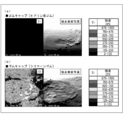
- FIGS. 6 (a) and 6 (b) show the results of conducting an electrical open / close test of the microswitch in a siloxane gas atmosphere.
- a siloxane gas atmosphere is obtained by using the microswitch of the embodiment having a rubber cap 16 made of hydrin rubber GECO and the conventional microswitch having a rubber cap made of silicone rubber (secondary vulcanized).
- an electrical switching test of the switch was carried out to compare the surface changes of the contacts.
- FIG. 6A shows the result of the example
- FIG. 6B shows the result of the conventional example.
- siloxane gas is not allowed to pass through. However, this is not sufficient, and the strength against oil such as grease, that is, oil resistance is the same as that of silicone rubber. Degree is required.
- FIG. 7 shows the results of an oil resistance test between hydrin rubber and silicone rubber.
- three types of greases of olefin type, paraffin type and ester type were used, and three types of greases, # 1 and # 2 as hydrin type rubbers, and those used in the above siloxane gas permeation test were used.
- the same silicone rubber was immersed at 90 ° C. for 96 hours, and then the weight was measured to determine the weight change rate (%).
- Hydrin rubber # 1 is obtained by adding 20 parts by weight of Adekasizer RS-705, which is an ether plasticizer, to 100 parts by weight of epichromer CG102 (manufactured by Daiso Corporation), which is GECO.
- the addition amount of Adeka Sizer RS-705 is 10 parts by weight which is half.
- the silicone rubber has increased in weight and absorbed various greases.
- Silicone rubber has the property of absorbing grease into the rubber material, but it is not a problematic absorption amount.
- the hydrin rubbers # 1 and # 2 are reduced in weight and do not absorb various greases.
- the hydrin rubber does not have the property of absorbing grease in the rubber material, it absorbs the grease and expands like the ethylene / propylene / copolymer rubber used in the gasket in Patent Document 2. There is no fear.
- the reason why the weight of the hydrin rubbers # 1 and # 2 is decreased is that the additive is dissolved out from the rubber material. This can also be seen from the fact that hydrin rubber # 1 with a large amount of plasticizer added has a greater weight change than # 2.
- the dissolution of such additives in the hydrin rubbers # 1 and # 2 is a value within a range where there is no problem with the properties as a rubber material.
- Geman torsion test JIS K-6261 will be described.
- a rubber test piece head is connected to a wire having a constant torsion constant, and the twist angle (X) of the test piece head is measured when the wire head is twisted.
- the relationship between the temperature and the measured angle X is graphed, and the connection point and the softening point are obtained.
- temperatures T2, T5, T10, and T100 at which the specific modulus (180-X) / X becomes 2,35,10,100 times that at room temperature are obtained.
- T2 It can be considered that rubber elasticity similar to room temperature is maintained up to around this temperature.
- T5 It can be seen that in this temperature range, the rigidity changes remarkably with a slight temperature difference and is in the glass transition region.
- T100 At this temperature, the rubber is almost frozen and in a glass state.
- Tg glass transition temperature, a temperature that changes from a glass state to a rubber state.
- the temperature of hydrin rubber # 1 with a large amount of plasticizer added is generally lower than that of hydrin rubber # 2 with a small amount of additive, at a lower temperature. It can be seen that flexibility can be maintained. That is, in order to improve flexibility at low temperatures, it is preferable that the amount of plasticizer added is large. Further, from the results of the hydrin rubbers # 1 and # 2 and the result of the silicone rubbers, it is understood that both the hydrin rubbers # 1 and # 2 have flexibility at a low temperature equal to or higher than that of the silicone rubber.
- the appropriate thickness range is determined by the type of rubber material. Therefore, the flexibility at a low temperature measured with the test piece does not directly apply to the test result of the rubber cap.
- results equivalent to or better than silicone rubber have been obtained.
- the rubber cap has the same adhesion as the rubber cap made of silicone rubber and the operability of the push button. It is fully possible to get.
- the amount of the ether plasticizer added to the hydrin rubber is preferably 5 to 40 parts by weight with respect to 100 parts by weight of the rubber.
- the added amount exceeds 40 parts by weight, the additive is dissolved out due to adhesion of oil such as grease, which is not preferable.
- the addition amount is less than 5 parts by weight, the effectiveness of the plasticizer is deteriorated and sufficient flexibility cannot be expected in a low temperature environment.
- the rubber cap that seals the sliding portion of the actuator is made of hydrin rubber.
- the microswitch 1 even when the microswitch 1 is used in an environment where the siloxane gas is volatilized from the silicone material, the siloxane gas penetrates through the rubber cap 16 and enters the inside of the case. It is possible to effectively suppress the silicon oxide from adhering to the surface, and to reduce contact failure.
- the rubber cap 16 is not deteriorated by absorbing the adhered grease, and the sealed structure can be maintained for a long time.
- the electronic component of the present invention incorporates a switching mechanism in a case, and an actuator for operating the switching mechanism is provided in the case so as to be slidable, while the sliding portion of the actuator is sealed.
- an ether plasticizer is further added to the hydrin rubber at a ratio of 5 to 40 parts by weight with respect to 100 parts by weight of the rubber.
- the hydrin rubber is an epichlorohydrin / ethylene oxide / acurgilycidyl ether terpolymer.
- epichlorohydrin / ethylene oxide / acurgilycidyl ether terpolymer is most preferred because it has the best balance between cold resistance and oil resistance.
- the case further includes a base on which a plurality of terminals are mounted and fixed, and a cover assembled to the base, and the switching mechanism is incorporated in a space surrounded by the base and the cover, It is good also as a structure which switches the conduction
- the present invention can be used for a microswitch or the like.
Landscapes
- Chemical & Material Sciences (AREA)
- Health & Medical Sciences (AREA)
- Chemical Kinetics & Catalysis (AREA)
- Medicinal Chemistry (AREA)
- Polymers & Plastics (AREA)
- Organic Chemistry (AREA)
- Push-Button Switches (AREA)
- Switch Cases, Indication, And Locking (AREA)
Abstract
ケース(2)内にスイッチング機構を組み込むとともに、スイッチング機構を作動させるアクチュエータである押しボタン(14)を、ケース(2)に摺動変位可能に設ける一方、押しボタン(14)の摺動部を密封するゴムキャップ(16)を装着した電子部品であって、ゴムキャップ(16)はヒドリン系ゴム製である。
Description
本発明は、スイッチ装置などの可動接点を有する電子部品に関する。
スイッチ装置においては、例えば、スイッチケース内にスイッチング機構を組み込み、アクチュエータとしての押しボタンの摺動変位によってスイッチング機構の可動片をスナップ作動させて、端子間の導通切換えを行うよう構成したマイクロスイッチが広く活用されている(例えば、特許文献1参照)。
このようなマイクロスイッチでは、マイクロスイッチに近接して、あるいはマイクロスイッチと同じ密閉空間内に、シリコーン系の接着剤やシリコーングリースなどのシロキサンガスを発生させるシリコーン系材料が使用される場合がある。シロキサンガスは、マイクロスイッチのケース内部に侵入すると、スイッチング機構の接点にSiO2などの絶縁物として付着してしまい、接触不良を起こすこととなる。
このような絶縁物の付着を防止するために、マイクロスイッチにおいては、スイッチケースの連結部をシールし、押しボタンの摺動部分をゴムキャップで覆ったり、ガスケットで塞いだりして、密閉構造とすることが行われている。
ゴムキャップやガスケットには、シリコーンゴムが多く使用される。ゴムキャップやガスケットにシリコーンゴムを使用する場合、成型後も残留するシロキサンガスによる上記した絶縁物の付着を防止するために「二次加硫」を行っている。二次加硫とは、残留シロキサンガスを除去するために行われるものであるが、生産面や品質管理面で煩雑となる。
また、シリコーンゴムは、たとえ二次加硫を行ったとしても、化学的特性として分子間結合が粗いため、気体を容易に通過させてしまう問題もある。
一方、特許文献2には、押しボタンに相当する操作釦の外側全体が、エチレン・プロピレン系・共重合ゴム製のガスケットにて覆われることで密閉されたマイクロスイッチが記載されている。特許文献2には、ガスケットをエチレン・プロピレン系・共重合ゴム製とすることで、スイッチの作動時に押しボタンに相当する操作釦の上下動によって、ガスケットと操作釦の接合部から、塵埃や液体、さらには気体がスイッチ内部に侵入すること防止することができると記載されている。また、残留シロキサン成分を除去するための二次加硫を実施する必要がなく、ガスケットの製造が容易となることが記載されている。
しかしながら、特許文献2においてガスケットに用いられているエチレン・プロピレン系・共重合ゴムは、グリース等の油分を吸収して膨張するといった性質がある。潤滑材であるグリースは、電子部品にはよく用いられるものであり、スイッチング機構や押しボタンの摺動変位を可能にするプランジャ部分などに用いられる。また、スイッチ装置は自動車などにも搭載され、自動車においては、各種のオイルが使用されている。そのため、油分に弱いエチレン・プロピレン系・共重合ゴムよりなるガスケットを備えたスイッチ装置では、油分の付着によってガスケットが劣化し、密閉構造を長く保持できないといった問題点がある。
本発明は、上述の点に鑑みてなされたものであって、その目的は、シロキサンガスなどのガスの影響を低減しつつ、密閉構造を長く保持することが可能な、可動接点を有する電子部品の提供にある。
上記の課題を解決するために、本発明の電子部品は、ケース内にスイッチング機構を組み込むとともに、前記スイッチング機構を作動させるアクチュエータを、前記ケースに摺動変位可能に設ける一方、前記アクチュエータの摺動部を密封するゴムキャップを装着した電子部品であって、前記ゴムキャップは、ヒドリン系ゴム製であることを特徴としている。
これによれば、ゴムキャップをヒドリン系ゴム製としたことで、当該電子部品を、シリコーン系材料からシロキサンガスが揮発するような環境下で使用しても、シロキサンガスが、ゴムキャップを透過してケース内部に侵入して、スイッチング機構の接点にシリコン酸化物が付着することを効果的に抑制することができ、接触不良を低減することができる。
しかも、ヒドリン系ゴムは耐油性に優れているため、当該電子部品を、グリース等の油分が付着しやすい環境下で使用しても、付着した油分を吸収してゴムキャップが劣化するようなことがなく、密閉構造を長く保持することができる。
本発明によれば、シロキサンガスなどのガスの影響を低減しつつ、密閉構造を長く保持することが可能な、可動接点を有する電子部品の提供できるという効果を奏する。
以下、本発明の実施の形態について、詳細に説明する。図1は、本実施の形態の電子部品であるマイクロスイッチの斜視図であり、図2はマイクロスイッチの分解斜視図、図3はマイクロスイッチを断面図である。
図1~図3に示すように、本実施の形態のマイクロスイッチ1は、樹脂製のケース2と、該ケース2が外嵌装着される樹脂製のベース4とを備え、該ベース4には3本の端子6,8,10が設けられている。各端子6,8,10は、ベース4の成形時にインサート成型で一体製作されており、マイクロスイッチ1と外部導線との接続を可能にするものである。
ケース2とベース4とで区画されるケース内部には、スナップ作動式のスイッチング機構12が設けられている。その他、マイクロスイッチ1には、ケース2に摺動変位可能に装着されたアクチュエータとしての押しボタン14、および該押しボタン14の摺動部分を密封するゴムキャップ16等が備えられている。
スイッチング機構12は、コモン端子となる端子6の内端部に基端部(図2、図3では左端部)が連結された板バネ製の可動片18、常開端子となる端子8の内端部に連結された固定片20、常閉端子となる端子10の内端部に連結された固定片22とを備え、可動片18の遊端部側と中央側との間には、スナップ作動用のバネ片19が弾性湾曲された状態で取付けられている。
可動片18は、端子6との連結箇所を支点にして上下に湾曲揺動可能に片持ち支持されており、一対の固定片20,22は可動片18の遊端部に上下から対向するよう配備されている。
可動片18の遊端に備えられた上下の可動接点24に対向する固定接点26,28が、各固定片20,22に設けられており、可動片18が上下に揺動して可動接点24が、固定接点26あるいは固定接点28に接触されることで、端子6と端子8の導通状態、あるいは、端子6と端子10の導通状態が得られるようになっている。
押しボタン14が押し込み操作されると、可動片18が下方変位して、可動接点24が、固定片20の固定接点26に接触する。また、押しボタン14に外力をかけない常態においては、バネ片18aの弾性復元力によって可動片18の遊端側が上方に付勢変位されて、可動接点24が、固定片22の固定接点28に接触維持される。
マイクロスイッチ1は、ケース2とベース4とが、接着剤で封止されて連結されるとともに、上述のように、押しボタン14の摺動部分をゴムキャップ16で密封した、いわゆる、防滴タイプのマイクロスイッチである。ゴムキャップ16は、押しボタン14などのアクチュエータの摺動部を覆うゴム製の部材である。マイクロスイッチ1では、ゴムキャップ16は、押しボタン14とケース2とに亘って装着されている。
なお、図1~3では、ゴムキャップ16として、アクチュエータの上部が通る孔を有している構成を例示しているが、このような孔を有しておらず、アクチュエータの上部を含めて覆うものであってもよい。要は、アクチュエータの上部を覆う構成であればよい。
そして、マイクロスイッチ1においては、ケース内部にシロキサンガスが侵入してスイッチング機構12の接触不良を生じさせることを抑制するために、ゴムキャップ16に、耐寒耐油に優れ、かつガス透過を抑制できるヒドリン系ゴムを使用している。
ヒドリン系ゴムとしては、エピクロルヒドリンホモポリマー(CO)、エピクロルヒドリン・エチレンオキサイドコポリマー(ECO)、あるいはエピクロルヒドリン・エチレンオキサイド・アクルグリシジルエーテルターポリマー(GECO)などを用いることができる。中でもGECOが、耐油に優れ、低温時の操作性が優れている点で特に好ましい。
COの耐油体積変化率は、ASTM No.1:0%、ASTM No.3:10~20%、Fuel B:~20%であり、COの最低使用温度:-15℃、COの最高使用温度:140℃である。
ECOの耐油体積変化率は、ASTM No.1:0%、ASTM No.3:10~20%、Fuel B:~30%であり、ECOの最低使用温度:-35℃、ECOの最高使用温度:120℃である。
GECOの耐油体積変化率は、ASTM No.1:0%、ASTM No.3:10~20%、Fuel B:~35%であり、GECOの最低使用温度:-35℃、GECOの最高使用温度:130℃である。
図4に、ヒドリン系ゴム(ゴム材)とシリコーンゴム(ゴム材)とのシロキサンガス透過試験の結果を示す。試験ではMJIS K7126(プラスチックフィルムおよびシートの気体透過度測定方法)を参考に、等圧法にてガス透過評価を行った。この方法は、対象ガス透過性だけを評価するものであり、試験片の一方に対象ガスを供給し、もう一方に等圧に保ち、透過した対象ガスを種々の検知手段を用いて測定した。
図5にシロキサンガス透過試験に用いた実験系を示す。今回は検知手段にトラップ法を用いて、重量計測にて、透過サンプルの透過量を計測した。具体的には、サンプル管100内にシリコーントラッパ102を入れ、サンプル管100の口を透過サンプル108で塞いでなる測定対象物を準備した。
透過サンプル108は、ヒドリン系ゴムとして、GECOであるEPION-301(ダイソー(株)製)、シリコーンゴム KE-9511(信越シリコーン(株)製)とを用い、各透過サンプル108に付き測定対象物をそれぞれ2個ずつ用意した。可塑剤は、低温時のゴムの可塑性を保持し、例えば、ゴムキャップ16として使用された場合には、押しボタン14の上下の動作をスムーズに行うために添加される。
次に、準備した測定対象物をシリコーンチャンバー104内に入れ、チャンバー104内部に試験気体106を供給し、測定対象物を試験気体106の雰囲気下において、所定時間放置した。ここでは、試験気体106としてD4試薬を用い、チャンバー104内の試験気体106の濃度(周囲環境)を25ppm、シリコーンチャンバー104内の温度(周囲温度)を80℃として、126時間放置した。所定時間経過後、サンプル管100からシリコーントラッパ102を取り出し、シリコーントラッパ102を熱処理して重量を測定した。そして、重量変化量から吸着シリコーンを計測し、透過係数を算出した(参考資料:安田武夫:プラスチック材料の各動特性の試験法と評価結果(5)、プラスチックス: 日本プラスチック工業連盟誌/「プラスチックス」編集委員会編)。
図4に示すように、シリコーンゴムは2つの測定対象物共に、490×10-10g・cm2/sec/Pa以上ものシロキサンガス(D4試薬)が通過している。これに対し、ヒドリン系ゴムの2つの測定対象物は、一方はシロキサンガス(D4試薬)の通過量がゼロであり、もう一方はほぼゼロである。なお、ヒドリン系ゴムにおいて、一方には若干のシロキサンガスが検出されているが、実験系の精度等を考慮すると、これは誤差の範囲に入ると考えるべきものである。
図6の(a)(b)に、シロキサンガス雰囲気下でマイクロスイッチの電気的開閉試験を実施した結果を示す。ここでは、ヒドリン系ゴムのGECOよりなるゴムキャップ16を有する実施例のマイクロスイッチと、シリコーンゴム(二次加硫済み)製のゴムキャップを有する従来例のマイクロスイッチとを用いて、シロキサンガス雰囲気下でスイッチの電気的開閉試験を実施し、接点の表面変化を比較した。
接点の表面変化を示すデータとして、X線回折装置による接点の表面のSi強度(CPS)の測定結果と、電子顕微鏡にて撮影した接点の表面の写真を示す。図6の(a)が実施例の結果で、(b)が従来例の結果である。
図6の(a)(b)における接点の表面の写真を比較すると一目瞭然であるように、従来例のマイクロスイッチでは、接点の表面に付着物が付着して荒れていることがわかる。Si強度の測定結果より、付着物がSi、つまり、酸化シリコンであることがわかる。一方、実施例のマイクロスイッチの接点の表面は、滑らかさを保持しており、Si強度の測定結果からも、酸化シリコンが付着していないことがわかる。
このように、押しボタン14の摺動部分を密封するゴムキャップ16を、ヒドリン系ゴムにて形成することにより、シロキサンガスなどがゴムキャップ16を透過してケース内に侵入することを効果的に抑制することが可能となる。
ところで、上述したように、ゴムキャップ16の材質としては、シロキサンガスを通過させないことはもちろんであるが、それだけでは十分ではなく、グリース等の油分に対する強さ、すなわち耐油性が、シリコーンゴムと同程度要求される。
図7に、ヒドリン系ゴムとシリコーンゴムとの耐油試験の結果を示す。試験では、オレフィン系、パラフィン系、エステル系の3種類のグリースを用い、3種類のグリースに、ヒドリン系ゴムとして2種類の#1、#2と、前述のシロキサンガス透過試験で用いたものと同じシリコーンゴムを、90℃で96時間浸漬した後、重量を測定して重量変化率(%)を求めた。ヒドリン系ゴム#1は、GECOであるエピクロマーCG102(ダイソー(株)製)100重量部にエーテル系可塑剤であるアデカサイザーRS-705を20重量部添加したもので、ヒドリン系ゴム#2は、アデカサイザーRS-705の添加量を半分の10重量部としたものである。
図7に示すように、シリコーンゴムは、重量が増えており、各種グリースを吸収している。シリコーンゴムは、グリースをゴム材に吸収する性質があるが、問題になる吸収量ではない。一方、ヒドリン系ゴム#1,#2は、重量が減少しており、各種グリースを吸収していないことがわかる。このように、ヒドリン系ゴムは、ゴム材にグリースを吸収する性質ではないので、特許文献2においてガスケットに用いられているエチレン・プロピレン系・共重合ゴムのように、グリースを吸収して膨張する恐れはない。
なお、ヒドリン系ゴム#1,#2は、重量が減少しているのは、ゴム材より添加物が溶け出しているためと考えられる。このことは、可塑剤の添加量の多いヒドリン系ゴム#1の方が、#2よりも重量変化が大きいことからもわかる。ヒドリン系ゴム#1,#2におけるこのような添加物の溶け出しは、ゴム材としての性質に何ら問題のない範囲の値である。
最後に、ゲーマンねじり試験を行って、低温環境下で使用される場合にゴムキャップに要求される低温環境下での柔軟性を調べた結果を、図8に示す。低温環境下でマイクロスイッチの使用を考えると、密着性および押しボタンの操作性を保持するためには、シリコーンゴムと同程度の低温柔軟性が要求される。
ゲーマンねじり試験(低温ねじり試験):JIS K 6261について説明する。この試験では、ゴムの試験片頭部を、ねじり定数が一定のワイヤーに連結し、ワイヤ頭部にねじりを与えたときの、試験片頭部のねじれの角度(X)を測定する。温度と測定した角度Xの関係をグラフにし、連結点、軟化点を求める。一般的には、比モジュラス(180-X)/Xが、常温におけるそれの2,35,10,100倍になる温度T2、T5、T10、T100を求める。
ここでは、前述のシロキサンガス透過試験で用いた2種類のヒドリン系ゴム#1,#2と、シリコーンゴムとを用いて、温度T2、T5、T10、T100、Tgを求めた。T2:この温度付近までは、室温と同様なゴム弾性を維持しているものとみなすことができる。T5、T10:この温度領域ではわずかな温度の違いで剛性率が著しく変化し、ガラス転移領域にあることがわかる。T100:この温度では、ゴムはほぼ凍結しており、ガラス状態にある。Tg:ガラス転移温度であり、ガラス状態からゴム状態にかわる温度である。
2種類のヒドリン系ゴム#1,#2の結果より、可塑剤の添加量の多いヒドリン系ゴム#1の各温度が添加量の少ないヒドリン系ゴム#2よりも全体的に低く、より低温で柔軟性を保持できることがわかる。つまり、低温での柔軟性を向上させるためには、可塑剤の添加量が多いことが好ましい。また、ヒドリン系ゴム#1,#2の結果とシリコーンゴムの結果をより、ヒドリン系ゴム#1,#2共にシリコーンゴムと同等以上の低温での柔軟性が得られていることがわかる。
但し、実際にゴム材をゴムキャップに成型加工した場合、適切な厚さの範囲がゴム材の種類によって決まる。そのため、試験片で測定した低温での柔軟性が直に、ゴムキャップの試験結果に当てはまるものではない。しかしながら、ゴム材としては、シリコーンゴムと同等以上の結果が得られているので、厚みや形状の工夫次第で、ゴムキャップとしてシリコーンゴム製のゴムキャップと同等の密着性および押しボタンの操作性を得ることは十分に可能である。
ヒドリン系ゴムに添加するエーテル系可塑剤の量は、ゴム100重量部に対して5~40重量部の割合であることが好ましい。添加量が40重量部を超えると、グリース等の油分が付着したことによる添加物の溶け出しが多くなり好ましくない。また、添加量が5重量部を下回ると、可塑剤の効きが悪くなり、低温環境下において、十分な柔軟性が期待できない。
エーテル系可塑剤を上記範囲で添加することで、耐油性を保持しながら、-40℃もの低温環境下であっても、シリコーンゴムと同程度の密着性および押しボタンの操作性を得ることができる。
以上のように、マイクロスイッチ1は、アクチュエータの摺動部を密封するゴムキャップがヒドリン系ゴム製である。
これによって、マイクロスイッチ1を、シリコーン系材料からシロキサンガスが揮発するような環境下で使用しても、シロキサンガスが、ゴムキャップ16を透過してケース内部に侵入して、スイッチング機構12の接点にシリコン酸化物が付着することを効果的に抑制することができ、接触不良を低減することができる。
また、グリース剤が付着しやすい環境下で使用しても、付着したグリースを吸収してゴムキャップ16が劣化するようなことがなく、密閉構造を長く保持することができる。
以上のように、本発明の電子部品は、ケース内にスイッチング機構を組み込むとともに、前記スイッチング機構を作動させるアクチュエータを、前記ケースに摺動変位可能に設ける一方、前記アクチュエータの摺動部を密封するゴムキャップを装着した電子部品であって、前記ゴムキャップは、ヒドリン系ゴム製である構成である。
本発明の電子部品においては、さらに、前記ヒドリン系ゴムに、エーテル系可塑剤が、ゴム100重量部に対して5~40重量部の割合で添加されている構成とすることが好ましい。
エーテル系可塑剤を上記範囲で添加することで、耐油性を保持しながら、-40℃もの低温環境下であっても、シリコーンゴムと同程度の密着性および押しボタンの操作性を得ることができる。
本発明の電子部品においては、さらに、前記ヒドリン系ゴムが、エピクロルヒドリン・エチレンオキサイド・アクルグリシジルエーテルターポリマーであることが好ましい。
ヒドリン系ゴムの中でも、エピクロルヒドリン・エチレンオキサイド・アクルグリシジルエーテルターポリマーが、最も、耐寒性と耐油性のバランスがよく、好ましい。
本発明の電子部品は、さらに、前記ケースは、複数の端子を装着固定したベースと、該ベースに組み付けられるカバーとを備え、前記ベースとカバーとで囲まれた空間に前記スイッチング機構を組み込み、前記カバーに摺動変位可能に装着された前記アクチュエータの変位作動によって前記スイッチング機構の可動片をスナップ作動させて、端子間の導通切換えを行う構成としてもよい。
本発明は、マイクロスイッチなどに利用することができる。
2 ケース
4 ベース
6,8,10 端子
12 スイッチング機構
14 押しボタン
16 ゴムキャップ
18 可動片
19 バネ片
20,22 固定片
24 可動接点
26,28 固定接点
100 サンプル管
102 シリコーントラッパ
104 シリコーンチャンバー
106 試験気体
108 透過サンプル
4 ベース
6,8,10 端子
12 スイッチング機構
14 押しボタン
16 ゴムキャップ
18 可動片
19 バネ片
20,22 固定片
24 可動接点
26,28 固定接点
100 サンプル管
102 シリコーントラッパ
104 シリコーンチャンバー
106 試験気体
108 透過サンプル
Claims (4)
- ケース内にスイッチング機構を組み込むとともに、前記スイッチング機構を作動させるアクチュエータを、前記ケースに摺動変位可能に設ける一方、前記アクチュエータの摺動部を密封するゴムキャップを装着した電子部品であって、
前記ゴムキャップは、ヒドリン系ゴム製であることを特徴とする電子部品。 - 前記ヒドリン系ゴムに、エーテル系可塑剤が、ゴム100重量部に対して5~40重量部の割合で添加されていることを特徴とする請求項1に記載の電子部品。
- 前記ヒドリン系ゴムが、エピクロルヒドリン・エチレンオキサイド・アクルグリシジルエーテルターポリマーであることを特徴とする請求項1又は2に記載の電子部品。
- 前記ケースは、複数の端子を装着固定したベースと、該ベースに組み付けられるケースとを備え、前記ベースとケースとで囲まれた空間に前記スイッチング機構を組み込み、前記ケースに摺動変位可能に装着された前記アクチュエータの変位作動によって前記スイッチング機構の可動片をスナップ作動させて、端子間の導通切換えを行うことを特徴とする請求項1~3の何れか1項に記載の電子部品。
Priority Applications (4)
| Application Number | Priority Date | Filing Date | Title |
|---|---|---|---|
| CN201380044526.3A CN104603898B (zh) | 2012-09-25 | 2013-09-18 | 具有可动接点的电子部件 |
| US14/424,421 US9741504B2 (en) | 2012-09-25 | 2013-09-18 | Electronic component having movable contact |
| EP13842702.6A EP2879148B1 (en) | 2012-09-25 | 2013-09-18 | Electronic component having movable contact |
| CA2882554A CA2882554A1 (en) | 2012-09-25 | 2013-09-18 | Electronic component having movable contact |
Applications Claiming Priority (2)
| Application Number | Priority Date | Filing Date | Title |
|---|---|---|---|
| JP2012211404A JP6056324B2 (ja) | 2012-09-25 | 2012-09-25 | 可動接点を有する電子部品 |
| JP2012-211404 | 2012-09-25 |
Publications (1)
| Publication Number | Publication Date |
|---|---|
| WO2014050643A1 true WO2014050643A1 (ja) | 2014-04-03 |
Family
ID=50388049
Family Applications (1)
| Application Number | Title | Priority Date | Filing Date |
|---|---|---|---|
| PCT/JP2013/075092 Ceased WO2014050643A1 (ja) | 2012-09-25 | 2013-09-18 | 可動接点を有する電子部品 |
Country Status (6)
| Country | Link |
|---|---|
| US (1) | US9741504B2 (ja) |
| EP (1) | EP2879148B1 (ja) |
| JP (1) | JP6056324B2 (ja) |
| CN (1) | CN104603898B (ja) |
| CA (1) | CA2882554A1 (ja) |
| WO (1) | WO2014050643A1 (ja) |
Cited By (1)
| Publication number | Priority date | Publication date | Assignee | Title |
|---|---|---|---|---|
| CN110268496A (zh) * | 2017-03-13 | 2019-09-20 | 欧姆龙株式会社 | 开关 |
Families Citing this family (10)
| Publication number | Priority date | Publication date | Assignee | Title |
|---|---|---|---|---|
| CN104835668A (zh) * | 2014-02-12 | 2015-08-12 | 环旭电子股份有限公司 | 防水按键结构 |
| JP1532127S (ja) | 2014-08-06 | 2015-08-31 | ||
| JP1532529S (ja) * | 2014-08-06 | 2015-08-31 | ||
| JP6711716B2 (ja) * | 2016-07-20 | 2020-06-17 | 三井金属アクト株式会社 | 車両ドアラッチ装置 |
| JP6662537B2 (ja) * | 2016-07-22 | 2020-03-11 | アルプスアルパイン株式会社 | スイッチ装置及び該スイッチ装置の製造方法 |
| WO2018045380A1 (en) * | 2016-09-02 | 2018-03-08 | Sharkninja Operating Llc | Multifunction switch for use with cleaning device and/or other powered devices |
| TWD188673S (zh) * | 2017-05-08 | 2018-02-21 | 進聯工業股份有限公司 | Housing of electrical connection terminal |
| JP6881078B2 (ja) * | 2017-06-22 | 2021-06-02 | オムロン株式会社 | スイッチ |
| TWI677889B (zh) * | 2018-07-03 | 2019-11-21 | 易湘雲 | 鉍基合金作為開關或插座斷電元件的方法 |
| KR200497970Y1 (ko) * | 2021-12-24 | 2024-05-03 | 주식회사 제이케이시스템 | 스위치의 접점 구조, 그 접점 구조를 포함하는 접점 블록 및 그 접점 블록을 포함하는 스위치 |
Citations (4)
| Publication number | Priority date | Publication date | Assignee | Title |
|---|---|---|---|---|
| JPH10302593A (ja) * | 1997-04-28 | 1998-11-13 | Niles Parts Co Ltd | 圧力スイッチの防水構造 |
| JP2003157742A (ja) * | 2001-11-21 | 2003-05-30 | Polymatech Co Ltd | 入力装置 |
| JP2006351391A (ja) | 2005-06-16 | 2006-12-28 | Matsushita Electric Works Ltd | スイッチ装置 |
| JP2007042359A (ja) | 2005-08-02 | 2007-02-15 | Hst Kk | 押釦型スイッチ |
Family Cites Families (3)
| Publication number | Priority date | Publication date | Assignee | Title |
|---|---|---|---|---|
| JPS62179560A (ja) * | 1986-02-03 | 1987-08-06 | Nippon Zeon Co Ltd | ゴム混合物 |
| US5447992A (en) * | 1994-06-13 | 1995-09-05 | The Goodyear Tire & Rubber Company | Heat and ozone resistant NBR/epichlorohydrin blends |
| JP5239260B2 (ja) | 2007-08-30 | 2013-07-17 | オムロン株式会社 | スイッチ |
-
2012
- 2012-09-25 JP JP2012211404A patent/JP6056324B2/ja active Active
-
2013
- 2013-09-18 WO PCT/JP2013/075092 patent/WO2014050643A1/ja not_active Ceased
- 2013-09-18 US US14/424,421 patent/US9741504B2/en active Active
- 2013-09-18 CA CA2882554A patent/CA2882554A1/en not_active Abandoned
- 2013-09-18 EP EP13842702.6A patent/EP2879148B1/en active Active
- 2013-09-18 CN CN201380044526.3A patent/CN104603898B/zh active Active
Patent Citations (4)
| Publication number | Priority date | Publication date | Assignee | Title |
|---|---|---|---|---|
| JPH10302593A (ja) * | 1997-04-28 | 1998-11-13 | Niles Parts Co Ltd | 圧力スイッチの防水構造 |
| JP2003157742A (ja) * | 2001-11-21 | 2003-05-30 | Polymatech Co Ltd | 入力装置 |
| JP2006351391A (ja) | 2005-06-16 | 2006-12-28 | Matsushita Electric Works Ltd | スイッチ装置 |
| JP2007042359A (ja) | 2005-08-02 | 2007-02-15 | Hst Kk | 押釦型スイッチ |
Non-Patent Citations (1)
| Title |
|---|
| See also references of EP2879148A4 |
Cited By (2)
| Publication number | Priority date | Publication date | Assignee | Title |
|---|---|---|---|---|
| CN110268496A (zh) * | 2017-03-13 | 2019-09-20 | 欧姆龙株式会社 | 开关 |
| CN110268496B (zh) * | 2017-03-13 | 2021-03-30 | 欧姆龙株式会社 | 开关 |
Also Published As
| Publication number | Publication date |
|---|---|
| CA2882554A1 (en) | 2014-04-03 |
| JP6056324B2 (ja) | 2017-01-11 |
| CN104603898A (zh) | 2015-05-06 |
| US9741504B2 (en) | 2017-08-22 |
| EP2879148A4 (en) | 2015-08-26 |
| JP2014067557A (ja) | 2014-04-17 |
| US20150206670A1 (en) | 2015-07-23 |
| CN104603898B (zh) | 2017-10-20 |
| EP2879148A1 (en) | 2015-06-03 |
| EP2879148B1 (en) | 2019-03-20 |
Similar Documents
| Publication | Publication Date | Title |
|---|---|---|
| JP6056324B2 (ja) | 可動接点を有する電子部品 | |
| US20090015270A1 (en) | Electrostatic capacity-type sensor | |
| US9879130B2 (en) | Additive for rubber, and rubber composition obtained by blending same | |
| Tugui et al. | Bimodal silicone interpenetrating networks sequentially built as electroactive dielectric elastomers | |
| JP6383484B2 (ja) | ハロゲン化ブチルゴム組成物と防振グロメット | |
| JP2011126992A (ja) | 高減衰組成物 | |
| JP2019199549A (ja) | ゴム組成物およびシール材 | |
| CN115336115A (zh) | 密封构件及防水连接器 | |
| Ranieri | Elastomers in extreme environments applications | |
| CN104576110A (zh) | 开关 | |
| WO2006081564A1 (en) | Non-locking switch for filter monitoring | |
| ATE388175T1 (de) | Polyethylenfilm mit verbesserter verarbeitbarkeit und verbesserten mechanischen eigenschaften | |
| JP4534534B2 (ja) | Epdm組成物 | |
| JP5181488B2 (ja) | 電気機器用シリコンフリーゴム組成物および電気機器 | |
| JP2002265681A (ja) | Nbr組成物 | |
| JP7853120B2 (ja) | コンデンサ | |
| JP4980011B2 (ja) | パッキン | |
| JP2005153817A (ja) | 自動車用シール部品 | |
| JP5239260B2 (ja) | スイッチ | |
| JP2005255925A (ja) | ブレンドゴム組成物 | |
| JPH08269267A (ja) | オイルブリード性ポリオレフイン系ゴム組成物 | |
| WO2025046669A1 (ja) | コンデンサ | |
| JP2007284604A (ja) | フッ素ゴム組成物 | |
| JP2004197017A (ja) | ゴム組成物 | |
| Snoddon | Comparison of Low Temperature Testing Techniques for Elastomer Specifications |
Legal Events
| Date | Code | Title | Description |
|---|---|---|---|
| 121 | Ep: the epo has been informed by wipo that ep was designated in this application |
Ref document number: 13842702 Country of ref document: EP Kind code of ref document: A1 |
|
| ENP | Entry into the national phase |
Ref document number: 2882554 Country of ref document: CA |
|
| WWE | Wipo information: entry into national phase |
Ref document number: 2013842702 Country of ref document: EP |
|
| WWE | Wipo information: entry into national phase |
Ref document number: 14424421 Country of ref document: US |
|
| NENP | Non-entry into the national phase |
Ref country code: DE |