WO2014058048A1 - 温水で落ちる肌用下地化粧料 - Google Patents
温水で落ちる肌用下地化粧料 Download PDFInfo
- Publication number
- WO2014058048A1 WO2014058048A1 PCT/JP2013/077739 JP2013077739W WO2014058048A1 WO 2014058048 A1 WO2014058048 A1 WO 2014058048A1 JP 2013077739 W JP2013077739 W JP 2013077739W WO 2014058048 A1 WO2014058048 A1 WO 2014058048A1
- Authority
- WO
- WIPO (PCT)
- Prior art keywords
- skin
- cosmetic
- foundation
- water
- makeup
- Prior art date
- Legal status (The legal status is an assumption and is not a legal conclusion. Google has not performed a legal analysis and makes no representation as to the accuracy of the status listed.)
- Ceased
Links
Images

Classifications
-
- A—HUMAN NECESSITIES
- A61—MEDICAL OR VETERINARY SCIENCE; HYGIENE
- A61K—PREPARATIONS FOR MEDICAL, DENTAL OR TOILETRY PURPOSES
- A61K8/00—Cosmetics or similar toiletry preparations
- A61K8/02—Cosmetics or similar toiletry preparations characterised by special physical form
- A61K8/04—Dispersions; Emulsions
- A61K8/06—Emulsions
- A61K8/062—Oil-in-water emulsions
-
- A—HUMAN NECESSITIES
- A61—MEDICAL OR VETERINARY SCIENCE; HYGIENE
- A61K—PREPARATIONS FOR MEDICAL, DENTAL OR TOILETRY PURPOSES
- A61K8/00—Cosmetics or similar toiletry preparations
- A61K8/18—Cosmetics or similar toiletry preparations characterised by the composition
- A61K8/30—Cosmetics or similar toiletry preparations characterised by the composition containing organic compounds
- A61K8/33—Cosmetics or similar toiletry preparations characterised by the composition containing organic compounds containing oxygen
- A61K8/34—Alcohols
- A61K8/345—Alcohols containing more than one hydroxy group
-
- A—HUMAN NECESSITIES
- A61—MEDICAL OR VETERINARY SCIENCE; HYGIENE
- A61K—PREPARATIONS FOR MEDICAL, DENTAL OR TOILETRY PURPOSES
- A61K8/00—Cosmetics or similar toiletry preparations
- A61K8/18—Cosmetics or similar toiletry preparations characterised by the composition
- A61K8/30—Cosmetics or similar toiletry preparations characterised by the composition containing organic compounds
- A61K8/60—Sugars; Derivatives thereof
-
- A—HUMAN NECESSITIES
- A61—MEDICAL OR VETERINARY SCIENCE; HYGIENE
- A61K—PREPARATIONS FOR MEDICAL, DENTAL OR TOILETRY PURPOSES
- A61K8/00—Cosmetics or similar toiletry preparations
- A61K8/18—Cosmetics or similar toiletry preparations characterised by the composition
- A61K8/72—Cosmetics or similar toiletry preparations characterised by the composition containing organic macromolecular compounds
- A61K8/81—Cosmetics or similar toiletry preparations characterised by the composition containing organic macromolecular compounds obtained by reactions involving only carbon-to-carbon unsaturated bonds
- A61K8/8135—Compositions of homopolymers or copolymers of compounds having one or more unsaturated aliphatic radicals, each having only one carbon-to-carbon double bond, and at least one being terminated by an acyloxy radical of a saturated carboxylic acid, of carbonic acid or of a haloformic acid; Compositions of derivatives of such polymers, e.g. vinyl esters (polyvinylacetate)
-
- A—HUMAN NECESSITIES
- A61—MEDICAL OR VETERINARY SCIENCE; HYGIENE
- A61K—PREPARATIONS FOR MEDICAL, DENTAL OR TOILETRY PURPOSES
- A61K8/00—Cosmetics or similar toiletry preparations
- A61K8/18—Cosmetics or similar toiletry preparations characterised by the composition
- A61K8/72—Cosmetics or similar toiletry preparations characterised by the composition containing organic macromolecular compounds
- A61K8/84—Cosmetics or similar toiletry preparations characterised by the composition containing organic macromolecular compounds obtained by reactions otherwise than those involving only carbon-carbon unsaturated bonds
- A61K8/86—Polyethers
-
- A—HUMAN NECESSITIES
- A61—MEDICAL OR VETERINARY SCIENCE; HYGIENE
- A61Q—SPECIFIC USE OF COSMETICS OR SIMILAR TOILETRY PREPARATIONS
- A61Q1/00—Make-up preparations; Body powders; Preparations for removing make-up
- A61Q1/14—Preparations for removing make-up
-
- A—HUMAN NECESSITIES
- A61—MEDICAL OR VETERINARY SCIENCE; HYGIENE
- A61K—PREPARATIONS FOR MEDICAL, DENTAL OR TOILETRY PURPOSES
- A61K2800/00—Properties of cosmetic compositions or active ingredients thereof or formulation aids used therein and process related aspects
- A61K2800/40—Chemical, physico-chemical or functional or structural properties of particular ingredients
- A61K2800/59—Mixtures
-
- A—HUMAN NECESSITIES
- A61—MEDICAL OR VETERINARY SCIENCE; HYGIENE
- A61Q—SPECIFIC USE OF COSMETICS OR SIMILAR TOILETRY PREPARATIONS
- A61Q1/00—Make-up preparations; Body powders; Preparations for removing make-up
- A61Q1/02—Preparations containing skin colorants, e.g. pigments
Definitions
- the present invention relates to a skin foundation cosmetic, particularly a skin foundation cosmetic that can be removed with warm water, and can be removed together with the foundation cosmetic with warm water by applying to the skin before makeup such as a foundation. .
- Makeups such as foundations usually contain a large amount of oil and other oily components, and therefore it is usually necessary to use a cleansing agent or facial cleanser for make-up removal.
- a cleansing agent or facial cleanser for make-up removal.
- the so-called long lasting type and waterproof type foundations that have significantly improved water resistance, sebum resistance, and long-lasting makeup have special formulations that are difficult to remove even with regular cleansing or face wash. Often cleansing fees are required.
- cleansing and facial cleanser when removing make-up is one of the time and cost burdens for users, and some users are concerned about eye and skin irritation caused by cleansing and facial cleanser. is there. Therefore, if the makeup can be removed without using a cleansing fee or a facial cleanser, the burden on the user and concerns can be reduced.
- Patent Document 1 describes an oil-in-water eye makeup cosmetic that can be easily removed with water or warm water.
- the technique of patent document 1 is that it can be easily dropped with water or warm water by blending a liquid crystal of a polyhydric alcohol and an amphiphilic substance in an oil phase.
- Patent Document 1 only describes an eye makeup cosmetic, that is, a partial makeup cosmetic that is applied to a part of the eyelid, eyebrows, or eyelids, and is a type of cosmetic that is applied to the entire facial skin. Is not listed.
- Patent Documents 2 to 3 describe cosmetics that are resistant to cold water of 30 ° C. or less and can be easily removed by rubbing with hot water of 35 to 50 ° C. That is, Patent Document 2 describes a makeup cosmetic containing at least one hydrophobic film-forming polymer and a specific ionic surfactant in a medium acceptable as a cosmetic.
- the technology of Patent Document 2 is that the polymer film becomes more sensitive to water because the specific ionic surfactant has a conductivity variation in water of 100 ⁇ S / cm or more at 20 to 45 ° C., and as a result is resistant to cold water.
- the make-up film becomes brittle and easily disintegrates and peels off from the support.
- Patent Document 3 discloses a first semi-crystalline polymer having a melting point of 30 ° C. or higher and a second film-forming polymer capable of forming a hydrophobic film at room temperature in a physiologically acceptable medium. Makeup cosmetics containing are described.
- the first semi-crystalline polymer has a melting point of 30 ° C. or higher, when the melting point is exceeded, the film is easily affected by water, and as a result, the film becomes brittle when in contact with hot water. By rubbing, it breaks away quickly from the support.
- Patent Documents 2 to 3 describe that it can be applied to foundations and the like, only mascara is shown as a specific example.
- Patent Document 4 describes a mascara substrate containing water-soluble polyacrylic acid polymer, polyvinyl pyrrolidone, and water as a mascara substrate that can be easily removed with water, and is simply washed with water without using a makeup remover. It is described that the mascara substrate can be removed together with the mascara applied thereon.
- the mascara substrate of Patent Document 4 is a type that also drops with water, so it may be swollen or dropped by sweat or tears.
- the mascara base of patent document 4 is a cosmetic for wrinkles, and is not described about the base cosmetic for skin apply
- the present invention has been made in view of the background art, the purpose thereof is a skin foundation cosmetic applied to the skin before applying a foundation or the like, and it does not drool or fall off with sweat or cold water,
- An object of the present invention is to provide a skin foundation cosmetic that can be easily removed from the skin together with a make-up without using a cleansing or facial cleanser when rubbed with warm water.
- the above-mentioned skin use is achieved by using specific amounts of vinyl acetate polymer, polyhydric alcohol, and hydrophilic nonionic surfactant.
- the present inventors have found that a base cosmetic can be obtained and have completed the present invention.
- the skin foundation cosmetic according to the present invention is a skin foundation cosmetic that is applied to the skin before the skin makeup cosmetic is applied, and the aqueous phase containing water is a continuous phase, (A) a vinyl acetate polymer; (B) a polyhydric alcohol; (C) a hydrophilic nonionic surfactant; Containing (A) The vinyl acetate polymer is 0.5 to 7% by mass in the cosmetic and is dispersed as particles in the aqueous phase; (B) the polyhydric alcohol is 0.5 to 5.5 parts by mass with respect to 1 part by mass of the (a) vinyl acetate polymer, (C) A base cosmetic for skin characterized in that the hydrophilic nonionic surfactant is 1 to 5% by mass in the cosmetic.
- the skin base cosmetic can be removed together with the skin base cosmetic with hot water of 38 to 45 ° C. when the skin make-up cosmetic is removed from the skin.
- the skin foundation cosmetic is applied to the skin before makeup such as foundation, and is not a base cosmetic for eyebrows or eyebrows.
- makeup cosmetics such as foundations usually contain a large amount of colorant, but since the present invention is a skin foundation cosmetic, it contains almost no colorant.
- the colorant (colored pigment, white pigment, extender pigment, coloring matter, etc.) is less than 3% by mass, preferably less than 1% by mass.
- the make-up cosmetic for skin applied on the skin base cosmetic of the present invention comprises a total of 1% by mass or more of coloring materials (colored pigments, white pigments, extender pigments, pigments, etc.) It can contain 3 mass% or more.
- skin makeup cosmetics to be applied after the skin foundation cosmetic of the present invention include liquid foundation, cream foundation, powdery foundation, teak (blusher), funny, eye shadow, concealer, lipstick, gloss, etc. Can be mentioned.
- the present invention is characterized in that, in the skin base cosmetic, (b) the polyhydric alcohol is at least one selected from dipropylene glycol, propylene glycol, 1,3-butylene glycol, and polyethylene glycol.
- the polyhydric alcohol is at least one selected from dipropylene glycol, propylene glycol, 1,3-butylene glycol, and polyethylene glycol.
- the present invention also provides a skin foundation cosmetic characterized in that in the skin foundation cosmetic, (c) the hydrophilic nonionic surfactant is a nonionic surfactant of HLB8 or higher. .
- the present invention also provides a skin foundation cosmetic characterized in that, in the skin foundation cosmetic, (c) the hydrophilic nonionic surfactant is a sucrose fatty acid ester.
- the present invention is the O / W emulsion according to any one of the above skin cosmetics, wherein the oil phase particles are dispersed in the water phase separately from the vinyl acetate polymer particles.
- the base cosmetic for skin characterized by this is provided.
- the present invention provides a skin foundation cosmetic characterized by not containing an ionic surfactant in any of the skin foundation cosmetics described above.
- the cosmetic method according to the present invention includes a step of applying the foundation cosmetic for skin according to any one of the above to the skin before applying the makeup cosmetic for skin, Removing the makeup cosmetic together with the base cosmetic by rubbing the skin with warm water of 38 to 45 ° C. to remove the makeup cosmetic; It is a makeup
- the hot water does not contain a cleaning agent.
- an undercoat cosmetic for skin that can be removed from the skin is provided.
- the makeup cosmetic can be applied only with warm water (38 ° C or higher, preferably 40 ° C or higher). Can be easily removed from the skin.
- the base coat formed by applying the skin base cosmetic of the present invention to the skin has good adhesion to the skin coat of the skin make-up cosmetic applied thereon.
- the base coat peels off from the skin while uniformly and finely disintegrating while retaining the cosmetic coat, and it can be easily and easily removed without causing a slimy or foreign body sensation.
- the makeup does not reattach to the skin and the skin does not get dirty.
- the vinyl acetate polymer is a hydrophobic film-forming polymer and is polyvinyl acetate which is a homopolymer of vinyl acetate.
- the vinyl acetate polymer can be produced by a known method, but a commercially available product may be used.
- a polymer emulsion in which a vinyl acetate polymer is dispersed in water is commercially available and can be suitably used.
- the vinyl acetate polymer emulsion usually has a solid content of about 35 to 55% and the polyvinyl acetate particles have a particle size of about 0.1 to 3 ⁇ m.
- Suitable vinyl acetate polymer emulsions include, for example, Vinyblan S-40 (Nissin Chemical Industry Co., Ltd., solid content 40%, ethanol 2%, balance water).
- Vinyblan S-40 Nisin Chemical Industry Co., Ltd., solid content 40%, ethanol 2%, balance water.
- such a vinyl acetate polymer emulsion is blended in an aqueous phase, and the vinyl acetate polymer is dispersed as particles in an aqueous phase that is a continuous phase.
- the vinyl acetate polymer is 0.5 to 7% by mass, preferably 1 to 5.5% by mass as a solid content in the skin foundation cosmetic of the present invention. If there is too little vinyl acetate polymer, it may fall off with low temperature water. Alternatively, rubbing with warm water dissolves the base film without peeling, so the make-up may reattach to the skin. . On the other hand, when the amount is too large, the feeling of use decreases, such as the elongation of the base cosmetic becomes poor, the base cosmetic becomes sticky, or the base coat becomes stiff.
- the polyhydric alcohol used in the present invention is a water-soluble saturated aliphatic alcohol having 2 or more, preferably 2 to 6 hydroxyl groups in the molecule (which may contain an ether bond in the molecule), and cosmetics. Ingredients that are usually blended in foods and quasi drugs can be used.
- polyhydric alcohols examples include trihydric alcohols (eg, glycerin, trimethylolpropane, etc.), tetrahydric alcohols (eg, diglycerin, erythritol, pentaerythritol, etc.), pentahydric alcohols (eg, xylitol, triglycerin, etc.), 6 Examples thereof include monohydric alcohols (for example, sorbitol, mannitol, etc.), and polymers thereof (for example, diglycerin, triglycerin, tetraglycerin, polyglycerin). Alcohol having two hydroxyl groups therein).
- trihydric alcohols eg, glycerin, trimethylolpropane, etc.
- tetrahydric alcohols eg, diglycerin, erythritol, pentaerythritol, etc.
- pentahydric alcohols eg, xylit
- glycol examples include ethylene glycol, diethylene glycol, triethylene glycol, tetraethylene glycol, polyethylene glycol, propylene glycol, trimethylene glycol, dipropylene glycol, polypropylene glycol, 1,3-butylene glycol, 1,2-butylene glycol, Examples include tetramethylene glycol and 2,3-butylene glycol.
- dipropylene glycol, propylene glycol, 1,3-butylene glycol, and polyethylene glycol are particularly preferable.
- the polyhydric alcohol is 0.5 to 5.5 parts by weight, preferably 0.8 to 4 parts by weight, based on 1 part by weight of the (a) vinyl acetate polymer. is there. If there is too little polyhydric alcohol with respect to a vinyl acetate polymer, it will become difficult for a base film to fall with warm water. On the other hand, if it is too much, it tends to be dropped with low-temperature water, the film-forming property may deteriorate, and the base cosmetic may become sticky.
- hydrophilic nonionic surfactant those usually blended in cosmetics, quasi drugs and the like can be used, and nonionic surfactants of HLB8 or higher are preferred.
- hydrophilic nonionic surfactant include sucrose fatty acid ester, glycerin or polyglycerin fatty acid ester, propylene glycol fatty acid ester, POE sorbitan fatty acid ester, POE sorbit fatty acid ester, POE glycerin fatty acid ester, POE fatty acid ester, POE.
- Alkyl ether, POE alkyl phenyl ether, POE / POP alkyl ether, POE castor oil or POE hydrogenated castor oil derivative, POE beeswax / lanolin derivative, alkanolamide, POE propylene glycol fatty acid ester, POE alkylamine, POE fatty acid amide, An alkylamidoamine etc. are mentioned, These 1 type (s) or 2 or more types can be mix
- hydrophilic nonionic surfactant used in the present invention include sucrose fatty acid esters.
- the fatty acid may be, for example, a linear or branched, saturated or unsaturated higher fatty acid having 12 to 22 carbon atoms.
- a silicone-based nonionic surfactant such as polyoxyethylene such as KF-6011 (Shin-Etsu Chemical Co., Ltd., INCI name: PEG-11 methyl ether dimethicone).
- examples include modified organopolysiloxanes.
- the hydrophilic nonionic surfactant is 1 to 5% by mass, preferably 1.5 to 4.5% by mass in the base cosmetic of the present invention. If there is too little hydrophilic nonionic surfactant, it will drop with 38 ° C hot water, but it will need to be rubbed strongly. Because it falls in, it is inferior in washing comfort. On the other hand, if the amount is too large, the base cosmetic becomes sticky or it is easy to fall off with low-temperature water.
- blend surfactant other than hydrophilic nonionic surfactant in the range which does not impair the effect of this invention in the foundation cosmetics of this invention, but ionic surfactant is Since the effects of the present invention may be significantly impaired, the amount of the ionic surfactant is preferably suppressed as much as possible, and more preferably not.
- components usually used in cosmetics and quasi drugs can be blended in a qualitative and quantitative range that does not impair the effects of the present invention.
- examples thereof include oils such as liquid fats and oils, solid fats and oils, waxes, hydrocarbons, ester oils, higher fatty acids, higher alcohols, and silicone oils.
- the skin base cosmetic of the present invention is an aqueous cosmetic having an aqueous phase as a continuous phase, and the vinyl acetate polymer is dispersed as particles in the aqueous phase.
- an O / W emulsion is obtained by emulsifying and dispersing oil phase particles containing oil in a certain aqueous phase, and the oil phase particles are preferably dispersed in the aqueous phase separately from the vinyl acetate polymer particles. If the vinyl acetate polymer is present in a dissolved state in the oil phase, it may be difficult to remove it even with warm water at 38 ° C.
- Such an O / W emulsion can be obtained preferably by preparing an O / W emulsion containing no vinyl acetate polymer and adding a vinyl acetate polymer emulsion thereto.
- powder components humectants, water-soluble polymers, thickeners, film agents, UV absorbers, sequestering agents, lower alcohols, sugars, amino acids, organic amines, polymer emulsions, pH adjusters, skin nutrients
- vitamins, antioxidants, antioxidant aids, fragrances, and the like can be blended within a range that does not impair the effects of the present invention.
- the skin base cosmetic of the present invention is applied to the skin before the skin makeup cosmetic such as foundation is applied.
- the base cosmetic of the present invention is resistant to low-temperature water, and even if it gets wet with sweat or water, it does not fall or collapse as long as it is lightly pressed.
- warm water 38 ° C. or higher, preferably 40 ° C. or higher
- the base film is completely and finely disintegrated while holding the makeup makeup film by simply rubbing with a finger or palm.
- Makeup can be removed only with warm water without using a cleaning agent such as a cosmetic or a facial cleanser, and there is no reattachment of the makeup to the skin.
- cloth, gauze, cotton, etc. can also be used when removing make-up with warm water.
- it is 45 degrees C or less normally as warm water from the point of the burden to a skin and a heat irritation.
- the blending amount is mass% unless otherwise specified.
- the test method used in the present invention is as follows. *
- Removability ⁇ Completely removed by lightly rubbing. ⁇ : Although it could not be completely removed even by lightly rubbing, it could be completely removed by rubbing strongly. X: Even if rubbed strongly, it could not be removed at all.
- the case where it was able to be removed by the disintegration evaluation was evaluated according to the following criteria.
- ⁇ The undercoat was peeled and removed while being uniformly and finely disintegrated.
- delta The undercoat peeled and removed, disintegrating almost uniformly finely.
- X The base film did not disintegrate uniformly and finely, but was peeled off into a film shape, a small piece shape, or a lump shape and removed.
- XX The undercoat was not removed but dissolved and removed while attaching a null.
- a skin base cosmetic was prepared with the composition shown in Table 1 above.
- Sample 1-1 when a vinyl acetate polymer, a polyhydric alcohol, and a hydrophilic nonionic surfactant were included, a uniform base film that did not fall off or collapsed even at 35 ° C. water could be formed. And when this base coat was rubbed in warm water at 40 ° C., it fell off while disintegrating uniformly and finely just by rubbing lightly, and it was a refreshing and excellent washing comfort.
- a base cosmetic was prepared with the composition shown in Table 2 above.
- a certain amount or more of vinyl acetate polymer was blended, a film that could not be removed with water at 35 ° C. and could be removed while being disintegrated finely with warm water at 40 ° C. could be formed.
- the vinyl acetate polymer is 0.5 to 7% by mass, preferably 1 to 5.5% by mass, based on the total amount of the base cosmetic.
- Table 3 shows the results when other coating agents and polymers were used in place of the vinyl acetate polymer in Test Example 2-4. In either case, the resistance to water at 35 ° C. was low, and dropping or collapse occurred. In addition, the oil-soluble hydrophobic coating agent trimethylsiloxysilicic acid and other hydrophobic polymer emulsions have poor film-forming properties. Next, polyhydric alcohol was examined.
- a base cosmetic was prepared with the composition shown in Table 4 above. If the amount of polyhydric alcohol is too small relative to the vinyl acetate polymer, it tends to be difficult to remove with 40 ° C. warm water, while if too large, the water resistance at 35 ° C. decreases, the film-forming property deteriorates, and the base makeup The fee tends to be sticky. For these reasons, the polyhydric alcohol was considered to be 0.5 to 5.5 parts by mass, preferably 0.8 to 4 parts by mass with respect to 1 part by mass of the vinyl acetate polymer.
- Table 5 above shows the results when other polyhydric alcohols were used in place of dipropylene glycol in Test Example 2-4.
- Propylene glycol, 1,3-butylene glycol, and polyethylene glycol 400 gave almost the same results as dipropylene glycol.
- the resistance to 35 ° C. water is slightly inferior to that of dipropylene glycol, etc.
- the base cosmetic may be slightly sticky, or in diglycerin, a slight amount of foreign matter may be generated. However, it was a usable level.
- hydrophilic nonionic surfactants were examined.
- Table 6 above shows the results when no hydrophilic nonionic surfactant was added in Table 4. Even if a hydrophilic nonionic surfactant is not blended, if the polyhydric alcohol ratio is increased with respect to the vinyl acetate polymer, the undercoating film will fall with 40 ° C hot water, but it will be difficult to remove unless strongly rubbed. If it is remarkably increased, it tends to drop even with respect to 35 ° C. water, and the film-forming property, feeling of use, etc. also deteriorate. Therefore, it is considered necessary to blend polyhydric alcohol in a specific ratio with respect to the vinyl acetate polymer and blend a hydrophilic nonionic surfactant.
- Table 7 shows the results when the blending amount of the hydrophilic nonionic surfactant is changed.
- preparation was performed according to the manufacturing method of Table 1. If there is too little hydrophilic nonionic surfactant, even if it falls with 40 ° C warm water, it will not come off unless it is rubbed strongly. Or because it falls like a lump, it is not comfortable to wash. On the other hand, if the amount is too large, stickiness may occur or the resistance to 35 ° C. water tends to decrease. From these facts, it was considered that the hydrophilic nonionic surfactant was 1 to 5% by mass, preferably 1.5 to 4.5% by mass, based on the total amount of the base cosmetic.
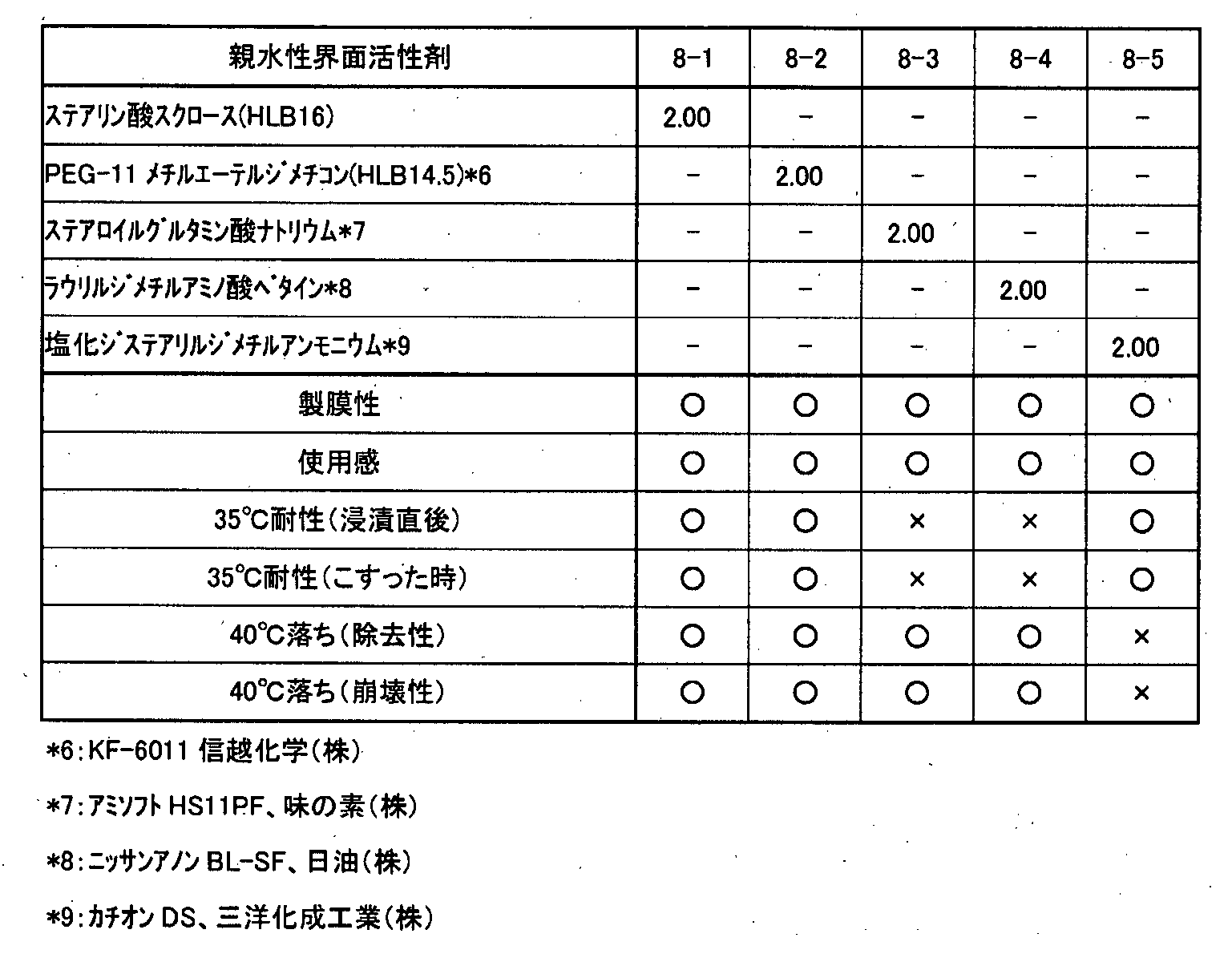
- Table 8 above shows the results when another hydrophilic surfactant was used in place of sucrose stearate in Test Example 7-5.
- an anionic surfactant or an amphoteric surfactant was blended, the resistance to 35 ° C. water was low, and when a cationic surfactant was blended, it was difficult to remove with 40 ° C. warm water. . Therefore, it is desirable to reduce the blending amount of the ionic surfactant as much as possible, and it is more desirable not to blend.
- Foundation A Maquillage Writing White Powder UV (applied with sponge) (Shiseido Co., Ltd., powder solid foundation)
- Foundation B Maquillage Lasting Stick Foundation UV (apply with fingers) (Shiseido Co., Ltd., oil-based solid foundation)
- Foundation C Maquillage Essence Rich White Liquid UV (applied with sponge) (Shiseido Co., Ltd., oil-in-water emulsion foundation)
- Foundation D Integrate mineral watery foundation (apply with fingers) (Shiseido Co., Ltd., water-in-oil emulsification foundation)
- Table 9 shows the results of evaluation of makeup removal when the test was performed in the same manner by changing the temperature of water during face washing.
- the foundation used was Shiseido Co., Ltd. Anessa Perfect UV Liquid N (oil-based liquid).
- the evaluation criteria are as follows. Makeup removal ⁇ : The foundation was removed without rubbing with a light force. (Triangle
- FIG. 1 shows a representative example.
- (a-1) to (b-3) are as follows.
- (A-1) Skin immediately after applying Foundation A without applying the base cosmetic of Test Example 1-1.
- (A-2) Skin immediately after washing the skin of (a-1) with only warm water of 38 ° C.
- (A-3) Skin immediately after the face of (a-2) was further washed using a face wash.
- (B-1) Skin immediately after applying Foundation A after applying the base cosmetic of Test Example 1-1.
- (B-3) Skin immediately after the face of (b-2) was further washed using a face wash.
- FIGS. 1 (a-1) to (a-3) when the base cosmetic composition of the present invention was not used, the foundation hardly dropped even if the face was washed with warm water, and no facial cleanser was used. The foundation could not be dropped.
- FIGS. 1 (b-1) to (b-3) when the base cosmetic composition of the present invention was used, the foundation could be cleanly removed simply by washing with warm water.
- the base coating thickness on the skin is extremely thin, cleaning is performed at a slightly low temperature side as compared with the case where a film is formed using the doctor blade. It tends to be possible.
- the water resistance of the make-up cosmetic applied on the base cosmetic of the present invention also slightly affects the base film cleaning temperature, and in the case of a make-up cosmetic with high water resistance, the cleaning temperature is slightly increased. It is preferable.
- the skin foundation cosmetic of Formulation Example 1 was easy to spread on the skin when applied to the skin, and formed a uniform foundation film without stickiness without causing foreign matters such as debris. Moreover, by applying to the skin before applying the foundation, it was possible to remove the foundation without using a facial cleanser by simply rubbing with warm water of 38 ° C. or higher. Moreover, the reattachment of the foundation to the skin was not seen.
Landscapes
- Health & Medical Sciences (AREA)
- Life Sciences & Earth Sciences (AREA)
- General Health & Medical Sciences (AREA)
- Veterinary Medicine (AREA)
- Public Health (AREA)
- Animal Behavior & Ethology (AREA)
- Birds (AREA)
- Epidemiology (AREA)
- Chemical & Material Sciences (AREA)
- Emergency Medicine (AREA)
- Oil, Petroleum & Natural Gas (AREA)
- Dispersion Chemistry (AREA)
- Cosmetics (AREA)
Description
従って、クレンジング料や洗顔料を用いずにメークを落とすことができれば、ユーザーの負担や懸念を軽減することができる。
例えば、特許文献1には、水や温水で容易に落とすことができる水中油型アイメークアップ化粧料が記載されている。特許文献1の技術は、多価アルコールと両親媒性物質との液晶を油相中に配合することで、水や温水で容易に落とすことができるというものである。
しかしながら、特許文献1の化粧料は水でも落ちるため、汗や涙で落ちたり崩れたりする場合がある。また、特許文献1はアイメーク化粧料、すなわち睫、眉、又はまぶたの一部に適用される部分メーク化粧料が記載されているに過ぎず、顔面の肌全体に塗布されるタイプの化粧料については記載されていない。
すなわち、特許文献2には、化粧料として許容される媒質中に、少なくとも一つの疎水性フィルム形成性ポリマーと、特定のイオン性界面活性剤とを含むメークアップ化粧料が記載されている。特許文献2の技術は、特定のイオン性界面活性剤が20~45℃で100μS/cm以上の水中導電性変動を有するためにポリマーフィルムが水に対してより感受性となり、その結果冷水には耐性を有しながら、温水との接触の間にこすった場合にはメークアップフィルムが脆化して容易に崩壊し、支持体から剥離するというものである。
しかしながら、特許文献2~3にはファンデーションなどにも適用可能であることは記載されているものの、具体例として示されているのはマスカラのみである。
よって、汗など低温の水に対しては落ちにくく、温水では容易に除去可能な下地化粧料があれば、これを肌に塗布した後にユーザーは好みの製品を使用することができるので、ユーザーにその嗜好性の変更を強要することなく、それまでのクレンジング料や洗顔料などを使用せずに温水のみでメーク落としを行うことができるようになる。
しかしながら、特許文献1と同じように、特許文献4のマスカラ下地も水でも落ちるタイプであるため、汗や涙でよれたり落ちたりする場合がある。また、特許文献4のマスカラ下地は睫用化粧料であり、ファンデーションなどの前に肌上に広範囲に塗布される肌用下地化粧料については記載されていない。
(a)酢酸ビニルポリマーと、
(b)多価アルコールと、
(c)親水性非イオン性界面活性剤と、
を含有し、
(a)酢酸ビニルポリマーは化粧料中0.5~7質量%であって、且つ水相中に粒子として分散しており、
(b)多価アルコールは(a)酢酸ビニルポリマー1質量部に対して0.5~5.5質量部であり、
(c)親水性非イオン性界面活性剤は化粧料中1~5質量%であることを特徴とする肌用下地化粧料である。
前記肌用下地化粧料は、肌用メークアップ化粧料を肌から除去する際に38~45℃の温水で肌用下地化粧料ごと除去することができる。
また、本発明は、前記肌用下地化粧料において、(c)親水性非イオン性界面活性剤がショ糖脂肪酸エステルであることを特徴とする肌用下地化粧料を提供する。
また、本発明は、前記何れかに記載の肌用下地化粧料において、イオン性界面活性剤を含まないことを特徴とする肌用下地化粧料を提供する。
前記メークアップ化粧料を落とすために38~45℃の温水で肌をこすることにより前記メークアップ化粧料を下地化粧料ごと落とす工程と、
を備えることを特徴とする化粧方法である。
前記化粧方法において、温水が洗浄剤を含まないことが好適である。
本発明の肌用下地化粧料を肌に塗布して形成される下地被膜は、その上に塗布された肌用メークアップ化粧料による化粧被膜に対して良好な密着性を有する。このため、温水でこするだけで下地被膜が化粧被膜を保持したまま均一且つ微細に崩壊しながら肌から剥離し、ヌルヌルしたり異物感を生じたりすることなくさっぱりと容易にメークを落とすことができ、しかも、メークが肌に再付着して肌が汚れることもない。
酢酸ビニルポリマーは疎水性被膜形成性ポリマーで、酢酸ビニルの単独重合体であるポリ酢酸ビニルである。
酢酸ビニルポリマーは公知の方法で製造することが可能であるが、市販品を用いてもよい。例えば、酢酸ビニルポリマーを水中に分散したポリマーエマルジョンが市販されており、これを好適に用いることができる。酢酸ビニルポリマーエマルジョンは通常は固形分含有率約35~55%、ポリ酢酸ビニル粒子の粒径は約0.1~3μmである。好適な酢酸ビニルポリマーエマルジョンとしては、例えばビニブランS-40(日信化学工業(株)、固形分40%、エタノール2%、残部水)を挙げることができる。
本発明においては、このような酢酸ビニルポリマーエマルジョンは水相に配合され、酢酸ビニルポリマーは連続相である水相中に粒子として分散する。
本発明において用いる多価アルコールは、分子内に2個以上、好ましくは2~6個の水酸基を有する水溶性の飽和脂肪族アルコール(分子内にエーテル結合を含んでいてもよい)であり、化粧料や医薬部外品などに通常配合される成分を用いることができる。
多価アルコールとしては、3価アルコール(例えば、グリセリン、トリメチロールプロパン等)、4価アルコール(例えば、ジグリセリン、エリスリトール、ペンタエリスリトール等)、5価アルコール(例えば、キシリトール、トリグリセリン等)、6価アルコール(例えば、ソルビトール、マンニトール等)、ならびにこれらの重合体(例えば、ジグリセリン、トリグリセリン、テトラグリセリン、ポリグリセリン等)なども挙げることができるが、好ましい多価アルコールの例としてグリコール(分子内に水酸基を2個有するアルコール)が挙げられる。
この中でも、特にジプロピレングリコール、プロピレングリコール、1,3-ブチレングリコール、ポリエチレングリコール(例えば分子量500以下)が好ましい。
親水性非イオン性界面活性剤としては、化粧料や医薬部外品などに通常配合されるものを用いることができ、好ましくはHLB8以上の非イオン性界面活性剤である。
親水性非イオン性界面活性剤としては、例えば、ショ糖脂肪酸エステル、グリセリン又はポリグリセリン脂肪酸エステル、プロピレングリコール脂肪酸エステル、POEソルビタン脂肪酸エステル、POEソルビット脂肪酸エステル、POEグリセリン脂肪酸エステル、POE脂肪酸エステル、POEアルキルエーテル、POEアルキルフェニルエーテル、POE・POPアルキルエーテル、POEヒマシ油又はPOE硬化ヒマシ油誘導体、POE蜜ロウ・ラノリン誘導体、アルカノールアミド類、POEプロピレングリコール脂肪酸エステル類、POEアルキルアミン、POE脂肪酸アミド、アルキルアミドアミン等が挙げられ、これらの1種又は2種以上を組み合わせて配合することができる。
また、別の好適な例として、シリコーン系非イオン性界面活性剤が挙げられ、例えば、KF-6011(信越化学工業(株)、INCI名:PEG-11メチルエーテルジメチコン)のようなポリオキシエチレン変性オルガノポリシロキサンが挙げられる。
なお、本発明の下地化粧料には、本発明の効果を損なわない範囲で、親水性非イオン性界面活性剤以外の界面活性剤を配合することが可能であるが、イオン性界面活性剤は本発明の効果を著しく損なう場合があるので、イオン性界面活性剤の配合量はできるだけ抑制することが好ましく、配合しないことがより望ましい。
本発明においては、上記必須成分以外に、通常化粧料や医薬部外品に用いられる成分を本発明の効果を損なわない質的・量的範囲で配合することができる。例えば、液体油脂、固体油脂、ロウ、炭化水素、エステル油、高級脂肪酸、高級アルコール、シリコーン油等などの油分が挙げられる。
ドクターブレードを用いて試料をスライドグラス上に0.175mm厚にプルダウンし、37℃で1昼夜乾燥させた。形成された下地被膜を肉眼観察し、次の基準で評価した。
○ :ツブ(異物)、シワ、穴等がなく、均一な乾燥被膜が形成された。
△ :ツブ(異物)、シワ、穴等がほとんどなく、ほぼ均一な乾燥被膜が形成された。
× :ツブ(異物)、シワ、穴等があり、不均一な乾燥被膜が形成された。
××:乾燥被膜が形成されず、べたつく被膜が形成された。
汗などに対する耐性を調べるため、35℃の水で浸漬試験を行った。具体的には、製膜性試験で得られた乾燥被膜をスライドグラスごと35℃の水に浸漬後直ちに引き上げる操作を10回繰り返した直後の被膜について、落ちや崩れがないかを肉眼で観察した(浸漬直後)。さらに、室温1分間放置した後、指で軽くこすって落ちや崩れがないかを肉眼で観察した(こすった時)。観察結果を次の基準で評価した。
○:落ちや崩れが全くない。
△:落ちや崩れがほとんどない。
×:落ちや崩れがある。
温水での落ちを調べるために、製膜性試験で得られた被膜をスライドグラスごと40℃の温水中に浸漬し、指でこすってスライドグラスからの落ち(除去性)及び落ちた場合にはその落ち方(崩壊性)を観察し、下記の基準で評価した。
○ :軽くこするだけで完全に除去できた。
△ :軽くこすってもなかなか完全に除去できなかったが、強くこすると完全に除去できた。
× :強くこすっても全く除去できなかった。
上記除去性評価で除去できた場合について、下記の基準で評価した。
○:下地被膜が均一に微細に崩壊しながら剥離して除去された。
△:下地被膜がほぼ均一に微細に崩壊しながら剥離して除去された。
×:下地被膜が均一に微細に崩壊せず、膜状、小片状、あるいは塊状に剥離して除去された。
××:下地被膜が剥離はせずに、ヌルつきながら溶解して除去された。
肌に塗布した際の「のび」、「べたつきのなさ」及び「異物感(ツブ)」、下地被膜が形成された時の「ごわつきのなさ」の4項目について、下記の基準で評価した。
○:全ての項目で優れている
△:少なくとも一つの項目がやや劣る
×:少なくとも一つの項目が劣る
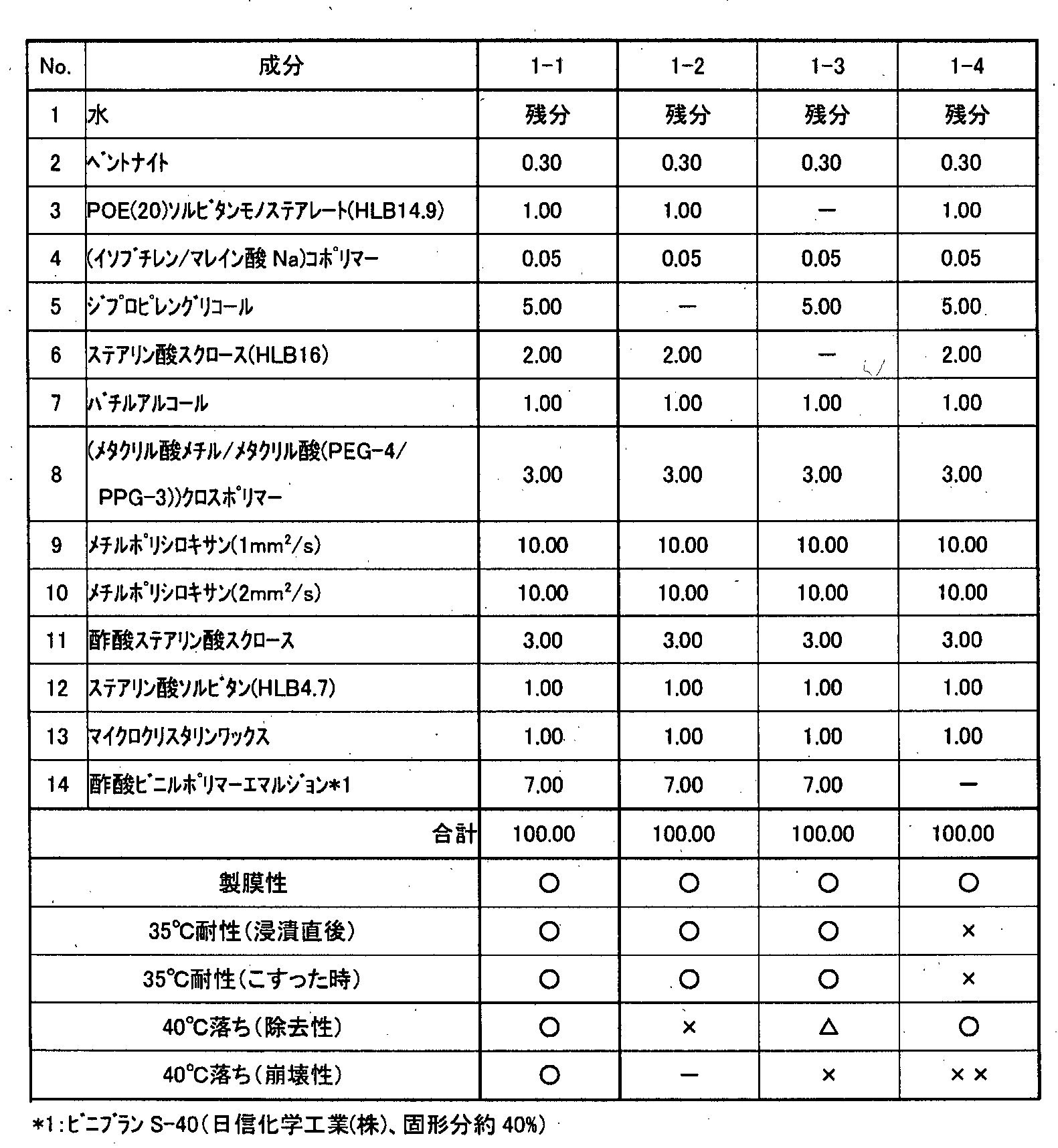
1に3~7を添加して加熱溶解した後、2を添加して分散し、さらに8を添加して分散させた(水相)。9~10に11~13を添加して加熱溶解し(油相)、加熱した水相に投入してホモミキサーで乳化し、得られたO/W乳化物に14を混合して下地化粧料を得た。
試料1-1のように、酢酸ビニルポリマーと多価アルコールと親水性非イオン性界面活性剤とを含む場合には、35℃の水でも落ちや崩れのない均一な下地被膜が形成できた。そして、この下地被膜を40℃の温水中でこすった場合には、軽くこするだけで均一に微細に崩壊しながら落ちて、さっぱりとした優れた洗い心地であった。
試料1-3のように親水性非イオン性界面活性剤を配合しなかった場合には、35℃水で落ちや崩れはなく、40℃温水でこすると落ちる下地被膜が得られたが、強くこすらないと落とすことができなかった。また、落ち方も均一に微細に崩壊せずに、膜状、小片状あるいは塊状で落ちたために異物感があり、洗い心地が悪かった。
これらのことから、酢酸ビニルポリマーと多価アルコールと親水性非イオン性界面活性剤とを配合することが重要であると考えられた。そこで、各成分について検討を行った。
まず、酢酸ビニルポリマーについて検討した。

酢酸ビニルポリマーを一定量以上配合すれば35℃の水では落ちず、40℃の温水では微細に崩壊しながら剥離除去できる被膜を形成することができた。一方で、多すぎるとのびが悪くなったり、下地化粧料がべたついたり、下地被膜がごわついたりする。
このようなことから、酢酸ビニルポリマーは下地化粧料全量中0.5~7質量%、好ましくは1~5.5質量%である。

次に、多価アルコールについて検討した。

酢酸ビニルポリマーに対して多価アルコールが少なすぎると、40℃温水では落ちにくくなる傾向があり、多すぎると35℃での耐水性が低下し、また、製膜性が悪化したり、下地化粧料がべたつく傾向がある。
このようなことから、多価アルコールは酢酸ビニルポリマー1質量部に対して0.5~5.5質量部、好ましくは0.8~4質量部と考えられた。

プロピレングリコール、1,3-ブチレングリコール、ポリエチレングリコール400ではジプロピレングリコールとほぼ同等の結果であった。また、グリセリンやジグリセリンでは、35℃水に対する耐性がジプロピレングリコール等に比べてやや劣り、また、グリセリンでは下地化粧料にややべたつきがあったり、ジグリセリンでは僅かに異物を生じることがあったが、使用可能なレベルであった。
さらに、親水性非イオン性界面活性剤について検討を行った。
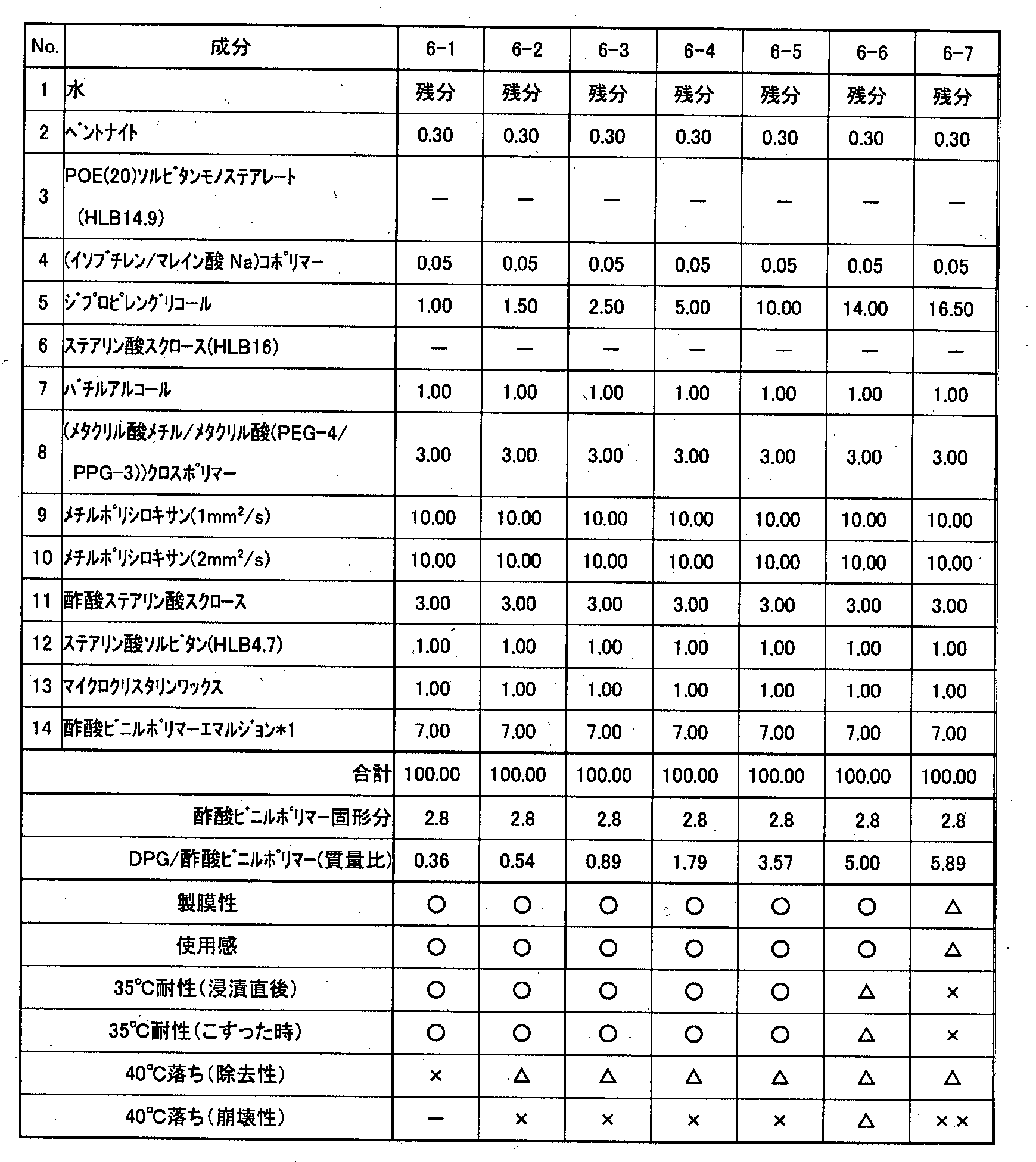
よって、多価アルコールを酢酸ビニルポリマーに対して特定比率で配合し、且つ、親水性非イオン性界面活性剤を配合することが必要であると考えられる。

親水性非イオン性界面活性剤が少なすぎると40℃温水で落ちたとしても強くこすらなければ落ちず、また、落ち方も下地被膜が均一に微細に崩壊せずに、膜状、小片状、あるいは塊状で落ちるものであるため、洗い心地が悪い。一方、多すぎるとべたつきを生じたり、35℃の水に対する耐性が低下する傾向がある。
このようなことから、親水性非イオン性界面活性剤は下地化粧料全量中1~5質量%、好ましくは1.5~4.5質量%であると考えられた。
女性パネルにより本発明の下地化粧料の実使用試験を行った。具体的には、次の通りである。
午前9:30に顔面全体に試験例1-1の下地化粧料を指で塗布し、1分後にファンデーションを塗布した。屋外を約4時間ウォーキングした後、午後2時頃に化粧持ちを目視により確認し、評価を行った。その後ファンデーションで化粧直しを行い、さらに屋内外で普段通りに4時間過ごした後、午後6時頃に洗顔料は用いずに38℃の温水で顔を濡らしながら指や掌で軽くこすることにより洗顔を行い、化粧落ちを目視により確認し、評価を行った。
試験中の平均気温は26~28℃(最高気温約31℃)、平均湿度は70~80%(最高湿度約91%)であった。各群は7名のパネルで試験を行った。用いたファンデーションと塗布方法は次の通りであった。
マキアージュ ライティング ホワイトパウダリー UV(スポンジで塗布)
((株)資生堂、粉末固型ファンデーション)
ファンデーションB:
マキアージュ ラスティング スティックファンデーション UV(指で塗布)
((株)資生堂、油性固型ファンデーション)
ファンデーションC:
マキアージュ エッセンスリッチ ホワイトリキッド UV(スポンジで塗布)
((株)資生堂、水中油型乳化ファンデーション)
ファンデーションD:
インテグレート ミネラルウォータリーファンデーション(指で塗布)
((株)資生堂、油中水型乳化ファンデーション)
化粧持ちについては、何れのファンデーションを塗布した群においても、テカリや脂浮きはあったものの、ファンデーションの剥がれ、崩れ、ヨレはほとんどなかった。
化粧落ちについては、何れのファンデーションを塗布した群においても、38℃の温水で軽くこするだけでファンデーションを残らず落とすことができた。また、ファンデーションの肌への再付着は見られなかった。
化粧落ち
○ :軽い力でこするだけでファンデーションが残らず落ちた。
△ :やや強い力でこすることによりファンデーションが残らず落ちた。
× :強い力でこすらないとファンデーションが落ちなかった。

なお、下地化粧料を塗布しなかった場合には、38℃以上の温水で強くこすっても、何れの群においてもファンデーションを落とすことはできなかった。
(a-1):試験例1-1の下地化粧料を塗布せずにファンデーションAを塗布した直後の肌。
(a-2):(a-1)の肌を38℃の温水のみで洗顔した直後の肌。
(a-3):(a-2)の肌をさらに洗顔料を使用して洗顔を行った直後の肌。
(b-1):試験例1-1の下地化粧料を塗布した後にファンデーションAを塗布した直後の肌。
(b-2):(b-1)の肌を38℃の温水のみで洗顔した直後の肌。
(b-3):(b-2)の肌をさらに洗顔料を使用して洗顔を行った直後の肌。
これに対して、図1(b-1)~(b-3)からわかるように、本発明の下地化粧料を用いれば、温水で洗顔するだけでファンデーションをきれいに落とすことができた。
なお、本発明にかかる下地化粧料を実使用する際には、肌上での下地被膜厚が極めて薄いため、前記ドクターブレードを用いて被膜を形成する場合に比較して、やや低温側で洗浄可となる傾向がある。また、本発明の下地化粧料上に塗布されるメーク化粧料の耐水性も、若干、下地被膜洗浄温度に影響を与え、耐水性が高いメーク化粧料の場合には洗浄温度をやや高めにすることが好ましい。
水 残余
ベントナイト 0.3 質量%
POE(20)ソルビタンモノステアレート 1.0
(イソブチレン/マレイン酸ナトリウム)コポリマー 0.05
ジプロピレングリコール 5.0
ステアリン酸スクロース 2.0
バチルアルコール 1.0
シリカ被覆微粒子酸化チタン 5.0
(メタクリル酸メチル/メタクリル酸
(PEG-4/PPG-3))クロスポリマー 3.0
ジメチルポリシロキサン(1mm2/s) 10.0
ジメチルポリシロキサン(2mm2/s) 10.0
酢酸ステアリン酸スクロース 3.0
ステアリン酸ソルビタン 1.0
マイクロクリスタリンワックス 1.0
メトキシケイ皮酸オクチル 3.0
酢酸ビニルポリマーエマルジョン*1 7.0
Claims (9)
- 肌用メークアップ化粧料を塗布する前に肌に塗布される肌用下地化粧料であって、水を含む水相を連続相とし、
(a)酢酸ビニルポリマーと、
(b)多価アルコールと、
(c)親水性非イオン性界面活性剤と、
を含有し、
(a)酢酸ビニルポリマーは化粧料中0.5~7質量%であって、且つ水相中に粒子として分散しており、
(b)多価アルコールは(a)酢酸ビニルポリマー1質量部に対して0.5~5.5質量部であり、
(c)親水性非イオン性界面活性剤は化粧料中1~5質量%であることを特徴とする肌用下地化粧料。 - 請求項1記載の肌用下地化粧料において、肌用メークアップ化粧料を肌から除去する際に38~45℃の温水で肌用下地化粧料ごと除去することを特徴とする肌用下地化粧料。
- 請求項2記載の肌用下地化粧料において、(b)多価アルコールが、ジプロピレングリコール、プロピレングリコール、1,3-ブチレングリコール、ポリエチレングリコールから選ばれる1種以上であることを特徴とする肌用下地化粧料。
- 請求項1~3の何れかに記載の肌用下地化粧料において、(c)親水性非イオン性界面活性剤がHLB8以上の非イオン性界面活性剤であることを特徴とする肌用下地化粧料。
- 請求項4記載の肌用下地化粧料において、(c)親水性非イオン性界面活性剤がショ糖脂肪酸エステルであることを特徴とする肌用下地化粧料。
- 請求項1~5の何れかに記載の肌用下地化粧料において、さらに、油相粒子が酢酸ビニルポリマーの粒子とは別個に水相中に分散しているO/W乳化物であることを特徴とする肌用下地化粧料。
- 請求項1~6の何れかに記載の肌用下地化粧料において、イオン性界面活性剤を含まないことを特徴とする肌用下地化粧料。
- 請求項1~7の何れかに記載の肌用下地化粧料を肌用メークアップ化粧料を塗布する前に肌に塗布する工程と、
前記メークアップ化粧料を落とすために38~45℃の温水で肌をこすることにより前記メークアップ化粧料を下地化粧料ごと落とす工程と、
を備えることを特徴とする化粧方法。 - 請求項8記載の方法において、温水が洗浄剤を含まないことを特徴とする化粧方法。
Priority Applications (8)
| Application Number | Priority Date | Filing Date | Title |
|---|---|---|---|
| CN201380053025.1A CN104853740B (zh) | 2012-10-12 | 2013-10-11 | 可以用温水除掉的皮肤用打底化妆品 |
| KR1020157007610A KR102129639B1 (ko) | 2012-10-12 | 2013-10-11 | 온수로 제거되는 피부용 베이스 화장료 |
| HK15110359.7A HK1209622B (en) | 2012-10-12 | 2013-10-11 | Makeup base cosmetic for skin removable with warm water |
| RU2015116148A RU2635538C2 (ru) | 2012-10-12 | 2013-10-11 | Косметическая основа под макияж для кожи, удаляемая теплой водой |
| JP2014540904A JP6219298B2 (ja) | 2012-10-12 | 2013-10-11 | 温水で落ちる肌用下地化粧料 |
| EP13845869.0A EP2907499B1 (en) | 2012-10-12 | 2013-10-11 | Makeup base cosmetic for skin removable with warm water |
| US14/434,249 US9968542B2 (en) | 2012-10-12 | 2013-10-11 | Makeup base for skin removable with warm water |
| ES13845869.0T ES2661877T3 (es) | 2012-10-12 | 2013-10-11 | Base de maquillaje cosmética para piel removible con agua tibia BASE DE MAQUILLAJE COSMÉTICA PARA PIEL REMOVIBLE CON AGUA TIBIA |
Applications Claiming Priority (2)
| Application Number | Priority Date | Filing Date | Title |
|---|---|---|---|
| JP2012227165 | 2012-10-12 | ||
| JP2012-227165 | 2012-10-12 |
Publications (1)
| Publication Number | Publication Date |
|---|---|
| WO2014058048A1 true WO2014058048A1 (ja) | 2014-04-17 |
Family
ID=50477510
Family Applications (1)
| Application Number | Title | Priority Date | Filing Date |
|---|---|---|---|
| PCT/JP2013/077739 Ceased WO2014058048A1 (ja) | 2012-10-12 | 2013-10-11 | 温水で落ちる肌用下地化粧料 |
Country Status (9)
| Country | Link |
|---|---|
| US (1) | US9968542B2 (ja) |
| EP (1) | EP2907499B1 (ja) |
| JP (1) | JP6219298B2 (ja) |
| KR (1) | KR102129639B1 (ja) |
| CN (1) | CN104853740B (ja) |
| ES (1) | ES2661877T3 (ja) |
| RU (1) | RU2635538C2 (ja) |
| TW (1) | TWI602578B (ja) |
| WO (1) | WO2014058048A1 (ja) |
Cited By (2)
| Publication number | Priority date | Publication date | Assignee | Title |
|---|---|---|---|---|
| JP2014224059A (ja) * | 2013-05-16 | 2014-12-04 | 株式会社 資生堂 | 温水で落ちる肌用下地化粧料 |
| KR20160095155A (ko) | 2013-12-27 | 2016-08-10 | 가부시키가이샤 코세 | 피부용 수중유형 유화 화장료 |
Families Citing this family (6)
| Publication number | Priority date | Publication date | Assignee | Title |
|---|---|---|---|---|
| BR112017012615B1 (pt) | 2014-12-18 | 2021-04-06 | L'oreal | Composição e película de enrijecimento da pele, e, método para melhorar a aparência da pele |
| KR20170025254A (ko) | 2015-08-28 | 2017-03-08 | (주)신생활화장품 | 비누로 쉽게 제거되는 피부용 베이스 화장료 조성물 |
| US10292922B2 (en) * | 2015-12-31 | 2019-05-21 | L'oreal | Silicone-wax dispersion compositions for removing cosmetic films |
| US10835479B2 (en) | 2015-12-31 | 2020-11-17 | L'oreal | Systems and methods for improving the appearance of the skin |
| KR102370611B1 (ko) * | 2017-06-28 | 2022-03-03 | 주식회사 엘지생활건강 | 유중수형 메이크업 화장료 조성물 |
| CN111000756A (zh) * | 2019-12-27 | 2020-04-14 | 株式会社资生堂 | 易卸妆的皮肤用打底化妆品 |
Citations (11)
| Publication number | Priority date | Publication date | Assignee | Title |
|---|---|---|---|---|
| JPH0525021A (ja) * | 1991-07-19 | 1993-02-02 | Pola Chem Ind Inc | メイクアツプ化粧料 |
| JPH10236919A (ja) * | 1997-02-26 | 1998-09-08 | Shiseido Co Ltd | 水中油型固型化粧料 |
| JPH11349441A (ja) * | 1998-06-10 | 1999-12-21 | Pola Chem Ind Inc | ウォッシュオフ・オイルゲル化粧料 |
| JP2003026539A (ja) | 2001-05-04 | 2003-01-29 | L'oreal Sa | 皮膜形成化粧品組成物 |
| JP2003137732A (ja) | 2001-10-17 | 2003-05-14 | L'oreal Sa | フィルム形成性化粧品組成物 |
| JP2004339082A (ja) | 2003-05-13 | 2004-12-02 | Tokiwa Corp | マスカラ下地 |
| JP2006306849A (ja) | 2005-03-29 | 2006-11-09 | Kose Corp | 水中油型アイメークアップ化粧料 |
| JP2008037826A (ja) * | 2006-08-09 | 2008-02-21 | Pola Chem Ind Inc | 角栓除去用の乳化化粧料 |
| JP2008266249A (ja) * | 2007-04-24 | 2008-11-06 | Pola Chem Ind Inc | 乳化剤形の皮膚外用剤 |
| JP2011168583A (ja) * | 2010-01-21 | 2011-09-01 | Shiseido Co Ltd | 外用剤組成物 |
| JP2011225534A (ja) * | 2010-03-30 | 2011-11-10 | Kose Corp | メイクアップ化粧料 |
Family Cites Families (15)
| Publication number | Priority date | Publication date | Assignee | Title |
|---|---|---|---|---|
| GB1110240A (en) * | 1967-07-27 | 1968-04-18 | Pfizer & Co C | Cosmetic preparation |
| US5238678A (en) | 1991-07-19 | 1993-08-24 | Pola Chemical Industries, Inc. | Double-coat type make-up cosmetic product containing aluminum powder |
| RU2063220C1 (ru) * | 1992-12-24 | 1996-07-10 | АО Московский мясокомбинат "Микомс" | Крем под макияж |
| FR2745494B1 (fr) * | 1996-03-04 | 1998-08-07 | Oreal | Composition comprenant une dispersion aqueuse de particules de polymere filmogene,et utilisation d'un systeme polymerique comprenant ladite dispersion notamment en cosmetique |
| YU275U (sh) * | 1997-04-02 | 1999-09-27 | Božen Kosmetic | Kozmetička rukavica za skidanje šminke sa lica |
| KR100633022B1 (ko) | 1999-11-15 | 2006-10-11 | 가부시키가이샤 시세이도 | 다가알코올중유형 온열기제 |
| FR2815850B1 (fr) | 2000-10-27 | 2003-02-14 | Oreal | Composition cosmetique filmogene |
| FR2826260B1 (fr) | 2001-06-22 | 2003-09-12 | Oreal | Composition cosmetique filmogene |
| JP2003238355A (ja) * | 2002-02-18 | 2003-08-27 | Dai Ichi Kogyo Seiyaku Co Ltd | メイクアップ除去料 |
| AU2005290511B2 (en) * | 2004-10-07 | 2011-06-02 | Shiseido Company, Ltd. | Surface-treating agent, surface-treated powder, and cosmetic preparation containing same |
| US8211415B2 (en) * | 2004-10-13 | 2012-07-03 | L'oreal | Easily removable waterproof cosmetic care and/or makeup composition comprising at least one latex or pseudolatex |
| FR2876280B1 (fr) * | 2004-10-13 | 2008-03-21 | Oreal | Composition cosmetique pour le soin et/ou le maquillage, resistante a l'eau, comprenant au moins un latex ou un pseudo-latex et facilement demaquillable |
| JP4724483B2 (ja) * | 2005-07-08 | 2011-07-13 | ジェイオーコスメティックス株式会社 | ベースメイク化粧料 |
| WO2011071795A1 (en) * | 2009-12-07 | 2011-06-16 | Susanne Lang Fragrance Inc. | Peelable, water-based nail cosmetic system |
| JP5533176B2 (ja) * | 2010-04-14 | 2014-06-25 | 信越化学工業株式会社 | ウォーターブレイクメイクアップ化粧料 |
-
2013
- 2013-10-11 EP EP13845869.0A patent/EP2907499B1/en active Active
- 2013-10-11 US US14/434,249 patent/US9968542B2/en active Active
- 2013-10-11 TW TW102136711A patent/TWI602578B/zh not_active IP Right Cessation
- 2013-10-11 CN CN201380053025.1A patent/CN104853740B/zh active Active
- 2013-10-11 WO PCT/JP2013/077739 patent/WO2014058048A1/ja not_active Ceased
- 2013-10-11 JP JP2014540904A patent/JP6219298B2/ja active Active
- 2013-10-11 RU RU2015116148A patent/RU2635538C2/ru not_active IP Right Cessation
- 2013-10-11 KR KR1020157007610A patent/KR102129639B1/ko active Active
- 2013-10-11 ES ES13845869.0T patent/ES2661877T3/es active Active
Patent Citations (11)
| Publication number | Priority date | Publication date | Assignee | Title |
|---|---|---|---|---|
| JPH0525021A (ja) * | 1991-07-19 | 1993-02-02 | Pola Chem Ind Inc | メイクアツプ化粧料 |
| JPH10236919A (ja) * | 1997-02-26 | 1998-09-08 | Shiseido Co Ltd | 水中油型固型化粧料 |
| JPH11349441A (ja) * | 1998-06-10 | 1999-12-21 | Pola Chem Ind Inc | ウォッシュオフ・オイルゲル化粧料 |
| JP2003026539A (ja) | 2001-05-04 | 2003-01-29 | L'oreal Sa | 皮膜形成化粧品組成物 |
| JP2003137732A (ja) | 2001-10-17 | 2003-05-14 | L'oreal Sa | フィルム形成性化粧品組成物 |
| JP2004339082A (ja) | 2003-05-13 | 2004-12-02 | Tokiwa Corp | マスカラ下地 |
| JP2006306849A (ja) | 2005-03-29 | 2006-11-09 | Kose Corp | 水中油型アイメークアップ化粧料 |
| JP2008037826A (ja) * | 2006-08-09 | 2008-02-21 | Pola Chem Ind Inc | 角栓除去用の乳化化粧料 |
| JP2008266249A (ja) * | 2007-04-24 | 2008-11-06 | Pola Chem Ind Inc | 乳化剤形の皮膚外用剤 |
| JP2011168583A (ja) * | 2010-01-21 | 2011-09-01 | Shiseido Co Ltd | 外用剤組成物 |
| JP2011225534A (ja) * | 2010-03-30 | 2011-11-10 | Kose Corp | メイクアップ化粧料 |
Cited By (2)
| Publication number | Priority date | Publication date | Assignee | Title |
|---|---|---|---|---|
| JP2014224059A (ja) * | 2013-05-16 | 2014-12-04 | 株式会社 資生堂 | 温水で落ちる肌用下地化粧料 |
| KR20160095155A (ko) | 2013-12-27 | 2016-08-10 | 가부시키가이샤 코세 | 피부용 수중유형 유화 화장료 |
Also Published As
| Publication number | Publication date |
|---|---|
| JPWO2014058048A1 (ja) | 2016-09-05 |
| CN104853740A (zh) | 2015-08-19 |
| RU2015116148A (ru) | 2016-12-10 |
| ES2661877T3 (es) | 2018-04-04 |
| TW201420123A (zh) | 2014-06-01 |
| EP2907499A1 (en) | 2015-08-19 |
| TWI602578B (zh) | 2017-10-21 |
| HK1209622A1 (en) | 2016-04-08 |
| KR20150067150A (ko) | 2015-06-17 |
| KR102129639B1 (ko) | 2020-07-02 |
| US20150272853A1 (en) | 2015-10-01 |
| RU2635538C2 (ru) | 2017-11-13 |
| CN104853740B (zh) | 2018-05-22 |
| EP2907499B1 (en) | 2017-12-06 |
| EP2907499A4 (en) | 2016-04-06 |
| JP6219298B2 (ja) | 2017-10-25 |
| US9968542B2 (en) | 2018-05-15 |
Similar Documents
| Publication | Publication Date | Title |
|---|---|---|
| JP6219298B2 (ja) | 温水で落ちる肌用下地化粧料 | |
| JP4274491B1 (ja) | クレンジング化粧料 | |
| KR20190060863A (ko) | 화장료용 피막의 제조 방법 | |
| TW201102106A (en) | Skin care preparation for external use | |
| CN104257513A (zh) | 化妆品、其制造方法、化妆品用组合物、含有所述化妆品用组合物的化妆品及其制造方法、以及工业用清洁剂 | |
| JP6026615B1 (ja) | バイコンティニュアス型クレンジング化粧料 | |
| JP2011026261A (ja) | パック化粧料 | |
| JPWO2019187215A1 (ja) | 油性化粧料 | |
| JP6133574B2 (ja) | 水系アイライナー化粧料 | |
| JP5964560B2 (ja) | 乳化型整髪料 | |
| JP6144109B2 (ja) | 温水で落ちる肌用下地化粧料 | |
| JP6180294B2 (ja) | シート用液状化粧料組成物及びシート状化粧料 | |
| CN105163707B (zh) | 皮肤清洁剂组合物 | |
| JP2007015935A (ja) | 整髪料 | |
| JP2010235514A (ja) | 液状クレンジング用組成物 | |
| JP2011111443A (ja) | 油中油型化粧料 | |
| TWI355943B (en) | Cleansing composition, cleansing sheet and makeup | |
| JP2003286137A (ja) | 毛髪速乾用化粧料 | |
| JP3543523B2 (ja) | ボディ用化粧料 | |
| JP6842402B2 (ja) | 汗及び/又は皮脂の除去方法 | |
| JP2008179584A (ja) | 透明状皮膚洗浄剤組成物 | |
| JP2008195614A (ja) | スティック状メイクアップリムーバー | |
| HK1209622B (en) | Makeup base cosmetic for skin removable with warm water | |
| JP2007217302A (ja) | 油性皮膚クレンジング料 | |
| JP2016216372A (ja) | ジェル状ミスト化粧料 |
Legal Events
| Date | Code | Title | Description |
|---|---|---|---|
| 121 | Ep: the epo has been informed by wipo that ep was designated in this application |
Ref document number: 13845869 Country of ref document: EP Kind code of ref document: A1 |
|
| ENP | Entry into the national phase |
Ref document number: 20157007610 Country of ref document: KR Kind code of ref document: A |
|
| WWE | Wipo information: entry into national phase |
Ref document number: 14434249 Country of ref document: US |
|
| ENP | Entry into the national phase |
Ref document number: 2014540904 Country of ref document: JP Kind code of ref document: A |
|
| NENP | Non-entry into the national phase |
Ref country code: DE |
|
| WWE | Wipo information: entry into national phase |
Ref document number: 2013845869 Country of ref document: EP |
|
| ENP | Entry into the national phase |
Ref document number: 2015116148 Country of ref document: RU Kind code of ref document: A |