WO2014103597A1 - 排気ガス浄化用触媒組成物及び排気ガス浄化用触媒 - Google Patents
排気ガス浄化用触媒組成物及び排気ガス浄化用触媒 Download PDFInfo
- Publication number
- WO2014103597A1 WO2014103597A1 PCT/JP2013/081888 JP2013081888W WO2014103597A1 WO 2014103597 A1 WO2014103597 A1 WO 2014103597A1 JP 2013081888 W JP2013081888 W JP 2013081888W WO 2014103597 A1 WO2014103597 A1 WO 2014103597A1
- Authority
- WO
- WIPO (PCT)
- Prior art keywords
- particles
- catalyst
- catalyst composition
- exhaust gas
- ceria
- Prior art date
- Legal status (The legal status is an assumption and is not a legal conclusion. Google has not performed a legal analysis and makes no representation as to the accuracy of the status listed.)
- Ceased
Links
Classifications
-
- B—PERFORMING OPERATIONS; TRANSPORTING
- B01—PHYSICAL OR CHEMICAL PROCESSES OR APPARATUS IN GENERAL
- B01J—CHEMICAL OR PHYSICAL PROCESSES, e.g. CATALYSIS OR COLLOID CHEMISTRY; THEIR RELEVANT APPARATUS
- B01J23/00—Catalysts comprising metals or metal oxides or hydroxides, not provided for in group B01J21/00
- B01J23/70—Catalysts comprising metals or metal oxides or hydroxides, not provided for in group B01J21/00 of the iron group metals or copper
- B01J23/72—Copper
-
- B—PERFORMING OPERATIONS; TRANSPORTING
- B01—PHYSICAL OR CHEMICAL PROCESSES OR APPARATUS IN GENERAL
- B01J—CHEMICAL OR PHYSICAL PROCESSES, e.g. CATALYSIS OR COLLOID CHEMISTRY; THEIR RELEVANT APPARATUS
- B01J23/00—Catalysts comprising metals or metal oxides or hydroxides, not provided for in group B01J21/00
- B01J23/70—Catalysts comprising metals or metal oxides or hydroxides, not provided for in group B01J21/00 of the iron group metals or copper
- B01J23/89—Catalysts comprising metals or metal oxides or hydroxides, not provided for in group B01J21/00 of the iron group metals or copper combined with noble metals
- B01J23/8933—Catalysts comprising metals or metal oxides or hydroxides, not provided for in group B01J21/00 of the iron group metals or copper combined with noble metals also combined with metals, or metal oxides or hydroxides provided for in groups B01J23/02 - B01J23/36
- B01J23/894—Catalysts comprising metals or metal oxides or hydroxides, not provided for in group B01J21/00 of the iron group metals or copper combined with noble metals also combined with metals, or metal oxides or hydroxides provided for in groups B01J23/02 - B01J23/36 with rare earths or actinides
-
- B—PERFORMING OPERATIONS; TRANSPORTING
- B01—PHYSICAL OR CHEMICAL PROCESSES OR APPARATUS IN GENERAL
- B01D—SEPARATION
- B01D53/00—Separation of gases or vapours; Recovering vapours of volatile solvents from gases; Chemical or biological purification of waste gases, e.g. engine exhaust gases, smoke, fumes, flue gases, aerosols
- B01D53/34—Chemical or biological purification of waste gases
- B01D53/92—Chemical or biological purification of waste gases of engine exhaust gases
- B01D53/94—Chemical or biological purification of waste gases of engine exhaust gases by catalytic processes
- B01D53/944—Simultaneously removing carbon monoxide, hydrocarbons or carbon making use of oxidation catalysts
-
- B—PERFORMING OPERATIONS; TRANSPORTING
- B01—PHYSICAL OR CHEMICAL PROCESSES OR APPARATUS IN GENERAL
- B01D—SEPARATION
- B01D53/00—Separation of gases or vapours; Recovering vapours of volatile solvents from gases; Chemical or biological purification of waste gases, e.g. engine exhaust gases, smoke, fumes, flue gases, aerosols
- B01D53/34—Chemical or biological purification of waste gases
- B01D53/92—Chemical or biological purification of waste gases of engine exhaust gases
- B01D53/94—Chemical or biological purification of waste gases of engine exhaust gases by catalytic processes
- B01D53/9445—Simultaneously removing carbon monoxide, hydrocarbons or nitrogen oxides making use of three-way catalysts [TWC] or four-way-catalysts [FWC]
- B01D53/945—Simultaneously removing carbon monoxide, hydrocarbons or nitrogen oxides making use of three-way catalysts [TWC] or four-way-catalysts [FWC] characterised by a specific catalyst
-
- B—PERFORMING OPERATIONS; TRANSPORTING
- B01—PHYSICAL OR CHEMICAL PROCESSES OR APPARATUS IN GENERAL
- B01J—CHEMICAL OR PHYSICAL PROCESSES, e.g. CATALYSIS OR COLLOID CHEMISTRY; THEIR RELEVANT APPARATUS
- B01J23/00—Catalysts comprising metals or metal oxides or hydroxides, not provided for in group B01J21/00
- B01J23/38—Catalysts comprising metals or metal oxides or hydroxides, not provided for in group B01J21/00 of noble metals
- B01J23/48—Silver or gold
- B01J23/50—Silver
-
- B—PERFORMING OPERATIONS; TRANSPORTING
- B01—PHYSICAL OR CHEMICAL PROCESSES OR APPARATUS IN GENERAL
- B01J—CHEMICAL OR PHYSICAL PROCESSES, e.g. CATALYSIS OR COLLOID CHEMISTRY; THEIR RELEVANT APPARATUS
- B01J23/00—Catalysts comprising metals or metal oxides or hydroxides, not provided for in group B01J21/00
- B01J23/70—Catalysts comprising metals or metal oxides or hydroxides, not provided for in group B01J21/00 of the iron group metals or copper
- B01J23/74—Iron group metals
- B01J23/745—Iron
-
- B—PERFORMING OPERATIONS; TRANSPORTING
- B01—PHYSICAL OR CHEMICAL PROCESSES OR APPARATUS IN GENERAL
- B01J—CHEMICAL OR PHYSICAL PROCESSES, e.g. CATALYSIS OR COLLOID CHEMISTRY; THEIR RELEVANT APPARATUS
- B01J23/00—Catalysts comprising metals or metal oxides or hydroxides, not provided for in group B01J21/00
- B01J23/70—Catalysts comprising metals or metal oxides or hydroxides, not provided for in group B01J21/00 of the iron group metals or copper
- B01J23/74—Iron group metals
- B01J23/75—Cobalt
-
- B—PERFORMING OPERATIONS; TRANSPORTING
- B01—PHYSICAL OR CHEMICAL PROCESSES OR APPARATUS IN GENERAL
- B01J—CHEMICAL OR PHYSICAL PROCESSES, e.g. CATALYSIS OR COLLOID CHEMISTRY; THEIR RELEVANT APPARATUS
- B01J23/00—Catalysts comprising metals or metal oxides or hydroxides, not provided for in group B01J21/00
- B01J23/70—Catalysts comprising metals or metal oxides or hydroxides, not provided for in group B01J21/00 of the iron group metals or copper
- B01J23/74—Iron group metals
- B01J23/755—Nickel
-
- B—PERFORMING OPERATIONS; TRANSPORTING
- B01—PHYSICAL OR CHEMICAL PROCESSES OR APPARATUS IN GENERAL
- B01J—CHEMICAL OR PHYSICAL PROCESSES, e.g. CATALYSIS OR COLLOID CHEMISTRY; THEIR RELEVANT APPARATUS
- B01J23/00—Catalysts comprising metals or metal oxides or hydroxides, not provided for in group B01J21/00
- B01J23/70—Catalysts comprising metals or metal oxides or hydroxides, not provided for in group B01J21/00 of the iron group metals or copper
- B01J23/76—Catalysts comprising metals or metal oxides or hydroxides, not provided for in group B01J21/00 of the iron group metals or copper combined with metals, oxides or hydroxides provided for in groups B01J23/02 - B01J23/36
- B01J23/83—Catalysts comprising metals or metal oxides or hydroxides, not provided for in group B01J21/00 of the iron group metals or copper combined with metals, oxides or hydroxides provided for in groups B01J23/02 - B01J23/36 with rare earths or actinides
-
- B—PERFORMING OPERATIONS; TRANSPORTING
- B01—PHYSICAL OR CHEMICAL PROCESSES OR APPARATUS IN GENERAL
- B01J—CHEMICAL OR PHYSICAL PROCESSES, e.g. CATALYSIS OR COLLOID CHEMISTRY; THEIR RELEVANT APPARATUS
- B01J23/00—Catalysts comprising metals or metal oxides or hydroxides, not provided for in group B01J21/00
- B01J23/70—Catalysts comprising metals or metal oxides or hydroxides, not provided for in group B01J21/00 of the iron group metals or copper
- B01J23/76—Catalysts comprising metals or metal oxides or hydroxides, not provided for in group B01J21/00 of the iron group metals or copper combined with metals, oxides or hydroxides provided for in groups B01J23/02 - B01J23/36
- B01J23/84—Catalysts comprising metals or metal oxides or hydroxides, not provided for in group B01J21/00 of the iron group metals or copper combined with metals, oxides or hydroxides provided for in groups B01J23/02 - B01J23/36 with arsenic, antimony, bismuth, vanadium, niobium, tantalum, polonium, chromium, molybdenum, tungsten, manganese, technetium or rhenium
- B01J23/85—Chromium, molybdenum or tungsten
- B01J23/86—Chromium
- B01J23/868—Chromium copper and chromium
-
- B—PERFORMING OPERATIONS; TRANSPORTING
- B01—PHYSICAL OR CHEMICAL PROCESSES OR APPARATUS IN GENERAL
- B01J—CHEMICAL OR PHYSICAL PROCESSES, e.g. CATALYSIS OR COLLOID CHEMISTRY; THEIR RELEVANT APPARATUS
- B01J23/00—Catalysts comprising metals or metal oxides or hydroxides, not provided for in group B01J21/00
- B01J23/70—Catalysts comprising metals or metal oxides or hydroxides, not provided for in group B01J21/00 of the iron group metals or copper
- B01J23/76—Catalysts comprising metals or metal oxides or hydroxides, not provided for in group B01J21/00 of the iron group metals or copper combined with metals, oxides or hydroxides provided for in groups B01J23/02 - B01J23/36
- B01J23/84—Catalysts comprising metals or metal oxides or hydroxides, not provided for in group B01J21/00 of the iron group metals or copper combined with metals, oxides or hydroxides provided for in groups B01J23/02 - B01J23/36 with arsenic, antimony, bismuth, vanadium, niobium, tantalum, polonium, chromium, molybdenum, tungsten, manganese, technetium or rhenium
- B01J23/889—Manganese, technetium or rhenium
- B01J23/8892—Manganese
-
- B—PERFORMING OPERATIONS; TRANSPORTING
- B01—PHYSICAL OR CHEMICAL PROCESSES OR APPARATUS IN GENERAL
- B01J—CHEMICAL OR PHYSICAL PROCESSES, e.g. CATALYSIS OR COLLOID CHEMISTRY; THEIR RELEVANT APPARATUS
- B01J35/00—Catalysts, in general, characterised by their form or physical properties
- B01J35/50—Catalysts, in general, characterised by their form or physical properties characterised by their shape or configuration
-
- B—PERFORMING OPERATIONS; TRANSPORTING
- B01—PHYSICAL OR CHEMICAL PROCESSES OR APPARATUS IN GENERAL
- B01J—CHEMICAL OR PHYSICAL PROCESSES, e.g. CATALYSIS OR COLLOID CHEMISTRY; THEIR RELEVANT APPARATUS
- B01J37/00—Processes, in general, for preparing catalysts; Processes, in general, for activation of catalysts
- B01J37/34—Irradiation by, or application of, electric, magnetic or wave energy, e.g. ultrasonic waves ; Ionic sputtering; Flame or plasma spraying; Particle radiation
- B01J37/349—Irradiation by, or application of, electric, magnetic or wave energy, e.g. ultrasonic waves ; Ionic sputtering; Flame or plasma spraying; Particle radiation making use of flames, plasmas or lasers
-
- B—PERFORMING OPERATIONS; TRANSPORTING
- B01—PHYSICAL OR CHEMICAL PROCESSES OR APPARATUS IN GENERAL
- B01D—SEPARATION
- B01D2255/00—Catalysts
- B01D2255/10—Noble metals or compounds thereof
- B01D2255/104—Silver
-
- B—PERFORMING OPERATIONS; TRANSPORTING
- B01—PHYSICAL OR CHEMICAL PROCESSES OR APPARATUS IN GENERAL
- B01D—SEPARATION
- B01D2255/00—Catalysts
- B01D2255/20—Metals or compounds thereof
- B01D2255/206—Rare earth metals
- B01D2255/2065—Cerium
-
- B—PERFORMING OPERATIONS; TRANSPORTING
- B01—PHYSICAL OR CHEMICAL PROCESSES OR APPARATUS IN GENERAL
- B01D—SEPARATION
- B01D2255/00—Catalysts
- B01D2255/20—Metals or compounds thereof
- B01D2255/207—Transition metals
- B01D2255/20715—Zirconium
-
- B—PERFORMING OPERATIONS; TRANSPORTING
- B01—PHYSICAL OR CHEMICAL PROCESSES OR APPARATUS IN GENERAL
- B01D—SEPARATION
- B01D2255/00—Catalysts
- B01D2255/20—Metals or compounds thereof
- B01D2255/207—Transition metals
- B01D2255/2073—Manganese
-
- B—PERFORMING OPERATIONS; TRANSPORTING
- B01—PHYSICAL OR CHEMICAL PROCESSES OR APPARATUS IN GENERAL
- B01D—SEPARATION
- B01D2255/00—Catalysts
- B01D2255/20—Metals or compounds thereof
- B01D2255/207—Transition metals
- B01D2255/20738—Iron
-
- B—PERFORMING OPERATIONS; TRANSPORTING
- B01—PHYSICAL OR CHEMICAL PROCESSES OR APPARATUS IN GENERAL
- B01D—SEPARATION
- B01D2255/00—Catalysts
- B01D2255/20—Metals or compounds thereof
- B01D2255/207—Transition metals
- B01D2255/20746—Cobalt
-
- B—PERFORMING OPERATIONS; TRANSPORTING
- B01—PHYSICAL OR CHEMICAL PROCESSES OR APPARATUS IN GENERAL
- B01D—SEPARATION
- B01D2255/00—Catalysts
- B01D2255/20—Metals or compounds thereof
- B01D2255/207—Transition metals
- B01D2255/20753—Nickel
-
- B—PERFORMING OPERATIONS; TRANSPORTING
- B01—PHYSICAL OR CHEMICAL PROCESSES OR APPARATUS IN GENERAL
- B01D—SEPARATION
- B01D2255/00—Catalysts
- B01D2255/20—Metals or compounds thereof
- B01D2255/207—Transition metals
- B01D2255/20761—Copper
-
- B—PERFORMING OPERATIONS; TRANSPORTING
- B01—PHYSICAL OR CHEMICAL PROCESSES OR APPARATUS IN GENERAL
- B01D—SEPARATION
- B01D2255/00—Catalysts
- B01D2255/90—Physical characteristics of catalysts
- B01D2255/92—Dimensions
- B01D2255/9207—Specific surface
-
- B—PERFORMING OPERATIONS; TRANSPORTING
- B01—PHYSICAL OR CHEMICAL PROCESSES OR APPARATUS IN GENERAL
- B01J—CHEMICAL OR PHYSICAL PROCESSES, e.g. CATALYSIS OR COLLOID CHEMISTRY; THEIR RELEVANT APPARATUS
- B01J2235/00—Indexing scheme associated with group B01J35/00, related to the analysis techniques used to determine the catalysts form or properties
- B01J2235/15—X-ray diffraction
-
- B—PERFORMING OPERATIONS; TRANSPORTING
- B01—PHYSICAL OR CHEMICAL PROCESSES OR APPARATUS IN GENERAL
- B01J—CHEMICAL OR PHYSICAL PROCESSES, e.g. CATALYSIS OR COLLOID CHEMISTRY; THEIR RELEVANT APPARATUS
- B01J35/00—Catalysts, in general, characterised by their form or physical properties
- B01J35/30—Catalysts, in general, characterised by their form or physical properties characterised by their physical properties
- B01J35/34—Mechanical properties
- B01J35/36—Mechanical strength
-
- F—MECHANICAL ENGINEERING; LIGHTING; HEATING; WEAPONS; BLASTING
- F01—MACHINES OR ENGINES IN GENERAL; ENGINE PLANTS IN GENERAL; STEAM ENGINES
- F01N—GAS-FLOW SILENCERS OR EXHAUST APPARATUS FOR MACHINES OR ENGINES IN GENERAL; GAS-FLOW SILENCERS OR EXHAUST APPARATUS FOR INTERNAL-COMBUSTION ENGINES
- F01N2510/00—Surface coverings
- F01N2510/06—Surface coverings for exhaust purification, e.g. catalytic reaction
-
- Y—GENERAL TAGGING OF NEW TECHNOLOGICAL DEVELOPMENTS; GENERAL TAGGING OF CROSS-SECTIONAL TECHNOLOGIES SPANNING OVER SEVERAL SECTIONS OF THE IPC; TECHNICAL SUBJECTS COVERED BY FORMER USPC CROSS-REFERENCE ART COLLECTIONS [XRACs] AND DIGESTS
- Y02—TECHNOLOGIES OR APPLICATIONS FOR MITIGATION OR ADAPTATION AGAINST CLIMATE CHANGE
- Y02T—CLIMATE CHANGE MITIGATION TECHNOLOGIES RELATED TO TRANSPORTATION
- Y02T10/00—Road transport of goods or passengers
- Y02T10/10—Internal combustion engine [ICE] based vehicles
- Y02T10/12—Improving ICE efficiencies
Definitions
- the present invention relates to a catalyst that can be used to purify exhaust gas discharged from an internal combustion engine such as a gasoline engine such as a two-wheeled or four-wheeled vehicle or a diesel engine, and a catalyst composition used for the catalyst.
- an internal combustion engine such as a gasoline engine such as a two-wheeled or four-wheeled vehicle or a diesel engine
- a catalyst composition used for the catalyst used for the catalyst.
- the exhaust gas of automobiles using gasoline as fuel contains harmful components such as hydrocarbons (THC), carbon monoxide (CO), and nitrogen oxides (NOx). Therefore, the hydrocarbon (THC) is oxidized and converted to water and carbon dioxide, the carbon monoxide (CO) is oxidized and converted to carbon dioxide, and the nitrogen oxide (NOx) is reduced to nitrogen. It is necessary to purify each harmful component by converting it.
- THC hydrocarbons
- CO carbon monoxide
- NOx nitrogen oxide
- exhaust gas purification catalyst As a catalyst for treating such exhaust gas (hereinafter referred to as “exhaust gas purification catalyst”), a three-way catalyst (Threee way catalyst: TWC) capable of oxidizing and reducing CO, THC, and NOx is used. Yes.
- a noble metal is supported on a refractory oxide porous body having a high specific surface area, for example, an alumina porous body having a high specific surface area, and this is used as a base material such as a refractory ceramic or metal.
- a base material such as a refractory ceramic or metal.
- Known are those supported on a monolithic substrate made of a honeycomb structure or supported on refractory particles.
- exhaust gas exhausted from diesel engines includes sulfates based on sulfur in the fuel, tar-like particulate matter (referred to as “PM”) derived from incomplete combustion, and nitrogen oxides (NOx). Etc. are included.
- an exhaust gas purification apparatus that collects PM with a diesel particulate filter (referred to as “DPF”) and burns and removes the collected PM at an appropriate timing.
- DPF diesel particulate filter
- Such a DPF usually collects PM on the surface of the partition wall when the porous filter substrate having a honeycomb structure forms a skeleton and exhaust gas flows through the partition wall of the substrate. It has become.
- Patent Document 1 Japanese Patent Application Laid-Open No. 2011-140011
- Pd is supported on CeO 2 carrier particles as a CO oxidation catalyst capable of exhibiting CO oxidation activity in a wide range of temperatures including low temperature, and 850 is used in an oxidizing atmosphere.
- a CO oxidation catalyst obtained by heat treatment at a temperature in the range of ⁇ 950 ° C. is disclosed.
- Patent Document 2 Japanese Patent Application Laid-Open No. 2008-156130 discloses a general formula ABOx (in which A is a formula for an exhaust gas purification catalyst that does not require the presence of noble metals and has a high oxygen storage capacity from a low temperature range to a high temperature range).
- A represents at least one selected from the group consisting of Cu, Ag, Pd and Pt
- B represents Al, Cr, Ga, Fe, Mn, Co, Rh, Ni, In, La, Nd, Sm, Eu, Y
- an exhaust gas purifying catalyst comprising a 3R-type delafossite-type oxide represented by (1) selected from the group consisting of Ti and Ti on a carrier made of ceramics or a metal material. Yes.
- Patent Document 3 Japanese Patent Laid-Open No. 9-225267 uses a spinel oxide as a catalyst that traps HC at 200 ° C. or lower and is used for purification of NOx reduction reaction or the like at higher temperatures. It is disclosed.
- JP 2011-140011 A JP 2008-156130 A JP 2009-225267 A
- the present invention relates to a catalyst composition using a metal other than a noble metal as a catalytically active component, and can exhibit an excellent effect on the catalytic activity, particularly the treatment activity of HC and CO.
- the present invention proposes a new exhaust gas purifying catalyst composition and a catalyst using the same, in which the catalytic activity does not decrease.
- the present invention relates to a catalyst particle having a configuration in which Cu and a transition metal A containing at least one of Cr, Fe, Mn, Co, Ni, Zr and Ag are supported on ceria (CeO 2 ) particles.
- the present invention proposes an exhaust gas purifying catalyst composition containing the catalyst and a catalyst using the same.
- the exhaust gas purifying catalyst composition proposed by the present invention and a catalyst using the same are a combination of Cu and a transition metal A containing at least one of Cr, Fe, Mn, Co, Ni, Zr and Ag. , By being supported on ceria (CeO 2 ) particles, no noble metal can be used or the amount used can be significantly reduced, so that it can be provided at a lower cost. In addition, it has excellent catalytic activity after heat endurance treatment, especially HC and CO oxidation activity.
- the exhaust gas purifying catalyst composition (referred to as “the present catalyst composition”) according to the present embodiment includes a transition metal A containing Cu and at least one of Cr, Fe, Mn, Co, Ni, Zr, and Ag. Is a composition containing catalyst particles (referred to as “the present catalyst particles”) having a configuration of being supported on ceria (CeO 2 ) particles.
- the present catalyst particle is a catalyst particle having a configuration in which Cu and transition metal A are supported on ceria (CeO 2 ) particles.
- the specific surface area of the ceria particles constituting the catalyst particles is not particularly limited. As a guideline, it is preferably from 20 ⁇ 200m 2 / g as the BET specific surface area, among them 40 m 2 / g or more or 160 m 2 / g or less, 85 m 2 / g or more at which is further preferable among them.
- the ceria particles are preferably contained in the catalyst composition in a proportion of 5 to 90% by mass. If ceria particles are contained in the catalyst composition in an amount of 5% by mass or more, CO and THC can be sufficiently purified in a fuel-rich atmosphere, and if the content is 90% by mass or less, the substrate and It is possible to more reliably secure the adhesion. From such a viewpoint, the ceria particles are preferably contained in the catalyst composition in a proportion of 5 to 90% by mass, and particularly preferably in the proportion of 13% by mass or more or 40% by mass or less.
- Catalytic active ingredient In the present catalyst particle, Cu and a transition metal A containing at least one of Cr, Fe, Mn, Co, Ni, Zr and Ag are supported on ceria (CeO 2 ) particles as a catalytic active component. Including.
- the transition metal A may be one selected from the group consisting of Cr, Fe, Mn, Co, Ni, Zr and Ag, or a combination of two or more of these. Also good. Among these, from the viewpoint of a relatively high melting point, those composed of one or a combination of two or more selected from the group consisting of Cr, Mn, Co, Zr and Ni are particularly preferable.
- Cu and transition metal A are supported on ceria (CeO 2 ) particles in the state of their respective oxides or metals, or in the state of a composite oxide of both.
- Cu and the transition metal A are supported on the ceria (CeO 2 ) particles in the state of each oxide.
- a state after heat endurance treatment for example, after heat endurance treatment (Aged) of heating to 800 ° C. or higher, Cu and transition metal A are in the state of their respective oxides or in the state of complex oxides of them. 2 ) It will be supported by particles.
- the heat endurance treatment is performed by heating in a reducing atmosphere (for example, under a nitrogen atmosphere), for example, when the transition metal A is Fe or Mn, Cu and the transition metal A are delafossite-type oxides. It becomes a state and is supported on the ceria (CeO 2 ) particles.
- XRD X-ray diffraction analysis
- the state supported on the ceria (CeO 2 ) particles varies depending on the type of the transition metal A.
- the transition metal A is Mn
- Cu and Mn become a non-stoichiometric spinel (Cu 1.5 Mn 1.5 O 4 ) when heated in an oxidizing atmosphere and heat endured, and then ceria (CeO). 2
- Cu and Fe are in the state of spinel oxide (CuFe 2 O 4 ) and are supported on ceria (CeO 2 ) particles.
- Cu and Ni are in the state of their respective oxides (CuO—NiO), and Cu and Ag are in the state of oxides or metals (CuO—Ag 2 O, CuO—Ag), and ceria (CeO 2). ) It will be supported by the particles. However, in any case, the excess of Cu and transition metal A exists in the respective oxide state or metal state.
- the Cu content ratio determined by the following formula (1) with respect to the ceria (CeO 2 ) particles is preferably 0.05 to 20% by mass, and more preferably 0.10. The ratio is preferably not less than 15% by mass and not more than 15% by mass, and particularly preferably not less than 0.15% by mass and not more than 10% by mass.
- Cu content ratio ⁇ Cu amount / (ceria particle amount + Cu amount + transition metal A amount) ⁇ ⁇ 100
- the content of transition metal A (that is, the supported amount)
- the content of transition metal A determined by the following formula (2) with respect to ceria (CeO 2 ) particles is preferably 0.05 to 20% by mass, Among these, it is preferably 0.1% by mass or more and 10% by mass or less, and particularly preferably 0.2% by mass or more or 5% by mass or less.
- Transition metal A content ratio ⁇ transition metal A amount / (ceria particle amount + Cu amount + transition metal A amount) ⁇ ⁇ 100
- the content ratio of the transition metal A obtained by the above formula (2) with respect to the ceria (CeO 2 ) particles is preferably 0.05 to 20% by mass, Of these, 0.1% by mass or more or 10% by mass or less, and particularly preferably 0.5% by mass or more or 1.5% by mass or less.
- the content of the transition metal A determined by the above formula (2) with respect to the ceria (CeO 2 ) particles is preferably 0.05 to 20% by mass. It is particularly preferably 1% by mass or more or 10% by mass or less, and particularly preferably 0.2% by mass or more or 1.0% by mass or less.
- the catalyst particles may contain a catalytic active component other than Cu and transition metal A, for example, a noble metal. If a noble metal is contained, the oxidation activity of CO and HC can be further improved. Examples of the noble metal include metals such as platinum, rhodium and palladium.
- the catalyst particles may contain a stabilizer.
- this type of stabilizer include alkaline earth metals and alkali metals. Among them, it is possible to select one or more metals selected from the group consisting of magnesium, barium, calcium and strontium, preferably strontium and barium.
- the present catalyst composition may contain components other than the present catalyst particles.
- catalyst particles in which a catalytic active component such as a noble metal is supported on inorganic porous particles, OSC material particles, or the like may be included.
- the inorganic porous particles include a porous body of a compound selected from the group consisting of silica, ceria, ceria zirconia, alumina or titania, more specifically, for example, alumina, silica, silica-alumina, alumino- Mention may be made of porous bodies composed of compounds selected from silicates, alumina-zirconia, alumina-chromia and alumina-ceria.
- the OSC material particles may be particles made of a material having an oxygen storage capacity (OSC). Examples thereof include cerium compound particles, zirconium compound particles, and ceria / zirconia composite oxide particles.
- This catalyst composition is a slurry obtained by mixing and stirring ceria (CeO 2 ) powder, a copper compound, a compound of transition metal A, water, and other raw materials as required, and obtaining a slurry. Can be obtained by drying.
- the catalyst particles and the catalyst composition can be produced by an arc plasma (AP) method.
- the arc plasma generator is usually composed of a cathode (in this case, Cu and transition metal A), an anode, a trigger electrode, an insulator, and the like, which are metal bullion.
- a high-voltage pulse is applied between the trigger metal and the cathode metal ingot with the insulator sandwiched between them, causing a creeping discharge, which triggers the charge charged in the cathode-anode capacitor and releases the cathode noble metal Is converted into plasma and ejected forward, and deposited as nanoparticles on the surface of the powder carrier.
- the arc plasma (AP) method has a feature that the particle size and the deposition density of the deposited particles can be controlled by the discharge energy.
- the discharge energy When discharging with high energy, the number of moles of noble metal that is turned into plasma at a time increases, but the particle size of the precipitated particles increases.
- the energy when the energy is low, the particle size of the precipitated particles becomes fine, but the plasma generation probability decreases.
- the carrying amount can be controlled by the number of discharges.
- the present catalyst composition is prepared by the arc plasma (AP) method, a book having a configuration in which Cu oxide and the transition metal A oxide are supported on ceria (CeO 2 ) particles in a close state. Catalyst particles can be obtained. And when this catalyst composition was prepared by the arc plasma (AP) method, it turned out that the surprising effect that a catalyst activity increases can be obtained after the heat endurance treatment than before the heat endurance treatment.
- AP arc plasma
- the present catalyst an exhaust gas purifying catalyst (hereinafter referred to as “the present catalyst”) that can be produced using the present catalyst composition will be described.
- the present catalyst composition can be produced by supporting the present catalyst composition on a honeycomb substrate.
- the present catalyst composition can be formed into pellets to produce the present catalyst.
- the catalyst composition is mixed with water and other components, stirred with a ball mill or the like to prepare a slurry, and the slurry is washed on a substrate to form a catalyst layer.
- the catalyst provided with the structure which consists of can be mentioned.
- the catalyst composition is mixed with water and other components and stirred with a ball mill or the like to prepare a slurry.
- the base material is immersed in the slurry, and the base material is pulled up and fired.
- a catalyst formed by forming a catalyst layer can be mentioned.
- any known method can be adopted as a method for producing the present catalyst, and the present invention is not limited to the above example.
- the material of the base material used in the present catalyst examples include refractory materials such as ceramics and metal materials.
- Materials for the ceramic substrate include refractory ceramic materials such as cordierite, cordierite-alpha alumina, silicon nitride, zircon mullite, spojumen, alumina-silica magnesia, zircon silicate, sillimanite, magnesium silicate, Examples thereof include zircon, petalite, alpha alumina, and aluminosilicates.
- the material of the metal substrate can include refractory metals such as other suitable corrosion resistant alloys based on stainless steel or iron.
- the shape of the substrate can include a honeycomb shape, a pellet shape, and a spherical shape.
- a cordierite material such as ceramics is often used as the honeycomb material.
- a honeycomb made of a metal material such as ferritic stainless steel can also be used.
- a honeycomb-shaped substrate for example, a monolith type substrate having a large number of parallel and fine gas flow passages, that is, channels, can be used so that fluid flows through the substrate.
- the catalyst layer can be formed by coating the inner wall surface of each channel of the monolith substrate with the catalyst composition by wash coating or the like.
- Catalyst layer One or two or more catalyst layers may be stacked in the vertical direction, or another catalyst layer may be formed in the flow direction of the exhaust gas.
- the present catalyst may contain a known additive component such as a binder component.
- a binder component an inorganic binder, for example, an aqueous solution such as alumina sol, silica sol, or zirconia sol can be used. These can take the form of inorganic oxides upon firing.
- ⁇ Comparative Example 1 99 parts by mass of CeO 2 , copper acetate monohydrate equivalent to 1 part by mass in terms of Cu metal, and an appropriate amount of ion-exchanged water are mixed and stirred to form a slurry, and the slurry is dried to obtain ceria particles.
- a catalyst composition (Fresh) containing a structure in which Cu oxide was supported on was obtained.
- the catalyst composition (Fresh) was subjected to a heat durability treatment so as to be calcined at 800 ° C. for 5 hours in an air atmosphere to obtain a catalyst composition (Aged). When the XRD of the catalyst composition (Aged) was measured, both a CeO 2 peak and a CuO peak were detected.
- Ceria particles were prepared by mixing 90 parts by mass of CeO 2 , copper acetate monohydrate corresponding to 10 parts by mass in terms of Cu metal, and mixing an appropriate amount of ion-exchanged water with stirring to form a slurry, and drying the slurry.
- a catalyst composition (Fresh) containing a structure in which Cu oxide was supported on was obtained.
- the catalyst composition (Fresh) was subjected to a heat durability treatment so as to be calcined at 800 ° C. for 5 hours in an air atmosphere to obtain a catalyst composition (Aged).
- XRD of the catalyst composition (Aged) was measured, both a CeO 2 peak and a CuO peak were detected.
- Example 1 95 parts by mass of CeO 2 , copper acetate monohydrate corresponding to 2.5 parts by mass in terms of Cu metal, manganese nitrate hexahydrate corresponding to 2.5 parts by mass in terms of Mn metal, and an appropriate amount Ion exchange water was mixed and stirred to form a slurry, and the slurry was dried to obtain a catalyst composition (Fresh) including a structure in which Cu oxide and Mn oxide were supported on ceria particles.
- This catalyst composition (Fresh) was subjected to a heat durability treatment so as to be calcined at 800 ° C. for 5 hours in an air atmosphere to obtain a catalyst composition (Aged).
- XRD of the catalyst composition (Aged) was measured, the peaks of Cu 1.5 Mn 1.5 O 4 and Mn 2 O 3 were detected together with the peak of CeO 2 .
- Example 2 95 parts by mass of CeO 2 , copper acetate monohydrate corresponding to 4 parts by mass in terms of Cu metal, manganese nitrate hexahydrate corresponding to 1 part by mass in terms of Mn metal, and an appropriate amount of ion-exchanged water Were mixed and stirred to form a slurry, and the slurry was dried to obtain a catalyst composition (Fresh) including a structure in which Cu oxide and Mn oxide were supported on ceria particles.
- the catalyst composition (Fresh) was subjected to a heat durability treatment so as to be calcined at 800 ° C. for 5 hours in an air atmosphere to obtain a catalyst composition (Aged).
- XRD of the catalyst composition (Aged) was measured, the peaks of Cu 1.5 Mn 1.5 O 4 and Mn 2 O 3 were detected together with the peak of CeO 2 .
- Example 3 95 parts by mass of CeO 2 , copper acetate monohydrate corresponding to 1 part by mass in terms of Cu metal, manganese nitrate hexahydrate corresponding to 4 parts by mass in terms of Mn metal, and an appropriate amount of ion-exchanged water Were mixed and stirred to form a slurry, and the slurry was dried to obtain a catalyst composition (Fresh) including a structure in which Cu oxide and Mn oxide were supported on ceria particles.
- the catalyst composition (Are) was obtained by subjecting the catalyst composition (Fresh) to a heat durability treatment such that the catalyst composition was baked at 800 ° C. for 5 hours in an air atmosphere. When XRD of the catalyst composition (Aged) was measured, the peaks of Cu 1.5 Mn 1.5 O 4 and Mn 2 O 3 were detected together with the peak of CeO 2 .
- Example 4 95 parts by mass of CeO 2 , copper acetate monohydrate corresponding to 2.5 parts by mass in terms of Cu metal, nickel nitrate hexahydrate corresponding to 2.5 parts by mass in terms of Ni metal, and an appropriate amount Ion exchange water was mixed and stirred to form a slurry, and the slurry was dried to obtain a catalyst composition (Fresh) including a structure in which Cu oxide and Ni oxide were supported on ceria particles. This catalyst composition (Fresh) was obtained. Thereafter, a heat endurance treatment was performed so as to fire at 800 ° C. for 5 hours in an air atmosphere to obtain a catalyst composition (Aged). When XRD of the catalyst composition (Aged) was measured, both the peak of CeO 2 and the peak of CuO and NiO were detected.
- Example 5 95 parts by mass of CeO 2 , copper acetate monohydrate corresponding to 4 parts by mass in terms of Cu metal, nickel nitrate hexahydrate corresponding to 1 part by mass in terms of Ni metal, and an appropriate amount of ion-exchanged water Were mixed and stirred to form a slurry, and the slurry was dried to obtain a catalyst composition (Fresh) including a structure in which Cu oxide and Ni oxide were supported on ceria particles.
- the catalyst composition (Fresh) was subjected to a heat durability treatment so as to be calcined at 800 ° C. for 5 hours in an air atmosphere to obtain a catalyst composition (Aged). When XRD of the catalyst composition (Aged) was measured, both the peak of CeO 2 and the peak of CuO and NiO were detected.
- Example 6 95 parts by mass of CeO 2 , copper acetate monohydrate equivalent to 1 part by mass in terms of Cu metal, nickel nitrate hexahydrate equivalent to 4 parts by mass in terms of Ni metal, and an appropriate amount of ion-exchanged water Were mixed and stirred to form a slurry, and the slurry was dried to obtain a catalyst composition (Fresh) including a structure in which Cu oxide and Ni oxide were supported on ceria particles.
- the catalyst composition (Fresh) was subjected to a heat durability treatment so as to be calcined at 800 ° C. for 5 hours in an air atmosphere to obtain a catalyst composition (Aged). When XRD of the catalyst composition (Aged) was measured, both the peak of CeO 2 and the peak of CuO and NiO were detected.
- Example 7 95 parts by mass of CeO 2 , copper acetate monohydrate corresponding to 2.5 parts by mass in terms of Cu metal, silver nitrate corresponding to 2.5 parts by mass in terms of Ag metal, and an appropriate amount of ion-exchanged water
- the slurry was mixed and stirred to obtain a slurry, and the slurry was dried to obtain a catalyst composition (Fresh) including a structure in which Cu oxide, Ag oxide, and Ag metal were supported on ceria particles.
- the catalyst composition (Fresh) was subjected to a heat durability treatment so as to be calcined at 800 ° C. for 5 hours in an air atmosphere to obtain a catalyst composition (Aged).
- Example 8 95 parts by mass of CeO 2 , copper acetate monohydrate corresponding to 2.5 parts by mass in terms of Cu metal, cobalt nitrate hexahydrate corresponding to 2.5 parts by mass in terms of Co metal, and an appropriate amount Ion exchange water was mixed and stirred to form a slurry, and the slurry was dried to obtain a catalyst composition (Fresh) including a structure in which Cu oxide and Co oxide were supported on ceria particles.
- the catalyst composition (Fresh) was subjected to a heat durability treatment so as to be calcined at 800 ° C. for 5 hours in an air atmosphere to obtain a catalyst composition (Aged).
- Example 9 95 parts by mass of CeO 2 , copper acetate monohydrate corresponding to 2.5 parts by mass in terms of Cu metal, iron nitrate nonahydrate corresponding to 2.5 parts by mass in terms of Fe metal, and an appropriate amount Ion exchange water was mixed and stirred to form a slurry, and the slurry was dried to obtain a catalyst composition (Fresh) including a structure in which Cu oxide and Co oxide were supported on ceria particles.
- the catalyst composition (Fresh) was subjected to a heat durability treatment so as to be calcined at 800 ° C. for 5 hours in an air atmosphere to obtain a catalyst composition (Aged). When XRD of the catalyst composition (Aged) was measured, a peak of CuFe 2 O 4 was detected together with a peak of CeO 2 .
- Catalyst performance evaluation With respect to the catalyst compositions (Aged) obtained in Comparative Examples 1 and 2 and Examples 1 to 9, the purification performance of the simulated exhaust gas was measured using a fixed bed flow type reactor. 0.1 g of the catalyst composition (powder) is set in the reaction tube, and as simulated exhaust gas, 10 ° C./min, CO: 500 ppm, C 3 H 6 : 500 ppmC, NO: 200 ppm, O 2 : 4.8%, CO 2 : 10%, H 2 O: 10%, N 2 balance, introduced into the catalyst powder at a total flow rate of 1000 cc / min. After the temperature was raised to 500 ° C.
- pretreatment was performed so as to hold 500 ° C. for 10 minutes. Then, after cooling, the temperature is raised from 100 ° C. to 500 ° C. at a rate of 10 ° C./min, and the outlet gas component is measured using an HC analyzer (manufactured by Shimadzu Corporation “VMF-1000F”). The temperature (T20) when 20% of HC was purified was measured.
- the HC purification performance is better when Cu and other transition metals are combined and supported on ceria (CeO 2 ) particles than when only Cu is supported on ceria (CeO 2 ) particles. I found it to increase.
- the catalyst particles of Examples 1 to 9 were measured by XRD, Cu and other transition metals were supported on ceria (CeO 2 ) particles in the respective oxide or metal state before the heat durability treatment.
- Cu and Mn are supported in ceria (CeO 2 ) particles in a non-stoichiometric spinel (Cu 1.5 Mn 1.5 O 4 ) state.
- Cu and Fe they are supported on ceria (CeO 2 ) particles in the state of spinel oxide (CuFe 2 O 4 ), and in the case of Cu and Ni, the respective oxides (CuO—NiO).
- Cu and Ag it was found that the oxide (CuO—Ag 2 O) and the metal (CuO—Ag) were supported on the ceria (CeO 2 ) particles. In any case, it was also confirmed that the excess of Cu and transition metal A exists in the respective oxide state or metal state.
- the Cu content ratio calculated by the following formula (1) with respect to the ceria (CeO 2 ) particles is: It is preferably 0.05 to 20% by mass, especially 0.10% by mass or more and 15% by mass or less, and particularly preferably 0.15% by mass or more and 10% by mass or less. .
- Cu content ratio ⁇ Cu amount / (ceria particle amount + Cu amount + transition metal A amount) ⁇ ⁇ 100
- the transition metal A content (that is, the supported amount)
- the transition metal A content determined by the following formula (2) with respect to ceria (CeO 2 ) particles is 0.05 to 20% by mass.
- 0.1% by mass or more or 10% by mass or less is preferable, and among these, 0.2% by mass or more or 5% by mass or less is particularly preferable.
- Transition metal A content ratio ⁇ transition metal A amount / (ceria particle amount + Cu amount + transition metal A amount) ⁇ ⁇ 100
- the content ratio of the transition metal A obtained by the above formula (2) with respect to the ceria (CeO 2 ) particles is 0.05 to 20% by mass, In particular, it is considered that 0.1% by mass or more or 10% by mass or less, particularly preferably 0.5% by mass or more or 1.5% by mass or less.
- the content of the transition metal A determined by the above formula (2) with respect to the ceria (CeO 2 ) particles is preferably 0.05 to 20% by mass. 1% by mass or more or 10% by mass or less, among which 0.2% by mass or more or 1.0% by mass or less is considered particularly preferable.
- Table 2 shows the arc plasma (AP) generator ("ARL-300" manufactured by Ulvac Inc.) equipped with various cylindrical metal castings (10 mm x 17 mm, purity 99.9% or more, made of Furuya Metal) as the cathode.
- AP arc plasma
- CeO 2 was put as a carrier in a container in a vacuum chamber and evacuated with an oil rotary vacuum pump (RP) and a turbo molecular pump (TMP). Under plasma irradiation, the container was rotated and the powder (sample) was stirred with a scraper.
- RP oil rotary vacuum pump
- TMP turbo molecular pump
- an arc discharge was generated at a peak current of 2 kA and a pulse width of 0.2 ms at a frequency of 1 Hz or 2 Hz, and the whole container was rotated and prepared at room temperature while stirring. .
- the inside of the vacuum chamber was opened to atmospheric pressure, and the catalyst composition (Fresh) prepared while stirring by rotating the entire container was collected from the container. Then, the heat endurance process was performed so that it baked at 900 degreeC for 25 hours in 10% steam / air
- Example 14 99.6 parts by mass of CeO 2 , iron nitrate equivalent to 0.2 parts by mass in terms of Cu metal, iron nitrate nonahydrate equivalent to 0.2 parts by mass in terms of Fe metal, and an appropriate amount of ion exchange Water was mixed and stirred to form a slurry, and the slurry was dried to obtain a catalyst composition (Fresh) including a structure in which Cu oxide and Fe oxide were supported on ceria particles.
- This catalyst composition (Fresh) was subjected to a heat durability treatment using an electric furnace in a 10% steam / air atmosphere at 900 ° C. for 25 hours to obtain a catalyst composition (Aged).
- Example 15 80 parts by mass of CeO 2 , iron nitrate equivalent to 10 parts by mass in terms of Cu metal, iron nitrate nonahydrate equivalent to 10 parts by mass in terms of Fe metal, and an appropriate amount of ion-exchanged water are mixed and stirred Then, the slurry was dried, and the slurry was dried to obtain a catalyst composition (Fresh) including a configuration in which Cu oxide and Fe oxide were supported on ceria particles. This catalyst composition (Fresh) was subjected to a heat durability treatment using an electric furnace in a 10% steam / air atmosphere at 900 ° C. for 25 hours to obtain a catalyst composition (Aged).
Landscapes
- Chemical & Material Sciences (AREA)
- Engineering & Computer Science (AREA)
- Chemical Kinetics & Catalysis (AREA)
- Materials Engineering (AREA)
- Organic Chemistry (AREA)
- Health & Medical Sciences (AREA)
- Environmental & Geological Engineering (AREA)
- Biomedical Technology (AREA)
- Combustion & Propulsion (AREA)
- Analytical Chemistry (AREA)
- General Chemical & Material Sciences (AREA)
- Oil, Petroleum & Natural Gas (AREA)
- Physics & Mathematics (AREA)
- Optics & Photonics (AREA)
- Plasma & Fusion (AREA)
- Toxicology (AREA)
- Exhaust Gas Treatment By Means Of Catalyst (AREA)
- Catalysts (AREA)
Abstract
Description
このようなDPFは、通常、ハニカム構造を呈する多孔質製のフィルタ基材が骨格を為し、該基材の隔壁内部を排気ガスが流通する際に、該隔壁表面でPMを捕集するようになっている。
本実施形態に係る排気ガス浄化用触媒組成物(「本触媒組成物」と称する)は、Cuと、Cr、Fe、Mn、Co、Ni、Zr及びAgのうちの少なくとも一種を含む遷移金属Aとが、セリア(CeO2)粒子に担持されてなる構成を備えた触媒粒子(「本触媒粒子」と称する)を含む組成物である。
本触媒粒子は、上述のように、Cuと遷移金属Aとが、セリア(CeO2)粒子に担持されてなる構成を備えた触媒粒子である。
本触媒粒子を構成するセリア粒子の比表面積は、特に限定するものではない。目安としては、BET比表面積として20~200m2/gであるのが好ましく、中でも40m2/g以上或いは160m2/g以下、その中でも85m2/g以上であるがさらに好ましい。
セリア粒子が本触媒組成物中に5質量%以上含有されていれば、燃料リッチ雰囲気下においてCO及びTHCを十分に浄化することができ、90質量%以下の含有量であれば、基材との密着性をより確実に確保することができる。
かかる観点から、セリア粒子は、本触媒組成物中に5~90質量%の割合で含有されることが好ましく、中でも13質量%以上或いは40質量%以下の割合で含有されるのが特に好ましい。
本触媒粒子は、触媒活性成分として、Cuと、Cr、Fe、Mn、Co、Ni、Zr及びAgのうちの少なくとも一種を含む遷移金属Aとを、セリア(CeO2)粒子に担持された状態で含んでいる。
中でも、融点が比較的高いという観点から、Cr、Mn、Co、Zr及びNiからなる群から選ばれる一種又は二種以上の組合せからなるものが特に好ましい。
熱耐久処理前、例えば400℃以上に加熱する熱耐久処理前(Fresh)の状態では、Cu及び遷移金属Aは、それぞれの酸化物の状態でセリア(CeO2)粒子に担持される。
この際、還元雰囲気下(例えば窒素雰囲気下)で加熱されて熱耐久処理されると、例えば遷移金属AがFeやMnの場合には、Cu及び遷移金属Aは、デラフォサイト型酸化物の状態となってセリア(CeO2)粒子に担持されることになる。
例えば、遷移金属AがMnの場合には、酸化雰囲気下で加熱されて熱耐久処理されると、CuとMnは不定比性スピネル(Cu1.5Mn1.5O4)の状態となってセリア(CeO2)粒子に担持されることになり、Feの場合には、CuとFeはスピネル型酸化物(CuFe2O4)の状態となってセリア(CeO2)粒子に担持されことになり、Ni又はAgの場合には、CuとNiはそれぞれの酸化物(CuO-NiO)の状態で、CuとAgは酸化物又は金属(CuO-Ag2O、CuO-Ag)の状態でセリア(CeO2)粒子に担持されことになる。
但し、いずれの場合も、Cu及び遷移金属Aの過剰分はそれぞれの酸化物状態又は金属の状態で存在する。
(1)Cu含有割合={Cu量/(セリア粒子量+Cu量+遷移金属A量)}×100
(2)遷移金属A含有割合={遷移金属A量/(セリア粒子量+Cu量+遷移金属A量)}×100
Niの含有量(担持量)に関しては、セリア(CeO2)粒子に対する、上記式(2)で求められる遷移金属Aの含有割合が0.05~20質量%であるのが好ましく、中でも0.1質量%以上或いは10質量%以下、その中でも0.2質量%以上或いは1.0質量%以下であるのが特に好ましい。
貴金属としては、例えば白金、ロジウム、パラジウム等の金属を挙げることができる。
本触媒粒子は、安定剤を含んでいてもよい。この種の安定剤としては、例えばアルカリ土類金属やアルカリ金属を挙げることができる。中でも、マグネシウム、バリウム、カルシウムおよびストロンチウム、好適にはストロンチウムおよびバリウムから成る群から選択される金属のうちの一種又は二種以上を選択可能である。
本触媒組成物は、本触媒粒子以外の他の成分を含んでいてもよい。
例えば、無機多孔質粒子に貴金属などの触媒活性成分が担持されてなる触媒粒子や、OSC材粒子などを含んでいてもよい。
本触媒組成物は、セリア(CeO2)粉末と、銅化合物と、遷移金属Aの化合物と、水と、必要に応じて他の原料とを混合及び撹拌してスラリーを得、得られたスラリーを乾燥して得ることができる。
アークプラズマ発生装置は、通常、金属地金であるカソード(本例の場合はCuと遷移金属Aの地金)、アノード、トリガー電極、碍子などから構成される。碍子を挟んだカソードの金属地金とトリガー電極との間に高電圧パルスを加えて沿面放電を起こし、これが誘因となってカソード-アノード間のコンデンサーに充電された電荷が放出し、カソードの貴金属がプラズマ化して前方に噴出され、粉末担体表面にナノ粒子として析出する。
様々なエネルギーを検討した結果、約3J~5Jの放電エネルギーによって、最も均一で高分散のナノ粒子が得られることが分かった。担持量は放電回数により制御可能である。
そして、アークプラズマ(AP)法により本触媒組成物を調製すると、熱耐久処理前よりも熱耐久処理後の方が、触媒活性が高まるという驚くべき効果を得ることができることが分かった。
次に、本触媒組成物を用いて作製することができる排気ガス浄化用触媒(以下「本触媒」と称する)について説明する。
また、本触媒組成物をペレット状に成形して本触媒を作製することもできる。
また、本触媒組成物を水その他成分と混合し、ボールミルなどで撹拌してスラリーを作製し、次に、このスラリー中に基材を浸漬し、これを引き上げて焼成して、基材表面に触媒層を形成してなる触媒を挙げることができる。
ただし、本触媒を製造するための方法は公知のあらゆる方法を採用することが可能であり、上記例に限定するものではない。
本触媒に用いる基材の材質としては、セラミックス等の耐火性材料や金属材料を挙げることができる。
セラミック製基材の材質としては、耐火性セラミック材料、例えばコージライト、コージライト-アルファアルミナ、窒化ケイ素、ジルコンムライト、スポジュメン、アルミナ-シリカマグネシア、ケイ酸ジルコン、シリマナイト(sillimanite)、ケイ酸マグネシウム、ジルコン、ペタライト(petalite)、アルファアルミナおよびアルミノシリケート類などを挙げることができる。
金属製基材の材質としては、耐火性金属、例えばステンレス鋼または鉄を基とする他の適切な耐食性合金などを挙げることができる。
ハニカム形状の基材を用いる場合、例えば基材内部を流体が流通するように、基材内部に平行で微細な気体流通路、すなわちチャンネルを多数有するモノリス型基材を使用することができる。この際、モノリス型基材の各チャンネル内壁表面に、触媒組成物をウォッシュコートなどによってコートして触媒層を形成することができる。
触媒層は、上下方向に一層或いは二層以上積層してもよいし、また、排気ガスの流通方向に他の触媒層を形成してもよい。
本触媒は、バインダ成分など、公知の添加成分を含んでいてもよい。
バインダ成分としては、無機系バインダ、例えばアルミナゾル、シリカゾル、ジルコニアゾル等の水溶性溶液を使用することができる。これらは、焼成すると無機酸化物の形態をとることができる。
本明細書において「X~Y」(X,Yは任意の数字)と表現する場合、特にことわらない限り「X以上Y以下」の意と共に、「好ましくはXより大きい」或いは「好ましくはYより小さい」の意も包含する。
また、「X以上」(Xは任意の数字)或いは「Y以下」(Yは任意の数字)と表現した場合、「Xより大きいことが好ましい」或いは「Y未満であることが好ましい」旨の意図も包含する。
CeO2を99質量部と、Cuメタル換算で1質量部に相当する酢酸銅一水和物と、適量のイオン交換水とを混合し撹拌してスラリーとし、該スラリーを乾燥させて、セリア粒子にCu酸化物が担持された構成を含む触媒組成物(Fresh)を得た。
この触媒組成物(Fresh)を大気雰囲気下で800℃、5時間焼成するように熱耐久処理を行って触媒組成物(Aged)を得た。
触媒組成物(Aged)のXRDを測定したところ、CeO2のピークともに、CuOのピークが検出された。
CeO2を90質量部と、Cuメタル換算で10質量部に相当する酢酸銅一水和物と、適量のイオン交換水とを混合し撹拌してスラリーとし、該スラリーを乾燥させて、セリア粒子にCu酸化物が担持された構成を含む触媒組成物(Fresh)を得た。
この触媒組成物(Fresh)を大気雰囲気下で800℃、5時間焼成するように熱耐久処理を行って触媒組成物(Aged)を得た。
触媒組成物(Aged)のXRDを測定したところ、CeO2のピークともに、CuOのピークが検出された。
CeO2を95質量部と、Cuメタル換算で2.5質量部に相当する酢酸銅一水和物と、Mnメタル換算で2.5質量部に相当する硝酸マンガン六水和物と、適量のイオン交換水とを混合し撹拌してスラリーとし、該スラリーを乾燥させて、セリア粒子にCu酸化物及びMn酸化物が担持された構成を含む触媒組成物(Fresh)を得た。
この触媒組成物(Fresh)大気雰囲気下で800℃、5時間焼成するように熱耐久処理を行って触媒組成物(Aged)を得た。
触媒組成物(Aged)のXRDを測定したところ、CeO2のピークともに、Cu1.5Mn1.5O4とMn2O3のピークが検出された。
CeO2を95質量部と、Cuメタル換算で4質量部に相当する酢酸銅一水和物と、Mnメタル換算で1質量部に相当する硝酸マンガン六水和物と、適量のイオン交換水とを混合し撹拌してスラリーとし、該スラリーを乾燥させて、セリア粒子にCu酸化物及びMn酸化物が担持された構成を含む触媒組成物(Fresh)を得た。
この触媒組成物(Fresh)を大気雰囲気下で800℃、5時間焼成するように熱耐久処理を行って触媒組成物(Aged)を得た。
触媒組成物(Aged)のXRDを測定したところ、CeO2のピークともに、Cu1.5Mn1.5O4とMn2O3のピークが検出された。
CeO2を95質量部と、Cuメタル換算で1質量部に相当する酢酸銅一水和物と、Mnメタル換算で4質量部に相当する硝酸マンガン六水和物と、適量のイオン交換水とを混合し撹拌してスラリーとし、該スラリーを乾燥させて、セリア粒子にCu酸化物及びMn酸化物が担持された構成を含む触媒組成物(Fresh)を得た。
触媒組成物(Fresh)を大気雰囲気下で800℃、5時間焼成するように熱耐久処理を行って触媒組成物(Aged)を得た。
触媒組成物(Aged)のXRDを測定したところ、CeO2のピークともに、Cu1.5Mn1.5O4とMn2O3のピークが検出された。
CeO2を95質量部と、Cuメタル換算で2.5質量部に相当する酢酸銅一水和物と、Niメタル換算で2.5質量部に相当する硝酸ニッケル六水和物と、適量のイオン交換水とを混合し撹拌してスラリーとし、該スラリーを乾燥させて、セリア粒子にCu酸化物及びNi酸化物が担持された構成を含む触媒組成物(Fresh)を得た。
この触媒組成物(Fresh)を得た。その後、大気雰囲気下で800℃、5時間焼成するように熱耐久処理を行って触媒組成物(Aged)を得た。
触媒組成物(Aged)のXRDを測定したところ、CeO2のピークともに、CuOとNiOのピークが検出された。
CeO2を95質量部と、Cuメタル換算で4質量部に相当する酢酸銅一水和物と、Niメタル換算で1質量部に相当する硝酸ニッケル六水和物と、適量のイオン交換水とを混合し撹拌してスラリーとし、該スラリーを乾燥させて、セリア粒子にCu酸化物及びNi酸化物が担持された構成を含む触媒組成物(Fresh)を得た。
この触媒組成物(Fresh)を大気雰囲気下で800℃、5時間焼成するように熱耐久処理を行って触媒組成物(Aged)を得た。
触媒組成物(Aged)のXRDを測定したところ、CeO2のピークともに、CuOとNiOのピークが検出された。
CeO2を95質量部と、Cuメタル換算で1質量部に相当する酢酸銅一水和物と、Niメタル換算で4質量部に相当する硝酸ニッケル六水和物と、適量のイオン交換水とを混合し撹拌してスラリーとし、該スラリーを乾燥させて、セリア粒子にCu酸化物及びNi酸化物が担持された構成を含む触媒組成物(Fresh)を得た。
この触媒組成物(Fresh)を大気雰囲気下で800℃、5時間焼成するように熱耐久処理を行って触媒組成物(Aged)を得た。
触媒組成物(Aged)のXRDを測定したところ、CeO2のピークともに、CuOとNiOのピークが検出された。
CeO2を95質量部と、Cuメタル換算で2.5質量部に相当する酢酸銅一水和物と、Agメタル換算で2.5質量部に相当する硝酸銀と、適量のイオン交換水とを混合し撹拌してスラリーとし、該スラリーを乾燥させて、セリア粒子にCu酸化物、Ag酸化物及びAg金属が担持された構成を含む触媒組成物(Fresh)を得た。
この触媒組成物(Fresh)を大気雰囲気下で800℃、5時間焼成するように熱耐久処理を行って触媒組成物(Aged)を得た。
CeO2を95質量部と、Cuメタル換算で2.5質量部に相当する酢酸銅一水和物と、Coメタル換算で2.5質量部に相当する硝酸コバルト六水和物と、適量のイオン交換水とを混合し撹拌してスラリーとし、該スラリーを乾燥させて、セリア粒子にCu酸化物及びCo酸化物が担持された構成を含む触媒組成物(Fresh)を得た。
この触媒組成物(Fresh)を大気雰囲気下で800℃、5時間焼成するように熱耐久処理を行って触媒組成物(Aged)を得た。
CeO2を95質量部と、Cuメタル換算で2.5質量部に相当する酢酸銅一水和物と、Feメタル換算で2.5質量部に相当する硝酸鉄九水和物と、適量のイオン交換水とを混合し撹拌してスラリーとし、該スラリーを乾燥させて、セリア粒子にCu酸化物及びCo酸化物が担持された構成を含む触媒組成物(Fresh)を得た。
この触媒組成物(Fresh)を大気雰囲気下で800℃、5時間焼成するように熱耐久処理を行って触媒組成物(Aged)を得た。
触媒組成物(Aged)のXRDを測定したところ、CeO2のピークともに、CuFe2O4のピークが検出された。
比較例1~2及び実施例1~9で得られた触媒組成物(Aged)について、固定床流通型反応装置を用いて模擬排ガスの浄化性能を測定した。
反応管に触媒組成物(粉)を0.1gセットし、模擬排ガスとして、10℃/min、CO:500ppm、C3H6:500ppmC、NO:200ppm、O2:4.8%、CO2:10%、H2O:10%、N2balance、総流量1000cc/minで触媒粉に導入した。
10℃/minの昇温速度で、500℃まで昇温した後、500℃を10分間保持するようにして前処理を行った。その後、一旦冷却後、100℃~500℃まで10℃/minで昇温し測定を行い、出口ガス成分を、HC分析計(株式会社 島津製作所製 「VMF-1000F」)を用いて測定し、HCを20%浄化したときの温度(T20)を測定した。

実施例1~9の触媒粒子をXRDで測定したところ、熱耐久処理前は、Cuと他の遷移金属は、それぞれの酸化物又は金属の状態でセリア(CeO2)粒子に担持されていた。
その一方、還元雰囲気下で加熱耐久処理すると、Cuと他の遷移金属はデラフォサイト型酸化物の状態で、セリア(CeO2)粒子に担持されていることが分かった。
また、酸化雰囲気下で加熱耐久処理されると、CuとMnの場合には、不定比性スピネル(Cu1.5Mn1.5O4)の状態となってセリア(CeO2)粒子に担持されることになり、CuとFeの場合にはスピネル型酸化物(CuFe2O4)の状態でセリア(CeO2)粒子に担持されことになり、CuとNiの場合にはそれぞれの酸化物(CuO-NiO)の状態で、CuとAgの場合には酸化物(CuO-Ag2O)と金属(CuO-Ag)の状態でセリア(CeO2)粒子に担持されることが分かった。
いずれの場合も、Cu及び遷移金属Aの過剰分はそれぞれの酸化物状態又は金属の状態で存在することも確認された。
(1)Cu含有割合={Cu量/(セリア粒子量+Cu量+遷移金属A量)}×100
(2)遷移金属A含有割合={遷移金属A量/(セリア粒子量+Cu量+遷移金属A量)}×100
その中でも、Mnの含有量(担持量)に関しては、セリア(CeO2)粒子に対する、上記式(2)で求められる遷移金属Aの含有割合が0.05~20質量%であるのが好ましく、中でも0.1質量%以上或いは10質量%以下、その中でも0.5質量%以上或いは1.5質量%以下であるのが特に好ましいと考えられる。
Niの含有量(担持量)に関しては、セリア(CeO2)粒子に対する、上記式(2)で求められる遷移金属Aの含有割合が0.05~20質量%であるのが好ましく、中でも0.1質量%以上或いは10質量%以下、その中でも0.2質量%以上或いは1.0質量%以下であるのが特に好ましいと考えられる。
比較例3~7及び実施例10~13では、アークプラズマ(AP)法で触媒組成物を調製した。
担体に対して所定量の金属ナノ粒子を析出させるため、尖頭電流2kA及びパルス幅0.2msでアーク放電を周波数1Hz若しくは2Hzで発生させ、容器ごと回転させることによって攪拌しながら室温で調製した。
プラズマ照射終了後、真空チャンバー内を大気圧に開放し、容器ごと回転させることによって攪拌しながら調製した触媒組成物(Fresh)を容器から採取した。その後、電気炉を用いて10%水蒸気/大気中、900℃で25時間焼成するように熱耐久処理を行って触媒組成物(Aged)を得た。なお、詳細な条件については下記表2を参照のこと。


比較例3~7及び実施例10~13で得られた触媒組成物(Fresh)及び触媒組成物(Aged)それぞれについて、固定床流通型反応装置を用いて模擬排ガスの浄化性能を測定した。
反応管に触媒粉を0.1gセットし、模擬排ガスとして、10℃/min、CO:1000ppm、O2:1.25%、He-balance、W/F=5.0×10-4g/min・cm-3で触媒粉に導入した。
10℃/min500℃まで昇温後10分間保持し、前処理を行った。その後、一旦冷却後、100℃~500℃まで10℃/minで昇温し測定を行い、出口ガス成分を、CO/NO分析計(株式会社 堀場製作所製 「PG240」)を用いて、COを50%浄化したときの温度(T50)を測定した。

さらに驚いたことに、アークプラズマ(AP)法により、Cuと他の遷移金属とを組み合わせてセリア(CeO2)粒子に担持させた場合には、熱耐久処理する前(Fresh)よりも、熱耐久処理した後(Aged)の方が、COの浄化性能が高まることが分かった。
また、アークプラズマ(AP)法により本触媒組成物を調製すると、Cuの酸化物と前記遷移金属Aの酸化物とが近接した状態で、セリア(CeO2)粒子に担持されることが確認された。
CeO2を99.6質量部と、Cuメタル換算で0.2質量部に相当する硝酸鉄と、Feメタル換算で0.2質量部に相当する硝酸鉄九水和物と、適量のイオン交換水とを混合し撹拌してスラリーとし、該スラリーを乾燥させて、セリア粒子にCu酸化物及びFe酸化物が担持された構成を含む触媒組成物(Fresh)を得た。
この触媒組成物(Fresh)を電気炉を用いて10%水蒸気/大気中、900℃で25時間焼成するように熱耐久処理を行って触媒組成物(Aged)を得た。
CeO2を80質量部と、Cuメタル換算で10質量部に相当する硝酸鉄と、Feメタル換算で10質量部に相当する硝酸鉄九水和物と、適量のイオン交換水とを混合し撹拌してスラリーとし、該スラリーを乾燥させて、セリア粒子にCu酸化物及びFe酸化物が担持された構成を含む触媒組成物(Fresh)を得た。
この触媒組成物(Fresh)を電気炉を用いて10%水蒸気/大気中、900℃で25時間焼成するように熱耐久処理を行って触媒組成物(Aged)を得た。
実施例14、実施例15、上記比較例3及び4で得られた触媒組成物(Aged)について、固定床流通型反応装置を用いて模擬排ガスの浄化性能を測定した。
反応管に触媒粉を0.1gセットし、模擬排ガスとして、10℃/min、CO:1000ppm、O2:1.25%、He-balance、W/F=5.0×10-4g/min・cm-3で触媒粉に導入した。
10℃/min500℃まで昇温後10分間保持し、前処理を行った。その後、一旦冷却後、100℃~500℃まで10℃/minで昇温し測定を行い、出口ガス成分を、CO/NO分析計(株式会社 堀場製作所製 「PG240」)を用いて、COを50%浄化したときの温度(T50)を測定した。
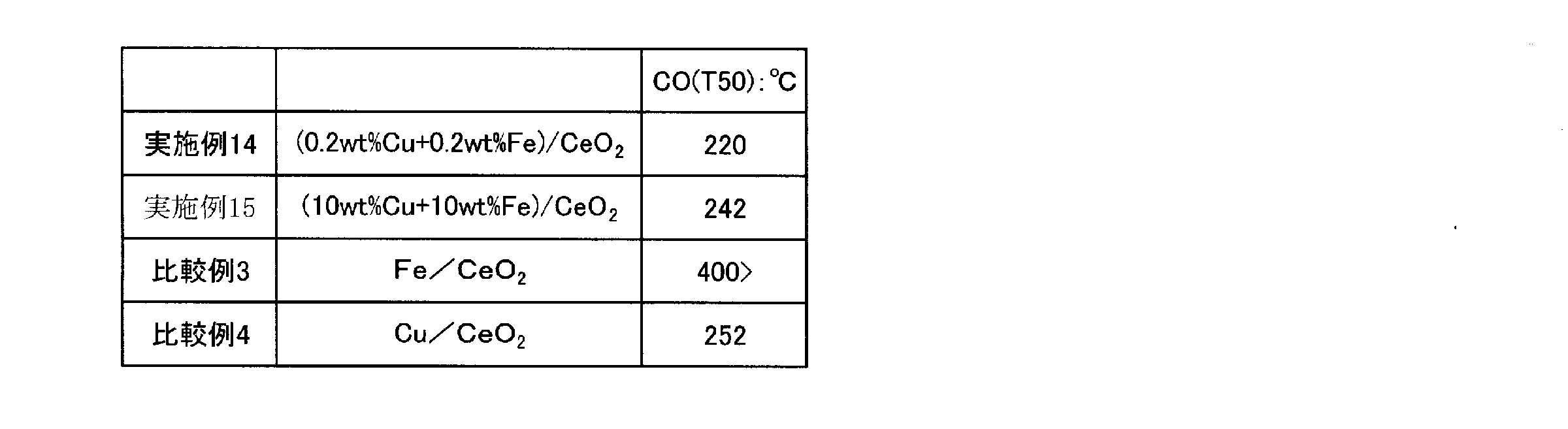
これより、Cuと、Cr、Fe、Mn、Co、Ni、Zr及びAgのうちの少なくとも一種を含む遷移金属Aとが、セリア(CeO2)粒子に担持されてなる構成を備えた触媒粒子を含む触媒組成物に関しては、Cu及び遷移金属Aの担持濃度が広い範囲で、触媒活性が高いことが分かった。
Claims (9)
- Cuと、Cr、Fe、Mn、Co、Ni、Zr及びAgのうちの少なくとも一種を含む遷移金属Aとが、セリア(CeO2)粒子に担持されてなる構成を備えた触媒粒子を含む排気ガス浄化用触媒組成物。
- 前記触媒粒子における前記Cuと前記遷移金属Aは、それぞれの酸化物又は金属の状態で、若しくは、両者の複合酸化物の状態で、セリア(CeO2)粒子に担持されることを特徴とする請求項1記載の排気ガス浄化用触媒組成物。
- 前記触媒粒子における前記Cuと前記遷移金属Aは、還元雰囲気下で加熱されると、デラフォサイト型酸化物に変化し得る状態で、セリア(CeO2)粒子に担持されることを特徴とする請求項1又は2に記載の排気ガス浄化用触媒組成物。
- Cuの含有量に対して0.05~20質量%の割合で遷移金属Aを含有することを特徴とする請求項1~3の何れかに記載の排気ガス浄化用触媒組成物。
- セリア(CeO2)粒子に対する、下記式(1)で求められるCuの含有量の割合が0.05~20質量%であり、セリア(CeO2)粒子に対する、下記式(2)で求められる遷移金属Aの含有量の割合が0.05~20質量%であることを特徴とする請求項1~4の何れかに記載の排気ガス浄化用触媒組成物。
(1)Cu含有割合={Cu量/(セリア粒子量+Cu量+遷移金属A量)}×100
(2)遷移金属A含有割合={遷移金属A量/(セリア粒子量+Cu量+遷移金属A量)}×100 - アークプラズマ法によって、Cu及び前記遷移金属Aがセリア(CeO2)粒子に担持されてなる構成を備えた触媒粒子を含むことを特徴とする請求項1~5の何れかに記載の排気ガス浄化用触媒組成物。
- 前記触媒粒子における前記Cuと前記遷移金属Aは、Cuの酸化物と前記遷移金属Aの酸化物とが近接した状態で、セリア(CeO2)粒子に担持されることを特徴とする請求項6に記載の排気ガス浄化用触媒組成物。
- 請求項1~7の何れかに記載の排気ガス浄化用触媒組成物がハニカム基材に担持されてなる構成を備えた排気ガス浄化用触媒。
- 請求項1~7の何れかに記載の排気ガス浄化用触媒組成物がペレット状に成形されてなる構成を備えた排気ガス浄化用触媒。
Priority Applications (3)
| Application Number | Priority Date | Filing Date | Title |
|---|---|---|---|
| JP2013554495A JP6174494B2 (ja) | 2012-12-27 | 2013-11-27 | 排気ガス浄化用触媒組成物及び排気ガス浄化用触媒 |
| EP13867727.3A EP2939741A4 (en) | 2012-12-27 | 2013-11-27 | CATALYST COMPOSITION FOR EMISSION CONTROL AND CATALYTIC FOR EMISSION CONTROL |
| US14/654,985 US10350581B2 (en) | 2012-12-27 | 2013-11-27 | Catalyst composition for exhaust gas purification and catalyst for exhaust gas purification |
Applications Claiming Priority (2)
| Application Number | Priority Date | Filing Date | Title |
|---|---|---|---|
| JP2012-285200 | 2012-12-27 | ||
| JP2012285200 | 2012-12-27 |
Publications (1)
| Publication Number | Publication Date |
|---|---|
| WO2014103597A1 true WO2014103597A1 (ja) | 2014-07-03 |
Family
ID=51020691
Family Applications (1)
| Application Number | Title | Priority Date | Filing Date |
|---|---|---|---|
| PCT/JP2013/081888 Ceased WO2014103597A1 (ja) | 2012-12-27 | 2013-11-27 | 排気ガス浄化用触媒組成物及び排気ガス浄化用触媒 |
Country Status (4)
| Country | Link |
|---|---|
| US (1) | US10350581B2 (ja) |
| EP (1) | EP2939741A4 (ja) |
| JP (1) | JP6174494B2 (ja) |
| WO (1) | WO2014103597A1 (ja) |
Cited By (6)
| Publication number | Priority date | Publication date | Assignee | Title |
|---|---|---|---|---|
| CN107106977A (zh) * | 2014-10-30 | 2017-08-29 | 巴斯夫公司 | 用于处理空气供给中存在的臭氧和挥发性有机化合物的贱金属催化剂 |
| CN107335447A (zh) * | 2017-06-15 | 2017-11-10 | 华南理工大学 | 一种用于净化挥发性有机物的催化剂及其制备方法 |
| WO2018123863A1 (ja) * | 2016-12-27 | 2018-07-05 | 国立大学法人秋田大学 | 排気ガス浄化触媒用デラフォサイト型酸化物及びこれを用いた排気ガス浄化触媒 |
| JP2018176106A (ja) * | 2017-04-18 | 2018-11-15 | エヌ・イーケムキャット株式会社 | 軽油燃焼用ディーゼル酸化触媒、及びこれを用いたディーゼルエンジンの排ガス浄化装置 |
| JP2019137580A (ja) * | 2018-02-09 | 2019-08-22 | アドバンス理工株式会社 | 水素生成装置及び水素充填装置 |
| JPWO2018123862A1 (ja) * | 2016-12-27 | 2019-10-31 | 国立大学法人秋田大学 | 排気ガス浄化触媒 |
Families Citing this family (6)
| Publication number | Priority date | Publication date | Assignee | Title |
|---|---|---|---|---|
| CN105618079B (zh) * | 2016-01-22 | 2019-02-01 | 浙江中医药大学 | 非贵金属催化氧化复合材料、制备方法及应用 |
| US10807071B2 (en) * | 2016-05-05 | 2020-10-20 | University Of Connecticut | Mesoporous metal doped cerium oxide catalyst |
| JP7076241B2 (ja) * | 2018-03-22 | 2022-05-27 | 日本碍子株式会社 | 酸化触媒の粉末、触媒担持構造体、酸化触媒の粉末の製造方法、および、触媒担持構造体の製造方法 |
| US11167272B2 (en) | 2019-07-15 | 2021-11-09 | Ford Global Technologies, Llc | Exhaust treatment system including nickel-containing catalyst |
| CN118268004A (zh) * | 2022-12-29 | 2024-07-02 | 中国石油天然气股份有限公司 | 一种用于处理丙烯腈吸收塔尾气的催化剂 |
| US12605394B2 (en) | 2024-07-25 | 2026-04-21 | Visionary Assets, Llc | Compositions containing cannabinoid nanoparticles |
Citations (9)
| Publication number | Priority date | Publication date | Assignee | Title |
|---|---|---|---|---|
| JPH04275922A (ja) * | 1991-02-27 | 1992-10-01 | Dainichiseika Color & Chem Mfg Co Ltd | 金属複合酸化物粉末の製造方法 |
| JPH09225267A (ja) | 1995-12-13 | 1997-09-02 | Daimler Benz Ag | ガス用浄化装置の運転方法及びガス用浄化装置 |
| JPH10502020A (ja) * | 1994-10-13 | 1998-02-24 | ローヌプーラン シミ | タンタル、バナジウム、ニオブ、銅又はアンチモンを基とする、窒素酸化物を減少させるための触媒組成物 |
| JPH10151348A (ja) * | 1996-11-22 | 1998-06-09 | Toyota Central Res & Dev Lab Inc | 酸化触媒 |
| JP2005087963A (ja) * | 2003-09-19 | 2005-04-07 | Toyota Motor Corp | 排気浄化装置 |
| JP2008156130A (ja) | 2006-12-20 | 2008-07-10 | Mitsui Mining & Smelting Co Ltd | デラフォサイト型酸化物およびその製造方法並びに排気ガス浄化用触媒 |
| JP2009138591A (ja) * | 2007-12-05 | 2009-06-25 | Babcock Hitachi Kk | 熱機関の排ガス浄化装置、排ガス浄化方法及びNOx浄化触媒 |
| JP2009225267A (ja) | 2008-03-18 | 2009-10-01 | Funai Electric Co Ltd | テレビジョン受信装置 |
| JP2011140011A (ja) | 2010-01-08 | 2011-07-21 | Toyota Motor Corp | Co酸化触媒の製造方法及びそれによって得られるco酸化触媒 |
Family Cites Families (12)
| Publication number | Priority date | Publication date | Assignee | Title |
|---|---|---|---|---|
| US3842158A (en) * | 1972-04-20 | 1974-10-15 | Union Oil Co | Exhaust gas conversion process and catalyst |
| JPS6186944A (ja) | 1984-10-02 | 1986-05-02 | Matsushita Electric Ind Co Ltd | 排ガス浄化用触媒体 |
| US5063193A (en) * | 1990-06-06 | 1991-11-05 | General Motors Corporation | Base metal automotive exhaust catalysts with improved activity and stability and method of making the catalysts |
| JPH09141102A (ja) | 1995-11-22 | 1997-06-03 | Kyocera Corp | 窒素酸化物除去用酸化物触媒材料並びに窒素酸化物除去方法 |
| JP3483190B2 (ja) * | 1996-09-09 | 2004-01-06 | 日野自動車株式会社 | 窒素酸化物除去触媒及びその製造方法 |
| JPH10180103A (ja) | 1996-12-26 | 1998-07-07 | Kyocera Corp | 窒素酸化物除去用酸化物触媒材料及びその製造方法 |
| KR100612956B1 (ko) * | 2004-04-26 | 2006-08-16 | 한국과학기술연구원 | 고성능 수성가스 전환 반응용 촉매와 이의 제조방법 |
| EP1755778A1 (en) * | 2004-04-26 | 2007-02-28 | HTE Aktiengesellschaft The High Throughput Experimentation Company | Catalysts for the simultaneous removal of carbon monoxide and hydrocarbons from oxygen-rich exhaust gases and processes for the manufacture thereof |
| JP2007179963A (ja) * | 2005-12-28 | 2007-07-12 | Kasatani:Kk | 燃料電池用触媒の製造方法及び触媒の担持方法 |
| CN101767015A (zh) * | 2009-01-06 | 2010-07-07 | 中国科学院成都有机化学有限公司 | 一种治理“三苯”废气的铜锰基催化燃烧催化剂及其制备方法 |
| US10792647B2 (en) * | 2009-04-21 | 2020-10-06 | Johnson Matthey Public Limited Company | Base metal catalysts for the oxidation of carbon monoxide and volatile organic compounds |
| EP2805766A4 (en) * | 2012-01-19 | 2015-08-05 | Toyota Motor Co Ltd | EMISSION CONTROL CATALYST AND METHOD FOR THE PRODUCTION THEREOF |
-
2013
- 2013-11-27 EP EP13867727.3A patent/EP2939741A4/en not_active Withdrawn
- 2013-11-27 US US14/654,985 patent/US10350581B2/en active Active
- 2013-11-27 WO PCT/JP2013/081888 patent/WO2014103597A1/ja not_active Ceased
- 2013-11-27 JP JP2013554495A patent/JP6174494B2/ja active Active
Patent Citations (9)
| Publication number | Priority date | Publication date | Assignee | Title |
|---|---|---|---|---|
| JPH04275922A (ja) * | 1991-02-27 | 1992-10-01 | Dainichiseika Color & Chem Mfg Co Ltd | 金属複合酸化物粉末の製造方法 |
| JPH10502020A (ja) * | 1994-10-13 | 1998-02-24 | ローヌプーラン シミ | タンタル、バナジウム、ニオブ、銅又はアンチモンを基とする、窒素酸化物を減少させるための触媒組成物 |
| JPH09225267A (ja) | 1995-12-13 | 1997-09-02 | Daimler Benz Ag | ガス用浄化装置の運転方法及びガス用浄化装置 |
| JPH10151348A (ja) * | 1996-11-22 | 1998-06-09 | Toyota Central Res & Dev Lab Inc | 酸化触媒 |
| JP2005087963A (ja) * | 2003-09-19 | 2005-04-07 | Toyota Motor Corp | 排気浄化装置 |
| JP2008156130A (ja) | 2006-12-20 | 2008-07-10 | Mitsui Mining & Smelting Co Ltd | デラフォサイト型酸化物およびその製造方法並びに排気ガス浄化用触媒 |
| JP2009138591A (ja) * | 2007-12-05 | 2009-06-25 | Babcock Hitachi Kk | 熱機関の排ガス浄化装置、排ガス浄化方法及びNOx浄化触媒 |
| JP2009225267A (ja) | 2008-03-18 | 2009-10-01 | Funai Electric Co Ltd | テレビジョン受信装置 |
| JP2011140011A (ja) | 2010-01-08 | 2011-07-21 | Toyota Motor Corp | Co酸化触媒の製造方法及びそれによって得られるco酸化触媒 |
Non-Patent Citations (4)
| Title |
|---|
| NORIKO YAMASHITA ET AL.: "Arc Plasma-ho de Chosei shita Ceria Tanji Sen'i Kinzoku no Kozo Oyobi Shokubai Tokusei", RAVE EARTHS, 16 May 2013 (2013-05-16), pages 64, 65, XP008179591 * |
| NORIKO YAMASHITA ET AL.: "Arc Plasma-ho ni yoru Tanji Hi-PGM-kei Fukugo Nano Ryushi no Chosei to Shokubai Tokusei", DAI 112 KAI SHOKUBAI TORONKAI TORONKAI A YOKOSHU, 11 September 2013 (2013-09-11), pages 342, XP008179599 * |
| SATOSHI HINOKUMA ET AL.: "Arc Plasma-ho ni yoru Pd-M(M=Fe,Co,Ni,Cu) Nigenkei Tanji Shokubai no Chosei", DAI 108 KAI SHOKUBAI TORONKAI TORONKAI A YOKOSHU, 13 September 2011 (2011-09-13), pages 152, XP008179598 * |
| See also references of EP2939741A4 |
Cited By (11)
| Publication number | Priority date | Publication date | Assignee | Title |
|---|---|---|---|---|
| CN107106977A (zh) * | 2014-10-30 | 2017-08-29 | 巴斯夫公司 | 用于处理空气供给中存在的臭氧和挥发性有机化合物的贱金属催化剂 |
| JP2017534448A (ja) * | 2014-10-30 | 2017-11-24 | ビーエーエスエフ コーポレーション | 空気供給源中に存在するオゾン及び揮発性有機化合物を処理するための卑金属触媒 |
| EP3212325B1 (en) * | 2014-10-30 | 2020-05-20 | BASF Corporation | Use of a verbase metal catalyst for treatment of ozone and volatile organic compounds present in air supply |
| WO2018123863A1 (ja) * | 2016-12-27 | 2018-07-05 | 国立大学法人秋田大学 | 排気ガス浄化触媒用デラフォサイト型酸化物及びこれを用いた排気ガス浄化触媒 |
| JPWO2018123862A1 (ja) * | 2016-12-27 | 2019-10-31 | 国立大学法人秋田大学 | 排気ガス浄化触媒 |
| JPWO2018123863A1 (ja) * | 2016-12-27 | 2019-10-31 | 国立大学法人秋田大学 | 排気ガス浄化触媒用デラフォサイト型酸化物及びこれを用いた排気ガス浄化触媒 |
| US10722870B2 (en) | 2016-12-27 | 2020-07-28 | Mitsui Mining & Smelting Co., Ltd. | Exhaust gas purification catalyst |
| US11110439B2 (en) | 2016-12-27 | 2021-09-07 | Mitsui Mining & Smelting Co., Ltd. | Delafossite-type oxide for exhaust gas purification catalyst, and exhaust gas purification catalyst using same |
| JP2018176106A (ja) * | 2017-04-18 | 2018-11-15 | エヌ・イーケムキャット株式会社 | 軽油燃焼用ディーゼル酸化触媒、及びこれを用いたディーゼルエンジンの排ガス浄化装置 |
| CN107335447A (zh) * | 2017-06-15 | 2017-11-10 | 华南理工大学 | 一种用于净化挥发性有机物的催化剂及其制备方法 |
| JP2019137580A (ja) * | 2018-02-09 | 2019-08-22 | アドバンス理工株式会社 | 水素生成装置及び水素充填装置 |
Also Published As
| Publication number | Publication date |
|---|---|
| EP2939741A4 (en) | 2016-08-17 |
| EP2939741A1 (en) | 2015-11-04 |
| JP6174494B2 (ja) | 2017-08-02 |
| JPWO2014103597A1 (ja) | 2017-01-12 |
| US10350581B2 (en) | 2019-07-16 |
| US20150352530A1 (en) | 2015-12-10 |
Similar Documents
| Publication | Publication Date | Title |
|---|---|---|
| JP6174494B2 (ja) | 排気ガス浄化用触媒組成物及び排気ガス浄化用触媒 | |
| JP5816648B2 (ja) | 排気ガス浄化用触媒組成物及び排気ガス浄化用触媒 | |
| JP5350614B2 (ja) | 排ガス浄化触媒及びこれを用いた排ガス浄化装置 | |
| US9861961B2 (en) | Catalyst for nitrogen oxide removal | |
| WO2012093599A1 (ja) | 排気ガス浄化用触媒 | |
| JP5925956B2 (ja) | 排気ガス浄化用触媒組成物及び排気ガス浄化触媒 | |
| US10722870B2 (en) | Exhaust gas purification catalyst | |
| JP5940992B2 (ja) | 排気ガス浄化触媒 | |
| JPWO2014123232A1 (ja) | NOx吸蔵還元型排ガス浄化用触媒および当該触媒を用いた排ガス浄化方法 | |
| CN117083122B (zh) | 废气净化用催化剂组合物和废气净化用催化剂 | |
| JP5416497B2 (ja) | 排気ガス浄化用触媒及びその製造方法 | |
| JP6715351B2 (ja) | 排気ガス浄化触媒用デラフォサイト型酸化物及びこれを用いた排気ガス浄化触媒 | |
| JP5196656B2 (ja) | 排ガス浄化用触媒及びその製造方法 | |
| CN115151339B (zh) | 排气净化用催化剂 | |
| JP4831753B2 (ja) | 排ガス浄化用触媒 | |
| CN116981514A (zh) | 废气净化用催化剂组合物和废气净化用催化剂 | |
| JP6073732B2 (ja) | 排ガス浄化用触媒 | |
| JP2017023999A (ja) | 排気ガス浄化用触媒 | |
| JP4407117B2 (ja) | 排気ガス浄化用触媒の製造方法 | |
| JP2022096327A (ja) | 排気ガス浄化触媒 | |
| CN117120161B (en) | Catalyst composition for exhaust gas purification and catalyst for exhaust gas purification | |
| CN117120161A (zh) | 废气净化用催化剂组合物和废气净化用催化剂 | |
| JP2014213315A (ja) | 排ガス浄化用触媒 |
Legal Events
| Date | Code | Title | Description |
|---|---|---|---|
| ENP | Entry into the national phase |
Ref document number: 2013554495 Country of ref document: JP Kind code of ref document: A |
|
| 121 | Ep: the epo has been informed by wipo that ep was designated in this application |
Ref document number: 13867727 Country of ref document: EP Kind code of ref document: A1 |
|
| WWE | Wipo information: entry into national phase |
Ref document number: 2013867727 Country of ref document: EP |
|
| WWE | Wipo information: entry into national phase |
Ref document number: 14654985 Country of ref document: US |
|
| NENP | Non-entry into the national phase |
Ref country code: DE |