WO2014115251A1 - Corps de structure en résine à revêtement métallique et son procédé de fabrication - Google Patents
Corps de structure en résine à revêtement métallique et son procédé de fabrication Download PDFInfo
- Publication number
- WO2014115251A1 WO2014115251A1 PCT/JP2013/051231 JP2013051231W WO2014115251A1 WO 2014115251 A1 WO2014115251 A1 WO 2014115251A1 JP 2013051231 W JP2013051231 W JP 2013051231W WO 2014115251 A1 WO2014115251 A1 WO 2014115251A1
- Authority
- WO
- WIPO (PCT)
- Prior art keywords
- metal
- resin
- intermediate layer
- glass
- layer
- Prior art date
- Legal status (The legal status is an assumption and is not a legal conclusion. Google has not performed a legal analysis and makes no representation as to the accuracy of the status listed.)
- Ceased
Links
Images

Classifications
-
- C—CHEMISTRY; METALLURGY
- C23—COATING METALLIC MATERIAL; COATING MATERIAL WITH METALLIC MATERIAL; CHEMICAL SURFACE TREATMENT; DIFFUSION TREATMENT OF METALLIC MATERIAL; COATING BY VACUUM EVAPORATION, BY SPUTTERING, BY ION IMPLANTATION OR BY CHEMICAL VAPOUR DEPOSITION, IN GENERAL; INHIBITING CORROSION OF METALLIC MATERIAL OR INCRUSTATION IN GENERAL
- C23C—COATING METALLIC MATERIAL; COATING MATERIAL WITH METALLIC MATERIAL; SURFACE TREATMENT OF METALLIC MATERIAL BY DIFFUSION INTO THE SURFACE, BY CHEMICAL CONVERSION OR SUBSTITUTION; COATING BY VACUUM EVAPORATION, BY SPUTTERING, BY ION IMPLANTATION OR BY CHEMICAL VAPOUR DEPOSITION, IN GENERAL
- C23C24/00—Coating starting from inorganic powder
- C23C24/02—Coating starting from inorganic powder by application of pressure only
- C23C24/04—Impact or kinetic deposition of particles
Definitions
- the present invention relates to a metal-coated resin structure and a method for producing the same.
- the blade surface of a wind turbine in a wind turbine is generally made of light-weight and high-strength Glass-Fiber Reinforced Plastics (hereinafter GFRP).
- GFRP is a glass fiber impregnated with resin and has electrical insulation. Almost one-third of the failure factors of wind turbine blades are due to lightning strikes, and this blade failure is caused by rapid high voltage-large current being applied to insulating blades, which cause burnout and breakage, rupture due to internal water expansion. , Caused by shockwave-induced bursting. If the blade is broken, power generation can not be performed during that time, and not only the cost of replacing and repairing the blade, but also significant economic damage such as compensation for interruption of the power supply will occur.
- a plating method As a general method of coating an organic material such as a resin with GFRP, such as resin, there is a plating method (chemical plating).
- the film forming rate is slow and a metal film of several mm order is formed Takes a lot of time.
- thermal spraying Another method is thermal spraying.
- the thermal spraying method is capable of forming a thick film in a relatively short time, but since it is sprayed on the substrate (resin) in a molten state of the metal powder of the raw material, the resin substrate is also melted and a sound film is formed. Can not be obtained. Therefore, it is necessary to provide an intermediate layer (or an adhesive layer) in advance on the resin base material, and thermally spray on the intermediate layer. Since this intermediate layer is required to have heat resistance enough to withstand the subsequent thermal spray coating, it is necessary to include relatively expensive ceramic particles and the like, and formation of the intermediate layer can be performed separately from thermal spraying such as slurry spraying. This leads to an increase in manufacturing costs.
- an object of the present invention is to form a metal film of a healthy structure at high speed with high efficiency on a large-sized, large-area structure mainly composed of an organic material.
- the present invention comprises a resin substrate, an intermediate layer covering the resin substrate, and a metal layer covering the intermediate layer, wherein the intermediate layer is at least resin or glass.
- the metal particles contained in the intermediate layer and the metal layer are metallurgically bonded, and any resin or glass contained in the intermediate layer is chemically bonded to the resin base material.
- the step of accelerating each powder of at least one of resin and glass and metal particles with a gas flow, and colliding at least one of the resin or the glass and the metal particles with the resin base material Depositing and forming an intermediate layer covering the resin substrate, and depositing the metal particles in collision with the intermediate layer to deposit on the intermediate layer and forming a metal layer covering the intermediate layer And.
- the present invention it is possible to form a metal film of a healthy structure at high speed and with high efficiency on a large-sized and large-area structure mainly composed of an organic material.
- Cross-sectional structure of metal-coated resin structure Another cross-sectional structure of the metal-coated resin structure.
- the metal-coated resin structure imparts conductivity by covering the surface of a resin base mainly composed of an organic material with a metal layer, and when it is used for a windmill blade or the like, grounds from the metal layer. Can prevent damage caused by lightning strikes.
- a resin base mainly composed of an organic material with a metal layer
- grounds from the metal layer can prevent damage caused by lightning strikes.
- the intermediate layer containing metal and resin, or the intermediate layer containing metal and low melting glass may have a uniform single composition ratio between the substrate and the metal layer, but the composition is continuous or stepwise It is desirable that the composition of the resin or the low melting point glass is large on the side in contact with the substrate, and the composition of the metal is large on the side in contact with the metal layer. As a result, the chemical bond between the intermediate layer on the substrate side and the substrate and the metallurgical bond between the intermediate layer on the metal layer side and the metal layer become stronger, and the intermediate layer has high adhesion strength. And the formation of metal layers.
- the substrate is a glass fiber reinforced plastic, a carbon fiber reinforced plastic, a thermoplastic resin, or a thermosetting resin widely used as a general organic material-based structural material.
- the metal layer is a typical metal having a atomic number of 12 or more and a melting point of 420 ° C. or more, a transition metal, or an alloy mainly comprising them.
- the resin contained in the intermediate layer is a thermoplastic resin or thermosetting resin containing a curing agent and a catalyst, and the low melting point glass is a glass having a glass transition point of 600 ° C. or less.
- the combination of the substrate composed of these materials, the intermediate layer and the metal layer causes the above-mentioned bonding mechanism between the respective layers, and a metal-coated resin structure to which the metal layer is attached with high adhesion strength is obtained.
- the metal particles constituting the metal layer have a ratio of the maximum diameter to the minimum thickness of 2 or more, and the metal particles are metallurgically bonded to each other.
- carrier gas carrier gas
- the grain interface distance in the film thickness direction which is a path in which corrosion proceeds, is longer than in the case where spherical particles are deposited, as compared with the case where spherical particles are deposited. Corrosion also improves.
- the metallurgical bond between these metal particles and the effect of prolonging the corrosion path appear when the ratio of the maximum width to the minimum thickness of the particles is approximately 2 or more.
- the thickness in the particle deposition direction and the width in the plane of the intermediate layer are represented.
- the resin or low melting glass contained in the intermediate layer chemically integrates with the substrate. This is because when the resin or low melting glass particles collide with the substrate by the high velocity gas flow, the kinetic energy is converted to heat, and the surface of the resin or low melting glass particles and the surface of the substrate melt. It is for solidification and integration.
- the constituent component of the intermediate layer is a resin
- integration is similarly caused by a method of applying, drying and solidifying using a liquid resin as described later. As a result, an intermediate layer having high adhesion strength is formed on the substrate, and the substrate is covered with the metal layer firmly adhered through the intermediate layer.
- the manufacturing method of the metal-coated resin structure is to accelerate the powder such as metal with a high-speed gas flow, to cause it to collide with the substrate and to deposit it, and is a method called cold spray or kinetic spray. This is to cause particles to be plastically deformed to adhere and deposit on the substrate by causing the powder to collide with the substrate at high speed, but deposition is possible even if the metal powder is sprayed directly onto the substrate made of an organic material. No metal film can be obtained. The reason is that when metal particles harder than organic materials collide with the substrate, the substrate is scraped off and worn away.
- the intermediate layer contains metal particles, even if the metal particles are injected onto the intermediate layer, they are metallurgically bonded to the metal particles in the intermediate layer, which enables the deposition of the metal particles, and the metal film becomes can get.
- the intermediate layer desirably has a composition of metal-resin or metal-low melting point glass continuously or stepwise changed from the side in contact with the substrate to the side of the metal layer. That is, there is a large amount of resin or low melting point glass on the side in contact with the base material, and the gradient composition in which the amount of metal increases toward the metal layer.
- the chemical bond between the intermediate layer and the base material and the metallurgical bond between the intermediate layer and the metal layer become strong, and the formation of the intermediate layer as well as the metal layer with high adhesion strength is possible.
- This intermediate layer having a graded composition is obtained by continuously or stepwise changing the gas flow rate and the powder feed rate from the side in contact with the substrate to the side of the metal layer.
- the collision speed of the resin or the low melting point glass is too high to the base material mainly composed of the organic material, the amount of heat converted from the kinetic energy is increased, and the resin or the low melting point glass is excessively melted. It collides with the substrate and is removed along the gas flow without adhering. Therefore, on the side in contact with the substrate, the raw material powder of metal-resin or metal-low-melting glass containing a large amount of resin or low melting glass collides with the substrate in a state where the gas flow speed is suppressed by lowering the gas temperature and pressure. You need to
- metal particles forming the metal layer are harder than resin and low melting glass, relatively high kinetic energy (ie, relatively high collision velocity) is required to plastically deform the particles for deposition. It is necessary to make it collide. Therefore, the intermediate layer to be the base must have a hardness not to be worn away by high-speed collision of hard metal particles, and must have a composition having a high metal content. Therefore, on the side closer to the metal layer, it is necessary to cause the raw material powder of metal-rich resin or metal-low melting point glass to collide with the substrate using a high gas flow rate by raising the gas temperature and pressure. Therefore, it is desirable that the gas flow rate set by the gas temperature or pressure be gradually or stepwise changed from the side in contact with the substrate to the side of the metal layer.
- changes in the composition of metal-resin or metal-low melting glass are used to fill metal powder and powder of resin or low melting glass in separate powder feeders, and to nozzles for injecting high-speed gas flow and raw material powder.
- the composition of the intermediate layer can be changed in the thickness direction by changing the feed amounts of the metal powder and the resin powder, or the metal powder and the low melting point glass powder.
- the above intermediate layer is made of metal and resin
- a mixture of metal particles forming the intermediate layer and liquid resin is applied to the surface of the substrate, dried and cured to form an intermediate layer, and then the metal powder is added.
- the metal layer can also be formed by accelerating with a high velocity gas flow and causing the substrate to collide and deposit.
- the composition of the intermediate layer is generally a single composition, if a mixture in which the content of the metal particles is changed is applied in layers, the intermediate layer whose composition changes stepwise in the thickness direction should be produced. Can.
- deposition of metal particles becomes possible in the same manner as described above, and a structure having a metal film formed on the outermost surface can be obtained.
- the film structure improvement and densification of the metal layer and the intermediate layer can also be achieved by forming the intermediate layer and the metal layer on the substrate and then heating to a temperature lower than the heat resistance temperature of the organic material forming the substrate. That is, by heat treatment after film formation, metallurgical bonding increases with sintering between metal particles, resin particles produced by high-speed collision, repair of micro cracks in low melting glass particles, disappearance of pores between particles, etc. Progress, and film quality improvement and densification can be achieved.
- the above-mentioned metal-coated resin structure is a light-weight and electrically conductive structure such as a wind turbine blade for wind power generation, aircraft fuselage, car body, etc., and a member requiring light weight and corrosion resistance such as automobile fuel tank Effectively use those functions.
- No. 1 is a comparative example in which an attempt was made to coat Al directly on the surface of a substrate made of epoxy resin.
- a spherical powder with a particle size of 20 to 45 ⁇ m was used as the raw material powder of Al.
- Al raw material powder was injected to the resin base material with compressed air of 100 ° C, 0.6MPa as carrier gas and injection distance (distance from tip of cold spray nozzle to base material) of 20 mm, the base material was Al particles It was scraped off, the substrate thickness decreased, and an Al film was not formed. From this, it is understood that direct metal film formation on a resin substrate is difficult.
- No. 2 was formed by cold spray forming an intermediate layer of a single composition consisting of 60% by volume Al-40% by volume epoxy resin on a resin substrate and then coating Al thereon.
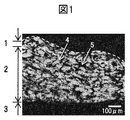
- FIG. 1 is a part of this cross-sectional structure. 1 is a metal layer, 2 is an intermediate layer, 3 is a substrate, 4 is Al particles, and 5 is an epoxy.
- the raw material powder of Al is a spherical powder similar to the above No. 1, the raw material powder of an epoxy resin is a crushed powder of 30 to 60 ⁇ m containing a curing agent, and the carrier gas for cold spray is compressed air.
- the intermediate layer is formed by feeding each of the Al raw material powder and the epoxy resin raw material powder from separate powder feeders to the nozzle so as to have the above composition, and using a carrier gas temperature of 100 ° C., a pressure of 0.6 MPa and a jet distance of 20 mm It injected it.
- the thickness of the formed intermediate layer was 250 to 500 ⁇ m, and when the porosity was determined by image processing at several locations of its cross-sectional structure, it was about 0.5% or less.
- Al raw material powder was cold-sprayed thereon under the same conditions to form a metal layer having a thickness of less than 50 ⁇ m.
- the porosity of the metal layer was measured by image processing in the cross-sectional structure and was about 40%.
- No. 3 is a composition in which the composition of the intermediate layer is continuously changed from the substrate side to the metal layer side from 60Al-40 epoxy to 80Al-20 epoxy, and No. 4 is from 60Al-40 epoxy to 100Al-0 epoxy And continuously changed.
- the amounts of each of the Al raw material powder and the epoxy resin raw material powder were continuously adjusted so as to obtain the above-mentioned composition under the same conditions as in the above No. 2.
- the porosity of these intermediate layers is 0.7% or less and 1% or less, respectively, and the porosity tends to increase when the amount of the epoxy resin decreases, but it is a range in which there is no problem in practical use.
- An Al metal layer was formed on these intermediate layers under the same conditions as No. 2, and the porosity was measured.
- the intermediate layer may have a single composition such as No. 2, the composition is inclined in the thickness direction, and the composition having a large amount of metal on the metal layer side (that is, having a large hardness) It is confirmed that it is desirable to densify the
- No. 6 was heated at 250 ° C. for 1 hour in the atmosphere after forming No. 4.
- the porosity of the intermediate layer and the metal layer was both reduced as compared with No. 4. Therefore, it was confirmed that heating below the heat-resistant temperature of a base material after formation of an intermediate
- a mixture of liquid epoxy resin containing Al powder and a curing agent (composition 30Al-70 epoxy) is applied to the surface of a substrate, dried and cured to form an intermediate layer, and then Al metal is formed on the surface.
- the layer was formed by cold spray.
- FIG. 2 is a part of this cross-sectional structure.
- No. 8 is a mixture of the composition 70Al-30 epoxy, and the intermediate layer and the metal layer are formed by the same method as No. 7.
- the intermediate layer can be formed also by a method in which a mixture of metal powder and liquid resin is applied to a substrate and solidified.
- the ratio of the maximum diameter to the minimum thickness of the Al particles was measured from the cross-sectional structure of the metal layers of No. 2 to No. 8. As a result, almost all the particles in all cases were 2 or more. Moreover, as a result of observing the cross-sectional structure in any case, it was confirmed that the resin of the intermediate layer had a structure chemically integrated with the base material, and metallurgical bonding was made between the Al particles of the metal layer. . Accordingly, it was confirmed that a structure in which a base material containing an organic material as a main component was coated with metal was obtained.
- the intermediate layer and the metal layer can be formed by the same method even when the base material is a thermoplastic resin, GFRP whose outermost surface is covered with a resin, carbon fiber reinforced plastics, etc. It is.
- the metal forming the intermediate layer and the metal layer is another transition metal, or when the component constituting the intermediate layer is low-melting glass, the respective layers can be similarly formed.
- Metal layer 2 Middle layer 3: Base material 4: Al particles 5: Epoxy
Landscapes
- Chemical & Material Sciences (AREA)
- Chemical Kinetics & Catalysis (AREA)
- Engineering & Computer Science (AREA)
- Materials Engineering (AREA)
- Mechanical Engineering (AREA)
- Metallurgy (AREA)
- Organic Chemistry (AREA)
- Laminated Bodies (AREA)
Abstract
L'invention concerne un revêtement métallique ayant une structure robuste, formé à grande vitesse et selon un rendement élevé sur une structure de grande dimension et de grande surface ayant comme composant principal une matière organique. La présente invention a une matière à base de résine, une couche intermédiaire recouvrant la matière à base de résine, et une couche de métal recouvrant la couche intermédiaire, la couche intermédiaire contenant au moins soit de la résine soit du verre et des particules métalliques, les particules métalliques contenues dans la couche intermédiaire étant liées par liaison métallurgique à la couche de métal, la résine ou le verre contenu(e) dans la couche intermédiaire étant lié(e) par liaison chimique à la matière à base de résine.
Priority Applications (2)
| Application Number | Priority Date | Filing Date | Title |
|---|---|---|---|
| JP2014558320A JPWO2014115251A1 (ja) | 2013-01-23 | 2013-01-23 | 金属被覆樹脂構造体とその製法 |
| PCT/JP2013/051231 WO2014115251A1 (fr) | 2013-01-23 | 2013-01-23 | Corps de structure en résine à revêtement métallique et son procédé de fabrication |
Applications Claiming Priority (1)
| Application Number | Priority Date | Filing Date | Title |
|---|---|---|---|
| PCT/JP2013/051231 WO2014115251A1 (fr) | 2013-01-23 | 2013-01-23 | Corps de structure en résine à revêtement métallique et son procédé de fabrication |
Publications (1)
| Publication Number | Publication Date |
|---|---|
| WO2014115251A1 true WO2014115251A1 (fr) | 2014-07-31 |
Family
ID=51227068
Family Applications (1)
| Application Number | Title | Priority Date | Filing Date |
|---|---|---|---|
| PCT/JP2013/051231 Ceased WO2014115251A1 (fr) | 2013-01-23 | 2013-01-23 | Corps de structure en résine à revêtement métallique et son procédé de fabrication |
Country Status (2)
| Country | Link |
|---|---|
| JP (1) | JPWO2014115251A1 (fr) |
| WO (1) | WO2014115251A1 (fr) |
Cited By (1)
| Publication number | Priority date | Publication date | Assignee | Title |
|---|---|---|---|---|
| JP2020084217A (ja) * | 2018-11-16 | 2020-06-04 | 三菱重工業株式会社 | 風車翼およびその製造方法 |
Citations (11)
| Publication number | Priority date | Publication date | Assignee | Title |
|---|---|---|---|---|
| JPS6011353A (ja) * | 1983-06-17 | 1985-01-21 | 三菱レイヨン株式会社 | 新規な複合成形体 |
| JPS60212348A (ja) * | 1984-04-09 | 1985-10-24 | 三菱レイヨン株式会社 | 複合成形体の製造方法 |
| JP2001240953A (ja) * | 2000-03-02 | 2001-09-04 | Tocalo Co Ltd | 耐摩耗性等の表面特性に優れるプラスチック基複合材料およびその製造方法 |
| JP2005305765A (ja) * | 2004-04-20 | 2005-11-04 | Toshiba Corp | プラスチックス複合材料およびその製造方法 |
| JP2006137143A (ja) * | 2004-11-15 | 2006-06-01 | Tocalo Co Ltd | プラスチック基複合材料およびその製造方法 |
| JP2009001859A (ja) * | 2007-06-21 | 2009-01-08 | Toyota Motor Corp | 成膜方法、伝熱部材、パワーモジュール、車両用インバータ、及び車両 |
| JP2009511751A (ja) * | 2005-10-19 | 2009-03-19 | プラックセアー エス.ティ.テクノロジー、 インコーポレイテッド | 部材のコーティング法 |
| JP2010047825A (ja) * | 2008-08-25 | 2010-03-04 | Mitsubishi Heavy Ind Ltd | 金属皮膜の形成方法及び航空宇宙構造部材 |
| JP3165145U (ja) * | 2010-10-19 | 2011-01-06 | トピー工業株式会社 | 薄い樹脂上に銅またはアルミニウム被膜を有する複合材料 |
| JP2011143336A (ja) * | 2010-01-13 | 2011-07-28 | Fujitsu Ltd | 粉体塗膜製造方法 |
| JP2012097353A (ja) * | 2010-10-05 | 2012-05-24 | Topy Industries Ltd | 薄い樹脂へ金属ガラスを溶射する方法、及び金属ガラス被膜を有する複合材料 |
Family Cites Families (2)
| Publication number | Priority date | Publication date | Assignee | Title |
|---|---|---|---|---|
| JP5377319B2 (ja) * | 2006-11-07 | 2013-12-25 | ハー.ツェー.スタルク ゲゼルシャフト ミット ベシュレンクテル ハフツング | 基材のコーティング方法及びコーティング製品 |
| JP2009275267A (ja) * | 2008-05-15 | 2009-11-26 | Toshiba Corp | 金属粉体膜の形成方法および金属粉体膜を備えた被着部材 |
-
2013
- 2013-01-23 JP JP2014558320A patent/JPWO2014115251A1/ja active Pending
- 2013-01-23 WO PCT/JP2013/051231 patent/WO2014115251A1/fr not_active Ceased
Patent Citations (11)
| Publication number | Priority date | Publication date | Assignee | Title |
|---|---|---|---|---|
| JPS6011353A (ja) * | 1983-06-17 | 1985-01-21 | 三菱レイヨン株式会社 | 新規な複合成形体 |
| JPS60212348A (ja) * | 1984-04-09 | 1985-10-24 | 三菱レイヨン株式会社 | 複合成形体の製造方法 |
| JP2001240953A (ja) * | 2000-03-02 | 2001-09-04 | Tocalo Co Ltd | 耐摩耗性等の表面特性に優れるプラスチック基複合材料およびその製造方法 |
| JP2005305765A (ja) * | 2004-04-20 | 2005-11-04 | Toshiba Corp | プラスチックス複合材料およびその製造方法 |
| JP2006137143A (ja) * | 2004-11-15 | 2006-06-01 | Tocalo Co Ltd | プラスチック基複合材料およびその製造方法 |
| JP2009511751A (ja) * | 2005-10-19 | 2009-03-19 | プラックセアー エス.ティ.テクノロジー、 インコーポレイテッド | 部材のコーティング法 |
| JP2009001859A (ja) * | 2007-06-21 | 2009-01-08 | Toyota Motor Corp | 成膜方法、伝熱部材、パワーモジュール、車両用インバータ、及び車両 |
| JP2010047825A (ja) * | 2008-08-25 | 2010-03-04 | Mitsubishi Heavy Ind Ltd | 金属皮膜の形成方法及び航空宇宙構造部材 |
| JP2011143336A (ja) * | 2010-01-13 | 2011-07-28 | Fujitsu Ltd | 粉体塗膜製造方法 |
| JP2012097353A (ja) * | 2010-10-05 | 2012-05-24 | Topy Industries Ltd | 薄い樹脂へ金属ガラスを溶射する方法、及び金属ガラス被膜を有する複合材料 |
| JP3165145U (ja) * | 2010-10-19 | 2011-01-06 | トピー工業株式会社 | 薄い樹脂上に銅またはアルミニウム被膜を有する複合材料 |
Cited By (3)
| Publication number | Priority date | Publication date | Assignee | Title |
|---|---|---|---|---|
| JP2020084217A (ja) * | 2018-11-16 | 2020-06-04 | 三菱重工業株式会社 | 風車翼およびその製造方法 |
| US11493020B2 (en) | 2018-11-16 | 2022-11-08 | Mitsubishi Heavy Industries, Ltd. | Wind turbine blade and method for manufacturing the same |
| US11891976B2 (en) | 2018-11-16 | 2024-02-06 | Mitsubishi Heavy Industries, Ltd. | Wind turbine blade and method for manufacturing the same |
Also Published As
| Publication number | Publication date |
|---|---|
| JPWO2014115251A1 (ja) | 2017-01-19 |
Similar Documents
| Publication | Publication Date | Title |
|---|---|---|
| US6808817B2 (en) | Kinetically sprayed aluminum metal matrix composites for thermal management | |
| KR101543895B1 (ko) | 저온분사공정을 이용하여 아연도금강판에 기능성 코팅층을 형성하는 방법 및 기능성 코팅층이 형성된 아연도금강판 | |
| CN105296912B (zh) | 一种电弧喷涂丝材及其制备、喷涂方法 | |
| WO2011080177A1 (fr) | Protection contre la foudre d'une pale d'éolienne | |
| US20110091709A1 (en) | Method for coating a fiber composite component for an aircraft or spacecraft and fiber composite component produced by said method | |
| CN101711290A (zh) | 为涡轮发动机部件上的热障涂层形成粘合层的方法 | |
| EP4238753B1 (fr) | Stratifiés composites avec des couches métalliques et procédés associés | |
| CN109844305B (zh) | 转子叶片涂层 | |
| US7820283B2 (en) | Metallized skin panels and methods of making | |
| KR20200037308A (ko) | 구조체, 그 적층체, 그 제조 방법 및 제조 장치 | |
| CN114950919A (zh) | 一种用于树脂基复合材料的复合涂层的制备方法和装置 | |
| JP5321942B2 (ja) | 電子回路基板の製造方法およびその電子回路基板 | |
| CN102977745B (zh) | 一种可室温固化耐超高温涂料及其制备方法 | |
| EP3266607B1 (fr) | Structure de résine renforcée par des fibres et procédé de production d'une structure de résine renforcée par des fibres | |
| KR101392749B1 (ko) | 스퍼터링용 타겟 보수 방법 및 스퍼터링용 타겟 | |
| KR101172815B1 (ko) | 인쇄회로기판 및 저온분사 방식을 이용한 인쇄회로기판의 제조방법 | |
| JPWO2014115251A1 (ja) | 金属被覆樹脂構造体とその製法 | |
| Jifeng et al. | Preparation of electrical contact materials by cold gas-spray | |
| KR20090037564A (ko) | 전기전도도 및 내마모성이 우수한 소재 및 그 제조방법 | |
| CN104862634A (zh) | 用于金属基热喷涂的耐冲击陶瓷涂层及其喷涂方法 | |
| DE102006046518B4 (de) | Verfahren zum Beschichten eines Substrates | |
| CN111850558B (zh) | 一种树脂基复材用导电耐磨涂层及其制备方法 | |
| KR20090044157A (ko) | 복합재료 코팅장치 | |
| Fukumoto et al. | Thick metallic/composite coating on C-FRP substrate by plasma spraying | |
| US20090258214A1 (en) | Vapor-deposited coating and thermally stressable component having such a coating, and also a process and apparatus for producing such a coating |
Legal Events
| Date | Code | Title | Description |
|---|---|---|---|
| 121 | Ep: the epo has been informed by wipo that ep was designated in this application |
Ref document number: 13872352 Country of ref document: EP Kind code of ref document: A1 |
|
| ENP | Entry into the national phase |
Ref document number: 2014558320 Country of ref document: JP Kind code of ref document: A |
|
| NENP | Non-entry into the national phase |
Ref country code: DE |
|
| 122 | Ep: pct application non-entry in european phase |
Ref document number: 13872352 Country of ref document: EP Kind code of ref document: A1 |