WO2014115347A1 - 油脂加工澱粉およびその製造方法 - Google Patents
油脂加工澱粉およびその製造方法 Download PDFInfo
- Publication number
- WO2014115347A1 WO2014115347A1 PCT/JP2013/061836 JP2013061836W WO2014115347A1 WO 2014115347 A1 WO2014115347 A1 WO 2014115347A1 JP 2013061836 W JP2013061836 W JP 2013061836W WO 2014115347 A1 WO2014115347 A1 WO 2014115347A1
- Authority
- WO
- WIPO (PCT)
- Prior art keywords
- starch
- fat
- oil
- water content
- emulsifier
- Prior art date
- Legal status (The legal status is an assumption and is not a legal conclusion. Google has not performed a legal analysis and makes no representation as to the accuracy of the status listed.)
- Ceased
Links
Classifications
-
- A—HUMAN NECESSITIES
- A23—FOODS OR FOODSTUFFS; TREATMENT THEREOF, NOT COVERED BY OTHER CLASSES
- A23P—SHAPING OR WORKING OF FOODSTUFFS, NOT FULLY COVERED BY A SINGLE OTHER SUBCLASS
- A23P20/00—Coating of foodstuffs; Coatings therefor; Making laminated, multi-layered, stuffed or hollow foodstuffs
- A23P20/10—Coating with edible coatings, e.g. with oils or fats
- A23P20/11—Coating with compositions containing a majority of oils, fats, mono/diglycerides, fatty acids, mineral oils, waxes or paraffins
-
- A—HUMAN NECESSITIES
- A23—FOODS OR FOODSTUFFS; TREATMENT THEREOF, NOT COVERED BY OTHER CLASSES
- A23D—EDIBLE OILS OR FATS, e.g. MARGARINES, SHORTENINGS OR COOKING OILS
- A23D7/00—Edible oil or fat compositions containing an aqueous phase, e.g. margarines
- A23D7/005—Edible oil or fat compositions containing an aqueous phase, e.g. margarines characterised by ingredients other than fatty acid triglycerides
- A23D7/0053—Compositions other than spreads
-
- A—HUMAN NECESSITIES
- A23—FOODS OR FOODSTUFFS; TREATMENT THEREOF, NOT COVERED BY OTHER CLASSES
- A23D—EDIBLE OILS OR FATS, e.g. MARGARINES, SHORTENINGS OR COOKING OILS
- A23D7/00—Edible oil or fat compositions containing an aqueous phase, e.g. margarines
- A23D7/01—Other fatty acid esters, e.g. phosphatides
- A23D7/011—Compositions other than spreads
-
- A—HUMAN NECESSITIES
- A23—FOODS OR FOODSTUFFS; TREATMENT THEREOF, NOT COVERED BY OTHER CLASSES
- A23L—FOODS, FOODSTUFFS OR NON-ALCOHOLIC BEVERAGES, NOT OTHERWISE PROVIDED FOR; PREPARATION OR TREATMENT THEREOF
- A23L13/00—Meat products; Meat meal; Preparation or treatment thereof
- A23L13/03—Coating with a layer; Stuffing, laminating, binding, or compressing of original meat pieces
-
- A—HUMAN NECESSITIES
- A23—FOODS OR FOODSTUFFS; TREATMENT THEREOF, NOT COVERED BY OTHER CLASSES
- A23L—FOODS, FOODSTUFFS OR NON-ALCOHOLIC BEVERAGES, NOT OTHERWISE PROVIDED FOR; PREPARATION OR TREATMENT THEREOF
- A23L17/00—Food-from-the-sea products; Fish products; Fish meal; Fish-egg substitutes; Preparation or treatment thereof
- A23L17/75—Coating with a layer, stuffing, laminating, binding or compressing of original fish pieces
-
- A—HUMAN NECESSITIES
- A23—FOODS OR FOODSTUFFS; TREATMENT THEREOF, NOT COVERED BY OTHER CLASSES
- A23L—FOODS, FOODSTUFFS OR NON-ALCOHOLIC BEVERAGES, NOT OTHERWISE PROVIDED FOR; PREPARATION OR TREATMENT THEREOF
- A23L29/00—Foods or foodstuffs containing additives; Preparation or treatment thereof
- A23L29/10—Foods or foodstuffs containing additives; Preparation or treatment thereof containing emulsifiers
-
- A—HUMAN NECESSITIES
- A23—FOODS OR FOODSTUFFS; TREATMENT THEREOF, NOT COVERED BY OTHER CLASSES
- A23L—FOODS, FOODSTUFFS OR NON-ALCOHOLIC BEVERAGES, NOT OTHERWISE PROVIDED FOR; PREPARATION OR TREATMENT THEREOF
- A23L29/00—Foods or foodstuffs containing additives; Preparation or treatment thereof
- A23L29/20—Foods or foodstuffs containing additives; Preparation or treatment thereof containing gelling or thickening agents
- A23L29/206—Foods or foodstuffs containing additives; Preparation or treatment thereof containing gelling or thickening agents of vegetable origin
- A23L29/212—Starch; Modified starch; Starch derivatives, e.g. esters or ethers
-
- A—HUMAN NECESSITIES
- A23—FOODS OR FOODSTUFFS; TREATMENT THEREOF, NOT COVERED BY OTHER CLASSES
- A23L—FOODS, FOODSTUFFS OR NON-ALCOHOLIC BEVERAGES, NOT OTHERWISE PROVIDED FOR; PREPARATION OR TREATMENT THEREOF
- A23L29/00—Foods or foodstuffs containing additives; Preparation or treatment thereof
- A23L29/20—Foods or foodstuffs containing additives; Preparation or treatment thereof containing gelling or thickening agents
- A23L29/206—Foods or foodstuffs containing additives; Preparation or treatment thereof containing gelling or thickening agents of vegetable origin
- A23L29/212—Starch; Modified starch; Starch derivatives, e.g. esters or ethers
- A23L29/219—Chemically modified starch; Reaction or complexation products of starch with other chemicals
-
- A—HUMAN NECESSITIES
- A23—FOODS OR FOODSTUFFS; TREATMENT THEREOF, NOT COVERED BY OTHER CLASSES
- A23L—FOODS, FOODSTUFFS OR NON-ALCOHOLIC BEVERAGES, NOT OTHERWISE PROVIDED FOR; PREPARATION OR TREATMENT THEREOF
- A23L5/00—Preparation or treatment of foods or foodstuffs, in general; Food or foodstuffs obtained thereby; Materials therefor
- A23L5/10—General methods of cooking foods, e.g. by roasting or frying
- A23L5/11—General methods of cooking foods, e.g. by roasting or frying using oil
-
- A—HUMAN NECESSITIES
- A23—FOODS OR FOODSTUFFS; TREATMENT THEREOF, NOT COVERED BY OTHER CLASSES
- A23P—SHAPING OR WORKING OF FOODSTUFFS, NOT FULLY COVERED BY A SINGLE OTHER SUBCLASS
- A23P20/00—Coating of foodstuffs; Coatings therefor; Making laminated, multi-layered, stuffed or hollow foodstuffs
- A23P20/10—Coating with edible coatings, e.g. with oils or fats
- A23P20/105—Coating with compositions containing vegetable or microbial fermentation gums, e.g. cellulose or derivatives; Coating with edible polymers, e.g. polyvinyalcohol
-
- A—HUMAN NECESSITIES
- A23—FOODS OR FOODSTUFFS; TREATMENT THEREOF, NOT COVERED BY OTHER CLASSES
- A23V—INDEXING SCHEME RELATING TO FOODS, FOODSTUFFS OR NON-ALCOHOLIC BEVERAGES AND LACTIC OR PROPIONIC ACID BACTERIA USED IN FOODSTUFFS OR FOOD PREPARATION
- A23V2002/00—Food compositions, function of food ingredients or processes for food or foodstuffs
Definitions
- the present invention relates to an oil and fat processed starch and a method for producing the same.
- the present invention also relates to a fried food material containing the oil- and fat-processed starch, and a fried food product including the clothing material and ingredients.
- Fat and oil-modified starch obtained by adding fats and oils to starches and subjecting them to aging treatment is preferable when used as a fried food material because the fats and oils adhere to and bind to the starch granules. Therefore, it has been widely used in the form of batter and dusting as a fried food material (Patent Documents 1 to 7).
- Patent Documents 1 to 7 just mixing the fats and oils to the starch is insufficient to disperse the fats and oils and fats cannot be evenly adhered to the starch. There is a problem that the fluidity is remarkably lowered due to the consolidation of the.
- Patent Documents 8 to 10 a method of emulsifying an oil and fat added during the production of oil and fat processed starch with an emulsifier.
- blending the emulsifier solves the problem related to the properties of the powder, but when a batter containing fat-processed starch is prepared, the viscosity of the slurry may be too low, which reduces the binding function of the fat-processed starch.
- Patent Document 11 a method of increasing the slurry viscosity by increasing the degree of heat aging treatment has been proposed.
- the degree of heat aging treatment is increased, the thermal damage that the starch is subjected to increases, resulting in a problem that the binding function of the oil- and fat-processed starch decreases.
- Japanese Patent Laid-Open No. 11-243891 Japanese Patent Laid-Open No. 2000-106832 JP 2002-218920 A JP 2002-291431 A JP 2003-235475 A JP 2004-113236 A JP 2012-29602 A JP 2005-185122 A Japanese Patent Laid-Open No. 2005-204502 JP 2012-165724 A JP 2005-73506 A
- oil- and fat-processed starch used in fried foods (fried foods) and the like, although various technological developments have been conducted in the past, the dispersibility of fats and oils in starch has been improved. It is desired to develop an oil- and fat-processed starch having all three properties of “workability at the time of preparation”, “function as a fried food material (binding property to ingredients)” and “appropriate slurry viscosity”.
- the present invention is not only good in dispersibility of fats and oils in starch, but also has good workability during preparation of fried foods, has a high slurry viscosity, and has a high function as a fried foods. It aims at providing the manufacturing method of. It is another object of the present invention to provide a fried food material having a high binding property and a fried food containing the clothing material.
- the inventors of the present invention significantly reduced the water content of starch after adding and mixing the fat and oil emulsified with an emulsifier to the starch whose water content was adjusted to a certain range. Then, further aging treatment was carried out, and it was found that an extremely high-functionality oil- and fat-processed starch could be produced, and the present invention was completed.
- the present invention includes, but is not limited to, the following aspects.
- An oil / fat mixed with an emulsifier in starch adjusted to a water content of 25-45% by mass is 0.02-0.4 mass with respect to the dry product weight of the starch as the weight of the oil / fat not containing the emulsifier.
- the present invention it is possible to improve the dispersibility of fats and oils in starch, so that the workability at the time of manufacturing a fried food material is good, the binding property when used as a fried food material is high, and the slurry viscosity is also high.
- Oil processed starch can be obtained.
- the oil- and fat-processed starch it is possible to obtain a fried food material having a high binding property to ingredients and a fried food product including the fried food material.
- the oil- and fat-processed starch of the present invention comprises 0.02% of the dry weight of starch based on the weight of fat and oil not containing an emulsifier, with the fat and oil emulsified in the starch adjusted to a water content of 25 to 45% by mass. It can be produced by adding and mixing ⁇ 0.4% by mass, adjusting the water content to 0.2 to 0.5 times that of the starch before addition of fats and oils, and further aging treatment.
- the manufacturing method of the fat and oil processed starch of the present invention (1) A step of adding and mixing a predetermined amount of fats and oils mixed with an emulsifier to starch adjusted to a moisture content of 25 to 45% by mass; (2) a step of adjusting the water content of starch mixed with fats and oils to be 0.2 to 0.5 times the water content of (1); (3) A step of performing an aging treatment, Is required.
- starch whose water content is adjusted to 25 to 45% by mass is used, but there is no particular limitation on the method for adjusting the water content of starch.
- Water may be appropriately added to the dried starch to adjust it to a desired moisture content, or it may be adjusted to a desired moisture content when dewatering the starch slurry.
- the water content of starch can be increased by adding water to starch as it is and mixing it, or by spraying water on starch. It is also possible to adjust the water content of starch to 25 to 45% by mass by placing starch under humidity control conditions.
- the water content of starch before the addition of fats and oils needs to be 25 to 45% by mass, preferably 30 to 40% by mass. If the water content of the starch is less than 25% by mass, the dispersibility of the oil and fat is lowered, and the workability, slurry viscosity, and binding properties are greatly reduced, which is not preferable. If the water content of the starch exceeds 45% by mass, the dilatancy phenomenon is likely to occur and the dispersibility of the oil and fat is lowered, and the workability, slurry viscosity and binding property are greatly reduced, and there is a risk of clogging in the production process. Therefore, it is not preferable.
- the starch used in the present invention is not particularly limited as long as it is a starch that can be used for foods.
- Starch, kuzu starch, koji starch, sago starch, mung bean starch, green lily starch and the like can be mentioned.
- tapioca starch, corn starch, rice starch, and potato starch are particularly preferable because they are inexpensive and easily available in large quantities.
- those modified in breeding techniques or genetic engineering techniques such as urch seeds, waxy seeds, and high amylose seeds may be used.
- modified starches can be used in the present invention. That is, raw material starch is subjected to chemical modification treatment such as oxidation treatment, esterification treatment, etherification treatment, cross-linking treatment, pregelatinization treatment, granulation treatment, wet heat treatment, ball mill treatment, fine pulverization treatment, heating treatment, hot water treatment, bleaching. You may use the starch which gave processing, sterilization processing, acid processing, alkali processing, enzyme processing, or those 2 or more types of processing. Considering the function of the oil- and fat-processed starch of the present invention as a fried food material, a cross-linked starch is preferable, and a phosphoric acid cross-linked starch is particularly preferable.
- fats and oils are added to starch whose moisture has been adjusted, but fats and oils mixed with an emulsifier are used.
- the fats and oils need to be emulsified with an emulsifier, and the amount of the emulsifier added to the fats and oils is not particularly limited, but the added amount of the emulsifier is 0.5 to 5 times the mass of the fats and oils. It is preferable.
- the added amount of the emulsifier is 0.5 times or more, the dispersibility of fats and oils in starch is improved, the slurry viscosity and binding properties are greatly improved, and it is easy to be familiar with water when used as a fried food material.
- the method for adding and mixing fats and oils to starch is not particularly limited as long as it is a method capable of dispersing fats and oils in starch, and can be performed by ordinary methods such as normal stirring and mixing, airflow mixing, and spray spraying.
- the addition amount of fats and oils needs to be 0.02 to 0.40% by mass, preferably 0.04 to 0.25% by mass, and preferably 0.08 to 0. More preferably, it is 20 mass%. If the added amount of the oil and fat is less than 0.02% by mass, the function of the oil and fat cannot be sufficiently obtained, and the slurry viscosity and the binding property are greatly reduced, which is not preferable. If the added amount of fats and oils exceeds 0.4% by mass, the slurry viscosity becomes excessively high, so that it is easy to cause lumps when preparing a batter and the workability is greatly reduced, which is not preferable.
- Oils and fats used in the present invention are not particularly limited as long as they are edible oils and fats, such as linseed oil, egoma oil, perilla oil, walnut oil, safflower oil, grape oil, soybean oil, sunflower oil, corn oil, cottonseed oil, Examples thereof include sesame oil, rapeseed oil, peanut oil, olive oil, palm oil, palm oil, beef tallow, lard, chicken fat, sheep fat, whale oil, fish oil, and processed oils such as fractionated oils and transesterified oils.
- Preferred examples include linseed oil, egoma oil, perilla oil, safflower oil, and soybean oil.
- the emulsifier used in the present invention is not particularly limited as long as it is a food emulsifier capable of emulsifying fats and oils, glycerin fatty acid ester, polyglycerin fatty acid ester, glycerin organic acid fatty acid ester, polyglycerin condensed ricinoleic acid ester, sorbitan fatty acid.
- examples thereof include esters, propylene glycol fatty acid esters, sucrose fatty acid esters, and lecithin.
- glycerin fatty acid ester-based emulsifiers such as glycerin fatty acid esters and polyglycerin fatty acid esters can be preferably used.
- the HLB is preferably 2 to 10.
- the HLB is 2 to 10
- the water content of the starch mixed with the fat after adding the fat mixed with the emulsifier to the starch is 0.2 to 0.00% of the water content of the starch before the addition of the fat. Adjust to 5 times. That is, in the present invention, a predetermined amount of fat and oil mixed with an emulsifier is added to starch having a relatively high water content, and then the water content of the starch mixed with fat and oil is 1 ⁇ 2 to 1 of the initial water content. / 5 needs to be reduced.
- the dispersibility of the oil- and fat-processed starch and the water familiarity can be improved, and the binding property of the starch can be greatly improved by the subsequent aging step.
- the starch when the water content is adjusted to be less than 0.2 times, the starch is charged, and when used as a fried food material, the starch is likely to be scattered in the air and the water familiarity is deteriorated. It is not preferable because lumps are likely to occur and workability is greatly reduced. If the water content is adjusted to be more than 0.5 times, starch hydrolysis (thermal damage) is accelerated in the ripening step, and the binding property is greatly reduced. In this moisture adjustment step, it is preferable to adjust the moisture content of the starch mixed with fats and oils to be 0.22 to 0.47 times the moisture content of the starch before the addition of fats and oils. It is more preferable to adjust so that it becomes 4 times.
- the method for adjusting the moisture content is not particularly limited, and can be adjusted using a drying device such as a flash dryer, spray dryer, drum dryer, paddle dryer, shelf dryer, etc. Since it can do, it is preferable to use a flash dryer.
- a drying device such as a flash dryer, spray dryer, drum dryer, paddle dryer, shelf dryer, etc. Since it can do, it is preferable to use a flash dryer.
- the aging treatment means storing a starch mixture prepared with water at 30 ° C. to 150 ° C. for a certain period of time.
- the aging treatment can be carried out, for example, by treating the starch mixture at 30 ° C. to 150 ° C. in a state where it is put in a reactor, an extruder, a dryer, a tank, a container, a packaging material, etc. In consideration of damage, it is preferable to treat at 30 ° C. to 70 ° C.
- the aging treatment may use a method of performing heat treatment with ordinary heating equipment, but in an environment exceeding 30 ° C.
- the aging treatment time can be adjusted to a shorter time as the aging treatment temperature is higher, but is suitably 1 hour to 8 weeks, preferably 1 day to 6 weeks, more preferably 5 days to 4 weeks, and 1 week. ⁇ 3 weeks is particularly preferred.
- Fat and oil processed starch in the present invention can be used as a dressing for deep-fried foods by directly using it as a dusting powder or a dusting powder, or by dissolving it in water and using it as a batter. Furthermore, the fat-and-oil processed starch by this invention can be used even if it adds to the mix powder etc. which are marketed. As the fried food material in the present invention, the oil- and fat-processed starch of the present invention may be used as it is, or, if necessary, a material used in a normal fried food material may be mixed and used.
- the materials used for the dressing of normal fried foods are, for example, flour, fine powder, thickening polysaccharide, swelling agent, protein, starch degradation product and reduced product, pigment, seasoning, flavor, vitamin E, Salt etc. are mentioned and can be used suitably as needed.
- the fried food (fried food) in the present invention is a cooked food manufactured using the above-mentioned fried food material, and so-called deep-fried food does not correspond to the fried food in the present invention because there is no clothing.
- Examples of the deep-fried food in the present invention include fried chicken, tempura, fried Tatsuta, pork cutlet, beef cutlet, cutlet cutlet, cream croquette, fried shrimp, squid rings, fritters and the like.
- the ingredients of the fried food used here are not particularly limited, and vegetables, seafood, meat, eggs and the like generally used for fried food can be used.
- the fried food according to the present invention may be frozen after application, and then oiled when desired, or so-called frozen fried food that is frozen after oiling and reheated in a microwave oven or the like. It may be food. That is, when the fried food according to the present invention is a frozen food, it may be a pre-fried product or an un-pre-fried product, in the case of a pre-fried product, it may be eaten after heating, You can eat it after oiling.
- the fried food of the present invention may be a so-called non-fried food using a cooking method using a frying pan, a microwave oven, an oven, a microwave oven, a convection oven or the like.
- fried food includes not only food that has been cooked such as oil butter, but also food that has not been cooked such as oil butter, that is, clothing and ingredients. Pre-cooked food products are also included.
- Tap water is added to 20 kg of phosphate-crosslinked tapioca starch (manufactured by Asia di Modified Starch Co., Ltd.) and stirred and mixed with a mixer so that the water content of the starch is 21, 26, 35, 44 and 49 mass%. Each was adjusted (this is called primary moisture adjustment).
- glycerin fatty acid ester with HLB of 3 or polyglycerin fatty acid ester with HLB of 1, 9 and 11 is used as an emulsifier so that “emulsifier mass / oil lipid amount” is 0.3, 1, 4 and 6.
- the emulsifier and fat eggoma oil, safflower oil, linseed oil
- Sample 12 no emulsifier was used.
- the added amount of fats and oils (excluding the mass of the emulsifier) is 0.01, 0.03, 0.08, 0.10, 0.16, 0.18, 0.31 with respect to the dry product weight of the starch.
- the mixture of the above-mentioned emulsifier and fat was added to the above-mentioned phosphoric acid-crosslinked tapioca that had been subjected to the primary moisture adjustment so as to be 0.45% by mass, and mixed with a mixer.
- the mixture of an emulsifier and fats and oils was used after heating and dissolving beforehand.
- the water content of the obtained starch mixture was adjusted (referred to as secondary water control), and the “water content after secondary water control / water content after primary water control” was 0.14.
- the starch mixture was dried to 0.20, 0.24, 0.35, 0.45, 0.50 and 0.55.
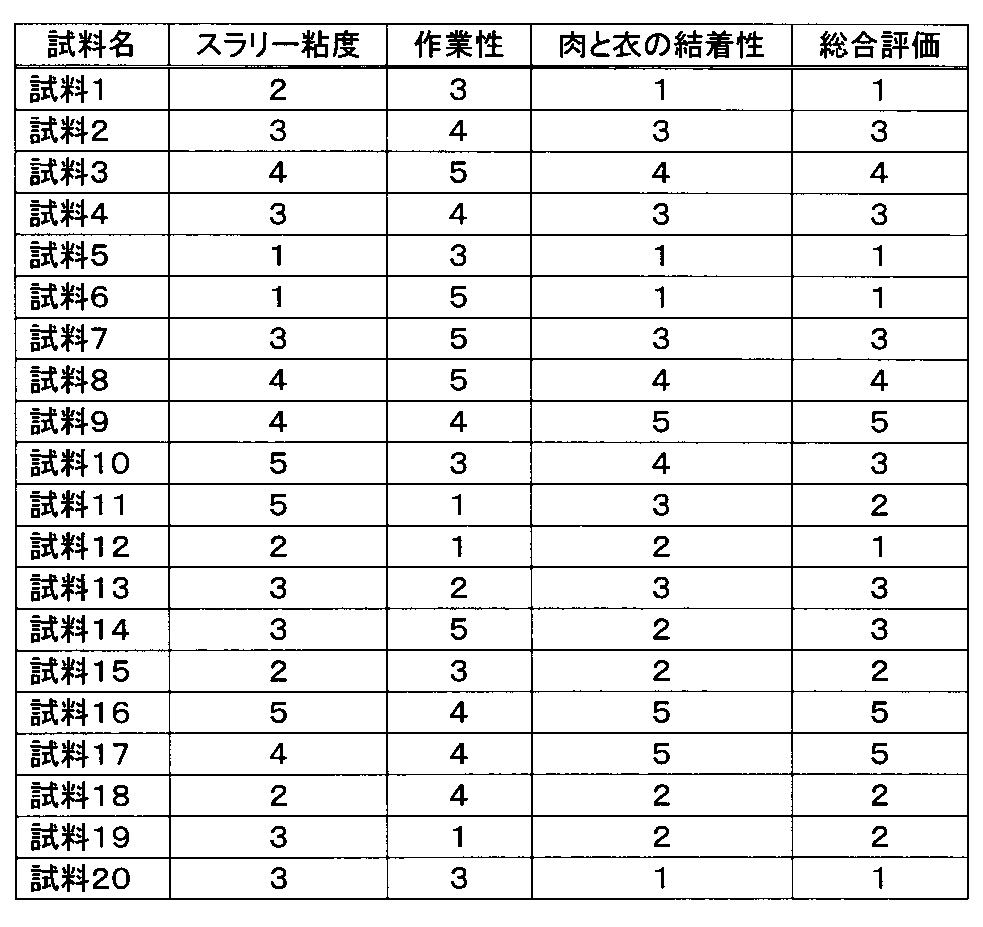
- Table 2 shows the evaluation results of the slurry viscosity, and the evaluation criteria are as follows. 1: Very low (less than 10 mPa ⁇ s) 2: Low (10 mPa ⁇ s or more, less than 100 mPa ⁇ s) 3: Normal (100 mPa ⁇ s or more, less than 500 mPa ⁇ s) 4: High (500 mPa ⁇ s or more, less than 1000 mPa ⁇ s) 5: Very high (1000 mPa ⁇ s or more)
- Tonkatsu was cut after 3 minutes of frying, and after 120 minutes, the binding property of meat and clothes was visually evaluated.
- the evaluation criteria are as follows. 1: completely peeled, 2: almost peeled, 3: half peeled, 4: almost bound, 5: completely bound
- Table 2 shows the overall evaluation of Samples 1 to 20, and the evaluation criteria are as follows. 1: bad 2: normal 3: preferred 4: highly preferred 5: highly preferred
Landscapes
- Chemical & Material Sciences (AREA)
- Life Sciences & Earth Sciences (AREA)
- Engineering & Computer Science (AREA)
- Food Science & Technology (AREA)
- Polymers & Plastics (AREA)
- Health & Medical Sciences (AREA)
- Nutrition Science (AREA)
- Oil, Petroleum & Natural Gas (AREA)
- Dispersion Chemistry (AREA)
- Marine Sciences & Fisheries (AREA)
- Zoology (AREA)
- Chemical Kinetics & Catalysis (AREA)
- Biotechnology (AREA)
- Grain Derivatives (AREA)
- General Preparation And Processing Of Foods (AREA)
- Cereal-Derived Products (AREA)
- Jellies, Jams, And Syrups (AREA)
Abstract
Description
(1) 水分含量が25~45質量%に調整された澱粉に、乳化剤を混合した油脂を、乳化剤を含まない油脂の重量として該澱粉の乾燥物重量に対して0.02~0.4質量%添加して混合する工程と、該混合物の水分が油脂添加前の澱粉の0.2~0.5倍となるよう調整する工程と、水分調整した澱粉を熟成処理する工程と、を含む、油脂加工澱粉の製造方法。
(2) 乳化剤のHLBが2~10である、(1)に記載の方法。
(3) 乳化剤の油脂への添加量が、油脂の質量に対して0.5~5倍である、(1)または(2)に記載の方法。
(4) (1)~(3)のいずれかに記載の方法で製造される油脂加工澱粉。
(5) (4)に記載の油脂加工澱粉を含んでなる、揚げ物用衣材。
(6) (4)に記載の油脂加工澱粉または(5)に記載の揚げ物用衣材を含んでなる、揚げ物食品。
(1)水分含量を25~45質量%に調整した澱粉に対して、乳化剤と混合した所定量の油脂を添加混合する工程、
(2)油脂を混合した澱粉の水分含量が、(1)の水分含量の0.2~0.5倍となるよう調整する工程、
(3)熟成処理を施す工程、
を必須とする。
本発明においては、水分含量が25~45質量%に調整された澱粉を使用するが、澱粉の水分含量の調整方法には特に制限は無い。乾燥した澱粉に適宜水を添加して所望の水分含量に調整しても良く、澱粉スラリーを脱水する際に所望の水分含量に調整しても良い。水分含量を高める場合は、例えば、澱粉に水をそのまま添加して混合したり、澱粉に水分をスプレーすることによって澱粉の水分含量を高めることができる。また、調湿条件下に澱粉を置くことなどによって澱粉の水分含量を25~45質量%に調整することも可能である。
本発明においては、乳化剤を混合した油脂を澱粉に添加した後、油脂を混合した澱粉の水分含量が、油脂添加前の澱粉の水分含量の0.2~0.5倍となるよう調整する。すなわち、本発明においては、比較的水分含量の高い澱粉に対して、乳化剤を混合した油脂を所定量添加し、次いで、油脂を混合した澱粉の水分量を最初の水分量の1/2~1/5まで低下させる必要がある。このように大幅に澱粉の水分量を低下させることによって、油脂加工澱粉の分散性や水馴染みを向上させるとともに、後続の熟成工程によって澱粉の結着性を大きく向上させることができる。ただし、水分含量が0.2倍を下回るように調整すると澱粉が帯電し、揚げ物用衣材として利用する際、澱粉が空中に飛散し易くなるとともに、水馴染みが悪くなるため、バッターの調製においてダマが生じ易くなり、作業性が大きく低下するので好ましくない。水分含量が0.5倍を上回るように調整すると、熟成工程において澱粉の加水分解(熱ダメージ)が加速され、結着性が大きく低下するので好ましくない。この水分調整工程においては、油脂を混合した澱粉の水分含量を、油脂添加前の澱粉の水分含量の0.22~0.47倍となるように調整することが好ましく、0.3~0.4倍となるように調整することがより好ましい。
本発明においては、上記のようにした水分調整した澱粉を熟成させる。本発明において熟成処理とは、水分を調製した澱粉混合物を30℃~150℃で一定時間保存することである。熟成処理は、例えば、反応機、エクストルーダー、ドライヤー、タンク、容器、包材等に入れた状態で、澱粉混合物を30℃~150℃で処理することによって実施できるが、油脂加工澱粉への熱ダメージを考慮すると30℃~70℃で処理することが好ましい。熟成処理は、通常の加熱機器にて加熱処理を行う方法を用いても良いが、加熱処理しなくても30℃を超える環境下において、タンク、容器、包材等の入れ物に入れた状態でそのまま保管する方法を用いても当然良い。熟成処理時間は、熟成処理温度が高いほど短時間に調整することができるが、1時間~8週間が適当であり、1日間~6週間が好ましく、5日間~4週間がより好ましく、1週間~3週間が特に好ましい。
本発明における油脂加工澱粉は、そのまま打ち粉やまぶし粉として使用したり、あるいは水溶きしてバッターとして使用したりすることで揚げ物用衣材として利用できる。さらに、本発明による油脂加工澱粉は、市販されているミックス粉等に添加しても使用することができる。本発明における揚げ物用衣材は、本発明の油脂加工澱粉をそのまま用いても良いし、あるいは、必要に応じて通常の揚げ物用衣材に使用されている材料を混合して用いても良い。通常の揚げ物食品の衣材に使用されている材料は、例えば、穀粉、上新粉、増粘多糖類、膨張剤、蛋白質、澱粉分解物および還元物、色素、調味料、香料、ビタミンE、食塩等が挙げられ、必要に応じて適宜用いることができる。
油脂加工澱粉として、下記表1に示す試料1~20を調製した。具体的な実験手順は、以下の通りとした。

乾燥物重量で108gの試料を氷冷水に分散して総量を300gとした後、TVB10M型粘度計(東機産業株式会社)を用い、ローター回転数を60rpmに設定し、15秒間回転させた後の値として測定した。
1:非常に低い(10mPa・s未満)
2:低い(10mPa・s以上、100mPa・s未満)
3:普通(100mPa・s以上、500mPa・s未満)
4:高い(500mPa・s以上、1000mPa・s未満)
5:非常に高い(1000mPa・s以上)
揚げ物の具材として豚ロース肉を用いた。トリミングした豚ロース肉を10mm厚にスライスし、予め凍結しておき、使用する直前に表面部分のみを温風にて解凍した。バッターは、試料1~20の100部(乾燥物重量として)に対し、増粘多糖類1.2部と氷冷水250部を加えて攪拌混合することで調製した。豚ロース肉にバッターを対肉28質量%となるように付着させ、パン粉付けして凍結した。なお、ここまでの作業において、試料1~20の作業性を評価したが、評価基準は以下のとおりである。
1:非常に悪い、2:悪い、3:普通、4:良い、5:非常に良い
1:完全に剥がれている、2:ほとんど剥がれている、3:半分程度剥がれている
4:ほとんど結着している、5:完全に結着している
1:悪い、2:普通、3:好ましい、4:非常に好ましい、5:極めて好ましい
Claims (6)
- 水分含量が25~45質量%に調整された澱粉に、乳化剤を混合した油脂を、乳化剤を含まない油脂の重量として該澱粉の乾燥物重量に対して0.02~0.4質量%添加して混合する工程と、
該混合物の水分が油脂添加前の澱粉の0.2~0.5倍となるよう調整する工程と、
水分調整した澱粉を熟成処理する工程と、
を含む、油脂加工澱粉の製造方法。 - 乳化剤のHLBが2~10である、請求項1に記載の方法。
- 乳化剤の油脂への添加量が、油脂の質量に対して0.5~5倍である、請求項1または2に記載の方法。
- 請求項1~3のいずれかに記載の方法で製造される油脂加工澱粉。
- 請求項4に記載の油脂加工澱粉を含んでなる、揚げ物用衣材。
- 請求項4に記載の油脂加工澱粉または請求項5に記載の揚げ物用衣材を含んでなる、揚げ物食品。
Priority Applications (6)
| Application Number | Priority Date | Filing Date | Title |
|---|---|---|---|
| ES13873031T ES2701752T3 (es) | 2013-01-28 | 2013-04-23 | Almidón procesado con grasa y un procedimiento para producir el mismo |
| EP13873031.2A EP2949221B1 (en) | 2013-01-28 | 2013-04-23 | Fat-processed starch and process for producing same |
| AU2013375022A AU2013375022B2 (en) | 2013-01-28 | 2013-04-23 | Fat-processed starch and process for producing same |
| CN201380051302.5A CN104754958B (zh) | 2013-01-28 | 2013-04-23 | 油脂加工淀粉及其制备方法 |
| HK15109810.2A HK1208999B (en) | 2013-01-28 | 2013-04-23 | Fat-processed starch and process for producing same |
| US14/763,643 US11678688B2 (en) | 2013-01-28 | 2013-04-23 | Fat-processed starch and process for producing same |
Applications Claiming Priority (2)
| Application Number | Priority Date | Filing Date | Title |
|---|---|---|---|
| JP2013-012978 | 2013-01-28 | ||
| JP2013012978A JP5265821B1 (ja) | 2013-01-28 | 2013-01-28 | 油脂加工澱粉およびその製造方法 |
Publications (1)
| Publication Number | Publication Date |
|---|---|
| WO2014115347A1 true WO2014115347A1 (ja) | 2014-07-31 |
Family
ID=49053066
Family Applications (1)
| Application Number | Title | Priority Date | Filing Date |
|---|---|---|---|
| PCT/JP2013/061836 Ceased WO2014115347A1 (ja) | 2013-01-28 | 2013-04-23 | 油脂加工澱粉およびその製造方法 |
Country Status (7)
| Country | Link |
|---|---|
| US (1) | US11678688B2 (ja) |
| EP (1) | EP2949221B1 (ja) |
| JP (1) | JP5265821B1 (ja) |
| CN (1) | CN104754958B (ja) |
| AU (1) | AU2013375022B2 (ja) |
| ES (1) | ES2701752T3 (ja) |
| WO (1) | WO2014115347A1 (ja) |
Families Citing this family (11)
| Publication number | Priority date | Publication date | Assignee | Title |
|---|---|---|---|---|
| EP3170407B1 (en) * | 2014-07-15 | 2024-09-04 | Nisshin Seifun Welna Inc. | Tempura batter mix |
| US20170208846A1 (en) * | 2014-07-15 | 2017-07-27 | Nisshin Foods Inc. | Tempura batter mix |
| CN107846943A (zh) * | 2015-08-14 | 2018-03-27 | 日清食品株式会社 | 油炸食品用撒粉混合物 |
| WO2018159583A1 (ja) * | 2017-02-28 | 2018-09-07 | 株式会社ニチレイフーズ | 揚げ物用衣材 |
| JP6320605B1 (ja) * | 2017-06-30 | 2018-05-09 | 日本食品化工株式会社 | 油脂加工澱粉及びその製造方法 |
| US20200154750A1 (en) * | 2017-07-21 | 2020-05-21 | J-Oil Mills, Inc. | Oil- or fat-processed starch, coating material for fried food using the same, food and method for producing the same |
| WO2021060350A1 (ja) * | 2019-09-27 | 2021-04-01 | 株式会社J-オイルミルズ | 食肉加工品の製造方法 |
| WO2021210130A1 (ja) | 2020-04-16 | 2021-10-21 | 日本食品化工株式会社 | 油脂加工澱粉、揚げ物用衣材及びその製造方法、揚げ物の製造方法 |
| JP6890911B1 (ja) * | 2020-10-06 | 2021-06-18 | 日本食品化工株式会社 | 分散性に優れた油脂加工澱粉、その製造方法およびその用途 |
| JP2023151955A (ja) * | 2022-04-01 | 2023-10-16 | 株式会社J-オイルミルズ | バッターミックス、バッター液および衣付き食品 |
| CN119156140A (zh) * | 2022-07-07 | 2024-12-17 | 株式会社日清富滋 | 油炸食品用面衣材料及其制造方法 |
Citations (12)
| Publication number | Priority date | Publication date | Assignee | Title |
|---|---|---|---|---|
| JPH01243891A (ja) | 1988-02-12 | 1989-09-28 | Eta Sa Fab Ebauches | ステッピングモータの制御回路 |
| JP2000106832A (ja) | 1998-10-06 | 2000-04-18 | Honen Corp | 油脂加工澱粉及びその製造方法 |
| JP2002218920A (ja) | 2001-01-25 | 2002-08-06 | Honen Corp | 加工澱粉及びその製造方法 |
| JP2002291431A (ja) | 2001-03-30 | 2002-10-08 | Nisshin Foods Kk | 揚げ物用打ち粉 |
| JP2003235475A (ja) | 2002-02-21 | 2003-08-26 | Honen Corp | 加工澱粉及びその製造方法 |
| JP2004113236A (ja) | 2002-09-06 | 2004-04-15 | Nippon Starch Chemical Co Ltd | 揚げ物用衣材 |
| JP2005073506A (ja) | 2003-08-29 | 2005-03-24 | Nippon Shokuhin Kako Co Ltd | 油脂加工澱粉及びその製造方法、並びに揚げ物用衣材 |
| JP2005185122A (ja) | 2003-12-24 | 2005-07-14 | Riken Vitamin Co Ltd | 油脂加工澱粉およびそれを用いる揚げ物用衣材 |
| JP2005204502A (ja) | 2004-01-20 | 2005-08-04 | Nippon Shokuhin Kako Co Ltd | 揚げ物用衣材及び揚げ物食品 |
| JP2012029602A (ja) | 2010-07-29 | 2012-02-16 | Nippon Shokuhin Kako Co Ltd | 揚げ物用衣材 |
| JP2012157342A (ja) * | 2011-02-03 | 2012-08-23 | Riken Vitamin Co Ltd | ノンフライ食品用バッター粉および該バッター粉を用いたノンフライ食品 |
| JP2012165724A (ja) | 2011-02-17 | 2012-09-06 | Nippon Shokuhin Kako Co Ltd | 揚げ物用衣材 |
Family Cites Families (6)
| Publication number | Priority date | Publication date | Assignee | Title |
|---|---|---|---|---|
| JPS56106570A (en) * | 1980-01-24 | 1981-08-24 | Nisshin Flour Milling Co Ltd | Conversion of starch to alpha-form |
| US4491483A (en) | 1981-10-01 | 1985-01-01 | Cpc International Inc. | Hot-water dispersible starch-surfactant products, including acid stable and acid and freeze-thaw stable food thickeners |
| ZA826015B (en) * | 1981-10-01 | 1983-10-26 | Cpc International Inc | Hot water dispersible starch-surfactant products, including acid stable and acid and freeze thaw stable food thickeners |
| JP3975417B2 (ja) | 1998-02-27 | 2007-09-12 | 株式会社J−オイルミルズ | 揚げ物用衣材 |
| JP4116910B2 (ja) * | 2003-03-25 | 2008-07-09 | 株式会社日清製粉グループ本社 | 食品用素材 |
| JP4340588B2 (ja) | 2004-06-14 | 2009-10-07 | 株式会社ニチレイフーズ | バッター、揚げ用餃子又は揚げ用焼売、その製造法及び、揚げ餃子又は揚げ焼売 |
-
2013
- 2013-01-28 JP JP2013012978A patent/JP5265821B1/ja active Active
- 2013-04-23 CN CN201380051302.5A patent/CN104754958B/zh active Active
- 2013-04-23 AU AU2013375022A patent/AU2013375022B2/en active Active
- 2013-04-23 ES ES13873031T patent/ES2701752T3/es active Active
- 2013-04-23 WO PCT/JP2013/061836 patent/WO2014115347A1/ja not_active Ceased
- 2013-04-23 EP EP13873031.2A patent/EP2949221B1/en active Active
- 2013-04-23 US US14/763,643 patent/US11678688B2/en active Active
Patent Citations (12)
| Publication number | Priority date | Publication date | Assignee | Title |
|---|---|---|---|---|
| JPH01243891A (ja) | 1988-02-12 | 1989-09-28 | Eta Sa Fab Ebauches | ステッピングモータの制御回路 |
| JP2000106832A (ja) | 1998-10-06 | 2000-04-18 | Honen Corp | 油脂加工澱粉及びその製造方法 |
| JP2002218920A (ja) | 2001-01-25 | 2002-08-06 | Honen Corp | 加工澱粉及びその製造方法 |
| JP2002291431A (ja) | 2001-03-30 | 2002-10-08 | Nisshin Foods Kk | 揚げ物用打ち粉 |
| JP2003235475A (ja) | 2002-02-21 | 2003-08-26 | Honen Corp | 加工澱粉及びその製造方法 |
| JP2004113236A (ja) | 2002-09-06 | 2004-04-15 | Nippon Starch Chemical Co Ltd | 揚げ物用衣材 |
| JP2005073506A (ja) | 2003-08-29 | 2005-03-24 | Nippon Shokuhin Kako Co Ltd | 油脂加工澱粉及びその製造方法、並びに揚げ物用衣材 |
| JP2005185122A (ja) | 2003-12-24 | 2005-07-14 | Riken Vitamin Co Ltd | 油脂加工澱粉およびそれを用いる揚げ物用衣材 |
| JP2005204502A (ja) | 2004-01-20 | 2005-08-04 | Nippon Shokuhin Kako Co Ltd | 揚げ物用衣材及び揚げ物食品 |
| JP2012029602A (ja) | 2010-07-29 | 2012-02-16 | Nippon Shokuhin Kako Co Ltd | 揚げ物用衣材 |
| JP2012157342A (ja) * | 2011-02-03 | 2012-08-23 | Riken Vitamin Co Ltd | ノンフライ食品用バッター粉および該バッター粉を用いたノンフライ食品 |
| JP2012165724A (ja) | 2011-02-17 | 2012-09-06 | Nippon Shokuhin Kako Co Ltd | 揚げ物用衣材 |
Non-Patent Citations (1)
| Title |
|---|
| YOSHIRO TODA ET AL., SHOKUHIN-YO NYUKAZAI -KISO TO OYO, 1997, KORIN PUBLISHING CO., LTD., pages 26 - 28 * |
Also Published As
| Publication number | Publication date |
|---|---|
| US11678688B2 (en) | 2023-06-20 |
| CN104754958A (zh) | 2015-07-01 |
| US20160066604A1 (en) | 2016-03-10 |
| JP5265821B1 (ja) | 2013-08-14 |
| HK1208999A1 (en) | 2016-03-24 |
| EP2949221B1 (en) | 2018-10-24 |
| JP2014143929A (ja) | 2014-08-14 |
| CN104754958B (zh) | 2016-10-19 |
| EP2949221A4 (en) | 2016-08-24 |
| AU2013375022A1 (en) | 2015-09-10 |
| EP2949221A1 (en) | 2015-12-02 |
| ES2701752T3 (es) | 2019-02-25 |
| AU2013375022B2 (en) | 2017-03-09 |
Similar Documents
| Publication | Publication Date | Title |
|---|---|---|
| JP5265821B1 (ja) | 油脂加工澱粉およびその製造方法 | |
| JP6773691B2 (ja) | 揚げ物衣用改質小麦粉 | |
| JP7076381B2 (ja) | 揚げ物用衣材 | |
| JP4739459B1 (ja) | 揚げ物用衣材 | |
| JP4942855B1 (ja) | 水産練り製品用改良剤及び水産練り製品 | |
| WO2012111199A1 (ja) | 揚げ物用衣材 | |
| JP2016174535A (ja) | 衣材、これを用いた食品およびその製造方法 | |
| JPWO2016010060A1 (ja) | 天ぷら衣用ミックス | |
| JP4530629B2 (ja) | 油脂加工澱粉及びその製造方法、並びに揚げ物用衣材 | |
| JP7162547B2 (ja) | 即席食品用乾燥天ぷらの製造方法 | |
| WO2021246440A1 (ja) | 唐揚げバッター用粉体組成物 | |
| JP6591979B2 (ja) | 天ぷら衣用ミックス | |
| RS67498B1 (sr) | Postupak za instant nudle pržene u ulju | |
| JP2021029131A (ja) | バッター用油脂処理澱粉、バッター粉、およびバッター用油脂処理澱粉の製造方法 | |
| JP2022032448A (ja) | 油脂加工澱粉組成物、揚げ物衣材用ミックス粉及び揚げ物並びにこれらの製造方法 | |
| JP2005000081A (ja) | 揚げ物用バッター | |
| AU2021356474B2 (en) | Oil-or-fat processed starch having exceptional dispersibility, method for producing same, and application of same | |
| HK1208999B (en) | Fat-processed starch and process for producing same | |
| JP7110517B1 (ja) | 澱粉組成物の製造方法 | |
| JP6802014B2 (ja) | 麺用乾燥卵白組成物及びそれを用いた麺 | |
| CN115515431B (zh) | 加工食用粉、加工食用粉的制造方法、油炸食品用裹衣材料、油炸食品用裹衣材料的制造方法、及油炸食品用裹衣材料的口感改良方法 | |
| WO2024009898A1 (ja) | 揚げ物用衣材及びその製造方法 | |
| JP2019033701A (ja) | 揚げ衣用バッター液及びその製造方法並びに揚げ物の製造方法 | |
| CN115515431A (zh) | 加工食用粉、加工食用粉的制造方法、油炸食品用裹衣材料、油炸食品用裹衣材料的制造方法、及油炸食品用裹衣材料的口感改良方法 | |
| HK1193722A (en) | Improving agent for boiled fish-paste product, and boiled fish-paste product |
Legal Events
| Date | Code | Title | Description |
|---|---|---|---|
| 121 | Ep: the epo has been informed by wipo that ep was designated in this application |
Ref document number: 13873031 Country of ref document: EP Kind code of ref document: A1 |
|
| NENP | Non-entry into the national phase |
Ref country code: DE |
|
| WWE | Wipo information: entry into national phase |
Ref document number: 2013873031 Country of ref document: EP |
|
| ENP | Entry into the national phase |
Ref document number: 2013375022 Country of ref document: AU Date of ref document: 20130423 Kind code of ref document: A |
|
| WWE | Wipo information: entry into national phase |
Ref document number: 14763643 Country of ref document: US |