WO2014126235A1 - 電池用包装材料 - Google Patents
電池用包装材料 Download PDFInfo
- Publication number
- WO2014126235A1 WO2014126235A1 PCT/JP2014/053624 JP2014053624W WO2014126235A1 WO 2014126235 A1 WO2014126235 A1 WO 2014126235A1 JP 2014053624 W JP2014053624 W JP 2014053624W WO 2014126235 A1 WO2014126235 A1 WO 2014126235A1
- Authority
- WO
- WIPO (PCT)
- Prior art keywords
- packaging material
- layer
- battery packaging
- resin
- insulating layer
- Prior art date
- Legal status (The legal status is an assumption and is not a legal conclusion. Google has not performed a legal analysis and makes no representation as to the accuracy of the status listed.)
- Ceased
Links
Images


Classifications
-
- B—PERFORMING OPERATIONS; TRANSPORTING
- B32—LAYERED PRODUCTS
- B32B—LAYERED PRODUCTS, i.e. PRODUCTS BUILT-UP OF STRATA OF FLAT OR NON-FLAT, e.g. CELLULAR OR HONEYCOMB, FORM
- B32B27/00—Layered products comprising a layer of synthetic resin
- B32B27/32—Layered products comprising a layer of synthetic resin comprising polyolefins
-
- B—PERFORMING OPERATIONS; TRANSPORTING
- B32—LAYERED PRODUCTS
- B32B—LAYERED PRODUCTS, i.e. PRODUCTS BUILT-UP OF STRATA OF FLAT OR NON-FLAT, e.g. CELLULAR OR HONEYCOMB, FORM
- B32B15/00—Layered products comprising a layer of metal
- B32B15/20—Layered products comprising a layer of metal comprising aluminium or copper
-
- B—PERFORMING OPERATIONS; TRANSPORTING
- B32—LAYERED PRODUCTS
- B32B—LAYERED PRODUCTS, i.e. PRODUCTS BUILT-UP OF STRATA OF FLAT OR NON-FLAT, e.g. CELLULAR OR HONEYCOMB, FORM
- B32B15/00—Layered products comprising a layer of metal
- B32B15/04—Layered products comprising a layer of metal comprising metal as the main or only constituent of a layer, which is next to another layer of the same or of a different material
- B32B15/08—Layered products comprising a layer of metal comprising metal as the main or only constituent of a layer, which is next to another layer of the same or of a different material of synthetic resin
-
- B—PERFORMING OPERATIONS; TRANSPORTING
- B32—LAYERED PRODUCTS
- B32B—LAYERED PRODUCTS, i.e. PRODUCTS BUILT-UP OF STRATA OF FLAT OR NON-FLAT, e.g. CELLULAR OR HONEYCOMB, FORM
- B32B15/00—Layered products comprising a layer of metal
- B32B15/04—Layered products comprising a layer of metal comprising metal as the main or only constituent of a layer, which is next to another layer of the same or of a different material
- B32B15/08—Layered products comprising a layer of metal comprising metal as the main or only constituent of a layer, which is next to another layer of the same or of a different material of synthetic resin
- B32B15/085—Layered products comprising a layer of metal comprising metal as the main or only constituent of a layer, which is next to another layer of the same or of a different material of synthetic resin comprising polyolefins
-
- B—PERFORMING OPERATIONS; TRANSPORTING
- B32—LAYERED PRODUCTS
- B32B—LAYERED PRODUCTS, i.e. PRODUCTS BUILT-UP OF STRATA OF FLAT OR NON-FLAT, e.g. CELLULAR OR HONEYCOMB, FORM
- B32B27/00—Layered products comprising a layer of synthetic resin
- B32B27/06—Layered products comprising a layer of synthetic resin as the main or only constituent of a layer, which is next to another layer of the same or of a different material
- B32B27/08—Layered products comprising a layer of synthetic resin as the main or only constituent of a layer, which is next to another layer of the same or of a different material of synthetic resin
-
- B—PERFORMING OPERATIONS; TRANSPORTING
- B32—LAYERED PRODUCTS
- B32B—LAYERED PRODUCTS, i.e. PRODUCTS BUILT-UP OF STRATA OF FLAT OR NON-FLAT, e.g. CELLULAR OR HONEYCOMB, FORM
- B32B27/00—Layered products comprising a layer of synthetic resin
- B32B27/28—Layered products comprising a layer of synthetic resin comprising synthetic resins not wholly covered by any one of the sub-groups B32B27/30 - B32B27/42
-
- B—PERFORMING OPERATIONS; TRANSPORTING
- B32—LAYERED PRODUCTS
- B32B—LAYERED PRODUCTS, i.e. PRODUCTS BUILT-UP OF STRATA OF FLAT OR NON-FLAT, e.g. CELLULAR OR HONEYCOMB, FORM
- B32B27/00—Layered products comprising a layer of synthetic resin
- B32B27/30—Layered products comprising a layer of synthetic resin comprising vinyl (co)polymers; comprising acrylic (co)polymers
- B32B27/308—Layered products comprising a layer of synthetic resin comprising vinyl (co)polymers; comprising acrylic (co)polymers comprising acrylic (co)polymers
-
- B—PERFORMING OPERATIONS; TRANSPORTING
- B32—LAYERED PRODUCTS
- B32B—LAYERED PRODUCTS, i.e. PRODUCTS BUILT-UP OF STRATA OF FLAT OR NON-FLAT, e.g. CELLULAR OR HONEYCOMB, FORM
- B32B37/00—Methods or apparatus for laminating, e.g. by curing or by ultrasonic bonding
- B32B37/06—Methods or apparatus for laminating, e.g. by curing or by ultrasonic bonding characterised by the heating method
-
- B—PERFORMING OPERATIONS; TRANSPORTING
- B32—LAYERED PRODUCTS
- B32B—LAYERED PRODUCTS, i.e. PRODUCTS BUILT-UP OF STRATA OF FLAT OR NON-FLAT, e.g. CELLULAR OR HONEYCOMB, FORM
- B32B37/00—Methods or apparatus for laminating, e.g. by curing or by ultrasonic bonding
- B32B37/14—Methods or apparatus for laminating, e.g. by curing or by ultrasonic bonding characterised by the properties of the layers
- B32B37/16—Methods or apparatus for laminating, e.g. by curing or by ultrasonic bonding characterised by the properties of the layers with all layers existing as coherent layers before laminating
- B32B37/18—Methods or apparatus for laminating, e.g. by curing or by ultrasonic bonding characterised by the properties of the layers with all layers existing as coherent layers before laminating involving the assembly of discrete sheets or panels only
- B32B37/182—Methods or apparatus for laminating, e.g. by curing or by ultrasonic bonding characterised by the properties of the layers with all layers existing as coherent layers before laminating involving the assembly of discrete sheets or panels only one or more of the layers being plastic
-
- B—PERFORMING OPERATIONS; TRANSPORTING
- B32—LAYERED PRODUCTS
- B32B—LAYERED PRODUCTS, i.e. PRODUCTS BUILT-UP OF STRATA OF FLAT OR NON-FLAT, e.g. CELLULAR OR HONEYCOMB, FORM
- B32B7/00—Layered products characterised by the relation between layers; Layered products characterised by the relative orientation of features between layers, or by the relative values of a measurable parameter between layers, i.e. products comprising layers having different physical, chemical or physicochemical properties; Layered products characterised by the interconnection of layers
- B32B7/02—Physical, chemical or physicochemical properties
- B32B7/027—Thermal properties
-
- H—ELECTRICITY
- H01—ELECTRIC ELEMENTS
- H01M—PROCESSES OR MEANS, e.g. BATTERIES, FOR THE DIRECT CONVERSION OF CHEMICAL ENERGY INTO ELECTRICAL ENERGY
- H01M50/00—Constructional details or processes of manufacture of the non-active parts of electrochemical cells other than fuel cells, e.g. hybrid cells
- H01M50/10—Primary casings; Jackets or wrappings
- H01M50/116—Primary casings; Jackets or wrappings characterised by the material
- H01M50/117—Inorganic material
- H01M50/119—Metals
-
- H—ELECTRICITY
- H01—ELECTRIC ELEMENTS
- H01M—PROCESSES OR MEANS, e.g. BATTERIES, FOR THE DIRECT CONVERSION OF CHEMICAL ENERGY INTO ELECTRICAL ENERGY
- H01M50/00—Constructional details or processes of manufacture of the non-active parts of electrochemical cells other than fuel cells, e.g. hybrid cells
- H01M50/10—Primary casings; Jackets or wrappings
- H01M50/116—Primary casings; Jackets or wrappings characterised by the material
- H01M50/121—Organic material
-
- H—ELECTRICITY
- H01—ELECTRIC ELEMENTS
- H01M—PROCESSES OR MEANS, e.g. BATTERIES, FOR THE DIRECT CONVERSION OF CHEMICAL ENERGY INTO ELECTRICAL ENERGY
- H01M50/00—Constructional details or processes of manufacture of the non-active parts of electrochemical cells other than fuel cells, e.g. hybrid cells
- H01M50/10—Primary casings; Jackets or wrappings
- H01M50/116—Primary casings; Jackets or wrappings characterised by the material
- H01M50/124—Primary casings; Jackets or wrappings characterised by the material having a layered structure
-
- H—ELECTRICITY
- H01—ELECTRIC ELEMENTS
- H01M—PROCESSES OR MEANS, e.g. BATTERIES, FOR THE DIRECT CONVERSION OF CHEMICAL ENERGY INTO ELECTRICAL ENERGY
- H01M50/00—Constructional details or processes of manufacture of the non-active parts of electrochemical cells other than fuel cells, e.g. hybrid cells
- H01M50/10—Primary casings; Jackets or wrappings
- H01M50/116—Primary casings; Jackets or wrappings characterised by the material
- H01M50/124—Primary casings; Jackets or wrappings characterised by the material having a layered structure
- H01M50/126—Primary casings; Jackets or wrappings characterised by the material having a layered structure comprising three or more layers
- H01M50/129—Primary casings; Jackets or wrappings characterised by the material having a layered structure comprising three or more layers with two or more layers of only organic material
-
- H—ELECTRICITY
- H01—ELECTRIC ELEMENTS
- H01M—PROCESSES OR MEANS, e.g. BATTERIES, FOR THE DIRECT CONVERSION OF CHEMICAL ENERGY INTO ELECTRICAL ENERGY
- H01M50/00—Constructional details or processes of manufacture of the non-active parts of electrochemical cells other than fuel cells, e.g. hybrid cells
- H01M50/10—Primary casings; Jackets or wrappings
- H01M50/131—Primary casings; Jackets or wrappings characterised by physical properties, e.g. gas permeability, size or heat resistance
- H01M50/134—Hardness
-
- H—ELECTRICITY
- H01—ELECTRIC ELEMENTS
- H01M—PROCESSES OR MEANS, e.g. BATTERIES, FOR THE DIRECT CONVERSION OF CHEMICAL ENERGY INTO ELECTRICAL ENERGY
- H01M50/00—Constructional details or processes of manufacture of the non-active parts of electrochemical cells other than fuel cells, e.g. hybrid cells
- H01M50/10—Primary casings; Jackets or wrappings
- H01M50/14—Primary casings; Jackets or wrappings for protecting against damage caused by external factors
- H01M50/141—Primary casings; Jackets or wrappings for protecting against damage caused by external factors for protecting against humidity
-
- B—PERFORMING OPERATIONS; TRANSPORTING
- B32—LAYERED PRODUCTS
- B32B—LAYERED PRODUCTS, i.e. PRODUCTS BUILT-UP OF STRATA OF FLAT OR NON-FLAT, e.g. CELLULAR OR HONEYCOMB, FORM
- B32B2307/00—Properties of the layers or laminate
- B32B2307/50—Properties of the layers or laminate having particular mechanical properties
- B32B2307/51—Elastic
-
- B—PERFORMING OPERATIONS; TRANSPORTING
- B32—LAYERED PRODUCTS
- B32B—LAYERED PRODUCTS, i.e. PRODUCTS BUILT-UP OF STRATA OF FLAT OR NON-FLAT, e.g. CELLULAR OR HONEYCOMB, FORM
- B32B2307/00—Properties of the layers or laminate
- B32B2307/50—Properties of the layers or laminate having particular mechanical properties
- B32B2307/536—Hardness
-
- B—PERFORMING OPERATIONS; TRANSPORTING
- B32—LAYERED PRODUCTS
- B32B—LAYERED PRODUCTS, i.e. PRODUCTS BUILT-UP OF STRATA OF FLAT OR NON-FLAT, e.g. CELLULAR OR HONEYCOMB, FORM
- B32B2307/00—Properties of the layers or laminate
- B32B2307/70—Other properties
- B32B2307/726—Permeability to liquids, absorption
- B32B2307/7265—Non-permeable
-
- B—PERFORMING OPERATIONS; TRANSPORTING
- B32—LAYERED PRODUCTS
- B32B—LAYERED PRODUCTS, i.e. PRODUCTS BUILT-UP OF STRATA OF FLAT OR NON-FLAT, e.g. CELLULAR OR HONEYCOMB, FORM
- B32B2311/00—Metals, their alloys or their compounds
- B32B2311/24—Aluminium
-
- B—PERFORMING OPERATIONS; TRANSPORTING
- B32—LAYERED PRODUCTS
- B32B—LAYERED PRODUCTS, i.e. PRODUCTS BUILT-UP OF STRATA OF FLAT OR NON-FLAT, e.g. CELLULAR OR HONEYCOMB, FORM
- B32B2323/00—Polyalkenes
- B32B2323/04—Polyethylene
-
- B—PERFORMING OPERATIONS; TRANSPORTING
- B32—LAYERED PRODUCTS
- B32B—LAYERED PRODUCTS, i.e. PRODUCTS BUILT-UP OF STRATA OF FLAT OR NON-FLAT, e.g. CELLULAR OR HONEYCOMB, FORM
- B32B2323/00—Polyalkenes
- B32B2323/10—Polypropylene
-
- B—PERFORMING OPERATIONS; TRANSPORTING
- B32—LAYERED PRODUCTS
- B32B—LAYERED PRODUCTS, i.e. PRODUCTS BUILT-UP OF STRATA OF FLAT OR NON-FLAT, e.g. CELLULAR OR HONEYCOMB, FORM
- B32B2439/00—Containers; Receptacles
-
- B—PERFORMING OPERATIONS; TRANSPORTING
- B32—LAYERED PRODUCTS
- B32B—LAYERED PRODUCTS, i.e. PRODUCTS BUILT-UP OF STRATA OF FLAT OR NON-FLAT, e.g. CELLULAR OR HONEYCOMB, FORM
- B32B2457/00—Electrical equipment
- B32B2457/10—Batteries
-
- B—PERFORMING OPERATIONS; TRANSPORTING
- B32—LAYERED PRODUCTS
- B32B—LAYERED PRODUCTS, i.e. PRODUCTS BUILT-UP OF STRATA OF FLAT OR NON-FLAT, e.g. CELLULAR OR HONEYCOMB, FORM
- B32B2553/00—Packaging equipment or accessories not otherwise provided for
-
- H—ELECTRICITY
- H01—ELECTRIC ELEMENTS
- H01M—PROCESSES OR MEANS, e.g. BATTERIES, FOR THE DIRECT CONVERSION OF CHEMICAL ENERGY INTO ELECTRICAL ENERGY
- H01M50/00—Constructional details or processes of manufacture of the non-active parts of electrochemical cells other than fuel cells, e.g. hybrid cells
- H01M50/10—Primary casings; Jackets or wrappings
- H01M50/131—Primary casings; Jackets or wrappings characterised by physical properties, e.g. gas permeability, size or heat resistance
-
- Y—GENERAL TAGGING OF NEW TECHNOLOGICAL DEVELOPMENTS; GENERAL TAGGING OF CROSS-SECTIONAL TECHNOLOGIES SPANNING OVER SEVERAL SECTIONS OF THE IPC; TECHNICAL SUBJECTS COVERED BY FORMER USPC CROSS-REFERENCE ART COLLECTIONS [XRACs] AND DIGESTS
- Y02—TECHNOLOGIES OR APPLICATIONS FOR MITIGATION OR ADAPTATION AGAINST CLIMATE CHANGE
- Y02E—REDUCTION OF GREENHOUSE GAS [GHG] EMISSIONS, RELATED TO ENERGY GENERATION, TRANSMISSION OR DISTRIBUTION
- Y02E60/00—Enabling technologies; Technologies with a potential or indirect contribution to GHG emissions mitigation
- Y02E60/10—Energy storage using batteries
-
- Y—GENERAL TAGGING OF NEW TECHNOLOGICAL DEVELOPMENTS; GENERAL TAGGING OF CROSS-SECTIONAL TECHNOLOGIES SPANNING OVER SEVERAL SECTIONS OF THE IPC; TECHNICAL SUBJECTS COVERED BY FORMER USPC CROSS-REFERENCE ART COLLECTIONS [XRACs] AND DIGESTS
- Y02—TECHNOLOGIES OR APPLICATIONS FOR MITIGATION OR ADAPTATION AGAINST CLIMATE CHANGE
- Y02P—CLIMATE CHANGE MITIGATION TECHNOLOGIES IN THE PRODUCTION OR PROCESSING OF GOODS
- Y02P70/00—Climate change mitigation technologies in the production process for final industrial or consumer products
- Y02P70/50—Manufacturing or production processes characterised by the final manufactured product
Definitions
- the present invention relates to a battery packaging material having high insulation properties.
- a film-like laminate in which a base material layer / metal layer / sealant layer are sequentially laminated has been proposed as a battery packaging material that can be easily processed into various shapes and can be reduced in thickness and weight.
- Patent Document 1 discloses a battery case including a biaxially stretched polyamide film layer as an outer layer, an unstretched thermoplastic resin film layer as an inner layer, and an aluminum foil layer disposed between the two film layers.
- a packaging material is disclosed.
- the battery packaging material disclosed in Patent Document 1 has a new insulative property that may deteriorate when the battery packaging material is applied to a battery. A challenge has been found.
- minute foreign matters such as electrode active material and electrode tab fragments have electrical conductivity.
- the foreign material penetrates the sealant layer due to heat and pressure during heat sealing, and the electrode tab and the metal layer of the battery packaging material are electrically connected. May be short-circuited.
- the present invention has been made in view of these problems. That is, the present invention is also high when minute foreign matters such as electrode active material and electrode tab fragments are present at the heat-sealed portion such as the interface between the sealant layers or between the electrode tab and the sealant layer.
- the main object is to provide a battery packaging material having insulating properties.
- the battery packaging material is constituted by a laminate in which at least a base material layer, a metal layer, an insulating layer, and a sealant layer are laminated in this order, and further, a laminate using a nanoindenter It has been found that a battery packaging material with high insulation can be obtained by setting the hardness measured by pressing an indenter 5 ⁇ m into the insulating layer from the cross section in the stacking direction of 10 MPa to 300 MPa. The present invention has been completed by further studies based on these findings.
- this invention provides the packaging material for batteries of the aspect hung up below, its manufacturing method, and a battery.
- Item 1 At least a base material layer, a metal layer, an insulating layer, and a sealant layer are laminated in this order, A battery packaging material having a hardness measured by pushing an indenter of 5 ⁇ m into an insulating layer from a cross-section in the stacking direction of the laminate using a nanoindenter, in a range of 10 MPa to 300 MPa.
- Item 2. The battery packaging material according to Item 1, wherein the insulating layer is formed of a resin composition containing a modified polyolefin resin modified with an unsaturated carboxylic acid or an acid anhydride thereof.
- Item 3. Item 3.
- the battery packaging material according to Item 2 wherein the modified polyolefin resin is formed by modifying at least one of a polyethylene resin and a polypropylene resin with the unsaturated carboxylic acid or an acid anhydride thereof.
- Item 4. Item 3. The battery packaging material according to Item 2, wherein the modified polyolefin resin is further modified with (meth) acrylic acid ester.
- Item 5. Item 5. The battery packaging according to Item 4, wherein the modified polyolefin resin is one in which at least one of a polyethylene resin and a polypropylene resin is modified with an unsaturated carboxylic acid or an acid anhydride thereof and a (meth) acrylic acid ester. material.
- Item 6. Item 6.
- Item 7. Item 7. The battery packaging material according to any one of Items 1 to 6, further comprising a moisture barrier resin layer between the insulating layer and the sealant layer.
- Item 8. Item 8. The battery packaging material according to any one of Items 1 to 7, wherein the metal layer is formed of an aluminum foil.
- the sealant layer has a modulus of elasticity measured by pushing an indenter of 5 ⁇ m into the sealant layer from a cross-section in the stacking direction of the laminate using a nanoindenter, in a range of 100 MPa to 1000 MPa.
- Item 10 The insulating layer according to any one of Items 1 to 9, wherein the insulating layer is formed of a resin composition containing a modified polypropylene resin modified with an unsaturated carboxylic acid or an acid anhydride thereof and a (meth) acrylic acid ester. Battery packaging material.
- the modified polypropylene resin is formed by modifying at least one of a homopolypropylene and a propylene copolymer with an unsaturated carboxylic acid or an acid anhydride thereof and a (meth) acrylic acid ester.
- Item 12. Item 12.
- Item 13. Item 13.
- Item 14. Item 14.
- the curing agent includes at least one selected from the group consisting of a polyfunctional isocyanate compound, a carbodiimide compound, an epoxy compound, and an oxazoline compound.
- Item 15. Item 15.
- Item 16. Item 16.
- Packaging materials Item 17.
- Item 10. The battery packaging according to any one of Items 1 to 9, wherein the insulating layer is formed of a resin composition containing a modified polyolefin resin modified with an unsaturated carboxylic acid or an acid anhydride thereof and a carbodiimide compound. material.
- the carbodiimide compound has the following general formula (1): [In General Formula (5), n is an integer of 2 or more. ] A polycarbodiimide compound having a repeating unit represented by: The following general formula (6): [In General formula (6), n is an integer greater than or equal to 2. ] A polycarbodiimide compound having a repeating unit represented by: And the following general formula (7): [In General formula (7), n is an integer greater than or equal to 2. ] Item 19.
- Item 17-19 wherein the content of the carbodiimide compound in the resin composition is in the range of 0.01 equivalents to 1.0 equivalents as carbodiimide groups with respect to 1 equivalent of carboxyl groups in the modified polyolefin resin.
- the content of the other cured product in the resin composition is in the range of 0.05 equivalent to 10 equivalents as a reactive group of the other cured product with respect to 1 equivalent of the carboxyl group in the modified polyolefin resin.
- Item 22 The battery packaging material according to Item 21.
- Item 23 The battery according to any one of Items 17 to 22, wherein the modified polyolefin resin is formed by modifying at least one of a polyethylene resin and a polypropylene resin with the unsaturated carboxylic acid or an acid anhydride thereof.
- Packaging materials Item 24.
- Item 24. The item according to any one of Items 17 to 23, wherein the insulating layer is formed of a resin composition containing a modified polyolefin resin modified with an unsaturated carboxylic acid or an acid anhydride thereof and a (meth) acrylic acid ester. Battery packaging material.
- Item 25 The item according to any one of Items 17 to 22, wherein the modified polyolefin resin is formed by modifying at least one of a polyethylene resin and a polypropylene resin with the unsaturated carboxylic acid or an acid anhydride thereof.
- Packaging materials Item 24.
- the insulating layer is formed of a resin composition containing a modified polyolefin resin modified with an unsaturated carboxylic acid
- the modified polyolefin resin modified with the unsaturated carboxylic acid or an acid anhydride thereof and a (meth) acrylic acid ester is such that at least one of a polyethylene resin and a polypropylene resin is the unsaturated carboxylic acid or an acid anhydride thereof.
- Item 25. The battery packaging material according to Item 24, which is modified with (meth) acrylic acid ester.
- the insulating layer comprises (i) at least one of an amorphous modified polyolefin resin (A) and a modified polyolefin resin (B) having a melting point of 110 ° C. or higher; and (ii) a modified polyolefin resin having a melting point of 100 ° C. or lower (C Item 10.
- the battery packaging material according to any one of Items 1 to 9, wherein the battery packaging material is formed from a resin composition comprising: Item 27.
- the amorphous modified polyolefin resin (A) is modified with a modified polyolefin resin modified with an unsaturated carboxylic acid or an acid anhydride thereof, an unsaturated carboxylic acid or an acid anhydride thereof, and a (meth) acrylic acid ester.
- the battery packaging material according to Item 26 which is at least one selected from the group consisting of a modified polyolefin resin and a modified polyolefin resin having an alcoholic hydroxyl group.
- Item 28. The modified polyolefin resin (B) having a melting point of 110 ° C.
- the modified polyolefin resin (C) having a melting point of 100 ° C. or lower is a modified polyolefin resin modified with an unsaturated carboxylic acid or an acid anhydride thereof, an unsaturated carboxylic acid or an acid anhydride thereof, and a (meth) acrylic acid ester.
- Item 30. The battery packaging material according to any one of Items 26 to 29, wherein the modified polyolefin resin (B) having a melting point of 110 ° C. or higher is at least one of a modified polyethylene resin and a modified polypropylene resin.
- Item 31. The battery packaging material according to any one of Items 26 to 30, wherein the modified polyolefin resin (C) having a melting point of 100 ° C. or lower is at least one of a modified polyethylene resin and a modified polypropylene resin.
- the battery packaging material according to Item 32 or 33, wherein the curing agent is composed of two or more kinds of compounds.
- the content of the curing agent includes (i) an amorphous modified polyolefin resin (A), a modified polyolefin resin (B) having a melting point of 110 ° C.
- Item 35 The battery packaging material according to any one of Items 32 to 34, which is in the range of 0.1 to 50 parts by mass with respect to 100 parts by mass in total with the modified polyolefin resin (C).
- Item 36. A battery in which a battery element comprising a positive electrode, a negative electrode, and an electrolyte is sealed with the battery packaging material according to any one of Items 1 to 35.
- At least a step of obtaining a laminate by laminating a base material layer, a metal layer, an insulating layer, and a sealant layer in this order In the above step, a battery is used that forms an insulating layer having a hardness measured by pushing an indenter of 5 ⁇ m into the insulating layer from a cross section in the stacking direction of the laminate using a nanoindenter in the range of 10 MPa to 300 MPa.
- Method of manufacturing packaging materials Item 38. Item 38. The manufacturing method according to Item 37, further comprising a step of heating the laminated body at a temperature equal to or higher than the melting point of the sealant layer after the step. Item 39. 39.
- an insulating layer is formed from a resin composition containing a modified polypropylene resin modified with an unsaturated carboxylic acid or an acid anhydride thereof and a (meth) acrylic ester. Manufacturing method of packaging material.
- the insulating layer is formed from a resin composition containing a modified polyolefin resin modified with an unsaturated carboxylic acid or an acid anhydride thereof and a carbodiimide compound. Production method. Item 41.
- Item 40 The method for producing a battery packaging material according to Item 37 or 38, wherein the insulating layer is formed from a resin composition comprising:
- the battery packaging material of the present invention minute foreign matters such as electrode active materials and electrode tab fragments are present at the heat-sealed portions such as the interface between the sealant layers and between the electrode tab and the sealant layer. Even in this case, it is possible to provide a battery packaging material having high insulation properties. That is, the battery insulation can be enhanced by sealing the battery element with the battery packaging material of the present invention.
- the battery packaging material of the present invention is composed of a laminate in which at least a base material layer, a metal layer, an insulating layer, and a sealant layer are laminated in this order, and a lamination direction of the laminate using a nanoindenter The hardness measured by pressing the indenter 5 ⁇ m into the insulating layer from the cross section in the range of 10 MPa to 300 MPa.
- the battery packaging material of the present invention, the manufacturing method thereof, and the battery of the present invention in which the battery element is sealed with the battery packaging material of the present invention will be described in detail with reference to FIGS.
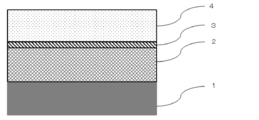
- the battery packaging material of the present invention has at least a base layer 1, a metal layer 2, an insulating layer 3, and a sealant layer 4 laminated in this order. It consists of a laminate.
- the base material layer 1 is the outermost layer
- the sealant layer 4 is the innermost layer. That is, when the battery is assembled, the battery element is wrapped with the battery packaging material so that the sealant layer 4 of the battery packaging material is on the inside of the battery, and the sealant layers 4 positioned at the periphery of the battery element are heat-welded. The battery element is sealed by sealing the battery element.
- the battery packaging material of the present invention only needs to include at least the base material layer 1, the metal layer 2, the insulating layer 3, and the sealant layer 4, and may further have other layers.
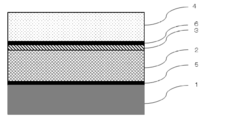
- An adhesive layer 5 may be provided in the battery packaging material of the present invention.
- FIG. 3 for example, as needed, in order to suppress moisture permeability from the end face of the battery packaging material between the metal layer 2 and the insulating layer 3 and improve the durability of the battery.
- a moisture barrier resin layer 6 may be provided.
- a moisture barrier resin layer 6 may be provided between the insulating layer 3 and the sealant layer 4.
- other layers may be further formed on the outside of the base material layer 1 for the purpose of, for example, imparting design properties.
- the base material layer 1 is a layer constituting the outermost layer when the battery is assembled.
- the raw material which forms the base material layer 1 will not be restrict
- the material for forming the base material layer 1 include resin films such as polyester resin, polyamide resin, epoxy resin, acrylic resin, fluorine resin, polyurethane resin, silicon resin, phenol resin, and mixtures and copolymers thereof. Can be mentioned.
- polyester resin examples include polyethylene terephthalate, polybutylene terephthalate, polyethylene naphthalate, polybutylene naphthalate, copolymerized polyester, and polycarbonate.
- polyamide resin examples include nylon 6, nylon 6,6, a copolymer of nylon 6 and nylon 6,6, nylon 6,10, polymetaxylylene adipamide (MXD6), and the like. It is done.
- the material forming the base layer 1 is preferably nylon or polyester, more preferably biaxially stretched nylon, biaxially stretched polyester, and particularly preferably biaxially stretched nylon.
- the base material layer 1 may be formed from one resin film or may be formed from two or more multilayer resin films.
- the pinhole resistance and insulation of the battery packaging material of the present invention can be improved.
- two or more resin films can be laminated
- the type and amount of the adhesive used at this time can be the same as in the case of the adhesive layer 5 described later.
- the thickness of the base material layer 1 is not particularly limited, but can be, for example, about 5 ⁇ m to 50 ⁇ m, preferably about 12 ⁇ m to 30 ⁇ m.
- the metal layer 2 is a layer that functions as a barrier layer for preventing water vapor, oxygen, light, and the like from entering the battery, in addition to improving the strength of the battery packaging material.
- the metal constituting the metal layer 2 include aluminum, stainless steel, and titanium, and preferably aluminum.
- the metal layer 2 can be formed by metal foil, metal vapor deposition, or the like, preferably by metal foil, and more preferably by aluminum foil. From the viewpoint of preventing the generation of wrinkles and pinholes in the metal layer 2 during the manufacture of battery packaging materials, for example, by using a soft aluminum foil such as annealed aluminum (JIS A8021P-O, JIS A8079P-O). More preferably, it is formed.
- the thickness of the metal layer 2 is not particularly limited, but can be, for example, about 10 ⁇ m to 200 ⁇ m, preferably about 20 ⁇ m to 100 ⁇ m.
- the metal layer 2 is preferably subjected to chemical conversion treatment on at least one surface, preferably both surfaces, for the purpose of stabilizing adhesion, preventing dissolution and corrosion, and the like.
- the chemical conversion treatment refers to a treatment for forming an acid-resistant film on the surface of the metal layer.
- chromic acid compounds such as chromium nitrate, chromium fluoride, chromium sulfate, chromium acetate, chromium oxalate, chromium biphosphate, chromic acetyl acetate, chromium chloride, potassium sulfate chromium, etc.
- Phosphoric acid chromate treatment using a phosphoric acid compound such as sodium phosphate, potassium phosphate, ammonium phosphate, polyphosphoric acid; aminated phenol having a repeating unit represented by the following general formulas (1) to (4) Examples include chromate treatment using a polymer.
- X represents a hydrogen atom, a hydroxyl group, an alkyl group, a hydroxyalkyl group, an allyl group or a benzyl group.
- R 1 and R 2 are the same or different and each represents a hydroxyl group, an alkyl group, or a hydroxyalkyl group.
- examples of the alkyl group represented by X, R 1 and R 2 include a methyl group, an ethyl group, an n-propyl group, an isopropyl group, an n-butyl group, an isobutyl group, Examples thereof include a linear or branched alkyl group having 1 to 4 carbon atoms such as a tert-butyl group.
- Examples of the hydroxyalkyl group represented by X, R 1 and R 2 include a hydroxymethyl group, a 1-hydroxyethyl group, a 2-hydroxyethyl group, a 1-hydroxypropyl group, a 2-hydroxypropyl group, 3- C1-C4 straight or branched chain in which one hydroxy group such as hydroxypropyl group, 1-hydroxybutyl group, 2-hydroxybutyl group, 3-hydroxybutyl group, 4-hydroxybutyl group is substituted
- An alkyl group is mentioned.
- the alkyl group and hydroxyalkyl group represented by X, R 1 and R 2 may be the same or different.
- X is preferably a hydrogen atom, a hydroxyl group or a hydroxyalkyl group.
- the number average molecular weight of the aminated phenol polymer having a repeating unit represented by the general formulas (1) to (4) is preferably, for example, 500 to 1,000,000, more preferably about 1,000 to 20,000. preferable.
- a metal oxide such as aluminum oxide, titanium oxide, cerium oxide, tin oxide, or barium sulfate fine particles dispersed in phosphoric acid is coated.
- a method of forming a corrosion-resistant treatment layer on the surface of the metal layer 2 by performing a baking treatment at 150 ° C. or higher can be mentioned.
- a resin layer obtained by crosslinking a cationic polymer with a crosslinking agent may be further formed on the corrosion-resistant treatment layer.
- examples of the cationic polymer include polyethyleneimine, an ionic polymer complex composed of a polymer having polyethyleneimine and a carboxylic acid, a primary amine graft acrylic resin obtained by graft polymerization of a primary amine on an acrylic main skeleton, and polyallylamine. Or the derivative, aminophenol, etc. are mentioned.
- these cationic polymers only one type may be used, or two or more types may be used in combination.
- examples of the crosslinking agent include a compound having at least one functional group selected from the group consisting of an isocyanate group, a glycidyl group, a carboxyl group, and an oxazoline group, and a silane coupling agent. As these crosslinking agents, only one type may be used, or two or more types may be used in combination.
- chemical conversion treatment only one type of chemical conversion treatment may be performed, or two or more types of chemical conversion processing may be performed in combination. Furthermore, these chemical conversion treatments may be carried out using one kind of compound alone, or may be carried out using a combination of two or more kinds of compounds.
- chemical conversion treatments chromic acid chromate treatment, chromate treatment combining a chromic acid compound, a phosphoric acid compound, and an aminated phenol polymer are preferable.
- the amount of the acid-resistant film formed on the surface of the metal layer 2 in the chemical conversion treatment is not particularly limited.
- a chromic acid compound is present per 1 m 2 of the surface of the metal layer 2.
- a solution containing a compound used for forming an acid-resistant film is applied to the surface of the metal layer by a bar coating method, a roll coating method, a gravure coating method, an immersion method, or the like, and then the temperature of the metal layer is 70. It is carried out by heating so as to reach about 200 ° C.
- the metal layer may be previously subjected to a degreasing treatment by an alkali dipping method, an electrolytic cleaning method, an acid cleaning method, an electrolytic acid cleaning method, or the like. By performing the degreasing treatment in this way, it becomes possible to more efficiently perform the chemical conversion treatment on the surface of the metal layer.
- the insulating layer 3 is a layer provided between the metal layer 2 and the sealant layer 4 in order to enhance the insulation of the battery packaging material.
- the insulating layer 3 has a hardness measured by pushing an indenter of 5 ⁇ m into the insulating layer 3 from the cross section in the stacking direction of the laminate using a nanoindenter, and the hardness is in the range of 10 MPa to 300 MPa. More specifically, the hardness of the insulating layer 3 is an indenter made of a diamond tip having a triangular pyramid (Berkovic type) tip shape with respect to the insulating layer 3 from a cross section in the stacking direction of the stacked body using a nanoindenter. Is the hardness when the indenter is pushed in (nanoindenter hardness). This hardness is measured by a so-called nanoindentation method.
- the hardness of the insulating layer 3 is preferably in the range of 10 MPa to 300 MPa, more preferably in the range of 15 MPa to 250 MPa.
- the insulating layer 3 having such specific hardness is provided between the metal layer 2 and the sealant layer 4, the electrode active material, electrode tab fragments, etc. Even when such minute foreign matter is present at the heat-sealed portion such as the interface between the sealant layers or between the electrode tab and the sealant layer, the insulation and durability of the battery packaging material are enhanced.
- the insulating layer 3 may have a multilayer structure of two or more layers. Thereby, even when a thin-walled portion or a through hole is formed in the first insulating layer together with the sealant layer 4, the insulating properties can be maintained by the second and third insulating layers.
- the material constituting the insulating layer 3 is not particularly limited as long as it has insulating properties and hardness as described above.
- the insulating layer 3 can be formed of, for example, a resin composition. From the viewpoint of enhancing the insulating properties of the battery packaging material, the resin composition preferably contains a modified polyolefin resin.
- the modified polyolefin resin it is preferable to use a modified polyolefin resin modified with an unsaturated carboxylic acid or an acid anhydride thereof. Furthermore, the modified polyolefin resin may be further modified with a (meth) acrylic ester.
- the insulating layer 3 With forming the insulating layer 3 with a resin composition containing these modified polyolefin-based resins, the adhesion between the insulating layer 3 and the metal layer 2 or the sealant layer 4 is improved, and the insulation of the battery packaging material is enhanced. Not only can durability be improved.
- the modified polyolefin resin further modified with (meth) acrylic acid ester can be obtained by acid-modifying polyolefin resin by using unsaturated carboxylic acid or its acid anhydride and (meth) acrylic acid ester in combination. Is.
- (meth) acrylic acid ester means “acrylic acid ester” or “methacrylic acid ester”.
- the polyolefin resin to be modified is not particularly limited as long as it is a resin containing at least an olefin as a monomer unit.
- the polyolefin resin can be composed of, for example, at least one of a polyethylene resin and a polypropylene resin, and is preferably composed of a polypropylene resin.
- the polyethylene resin can be composed of, for example, at least one of homopolyethylene and ethylene copolymer.
- the polypropylene resin can be composed of at least one of a homopolypropylene and a propylene copolymer, for example.
- propylene copolymer examples include copolymers of propylene and other olefins such as ethylene-propylene copolymer, propylene-butene copolymer, and ethylene-propylene-butene copolymer.
- the proportion of the propylene unit contained in the polypropylene resin is preferably about 50 mol% to 100 mol%, and preferably about 80 mol% to 100 mol% from the viewpoint of further improving the insulation and durability of the battery packaging material. More preferably.
- the proportion of ethylene units contained in the polyethylene resin is preferably about 50 mol% to 100 mol%, and more preferably 80 mol% to 100 mol, from the viewpoint of further improving the insulation and durability of the battery packaging material.
- Each of the ethylene copolymer and the propylene copolymer may be a random copolymer or a block copolymer. Further, the ethylene copolymer and the propylene copolymer may each be crystalline or amorphous, and may be a copolymer or a mixture thereof.
- the polyolefin resin may be formed of one type of homopolymer or copolymer, or may be formed of two or more types of homopolymer or copolymer.
- the unsaturated carboxylic acid examples include acrylic acid, methacrylic acid, maleic acid, itaconic acid, fumaric acid, and crotonic acid.
- an acid anhydride the acid anhydride of the unsaturated carboxylic acid illustrated above is preferable, and maleic anhydride and itaconic anhydride are more preferable.
- the modified polypropylene resin may be one modified with one type of unsaturated carboxylic acid or acid anhydride thereof, or one modified with two or more types of unsaturated carboxylic acid or acid anhydrides thereof. May be.
- Examples of (meth) acrylic acid esters include esterification products of (meth) acrylic acid and alcohols having 1 to 30 carbon atoms, preferably esterification products of (meth) acrylic acid and alcohols having 1 to 20 carbon atoms. Is mentioned. Specific examples of (meth) acrylic acid esters include methyl (meth) acrylate, ethyl (meth) acrylate, propyl (meth) acrylate, butyl (meth) acrylate, hexyl (meth) acrylate, (meth) Examples include octyl acrylate, decyl (meth) acrylate, lauryl (meth) acrylate, octyl (meth) acrylate, dodecyl (meth) acrylate, stearyl (meth) acrylate, and the like. In modification
- the ratio of the unsaturated carboxylic acid or its acid anhydride in the modified polyolefin resin is preferably about 0.1 to 30% by mass, and preferably about 0.1 to 20% by mass. More preferred. By setting it as such a range, the insulation and durability of the packaging material for batteries can be improved more.
- the ratio of (meth) acrylic acid ester in the modified polyolefin resin is preferably about 0.1% by mass to 40% by mass, and more preferably about 0.1% by mass to 30% by mass. By setting it as such a range, the insulation and durability of the packaging material for batteries can be improved more.
- the weight average molecular weight of the modified polyolefin resin is preferably about 6000 to 200000, and more preferably about 8000 to 150,000, respectively. By setting it as such a range, since the affinity of the insulating layer 3 with respect to the metal layer 2 and the sealant layer 4 can be stabilized, the adhesiveness of the metal layer 2 and the sealant layer 4 can be stabilized for a long time. Furthermore, since heat resistance can also be improved, the insulation and durability of the battery packaging material can be further improved.
- the weight average molecular weight of the modified polypropylene resin is a value measured by gel permeation chromatography (GPC) measured under conditions using polystyrene as a standard sample.
- the melting point of the modified polyolefin resin is preferably about 60 ° C. to 160 ° C., and more preferably about 70 ° C. to 140 ° C. By setting it as such a range, since the affinity of the insulating layer 3 with respect to the metal layer 2 and the sealant layer 4 can be stabilized, the adhesiveness of the metal layer 2 and the sealant layer 4 can be stabilized for a long time. Furthermore, since heat resistance can also be improved, the insulation and durability of the battery packaging material can be further improved.
- the melting point of the modified polyolefin resin refers to an endothermic peak temperature in differential scanning calorimetry.
- the method for modifying the polyolefin resin is not particularly limited, and for example, an unsaturated carboxylic acid or an acid anhydride thereof, or a (meth) acrylic acid ester may be copolymerized with the polyolefin resin.
- examples of such copolymerization include random copolymerization, block copolymerization, graft copolymerization (graft modification), and the like, and preferably graft copolymerization.
- the hard insulating layer 3 formed from the modified polyolefin resin as described above is formed, and high heat-resistant mechanical strength when heat is applied during heat sealing or the like.
- the insulating layer 3 is formed which has high flexibility and can suppress the occurrence of fine cracks due to stress such as bending.
- the sealant layer 4 fine cracks that are likely to occur in a thin portion, through holes due to foreign matters, and voids due to foaming of the sealant layer that are generated when the sealant layer is heat-sealed with the electrolyte solution formed are formed. Even in this case, the insulating layer 3 can prevent the electrolytic solution from coming into direct contact with the metal layer, and the metal layer 2 is protected. In addition, even when the sealant layer 4 bites foreign matter or the like, the insulating layer 3 having high heat resistance and high mechanical strength and flexibility can prevent deterioration of the insulating property of the battery packaging material due to foreign matter.
- the curing agent is not particularly limited as long as it can cure the modified polypropylene resin.
- curing agent a polyfunctional isocyanate compound, a carbodiimide compound, an epoxy compound, an oxazoline compound etc. are mentioned, for example.
- the polyfunctional isocyanate compound is not particularly limited as long as it is a compound having two or more isocyanate groups.
- Specific examples of the polyfunctional isocyanate compound include isophorone diisocyanate (IPDI), hexamethylene diisocyanate (HDI), tolylene diisocyanate (TDI), diphenylmethane diisocyanate (MDI), those obtained by polymerizing or nurate, mixtures thereof, Examples include copolymers with other polymers.
- the carbodiimide compound is not particularly limited as long as it is a compound having at least one carbodiimide group (—N ⁇ C ⁇ N—).
- a polycarbodiimide compound having at least two carbodiimide groups is preferable.
- Specific examples of particularly preferred carbodiimide compounds include the following general formula (5):
- n is an integer of 2 or more.
- n is an integer greater than or equal to 2.
- n is an integer greater than or equal to 2.
- the polycarbodiimide compound represented by these is mentioned.
- n is usually an integer of 30 or less, preferably an integer of 3 to 20.
- the epoxy compound is not particularly limited as long as it is a compound having at least one epoxy group.
- the epoxy compound include epoxy resins such as bisphenol A diglycidyl ether, modified bisphenol A diglycidyl ether, novolac glycidyl ether, glycerin polyglycidyl ether, and polyglycerin polyglycidyl ether.
- the oxazoline compound is not particularly limited as long as it is a compound having an oxazoline skeleton.
- Specific examples of the oxazoline compound include Epocross series manufactured by Nippon Shokubai Co., Ltd.
- the curing agent may be composed of two or more kinds of compounds.
- the content of the curing agent is preferably in the range of 0.1 parts by weight to 50 parts by weight with respect to 100 parts by weight of the modified polypropylene resin, and 0.1 parts by weight to 30 parts by weight. More preferably, it is in the range.
- the content of the curing agent is preferably in the range of 1 equivalent to 30 equivalents as a reactive group in the curing agent with respect to 1 equivalent of the carboxyl group in the modified polypropylene resin. More preferably in the range of ⁇ 20 equivalents.
- the thickness of the insulating layer 3 is not particularly limited as long as it is a thickness suitable for a battery packaging material, and can be, for example, about 0.1 ⁇ m to 20 ⁇ m, preferably about 0.5 ⁇ m to 15 ⁇ m. Since the battery packaging material of the present invention is molded into various shapes according to the shape of the battery, a certain degree of flexibility is also required. In the battery packaging material, by setting the thickness of the insulating layer 3 in such a range, the insulation can be further improved while maintaining the flexibility of the battery packaging material.
- the melting point of the insulating layer 3 is preferably lower than the melting point of the sealant layer 4 described later.
- the melting point of the insulating layer means the melting point of the component constituting the insulating layer.
- the melting point of the insulating layer refers to an endothermic peak temperature in differential scanning calorimetry of the resin composition.
- the insulating layer 3 has a high flexibility, and it is possible to suppress crushing at the time of foreign matter biting due to stress dispersion during compression, It is possible to prevent fine cracks during stretching.
- the olefinic rubber-like additive include Mitsui Chemicals' Tuffmer P, Tuffmer A, Tuffmer H, Tuffmer XM, Tuffmer BL, Tuffmer PN, and ⁇ -olefin copolymers such as Sumitomo Chemical's Tough Selenium.
- the hydrocarbon wax include paraffin.
- a preferred embodiment A of the insulating layer 3 is that the insulating layer 3 is formed of a resin composition containing a modified polypropylene resin modified with an unsaturated carboxylic acid or an acid anhydride thereof and a (meth) acrylic ester.
- the modified polypropylene-based resin is obtained by acid-modifying a polypropylene-based resin using an unsaturated carboxylic acid or an acid anhydride thereof and a (meth) acrylic acid ester in combination.
- the insulating layer 3 formed of such a specific resin composition is provided between the metal layer 2 and the sealant layer 4, the electrode active material or the electrode tab Even when a minute foreign matter such as a broken piece is present between the battery element and the sealant layer, the insulation and durability of the battery packaging material are enhanced.
- the polypropylene resin to be modified is not particularly limited as long as it is a resin containing at least propylene as a monomer unit.
- the polypropylene resin can be composed of at least one of a homopolypropylene and a propylene copolymer, for example.
- the propylene copolymer include copolymers of propylene and other olefins such as ethylene-propylene copolymer, propylene-butene copolymer, and ethylene-propylene-butene copolymer.
- the propylene copolymer may be either a random copolymer or a block copolymer.
- the propylene copolymer may be crystalline or amorphous, and may be a copolymer or a mixture thereof.
- the polypropylene resin may be formed of one type of homopolymer or copolymer, or may be formed of two or more types of homopolymer or copolymer.
- the proportion of the propylene unit contained in the polypropylene resin is preferably about 50 mol% to 100 mol%, and about 80 mol% to 100 mol%, from the viewpoint of further improving the insulation and durability of the battery packaging material. More preferably.
- the modified polypropylene resin may be modified with one (meth) acrylic acid ester or may be modified with two or more (meth) acrylic acid esters.
- the ratio of the unsaturated carboxylic acid or its acid anhydride in the modified polypropylene resin is preferably about 0.1% by mass to 30% by mass, more preferably about 0.1% by mass to 20% by mass. preferable. By setting it as such a range, the insulation and durability of the packaging material for batteries can be improved more.
- the proportion of (meth) acrylic acid ester in the modified polypropylene resin is preferably about 0.1% by mass to 40% by mass, and more preferably about 0.1% by mass to 30% by mass. . By setting it as such a range, the insulation and durability of the packaging material for batteries can be improved more.
- the proportion of unsaturated carboxylic acid or acid anhydride and the proportion of (meth) acrylic acid ester in the modified polypropylene resin can be determined by 1 H-NMR analysis.
- the weight average molecular weight of the modified polypropylene resin is the same as described above.
- the melting point of the modified polypropylene resin is the same as described above.
- the method for modifying the polypropylene resin is not particularly limited as long as the unsaturated carboxylic acid or its acid anhydride and (meth) acrylic acid ester are copolymerized with the polypropylene resin.
- Examples of such copolymerization include random copolymerization, block copolymerization, graft copolymerization (graft modification), and the like, and preferably graft copolymerization.
- the battery packaging material of aspect A is formed from the modified polypropylene resin as described above, has high heat-resistant mechanical strength when heat is applied during heat sealing, etc., and also has flexibility.
- the insulating layer 3 is formed, which is high and can suppress generation of fine cracks due to stress such as bending.
- the sealant layer 4 fine cracks that are likely to occur in a thin portion, through holes due to foreign matters, and voids due to foaming of the sealant layer that are generated when the sealant layer is heat-sealed with the electrolyte solution formed are formed. Even in this case, the insulating layer 3 can prevent the electrolytic solution from coming into direct contact with the metal layer, and the metal layer 2 is protected. In addition, even when the sealant layer 4 bites foreign matter or the like, the insulating layer 3 having high heat resistance and high mechanical strength and flexibility can prevent deterioration of the insulating property of the battery packaging material due to foreign matter. Furthermore, since the insulating layer 3 has a high affinity with the metal layer 2 and the sealant layer 4, the adhesion between the insulating layer 3 and the metal layer 2 or the sealant layer 4 is high, and the durability is excellent.
- the resin composition forming the insulating layer 3 may further contain the above curing agent.
- the mechanical strength of the insulating layer 3 can be increased.
- a preferred embodiment B of the insulating layer 3 is characterized in that the insulating layer 3 is formed of a resin composition containing a modified polyolefin resin modified with an unsaturated carboxylic acid or an acid anhydride thereof and the carbodiimide compound. To do.
- the modified polyolefin resin may be further modified with a (meth) acrylic acid ester.
- the insulation and durability of the battery packaging material can be improved by forming the insulating layer 3 from a resin composition containing these modified polyolefin-based resins and the carbodiimide compound.
- modified polyolefin resin a modified polyolefin resin modified with an unsaturated carboxylic acid or an acid anhydride thereof and a modified polyolefin resin further modified with a (meth) acrylic acid ester are mixed and used. Also good. Moreover, the modified polyolefin resin further modified with (meth) acrylic acid ester can be obtained by acid-modifying polyolefin resin in combination with unsaturated carboxylic acid or its acid anhydride and (meth) acrylic acid ester. Is.
- modified polyolefin resin unsaturated carboxylic acid, (meth) acrylic acid ester, carbodiimide compound and the like are the same as described above.
- the insulating layer 3 having high mechanical strength formed from the resin composition containing the modified polyolefin resin and the carbodiimide compound as described above is formed. For this reason, the insulating layer 3 is formed which has high heat-resistant mechanical strength when heat such as heat sealing is applied, has high flexibility, and can suppress generation of fine cracks due to stress such as bending.
- the sealant layer 4 fine cracks that are likely to occur in a thin portion, through holes due to foreign matters, and voids due to foaming of the sealant layer that are generated when the sealant layer is heat-sealed with the electrolyte solution formed are formed. Even in this case, the insulating layer 3 can prevent the electrolytic solution from coming into direct contact with the metal layer, and the metal layer 2 is protected. In addition, even when the sealant layer 4 bites foreign matter or the like, the insulating layer 3 having high heat resistance and high mechanical strength and flexibility can prevent deterioration of the insulating property of the battery packaging material due to foreign matter. Furthermore, in aspect B, since the insulating layer 3 has high affinity with the metal layer 2 and the sealant layer 4, the adhesiveness between the insulating layer 3 and the metal layer 2 or the sealant layer 4 is high, and the durability is excellent.
- the resin composition forming the insulating layer 3 further includes other curing agents such as a polyfunctional isocyanate compound, an epoxy compound, and an oxazoline compound for the purpose of curing the modified polyolefin resin. May be included.
- the resin composition contains these other curing agents, the adhesive strength between the insulating layer 3 and the metal layer 2 or the sealant layer 4 can be improved while further improving the mechanical strength of the insulating layer 3.
- a preferred embodiment C of the insulating layer 3 is that the insulating layer 3 comprises: (i) at least one of an amorphous modified polyolefin resin (A) and a modified polyolefin resin (B) having a melting point of 110 ° C. or higher; and (ii) a melting point. It is formed by the resin composition containing 100 degreeC or less modified polyolefin resin (C).
- the insulating layer 3 formed of such a specific resin composition is provided between the metal layer 2 and the sealant layer 4, the electrode active material, electrode tab fragments, and the like Even when a foreign substance is present between the battery element and the sealant layer, the insulation and durability of the battery packaging material are enhanced.
- the insulating layer 3 is formed of any one of the following resin compositions (1) to (3), so that the above-described effects of improving the insulation and durability can be obtained. Is done.
- a resin composition comprising (i) an amorphous modified polyolefin resin (A) and (ii) a modified polyolefin resin (C) having a melting point of 110 ° C. or lower.
- a resin composition comprising (i) a modified polyolefin resin (B) having a melting point of 110 ° C. or higher and (ii) a modified polyolefin resin (C) having a melting point of 100 ° C. or lower.
- a resin comprising (i) an amorphous modified polyolefin resin (A), a modified polyolefin resin (B) having a melting point of 110 ° C. or higher, and (ii) a modified polyolefin resin (C) having a melting point of 100 ° C. or lower. Composition.
- the amorphous modified polyolefin resin refers to a modified polyolefin resin having a low crystallinity and having substantially no melting point by using an atactic polymer with less stereoregularity.
- the melting point of the modified polyolefin resin refers to the endothermic peak temperature in differential scanning calorimetry.
- the amorphous modified polyolefin resin (A) is not particularly limited, and a known amorphous modified polyolefin resin can be used. From the viewpoint of enhancing the insulation and durability of the battery packaging material by using in combination with a modified polyolefin resin (C) having a melting point of 100 ° C.
- the amorphous modified polyolefin resin (A) is preferably , Modified polyolefin resin modified with unsaturated carboxylic acid or acid anhydride thereof, modified polyolefin resin modified with unsaturated carboxylic acid or acid anhydride thereof and (meth) acrylic acid ester, modified polyolefin having alcoholic hydroxyl group Resin, and more preferably, a modified polyolefin resin having an alcoholic hydroxyl group.
- the amorphous modified polyolefin resin (A) one kind may be used alone, or two or more kinds may be used in combination.
- the modified polyolefin resin modified with an unsaturated carboxylic acid or an acid anhydride thereof is not particularly limited.
- a modified polyolefin resin having a melting point of 110 ° C. or higher (described later) What was illustrated by B) is mentioned.
- the modified polyolefin resin modified with an unsaturated carboxylic acid or acid anhydride thereof and a (meth) acrylic ester is not particularly limited, and for example, a modified polyolefin resin (B) having a melting point of 110 ° C. or higher described below. And those exemplified in.
- the acid value of the modified polyolefin resin modified with an unsaturated carboxylic acid or an acid anhydride thereof, and the modified polyolefin resin modified with an unsaturated carboxylic acid or an acid anhydride thereof and a (meth) acrylic ester is particularly limited. For example, about 20 to 60, preferably about 25 to 55 can be mentioned.
- the modified polyolefin resin having an alcoholic hydroxyl group is not particularly limited, and examples thereof include a modified polyolefin resin having at least one alcoholic hydroxyl group in the polyolefin main chain.
- the number of hydroxyl groups bonded to the polyolefin main chain is not particularly limited, and examples thereof include a hydroxyl value that is an index of polarity in the polymer, preferably about 20 to 60, more preferably about 30 to 50.
- the hydroxyl value can be measured according to the method defined in JISK1557-1.
- the modified polyolefin resin having an alcoholic hydroxyl group preferably has a hydroxyl group at the end of the polyolefin main chain.
- the weight average molecular weight of the amorphous modified polyolefin resin (A) is not particularly limited, but is preferably about 6000 to 200000, more preferably about 8000 to 150,000. By using such a range, the affinity of the insulating layer 3 to the metal layer 2 and the sealant layer 4 can be stabilized when used in combination with the modified polyolefin resin (C) having a melting point of 100 ° C. or less, which will be described later. The adhesion between the layer 2 and the sealant layer 4 can be stabilized for a long time. Furthermore, since heat resistance can also be improved, the insulation and durability of the battery packaging material can be further improved. In embodiment C, the weight average molecular weight of the modified polyolefin resin is a value measured by gel permeation chromatography (GPC) measured under conditions using polystyrene as a standard sample.
- GPC gel permeation chromatography
- fusing point is 110 degreeC or more
- fusing point mentioned later is 100 degrees C or less.
- the insulation and durability of the packaging material for batteries are provided.
- at least one of a modified polyolefin resin modified with an unsaturated carboxylic acid or an acid anhydride thereof, and a modified polyolefin resin modified with an unsaturated carboxylic acid or an acid anhydride thereof and a (meth) acrylic acid ester It is preferable that
- the modified polyolefin resin modified with an unsaturated carboxylic acid or an acid anhydride thereof is obtained by acid-modifying a polyolefin resin with an unsaturated carboxylic acid or an acid anhydride thereof.
- the modified polypropylene resin modified with unsaturated carboxylic acid or its acid anhydride and (meth) acrylic acid ester is a combination of unsaturated carboxylic acid or its acid anhydride and (meth) acrylic acid ester. Thus, it is obtained by acid-modifying a polyolefin resin.
- the polyolefin resin to be modified is not particularly limited as long as it is a resin containing at least an olefin as a monomer unit.
- the polyolefin resin can be composed of, for example, at least one of a polyethylene resin and a polypropylene resin, and is preferably composed of a polypropylene resin.
- the polyethylene resin can be composed of, for example, at least one of homopolyethylene and ethylene copolymer.
- the polypropylene resin can be composed of at least one of a homopolypropylene and a propylene copolymer, for example.
- propylene copolymer examples include copolymers of propylene and other olefins such as ethylene-propylene copolymer, propylene-butene copolymer, and ethylene-propylene-butene copolymer.
- the proportion of the propylene unit contained in the polypropylene resin is preferably about 50 mol% to 100 mol%, and preferably about 80 mol% to 100 mol% from the viewpoint of further improving the insulation and durability of the battery packaging material. More preferably.
- the proportion of ethylene units contained in the polyethylene resin is preferably about 50 mol% to 100 mol%, and more preferably 80 mol% to 100 mol, from the viewpoint of further improving the insulation and durability of the battery packaging material.
- Each of the ethylene copolymer and the propylene copolymer may be a random copolymer or a block copolymer. Further, the ethylene copolymer and the propylene copolymer may each be crystalline or amorphous, and may be a copolymer or a mixture thereof.
- the polyolefin resin may be formed of one type of homopolymer or copolymer, or may be formed of two or more types of homopolymer or copolymer.
- the modified polypropylene resin may be modified with one type of unsaturated carboxylic acid or its acid anhydride, or may be modified with two or more types of unsaturated carboxylic acid or its acid anhydride, as described above. It may be.
- the ratio of the unsaturated carboxylic acid or its acid anhydride in the modified polyolefin resin (B) having a melting point of 110 ° C. or higher is preferably about 0.1% by mass to 30% by mass, preferably 0.1% by mass to 20%. More preferably, it is about mass%. By setting it as such a range, the insulation and durability of the packaging material for batteries can be improved more.
- (meth) acrylic acid esters examples include esterification products of (meth) acrylic acid and alcohols having 1 to 30 carbon atoms, preferably esterification products of (meth) acrylic acid and alcohols having 1 to 20 carbon atoms. Is mentioned. Specific examples of (meth) acrylic acid esters include methyl (meth) acrylate, ethyl (meth) acrylate, propyl (meth) acrylate, butyl (meth) acrylate, hexyl (meth) acrylate, (meth) Examples include octyl acrylate, decyl (meth) acrylate, lauryl (meth) acrylate, octyl (meth) acrylate, dodecyl (meth) acrylate, stearyl (meth) acrylate, and the like.
- the modified polypropylene resin may be modified with one (meth) acrylic acid ester or may be modified with two or more (meth) acrylic acid esters.
- the proportion of (meth) acrylic acid ester in the modified polyolefin resin (B) having a melting point of 110 ° C. or higher is about 0.1% by mass to 40% by mass. It is preferably about 0.1% by mass to 30% by mass. By setting it as such a range, the insulation and durability of the packaging material for batteries can be improved more.
- the method for modifying the polyolefin resin is not particularly limited, and examples thereof include a method of copolymerizing an unsaturated carboxylic acid or an acid anhydride thereof or a (meth) acrylic ester with a polyolefin resin.
- Examples of such copolymerization include random copolymerization, block copolymerization, graft copolymerization (graft modification), and the like, and preferably graft copolymerization.
- the proportion of unsaturated carboxylic acid or acid anhydride and the proportion of (meth) acrylic acid ester in the polyolefin resin can be determined by 1 H-NMR analysis.
- the modified polyolefin resin When using a modified polyolefin resin modified with an unsaturated carboxylic acid or acid anhydride thereof and a modified polyolefin resin modified with an unsaturated carboxylic acid or acid anhydride thereof and a (meth) acrylic acid ester, the modified polyolefin resin
- the ratio in the resin (B) is preferably about 10:90 to 90:10, more preferably about 20:80 to 80:20 in terms of mass ratio.
- the weight average molecular weight of the modified polyolefin resin (B) having a melting point of 110 ° C. or higher is preferably about 6000 to 200000, and more preferably about 8000 to 150,000.
- the affinity of the insulating layer 3 to the metal layer 2 and the sealant layer 4 can be stabilized when used in combination with the modified polyolefin resin (C) having a melting point of 100 ° C. or less, which will be described later.
- the adhesion between the layer 2 and the sealant layer 4 can be stabilized for a long time. Furthermore, since heat resistance can also be improved, the insulation and durability of the battery packaging material can be further improved.
- the melting point of the modified polyolefin resin (B) having a melting point of 110 ° C. or higher is preferably about 110 to 160 ° C., more preferably about 110 to 150 ° C.
- fusing point can be adjusted by setting suitably the weight average molecular weight of modified polyolefin resin (B), the ratio of unsaturated carboxylic acid or its acid anhydride, and (meth) acrylic acid ester.
- the modified polyolefin resin (A) and the modified polyolefin resin in the resin composition forming the insulating layer 3 are not particularly limited, and may be, for example, about 20:80 to 80:20, preferably about 30:70 to 70:30 in terms of mass ratio.
- the modified polyolefin resin (C) having a melting point of 100 ° C. or lower is not particularly limited, but is the same unsaturated carboxylic acid or acid anhydride as exemplified for the modified polyolefin resin (B) having a melting point of 110 ° C. or higher. It is preferably at least one of a modified polyolefin resin modified with a product and a modified polyolefin resin modified with an unsaturated carboxylic acid or acid anhydride thereof and a (meth) acrylic acid ester.
- these modified polyolefin resins as the modified polyolefin resin (C) having a melting point of 100 ° C.
- amorphous modified polyolefin resin (A) and a modified polyolefin resin (B) having a melting point of 110 ° C. or higher When used together, the insulation and durability of the battery packaging material can be further enhanced.
- the ratio of the unsaturated carboxylic acid or its acid anhydride in the modified polyolefin resin (C) having a melting point of 100 ° C. or less is preferably about 0.1% by mass to 30% by mass, and more preferably 0.1% by mass to 20%. More preferably, it is about mass%. By setting it as such a range, the insulation and durability of the packaging material for batteries can be improved more.
- the proportion of (meth) acrylic acid ester in the modified polyolefin resin (C) having a melting point of 100 ° C. or less is about 0.1% by mass to 40% by mass. It is preferably about 0.1% by mass to 30% by mass. By setting it as such a range, the insulation and durability of the packaging material for batteries can be improved more.
- the melting point is
- the ratio in the modified polyolefin resin (C) at 100 ° C. or lower is preferably about 10:90 to 90:10, more preferably about 20:80 to 80:20, by mass ratio.
- the weight average molecular weight of the modified polyolefin resin (C) having a melting point of 100 ° C. or less is preferably about 6000 to 200000, and more preferably about 8000 to 150,000.
- the metal layer 2 and the sealant layer 4 are used. Therefore, the adhesion between the metal layer 2 and the sealant layer 4 can be stabilized for a long time. Furthermore, since heat resistance can also be improved, the insulation and durability of the battery packaging material can be further improved.
- the melting point of the modified polyolefin resin (C) having a melting point of 100 ° C. or lower is preferably about 40 to 100 ° C., more preferably about 50 to 100 ° C.
- fusing point can be adjusted by setting suitably the weight average molecular weight of modified polyolefin resin (C), the ratio of unsaturated carboxylic acid or its acid anhydride, and (meth) acrylic acid ester.
- the ratio of the modified polyolefin resin (C) is not particularly limited, but is preferably about 20:80 to 80:20, more preferably about 30:70 to 70:30, in terms of mass ratio. By setting it as such a range, at least one of (i) the amorphous modified polyolefin resin (A) and the modified polyolefin resin (B) having a melting point of 110 ° C. or higher, and (ii) a modified resin having a melting point of 100 ° C. or lower.
- the polyolefin resin (C) in combination, the effect of improving the insulation and durability can be further enhanced.
- the insulating layer 3 is formed from the resin composition using the modified polyolefin resin of (i) and (ii) above, heat during heat sealing or the like When it is added, it has high heat-resistant mechanical strength, high flexibility, and can suppress the occurrence of fine cracks due to stress such as bending.
- the sealant layer 4 when the sealant layer 4 is formed with fine cracks that are likely to occur in thin portions, through-holes due to foreign matter, etc., voids due to foaming of the sealant layer that are generated when the sealant layer is heat sealed.
- the insulating layer 3 can prevent the electrolytic solution from coming into direct contact with the metal layer, and the metal layer 2 is protected.
- the insulating layer 3 having high heat resistance and high mechanical strength and flexibility can prevent deterioration of the insulating property of the battery packaging material due to foreign matter.
- the insulating layer 3 since the insulating layer 3 has high affinity with the metal layer 2 and the sealant layer 4, the adhesiveness between the insulating layer 3 and the metal layer 2 or the sealant layer 4 is high, and the durability is excellent.
- the content of the curing agent is (i) an amorphous modified polyolefin resin (A), a modified polyolefin resin (B) having a melting point of 110 ° C. or more, and (ii) a modification having a melting point of 100 ° C. or less. It is preferably in the range of 0.1 to 50 parts by mass, more preferably in the range of 0.1 to 30 parts by mass with respect to 100 parts by mass in total with the polyolefin resin (C).
- the content of the curing agent is as a reactive group in the curing agent with respect to 1 equivalent of all active hydroxyl groups (total of carboxyl group hydroxyl groups and terminal alcoholic hydroxyl groups) in these modified polyolefin resins. It is preferably in the range of 1 equivalent to 30 equivalents, and more preferably in the range of 1 equivalent to 20 equivalents. Thereby, the insulation and durability of the battery packaging material can be further improved.
- the sealant layer 4 is a layer constituting the innermost layer of the battery packaging material of the present invention when the battery is assembled. When the battery is assembled, the surfaces of the sealant layer 4 can be brought into contact with each other, and the contacted portion can be heat-welded to seal the battery element.
- the resin component for forming the sealant layer 4 is not particularly limited as long as the sealant layers 4 can be thermally welded to each other.
- examples of such a resin component include polyolefin, cyclic polyolefin, carboxylic acid-modified polyolefin, carboxylic acid-modified cyclic polyolefin, and the like.
- polyolefins include polyethylene such as low density polyethylene, medium density polyethylene, high density polyethylene, and linear low density polyethylene; homopolypropylene, polypropylene block copolymers (for example, block copolymers of propylene and ethylene), polypropylene Crystalline or amorphous polypropylene such as random copolymers (for example, random copolymers of propylene and ethylene); ethylene-butene-propylene terpolymers, and the like.
- polyethylene and polypropylene are preferable.
- Cyclic polyolefin is a copolymer of olefin and cyclic monomer.
- the olefin include ethylene, propylene, 4-methyl-1-pentene, styrene, butadiene, and isoprene.
- the cyclic monomer include cyclic alkenes such as norbornene; cyclic dienes such as cyclopentadiene, dicyclopentadiene, cyclohexadiene, norbornadiene, and the like.
- a cyclic alkene is preferable, and norbornene is more preferable.
- Carboxylic acid-modified polyolefin is a polymer obtained by modifying polyolefin with carboxylic acid.
- carboxylic acid used for modification include maleic acid, acrylic acid, itaconic acid, crotonic acid, maleic anhydride, itaconic anhydride and the like.
- the carboxylic acid-modified cyclic polyolefin is a copolymer obtained by copolymerizing a part of the monomer constituting the cyclic polyolefin in place of the ⁇ , ⁇ -unsaturated carboxylic acid or its acid anhydride, or ⁇ , ⁇ with respect to the cyclic polyolefin.
- the cyclic polyolefin to be modified with carboxylic acid can be the same as the above cyclic polyolefin.
- the carboxylic acid used for modification can be the same as that used for modification of the acid-modified cycloolefin copolymer.
- these resin components preferably crystalline or amorphous polyolefin, cyclic polyolefin, and blended polymers thereof; more preferably polyethylene, polypropylene, copolymers of ethylene and norbornene, and two or more of these The blend polymer of these is mentioned.
- the sealant layer 4 may be formed of only one type of resin component or may be formed of a blend polymer obtained by combining two or more types of resin components. Furthermore, the sealant layer 4 may be formed of only one layer, or may be formed of two or more layers using the same or different resin components.
- the sealant layer 4 is measured by pushing the indenter 5 ⁇ m into the sealant layer 4 from the cross section in the stacking direction of the laminate using a nanoindenter.
- the elastic modulus is preferably in the range of 100 MPa to 1000 MPa, and more preferably in the range of 100 MPa to 800 MPa. More specifically, the elastic modulus of the sealant layer 4 is composed of a diamond tip having a triangular pyramid (Berkovic type) tip shape with respect to the sealant layer 4 from a cross section in the stacking direction of the laminate using a nanoindenter. This is the elastic modulus when the indenter is pushed in by 5 ⁇ m and the indenter is pushed in. This elastic modulus is measured by a so-called nanoindentation method.
- the thickness of the sealant layer 4 is not particularly limited, but may be, for example, about 2 ⁇ m to 2000 ⁇ m, preferably about 5 ⁇ m to 1000 ⁇ m, and more preferably 10 ⁇ m to 500 ⁇ m.
- an adhesive layer 5 may be further provided between the base material layer 1 and the metal layer 2 for the purpose of firmly bonding the base material layer 1 and the metal layer 2. Good.
- the adhesive layer 5 is formed of an adhesive component capable of adhering the base material layer 1 and the metal layer 2.
- the adhesive used for forming the adhesive layer 5 may be a two-component curable adhesive or a one-component curable adhesive. Moreover, it does not specifically limit about the adhesion
- the thickness of the adhesive layer 5 is not particularly limited, but is preferably about 1 ⁇ m to 40 ⁇ m, for example, and more preferably about 2 ⁇ m to 30 ⁇ m.
- the moisture barrier resin layer 6 is provided between at least one of the metal layer 2 and the insulating layer 3 and between the insulating layer 3 and the sealant layer 4, thereby The moisture resistance can be further improved. That is, it can suppress more effectively that a water
- the material constituting the moisture barrier resin layer 6 is not particularly limited as long as the moisture resistance of the battery packaging material can be improved.
- the moisture barrier resin layer 6 can be formed of, for example, a fluorine-based resin.
- the moisture barrier resin layer 6 is preferably formed of a fluorine-containing copolymer containing a hydroxyl group and a curing agent that reacts with the fluorine-containing copolymer.
- the fluorine-containing copolymer containing a hydroxyl group is not particularly limited, and examples thereof include those that are soluble in an organic solvent and have an alcoholic hydroxyl group (OH group) as a crosslinking site in the molecule.
- a fluorine-containing copolymer for example, 1) a fluoroolefin monomer represented by the formula: CF 2 ⁇ CFX [wherein X is a fluorine atom, a hydrogen atom, or a trifluoromethyl group] 2) ⁇ -methyl substituted ⁇ -olefin monomer represented by the formula: CH 2 ⁇ CR (CH 2 ) [wherein R is an alkyl group having 1 to 8 carbon atoms] 3) a hydroxyl group-containing monomer represented by the formula: CH 2 ⁇ CHR 1 , wherein R 1 is —OR 2 or —CH 2 OR 2 (where R 2 is an alkyl group having a hydroxyl group); 4) Fluorine-containing copolymers derived from other monomers that do not have a crosslinkable functional group and that can be copolymerized with the monomers 1), 2), and 3).
- Examples of the fluoroolefin monomer include tetrafluoroethylene, trifluoroethylene, hexafluoropropylene, and the like.
- Examples of the ⁇ -methyl-substituted ⁇ -olefin monomer include isobutylene, 2-methyl-1-pentene, 2-methyl-1-hexene and the like.
- Examples of the hydroxyl group-containing monomer include 2-hydroxyethyl vinyl ether, 3-hydroxypropyl vinyl ether, 2-hydroxypropyl vinyl ether, 2-hydroxy-2-methylpropyl vinyl ether, 4-hydroxybutyl vinyl ether, and 5-hydroxypentyl.
- Examples thereof include vinyl ether, 6-hydroxyhexyl vinyl ether, 2-hydroxyethyl allyl ether, and 4-hydroxybutyl allyl ether. Only one type of fluoroolefin monomer may be used, or two or more types may be used.
- Examples of other monomers that can be copolymerized with fluoroolefin monomers, ⁇ -methyl-substituted ⁇ -olefin monomers, and hydroxyl group-containing monomers include vinyl acetate, vinyl propionate, and (iso) butyric acid.
- Carboxylic acid vinyl esters such as vinyl, vinyl caproate, vinyl laurate, vinyl stearate, vinyl benzoate, vinyl xafluoropropionate, vinyl trifluoroacetate, maleic acid or dimethyl fumarate, diethyl, dipropyl, dibutyl, ditrifluoro Alkyl vinyl ethers such as maleic acid or fumaric acid diesters such as methyl, ditrifluoromethyl and dihexafluoropropyl, methyl vinyl ether, ethyl vinyl ether, n-propyl vinyl ether, iso-butyl vinyl ether, tert-butyl vinyl ether
- cycloalkyl vinyl ethers such as cyclopentyl vinyl ether and cyclohexyl vinyl ether, vinyl ethers having an aromatic group such as benzyl vinyl ether, or fluoroalkyl vinyl ethers such as perfluoroethyl vinyl ether and perflu
- the fluorine-containing copolymer having a hydroxyl group can be obtained, for example, by copolymerizing the monomers of the above formulas 1) to 4) by a known method such as emulsion polymerization, solution polymerization, suspension polymerization or the like.
- the fluorine-containing copolymer having a hydroxyl group has, for example, a number average molecular weight of about 1,000 to 500,000, preferably about 3,000 to 100,000 as measured by GPC using polystyrene as a standard sample. Used.
- an organic polyisocyanate compound having high reactivity with a hydroxyl group that is a crosslinking site is suitable, for example, 2,4-tolylene diisocyanate, diphenylmethane-4,4′-diisocyanate, xylylene diisocyanate, Isophorone diisocyanate, lysine methyl ester diisocyanate, methylcyclohexyl diisocyanate, trimethylhexamethylene diisocyanate, hexamethylene diisocyanate, n-pentane-1,4-diisocyanate, their trimers, their adducts and burettes, their polymers And those having two or more isocyanate groups, and blocked isocyanates. Only one type of organic polyisocyanate compound may be used, or two or more types may be used.
- the moisture barrier resin layer 6 composed of a cured product of a fluorine-based adhesive can be formed.
- the fluorine-containing copolymer is dissolved in a solvent and becomes 0.3 equivalents or more, preferably 0.5 to 2.0 equivalents, per equivalent of hydroxyl group (—OH group) in the fluorine-containing copolymer.
- the thickness of the moisture barrier resin layer 6 is not particularly limited, but is preferably about 0.1 ⁇ m to 20 ⁇ m, and more preferably about 0.5 ⁇ m to 15 ⁇ m.
- the thickness of the insulating layer 3 is reduced as compared with the case where the insulating layer 3 and the sealant layer 4 are directly laminated.
- the thickness of the insulating layer 3 is more preferably 1 ⁇ m or less.
- Method for producing battery packaging material is not particularly limited as long as the above-mentioned laminate in which layers having a predetermined composition are laminated is obtained.
- the following method is exemplified. be able to.
- At least the base material layer 1, the metal layer 2, the insulating layer 3, and the sealant layer 4 are laminated in this order to obtain a laminate.
- the base material layer 1 and the metal layer 2 are laminated.
- This lamination can be performed, for example, by a dry lamination method using the above-described adhesive component that forms the adhesive layer 5.
- a method of laminating the base material layer 1 and the metal layer 2 a method of extruding and forming a resin forming the base material layer 1 on the metal layer 2, or depositing a metal on the base material layer 1. And a method of forming the metal layer 2.
- said resin composition used for formation of the insulating layer 3 is apply
- the resin composition can be applied by an application method such as an extrusion method, a gravure coating method, or a roll coating method.
- one or both surfaces of the metal constituting the metal layer 2 may be subjected to chemical conversion treatment as described above.
- the sealant layer 4 is laminated on the resin composition. This lamination can be performed by, for example, a dry lamination method.
- a component for forming the moisture barrier resin layer 6 is applied on the surface of the metal layer 2 as necessary. After drying, the resin composition for forming the insulating layer 3 may be applied and dried, and the sealant layer 4 may be formed thereon.
- an aging treatment or the like may be performed.
- the aging treatment can be performed, for example, by heating the laminate at a temperature of about 30 to 100 ° C. for 1 to 200 hours.
- the obtained laminate may be heated at a temperature equal to or higher than the melting point of the sealant layer 4.
- the temperature at this time is preferably the melting point of the sealant layer 4 + 5 ° C. or higher and the melting point + 100 ° C. or lower, more preferably the melting point + 10 ° C. or higher and the melting point + 80 ° C. or lower.
- Either one or both of the aging treatment and the heat treatment at a temperature equal to or higher than the melting point of the sealant layer 4 may be performed.
- the order of treatment is not particularly limited, but by performing the aging treatment after performing the heat treatment at a temperature equal to or higher than the melting point of the sealant layer 4, the film strength of the insulating layer 3 is improved. The insulating layer 3 having excellent long-term durability is formed. Further, when the aging treatment is performed after the heat treatment at a temperature equal to or higher than the melting point of the sealant layer 4, the crystal growth of the sealant layer 4 is suppressed by setting the aging temperature to 80 ° C. or less, and the battery packaging material.
- the melting point of the sealant layer refers to an endothermic peak temperature in differential scanning calorimetry of the resin component constituting the sealant layer. Heating in the aging treatment and heating above the melting point of the sealant layer 4 can be performed by, for example, a hot roll contact method, a hot air method, a near or far infrared method, and the like.
- each layer constituting the laminate improves or stabilizes film forming properties, lamination processing, suitability for final processing (pouching, embossing), etc., as necessary. Therefore, surface activation treatment such as corona treatment, blast treatment, oxidation treatment, ozone treatment may be performed.
- the battery packaging material of the present invention is used as a package for sealing and housing battery elements such as a positive electrode, a negative electrode, and an electrolyte. That is, the battery packaging material of the present invention can be deformed in accordance with the shape of the battery element to form a packaging body that accommodates the battery element.
- a battery element including at least a positive electrode, a negative electrode, and an electrolyte is formed with a flange (sealant layer) on the periphery of the battery element in a state in which a metal terminal connected to each of the positive electrode and the negative electrode protrudes outward.
- region which mutually contacts) can be formed, and it coat
- the battery sealed with the battery packaging material (packaging body) of the present invention is provided by heat-sealing the sealant layers of the flange portion to seal each other.
- the battery packaging material of the present invention is used such that the sealant layer 4 is on the inner side (surface in contact with the battery element).
- the battery packaging material of the present invention can be used for either a primary battery or a secondary battery, but is particularly suitable for a secondary battery.
- the type of the secondary battery to which the battery packaging material of the present invention is applied is not particularly limited.
- a lithium ion battery, a lithium ion polymer battery, a lead live battery, a nickel / hydrogen live battery, a nickel / cadmium live battery Nickel / iron livestock batteries, nickel / zinc livestock batteries, silver oxide / zinc livestock batteries, metal-air batteries, multivalent cation batteries, capacitors, capacitors, and the like are suitable applications for the battery packaging material of the present invention.
- Examples 1 to 5 and Comparative Examples 1 and 2 As the aluminum foil for forming the metal layer, an aluminum foil (thickness 40 ⁇ m) made of soft aluminum ((JIS H4160 A8021H-O)) was used for chemical conversion treatment. A treatment liquid composed of a chromium fluoride compound and phosphoric acid was applied to both surfaces of the metal layer by a roll coating method to form a film, and baked for 20 seconds under the condition that the film temperature was 180 ° C. or higher. In order to form an adhesive layer on one surface of the aluminum foil subjected to chemical conversion treatment, an adhesive using a polyester-polyol resin as a main component and a TMP adduct type TDI curing agent as a curing agent is used.
- the biaxially stretched nylon film used as a base material layer is formed on the adhesive.
- 20 ⁇ m was laminated by a dry lamination method to obtain a laminate in which the base material layer, the adhesive layer, and the metal layer were laminated.
- Modified polyolefin resin maleic anhydride modified ethylene-propylene copolymer, weight average molecular weight 100,000, melting point 100 ° C., ethylene content in polypropylene main skeleton 2.1 mol%, maleic anhydride modified degree 3.0 mass
- a curing agent prepolymer type diphenylmethane diisocyanate, NCO content of 31% by mass
- Example 1 The content is 1 equivalent in Example 1 as a reactive group in the curing agent with respect to 1 equivalent of carboxyl group in the modified polypropylene resin, and Example 2 And 5 equivalents, 10 equivalents In Example 3, 20 equiv In Example 4, 30 equiv In Example 5, Comparative Example 1 0.0 equivalents, in Comparative Example 2 50 equivalents.
- an unstretched polypropylene film (ethylene-propylene random copolymer type, thickness 30 ⁇ m, melting point 140 ° C.) that forms a sealant layer is laminated on the dried resin composition, and each layer is pasted by a dry laminating method. Together, a laminate was obtained. Further, the obtained laminate was aged at 80 ° C. for 24 hours, and finally heated at 190 ° C. for 2 minutes, whereby the base material layer, the adhesive layer, the metal layer, the insulating layer, and the sealant layer were laminated in this order. A battery packaging material was obtained.
- Example 6 An insulating layer is applied on the metal layer to a thickness of 0.1 ⁇ m and dried, and then a fluoroolefin-hydroxyl group-containing vinyl ether copolymer is used as the fluorine-containing copolymer, and the curing agent is an isocyanate curing agent.
- the fluorine-based resin solution in which the hexamethylene diisocyanate trimer is 1.1 equivalent to 1 equivalent of the hydroxyl group (—OH group) of the polyol is dried to be 3.0 g / m 2.
- a fluorine resin layer was formed by coating and drying, and a non-stretched polypropylene film (ethylene-propylene random copolymer type, thickness 30 ⁇ m, melting point 140 ° C.) was thermocompression bonded to the surface of the fluorine resin layer to form a sealant layer.
- a battery packaging material was produced in the same manner as in Example 4 except that.
- Example 7 On the metal layer, a modified polyolefin resin (modified ethylene-propylene copolymer, weight average molecular weight 110,000, melting point 120 ° C., ethylene content in polypropylene main skeleton 2.5 mol%, maleic anhydride modification degree 8.0 mass%, A resin composition obtained by mixing ethyl acrylate modification degree 1.0% by mass) and a curing agent (prepolymer type diphenylmethane diisocyanate, NCO content 31% by mass) is applied to a thickness of 5 ⁇ m.
- a battery packaging material was produced in the same manner as in Example 2 except that the insulating layer was formed.
- a battery packaging material was prepared in the same manner as in Example 2 except that the insulating layer was formed.
- Example 9 On the metal layer, a modified polyolefin resin (modified ethylene-propylene copolymer, weight average molecular weight 110,000, melting point 80 ° C., ethylene content 2.1% by mole in polypropylene main skeleton, itaconic anhydride modification degree 4.0% by weight, A resin composition obtained by mixing an ethyl acrylate modification degree of 3.0% by mass and a curing agent (prepolymer type diphenylmethane diisocyanate, NCO content of 31% by mass) is applied to a thickness of 5 ⁇ m. A battery packaging material was produced in the same manner as in Example 2 except that the insulating layer was formed.
- a modified polyolefin resin modified ethylene-propylene copolymer, weight average molecular weight 110,000, melting point 80 ° C., ethylene content 2.1% by mole in polypropylene main skeleton, itaconic anhydride modification degree 4.0% by weight
- Modified polyolefin resin maleic anhydride modified ethylene-propylene copolymer, weight average molecular weight 100,000, melting point 90 ° C., ethylene content in polypropylene main skeleton, 1.9 mol%, maleic anhydride modified degree 18. 0 mass
- a curing agent prepolymer type diphenylmethane diisocyanate, NCO content 31 mass%
- Example 11 Modified polyolefin resin (maleic anhydride modified polyethylene, weight average molecular weight 90,000, melting point 90 ° C., maleic anhydride modification degree 2.5% by mass) and curing agent (prepolymer type diphenylmethane diisocyanate, NCO content on the metal layer 31% by mass) was applied to a thickness of 5 ⁇ m, and a battery packaging material was produced in the same manner as in Example 2 except that an insulating layer was formed. .
- Modified polyolefin resin maleic anhydride modified polyethylene, weight average molecular weight 90,000, melting point 90 ° C., maleic anhydride modification degree 2.5% by mass
- curing agent prepolymer type diphenylmethane diisocyanate, NCO content on the metal layer 31% by mass
- the battery packaging materials of Examples 1 to 11 and Comparative Examples 1 and 2 obtained above were each cut into 60 mm (MD direction, vertical direction) ⁇ 150 mm (TD direction, horizontal direction). Next, the cut battery packaging material is folded in half so that the sealant layers face each other in the TD direction, one side in the TD direction and one side in the MD direction are thermally welded, and one side in the TD direction is An open bag-shaped battery packaging material was prepared.
- the heat welding conditions were a temperature of 190 ° C., a surface pressure of 1.0 MPa, and a heating / pressurization time of 3 seconds.
- electrolytic solution 3 g was injected from the opening, and the opening was 7 mm wide and thermally welded under the same conditions as described above.
- the part where the opening part of the packaging material for batteries was located was faced up, and it left still in an 85 degreeC thermostat for 24 hours.
- each battery packaging material was taken out from the thermostatic layer, the battery packaging material was opened, and the electrolytic solution was taken out.
- the folded portion of the battery packaging material was cut into a 15 mm wide strip to obtain a test piece.
- the sealant layer and metal layer of the obtained test piece were pulled at a rate of 50 mm / min using a tension machine (trade name AGS-50D manufactured by Shimadzu Corporation), and the peel strength (N / 15 mm) of the test piece was measured. (Tensile strength after durability test).
- the peel strength of the test pieces obtained by cutting the battery packaging materials obtained in Examples 1 to 11 and Comparative Examples 1 and 2 to a width of 15 mm was measured in the same manner (tensile strength before the durability test). The results are shown in Table 1.
- the sealant layers were heat-sealed with a heat-sealing machine composed of a plate-like hot plate having a width of 7 mm in both the upper and lower directions in a direction perpendicular to the length direction of the battery packaging material (heat seal condition: 190 ° C., 1 0.0 MPa).
- the terminals of the tester were connected to the surfaces of the base material layers on both sides so that the portion where the wire of the battery packaging material was sandwiched was in the center.
- a voltage of 100 V was applied between the testers, and the time (seconds) until short-circuiting was measured. The results are shown in Table 1.
- the battery packaging materials obtained in Examples 1 to 11 and Comparative Examples 1 to 2 were cut into sheet pieces of 60 mm (MD direction) ⁇ 60 mm (TD direction, lateral direction). Next, these sheet pieces were folded in two in the MD direction (longitudinal direction), and two opposite sides were heat-sealed with a width of 7 mm to produce a pouch-type exterior body having an opening on one side. Next, the obtained exterior body is sealed with a lithium ion battery main body including cells so that the metal terminal extends to the outside from one side of the opening, and the opening is formed while holding the metal terminal with the electrolytic solution. A lithium ion battery was produced by hermetically sealing with a width of 3 mm.
- the heat sealing was performed under the conditions of a surface pressure of 2.0 MPa, a sealing temperature of 170 ° C., and a sealing time of 5.0 seconds.
- the insulation evaluation test with respect to a crack was implemented using the impulse application system (Nippon Technate make, a lithium ion battery insulation tester).
- 100 lithium ion batteries were prepared, and an impulse voltage of 100 V applied voltage was applied between the negative electrode terminal of each lithium ion battery and the aluminum foil, and the voltage drop after 99 msec was within 20 V.
- the product was accepted, and the product with an acceptable product ratio of 20% or more was evaluated as ⁇ .
- An acceptable product with a ratio of less than 20% was evaluated as x.
- Table 1 The results are shown in Table 1.
- ⁇ Moisture resistance evaluation> The battery packaging materials obtained in Examples 1 to 11 and Comparative Examples 1 and 2 were each cut to produce strips of 100 mm ⁇ 100 mm. The obtained strip was folded in half at the center, one short side portion was heat-sealed with a width of 10 mm, the long side portion was heat-sealed with a width of 3 mm, and a bag body with the other short side portion opened was produced. .
- the heat seal conditions for the short side portion were 190 ° C., 2.0 MPa, 3.0 seconds, and the heat seal conditions for the long side portion were 190 ° C., 1.0 MPa, 3.0 seconds.
- the battery packaging materials of Examples 1 to 11 in which the hardness measured by pushing an indenter 5 ⁇ m into the insulating layer from the cross section in the stacking direction of the laminate using a nanoindenter is in the range of 10 MPa to 300 MPa.
- the hardness using an indenter exceeded 300 MPa, and the insulating layer became hard, so that cracks occurred during the production of the lithium ion battery, and the insulation against the cracks decreased.
- the battery packaging materials of Examples 1 to 11 have substantially the same peel strength before and after being exposed to the electrolyte, whereas the battery packaging material of Comparative Example 1 has a significantly reduced peel strength.
- Example 2 since the insulating layer was hard, the metal layer and the sealant layer were peeled while the insulating layer was cracked during the peel test, and thus the peel strength was low. From these results, it was revealed that the battery packaging materials of Examples 1 to 11 were excellent in durability and peel strength as compared with those of Comparative Examples 1 and 2. Further, the battery packaging material of Example 6 provided with the moisture barrier resin layer was used as the battery packaging material of Examples 1 to 5, Example 7 to 11 and Comparative Examples 1 to 2 without the moisture barrier resin layer. In comparison, it was revealed that the amount of increase in moisture was small and the moisture resistance was excellent.
- Example 12 In the same manner as in Example 2, a laminate in which a base material layer, an adhesive layer, a metal layer, and an insulating layer were laminated was produced. Next, after the obtained laminate was aged at 80 ° C. for 24 hours, a sealant layer (ethylene-propylene random copolymer type polypropylene resin, melting point 140 ° C., MFR 30, thickness 30 ⁇ m) was formed by an extrusion method. . Next, the obtained laminate is heated at 190 ° C. for 2 minutes to obtain the battery packaging material of Example 12 in which the base material layer, the adhesive layer, the metal layer, the insulating layer, and the sealant layer are laminated in this order. It was.
- a sealant layer ethylene-propylene random copolymer type polypropylene resin, melting point 140 ° C., MFR 30, thickness 30 ⁇ m
- Example 13 A battery packaging material of Example 13 was produced in the same manner as in Example 2 except that an ethylene-propylene terpolymer copolymer type polypropylene resin, a melting point of 137 ° C., MFR7, and a thickness of 30 ⁇ m were used for the sealant layer.
- Example 14 A battery packaging material of Example 14 was produced in the same manner as in Example 2 except that an ethylene-propylene block copolymer type polypropylene-based resin, a melting point of 163 ° C., MFR7, and a thickness of 30 ⁇ m were used for the sealant layer.
- Example 15 A battery packaging material of Example 15 was produced in the same manner as in Example 2 except that an ethylene-propylene random copolymer type polypropylene resin, melting point 140 ° C., MFR 7.5, thickness 30 ⁇ m was used for the sealant layer. .
- Example 16 Ethylene-propylene random copolymer type polypropylene resin co-extruded into the sealant layer, melting point 160 ° C, MFR5, thickness 15 ⁇ m, ethylene-propylene terpolymer copolymer type polypropylene resin, melting point 137 ° C, MFR7, thickness A battery packaging material of Example 14 was produced in the same manner as Example 2 except that 15 ⁇ m was used.
- Comparative Example 3 A battery packaging material of Comparative Example 3 was prepared in the same manner as in Example 2 except that an ethylene-propylene random copolymer type polypropylene resin, melting point 148 ° C., MFR 9.5, thickness 30 ⁇ m was used for the sealant layer. .
- the battery packaging materials obtained in Examples 2, 12 to 16, and Comparative Example 3 were cut into strips of 60 mm (MD direction) ⁇ 120 mm (TD direction). Each strip was folded in half in the TD direction, and two opposite sides were heat-sealed with a width of 7 mm to produce a bag having an opening on one side. Next, the opening portion of the obtained bag was heat-sealed with a width of 7 mm, a sealing temperature of 190 ° C., a surface pressure of 1.0 MPa, and a sealing time of 3.0 seconds.
- the elastic modulus measured by pushing an indenter 5 ⁇ m into the sealant layer from a cross section in the stacking direction of the laminate is 100 MPa to 1000 MPa.
- the battery packaging materials of Example 2 and Examples 12 to 16 in the range had a very high sealing strength as compared with the battery packaging material of Comparative Example 3 having an elastic modulus of 1200 MP.
- Example 17 A battery packaging material was obtained in the same manner as in Example 12 except that the aging treatment was not performed.
- Example 18 Before the aging treatment, a laminate was obtained in the same manner as in Example 2. Next, the obtained laminate was heated at 190 ° C. for 2 minutes to obtain a battery packaging material.
- Example 19 Before the aging treatment, a laminate was obtained in the same manner as in Example 2. Next, the obtained laminate was heated at 190 ° C. for 2 minutes and then aged at 80 ° C. for 24 hours to obtain a battery packaging material.
- Examples 1A to 13A and Comparative Examples 1A to 11A> In the same manner as in Examples 1 to 5 and Comparative Examples 1 and 2, a laminate in which a base material layer, an adhesive layer, and a metal layer were laminated was obtained. Next, in order to form an insulating layer on the other surface of the aluminum foil of the laminate, a resin composition containing a modified polyolefin-based resin having a composition described in Table 1A and a curing agent is formed to a thickness of 5 ⁇ m. It was applied and dried. The modification ratio of the modified polyolefin was determined by 1 H-NMR analysis (manufactured by Varian, 300 MHz).
- an unstretched polypropylene film (ethylene-propylene random copolymer type, melting point 140 ° C., thickness 30 ⁇ m) forming a sealant layer is laminated on the dried resin composition, and each layer is pasted by a dry laminating method. Together, a laminate was obtained. Further, the obtained laminate was aged at 80 ° C. for 24 hours, and further heated at 190 ° C. for 2 minutes, whereby the base material layer, the adhesive layer, the metal layer, the insulating layer, and the sealant layer were laminated in this order. Battery packaging materials of Examples 1A to 13A and Comparative Examples 1A to 11A were obtained.
- Example 14A a sample was prepared in the same manner as in Example 4A, except that the insulating layer 3 was applied to the metal layer 2 so that the thickness was 0.2 ⁇ m.
- Example 15A a sample was prepared in the same manner as in Example 4A, except that the insulating layer 3 was applied to the metal layer 2 so that the thickness was 15 ⁇ m.
- IPDI used as a curing agent is isophorone diisocyanate (nurate type, NCO content 17% by mass), HDI is hexamethylene diisocyanate (nurate type, NCO content 21% by mass), and TDI is tolylene diisocyanate (TMP).
- Adduct type NCO content 17% by mass
- MDI is diphenylmethane diisocyanate (prepolymer type, NCO content 31% by mass)
- carbodiimide is carbodilite V-05 (Nisshinbo Chemical Co., Ltd.)
- epoxy resin is jER828.
- Oxazoline Mitsubishi Chemical Corporation
- Epocross WS-500 (Nippon Shokubai Co., Ltd.).
- the battery packaging materials of Examples 1A to 15A having an insulating layer formed from a modified polypropylene resin obtained by modifying a polypropylene resin with maleic anhydride and an acrylate ester were obtained by modifying the polypropylene resin only with maleic anhydride. It is clear that it takes a long time to short-circuit when foreign matter is bitten and shows high insulation as compared with the battery packaging materials of Comparative Examples 1A to 7A having an insulating layer formed of a modified polypropylene resin. It became.
- Examples 1B-7B and Comparative Examples 1B-2B> In the same manner as in Examples 1 to 5 and Comparative Examples 1 and 2, a laminate in which a base material layer, an adhesive layer, and a metal layer were laminated was obtained. Next, in order to form an insulating layer on the other surface of the aluminum foil, a modified polyolefin resin (modified ethylene-propylene copolymer, weight average molecular weight 80,000, melting point 95 ° C., so as to have the composition shown in Table 1A, respectively.
- modified polyolefin resin modified ethylene-propylene copolymer, weight average molecular weight 80,000, melting point 95 ° C.
- Example 8B A battery packaging material was prepared in the same manner as in Examples 1B to 7B, except that the insulating layer 3 was formed using an epoxy compound (jER828, manufactured by Mitsubishi Chemical) instead of the polyfunctional isocyanate compound as another curing agent. Produced.
- an epoxy compound jER828, manufactured by Mitsubishi Chemical
- Example 9B On the metal layer, a modified polyolefin resin (modified ethylene-propylene copolymer, weight average molecular weight 80,000, melting point 70 ° C., ethylene content in polypropylene main skeleton 2.5 mol%, maleic anhydride modification degree 9.0 mass%, A resin composition obtained by mixing an octyl acrylate modification degree 7.0 mass%), a carbodiimide compound (weight average molecular weight 1800, carbodiimide equivalent 470) and an oxazoline compound (Epocross WS-500, manufactured by Nippon Shokubai Co., Ltd.)
- a battery packaging material was prepared in the same manner as in Examples 1B to 7B, except that the insulating layer was formed by coating to a thickness of 5 ⁇ m.
- Example 10B On the metal layer, a modified polyolefin resin (modified ethylene-propylene copolymer, weight average molecular weight 110,000, melting point 110 ° C., ethylene content 2.1% by mole in polypropylene main skeleton, maleic anhydride modification degree 5.0% by weight, Octyl acrylate modification degree 7.0 mass%), carbodiimide compound (weight average molecular weight 2000, carbodiimide equivalent 200) and polyfunctional isocyanate compound (prepolymer type diphenylmethane diisocyanate, NCO content 31 mass%) Battery packaging materials were produced in the same manner as in Examples 1B to 7B, except that the obtained resin composition was applied to a thickness of 5 ⁇ m to form an insulating layer.
- a modified polyolefin resin modified ethylene-propylene copolymer, weight average molecular weight 110,000, melting point 110 ° C., ethylene content 2.1% by mole in polypropylene main skeleton, maleic anhydride modification
- Example 11B Polyfunctional modified polyolefin resin (maleic anhydride-modified polyethylene, weight average molecular weight 90,000, melting point 90 ° C., maleic anhydride modification degree 8.0% by mass) and carbodiimide compound (weight average molecular weight 2000, carbodiimide equivalent 200) on the metal layer Except that the resin composition obtained by mixing with an isocyanate compound (prepolymer type diphenylmethane diisocyanate, NCO content 31 mass%) was applied to a thickness of 5 ⁇ m to form an insulating layer, Battery packaging materials were prepared in the same manner as in Examples 1B to 7B.
- an isocyanate compound prepolymer type diphenylmethane diisocyanate, NCO content 31 mass
- the battery packaging materials of Examples 1B to 11B having an insulating layer formed from a resin composition containing a modified polyolefin resin obtained by modifying a polyolefin resin with maleic anhydride and a carbodiimide compound are comparative examples 1B in which the carbodiimide compound is not used.
- the battery packaging material of ⁇ 2B when the sealant layer bites foreign matter, it takes a long time to short-circuit, and it is clear that high insulation is exhibited.
- the adhesion between the metal layer and the sealant layer was improved and the durability was increased. Furthermore, the adhesion between the metal layer and the sealant layer was improved by using carbodiimide and another curing agent.
- Examples 1C to 33C and Comparative Examples 1C to 4C> In the same manner as in Examples 1 to 5 and Comparative Examples 1 and 2, a laminate in which a base material layer, an adhesive layer, and a metal layer were laminated was obtained. Next, in order to form an insulating layer on the other surface of the aluminum foil of the laminate, a resin composition (ink) containing a modified polyolefin resin having a composition described in Table 1B and a curing agent is thickened. It was applied to a thickness of 5 ⁇ m and dried.
- a resin composition (ink) containing a modified polyolefin resin having a composition described in Table 1B and a curing agent is thickened. It was applied to a thickness of 5 ⁇ m and dried.
- an unstretched polypropylene film (ethylene-propylene random copolymer type, melting point 140 ° C., thickness 30 ⁇ m) forming a sealant layer is laminated on the dried resin composition by a dry lamination method or an extrusion method, Each layer was bonded to obtain a laminate.
- the obtained laminate was aged at 80 ° C. for 24 hours and further heated at 190 ° C. for 2 minutes, whereby the base material layer, the adhesive layer, the metal layer, the insulating layer, and the sealant layer were laminated in this order.
- the battery packaging materials of Examples 1C to 33C and Comparative Examples 1C to 4C were obtained.
- Example 34C> In the same manner as in Example 1C, a laminate in which a base material layer, an adhesive layer, a metal layer, and an insulating layer were laminated was produced. Next, the obtained laminate was subjected to an aging treatment at 80 ° C. for 24 hours, and then a sealant layer 4 (ethylene-propylene copolymer type, melting point 150 ° C., MFR 7, thickness 30 ⁇ m) was formed by an extrusion method. Next, the obtained laminate is heated at 190 ° C. for 2 minutes to obtain the battery packaging material of Example 34C in which the base material layer, the adhesive layer, the metal layer, the insulating layer, and the sealant layer are laminated in this order. It was.
- a sealant layer 4 ethylene-propylene copolymer type, melting point 150 ° C., MFR 7, thickness 30 ⁇ m
- Example 35C A battery packaging material was obtained in the same manner as in Example 34C except that the aging treatment was not performed.
- Example 36C> Before performing the aging treatment, a laminate was obtained in the same manner as in Example 1C. Next, the obtained laminate was heated at 190 ° C. for 2 minutes to obtain a battery packaging material.
- Example 37C> Before performing the aging treatment, a laminate was obtained in the same manner as in Example 1C. Next, the obtained laminate was heated at 190 ° C. for 2 minutes and then aged at 80 ° C. for 24 hours to obtain a battery packaging material.
- the battery packaging materials of Examples 1C to 33C and Comparative Examples 1C to 4C obtained above were each cut into 60 mm (MD direction, vertical direction) ⁇ 150 mm (TD direction, horizontal direction). Next, the cut battery packaging material is folded in half so that the sealant layers face each other in the TD direction, one side in the TD direction and one side in the MD direction are thermally welded, and one side in the TD direction is An open bag-shaped battery packaging material was prepared.
- the heat welding conditions were a temperature of 190 ° C., a surface pressure of 1.0 MPa, and a heating / pressurization time of 3 seconds.
- electrolytic solution 3 g was injected from the opening, and the opening was 7 mm wide and thermally welded under the same conditions as described above.
- the part where the opening part of the packaging material for batteries was located was faced up, and it left still in an 85 degreeC thermostat for 24 hours.
- each battery packaging material was taken out from the thermostatic layer, the battery packaging material was opened, and the electrolytic solution was taken out.
- the folded portion of the battery packaging material was cut into a 15 mm wide strip to obtain a test piece.
- the sealant layer and metal layer of the obtained test piece were pulled at a rate of 50 mm / min using a tension machine (trade name AGS-50D manufactured by Shimadzu Corporation), and the peel strength (N / 15 mm) of the test piece was measured. (Peel strength after durability test).
- the peel strength of the test pieces obtained by cutting the battery packaging materials obtained in Examples 1C to 33C and Comparative Examples 1C to 4C into a width of 15 mm was measured in the same manner (peel strength before the durability test). The results are shown in Table 1C and Table 2C.
- the peel strength was almost the same before and after being exposed to the electrolytic solution, and it was revealed that the 18C battery packaging material was excellent in durability.
- the battery packaging materials of Examples 1C to 18C it was revealed that when a foreign object was bitten, the time until short-circuiting was long and high insulation was exhibited.
- the battery packaging material of Comparative Example 4C using only the modified polyolefin resin (B) having a melting point of 110 ° C. or higher for the insulating layer was found to be inferior in durability although having high insulation.
Landscapes
- Chemical & Material Sciences (AREA)
- Chemical Kinetics & Catalysis (AREA)
- Electrochemistry (AREA)
- General Chemical & Material Sciences (AREA)
- Inorganic Chemistry (AREA)
- Physics & Mathematics (AREA)
- Thermal Sciences (AREA)
- Sealing Battery Cases Or Jackets (AREA)
- Laminated Bodies (AREA)
- Engineering & Computer Science (AREA)
- Manufacturing & Machinery (AREA)
Priority Applications (6)
| Application Number | Priority Date | Filing Date | Title |
|---|---|---|---|
| HK16102541.2A HK1214683B (zh) | 2013-02-18 | 2014-02-17 | 电池用包装材料 |
| KR1020157014161A KR102207486B1 (ko) | 2013-02-18 | 2014-02-17 | 전지용 포장 재료 |
| US14/768,651 US10236479B2 (en) | 2013-02-18 | 2014-02-17 | Power-cell packaging material |
| EP14751986.2A EP2958161B1 (de) | 2013-02-18 | 2014-02-17 | Verkapselungsmaterial für leistungszelle |
| CN201480009267.5A CN105009322B (zh) | 2013-02-18 | 2014-02-17 | 电池用包装材料 |
| US16/259,556 US10777785B2 (en) | 2013-02-18 | 2019-01-28 | Power-cell packaging material |
Applications Claiming Priority (10)
| Application Number | Priority Date | Filing Date | Title |
|---|---|---|---|
| JP2013-029517 | 2013-02-18 | ||
| JP2013-029516 | 2013-02-18 | ||
| JP2013-029515 | 2013-02-18 | ||
| JP2013029515 | 2013-02-18 | ||
| JP2013029516A JP5914380B2 (ja) | 2013-02-18 | 2013-02-18 | 電池用包装材料 |
| JP2013029517A JP5783196B2 (ja) | 2013-02-18 | 2013-02-18 | 電池用包装材料 |
| JP2013119705A JP5821900B2 (ja) | 2013-02-18 | 2013-06-06 | 電池用包装材料 |
| JP2013-119705 | 2013-06-06 | ||
| JP2013121020A JP5733339B2 (ja) | 2013-06-07 | 2013-06-07 | 電池用包装材料 |
| JP2013-121020 | 2013-06-07 |
Related Child Applications (2)
| Application Number | Title | Priority Date | Filing Date |
|---|---|---|---|
| US14/768,651 A-371-Of-International US10236479B2 (en) | 2013-02-18 | 2014-02-17 | Power-cell packaging material |
| US16/259,556 Continuation US10777785B2 (en) | 2013-02-18 | 2019-01-28 | Power-cell packaging material |
Publications (1)
| Publication Number | Publication Date |
|---|---|
| WO2014126235A1 true WO2014126235A1 (ja) | 2014-08-21 |
Family
ID=54380178
Family Applications (1)
| Application Number | Title | Priority Date | Filing Date |
|---|---|---|---|
| PCT/JP2014/053624 Ceased WO2014126235A1 (ja) | 2013-02-18 | 2014-02-17 | 電池用包装材料 |
Country Status (5)
| Country | Link |
|---|---|
| US (2) | US10236479B2 (de) |
| EP (1) | EP2958161B1 (de) |
| KR (1) | KR102207486B1 (de) |
| CN (2) | CN105009322B (de) |
| WO (1) | WO2014126235A1 (de) |
Cited By (6)
| Publication number | Priority date | Publication date | Assignee | Title |
|---|---|---|---|---|
| CN105914306A (zh) * | 2015-02-23 | 2016-08-31 | 凸版印刷株式会社 | 二次电池用外包装材料及二次电池 |
| JP2017120790A (ja) * | 2015-12-29 | 2017-07-06 | 大日本印刷株式会社 | 蓄電デバイス金属端子部密封用接着性フィルム |
| JP2017143062A (ja) * | 2016-02-05 | 2017-08-17 | 大日本印刷株式会社 | 蓄電デバイス金属端子部密封用接着性フィルム |
| JP2017147225A (ja) * | 2016-02-15 | 2017-08-24 | 大日本印刷株式会社 | 電池用包装材料、その製造方法、及び電池 |
| WO2017188445A1 (ja) * | 2016-04-28 | 2017-11-02 | 大日本印刷株式会社 | 電池用包装材料及び電池 |
| WO2019003977A1 (ja) * | 2017-06-26 | 2019-01-03 | 東亞合成株式会社 | 接着剤組成物及びそれを用いた熱融着性部材 |
Families Citing this family (20)
| Publication number | Priority date | Publication date | Assignee | Title |
|---|---|---|---|---|
| JP6426895B2 (ja) * | 2013-05-31 | 2018-11-21 | 昭和電工パッケージング株式会社 | 電池用外装材及び電池 |
| KR101655563B1 (ko) * | 2014-11-06 | 2016-09-07 | 주식회사 엘지화학 | 이차전지용 파우치 외장재 및 이를 포함하는 파우치형 이차전지 |
| JP6708979B2 (ja) * | 2015-03-30 | 2020-06-10 | 凸版印刷株式会社 | 蓄電デバイス用外装材 |
| US10886506B2 (en) | 2015-03-30 | 2021-01-05 | Dai Nippon Printing Co., Ltd. | Cell packaging material, method for manufacturing same, and cell |
| US20160351865A1 (en) * | 2015-05-27 | 2016-12-01 | GM Global Technology Operations LLC | Folded laminate battery cell |
| KR102159514B1 (ko) | 2016-01-21 | 2020-09-24 | 미쓰이 가가쿠 가부시키가이샤 | 조성물, 적층체, 포재, 전지 케이스용 포재 및 전지 |
| JP6540876B2 (ja) * | 2016-02-17 | 2019-07-10 | 大日本印刷株式会社 | 電池用包装材料、電池、及び電池用包装材料の製造方法 |
| JP6850539B2 (ja) * | 2016-02-25 | 2021-03-31 | 藤森工業株式会社 | 電池外装用積層体、電池外装体及び電池 |
| JP7066965B2 (ja) * | 2016-06-02 | 2022-05-16 | 凸版印刷株式会社 | 蓄電装置用外装材 |
| JP7151484B2 (ja) * | 2016-10-05 | 2022-10-12 | 大日本印刷株式会社 | 電池用包装材料、その製造方法及び電池 |
| WO2018174056A1 (ja) * | 2017-03-21 | 2018-09-27 | 大日本印刷株式会社 | 電池用包装材料、その製造方法、電池用包装材料用ポリブチレンテレフタレートフィルム、及び電池 |
| EP3614449B1 (de) * | 2017-04-20 | 2024-08-14 | Dai Nippon Printing Co., Ltd. | Batterieverpackungsmaterial, herstellungsverfahren dafür und batterie |
| JP6555454B1 (ja) | 2017-09-28 | 2019-08-07 | 大日本印刷株式会社 | 電池用包装材料、その製造方法、電池及びアルミニウム合金箔 |
| CN109708944B (zh) * | 2019-02-19 | 2021-03-26 | 大连理工大学 | 一种硅的损伤层透射电镜原位纳米压痕方法 |
| CN110165133A (zh) * | 2019-05-28 | 2019-08-23 | 华为技术有限公司 | 一种电池及电池组 |
| CN111136970B (zh) * | 2019-12-19 | 2021-12-14 | 贵州嘉盈科技有限公司 | 一种锂离子电池用铝塑膜及锂离子电池 |
| EP4120415A4 (de) * | 2020-03-12 | 2025-02-19 | Dai Nippon Printing Co., Ltd. | Äusseres verpackungsmaterial für festkörperbatterien, verfahren zur herstellung davon und festkörperbatterie |
| CN111704825A (zh) * | 2020-07-11 | 2020-09-25 | 张家港科思创感光新材料有限公司 | 一种含有新型固化剂的感光阻焊油墨组合物及其应用 |
| CN112670627A (zh) * | 2020-12-16 | 2021-04-16 | 珠海冠宇电池股份有限公司 | 密封件及其制造方法及电池 |
| TWI883919B (zh) * | 2024-04-16 | 2025-05-11 | 南亞塑膠工業股份有限公司 | 鋁塑膜及其製造方法 |
Citations (5)
| Publication number | Priority date | Publication date | Assignee | Title |
|---|---|---|---|---|
| JP2005063685A (ja) * | 2003-08-11 | 2005-03-10 | Toagosei Co Ltd | 電池ケース用包装材料及びそれを用いて成形された電池ケース |
| JP2007294380A (ja) * | 2006-03-31 | 2007-11-08 | Dainippon Printing Co Ltd | 電池用包装材料 |
| JP2008287971A (ja) | 2007-05-16 | 2008-11-27 | Sony Corp | 積層型包装材料、電池用外装部材および電池 |
| JP2010092703A (ja) * | 2008-10-08 | 2010-04-22 | Showa Denko Packaging Co Ltd | 電池ケース用包材及び電池用ケース |
| WO2012133683A1 (ja) * | 2011-03-29 | 2012-10-04 | 昭和電工パッケージング株式会社 | 成形用包装材および電池用ケース |
Family Cites Families (15)
| Publication number | Priority date | Publication date | Assignee | Title |
|---|---|---|---|---|
| EP1102336B1 (de) * | 1999-04-08 | 2007-09-12 | Dai Nippon Printing Co., Ltd. | Multischicht-verbundstruktur zum packen einer lithiumzelle |
| JP2002216712A (ja) | 2001-01-17 | 2002-08-02 | Atofina Japan Kk | 電池ケース用多層シート |
| JP5181404B2 (ja) * | 2001-08-06 | 2013-04-10 | 大日本印刷株式会社 | 電池用包装材料およびそれを用いた電池 |
| DE60237501D1 (de) | 2001-06-20 | 2010-10-14 | Dainippon Printing Co Ltd | Batterieverpackungsmaterial |
| US20060014036A1 (en) * | 2004-07-15 | 2006-01-19 | Kendig Terrance D | Composition comprising ethylene copolymers and polyolefins |
| KR101237693B1 (ko) * | 2004-10-29 | 2013-02-26 | 다이니폰 인사츠 가부시키가이샤 | 적층체 및 2차 전지 |
| JP5344837B2 (ja) * | 2008-03-26 | 2013-11-20 | ユニチカ株式会社 | 電池外装体用積層体及びその製造方法、電池 |
| CN102459395B (zh) * | 2009-06-15 | 2015-01-28 | 味之素株式会社 | 树脂组合物和有机电解液电池 |
| JP5633157B2 (ja) | 2010-02-26 | 2014-12-03 | 凸版印刷株式会社 | リチウムイオン電池用包装材 |
| JP5546973B2 (ja) * | 2010-07-02 | 2014-07-09 | チェイル インダストリーズ インコーポレイテッド | 粘着剤組成物、および該粘着剤を用いた光学部材 |
| TWI501446B (zh) | 2010-09-08 | 2015-09-21 | Toppan Printing Co Ltd | 鋰離子電池用外裝材料 |
| TWI511351B (zh) | 2010-10-14 | 2015-12-01 | Toppan Printing Co Ltd | 鋰離子電池用外裝材料 |
| KR20140008525A (ko) | 2011-03-07 | 2014-01-21 | 후지필름 가부시키가이샤 | 이접착 시트 및 태양 전지용 보호 시트 |
| JP5670803B2 (ja) * | 2011-03-31 | 2015-02-18 | ユニチカ株式会社 | 電池用外装体及びその製造方法並びに電池 |
| WO2014123164A1 (ja) * | 2013-02-06 | 2014-08-14 | 大日本印刷株式会社 | 電池用包装材料 |
-
2014
- 2014-02-17 CN CN201480009267.5A patent/CN105009322B/zh active Active
- 2014-02-17 EP EP14751986.2A patent/EP2958161B1/de active Active
- 2014-02-17 CN CN201810563318.9A patent/CN108749176B/zh active Active
- 2014-02-17 WO PCT/JP2014/053624 patent/WO2014126235A1/ja not_active Ceased
- 2014-02-17 KR KR1020157014161A patent/KR102207486B1/ko active Active
- 2014-02-17 US US14/768,651 patent/US10236479B2/en active Active
-
2019
- 2019-01-28 US US16/259,556 patent/US10777785B2/en active Active
Patent Citations (5)
| Publication number | Priority date | Publication date | Assignee | Title |
|---|---|---|---|---|
| JP2005063685A (ja) * | 2003-08-11 | 2005-03-10 | Toagosei Co Ltd | 電池ケース用包装材料及びそれを用いて成形された電池ケース |
| JP2007294380A (ja) * | 2006-03-31 | 2007-11-08 | Dainippon Printing Co Ltd | 電池用包装材料 |
| JP2008287971A (ja) | 2007-05-16 | 2008-11-27 | Sony Corp | 積層型包装材料、電池用外装部材および電池 |
| JP2010092703A (ja) * | 2008-10-08 | 2010-04-22 | Showa Denko Packaging Co Ltd | 電池ケース用包材及び電池用ケース |
| WO2012133683A1 (ja) * | 2011-03-29 | 2012-10-04 | 昭和電工パッケージング株式会社 | 成形用包装材および電池用ケース |
Non-Patent Citations (1)
| Title |
|---|
| See also references of EP2958161A4 |
Cited By (14)
| Publication number | Priority date | Publication date | Assignee | Title |
|---|---|---|---|---|
| CN105914306A (zh) * | 2015-02-23 | 2016-08-31 | 凸版印刷株式会社 | 二次电池用外包装材料及二次电池 |
| US10418600B2 (en) * | 2015-02-23 | 2019-09-17 | Toppan Printing Co., Ltd. | Secondary battery packaging material and secondary battery |
| JP2017120790A (ja) * | 2015-12-29 | 2017-07-06 | 大日本印刷株式会社 | 蓄電デバイス金属端子部密封用接着性フィルム |
| JP2017143062A (ja) * | 2016-02-05 | 2017-08-17 | 大日本印刷株式会社 | 蓄電デバイス金属端子部密封用接着性フィルム |
| JP2017147225A (ja) * | 2016-02-15 | 2017-08-24 | 大日本印刷株式会社 | 電池用包装材料、その製造方法、及び電池 |
| JP2022000853A (ja) * | 2016-02-15 | 2022-01-04 | 大日本印刷株式会社 | 電池用包装材料、その製造方法、及び電池 |
| JP7020401B2 (ja) | 2016-04-28 | 2022-02-16 | 大日本印刷株式会社 | 電池用包装材料及び電池 |
| WO2017188445A1 (ja) * | 2016-04-28 | 2017-11-02 | 大日本印刷株式会社 | 電池用包装材料及び電池 |
| CN109075270A (zh) * | 2016-04-28 | 2018-12-21 | 大日本印刷株式会社 | 电池用包装材料和电池 |
| JPWO2017188445A1 (ja) * | 2016-04-28 | 2019-03-28 | 大日本印刷株式会社 | 電池用包装材料及び電池 |
| CN109075270B (zh) * | 2016-04-28 | 2022-05-03 | 大日本印刷株式会社 | 电池用包装材料和电池 |
| WO2019003977A1 (ja) * | 2017-06-26 | 2019-01-03 | 東亞合成株式会社 | 接着剤組成物及びそれを用いた熱融着性部材 |
| JPWO2019003977A1 (ja) * | 2017-06-26 | 2020-04-23 | 東亞合成株式会社 | 接着剤組成物及びそれを用いた熱融着性部材 |
| US12215250B2 (en) | 2017-06-26 | 2025-02-04 | Toagosei Co., Ltd. | Adhesive composition and heat-fusible member using same |
Also Published As
| Publication number | Publication date |
|---|---|
| US20150380692A1 (en) | 2015-12-31 |
| EP2958161A4 (de) | 2016-10-26 |
| KR20150120934A (ko) | 2015-10-28 |
| CN108749176B (zh) | 2020-08-07 |
| US20190157633A1 (en) | 2019-05-23 |
| US10236479B2 (en) | 2019-03-19 |
| HK1214683A1 (zh) | 2016-07-29 |
| CN105009322A (zh) | 2015-10-28 |
| KR102207486B1 (ko) | 2021-01-26 |
| CN105009322B (zh) | 2018-06-29 |
| CN108749176A (zh) | 2018-11-06 |
| EP2958161B1 (de) | 2024-04-17 |
| EP2958161A1 (de) | 2015-12-23 |
| US10777785B2 (en) | 2020-09-15 |
Similar Documents
| Publication | Publication Date | Title |
|---|---|---|
| US10777785B2 (en) | Power-cell packaging material | |
| JP6387938B2 (ja) | 電池用包装材料 | |
| JP5733339B2 (ja) | 電池用包装材料 | |
| US10818891B2 (en) | Resin composition for sealant layer of battery packaging material | |
| JP4935358B2 (ja) | 積層体及び二次電池 | |
| JP5914380B2 (ja) | 電池用包装材料 | |
| JP2017069203A (ja) | 電池用包装材料及び電池 | |
| JP7761074B2 (ja) | 蓄電デバイス用外装材、蓄電デバイス用外装材の製造方法、及び蓄電デバイス | |
| JP2020119755A (ja) | 蓄電デバイス用外装材、蓄電デバイス用外装材の製造方法、及び蓄電デバイス | |
| CN115668599A (zh) | 蓄电器件用外包装材料、其制造方法和蓄电器件 | |
| JP2017139121A (ja) | 金属端子用接着性フィルム | |
| JP5783196B2 (ja) | 電池用包装材料 | |
| JP2017162830A (ja) | 電池用包装材料 | |
| JP2015213064A (ja) | 電池用包装材料 | |
| JP6543031B2 (ja) | 電池用包装材料 | |
| CN117613473A (zh) | 电池用包装材料、其制造方法、聚酯膜和电池 | |
| JP6282997B2 (ja) | 電池用包装材料 | |
| JP2017079199A (ja) | 電池用包装材料 | |
| JP2020119756A (ja) | 蓄電デバイス用外装材、蓄電デバイス用外装材の製造方法、及び蓄電デバイス | |
| HK1214683B (zh) | 电池用包装材料 | |
| CN117083751A (zh) | 蓄电器件用外包装材料、蓄电器件及其制造方法 |
Legal Events
| Date | Code | Title | Description |
|---|---|---|---|
| 121 | Ep: the epo has been informed by wipo that ep was designated in this application |
Ref document number: 14751986 Country of ref document: EP Kind code of ref document: A1 |
|
| ENP | Entry into the national phase |
Ref document number: 20157014161 Country of ref document: KR Kind code of ref document: A |
|
| NENP | Non-entry into the national phase |
Ref country code: DE |
|
| WWE | Wipo information: entry into national phase |
Ref document number: 14768651 Country of ref document: US |
|
| WWE | Wipo information: entry into national phase |
Ref document number: 2014751986 Country of ref document: EP |