WO2014127860A1 - Matériau hybride organique-inorganique, utile pour extraire l'uranium(vi) de milieux aqueux comprenant de l'acide phosphorique, ses procédés de préparation et ses utilisations - Google Patents
Matériau hybride organique-inorganique, utile pour extraire l'uranium(vi) de milieux aqueux comprenant de l'acide phosphorique, ses procédés de préparation et ses utilisations Download PDFInfo
- Publication number
- WO2014127860A1 WO2014127860A1 PCT/EP2013/073429 EP2013073429W WO2014127860A1 WO 2014127860 A1 WO2014127860 A1 WO 2014127860A1 EP 2013073429 W EP2013073429 W EP 2013073429W WO 2014127860 A1 WO2014127860 A1 WO 2014127860A1
- Authority
- WO
- WIPO (PCT)
- Prior art keywords
- organic
- group
- inorganic
- hybrid material
- inorganic hybrid
- Prior art date
- Legal status (The legal status is an assumption and is not a legal conclusion. Google has not performed a legal analysis and makes no representation as to the accuracy of the status listed.)
- Ceased
Links
Classifications
-
- B—PERFORMING OPERATIONS; TRANSPORTING
- B01—PHYSICAL OR CHEMICAL PROCESSES OR APPARATUS IN GENERAL
- B01J—CHEMICAL OR PHYSICAL PROCESSES, e.g. CATALYSIS OR COLLOID CHEMISTRY; THEIR RELEVANT APPARATUS
- B01J20/00—Solid sorbent compositions or filter aid compositions; Sorbents for chromatography; Processes for preparing, regenerating or reactivating thereof
- B01J20/30—Processes for preparing, regenerating, or reactivating
- B01J20/32—Impregnating or coating ; Solid sorbent compositions obtained from processes involving impregnating or coating
- B01J20/3231—Impregnating or coating ; Solid sorbent compositions obtained from processes involving impregnating or coating characterised by the coating or impregnating layer
- B01J20/3242—Layers with a functional group, e.g. an affinity material, a ligand, a reactant or a complexing group
- B01J20/3244—Non-macromolecular compounds
- B01J20/3246—Non-macromolecular compounds having a well defined chemical structure
- B01J20/3248—Non-macromolecular compounds having a well defined chemical structure the functional group or the linking, spacer or anchoring group as a whole comprising at least one type of heteroatom selected from a nitrogen, oxygen or sulfur, these atoms not being part of the carrier as such
- B01J20/3251—Non-macromolecular compounds having a well defined chemical structure the functional group or the linking, spacer or anchoring group as a whole comprising at least one type of heteroatom selected from a nitrogen, oxygen or sulfur, these atoms not being part of the carrier as such comprising at least two different types of heteroatoms selected from nitrogen, oxygen or sulphur
-
- B—PERFORMING OPERATIONS; TRANSPORTING
- B01—PHYSICAL OR CHEMICAL PROCESSES OR APPARATUS IN GENERAL
- B01J—CHEMICAL OR PHYSICAL PROCESSES, e.g. CATALYSIS OR COLLOID CHEMISTRY; THEIR RELEVANT APPARATUS
- B01J20/00—Solid sorbent compositions or filter aid compositions; Sorbents for chromatography; Processes for preparing, regenerating or reactivating thereof
- B01J20/28—Solid sorbent compositions or filter aid compositions; Sorbents for chromatography; Processes for preparing, regenerating or reactivating thereof characterised by their form or physical properties
- B01J20/28054—Solid sorbent compositions or filter aid compositions; Sorbents for chromatography; Processes for preparing, regenerating or reactivating thereof characterised by their form or physical properties characterised by their surface properties or porosity
- B01J20/28078—Pore diameter
- B01J20/28083—Pore diameter being in the range 2-50 nm, i.e. mesopores
-
- B—PERFORMING OPERATIONS; TRANSPORTING
- B01—PHYSICAL OR CHEMICAL PROCESSES OR APPARATUS IN GENERAL
- B01J—CHEMICAL OR PHYSICAL PROCESSES, e.g. CATALYSIS OR COLLOID CHEMISTRY; THEIR RELEVANT APPARATUS
- B01J20/00—Solid sorbent compositions or filter aid compositions; Sorbents for chromatography; Processes for preparing, regenerating or reactivating thereof
- B01J20/28—Solid sorbent compositions or filter aid compositions; Sorbents for chromatography; Processes for preparing, regenerating or reactivating thereof characterised by their form or physical properties
- B01J20/28054—Solid sorbent compositions or filter aid compositions; Sorbents for chromatography; Processes for preparing, regenerating or reactivating thereof characterised by their form or physical properties characterised by their surface properties or porosity
- B01J20/28078—Pore diameter
- B01J20/28085—Pore diameter being more than 50 nm, i.e. macropores
-
- B—PERFORMING OPERATIONS; TRANSPORTING
- B01—PHYSICAL OR CHEMICAL PROCESSES OR APPARATUS IN GENERAL
- B01J—CHEMICAL OR PHYSICAL PROCESSES, e.g. CATALYSIS OR COLLOID CHEMISTRY; THEIR RELEVANT APPARATUS
- B01J20/00—Solid sorbent compositions or filter aid compositions; Sorbents for chromatography; Processes for preparing, regenerating or reactivating thereof
- B01J20/30—Processes for preparing, regenerating, or reactivating
- B01J20/32—Impregnating or coating ; Solid sorbent compositions obtained from processes involving impregnating or coating
- B01J20/3202—Impregnating or coating ; Solid sorbent compositions obtained from processes involving impregnating or coating characterised by the carrier, support or substrate used for impregnation or coating
- B01J20/3204—Inorganic carriers, supports or substrates
-
- B—PERFORMING OPERATIONS; TRANSPORTING
- B01—PHYSICAL OR CHEMICAL PROCESSES OR APPARATUS IN GENERAL
- B01J—CHEMICAL OR PHYSICAL PROCESSES, e.g. CATALYSIS OR COLLOID CHEMISTRY; THEIR RELEVANT APPARATUS
- B01J20/00—Solid sorbent compositions or filter aid compositions; Sorbents for chromatography; Processes for preparing, regenerating or reactivating thereof
- B01J20/30—Processes for preparing, regenerating, or reactivating
- B01J20/32—Impregnating or coating ; Solid sorbent compositions obtained from processes involving impregnating or coating
- B01J20/3214—Impregnating or coating ; Solid sorbent compositions obtained from processes involving impregnating or coating characterised by the method for obtaining this coating or impregnating
- B01J20/3217—Resulting in a chemical bond between the coating or impregnating layer and the carrier, support or substrate, e.g. a covalent bond
- B01J20/3219—Resulting in a chemical bond between the coating or impregnating layer and the carrier, support or substrate, e.g. a covalent bond involving a particular spacer or linking group, e.g. for attaching an active group
-
- B—PERFORMING OPERATIONS; TRANSPORTING
- B01—PHYSICAL OR CHEMICAL PROCESSES OR APPARATUS IN GENERAL
- B01J—CHEMICAL OR PHYSICAL PROCESSES, e.g. CATALYSIS OR COLLOID CHEMISTRY; THEIR RELEVANT APPARATUS
- B01J20/00—Solid sorbent compositions or filter aid compositions; Sorbents for chromatography; Processes for preparing, regenerating or reactivating thereof
- B01J20/30—Processes for preparing, regenerating, or reactivating
- B01J20/32—Impregnating or coating ; Solid sorbent compositions obtained from processes involving impregnating or coating
- B01J20/3231—Impregnating or coating ; Solid sorbent compositions obtained from processes involving impregnating or coating characterised by the coating or impregnating layer
- B01J20/3242—Layers with a functional group, e.g. an affinity material, a ligand, a reactant or a complexing group
- B01J20/3244—Non-macromolecular compounds
- B01J20/3246—Non-macromolecular compounds having a well defined chemical structure
- B01J20/3257—Non-macromolecular compounds having a well defined chemical structure the functional group or the linking, spacer or anchoring group as a whole comprising at least one of the heteroatoms nitrogen, oxygen or sulfur together with at least one silicon atom, these atoms not being part of the carrier as such
- B01J20/3259—Non-macromolecular compounds having a well defined chemical structure the functional group or the linking, spacer or anchoring group as a whole comprising at least one of the heteroatoms nitrogen, oxygen or sulfur together with at least one silicon atom, these atoms not being part of the carrier as such comprising at least two different types of heteroatoms selected from nitrogen, oxygen or sulfur with at least one silicon atom
-
- B—PERFORMING OPERATIONS; TRANSPORTING
- B01—PHYSICAL OR CHEMICAL PROCESSES OR APPARATUS IN GENERAL
- B01J—CHEMICAL OR PHYSICAL PROCESSES, e.g. CATALYSIS OR COLLOID CHEMISTRY; THEIR RELEVANT APPARATUS
- B01J45/00—Ion-exchange in which a complex or a chelate is formed; Use of material as complex or chelate forming ion-exchangers; Treatment of material for improving the complex or chelate forming ion-exchange properties
-
- C—CHEMISTRY; METALLURGY
- C22—METALLURGY; FERROUS OR NON-FERROUS ALLOYS; TREATMENT OF ALLOYS OR NON-FERROUS METALS
- C22B—PRODUCTION AND REFINING OF METALS; PRETREATMENT OF RAW MATERIALS
- C22B60/00—Obtaining metals of atomic number 87 or higher, i.e. radioactive metals
- C22B60/02—Obtaining thorium, uranium, or other actinides
- C22B60/0204—Obtaining thorium, uranium, or other actinides obtaining uranium
- C22B60/0217—Obtaining thorium, uranium, or other actinides obtaining uranium by wet processes
- C22B60/0252—Obtaining thorium, uranium, or other actinides obtaining uranium by wet processes treatment or purification of solutions or of liquors or of slurries
- C22B60/0265—Obtaining thorium, uranium, or other actinides obtaining uranium by wet processes treatment or purification of solutions or of liquors or of slurries extraction by solid resins
- C22B60/0269—Extraction by activated carbon containing adsorbents
-
- C—CHEMISTRY; METALLURGY
- C22—METALLURGY; FERROUS OR NON-FERROUS ALLOYS; TREATMENT OF ALLOYS OR NON-FERROUS METALS
- C22B—PRODUCTION AND REFINING OF METALS; PRETREATMENT OF RAW MATERIALS
- C22B60/00—Obtaining metals of atomic number 87 or higher, i.e. radioactive metals
- C22B60/02—Obtaining thorium, uranium, or other actinides
- C22B60/0204—Obtaining thorium, uranium, or other actinides obtaining uranium
- C22B60/0217—Obtaining thorium, uranium, or other actinides obtaining uranium by wet processes
- C22B60/0252—Obtaining thorium, uranium, or other actinides obtaining uranium by wet processes treatment or purification of solutions or of liquors or of slurries
- C22B60/0265—Obtaining thorium, uranium, or other actinides obtaining uranium by wet processes treatment or purification of solutions or of liquors or of slurries extraction by solid resins
- C22B60/0273—Extraction by titanium containing adsorbents, e.g. by hydrous titanium oxide
-
- C—CHEMISTRY; METALLURGY
- C22—METALLURGY; FERROUS OR NON-FERROUS ALLOYS; TREATMENT OF ALLOYS OR NON-FERROUS METALS
- C22B—PRODUCTION AND REFINING OF METALS; PRETREATMENT OF RAW MATERIALS
- C22B60/00—Obtaining metals of atomic number 87 or higher, i.e. radioactive metals
- C22B60/02—Obtaining thorium, uranium, or other actinides
- C22B60/0204—Obtaining thorium, uranium, or other actinides obtaining uranium
- C22B60/0217—Obtaining thorium, uranium, or other actinides obtaining uranium by wet processes
- C22B60/0252—Obtaining thorium, uranium, or other actinides obtaining uranium by wet processes treatment or purification of solutions or of liquors or of slurries
- C22B60/0278—Obtaining thorium, uranium, or other actinides obtaining uranium by wet processes treatment or purification of solutions or of liquors or of slurries by chemical methods
- C22B60/0282—Solutions containing P ions, e.g. treatment of solutions resulting from the leaching of phosphate ores or recovery of uranium from wet-process phosphoric acid
Definitions
- the invention relates to the field of the extraction of uranium (VI) from aqueous media containing phosphoric acid.
- the invention relates to an organic-inorganic hybrid material which makes it possible to extract uranium (VI) present in an aqueous medium comprising phosphoric acid and this, both very efficiently and with high selectivity vis-à-vis other metal cations likely to be present in this environment and, in particular, vis-à-vis the iron (III).
- this hybrid organic-inorganic material for extracting uranium (VI) from an aqueous medium comprising, in addition to this uranium, phosphoric acid such as a solution resulting from the attack of a natural phosphate with sulfuric acid, whether for later recovery of this uranium or, conversely, to treat it as a waste.
- the invention finds particular application in the treatment of natural phosphates.
- Natural phosphates which are used for the production of phosphoric acid and fertilizers, contain uranium at levels ranging from a few tens of ppm to several thousand ppm, as well as varying amounts of other metals.
- the uranium present in natural phosphates is found almost entirely in the aqueous solutions of phosphoric acid which result from the sulfuric attack of these phosphates.
- the recovery potential of the uranium contained in these phosphate ores is 14,000 tonnes / year, or about 25% of the current annual production of uranium, which represents a significant source of uranium.
- the liquid-liquid extraction which consists of extracting the uranium from the aqueous phosphoric acid solution by bringing this aqueous solution into contact with an organic solution which comprises one or more specific extractants, such as, for example, a mixture of di-2- (ethylhexyl) phosphoric acid (or HDEHP) and trioctylphosphine oxide (or TOPO), in solution in an organic diluent such as, for example, n-dodecane.
- an organic diluent such as, for example, n-dodecane.
- solid-liquid extraction which consists in extracting the uranium from the aqueous phosphoric acid solution by bringing this aqueous solution into contact with a resin formed of a water insoluble organic polymer which comprises chemical groups capable of retaining uranium either by ion exchange or by complexation.
- Resins bearing aminophosphonic, hydroxyphosphonic, phosphonic acid or polyfunctional sulfonic acid / phosphonic acid groups have been proposed (see, for example, Gonzalez-Luque and Streat, Hydrometallurgy 1983, 12 (2), 207-225, reference [2]).
- Ketzinel, US Pat. No. 4,599,221, reference [3] Kabay et al., Industriol & Engineering Chemistry Research 1998, 37 (5), 1983-1990, reference [4]).
- the solid-liquid extraction has the advantage over the liquid-liquid extraction of not using organic solutions and therefore to be free from the various disadvantages associated with the use of this type of solutions.
- the applications of the resins that have been proposed to date for extracting uranium from an aqueous solution of phosphoric acid are very limited because:
- inorganic solid support materials which are more chemically stable than organic solid support materials and which have, as a result, a number of studies have recently been conducted on the possibility of using them to extract uranium from acidic, typically nitric, aqueous solutions.
- inorganic support materials functionalized with amino group molecules (Donia et al., International Journal of Mineral Processing 2011, 101 (1-4), 81-88, reference [5], Sadeghi et al., Microchemica Acta 2012, 178 (1-2), 89-97, reference [6]), or impregnated with trioctylamine (Ahmed et al., Hydrometallurgy 2013, 134-135 (0), 150-157, reference [7]); however, these materials are found not to be selective for uranium vis-à-vis other metal cations;
- inorganic support materials functionalized with molecules with phosphorus groups for example, Lebed et al. (Chemistry of Materials 2012, 24 (21), 4166-4176, reference [8]) have proposed a mesoporous silica functionalized with diethylphosphonate ethyltriethoxysilane groups at the pore surface of this silica, while Yuan et al.
- inorganic support materials functionalized with glycinylurea, salicylamide, acetamide phosphonate type molecules (Fryxell et al., Environmental Science & Technology 2005, 39 (5), 1324-1331, reference [10]) or dihydroimidazole (Yuan and al., Journal of Materials Chemistry 2012, 22 (33), 17019-17026, reference [11]); however, the extraction tests described in these references are inconclusive, either because the extraction of uranium is very low or even zero at pH of the order of 2, or because the selectivity of the extraction of uranium is not very selective, particularly with respect to iron (reference [10]).
- the inventors have therefore set themselves the goal of providing new materials which make it possible to extract, by the solid-liquid extraction technique, the uranium (VI) present in an aqueous medium comprising phosphoric acid and which in general, they do not suffer from the disadvantages presented by the solid materials proposed hitherto for the implementation of this technique.
- the inventors have set themselves the goal that these new materials make it possible to extract uranium (VI) from an aqueous medium comprising phosphoric acid very efficiently and with a high selectivity vis-à-vis the other cations.
- metal which may be present in this solution and, in particular, with respect to iron (III) and without the need to previously subject this uranium to any reduction treatment.
- an organic-inorganic hybrid material which comprises an inorganic solid support on which is covalently grafted a plurality of organic molecules corresponding to the general formula (I). ) below:
- x, y and z are 0 or 1, with the proviso that at least one of x, y and z is 1;
- n is an integer from 1 to 6;
- v and w are 0 or 1, with the proviso that v is 1 when w is 0 and v is 0 when w is 1;
- R 1 represents a hydrogen atom or a saturated or unsaturated hydrocarbon group, linear or branched, comprising from 1 to 12 carbon atoms, while, if x is equal to 1, R 1 represents a group bound to the inorganic solid support by at least one covalent bond (represented by the dashed line);
- R 2 represents a hydrogen atom or a hydrocarbon group, saturated or unsaturated, linear or branched, comprising from 1 to 12 carbon atoms, whereas, if y is 1, R 2 represents a group bound to the inorganic solid support by at least one covalent bond (represented by the dashed line);
- R 3 represents a hydrogen atom or a linear or branched, saturated or unsaturated hydrocarbon-based group comprising from 1 to 12 carbon atoms, whereas, if z is equal to 1, R 3 represents a group bound to the inorganic solid support by at least one covalent bond (represented by the dashed line);
- R 4 and R 5 represent, independently of one another, a hydrogen atom, a hydrocarbon group, saturated or unsaturated, linear or branched, comprising from 2 to 8 carbon atoms, or a monocyclic aromatic group.
- the organic-inorganic hybrid material according to the invention comprises a solid support of inorganic nature (which is therefore chemically more stable than is typically the case with organic supports), on which are covalently attached molecules which are of organic nature and comprise a diamidophosphonate unit which is capable of complexing uranium (VI) when it is present in an aqueous medium comprising phosphoric acid and to retain it by this complexing mechanism.
- a solid support of inorganic nature which is therefore chemically more stable than is typically the case with organic supports
- covalently attached molecules which are of organic nature and comprise a diamidophosphonate unit which is capable of complexing uranium (VI) when it is present in an aqueous medium comprising phosphoric acid and to retain it by this complexing mechanism.
- VI uranium
- inorganic any element (compound, material, etc.) that is likely to decomposing at a temperature above 800 ° C
- organic any element that is likely to decompose at a temperature below or equal to 800 ° C.
- hydrocarbon group saturated or unsaturated, linear or branched, comprising from 1 to 12 carbon atoms
- any alkyl, alkenyl or alkynyl group, straight or branched chain which comprises at least 1 carbon atom but which does not not more than 12 carbon atoms.
- Such a group may therefore comprise 1 carbon atom, 2 carbon atoms, 3 carbon atoms, 4 carbon atoms, etc., up to and including 12 carbon atoms.
- linear or branched, saturated or unsaturated hydrocarbon group comprising from 2 to 8 carbon atoms means any linear or branched chain alkyl, alkenyl or alkynyl group which comprises at least 2 carbon atoms. carbon but does not include more than 8 carbon atoms. Such a group may therefore comprise 2 carbon atoms, 3 carbon atoms, 4 carbon atoms, etc., up to and including 8 carbon atoms.
- monocyclic aromatic group means any group with a single ring whose cycle satisfies Huckel's aromaticity rule and therefore has a number of delocalized ⁇ electrons equal to 4n + 2, for example a phenyl group or benzyl.
- the inorganic solid support may consist of any inorganic solid material on which it is possible to covalently attach organic molecules by one or more chemical reactions.
- the inorganic solid support may in particular be based (1) on a metal oxide and, in particular, on a transition metal oxide such as a titanium oxide or a zirconium oxide (or zirconia), an oxide of a lean metal such as an aluminum oxide (or alumina), a metalloid oxide such as a silicon oxide (or silica), a silica glass or a germanium oxide, (2) a mixed metal oxide such as an aluminosilicate, an aluminosilicate glass, a zirconium silicate, a tin silicate or a cerium silicate, (3) a mixture of metal oxides such as a borosilicate or a borosilicate glass, or (4) carbon (graphite, fullerenes whose nanotubes, mesoporous carbon, ...
- a transition metal oxide such as a titanium oxide or a zirconium oxide (or zirconia), an oxide of a lean metal such as an aluminum oxide (or alumina),
- the inorganic solid support present (after grafting organic molecules) a specific surface greater than or equal to 100 m 2 / g ( as determined by gas adsorption-desorption with the BET method), which is made possible by the use of a porous material.
- This porous material can be a microporous material, that is to say a material whose pore diameter is less than 2 nm (according to the definition of the International Union of Pure and Applied Chemistry), a mesoporous material , that is to say of a material whose pore diameter is between 2 and 50 nm (also according to the definition of the PAC UI), a macroporous material, that is to say a material whose the pore diameter is greater than 50 nm (still according to the IUPAC definition), or a material with double porosity, for example both mesoporous and macroporous, or even triple porosity. It can, moreover, be ordered or disordered.
- ordered mesoporous silicas such as silicas of MC and SBA type, disordered porous silicas such as porous silica glasses of the VYCOR TM type (available in particular from Corning), mesoporous titanium oxides, mesoporous zirconias, ordered porous carbons such as mesoporous CMK-type carbons and carbon nanotubes, and disordered porous carbons such as activated carbons.
- the inorganic solid support consists of a mesoporous or macroporous material and is, in particular, selected from mesoporous silicas, mesoporous titanium oxides, mesoporous zirconias and mesoporous carbons.
- mesoporous silicas and mesoporous carbons are very particularly preferred, in particular ordered mesoporous silicas of the SBA type and ordered mesoporous carbons of the CMK type.
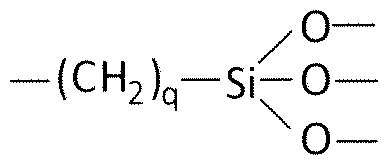
- the organic molecules can be grafted onto the inorganic solid support via R 3 , in which case R 3 preferably represents a group of formula - (CH 2 ) q -X x - in which q is an integer from 0 to 12, while X 1 represents a group selected from the groups:
- R 3 represents a group of formula - (CH 2 ) q -X 1 -
- the one or more covalent bonds between R 3 and the inorganic solid support is (are) provided by the group -X 1 - and not by the group - (CH 2 ) q -.
- the organic molecules can also be grafted to the inorganic solid support via at least one of R 1 and R 2 , in which case R 1 and / or R 2 preferably represent (s) a group of formula (a), (b), (c), (d), (e), (f) or (g) below:
- p is an integer from 1 to 6
- q is an integer from 0 to 12
- X 2 represents a group selected from:
- R 1 and / or R 2 represents (nt) a group of formula (a), (b), (c), (d), (e), (f) or (g) above, the one or more covalent bonds existing between R 1 and / or R 2 on the one hand, and the inorganic solid support on the other hand, are (are) ensured by the group -X 2 - and not by the group - (CH 2 ) P -.
- X 1 (which belongs to R 3 ) is preferably identical to X 2 (which belongs to R 1 and / or R 2 ).
- R 3 represents a group - (CH 2 ) q -SiO 3 -
- R 1 and / or R 2 may (may) meet any one of formulas (a) to (g) below. before but in which X 2 preferably represents a group -Si0 3 -.
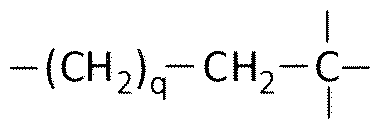
- R 1 and / or R 2 may (may) meet any of formulas (a) to (g) above but in which X 2 preferably represents a group -CH 2 -C-
- the organic molecules preferably correspond to the general formula (I) above in which v is equal to 1, w is equal to 0, in which case these organic molecules correspond to the particular formula ( ) below:
- R 1 and R 2 represent, independently of one another, a linear or branched alkyl group comprising 1 to 12 carbon atoms; z is 1 and R 3 represents a group bound to the inorganic solid support by at least one covalent bond, while R 4 and R 5 represent, independently of one another, a hydrogen atom or a linear alkyl group; or branched, comprising from 2 to 8 carbon atoms.
- R 1 and R 2 are identical to each other and represent a branched alkyl group comprising from 6 to 12 carbon atoms, the 2-ethylhexyl group being very particularly preferred.
- R 4 and R 5 they preferably represent, independently of one another, a hydrogen atom or a linear or branched alkyl group comprising from 2 to 4 carbon atoms, such as an ethyl group, n-propyl, isopropyl, n-butyl, sec-butyl, isobutyl or rerf-butyl, the ethyl and n-butyl groups being, among these alkyl groups, very particularly preferred.
- the inorganic solid support is based on a metal oxide, a mixed metal oxide or a mixture of metal oxides, in which case R 3 represents a group of formula - (CH 2 ) q Si0 3 - in which q is from 1 to 5.
- the inorganic solid support is based on carbon, in which case R 3 represents a group of formula - (CH 2 ) q --CH 2 -C- in which q is 0 to 5.
- the covalent grafting of the organic molecules onto the inorganic solid support can be obtained by a one-step process, which consists in reacting one or more reactive functions F1 belonging to the inorganic solid support with one or more reactive functions.
- the organic molecules of general formula (I) above correspond to what remains of the organic compound after the reactive functions F1 and F2 have reacted together.
- the covalent grafting of the organic molecules onto the inorganic solid support can be obtained by reacting silica silanol functions (-SiOH) with a trialkoxysilane function.
- silica silanol functions for example, trimethoxy-, triethoxy- or tripropoxysilane
- an organic compound which also comprises the complexing diamidophosphonate unit for example, trimethoxy-, triethoxy- or tripropoxysilane
- the grafting of the organic molecules onto the inorganic solid support can be obtained by a two-step process, which consists of:
- the organic molecules of general formula (I) above correspond to the molecular set formed by what remains of the first and second organic compounds after the reactive functions F1 and F2, then F3 and F4 reacted together.
- the covalent grafting of the organic molecules onto the inorganic solid support can be obtained by first reacting silica silanols (-SiOH) functions. with a trialkoxysilane function of a first organic compound which also comprises an amine function, then reacting this amino function with a carboxylic acid function of a second organic compound which also comprises the complexing diamidophosphonate unit.
- silica silanols -SiOH
- the hybrid organic-inorganic material according to the invention has a particularly high affinity and selectivity for uranium (VI) when it is present in an aqueous medium comprising phosphoric acid.
- the subject of the invention is also the use of an organic-inorganic hybrid material as defined above for extracting uranium (VI) from an aqueous medium comprising phosphoric acid and in which this uranium is present.
- this aqueous medium may comprise phosphoric acid in a very wide range of concentrations and, in particular, from 0.01 to 9 mol / l of phosphoric acid.
- Such an aqueous medium may in particular be an aqueous solution resulting from the attack of a natural phosphate with sulfuric acid.
- uranium (VI) is extremely simple to implement since it is sufficient to put this material in contact with the aqueous medium, for example in a reactor under stirring or in a column, for a time sufficient to allow the uranium (VI) to be complexed by the material, and then to separate the latter from the aqueous medium.
- 0.01 to 1 L of aqueous solution will be used for 0.05 to 5 kg of material.
- the subject of the invention is also a method for recovering uranium (VI) present in an aqueous medium comprising phosphoric acid, which process comprises:
- step b) the extraction of the uranium (VI) of the hybrid organic-inorganic material obtained at the end of step a) by bringing the hybrid organic-inorganic material into contact with a basic aqueous solution, for example an aqueous solution of potash and then separation of the organic-inorganic hybrid material and the basic aqueous solution.
- a basic aqueous solution for example an aqueous solution of potash
- the aqueous medium comprising phosphoric acid which is used in step a), is advantageously an aqueous solution resulting from the attack of a natural phosphate with sulfuric acid.
- FIG. 1 schematically illustrates the preparation of a first organic-inorganic hybrid material according to the invention, in which the inorganic solid support is a mesoporous silica and in which the organic molecules correspond to the general formula (I) above in which R 1 and R 2 are both 2-ethylhexyl, R 3 is - (CH 2 ) 3 -SiO 3 -, R 4 is ethyl, and R 5 is hydrogen.
- the inorganic solid support is a mesoporous silica and in which the organic molecules correspond to the general formula (I) above in which R 1 and R 2 are both 2-ethylhexyl, R 3 is - (CH 2 ) 3 -SiO 3 -, R 4 is ethyl, and R 5 is hydrogen.
- FIG. 2 schematically illustrates the preparation of a second hybrid organic-inorganic material according to the invention in which the inorganic solid support is a mesoporous carbon and in which the organic molecules correspond to the general formula (I) above in which R 1 and R 2 are both 2-ethylhexyl, R 3 is -CH 2 -C-, R 4 is ethyl, and R 5 is hydrogen.
- the inorganic solid support is a mesoporous carbon and in which the organic molecules correspond to the general formula (I) above in which R 1 and R 2 are both 2-ethylhexyl, R 3 is -CH 2 -C-, R 4 is ethyl, and R 5 is hydrogen.
- Figure 3 schematically illustrates the reaction schemes of the synthesis of organic compounds useful for the preparation of the organic-inorganic hybrid materials shown in Figures 1 and 2.
- a first organic-inorganic hybrid material according to the invention hereinafter referred to as material M1, is prepared which comprises a mesoporous silica with a periodic hexagonal structure, of the SBA-15 type, onto which are grafted organic molecules corresponding to the general formula (l) above in which:
- n 1;
- R 1 and R 2 are both 2-ethylhexyl, R 3 represents a group - (CH 2 ) 3 -SiO 3 -,
- R 4 represents an ethyl group
- R 5 represents a hydrogen atom.
- This hybrid organic-inorganic material is prepared by the method illustrated in Figure 1, which comprises:
- the mesoporous silica is synthesized according to an operating protocol identical to that described by Zhao et al. in Science 1998, 279, 548-552, reference [12]. It has pores 9.1 nm in diameter (as determined by the BJH method) and a BET specific surface area of 800 m 2 / g (as determined by adsorption-desorption of nitrogen).
- the mesoporous silica (1.8 g) is suspended in a solution containing 0.5 g of 3-aminopropyltriethoxysilane in 20 ml. toluene.
- the mixture is heated at 90 ° C for 48 hours under nitrogen, then filtered and washed with acetone before being treated with acetone in soxhlet for 48 hours.
- the aminosilice thus obtained is dried in an oven (80 ° C) for 20 hours.
- Amount of grafted amino functional groups 1.4 mmol / g of mesoporous silica.
- RT141 is synthesized using the reaction scheme comprising Steps A, B, C and D which is illustrated in Figure 3.
- this synthesis consists in reacting, in a first step denoted A, 2,2'-diethylhexylamine, denoted 1, with chloroacetyl chloride, denoted 2, to obtain 2-chloro / V , N-diethylhexylacetamide, denoted 3 in this figure.
- This Arbuzov reaction is carried out by carrying a mixture of 2-chloro-N, N-diethylhexylacetamide (1 eq) and triethylphosphite (1.2 eq.) At 160 ° C under reflux for 3 hours. Once the acetamide has been consumed (which is verified by TLC using dichloromethane as eluent and UV or phosphomolybdic acid as developer), the excess phosphite is distilled under reduced pressure. This gives the expected compound (Yield: quantitative) whose characterizations by 1 H NMR, 13 C and 31 P are given below.
- ethyl 3- (N, N-di (2-ethylhexyl) carbamoyl) -3- (diethoxy) phosphono) propanoate is subjected to a saponification reaction to obtain the RT141 compound.
- This saponification is carried out by adding to a solution of ethyl 3- (N-di (2-ethylhexyl) carbamoyl) -3- (diethoxy) phosphono) propanoate at 0.4 mol / L in ethanol, 20% sodium hydroxide solution (6 eq.). The mixture is refluxed for 3 hours. After cooling, the mixture is acidified to pH 1 with an aqueous solution of hydrochloric acid at 1 mol / L, then extracted twice at dichloromethane. The aqueous and organic phases are separated and the organic phase is dried over Na 2 SO 4 , filtered and concentrated.
- the aminosilice (1 eq of amino functions) and the compound RT141 (2 eq.) are reacted in anhydrous THF in the presence of dicyclohexylcarbodiimide (DDC-2 eq.), / V-hydroxybenzotriazole (HOBt-2). eq.) and diisopropylethylamine (DIPEA - 1.5 eq.) for 48 hours, at room temperature and under argon flow.
- DDC-2 eq. dicyclohexylcarbodiimide
- HOBt-2 V-hydroxybenzotriazole
- DIPEA - 1.5 eq. diisopropylethylamine
- reaction medium is filtered, the residue is washed several times with dichloromethane and methanol and dried under vacuum at 90 ° C.
- NMR 29 Si ⁇ (ppm): -59.01; -66.05 (T 2 and T 3 sites); -101.12; -110.01 (sites Q 3 and Q 4 );
- Pore diameter (model BJH): 5.5 nm
- a second organic-inorganic hybrid material according to the invention hereinafter referred to as material M2, is prepared which comprises a mesoporous carbon with a periodic hexagonal structure, of the CM K-3 type, on which are grafted organic molecules corresponding to the general formula (I) above in which:
- n 1;
- R 1 and R 2 are both 2-ethylhexyl
- R 3 represents a group -CH 2 -C-
- R 4 represents an ethyl group
- R 5 represents a hydrogen atom.
- This hybrid organic-inorganic material is prepared by the process illustrated in Figure 2, which comprises:
- the mesoporous carbon is synthesized following the operating procedure described by Jun et al. in Journal of the American Chemical Society 2000, 122, 10712-10713, reference [13]. It has pores 3.5 nm in diameter (as determined by the BJH method) and a BET specific surface area of 1400 m 2 / g (as determined by adsorption-desorption of nitrogen). 2.2 - Functionalization of mesoporous carbon
- the mesoporous carbon (0.5 g) is suspended in pure propargylamine.
- the mixture is placed in an autoclave heated at 100 ° C for 48 hours. After that, it is washed with acetone in soxhiet for 48 hours.
- the aminocarbon thus obtained is dried in an oven (80 ° C.) during
- This grafting is carried out following an identical operating procedure to that described in Example 1 above for the grafting of the RT141 compound on the aminosilice.
- concentrations of uranium (VI) and, optionally, iron (III) are measured by X-ray fluorescence in the synthetic phosphoric acid solution before it is mixed with the material as well as in the filtrate.
- C ini initial concentration of the element in the synthetic phosphoric acid solution (in mg / L);
- Table I presents the results obtained with various synthetic solutions of phosphoric acid, the concentration of phosphoric acid and the initial concentrations of uranium (VI) and iron (III) have been varied.
- Table II below shows the dextracted uranium (VI) concentrations, denoted Cconverges, by comparing them with the uranium concentrations previously extracted by the material M2, denoted C ext .
Landscapes
- Chemical & Material Sciences (AREA)
- Organic Chemistry (AREA)
- Engineering & Computer Science (AREA)
- Chemical Kinetics & Catalysis (AREA)
- Life Sciences & Earth Sciences (AREA)
- General Life Sciences & Earth Sciences (AREA)
- Analytical Chemistry (AREA)
- Materials Engineering (AREA)
- Manufacturing & Machinery (AREA)
- Geology (AREA)
- Mechanical Engineering (AREA)
- Metallurgy (AREA)
- Environmental & Geological Engineering (AREA)
- Nanotechnology (AREA)
- General Chemical & Material Sciences (AREA)
- Inorganic Chemistry (AREA)
- Solid-Sorbent Or Filter-Aiding Compositions (AREA)
Abstract
Description


Claims


Priority Applications (5)
| Application Number | Priority Date | Filing Date | Title |
|---|---|---|---|
| BR112015019799-0A BR112015019799B1 (pt) | 2013-02-25 | 2013-11-08 | Material híbrido orgânico-inorgânico, uso de um material híbrido orgânico-inorgânico e processo de recuperação do urânio(vi) |
| AU2013379406A AU2013379406B2 (en) | 2013-02-25 | 2013-11-08 | Organic-inorganic hybrid material of use for extracting uranium(VI) from aqueous media containing phosphoric acid, processes for preparing same and uses thereof |
| MA38371A MA38371B1 (fr) | 2013-02-25 | 2013-11-08 | Matériau hybride organique-inorganique, utile pour extraire l'uranium(vi) de milieux aqueux comprenant de l'acide phosphorique, ses procédés de préparation et ses utilisations |
| US14/769,846 US10130932B2 (en) | 2013-02-25 | 2013-11-08 | Organic-inorganic hybrid material of use for extracting uranium (VI) from aqueous media containing phosphoric acid, processes for preparing same and uses thereof |
| TN2015000334A TN2015000334A1 (fr) | 2013-02-25 | 2015-08-05 | Matériau hybride organique-inorganique, utile pour extraire l'uranium(vi) de milieux aqueux comprenant de l'acide phosphorique, ses procédés de préparation et ses utilisations |
Applications Claiming Priority (2)
| Application Number | Priority Date | Filing Date | Title |
|---|---|---|---|
| FR1351639 | 2013-02-25 | ||
| FR1351639A FR3002463B1 (fr) | 2013-02-25 | 2013-02-25 | Materiau hybride organique-inorganique, utile pour extraire l'uranium(vi) de milieux aqueux contenant de l'acide phosphorique, ses procedes de preparation et ses utilisations |
Publications (1)
| Publication Number | Publication Date |
|---|---|
| WO2014127860A1 true WO2014127860A1 (fr) | 2014-08-28 |
Family
ID=48140081
Family Applications (1)
| Application Number | Title | Priority Date | Filing Date |
|---|---|---|---|
| PCT/EP2013/073429 Ceased WO2014127860A1 (fr) | 2013-02-25 | 2013-11-08 | Matériau hybride organique-inorganique, utile pour extraire l'uranium(vi) de milieux aqueux comprenant de l'acide phosphorique, ses procédés de préparation et ses utilisations |
Country Status (7)
| Country | Link |
|---|---|
| US (1) | US10130932B2 (fr) |
| AU (1) | AU2013379406B2 (fr) |
| BR (1) | BR112015019799B1 (fr) |
| FR (1) | FR3002463B1 (fr) |
| MA (1) | MA38371B1 (fr) |
| TN (1) | TN2015000334A1 (fr) |
| WO (1) | WO2014127860A1 (fr) |
Cited By (4)
| Publication number | Priority date | Publication date | Assignee | Title |
|---|---|---|---|---|
| US20160289796A1 (en) * | 2013-11-08 | 2016-10-06 | Commissariat A L'energie Atomique Et Aux Energies Alternatives | Use of an organic-inorganic hybrid material for extracting uranium(vi) from a sulfuric acid aqueous solution, issued notably from the sulfuric leaching of a uranium-bearing ore |
| WO2017085311A1 (fr) | 2015-11-19 | 2017-05-26 | Areva Mines | Procédés d'extraction et de récupération de l'uranium présent dans une solution aqueuse comprenant de l'acide phosphorique |
| WO2017085312A1 (fr) | 2015-11-19 | 2017-05-26 | Areva Mines | Nouveau matériau organique pour extraire l'uranium d'une solution aqueuse d'acide phosphorique, procédés d'extraction et de récupération de l'uranium associés et précurseur d'un tel matériau organique |
| FR3060006A1 (fr) * | 2016-12-13 | 2018-06-15 | Areva Mines | Materiau organique mesoporeux, utile notamment pour extraire l'uranium(vi) de milieux aqueux comprenant de l'acide phosphorique, et ses utilisations |
Families Citing this family (7)
| Publication number | Priority date | Publication date | Assignee | Title |
|---|---|---|---|---|
| FR3014336B1 (fr) | 2013-12-05 | 2016-01-22 | Commissariat Energie Atomique | Utilisation d'un gel alcalin oxydant pour eliminer un biofilm sur une surface d'un substrat solide. |
| FR3025115B1 (fr) | 2014-09-03 | 2018-12-07 | Commissariat A L'energie Atomique Et Aux Energies Alternatives | Procede d'extraction selectif de platinoides, a partir d'un support les contenant, avec un milieu d'extraction comprenant un fluide supercritique et un ligand organique. |
| FR3025799B1 (fr) | 2014-09-12 | 2016-10-14 | Commissariat Energie Atomique | Procede de preparation d'un materiau solide nanocomposite a base d'hexa- et octacyanometallates de metaux alcalins. |
| FR3034417B1 (fr) | 2015-04-03 | 2019-03-15 | Commissariat A L'energie Atomique Et Aux Energies Alternatives | Composes a fonctions oxyde de phosphine et amine, utiles comme ligands de l'uranium(vi), et leurs utilisations, notamment pour extraire l'uranium(vi) de solutions aqueuses d'acide sulfurique |
| CN107163079B (zh) * | 2017-05-09 | 2019-07-16 | 凯莱英生命科学技术(天津)有限公司 | 一种烃基膦酸酯的制备方法 |
| EP3441396A1 (fr) * | 2017-08-07 | 2019-02-13 | Université de Montpellier | Procé?dé? de sé?paration d'uranium et/ou de thorium |
| DE102018005069A1 (de) | 2018-06-26 | 2020-01-02 | Skw Stickstoffwerke Piesteritz Gmbh | Verfahren zur Herstellung von harnstoffbasierten Düngemitteln mit elementaren Schwefel und Produkte davon |
Citations (3)
| Publication number | Priority date | Publication date | Assignee | Title |
|---|---|---|---|---|
| US4396556A (en) * | 1981-03-02 | 1983-08-02 | Occidental Research Corporation | Process of preparing organophosphorus compounds by phase transfer catalysis |
| US20090093664A1 (en) * | 2007-10-09 | 2009-04-09 | Chemnano Materials, Ltd. | Carbon nanotubes using for recovery of radionuclides and separation of actinides and lanthanides |
| WO2011056288A1 (fr) * | 2009-11-06 | 2011-05-12 | Battelle Memorial Institute | Nanomatériaux fonctionnalisés pour la décorporation dermique, la chélation, la thérapie, et la dialyse par sorbant de radiounucléides et de toxines |
Family Cites Families (5)
| Publication number | Priority date | Publication date | Assignee | Title |
|---|---|---|---|---|
| IL69384A0 (en) | 1983-08-01 | 1983-11-30 | Israel Atomic Energy Comm | Recovery of uranium from wet process phosphoric acid by liquid-solid ion exchange |
| FR2896705B1 (fr) | 2006-01-30 | 2008-12-05 | Commissariat Energie Atomique | Procede de separation en milieu aqueux d'au moins un element actinide d'elements lanthanides par complexation et filtration membranaire |
| US8357628B2 (en) * | 2008-08-29 | 2013-01-22 | Agilent Technologies, Inc. | Inorganic/organic hybrid totally porous metal oxide particles, methods for making them and separation devices using them |
| JP6151021B2 (ja) * | 2009-06-01 | 2017-06-21 | ウオーターズ・テクノロジーズ・コーポレイシヨン | クロマトグラフ分離用ハイブリッド材料 |
| FR2990206B1 (fr) | 2012-05-07 | 2014-06-06 | Commissariat Energie Atomique | Nouveaux composes bifonctionnels utiles comme ligands de l'uranium(vi), leurs procedes de synthese et leurs utilisations |
-
2013
- 2013-02-25 FR FR1351639A patent/FR3002463B1/fr active Active
- 2013-11-08 BR BR112015019799-0A patent/BR112015019799B1/pt active IP Right Grant
- 2013-11-08 WO PCT/EP2013/073429 patent/WO2014127860A1/fr not_active Ceased
- 2013-11-08 MA MA38371A patent/MA38371B1/fr unknown
- 2013-11-08 US US14/769,846 patent/US10130932B2/en active Active
- 2013-11-08 AU AU2013379406A patent/AU2013379406B2/en active Active
-
2015
- 2015-08-05 TN TN2015000334A patent/TN2015000334A1/fr unknown
Patent Citations (3)
| Publication number | Priority date | Publication date | Assignee | Title |
|---|---|---|---|---|
| US4396556A (en) * | 1981-03-02 | 1983-08-02 | Occidental Research Corporation | Process of preparing organophosphorus compounds by phase transfer catalysis |
| US20090093664A1 (en) * | 2007-10-09 | 2009-04-09 | Chemnano Materials, Ltd. | Carbon nanotubes using for recovery of radionuclides and separation of actinides and lanthanides |
| WO2011056288A1 (fr) * | 2009-11-06 | 2011-05-12 | Battelle Memorial Institute | Nanomatériaux fonctionnalisés pour la décorporation dermique, la chélation, la thérapie, et la dialyse par sorbant de radiounucléides et de toxines |
Non-Patent Citations (3)
| Title |
|---|
| ADDLEMAN R S ET AL: "Preconcentration and assay of radionuclides with self assembled monolayers on mesoporous supports", JOURNAL OF RADIOANALYTICAL AND NUCLEAR CHEMISTRY, KLUWER ACADEMIC PUBLISHERS, DO, vol. 263, no. 1, 1 January 2005 (2005-01-01), pages 59 - 64, XP019251715, ISSN: 1588-2780 * |
| GLEN E FRYXELL ET AL: "Actinide Sequestration Using Self-Assembled Monolayers on Mesoporous Supports", ENVIRONMENTAL SCIENCE AND TECHNOLOGY, AMERICAN CHEMICAL SOCIETY. EASTON, PA, US, vol. 39, no. 5, 12 January 2005 (2005-01-12), pages 1324 - 1331, XP007917080, ISSN: 0013-936X, DOI: 10.1021/ES049201J * |
| GLEN E. FRYXELL ET AL: "Lanthanide selective sorbents: self-assembled monolayers on mesoporous supports (SAMMS)", JOURNAL OF MATERIALS CHEMISTRY, vol. 14, no. 22, 1 January 2004 (2004-01-01), pages 3356, XP055062968, ISSN: 0959-9428, DOI: 10.1039/b408181a * |
Cited By (8)
| Publication number | Priority date | Publication date | Assignee | Title |
|---|---|---|---|---|
| US20160289796A1 (en) * | 2013-11-08 | 2016-10-06 | Commissariat A L'energie Atomique Et Aux Energies Alternatives | Use of an organic-inorganic hybrid material for extracting uranium(vi) from a sulfuric acid aqueous solution, issued notably from the sulfuric leaching of a uranium-bearing ore |
| US10006103B2 (en) * | 2013-11-08 | 2018-06-26 | Commissariat A L'energie Atomique Et Aux Energies Alternatives | Use of an organic-inorganic hybrid material for extracting uranium(VI) from a sulfuric acid aqueous solution, issued notably from the sulfuric leaching of a uranium-bearing ore |
| WO2017085311A1 (fr) | 2015-11-19 | 2017-05-26 | Areva Mines | Procédés d'extraction et de récupération de l'uranium présent dans une solution aqueuse comprenant de l'acide phosphorique |
| WO2017085312A1 (fr) | 2015-11-19 | 2017-05-26 | Areva Mines | Nouveau matériau organique pour extraire l'uranium d'une solution aqueuse d'acide phosphorique, procédés d'extraction et de récupération de l'uranium associés et précurseur d'un tel matériau organique |
| FR3044006A1 (fr) * | 2015-11-19 | 2017-05-26 | Areva Mines | Nouveau materiau organique pour extraire l'uranium d'une solution aqueuse d'acide phosphorique, procedes d'extraction et de recuperation de l'uranium associes et precurseur d'un tel materiau organique |
| FR3060006A1 (fr) * | 2016-12-13 | 2018-06-15 | Areva Mines | Materiau organique mesoporeux, utile notamment pour extraire l'uranium(vi) de milieux aqueux comprenant de l'acide phosphorique, et ses utilisations |
| WO2018109382A1 (fr) | 2016-12-13 | 2018-06-21 | Orano Mining | Matériau organique mésoporeux, utile notamment pour extraire l'uranium(vi) de milieux aqueux comprenant de l'acide phosphorique, et ses utilisations |
| US11365462B2 (en) | 2016-12-13 | 2022-06-21 | Orano Mining | Mesoporous organic material, useful in particular for extracting uranium(VI) from aqueous media including phosphoric acid, and uses thereof |
Also Published As
| Publication number | Publication date |
|---|---|
| MA38371B1 (fr) | 2017-04-28 |
| TN2015000334A1 (fr) | 2017-01-03 |
| MA38371A1 (fr) | 2016-09-30 |
| AU2013379406B2 (en) | 2017-03-09 |
| BR112015019799A2 (pt) | 2017-07-18 |
| FR3002463A1 (fr) | 2014-08-29 |
| AU2013379406A1 (en) | 2015-09-03 |
| US20160016150A1 (en) | 2016-01-21 |
| FR3002463B1 (fr) | 2016-08-19 |
| US10130932B2 (en) | 2018-11-20 |
| BR112015019799B1 (pt) | 2022-03-08 |
Similar Documents
| Publication | Publication Date | Title |
|---|---|---|
| WO2014127860A1 (fr) | Matériau hybride organique-inorganique, utile pour extraire l'uranium(vi) de milieux aqueux comprenant de l'acide phosphorique, ses procédés de préparation et ses utilisations | |
| WO2013167516A1 (fr) | Nouveaux composés bifonctionnels utiles comme ligands de l'uranium(vi), leurs procédés de synthèse et leurs utilisations | |
| CA2929405C (fr) | Utilisation d'un materiau hybride organique-inorganique pour extraire l'uranium(vi) d'une solution aqueuse d'acide sulfurique, issue notamment de la lixiviation sulfurique d'un minerai uranifere | |
| CN108602755B (zh) | 分离有机化合物的方法 | |
| JP2007516271A5 (fr) | ||
| EP2259999B1 (fr) | Matériaux pour l'extraction solide/liquide de cations de métaux lourds à base de polyazacycloalcanes n-fonctionnalisés supportés | |
| JPH072718A (ja) | 4−(3,4−ジクロロフェニル)−3,4−ジヒドロ−1(2h)−ナフタリノンの鏡像異性体分割 | |
| EP1597304B1 (fr) | Dendrimeres phosphores, leur procede de preparation et leur utilisation pour l extraction des actinides et des lanthanides | |
| EP3555158B1 (fr) | Matériau organique mésoporeux, utile notamment pour extraire l'uranium(vi) de milieux aqueux comprenant de l'acide phosphorique, et ses utilisations | |
| JP5481903B2 (ja) | 高純度長鎖不飽和脂肪酸メントールエステルの製造方法 | |
| EP3310713B1 (fr) | Procédé de stabilisation de mercure métallique | |
| JP4750787B2 (ja) | 水性液流からのプロピレングリコールおよびプロピレングリコールエーテルの除去 | |
| OA17759A (fr) | Utilisation d'un matériau hybride organiqueinorganique pour extraire l'uranium(VI) d'une solution aqueuse d'acide sulfurique, issue notamment de la lixiviation sulfurique d'un minerai uranifère. | |
| WO2025045881A1 (fr) | Matériau composite poreux, fonctionnalisé par un ligand de l'uranium(vi), son procédé de préparation et son utilisation pour extraire l'uranium(vi) d'une solution aqueuse d'acide sulfurique | |
| EP0258146A1 (fr) | Procédé de récupération du gallium contenu dans une solution d'aluminate de sodium | |
| WO2009153424A1 (fr) | Procede de neutralisation d'une zeolithe cationique | |
| EP4602130A1 (fr) | Élimination de silicones et d'autres impuretés dans de l'huile de pyrolyse à l'aide de matrices de gel de silice | |
| JP2010051954A (ja) | 金属吸着材の製造方法及び金属吸着材 | |
| FR2789380A1 (fr) | Procede d'epuration du peroxyde d'hydrogene utilisant un support mineral modifie | |
| WO2006058995A2 (fr) | Oxyde poreux mesostructure multifonctionnalise | |
| FR2836063A1 (fr) | Zeolite a echangee au potassium pour la recuperation de h2s de melange gazeux | |
| JPS59173088A (ja) | 補酵素qの製造法 | |
| WO2010128216A1 (fr) | Procede de demercurisation total en une etape de charges hydrocarbonees liquides utilisant un materiau hybride organique-inorganique |
Legal Events
| Date | Code | Title | Description |
|---|---|---|---|
| 121 | Ep: the epo has been informed by wipo that ep was designated in this application |
Ref document number: 13792630 Country of ref document: EP Kind code of ref document: A1 |
|
| WWE | Wipo information: entry into national phase |
Ref document number: 14769846 Country of ref document: US |
|
| NENP | Non-entry into the national phase |
Ref country code: DE |
|
| REG | Reference to national code |
Ref country code: BR Ref legal event code: B01A Ref document number: 112015019799 Country of ref document: BR |
|
| WWE | Wipo information: entry into national phase |
Ref document number: 38371 Country of ref document: MA |
|
| ENP | Entry into the national phase |
Ref document number: 2013379406 Country of ref document: AU Date of ref document: 20131108 Kind code of ref document: A |
|
| 122 | Ep: pct application non-entry in european phase |
Ref document number: 13792630 Country of ref document: EP Kind code of ref document: A1 |
|
| ENP | Entry into the national phase |
Ref document number: 112015019799 Country of ref document: BR Kind code of ref document: A2 Effective date: 20150818 |