WO2014136924A1 - 多層構成物、多層構成物の製造方法、及び、組成物セット - Google Patents
多層構成物、多層構成物の製造方法、及び、組成物セット Download PDFInfo
- Publication number
- WO2014136924A1 WO2014136924A1 PCT/JP2014/055911 JP2014055911W WO2014136924A1 WO 2014136924 A1 WO2014136924 A1 WO 2014136924A1 JP 2014055911 W JP2014055911 W JP 2014055911W WO 2014136924 A1 WO2014136924 A1 WO 2014136924A1
- Authority
- WO
- WIPO (PCT)
- Prior art keywords
- layer
- group
- meth
- pigment
- multilayer structure
- Prior art date
- Legal status (The legal status is an assumption and is not a legal conclusion. Google has not performed a legal analysis and makes no representation as to the accuracy of the status listed.)
- Ceased
Links
Classifications
-
- C—CHEMISTRY; METALLURGY
- C09—DYES; PAINTS; POLISHES; NATURAL RESINS; ADHESIVES; COMPOSITIONS NOT OTHERWISE PROVIDED FOR; APPLICATIONS OF MATERIALS NOT OTHERWISE PROVIDED FOR
- C09D—COATING COMPOSITIONS, e.g. PAINTS, VARNISHES OR LACQUERS; FILLING PASTES; CHEMICAL PAINT OR INK REMOVERS; INKS; CORRECTING FLUIDS; WOODSTAINS; PASTES OR SOLIDS FOR COLOURING OR PRINTING; USE OF MATERIALS THEREFOR
- C09D11/00—Inks
- C09D11/30—Inkjet printing inks
- C09D11/32—Inkjet printing inks characterised by colouring agents
- C09D11/322—Pigment inks
-
- B—PERFORMING OPERATIONS; TRANSPORTING
- B32—LAYERED PRODUCTS
- B32B—LAYERED PRODUCTS, i.e. PRODUCTS BUILT-UP OF STRATA OF FLAT OR NON-FLAT, e.g. CELLULAR OR HONEYCOMB, FORM
- B32B27/00—Layered products comprising a layer of synthetic resin
- B32B27/06—Layered products comprising a layer of synthetic resin as the main or only constituent of a layer, which is next to another layer of the same or of a different material
- B32B27/08—Layered products comprising a layer of synthetic resin as the main or only constituent of a layer, which is next to another layer of the same or of a different material of synthetic resin
-
- B—PERFORMING OPERATIONS; TRANSPORTING
- B32—LAYERED PRODUCTS
- B32B—LAYERED PRODUCTS, i.e. PRODUCTS BUILT-UP OF STRATA OF FLAT OR NON-FLAT, e.g. CELLULAR OR HONEYCOMB, FORM
- B32B27/00—Layered products comprising a layer of synthetic resin
- B32B27/18—Layered products comprising a layer of synthetic resin characterised by the use of special additives
- B32B27/20—Layered products comprising a layer of synthetic resin characterised by the use of special additives using fillers, pigments, thixotroping agents
-
- B—PERFORMING OPERATIONS; TRANSPORTING
- B32—LAYERED PRODUCTS
- B32B—LAYERED PRODUCTS, i.e. PRODUCTS BUILT-UP OF STRATA OF FLAT OR NON-FLAT, e.g. CELLULAR OR HONEYCOMB, FORM
- B32B27/00—Layered products comprising a layer of synthetic resin
- B32B27/30—Layered products comprising a layer of synthetic resin comprising vinyl (co)polymers; comprising acrylic (co)polymers
- B32B27/308—Layered products comprising a layer of synthetic resin comprising vinyl (co)polymers; comprising acrylic (co)polymers comprising acrylic (co)polymers
-
- B—PERFORMING OPERATIONS; TRANSPORTING
- B32—LAYERED PRODUCTS
- B32B—LAYERED PRODUCTS, i.e. PRODUCTS BUILT-UP OF STRATA OF FLAT OR NON-FLAT, e.g. CELLULAR OR HONEYCOMB, FORM
- B32B9/00—Layered products comprising a layer of a particular substance not covered by groups B32B11/00 - B32B29/00
- B32B9/005—Layered products comprising a layer of a particular substance not covered by groups B32B11/00 - B32B29/00 comprising one layer of ceramic material, e.g. porcelain, ceramic tile
-
- B—PERFORMING OPERATIONS; TRANSPORTING
- B32—LAYERED PRODUCTS
- B32B—LAYERED PRODUCTS, i.e. PRODUCTS BUILT-UP OF STRATA OF FLAT OR NON-FLAT, e.g. CELLULAR OR HONEYCOMB, FORM
- B32B9/00—Layered products comprising a layer of a particular substance not covered by groups B32B11/00 - B32B29/00
- B32B9/04—Layered products comprising a layer of a particular substance not covered by groups B32B11/00 - B32B29/00 comprising such particular substance as the main or only constituent of a layer, which is next to another layer of the same or of a different material
- B32B9/045—Layered products comprising a layer of a particular substance not covered by groups B32B11/00 - B32B29/00 comprising such particular substance as the main or only constituent of a layer, which is next to another layer of the same or of a different material of synthetic resin
-
- B—PERFORMING OPERATIONS; TRANSPORTING
- B41—PRINTING; LINING MACHINES; TYPEWRITERS; STAMPS
- B41M—PRINTING, DUPLICATING, MARKING, OR COPYING PROCESSES; COLOUR PRINTING
- B41M1/00—Inking and printing with a printer's forme
- B41M1/26—Printing on other surfaces than ordinary paper
- B41M1/34—Printing on other surfaces than ordinary paper on glass or ceramic surfaces
-
- B—PERFORMING OPERATIONS; TRANSPORTING
- B41—PRINTING; LINING MACHINES; TYPEWRITERS; STAMPS
- B41M—PRINTING, DUPLICATING, MARKING, OR COPYING PROCESSES; COLOUR PRINTING
- B41M5/00—Duplicating or marking methods; Sheet materials for use therein
- B41M5/0041—Digital printing on surfaces other than ordinary paper
- B41M5/0047—Digital printing on surfaces other than ordinary paper by ink-jet printing
-
- B—PERFORMING OPERATIONS; TRANSPORTING
- B41—PRINTING; LINING MACHINES; TYPEWRITERS; STAMPS
- B41M—PRINTING, DUPLICATING, MARKING, OR COPYING PROCESSES; COLOUR PRINTING
- B41M5/00—Duplicating or marking methods; Sheet materials for use therein
- B41M5/0041—Digital printing on surfaces other than ordinary paper
- B41M5/007—Digital printing on surfaces other than ordinary paper on glass, ceramic, tiles, concrete, stones, etc.
-
- C—CHEMISTRY; METALLURGY
- C09—DYES; PAINTS; POLISHES; NATURAL RESINS; ADHESIVES; COMPOSITIONS NOT OTHERWISE PROVIDED FOR; APPLICATIONS OF MATERIALS NOT OTHERWISE PROVIDED FOR
- C09D—COATING COMPOSITIONS, e.g. PAINTS, VARNISHES OR LACQUERS; FILLING PASTES; CHEMICAL PAINT OR INK REMOVERS; INKS; CORRECTING FLUIDS; WOODSTAINS; PASTES OR SOLIDS FOR COLOURING OR PRINTING; USE OF MATERIALS THEREFOR
- C09D11/00—Inks
- C09D11/02—Printing inks
- C09D11/03—Printing inks characterised by features other than the chemical nature of the binder
- C09D11/037—Printing inks characterised by features other than the chemical nature of the binder characterised by the pigment
-
- C—CHEMISTRY; METALLURGY
- C09—DYES; PAINTS; POLISHES; NATURAL RESINS; ADHESIVES; COMPOSITIONS NOT OTHERWISE PROVIDED FOR; APPLICATIONS OF MATERIALS NOT OTHERWISE PROVIDED FOR
- C09D—COATING COMPOSITIONS, e.g. PAINTS, VARNISHES OR LACQUERS; FILLING PASTES; CHEMICAL PAINT OR INK REMOVERS; INKS; CORRECTING FLUIDS; WOODSTAINS; PASTES OR SOLIDS FOR COLOURING OR PRINTING; USE OF MATERIALS THEREFOR
- C09D11/00—Inks
- C09D11/02—Printing inks
- C09D11/10—Printing inks based on artificial resins
- C09D11/101—Inks specially adapted for printing processes involving curing by wave energy or particle radiation, e.g. with UV-curing following the printing
-
- B—PERFORMING OPERATIONS; TRANSPORTING
- B32—LAYERED PRODUCTS
- B32B—LAYERED PRODUCTS, i.e. PRODUCTS BUILT-UP OF STRATA OF FLAT OR NON-FLAT, e.g. CELLULAR OR HONEYCOMB, FORM
- B32B2307/00—Properties of the layers or laminate
- B32B2307/40—Properties of the layers or laminate having particular optical properties
- B32B2307/402—Coloured
- B32B2307/4026—Coloured within the layer by addition of a colorant, e.g. pigments, dyes
-
- B—PERFORMING OPERATIONS; TRANSPORTING
- B32—LAYERED PRODUCTS
- B32B—LAYERED PRODUCTS, i.e. PRODUCTS BUILT-UP OF STRATA OF FLAT OR NON-FLAT, e.g. CELLULAR OR HONEYCOMB, FORM
- B32B2307/00—Properties of the layers or laminate
- B32B2307/50—Properties of the layers or laminate having particular mechanical properties
- B32B2307/536—Hardness
-
- B—PERFORMING OPERATIONS; TRANSPORTING
- B32—LAYERED PRODUCTS
- B32B—LAYERED PRODUCTS, i.e. PRODUCTS BUILT-UP OF STRATA OF FLAT OR NON-FLAT, e.g. CELLULAR OR HONEYCOMB, FORM
- B32B2307/00—Properties of the layers or laminate
- B32B2307/50—Properties of the layers or laminate having particular mechanical properties
- B32B2307/558—Impact strength, toughness
-
- B—PERFORMING OPERATIONS; TRANSPORTING
- B32—LAYERED PRODUCTS
- B32B—LAYERED PRODUCTS, i.e. PRODUCTS BUILT-UP OF STRATA OF FLAT OR NON-FLAT, e.g. CELLULAR OR HONEYCOMB, FORM
- B32B2471/00—Floor coverings
-
- B—PERFORMING OPERATIONS; TRANSPORTING
- B41—PRINTING; LINING MACHINES; TYPEWRITERS; STAMPS
- B41M—PRINTING, DUPLICATING, MARKING, OR COPYING PROCESSES; COLOUR PRINTING
- B41M1/00—Inking and printing with a printer's forme
- B41M1/12—Stencil printing; Silk-screen printing
-
- B—PERFORMING OPERATIONS; TRANSPORTING
- B41—PRINTING; LINING MACHINES; TYPEWRITERS; STAMPS
- B41M—PRINTING, DUPLICATING, MARKING, OR COPYING PROCESSES; COLOUR PRINTING
- B41M7/00—After-treatment of prints, e.g. heating, irradiating, setting of the ink, protection of the printed stock
- B41M7/0045—After-treatment of prints, e.g. heating, irradiating, setting of the ink, protection of the printed stock using protective coatings or film forming compositions cured by mechanical wave energy, e.g. ultrasonics, cured by electromagnetic radiation or waves, e.g. ultraviolet radiation, electron beams, or cured by magnetic or electric fields, e.g. electric discharge, plasma
-
- B—PERFORMING OPERATIONS; TRANSPORTING
- B41—PRINTING; LINING MACHINES; TYPEWRITERS; STAMPS
- B41M—PRINTING, DUPLICATING, MARKING, OR COPYING PROCESSES; COLOUR PRINTING
- B41M7/00—After-treatment of prints, e.g. heating, irradiating, setting of the ink, protection of the printed stock
- B41M7/0054—After-treatment of prints, e.g. heating, irradiating, setting of the ink, protection of the printed stock using protective coatings or film forming compositions cured by thermal means, e.g. infrared radiation, heat
Definitions
- the present invention relates to a multilayer construction, a method of manufacturing a multilayer construction, and a composition set.
- Patent document 1 discloses a method of decorating a glass or ceramic product, comprising providing a lower layer (2) of a glass frit formulation, for example by screen printing or ink jet printing, and at least one pigment by ink jet printing At least one, preferably a single layer (3) of the formulation is applied directly to the lower layer (2) of the above glass frit formulation to form an image, and by inkjet printing A coating step of providing an upper layer (4) in the layer (3) of the at least one pigment composition to coat the substrate (1), and the above glass provided with the above layers (2, 3, 4) Or heating the ceramic product to the melting temperature of the glass frit particles of at least the lower and upper layers (2, 4). That.
- Patent Document 1 The method of forming an image layer by firing a pigment and a glaze (glass frit) at a high temperature as described in Patent Document 1 has a problem that the color reproducibility of the pigment is narrow and the design is limited. In addition, since high-temperature firing is required, there is a problem that a large-scale apparatus for production is required, and the production cost becomes high.
- the present invention solves the above-mentioned problems. That is, the object of the present invention is that there is no need for large-scale equipment for firing and production at high temperature, and the production cost is low, and furthermore, the inherent performance of the tile, for example, surface hardness, excellent impact resistance It is an object of the present invention to provide a multilayer structure having the properties, durability (long-term, surface hardness, impact resistance are not lost, and no discoloration). Furthermore, the present invention aims to provide a method for producing the above-mentioned multilayer structure and a composition set for producing the above-mentioned multilayer structure.
- ⁇ 1> (layer 1) base material layer, (layer 2) image layer containing a color pigment, and (layer 3) characterized by having a protective layer formed by condensation reaction of an organosilicon compound in this order Multilayer structure
- ⁇ 2> The multilayer structure according to ⁇ 1>, wherein the layer 2 is a layer having an image formed by inkjet printing or screen printing,
- ⁇ 4> The multilayer structure according to any one of ⁇ 1> to ⁇ 3>, wherein the layer 1 is glass or ceramic.
- ⁇ 5> The multilayer structure according to any one of ⁇ 1> to ⁇ 4>, wherein the layer 2 is a layer formed of a polymer formed by a radical polymerization reaction,
- the organosilicon compound contains a (meth) acryloyl group-containing polysiloxane compound and / or a (meth) acryloyl group-containing silane coupling agent Multi-layer construction as described ⁇ 7>
- the layer 2 is a layer formed of a polymer formed by copolymerizing a (meth) acryloyl group-containing silane coupling agent and / or a phosphate ester group-containing (meth) acrylate compound, ⁇ 1> -The multilayer structure according to any one of ⁇ 6>, ⁇ 8> In any one of ⁇
- Multi-layer construction as described ⁇ 9> The multilayer structure according to ⁇ 8>, containing a (meth) acryloyl group-containing silane coupling agent and / or a phosphate ester group-containing (meth) acrylate compound as a radically polymerizable compound, ⁇ 10>
- the present invention there is no need for extensive equipment for firing and production at high temperatures, and the production cost is low, and furthermore, the inherent performance of the tile, such as surface hardness, excellent impact resistance, It has been possible to provide a multilayer construction having durability (long-term, surface hardness, impact resistance not lost, no discoloration). Furthermore, it has been possible to provide a method of producing the above-mentioned multilayer structure and a composition set for producing the above-mentioned multilayer structure.
- the multilayer structure of the present invention comprises (layer 1) base layer, (layer 2) image layer containing color pigment, and (layer 3) protective layer formed by condensation reaction of organosilicon compound in this order. It is characterized by having.
- “(layer 1) base material layer” and the like are simply referred to as “layer 1” and the like.
- the layer 1 is also referred to as a "substrate” or a “base layer”
- the layer 2 is also referred to as an "image layer”
- the layer 3 is also referred to as a "protective layer”.
- X to Y representing a numerical range means “X or more and Y or less” (in the case of X ⁇ Y) or “X or less and Y or more” (in the case of X> Y).
- parts by mass” and “mass%” are respectively synonymous with “parts by weight” and “% by weight”.
- a combination of preferred embodiments is a more preferred embodiment.
- the multilayer composition having the inherent performance of the tile for example, surface hardness, excellent impact resistance, durability (no loss in surface hardness, impact resistance over a long period, no discoloration) is obtained It has been found that it is possible to complete the present invention.
- the image layer is a layer formed of a polymer generated by radical polymerization reaction, and the image layer has a (meth) acrylate compound having a silane coupling group and / or a (meth) acrylate compound having a phosphate ester group
- the adhesion between the image layer and the protective layer is further improved in the case of a layer formed of a polymer formed by copolymerization of This is because the silane coupling group and / or the phosphate ester group in the composition forming the image layer contributes to the improvement of the adhesion between the two layers by reacting or affinity with the organosilicon compound forming the protective layer. It is presumed that.
- the image layer may be a layer formed of a polymer formed by a radical polymerization reaction, and by containing an acrylate-modified polysiloxane compound and / or an acrylate-modified silane coupling agent as the organosilicon compound of the protective layer, It has been found that the adhesion between the image layer and the protective layer is further improved. This is presumed to be due to the reaction between the radically polymerizable group of the radically polymerizable compound forming the image layer and the acrylate group of the acrylate-modified polysiloxane compound and / or the acrylate-modified silane coupling agent. Each layer will be described below.
- the multilayer structure of the present invention has (Layer 1) a substrate layer.
- the base layer is preferably an inorganic base.
- the layer 1 is preferably glass or ceramic, and more preferably glass or ceramic tile.
- the multilayer structure of the present invention has an (image layer 2) containing a color pigment.
- the image layer is a layer containing at least one color pigment.
- the image layer may be provided on the entire surface (entire area) of the base material layer, or may be provided only on a partial area requiring decoration, and is not particularly limited.
- the image layer is preferably a layer printed by any of inkjet printing method, screen printing method and spray printing method, preferably a layer printed by inkjet printing method or screen printing method, and an image It is particularly preferable that the layer is a layer printed by an inkjet printing method from the viewpoint of freely changing the design of the layer. That is, the image layer is preferably a layer formed by drying and / or curing of the inkjet ink.
- the composition for forming the image layer (hereinafter, also referred to as “the ink composition of the present invention”) is not particularly limited as long as it contains at least one color pigment, and is generally used widely.
- Ultraviolet (UV) curable inks, solvent inks, water-based inks, etc. that are used are preferably used.
- an ultraviolet curable ink composition is particularly preferable.
- the ink composition of the present invention preferably contains a color pigment, a polymerizable compound and a polymerization initiator, more preferably contains a color pigment, a radically polymerizable compound and a radical polymerization initiator, and the image layer has a polymerization reaction.
- the ink composition of the present invention is preferably an oil-based ink composition curable by ultraviolet light.
- the ink composition of the present invention is preferably a non-solvent type ink composition containing no volatile organic solvent, and the content of the solvent including water is preferably 5% by mass or less, 3 It is more preferable that it is mass% or less, it is further more preferable that it is 1 mass% or less, and it is especially preferable not to contain it.
- the presence of a small amount of water or the like in the ink composition due to the influence of impurities and the environment is not excluded.
- ⁇ Colored pigment> As a color pigment which the ink composition of this invention contains, an organic pigment, an inorganic pigment, a ceramic pigment etc. are illustrated.
- the organic pigment has a relatively low specific gravity, the storage stability of the ink composition is excellent, and a wide color reproduction range can be obtained. Therefore, the organic pigment can be suitably used.
- inorganic pigments can be preferably used. That is, the inkjet ink particularly preferably used for forming the image layer is an ultraviolet curable ink containing an organic pigment.
- a color pigment an organic pigment, an inorganic pigment, etc. generally used can be used.
- any commercially available pigment can be used, and further, a pigment which has been previously treated with a commercially available pigment dispersion or a surface treatment agent can be used as long as the effect of the present invention is not impaired.
- these pigments for example, Ito Seishiro ed., "Dictionary of pigments” (2000), W. Herbst, K. Hunger “Industrial Organic Pigments", JP-A-2002-12607, JP-A-2002-188025, JP-A-2003-26978, JP-A-2003-342503, and the like.
- color pigments examples include C.I. I. Pigment yellow 1 (Fast Yellow G etc.), C.I. I. Monoazo pigments such as C.I. I. Pigment yellow 12 (discolor yellow etc.), C.I. I. Pigment yellow 17, C.I. I. Pigment yellow 97, C.I. I. Pigment yellow 3, C.I. I. Pigment yellow 16, C.I. I. Pigment yellow 83, C.I. I. Pigment yellow 155, C.I. I. Disazo pigments such as C.I. I. Azo lake pigments such as CI Pigment Yellow 100 (Tartrazine Yellow Lake etc.), C.I. I.
- Pigment yellow 95 (condensed azo yellow etc.), C.I. I. Pigment yellow 93, C.I. I. Pigment yellow 94, C.I. I. Pigment yellow 128, C.I. I. Condensed azo pigments such as C.I. I. Acid dye lake pigments such as C.I. pigment yellow 115 (quinoline yellow lake etc.), C.I. I. Basic dye lake pigments such as CI Pigment Yellow 18 (thioflavin lake etc.), C.I. I. Anthraquinone pigments such as C.I. Pigment Yellow 24 (Flavantrone Yellow), Isoindolinone pigments such as Isoindolinone Yellow 3 RLT (Y-110), C.I. I.
- Quinophthalone pigments such as CI pigment yellow 138 (quinophthalone yellow), C.I. I. Isoindoline pigments such as C.I. pigment yellow 139 (isoindoline yellow); I. Nitroso pigments such as CI pigment yellow 153 (nickel nitroso yellow etc.), C.I. I. Metal complex azomethine pigments such as C.I. pigment yellow 117 (copper azomethine yellow etc.), C.I. I. Pigment yellow 120 (benzimidazolone yellow), C.I. I. Pigment yellow 151, C.I. I. Pigment yellow 154, C.I. I. Pigment yellow 175, C.I. I. Pigment yellow 180, C.I. I.
- C.I. I. Pigment yellow 74, C.I. I. Pigment yellow 120, C.I. I. Pigment yellow 150, C.I. I. Pigment yellow 151, C.I. I. Pigment yellow 154, C.I. I. Pigment yellow 155, C.I. I. Pigment Yellow 180 is preferably used.
- red or magenta color examples include C.I. I. Monoazo pigments such as C.I. pigment red 3 (toluidine red etc.), C.I. I. Pigment red 1, C.I. I. Pigment red 4, C.I. I. Pigment red 6 etc., ⁇ -naphthol pigments, C.I. I. Disazo pigments such as CI pigment red 38 (pyrazolone red B and the like), C.I. I. Pigment red 53: 1 (lake red C etc.) and C.I. I. Pigment red 57: 1 (Brilliant Carmine 6B etc.), C.I. I. Pigment red 52: 1, C.I. I. Azo lake pigments such as C.I.
- pigment red 48 (.beta.-oxynaphthoic acid lake etc.), C.I. I. Pigment red 144 (condensed azo red etc.), C.I. I. Pigment red 166, C.I. I. Pigment red 220, C.I. I. Pigment red 214, C.I. I. Pigment red 221, C.I. I. Condensed azo pigments such as C.I. I. Pigment red 174 (Floxin B lake etc.), C.I. I. Acid dye lake pigments such as CI pigment red 172 (erythrosine lake etc.), C.I. I. Basic dye lake pigments such as CI pigment red 81 (rhodamine 6G 'lake etc.), C.I.
- Anthraquinone pigments such as C.I. pigment red 177 (Dianthraquinonyl red etc.), C.I. I. Thioindigo pigments such as CI pigment red 88 (thioindigo Bordeaux etc.), C.I. I. Perinone pigments such as CI pigment red 194 (perinone red etc.), C.I. I. Pigment red 149 (perylene scarlet etc.), C.I. I. Pigment red 179, C.I. I. Pigment red 178, C.I. I. Pigment red 190, C.I. I. Pigment red 224, C.I. I. Pigment red 123, C.I. I. Perylene pigments such as C.I. I.
- Pigment violet 19 (unsubstituted quinacridone), C.I. I. Pigment red 122 (quinacridone magenta etc.), C.I. I. Pigment red 262, C.I. I. Pigment red 207, C.I. I. Pigment red 209 and quinacridone pigments which are solid solutions of the above plurality of quinacridone pigments, C.I. I. Isoindolinone pigments such as CI pigment red 180 (isoindolinone red 2BLT etc.), C.I. I. Alizarin lake pigments such as CI pigment red 83 (Mada lake, etc.), C.I. I. Pigment red 171, C.I. I. Pigment red 175, C.I. I.
- I. And diketopyrrolopyrrole pigments such as CI pigment red 27.
- C.I. I. Pigment violet 19 unsubstituted quinacridone
- C.I. I. Pigment red 122 quinacridone magenta etc.
- C.I. I. Pigment red 262 C.I. I. Pigment red 207
- C.I. I. Preferred are quinacridone pigments such as CI Pigment Red 209, and quinacridone pigments which are solid solutions containing a plurality of these quinacridone pigments.
- pigments exhibiting blue or cyan color examples include C.I. I. Disazo pigments such as CI pigment blue 25 (dianisidine blue etc.), C.I. I. Pigment blue 15, C.I. I. Pigment blue 15: 1, C.I. I. Pigment blue 15: 2, C.I. I. Pigment blue 15: 3, C.I. I. Pigment blue 15: 4, C.I. I. Pigment blue 15: 6, C.I. I. Pigment blue 15: 6, C.I. I. Phthalocyanine pigments such as CI pigment blue 16 (phthalocyanine blue etc.), C.I. I. Acid dye lake pigments such as C.I. pigment blue 24 (Pecock blue lake etc.), C.I. I. Basic dye lake pigments such as C.I.
- pigment blue 1 such as Victoria Pure Blue BO lake
- C.I. I. Anthraquinone pigments such as CI pigment blue 60 (indanthrone blue etc.), C.I. I. And alkali blue pigments such as C.I. pigment blue 18 (alkali blue V-5: 1).
- C.I. I. Pigment blue 15, C.I. I. Pigment blue 15: 1, C.I. I. Pigment blue 15: 2, C.I. I. Pigment blue 15: 3, C.I. I. Pigment blue 15: 4, C.I. I. Copper phthalocyanine pigments such as pigment blue 15: 6 are preferable.
- pigments exhibiting a green color examples include C.I. I. Pigment green 7 (phthalocyanine green), C.I. I. Phthalocyanine pigments such as CI pigment green 36 (phthalocyanine green); I. Pigment green 8 (nitroso green), C.I. I. And azo metal complex pigments such as C.I. Pigment Green 10 etc.
- pigments exhibiting an orange color examples include C.I. I. Isoindoline pigments such as CI pigment orange 66 (isoindoline orange), C.I. I. Anthraquinone pigments such as CI pigment orange 51 (dichloropyranthrone orange), C.I. I. Pigment orange 2, C.I. I. Pigment orange 3, C.I.
- I. ⁇ -naphthol pigments such as C.I. I. Pigment orange 4, C.I. I. Pigment orange 22, C.I. I. Pigment orange 24, C.I. I. Pigment orange 38, C.I. I. Naphthol AS pigments such as C.I. I. Isoindolinone pigments such as C.I. I. Perinone pigments such as C.I. I. Pigment orange 15, C.I. I. Disazo pigments such as C.I. I. Pigment orange 48, C.I. I. Quinacridone pigments such as C.I. I. Pigment orange 36, C.I. I. Pigment orange 62, C.I. I. Pigment orange 60, C.I. I.
- Pigment orange 64 C.I. I. Acetone pigments such as CI pigment orange 72 etc., C.I. I. Pigment orange 13, C.I. I. And pyrazolone pigments such as C.I. Pigment Orange 34 and the like.
- Examples of pigments exhibiting a brown color include C.I. I. Pigment brown 25, C.I. I. And naphtholone pigments such as C.I. Pigment Brown 32.
- pigments exhibiting a black color examples include C.I. I. Pigment black 7 (carbon black), titanium black, C.I. I. Indazine pigments such as C.I. pigment black 1 (aniline black); I. Pigment black 31, C.I. I. Perylene pigments such as pigment black 32 and the like can be mentioned. Among these, C.I. I. Pigment black 7 is preferred.
- white pigment for example, basic lead carbonate (2PbCO 3 Pb (OH) 2 , so-called, silver white), zinc oxide (ZnO, so-called, zinc white), titanium oxide (TiO 2 , so-called, titanium white), titanium Acid strontium (SrTiO 3 , so-called, titanium strontium white) and the like can be used, and among these, titanium oxide is preferable.
- the inorganic particles used for the white pigment may be a single particle, or may be, for example, composite particles with oxides such as silicon, aluminum, zirconium and titanium, organic metal compounds and organic compounds.
- titanium oxide has a specific gravity smaller than other white pigments, has a large refractive index, is chemically and physically stable, and has a large hiding power and coloring power as a pigment, and further, an acid or alkali, It is also excellent in durability to other environments. Therefore, it is preferable to use titanium oxide as a white pigment.
- other white pigments which may be other than the white pigments listed) may be used if necessary.
- the pigment other than white is more excellent in color developability as the average particle diameter is smaller, so if the pigment dispersion is applied to a pigment dispersion other than white, the average particle diameter of the pigment contained in the pigment dispersion is
- the thickness is preferably about 0.01 ⁇ m to 0.4 ⁇ m, and more preferably in the range of 0.02 ⁇ m to 0.3 ⁇ m.
- the maximum particle size of the pigment is preferably 3 ⁇ m or less, more preferably 1 ⁇ m or less.
- the particle size of the pigment can be adjusted by the selection of the pigment, the dispersant, the dispersion medium, the dispersion conditions, the setting of the filtration conditions, and the like.
- the average particle diameter of the pigment contained in the pigment dispersion is 0.05 ⁇ m or more from the viewpoint of giving sufficient hiding power.
- the thickness is preferably about 1.0 ⁇ m, and more preferably about 0.1 ⁇ m to 0.4 ⁇ m.
- the maximum particle size of the pigment is preferably 3 ⁇ m or less, and more preferably 1 ⁇ m or less.
- a pigment dispersant When preparing a colored pigment particle, a pigment dispersant may be used if necessary, and as a pigment dispersant which can be used, for example, a higher fatty acid salt, an alkyl sulfate, an alkyl ester sulfate, an alkyl sulfonic acid Salt, sulfosuccinate, naphthalene sulfonate, alkyl phosphate, polyoxyalkylene alkyl ether phosphate, polyoxyalkylene alkyl phenyl ether, polyoxyethylene polyoxypropylene glycol, glycerin ester, sorbitan ester, polyoxyethylene fatty acid
- activators such as amide and amine oxide or styrene, styrene derivative, vinyl naphthalene derivative, acrylic acid, acrylic acid derivative, maleic acid, maleic acid derivative, itaconic acid, itaconic acid derivative, fumaric acid and fumaric acid derivative
- a self-dispersible pigment can also be used in the ink composition of the present invention.
- the self-dispersible pigment in the present invention refers to a pigment which can be dispersed without a dispersant, and is particularly preferably colored pigment particles having a polar group on the surface.
- the colored pigment particles having a polar group on the surface as referred to in the present invention are a pigment obtained by directly modifying the surface of the colored pigment particle with a polar group, or an organic pigment having an organic pigment mother core directly or via a joint. (Hereinafter referred to as “pigment derivative”).
- the polar group includes, for example, a sulfonic acid group, a carboxylic acid group, a phosphoric acid group, a succinic acid group and a hydroxyl group, preferably a sulfonic acid group and a carboxylic acid group, and more preferably a sulfonic acid group.
- a method of obtaining pigment particles having such a polar group on the surface for example, WO 97/48769, JP-A Nos. 10-110129, 11-246807, 11-57458, No. 11-189739, Japanese Patent Application Laid-Open Nos.
- the surface of the pigment particles is oxidized with an appropriate oxidizing agent to form a sulfonic acid on at least a part of the surface of the pigment.
- an appropriate oxidizing agent to form a sulfonic acid on at least a part of the surface of the pigment.
- a polar group such as a group or a salt thereof. Specifically, it is prepared by oxidizing carbon black with concentrated nitric acid or, in the case of a color pigment, by oxidizing it with sulfamic acid, sulfonated pyridine salt, amidosulfuric acid or the like in sulfolane or N-methyl-2-pyrrolidone. can do.
- a pigment dispersion can be obtained by removing and purifying substances that have become too soluble in water and become water soluble in these reactions.
- the acid group may be neutralized using a basic compound, if necessary.
- pigment particles having a polar group on the other surface treatments such as milling of pigment derivatives described in JP-A-11-49974, JP-A-2000-273383, JP-A-2000-303014, etc. And the method of causing the pigment to dissolve in a poor solvent after dissolving it together with the pigment derivative as described in JP-A-2002-179977 and JP-A-2002-201401.
- the pigment particles having a polar group on the surface can be easily obtained by any method.
- the polar group on the pigment surface may be free or in the form of a salt, or may have a counter salt.
- the counter salt include inorganic salts (lithium, sodium, potassium, magnesium, calcium, aluminum, nickel, ammonium) and organic salts (triethylammonium, diethylammonium, pyridinium, triethanolammonium etc.), preferably 1 It is a counter salt having a valence of valence.
- the content of the pigment based on the total amount of the ink composition in the present invention is preferably 0.5% by mass to 10% by mass, and more preferably 0.5% by mass to 5% by mass. When the content of the pigment is in the above range, a high quality image can be obtained.
- the ink composition of the present invention preferably contains a polymerizable compound, and more preferably contains a radically polymerizable compound.
- the radically polymerizable compound is a compound having a radically polymerizable ethylenic unsaturated bond, and may be any compound having at least one radically polymerizable ethylenically unsaturated bond in the molecule, and a monomer And those having chemical forms such as oligomers, polymers and the like.
- the radically polymerizable compound may be used alone or in combination of two or more at any ratio in order to improve the intended properties.
- Examples of the polymerizable monomer having a radically polymerizable ethylenic unsaturated bond include nitrogen-containing radically polymerizable compounds such as N-vinyl compounds, acrylamide and methacrylamide; acrylic acid, methacrylic acid, itaconic acid, crotonic acid and isocroton Examples thereof include acids, unsaturated carboxylic acids such as maleic acid, unsaturated carboxylic esters and salts thereof; anhydrides having an ethylenically unsaturated bond; acrylonitrile; styrene; vinyl ether compounds and the like. Furthermore, various unsaturated polyesters, unsaturated polyethers, unsaturated polyamides, macromonomers such as unsaturated polyurethanes and the like can also be mentioned.
- the ink composition of the present invention preferably contains a radically polymerizable compound selected from the group consisting of (meth) acrylate compounds, vinyl ether compounds, and N-vinyl compounds. More preferably, the radically polymerizable compound is a radically polymerizable compound selected from the group consisting of (meth) acrylate compounds, vinyl ether compounds, and N-vinyl compounds.
- the term "(meth) acrylate” refers to both or any of "acrylate” and “methacrylate”
- the term “(meth) acrylic” refers to both or any of "acrylic” and "methacrylic". There is something to do.
- Preferred specific examples of the monofunctional radically polymerizable compound include, for example, N-vinyl compounds such as N-vinyl formamide, N-vinyl lactams (N-vinyl pyrrolidone, N-vinyl caprolactam, etc.); (meth) acrylamide N-methylol (meth) acrylamide, diacetone (meth) acrylamide, N, N-dimethyl (meth) acrylamide, N, N-diethyl (meth) acrylamide, N-isopropyl (meth) acrylamide, (meth) acryloyl morpholine, ( (Meth) acrylamide compounds such as acrylamide; 2-hydroxyethyl (meth) acrylate, butoxyethyl (meth) acrylate, carbitol (meth) acrylate, cyclohexyl (meth) acrylate, tetrahydrofurfuryl (meth) Crylates, benzyl
- a radically polymerizable compound it is also preferable to contain a polyfunctional radically polymerizable compound, and a polyfunctional (meth) acrylate compound is preferably illustrated as a polyfunctional radically polymerizable compound.
- polyfunctional radically polymerizable compounds include ethylene glycol di (meth) acrylate, diethylene glycol di (meth) acrylate, triethylene glycol di (meth) acrylate, tetraethylene glycol di (meth) acrylate, polyethylene glycol di (meth) acrylate, Propylene glycol di (meth) acrylate, dipropylene glycol di (meth) acrylate, tripropylene glycol di (meth) acrylate, tetrapropylene glycol di (meth) acrylate, polypropylene glycol di (meth) acrylate, ethoxylated neopentyl glycol di ( Glycol di (meth) acrylate compounds such as meta) acryl
- Trivinyl ether compound bisphenol A diglycidyl ether (meth) acrylic acid adduct, modified bisphenol A di (meth) acrylate, PO adduct of bisphenol A di (meth) acrylate, EO adduct of bisphenol A di (meth) acrylate Di (meth) acrylate compound of bisphenol A; pentaerythritol tri (meth) acrylate , Pentaerythritol tetra (meth) acrylate, dipentaerythritol tetra (meth) acrylate, trimethylolethane tri (meth) acrylate, trimethylolpropane tri (meth) acrylate, and tetramethylolmethane tetra (meth) acrylate And allyl compounds such as diallyl phthalate and triallyl trimellitate; and bis (4- (meth) acryloxypolyethoxyphenyl) propane; and the like.
- the ink composition of the present invention may contain, as a radically polymerizable compound, an oligomer having a radically polymerizable group.
- an ethylenically unsaturated group is preferable and (meth) acryloxy group is more preferable.
- examples of the above-mentioned oligomer having a radically polymerizable group include olefin-based (ethylene oligomers, propylene oligomers, butene oligomers, etc.), vinyl-based (styrene oligomers, vinyl alcohol oligomers, vinylpyrrolidone oligomers, acrylate oligomers, etc.) having radically polymerizable groups.
- Methacrylate oligomers etc. dienes (butadiene oligomers, chloroprene rubber, pentadiene oligomers etc.), ring-opening polymerization systems (di-, tri-, tetraethylene glycol, polyethylene glycol, polyethyleneimine etc.), polyaddition systems (oligoester acrylates) , Polyamide oligomers, polyisocyanate oligomers), addition condensation oligomers (phenol resins, amino resins, xylene resins, ketone resins etc.) .
- oligoester (meth) acrylates are preferable, and urethane (meth) acrylates, polyester (meth) acrylates and epoxy (meth) acrylates are more preferable, and urethane (meth) acrylates are more preferable.
- urethane (meth) acrylate although aliphatic urethane (meth) acrylate and aromatic urethane (meth) acrylate are mentioned preferably, aliphatic urethane (meth) acrylate is mentioned more preferably.
- the urethane (meth) acrylate is preferably a tetrafunctional or less urethane (meth) acrylate, and more preferably a bifunctional or less urethane (meth) acrylate.
- an ink composition having excellent adhesion to the substrate and curability can be obtained.
- reference can also be made to “Oligomer Handbook” (edited by Yuji Furukawa, Chemical Industry Nippo Co., Ltd.).
- urethane (meth) acrylates include R1204, R1211, R1213, R1217, R1218, R1301, R1302, R1304, R1306, R1308, R1308, R1901, R1150, etc.
- Dai-ichi Kogyo Seiyaku Co., Ltd. Daicel Cytec EBECRYL series (for example, EBECRYL 230, 270, 4858, 8402, 8804, 8807, 8603, 9260, 1290, 1290K, 5129, 4842, 8210, 210, 4827, 6700, 4700, 4200, 220), Shin-Nakamura Chemical Co., Ltd.
- polyester (meth) acrylates examples include EBECRYL series (eg, EBECRYL 770, IRR 467, 81, 84, 83, 80, 675, 800, 810, 812, 1657, 1810, IRR 302, 450, manufactured by Daicel-Cytec Co., Ltd.). , 670, 830, 870, 1830, 1870, 2870, IRR 267, 813, IRR 483, 811, etc., Alonix M-6100, M-6200, M-6250, M-6500, M-7100 manufactured by Toagosei Co., Ltd. , M-8030, M-8060, M-8100, M-8530, M-8560, M-9050 and the like.
- EBECRYL series eg, EBECRYL 770, IRR 467, 81, 84, 83, 80, 675, 800, 810, 812, 1657, 1810, IRR 302, 450, manufactured by Daicel
- epoxy (meth) acrylate for example, EBECRYL series (for example, EBECRYL 600, 860, 2958, 3411, 3600, 3700, 3701, 3703, 3702, 3708, RDX63182, 6040 manufactured by Daicel-Cytec Co., Ltd.). Etc.).
- the ink composition of the present invention is a (meth) acryloyl group-containing silane coupling agent (a (meth) acrylate compound having a silane coupling group) and / or a phosphate ester group-containing, from the viewpoint of enhancing adhesion with a protective layer. It is preferable to contain a (meth) acrylate compound.
- the ink composition for forming the image layer preferably contains a (meth) acryloyl group-containing silane coupling agent and / or a (meth) acrylate compound having a phosphoric acid ester group, (meth) It is more preferable to contain an acryloyl group-containing silane coupling agent or a (meth) acrylate compound having a phosphoric acid ester group.
- the (meth) acryloyl group-containing silane coupling agent and the (meth) acrylate compound having a phosphoric acid ester group may be used alone or in combination of two or more. Each of these will be described below.
- the (meth) acryloyl group-containing silane coupling agent is a compound having a reactive silyl group (hydrolyzable silyl group and / or silanol group) such as a (meth) acryloyl group and an alkoxysilyl group in the molecule.
- the hydrolyzable silyl group or silanol group is preferably one represented by the following formula (1).
- R 1 to R 3 is a water selected from the group consisting of an alkoxy group, a mercapto group, a halogen atom, an amido group, an acetoxy group, an amino group and an isopropenoxy group It represents a degradable group or a hydroxyl group.
- the remaining R 1 to R 3 each independently represent a hydrogen atom, a halogen atom, or a monovalent organic substituent (eg, an alkyl group, an aryl group, an alkenyl group, an alkynyl group or an aralkyl group can be mentioned).
- the hydrolyzable group bonded to the silicon atom is particularly preferably an alkoxy group or a halogen atom, and more preferably an alkoxy group.
- (meth) acryloyl group-containing silane coupling agent examples include ⁇ -methacryloxypropylmethyldimethoxysilane, ⁇ -methacryloxypropyltrimethoxysilane, ⁇ -methacryloxypropylmethyldiethoxysilane, and ⁇ -methacryloxypropyl Examples include triethoxysilane, ⁇ -acryloxypropyltrimethoxysilane and the like.
- the content of the (meth) acryloyl group-containing silane coupling agent in the ink composition of the present invention is preferably 0.5 to 20% by mass, and more preferably 1 to 10% by mass with respect to the total solid content of the ink composition. More preferably, it is%. When the content is within the above range, the effect of improving the adhesion to the protective layer can be obtained.
- a phosphate ester group containing (meth) acrylate compound As a phosphate ester group containing (meth) acrylate compound, the compound which has a (meth) acryloyl group and a phosphate ester group in a molecule
- numerator is mentioned.
- a compound represented by the following formula (2) is preferably exemplified.
- Z 1 is Ac 2 -O-X 2 -, represents a substituent or a hydrogen atom not having a polymerizable group
- Z 2 is Ac 3 -O-X 3 -, not having a polymerizable group
- Ac 1 , Ac 2 and Ac 3 each independently represent an acryloyl group or a methacryloyl group
- X 1 , X 2 and X 3 each independently represent an alkylene group or an alkylene group, and an alkylene group It represents a divalent group in combination with at least one selected from the group consisting of an oxy group, an alkylene oxycarbonyl group, and an alkylene carbonyloxy group.
- R 1 represents a substituent having no polymerizable group or a hydrogen atom
- R 2 represents a substituent having no polymerizable group or a hydrogen atom.
- the carbon number of X 1 , X 2 and X 3 is preferably 1 to 12, more preferably 1 to 6, and still more preferably 1 to 4.
- Specific examples of the alkylene group that can be taken by X 1 , X 2 and X 3 and specific examples of the alkylene moiety of the alkyleneoxy group, alkylene oxy carbonyl group and alkylene carbonyloxy group that can be taken by X 1 , X 2 and X 3 And examples thereof include a methylene group, an ethylene group, a propylene group, a butylene group, a pentylene group and a hexylene group.
- the alkylene group may be linear or branched, but a linear alkylene group is preferable.
- Preferred as X 1 , X 2 and X 3 are alkylene groups.
- a divalent group in which an alkylene group and at least one selected from the group consisting of an alkyleneoxy group, an alkyleneoxy carbonyl group, and an alkylene carbonyloxy group are combined is an alkyleneoxy alkylene group, an alkyleneoxy carbonyl alkylene It means a group, an alkylene carbonyloxy alkylene group, or a combination thereof.
- the alkylene group may have a substituent, and a halogen atom is exemplified as the substituent.
- examples of the substituent having no polymerizable group include an alkyl group, an aryl group, and a group obtained by combining these.
- Preferred is an alkyl group.
- the carbon number of the alkyl group is preferably 1 to 12, more preferably 1 to 9, and still more preferably 1 to 6.
- a methyl group, an ethyl group, a propyl group, a butyl group, a pentyl group, a hexyl group is mentioned as a specific example of an alkyl group.
- the alkyl group may be linear, branched or cyclic, but a linear alkyl group is preferable.
- the alkyl group may be substituted by an alkoxy group, an aryl group, an aryloxy group or the like.
- the carbon number of the aryl group is preferably 6 to 14, and more preferably 6 to 10.
- Specific examples of the aryl group include phenyl group, 1-naphthyl group and 2-naphthyl group.
- the aryl group may be substituted by an alkyl group, an alkoxy group, an aryloxy group or the like.
- only one type of monomer represented by Formula (2) may be used, or two or more types may be used in combination.
- two or more of the monofunctional monomer represented by the formula (3), the bifunctional monomer represented by the formula (4), and the trifunctional monomer represented by the formula (5) May be used in combination.
- the content of the phosphate ester group-containing (meth) acrylate compound in the ink composition of the present invention is preferably 0.5 to 20% by mass, and more preferably 1 to 10% by mass with respect to the total solid content of the ink composition. More preferably, it is%. When the content is within the above range, the effect of improving the adhesion to the protective layer can be obtained.
- the total content of the radically polymerizable compound is preferably 30 to 98% by mass, more preferably 40 to 95% by mass, based on the total mass of the ink composition. More preferably, it is 50 to 90% by mass.
- the content of the radically polymerizable compound is in the above range, the curability is excellent, the viscosity is appropriate, and a favorable image can be obtained, which is preferable.
- the ink composition of the present invention preferably contains a polymerization initiator, and preferably contains a radical polymerization initiator.
- polymerization initiators that can be used in the present invention, known polymerization initiators can be used. In the present invention, one type of polymerization initiator may be used alone, or two or more types may be used in combination.
- the polymerization initiator that can be used in the present invention is a compound that absorbs external energy to generate a polymerization initiation species. The external energy used to initiate polymerization is roughly classified into heat and actinic radiation, and a thermal polymerization initiator and a photopolymerization initiator are used, respectively.
- ⁇ rays, electron beams, ultraviolet rays, visible rays and infrared rays are preferably exemplified. Electron rays or ultraviolet rays are more preferable, and ultraviolet rays are further preferable.
- radical polymerization initiator which can be used by this invention
- a well-known radical polymerization initiator can be used.
- radical polymerization initiators that can be used in the present invention (a) aromatic ketones, (b) acyl phosphine compounds, (c) aromatic onium salt compounds, (d) organic peroxides, (e) thio compounds (F) Hexaarylbiimidazole compounds, (g) ketoxime ester compounds, (h) borate compounds, (i) azinium compounds, (j) metallocene compounds, (k) active ester compounds, (l) carbon halogen bonds The compound which it has, (m) alkylamine compound, etc. are mentioned.
- radical polymerization initiators may be used alone or in combination of the compounds (a) to (m). Among these, it is preferable to use (a) aromatic ketones, (b) an acyl phosphine compound and (e) a thio compound.
- the radical polymerization initiator in the present invention absorbs not only a compound that absorbs external energy such as actinic radiation to generate radical polymerization initiating species, but also absorbs specific actinic radiation to promote decomposition of the radical polymerization initiator. Compounds (so-called sensitizers) are also included.
- aromatic ketones (a) ⁇ -hydroxy ketone compounds and ⁇ -amino ketone compounds are preferable.
- the ⁇ -hydroxy ketone compound include 1- [4- (2-hydroxyethoxy) phenyl] -2-hydroxy-2-methyl-1-propan-1-one and 2-hydroxy-2-methyl-1-one.
- Examples include phenyl-propan-1-one, 1-hydroxycyclohexyl phenyl ketone and the like.
- ⁇ -amino ketone compounds include 2-methyl-1-phenyl-2-morpholinopropan-1-one and 2-methyl-1- [4- (hexyl) phenyl] -2-morpholinopropane-1-one.
- an acyl phosphine oxide compound is preferable.
- an acyl phosphine oxide compound a monoacyl phosphine oxide compound, a bisacyl phosphine oxide compound, etc. can be illustrated preferably.
- Known monoacyl phosphine oxide compounds can be used as the monoacyl phosphine oxide compound.
- monoacyl phosphine oxide compounds described in JP-B 60-8047 and JP-B 63-40799 can be mentioned.
- Known bisacylphosphine oxide compounds can be used as the bisacylphosphine oxide compound.
- bisacylphosphine oxide compounds described in JP-A-3-101686, JP-A-5-345790 and JP-A-6-298818 can be mentioned.
- the ink composition of the present invention preferably contains one or more compounds selected from the group consisting of aromatic ketones, acyl phosphine oxide compounds, and thioxanthones as a polymerization initiator, and bisacyl phosphine oxide and / or thioxanthone It is more preferable to contain a compound, and it is further preferable to contain a bisacyl phosphine oxide and a thioxanthone compound.
- the ink composition which is excellent in curability as it is the said combination is obtained.
- the total content of the polymerization initiator in the ink composition of the present invention is preferably 0.1 to 20.0% by mass, based on the total mass of the ink composition, 0.5 to 18.0. More preferably, it is mass%, and more preferably 1.0 to 15.0 mass%. It is excellent in curability as the addition amount of a polymerization initiator is in the said numerical range, and it is suitable from a viewpoint of surface stickiness reduction.
- the ink composition of the present invention preferably contains a sensitizer in order to absorb a specific actinic ray to accelerate the decomposition of the polymerization initiator.
- a sensitizer include polynuclear aromatics (eg, pyrene, perylene, triphenylene, 2-ethyl-9, 10-dimethoxyanthracene, etc.), xanthenes (eg, fluorescein, eosin, erythrosine, rhodamine B, and the like).
- cyanines eg thiacarbocyanine, oxacarbocyanine etc.
- merocyanines eg merocyanine, carbomerocyanine etc.
- thiazines eg thionine, methylene blue, toluidine blue etc.
- acridines eg Acridine orange, chloroflavin, acriflavine etc.
- anthraquinones eg anthraquinone etc.
- squaliums eg squalium etc.
- coumarins eg 7-diethylamino-4-methylcoumarin etc.
- the content of the sensitizer in the ink composition of the present invention is preferably 0.01 to 20% by mass, and more preferably 0.1 to 15% by mass, with respect to the total mass of the ink composition, from the viewpoint of the colorability of the ink. More preferably, 0.5 to 10% by mass is more preferable.
- a sensitizer may be used individually by 1 type, and may use 2 or more types together.
- the content of the sensitizer and the polymerization initiator in the ink composition from the viewpoint of improving the decomposition rate of the polymerization initiator and the transmittance of the irradiated light, the content of the polymerization initiator by mass ratio /
- the content of the sensitizer is preferably 100 to 0.5, more preferably 50 to 1, and still more preferably 10 to 1.5.
- surfactants, co-sensitizers, UV absorbers, antioxidants, anti-fading agents, conductive salts, solvents, polymer compounds , Basic compounds, etc. may be contained. These are described in JP-A-2009-221416 and can also be used in the present invention. Needless to say, the total content of each component contained in the ink composition of the present invention does not exceed 100% by mass.
- the ink composition of the present invention preferably contains a polymerization inhibitor from the viewpoint of storage stability and suppression of head clogging. It is preferable to add 200 to 20,000 ppm of a polymerization inhibitor to the total amount of the ink composition of the present invention.
- a polymerization inhibitor nitroso polymerization inhibitors, hindered amine polymerization inhibitors, hydroquinone, benzoquinone, p-methoxyphenol, TEMPO (2,2,6,6-tetramethylpiperidine-1-oxyl), TEMPOL (4 And -hydroxy-2,2,6,6-tetramethylpiperidin-1-oxyl), cuperone Al and the like.
- the ink composition of the present invention is preferably liquid at room temperature (25 ° C.).
- an ink composition having a viscosity of 40 mPa ⁇ s or less at 25 ° C. in consideration of dischargeability. More preferably, it is 5 to 30 mPa ⁇ s, still more preferably 7 to 30 mPa ⁇ s.
- the viscosity at a discharge temperature (preferably 25 to 80 ° C., more preferably 25 to 50 ° C.) is preferably 3 to 15 mPa ⁇ s, and more preferably 3 to 13 mPa ⁇ s.
- the ink composition of the present invention it is preferable to appropriately adjust the composition ratio so that the viscosity at 25 ° C. or the viscosity at the discharge temperature is in the above range.
- the viscosity at room temperature high, penetration of the ink composition into the base layer can be avoided, and reduction of the uncured monomer becomes possible.
- the surface tension at 25 ° C. of the ink composition of the present invention is preferably 20 to 35 mN / m, and more preferably 23 to 33 mN / m. From the viewpoint of bleeding and penetration, 20 mN / m or more is preferable, and from the viewpoint of wettability, 35 mN / m or less is preferable.
- the multilayer structure of the present invention has a protective layer formed by the condensation reaction of an organosilicon compound.
- the protective layer is preferably provided in the same area as the image area of the image layer provided on the base layer, or in an area larger than the image including the image area, and includes the image area as one solid layer including the image area. It is more preferable to provide in a wider area than the image.
- a composition for forming a protective layer is also referred to as an overcoat composition or an overcoat composition of the present invention.
- the overcoat composition of the present invention contains at least an organosilicon compound.
- the protective layer is preferably a layer printed by any method of ink jet printing, screen printing, and spray printing.
- the layer formed by the condensation reaction of the organosilicon compound of the layer 3 includes a polysiloxane formed by the condensation reaction of the organosilicon compound containing at least a siloxane oligomer.
- the overcoat composition preferably contains at least a siloxane oligomer. That is, the protective layer is preferably a layer formed by the condensation reaction of an organosilicon compound containing at least a siloxane oligomer.
- the siloxane oligomer is preferably a siloxane oligomer having a structure in which the molecular end is blocked by an alkoxysilyl group.
- the overcoat composition of the present invention contains an organosilicon compound, and preferably contains at least a siloxane oligomer as the organosilicon compound.
- a siloxane oligomer in the present invention a partial hydrolysis condensate obtained using one type of silane compound and a partial cohydrolysis condensate obtained using two or more types of silane compounds can be used.
- these compounds may be referred to as "partial (co) hydrolytic condensates”.
- the silane compound is a compound having the above-described hydrolyzable silyl group and / or silanol group. The silyl group is hydrolyzed to form a silanol group, and the silanol group is dehydrated and condensed to form a siloxane bond.
- partial (co) hydrolytic condensates include tetramethoxysilane, tetraethoxysilane, methyltrimethoxysilane, methyltriethoxysilane, methyltriisopropoxysilane, methyltriacetoxysilane, methyltriacetoxysilane, and methyltris (methoxyethoxysilane).
- Silane methyltris (methoxypropoxy) silane, ethyltrimethoxysilane, propyltrimethoxysilane, butyltrimethoxysilane, hexyltrimethoxysilane, octyltrimethoxysilane, decyltrimethoxysilane, decyltrimethoxysilane, cyclohexyltrimethoxysilane, phenyltrimethoxysilane , Phenyltriethoxysilane, tolyltrimethoxysilane, chloromethyltrimethoxysilane, ⁇ -chloropropyltrimethoxysilane, 3,3,3-trifluoropane Pirtrimethoxysilane, cyanoethyltriethoxysilane, ⁇ -glycidoxypropyltrimethoxysilane, ⁇ -glycidoxypropyltriethoxysilane,
- silane compounds as these partial (co) hydrolytic condensate precursors, substituents selected from methyl group and phenyl group as substituents on silicon from the viewpoints of versatility, cost and film compatibility It is preferable that it is a silane compound having the following formula: specifically, methyltrimethoxysilane, methyltriethoxysilane, phenyltrimethoxysilane, phenyltriethoxysilane, dimethyldimethoxysilane, dimethyldiethoxysilane, diphenyldimethoxysilane, diphenyldisilane Ethoxysilane is exemplified as a preferred precursor.
- a dimer of a silane compound as described above (2 moles of a silane compound is allowed to react with 1 mole of water to release 2 moles of alcohol to give a disiloxane unit ) 100-mers, preferably dimers to 50-mers, more preferably dimers to 30-mers, and it is also possible to suitably use two or more kinds of silane compounds as a raw material ( It is also possible to use co-hydrolysis condensates.
- Such partial (co) hydrolytic condensates may be commercially available as silicone alkoxy oligomers (for example, commercially available from Shin-Etsu Chemical Co., Ltd. etc.), and usually, Based on the method, one produced by reacting less than the equivalent amount of hydrolyzable water with respect to the hydrolyzable silane compound and then removing by-products such as alcohol and hydrochloric acid may be used.
- acids such as hydrochloric acid and sulfuric acid, sodium hydroxide, hydroxide Partial hydrolysis and condensation may be carried out using an alkali metal such as potassium or an alkali earth metal hydroxide, an alkaline organic substance such as triethylamine, etc. as a reaction catalyst, and in the case of direct production from chlorosilanes Water and alcohol may be reacted as
- the siloxane oligomer preferably has an alkoxysilyl group at the molecular terminal.
- the siloxane oligomer having an alkoxysilyl group at the molecular terminal include an alkoxysilane compound represented by the following formula (A-1) or a partial hydrolysis condensate thereof.
- R 11 represents a hydrogen atom or a substituted or unsubstituted monovalent hydrocarbon group
- R 12 represents an alkyl group
- m represents an integer of 0 to 3
- m represents an integer of 0 to 3
- R 11 represents a hydrogen atom or a substituted or unsubstituted monovalent hydrocarbon group, and examples of the hydrocarbon group include an alkyl group, a cycloalkyl group, an aryl group and an aralkyl group.
- the alkyl group preferably has 1 to 24 carbon atoms, more preferably 1 to 18 carbon atoms, still more preferably 1 to 12 carbon atoms, and particularly preferably 1 to 6 carbon atoms.
- alkyl group methyl group, ethyl group, propyl group, isopropyl group, butyl group, isobutyl group, sec-butyl group, tert-butyl group, pentyl group, isopentyl group, sec-pentyl group, hexyl group, heptyl group,
- Examples include n-octyl group, isooctyl group, 2-ethylhexyl group, nonyl group, decyl group, isodecyl group, dodecyl group, tetradecyl group, hexadecyl group and octadecyl group.
- the cycloalkyl group preferably has 3 to 12 carbon atoms, more preferably 3 to 10 carbon atoms, and still more preferably 3 to 8 carbon atoms.
- cyclopropyl group, cyclobutyl group, cyclopentyl group, cyclohexyl group, cycloheptyl group, cyclooctyl group and the like are exemplified.
- the aryl group preferably has 6 to 12 carbon atoms, and more preferably 6 to 8 carbon atoms.
- phenyl group, tolyl group and xylyl group are exemplified.
- the aralkyl group preferably has 7 to 13 carbon atoms, and more preferably 7 to 9 carbon atoms.
- a benzyl group, 1-phenylethyl group, 2-phenylethyl group, o-, m- or p-methylbenzyl group is exemplified.
- R 11 examples include those substituted with the above-mentioned monovalent hydrocarbon group, and examples of the substituent include halogen atoms (eg, chlorine, fluorine, bromine and iodine), hydroxy group, cyano group, amino group, carboxy A group is illustrated. A plurality of these substituents may be provided, and in the case of having a plurality of substituents, they may be the same or different.
- Preferred examples of R 11 include hydrogen, an alkyl group having 1 to 18 carbon atoms, and an aryl group having 6 to 8 carbon atoms.
- R 12 represents an alkyl group, preferably an alkyl group having 1 to 8 carbon atoms, more preferably an alkyl group having 1 to 4 carbon atoms, and an alkyl group having 1 or 2 carbon atoms, that is, methyl More preferably, it is a group or an ethyl group.
- m represents an integer of 0 to 3, preferably 1 or 2, and more preferably 1.
- R 11 and / or R 12 may be the same or different and are not particularly limited.
- the alkoxysilane compound represented by the formula (A-1) methyltrimethoxysilane, methyltriethoxysilane, methyltriisopropoxysilane, methyltributoxysilane, ethyltrimethoxysilane, propyltrimethoxysilane, dimethyldimethoxysilane And phenyltrimethoxysilane, diphenyldimethoxysilane, phenylmethyldimethoxysilane, tetramethoxysilane, tetraethoxysilane, tetraisopropoxysilane, tetrabutoxysilane, and mixtures thereof.
- the siloxane oligomer is more preferably a compound represented by the formula (A-2) or a hydrolytic condensate thereof.
- R 21 represents an alkyl group
- R 22 represents an alkyl group having 1 to 4 carbon atoms.
- R 21 in the above formula (A-2) represents an alkyl group, preferably an alkyl group having 1 to 10 carbon atoms, and may be linear, branched or cyclic.
- the hydrogen atom may be substituted by another element such as fluorine.
- R 22 represents a linear or branched alkyl group having 1 to 4 carbon atoms, which will be the alkyl group of the alcohol produced in the subsequent reaction process. From the viewpoint of uniform film formation and storage stability, methyl group or ethyl group is preferred.
- the above (a) and (b) are competitive reactions, and they continue to be crosslinked and polymerize.
- the condensation reaction can be cross-linked with a large number of molecules to form a large molecule to form a cured film, as well as the reaction with two molecules.
- siloxane oligomers include KR-217, KR-400, KR-500, X-40-2308, X-40-9238 (all manufactured by Shin-Etsu Chemical Co., Ltd.).
- products in which a curing agent described later is mixed in advance are also marketed, and examples thereof include KR-400 and KR-401 (manufactured by Shin-Etsu Chemical Co., Ltd.).
- the overcoat composition of the present invention may contain a single type of siloxane oligomer or may contain two or more types, and is not particularly limited.
- the overcoat composition of the present invention preferably contains 10% by mass to 90% by mass, and more preferably 50% by mass to 80% by mass, of the siloxane oligomer based on the total solid content.
- the above overcoat composition preferably contains a curing agent selected from the group consisting of an organic metal compound, an acid, an acid generator, a base, and a base generator, from the viewpoint of increasing the curing rate.
- a curing agent selected from the group consisting of an organic metal compound, an acid, an acid generator, a base, and a base generator, from the viewpoint of increasing the curing rate.
- Organic metal compounds such as organic tin compounds such as dibutyltin diacetate, dibutyltin diacrylate and dibutyltin dilaurate; organic compounds such as aluminum tris (acetylacetone), aluminum tris (acetoacetate ethyl), aluminum diisopropoxy (acetoacetate ethyl) Aluminum compounds; Organic zirconium compounds such as zirconium (acetylacetone), zirconium tris (acetylacetone), zirconium tetrakis (ethylene glycol monomethyl ether), zirconium tetrakis (ethylene glycol monoethyl ether), zirconium tetrakis (ethylene glycol monobutyl ether); titanium tetrakis Ethylene glycol monomethyl ether), titanium tetrakis ( Chi glycol monoethyl ether), and organic titanium compounds such as titanium tetrakis (ethylene glycol monobutyl ether) and the like.
- any of inorganic acid and organic acid may be used.
- inorganic acid hydrochloric acid, nitric acid, sulfuric acid, phosphoric acid etc. may be exemplified.
- organic acid formic acid, acetic acid, oxalic acid, trifluoroacetic acid etc may be exemplified. Be done.
- the acid generator may be any of a compound which generates an acidic substance by heating (heat generator) and / or a compound which generates an acid by light irradiation (photo acid generator).
- photoacid generators are preferred.
- the photoacid generator include known compounds such as known photoacid generators used for photocationic polymerization photoinitiators, dye photobleaching agents, photochromic agents, micro resists, etc. A mixture etc. are mentioned. It is a substance that imparts photosensitivity to the overcoat composition by the addition of a photoacid generator, and allows the film to be photocured by irradiation with radiation such as light.
- the photoacid generator examples include (1) various onium salts such as iodonium salts, sulfonium salts, phosphonium salts, diazonium salts, ammonium salts, iminium salts, arsonium salts, selenonium salts, pyridinium salts and the like; Sulfones such as keto esters, ⁇ -sulfonyl sulfones and their ⁇ -diazo compounds; (3) alkyl sulfonates, haloalkyl sulfonates, aryl sulfonates, sulfonates such as imino sulfonate; (4) sulfone imides Compounds: (5) Diazomethane compounds; others can be mentioned, and they can be used appropriately.
- onium salts such as iodonium salts, sulfonium salts, phosphonium salts, diazonium salts, ammonium salts, iminium salt
- diazonium salts, iodonium salts, sulfonium salts and iminium salts are preferable from the viewpoint of photosensitivity, stability of the compound and the like.
- diazonium salts, iodonium salts, sulfonium salts and iminium salts are preferable from the viewpoint of photosensitivity, stability of the compound and the like.
- the compounds described in paragraphs [0058] to [0059] of JP-A-2002-29162 can be mentioned.
- a photo-acid generator can be used individually or in combination of 2 or more types, and also can be used together with the said thermal acid generator.
- the contents described in, for example, JP-A-2005-43876 can be used as specific compounds and methods of use.
- any of an inorganic base and an organic base may be used.
- the inorganic base ammonia, sodium hydroxide, potassium hydroxide and the like are exemplified, and as the organic base, ethylenediamine, an alkanolamine and the like, and the like.
- the base generator include those having a group represented by C 6 H 5 OOCNH-.
- an organic metal compound and / or a photoacid generator are preferable, and it is more preferable to contain an organic metal compound and a photoacid generator.
- an organic metal compound and a photoacid generator are particularly preferred.
- the overcoat composition of the present invention preferably contains a curing agent in an amount of 0.1% by mass to 20% by mass, and particularly preferably 1% by mass to 10% by mass of the total solid content. It is preferable that the content of the curing agent is in the above-mentioned range since good curability can be obtained.
- the overcoat composition of the present invention preferably contains an additive for enhancing the adhesion between the image layer and the protective layer, and as such an additive, (meth) acryloyl group-containing polysiloxane compound and (meth) An acryloyl group-containing silane coupling agent can be exemplified.
- the overcoat composition of the present invention preferably contains a (meth) acryloyl group-containing polysiloxane compound and / or a (meth) acryloyl group-containing silane coupling agent.
- the (meth) acryloyl group-containing polysiloxane compound and / or the (meth) acryloyl group-containing silane coupling agent condenses on a part of the protective layer formed by the condensation reaction of the organosilicon compound, It is considered that crosslinking of the (meth) acryloyl group with the polymerizable compound of the image layer is formed, and the adhesion between the protective layer and the image layer is further improved.
- the (meth) acryloyl group-containing polysiloxane compound is a polysiloxane compound having at least one (meth) acryloyl group, and the above-mentioned siloxane oligomer is preferably exemplified as the polysiloxane compound. That is, a partial hydrolytic condensate obtained using one type of silane compound and a partial cohydrolytic condensate obtained using two or more types of silane compounds can be used.
- the (meth) acryloyl group-containing polysiloxane compound for example, one obtained by organically modifying a part of linear dimethylpolysiloxane with alkyl or polyether and giving a (meth) acrylate group to its modified terminal can be mentioned. .
- a commercial item may be used as a polysiloxane compound which has these (meth) acryloyl groups, for example, BYK-UV3500, BYK-UV3570 (all are the products made by BIC Chemie), TEGO Rad2100, 2200N, 2250, 2500, 2600, 2700 (all manufactured by Degussa), X-22-2445, X-22-2455, X-22-2457, X-22-2458, X-22-2459, X-22-1602, X-22-1603 , X-22-1615, X-22-1616, X-22-1618, X-22-1619, X-22-2404, X-22-2474, X-22-174DX, X-22-8201, X -22-2426, X-22-164A, X-22-164C (all from Shin-Etsu Chemical Co., Ltd.), etc. You can These may be used alone or in combination of two or more.
- (Meth) Acryloyl Group-Containing Silane Coupling Agent As a (meth) acryloyl group containing silane coupling agent, the compound similar to the (meth) acryloyl group containing silane coupling agent illustrated by the image layer is illustrated, and its preferable range is also the same.
- the overcoat composition of the present invention may use the (meth) acryloyl group-containing polysiloxane compound and the (meth) acryloyl group-containing silane coupling agent in combination, but from the viewpoint of the effect, the (meth) acryloyl group-containing poly It is preferable to contain a siloxane compound or a (meth) acryloyl group-containing silane coupling agent.
- the (meth) acryloyl group-containing polysiloxane compound and the (meth) acryloyl group-containing silane coupling agent may be used alone or in combination of two or more, and are not particularly limited.
- the total amount of the (meth) acryloyl group-containing polysiloxane compound and / or the (meth) acryloyl group-containing silane coupling agent is 0.5% by mass to 20% of the total solid content of the overcoat composition.
- the content is preferably in the range of 1% by mass, and more preferably in the range of 1% by mass to 10% by mass.
- the overcoat composition of the present invention contains an organic solvent, as needed, based on the total mass of the overcoat composition, for the purpose of imparting inkjet discharge suitability, spray printability, storage stability and the like.
- the content may be 10% by mass to 90% by mass.
- surfactants, polymer resins, pH adjusters, solid substances (for example, silica etc.) for improving film properties, and stabilizers for imparting storage stability to adjust liquid properties It is possible to add.
- the organic solvent is not particularly limited as long as it can uniformly dissolve the silicone oligomer and is liquid at room temperature.
- the following solvents can be used.
- alcohols 1-butanol, isobutyl alcohol, tert-butyl alcohol, 2-pentanol, 3-pentanol, tert-pentyl alcohol, 3-methyl-2-butanol, neopentyl alcohol, allyl alcohol, propargyl alcohol, benzyl Alcohol, cyclohexanol, 2-methylcyclohexanol, 1,3-butanediol, 2,3-butanediol, 2-methyl-2,4-pentanediol, 2-ethyl-1,3-hexanediol, 2-ethyl -2- (hydroxymethyl) -1,3-propanediol, 1,2,6-hexanetriol, furfuryl alcohol, tetrahydrofurfuryl alcohol, diacetone alcohol
- Ethers include dioxane, trioxane, tetrahydrofuran, tetrahydropyran, 1,2-dimethoxyethane, 1,2-diethoxyethane, diethylene glycol dimethyl ether, diethylene glycol diethyl ether, diethylene glycol dibutyl ether, methylal and acetal.
- ketones include acetone, methyl ethyl ketone, 2-pentanone, 3-pentanone, acetonylacetone and cyclohexanone.
- esters methyl formate, ethyl formate, methyl acetate, ethyl acetate, 3-methoxybutyl acetate, methyl propionate, ⁇ -butyrolactone, diethyl oxalate, dimethyl maleate, monoacetin, diacetin, triacetin, ethylene carbonate Propylene carbonate, triethyl phosphate, acetonitrile, methyl lactate, ethyl lactate, butyl lactate, 2-methoxyethyl acetate, 2-ethoxyethyl acetate, diethylene glycol monoethyl ether acetate, diethylene glycol monobutyl ether acetate, methyl acetoacetate, Ethyl acetoacetate, hexamethyl phosphate triamide may be mentioned.
- pyridine ⁇ -picoline, ⁇ -picoline, ⁇ -picoline, ethylenediamine, propylenediamine, tetraethylenepentamine, formamide, N-methylformamide, N, N-dimethylformamide, N, N-
- examples include diethylformamide, acetamide, N-methylacetamide, N, N-dimethylacetamide, N, N, N ', N'-tetramethylurea, ⁇ -caprolactam, morpholine, and N-methylmorpholine.
- the overcoat composition of the present invention is preferably liquid at room temperature (25 ° C.).
- an overcoat composition having a viscosity of 40 mPa ⁇ s or less at 25 ° C. in consideration of the ejection property. More preferably, it is 5 to 30 mPa ⁇ s, still more preferably 7 to 30 mPa ⁇ s.
- the viscosity at a discharge temperature (preferably 25 to 80 ° C., more preferably 25 to 50 ° C.) is preferably 3 to 15 mPa ⁇ s, and more preferably 3 to 13 mPa ⁇ s.
- the surface tension of the overcoat composition of the present invention at 25 ° C. is preferably 20 to 35 mN / m, and more preferably 23 to 33 mN / m. From the viewpoint of bleeding and penetration, 20 mN / m or more is preferable, and from the viewpoint of wettability, 35 mN / m or less is preferable.
- the method for producing a multilayer structure of the present invention preferably includes at least the following steps.
- Step a 1 A composition containing a color pigment (ink composition of the present invention) is applied onto the substrate layer by ink jet printing or screen printing (layer 2) an image layer Step of Forming (Step b 1 ) Step of Applying Composition Containing Organosilicon Compound (Overcoat Composition of the Present Invention) onto Layer 2 to Form (Layer 3) Protective Layer
- multilayer of the present invention It is more preferable that the method for producing the composition has the following steps.
- Step a 2 (Layer 1) On the substrate layer, a UV curable composition (ink composition of the present invention) containing a color pigment is applied by ink jet printing or screen printing, and then UV light is applied.
- Step of Forming an Image Layer by Curing the Composition Provided by Exposure (Step 2 ) (Step b2) Applying a composition containing the organosilicon compound (overcoat composition of the present invention) onto the layer 2 Forming a protective layer (layer 3)
- the method for producing a multilayer structure of the present invention has the following steps.
- Step a 3 A UV curable composition containing a color pigment (ink composition of the present invention) is applied onto the substrate layer by ink jet printing or screen printing, and then UV exposure is performed.
- Layer 2 forming an image layer by curing the composition applied by (step b 3 ) applying a composition containing the organosilicon compound (overcoat composition of the present invention) on the layer 2 (Layer 3) Step of Forming Protective Layer
- Step c 3 Step of Performing UV Exposure After Forming Layer 3
- Steps a 1 , a 2 and a 3 are steps of forming an image layer on the base material layer using the ink composition of the present invention.
- the image layer may be provided by any method such as ink jet printing, screen printing, spray printing, etc.
- the ink composition of the present invention is applied onto the substrate layer by ink jet printing or screen printing to create an image. It is preferable to create an image by inkjet printing.
- the ink composition of the present invention is preferably an ultraviolet curable ink composition, and in this case, after applying the ink composition on the base layer, the ink composition applied by ultraviolet exposure is cured.
- the inkjet recording apparatus that can be used for inkjet printing is not particularly limited, and any known inkjet recording apparatus that can achieve the target resolution can be selected and used. That is, in the case of a known inkjet recording apparatus including commercially available products, any of the inks of the present invention applied to the substrate layer in step a 1 , step a 2 and step a 3 of the method for producing a multilayer structure of the present invention
- the composition can be discharged, and for example, the ink jet recording method and the ink jet recording apparatus described in paragraphs “0085” to “0094” of JP 2012-184404 A are referred to.
- Steps b 1 , b 2 and b 3 are steps of forming a protective layer on the image layer using the overcoat composition of the present invention.
- the method for applying the overcoat composition is not particularly limited, and is preferably applied by an inkjet printing method, a screen printing method, or a spray printing method. Further, the method of applying the overcoat composition is not limited to this, and can be appropriately selected from known coating devices according to the purpose etc.
- an air doctor coater, a blade coater, a lot coater, a knife coater examples thereof include a squeeze coater, an impregnation coater, a reverse roll coater, a transfer roll coater, a gravure coater, a kiss roll coater, a cast coater, a spray coater, a curtain coater, and an extrusion coater.
- a squeeze coater an impregnation coater, a reverse roll coater, a transfer roll coater, a gravure coater, a kiss roll coater, a cast coater, a spray coater, a curtain coater, and an extrusion coater.
- Yuji Harasaki Coating Engineering
- the inkjet printing method or the screen printing method is more preferable, and the inkjet printing method is further preferable.
- the humidity is preferably 60 to 100% RH, and the temperature is preferably 15 to 30 ° C.
- the multilayer structure is allowed to stand in such an environment for 10 to 60 minutes, thereby promoting the condensation reaction of the organosilicon compound.
- heating at 60 ° C. to 400 ° C. is preferable, heating at 80 ° C. to 300 ° C. is more preferable, and heating at 100 ° C. to 200 ° C. is more preferable.
- the treatment time is preferably 1 minute to 6 hours, more preferably 3 minutes to 3 hours, still more preferably 5 minutes to 60 minutes, and particularly preferably 10 minutes to 30 minutes. .
- the method for producing a multilayer structure has the following steps in this order.
- (Layer 1) A UV curable composition (ink composition of the present invention) containing a color pigment is applied onto the substrate layer by ink jet printing or screen printing (layer 2) Forming an image layer,
- (Step 2) a step of semi-curing the ink composition by exposing the ink composition applied on the substrate layer to ultraviolet light;
- (Step 3) applying a composition containing the organosilicon compound (the overcoat composition of the present invention) onto the substrate layer having the semi-cured ink composition to form a (layer 3) protective layer
- (Step 4) A step of exposing the overcoat composition to ultraviolet light
- (Step 5) a step of standing at around room temperature
- (Step 6) A step of heat treatment at high temperature.
- step 1 is the same as the step of applying the ink composition in the above steps a 1 , a 2 and a 3 onto the base layer.
- step 2 the ink composition is not completely cured, and the surface layer is exposed to ultraviolet light at an exposure intensity that maintains the liquid state. That is, after application of ultraviolet light in step 2, when a constant pressure is applied to the image layer with plain paper, a cured state (semi-cured state) in which about 5 to 50% by mass of the ink composition is transferred to plain paper It is preferable to adjust the exposure intensity so that
- step 3 it is preferable to apply the overcoat composition of the present invention by an inkjet printing method.
- step 4 the overcoat composition of the present invention is exposed to ultraviolet light.
- step 4 the semi-cured image layer is exposed through the protective layer and completely cured.
- the overcoat composition of the present invention contains a (meth) acryloyl group-containing polysiloxane compound and / or a (meth) acryloyl group-containing silane coupling agent, an uncured polymerizable compound in the image layer Polymerization reaction occurs, and adhesion is further improved.
- the overcoat composition of the present invention contains a photoacid generator, the ultraviolet light exposure in step 4 promotes the condensation reaction of the organosilicon compound. Steps 5 and 6 are as described above.
- the thickness of the substrate layer is not particularly limited, but is preferably 0.5 to 10 cm, more preferably 1 to 10 cm, when used for design tiles. More preferably, it is -5 cm.
- the thickness of the image layer is not particularly limited, but is preferably 0.5 to 40 ⁇ m, more preferably 1 to 20 ⁇ m, and still more preferably 1 to 15 ⁇ m from the viewpoint of obtaining sufficient color forming property.
- the thickness of the protective layer is not particularly limited, but is preferably 0.5 to 40 ⁇ m, more preferably 1 to 20 ⁇ m, and still more preferably 1 to 15 ⁇ m from the viewpoint of obtaining sufficient durability. preferable.
- the multilayer constructions of the present invention can be used in a variety of applications. Specifically, it can be particularly preferably used for indoor floor and wall design tiles. In addition, it can be used for decoration of glass, outdoor outer wall, decoration of furniture, and ceramics.
- composition set of the present invention is a set of compositions for producing the multilayer structure of the present invention, which comprises a composition containing a color pigment for forming the layer 2 and a layer 3 And a composition containing the organosilicon compound of That is, the ink composition of the present invention for forming the layer 2 and the overcoat composition of the present invention for forming the layer 3.
- the ink composition and the overcoat composition of each color be a set.
- Ink 1 UV curable ink UVIJET KO series
- Ink 2 UV curable ink Acrylate modified silane coupling agent (KBM-5103 (Shin-Etsu Chemical Co., Ltd.)) for 100 parts by mass of each color of UVIJET KO series 2.5 parts by mass each of 3-acryloxypropyl trimethoxysilane is added.
- KBM-5103 Shin-Etsu Chemical Co., Ltd.
- UV curable ink A phosphate ester group-containing acrylate (phosphoric acid 2-acryloyloxyethyl) relative to 100 parts by mass of each color of UVIJET KO series Add 2.5 parts by mass each (manufactured by Polysciences))
- the UVIJET KO series ink contains 70 to 90% by mass of pigment, radically polymerizable compound such as dipropylene glycol diacrylate, etc., diphenyl (2,4,6-tri Chirubenzoiru) a photopolymerization initiator, such as phosphine oxides 5-10% by weight, and, contain other additives, an ultraviolet curable inkjet ink.
- Example 1 Images of red, blue and green were printed on a ceramic tile substrate using a printing press 1 filled with ink 1.
- the printing conditions were the Fineart mode, lamp intensity 11 (both lamps are on), and no color profile (no total ink limit). In the case where printing was performed under these conditions, it was confirmed that no ink was transferred when plain paper was pressed against the image after printing.
- a coat layer was applied to the above-mentioned printed matter by the printing press 2 filled with the coating solution A.
- the transport speed and the discharge voltage were adjusted so that the droplet deposition density was 600 ⁇ 600 dpi and the droplet amount per pixel was 42 ⁇ 2 pL.
- the printed material to which the coating solution was applied was left to stand for 40 minutes under constant temperature and humidity conditions.
- Examples 2 to 8, Comparative Examples 1 to 2 Under the same conditions as in Example 1, a multilayer structure was produced using the combination of ink, coating solution and substrate described in Table 1, and the same test was performed.
- Example 9 Images of red, blue and green were printed on a ceramic tile substrate using a printing press 1 filled with ink 1.
- the printing conditions were the Fineart mode, lamp intensity 5 (only one of the two lamps is on), and no color profile (no total ink limit).
- lamp intensity 5 only one of the two lamps is on
- no color profile no total ink limit
- UV exposure was applied (irradiation energy is 150 mJ / cm 2 ).
- the printed material to which the coating solution was applied was left to stand for 40 minutes under constant temperature and humidity conditions. At this time, the temperature was adjusted to 25 ° C., and the humidity was adjusted to 60% RH. Thereafter, heat treatment was performed for 20 minutes in an oven set at 150 ° C. to obtain an evaluation sample.
- the pencil hardness, the adhesion test, and the weather resistance test were performed under the following conditions. The results are shown in Table 1.
- Example 10 Images of red, blue and green were printed on a ceramic tile substrate using a printing press 1 filled with ink 1.
- the printing conditions were the Fineart mode, lamp intensity 5 (only one of the two lamps is on), and no color profile (no total ink limit).
- lamp intensity 5 only one of the two lamps is on
- no color profile no total ink limit
- UV exposure was applied (irradiation energy is 150 mJ / cm 2 ).
- the printed material to which the coating solution was applied was left to stand for 20 minutes under constant temperature and humidity conditions. At this time, the temperature was adjusted to 25 ° C., and the humidity was adjusted to 60% RH. Thereafter, heat treatment was applied for 10 minutes in an oven set at 150 ° C. to obtain an evaluation sample.
- the pencil hardness, the adhesion test, and the weather resistance test were performed under the following conditions. The results are shown in Table 1.
- Example 11 As a material for forming the layer 2, using a UV curable screen ink (Omniplus UL, manufactured by Fujifilm Specialty Ink Systems Co., Ltd.), an image of red, blue, and green on a screen printing machine (MATIC manufactured by Svesia) was printed on a ceramic tile substrate. When plain paper was pressed against the image after printing, it was confirmed that there was no ink transfer. A coat layer was applied to the above-mentioned printed matter by the printing press 2 filled with the coating solution A. The transport speed and the discharge voltage were adjusted so that the droplet deposition density was 600 ⁇ 600 dpi and the droplet amount per pixel was 42 ⁇ 2 pL.
- a UV curable screen ink Omniplus UL, manufactured by Fujifilm Specialty Ink Systems Co., Ltd.
- the printed material to which the coating solution was applied was left to stand for 40 minutes under constant temperature and humidity conditions. At this time, the temperature was adjusted to 25 ° C., and the humidity was adjusted to 60% RH. Thereafter, heat treatment was performed for 20 minutes in an oven set at 150 ° C. to obtain an evaluation sample.
- the pencil hardness, the adhesion test, and the weather resistance test were conducted in the same manner as in Example 1.
- the Omniplus UL series ink used contained 70 to 90% by mass of a pigment, a radically polymerizable compound such as 2-phenoxyethyl acrylate, isobornyl acrylate, etc. as described in MSDS, diphenyl (2,4,6- A UV curable screen ink containing 1 to 5% by mass of a photopolymerization initiator such as trimethyl benzoyl) phosphine oxide and other additives.
- Example 12 As a material for forming layer 2, solvent ink jet ink (Color + QJ Series, manufactured by Fujifilm Specialty Ink Systems Co., Ltd.) is filled in the printing machine 2 and red, blue and green images are placed on the ceramic tile substrate I printed it. After printing, it was left in a thermostat at 60 ° C. for 1 hour, and when plain paper was pressed against the image, it was confirmed that there was no transfer of the ink. A coat layer was applied to the above-mentioned printed matter by the printing press 2 filled with the coating solution A. The transport speed and the discharge voltage were adjusted so that the droplet deposition density was 600 ⁇ 600 dpi and the droplet amount per pixel was 42 ⁇ 2 pL.
- solvent ink jet ink (Color + QJ Series, manufactured by Fujifilm Specialty Ink Systems Co., Ltd.) is filled in the printing machine 2 and red, blue and green images are placed on the ceramic tile substrate I printed it. After printing, it was left in a thermostat at 60 ° C. for
- the printed material to which the coating solution was applied was left to stand for 40 minutes under constant temperature and humidity conditions. At this time, the temperature was adjusted to 25 ° C., and the humidity was adjusted to 60% RH. Thereafter, heat treatment was performed for 20 minutes in an oven set at 150 ° C. to obtain an evaluation sample.
- the pencil hardness, the adhesion test, and the weather resistance test were conducted in the same manner as in Example 1.
- the Color + QJ series ink used contains 70 to 90% by mass of a pigment, a solvent such as ethylene glycol monobutyl ether acetate, propylene glycol 1-methyl ether 2 -acetate and the like, as described in MSDS, and other additives. It is a solvent-based inkjet ink containing an agent.
- Pencil hardness A method in accordance with scratch hardness (pencil method, JIS K5600-5-4 (ISO / DIN 15184)) was carried out.
- Adhesion test A method according to a cross cut test (JIS K5600-5-6 (ISO 2409)) was performed. The test results are classified into six stages of 0 to 5, with 0 being the best.
Landscapes
- Chemical & Material Sciences (AREA)
- Engineering & Computer Science (AREA)
- Ceramic Engineering (AREA)
- Life Sciences & Earth Sciences (AREA)
- Materials Engineering (AREA)
- Wood Science & Technology (AREA)
- Organic Chemistry (AREA)
- Chemical Kinetics & Catalysis (AREA)
- General Chemical & Material Sciences (AREA)
- Inks, Pencil-Leads, Or Crayons (AREA)
- Ink Jet Recording Methods And Recording Media Thereof (AREA)
- Laminated Bodies (AREA)
Abstract
高温での焼成や生産に大がかりな装置が必要なく、かつ、生産コストが低く、更に、タイル本来の持っている性能、例えば、表面の硬さ、優れた耐衝撃性、耐久性(長期間、表面の硬さ、耐衝撃性が損なわず、変色がない)を有する多層構成物を提供することを課題とする。 上記課題は、(層1)基材層、(層2)着色顔料を含有する画像層、及び、(層3)有機ケイ素化合物の縮合反応によって形成された保護層をこの順で有することを特徴とする多層構成物により解決された。
Description
本発明は、多層構成物、多層構成物の製造方法、及び、組成物セットに関する。
屋内外の壁材や床材等として使用されるタイル、すなわち、外装タイル、内装タイル、床タイル等として、近年、多様な模様を付したデザインタイルが使用されるようになっている。
特許文献1には、ガラス又はセラミック製品に装飾を施す方法であって、例えばスクリーン印刷又はインクジェット印刷によって、ガラスフリット配合物の下部の層(2)を設け、インクジェット印刷によって、少なくとも1種の顔料配合物の少なくとも1つの、好ましくは単一の層(3)を、画像を形成するように、上記ガラスフリット配合物の下部の層(2)に直接設け、インクジェット印刷によって、ガラスフリット配合物の上部の層(4)を上記少なくとも1種の顔料配合物の層(3)に設けて、基材(1)を被覆する被覆工程と、上記層(2,3,4)を設けた上記ガラス又はセラミック製品を、少なくとも上記下部及び上部の層(2,4)のガラスフリット粒子の溶融温度になるまで加熱する加熱工程とを含む方法が記載されている。
特許文献1には、ガラス又はセラミック製品に装飾を施す方法であって、例えばスクリーン印刷又はインクジェット印刷によって、ガラスフリット配合物の下部の層(2)を設け、インクジェット印刷によって、少なくとも1種の顔料配合物の少なくとも1つの、好ましくは単一の層(3)を、画像を形成するように、上記ガラスフリット配合物の下部の層(2)に直接設け、インクジェット印刷によって、ガラスフリット配合物の上部の層(4)を上記少なくとも1種の顔料配合物の層(3)に設けて、基材(1)を被覆する被覆工程と、上記層(2,3,4)を設けた上記ガラス又はセラミック製品を、少なくとも上記下部及び上部の層(2,4)のガラスフリット粒子の溶融温度になるまで加熱する加熱工程とを含む方法が記載されている。
特許文献1に記載されているような、顔料及び釉薬(ガラスフリット)を高温焼成して画像層を形成する方法では、顔料の色再現性が狭く、デザインに制限があるという問題があった。
また、高温焼成が必要であるため、生産に大がかりな装置が必要であったり、生産コストが高くなるという問題があった。
また、高温焼成が必要であるため、生産に大がかりな装置が必要であったり、生産コストが高くなるという問題があった。
本発明は、上記の課題を解決するものである。すなわち、本発明の目的は、高温での焼成や生産に大がかりな装置が必要なく、かつ、生産コストが低く、更に、タイル本来の持っている性能、例えば、表面の硬さ、優れた耐衝撃性、耐久性(長期間、表面の硬さ、耐衝撃性が損なわれず、変色がない)を有する多層構成物を提供することである。更に、本発明は、上記多層構成物の製造方法及び上記多層構成物を製造するための組成物セットを提供することを目的とする。
本発明の上記の課題は、以下の<1>、<13>~<15>及び<17>に記載の手段により解決された。好ましい実施態様である<2>~<12>及び<16>と共に以下に記載する。
<1> (層1)基材層、(層2)着色顔料を含有する画像層、及び、(層3)有機ケイ素化合物の縮合反応によって形成された保護層をこの順で有することを特徴とする多層構成物、
<2> 層2がインクジェット印刷、又は、スクリーン印刷により形成された画像を有する層である、<1>に記載の多層構成物、
<3> 層3において、有機ケイ素化合物がシロキサンオリゴマーを含有する、<1>又は<2>に記載の多層構成物、
<4> 層1が、ガラス、又は、セラミックである、<1>~<3>のいずれか1つに記載の多層構成物、
<5> 層2が、ラジカル重合反応によって生成した高分子により形成された層である、<1>~<4>のいずれか1つに記載の多層構成物、
<6> 層3において、有機ケイ素化合物が(メタ)アクリロイル基含有ポリシロキサン化合物及び/又は(メタ)アクリロイル基含有シランカップリング剤を含有する、<1>~<5>のいずれか1つに記載の多層構成物、
<7> 層2が、(メタ)アクリロイル基含有シランカップリング剤及び/又はリン酸エステル基含有(メタ)アクリレート化合物を共重合して生成した高分子により形成された層である、<1>~<6>のいずれか1つに記載の多層構成物、
<8> 層2が、着色顔料、ラジカル重合性化合物、及び、ラジカル重合開始剤を含む組成物のラジカル重合反応によって形成された層である、<1>~<7>のいずれか1つに記載の多層構成物、
<9> ラジカル重合性化合物として、(メタ)アクリロイル基含有シランカップリング剤及び/又はリン酸エステル基含有(メタ)アクリレート化合物を含有する、<8>に記載の多層構成物、
<10> 層3が、有機ケイ素化合物、及び、硬化剤を含む組成物の縮合反応によって形成された層である、<1>~<9>のいずれか1つに記載の多層構成物、
<11> 有機ケイ素化合物が、シロキサンオリゴマーを含有する、<10>に記載の多層構成物、
<12> 有機ケイ素化合物が、シロキサンオリゴマーと、(メタ)アクリロイル基含有ポリシロキサン化合物及び/又は(メタ)アクリロイル基含有シランカップリング剤とを含有する、<10>に記載の多層構成物、
<13> 下記工程を有することを特徴とする、<1>~<12>のいずれか1つに記載の多層構成物の製造方法、
(工程a1)(層1)基材層の上に、インクジェット印刷又はスクリーン印刷にて、着色顔料を含有する組成物を付与して(層2)画像層を形成する工程
(工程b1)層2の上に、有機ケイ素化合物を含有する組成物を付与して(層3)保護層を形成する工程
<14> 下記工程を有することを特徴とする、<1>~<12>のいずれか1つに記載の多層構成物の製造方法、
(工程a2)(層1)基材層の上に、インクジェット印刷又はスクリーン印刷にて、着色顔料を含有する紫外線硬化可能な組成物を付与し、その後に紫外線露光により付与した組成物を硬化させることによって(層2)画像層を形成する工程
(工程b2)層2の上に、有機ケイ素化合物を含有する組成物を付与して(層3)保護層を形成する工程
<15> 下記工程を有することを特徴とする、<1>~<12>のいずれか1つに記載の多層構成物の製造方法、
(工程a3)(層1)基材層の上に、インクジェット印刷又はスクリーン印刷にて、着色顔料を含有する紫外線硬化可能な組成物を付与し、その後に紫外線露光により付与した組成物を硬化させることによって(層2)画像層を形成する工程
(工程b3)層2の上に、有機ケイ素化合物を含有する組成物を付与して(層3)保護層を形成する工程
(工程c3)層3を形成後に紫外線露光を実施する工程
<16> 層1、層2、及び、層3を形成した後に、加温する工程を更に含む、<13>~<15>のいずれか1つに記載の多層構成物の製造方法、
<17> 層2を形成するための着色顔料を含有する組成物、及び、層3を形成するための有機ケイ素化合物を含有する組成物を含有することを特徴とする、<1>~<12>のいずれか1つに記載の多層構成物を製造するための組成物セット。
<1> (層1)基材層、(層2)着色顔料を含有する画像層、及び、(層3)有機ケイ素化合物の縮合反応によって形成された保護層をこの順で有することを特徴とする多層構成物、
<2> 層2がインクジェット印刷、又は、スクリーン印刷により形成された画像を有する層である、<1>に記載の多層構成物、
<3> 層3において、有機ケイ素化合物がシロキサンオリゴマーを含有する、<1>又は<2>に記載の多層構成物、
<4> 層1が、ガラス、又は、セラミックである、<1>~<3>のいずれか1つに記載の多層構成物、
<5> 層2が、ラジカル重合反応によって生成した高分子により形成された層である、<1>~<4>のいずれか1つに記載の多層構成物、
<6> 層3において、有機ケイ素化合物が(メタ)アクリロイル基含有ポリシロキサン化合物及び/又は(メタ)アクリロイル基含有シランカップリング剤を含有する、<1>~<5>のいずれか1つに記載の多層構成物、
<7> 層2が、(メタ)アクリロイル基含有シランカップリング剤及び/又はリン酸エステル基含有(メタ)アクリレート化合物を共重合して生成した高分子により形成された層である、<1>~<6>のいずれか1つに記載の多層構成物、
<8> 層2が、着色顔料、ラジカル重合性化合物、及び、ラジカル重合開始剤を含む組成物のラジカル重合反応によって形成された層である、<1>~<7>のいずれか1つに記載の多層構成物、
<9> ラジカル重合性化合物として、(メタ)アクリロイル基含有シランカップリング剤及び/又はリン酸エステル基含有(メタ)アクリレート化合物を含有する、<8>に記載の多層構成物、
<10> 層3が、有機ケイ素化合物、及び、硬化剤を含む組成物の縮合反応によって形成された層である、<1>~<9>のいずれか1つに記載の多層構成物、
<11> 有機ケイ素化合物が、シロキサンオリゴマーを含有する、<10>に記載の多層構成物、
<12> 有機ケイ素化合物が、シロキサンオリゴマーと、(メタ)アクリロイル基含有ポリシロキサン化合物及び/又は(メタ)アクリロイル基含有シランカップリング剤とを含有する、<10>に記載の多層構成物、
<13> 下記工程を有することを特徴とする、<1>~<12>のいずれか1つに記載の多層構成物の製造方法、
(工程a1)(層1)基材層の上に、インクジェット印刷又はスクリーン印刷にて、着色顔料を含有する組成物を付与して(層2)画像層を形成する工程
(工程b1)層2の上に、有機ケイ素化合物を含有する組成物を付与して(層3)保護層を形成する工程
<14> 下記工程を有することを特徴とする、<1>~<12>のいずれか1つに記載の多層構成物の製造方法、
(工程a2)(層1)基材層の上に、インクジェット印刷又はスクリーン印刷にて、着色顔料を含有する紫外線硬化可能な組成物を付与し、その後に紫外線露光により付与した組成物を硬化させることによって(層2)画像層を形成する工程
(工程b2)層2の上に、有機ケイ素化合物を含有する組成物を付与して(層3)保護層を形成する工程
<15> 下記工程を有することを特徴とする、<1>~<12>のいずれか1つに記載の多層構成物の製造方法、
(工程a3)(層1)基材層の上に、インクジェット印刷又はスクリーン印刷にて、着色顔料を含有する紫外線硬化可能な組成物を付与し、その後に紫外線露光により付与した組成物を硬化させることによって(層2)画像層を形成する工程
(工程b3)層2の上に、有機ケイ素化合物を含有する組成物を付与して(層3)保護層を形成する工程
(工程c3)層3を形成後に紫外線露光を実施する工程
<16> 層1、層2、及び、層3を形成した後に、加温する工程を更に含む、<13>~<15>のいずれか1つに記載の多層構成物の製造方法、
<17> 層2を形成するための着色顔料を含有する組成物、及び、層3を形成するための有機ケイ素化合物を含有する組成物を含有することを特徴とする、<1>~<12>のいずれか1つに記載の多層構成物を製造するための組成物セット。
本発明によれば、高温での焼成や生産に大がかりな装置が必要なく、かつ、生産コストが低く、更に、タイル本来の持っている性能、例えば、表面の硬さ、優れた耐衝撃性、耐久性(長期間、表面の硬さ、耐衝撃性が損なわれず、変色がない)を有する多層構成物を提供することができた。更に、上記多層構成物の製造方法及び上記多層構成物を製造するための組成物セットを提供することができた。
本発明の多層構成物は、(層1)基材層、(層2)着色顔料を含有する画像層、及び、(層3)有機ケイ素化合物の縮合反応によって形成された保護層をこの順で有することを特徴とする。
なお、以下の発明おいて、「(層1)基材層」等を、単に「層1」等ともいう。また、層1を「基材」又は「基材層」ともいい、層2を「画像層」ともいい、層3を「保護層」ともいう。
本発明において、数値範囲を表す「X~Y」の記載は、「X以上Y以下」(X<Yの場合)、又は、「X以下Y以上」(X>Yの場合)を意味する。
また、「質量部」及び「質量%」は、それぞれ「重量部」及び「重量%」と同義である。
以下の説明において、好ましい態様の組み合わせは、より好ましい態様である。
なお、以下の発明おいて、「(層1)基材層」等を、単に「層1」等ともいう。また、層1を「基材」又は「基材層」ともいい、層2を「画像層」ともいい、層3を「保護層」ともいう。
本発明において、数値範囲を表す「X~Y」の記載は、「X以上Y以下」(X<Yの場合)、又は、「X以下Y以上」(X>Yの場合)を意味する。
また、「質量部」及び「質量%」は、それぞれ「重量部」及び「重量%」と同義である。
以下の説明において、好ましい態様の組み合わせは、より好ましい態様である。
従来、デザインタイル等の分野では、セラミック顔料と釉薬とを用いて画像層を形成し、これを高温焼結することで様々な画像層を形成し、意匠性を高めたタイルが知られている。しかし、セラミック顔料の色再現域が狭く、デザインに制限があったり、高温焼結が必要で生産コストが高いなどの問題があった。
一方、保護層として、紫外線硬化樹脂によって形成された有機樹脂層を用いた場合には、耐擦性が不十分であるという問題が生じることを、本発明者は見いだした。
本発明者は鋭意検討した結果、基材層の上に、着色顔料を有する画像層と、有機ケイ素化合物の縮合反応によって形成された保護層とをこの順で有することにより、生産コストを抑制しながら、タイル本来の持っている性能、例えば、表面硬さ、優れた耐衝撃性、耐久性(長期間にわたり表面硬さ、耐衝撃性が損なわれず、変色がない)を有する多層構成物が得られることを見いだし、本発明を完成するに至った。
一方、保護層として、紫外線硬化樹脂によって形成された有機樹脂層を用いた場合には、耐擦性が不十分であるという問題が生じることを、本発明者は見いだした。
本発明者は鋭意検討した結果、基材層の上に、着色顔料を有する画像層と、有機ケイ素化合物の縮合反応によって形成された保護層とをこの順で有することにより、生産コストを抑制しながら、タイル本来の持っている性能、例えば、表面硬さ、優れた耐衝撃性、耐久性(長期間にわたり表面硬さ、耐衝撃性が損なわれず、変色がない)を有する多層構成物が得られることを見いだし、本発明を完成するに至った。
その作用機構は定かではないが、以下のように推定される。釉薬を使用する特許文献1に記載されているような従来の方法では、ガラスフリット(釉薬)の融点以上で焼結する必要があり、高温での加熱を必要とするために、従来のインクジェットインク等を使用することが困難であった。一方、有機ケイ素化合物の縮合反応によって形成された保護層を設ける場合には、このような高温での加熱を必要とせず、画像層を形成する材料の自由度が飛躍的に向上する。更に、セラミック顔料を用いた多層構成物よりも、高発色で広い色再現域でデザインが可能な多層構成物を提供することができる。
また、画像層をラジカル重合反応によって生成した高分子により形成された層とし、かつ、画像層がシランカップリング基を有する(メタ)アクリレート化合物及び/又はリン酸エステル基を有する(メタ)アクリレート化合物を共重合して生成した高分子により形成された層である場合、画像層と保護層との密着性が更に向上することを見いだした。これは、画像層を形成する組成物中のシランカップリング基及び/又はリン酸エステル基が、保護層を形成する有機ケイ素化合物と反応又は親和することにより両層間の密着性の向上に寄与するものと推定される。
更に、画像層をラジカル重合反応によって生成した高分子により形成された層とし、かつ、保護層の有機ケイ素化合物としてアクリレート修飾ポリシロキサン化合物及び/又はアクリレート修飾シランカップリング剤を含有することによっても、画像層と保護層との密着性が更に向上することを見いだした。これは、画像層を形成するラジカル重合性化合物が有するラジカル重合性基と、アクリレート修飾ポリシロキサン化合物及び/又はアクリレート修飾シランカップリング剤が有するアクリレート基が反応することによるものと推定される。
以下、それぞれの層について説明する。
また、画像層をラジカル重合反応によって生成した高分子により形成された層とし、かつ、画像層がシランカップリング基を有する(メタ)アクリレート化合物及び/又はリン酸エステル基を有する(メタ)アクリレート化合物を共重合して生成した高分子により形成された層である場合、画像層と保護層との密着性が更に向上することを見いだした。これは、画像層を形成する組成物中のシランカップリング基及び/又はリン酸エステル基が、保護層を形成する有機ケイ素化合物と反応又は親和することにより両層間の密着性の向上に寄与するものと推定される。
更に、画像層をラジカル重合反応によって生成した高分子により形成された層とし、かつ、保護層の有機ケイ素化合物としてアクリレート修飾ポリシロキサン化合物及び/又はアクリレート修飾シランカップリング剤を含有することによっても、画像層と保護層との密着性が更に向上することを見いだした。これは、画像層を形成するラジカル重合性化合物が有するラジカル重合性基と、アクリレート修飾ポリシロキサン化合物及び/又はアクリレート修飾シランカップリング剤が有するアクリレート基が反応することによるものと推定される。
以下、それぞれの層について説明する。
(層1)基材層
本発明の多層構成物は、(層1)基材層を有する。基材層は、無機質基材であることが好ましい。多層構成物の耐熱性、耐久性を高める観点から、層1はガラスやセラミックスであることが好ましく、特に、ガラス又はセラミックスのタイルであることがより好ましい。
本発明の多層構成物は、(層1)基材層を有する。基材層は、無機質基材であることが好ましい。多層構成物の耐熱性、耐久性を高める観点から、層1はガラスやセラミックスであることが好ましく、特に、ガラス又はセラミックスのタイルであることがより好ましい。
(層2)着色顔料を含有する画像層
本発明の多層構成物は、(層2)着色顔料を含有する画像層を有する。
画像層は、少なくとも1種の着色顔料を含有する層である。画像層は、基材層の全面(全領域)に設けられていてもよく、また、加飾を必要とする一部の領域にのみ設けられていてもよく、特に限定されない。
画像層は、インクジェット印刷法、スクリーン印刷法、スプレー印刷法のいずれかの方法で印刷された層であることが好ましく、インクジェット印刷法又はスクリーン印刷法で印刷された層であることが好ましく、画像のデザインを自由に変更できる観点から、インクジェット印刷法で印刷された層であることが特に好ましい。すなわち、画像層は、インクジェットインクが乾燥、及び/又は、硬化することよって形成された層であることが好ましい。
本発明の多層構成物は、(層2)着色顔料を含有する画像層を有する。
画像層は、少なくとも1種の着色顔料を含有する層である。画像層は、基材層の全面(全領域)に設けられていてもよく、また、加飾を必要とする一部の領域にのみ設けられていてもよく、特に限定されない。
画像層は、インクジェット印刷法、スクリーン印刷法、スプレー印刷法のいずれかの方法で印刷された層であることが好ましく、インクジェット印刷法又はスクリーン印刷法で印刷された層であることが好ましく、画像のデザインを自由に変更できる観点から、インクジェット印刷法で印刷された層であることが特に好ましい。すなわち、画像層は、インクジェットインクが乾燥、及び/又は、硬化することよって形成された層であることが好ましい。
画像層を形成するための組成物(以下、「本発明のインク組成物」ともいう。)としては、少なくとも1種の着色顔料を含有するものであれば特に限定されず、一般的に広く用いられている紫外線(UV)硬化型インク、溶剤インク、水性インク、などが好ましく用いられる。これらの中でも、ガラスやセラミックスタイル上での画像の滲みを抑制する観点から、紫外線硬化型インク組成物であることが特に好ましい。
本発明のインク組成物は、着色顔料、重合性化合物及び重合開始剤を含有することが好ましく、着色顔料、ラジカル重合性化合物及びラジカル重合開始剤を含有することがより好ましく、画像層が重合反応によって生成した高分子により形成された層、すなわち、紫外線硬化型インク組成物の含有するラジカル重合性化合物が重合することで形成された硬化層であることが好ましい。
本発明のインク組成物は、紫外線により硬化可能な油性のインク組成物であることが好ましい。また、本発明のインク組成物は、揮発性有機溶剤を含有しない非溶剤型のインク組成物であることが好ましく、水を含めた溶剤の含有量が5質量%以下であることが好ましく、3質量%以下であることがより好ましく、1質量%以下であることが更に好ましく、含有しないことが特に好ましい。なお、不純物や環境からの影響によりインク組成物中に微量の水分等が存在することを排除するものではない。
本発明のインク組成物は、着色顔料、重合性化合物及び重合開始剤を含有することが好ましく、着色顔料、ラジカル重合性化合物及びラジカル重合開始剤を含有することがより好ましく、画像層が重合反応によって生成した高分子により形成された層、すなわち、紫外線硬化型インク組成物の含有するラジカル重合性化合物が重合することで形成された硬化層であることが好ましい。
本発明のインク組成物は、紫外線により硬化可能な油性のインク組成物であることが好ましい。また、本発明のインク組成物は、揮発性有機溶剤を含有しない非溶剤型のインク組成物であることが好ましく、水を含めた溶剤の含有量が5質量%以下であることが好ましく、3質量%以下であることがより好ましく、1質量%以下であることが更に好ましく、含有しないことが特に好ましい。なお、不純物や環境からの影響によりインク組成物中に微量の水分等が存在することを排除するものではない。
<着色顔料>
本発明のインク組成物が含有する着色顔料としては、有機顔料、無機顔料、セラミック顔料などが例示される。特に、有機顔料は比重が比較的小さいため、インク組成物の保存安定性に優れ、かつ、広い色再現域が得られるため、好適に用いることができる。なお、白色や黒色のインク組成物については、無機顔料も好ましく使用できる。
すなわち、画像層を形成するのに、特に好ましく用いられるインクジェットインクは、有機顔料を含有する紫外線硬化型インクである。
本発明のインク組成物が含有する着色顔料としては、有機顔料、無機顔料、セラミック顔料などが例示される。特に、有機顔料は比重が比較的小さいため、インク組成物の保存安定性に優れ、かつ、広い色再現域が得られるため、好適に用いることができる。なお、白色や黒色のインク組成物については、無機顔料も好ましく使用できる。
すなわち、画像層を形成するのに、特に好ましく用いられるインクジェットインクは、有機顔料を含有する紫外線硬化型インクである。
着色顔料としては、一般に用いられる有機顔料、無機顔料等を用いることができる。通常、市販されている顔料はいずれも使用でき、更に、市販の顔料分散体や表面処理剤などで予め処理された顔料も、本発明の効果を損なわない限りにおいて用いることができる。
これらの顔料としては、例えば、伊藤征司郎編「顔料の辞典」(2000年刊)、W.Herbst,K.Hunger「Industrial Organic Pigments」、特開2002-12607号公報、特開2002-188025号公報、特開2003-26978号公報、特開2003-342503号公報に記載の顔料が挙げられる。
これらの顔料としては、例えば、伊藤征司郎編「顔料の辞典」(2000年刊)、W.Herbst,K.Hunger「Industrial Organic Pigments」、特開2002-12607号公報、特開2002-188025号公報、特開2003-26978号公報、特開2003-342503号公報に記載の顔料が挙げられる。
本発明に用いうる着色顔料としては、例えば、イエロー色を呈するものとして、C.I.ピグメントイエロー1(ファストイエローG等)、C.I.ピグメントイエロー74の如きモノアゾ顔料、C.I.ピグメントイエロー12(ジスアジイエロー等)、C.I.ピグメントイエロー17、C.I.ピグメントイエロー97、C.I.ピグメントイエロー3、C.I.ピグメントイエロー16、C.I.ピグメントイエロー83、C.I.ピグメントイエロー155、C.I.ピグメントイエロー219の如きジスアゾ顔料、C.I.ピグメントイエロー100(タートラジンイエローレーキ等)の如きアゾレーキ顔料、C.I.ピグメントイエロー95(縮合アゾイエロー等)、C.I.ピグメントイエロー93、C.I.ピグメントイエロー94、C.I.ピグメントイエロー128、C.I.ピグメントイエロー166の如き縮合アゾ顔料、C.I.ピグメントイエロー115(キノリンイエローレーキ等)の如き酸性染料レーキ顔料、C.I.ピグメントイエロー18(チオフラビンレーキ等)の如き塩基性染料レーキ顔料、C.I.ピグメントイエロー24(フラバントロンイエロー)の如きアントラキノン系顔料、イソインドリノンイエロー3RLT(Y-110)の如きイソインドリノン顔料、C.I.ピグメントイエロー138(キノフタロンイエロー)の如きキノフタロン顔料、C.I.ピグメントイエロー139(イソインドリンイエロー)の如きイソインドリン顔料、C.I.ピグメントイエロー153(ニッケルニトロソイエロー等)の如きニトロソ顔料、C.I.ピグメントイエロー117(銅アゾメチンイエロー等)の如き金属錯塩アゾメチン顔料、C.I.ピグメントイエロー120(ベンズイミダゾロンイエロー)、C.I.ピグメントイエロー151、C.I.ピグメントイエロー154、C.I.ピグメントイエロー175、C.I.ピグメントイエロー180、C.I.ピグメントイエロー181、C.I.ピグメントイエロー194等の如きアセトロン顔料、C.I.ピグメントイエロー150の如きニッケルアゾ顔料等が挙げられる。これらの中でも、C.I.ピグメントイエロー74、C.I.ピグメントイエロー120、C.I.ピグメントイエロー150、C.I.ピグメントイエロー151、C.I.ピグメントイエロー154、C.I.ピグメントイエロー155、C.I.ピグメントイエロー180などが好ましく用いられる。
赤或いはマゼンタ色を呈するものとしては、例えば、C.I.ピグメントレッド3(トルイジンレッド等)の如きモノアゾ系顔料、C.I.ピグメントレッド1、C.I.ピグメントレッド4、C.I.ピグメントレッド6等の如きβ-ナフトール顔料、C.I.ピグメントレッド38(ピラゾロンレッドB等)の如きジスアゾ顔料、C.I.ピグメントレッド53:1(レーキレッドC等)やC.I.ピグメントレッド57:1(ブリリアントカーミン6B等)、C.I.ピグメントレッド52:1、C.I.ピグメントレッド48(β-オキシナフト酸レーキ等)の如きアゾレーキ顔料、C.I.ピグメントレッド144(縮合アゾレッド等)、C.I.ピグメントレッド166、C.I.ピグメントレッド220、C.I.ピグメントレッド214、C.I.ピグメントレッド221、C.I.ピグメントレッド242の如き縮合アゾ顔料、C.I.ピグメントレッド174(フロキシンBレーキ等)、C.I.ピグメントレッド172(エリスロシンレーキ等)の如き酸性染料レーキ顔料、C.I.ピグメントレッド81(ローダミン6G’レーキ等)の如き塩基性染料レーキ顔料、C.I.ピグメントレッド177(ジアントラキノニルレッド等)の如きアントラキノン系顔料、C.I.ピグメントレッド88(チオインジゴボルドー等)の如きチオインジゴ顔料、C.I.ピグメントレッド194(ペリノンレッド等)の如きペリノン顔料、C.I.ピグメントレッド149(ペリレンスカーレット等)、C.I.ピグメントレッド179、C.I.ピグメントレッド178、C.I.ピグメントレッド190、C.I.ピグメントレッド224、C.I.ピグメントレッド123、C.I.ピグメントレッド224の如きペリレン顔料、C.I.ピグメントバイオレット19(無置換キナクリドン)、C.I.ピグメントレッド122(キナクリドンマゼンタ等)、C.I.ピグメントレッド262、C.I.ピグメントレッド207、C.I.ピグメントレッド209の如きキナクリドン顔料及び、上記複数のキナクリドン顔料の固溶体であるキナクリドン顔料、C.I.ピグメントレッド180(イソインドリノンレッド2BLT等)の如きイソインドリノン顔料、C.I.ピグメントレッド83(マダーレーキ等)の如きアリザリンレーキ顔料、C.I.ピグメントレッド171、C.I.ピグメントレッド175、C.I.ピグメントレッド176、C.I.ピグメントレッド185、C.I.ピグメントレッド208の如きナフトロン顔料、C.I.ピグメントレッド247の如きナフトールAS系レーキ顔料、C.I.ピグメントレッド2、C.I.ピグメントレッド5、C.I.ピグメントレッド21、C.I.ピグメントレッド170、C.I.ピグメントレッド187、C.I.ピグメントレッド256、C.I.ピグメントレッド268、C.I.ピグメントレッド269の如きナフトールAS顔料、C.I.ピグメントレッド254、C.I.ピグメントレッド255、C.I.ピグメントレッド264、C.I.ピグメントレッド27の如きジケトピロロピロール顔料等が挙げられる。これらの中でも、C.I.ピグメントバイオレット19(無置換キナクリドン)、C.I.ピグメントレッド122(キナクリドンマゼンタ等)、C.I.ピグメントレッド262、C.I.ピグメントレッド207、C.I.ピグメントレッド209の如きキナクリドン顔料及び、これらのキナクリドン顔料を複数含む固溶体であるキナクリドン顔料等が好ましい。
青或いはシアン色を呈する顔料としては、例えば、C.I.ピグメントブルー25(ジアニシジンブルー等)の如きジスアゾ系顔料、C.I.ピグメントブルー15、C.I.ピグメントブルー15:1、C.I.ピグメントブルー15:2、C.I.ピグメントブルー15:3、C.I.ピグメントブルー15:4、C.I.ピグメントブルー15:6、C.I.ピグメントブルー16(フタロシアニンブルー等)の如きフタロシアニン顔料、C.I.ピグメントブルー24(ピーコックブルーレーキ等)の如き酸性染料レーキ顔料、C.I.ピグメントブルー1(ビクトリアピュアブルーBOレーキ等)の如き塩基性染料レーキ顔料、C.I.ピグメントブルー60(インダントロンブルー等)の如きアントラキノン系顔料、C.I.ピグメントブルー18(アルカリブルーV-5:1)の如きアルカリブルー顔料等が挙げられる。これらの中でも、C.I.ピグメントブルー15、C.I.ピグメントブルー15:1、C.I.ピグメントブルー15:2、C.I.ピグメントブルー15:3、C.I.ピグメントブルー15:4、C.I.ピグメントブルー15:6などの銅フタロシアニン顔料等が好ましい。
緑色を呈する顔料としては、例えば、C.I.ピグメントグリーン7(フタロシアニングリーン)、C.I.ピグメントグリーン36(フタロシアニングリーン)の如きフタロシアニン顔料、C.I.ピグメントグリーン8(ニトロソグリーン)、C.I.ピグメントグリーン10等の如きアゾ金属錯体顔料等が挙げられる。
オレンジ色を呈する顔料としては、例えば、C.I.ピグメントオレンジ66(イソインドリンオレンジ)の如きイソインドリン系顔料、C.I.ピグメントオレンジ51(ジクロロピラントロンオレンジ)の如きアントラキノン系顔料、C.I.ピグメントオレンジ2、C.I.ピグメントオレンジ3、C.I.ピグメントオレンジ5の如きβ-ナフトール顔料、C.I.ピグメントオレンジ4、C.I.ピグメントオレンジ22、C.I.ピグメントオレンジ24、C.I.ピグメントオレンジ38、C.I.ピグメントオレンジ74等の如きナフトールAS顔料、C.I.ピグメントオレンジ61等の如きイソインドリノン顔料、C.I.ピグメントオレンジ43等の如きペリノン顔料、C.I.ピグメントオレンジ15、C.I.ピグメントオレンジ16等の如きジスアゾ顔料、C.I.ピグメントオレンジ48、C.I.ピグメントオレンジ49等の如きキナクリドン顔料、C.I.ピグメントオレンジ36、C.I.ピグメントオレンジ62、C.I.ピグメントオレンジ60、C.I.ピグメントオレンジ64、C.I.ピグメントオレンジ72等の如きアセトロン顔料、C.I.ピグメントオレンジ13、C.I.ピグメントオレンジ34等の如きピラゾロン顔料、が挙げられる。
茶色を呈する顔料としては、例えば、C.I.ピグメントブラウン25、C.I.ピグメントブラウン32等のナフトロン顔料などが挙げられる。
オレンジ色を呈する顔料としては、例えば、C.I.ピグメントオレンジ66(イソインドリンオレンジ)の如きイソインドリン系顔料、C.I.ピグメントオレンジ51(ジクロロピラントロンオレンジ)の如きアントラキノン系顔料、C.I.ピグメントオレンジ2、C.I.ピグメントオレンジ3、C.I.ピグメントオレンジ5の如きβ-ナフトール顔料、C.I.ピグメントオレンジ4、C.I.ピグメントオレンジ22、C.I.ピグメントオレンジ24、C.I.ピグメントオレンジ38、C.I.ピグメントオレンジ74等の如きナフトールAS顔料、C.I.ピグメントオレンジ61等の如きイソインドリノン顔料、C.I.ピグメントオレンジ43等の如きペリノン顔料、C.I.ピグメントオレンジ15、C.I.ピグメントオレンジ16等の如きジスアゾ顔料、C.I.ピグメントオレンジ48、C.I.ピグメントオレンジ49等の如きキナクリドン顔料、C.I.ピグメントオレンジ36、C.I.ピグメントオレンジ62、C.I.ピグメントオレンジ60、C.I.ピグメントオレンジ64、C.I.ピグメントオレンジ72等の如きアセトロン顔料、C.I.ピグメントオレンジ13、C.I.ピグメントオレンジ34等の如きピラゾロン顔料、が挙げられる。
茶色を呈する顔料としては、例えば、C.I.ピグメントブラウン25、C.I.ピグメントブラウン32等のナフトロン顔料などが挙げられる。
黒色を呈する顔料としては、例えば、C.I.ピグメントブラック7(カーボンブラック)、チタンブラック、C.I.ピグメントブラック1(アニリンブラック)等の如きインダジン顔料、C.I.ピグメントブラック31、C.I.ピグメントブラック32の如きペリレン顔料等が挙げられる。これらの中でも、C.I.ピグメントブラック7が好ましい。
白色顔料としては、例えば、塩基性炭酸鉛(2PbCO3Pb(OH)2、いわゆる、シルバーホワイト)、酸化亜鉛(ZnO、いわゆる、ジンクホワイト)、酸化チタン(TiO2、いわゆる、チタンホワイト)、チタン酸ストロンチウム(SrTiO3、いわゆる、チタンストロンチウムホワイト)などが利用可能であり、これらの中でも、酸化チタンが好ましい。白色顔料に使用される無機粒子は単体でもよいし、例えば、ケイ素、アルミニウム、ジルコニウム、チタン等の酸化物や有機金属化合物、有機化合物との複合粒子であってもよい。
ここで、酸化チタンは他の白色顔料と比べて比重が小さく、屈折率が大きく化学的、物理的にも安定であるため、顔料としての隠蔽力や着色力が大きく、更に、酸やアルカリ、その他の環境に対する耐久性にも優れている。従って、白色顔料としては酸化チタンを利用することが好ましい。もちろん、必要に応じて他の白色顔料(列挙した白色顔料以外であってもよい。)を使用してもよい。
白色顔料としては、例えば、塩基性炭酸鉛(2PbCO3Pb(OH)2、いわゆる、シルバーホワイト)、酸化亜鉛(ZnO、いわゆる、ジンクホワイト)、酸化チタン(TiO2、いわゆる、チタンホワイト)、チタン酸ストロンチウム(SrTiO3、いわゆる、チタンストロンチウムホワイト)などが利用可能であり、これらの中でも、酸化チタンが好ましい。白色顔料に使用される無機粒子は単体でもよいし、例えば、ケイ素、アルミニウム、ジルコニウム、チタン等の酸化物や有機金属化合物、有機化合物との複合粒子であってもよい。
ここで、酸化チタンは他の白色顔料と比べて比重が小さく、屈折率が大きく化学的、物理的にも安定であるため、顔料としての隠蔽力や着色力が大きく、更に、酸やアルカリ、その他の環境に対する耐久性にも優れている。従って、白色顔料としては酸化チタンを利用することが好ましい。もちろん、必要に応じて他の白色顔料(列挙した白色顔料以外であってもよい。)を使用してもよい。
白色以外の顔料は、平均粒径が小さいほど発色性に優れるため、顔料分散物を白色以外の顔料分散物に適用する場合であれば、顔料分散物に含有される顔料の平均粒径は、0.01μm~0.4μm程度であることが好ましく、より好ましくは0.02μm~0.3μmの範囲である。
また、顔料の最大粒径は、3μm以下が好ましく、より好ましくは1μm以下である。顔料の粒径は、顔料、分散剤、分散媒体の選定、分散条件、ろ過条件の設定などにより調整することができる。また、本発明のインク組成物を、白色のインク組成物として調製する場合であれば、顔料分散物に含有される顔料の平均粒径は、充分な隠蔽性を与える観点から、0.05μm~1.0μm程度であることが好ましく、より好ましくは0.1μm~0.4μm程度である。白色の顔料分散物とする場合についても、顔料の最大粒径は、3μm以下であることが好ましく、1μm以下であることがより好ましい。
また、顔料の最大粒径は、3μm以下が好ましく、より好ましくは1μm以下である。顔料の粒径は、顔料、分散剤、分散媒体の選定、分散条件、ろ過条件の設定などにより調整することができる。また、本発明のインク組成物を、白色のインク組成物として調製する場合であれば、顔料分散物に含有される顔料の平均粒径は、充分な隠蔽性を与える観点から、0.05μm~1.0μm程度であることが好ましく、より好ましくは0.1μm~0.4μm程度である。白色の顔料分散物とする場合についても、顔料の最大粒径は、3μm以下であることが好ましく、1μm以下であることがより好ましい。
〔分散剤〕
着色顔料粒子を調製する際に、必要に応じて顔料分散剤を用いてもよく、用いることのできる顔料分散剤としては、例えば、高級脂肪酸塩、アルキル硫酸塩、アルキルエステル硫酸塩、アルキルスルホン酸塩、スルホコハク酸塩、ナフタレンスルホン酸塩、アルキルリン酸塩、ポリオキシアルキレンアルキルエーテルリン酸塩、ポリオキシアルキレンアルキルフェニルエーテル、ポリオキシエチレンポリオキシプロピレングリコール、グリセリンエステル、ソルビタンエステル、ポリオキシエチレン脂肪酸アミド、アミンオキシド等の活性剤、或いはスチレン、スチレン誘導体、ビニルナフタレン誘導体、アクリル酸、アクリル酸誘導体、マレイン酸、マレイン酸誘導体、イタコン酸、イタコン酸誘導体、フマル酸、フマル酸誘導体から選ばれた2種以上の単量体からなるブロック共重合体、ランダム共重合体及びこれらの塩を挙げることができる。
着色顔料粒子を調製する際に、必要に応じて顔料分散剤を用いてもよく、用いることのできる顔料分散剤としては、例えば、高級脂肪酸塩、アルキル硫酸塩、アルキルエステル硫酸塩、アルキルスルホン酸塩、スルホコハク酸塩、ナフタレンスルホン酸塩、アルキルリン酸塩、ポリオキシアルキレンアルキルエーテルリン酸塩、ポリオキシアルキレンアルキルフェニルエーテル、ポリオキシエチレンポリオキシプロピレングリコール、グリセリンエステル、ソルビタンエステル、ポリオキシエチレン脂肪酸アミド、アミンオキシド等の活性剤、或いはスチレン、スチレン誘導体、ビニルナフタレン誘導体、アクリル酸、アクリル酸誘導体、マレイン酸、マレイン酸誘導体、イタコン酸、イタコン酸誘導体、フマル酸、フマル酸誘導体から選ばれた2種以上の単量体からなるブロック共重合体、ランダム共重合体及びこれらの塩を挙げることができる。
また、本発明のインク組成物には、自己分散顔料を用いることもできる。本発明でいう自己分散顔料とは、分散剤なしで分散が可能な顔料を指し、特に好ましくは、表面に極性基を有している着色顔料粒子である。
本発明でいう表面に極性基を有する着色顔料粒子とは、着色顔料粒子表面を直接極性基で修飾した顔料、或いは有機顔料母核を有する有機物で直接に又はジョイントを介して極性基が結合しているもの(以下、顔料誘導体という。)をいう。
極性基としては、例えば、スルホン酸基、カルボン酸基、燐酸基、硼酸基、水酸基が挙げられるが、好ましくはスルホン酸基、カルボン酸基であり、より好ましくは、スルホン酸基である。
このような表面に極性基を有する顔料粒子を得る方法としては、例えば、WO97/48769号公報、特開平10-110129号公報、特開平11-246807号公報、特開平11-57458号公報、特開平11-189739号公報、特開平11-323232号公報、特開2000-265094号公報等に記載の顔料粒子表面を適当な酸化剤で酸化させることにより、顔料表面の少なくとも一部に、スルホン酸基若しくはその塩といった極性基を導入する方法が挙げられる。具体的には、カーボンブラックを濃硝酸で酸化したり、カラー顔料の場合は、スルフォランやN-メチル-2-ピロリドン中で、スルファミン酸、スルホン化ピリジン塩、アミド硫酸などで酸化することにより調製することができる。これらの反応で、酸化が進みすぎ、水溶性となってしまった物は除去、精製することにより、顔料分散体を得ることができる。また、酸化によりスルホン酸基を表面に導入した場合は、酸性基を必要に応じて、塩基性化合物を用いて中和してもよい。
本発明でいう表面に極性基を有する着色顔料粒子とは、着色顔料粒子表面を直接極性基で修飾した顔料、或いは有機顔料母核を有する有機物で直接に又はジョイントを介して極性基が結合しているもの(以下、顔料誘導体という。)をいう。
極性基としては、例えば、スルホン酸基、カルボン酸基、燐酸基、硼酸基、水酸基が挙げられるが、好ましくはスルホン酸基、カルボン酸基であり、より好ましくは、スルホン酸基である。
このような表面に極性基を有する顔料粒子を得る方法としては、例えば、WO97/48769号公報、特開平10-110129号公報、特開平11-246807号公報、特開平11-57458号公報、特開平11-189739号公報、特開平11-323232号公報、特開2000-265094号公報等に記載の顔料粒子表面を適当な酸化剤で酸化させることにより、顔料表面の少なくとも一部に、スルホン酸基若しくはその塩といった極性基を導入する方法が挙げられる。具体的には、カーボンブラックを濃硝酸で酸化したり、カラー顔料の場合は、スルフォランやN-メチル-2-ピロリドン中で、スルファミン酸、スルホン化ピリジン塩、アミド硫酸などで酸化することにより調製することができる。これらの反応で、酸化が進みすぎ、水溶性となってしまった物は除去、精製することにより、顔料分散体を得ることができる。また、酸化によりスルホン酸基を表面に導入した場合は、酸性基を必要に応じて、塩基性化合物を用いて中和してもよい。
そのほかの表面に極性基を有する顔料粒子を得る方法としては、特開平11-49974号公報、特開2000-273383号公報、特開2000-303014号公報等に記載の顔料誘導体をミリングなどの処理で顔料粒子表面に吸着させる方法、特開2002-179977号公報、特開2002-201401号公報に記載の顔料を顔料誘導体と共に溶剤で溶解した後、貧溶剤中で晶析させる方法等を挙げることができ、いずれの方法でも容易に、表面に極性基を有する顔料粒子を得ることができる。
顔料表面における極性基は、フリーでも塩の状態でもよいし、或いはカウンター塩を有していてもよい。カウンター塩としては、例えば、無機塩(リチウム、ナトリウム、カリウム、マグネシウム、カルシウム、アルミニウム、ニッケル、アンモニウム)、有機塩(トリエチルアンモニウム、ジエチルアンモニウム、ピリジニウム、トリエタノールアンモニウム等)が挙げられ、好ましくは1価の価数を有するカウンター塩である。
本発明におけるインク組成物全量に対する顔料の含有量は、0.5質量%~10質量%が好ましく、0.5質量%~5質量%がより好ましい。
顔料の含有量が上記範囲内であると、高画質の画像が得られる。
顔料の含有量が上記範囲内であると、高画質の画像が得られる。
<重合性化合物>
本発明のインク組成物は、重合性化合物を含有することが好ましく、ラジカル重合性化合物を含有することがより好ましい。
ラジカル重合性化合物は、ラジカル重合可能なエチレン性不飽和結合を有する化合物であり、分子中にラジカル重合可能なエチレン性不飽和結合を少なくとも1つ有する化合物であればどのようなものでもよく、モノマー、オリゴマー、ポリマー等の化学形態を持つものが含まれる。ラジカル重合性化合物は1種のみ用いてもよく、また目的とする特性を向上させるために任意の比率で2種以上を併用してもよい。
本発明のインク組成物は、重合性化合物を含有することが好ましく、ラジカル重合性化合物を含有することがより好ましい。
ラジカル重合性化合物は、ラジカル重合可能なエチレン性不飽和結合を有する化合物であり、分子中にラジカル重合可能なエチレン性不飽和結合を少なくとも1つ有する化合物であればどのようなものでもよく、モノマー、オリゴマー、ポリマー等の化学形態を持つものが含まれる。ラジカル重合性化合物は1種のみ用いてもよく、また目的とする特性を向上させるために任意の比率で2種以上を併用してもよい。
ラジカル重合可能なエチレン性不飽和結合を有する重合性モノマーの一例としては、N-ビニル化合物、アクリルアミド、メタクリルアミド等の含窒素ラジカル重合性化合物;アクリル酸、メタクリル酸、イタコン酸、クロトン酸、イソクロトン酸、マレイン酸等の不飽和カルボン酸、不飽和カルボン酸エステル及びこれらの塩;エチレン性不飽和結合を有する無水物;アクリロニトリル;スチレン;ビニルエーテル化合物等が挙げられる。また、更に種々の不飽和ポリエステル、不飽和ポリエーテル、不飽和ポリアミド、不飽和ポリウレタンなどのマクロモノマー等も挙げられる。
中でも、本発明のインク組成物は、(メタ)アクリレート化合物、ビニルエーテル化合物、及び、N-ビニル化合物よりなる群から選ばれたラジカル重合性化合物を含有することが好ましい。また、ラジカル重合性化合物が、(メタ)アクリレート化合物、ビニルエーテル化合物、及び、N-ビニル化合物よりなる群から選ばれたラジカル重合性化合物であることがより好ましい。なお、「アクリレート」、「メタクリレート」の双方或いはいずれかを指す場合「(メタ)アクリレート」と、「アクリル」、「メタクリル」の双方或いはいずれかを指す場合「(メタ)アクリル」と、それぞれ記載することがある。
単官能のラジカル重合性化合物の好ましい具体例としては、例えば、N-ビニルフォルムアミド、N-ビニルラクタム類(N-ビニルピロリドン、N-ビニルカプロラクタム等)等のN-ビニル化合物;(メタ)アクリルアミド、N-メチロール(メタ)アクリルアミド、ジアセトン(メタ)アクリルアミド、N,N-ジメチル(メタ)アクリルアミド、N,N-ジエチル(メタ)アクリルアミド、N-イソプロピル(メタ)アクリルアミド、(メタ)アクリロイルモルホリン、(メタ)アクリルアミド等の(メタ)アクリルアミド化合物;2-ヒドロキシエチル(メタ)アクリレート、ブトキシエチル(メタ)アクリレート、カルビトール(メタ)アクリレート、シクロヘキシル(メタ)アクリレート、テトラヒドロフルフリル(メタ)アクリレート、ベンジル(メタ)アクリレート、トリデシル(メタ)アクリレート、2-フェノキシエチル(メタ)アクリレート、グリシジル(メタ)アクリレート、イソボルニル(メタ)アクリレート、ジシクロペンテニル(メタ)アクリレート、ジシクロペンテニルオキシエチル(メタ)アクリレート、ジシクロペンタニル(メタ)アクリレート、2-ヒドロキシ-3-フェノキシプロピル(メタ)アクリレート、2-(メタ)アクリロイロキシエチルフタル酸、メトキシ-ポリエチレングリコール(メタ)アクリレート、2-(メタ)アクリロイロキシエチル-2-ヒドロキシエチルフタル酸、2-(2-エトキシエトキシ)エチル(メタ)アクリレート、2-メトキシエチル(メタ)アクリレート、3-メトキシブチル(メタ)アクリレート、エトキシ化フェニル(メタ)アクリレート、2-(メタ)アクリロイロキシエチルコハク酸、ノニルフェノールEO付加物(メタ)アクリレート、フェノキシ-ポリエチレングリコール(メタ)アクリレート、2-(メタ)アクリロイロキシエチルヘキサヒドロフタル酸、ラクトン変性(メタ)アクリレート、ステアリル(メタ)アクリレート、イソアミル(メタ)アクリレート、イソミリスチル(メタ)アクリレート、イソステアリル(メタ)アクリレート、ラクトン変性(メタ)アクリレート、サイクリックトリメチロールプロパンフォルマル(メタ)アクリレート等の(メタ)アクリレート化合物;アリルグリシジルエーテル等のアリル化合物;メチルビニルエーテル、エチルビニルエーテル、n-プロピルビニルエーテル、イソプロピルビニルエーテル、n-ブチルビニルエーテル、イソブチルビニルエーテル、t-ブチルビニルエーテル、2-エチルヘキシルビニルエーテル、n-ノニルビニルエーテル、ドデシルビニルエーテル、オクタデシルビニルエーテル、シクロヘキシルビニルエーテル、シクロヘキシルメチルビニルエーテル、4-メチルシクロヘキシルメチルビニルエーテル、ベンジルビニルエーテル、ジシクロペンテニルビニルエーテル、2-ジシクロペンテノキシエチルビニルエーテル、メトキシエチルビニルエーテル、エトキシエチルビニルエーテル、ブトキシエチルビニルエーテル、メトキシエトキシエチルビニルエーテル、エトキシエトキシエチルビニルエーテル、メトキシポリエチレングリコールビニルエーテル、テトラヒドロフルフリルビニルエーテル、2-ヒドロキシエチルビニルエーテル、2-ヒドロキシプロピルビニルエーテル、4-ヒドロキシブチルビニルエーテル、4-ヒドロキシメチルシクロヘキシルメチルビニルエーテル、ジエチレングリコールモノビニルエーテル、ポリエチレングリコールビニルエーテル、クロルエチルビニルエーテル、クロルブチルビニルエーテル、クロルエトキシエチルビニルエーテル、フェニルエチルビニルエーテル、フェノキシポリエチレングリコールビニルエーテル、シクロヘキサンジメタノールモノビニルエーテル、イソプロペニルエーテル-O-プロピレンカーボネート等のモノビニルエーテル化合物;等が挙げられる。
また、ラジカル重合性化合物としては、多官能ラジカル重合性化合物を含有することも好ましく、多官能ラジカル重合性化合物としては、多官能(メタ)アクリレート化合物が好ましく例示される。
多官能ラジカル重合性化合物としては、エチレングリコールジ(メタ)アクリレート、ジエチレングリコールジ(メタ)アクリレート、トリエチレングリコールジ(メタ)アクリレート、テトラエチレングリコールジ(メタ)アクリレート、ポリエチレングリコールジ(メタ)アクリレート、プロピレングリコールジ(メタ)アクリレート、ジプロピレングリコールジ(メタ)アクリレート、トリプロピレングリコールジ(メタ)アクリレート、テトラプロピレングリコールジ(メタ)アクリレート、ポリプロピレングリコールジ(メタ)アクリレート、エトキシ化ネオペンチルグリコールジ(メタ)アクリレート、プロポキシ化ネオペンチルグリコールジ(メタ)アクリレートなどのグリコールジ(メタ)アクリレート化合物;エチレングリコールジビニルエーテル、ジエチレングリコールジビニルエーテル、トリエチレングリコールジビニルエーテル、プロピレングリコールジビニルエーテル、ジプロピレングリコールジビニルエーテル、ブタンジオールジビニルエーテル、ヘキサンジオールジビニルエーテル、シクロヘキサンジメタノールジビニルエーテル、トリメチロールプロパントリビニルエーテル等のジ又はトリビニルエーテル化合物;ビスフェノールAジグリシジルエーテル(メタ)アクリル酸付加物、変性ビスフェノールAジ(メタ)アクリレート、ビスフェノールAのPO付加物ジ(メタ)アクリレート、ビスフェノールAのEO付加物ジ(メタ)アクリレートなどのビスフェノールAのジ(メタ)アクリレート化合物;ペンタエリスリトールトリ(メタ)アクリレート、ペンタエリスリトールテトラ(メタ)アクリレート、ジペンタエリスリトールテトラ(メタ)アクリレート、トリメチロールエタントリ(メタ)アクリレート、トリメチロールプロパントリ(メタ)アクリレート、テトラメチロールメタンテトラ(メタ)アクリレートなどの3価以上のアルコールの(メタ)アクリル酸エステル化合物、ジアリルフタレート、トリアリルトリメリテート等のアリル化合物;ビス(4-(メタ)アクリロキシポリエトキシフェニル)プロパン;などが好ましく例示できる。なお、POはプロピレンオキシド、EOはエチレンオキシドを示す。
多官能ラジカル重合性化合物としては、エチレングリコールジ(メタ)アクリレート、ジエチレングリコールジ(メタ)アクリレート、トリエチレングリコールジ(メタ)アクリレート、テトラエチレングリコールジ(メタ)アクリレート、ポリエチレングリコールジ(メタ)アクリレート、プロピレングリコールジ(メタ)アクリレート、ジプロピレングリコールジ(メタ)アクリレート、トリプロピレングリコールジ(メタ)アクリレート、テトラプロピレングリコールジ(メタ)アクリレート、ポリプロピレングリコールジ(メタ)アクリレート、エトキシ化ネオペンチルグリコールジ(メタ)アクリレート、プロポキシ化ネオペンチルグリコールジ(メタ)アクリレートなどのグリコールジ(メタ)アクリレート化合物;エチレングリコールジビニルエーテル、ジエチレングリコールジビニルエーテル、トリエチレングリコールジビニルエーテル、プロピレングリコールジビニルエーテル、ジプロピレングリコールジビニルエーテル、ブタンジオールジビニルエーテル、ヘキサンジオールジビニルエーテル、シクロヘキサンジメタノールジビニルエーテル、トリメチロールプロパントリビニルエーテル等のジ又はトリビニルエーテル化合物;ビスフェノールAジグリシジルエーテル(メタ)アクリル酸付加物、変性ビスフェノールAジ(メタ)アクリレート、ビスフェノールAのPO付加物ジ(メタ)アクリレート、ビスフェノールAのEO付加物ジ(メタ)アクリレートなどのビスフェノールAのジ(メタ)アクリレート化合物;ペンタエリスリトールトリ(メタ)アクリレート、ペンタエリスリトールテトラ(メタ)アクリレート、ジペンタエリスリトールテトラ(メタ)アクリレート、トリメチロールエタントリ(メタ)アクリレート、トリメチロールプロパントリ(メタ)アクリレート、テトラメチロールメタンテトラ(メタ)アクリレートなどの3価以上のアルコールの(メタ)アクリル酸エステル化合物、ジアリルフタレート、トリアリルトリメリテート等のアリル化合物;ビス(4-(メタ)アクリロキシポリエトキシフェニル)プロパン;などが好ましく例示できる。なお、POはプロピレンオキシド、EOはエチレンオキシドを示す。
更に具体的には、山下晋三編「架橋剤ハンドブック」(1981年、(株)大成社);加藤清視編「UV・EB硬化ハンドブック(原料編)」(1985年、高分子刊行会);ラドテック研究会編「UV・EB硬化技術の応用と市場」79頁(1989年、(株)シーエムシー出版);滝山栄一郎著「ポリエステル樹脂ハンドブック」(1988年、(株)日刊工業新聞社)等に記載の市販品又は業界で公知のラジカル重合性乃至架橋性のモノマー、オリゴマー及びポリマーを用いることができる。
本発明のインク組成物は、ラジカル重合性化合物として、ラジカル重合性基を有するオリゴマーを含有してもよい。上記ラジカル重合性基としては、エチレン性不飽和基が好ましく、(メタ)アクリロキシ基がより好ましい。
上記ラジカル重合性基を有するオリゴマーとしては、例えば、ラジカル重合性基を有する、オレフィン系(エチレンオリゴマー、プロピレンオリゴマー、ブテンオリゴマー等)、ビニル系(スチレンオリゴマー、ビニルアルコールオリゴマー、ビニルピロリドンオリゴマー、アクリレートオリゴマー、メタクリレートオリゴマー等)、ジエン系(ブタジエンオリゴマー、クロロプレンゴム、ペンタジエンオリゴマー等)、開環重合系(ジ-,トリ-,テトラエチレングリコール、ポリエチレングリコール、ポリエチレンイミン等)、重付加系(オリゴエステルアクリレート、ポリアミドオリゴマー、ポリイソシアネートオリゴマー)、付加縮合オリゴマー(フェノール樹脂、アミノ樹脂、キシレン樹脂、ケトン樹脂等)等を挙げることができる。これら中で、オリゴエステル(メタ)アクリレートが好ましく、その中では、ウレタン(メタ)アクリレート、ポリエステル(メタ)アクリレート、エポキシ(メタ)アクリレートがより好ましく、ウレタン(メタ)アクリレートが更に好ましい。
ウレタン(メタ)アクリレートとしては、脂肪族ウレタン(メタ)アクリレート、芳香族ウレタン(メタ)アクリレートが好ましく挙げられるが、脂肪族ウレタン(メタ)アクリレートがより好ましく挙げられる。
また、ウレタン(メタ)アクリレートは、4官能以下のウレタン(メタ)アクリレートであることが好ましく、2官能以下のウレタン(メタ)アクリレートであることがより好ましい。
ウレタン(メタ)アクリレートを含有することにより、基材との密着性、及び、硬化性に優れるインク組成物が得られる。
オリゴマーについて、「オリゴマーハンドブック」(古川淳二監修、(株)化学工業日報社)も参照することができる。
上記ラジカル重合性基を有するオリゴマーとしては、例えば、ラジカル重合性基を有する、オレフィン系(エチレンオリゴマー、プロピレンオリゴマー、ブテンオリゴマー等)、ビニル系(スチレンオリゴマー、ビニルアルコールオリゴマー、ビニルピロリドンオリゴマー、アクリレートオリゴマー、メタクリレートオリゴマー等)、ジエン系(ブタジエンオリゴマー、クロロプレンゴム、ペンタジエンオリゴマー等)、開環重合系(ジ-,トリ-,テトラエチレングリコール、ポリエチレングリコール、ポリエチレンイミン等)、重付加系(オリゴエステルアクリレート、ポリアミドオリゴマー、ポリイソシアネートオリゴマー)、付加縮合オリゴマー(フェノール樹脂、アミノ樹脂、キシレン樹脂、ケトン樹脂等)等を挙げることができる。これら中で、オリゴエステル(メタ)アクリレートが好ましく、その中では、ウレタン(メタ)アクリレート、ポリエステル(メタ)アクリレート、エポキシ(メタ)アクリレートがより好ましく、ウレタン(メタ)アクリレートが更に好ましい。
ウレタン(メタ)アクリレートとしては、脂肪族ウレタン(メタ)アクリレート、芳香族ウレタン(メタ)アクリレートが好ましく挙げられるが、脂肪族ウレタン(メタ)アクリレートがより好ましく挙げられる。
また、ウレタン(メタ)アクリレートは、4官能以下のウレタン(メタ)アクリレートであることが好ましく、2官能以下のウレタン(メタ)アクリレートであることがより好ましい。
ウレタン(メタ)アクリレートを含有することにより、基材との密着性、及び、硬化性に優れるインク組成物が得られる。
オリゴマーについて、「オリゴマーハンドブック」(古川淳二監修、(株)化学工業日報社)も参照することができる。
また、オリゴマーの市販品としては、以下に示すものが例示できる。
ウレタン(メタ)アクリレートとしては、例えば、第一工業製薬(株)製のR1204、R1211、R1213、R1217、R1218、R1301、R1302、R1303、R1304、R1306、R1308、R1901、R1150等や、ダイセル・サイテック(株)製のEBECRYLシリーズ(例えば、EBECRYL230、270、4858、8402、8804、8807、8803、9260、1290、1290K、5129、4842、8210、210、4827、6700、4450、220)、新中村化学工業(株)製のNKオリゴU-4HA、U-6HA、U-15HA、U-108A、U200AX等、東亞合成(株)製のアロニックスM-1100、M-1200、M-1210、M-1310、M-1600、M-1960等が挙げられる。
ウレタン(メタ)アクリレートとしては、例えば、第一工業製薬(株)製のR1204、R1211、R1213、R1217、R1218、R1301、R1302、R1303、R1304、R1306、R1308、R1901、R1150等や、ダイセル・サイテック(株)製のEBECRYLシリーズ(例えば、EBECRYL230、270、4858、8402、8804、8807、8803、9260、1290、1290K、5129、4842、8210、210、4827、6700、4450、220)、新中村化学工業(株)製のNKオリゴU-4HA、U-6HA、U-15HA、U-108A、U200AX等、東亞合成(株)製のアロニックスM-1100、M-1200、M-1210、M-1310、M-1600、M-1960等が挙げられる。
ポリエステル(メタ)アクリレートとしては、例えば、ダイセル・サイテック(株)製のEBECRYLシリーズ(例えば、EBECRYL770、IRR467、81、84、83、80、675、800、810、812、1657、1810、IRR302、450、670、830、870、1830、1870、2870、IRR267、813、IRR483、811等)、東亞合成(株)製のアロニックスM-6100、M-6200、M-6250、M-6500、M-7100、M-8030、M-8060、M-8100、M-8530、M-8560、M-9050等が挙げられる。
また、エポキシ(メタ)アクリレートとしては、例えば、ダイセル・サイテック(株)製のEBECRYLシリーズ(例えば、EBECRYL600、860、2958、3411、3600、3605、3700、3701、3703、3702、3708、RDX63182、6040等)等が挙げられる。
また、エポキシ(メタ)アクリレートとしては、例えば、ダイセル・サイテック(株)製のEBECRYLシリーズ(例えば、EBECRYL600、860、2958、3411、3600、3605、3700、3701、3703、3702、3708、RDX63182、6040等)等が挙げられる。
本発明のインク組成物は、保護層との密着性を高める観点で、(メタ)アクリロイル基含有シランカップリング剤(シランカップイング基を有する(メタ)アクリレート化合物)及び/又はリン酸エステル基含有(メタ)アクリレート化合物を含有することが好ましい。本発明において、画像層を形成するためのインク組成物は、(メタ)アクリロイル基含有シランカップリング剤及び/又はリン酸エステル基を有する(メタ)アクリレート化合物を含有することが好ましく、(メタ)アクリロイル基含有シランカップリング剤又はリン酸エステル基を有する(メタ)アクリレート化合物を含有することがより好ましい。(メタ)アクリロイル基含有シランカップリング剤及びリン酸エステル基を有する(メタ)アクリレート化合物は、それぞれ単独で使用してもよく、2種以上を併用してもよい。
以下、それぞれについて説明する。
以下、それぞれについて説明する。
〔(メタ)アクリロイル基含有シランカップリング剤〕
(メタ)アクリロイル基含有シランカップリング剤は、分子内に(メタ)アクリロイル基及びアルコキシシリル基等の反応性シリル基(加水分解性シリル基及び/又はシラノール基)を有する化合物である。
なお、加水分解性シリル基又はシラノール基は下記式(1)で表されるものが好ましい。
(メタ)アクリロイル基含有シランカップリング剤は、分子内に(メタ)アクリロイル基及びアルコキシシリル基等の反応性シリル基(加水分解性シリル基及び/又はシラノール基)を有する化合物である。
なお、加水分解性シリル基又はシラノール基は下記式(1)で表されるものが好ましい。

上記式(1)中、R1~R3の少なくともいずれか1つは、アルコキシ基、メルカプト基、ハロゲン原子、アミド基、アセトキシ基、アミノ基、及び、イソプロペノキシ基よりなる群から選択される加水分解性基、又は、ヒドロキシル基を表す。残りのR1~R3はそれぞれ独立に水素原子、ハロゲン原子、又は、1価の有機置換基(例えば、アルキル基、アリール基、アルケニル基、アルキニル基、アラルキル基を挙げることができる。)を表す。
上記式(1)中、ケイ素原子に結合する加水分解性基としては、特にアルコキシ基、ハロゲン原子が好ましく、アルコキシ基がより好ましい。
上記式(1)中、ケイ素原子に結合する加水分解性基としては、特にアルコキシ基、ハロゲン原子が好ましく、アルコキシ基がより好ましい。
(メタ)アクリロイル基含有シランカップリング剤として、具体的には、γ-メタクリロキシプロピルメチルジメトキシシラン、γ-メタクリロキシプロピルトリメトキシシラン、γ-メタクリロキシプロピルメチルジエトキシシラン、γ-メタクリロキシプロピルトリエトキシシラン、γ-アクリロキシプロピルトリメトキシシランなどが挙げられる。
また、(メタ)アクリロイル基含有シランカップリング剤として上市された製品を使用してもよく、例えば、KBM-502、KBM-503、KBE-502、KBE-506、KBM-5103など(信越化学工業(株)製)が挙げられる。
本発明のインク組成物における(メタ)アクリロイル基含有シランカップリング剤の含有量は、インク組成物の固形分総量に対して、0.5~20質量%であることが好ましく、1~10質量%であることがより好ましい。含有量が上記範囲内であると、保護層との密着性の改良効果が得られる。
〔リン酸エステル基含有(メタ)アクリレート化合物〕
リン酸エステル基含有(メタ)アクリレート化合物として、分子内に(メタ)アクリロイル基及びリン酸エステル基を有する化合物が挙げられる。例えば、以下の式(2)で表される化合物などが好ましく例示される。
リン酸エステル基含有(メタ)アクリレート化合物として、分子内に(メタ)アクリロイル基及びリン酸エステル基を有する化合物が挙げられる。例えば、以下の式(2)で表される化合物などが好ましく例示される。

式(2)において、Z1はAc2-O-X2-、重合性基を有しない置換基又は水素原子を表し、Z2はAc3-O-X3-、重合性基を有しない置換基又は水素原子を表し、Ac1、Ac2及びAc3は各々独立にアクリロイル基又はメタクリロイル基を表し、X1、X2及びX3は各々独立にアルキレン基、又は、アルキレン基と、アルキレンオキシ基、アルキレンオキシカルボニル基、及び、アルキレンカルボニルオキシ基よりなる群から選択された少なくとも1つとを組み合わせた2価の基を表す。
式(2)には、以下の式(3)で表される単官能モノマー、以下の式(4)で表される2官能モノマー、及び以下の式(5)で表される3官能モノマーが含まれる。
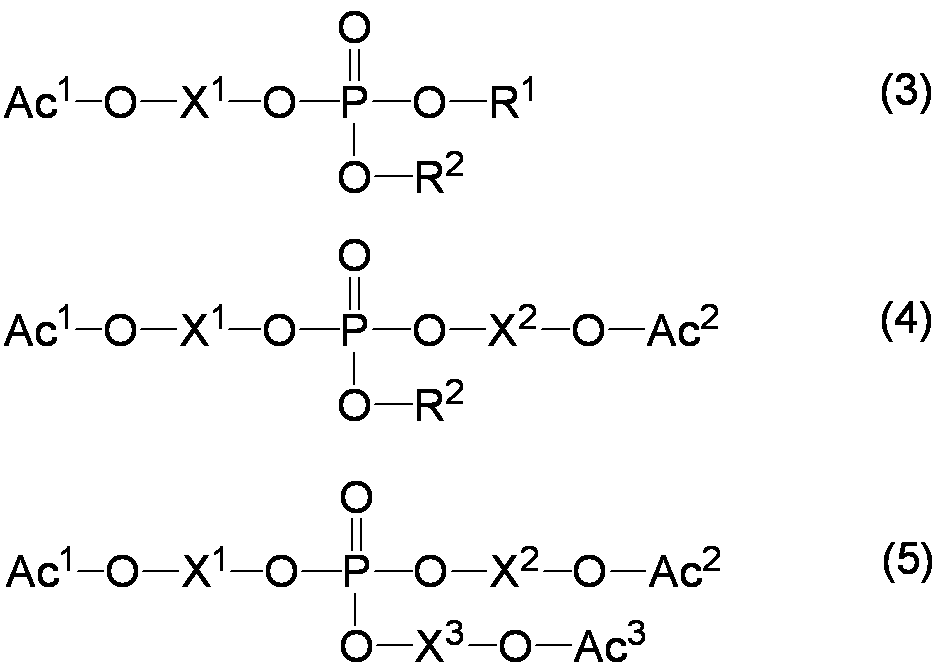
Ac1、Ac2、Ac3、X1、X2及びX3の定義は、式(2)における定義と同じである。式(3)及び(4)において、R1は重合性基を有しない置換基又は水素原子を表し、R2は重合性基を有しない置換基又は水素原子を表す。
式(2)~(5)において、X1、X2及びX3の炭素数は、1~12が好ましく、1~6がより好ましく、1~4が更に好ましい。X1、X2及びX3が採りうるアルキレン基の具体例、及び、X1、X2及びX3が採りうるアルキレンオキシ基、アルキレンオキシカルボニル基、アルキレンカルボニルオキシ基のアルキレン部分の具体例としては、メチレン基、エチレン基、プロピレン基、ブチレン基、ペンチレン基、ヘキシレン基が挙げられる。アルキレン基は、直鎖状であっても分枝状であっても構わないが、好ましいのは直鎖アルキレン基である。X1、X2及びX3として好ましいのは、アルキレン基である。
なお、アルキレン基と、アルキレンオキシ基、アルキレンオキシカルボニル基、及び、アルキレンカルボニルオキシ基よりなる群から選択された少なくとも1つとを組み合わせた2価の基とは、アルキレンオキシアルキレン基、アルキレンオキシカルボニルアルキレン基、アルキレンカルボニルオキシアルキレン基や、これらの組み合わせを意味する。すなわち、アルキレン基の末端を除く炭素原子が、エーテル結合及び/又はエステル結合(-C(=O)-O-又は-O-C(=O)-)により置換された2価の基を意味する。
上記アルキレン基は、置換基を有していてもよく、該置換基としては、ハロゲン原子が例示される。
なお、アルキレン基と、アルキレンオキシ基、アルキレンオキシカルボニル基、及び、アルキレンカルボニルオキシ基よりなる群から選択された少なくとも1つとを組み合わせた2価の基とは、アルキレンオキシアルキレン基、アルキレンオキシカルボニルアルキレン基、アルキレンカルボニルオキシアルキレン基や、これらの組み合わせを意味する。すなわち、アルキレン基の末端を除く炭素原子が、エーテル結合及び/又はエステル結合(-C(=O)-O-又は-O-C(=O)-)により置換された2価の基を意味する。
上記アルキレン基は、置換基を有していてもよく、該置換基としては、ハロゲン原子が例示される。
式(2)~(5)において、重合性基を有しない置換基としては、例えばアルキル基、アリール基、又はこれらを組み合わせた基などを挙げることができる。好ましいのはアルキル基である。
アルキル基の炭素数は、1~12が好ましく、1~9がより好ましく、1~6が更に好ましい。アルキル基の具体例として、メチル基、エチル基、プロピル基、ブチル基、ペンチル基、ヘキシル基が挙げられる。アルキル基は、直鎖状であっても分枝状であっても環状であっても構わないが、好ましいのは直鎖アルキル基である。アルキル基は、アルコキシ基、アリール基、アリールオキシ基などで置換されていてもよい。
アリール基の炭素数は、6~14が好ましく、6~10がより好ましい。アリール基の具体例として、フェニル基、1-ナフチル基、2-ナフチル基が挙げられる。アリール基は、アルキル基、アルコキシ基、アリールオキシ基などで置換されていてもよい。
アルキル基の炭素数は、1~12が好ましく、1~9がより好ましく、1~6が更に好ましい。アルキル基の具体例として、メチル基、エチル基、プロピル基、ブチル基、ペンチル基、ヘキシル基が挙げられる。アルキル基は、直鎖状であっても分枝状であっても環状であっても構わないが、好ましいのは直鎖アルキル基である。アルキル基は、アルコキシ基、アリール基、アリールオキシ基などで置換されていてもよい。
アリール基の炭素数は、6~14が好ましく、6~10がより好ましい。アリール基の具体例として、フェニル基、1-ナフチル基、2-ナフチル基が挙げられる。アリール基は、アルキル基、アルコキシ基、アリールオキシ基などで置換されていてもよい。
本発明では、式(2)で表されるモノマーを1種類だけ用いてもよいし、2種類以上を組み合わせて用いてもよい。また、組み合わせて用いる場合は、式(3)で表される単官能モノマー、式(4)で表される2官能モノマー、及び式(5)で表される3官能モノマーのうちの2種以上を組み合わせて用いてもよい。
本発明では、上記のリン酸エステル基含有(メタ)アクリレート化合物として、日本化薬(株)製のKAYAMERシリーズ、ユニケミカル(株)製のPhosmerシリーズ等、市販されている化合物をそのまま用いてもよく、新たに合成された化合物を用いてもよい。
本発明のインク組成物におけるリン酸エステル基含有(メタ)アクリレート化合物の含有量は、インク組成物の固形分総量に対して、0.5~20質量%であることが好ましく、1~10質量%であることがより好ましい。含有量が上記範囲内であると、保護層との密着性の改良効果が得られる。
本発明のインク組成物において、ラジカル重合性化合物の総含有量は、インク組成物の全質量に対して、30~98質量%であることが好ましく、40~95質量%であることがより好ましく、50~90質量%であることが更に好ましい。
ラジカル重合性化合物の含有量が上記範囲内であると、硬化性に優れると共に、粘度が適切であり、良好な画像が得られるので好ましい。
ラジカル重合性化合物の含有量が上記範囲内であると、硬化性に優れると共に、粘度が適切であり、良好な画像が得られるので好ましい。
<重合開始剤>
本発明のインク組成物は、重合開始剤を含有することが好ましく、ラジカル重合開始剤を含有することが好ましい。
本発明で用いることができる重合開始剤としては、公知の重合開始剤を使用することができる。本発明において、重合開始剤は、1種単独で使用してもよく、2種以上を併用してもよい。
本発明に用いることのできる重合開始剤は、外部エネルギーを吸収して重合開始種を生成する化合物である。重合を開始するために使用される外部エネルギーは、熱及び活性放射線に大別され、それぞれ、熱重合開始剤及び光重合開始剤が使用される。活性光線としては、γ線、電子線、紫外線、可視光線、赤外線が好ましく例示でき、電子線又は紫外線がより好ましく、紫外線が更に好ましい。
本発明のインク組成物は、重合開始剤を含有することが好ましく、ラジカル重合開始剤を含有することが好ましい。
本発明で用いることができる重合開始剤としては、公知の重合開始剤を使用することができる。本発明において、重合開始剤は、1種単独で使用してもよく、2種以上を併用してもよい。
本発明に用いることのできる重合開始剤は、外部エネルギーを吸収して重合開始種を生成する化合物である。重合を開始するために使用される外部エネルギーは、熱及び活性放射線に大別され、それぞれ、熱重合開始剤及び光重合開始剤が使用される。活性光線としては、γ線、電子線、紫外線、可視光線、赤外線が好ましく例示でき、電子線又は紫外線がより好ましく、紫外線が更に好ましい。
本発明で用いることができるラジカル重合開始剤としては、特に制限はなく、公知のラジカル重合開始剤を使用することができる。
本発明に用いることができるラジカル重合開始剤としては(a)芳香族ケトン類、(b)アシルホスフィン化合物、(c)芳香族オニウム塩化合物、(d)有機過酸化物、(e)チオ化合物、(f)ヘキサアリールビイミダゾール化合物、(g)ケトオキシムエステル化合物、(h)ボレート化合物、(i)アジニウム化合物、(j)メタロセン化合物、(k)活性エステル化合物、(l)炭素ハロゲン結合を有する化合物及び(m)アルキルアミン化合物等が挙げられる。これらのラジカル重合開始剤は、上記(a)~(m)の化合物を単独若しくは組み合わせて使用してもよい。
これらの中でも、(a)芳香族ケトン類、(b)アシルホスフィン化合物及び、(e)チオ化合物を使用することが好ましい。
なお、本発明におけるラジカル重合開始剤は、活性光線等の外部エネルギーを吸収してラジカル重合開始種を生成する化合物だけでなく、特定の活性光線を吸収してラジカル重合開始剤の分解を促進させる化合物(いわゆる増感剤)も含まれる。
本発明に用いることができるラジカル重合開始剤としては(a)芳香族ケトン類、(b)アシルホスフィン化合物、(c)芳香族オニウム塩化合物、(d)有機過酸化物、(e)チオ化合物、(f)ヘキサアリールビイミダゾール化合物、(g)ケトオキシムエステル化合物、(h)ボレート化合物、(i)アジニウム化合物、(j)メタロセン化合物、(k)活性エステル化合物、(l)炭素ハロゲン結合を有する化合物及び(m)アルキルアミン化合物等が挙げられる。これらのラジカル重合開始剤は、上記(a)~(m)の化合物を単独若しくは組み合わせて使用してもよい。
これらの中でも、(a)芳香族ケトン類、(b)アシルホスフィン化合物及び、(e)チオ化合物を使用することが好ましい。
なお、本発明におけるラジカル重合開始剤は、活性光線等の外部エネルギーを吸収してラジカル重合開始種を生成する化合物だけでなく、特定の活性光線を吸収してラジカル重合開始剤の分解を促進させる化合物(いわゆる増感剤)も含まれる。
(a)芳香族ケトン類としては、α-ヒドロキシケトン化合物、及び、α-アミノケトン化合物が好ましい。
α-ヒドロキシケトン化合物としては、例えば、1-[4-(2-ヒドロキシエトキシ)フェニル]-2-ヒドロキシ-2-メチル-1-プロパン-1-オン、2-ヒドロキシ-2-メチル-1-フェニル-プロパン-1-オン、1-ヒドロキシシクロヘキシルフェニルケトン等が挙げられる。
α-アミノケトン化合物としては、例えば、2-メチル-1-フェニル-2-モルフォリノプロパン-1-オン、2-メチル-1-[4-(ヘキシル)フェニル]-2-モルフォリノプロパン-1-オン、2-エチル-2-ジメチルアミノ-1-(4-モルフォリノフェニル)-ブタン-1-オン等が挙げられる。
α-ヒドロキシケトン化合物としては、例えば、1-[4-(2-ヒドロキシエトキシ)フェニル]-2-ヒドロキシ-2-メチル-1-プロパン-1-オン、2-ヒドロキシ-2-メチル-1-フェニル-プロパン-1-オン、1-ヒドロキシシクロヘキシルフェニルケトン等が挙げられる。
α-アミノケトン化合物としては、例えば、2-メチル-1-フェニル-2-モルフォリノプロパン-1-オン、2-メチル-1-[4-(ヘキシル)フェニル]-2-モルフォリノプロパン-1-オン、2-エチル-2-ジメチルアミノ-1-(4-モルフォリノフェニル)-ブタン-1-オン等が挙げられる。
(b)アシルホスフィン化合物としては、アシルホスフィンオキサイド化合物が好ましい。
アシルホスフィンオキサイド化合物としては、モノアシルホスフィンオキサイド化合物及びビスアシルホスフィンオキサイド化合物等を好ましく例示できる。
モノアシルホスフィンオキサイド化合物としては、公知のモノアシルホスフィンオキサイド化合物を使用することができる。例えば、特公昭60-8047号公報、特公昭63-40799号公報に記載のモノアシルホスフィンオキサイド化合物が挙げられる。
ビスアシルホスフィンオキサイド化合物としては、公知のビスアシルホスフィンオキサイド化合物が使用できる。例えば、特開平3-101686号公報、特開平5-345790号公報、特開平6-298818号公報に記載のビスアシルホスフィンオキサイド化合物が挙げられる。
アシルホスフィンオキサイド化合物としては、モノアシルホスフィンオキサイド化合物及びビスアシルホスフィンオキサイド化合物等を好ましく例示できる。
モノアシルホスフィンオキサイド化合物としては、公知のモノアシルホスフィンオキサイド化合物を使用することができる。例えば、特公昭60-8047号公報、特公昭63-40799号公報に記載のモノアシルホスフィンオキサイド化合物が挙げられる。
ビスアシルホスフィンオキサイド化合物としては、公知のビスアシルホスフィンオキサイド化合物が使用できる。例えば、特開平3-101686号公報、特開平5-345790号公報、特開平6-298818号公報に記載のビスアシルホスフィンオキサイド化合物が挙げられる。
(e)チオ化合物としては、「RADIATION CURING IN POLYMER SCIENCE AND TECHNOLOGY」J. P. FOUASSIER J.F.RABEK(1993)、pp.77~117記載のベンゾフェノン骨格又はチオキサントン骨格を有する化合物、特公昭63-61950号公報記載のチオキサントン類、特公昭59-42864号公報記載のクマリン類等が好ましく挙げられる。
本発明のインク組成物は、重合開始剤として、芳香族ケトン、アシルホスフィンオキサイド化合物、チオキサントン類よりなる群から選ばれた化合物を1つ以上含有することが好ましく、ビスアシルホスフィンオキサイド及び/又はチオキサントン化合物を含有することがより好ましく、ビスアシルホスフィンオキサイド及びチオキサントン化合物を含有することが更に好ましい。上記組み合わせであると、硬化性に優れるインク組成物が得られる。
本発明のインク組成物中における重合開始剤の総含有量としては、インク組成物の全質量に対して、0.1~20.0質量%であることが好ましく、0.5~18.0質量%であることがより好ましく、1.0~15.0質量%であることが更に好ましい。重合開始剤の添加量が上記数値範囲内であると、硬化性に優れ、また、表面ベトツキ低減の観点から適切である。
また、本発明のインク組成物中における重合開始剤と重合性化合物との含有比(質量比)としては、重合開始剤:重合性化合物=0.5:100~30:100であることが好ましく、1:100~15:100であることがより好ましく、2:100~10:100であることが更に好ましい。
また、本発明のインク組成物中における重合開始剤と重合性化合物との含有比(質量比)としては、重合開始剤:重合性化合物=0.5:100~30:100であることが好ましく、1:100~15:100であることがより好ましく、2:100~10:100であることが更に好ましい。
<増感剤>
本発明のインク組成物は、特定の活性光線を吸収して上記重合開始剤の分解を促進させるため、増感剤を含有することが好ましい。
増感剤としては、例えば、多核芳香族類(例えば、ピレン、ペリレン、トリフェニレン、2-エチル-9,10-ジメトキシアントラセン等)、キサンテン類(例えば、フルオレッセイン、エオシン、エリスロシン、ローダミンB、ローズベンガル等)、シアニン類(例えば、チアカルボシアニン、オキサカルボシアニン等)、メロシアニン類(例えば、メロシアニン、カルボメロシアニン等)、チアジン類(例えば、チオニン、メチレンブルー、トルイジンブルー等)、アクリジン類(例えば、アクリジンオレンジ、クロロフラビン、アクリフラビン等)、アントラキノン類(例えば、アントラキノン等)、スクアリウム類(例えば、スクアリウム等)、クマリン類(例えば、7-ジエチルアミノ-4-メチルクマリン等)などが挙げられる。
本発明のインク組成物は、特定の活性光線を吸収して上記重合開始剤の分解を促進させるため、増感剤を含有することが好ましい。
増感剤としては、例えば、多核芳香族類(例えば、ピレン、ペリレン、トリフェニレン、2-エチル-9,10-ジメトキシアントラセン等)、キサンテン類(例えば、フルオレッセイン、エオシン、エリスロシン、ローダミンB、ローズベンガル等)、シアニン類(例えば、チアカルボシアニン、オキサカルボシアニン等)、メロシアニン類(例えば、メロシアニン、カルボメロシアニン等)、チアジン類(例えば、チオニン、メチレンブルー、トルイジンブルー等)、アクリジン類(例えば、アクリジンオレンジ、クロロフラビン、アクリフラビン等)、アントラキノン類(例えば、アントラキノン等)、スクアリウム類(例えば、スクアリウム等)、クマリン類(例えば、7-ジエチルアミノ-4-メチルクマリン等)などが挙げられる。
本発明のインク組成物における増感剤の含有量は、インクの着色性の観点から、インク組成物の全質量に対し、0.01~20質量%が好ましく、0.1~15質量%がより好ましく、0.5~10質量%が更に好ましい。
また、増感剤は、1種単独で用いてもよいし、2種以上を併用してもよい。
また、増感剤と重合開始剤とのインク組成物中における含有比としては、重合開始剤の分解率向上と照射した光の透過性の観点から、質量比で、重合開始剤の含有量/増感剤の含有量=100~0.5が好ましく、50~1がより好ましく、10~1.5が更に好ましい。
また、増感剤は、1種単独で用いてもよいし、2種以上を併用してもよい。
また、増感剤と重合開始剤とのインク組成物中における含有比としては、重合開始剤の分解率向上と照射した光の透過性の観点から、質量比で、重合開始剤の含有量/増感剤の含有量=100~0.5が好ましく、50~1がより好ましく、10~1.5が更に好ましい。
<その他の成分>
本発明のインク組成物には、必要に応じて、上記各成分以外に、界面活性剤、共増感剤、紫外線吸収剤、酸化防止剤、褪色防止剤、導電性塩類、溶剤、高分子化合物、塩基性化合物等を含んでいてもよい。これらは、特開2009-221416号公報に記載されており、本発明においても使用できる。なお、本発明のインク組成物に含まれる各成分の含有率の合計が100質量%を超えないことはいうまでもない。
本発明のインク組成物には、必要に応じて、上記各成分以外に、界面活性剤、共増感剤、紫外線吸収剤、酸化防止剤、褪色防止剤、導電性塩類、溶剤、高分子化合物、塩基性化合物等を含んでいてもよい。これらは、特開2009-221416号公報に記載されており、本発明においても使用できる。なお、本発明のインク組成物に含まれる各成分の含有率の合計が100質量%を超えないことはいうまでもない。
また、本発明のインク組成物は、保存性、及び、ヘッド詰まりの抑制という観点から、重合禁止剤を含有することが好ましい。
重合禁止剤は、本発明のインク組成物全量に対し、200~20,000ppm添加することが好ましい。
重合禁止剤としては、ニトロソ系重合禁止剤や、ヒンダードアミン系重合禁止剤、ハイドロキノン、ベンゾキノン、p-メトキシフェノール、TEMPO(2,2,6,6-テトラメチルピペリジン-1-オキシル)、TEMPOL(4-ヒドロキシ-2,2,6,6-テトラメチルピペリジン-1-オキシル)、クペロンAl等が挙げられる。
重合禁止剤は、本発明のインク組成物全量に対し、200~20,000ppm添加することが好ましい。
重合禁止剤としては、ニトロソ系重合禁止剤や、ヒンダードアミン系重合禁止剤、ハイドロキノン、ベンゾキノン、p-メトキシフェノール、TEMPO(2,2,6,6-テトラメチルピペリジン-1-オキシル)、TEMPOL(4-ヒドロキシ-2,2,6,6-テトラメチルピペリジン-1-オキシル)、クペロンAl等が挙げられる。
<インク物性>
本発明のインク組成物は、室温(25℃)にて液体であることが好ましい。
また、本発明においては、特にインクジェットによって画像層を形成する場合、吐出性を考慮し、25℃における粘度が40mPa・s以下であるインク組成物を使用することが好ましい。より好ましくは5~30mPa・s、更に好ましくは7~30mPa・sである。また、吐出温度(好ましくは25~80℃、より好ましくは25~50℃)における粘度が、3~15mPa・sであることが好ましく、3~13mPa・sであることがより好ましい。本発明のインク組成物は、25℃における粘度又は吐出温度における粘度が上記範囲になるように適宜組成比を調整することが好ましい。室温での粘度を高く設定することにより、基材層へのインク組成物の浸透を回避し、未硬化モノマーの低減が可能となる。更にインク組成物の液滴着弾時のインク滲みを抑えることができ、その結果として画質が改善されるので好ましい。
本発明のインク組成物は、室温(25℃)にて液体であることが好ましい。
また、本発明においては、特にインクジェットによって画像層を形成する場合、吐出性を考慮し、25℃における粘度が40mPa・s以下であるインク組成物を使用することが好ましい。より好ましくは5~30mPa・s、更に好ましくは7~30mPa・sである。また、吐出温度(好ましくは25~80℃、より好ましくは25~50℃)における粘度が、3~15mPa・sであることが好ましく、3~13mPa・sであることがより好ましい。本発明のインク組成物は、25℃における粘度又は吐出温度における粘度が上記範囲になるように適宜組成比を調整することが好ましい。室温での粘度を高く設定することにより、基材層へのインク組成物の浸透を回避し、未硬化モノマーの低減が可能となる。更にインク組成物の液滴着弾時のインク滲みを抑えることができ、その結果として画質が改善されるので好ましい。
本発明のインク組成物の25℃における表面張力は、20~35mN/mであることが好ましく、23~33mN/mであることがより好ましい。滲み及び浸透の観点から、20mN/m以上が好ましく、濡れ性の点では、35mN/m以下が好ましい。
(層3)有機ケイ素化合物の縮合反応によって形成された保護層
本発明の多層構成物は、有機ケイ素化合物の縮合反応によって形成された保護層を有する。保護層は、基材層上に設けられた画像層の画像領域と同一領域、又は、画像領域を含む画像より広い領域に設けることが好ましく、画像領域を含む一層のベタ層として画像領域を含む画像より広い領域に設けることがより好ましい。
以下の説明において、保護層を形成するための組成物を、オーバーコート組成物、又は、本発明のオーバーコート組成物ともいうこととする。本発明のオーバーコート組成物は、少なくとも有機ケイ素化合物を含有する。
本発明の多層構成物は、有機ケイ素化合物の縮合反応によって形成された保護層を有する。保護層は、基材層上に設けられた画像層の画像領域と同一領域、又は、画像領域を含む画像より広い領域に設けることが好ましく、画像領域を含む一層のベタ層として画像領域を含む画像より広い領域に設けることがより好ましい。
以下の説明において、保護層を形成するための組成物を、オーバーコート組成物、又は、本発明のオーバーコート組成物ともいうこととする。本発明のオーバーコート組成物は、少なくとも有機ケイ素化合物を含有する。
保護層は、インクジェット印刷法、スクリーン印刷法、スプレー印刷法のいずれかの方法で印刷された層であることが好ましい。
優れた耐熱性や耐擦性を得る観点で、層3の有機ケイ素化合物の縮合反応によって形成された層は、少なくともシロキサンオリゴマーを含む有機ケイ素化合物の縮合反応で形成されたポリシロキサンを含むことが好ましい。
優れた耐熱性や耐擦性を得る観点で、保護層を作製するには、オーバーコート組成物が、少なくともシロキサンオリゴマーを含むことが好ましい。すなわち、保護層が、少なくともシロキサンオリゴマーを含有する有機ケイ素化合物の縮合反応で形成された層であることが好ましい。特に、耐擦性、硬化速度、及び、透明性に優れているという観点では、シロキサンオリゴマーは、分子末端がアルコキシシリル基で封鎖された構造をもつシロキサンオリゴマーであることが好ましい。
優れた耐熱性や耐擦性を得る観点で、層3の有機ケイ素化合物の縮合反応によって形成された層は、少なくともシロキサンオリゴマーを含む有機ケイ素化合物の縮合反応で形成されたポリシロキサンを含むことが好ましい。
優れた耐熱性や耐擦性を得る観点で、保護層を作製するには、オーバーコート組成物が、少なくともシロキサンオリゴマーを含むことが好ましい。すなわち、保護層が、少なくともシロキサンオリゴマーを含有する有機ケイ素化合物の縮合反応で形成された層であることが好ましい。特に、耐擦性、硬化速度、及び、透明性に優れているという観点では、シロキサンオリゴマーは、分子末端がアルコキシシリル基で封鎖された構造をもつシロキサンオリゴマーであることが好ましい。
<シロキサンオリゴマー>
本発明のオーバーコート組成物は、有機ケイ素化合物を含有し、有機ケイ素化合物として、少なくともシロキサンオリゴマーを含有することが好ましい。
本発明におけるシロキサンオリゴマーとして、1種のシラン化合物を用いて得られた部分加水分解縮合物、及び、2種以上のシラン化合物を用いて得られた部分共加水分解縮合物を用いることができる。以下、これらの化合物を「部分(共)加水分解縮合物」と称することがある。
なお、シラン化合物とは、上述した加水分解性シリル基及び/又はシラノール基を有する化合物であり、シリル基は加水分解してシラノール基となり、シラノール基は脱水縮合してシロキサン結合が生成する。
本発明のオーバーコート組成物は、有機ケイ素化合物を含有し、有機ケイ素化合物として、少なくともシロキサンオリゴマーを含有することが好ましい。
本発明におけるシロキサンオリゴマーとして、1種のシラン化合物を用いて得られた部分加水分解縮合物、及び、2種以上のシラン化合物を用いて得られた部分共加水分解縮合物を用いることができる。以下、これらの化合物を「部分(共)加水分解縮合物」と称することがある。
なお、シラン化合物とは、上述した加水分解性シリル基及び/又はシラノール基を有する化合物であり、シリル基は加水分解してシラノール基となり、シラノール基は脱水縮合してシロキサン結合が生成する。
このような部分(共)加水分解縮合物の具体例としては、テトラメトキシシラン、テトラエトキシシラン、メチルトリメトキシシラン、メチルトリエトキシシラン、メチルトリイソプロポキシシラン、メチルトリアセトキシシラン、メチルトリス(メトキシエトキシ)シラン、メチルトリス(メトキシプロポキシ)シラン、エチルトリメトキシシラン、プロピルトリメトキシシラン、ブチルトリメトキシシラン、へキシルトリメトキシシラン、オクチルトリメトキシシラン、デシルトリメトキシシラン、シクロヘキシルトリメトキシシラン、フェニルトリメトキシシラン、フェニルトリエトキシシラン、トリルトリメトキシシラン、クロロメチルトリメトキシシラン、γ-クロロプロピルトリメトキシシラン、3,3,3-トリフルオロプロピルトリメトキシシラン、シアノエチルトリエトキシシラン、γ-グリシドキシプロピルトリメトキシシラン、γ-グリシドキシプロピルトリエトキシシラン、β-(3,4-エポキシシクロヘキシル)エチルトリメトキシシラン、γ-アミノプロピルトリメトキシシラン、γ-アミノプロピルトリエトキシシラン、N-β(アミノエチル)γ-アミノプロピルトリメトキシシラン、N-フェニル-γ-アミノプロピルトリメトキシシラン、γ-メルカプトプロピルトリメトキシシラン、ジメチルジメトキシシラン、ジメチルジエトキシシラン、ジエチルジメトキシシラン、メチルエチルジメトキシシラン、メチルプロピルジメトキシシラン、ジフェニルジメトキシシラン、ジフェニルジエトキシシラン、メチルフェニルジメトキシシラン、γ-クロロプロピルメチルジメトキシシラン、3,3,3-トリフルオロプロピルメチルジメトキシシラン、γ-グリシドキシプロピルメチルジエトキシシラン、γ-アミノプロピルメチルジエトキシシラン、N-β(アミノエチル)γ-アミノプロピルメチルジメトキシシラン、γ-メルカプトプロピルメチルジエトキシシラン等のアルコキシシラン又はアセチルオキシシラン、エトキサリルオキシシラン等のアシロキシシランからなるシラン化合物から選択される1種以上を前駆体として用いて得られた部分(共)加水分解縮合物を挙げることができる。
これらの部分(共)加水分解縮合物前駆体としてのシラン化合物の中でも、汎用性、コスト面、膜の相溶性の観点から、ケイ素上の置換基としてメチル基及びフェニル基から選択される置換基を有するシラン化合物であることが好ましく、具体的には、メチルトリメトキシシラン、メチルトリエトキシシラン、フェニルトリメトキシシラン、フェニルトリエトキシシラン、ジメチルジメトキシシラン、ジメチルジエトキシシラン、ジフェニルジメトキシシラン、ジフェニルジエトキシシランが好ましい前駆体として例示される。
この場合、部分(共)加水分解縮合物としては、上記したようなシラン化合物の2量体(シラン化合物2モルに水1モルを作用させてアルコール2モルを脱離させ、ジシロキサン単位としたもの)~100量体、好ましくは2量体~50量体、更に好ましくは2量体~30量体としたものが好適に使用でき、また、2種以上のシラン化合物を原料とする部分(共)加水分解縮合物を使用することも可能である。
なお、このような部分(共)加水分解縮合物はシリコーンアルコキシオリゴマーとして市販されているものを使用してもよく(例えば、信越化学工業(株)などから市販されている。)、また、常法に基づき、加水分解性シラン化合物に対し当量未満の加水分解水を反応させた後に、アルコール、塩酸等の副生物を除去することによって製造したものを使用してもよい。製造に際しては、前駆体となる原料の加水分解性シラン化合物として、例えば、上記したようなアルコキシシラン類やアシロキシシラン類を使用する場合は、塩酸、硫酸等の酸、水酸化ナトリウム、水酸化カリウム等のアルカリ金属又はアルカリ土類金属の水酸化物、トリエチルアミン等のアルカリ性有機物質等を反応触媒として部分加水分解縮合すればよく、クロロシラン類から直接製造する場合には、副生する塩酸を触媒として水及びアルコールを反応させればよい。
本発明において、シロキサンオリゴマーは、分子末端にアルコキシシリル基を有することが好ましい。分子末端にアルコキシシリル基を有するシロキサンオリゴマーとしては、下記式(A-1)で表されるアルコキシシラン化合物又はその部分加水分解縮合物が挙げられる。

式(A-1)中、R11は水素原子、置換又は無置換の1価の炭化水素基を表し、炭化水素基としては、アルキル基、シクロアルキル基、アリール基、アラルキル基が例示される。アルキル基は、炭素数1~24であることが好ましく、1~18であることがより好ましく、炭素数1~12であることが更に好ましく、炭素数1~6であることが特に好ましい。
アルキル基としては、メチル基、エチル基、プロピル基、イソプロピル基、ブチル基、イソブチル基、sec-ブチル基、tert-ブチル基、ペンチル基、イソペンチル基、sec-ペンチル基、ヘキシル基、ヘプチル基、n-オクチル基、イソオクチル基、2-エチルへキシル基、ノニル基、デシル基、イソデシル基、ドデシル基、テトラデシル基、ヘキサデシル基、オクタデシル基が例示される。
アルキル基としては、メチル基、エチル基、プロピル基、イソプロピル基、ブチル基、イソブチル基、sec-ブチル基、tert-ブチル基、ペンチル基、イソペンチル基、sec-ペンチル基、ヘキシル基、ヘプチル基、n-オクチル基、イソオクチル基、2-エチルへキシル基、ノニル基、デシル基、イソデシル基、ドデシル基、テトラデシル基、ヘキサデシル基、オクタデシル基が例示される。
シクロアルキル基としては、炭素数3~12であることが好ましく、炭素数3~10であることがより好ましく、炭素数3~8であることが更に好ましい。具体的には、シクロプロピル基、シクロブチル基、シクロペンチル基、シクロヘキシル基、シクロヘプチル基、シクロオクチル基等が例示される。
アリール基としては、炭素数6~12であることが好ましく、炭素数6~8であることがより好ましい。具体的には、フェニル基、トリル基、キシリル基が例示される。
アリール基としては、炭素数6~12であることが好ましく、炭素数6~8であることがより好ましい。具体的には、フェニル基、トリル基、キシリル基が例示される。
アラルキル基としては、炭素数7~13であることが好ましく、炭素数7~9であることがより好ましい。具体的には、ベンジル基、1-フェニルエチル基、2-フェニルエチル基、o-、m-又はp-メチルベンジル基が例示される。
R11としては、上記の1価の炭化水素基を置換したものが例示され、置換基としては、ハロゲン原子(例えば、塩素、フッ素、臭素及びヨウ素)、ヒドロキシ基、シアノ基、アミノ基、カルボキシ基が例示される。これらの置換基を複数有していてもよく、また、複数有する場合には、それらは同一でも異なっていてもよい。
R11として好ましくは水素、炭素数1~18のアルキル基、炭素数6~8のアリール基が挙げられる。
R11として好ましくは水素、炭素数1~18のアルキル基、炭素数6~8のアリール基が挙げられる。
R12は、アルキル基を表し、炭素数1~8のアルキル基であることが好ましく、炭素数1~4のアルキル基であることがより好ましく、炭素数1又は2のアルキル基、すなわち、メチル基又はエチル基であることが更に好ましい。
mは0~3の整数を表し、好ましくは1又は2であり、より好ましくは1である。
R11及び/又はR12が複数存在する場合、それぞれ同一でも異なっていてもよく、特に限定されない。
式(A-1)で表されるアルコキシシラン化合物としては、メチルトリメトキシシラン、メチルトリエトキシシラン、メチルトリイソプロポキシシラン、メチルトリブトキシシラン、エチルトリメトキシシラン、プロピルトリメトキシシラン、ジメチルジメトキシシラン、フェニルトリメトキシシラン、ジフェニルジメトキシシラン、フェニルメチルジメトキシシラン、テトラメトキシシラン、テトラエトキシシラン、テトライソプロポキシシラン、テトラブトキシシラン、又は、これらの混合物等が挙げられる。
R11及び/又はR12が複数存在する場合、それぞれ同一でも異なっていてもよく、特に限定されない。
式(A-1)で表されるアルコキシシラン化合物としては、メチルトリメトキシシラン、メチルトリエトキシシラン、メチルトリイソプロポキシシラン、メチルトリブトキシシラン、エチルトリメトキシシラン、プロピルトリメトキシシラン、ジメチルジメトキシシラン、フェニルトリメトキシシラン、ジフェニルジメトキシシラン、フェニルメチルジメトキシシラン、テトラメトキシシラン、テトラエトキシシラン、テトライソプロポキシシラン、テトラブトキシシラン、又は、これらの混合物等が挙げられる。
シロキサンオリゴマーとしては、式(A-2)で表される化合物又はその加水分解縮合物であることが更に好ましい。

上記式(A-2)中のR21は、アルキル基を表し、好ましくは、炭素数1~10のアルキル基であり、直鎖、分岐状及び環状のいずれでもよい。また、水素原子が別な元素、例えば、フッ素などで置換されていてもよい。
R22は炭素数1~4の直鎖又は分岐状のアルキル基を表し、その後の反応過程で生成するアルコールのアルキル基になるものである。均一な膜の形成、及び、貯蔵安定性の観点では、メチル基又はエチル基が好ましい。
R22は炭素数1~4の直鎖又は分岐状のアルキル基を表し、その後の反応過程で生成するアルコールのアルキル基になるものである。均一な膜の形成、及び、貯蔵安定性の観点では、メチル基又はエチル基が好ましい。
式(A-2)で表される化合物の縮合反応は、下記式(a)及び(b)に従う。
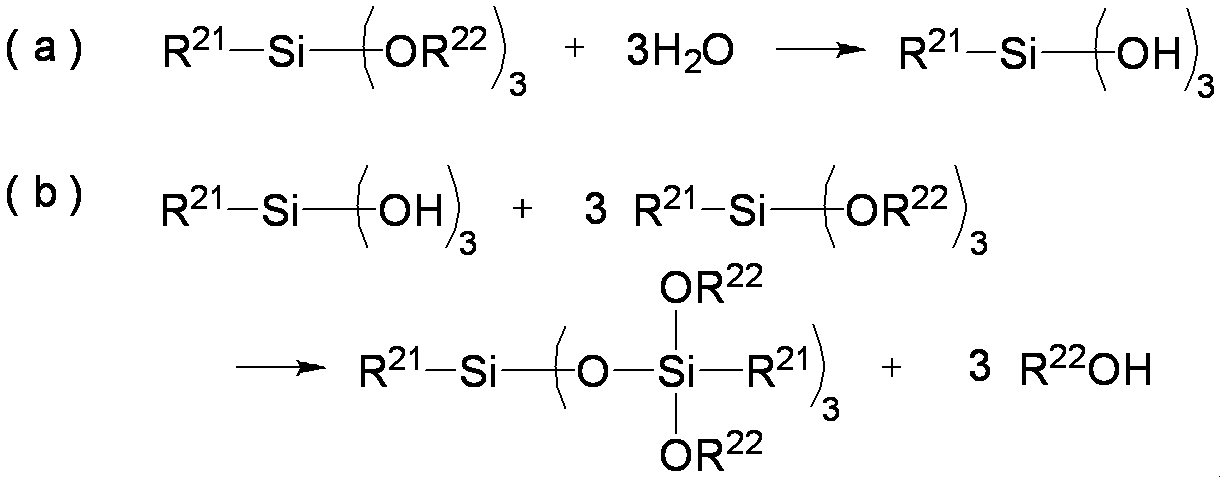
上記(a)及び(b)は競争反応であり、架橋し続け高分子化する。
また、縮合反応は、2分子での反応だけではなく、多数の分子と架橋反応を起こして巨大分子化して硬化被膜とすることもできる。
また、縮合反応は、2分子での反応だけではなく、多数の分子と架橋反応を起こして巨大分子化して硬化被膜とすることもできる。
また市販のシロキサンオリゴマーとしてKR-217、KR-400、KR-500、X-40-2308、X-40-9238(以上、信越化学工業(株)製)が挙げられる。また、後述する硬化剤を予め混合した製品も上市されており、例えば、KR-400、KR-401(信越化学工業(株)製)等が挙げられる。
本発明のオーバーコート組成物は、シロキサンオリゴマーを1種単独で含有してもよく、2種以上を含有してもよく、特に限定されない。
本発明のオーバーコート組成物は、シロキサンオリゴマーを固形分総量に対して10質量%~90質量%含有することが好ましく、50質量%~80質量%含有することが好ましい。
本発明のオーバーコート組成物は、シロキサンオリゴマーを固形分総量に対して10質量%~90質量%含有することが好ましく、50質量%~80質量%含有することが好ましい。
<硬化剤>
上記オーバーコート組成物は、硬化速度を高める観点から、有機金属化合物、酸、酸発生剤、塩基、及び、塩基発生剤よりなる群から選択される硬化剤を含有することが好ましい。
上記オーバーコート組成物は、硬化速度を高める観点から、有機金属化合物、酸、酸発生剤、塩基、及び、塩基発生剤よりなる群から選択される硬化剤を含有することが好ましい。
有機金属化合物としては、ジブチル錫ジアセテート、ジブチル錫ジオクチレート、ジブチル錫ジラウレートなどの有機錫化合物;アルミニウムトリス(アセチルアセトン)、アルミニウムトリス(アセトアセテートエチル)、アルミニウムジイソプロポキシ(アセトアセテートエチル)などの有機アルミニウム化合物;ジルコニウム(アセチルアセトン)、ジルコニウムトリス(アセチルアセトン)、ジルコニウムテトラキス(エチレングリコールモノメチルエーテル)、ジルコニウムテトラキス(エチレングリコールモノエチルエーテル)、ジルコニウムテトラキス(エチレングリコールモノブチルエーテル)などの有機ジルコニウム化合物;チタニウムテトラキス(エチレングリコールモノメチルエーテル)、チタニウムテトラキス(エチレングリコールモノエチルエーテル)、チタニウムテトラキス(エチレングリコールモノブチルエーテル)などの有機チタニウム化合物などが例示される。
酸としては、無機酸及び有機酸のいずれでもよく、無機酸としては、塩酸、硝酸、硫酸、リン酸などが例示され、有機酸としては、ギ酸、酢酸、シュウ酸、トリフルオロ酢酸などが例示される。
酸発生剤としては、加熱により酸性物質を発生する化合物(熱発生剤)及び/又は光照射により酸を発生する化合物(光酸発生剤)のいずれでもよい。これらの中でも、安定性の観点から、光酸発生剤が好ましい。
光酸発生剤としては、光カチオン重合の光開始剤、色素類の光消色剤、光変色剤、又はマイクロレジスト等に使用されている公知の光酸発生剤等、公知の化合物及びそれらの混合物等が挙げられる。光酸発生剤の添加により、オーバーコート組成物に感光性を付与し、例えば、光等の放射線を照射することによって当該膜を光硬化させることを可能にする物質である。この光酸発生剤としては、例えば、(1)ヨードニウム塩、スルホニウム塩、ホスホニウム塩、ジアゾニウム塩、アンモニウム塩、イミニウム塩、アルソニウム塩、セレノニウム塩、ピリジニウム塩等の各種オニウム塩;(2)β-ケトエステル、β-スルホニルスルホンとこれらのα-ジアゾ化合物等のスルホン化合物;(3)アルキルスルホン酸エステル、ハロアルキルスルホン酸エステル、アリールスルホン酸エステル、イミノスルホネート等のスルホン酸エステル類;(4)スルホンイミド化合物類;(5)ジアゾメタン化合物類;その他を挙げることができ、適宜使用することができる。
これらの中でも、ジアゾニウム塩、ヨードニウム塩、スルホニウム塩、イミニウム塩が、光感度、化合物の安定性等の点から好ましい。例えば特開2002-29162号公報の段落番号0058~0059に記載の化合物等が挙げられる。
光酸発生剤としては、光カチオン重合の光開始剤、色素類の光消色剤、光変色剤、又はマイクロレジスト等に使用されている公知の光酸発生剤等、公知の化合物及びそれらの混合物等が挙げられる。光酸発生剤の添加により、オーバーコート組成物に感光性を付与し、例えば、光等の放射線を照射することによって当該膜を光硬化させることを可能にする物質である。この光酸発生剤としては、例えば、(1)ヨードニウム塩、スルホニウム塩、ホスホニウム塩、ジアゾニウム塩、アンモニウム塩、イミニウム塩、アルソニウム塩、セレノニウム塩、ピリジニウム塩等の各種オニウム塩;(2)β-ケトエステル、β-スルホニルスルホンとこれらのα-ジアゾ化合物等のスルホン化合物;(3)アルキルスルホン酸エステル、ハロアルキルスルホン酸エステル、アリールスルホン酸エステル、イミノスルホネート等のスルホン酸エステル類;(4)スルホンイミド化合物類;(5)ジアゾメタン化合物類;その他を挙げることができ、適宜使用することができる。
これらの中でも、ジアゾニウム塩、ヨードニウム塩、スルホニウム塩、イミニウム塩が、光感度、化合物の安定性等の点から好ましい。例えば特開2002-29162号公報の段落番号0058~0059に記載の化合物等が挙げられる。
光酸発生剤は、単独で、又は2種以上を併用することができ、更に上記熱酸発生剤と併用することもできる。その他、具体的な化合物や使用法として、例えば特開2005-43876号公報に記載の内容などを用いることができる。
塩基としては、無機塩基及び有機塩基のいずれを使用してもよく、無機塩基としてはアンモニア、水酸化ナトリウム、水酸化カリウムなどが例示され、有機塩基としてはエチレンジアミン、アルカノールアミンなどが例示される。
塩基発生剤としては、としては、C6H5OOCNH-で示される基を有するものが挙げられる。
塩基発生剤としては、としては、C6H5OOCNH-で示される基を有するものが挙げられる。
これらの中でも、硬化剤としては、有機金属化合物及び/又は光酸発生剤が好ましく、有機金属化合物及び光酸発生剤を含有することがより好ましい。光酸発生剤としては、オニウム塩が特に好ましい。
本発明のオーバーコート組成物は、硬化剤を固形分総量の0.1質量%~20質量%含有することが好ましく、1質量%~10質量%含有することが特に好ましい。硬化剤の含有量が上記範囲内であると、良好な硬化性が得られるので好ましい。
<(メタ)アクリロイル基含有ポリシロキサン化合物及び/又は(メタ)アクリロイル基含有シランカップリング剤>
本発明のオーバーコート組成物は、画像層と保護層との密着性を高める添加剤を含有することが好ましく、このような添加剤としては、(メタ)アクリロイル基含有ポリシロキサン化合物及び(メタ)アクリロイル基含有シランカップリング剤が例示できる。すなわち、本発明のオーバーコート組成物は、(メタ)アクリロイル基含有ポリシロキサン化合物及び/又は(メタ)アクリロイル基含有シランカップリング剤を含有することが好ましい。これにより、有機ケイ素化合物の縮合反応によって形成した保護層の一部に、(メタ)アクリロイル基含有ポリシロキサン化合物、及び/又は、(メタ)アクリロイル基含有シランカップリング剤が縮合し、また、(メタ)アクリロイル基と、画像層の重合性化合物との架橋が形成され、保護層と画像層の密着性がより向上すると考えられる。
本発明のオーバーコート組成物は、画像層と保護層との密着性を高める添加剤を含有することが好ましく、このような添加剤としては、(メタ)アクリロイル基含有ポリシロキサン化合物及び(メタ)アクリロイル基含有シランカップリング剤が例示できる。すなわち、本発明のオーバーコート組成物は、(メタ)アクリロイル基含有ポリシロキサン化合物及び/又は(メタ)アクリロイル基含有シランカップリング剤を含有することが好ましい。これにより、有機ケイ素化合物の縮合反応によって形成した保護層の一部に、(メタ)アクリロイル基含有ポリシロキサン化合物、及び/又は、(メタ)アクリロイル基含有シランカップリング剤が縮合し、また、(メタ)アクリロイル基と、画像層の重合性化合物との架橋が形成され、保護層と画像層の密着性がより向上すると考えられる。
〔(メタ)アクリロイル基含有ポリシロキサン化合物〕
(メタ)アクリロイル基含有ポリシロキサン化合物は、少なくとも1つの(メタ)アクリロイル基を有するポリシロキサン化合物であり、ポリシロキサン化合物としては、上述のシロキサンオリゴマーが好ましく例示される。すなわち、1種のシラン化合物を用いて得られた部分加水分解縮合物、及び、2種以上のシラン化合物を用いて得られた部分共加水分解縮合物を用いることができる。
(メタ)アクリロイル基含有ポリシロキサン化合物としては、例えば、直鎖型ジメチルポリシロキサンの一部をアルキルやポリエーテルなどで有機変性し、その変性末端に(メタ)アクリレート基を付与したものが挙げられる。
これら(メタ)アクリロイル基を有するポリシロキサン化合物としては市販品を使用してもよく、例えば、BYK-UV3500、BYK-UV3570(いずれもビックケミー社製)、TEGO Rad2100、2200N、2250、2500、2600、2700(いずれもデグサ社製)、X-22-2445、X-22-2455、X-22-2457、X-22-2458、X-22-2459、X-22-1602、X-22-1603、X-22-1615、X-22-1616、X-22-1618、X-22-1619、X-22-2404、X-22-2474、X-22-174DX、X-22-8201、X-22-2426、X-22-164A、X-22-164C(いずれも信越化学工業(株)製)などを挙げることができる。また、これらは単独で使用しても、2種以上混合して使用してもよい。
(メタ)アクリロイル基含有ポリシロキサン化合物は、少なくとも1つの(メタ)アクリロイル基を有するポリシロキサン化合物であり、ポリシロキサン化合物としては、上述のシロキサンオリゴマーが好ましく例示される。すなわち、1種のシラン化合物を用いて得られた部分加水分解縮合物、及び、2種以上のシラン化合物を用いて得られた部分共加水分解縮合物を用いることができる。
(メタ)アクリロイル基含有ポリシロキサン化合物としては、例えば、直鎖型ジメチルポリシロキサンの一部をアルキルやポリエーテルなどで有機変性し、その変性末端に(メタ)アクリレート基を付与したものが挙げられる。
これら(メタ)アクリロイル基を有するポリシロキサン化合物としては市販品を使用してもよく、例えば、BYK-UV3500、BYK-UV3570(いずれもビックケミー社製)、TEGO Rad2100、2200N、2250、2500、2600、2700(いずれもデグサ社製)、X-22-2445、X-22-2455、X-22-2457、X-22-2458、X-22-2459、X-22-1602、X-22-1603、X-22-1615、X-22-1616、X-22-1618、X-22-1619、X-22-2404、X-22-2474、X-22-174DX、X-22-8201、X-22-2426、X-22-164A、X-22-164C(いずれも信越化学工業(株)製)などを挙げることができる。また、これらは単独で使用しても、2種以上混合して使用してもよい。
〔(メタ)アクリロイル基含有シランカップリング剤〕
(メタ)アクリロイル基含有シランカップリング剤としては、画像層で例示した(メタ)アクリロイル基含有シランカップリング剤と同様な化合物が例示され、好ましい範囲も同様である。
(メタ)アクリロイル基含有シランカップリング剤としては、画像層で例示した(メタ)アクリロイル基含有シランカップリング剤と同様な化合物が例示され、好ましい範囲も同様である。
本発明のオーバーコート組成物は、(メタ)アクリロイル基含有ポリシロキサン化合物と(メタ)アクリロイル基含有シランカップリング剤とを併用してもよいが、効果の観点から、(メタ)アクリロイル基含有ポリシロキサン化合物又は(メタ)アクリロイル基含入シランカップリング剤を含有することが好ましい。また、(メタ)アクリロイル基含有ポリシロキサン化合物及び(メタ)アクリロイル基含有シランカップリング剤は、1種単独で使用してもよく、それぞれ2種以上を使用してもよく、特に限定されない。
本発明のオーバーコート組成物において、(メタ)アクリロイル基含有ポリシロキサン化合物及び/又は(メタ)アクリロイル基含有シランカップリング剤の総量がオーバーコート組成物の固形分総量の0.5質量%~20質量%であることが好ましく、1質量%~10質量%であることがより好ましい。
本発明のオーバーコート組成物において、(メタ)アクリロイル基含有ポリシロキサン化合物及び/又は(メタ)アクリロイル基含有シランカップリング剤の総量がオーバーコート組成物の固形分総量の0.5質量%~20質量%であることが好ましく、1質量%~10質量%であることがより好ましい。
<その他の成分>
更に、本発明のオーバーコート組成物は、インクジェット吐出適性やスプレー印刷適性の付与、貯蔵安定性の付与などのために、必要に応じて、オーバーコート組成物の全質量に対して、有機溶剤を10質量%~90質量%含有してもよい。その他、液物性を調整するため界面活性剤、高分子樹脂、pH調整剤や、膜物性を向上させるための固体物質(例えば、シリカなど)、貯蔵安定性の付与のための安定化剤なども添加することが可能である。
更に、本発明のオーバーコート組成物は、インクジェット吐出適性やスプレー印刷適性の付与、貯蔵安定性の付与などのために、必要に応じて、オーバーコート組成物の全質量に対して、有機溶剤を10質量%~90質量%含有してもよい。その他、液物性を調整するため界面活性剤、高分子樹脂、pH調整剤や、膜物性を向上させるための固体物質(例えば、シリカなど)、貯蔵安定性の付与のための安定化剤なども添加することが可能である。
上記有機溶剤としては、上記シリコーンオリゴマーが均一に溶解でき、かつ、室温で液体であれば特に限定されないが、例えば、下記のような溶剤を使用することができる。
アルコール類として1-ブタノール、イソブチルアルコール、tert-ブチルアルコール、2-ペンタノール、3-ペンタノール、tert-ペンチルアルコール、3-メチル-2-ブタノール、ネオペンチルアルコール、アリルアルコール、プロパギルアルコール、ベンジルアルコール、シクロヘキサノール、2-メチルシクロヘキサノール、1,3-ブタンジオール、2,3-ブタンジオール、2-メチル-2,4-ペンタンジオール、2-エチル-1,3-ヘキサンジオール、2-エチル-2-(ヒドロキシメチル)-1,3-プロパンジオール、1,2,6-ヘキサントリオール、フルフリルアルコール、テトラヒドロフルフリルアルコール、ジアセトンアルコールが挙げられる。
またエーテル類としては、ジオキサン、トリオキサン、テトラヒドロフラン、テトラヒドロピラン、1,2-ジメトキシエタン、1,2-ジエトキシエタン、ジエチレングリコールジメチルエーテル、ジエチレングリコールジエチルエーテル、ジエチレングリコールジブチルエーテル、メチラール、アセタールが挙げられる。
また、ケトン類としては、アセトン、メチルエチルケトン、2-ペンタノン、3-ペンタノン、アセトニルアセトン、シクロヘキサノンが挙げられる。
また、エステル類としては、蟻酸メチル、蟻酸エチル、酢酸メチル、酢酸エチル、3-メトキシブチルアセタート、プロピオン酸メチル、γ-ブチロラクトン、シュウ酸ジエチル、マレイン酸ジメチル、モノアセチン、ジアセチン、トリアセチン、炭酸エチレン、炭酸プロピレン、リン酸トリエチル、アセトニトリル、乳酸メチル、乳酸エチル、乳酸ブチル、2-メトキシエチルアセタート、2-エトキシエチルアセタート、ジエチレングリコールモノエチルエーテルアセタート、ジエチレングリコールモノブチルエーテルアセタート、アセト酢酸メチル、アセト酢酸エチル、ヘキサメチルリン酸トリアミドが挙げられる。
また、含窒素化合物としては、ピリジン、α-ピコリン、β-ピコリン、γ-ピコリン、エチレンジアミン、プロピレンジアミン、テトラエチレンペンタミン、ホルムアミド、N-メチルホルムアミド、N,N-ジメチルホルムアミド、N,N-ジエチルホルムアミド、アセトアミド、N-メチルアセトアミド、N,N-ジメチルアセトアミド、N,N,N’,N’-テトラメチル尿素、ε-カプロラクタム、モルホリン、N-メチルモルホリンが挙げられる。
アルコール類として1-ブタノール、イソブチルアルコール、tert-ブチルアルコール、2-ペンタノール、3-ペンタノール、tert-ペンチルアルコール、3-メチル-2-ブタノール、ネオペンチルアルコール、アリルアルコール、プロパギルアルコール、ベンジルアルコール、シクロヘキサノール、2-メチルシクロヘキサノール、1,3-ブタンジオール、2,3-ブタンジオール、2-メチル-2,4-ペンタンジオール、2-エチル-1,3-ヘキサンジオール、2-エチル-2-(ヒドロキシメチル)-1,3-プロパンジオール、1,2,6-ヘキサントリオール、フルフリルアルコール、テトラヒドロフルフリルアルコール、ジアセトンアルコールが挙げられる。
またエーテル類としては、ジオキサン、トリオキサン、テトラヒドロフラン、テトラヒドロピラン、1,2-ジメトキシエタン、1,2-ジエトキシエタン、ジエチレングリコールジメチルエーテル、ジエチレングリコールジエチルエーテル、ジエチレングリコールジブチルエーテル、メチラール、アセタールが挙げられる。
また、ケトン類としては、アセトン、メチルエチルケトン、2-ペンタノン、3-ペンタノン、アセトニルアセトン、シクロヘキサノンが挙げられる。
また、エステル類としては、蟻酸メチル、蟻酸エチル、酢酸メチル、酢酸エチル、3-メトキシブチルアセタート、プロピオン酸メチル、γ-ブチロラクトン、シュウ酸ジエチル、マレイン酸ジメチル、モノアセチン、ジアセチン、トリアセチン、炭酸エチレン、炭酸プロピレン、リン酸トリエチル、アセトニトリル、乳酸メチル、乳酸エチル、乳酸ブチル、2-メトキシエチルアセタート、2-エトキシエチルアセタート、ジエチレングリコールモノエチルエーテルアセタート、ジエチレングリコールモノブチルエーテルアセタート、アセト酢酸メチル、アセト酢酸エチル、ヘキサメチルリン酸トリアミドが挙げられる。
また、含窒素化合物としては、ピリジン、α-ピコリン、β-ピコリン、γ-ピコリン、エチレンジアミン、プロピレンジアミン、テトラエチレンペンタミン、ホルムアミド、N-メチルホルムアミド、N,N-ジメチルホルムアミド、N,N-ジエチルホルムアミド、アセトアミド、N-メチルアセトアミド、N,N-ジメチルアセトアミド、N,N,N’,N’-テトラメチル尿素、ε-カプロラクタム、モルホリン、N-メチルモルホリンが挙げられる。
<オーバーコート組成物の物性>
本発明のオーバーコート組成物は、室温(25℃)にて液体であることが好ましい。
本発明においては、特にインクジェットによって保護層を形成する場合、吐出性を考慮し、25℃における粘度が40mPa・s以下であるオーバーコート組成物を使用することが好ましい。より好ましくは5~30mPa・s、更に好ましくは7~30mPa・sである。また、吐出温度(好ましくは25~80℃、より好ましくは25~50℃)における粘度が、3~15mPa・sであることが好ましく、3~13mPa・sであることがより好ましい。本発明のオーバーコート組成物は、25℃における粘度又は吐出温度における粘度が上記範囲になるように適宜組成比を調整することが好ましい。室温での粘度を高く設定することにより、基材層や画像層への浸透を回避し、未硬化モノマーの低減が可能となる。更にオーバーコート組成物の液滴着弾時の滲みを抑えることができるので好ましい。
本発明のオーバーコート組成物は、室温(25℃)にて液体であることが好ましい。
本発明においては、特にインクジェットによって保護層を形成する場合、吐出性を考慮し、25℃における粘度が40mPa・s以下であるオーバーコート組成物を使用することが好ましい。より好ましくは5~30mPa・s、更に好ましくは7~30mPa・sである。また、吐出温度(好ましくは25~80℃、より好ましくは25~50℃)における粘度が、3~15mPa・sであることが好ましく、3~13mPa・sであることがより好ましい。本発明のオーバーコート組成物は、25℃における粘度又は吐出温度における粘度が上記範囲になるように適宜組成比を調整することが好ましい。室温での粘度を高く設定することにより、基材層や画像層への浸透を回避し、未硬化モノマーの低減が可能となる。更にオーバーコート組成物の液滴着弾時の滲みを抑えることができるので好ましい。
本発明のオーバーコート組成物の25℃における表面張力は、20~35mN/mであることが好ましく、23~33mN/mであることがより好ましい。滲み及び浸透の観点から、20mN/m以上が好ましく、濡れ性の点では、35mN/m以下が好ましい。
(多層構成物の製造方法)
本発明の多層構成物の製造方法は、下記工程を少なくとも有することが好ましい。
(工程a1)(層1)基材層の上に、インクジェット印刷又はスクリーン印刷にて、着色顔料を含有する組成物(本発明のインク組成物)を付与して(層2)画像層を形成する工程
(工程b1)層2の上に、有機ケイ素化合物を含む組成物(本発明のオーバーコート組成物)を付与して(層3)保護層を形成する工程
また、本発明の多層構成物の製造方法は、下記工程を有することがより好ましい。
(工程a2)(層1)基材層の上に、インクジェット印刷又はスクリーン印刷にて、着色顔料を含有する紫外線硬化可能な組成物(本発明のインク組成物)を付与し、その後に紫外線露光により付与した組成物を硬化させることによって(層2)画像層を形成する工程
(工程b2)層2の上に、有機ケイ素化合物を含む組成物(本発明のオーバーコート組成物)を付与して(層3)保護層を形成する工程
本発明の多層構成物の製造方法は、下記工程を少なくとも有することが好ましい。
(工程a1)(層1)基材層の上に、インクジェット印刷又はスクリーン印刷にて、着色顔料を含有する組成物(本発明のインク組成物)を付与して(層2)画像層を形成する工程
(工程b1)層2の上に、有機ケイ素化合物を含む組成物(本発明のオーバーコート組成物)を付与して(層3)保護層を形成する工程
また、本発明の多層構成物の製造方法は、下記工程を有することがより好ましい。
(工程a2)(層1)基材層の上に、インクジェット印刷又はスクリーン印刷にて、着色顔料を含有する紫外線硬化可能な組成物(本発明のインク組成物)を付与し、その後に紫外線露光により付与した組成物を硬化させることによって(層2)画像層を形成する工程
(工程b2)層2の上に、有機ケイ素化合物を含む組成物(本発明のオーバーコート組成物)を付与して(層3)保護層を形成する工程
本発明の多層構成物の製造方法は、下記工程を有することが更に好ましい。
(工程a3)(層1)基材層の上に、インクジェット印刷又はスクリーン印刷にて、着色顔料を含有する紫外線硬化可能な組成物(本発明のインク組成物)付与し、その後に紫外線露光により付与した組成物を硬化させることによって(層2)画像層を形成する工程
(工程b3)層2の上に、有機ケイ素化合物を含む組成物(本発明のオーバーコート組成物)を付与して(層3)保護層を形成する工程
(工程c3)層3を形成後に紫外線露光を実施する工程
また、上記の3つの製造方法において、層1、層2及び層3を形成した後に、加温する工程を更に含むことが好ましい。
(工程a3)(層1)基材層の上に、インクジェット印刷又はスクリーン印刷にて、着色顔料を含有する紫外線硬化可能な組成物(本発明のインク組成物)付与し、その後に紫外線露光により付与した組成物を硬化させることによって(層2)画像層を形成する工程
(工程b3)層2の上に、有機ケイ素化合物を含む組成物(本発明のオーバーコート組成物)を付与して(層3)保護層を形成する工程
(工程c3)層3を形成後に紫外線露光を実施する工程
また、上記の3つの製造方法において、層1、層2及び層3を形成した後に、加温する工程を更に含むことが好ましい。
(工程a1、工程a2及び工程a3)
工程a1、工程a2及び工程a3は、基材層の上に、本発明のインク組成物を用いて画像層を形成する工程である。画像層は、インクジェット印刷、スクリーン印刷、スプレー印刷等のいずれの方法で設けてもよいが、インクジェット印刷又はスクリーン印刷にて基材層上に本発明のインク組成物を付与して、画像を作成することが好ましく、インクジェット印刷により画像を作成することがより好ましい。
インクジェット印刷及びスクリーン印刷としては、従来公知の方法を適宜採用して用いればよい。
本発明のインク組成物は、紫外線硬化性インク組成物であることが好ましく、その場合には、基材層の上にインク組成物を付与した後に、紫外線露光により付与したインク組成物を硬化させる工程を有することが好ましい。
本発明において、インクジェット印刷に用いることができるインクジェット記録装置としては、特に制限はなく、目的とする解像度を達成しうる公知のインクジェット記録装置を任意に選択して使用することができる。すなわち、市販品を含む公知のインクジェット記録装置であれば、いずれも、本発明の多層構成物の製造方法の工程a1、工程a2、及び工程a3における基材層への本発明のインク組成物の吐出を実施することができ、例えば、特開2012-184404号公報の段落0085~0094に記載のインクジェット記録方法及びインクジェット記録装置が参照される。
工程a1、工程a2及び工程a3は、基材層の上に、本発明のインク組成物を用いて画像層を形成する工程である。画像層は、インクジェット印刷、スクリーン印刷、スプレー印刷等のいずれの方法で設けてもよいが、インクジェット印刷又はスクリーン印刷にて基材層上に本発明のインク組成物を付与して、画像を作成することが好ましく、インクジェット印刷により画像を作成することがより好ましい。
インクジェット印刷及びスクリーン印刷としては、従来公知の方法を適宜採用して用いればよい。
本発明のインク組成物は、紫外線硬化性インク組成物であることが好ましく、その場合には、基材層の上にインク組成物を付与した後に、紫外線露光により付与したインク組成物を硬化させる工程を有することが好ましい。
本発明において、インクジェット印刷に用いることができるインクジェット記録装置としては、特に制限はなく、目的とする解像度を達成しうる公知のインクジェット記録装置を任意に選択して使用することができる。すなわち、市販品を含む公知のインクジェット記録装置であれば、いずれも、本発明の多層構成物の製造方法の工程a1、工程a2、及び工程a3における基材層への本発明のインク組成物の吐出を実施することができ、例えば、特開2012-184404号公報の段落0085~0094に記載のインクジェット記録方法及びインクジェット記録装置が参照される。
(工程b1、工程b2及び工程b3)
工程b1、工程b2及び工程b3は、画像層の上に、本発明のオーバーコート組成物を用いて保護層を形成する工程である。オーバーコート組成物を付与する方法としては、特に限定されず、インクジェット印刷法、スクリーン印刷法、スプレー印刷法で付与することが好ましい。また、オーバーコート組成物の付与方法はこれに限定されず、公知の塗布装置の中から目的等に応じて適宜選択することもでき、例えば、エアドクターコーター、ブレードコーター、ロットコーター、ナイフコーター、スクイズコーター、含浸コーター、リバースロールコーター、トランスファーロールコーター、グラビアコーター、キスロールコーター、キャストコーター、スプレイコーター、カーテンコーター、押出コーター等が挙げられる。詳しくは、原崎勇次著「コーティング工学」を参照できる。
これらの中でも、インクジェット印刷法又はスクリーン印刷法がより好ましく、インクジェット印刷法が更に好ましい。
工程b1、工程b2及び工程b3は、画像層の上に、本発明のオーバーコート組成物を用いて保護層を形成する工程である。オーバーコート組成物を付与する方法としては、特に限定されず、インクジェット印刷法、スクリーン印刷法、スプレー印刷法で付与することが好ましい。また、オーバーコート組成物の付与方法はこれに限定されず、公知の塗布装置の中から目的等に応じて適宜選択することもでき、例えば、エアドクターコーター、ブレードコーター、ロットコーター、ナイフコーター、スクイズコーター、含浸コーター、リバースロールコーター、トランスファーロールコーター、グラビアコーター、キスロールコーター、キャストコーター、スプレイコーター、カーテンコーター、押出コーター等が挙げられる。詳しくは、原崎勇次著「コーティング工学」を参照できる。
これらの中でも、インクジェット印刷法又はスクリーン印刷法がより好ましく、インクジェット印刷法が更に好ましい。
なお、工程b1、工程b2及び工程b3の後に、室温付近にて静置する工程、及び、高温で熱処理する工程を有することが好ましい。
室温付近にて静置する工程は、湿度が60~100%RHであることが好ましく、また、温度が15~30℃であることが好ましい。このような環境に10分~60分、多層構成物を静置することが好ましく、これによって有機ケイ素化合物の縮合反応が促進される。
室温付近にて静置する工程の後、高温で熱処理する工程を有することが好ましい。高温で熱処理する工程では、60℃~400℃で加熱することが好ましく、80℃~300℃で加熱することがより好ましく、100℃~200℃で加熱することが更に好ましい。処理時間は、1分~6時間であることが好ましく、3分~3時間であることがより好ましく、5分~60分であることが更に好ましく、10分~30分であることが特に好ましい。
室温付近にて静置する工程は、湿度が60~100%RHであることが好ましく、また、温度が15~30℃であることが好ましい。このような環境に10分~60分、多層構成物を静置することが好ましく、これによって有機ケイ素化合物の縮合反応が促進される。
室温付近にて静置する工程の後、高温で熱処理する工程を有することが好ましい。高温で熱処理する工程では、60℃~400℃で加熱することが好ましく、80℃~300℃で加熱することがより好ましく、100℃~200℃で加熱することが更に好ましい。処理時間は、1分~6時間であることが好ましく、3分~3時間であることがより好ましく、5分~60分であることが更に好ましく、10分~30分であることが特に好ましい。
本発明において、多層構成物の製造方法は、以下の工程をこの順で有することが特に好ましい。
(工程1)(層1)基材層の上に、インクジェット印刷又はスクリーン印刷にて、着色顔料を含有する紫外線硬化可能な組成物(本発明のインク組成物)を付与して(層2)画像層を形成する工程、
(工程2)基材層上に付与したインク組成物に紫外線露光して、インク組成物を半硬化する工程、
(工程3)有機ケイ素化合物を含む組成物(本発明のオーバーコート組成物)を半硬化したインク組成物を有する基材層の上に付与して(層3)保護層を形成する工程、
(工程4)オーバーコート組成物に紫外線露光する工程、
(工程5)室温付近にて静置する工程、及び、
(工程6)高温にて熱処理する工程。
(工程1)(層1)基材層の上に、インクジェット印刷又はスクリーン印刷にて、着色顔料を含有する紫外線硬化可能な組成物(本発明のインク組成物)を付与して(層2)画像層を形成する工程、
(工程2)基材層上に付与したインク組成物に紫外線露光して、インク組成物を半硬化する工程、
(工程3)有機ケイ素化合物を含む組成物(本発明のオーバーコート組成物)を半硬化したインク組成物を有する基材層の上に付与して(層3)保護層を形成する工程、
(工程4)オーバーコート組成物に紫外線露光する工程、
(工程5)室温付近にて静置する工程、及び、
(工程6)高温にて熱処理する工程。
上記工程1は、上述した工程a1、a2及びa3におけるインク組成物を基材層の上に付与する工程と同一である。
工程2では、インク組成物を完全に硬化させず、表層を液体状態を保った程度の露光強度にて紫外線露光する。すなわち、工程2での紫外線露光後に、普通紙で画像層に一定の圧力をかけた場合、5~50質量%程度のインク組成物が普通紙に転写する程度の硬化状態(半硬化状態)となるように、露光強度を調整することが好ましい。
次に、工程3では、インクジェット印刷法にて本発明のオーバーコート組成物を付与することが好ましい。
その後、工程4では、本発明のオーバーコート組成物に対して紫外線露光を行う。工程4では、半硬化状態の画像層が保護層を通して露光され、完全に硬化される。また、本発明のオーバーコート組成物が(メタ)アクリロイル基含有ポリシロキサン化合物、及び/又は、(メタ)アクリロイル基含有シランカップリング剤を含有する場合には、画像層中の未硬化重合性化合物との重合反応が生じ、更に密着性が向上する。更に、本発明のオーバーコート組成物が光酸発生剤を含有する場合には、工程4における紫外線露光によって有機ケイ素化合物の縮合反応が促進される。
工程5及び6については、上述した通りである。
工程2では、インク組成物を完全に硬化させず、表層を液体状態を保った程度の露光強度にて紫外線露光する。すなわち、工程2での紫外線露光後に、普通紙で画像層に一定の圧力をかけた場合、5~50質量%程度のインク組成物が普通紙に転写する程度の硬化状態(半硬化状態)となるように、露光強度を調整することが好ましい。
次に、工程3では、インクジェット印刷法にて本発明のオーバーコート組成物を付与することが好ましい。
その後、工程4では、本発明のオーバーコート組成物に対して紫外線露光を行う。工程4では、半硬化状態の画像層が保護層を通して露光され、完全に硬化される。また、本発明のオーバーコート組成物が(メタ)アクリロイル基含有ポリシロキサン化合物、及び/又は、(メタ)アクリロイル基含有シランカップリング剤を含有する場合には、画像層中の未硬化重合性化合物との重合反応が生じ、更に密着性が向上する。更に、本発明のオーバーコート組成物が光酸発生剤を含有する場合には、工程4における紫外線露光によって有機ケイ素化合物の縮合反応が促進される。
工程5及び6については、上述した通りである。
(多層構成物)
本発明の多層構成物において、基材層の厚みは特に限定されないが、デザインタイル用途に用いる場合には、0.5~10cmであることが好ましく、1~10cmであることがより好ましく、1~5cmであることが更に好ましい。
また、画像層の厚みは特に限定されないが、十分な発色性を得る観点から、0.5~40μmであることが好ましく、1~20μmであることがより好ましく、1~15μmであることが更に好ましい。
更に、保護層の厚みは特に限定されないが、十分な耐久性を得る観点から、0.5~40μmであることが好ましく、1~20μmであることがより好ましく、1~15μmであることが更に好ましい。
本発明の多層構成物において、基材層の厚みは特に限定されないが、デザインタイル用途に用いる場合には、0.5~10cmであることが好ましく、1~10cmであることがより好ましく、1~5cmであることが更に好ましい。
また、画像層の厚みは特に限定されないが、十分な発色性を得る観点から、0.5~40μmであることが好ましく、1~20μmであることがより好ましく、1~15μmであることが更に好ましい。
更に、保護層の厚みは特に限定されないが、十分な耐久性を得る観点から、0.5~40μmであることが好ましく、1~20μmであることがより好ましく、1~15μmであることが更に好ましい。
本発明の多層構成物は、種々の用途に用いることができる。
具体的には、屋内の床や壁のデザインタイルに特に好ましく使用することができる。その他、ガラスの装飾、屋外の外壁、家具類の装飾、陶磁器などにも使用することができる。
具体的には、屋内の床や壁のデザインタイルに特に好ましく使用することができる。その他、ガラスの装飾、屋外の外壁、家具類の装飾、陶磁器などにも使用することができる。
(組成物セット)
本発明の組成物セットは、本発明の多層構成物を製造するための組成物のセットであって、層2を形成するための着色顔料を含有する組成物、及び、層3を形成するための有機ケイ素化合物を含有する組成物で構成されることを特徴とする。すなわち、層2を形成するための本発明のインク組成物及び層3を形成するための本発明のオーバーコート組成物からなるセットである。
なお、多色のカラー画像を形成する場合には、各色のインク組成物及びオーバーコート組成物からなるセットであることが好ましい。
本発明の組成物セットは、本発明の多層構成物を製造するための組成物のセットであって、層2を形成するための着色顔料を含有する組成物、及び、層3を形成するための有機ケイ素化合物を含有する組成物で構成されることを特徴とする。すなわち、層2を形成するための本発明のインク組成物及び層3を形成するための本発明のオーバーコート組成物からなるセットである。
なお、多色のカラー画像を形成する場合には、各色のインク組成物及びオーバーコート組成物からなるセットであることが好ましい。
以下に実施例及び比較例を示し、本発明をより具体的に説明する。ただし、本発明はこれらの実施例によって限定されるものではない。なお、以下の記載における「部」とは、特に断りのない限り「質量部」を示し、「%」は「質量%」を示すものとする。
本発明の実施例に用いた材料、機器は下記の通りである。
(層1を形成するための素材)
・150mm角の陶磁器タイル基材
・150mm角のガラス
(層1を形成するための素材)
・150mm角の陶磁器タイル基材
・150mm角のガラス
(層2を形成するための素材)
・インク1:UV硬化型インク UVIJET KO シリーズ
・インク2:UV硬化型インク UVIJET KO シリーズの各色100質量部に対し、アクリレート修飾シランカップリング剤(KBM-5103(信越化学工業(株)製)、3-アクリロキシプロピルトリメトキシシラン)を2.5質量部ずつ添加
・インク3:UV硬化型インク UVIJET KO シリーズの各色100質量部に対し、リン酸エステル基含有アクリレート(リン酸2-アクリロイルオキシエチル(Polysciences社製))を2.5質量部ずつ添加
なお、UVIJET KO シリーズのインクは、MSDSに記載の通り、顔料、ジプロピレングリコールジアクレートなどのラジカル重合性化合物を70~90質量%、ジフェニル(2,4,6-トリメチルベンゾイル)ホスフィンオキシドなどの光重合開始剤を5~10質量%、及び、その他添加剤を含有する、紫外線硬化型インクジェットインクである。
・インク1:UV硬化型インク UVIJET KO シリーズ
・インク2:UV硬化型インク UVIJET KO シリーズの各色100質量部に対し、アクリレート修飾シランカップリング剤(KBM-5103(信越化学工業(株)製)、3-アクリロキシプロピルトリメトキシシラン)を2.5質量部ずつ添加
・インク3:UV硬化型インク UVIJET KO シリーズの各色100質量部に対し、リン酸エステル基含有アクリレート(リン酸2-アクリロイルオキシエチル(Polysciences社製))を2.5質量部ずつ添加
なお、UVIJET KO シリーズのインクは、MSDSに記載の通り、顔料、ジプロピレングリコールジアクレートなどのラジカル重合性化合物を70~90質量%、ジフェニル(2,4,6-トリメチルベンゾイル)ホスフィンオキシドなどの光重合開始剤を5~10質量%、及び、その他添加剤を含有する、紫外線硬化型インクジェットインクである。
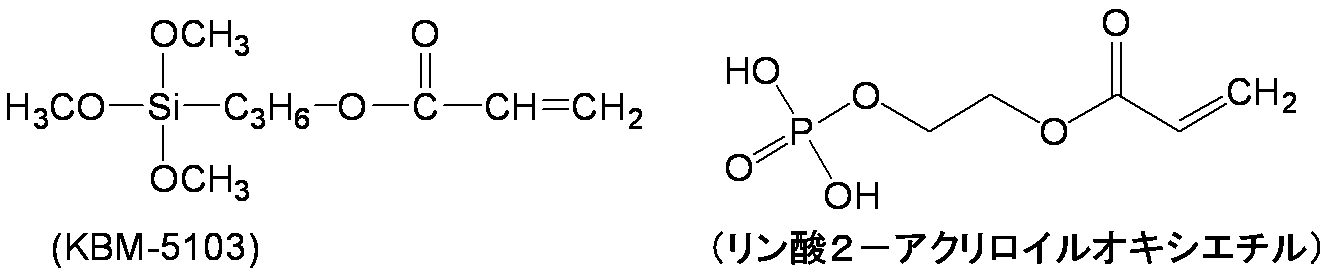
(層3を形成するための素材)
・コート液A:シリコーンコーティング剤KR-400(信越化学工業(株)製、硬化触媒を含むポリシロキサンオリゴマー液)
・コート液B:シリコーンコーティング剤KR-400(信越化学工業(株)製)100質量部にメタアクリレート修飾シランカップリング剤(KBM-503(信越化学工業(株)製)、3-メタクリロキシプロピルトリメトキシシラン)を2.5質量部添加
・コート液C:シリコーンコーティング剤KR-400(信越化学工業(株)製)100質量部に対し、アクリレート修飾ポリシロキサンオリゴマー(KR-513(信越化学工業(株)製))を2.5質量部添加
・コート液D:UV硬化型コート液(LL391(富士フイルムスペシャリティーインクシステムズ社製))
・コート液E:シリコーンコーティング剤KR-400(信越化学工業(株)製、硬化触媒を含むポリシロキサンオリゴマー液)100質量部に対し、光酸発生剤(Triarylsulfonium hexafluorophosphate salts,mixed(407216 Aldrich)アルドリッチ社製)を5質量部添加
なお、シリコーンコーティング剤KR-400は、シロキサンオリゴマー、硬化剤としてアルミニウムキレート化合物、及び、希釈溶剤から構成されるシリコーンコーティング剤である。
・コート液A:シリコーンコーティング剤KR-400(信越化学工業(株)製、硬化触媒を含むポリシロキサンオリゴマー液)
・コート液B:シリコーンコーティング剤KR-400(信越化学工業(株)製)100質量部にメタアクリレート修飾シランカップリング剤(KBM-503(信越化学工業(株)製)、3-メタクリロキシプロピルトリメトキシシラン)を2.5質量部添加
・コート液C:シリコーンコーティング剤KR-400(信越化学工業(株)製)100質量部に対し、アクリレート修飾ポリシロキサンオリゴマー(KR-513(信越化学工業(株)製))を2.5質量部添加
・コート液D:UV硬化型コート液(LL391(富士フイルムスペシャリティーインクシステムズ社製))
・コート液E:シリコーンコーティング剤KR-400(信越化学工業(株)製、硬化触媒を含むポリシロキサンオリゴマー液)100質量部に対し、光酸発生剤(Triarylsulfonium hexafluorophosphate salts,mixed(407216 Aldrich)アルドリッチ社製)を5質量部添加
なお、シリコーンコーティング剤KR-400は、シロキサンオリゴマー、硬化剤としてアルミニウムキレート化合物、及び、希釈溶剤から構成されるシリコーンコーティング剤である。
(印刷機1(層2のプロセス用))
・Luxel Jet 550GTW(富士フイルム(株)製)
(印刷機2(層3のプロセス用))
KEGON((株)アフィット製)に、東芝テック(株)製ヘッドCA4を4個搭載(メタルハライドランプ搭載)
・Luxel Jet 550GTW(富士フイルム(株)製)
(印刷機2(層3のプロセス用))
KEGON((株)アフィット製)に、東芝テック(株)製ヘッドCA4を4個搭載(メタルハライドランプ搭載)
(実施例1)
インク1を充填した印刷機1を用いて、レッド、ブルー、グリーンの画像を陶磁器タイル基材上に印刷した。印刷条件はFineartモード、ランプ強度11(2つのランプとも点灯)、カラープロファイルなし(インク総量制限なし)とした。なお、この条件で印刷した場合、印刷後に普通紙を画像に押し付けた場合、インクの転写がないことを確認した。
上記の印刷物に対して、コート液Aを充填した印刷機2にて、コート層を付与した。打滴密度が600×600dpiに、1画素当たりの液滴量は42±2pLになるように、搬送速度と吐出電圧をそれぞれ調整した。
コート液を付与した印刷物は恒温恒湿条件で40分間放置した。この時、温度は25℃、湿度は60%RHになるように調整した。その後、150℃に設定したオーブンにて、20分間熱処理を加え、評価サンプルを得た。
鉛筆硬度、密着性試験、及び、耐候性試験を下記条件で実施した。結果を表1に示す。
インク1を充填した印刷機1を用いて、レッド、ブルー、グリーンの画像を陶磁器タイル基材上に印刷した。印刷条件はFineartモード、ランプ強度11(2つのランプとも点灯)、カラープロファイルなし(インク総量制限なし)とした。なお、この条件で印刷した場合、印刷後に普通紙を画像に押し付けた場合、インクの転写がないことを確認した。
上記の印刷物に対して、コート液Aを充填した印刷機2にて、コート層を付与した。打滴密度が600×600dpiに、1画素当たりの液滴量は42±2pLになるように、搬送速度と吐出電圧をそれぞれ調整した。
コート液を付与した印刷物は恒温恒湿条件で40分間放置した。この時、温度は25℃、湿度は60%RHになるように調整した。その後、150℃に設定したオーブンにて、20分間熱処理を加え、評価サンプルを得た。
鉛筆硬度、密着性試験、及び、耐候性試験を下記条件で実施した。結果を表1に示す。
(実施例2~8、比較例1~2)
実施例1と同じ条件で、インク、コート液、基材を表1に記載の組み合わせで、多層構成物を作製し、同様の試験を実施した。
実施例1と同じ条件で、インク、コート液、基材を表1に記載の組み合わせで、多層構成物を作製し、同様の試験を実施した。
(実施例9)
インク1を充填した印刷機1を用いて、レッド、ブルー、グリーンの画像を陶磁器タイル基材上に印刷した。印刷条件はFineartモード、ランプ強度5(2つのランプのうち1つのみ点灯)、カラープロファイルなし(インク総量制限なし)とした。なお、この条件で印刷した場合、印刷後に普通紙を画像に押し付けた場合、インクのうち10~20%が転写することを確認した。
上記の印刷物に対して、コート液Aを充填した印刷機2にて、コート液を付与した。打滴密度が600×600dpiに、1画素当たりの液滴量は42±2pLになるように、搬送速度と吐出電圧をそれぞれ調整した。更に、コート液を付与した後にUV露光を施した(照射エネルギーは150mJ/cm2)。
コート液を付与した印刷物は恒温恒湿条件で40分間放置した。この時、温度は25℃、湿度は60%RHになるように調整した。その後、150℃に設定したオーブンにて、20分間熱処理を加え、評価サンプルを得た。
鉛筆硬度、密着性試験、及び、耐候性試験を下記条件で実施した。結果を表1に示す。
インク1を充填した印刷機1を用いて、レッド、ブルー、グリーンの画像を陶磁器タイル基材上に印刷した。印刷条件はFineartモード、ランプ強度5(2つのランプのうち1つのみ点灯)、カラープロファイルなし(インク総量制限なし)とした。なお、この条件で印刷した場合、印刷後に普通紙を画像に押し付けた場合、インクのうち10~20%が転写することを確認した。
上記の印刷物に対して、コート液Aを充填した印刷機2にて、コート液を付与した。打滴密度が600×600dpiに、1画素当たりの液滴量は42±2pLになるように、搬送速度と吐出電圧をそれぞれ調整した。更に、コート液を付与した後にUV露光を施した(照射エネルギーは150mJ/cm2)。
コート液を付与した印刷物は恒温恒湿条件で40分間放置した。この時、温度は25℃、湿度は60%RHになるように調整した。その後、150℃に設定したオーブンにて、20分間熱処理を加え、評価サンプルを得た。
鉛筆硬度、密着性試験、及び、耐候性試験を下記条件で実施した。結果を表1に示す。
(実施例10)
インク1を充填した印刷機1を用いて、レッド、ブルー、グリーンの画像を陶磁器タイル基材上に印刷した。印刷条件はFineartモード、ランプ強度5(2つのランプのうち1つのみ点灯)、カラープロファイルなし(インク総量制限なし)とした。なお、この条件で印刷した場合、印刷後に普通紙を画像に押し付けた場合、インクのうち10~20%が転写することを確認した。
上記の印刷物に対して、コート液Eを充填した印刷機2にて、コート液を付与した。打滴密度が600×600dpiに、1画素当たりの液滴量は42±2pLになるように、搬送速度と吐出電圧をそれぞれ調整した。更に、コート液を付与した後にUV露光を施した(照射エネルギーは150mJ/cm2)。
コート液を付与した印刷物は恒温恒湿条件で20分間放置した。この時、温度は25℃、湿度は60%RHになるように調整した。その後、150℃に設定したオーブンにて、10分間熱処理を加え、評価サンプルを得た。
鉛筆硬度、密着性試験、及び、耐候性試験を下記条件で実施した。結果を表1に示す。
インク1を充填した印刷機1を用いて、レッド、ブルー、グリーンの画像を陶磁器タイル基材上に印刷した。印刷条件はFineartモード、ランプ強度5(2つのランプのうち1つのみ点灯)、カラープロファイルなし(インク総量制限なし)とした。なお、この条件で印刷した場合、印刷後に普通紙を画像に押し付けた場合、インクのうち10~20%が転写することを確認した。
上記の印刷物に対して、コート液Eを充填した印刷機2にて、コート液を付与した。打滴密度が600×600dpiに、1画素当たりの液滴量は42±2pLになるように、搬送速度と吐出電圧をそれぞれ調整した。更に、コート液を付与した後にUV露光を施した(照射エネルギーは150mJ/cm2)。
コート液を付与した印刷物は恒温恒湿条件で20分間放置した。この時、温度は25℃、湿度は60%RHになるように調整した。その後、150℃に設定したオーブンにて、10分間熱処理を加え、評価サンプルを得た。
鉛筆硬度、密着性試験、及び、耐候性試験を下記条件で実施した。結果を表1に示す。
(実施例11)
層2を形成するための素材として、紫外線硬化型スクリーンインク(Omniplus UL、富士フイルムスペシャリティーインクシステムズ社製)を用い、スクリーン印刷機(スベシア社製MATIC)にて、レッド、ブルー、グリーンの画像を陶磁器タイル基材上に印刷した。印刷後に普通紙を画像に押し付けた場合、インクの転写がないことを確認した。
上記の印刷物に対して、コート液Aを充填した印刷機2にて、コート層を付与した。打滴密度が600×600dpiに、1画素当たりの液滴量は42±2pLになるように、搬送速度と吐出電圧をそれぞれ調整した。
コート液を付与した印刷物は恒温恒湿条件で40分間放置した。この時、温度は25℃、湿度は60%RHになるように調整した。その後、150℃に設定したオーブンにて、20分間熱処理を加え、評価サンプルを得た。
鉛筆硬度、密着性試験、及び、耐候性試験を実施例1と同様に実施した。
なお、使用したOmniplus UL シリーズのインクは、MSDSに記載の通り、顔料、2-フェノキシエチルアクリレート、イソボルニルアクリレートなどのラジカル重合性化合物を70~90質量%、ジフェニル(2,4,6-トリメチルベンゾイル)ホスフィンオキシドなどの光重合開始剤を1~5質量%、及び、その他添加剤を含有する、紫外線硬化型スクリーンインクである。
層2を形成するための素材として、紫外線硬化型スクリーンインク(Omniplus UL、富士フイルムスペシャリティーインクシステムズ社製)を用い、スクリーン印刷機(スベシア社製MATIC)にて、レッド、ブルー、グリーンの画像を陶磁器タイル基材上に印刷した。印刷後に普通紙を画像に押し付けた場合、インクの転写がないことを確認した。
上記の印刷物に対して、コート液Aを充填した印刷機2にて、コート層を付与した。打滴密度が600×600dpiに、1画素当たりの液滴量は42±2pLになるように、搬送速度と吐出電圧をそれぞれ調整した。
コート液を付与した印刷物は恒温恒湿条件で40分間放置した。この時、温度は25℃、湿度は60%RHになるように調整した。その後、150℃に設定したオーブンにて、20分間熱処理を加え、評価サンプルを得た。
鉛筆硬度、密着性試験、及び、耐候性試験を実施例1と同様に実施した。
なお、使用したOmniplus UL シリーズのインクは、MSDSに記載の通り、顔料、2-フェノキシエチルアクリレート、イソボルニルアクリレートなどのラジカル重合性化合物を70~90質量%、ジフェニル(2,4,6-トリメチルベンゾイル)ホスフィンオキシドなどの光重合開始剤を1~5質量%、及び、その他添加剤を含有する、紫外線硬化型スクリーンインクである。
(実施例12)
層2を形成するための素材として、ソルベントインクジェットインク(Color+ QJ Series、富士フイルムスペシャリティーインクシステムズ社製)を、印刷機2に充填し、レッド、ブルー、グリーンの画像を陶磁器タイル基材上に印刷した。印刷後、60℃の恒温槽に1時間放置し、普通紙を画像に押し付けた場合、インクの転写がないことを確認した。
上記の印刷物に対して、コート液Aを充填した印刷機2にて、コート層を付与した。打滴密度が600×600dpiに、1画素当たりの液滴量は42±2pLになるように、搬送速度と吐出電圧をそれぞれ調整した。
コート液を付与した印刷物は恒温恒湿条件で40分間放置した。この時、温度は25℃、湿度は60%RHになるように調整した。その後、150℃に設定したオーブンにて、20分間熱処理を加え、評価サンプルを得た。
鉛筆硬度、密着性試験、及び、耐候性試験を実施例1と同様に実施した。
なお、使用したColor+ QJ Seriesのインクは、MSDSに記載の通り、顔料、エチレングリコールモノブチルエーテルアセテート、プロピレングリコール‐1‐メチルエーテル‐2‐アセタートなどの溶剤を70~90質量%、及び、その他添加剤を含有する、ソルベントインクジェットインクである。
層2を形成するための素材として、ソルベントインクジェットインク(Color+ QJ Series、富士フイルムスペシャリティーインクシステムズ社製)を、印刷機2に充填し、レッド、ブルー、グリーンの画像を陶磁器タイル基材上に印刷した。印刷後、60℃の恒温槽に1時間放置し、普通紙を画像に押し付けた場合、インクの転写がないことを確認した。
上記の印刷物に対して、コート液Aを充填した印刷機2にて、コート層を付与した。打滴密度が600×600dpiに、1画素当たりの液滴量は42±2pLになるように、搬送速度と吐出電圧をそれぞれ調整した。
コート液を付与した印刷物は恒温恒湿条件で40分間放置した。この時、温度は25℃、湿度は60%RHになるように調整した。その後、150℃に設定したオーブンにて、20分間熱処理を加え、評価サンプルを得た。
鉛筆硬度、密着性試験、及び、耐候性試験を実施例1と同様に実施した。
なお、使用したColor+ QJ Seriesのインクは、MSDSに記載の通り、顔料、エチレングリコールモノブチルエーテルアセテート、プロピレングリコール‐1‐メチルエーテル‐2‐アセタートなどの溶剤を70~90質量%、及び、その他添加剤を含有する、ソルベントインクジェットインクである。
(評価条件)
鉛筆硬度:ひっかき硬度(鉛筆法、JIS K5600-5-4(ISO/DIN 15184)))に準じた方法を実施した。
密着性試験:クロスカット試験(JIS K5600-5-6(ISO2409))に準じた方法を実施した。なお、試験結果は0~5の6段階に分類され、0が最もよい。
鉛筆硬度:ひっかき硬度(鉛筆法、JIS K5600-5-4(ISO/DIN 15184)))に準じた方法を実施した。
密着性試験:クロスカット試験(JIS K5600-5-6(ISO2409))に準じた方法を実施した。なお、試験結果は0~5の6段階に分類され、0が最もよい。
耐候性試験(色相変化):評価サンプルをQ-Lab社製Xe試験機(機種:Q-SUN、条件:SAEJ2527に準拠)で経時(1,200時間)した。経時前後での色相(La*b*)の変化を比較した。同時に、経時後のサンプルについても、鉛筆硬度と密着性試験を実施した。なお、色相の測定は測色計(SpectroEye、Xrite社製)で測定し、試験前後のタイミングで測定した。評価基準は下記の通りである。
色相の変化の評価基準
A:ΔEが3.0以下
B:ΔEが3.0を超え、6.0以下
C:ΔEが6.0を超え、10.0以下
D:ΔEが10を超える
色相の変化の評価基準
A:ΔEが3.0以下
B:ΔEが3.0を超え、6.0以下
C:ΔEが6.0を超え、10.0以下
D:ΔEが10を超える
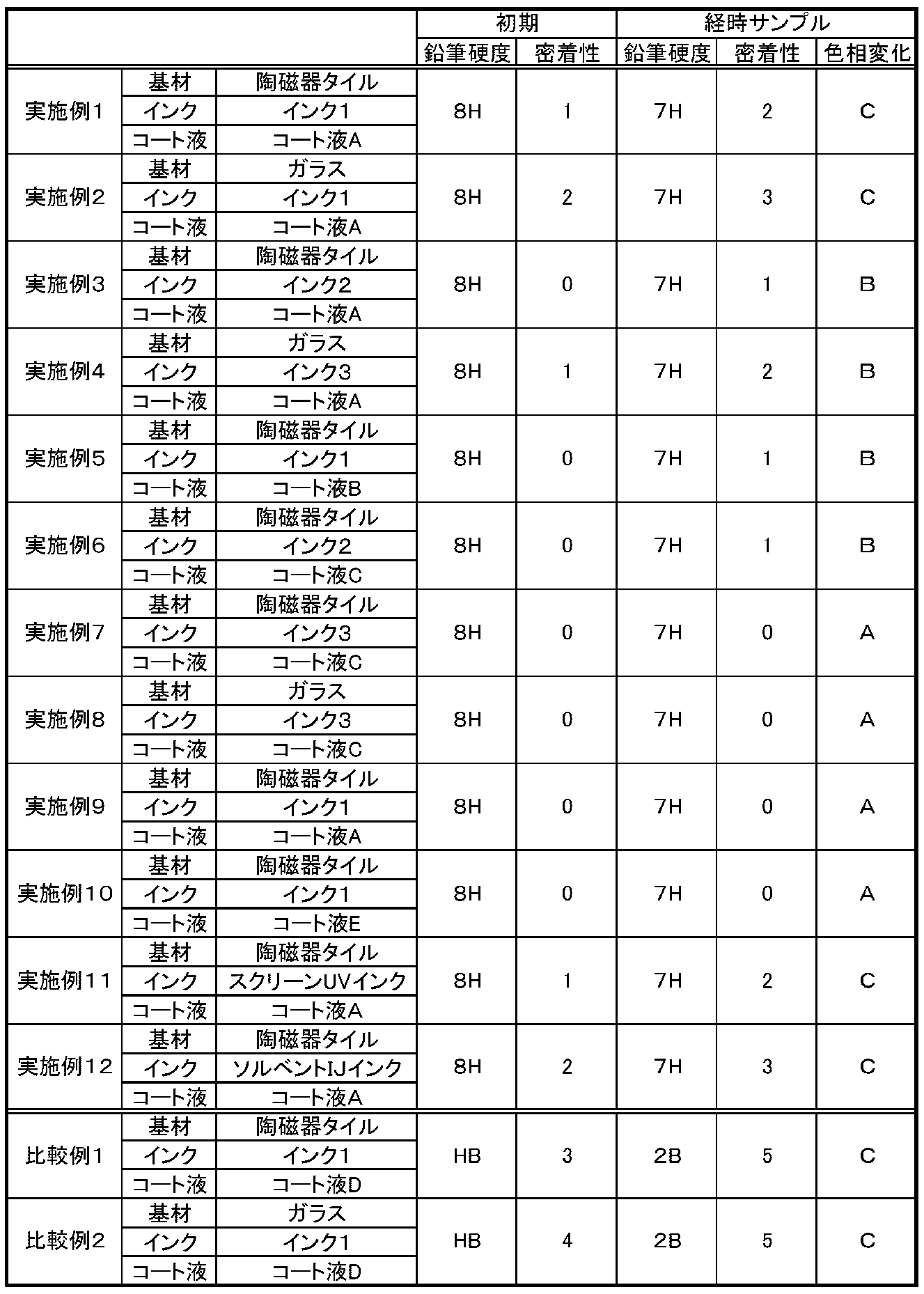
Claims (17)
- (層1)基材層、
(層2)着色顔料を含有する画像層、及び、
(層3)有機ケイ素化合物の縮合反応によって形成された保護層をこの順で有することを特徴とする
多層構成物。 - 層2がインクジェット印刷、又は、スクリーン印刷により形成された画像を有する層である、請求項1に記載の多層構成物。
- 層3において、有機ケイ素化合物がシロキサンオリゴマーを含有する、請求項1又は2に記載の多層構成物。
- 層1が、ガラス、又は、セラミックである、請求項1~3のいずれか1項に記載の多層構成物。
- 層2が、ラジカル重合反応によって生成した高分子により形成された層である、請求項1~4のいずれか1項に記載の多層構成物。
- 層3において、有機ケイ素化合物が(メタ)アクリロイル基含有ポリシロキサン化合物及び/又は(メタ)アクリロイル基含有シランカップリング剤を含有する、請求項1~5のいずれか1項に記載の多層構成物。
- 層2が、(メタ)アクリロイル基含有シランカップリング剤及び/又はリン酸エステル基含有(メタ)アクリレート化合物を共重合して生成した高分子により形成された層である、請求項1~6のいずれか1項に記載の多層構成物。
- 層2が、着色顔料、ラジカル重合性化合物、及び、ラジカル重合開始剤を含む組成物のラジカル重合反応によって形成された層である、請求項1~7のいずれか1項に記載の多層構成物。
- ラジカル重合性化合物として、(メタ)アクリロイル基含有シランカップリング剤及び/又はリン酸エステル基含有(メタ)アクリレート化合物を含有する、請求項8に記載の多層構成物。
- 層3が、有機ケイ素化合物、及び、硬化剤を含む組成物の縮合反応によって形成された層である、請求項1~9のいずれか1項に記載の多層構成物。
- 有機ケイ素化合物が、シロキサンオリゴマーを含有する、請求項10に記載の多層構成物。
- 有機ケイ素化合物が、シロキサンオリゴマーと、(メタ)アクリロイル基含有ポリシロキサン化合物及び/又は(メタ)アクリロイル基含有シランカップリング剤とを含有する、請求項10に記載の多層構成物。
- 下記工程を有することを特徴とする、請求項1~12のいずれか1項に記載の多層構成物の製造方法。
(工程a1)(層1)基材層の上に、インクジェット印刷又はスクリーン印刷にて、着色顔料を含有する組成物を付与して(層2)画像層を形成する工程
(工程b1)層2の上に、有機ケイ素化合物を含有する組成物を付与して(層3)保護層を形成する工程 - 下記工程を有することを特徴とする、請求項1~12のいずれか1項に記載の多層構成物の製造方法。
(工程a2)(層1)基材層の上に、インクジェット印刷又はスクリーン印刷にて、着色顔料を含有する紫外線硬化可能な組成物を付与し、その後に紫外線露光により付与した組成物を硬化させることによって(層2)画像層を形成する工程
(工程b2)層2の上に、有機ケイ素化合物を含有する組成物を付与して(層3)保護層を形成する工程 - 下記工程を有することを特徴とする、請求項1~12のいずれか1項に記載の多層構成物の製造方法。
(工程a3)(層1)基材層の上に、インクジェット印刷又はスクリーン印刷にて、着色顔料を含有する紫外線硬化可能な組成物を付与し、その後に紫外線露光により付与した組成物を硬化させることによって(層2)画像層を形成する工程
(工程b3)層2の上に、有機ケイ素化合物を含有する組成物を付与して(層3)保護層を形成する工程
(工程c3)層3を形成後に紫外線露光を実施する工程 - 層1、層2、及び、層3を形成した後に、加温する工程を更に含む、請求項13~15のいずれか1項に記載の多層構成物の製造方法。
- 層2を形成するための着色顔料を含有する組成物、及び、層3を形成するための有機ケイ素化合物を含有する組成物を含有することを特徴とする、請求項1~12のいずれか1項に記載の多層構成物を製造するための組成物セット。
Priority Applications (2)
| Application Number | Priority Date | Filing Date | Title |
|---|---|---|---|
| CN201480009100.9A CN104995023B (zh) | 2013-03-08 | 2014-03-07 | 多层构成物、多层构成物的制造方法以及组合物组 |
| EP14761106.5A EP2965904B1 (en) | 2013-03-08 | 2014-03-07 | Multilayer structure manufacturing method |
Applications Claiming Priority (2)
| Application Number | Priority Date | Filing Date | Title |
|---|---|---|---|
| JP2013046466A JP5939640B2 (ja) | 2013-03-08 | 2013-03-08 | 多層構成物、及び、多層構成物の製造方法 |
| JP2013-046466 | 2013-03-08 |
Publications (1)
| Publication Number | Publication Date |
|---|---|
| WO2014136924A1 true WO2014136924A1 (ja) | 2014-09-12 |
Family
ID=51491431
Family Applications (1)
| Application Number | Title | Priority Date | Filing Date |
|---|---|---|---|
| PCT/JP2014/055911 Ceased WO2014136924A1 (ja) | 2013-03-08 | 2014-03-07 | 多層構成物、多層構成物の製造方法、及び、組成物セット |
Country Status (4)
| Country | Link |
|---|---|
| EP (1) | EP2965904B1 (ja) |
| JP (1) | JP5939640B2 (ja) |
| CN (1) | CN104995023B (ja) |
| WO (1) | WO2014136924A1 (ja) |
Cited By (1)
| Publication number | Priority date | Publication date | Assignee | Title |
|---|---|---|---|---|
| JP6008436B1 (ja) * | 2015-01-27 | 2016-10-19 | 帝国インキ製造株式会社 | ガラス基材用高品位・高精細スクリーン印刷インキ組成物、当該インキ組成物をスクリーン印刷した印刷物及び当該印刷物の製造方法 |
Families Citing this family (8)
| Publication number | Priority date | Publication date | Assignee | Title |
|---|---|---|---|---|
| WO2016129562A1 (ja) * | 2015-02-10 | 2016-08-18 | 住友ベークライト株式会社 | 化粧シートおよび化粧シートの製造方法 |
| CN108025577B (zh) | 2015-10-06 | 2020-02-14 | 株式会社理光 | 图像形成方法、图像形成设备、激光照射印刷墨和用于制造图像形成物体的方法 |
| CN108508701A (zh) * | 2018-03-21 | 2018-09-07 | 深圳市华星光电技术有限公司 | 一种光刻胶的制备方法,光刻胶及滤光片 |
| WO2019189443A1 (ja) * | 2018-03-30 | 2019-10-03 | 大日本塗料株式会社 | 印刷物 |
| JP7025288B2 (ja) * | 2018-06-19 | 2022-02-24 | 大日本塗料株式会社 | 印刷物 |
| CN115380087B (zh) | 2020-03-25 | 2024-04-02 | 株式会社则武 | 喷墨墨 |
| WO2021193447A1 (ja) * | 2020-03-25 | 2021-09-30 | 株式会社ノリタケカンパニーリミテド | インクジェットインク |
| JP7340306B1 (ja) * | 2023-03-28 | 2023-09-07 | サカタインクス株式会社 | 光硬化型インクジェット印刷用インク組成物 |
Citations (36)
| Publication number | Priority date | Publication date | Assignee | Title |
|---|---|---|---|---|
| JPS5942864B2 (ja) | 1979-04-13 | 1984-10-18 | 京セラミタ株式会社 | 投影用原稿の作成方法及びそれに用いる静電写真用転写フイルム |
| JPS608047B2 (ja) | 1978-07-14 | 1985-02-28 | バスフ アクチェン ゲゼルシャフト | 光硬化性のポリエステル樹脂組成物 |
| JPS6340799B2 (ja) | 1978-07-14 | 1988-08-12 | Basf Ag | |
| JPS6361950B2 (ja) | 1981-03-16 | 1988-11-30 | ||
| JPH03101686A (ja) | 1989-08-04 | 1991-04-26 | Ciba Geigy Ag | モノ―及びジ―アシルホスフィンオキシド |
| JPH05345790A (ja) | 1991-09-23 | 1993-12-27 | Ciba Geigy Ag | アルキルビスアシルホスフインオキシド |
| JPH06298818A (ja) | 1993-03-18 | 1994-10-25 | Ciba Geigy Ag | ビスアシルホスフィンオキシド光開始剤を含む硬化組成物 |
| JPH0965946A (ja) * | 1995-08-30 | 1997-03-11 | Toppan Printing Co Ltd | 化粧板 |
| WO1997048769A1 (en) | 1996-06-17 | 1997-12-24 | Cabot Corporation | Colored pigment and aqueous compositions containing same |
| JPH10110129A (ja) | 1996-10-07 | 1998-04-28 | Toyo Ink Mfg Co Ltd | インクジェット用記録液 |
| JPH1149974A (ja) | 1996-12-20 | 1999-02-23 | Seiko Epson Corp | 顔料塊状体及びその製造方法、顔料水系分散液、並びに水系インク組成物 |
| JPH1157458A (ja) | 1997-08-14 | 1999-03-02 | Stanley Electric Co Ltd | 超微粒子の製造方法及び改質した超微粒子材料 |
| JPH11189739A (ja) | 1997-10-22 | 1999-07-13 | Orient Chem Ind Ltd | 水性顔料インキ組成物 |
| JPH11246807A (ja) | 1998-03-02 | 1999-09-14 | Toyo Ink Mfg Co Ltd | 水性顔料分散体およびインクジェット用記録液 |
| JPH11265094A (ja) | 1998-01-16 | 1999-09-28 | Ricoh Co Ltd | 画像形成方法 |
| JPH11323232A (ja) | 1998-05-13 | 1999-11-26 | Toyo Ink Mfg Co Ltd | インクジェット用記録液およびそれを用いた記録方法 |
| JP2000093890A (ja) * | 1998-09-18 | 2000-04-04 | Kajima Corp | 防水層の劣化防止法 |
| JP2000273383A (ja) | 1999-03-23 | 2000-10-03 | Toyo Ink Mfg Co Ltd | 水系顔料分散体およびインクジェット用記録液 |
| JP2000303014A (ja) | 1999-04-19 | 2000-10-31 | Toyo Ink Mfg Co Ltd | 水系顔料分散体およびインクジェット用記録液 |
| JP2002012607A (ja) | 2000-06-28 | 2002-01-15 | Mitsubishi Chemicals Corp | 光重合性組成物、光重合性着色組成物およびカラーフィルター |
| JP2002029162A (ja) | 2000-07-13 | 2002-01-29 | Fuji Photo Film Co Ltd | 平版印刷用原板 |
| JP2002179977A (ja) | 2000-12-12 | 2002-06-26 | Konica Corp | 顔料分散体の製造方法および顔料インク |
| JP2002188025A (ja) | 2000-10-10 | 2002-07-05 | Toyo Ink Mfg Co Ltd | 活性エネルギー線硬化型インクジェットインキ |
| JP2002200455A (ja) * | 2000-12-28 | 2002-07-16 | Chugoku Marine Paints Ltd | 複合体、該複合体からなる塗膜で被覆された基材、塗膜付き基材の製造方法 |
| JP2002201401A (ja) | 2001-01-09 | 2002-07-19 | Konica Corp | 顔料分散体及びインクジェット用インク |
| JP2003026978A (ja) | 1998-09-08 | 2003-01-29 | Ricoh Co Ltd | 記録液体 |
| JP2003342503A (ja) | 2002-05-28 | 2003-12-03 | Konica Minolta Holdings Inc | インクジェット記録用ブラックインクおよび画像形成方法 |
| JP2005043876A (ja) | 2003-07-09 | 2005-02-17 | Jsr Corp | 感光性含フッ素樹脂組成物、該組成物から得られる硬化膜、およびパターン形成方法 |
| JP2006263920A (ja) * | 2005-03-22 | 2006-10-05 | Shinto Paint Co Ltd | 無機塗料組成物を塗装した塗装物品 |
| JP2007514804A (ja) | 2003-11-14 | 2007-06-07 | クラリアント・プロドゥクテ(ドイチュラント)ゲーエムベーハー | 黄色のジスアゾ顔料および有機顔料からなる顔料組成物 |
| WO2008032722A1 (en) * | 2006-09-14 | 2008-03-20 | Toray Industries, Inc. | Coating material, optical article using the same, and method for producing optical article |
| JP2008536791A (ja) * | 2005-04-19 | 2008-09-11 | ショット アクチエンゲゼルシャフト | 装飾コーティングを有するガラス、又はガラス・セラミック製品 |
| JP2009221416A (ja) | 2008-03-18 | 2009-10-01 | Fujifilm Corp | インクセット、及び、インクジェット記録方法 |
| DE102009004783A1 (de) * | 2009-01-13 | 2010-07-22 | Schott Ag | Glimmerreduzierte Versiegelungsschicht für Dekorschichten von Glas- oder Glaskeramik-Artikeln |
| WO2012010302A1 (de) * | 2010-07-21 | 2012-01-26 | Schott Ag | Silikonbeschichtung als versiegelungsschicht für eine dekorbeschichtung |
| JP2012184404A (ja) | 2011-02-16 | 2012-09-27 | Fujifilm Corp | インクジェットインク組成物及びその製造方法、並びに、インクジェット記録方法 |
Family Cites Families (8)
| Publication number | Priority date | Publication date | Assignee | Title |
|---|---|---|---|---|
| US20070085983A1 (en) * | 2005-10-17 | 2007-04-19 | Photo Man Image Corporation | Digital ink jet printing process |
| GB0805493D0 (en) * | 2008-03-26 | 2008-04-30 | Sun Chemical Bv | A jet ink and ink jet printing process |
| TR201903038T4 (tr) * | 2008-04-22 | 2019-03-21 | Yurievich Mirchev Vladislav | Bir maddenin kürlenmesine yönelik yöntem, söz konusu yöntemin gerçekleştirilmesine yönelik cihaz ve mürekkep. |
| US20120077896A1 (en) * | 2009-06-05 | 2012-03-29 | Dnp Fine Chemicals Co Ltd | Active energy ray curable-type inkjet recording ink composition |
| CN101709179A (zh) * | 2009-12-08 | 2010-05-19 | 杭华油墨化学有限公司 | 无溶剂紫外光固化玻璃油墨及制备方法 |
| EP2497647A1 (en) * | 2011-02-15 | 2012-09-12 | Bergstein B.V. | Process for decorating glazed ceramic tiles |
| CN102638947B (zh) * | 2012-04-24 | 2014-12-31 | 杭州新三联电子有限公司 | 银浆跨线印制线路板生产工艺 |
| CN102786839B (zh) * | 2012-07-31 | 2014-07-09 | 佛山市三求电子材料有限公司 | 玻璃保护油墨及其制备方法 |
-
2013
- 2013-03-08 JP JP2013046466A patent/JP5939640B2/ja active Active
-
2014
- 2014-03-07 WO PCT/JP2014/055911 patent/WO2014136924A1/ja not_active Ceased
- 2014-03-07 EP EP14761106.5A patent/EP2965904B1/en active Active
- 2014-03-07 CN CN201480009100.9A patent/CN104995023B/zh active Active
Patent Citations (36)
| Publication number | Priority date | Publication date | Assignee | Title |
|---|---|---|---|---|
| JPS608047B2 (ja) | 1978-07-14 | 1985-02-28 | バスフ アクチェン ゲゼルシャフト | 光硬化性のポリエステル樹脂組成物 |
| JPS6340799B2 (ja) | 1978-07-14 | 1988-08-12 | Basf Ag | |
| JPS5942864B2 (ja) | 1979-04-13 | 1984-10-18 | 京セラミタ株式会社 | 投影用原稿の作成方法及びそれに用いる静電写真用転写フイルム |
| JPS6361950B2 (ja) | 1981-03-16 | 1988-11-30 | ||
| JPH03101686A (ja) | 1989-08-04 | 1991-04-26 | Ciba Geigy Ag | モノ―及びジ―アシルホスフィンオキシド |
| JPH05345790A (ja) | 1991-09-23 | 1993-12-27 | Ciba Geigy Ag | アルキルビスアシルホスフインオキシド |
| JPH06298818A (ja) | 1993-03-18 | 1994-10-25 | Ciba Geigy Ag | ビスアシルホスフィンオキシド光開始剤を含む硬化組成物 |
| JPH0965946A (ja) * | 1995-08-30 | 1997-03-11 | Toppan Printing Co Ltd | 化粧板 |
| WO1997048769A1 (en) | 1996-06-17 | 1997-12-24 | Cabot Corporation | Colored pigment and aqueous compositions containing same |
| JPH10110129A (ja) | 1996-10-07 | 1998-04-28 | Toyo Ink Mfg Co Ltd | インクジェット用記録液 |
| JPH1149974A (ja) | 1996-12-20 | 1999-02-23 | Seiko Epson Corp | 顔料塊状体及びその製造方法、顔料水系分散液、並びに水系インク組成物 |
| JPH1157458A (ja) | 1997-08-14 | 1999-03-02 | Stanley Electric Co Ltd | 超微粒子の製造方法及び改質した超微粒子材料 |
| JPH11189739A (ja) | 1997-10-22 | 1999-07-13 | Orient Chem Ind Ltd | 水性顔料インキ組成物 |
| JPH11265094A (ja) | 1998-01-16 | 1999-09-28 | Ricoh Co Ltd | 画像形成方法 |
| JPH11246807A (ja) | 1998-03-02 | 1999-09-14 | Toyo Ink Mfg Co Ltd | 水性顔料分散体およびインクジェット用記録液 |
| JPH11323232A (ja) | 1998-05-13 | 1999-11-26 | Toyo Ink Mfg Co Ltd | インクジェット用記録液およびそれを用いた記録方法 |
| JP2003026978A (ja) | 1998-09-08 | 2003-01-29 | Ricoh Co Ltd | 記録液体 |
| JP2000093890A (ja) * | 1998-09-18 | 2000-04-04 | Kajima Corp | 防水層の劣化防止法 |
| JP2000273383A (ja) | 1999-03-23 | 2000-10-03 | Toyo Ink Mfg Co Ltd | 水系顔料分散体およびインクジェット用記録液 |
| JP2000303014A (ja) | 1999-04-19 | 2000-10-31 | Toyo Ink Mfg Co Ltd | 水系顔料分散体およびインクジェット用記録液 |
| JP2002012607A (ja) | 2000-06-28 | 2002-01-15 | Mitsubishi Chemicals Corp | 光重合性組成物、光重合性着色組成物およびカラーフィルター |
| JP2002029162A (ja) | 2000-07-13 | 2002-01-29 | Fuji Photo Film Co Ltd | 平版印刷用原板 |
| JP2002188025A (ja) | 2000-10-10 | 2002-07-05 | Toyo Ink Mfg Co Ltd | 活性エネルギー線硬化型インクジェットインキ |
| JP2002179977A (ja) | 2000-12-12 | 2002-06-26 | Konica Corp | 顔料分散体の製造方法および顔料インク |
| JP2002200455A (ja) * | 2000-12-28 | 2002-07-16 | Chugoku Marine Paints Ltd | 複合体、該複合体からなる塗膜で被覆された基材、塗膜付き基材の製造方法 |
| JP2002201401A (ja) | 2001-01-09 | 2002-07-19 | Konica Corp | 顔料分散体及びインクジェット用インク |
| JP2003342503A (ja) | 2002-05-28 | 2003-12-03 | Konica Minolta Holdings Inc | インクジェット記録用ブラックインクおよび画像形成方法 |
| JP2005043876A (ja) | 2003-07-09 | 2005-02-17 | Jsr Corp | 感光性含フッ素樹脂組成物、該組成物から得られる硬化膜、およびパターン形成方法 |
| JP2007514804A (ja) | 2003-11-14 | 2007-06-07 | クラリアント・プロドゥクテ(ドイチュラント)ゲーエムベーハー | 黄色のジスアゾ顔料および有機顔料からなる顔料組成物 |
| JP2006263920A (ja) * | 2005-03-22 | 2006-10-05 | Shinto Paint Co Ltd | 無機塗料組成物を塗装した塗装物品 |
| JP2008536791A (ja) * | 2005-04-19 | 2008-09-11 | ショット アクチエンゲゼルシャフト | 装飾コーティングを有するガラス、又はガラス・セラミック製品 |
| WO2008032722A1 (en) * | 2006-09-14 | 2008-03-20 | Toray Industries, Inc. | Coating material, optical article using the same, and method for producing optical article |
| JP2009221416A (ja) | 2008-03-18 | 2009-10-01 | Fujifilm Corp | インクセット、及び、インクジェット記録方法 |
| DE102009004783A1 (de) * | 2009-01-13 | 2010-07-22 | Schott Ag | Glimmerreduzierte Versiegelungsschicht für Dekorschichten von Glas- oder Glaskeramik-Artikeln |
| WO2012010302A1 (de) * | 2010-07-21 | 2012-01-26 | Schott Ag | Silikonbeschichtung als versiegelungsschicht für eine dekorbeschichtung |
| JP2012184404A (ja) | 2011-02-16 | 2012-09-27 | Fujifilm Corp | インクジェットインク組成物及びその製造方法、並びに、インクジェット記録方法 |
Non-Patent Citations (8)
| Title |
|---|
| "UV-EB Koka Gijutsu no Oyo to Shijyo (Application and Market of UV-EB Curing Technology),", 1989, CMC, pages: 79 |
| E. TAKIYAMA: "Poriesuteru Jushi Handobukku(Polyester Resin Handbook),", 1988, THE NIKKAN KOGYO SHIMBUN LTD. |
| J. P. FOUASSIER; J. F. RABEK, RADIATION CURING IN POLYMER SCIENCE AND TECHNOLOGY, 1993, pages 77 - 117 |
| JOURNAL OF THE ADHESION SOCIETY OF JAPAN, vol. 20, no. 7, 1984, pages 300 - 308 |
| JUNJI FURUKAWA: "Origomar Handobukku (Oligomer Handbook)", THE CHEMICAL DAILY CO., LTD. |
| K. KATO: "UV-EB Koka Handobukku (Genryohen)", 1985, KOBUNSHI KANKOUKAI |
| S. YAMASHITA: "Kakyozai Handobukku", 1981, TAISEISHA |
| SEIJIROU ITO: "Ganryo no Jiten (Dictionary of Pigments)", 2000, article W. HERBST; K. HUNGER: "Industrial Organic Pigments" |
Cited By (2)
| Publication number | Priority date | Publication date | Assignee | Title |
|---|---|---|---|---|
| JP6008436B1 (ja) * | 2015-01-27 | 2016-10-19 | 帝国インキ製造株式会社 | ガラス基材用高品位・高精細スクリーン印刷インキ組成物、当該インキ組成物をスクリーン印刷した印刷物及び当該印刷物の製造方法 |
| US9879145B2 (en) | 2015-01-27 | 2018-01-30 | Teikoku Printing Inks Mfg. Co. Ltd. | High-quality/high-definition screen printing ink composition for glass substrate, printed product obtained by screen printing said ink composition, and manufacturing method for said printed product |
Also Published As
| Publication number | Publication date |
|---|---|
| JP2014172271A (ja) | 2014-09-22 |
| EP2965904B1 (en) | 2020-04-22 |
| JP5939640B2 (ja) | 2016-06-22 |
| CN104995023B (zh) | 2017-08-22 |
| EP2965904A1 (en) | 2016-01-13 |
| CN104995023A (zh) | 2015-10-21 |
| EP2965904A4 (en) | 2016-12-14 |
Similar Documents
| Publication | Publication Date | Title |
|---|---|---|
| JP5939640B2 (ja) | 多層構成物、及び、多層構成物の製造方法 | |
| EP2152437B1 (en) | Radiation curable inks | |
| CN103242702B (zh) | 紫外线固化型喷墨用组合物和记录物 | |
| EP2268750B1 (en) | A jet ink and ink jet printing process | |
| US20080090929A1 (en) | Ink compositions and methods of use thereof | |
| EP3715094B1 (en) | Composition for model material | |
| JP2010506966A (ja) | 放射線硬化性でありおよび噴射可能なインク組成物 | |
| CN102459476A (zh) | 活性能量射线固化型喷墨记录用油墨组合物 | |
| WO2009048585A1 (en) | Radiation curable and jettable ink compositions | |
| JP6064555B2 (ja) | 紫外線硬化型インクジェット用組成物および記録物 | |
| WO2012133667A1 (ja) | 複層塗膜及び該複層塗膜の製造方法 | |
| WO2017086224A1 (ja) | 光重合開始剤及びその製造方法、重合性組成物、インクジェット記録方法、並びに、アシルホスフィンオキシド化合物 | |
| WO2012117944A1 (ja) | インク組成物、画像形成方法及び印画物 | |
| JPWO2018159236A1 (ja) | インクジェット用液体組成物、及び、インクジェット記録方法 | |
| EP2287218B1 (en) | Pigment dispersant, pigment dispersion and method for producing the same, ink composition, ink set, and image-forming method | |
| JP5793982B2 (ja) | 紫外線硬化型インクジェット組成物および記録物 | |
| JP2014109007A (ja) | 紫外線硬化型インクジェット用組成物および記録物 | |
| JP2017171702A (ja) | 活性エネルギー線硬化型組成物、活性エネルギー線硬化型インク、インク収容容器、活性エネルギー線硬化型組成物を用いた像形成装置と像形成方法 | |
| JP2025107258A (ja) | 熱硬化性組成物及び熱硬化性インクジェットインク | |
| WO2014157130A1 (ja) | インクジェット記録方法、印刷物、及び、インクセット | |
| JP2019163382A (ja) | インク組成物、液体吐出装置用インク組成物、像形成装置、及び像形成方法 |
Legal Events
| Date | Code | Title | Description |
|---|---|---|---|
| 121 | Ep: the epo has been informed by wipo that ep was designated in this application |
Ref document number: 14761106 Country of ref document: EP Kind code of ref document: A1 |
|
| WWE | Wipo information: entry into national phase |
Ref document number: 2014761106 Country of ref document: EP |
|
| NENP | Non-entry into the national phase |
Ref country code: DE |