WO2014156253A1 - Dispositif endoscopique - Google Patents
Dispositif endoscopique Download PDFInfo
- Publication number
- WO2014156253A1 WO2014156253A1 PCT/JP2014/051368 JP2014051368W WO2014156253A1 WO 2014156253 A1 WO2014156253 A1 WO 2014156253A1 JP 2014051368 W JP2014051368 W JP 2014051368W WO 2014156253 A1 WO2014156253 A1 WO 2014156253A1
- Authority
- WO
- WIPO (PCT)
- Prior art keywords
- illumination
- brightness
- light
- band
- processing unit
- Prior art date
- Legal status (The legal status is an assumption and is not a legal conclusion. Google has not performed a legal analysis and makes no representation as to the accuracy of the status listed.)
- Ceased
Links
Images



Classifications
-
- A—HUMAN NECESSITIES
- A61—MEDICAL OR VETERINARY SCIENCE; HYGIENE
- A61B—DIAGNOSIS; SURGERY; IDENTIFICATION
- A61B1/00—Instruments for performing medical examinations of the interior of cavities or tubes of the body by visual or photographical inspection, e.g. endoscopes; Illuminating arrangements therefor
- A61B1/00002—Operational features of endoscopes
- A61B1/00004—Operational features of endoscopes characterised by electronic signal processing
- A61B1/00009—Operational features of endoscopes characterised by electronic signal processing of image signals during a use of endoscope
-
- A—HUMAN NECESSITIES
- A61—MEDICAL OR VETERINARY SCIENCE; HYGIENE
- A61B—DIAGNOSIS; SURGERY; IDENTIFICATION
- A61B1/00—Instruments for performing medical examinations of the interior of cavities or tubes of the body by visual or photographical inspection, e.g. endoscopes; Illuminating arrangements therefor
- A61B1/04—Instruments for performing medical examinations of the interior of cavities or tubes of the body by visual or photographical inspection, e.g. endoscopes; Illuminating arrangements therefor combined with photographic or television appliances
- A61B1/05—Instruments for performing medical examinations of the interior of cavities or tubes of the body by visual or photographical inspection, e.g. endoscopes; Illuminating arrangements therefor combined with photographic or television appliances characterised by the image sensor, e.g. camera, being in the distal end portion
-
- A—HUMAN NECESSITIES
- A61—MEDICAL OR VETERINARY SCIENCE; HYGIENE
- A61B—DIAGNOSIS; SURGERY; IDENTIFICATION
- A61B1/00—Instruments for performing medical examinations of the interior of cavities or tubes of the body by visual or photographical inspection, e.g. endoscopes; Illuminating arrangements therefor
- A61B1/06—Instruments for performing medical examinations of the interior of cavities or tubes of the body by visual or photographical inspection, e.g. endoscopes; Illuminating arrangements therefor with illuminating arrangements
- A61B1/0638—Instruments for performing medical examinations of the interior of cavities or tubes of the body by visual or photographical inspection, e.g. endoscopes; Illuminating arrangements therefor with illuminating arrangements providing two or more wavelengths
-
- A—HUMAN NECESSITIES
- A61—MEDICAL OR VETERINARY SCIENCE; HYGIENE
- A61B—DIAGNOSIS; SURGERY; IDENTIFICATION
- A61B1/00—Instruments for performing medical examinations of the interior of cavities or tubes of the body by visual or photographical inspection, e.g. endoscopes; Illuminating arrangements therefor
- A61B1/06—Instruments for performing medical examinations of the interior of cavities or tubes of the body by visual or photographical inspection, e.g. endoscopes; Illuminating arrangements therefor with illuminating arrangements
- A61B1/0646—Instruments for performing medical examinations of the interior of cavities or tubes of the body by visual or photographical inspection, e.g. endoscopes; Illuminating arrangements therefor with illuminating arrangements with illumination filters
-
- A—HUMAN NECESSITIES
- A61—MEDICAL OR VETERINARY SCIENCE; HYGIENE
- A61B—DIAGNOSIS; SURGERY; IDENTIFICATION
- A61B1/00—Instruments for performing medical examinations of the interior of cavities or tubes of the body by visual or photographical inspection, e.g. endoscopes; Illuminating arrangements therefor
- A61B1/06—Instruments for performing medical examinations of the interior of cavities or tubes of the body by visual or photographical inspection, e.g. endoscopes; Illuminating arrangements therefor with illuminating arrangements
- A61B1/07—Instruments for performing medical examinations of the interior of cavities or tubes of the body by visual or photographical inspection, e.g. endoscopes; Illuminating arrangements therefor with illuminating arrangements using light-conductive means, e.g. optical fibres
-
- G—PHYSICS
- G06—COMPUTING OR CALCULATING; COUNTING
- G06T—IMAGE DATA PROCESSING OR GENERATION, IN GENERAL
- G06T5/00—Image enhancement or restoration
- G06T5/50—Image enhancement or restoration using two or more images, e.g. averaging or subtraction
-
- G—PHYSICS
- G06—COMPUTING OR CALCULATING; COUNTING
- G06T—IMAGE DATA PROCESSING OR GENERATION, IN GENERAL
- G06T2207/00—Indexing scheme for image analysis or image enhancement
- G06T2207/10—Image acquisition modality
- G06T2207/10024—Color image
-
- G—PHYSICS
- G06—COMPUTING OR CALCULATING; COUNTING
- G06T—IMAGE DATA PROCESSING OR GENERATION, IN GENERAL
- G06T2207/00—Indexing scheme for image analysis or image enhancement
- G06T2207/10—Image acquisition modality
- G06T2207/10068—Endoscopic image
-
- G—PHYSICS
- G06—COMPUTING OR CALCULATING; COUNTING
- G06T—IMAGE DATA PROCESSING OR GENERATION, IN GENERAL
- G06T2207/00—Indexing scheme for image analysis or image enhancement
- G06T2207/10—Image acquisition modality
- G06T2207/10141—Special mode during image acquisition
- G06T2207/10152—Varying illumination
-
- G—PHYSICS
- G06—COMPUTING OR CALCULATING; COUNTING
- G06T—IMAGE DATA PROCESSING OR GENERATION, IN GENERAL
- G06T2207/00—Indexing scheme for image analysis or image enhancement
- G06T2207/20—Special algorithmic details
- G06T2207/20212—Image combination
- G06T2207/20221—Image fusion; Image merging
-
- G—PHYSICS
- G06—COMPUTING OR CALCULATING; COUNTING
- G06T—IMAGE DATA PROCESSING OR GENERATION, IN GENERAL
- G06T2207/00—Indexing scheme for image analysis or image enhancement
- G06T2207/30—Subject of image; Context of image processing
- G06T2207/30004—Biomedical image processing
Definitions
- the present invention relates to an endoscope apparatus suitable for narrowband light observation.
- a medical endoscope requires a light source device that illuminates the inside of the living body because the site to be observed is inside the living body. Illumination light generated by the light source device is irradiated to the observation target tissue from the distal end portion where the imaging unit is located through a light guide inserted through the insertion portion of the endoscope.
- white light sources are transmitted through a rotary filter, so that illumination light of three colors of R, G, and B is sequentially irradiated onto a tissue in a body cavity. Then, the reflected light images corresponding to the three colors of R, G, and B are acquired in a time-sharing manner, and a color image for performing normal light observation is generated from each reflected light image.
- the invention of International Publication No. WO2010 / 131620 is configured to be capable of sequentially irradiating green narrowband light G and two blue narrowband lights B1 and B2.
- narrowband light observation is performed using a narrowband light observation image created from reflected light images (narrowband images) corresponding to the narrowband light G, B1, and B2. It has become.
- it is used for addition of an image obtained when the narrowband light B1 is irradiated and an image obtained when the narrowband light B2 is irradiated. The amount of addition is determined based on the average brightness of the image.
- the present invention has been made in view of the above-described circumstances, and an object of the present invention is to provide an endoscope apparatus capable of improving the image quality of a narrow-band light observation image as compared with the conventional art.
- the endoscope apparatus performs illumination with illumination light of the first band once in a predetermined time, and illumination with illumination light of the second band N times (N ⁇ 2).
- an illuminating unit to be performed, and a subject illuminated by the illuminating unit are imaged, and a first imaging signal based on illumination of illumination light in the first band and illumination based on illumination of illumination light in the second band
- An image pickup unit that outputs two image pickup signals
- a clip processing unit that performs processing for limiting upper limit values of luminance values in the first image pickup signal and the second image pickup signal according to a clip level
- the first The first brightness is obtained by color conversion matrix processing using a first imaging signal based on illumination with illumination light of a certain band and a second imaging signal based on K times (an integer of 1 ⁇ K ⁇ N).
- Calculating and first imaging based on illumination by illumination light in the first band A brightness calculation unit for calculating the second brightness by color conversion matrix processing using the second imaging signal based on the number and the NK times illumination, and a brightness target value and the first brightness
- a composite ratio calculation unit that calculates a composite ratio according to the difference value, and the composite ratio calculated by the composite ratio calculation unit with respect to the first and second imaging signals that are the sources of the second brightness And then combining the first and second imaging signals that are the sources of the first brightness, and controlling the illumination unit based on the brightness target value and the difference value.
- the dimming control unit for adjusting the amount of illumination light in the first band and the amount of illumination light in the second band, and the combination ratio calculated by the combination ratio calculation unit Set the clip level and the brightness target value accordingly. It has a tough, a.
- the block diagram which shows an example of a structure of the endoscope apparatus which concerns on the Example of this invention.
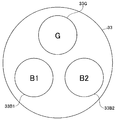
- the figure which shows an example of a structure of the rotation filter provided in the light source device.
- the block diagram which shows an example of a specific structure of a brightness calculation process part.
- the figure which shows an example of the correlation between the composition ratio a and the clip brightness
- FIG. 1 is a block diagram illustrating a configuration of an endoscope apparatus according to an embodiment of the present invention.
- an endoscope apparatus 1 includes an endoscope 2 for observing the inside of a living body as a subject, and a light source that emits narrow-band illumination light for observing the inside of the living body.
- the apparatus 3 and the image processing apparatus 4 which performs signal processing with respect to the imaging signal imaged under the narrow band illumination light are provided.
- the narrow band image generated by the image processing device 4 is supplied to the monitor 5.
- the monitor 5 a normal color monitor can be adopted. That is, the monitor 5 includes an RGB input terminal (not shown), and R, G, and B image signals are supplied to the RGB input terminal to perform color display.
- the endoscope 2 has a flexible insertion portion 21 having an outer diameter that can be inserted into a body cavity, and guides light emitted from the light source device 3 inside the insertion portion 21.
- a light guide fiber 26 made of quartz fiber or the like is inserted.
- One end of the light guide fiber 26 is connected to a connector 27 that is detachably connected to the light source device 3.
- the other end of the light guide fiber 26 is disposed in the vicinity of the illumination lens 23 provided at the distal end portion 22 at the distal end of the insertion portion 21.
- the connector 27 is connected to the light source device 3 and also to the image processing device 4 described later.
- the illumination light from the light source device 3 is guided to the distal end portion 22 of the insertion portion 21 by the light guide fiber 26, is diffused by the illumination lens 23, and is irradiated onto the subject.
- an objective lens 24 for connecting an optical image of the subject by return light from the subject, and a CCD (charge coupled device) 25 as an imaging device disposed at the imaging position are provided at the distal end portion 22. Is provided.
- the CCD 25 constituting the imaging means is driven by a CCD drive circuit (not shown) provided in the image processing device 4 (not shown), images the subject, converts the captured optical image of the subject into a video signal, The image is output to the image processing device 4.
- the light source device 3 includes a light source 31 constituted by a xenon lamp or the like.
- the light source 31 emits light in a wavelength band close to white light.
- a narrow band filter 32, a rotary filter 33 and a diaphragm 34 are disposed on the irradiation light path of the light source 31.
- the narrow band filter 32 narrows the band of light emitted from the light source 31 and emits it to the rotary filter 33.
- the rotary filter 33 limits the band of light that has passed through the narrow band filter 32 to a wavelength band necessary for narrow band light observation.
- the diaphragm 34 adjusts the amount of light by limiting the amount of light that has passed through the rotary filter 33.
- the aperture amount of the aperture 34 is controlled by a dimming control unit 49 described later.
- FIG. 2 is a diagram illustrating an example of a configuration of a rotary filter provided in the light source device.
- the rotary filter 33 has a disk shape, and three openings are provided at equal angles in the circumferential direction, and filters 33G, 33B1, and 33B2 are attached to the three openings, respectively.
- the filter 33G has a green (G) wavelength band as a transmission band
- the filters 33B1 and 33B2 have a blue (B) wavelength band as a transmission band.
- a narrow band G illumination light of 530-550 nm centered at 540 nm is transmitted from the filter 33G, and for example, 400-430 nm centered at 415 nm is transmitted from the filter 33B1.
- N-band B illumination light (hereinafter referred to as B1 illumination light) is transmitted, and the filter 33B2 transmits, for example, 400-430 nm narrow-band B illumination light (hereinafter referred to as B2) centered on 415 nm, in the same manner as the filter 33B1.
- B1 illumination light 400-430 nm narrow-band B illumination light
- B2 illumination light transmitted through the filters 33B1 and 33B2 have the same wavelength band.
- the center of the rotary filter 33 is attached to a rotary shaft of a rotary motor (not shown) and is driven to rotate.
- An encoder (not shown) is attached to the rotation shaft of the rotation motor, and the rotation of the rotation motor, that is, the rotation of the rotation filter 33 can be detected by the encoder.
- the image processing apparatus 4 to be described later controls the rotation of the rotation motor so that the rotation speed of the rotation filter 33 is constant (not shown).
- the light source device 3 performs imaging on the subject using narrow-band illumination light. For this reason, the amount of illumination light tends to be insufficient as compared to the case of using broadband illumination light that is normally widely used.
- the transmission loss on the short wavelength B side tends to be larger due to the optical transmission characteristics of the light guide fiber 26, and the B illumination light is emitted when emitted from the illumination lens 23 of the tip 22 as illumination light. The amount of light tends to be small.
- two filters 33B1 and 33B2 having the same transmission characteristic are arranged in the circumferential direction of the rotary filter 33, and each time the rotary filter 33 is rotated once by using these two filters 33B1 and 33B2. Then, the B illumination light is irradiated twice on the same part of the subject to be observed, and the imaging is performed twice based on the B illumination light by the return light.
- the rotation filter 33 is rotated once in a 1.5 frame period, and imaging with B illumination light is performed twice. The brightness of the captured image (B captured image) based on the B illumination light is improved by combining the two captured images.
- imaging with the G illumination light is performed once and imaging with the B illumination light is performed twice in the 1.5 frame period will be described. It can be set.
- the B1 captured image based on the return light of the narrow-band B1 illumination light and the B2 captured image based on the return light of the B2 illumination light are temporally shifted images, and the image quality deteriorates by combining these images.
- the image quality deteriorates by combining these images.
- synthesis is not performed.
- a captured image with sufficient brightness cannot be obtained with only one of the narrow-band B1 illumination light and B2 illumination light
- a captured image based on the other B illumination light is synthesized according to the brightness. As a result, a captured image with sufficient brightness is obtained while image quality deterioration is suppressed.
- the image processing apparatus 4 performs brightness control in accordance with the operator's sense by obtaining the brightness of the captured image by color conversion matrix processing.
- the CCD 25 of the endoscope 2 outputs a G captured image based on the return light of the G illumination light as a G signal, and a B1 captured image based on the return light of the B1 illumination light as B1.
- a B2 captured image based on the return light of the B2 illumination light is output as a B2 signal. That is, the video signal output from the endoscope 2 includes these G signal, B1 signal, and B2 signal.
- the image processing apparatus 4 includes an analog processing unit 41, an A / D converter 42, a color balance processing unit 48, a digital processing unit 43, a synchronization control unit 40, a synchronization memory 40a, and a synthesis processing unit 45.
- the analog processing unit 41 performs predetermined analog signal processing such as amplification processing on the video signal from the endoscope 2 and outputs it to the A / D converter 42.
- the A / D converter 42 converts the output of the analog processing unit 41 into a digital video signal, and then outputs the digital video signal to the color balance processing unit 48.
- the color balance processing unit 48 outputs a correction coefficient determined according to an operation of a color balance adjustment switch (not shown) provided on the front panel of the image processing apparatus 4 as a digital video signal output from the A / D converter 42.
- the color balance adjustment is performed by multiplying each color signal (G signal, B1 signal, and B2 signal) included in the image signal, and the digital video signal subjected to the color balance adjustment is output to the digital processing unit 43.
- the digital processing unit 43 performs clip processing on the digital video signal output from the color balance processing unit 48 based on the clip luminance (clip level) Yc output from the brightness calculation processing unit 44, thereby performing the clip processing.
- the upper limit value of the luminance value in the digital video signal subjected to is limited to the luminance value Yc.
- the digital processing unit 43 separates the digital video signal subjected to the above-described clip processing into a G signal, a B1 signal, and a B2 signal, and outputs them to the synchronization control unit 40 and the brightness calculation processing unit 44.
- the synchronization control unit 40 stores the G signal, the B1 signal, and the B2 signal output from the digital processing unit 43 in the synchronization memory 40a that stores the R image, the G image, and the B image.
- the synchronization memory 40a stores, for example, 30 frames of G signal, B1 signal, and B2 signal, respectively. Then, the synchronization control unit 40 reads out the G signal, the B1 signal, and the B2 signal that minimize the color misregistration from the synchronization memory 40a and outputs the signals to the synthesis processing unit 45.
- the brightness calculation processing unit 44 calculates the brightness of the captured image in order every 0.5 frame based on the G signal, the B1 signal, and the B2 signal output from the digital processing unit 43.
- the same matrix processing as that performed at the time of display on the monitor 5 is performed to perform the brightness. I ask for it.
- the illumination by the G illumination light and the B1 illumination light is used as the master illumination that is always used for imaging, and the illumination by the G illumination light and the B2 illumination light is supplementarily used when the brightness of the image is dark. Use slave lighting.
- the brightness calculation processing unit 44 obtains the luminance Y1 by the master illumination using matrix processing by the matrix processing unit 52 based on the G signal and the B1 signal. In addition, in order to obtain the brightness of the captured image by the slave illumination, the brightness calculation processing unit 44 obtains the luminance Y2 by the slave illumination by using the matrix processing by the matrix processing unit 52 based on the G signal and the B2 signal. .
- FIG. 3 is a block diagram illustrating an example of a specific configuration of the brightness calculation processing unit.
- the average value calculation unit 50 calculates an SB1 signal, an SG signal, and an SB2 signal that are average values of signals corresponding to the R image, the G image, and the B image.
- the R image brightness calculation unit 51R, the G image brightness calculation unit 51G, and the B image brightness calculation unit 51B obtain the brightness based on the SB1 signal, the SG signal, and the SB2 signal, respectively.
- the B1 signal is used as the R image signal
- the G signal is used as the G image signal
- the B2 signal is used as the B image signal.
- the R image brightness calculation unit 51R, the G image brightness calculation unit 51G, and the B image brightness calculation unit 51B hold the SB1 signal, the SG signal, and the SB2 signal, and then send them to the matrix processing unit 52 as Rf, Gf, and Bf. Output.
- the matrix processing unit 52 applies Rf, Gf, and Bf output from the R image brightness calculation unit 51R, the G image brightness calculation unit 51G, and the B image brightness calculation unit 51B to the following formula (1). Matrix operation related to color conversion is performed. In this case, the matrix processing unit 52 performs matrix processing on each of the master illumination and the slave illumination by matrix calculation using the following mathematical formula (1). In the following formula (1), ⁇ , ⁇ , and ⁇ are matrix coefficients.
- the matrix processing unit 52 supplies output values Rm, Gm, and Bm obtained by matrix processing for master illumination or matrix processing for slave illumination to the luminance calculation unit 53.
- the G signal is supplied to the luminance calculation unit 53 as the output value Rm, the B signal as the output value Gm, and the B signal as the output value Bm.
- the luminance calculation unit 53 calculates the output value Rm (G signal), the output value Gm (B signal), and the output value Bm (B signal) supplied from the matrix processing unit 52 by applying the following equation (2). To obtain the luminance Y1 by the master illumination.
- the luminance calculation unit 53 applies, for example, the output value Rm (G signal), the output value Gm (B signal), and the output value Bm (B signal) supplied from the matrix processing unit 52 to the following equation (3).
- the luminance Y2 by the slave illumination is obtained.
- the brightness calculation processing unit 44 calculates the value of the composition ratio a by calculation using the following formula (4). And the values of the clip luminance Yc and the target luminance Ys are respectively set according to the obtained value of the composition ratio a.
- a matrix processing unit 46 which will be described later, generates RGB image signal components from a G captured image and a B captured image obtained by imaging using narrowband light by matrix processing (color conversion matrix processing).
- the matrix processing in the matrix processing unit 52 of the brightness calculation processing unit 44 is the same processing as the matrix processing in the matrix processing unit 46. That is, the matrix calculation by the brightness calculation processing unit 44 is for obtaining a signal corresponding to the RGB input of the monitor 5, and the brightness obtained by the brightness calculation processing unit 44 is the luminance of the image displayed on the monitor. This corresponds to the luminance, and corresponds to the brightness of the image felt when the operator observes the monitor 5.
- the brightness calculation processing unit 44 outputs the synthesis ratio a obtained through the calculation of the above formula (4) to the synthesis processing unit 45, and sets the clip luminance Yc set according to the value of the synthesis ratio a to the digital processing unit 43. Output to. In addition, the brightness calculation processing unit 44 outputs the target luminance Ys set according to the value of the combination ratio a and the difference value ⁇ Y1 to the dimming control unit 49.
- the dimming control unit 49 generates and outputs a dimming signal for adjusting the aperture amount of the aperture 34 based on the target luminance Ys and the difference value ⁇ Y1 output from the brightness calculation processing unit 44. Specifically, the dimming control unit 49, for example, sets the difference value ⁇ Y1 output from the brightness calculation processing unit 44 so as to approach the target luminance Ys output from the brightness calculation processing unit 44. A dimming signal for adjusting the aperture amount of the aperture 34 so as to approach 0 is generated and output. And the light quantity of G illumination light and the light quantity of B illumination light (B1 illumination light and B2 illumination light) are adjusted by control of such a light control control part 49.
- the composition processing unit 45 synthesizes the captured image by the master illumination and the captured image by the slave illumination based on the composition ratio a. That is, when the composition ratio a is 0, the composition processing unit 45 outputs a captured image by the master illumination from the digital processing unit 43, that is, a signal using only the G signal and the B1 signal to the matrix processing unit 46. In addition, when the combination ratio a is not 0, the combination processing unit 45 uses a signal based on the image captured by the master illumination as an image captured by the slave illumination, that is, a signal obtained by the G signal and the B2 signal and the combination ratio a. And synthesize.
- the following formula (5) is an arithmetic expression used when a captured image obtained by master illumination and a captured image obtained by slave illumination are combined based on the combination ratio a.
- Rin, Gin, and Bin in the following mathematical formula (5) indicate input of an R image, a G image, and a B image.
- the B2 signal from the synchronization control unit 40 is input to the synthesis processing unit 45 as Rin of the following formula (5)
- the G signal from the synchronization control unit 40 is input.
- the signal is input to the synthesis processing unit 45 as Gin of the following equation (5)
- the B1 signal from the synchronization control unit 40 is input to the synthesis processing unit 45 as Bin of the following equation (5).
- the synthesis processing unit 45 obtains a synthesized signal by performing an operation using the above formula (5), and outputs the obtained synthesized signal to the matrix processing unit 46.
- the matrix processing unit 46 obtains a signal corresponding to the RGB input of the monitor 5 by matrix processing.
- Equation (6) shows an example of matrix processing by the matrix processing unit 46.
- ⁇ , ⁇ , and ⁇ in the following formula (6) are matrix coefficients set to the same values as ⁇ , ⁇ , and ⁇ in the formula (1).
- Rout, Gout, and Bout in the following mathematical formula (6) indicate outputs of the R image, the G image, and the B image after the matrix processing.
- ⁇ , ⁇ and ⁇ can be changed according to the color tone desired for narrowband light observation. These are obtained in a range of 0.7 to 1.5, for example, and selected from a plurality of candidates so that they are neither too large nor too small. If this range is exceeded, noise increases or saturation tends to occur. Under this condition, only ⁇ is determined in the range of 0.35 to 0.75 in consideration of (1 + a) in the above equation (5). Of course, because of this consideration, there is no increase in noise or saturation, but it is necessary to expand the bit width so that the dynamic range is not lost.
- the D / A converter 47 converts the output of the matrix processing unit 46 into an analog signal and outputs it to the monitor 5. That is, Rout, Gout, and Bout in the equation (6) are given to the monitor 5 as RGB inputs.
- the monitor 5 displays a narrow band light observation image corresponding to the input RGB input.
- the surgeon When using the endoscope apparatus 1, the surgeon connects the connector 27 of the endoscope 2 to the light source apparatus 3 and the image processing apparatus 4 as shown in FIG. 1. Thereby, the connection state shown in FIG. 1 is obtained.
- the surgeon operates a power switch (not shown) so that the light source device 3, the image processing device 4, and the monitor 5 are in an operating state, and performs an operation for narrowband light observation.
- the light emitted from the light source 31 is converted into narrowband G illumination light, B1 illumination light, and B2 illumination light by the narrowband filter 32 and the rotary filter 33, and after adjusting the brightness by the diaphragm 34, Supplied to the mirror 2.
- Each illumination light is irradiated from the illumination lens 23 to the subject side through the light guide fiber 26 sequentially and substantially continuously, for example, in a period of 1/20 second.
- the CCD 25 captures an optical image by the return light from the part.
- the G signal, the B1 signal, and the B2 signal corresponding to the return lights of the G illumination light, the B1 illumination light, and the B2 illumination light are obtained by the photoelectric conversion of the CCD 25.
- Video signals including the G signal, the B1 signal, and the B2 signal are given from the endoscope 2 to the image processing device 4.
- the B1 signal and the B2 signal are signals obtained by imaging with the same exposure amount using illumination light in the same wavelength band, and are substantially the same under the same conditions except that there is a short timing shift within one frame. It is obtained by.
- the video signal input to the image processing device 4 is subjected to predetermined analog processing by the analog processing unit 41 and then converted to a digital signal by the A / D converter 42.
- the digital video signal from the A / D converter 42 is subjected to color balance adjustment by the color balance processing unit 48 and then input to the digital processing unit 43.
- the digital processing unit 43 subjects the digital video signal output from the color balance processing unit 48 to clip processing based on the clip luminance Yc output from the brightness calculation processing unit 44, and the digital video signal subjected to the clip processing. Is separated into a G signal, a B1 signal, and a B2 signal and output to the synchronization control unit 40 and the brightness calculation processing unit 44.
- the brightness calculation processing unit 44 calculates the luminance Y1 by the master illumination and the luminance Y2 by the slave illumination by the matrix processing in the matrix processing unit 52, respectively. Further, the brightness calculation processing unit 44 calculates a difference value ⁇ Y1 between the target luminance Ys and the luminance Y1, obtains a composition ratio a using the calculated difference value ⁇ Y1, and further determines the value of the obtained composition ratio a.
- the values of the clip luminance Yc and the target luminance Ys are respectively set according to.
- the target luminance Ys is set to a predetermined initial value Ydb at a timing immediately after the image processing device 4 is activated, and when the image processing device 4 is in an operating state. Is set as a value corresponding to the value of the composition ratio a. Specifically, for example, the target luminance Ys is set to the luminance Yt when the composition ratio a is 0 or more and less than the predetermined threshold value TH1, and when the composition ratio a is greater than or equal to the predetermined threshold value TH1 and 1 or less, for example.
- the luminance Yu is set larger than the luminance Yt.
- the target brightness Ys is not only set according to the value of the combination ratio a, but for example, the color balance adjustment by the color balance processing unit 48 is performed from the A / D converter 42.
- the brightness calculation processing unit 44 performs synthesis.
- the target luminance Ys may be set to the luminance Yw that is equal to or higher than the luminance Yu.
- the clip luminance Yc is set based on, for example, data defining the correlation between the composition ratio a and the clip luminance Yc as shown in FIG.
- FIG. 4 is a diagram illustrating an example of the correlation between the composition ratio a and the clip luminance Yc.
- the clip luminance Yc may be set based on data defining the correlation between the composition ratio a and the clip luminance Yc as shown in FIG.
- FIG. 5 is a diagram showing an example of the correlation between the composition ratio a and the clip luminance Yc, which is different from FIG.
- the value of Yc is set to increase within the range of 160 ⁇ Yc ⁇ 200 in proportion to the increase of the value of a. That is, according to FIG. 5, the composition ratio a and the clip luminance Yc have a proportional relationship within the range of 0 ⁇ a ⁇ 0.6 and 160 ⁇ Yc ⁇ 200.
- the brightness calculation processing unit 44 outputs the synthesis ratio a obtained as described above to the synthesis processing unit 45, and outputs the clip luminance Yc set as described above to the digital processing unit 43. Further, the brightness calculation processing unit 44 outputs the target luminance Ys set as described above and the difference value ⁇ Y1 to the dimming control unit 49.
- the dimming control unit 49 generates and outputs a dimming signal for adjusting the aperture amount of the aperture 34 based on the target luminance Ys and ⁇ Y1 output from the brightness calculation processing unit 44.
- the synthesis processing unit 45 obtains a synthesized signal by applying the synthesis ratio a output from the brightness calculation processing unit 44 to the formula (5), and outputs the obtained synthesized signal to the matrix processing unit 46.
- the composite signal output from the composite processing unit 45 is given to the matrix processing unit 46 and subjected to matrix processing, and R, G, and B image signals in the display system are obtained.
- the output of the matrix processing unit 46 is returned to an analog signal by the D / A converter 47 and then supplied to the monitor 5.
- the target luminance Ys and the clip luminance Yc can be set according to the value of the composition ratio a. Therefore, according to the present embodiment, for example, even when the pixel size of the CCD 25 is small (saturation level is low), it is possible to suppress deterioration in image quality due to variation in saturation level for each pixel. As a result, the image quality of the narrow-band light observation image can be improved as compared with the conventional case.
- a freeze image is displayed on the monitor 5.
- a composite signal that minimizes the value of the composite ratio a is selected from each composite signal stored in the memory and output to the matrix processing unit 46. Also good.
- a freeze image is displayed on the monitor 5.
- a composite signal in which the elapsed time from the instruction timing is equal to or less than a predetermined time and the value of the composite ratio a is equal to or less than a predetermined value is stored in the memory. You may make it select from a signal and make it output to the matrix process part 46.
- the setting of the peripheral device and the setting of the image processing device 4 are interlocked with each other. You may make it switch.
- information indicating the positional relationship between the center position of the objective lens 24 and the center position of the effective pixel area of the CCD 25 is stored in advance in a memory (not shown) provided in the endoscope 2.
- the position adjustment process may be performed such that the center position of the observation image displayed on the monitor 5 is matched with the center position of the objective lens 24 based on the information read from the memory.
- the color balance adjustment by the color balance processing unit 48 reduces the signal level of each color signal included in the digital video signal output from the A / D converter 42 (1).
- control for reducing the light amount of the light source 31 may be performed.
- a plurality of scope switches capable of giving various instructions according to the operation of the operator are provided in the endoscope 2 and the endoscope connected to the image processing device 4 is provided.
- instructions that can be executed by operating the plurality of scope switches may be appropriately assigned.
- the rotational speed of the rotary filter 33 when imaging a subject with rapid movement is increased compared to the rotational speed of the rotary filter 33 when imaging a subject with gentle movement.
- the color shift of the freeze image displayed on the monitor 5 may be reduced.
- a light source device provided with an LED that emits G illumination light, an LED that emits B1 illumination light, and an LED that emits B2 illumination light
- a light emission time capable of generating a narrow-band light observation image with brightness is set for each LED, and a narrow-band light observation image is displayed on the monitor 5 according to the set light emission time for each LED.
- the frame rate may be changed.
- the dimming control unit 49 for example, the target luminance Ys and ⁇ Y1 output from the brightness calculation processing unit 44, and the detection result of the light distribution state of the illumination light irradiated from the light guide fiber 26, , And may be configured to generate a dimming signal.
Landscapes
- Health & Medical Sciences (AREA)
- Life Sciences & Earth Sciences (AREA)
- Surgery (AREA)
- Engineering & Computer Science (AREA)
- Physics & Mathematics (AREA)
- Biomedical Technology (AREA)
- Animal Behavior & Ethology (AREA)
- Radiology & Medical Imaging (AREA)
- Optics & Photonics (AREA)
- Nuclear Medicine, Radiotherapy & Molecular Imaging (AREA)
- Biophysics (AREA)
- Heart & Thoracic Surgery (AREA)
- Medical Informatics (AREA)
- Molecular Biology (AREA)
- Pathology (AREA)
- General Health & Medical Sciences (AREA)
- Public Health (AREA)
- Veterinary Medicine (AREA)
- Signal Processing (AREA)
- General Physics & Mathematics (AREA)
- Theoretical Computer Science (AREA)
- Endoscopes (AREA)
Abstract
L'invention concerne un dispositif endoscopique qui comprend : une unité d'éclairage qui éclaire, pendant une durée prédéterminée, une lumière d'une première bande une fois et une lumière d'une seconde bande de multiples fois ; une unité d'imagerie qui délivre un premier signal d'imagerie sur la base de l'éclairage de la lumière de la première bande, et un second signal d'imagerie sur la base de l'éclairage de la lumière de la seconde bande ; une unité de traitement de découpe qui découpe les premier et second signaux d'imagerie ; une unité de calcul de luminosité qui calcule une première luminosité et une seconde luminosité en combinant les premier et second signaux d'imagerie en fonction du nombre de fois où est réalisé un éclairage de la lumière d'éclairage de la seconde bande ; une unité de calcul de rapport de composition qui calcule un rapport de composition en fonction d'une valeur cible de luminosité et de la première luminosité ; une unité de traitement de composition qui compose les premier et second signaux d'imagerie en fonction du rapport de composition ; une unité de commande d'assombrissement qui ajuste la quantité de lumière de la lumière d'éclairage sur la base de la valeur cible de luminosité et d'une valeur de différence ; et une unité de réglage qui règle un niveau de découpe et la valeur cible de luminosité en fonction du rapport de composition.
Priority Applications (4)
| Application Number | Priority Date | Filing Date | Title |
|---|---|---|---|
| JP2014532177A JP5747362B2 (ja) | 2013-03-25 | 2014-01-23 | 内視鏡装置 |
| EP14774577.2A EP2942001A4 (fr) | 2013-03-25 | 2014-01-23 | Dispositif endoscopique |
| CN201480005323.8A CN104936503B (zh) | 2013-03-25 | 2014-01-23 | 内窥镜装置 |
| US14/804,554 US9545193B2 (en) | 2013-03-25 | 2015-07-21 | Endoscope apparatus |
Applications Claiming Priority (2)
| Application Number | Priority Date | Filing Date | Title |
|---|---|---|---|
| JP2013062433 | 2013-03-25 | ||
| JP2013-062433 | 2013-03-25 |
Related Child Applications (1)
| Application Number | Title | Priority Date | Filing Date |
|---|---|---|---|
| US14/804,554 Continuation US9545193B2 (en) | 2013-03-25 | 2015-07-21 | Endoscope apparatus |
Publications (1)
| Publication Number | Publication Date |
|---|---|
| WO2014156253A1 true WO2014156253A1 (fr) | 2014-10-02 |
Family
ID=51623256
Family Applications (1)
| Application Number | Title | Priority Date | Filing Date |
|---|---|---|---|
| PCT/JP2014/051368 Ceased WO2014156253A1 (fr) | 2013-03-25 | 2014-01-23 | Dispositif endoscopique |
Country Status (5)
| Country | Link |
|---|---|
| US (1) | US9545193B2 (fr) |
| EP (1) | EP2942001A4 (fr) |
| JP (1) | JP5747362B2 (fr) |
| CN (1) | CN104936503B (fr) |
| WO (1) | WO2014156253A1 (fr) |
Cited By (1)
| Publication number | Priority date | Publication date | Assignee | Title |
|---|---|---|---|---|
| JPWO2024079785A1 (fr) * | 2022-10-11 | 2024-04-18 |
Families Citing this family (4)
| Publication number | Priority date | Publication date | Assignee | Title |
|---|---|---|---|---|
| JP6152635B2 (ja) * | 2012-11-08 | 2017-06-28 | ソニー株式会社 | 画像処理装置および方法、並びに、プログラム |
| CN104166258B (zh) * | 2014-08-18 | 2017-02-15 | 深圳市华星光电技术有限公司 | 液晶面板的灰阶值设定方法以及液晶显示器 |
| US20190269309A1 (en) * | 2016-09-01 | 2019-09-05 | Hoya Corporation | Electronic scope and electronic endoscope system |
| WO2018163875A1 (fr) * | 2017-03-09 | 2018-09-13 | ソニー株式会社 | Dispositif et procédé de traitement d'image |
Citations (3)
| Publication number | Priority date | Publication date | Assignee | Title |
|---|---|---|---|---|
| WO2010131620A1 (fr) | 2009-05-14 | 2010-11-18 | オリンパスメディカルシステムズ株式会社 | Dispositif d'imagerie |
| JP2010279454A (ja) * | 2009-06-03 | 2010-12-16 | Olympus Corp | 画像処理装置、画像処理方法、画像処理プログラムおよび撮像装置 |
| WO2013031701A1 (fr) * | 2011-08-26 | 2013-03-07 | オリンパスメディカルシステムズ株式会社 | Dispositif d'endoscope |
Family Cites Families (7)
| Publication number | Priority date | Publication date | Assignee | Title |
|---|---|---|---|---|
| JP4270634B2 (ja) * | 1999-03-18 | 2009-06-03 | オリンパス株式会社 | 内視鏡装置 |
| EP2319390B1 (fr) * | 2000-07-21 | 2016-04-20 | Olympus Corporation | Endoscope |
| US6826424B1 (en) * | 2000-12-19 | 2004-11-30 | Haishan Zeng | Methods and apparatus for fluorescence and reflectance imaging and spectroscopy and for contemporaneous measurements of electromagnetic radiation with multiple measuring devices |
| JP4009626B2 (ja) * | 2004-08-30 | 2007-11-21 | オリンパス株式会社 | 内視鏡用映像信号処理装置 |
| JP5191090B2 (ja) * | 2005-07-15 | 2013-04-24 | オリンパスメディカルシステムズ株式会社 | 内視鏡装置 |
| JP5081720B2 (ja) * | 2008-05-22 | 2012-11-28 | 富士フイルム株式会社 | 蛍光内視鏡装置および励起光ユニット |
| JP4996773B2 (ja) * | 2010-06-28 | 2012-08-08 | オリンパスメディカルシステムズ株式会社 | 内視鏡装置 |
-
2014
- 2014-01-23 EP EP14774577.2A patent/EP2942001A4/fr not_active Withdrawn
- 2014-01-23 JP JP2014532177A patent/JP5747362B2/ja active Active
- 2014-01-23 WO PCT/JP2014/051368 patent/WO2014156253A1/fr not_active Ceased
- 2014-01-23 CN CN201480005323.8A patent/CN104936503B/zh active Active
-
2015
- 2015-07-21 US US14/804,554 patent/US9545193B2/en active Active
Patent Citations (3)
| Publication number | Priority date | Publication date | Assignee | Title |
|---|---|---|---|---|
| WO2010131620A1 (fr) | 2009-05-14 | 2010-11-18 | オリンパスメディカルシステムズ株式会社 | Dispositif d'imagerie |
| JP2010279454A (ja) * | 2009-06-03 | 2010-12-16 | Olympus Corp | 画像処理装置、画像処理方法、画像処理プログラムおよび撮像装置 |
| WO2013031701A1 (fr) * | 2011-08-26 | 2013-03-07 | オリンパスメディカルシステムズ株式会社 | Dispositif d'endoscope |
Non-Patent Citations (1)
| Title |
|---|
| See also references of EP2942001A4 |
Cited By (2)
| Publication number | Priority date | Publication date | Assignee | Title |
|---|---|---|---|---|
| JPWO2024079785A1 (fr) * | 2022-10-11 | 2024-04-18 | ||
| WO2024079785A1 (fr) * | 2022-10-11 | 2024-04-18 | オリンパスメディカルシステムズ株式会社 | Système d'endoscope, dispositif de génération d'image et procédé de génération d'image |
Also Published As
| Publication number | Publication date |
|---|---|
| CN104936503B (zh) | 2016-10-26 |
| EP2942001A1 (fr) | 2015-11-11 |
| CN104936503A (zh) | 2015-09-23 |
| US9545193B2 (en) | 2017-01-17 |
| JPWO2014156253A1 (ja) | 2017-02-16 |
| JP5747362B2 (ja) | 2015-07-15 |
| US20150320301A1 (en) | 2015-11-12 |
| EP2942001A4 (fr) | 2016-09-07 |
Similar Documents
| Publication | Publication Date | Title |
|---|---|---|
| CN103429136B (zh) | 内窥镜装置 | |
| JP5303012B2 (ja) | 内視鏡システム、内視鏡システムのプロセッサ装置及び内視鏡システムの作動方法 | |
| EP2926718B1 (fr) | Système d'endoscope | |
| JP6461739B2 (ja) | 画像処理装置及び内視鏡システム並びに画像処理装置の作動方法 | |
| JP5690790B2 (ja) | 内視鏡システム及び内視鏡システムの作動方法 | |
| JP5308815B2 (ja) | 生体観測システム | |
| US9414739B2 (en) | Imaging apparatus for controlling fluorescence imaging in divided imaging surface | |
| JP5670399B2 (ja) | 内視鏡システム及びそのプロセッサ装置並びに内視鏡システムの作動方法 | |
| JP6392486B1 (ja) | 内視鏡システム | |
| JP5747362B2 (ja) | 内視鏡装置 | |
| JP5774531B2 (ja) | 内視鏡システム、内視鏡システムのプロセッサ装置、内視鏡システムの作動方法、及び画像処理プログラム | |
| JPWO2019092948A1 (ja) | 内視鏡システム、内視鏡画像の生成方法及びプロセッサ | |
| JP5715602B2 (ja) | 内視鏡システム及び内視鏡システムの作動方法 | |
| JP5948191B2 (ja) | 内視鏡用プローブ装置及び内視鏡システム | |
| US10575721B2 (en) | Image pickup system and image processing apparatus |
Legal Events
| Date | Code | Title | Description |
|---|---|---|---|
| ENP | Entry into the national phase |
Ref document number: 2014532177 Country of ref document: JP Kind code of ref document: A |
|
| 121 | Ep: the epo has been informed by wipo that ep was designated in this application |
Ref document number: 14774577 Country of ref document: EP Kind code of ref document: A1 |
|
| WWE | Wipo information: entry into national phase |
Ref document number: 2014774577 Country of ref document: EP |
|
| NENP | Non-entry into the national phase |
Ref country code: DE |