WO2014157220A1 - ホットメルト接着剤 - Google Patents
ホットメルト接着剤 Download PDFInfo
- Publication number
- WO2014157220A1 WO2014157220A1 PCT/JP2014/058318 JP2014058318W WO2014157220A1 WO 2014157220 A1 WO2014157220 A1 WO 2014157220A1 JP 2014058318 W JP2014058318 W JP 2014058318W WO 2014157220 A1 WO2014157220 A1 WO 2014157220A1
- Authority
- WO
- WIPO (PCT)
- Prior art keywords
- melt adhesive
- hot melt
- block copolymer
- styrene
- weight
- Prior art date
- Legal status (The legal status is an assumption and is not a legal conclusion. Google has not performed a legal analysis and makes no representation as to the accuracy of the status listed.)
- Ceased
Links
Classifications
-
- C—CHEMISTRY; METALLURGY
- C09—DYES; PAINTS; POLISHES; NATURAL RESINS; ADHESIVES; COMPOSITIONS NOT OTHERWISE PROVIDED FOR; APPLICATIONS OF MATERIALS NOT OTHERWISE PROVIDED FOR
- C09J—ADHESIVES; NON-MECHANICAL ASPECTS OF ADHESIVE PROCESSES IN GENERAL; ADHESIVE PROCESSES NOT PROVIDED FOR ELSEWHERE; USE OF MATERIALS AS ADHESIVES
- C09J153/00—Adhesives based on block copolymers containing at least one sequence of a polymer obtained by reactions only involving carbon-to-carbon unsaturated bonds; Adhesives based on derivatives of such polymers
- C09J153/02—Vinyl aromatic monomers and conjugated dienes
-
- A—HUMAN NECESSITIES
- A61—MEDICAL OR VETERINARY SCIENCE; HYGIENE
- A61F—FILTERS IMPLANTABLE INTO BLOOD VESSELS; PROSTHESES; DEVICES PROVIDING PATENCY TO, OR PREVENTING COLLAPSING OF, TUBULAR STRUCTURES OF THE BODY, e.g. STENTS; ORTHOPAEDIC, NURSING OR CONTRACEPTIVE DEVICES; FOMENTATION; TREATMENT OR PROTECTION OF EYES OR EARS; BANDAGES, DRESSINGS OR ABSORBENT PADS; FIRST-AID KITS
- A61F13/00—Bandages or dressings; Absorbent pads
- A61F13/15—Absorbent pads, e.g. sanitary towels, swabs or tampons for external or internal application to the body; Supporting or fastening means therefor; Tampon applicators
- A61F13/56—Supporting or fastening means
-
- C—CHEMISTRY; METALLURGY
- C08—ORGANIC MACROMOLECULAR COMPOUNDS; THEIR PREPARATION OR CHEMICAL WORKING-UP; COMPOSITIONS BASED THEREON
- C08K—Use of inorganic or non-macromolecular organic substances as compounding ingredients
- C08K5/00—Use of organic ingredients
- C08K5/01—Hydrocarbons
-
- C—CHEMISTRY; METALLURGY
- C09—DYES; PAINTS; POLISHES; NATURAL RESINS; ADHESIVES; COMPOSITIONS NOT OTHERWISE PROVIDED FOR; APPLICATIONS OF MATERIALS NOT OTHERWISE PROVIDED FOR
- C09J—ADHESIVES; NON-MECHANICAL ASPECTS OF ADHESIVE PROCESSES IN GENERAL; ADHESIVE PROCESSES NOT PROVIDED FOR ELSEWHERE; USE OF MATERIALS AS ADHESIVES
- C09J145/00—Adhesives based on homopolymers or copolymers of compounds having no unsaturated aliphatic radicals in a side chain, and having one or more carbon-to-carbon double bonds in a carbocyclic or in a heterocyclic system; Adhesives based on derivatives of such polymers
-
- A—HUMAN NECESSITIES
- A61—MEDICAL OR VETERINARY SCIENCE; HYGIENE
- A61F—FILTERS IMPLANTABLE INTO BLOOD VESSELS; PROSTHESES; DEVICES PROVIDING PATENCY TO, OR PREVENTING COLLAPSING OF, TUBULAR STRUCTURES OF THE BODY, e.g. STENTS; ORTHOPAEDIC, NURSING OR CONTRACEPTIVE DEVICES; FOMENTATION; TREATMENT OR PROTECTION OF EYES OR EARS; BANDAGES, DRESSINGS OR ABSORBENT PADS; FIRST-AID KITS
- A61F13/00—Bandages or dressings; Absorbent pads
- A61F13/15—Absorbent pads, e.g. sanitary towels, swabs or tampons for external or internal application to the body; Supporting or fastening means therefor; Tampon applicators
Definitions
- the present invention relates to a hot melt adhesive, and more particularly to a hot melt adhesive used in the field of disposable products represented by disposable diapers and napkins.
- Disposable products such as disposable diapers and napkins use adhesives based on thermoplastic block copolymers, especially hot-melt adhesives based on styrene block copolymers.
- a paper diaper is produced by bonding a polyethylene film and another member (for example, an elastic body such as a nonwoven fabric or natural rubber, and water-absorbing paper) with a hot melt adhesive.
- Hot melt adhesives can be applied to various components using various methods, but by using any method, hot melt adhesives are heated and melted so that they have an appropriate viscosity. It is carried out by applying to various constituent members in the form of stripes, stripes, spirals, planes, etc.
- a hot melt adhesive includes a base polymer and a plasticizer.
- a paper diaper or the like is produced with a low-viscosity hot melt adhesive produced by using these methods, the balance between the adhesion to the polyethylene film and the like constituting the paper diaper member and the holding power (cohesive force) is reduced. The softening point may be lowered too much.
- Patent Document 1 discloses a hot-melt adhesive containing a linear styrene block copolymer, a tackifier resin, and a plasticizer (claim 1).
- the hot melt adhesive of the same document is suitable for low temperature coating because of its low viscosity, but the adhesiveness at low temperature is not sufficient.
- Patent Documents 2 to 4 describe a hot-melt adhesive containing a radial styrene block copolymer (claim 1 of each document).
- the hot melt adhesives of Documents 2 to 4 have a high melt viscosity and are not suitable for low temperature coating. Moreover, these are insufficient in any of the peeling strength at the time of low temperature, holding power, or tack which are adhesive performance required for the hot melt adhesive for disposable products.
- JP 2004-137297 A JP-A-5-31138 JP 2006-8947 A Japanese translation of PCT publication 2010-536957
- An object of the present invention is to provide a hot melt adhesive that can be applied at a low temperature and has excellent adhesion at low temperatures, and a disposable product obtained by using the hot melt adhesive.
- the present invention is a hot melt adhesive comprising (A) a thermoplastic block copolymer which is a copolymer of a vinyl aromatic hydrocarbon and a conjugated diene compound, (A) Thermoplastic block copolymer is (A1) Styrene content is 35-45 wt%, diblock content is 50-90 wt%, 25 wt% Toluene solution has a viscosity at 25 ° C of 250 mPa ⁇ s or less A hot melt adhesive comprising a radial styrene block copolymer is provided.
- (A1) the radial type styrene block copolymer is at least one selected from the group consisting of a 3-branch type and a 4-branch type.
- the said hot-melt-adhesive contains the (B) tackifying resin and the (C) plasticizer further.
- the hot melt adhesive has a content of (A) of 15 to 30 parts by weight with respect to a total weight of 100 parts by weight of (A) to (C).
- thermoplastic block copolymer further includes (A2) a linear styrene block copolymer.
- a plasticizer contains at least 1 sort (s) selected from the group which consists of naphthene oil and paraffin oil.
- the present invention provides a disposable product obtained by applying any one of the above hot melt adhesives.
- the hot melt adhesive of the present invention can be applied at a low temperature because of its low melt viscosity, has excellent adhesion at low temperatures, and has a good balance between tack and holding power (cohesive force).
- each member such as a polyethylene film and a non-woven fabric is stuck with the hot melt adhesive, each member does not peel off even at a low temperature in winter.
- thermoplastic block copolymer is a copolymer obtained by block copolymerization of a vinyl aromatic hydrocarbon and a conjugated diene compound, and is usually a vinyl aromatic hydrocarbon block. And a resin composition comprising a conjugated diene compound block.
- the “vinyl aromatic hydrocarbon” means an aromatic hydrocarbon compound having a vinyl group.
- styrene, o-methylstyrene, p-methylstyrene, p-tert- Examples include butyl styrene, 1,3-dimethyl styrene, ⁇ -methyl styrene, vinyl naphthalene, and vinyl anthracene. Styrene is particularly preferable.
- These vinyl aromatic hydrocarbons can be used alone or in combination.
- Conjugated diene compound means a diolefin compound having at least one pair of conjugated double bonds.
- specific examples of the “conjugated diene compound” include 1,3-butadiene, 2-methyl-1,3-butadiene (or isoprene), 2,3-dimethyl-1,3-butadiene, 1,3- Examples thereof include pentadiene and 1,3-hexadiene. 1,3-butadiene and 2-methyl-1,3-butadiene are particularly preferred.
- These conjugated diene compounds can be used alone or in combination.
- thermoplastic block copolymer according to the present invention may be an unhydrogenated product or a hydrogenated product.
- thermoplastic block copolymer is specifically exemplified by a block in which a block based on a conjugated diene compound is not hydrogenated.
- hydrogenated product of thermoplastic block copolymer specifically includes a block copolymer in which all or a part of the block based on the conjugated diene compound is hydrogenated.
- the percentage of hydrogenation of “(A) hydrogenated thermoplastic block copolymer” can be indicated by “hydrogenation rate”.
- the “hydrogenation ratio” of “(A) hydrogenated thermoplastic block copolymer” is based on the total aliphatic double bonds contained in the block based on the conjugated diene compound, in which hydrogenation is performed. The ratio of double bonds converted to saturated hydrocarbon bonds. This “hydrogenation rate” can be measured by an infrared spectrophotometer, a nuclear magnetic resonance apparatus, or the like.
- (A) unhydrogenated thermoplastic block copolymer include, for example, a styrene-isoprene block copolymer (also referred to as “SIS”), a styrene-butadiene block copolymer (“SBS”). Also referred to).
- Specific examples of “(A) hydrogenated thermoplastic block copolymer” include, for example, hydrogenated styrene-isoprene block copolymer (also referred to as “SEPS”) and hydrogenated styrene-butadiene block.
- SEPS hydrogenated styrene-isoprene block copolymer
- SEBS hydrogenated styrene-butadiene block
- thermoplastic block copolymer can be used alone or in combination of two or more.
- (A1) a radial styrene block copolymer is used as one type of (A) thermoplastic block copolymer.
- the radial type styrene block copolymer is a branched styrene block copolymer having a structure in which a plurality of linear type styrene block copolymers project radially with a coupling agent as a center.
- the linear styrene block copolymer is a linear copolymer in which a block of styrene and a block of a conjugated diene compound are bonded.
- n is an integer of 2 or more
- S is a styrene block
- E is a conjugated diene compound block
- Y is a coupling agent.
- n is preferably 3 or 4.
- the copolymer in which n is 3 is referred to as a 3-branch type
- the copolymer in which n is 4 is referred to as a 4-branch type.
- n is 3 or 4
- the melt viscosity of the obtained hot melt adhesive is low, and the holding power (cohesive force) is high.
- the conjugated diene compound butadiene or isoprene is preferable.
- the (A1) radial styrene block copolymer referred to in the present invention is a resin composition having a formula
- the styrene conjugated diene block copolymer represented by these is contained in a fixed ratio.
- the styrene conjugated diene block copolymer of formula (2) is sometimes referred to as a “diblock”.
- the coupling agent is a polyfunctional compound that binds linear styrene block copolymer radially.
- the type of coupling agent is not particularly limited.
- Examples of coupling agents include silane compounds such as halogenated silanes and alkoxysilanes, tin compounds such as tin halides, polycarboxylic acid esters, epoxy compounds such as epoxidized soybean oil, acrylic esters such as pentaerythritol tetraacrylate, And divinyl compounds such as epoxy silane and divinylbenzene.
- Specific examples include trichlorosilane, tribromosilane, tetrachlorosilane, tetrabromosilane, methyltrimethoxysilane, ethyltrimethoxysilane, vinyltrimethoxysilane, vinyltriethoxysilane, tetramethoxysilane, tetraethoxysilane, tetrachlorotin. And diethyl adipate.
- the (A1) radial type styrene block copolymer has a styrene content of 35 to 45% by weight, a diblock content of 50 to 90% by weight, and a viscosity of a 25% by weight toluene solution at 25 ° C. of 250 mPa ⁇ s or less.
- “Styrene content” refers to the proportion of styrene blocks contained in (A1). The styrene content is 35 to 45% by weight, and more preferably 35 to 40% by weight.
- the hot melt adhesive of the present invention has an excellent balance of holding power (cohesive force), tack, and low temperature adhesiveness.
- “Diblock content” refers to the ratio of the styrene-conjugated diene compound block copolymer of formula (2) contained in (A1).
- the diblock content is 50 to 90% by weight, and more preferably 55 to 85% by weight.
- the hot melt adhesive of the present invention has excellent tack and low temperature adhesiveness when the diblock content of (A1) is in the above range.
- the diblock content of (A1) is less than 50% by weight, the branched structure component represented by the formula (1) is excessively increased, and either the low-temperature adhesiveness or tack of the obtained hot melt adhesive is reduced. There is a case.
- the diblock content of (A1) exceeds 90% by weight, it is difficult to increase the holding power of the hot melt adhesive even in the radial structure.
- Viscosity of 25% by weight toluene solution at 25 ° C.” refers to the viscosity at 25 ° C. of a 25% by weight solution containing toluene as a solvent, and can be measured using various viscometers. It is measured using a Brookfield BM viscometer (spindle No. 2). *
- the viscosity of a 25 wt% toluene solution of (A1) at 25 ° C. is 250 mPa ⁇ s or less, 100 to 250 mPa ⁇ s, and more preferably 130 to 200 mPa ⁇ s.
- the viscosity at 25 ° C. of the 25% by weight toluene solution of (A1) is in the above range, so that the melt viscosity becomes remarkably low and it can be easily applied at a low temperature.
- HJ10, HJ12, HJ13, and HJ15 can be obtained from Asahi Kasei Chemicals Corporation.
- the thermoplastic block copolymer may contain a styrene block copolymer other than (A1), and particularly preferably (A2) a linear styrene block copolymer.
- A1 styrene block copolymer other than (A1)
- A2 a linear styrene block copolymer.
- linear type means a linear structure.
- the linear styrene block copolymer is a linear linear styrene block copolymer.
- a commercially available product can be used as the linear styrene block copolymer.
- Asaprene T439 (trade name), Asaprene T436 (trade name), Asaprene T432 (trade name) manufactured by Asahi Chemicals Corporation; TR2600 (trade name) manufactured by JSR Corporation; Stereon manufactured by Firestone Corporation 857 (trade name) and stereon 841A (trade name); Clayton D1118 (trade name) manufactured by Clayton Polymer Co .; Sol16T166 (trade name) manufactured by Enichem Co .; Quintac manufactured by Nippon Zeon Co., Ltd. 3433N (product name) and quintack 3421 (product name) can be exemplified.
- These commercially available products of the thermoplastic block copolymer (A) can be used alone or in combination.
- thermoplastic block copolymer may contain (A3) other styrene block copolymers not corresponding to (A1) or (A2).
- styrene block copolymers include TR2500 (trade name) manufactured by JSR Corporation; Quintac 3450 (trade name) and Quintac 3460 (trade name) manufactured by Nippon Zeon Co., Ltd .; An example is Sol14 T6414 (trade name) manufactured by Co., Ltd.
- the hot melt adhesive of the present invention has (B) a tackifier resin and (C) a plasticizer.
- the tackifying resin is not particularly limited as long as it is a resin that is usually used for a hot melt adhesive and can obtain the intended hot melt adhesive of the present invention.
- Examples of such (B) tackifying resins include natural rosin, modified rosin, hydrogenated rosin, glycerol ester of natural rosin, glycerol ester of modified rosin, pentaerythritol ester of natural rosin, pentaerythritol ester of modified rosin, water Pentaerythritol ester of rosin, natural terpene copolymer, three-dimensional polymer of natural terpene, hydrogenated derivative of hydrogenated terpene copolymer, polyterpene resin, hydrogenated derivative of phenolic modified terpene resin, aliphatic petroleum hydrocarbon resin, fat Examples of hydrogenated derivatives of aromatic petroleum hydrocarbon resins, aromatic petroleum hydrocarbon resins, hydrogenated derivatives of aromatic petroleum hydrocarbon resins, cycloaliphatic petroleum hydrocarbon resins, hydrogenated derivatives of cycloaliphatic petroleum hydrocarbon resins be able to.
- the tackifying resin may be a liquid type tackifying resin as long as the color tone is colorless to light yellow and has substantially no odor and good thermal stability. Considering these characteristics comprehensively, a hydrogenated derivative such as a resin is preferable as the tackifier resin. An unhydrogenated tackifying resin may be used together.
- a commercially available product can be used as the tackifier resin.
- Examples of such commercially available products include ECR179EX (trade name) manufactured by Tonex Co., Ltd .; Marcclear H (trade name) manufactured by Maruzen Petrochemical Co., Ltd .; Alcon M100 (trade name) manufactured by Arakawa Chemical Co., Ltd .; S100 (trade name); Clearon K100 (trade name), Clearon K4090 (trade name) and Clearon K4100 manufactured by Yashara Chemical Co .; ECR179EX (trade name) and ECR231C (trade name) manufactured by Tonex, Rigalite manufactured by Eastman Chemical Co., Ltd.
- examples thereof include C6100L (trade name) and Rigalite C8010 (trade name); FTR 2140 (trade name) manufactured by Mitsui Chemicals.
- examples of the non-hydrogenated tackifier resin include quinton DX390N and quinton DX395 manufactured by Nippon Zeon. These commercially available tackifying resins can be used alone or in combination.
- the plasticizer is blended for the purpose of lowering the melt viscosity of the hot melt adhesive, imparting flexibility, and improving wetness to the adherend, and is compatible with the block copolymer. There is no particular limitation as long as a melt adhesive can be obtained.
- the plasticizer include paraffinic oil, naphthenic oil, and aromatic oil. Colorless and odorless paraffinic oil is particularly preferred.
- (C) A commercially available product can be used as the plasticizer.
- White Oil Boom 350 (trade name) manufactured by Kukdong Oil & Chem
- Diana Fresia S32 (trade name)
- Diana Process Oil PW-90 (trade name)
- DN Oil KP-68 (trade name)
- BP manufactured by Idemitsu Kosan Co., Ltd.
- Emerper M1930 (trade name) manufactured by Chemicals
- Kaydol (trade name) manufactured by Crompton
- Primol 352 (trade name) manufactured by Esso
- KN4010 manufactured by Petro China Company
- the content of (A) is 3 to 60 parts by weight, preferably 8 to 45 parts by weight, more preferably 15 parts per 100 parts by weight of the total weight of (A) to (C). -30 parts by weight, most preferably 10-30 parts by weight.
- the hot melt adhesive is excellent in adhesiveness at low temperature, tack, and holding power, and can be applied at low temperature.
- the hot melt adhesive according to the present invention may further contain various additives as necessary.
- various additives include stabilizers and fine particle fillers.
- Stabilizers are formulated to improve the stability of hot melt adhesives by preventing the molecular weight reduction, gelation, coloring, odor generation, etc. caused by the heat of hot melt adhesives. As long as the hot melt adhesive intended by the present invention can be obtained, there is no particular limitation.
- the “stabilizer” include an antioxidant and an ultraviolet absorber.
- UV absorbers are used to improve the light resistance of hot melt adhesives.
- Antioxidants are used to prevent oxidative degradation of hot melt adhesives.
- Antioxidants and ultraviolet absorbers are generally used for disposable products, and can be used as long as they can obtain a target disposable product to be described later, and are particularly limited. is not.
- antioxidants include phenolic antioxidants, sulfur antioxidants, and phosphorus antioxidants.
- ultraviolet absorbers include benzotriazole ultraviolet absorbers and benzophenone ultraviolet absorbers.
- lactone stabilizer can also be added. These can be used alone or in combination.
- Synilizer GM (trade name), Sumilizer TPD (trade name) and Sumilizer TPS (trade name) manufactured by Sumitomo Chemical Co., Ltd.
- Product name Irgaphos 168 (product name), Irganox 1520 (product name), and JF77 (product name) manufactured by Johoku Chemical Co., Ltd.
- Irgaphos 168 product name
- Irganox 1520 product name
- JF77 product name
- the hot melt adhesive of the present invention is produced by blending the above components at a predetermined ratio, further blending various additives as necessary, heating and melting and mixing. Specifically, it is manufactured by putting the above components into a melt mixing kettle equipped with a stirrer and heating and mixing.
- the obtained hot melt adhesive preferably has a melt viscosity at 120 ° C. of 10,000 mPa ⁇ s or less, a viscosity at 140 ° C. of 5000 mPa ⁇ s or less, and a softening point of 75 ° C. or more.
- Melt viscosity refers to the viscosity of the melt of the hot melt adhesive. Measured with a Brookfield RVT viscometer (spindle No. 27).
- the “softening point” refers to a temperature at which the hot melt adhesive is heated and the material becomes soft and starts to deform. It is measured by the ring and ball method (the method prescribed in Japan Adhesive Industry Association Standard JAI-7-1999).
- the hot melt adhesive according to the present invention has a melt viscosity at 120 ° C. of 10,000 mPa ⁇ s or less and a viscosity at 140 ° C. of 5000 mPa ⁇ s or less, and can be applied at a low temperature (140 ° C. or less). . Furthermore, when the softening point is 75 ° C. or higher, the hot melt adhesive can be supplied in liquid or semi-liquid form. Since the hot melt adhesive can be stored in a liquid or semi-liquid state in a heat retaining container and supplied as it is, the hot melt adhesive is very preferable environmentally. That is, when producing a hot melt adhesive, the generation of waste materials can be reduced, and power consumption can be saved.
- the hot melt adhesive according to the present invention has a holding power at 40 ° C. of preferably 10 minutes or more, more preferably 30 minutes or more, in the holding power evaluation method described in the examples. It is particularly preferred that the time be at least minutes.
- the hot melt adhesive according to the present invention has a peel strength (10 ° C., 20 ° C.) of 1000 gf / inch (8.8 N / 2.54 cm) or more according to the peel strength evaluation method described in the examples. Preferably, it is 2000 gf / inch (9.8 N / 2.54 cm).
- the hot melt adhesive according to the present invention preferably has a loop tack of 1000 gf / inch (9.8 N / 2.54 cm) or more according to the loop tack evaluation method described in the examples, and 1500 gf / inch. (14.7 N / 2.54 cm) or more is more preferable, and 2000 gf / inch (19.6 N / 2.54 cm) or more is particularly preferable.
- the hot melt adhesive according to the present invention is widely used for paper processing, bookbinding, disposable products, etc., but is mainly used for disposable products.
- the “disposable product” is not particularly limited as long as it is a so-called sanitary material. Specific examples of sanitary materials include paper diapers, sanitary napkins, pet sheets, hospital gowns, surgical lab coats, and the like.
- a disposable product obtained by non-contact application of the above-described hot melt adhesive at a low temperature (140 ° C. or lower) is provided.
- the disposable product is constituted by adhering at least one member selected from the group consisting of woven fabric, non-woven fabric, rubber, resin, paper, and a polyolefin film using the hot melt adhesive according to the present invention.
- a polyethylene film is preferred for reasons such as durability and cost.
- a disposable product is generally produced by applying a hot melt adhesive to at least one of various members of a disposable product (for example, a nonwoven fabric or the like) or a polyolefin film, and crimping the film and the member.
- the hot melt adhesive may be used by being ejected from various ejectors.
- non-contact coating refers to a coating method in which a jetting machine is not brought into contact with a member or a film when a hot melt adhesive is applied.
- Non-contact coating methods include, for example, spiral coating that can be applied spirally, omega coating and control seam coating that can be applied in a wavy manner, slot spray coating and curtain spray coating that can be applied in the form of a surface, and dot-like coating Examples thereof include dot coating that can be applied to the surface.
- Thermoplastic block copolymer ⁇ (A1) Radial type styrene block copolymer>
- A1-1) Tri-branched styrene-butadiene block copolymer styrene content 39% by weight, diblock content 80% by weight, 25% viscosity in toluene solution at 25 ° C.
- A2-1 Linear-type styrene-butadiene block copolymer (styrene content 30% by weight, diblock content 50% by weight, 25% by weight viscosity of toluene solution at 25 ° C. 3100 mPa ⁇ s Asaprene T432 (Asahi Kasei Chemicals) Made))
- A2-2 Linear type styrene-butadiene block copolymer (styrene content 43 wt%, diblock content 60 wt%, 25 wt% toluene solution viscosity at 25 ° C.
- A3-1 Three-branched styrene-butadiene block copolymer (styrene content 35% by weight, diblock content 40% by weight, 25% by weight viscosity of toluene solution at 25 ° C. 490 mPa ⁇ s JSR TR2500 (JSR Corporation) Made))
- A3-2 4-branched styrene-butadiene block copolymer (styrene content 40 wt%, diblock content 20 wt%, 25 wt% toluene solution at 25 ° C.
- B Tackifying resin
- B1 Hydrogenated tackifying resin (ECR179EX (manufactured by ExxonMobil))
- B2 Hydrogenated tackifier resin (Alcon M100 (Arakawa Chemical Co., Ltd.))
- B3 Hydrogenated tackifying resin (Imabe S100N (made by Idemitsu Kosan Co., Ltd.))
- B4 Hydrogenated tackifying resin (Ligalite C6100L (Eastman Chemical Co.))
- B5 Unhydrogenated tackifier resin (Quinton DX390N (manufactured by Nippon Zeon))
- B6 Liquid tackifying resin (Marca Clear H (manufactured by Maruzen Petroleum Corporation))
- B7 Hydrogenated tackifier resin (Plastolyn 240 (Eastman Chemical))
- C Plasticizer
- C1 Paraffin oil (Dianaflexis S-32 (made by Idemitsu Kosan Co., Ltd.))
- C2) Paraffin oil (Daffney oil KP68 (made by Idemitsu Kosan Co., Ltd.))
- C3) Naphthenic oil (Process oil NS100 (made by Idemitsu Kosan Co., Ltd.))
- E Antioxidant (E1) Phenolic antioxidant (Sumilyzer GM (Sumitomo Chemical Co., Ltd.)) (E2) Sulfur-based antioxidant (Sumilyzer TPD (manufactured by Sumitomo Chemical)) (E3) Benzotriazole antioxidant (JF77 (manufactured by Johoku Chemical Co., Ltd.))
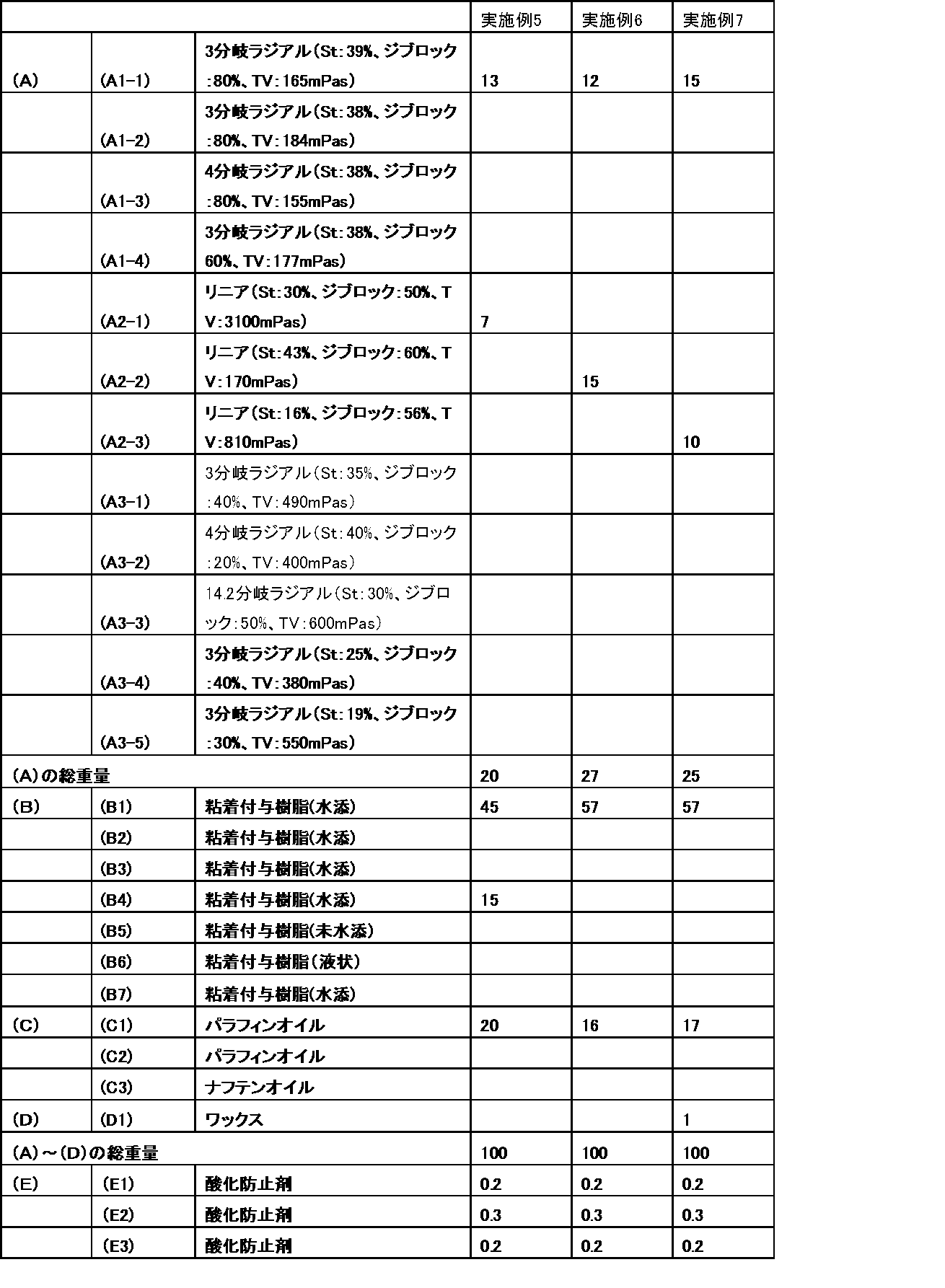
- Hot Melt Adhesives of Examples 1 to 7 and Comparative Examples 1 to 6 The components were blended in the weight ratios shown in Tables 1 to 4, and melt mixed at about 150 ° C. to prepare hot melt adhesives.
- St means the styrene content
- diblock means the diblock content
- TV means the viscosity of a 25 wt% toluene solution at 25 ° C.
- a hot melt adhesive was applied to a 50 ⁇ m thick PET film so as to have a thickness of 50 ⁇ m.
- This PET film was molded to a width of 2.5 cm to obtain a test body.
- a weight of 1 kg is applied vertically to the adhesion surface and below, It was left under the condition of 40 ° C. And time until the said 1 kg weight fell was measured, and this was made into retention strength.
- the test body was peeled off from the PE plate at a speed of 300 mm / min, the peel strength at that time was measured, and this was taken as a loop tack after one week.
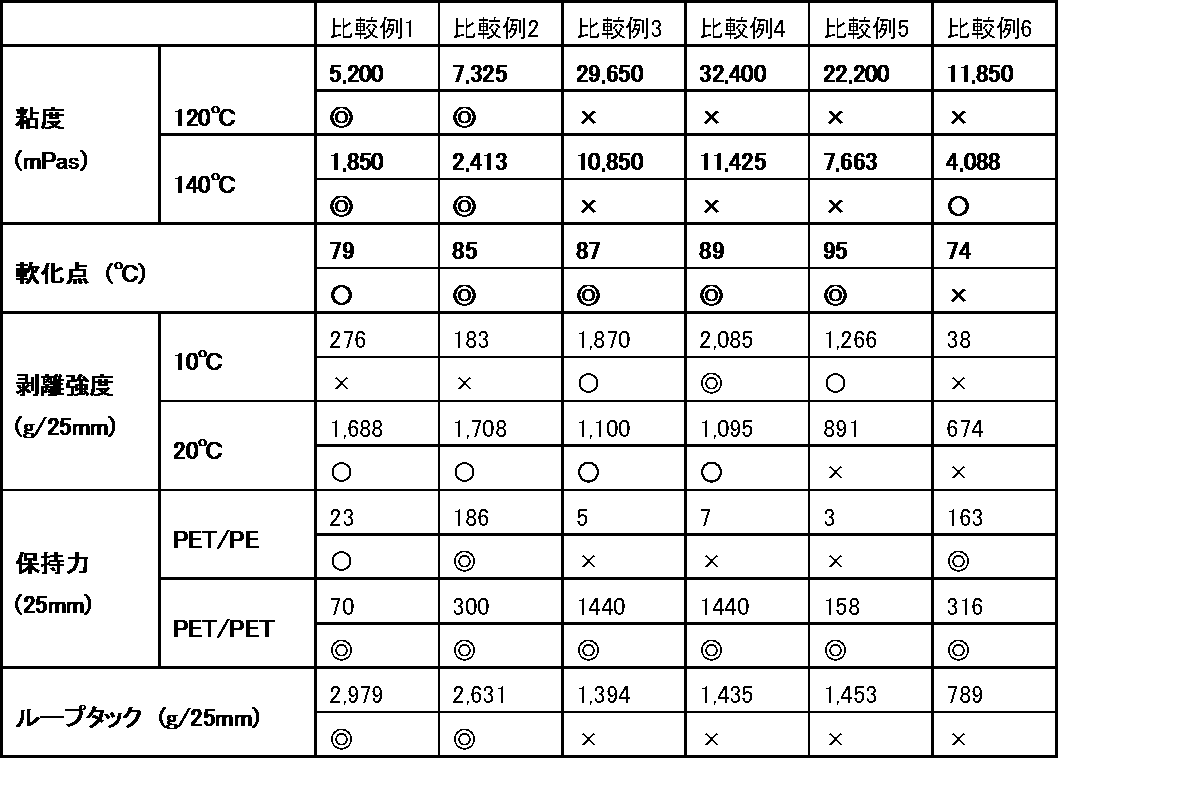
- the hot melt adhesives of the examples are excellent in melt viscosity, softening point, peel strength, holding force and loop tack because of containing the component (A1).
- the hot melt adhesive of the comparative example does not contain the component (A1), any of the performances is significantly inferior to the hot melt adhesive of the example.
- the hot melt adhesive improves the performance by containing (A1), and can be applied at a low temperature of 140 ° C. or lower when manufacturing a disposable product. Proven to be difficult to peel.
- the present invention provides a hot melt adhesive and a disposable product obtained by applying the hot melt adhesive.
- the hot melt adhesive according to the present invention is particularly suitable for producing disposable products.
Landscapes
- Chemical & Material Sciences (AREA)
- Organic Chemistry (AREA)
- Chemical Kinetics & Catalysis (AREA)
- Health & Medical Sciences (AREA)
- Medicinal Chemistry (AREA)
- Polymers & Plastics (AREA)
- Biomedical Technology (AREA)
- Engineering & Computer Science (AREA)
- Epidemiology (AREA)
- Heart & Thoracic Surgery (AREA)
- Vascular Medicine (AREA)
- Life Sciences & Earth Sciences (AREA)
- Animal Behavior & Ethology (AREA)
- General Health & Medical Sciences (AREA)
- Public Health (AREA)
- Veterinary Medicine (AREA)
- Adhesives Or Adhesive Processes (AREA)
Abstract
Description
(A)熱可塑性ブロック共重合体が(A1)スチレン含有率が35~45重量%、ジブロック含有率が50~90重量%、25重量%トルエン溶液の25℃での粘度が250mPa・s以下であるラジアル型スチレンブロック共重合体を含むホットメルト接着剤を提供する。
[式中、S及びEは上記と同意義である。]
尚、実施例の記載において、特に記載がない限り、溶媒を考慮しない部分を、重量部及び重量%の基準としている。
(A)熱可塑性ブロック共重合体
<(A1)ラジアル型スチレンブロック共重合体>
(A1-1)3分岐型スチレン-ブタジエンブロック共重合体(スチレン含有率 39重量%、ジブロック含有率 80重量%、25重量%トルエン溶液の25℃での粘度 165mPa・s HJ13(旭化成ケミカルズ社製))
(A1-2)3分岐型スチレン-ブタジエンブロック共重合体(スチレン含有率 38重量%、ジブロック含有率 80重量%、25重量%トルエン溶液の25℃での粘度 184mPa・s HJ12(旭化成ケミカルズ社製))
(A1-3)4分岐型スチレン-ブタジエンブロック共重合体(スチレン含有率 38重量%、ジブロック含有率 80重量%、25重量%トルエン溶液の25℃での粘度 155mPa・s HJ15(旭化成ケミカルズ社製))
(A1-4)3分岐型スチレン-ブタジエンブロック共重合体(スチレン含有率 38重量%、ジブロック含有率 60重量%、25重量%トルエン溶液の25℃での粘度 177mPa・s HJ10(旭化成ケミカルズ社製))
(A2-1)リニア型スチレン-ブタジエンブロック共重合体(スチレン含有率 30重量%、ジブロック含有率 50重量%、25重量%トルエン溶液の25℃での粘度 3100mPa・s アサプレンT432(旭化成ケミカルズ社製))
(A2-2)リニア型スチレン-ブタジエンブロック共重合体(スチレン含有率 43重量%、ジブロック含有率 60重量%、25重量%トルエン溶液の25℃での粘度 170mPa・s アサプレンT439(旭化成ケミカルズ社製))
(A2-3)リニア型スチレン-イソプレンブロック共重合体(スチレン含有率 16重量%、ジブロック含有率 56重量%、25重量%トルエン溶液の25℃での粘度 810mPa・s クインタック3433N(日本ゼオン社製))
(A3-1)3分岐型スチレン-ブタジエンブロック共重合体(スチレン含有率 35重量%、ジブロック含有率 40重量%、25重量%トルエン溶液の25℃での粘度490mPa・s JSR TR2500(JSR社製))
(A3-2)4分岐型スチレン-ブタジエンブロック共重合体(スチレン含有率 40重量%、ジブロック含有率 20重量%、25重量%トルエン溶液の25℃での粘度 400mPa・s SOlT6414(Enichem社製))
(A3-3)14.2分岐型スチレン-ブタジエンブロック共重合体(スチレン含有率 30重量%、ジブロック含有率 50重量%、25重量%トルエン溶液の25℃での粘度 600mPa・s ソルプレン9618(Dynasol社製))
(A3-4)3分岐型スチレン-イソプレンブロック共重合体(スチレン含有率 25重量%、ジブロック含有率 40重量%、25重量%トルエン溶液の25℃での粘度 380mPa・s クインタック3460(日本ゼオン社製))
(A3-5)3分岐型スチレン-イソプレンブロック共重合体(スチレン含有率 19重量%、ジブロック含有率 30重量%、25重量%トルエン溶液の25℃での粘度 550mPa・s クインタック3450(日本ゼオン社製))
(B1)水添粘着付与樹脂(ECR179EX(エクソンモービル社製))
(B2)水添粘着付与樹脂(アルコンM100(荒川化学社製))
(B3)水添粘着付与樹脂(アイマーブS100N(出光興産社製))
(B4)水添粘着付与樹脂(リガライトC6100L(イーストマンケミカル社製))
(B5)未水添粘着付与樹脂(クイントンDX390N(日本ゼオン社製))
(B6)液状粘着付与樹脂(マルカクリアH(丸善石油社製))
(B7)水添粘着付与樹脂(Plastolyn240(イーストマンケミカル社製))
(C1)パラフィンオイル(ダイアナフレシスS-32(出光興産社製))
(C2)パラフィンオイル(ダフニーオイルKP68(出光興産社製))
(C3)ナフテンオイル(プロセスオイルNS100(出光興産社製))
(C4)ナフテンオイル(KN4010(ペトロチャイナカンパニー社製))
(D1)無水マレイン酸変性ポリプロピレンワックス(リコセン TP MA6252(クラリアントジャパン社製))
(E1)フェノール系酸化防止剤(スミライザーGM(住友化学社製))
(E2)硫黄系酸化防止剤(スミライザーTPD(住友化学社製))
(E3)ベンゾトリアゾール系酸化防止剤(JF77(城北化学社製))
各成分を表1~4に示す重量割合で配合し、約150℃で溶融混合してホットメルト接着剤を作製した。尚、表1~4中、「St」はスチレン含有率、「ジブロック」はジブロック含有率、「TV」は25重量%トルエン溶液の25℃での粘度を意味する。



ホットメルト接着剤を加熱して溶融し、120℃及び140℃において、溶融状態の粘度をブルックフィールドRVT型粘度計(スピンドルNo.27)を用いて測定した。評価基準は以下のとおりである。


リング&ボール法 (日本接着剤工業会規格JAI-7-1999に規定された方法)でホットメルト接着剤の軟化点を測定した。

厚さが50μmのPETフィルムに、50μmの厚さでホットメルト接着剤を塗布した。これを2.5cm幅に成形して試験体とした。この試験体を100μmの厚さのポリエチレンフィルムに20℃で貼り合わせ、20℃で1日間放置した。その後、10℃、20℃において300mm/分の引張速度で剥離を行い、剥離強度を測定した。

厚さが50μmのPETフィルムに、50μmの厚さとなるようにホットメルト接着剤を塗布した。このPETフィルムを2.5cm幅に成形して試験体とした。この試験体に、接着面積が1.0cm×2.5cmとなるように100μmの厚さのポリエチレンフィルムを20℃にて貼り合わせた後、接着面と下に垂直方向に1kgのおもりをかけ、40℃の条件下に放置した。そして、上記1kgおもりが落下するまでの時間を測定し、これを保持力とした。

厚さが50μmのPETフィルムに、50μmの厚さとなるようにホットメルト接着剤を塗布した。このPETフィルムを2.5cm×10cmのサイズに成形して試験体とした。この試験体を、粘着面(接着剤塗布面)が外側となるようにループ状に巻回し、これを、PE板に対し、20℃で300mm/分の速度で接触させた。その後、300mm/分の速度で試験体をPE板から引きはがし、その時の引きはがし強度を測定し、これを初期のループタックとした。また、上述の試験体を20℃で一週間保管した後、PE板に対し、20℃で300mm/分の速度で接触させた。その後、300mm/分の速度で試験体をPE板から引きはがし、その時の引きはがし強度を測定し、これを一週間後のループタックとした。


Claims (4)
- (A)ビニル系芳香族炭化水素と共役ジエン化合物との共重合体である熱可塑性ブロック共重合体を含んで成るホットメルト接着剤であって、
(A)熱可塑性ブロック共重合体が(A1)スチレン含有率が35~45重量%、ジブロック含有率が50~90重量%、25重量%トルエン溶液の25℃での粘度が250mPa・s以下であるラジアル型スチレンブロック共重合体を含むホットメルト接着剤。 - (A1)ラジアル型スチレンブロック共重合体は、3分岐型および4分岐型からなる群から選択される少なくとも1種である請求項1に記載のホットメルト接着剤。
- (A)熱可塑性ブロック共重合体は、さらに、(A2)リニア型スチレンブロック共重合体を含む請求項1または2に記載のホットメルト接着剤。
- 請求項1~3のいずれか一項に記載のホットメルト接着剤を塗工して得られることを特徴とする使い捨て製品。
Priority Applications (12)
| Application Number | Priority Date | Filing Date | Title |
|---|---|---|---|
| ES14774177T ES2703939T3 (es) | 2013-03-26 | 2014-03-25 | Adhesivo de fusión en caliente |
| CN201480017365.3A CN105143386B (zh) | 2013-03-26 | 2014-03-25 | 热熔性粘合剂 |
| CA2908214A CA2908214C (en) | 2013-03-26 | 2014-03-25 | Hot-melt adhesive agent |
| RU2015145462A RU2662714C2 (ru) | 2013-03-26 | 2014-03-25 | Термоплавкое клеящее средство |
| BR112015023943A BR112015023943A2 (pt) | 2013-03-26 | 2014-03-25 | agente adesivo fundido a quente |
| EP18199026.8A EP3498800A1 (en) | 2013-03-26 | 2014-03-25 | Hot-melt adhesive agent |
| EP14774177.1A EP2980179B1 (en) | 2013-03-26 | 2014-03-25 | Hot-melt adhesive |
| KR1020157026619A KR102204767B1 (ko) | 2013-03-26 | 2014-03-25 | 핫-멜트 접착제 |
| MX2015013704A MX374115B (es) | 2013-03-26 | 2014-03-25 | Agente adhesivo termoplastico. |
| US14/865,004 US9765245B2 (en) | 2013-03-26 | 2015-09-25 | Hot melt adhesive |
| US15/598,426 US10138400B2 (en) | 2013-03-26 | 2017-05-18 | Hot melt adhesive |
| US16/167,812 US10513642B2 (en) | 2013-03-26 | 2018-10-23 | Hot melt adhesive |
Applications Claiming Priority (2)
| Application Number | Priority Date | Filing Date | Title |
|---|---|---|---|
| JP2013-064483 | 2013-03-26 | ||
| JP2013064483A JP6001483B2 (ja) | 2013-03-26 | 2013-03-26 | ホットメルト接着剤 |
Related Child Applications (1)
| Application Number | Title | Priority Date | Filing Date |
|---|---|---|---|
| US14/865,004 Continuation US9765245B2 (en) | 2013-03-26 | 2015-09-25 | Hot melt adhesive |
Publications (1)
| Publication Number | Publication Date |
|---|---|
| WO2014157220A1 true WO2014157220A1 (ja) | 2014-10-02 |
Family
ID=51624189
Family Applications (1)
| Application Number | Title | Priority Date | Filing Date |
|---|---|---|---|
| PCT/JP2014/058318 Ceased WO2014157220A1 (ja) | 2013-03-26 | 2014-03-25 | ホットメルト接着剤 |
Country Status (12)
| Country | Link |
|---|---|
| US (3) | US9765245B2 (ja) |
| EP (2) | EP2980179B1 (ja) |
| JP (1) | JP6001483B2 (ja) |
| KR (1) | KR102204767B1 (ja) |
| CN (1) | CN105143386B (ja) |
| BR (1) | BR112015023943A2 (ja) |
| CA (1) | CA2908214C (ja) |
| ES (1) | ES2703939T3 (ja) |
| MX (1) | MX374115B (ja) |
| RU (1) | RU2662714C2 (ja) |
| TR (1) | TR201819994T4 (ja) |
| WO (1) | WO2014157220A1 (ja) |
Cited By (3)
| Publication number | Priority date | Publication date | Assignee | Title |
|---|---|---|---|---|
| WO2016031170A1 (en) * | 2014-08-26 | 2016-03-03 | Henkel Ag & Co. Kgaa | Hot-melt adhesive agent |
| RU2706621C2 (ru) * | 2015-02-20 | 2019-11-19 | Хенкель Аг Унд Ко. Кгаа | Термоплавкий клей и одноразовое изделие |
| CN114787313A (zh) * | 2019-12-13 | 2022-07-22 | 汉高股份有限及两合公司 | 碱分散性热熔压敏粘合剂 |
Families Citing this family (14)
| Publication number | Priority date | Publication date | Assignee | Title |
|---|---|---|---|---|
| JP5995314B2 (ja) * | 2012-03-16 | 2016-09-21 | 日東電工株式会社 | 粘着剤組成物および粘着シート |
| JP6001483B2 (ja) | 2013-03-26 | 2016-10-05 | ヘンケルジャパン株式会社 | ホットメルト接着剤 |
| JP6001493B2 (ja) * | 2013-04-23 | 2016-10-05 | ヘンケルジャパン株式会社 | ホットメルト接着剤 |
| JP6023001B2 (ja) | 2013-05-22 | 2016-11-09 | ヘンケルジャパン株式会社 | ホットメルト接着剤 |
| MX383789B (es) | 2014-01-23 | 2025-03-14 | Asahi Chemical Ind | Composicion de copolimero de bloque y composicion adhesiva. |
| JP6290693B2 (ja) * | 2014-04-14 | 2018-03-07 | 綜研化学株式会社 | 偏光板用粘着剤組成物、粘着剤層、粘着シートおよび粘着剤層付き偏光板 |
| JP6421004B2 (ja) * | 2014-09-24 | 2018-11-07 | ヘンケルジャパン株式会社 | ホットメルト接着剤 |
| EP3339390A1 (en) * | 2016-12-21 | 2018-06-27 | Bostik Sa | Hot-melt adhesive composition for elastic attachments |
| CN110461979B (zh) * | 2017-03-30 | 2021-11-19 | 昭和电工材料株式会社 | 粘接剂组合物 |
| JP7433787B2 (ja) * | 2019-07-02 | 2024-02-20 | 積水フーラー株式会社 | ホットメルト接着剤 |
| CN110649444B (zh) * | 2019-08-30 | 2021-07-23 | 惠州市恒泰科技股份有限公司 | 一种锂电池导线外露线头绝缘生产工艺 |
| JP7532100B2 (ja) * | 2020-06-08 | 2024-08-13 | 旭化成株式会社 | 制電性樹脂組成物、制電性樹脂組成物の製造方法、及び電子部品包装材 |
| WO2022039108A1 (ja) * | 2020-08-20 | 2022-02-24 | デンカ株式会社 | 粘着テ-プ及びその製造方法 |
| CN119019695B (zh) * | 2023-05-23 | 2026-08-11 | 中国石油天然气股份有限公司 | 星型接枝改性液体丁苯橡胶及其制备方法和应用 |
Citations (6)
| Publication number | Priority date | Publication date | Assignee | Title |
|---|---|---|---|---|
| JPS6210163A (ja) * | 1985-07-08 | 1987-01-19 | Mitsubishi Gas Chem Co Inc | 耐衝撃性ポリフエニレンエ−テル系樹脂組成物 |
| JPH05311138A (ja) | 1992-05-07 | 1993-11-22 | Sekisui Chem Co Ltd | ホットメルト接着剤 |
| JP2004137297A (ja) | 2002-10-15 | 2004-05-13 | Nippon Nsc Ltd | ホットメルト接着剤及びそれを用いた使い捨て製品 |
| JP2006008947A (ja) | 2004-06-29 | 2006-01-12 | Sekisui Chem Co Ltd | ホットメルト接着剤 |
| JP2010536957A (ja) | 2007-08-17 | 2010-12-02 | ヘンケル・アクチェンゲゼルシャフト・ウント・コムパニー・コマンディットゲゼルシャフト・アウフ・アクチェン | スチレン・ブタジエンブロックコポリマー含有ホットメルト接着剤 |
| JP2012021078A (ja) * | 2010-07-14 | 2012-02-02 | Asahi Kasei Chemicals Corp | 粘接着剤用ポリマー組成物及び粘接着剤組成物 |
Family Cites Families (31)
| Publication number | Priority date | Publication date | Assignee | Title |
|---|---|---|---|---|
| JPH0715089B2 (ja) * | 1988-04-19 | 1995-02-22 | 日本ゼオン株式会社 | 粘着剤用ブロック共重合体組成物及び粘着剤組成物 |
| US4944993A (en) * | 1988-08-17 | 1990-07-31 | National Starch And Investment Holding Corporation | Toughened rubber based hot melt adhesive compositions for disposable applications |
| US5024667A (en) * | 1988-11-07 | 1991-06-18 | H. B. Fuller Licensing & Financing, Inc. | Disposable article construction |
| JP3219852B2 (ja) | 1992-06-02 | 2001-10-15 | 東芝ケミカル株式会社 | 導電性ペースト |
| JP3207577B2 (ja) | 1993-01-20 | 2001-09-10 | 三菱重工業株式会社 | 炭化水素の吸着剤及び吸着浄化方法 |
| IT1265225B1 (it) * | 1993-11-26 | 1996-10-31 | Enichem Elastomeri Srl | Composizioni adesive hot meli per applicazioni speciali a base di copolimeri a blocchi |
| GB2310859A (en) | 1996-03-08 | 1997-09-10 | Shell Int Research | Adhesive compositions comprising block copolymers |
| US5916959A (en) * | 1996-03-29 | 1999-06-29 | H.B. Fuller Licensing & Financing, Inc. | Radial styrene-isoprene-styrene based hot melt pressure sensitive adhesive |
| JP2806875B2 (ja) * | 1996-04-26 | 1998-09-30 | 日本エヌエスシー株式会社 | ホットメルト接着剤組成物及びその製造方法 |
| JP4130983B2 (ja) | 1996-10-30 | 2008-08-13 | 日本ゼオン株式会社 | 芳香族ビニル−イソプレンブロック共重合体混合物、その製法、およびそれを含む粘接着剤組成物 |
| US6184285B1 (en) | 1997-12-04 | 2001-02-06 | Henkel Corporation | Hot melt construction adhesives for disposable articles |
| JP2000282006A (ja) | 1998-10-29 | 2000-10-10 | Sekisui Chem Co Ltd | ホットメルト接着剤組成物 |
| JP4497579B2 (ja) | 1999-04-27 | 2010-07-07 | 日本エラストマー株式会社 | 新規な粘接着剤組成物 |
| GB0123027D0 (en) | 2001-09-25 | 2001-11-14 | Exxonmobil Chem Patents Inc | Adhesives based on radial block copolymers with improved die-cutting performance |
| JP4518742B2 (ja) | 2003-02-07 | 2010-08-04 | 日本エラストマー株式会社 | 新規な粘接着剤組成物 |
| US20050182194A1 (en) | 2004-02-13 | 2005-08-18 | Qiwei He | Adhesive containing radial block copolymer |
| US8465844B2 (en) | 2004-02-13 | 2013-06-18 | Henkel Ag & Co. Kgaa | Elastic attachment adhesive containing radial block copolymer |
| US7307124B2 (en) | 2004-02-19 | 2007-12-11 | Kraton Polymers U.S. Llc | Hot-melt adhesive composition for non-wovens |
| JP2006182839A (ja) * | 2004-12-27 | 2006-07-13 | Nippon Zeon Co Ltd | 芳香族ビニル化合物−イソプレンブロック共重合体組成物及び粘・接着剤組成物 |
| US20070088116A1 (en) | 2005-10-14 | 2007-04-19 | Fabienne Abba | Low application temperature hot melt adhesive |
| US7816448B2 (en) | 2006-09-19 | 2010-10-19 | H.B. Fuller Company | High shear pressure sensitive adhesive composition |
| US20080081858A1 (en) | 2006-10-02 | 2008-04-03 | Genta Okazaki | High styrene SBS hot melt adhesive |
| EP2094801B2 (en) * | 2006-12-07 | 2017-02-22 | 3M Innovative Properties Company | Block copolymer blend adhesives with multiple tackifiers |
| US20080153971A1 (en) | 2006-12-21 | 2008-06-26 | Kraton Polymers U.S. Llc | Solvent sprayable contact adhesive formulations from (S-I/B)x polymers |
| JP5527220B2 (ja) * | 2008-12-26 | 2014-06-18 | 日本ゼオン株式会社 | ブロック共重合体組成物およびホットメルト粘接着剤組成物 |
| US8324309B2 (en) * | 2010-04-27 | 2012-12-04 | Kraton Polymers Us Llc | High melt flow block copolymers for non-woven adhesives |
| US20130030096A1 (en) | 2011-07-25 | 2013-01-31 | Christian Lietzau | Flame retardant poly(arylene ether)-polysiloxane block copolymer composition and article |
| KR20150028993A (ko) | 2012-07-25 | 2015-03-17 | 아사히 가세이 케미칼즈 가부시키가이샤 | 점접착제용 블록 공중합체 조성물 및 점접착제 조성물 |
| JP6001483B2 (ja) | 2013-03-26 | 2016-10-05 | ヘンケルジャパン株式会社 | ホットメルト接着剤 |
| JP6001493B2 (ja) | 2013-04-23 | 2016-10-05 | ヘンケルジャパン株式会社 | ホットメルト接着剤 |
| JP6023001B2 (ja) * | 2013-05-22 | 2016-11-09 | ヘンケルジャパン株式会社 | ホットメルト接着剤 |
-
2013
- 2013-03-26 JP JP2013064483A patent/JP6001483B2/ja active Active
-
2014
- 2014-03-25 CA CA2908214A patent/CA2908214C/en not_active Expired - Fee Related
- 2014-03-25 MX MX2015013704A patent/MX374115B/es active IP Right Grant
- 2014-03-25 TR TR2018/19994T patent/TR201819994T4/tr unknown
- 2014-03-25 KR KR1020157026619A patent/KR102204767B1/ko active Active
- 2014-03-25 BR BR112015023943A patent/BR112015023943A2/pt active Search and Examination
- 2014-03-25 EP EP14774177.1A patent/EP2980179B1/en active Active
- 2014-03-25 CN CN201480017365.3A patent/CN105143386B/zh active Active
- 2014-03-25 EP EP18199026.8A patent/EP3498800A1/en not_active Withdrawn
- 2014-03-25 WO PCT/JP2014/058318 patent/WO2014157220A1/ja not_active Ceased
- 2014-03-25 RU RU2015145462A patent/RU2662714C2/ru active
- 2014-03-25 ES ES14774177T patent/ES2703939T3/es active Active
-
2015
- 2015-09-25 US US14/865,004 patent/US9765245B2/en active Active
-
2017
- 2017-05-18 US US15/598,426 patent/US10138400B2/en active Active
-
2018
- 2018-10-23 US US16/167,812 patent/US10513642B2/en active Active
Patent Citations (6)
| Publication number | Priority date | Publication date | Assignee | Title |
|---|---|---|---|---|
| JPS6210163A (ja) * | 1985-07-08 | 1987-01-19 | Mitsubishi Gas Chem Co Inc | 耐衝撃性ポリフエニレンエ−テル系樹脂組成物 |
| JPH05311138A (ja) | 1992-05-07 | 1993-11-22 | Sekisui Chem Co Ltd | ホットメルト接着剤 |
| JP2004137297A (ja) | 2002-10-15 | 2004-05-13 | Nippon Nsc Ltd | ホットメルト接着剤及びそれを用いた使い捨て製品 |
| JP2006008947A (ja) | 2004-06-29 | 2006-01-12 | Sekisui Chem Co Ltd | ホットメルト接着剤 |
| JP2010536957A (ja) | 2007-08-17 | 2010-12-02 | ヘンケル・アクチェンゲゼルシャフト・ウント・コムパニー・コマンディットゲゼルシャフト・アウフ・アクチェン | スチレン・ブタジエンブロックコポリマー含有ホットメルト接着剤 |
| JP2012021078A (ja) * | 2010-07-14 | 2012-02-02 | Asahi Kasei Chemicals Corp | 粘接着剤用ポリマー組成物及び粘接着剤組成物 |
Non-Patent Citations (1)
| Title |
|---|
| See also references of EP2980179A4 |
Cited By (5)
| Publication number | Priority date | Publication date | Assignee | Title |
|---|---|---|---|---|
| WO2016031170A1 (en) * | 2014-08-26 | 2016-03-03 | Henkel Ag & Co. Kgaa | Hot-melt adhesive agent |
| US20170166788A1 (en) * | 2014-08-26 | 2017-06-15 | Henkel Ag & Co. Kgaa | Hot-melt adhesive agent |
| RU2706621C2 (ru) * | 2015-02-20 | 2019-11-19 | Хенкель Аг Унд Ко. Кгаа | Термоплавкий клей и одноразовое изделие |
| CN114787313A (zh) * | 2019-12-13 | 2022-07-22 | 汉高股份有限及两合公司 | 碱分散性热熔压敏粘合剂 |
| US12173206B2 (en) | 2019-12-13 | 2024-12-24 | Henkel Ag & Co. Kgaa | Alkali-dispersible hot melt pressure-sensitive adhesive |
Also Published As
| Publication number | Publication date |
|---|---|
| US20190055438A1 (en) | 2019-02-21 |
| MX374115B (es) | 2025-03-05 |
| CA2908214A1 (en) | 2014-10-02 |
| ES2703939T3 (es) | 2019-03-13 |
| RU2662714C2 (ru) | 2018-07-27 |
| EP3498800A1 (en) | 2019-06-19 |
| JP6001483B2 (ja) | 2016-10-05 |
| EP2980179A1 (en) | 2016-02-03 |
| MX2015013704A (es) | 2016-02-26 |
| CN105143386A (zh) | 2015-12-09 |
| US20160009966A1 (en) | 2016-01-14 |
| TR201819994T4 (tr) | 2019-01-21 |
| CN105143386B (zh) | 2017-07-11 |
| BR112015023943A2 (pt) | 2017-07-18 |
| US10138400B2 (en) | 2018-11-27 |
| US9765245B2 (en) | 2017-09-19 |
| US20170253778A1 (en) | 2017-09-07 |
| CA2908214C (en) | 2021-02-16 |
| EP2980179A4 (en) | 2016-11-09 |
| KR102204767B1 (ko) | 2021-01-18 |
| JP2014189584A (ja) | 2014-10-06 |
| KR20150135316A (ko) | 2015-12-02 |
| US10513642B2 (en) | 2019-12-24 |
| EP2980179B1 (en) | 2018-10-10 |
| RU2015145462A (ru) | 2017-05-02 |
Similar Documents
| Publication | Publication Date | Title |
|---|---|---|
| JP6001483B2 (ja) | ホットメルト接着剤 | |
| JP6023001B2 (ja) | ホットメルト接着剤 | |
| JP6001493B2 (ja) | ホットメルト接着剤 | |
| JP4436599B2 (ja) | ホットメルト接着剤及びそれを用いた使い捨て製品 | |
| KR20170118751A (ko) | 핫 멜트 접착제 및 일회용 제품 | |
| JP6383609B2 (ja) | ホットメルト接着剤 | |
| WO2023022193A1 (en) | Hot melt adhesive |
Legal Events
| Date | Code | Title | Description |
|---|---|---|---|
| WWE | Wipo information: entry into national phase |
Ref document number: 201480017365.3 Country of ref document: CN |
|
| 121 | Ep: the epo has been informed by wipo that ep was designated in this application |
Ref document number: 14774177 Country of ref document: EP Kind code of ref document: A1 |
|
| ENP | Entry into the national phase |
Ref document number: 20157026619 Country of ref document: KR Kind code of ref document: A |
|
| ENP | Entry into the national phase |
Ref document number: 2908214 Country of ref document: CA |
|
| WWE | Wipo information: entry into national phase |
Ref document number: MX/A/2015/013704 Country of ref document: MX |
|
| NENP | Non-entry into the national phase |
Ref country code: DE |
|
| WWE | Wipo information: entry into national phase |
Ref document number: 2014774177 Country of ref document: EP |
|
| ENP | Entry into the national phase |
Ref document number: 2015145462 Country of ref document: RU Kind code of ref document: A |
|
| REG | Reference to national code |
Ref country code: BR Ref legal event code: B01A Ref document number: 112015023943 Country of ref document: BR |
|
| ENP | Entry into the national phase |
Ref document number: 112015023943 Country of ref document: BR Kind code of ref document: A2 Effective date: 20150917 |